




NCERT Handwritten Notes for Class 12 English (Suppl.) Chapter 15 Kaleidoscope: The Mark on the Wall help students revise Virginia Woolf's modernist essay through clear handwritten revision points, thought-flow charts and NCERT answer cues for the 2026-27 reprint.
- Resource: Class 12 English Supplementary Chapter 15 handwritten revision notes PDF.
- Chapter focus: Woolf, stream of consciousness, the mark, self-image, social rules, reality and the snail.
- Revision use: quick summary, theme map, style notes and short answer frames.
The fastest revision route is: mark, mind-flow, social rules and snail.
Chapter15Kaleidoscope:TheMarkontheWallHandwrittenNotes.pdf?page=1&dpi=150)
Chapter15Kaleidoscope:TheMarkontheWallHandwrittenNotes.pdf?page=2&dpi=150)
Chapter15Kaleidoscope:TheMarkontheWallHandwrittenNotes.pdf?page=3&dpi=150)
Chapter15Kaleidoscope:TheMarkontheWallHandwrittenNotes.pdf?page=4&dpi=150)
Chapter15Kaleidoscope:TheMarkontheWallHandwrittenNotes.pdf?page=5&dpi=150)
Chapter15Kaleidoscope:TheMarkontheWallHandwrittenNotes.pdf?page=6&dpi=150)
Chapter15Kaleidoscope:TheMarkontheWallHandwrittenNotes.pdf?page=7&dpi=150)
Chapter15Kaleidoscope:TheMarkontheWallHandwrittenNotes.pdf?page=8&dpi=150)
Chapter15Kaleidoscope:TheMarkontheWallHandwrittenNotes.pdf?page=9&dpi=150)
Chapter15Kaleidoscope:TheMarkontheWallHandwrittenNotes.pdf?page=10&dpi=150)
Chapter15Kaleidoscope:TheMarkontheWallHandwrittenNotes.pdf?page=11&dpi=150)
Chapter15Kaleidoscope:TheMarkontheWallHandwrittenNotes.pdf?page=12&dpi=150)
Chapter15Kaleidoscope:TheMarkontheWallHandwrittenNotes.pdf?page=13&dpi=150)
Chapter15Kaleidoscope:TheMarkontheWallHandwrittenNotes.pdf?page=14&dpi=150)
Chapter15Kaleidoscope:TheMarkontheWallHandwrittenNotes.pdf?page=15&dpi=150)
Chapter15Kaleidoscope:TheMarkontheWallHandwrittenNotes.pdf?page=16&dpi=150)
Chapter15Kaleidoscope:TheMarkontheWallHandwrittenNotes.pdf?page=17&dpi=150)
Chapter15Kaleidoscope:TheMarkontheWallHandwrittenNotes.pdf?page=18&dpi=150)
Chapter15Kaleidoscope:TheMarkontheWallHandwrittenNotes.pdf?page=19&dpi=150)
Chapter15Kaleidoscope:TheMarkontheWallHandwrittenNotes.pdf?page=20&dpi=150)
Chapter15Kaleidoscope:TheMarkontheWallHandwrittenNotes.pdf?page=21&dpi=150)
Chapter15Kaleidoscope:TheMarkontheWallHandwrittenNotes.pdf?page=22&dpi=150)
Student Feedback: Students usually revise this chapter faster when they track the thought-flow first, then connect the final snail reveal with Woolf's method.
The Mark on the Wall Handwritten Notes Overview
The Mark on the Wall begins with a small black mark seen above the mantelpiece. Woolf turns that ordinary detail into a record of thought, memory, imagination, social rules and reality. The handwritten notes help students revise the chapter without losing the essay's movement.
The chapter is best understood as a modernist prose piece. The wall mark acts as an anchor, while the narrator's mind moves through guesses, memories and reflections before the ordinary fact of the snail appears.
The Mark on the Wall Thought Flow
The easiest way to revise the essay is to follow the narrator's movement from a physical object to inner reflection and back to the physical world.
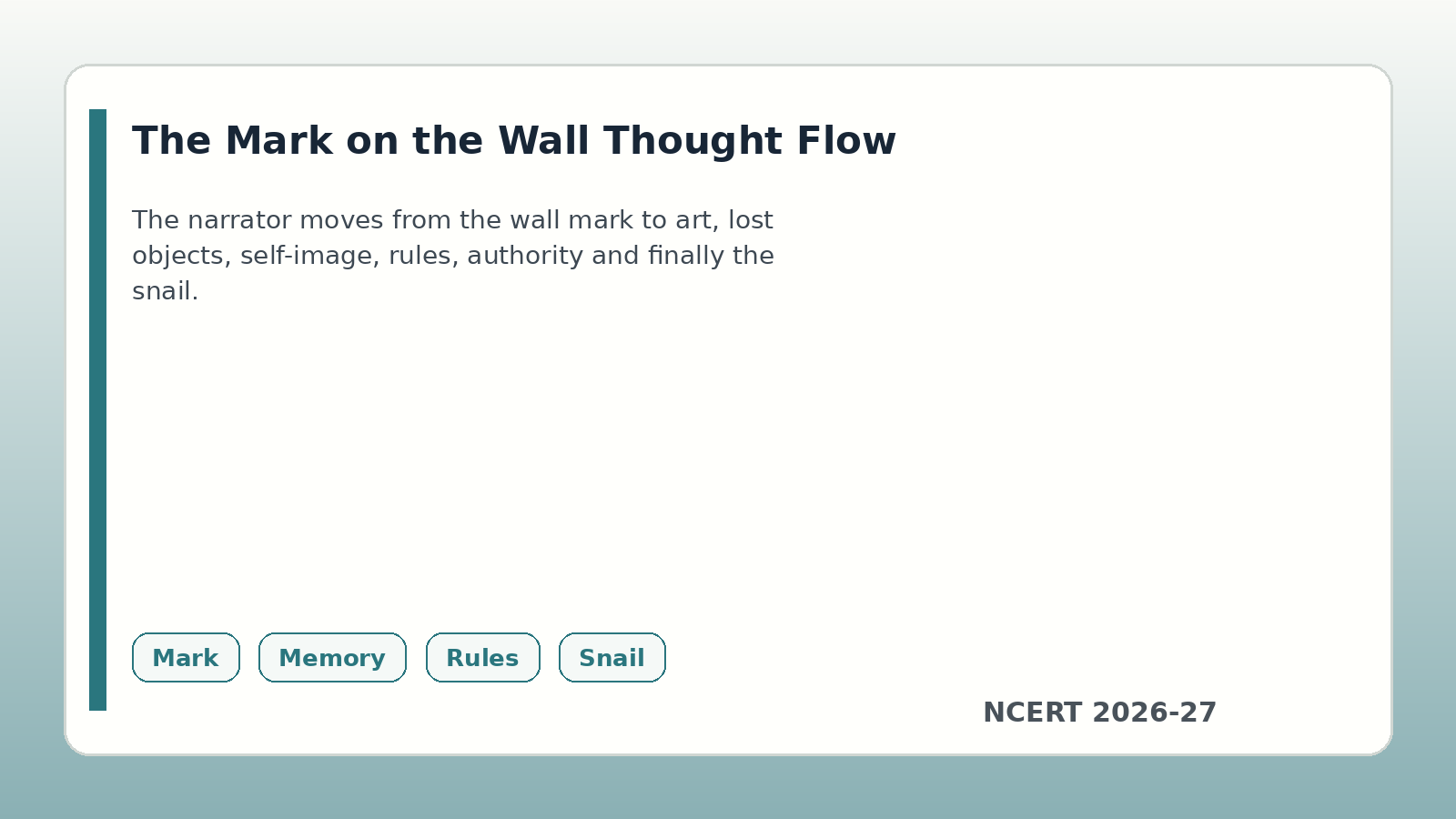
| Stage | What happens | Answer cue |
|---|---|---|
| Wall mark | The narrator sees a small black round mark above the mantelpiece. | Use it as the trigger for thought. |
| Associations | The mind moves to pictures, former tenants, lost objects and after-life images. | Show free mental movement. |
| Social reflection | The essay turns toward rules, self-image and authority. | Connect private thought with social criticism. |
| Snail reveal | The mark is finally identified as a snail. | Explain reality interrupting imagination. |
The Mark on the Wall Explanation Video
Source: Magnet Brains on YouTube
Mark, Mind and Reality in Woolf's Essay
Woolf's essay contrasts one small object with the wide movement of the narrator's mind. The mark stays almost still, but the mind travels through art, history, identity, rules and authority.
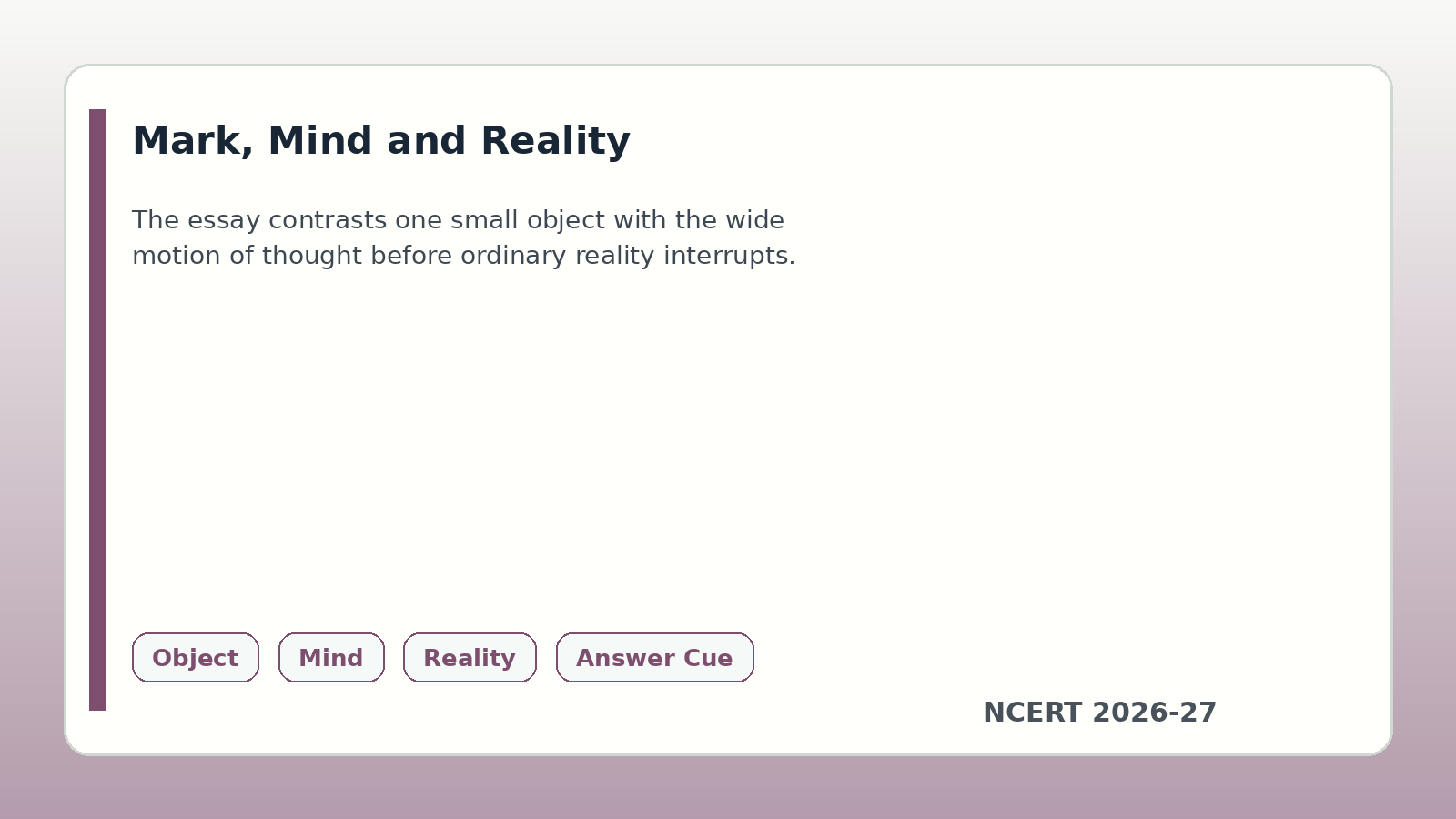
| Point | Meaning | Use in answers |
|---|---|---|
| The mark | A small anchor for perception and uncertainty. | Begin summary answers here. |
| The mind | A flowing chain of guesses and associations. | Use for stream of consciousness. |
| Rules and authority | Old standards appear less solid than they once seemed. | Use for social reflection. |
| The snail | A plain fact that stops the private thought-flow. | Use for the ending. |
Themes and Style in The Mark on the Wall
The handwritten notes mark the ideas students need for short and long answers. Woolf's style matters as much as the plot because the chapter is about how thought happens.
- Stream of consciousness: thought moves by association, not by a straight plot.
- Uncertainty: the narrator delays checking the mark, so imagination stays active.
- Reality and imagination: the snail is ordinary, but the thinking around it is rich.
- Social criticism: rules, rank and the masculine point of view appear as fading phantoms.
How to Use the The Mark on the Wall Handwritten Notes PDF
Use the PDF for quick revision before class tests or board-style practice. First revise the thought-flow chart, then read the pages on the snail reveal, stream of consciousness and Language Work.
- Use the opening pages for summary and central idea answers.
- Use the stream-of-consciousness pages for style questions.
- Use the Language Work page for loose sentences and content words.
- Use the common mistakes page before writing long answers.
Related Class 12 English Supplementary Resources
Use these related resources with the handwritten notes for full chapter preparation.
| Resource | Best use | Link |
|---|---|---|
| NCERT Solutions | Step-by-step answers for The Mark on the Wall | Open solutions |
| NCERT Notes | Typed revision notes for the same chapter | Open notes |
| NCERT Book PDF | Official chapter reading | Open book PDF |
All Class 12 English Supplementary Handwritten Notes
The table below keeps the same resource type together, so students can move chapter by chapter through the Class 12 English Supplementary Kaleidoscope handwritten notes.
| Chapter | Title | Handwritten notes link |
|---|---|---|
| Chapter 11 | The Wild Swans at Coole | Open handwritten notes |
| Chapter 12 | Time and Time Again | Open handwritten notes |
| Chapter 13 | Blood | Open handwritten notes |
| Chapter 14 | Freedom | Open handwritten notes |
| Chapter 15 | The Mark on the Wall | Open handwritten notes |
The Mark on the Wall Class 12 English Handwritten Notes FAQs
Ques. What do The Mark on the Wall handwritten notes cover?
Ans. The notes cover Virginia Woolf, the wall mark, stream of consciousness, the narrator's thought-flow, social reflection, the snail reveal and NCERT answer cues for 2026-27.
Ques. What is stream of consciousness in The Mark on the Wall?
Ans. It is Woolf's method of recording thought as it moves through memory, guesses, images and interruptions instead of following a straight plot.
Ques. Why is the snail important in The Mark on the Wall?
Ans. The snail gives the plain reality behind the mark and interrupts the narrator's long chain of imaginative reflection.
Ques. Are these notes aligned with the 2026-27 NCERT book?
Ans. Yes. The notes are prepared for Class 12 English Supplementary Kaleidoscope Chapter 15 The Mark on the Wall in the 2026-27 NCERT reprint.



Comments