




NCERT Handwritten Notes for Class 12 English (Suppl.) Chapter 16 Kaleidoscope: Film-Making help students revise Ingmar Bergman's ideas on cinema, rhythm, imagination, screenplay writing and book-to-film adaptation for the 2026-27 NCERT reprint.
- Resource: Class 12 English Supplementary Chapter 16 handwritten revision notes PDF.
- Chapter focus: Bergman's childhood memories, the conjurer idea, screenplay difficulty, rhythm, literature and Eco's interview.
- Revision use: short theme pages, NCERT answer pointers, comparison notes and last-minute recall.
Chapter16Kaleidoscope:Film-MakingHandwrittenNotes.pdf?page=1&dpi=150)
Chapter16Kaleidoscope:Film-MakingHandwrittenNotes.pdf?page=2&dpi=150)
Chapter16Kaleidoscope:Film-MakingHandwrittenNotes.pdf?page=3&dpi=150)
Chapter16Kaleidoscope:Film-MakingHandwrittenNotes.pdf?page=4&dpi=150)
Chapter16Kaleidoscope:Film-MakingHandwrittenNotes.pdf?page=5&dpi=150)
Chapter16Kaleidoscope:Film-MakingHandwrittenNotes.pdf?page=6&dpi=150)
Chapter16Kaleidoscope:Film-MakingHandwrittenNotes.pdf?page=7&dpi=150)
Chapter16Kaleidoscope:Film-MakingHandwrittenNotes.pdf?page=8&dpi=150)
Chapter16Kaleidoscope:Film-MakingHandwrittenNotes.pdf?page=9&dpi=150)
Chapter16Kaleidoscope:Film-MakingHandwrittenNotes.pdf?page=10&dpi=150)
Chapter16Kaleidoscope:Film-MakingHandwrittenNotes.pdf?page=11&dpi=150)
Chapter16Kaleidoscope:Film-MakingHandwrittenNotes.pdf?page=12&dpi=150)
Chapter16Kaleidoscope:Film-MakingHandwrittenNotes.pdf?page=13&dpi=150)
Chapter16Kaleidoscope:Film-MakingHandwrittenNotes.pdf?page=14&dpi=150)
Chapter16Kaleidoscope:Film-MakingHandwrittenNotes.pdf?page=15&dpi=150)
Chapter16Kaleidoscope:Film-MakingHandwrittenNotes.pdf?page=16&dpi=150)
Chapter16Kaleidoscope:Film-MakingHandwrittenNotes.pdf?page=17&dpi=150)
Chapter16Kaleidoscope:Film-MakingHandwrittenNotes.pdf?page=18&dpi=150)
Chapter16Kaleidoscope:Film-MakingHandwrittenNotes.pdf?page=19&dpi=150)
Chapter16Kaleidoscope:Film-MakingHandwrittenNotes.pdf?page=20&dpi=150)
Chapter16Kaleidoscope:Film-MakingHandwrittenNotes.pdf?page=21&dpi=150)
Chapter16Kaleidoscope:Film-MakingHandwrittenNotes.pdf?page=22&dpi=150)
Student Feedback: 12,420 students in a Collegedunia English revision poll said this chapter becomes easier when Bergman's ideas are grouped as memory, craft, rhythm and viewer response.
Film-Making Handwritten Notes Overview
The Film-Making handwritten notes explain how Ingmar Bergman sees cinema as a mix of memory, image, rhythm, teamwork and emotional response. The PDF also covers Umberto Eco's comments on book-to-film adaptation, so students can compare both views in NCERT answers.
The notes are built for quick revision. They turn long reflective passages into short cues on childhood memories, the magic lantern, split-second impressions, screenplay writing, montage, music and the cathedral image.
Film-Making Process Flow for Quick Revision
Bergman does not describe cinema as a simple written story. He begins with a mood and slowly turns it into a film through craft.
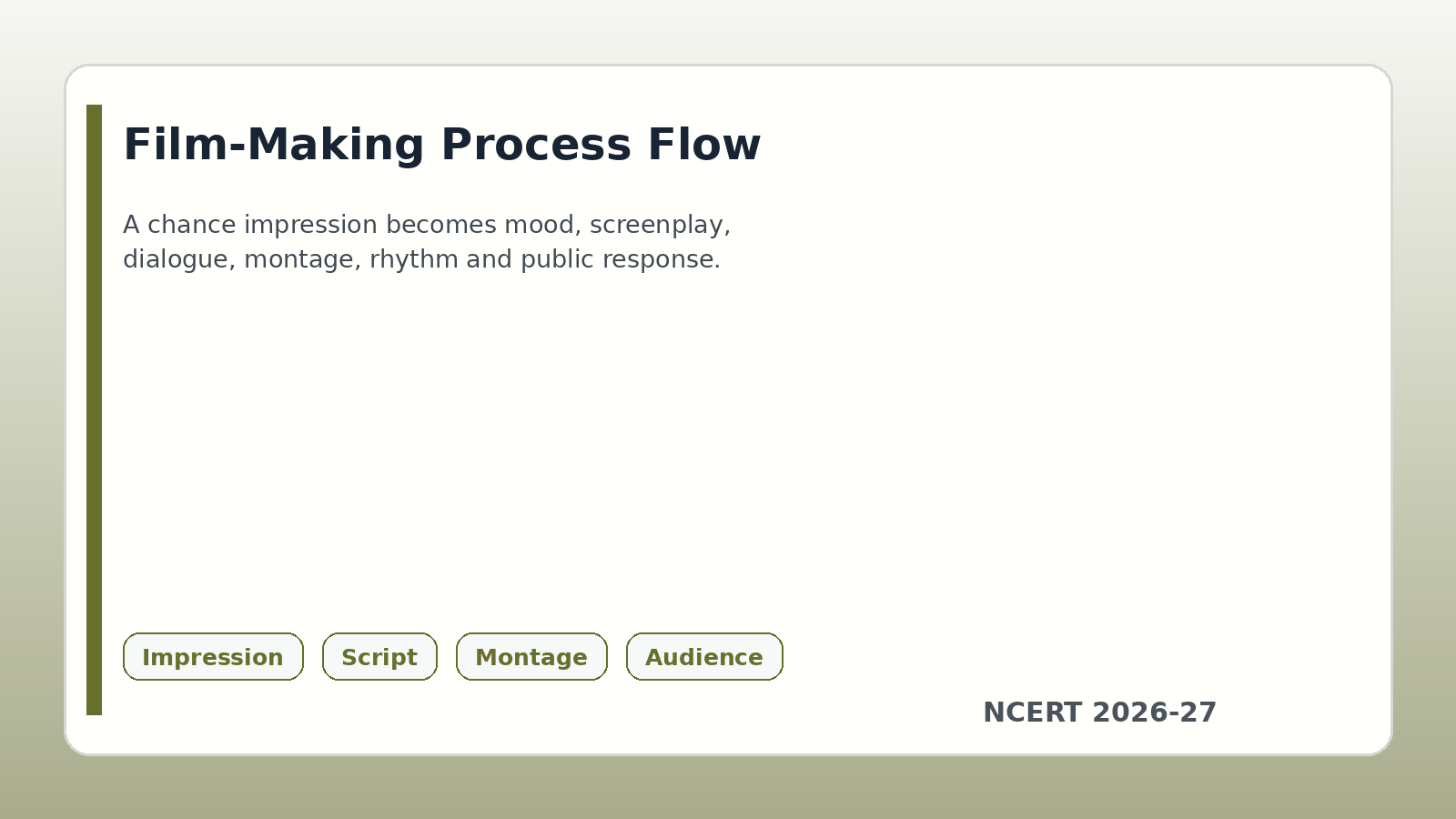
| Stage | What it means | Answer cue |
|---|---|---|
| Impression | A remark, music, light or image leaves a mood. | Film begins before a fixed story. |
| Screenplay | Mood is changed into dialogue, location and sequence. | This is difficult and incomplete. |
| Rhythm | Montage and image relation make the film breathe. | Film is closest to music. |
| Viewer response | The public must react in some way. | A film without response is worthless. |
Film-Making Chapter Explanation Video
Source: Magnet Brains on YouTube
Film and Literature in Bergman's Essay
Bergman says film and literature work through different mental routes. The written word is read through will and intellect, while film makes space for illusion and reaches feeling through moving images.
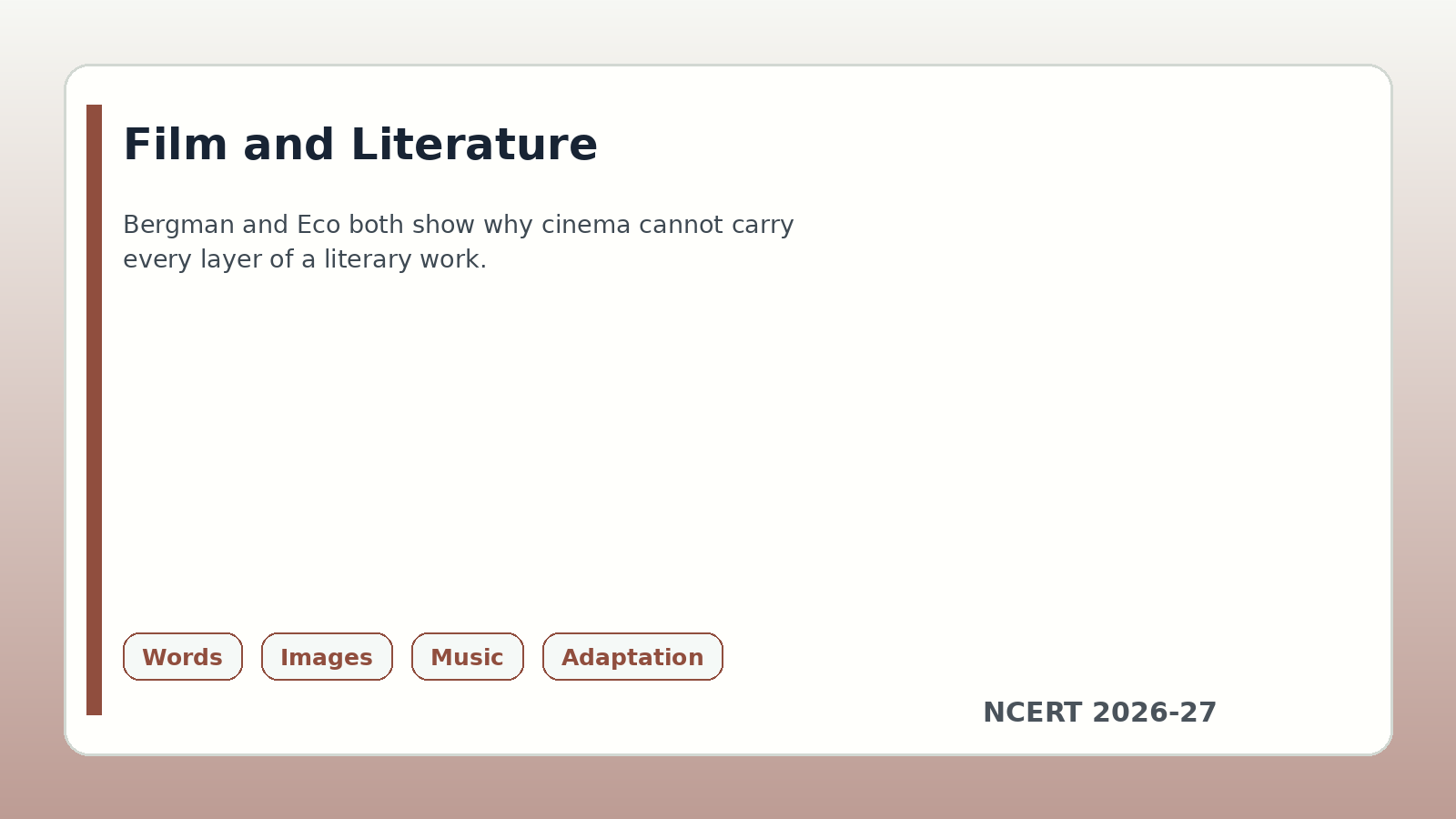
| Point | Literature | Film |
|---|---|---|
| Reception | Read by conscious effort. | Experienced through visual illusion. |
| Effect | Slowly affects imagination and emotion. | Acts directly on feeling. |
| Adaptation issue | Carries many inner layers. | Must select visual layers. |
| Eco link | Novel lets students imagine freely. | Film can fix character images too early. |
Important Themes in Film-Making Handwritten Notes
The PDF marks the themes students need for short and long answers. Bergman's chapter is personal, but every memory leads back to cinema craft.
- Sensory memory: light, bells, music and pictures shape Bergman's film imagination.
- Cinema as illusion: the film-maker is a conjurer because viewers willingly accept the trick.
- Rhythm and music: a film breathes through montage, image relation and emotional pulse.
- Collective art: the cathedral story values shared craft above personal fame.
How to Use the Film-Making Handwritten Notes PDF
Use the PDF after reading the NCERT text once. First revise the story-like examples, then learn the technique points, and finally practise comparison questions on Bergman and Eco.
- Use the childhood pages for sensory-impression questions.
- Use the screenplay and rhythm pages for film-making process answers.
- Use the film-literature page for adaptation questions.
- Use the cathedral page for Bergman's artistic aim.
Related Class 12 English Supplementary Resources
Use these related resources with the handwritten notes for full chapter preparation.
| Resource | Best use | Link |
|---|---|---|
| NCERT Solutions | Step-by-step answers for Film-Making | Open solutions |
| NCERT Notes | Typed revision notes for the same chapter | Open notes |
| NCERT Book PDF | Official chapter reading | Open book PDF |
All Class 12 English Supplementary Handwritten Notes
The table below keeps the same resource type together, so students can move chapter by chapter through the Class 12 English Supplementary Kaleidoscope handwritten notes.
| Chapter | Title | Handwritten notes link |
|---|---|---|
| Chapter 13 | The Argumentative Indian | Open handwritten notes |
| Chapter 14 | On Science Fiction | Open handwritten notes |
| Chapter 15 | The Mark on the Wall | Open handwritten notes |
| Chapter 16 | Film-Making | Open handwritten notes |
| Chapter 17 | Why the Novel Matters | Open handwritten notes |
| Chapter 18 | Chandalika | Open handwritten notes |
Film-Making Class 12 English Handwritten Notes FAQs
Ques. What do the Film-Making handwritten notes cover?
Ans. The notes cover Bergman's childhood memories, conjurer idea, screenplay process, rhythm, film and literature, Eco's interview and NCERT answer pointers.
Ques. Who wrote Film-Making in Class 12 English Kaleidoscope?
Ans. The main selection is by Swedish film-maker Ingmar Bergman. The chapter also includes an interview with Umberto Eco on filming books.
Ques. Why does Bergman compare film-making with conjuring?
Ans. He calls the film-maker a conjurer because cinema creates smooth movement from frames and darkness, and viewers willingly accept the illusion.
Ques. Are these notes aligned with the 2026-27 NCERT book?
Ans. Yes. The notes are prepared for Class 12 English Supplementary Kaleidoscope Chapter 16 Film-Making in the 2026-27 NCERT reprint.



Comments