




Inside these handwritten Staffing notes for Class 12 you get the nine-step staffing process, recruitment sources, the eight-step selection procedure and training, hand-written for quick revision of the 2026-27 syllabus.
- CBSE Weightage: 6 to 10 marks (Unit 1, Principles and Functions of Management)
- Sections Covered: 12 concept blocks + 10-point cheat sheet (staffing, recruitment, selection, training)
The handwritten notes are designed for a Class 12 student covering the chapter for the first time, and for board-exam candidates revising in the last week before the paper. Every concept is presented clearly with definitions, supporting features and one-line takeaways. Mnemonics, quick tips, common-mistake call-outs and case-study spotters are placed at the precise points where students typically slip.
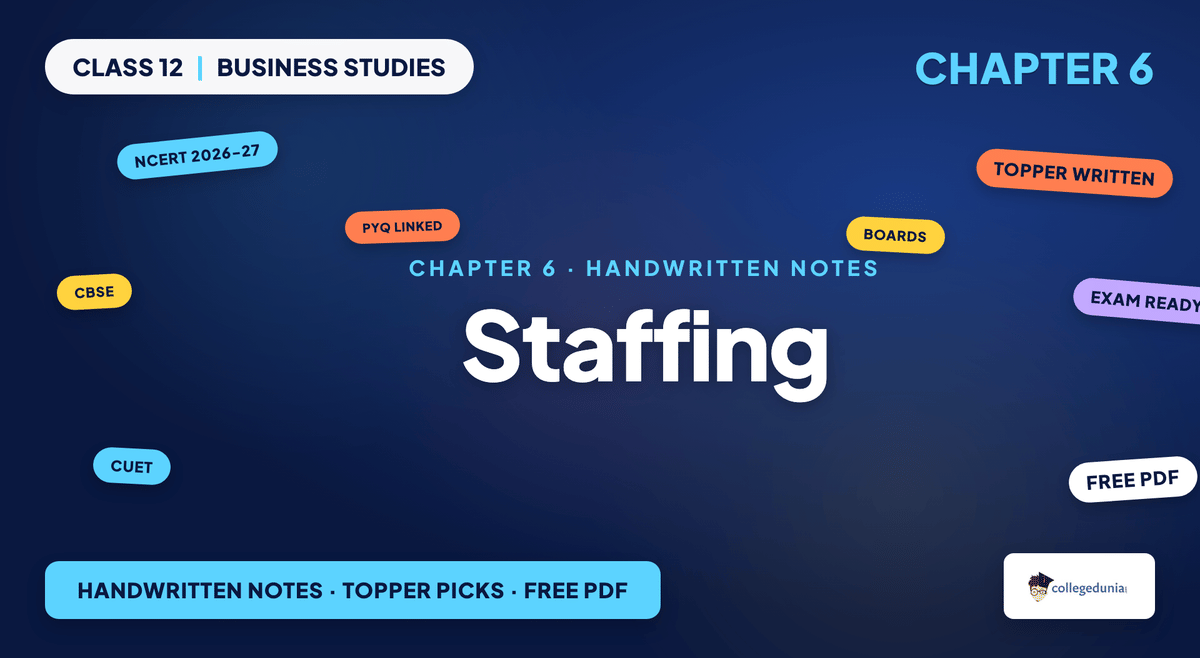
Staffing Class 12 Handwritten Notes: Topic Map
| Section | What is Covered | Why It Matters in the Exam |
|---|---|---|
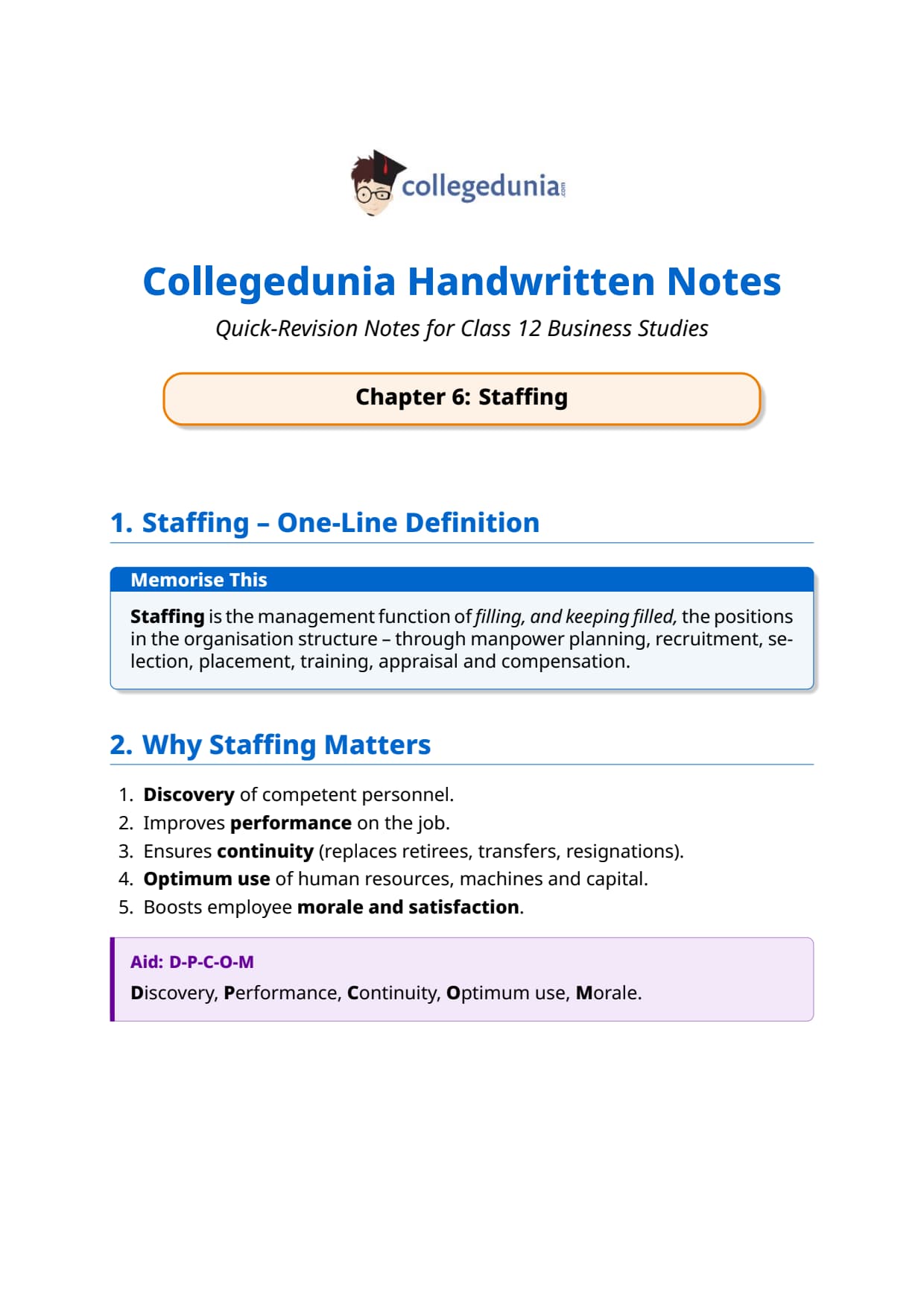
| 1. Meaning of Staffing | NCERT process definition, place in management cycle | 1 to 3-mark questions; the verbatim "filling and keeping filled" line |
| 2. Importance of Staffing | Five-point list anchored in NCERT | 3 to 4-mark; mnemonic D-P-C-O-M |
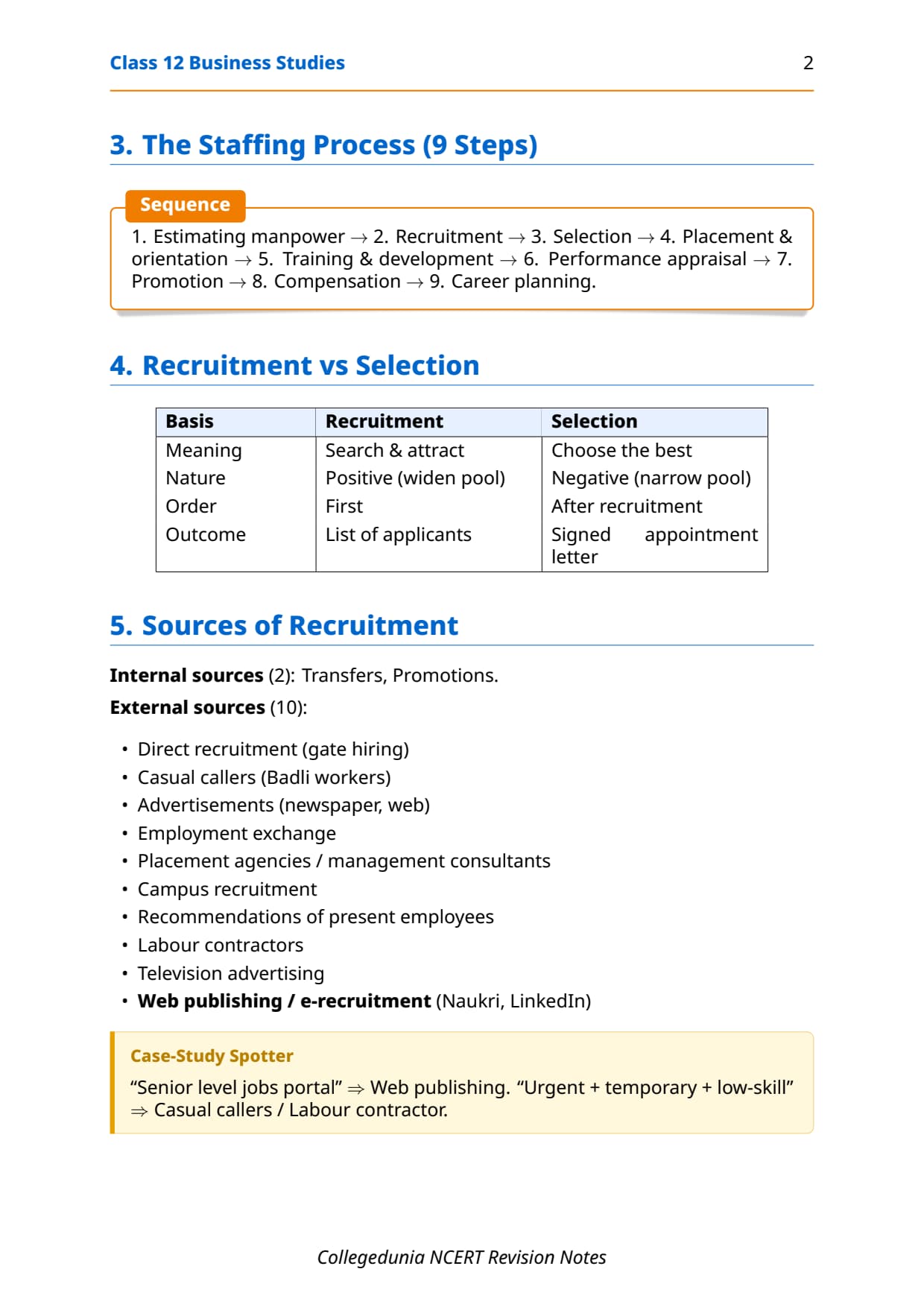
| 3. Staffing Process (9 steps) | Estimate to career planning | Sequence question (3 marks); cycle diagram |
| 4. Recruitment Sources | Internal (transfers, promotions) vs external (10 sub-sources) | 3 to 6-mark case-study identification (web publishing, casual callers) |
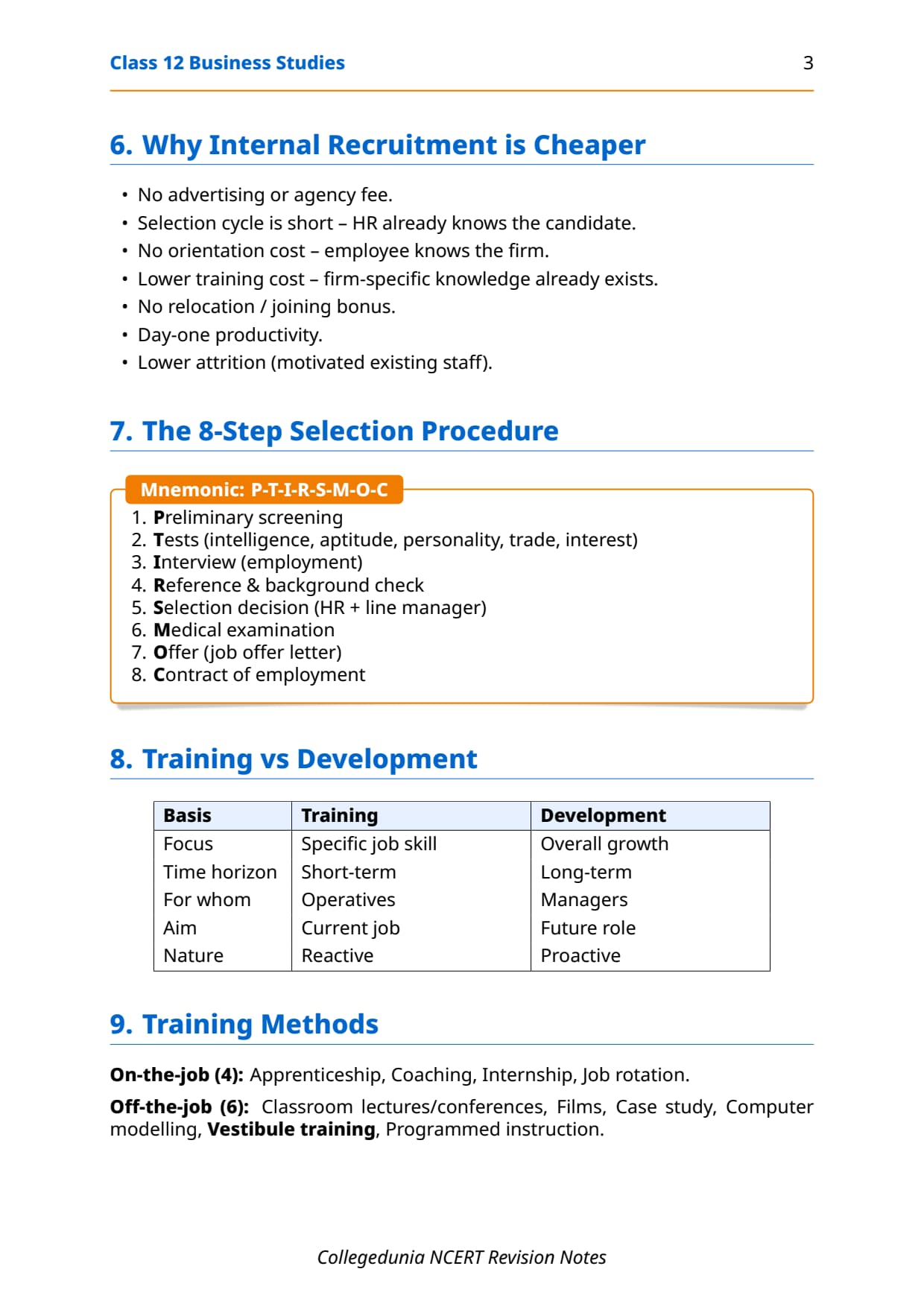
| 5. Selection (8-step) | P-T-I-R-S-M-O-C procedure | 5 to 6-mark long answer; ordered list |
| 6. Training vs Development | Side-by-side comparison table | 3 to 4-mark "distinguish between" question |
| 7. Training Methods | On-the-job (4) vs off-the-job (6); vestibule training | Case-study: hi-tech machines, costly engineer visits |
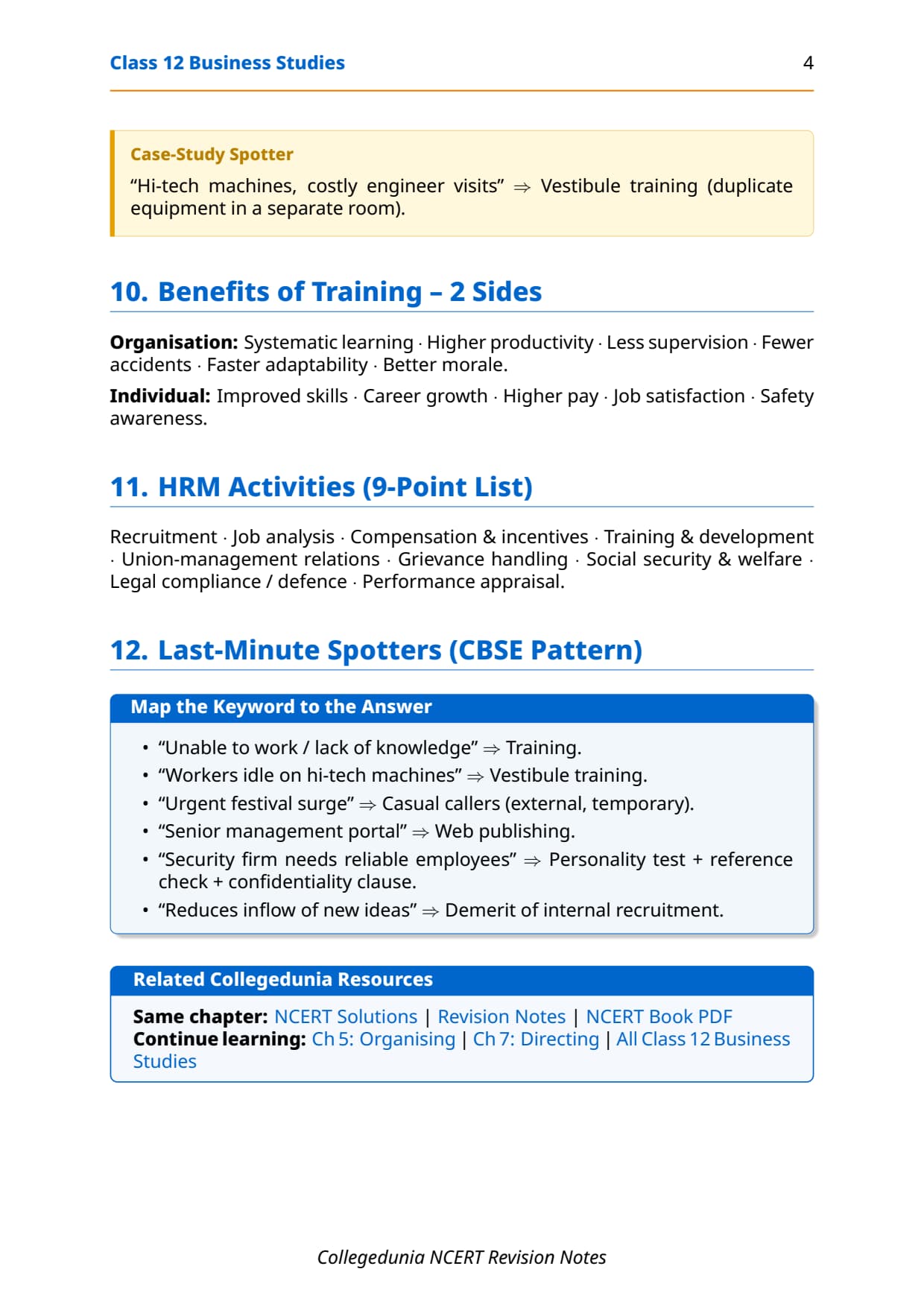
| 8. HRM Activities | Nine specialised duties | 6-mark long answer "HRM includes specialised activities" |
| 9. Case Studies | Xylo (auto components), Insurance, Steel firm Jayshree | 8 to 10-mark applied case |
| 10. Quick Recap | 10-point cheat sheet | Last-minute revision |
Staffing Video Walkthrough
Source: Magnet Brains on YouTube
What the Class 12 Business Studies Chapter 6 Handwritten Notes PDF Contains
- One-line definitions for every named concept.
- Mnemonic boxes (D-P-C-O-M, P-T-I-R-S-M-O-C, P-S-S-E-S, I-I-M-F-S).
- Crisp comparison tables (recruitment vs selection, training vs development, leadership styles, formal vs grapevine).
- Case-study spotter list mapping each common CBSE keyword to the NCERT answer.
- Quick-revision lists (sources of recruitment, financial incentives, non-financial incentives, barriers to communication).
- Cross-links to the full Notes and Solutions PDFs for the same chapter.
Continue Learning: More Class 12 Business Studies Chapter 6 Staffing Resources
- Ch 5: Organising Class 12 Handwritten Notes
- Ch 7: Directing Class 12 Handwritten Notes
- All Class 12 Business Studies Chapters
Student Feedback
In a Collegedunia poll of 420 Class 12 Commerce students, 81% said the staffing process sequence and the recruitment source list were the hardest part of this chapter to remember before these notes. 3 in 4 said the mnemonic boxes and case-study spotter list helped them answer the vestibule training and casual callers questions faster in their pre-board tests.
Other Resources for Class 12 Business Studies Chapter 6 Staffing
| Resource | Link |
|---|---|
| NCERT Solutions | Staffing NCERT Solutions |
| Revision Notes | Staffing Class 12 Notes |
| Handwritten Notes | Staffing Handwritten Notes |
| NCERT Book PDF | Staffing NCERT Book PDF |
Staffing Class 12 - Frequently Asked Questions
Staffing Class 12 - Frequently Asked Questions
What is staffing in Class 12 Business Studies Chapter 6?
Staffing is the management function of filling, and keeping filled, the positions in the organisation structure - through manpower planning, recruitment, selection, placement, orientation, training, appraisal, promotion and compensation. It is the second function of management after planning and organising.
What are the steps of the staffing process?
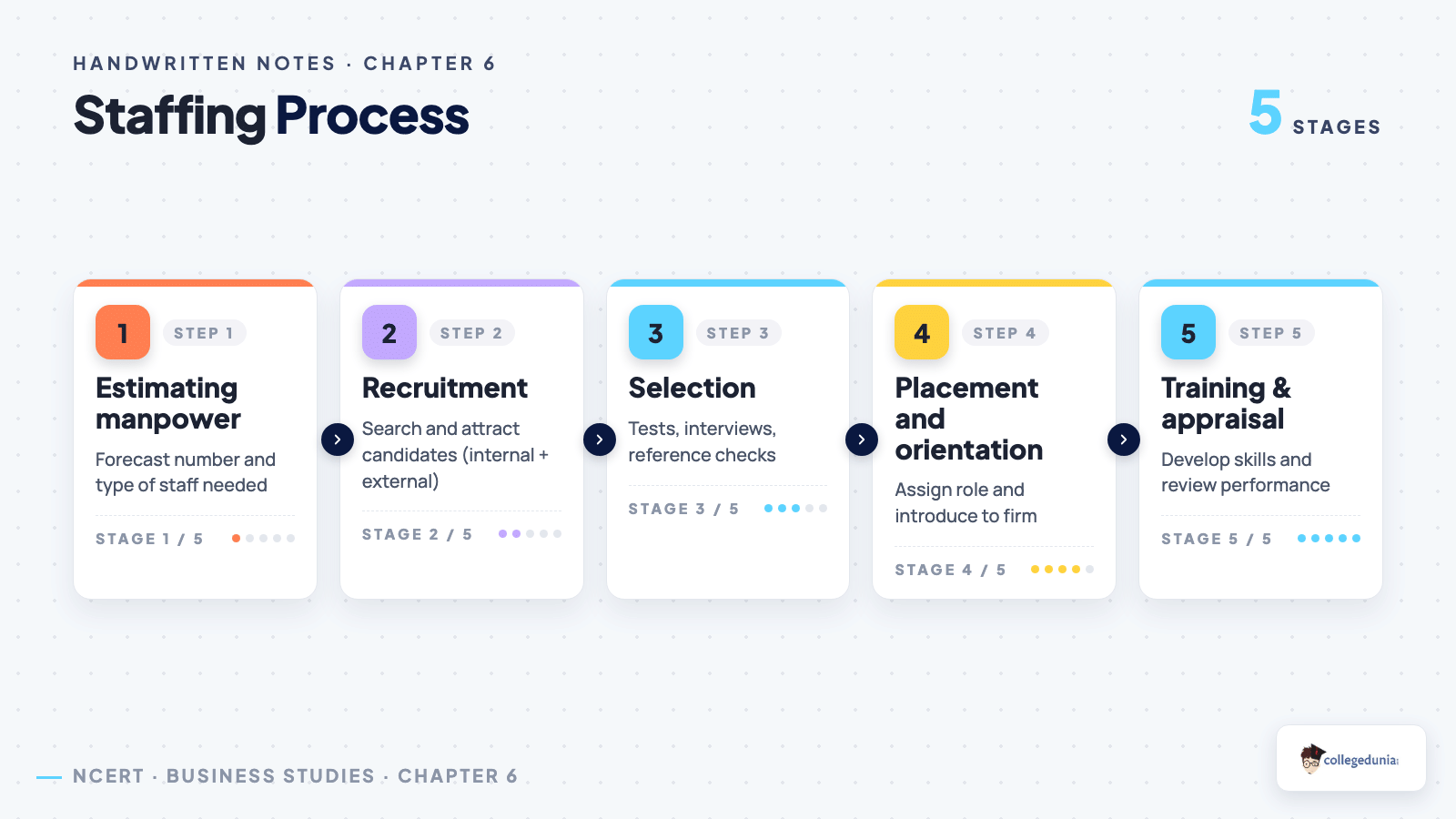
The NCERT staffing process has nine steps: (1) estimating manpower requirements, (2) recruitment, (3) selection, (4) placement and orientation, (5) training and development, (6) performance appraisal, (7) promotion and career planning, (8) compensation, (9) separation.
What are the differences between recruitment and selection?
Recruitment is the process of searching for and attracting prospective candidates (a positive, enlarging process). Selection is the process of choosing the most suitable candidate from the applicant pool (a negative, narrowing process). Recruitment precedes selection.
What is vestibule training?
Vestibule training is an off-the-job training method where trainees learn on duplicate (not live) equipment in a separate room. It is used when training on live machines would be unsafe, costly or disruptive to regular production - exactly the situation where workers must learn hi-tech machines without halting the shop floor.
Where can I download the Class 12 Business Studies Chapter 6 Staffing Handwritten Notes PDF?
You can download the Collegedunia Class 12 Business Studies Chapter 6 Staffing Handwritten Notes PDF free of cost from this page. The PDF is aligned to the NCERT Reprint 2026-27 syllabus and includes all the concepts, comparisons and case-study spotters you need for the board exam.



Comments