




Inside these handwritten Class 12 Planning notes you get the Koontz and O'Donnell meaning, the seven features, the seven-step planning process and all eight types of plans, hand-drawn for fast 2026-27 revision.
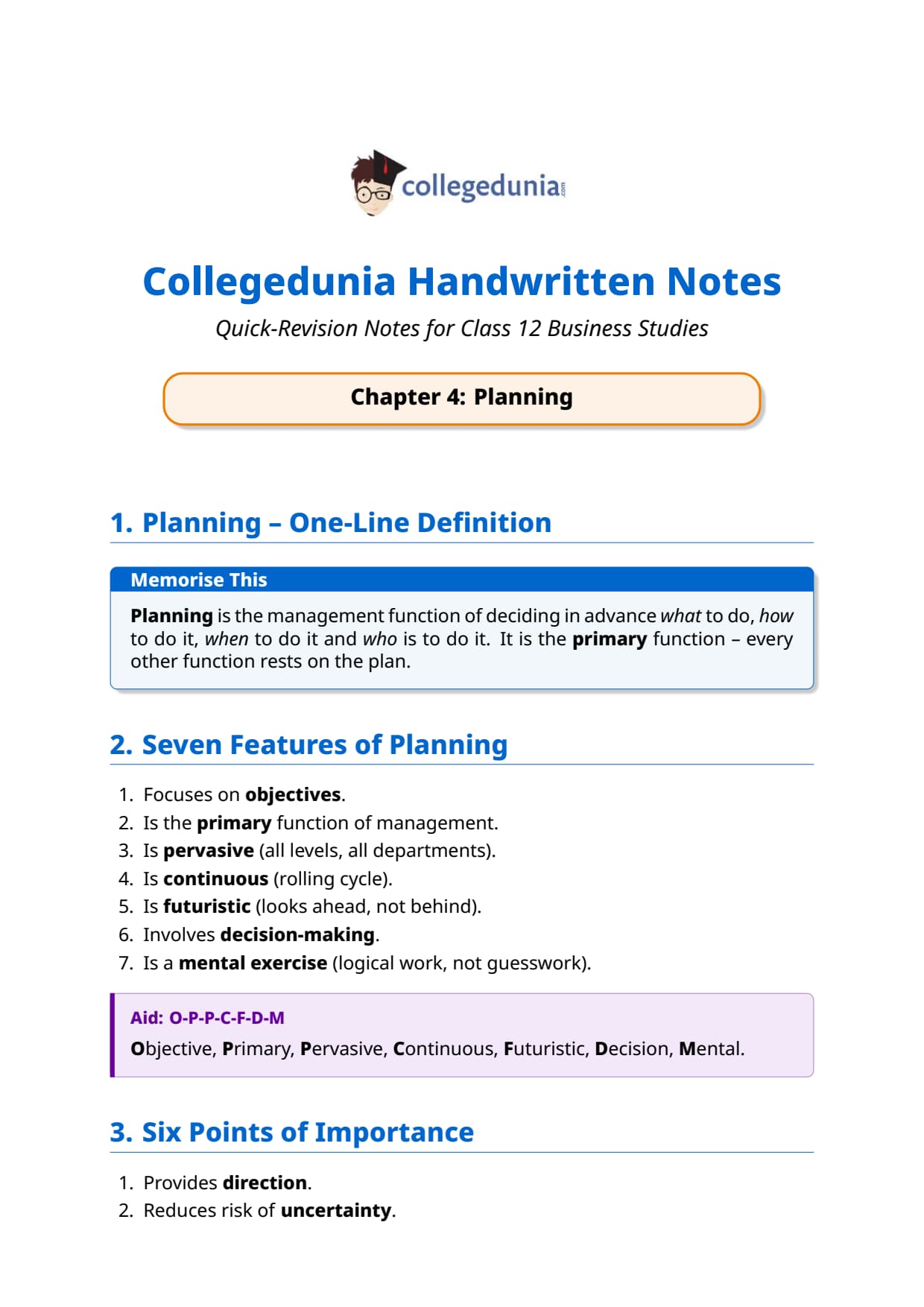
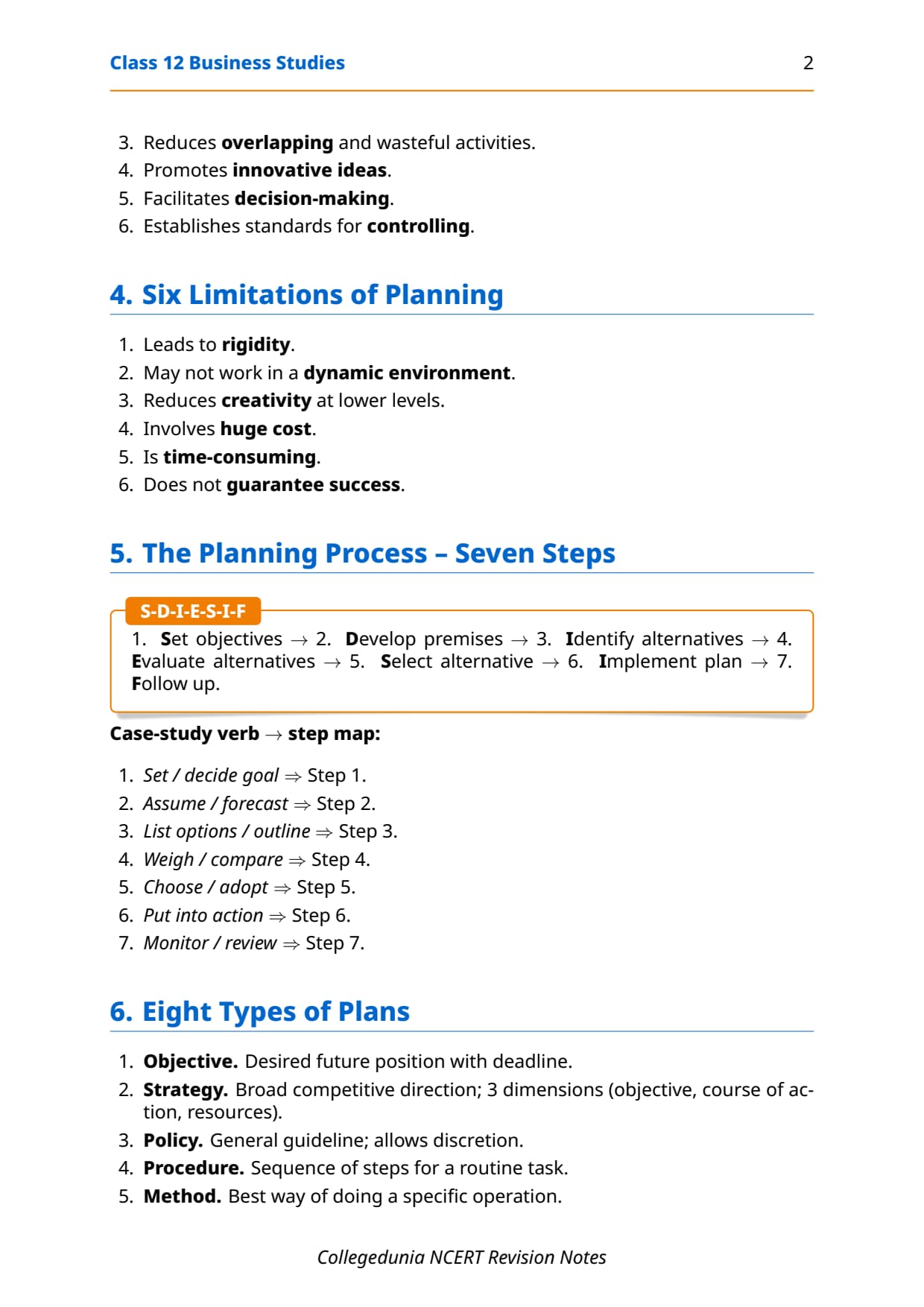
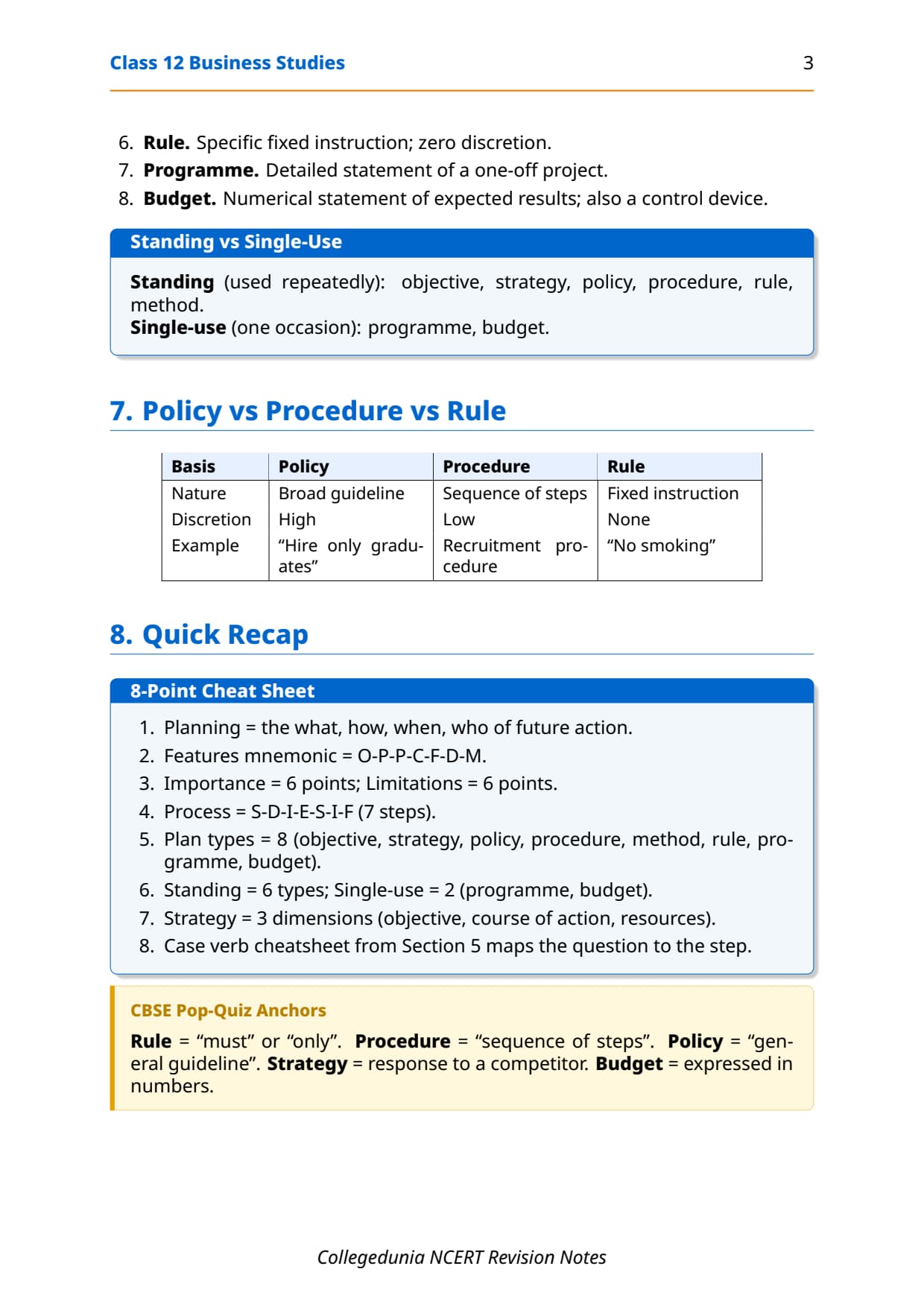

- CBSE Weightage: 5 to 8 marks (Unit 2, Principles and Functions of Management).
- Notes Coverage: 8 sections, 5 numbered lists, 1 difference table, S-D-I-E-S-I-F mnemonic, O-P-P-C-F-D-M mnemonic, and a CBSE pop-quiz anchor list.
The Handwritten Notes work best as a last-week revision aid. Open the PDF, scan the highlighted boxes, and you have every CBSE-tested concept of Planning in one place. The verb-to-step map in Section 5 is the single most useful page during case-study questions.
These Handwritten Notes are curated by senior Commerce educators, mapped to the 2026-27 NCERT Business Studies textbook, and refined against the last five years of CBSE Class 12 board papers.
Planning Handwritten Notes Class 12: What is Inside the PDF
| Section | Concept | Memory Hook |
|---|---|---|
| 1 | One-line definition (Koontz and O'Donnell) | What, how, when, who |
| 2 | Seven features | O-P-P-C-F-D-M |
| 3 | Six points of importance | Direction first, control last |
| 4 | Six limitations | Rigidity to no-guarantee |
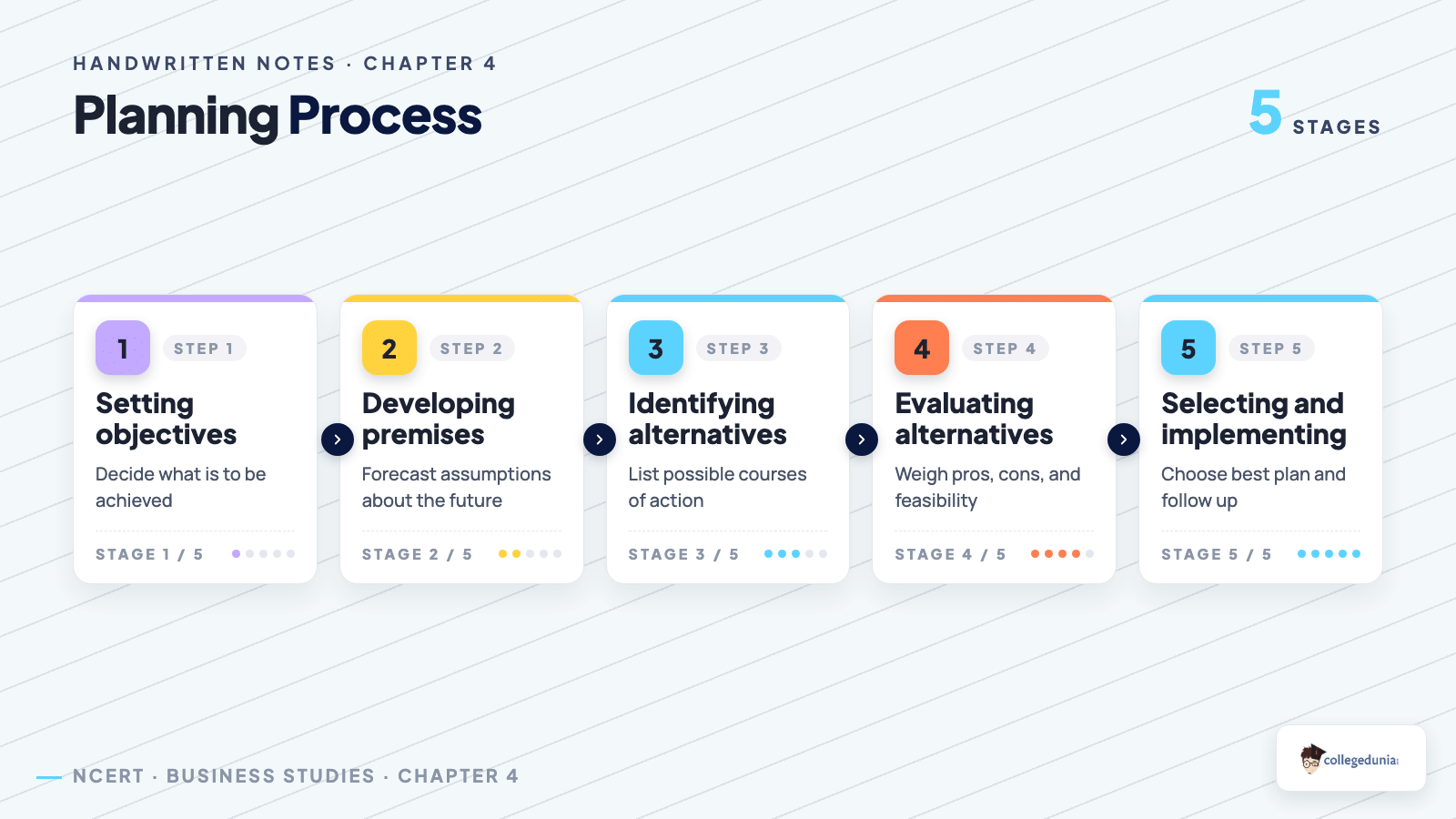
| 5 | Seven-step planning process | S-D-I-E-S-I-F |
| 6 | Eight types of plans | Standing (6) vs single-use (2) |
| 7 | Difference: Policy vs Procedure vs Rule | Side-by-side table |
| 8 | 8-point cheat sheet + CBSE pop-quiz anchors | Last-minute scan |
Planning Video Walkthrough
Source: Magnet Brains on YouTube
How These Handwritten Notes Help You Score
- Single-Page Section Layout: Each major concept fits on a single page so you can flip through the entire chapter in 10 minutes.
- Mnemonic-First Design: Two mnemonics (O-P-P-C-F-D-M, S-D-I-E-S-I-F) so you can recall every list under exam pressure.
- Verb-to-Step Map: The Section 5 cheat-table is the difference between knowing the seven steps and being able to apply them to a case.
- Difference Tables: Policy vs Procedure vs Rule in side-by-side format, exactly the structure CBSE rewards.
- 2026-27 Alignment: Every concept matches the current NCERT chapter order and CBSE marking scheme.
How to Use These Handwritten Notes for Maximum Marks
- Last-Night Sweep: Open the PDF, scan each numbered list once, then close the file. Try to recall the lists on paper before opening again.
- Mnemonic Reinforcement: Write O-P-P-C-F-D-M and S-D-I-E-S-I-F at the top of your rough sheet during the exam.
- Case-Study Decoding: Use the Section 5 verb map and Section 6 plan-type triggers to map any case description to the correct step or plan.
- Difference Tables: Reproduce the Section 7 table format in your answer booklet for any "distinguish between" question.
Student Feedback
In a Collegedunia poll of 480 Class 12 Commerce students, 79% said the S-D-I-E-S-I-F mnemonic helped them recall the seven-step planning process without re-reading the chapter. 3 in 4 said the Policy vs Procedure vs Rule table cleared up their most common mix-up before the board exam.
Other Resources for Class 12 Business Studies Chapter 4 Planning
| Resource | Link |
|---|---|
| NCERT Solutions | Planning NCERT Solutions |
| Revision Notes | Planning Class 12 Notes |
| Handwritten Notes | Planning Handwritten Notes |
| NCERT Book PDF | Planning NCERT Book PDF |
Frequently Asked Questions on Class 12 Business Studies Chapter 4 Handwritten Notes
Frequently Asked Questions on Class 12 Business Studies Chapter 4 Handwritten Notes
Q1. Are the Class 12 Business Studies Chapter 4 Handwritten Notes free to download?
Yes. The Collegedunia Handwritten Notes PDF for Planning is free to download from this page, aligned to the 2026-27 CBSE syllabus.
Q2. What is the mnemonic for the planning process?
S-D-I-E-S-I-F. Set objectives, Develop premises, Identify alternatives, Evaluate alternatives, Select alternative, Implement plan, Follow up.
Q3. How many features and limitations does planning have?
Seven features (mnemonic O-P-P-C-F-D-M) and six limitations. Each is developed in one line in these handwritten notes for fast recall.
Q4. Which of the eight types of plans are single-use and which are standing?
Of the eight types, two are single-use plans (programme, budget) and six are standing plans (objective, strategy, policy, procedure, method, rule).
Q5. Are these notes aligned to the 2026-27 CBSE syllabus?
Yes. Every concept matches the 2026-27 NCERT Business Studies textbook and the latest CBSE marking scheme.



Comments