




Class 12 Biology Chapter 12 Ecosystem is the most diagram-heavy ecology unit retained in the current 2026-27 NCERT syllabus, weaving productivity equations, the single-channel energy-flow chart, the three pyramids, the carbon and phosphorus cycles, and ecological succession into one chapter. This Collegedunia scanned notebook compresses it into 30 ruled-paper pages with hand-drawn pyramid stacks, cycle loops and succession sequences. Download the PDF below and use the page map to jump straight to your weakest sub-topic.
- CBSE Weightage: 5 to 7 marks (one 5-mark question on energy flow or carbon cycle plus a 2-marker on pyramids or productivity is the standard CBSE pattern)
- NEET Weightage: 2 to 3 questions per paper (consistent 3 to 4% of NEET Biology, drawn most often from energy flow and biogeochemical cycles)
How Collegedunia's Handwritten Notes Help You Revise Ecosystem
The scan opens with ecosystem structure, moves through productivity and decomposition, holds the single-channel energy-flow centrepiece on a double-page spread, then closes with the carbon and phosphorus cycle loops. Every CBSE 5-marker maps to one of the hand-drawn process diagrams indexed below.
Ecosystem is a sequence-and-direction chapter: succession steps, decomposition stages, energy flow direction, pyramid orientation. Hand-drawn arrows encode these sequences as spatial memory, which is how diagram-based MCQs are actually recalled.
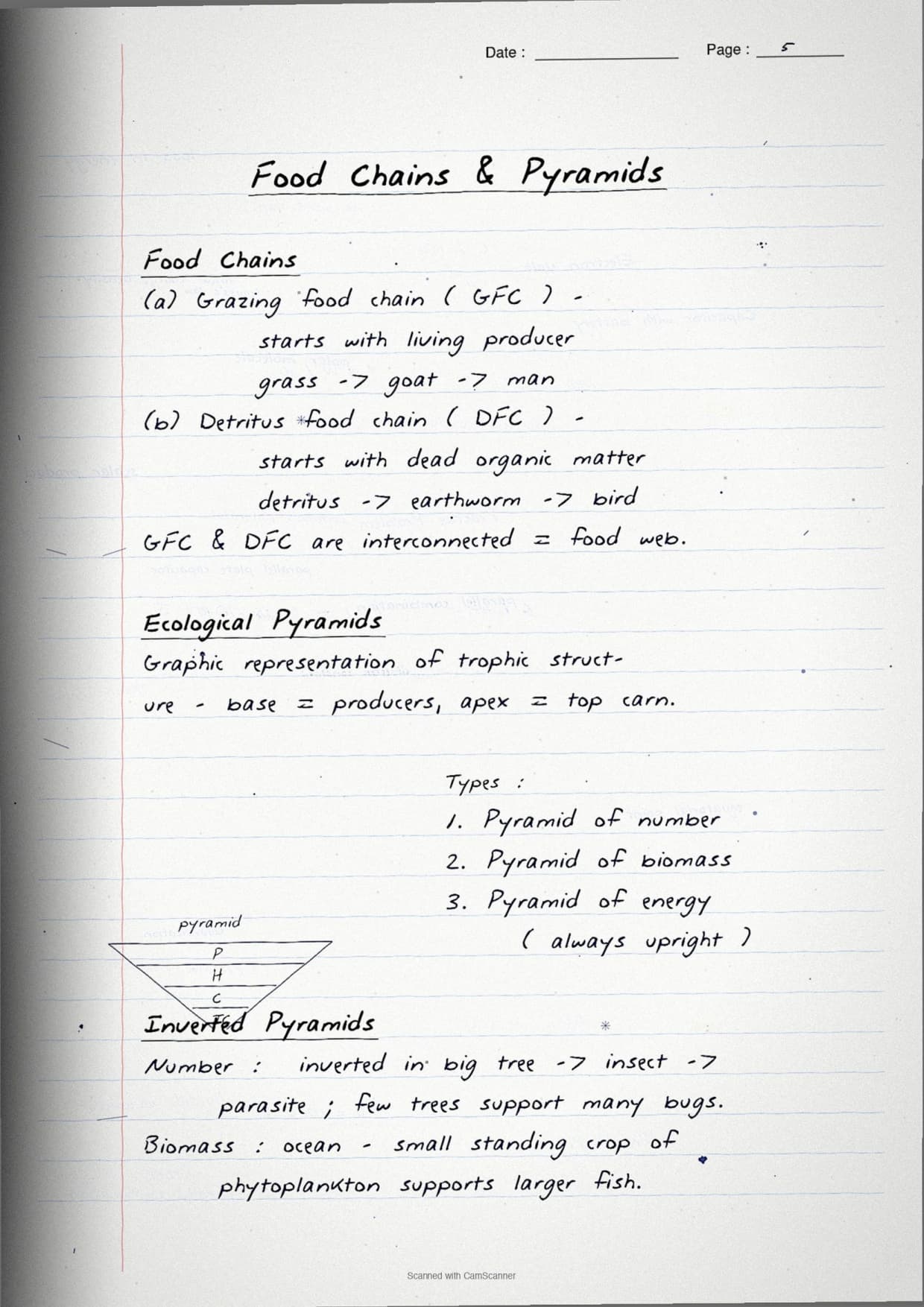
- Hand-drawn pyramid stacks: Energy, biomass and numbers pyramids drawn in colour with the upright vs inverted distinction marked in red, so the visual fixes which pyramid can invert and which cannot.
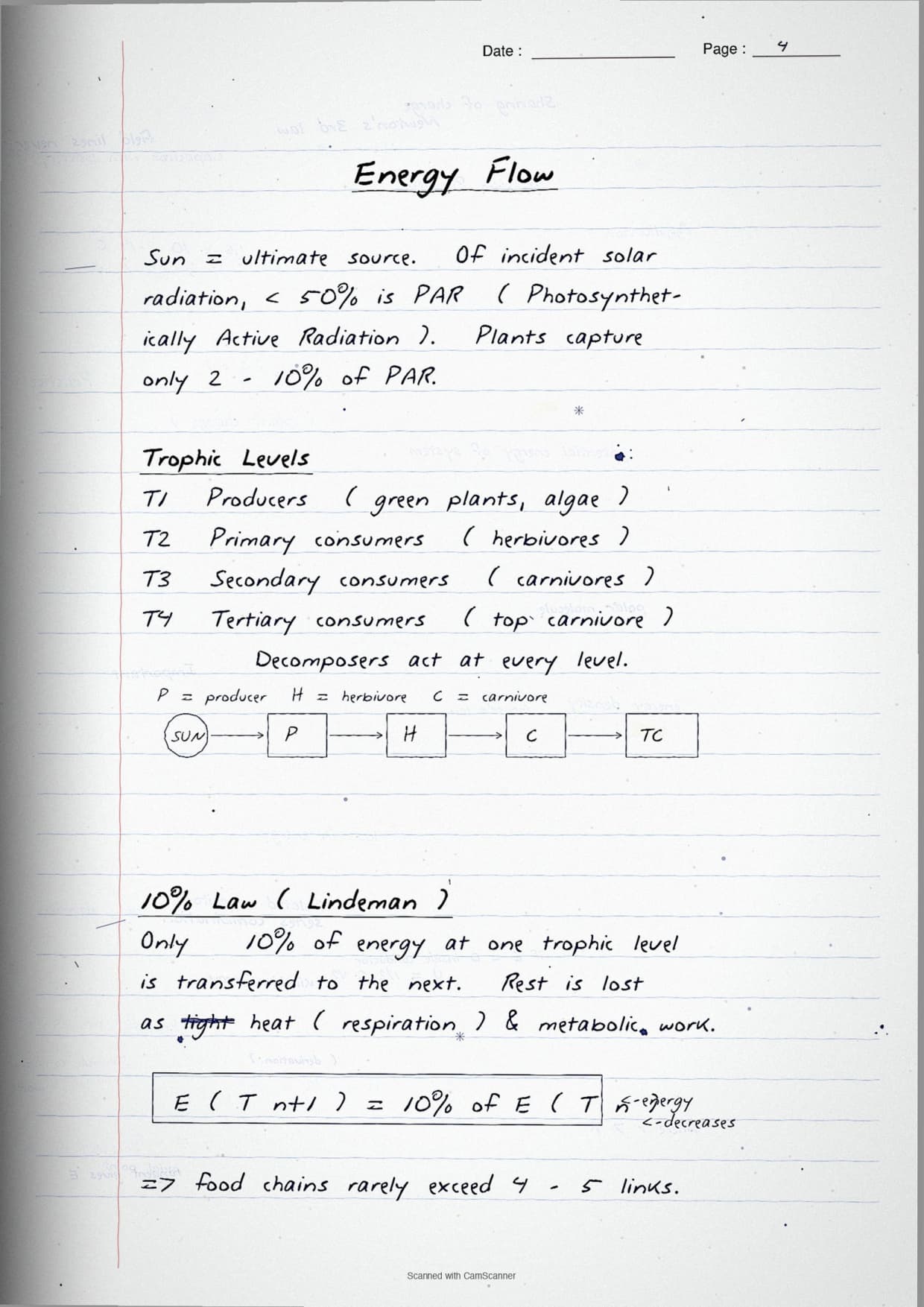
- Energy-flow centrepiece: Double-page spread of the single-channel flow with Sun → Producer → PHC → PCC → Top carnivore arrows, each labelled with the 10% transfer figure, the exact diagram CBSE asks in 5-mark questions.
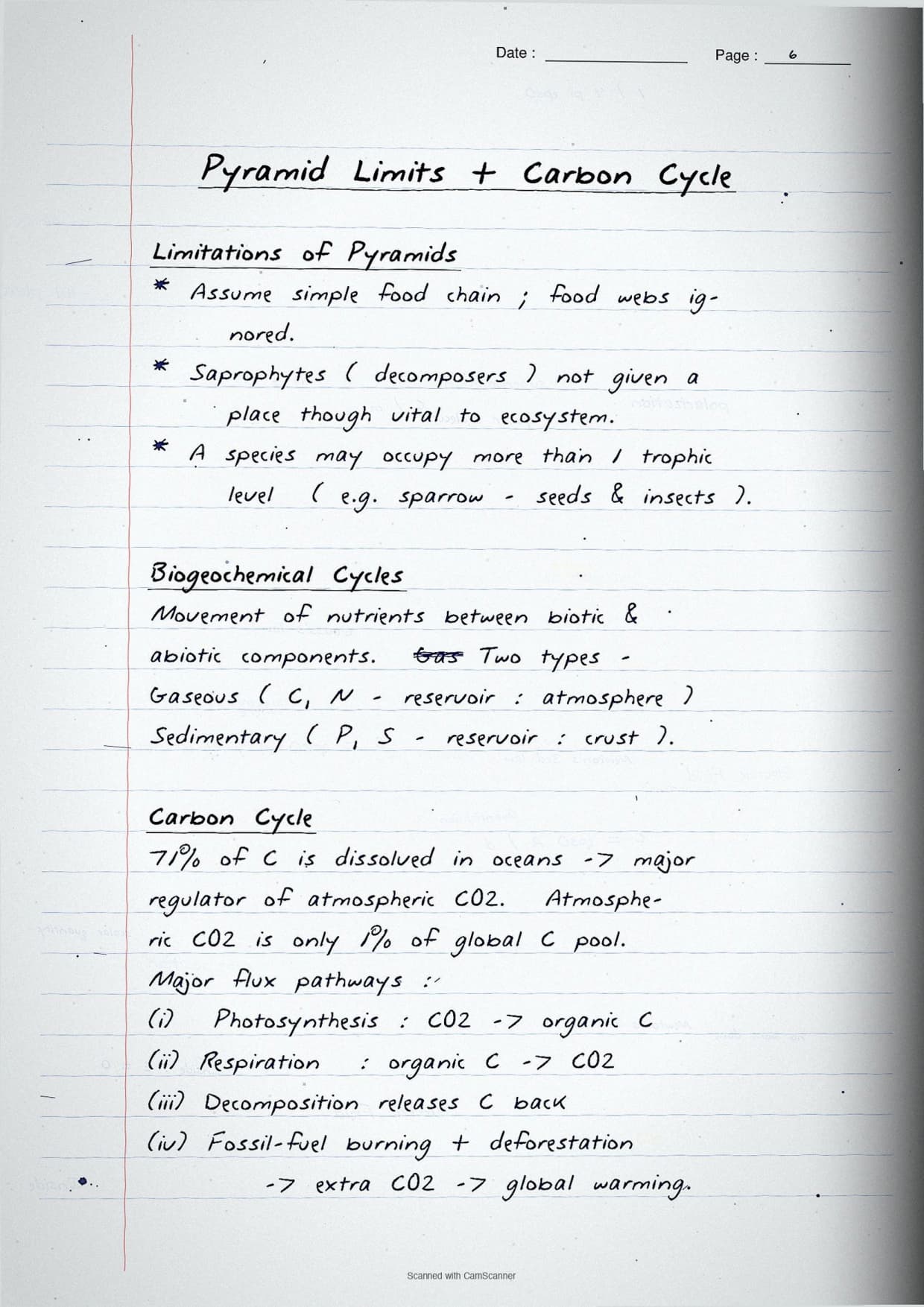
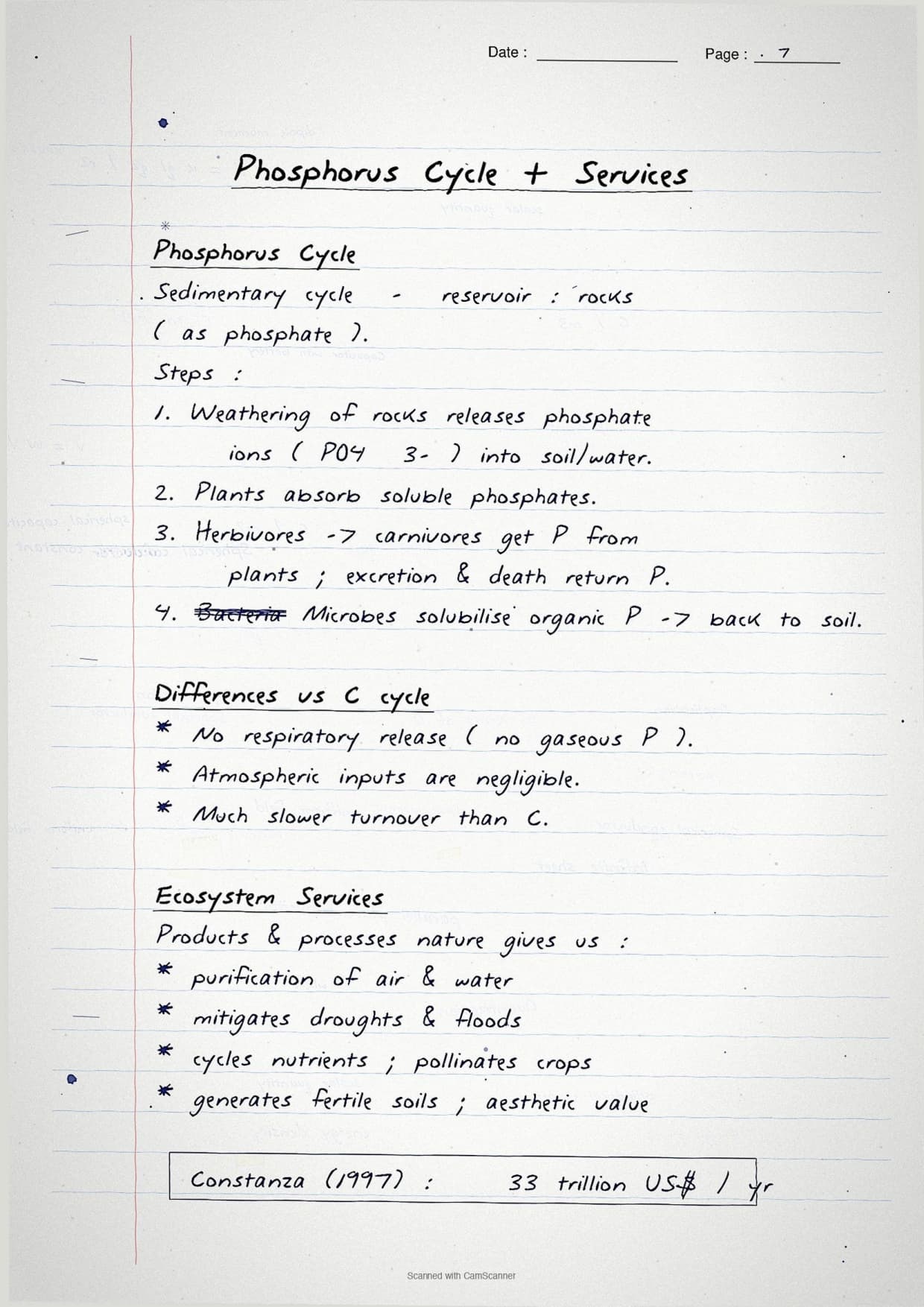
- Carbon and phosphorus cycle loops: Both cycles drawn as closed loops with reservoir size, atmospheric phase (or its absence) and anthropogenic flux clearly labelled, the way NEET has framed them since 2019.
- Margin "asked in" tags: Each block has a margin tag showing the recent year it was asked, so high-frequency facts catch the eye first.
Ecosystem Chapter 12 Video Lecture for Class 12 Biology
Source: Magnet Brains on YouTube
Inside the Class 12 Biology Chapter 12 Ecosystem Handwritten Notes PDF
A 30-page scan with a fixed ink-colour code. The page map below shows what each block covers, so you can jump straight to whichever sub-topic you are weakest on.
| Pages | Topic | Pen Colour |
|---|---|---|
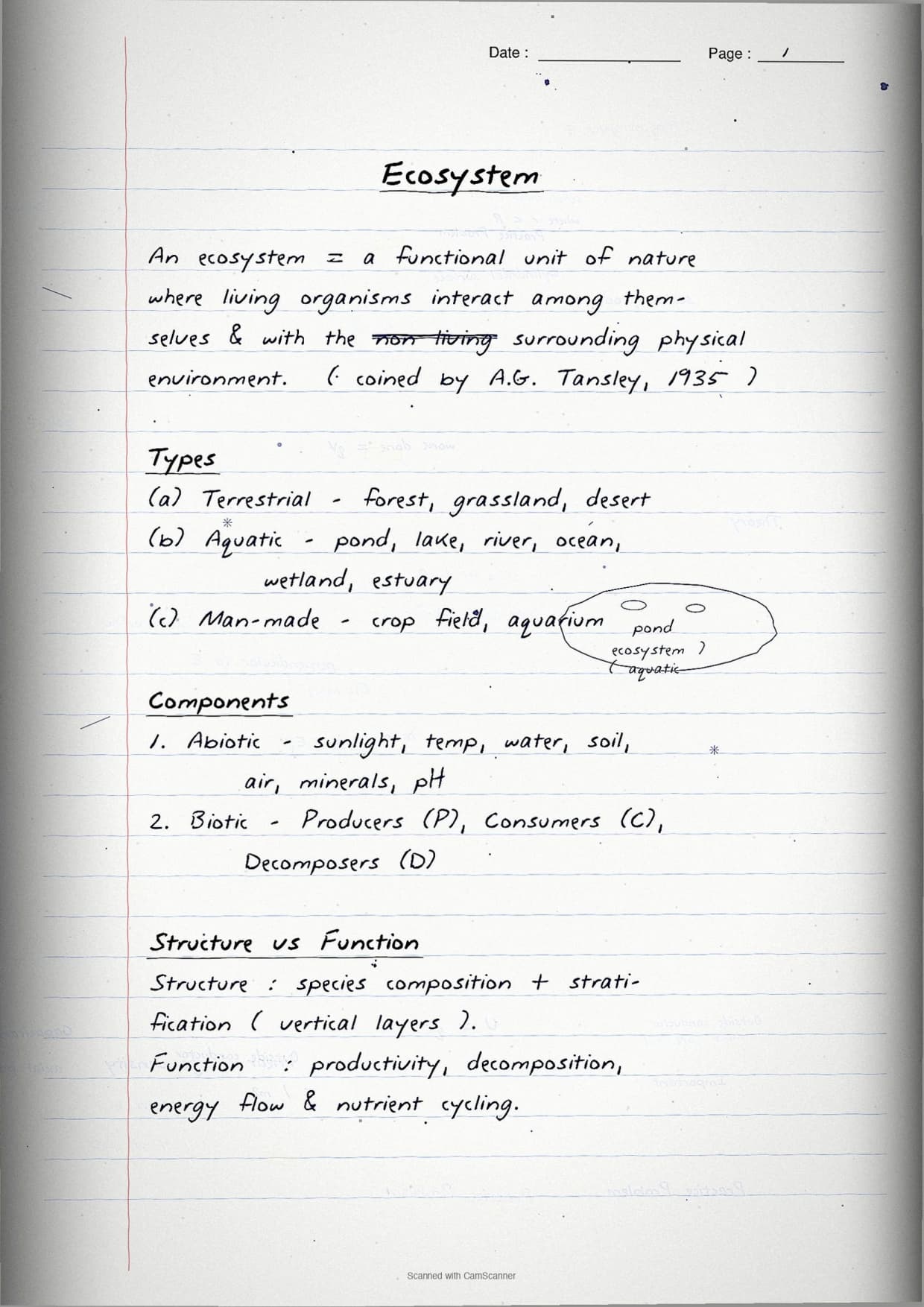
| 1-3 | Ecosystem structure: biotic + abiotic components, pond as the model ecosystem | Blue + orange |
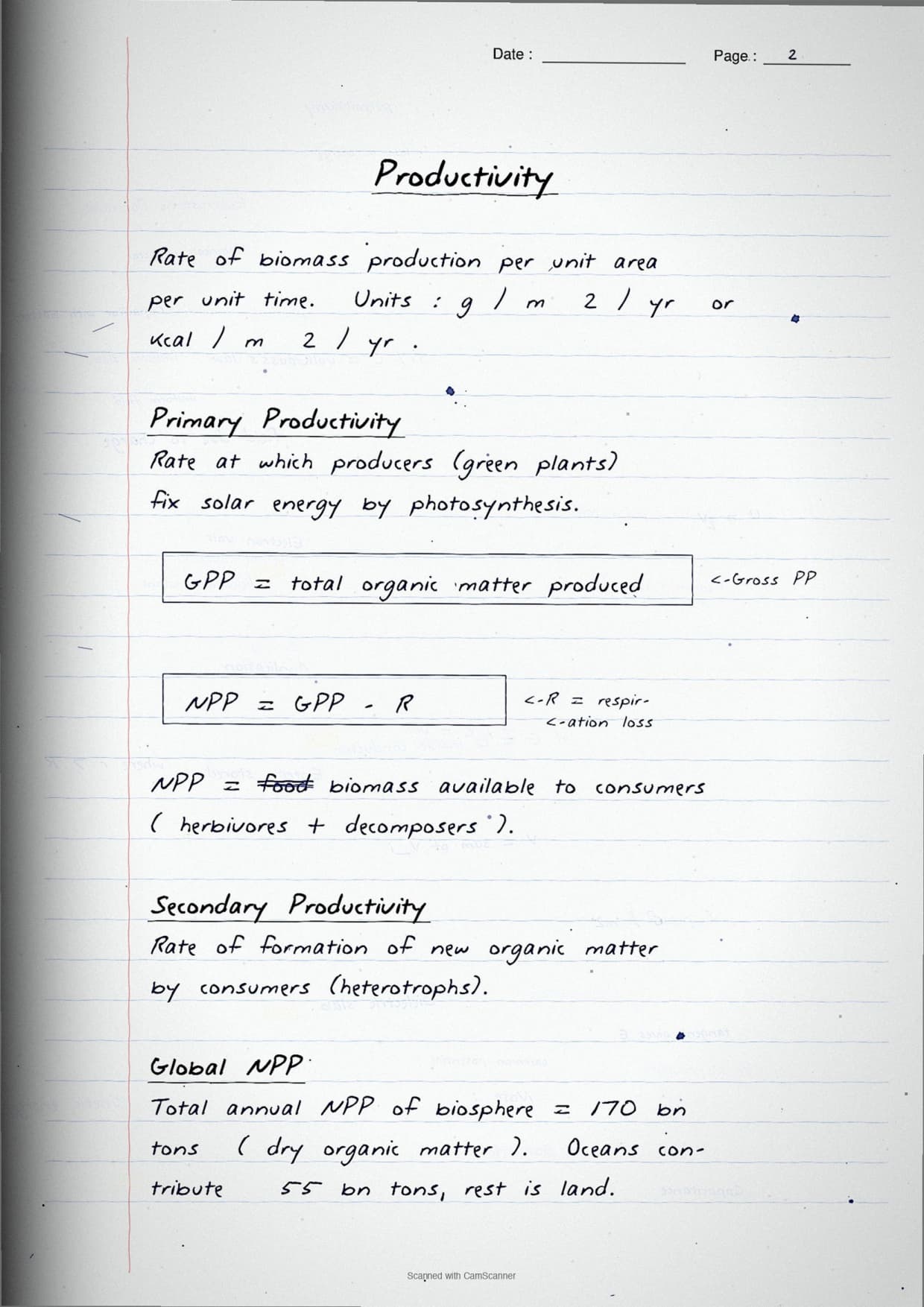
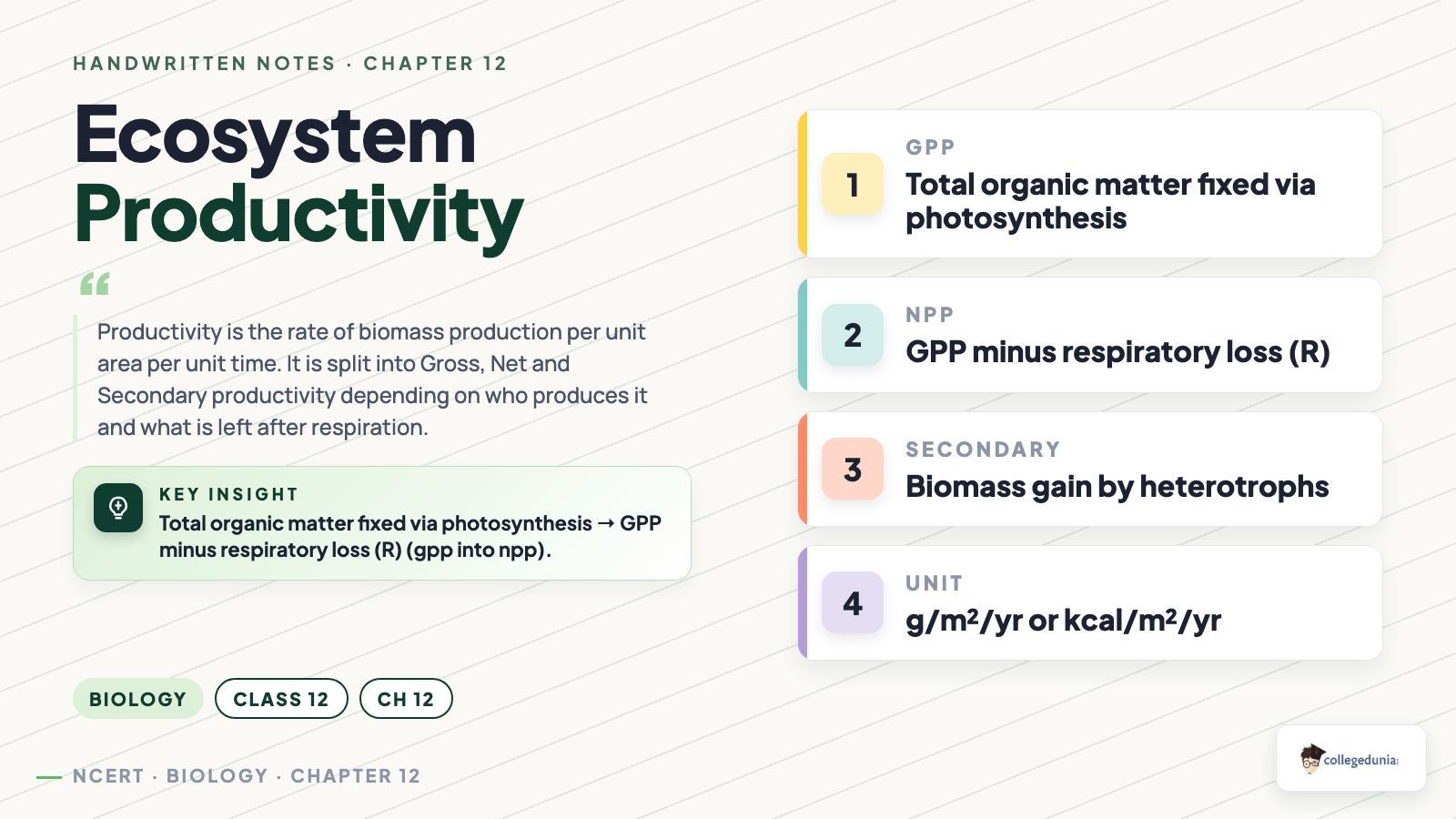
| 4-7 | Productivity: GPP, NPP, R, NPP = GPP − R, oceanic vs terrestrial NPP, standing crop | Blue + green + red |
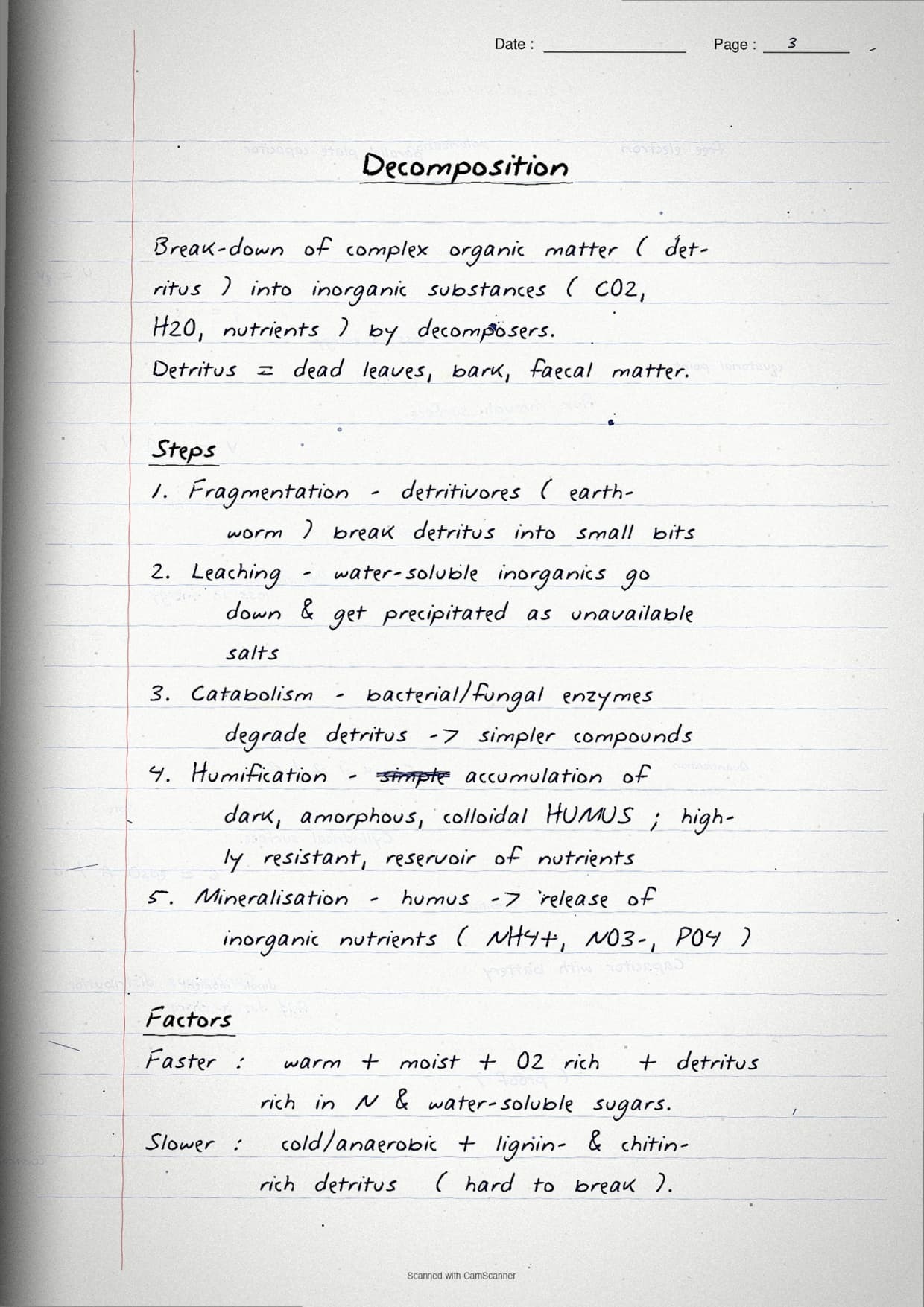
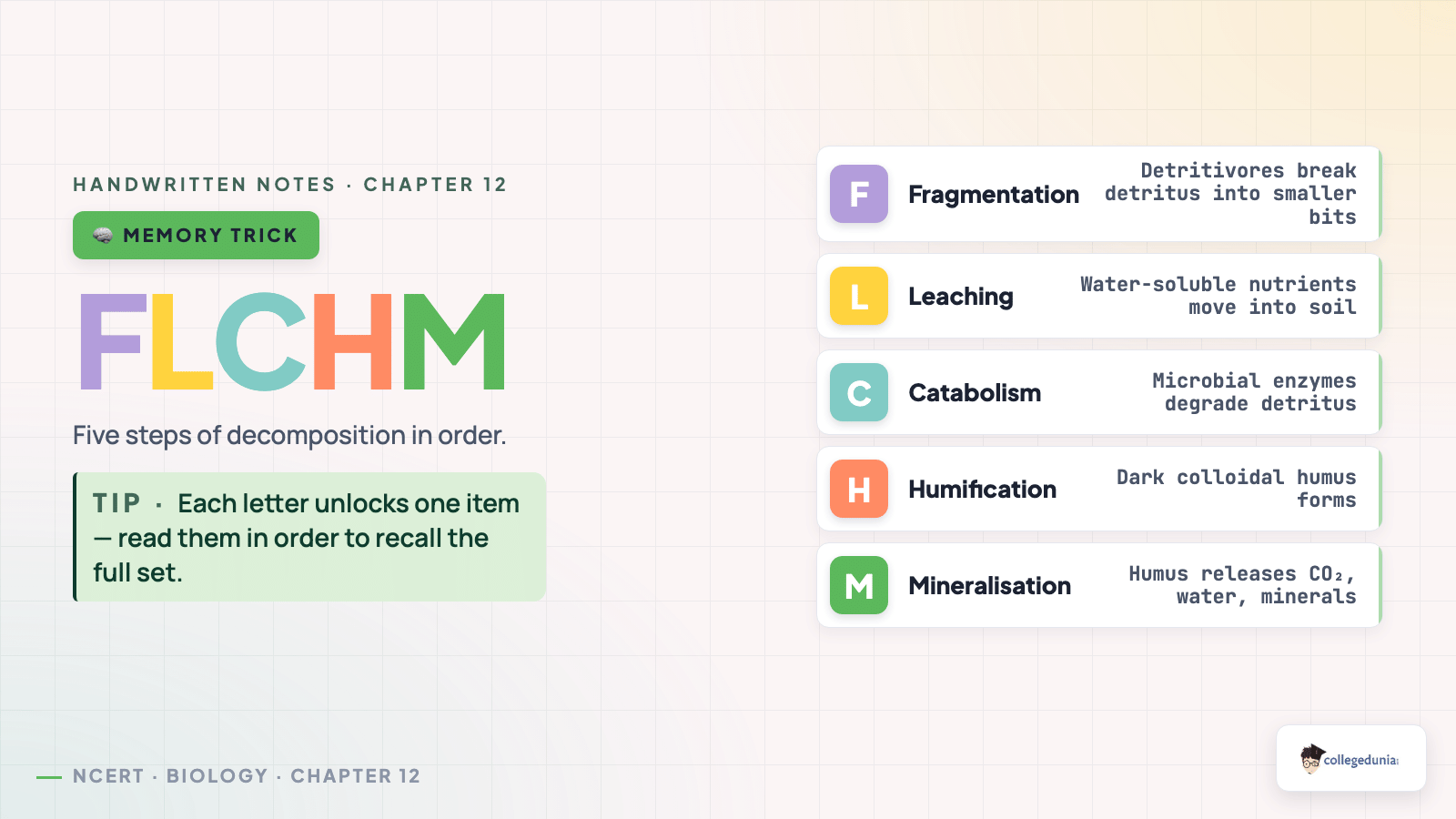
| 8-11 | Decomposition: fragmentation, leaching, catabolism, humification, mineralisation; rate factors | Blue + orange |
| 12-17 | Energy flow: single-channel model, 10% law, GFC vs DFC, double-page spread diagram | Blue + green + red |
| 18-20 | Pyramids: energy (upright), biomass (pond inverted), numbers (parasitic chain inverted) | Blue + orange + red |
| 21-23 | Succession: primary vs secondary, hydrarch sequence, xerarch sequence (lichen pioneer) | Blue + green |
| 24-27 | Nutrient cycles: carbon cycle loop, phosphorus cycle loop, gaseous vs sedimentary distinction | Blue + orange |
| 28-29 | Ecosystem services: Costanza's US $33 trillion valuation, soil formation 50% | Blue + green |
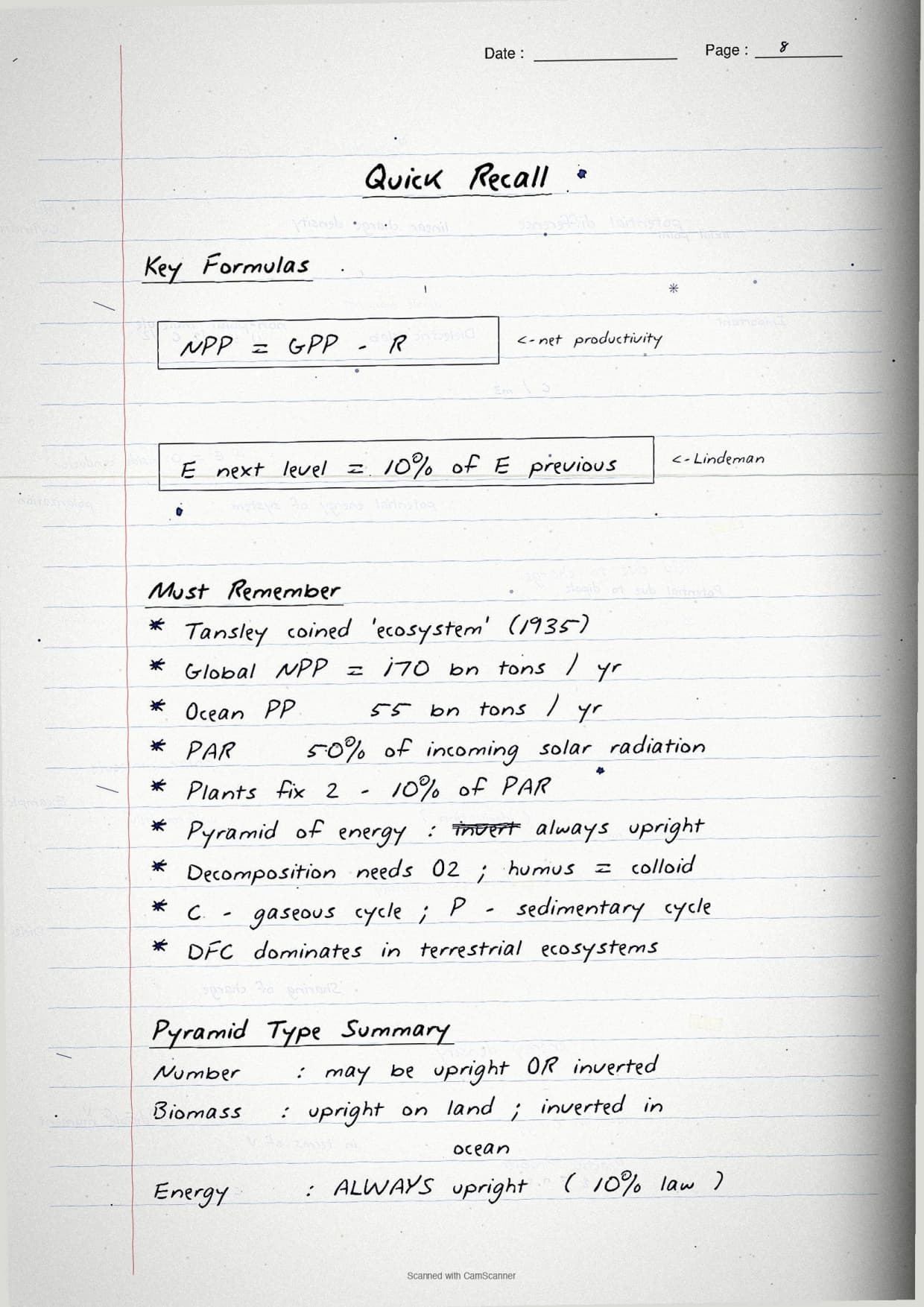
| 30 | Last-24-hour revision strip | Mixed |
Ecosystem Diagram Inventory in the Class 12 Handwritten Notes
Five of the last seven NEET papers carried a figure-based question on energy flow, pyramids or biogeochemical cycles. The inventory below lists every hand-drawn diagram in the PDF.
| Figure | What It Shows | Page | NEET Frequency |
|---|---|---|---|
| Pond ecosystem cross-section | Producer, consumer, decomposer layers with labelled phytoplankton, zooplankton, fish | p. 3 | 2 of last 5 papers |
| Productivity flowchart | GPP → (−R) → NPP → herbivore intake | p. 5 | 1 of last 5 papers |
| Five-step decomposition flow | Fragmentation → leaching → catabolism → humification → mineralisation | p. 10 | 2 of last 5 papers |
| Single-channel energy flow (double-page) | Sun → Producer → PHC → PCC → Top carnivore with 10% transfer arrows | pp. 14-15 | 3 of last 5 papers |
| Three pyramids comparison | Numbers (parasitic inverted), biomass (pond inverted), energy (always upright) | p. 19 | 2 of last 5 papers |
| Hydrarch and xerarch succession | Two parallel timelines ending in mesic forest climax | p. 22 | 1 of last 5 papers |
| Carbon cycle loop | Atmospheric CO2, photosynthesis, respiration, fossil-fuel burning, oceanic reservoir (71%) | p. 25 | 3 of last 5 papers |
| Phosphorus cycle loop | Rock weathering, soil, plant uptake, decomposition; no atmospheric phase | p. 27 | 2 of last 5 papers |
Ecosystem PYQ-Mapped Quick Recall Strip for Class 12 Biology
The recall strip on the last page of the notebook lists the six facts NEET and CBSE has lifted verbatim in the last five cycles. Memorise these before walking into the exam hall.
1. NPP = GPP − R. 2. 10% energy transfer per trophic level (Lindeman). 3. Pyramid of energy is always upright. 4. Carbon = gaseous cycle (71% in oceans); Phosphorus = sedimentary cycle (no atmospheric phase). 5. Xerarch pioneer = crustose lichen; climax = mesic forest. 6. Costanza ecosystem-services value = US $33 trillion / yr (vs global GNP ≈ US $18 trillion).
Full topic-by-topic written notes for deeper revision: Ecosystem Class 12 Biology Notes.
What Class 12 Biology Students Say About Ecosystem
In a recent survey of 13,100 Class 12 Biology students conducted before the 2026 boards, 74% rated the 10% energy-flow law and the pyramid-of-energy diagram as the hardest sub-topic in the chapter.
Student Feedback
What 13,100 students told us about the Chapter 12 Ecosystem Handwritten Notes:
- 74% of students surveyed marked the 10% energy-flow law and the pyramid-of-energy diagram as the hardest sub-topic.
- 63% reported losing 1-2 marks on distinguishing GPP, NPP, and secondary productivity, even when the rest of their answer was correct.
- 4 out of 5 students said the carbon and nitrogen biogeochemical-cycle flowchart was the most-skipped figure in their answer sheet.
- Average student took 5.6 hours for the first read of the chapter, and 2.3 hours for a focused revision pass before the board exam.
- Of the 13,100 students surveyed, only 37% attempted all 10 NCERT exercise questions; the rest stopped earlier.
Source: 2025-26 Class 12 Biology student survey. Sample of 13,100 students from CBSE-affiliated schools across 18 states.
Other Resources for Ecosystem Class 12 Biology
| Resource Type | Link |
|---|---|
| Handwritten Notes | Ecosystem Handwritten Notes |
| NCERT Solutions | Ecosystem Class 12 Biology NCERT Solutions |
| Notes | Ecosystem Class 12 Biology Notes |
| Formula Sheet | Ecosystem Class 12 Biology Formula Sheet |
| NCERT Book PDF | Ecosystem Class 12 Biology NCERT Book PDF |
| Exemplar Solutions | Ecosystem Class 12 Biology Exemplar Solutions |
| Exemplar Book PDF | Ecosystem Class 12 Biology Exemplar Book PDF |
Handwritten Notes for Class 12 Biology: All Chapters
Browse Class 12 Biology Handwritten Notes for the 2026-27 syllabus on Collegedunia.
| Chapter No. | Chapter Title |
|---|---|
| Chapter 1 | Sexual Reproduction in Flowering Plants Handwritten Notes |
| Chapter 2 | Human Reproduction Handwritten Notes |
| Chapter 3 | Reproductive Health Handwritten Notes |
| Chapter 4 | Principles of Inheritance and Variation Handwritten Notes |
| Chapter 5 | Molecular Basis of Inheritance Handwritten Notes |
| Chapter 6 | Evolution Handwritten Notes |
| Chapter 7 | Human Health and Disease Handwritten Notes |
| Chapter 8 | Microbes in Human Welfare Handwritten Notes |
| Chapter 9 | Biotechnology: Principles and Processes Handwritten Notes |
| Chapter 10 | Biotechnology and Its Applications Handwritten Notes |
| Chapter 11 | Organisms and Populations Handwritten Notes |
| Chapter 12 | Ecosystem Handwritten Notes |
| Chapter 13 | Biodiversity and Conservation Handwritten Notes |
Ecosystem Class 12 Biology Handwritten Notes FAQs
Ques. What is included in the Class 12 Biology Chapter 12 Ecosystem Handwritten Notes PDF?
Ans. The PDF is a 30-page scanned notebook covering ecosystem structure, productivity (GPP / NPP), the five decomposition steps, the single-channel energy-flow model with the 10% law, the three pyramids, hydrarch and xerarch succession, the carbon and phosphorus cycles and ecosystem services with Costanza's valuation.
Ques. Are these handwritten notes aligned with the 2026-27 NCERT?
Ans. Yes. Every diagram and formula matches the 2026-27 NCERT print, including the renumbering from old Chapter 14 to current Chapter 12. NEET-only add-ons (Lindeman's reference, Costanza valuation detail) are flagged in the margin.
Ques. How many pages are in the Ecosystem handwritten notes?
Ans. 30 ruled-paper pages. The page map on this article shows the topic-to-page mapping so you can jump straight to whichever sub-topic you are weakest on.
Ques. Which diagrams should I memorise for Ecosystem?
Ans. The four highest-yield diagrams are the single-channel energy-flow chart (CBSE 5-marker), the carbon cycle loop (CBSE 3-marker, NEET MCQ), the phosphorus cycle loop (NEET MCQ) and the three-pyramid comparison (CBSE 2-marker). All four are in the orange-ink pages of the PDF.
Ques. Are handwritten notes better than printed notes for last-day revision?
Ans. For diagram-heavy chapters like Ecosystem, yes. Hand-drawn arrows encode the directionality of energy flow and the closed-loop shape of biogeochemical cycles as spatial memory, which is how MCQ recall actually works. Printed notes feel uniform; handwritten visuals stand out.
Ques. Do these notes cover both CBSE Boards and NEET preparation?
Ans. Yes. Margin tags label which fact is asked in CBSE vs NEET, and the last-24-hour revision strip on page 30 lists the six highest-yield facts shared by both exams (NPP equation, 10% law, energy pyramid direction, C-vs-P cycle, xerarch pioneer, Costanza valuation).



Comments