




These Human Memory handwritten notes turn the whole chapter on memory into clean, handwritten pages for fast last-minute revision. They follow the 2026-27 NCERT syllabus and Chapter 6 of Class 11 Psychology. Students get the nature of memory, the encoding-storage-retrieval stages, the Atkinson-Shiffrin stage model, the types of long-term memory, the causes of forgetting and the mnemonics, all in a pen-on-paper format that is easy to skim before a test.
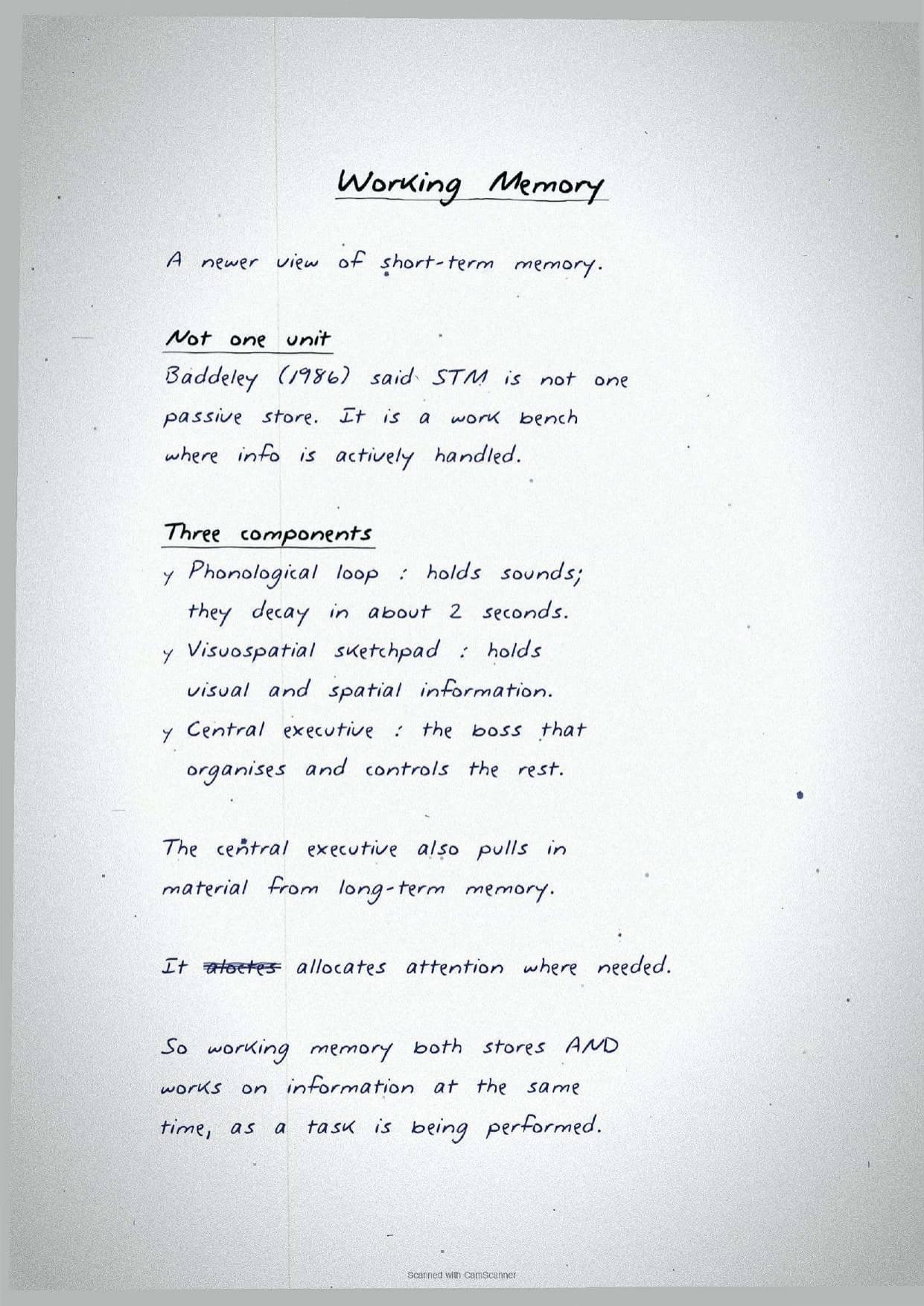
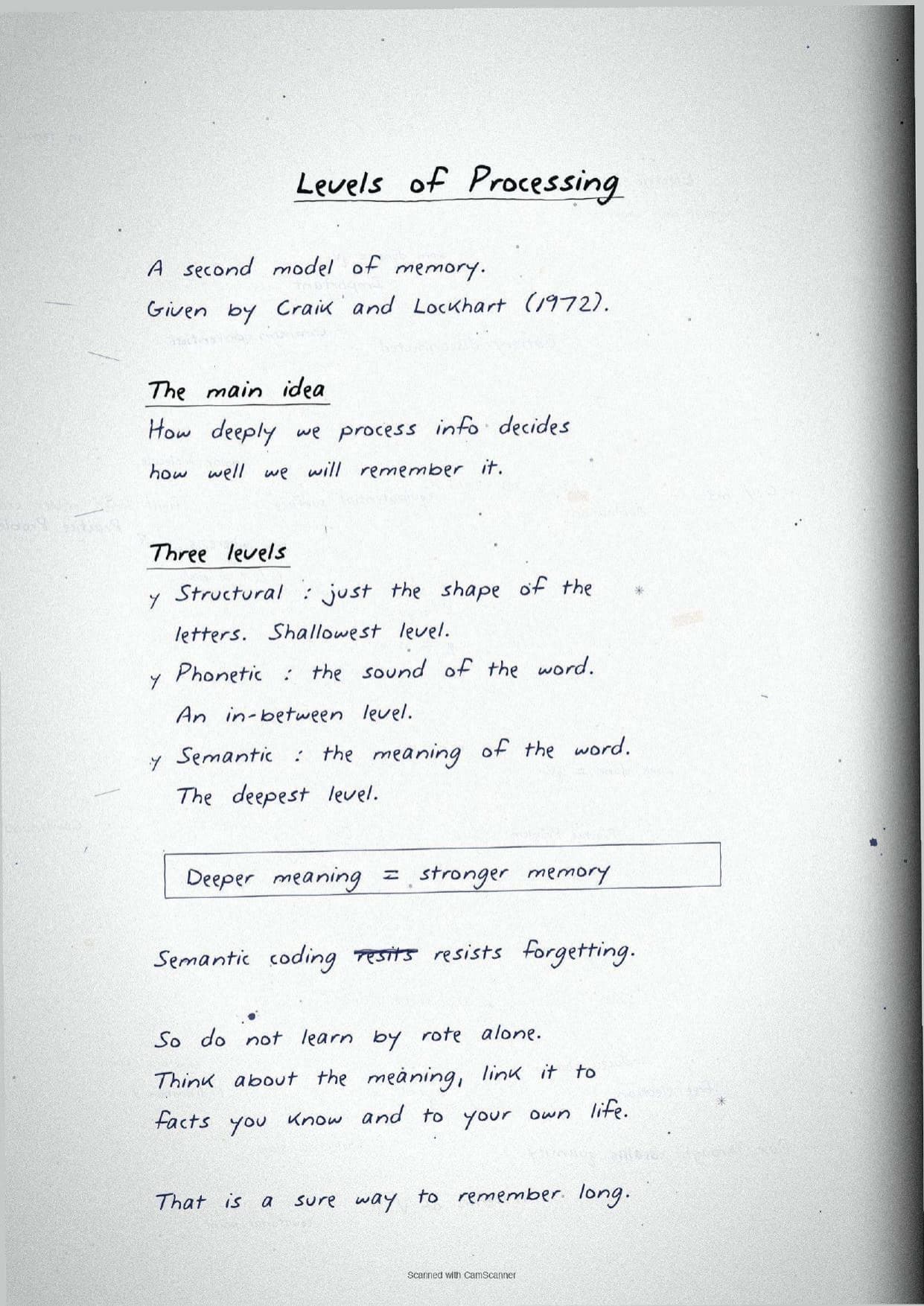
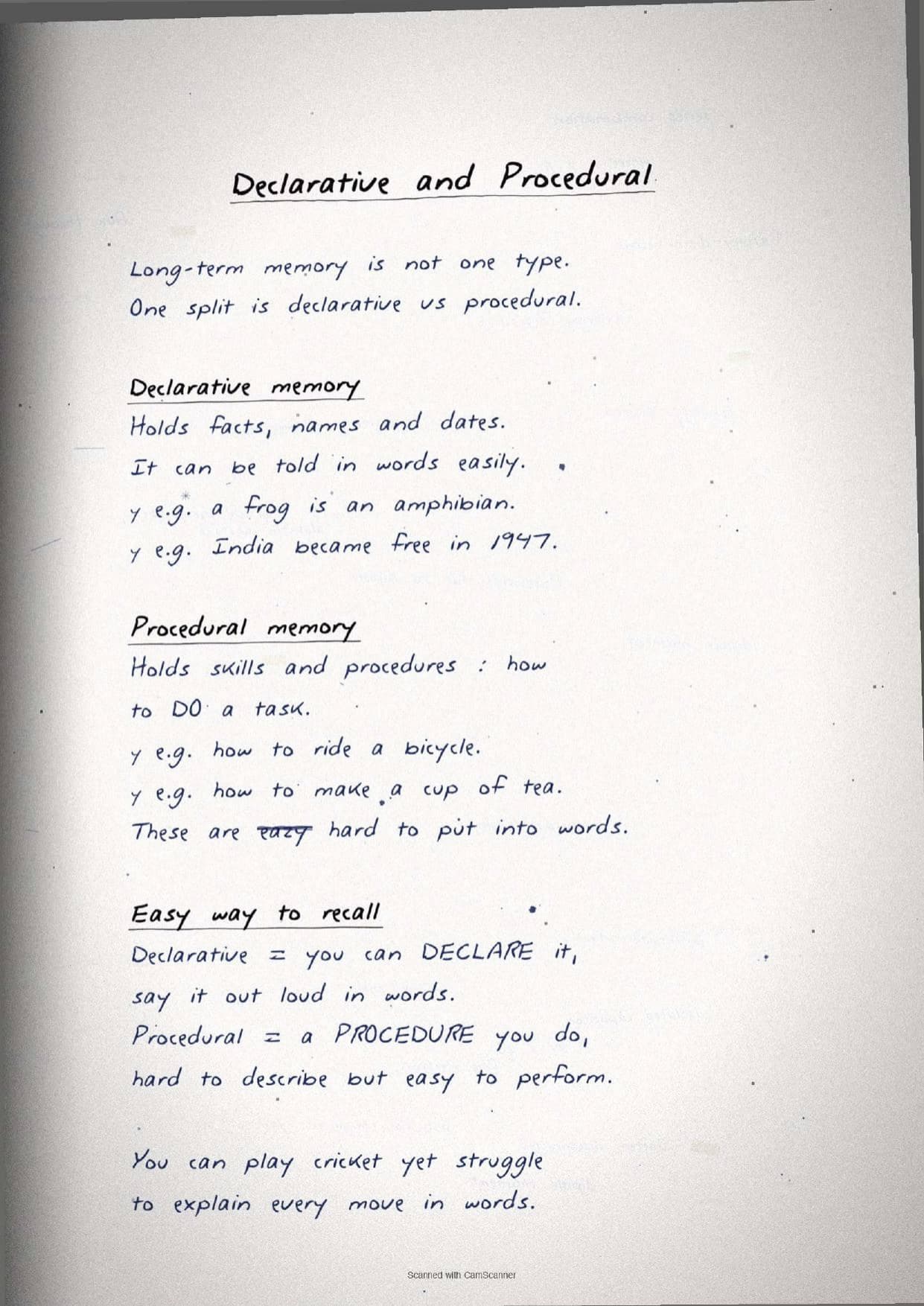
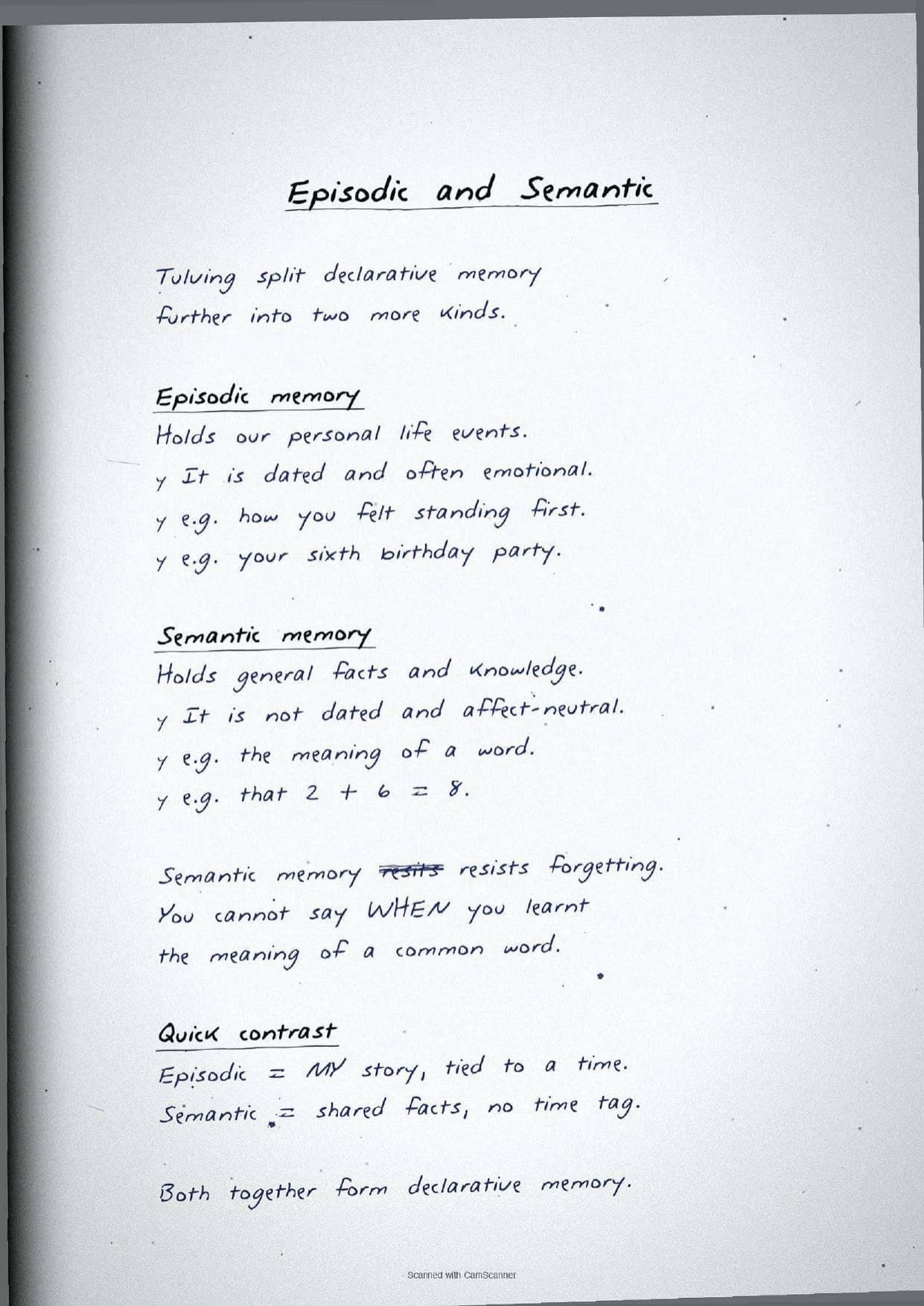
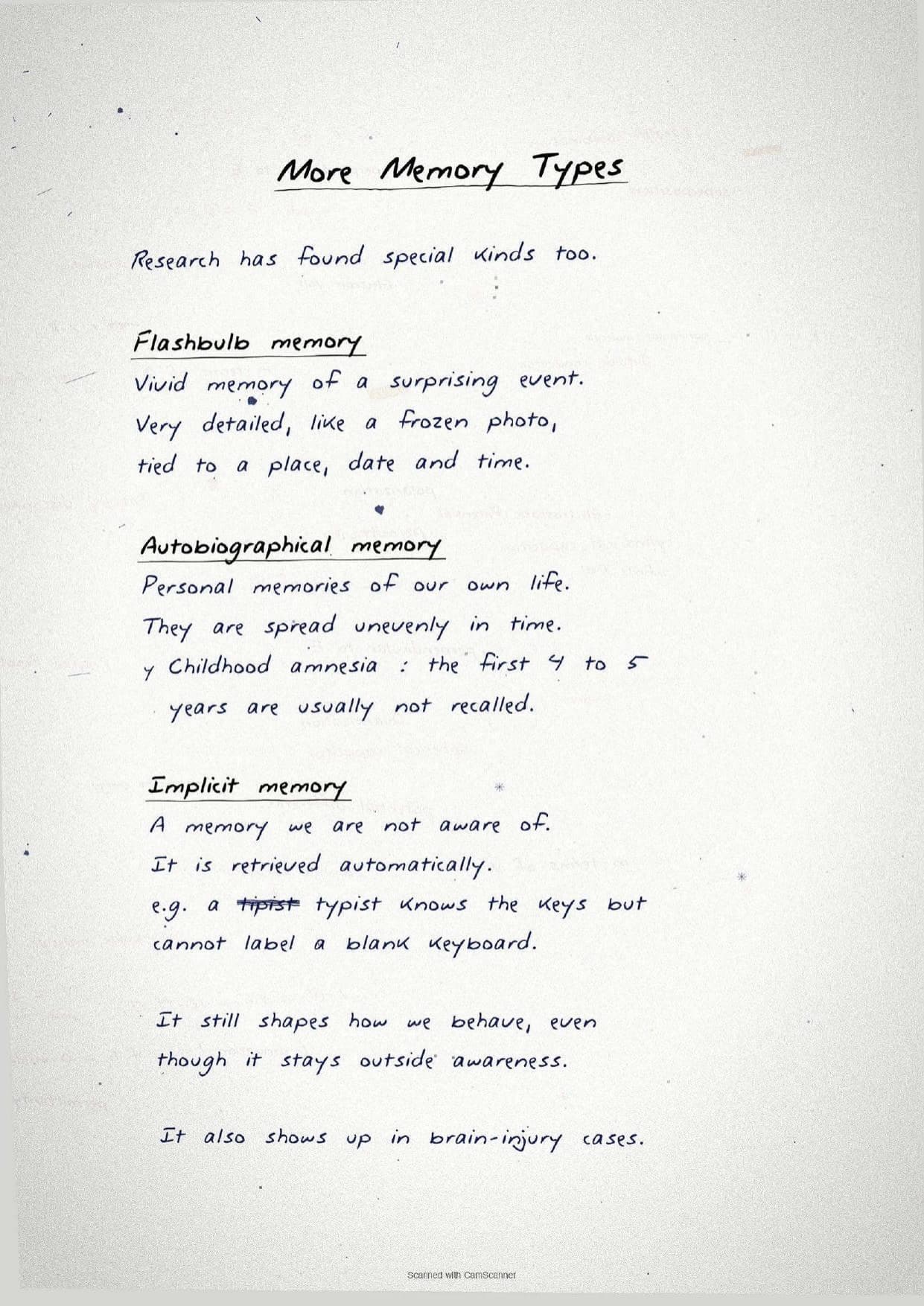
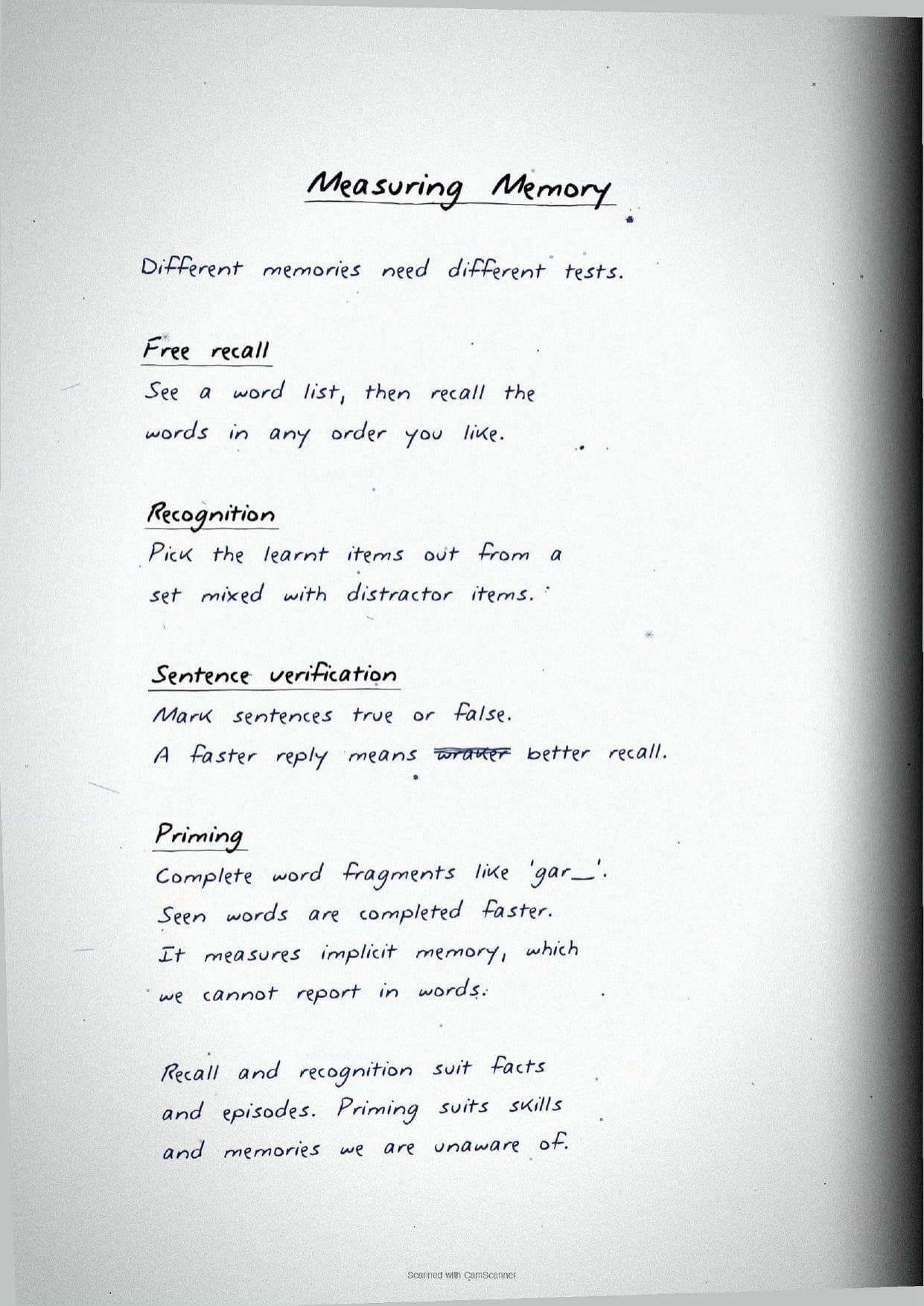
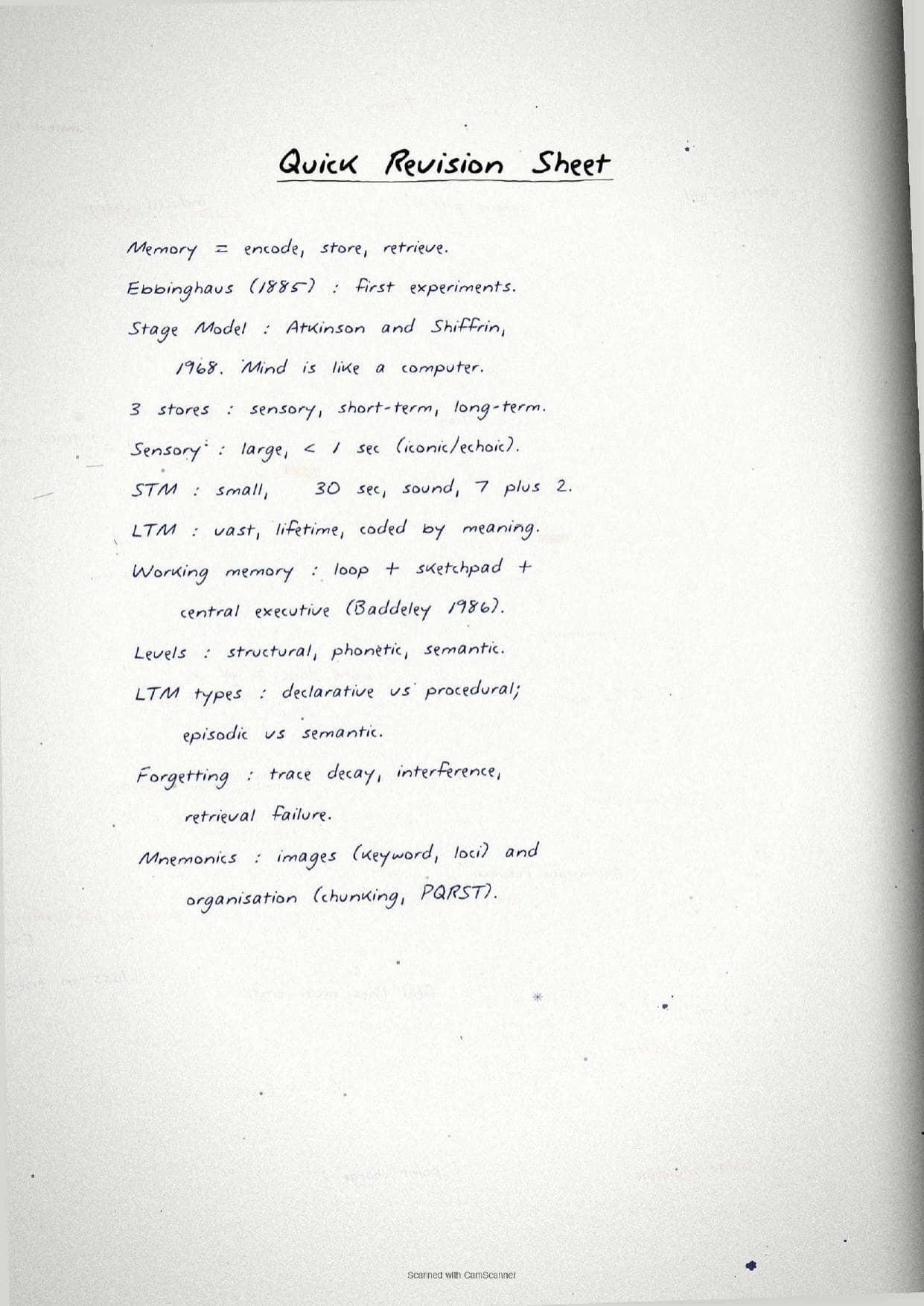
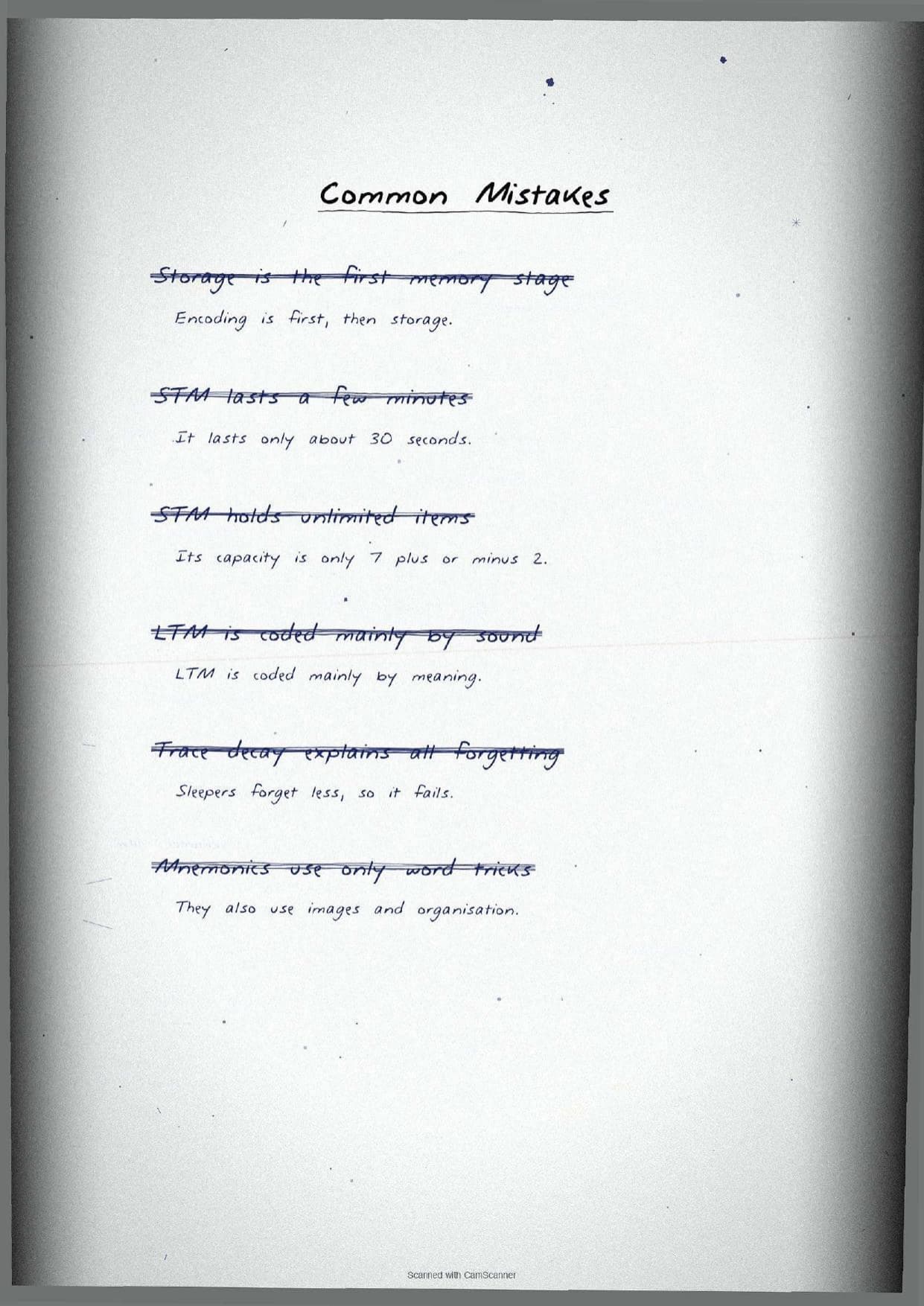
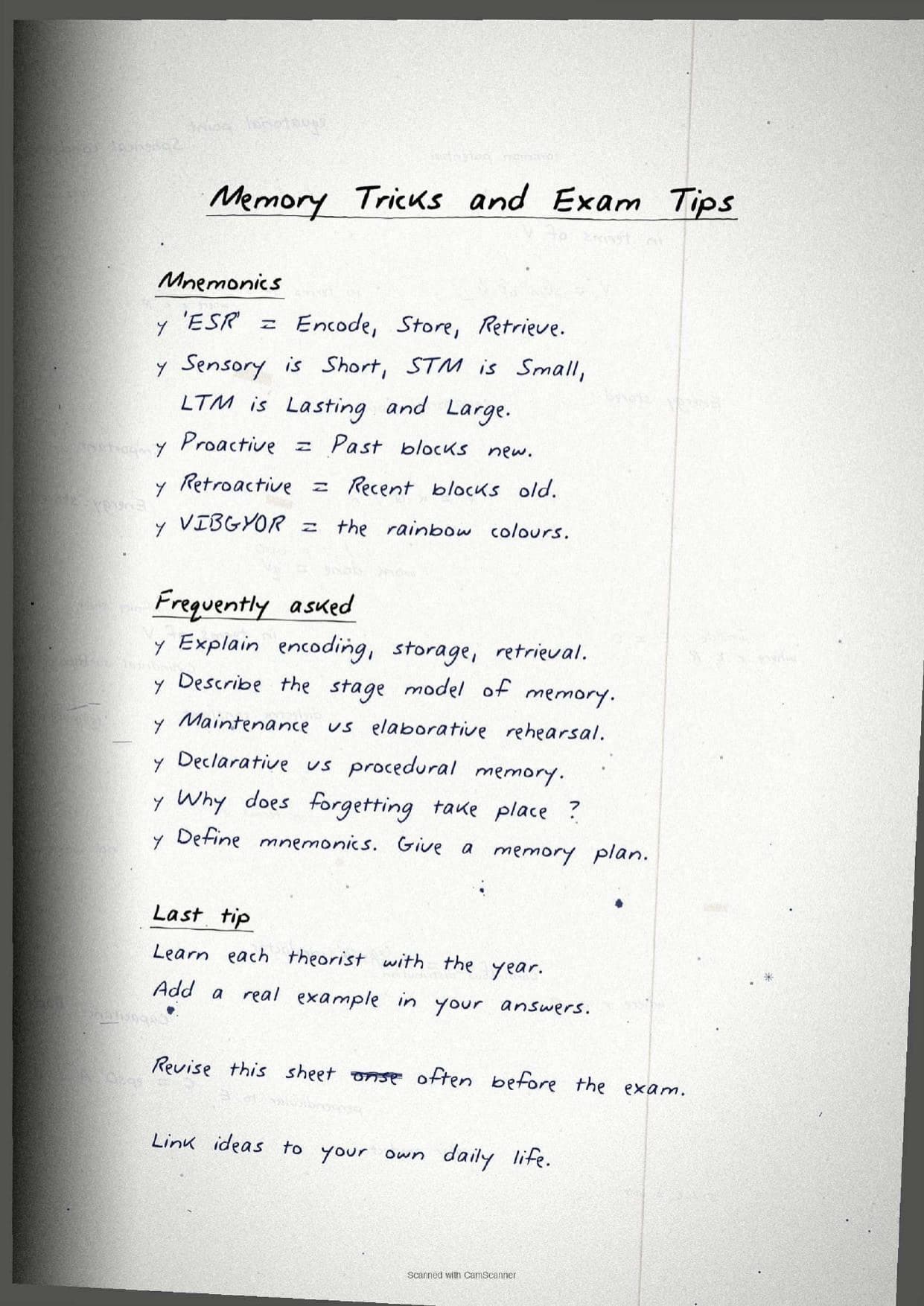
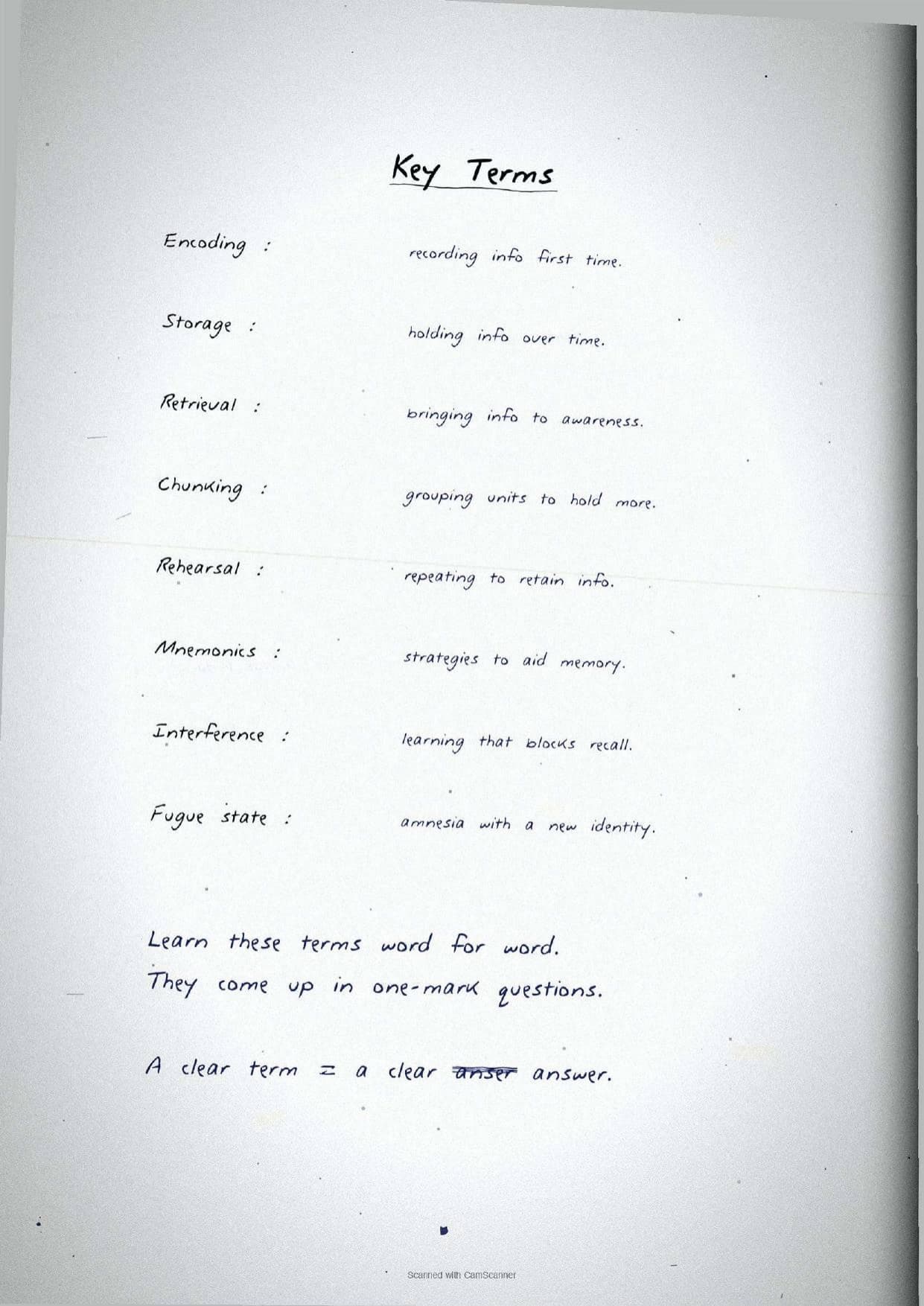
- Handwritten pages with boxed key terms and a labelled stage-model map of memory.
- Human Memory is a high-weight Class 11 Psychology chapter, so its long answers appear often in the final exam and in CUET.
- Pairs with the NCERT Solutions, Notes and Book PDF linked lower on this page.
These Human Memory handwritten notes are prepared from the official NCERT Psychology textbook and checked against recent CBSE Class 11 question papers.
Student Feedback: In a Collegedunia poll of 6,180 Class 11 Psychology students, 72% of students said handwritten pages helped them recall the three memory systems and the two forgetting theories faster than printed text, because the boxed diagrams and arrows made the stage model stick.
Source: 2026-27 Class 11 Psychology student poll. Sample of 6,180 students from CBSE schools across 11 states.
What These Human Memory Handwritten Notes Contain
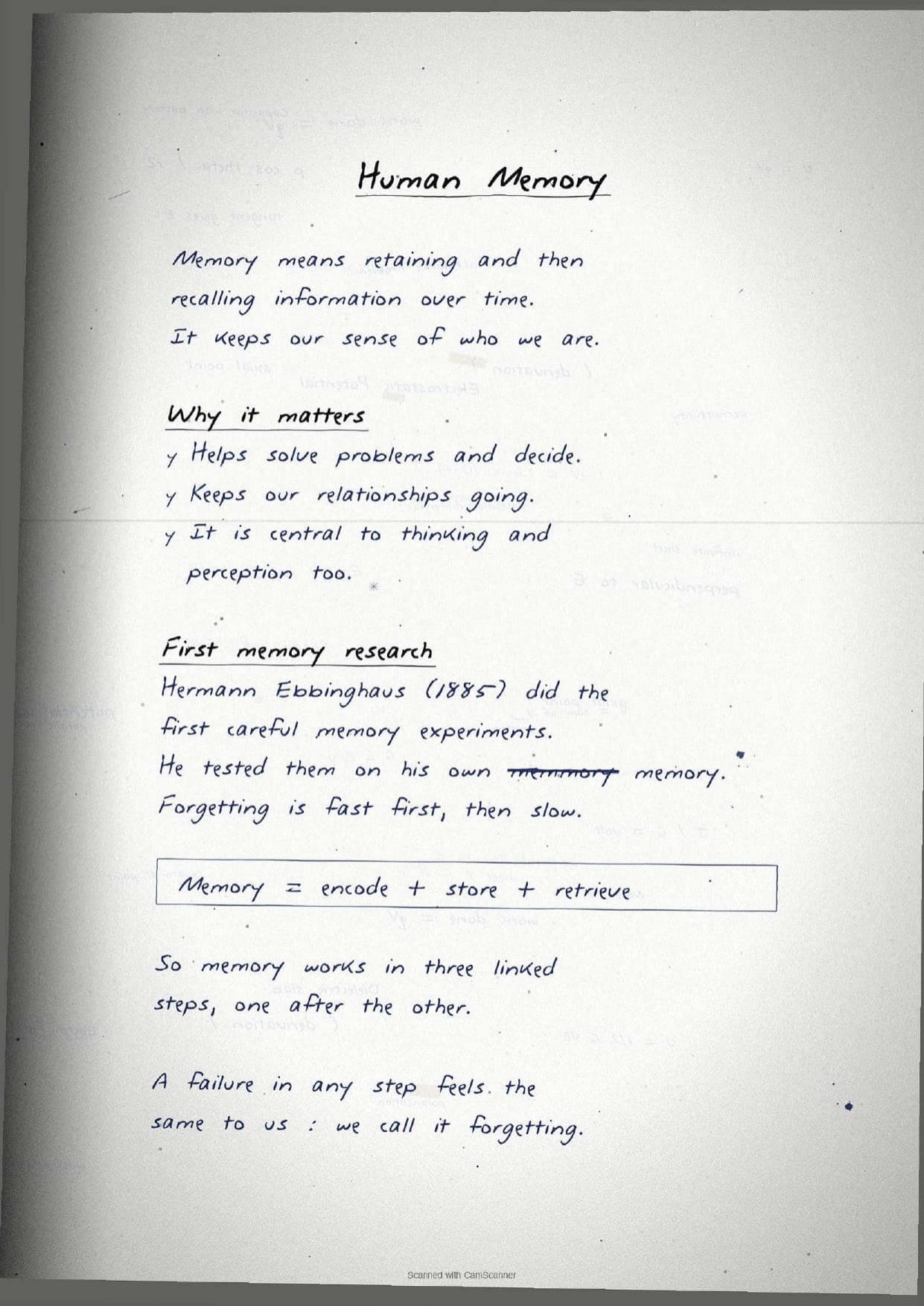
Human Memory is the sixth chapter of Class 11 Psychology. It studies how we retain and recall information over time, from the split-second sensory register to the lifetime store of long-term memory. These handwritten notes condense the chapter into handwritten pages that read like a topper's own notebook.
The notes are organised under three threads, each on its own set of pages:
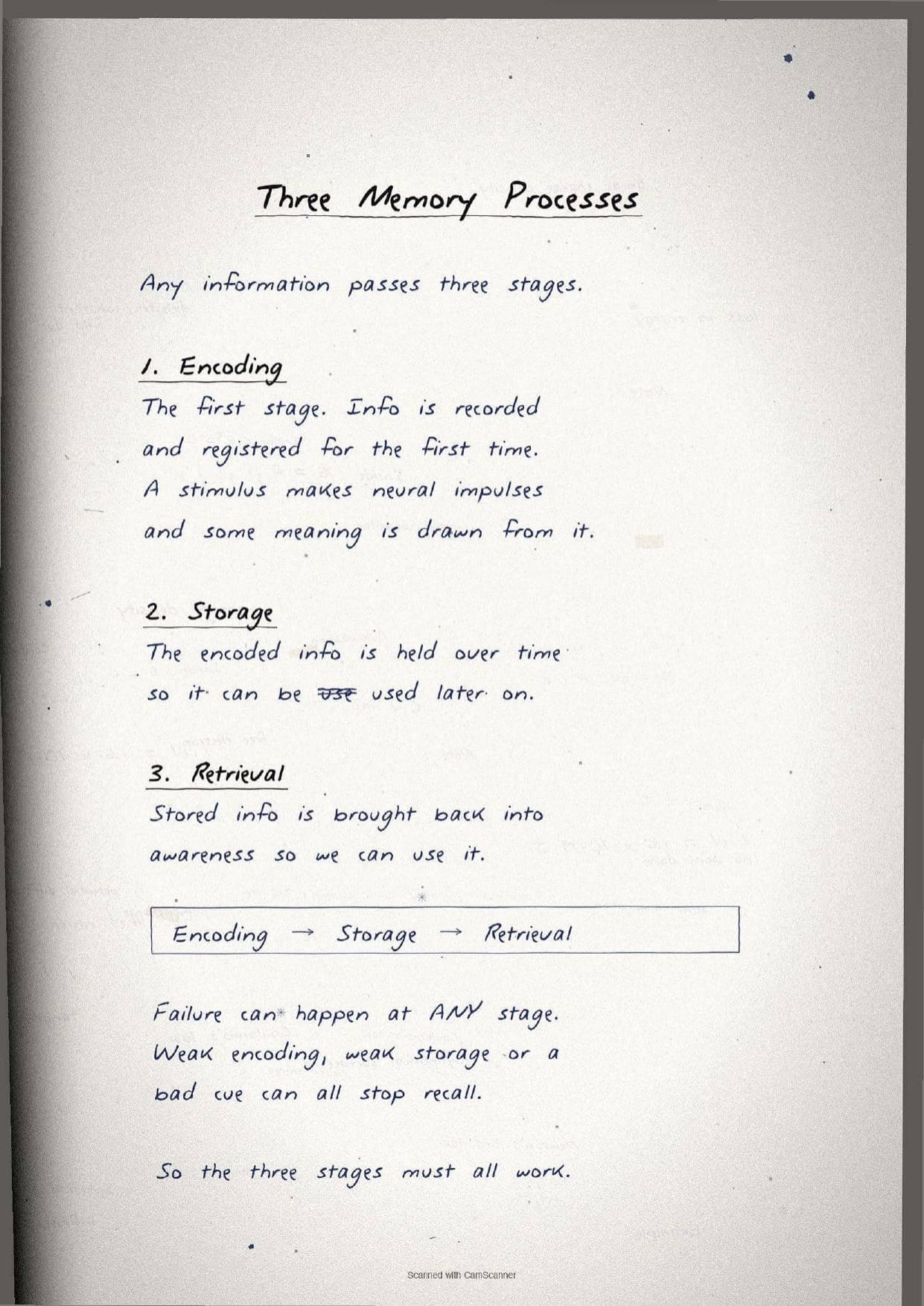
- The basics: the nature of memory and the three stages of encoding, storage and retrieval.
- The models: the Atkinson-Shiffrin stage model, the three memory systems and the levels of processing view.
- The wider picture: types of long-term memory, why we forget, and the mnemonics that improve memory.
Because the pages are handwritten, the key terms sit in boxes and arrows rather than long paragraphs. A student can flip through the Human Memory class 11 pages in a few minutes and still pick up the stage model, the forgetting theories and the main contrasts before walking into the exam.
Memory Systems and the Stage Model in the Handwritten Pages
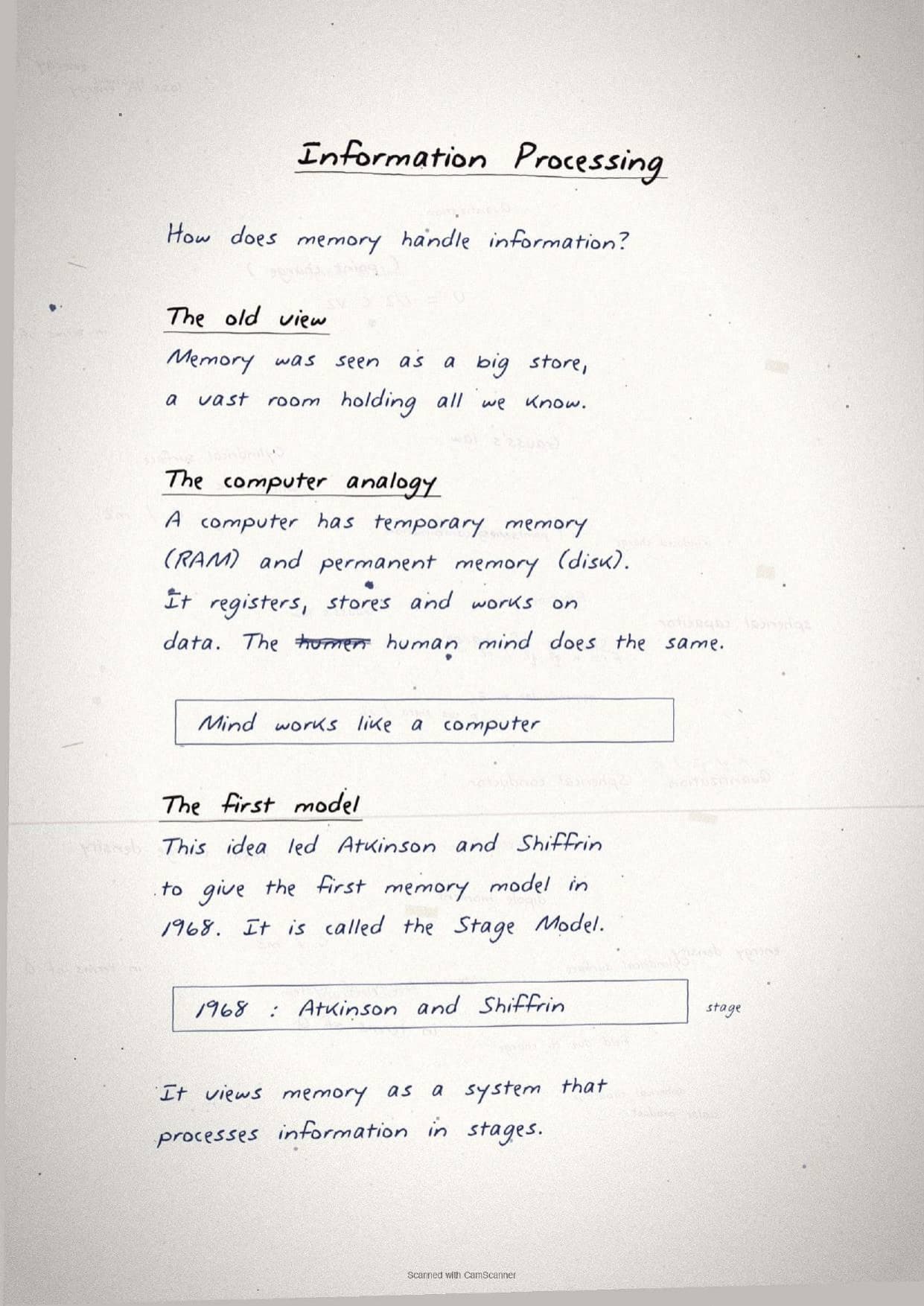
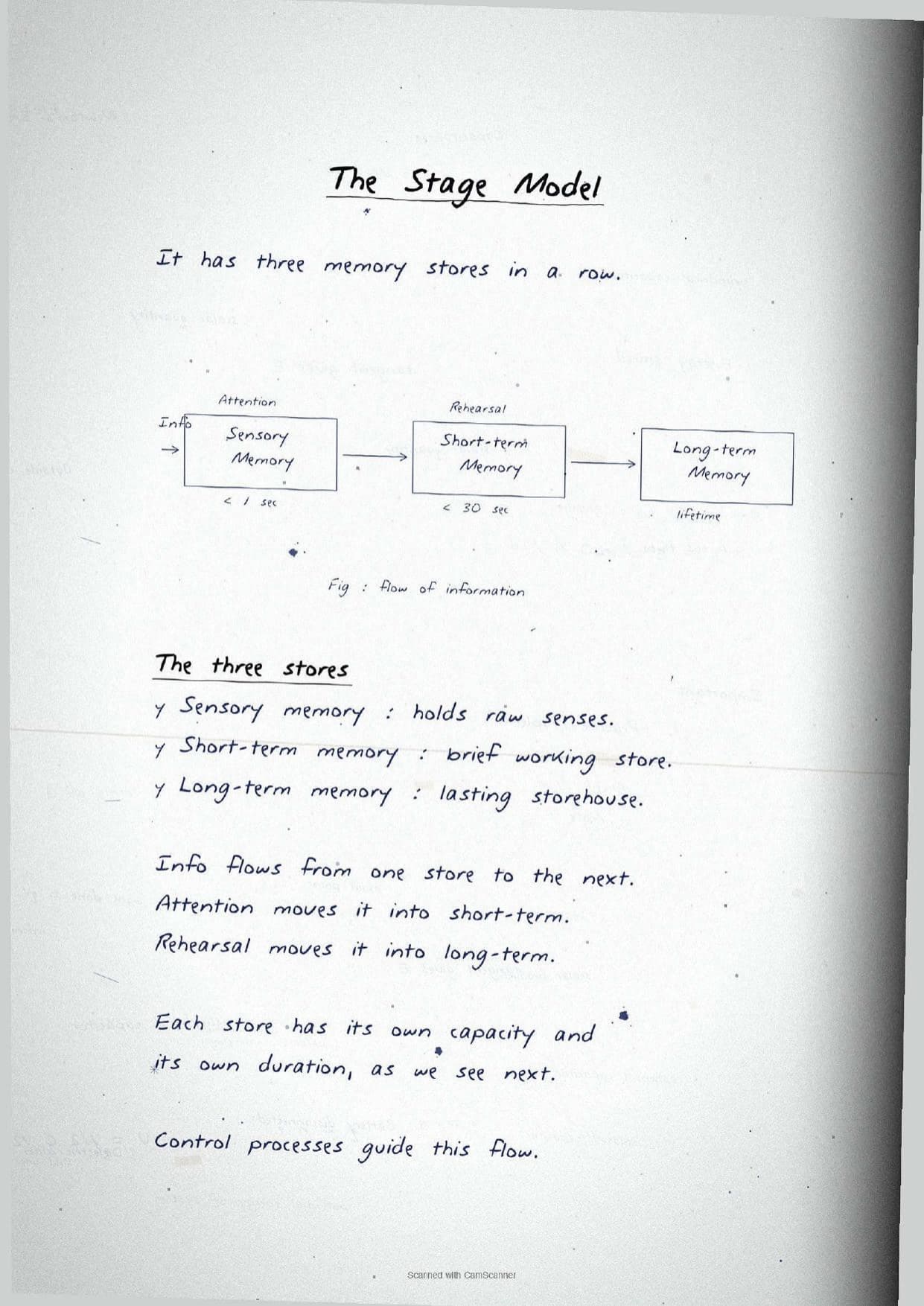
The stage model fills the central pages, drawn as a clear flow so the three systems stand apart. Proposed by Atkinson and Shiffrin in 1968, it compares human memory with a computer and traces how information moves from one store to the next. The table below shows what the handwritten notes cover for each system.
| Memory system | What the page shows |
|---|---|
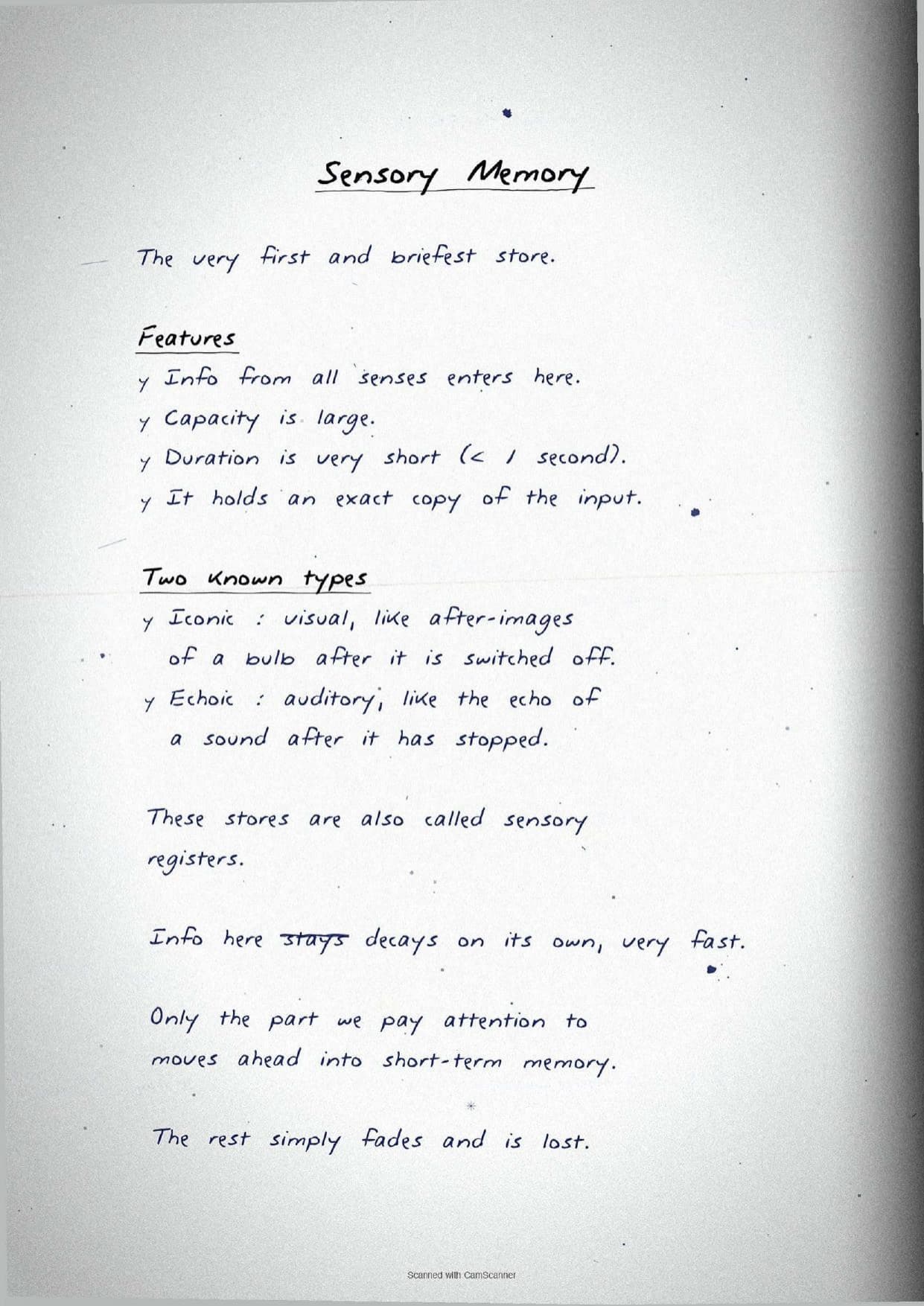
| Sensory memory | Large capacity, duration under one second; iconic (sight) and echoic (sound) registers. |
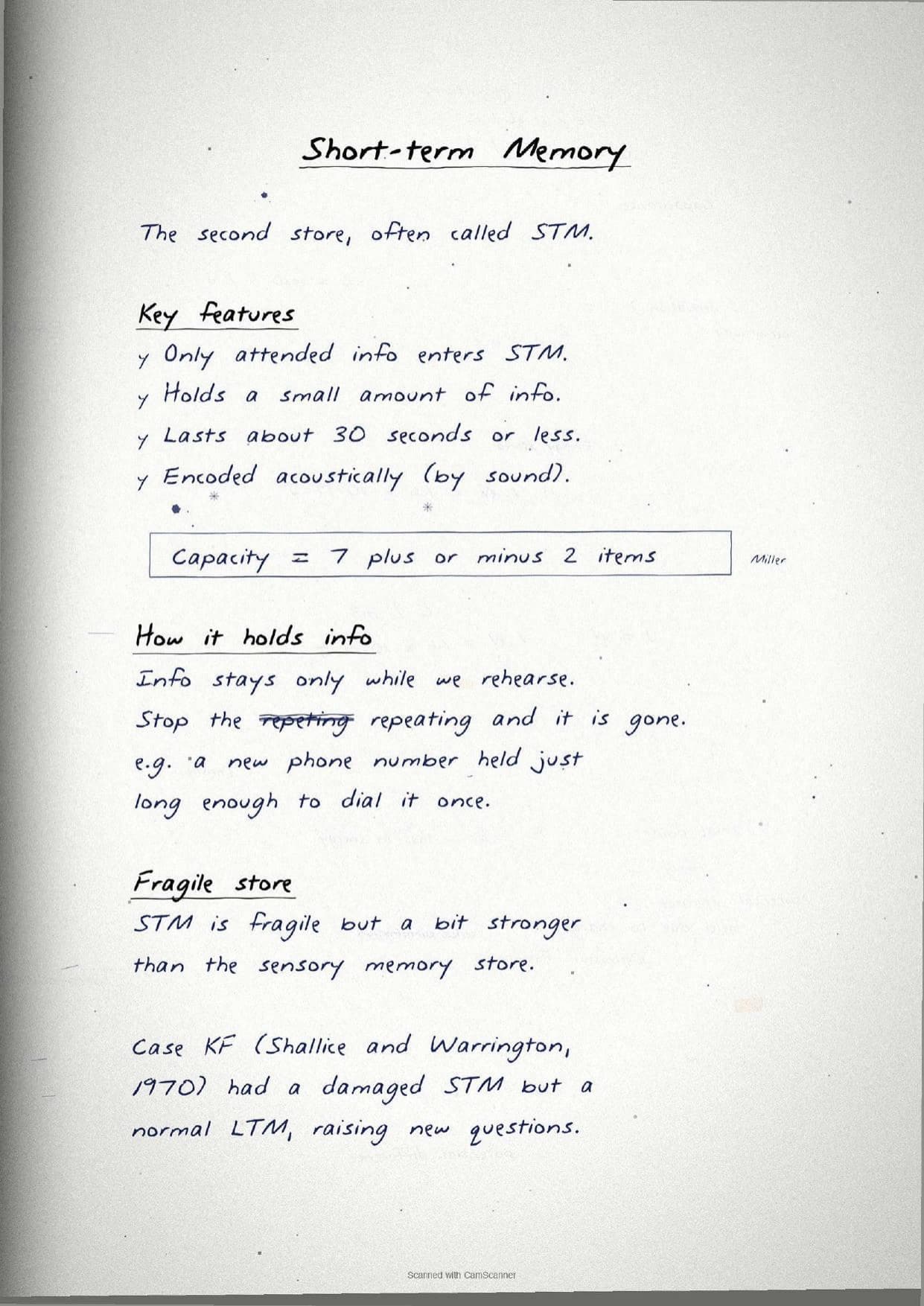
| Short-term memory (STM) | Small store, under 30 seconds, capacity 7 plus or minus 2; expanded through chunking. |
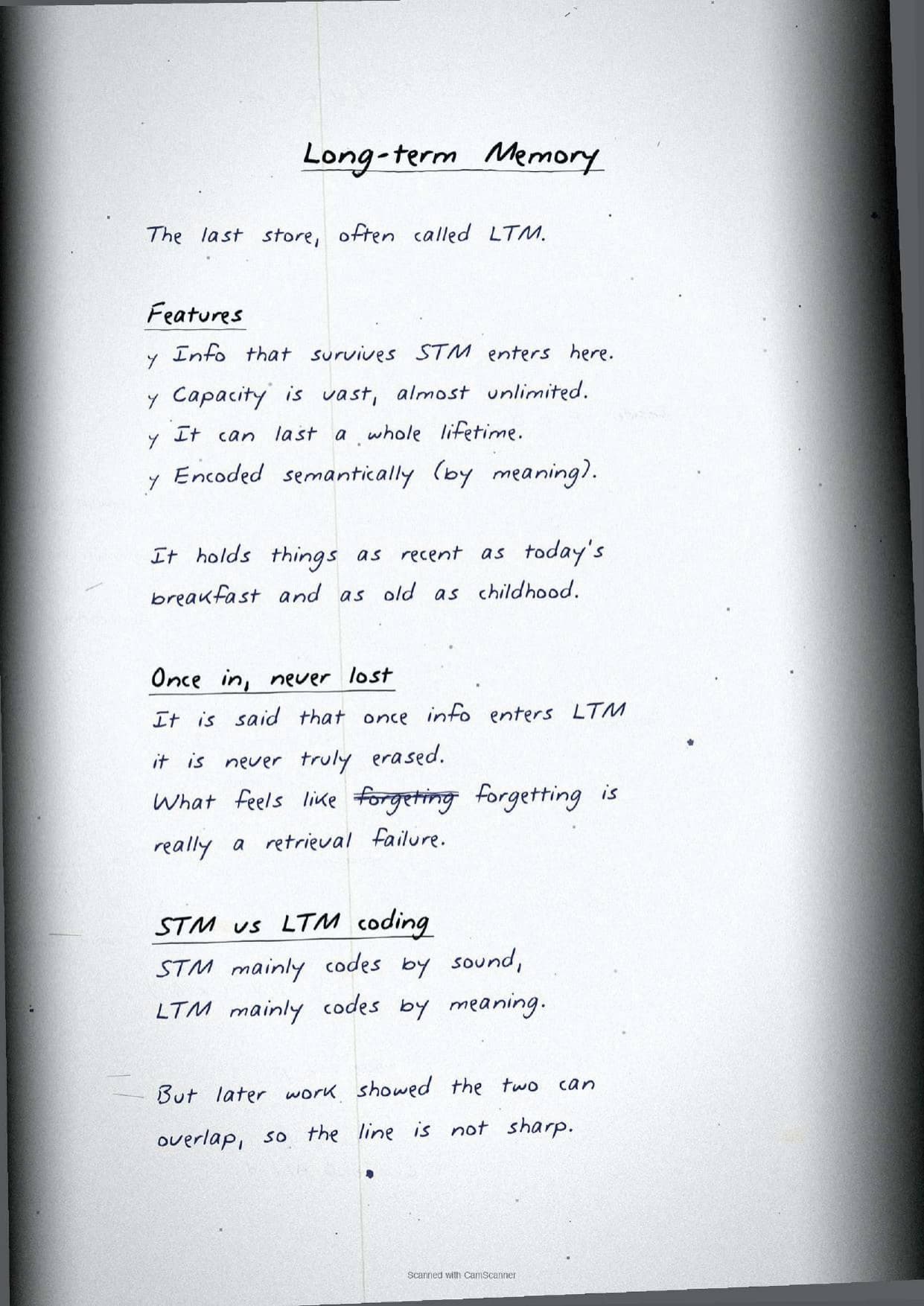
| Long-term memory (LTM) | Vast, near-permanent store; information encoded semantically, by meaning. |
| Working memory (Baddeley) | Phonological loop, visuospatial sketchpad and central executive as a work bench. |
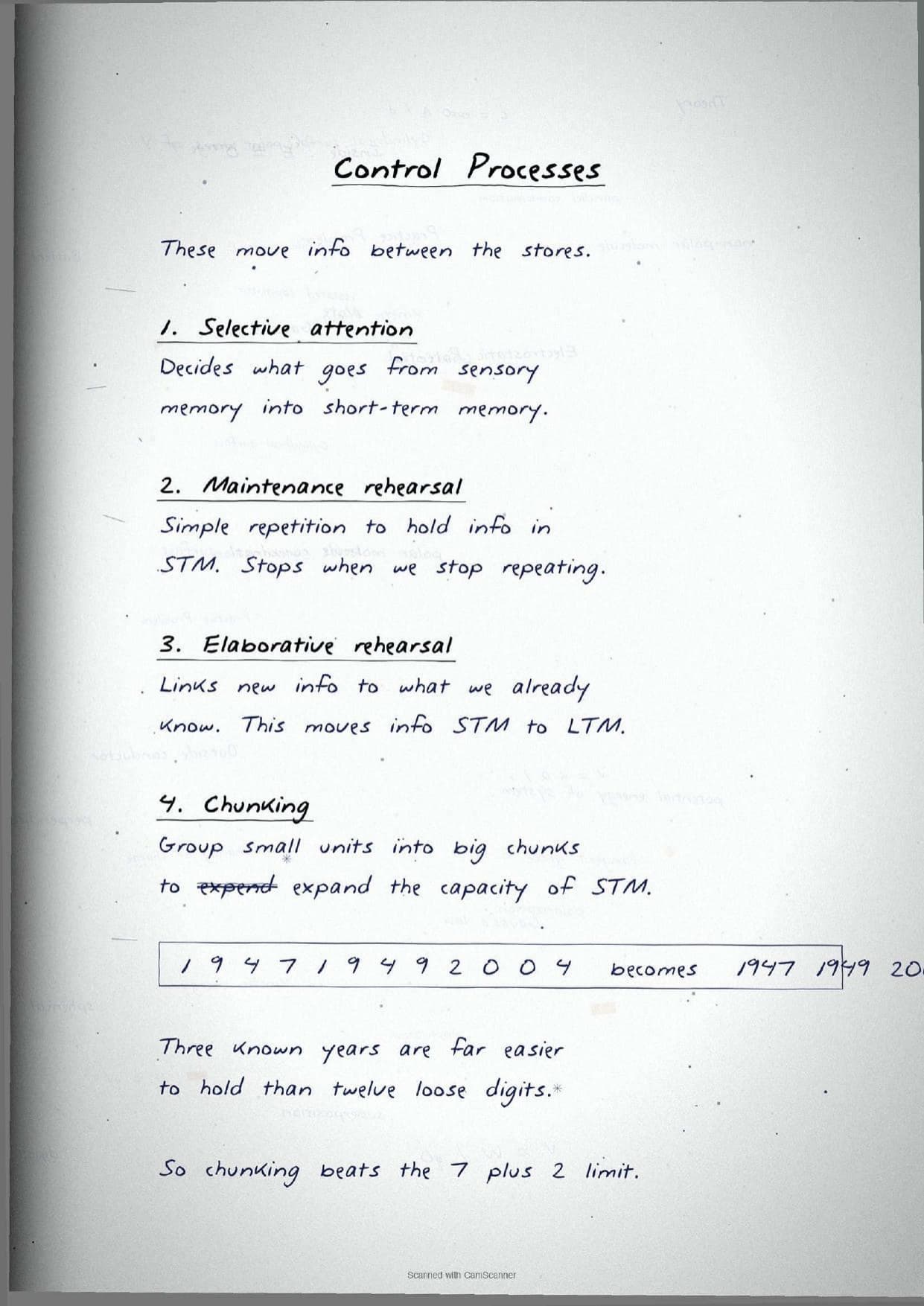
The handwritten map makes the control processes easy to see: selective attention moves information from the sensory register to STM, maintenance rehearsal holds it there, and elaborative rehearsal passes it into LTM. The pages also box the levels of processing view of Craik and Lockhart (1972), which shows that deeper, meaning-based (semantic) encoding resists forgetting far better than shallow structural or phonetic processing.
Forgetting and Memory Improvement in the Notes
The later pages cover the types of long-term memory, why we forget and how to remember more. These topics feed the short and long answers, so the handwritten notes keep them as boxed lists. The lists below show what each page covers.
- Types of LTM: declarative versus procedural, and within declarative, episodic (personal events) versus semantic (general knowledge).
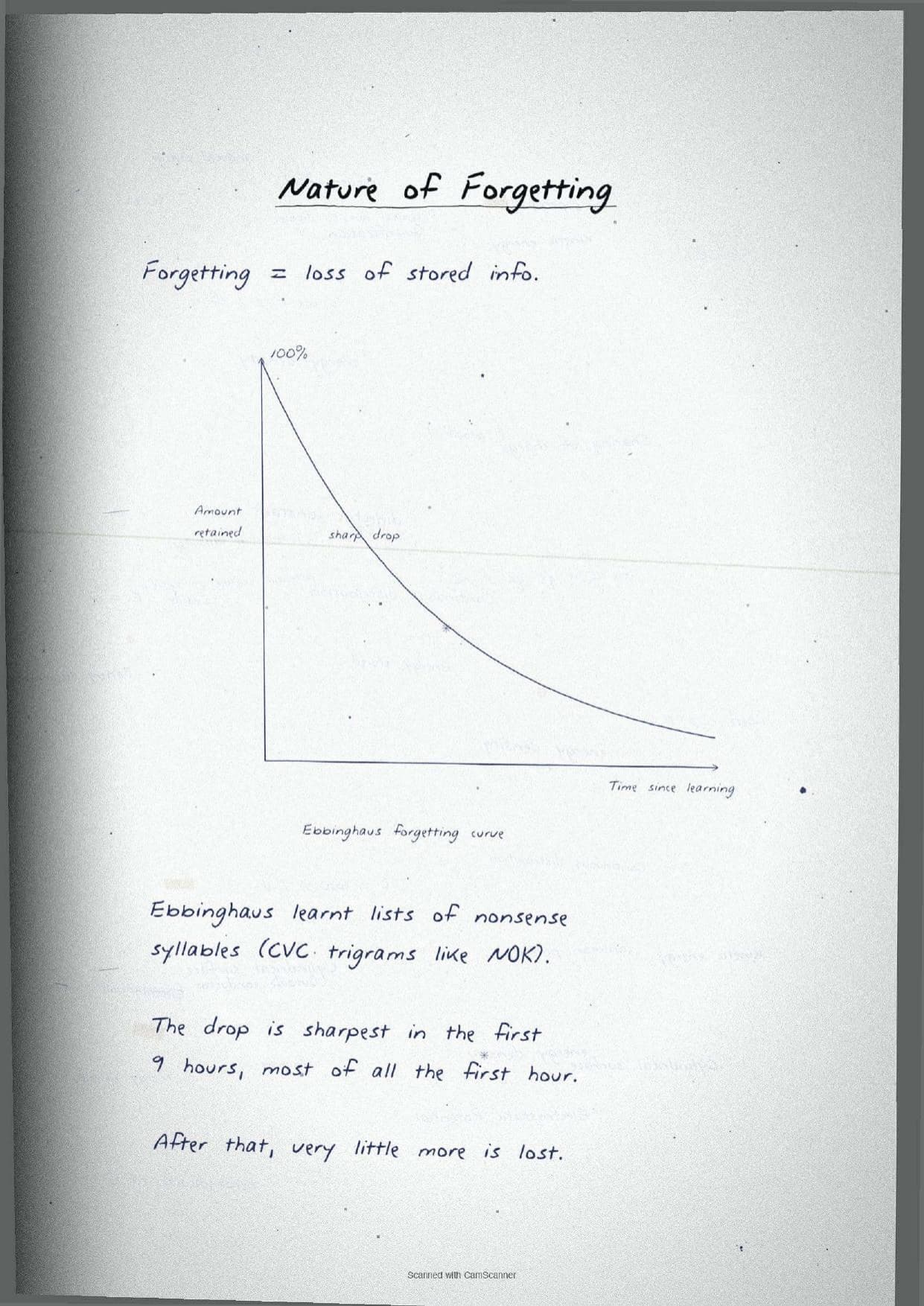
- Ebbinghaus curve: forgetting is fastest in the first hour, then the decline becomes gradual.
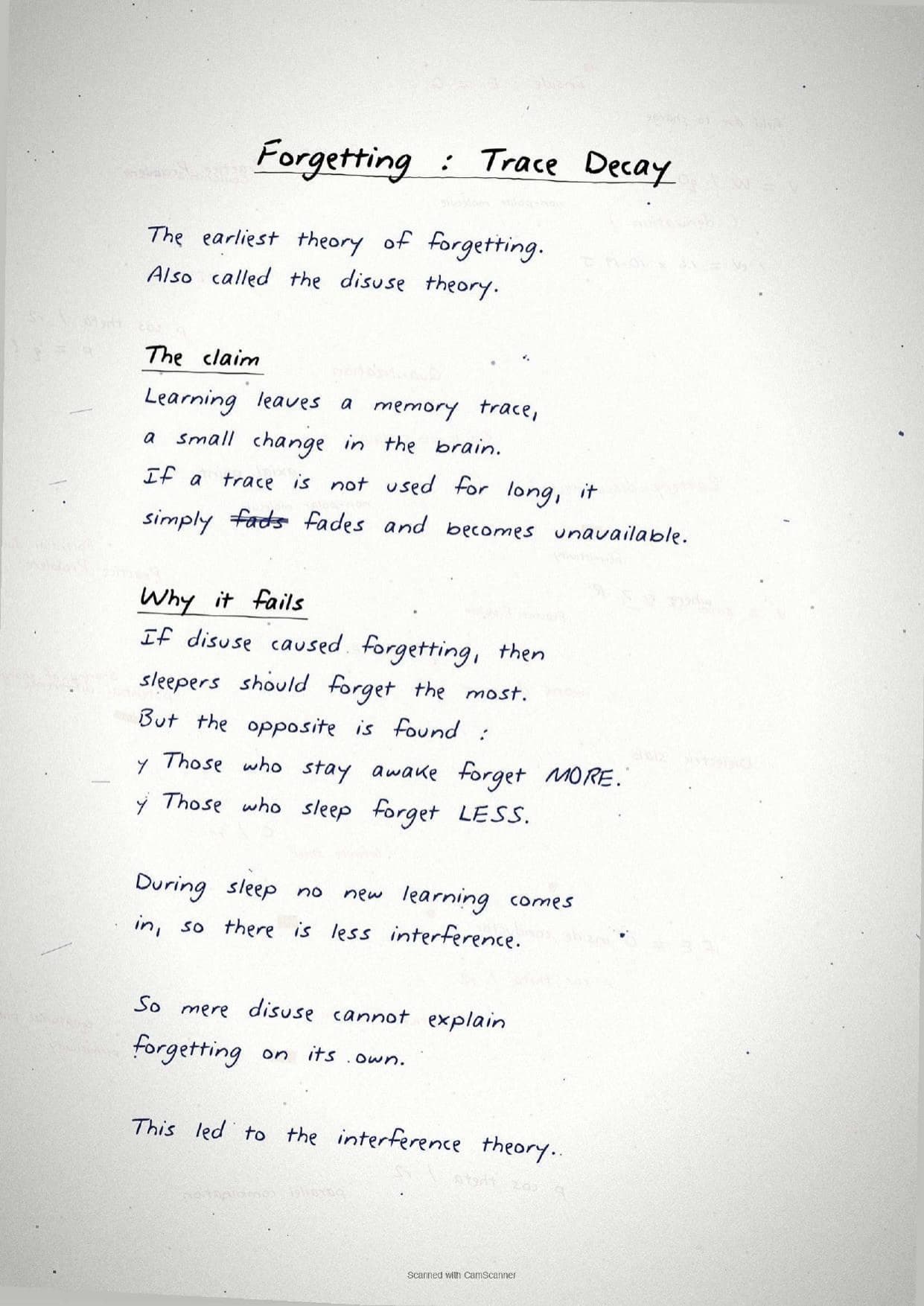
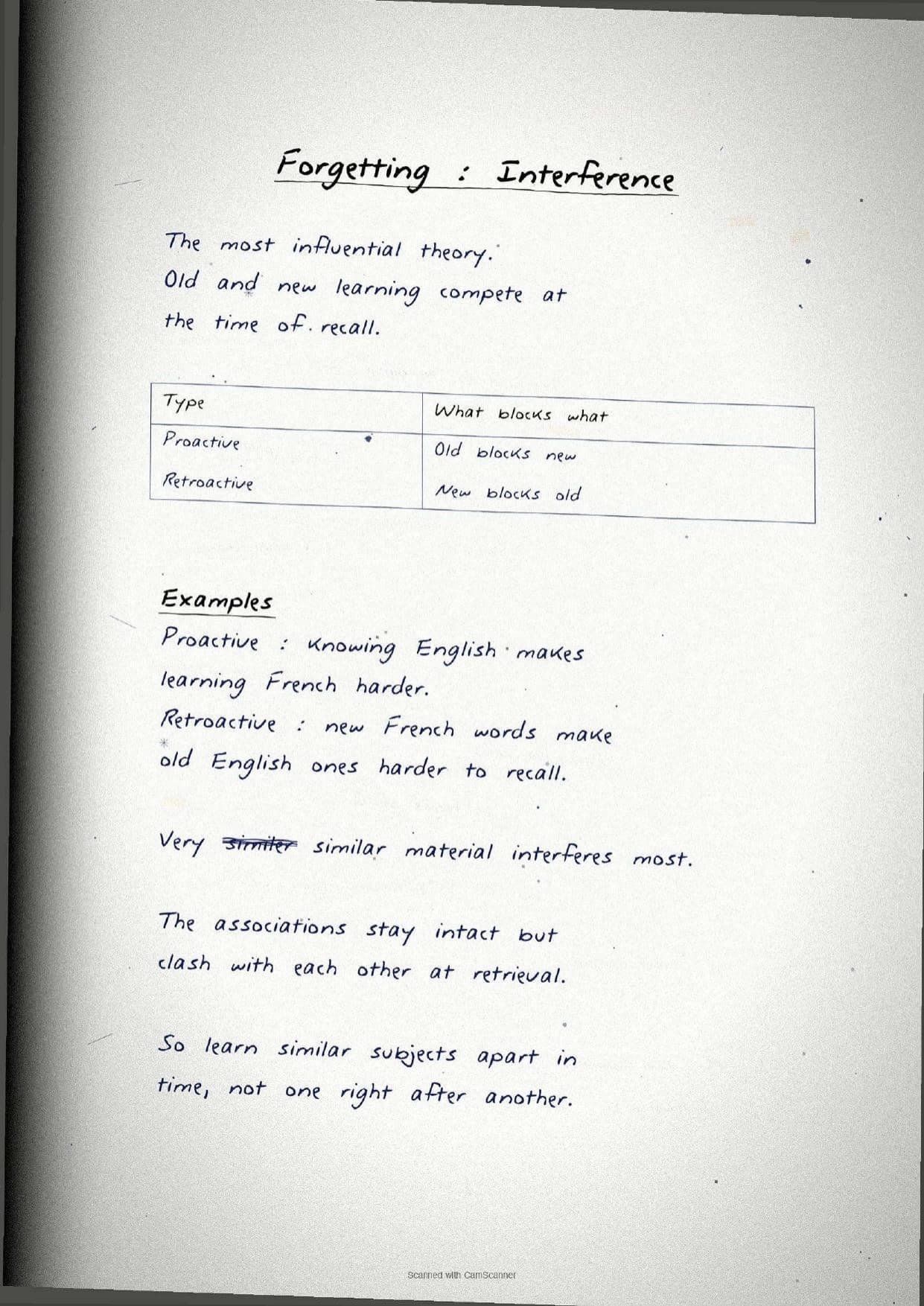
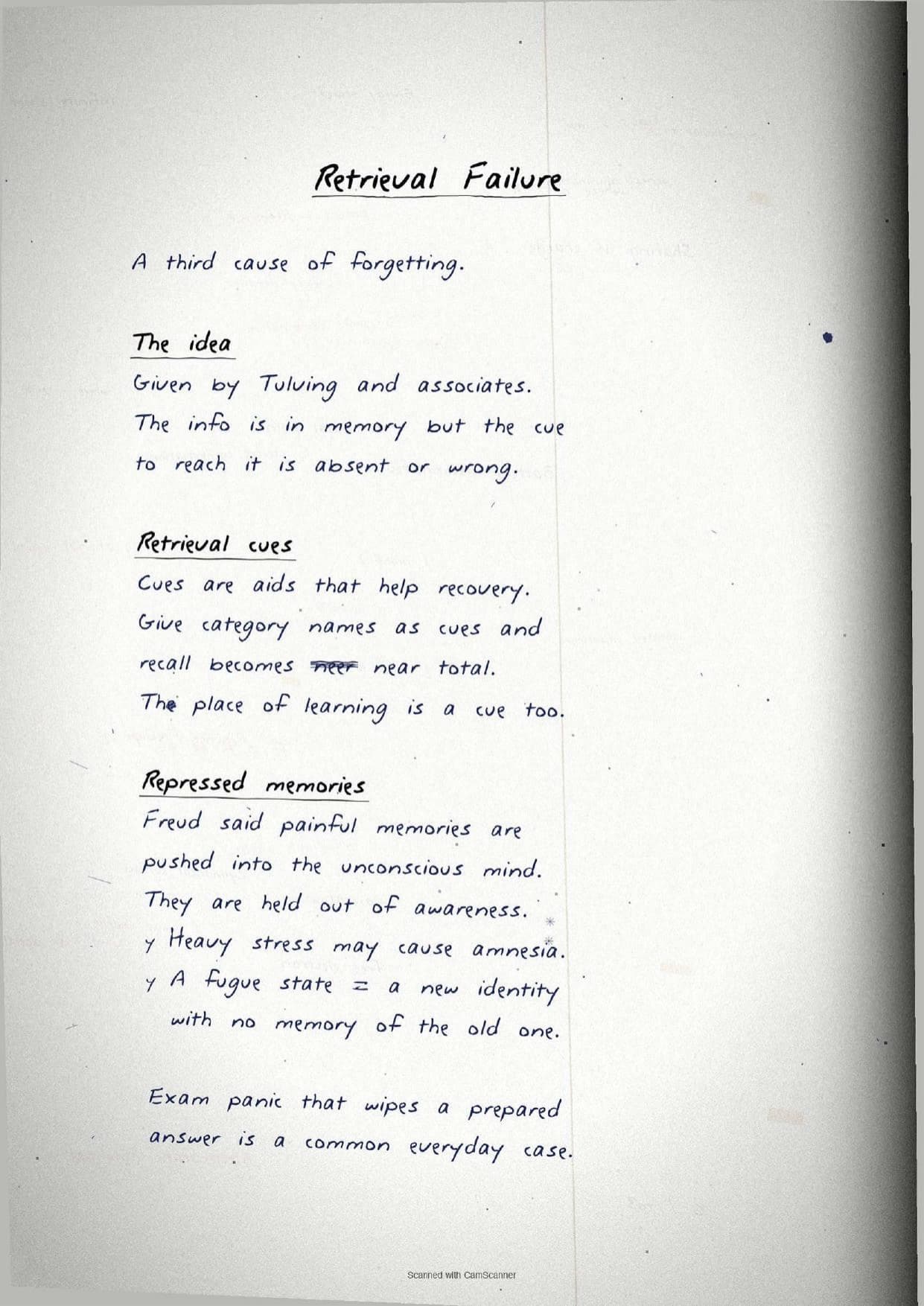
- Theories of forgetting: trace decay (disuse), interference (proactive and retroactive), and retrieval failure (missing cues).
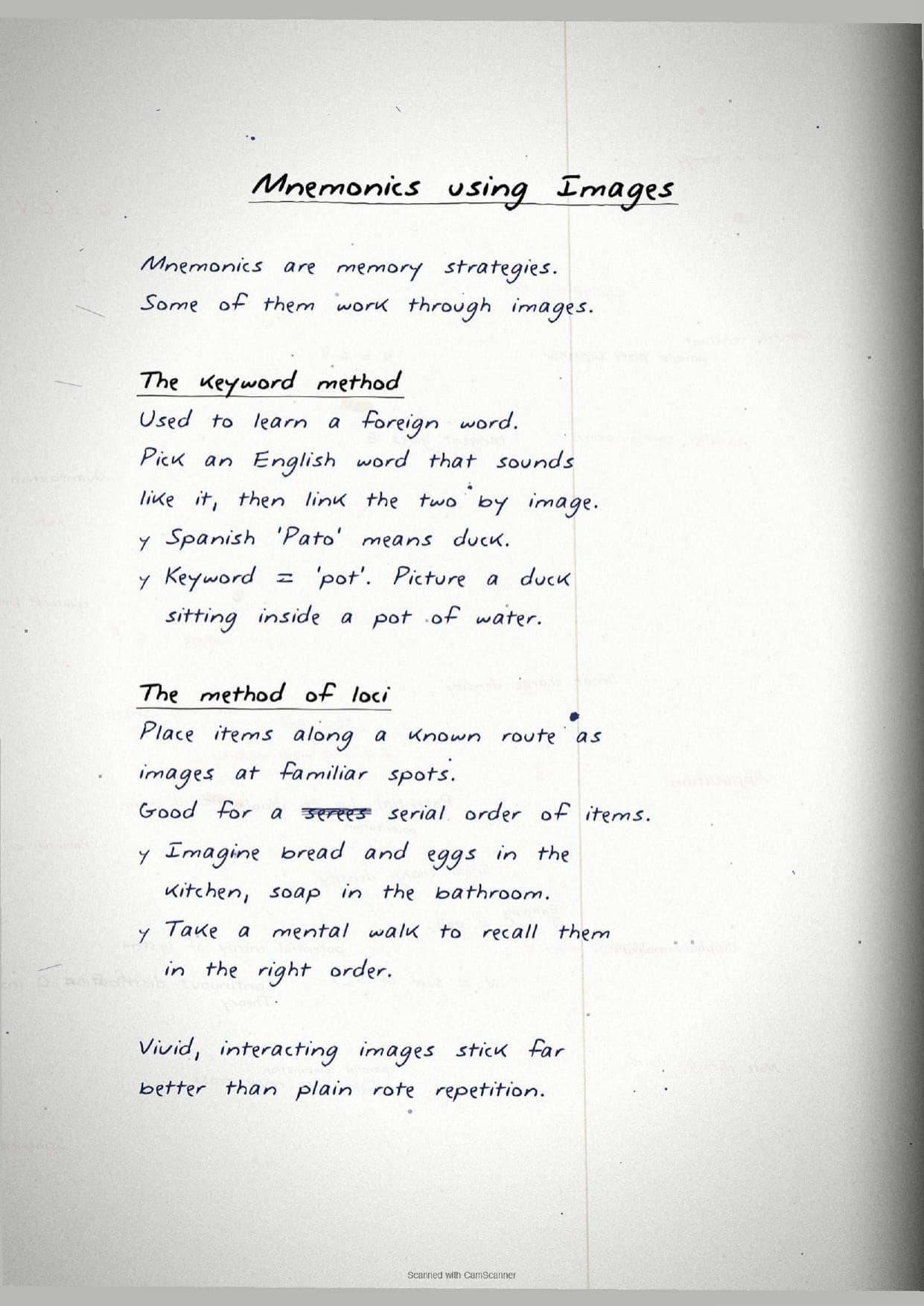
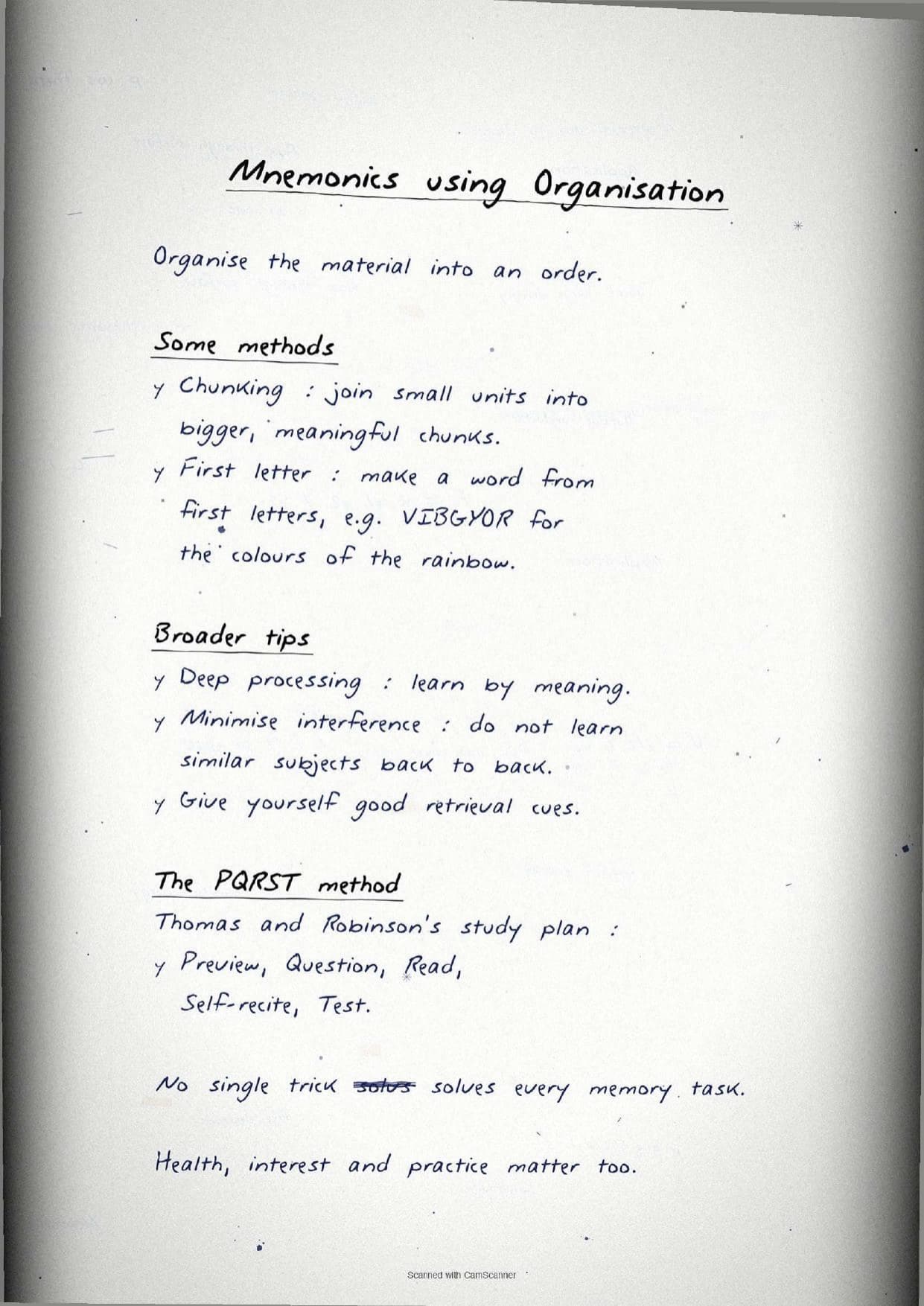
- Enhancing memory: mnemonics using images (keyword method, method of loci) and mnemonics using organisation (chunking, first-letter technique).
The notes underline one judgement that scores well: what we call forgetting is often retrieval failure, not loss of the stored information. The handwritten pages box this line so it stands out. Pair the interference labels and the mnemonics with the Ebbinghaus curve and you have the whole back half of the chapter on a few pages.
How to Use These Handwritten Notes
Handwritten notes work best as a final-revision tool, not a first read. The steps below show how to get the most out of the Human Memory handwritten notes in the last days before a test.
- Download: tap the download card above to save the handwritten pages to your device.
- First read: read the printed Notes once so the handwritten pages act as a refresher, not a first source.
- Recall drill: cover the page and try to write the three memory systems and the two interference types from memory.
- Night before: flip through the boxed pages for a quick last-minute recall of the stage model and the mnemonics.
Many students search for class 11 psychology chapter 6 notes on their phone the night before a test, so a saved set of handwritten pages means you can revise offline. Use the handwritten notes for speed, then check the solutions to confirm you have the answer points right.
Common Mistakes These Notes Help You Avoid
A few errors cost marks every year. The handwritten notes flag each one in the margin so you can fix it before the exam. These five are the most common.
- Mixing up the STM limits. It holds about 7 plus or minus 2 items for under 30 seconds.
- Swapping the two rehearsals. Maintenance rehearsal only repeats; elaborative rehearsal links new information to what you already know.
- Flipping proactive and retroactive interference. Proactive is old learning blocking new; retroactive is new learning blocking old.
- Calling all forgetting a loss of trace. Much of it is retrieval failure due to missing or wrong cues.
- Confusing episodic with semantic memory. Episodic is dated personal events; semantic is affect-neutral general knowledge.
Students who fix these five points usually move from average to high marks. The handwritten notes box the STM limits and lay the interference types side by side, so the soft points are hard to miss when you revise.
How These Handwritten Notes Pair with the Solutions and Book PDF
These handwritten notes are a fast revision tool. To prepare fully, students should use them alongside the other resources for the same chapter, all linked in the table below. Read the printed Notes, test yourself with the solutions, then use these pages for a final recall.
| Resource | Best used for |
|---|---|
| Human Memory NCERT Solutions | Step-by-step answers to all seven review questions |
| Human Memory Class 11 Notes | Quick chapter summary with the stage model and key terms in one place |
| Human Memory NCERT Book PDF | Reading the original NCERT chapter text and figures |
Tip: read the printed Notes first, then attempt the solutions, and keep these handwritten pages for the final night-before flip. Using them for recall, not for the first read, builds memory faster.
All Class 11 Psychology Handwritten Notes by Chapter
The table links the handwritten notes for every chapter in Class 11 Psychology, so students can move across the course in one click. Human Memory is highlighted.
| Chapter | Handwritten Notes |
|---|---|
| Chapter 1 | What is Psychology? |
| Chapter 2 | Methods of Enquiry in Psychology |
| Chapter 3 | Human Development |
| Chapter 4 | Sensory, Attentional and Perceptual Processes |
| Chapter 5 | Learning |
| Chapter 6 | Human Memory |
| Chapter 7 | Thinking |
| Chapter 8 | Motivation and Emotion |
FAQs on Human Memory Handwritten Notes
Human Memory Class 11 Psychology Handwritten Notes Common Questions
Ques. Where can I download the Human Memory handwritten notes PDF?
Ans. You can download the Human Memory Class 11 Psychology handwritten notes PDF directly from this page. It is free, follows the 2026-27 NCERT, and presents the stage model, the types of long-term memory, forgetting and mnemonics as handwritten pages.
Ques. Are handwritten notes good for revising Class 11 Psychology Chapter 6?
Ans. Yes. Handwritten notes are best for fast, last-minute revision because the boxed key terms and arrows make the three memory systems and the forgetting theories easy to skim. Use them after a first read of the printed Notes, not as your only source.
Ques. What topics do these handwritten notes cover?
Ans. They cover the nature of memory, encoding-storage-retrieval, the Atkinson-Shiffrin stage model, sensory, short-term and long-term memory, working memory, levels of processing, declarative and procedural, episodic and semantic memory, the causes of forgetting, and mnemonics for improving memory.
Ques. What is the difference between the two rehearsals in this chapter?
Ans. Maintenance rehearsal simply repeats information to keep it in short-term memory, and it is lost once repetition stops. Elaborative rehearsal connects the new information to existing knowledge in long-term memory, so it leads to lasting retention. The notes box this contrast because it is a common exam question.
Ques. How should I use these notes with the other resources?
Ans. Read the printed Notes first, test yourself with the NCERT Solutions, then keep these handwritten pages for the final night-before flip. Using them for recall rather than the first read builds memory faster.



Comments