




These Human Ecology and Family Sciences handwritten notes turn the whole first chapter into clean, hand-written pages for fast last-minute revision. They follow the 2026-27 NCERT syllabus and Chapter 1 of Class 11 Home Science. Students get the meaning of Human Ecology and Family Sciences, the evolution from Home Science to HEFS, the five knowledge streams of Food and Nutrition, Human Development, Fabric and Apparel, Resource Management and Communication and Extension, the link to quality of life, and the scope and career avenues, all in a pen-on-paper format that is easy to skim before a test.
- Hand-written pages with boxed key terms, a five-stream mind-map, and a labelled disciplines diagram drawn by hand.
- This is the opening chapter of Class 11 Home Science, so its terms and streams set up the whole course.
- Pairs with the NCERT Solutions, Notes and Book PDF linked lower on this page.
These Human Ecology and Family Sciences handwritten notes are prepared from the official NCERT Home Science (Human Ecology and Family Sciences) textbook and checked against recent CBSE Class 11 question papers.
Student Feedback: In a Collegedunia poll of 3,940 Class 11 Home Science students, 76% of students said hand-written pages helped them recall the five knowledge streams and the Home Science to HEFS story faster than printed text, because the boxed mind-map and arrows made the ideas stick.
Source: 2026-27 Class 11 Home Science student poll. Sample of 3,940 students from CBSE schools across 9 states.
What These Human Ecology and Family Sciences Handwritten Notes Contain
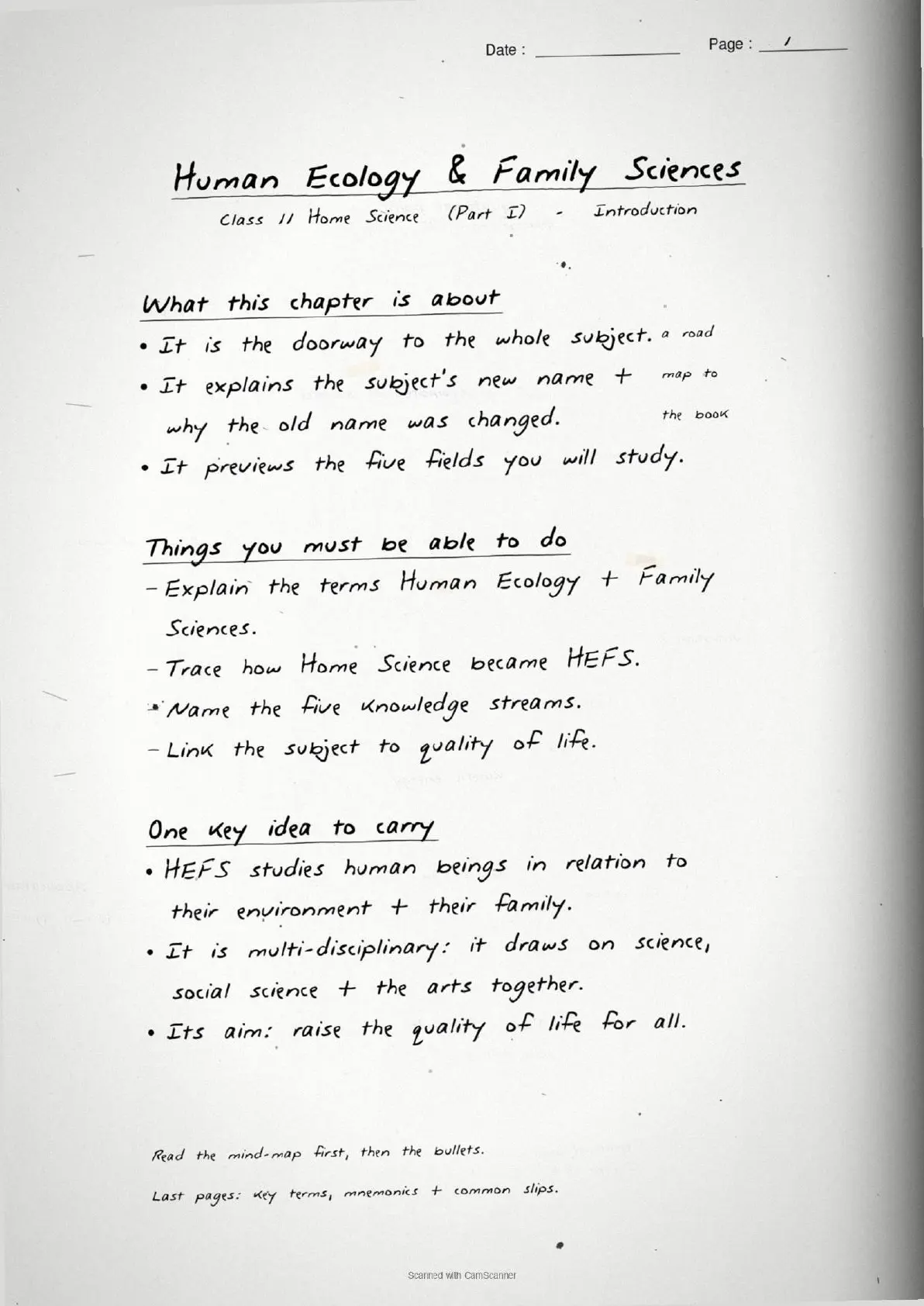
Human Ecology and Family Sciences is the first chapter of Class 11 Home Science. It is the doorway to the whole subject: it explains the new name, why the old name was changed, and previews the five fields students will study across the year. These handwritten notes condense the chapter into hand-written pages that read like a topper's own notebook.
The notes are organised under three threads, each on its own set of pages:
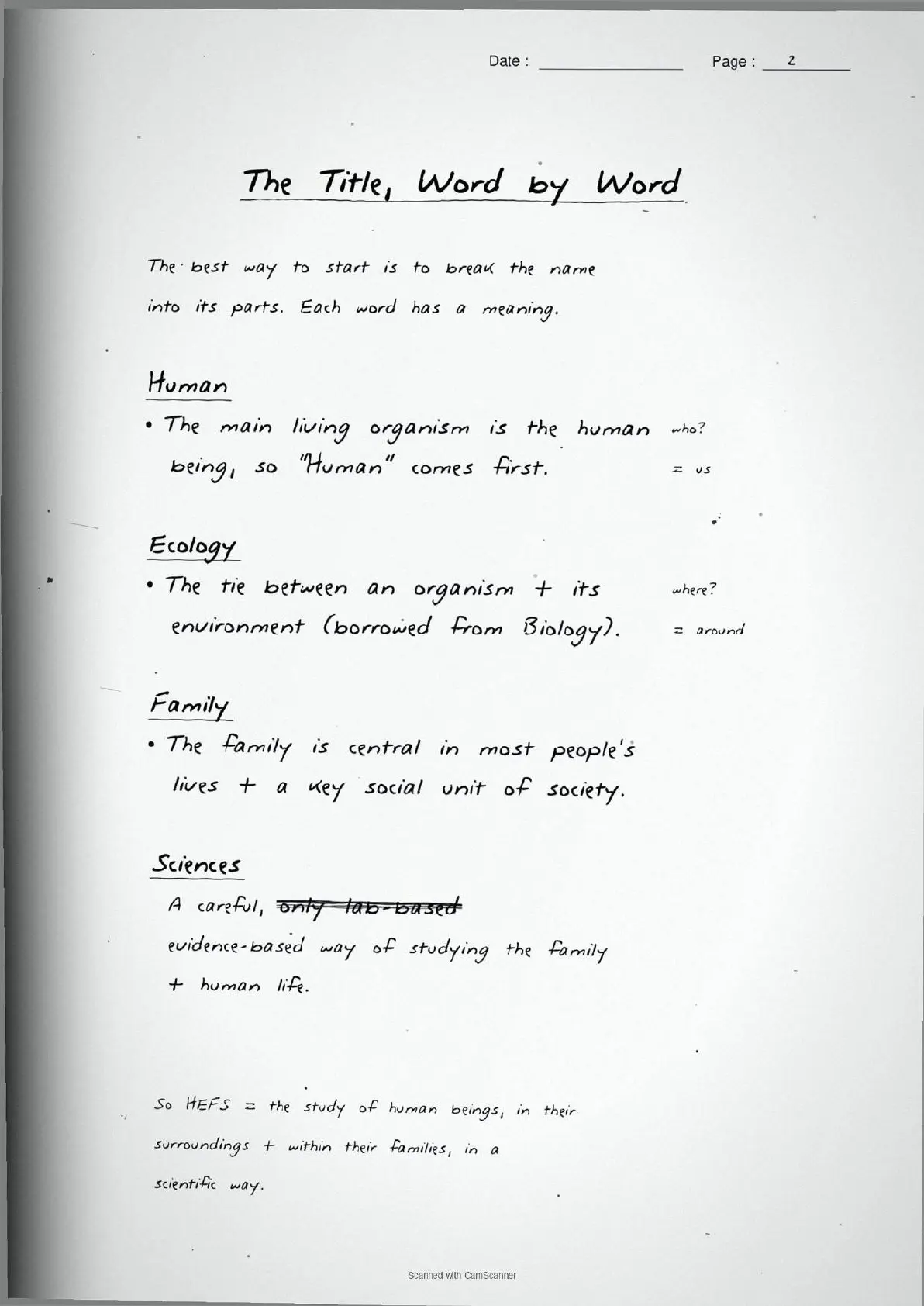
- The meaning: the title broken word by word into Human, Ecology, Family and Sciences, so HEFS reads as the scientific study of people in their surroundings and within their families.
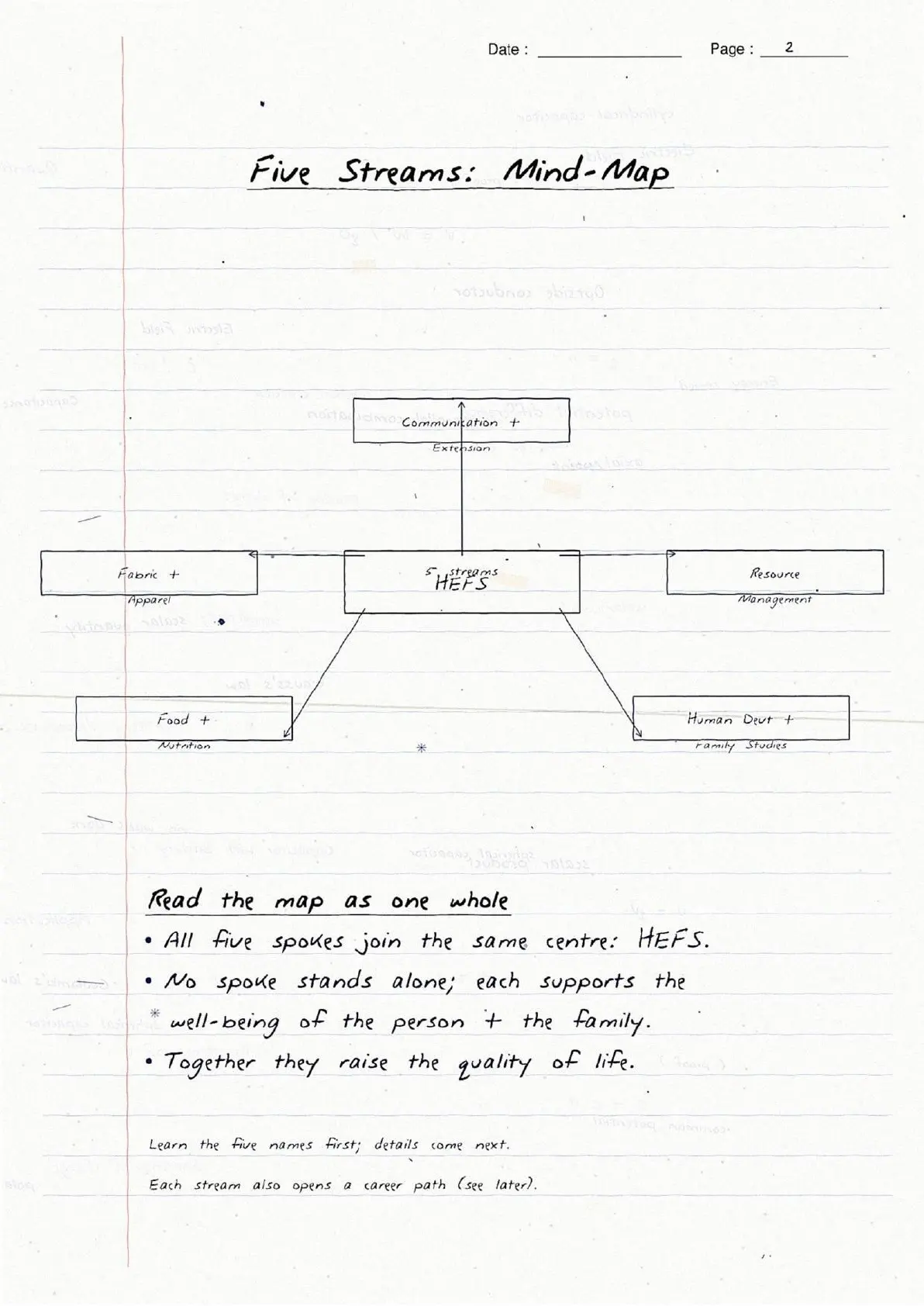
- The five streams: Food and Nutrition, Human Development and Family Studies, Fabric and Apparel, Resource Management, and Communication and Extension, drawn as a single mind-map.
- The story and the reach: the evolution from Home Science to HEFS, the relevance to quality of life, and the scope and career avenues.
Because the pages are hand-written, the key terms sit in boxes and arrows rather than long paragraphs. A student can flip through the Human Ecology and Family Sciences class 11 pages in a few minutes and still pick up the meaning, the five streams and the history before walking into the exam.
Meaning of HEFS and the Five Knowledge Streams
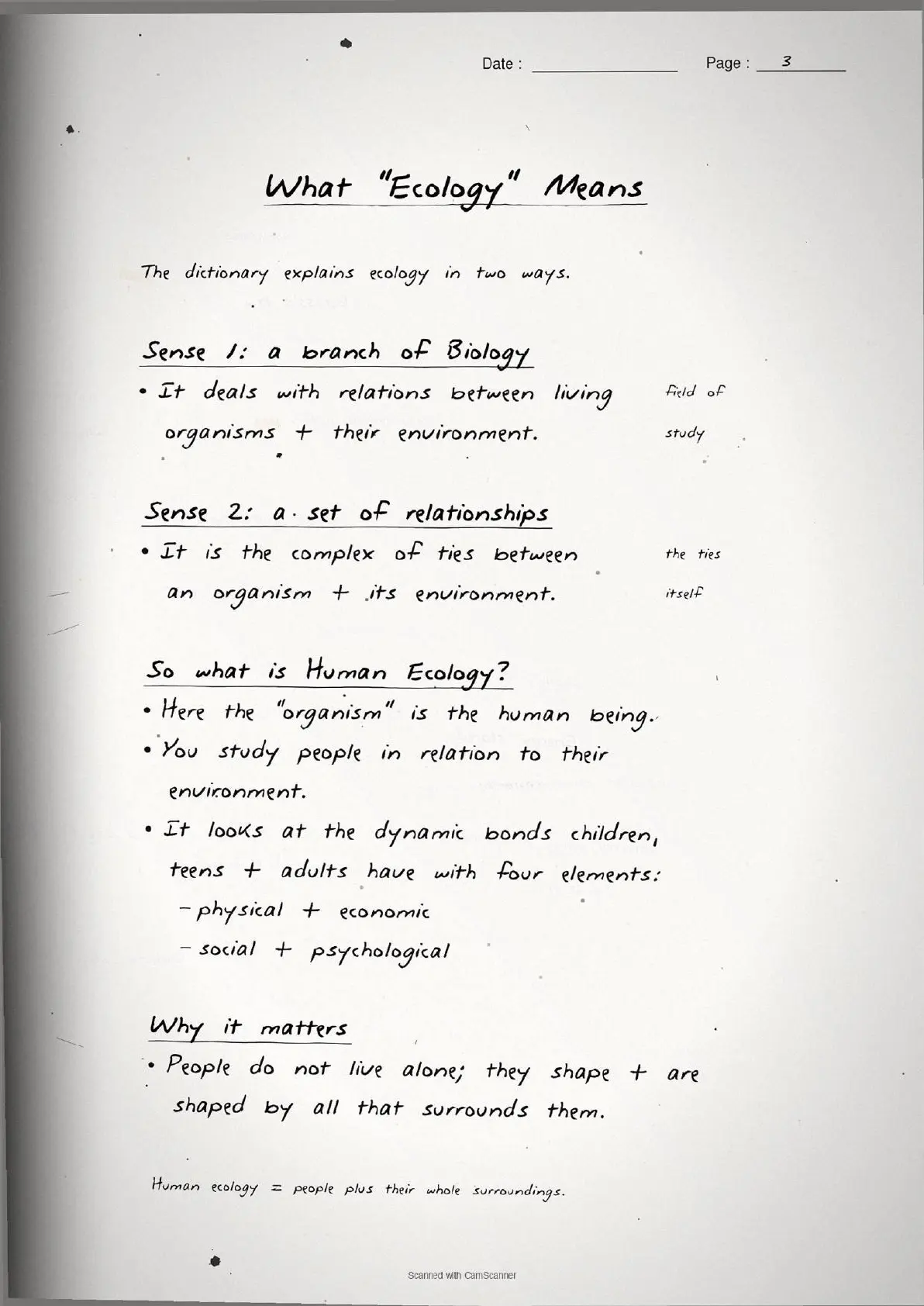
The opening pages settle what the subject actually is. Human Ecology and Family Sciences (HEFS) studies human beings in relation to their environment and their family. The notes break the title into parts: Human is the main living organism, Ecology is the tie between an organism and its environment, Family is a key social unit at the centre of most lives, and Sciences means a careful, evidence-based way of study. Human ecology looks at the bonds a person has with four elements at once: physical, economic, social and psychological.
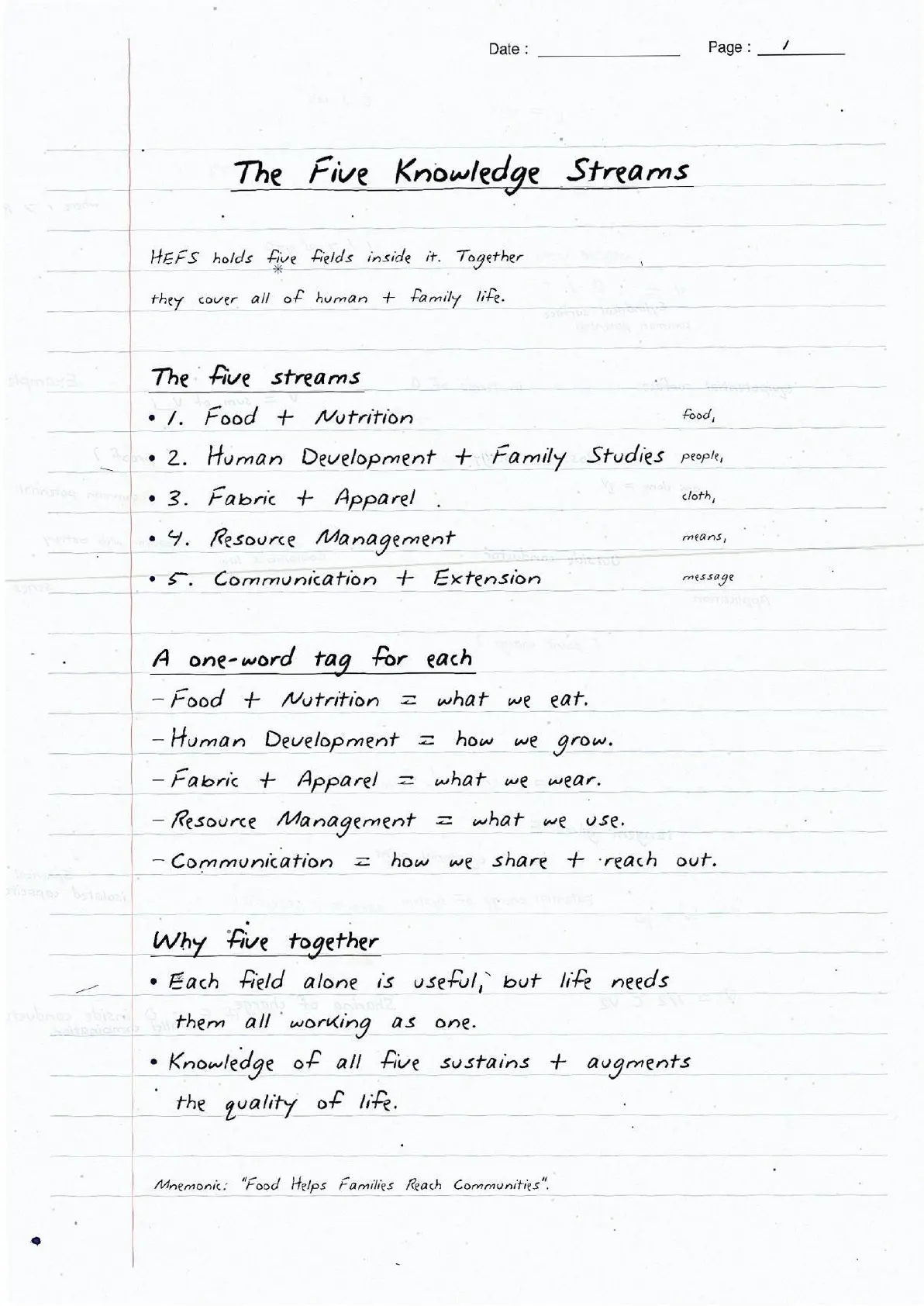
The heart of the chapter is the set of five knowledge streams that sit inside HEFS. The table below shows what each stream covers on the hand-written pages.
| Knowledge stream | What the page shows |
|---|---|
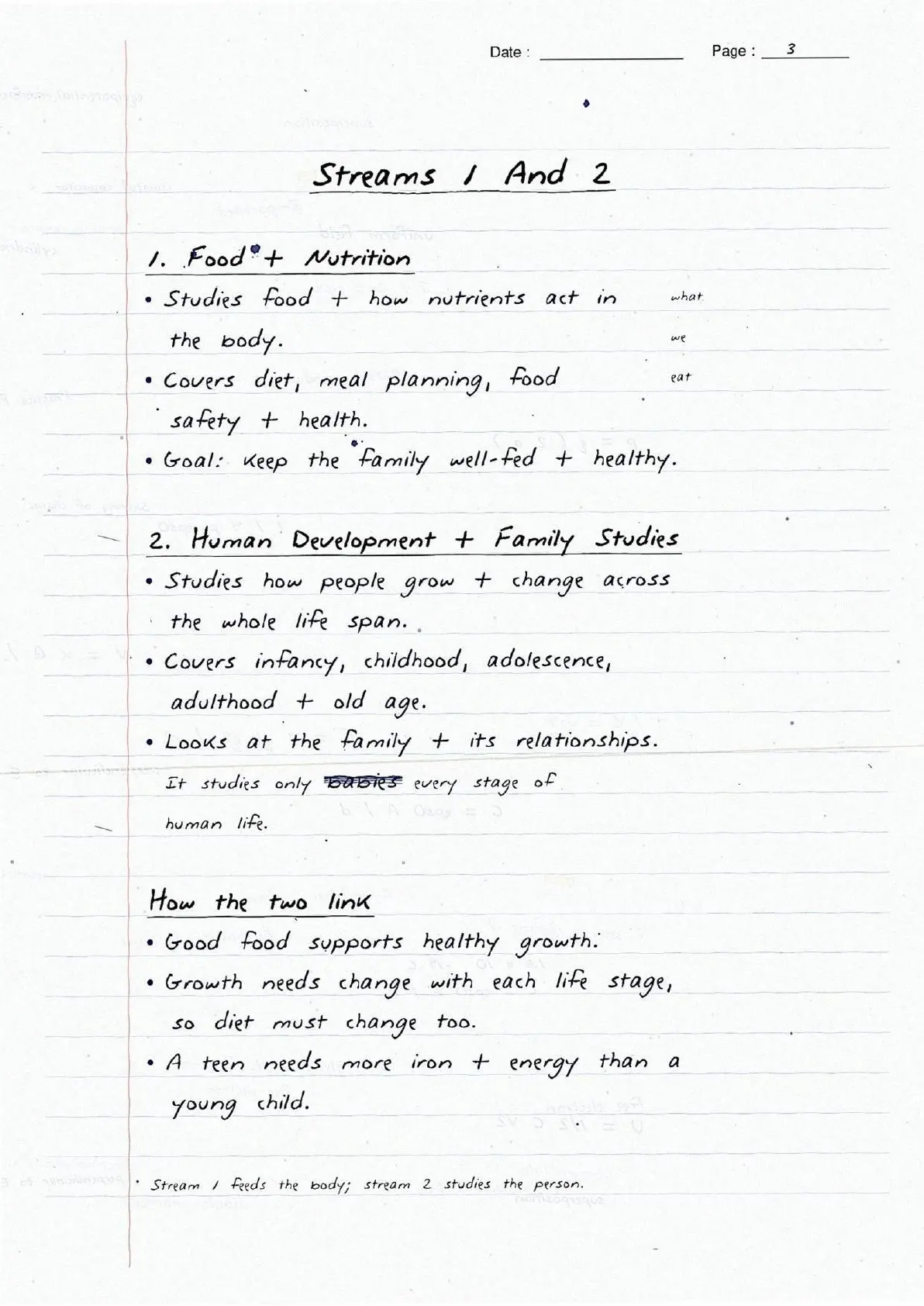
| Food and Nutrition | What we eat: food, nutrients, diet, meal planning and food safety to keep the family healthy. |
| Human Development and Family Studies | How we grow: development across the whole life span, from infancy to old age, and family relationships. |
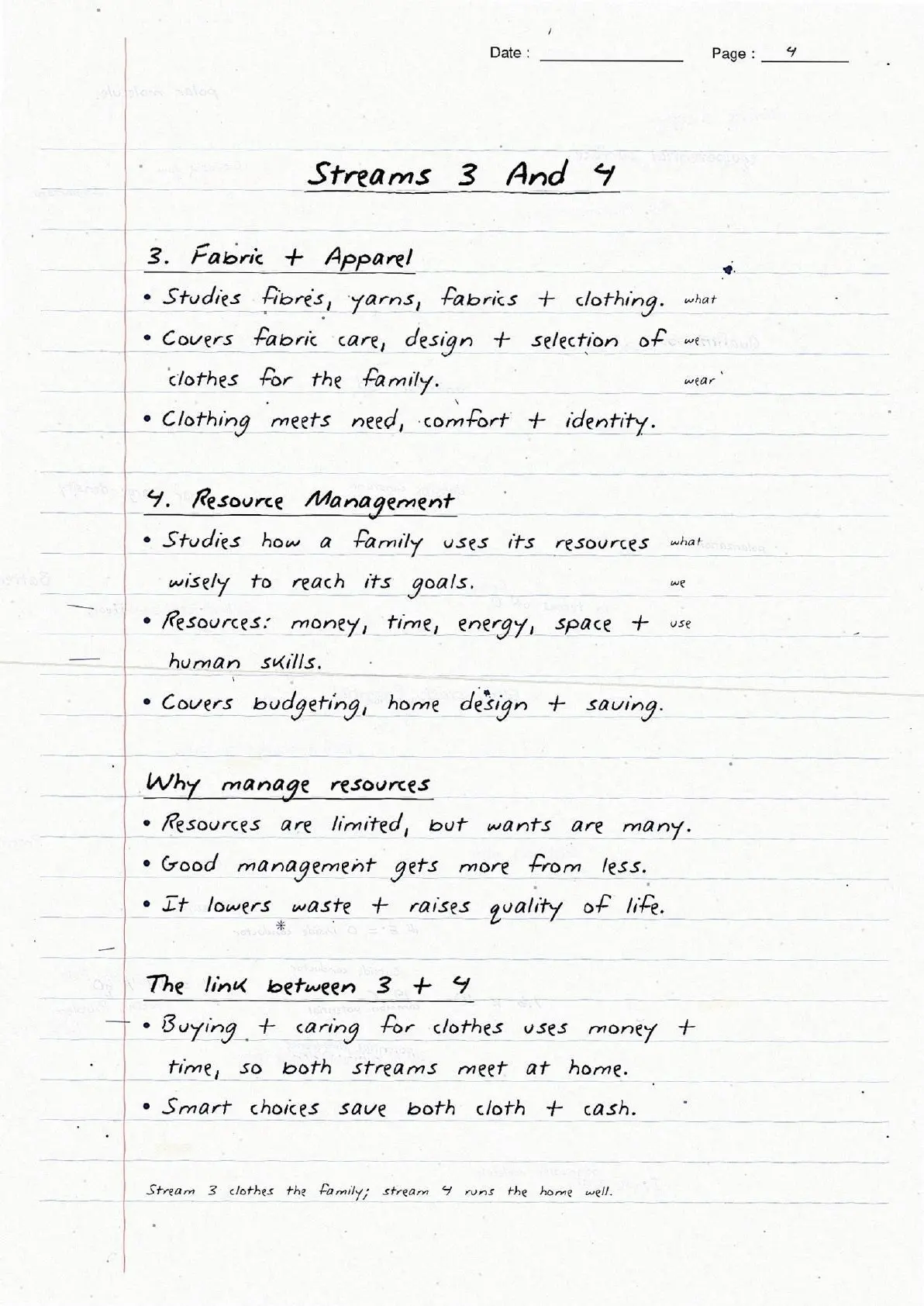
| Fabric and Apparel | What we wear: fibres, yarns, fabrics, fabric care, and the design and selection of clothing. |
| Resource Management | What we use: how a family manages money, time, energy and space to reach its goals. |
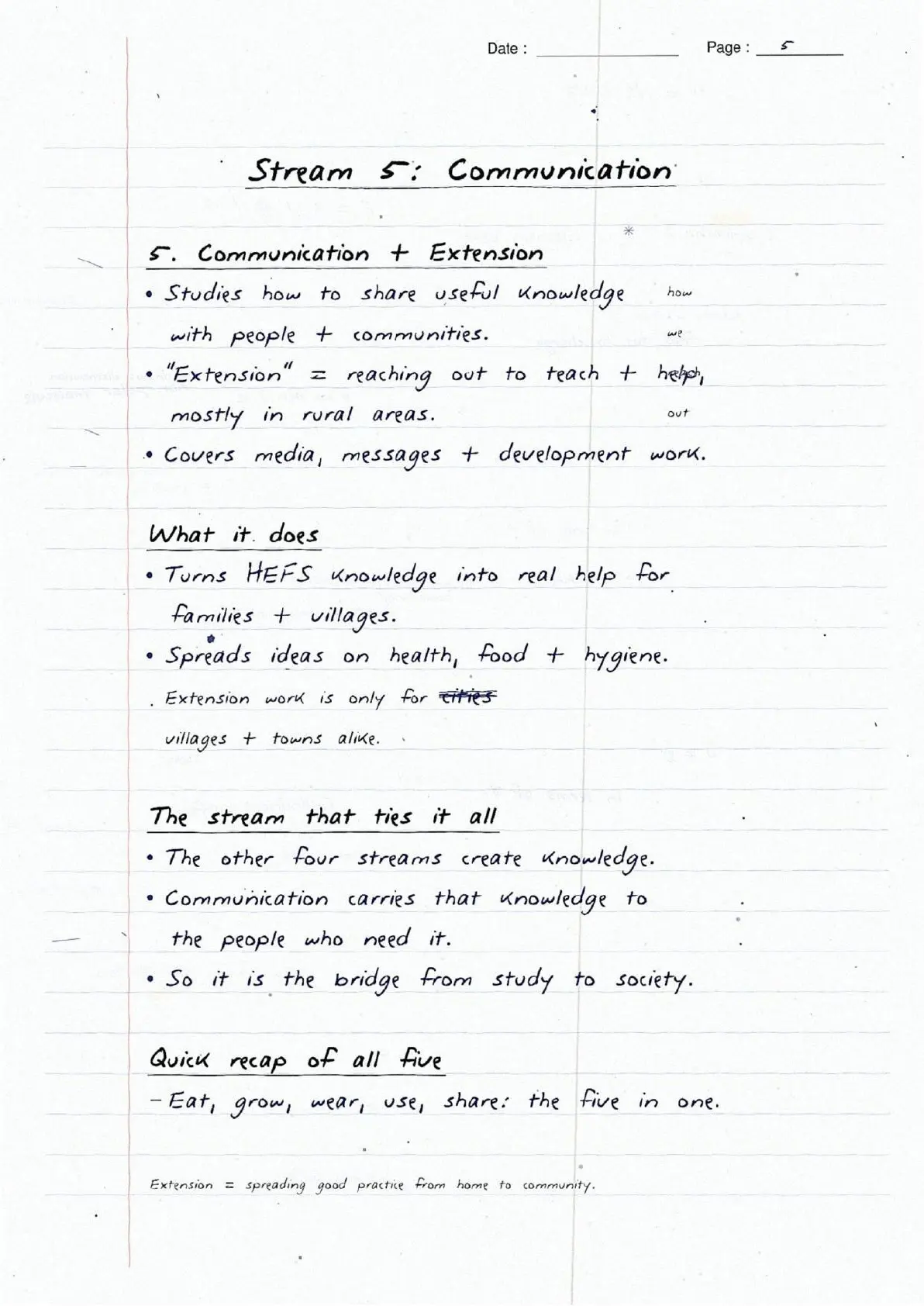
| Communication and Extension | How we share: reaching out to teach and help people and communities, mostly through extension work. |
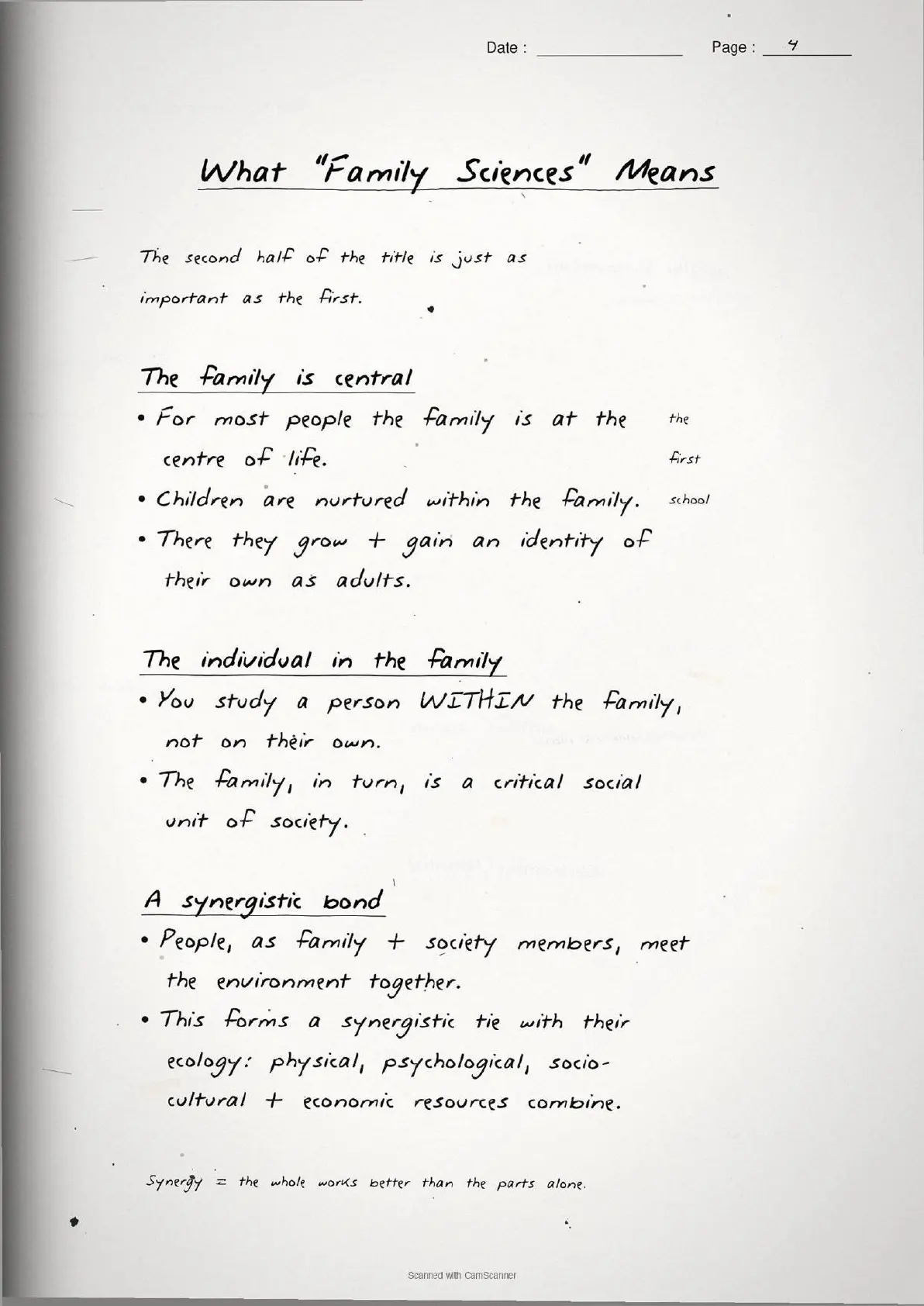
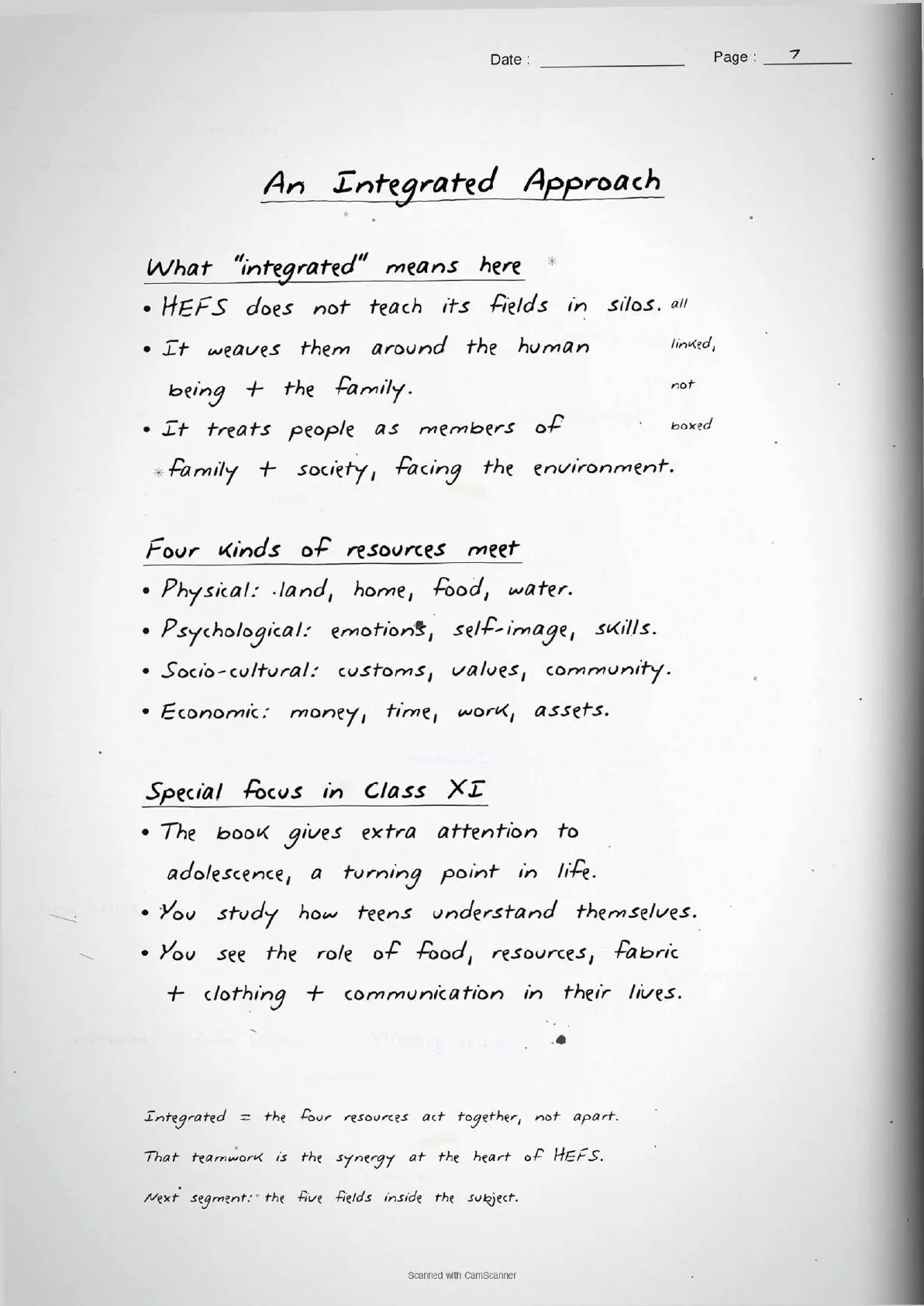
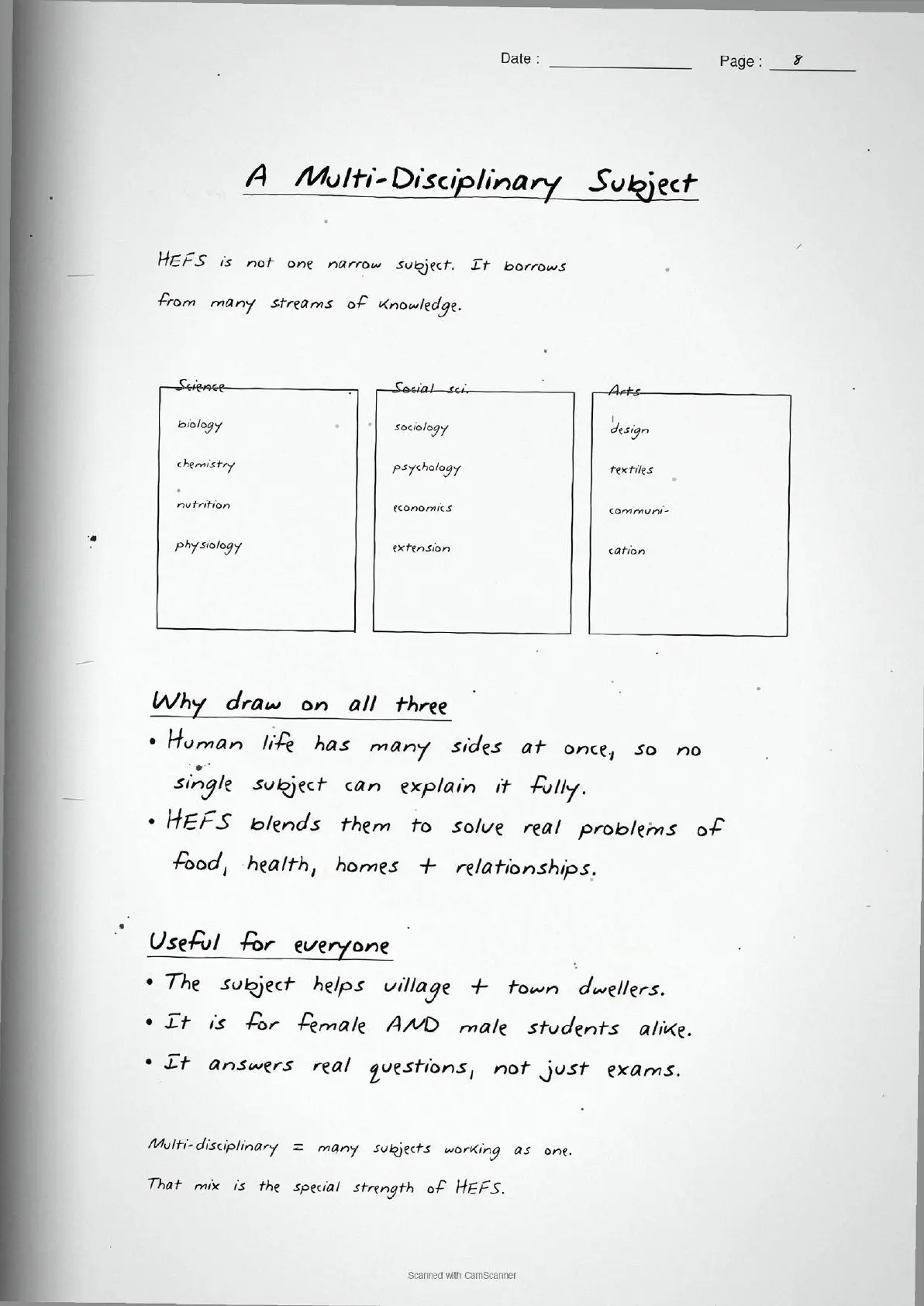
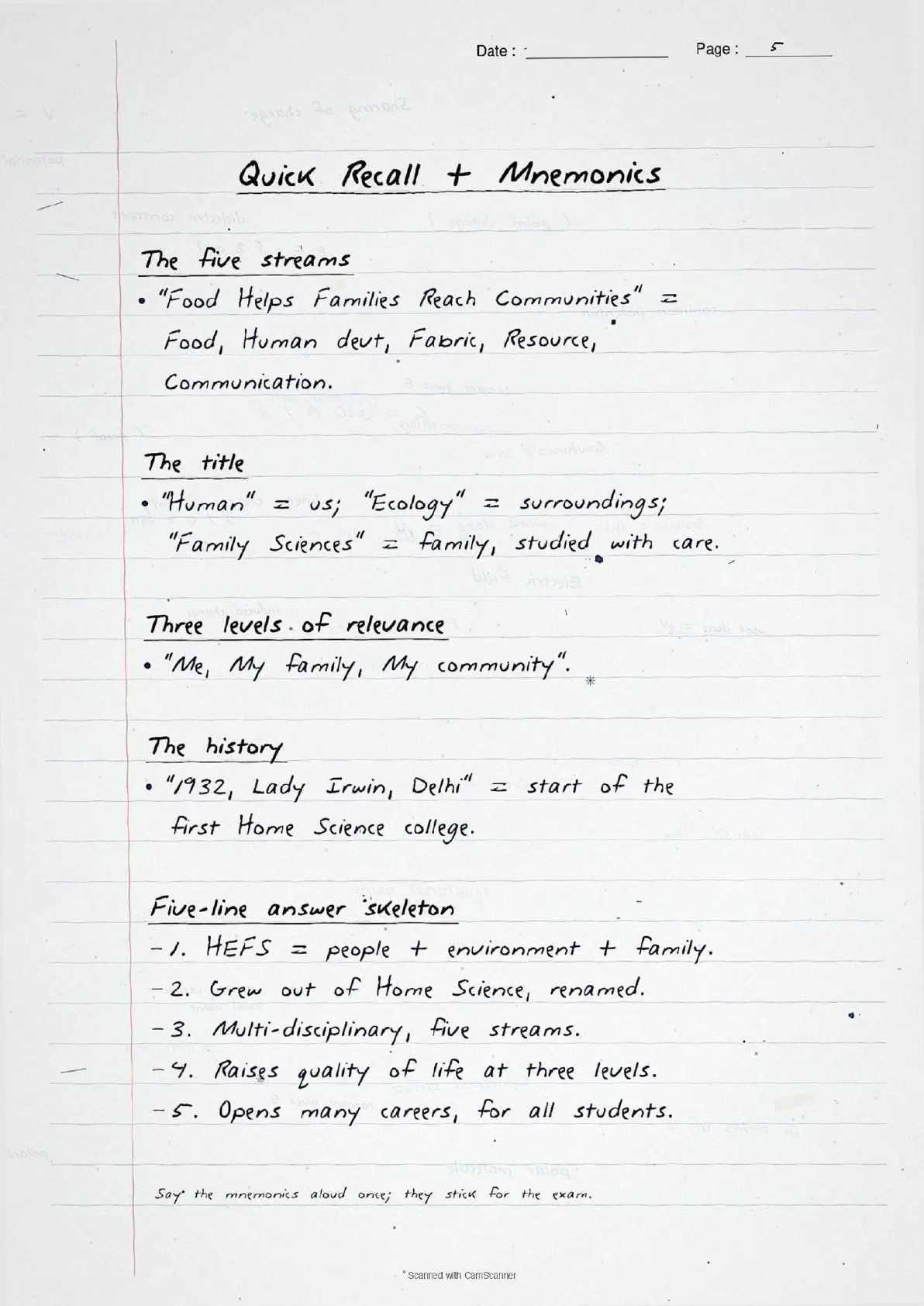
The pages also show that HEFS is multi-disciplinary and integrated. It draws on science, social science and the arts together, and it does not teach its fields in silos. Instead it weaves them around the human being and the family, so that physical, psychological, socio-cultural and economic resources combine in a synergistic bond. A handy classroom mnemonic on the page reads "Food Helps Families Reach Communities" for the five streams in order.
Evolution, Scope and Careers in the Handwritten Pages
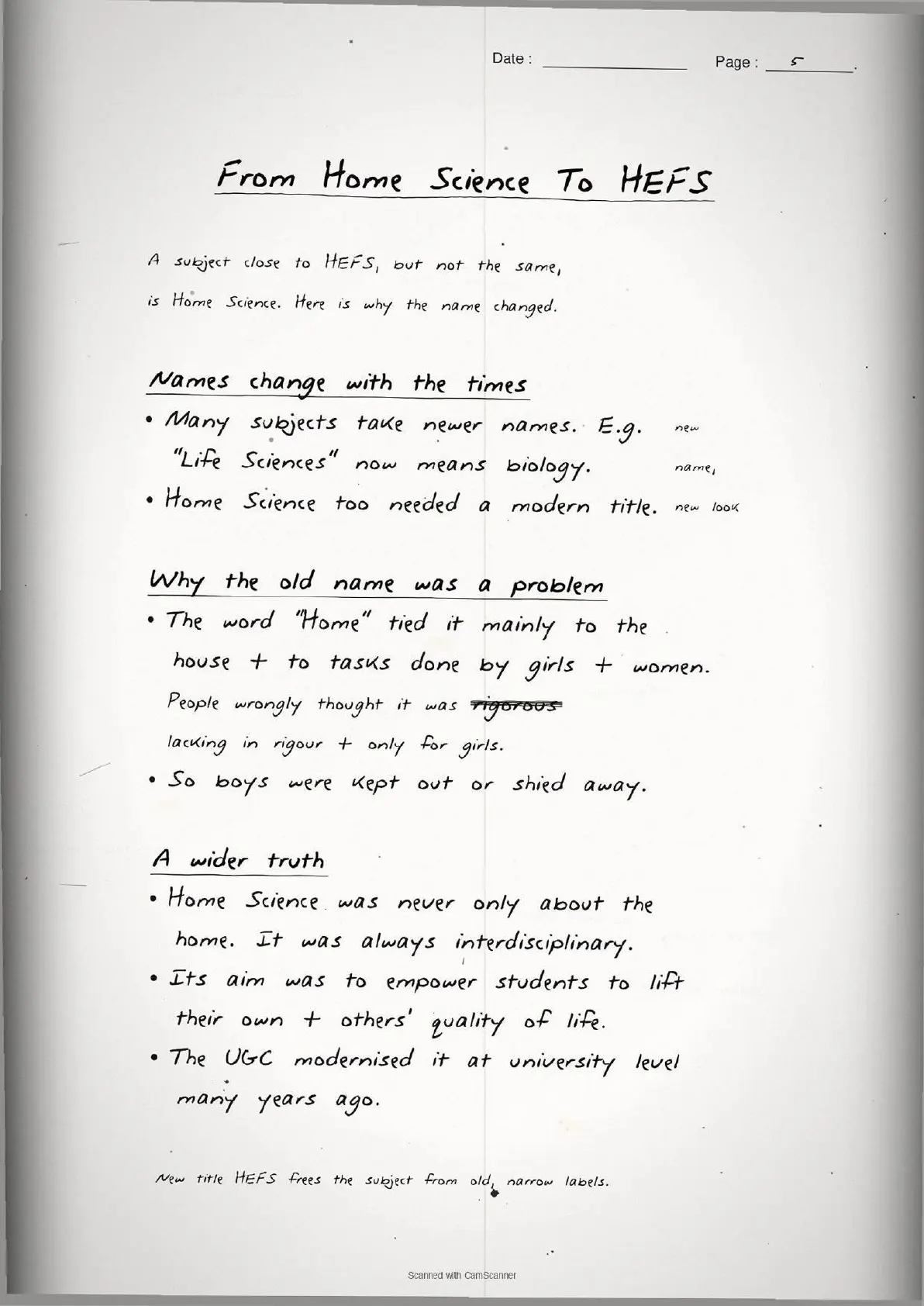
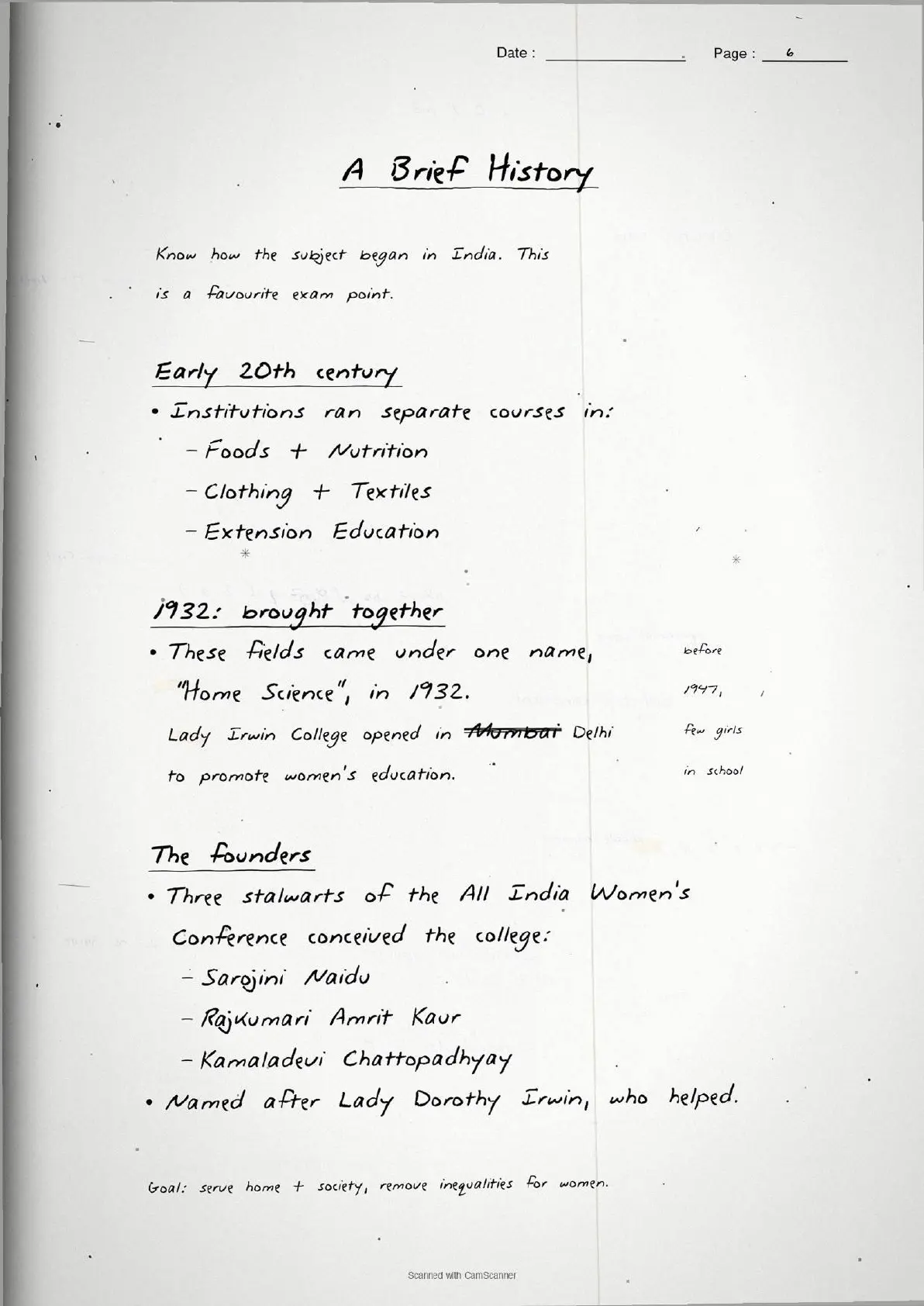
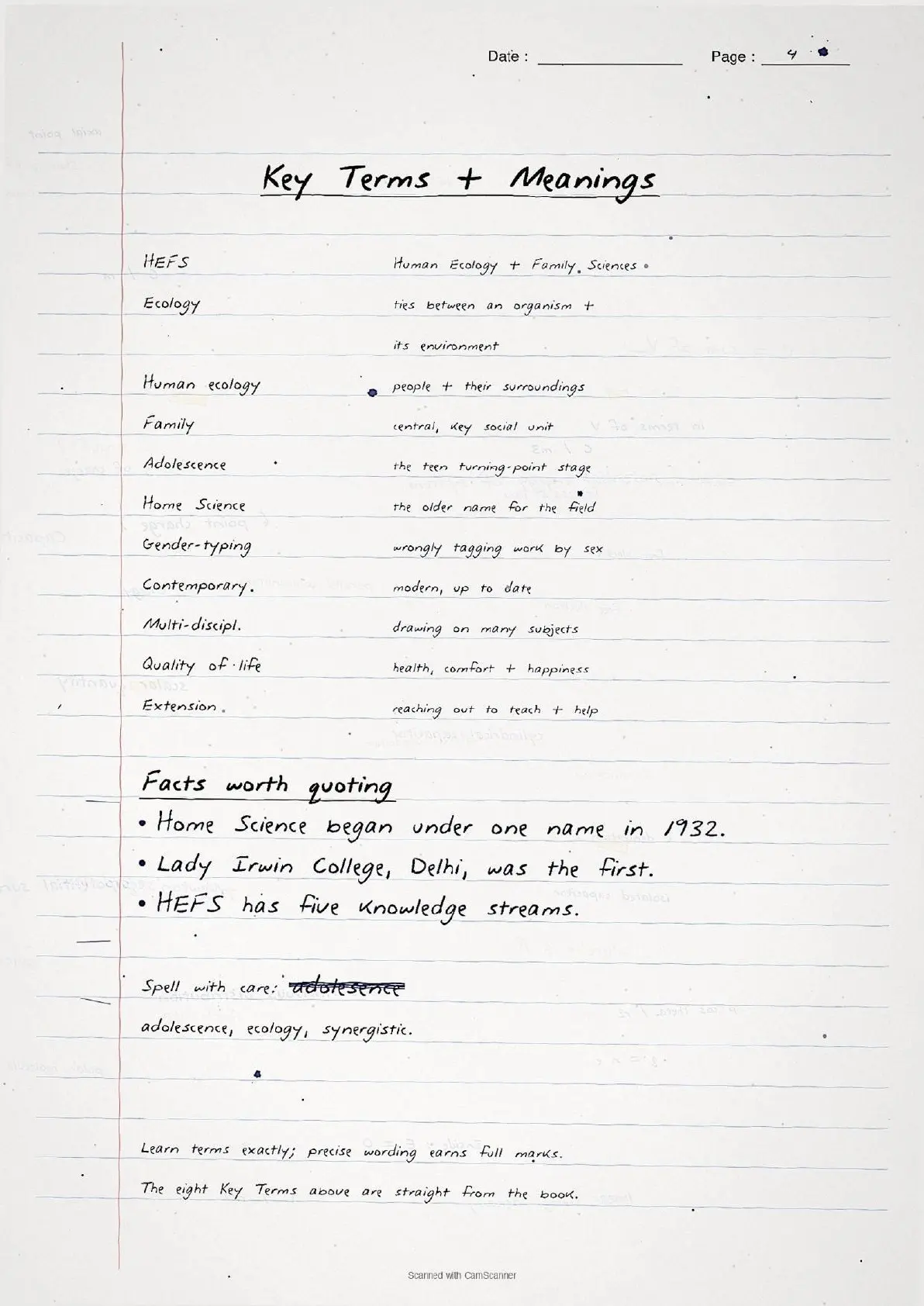
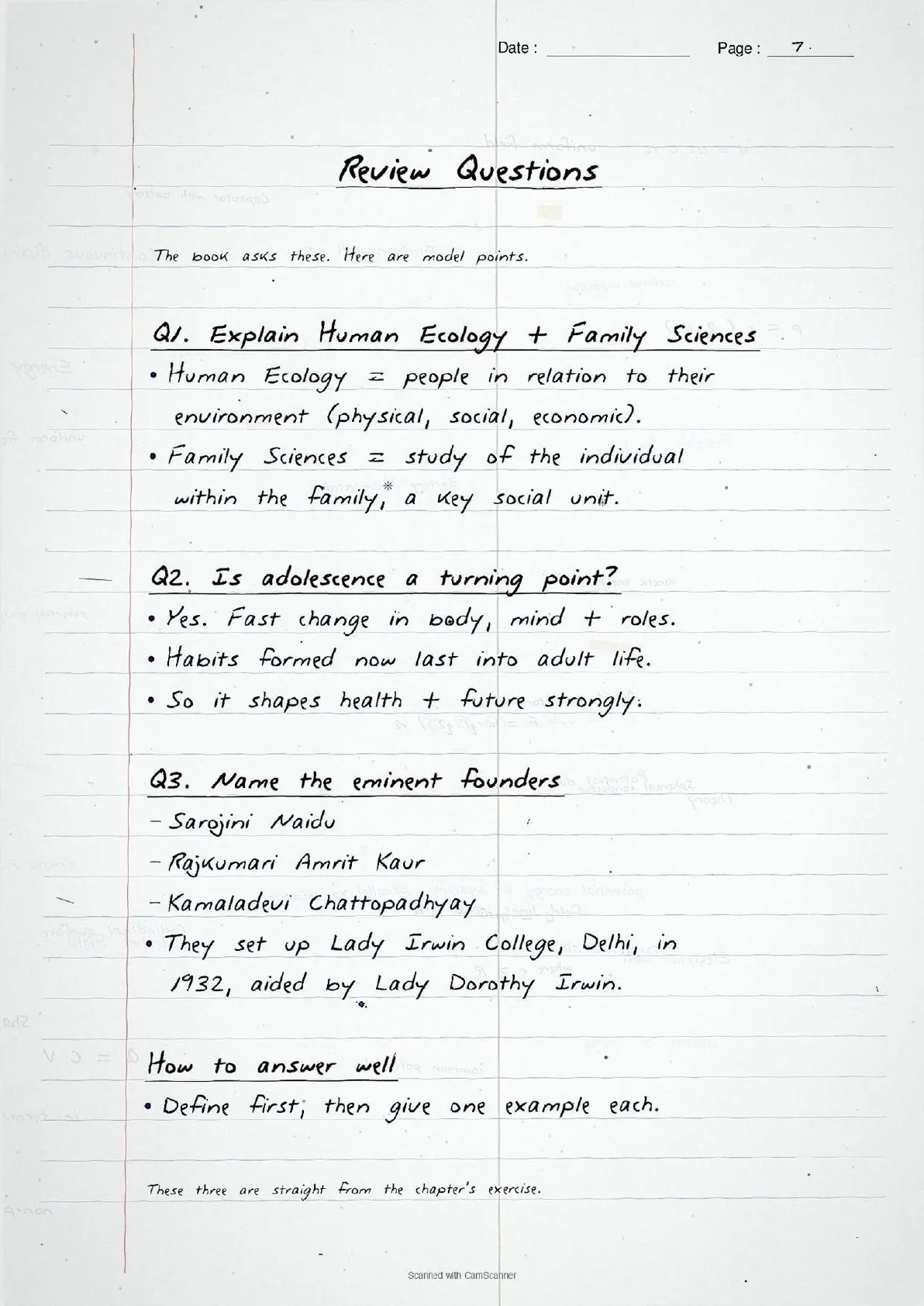
The middle pages trace how the subject grew, drawn as a clear story so the history stands apart. A field close to HEFS, but not the same, is Home Science. In the early twentieth century, institutions ran separate courses in Foods and Nutrition, Clothing and Textiles, and Extension Education. These were brought under one name, "Home Science", in 1932, and Lady Irwin College, Delhi, opened that year to promote women's education. Three stalwarts of the All India Women's Conference conceived it: Sarojini Naidu, Rajkumari Amrit Kaur and Kamaladevi Chattopadhyay.
The notes then explain why the name changed to HEFS. The word "Home" wrongly tied the subject to the house and to tasks done by girls and women, so many people thought it lacked rigour and was only for girls. In truth the subject was always interdisciplinary and always aimed to lift quality of life, so the UGC modernised the name at university level. The table below shows how the notes present the subject's reach.
| Aspect | Key idea on the page |
|---|---|
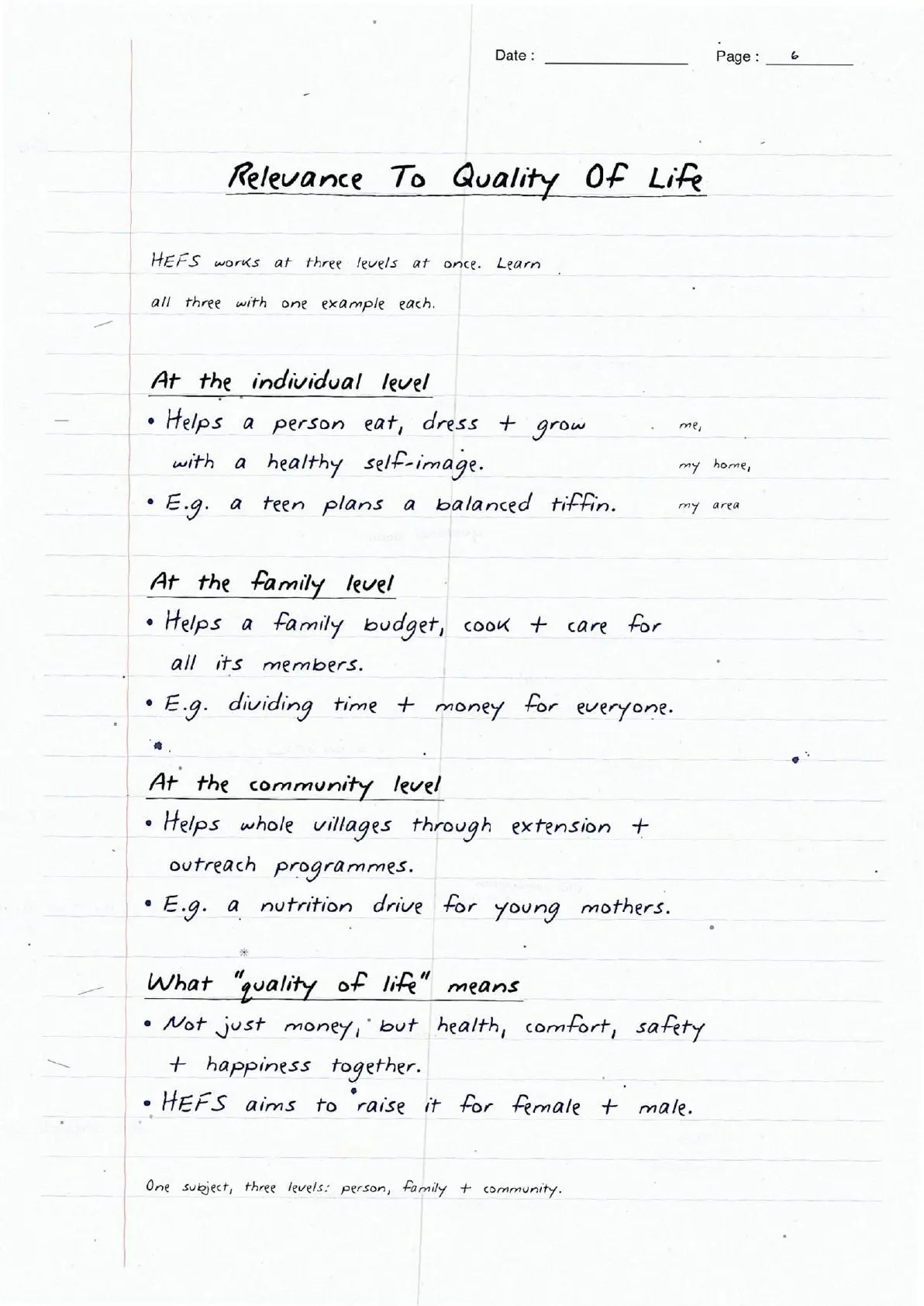
| Relevance to quality of life | Works at three levels: the individual, the family and the community, raising health, comfort, safety and happiness together. |
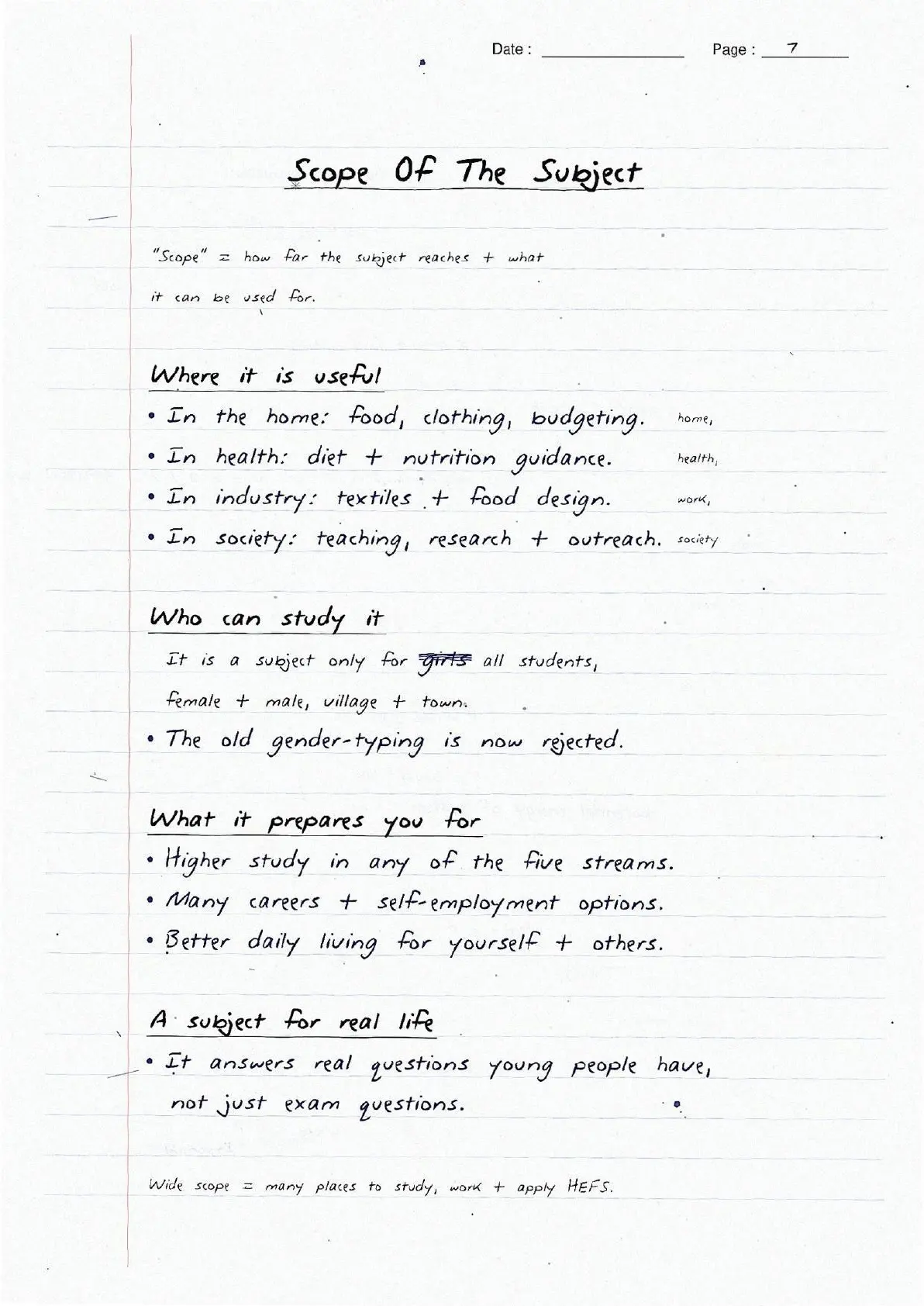
| Scope | Useful in the home, in health, in industry and in society; open to female and male students, in villages and towns alike. |
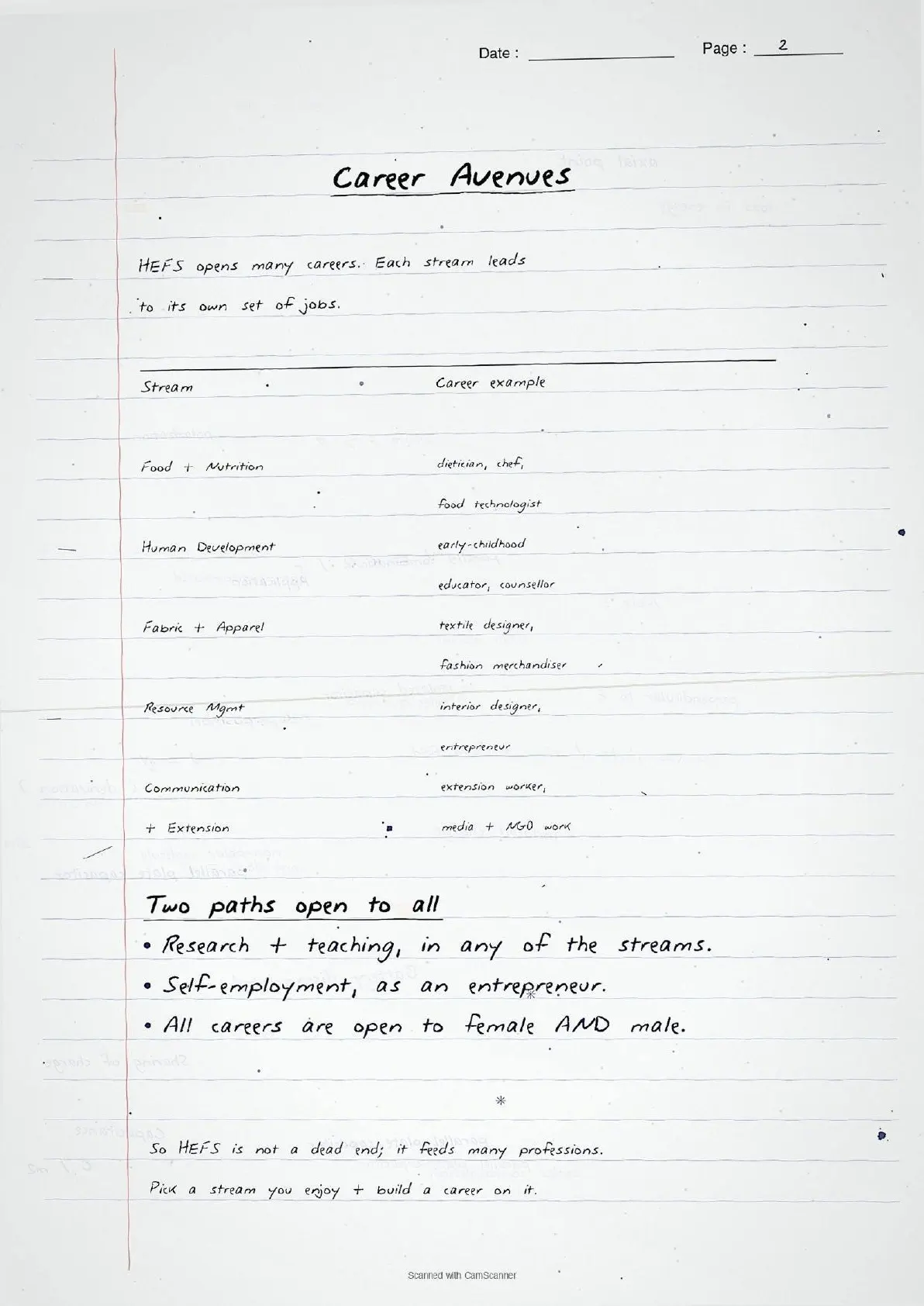
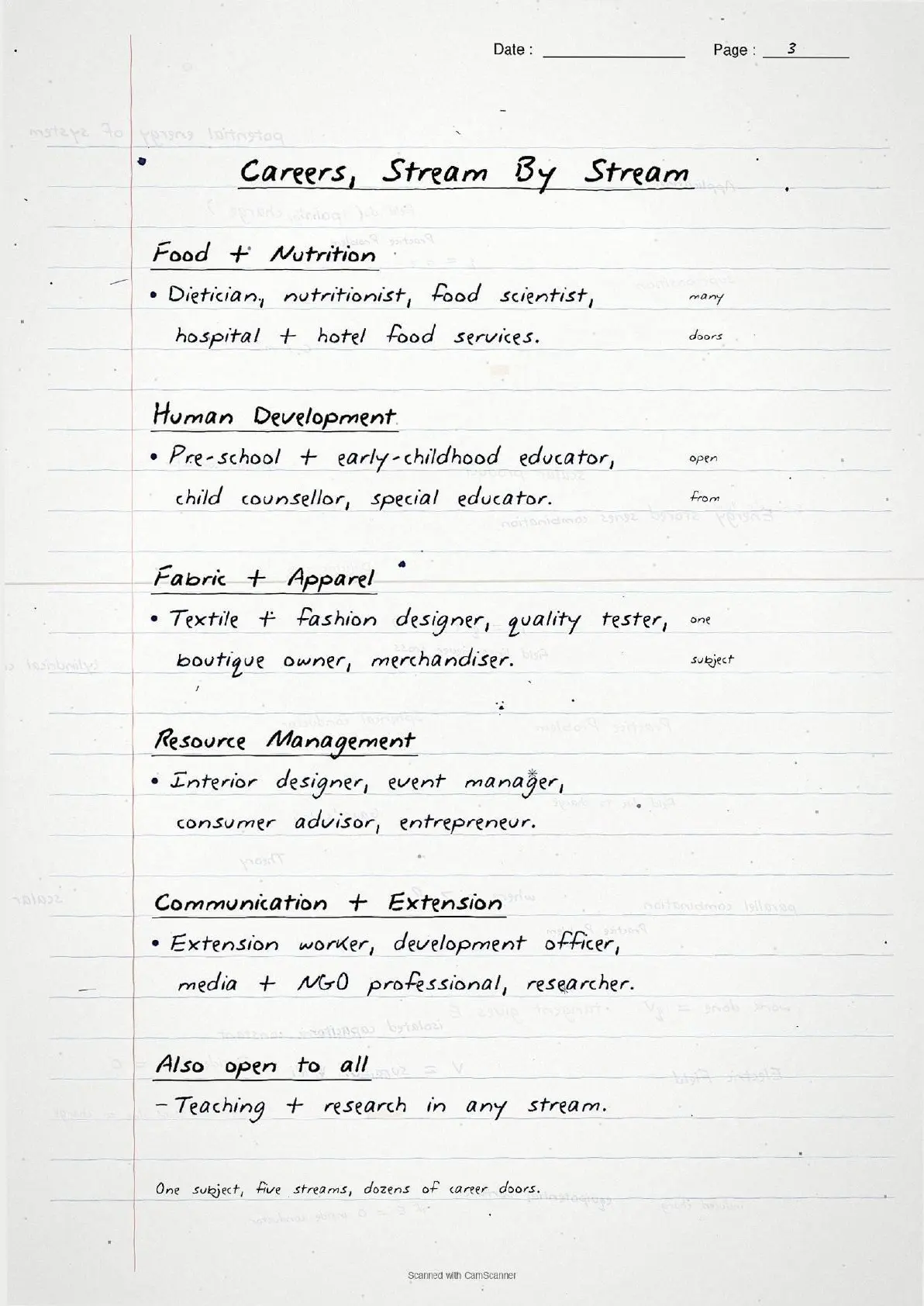
| Career avenues | Dietician, early-childhood educator, textile designer, interior designer and extension worker, plus teaching, research and self-employment. |
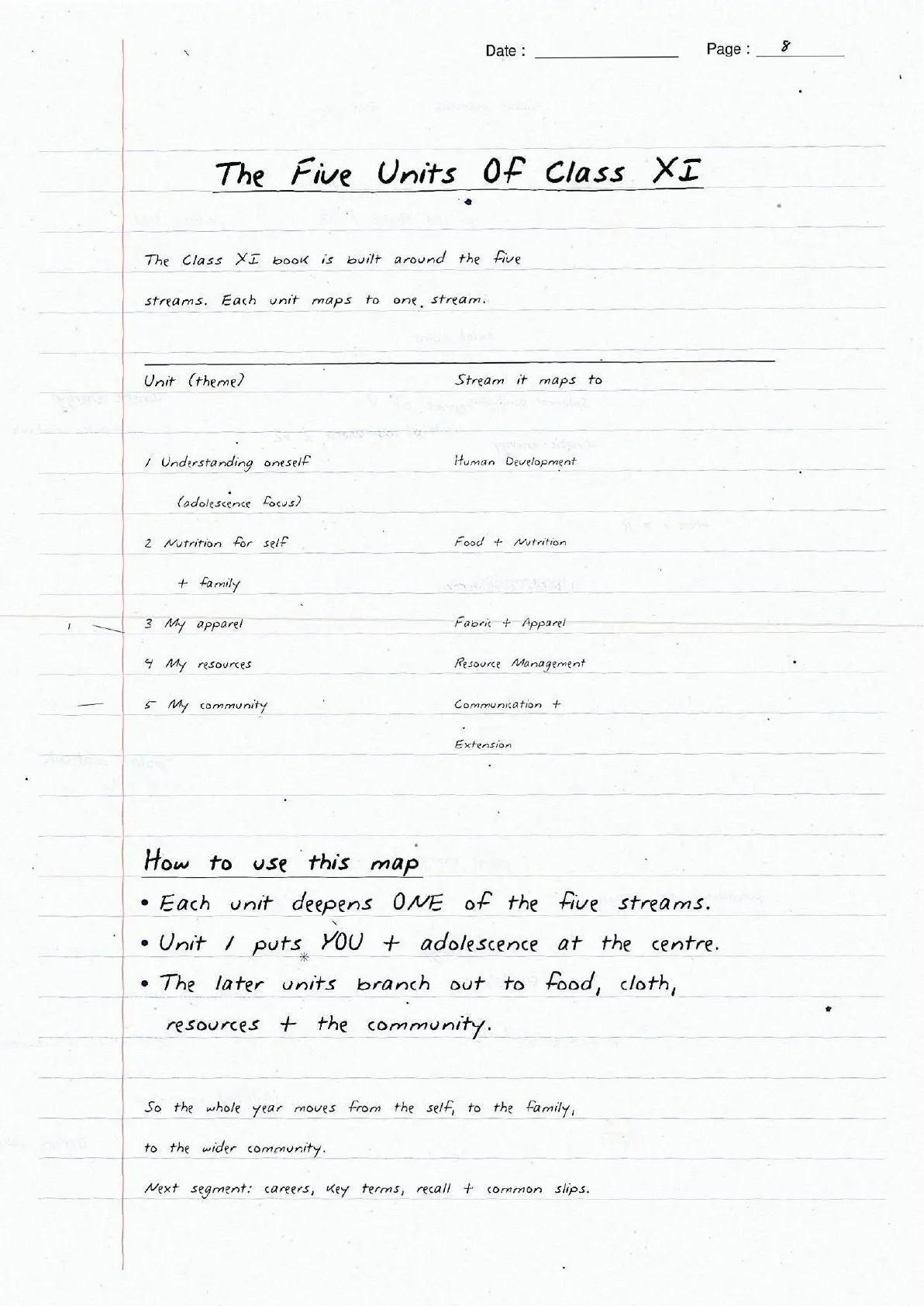
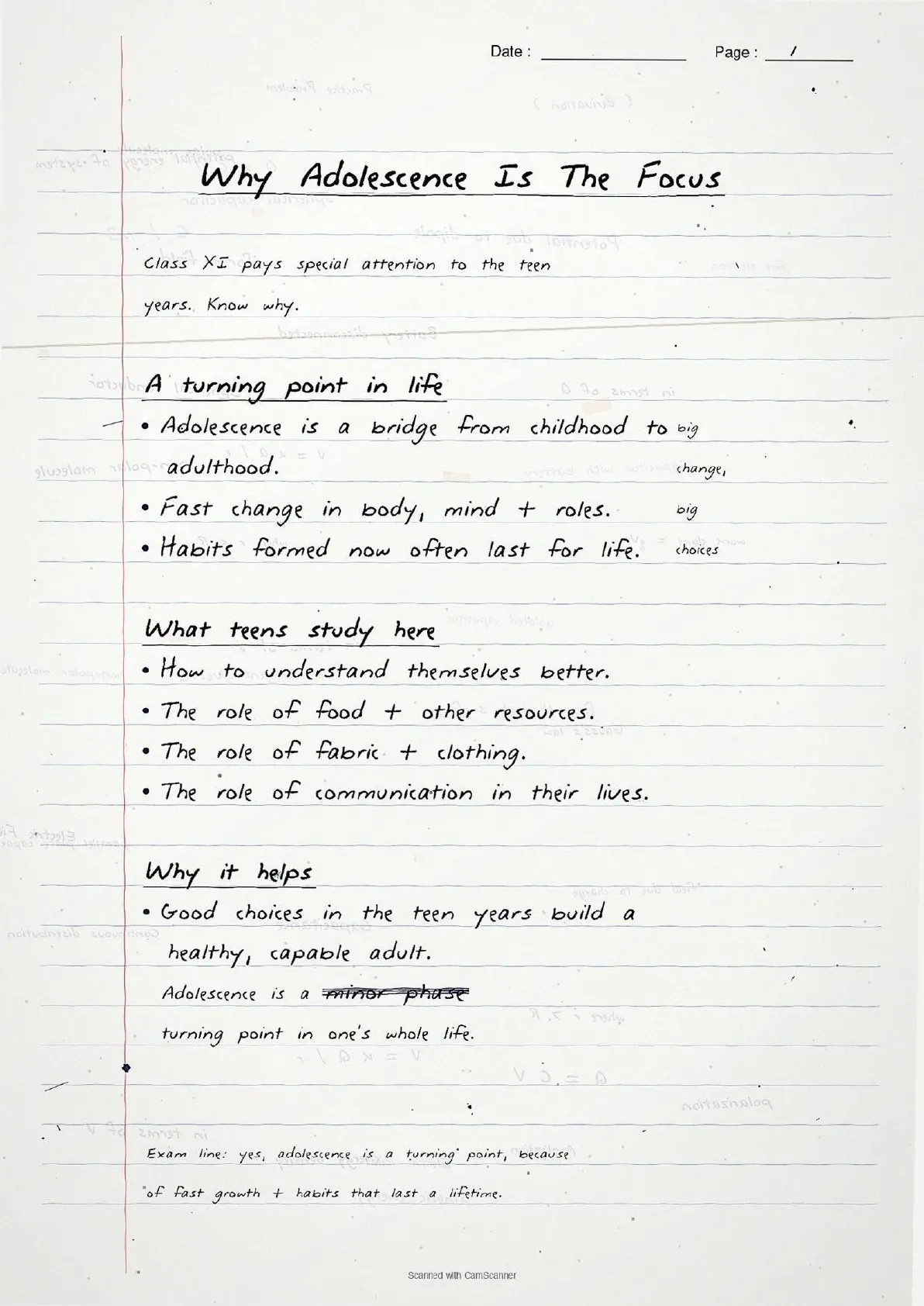
| Class 11 focus | Special attention to adolescence, a turning point in life, studied through food, resources, fabric and communication. |
A final boxed diagram shows HEFS at the intersection of many disciplines, including biology, chemistry, nutrition and physiology from science, sociology, psychology and economics from social science, and design, textiles and communication from the arts. The pages stress that each stream also opens its own career path, so HEFS is a subject for real life and not a dead end.
How to Use These Handwritten Notes
Handwritten notes work best as a final-revision tool, not a first read. The steps below show how to get the most out of the Human Ecology and Family Sciences handwritten notes in the last days before a test.
- Download: tap the download card above to save the hand-written pages to your device.
- First read: read the printed Notes once so the hand-written pages act as a refresher, not a first source.
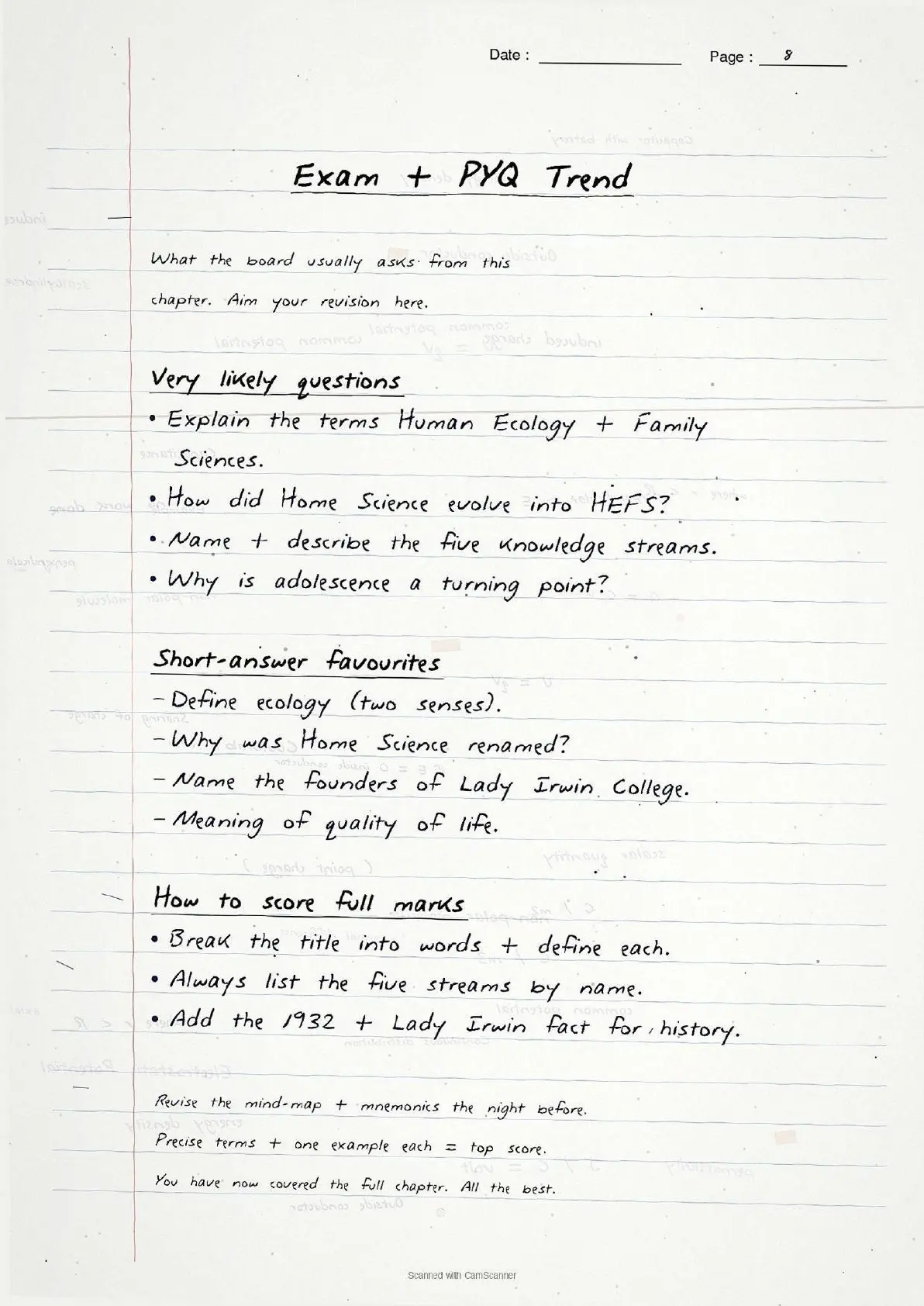
- Recall drill: cover the page and try to write the five knowledge streams and the 1932 Lady Irwin fact from memory.
- Night before: flip through the boxed mind-map for a quick last-minute recall of the streams and the meaning of the title.
Many students search for class 11 home science chapter 1 notes on their phone the night before a test, so a saved set of hand-written pages means you can revise offline. Use the handwritten notes for speed, then check the solutions to confirm you have the answer points right. Saying the mnemonic aloud once helps it stick for the exam.
Common Mistakes These Notes Help You Avoid
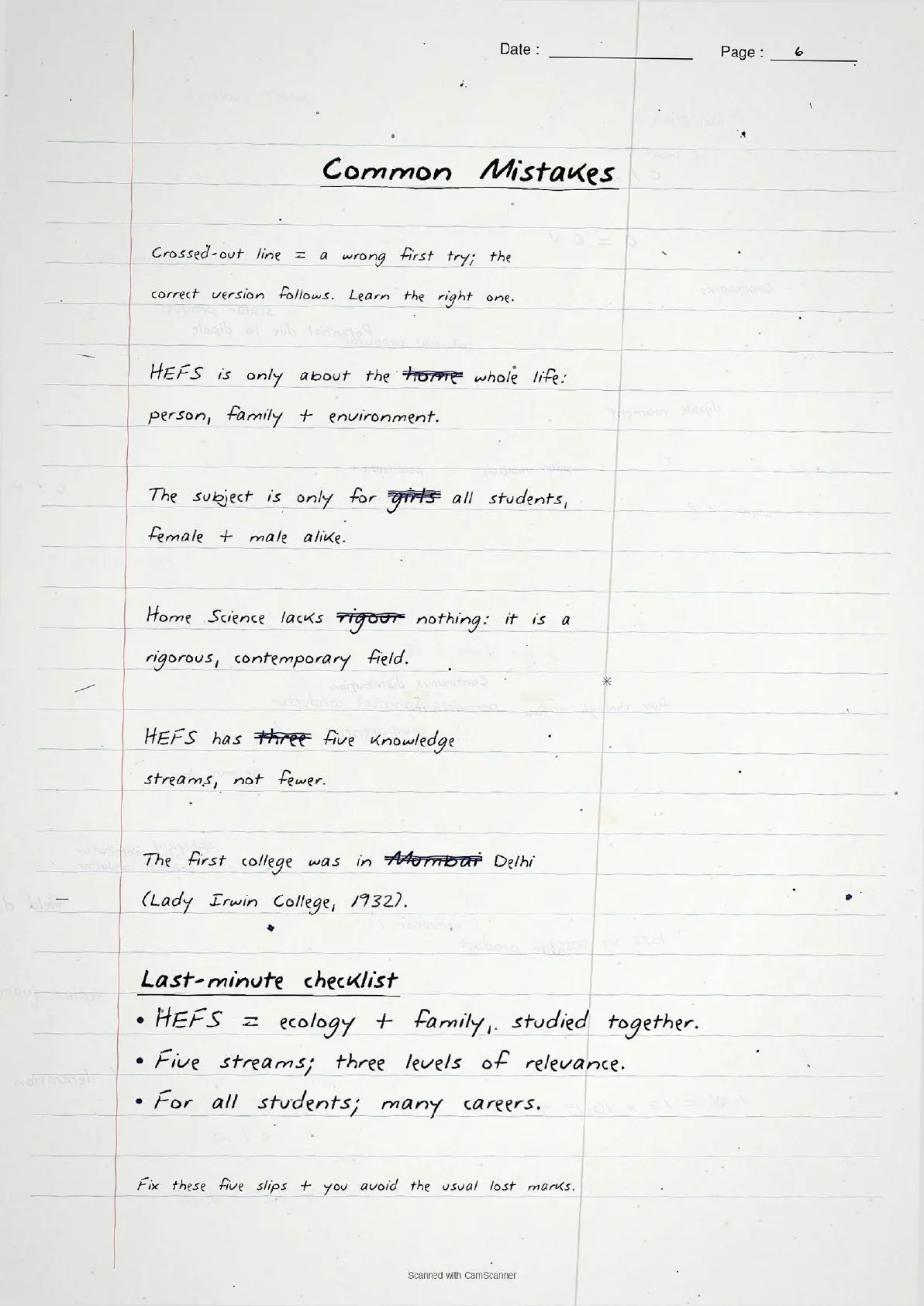
A few errors cost marks every year. The handwritten notes flag each one in the margin so you can fix it before the exam. These five are the most common.
- Saying HEFS is only about the home. It covers the whole life: the person, the family and the environment together.
- Thinking the subject is only for girls. It is for all students, female and male, in villages and towns.
- Claiming Home Science lacks rigour. It is a rigorous, contemporary and interdisciplinary field.
- Miscounting the streams. HEFS has five knowledge streams, not three or four.
- Wrong history. The first college was Lady Irwin College, Delhi, in 1932, not Mumbai.
Students who fix these five points usually move from average to high marks. The handwritten notes box the definition and list every stream in full, so the soft points are hard to miss when you revise. Watch the spelling of adolescence, ecology and synergistic too.
How These Handwritten Notes Pair with the Solutions and Book PDF
These handwritten notes are a fast revision tool. To prepare fully, students should use them alongside the other resources for the same chapter, all linked in the table below. Read the printed Notes, test yourself with the solutions, then use these pages for a final recall.
| Resource | Best used for |
|---|---|
| Human Ecology and Family Sciences NCERT Solutions | Step-by-step answers to all the chapter review questions |
| Human Ecology and Family Sciences Class 11 Notes | Quick chapter summary with all five streams and key terms in one place |
| Human Ecology and Family Sciences NCERT Book PDF | Reading the original NCERT chapter text and diagrams |
Tip: read the printed Notes first, then attempt the solutions, and keep these handwritten pages for the final night-before flip. Using them for recall, not for the first read, builds memory faster.
All Class 11 Home Science Handwritten Notes by Chapter
The table links the handwritten notes for every chapter in Class 11 Home Science, so students can move across the course in one click. Human Ecology and Family Sciences is highlighted.
| Chapter | Handwritten Notes |
|---|---|
| Chapter 1 | Human Ecology and Family Sciences |
| Chapter 2 | Understanding the Self |
| Chapter 3 | Food, Nutrition, Health and Fitness |
| Chapter 4 | Management of Resources |
| Chapter 5 | Fabrics Around Us |
| Chapter 6 | Media and Communication Technology |
| Chapter 7 | Concerns and Needs in Diverse Contexts |
| Chapter 8 | Nutrition, Health and Well-being |
| Chapter 9 | Our Apparel |
| Chapter 10 | Financial Management and Planning |
| Chapter 11 | Care and Maintenance of Fabrics |
FAQs on Human Ecology and Family Sciences Handwritten Notes
Human Ecology and Family Sciences Class 11 Home Science Handwritten Notes Common Questions
Ques. Where can I download the Human Ecology and Family Sciences handwritten notes PDF?
Ans. You can download the Human Ecology and Family Sciences Class 11 Home Science handwritten notes PDF directly from this page. It is free, follows the 2026-27 NCERT, and presents the meaning of HEFS, the five knowledge streams, the Home Science history and the career avenues as hand-written pages.
Ques. What does Human Ecology and Family Sciences mean in Class 11 Chapter 1?
Ans. Human Ecology and Family Sciences, or HEFS, is the scientific study of human beings in relation to their environment and their family. Human ecology looks at the ties a person has with their physical, economic, social and psychological surroundings, while Family Sciences studies the individual within the family, a key social unit. The handwritten notes break the title into parts and box the meaning.
Ques. What topics do these handwritten notes cover?
Ans. They cover the meaning of Human Ecology and Family Sciences, the evolution from Home Science to HEFS, the five knowledge streams of Food and Nutrition, Human Development and Family Studies, Fabric and Apparel, Resource Management, and Communication and Extension, the relevance to quality of life at three levels, the scope of the subject, and the career avenues each stream opens.
Ques. Are handwritten notes good for revising Class 11 Home Science Chapter 1?
Ans. Yes. Handwritten notes are best for fast, last-minute revision because the boxed key terms and the five-stream mind-map make the ideas easy to skim. Use them after a first read of the printed Notes, not as your only source.
Ques. How should I use these notes with the other resources?
Ans. Read the printed Notes first, test yourself with the NCERT Solutions, then keep these handwritten pages for the final night-before flip. Using them for recall rather than the first read builds memory faster.



Comments