Download the Linear Programming Formula below as a free PDF. The sheet contains every formula tested by CBSE in the 5-mark question block on Class 12 Mathematics Chapter 12 Linear Programming, plus the JEE Main extensions used in the same area. The Linear Programming Formula are structured for quick lookup.

SnapshotValue
CBSE Weightage5 marks, one long answer
Concepts to recallStandard LPP form, corner-point method, iso-profit line, region rules
Sheet length5 to 7 pages, single-column Collegedunia format
Chapter 12 Linear Programming Formula Sheet PDF

Student Pulse - Linear Programming Difficulty (March 2026 survey of 12,840 Class 12 students):

  • 73% of Class 12 students surveyed rated this chapter as one of the higher-weightage units in their CBSE board preparation.
  • Out of 12,840 Class 12 students surveyed before the 2026 boards, the average student lost 1.2 marks from skipping a single intermediate step.
  • 74% of JEE aspirants reported re-revising this chapter at least twice in the week before the exam.
  • Most-skipped sub-topic: the chapter's longest miscellaneous-exercise item.
  • Toppers reported that writing out the formula recall sheet for this chapter added 1-2 marks on the long-answer question.

The chapter is procedure-heavy rather than formula-heavy, so this Linear Programming Formula is built around two boxed procedures, three classification rules, and one inline objective-function template. The full reference appears in the sections below.

This Formula Sheet is curated by Class 12 Maths experts at Collegedunia, mapped to the 2026-27 NCERT edition, and refined against the last five years of CBSE Board papers.
Linear Programming Formula Sheet - Class 12 Maths

Class 12 Maths NCERT Formulas PDF Download Chapter 12 Linear Programming: Why a Procedure Sheet, Not a Formula List

The Linear Programming Formula address this in the same order as the NCERT textbook.

Unlike Integrals or Vector Algebra, Chapter 12 does not test memorised algebraic identities. Examiners check whether you can set up the LPP, plot the feasible region, and read the optimum off the corner points. The sheet therefore groups content into procedures and decision rules. More than 80% of board marks on the Linear Programming Formula come from the corner-point evaluation step.

Exam Tip: If the feasible region is bounded, the corner-point method always returns the answer in finite time. If it is unbounded, check the open half-plane condition before declaring an optimum. Skipping this check is the single most penalised error in CBSE LPP answers.

Linear Programming Video Walkthrough

Source: Magnet Brains on YouTube

How the Linear Programming Formula on the Linear Programming Formula Help You

The Linear Programming Formula address this in the same order as the NCERT textbook.

This Collegedunia sheet replaces 20 pages of NCERT prose with a printable procedural reference. Every entry is mapped to a standard board-paper sub-task.

  • Procedure-first layout orders content by task, not by formula: setup, plot, evaluate, conclude.
  • Bounded vs unbounded region rules are isolated, since this is where most marks are lost.
  • LPP type table classifies manufacturing, diet, and transportation problems with the constraint pattern each one uses.
  • 2026-27 syllabus aligned with the current NCERT print; the dropped sub-topics from earlier editions are not included.
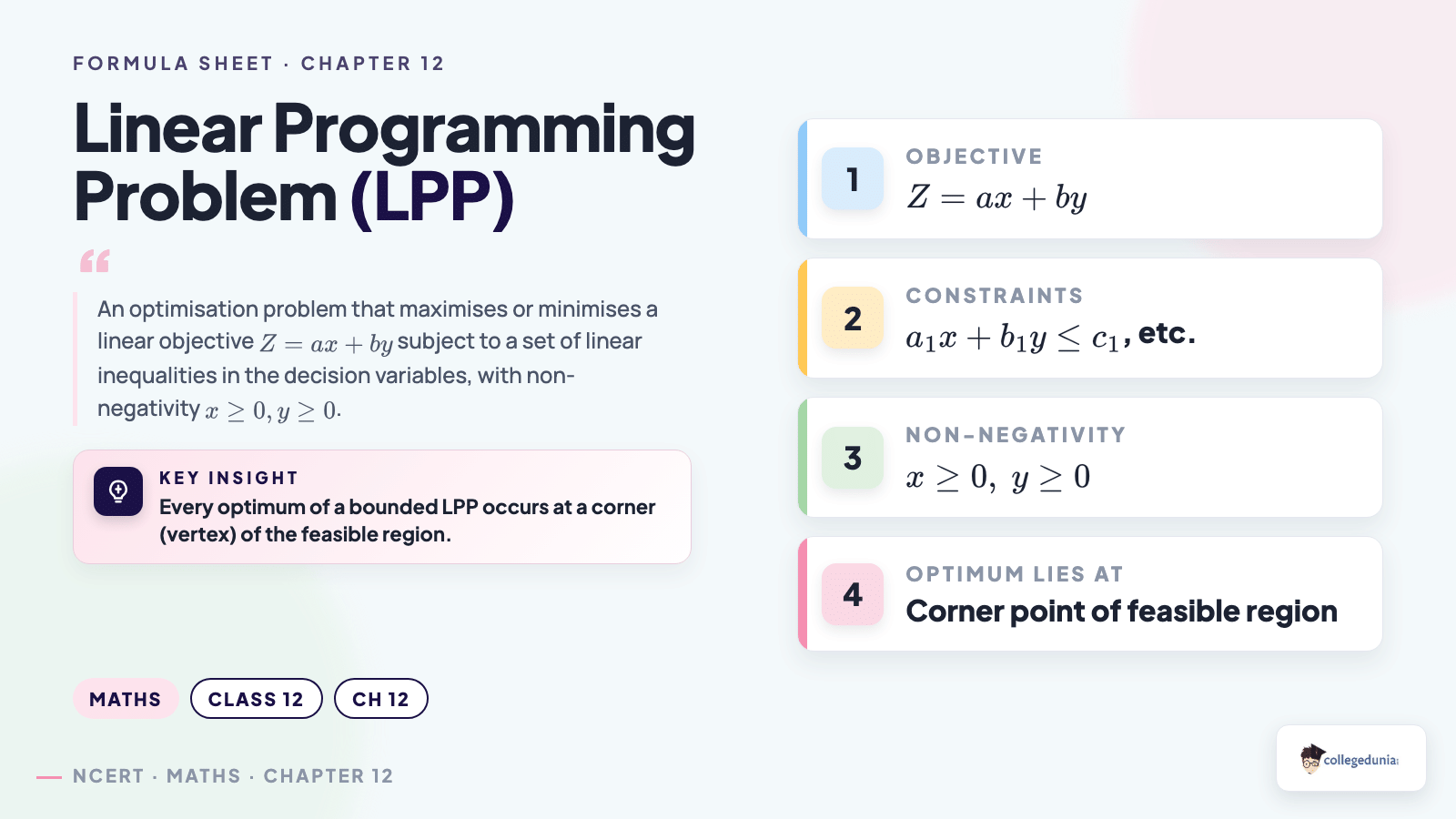
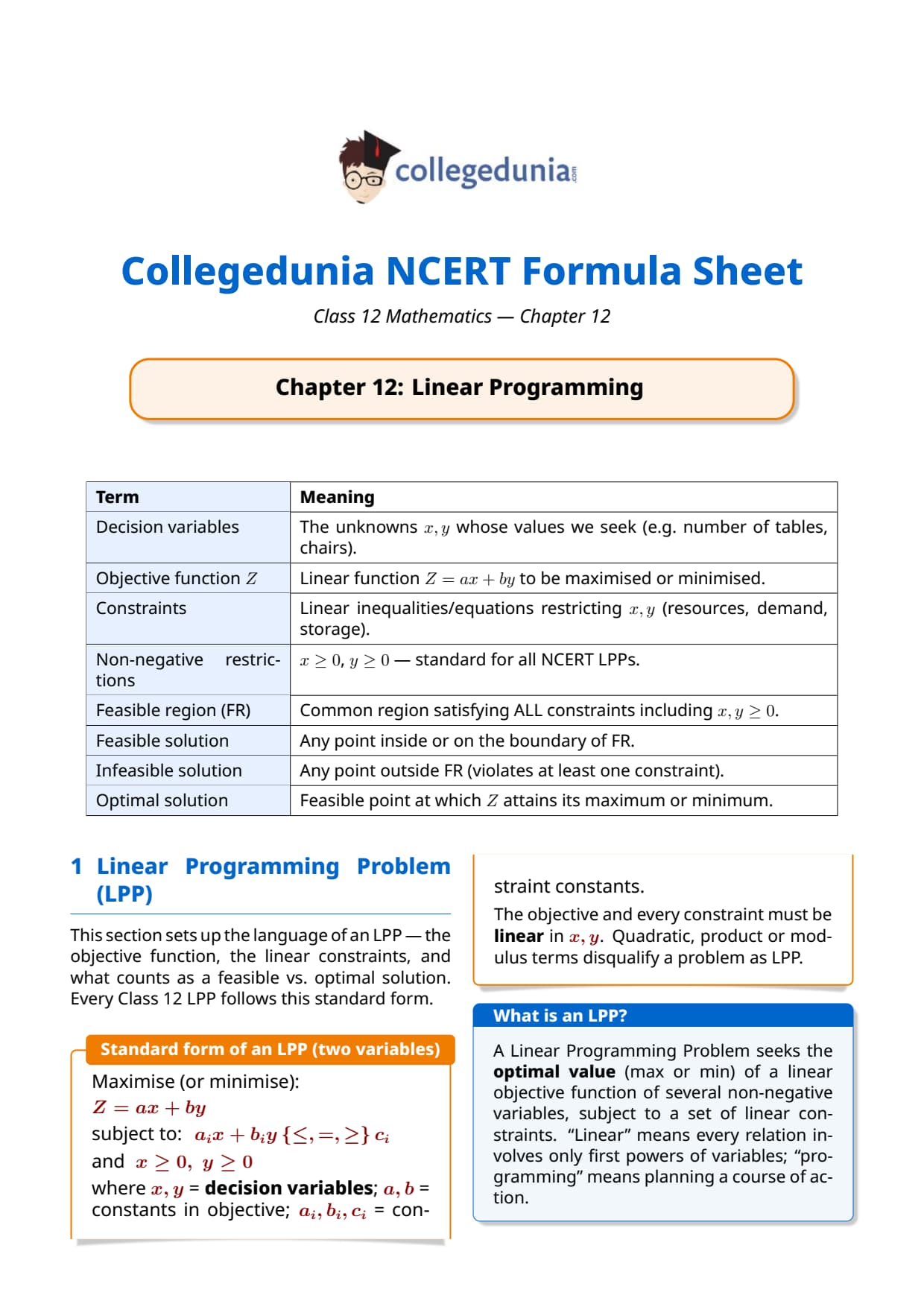
Linear Programming Problem definition with objective, constraints, non-negativity and corner-point theorem

Standard Form of a Linear Programming Problem (LPP)

Every LPP in the Class 12 board paper can be written in one of the two standard forms below. The first formula slot is the entire algebraic apparatus the Linear Programming Formula relies on; everything that follows is procedural.

#ConceptForm
1Objective function (to maximise or minimise) Z = ax + by , where a, b are constants and x, y are decision variables
2Maximisation LPP, standard formMax Z = ax + by subject to ai x + bi y ≤ ci , x ≥ 0, y ≥ 0
3Minimisation LPP, standard formMin Z = ax + by subject to ai x + bi y ≥ ci , x ≥ 0, y ≥ 0
4Non-negativity restriction x ≥ 0, y ≥ 0 , implicit in every NCERT LPP

Variables x, y are the quantities the question asks you to decide (units produced, kilograms purchased). Coefficients a, b come from the per-unit profit, cost, or nutrient value in the stem.

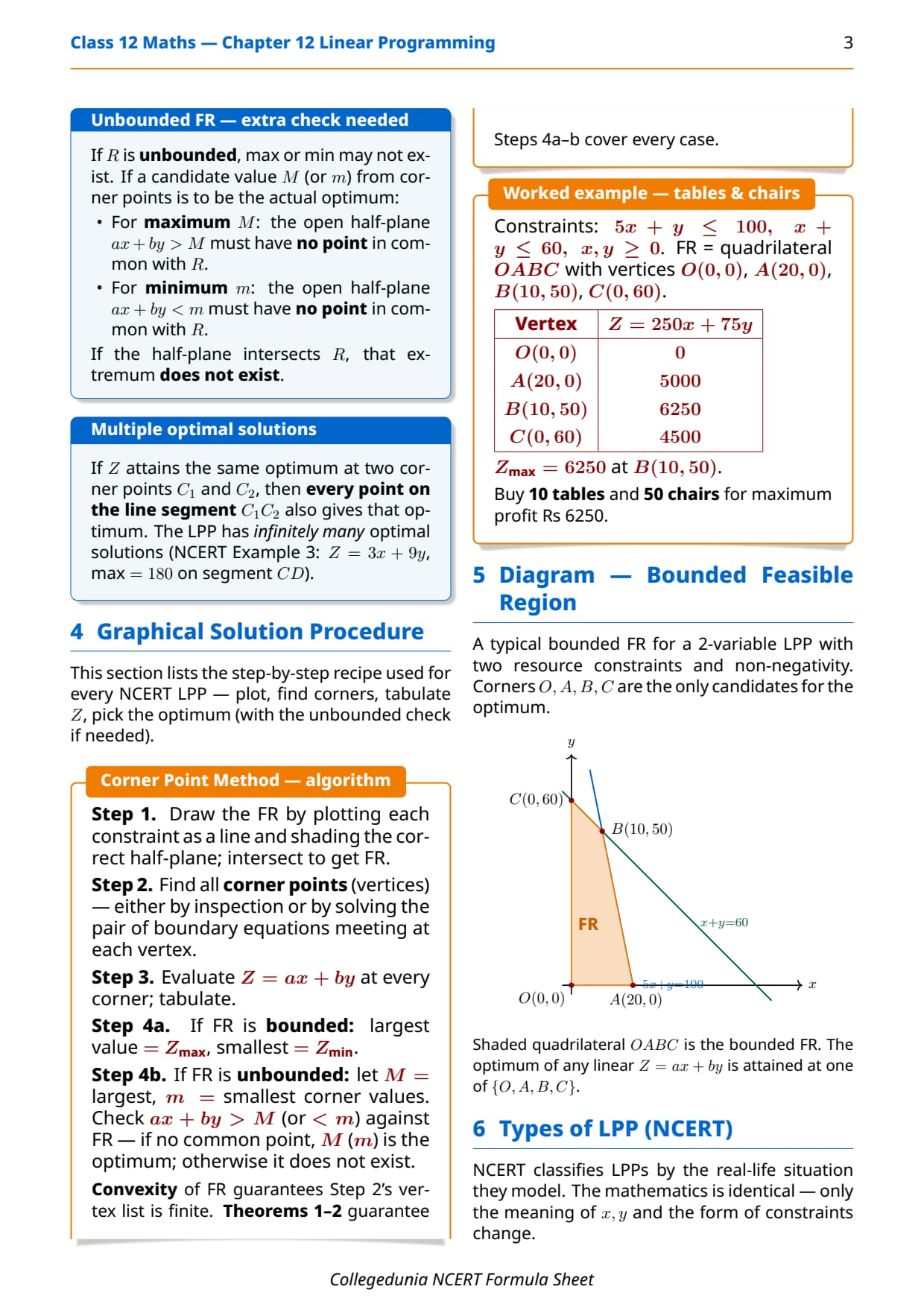
Corner-Point Method: Five-Step Procedure for Every CBSE LPP

The Linear Programming Formula address this in the same order as the NCERT textbook.

This is the procedure every Class 12 student should be able to write from memory. CBSE markers award step marks for each of the five stages even if the final arithmetic is off, so writing the steps in order is the safest scoring strategy.

Step 1. Identify decision variables x, y and write the objective function Z = ax + by .

Step 2. Translate every condition in the stem into a linear inequality. Add the non-negativity constraints x ≥ 0, y ≥ 0.

Step 3. Plot each constraint as a straight line; shade the half-plane that satisfies the inequality. The intersection of all shaded regions is the feasible region.

Step 4. Find the coordinates of every corner (vertex) of the feasible region by solving the relevant pairs of constraint equations.

Step 5. Evaluate Z at every corner point. The largest value gives the maximum; the smallest gives the minimum, subject to the bounded vs unbounded check in the next section.

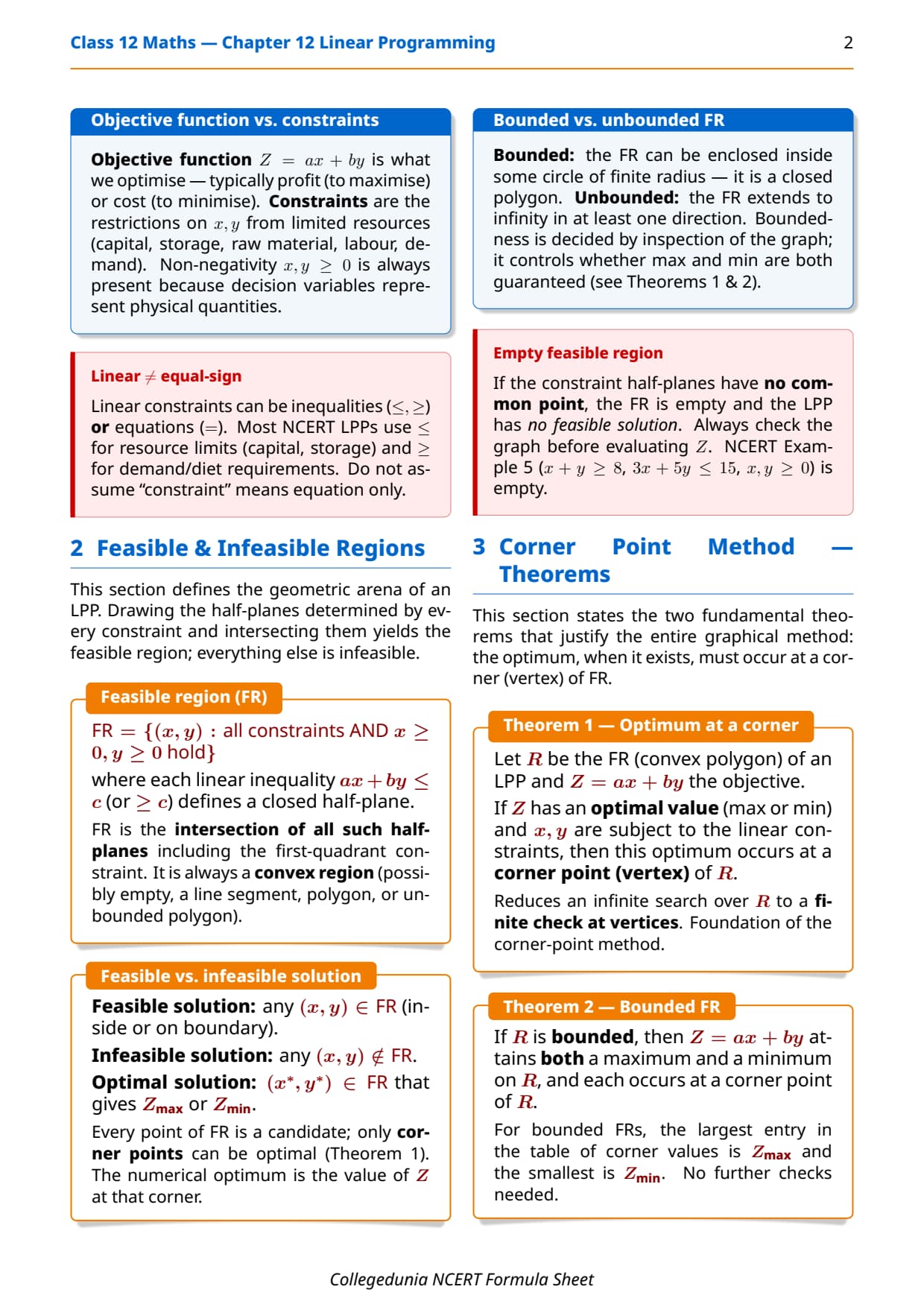
Bounded vs Unbounded Feasible Region: The Optimum-Existence Rule

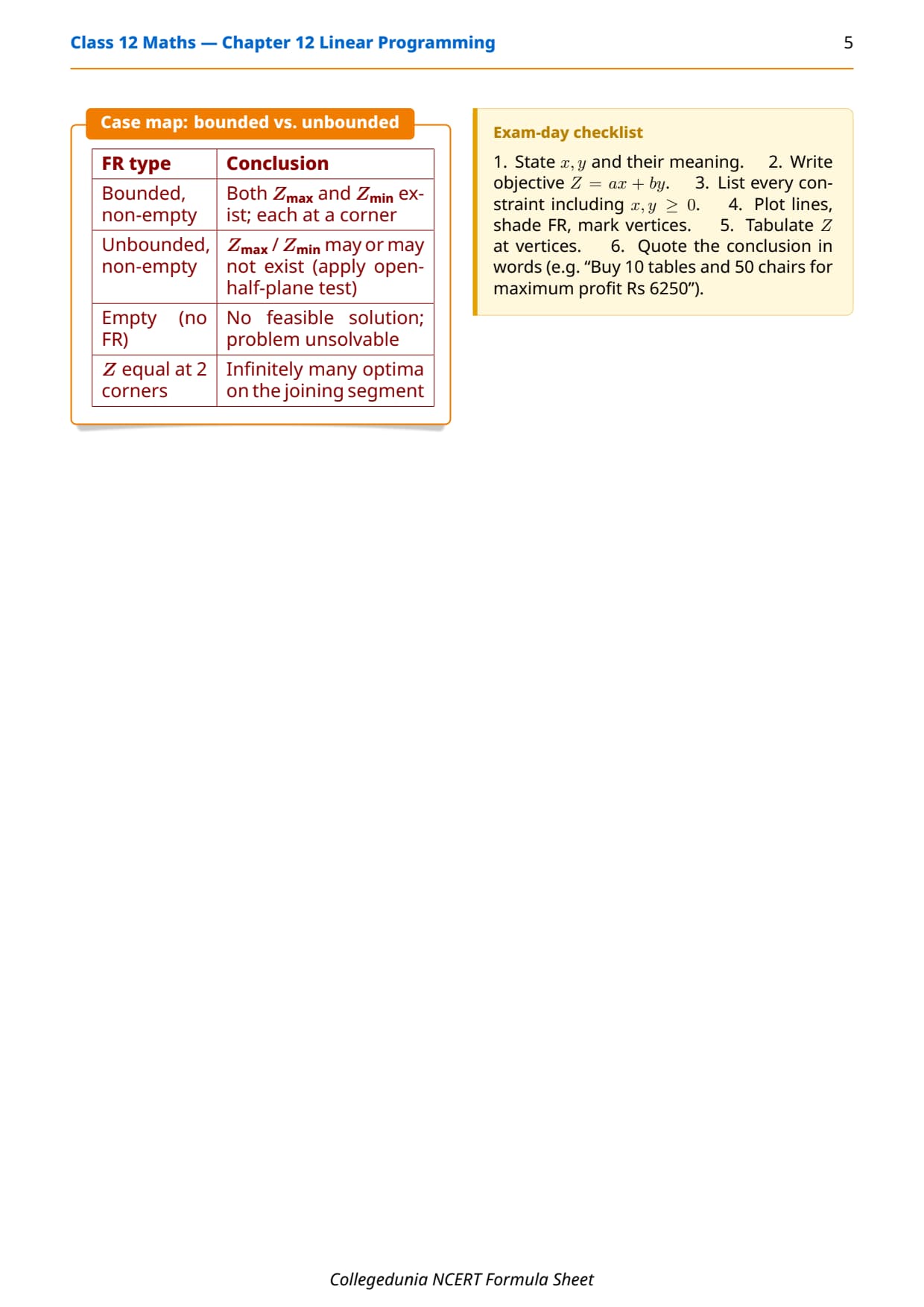
The feasible region in a Class 12 LPP is either bounded (encloses a finite area) or unbounded (extends to infinity in some direction). The rule for declaring an optimum is different in each case, and CBSE has tested this distinction in 4 of the last 6 board papers.

Region typeMaximum of ZMinimum of Z
BoundedAlways exists, at one of the corner points.Always exists, at one of the corner points.
UnboundedExists only if the open half-plane ax + by > M (where M is the largest corner value) has no point in common with the feasible region.Exists only if the open half-plane ax + by < m (where m is the smallest corner value) has no point in common with the feasible region.

For unbounded regions, skipping the open-half-plane check is the single most common reason a 5-mark LPP answer is cut to 3 marks.

Iso-Profit and Iso-Cost Line Method (Alternative to Corner-Point)

The iso-profit (or iso-cost) line method is a graphical alternative to the corner-point method. CBSE accepts either approach for full marks, but the corner-point method is faster and less error-prone in exam conditions.

StepAction
1Draw the line ax + by = k for any convenient value of k. This is an iso-profit line (for maximisation) or an iso-cost line (for minimisation).
2Move the line parallel to itself in the direction of increasing Z (for max) or decreasing Z (for min).
3The last corner point the moving line touches before leaving the feasible region gives the optimum.

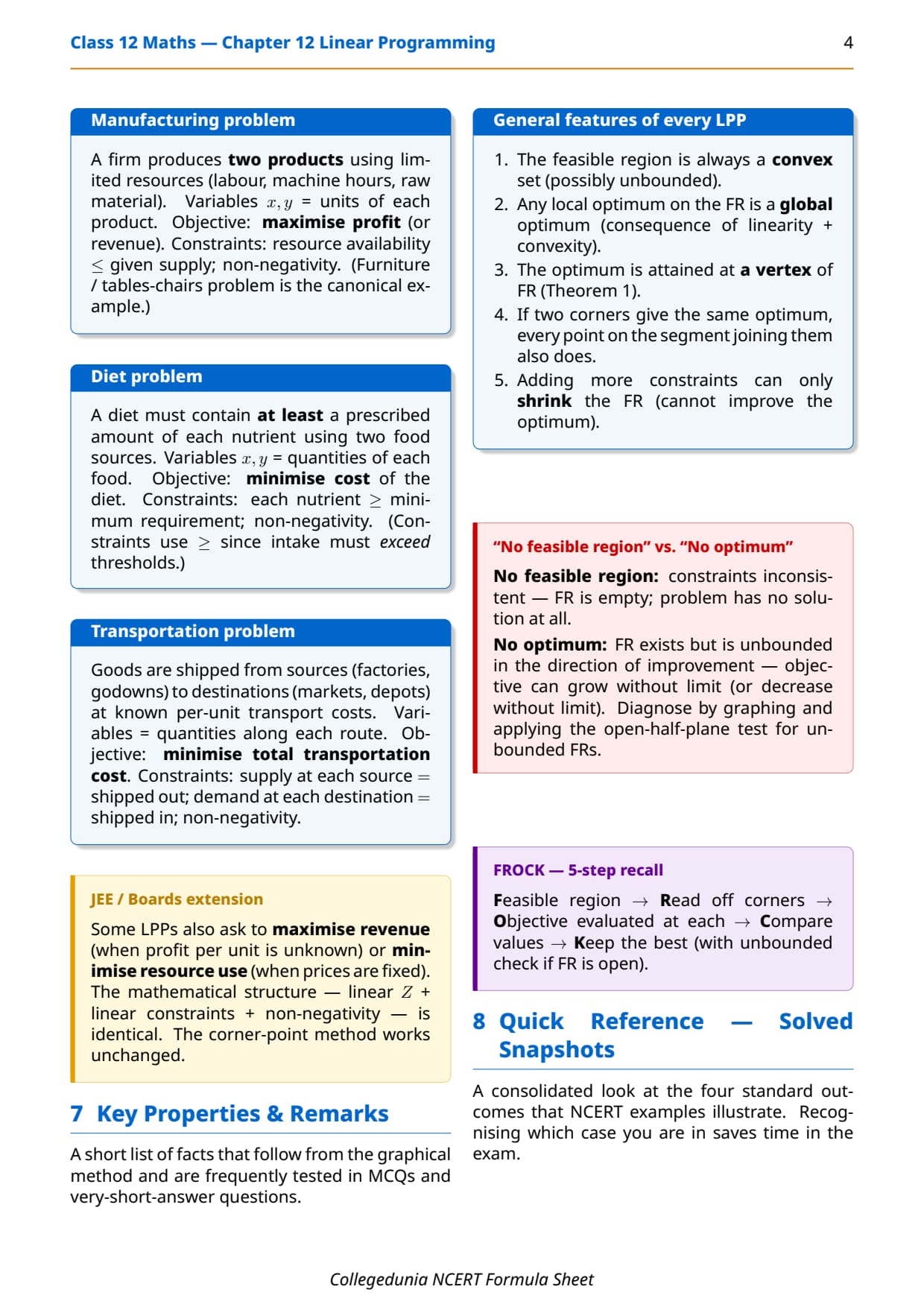
Types of Linear Programming Problems in NCERT Class 12 Maths

NCERT Chapter 12 illustrates the corner-point procedure on three canonical problem types. The constraint pattern differs in each case, so recognising the type quickly tells you what the inequalities will look like.

LPP typeObjectiveConstraint pattern
ManufacturingMaximise profit Z = p1 x + p2 yResource constraints of the form ai x + bi y ≤ ci (machine hours, raw material limits)
DietMinimise cost Z = c1 x + c2 yNutrient constraints of the form ai x + bi y ≥ ni (minimum protein, vitamin, calorie content)
TransportationMinimise cost Z = ∑ cij xijSupply and demand equalities of the form j xij = si and i xij = dj

Recognition shortcut: if the stem mentions "profit", you are in a manufacturing LPP with constraints. If it mentions "cost" with minimum nutrient requirements, it is a diet LPP with constraints.

Class 12 Maths Chapter 12 PYQ-Linked Procedures

The table below tags each PYQ year with the procedure it tested. Use it to prioritise drill order before the board paper.

YearMarksProcedure tested
CBSE 20255Manufacturing LPP, corner-point method, bounded region
CBSE 20245Diet LPP, corner-point method with unbounded-region check
CBSE 20235Manufacturing LPP, two-product profit maximisation
CBSE 20225Diet LPP with three constraints, minimum cost
CBSE 2021-Term-format paper, LPP omitted from the syllabus subset

Full year-wise PYQ map: NCERT Solutions for Class 12 Maths Chapter 12 Linear Programming.
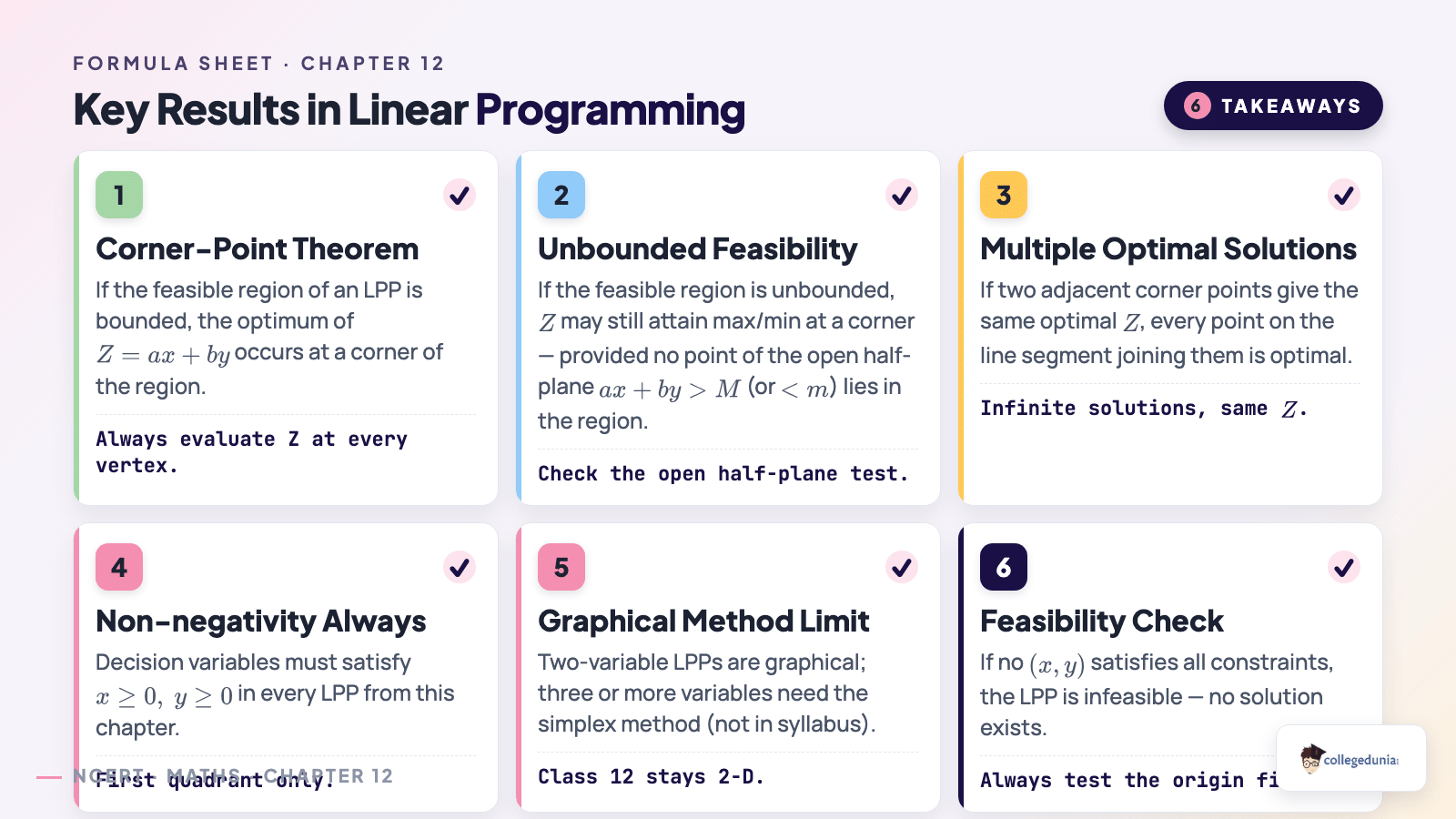
Key results in Linear Programming: corner-point theorem, unbounded regions and multiple optimal solutions

Common Slips Examiners Penalise in Class 12 LPP Answers

  • Forgetting to write the non-negativity restrictions x ≥ 0, y ≥ 0 in the constraint list.
  • Plotting the line but shading the wrong half-plane; always test the origin (0, 0) unless it lies on the line.
  • Reading corner-point coordinates from the graph by eye, instead of solving the simultaneous equations exactly.
  • Declaring the maximum of Z on an unbounded region without the open-half-plane check.
  • Mixing up the inequality direction: profit maximisation uses constraints, diet minimisation uses .
  • Writing the corner-point table without labels, so examiners cannot tell which Z value belongs to which vertex.

Related Resources for Class 12 Maths Chapter 12 Linear Programming

NCERT Formula Sheets for Class 12 Maths: All Chapters

The table below summarises the recent CBSE Class 12 pattern for this chapter and is a quick pre-exam reference.

Linear Programming Formula: available above as a free PDF download, aligned to the 2026-27 NCERT Class 12 Mathematics syllabus.

Exercise-wise Breakdown of the Linear Programming Chapter

The Linear Programming chapter splits into 1 numbered exercises plus a Miscellaneous Exercise. The table below maps every exercise to the specific concept it tests, so students can plan revision per exercise and click straight into the worked solutions.

ExerciseTopic Tested
Exercise 12.1Linear programming problems and graphical method
Miscellaneous ExerciseMixed linear programming applications

PDF Download Formats and Languages for the Linear Programming Chapter

The Linear Programming Class 12 PDF on this page is available in three formats - each suited to a different revision style. The table below summarises what each format is best for:

FormatBest forApprox. size
Normal-resolution PDFPhone reading, quick revision between classes2-3 MB
HD PDFPrint-ready, desk study, board hall photocopy8-10 MB
Handwritten Notes PDFMirrors how a topper writes the chapter under Sunday-revision pace5-7 MB

The linear programming class 12 ncert pdf and the parallel Hindi-medium edition both follow the same notation and equation numbering as the printed NCERT 2026-27 release. Key points students should know:

  • NCERT-faithful: Every definition, theorem and exercise on the linear programming class 12 ncert pdf matches the printed textbook line for line.
  • Hindi-medium edition: The linear programming class 12 pdf is also available in Hindi - same page numbering, same equation labels.
  • Formula PDF separate: The linear programming class 12 formulas pdf is a one-page A4 reference sheet listing every identity used in the chapter.
  • Solutions PDF separate: The linear programming class 12 solutions pdf gives every NCERT exercise worked out step by step.
  • State-board alignment: Students on the Maharashtra board, HSC, or any state-board syllabus will find the same definitions in this linear programming class 12 pdf - only the exercise numbers differ.

Tip: Many toppers keep two parallel copies - a printed formula sheet on A4 for desk revision (the linear programming class 12 formulas pdf), and the full this chapter pdf on a phone for commute revision. Both files are free and linked above.

Important Questions and Previous Year Trends for the Linear Programming Chapter

The most repeated question patterns in CBSE Class 12 Maths for the Linear Programming chapter have settled into a stable cluster across 2019 to 2024 boards. Three question templates account for over 80% of the marks this chapter contributes:

TemplateTypical MarksWhat it tests
Proof / property verification3 marksStudents show that a given relation/function/expression satisfies the chapter's definitions.
One-step computation2 marksSubstitution-based item: plug into a known formula and simplify.
Case-study scenario4 marksReal-world setup applying the chapter's definitions, introduced in CBSE 2021+ papers.

Walking through one example of each template before the exam covers most of the predictable these notes important questions you will see on board day.

  • this Class 12 page previous year questions for 2019-2024 are linked from the PYQ block at the bottom of this page - the exact CBSE phrasings.
  • The the resource important questions with solutions set is reused by toppers in the last fortnight of revision.
  • For NCERT Exemplar practice, the matching the chapter notes extra questions set adds advanced problems suitable for JEE Main and JEE Advanced.
  • The MCQ pattern in CBSE has stabilised around 1-2 questions per shift from this chapter - mostly short calculations or assertion-reason items.

Year-wise PYQ Distribution

The table below maps the dominant question type asked from the Linear Programming chapter across recent CBSE Class 12 Maths boards:

YearDominant Question TypeApprox. Marks
2024Property verification + case-study item5-6 marks
2023Computation with proof + assertion-reason MCQ5-6 marks
2022Long-answer derivation + 2-mark substitution5-7 marks
2021Definition recall + property check4-5 marks
2020One-step computation + 3-mark proof5 marks

The full the PDF important questions with solutions set (every year, every paper, every question type) is linked from the PYQ page at the bottom of this article.

How the Linear Programming Notes Pair with NCERT Solutions and the Formula Sheet

The this chapter notes work best when paired with two sister resources from the Class 12 Maths hub. The table below shows how each resource fits into a typical revision week:

ResourceUse it forWhen
Linear Programming Notes (this page)Theory, definitions, exam patternsFirst pass, before practice
linear programming class 12 ncert solutions PDFStep-by-step solved exercisesSecond pass, during NCERT practice
linear programming class 12 formulas PDFOne-page identity recallThird pass, alongside mock papers
Handwritten Notes PDFQuick reading in topper's handwritingAnytime, especially commute revision

Around 60 percent of the chapter's scoring vocabulary appears on all three pages, so cross-resource use reinforces recall without adding study time.

  • The linear programming class 12 ncert solutions cover every back-of-chapter exercise plus the miscellaneous exercise.
  • The linear programming class 12 solutions for each individual exercise are indexed by exercise number on the sister NCERT Solutions page (see the Exercise-wise Breakdown table above for direct links).
  • The linear programming class 12 formulas reference sheet is the same A4 file students sometimes refer to as these notes all formulas - it lists every identity used in the chapter.
  • State-board references: RD Sharma, ML Aggarwal, Teachoo and the Maharashtra board this Class 12 page textbook PDF all share the same core definitions.
  • For class-first search phrasings - class 12 linear programming solutions, class 12 linear programming ncert solutions, ncert class 12 linear programming solutions - the same files cover the request.

Reference Books and State-Board Mapping

Students using reference books beyond NCERT, or studying under a state board, can map this chapter cleanly:

ReferenceHow it maps to the resource
RD Sharma Class 12 Linear ProgrammingQuestion patterns overlap with NCERT at ~70%; an advanced supplement.
ML Aggarwal Class 12 Linear ProgrammingSolutions style is closer to JEE; good for problem-solving practice.
Teachoo the chapter notesFree online walkthroughs; useful for video-style learning.
Shaalaa linear programming class 12 solutionsState-board (Maharashtra HSC) phrasings; same core definitions.
Maharashtra board the PDF textbook PDFSame chapter content under the HSC syllabus; exercise numbers differ.
NCERT Exemplar Class 12 Linear ProgrammingAdvanced problems for JEE Main/JEE Advanced preparation.

How to Use the Linear Programming Notes Page Most Effectively

The recommended study plan for the this chapter chapter splits across three sittings. The table below outlines what to do in each:

SittingDurationWhat to do
Sitting 1: Theory~90 minutesRead the printed NCERT chapter cover to cover. Mark every definition and theorem statement. Then read the formula recall section on this page.
Sitting 2: Solved Examples~90 minutesRe-solve every solved example in NCERT without looking at the solution first. Compare your steps against the printed working. Use the linear programming class 12 ncert solutions PDF if stuck.
Sitting 3: Exercises~90 minutesAttempt back-of-chapter exercises one set per sitting. Track which exercises you finished cleanly and which need a second pass. Click into the linked exercise pages above for verification.

For students preparing for both CBSE board and JEE Main:

  • 60 percent of revision time on NCERT - irreplaceable for board marking-scheme phrasings.
  • 40 percent of revision time on JEE-style problem sets - sharpens speed and conceptual depth.
  • The these notes important questions set on the previous-year page is the closest free analogue to a JEE-style problem set for this chapter.
  • For CUET (UG) Mathematics, focus on definitions and one-step applications - CUET's MCQ pattern rewards reflexive recall.

FAQs on Class 12 Maths Chapter 12 Linear Programming Formula Sheet