




Inheritance passes characters from parent to progeny, and variation is the degree by which progeny differ from parents. Class 12 Biology Chapter 4 Principles of Inheritance and Variation is the most ratio-driven chapter in the syllabus, and this Collegedunia Class 12 Biology Formula Sheet for Chapter 4 Principles of Inheritance and Variation gathers every Mendelian ratio, allele rule, and disorder genotype from the 2026-27 NCERT onto one card set.
- CBSE Weightage: 6 to 8 marks (Unit Genetics and Evolution)
- NEET Weightage: 4 to 6 questions per year (highest-yield genetics block)
- JEE Main Weightage: Not applicable (Biology is outside the JEE Main syllabus)
Principles of Inheritance and Variation Video Lecture for Class 12 Biology
Source: Magnet Brains on YouTube
How will Collegedunia's Principles of Inheritance and Variation Formula Sheet Help You for NEET 2027?
This chapter is scored by getting the cross ratios and disorder genotypes exact.
- 2026-27 NCERT Alignment: Every ratio and genotype matches the current NCERT print, including Sections 4.7 and 4.8.
- Ratio-First Layout: All eleven cross ratios sit in one table so the splits never get swapped.
- Exam-Shaped Recall: Facts are stored the way CBSE and NEET phrase them.
All Important Ratios and Cross Rules of Principles of Inheritance and Variation at a Glance
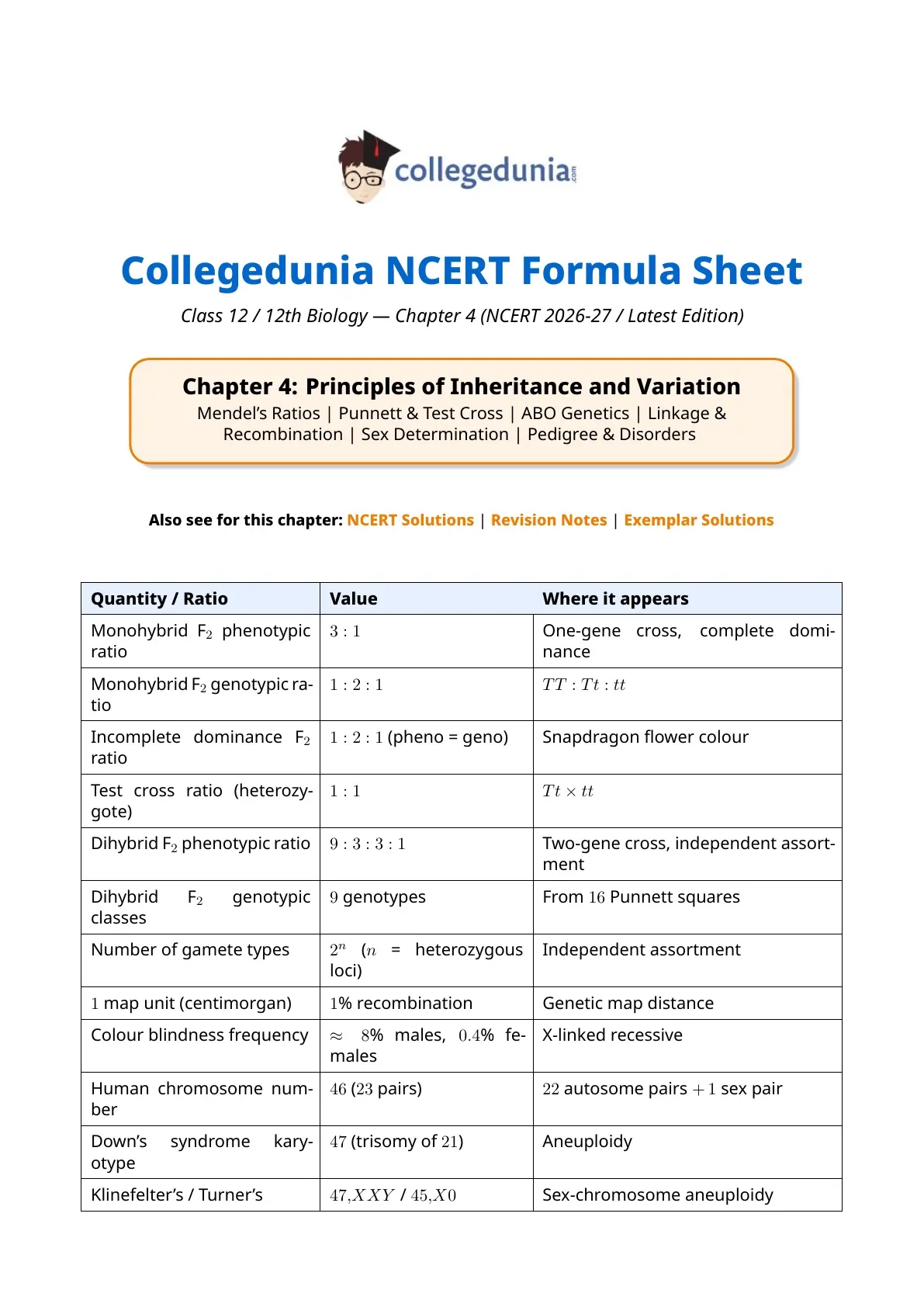
The master table collapses every cross outcome and allele rule, each tagged with its NCERT sub-section.
| Concept | Ratio / Rule | Type | NCERT section |
|---|---|---|---|
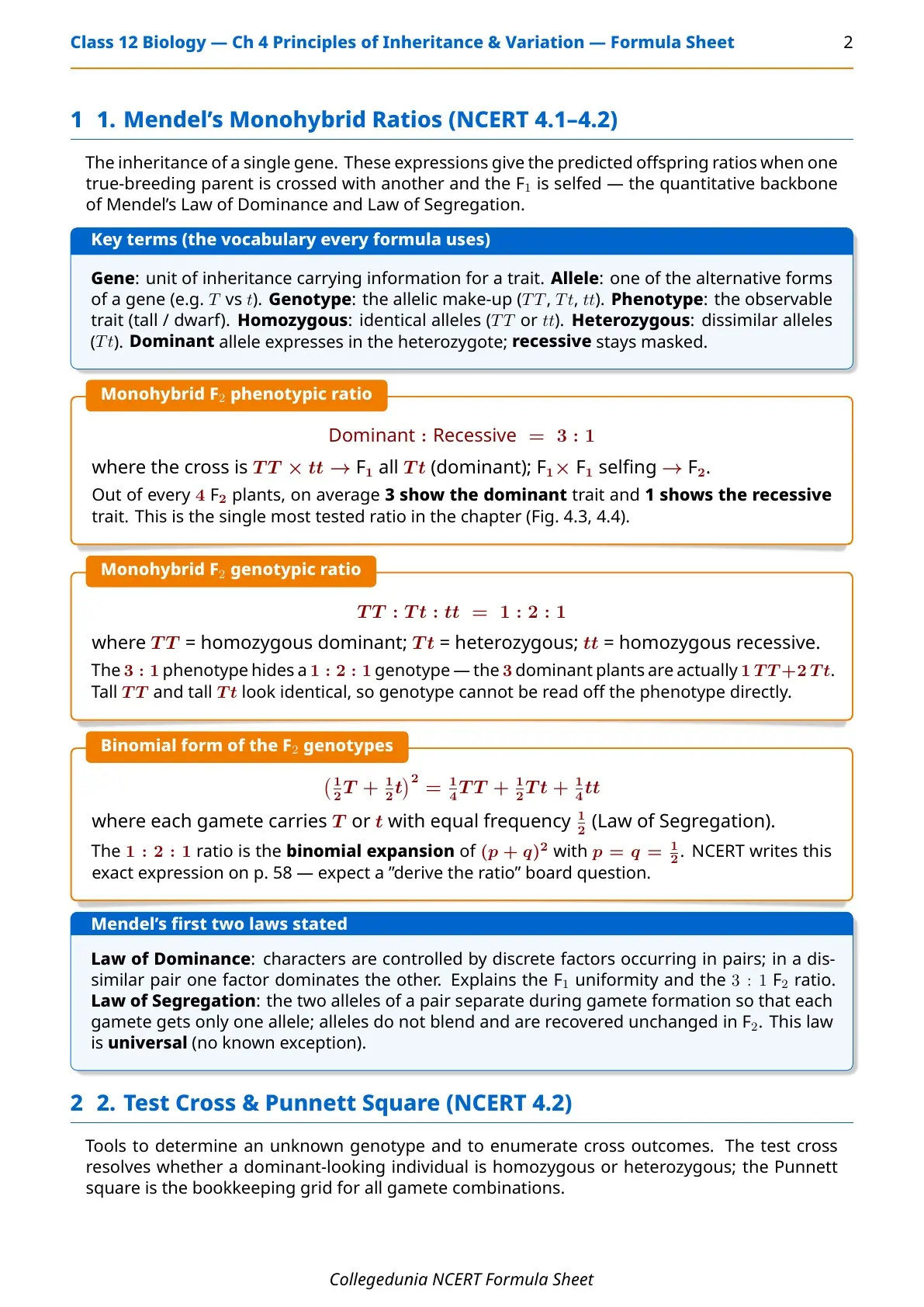
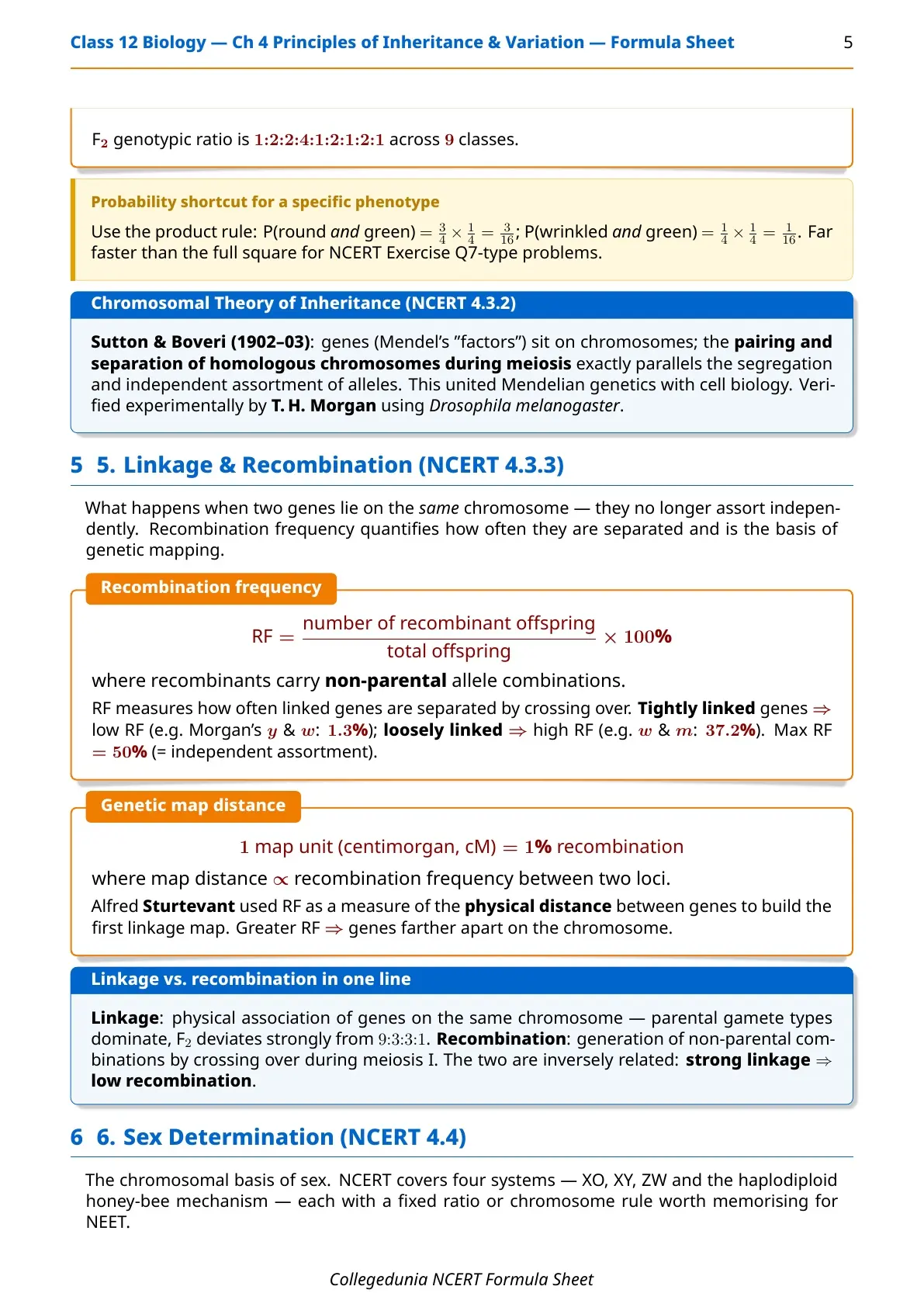
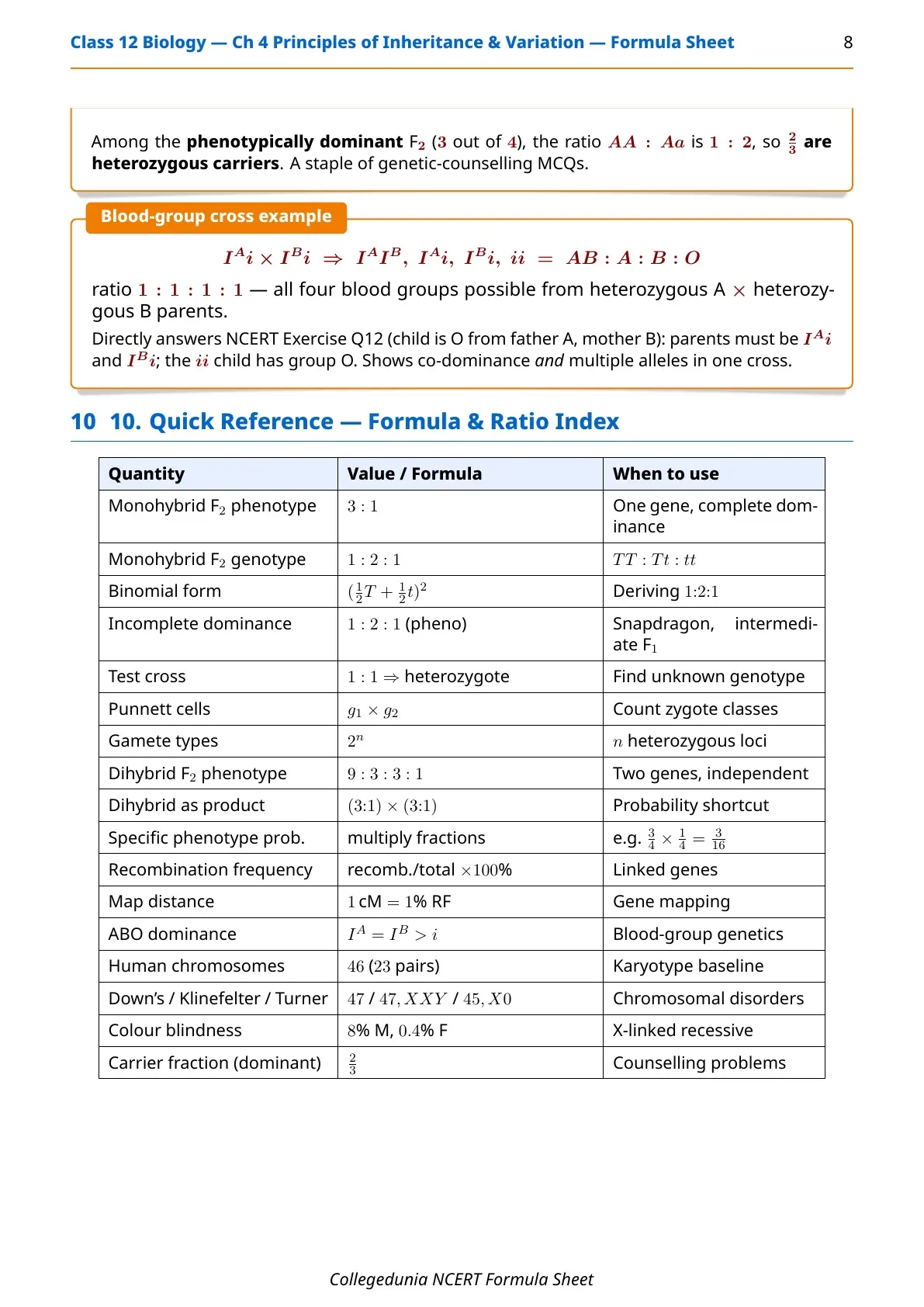
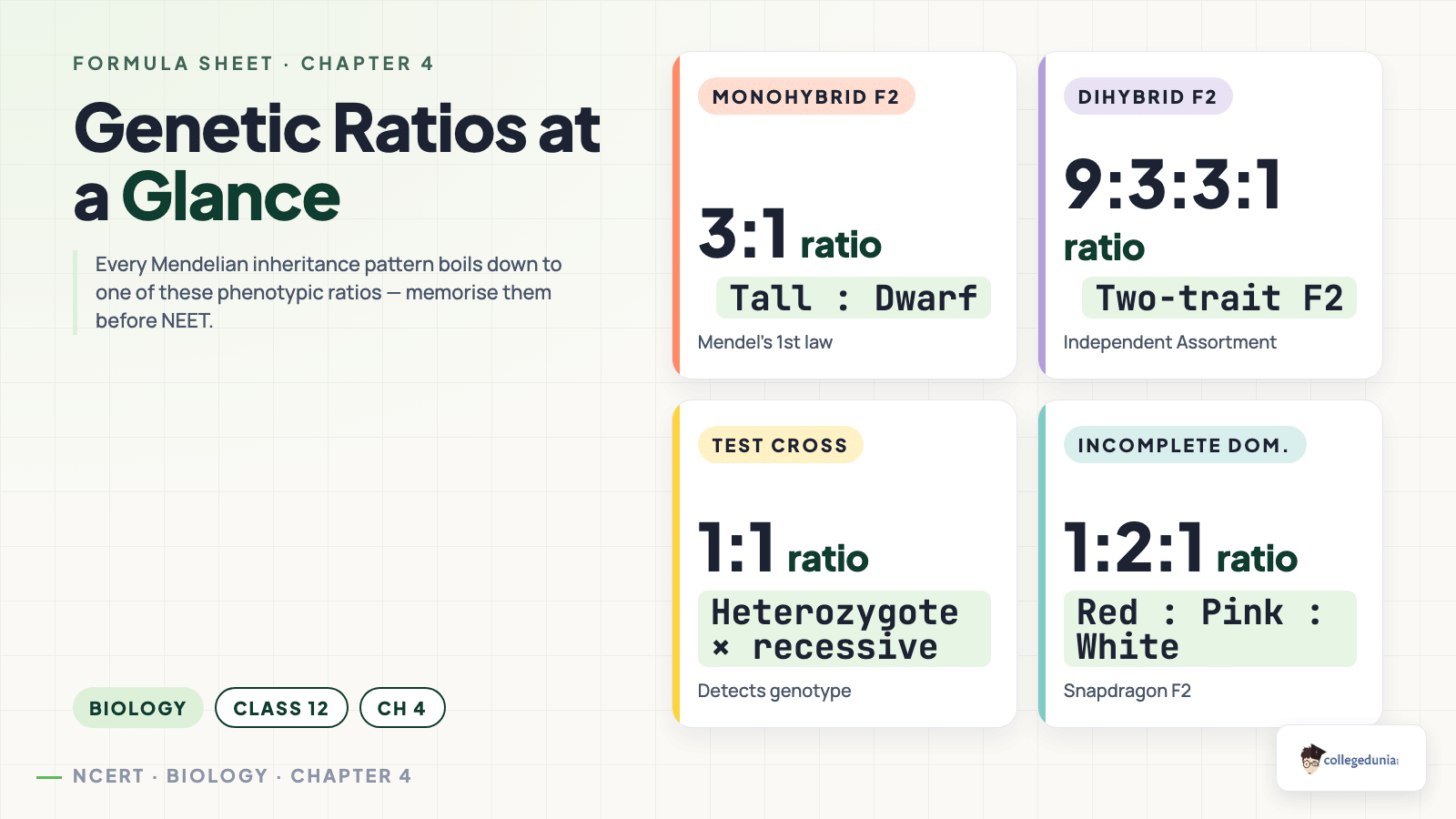
| Monohybrid F2 phenotypic ratio | 3 : 1 (dominant : recessive) | phenotypic | 4.2 |
| Monohybrid F2 genotypic ratio | 1 : 2 : 1 (TT : Tt : tt) | genotypic | 4.2 |
| Binomial expansion of monohybrid | (½T + ½t)2 = ¼TT + ½Tt + ¼tt | algebraic | 4.2 |
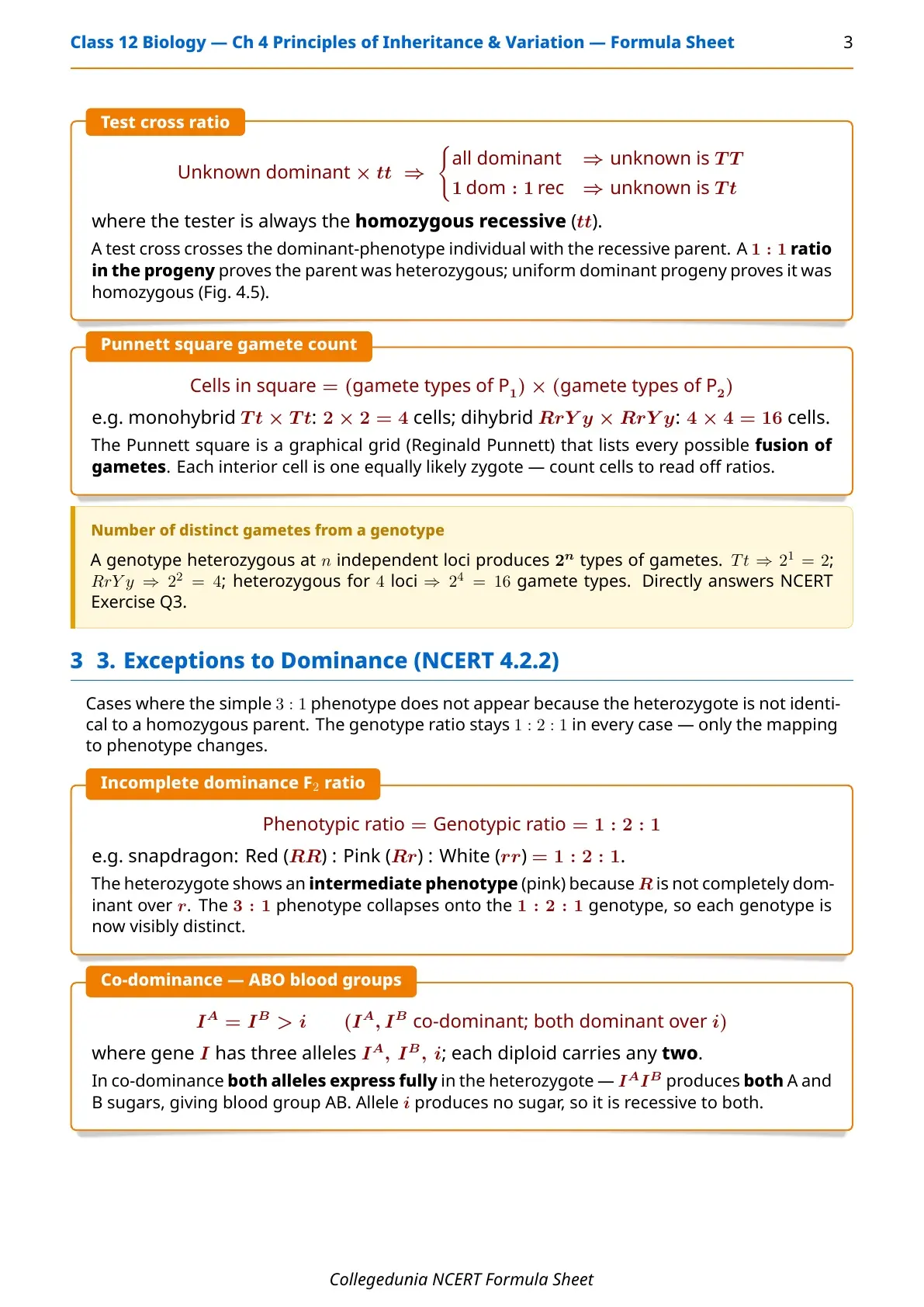
| Test cross ratio | 1 : 1 if heterozygous; all dominant if homozygous | phenotypic | 4.2 |
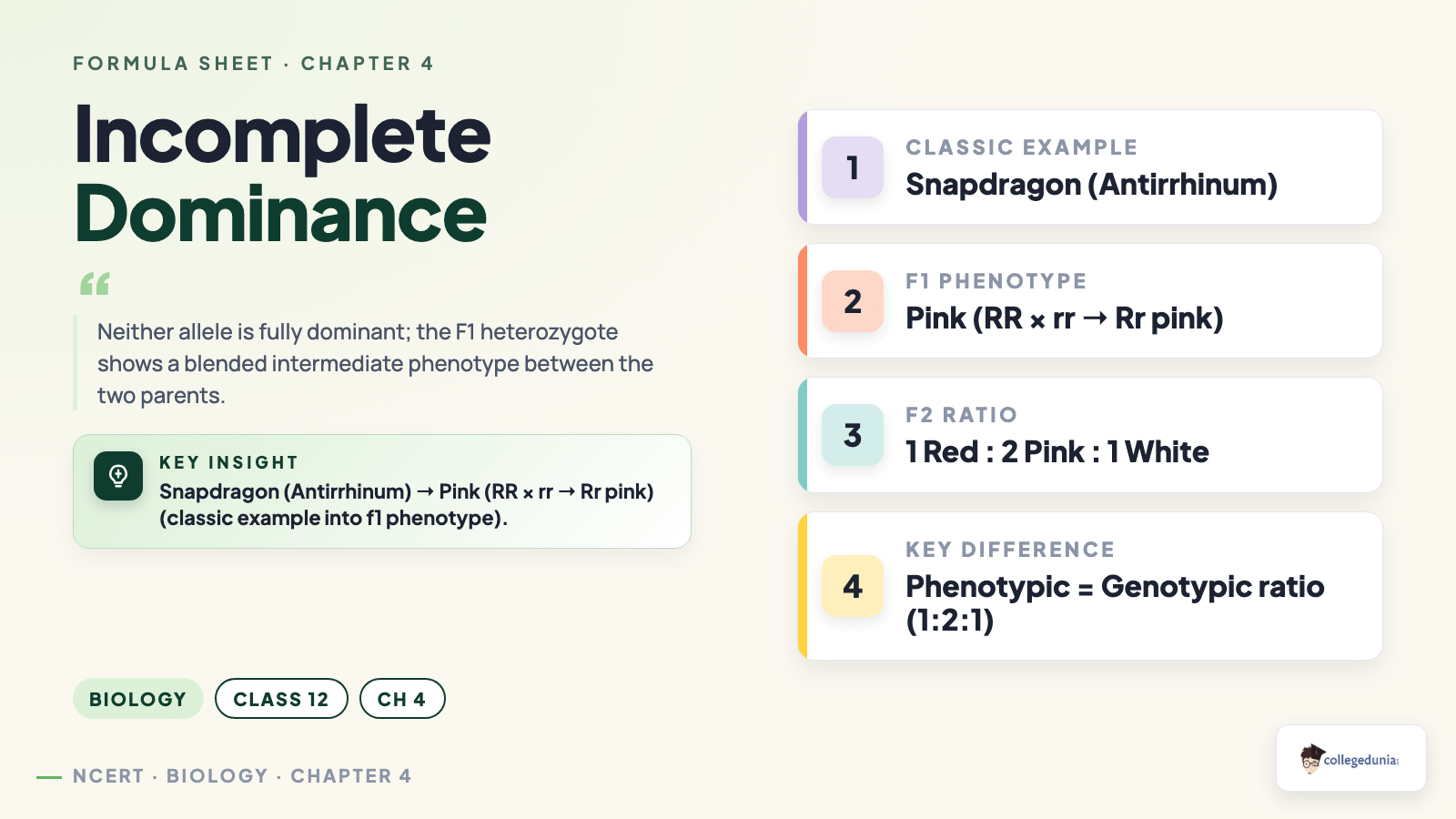
| Incomplete dominance F2 | 1 : 2 : 1 (phenotype = genotype; red : pink : white) | phenotypic | 4.2.2.1 |
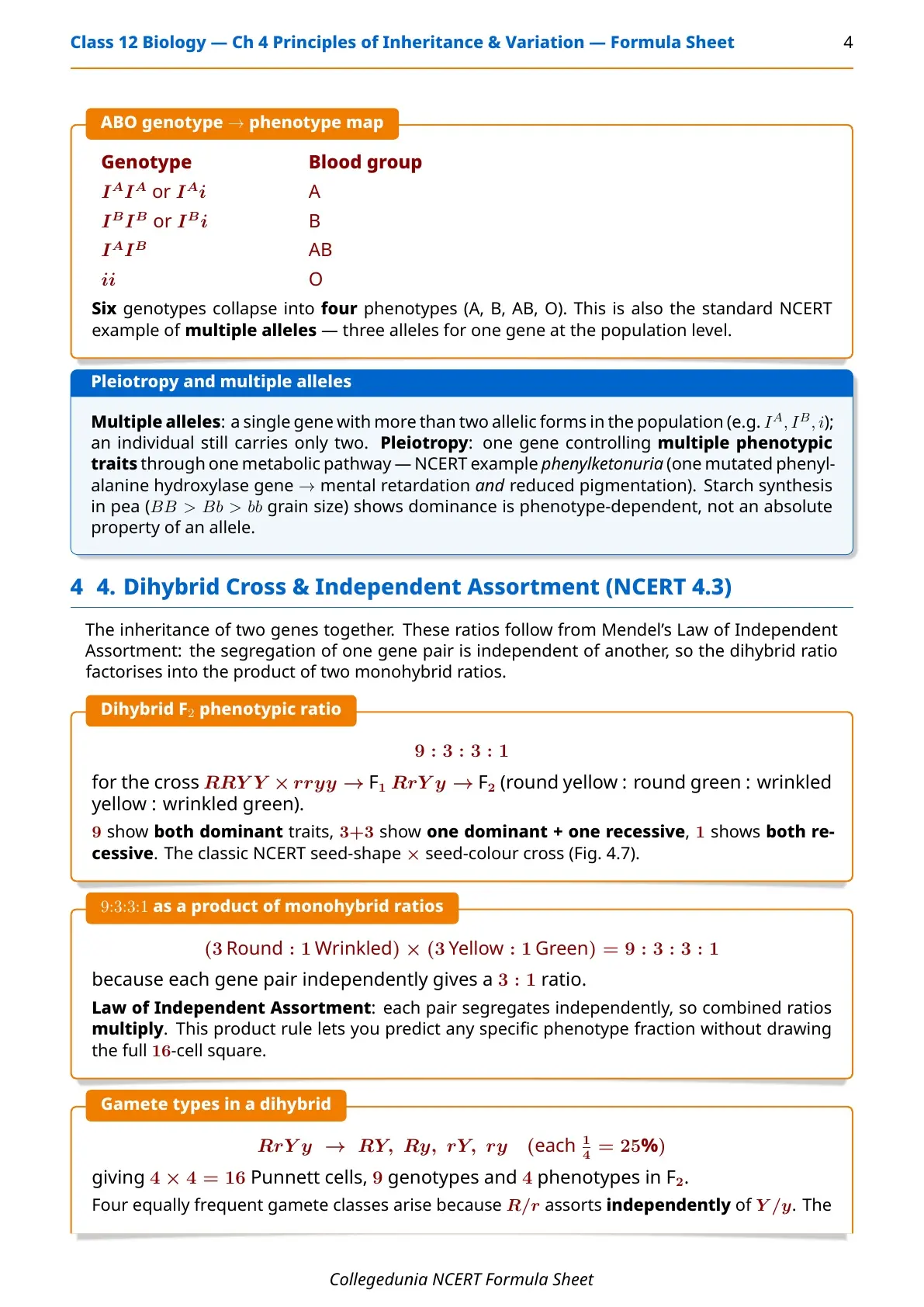
| Co-dominance (ABO) | 3 alleles (IA, IB, i); 6 genotypes; 4 phenotypes | multiple alleles | 4.2.2.2 |
| Dihybrid F2 phenotypic ratio | 9 : 3 : 3 : 1 | phenotypic | 4.3 |
| Dihybrid F2 genotypic ratio | 1:2:1:2:4:2:1:2:1 (9 genotypes) | genotypic | 4.3 |
| Dihybrid as product of monohybrids | (3 round : 1 wrinkled)(3 yellow : 1 green) | algebraic | 4.3.1 |
| Recombination frequency (y and w genes) | 1.3% (tightly linked) | linkage | 4.3.3 |
| Recombination frequency (w and m genes) | 37.2% (loosely linked) | linkage | 4.3.3 |
Incomplete dominance keeps the 1:2:1 genotype ratio but changes phenotype from 3:1 to 1:2:1.
Principles of Inheritance and Variation Symbol and Term Glossary for Class 12 Biology
The chapter has few equations but dense allele symbols and terms that CBSE and NEET test as one-mark recall.
| Symbol / Term | Meaning |
|---|---|
| TT, Tt, tt | Homozygous dominant, heterozygous, homozygous recessive (for tallness) |
| P, F1, F2 | Parental, first filial, second filial generation |
| IA, IB, i | Three alleles of gene I controlling ABO blood group |
| HbA, HbS | Normal and sickle-cell beta-globin alleles |
| Genotype vs Phenotype | Genetic constitution (TT/Tt) vs observable trait (tall/dwarf) |
| Homozygous / Heterozygous | Identical allele pair / dissimilar allele pair |
| Monohybrid / Dihybrid cross | Cross tracking 1 gene pair / 2 gene pairs |
| Pleiotropy | One gene controlling several phenotypic traits |
| Polygenic inheritance | One trait controlled by three or more genes with additive effect |
| Aneuploidy / Polyploidy | Gain or loss of one chromosome / gain of a whole chromosome set |
Pleiotropy is one gene, many effects (phenylketonuria); polygenic inheritance is many genes, one trait (skin colour). Confusing these is the most common conceptual slip in the chapter.
When to Use Which Cross Rule in Principles of Inheritance and Variation
The next skill tested is choosing the correct rule from the stem keyword.
F1 intermediate (pink): incomplete dominance, F2 = 1:2:1.
Both parental phenotypes together (AB blood): co-dominance, multiple alleles.
Dominant phenotype × homozygous recessive: test cross, 1:1 if heterozygous.
Two gene pairs assorting: dihybrid 9:3:3:1, Independent Assortment.
F2 deviates from 9:3:3:1, excess parental types: linked genes, recombination frequency as map distance.
Trait across a family tree: pedigree analysis (dominant/recessive, autosomal/sex-linked).
These rules cover the bulk of NEET genetics MCQs.
Principles of Inheritance and Variation Quick-Fact Cards for NEET MCQ Recall
The atomic facts below are the ones CBSE and NEET convert into single-mark items.
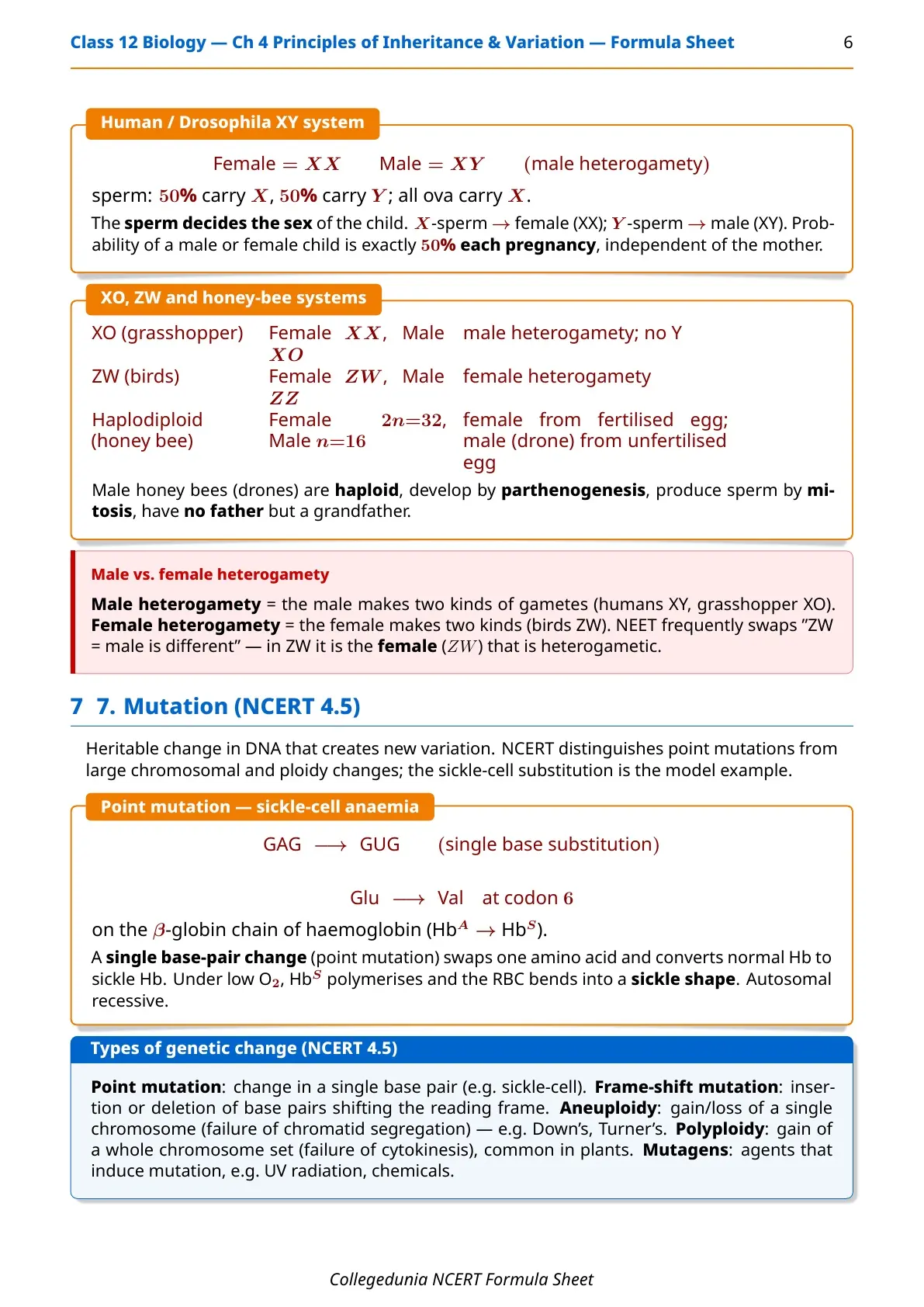
Sickle-cell: Glu to Val at position 6 (GAG to GUG), a top NEET MCQ.
Sex Determination Systems Comparison Card for Class 12th Biology
Sex determination carries single-mark NEET questions through the XX-XY, XO, ZW, and honeybee systems.
XX-XO (male heterogamety): grasshopper. Female XX, male XO (single X, no Y).
ZZ-ZW (female heterogamety): birds. Male ZZ, female ZW. The egg decides the chick's sex.
Haplodiploidy: honeybee. Female diploid (32) from fertilised egg; male drone haploid (16) from unfertilised egg.
In humans the sperm, not the egg, determines the sex of the child, the most asked sex-determination assertion in CBSE.
Principles of Inheritance and Variation Mnemonics for One-Shot Revision
The ratios and disorder lists are easier to retain as memory hooks.
- "3:1 hides 1:2:1": the monohybrid phenotype ratio 3:1 carries the hidden genotype ratio 1:2:1.
- "Dihybrid = monohybrid squared": 9:3:3:1 is (3:1) × (3:1).
- Mendelian disorders: Haemophilia, Cystic fibrosis, Sickle-cell anaemia, Colour blindness, Phenylketonuria, Thalassemia.
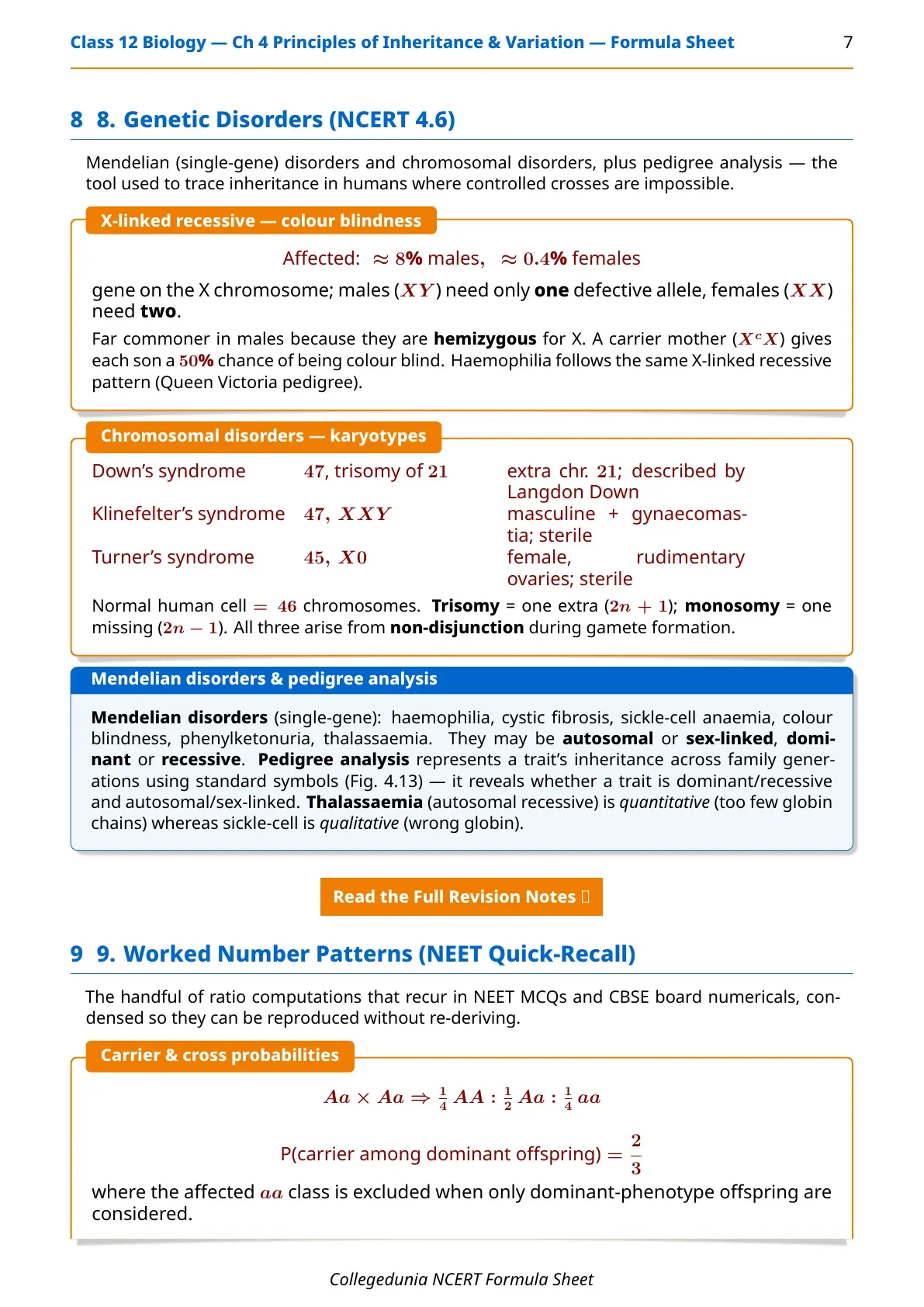
- Chromosomal: Down's (trisomy 21), Klinefelter's (47 XXY), Turner's (45 X0).
- "Alpha-16, Beta-11": alpha thalassemia gene HBA on chromosome 16; beta gene HBB on chromosome 11.
Thalassemia = quantitative globin defect; sickle-cell = qualitative single amino-acid change.
Genetic Disorder Genotype Snapshot for Class 12 Biology
The closing block is pure recall: each disorder as autosomal or sex-linked, with its genotype. This is the top CBSE long-answer source.
Colour blindness: X-linked recessive; 8% males, 0.4% females.
Sickle-cell anaemia: autosomal recessive; HbSHbS diseased, HbAHbS carrier.
Phenylketonuria: autosomal recessive; lacks phenylalanine hydroxylase.
Thalassemia: autosomal recessive; alpha (HBA, chr 16) or beta (HBB, chr 11).
Down's syndrome: trisomy 21; Langdon Down (1866); broad palm crease.
NEET often tests autosomal-vs-sex-linked tags as distractors.
Principles of Inheritance and Variation PYQ Recall Pattern Across CBSE and NEET
The latest five years show a clear pattern: this chapter is tested through cross ratios, pedigree, and disorder genotypes. The map below shows what was asked and the card covering it.
| Year | NEET focus | CBSE Board focus | Sheet card |
|---|---|---|---|
| 2025 | Dihybrid 9:3:3:1; ABO alleles | Incomplete dominance vs co-dominance (5) | Master ratio table |
| 2024 | Sex determination (ZW, honeybee) | Pedigree of sex-linked trait (3) | Sex determination card |
| 2023 | Sickle-cell mutation; linkage | Mendel's laws, test cross (5) | Quick-fact cards |
| 2022 | Down's, Klinefelter, Turner | Chromosomal disorders (3) | Disorder snapshot |
| 2021 | Pleiotropy vs polygenic | Independent assortment (3) | Glossary; cross-rule tree |
Student Feedback
What students told us about Chapter 4:
- 78% of students rated dihybrid-cross Punnett-square problems the hardest sub-topic.
- 65% lost marks on incomplete dominance vs codominance even when the rest of their answer was right.
- 4 out of 5 students skipped the pedigree-analysis figure for sex-linked inheritance in their answer sheet.
Other Resources for Principles of Inheritance and Variation Class 12 Biology
| Resource | Link |
|---|---|
| Formula Sheet | Principles of Inheritance and Variation Formula Sheet |
| NCERT Solutions | Principles of Inheritance and Variation NCERT Solutions |
| Notes | Principles of Inheritance and Variation Notes |
| Handwritten Notes | Principles of Inheritance and Variation Handwritten Notes |
| NCERT Book PDF | Principles of Inheritance and Variation NCERT Book PDF |
| Exemplar Solutions | Principles of Inheritance and Variation Exemplar Solutions |
| Exemplar Book PDF | Principles of Inheritance and Variation Exemplar Book PDF |
NCERT Formula Sheet for Class 12 Biology: All Chapters
The table links every other Class 12 Biology chapter's formula sheet.
| Chapter | Resource |
|---|---|
| Chapter 1 | Sexual Reproduction in Flowering Plants Formula Sheet |
| Chapter 2 | Human Reproduction Formula Sheet |
| Chapter 3 | Reproductive Health Formula Sheet |
| Chapter 5 | Molecular Basis of Inheritance Formula Sheet |
| Chapter 6 | Evolution Formula Sheet |
| Chapter 7 | Human Health and Disease Formula Sheet |
| Chapter 8 | Microbes in Human Welfare Formula Sheet |
| Chapter 9 | Biotechnology Principles and Processes Formula Sheet |
| Chapter 10 | Biotechnology and Its Applications Formula Sheet |
| Chapter 11 | Organisms and Populations Formula Sheet |
| Chapter 12 | Ecosystem Formula Sheet |
| Chapter 13 | Biodiversity and Conservation Formula Sheet |
Principles of Inheritance and Variation Class 12 Biology Formula Sheet FAQs
Ques. What is the phenotypic and genotypic ratio of a monohybrid cross in Class 12 Biology Chapter 4?
Ans. In a monohybrid cross, the F2 generation shows a phenotypic ratio of 3:1 (three dominant to one recessive) and a genotypic ratio of 1:2:1 (one homozygous dominant, two heterozygous, one homozygous recessive). The 3:1 phenotype always conceals the 1:2:1 genotype because the homozygous dominant and heterozygous individuals look identical. This is the most directly tested ratio in both CBSE Boards and NEET.
Ques. What is the difference between incomplete dominance and co-dominance?
Ans. In incomplete dominance the F1 is an intermediate blend of the two parents, as in pink snapdragon flowers from red and white parents, and the F2 ratio is 1:2:1 for both phenotype and genotype. In co-dominance both parental phenotypes are expressed fully and together, as in the AB blood group where both A and B sugars appear. Incomplete dominance gives a new intermediate phenotype, while co-dominance shows both phenotypes at once.
Ques. Where can I download Principles of Inheritance and Variation Class 12 Biology Formula Sheet PDF?
Ans. You can download the Principles of Inheritance and Variation Class 12 Biology Formula Sheet PDF directly from this page. Both the Normal and HD versions are available, and both are free. The sheet condenses every cross ratio, allele symbol, sex-determination system, and disorder genotype from the 2026-27 NCERT into one revision card set.
Ques. Is this Formula Sheet aligned with the 2026-27 NCERT?
Ans. Yes. This page reflects the current 2026-27 syllabus for Class 12 Biology. The chapter retains all eight sections from Mendel's Laws of Inheritance through Mutation and Genetic Disorders, including pleiotropy, polygenic inheritance, and the chromosomal disorder karyotypes, so every fact on the sheet matches the new NCERT print.
Ques. How many marks does Principles of Inheritance and Variation carry in CBSE Class 12 Biology?
Ans. In the CBSE Class 12 Biology Board paper, Chapter 4 Principles of Inheritance and Variation typically carries 6 to 8 marks in the Genetics and Evolution unit, usually split across a short answer on cross ratios and a long answer on pedigree analysis or genetic disorders. In NEET 2027 the chapter is expected to contribute 4 to 6 questions, making it one of the highest-yield genetics blocks in the paper.
Ques. What is the dihybrid cross ratio and how is it derived?
Ans. The dihybrid cross gives an F2 phenotypic ratio of 9:3:3:1. It is derived as the product of two independent monohybrid ratios, that is (3 round : 1 wrinkled) multiplied by (3 yellow : 1 green) gives 9 round yellow : 3 wrinkled yellow : 3 round green : 1 wrinkled green. This follows from Mendel's Law of Independent Assortment, which states that the segregation of one gene pair is independent of the other.
Ques. How many pages is the Class 12th Biology Principles of Inheritance and Variation Formula Sheet PDF?
Ans. The Formula Sheet PDF runs approximately 6 to 8 pages and covers all eleven cross ratios, the allele symbol glossary, the cross-rule decision tree, sex determination systems, mnemonics, and the full genetic disorder genotype table, mapped to NCERT Sections 4.1 to 4.8.
Ques. What causes sickle-cell anaemia according to Class 12 Biology Chapter 4?
Ans. Sickle-cell anaemia is an autosomal recessive disorder caused by a single point mutation in the beta-globin gene. Glutamic acid is substituted by valine at the sixth position of the beta-globin chain, due to a single base change from GAG to GUG in the mRNA. Only homozygous HbSHbS individuals show the disease, while heterozygous HbAHbS individuals are unaffected carriers with sickle-cell trait.



Comments