




The class 11 physics formula sheet chapter 2 motion in a straight line collects every kinematics formula tested in the Boards, JEE Main, JEE Advanced, NEET, CUET and NDA exams. It lists each formula, its meaning and SI unit so students revise the whole chapter fast.
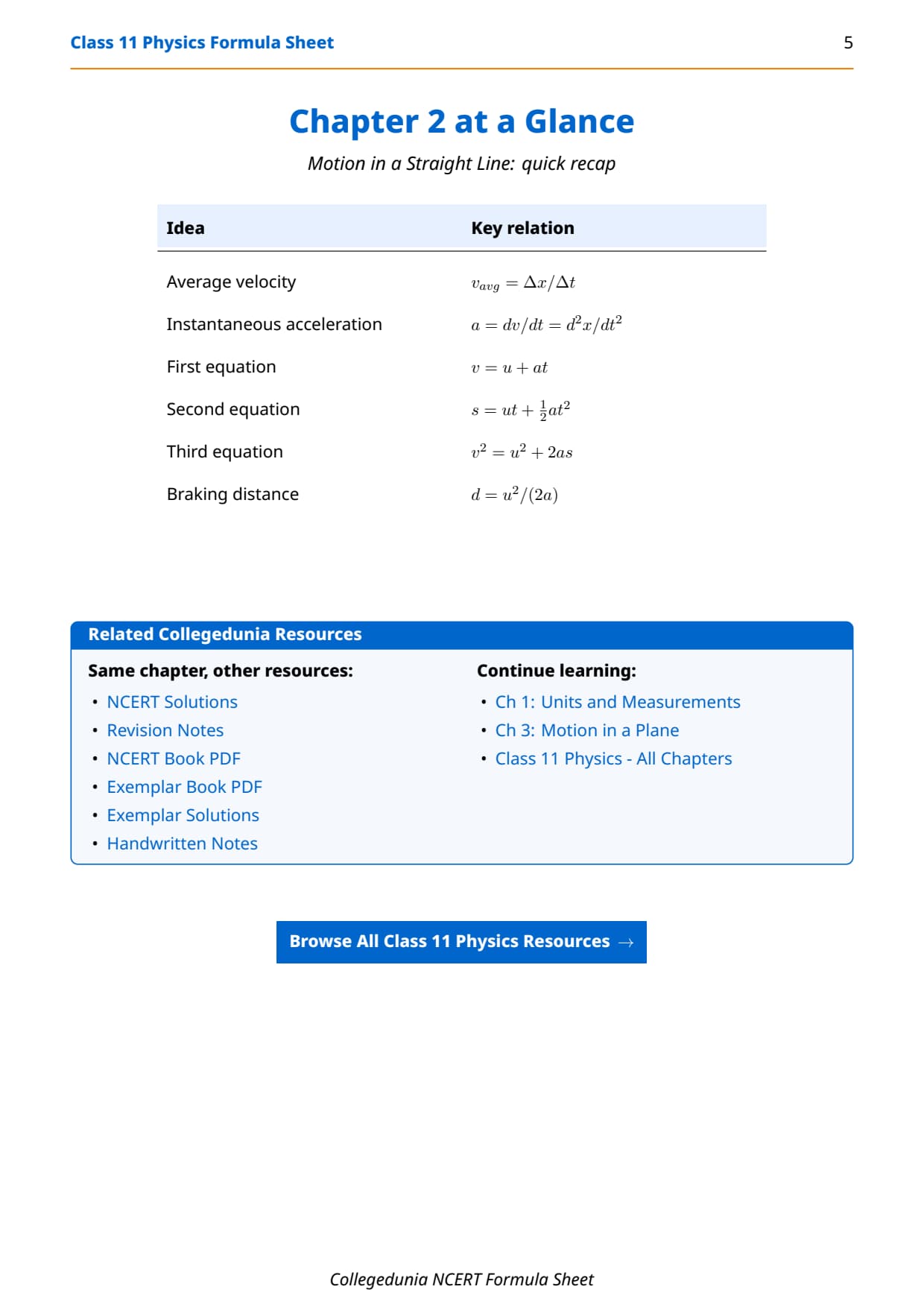
Motion in a Straight Line is the first kinematics chapter, so its velocity, acceleration and equation-of-motion rules return in every mechanics chapter that follows.
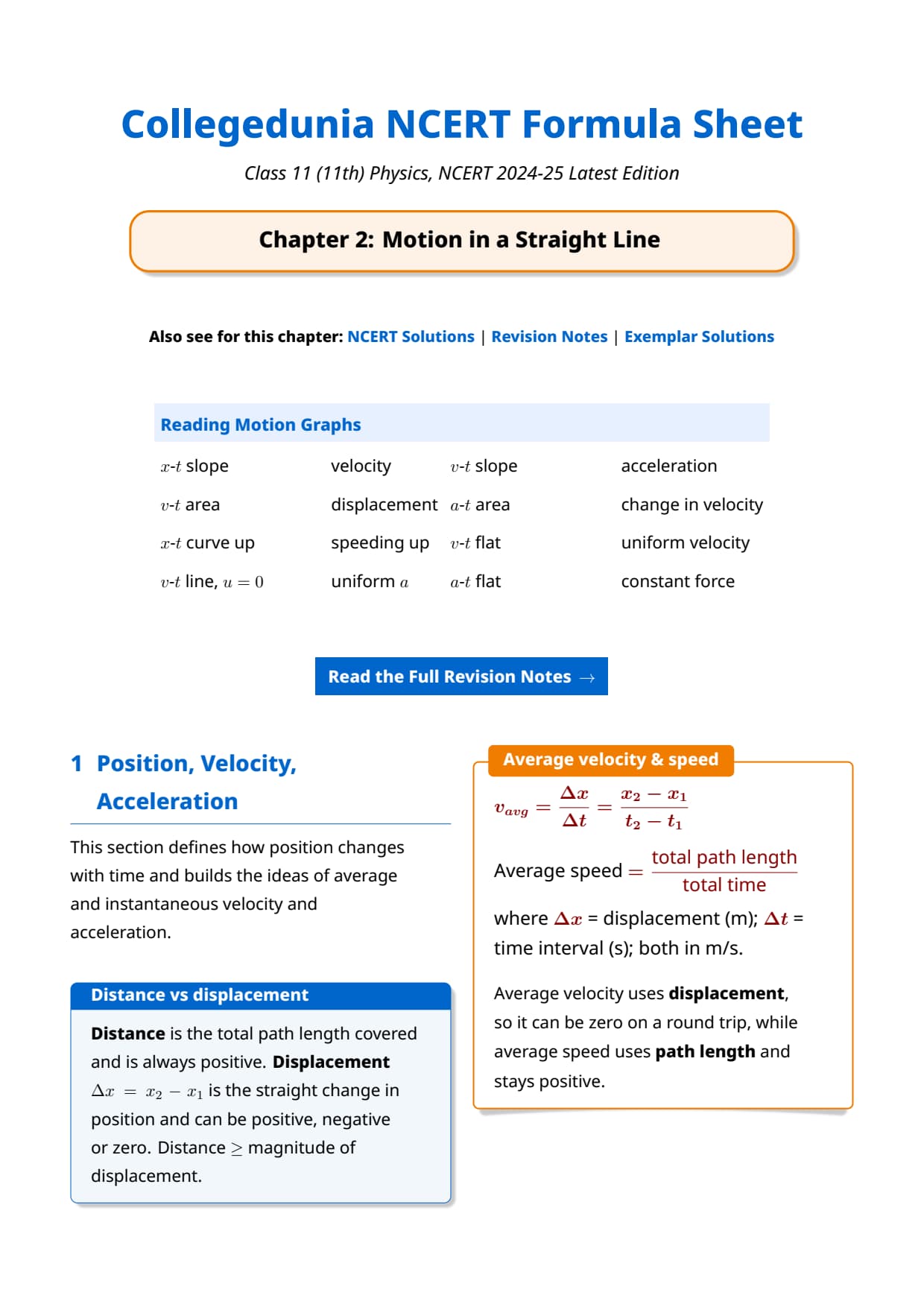
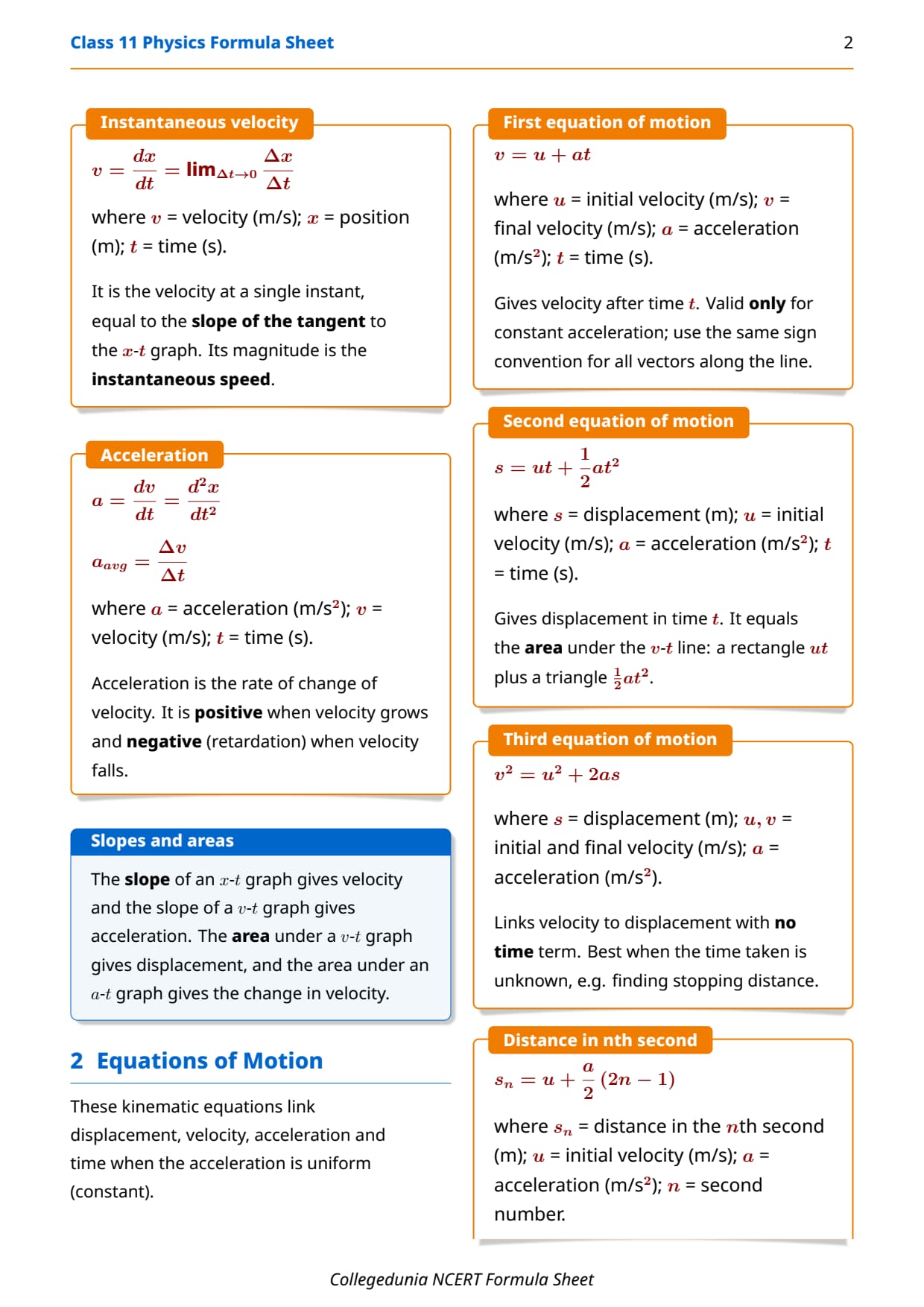
- Covers the three equations of motion, plus average and instantaneous velocity and speed.
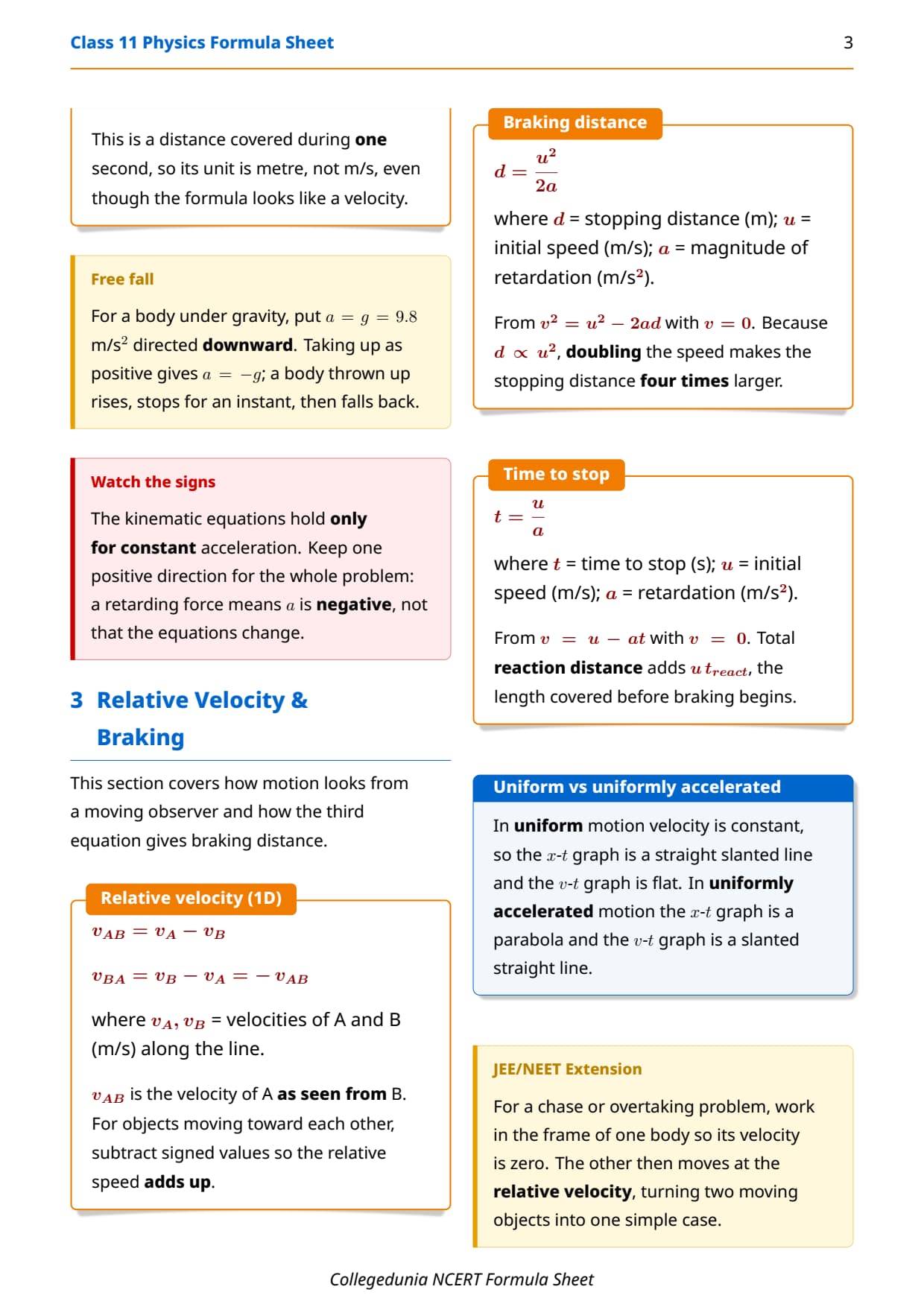
- Lists acceleration, displacement in the nth second and relative velocity in one dimension.
- Helps students read x-t and v-t graphs using the slope and area rules.
This class 11 physics formula sheet chapter 2 motion in a straight line is curated by subject experts and checked against the 2026-27 NCERT and recent CBSE and JEE papers.
All Motion in a Straight Line Formulas at a Glance
Every kinematics formula sits in one table below, with its meaning and SI unit. Learn the three equations of motion first, since almost every numerical uses them.
| Formula | What it means | SI unit |
|---|---|---|
| vavg = Δx/Δt = (x2 − x1)/(t2 − t1) | Average velocity uses displacement over time | m s-1 |
| average speed = total path length/total time | Average speed uses distance, not displacement | m s-1 |
| v = dx/dt | Instantaneous velocity, the slope of the x-t graph | m s-1 |
| aavg = Δv/Δt | Average acceleration over a time interval | m s-2 |
| a = dv/dt = d2x/dt2 | Instantaneous acceleration | m s-2 |
| v = u + at | First equation of motion, velocity after time t | m s-1 |
| x = ut + ½at2 | Second equation of motion, displacement in time t | metre (m) |
| v2 = u2 + 2ax | Third equation of motion, links speed and displacement | m2 s-2 |
| snth = u + a(n − ½) | Displacement in the nth second of motion | metre (m) |
| vAB = vA − vB | Relative velocity of A with respect to B in 1D | m s-1 |
In free fall, put a = g = 9.8 m s-2 downward and use the same three equations of motion.
Graph Rules and Key Definitions for Motion in a Straight Line
Boards and entrance papers often ask you to read a motion graph. The slope and area of each graph give a different quantity.
| Graph | Slope gives | Area under it gives |
|---|---|---|
| Position-time (x-t) | Velocity v | Not used |
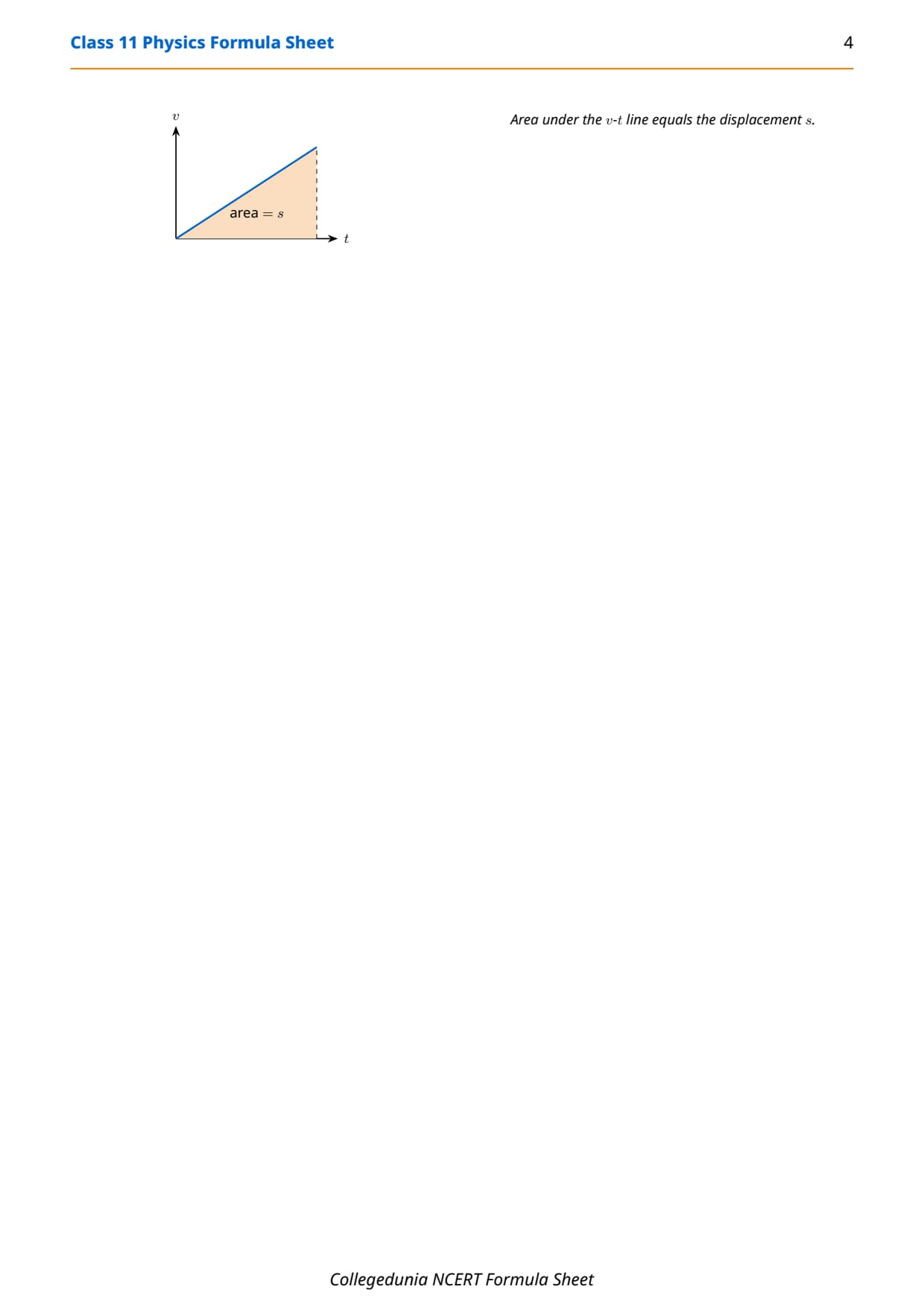
| Velocity-time (v-t) | Acceleration a | Displacement x |
| Acceleration-time (a-t) | Rate of change of acceleration | Change in velocity Δv |
A few definitions are worth writing on a flashcard:
- Displacement vs distance: displacement is the straight-line change in position; distance is the total path length.
- Uniform motion: velocity constant, acceleration zero, x-t graph a straight line.
- Uniformly accelerated motion: acceleration constant, so the three equations of motion apply.
- Free-fall constant: g = 9.8 m s-2 (take 10 m s-2 only when a paper says so).
How to Revise Motion in a Straight Line Formulas Before the Exam
Use this class 11 physics formula sheet chapter 2 motion in a straight line for a fast recap the night before a test, in about 20 minutes.
- First 8 minutes: write the three equations of motion and the nth-second formula from memory.
- Next 6 minutes: define average and instantaneous velocity, speed and acceleration.
- Last 6 minutes: sketch an x-t and a v-t graph and label the slope and the area.
Finish by solving one free-fall numerical using v² = u² + 2ax.
Student Feedback on the Motion in a Straight Line Formula Sheet
What 11,540 students told us about their Motion in a Straight Line revision:
- 64% of students rated reading the v-t graph as the trickiest part.
- Most-skipped step: using the nth-second formula instead of the full equation.
- Students who learned the three equations of motion first found free-fall sums easier.
Source: 2026-27 Class 11 Physics student poll. Sample of 11,540 students from CBSE schools across 14 states, conducted before the 2026 boards.
Other Motion in a Straight Line Class 11 Physics Resources
Pair this formula sheet with the solved answers, notes and textbook PDF.
| Resource | Link |
|---|---|
| NCERT Solutions | Motion in a Straight Line Class 11 NCERT Solutions |
| Revision Notes | Motion in a Straight Line Class 11 Notes |
| Handwritten Notes | Motion in a Straight Line Class 11 Handwritten Notes |
| NCERT Book PDF | Motion in a Straight Line Class 11 Book PDF |
NCERT Formula Sheet for Class 11 Physics: All Chapters
Jump to any other Class 11 Physics formula sheet below.
| Chapter | Formula Sheet |
|---|---|
| Chapter 1 | Units and Measurements |
| Chapter 2 | Motion in a Straight Line |
| Chapter 3 | Motion in a Plane |
| Chapter 4 | Laws of Motion |
| Chapter 5 | Work, Energy and Power |
| Chapter 6 | System of Particles and Rotational Motion |
| Chapter 7 | Gravitation |
| Chapter 8 | Mechanical Properties of Solids |
| Chapter 9 | Mechanical Properties of Fluids |
| Chapter 10 | Thermal Properties of Matter |
| Chapter 11 | Thermodynamics |
| Chapter 12 | Kinetic Theory |
| Chapter 13 | Oscillations |
| Chapter 14 | Waves |
FAQs on Motion in a Straight Line Class 11 Physics Formula Sheet
Motion in a Straight Line Formula Sheet - Frequently Asked Questions
Ques. What formulas does the class 11 physics formula sheet chapter 2 motion in a straight line cover?
Ans. This class 11 physics formula sheet chapter 2 motion in a straight line covers average and instantaneous velocity, speed, acceleration, the three equations of motion, displacement in the nth second, relative velocity in 1D and the slope and area rules for x-t and v-t graphs.
Ques. What are the three equations of motion?
Ans. The three equations of motion for constant acceleration are v = u + at, x = ut + ½at2 and v2 = u2 + 2ax. For free fall, replace a with g = 9.8 m s-2.
Ques. How do you find velocity and acceleration from a graph?
Ans. The slope of a position-time (x-t) graph gives velocity, and the slope of a velocity-time (v-t) graph gives acceleration. The area under a v-t graph gives displacement, while the area under an a-t graph gives the change in velocity.
Ques. What is relative velocity in one dimension?
Ans. The relative velocity of A with respect to B in one dimension is vAB = vA − vB. Use the correct sign for each direction; if the bodies move oppositely their speeds add.



Comments