




Class 10 Science Chapter 7 How do Organisms Reproduce? is a high-scoring biology chapter of the 2026-27 NCERT, and a single page of key facts covers almost every board question. This How do Organisms Reproduce formula sheet puts DNA copying, the six asexual modes, the parts of a flower, the flower-to-fruit chain, the human reproductive system, and the contraception methods on one page. Use it as a quick reference before any CBSE Class 10 board test.
- CBSE Weightage: part of the World of Living unit, worth 6 to 8 marks across one or two questions.
- Best used for: the asexual-mode table, the flower-to-fruit chain, the human reproductive organs, and last-minute board revision.
You can find the complete Formula Sheet for How do Organisms Reproduce, with DNA copying, the six asexual modes, the parts of a flower, the flower-to-fruit chain, the human reproductive system, and the contraception methods mapped to the 2026-27 NCERT, in the article below.
This Formula Sheet is curated by Science subject experts, mapped to the 2026-27 NCERT, and refined against the last five years of CBSE Class 10 board papers.
Also Check:
- How do Organisms Reproduce Class 10 Science NCERT Solutions
- How do Organisms Reproduce Class 10 Science Notes
How Collegedunia's How do Organisms Reproduce Formula Sheet Helps You
This Formula Sheet gathers DNA copying, the six asexual modes, the flower-to-fruit chain, the human reproductive system, and contraception on one page, in 2026-27 NCERT order.
- 2026-27 NCERT aligned to the current Class 10 syllabus.
- One-page recall: terms, six asexual modes, and the flower-to-fruit chain side by side.
How do Organisms Reproduce Class 10 Science Video Revision
Source: Magnet Brains on YouTube
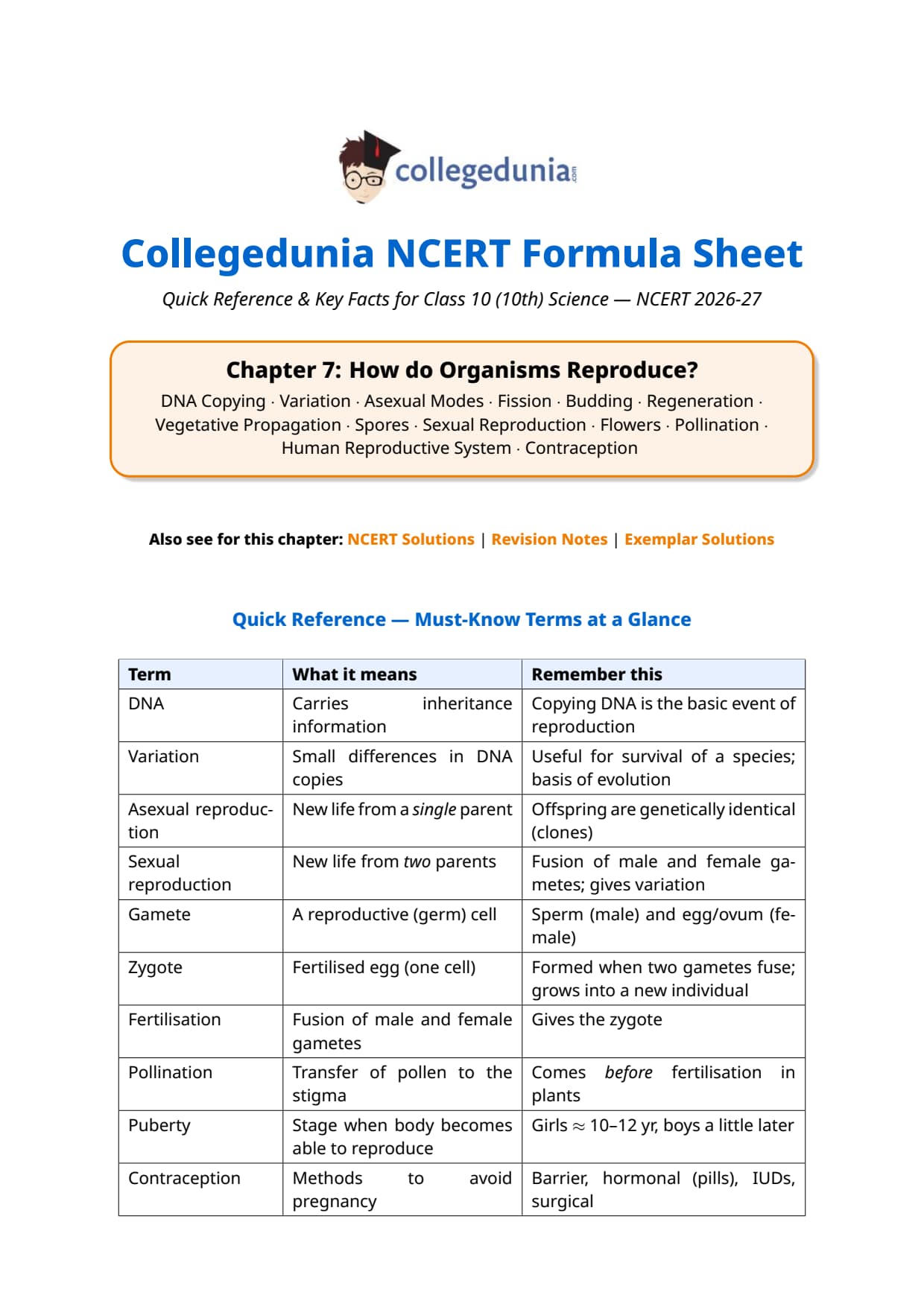
Must-Know Terms at a Glance in Class 10 Science Chapter 7
Lock these terms first; most one-mark questions are built on them. Reproduction begins with copying DNA, and is either asexual (one parent) or sexual (two parents).
| Term | Meaning | Where it acts / key point |
|---|---|---|
| DNA | Molecule that carries inheritance information | Copying DNA is the basic event of reproduction |
| Variation | Small differences in the DNA copies | Useful for survival of a species; basis of evolution |
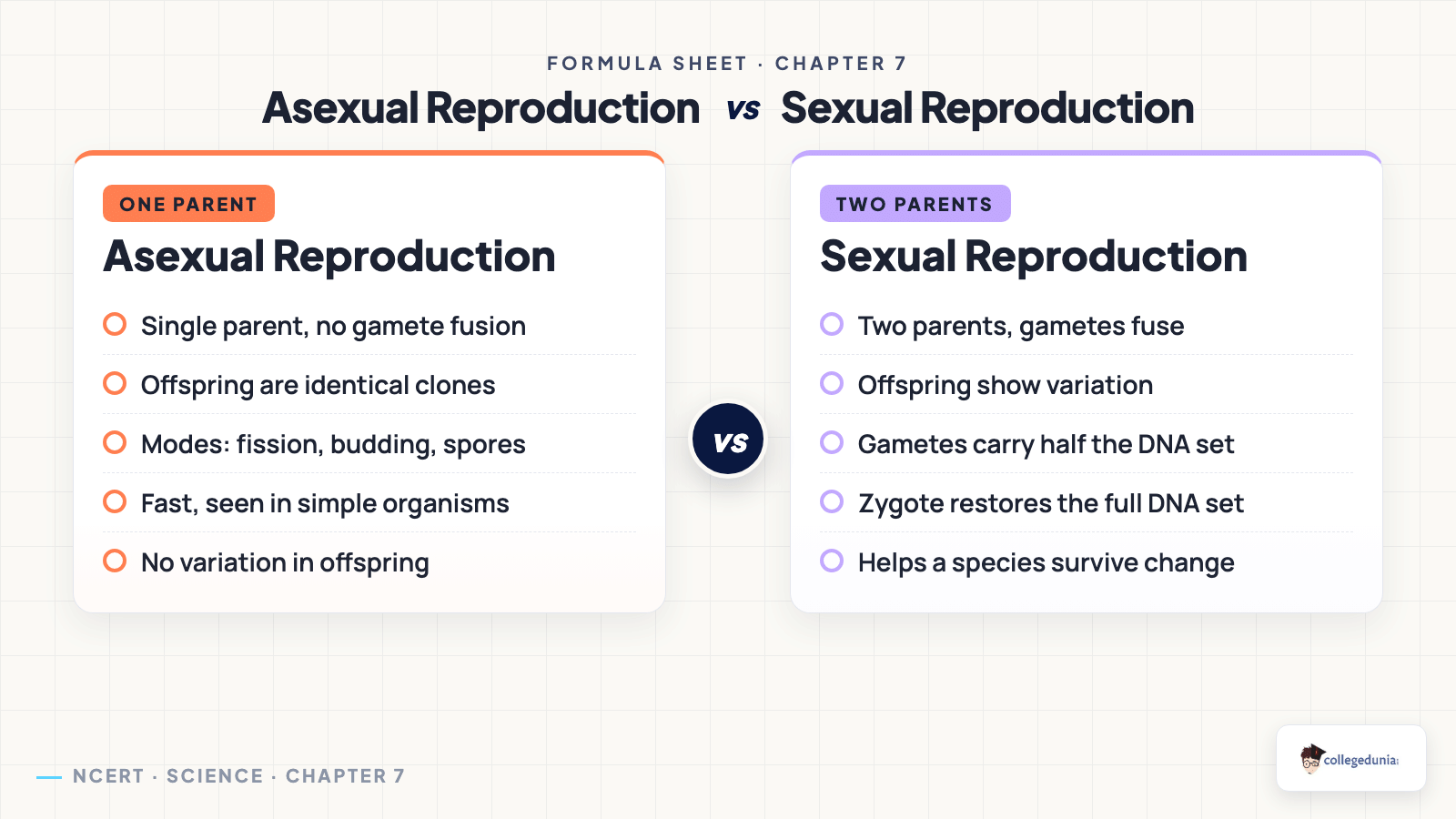
| Asexual reproduction | New life from a single parent | Offspring are genetically identical (clones) |
| Sexual reproduction | New life from two parents | Fusion of male and female gametes; gives variation |
| Gamete | A reproductive (germ) cell | Sperm (male) and egg / ovum (female) |
| Zygote | Fertilised egg (one cell) | Formed when two gametes fuse; grows into a new individual |
| Fertilisation | Fusion of the male and female gametes | Gives the zygote |
DNA Copying and Variation in Class 10 Science Chapter 7
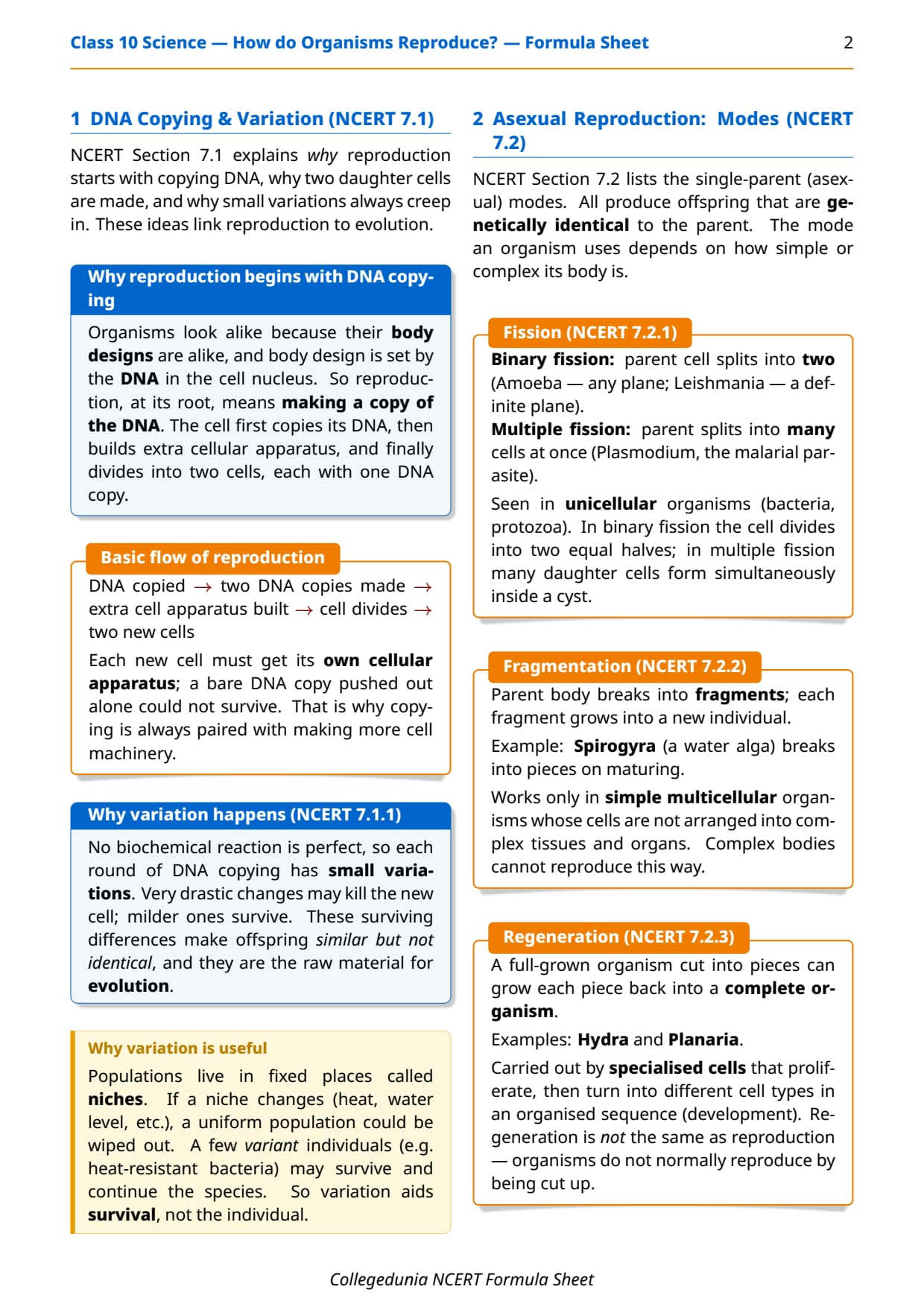
Body design is set by the DNA in the cell nucleus, so reproduction at its root means making a copy of the DNA.
- Copying: the cell copies its DNA, builds extra apparatus, then divides into two cells, each with one DNA copy.
- Why variation happens: no biochemical reaction is perfect, so each round of copying carries small variations.
- Why variation is useful: if a population's niche changes, a few variant individuals may survive and continue the species. It is the raw material for evolution. Note that variation helps the whole species, not a single individual.
Asexual Reproduction: Six Modes in Class 10 Science Chapter 7
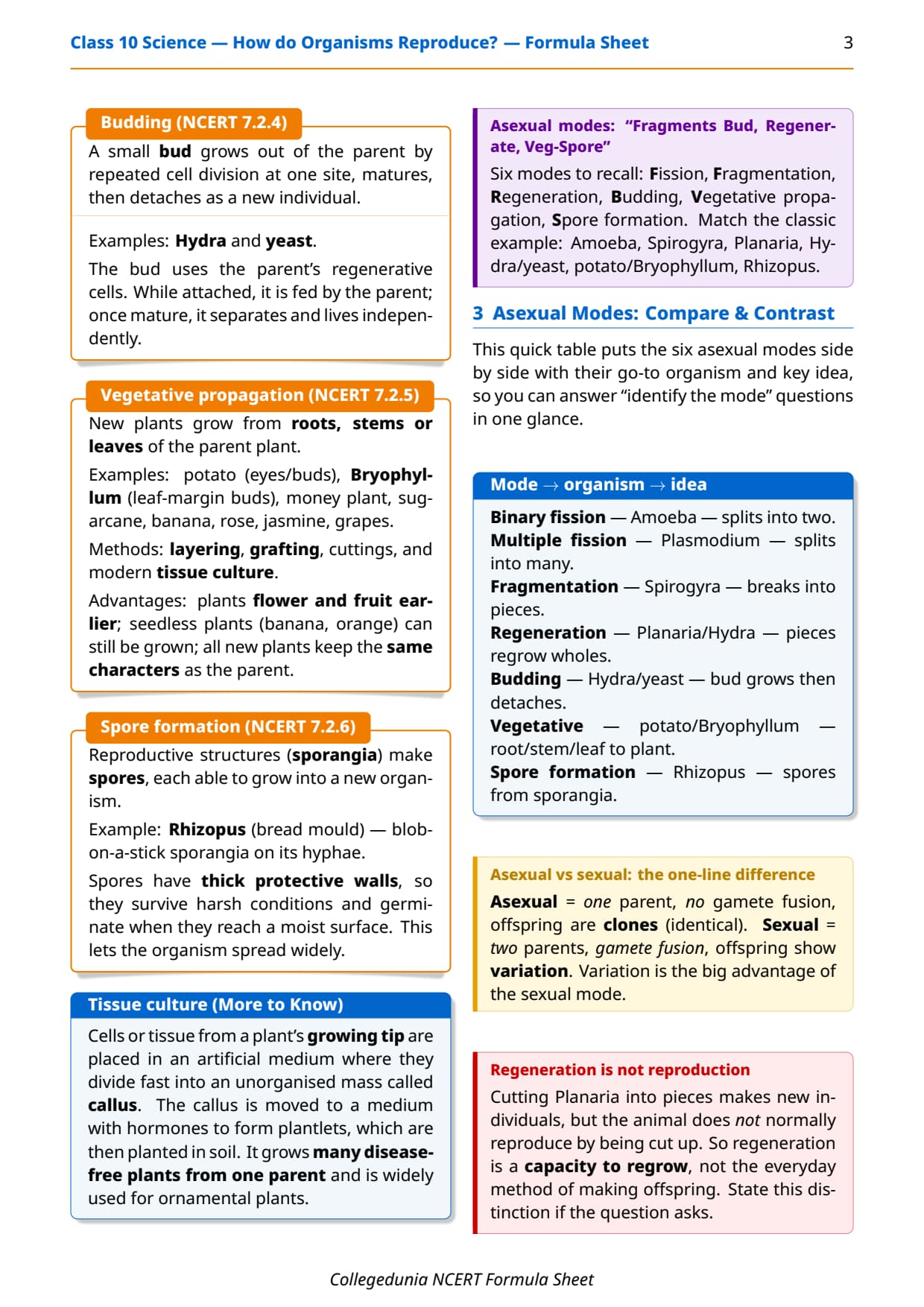
NCERT Section 7.2 lists the single-parent (asexual) modes. All produce offspring that are genetically identical to the parent. The table below maps each mode to its go-to organism and key idea.
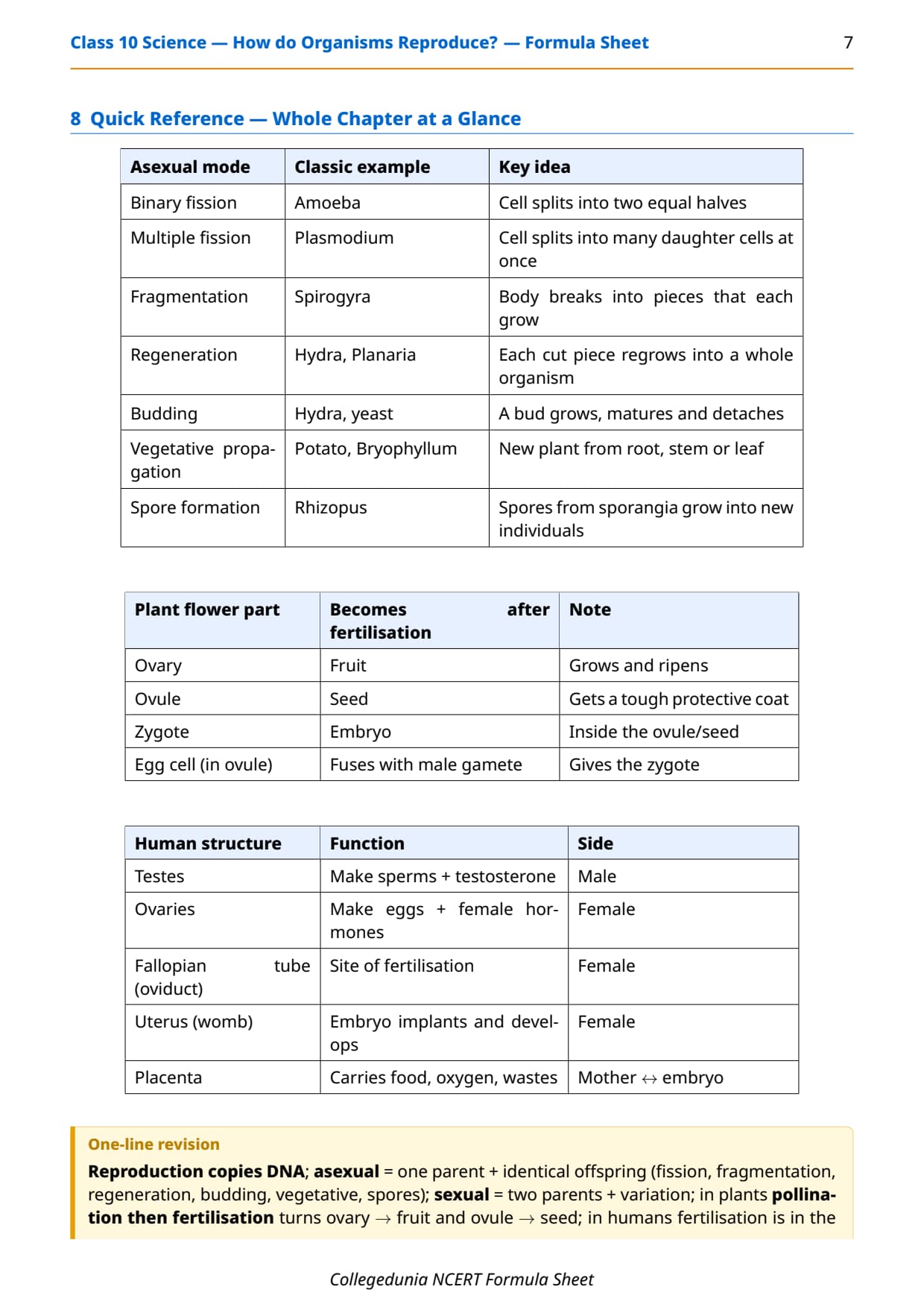
| Asexual mode | Classic example | Key idea |
|---|---|---|
| Binary fission | Amoeba (any plane), Leishmania (definite plane) | Cell splits into two equal halves |
| Multiple fission | Plasmodium (malarial parasite) | Cell splits into many daughter cells at once |
| Fragmentation | Spirogyra (water alga) | Body breaks into pieces that each grow |
| Regeneration | Hydra, Planaria | Each cut piece regrows into a whole organism |
| Budding | Hydra, yeast | A bud grows, matures and then detaches |
| Vegetative propagation | Potato, Bryophyllum | New plant from root, stem or leaf |
| Spore formation | Rhizopus (bread mould) | Spores from sporangia grow into new individuals |
- Vegetative propagation: by layering, grafting, cuttings, or tissue culture; lets seedless plants be grown, and new plants keep the parent's characters.
- Spore formation: spores have thick walls, survive harsh conditions, and germinate on a moist surface.
- Regeneration is not reproduction: the animal does not normally reproduce by being cut up; it is only a capacity to regrow.
Why Sexual Reproduction Happens in Class 10 Science Chapter 7
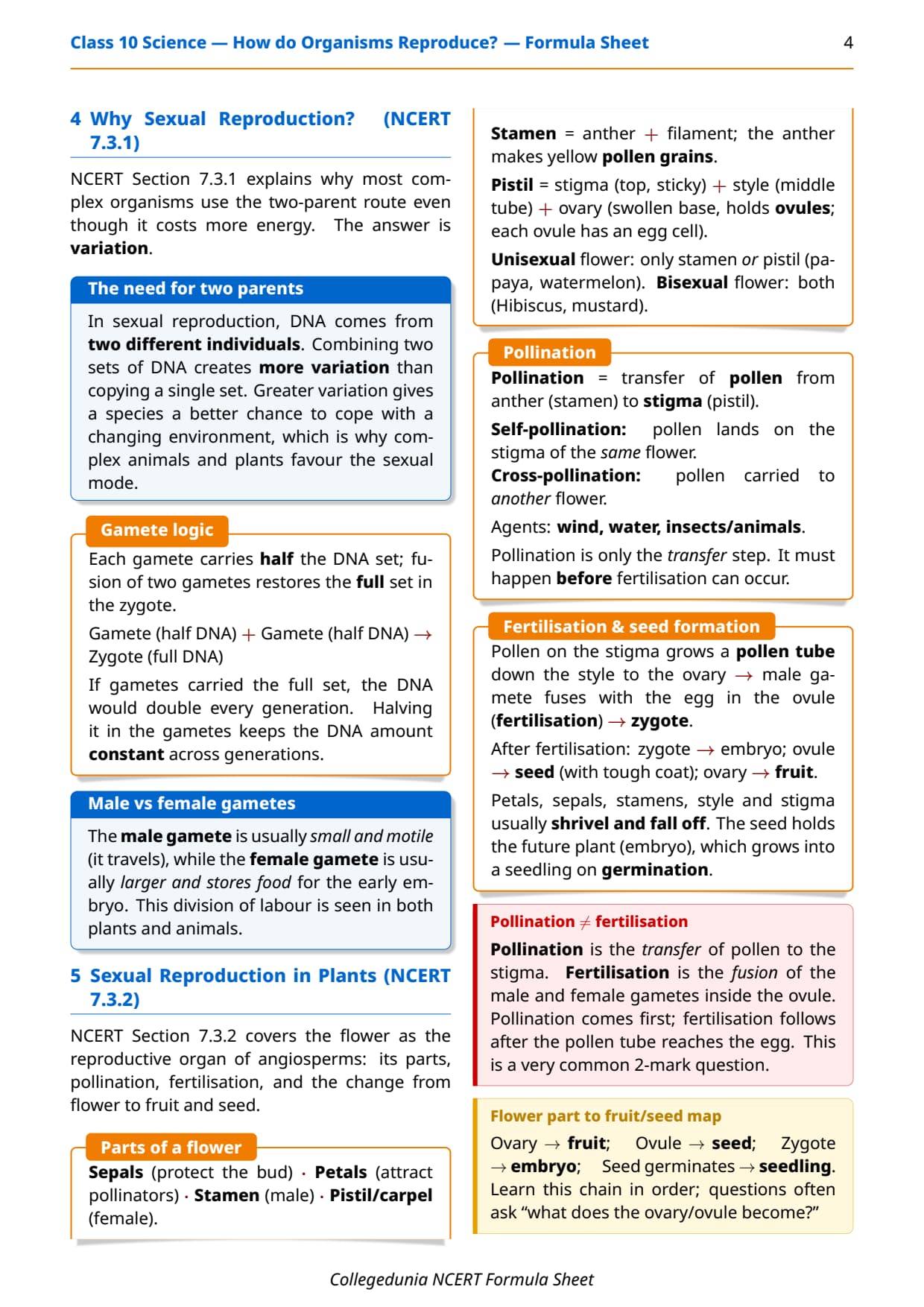
NCERT Section 7.3.1 explains why complex organisms use the two-parent route. The answer is variation: DNA comes from two different individuals, so combining two sets creates more variation than copying one.
- Gamete logic: each gamete carries half the DNA set; fusion restores the full set in the zygote, keeping the DNA amount steady across generations.
- Male vs female gametes: the male gamete is small and motile; the female gamete is larger and stores food for the early embryo.
Sexual Reproduction in Plants: Flower to Fruit in Class 10 Science
NCERT Section 7.3.2 covers the flower as the reproductive organ of flowering plants. It has four whorls, with the stamen as the male part and the pistil as the female part.
| Flower part | Role | Key point |
|---|---|---|
| Sepals | Protect the flower bud | Outermost green whorl |
| Petals | Attract pollinators | Often bright and coloured |
| Stamen (male) | Anther + filament | Anther makes yellow pollen grains |
| Pistil / carpel (female) | Stigma + style + ovary | Ovary holds ovules; each ovule has an egg cell |
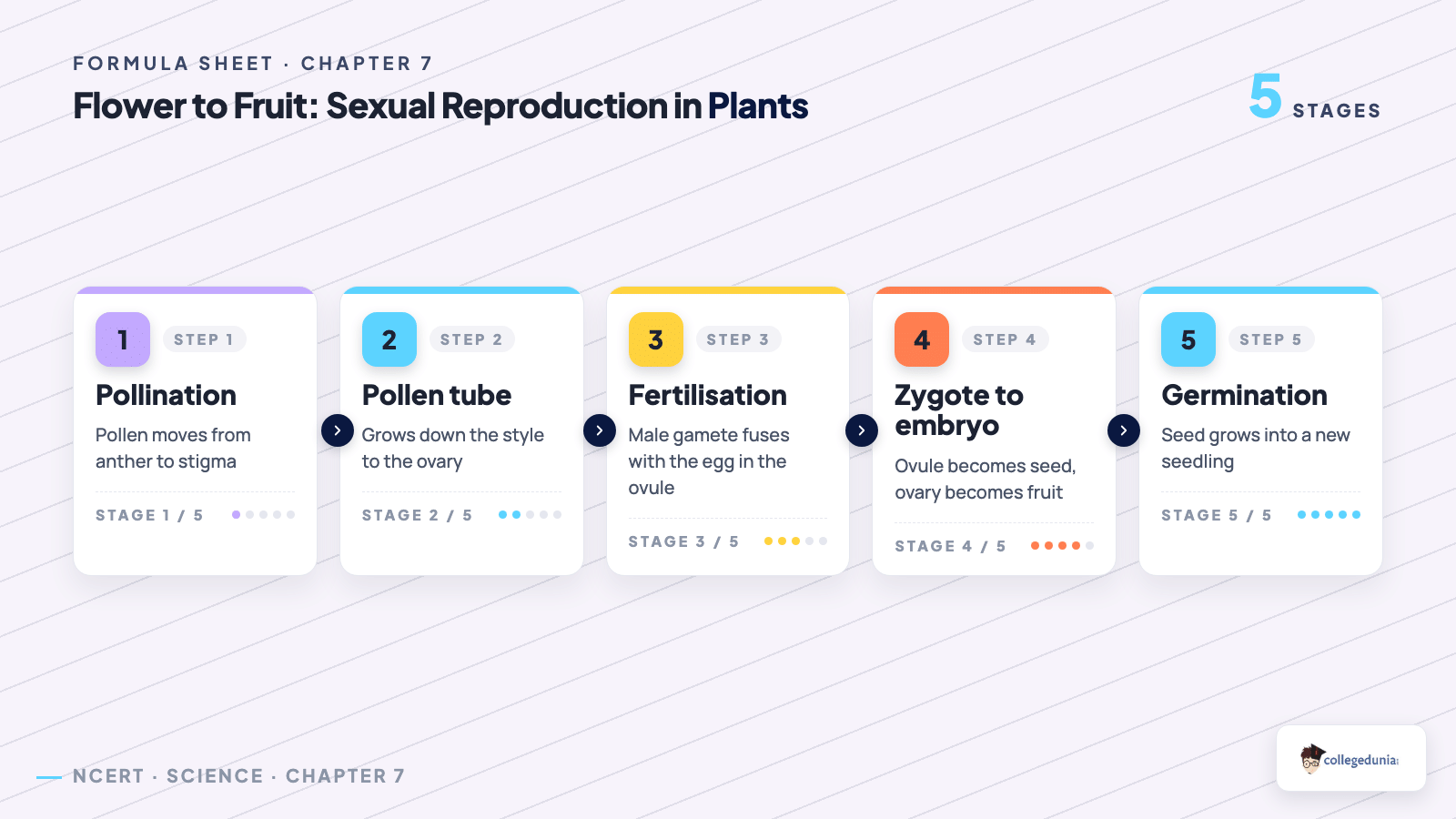
- Pollination: transfer of pollen from anther to stigma (self within one flower, cross to another). Comes before fertilisation.
- Fertilisation: pollen grows a pollen tube down the style to the ovary, where the male gamete fuses with the egg to form the zygote.
- After fertilisation: zygote → embryo, ovule → seed, ovary → fruit; other parts fall off.
Human Reproductive System in Class 10 Science Chapter 7
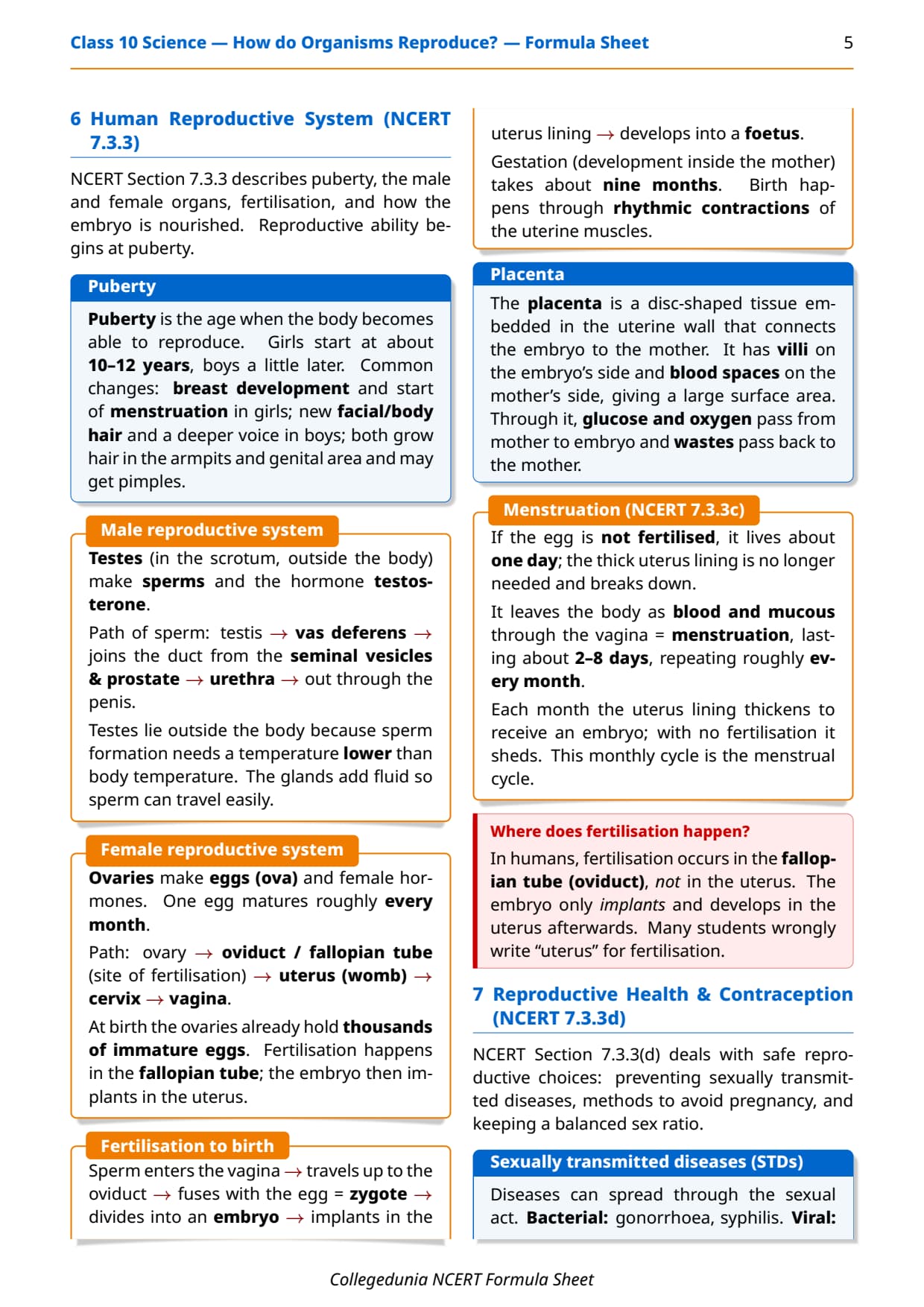
NCERT Section 7.3.3 describes puberty, the male and female organs, fertilisation, and how the embryo is nourished. Reproductive ability begins at puberty, around 10-12 years in girls and a little later in boys.
| Human structure | Function | Side |
|---|---|---|
| Testes | Make sperms and testosterone | Male |
| Ovaries | Make eggs (ova) and female hormones | Female |
| Fallopian tube | Site of fertilisation | Female |
| Uterus | Embryo implants and develops | Female |
| Placenta | Carries food, oxygen and wastes | Mother to embryo |
- Male path: testis → vas deferens → urethra. Testes lie outside the body because sperm formation needs a lower temperature.
- Female path: ovary → fallopian tube (fertilisation site) → uterus. Fertilisation happens in the fallopian tube, not the uterus.
- To birth: the zygote becomes an embryo, implants in the uterus, and develops into a foetus; gestation about nine months.
- Placenta: villi-rich tissue passing glucose and oxygen from mother to embryo and wastes back.
- Menstruation: if the egg is not fertilised, the uterus lining breaks down over about 2-8 days each month.
One-Shot Revision Tips for How do Organisms Reproduce Class 10
Treat this Formula Sheet as a checklist for the night before a test.
- Six asexual modes, one organism each: Amoeba, Spirogyra, Planaria, Hydra/yeast, potato/Bryophyllum, Rhizopus.
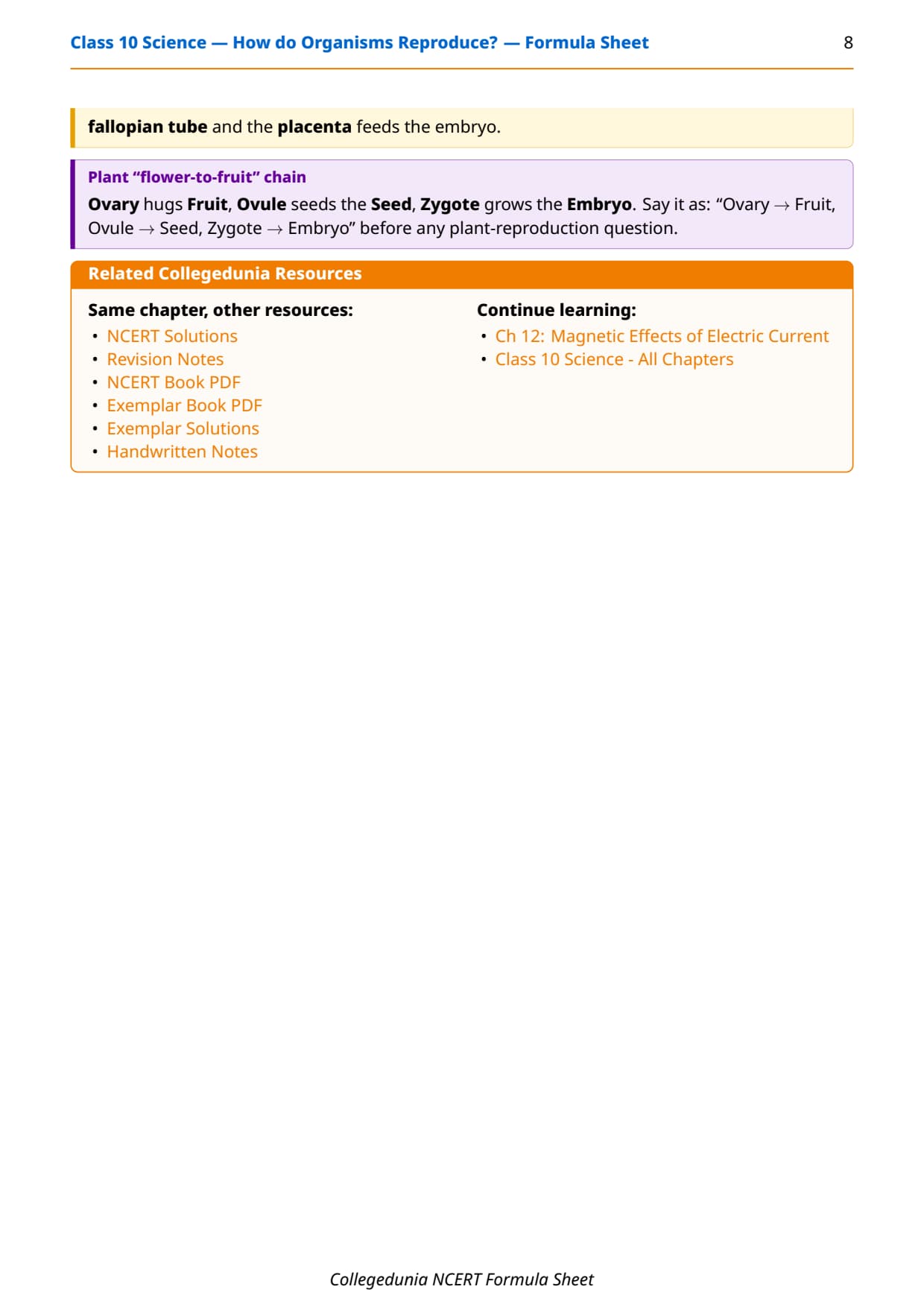
- Flower-to-fruit chain: ovary → fruit, ovule → seed, zygote → embryo.
- Human facts: fertilisation in the fallopian tube, placenta feeds the embryo, gestation about nine months, only the condom also protects against STDs.
Reproductive Health and Contraception in Class 10 Science
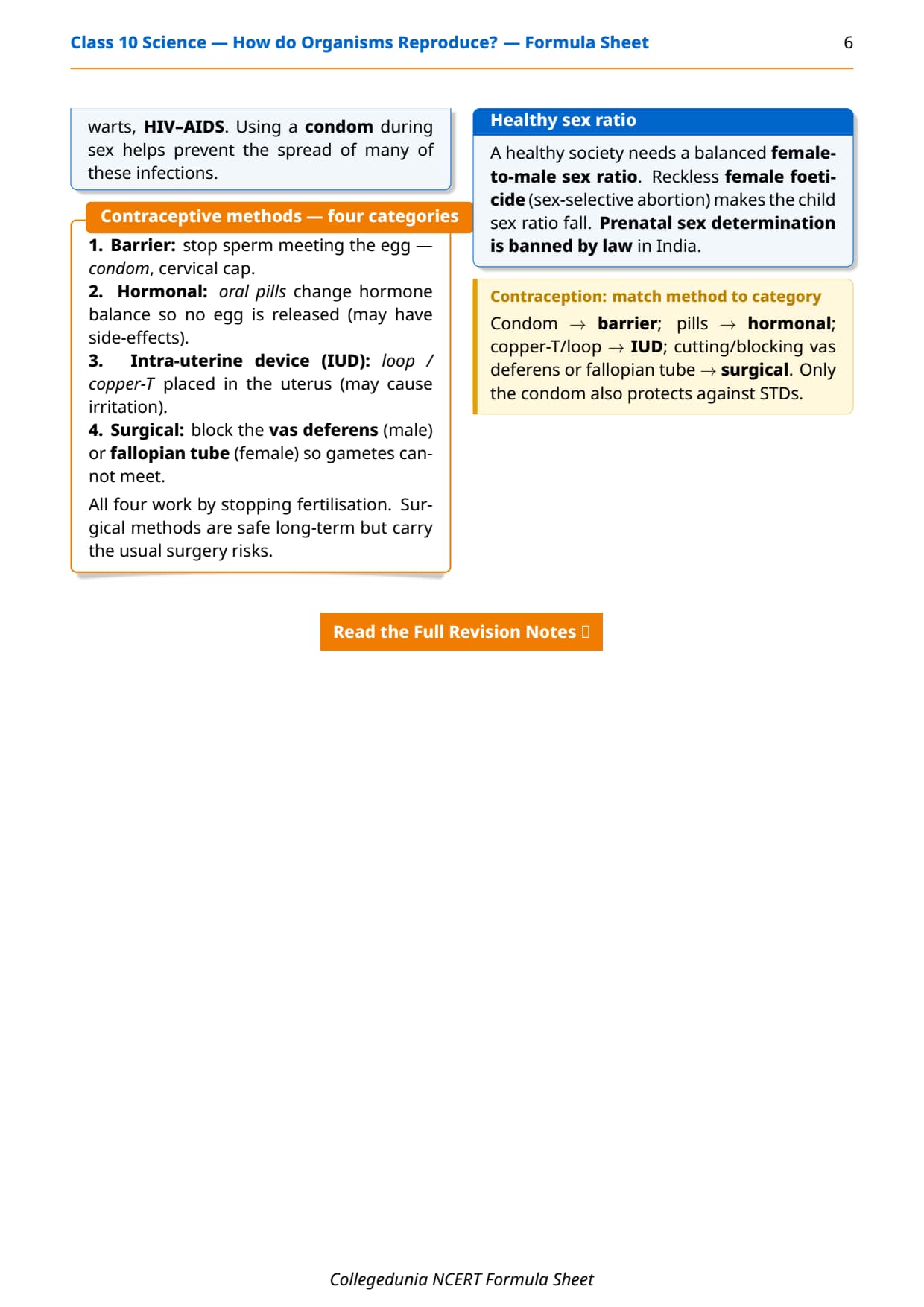
NCERT Section 7.3.3(d) deals with preventing STDs, avoiding pregnancy, and a balanced sex ratio. A condom helps prevent infections such as gonorrhoea, syphilis, and HIV-AIDS.
| Contraceptive category | Method | How it works / note |
|---|---|---|
| Barrier | Condom, cervical cap | Stops sperm meeting the egg; condom also protects against STDs |
| Hormonal | Oral pills | Change hormone balance so no egg is released |
| IUD | Loop or copper-T | Placed in the uterus |
| Surgical | Block vas deferens or fallopian tube | Gametes cannot meet |
- All four methods stop fertilisation by keeping sperm and egg apart or stopping the egg's release. Only the condom also protects against STDs.
- Healthy sex ratio: prenatal sex determination is banned by law in India to curb female foeticide.
Full topic-by-topic walkthrough: How do Organisms Reproduce Class 10 Science Notes
More How do Organisms Reproduce Class 10 Science Resources
Use the table below to move between the other resources for this chapter.
| Resource | Link |
|---|---|
| NCERT Solutions | How do Organisms Reproduce NCERT Solutions |
| Revision Notes | How do Organisms Reproduce Notes |
| Handwritten Notes | How do Organisms Reproduce Handwritten Notes |
| Exemplar Solutions | How do Organisms Reproduce Exemplar Solutions |
| NCERT Book PDF | How do Organisms Reproduce NCERT Book PDF |
NCERT Formula Sheet for Class 10 Science: All Chapters
Use the table below to jump to the Formula Sheet for any other chapter in the Class 10 Science NCERT.
| Chapter | Resource |
|---|---|
| Chapter 1 | Chemical Reactions and Equations Formula Sheet |
| Chapter 2 | Acids, Bases and Salts Formula Sheet |
| Chapter 3 | Metals and Non-metals Formula Sheet |
| Chapter 4 | Carbon and its Compounds Formula Sheet |
| Chapter 5 | Life Processes Formula Sheet |
| Chapter 6 | Control and Coordination Formula Sheet |
| Chapter 8 | Heredity Formula Sheet |
| Chapter 9 | Light - Reflection and Refraction Formula Sheet |
| Chapter 10 | The Human Eye and the Colourful World Formula Sheet |
| Chapter 11 | Electricity Formula Sheet |
| Chapter 12 | Magnetic Effects of Electric Current Formula Sheet |
| Chapter 13 | Our Environment Formula Sheet |
How do Organisms Reproduce Class 10 Formula Sheet FAQs
Ques. Where can I download the How do Organisms Reproduce Class 10 Formula Sheet PDF?
Ans. You can download the How do Organisms Reproduce Class 10 Science Formula Sheet PDF directly from this page. It is free and covers DNA copying, the six asexual modes, the parts of a flower, pollination and fertilisation, the human reproductive system, and the contraception methods in the 2026-27 NCERT Chapter 7.
Ques. Is this Formula Sheet aligned with the 2026-27 NCERT?
Ans. Yes. The sheet reflects the current 2026-27 syllabus for Class 10 Science. Chapter 7 retains DNA copying and variation, the asexual modes, sexual reproduction in plants, the human reproductive system, and reproductive health and contraception.
Ques. What are the six modes of asexual reproduction in Class 10 Science?
Ans. The six modes are fission (binary in Amoeba, multiple in Plasmodium), fragmentation (Spirogyra), regeneration (Hydra and Planaria), budding (Hydra and yeast), vegetative propagation (potato and Bryophyllum), and spore formation (Rhizopus). All produce offspring that are genetically identical to the single parent.
Ques. What is the difference between asexual and sexual reproduction?
Ans. Asexual reproduction needs a single parent, has no fusion of gametes, and gives identical clones, so there is no variation. Sexual reproduction needs two parents, fuses male and female gametes, and gives offspring with variation. Variation is the main advantage of the sexual mode.
Ques. Why does reproduction begin with copying DNA?
Ans. Organisms look alike because their body designs are alike, and body design is set by the DNA in the cell nucleus. So reproduction, at its root, means making a copy of the DNA. The cell first copies its DNA, then builds extra cellular apparatus, and finally divides into two cells, each with one DNA copy.
Ques. What is the difference between pollination and fertilisation?
Ans. Pollination is the transfer of pollen from the anther to the stigma, and it happens first. Fertilisation is the fusion of the male and female gametes inside the ovule, and it happens after the pollen tube grows down the style to the egg. Pollination is only the transfer step, while fertilisation is the actual fusion.
Ques. What do the ovary, ovule and zygote become after fertilisation in a flower?
Ans. After fertilisation, the ovary becomes the fruit, each ovule becomes a seed with a tough coat, and the zygote becomes the embryo inside the seed. The seed later germinates into a seedling. The full chain is ovary to fruit, ovule to seed, zygote to embryo, seed to seedling.
Ques. Why does each gamete carry only half the DNA set?
Ans. Each gamete carries half the DNA set so that when two gametes fuse, the zygote gets the full set. If gametes carried the full set, the amount of DNA would double in every generation. Halving the DNA in the gametes keeps the species' DNA amount constant across generations.
Ques. Where does fertilisation take place in humans?
Ans. In humans, fertilisation takes place in the fallopian tube (oviduct), not in the uterus. The sperm travels up to meet the egg in the oviduct, and the resulting zygote then moves to the uterus, where the embryo implants and develops into a foetus. Writing "uterus" for fertilisation is a common mistake.
Ques. What is the role of the placenta in Class 10 Science?
Ans. The placenta is a disc-shaped tissue embedded in the uterine wall that connects the embryo to the mother. It has villi on the embryo's side and blood spaces on the mother's side, giving a large surface area. Through it, glucose and oxygen pass from mother to embryo and wastes pass back to the mother.
Ques. What are the four types of contraceptive methods in Class 10 Science?
Ans. The four categories are barrier (condom, cervical cap), hormonal (oral pills), intra-uterine devices (loop or copper-T), and surgical (blocking the vas deferens in males or the fallopian tube in females). All of them work by stopping the sperm and egg from meeting. Only the condom also protects against sexually transmitted diseases.
Ques. What is regeneration, and why is it not the same as reproduction?
Ans. Regeneration is the ability of a full-grown organism, such as Hydra or Planaria, to regrow a complete organism from a cut piece, using specialised cells. It is not the same as reproduction because the organism does not normally reproduce by being cut up. Regeneration is a capacity to regrow, not the everyday method of making offspring.
Ques. What is the CBSE weightage of Chapter 7 How do Organisms Reproduce in Class 10 Science?
Ans. How do Organisms Reproduce sits in the World of Living unit and usually carries 6 to 8 marks in the CBSE Class 10 Science board exam, asked across one or two questions on DNA copying and variation, the asexual modes, sexual reproduction in plants, the human reproductive system, or reproductive health and contraception.



Comments