




The Class 10 Maths Chapter 6 Triangles formula sheet puts every key result on one page. It covers similar figures, the Basic Proportionality Theorem (Thales Theorem) and its converse, all four similarity criteria, the area ratio rule, and the Pythagoras Theorem with its converse. Built on the 2026-27 CBSE syllabus, it is made for quick revision right before the board exam.
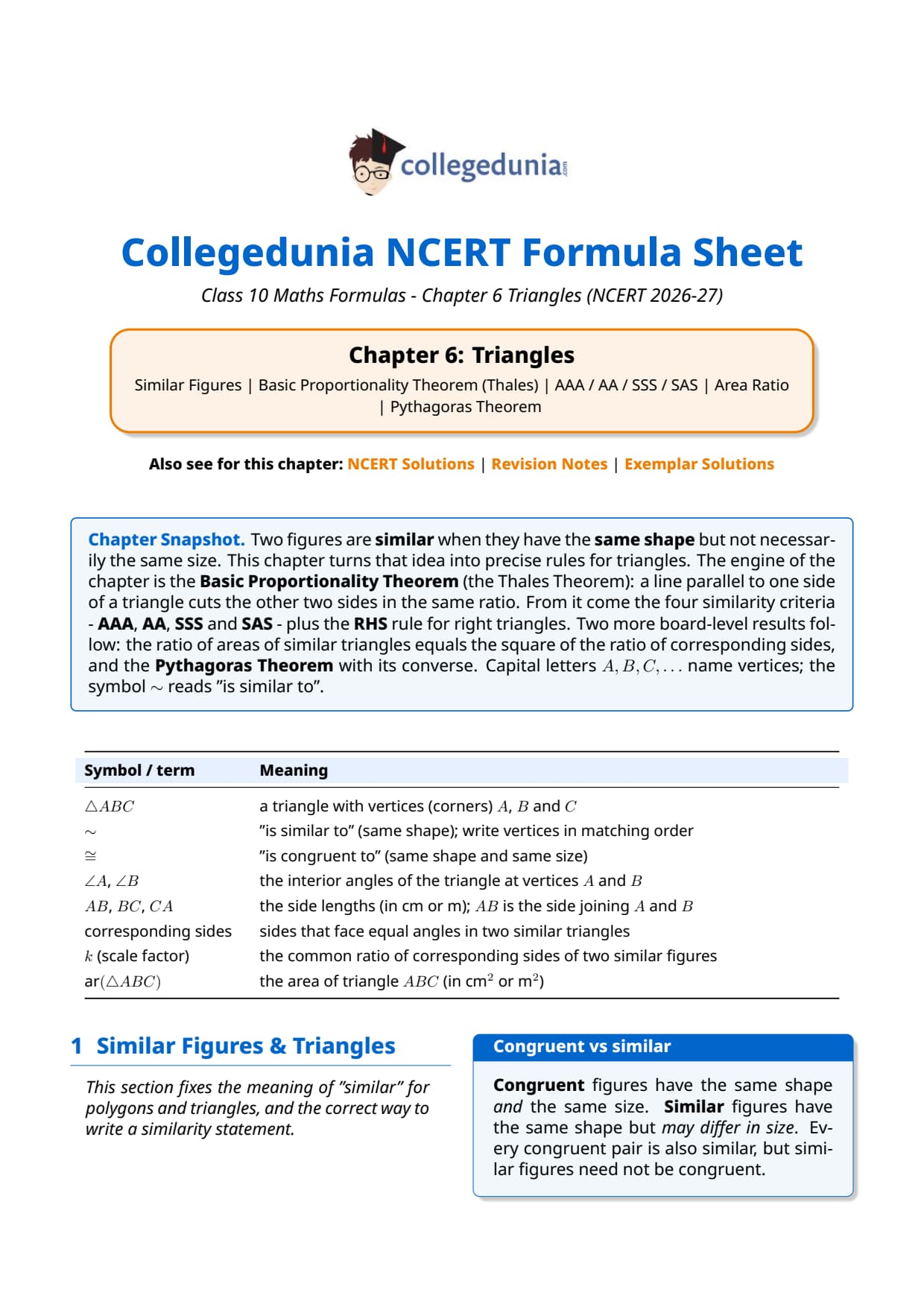
- All core theorems in one place, with a plain-English meaning for each.
- Similarity criteria (AA, SSS, SAS, RHS) and the BPT, with the exact conditions to check.
- Board focus: the area ratio rule, the Pythagoras Theorem, common triples, and the proof questions asked every year.
Student Feedback: In a Collegedunia poll of 2,200 Class 10 students before the 2026 board exam, 81% of students said the Basic Proportionality Theorem and the similarity criteria (especially AA) were the results they revised most from a one-page sheet, ahead of the area ratio rule and Pythagoras triples.
Watch Triangles Class 10 Maths Explained
Source: Magnet Brains on YouTube
Triangles Formula Sheet: Complete List
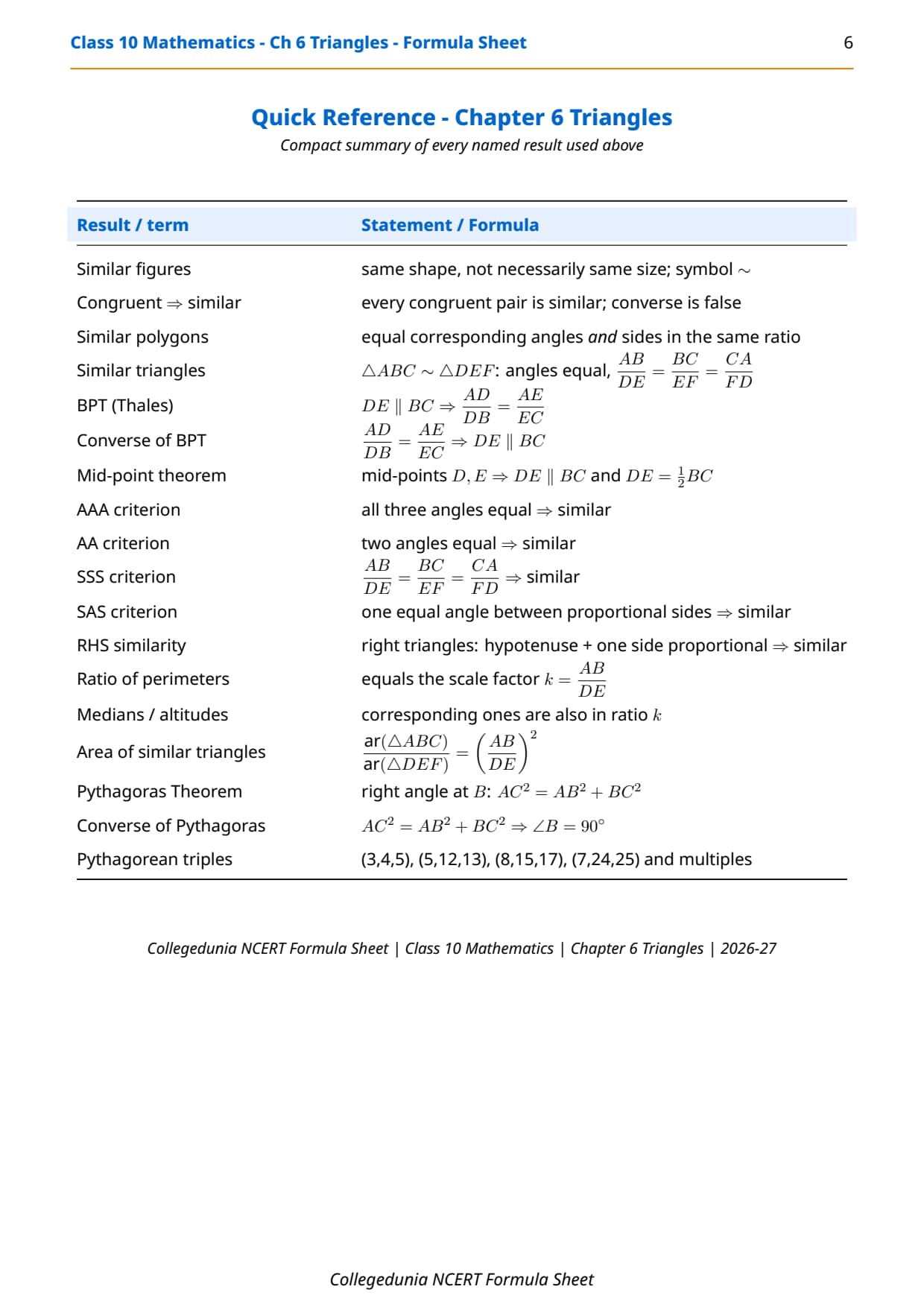
The table below lists every named result you need from Triangles. Each row gives the concept and its exact statement in simple words, the same one-page list you get in the PDF.
The chapter rests on two big ideas. First, two triangles are similar when they have the same shape (equal angles, proportional sides), and a line parallel to one side cuts the other two sides in the same ratio. Second, the area ratio of similar triangles is the square of the side ratio, and Pythagoras follows from similarity.
| Result / Term | Statement / Formula |
|---|---|
| Similar figures | Same shape, not necessarily same size; symbol ~ (tilde) |
| Similar triangles (definition) | ▵ABC ~ ▵DEF: ∠A = ∠D, ∠B = ∠E, ∠C = ∠F and AB/DE = BC/EF = CA/FD |
| Scale factor k | Common ratio of corresponding sides of two similar figures |
| BPT (Thales Theorem) | DE ∥ BC in ▵ABC ⇒ AD/DB = AE/EC |
| Converse of BPT | AD/DB = AE/EC ⇒ DE ∥ BC |
| Mid-point theorem (special BPT) | D, E are mid-points of AB, AC ⇒ DE ∥ BC and DE = BC/2 |
| AAA criterion | Three angles equal ⇒ triangles are similar |
| AA criterion | Two angles equal ⇒ triangles are similar (third is automatic) |
| SSS criterion | AB/DE = BC/EF = CA/FD ⇒ ▵ABC ~ ▵DEF |
| SAS criterion | ∠A = ∠D and AB/DE = AC/DF (included angle) ⇒ ▵ABC ~ ▵DEF |
| RHS similarity | Right triangles: hypotenuse and one side proportional ⇒ similar |
| Ratio of perimeters | Perimeter(▵ABC) / Perimeter(▵DEF) = k (the scale factor) |
| Medians and altitudes | Corresponding medians, altitudes and angle bisectors are also in ratio k |
| Area ratio of similar triangles | ar(▵ABC) / ar(▵DEF) = (AB/DE)2 = (BC/EF)2 = (CA/FD)2 |
| Pythagoras Theorem | Right angle at B: AC2 = AB2 + BC2 |
| Converse of Pythagoras | AC2 = AB2 + BC2 ⇒ ∠B = 90° |
| Common Pythagorean triples | (3, 4, 5), (5, 12, 13), (8, 15, 17), (7, 24, 25) and multiples |
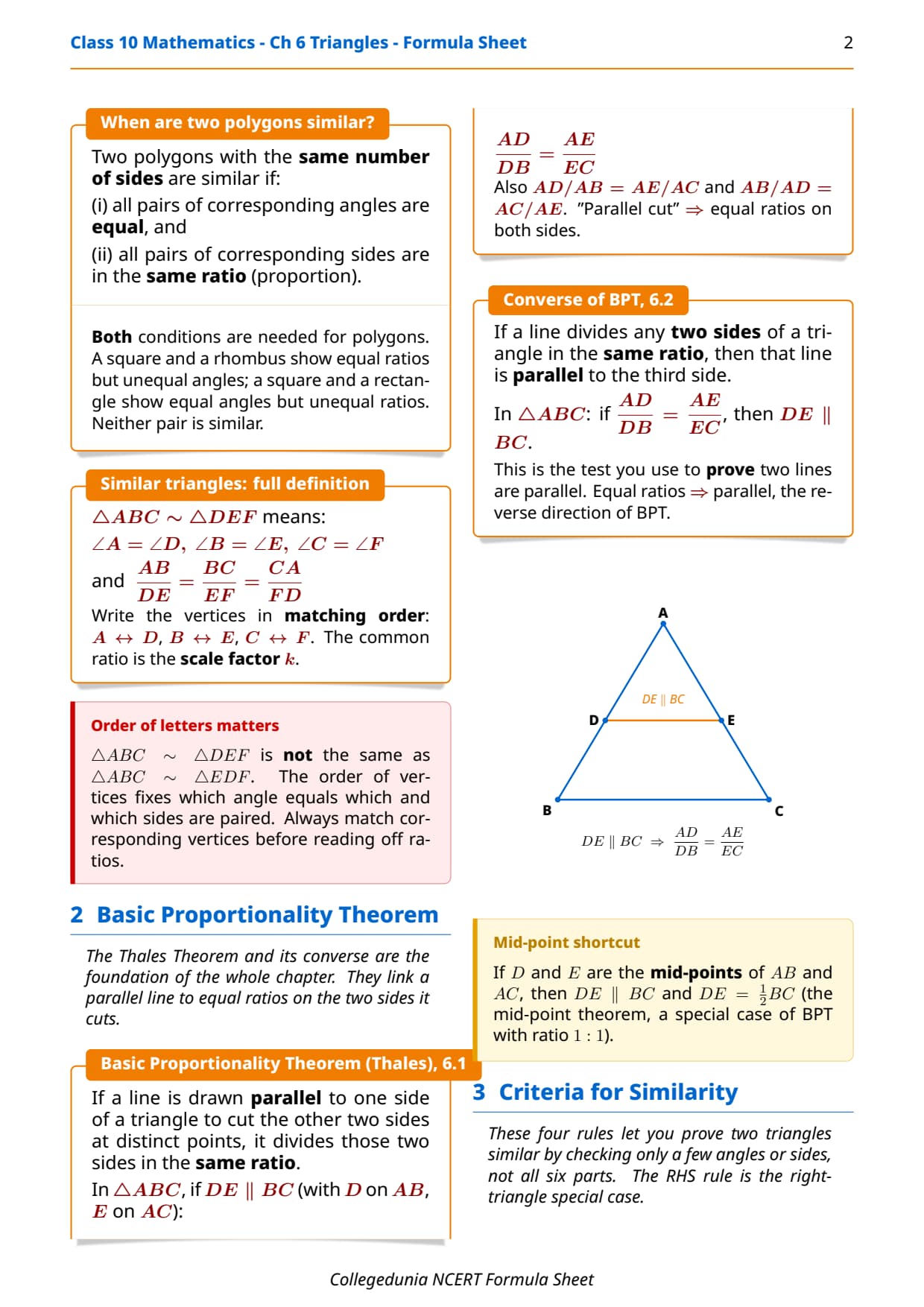
The Basic Proportionality Theorem: the single most-used result in this chapter.
Similar Figures: What the Symbols Mean
Two figures are similar when they have the same shape but not always the same size. The symbol ~ reads as "is similar to". Every congruent pair is similar, but similar figures need not be congruent. For two triangles to be similar you need:
- Equal corresponding angles: each angle in one triangle matches an angle in the other in the same position.
- Proportional corresponding sides: each pair of corresponding sides is in the same ratio k, the scale factor.
For triangles you need not check both conditions at once: the four criteria (AA, SSS, SAS, RHS) each prove similarity from one or two facts. Always match the vertices in the correct order. So ▵ABC ~ ▵DEF means ∠A = ∠D, ∠B = ∠E and ∠C = ∠F. Wrong order makes every ratio you read off wrong.
Basic Proportionality Theorem (Thales Theorem): AD/DB = AE/EC
The Basic Proportionality Theorem (BPT) is the base of this chapter. A line drawn parallel to one side of a triangle divides the other two sides in the same ratio. In ▵ABC, if DE ∥ BC with D on AB and E on AC, then AD/DB = AE/EC. You can also write it as AD/AB = AE/AC.
| Direction | Given | Conclusion |
|---|---|---|
| BPT (Theorem 6.1) | DE ∥ BC in ▵ABC | AD/DB = AE/EC |
| Converse of BPT (Theorem 6.2) | AD/DB = AE/EC in ▵ABC | DE ∥ BC |
The converse is just as important: if a line divides two sides in the same ratio, it is parallel to the third side. Use it to prove two lines parallel. The mid-point theorem is BPT with ratio 1:1: if D and E are mid-points of AB and AC, then DE ∥ BC and DE = BC/2. If the line is parallel, set up the equal ratios as a proportion to find missing lengths.
Similarity Criteria: AA, SSS, SAS & RHS
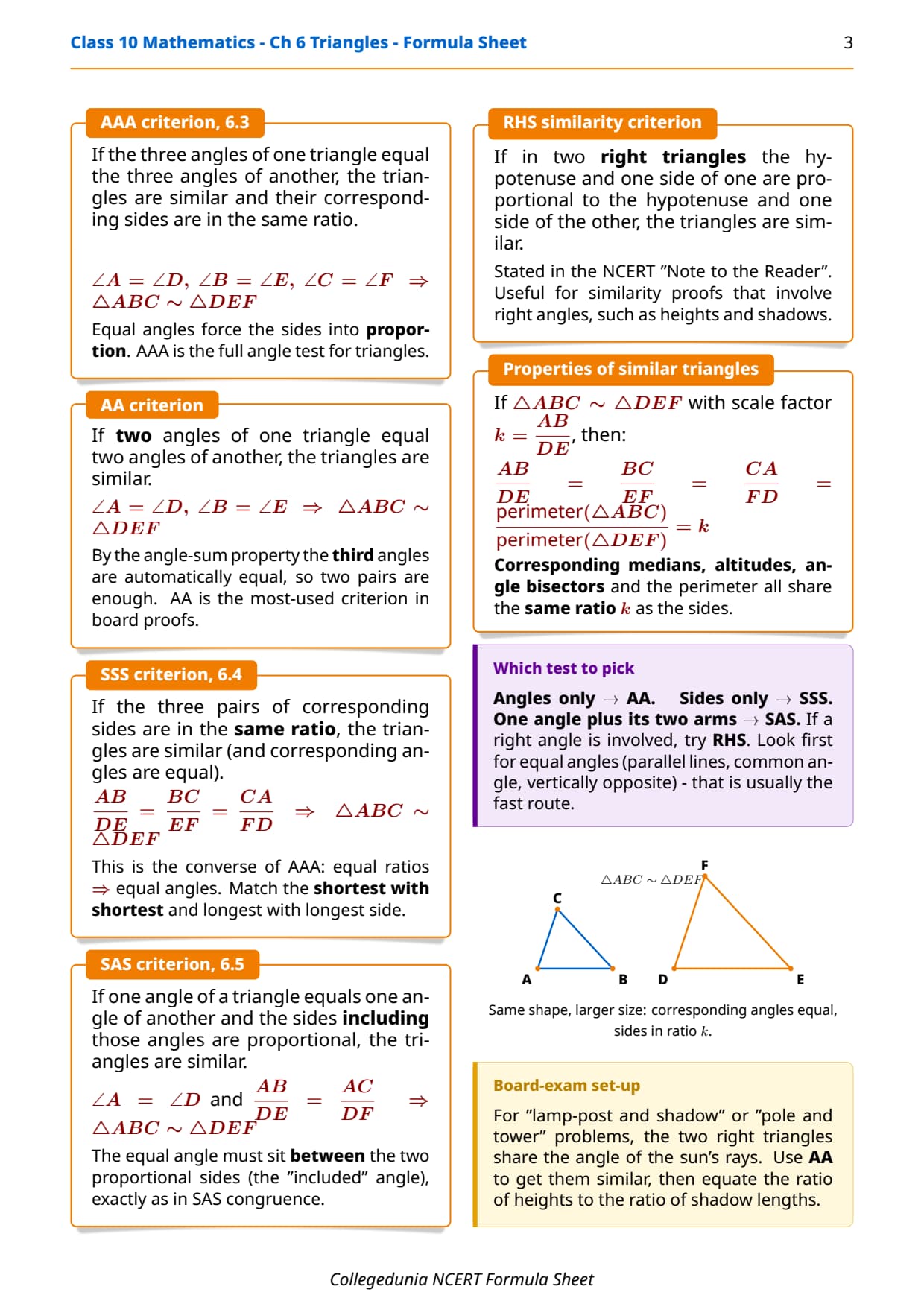
These four rules prove two triangles similar by checking only a few angles or sides. Each one is a shortcut, so you skip verifying all six parts of the triangles.
The four similarity criteria: use the one that matches what the question gives you.
| Criterion | What to check | Conclusion |
|---|---|---|
| AAA | All three pairs of angles are equal | ▵ABC ~ ▵DEF |
| AA | Any two pairs of angles are equal (third follows from angle sum) | ▵ABC ~ ▵DEF |
| SSS | AB/DE = BC/EF = CA/FD (all three side ratios equal) | ▵ABC ~ ▵DEF |
| SAS | One pair of equal angles with the two sides including it proportional | ▵ABC ~ ▵DEF |
| RHS | Right triangles: hypotenuse and one side in proportion | ▵ABC ~ ▵DEF |
AA is the most used criterion in board proofs: parallel lines, common angles and vertically opposite angles give equal angle pairs for free. SAS needs the equal angle to be the included angle, between the two proportional sides; otherwise it does not apply. For shadow and height problems, both right triangles share the sun's-ray angle, so AA is fastest.
Area Ratio Rule for Similar Figures
If two triangles are similar with scale factor k, their area ratio equals k2, the square of the scale factor. This is one of the most tested results in CBSE board papers.
- General rule: ar(▵ABC) / ar(▵DEF) = (AB/DE)2 = (BC/EF)2 = (CA/FD)2
- Lengths use k, not k2: corresponding medians, altitudes and angle bisectors are in ratio k; only the areas use the square.
- Quick fact: sides in ratio 2:3 give areas 4:9; sides in ratio 1:2 give areas 1:4.
Board questions give the area ratio and ask for the side ratio, or the reverse, so check which way the question runs before you set up the equation.
Pythagoras Theorem and Its Converse
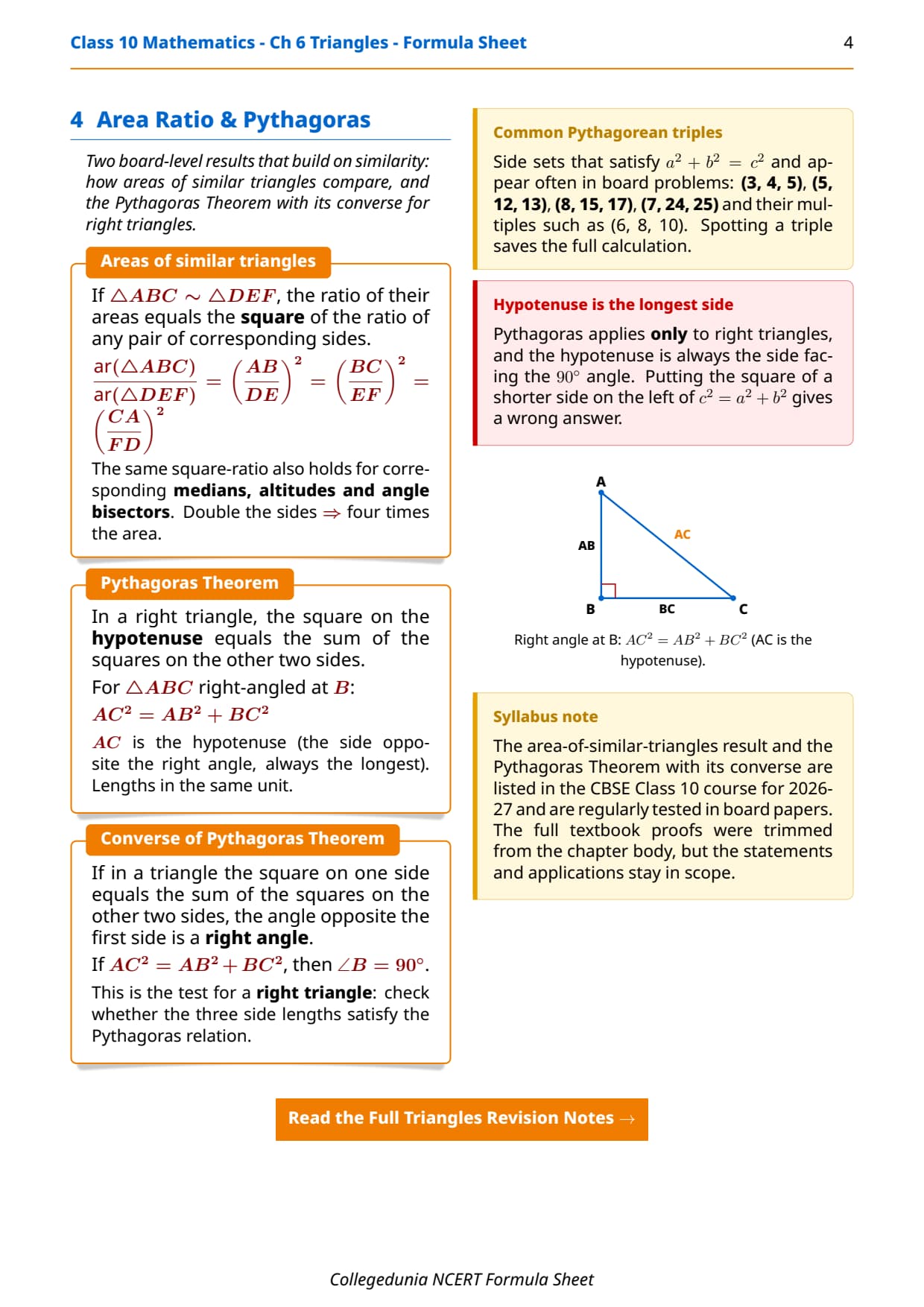
In a triangle right-angled at B, the square on the hypotenuse AC equals the sum of the squares on AB and BC. The Converse says: if AC2 = AB2 + BC2, then the angle at B is 90°. Use the converse to check whether three given lengths form a right triangle.
| Pythagorean Triple | Verification | Common Multiple Example |
|---|---|---|
| (3, 4, 5) | 9 + 16 = 25 ✓ | (6, 8, 10), (9, 12, 15) |
| (5, 12, 13) | 25 + 144 = 169 ✓ | (10, 24, 26) |
| (8, 15, 17) | 64 + 225 = 289 ✓ | (16, 30, 34) |
| (7, 24, 25) | 49 + 576 = 625 ✓ | (14, 48, 50) |
Spotting a Pythagorean triple saves the full calculation: if the shorter sides are 5 and 12, the hypotenuse is 13. The hypotenuse is always the longest side and sits opposite the right angle.
Picking the Right Similarity Criterion
Most board proofs on Triangles follow a pattern. Once you know which criterion to use, the proof almost writes itself.
| What the question gives | Best criterion |
|---|---|
| Two pairs of equal angles (parallel lines, common angle, vertically opposite) | AA |
| All three side ratios are equal | SSS |
| One equal included angle and two proportional sides around it | SAS |
| Two right triangles with hypotenuse and one side in proportion | RHS |
| Heights and shadows (right angles, shared sun angle) | AA |
The fastest path is to look for equal angles first. Parallel lines give alternate and co-interior angles. A common vertex gives a shared angle. Vertically opposite angles at a crossing are equal. Once you have two equal angle pairs, AA is done. Switch to SSS or SAS only when the question gives side measurements but no angles.
Using This Formula Sheet for Exam Prep
- Night-before revision: read every row in the complete table and check you can write the BPT ratio, all four similarity criteria and the Pythagoras result without looking.
- During practice: keep the PDF open alongside past papers and look up the correct criterion before writing the proof, rather than guessing mid-solution.
- For "prove that" questions: identify what is given (angles, parallel lines, ratios) and match it to the correct criterion row in the table above, then write the proof in order.
Triangles Weightage in the Board Exam
Triangles sits in the Geometry unit of the CBSE Class 10 Maths syllabus. The table shows where its topics fit among common question types, so you can plan revision time well.
| Topic in Chapter 6 | Typical Question Type | Usual Marks |
|---|---|---|
| Basic Proportionality Theorem and Converse | Proof or find missing length | 2 to 3 marks |
| AA / SSS / SAS similarity criteria | Prove triangles similar | 3 to 4 marks |
| Area ratio of similar triangles | Find area ratio given side ratio, or vice versa | 2 to 3 marks |
| Pythagoras Theorem and Converse | Prove right angle, or find a missing side | 2 to 4 marks |
| Combined (BPT + similarity + area) | Long answer, multi-step | 4 to 5 marks |
Across recent CBSE papers, Triangles carries about 6 to 10 marks. The most common multi-step format asks you to prove two triangles similar, then find a missing measurement. The BPT and AA criterion are reliable scoring points if you know the exact statements.
Common Mistakes With These Theorems
Mistake 1: Writing the similarity statement in the wrong vertex order. ▵ABC ~ ▵DEF means A matches D, B matches E, C matches F. The wrong order gives wrong ratios.
Mistake 2: Using SAS when the equal angle is not the included angle. The equal angle must sit between the two proportional sides.
Mistake 3: Confusing the area ratio (k2) with the side ratio (k). If sides are 3:4, areas are 9:16, not 3:4.
Mistake 4: Applying Pythagoras to a triangle that is not a right triangle. Check the right-angle condition before using AC2 = AB2 + BC2.
Mistake 5: In BPT problems, confusing AD/DB with AD/AB. Both forms are valid but they are not equal; use whichever the question asks for.
Each slip can cost 1 to 2 marks in the board exam.
More Triangles Resources
Use this formula sheet with the other Triangles resources below. Each one covers a different part of the chapter, so they work best together.
| Resource | Best Used For |
|---|---|
| Triangles NCERT Solutions | Step-by-step answers to all textbook questions |
| Triangles Notes | Full chapter explanation with solved examples |
| Triangles Handwritten Notes | Quick visual revision in a notebook style |
| Triangles NCERT Book PDF | The official textbook chapter to read |
| Triangles NCERT Exemplar Solutions | Harder practice questions with solutions |
| Triangles NCERT Exemplar Book PDF | The official Exemplar problems to attempt |
NCERT Formula Sheets for Class 10 Maths: All Chapters
| Chapter | Formula Sheet |
|---|---|
| Chapter 1 | Real Numbers Formula Sheet |
| Chapter 2 | Polynomials Formula Sheet |
| Chapter 3 | Pair of Linear Equations in Two Variables Formula Sheet |
| Chapter 4 | Quadratic Equations Formula Sheet |
| Chapter 5 | Arithmetic Progressions Formula Sheet |
| Chapter 6 | Triangles Formula Sheet (this page) |
| Chapter 7 | Coordinate Geometry Formula Sheet |
| Chapter 8 | Introduction to Trigonometry Formula Sheet |
| Chapter 9 | Some Applications of Trigonometry Formula Sheet |
| Chapter 10 | Circles Formula Sheet |
| Chapter 11 | Areas Related to Circles Formula Sheet |
| Chapter 12 | Surface Areas and Volumes Formula Sheet |
| Chapter 13 | Statistics Formula Sheet |
| Chapter 14 | Probability Formula Sheet |
Triangles Formula Sheet FAQs
Ques. What formulas are in the Class 10 Triangles formula sheet?
Ans. The sheet covers the definition of similar figures and similar triangles, the Basic Proportionality Theorem (AD/DB = AE/EC when DE ∥ BC) and its converse, the mid-point theorem, all four similarity criteria (AA, SSS, SAS, RHS), the ratio of perimeters and medians, the area ratio rule (ar(▵ABC)/ar(▵DEF) = (AB/DE)2), the Pythagoras Theorem (AC2 = AB2 + BC2) and its converse, and the four common Pythagorean triples.
Ques. What is the Basic Proportionality Theorem in Chapter 6?
Ans. The Basic Proportionality Theorem (also called the Thales Theorem) states that if a line is drawn parallel to one side of a triangle to intersect the other two sides at distinct points, it divides those sides in the same ratio. In ▵ABC, if DE ∥ BC, then AD/DB = AE/EC. The converse states that if a line divides two sides in the same ratio, it is parallel to the third side.
Ques. Which similarity criterion is most useful in board exams?
Ans. The AA criterion is the most commonly used in board proofs because two equal angles are often available directly from the figure (parallel lines, common angles, vertically opposite angles). Once you spot two pairs of equal angles, the similarity follows in one or two lines. Use SSS when only side ratios are given, SAS when one included angle and two proportional sides are given, and RHS for right-triangle problems.
Ques. How is the area ratio of similar triangles related to the side ratio?
Ans. If two triangles are similar with scale factor k (the ratio of corresponding sides), their areas are in the ratio k2. For example, if sides are in ratio 3:4, areas are in ratio 9:16. The same square-ratio applies to corresponding medians, altitudes and angle bisectors when comparing areas, but those lengths themselves are in ratio k, not k2.
Ques. What are the common Pythagorean triples students should know for the board exam?
Ans. The four triples tested most often in CBSE Class 10 papers are (3, 4, 5), (5, 12, 13), (8, 15, 17) and (7, 24, 25). Any whole-number multiple of these also satisfies the Pythagorean relation, so (6, 8, 10), (10, 24, 26) and (9, 12, 15) are also right triangles. Recognising a triple saves you computing the square root in the exam.
Ques. Where can I download the Triangles formula sheet PDF?
Ans. Use the download card near the top of this page to get the Triangles formula sheet PDF. It fits every key theorem on one page for quick revision under the 2026-27 CBSE syllabus.



Comments