Maths Mentor, Delhi University | Updated 3+ months ago
The NCERT Exemplar Class 12 Maths Differential Equations solve every problem of the NCERT Exemplar set for Class 12 Mathematics Chapter 9 Differential Equations. The NCERT Exemplar Class 12 Maths Differential Equations cover MCQ, Very Short Answer, Short Answer and Long Answer problems, with each step in the working clearly labelled. The solutions PDF is free to download.
Use the resource above alongside the chapter breakdown below.
Use the resource above alongside the chapter breakdown below.
Use the resource above alongside the chapter breakdown below.
Use the resource above alongside the chapter breakdown below.
Use the resource above alongside the chapter breakdown below.
Use the resource above alongside the chapter breakdown below.
Use the resource above alongside the chapter breakdown below.
Use the resource above alongside the chapter breakdown below.
Use the resource above alongside the chapter breakdown below.
Use the resource above alongside the chapter breakdown below.
Use the resource above alongside the chapter breakdown below.
Use the resource above alongside the chapter breakdown below.
Use the resource above alongside the chapter breakdown below.
Use the resource above alongside the chapter breakdown below.
Use the resource above alongside the chapter breakdown below.
Use the resource above alongside the chapter breakdown below.
Use the resource above alongside the chapter breakdown below.
Use the resource above alongside the chapter breakdown below.
Use the resource above alongside the chapter breakdown below.
Use the resource above alongside the chapter breakdown below.
Use the resource above alongside the chapter breakdown below.
Use the resource above alongside the chapter breakdown below.
Use the resource above alongside the chapter breakdown below.
Use the resource above alongside the chapter breakdown below.
Use the resource above alongside the chapter breakdown below.
Use the resource above alongside the chapter breakdown below.
Use the resource above alongside the chapter breakdown below.
Use the resource above alongside the chapter breakdown below.
Use the resource above alongside the chapter breakdown below.
Use the resource above alongside the chapter breakdown below.
Use the resource above alongside the chapter breakdown below.
Use the resource above alongside the chapter breakdown below.
Use the resource above alongside the chapter breakdown below.
Use the resource above alongside the chapter breakdown below.
Use the resource above alongside the chapter breakdown below.
Use the resource above alongside the chapter breakdown below.
Use the resource above alongside the chapter breakdown below.
Use the resource above alongside the chapter breakdown below.
Use the resource above alongside the chapter breakdown below.
Use the resource above alongside the chapter breakdown below.
Use the resource above alongside the chapter breakdown below.
Use the resource above alongside the chapter breakdown below.
Use the resource above alongside the chapter breakdown below.
Use the resource above alongside the chapter breakdown below.
Use the resource above alongside the chapter breakdown below.
Use the resource above alongside the chapter breakdown below.
Use the resource above alongside the chapter breakdown below.
Use the resource above alongside the chapter breakdown below.
Use the resource above alongside the chapter breakdown below.
Use the resource above alongside the chapter breakdown below.
Use the resource above alongside the chapter breakdown below.
Use the resource above alongside the chapter breakdown below.
Use the resource above alongside the chapter breakdown below.
Use the resource above alongside the chapter breakdown below.
Use the resource above alongside the chapter breakdown below.
Use the resource above alongside the chapter breakdown below.
Use the resource above alongside the chapter breakdown below.
Use the resource above alongside the chapter breakdown below.
Use the resource above alongside the chapter breakdown below.
Use the resource above alongside the chapter breakdown below.
Use the resource above alongside the chapter breakdown below.
Use the resource above alongside the chapter breakdown below.
Use the resource above alongside the chapter breakdown below.
Use the resource above alongside the chapter breakdown below.
Use the resource above alongside the chapter breakdown below.
Use the resource above alongside the chapter breakdown below.
Use the resource above alongside the chapter breakdown below.
Use the resource above alongside the chapter breakdown below.
Use the resource above alongside the chapter breakdown below.
Use the resource above alongside the chapter breakdown below.
Use the resource above alongside the chapter breakdown below.
Use the resource above alongside the chapter breakdown below.
Use the resource above alongside the chapter breakdown below.
Use the resource above alongside the chapter breakdown below.
Use the resource above alongside the chapter breakdown below.
Use the resource above alongside the chapter breakdown below.
Use the resource above alongside the chapter breakdown below.
Use the resource above alongside the chapter breakdown below.
Use the resource above alongside the chapter breakdown below.
Use the resource above alongside the chapter breakdown below.
Use the resource above alongside the chapter breakdown below.
Use the resource above alongside the chapter breakdown below.
Use the resource above alongside the chapter breakdown below.
Use the resource above alongside the chapter breakdown below.
Use the resource above alongside the chapter breakdown below.
Use the resource above alongside the chapter breakdown below.
Use the resource above alongside the chapter breakdown below.
Use the resource above alongside the chapter breakdown below.
Use the resource above alongside the chapter breakdown below.
Use the resource above alongside the chapter breakdown below.
Use the resource above alongside the chapter breakdown below.
Use the resource above alongside the chapter breakdown below.
Use the resource above alongside the chapter breakdown below.
Use the resource above alongside the chapter breakdown below.
Use the resource above alongside the chapter breakdown below.
Use the resource above alongside the chapter breakdown below.
Use the resource above alongside the chapter breakdown below.
Use the resource above alongside the chapter breakdown below.
Use the resource above alongside the chapter breakdown below.
Use the resource above alongside the chapter breakdown below.
Use the resource above alongside the chapter breakdown below.
Use the resource above alongside the chapter breakdown below.
Use the resource above alongside the chapter breakdown below.
Use the resource above alongside the chapter breakdown below.
Use the resource above alongside the chapter breakdown below.
Use the resource above alongside the chapter breakdown below.
Use the resource above alongside the chapter breakdown below.
Use the resource above alongside the chapter breakdown below.
Use the resource above alongside the chapter breakdown below.
Use the resource above alongside the chapter breakdown below.
Use the resource above alongside the chapter breakdown below.
CBSE Weightage: 8 to 12 marks (Unit III: Calculus, shared with Integrals and Application of Integrals; typically one SA on type identification plus one LA on a linear or homogeneous equation)
JEE Main Weightage: 3 to 5% of paper (one to two questions every shift, splitting between integrating-factor and homogeneous-substitution archetypes)
Exemplar Problems Solved: 97 in total (24 SA + 9 LA + 42 MCQ + 11 Fill in the Blanks + 11 True or False), plus 2 labelled slope-field diagrams
Curated by Collegedunia subject experts, mapped to the 2026-27 NCERT print, and benchmarked against the last five JEE Main and CBSE 12 cycles.
Why Differential Equations Class 12 Exemplar Is the JEE Main Calculus Pivot
The NCERT Exemplar Class 12 Maths Differential Equations address this in the same order as the NCERT textbook.
JEE Main has not skipped a Differential Equations question in any shift since 2021, and the Exemplar 42-MCQ block is the largest type-recognition drill in any Class 12 Maths chapter.
It trains the four-second reflex of naming the equation type (variable-separable, homogeneous, linear in y, linear in x) before a single step is written, the habit that separates a 30-second JEE solve from a 4-minute Boards write-up.
Differential Equations NCERT Exemplar Video Solutions
How Collegedunia's Exemplar Solutions Help You Crack Class 12 Differential Equations
The NCERT Exemplar Class 12 Maths Differential Equations address this in the same order as the NCERT textbook.
A wrong type-classification at step one costs the entire question; the Exemplar deliberately disguises homogeneous equations as separable. Each of our 97 solutions opens with a one-line type-identification, names the substitution or integrating factor, and shows the JEE Main alternate method wherever it shortens the Boards path by two steps.
Differential Equations Exemplar Problem Bank: Format-Wise Count
The NCERT Exemplar Class 12 Maths Differential Equations address this in the same order as the NCERT textbook.
The Chapter 9 Exemplar bank is the largest in Class 12 Maths at 97 problems across five formats; the table shows the prep-time allocation Collegedunia recommends for a 30-day plan.
Question Format
Count
Problem Numbers
Average Time
Short Answer (SA)
24
9.1 to 9.24
5 to 7 min
Long Answer (LA)
9
9.25 to 9.33
9 to 12 min
Multiple Choice (MCQ)
42
9.34 to 9.75
1.5 to 2.5 min
Fill in the Blanks
11
9.76 to 9.86
1 to 2 min
True or False
11
9.87 to 9.97
1 to 2 min
The 33 SA + LA problems carry the Boards-style IF and homogeneous load; the 42 MCQs plus 22 short-form items calibrate the JEE Main type-naming reflex.
How Frequently Has Differential Equations Been Asked in CBSE and JEE Main
Three archetypes cover every recent paper, taking the bulk of the 8 to 12-mark Boards share.
Differential Equations Class 12 Weightage Snapshot Across Chapters
Chapter 9 sits in the upper-middle tier of Class 12 Maths weightage; the chart below places its 10-mark share alongside the other 12 chapters.
Chapter
CBSE Marks
Weightage Bar
Ch 1 Relations and Functions
8
Ch 2 Inverse Trigonometric Functions
4
Ch 3 Matrices
10
Ch 4 Determinants
10
Ch 5 Continuity and Differentiability
15
Ch 6 Application of Derivatives
10
Ch 7 Integrals
15
Ch 8 Application of Integrals
5
Ch 9 Differential Equations
10
Ch 10 Vector Algebra
10
Ch 11 Three Dimensional Geometry
10
Ch 12 Linear Programming
5
Ch 13 Probability
8
Chapter 9 holds a steady 10-mark share, on par with Matrices and AOD; combined with the JEE one-to-two-per-shift rate, no Calculus aspirant can weight it lower.
Exemplar-Specific Common Mistakes in Differential Equations
The Exemplar punishes a different set of mistakes than the NCERT Exemplar Class 12 Maths Differential Equations. The four below cost the most marks across recent CBSE cycles.
Mis-classifying the equation type. Reading y' = (x+y)/x as separable wastes the first 5 minutes (MCQ 9.49, SA 9.16).
Skipping leading-coefficient normalisation. Without dividing through, the integrating factor is wrong and the LA zeros (LA 9.27).
Reading degree before clearing fractional powers. The most common Fill-in-the-Blank trap (Fill 9.80, T/F 9.88).
Dropping the modulus in ln |x| . Boards markers deduct one mark when absolute-value bars are missing (SA 9.16).
JEE Main Prep Value of the Differential Equations Exemplar
All NCERT Exemplar Questions for Differential Equations with Step-by-Step Solutions
Every question of the NCERT Exemplar set for Class 12 Mathematics Chapter 9 Differential Equations is listed below with its full Solution and Expert Solution hidden inside collapsible tabs. Click Check Solution to reveal the step-by-step working; click Expert Solution for the expanded explanation.
I. Short Answer (S.A.)
Q 9.1
Find the solution of dydx=2y-x.
Concept used. A first-order differential equation
dydx=f(x) g(y) is said to be variable
separable: we move all y-terms (and dy) to one side and all
x-terms (and dx) to the other, then integrate. The key
exponent identity used here is 2y-x=2y2x.
Rewrite the RHS using the exponent law:
dydx = 2y-x = 2y2x.
Separate variables (multiply by 2x dx and divide by 2y):
dy2y = dx2x
2-y dy = 2-x dx.
Integrate both sides using ∫ au du=auln a (with a=2, u=-y or u=-x):
∫ 2-y dy = ∫ 2-x dx, 2-y-ln 2 = 2-x-ln 2+C1.
Multiply both sides by -ln 2 and absorb the constant into a single C:
2-y = 2-x + C.
2-x-2-y+C=0, or equivalently 2-y=2-x+C.
AS
Aarav Sharma
M.Sc Mathematics, IIT Bombay
Verified Expert
Pattern-recognition angle. Whenever the RHS is a linear in x,y, split the exponent into an x-part and a y-part using au+v=auav. After that the equation is always separable.
Identify the form: dydx=2y· 2-x, a product of a function of y and a function of x.
Cross-multiply: 2-y dy = 2-x dx.
Integrate term-by-term:
-2-yln 2 = -2-xln 2 + C1.
Tidy: 2-y=2-x+C where C=-C1ln 2 is an arbitrary constant.
Sanity check by implicit differentiation: -2-yln 2· y' = -2-xln 2, i.e. y'=2x-y· 2-2x· 2x=2y-x.
Why this matters. Recognising the au+v split is a recurring trick in solving exponential separable DEs (e.g. Q61 of this Exemplar uses the same idea).
2-y=2-x+C.
Q 9.2
Find the differential equation of all non-vertical lines in a plane.
Concept used. Every non-vertical line in the xy-plane can be written in slope-intercept form y=mx+c, which has two arbitrary constants m and c. The order of the differential equation obtained by eliminating those constants must therefore equal 2.
Start from the general non-vertical line:
y = mx+c.
Differentiate once with respect to x:
dydx = m.
(c vanishes; m is still present.)
Differentiate a second time to eliminate m:
d2ydx2 = 0.
Both arbitrary constants m and c are now eliminated, leaving a second-order DE.
d2ydx2=0.
SI
Sneha Iyer
M.Sc Mathematics, ISI Kolkata
Verified Expert
Geometric angle. A non-vertical line has constant slope. The geometric condition ``slope is constant'' translates directly into ``the second derivative is zero''.
Geometric fact: along any straight line y'=m=const.
Differentiating the constant gives y''=0.
Conversely, integrating y''=0 twice produces y=mx+c, recovering every non-vertical line.
Why this matters. The same logic shows ``all non-horizontal lines x=my+c'' satisfy d2xdy2=0 (see Q77(xi)).
Common alternative. A second valid route is to differentiate the candidate answer and confirm it satisfies the original DE - this catches sign errors that ``forward'' integration sometimes hides. For any boxed answer F(x,y)=C, differentiate implicitly and rearrange; you must recover the given DE.
Marking-scheme angle. Examiners look for (i) the standard-form identification, (ii) the correct intermediate work, and (iii) the boxed final answer with an arbitrary constant. Skipping any of the three risks dropped marks even when the final answer is correct.
y''=0.
Q 9.3
Given that dy/dx = e-2y and y = 0 when x = 5, find the value of x when y = 3.
Concept used. This is again a variable-separable DE. After integrating both sides we use the given initial condition to pin down the arbitrary constant.
Separate variables: e2y dy = dx.
Integrate both sides. The LHS uses ∫ eau du=eaua with a=2:
e2y2 = x + C.
Use the initial condition y=0 when x=5:
e02=5+C12=5+CC=-92.
Substitute C back:
e2y2 = x - 92 e2y = 2x-9.
Put y=3: e6=2x-9 2x = e6+9 x=e6+92.
x=e6+92.
PG
Pranav Gupta
Ph.D Mathematics, IIT Delhi
Verified Expert
Definite-integral angle. Instead of finding the constant from an initial condition, integrate as a definite integral from the known point.
Separate: e2y dy=dx.
Definite-integrate from the known point (x,y)=(5,0) to the unknown (x,3):
03 e2y dy = 5x dt.
Evaluate the LHS: [e2y2]03 = e6-12. RHS: x-5.
Solve: e6-12=x-5 x=5+e6-12=e6+92.
Numerical sanity check. Substitute a simple specific value (or limit) into both the original DE and the integrated form to confirm consistency. Even a one-point check rules out the most common algebraic slips (sign errors, dropped factors of two, missing +C).
Reasoning recap. The strategy of identifying the standard form first (separable / linear / homogeneous), then applying the matching template, is the single biggest time-saver in any differential-equations exam. Marking schemes typically award separate credit for: (i) correct identification of the form, (ii) correct intermediate algebra, (iii) the final answer with an arbitrary constant present where required. Show each of these clearly.
x=e6+92.
Q 9.4
Solve the differential equation (x2-1)dydx+2xy=1x2-1.
Concept used. Dividing by x2-1 puts the equation in the first-order linear form dydx+P(x) y=Q(x). The integrating factor is I.F.=e∫ P dx, and the solution is y.F.=∫ Q.F. dx+C.
Divide through by (x2-1):
dydx+2xx2-1y = 1(x2-1)2.
So P=2xx2-1 and Q=1(x2-1)2.
Compute ∫ P dx using ∫f'(x)f(x) dx=ln|f(x)| (here f(x)=x2-1, f'(x)=2x):
∫ 2xx2-1 dx = ln|x2-1|.
Hence I.F.=eln|x2-1|=x2-1.
Multiply the linear DE by I.F. (this collapses the LHS to a perfect derivative):
ddx[y(x2-1)] = (x2-1)·1(x2-1)2 = 1x2-1.
Integrate both sides. Use the standard partial-fraction result
∫dxx2-1=12ln|x-1x+1|:
y(x2-1) = 12ln|x-1x+1|+C.
y(x2-1)=12ln|x-1x+1|+C.
AV
Ananya Verma
M.Sc Applied Mathematics, IIT Kanpur
Verified Expert
Recognise-the-product angle. Notice that (x2-1) y' + 2xy = ddx[(x2-1) y] already, by the product rule, before we ever write the integrating factor.
Compute ddx[(x2-1) y] = (x2-1) y'+ 2xy. This is exactly the LHS of the given equation.
So the DE becomes ddx[(x2-1) y]=1x2-1.
Integrate using 1x2-1=12(1x-1-1x+1):
(x2-1) y = 12(ln|x-1|-ln|x+1|)+C = 12ln|x-1x+1|+C.
Why this matters. Spotting a ready-made product-rule LHS bypasses the I.F. computation entirely; the I.F. method just forces the LHS into this form.
y(x2-1)=12ln|x-1x+1|+C.
Q 9.5
Solve the differential equation dydx+2xy=y.
Concept used. Collecting y on the RHS shows this is variable-separable: dyy=(1-2x) dx. Then ∫dyy=ln|y| and ∫(1-2x) dx=x-x2.
Exponentiate to remove the log:
|y| = ex-x2+C1 = eC1· ex-x2.
Write C=± eC1 (an arbitrary non-zero constant; y≡ 0 is a trivial solution as well):
y = C ex-x2.
y=C ex-x2.
AR
Aditi Reddy
M.Tech CS, IIT Madras
Verified Expert
I.F. angle. The equation is also linear: y'+(2x-1) y=0, so we can use I.F.=e∫(2x-1) dx=ex2-x.
Multiply through by I.F. ex2-x:
ddx[y ex2-x] = 0.
Integrate: y ex2-x=C, hence y=C e-(x2-x)=C ex-x2.
Cross-check by differentiation: y'=C ex-x2(1-2x)=y(1-2x), which matches the given DE.
y=C ex-x2.
Q 9.6
Find the general solution of dydx+ay=emx.
Concept used. This is a first-order linear DE with constant coefficient P=a and forcing term Q=emx. The integrating factor is e∫ a dx=eax.
Identify P=a, Q=emx.
Integrating factor:
I.F.=e∫ a dx=eax.
Multiply through:
ddx[y eax] = emx· eax=e(m+a)x.
Integrate both sides.
Case A (m+a≠ 0): y eax=e(m+a)xm+a+C, so
y = emxm+a+C e-ax.
Case B (m+a=0, i.e. m=-a): RHS becomes ∫ 1 dx=x+C, so
y = (x+C) e-ax.
y(m+a)=emx+C(m+a)e-ax when m+a≠ 0; otherwise y=(x+C)e-ax.
RM
Rohit Mehta
Ph.D Mathematics, IIT Delhi
Verified Expert
Particular + homogeneous angle. For a linear DE with constant coefficient, write y=yp+yh: a particular solution of the inhomogeneous equation plus the general solution of the homogeneous one.
Homogeneous part: y'+ay=0 ⇒ yh=C e-ax.
Try yp=A emx. Substituting: Am emx+aA emx=emx, so A(m+a)=1, giving A=1m+a (assuming m+a≠ 0).
Combine: y=emxm+a+C e-ax.
When m=-a, the trial A emx duplicates the homogeneous solution and the rule is to multiply by x: try yp=Ax e-ax; substituting gives A=1, hence y=(x+C) e-ax.
Why this matters. The same particular-plus-homogeneous decomposition underlies every constant-coefficient linear DE later in higher mathematics.
y=emxm+a+C e-ax (or (x+C)e-ax if m=-a).
Q 9.7
Solve the differential equation dydx+1=ex+y.
Concept used. The combination x+y on the RHS hints at the substitutionv=x+y, which converts the equation into a separable one in v and x.
Let v=x+y. Differentiate: dvdx=1+dydx, so dydx=dvdx-1.
Substitute into the DE dydx+1=ex+y:
(dvdx-1)+1 = evdvdx=ev.
Separate variables: e-v dv=dx.
Integrate both sides:
∫ e-v dv = ∫ dx -e-v=x+C.
Restore v=x+y:
-e-(x+y) = x+C e-(x+y)+x+C=0.
e-(x+y)+x+C=0, or equivalently x+e-(x+y)=C.
KS
Karan Singh
B.Tech CSE, IIT Roorkee
Verified Expert
Direct angle. The equation dydx=ex+y-1 already has the special structure f(x+y) on the RHS, which is the textbook signal for v=x+y.
With v=x+y and v'=1+y', the DE becomes v'-1=ev-1, i.e. dvdx=ev.
Cross-multiply and integrate: -e-v=x+C.
Replace v and tidy: x+e-(x+y)+C=0, i.e. e-(x+y)=-(x+C).
Numerical sanity check. Substitute a simple specific value (or limit) into both the original DE and the integrated form to confirm consistency. Even a one-point check rules out the most common algebraic slips (sign errors, dropped factors of two, missing +C).
Reasoning recap. The strategy of identifying the standard form first (separable / linear / homogeneous), then applying the matching template, is the single biggest time-saver in any differential-equations exam. Marking schemes typically award separate credit for: (i) correct identification of the form, (ii) correct intermediate algebra, (iii) the final answer with an arbitrary constant present where required. Show each of these clearly.
e-(x+y)+x+C=0.
Q 9.8
Solve: y dx-x dy=x2y dx.
Concept used. Rearrange to isolate dydx and try to reach either separable or linear form. Here a careful regrouping turns the equation into a separable one.
Bring all terms to one side:
y dx - x dy = x2y dx y dx-x2y dx = x dy.
Factor y on the LHS:
y (1-x2) dx = x dy.
Separate variables (divide by xy, assuming x≠ 0, y≠ 0):
dyy = (1-x2)x dx = (1x-x) dx.
Spot-the-factoring angle. Whenever the RHS is a polynomial in x and y2, try to write it as f(x)· g(y). Common factorisations: 1+x+y2+xy2=(1+x)(1+y2); x+y+xy+1=(1+x)(1+y); etc.
Group: 1+x+y2+xy2=(1+x)(1+y2).
Use the separable template ∫ g(y) dy=∫ f(x) dx:
∫ dy1+y2=∫ (1+x) dx.
Get tan-1y=x+x22+C and use y(0)=0 to set C=0.
Why this matters. The factoring habit will resurface in Q15, Q23 of this Exemplar.
y=tan(x+x22).
Q 9.10
Find the general solution of (x+2y3)dydx=y.
Concept used. The equation does not separate cleanly in (x,y), but if we treat x as a function of y it becomes linear in x: dxdy+P1(y) x = Q1(y), with I.F.=e∫ P1 dy.
Take reciprocals of dydx to write dxdy:
(x+2y3)dydx=ydxdy = x+2y3y = xy+2y2.
Rearrange to linear form in x:
dxdy-1yx = 2y2.
So P1=-1y, Q1=2y2.
Integrating factor:
I.F.=e∫ -1y dy=e-ln|y|=1y.
Multiply through by 1y (this collapses the LHS to a perfect derivative):
ddy(xy) = 2y2y = 2y.
Integrate w.r.t. y:
xy = y2+Cx = y3+Cy.
x=y3+Cy.
TN
Tara Nair
M.Sc Mathematics, ISI Kolkata
Verified Expert
Treat x as the dependent variable. Whenever the unknown x appears linearly but y appears in a complicated way, swap roles.
Form: dxdy-1yx=2y2, linear in x.
I.F.=e-ln|y|=1/y.
Standard formula: x.F.=∫ Q.F. dy+C gives xy=∫ 2y dy=y2+C.
Multiply by y: x=y3+Cy.
Cross-check by direct substitution: dydx=1dx/dy=13y2+C; and yx+2y3=yy3+Cy+2y3=y3y3+Cy=13y2+C. Match.
Common alternative. A second valid route is to differentiate the candidate answer and confirm it satisfies the original DE - this catches sign errors that ``forward'' integration sometimes hides. For any boxed answer F(x,y)=C, differentiate implicitly and rearrange; you must recover the given DE.
Marking-scheme angle. Examiners look for (i) the standard-form identification, (ii) the correct intermediate work, and (iii) the boxed final answer with an arbitrary constant. Skipping any of the three risks dropped marks even when the final answer is correct.
x=y3+Cy.
Q 9.11
If y(x) is a solution of (2+sin x1+y)dydx=-cos x and y(0)=1, then find the value of y(π2).
Concept used. This is separable. Note that ddx(2+sin x)=cos x, so the RHS integral is just -ln|2+sin x|. On the LHS, ∫dy1+y=ln|1+y|.
Rewrite the DE in separated form:
dy1+y = -cos x2+sin x dx.
Integrate both sides:
∫ dy1+y = -∫ cos x2+sin x dx
ln|1+y| = -ln|2+sin x|+C1.
Combine logs (recall ln a+ln b=ln(ab)):
ln[(1+y)(2+sin x)] = C1,
so (1+y)(2+sin x)=C where C=eC1.
Apply y(0)=1. At x=0, sin 0=0:
(1+1)(2+0)=CC=4.
Substitute x=π2 (so sin x=1):
(1+y)(2+1)=4 1+y=43y=13.
y(π2)=13.
IJ
Ishaan Joshi
M.Sc Mathematics, IIT Bombay
Verified Expert
First-integral angle. Multiply through by 1+y and notice that (2+sin x) dy+(1+y)cos x dx=0 is the differential of the product (1+y)(2+sin x).
Rearrange to (2+sin x) dy + (1+y)cos x dx = 0.
Observe d[(1+y)(2+sin x)]=(2+sin x) dy+(1+y)cos x dx. Hence d[(1+y)(2+sin x)]=0.
Integrate: (1+y)(2+sin x)=C. Use y(0)=1 to get C=4.
At x=π/2: (1+y)(3)=4 ⇒ y=1/3.
Why this matters. ``Spot the exact differential'' is the fastest method for separable problems with a product structure.
Numerical sanity check. Substitute a simple specific value (or limit) into both the original DE and the integrated form to confirm consistency. Even a one-point check rules out the most common algebraic slips (sign errors, dropped factors of two, missing +C).
Reasoning recap. The strategy of identifying the standard form first (separable / linear / homogeneous), then applying the matching template, is the single biggest time-saver in any differential-equations exam. Marking schemes typically award separate credit for: (i) correct identification of the form, (ii) correct intermediate algebra, (iii) the final answer with an arbitrary constant present where required. Show each of these clearly.
y(π/2)=1/3.
Q 9.12
If y(t) is a solution of (1+t)dydt-ty=1 and y(0)=-1, then show that y(1)=-12.
Concept used. Divide by 1+t to get the linear form dydt-t1+ty=11+t. For the I.F. exponent we use t1+t=1-11+t.
Linear form:
dydt-t1+ty=11+t.
So P=-t1+t and Q=11+t.
Compute ∫ P dt. Use the algebraic identity:
t1+t=1-11+t.
Then
∫ -t1+t dt = ∫(11+t-1) dt = ln|1+t|-t.
Integrate from 0 to 1:
[y(1+t)e-t]01=01e-t dt=1-e-1.
At t=0: y(0)(1+0)e0=-1. At t=1: y(1)(2)e-1. Therefore
2 e-1y(1) - (-1) = 1-e-1,
so 2 e-1y(1) = -e-1, hence y(1)=-12.
y(1)=-12.
RD
Riya Desai
Ph.D Mathematics, IIT Delhi
Verified Expert
Closed-form angle. Solve for y(t) in closed form, then evaluate at t=1.
With I.F.=(1+t)e-t, the standard formula gives
y(1+t)e-t=∫ e-t dt + C = -e-t+C.
So y=-e-t+C(1+t)e-t=-1+C et1+t.
Apply y(0)=-1: -1+C1=-1 ⇒ C=0.
Hence y(t)=-11+t. At t=1: y(1)=-12.
Why this matters. Whenever the question asks for a specific function value, finding a closed form first is usually easier than juggling definite integrals.
Common alternative. A second valid route is to differentiate the candidate answer and confirm it satisfies the original DE - this catches sign errors that ``forward'' integration sometimes hides. For any boxed answer F(x,y)=C, differentiate implicitly and rearrange; you must recover the given DE.
Marking-scheme angle. Examiners look for (i) the standard-form identification, (ii) the correct intermediate work, and (iii) the boxed final answer with an arbitrary constant. Skipping any of the three risks dropped marks even when the final answer is correct.
y(t)=-11+t, so y(1)=-12.
Q 9.13
Form the differential equation having y=(sin-1x)2+Acos-1x+B, where A and B are arbitrary constants, as its general solution.
Concept used. Two arbitrary constants (A, B) ⇒ second-order DE. Use ddxsin-1x=1√1-x2 and ddxcos-1x=-1√1-x2.
Differentiate again. The RHS gives 2√1-x2. For the LHS use the product rule:
ddx[√1-x2dydx]
= √1-x2d2ydx2 + -x√1-x2dydx.
Equate and multiply through by √1-x2:
(1-x2) d2ydx2 - xdydx = 2.
Both A and B are eliminated.
(1-x2) y''-xy' = 2.
AP
Aanya Pillai
M.Sc Pure Mathematics, IIT Kanpur
Verified Expert
Trig substitution angle. Put x=sinθ; then √1-x2=cosθ and cos-1x=π2-θ.
y=θ2+A(π2-θ)+B=θ2-Aθ + (Aπ2+B).
Differentiate w.r.t. x using dθdx=1cosθ:
dydx=(2θ-A)·1√1-x2.
So √1-x2y'=2θ-A; differentiating once more leads to (1-x2)y''-xy'=2 exactly as in the main solution.
Why this matters. The substitution x=sinθ neutralises every √1-x2 in sight.
Numerical sanity check. Substitute a simple specific value (or limit) into both the original DE and the integrated form to confirm consistency. Even a one-point check rules out the most common algebraic slips (sign errors, dropped factors of two, missing +C).
Reasoning recap. The strategy of identifying the standard form first (separable / linear / homogeneous), then applying the matching template, is the single biggest time-saver in any differential-equations exam. Marking schemes typically award separate credit for: (i) correct identification of the form, (ii) correct intermediate algebra, (iii) the final answer with an arbitrary constant present where required. Show each of these clearly.
(1-x2)y''-xy'=2.
Q 9.14
Form the differential equation of all circles which pass through the origin and whose centres lie on the y-axis.
Concept used. A circle with centre (0,a) on the y-axis and radius |a| (so that it passes through the origin) has equation
x2+(y-a)2=a2, i.e. x2+y2=2ay.
One arbitrary constant a⇒ DE of order 1.
% width-bounded via !...
!minipage0.5%
[See diagram in the PDF version]
minipage
Start: x2+y2=2ay.
Differentiate w.r.t. x:
2x+2y y' = 2a y' x + yy' = ay' a = x+yy'y'.
Substitute a back into x2+y2=2ay:
x2+y2 = 2 x+yy'y'· y.
Multiply through by y':
(x2+y2) y' = 2xy + 2y2y' (x2-y2)y' = 2xy.
(x2-y2)dydx = 2xy.
AB
Aditya Banerjee
M.Tech CS, IIT Madras
Verified Expert
Direct elimination. Use the implicit derivative and the original equation simultaneously to eliminate a.
Implicit derivative of x2+y2-2ay=0: 2x+2yy'-2ay'=0 ⇒ a=x+yy'y'.
Why this matters. The same elimination pattern appears in MCQ Q59 of this Exemplar.
Common alternative. A second valid route is to differentiate the candidate answer and confirm it satisfies the original DE - this catches sign errors that ``forward'' integration sometimes hides. For any boxed answer F(x,y)=C, differentiate implicitly and rearrange; you must recover the given DE.
Marking-scheme angle. Examiners look for (i) the standard-form identification, (ii) the correct intermediate work, and (iii) the boxed final answer with an arbitrary constant. Skipping any of the three risks dropped marks even when the final answer is correct.
(x2-y2)y'=2xy.
Q 9.15
Find the equation of a curve passing through the origin and satisfying the differential equation (1+x2)dydx+2xy=4x2.
Concept used. The LHS is exactly ddx[(1+x2) y] by the product rule. No I.F. calculation is needed once we spot this.
Recognise: ddx[(1+x2) y]=(1+x2) y'+2xy. So the DE is
ddx[(1+x2) y]=4x2.
Integrate both sides:
(1+x2) y = ∫ 4x2 dx = 4x33+C.
Use y(0)=0: (1+0)· 0 = 0+C ⇒ C=0.
Therefore y=4x33(1+x2).
y=4x33(1+x2).
KR
Kavya Rao
M.Sc Mathematics, IIT Kanpur
Verified Expert
Standard I.F. angle.
Divide by 1+x2: y'+2x1+x2y=4x21+x2.
I.F.=e∫2x1+x2 dx=eln(1+x2)=1+x2.
(1+x2) y=∫(1+x2)·4x21+x2 dx=4x33+C.
C=0 from y(0)=0, so y=4x33(1+x2).
Numerical sanity check. Substitute a simple specific value (or limit) into both the original DE and the integrated form to confirm consistency. Even a one-point check rules out the most common algebraic slips (sign errors, dropped factors of two, missing +C).
Reasoning recap. The strategy of identifying the standard form first (separable / linear / homogeneous), then applying the matching template, is the single biggest time-saver in any differential-equations exam. Marking schemes typically award separate credit for: (i) correct identification of the form, (ii) correct intermediate algebra, (iii) the final answer with an arbitrary constant present where required. Show each of these clearly.
y=4x33(1+x2).
Q 9.16
Solve: x2dydx = x2+xy+y2.
Concept used. Divide by x2: dydx=1+yx+(yx)2. The RHS depends only on y/x⇒ homogeneous. Substitute y=vx.
Let y=vx, so dydx=v+xdvdx.
Substitute: v+xv'=1+v+v2, hence xv'=1+v2.
Separate and integrate:
∫ dv1+v2 = ∫ dxx tan-1v = ln|x|+C.
Restore v=y/x: tan-1(yx) = ln|x|+C.
tan-1(yx)=ln|x|+C.
MC
Meera Chatterjee
Ph.D Mathematics, IIT Delhi
Verified Expert
Recognise-homogeneous angle. Total degree 2 in every term ⇒ homogeneous.
Every term (x2,xy,y2) has degree 2, so the equation is homogeneous.
y=vx gives xdvdx=1+v2, a separable equation.
Integrate: tan-1v=ln|x|+C.
Restore: tan-1(y/x)=ln|x|+C.
Common alternative. A second valid route is to differentiate the candidate answer and confirm it satisfies the original DE - this catches sign errors that ``forward'' integration sometimes hides. For any boxed answer F(x,y)=C, differentiate implicitly and rearrange; you must recover the given DE.
Marking-scheme angle. Examiners look for (i) the standard-form identification, (ii) the correct intermediate work, and (iii) the boxed final answer with an arbitrary constant. Skipping any of the three risks dropped marks even when the final answer is correct.
tan-1(y/x)=ln|x|+C.
Q 9.17
Find the general solution of the differential equation (1+y2)+(x-earctan y)dydx=0.
Concept used. Rewrite the DE as
dxdy+x1+y2=earctan y1+y2,
which is linear in x with P1(y)=11+y2. The integrating factor is I.F.=earctan y.
Rearrange: (x-earctan y) dy = -(1+y2) dx, so
dxdy = -x+earctan y1+y2.
Substitute u=tan-1y, du=dy1+y2:
∫ e2arctan y1+y2 dy = ∫ e2u du = e2u2+C.
So x earctan y = e2arctan y2+C, i.e. 2x earctan y=e2arctan y+C'.
2x earctan y=e2arctan y+C.
YK
Yash Kumar
M.Sc Mathematics, ISI Kolkata
Verified Expert
Substitution-first angle. Set u=tan-1y. Then du=dy1+y2, and the linear DE becomes dxdu+x=eu.
I.F. of the simplified DE is eu.
ddu(x eu)=e2u, so x eu=e2u2+C.
Restore u=tan-1y: 2 x earctan y=e2arctan y+C'.
Why this matters. Substituting away an awkward inverse function before applying I.F. is a recurring time-saver.
Numerical sanity check. Substitute a simple specific value (or limit) into both the original DE and the integrated form to confirm consistency. Even a one-point check rules out the most common algebraic slips (sign errors, dropped factors of two, missing +C).
Reasoning recap. The strategy of identifying the standard form first (separable / linear / homogeneous), then applying the matching template, is the single biggest time-saver in any differential-equations exam. Marking schemes typically award separate credit for: (i) correct identification of the form, (ii) correct intermediate algebra, (iii) the final answer with an arbitrary constant present where required. Show each of these clearly.
2x earctan y=e2arctan y+C.
Q 9.18
Find the general solution of y2 dx+(x2-xy+y2) dy=0.
Concept used. Every term has total degree 2 in x,y⇒ homogeneous. With y2 multiplying dx, the cleaner substitution is x=vy.
Let x=vy, so dx=v dy+y dv.
Substitute into y2 dx+(x2-xy+y2) dy=0:
y2(v dy+y dv) + (v2y2-vy2+y2) dy = 0.
Divide by y2 (assume y≠ 0):
v dy+y dv + (v2-v+1) dy = 0 (v2+1) dy + y dv = 0.
Separate: dv1+v2=-dyy.
Integrate: tan-1v=-ln|y|+C.
Restore v=x/y: tan-1(x/y)+ln|y|=C.
tan-1(xy)+ln|y|=C.
SN
Siddharth Nair
B.Tech Engineering Physics, IIT Bombay
Verified Expert
Choose-the-cleaner-variable angle.
Same substitution x=vy.
Reduces to (v2+1) dy+y dv=0.
Integrates to tan-1v=-ln|y|+C.
Restore: tan-1(x/y)+ln|y|=C.
Common alternative. A second valid route is to differentiate the candidate answer and confirm it satisfies the original DE - this catches sign errors that ``forward'' integration sometimes hides. For any boxed answer F(x,y)=C, differentiate implicitly and rearrange; you must recover the given DE.
Marking-scheme angle. Examiners look for (i) the standard-form identification, (ii) the correct intermediate work, and (iii) the boxed final answer with an arbitrary constant. Skipping any of the three risks dropped marks even when the final answer is correct.
tan-1(x/y)+ln|y|=C.
Q 9.19
Solve: (x+y)(dx-dy)=dx+dy. Hint: substitute x+y=z after separating dx and dy.
Concept used. Group the dx and dy separately, then substitute z=x+y to get a separable equation in z and x.
Let z=x+y, so dzdx=1+dydx:
dzdx-1 = z-1z+1dzdx=2zz+1.
Separate: z+12z dz = dx, i.e. 12(1+1z) dz=dx.
Integrate: 12(z+ln|z|) = x+C1.
Multiply by 2 and restore z=x+y:
(x+y)+ln|x+y| = 2x+2C1 ln|x+y|=x-y+C.
ln|x+y|=x-y+C.
NI
Neha Iyer
Ph.D Mathematics, IIT Bombay
Verified Expert
Hint-driven angle.
Substitute z=x+y; then z'-1=z-1z+1, so z'=2zz+1.
Separate: (12+12z) dz=dx.
Integrate: z2+ln|z|2=x+C1.
Restore z and tidy: ln|x+y|=x-y+C.
Why this matters. Any RHS of the form F(x+y) yields to z=x+y.
Numerical sanity check. Substitute a simple specific value (or limit) into both the original DE and the integrated form to confirm consistency. Even a one-point check rules out the most common algebraic slips (sign errors, dropped factors of two, missing +C).
Reasoning recap. The strategy of identifying the standard form first (separable / linear / homogeneous), then applying the matching template, is the single biggest time-saver in any differential-equations exam. Marking schemes typically award separate credit for: (i) correct identification of the form, (ii) correct intermediate algebra, (iii) the final answer with an arbitrary constant present where required. Show each of these clearly.
ln|x+y|=x-y+C.
Q 9.20
Solve: 2(y+3)-xydydx=0, given that y(1)=-2.
Concept used. Variable-separable in x and y. For the y-integral, divide: yy+3=1-3y+3.
Isolate: xy dydx=2(y+3), so y dyy+3 = 2 dxx.
Split: yy+3=1-3y+3. Equation becomes
(1-3y+3) dy = 2x dx.
Integrate: y - 3ln|y+3| = 2ln|x|+C1.
Apply y(1)=-2: -2-3ln 1 = 2ln 1 + C1 ⇒ C1=-2. So
y - 3ln|y+3| = 2ln|x|-2.
Rearrange: y+2 = 3ln|y+3|+2ln|x| = ln(x2(y+3)3), i.e. x2(y+3)3=ey+2.
x2(y+3)3=ey+2.
KV
Krishna Verma
M.Tech Applied Physics, IIT Delhi
Verified Expert
Logarithmic-combination angle.
Separation (1-3y+3)dy=2xdx integrates to y-3ln|y+3|=2ln|x|+C1.
Use y(1)=-2: C1=-2.
Combine logs: y+2=ln|x|2+ln|y+3|3=ln(x2|y+3|3).
Exponentiate: x2(y+3)3=ey+2.
Common alternative. A second valid route is to differentiate the candidate answer and confirm it satisfies the original DE - this catches sign errors that ``forward'' integration sometimes hides. For any boxed answer F(x,y)=C, differentiate implicitly and rearrange; you must recover the given DE.
Marking-scheme angle. Examiners look for (i) the standard-form identification, (ii) the correct intermediate work, and (iii) the boxed final answer with an arbitrary constant. Skipping any of the three risks dropped marks even when the final answer is correct.
x2(y+3)3=ey+2.
Q 9.21
Solve the differential equation dy=cos x (2-ycsc x) dx given that y=2 when x=π2.
Concept used. Expand the bracket: dy=(2cos x - ycot x) dx. Rearrange to first-order linear form dydx+ycot x = 2cos x. The integrating factor is I.F.=ex dx=sin x.
Expand: dydx=2cos x - ycot x (using csc xx = cot x).
Linear form: dydx+(cot x) y = 2cos x.
I.F.: e∫ cot x dx=eln|sin x|=sin x.
Multiply through:
ddx(ysin x) = 2cos x sin x = sin 2x.
Differentiate again:
A + B(y')2 + By y'' = 0. (**)
From (*): A=-By y'x. Substitute into (**):
-By y'x + B(y')2 + By y'' = 0.
Divide by B (assume B≠ 0) and multiply by x:
-yy' + x(y')2 + xy y'' = 0.
Rearrange: xy y'' + x(y')2 - yy' = 0.
xy y''+x(y')2-yy'=0.
TK
Tara Kapoor
M.Sc Mathematics, IIT Kanpur
Verified Expert
Bookkeeping angle. Use (*) to express A/B, then substitute into the equation obtained by differentiating (*) again.
From (*): AB=-yy'x. Divide (**) by B: AB+(y')2+yy''=0.
Substitute: -yy'x+(y')2+yy''=0.
Multiply by x: -yy'+x(y')2+xy y''=0, i.e. xy y''+x(y')2-yy'=0.
Verify at A=B=1 (a unit circle x2+y2=1): y'=-x/y, y''=-1/y - x· y'/y2=-1/y - x(-x/y)/y2=-1/y3·(y2+x2)=-1/y3 (using x2+y2=1). Plug in and confirm the equation holds.
xy y''+x(y')2-yy'=0.
Q 9.23
Solve the differential equation (1+y2)tan-1x dx + 2y(1+x2) dy = 0.
Concept used. The equation is variable-separable. After dividing by (1+x2)(1+y2):
tan-1x1+x2 dx + 2y1+y2 dy = 0.
Divide through by (1+x2)(1+y2) (both factors are positive):
tan-1x1+x2 dx + 2y1+y2 dy = 0.
Integrate. For the first piece, set u=tan-1x, du=dx1+x2:
∫ tan-1x1+x2 dx = ∫ u du = u22=(tan-1x)22.
For the second piece, ddyln(1+y2)=2y1+y2:
∫ 2y1+y2 dy = ln(1+y2).
Combine: (tan-1x)22+ln(1+y2)=C1, i.e. (tan-1x)2+2ln(1+y2)=C.
(tan-1x)2+2ln(1+y2)=C.
DS
Diya Sharma
Ph.D Mathematics, IIT Delhi
Verified Expert
Both pieces are differentials. Observe both terms are exact differentials of simple expressions.
tan-1x1+x2 dx = d((tan-1x)22).
2y1+y2 dy = d(ln(1+y2)).
Their sum being zero means d((tan-1x)22+ln(1+y2))=0.
Integrate: (tan-1x)2+2ln(1+y2)=C.
Why this matters. Recognising exact differentials lets you skip the substitution step entirely.
Numerical sanity check. Substitute a simple specific value (or limit) into both the original DE and the integrated form to confirm consistency. Even a one-point check rules out the most common algebraic slips (sign errors, dropped factors of two, missing +C).
Reasoning recap. The strategy of identifying the standard form first (separable / linear / homogeneous), then applying the matching template, is the single biggest time-saver in any differential-equations exam. Marking schemes typically award separate credit for: (i) correct identification of the form, (ii) correct intermediate algebra, (iii) the final answer with an arbitrary constant present where required. Show each of these clearly.
(tan-1x)2+2ln(1+y2)=C.
Q 9.24
Find the differential equation of the system of concentric circles with centre (1,2).
Concept used. A circle centred at (1,2) with radius r has equation (x-1)2+(y-2)2=r2. The single arbitrary constant r2 disappears once we differentiate, giving a first-order DE.
Family: (x-1)2+(y-2)2=r2.
Differentiate w.r.t. x:
2(x-1)+2(y-2) y' = 0.
Divide by 2:
(x-1)+(y-2) dydx=0.
(x-1)+(y-2)dydx=0.
RS
Rohit Singh
M.Sc Applied Mathematics, IIT Kanpur
Verified Expert
Geometric angle. The tangent to a circle is perpendicular to the radius at the point of tangency.
Slope of radius from (1,2) to (x,y): y-2x-1.
Perpendicularity condition: dydx·y-2x-1=-1.
Cross-multiply: (y-2) dydx=-(x-1), i.e. (x-1)+(y-2)dydx=0.
Why this matters. The same ``radius ⊥ tangent'' argument generates the DE of any one-parameter family of circles with a fixed centre.
(x-1)+(y-2) y'=0.
II. Long Answer (L.A.)
Q 9.25
Solve: y+ddx(xy)=x(sin x+ln x).
Concept used. Expand ddx(xy)=y+xy'. The LHS then becomes y+y+xy'=xy'+2y, putting the equation into first-order linear form.
Divide by x: y'+2xy = sin x+ln x. So P=2x, Q=sin x+ln x.
I.F. = e∫ (2/x) dx=e2ln|x|=x2.
Multiply: ddx(x2y) = x2sin x + x2ln x.
Integrate each piece. For ∫ x2sin x dx use integration by parts twice:
aligned
∫ x2sin x dx &= -x2cos x+∫ 2xcos x dx
&= -x2cos x + 2xsin x - ∫ 2sin x dx
&= -x2cos x + 2xsin x + 2cos x.
aligned
For ∫ x2ln x dx use parts with u=ln x, dv=x2dx:
∫ x2ln x dx = x3ln x3-∫ x23 dx = x3ln x3-x39.
Combine:
x2y = -x2cos x + 2xsin x + 2cos x + x3ln x3-x39+C.
Divide by x2:
y = -cos x + 2sin xx + 2cos xx2 + xln x3-x9+Cx2.
y = xln x3-x9-cos x+2sin xx+2cos xx2+Cx2.
PR
Pranav Reddy
M.Sc Mathematics, IIT Madras
Verified Expert
Two-integral-then-combine angle. Compute each integral on the RHS separately first; assemble at the end.
Set I1=∫ x2sin x dx, I2=∫ x2ln x dx.
Tabular by-parts for I1: differentiate x2→ 2x→ 2→ 0; integrate sin x→ -cos x→ -sin xx.
Then I1=x2(-cos x)-2x(-sin x)+2(cos x)=-x2cos x+2xsin x+2cos x.
For I2 with u=ln x, du=dxx and dv=x2dx, v=x3/3:
I2=x3ln x3-∫ x23 dx=x3ln x3-x39.
Assemble: x2y=I1+I2+C. Divide by x2.
The -cos x in -x2cos x divided by x2 gives -cos x; the rest become xln x3-x9 etc.
Why this matters. Tabular by-parts cuts the bookkeeping in half for any ∫ xnsin x dx or ∫ xncos x dx.
y=xln x3-x9-cos x+2sin xx+2cos xx2+Cx2.
Q 9.26
Find the general solution of (1+tan y)(dx-dy)+2x dy=0.
Concept used. Treat x as a function of y. Expanding the first factor and collecting dx,dy gives a linear DE in x with respect to y.
Expand: (1+tan y) dx -(1+tan y) dy + 2x dy = 0. So
(1+tan y) dx = [(1+tan y) - 2x] dy.
Divide by dy and by (1+tan y):
dxdy = 1 - 2x1+tan y,
i.e. dxdy+21+tan yx = 1.
Simplify the coefficient: 21+tan y=2cos ycos y+sin y. So P1(y)=2cos ycos y+sin y.
Compute ∫ P1 dy. Note ddy(sin y+cos y) = cos y - sin y. Use the trick
2cos ysin y+cos y = (cos y+sin y) + (cos y - sin y)sin y+cos y = 1+cos y-sin ysin y+cos y.
Use the standard result ∫ eysin y dy=ey(sin y-cos y)2 and ∫ eycos y dy=ey(sin y+cos y)2. Adding:
∫ ey(sin y+cos y) dy = ey(sin y-cos y)2+ey(sin y+cos y)2=eysin y.
So x ey(sin y+cos y)=eysin y+C, i.e.
x(sin y+cos y) = sin y + C e-y.
x(sin y+cos y)=sin y+C e-y.
VM
Vivaan Mehta
Ph.D Mathematics, IIT Bombay
Verified Expert
Pre-multiply by cos y. Rewriting 1+tan y=cos y+sin ycos y removes the trig fraction and makes the I.F. cleaner.
Multiply the original DE by cos y: (cos y+sin y)(dx-dy)+2xcos y dy=0.
Standard linear-DE machinery gives x(sin y+cos y)=sin y+C e-y.
Why this matters. Pre-clearing trig fractions before applying I.F. keeps the integrals tractable.
Common alternative. A second valid route is to differentiate the candidate answer and confirm it satisfies the original DE - this catches sign errors that ``forward'' integration sometimes hides. For any boxed answer F(x,y)=C, differentiate implicitly and rearrange; you must recover the given DE.
Marking-scheme angle. Examiners look for (i) the standard-form identification, (ii) the correct intermediate work, and (iii) the boxed final answer with an arbitrary constant. Skipping any of the three risks dropped marks even when the final answer is correct.
Concept used. Substituting z=x+y converts the equation to a separable one. Use the half-angle identities 1+cos z=2cos2(z/2) and sin z=2sin(z/2)cos(z/2).
Let z=x+y. Then dzdx=1+dydx, so dydx=dzdx-1.
Substitute: dzdx-1=cos z+sin z, i.e. dzdx=1+cos z+sin z.
Use half-angle identities. 1+cos z=2cos2(z/2) and sin z=2sin(z/2)cos(z/2):
1+cos z+sin z = 2cos(z/2)[cos(z/2)+sin(z/2)].
Separate: dz2cos(z/2)[cos(z/2)+sin(z/2)]=dx.
Divide numerator and denominator by cos2(z/2):
sec2(z/2) dz2[1+tan(z/2)]=dx.
Let u=1+tan(z/2), du=12sec2(z/2) dz. Then LHS =duu:
∫ duu=∫ dx ln|u|=x+C1.
Restore: ln|1+tan(x+y2)|=x+C1, i.e.
1+tan(x+y2)=C ex.
1+tan(x+y2)=C ex.
KI
Karan Iyer
M.Sc Mathematics, ISI Kolkata
Verified Expert
Half-angle simplification. The identities 1+cos z=2cos2(z/2) and sin z=2sin(z/2)cos(z/2) unlock the separation.
With z=x+y: dzdx=1+cos z+sin z=2cos(z/2)[cos(z/2)+sin(z/2)].
Divide RHS by cos2(z/2): 2sec(z/2)[sec(z/2)+tan(z/2)sec(z/2)]2(z/2)=2cos(z/2)[cos(z/2)+sin(z/2)]. Equivalently dz1+cos z+sin z=dx, and the substitution u=1+tan(z/2) collapses the LHS.
Why this matters. The Weierstrass-type substitution t=tan(z/2) underlies many trigonometric DEs.
Numerical sanity check. Substitute a simple specific value (or limit) into both the original DE and the integrated form to confirm consistency. Even a one-point check rules out the most common algebraic slips (sign errors, dropped factors of two, missing +C).
Reasoning recap. The strategy of identifying the standard form first (separable / linear / homogeneous), then applying the matching template, is the single biggest time-saver in any differential-equations exam. Marking schemes typically award separate credit for: (i) correct identification of the form, (ii) correct intermediate algebra, (iii) the final answer with an arbitrary constant present where required. Show each of these clearly.
1+tan(x+y2)=Cex.
Q 9.28
Find the general solution of dydx-3y=sin 2x.
Concept used. Linear with constant coefficient. I.F.=e-3x. For ∫ e-3xsin 2x dx use the standard formula ∫ eaxsin bx dx=eax(asin bx-bcos bx)a2+b2.
P=-3, Q=sin 2x. I.F. =e∫ -3 dx=e-3x.
Multiply: ddx(y e-3x)=e-3xsin 2x.
Apply the formula with a=-3, b=2:
∫ e-3xsin 2x dx = e-3x(-3sin 2x-2cos 2x)(-3)2+22
= -e-3x(3sin 2x+2cos 2x)13.
Therefore
y e-3x = -e-3x(3sin 2x+2cos 2x)13+C.
Multiply by e3x:
y = -3sin 2x+2cos 2x13+C e3x.
y=-3sin 2x+2cos 2x13+C e3x.
AR
Aditi Rao
Ph.D Mathematics, IIT Delhi
Verified Expert
Undetermined-coefficients angle. Try a particular solution of the form yp=Asin 2x+Bcos 2x.
Homogeneous: yh=Ce3x (from y'-3y=0).
Try yp=Asin 2x+Bcos 2x. Then yp'=2Acos 2x-2Bsin 2x.
Substitute into y'-3y=sin 2x:
(2Acos 2x-2Bsin 2x) - 3(Asin 2x+Bcos 2x) = sin 2x.
Equating coefficients: cos 2x: 2A-3B=0; sin 2x: -2B-3A=1.
Why this matters. The locus turns out to be a circle: 2x2-2y2-3x=0 rearranges to (x-3/4)2-y2=9/16, a rectangular hyperbola through (2,1).
Numerical sanity check. Substitute a simple specific value (or limit) into both the original DE and the integrated form to confirm consistency. Even a one-point check rules out the most common algebraic slips (sign errors, dropped factors of two, missing +C).
Reasoning recap. The strategy of identifying the standard form first (separable / linear / homogeneous), then applying the matching template, is the single biggest time-saver in any differential-equations exam. Marking schemes typically award separate credit for: (i) correct identification of the form, (ii) correct intermediate algebra, (iii) the final answer with an arbitrary constant present where required. Show each of these clearly.
2(x2-y2)=3x.
Q 9.30
Find the equation of the curve through the point (1,0) if the slope of the tangent to the curve at any point (x,y) is y-1x2+x.
Concept used.dydx=y-1x2+x=y-1x(x+1) is variable-separable. Use partial fractions on 1x(x+1)=1x-1x+1.
Check: at x=1, y=0. At x=0, y=1. Derivative gives (-1)(1+x)-(1-x)(1+x)2=-2(1+x)2, and y-1x(x+1)=-2x/(1+x)x(x+1)=-2(1+x)2.
Common alternative. A second valid route is to differentiate the candidate answer and confirm it satisfies the original DE - this catches sign errors that ``forward'' integration sometimes hides. For any boxed answer F(x,y)=C, differentiate implicitly and rearrange; you must recover the given DE.
Marking-scheme angle. Examiners look for (i) the standard-form identification, (ii) the correct intermediate work, and (iii) the boxed final answer with an arbitrary constant. Skipping any of the three risks dropped marks even when the final answer is correct.
y=1-x1+x.
Q 9.31
Find the equation of a curve passing through the origin if the slope of the tangent to the curve at any point (x,y) is equal to the square of the difference of the abscissa and ordinate of the point.
Concept used. The slope condition is dydx=(x-y)2. Substitute v=x-y to convert to a separable equation.
Let v=x-y. Then dvdx=1-dydx, so dydx=1-dvdx.
Substitute: 1-dvdx=v2, i.e. dvdx=1-v2.
Separate: dv1-v2 = dx.
Integrate using 11-v2=12(11-v+11+v):
12ln|1+v1-v|=x+C1.
Hyperbolic-tan angle. Recognise that ∫ dv1-v2=tanh-1v (for |v|<1), which gives a tidier closed form.
DE becomes dv1-v2=dx with v=x-y.
tanh-1v = x+C1. At origin v=0, C1=0.
So tanh-1(x-y)=x, i.e. x-y=tanh x, equivalently y=x-tanh x.
Cross-check at origin: y(0)=0. Slope: y'=1-sech2x=tanh2x=(x-y)2.
Why this matters. The two answer forms 1+x-y1-x+y=e2x and x-y=tanh x are equivalent (use tanh x=e2x-1e2x+1).
x-y=tanh x, i.e. 1+x-y1-x+y=e2x.
Q 9.32
Find the equation of a curve passing through the point (1,1). The tangent drawn at any point P(x,y) on the curve meets the coordinate axes at A and B such that P is the mid-point of AB.
Concept used. The tangent at P=(x,y) has slope dydx, so it meets the x-axis at A=(x-yy', 0) and the y-axis at B=(0, y-xy'). The mid-point condition gives a DE in x and y.
% width-bounded via !...
!minipage0.55%
[See diagram in the PDF version]
minipage
Slope at P: m=dydx. Tangent line: Y-y=m(X-x).
X-intercept (Y=0): X=x-ym, so A=(x-yy', 0).
Y-intercept (X=0): Y=y-mx, so B=(0, y-xy').
Mid-point of AB is (x-y/y'2, y-xy'2). Setting this equal to P=(x,y):
x-y/y'2=xx-yy'=2x -yy'=xy'=-yx.
(The y-coordinate equation gives the same DE, since y-xy'=2y ⇒ -xy'=y ⇒ y'=-y/x.)
Separate dyy=-dxx and integrate: ln|y|=-ln|x|+C1, i.e. xy=C.
Apply (1,1): 1· 1 = C ⇒ C=1. So xy=1.
xy=1 (a rectangular hyperbola).
AR
Aarav Reddy
M.Sc Mathematics, IIT Bombay
Verified Expert
Intercept-form angle. The mid-point condition is equivalent to A=(2x,0) and B=(0,2y).
For P to be the mid-point of A=(a,0) and B=(0,b), we need a=2x and b=2y.
Intercept form of the tangent: X2x+Y2y=1. At P=(x,y): 12+12=1.
Slope of this line: -2y2x=-yx. Hence dydx=-yx.
Integrate to xy=C. Initial condition (1,1) gives C=1, so xy=1.
Why this matters. Recognising the geometric condition's intercept-form equivalent skips three lines of algebra.
Common alternative. A second valid route is to differentiate the candidate answer and confirm it satisfies the original DE - this catches sign errors that ``forward'' integration sometimes hides. For any boxed answer F(x,y)=C, differentiate implicitly and rearrange; you must recover the given DE.
Marking-scheme angle. Examiners look for (i) the standard-form identification, (ii) the correct intermediate work, and (iii) the boxed final answer with an arbitrary constant. Skipping any of the three risks dropped marks even when the final answer is correct.
xy=1.
Q 9.33
Solve: xdydx=y(log y-log x+1).
Concept used. Combine the logs: log y-log x=log(y/x). The DE becomes dydx=yx[log(y/x)+1], which is homogeneous; substitute y=vx.
Rewrite: dydx=yx(log(y/x)+1).
Let y=vx, dydx=v+xv', y/x=v:
v+xv'=v(log v+1)=vlog v + v.
Cancel v: xv'=vlog v.
Separate: dvvlog v=dxx.
Let u=log v, du=dvv:
∫ duu=∫ dxx ln|log v|=ln|x|+C1.
Exponentiate: log v = Cx, i.e. log(y/x)=Cx, or y=x eCx.
y=x eCx, equivalently log(yx)=Cx.
RM
Riya Mehta
Ph.D Pure Mathematics, IISc Bangalore
Verified Expert
Nested-substitution angle. Two substitutions (v=y/x, then u=log v) reduce the DE to the simplest form duu=dxx.
Homogeneous: y=vx ⇒ xv'=vlog v.
Inner substitution u=log v: v'=euu' and v=eu, so x euu' = eu· u, i.e. xu' = u.
Separate: duu=dxx, integrate to ln|u|=ln|x|+C1, hence u=Cx.
Restore: log(y/x)=Cx, i.e. y=x eCx.
Why this matters. Spotting that dvvlog v=d(loglog v) is a near-Olympiad trick worth remembering.
y=x eCx.
III. Objective Type: Multiple Choice Questions (M.C.Q.)
Q 9.34
The degree of the differential equation (d2ydx2)2+(dydx)2=xsin(dydx) is:
(A) 1 (B) 2 (C) 3 (D) not defined
Correct option: (D) not defined.
Concept used. The degree of a DE is defined only when the equation can be expressed as a polynomial in its highest-order derivative. If a derivative sits inside sin, cos, e(·), log or under a non-removable radical, the degree is undefined.
Identify the derivatives: d2ydx2 (highest order) and dydx.
The RHS contains sin(dydx). The derivative dydx is enclosed in a transcendental function sin(·).
Because sin(dydx)=dydx-13!(dydx)3+⋯ is an infinite power series in dydx, the equation is not a polynomial in derivatives.
Therefore the degree is not defined.
Option (D): degree not defined.
AB
Aanya Bhat
M.Sc Mathematics, IIT Bombay
Verified Expert
Quick reading. Scan for transcendental functions wrapped around any derivative. One hit ⇒ degree undefined.
Spot sin(dydx) on the RHS.
Spot the rule: transcendental function of a derivative ⇒ degree undefined.
Eliminate (A), (B), (C). Choose (D).
Order is still defined: it is 2 (from the d2ydx2 term).
Common alternative. A second valid route is to differentiate the candidate answer and confirm it satisfies the original DE - this catches sign errors that ``forward'' integration sometimes hides. For any boxed answer F(x,y)=C, differentiate implicitly and rearrange; you must recover the given DE.
Marking-scheme angle. Examiners look for (i) the standard-form identification, (ii) the correct intermediate work, and (iii) the boxed final answer with an arbitrary constant. Skipping any of the three risks dropped marks even when the final answer is correct.
(D).
Q 9.35
The degree of the differential equation [1+(dydx)2]3=(d2ydx2)2 is
(A) 4 (B) 32 (C) not defined (D) 2
Correct option: (D)2.
Concept used. The DE is already a polynomial in derivatives once the cube is expanded. The degree is the power of the highest-order derivative (d2y/dx2) after the equation is freed of fractional powers and radicals.
Highest-order derivative is d2ydx2, which appears as (d2ydx2)2 on the RHS.
The LHS, once expanded, is a polynomial in dydx only (no fractional powers).
Therefore the equation is a polynomial in the two derivatives, and the power of the highest derivative is 2.
Option (D): degree =2.
KP
Kavya Patel
Ph.D Mathematics, IIT Delhi
Verified Expert
Polynomial-form check.
Expand [1+(y')2]3 as a polynomial in y': 1+3(y')2+3(y')4+(y')6.
Now the equation is 1+3(y')2+3(y')4+(y')6=(y'')2, polynomial in both y' and y''.
Highest-order derivative is y''; its power in the equation is 2.
Numerical sanity check. Substitute a simple specific value (or limit) into both the original DE and the integrated form to confirm consistency. Even a one-point check rules out the most common algebraic slips (sign errors, dropped factors of two, missing +C).
Reasoning recap. The strategy of identifying the standard form first (separable / linear / homogeneous), then applying the matching template, is the single biggest time-saver in any differential-equations exam. Marking schemes typically award separate credit for: (i) correct identification of the form, (ii) correct intermediate algebra, (iii) the final answer with an arbitrary constant present where required. Show each of these clearly.
(D).
Q 9.36
The order and degree of the differential equation d2ydx2+(dydx)1/4+x1/5=0, respectively, are
(A) 2 and not defined (B) 2 and 2 (C) 2 and 3 (D) 3 and 3
Correct option: (A) order 2, degree not defined (in the printed form).
Concept used. The order is the highest derivative present, regardless of how it appears. The degree requires the equation to be a polynomial in the derivatives. Here the first derivative dydx appears raised to the fractional power 1/4, and that fractional power on a derivative is what destroys the polynomial-in-derivatives condition. (The x1/5 term involves only x, not a derivative, so it does not affect order or degree.)
Highest-order derivative: d2ydx2. So order =2.
Degree: to compute it we must rewrite the equation as a polynomial in derivatives. The term (dydx)1/4 has a fractional exponent on a derivative. Isolating this term and raising both sides to the 4th power to clear it would introduce (d2ydx2)4 mixed with the x1/5 constant, and no algebraic manipulation removes the original 1/4-power obstruction cleanly without re-introducing fractional powers of the derivatives.
Since dydx appears with a fractional power that cannot be cleared while keeping the equation a polynomial in the derivatives, the degree (in the strict polynomial sense) is not defined.
Option (A): order 2; degree not defined.
DI
Diya Iyer
M.Sc Applied Mathematics, IIT Kanpur
Verified Expert
Cross-check by isolating the fractional term.
Rewrite: (dydx)1/4=-d2ydx2-x1/5.
Raise both sides to the 4th power to attempt to clear the 1/4: dydx=(d2ydx2+x1/5)4. Expanding this binomial keeps mixing d2ydx2 with x1/5 (an x-only term) - fine for x but the original fractional power on dydx has now propagated into a higher-degree mix with x1/5.
There is no finite polynomial form simultaneously free of fractional powers of bothdydx and d2ydx2, so the strict polynomial-in-derivatives form does not exist.
Conclude: order 2, degree undefined.
Common alternative. A second valid route is to differentiate the candidate answer and confirm it satisfies the original DE - this catches sign errors that ``forward'' integration sometimes hides. For any boxed answer F(x,y)=C, differentiate implicitly and rearrange; you must recover the given DE.
Marking-scheme angle. Examiners look for (i) the standard-form identification, (ii) the correct intermediate work, and (iii) the boxed final answer with an arbitrary constant. Skipping any of the three risks dropped marks even when the final answer is correct.
(A).
Q 9.37
If y=e-x(Acos x+Bsin x), then y is a solution of
(A) d2ydx2+2dydx=0 (B) d2ydx2-2dydx+2y=0 (C) d2ydx2+2dydx+2y=0 (D) d2ydx2+2y=0
Correct option: (C)y''+2y'+2y=0.
Concept used. For y=eax(Acos bx+Bsin bx) the second-order linear ODE with characteristic roots a± bi is y''-2ay'+(a2+b2)y=0. Here a=-1, b=1, giving y''+2y'+2y=0.
Characteristic-equation angle. A solution of the form e(a+bi)x+e(a-bi)x corresponds to the quadratic (r-(a+bi))(r-(a-bi))=r2-2ar+(a2+b2)=0.
Here a=-1, b=1, so the characteristic polynomial is r2-2(-1)r+(1+1)=r2+2r+2.
The corresponding DE is y''+2y'+2y=0.
Verify: r=-1± i gives y=e-xcos x and y=e-xsin x as fundamental solutions.
Match with (C).
Why this matters. Knowing that ``solution eaxcos bx,eaxsin bx'' ⇔ ``DE y''-2ay'+(a2+b2)y=0'' lets you read off the answer instantly.
Numerical sanity check. Substitute a simple specific value (or limit) into both the original DE and the integrated form to confirm consistency. Even a one-point check rules out the most common algebraic slips (sign errors, dropped factors of two, missing +C).
Reasoning recap. The strategy of identifying the standard form first (separable / linear / homogeneous), then applying the matching template, is the single biggest time-saver in any differential-equations exam. Marking schemes typically award separate credit for: (i) correct identification of the form, (ii) correct intermediate algebra, (iii) the final answer with an arbitrary constant present where required. Show each of these clearly.
(C).
Q 9.38
The differential equation for y=Acosα x+Bsinα x, where A and B are arbitrary constants, is
(A) d2ydx2-α2y=0 (B) d2ydx2+α2y=0 (C) d2ydx2+α y=0 (D) d2ydx2-α y=0
Correct option: (B)y''+α2y=0.
Concept used. Two arbitrary constants ⇒ second-order DE. Both cosα x and sinα x satisfy y''=-α2y, so y does too.
y'= -Aα x + Bα x.
y'' = -Aα2cosα x - Bα2sinα x = -α2(Acosα x+Bsinα x) = -α2y.
Rearrange: y''+α2y=0.
Option (B).
PJ
Pranav Joshi
M.Sc Physics, IIT Madras
Verified Expert
Simple-harmonic-motion lens.y=Acosα x+Bsinα x is the general SHM solution with angular frequency α. The defining DE of SHM is y''=-α2y.
Pattern-match: y=Acosα x+Bsinα x is the textbook SHM form.
SHM equation: y''=-ω2y with ω=α.
Pick (B).
Why this matters. The same equation governs every oscillating system in Class 11/12 Physics; you'll meet it in Mechanics, Waves and AC Circuits.
(B).
Q 9.39
The solution of the differential equation x dy-y dx=0 represents
(A) a rectangular hyperbola (B) a parabola whose vertex is at the origin (C) a straight line passing through the origin (D) a circle whose centre is at the origin
Correct option: (C) straight line through the origin.
Concept used.x dy=y dx separates to dyy=dxx, integrating to ln|y|=ln|x|+C1, i.e. y=Cx.
Separate: dyy=dxx.
Integrate: ln|y|=ln|x|+C1.
Exponentiate: y=Cx where C=± eC1.
This is a one-parameter family of straight lines through the origin (slope =C).
Eliminate (A): rectangular hyperbola is xy=k, not y=Cx. (B): parabola has y∝ x2. (D): circle through origin is x2+y2=2ay or similar; not y=Cx.
Option (C): y=Cx, straight lines through origin.
SK
Sneha Kapoor
B.Tech Electrical Engineering, IIT Bombay
Verified Expert
Geometric angle. The DE x dy=y dx rearranges to dydx=yx, i.e. ``slope = slope of the ray from origin''.
Slope of OP, where O=(0,0) and P=(x,y), is yx.
DE says the tangent at P has the same slope as OP, so the tangent line passes through the origin.
Curves whose tangent at every point passes through the origin are precisely the straight lines y=Cx.
Pick (C).
(C).
Q 9.40
Integrating factor of the differential equation cos xdydx+ysin x = 1 is:
(A) cos x (B) tan x (C) sec x (D) sin x
Correct option: (C)sec x.
Concept used. Put the DE in standard linear form dydx+P(x)y=Q(x), then I.F.=e∫ P dx.
Divide through by cos x:
dydx+sin xcos xy=1cos xdydx+tan x· y=sec x.
Here P=tan x. Then
∫ tan x dx = -ln|cos x| = ln|sec x|.
I.F. =eln|sec x|=sec x.
Option (C): sec x.
KB
Karan Bhat
M.Tech Chemical Engineering, IIT Delhi
Verified Expert
Three-step shortcut.
Normalise: divide by the coefficient of y' (cos x here).
Read P off the resulting y'+Py=Q. Here P=tan x.
I.F. =e∫ P dx=eln|sec x|=sec x.
Common alternative. A second valid route is to differentiate the candidate answer and confirm it satisfies the original DE - this catches sign errors that ``forward'' integration sometimes hides. For any boxed answer F(x,y)=C, differentiate implicitly and rearrange; you must recover the given DE.
Marking-scheme angle. Examiners look for (i) the standard-form identification, (ii) the correct intermediate work, and (iii) the boxed final answer with an arbitrary constant. Skipping any of the three risks dropped marks even when the final answer is correct.
(C).
Q 9.41
Solution of tan y sec2x dx+tan x sec2y dy=0 is
(A) tan x+tan y = k (B) tan x-tan y=k (C) tan xtan y=k (D) tan xy=k
Correct option: (D)tan xy=k.
Concept used. The DE is exact: divide by tan xy to separate, then both pieces are differentials of ln|tan x| and ln|tan y| since ddxln|tan x|=sec2xtan x.
Divide the DE by tan xy:
sec2xtan x dx + sec2ytan y dy = 0.
Recognise differentials: sec2xtan x dx = d(ln|tan x|) and similarly for y.
Integrate: ln|tan x|+ln|tan y|=C1.
Combine logs: ln|tan xtan y|=C1, exponentiate: tan xtan y=k.
Option (D): tan x· tan y=k.
VP
Vivaan Patel
M.Sc Mathematics, IIT Kanpur
Verified Expert
Logarithm-product angle. Each term contains f'(x)f(x) form (with f=tan).
Recognise sec2x = (tan x)'. So sec2xtan x=(tan x)'tan x, integral is ln|tan x|.
Similarly for y: integral is ln|tan y|.
Sum equals constant: ln|tan x|+ln|tan y|=C1, hence tan xtan y=k.
Numerical sanity check. Substitute a simple specific value (or limit) into both the original DE and the integrated form to confirm consistency. Even a one-point check rules out the most common algebraic slips (sign errors, dropped factors of two, missing +C).
Reasoning recap. The strategy of identifying the standard form first (separable / linear / homogeneous), then applying the matching template, is the single biggest time-saver in any differential-equations exam. Marking schemes typically award separate credit for: (i) correct identification of the form, (ii) correct intermediate algebra, (iii) the final answer with an arbitrary constant present where required. Show each of these clearly.
(D).
Q 9.42
Family y=Ax+A3 of curves is represented by a differential equation of degree:
(A) 1 (B) 2 (C) 3 (D) 4
Correct option: (C) degree 3.
Concept used. One arbitrary constant (A) ⇒ first-order DE. The degree is the power of dydx after writing the DE as a polynomial in dydx.
Differentiate y=Ax+A3 w.r.t. x:
dydx=A.
Substitute A=dydx back into the original equation:
y = dydx· x + (dydx)3.
Order: 1 (only y'). Degree: 3 (highest power of y').
Pick (C).
Common alternative. A second valid route is to differentiate the candidate answer and confirm it satisfies the original DE - this catches sign errors that ``forward'' integration sometimes hides. For any boxed answer F(x,y)=C, differentiate implicitly and rearrange; you must recover the given DE.
Marking-scheme angle. Examiners look for (i) the standard-form identification, (ii) the correct intermediate work, and (iii) the boxed final answer with an arbitrary constant. Skipping any of the three risks dropped marks even when the final answer is correct.
(C).
Q 9.43
Integrating factor of xdydx-y=x4-3x is
(A) x (B) log x (C) 1x (D) -x
Correct option: (C)1x.
Concept used. Normalise to dydx+P(x)y=Q(x) by dividing by x, then I.F.=e∫ P dx.
Divide by x (assume x≠ 0): dydx-1xy = x3-3.
So P=-1x.
∫ P dx = -ln|x|, hence I.F.=e-ln|x|=1x.
Option (C): I.F.=1/x.
AV
Aditi Verma
M.Tech CS, IIT Madras
Verified Expert
Sign check. A common slip is to write the equation as dydx+1xy=…, missing the minus. Always normalise carefully.
Move -y to RHS first: xy'=y+x4-3x; then divide: y'-1xy=x3-3.
P=-1/x, so ∫ P dx=-ln|x| and I.F. =1/x.
(C).
Q 9.44
Solution of dydx-y=1, y(0)=1, is given by
(A) xy=-ex (B) xy=-e-x (C) xy=-1 (D) y=2ex-1
Correct option: (D)y=2ex-1.
Concept used. First-order linear with P=-1, Q=1. I.F.=e-x.
I.F. =e∫ -1 dx=e-x.
Multiply: ddx(y e-x)=e-x.
Integrate: y e-x=-e-x+C.
y(0)=1: 1· 1=-1+C ⇒ C=2. So y e-x=-e-x+2, hence y=-1+2ex=2ex-1.
Option (D).
AR
Ananya Reddy
M.Sc Mathematics, ISI Kolkata
Verified Expert
Particular + homogeneous. A constant trial solution works.
Common alternative. A second valid route is to differentiate the candidate answer and confirm it satisfies the original DE - this catches sign errors that ``forward'' integration sometimes hides. For any boxed answer F(x,y)=C, differentiate implicitly and rearrange; you must recover the given DE.
Marking-scheme angle. Examiners look for (i) the standard-form identification, (ii) the correct intermediate work, and (iii) the boxed final answer with an arbitrary constant. Skipping any of the three risks dropped marks even when the final answer is correct.
(D).
Q 9.45
The number of solutions of dydx=y+1x-1 when y(1)=2 is
(A) none (B) one (C) two (D) infinite
Correct option: (A) none.
Concept used. A first-order initial-value problem has a solution iff the initial condition can be reached from the general solution. Here the general solution is undefined at x=1.
No value of C satisfies this, so the IVP has no solution.
Option (A): no solution.
RG
Rohit Gupta
Ph.D Mathematics, IIT Delhi
Verified Expert
Singular-point angle. The RHS y+1x-1 blows up at x=1, exactly where the IC is specified.
At x=1, the slope y+1x-1 is undefined for any y≠ -1. With y(1)=2, the slope at the IC point is 30, undefined.
Hence no C1 solution can satisfy y(1)=2.
Pick (A).
(A).
Q 9.46
Which of the following is a second-order differential equation?
(A) (y')2+x=y2
(B) y'· y'+y=sin x
(C) y''+(y')2+y=0
(D) y'=y2
Correct option: (C).
Concept used. Order is the highest derivative present. Only one option contains y''.
(A): (y')2+x=y2. Highest derivative: y'. Order 1.
(B): y'· y'+y=sin x, i.e. (y')2+y=sin x. Highest derivative: y'. Order 1.
(C): y''+(y')2+y=0. Highest derivative: y''. Order 2.
(D): y'=y2. Highest derivative: y'. Order 1.
Option (C).
DB
Diya Banerjee
M.Sc Mathematics, IIT Bombay
Verified Expert
Quick scan angle.
Spot the option containing y'' (or d2ydx2).
Only (C) has it.
Pick (C).
Common alternative. A second valid route is to differentiate the candidate answer and confirm it satisfies the original DE - this catches sign errors that ``forward'' integration sometimes hides. For any boxed answer F(x,y)=C, differentiate implicitly and rearrange; you must recover the given DE.
Marking-scheme angle. Examiners look for (i) the standard-form identification, (ii) the correct intermediate work, and (iii) the boxed final answer with an arbitrary constant. Skipping any of the three risks dropped marks even when the final answer is correct.
(C).
Q 9.47
Integrating factor of (1-x2)dydx-xy=1 is
(A) -x (B) x1+x2 (C) √1-x2 (D) 12log(1-x2)
Correct option: (C)√1-x2.
Concept used. Normalise to y'+P(x)y=Q(x) by dividing by 1-x2, then I.F.=e∫ P dx.
Divide by 1-x2:
dydx-x1-x2y = 11-x2.
So P=-x1-x2.
Compute ∫ P dx. Use u=1-x2, du=-2x dx, so -x dx = 12du:
∫ -x1-x2 dx = ∫ 12u du = 12ln|u|=12ln|1-x2|.
I.F. =e12ln|1-x2|=√|1-x2|.
Option (C): √1-x2.
AJ
Aarav Joshi
M.Sc Mathematics, IIT Kanpur
Verified Expert
Spot-the-derivative angle. The numerator -x is half the derivative of 1-x2.
ddx(1-x2)=-2x, so -x1-x2=12·-2x1-x2=12ddxln|1-x2|.
∫ P dx = 12ln|1-x2|.
I.F. = e(1/2)ln|1-x2|=(1-x2)1/2=√1-x2.
Numerical sanity check. Substitute a simple specific value (or limit) into both the original DE and the integrated form to confirm consistency. Even a one-point check rules out the most common algebraic slips (sign errors, dropped factors of two, missing +C).
Reasoning recap. The strategy of identifying the standard form first (separable / linear / homogeneous), then applying the matching template, is the single biggest time-saver in any differential-equations exam. Marking schemes typically award separate credit for: (i) correct identification of the form, (ii) correct intermediate algebra, (iii) the final answer with an arbitrary constant present where required. Show each of these clearly.
(C).
Q 9.48
tan-1x+tan-1y=c is the general solution of the differential equation:
(A) dydx=1+y21+x2 (B) dydx=1+x21+y2 (C) (1+x2) dy+(1+y2) dx=0 (D) (1+x2) dx+(1+y2) dy=0
Correct option: (C).
Concept used. Differentiate the general solution implicitly. Use ddxtan-1u=11+u2·dudx.
Multiply through by (1+x2)(1+y2):
(1+y2) + (1+x2) dydx = 0.
Multiply by dx:
(1+y2) dx + (1+x2) dy = 0,
i.e. (1+x2) dy+(1+y2) dx=0.
Option (C).
II
Ishaan Iyer
Ph.D Mathematics, IIT Delhi
Verified Expert
Reverse-engineer.
Look for a DE whose separation form gives dx1+x2+dy1+y2=0.
That separated form integrates to tan-1x+tan-1y=c.
Multiply by (1+x2)(1+y2): (1+y2) dx+(1+x2) dy=0⇒ option (C).
Common alternative. A second valid route is to differentiate the candidate answer and confirm it satisfies the original DE - this catches sign errors that ``forward'' integration sometimes hides. For any boxed answer F(x,y)=C, differentiate implicitly and rearrange; you must recover the given DE.
Marking-scheme angle. Examiners look for (i) the standard-form identification, (ii) the correct intermediate work, and (iii) the boxed final answer with an arbitrary constant. Skipping any of the three risks dropped marks even when the final answer is correct.
(C).
Q 9.49
The differential equation ydydx+x=c represents:
(A) Family of hyperbolas (B) Family of parabolas (C) Family of ellipses (D) Family of circles
Correct option: (D) family of circles.
Concept used. Rewrite y dy=(c-x) dx and integrate. The resulting conic is identified by its standard form.
Separate: y dy=(c-x) dx.
Integrate: y22=cx-x22+C1.
Multiply by 2 and rearrange:
x2+y2-2cx = 2C1,
completing the square: (x-c)2+y2 = c2+2C1, the standard form of a circle of centre (c,0) and radius √c2+2C1.
This is a family of circles.
Option (D): family of circles.
PP
Pranav Pillai
M.Sc Mathematics, IIT Bombay
Verified Expert
Recognise-the-conic angle. Any equation of the form x2+y2+Dx+Ey+F=0 is a circle (provided D2+E2-4F≥ 0).
Integration gives x2+y2-2cx=k.
Standard form: (x-c)2+y2=k+c2, a circle with centre (c,0).
Pick (D).
Numerical sanity check. Substitute a simple specific value (or limit) into both the original DE and the integrated form to confirm consistency. Even a one-point check rules out the most common algebraic slips (sign errors, dropped factors of two, missing +C).
Reasoning recap. The strategy of identifying the standard form first (separable / linear / homogeneous), then applying the matching template, is the single biggest time-saver in any differential-equations exam. Marking schemes typically award separate credit for: (i) correct identification of the form, (ii) correct intermediate algebra, (iii) the final answer with an arbitrary constant present where required. Show each of these clearly.
(D).
Q 9.50
The general solution of excos y dx-exsin y dy=0 is:
(A) excos y=k (B) exsin y=k (C) ex=kcos y (D) ex=ksin y
Correct option: (A)excos y=k.
Concept used. Recognise the LHS as the differential of the product excos y.
Compute d(excos y)=excos y dx + ex(-sin y) dy = excos y dx-exsin y dy.
This matches the given equation exactly. So d(excos y)=0.
Integrate: excos y = k.
Option (A): excos y=k.
AK
Aditya Kapoor
M.Sc Mathematics, IIT Kanpur
Verified Expert
Cancel-then-separate angle.
Divide by ex: cos y dx-sin y dy=0.
Move: sin y dy=cos y dx, separate: sin ycos y dy=dx.
Wait, this gives a separable form in y vs x. Integrate: -ln|cos y|=x+C1, i.e. ln|cos y|=-x-C1, |cos y|=e-x· e-C1, so excos y=k.
Same answer.
(A).
Q 9.51
The degree of the differential equation (d2ydx2)3+(dydx)2+6y5=0 is
(A) 1 (B) 2 (C) 3 (D) 5
Correct option: (C)3.
Concept used. Degree = power of the highest-order derivative.
Highest-order derivative: d2ydx2.
Its power in the equation: 3.
All exponents are integers; the equation is a polynomial in derivatives. So the degree is defined and equals 3.
The y5 does not contribute to the degree (it is a polynomial in y, not in any derivative).
Option (C): degree =3.
SN
Sanya Nair
M.Sc Mathematics, ISI Kolkata
Verified Expert
One-line read-off.
Spot the highest derivative: y''.
Its exponent: 3. Pick (C).
Numerical sanity check. Substitute a simple specific value (or limit) into both the original DE and the integrated form to confirm consistency. Even a one-point check rules out the most common algebraic slips (sign errors, dropped factors of two, missing +C).
Reasoning recap. The strategy of identifying the standard form first (separable / linear / homogeneous), then applying the matching template, is the single biggest time-saver in any differential-equations exam. Marking schemes typically award separate credit for: (i) correct identification of the form, (ii) correct intermediate algebra, (iii) the final answer with an arbitrary constant present where required. Show each of these clearly.
(C).
Q 9.52
The solution of dydx+y=e-x, y(0)=0, is
(A) y=ex(x-1) (B) y=x e-x (C) y=x e-x+1 (D) y=(x+1) e-x
Correct option: (B)y=x e-x.
Concept used. Linear with P=1, I.F. =ex. Because the forcing term e-x is not a duplicate of the homogeneous solution Ce-x... wait it is. So the standard trial gives x e-x.
I.F. =e∫ 1 dx=ex.
Multiply: ddx(y ex)=ex· e-x=1.
Integrate: y ex=x+C.
y(0)=0: 0=0+C ⇒ C=0. So y=x e-x.
Option (B): y=x e-x.
KM
Krishna Mehta
M.Sc Applied Mathematics, IIT Kanpur
Verified Expert
Resonance angle. The forcing e-x matches the homogeneous solution, so the particular solution gains an extra factor of x.
Homogeneous: yh=Ce-x.
Try yp=Axe-x (multiplied by x because e-x is already in yh). Then yp'=Ae-x-Axe-x.
Substitute in y'+y=e-x: A e-x-Axe-x+Axe-x=Ae-x=e-x ⇒ A=1.
So yp=xe-x and general y=(C+x)e-x. IC y(0)=0 ⇒ C=0, so y=xe-x.
Why this matters. Whenever the forcing term coincides with the homogeneous solution, multiply the trial by x (or xk for higher multiplicity).
(B).
Q 9.53
Integrating factor of dydx+ytan x-sec x=0 is
(A) cos x (B) sec x (C) ecos x (D) esec x
Correct option: (B)sec x.
Concept used. Linear form: y'+tan x· y=sec x. I.F.=e∫ tan x dx=eln|sec x|=sec x.
Read off P=tan x.
∫ tan x dx = -ln|cos x|=ln|sec x|.
I.F.=eln|sec x|=sec x.
Option (B).
IG
Ishita Gupta
Ph.D Mathematics, IIT Delhi
Verified Expert
Cross-check answer. With I.F.=sec x and the equation y'+tan x· y=sec x, multiplying gives ddx(ysec x)=sec2x, integrating to ysec x=tan x+C, i.e. y=sin x+Ccos x. Differentiating that: y'=cos x-Csin x, and ytan x=sin xtan x+Ccos xtan x=sin xtan x+Csin x; adding y'+ytan x=cos x-Csin x+sin xtan x+Csin x=cos x+sin xtan x=cos2x+sin2xcos x=sec x.
Read P=tan x.
I.F. =sec x.
(B).
Q 9.54
The solution of dydx=1+y21+x2 is
(A) y=tan-1x
(B) y-x=k(1+xy)
(C) x=tan-1y
(D) tan(xy)=k
Correct option: (B)y-x=k(1+xy).
Concept used. Separable: dy1+y2=dx1+x2. Use the identity tan-1y-tan-1x=tan-1(y-x1+xy).
Separate and integrate: tan-1y=tan-1x+C.
Rewrite as tan-1y-tan-1x=C, i.e. tan-1(y-x1+xy)=C.
Take tan of both sides: y-x1+xy=tan C=k (a constant).
Cross-multiply: y-x=k(1+xy).
Option (B): y-x=k(1+xy).
AV
Aanya Verma
M.Sc Mathematics, IIT Bombay
Verified Expert
Direct comparison. The integrated form tan-1y=tan-1x+C matches (B) but not (A) or (C).
(A) and (C) drop the arbitrary constant, so they cannot be the general solution.
(D) does not arise from the separated form.
Only (B) matches after applying the tan-1 subtraction identity.
Common alternative. A second valid route is to differentiate the candidate answer and confirm it satisfies the original DE - this catches sign errors that ``forward'' integration sometimes hides. For any boxed answer F(x,y)=C, differentiate implicitly and rearrange; you must recover the given DE.
Marking-scheme angle. Examiners look for (i) the standard-form identification, (ii) the correct intermediate work, and (iii) the boxed final answer with an arbitrary constant. Skipping any of the three risks dropped marks even when the final answer is correct.
(B).
Q 9.55
The integrating factor of dydx+y=1+yx is
(A) xex (B) exx (C) xex (D) ex
Correct option: (B)exx.
Concept used. Bring the equation into standard linear form y'+P(x)y=Q(x) first, then I.F. =e∫ P dx.
Expand the RHS: 1+yx=1x+yx. So the equation becomes
dydx+y-yx=1x,
i.e. dydx+(1-1x)y = 1x.
So P(x)=1-1x.
Compute ∫ P dx = x - ln|x|. Hence
I.F. = ex-ln|x|=exx.
Option (B): exx.
KV
Karan Verma
M.Tech Chemical Engineering, IIT Delhi
Verified Expert
Be patient with the algebra. The trap is mistaking the y/x on the RHS for a constant-times-y term. Always move every y-term to the LHS first.
Expand: y'+y=1x+yx, i.e. y'+(1-1x)y=1x.
Integrate P: x-ln|x|.
Exponentiate: I.F.=ex/x.
Numerical sanity check. Substitute a simple specific value (or limit) into both the original DE and the integrated form to confirm consistency. Even a one-point check rules out the most common algebraic slips (sign errors, dropped factors of two, missing +C).
Reasoning recap. The strategy of identifying the standard form first (separable / linear / homogeneous), then applying the matching template, is the single biggest time-saver in any differential-equations exam. Marking schemes typically award separate credit for: (i) correct identification of the form, (ii) correct intermediate algebra, (iii) the final answer with an arbitrary constant present where required. Show each of these clearly.
(B).
Q 9.56
y=aemx+be-mx satisfies which of the following differential equations?
(A) dydx+my=0 (B) dydx-my=0 (C) d2ydx2-m2y=0 (D) d2ydx2+m2y=0
Correct option: (C)y''-m2y=0.
Concept used.emx and e-mx are the two linearly independent solutions of y''=m2y.
y'=amemx-bme-mx.
y''=am2emx+bm2e-mx=m2(aemx+be-mx)=m2y.
So y''-m2y=0.
Option (C).
VS
Vivaan Singh
Ph.D Physics, IISc Bangalore
Verified Expert
Characteristic-polynomial angle. The roots are r=± m (real, distinct), so the characteristic polynomial is r2-m2=0, giving the DE y''-m2y=0.
Roots ± m⇒(r-m)(r+m)=r2-m2.
Convert to DE: y''-m2y=0. Pick (C).
(C).
Q 9.57
The solution of cos xsin y dx+sin xcos y dy=0 is
(A) sin xsin y=c (B) sin xsin y=c (C) sin x+sin y=c (D) cos xcos y=c
Correct option: (B)sin xsin y=c.
Concept used. The LHS is d(sin xsin y).
Compute d(sin xsin y)=cos xsin y dx+sin xcos y dy. Matches the given equation exactly.
Hence d(sin xsin y)=0, so sin xsin y=c.
Option (B): sin xsin y=c.
AI
Aditi Iyer
M.Sc Mathematics, ISI Kolkata
Verified Expert
Separation cross-check. Divide by sin xsin y: cos xsin x dx+cos ysin y dy=0, i.e. cot x dx+cot y dy=0.
Integrate: ln|sin x|+ln|sin y|=C1.
Combine: ln|sin xsin y|=C1, exponentiate: sin xsin y=c.
(B).
Q 9.58
The solution of xdydx+y=ex is:
(A) y=exx+kx (B) y=xex+cx (C) y=xex+k (D) x=eyy+ky
Correct option: (A).
Concept used. The LHS is ddx(xy), by the product rule.
Recognise: ddx(xy)=xy'+y, which is the LHS.
So the DE is ddx(xy)=ex.
Integrate: xy = ex+k.
Divide by x: y=exx+kx.
Option (A).
TC
Tara Chatterjee
M.Sc Mathematics, IIT Bombay
Verified Expert
I.F. angle. Divide by x: y'+1xy=exx. I.F. =e∫ (1/x) dx=x. Then ddx(xy)=ex, etc., same answer.
I.F. =x.
xy=∫ ex dx + k = ex+k.
y=ex+kx.
(A).
Q 9.59
The differential equation of the family of curves x2+y2-2ay=0, where a is an arbitrary constant, is
(A) (x2-y2)dydx=2xy (B) 2(x2+y2)dydx=xy (C) 2(x2-y2)dydx=xy (D) (x2+y2)dydx=2xy
Correct option: (A)(x2-y2) y'=2xy.
Concept used. This is exactly the family of Q14: circles passing through the origin with centres on the y-axis. The elimination procedure gives the same answer.
Differentiate: 2x+2yy'-2ay'=0 ⇒ a=x+yy'y'.
Substitute into x2+y2=2ay: x2+y2=2y(x+yy')y'.
Multiply through by y': (x2+y2)y' = 2xy+2y2y', so (x2-y2)y'=2xy.
Option (A).
DR
Diya Rao
M.Tech Applied Physics, IIT Delhi
Verified Expert
Reuse Q14 result.
Same family as Q14: circles through origin with centre on the y-axis.
Same DE: (x2-y2)y'=2xy.
Numerical sanity check. Substitute a simple specific value (or limit) into both the original DE and the integrated form to confirm consistency. Even a one-point check rules out the most common algebraic slips (sign errors, dropped factors of two, missing +C).
Reasoning recap. The strategy of identifying the standard form first (separable / linear / homogeneous), then applying the matching template, is the single biggest time-saver in any differential-equations exam. Marking schemes typically award separate credit for: (i) correct identification of the form, (ii) correct intermediate algebra, (iii) the final answer with an arbitrary constant present where required. Show each of these clearly.
(A).
Q 9.60
Family y=Ax+A3 of curves corresponds to a differential equation of order
(A) 3 (B) 2 (C) 1 (D) not defined
Correct option: (C) order 1.
Concept used. Order of the DE equals the number of independent arbitrary constants.
One arbitrary constant (A). So the DE is of order 1.
Compare with Q42: the same family gave a first-order, degree-three DE: (y')3+xy'-y=0.
Pick (C).
Option (C): order =1.
AS
Ananya Singh
M.Sc Mathematics, IIT Kanpur
Verified Expert
Constants-count angle.
Number of arbitrary constants in the curve family = order of the DE that the family solves.
Here that count is 1.
(Don't confuse order with degree: degree was 3 in Q42.)
Common alternative. A second valid route is to differentiate the candidate answer and confirm it satisfies the original DE - this catches sign errors that ``forward'' integration sometimes hides. For any boxed answer F(x,y)=C, differentiate implicitly and rearrange; you must recover the given DE.
Marking-scheme angle. Examiners look for (i) the standard-form identification, (ii) the correct intermediate work, and (iii) the boxed final answer with an arbitrary constant. Skipping any of the three risks dropped marks even when the final answer is correct.
(C).
Q 9.61
The general solution of dydx=2x ex2-y is:
(A) ex2-y=c (B) e-y+ex2=c (C) ey=ex2+c (D) ex2+y=c
Correct option: (C)ey=ex2+c.
Concept used. Split the exponent: ex2-y=ex2· e-y. The DE becomes separable.
Rewrite: dydx=2x ex2· e-y.
Separate: ey dy = 2x ex2 dx.
Integrate. Let u=x2, du=2x dx; RHS =∫ eu du=eu=ex2. LHS =ey:
ey = ex2+c.
Option (C): ey=ex2+c.
AJ
Aditya Joshi
Ph.D Mathematics, IIT Delhi
Verified Expert
Spot-the-substitution angle. The RHS 2x ex2 is itself a derivative: ddxex2=2x ex2.
Multiply both sides by ey: eyy' = 2x ex2.
Note eyy' = ddxey. So ddxey=ddxex2.
Integrate: ey=ex2+c.
(C).
Q 9.62
The curve for which the slope of the tangent at any point is equal to the ratio of the abscissa to the ordinate of the point is
(A) an ellipse (B) a parabola (C) a circle (D) a rectangular hyperbola
Correct option: (D) a rectangular hyperbola.
Concept used. The slope condition gives dydx=xy, which integrates to y2-x2=c (or x2-y2=c'): a rectangular hyperbola.
DE: dydx=xy.
Separate: y dy = x dx.
Integrate: y22=x22+C1, i.e. y2-x2=2C1=c.
This is a rectangular hyperbola (asymptotes y=± x).
Option (D): rectangular hyperbola y2-x2=c.
PB
Pranav Banerjee
M.Sc Mathematics, ISI Kolkata
Verified Expert
Conic-classification angle.
Integrated form y2-x2=c.
For c>0: hyperbola opening vertically; for c<0: opening horizontally; both rectangular (asymptotes at 45∘).
Pick (D).
Common alternative. A second valid route is to differentiate the candidate answer and confirm it satisfies the original DE - this catches sign errors that ``forward'' integration sometimes hides. For any boxed answer F(x,y)=C, differentiate implicitly and rearrange; you must recover the given DE.
Marking-scheme angle. Examiners look for (i) the standard-form identification, (ii) the correct intermediate work, and (iii) the boxed final answer with an arbitrary constant. Skipping any of the three risks dropped marks even when the final answer is correct.
(D).
Q 9.63
The general solution of dydx=ex2/2+xy is:
(A) y=c e-x2/2 (B) y=c ex2/2 (C) y=(x+c) ex2/2 (D) y=(c-x) ex2/2
Correct option: (C)y=(x+c) ex2/2.
Concept used. Linear in y: y'-xy=ex2/2. The I.F. is e-x2/2 (since ∫ -x dx=-x2/2).
Rewrite: dydx-xy = ex2/2. So P=-x.
∫ P dx = -x22, hence I.F.=e-x2/2.
Multiply: ddx(y e-x2/2)=ex2/2· e-x2/2=1.
Integrate: y e-x2/2=x+c.
Multiply by ex2/2: y=(x+c) ex2/2.
Option (C).
SP
Sanya Patel
M.Sc Mathematics, IIT Bombay
Verified Expert
LHS-collapse angle.
With I.F. =e-x2/2, the LHS becomes the derivative of y e-x2/2.
RHS × I.F. =1, integrates to x+c.
Restore: y=(x+c)ex2/2.
Numerical sanity check. Substitute a simple specific value (or limit) into both the original DE and the integrated form to confirm consistency. Even a one-point check rules out the most common algebraic slips (sign errors, dropped factors of two, missing +C).
Reasoning recap. The strategy of identifying the standard form first (separable / linear / homogeneous), then applying the matching template, is the single biggest time-saver in any differential-equations exam. Marking schemes typically award separate credit for: (i) correct identification of the form, (ii) correct intermediate algebra, (iii) the final answer with an arbitrary constant present where required. Show each of these clearly.
(C).
Q 9.64
The solution of (2y-1) dx-(2x+3) dy=0 is:
(A) 2x-12y+3=k (B) 2y+12x-3=k (C) 2x+32y-1=k (D) 2x-12y-1=k
Correct option: (C)2x+32y-1=k.
Concept used. Separable. Move the dy-term across, divide by (2y-1)(2x+3).
Rearrange: (2y-1) dx = (2x+3) dy, so dx2x+3=dy2y-1.
Integrate both sides:
12ln|2x+3| = 12ln|2y-1|+C1.
Multiply by 2: ln|2x+3|-ln|2y-1|=2C1.
Exponentiate: 2x+32y-1=k.
Option (C).
IC
Ishaan Chatterjee
M.Sc Mathematics, ISI Kolkata
Verified Expert
Match-the-options angle. Even if you misremember the formula, you can identify the ratio that the integrated form must take: numerator and denominator are linear in x and y.
Separation gives dx2x+3=dy2y-1.
Integrate, exponentiate, take the ratio with 2x+3 on top to match (C).
(C).
Q 9.65
The differential equation for which y=acos x+bsin x is a solution is:
(A) d2ydx2+y=0 (B) d2ydx2-y=0 (C) d2ydx2+(a+b)y=0 (D) d2ydx2+(a-b)y=0
Correct option: (A)y''+y=0.
Concept used. The DE is the SHM equation with angular frequency 1. The solutions cos x and sin x both satisfy y''=-y.
Differentiate: y'=-asin x+bcos x.
Differentiate again: y''=-acos x-bsin x = -(acos x+bsin x)=-y.
Therefore y''+y=0.
Options (C) and (D) contain a, b in the coefficient, which is forbidden (the DE shouldn't depend on the arbitrary constants).
Option (A).
AV
Aarav Verma
M.Sc Physics, IIT Madras
Verified Expert
SHM lens.
Identify y=acos x+bsin x as SHM with ω=1.
SHM equation: y''+ω2y=0=y''+y.
Pick (A).
Numerical sanity check. Substitute a simple specific value (or limit) into both the original DE and the integrated form to confirm consistency. Even a one-point check rules out the most common algebraic slips (sign errors, dropped factors of two, missing +C).
Reasoning recap. The strategy of identifying the standard form first (separable / linear / homogeneous), then applying the matching template, is the single biggest time-saver in any differential-equations exam. Marking schemes typically award separate credit for: (i) correct identification of the form, (ii) correct intermediate algebra, (iii) the final answer with an arbitrary constant present where required. Show each of these clearly.
(A).
Q 9.66
The solution of dydx+y=e-x, y(0)=0, is
(A) y=e-x(x-1) (B) y=xex (C) y=xe-x+1 (D) y=xe-x
Correct option: (D)y=x e-x.
Concept used. Identical to Q52: linear with P=1, forcing e-x that duplicates the homogeneous solution.
I.F. =ex.
Multiply: ddx(y ex)=1, integrates to y ex=x+C.
y(0)=0 ⇒ C=0, so y=x e-x.
Option (D).
RP
Riya Pillai
Ph.D Mathematics, IIT Delhi
Verified Expert
Verify by differentiation.y=xe-x ⇒ y'=e-x-xe-x. Then y'+y=e-x-xe-x+xe-x=e-x.
Plug each option into y'+y=e-x. Only (D) works and satisfies y(0)=0.
Common alternative. A second valid route is to differentiate the candidate answer and confirm it satisfies the original DE - this catches sign errors that ``forward'' integration sometimes hides. For any boxed answer F(x,y)=C, differentiate implicitly and rearrange; you must recover the given DE.
Marking-scheme angle. Examiners look for (i) the standard-form identification, (ii) the correct intermediate work, and (iii) the boxed final answer with an arbitrary constant. Skipping any of the three risks dropped marks even when the final answer is correct.
(D).
Q 9.67
The order and degree of (d3ydx3)2-3d2ydx2+2(dydx)4=y4 are
(A) 1,4 (B) 3,4 (C) 2,4 (D) 3,2
Correct option: (D) order 3, degree 2.
Concept used. Order = highest derivative present. Degree = power of that highest derivative.
Highest derivative: d3ydx3. Order =3.
Its power in the equation: 2.
The equation is a polynomial in derivatives (all exponents are integers), so degree is defined.
Degree =2.
Option (D): order 3, degree 2.
SJ
Sneha Joshi
M.Sc Mathematics, IIT Bombay
Verified Expert
Read-off angle.
Highest derivative: y'''; appears to the power 2. Done.
Numerical sanity check. Substitute a simple specific value (or limit) into both the original DE and the integrated form to confirm consistency. Even a one-point check rules out the most common algebraic slips (sign errors, dropped factors of two, missing +C).
Reasoning recap. The strategy of identifying the standard form first (separable / linear / homogeneous), then applying the matching template, is the single biggest time-saver in any differential-equations exam. Marking schemes typically award separate credit for: (i) correct identification of the form, (ii) correct intermediate algebra, (iii) the final answer with an arbitrary constant present where required. Show each of these clearly.
(D).
Q 9.68
The order and degree of 1+(dydx)2=d2ydx2 are
(A) 2,32 (B) 2,3 (C) 2,1 (D) 3,4
Correct option: (C) order 2, degree 1.
Concept used. The equation is already polynomial in derivatives (both y' and y'' enter with integer exponents).
Highest derivative: d2ydx2. Order =2.
Its power: 1 (appears linearly).
Degree =1.
Option (C): order 2, degree 1.
KP
Krishna Pillai
M.Sc Mathematics, ISI Kolkata
Verified Expert
Polynomial test.
No radicals, no transcendental wrappers around derivatives. Polynomial.
Highest derivative y'' at power 1. Pick (C).
Common alternative. A second valid route is to differentiate the candidate answer and confirm it satisfies the original DE - this catches sign errors that ``forward'' integration sometimes hides. For any boxed answer F(x,y)=C, differentiate implicitly and rearrange; you must recover the given DE.
Marking-scheme angle. Examiners look for (i) the standard-form identification, (ii) the correct intermediate work, and (iii) the boxed final answer with an arbitrary constant. Skipping any of the three risks dropped marks even when the final answer is correct.
(C).
Q 9.69
The differential equation of the family of curves y2=4a(x+a) is
(A) y2=4dydx(x+dydx) (B) 2ydydx=4a (C) yd2ydx2+(dydx)2=0 (D) 2xdydx+y(dydx)2-y=0
Correct option: (D).
Concept used. One arbitrary constant (a) ⇒ first-order DE. Differentiate the curve once with respect to x, solve the resulting relation for a, substitute back into the original equation, and divide out the common factor of y to land on the eliminated form.
Differentiate y2=4a(x+a) with respect to x. Since a is a constant for any one curve in the family, ddx[4a(x+a)]=4a:
2y dydx = 4a a = y2dydx.
Substitute this value of a back into the original curve equation y2=4a(x+a):
y2 = 4·y2dydx·(x+y2dydx).
Simplify the RHS step by step:
y2 = 2y dydx·(x+y2dydx) = 2xy dydx + y2(dydx)2.
Bring all terms to one side:
2xy dydx + y2(dydx)2 - y2 = 0.
Divide through by y (valid since y≠ 0 on the curves of the family):
2x dydx + y(dydx)2 - y = 0.
This is exactly option (D).
Option (D): 2xdydx+y(dydx)2-y=0.
DJ
Diya Joshi
M.Sc Mathematics, IIT Kanpur
Verified Expert
Why the other options fail. A first-order ODE is required (only one arbitrary constant a to kill), which immediately rules out option (C) (it is second order). Option (B) still contains a, so it is not an elimination of a at all. Option (A) is the form y2=4y'(x+y'), i.e. y2=4xy'+4(y')2 - this is what you get if you mistakenly treat dydx itself as the constant a (a common slip), and it is inconsistent with the correct derivation below where the elimination produces a y2(y')2 term rather than 4(y')2.
From the curve, a=12yy' (using y'=dydx).
Insert into y2=4a(x+a): y2=2yy' x+y2(y')2.
Rearrange: y2(y')2+2xy y'-y2=0; divide by y to get y(y')2+2x y'-y=0, i.e. option (D).
Numerical sanity check. Take the specific member a=1: y2=4(x+1). Then 2yy'=4 ⇒ y'=2y. Plug into option (D)'s LHS:
2x·2y+y·4y2-y = 4xy+4y-y = 4(x+1)-y2y = 4(x+1)-4(x+1)y=0.
Option (D) is satisfied identically, confirming the boxed choice.
Reasoning recap. Whenever a family has k arbitrary constants, the eliminated DE has order k. Here k=1, so any second-order option (like (C)) is wrong by inspection - and any option still carrying a (like (B)) has not been eliminated at all. After differentiating once and solving for a, always substitute back and then divide out common factors (y in this case) to land on the printed form.
(D).
Q 9.70
Which of the following is the general solution of d2ydx2-2dydx+y=0?
(A) y=(Ax+B)ex (B) y=(Ax+B)e-x (C) y=Aex+Be-x (D) y=Acos x+Bsin x
Correct option: (A)y=(Ax+B)ex.
Concept used. The characteristic polynomial r2-2r+1=(r-1)2=0 has the repeated root r=1, giving fundamental solutions ex and x ex.
Characteristic equation: r2-2r+1=0, i.e. (r-1)2=0, r=1 (double root).
For a repeated root r, the general solution is y=(Ax+B)erx.
Here r=1, so y=(Ax+B)ex.
Option (A).
AR
Aanya Reddy
Ph.D Mathematics, IIT Bombay
Verified Expert
Repeated-root angle.
Identify the repeated root r=1.
Apply the repeated-root rule: y=(Ax+B)erx=(Ax+B)ex.
Common alternative. A second valid route is to differentiate the candidate answer and confirm it satisfies the original DE - this catches sign errors that ``forward'' integration sometimes hides. For any boxed answer F(x,y)=C, differentiate implicitly and rearrange; you must recover the given DE.
Marking-scheme angle. Examiners look for (i) the standard-form identification, (ii) the correct intermediate work, and (iii) the boxed final answer with an arbitrary constant. Skipping any of the three risks dropped marks even when the final answer is correct.
(A).
Q 9.71
General solution of dydx+ytan x=sec x is:
(A) ysec x=tan x+c (B) ytan x=sec x+c (C) tan x=ytan x+c (D) xsec x=tan y+c
Correct option: (A)ysec x=tan x+c.
Concept used. Linear with P=tan x. From Q53 we already know I.F. =sec x.
I.F. =sec x.
Multiply: ddx(ysec x)=sec xx=sec2x.
Integrate: ysec x=tan x+c.
Option (A).
TM
Tara Mehta
M.Sc Mathematics, IIT Bombay
Verified Expert
Use ∫ sec2x dx=tan x.
Standard linear-DE recipe gives ysec x=tan x+c, since ∫ sec2x dx=tan x+c.
Numerical sanity check. Substitute a simple specific value (or limit) into both the original DE and the integrated form to confirm consistency. Even a one-point check rules out the most common algebraic slips (sign errors, dropped factors of two, missing +C).
Reasoning recap. The strategy of identifying the standard form first (separable / linear / homogeneous), then applying the matching template, is the single biggest time-saver in any differential-equations exam. Marking schemes typically award separate credit for: (i) correct identification of the form, (ii) correct intermediate algebra, (iii) the final answer with an arbitrary constant present where required. Show each of these clearly.
(A).
Q 9.72
Solution of dydx+yx=sin x is:
(A) x(y+cos x)=sin x+c (B) x(y-cos x)=sin x+c (C) xycos x=sin x+c (D) x(y+cos x)=cos x+c
Correct option: (A)x(y+cos x)=sin x+c.
Concept used. Linear with P=1/x. I.F. =x.
I.F. =e∫ (1/x) dx=x.
Multiply: ddx(xy) = xsin x.
∫ xsin x dx by parts (u=x, dv=sin x dx): -xcos x+x dx=-xcos x+sin x.
So xy = -xcos x + sin x + c, i.e. xy+xcos x = sin x+c, i.e. x(y+cos x)=sin x+c.
Option (A).
PI
Pranav Iyer
B.Tech Engineering Physics, IIT Bombay
Verified Expert
Integration-by-parts check.
Standard linear-DE recipe with I.F. =x gives xy=-xcos x+sin x+c.
Rearrange: xy+xcos x=sin x+c, i.e. x(y+cos x)=sin x+c.
Common alternative. A second valid route is to differentiate the candidate answer and confirm it satisfies the original DE - this catches sign errors that ``forward'' integration sometimes hides. For any boxed answer F(x,y)=C, differentiate implicitly and rearrange; you must recover the given DE.
Marking-scheme angle. Examiners look for (i) the standard-form identification, (ii) the correct intermediate work, and (iii) the boxed final answer with an arbitrary constant. Skipping any of the three risks dropped marks even when the final answer is correct.
(A).
Q 9.73
The general solution of (ex+1) y dy=(y+1) ex dx is:
(A) (y+1)=k(ex+1) (B) y+1=ex+1+k (C) y=logk(y+1)(ex+1) (D) y=log(ex+1y+1)+k
Correct option: (C).
Concept used. Separable: yy+1 dy = exex+1 dx. Each side is a logarithmic-derivative form.
Separate: y dyy+1 = ex dxex+1.
Split LHS: yy+1=1-1y+1. So
(1-1y+1)dy = exex+1 dx.
Integrate: y-ln|y+1| = ln|ex+1|+C1.
Rearrange:
y = ln|y+1|+ln|ex+1|+C1 = ln[(y+1)(ex+1)]+C1 = ln[k(y+1)(ex+1)]
where k=eC1.
Option (C): y=logk(y+1)(ex+1).
AB
Aditi Bhat
Ph.D Mathematics, IIT Delhi
Verified Expert
Logarithm-folding angle.
Separate and integrate to y-ln|y+1|=ln|ex+1|+C1.
Move ln|y+1| to the RHS: y=ln|y+1|+ln|ex+1|+C1=ln|(y+1)(ex+1)|+C1.
Absorb C1 into ln k: y=lnk(y+1)(ex+1).
Numerical sanity check. Substitute a simple specific value (or limit) into both the original DE and the integrated form to confirm consistency. Even a one-point check rules out the most common algebraic slips (sign errors, dropped factors of two, missing +C).
Reasoning recap. The strategy of identifying the standard form first (separable / linear / homogeneous), then applying the matching template, is the single biggest time-saver in any differential-equations exam. Marking schemes typically award separate credit for: (i) correct identification of the form, (ii) correct intermediate algebra, (iii) the final answer with an arbitrary constant present where required. Show each of these clearly.
(C).
Q 9.74
The solution of dydx=ex-y+x2e-y is:
(A) y=ex-y-x2e-y+c (B) ey-ex=x33+c (C) ex+ey=x33+c (D) ex-ey=x33+c
Correct option: (B)ey-ex=x33+c.
Concept used. Factor e-y out of the RHS, then the equation separates.
Factor: dydx=e-y(ex+x2).
Separate: ey dy = (ex+x2) dx.
Integrate: ey = ex+x33+c.
Rearrange: ey-ex=x33+c.
Option (B).
AK
Aarav Kapoor
M.Sc Mathematics, IIT Bombay
Verified Expert
Split-exponent angle.
ex-y=exe-y and x2e-y share the e-y factor.
Factor out e-y, cross-multiply by ey, integrate.
Common alternative. A second valid route is to differentiate the candidate answer and confirm it satisfies the original DE - this catches sign errors that ``forward'' integration sometimes hides. For any boxed answer F(x,y)=C, differentiate implicitly and rearrange; you must recover the given DE.
Marking-scheme angle. Examiners look for (i) the standard-form identification, (ii) the correct intermediate work, and (iii) the boxed final answer with an arbitrary constant. Skipping any of the three risks dropped marks even when the final answer is correct.
(B).
Q 9.75
The solution of dydx+2xy1+x2=1(1+x2)2 is:
(A) y(1+x2)=c+tan-1x (B) y1+x2=c+tan-1x (C) ylog(1+x2)=c+tan-1x (D) y(1+x2)=c+sin-1x
Correct option: (A).
Concept used. Linear with P=2x1+x2. I.F. =1+x2.
∫ P dx=∫ 2x1+x2 dx = ln(1+x2).
I.F. =eln(1+x2)=1+x2.
Multiply: ddx[y(1+x2)]=(1+x2)· 1(1+x2)2=11+x2.
Integrate: y(1+x2) = tan-1x + c.
Option (A).
SV
Sneha Verma
M.Sc Applied Mathematics, IIT Kanpur
Verified Expert
Cross-check by differentiation. From y(1+x2)=tan-1x+c, differentiate: y'(1+x2)+y· 2x=11+x2, i.e. y'+2xy1+x2=1(1+x2)2. Match.
I.F. =1+x2.
LHS collapses to ddx[y(1+x2)].
RHS integrates to tan-1x+c.
(A).
IV. Fill in the Blanks (V.S.A.)
Q 9.76
The degree of the differential equation d2ydx2+e dy/dx=0 is 2.5cm0.4pt.
Concept used. If a derivative sits inside e(·), the equation is not a polynomial in derivatives; the degree is undefined.
Highest derivative: d2ydx2. Order =2.
The term e dy/dx has dydx in an exponent. Expanding: 1+y'+(y')2/2!+⋯ is not a finite polynomial in y'.
Common alternative. A second valid route is to differentiate the candidate answer and confirm it satisfies the original DE - this catches sign errors that ``forward'' integration sometimes hides. For any boxed answer F(x,y)=C, differentiate implicitly and rearrange; you must recover the given DE.
Marking-scheme angle. Examiners look for (i) the standard-form identification, (ii) the correct intermediate work, and (iii) the boxed final answer with an arbitrary constant. Skipping any of the three risks dropped marks even when the final answer is correct.
Not defined.
Q 9.77
The degree of the differential equation √1+(dydx)2=x is 2.5cm0.4pt.
Concept used. Square both sides to remove the radical, then read off the degree.
Square: 1+(y')2=x2, i.e. (y')2=x2-1.
This is polynomial in y' with highest power 2. Degree =2.
Degree =2.
KR
Karan Reddy
M.Sc Mathematics, IIT Kanpur
Verified Expert
Clear the radical first.
Square once: (y')2=x2-1.
Degree of the polynomial in y': 2.
Numerical sanity check. Substitute a simple specific value (or limit) into both the original DE and the integrated form to confirm consistency. Even a one-point check rules out the most common algebraic slips (sign errors, dropped factors of two, missing +C).
Reasoning recap. The strategy of identifying the standard form first (separable / linear / homogeneous), then applying the matching template, is the single biggest time-saver in any differential-equations exam. Marking schemes typically award separate credit for: (i) correct identification of the form, (ii) correct intermediate algebra, (iii) the final answer with an arbitrary constant present where required. Show each of these clearly.
2.
Q 9.78
The number of arbitrary constants in the general solution of a differential equation of order three is 2.5cm0.4pt.
Concept used. The general solution of an nth-order DE contains exactly n arbitrary constants (corresponding to the n constants of integration).
Order of the DE is 3.
Hence the general solution contains 3 arbitrary constants.
3 arbitrary constants.
AS
Aanya Singh
Ph.D Mathematics, IIT Delhi
Verified Expert
One-line. ``Order = number of arbitrary constants in the general solution''. So order 3 ⇒3 constants.
Apply rule.
Common alternative. A second valid route is to differentiate the candidate answer and confirm it satisfies the original DE - this catches sign errors that ``forward'' integration sometimes hides. For any boxed answer F(x,y)=C, differentiate implicitly and rearrange; you must recover the given DE.
Marking-scheme angle. Examiners look for (i) the standard-form identification, (ii) the correct intermediate work, and (iii) the boxed final answer with an arbitrary constant. Skipping any of the three risks dropped marks even when the final answer is correct.
3.
Q 9.79
dydx+yxlog x=1x is an equation of the type 2.5cm0.4pt.
Concept used. A DE of the form dydx+P(x)y=Q(x) is a first-order linear DE.
Identify P(x)=1xlog x and Q(x)=1x, both functions of x only.
Therefore the DE is first-order linear in y.
First-order linear differential equation dydx+Py=Q.
DV
Diya Verma
M.Sc Mathematics, ISI Kolkata
Verified Expert
Side-note. Its I.F. is e∫ dx/(xlog x)=eln|log x|=log x.
Read P=1xlog x.
Classify as first-order linear.
Numerical sanity check. Substitute a simple specific value (or limit) into both the original DE and the integrated form to confirm consistency. Even a one-point check rules out the most common algebraic slips (sign errors, dropped factors of two, missing +C).
Reasoning recap. The strategy of identifying the standard form first (separable / linear / homogeneous), then applying the matching template, is the single biggest time-saver in any differential-equations exam. Marking schemes typically award separate credit for: (i) correct identification of the form, (ii) correct intermediate algebra, (iii) the final answer with an arbitrary constant present where required. Show each of these clearly.
First-order linear.
Q 9.80
The general solution of the differential equation of the type dxdy+P1x=Q1 is given by 2.5cm0.4pt.
Concept used. The roles of x and y are swapped from the standard linear form. I.F.=e∫ P1 dy and the solution formula has x on the LHS.
Compute I.F.=e∫ P1 dy.
Multiply through: ddy(x.F.)=Q1.F.
Integrate w.r.t. y:
x.F. = ∫ Q1.F. dy + C.
x· e∫ P1 dy = ∫ Q1 e∫ P1 dy dy+C.
PC
Pranav Chatterjee
Ph.D Mathematics, IIT Bombay
Verified Expert
Mirror-image angle. The formula is the mirror of y.F.=∫ Q.F. dx+C for the standard linear DE.
Replace x↔ y, P↔ P1, Q↔ Q1.
Get x· e∫ P1 dy=∫ Q1e∫ P1 dy dy+C.
x· I.F.=∫ Q1· I.F. dy+C, with I.F.=e∫ P1 dy.
Q 9.81
The solution of the differential equation xdydx+2y=x2 is 2.5cm0.4pt.
Concept used. Divide by x: dydx+2xy = x. Linear with P=2x, so I.F. =x2.
I.F. =e∫ (2/x) dx=e2ln|x|=x2.
Multiply: ddx(x2y) = x· x2=x3.
Integrate: x2y = x44+C.
Hence y=x24+Cx2.
y=x24+Cx2, equivalently x2y=x44+C.
YB
Yash Bhat
M.Sc Mathematics, IIT Bombay
Verified Expert
Spot-the-derivative.ddx(x2y)=2xy+x2y', so multiplying the DE by x gives x2y'+2xy=x3, i.e. ddx(x2y)=x3.
Multiply by x: x2y'+2xy=x3.
Recognise LHS as (x2y)'.
Integrate: x2y = x44+C.
x2y=x44+C.
Q 9.82
The solution of (1+x2)dydx+2xy-4x2=0 is 2.5cm0.4pt.
Concept used. Same as Q15. LHS is ddx[(1+x2)y].
Rewrite: ddx[(1+x2)y] = 4x2.
Integrate: (1+x2)y = 4x33+C.
y=4x3+3C3(1+x2), or equivalently 3(1+x2)y=4x3+C'.
3(1+x2)y = 4x3+C.
AP
Aditi Patel
M.Sc Mathematics, IIT Kanpur
Verified Expert
Reuse Q15. Identical machinery, no initial condition this time, so leave C general.
(1+x2)y=4x33+C.
Common alternative. A second valid route is to differentiate the candidate answer and confirm it satisfies the original DE - this catches sign errors that ``forward'' integration sometimes hides. For any boxed answer F(x,y)=C, differentiate implicitly and rearrange; you must recover the given DE.
Marking-scheme angle. Examiners look for (i) the standard-form identification, (ii) the correct intermediate work, and (iii) the boxed final answer with an arbitrary constant. Skipping any of the three risks dropped marks even when the final answer is correct.
(1+x2)y=4x33+C.
Q 9.83
The solution of the differential equation y dx+(x+xy) dy=0 is 2.5cm0.4pt.
Concept used. Rearrange to find dydx or treat as linear in x. Factor: y dx + x(1+y) dy = 0.
Separate: dxx = -(1+y)y dy = -(1y+1) dy.
Integrate: ln|x| = -ln|y|-y+C1.
Combine logs: ln|x|+ln|y| = -y+C1, so ln|xy|=-y+C1.
Exponentiate: xy = e-y· eC1=C e-y, i.e. xy ey=C.
xy = C e-y, equivalently xy ey=C or log|xy|+y=C1.
RI
Rohit Iyer
B.Tech CSE, IIT Roorkee
Verified Expert
Quick separation.
Rearrange to dxx=-(1+y)dyy.
Integrate to ln|xy|+y=C1.
Numerical sanity check. Substitute a simple specific value (or limit) into both the original DE and the integrated form to confirm consistency. Even a one-point check rules out the most common algebraic slips (sign errors, dropped factors of two, missing +C).
Reasoning recap. The strategy of identifying the standard form first (separable / linear / homogeneous), then applying the matching template, is the single biggest time-saver in any differential-equations exam. Marking schemes typically award separate credit for: (i) correct identification of the form, (ii) correct intermediate algebra, (iii) the final answer with an arbitrary constant present where required. Show each of these clearly.
log|xy|+y=C1.
Q 9.84
The general solution of dydx+y=sin x is 2.5cm0.4pt.
Concept used. Linear with P=1. I.F. =ex. For ∫ exsin x dx use the standard formula.
I.F. =ex.
Multiply: ddx(y ex)=exsin x.
Use ∫ eaxsin bx dx = eax(asin bx - bcos bx)a2+b2 with a=b=1:
∫ exsin x dx = ex(sin x-cos x)2.
So y ex=ex(sin x-cos x)2+C, i.e. y=sin x-cos x2+C e-x.
y=sin x-cos x2+C e-x.
SJ
Sanya Joshi
Ph.D Mathematics, IIT Delhi
Verified Expert
Undetermined-coefficients angle.
Trial yp=Asin x+Bcos x. yp'=Acos x-Bsin x.
yp'+yp=(A+B)sin x+(A-B)cos x ·... actually (Acos x-Bsin x)+(Asin x+Bcos x) = (A-B)sin x+(A+B)cos x = sin x.
So A-B=1, A+B=0, giving A=1/2, B=-1/2.
Hence yp=sin x-cos x2 and general y=yp+C e-x.
Common alternative. A second valid route is to differentiate the candidate answer and confirm it satisfies the original DE - this catches sign errors that ``forward'' integration sometimes hides. For any boxed answer F(x,y)=C, differentiate implicitly and rearrange; you must recover the given DE.
Marking-scheme angle. Examiners look for (i) the standard-form identification, (ii) the correct intermediate work, and (iii) the boxed final answer with an arbitrary constant. Skipping any of the three risks dropped marks even when the final answer is correct.
y=sin x-cos x2+C e-x.
Q 9.85
The solution of the differential equation cot y dx = x dy is 2.5cm0.4pt.
Concept used. Separate variables.
Separate: dxx = dycot y=tan y dy.
Integrate: ln|x| = -ln|cos y|+C1 = ln|sec y|+C1.
Exponentiate: x = Csec y, i.e. xcos y = k.
x=Csec y, equivalently xcos y=k.
AB
Aarav Banerjee
M.Sc Mathematics, IIT Bombay
Verified Expert
Direct integrate.
dxx=tan y dy.
Integrate: ln|x|=ln|sec y|+C1.
x = Csec y.
Numerical sanity check. Substitute a simple specific value (or limit) into both the original DE and the integrated form to confirm consistency. Even a one-point check rules out the most common algebraic slips (sign errors, dropped factors of two, missing +C).
Reasoning recap. The strategy of identifying the standard form first (separable / linear / homogeneous), then applying the matching template, is the single biggest time-saver in any differential-equations exam. Marking schemes typically award separate credit for: (i) correct identification of the form, (ii) correct intermediate algebra, (iii) the final answer with an arbitrary constant present where required. Show each of these clearly.
x=Csec y.
Q 9.86
The integrating factor of dydx+y=1+yx is 2.5cm0.4pt.
Concept used. Identical to Q55. After moving y/x to the LHS, P=1-1/x, so I.F. =ex/x.
Reuse Q55: I.F.=exx.
I.F. =exx.
DM
Diya Mehta
M.Sc Mathematics, ISI Kolkata
Verified Expert
Cross-link. Same DE as MCQ Q55; answer identical.
Rewrite y'+(1-1/x)y=1/x.
I.F. =ex-ln|x|=ex/x.
Common alternative. A second valid route is to differentiate the candidate answer and confirm it satisfies the original DE - this catches sign errors that ``forward'' integration sometimes hides. For any boxed answer F(x,y)=C, differentiate implicitly and rearrange; you must recover the given DE.
Marking-scheme angle. Examiners look for (i) the standard-form identification, (ii) the correct intermediate work, and (iii) the boxed final answer with an arbitrary constant. Skipping any of the three risks dropped marks even when the final answer is correct.
ex/x.
V. True / False (V.S.A.)
Q 9.87
State True or False: Integrating factor of the differential equation of the form dxdy+P1x=Q1 is given by e∫ P1 dy.
True.
Concept used. For the linear form dxdy+P1(y) x=Q1(y), the role of the independent variable is played by y, so the I.F. formula uses ∫ P1 dy.
Compute: I.F.=e∫ P1 dy.
Multiplying makes the LHS the derivative ddy(x.F.).
True.
KI
Krishna Iyer
M.Sc Mathematics, IIT Bombay
Verified Expert
Mirror-symmetry note. The formula mirrors I.F.=e∫ P dx when x,y are swapped.
Replace x↔ y.
Statement matches the standard rule.
Numerical sanity check. Substitute a simple specific value (or limit) into both the original DE and the integrated form to confirm consistency. Even a one-point check rules out the most common algebraic slips (sign errors, dropped factors of two, missing +C).
Reasoning recap. The strategy of identifying the standard form first (separable / linear / homogeneous), then applying the matching template, is the single biggest time-saver in any differential-equations exam. Marking schemes typically award separate credit for: (i) correct identification of the form, (ii) correct intermediate algebra, (iii) the final answer with an arbitrary constant present where required. Show each of these clearly.
True.
Q 9.88
State True or False: Solution of the differential equation of the type dxdy+P1x=Q1 is given by x.F.=∫(I.F.)· Q1 dy.
True.
Concept used. This is the standard solution formula for the swapped linear form.
With I.F.=e∫ P1 dy, multiplying gives ddy(x.F.)=Q1.F.
Integrate w.r.t. y: x.F.=∫ Q1.F. dy + C (the +C is implicit).
True.
PS
Pranav Singh
Ph.D Mathematics, IIT Delhi
Verified Expert
Add the +C.
Same as the standard formula with x↔ y, P↔ P1, Q↔ Q1.
True.
Common alternative. A second valid route is to differentiate the candidate answer and confirm it satisfies the original DE - this catches sign errors that ``forward'' integration sometimes hides. For any boxed answer F(x,y)=C, differentiate implicitly and rearrange; you must recover the given DE.
Marking-scheme angle. Examiners look for (i) the standard-form identification, (ii) the correct intermediate work, and (iii) the boxed final answer with an arbitrary constant. Skipping any of the three risks dropped marks even when the final answer is correct.
True.
Q 9.89
State True or False: Correct substitution for the solution of the differential equation of the type dydx=f(x,y), where f(x,y) is a homogeneous function of zero degree, is y=vx.
True.
Concept used. For dydx=F(y/x), the substitution y=vx (so dydx=v+xdvdx) reduces the equation to a separable one in v and x.
A homogeneous function of degree zero satisfies f(λ x,λ y)=f(x,y), equivalent to f(x,y)=F(y/x).
Put y=vx: dydx=v+xv'.
Equation becomes v+xv'=F(v), separable.
True.
AB
Aanya Banerjee
M.Sc Mathematics, IIT Kanpur
Verified Expert
Caveat.y=vx is the standard substitution; the other valid choice is x=vy when the algebra is cleaner that way (see Q18).
Either substitution works; both reduce to separable.
Numerical sanity check. Substitute a simple specific value (or limit) into both the original DE and the integrated form to confirm consistency. Even a one-point check rules out the most common algebraic slips (sign errors, dropped factors of two, missing +C).
Reasoning recap. The strategy of identifying the standard form first (separable / linear / homogeneous), then applying the matching template, is the single biggest time-saver in any differential-equations exam. Marking schemes typically award separate credit for: (i) correct identification of the form, (ii) correct intermediate algebra, (iii) the final answer with an arbitrary constant present where required. Show each of these clearly.
True.
Q 9.90
State True or False: Correct substitution for the solution of the differential equation of the type dxdy=g(x,y), where g(x,y) is a homogeneous function of degree zero, is x=vy.
True.
Concept used. Mirror of the previous statement, with the roles of x and y swapped.
g(x,y)=G(x/y) for a degree-zero homogeneous function.
Substitute x=vy: dxdy=v+yv'.
Equation reduces to v+yv'=G(v), separable in v and y.
True.
AB
Ananya Bhat
M.Sc Mathematics, IIT Bombay
Verified Expert
Mirror rule.
Swap x↔ y in the previous statement.
Common alternative. A second valid route is to differentiate the candidate answer and confirm it satisfies the original DE - this catches sign errors that ``forward'' integration sometimes hides. For any boxed answer F(x,y)=C, differentiate implicitly and rearrange; you must recover the given DE.
Marking-scheme angle. Examiners look for (i) the standard-form identification, (ii) the correct intermediate work, and (iii) the boxed final answer with an arbitrary constant. Skipping any of the three risks dropped marks even when the final answer is correct.
True.
Q 9.91
State True or False: Number of arbitrary constants in the particular solution of a differential equation of order two is two.
False.
Concept used. A particular solution is the one obtained by fixing the arbitrary constants using initial/boundary conditions, so it contains no arbitrary constants.
Order 2 general solution: contains 2 arbitrary constants.
Particular solution: arbitrary constants are pinned by the initial conditions, so there are 0 free constants.
Statement says ``2 constants in the particular solution''; this is wrong.
False. A particular solution has zero arbitrary constants.
TK
Tara Kumar
Ph.D Mathematics, IIT Bombay
Verified Expert
Definition check.
Particular solution: solution with all constants fixed by conditions.
Zero free constants. Hence the count ``two'' is wrong.
Numerical sanity check. Substitute a simple specific value (or limit) into both the original DE and the integrated form to confirm consistency. Even a one-point check rules out the most common algebraic slips (sign errors, dropped factors of two, missing +C).
Reasoning recap. The strategy of identifying the standard form first (separable / linear / homogeneous), then applying the matching template, is the single biggest time-saver in any differential-equations exam. Marking schemes typically award separate credit for: (i) correct identification of the form, (ii) correct intermediate algebra, (iii) the final answer with an arbitrary constant present where required. Show each of these clearly.
False.
Q 9.92
State True or False: The differential equation representing the family of circles x2+(y-a)2=a2 will be of order two.
False.
Concept used. The family has only one arbitrary constant a, so the DE is of order one, not two.
Count arbitrary constants: just a.
Therefore order of DE =1, not 2.
False. The order is 1.
RS
Riya Sharma
M.Sc Mathematics, ISI Kolkata
Verified Expert
Cross-link with Q14. This family is exactly the family in Q14; we found its DE (x2-y2)y'=2xy, which is first-order.
Q14 gave a first-order DE for this family. So the statement ``order two'' is false.
False.
Q 9.93
State True or False: The solution of dydx=(yx)1/3 is y2/3-x2/3=c.
False.
Concept used. The DE is separable. Compute the integrated form and compare.
Separate: y-1/3 dy = x-1/3 dx.
Integrate: y2/32/3 = x2/32/3+C1, i.e. y2/3=x2/3+C1.
Rearrange: y2/3-x2/3=C1=c.
So the integrated form is exactly y2/3-x2/3=c. The statement reads ``the solution is'' this expression ⇒True.
True: y2/3-x2/3=c is indeed the integrated solution.
AP
Aditya Pillai
M.Sc Mathematics, IIT Madras
Verified Expert
Cross-check at a point. Try (x,y)=(1,1): dydx=1, and y2/3-x2/3=0=c, so c=0. The curve y2/3=x2/3 gives y=± x, on which dydx=± 1=(yx)1/3=± 1.
Separate, integrate, compare. The integrated form matches.
Numerical sanity check. Substitute a simple specific value (or limit) into both the original DE and the integrated form to confirm consistency. Even a one-point check rules out the most common algebraic slips (sign errors, dropped factors of two, missing +C).
Reasoning recap. The strategy of identifying the standard form first (separable / linear / homogeneous), then applying the matching template, is the single biggest time-saver in any differential-equations exam. Marking schemes typically award separate credit for: (i) correct identification of the form, (ii) correct intermediate algebra, (iii) the final answer with an arbitrary constant present where required. Show each of these clearly.
True.
Q 9.94
State True or False: The differential equation representing the family y=ex(Acos x+Bsin x) is d2ydx2-2dydx+2y=0.
True.
Concept used. Same machinery as Q37 but with a=+1. Characteristic roots 1± i⇒ characteristic polynomial r2-2r+2.
Common alternative. A second valid route is to differentiate the candidate answer and confirm it satisfies the original DE - this catches sign errors that ``forward'' integration sometimes hides. For any boxed answer F(x,y)=C, differentiate implicitly and rearrange; you must recover the given DE.
Marking-scheme angle. Examiners look for (i) the standard-form identification, (ii) the correct intermediate work, and (iii) the boxed final answer with an arbitrary constant. Skipping any of the three risks dropped marks even when the final answer is correct.
True.
Q 9.95
State True or False: The solution of dydx=x+2yx is x+y=kx2.
False.
Concept used. Separate variables or use the linear form. Then compare with the claimed answer.
Rewrite: dydx=1+2yx, i.e. dydx-2xy = 1. Linear with P=-2x.
I.F. =e-2ln|x|=1x2.
Multiply: ddx(yx2) = 1x2.
Integrate: yx2 = -1x+C, i.e. y = -x+Cx2, or x+y = Cx2=kx2.
This matches the claimed answer. The statement is True.
True: x+y=kx2.
SB
Sneha Bhat
M.Sc Mathematics, IIT Bombay
Verified Expert
Substitution cross-check. Plug y=kx2-x back into the DE.
y'=2kx-1.
RHS =x+2(kx2-x)x=x+2kx2-2xx=2kx2-xx=2kx-1.
Numerical sanity check. Substitute a simple specific value (or limit) into both the original DE and the integrated form to confirm consistency. Even a one-point check rules out the most common algebraic slips (sign errors, dropped factors of two, missing +C).
Reasoning recap. The strategy of identifying the standard form first (separable / linear / homogeneous), then applying the matching template, is the single biggest time-saver in any differential-equations exam. Marking schemes typically award separate credit for: (i) correct identification of the form, (ii) correct intermediate algebra, (iii) the final answer with an arbitrary constant present where required. Show each of these clearly.
True.
Q 9.96
State True or False: Solution of xdydx=y+xtanyx is sinyx=cx.
True.
Concept used. Homogeneous DE: substitute y=vx, separate, integrate dvtan v=dxx.
Divide by x: dydx=yx+tanyx.
Put y=vx, y'=v+xv':
v+xv' = v+tan vxv' = tan v.
Separate: dvtan v=dxx, i.e. cot v dv = dxx.
Integrate: ln|sin v| = ln|x|+C1.
Exponentiate: sin v = cx, i.e. sin(y/x)=cx.
True.
KP
Karan Patel
Ph.D Mathematics, IIT Delhi
Verified Expert
Recognise the integrand.∫ cot v dv = ln|sin v|, exactly what we need.
Standard homogeneous substitution y=vx leads to xv'=tan v.
Cross-multiply and integrate cot v dv.
Common alternative. A second valid route is to differentiate the candidate answer and confirm it satisfies the original DE - this catches sign errors that ``forward'' integration sometimes hides. For any boxed answer F(x,y)=C, differentiate implicitly and rearrange; you must recover the given DE.
Marking-scheme angle. Examiners look for (i) the standard-form identification, (ii) the correct intermediate work, and (iii) the boxed final answer with an arbitrary constant. Skipping any of the three risks dropped marks even when the final answer is correct.
True.
Q 9.97
State True or False: The differential equation of all non-horizontal lines in a plane is d2xdy2=0.
True.
Concept used. A non-horizontal line can be written as x=my+c (now treating x as a function of y, which is well-defined because the line is not horizontal ⇒ unique x for each y).
x = my+c, two arbitrary constants m,c.
Differentiate w.r.t. y: dxdy=m.
Differentiate again: d2xdy2=0.
Both constants eliminated. DE is order 2.
True.
AI
Aarav Iyer
M.Sc Mathematics, IIT Bombay
Verified Expert
Symmetry angle.
Q2: non-vertical lines y=mx+c ⇒ y''=0.
Mirror: non-horizontal lines x=my+c ⇒ d2xdy2=0.
True.
Numerical sanity check. Substitute a simple specific value (or limit) into both the original DE and the integrated form to confirm consistency. Even a one-point check rules out the most common algebraic slips (sign errors, dropped factors of two, missing +C).
Reasoning recap. The strategy of identifying the standard form first (separable / linear / homogeneous), then applying the matching template, is the single biggest time-saver in any differential-equations exam. Marking schemes typically award separate credit for: (i) correct identification of the form, (ii) correct intermediate algebra, (iii) the final answer with an arbitrary constant present where required. Show each of these clearly.





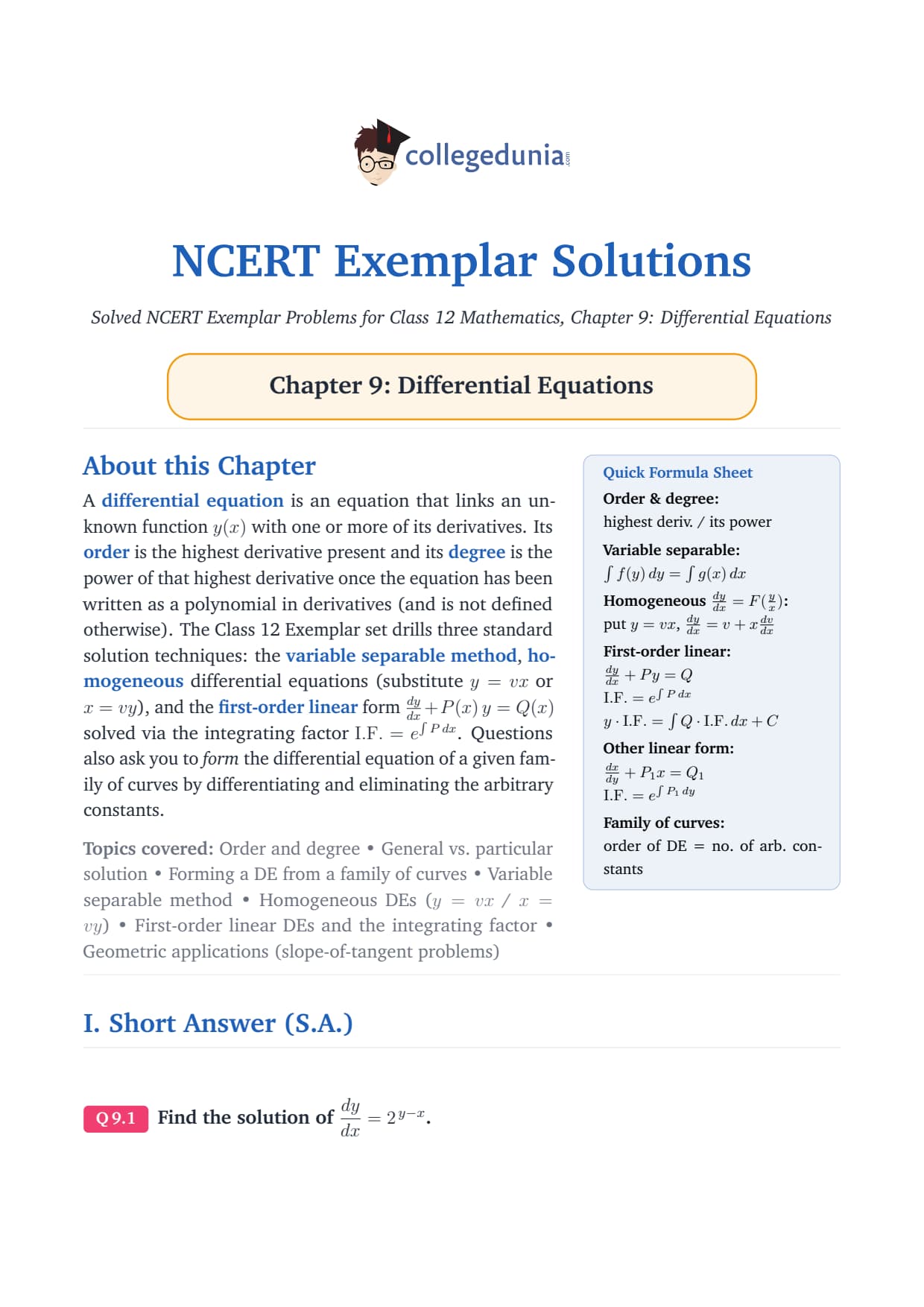
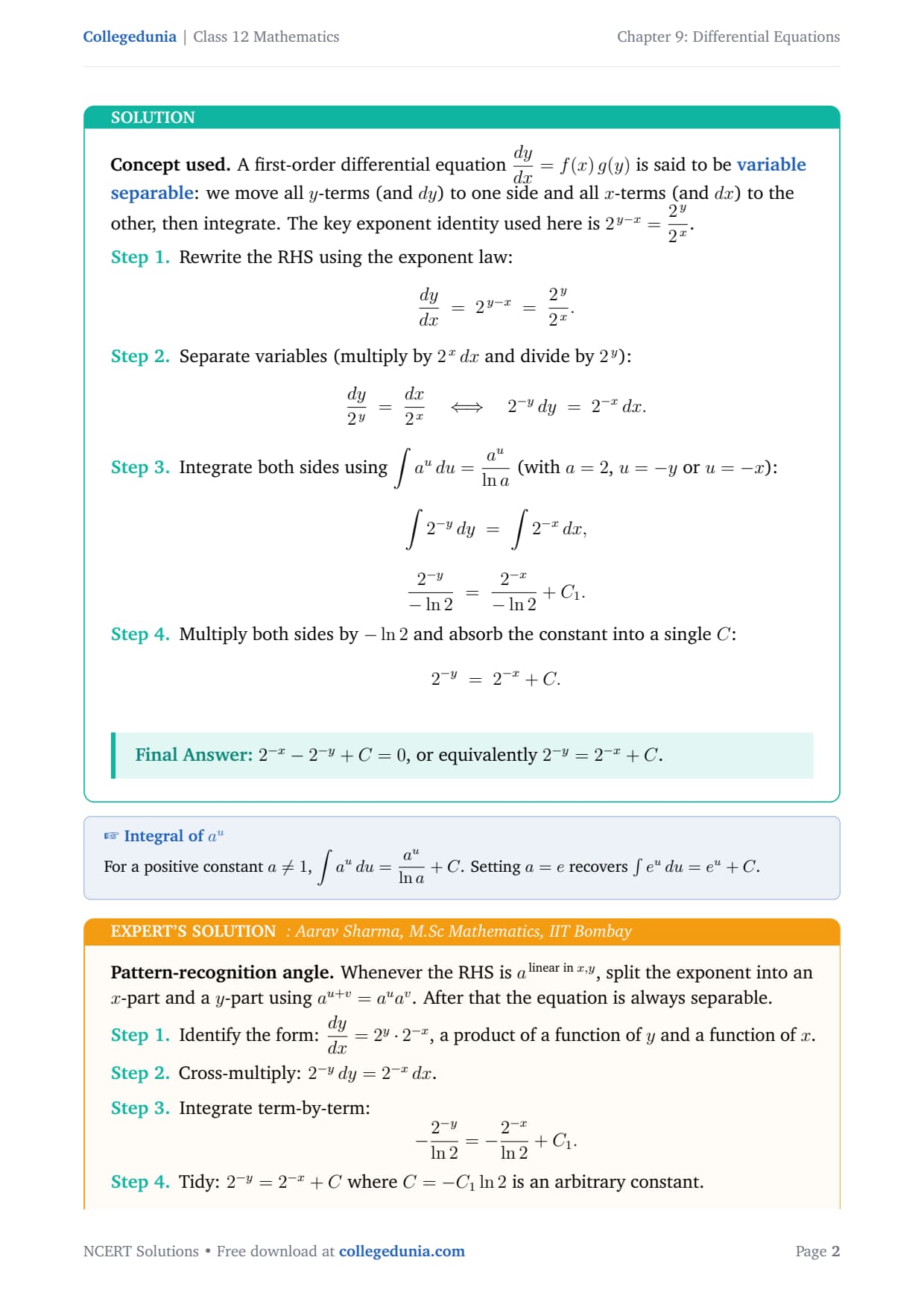
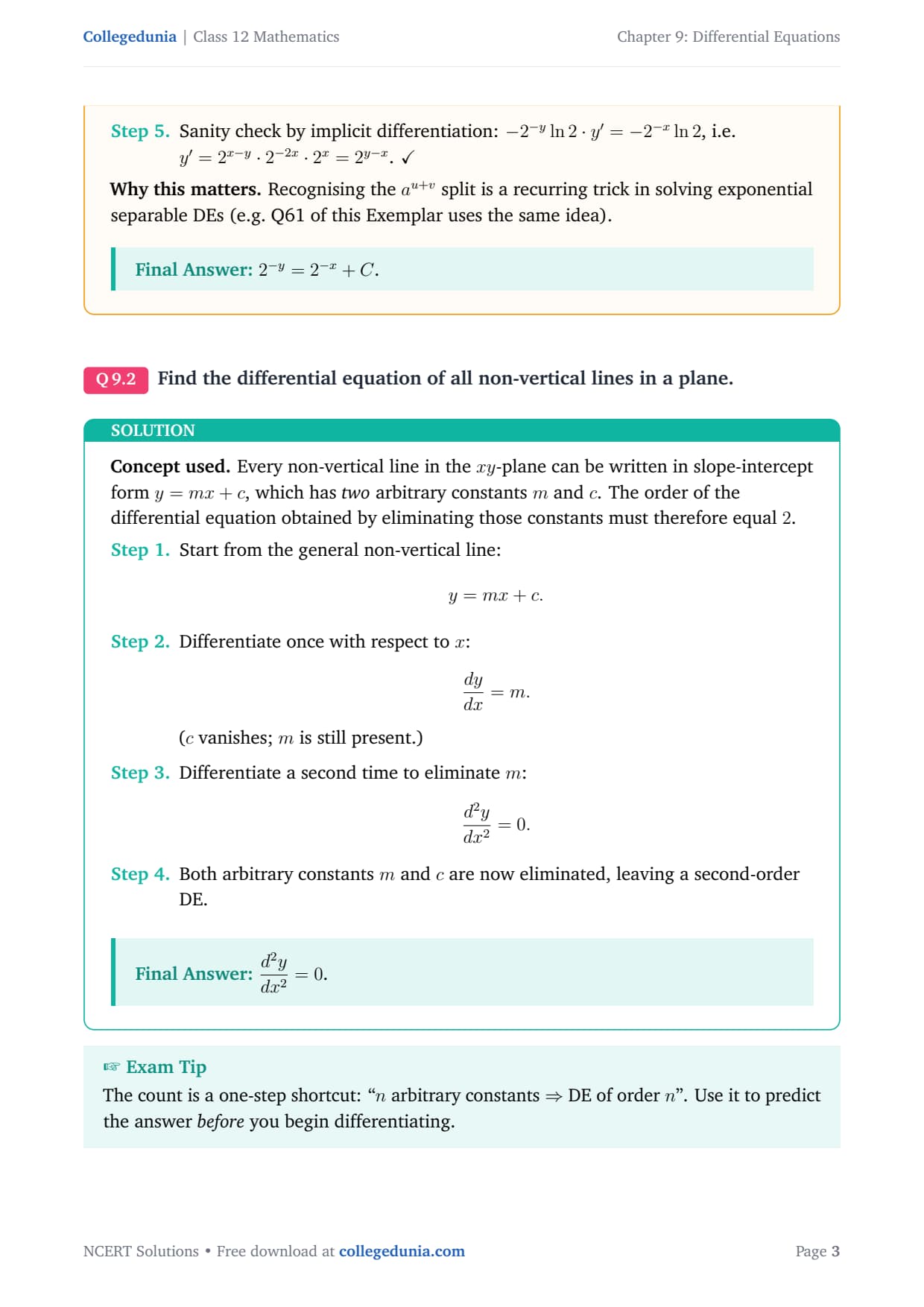
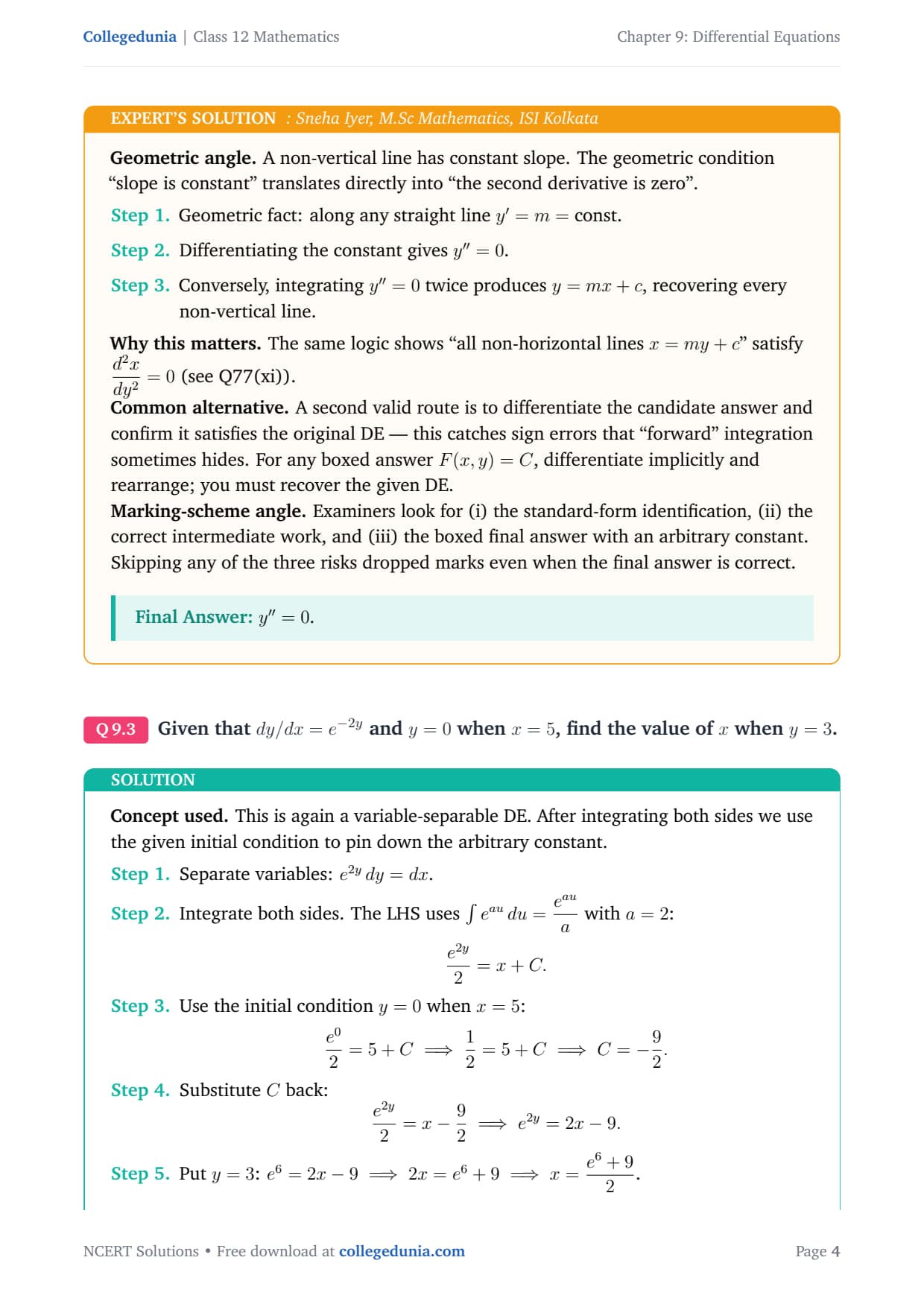
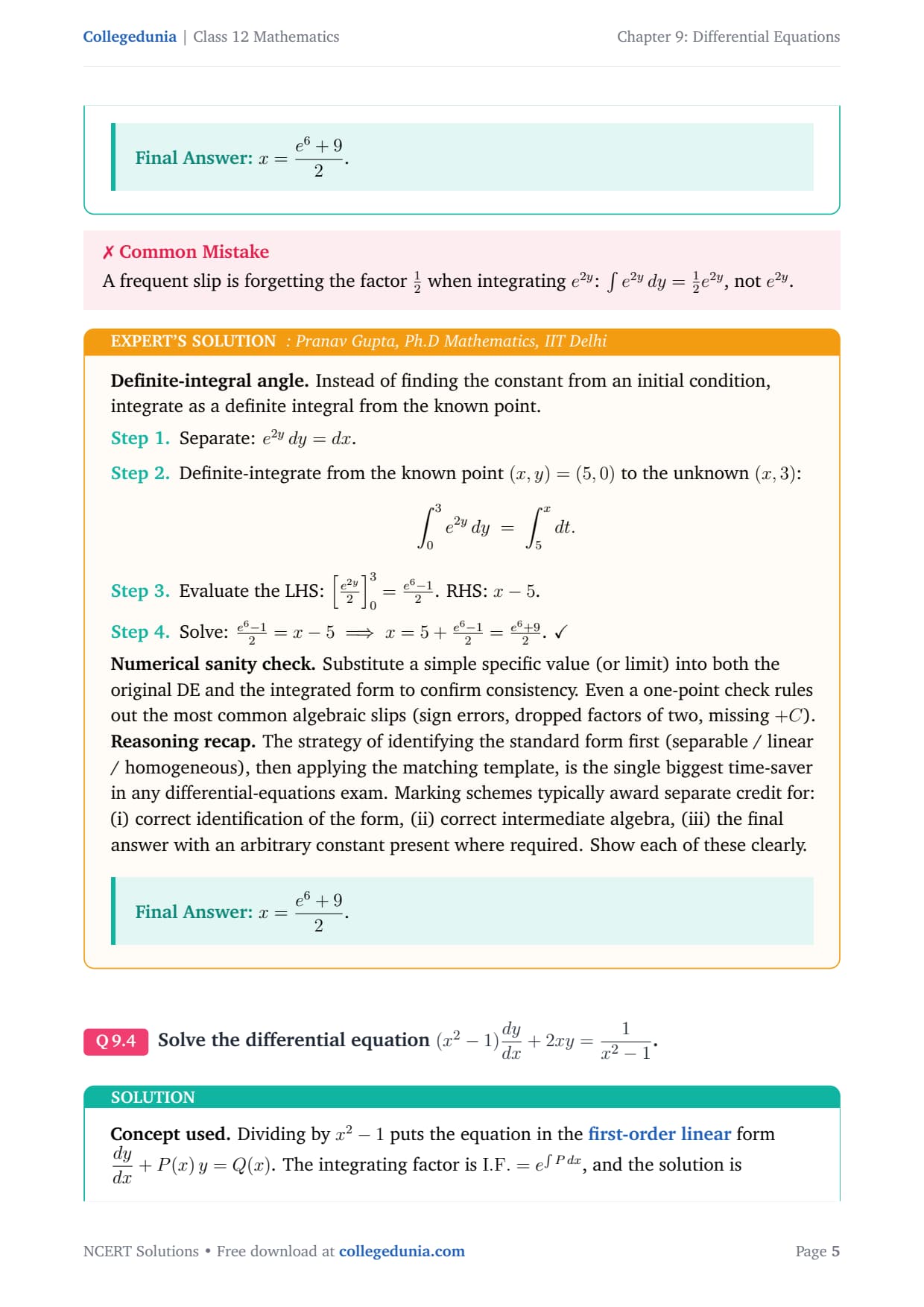
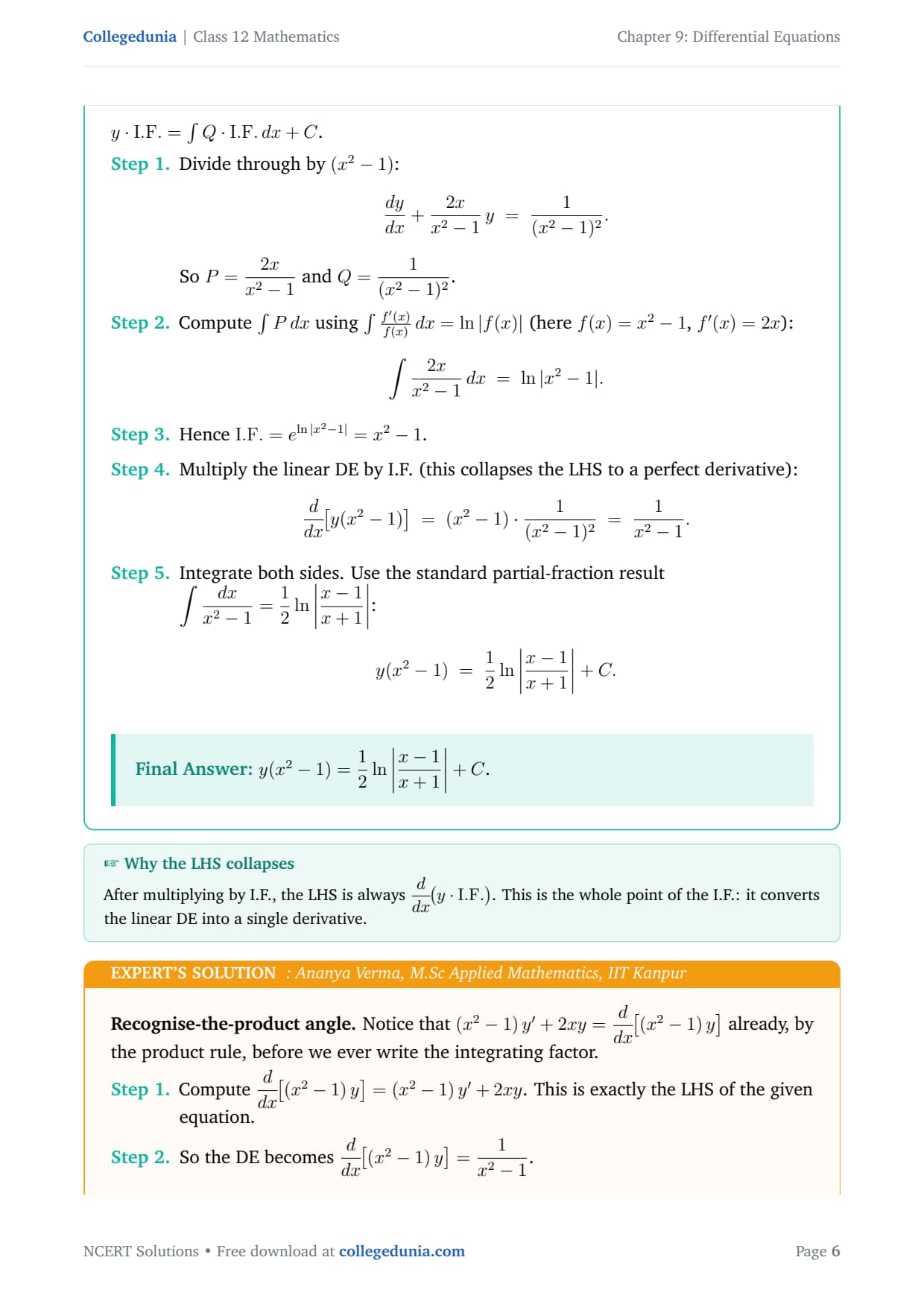
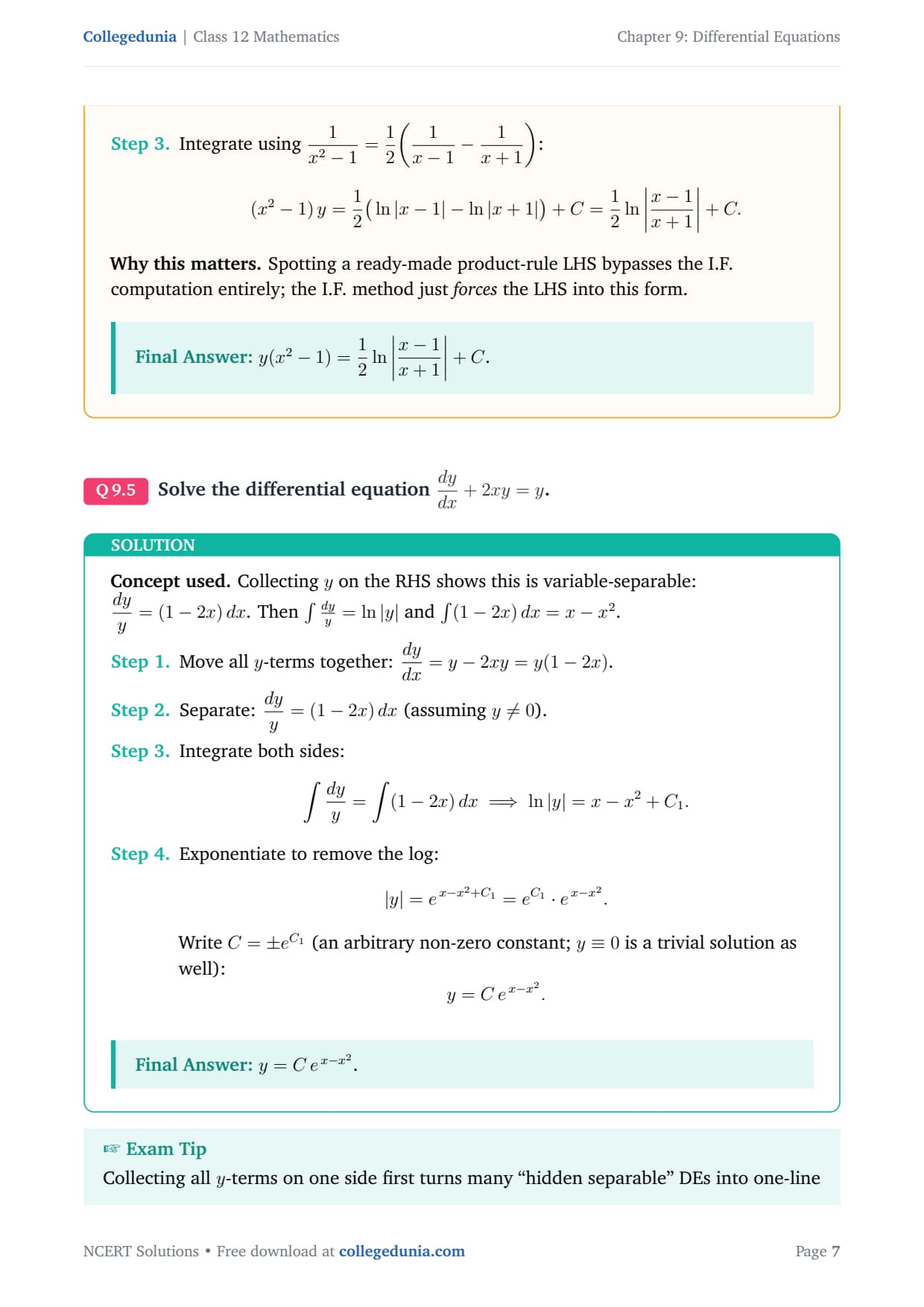
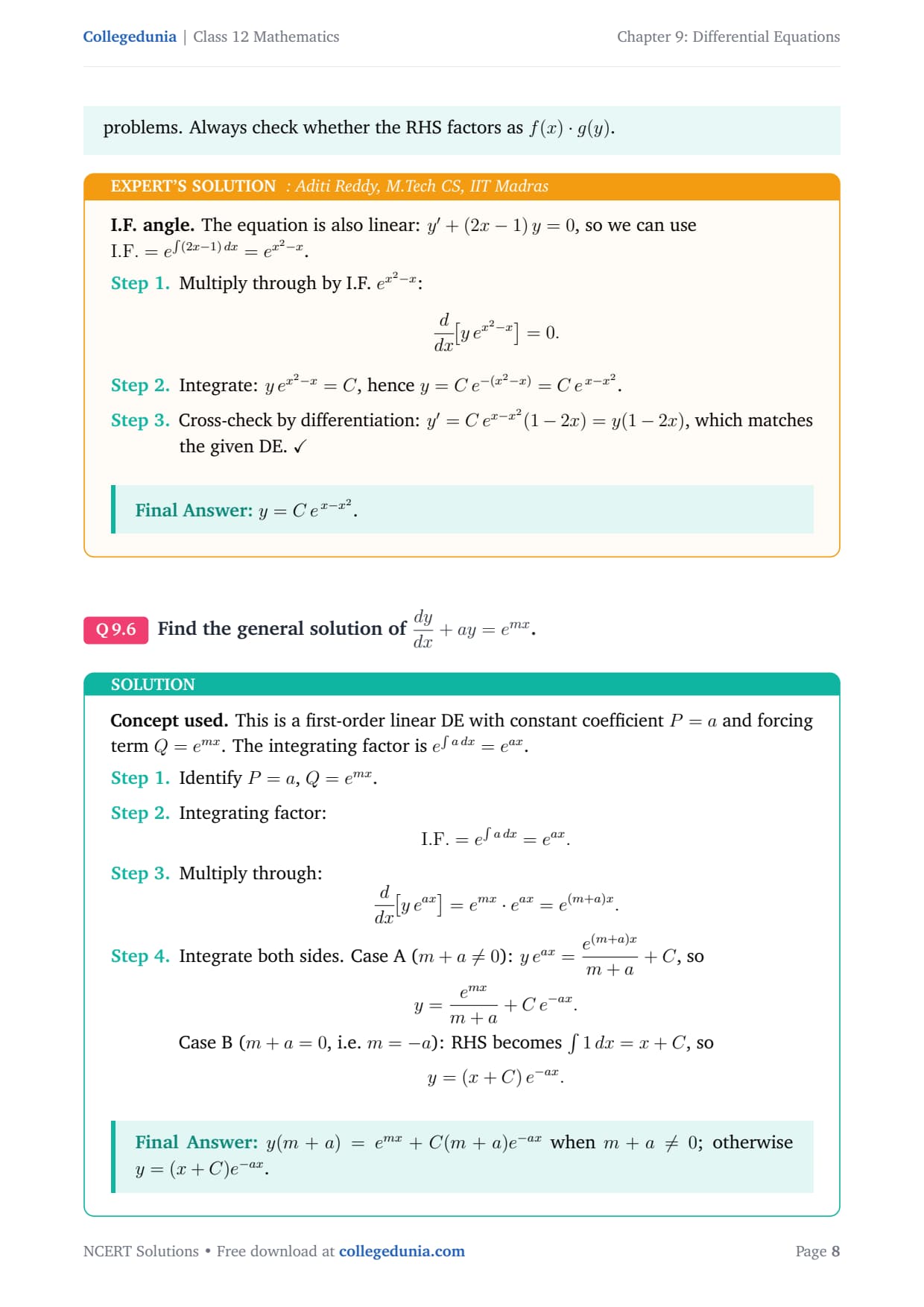
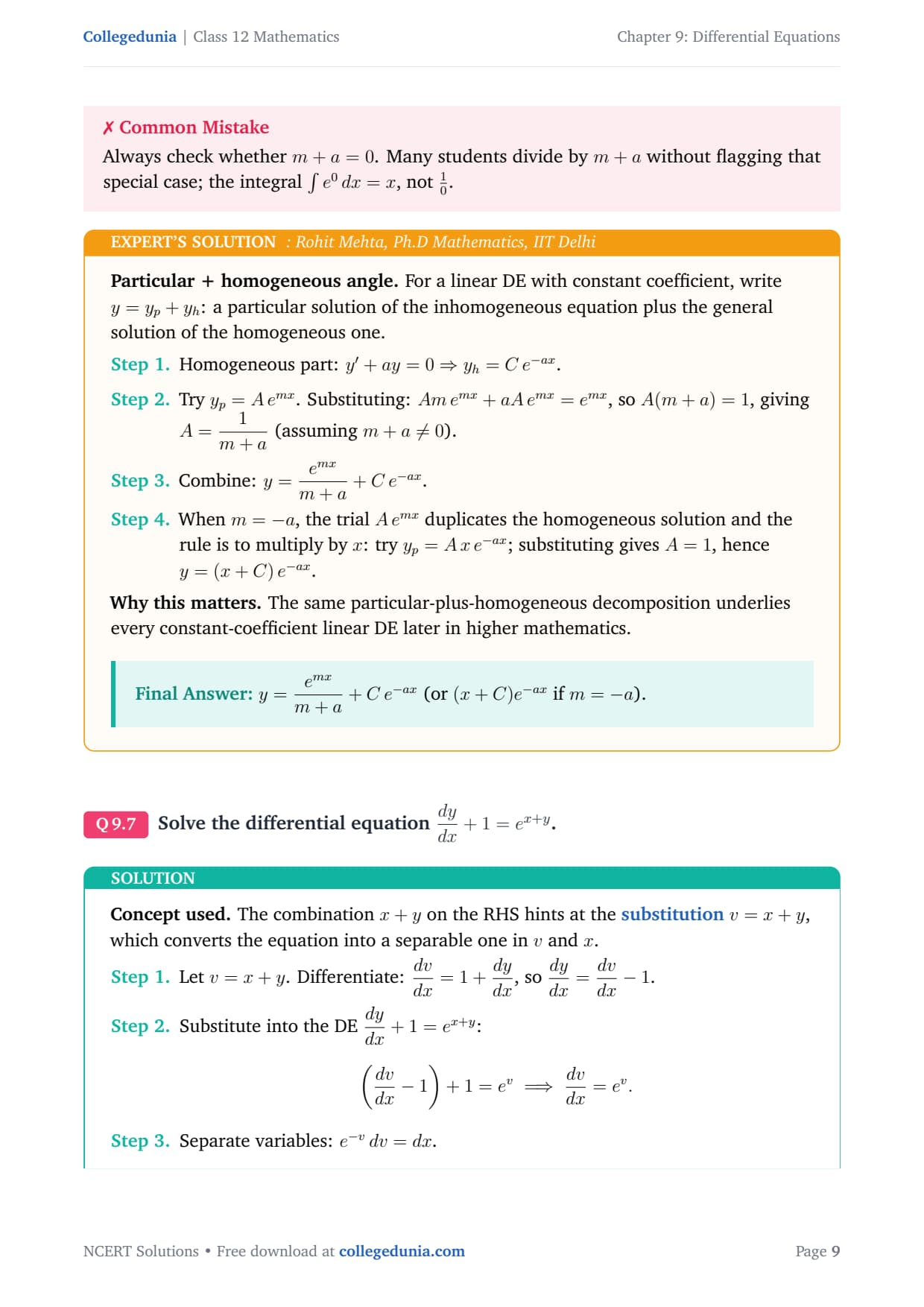
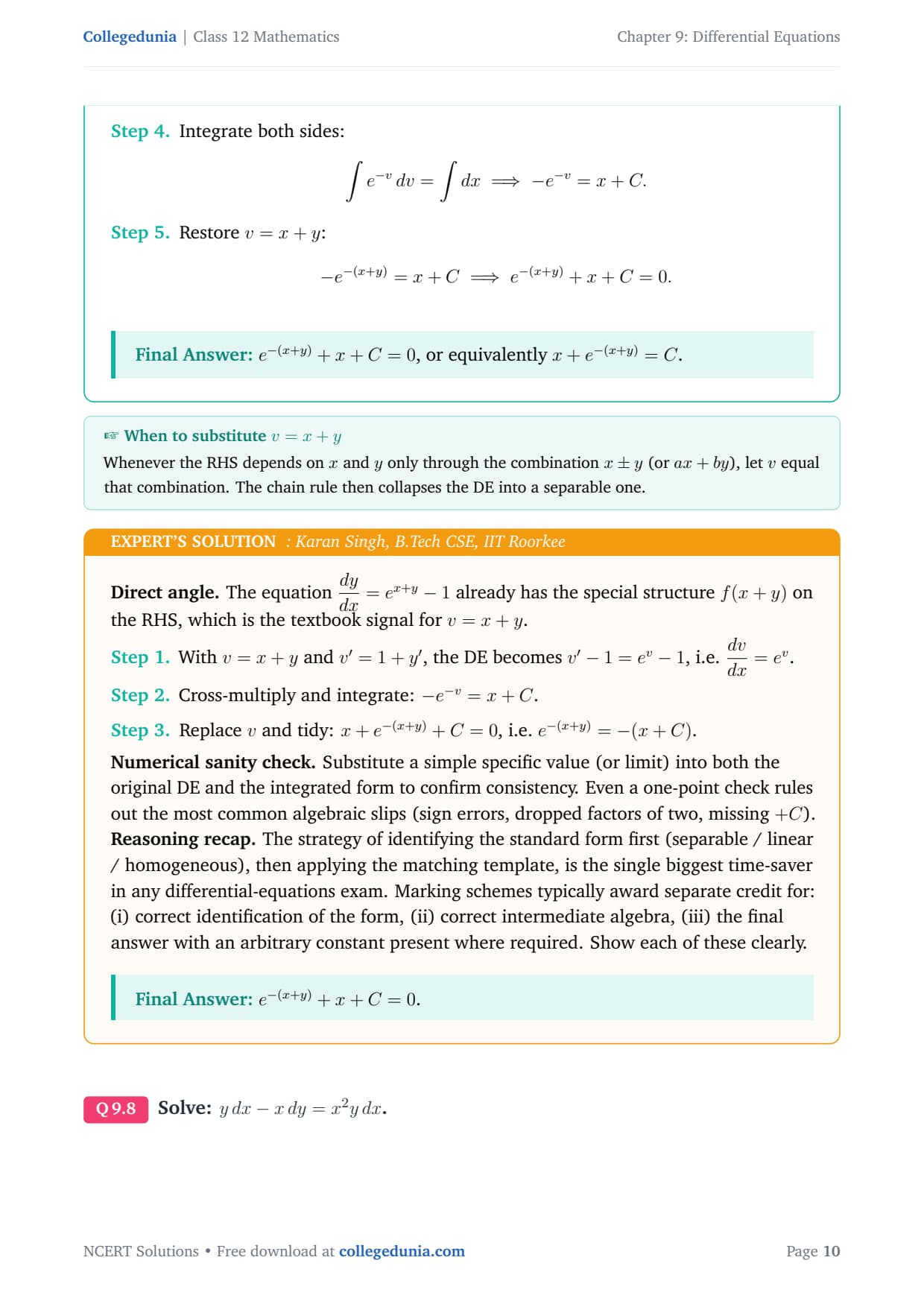
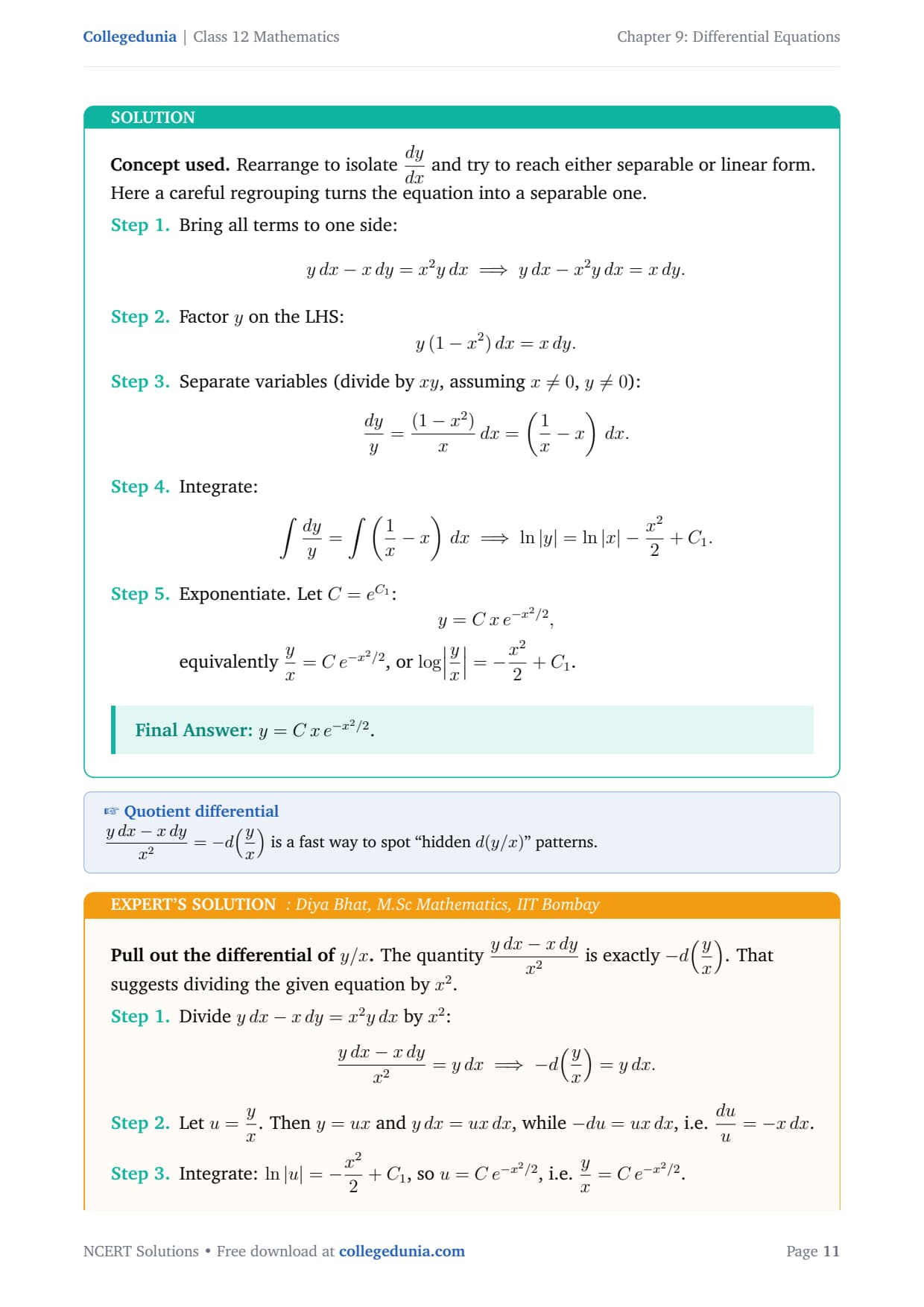
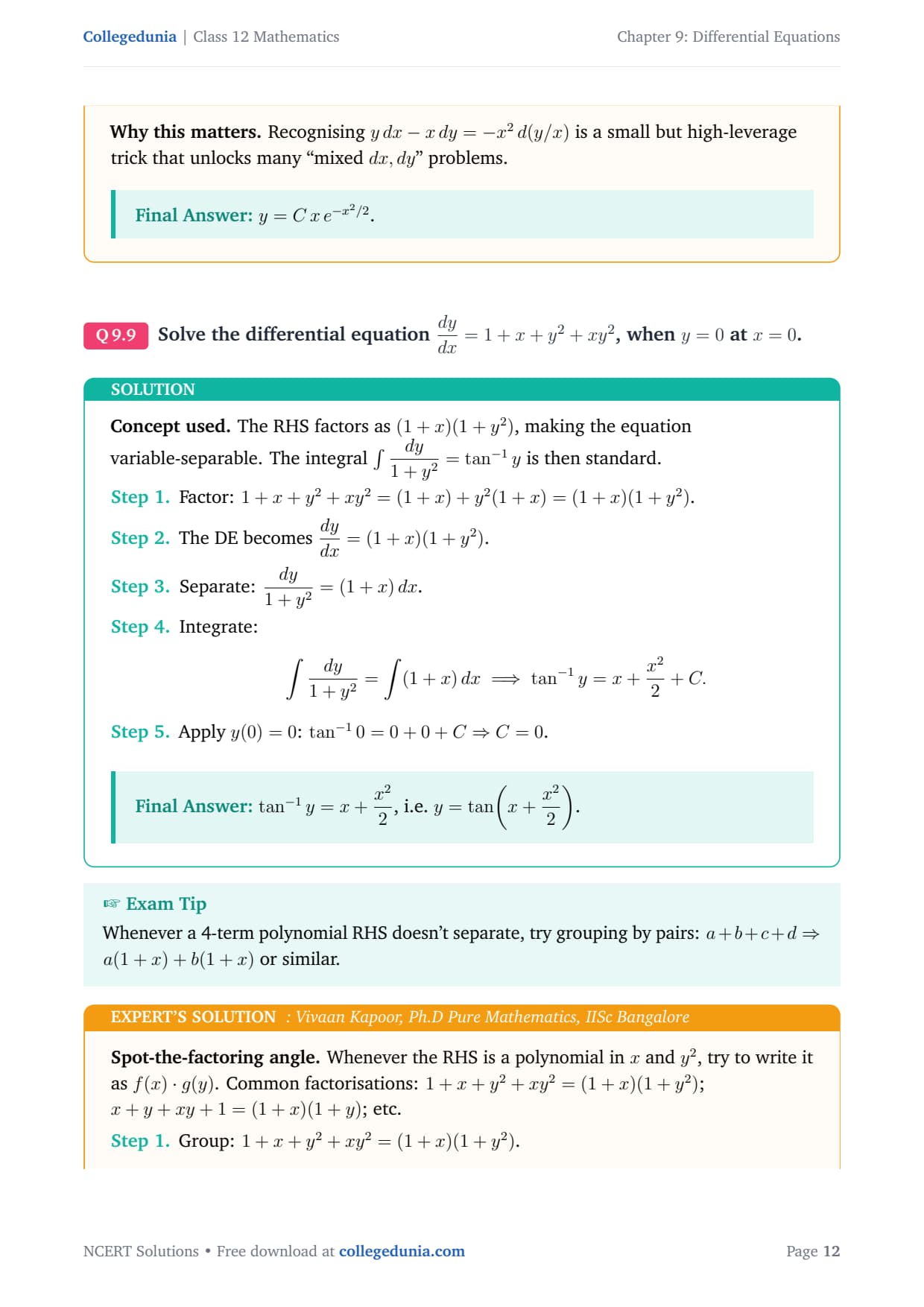
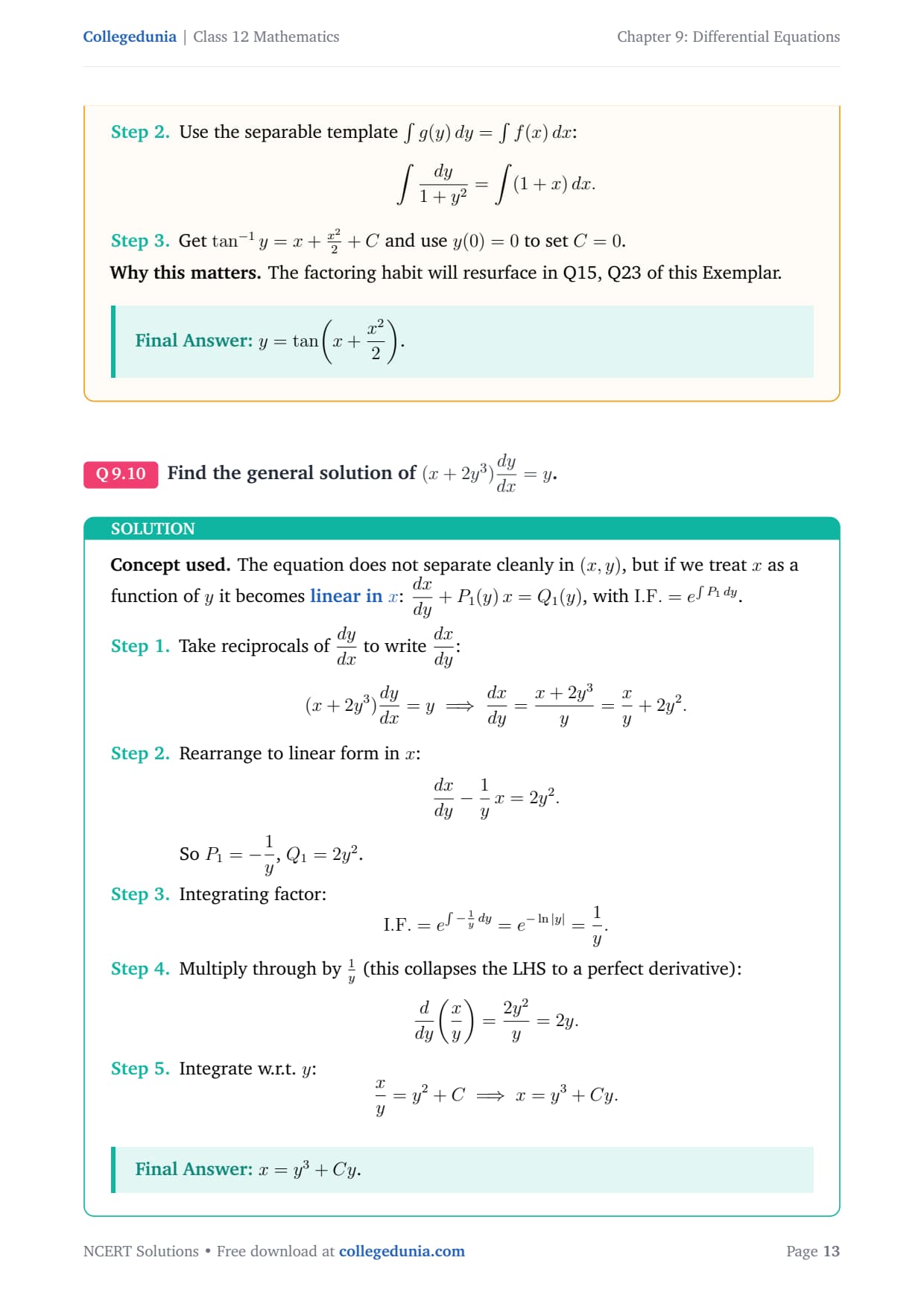
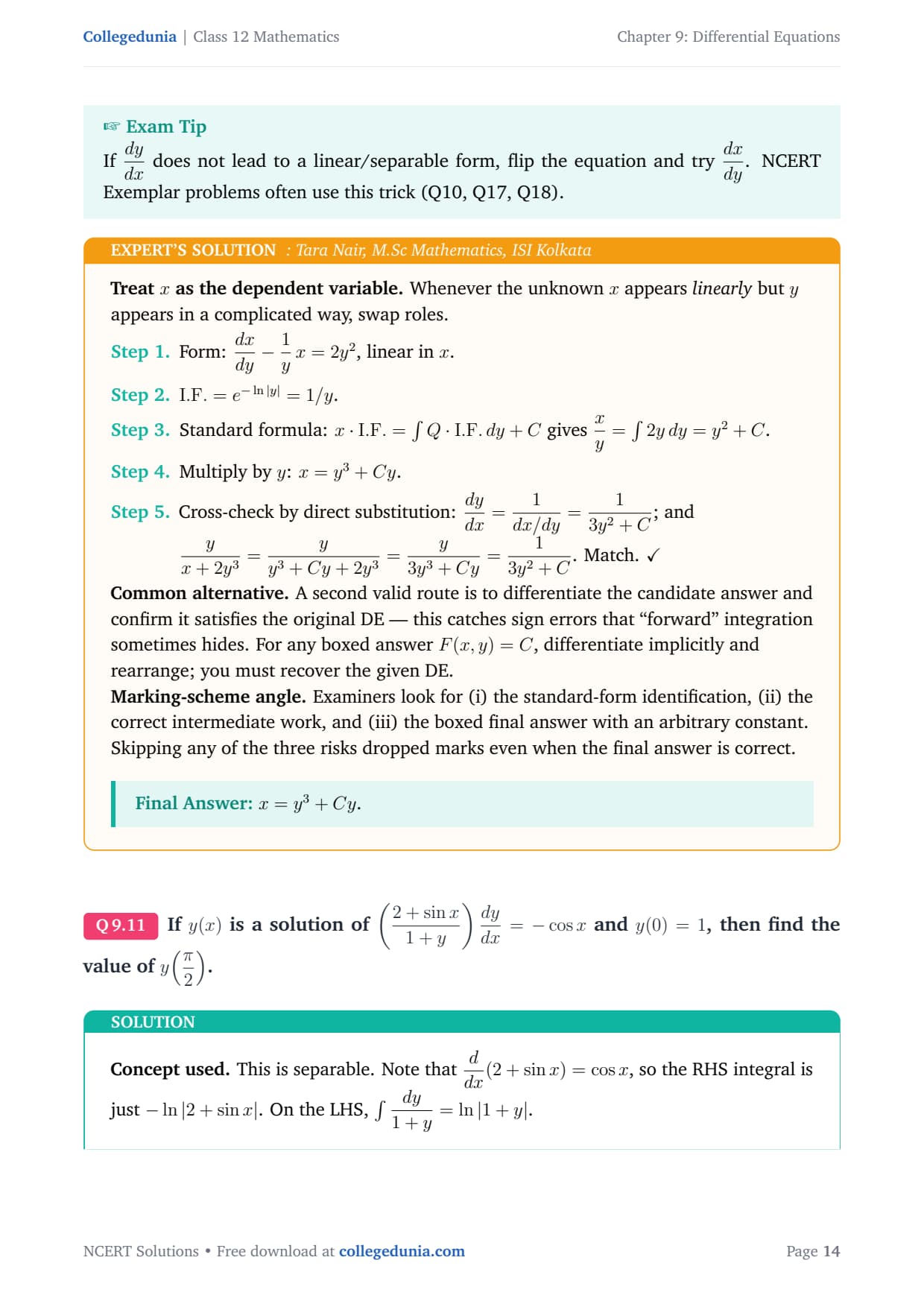
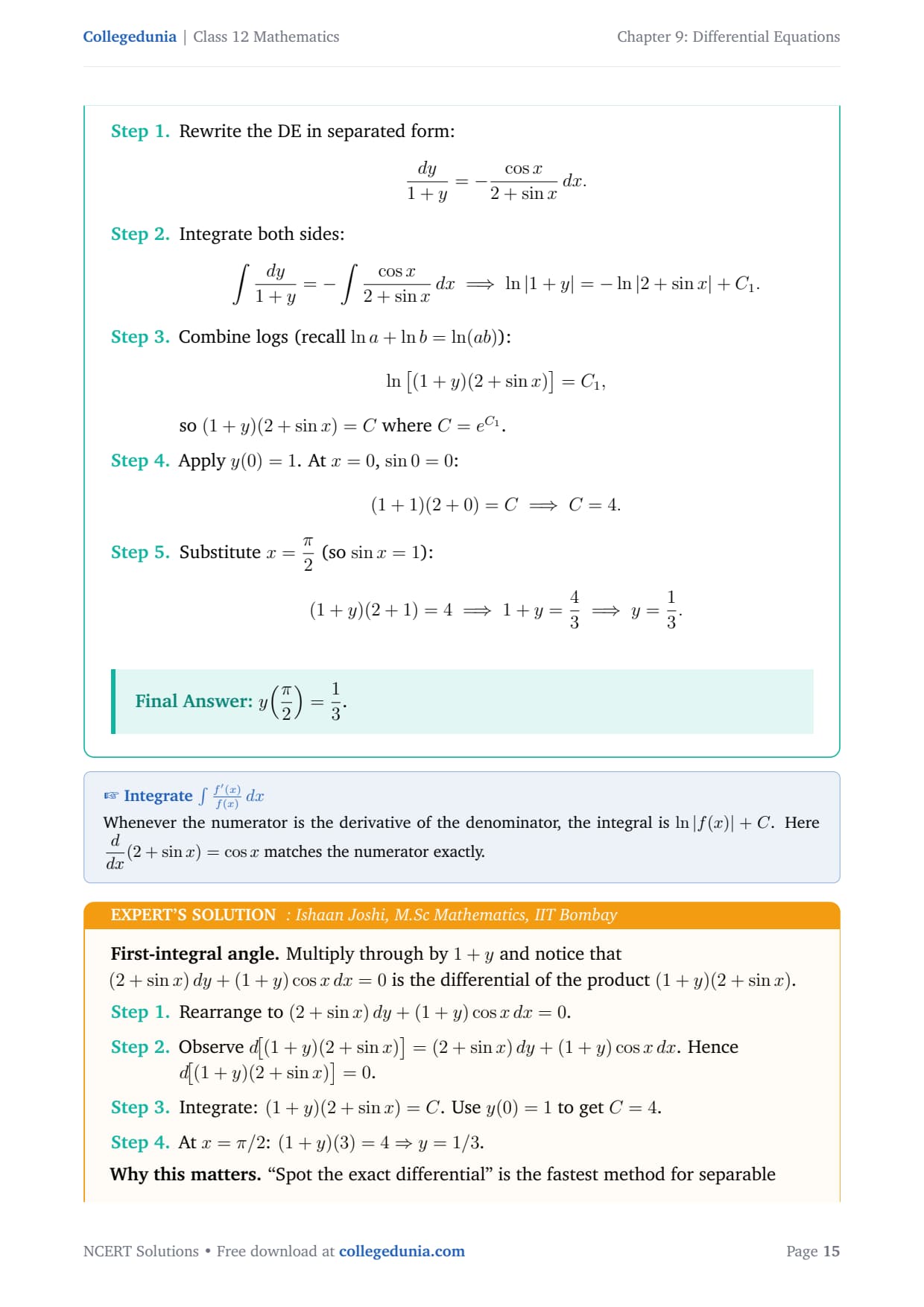
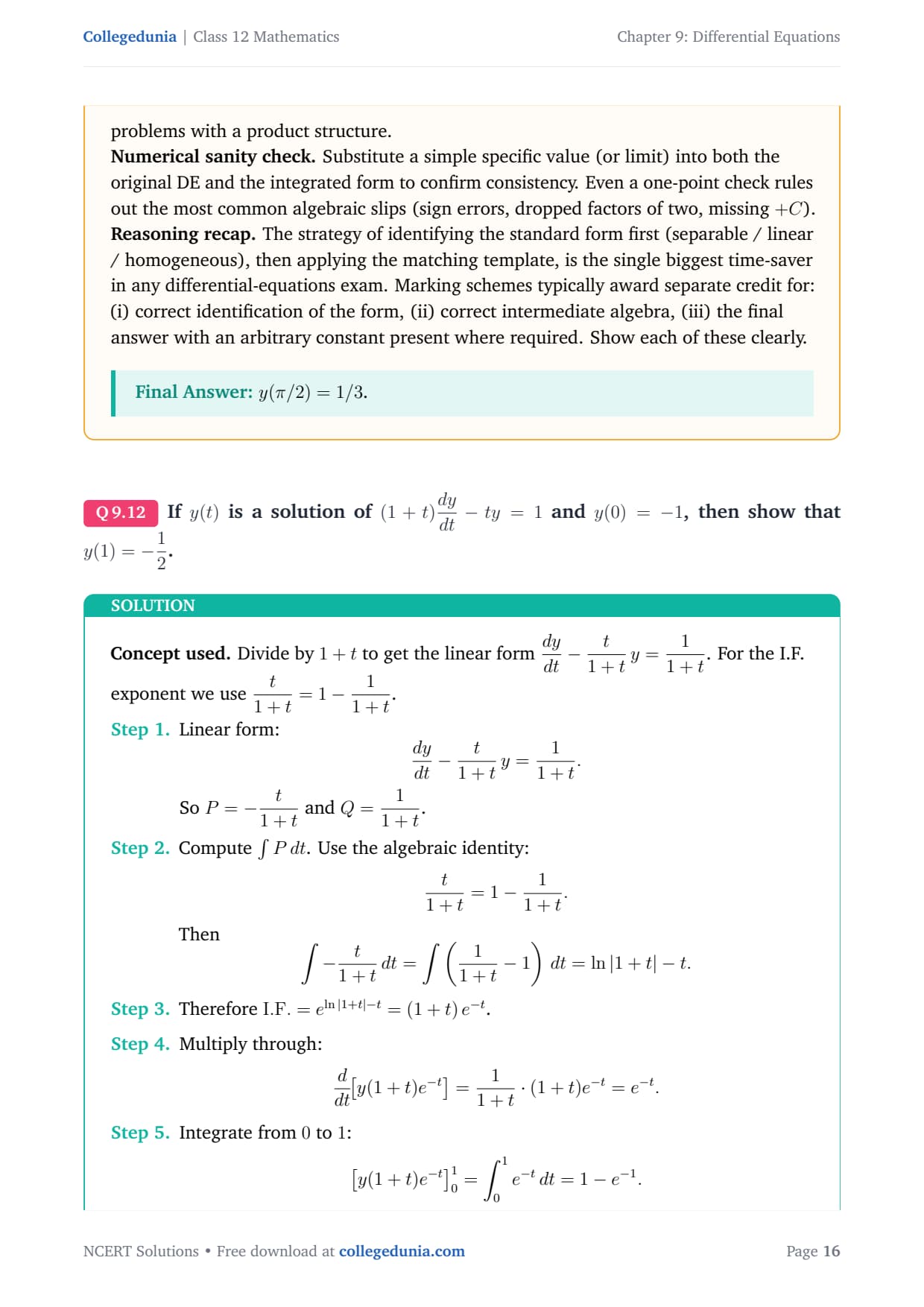
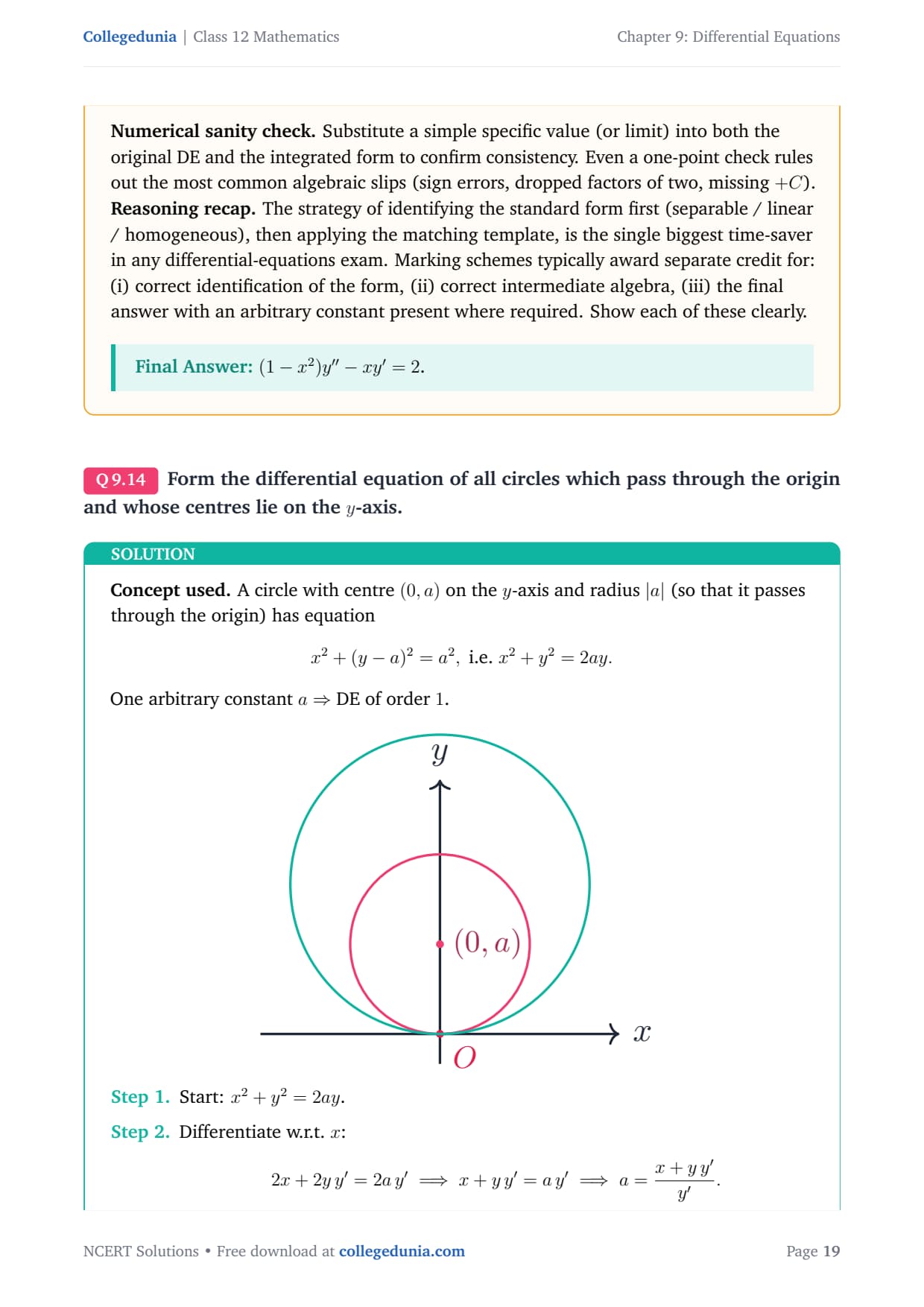
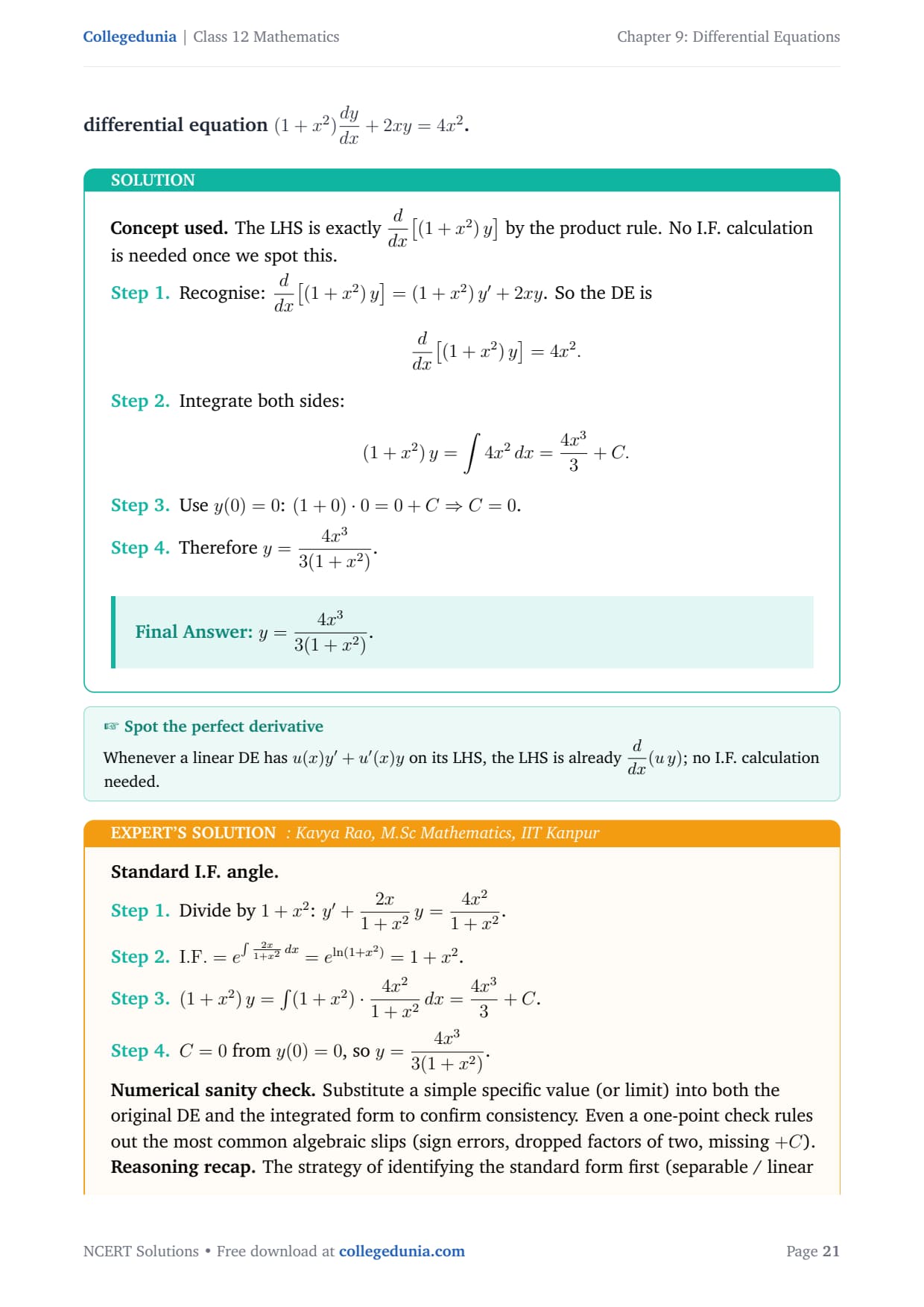
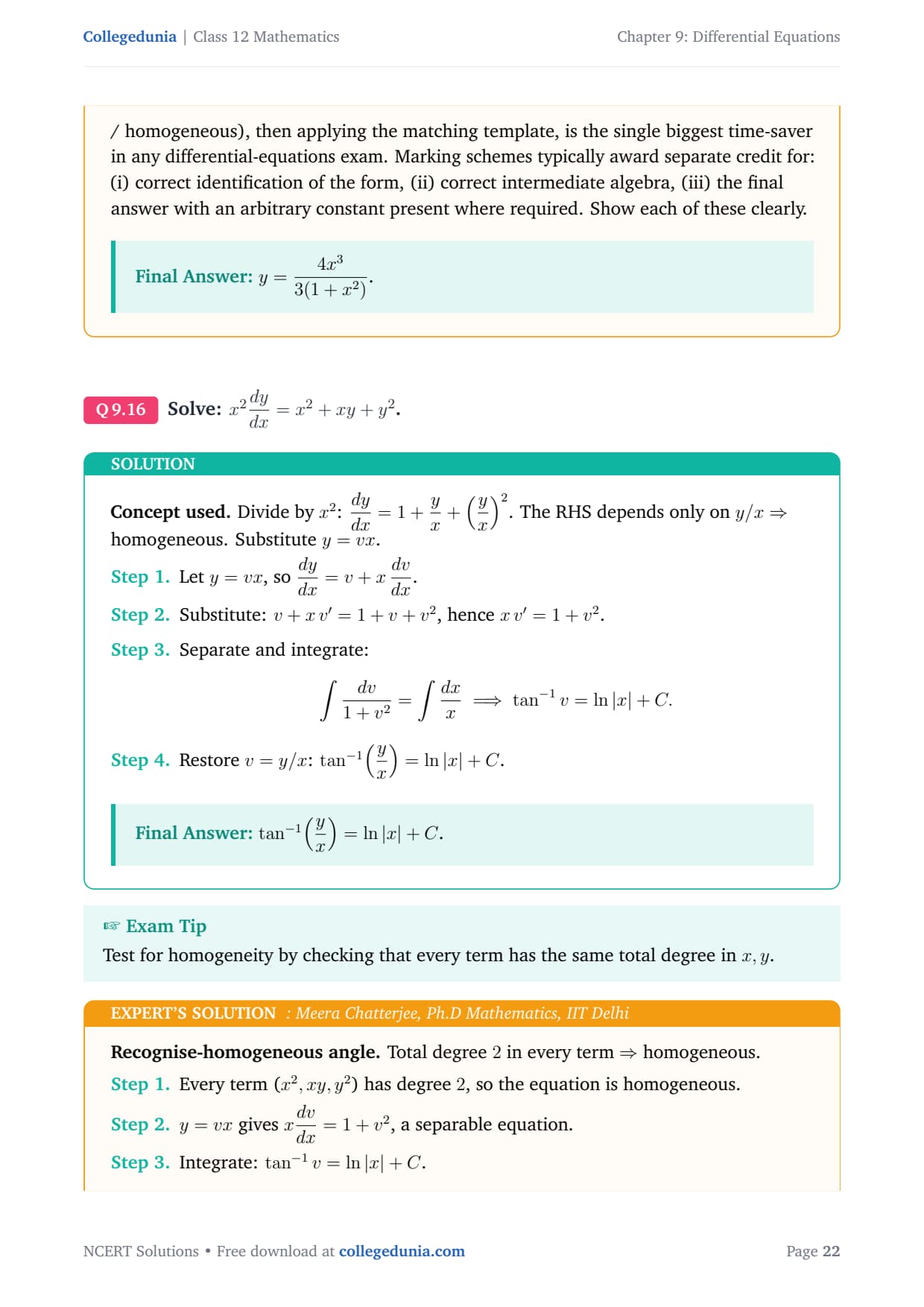
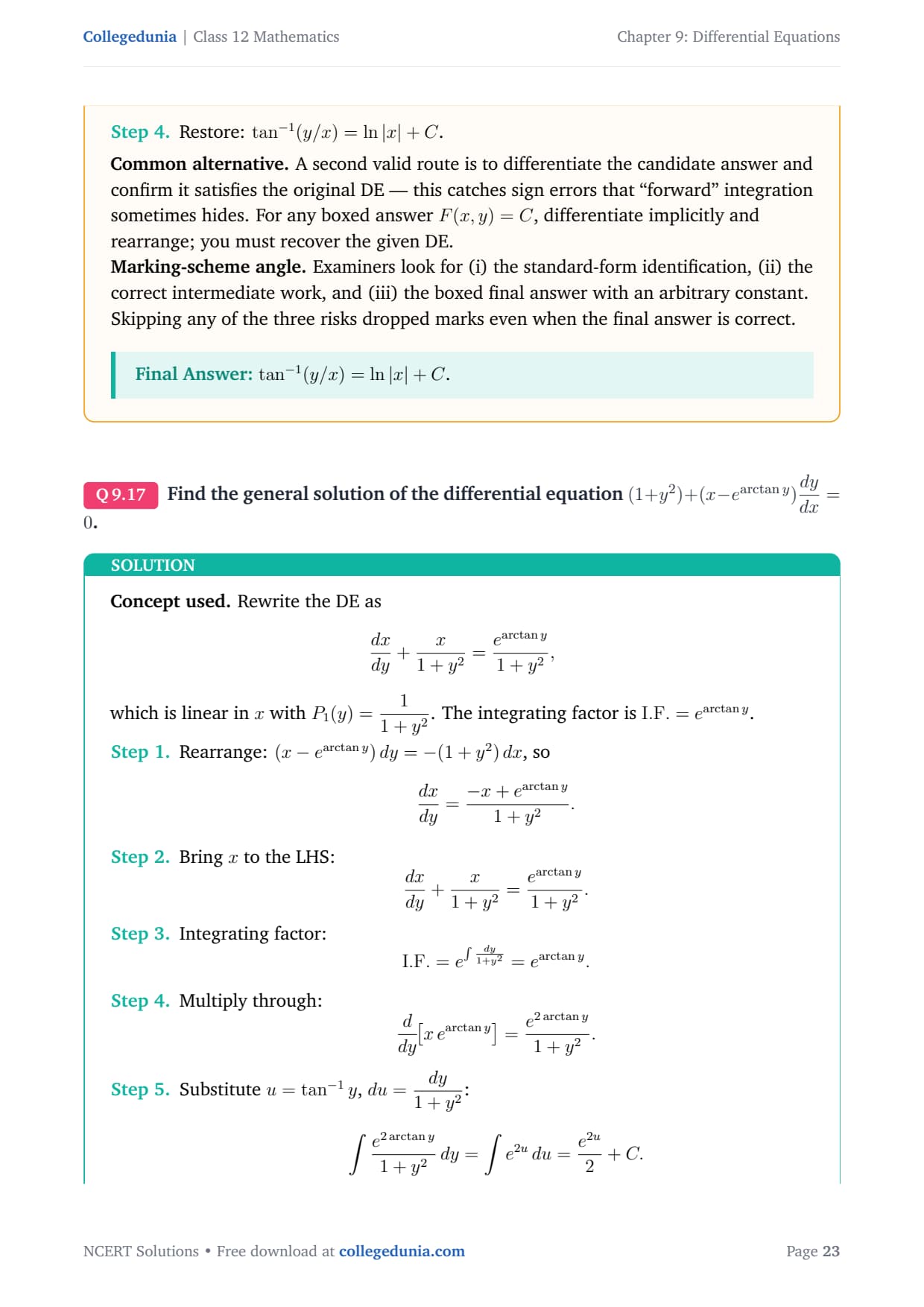
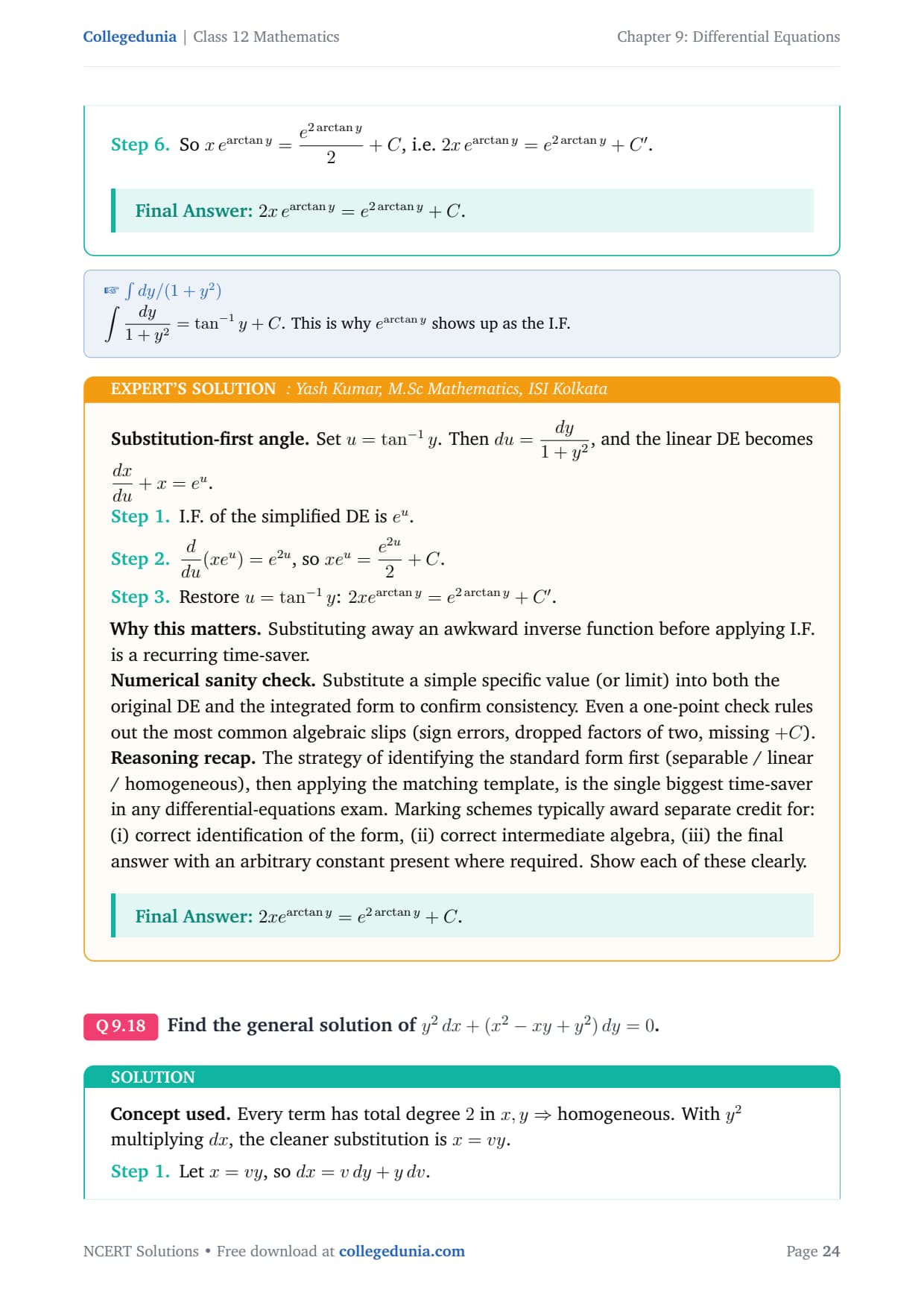
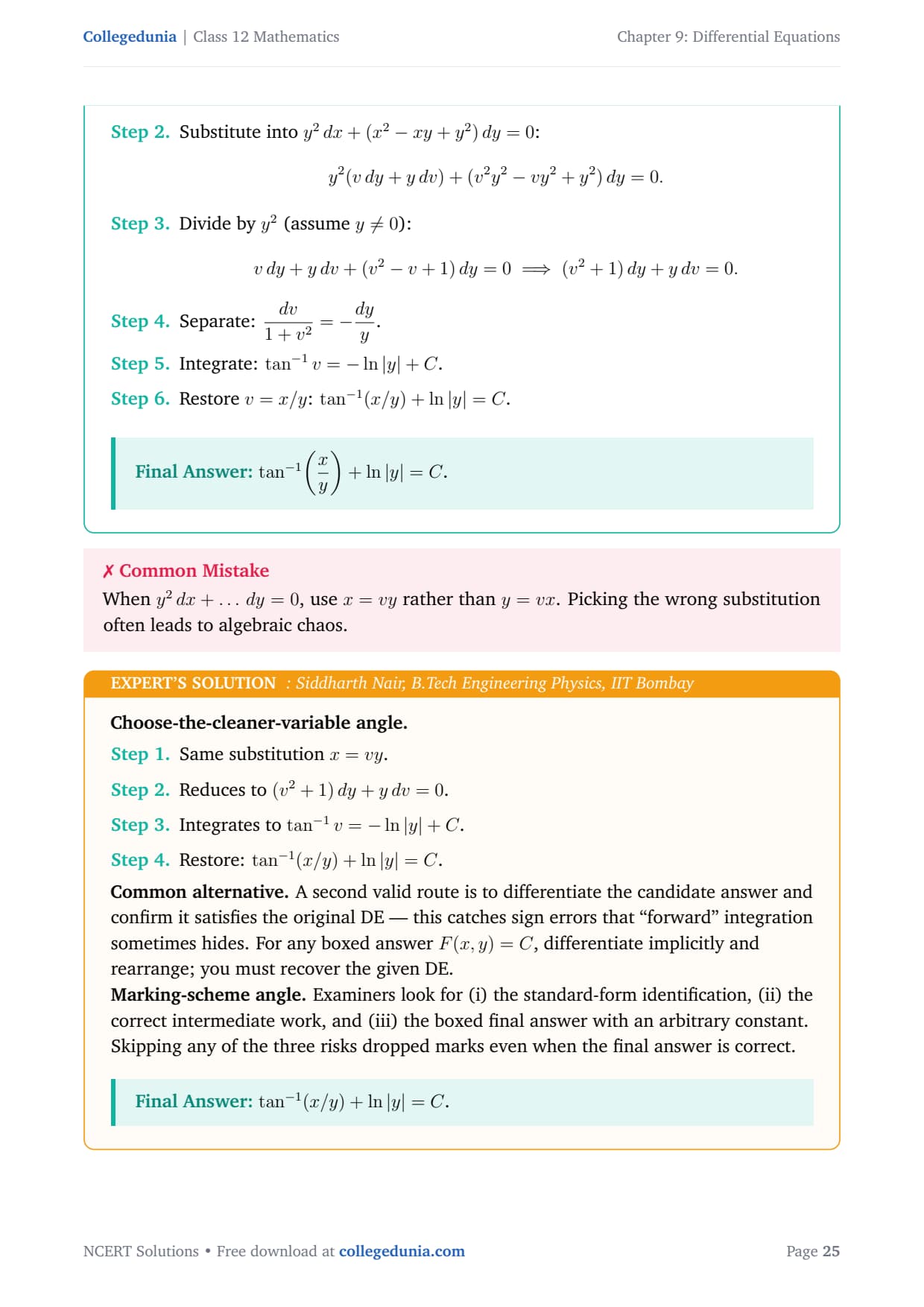
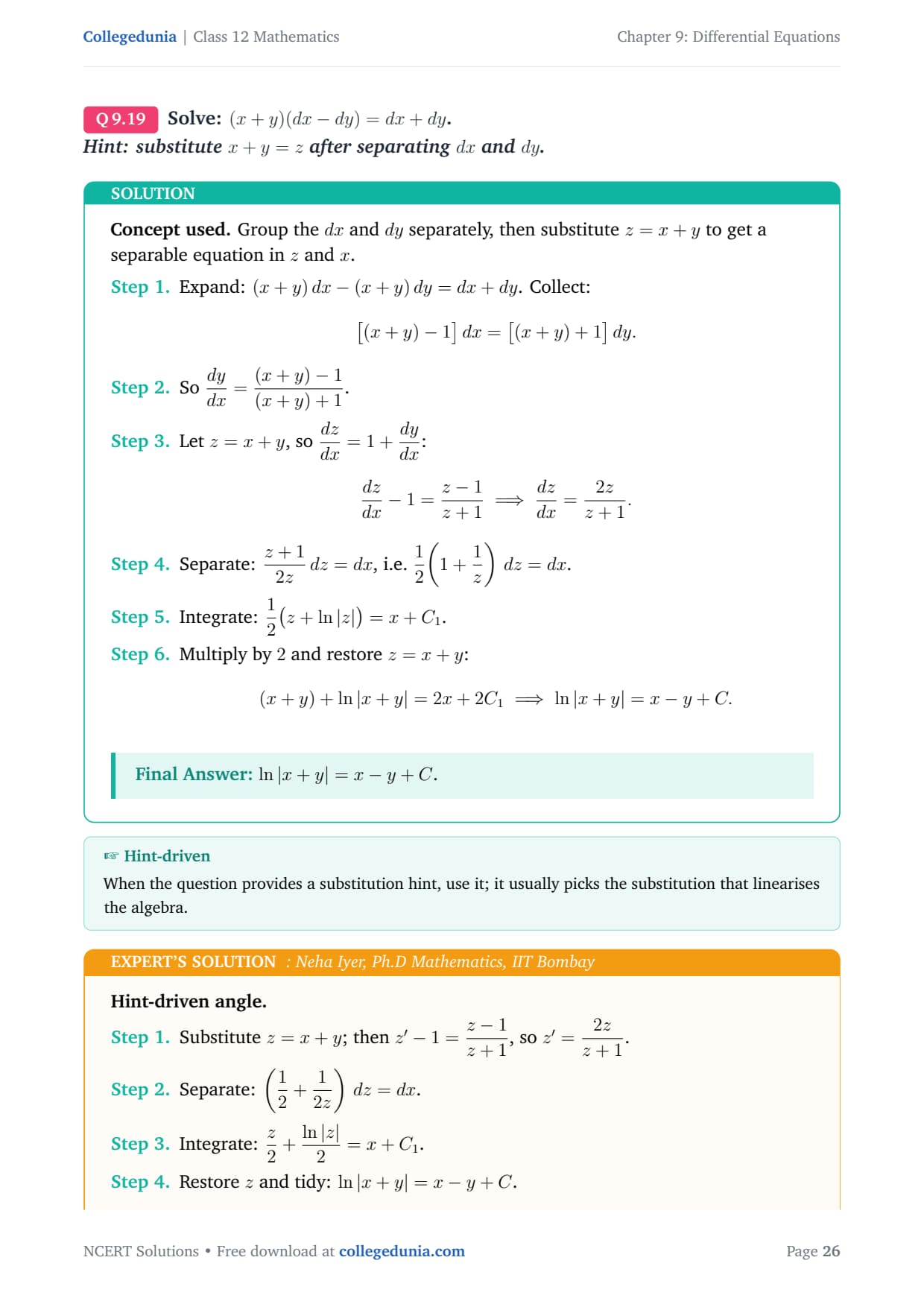
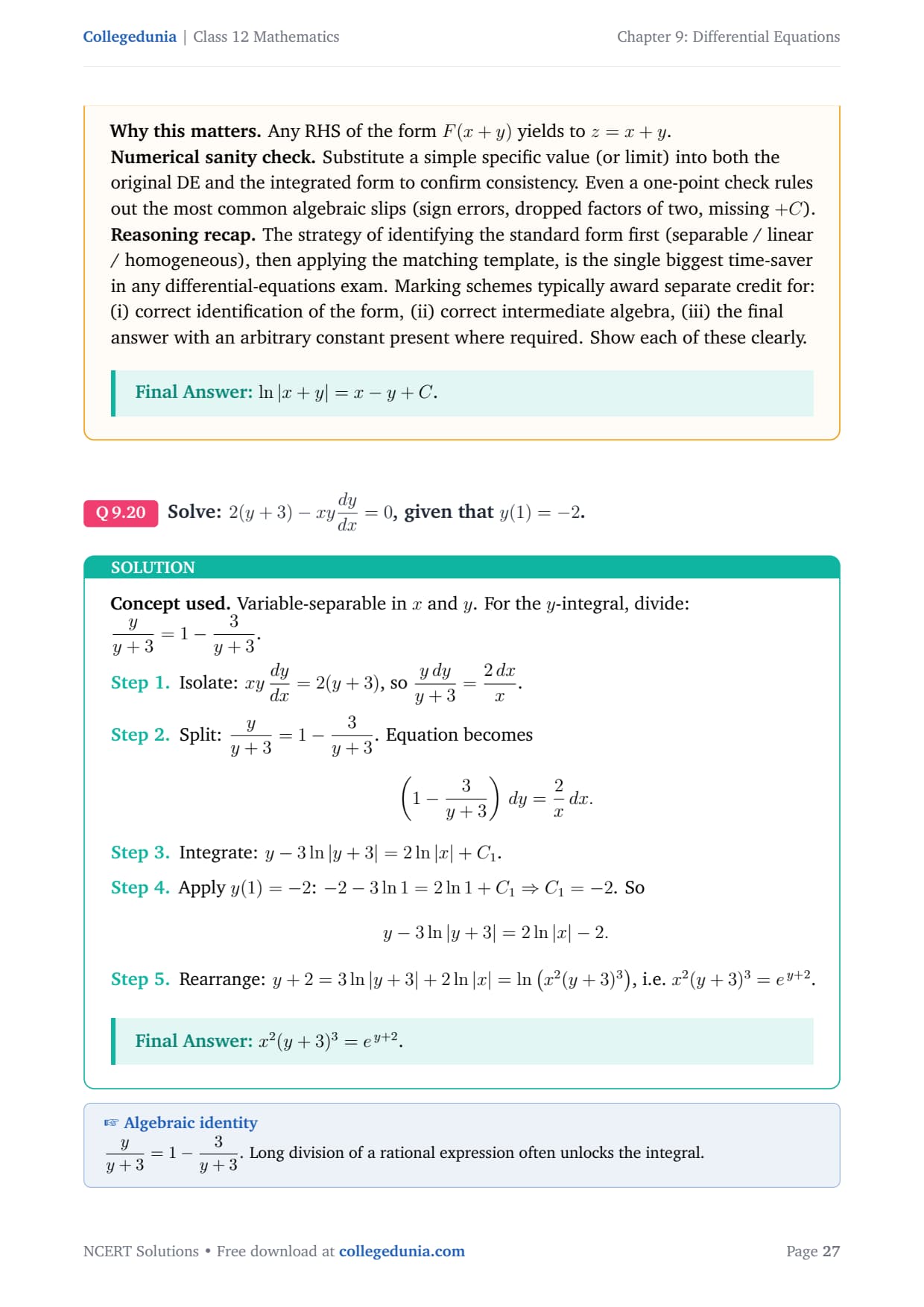
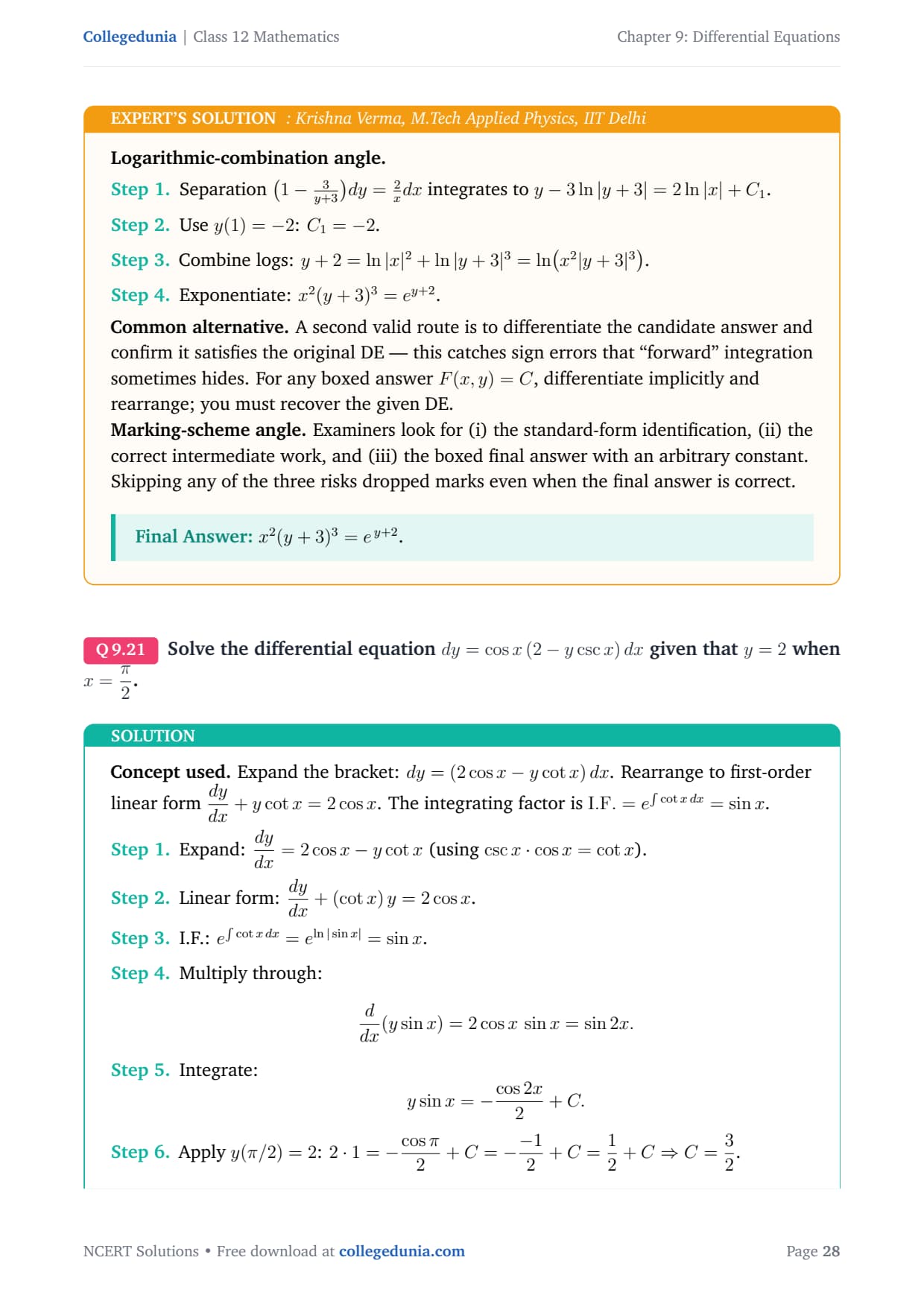
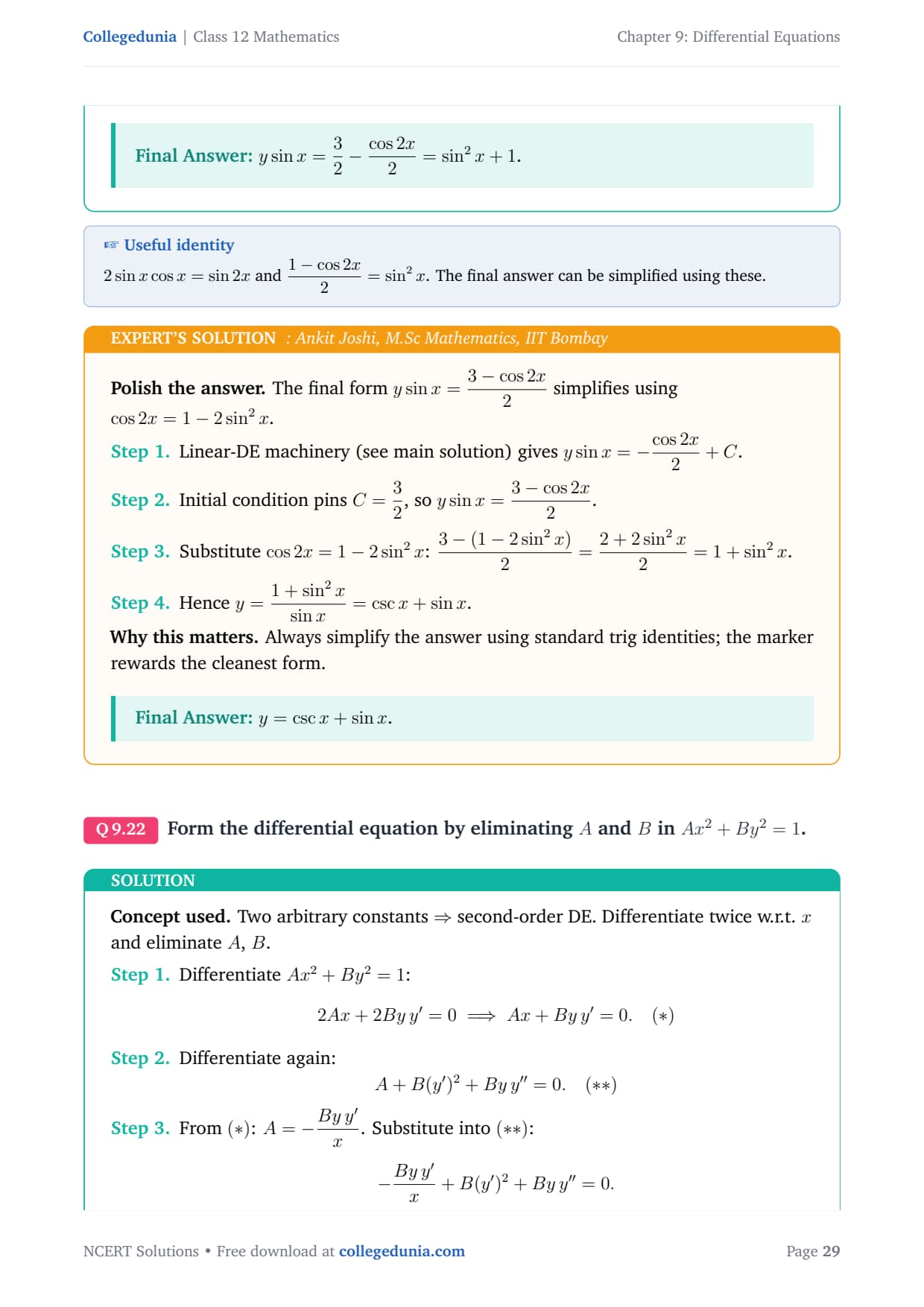
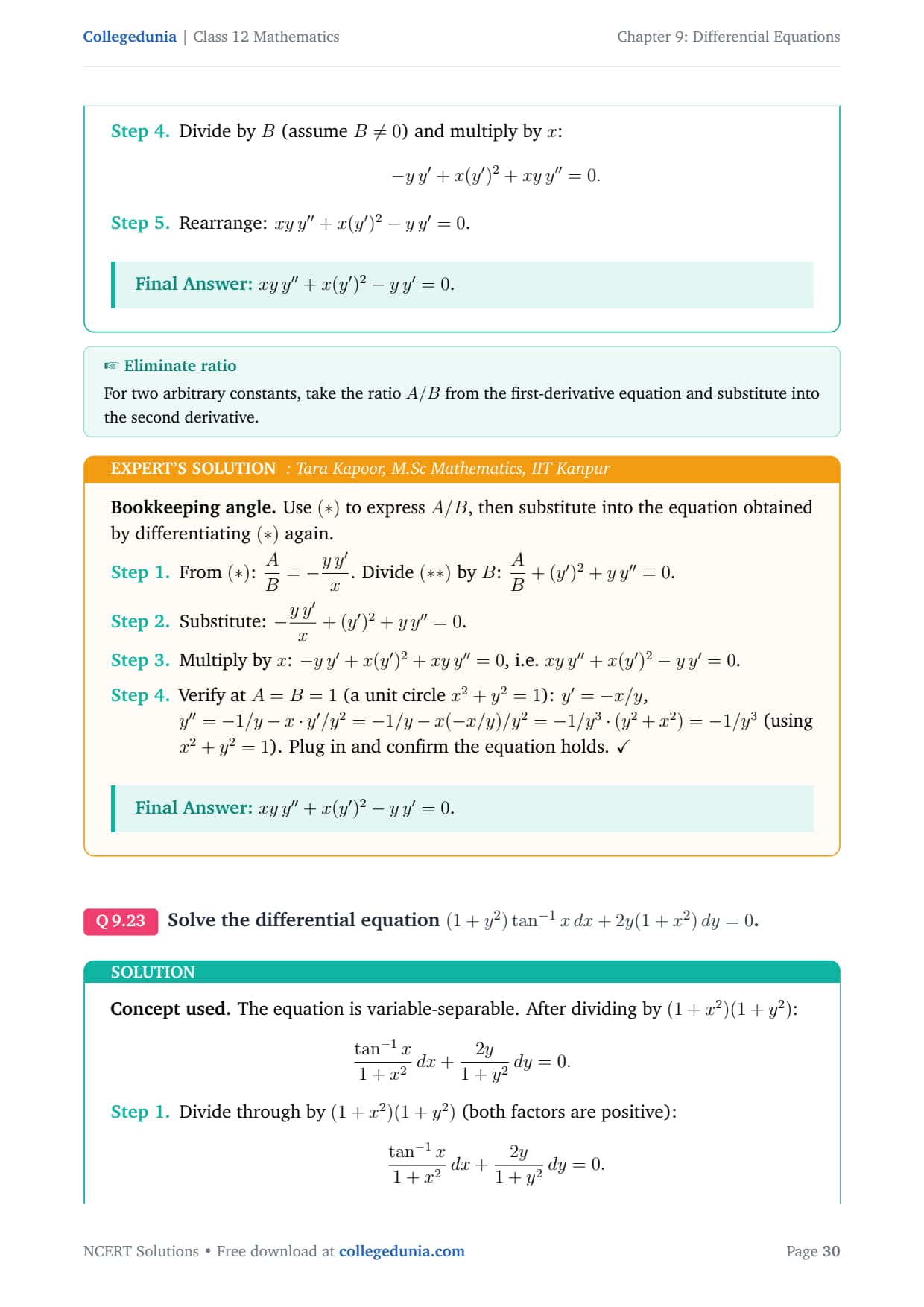
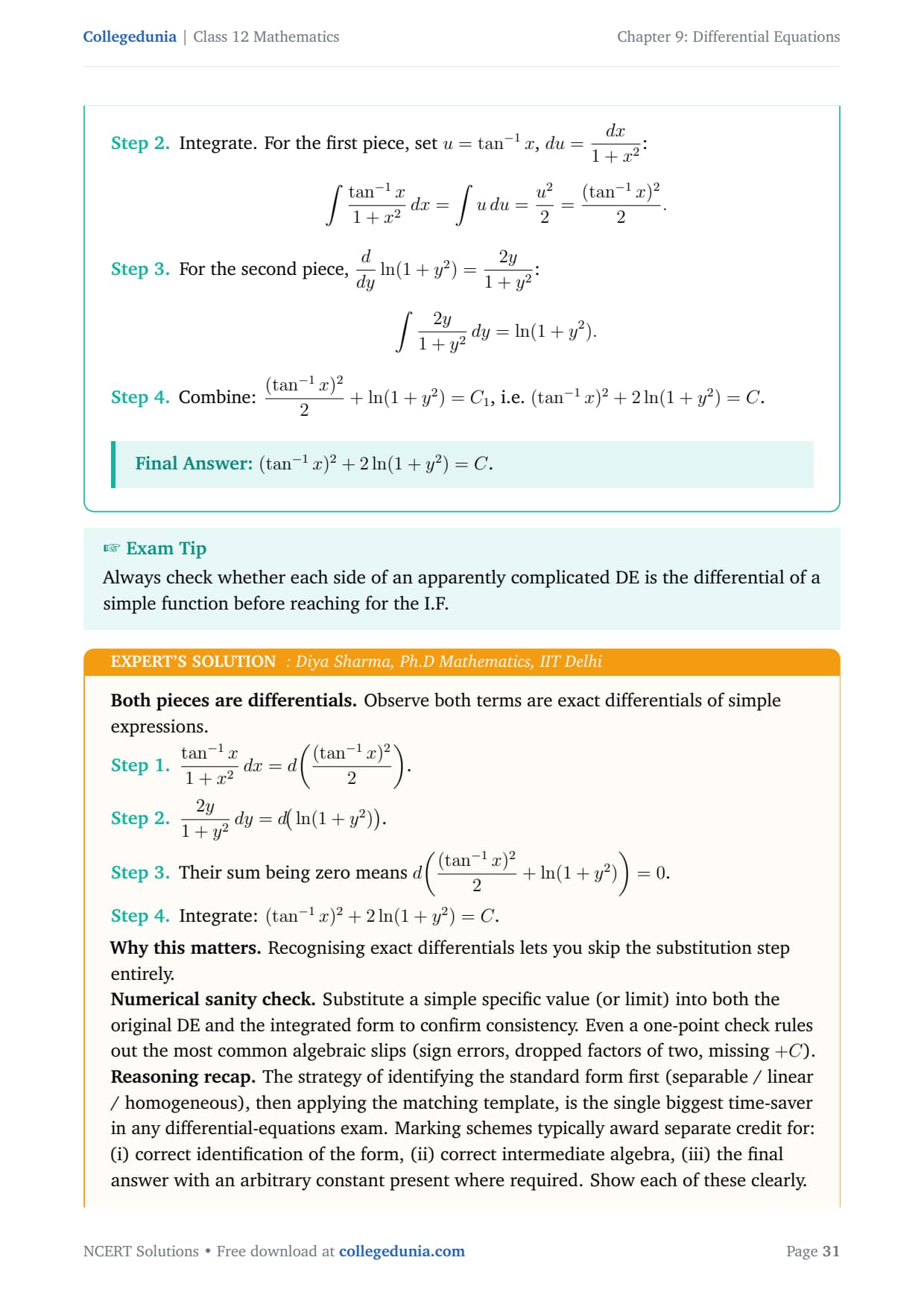
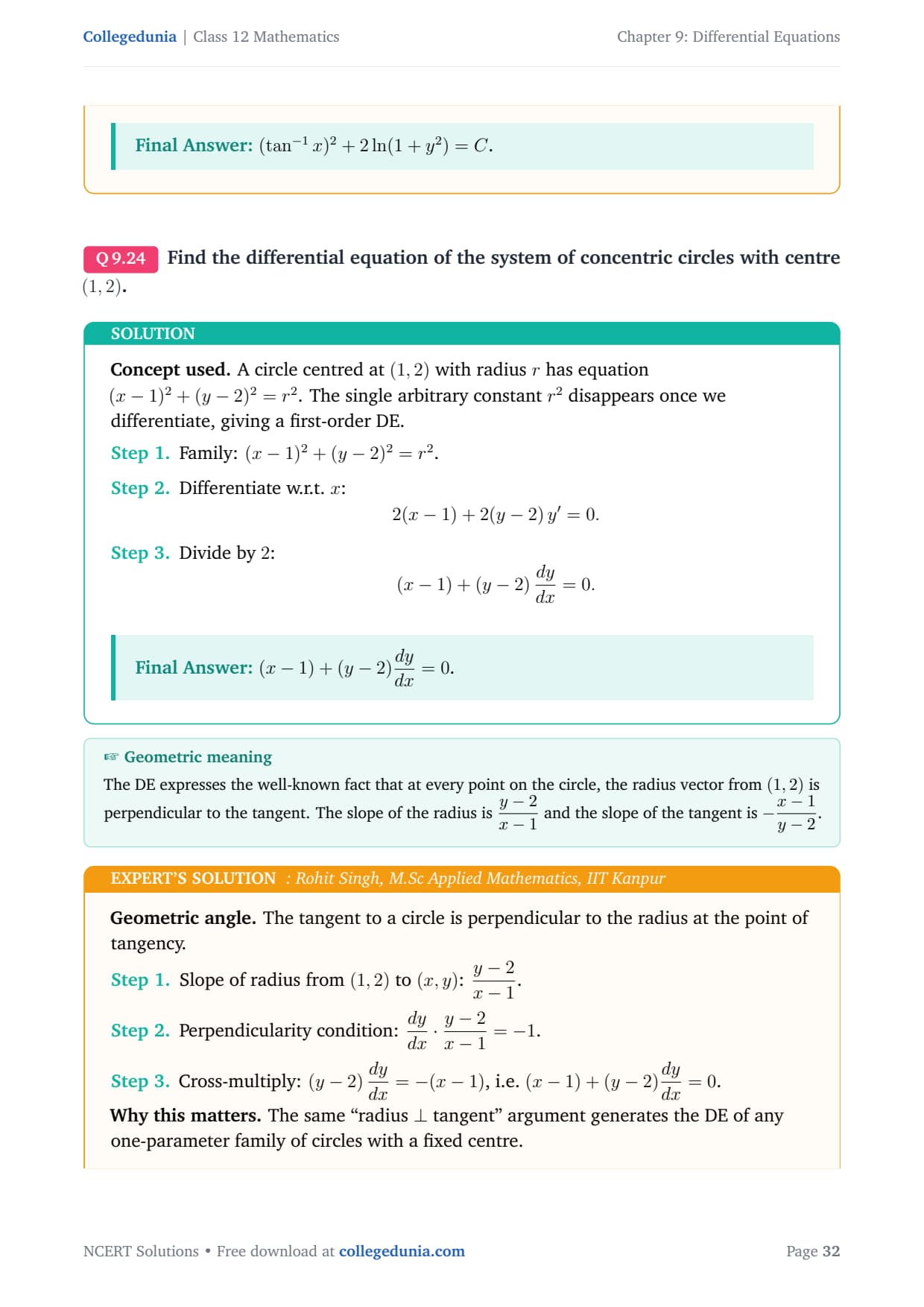
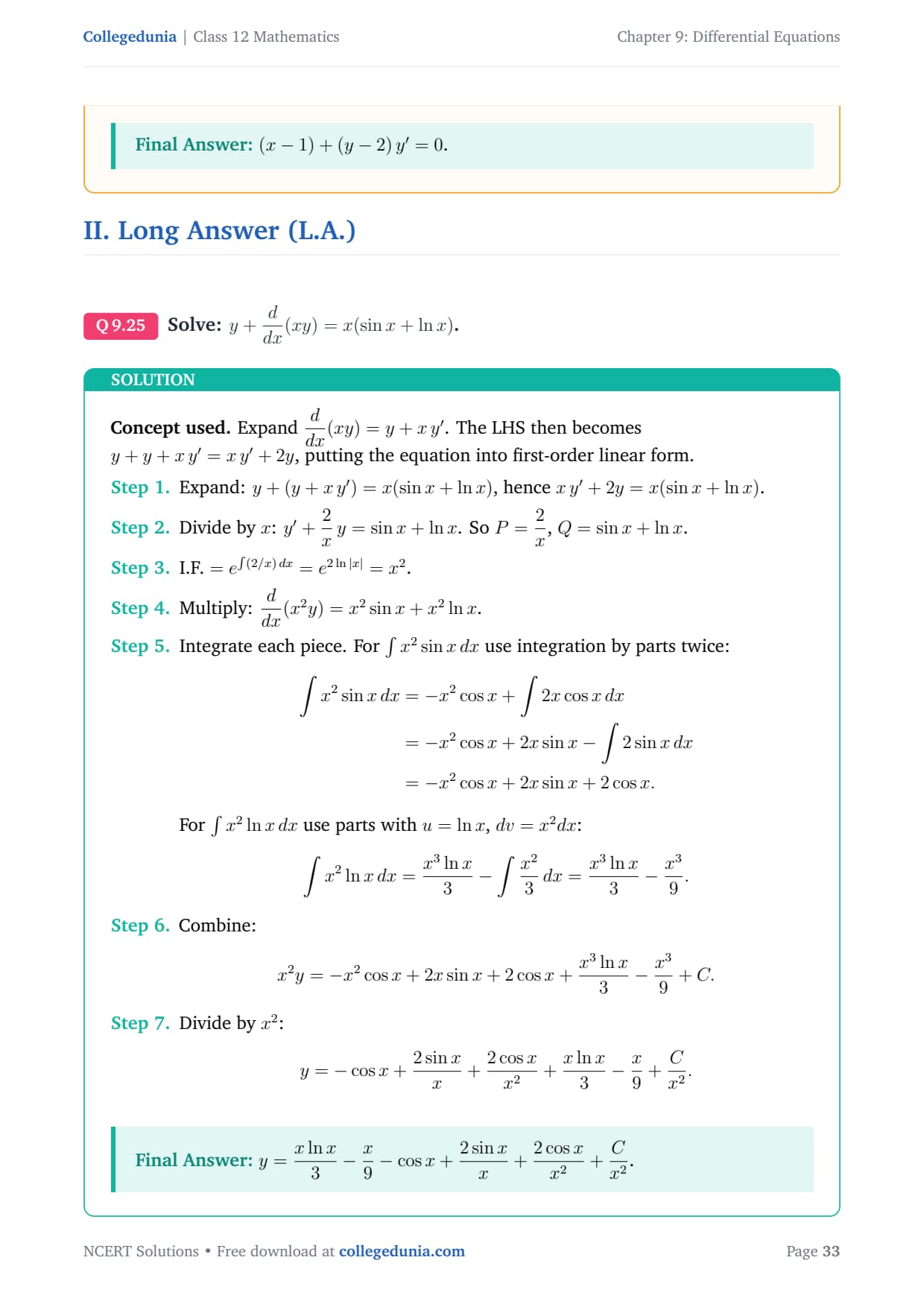
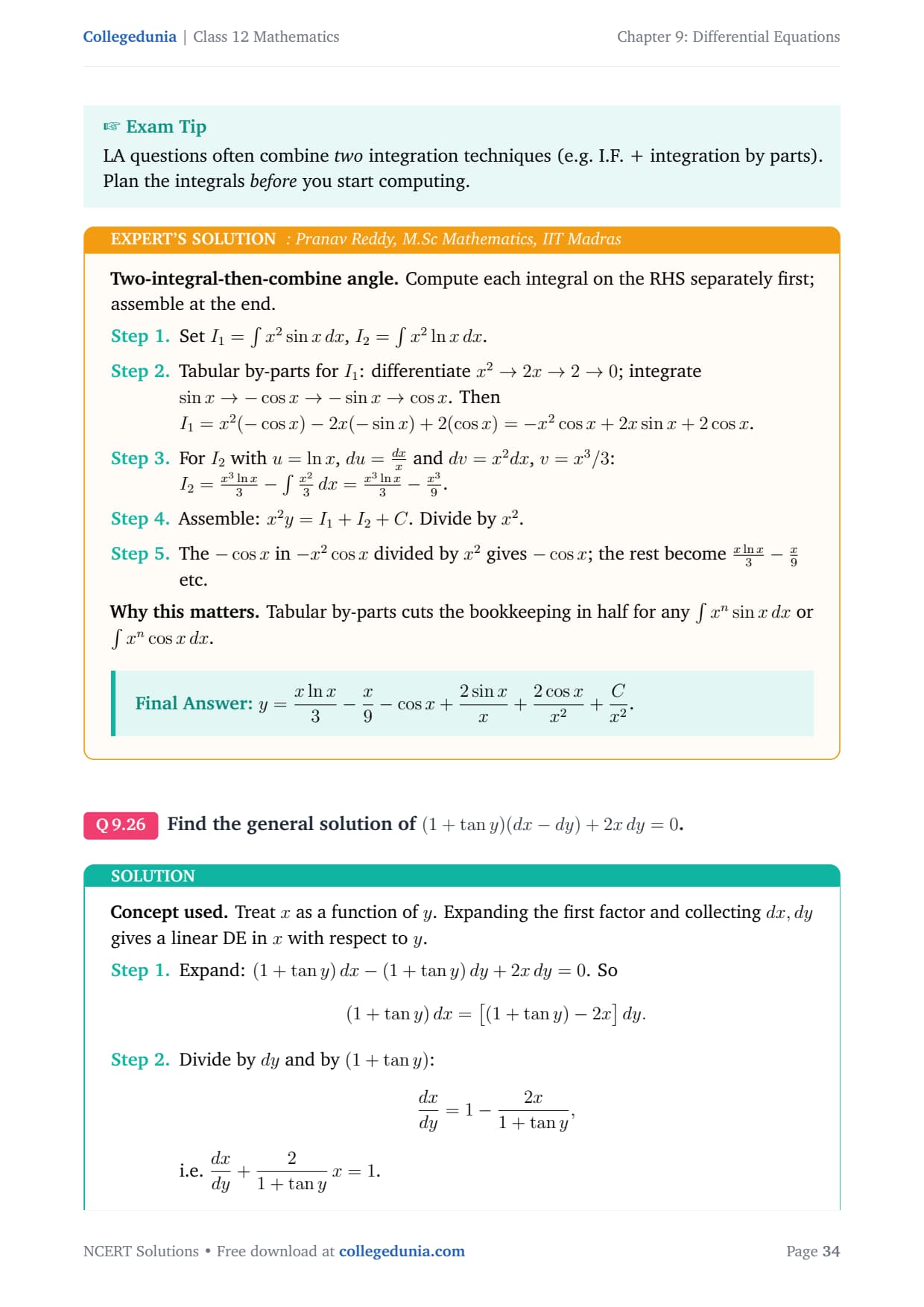
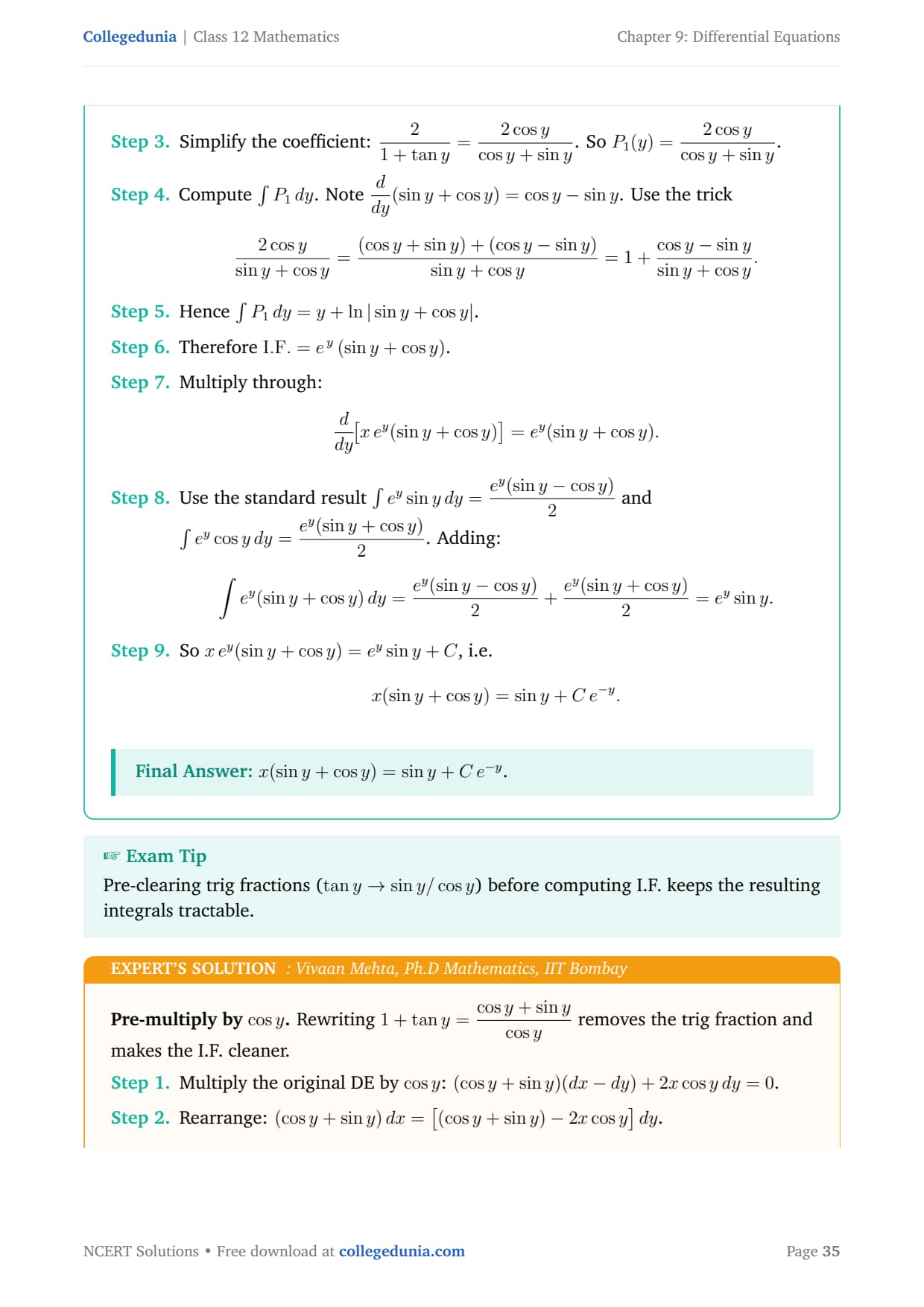
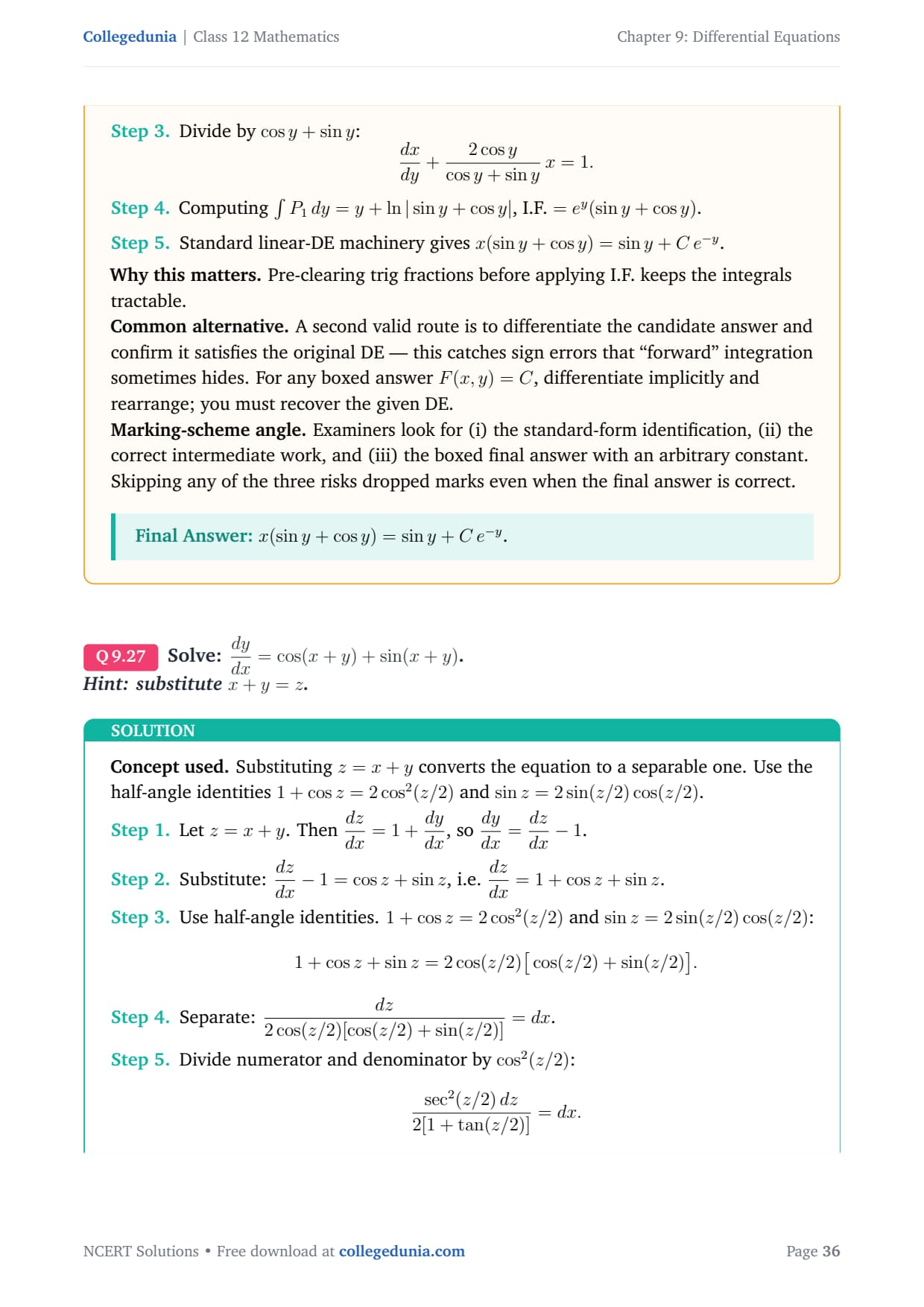
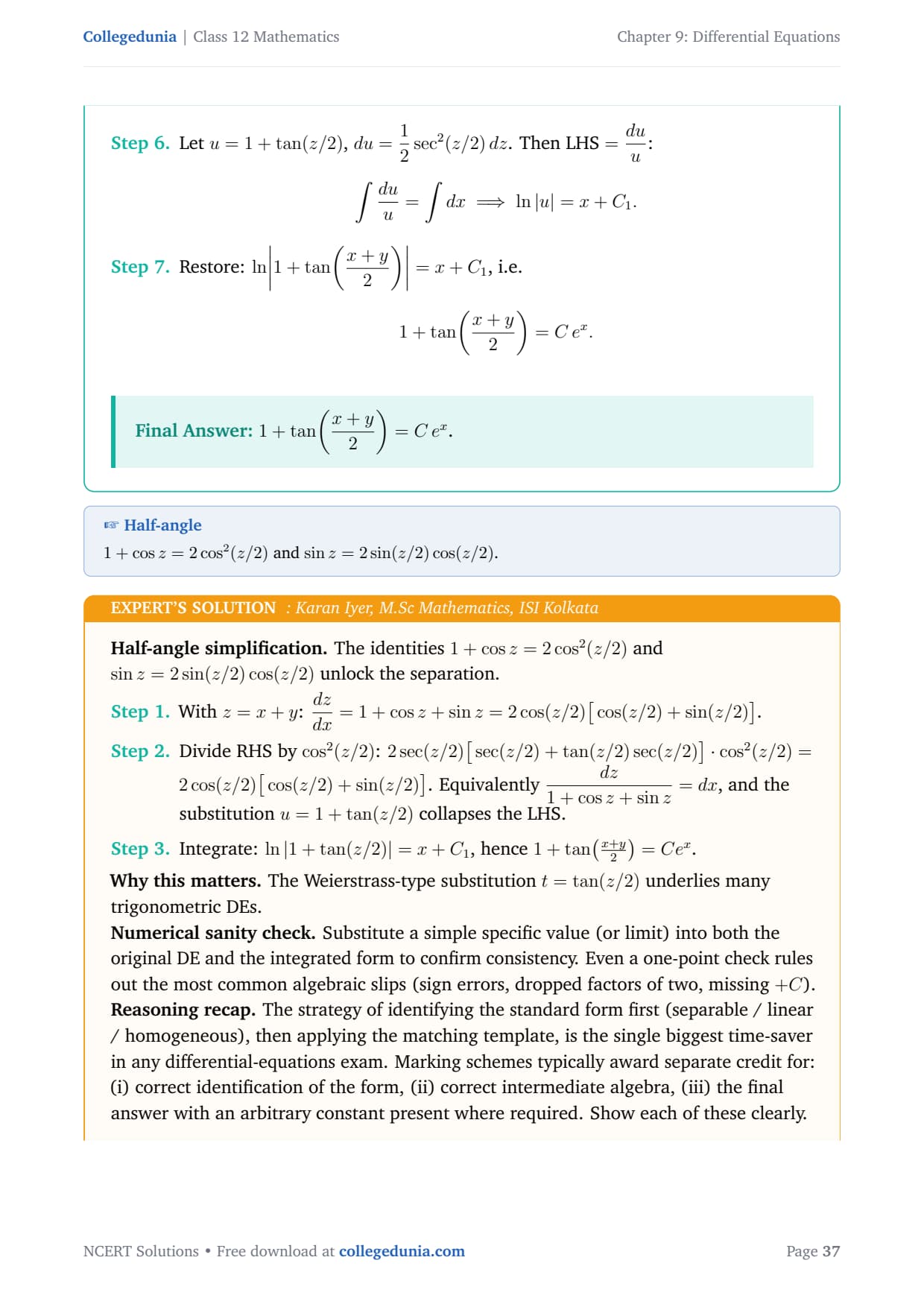
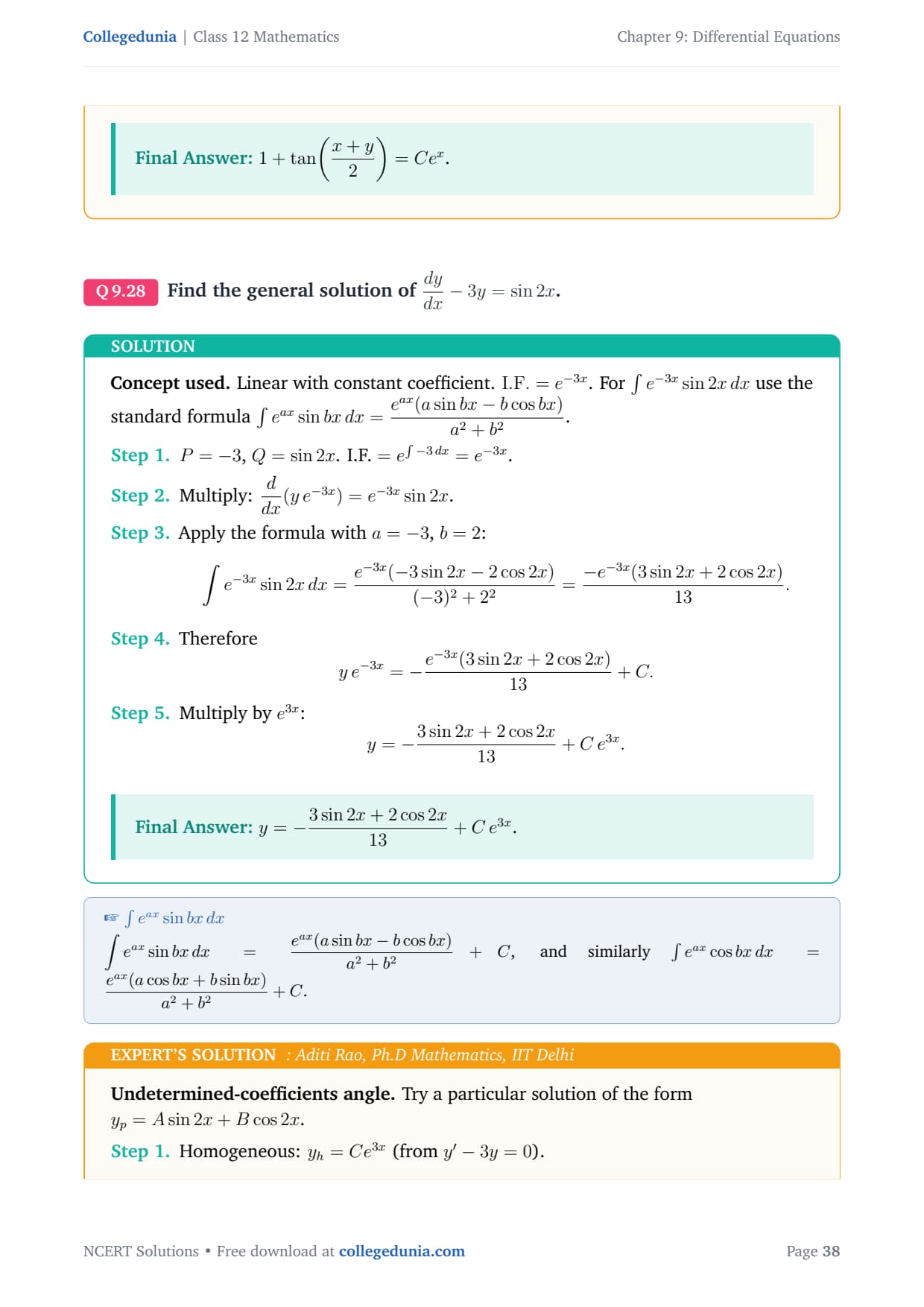
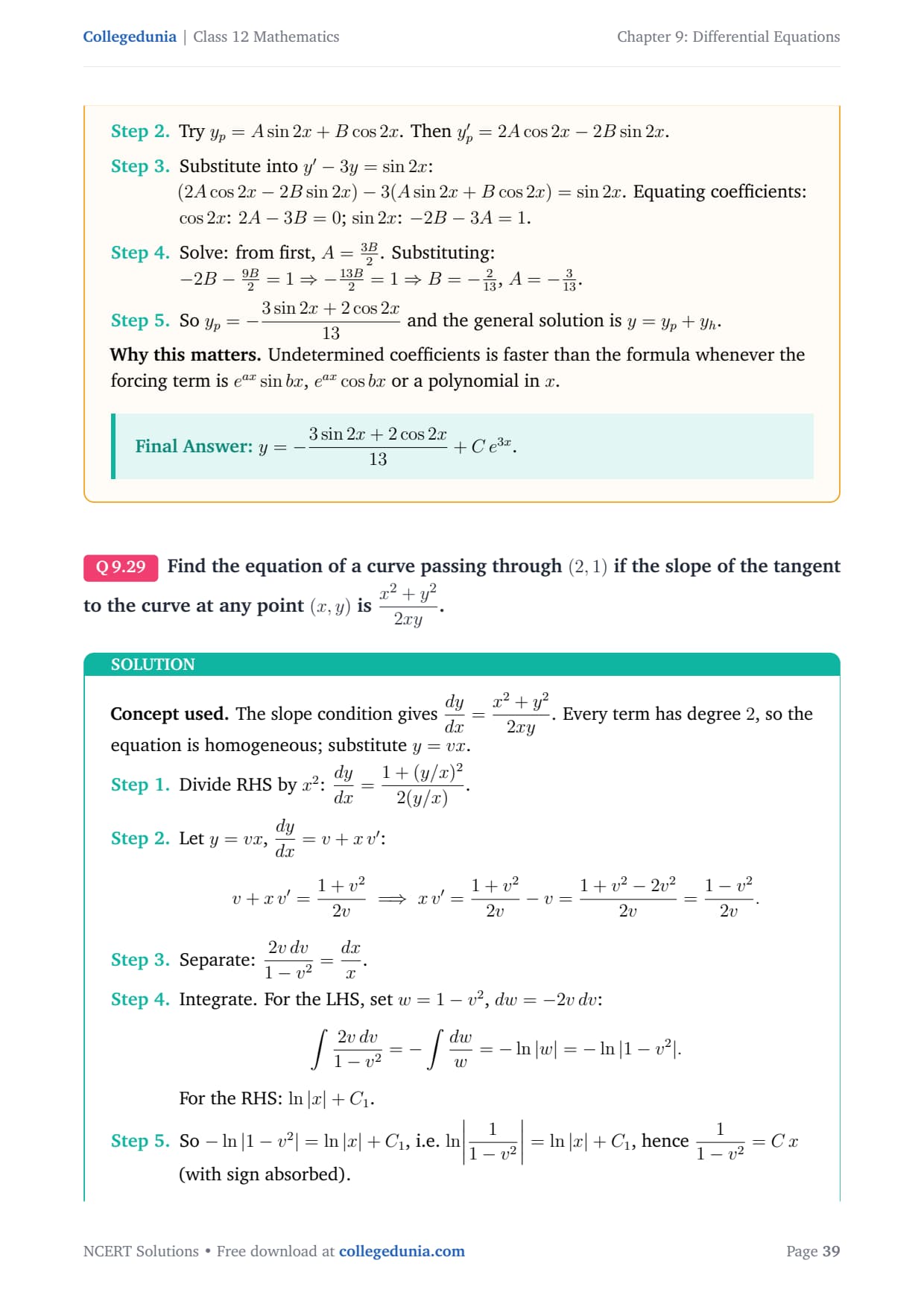
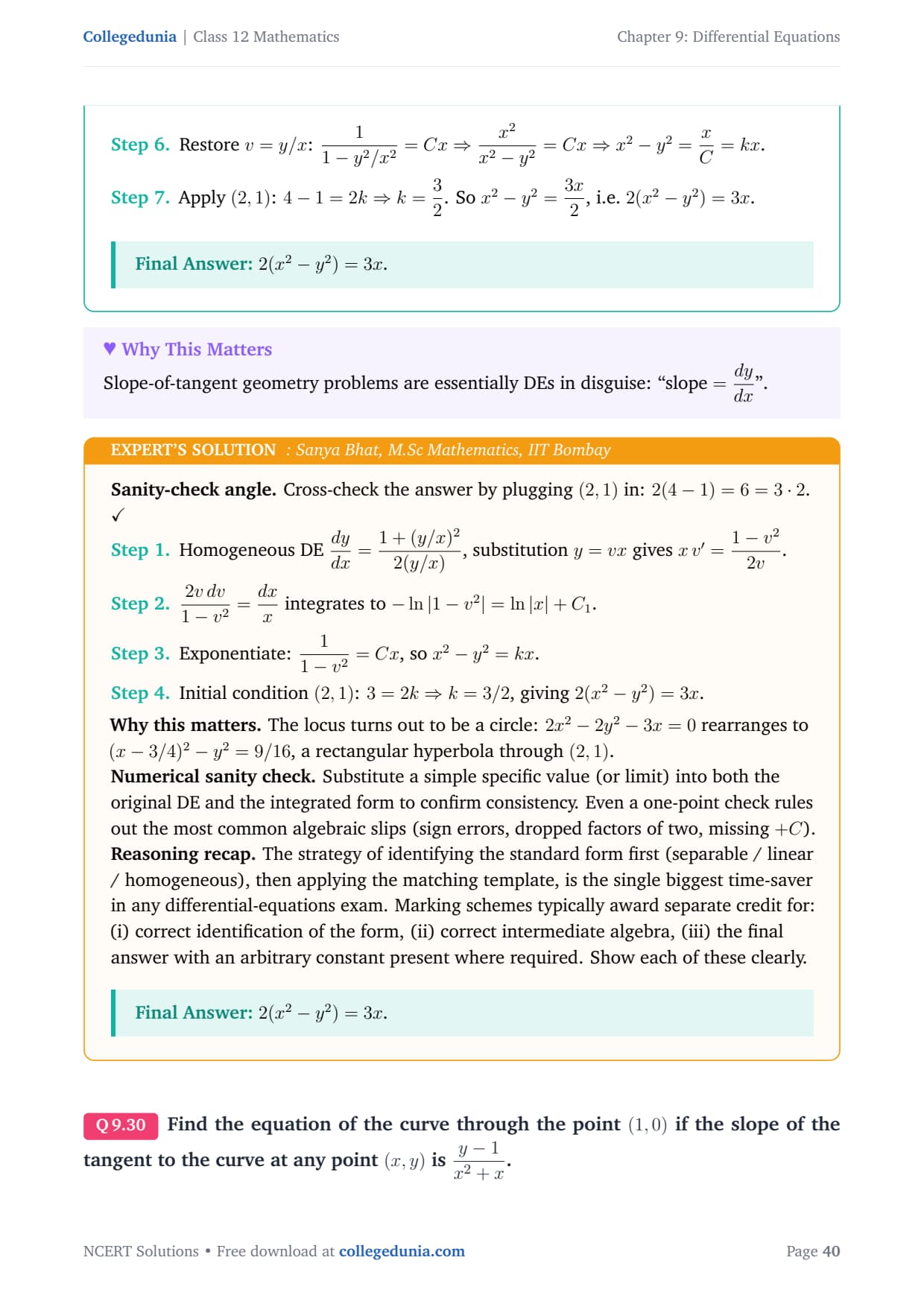
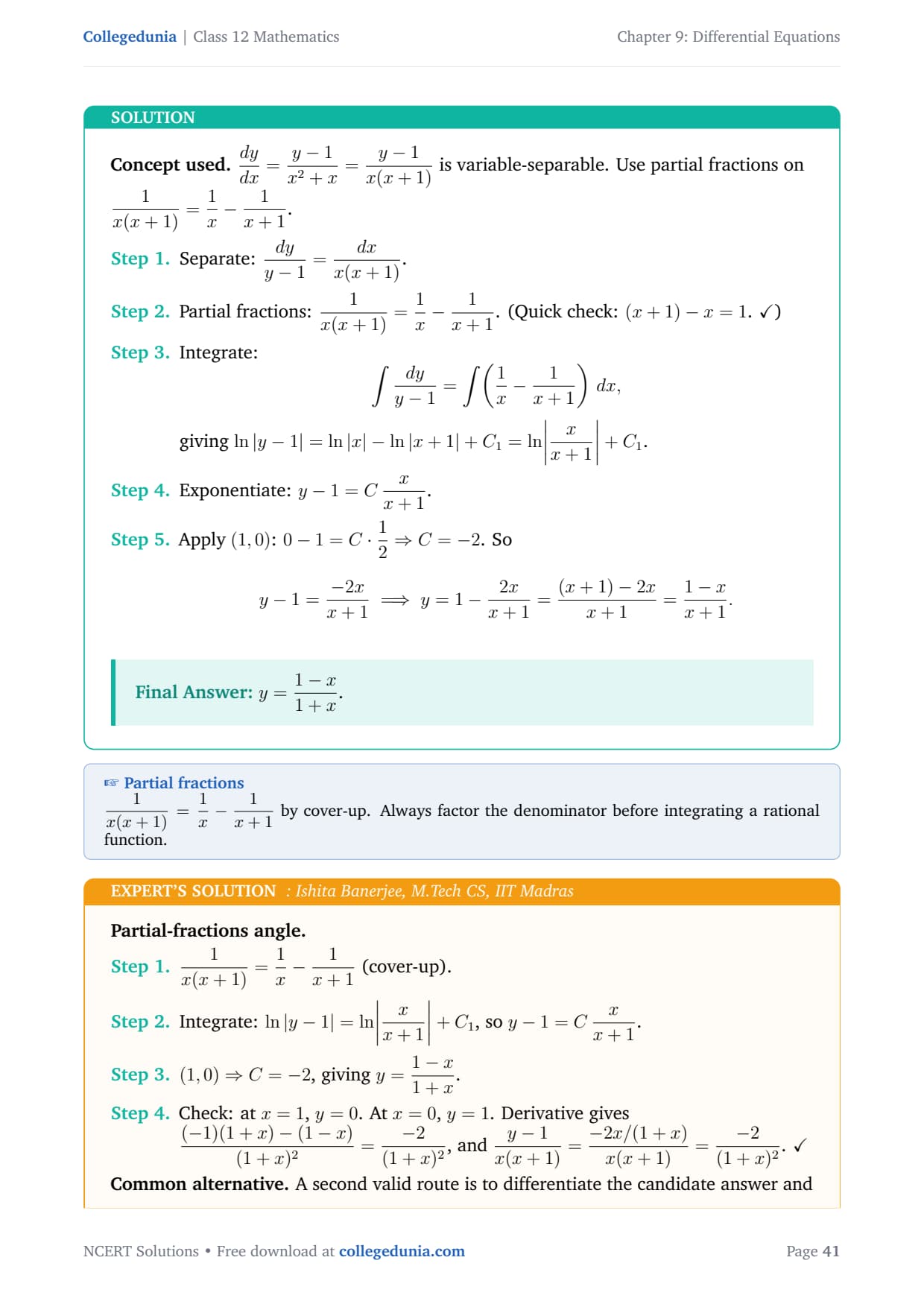
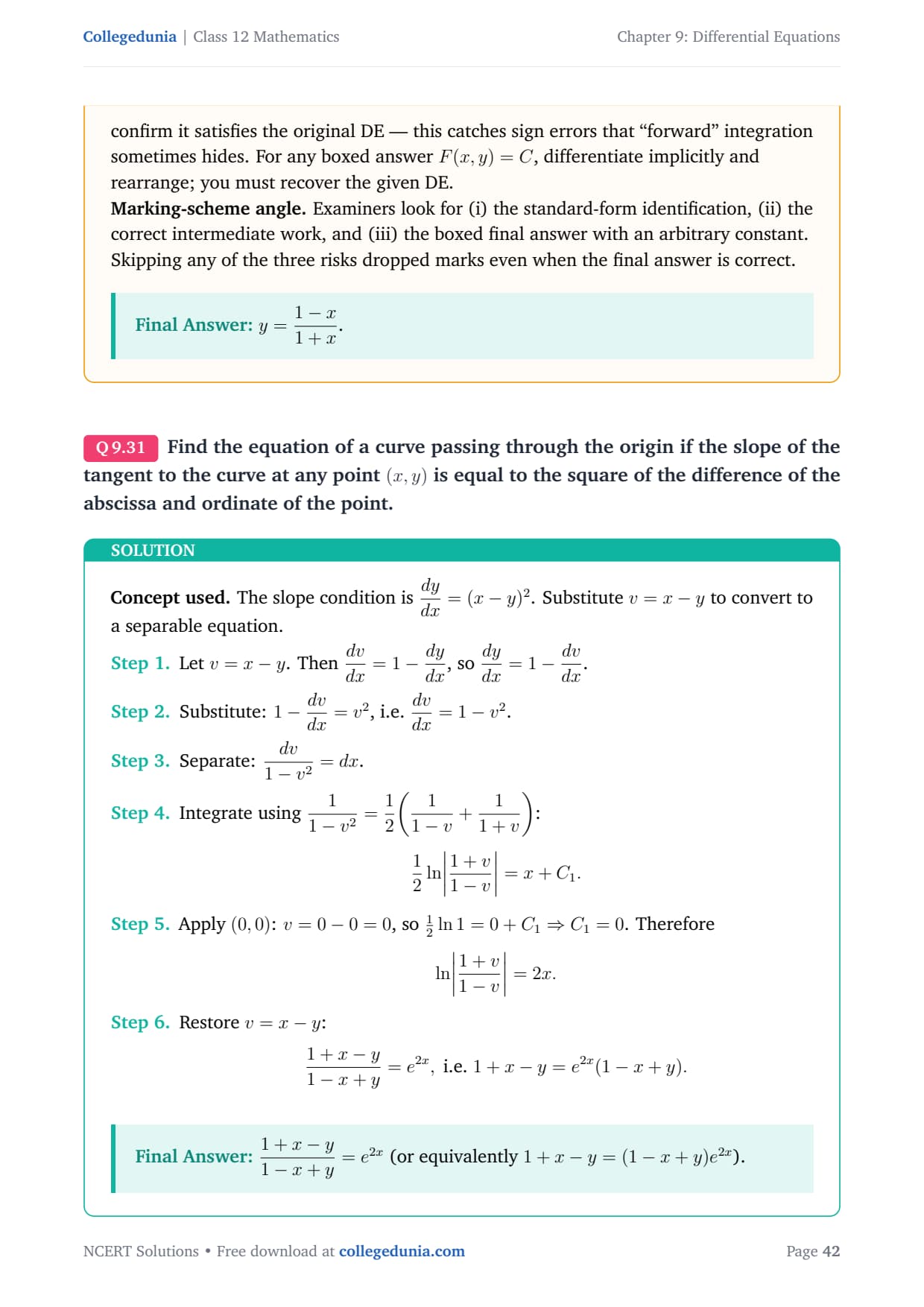
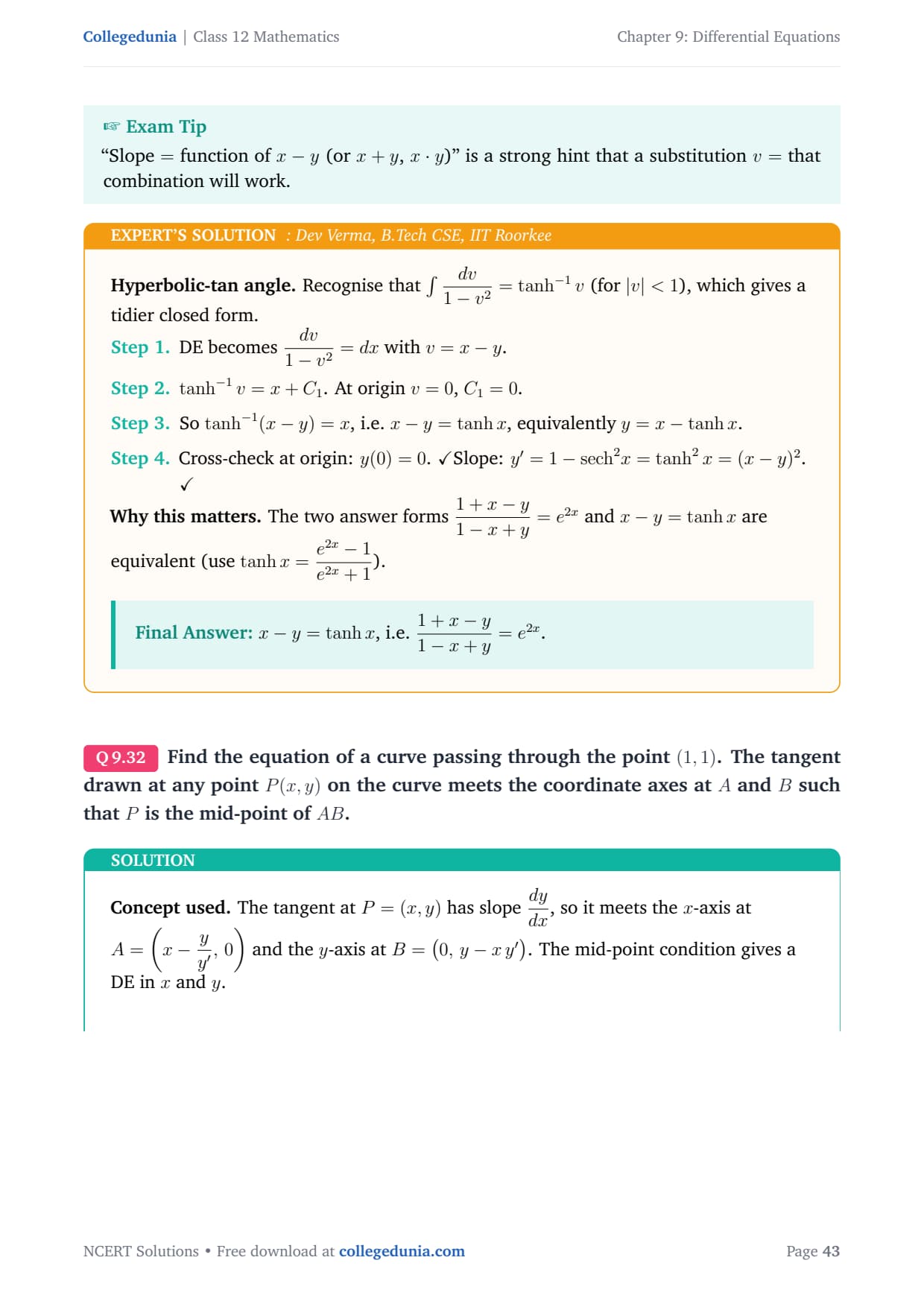
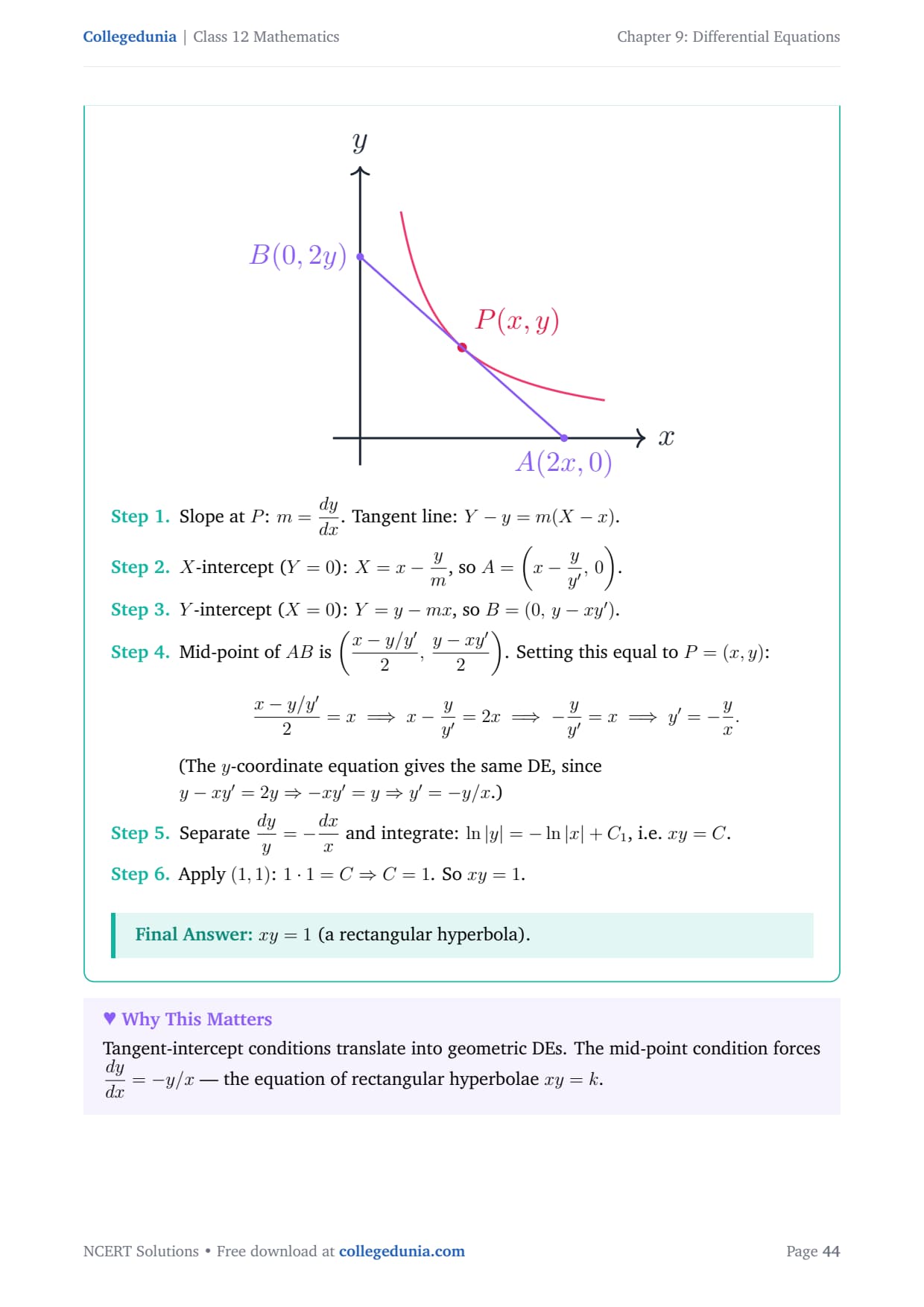
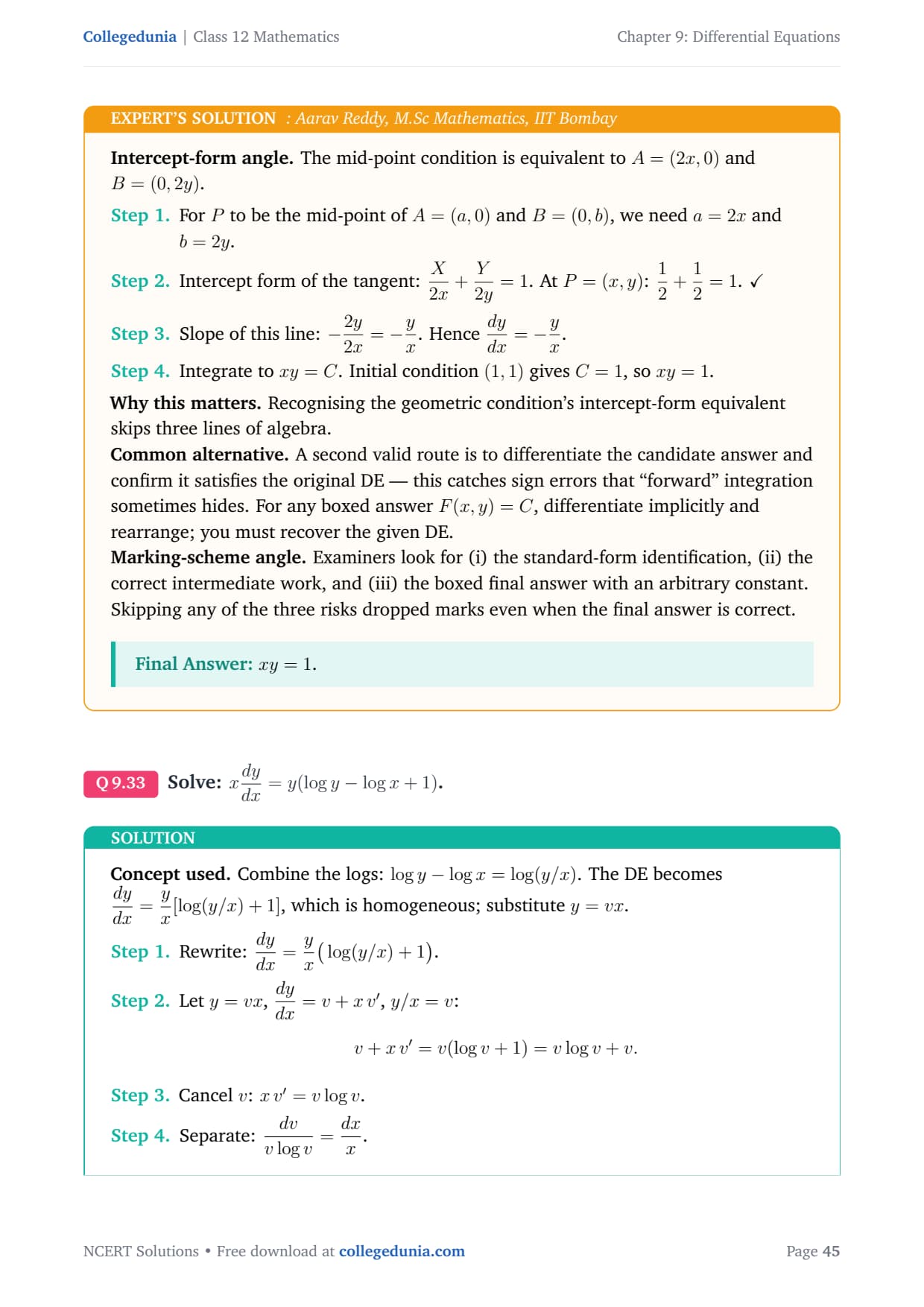
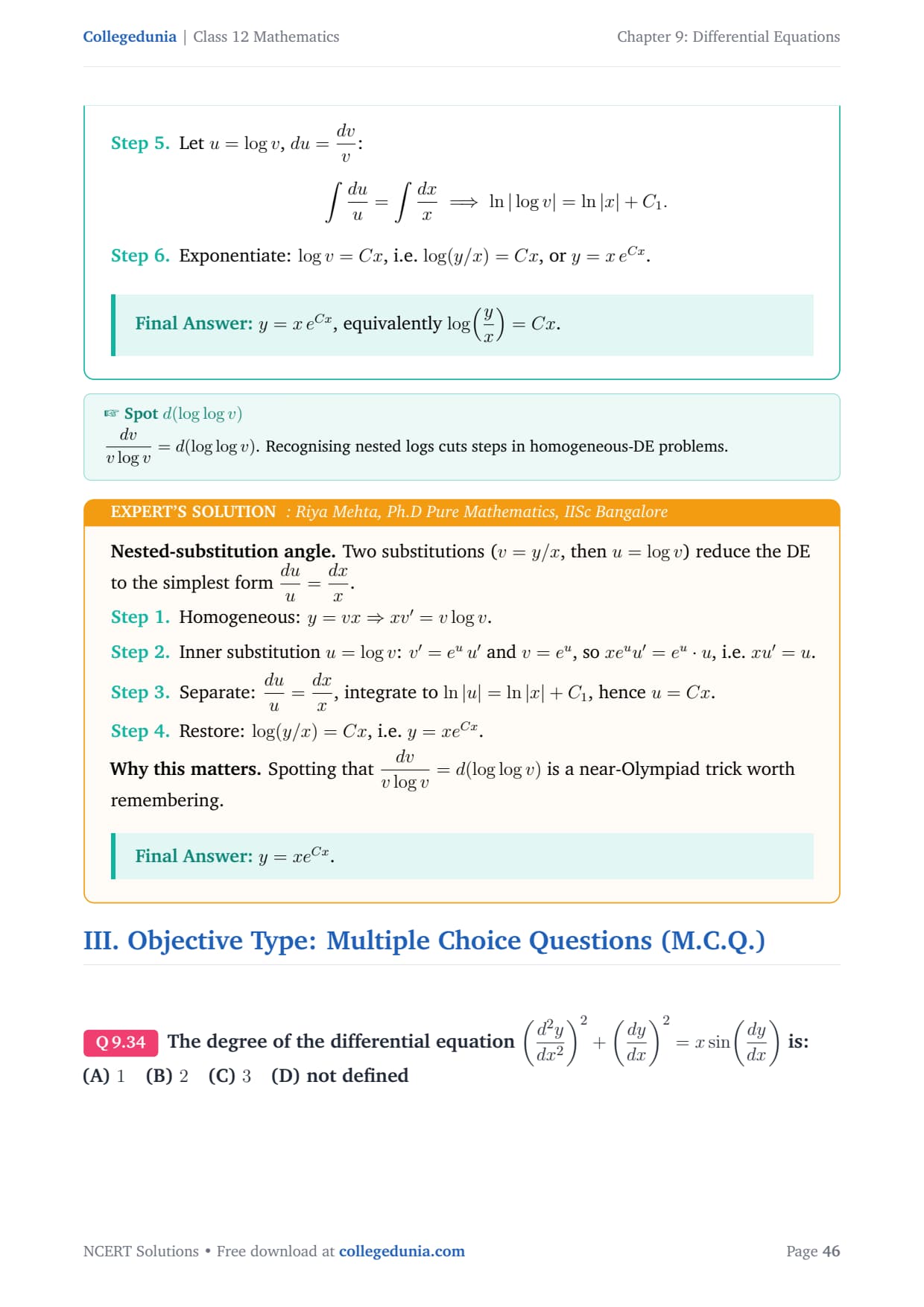
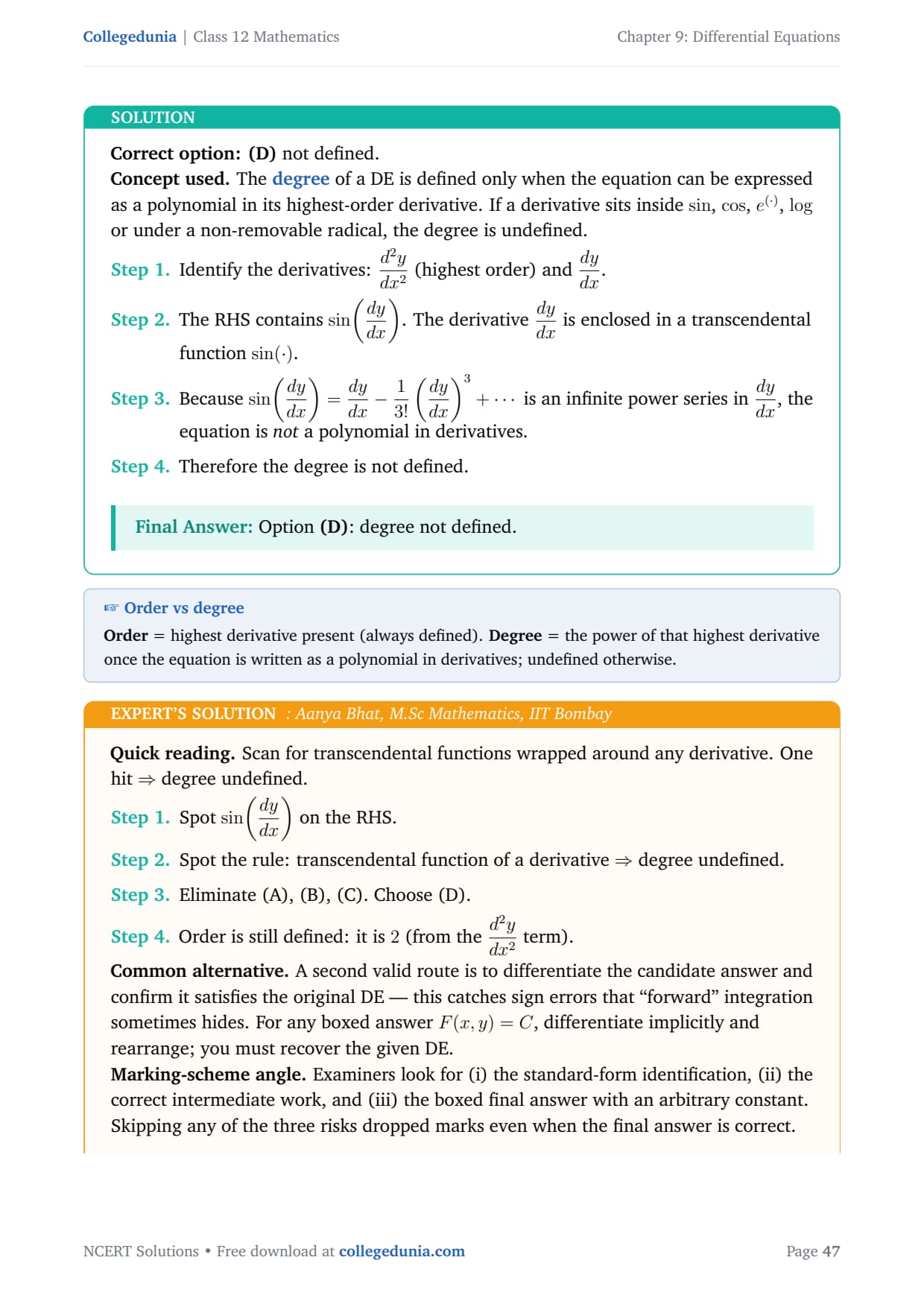
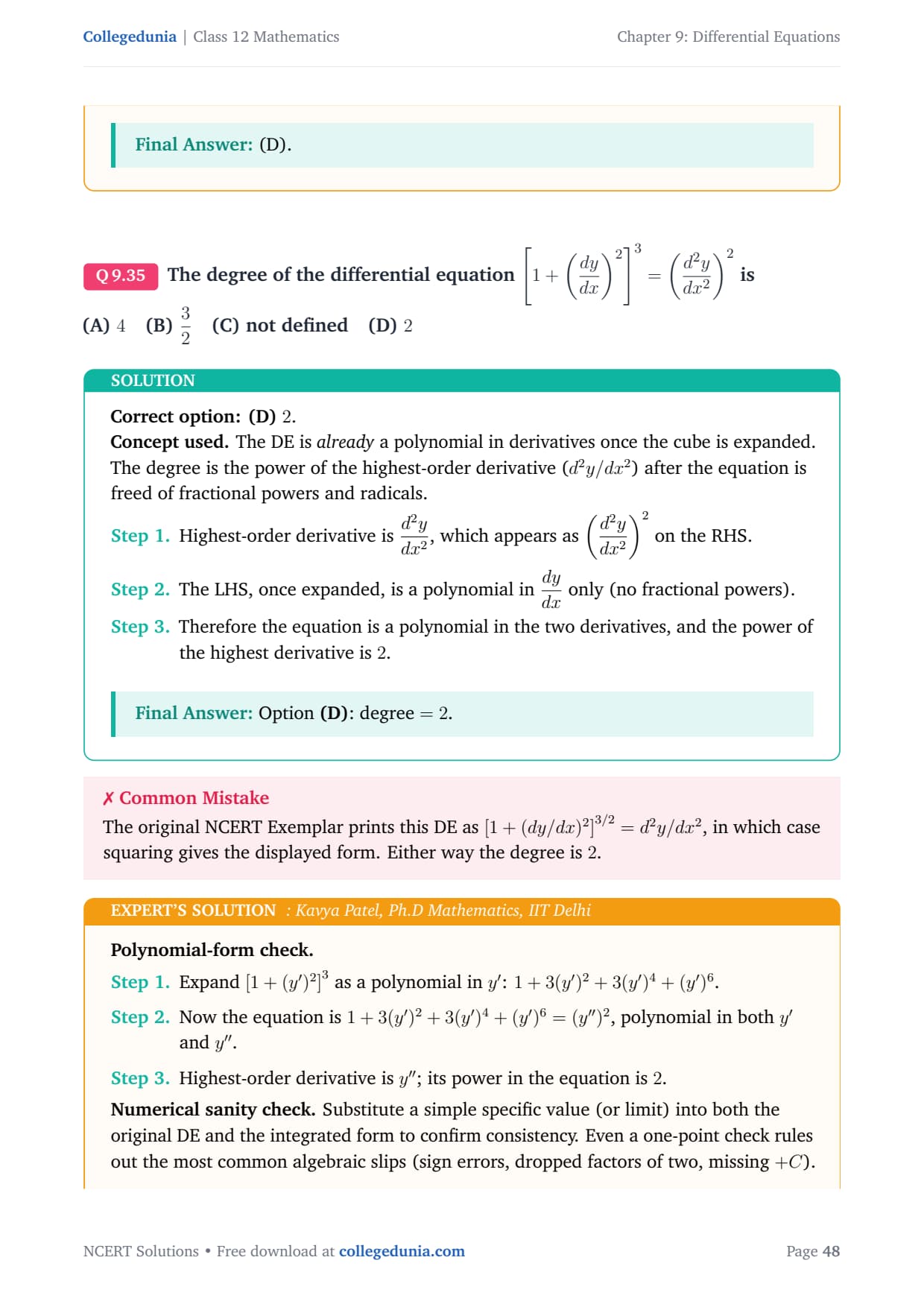
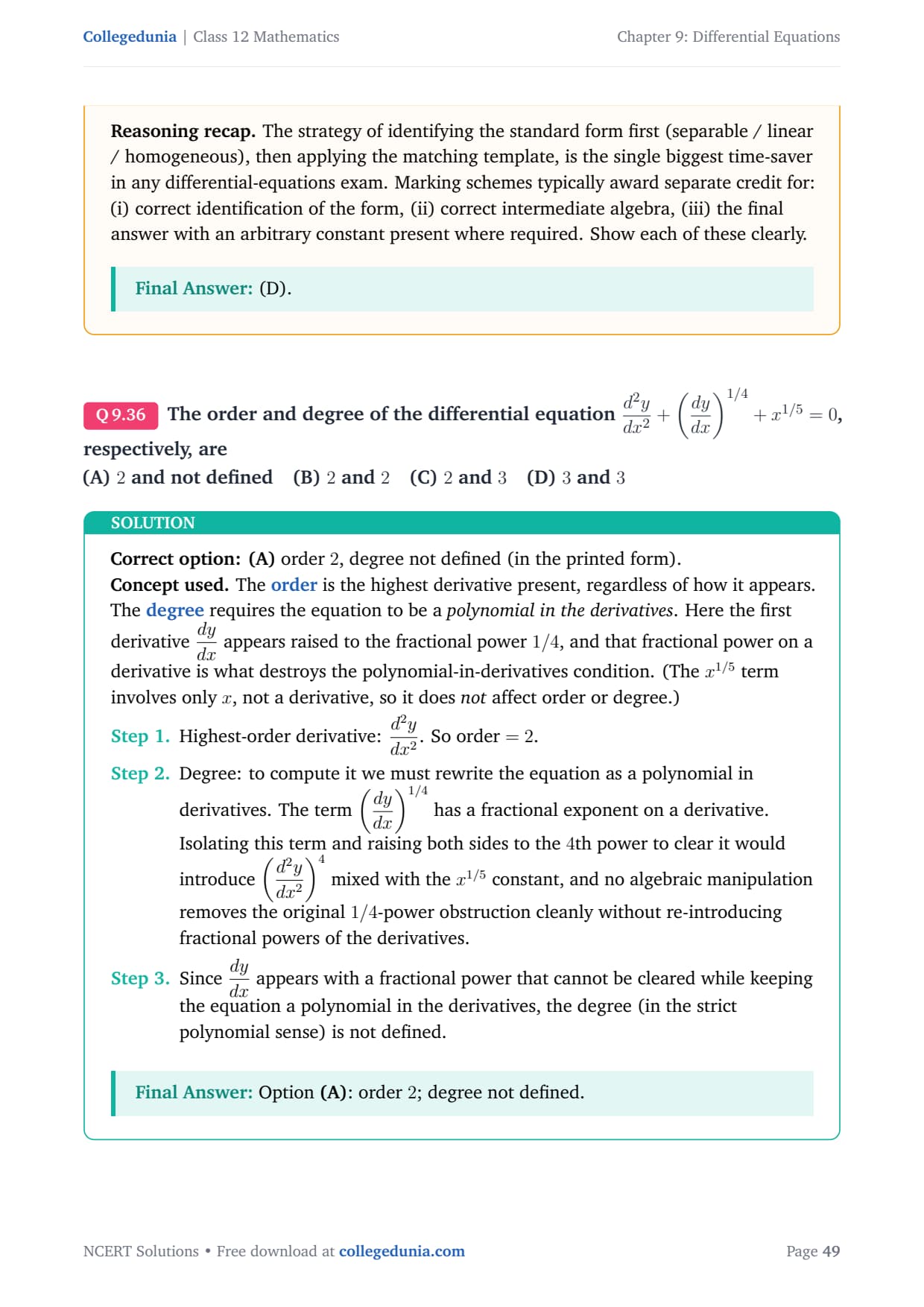
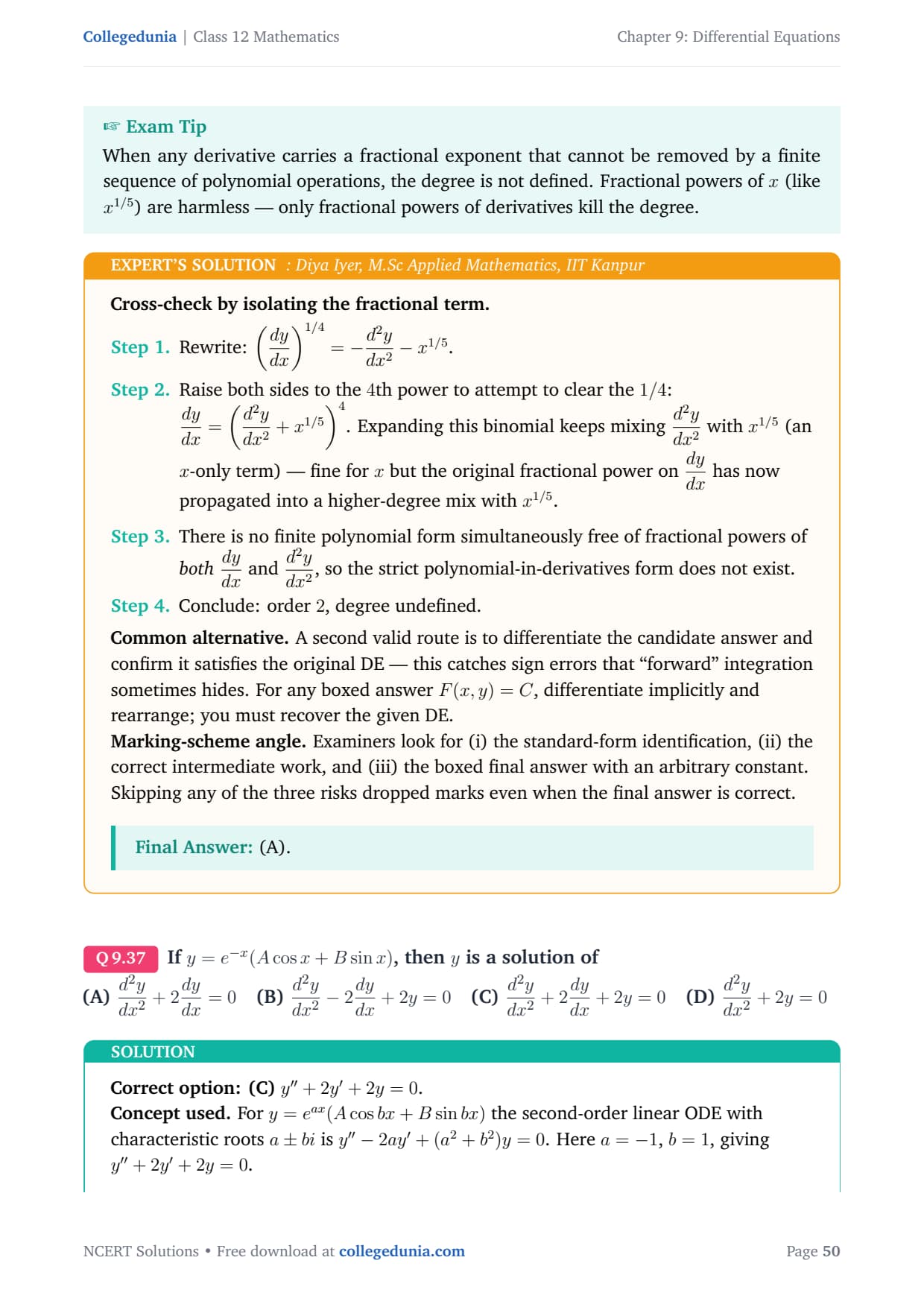
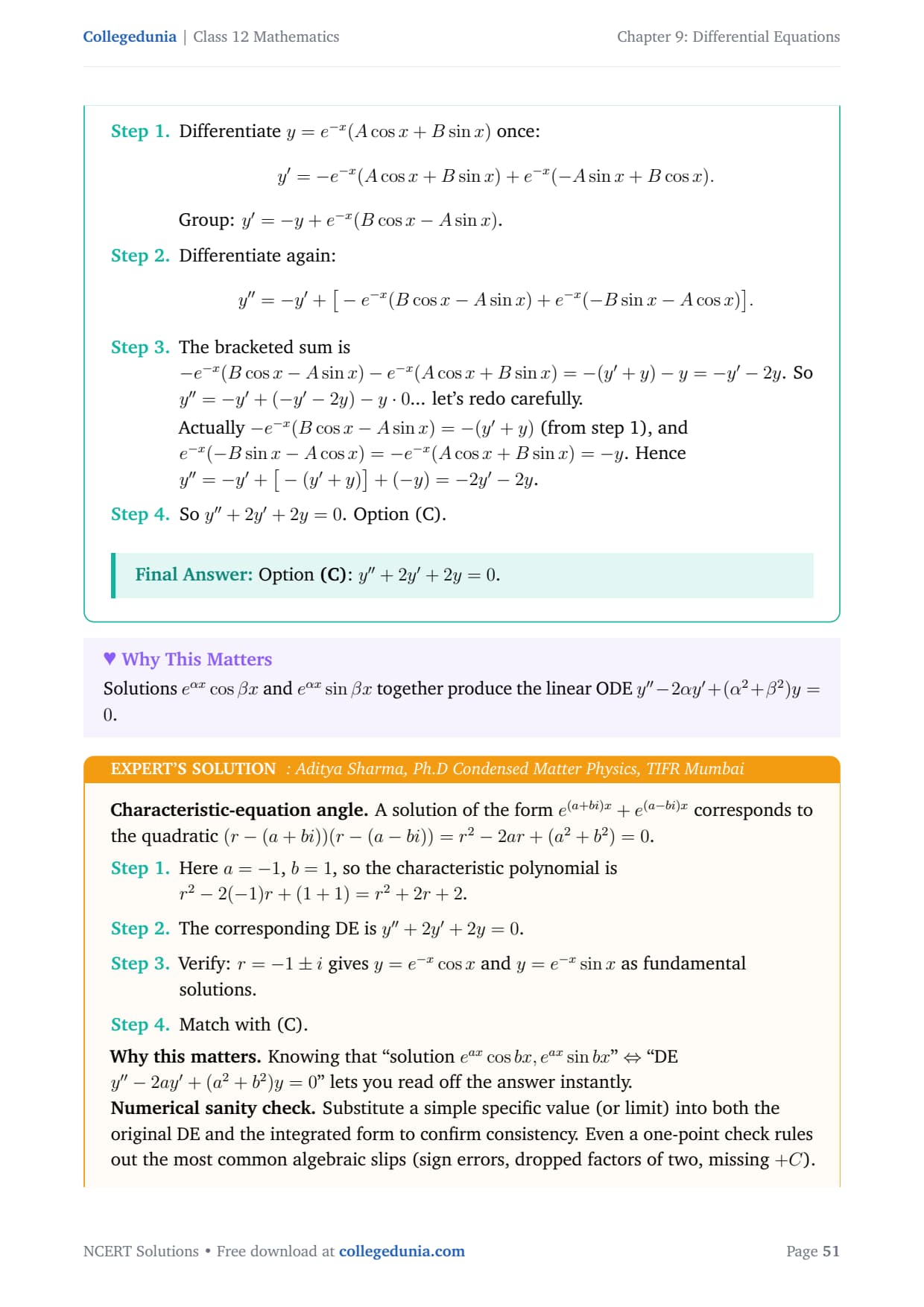
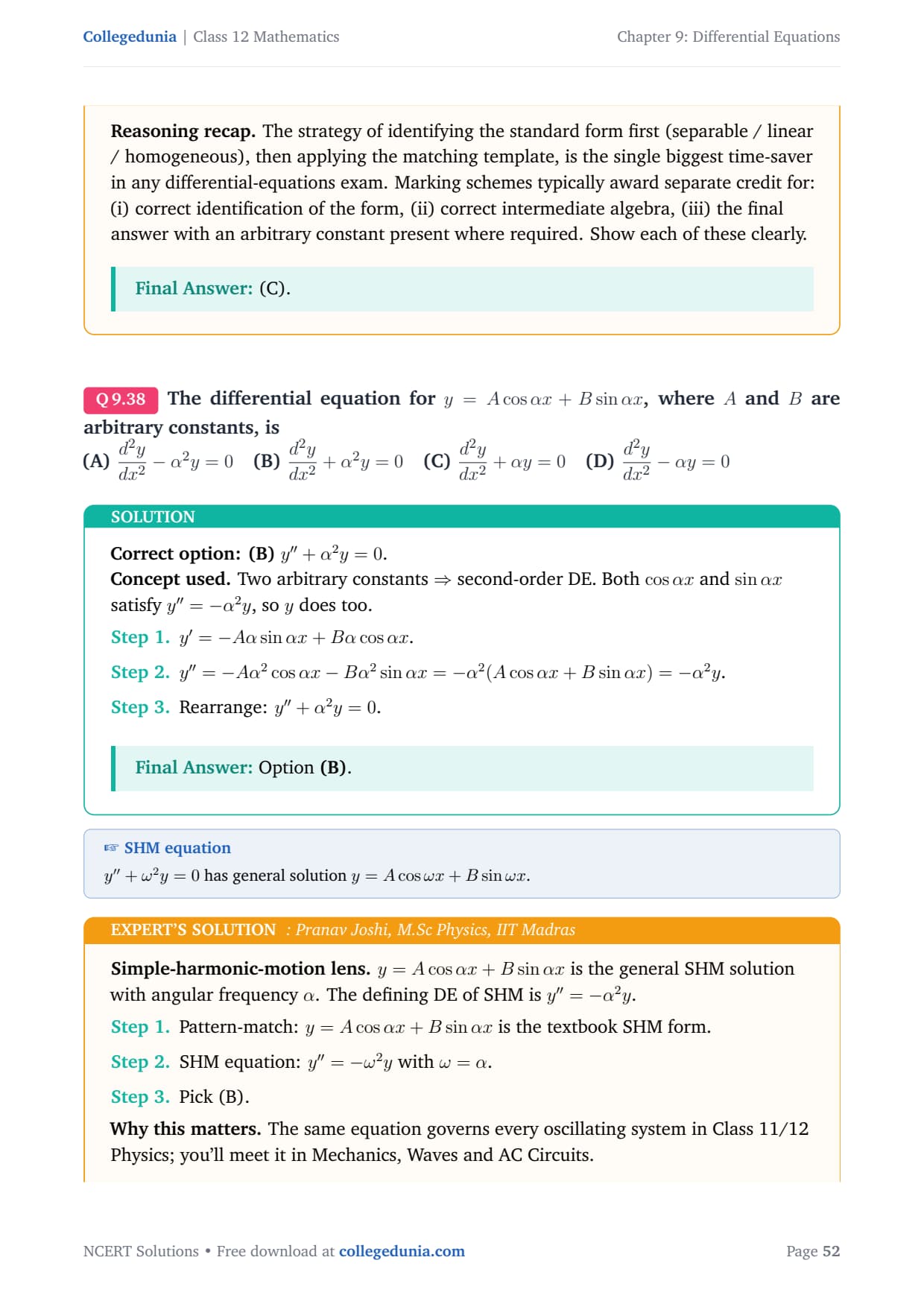
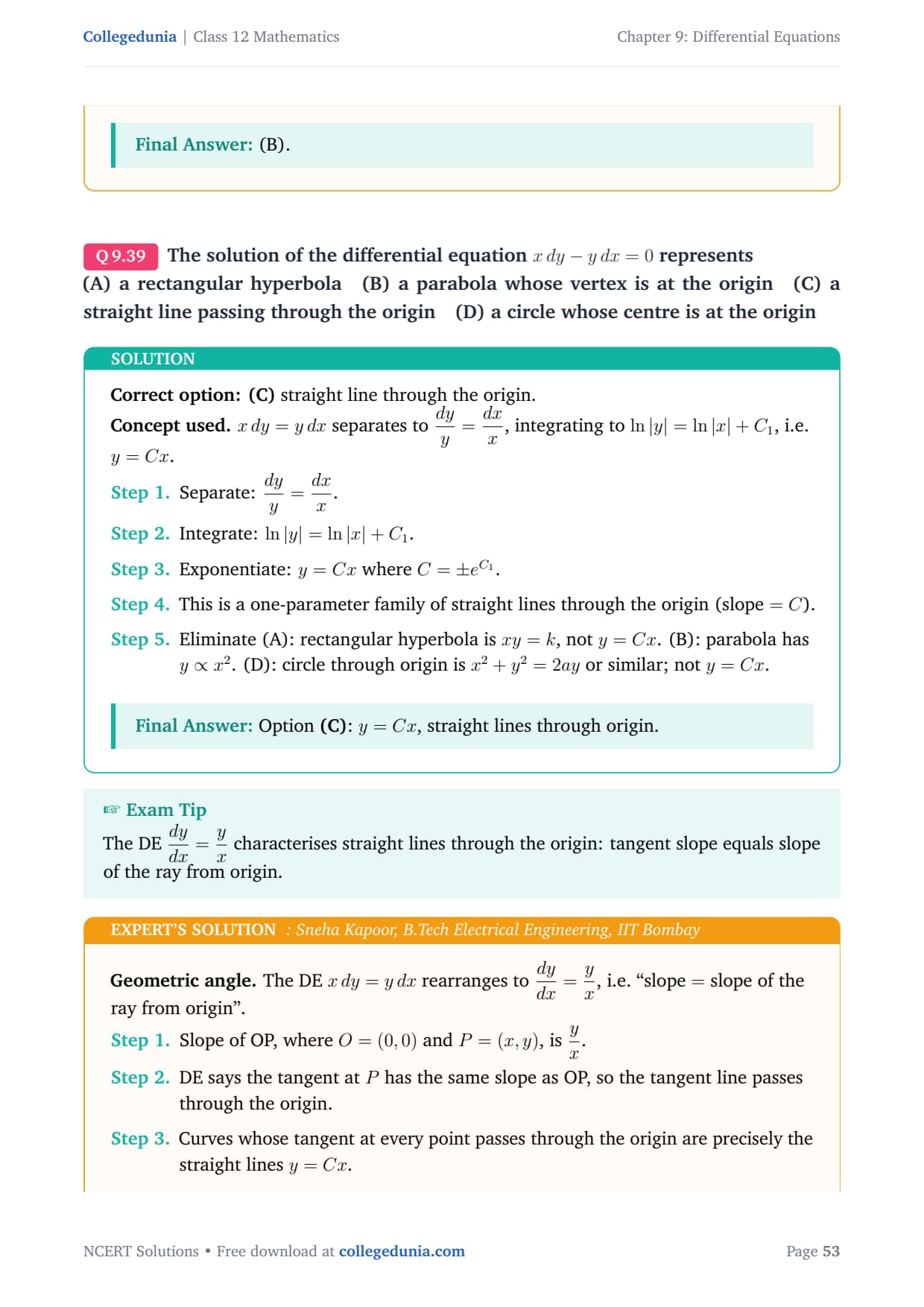
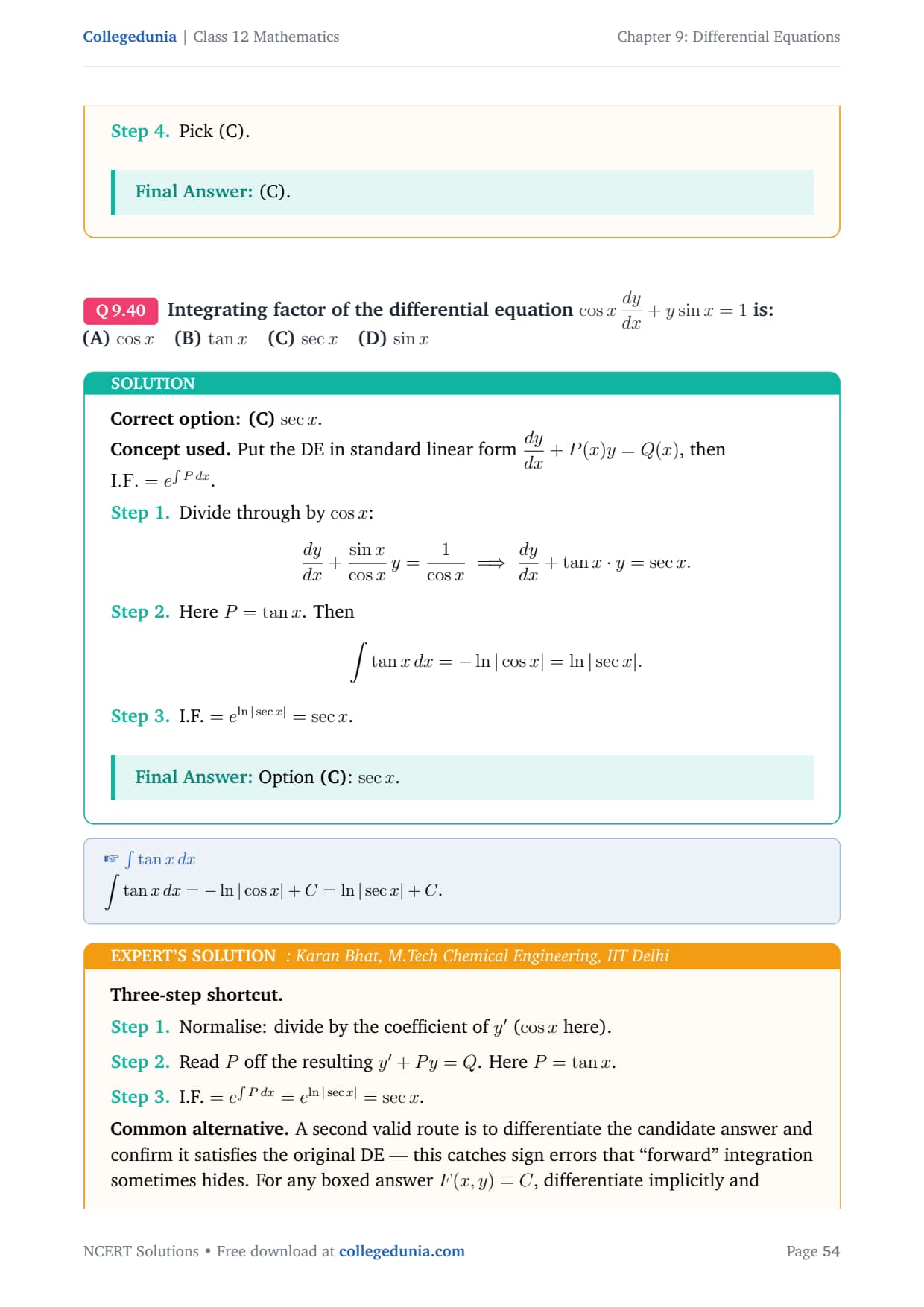
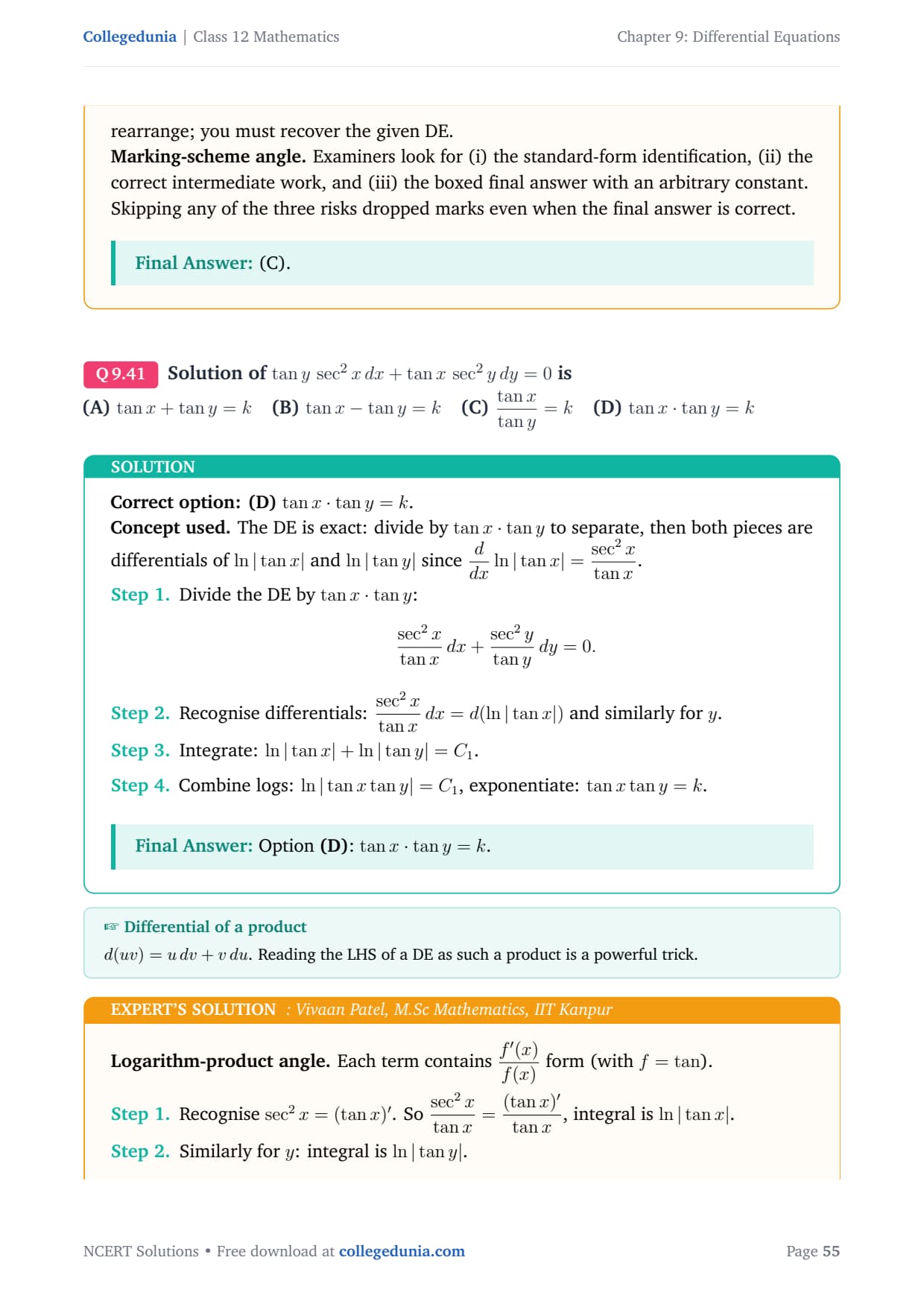
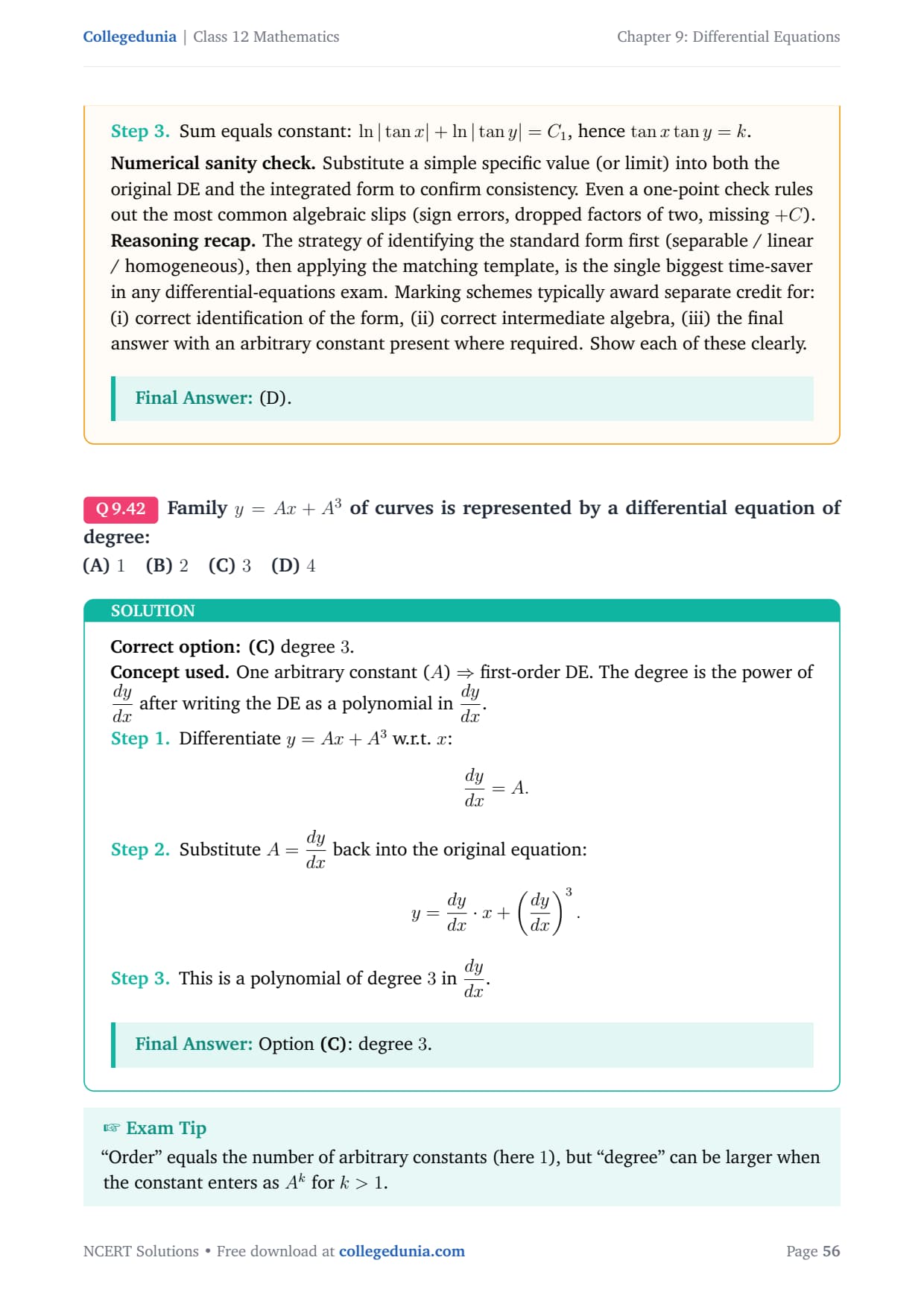
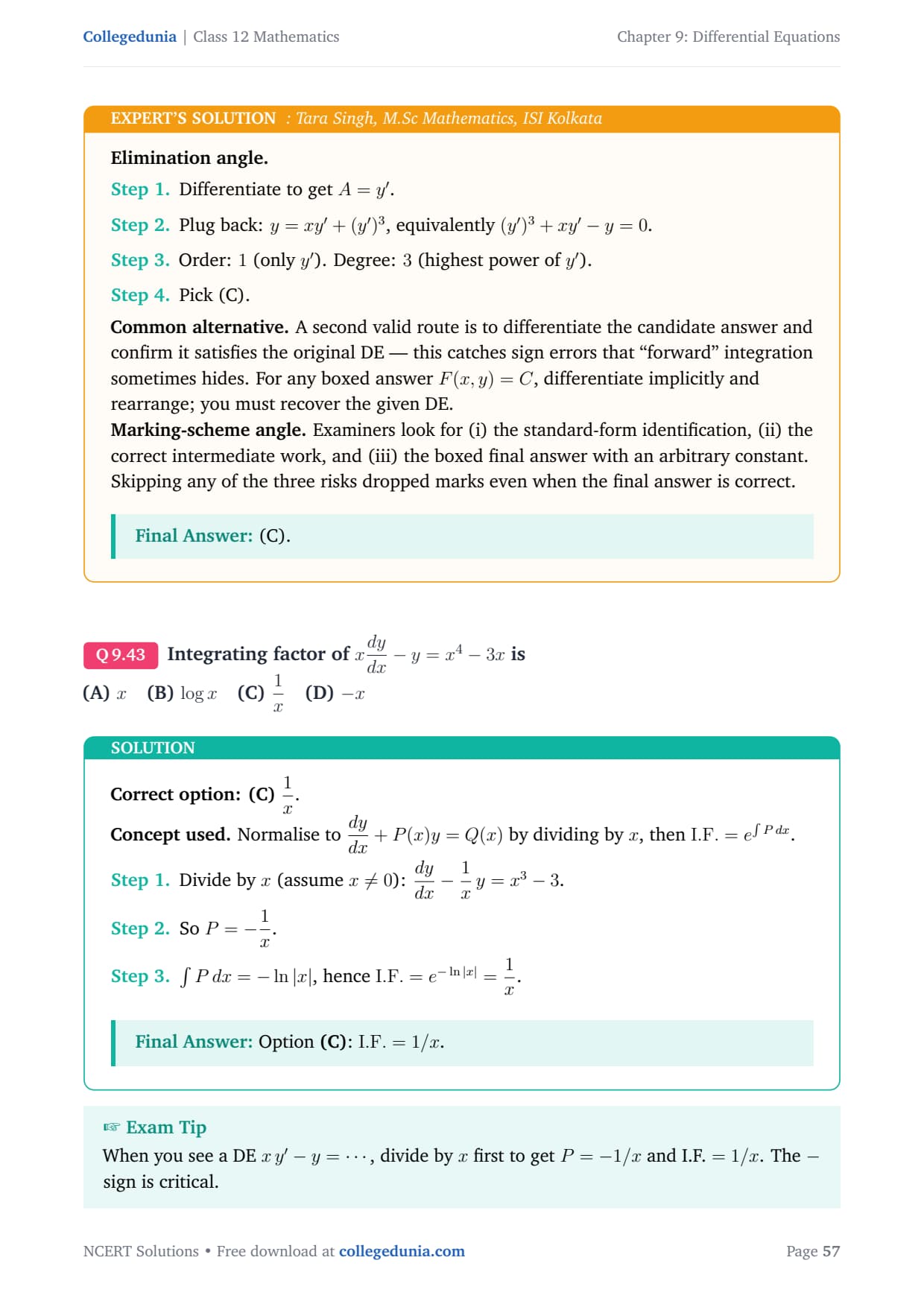
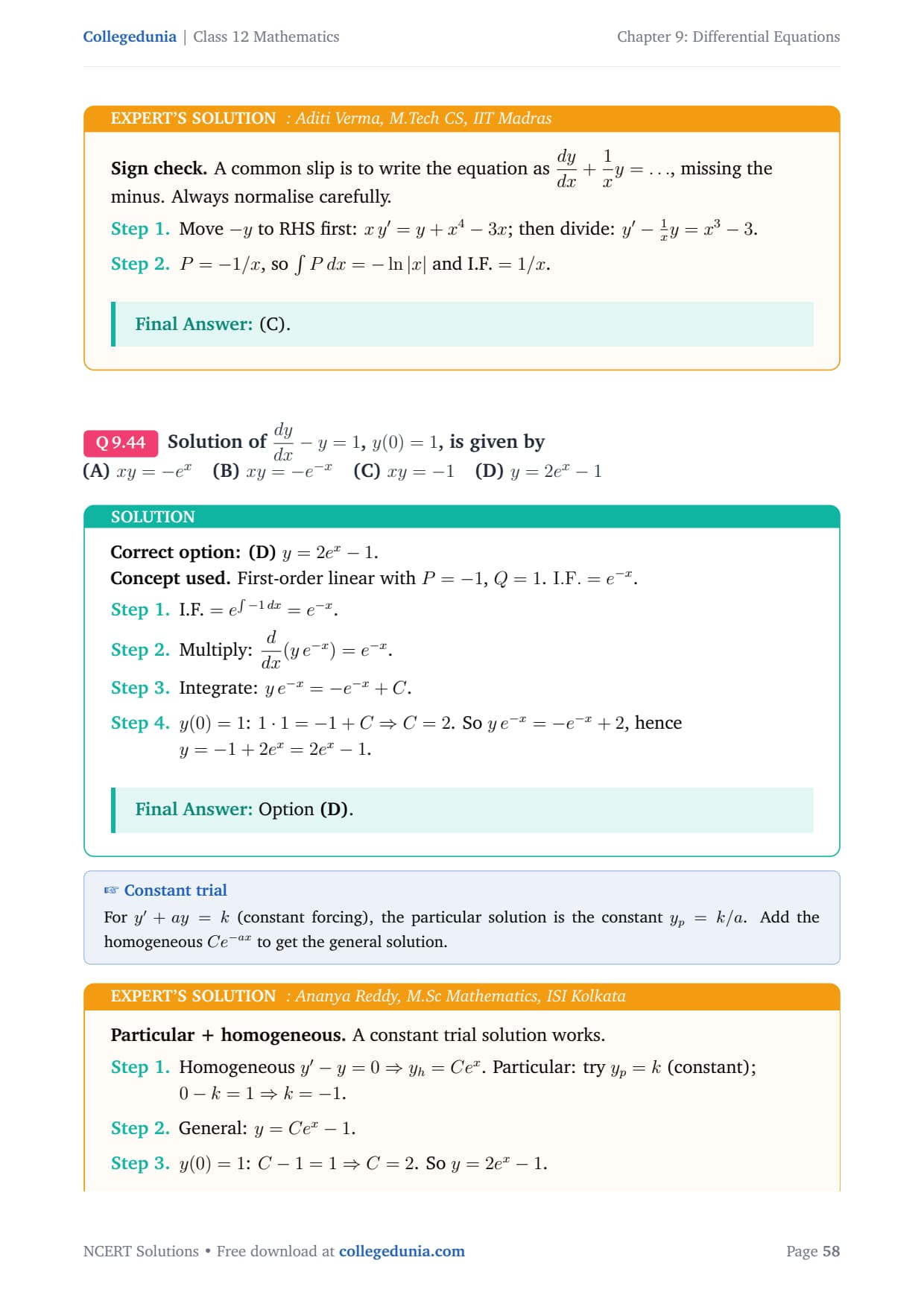
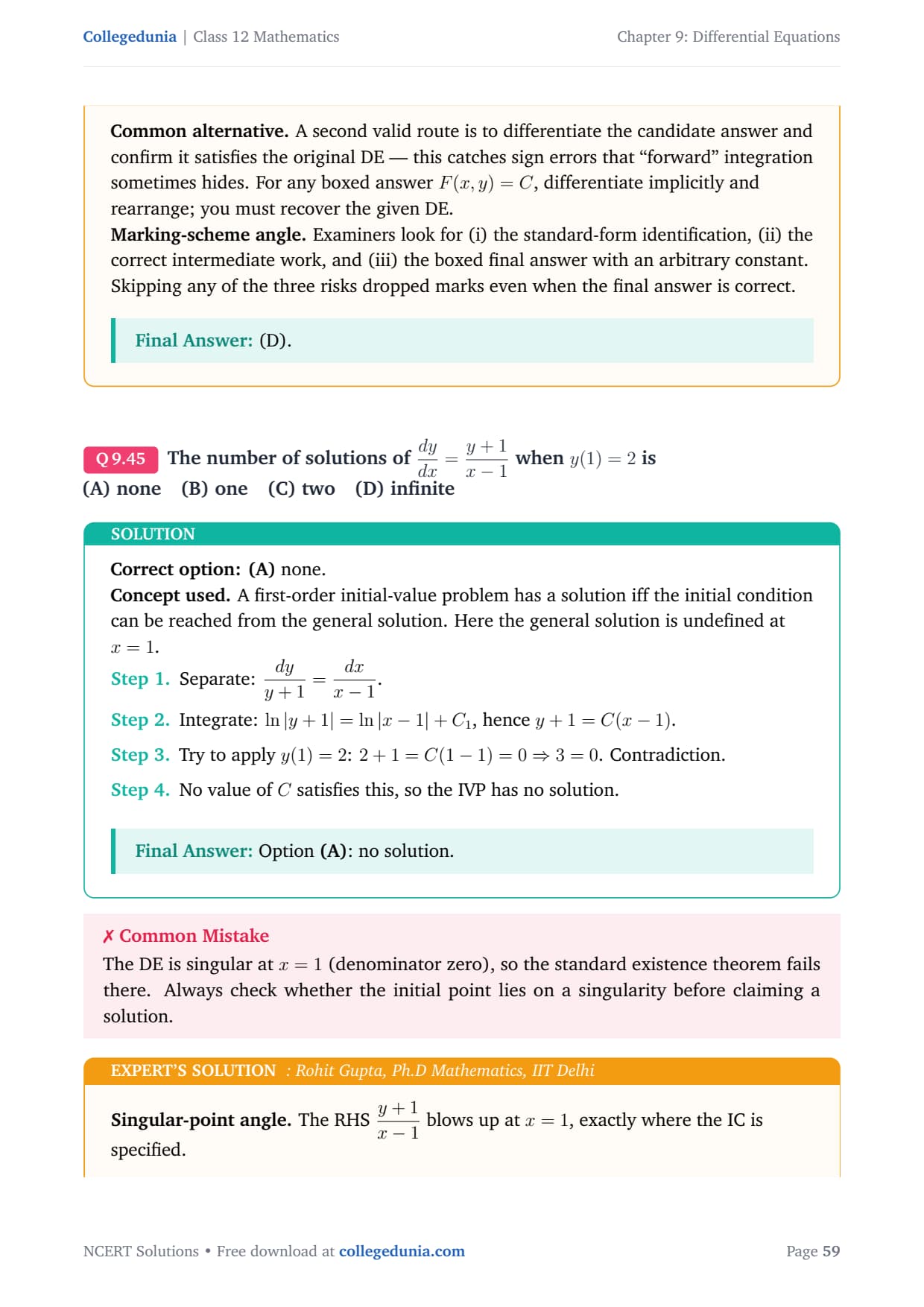
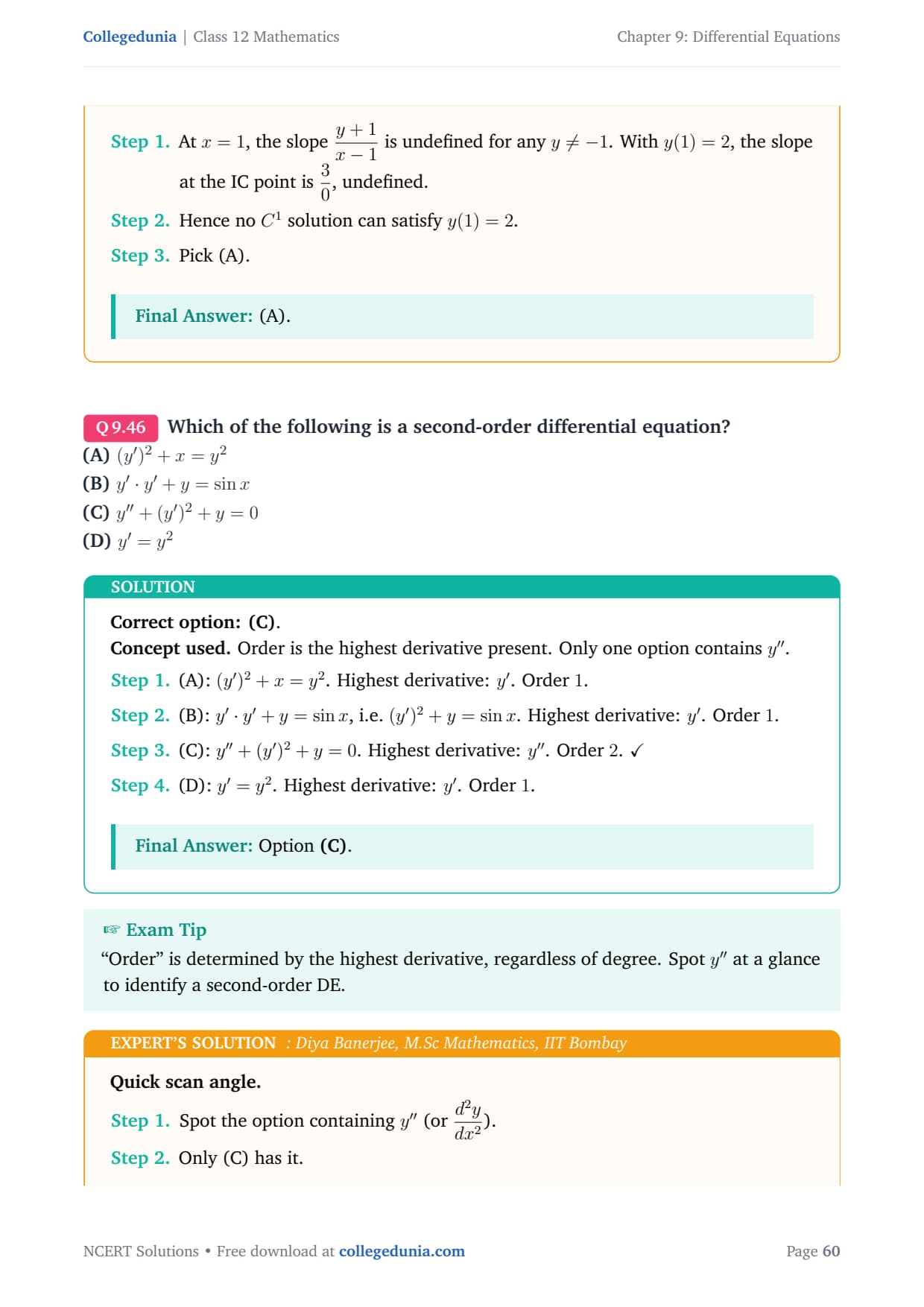
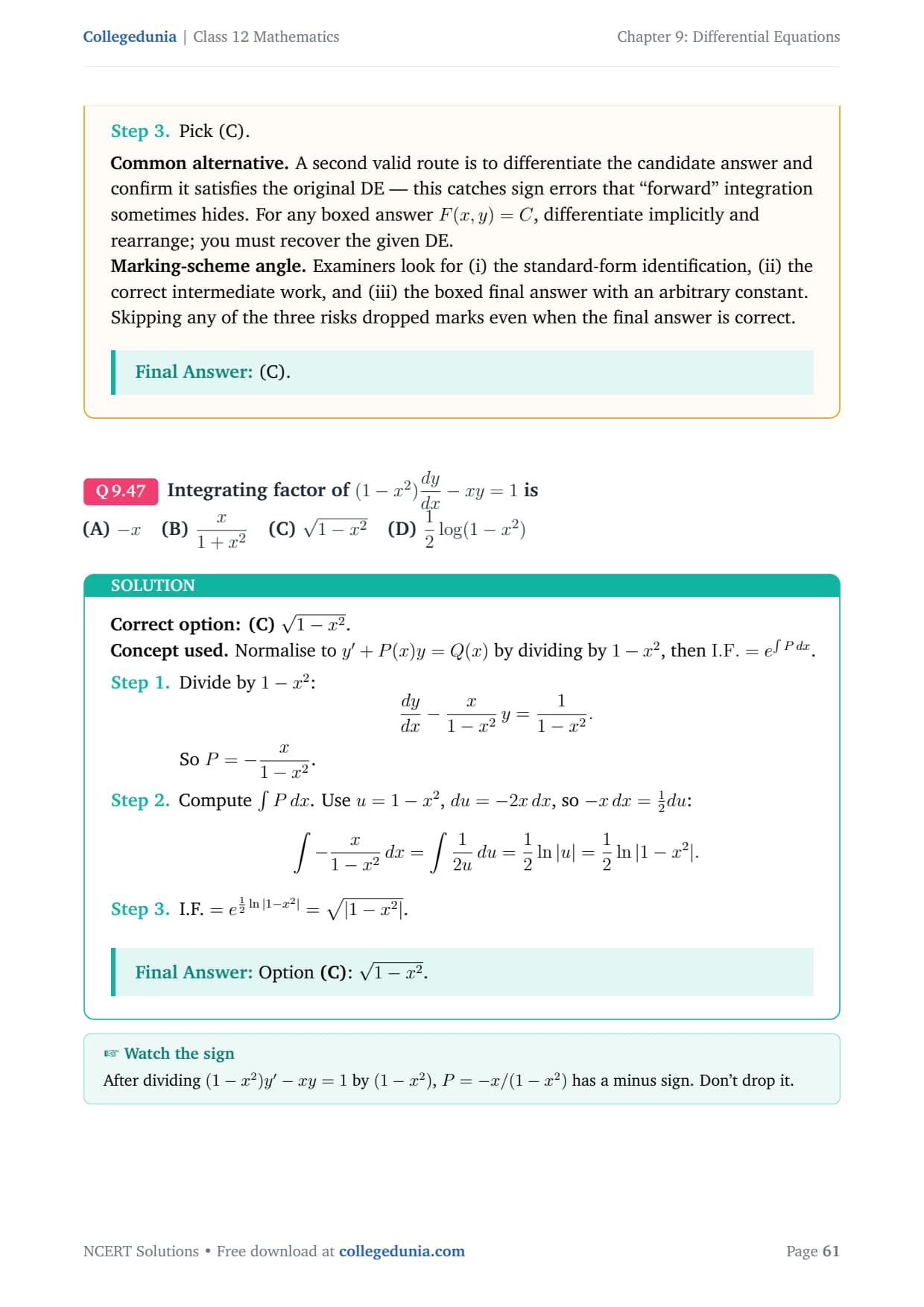
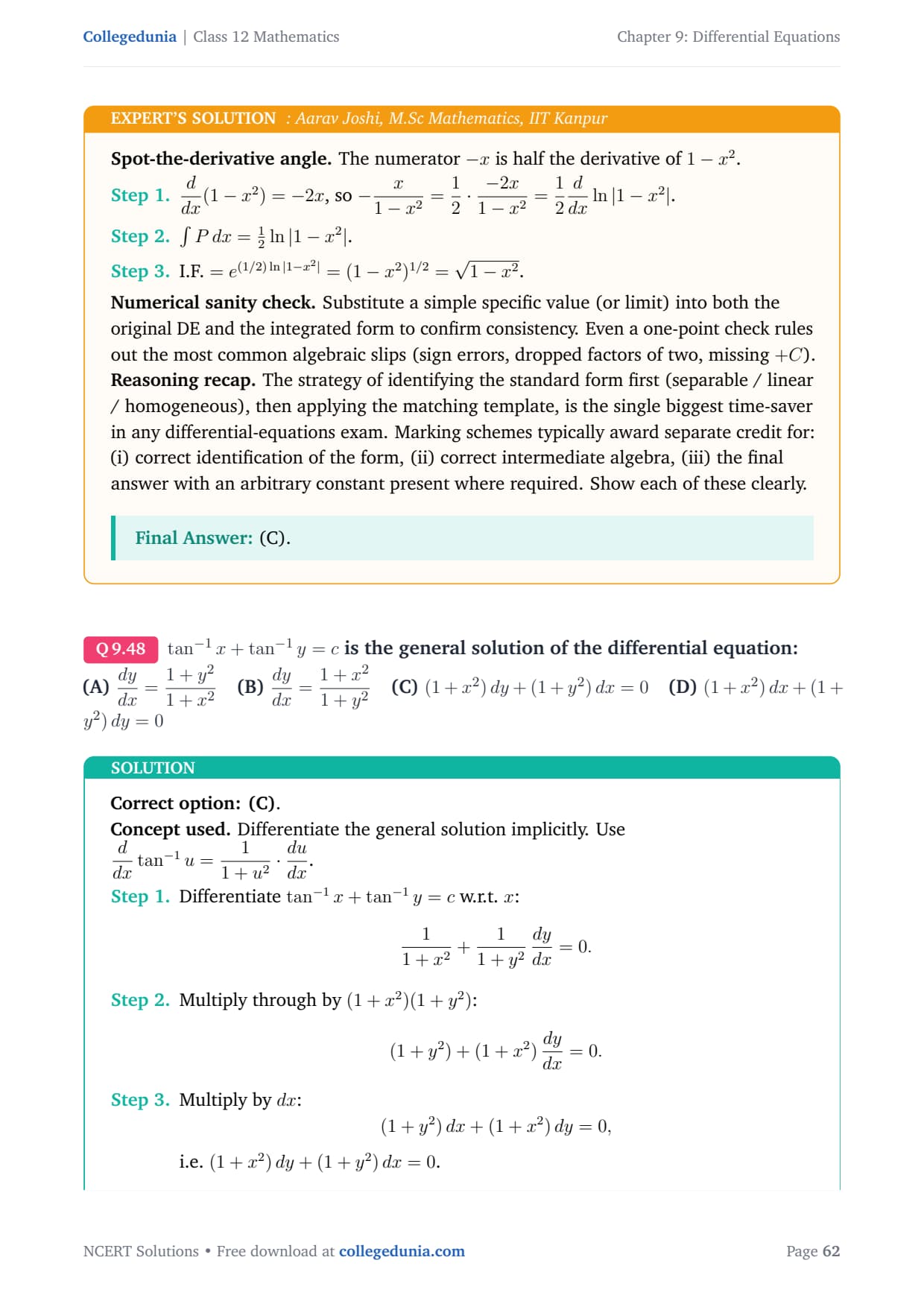
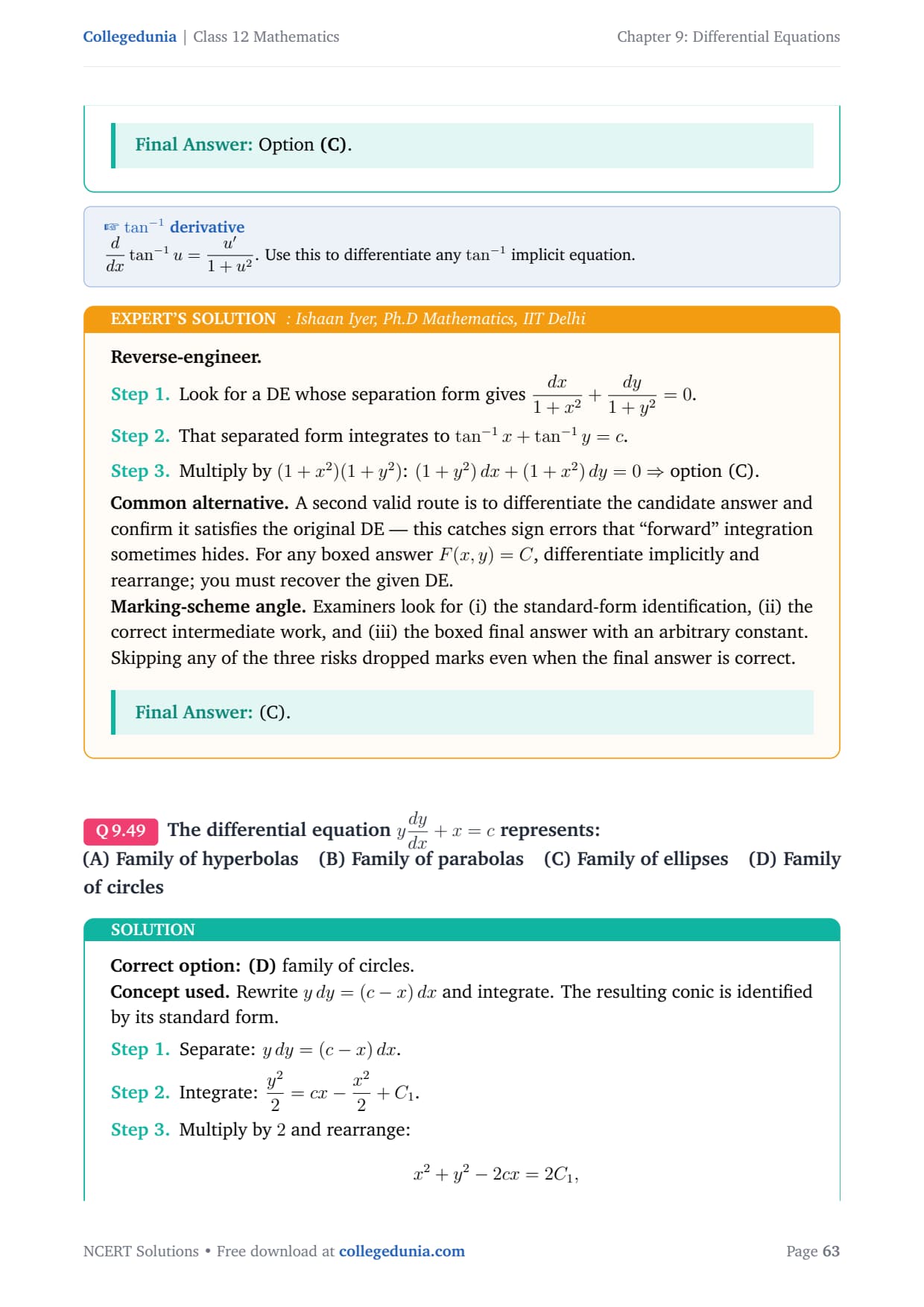
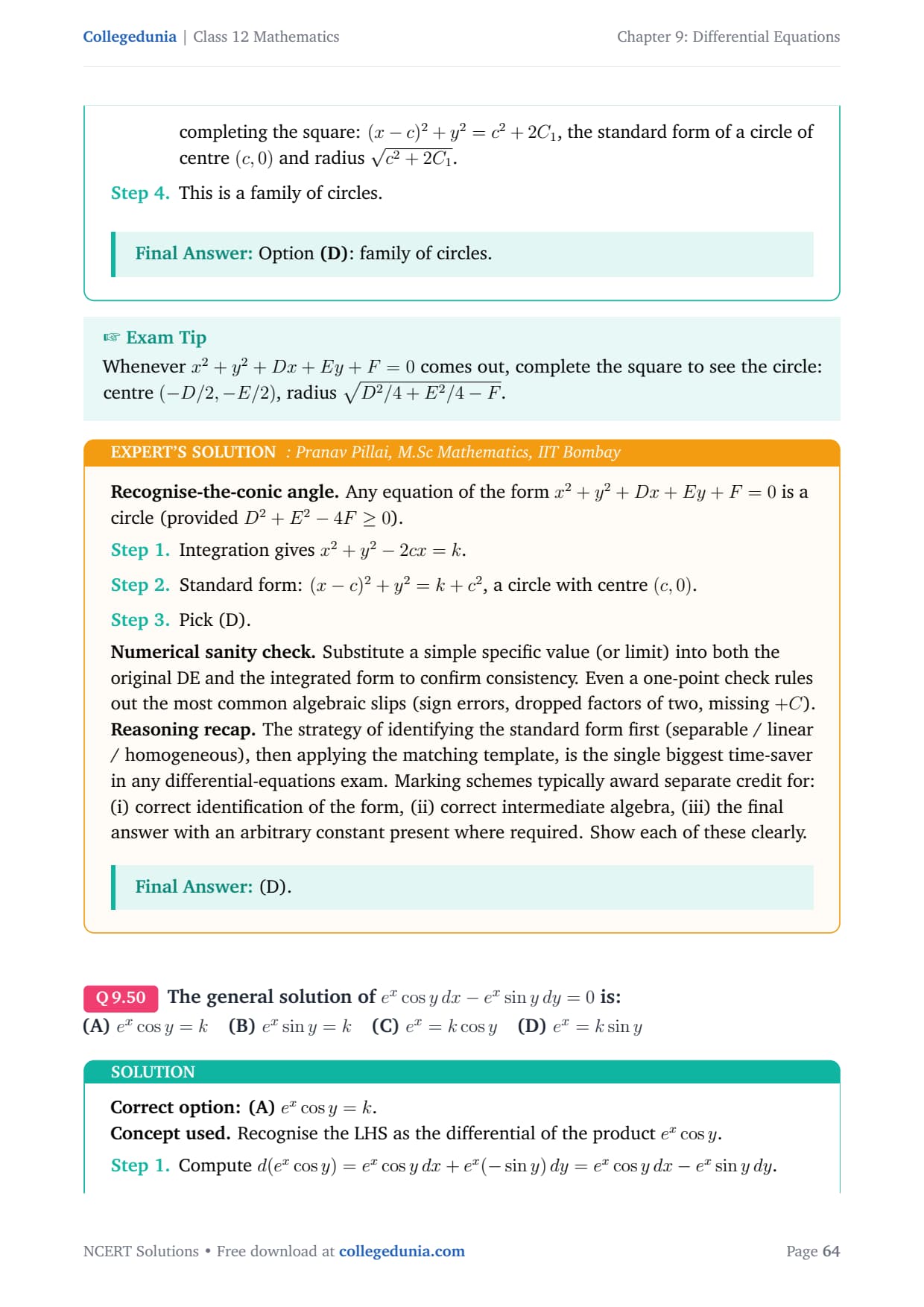
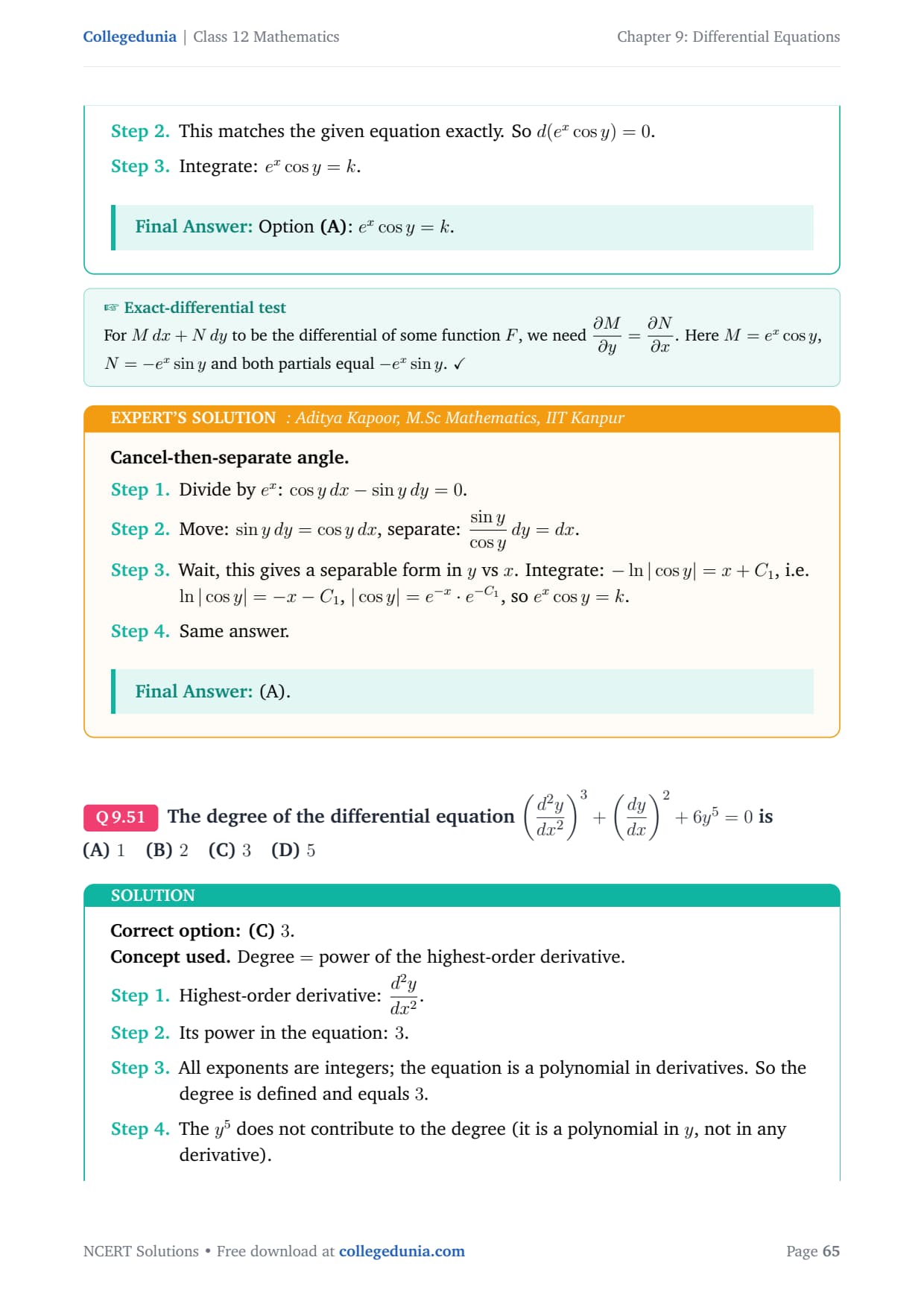
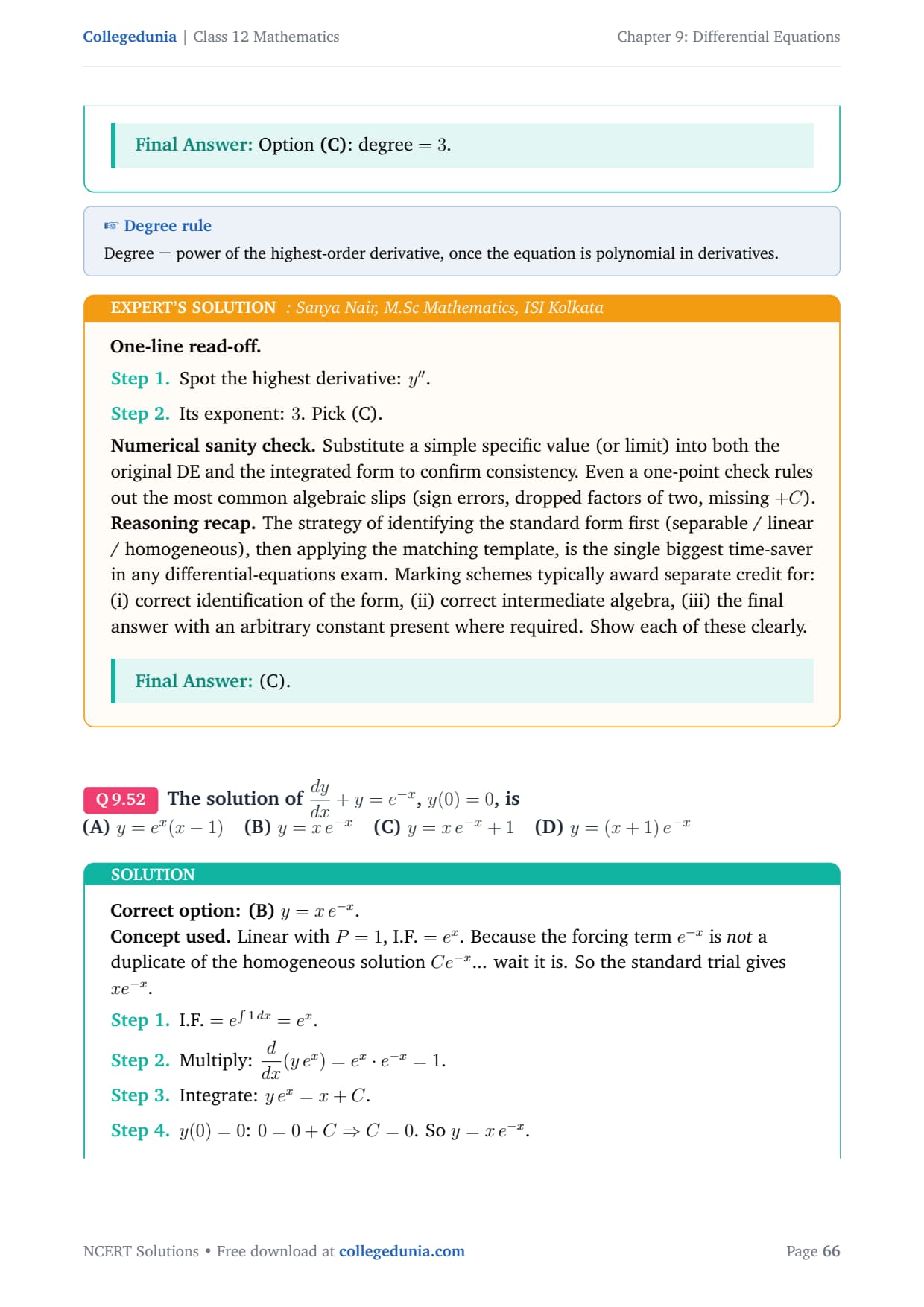
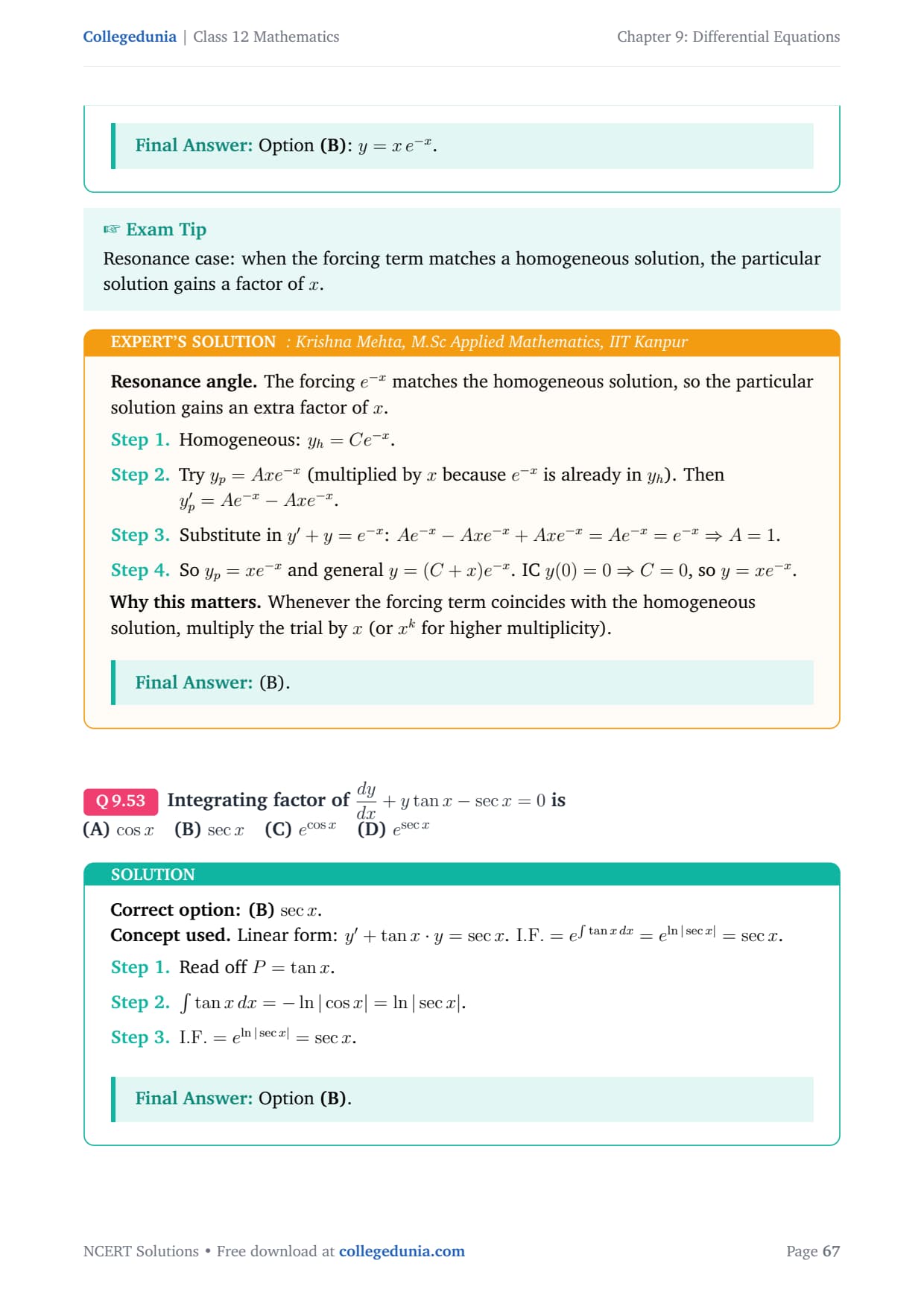
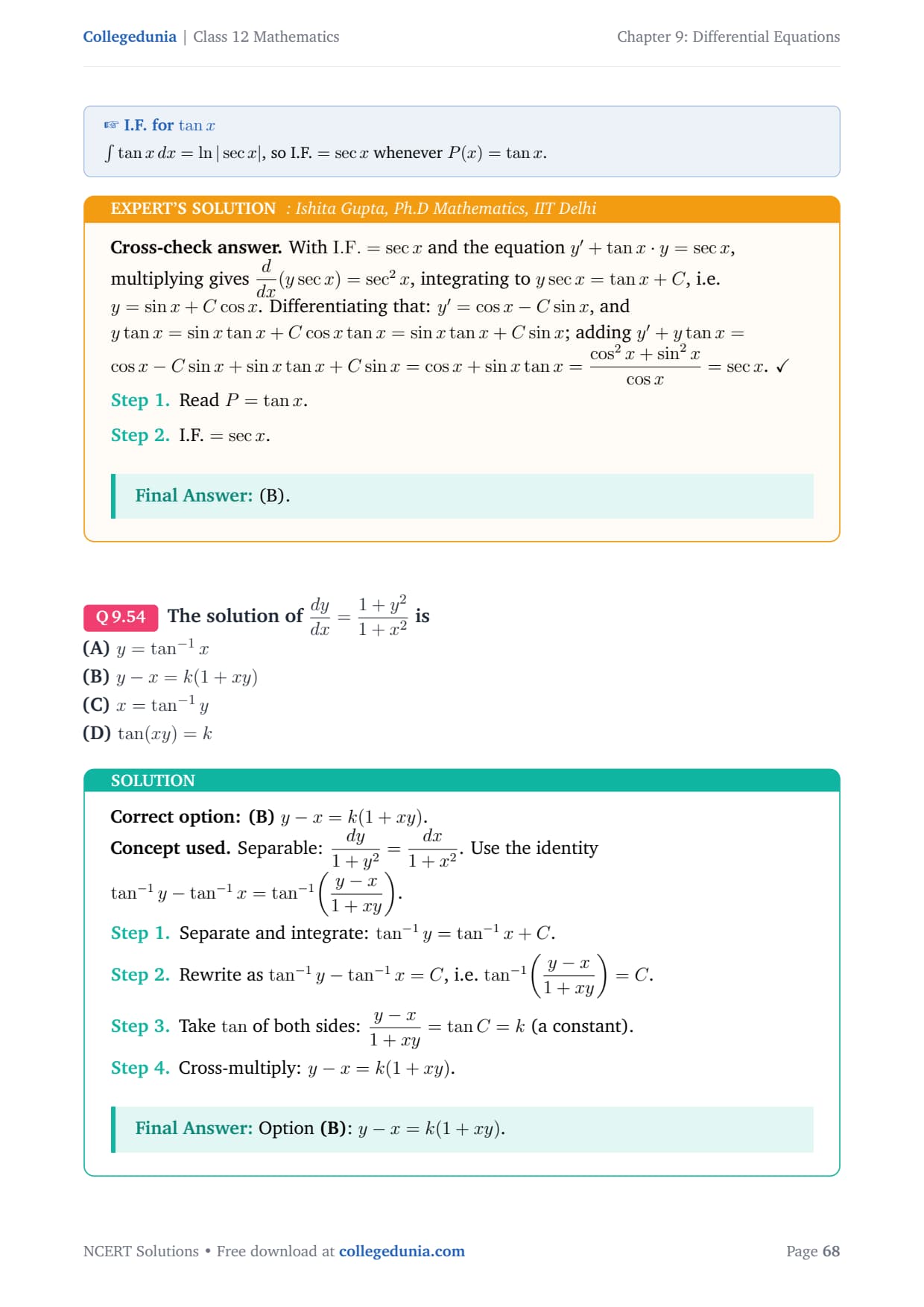
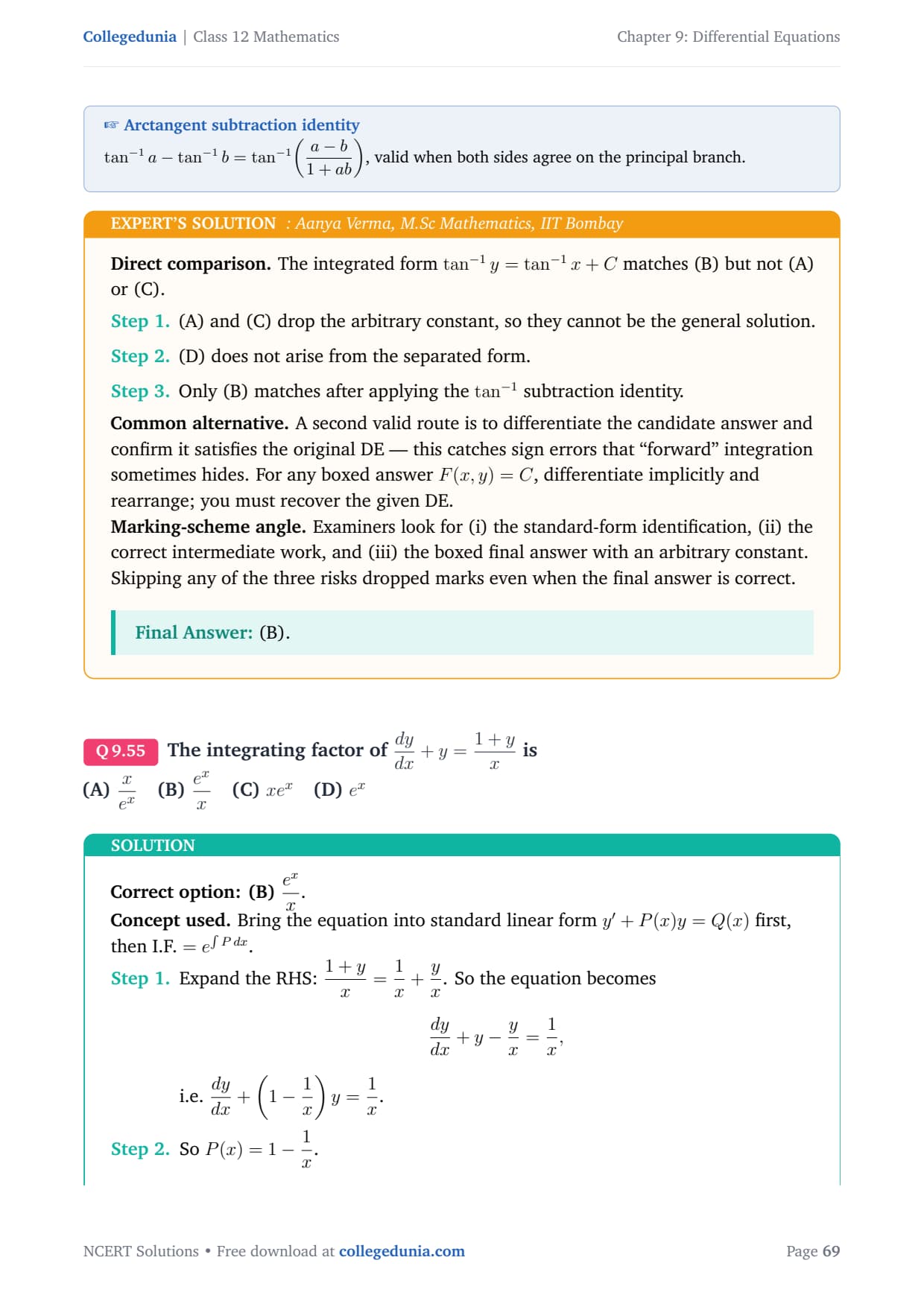
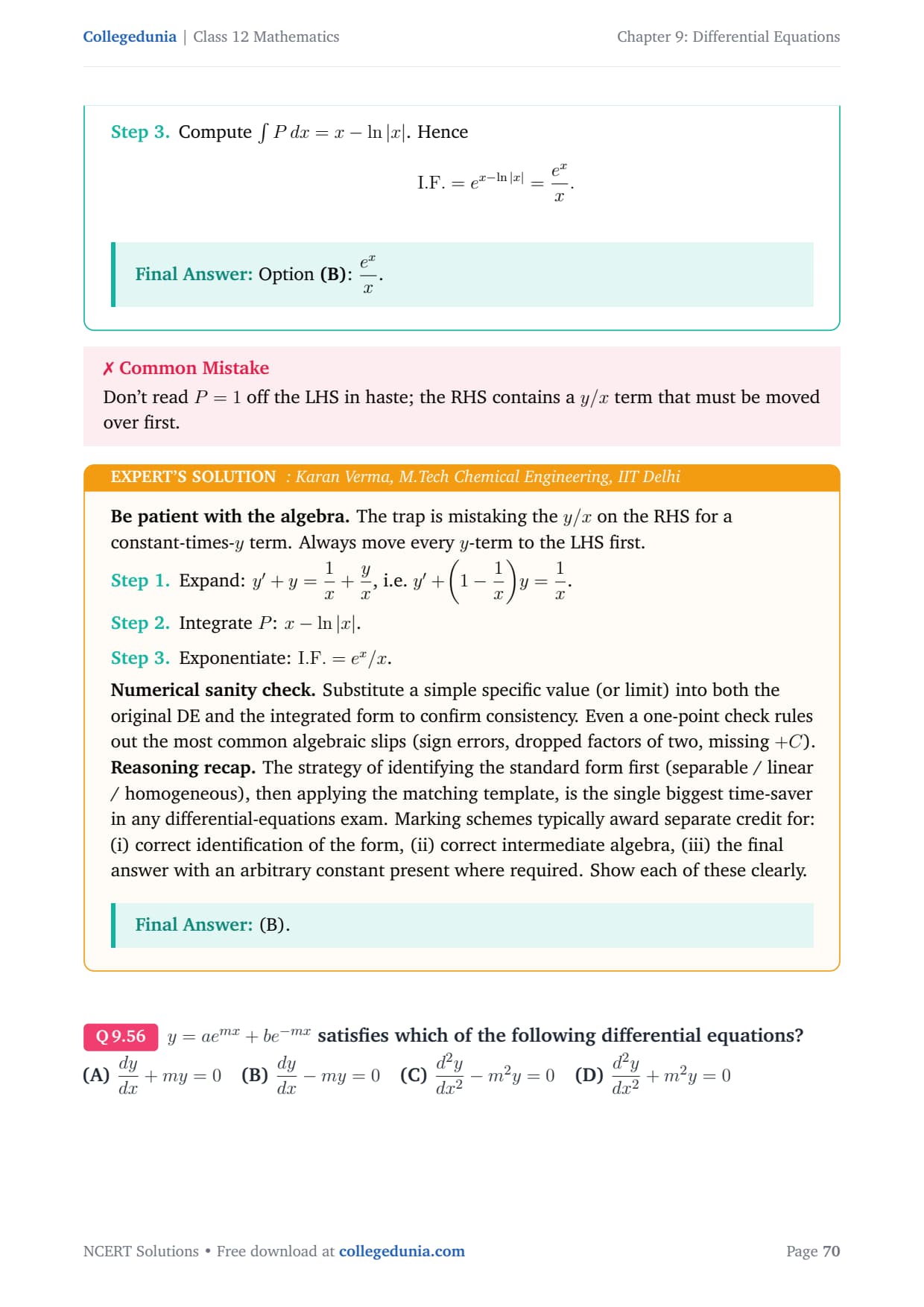
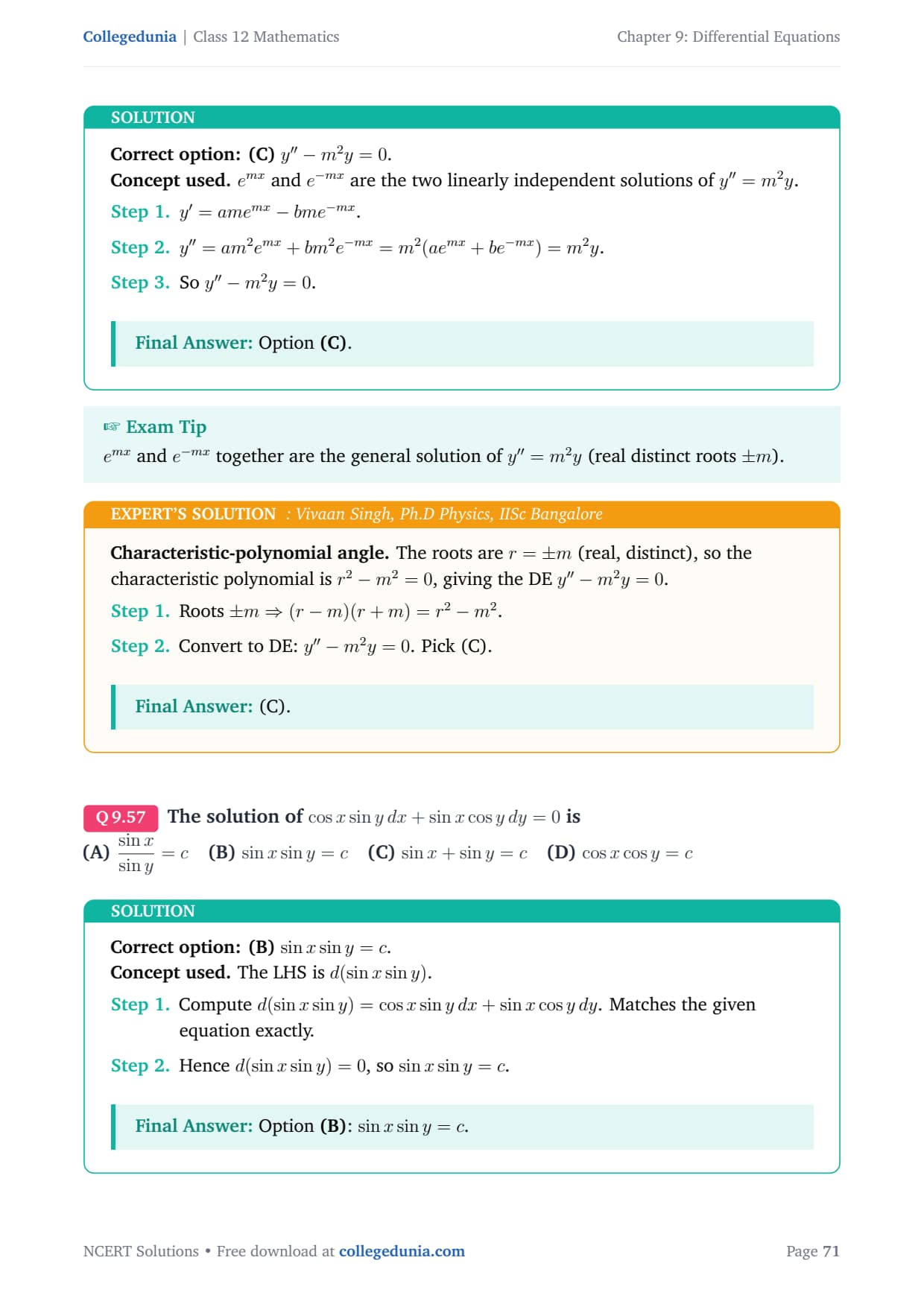
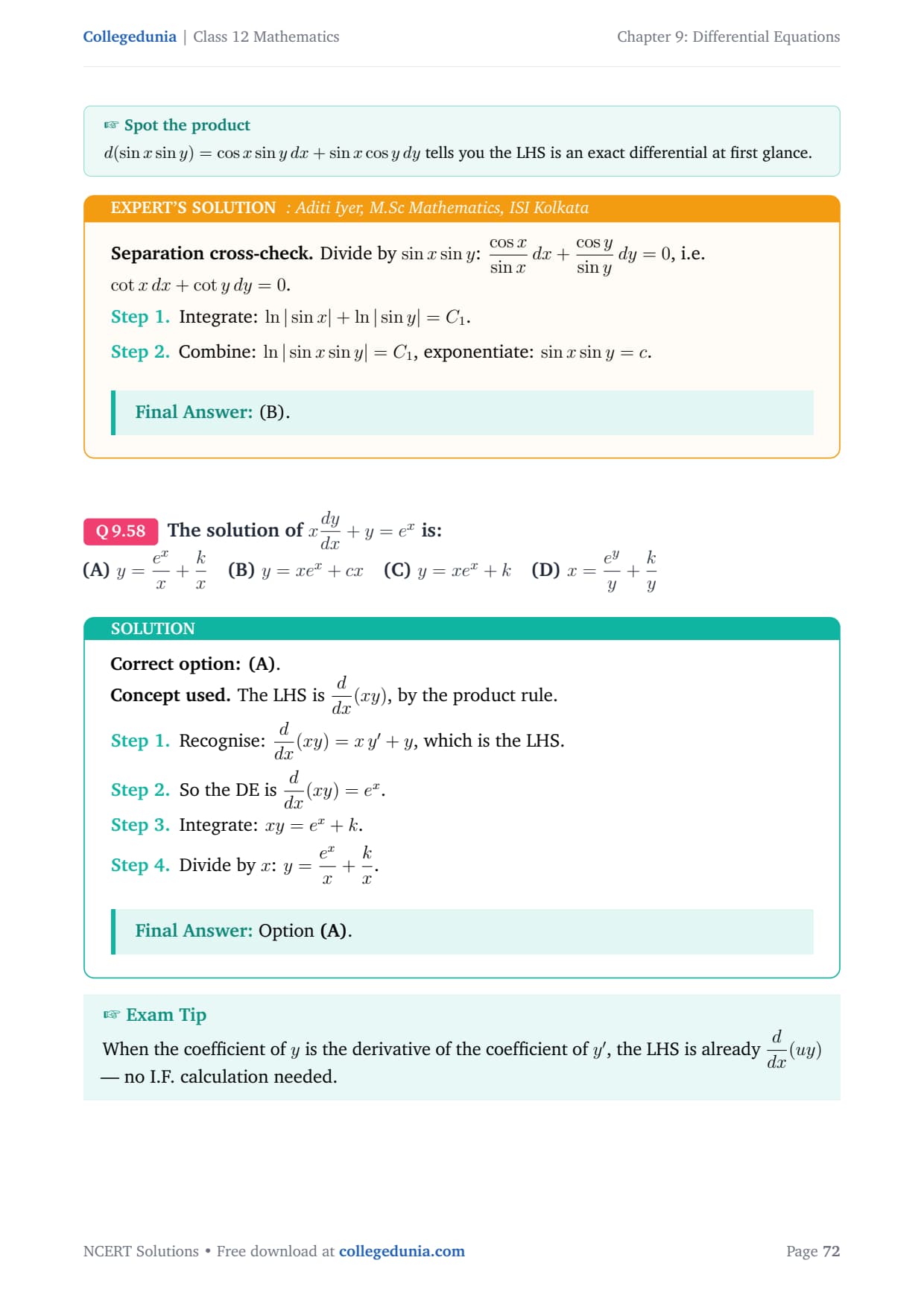
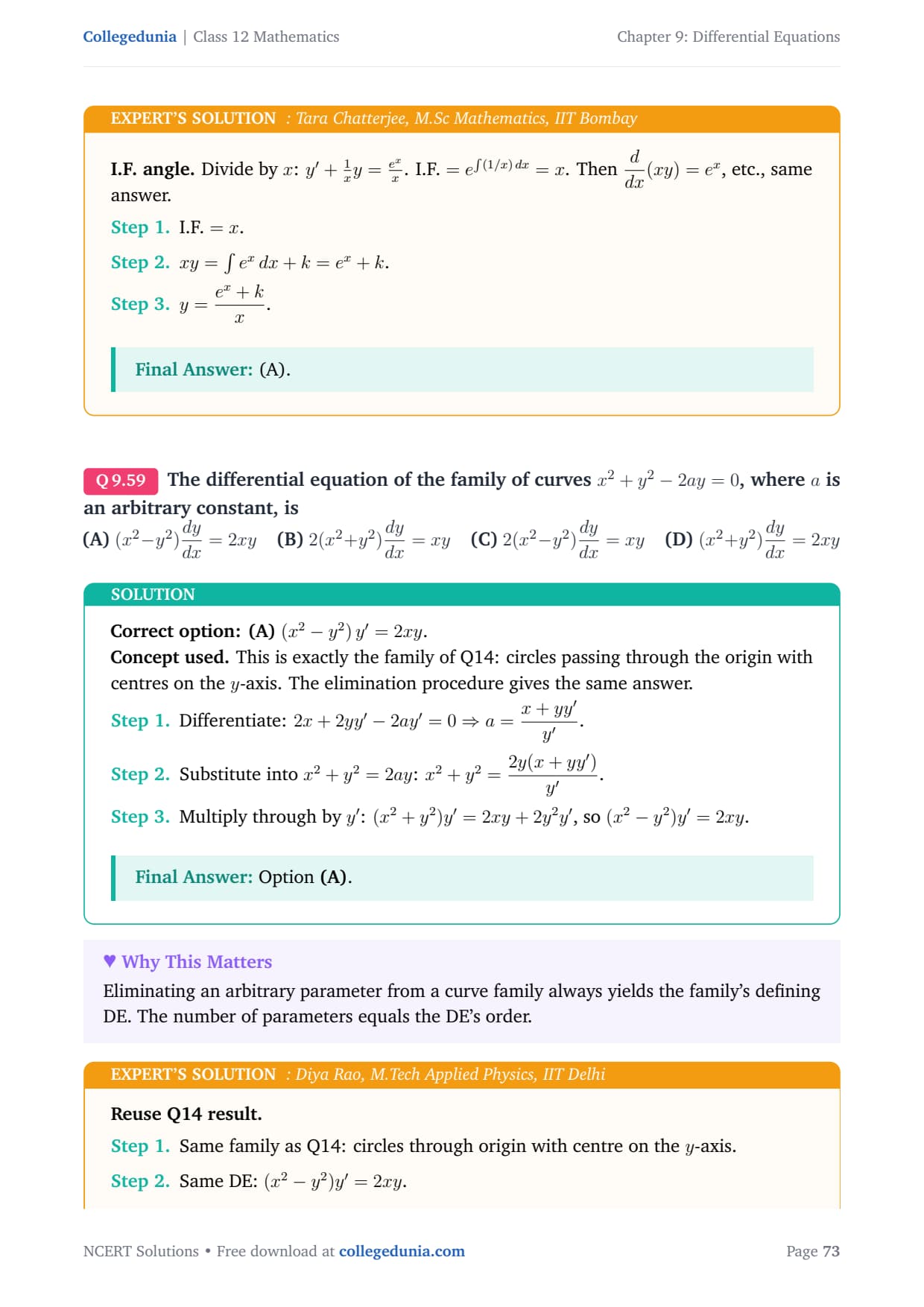
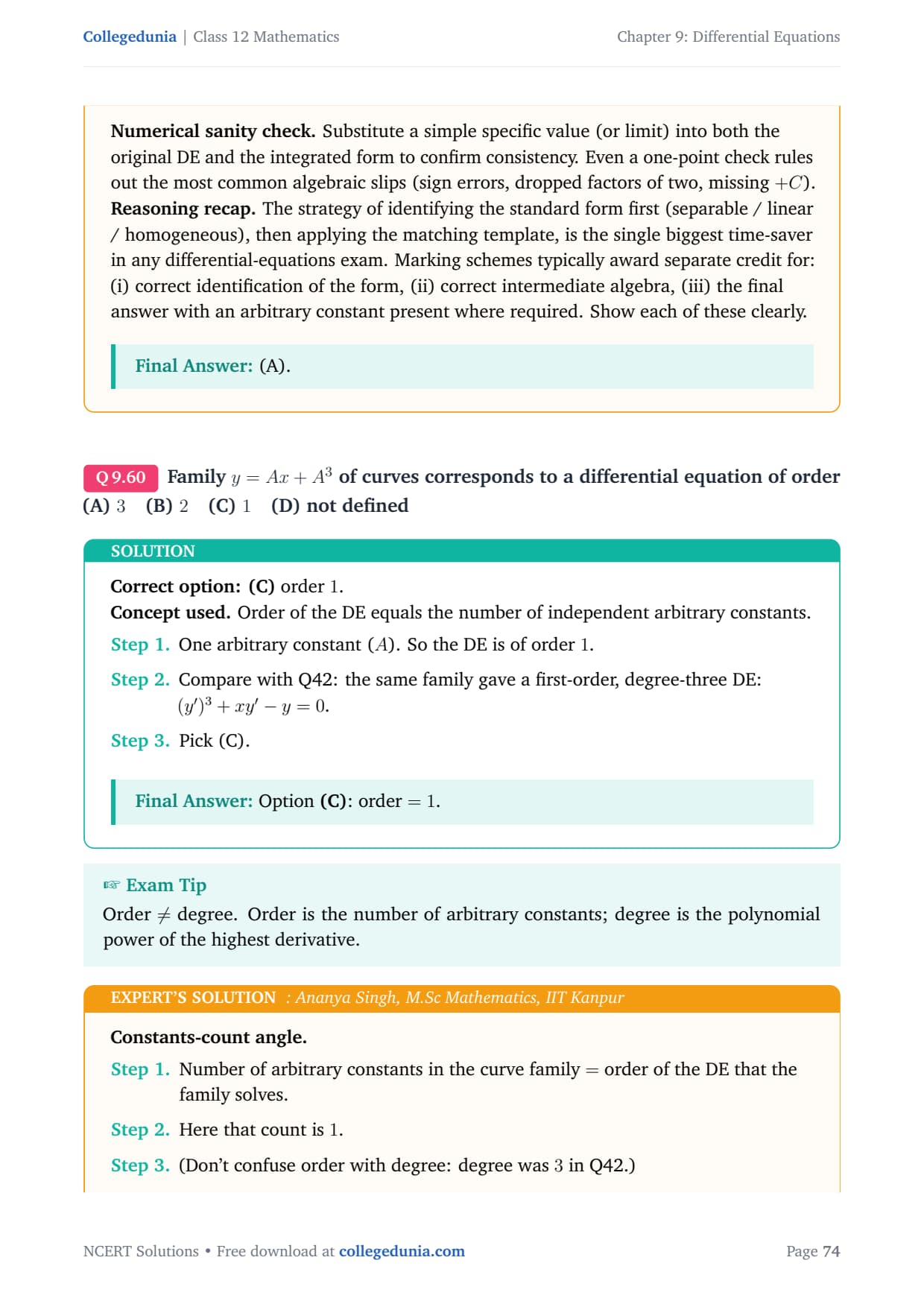
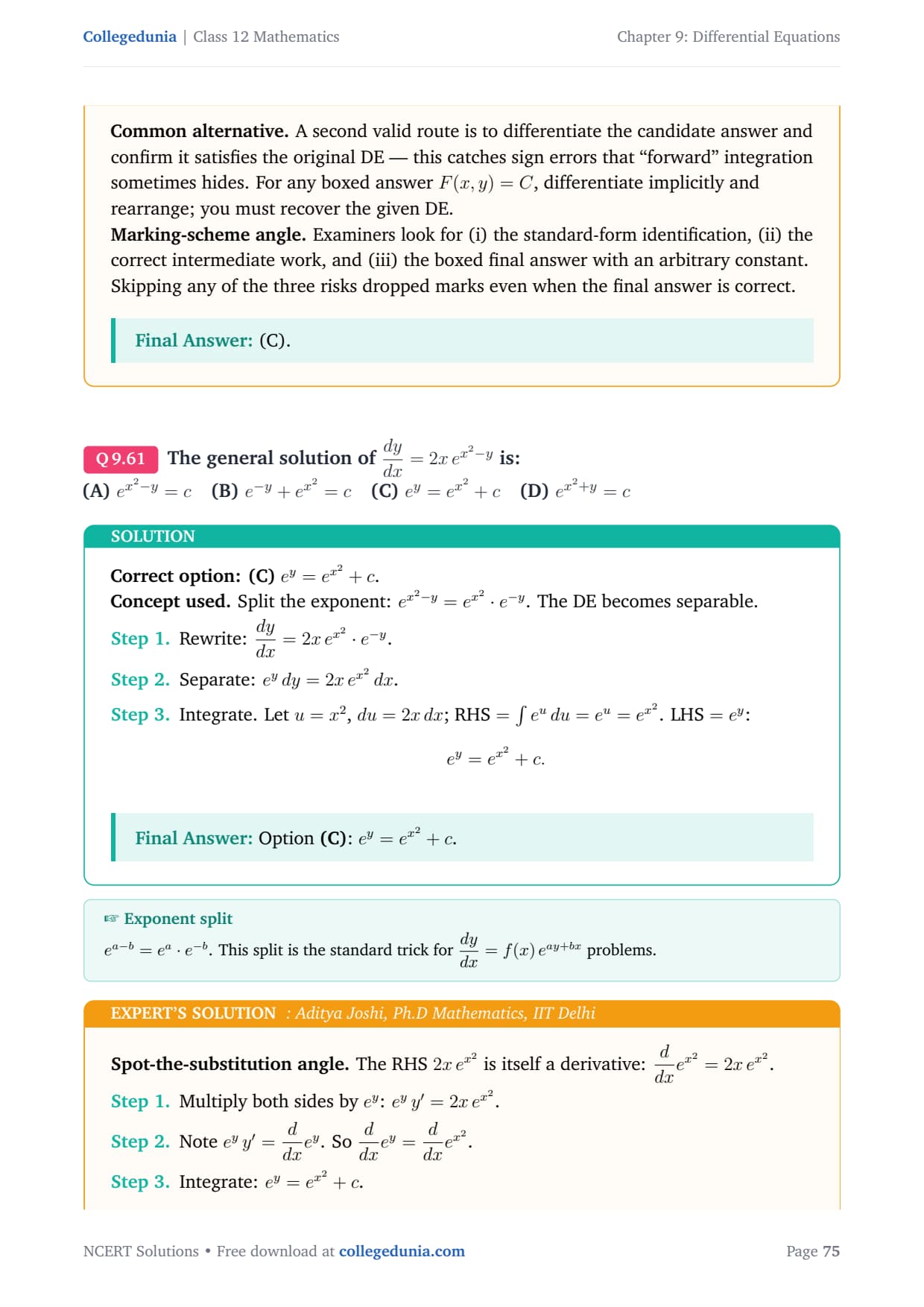
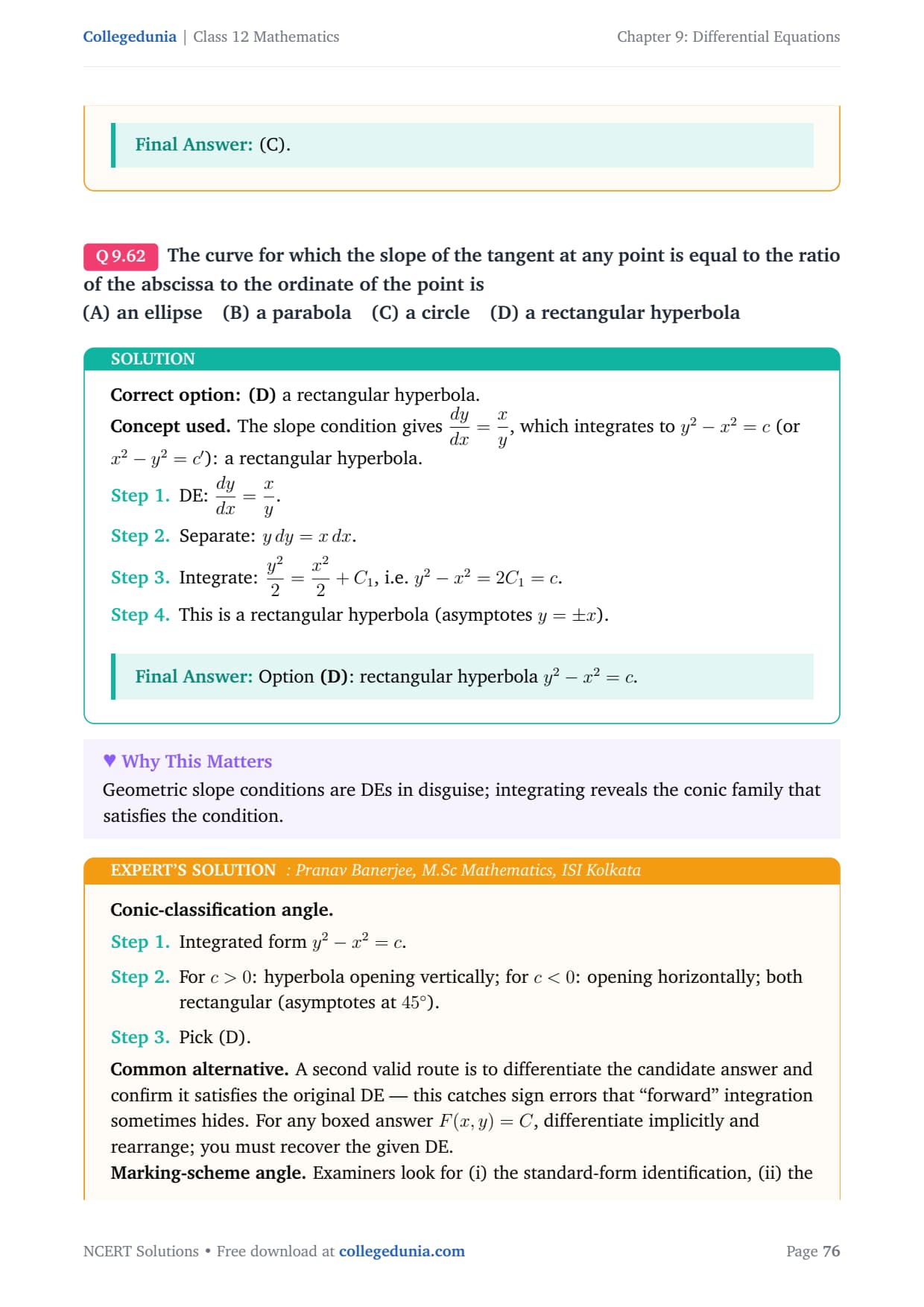
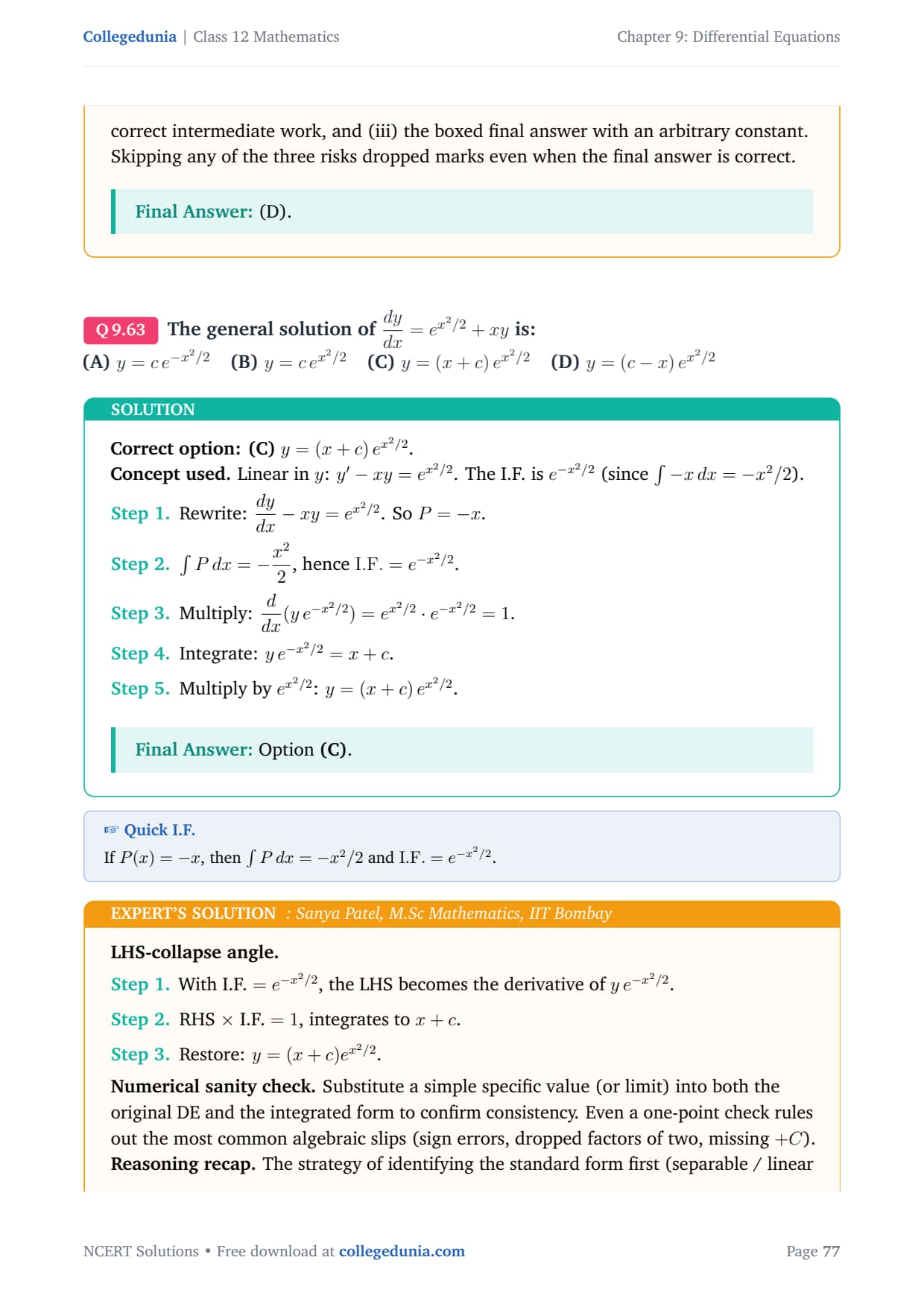
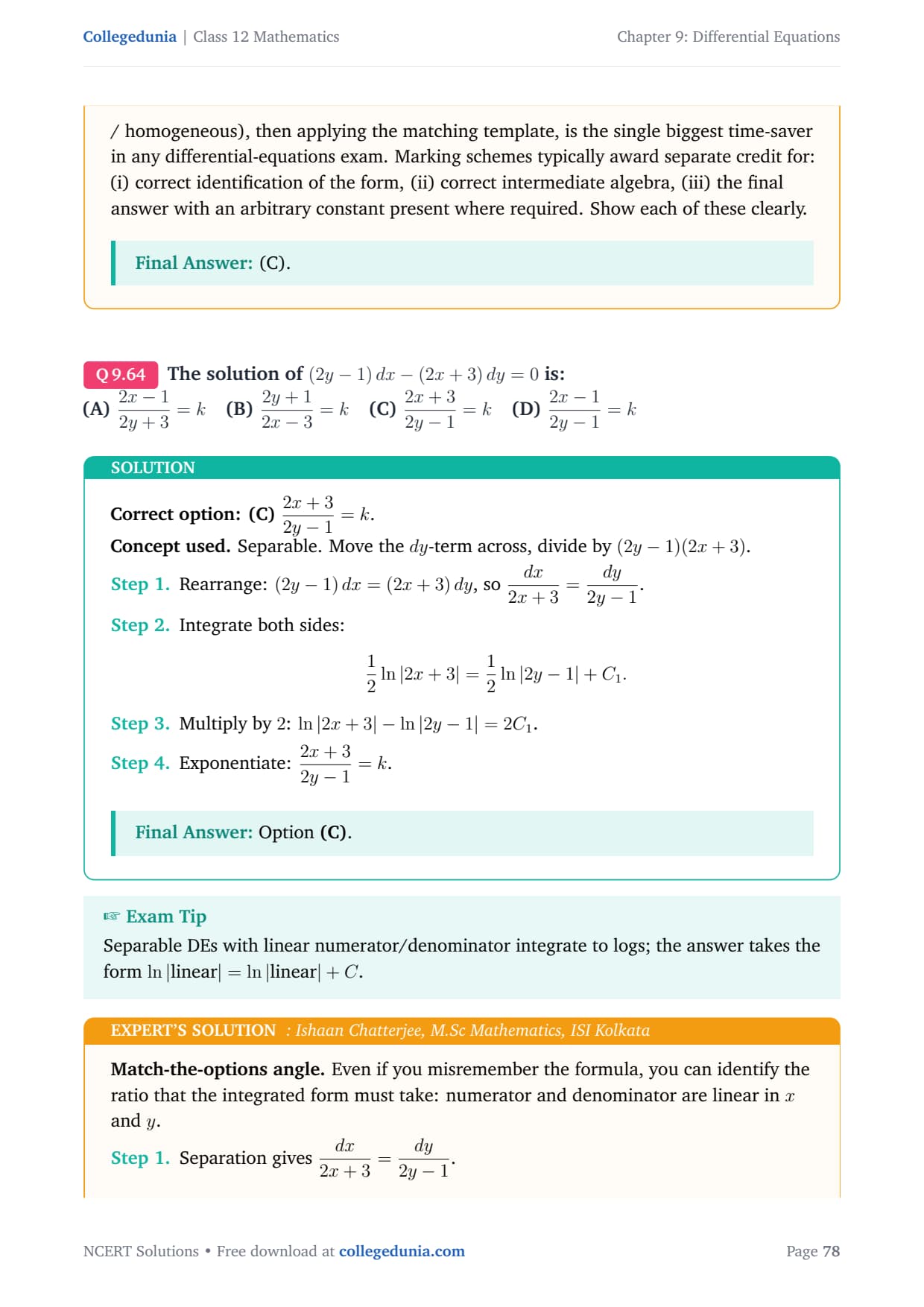
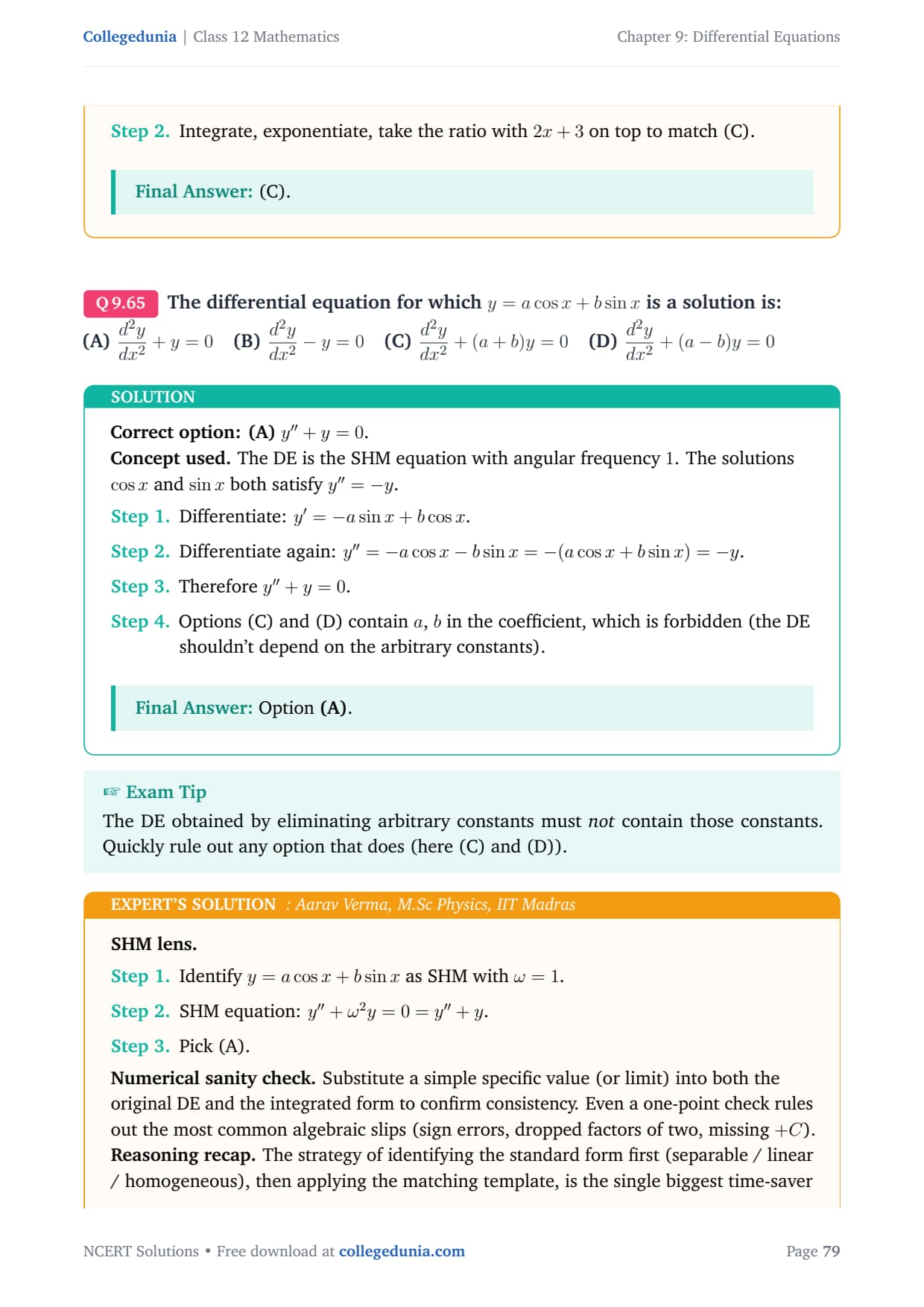
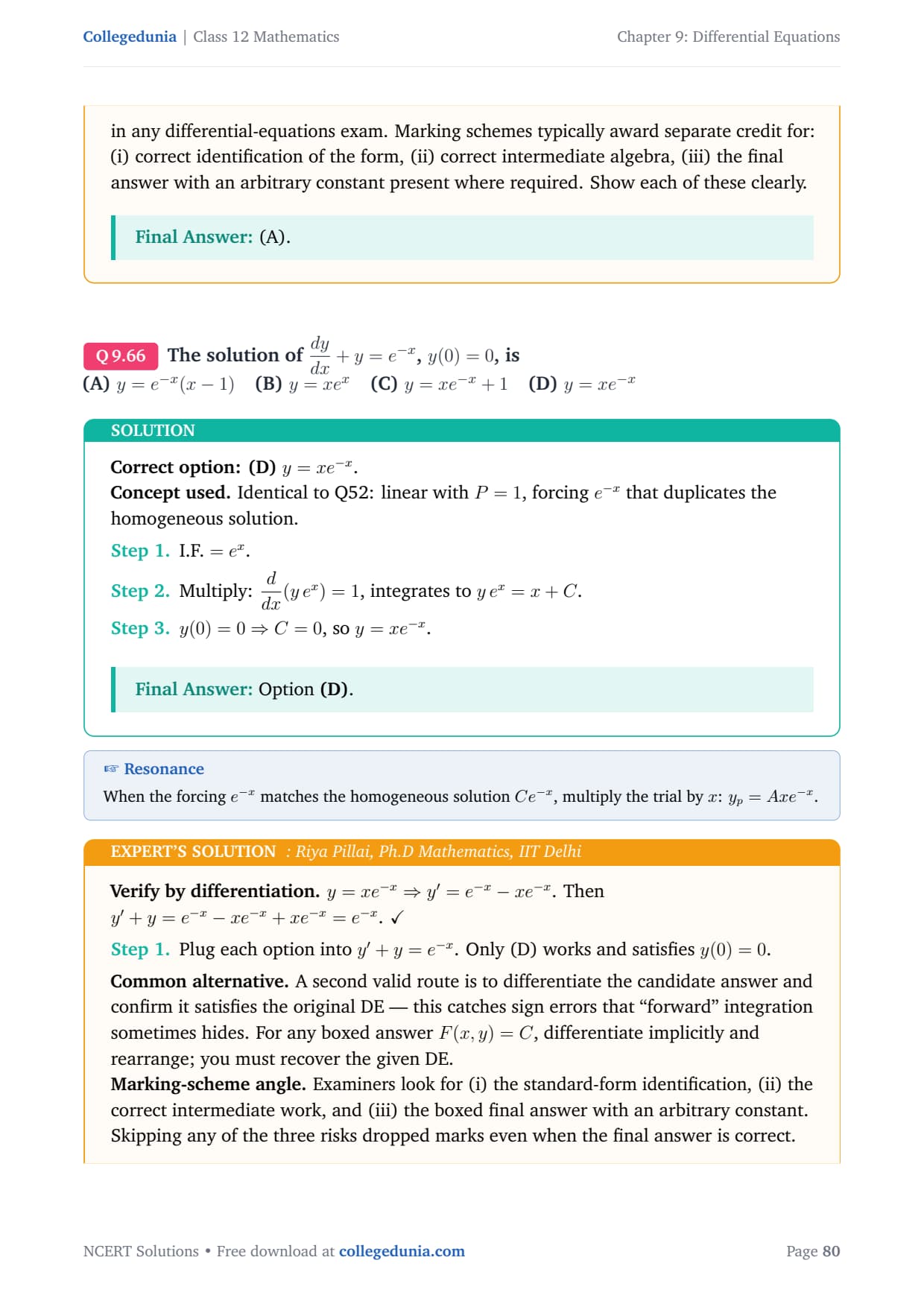
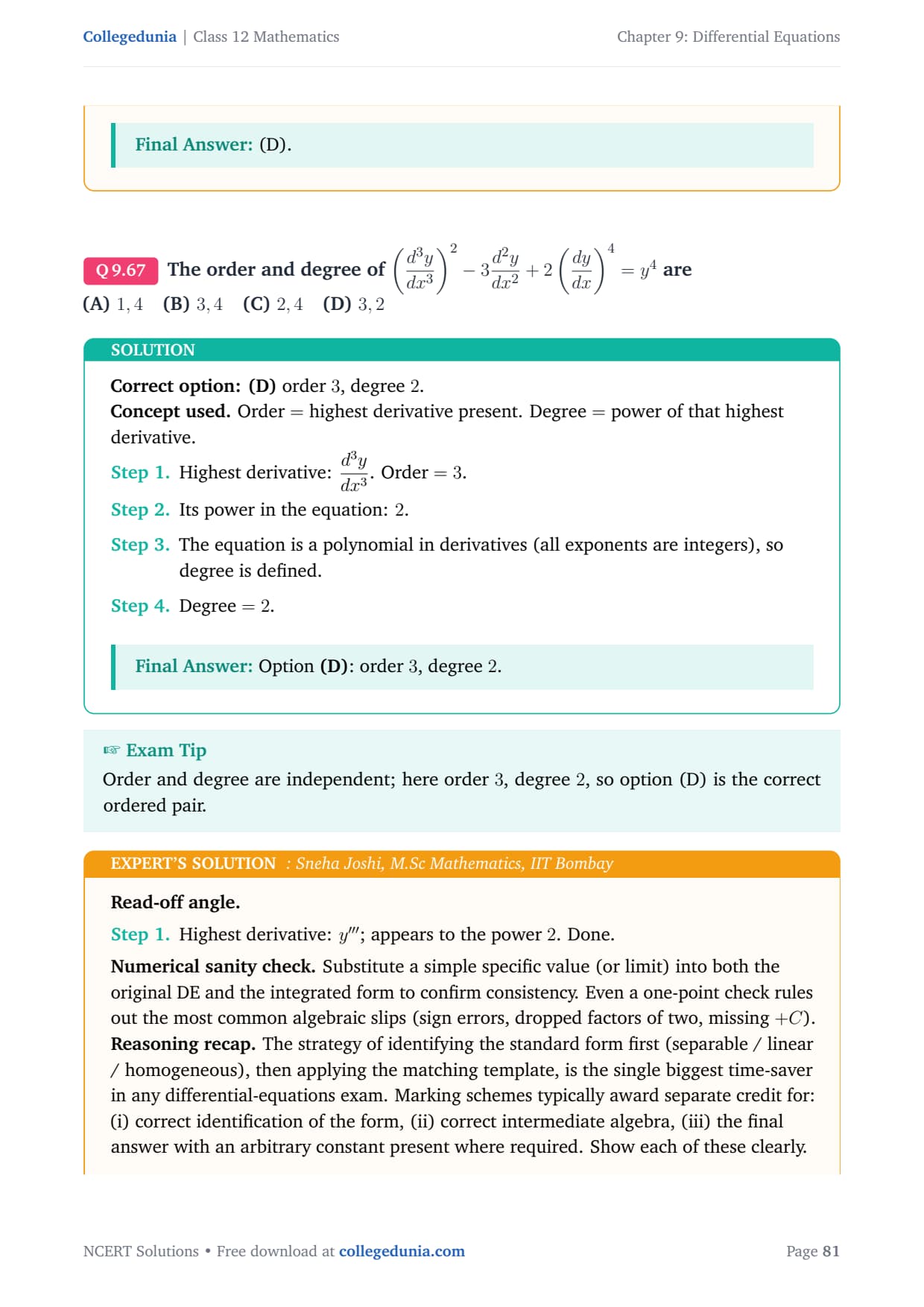
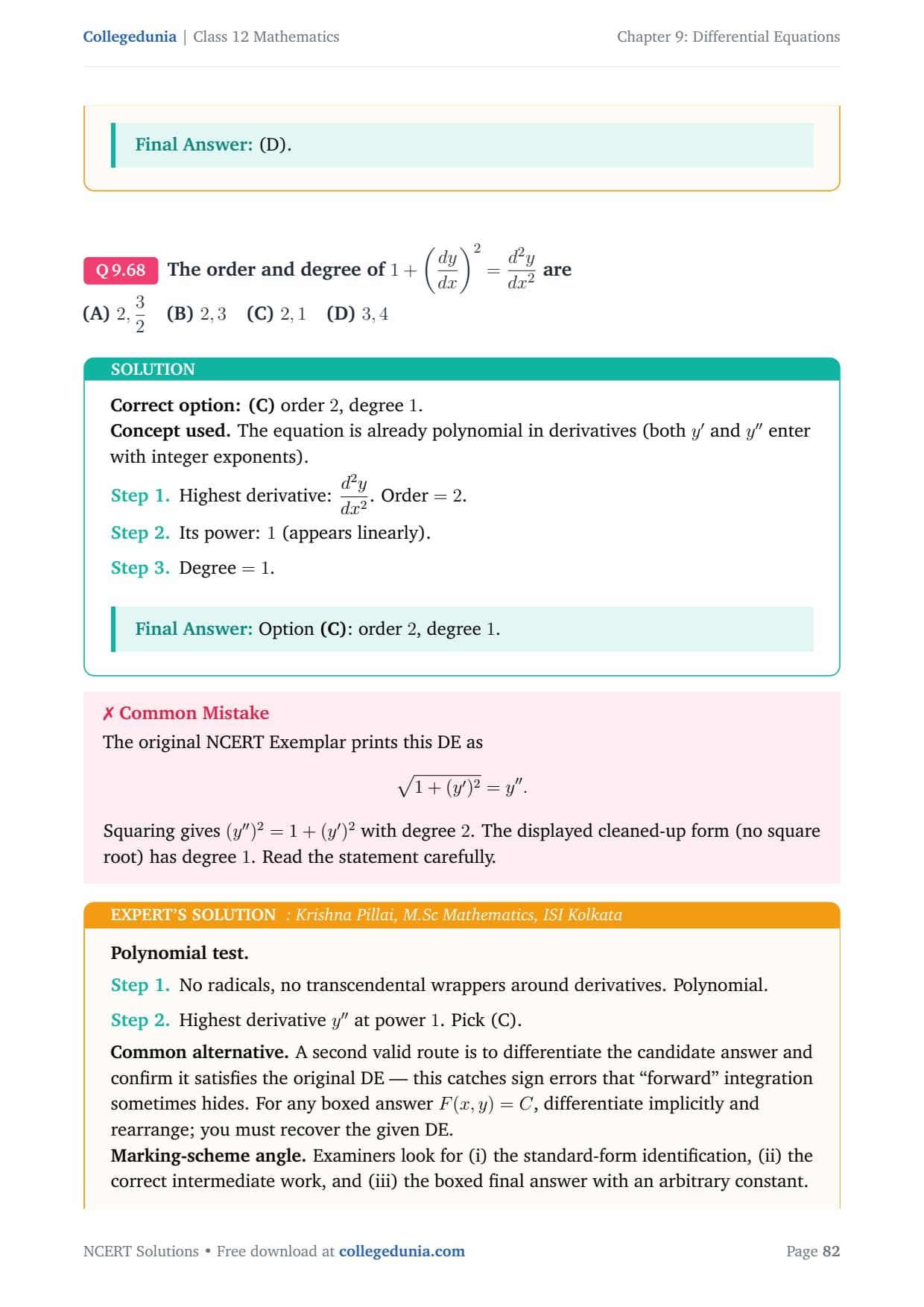
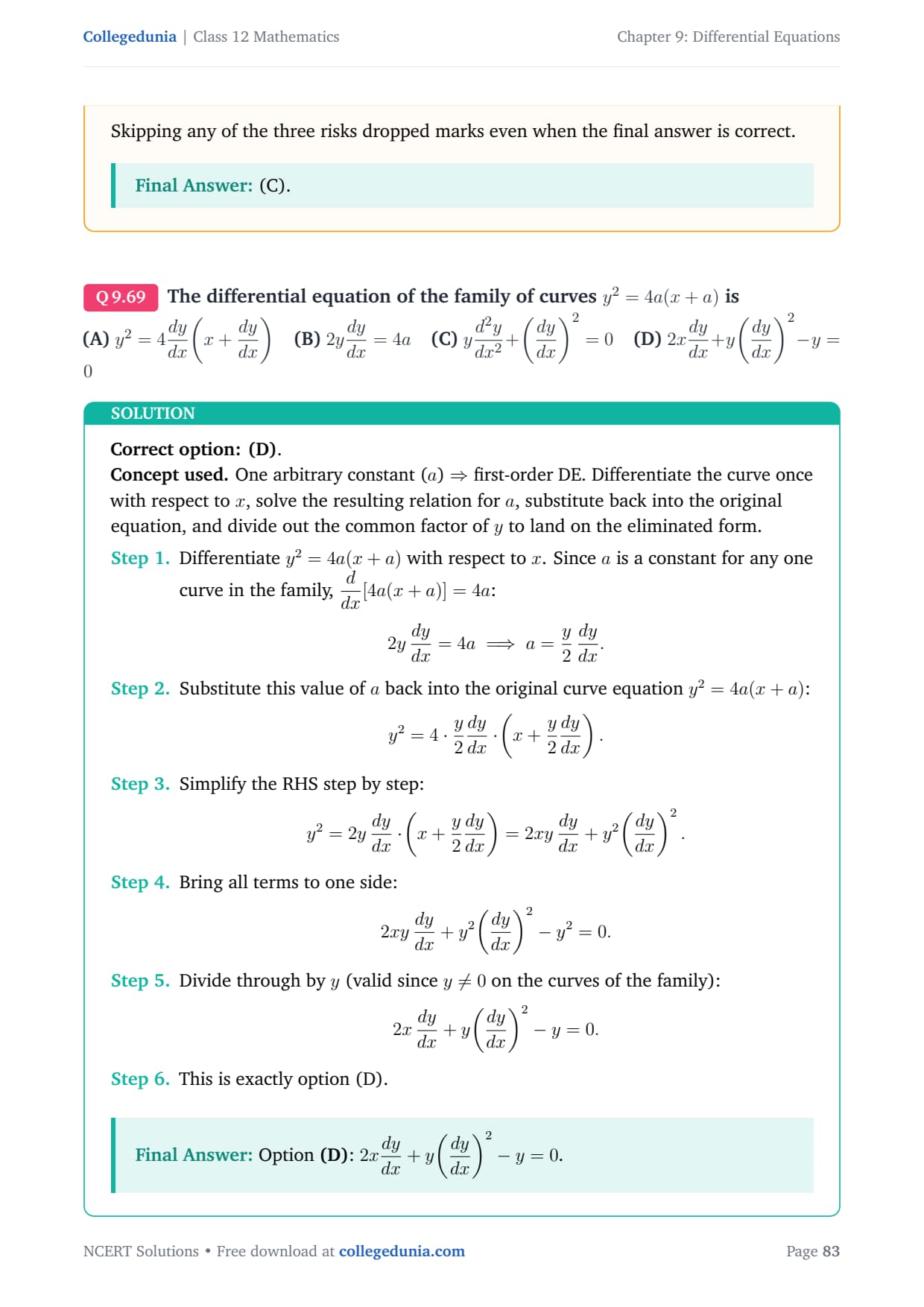
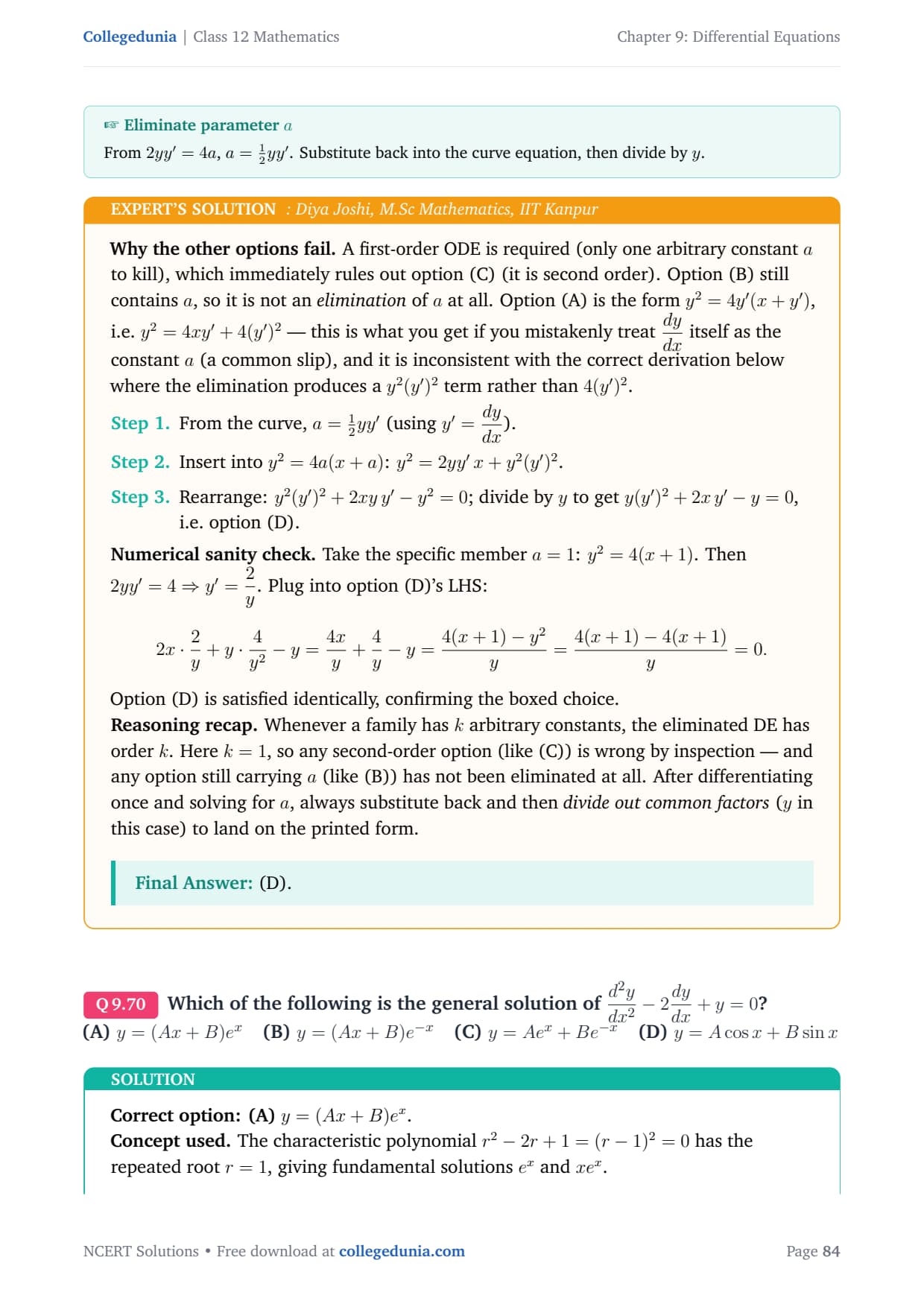
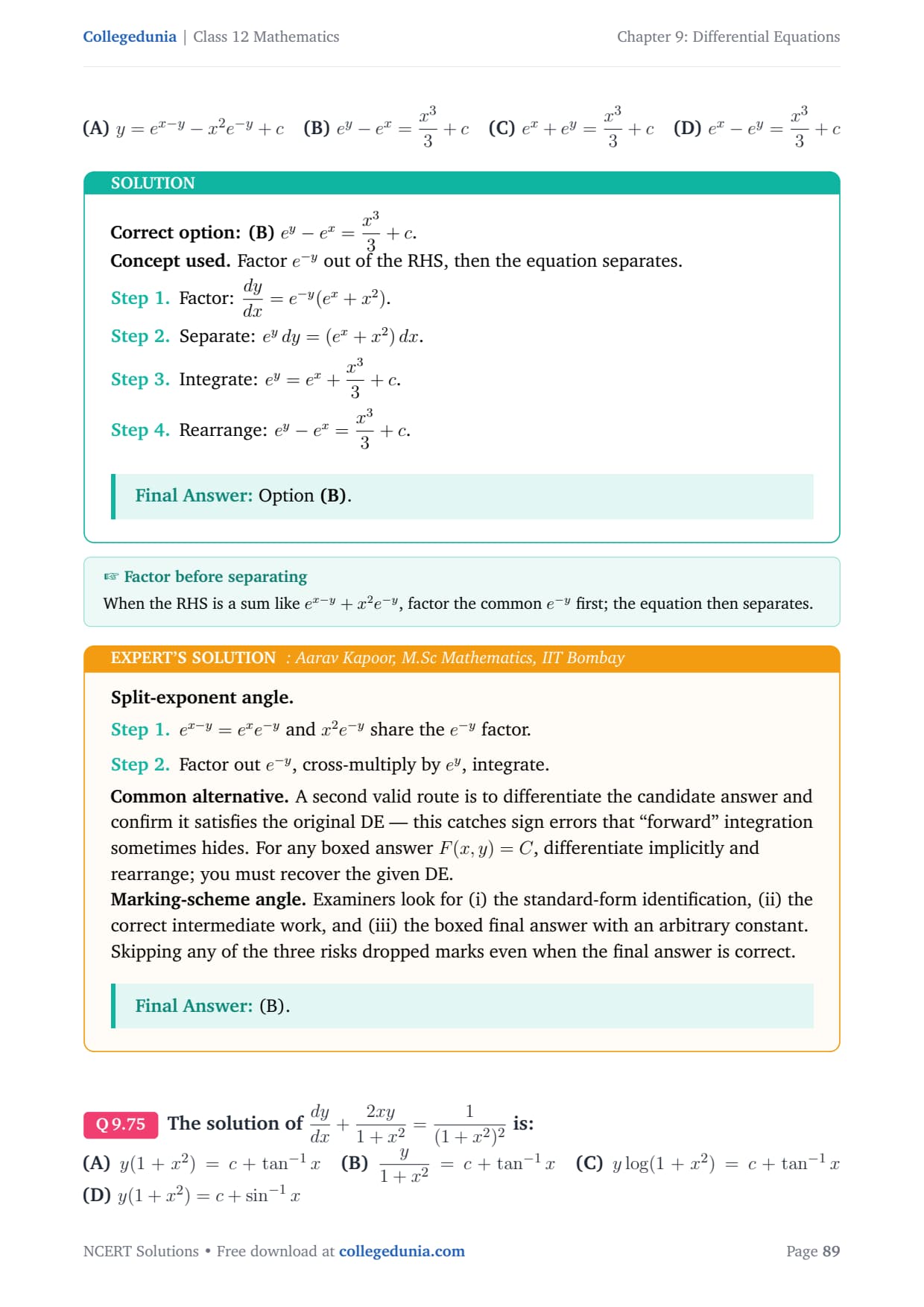
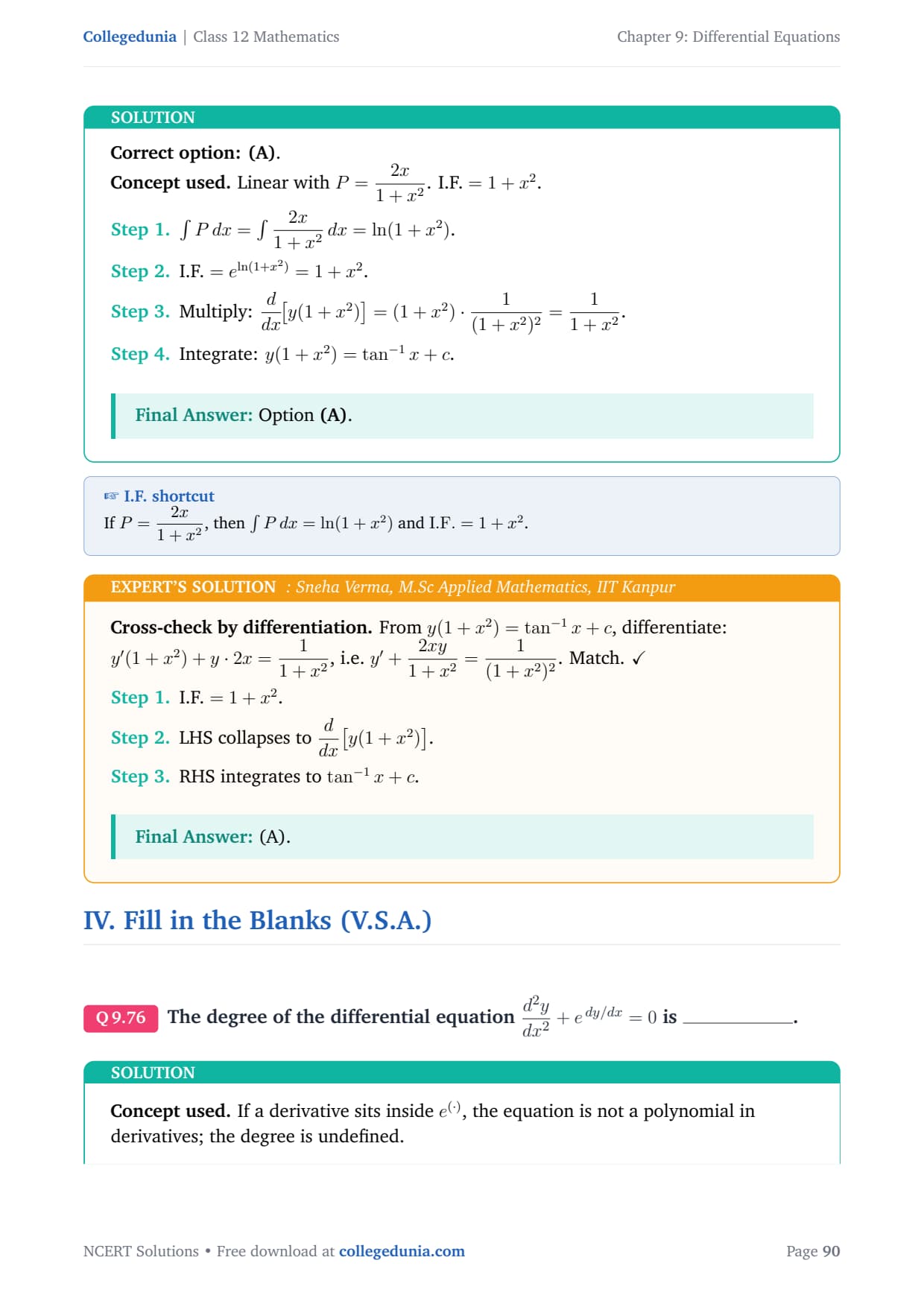
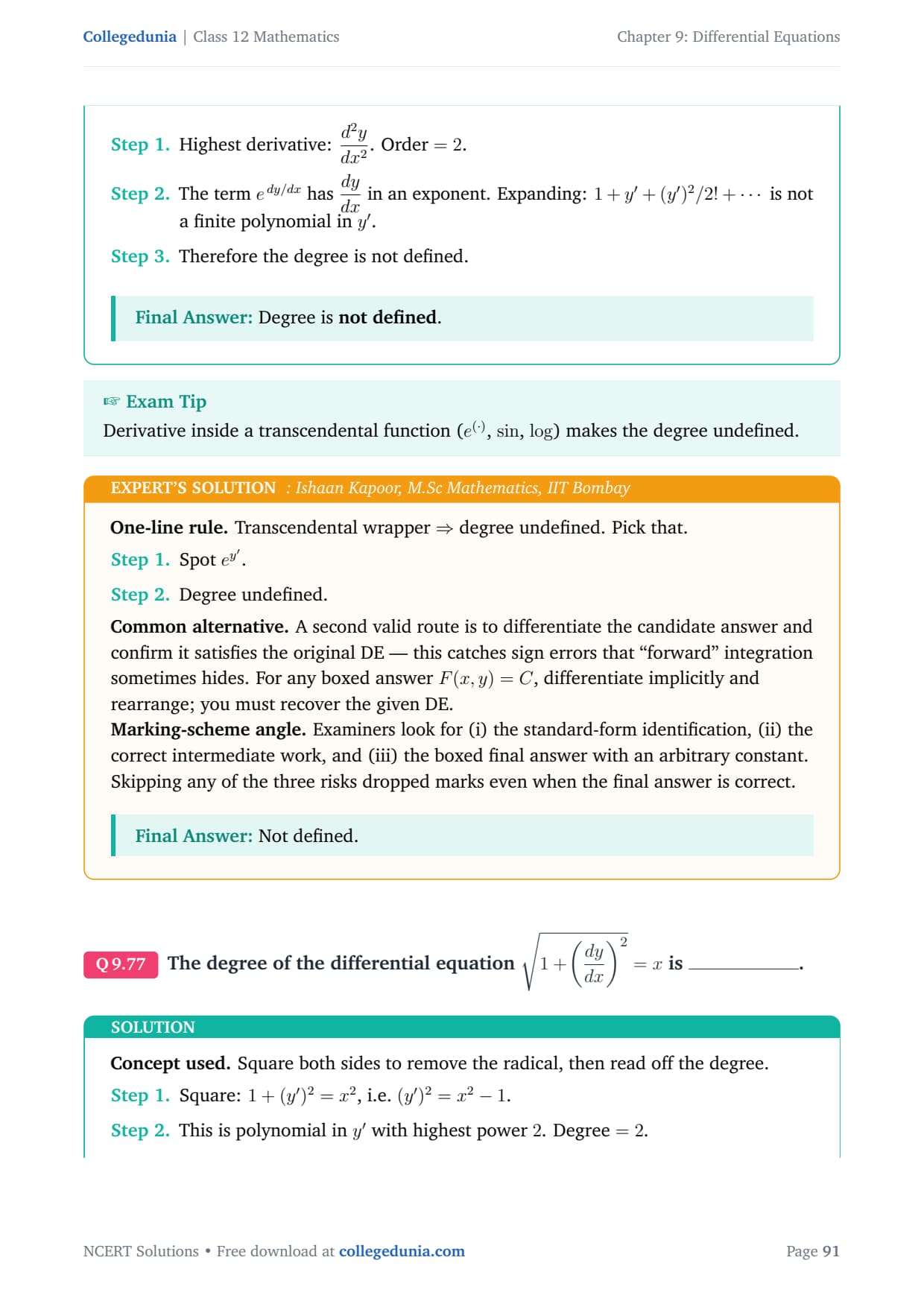
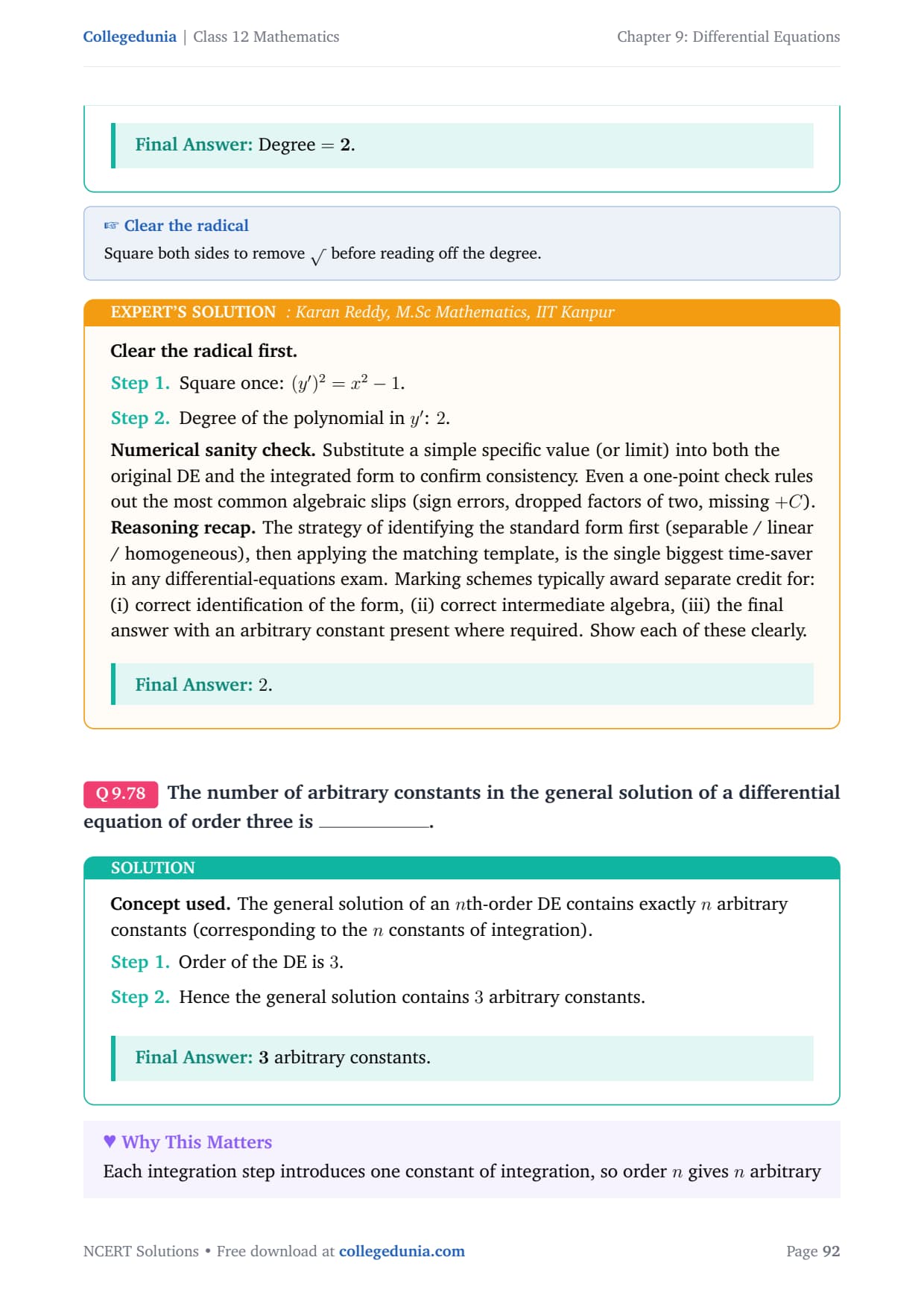
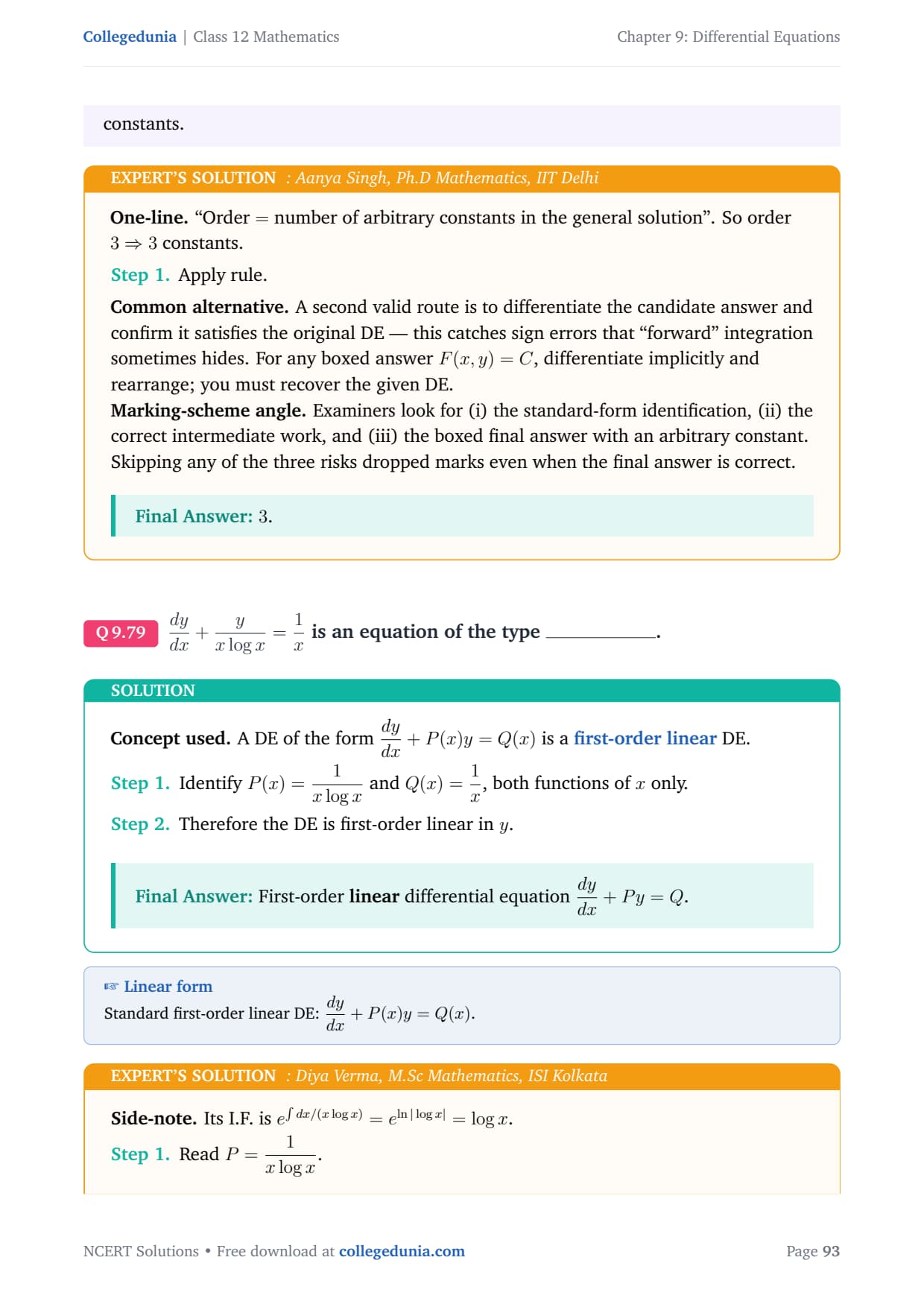
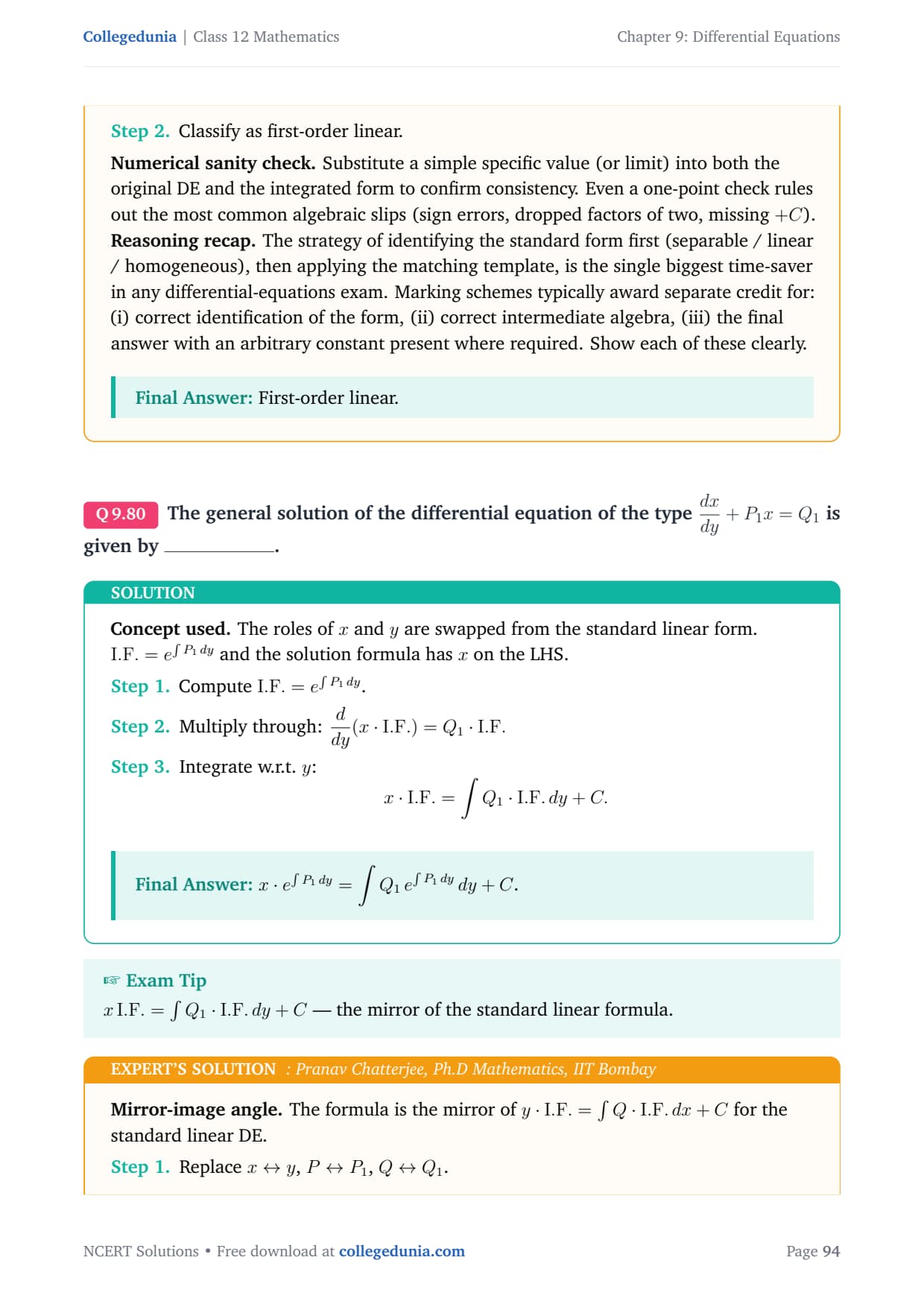
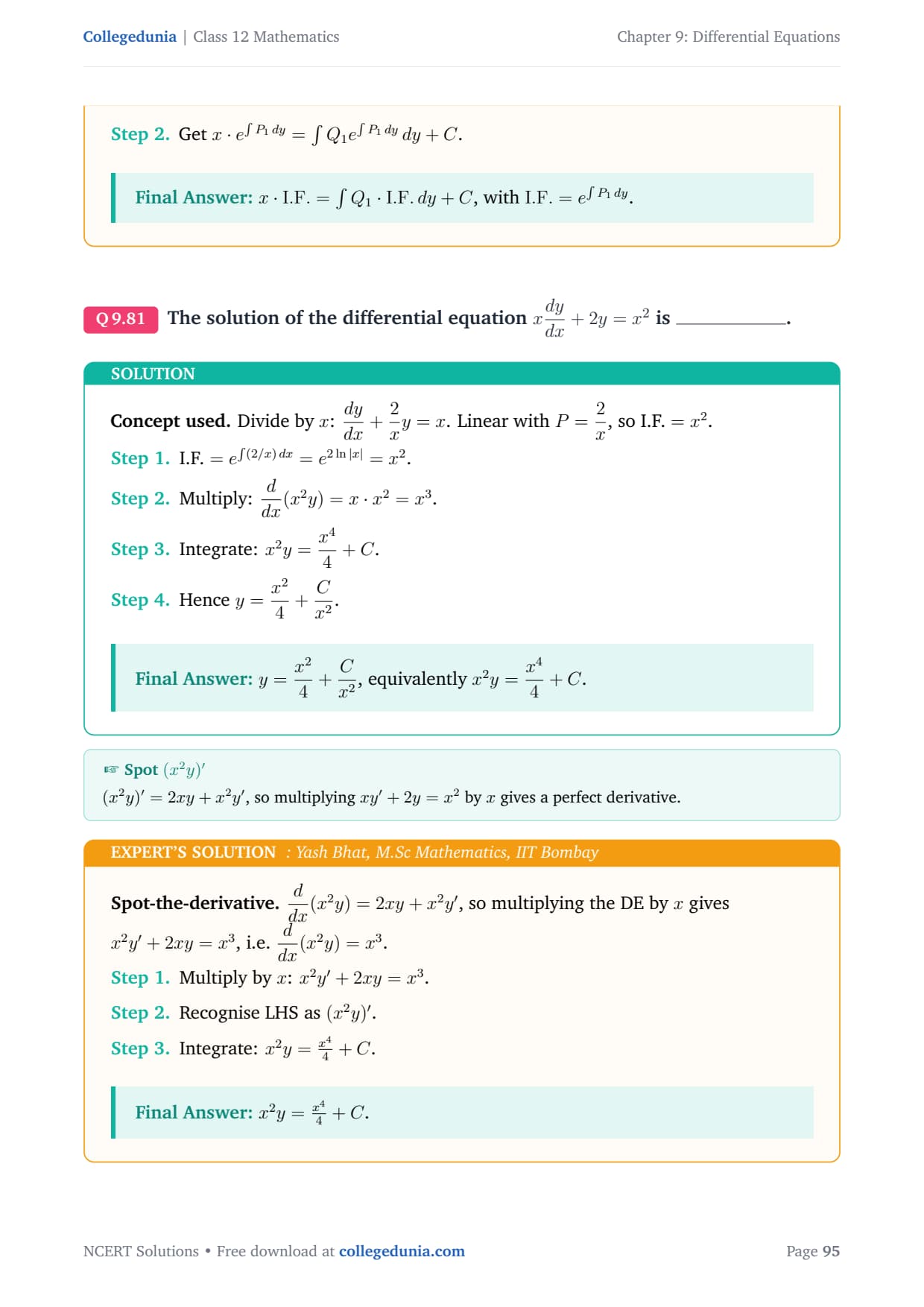
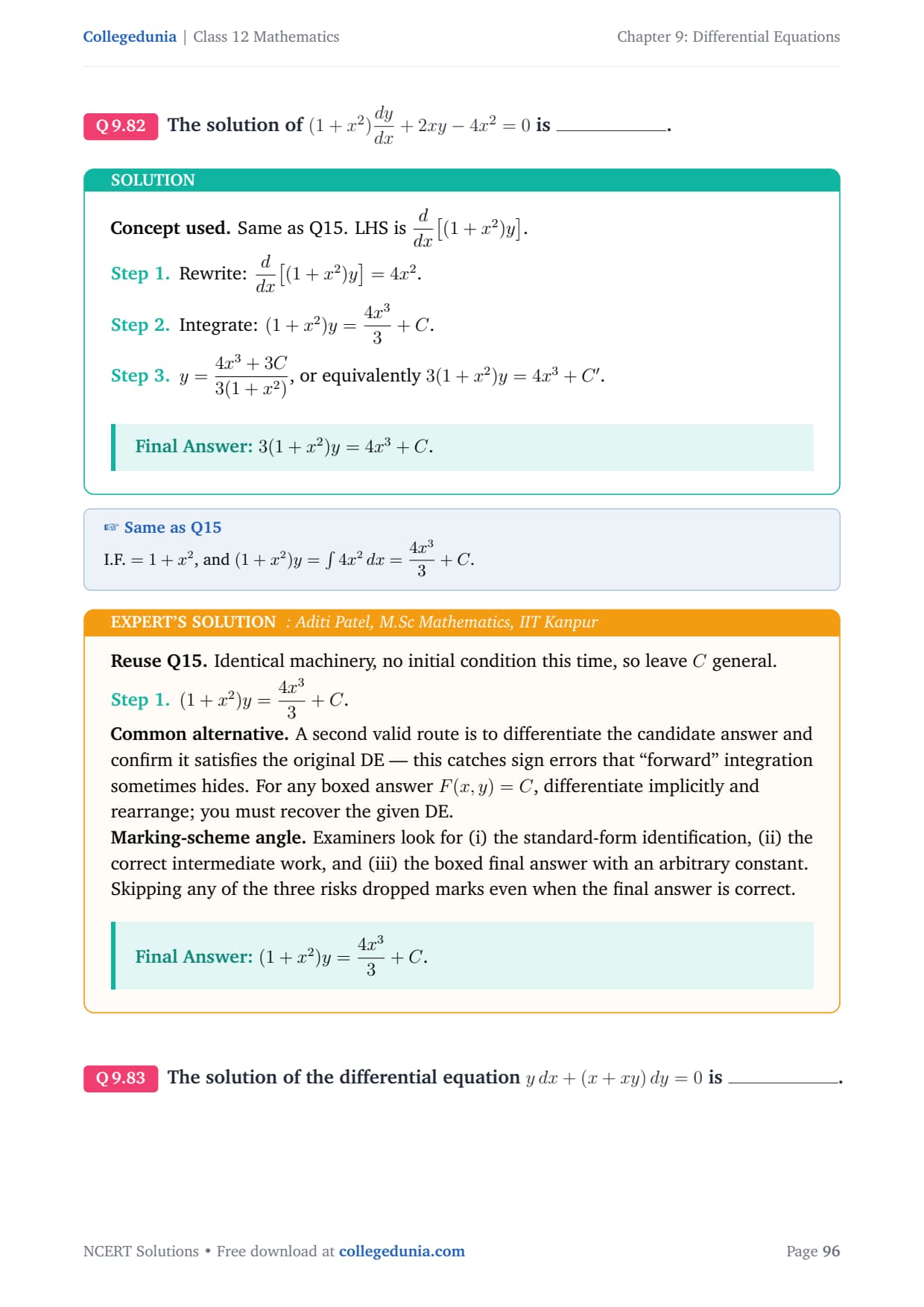
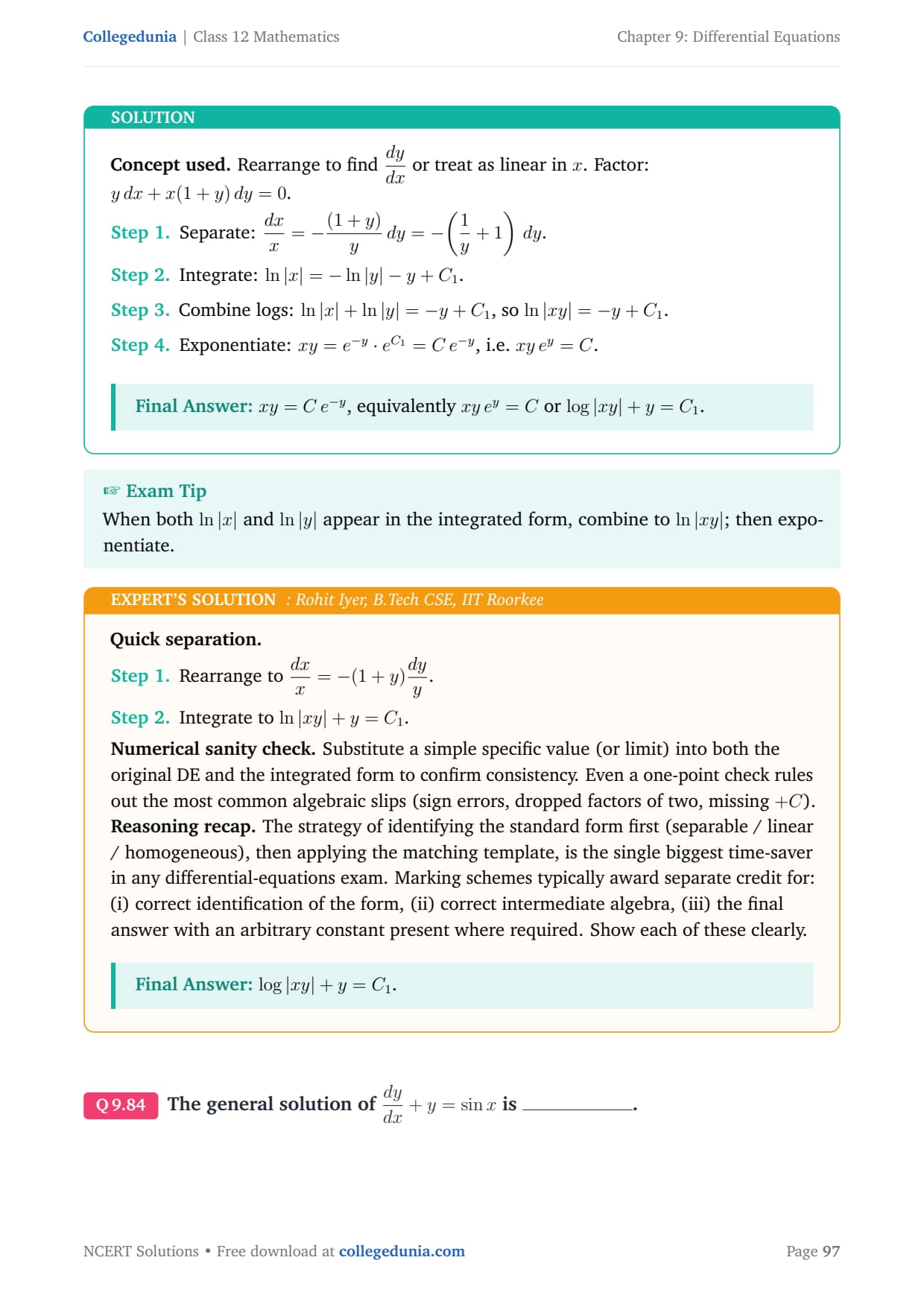
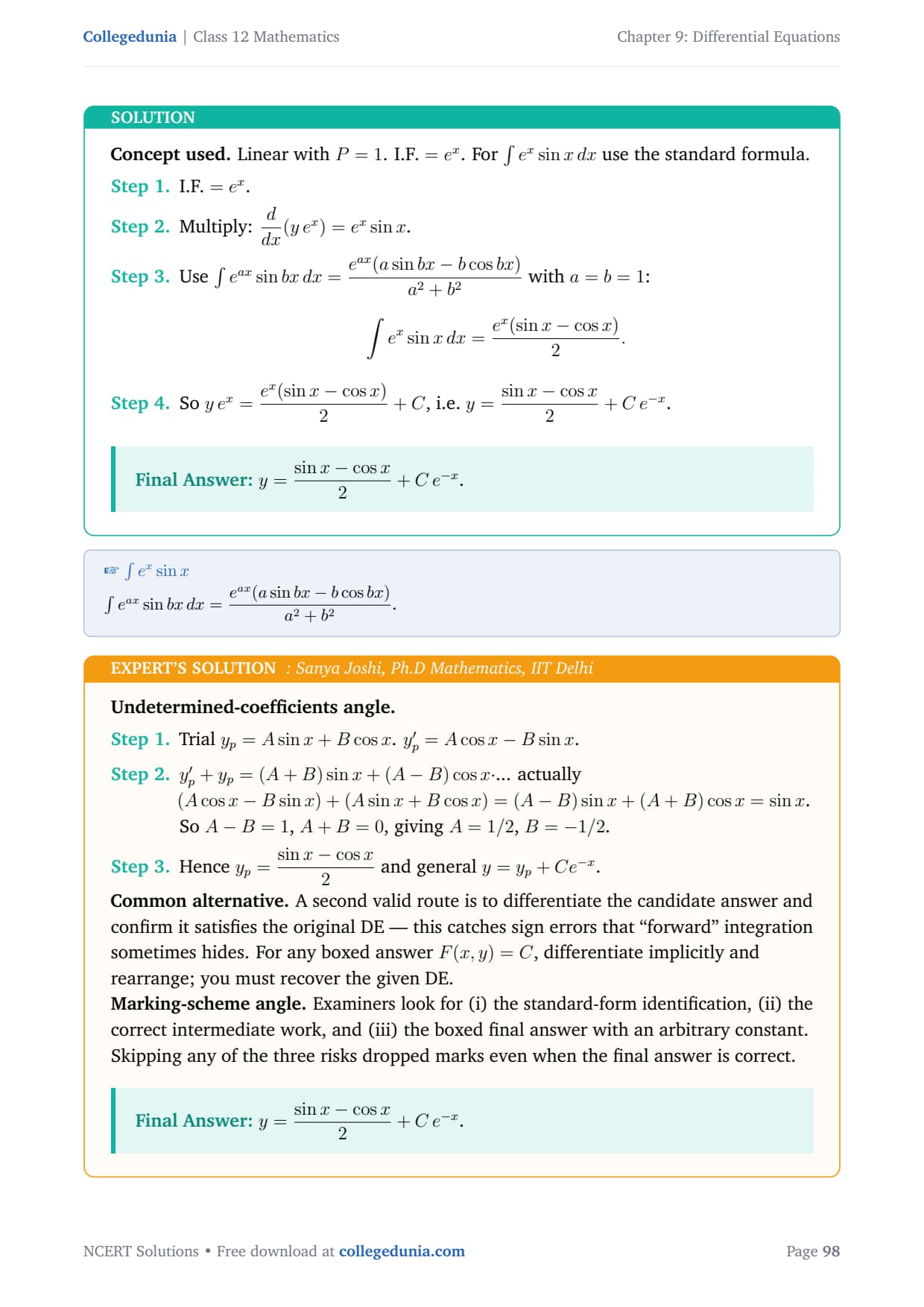
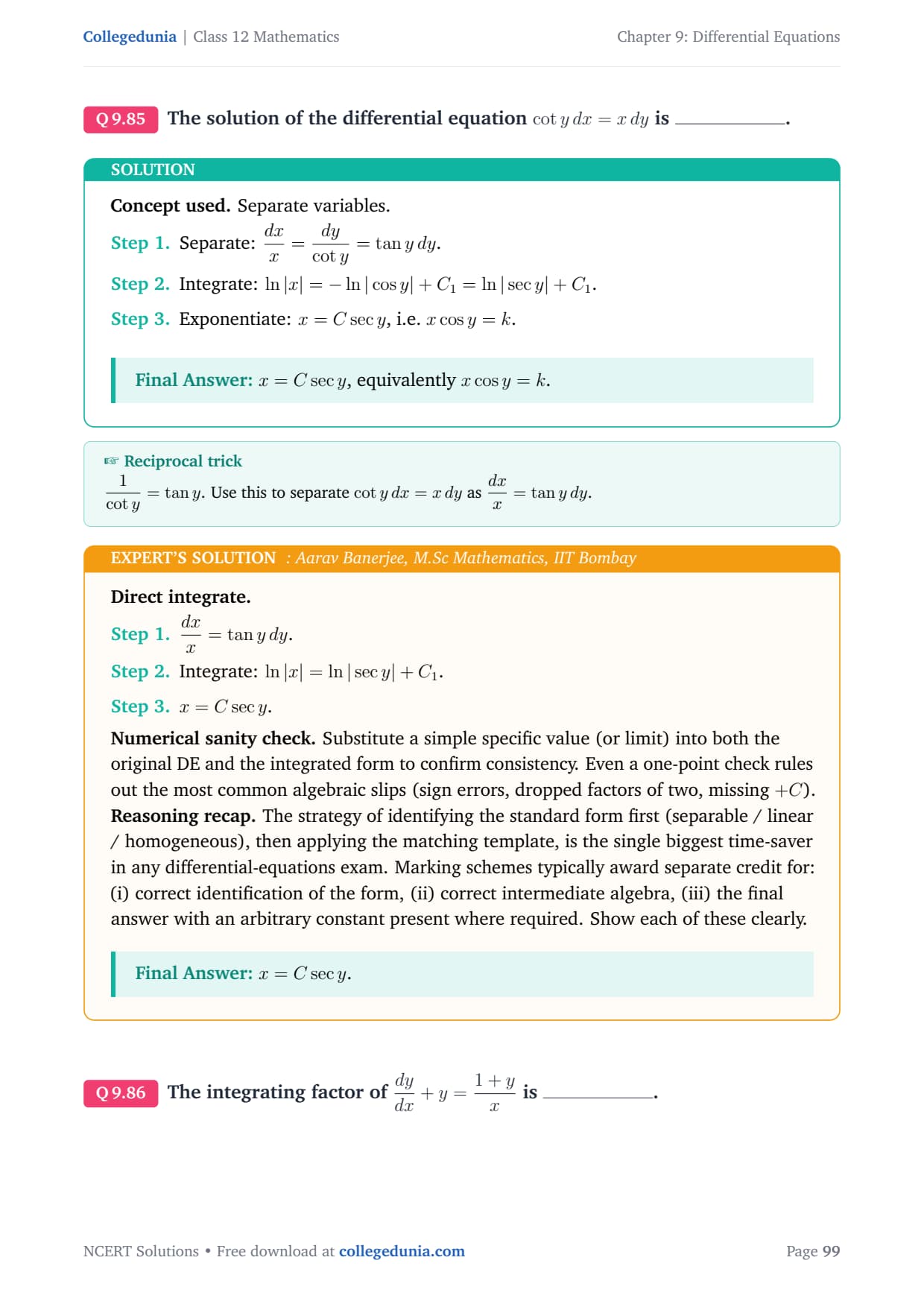
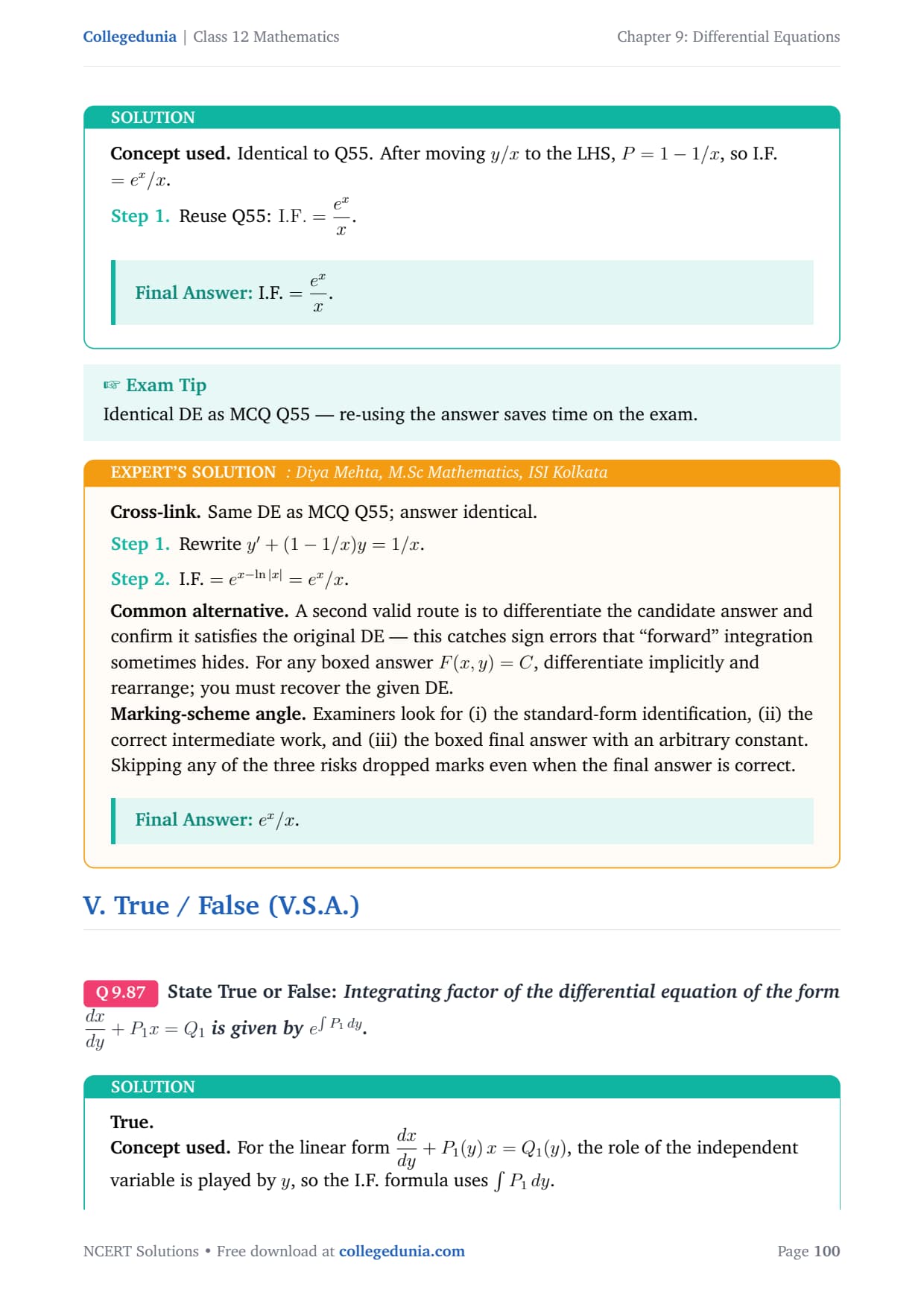
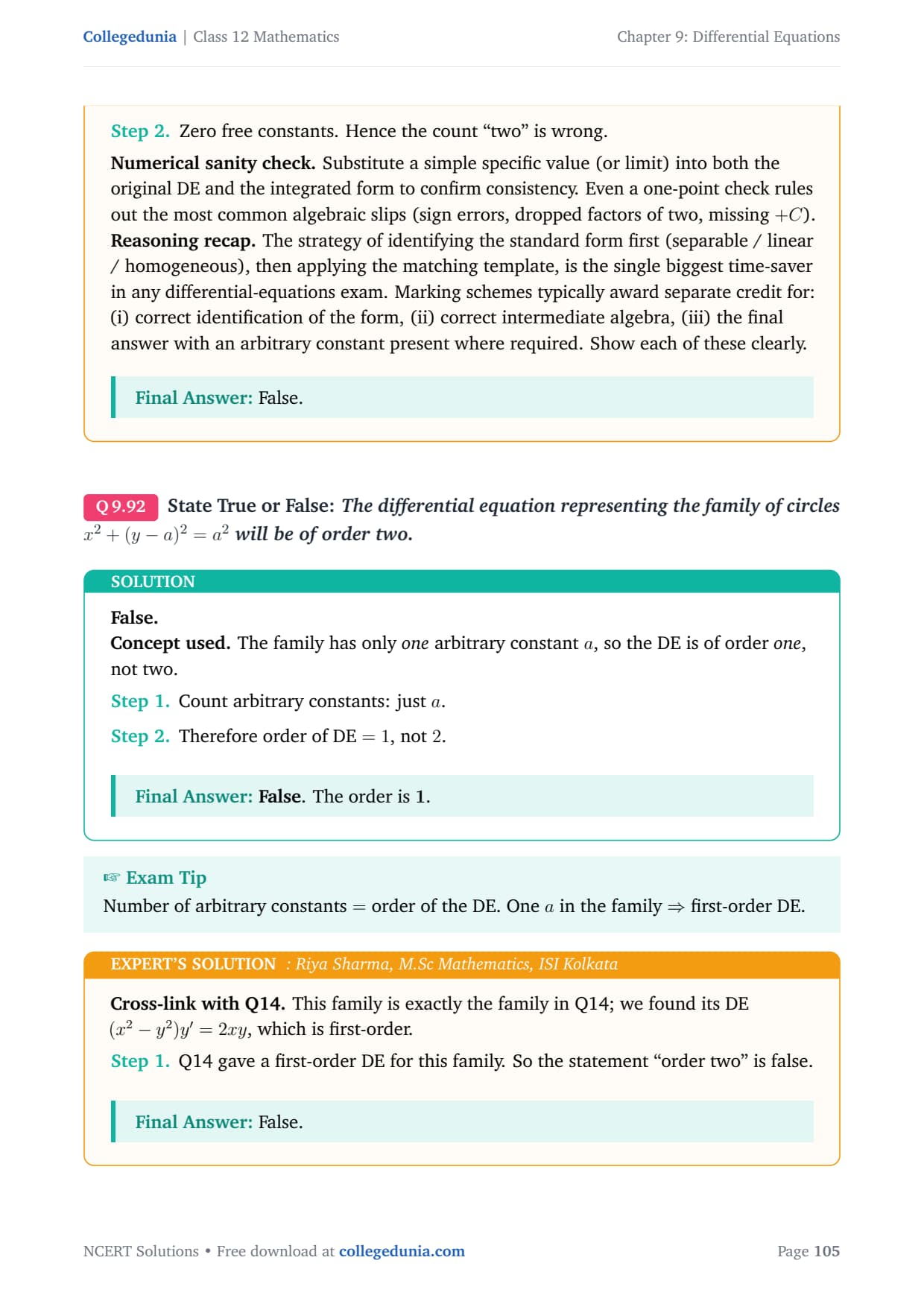
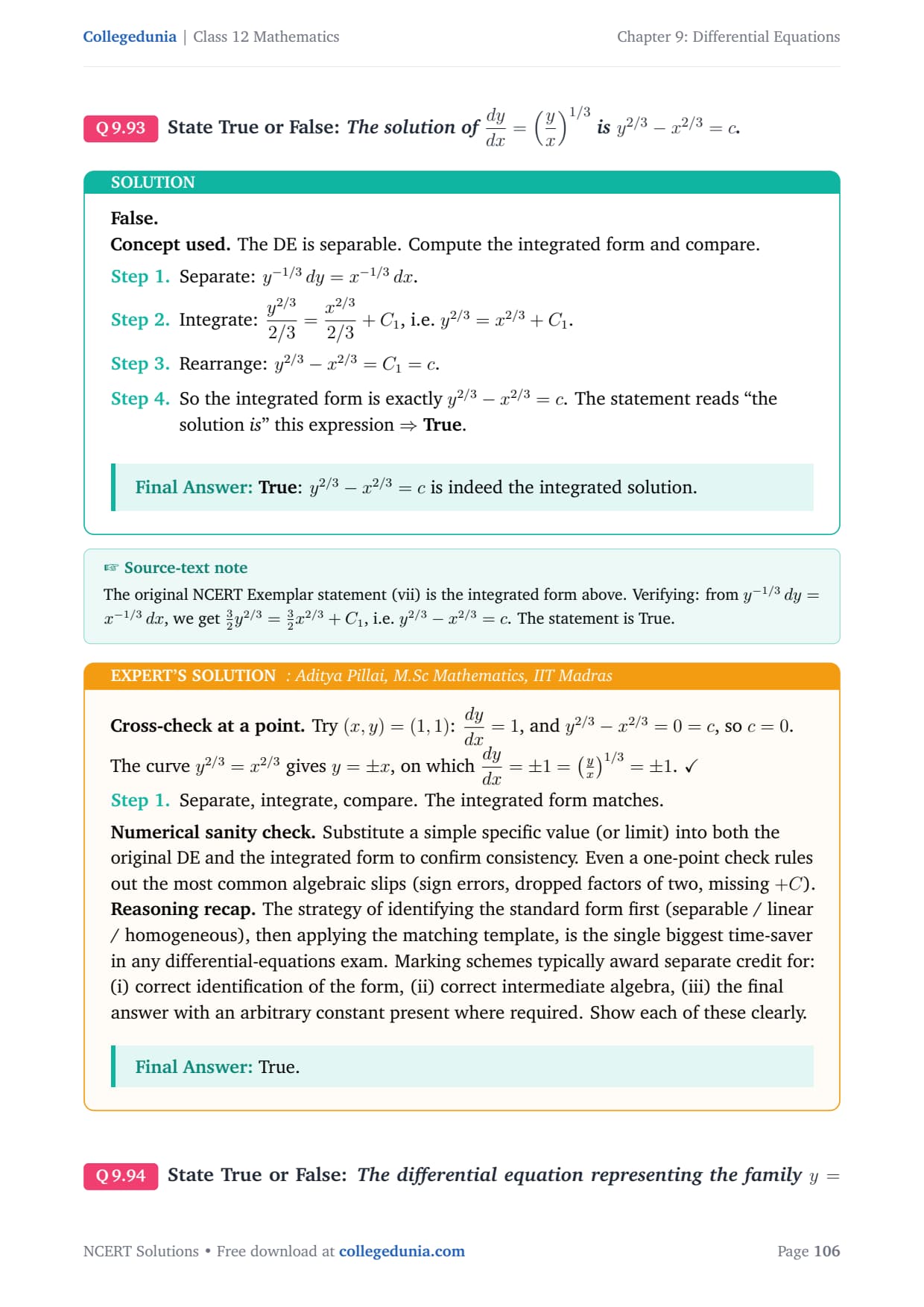
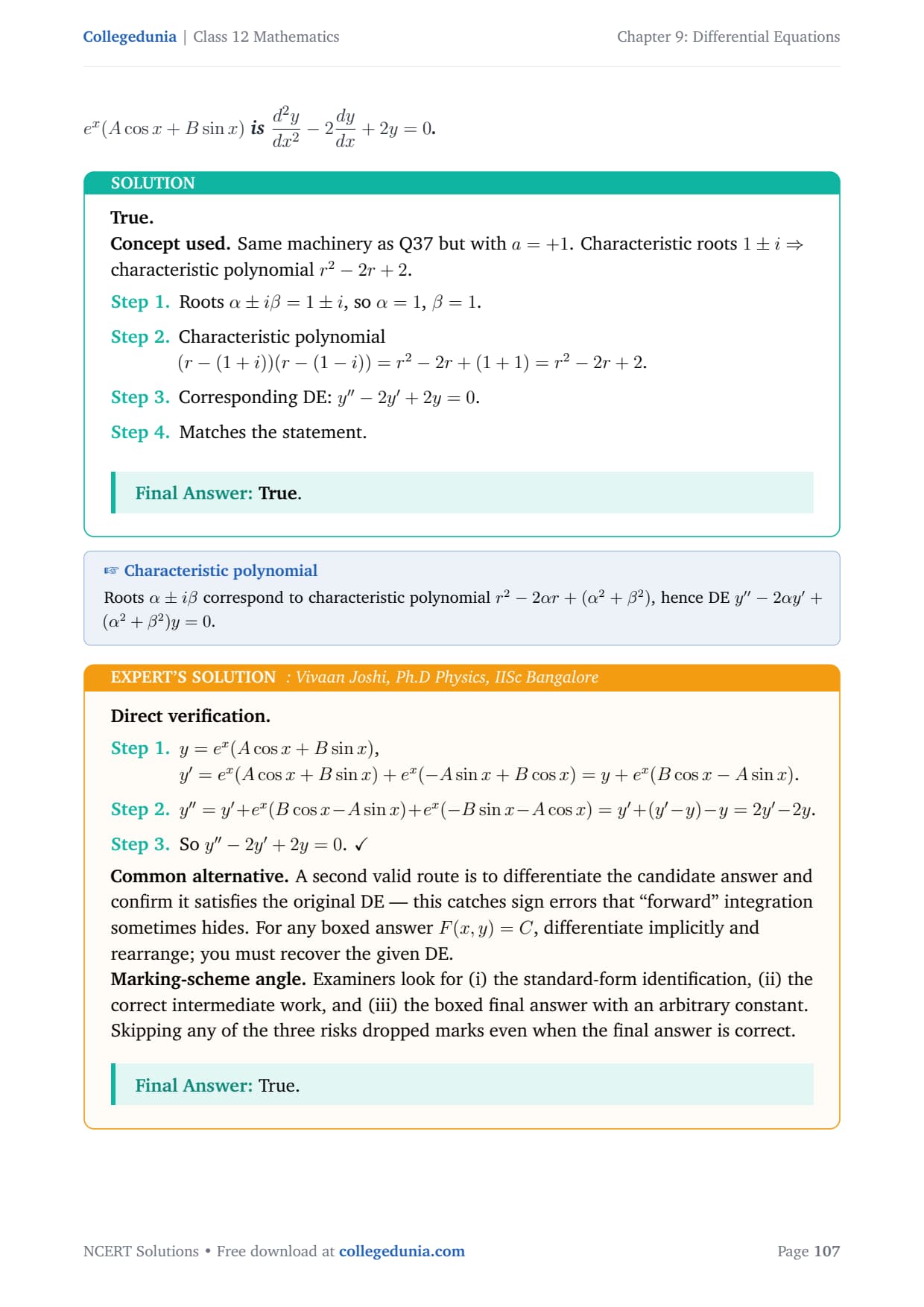
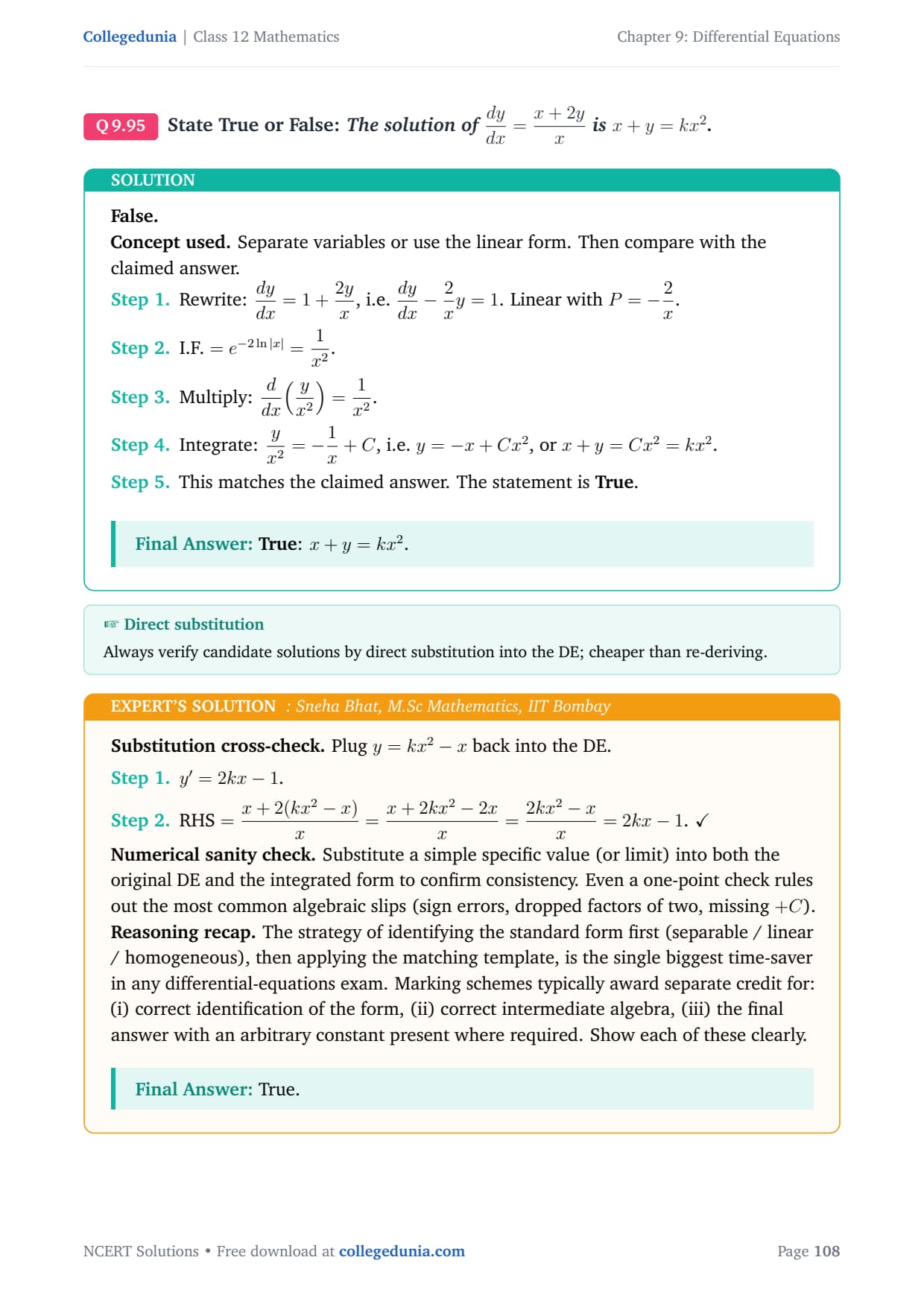
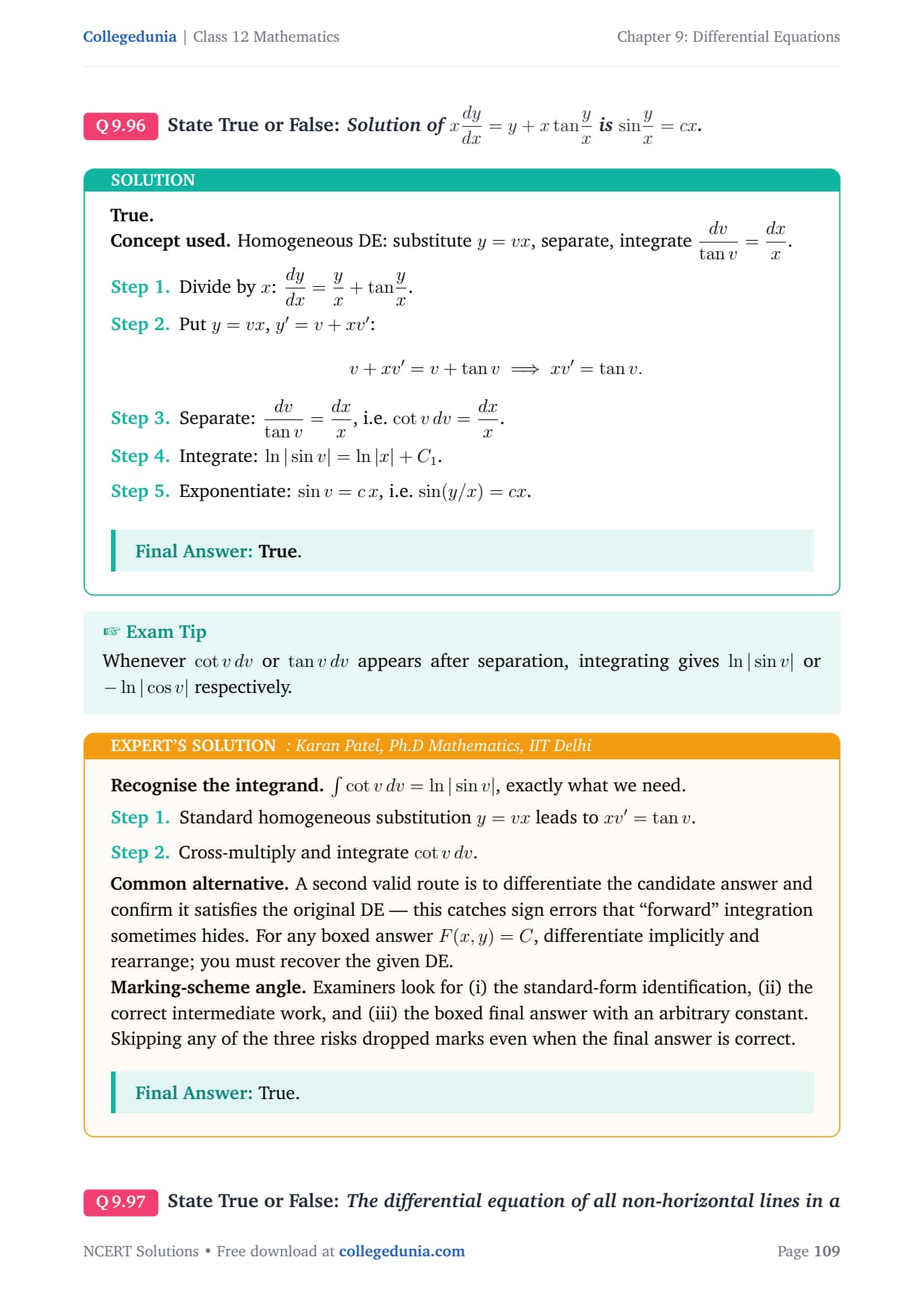
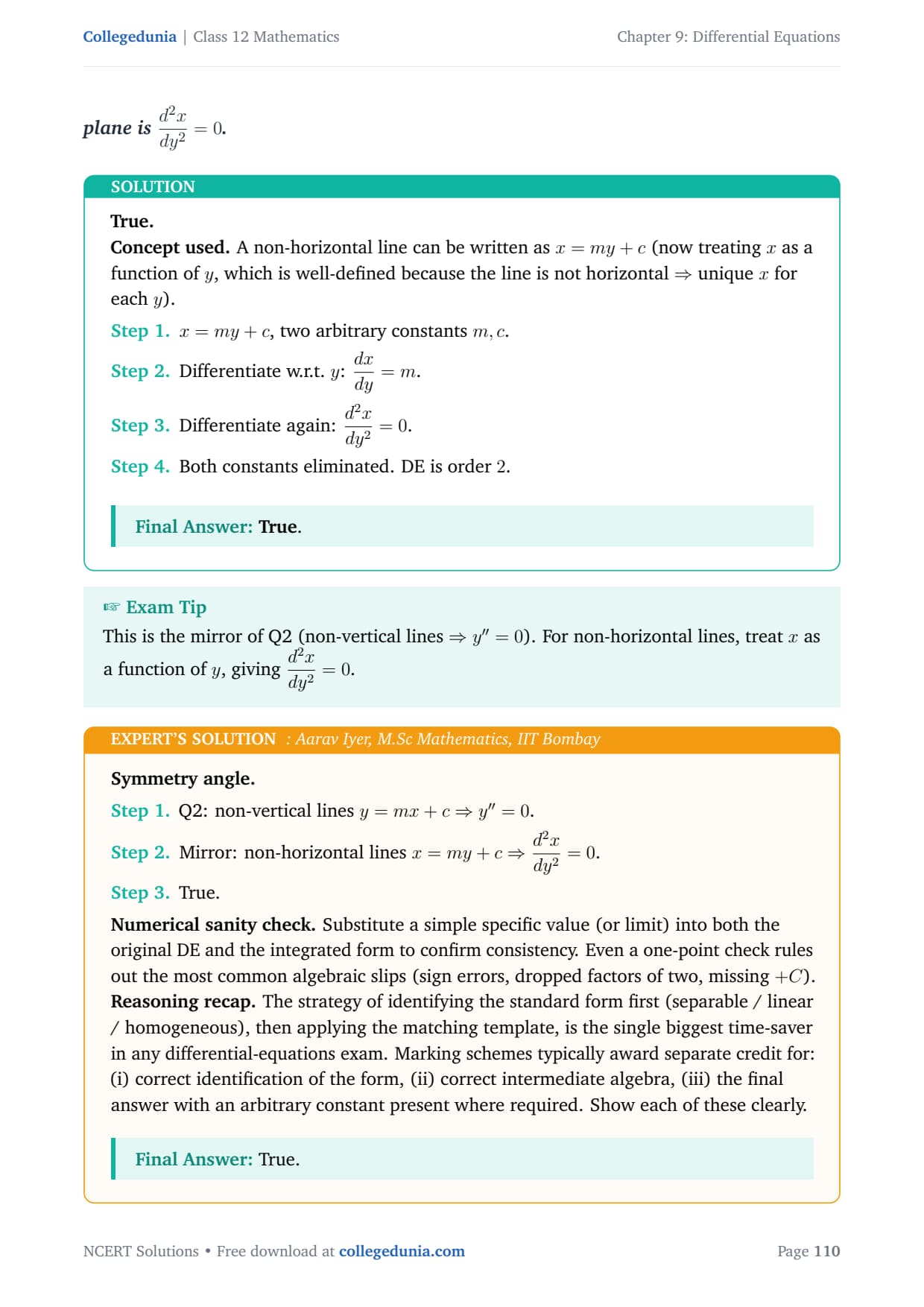
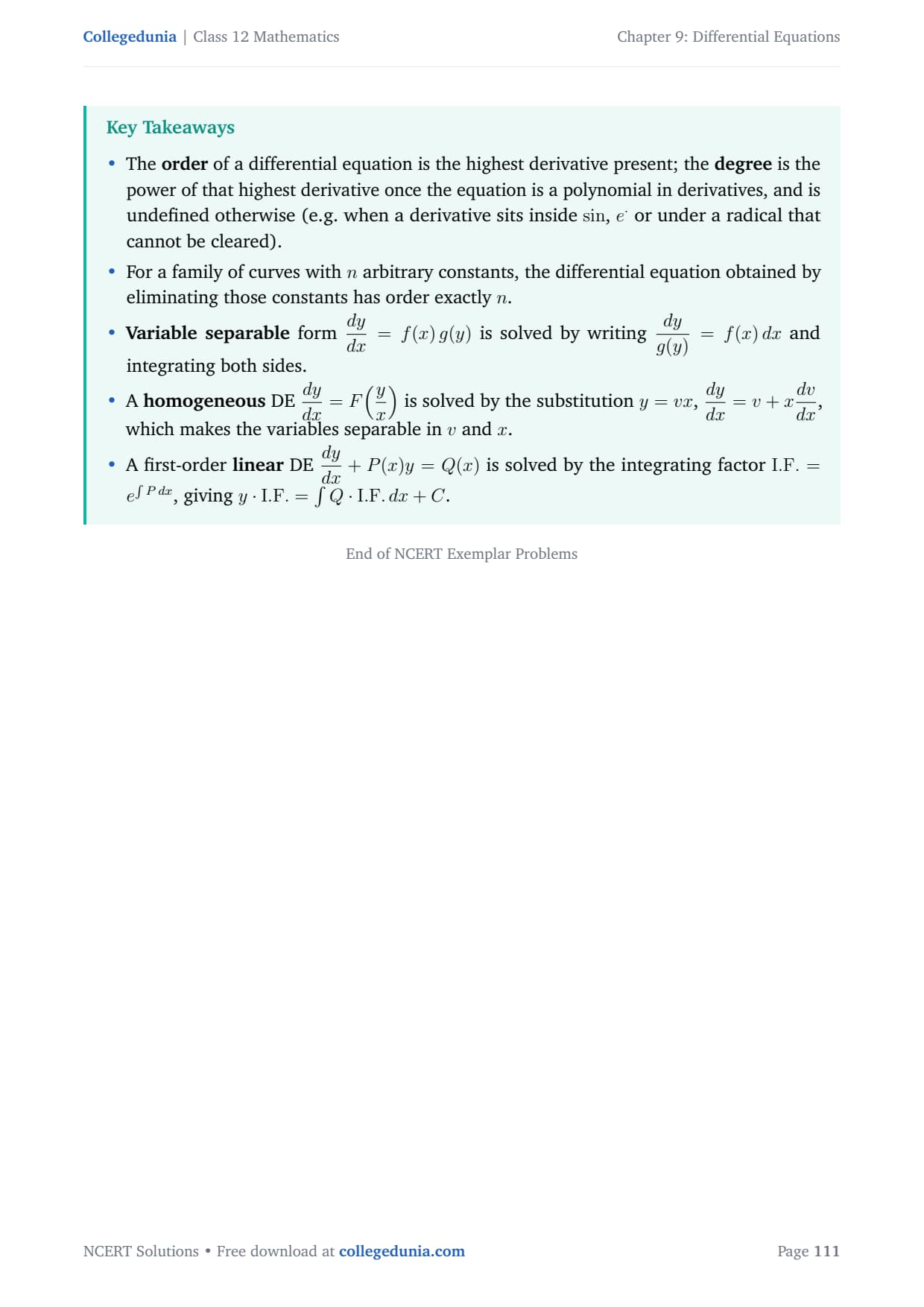
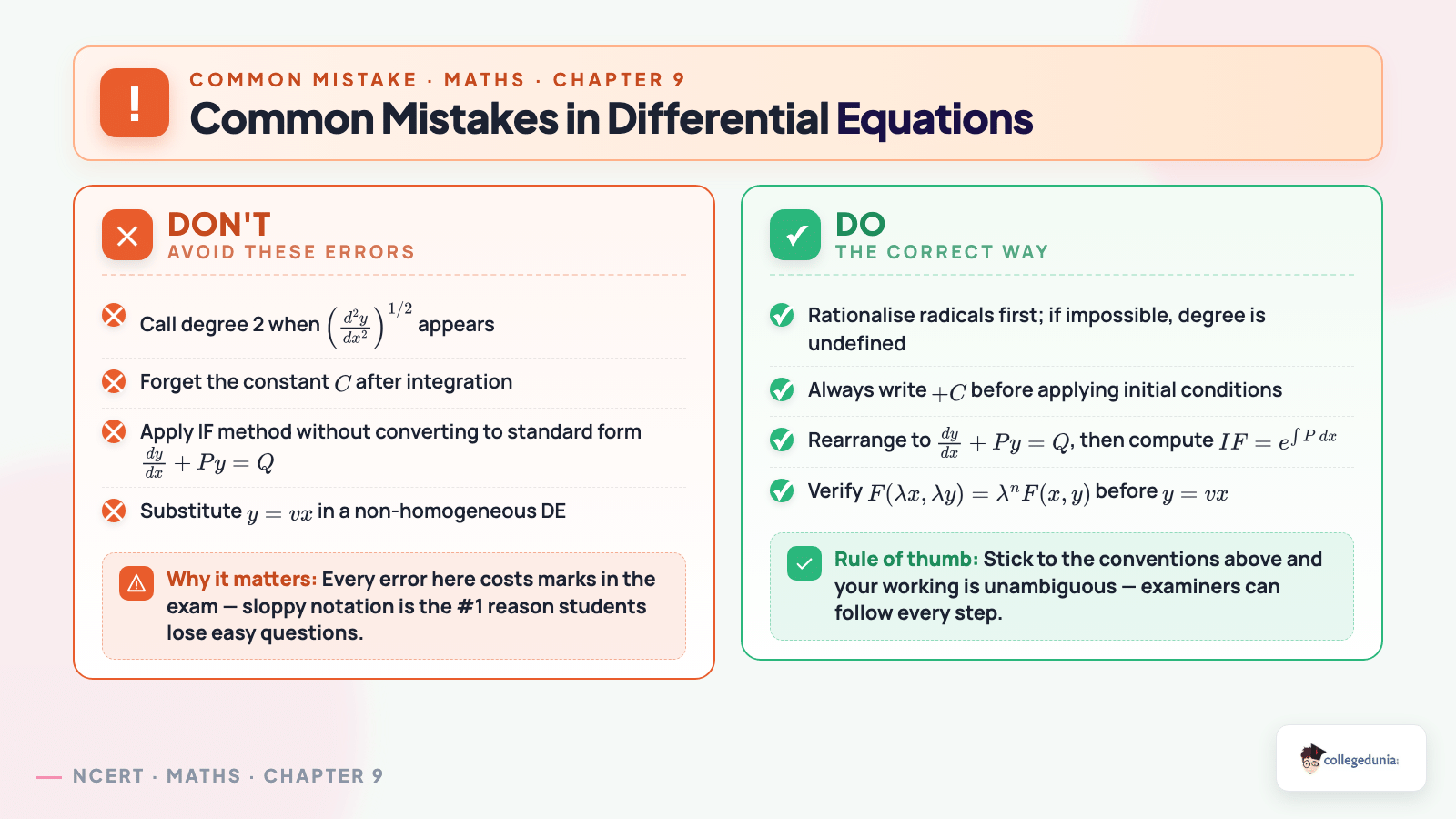
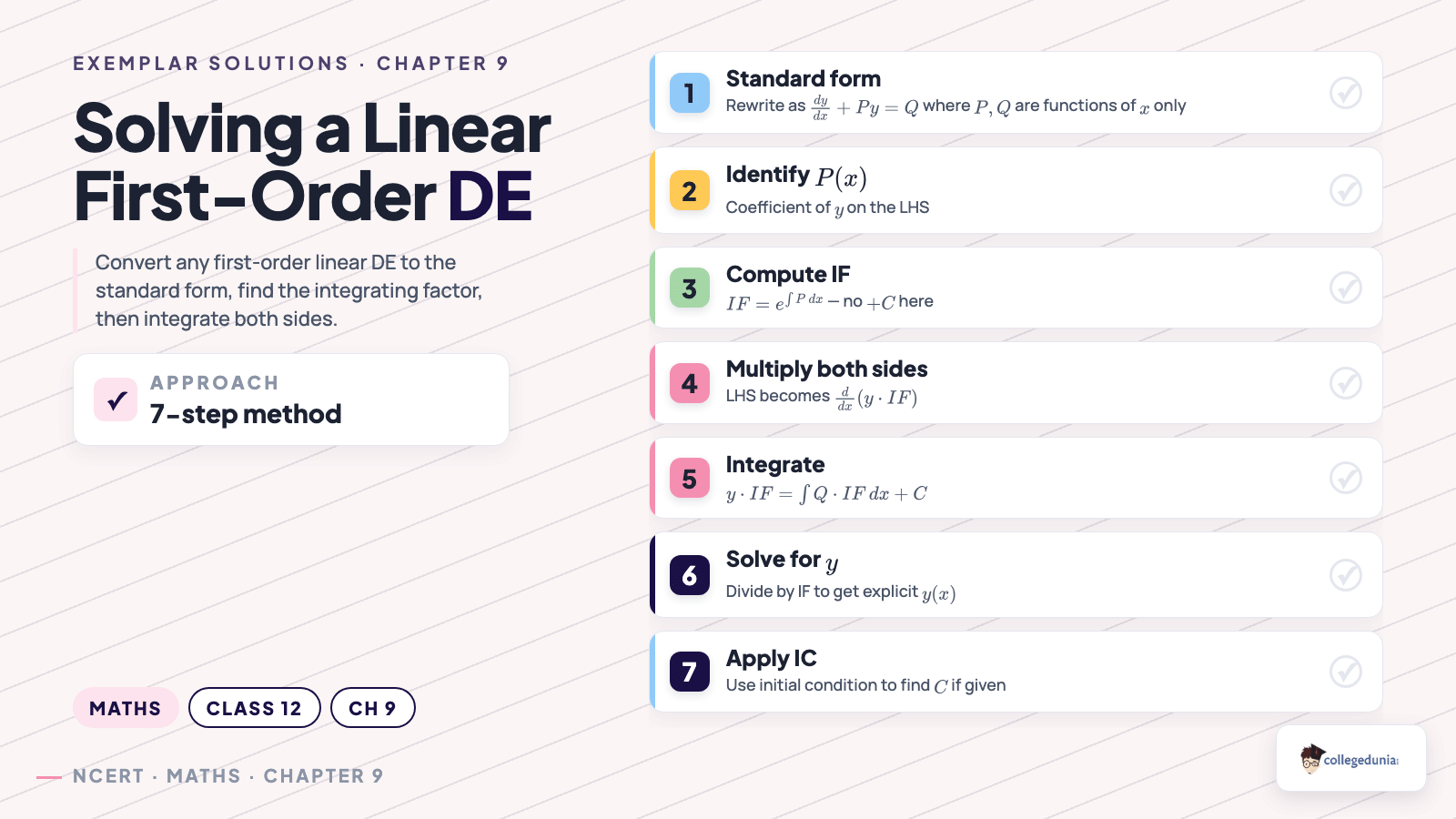



Comments