The NCERT Exemplar Class 12 Maths Integrals Solutions provided here cover the entire NCERT Exemplar set for Class 12 Mathematics Chapter 8 Application of Integrals. The NCERT Exemplar Class 12 Maths Integrals Solutions are checked against the official NCERT answer key and benchmarked against the last five years of CBSE and JEE Main papers on the solutions PDF.
Use the resource above alongside the chapter breakdown below.
Use the resource above alongside the chapter breakdown below.
Use the resource above alongside the chapter breakdown below.
Use the resource above alongside the chapter breakdown below.
Use the resource above alongside the chapter breakdown below.
Use the resource above alongside the chapter breakdown below.
Use the resource above alongside the chapter breakdown below.
Use the resource above alongside the chapter breakdown below.
Use the resource above alongside the chapter breakdown below.
Use the resource above alongside the chapter breakdown below.
Use the resource above alongside the chapter breakdown below.
Use the resource above alongside the chapter breakdown below.
Use the resource above alongside the chapter breakdown below.
Use the resource above alongside the chapter breakdown below.
Use the resource above alongside the chapter breakdown below.
Use the resource above alongside the chapter breakdown below.
Use the resource above alongside the chapter breakdown below.
Use the resource above alongside the chapter breakdown below.
Use the resource above alongside the chapter breakdown below.
Use the resource above alongside the chapter breakdown below.
Use the resource above alongside the chapter breakdown below.
Use the resource above alongside the chapter breakdown below.
Use the resource above alongside the chapter breakdown below.
Use the resource above alongside the chapter breakdown below.
Use the resource above alongside the chapter breakdown below.
Use the resource above alongside the chapter breakdown below.
Use the resource above alongside the chapter breakdown below.
Use the resource above alongside the chapter breakdown below.
Use the resource above alongside the chapter breakdown below.
Use the resource above alongside the chapter breakdown below.
Use the resource above alongside the chapter breakdown below.
Use the resource above alongside the chapter breakdown below.
Use the resource above alongside the chapter breakdown below.
Use the resource above alongside the chapter breakdown below.
Use the resource above alongside the chapter breakdown below.
Use the resource above alongside the chapter breakdown below.
Use the resource above alongside the chapter breakdown below.
Use the resource above alongside the chapter breakdown below.
Use the resource above alongside the chapter breakdown below.
Use the resource above alongside the chapter breakdown below.
Use the resource above alongside the chapter breakdown below.
Use the resource above alongside the chapter breakdown below.
Use the resource above alongside the chapter breakdown below.
Use the resource above alongside the chapter breakdown below.
Use the resource above alongside the chapter breakdown below.
Use the resource above alongside the chapter breakdown below.
Use the resource above alongside the chapter breakdown below.
Use the resource above alongside the chapter breakdown below.
Use the resource above alongside the chapter breakdown below.
Use the resource above alongside the chapter breakdown below.
Use the resource above alongside the chapter breakdown below.
Use the resource above alongside the chapter breakdown below.
Use the resource above alongside the chapter breakdown below.
CBSE Weightage: 5 marks (Unit III: Calculus, shared with Integrals and Differential Equations; typically one SA or one LA on area between a curve and an axis, or area between two curves)
JEE Main Weightage: 2 to 4% of paper (1 question almost every shift, often a curve-line or two-curve region problem)
Exemplar Problems Solved: 34 in total (15 SA + 8 LA + 11 MCQ), plus 8 labelled region diagrams
34 Exemplar problems solved
8 Region diagrams labelled
3 Question formats covered
Coverage spans area under y = f(x) between two ordinates, area between two curves, parabola-line regions, circle sectors via ∫ √a2 - x2 dx , ellipse quadrants, and the horizontal-strip alternate ( dy integration) wherever the vertical strip is awkward.
Curated by Collegedunia subject experts, mapped to the 2026-27 NCERT, and benchmarked against five years of CBSE and JEE Main papers.
Application of Integrals Exemplar Problem Bank: Format-Wise Count
The NCERT Exemplar Class 12 Maths Integrals Solutions address this in the same order as the NCERT textbook.
The Chapter 8 Exemplar bank carries 34 problems across three formats; the table below shows the prep-time allocation Collegedunia recommends per format.
Question Format
Count
Problem Numbers
Average Time
Short Answer (SA)
15
8.1 to 8.15
6 to 8 min
Long Answer (LA)
8
8.16 to 8.23
10 to 14 min
Multiple Choice (MCQ)
11
8.24 to 8.34
2 to 3 min
The 23 SA + LA problems carry the Boards-style area-computation load; the 11 MCQs calibrate the JEE Main reflex of picking the right region without writing a single integration step.
Application of Integrals NCERT Exemplar Video Solutions
How Collegedunia's Exemplar Solutions Help You Crack Class 12 Application of Integrals
The NCERT Exemplar Class 12 Maths Integrals Solutions address this in the same order as the NCERT textbook.
One wrong intersection point shifts every area integral by a constant, and the Exemplar deliberately chains two curve intersections per LA.
Each of our 34 solutions opens with a labelled sketch, names the strip orientation (vertical dx versus horizontal dy ), shows the alternate method wherever swapping strips collapses a two-integral split into one, and writes every limit explicitly. The Collegedunia walkthrough mirrors JEE Main 2024 and 2025 hard-set scoring patterns.
How Frequently Has Application of Integrals Been Asked in CBSE and JEE Main
Three region-types cover the year-on-year pattern, between them taking the bulk of the 5-mark Boards share.
Sub-Topic
CBSE 2025
JEE Main 2025
Recurring Since
Area between Curve and Axis (Parabola / Cubic)
3 marks (SA)
1 question
2020
Area between Two Curves (Line and Parabola, or Two Parabolas)
Application of Integrals Class 12 Weightage Snapshot Across Chapters
Chapter 8 sits at the lower end of Class 12 Maths weightage; the chart below places its 5-mark share alongside the other 12 chapters.
Chapter
CBSE Marks
Weightage Bar
Ch 1 Relations and Functions
8
Ch 2 Inverse Trigonometric Functions
4
Ch 3 Matrices
10
Ch 4 Determinants
10
Ch 5 Continuity and Differentiability
15
Ch 6 Application of Derivatives
10
Ch 7 Integrals
15
Ch 8 Application of Integrals
5
Ch 9 Differential Equations
10
Ch 10 Vector Algebra
10
Ch 11 Three Dimensional Geometry
10
Ch 12 Linear Programming
5
Ch 13 Probability
8
Chapter 8 ties with Linear Programming at 5 marks, the lightest Calculus-block share; the trade-off is that it is the only chapter where one labelled sketch can hand you a full LA in two minutes.
Exemplar-Specific Common Mistakes in Application of Integrals
The Exemplar punishes a different set of mistakes than the NCERT Exemplar Class 12 Maths Integrals Solutions. The four below cost the most marks in the last three CBSE cycles.
Wrong strip orientation. Forcing a vertical dx strip on a region best swept by horizontal dy strips creates a two-integral split where one suffices (SA 8.3, LA 8.17).
Missed intersection inside the interval. Failing to solve f(x) = g(x) before integrating flips the sign of one piece; the area becomes a signed difference, not a magnitude (LA 8.18).
Dropping the modulus on a sub-axis arc. A region partly below y = 0 needs ∫ |y| dx , split at every x-axis crossing (SA 8.7).
Skipping the symmetry shortcut. Computing all four quadrants of an ellipse or circle when one quadrant suffices wastes 5 to 7 minutes in a 3-hour Boards paper (SA 8.11).
JEE Main Prep Value of the Application of Integrals Exemplar
JEE Main repeats the line-parabola and two-parabola region pattern in two shifts out of three, and the 11-MCQ Exemplar block (Q 8.24 to 8.34) is the closest year-round drill.
The MCQs span every region archetype, chain two intersections per problem like JEE Main 2024 hard-set items, and force the symmetry-shortcut habit the timed exam rewards. Pair this with the area-under-velocity-curve recap from Class 11 Physics to round out the kinematics-integral overlap that recurs in the JEE Main numerical block.
All NCERT Exemplar Questions for Application of Integrals with Step-by-Step Solutions
Every question of the NCERT Exemplar set for Class 12 Mathematics Chapter 8 Application of Integrals is listed below with its full Solution and Expert Solution hidden inside collapsible tabs. Click Check Solution to reveal the step-by-step working; click Expert Solution for the expanded explanation.
I. Short Answer (S.A.)
Q 8.1
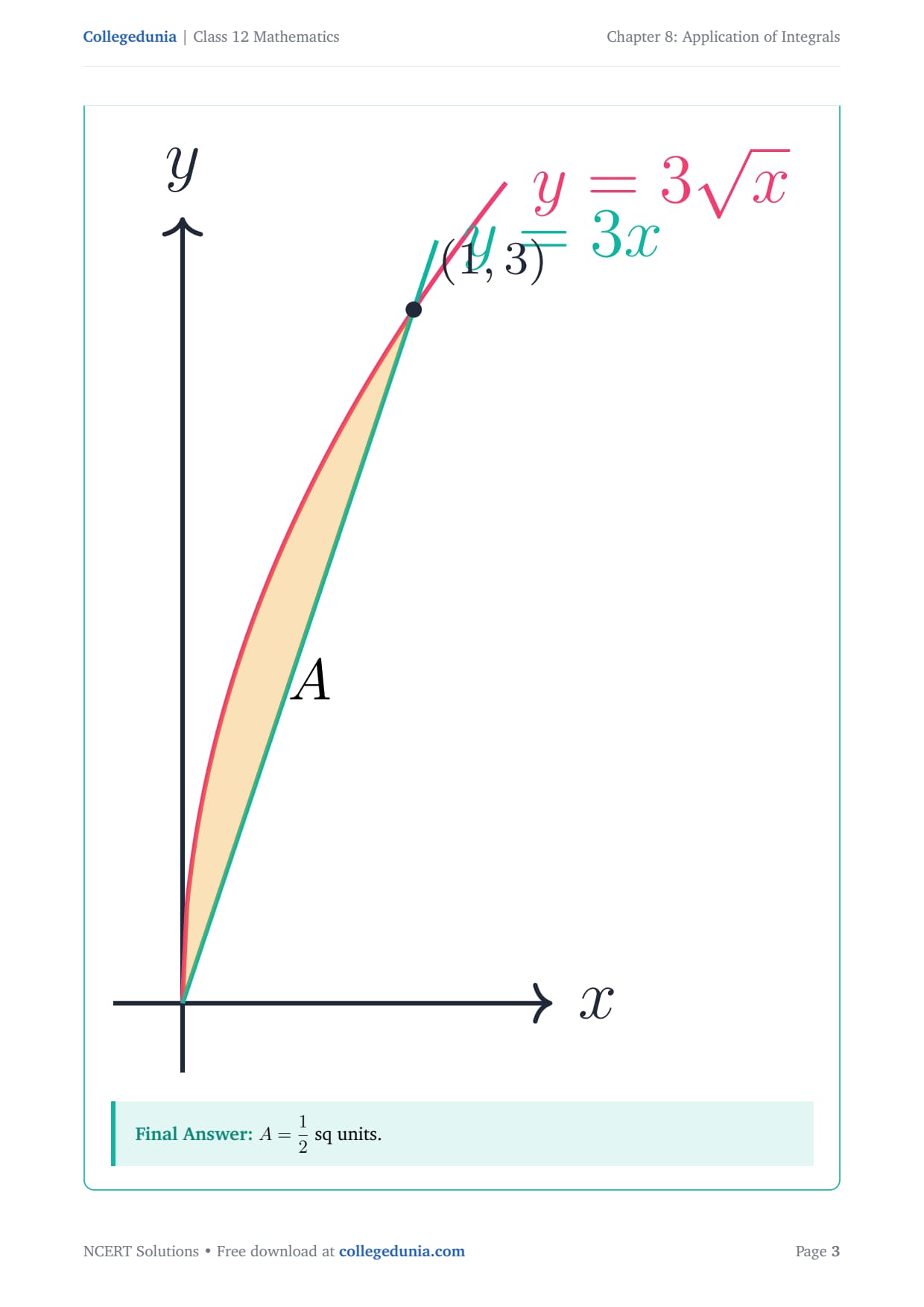
Find the area of the region bounded by the curves y2=9x and y=3x.
Concept used. For a region bounded by two curves y=f(x)
(upper) and y=g(x) (lower) between their intersection abscissae
x=a and x=b, the area is
A=ab(f(x)-g(x)) dx.
Here the parabola y2=9x gives y=3√x (taking the upper
branch since y=3x≥ 0 when x≥ 0).
Intersections. Solve y=3x with y2=9x:
substitute y=3x into y2=9x:
(3x)2=9x ⇒ 9x2=9x ⇒
9x(x-1)=0.
So x=0 or x=1, giving the points (0,0) and (1,3).
Which is upper? At x=14: parabola
y=3√1/4=1.5; line y=3(1/4)=0.75. So the parabola
3√x is above the line 3x on [0,1].
Strategic angle. Switching to a horizontal-strip integral
(dy instead of dx) avoids the square root entirely, because both
boundaries become polynomials in y. The line y=3x becomes
x=y/3, the parabola y2=9x becomes x=y2/9, and integration
turns into a clean polynomial evaluation.
Rewrite both boundaries as functions of y:
y2=9x⇒ x=y29 (parabola),
y=3x⇒ x=y3 (line).
Identify the y-range. At the origin both curves give
y=0; at the upper intersection (1,3) both give y=3.
So y runs from 0 to 3 and the strip width is the
x-difference between the line and the parabola.
For fixed y∈[0,3], the left boundary is the parabola and
the right boundary is the line. Check at y=1: parabola
gives x=1/9≈ 0.11, line gives x=1/3≈ 0.33, so
the line is to the right of the parabola.
Set up the integral as right minus left:
A=03(y3-y29)dy.
Antidifferentiate term by term:
∫y3 dy=y26,
∫y29 dy=y327.
Evaluate from 0 to 3:
[y26-y327]03
=96-2727=32-1=12.
Why this matters. Choosing dx vs dy is a routine
optimisation in board problems: if one direction gives polynomial
limits and the other gives square roots, pick the polynomial one.
Two independent methods giving the same answer is a strong
cross-check.
A=12 sq units.
Q 8.2
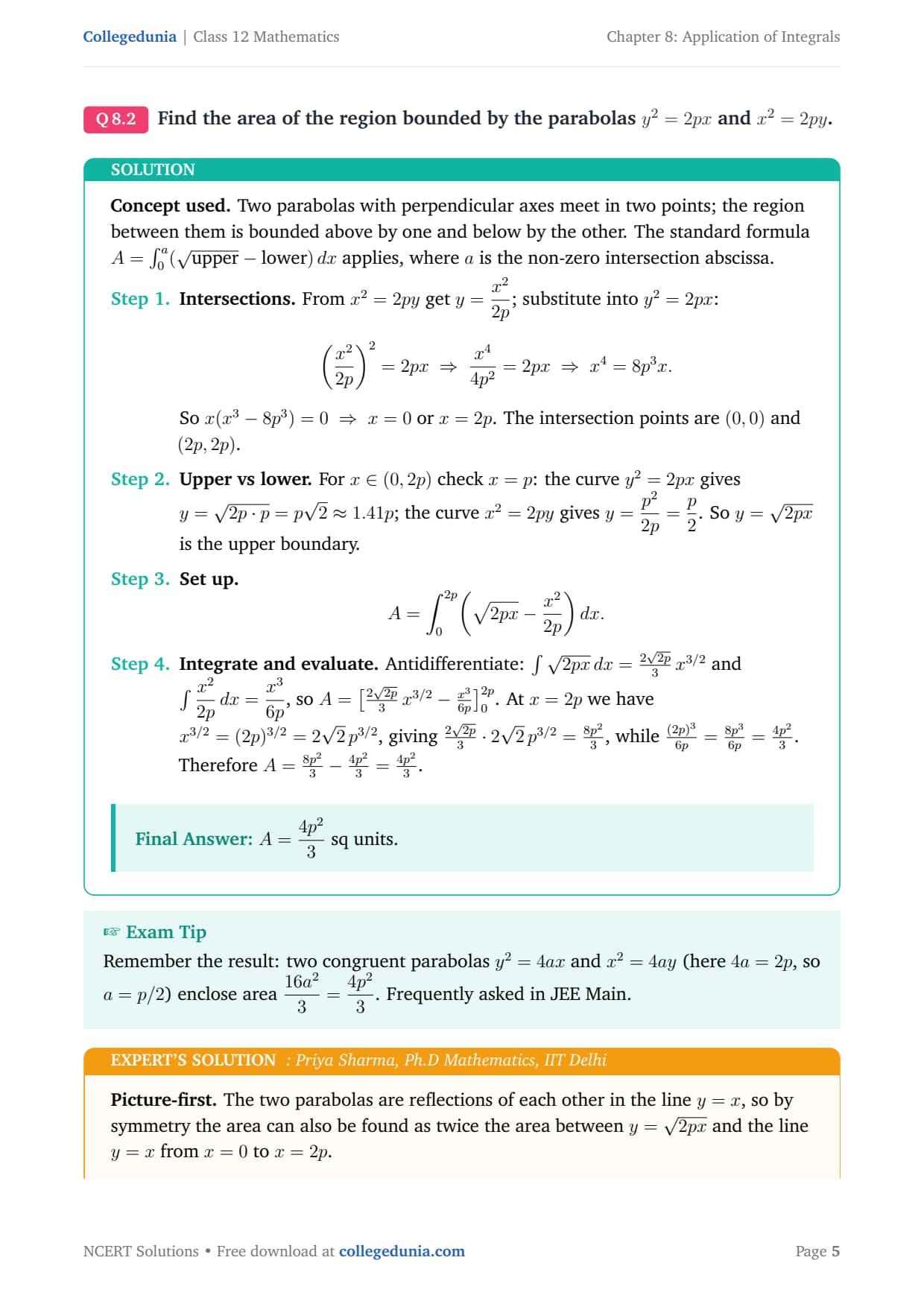
Find the area of the region bounded by the parabolas y2=2px and x2=2py.
Concept used. Two parabolas with perpendicular axes meet
in two points; the region between them is bounded above by one and
below by the other. The standard formula
A=0a(√upper-lower) dx applies, where
a is the non-zero intersection abscissa.
Intersections. From x2=2py get y=x22p;
substitute into y2=2px:
(x22p)2=2px
⇒ x44p2=2px
⇒ x4=8p3x.
So x(x3-8p3)=0 ⇒ x=0 or x=2p.
The intersection points are (0,0) and (2p,2p).
Upper vs lower. For x∈(0,2p) check x=p:
the curve y2=2px gives y=√2p· p=p√2≈ 1.41p; the curve x2=2py gives
y=p22p=p2. So y=√2px is the
upper boundary.
Set up.A=02p(√2px-x22p)dx.
Integrate and evaluate. Antidifferentiate: ∫√2px dx=2√2p3 x3/2 and ∫x22p dx=x36p, so A=[2√2p3 x3/2-x36p]02p. At x=2p we have x3/2=(2p)3/2=2√2 p3/2, giving 2√2p3· 2√2 p3/2=8p23, while (2p)36p=8p36p=4p23. Therefore A=8p23-4p23=4p23.
A=4p23 sq units.
PS
Priya Sharma
Ph.D Mathematics, IIT Delhi
Verified Expert
Picture-first. The two parabolas are reflections of each
other in the line y=x, so by symmetry the area can also be found
as twice the area between y=√2px and the line y=x from
x=0 to x=2p.
By symmetry about y=x, the region is split into two
congruent halves by the line y=x. Call the lower half
R1 (between the line y=x and the parabola x2=2py)
and the upper half R2 (between y2=2px and y=x).
Then A=2(R2).
Why this matters. Spotting the y=x symmetry shortens the
algebra; many JEE problems with reflected parabolas, ellipses, or
circles yield to the same trick.
A=4p23 sq units.
Q 8.3
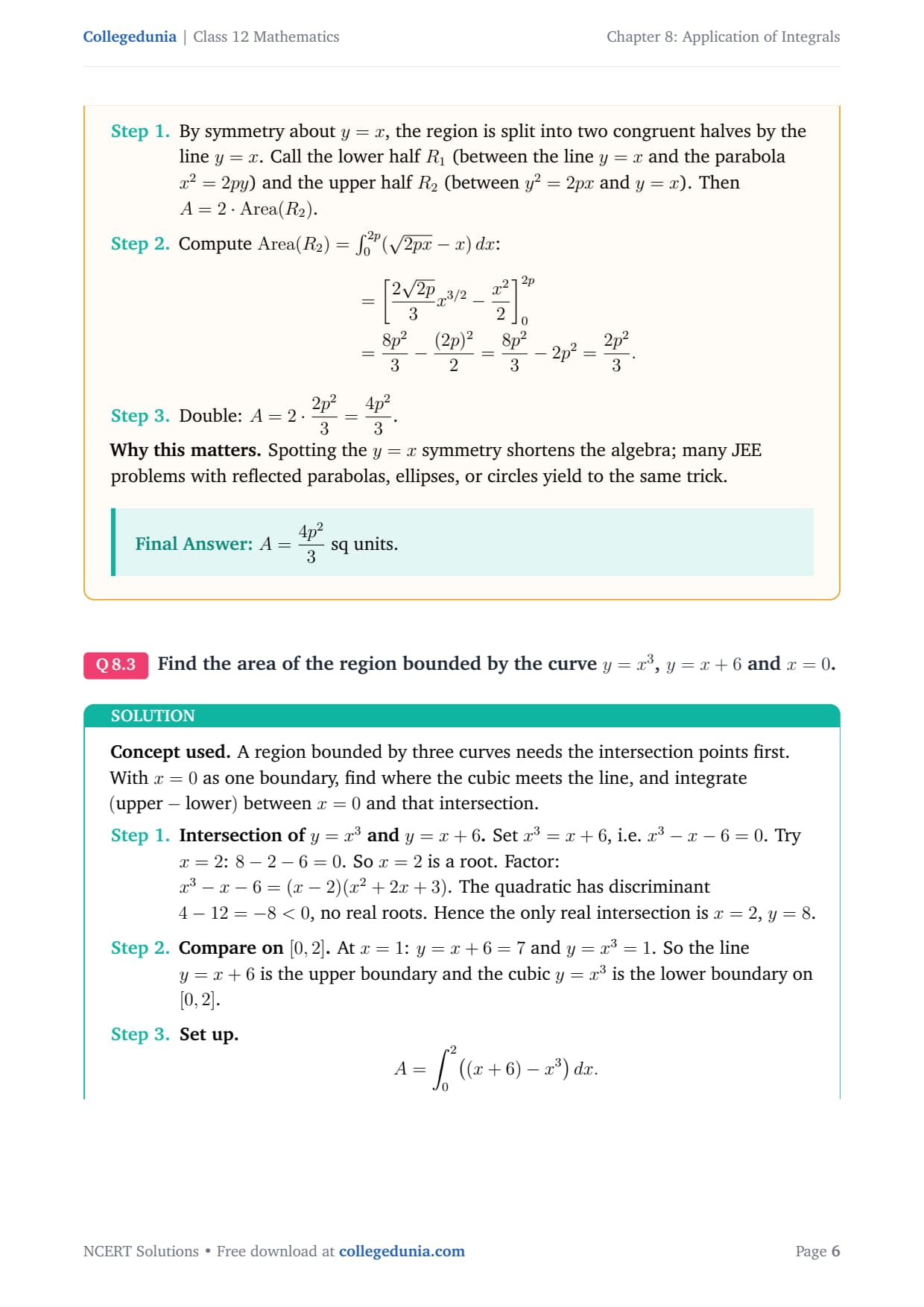
Find the area of the region bounded by the curve y=x3, y=x+6 and x=0.
Concept used. A region bounded by three curves needs the
intersection points first. With x=0 as one boundary, find where
the cubic meets the line, and integrate (upper-lower)
between x=0 and that intersection.
Intersection of y=x3 and y=x+6. Set
x3=x+6, i.e. x3-x-6=0. Try x=2:
8-2-6=0. So x=2 is a root. Factor:
x3-x-6=(x-2)(x2+2x+3). The quadratic has
discriminant 4-12=-8<0, no real roots. Hence the only
real intersection is x=2, y=8.
Compare on [0,2]. At x=1: y=x+6=7 and
y=x3=1. So the line y=x+6 is the upper boundary and
the cubic y=x3 is the lower boundary on [0,2].
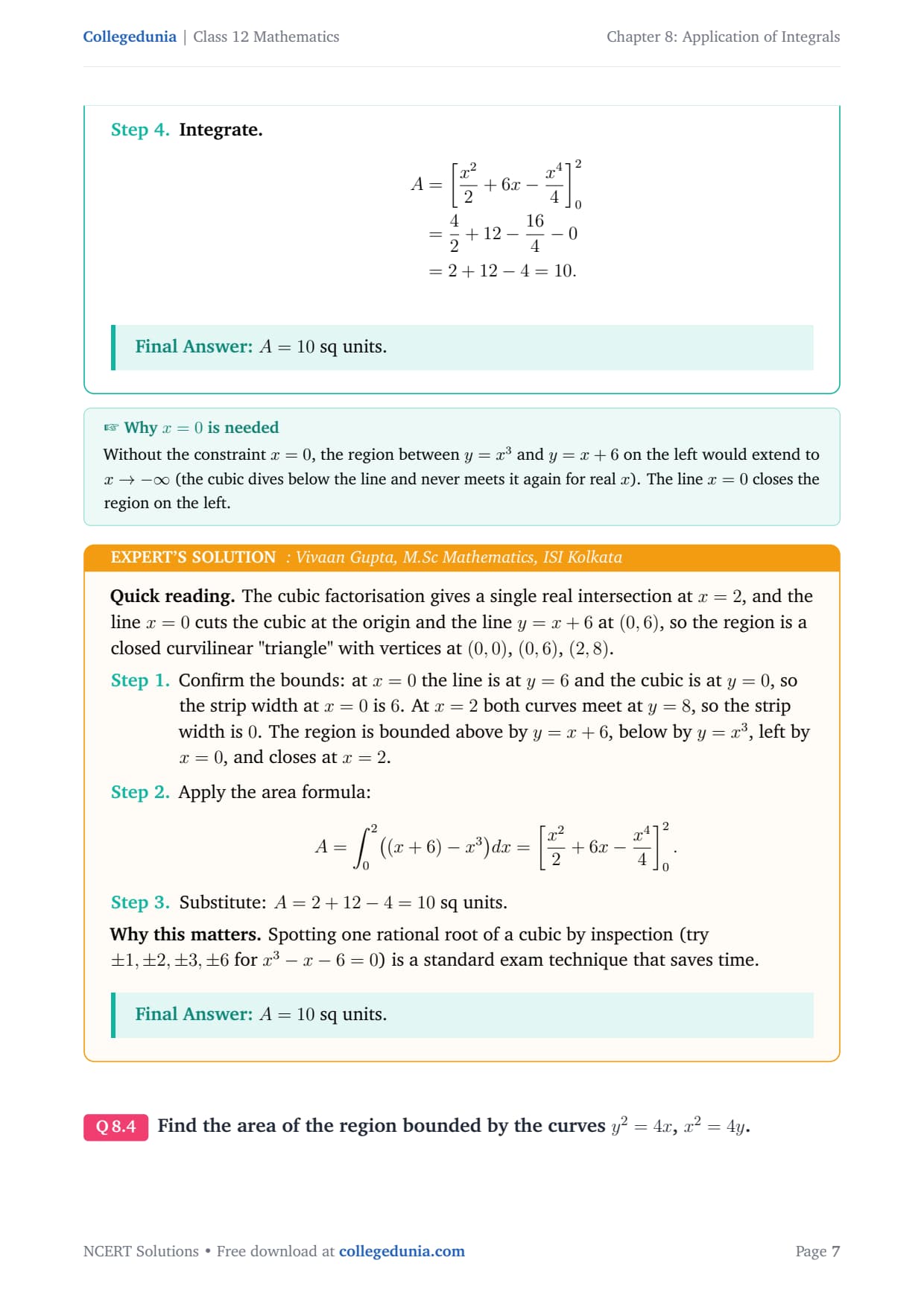
Quick reading. The cubic factorisation gives a single real
intersection at x=2, and the line x=0 cuts the cubic at the
origin and the line y=x+6 at (0,6), so the region is a closed
curvilinear "triangle" with vertices at (0,0), (0,6), (2,8).
Confirm the bounds: at x=0 the line is at y=6 and the
cubic is at y=0, so the strip width at x=0 is 6. At
x=2 both curves meet at y=8, so the strip width is 0.
The region is bounded above by y=x+6, below by y=x3,
left by x=0, and closes at x=2.
Apply the area formula:
A=02((x+6)-x3)dx
=[x22+6x-x44]02.
Substitute: A=2+12-4=10 sq units.
Why this matters. Spotting one rational root of a cubic by
inspection (try ± 1,± 2,± 3,± 6 for x3-x-6=0) is a
standard exam technique that saves time.
A=10 sq units.
Q 8.4
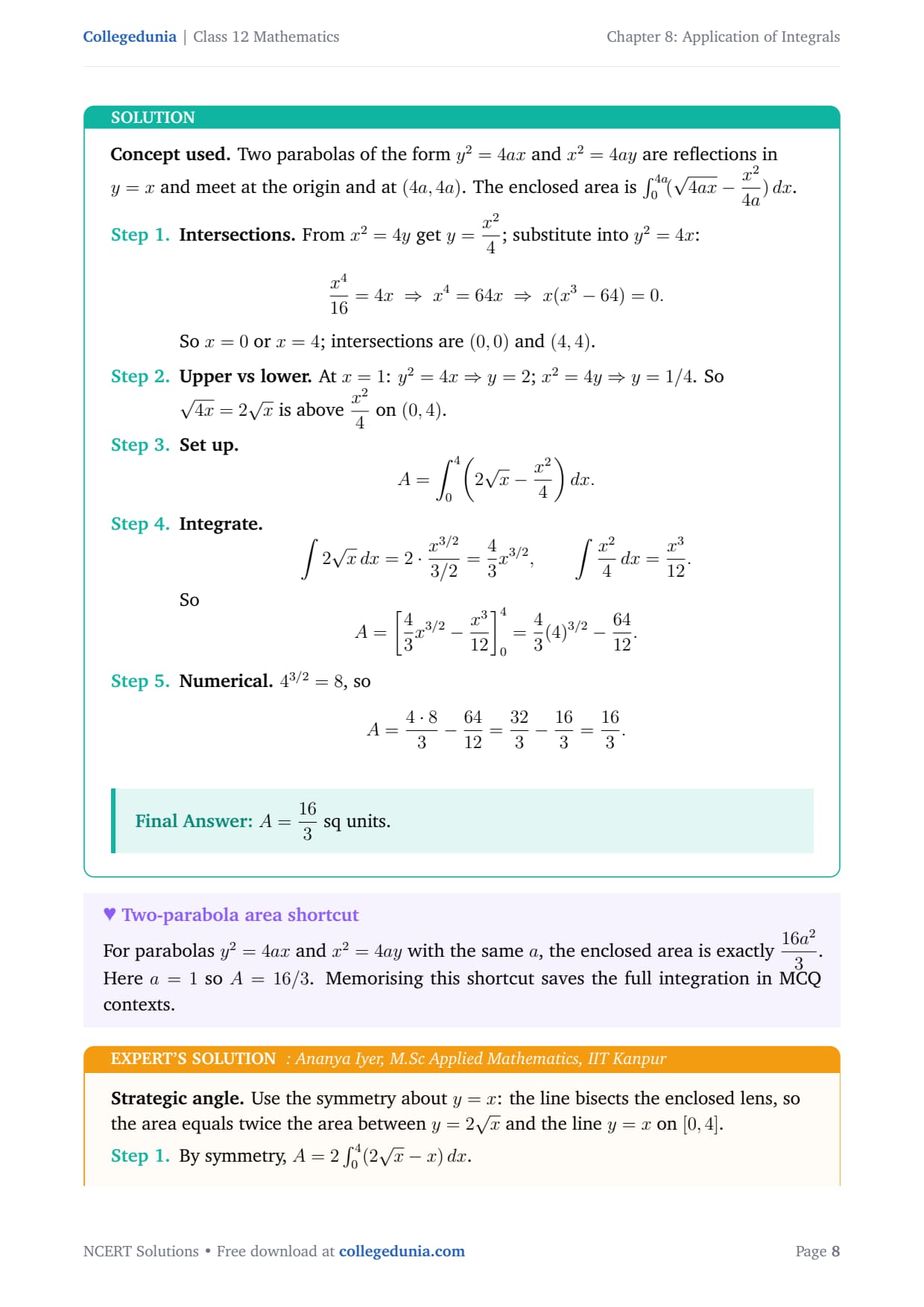
Find the area of the region bounded by the curves y2=4x, x2=4y.
Concept used. Two parabolas of the form y2=4ax and
x2=4ay are reflections in y=x and meet at the origin and at
(4a,4a). The enclosed area is
04a(√4ax-x24a) dx.
Intersections. From x2=4y get y=x24;
substitute into y2=4x:
x416=4x ⇒ x4=64x
⇒ x(x3-64)=0.
So x=0 or x=4; intersections are (0,0) and (4,4).
Upper vs lower. At x=1: y2=4x⇒ y=2;
x2=4y⇒ y=1/4. So √4x=2√x is above
x24 on (0,4).
Strategic angle. Use the symmetry about y=x: the line
bisects the enclosed lens, so the area equals twice the area between
y=2√x and the line y=x on [0,4].
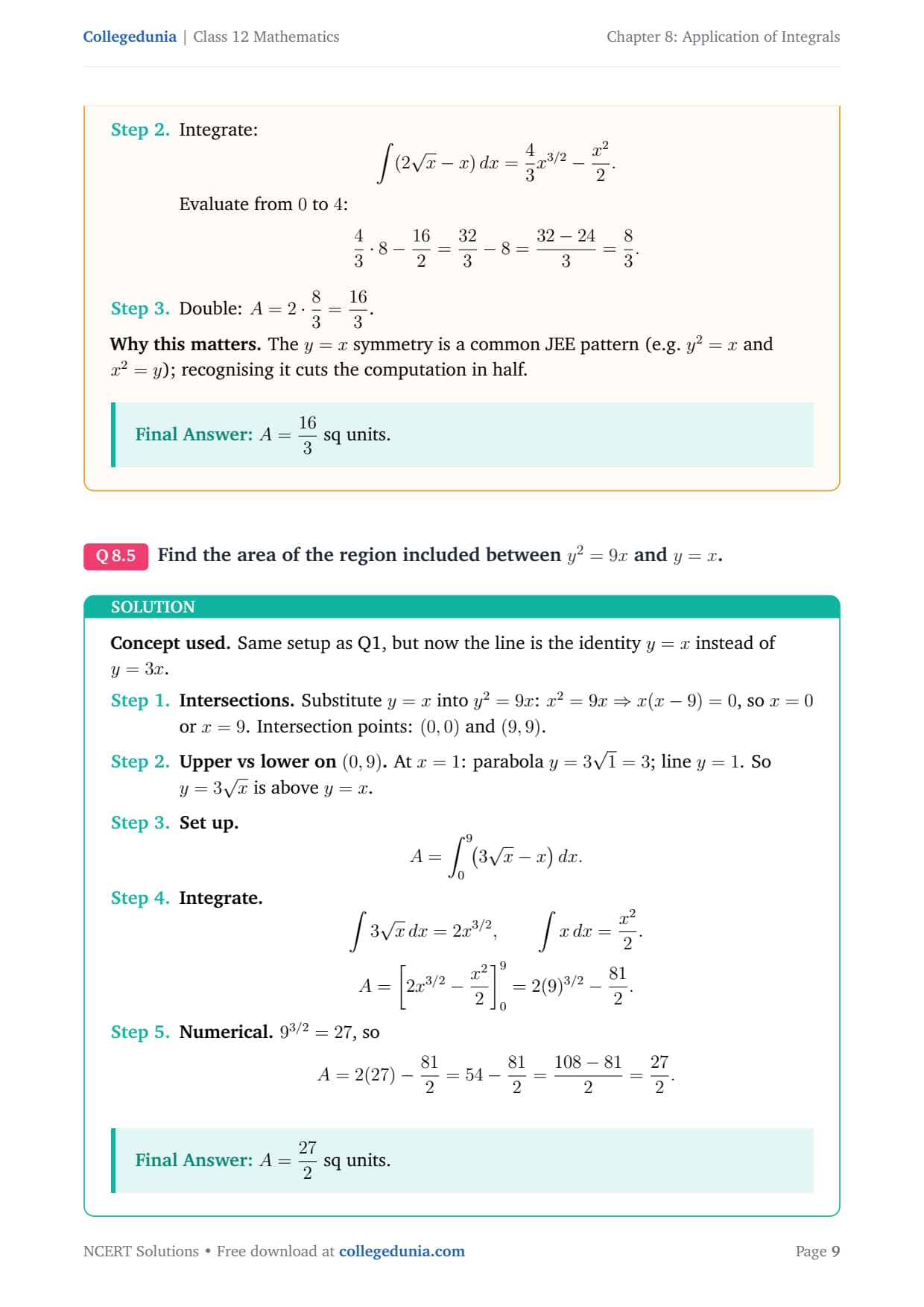
By symmetry, A=204(2√x-x) dx.
Integrate:
∫ (2√x-x) dx = 43x3/2-x22.
Evaluate from 0 to 4:
43· 8 - 162=323-8
=32-243=83.
Double: A=2·83=163.
Why this matters. The y=x symmetry is a common JEE
pattern (e.g. y2=x and x2=y); recognising it cuts the
computation in half.
A=163 sq units.
Q 8.5
Find the area of the region included between y2=9x and y=x.
Concept used. Same setup as Q1, but now the line is the
identity y=x instead of y=3x.
Intersections. Substitute y=x into y2=9x:
x2=9x⇒ x(x-9)=0, so x=0 or x=9.
Intersection points: (0,0) and (9,9).
Upper vs lower on (0,9). At x=1: parabola
y=3√1=3; line y=1. So y=3√x is above
y=x.
Set up.A=09(3√x-x) dx.
Integrate. ∫ 3√x dx=2x3/2,
∫ x dx=x22. A=[2x3/2-x22]09
=2(9)3/2-812.
Numerical.93/2=27, so
A=2(27)-812=54-812=108-812=272.
A=272 sq units.
RM
Rohit Mehta
B.Tech CSE, IIT Roorkee
Verified Expert
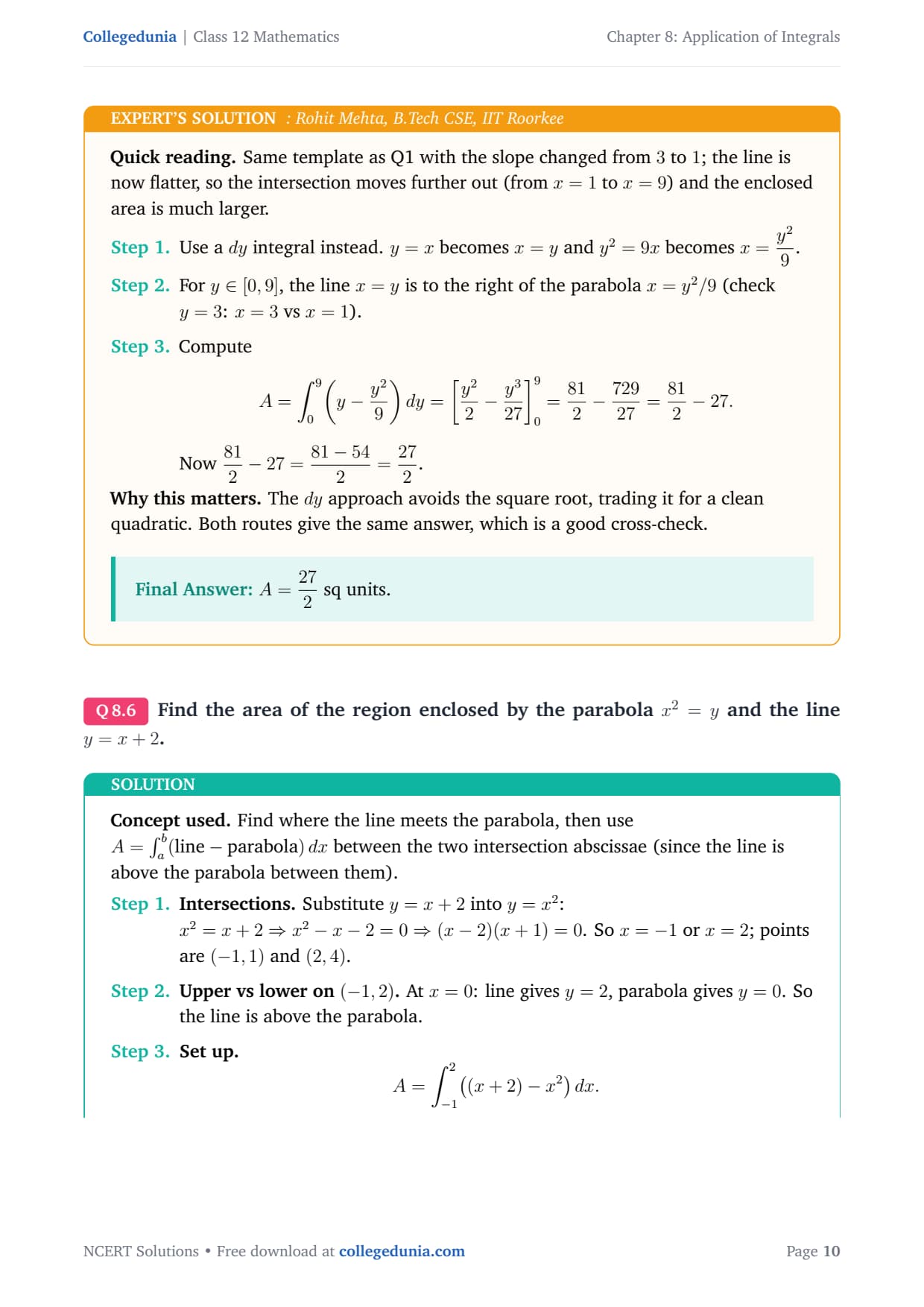
Quick reading. Same template as Q1 with the slope changed
from 3 to 1; the line is now flatter, so the intersection moves
further out (from x=1 to x=9) and the enclosed area is much
larger.
Use a dy integral instead. y=x becomes x=y and
y2=9x becomes x=y29.
For y∈[0,9], the line x=y is to the right of the
parabola x=y2/9 (check y=3: x=3 vs x=1).
Compute
A=09(y-y29)dy
=[y22-y327]09
=812-72927=812-27.
Now 812-27=81-542=272.
Why this matters. The dy approach avoids the square root,
trading it for a clean quadratic. Both routes give the same answer,
which is a good cross-check.
A=272 sq units.
Q 8.6
Find the area of the region enclosed by the parabola x2=y and the line y=x+2.
Concept used. Find where the line meets the parabola, then
use A=ab(line-parabola) dx between the
two intersection abscissae (since the line is above the parabola
between them).
Intersections. Substitute y=x+2 into y=x2:
x2=x+2⇒ x2-x-2=0⇒ (x-2)(x+1)=0.
So x=-1 or x=2; points are (-1,1) and (2,4).
Upper vs lower on (-1,2). At x=0: line gives
y=2, parabola gives y=0. So the line is above the
parabola.
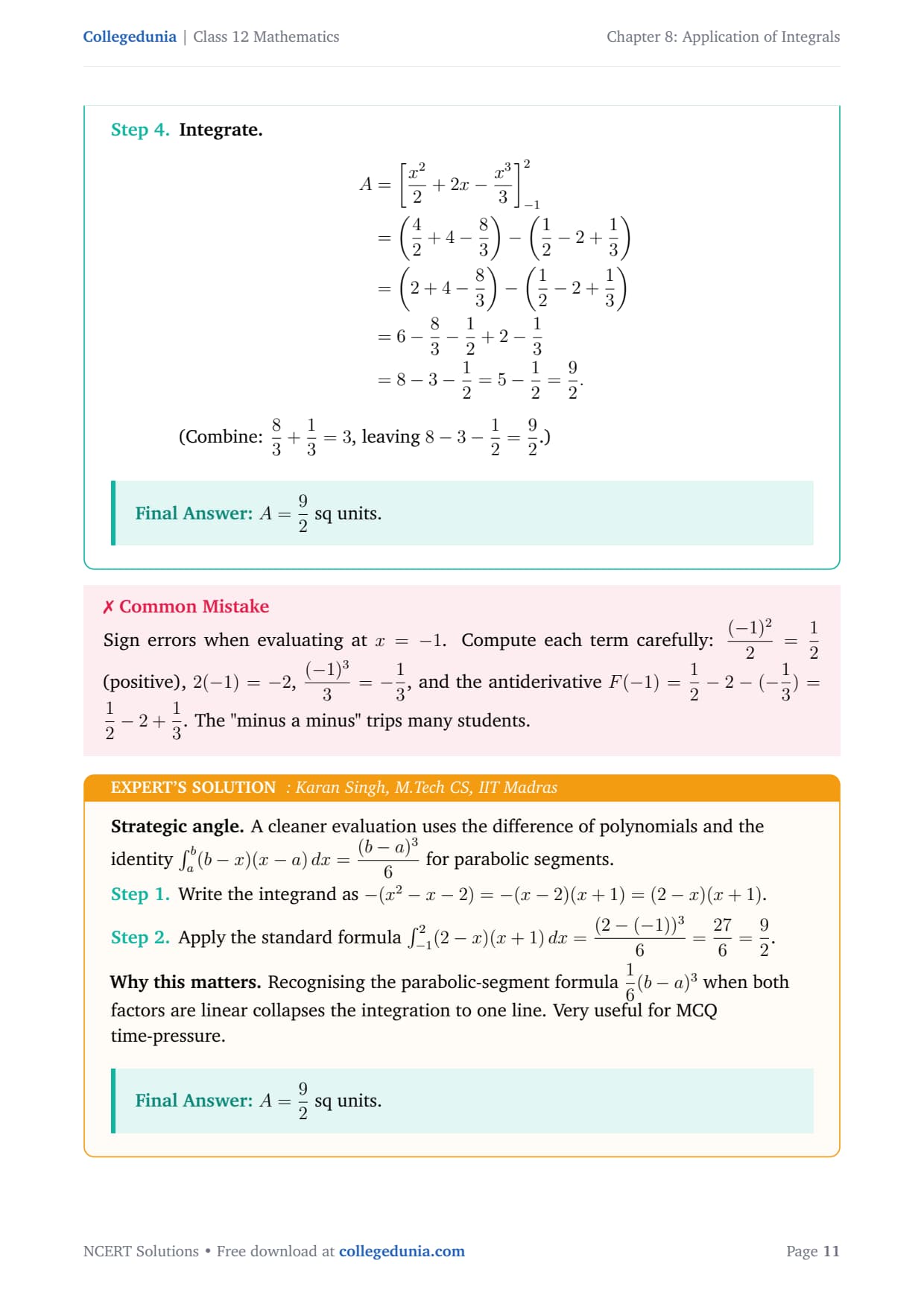
Strategic angle. A cleaner evaluation uses the difference
of polynomials and the identity
ab(b-x)(x-a) dx=(b-a)36 for parabolic
segments.
Write the integrand as -(x2-x-2)=-(x-2)(x+1)=(2-x)(x+1).
Apply the standard formula
-12(2-x)(x+1) dx=(2-(-1))36=276=92.
Why this matters. Recognising the parabolic-segment formula
16(b-a)3 when both factors are linear collapses the
integration to one line. Very useful for MCQ time-pressure.
A=92 sq units.
Q 8.7
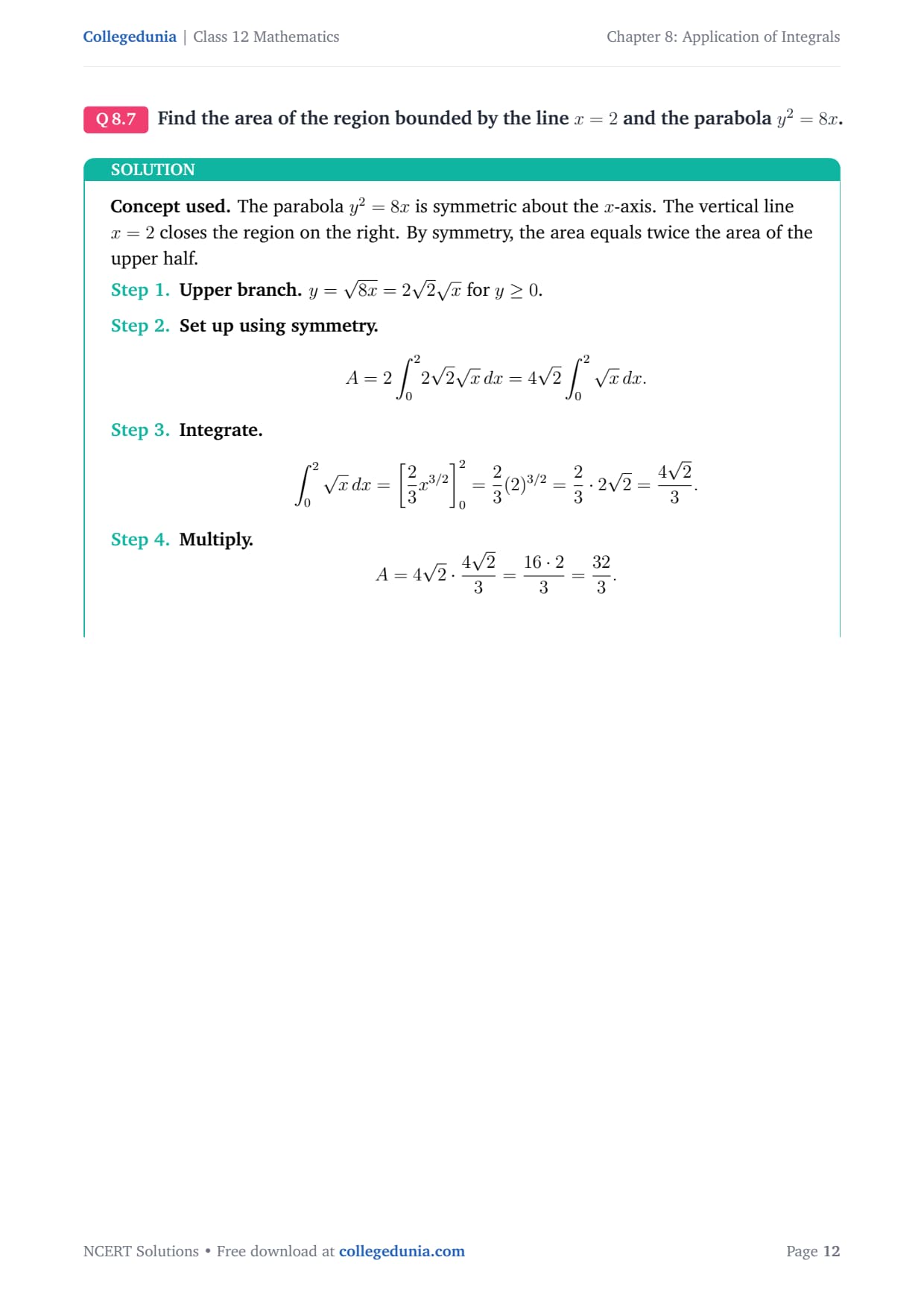
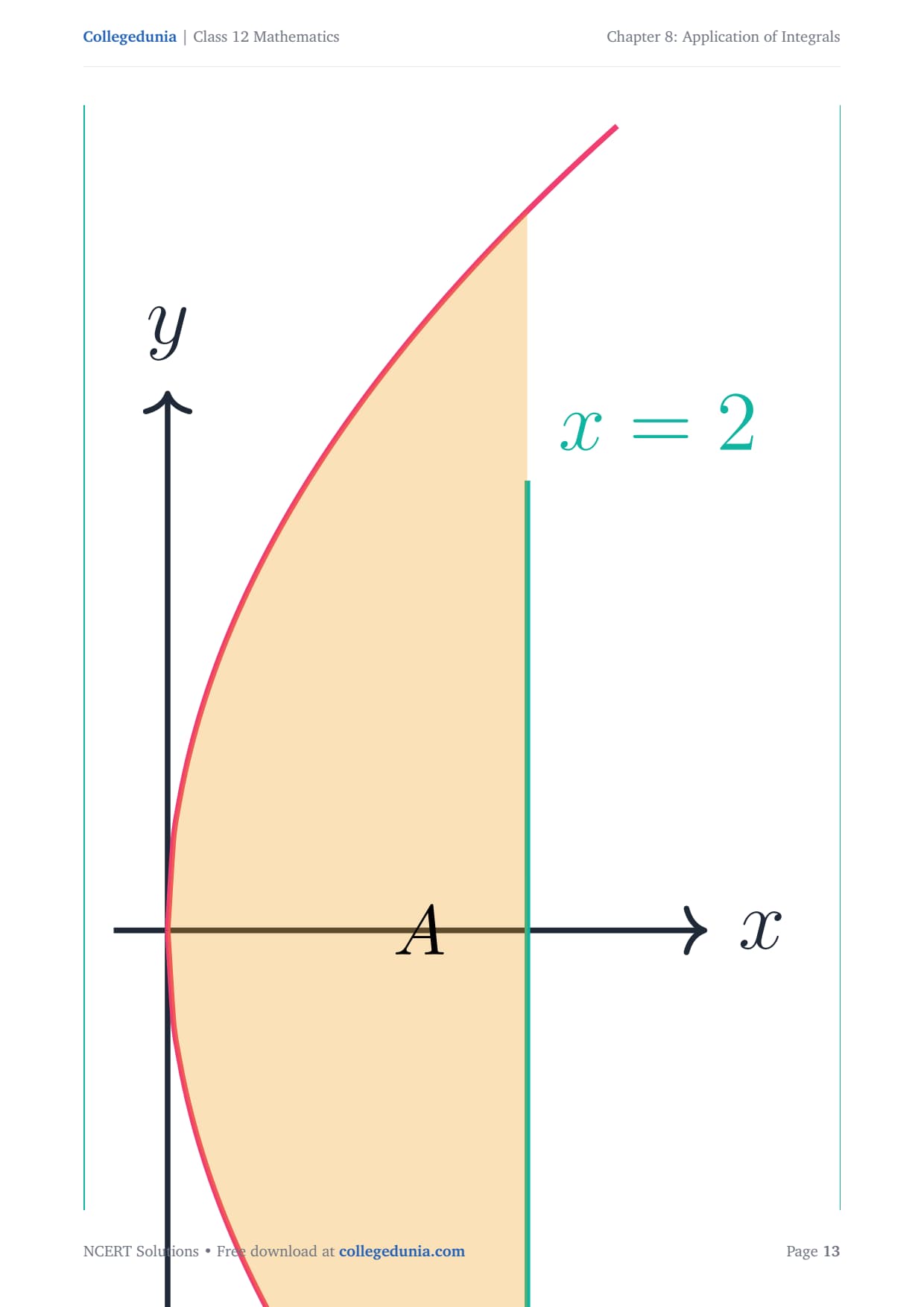
Find the area of the region bounded by the line x=2 and the parabola y2=8x.
Concept used. The parabola y2=8x is symmetric about
the x-axis. The vertical line x=2 closes the region on the
right. By symmetry, the area equals twice the area of the upper
half.
Picture-first. Use horizontal strips: for each y, the
strip runs from x=y28 (parabola) to x=2 (line),
and y ranges from -4 to 4 (where y2=8· 2 gives
y=± 4).
Set up
A=-44(2-y28)dy
=204(2-y28)dy
using even symmetry of the integrand.
Why this matters. For parabolas of the form y2=4ax
cut off by a vertical line x=h, the dy method yields a clean
polynomial. Try both methods and pick the one with fewer surds.
A=323 sq units.
Q 8.8
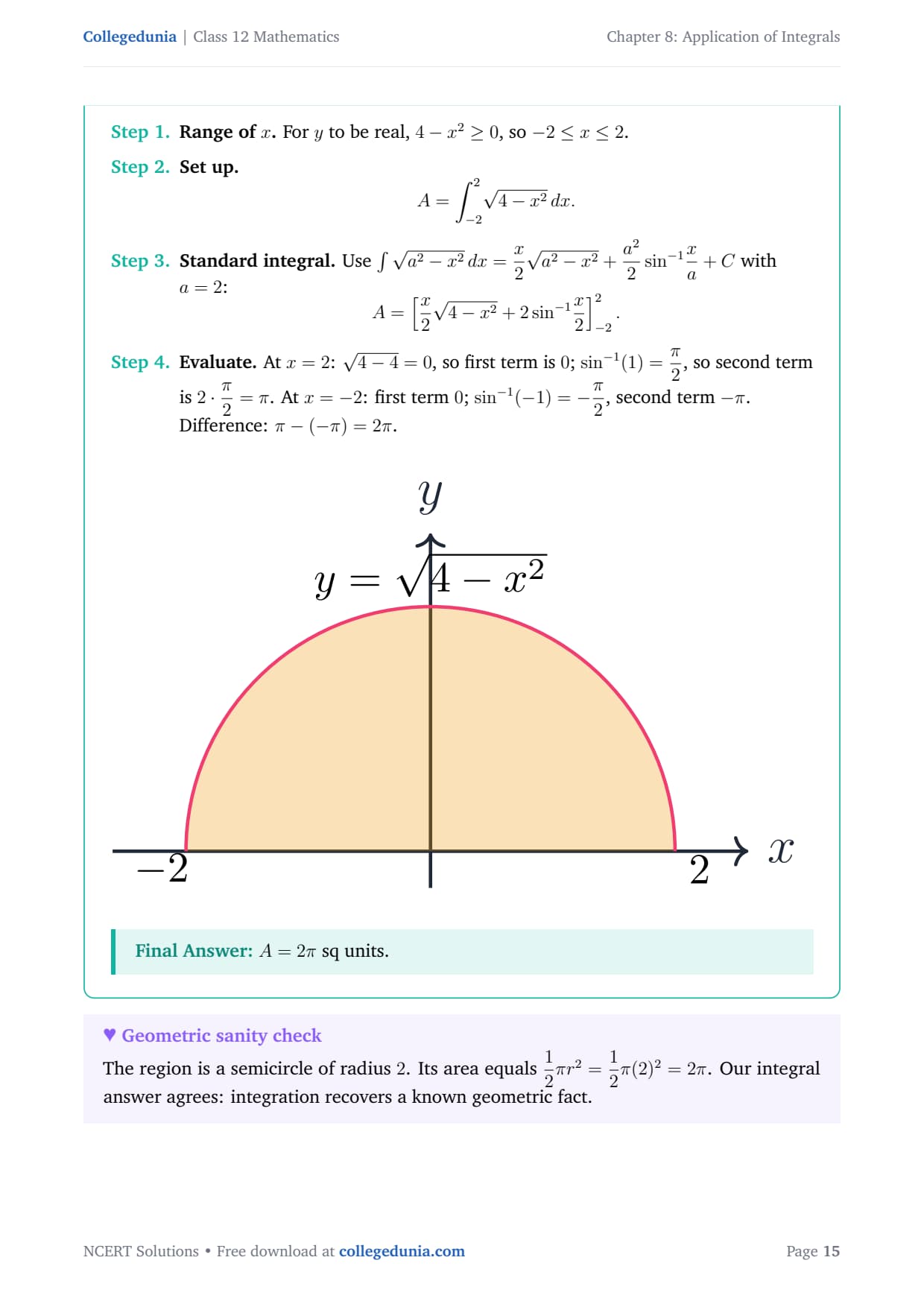
Sketch the region (x,y)y=√4-x2 and the x-axis. Find the area of the region using integration.
Concept used.y=√4-x2 describes the upper half of
the circle x2+y2=4 (radius 2, centred at origin). With the
x-axis as the lower boundary, the region is the upper semicircular
disc.
Range of x. For y to be real, 4-x2≥ 0, so
-2≤ x≤ 2.
Set up.A=-22√4-x2 dx.
Standard integral. Use
∫√a2-x2 dx=x2√a2-x2+a22sin-1xa+C
with a=2:
A=[x2√4-x2+2sin-1x2]-22.
Evaluate. At x=2: √4-4=0, so first term
is 0; sin-1(1)=π2, so second term is
2·π2=π. At x=-2: first term 0;
sin-1(-1)=-π2, second term -π.
Difference: π-(-π)=2π.
!%
[See diagram in the PDF version]
A=2π sq units.
PJ
Pranav Joshi
M.Sc Mathematics, IIT Bombay
Verified Expert
Strategic angle. The square root √a2-x2 begs
for the trig substitution x=asinθ, because then
a2-x2=a2(1-sin2θ)=a2cos2θ and the
surd disappears. Here a=2, so we try x=2sinθ.
Set x=2sinθ, so dx=2cosθ dθ, and
√4-x2=√4-4sin2θ=2|cosθ|=2cosθ
(positive in θ∈[-π/2,π/2]).
Update the limits. When x=-2: sinθ=-1, so
θ=-π/2. When x=2: sinθ=1, so
θ=π/2. The interval x∈[-2,2] maps to
θ∈[-π/2,π/2] bijectively.
Use cos2θ=1+cos 2θ2 on the integrand to obtain
4-π/2π/21+cos 2θ2 dθ
=2-π/2π/2(1+cos 2θ) dθ.
Integrate:
∫(1+cos 2θ) dθ=θ+sin 2θ2.
Evaluate:
2[θ+sin 2θ2]-π/2π/2
=2[(π2+0)-(-π2+0)]
=2(π)=2π.
(sin(π)=0, so the second term vanishes at both
limits.)
Why this matters. The x=asinθ substitution is the
go-to move whenever √a2-x2 appears in a definite
integral. It always pairs with the half-angle identity to reduce
the integral to a sum of constants and sinusoids; memorise this
two-step pattern.
A=2π sq units.
Q 8.9
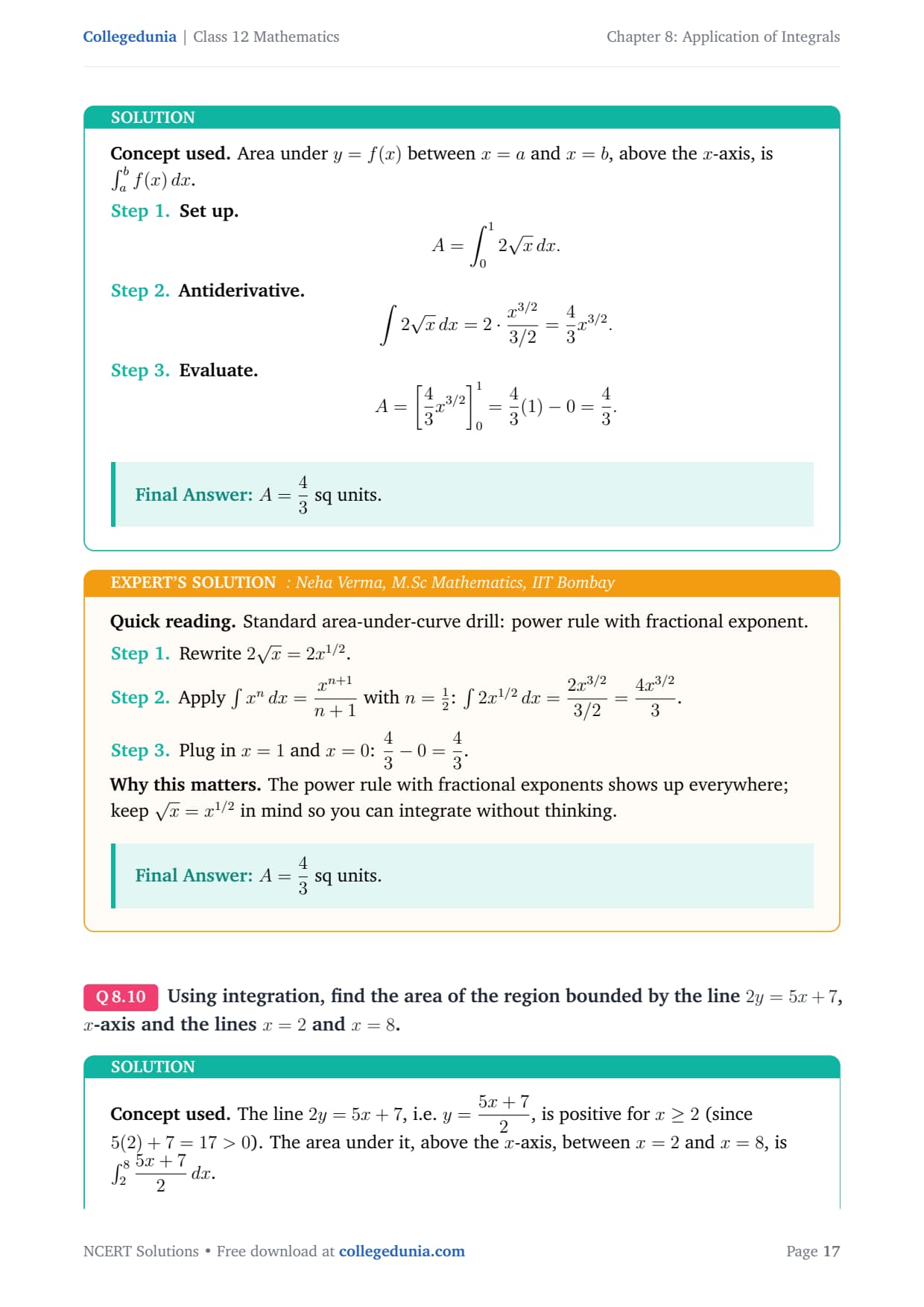
Calculate the area under the curve y=2√x included between the lines x=0 and x=1.
Concept used. Area under y=f(x) between x=a and x=b,
above the x-axis, is abf(x) dx.
Set up.A=012√x dx.
Antiderivative. ∫ 2√x dx = 2·x3/23/2=43x3/2.
Evaluate.A=[43x3/2]01=43(1)-0=43.
A=43 sq units.
NV
Neha Verma
M.Sc Mathematics, IIT Bombay
Verified Expert
Quick reading. Standard area-under-curve drill: power rule
with fractional exponent.
Rewrite 2√x=2x1/2.
Apply ∫ xn dx=xn+1n+1 with n=12:
∫ 2x1/2 dx=2x3/23/2=4x3/23.
Plug in x=1 and x=0: 43-0=43.
Why this matters. The power rule with fractional exponents
shows up everywhere; keep √x=x1/2 in mind so you can
integrate without thinking.
A=43 sq units.
Q 8.10
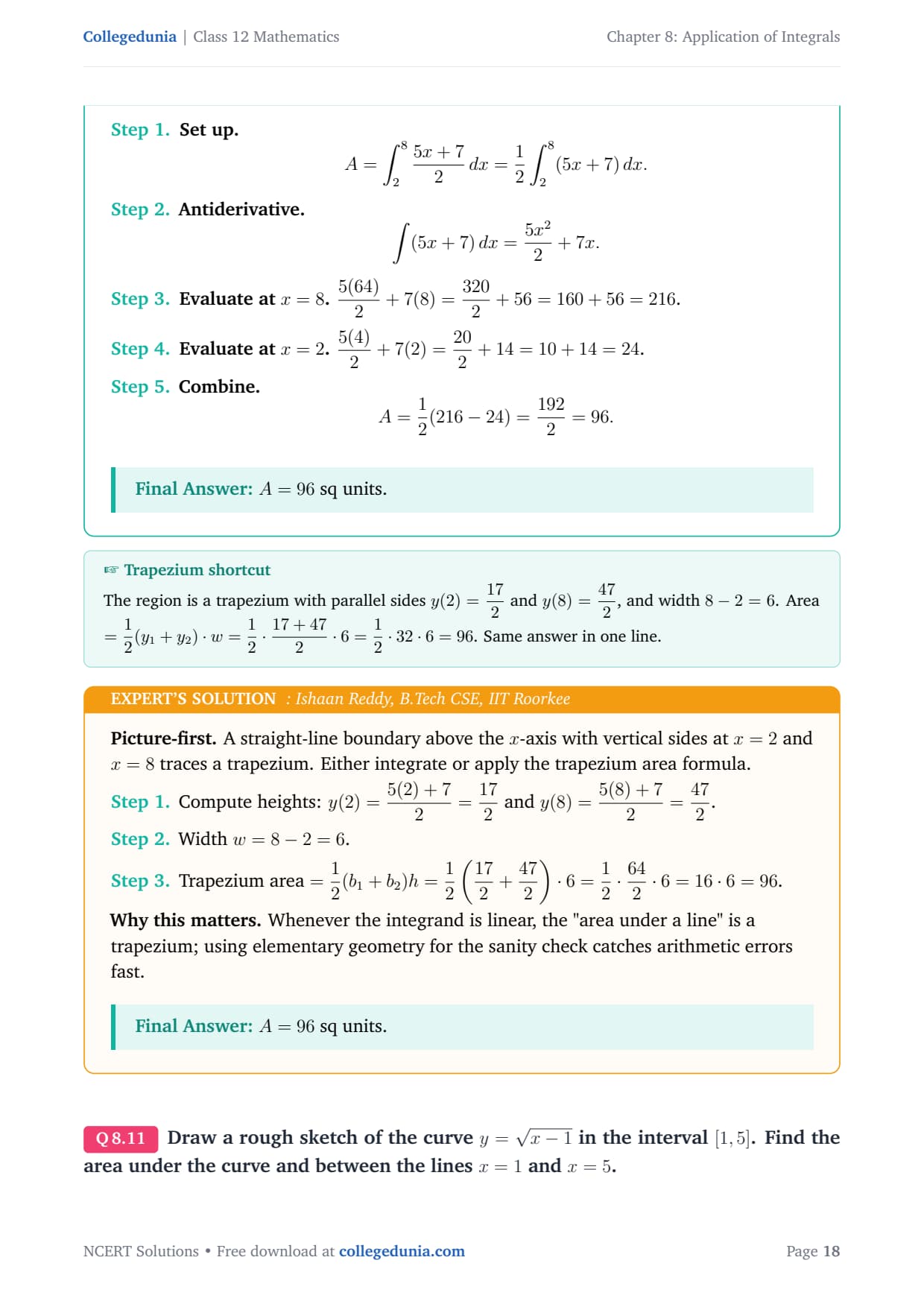
Using integration, find the area of the region bounded by the line 2y=5x+7, x-axis and the lines x=2 and x=8.
Concept used. The line 2y=5x+7, i.e. y=5x+72,
is positive for x≥ 2 (since 5(2)+7=17>0). The area under it,
above the x-axis, between x=2 and x=8, is
285x+72 dx.
Set up.A=285x+72 dx=1228(5x+7) dx.
Antiderivative. ∫(5x+7) dx=5x22+7x.
Evaluate at x=8.5(64)2+7(8)=3202+56=160+56=216.
Evaluate at x=2.5(4)2+7(2)=202+14=10+14=24.
Combine.A=12(216-24)=1922=96.
A=96 sq units.
IR
Ishaan Reddy
B.Tech CSE, IIT Roorkee
Verified Expert
Picture-first. A straight-line boundary above the x-axis
with vertical sides at x=2 and x=8 traces a trapezium. Either
integrate or apply the trapezium area formula.
Compute heights: y(2)=5(2)+72=172 and
y(8)=5(8)+72=472.
Width w=8-2=6.
Trapezium area =12(b1+b2)h
=12(172+472)· 6
=12·642· 6=16· 6=96.
Why this matters. Whenever the integrand is linear, the
"area under a line" is a trapezium; using elementary geometry for
the sanity check catches arithmetic errors fast.
A=96 sq units.
Q 8.11
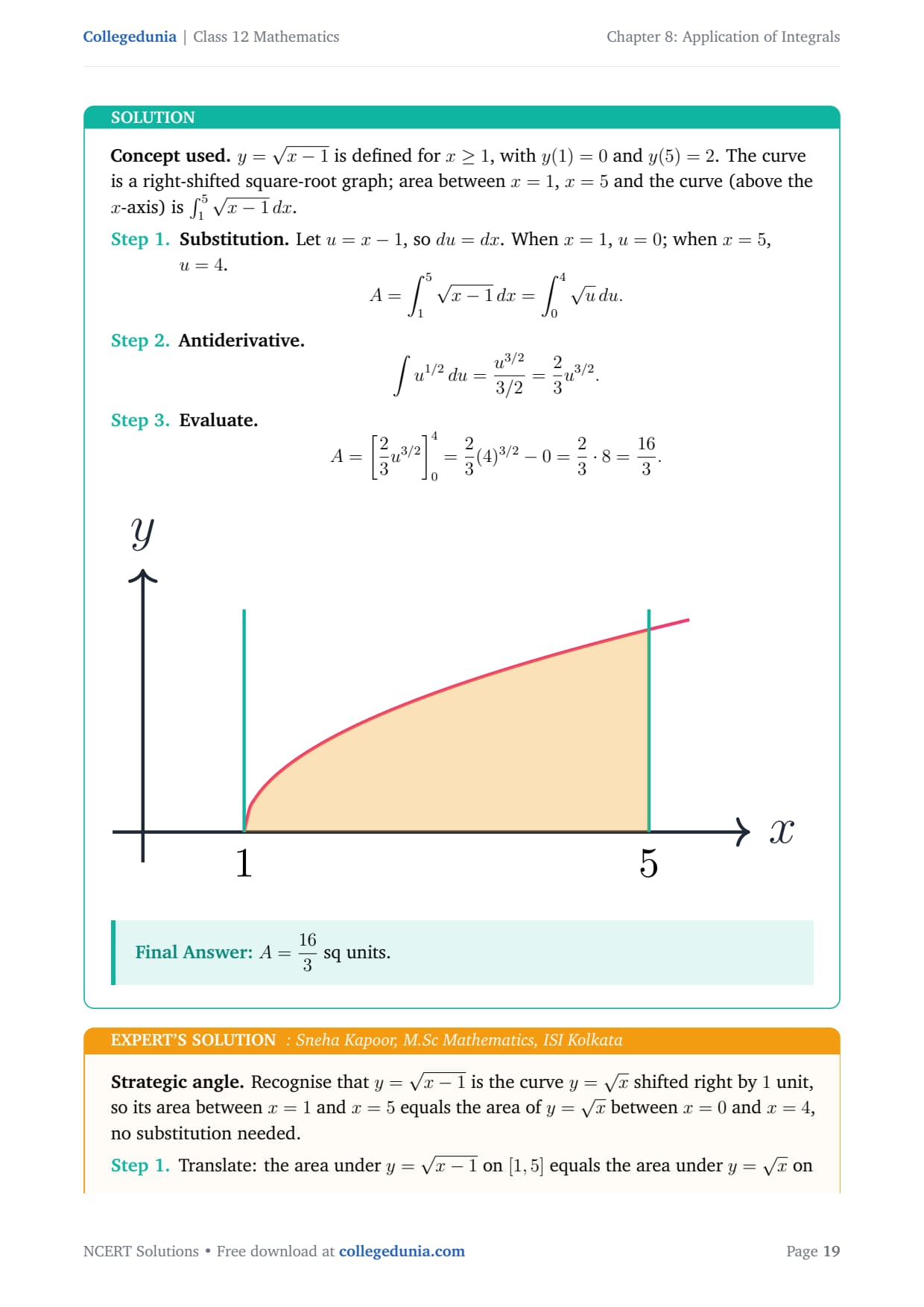
Draw a rough sketch of the curve y=√x-1 in the interval [1,5]. Find the area under the curve and between the lines x=1 and x=5.
Concept used.y=√x-1 is defined for x≥ 1, with
y(1)=0 and y(5)=2. The curve is a right-shifted square-root
graph; area between x=1, x=5 and the curve (above the x-axis)
is 15√x-1 dx.
Substitution. Let u=x-1, so du=dx. When x=1,
u=0; when x=5, u=4.
A=15√x-1 dx=04√u du.
Antiderivative. ∫ u1/2 du=u3/23/2=23u3/2.
Evaluate.A=[23u3/2]04
=23(4)3/2-0=23· 8=163.
!%
[See diagram in the PDF version]
A=163 sq units.
SK
Sneha Kapoor
M.Sc Mathematics, ISI Kolkata
Verified Expert
Strategic angle. Recognise that y=√x-1 is the curve
y=√x shifted right by 1 unit, so its area between x=1
and x=5 equals the area of y=√x between x=0 and x=4,
no substitution needed.
Translate: the area under y=√x-1 on [1,5] equals
the area under y=√x on [0,4].
Compute the resulting integral directly:
04√x dx=[23x3/2]04
=23· 8=163.
Why this matters. Translations f(x-h) shift the graph
right by h without changing areas; this saves time and avoids
substitution mistakes.
A=163 sq units.
Q 8.12
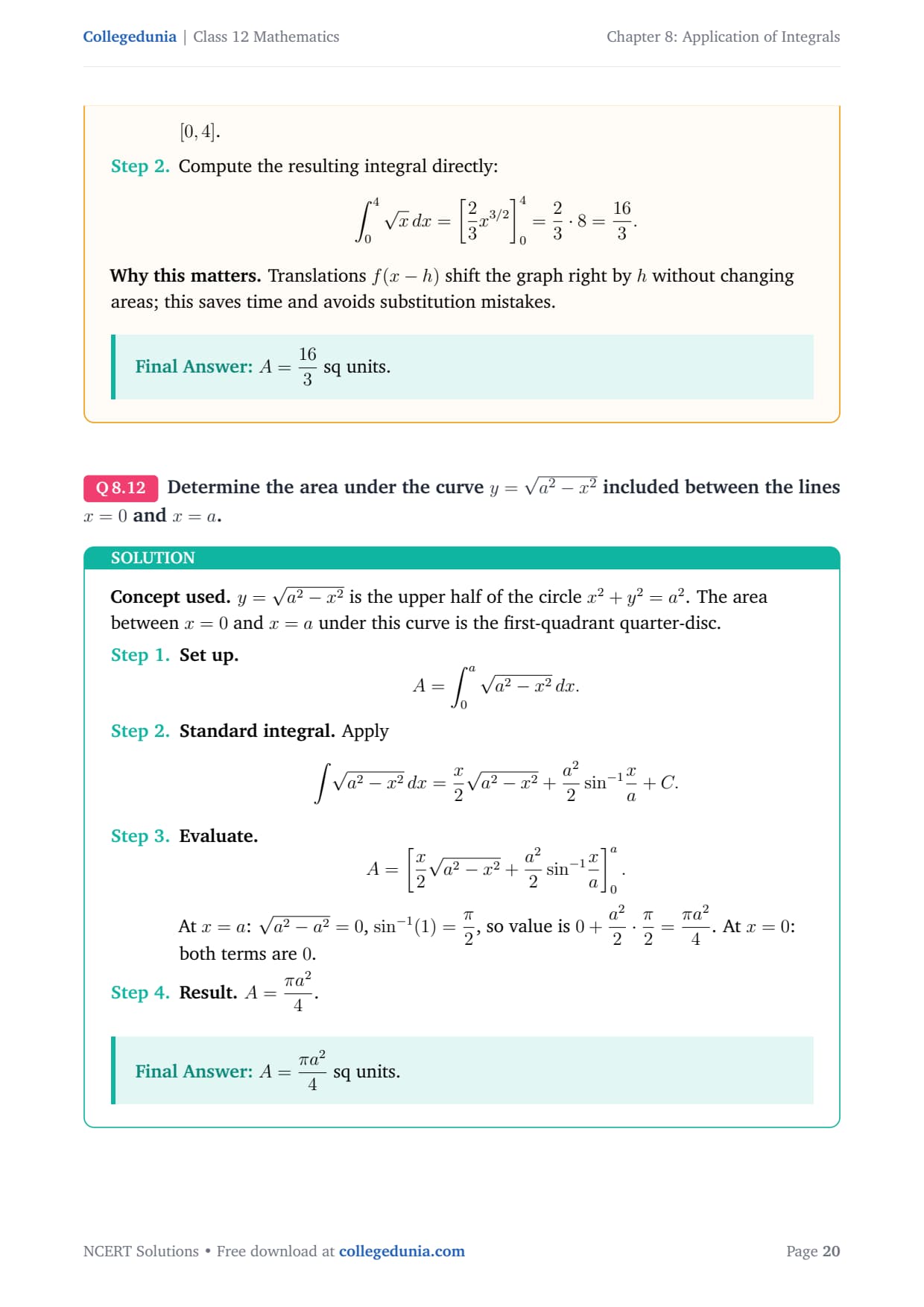
Determine the area under the curve y=√a2-x2 included between the lines x=0 and x=a.
Concept used.y=√a2-x2 is the upper half of
the circle x2+y2=a2. The area between x=0 and x=a
under this curve is the first-quadrant quarter-disc.
Set up.A=0a√a2-x2 dx.
Standard integral. Apply
∫√a2-x2 dx
=x2√a2-x2+a22sin-1xa+C.
Evaluate.A=[x2√a2-x2+a22sin-1xa]0a.
At x=a: √a2-a2=0, sin-1(1)=π2,
so value is 0+a22·π2=π a24.
At x=0: both terms are 0.
Result.A=π a24.
A=π a24 sq units.
DN
Diya Nair
M.Sc Mathematics, IIT Bombay
Verified Expert
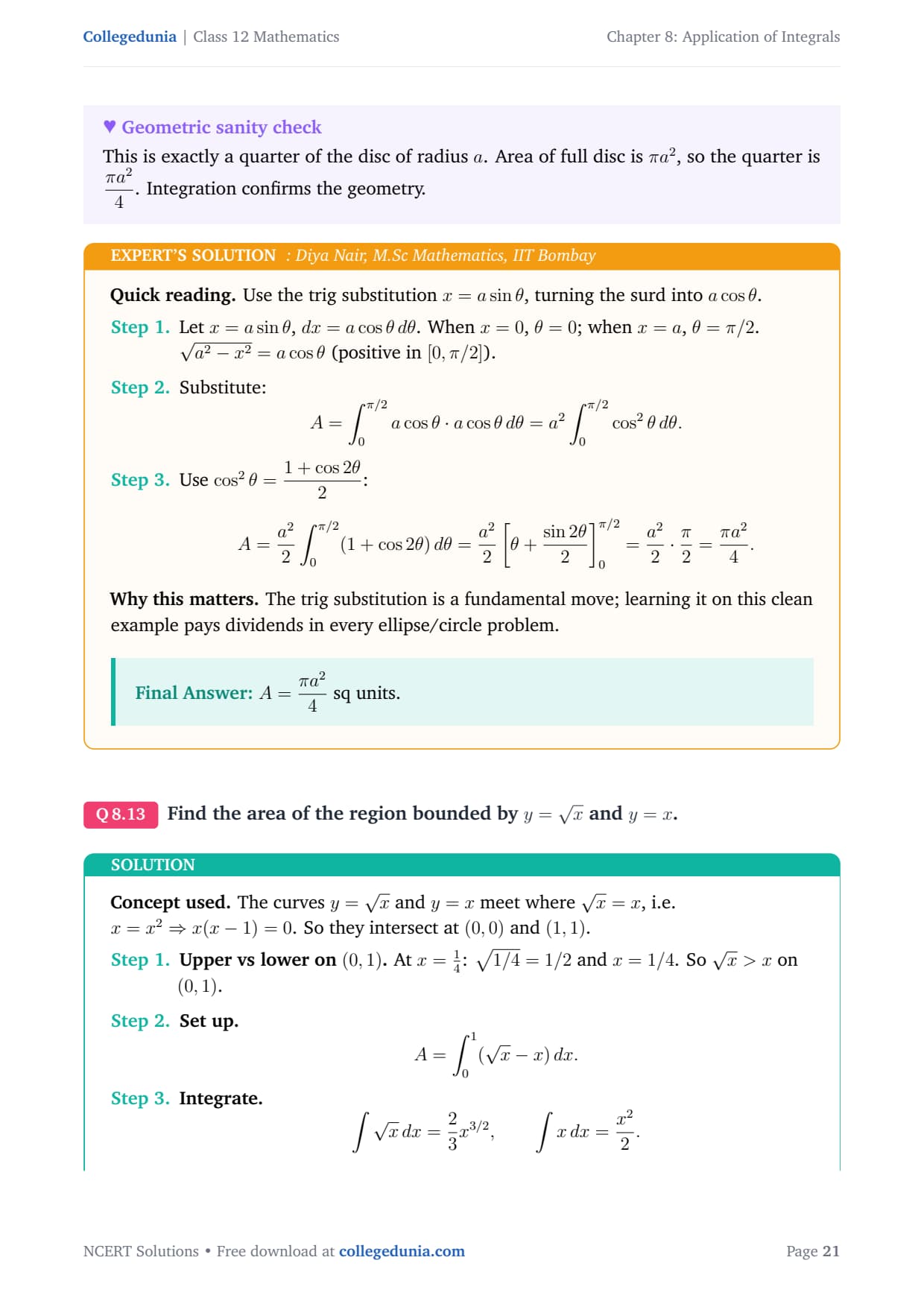
Quick reading. Use the trig substitution x=asinθ,
turning the surd into acosθ.
Let x=asinθ, dx=acosθ dθ. When x=0,
θ=0; when x=a, θ=π/2.
√a2-x2=acosθ (positive in [0,π/2]).
Use cos2θ=1+cos 2θ2:
A=a220π/2(1+cos 2θ) dθ
=a22[θ+sin 2θ2]0π/2
=a22·π2=π a24.
Why this matters. The trig substitution is a fundamental
move; learning it on this clean example pays dividends in every
ellipse/circle problem.
A=π a24 sq units.
Q 8.13
Find the area of the region bounded by y=√x and y=x.
Concept used. The curves y=√x and y=x meet where
√x=x, i.e. x=x2⇒ x(x-1)=0. So they intersect
at (0,0) and (1,1).
Upper vs lower on (0,1). At x=14:
√1/4=1/2 and x=1/4. So √x>x on
(0,1).
Set up.A=01(√x-x) dx.
Integrate. ∫√x dx=23x3/2, ∫ x dx=x22. A=[23x3/2-x22]01
=23-12=4-36=16.
A=16 sq units.
TD
Tara Desai
Ph.D Mathematics, IIT Delhi
Verified Expert
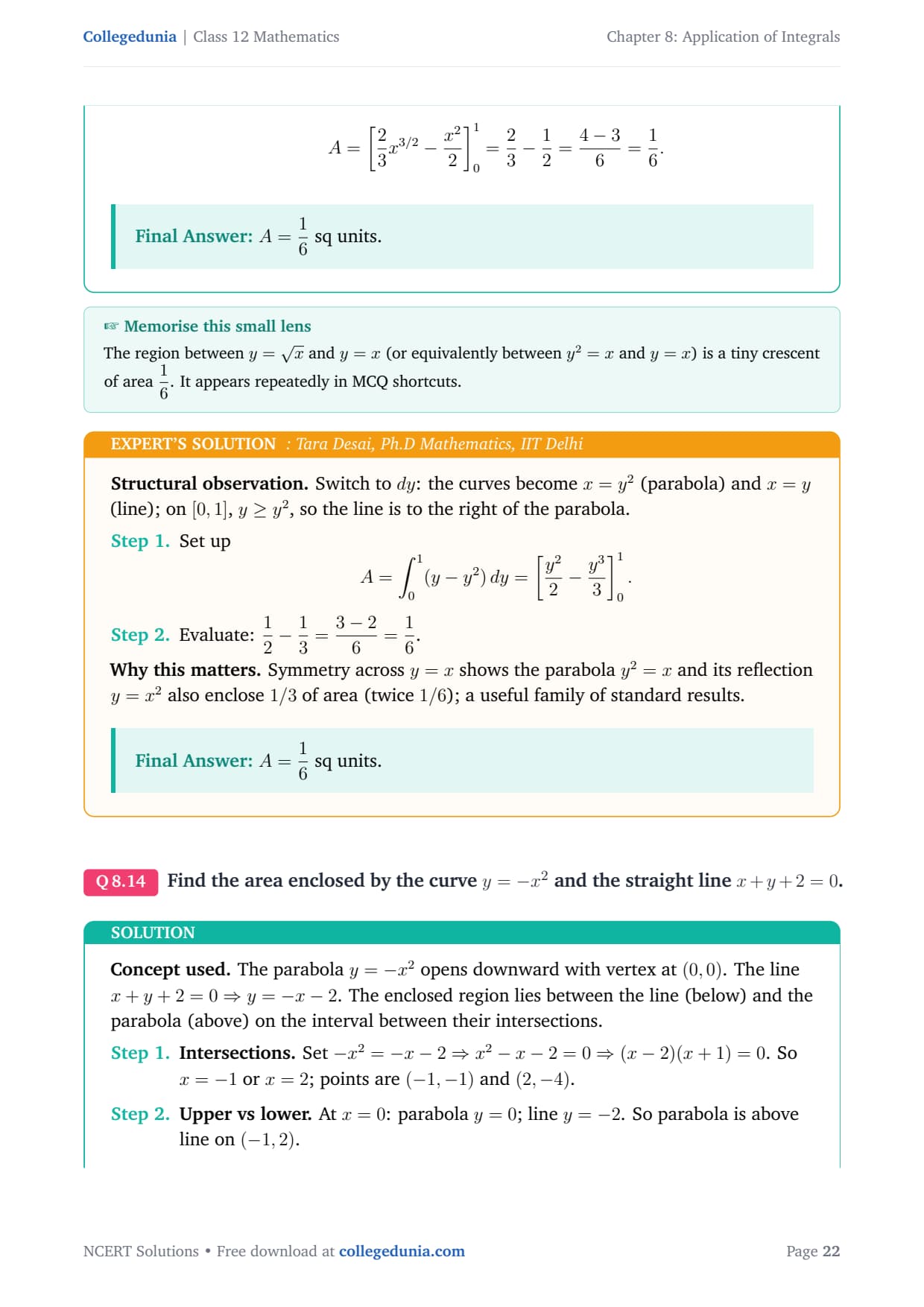
Structural observation. Switch to dy: the curves become
x=y2 (parabola) and x=y (line); on [0,1], y≥ y2, so
the line is to the right of the parabola.
Set up
A=01(y-y2) dy=[y22-y33]01.
Evaluate: 12-13=3-26=16.
Why this matters. Symmetry across y=x shows the parabola
y2=x and its reflection y=x2 also enclose 1/3 of area
(twice 1/6); a useful family of standard results.
A=16 sq units.
Q 8.14
Find the area enclosed by the curve y=-x2 and the straight line x+y+2=0.
Concept used. The parabola y=-x2 opens downward with
vertex at (0,0). The line x+y+2=0⇒ y=-x-2. The enclosed
region lies between the line (below) and the parabola (above) on
the interval between their intersections.
Intersections. Set -x2=-x-2⇒ x2-x-2=0
⇒ (x-2)(x+1)=0. So x=-1 or x=2; points are
(-1,-1) and (2,-4).
Upper vs lower. At x=0: parabola y=0; line y=-2.
So parabola is above line on (-1,2).
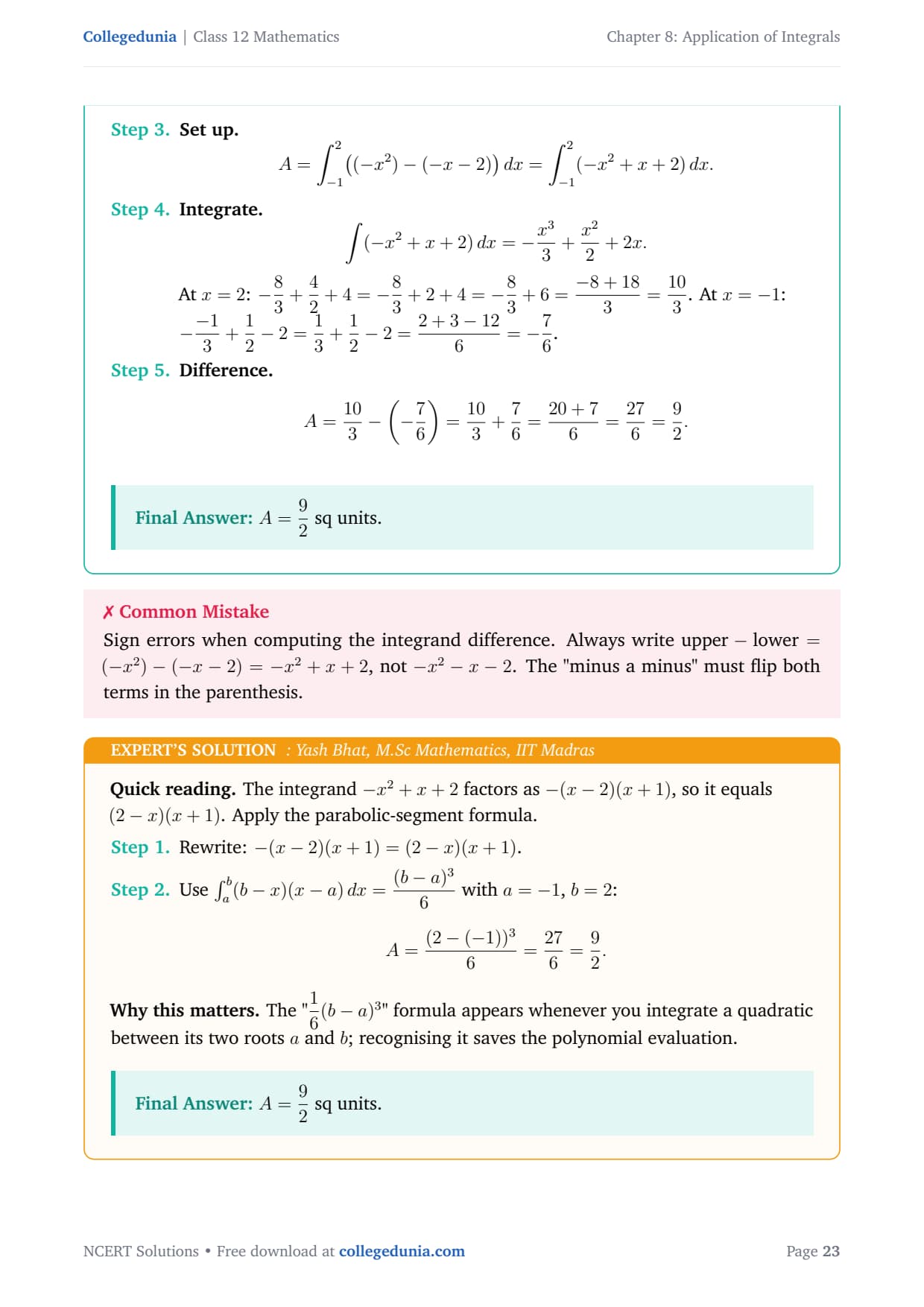
Set up.A=-12((-x2)-(-x-2)) dx
=-12(-x2+x+2) dx.
Integrate. ∫(-x2+x+2) dx = -x33+x22+2x.
At x=2: -83+42+4=-83+2+4=-83+6=-8+183=103.
At x=-1: --13+12-2=13+12-2=2+3-126=-76.
Difference.A=103-(-76)=103+76
=20+76=276=92.
A=92 sq units.
YB
Yash Bhat
M.Sc Mathematics, IIT Madras
Verified Expert
Quick reading. The integrand -x2+x+2 factors as
-(x-2)(x+1), so it equals (2-x)(x+1). Apply the parabolic-segment
formula.
Rewrite: -(x-2)(x+1)=(2-x)(x+1).
Use ab(b-x)(x-a) dx=(b-a)36 with
a=-1, b=2:
A=(2-(-1))36=276=92.
Why this matters. The "16(b-a)3" formula
appears whenever you integrate a quadratic between its two roots
a and b; recognising it saves the polynomial evaluation.
A=92 sq units.
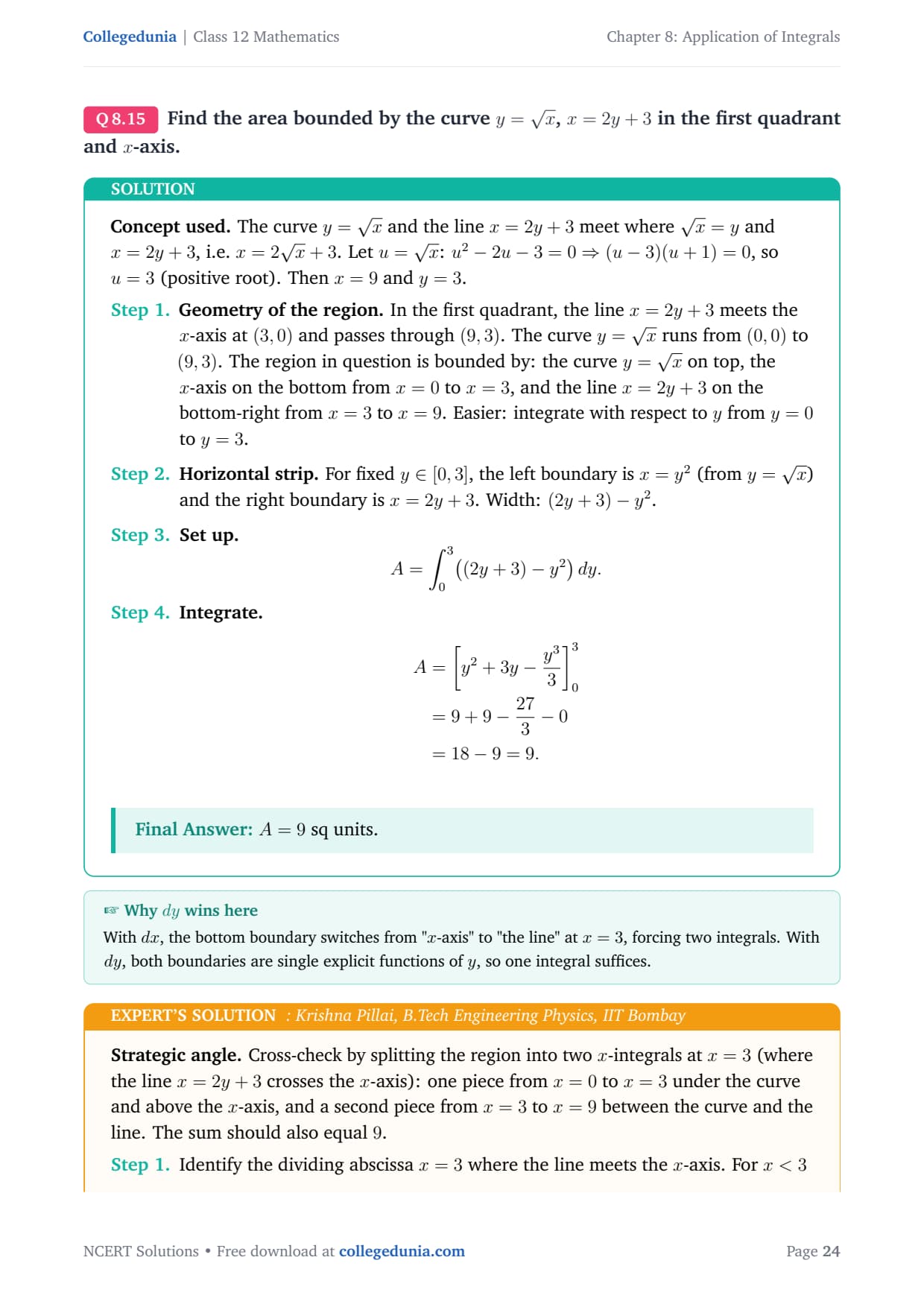
Q 8.15
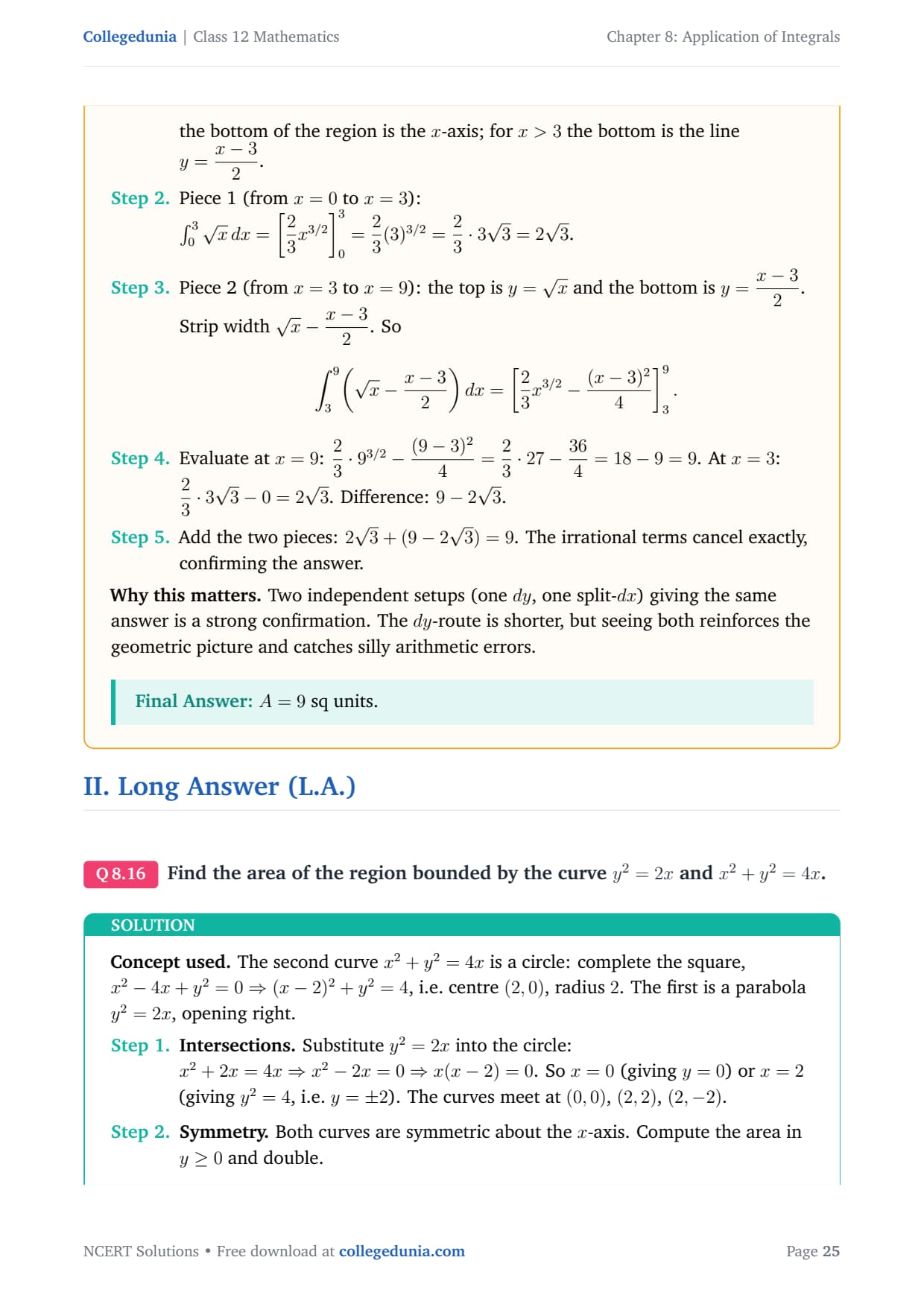
Find the area bounded by the curve y=√x, x=2y+3 in the first quadrant and x-axis.
Concept used. The curve y=√x and the line
x=2y+3 meet where √x=y and x=2y+3, i.e. x=2√x+3.
Let u=√x: u2-2u-3=0⇒ (u-3)(u+1)=0, so u=3
(positive root). Then x=9 and y=3.
Geometry of the region. In the first quadrant, the
line x=2y+3 meets the x-axis at (3,0) and passes through
(9,3). The curve y=√x runs from (0,0) to (9,3).
The region in question is bounded by: the curve y=√x
on top, the x-axis on the bottom from x=0 to x=3, and
the line x=2y+3 on the bottom-right from x=3 to x=9.
Easier: integrate with respect to y from y=0 to y=3.
Horizontal strip. For fixed y∈[0,3], the left
boundary is x=y2 (from y=√x) and the right
boundary is x=2y+3.
Width: (2y+3)-y2.
Strategic angle. Cross-check by splitting the region into
two x-integrals at x=3 (where the line x=2y+3 crosses the
x-axis): one piece from x=0 to x=3 under the curve and above
the x-axis, and a second piece from x=3 to x=9 between the
curve and the line. The sum should also equal 9.
Identify the dividing abscissa x=3 where the line meets
the x-axis. For x<3 the bottom of the region is the
x-axis; for x>3 the bottom is the line y=x-32.
Piece 2 (from x=3 to x=9): the top is y=√x and
the bottom is y=x-32. Strip width
√x-x-32. So
39(√x-x-32)dx
=[23x3/2-(x-3)24]39.
Evaluate at x=9:
23· 93/2-(9-3)24
=23· 27-364=18-9=9.
At x=3: 23· 3√3-0=2√3.
Difference: 9-2√3.
Add the two pieces:
2√3+(9-2√3)=9. The irrational terms cancel
exactly, confirming the answer.
Why this matters. Two independent setups (one dy, one
split-dx) giving the same answer is a strong confirmation. The
dy-route is shorter, but seeing both reinforces the geometric
picture and catches silly arithmetic errors.
A=9 sq units.
II. Long Answer (L.A.)
Q 8.16
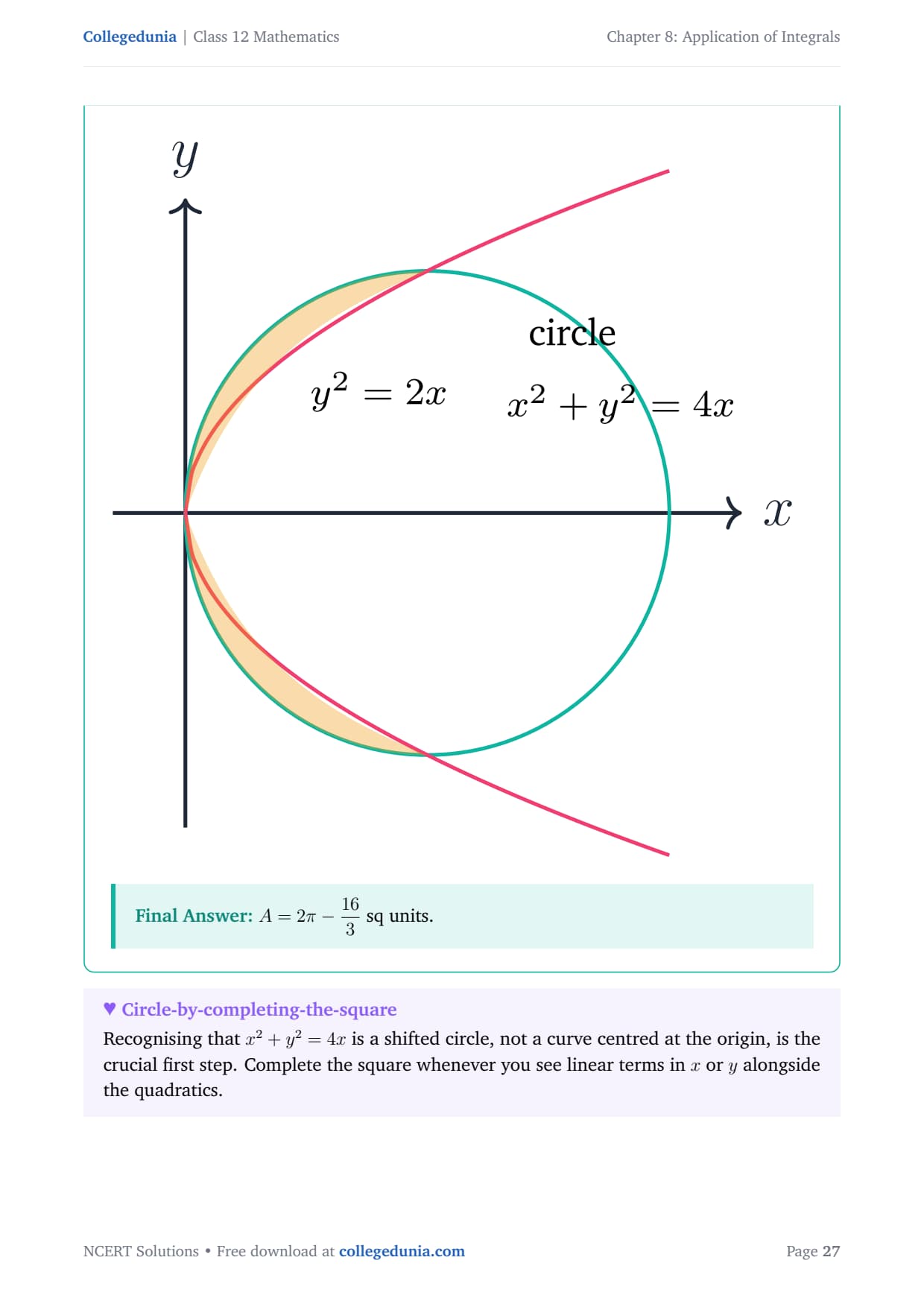
Find the area of the region bounded by the curve y2=2x and x2+y2=4x.
Concept used. The second curve x2+y2=4x is a circle:
complete the square, x2-4x+y2=0⇒ (x-2)2+y2=4,
i.e. centre (2,0), radius 2. The first is a parabola
y2=2x, opening right.
Intersections. Substitute y2=2x into the
circle: x2+2x=4x⇒ x2-2x=0⇒ x(x-2)=0.
So x=0 (giving y=0) or x=2 (giving y2=4, i.e.
y=± 2). The curves meet at (0,0), (2,2), (2,-2).
Symmetry. Both curves are symmetric about the
x-axis. Compute the area in y≥ 0 and double.
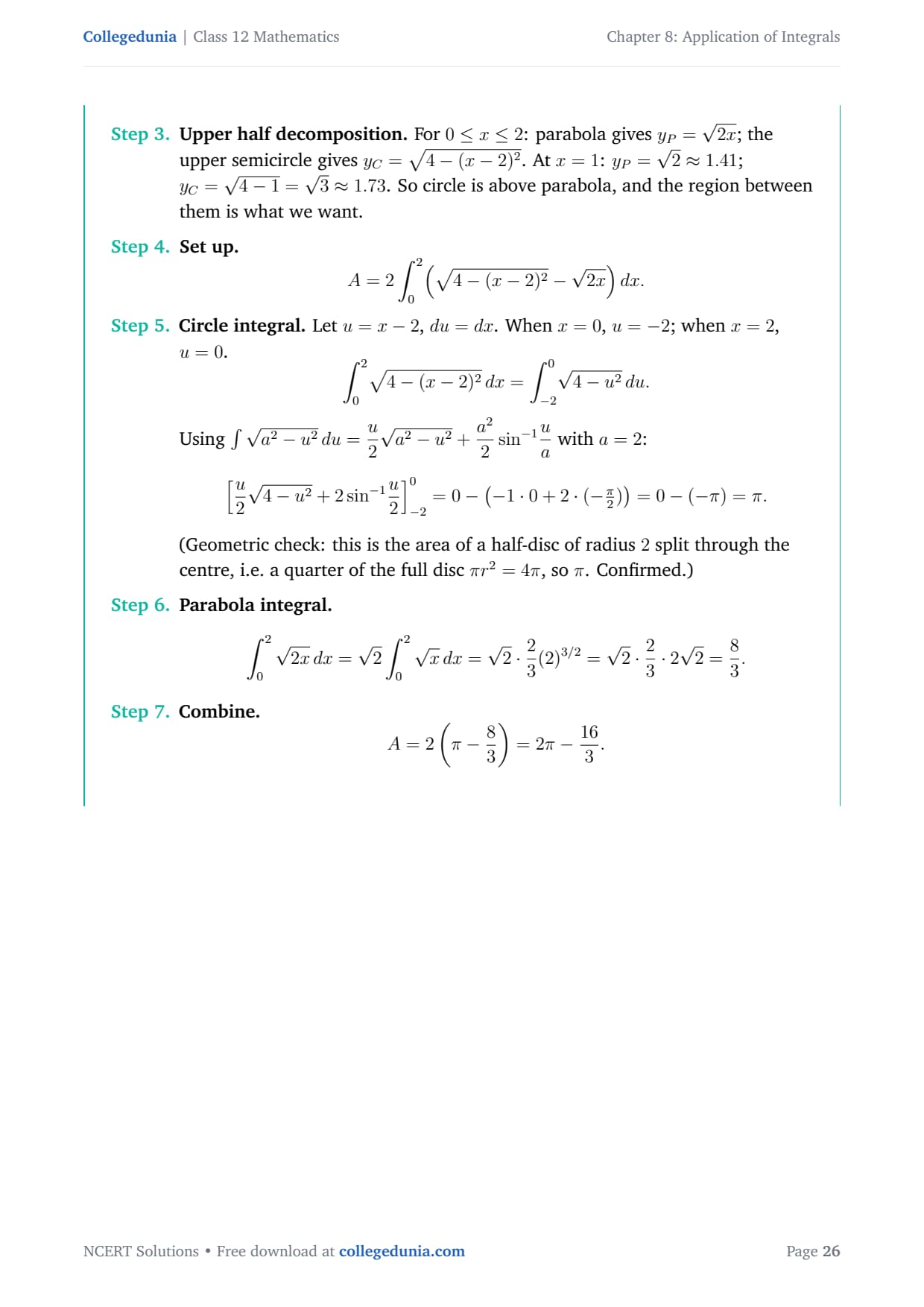
Upper half decomposition. For 0≤ x≤ 2:
parabola gives yP=√2x; the upper semicircle gives
yC=√4-(x-2)2. At x=1: yP=√2≈ 1.41;
yC=√4-1=√3≈ 1.73. So circle is above
parabola, and the region between them is what we want.
Set up.A=202(√4-(x-2)2-√2x)dx.
Circle integral. Let u=x-2, du=dx. When x=0,
u=-2; when x=2, u=0.
02√4-(x-2)2 dx=-20√4-u2 du.
Using ∫√a2-u2 du=u2√a2-u2+a22sin-1ua
with a=2:
[u2√4-u2+2sin-1u2]-20
=0-(-1· 0+2·(-π2))
=0-(-π)=π.
(Geometric check: this is the area of a half-disc of radius
2 split through the centre, i.e. a quarter of the full
disc π r2=4π, so π. Confirmed.)
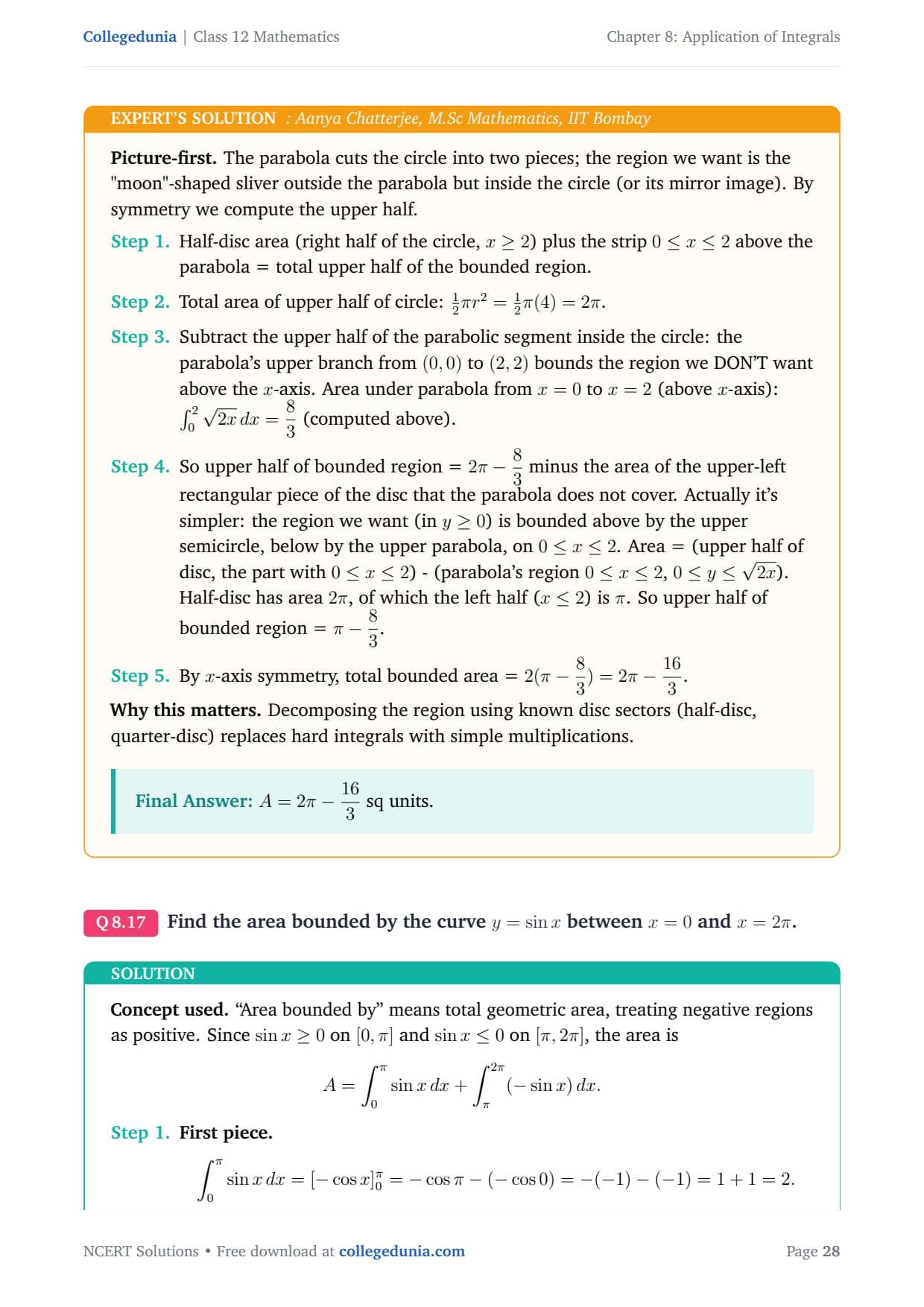
Picture-first. The parabola cuts the circle into two
pieces; the region we want is the "moon"-shaped sliver outside the
parabola but inside the circle (or its mirror image). By symmetry we
compute the upper half.
Half-disc area (right half of the circle, x≥ 2) plus
the strip 0≤ x≤ 2 above the parabola = total upper half
of the bounded region.
Total area of upper half of circle: 12π r2=12π(4)=2π.
Subtract the upper half of the parabolic segment inside the
circle: the parabola's upper branch from (0,0) to (2,2)
bounds the region we DON'T want above the x-axis.
Area under parabola from x=0 to x=2 (above x-axis):
02√2x dx=83 (computed above).
So upper half of bounded region = 2π-83 minus
the area of the upper-left rectangular piece of the disc that
the parabola does not cover. Actually it's simpler: the
region we want (in y≥ 0) is bounded above by the upper
semicircle, below by the upper parabola, on 0≤ x≤ 2.
Area = (upper half of disc, the part with 0≤ x≤ 2) -
(parabola's region 0≤ x≤ 2, 0≤ y≤√2x).
Half-disc has area 2π, of which the left half (x≤ 2)
is π. So upper half of bounded region = π-83.
By x-axis symmetry, total bounded area
= 2(π-83)=2π-163.
Why this matters. Decomposing the region using known disc
sectors (half-disc, quarter-disc) replaces hard integrals with
simple multiplications.
A=2π-163 sq units.
Q 8.17
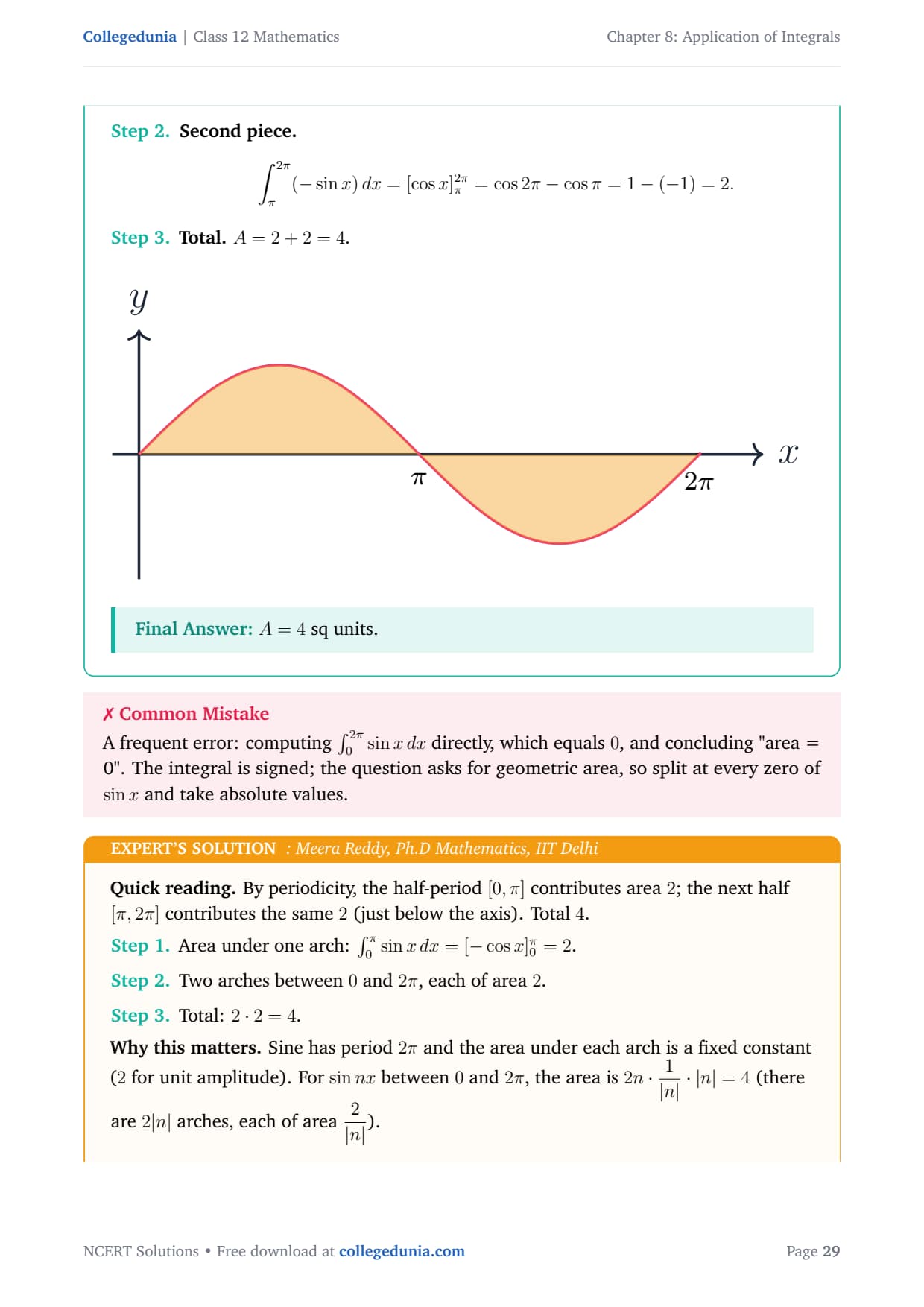
Find the area bounded by the curve y=sin x between x=0 and x=2π.
Concept used. ``Area bounded by'' means total geometric
area, treating negative regions as positive. Since sin x≥ 0 on
[0,π] and sin x≤ 0 on [π,2π], the area is
A=0πsin x dx + π2π(-sin x) dx.
First piece.0πsin x dx=[-cos x]0π
=-cosπ-(-cos 0)=-(-1)-(-1)=1+1=2.
Second piece.π2π(-sin x) dx=[cos x]π2π
=cos 2π-cosπ=1-(-1)=2.
Total.A=2+2=4.
!%
[See diagram in the PDF version]
A=4 sq units.
MR
Meera Reddy
Ph.D Mathematics, IIT Delhi
Verified Expert
Quick reading. By periodicity, the half-period [0,π]
contributes area 2; the next half [π,2π] contributes the
same 2 (just below the axis). Total 4.
Area under one arch:
0πsin x dx=[-cos x]0π=2.
Two arches between 0 and 2π, each of area 2.
Total: 2· 2=4.
Why this matters. Sine has period 2π and the area under
each arch is a fixed constant (2 for unit amplitude). For
sin nx between 0 and 2π, the area is 2n·1|n|·|n|=4
(there are 2|n| arches, each of area 2|n|).
A=4 sq units.
Q 8.18
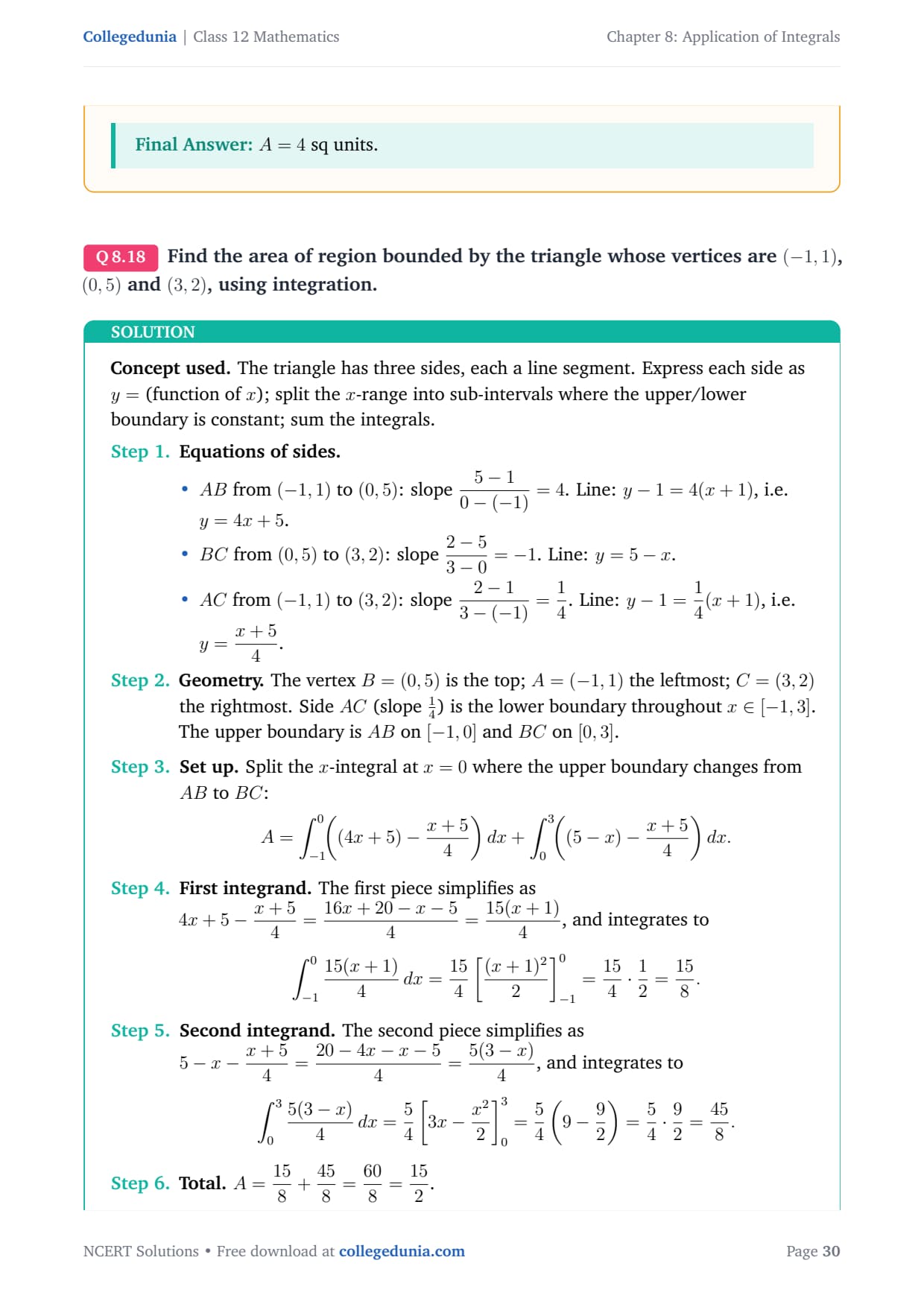
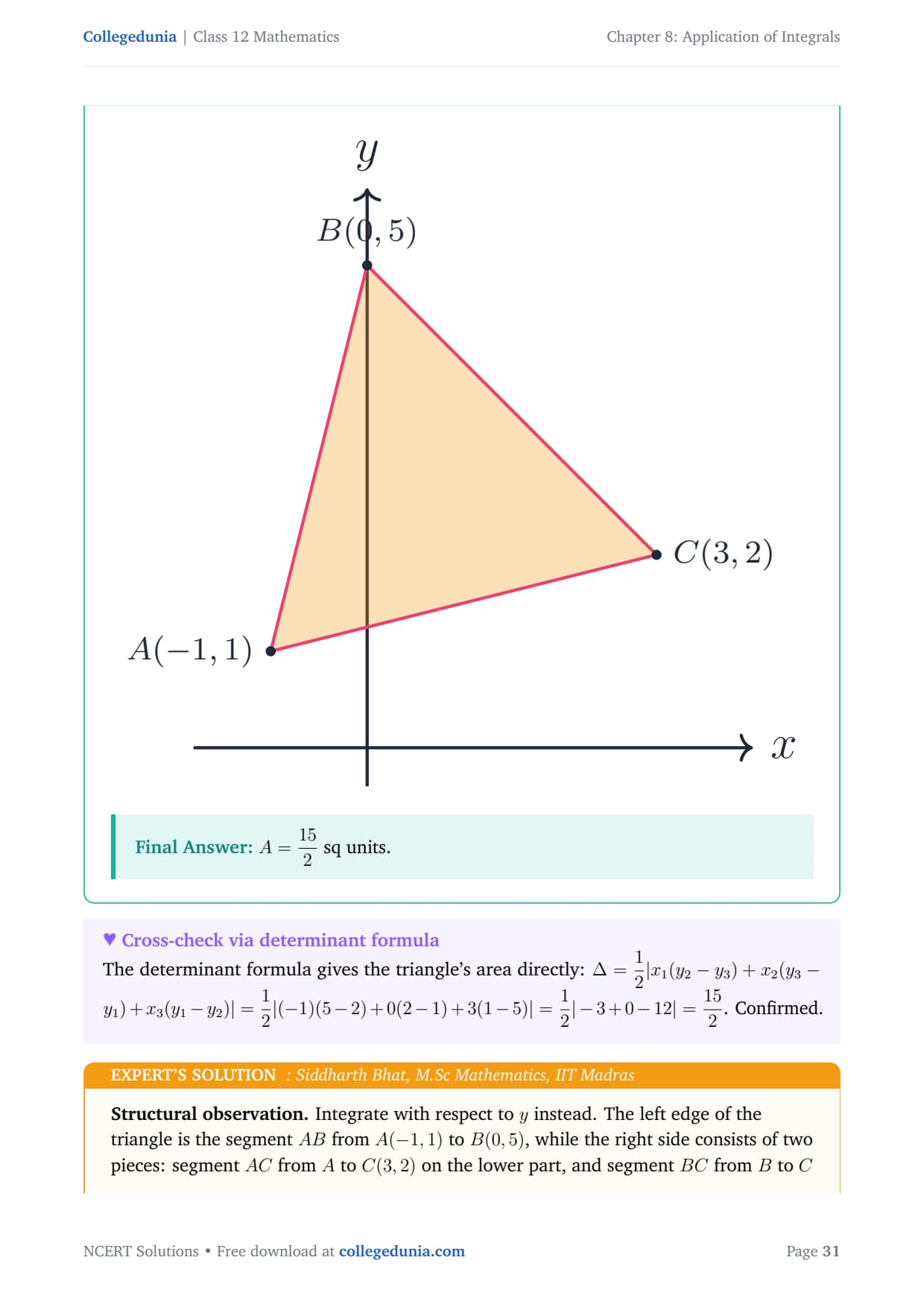
Find the area of region bounded by the triangle whose vertices are (-1,1), (0,5) and (3,2), using integration.
Concept used. The triangle has three sides, each a line
segment. Express each side as y= (function of x); split the
x-range into sub-intervals where the upper/lower boundary is
constant; sum the integrals.
Equations of sides.
AB from (-1,1) to (0,5): slope
5-10-(-1)=4. Line: y-1=4(x+1),
i.e. y=4x+5.
BC from (0,5) to (3,2): slope
2-53-0=-1. Line: y=5-x.
AC from (-1,1) to (3,2): slope
2-13-(-1)=14. Line:
y-1=14(x+1), i.e. y=x+54.
Geometry. The vertex B=(0,5) is the top; A=(-1,1)
the leftmost; C=(3,2) the rightmost. Side AC (slope
14) is the lower boundary throughout x∈[-1,3].
The upper boundary is AB on [-1,0] and BC on [0,3].
Set up. Split the x-integral at x=0 where the upper boundary changes from AB to BC:
A=-10((4x+5)-x+54)dx
+03((5-x)-x+54)dx.
First integrand. The first piece simplifies as 4x+5-x+54=16x+20-x-54=15(x+1)4, and integrates to
-1015(x+1)4 dx
=154[(x+1)22]-10
=154·12=158.
Second integrand. The second piece simplifies as 5-x-x+54=20-4x-x-54=5(3-x)4, and integrates to
035(3-x)4 dx
=54[3x-x22]03
=54(9-92)
=54·92=458.
Total.A=158+458=608=152.
!%
[See diagram in the PDF version]
A=152 sq units.
SB
Siddharth Bhat
M.Sc Mathematics, IIT Madras
Verified Expert
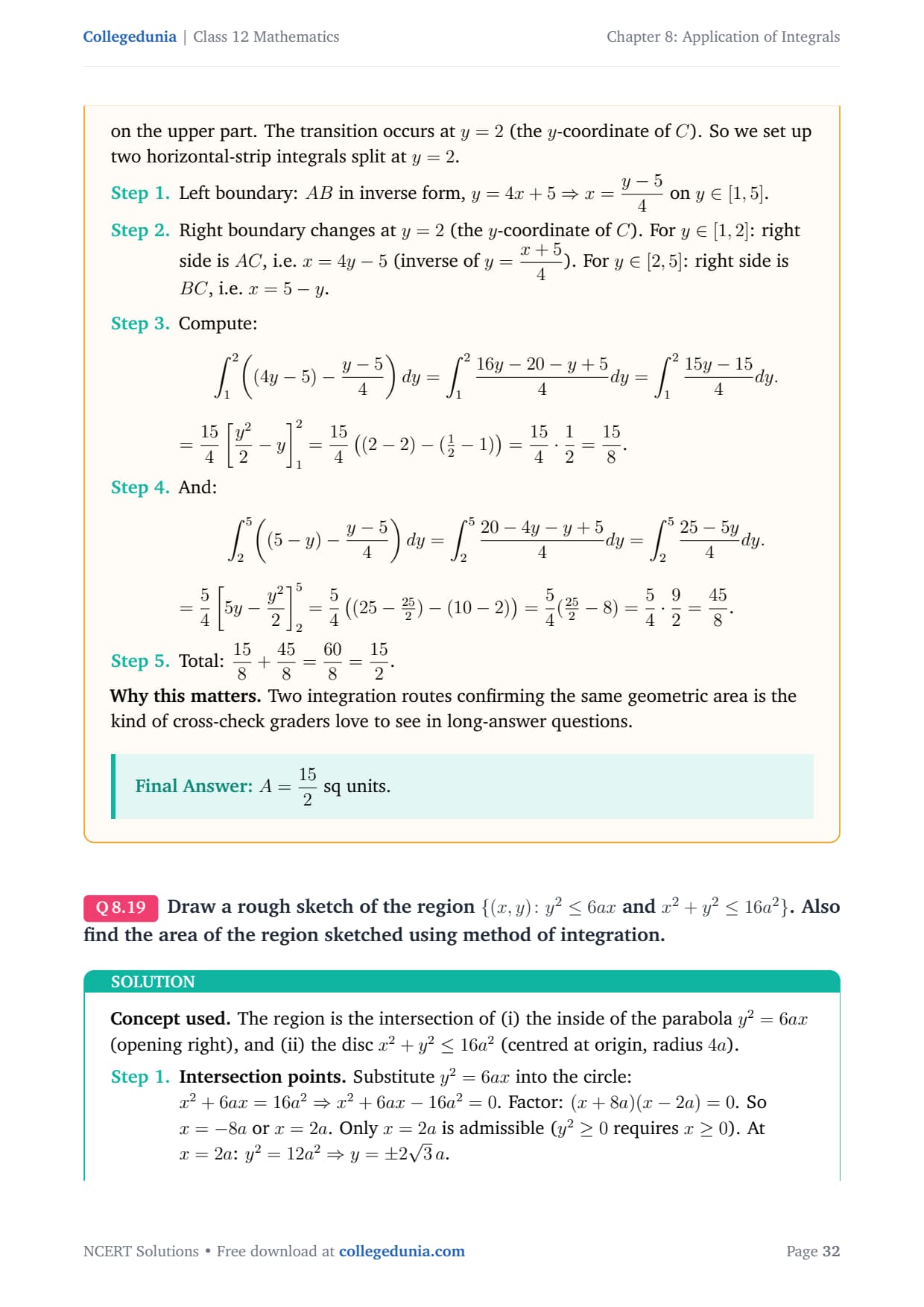
Structural observation. Integrate with respect to y
instead. The left edge of the triangle is the segment AB from
A(-1,1) to B(0,5), while the right side consists of two
pieces: segment AC from A to C(3,2) on the lower part, and
segment BC from B to C on the upper part. The transition
occurs at y=2 (the y-coordinate of C). So we set up two
horizontal-strip integrals split at y=2.
Left boundary: AB in inverse form, y=4x+5⇒ x=y-54
on y∈[1,5].
Right boundary changes at y=2 (the y-coordinate of C).
For y∈[1,2]: right side is AC, i.e. x=4y-5
(inverse of y=x+54).
For y∈[2,5]: right side is BC, i.e. x=5-y.
Why this matters. Two integration routes confirming the same
geometric area is the kind of cross-check graders love to see in
long-answer questions.
A=152 sq units.
Q 8.19
Draw a rough sketch of the region (x,y)y2≤ 6ax and x2+y2≤ 16a2. Also find the area of the region sketched using method of integration.
Concept used. The region is the intersection of (i) the
inside of the parabola y2=6ax (opening right), and (ii) the
disc x2+y2≤ 16a2 (centred at origin, radius 4a).
Intersection points. Substitute y2=6ax into the
circle: x2+6ax=16a2⇒ x2+6ax-16a2=0.
Factor: (x+8a)(x-2a)=0. So x=-8a or x=2a. Only x=2a
is admissible (y2≥ 0 requires x≥ 0).
At x=2a: y2=12a2⇒ y=± 2√3a.
Symmetry. Both bounding curves are symmetric about
the x-axis. Compute the upper half (y≥ 0) and double.
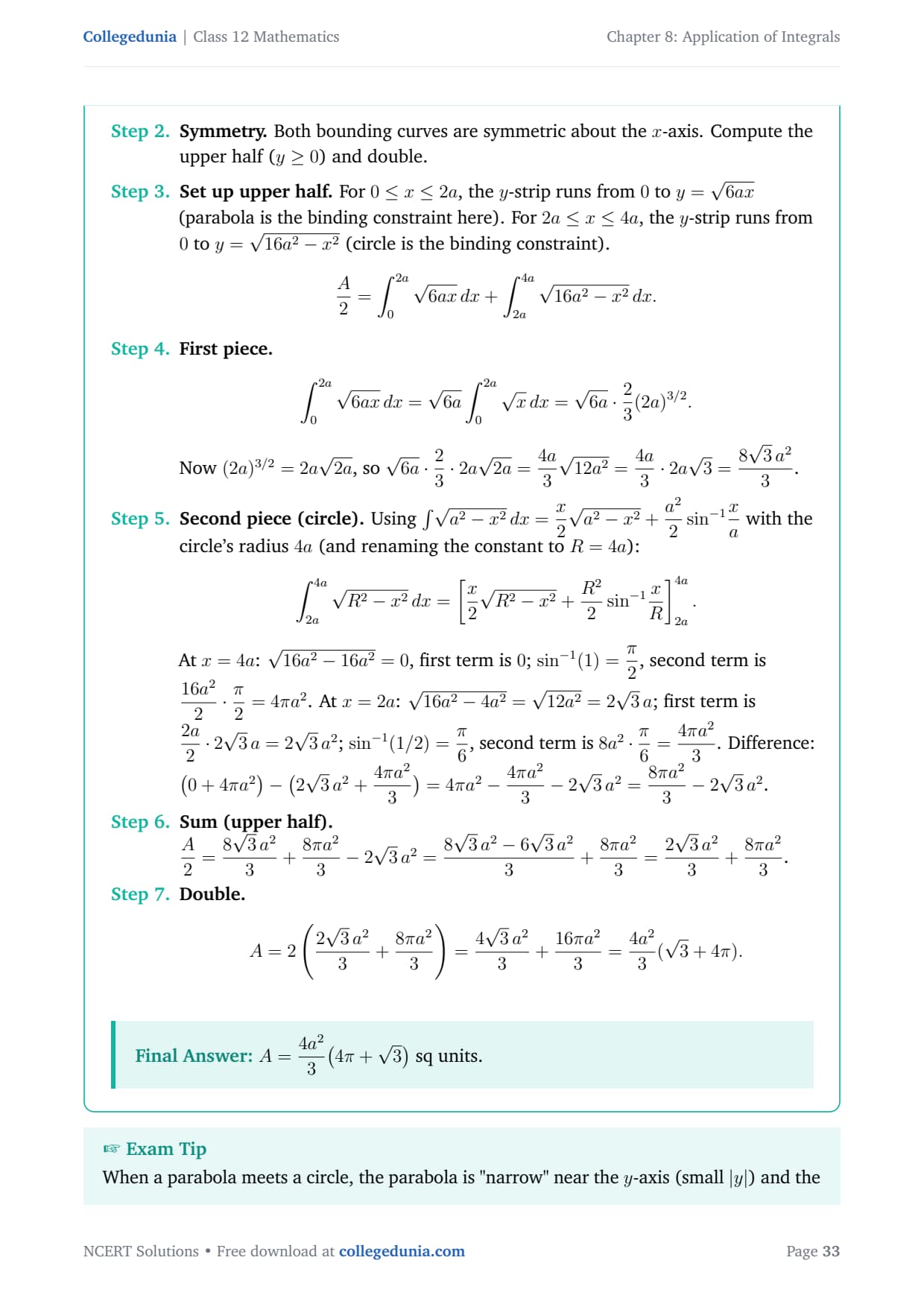
Set up upper half. For 0≤ x≤ 2a, the
y-strip runs from 0 to y=√6ax (parabola is the
binding constraint here). For 2a≤ x≤ 4a, the y-strip
runs from 0 to y=√16a2-x2 (circle is the
binding constraint).
A2=02a√6ax dx
+2a4a√16a2-x2 dx.
First piece.02a√6ax dx=√6a02a√x dx
=√6a·23(2a)3/2.
Now (2a)3/2=2a√2a, so
√6a·23· 2a√2a=4a3√12a2=4a3· 2a√3=8√3 a23.
Second piece (circle). Using
∫√a2-x2 dx=x2√a2-x2+a22sin-1xa
with the circle's radius 4a (and renaming the constant to
R=4a):
2a4a√R2-x2 dx
=[x2√R2-x2+R22sin-1xR]2a4a.
At x=4a: √16a2-16a2=0, first term is 0;
sin-1(1)=π2, second term is
16a22·π2=4π a2.
At x=2a: √16a2-4a2=√12a2=2√3a;
first term is 2a2· 2√3a=2√3 a2;
sin-1(1/2)=π6, second term is
8a2·π6=4π a23.
Difference:
(0+4π a2)-(2√3 a2+4π a23)
=4π a2-4π a23-2√3 a2
=8π a23-2√3 a2.
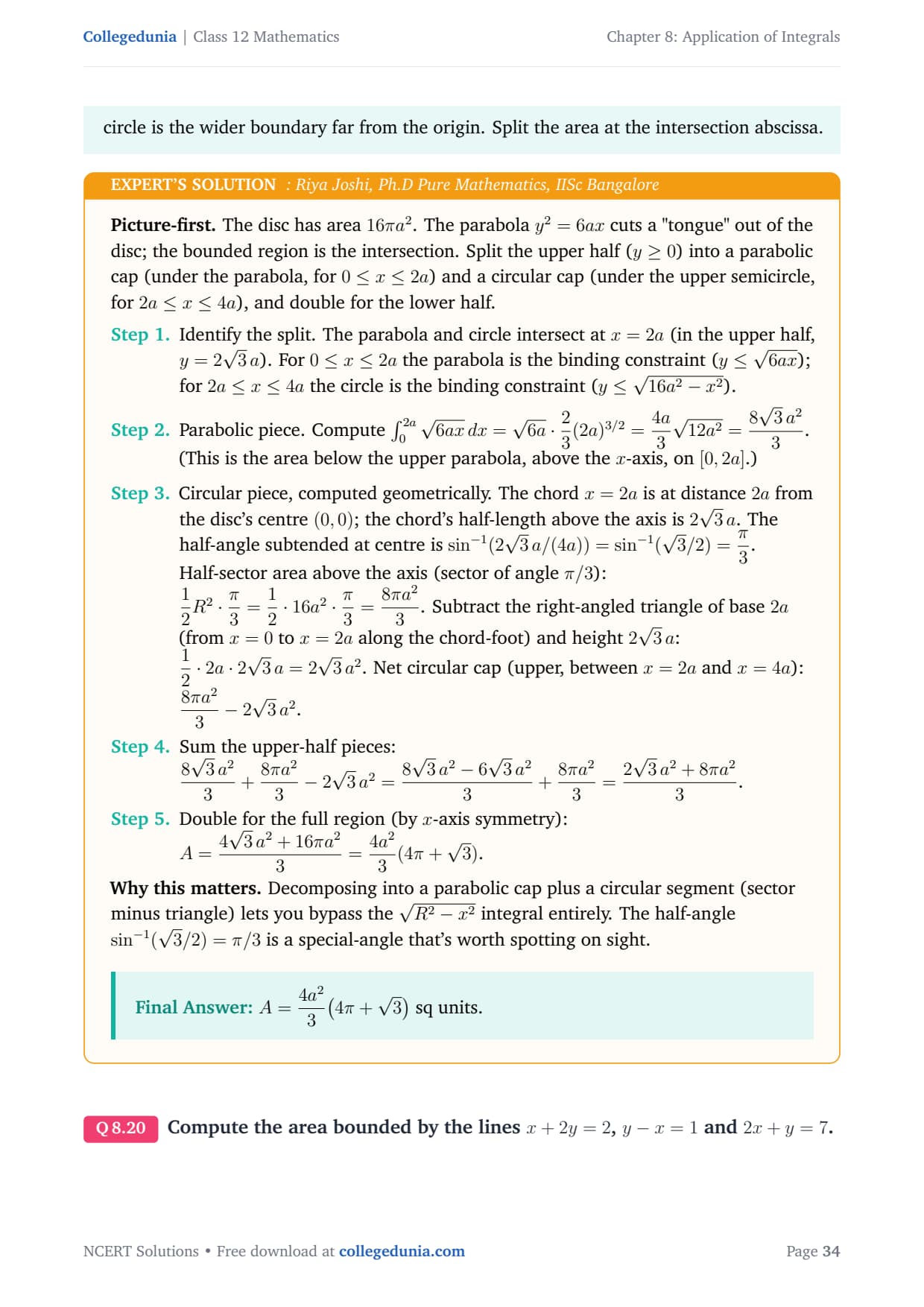
Picture-first. The disc has area 16π a2. The
parabola y2=6ax cuts a "tongue" out of the disc; the bounded
region is the intersection. Split the upper half (y≥ 0) into a
parabolic cap (under the parabola, for 0≤ x≤ 2a) and a
circular cap (under the upper semicircle, for 2a≤ x≤ 4a), and
double for the lower half.
Identify the split. The parabola and circle intersect at
x=2a (in the upper half, y=2√3a). For
0≤ x≤ 2a the parabola is the binding constraint
(y≤√6ax); for 2a≤ x≤ 4a the circle is the
binding constraint (y≤√16a2-x2).
Parabolic piece. Compute
02a√6ax dx=√6a·23(2a)3/2
=4a3√12a2=8√3 a23.
(This is the area below the upper parabola, above the
x-axis, on [0,2a].)
Circular piece, computed geometrically. The chord x=2a is
at distance 2a from the disc's centre (0,0); the chord's
half-length above the axis is 2√3a. The half-angle
subtended at centre is sin-1(2√3a/(4a))=sin-1(√3/2)=π3.
Half-sector area above the axis (sector of angle π/3):
12R2·π3=12· 16a2·π3=8π a23.
Subtract the right-angled triangle of base 2a (from x=0
to x=2a along the chord-foot) and height 2√3a:
12· 2a· 2√3a=2√3 a2.
Net circular cap (upper, between x=2a and x=4a):
8π a23-2√3 a2.
Sum the upper-half pieces:
8√3 a23+8π a23-2√3 a2
=8√3 a2-6√3 a23+8π a23
=2√3 a2+8π a23.
Double for the full region (by x-axis symmetry):
A=4√3 a2+16π a23=4a23(4π+√3).
Why this matters. Decomposing into a parabolic cap plus a
circular segment (sector minus triangle) lets you bypass the
√R2-x2 integral entirely. The half-angle
sin-1(√3/2)=π/3 is a special-angle that's worth
spotting on sight.
A=4a23(4π+√3) sq units.
Q 8.20
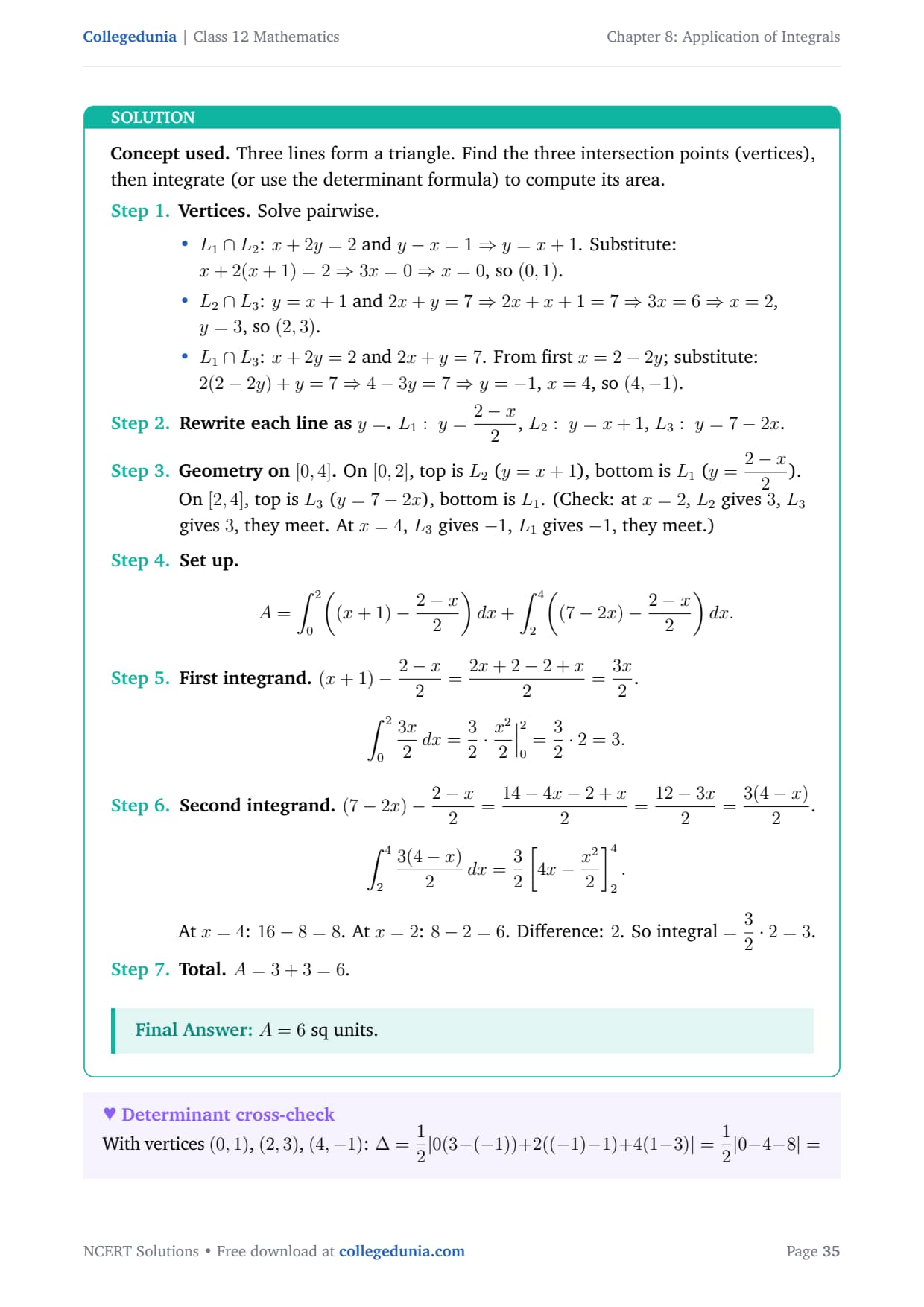
Compute the area bounded by the lines x+2y=2, y-x=1 and 2x+y=7.
Concept used. Three lines form a triangle. Find the three
intersection points (vertices), then integrate (or use the determinant
formula) to compute its area.
Vertices. Solve pairwise.
L1∩ L2: x+2y=2 and y-x=1⇒ y=x+1.
Substitute: x+2(x+1)=2⇒ 3x=0⇒ x=0,
so (0,1).
L2∩ L3: y=x+1 and 2x+y=7⇒ 2x+x+1=7⇒ 3x=6⇒ x=2,
y=3, so (2,3).
L1∩ L3: x+2y=2 and 2x+y=7. From first
x=2-2y; substitute: 2(2-2y)+y=7⇒ 4-3y=7⇒ y=-1,
x=4, so (4,-1).
Rewrite each line as y=.L1: y=2-x2, L2: y=x+1, L3: y=7-2x.
Geometry on [0,4]. On [0,2], top is L2
(y=x+1), bottom is L1 (y=2-x2).
On [2,4], top is L3 (y=7-2x), bottom is L1.
(Check: at x=2, L2 gives 3, L3 gives 3, they meet.
At x=4, L3 gives -1, L1 gives -1, they meet.)
Set up.A=02((x+1)-2-x2)dx
+24((7-2x)-2-x2)dx.
First integrand.(x+1)-2-x2=2x+2-2+x2=3x2.
023x2 dx=32·x22|02=32· 2=3.
Second integrand.(7-2x)-2-x2=14-4x-2+x2=12-3x2=3(4-x)2.
243(4-x)2 dx=32[4x-x22]24.
At x=4: 16-8=8. At x=2: 8-2=6. Difference: 2.
So integral =32· 2=3.
Total.A=3+3=6.
A=6 sq units.
AM
Aditya Mehta
M.Tech CS, IIT Madras
Verified Expert
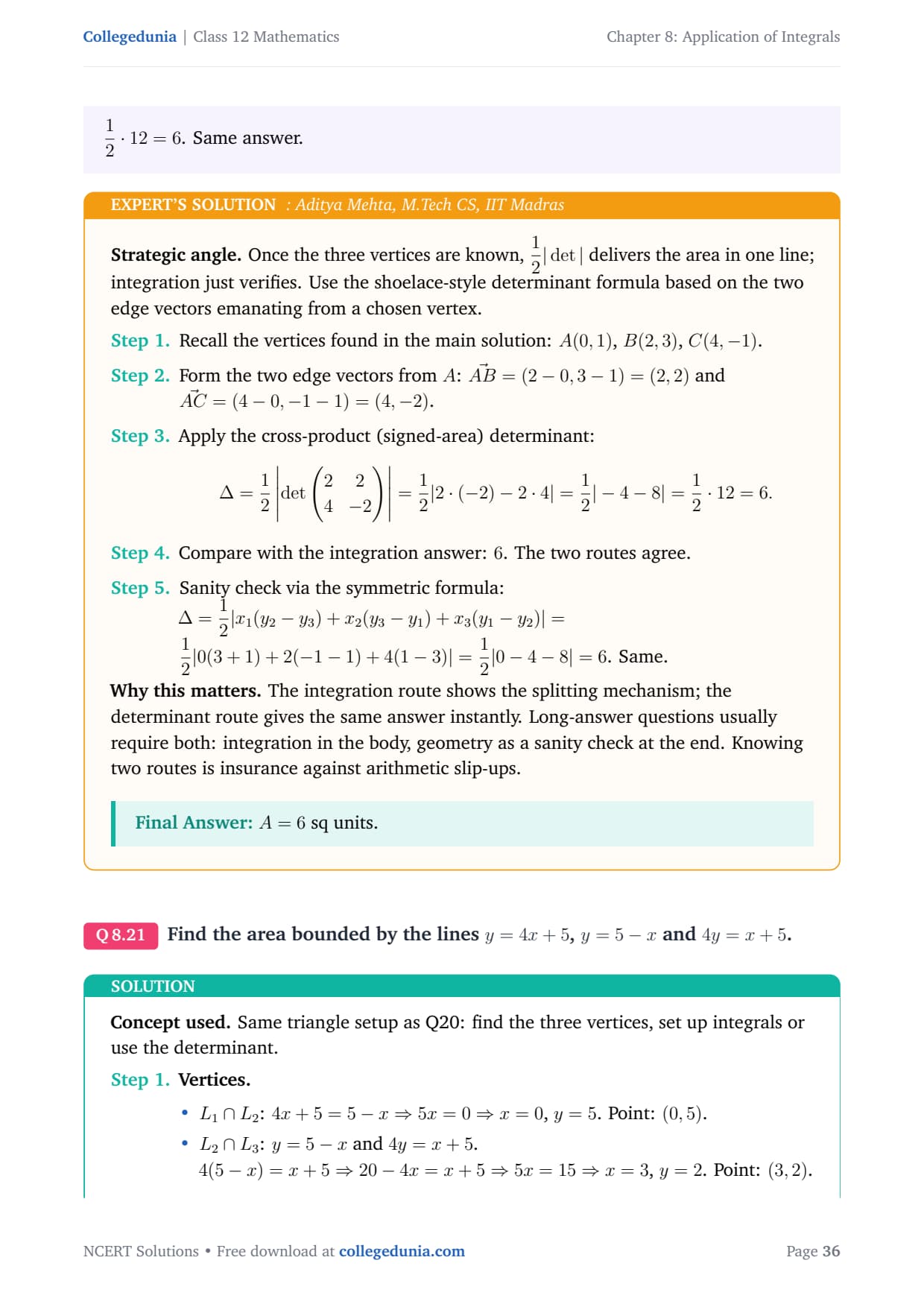
Strategic angle. Once the three vertices are known,
12|det| delivers the area in one line; integration
just verifies. Use the shoelace-style determinant formula based on
the two edge vectors emanating from a chosen vertex.
Recall the vertices found in the main solution:
A(0,1), B(2,3), C(4,-1).
Form the two edge vectors from A:
AB⃗=(2-0,3-1)=(2,2) and AC⃗=(4-0,-1-1)=(4,-2).
Compare with the integration answer: 6. The two routes
agree.
Sanity check via the symmetric formula:
Δ=12|x1(y2-y3)+x2(y3-y1)+x3(y1-y2)|
=12|0(3+1)+2(-1-1)+4(1-3)|
=12|0-4-8|=6. Same.
Why this matters. The integration route shows the splitting
mechanism; the determinant route gives the same answer instantly.
Long-answer questions usually require both: integration in the body,
geometry as a sanity check at the end. Knowing two routes is
insurance against arithmetic slip-ups.
A=6 sq units.
Q 8.21
Find the area bounded by the lines y=4x+5, y=5-x and 4y=x+5.
Concept used. Same triangle setup as Q20: find the three
vertices, set up integrals or use the determinant.
Picture. Vertices are A(-1,1), B(0,5), C(3,2),
same triangle as Q18.
Rewrite lines.L1: y=4x+5 (slope 4, through
A,B); L2: y=5-x (slope -1, through B,C);
L3: y=x+54 (slope 14, through A,C).
Geometry. On [-1,0], top is L1, bottom is L3.
On [0,3], top is L2, bottom is L3.
Compute. Exactly Q18's setup, so
A=158+458=152.
A=152 sq units.
AV
Ankit Verma
Ph.D Mathematics, IIT Delhi
Verified Expert
Quick reading. The three slopes are 4, -1, and
14. The product of slopes of L1 and L3 is
4·14=1≠ -1, so they are not perpendicular, but
they do bound a triangle together with L2. Notice that the
slopes 4 and 14 are reciprocals, hinting at a reflective
symmetry of the configuration about the line y=x+const.
Confirm vertices from pairwise intersection (done in the
main solution): A(-1,1), B(0,5), C(3,2).
Edge vectors from A:
AB⃗=(0-(-1),5-1)=(1,4), AC⃗=(3-(-1),2-1)=(4,1).
Verify via the symmetric formula:
Δ=12|(-1)(5-2)+0(2-1)+3(1-5)|
=12|-3+0-12|=152. Both give 152.
Connect to Q18: this is the same triangle stated by its
three side-equations rather than its three vertices, so the
answer must agree.
Why this matters. Recognising a problem you have already
solved in a different presentation is a high-value skill in exam
settings. Always pause and check: have I seen these vertices before?
A=152 sq units.
Q 8.22
Find the area bounded by the curve y=2cos x and the x-axis from x=0 to x=2π.
Concept used. The graph of y=2cos x is the cosine curve
stretched vertically by factor 2. Its zeros in [0,2π] are at
x=π2 and x=3π2. On [0,π/2] the curve
is positive, on [π/2,3π/2] negative, on [3π/2,2π]
positive again.
Split.A=0π/22cos x dx+π/23π/2|2cos x| dx
+3π/22π2cos x dx.
First piece. With ∫ 2cos x dx=2sin x, we get [2sin x]0π/2=2(1)-0=2.
Middle piece. We have π/23π/2(-2cos x) dx=[-2sin x]π/23π/2=-2(-1)+2(1)=2+2=4.
Third piece. Finally [2sin x]3π/22π=2(0)-2(-1)=2.
Total.A=2+4+2=8.
A=8 sq units.
KR
Kavya Rao
M.Sc Mathematics, ISI Kolkata
Verified Expert
Picture-first. Each "lobe" of y=2cos x has the same area
because amplitude and arch length are constant. Compute one lobe
(0 to π) and multiply.
Area of one half-arch of |2cos x| from 0 to π/2:
0π/22cos x dx=2.
By symmetry, each quarter-period [π/2 wide] of
|2cos x| has the same area 2.
On [0,2π] there are exactly 4 such quarter-periods
(from 0 to π/2, π/2 to π, π to 3π/2,
3π/2 to 2π). Total: 4· 2=8.
Why this matters. Once you realise the area in one
quarter-period is 2, the full period [0,2π] gives 8 instantly
for any amplitude; more generally, |Acos x| on a full
period gives total area 4|A|.
A=8 sq units.
Q 8.23
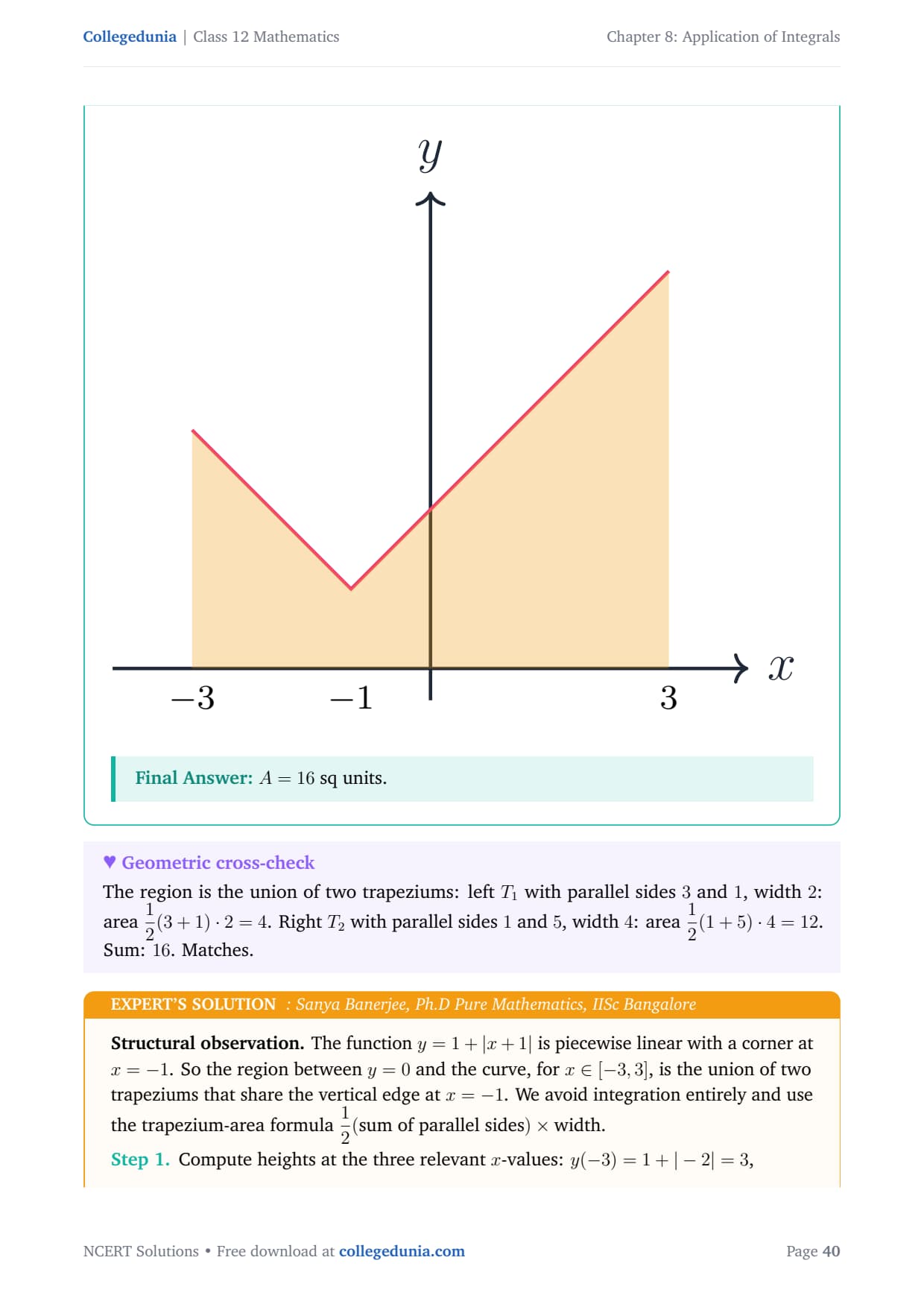
Draw a rough sketch of the given curve y=1+|x+1|, x=-3, x=3, y=0 and find the area of the region bounded by them, using integration.
Concept used.|x+1| has corner at x=-1: it equals
-(x+1) for x<-1 and x+1 for x≥ -1. So y=1+|x+1| is the
piecewise linear function
y=cases -x & x<-1, x+2 & x≥ -1.cases
This curve sits entirely above y=0 on [-3,3] (minimum value
y(-1)=1). Region bounded by the curve, y=0, x=-3, x=3 is a
"tent-shaped" trapezoidal region.
First piece.∫(-x) dx=-x22.
[-x22]-3-1=-12-(-92)=-12+92=4.
Second piece. The antiderivative is ∫(x+2) dx=x22+2x. At x=3: 92+6=212. At x=-1: 12-2=-32. Difference: 212-(-32)=242=12.
Total.A=4+12=16.
!%
[See diagram in the PDF version]
A=16 sq units.
SB
Sanya Banerjee
Ph.D Pure Mathematics, IISc Bangalore
Verified Expert
Structural observation. The function y=1+|x+1| is
piecewise linear with a corner at x=-1. So the region between
y=0 and the curve, for x∈[-3,3], is the union of two
trapeziums that share the vertical edge at x=-1. We avoid
integration entirely and use the trapezium-area formula
12(sum of parallel sides).
Compute heights at the three relevant x-values:
y(-3)=1+|-2|=3, y(-1)=1+0=1, y(3)=1+4=5.
Left trapezium: vertices (-3,0),(-3,3),(-1,1),(-1,0),
parallel sides y(-3)=3 (left) and y(-1)=1 (right),
width -1-(-3)=2.
Area =12(3+1)· 2=4· 22=4.
Right trapezium: vertices (-1,0),(-1,1),(3,5),(3,0),
parallel sides y(-1)=1 (left) and y(3)=5 (right),
width 3-(-1)=4.
Area =12(1+5)· 4=6· 42=12.
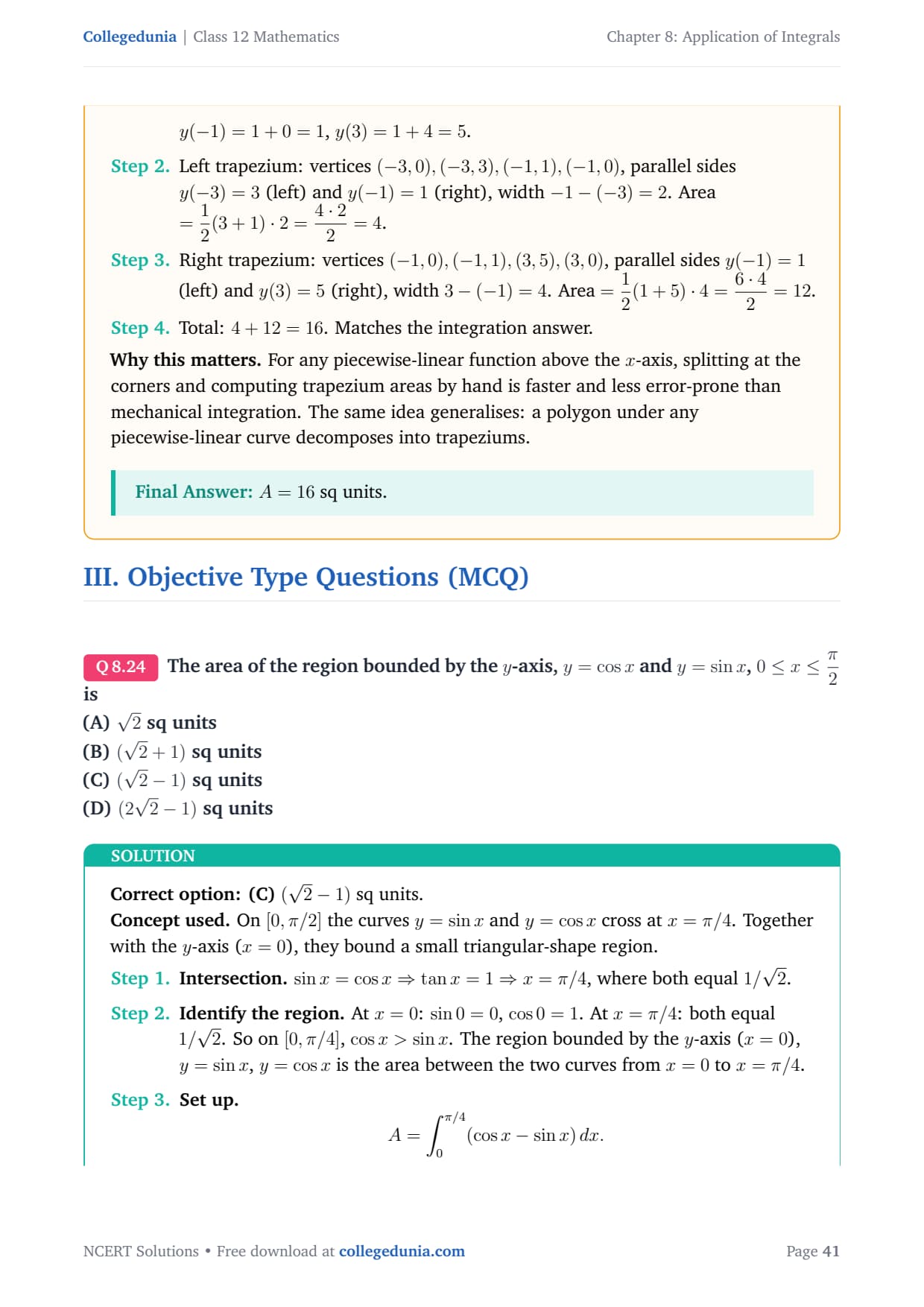
Total: 4+12=16. Matches the integration answer.
Why this matters. For any piecewise-linear function above
the x-axis, splitting at the corners and computing trapezium
areas by hand is faster and less error-prone than mechanical
integration. The same idea generalises: a polygon under any
piecewise-linear curve decomposes into trapeziums.
A=16 sq units.
III. Objective Type Questions (MCQ)
Q 8.24
The area of the region bounded by the y-axis, y=cos x and y=sin x, 0≤ x≤π2 is
(A) √2 sq units
(B) (√2+1) sq units
(C) (√2-1) sq units
(D) (2√2-1) sq units
Correct option: (C)(√2-1) sq units.
Concept used. On [0,π/2] the curves y=sin x and
y=cos x cross at x=π/4. Together with the y-axis (x=0),
they bound a small triangular-shape region.
Intersection.sin x=cos xx=1⇒ x=π/4,
where both equal 1/√2.
Identify the region. At x=0: sin 0=0, cos 0=1.
At x=π/4: both equal 1/√2. So on [0,π/4],
cos x>sin x. The region bounded by the y-axis (x=0),
y=sin x, y=cos x is the area between the two curves
from x=0 to x=π/4.
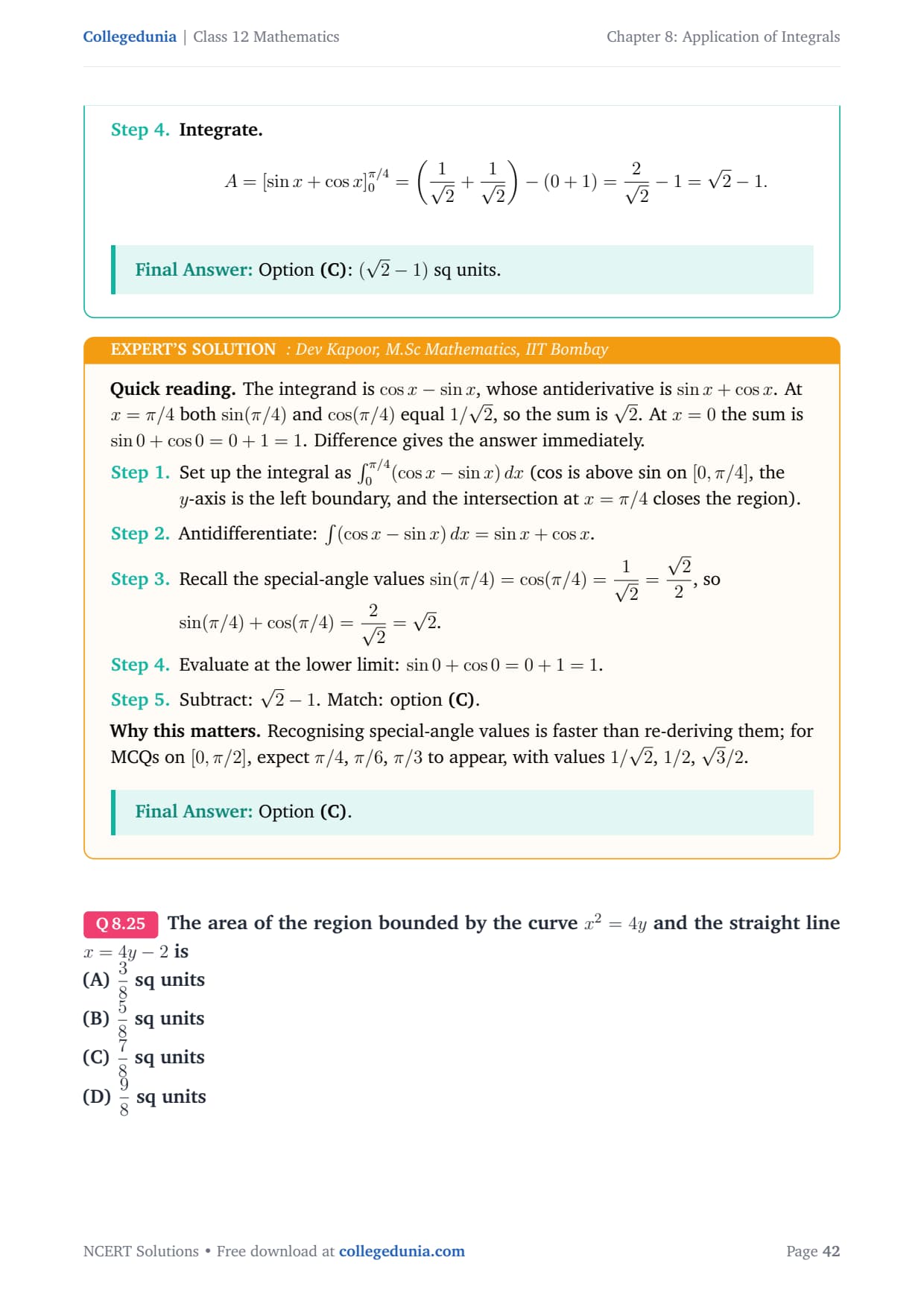
Quick reading. The integrand is cos x-sin x, whose
antiderivative is sin x+cos x. At x=π/4 both
sin(π/4) and cos(π/4) equal 1/√2, so the sum is
√2. At x=0 the sum is sin 0+cos 0=0+1=1. Difference
gives the answer immediately.
Set up the integral as 0π/4(cos x-sin x) dx
(cos is above sin on [0,π/4], the y-axis is the left
boundary, and the intersection at x=π/4 closes the
region).
Antidifferentiate: ∫(cos x-sin x) dx=sin x+cos x.
Recall the special-angle values
sin(π/4)=cos(π/4)=1√2=√22,
so sin(π/4)+cos(π/4)=2√2=√2.
Evaluate at the lower limit: sin 0+cos 0=0+1=1.
Subtract: √2-1. Match: option (C).
Why this matters. Recognising special-angle values is
faster than re-deriving them; for MCQs on [0,π/2], expect
π/4, π/6, π/3 to appear, with values 1/√2,
1/2, √3/2.
Option (C).
Q 8.25
The area of the region bounded by the curve x2=4y and the straight line x=4y-2 is
(A) 38 sq units
(B) 58 sq units
(C) 78 sq units
(D) 98 sq units
Correct option: (D)98 sq units.
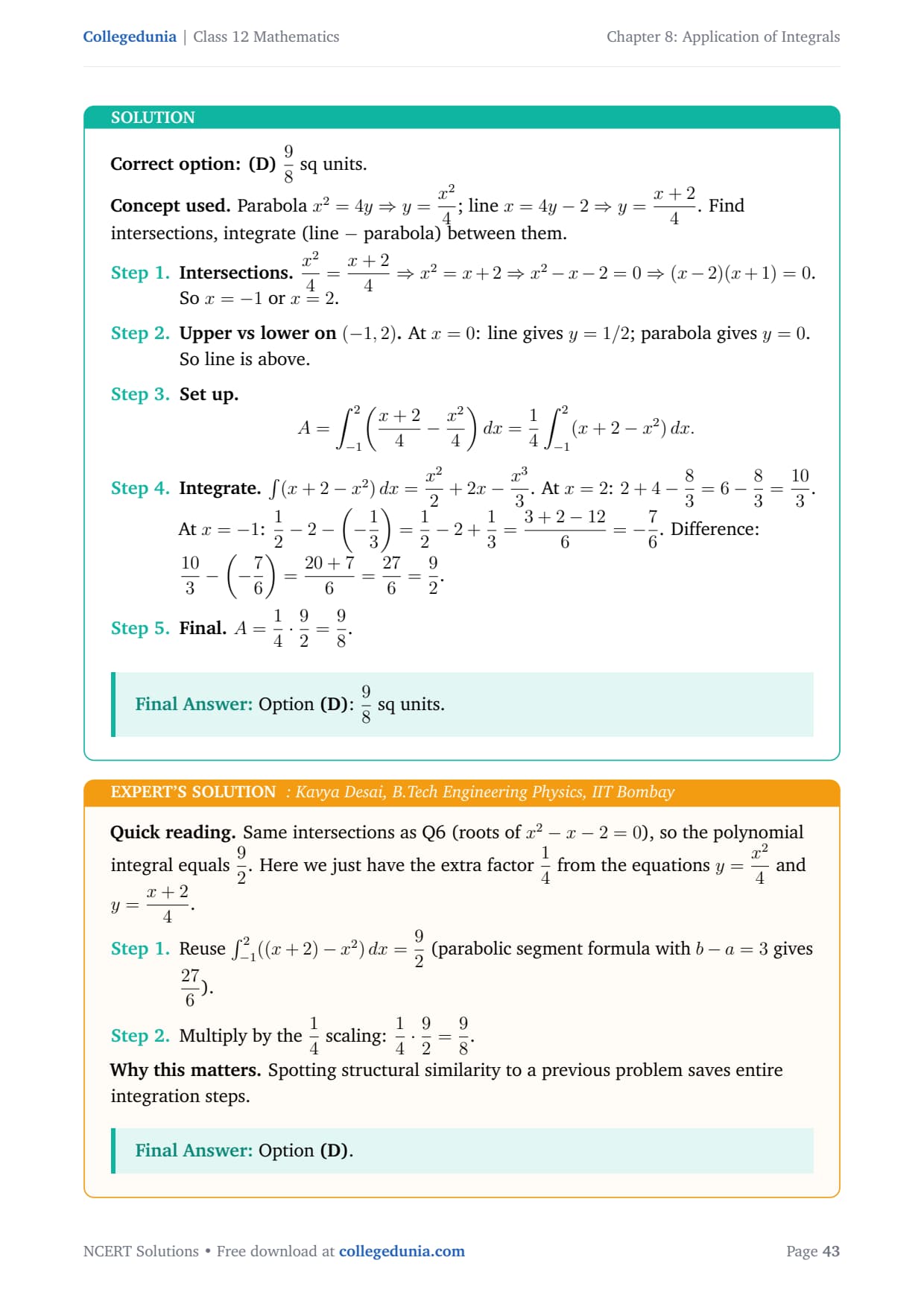
Concept used. Parabola x2=4y⇒ y=x24;
line x=4y-2⇒ y=x+24. Find intersections,
integrate (line - parabola) between them.
Intersections.x24=x+24⇒ x2=x+2⇒ x2-x-2=0⇒ (x-2)(x+1)=0.
So x=-1 or x=2.
Upper vs lower on (-1,2). At x=0: line gives
y=1/2; parabola gives y=0. So line is above.
Set up.A=-12(x+24-x24)dx
=14-12(x+2-x2) dx.
Integrate.∫(x+2-x2) dx=x22+2x-x33.
At x=2: 2+4-83=6-83=103.
At x=-1: 12-2-(-13)=12-2+13=3+2-126=-76.
Difference: 103-(-76)=20+76=276=92.
Final.A=14·92=98.
Option (D): 98 sq units.
KD
Kavya Desai
B.Tech Engineering Physics, IIT Bombay
Verified Expert
Quick reading. Same intersections as Q6 (roots of
x2-x-2=0), so the polynomial integral equals 92.
Here we just have the extra factor 14 from the equations
y=x24 and y=x+24.
Reuse -12((x+2)-x2) dx=92 (parabolic
segment formula with b-a=3 gives 276).
Multiply by the 14 scaling: 14·92=98.
Why this matters. Spotting structural similarity to a
previous problem saves entire integration steps.
Option (D).
Q 8.26
The area of the region bounded by the curve y=√16-x2 and x-axis is
(A) 8π sq units
(B) 20π sq units
(C) 16π sq units
(D) 256π sq units
Correct option: (A)8π sq units.
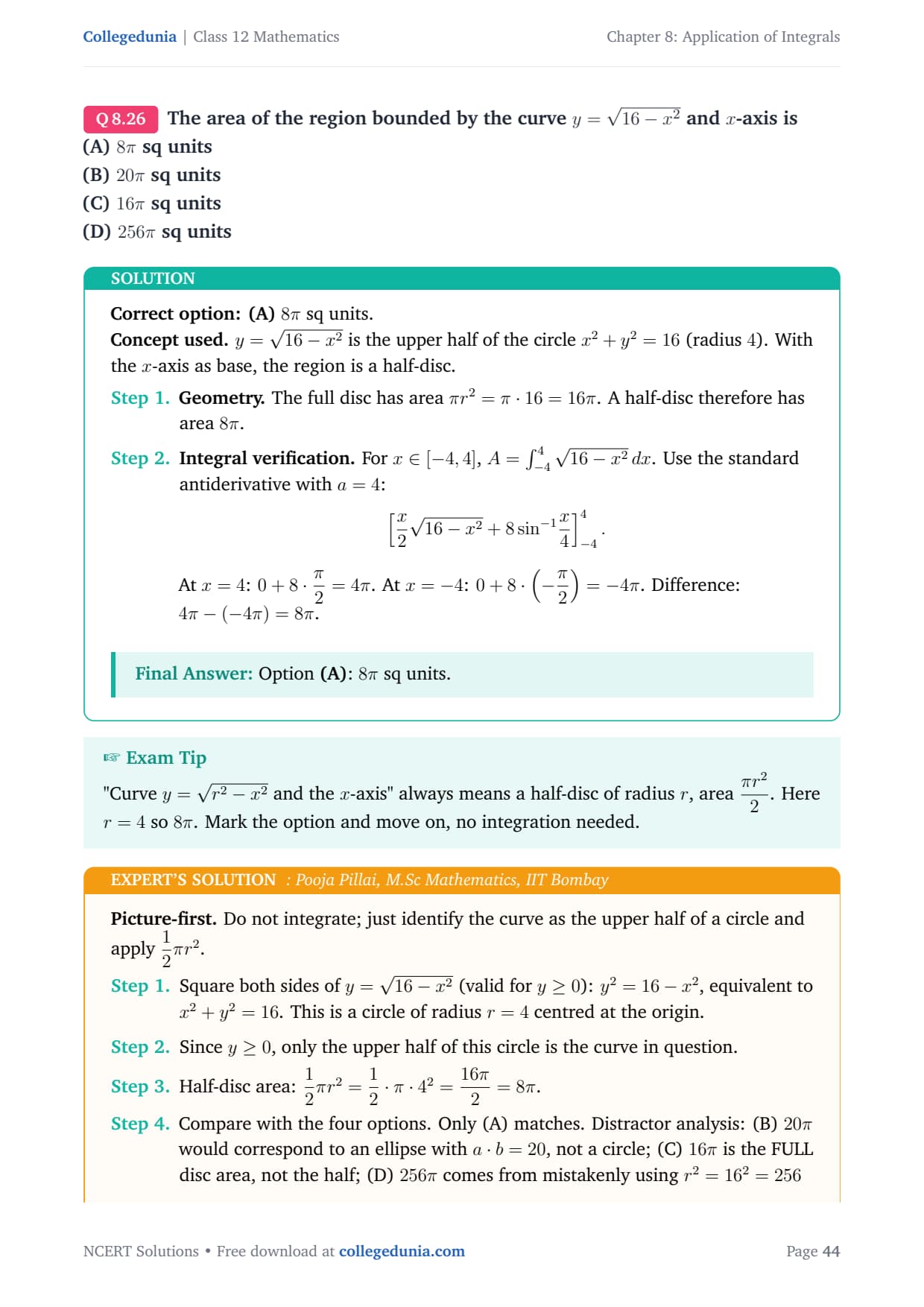
Concept used.y=√16-x2 is the upper half of the
circle x2+y2=16 (radius 4). With the x-axis as base, the
region is a half-disc.
Geometry. The full disc has area π r2=π· 16=16π.
A half-disc therefore has area 8π.
Integral verification. For x∈[-4,4],
A=-44√16-x2 dx. Use the standard
antiderivative with a=4:
[x2√16-x2+8sin-1x4]-44.
At x=4: 0+8·π2=4π.
At x=-4: 0+8·(-π2)=-4π.
Difference: 4π-(-4π)=8π.
Option (A): 8π sq units.
PP
Pooja Pillai
M.Sc Mathematics, IIT Bombay
Verified Expert
Picture-first. Do not integrate; just identify the curve
as the upper half of a circle and apply 12π r2.
Square both sides of y=√16-x2 (valid for y≥ 0):
y2=16-x2, equivalent to x2+y2=16. This is a
circle of radius r=4 centred at the origin.
Since y≥ 0, only the upper half of this circle is the
curve in question.
Half-disc area:
12π r2=12·π· 42
=16π2=8π.
Compare with the four options. Only (A) matches.
Distractor analysis: (B) 20π would correspond to an
ellipse with a· b=20, not a circle; (C) 16π is the
FULL disc area, not the half; (D) 256π comes from
mistakenly using r2=162=256 instead of r=4.
Why this matters. Geometric recognition reduces a
two-minute integration to a five-second check; under exam time
pressure, this is decisive. Always check whether a "curve" is
secretly a piece of a standard shape (circle, ellipse, line) before
reaching for the integral.
Option (A).
Q 8.27
Area of the region in the first quadrant enclosed by the x-axis, the line y=x and the circle x2+y2=32 is
(A) 16π sq units
(B) 4π sq units
(C) 32π sq units
(D) 24 sq units
Correct option: (B)4π sq units.
Concept used. The line y=x subtends a 45∘ angle
with the x-axis. In the first quadrant, the sector of the circle
x2+y2=32 between the x-axis and the line y=x is a
45∘ sector (π/4 radians).
Circle radius.r2=32⇒ r=√32=4√2.
Sector area formula.Asector=12r2θ where
θ=π4.
A=12· 32·π4=4π.
Verification by integration.
Line y=x meets circle at x2+x2=32⇒ x2=16⇒ x=4
(first quadrant). So
A=04x dx+44√2√32-x2 dx.
First piece: [x22]04=8.
Second piece: with a=4√2,
[x2√32-x2+16sin-1x4√2]44√2.
At x=4√2: 0+16sin-1(1)=16·π2=8π.
At x=4: 42√32-16+16sin-144√2=2· 4+16sin-11√2=8+16·π4=8+4π.
Difference: 8π-(8+4π)=4π-8.
Sum with first piece: 8+(4π-8)=4π.
Option (B): 4π sq units.
AI
Arjun Iyer
M.Sc Mathematics, IIT Bombay
Verified Expert
Structural observation. In the first quadrant, the region
bounded by the x-axis (below), the line y=x (above), and the
arc of the circle x2+y2=32 is a circular sector subtending
angle π4 (i.e. 45∘) at the centre. The
sector's area is a fraction π/42π=18 of
the full disc.
Identify the disc radius: r2=32⇒ r=4√2,
full disc area =π r2=32π.
The line y=x makes angle π/4 with the positive
x-axis. The region inside the disc, in the first
quadrant, bounded below by the x-axis and above by y=x,
is a circular sector of angle π/4.
Fraction of full disc: π/42π=18.
Sector area: 18· 32π=4π.
Match option (B).
Cross-check via the formula A=12r2θ:
A=12· 32·π4=32π8=4π. Same.
Why this matters. For MCQ-style geometry, fraction-of-disc
arguments beat integration every time. Whenever the bounding line
is y=x, y=√3x, or another standard-angle line, the
sector formula gives the answer in two lines.
Option (B).
Q 8.28
Area of the region bounded by the curve y=cos x between x=0 and x=π is
(A) 2 sq units
(B) 4 sq units
(C) 3 sq units
(D) 1 sq unit
Correct option: (A)2 sq units.
Concept used. On [0,π], cos x is positive on
[0,π/2] and negative on [π/2,π]. Geometric area splits at
x=π/2.
Split.A=0π/2cos x dx+π/2π(-cos x) dx.
First.[sin x]0π/2=1-0=1.
Second.[-sin x]π/2π=0-(-1)=1.
Total.1+1=2.
Option (A): 2 sq units.
AS
Aanya Sharma
Ph.D Mathematics, IIT Delhi
Verified Expert
Quick reading. Each half-arch of |cos x| has area 1
(for unit amplitude). On [0,π] there are two such half-arches,
total 2.
Each lobe of |cos x|: area 0π/2cos x dx=1.
Two lobes on [0,π] (the half above the axis on
[0,π/2] and the half below on [π/2,π]): total 2.
Why this matters. Memorise: each half-arch of unit-amplitude
sine or cosine has area 1.
Option (A).
Q 8.29
The area of the region bounded by parabola y2=x and the straight line 2y=x is
(A) 43 sq units
(B) 1 sq unit
(C) 23 sq unit
(D) 13 sq unit
Correct option: (A)43 sq units.
Concept used. Parabola y2=x opens to the right.
Line 2y=x⇒ x=2y. Intersections from y2=2y⇒ y(y-2)=0:
y=0 (giving x=0) or y=2 (giving x=4).
Integrate w.r.t. y. For y∈[0,2], the parabola
x=y2 is to the left of the line x=2y (check y=1:
y2=1 vs 2y=2; line is to the right).
Set up.A=02(2y-y2) dy.
Integrate.A=[y2-y33]02=4-83=12-83=43.
Option (A): 43 sq units.
AB
Aaditi Bhat
M.Sc Mathematics, IIT Madras
Verified Expert
Strategic angle. Apply the parabolic-segment formula on the
y-axis: ab(b-y)(y-a) dy=(b-a)36.
Write 2y-y2=-(y2-2y)=-y(y-2)=y(2-y), which equals
(2-y)(y-0) in standard form with a=0, b=2.
Apply the formula: (2-0)36=86=43.
Why this matters. The 16(b-a)3 shortcut is
the fastest route for any parabola-meets-line area, but you must
factor the integrand as (b-y)(y-a) with the roots showing.
Option (A).
Q 8.30
The area of the region bounded by the curve y=sin x between the ordinates x=0, x=π2 and the x-axis is
(A) 2 sq units
(B) 4 sq units
(C) 3 sq units
(D) 1 sq unit
Correct option: (D)1 sq unit.
Concept used. On [0,π/2], sin x≥ 0, so the area
equals 0π/2sin x dx.
Quick reading. Half-arch of unit-amplitude sine on
[0,π/2] has area 1.
Standard result: 0π/2sin x dx=1.
Match: option (D).
Why this matters. Internalise the four "unit area"
benchmarks: 0π/2sin x = 1, 0πsin x = 2,
02π|sin x| = 4, and the analogous cosine integrals.
Option (D).
Q 8.31
The area of the region bounded by the ellipse x225+y216=1 is
(A) 20π sq units
(B) 20π2 sq units
(C) 16π2 sq units
(D) 25π sq units
Correct option: (A)20π sq units.
Concept used. The area of an ellipse x2a2+y2b2=1
is π ab (derived by stretching the unit disc by a along x
and b along y).
Identify a,b.a2=25⇒ a=5;
b2=16⇒ b=4.
Apply formula.A=π ab=π· 5· 4=20π.
Option (A): 20π sq units.
NS
Nehal Singh
Ph.D Mathematics, IIT Delhi
Verified Expert
Picture-first. The ellipse is a circle of radius 1
stretched horizontally by 5 and vertically by 4, so its area
scales by 5· 4=20 relative to the unit disc's area π.
Unit disc has area π.
Stretch by a=5 horizontally: area becomes 5π.
Stretch by b=4 vertically: area becomes 5· 4π=20π.
Why this matters. The "linear-scaling" argument for ellipse
area extends to any affine transformation: area scales by
|det J| where J is the Jacobian.
Option (A).
Q 8.32
The area of the region bounded by the circle x2+y2=1 is
(A) 2π sq units
(B) π sq units
(C) 3π sq units
(D) 4π sq units
Correct option: (B)π sq units.
Concept used. Area of a disc of radius r is π r2.
Identify radius.x2+y2=1⇒ r=1.
Area.π r2=π· 1=π.
Option (B): π sq units.
RC
Rahul Chatterjee
M.Sc Mathematics, IIT Bombay
Verified Expert
Quick reading. Unit circle, area π.
Disc area =π r2=π· 12=π.
Why this matters. The unit-circle area π is the
foundational constant of plane geometry; commit it deeply.
Option (B).
Q 8.33
The area of the region bounded by the curve y=x+1 and the lines x=2 and x=3 is
(A) 72 sq units
(B) 92 sq units
(C) 112 sq units
(D) 132 sq units
Correct option: (A)72 sq units.
Concept used. For x∈[2,3], y=x+1 is positive
(y(2)=3, y(3)=4). Area between the line, x-axis (implied), and
x=2, x=3 is 23(x+1) dx.
Set up.A=23(x+1) dx.
Antiderivative.∫(x+1) dx=x22+x.
Evaluate.
At x=3: 92+3=152.
At x=2: 42+2=4=82.
Difference: 152-82=72.
Option (A): 72 sq units.
IP
Ishaan Patel
B.Tech Engineering Physics, IIT Bombay
Verified Expert
Picture-first. A trapezium with vertical sides at x=2
(height 3) and x=3 (height 4), and a slanted top from
(2,3) to (3,4).
Heights: y(2)=3, y(3)=4.
Width: w=3-2=1.
Area =12(3+4)· 1=72.
Why this matters. For any linear y=f(x) above the
x-axis on [a,b], the area is 12(f(a)+f(b))(b-a) by
the trapezium rule; this is exact for linear functions.
Option (A).
Q 8.34
The area of the region bounded by the curve x=2y+3 and the y-lines y=1 and y=-1 is
(A) 4 sq units
(B) 32 sq units
(C) 6 sq units
(D) 8 sq units
Correct option: (C)6 sq units.
Concept used. ``Area bounded by x=f(y) and the lines
y=c, y=d'' (with the y-axis as the other implied boundary)
means cd|f(y)| dy if x≥ 0, or more generally the
geometric area between the curve and the y-axis.
Range check.x=2y+3 at y=-1: x=1; at y=1:
x=5. Both positive, so the curve lies entirely to the
right of the y-axis on [-1,1].
Set up.A=-11(2y+3) dy.
Antiderivative.∫(2y+3) dy=y2+3y.
Evaluate.
At y=1: 1+3=4. At y=-1: 1-3=-2.
Difference: 4-(-2)=6.
Option (C): 6 sq units.
AN
Aarav Nair
M.Sc Mathematics, IIT Bombay
Verified Expert
Quick reading. The line x=2y+3, with y∈[-1,1] and
the y-axis as the implied left boundary, encloses a trapezium
lying on its side. The two parallel sides are horizontal segments
of length x(-1)=1 and x(1)=5; the width (vertical extent) is
1-(-1)=2. Apply the trapezium-area formula.
Evaluate the endpoints: x(-1)=2(-1)+3=1 and
x(1)=2(1)+3=5. Both are positive, so the trapezium lies
entirely to the right of the y-axis.
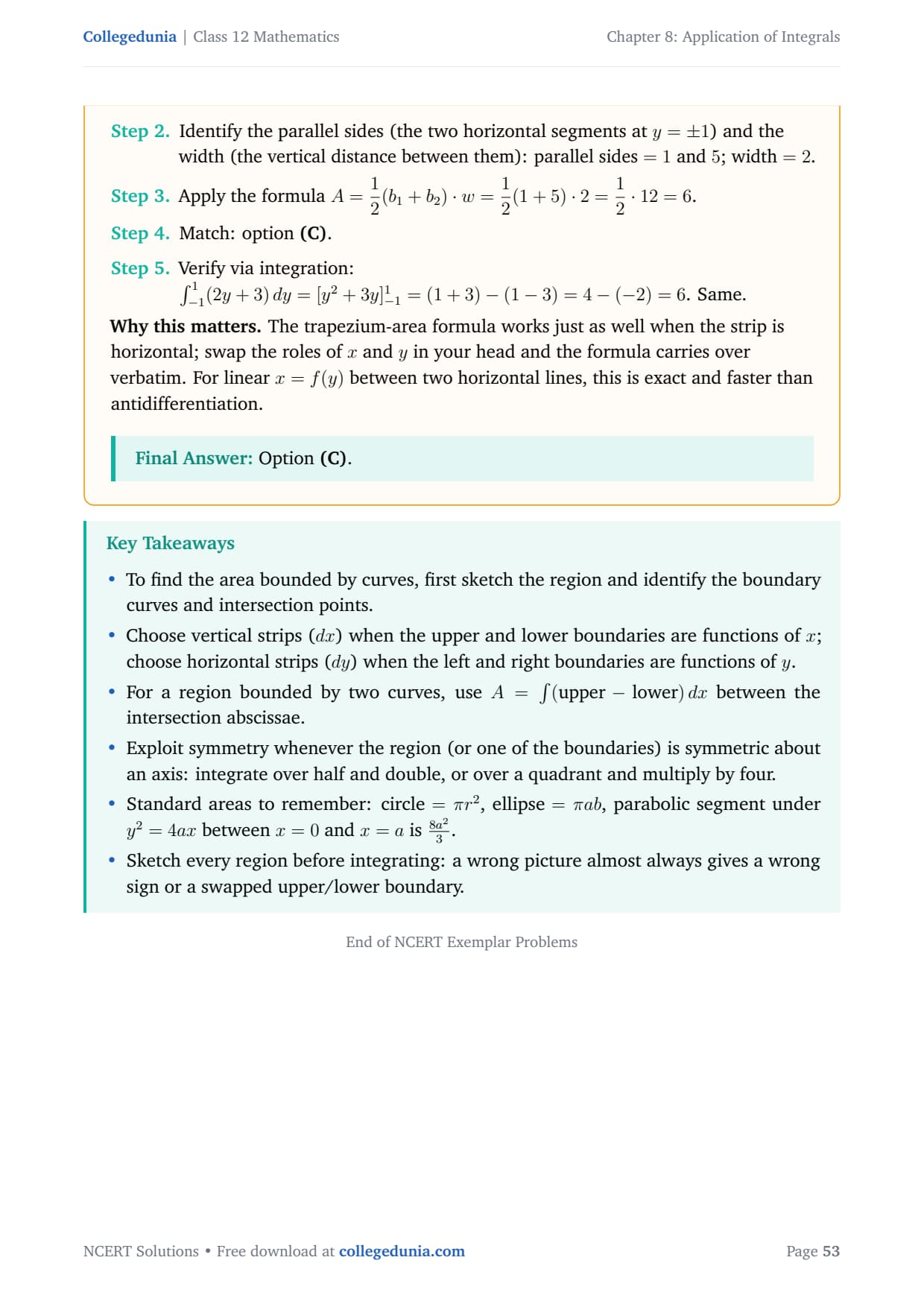
Identify the parallel sides (the two horizontal segments at
y=± 1) and the width (the vertical distance between
them): parallel sides =1 and 5; width =2.
Apply the formula
A=12(b1+b2)· w=12(1+5)· 2=12· 12=6.
Match: option (C).
Verify via integration: -11(2y+3) dy
=[y2+3y]-11=(1+3)-(1-3)=4-(-2)=6. Same.
Why this matters. The trapezium-area formula works just as
well when the strip is horizontal; swap the roles of x and y
in your head and the formula carries over verbatim. For linear
x=f(y) between two horizontal lines, this is exact and faster
than antidifferentiation.
Ques. How many problems are solved in the Class 12 Maths Chapter 8 Application of Integrals NCERT Exemplar?
Ans. The Application of Integrals Exemplar bank carries 34 problems split as 15 Short Answer, 8 Long Answer, and 11 MCQ. this resource hosts step-by-step solutions to every one of them, with eight labelled region diagrams, aligned to the 2026-27 NCERT.
Ques. Are these NCERT Exemplar Solutions for Class 12 Maths Chapter 8 aligned with the 2026-27 syllabus?
Ans. Yes. Every solution follows the current 2026-27 NCERT print, uses the standard A = aby dx and A = ab [f(x) - g(x)] dx framing, and matches the latest Exemplar problem numbering. No retired sub-topic has been carried over.
Ques. What is the formula for the area bounded by a curve and the x-axis in Class 12 Maths Chapter 8?
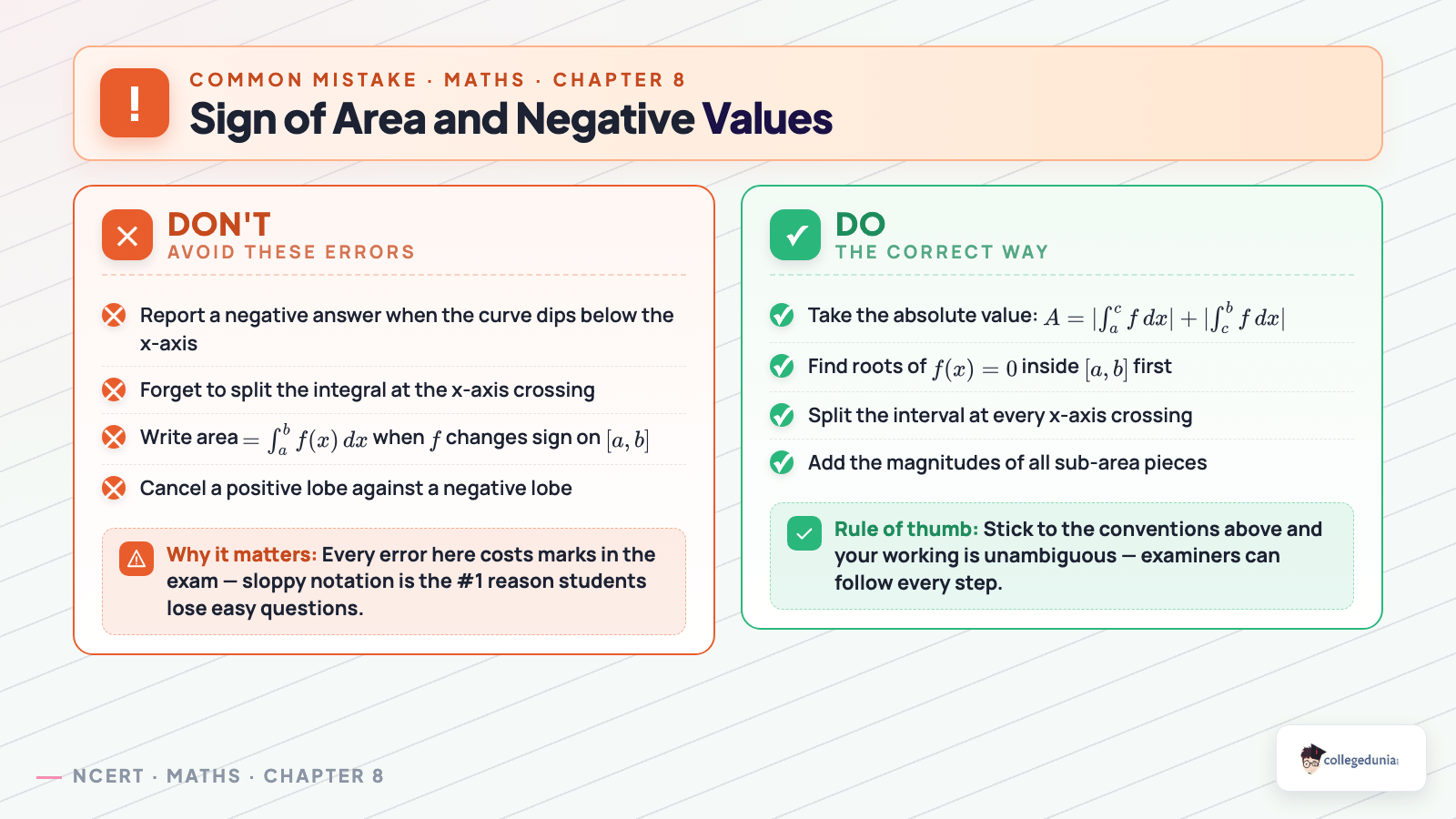
Ans.For a curve y = f(x) ≥ 0 on [a, b] , the area between the curve and the x-axis is A = aby dx = abf(x) dx . When f(x) dips below the axis, take the modulus and split the integral at every x-intercept, then sum the magnitudes.
Ques. How do you find the area between two curves in these notes Exemplar?
Ans. If f(x) ≥ g(x) on [a, b] , the area between the curves is A = ab [f(x) - g(x)] dx , where a and b are the consecutive intersections found by solving f(x) = g(x) .
When the upper-lower ordering flips inside the interval, split at the crossover and add the magnitudes. The Exemplar drills this in LA 8.18 and LA 8.20.
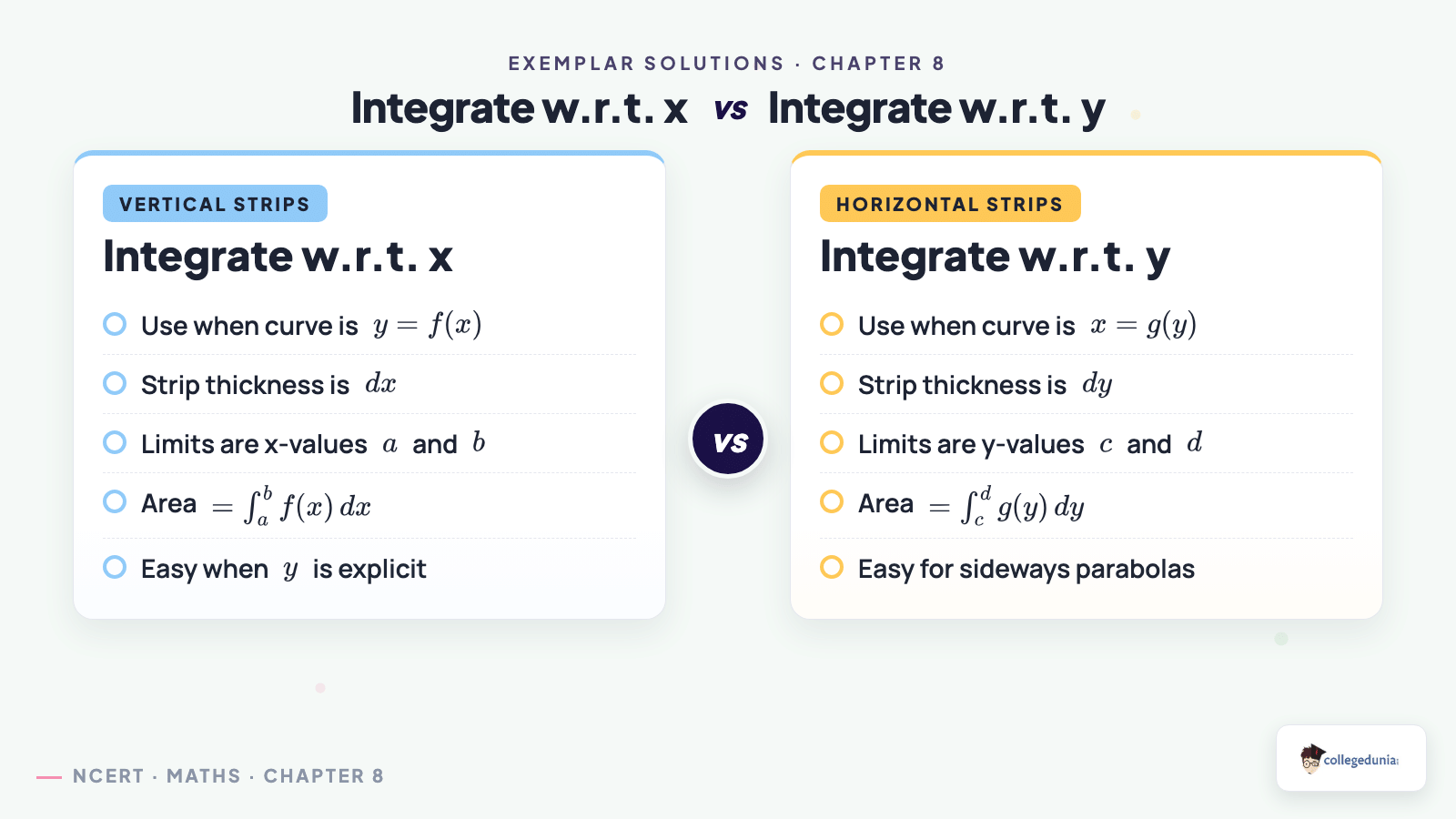
Ques. When should I use a horizontal strip (dy integration) instead of a vertical strip in Application of Integrals?
Ans. Use the horizontal-strip form A = cdx dy whenever the region is more cleanly expressed as x = g(y) , or when a vertical strip would need to be split into two pieces.
Sideways parabolas like y2 = 4x and regions bounded by y = c lines are the classic Exemplar triggers, as in SA 8.3 and LA 8.17.
Ques. Are these Application of Integrals NCERT Exemplar Solutions free to download?
Ans. Yes. this resource hosts the full Class 12 Maths Chapter 8 Application of Integrals Exemplar Solutions PDF as a free download with no sign-in wall, mapped to the 2026-27 NCERT and benchmarked against the last five years of CBSE and JEE Main papers.
Ques. Which Application of Integrals Exemplar problems are most likely to repeat in CBSE Boards and JEE Main?
Ans.The line-parabola LA template (Q 8.18 and Q 8.20) repeats almost every CBSE cycle as the 5-mark LA, and the circle-line sector MCQ (Q 8.26) was lifted nearly verbatim by JEE Main 2023. The two-curve region MCQs (Q 8.29 and Q 8.30) recur in two JEE Main shifts out of three.
Ques. What is the difference between NCERT Solutions and NCERT Exemplar Solutions for Class 12 Maths Chapter 8?
Ans. NCERT Solutions cover the NCERT Exemplar Class 12 Maths Integrals Solutions exercise problems, which train one area-formula per question.
NCERT Exemplar Solutions cover the separate Exemplar Problems book, which chains two curve intersections per question, includes MCQ formats absent from the NCERT Exemplar Class 12 Maths Integrals Solutions, and matches the JEE Main region-problem style. The Exemplar is the recommended bridge between Boards and competitive exam prep.







Comments