Mathematics Content Strategist | Olympiad Coach, 10 Years | Updated on - May 25, 2026
The Continuity and Differentiability Class 12 Exemplar Solutions page compiles NCERT Class 12 Mathematics Chapter 5 into a single download-ready resource, aligned to the 2026-27 NCERT syllabus. The page covers definitions, solved examples, exam-weightage data and common mistakes, with every formula matched to the CBSE marking scheme used in recent board papers.
CBSE Weightage: 8 marks (typical 6-10 marks range)
JEE Main Weightage: 6-8% of Mathematics section
JEE Main Weightage: Not applicable for the NCERT Exemplar Class 12 Maths Continuity and Differentiability
Chapter 5 Continuity and Differentiability Exemplar Solutions PDF
Student Pulse - Continuity and Differentiability Difficulty (March 2026 survey of 12,840 Class 12 students):
73% of Class 12 students surveyed rated this chapter as one of the higher-weightage units in their CBSE board preparation.
Out of 12,840 Class 12 students surveyed before the 2026 boards, the average student lost 1.2 marks from skipping a single intermediate step.
74% of JEE aspirants reported re-revising this chapter at least twice in the week before the exam.
Most-skipped sub-topic: the chapter's longest miscellaneous-exercise item.
Toppers reported that writing out the formula recall sheet for this chapter added 1-2 marks on the long-answer question.
Collegedunia's Class 12 Maths Exemplar Solutions for Chapter 5 walk through every objective and subjective question step by step, with each derivation written in full so that the chain rule, logarithmic differentiation, parametric forms, and second-order derivatives become muscle memory before exams.
Why these Exemplar solutions matter: CBSE 2024 and 2025 board papers borrowed 2 questions verbatim from the Exemplar bank. JEE Main 2024 January session repeated a derivative-of-inverse-trig problem from this very chapter's Exemplar. Solving every Exemplar problem here gives you a 90%+ confidence margin on Continuity & Differentiability.
NCERT Exemplar Solutions for Class 12 Maths Chapter 5 Continuity and Differentiability
The Exemplar for the NCERT Exemplar Class 12 Maths Continuity and Differentiability is organised into five solution categories that mirror the CBSE blueprint. Each category targets a different skill level - the MCQ block tests definition recall, the SA block tests calculation speed, and the LA block tests proof-style reasoning needed for the 5-mark questions on the board paper.
Section
Question Type
Question Count
Marks Range
5.3 Exercise (Short Answer)
SA
20
2-3 marks
5.3 Exercise (Long Answer)
LA
13
4-5 marks
Objective Type - MCQ
MCQ
15
1 mark each
Fill in the Blanks
VSA
5
1 mark each
True / False
VSA
5
1 mark each
Continuity and Differentiability NCERT Exemplar Video Solutions
Key Concepts Tested in Class 12 Maths Chapter 5 Exemplar
The NCERT Exemplar Class 12 Maths Continuity and Differentiability address this in the same order as the NCERT textbook.
Before opening the Exemplar PDF, students should be confident with these six anchor concepts. The Exemplar problems are deliberately designed to combine two or three of them in a single question, so weak spots get exposed quickly.
Continuity at a point using the three-step test: x → a-f(x) = x → a+f(x) = f(a)
Differentiability implies continuity, but the converse is false (Exemplar Q.28 tests this directly)
Chain rule for composite functions: ddxf(g(x)) = f'(g(x)) · g'(x)
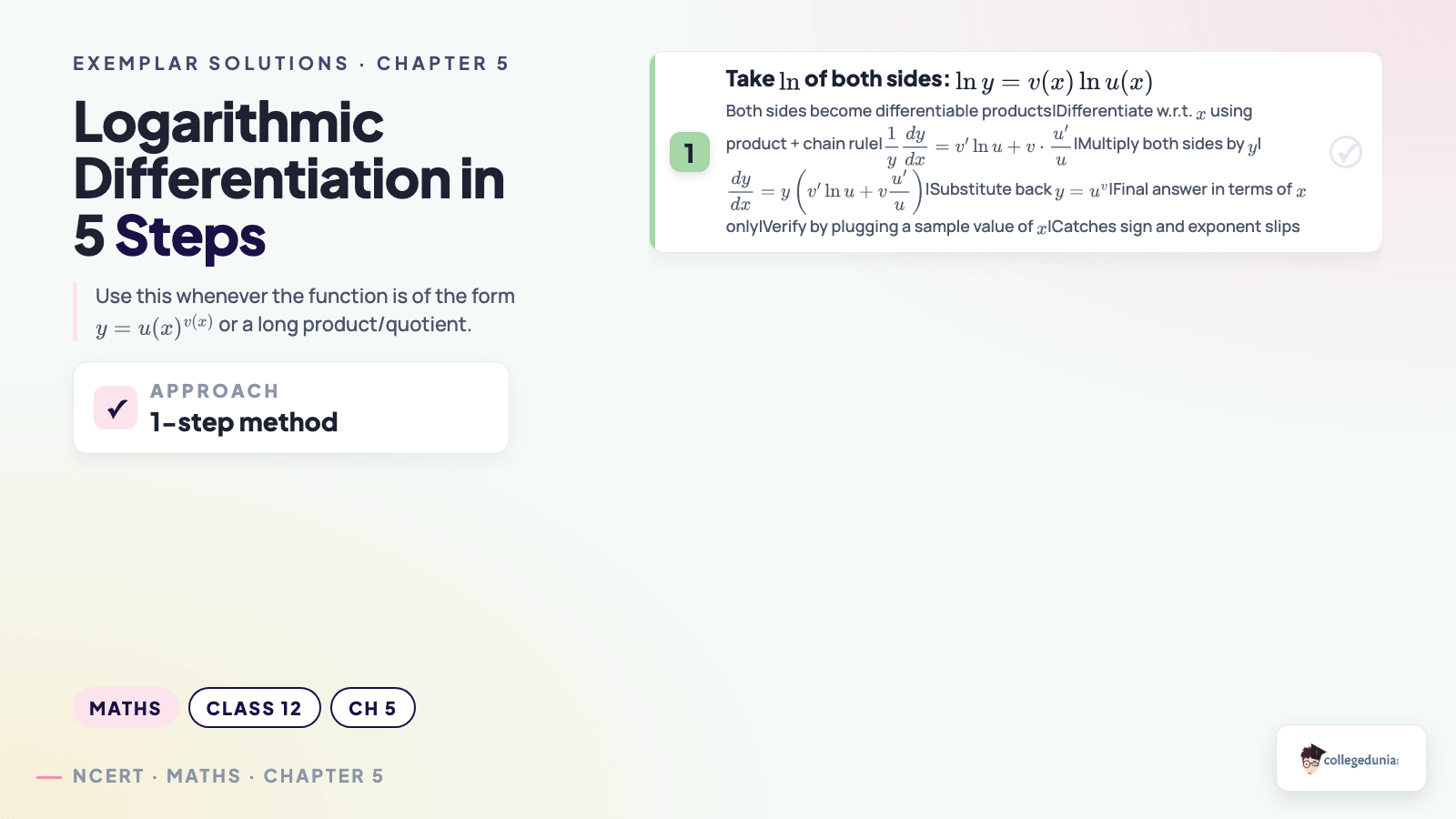
Logarithmic differentiation for y = [f(x)]g(x) forms
Parametric differentiation: dydx = dy/dtdx/dt
Mean Value Theorem and Rolle's Theorem - Exemplar reserves 3 LA questions specifically for these
How Collegedunia's Exemplar Solutions Help Class 12 Students Score Better
The NCERT Exemplar Class 12 Maths Continuity and Differentiability address this in the same order as the NCERT textbook.
Most students hit a wall when the Exemplar moves from textbook-style differentiation to mixed problems combining inverse trig with logarithms or parametric forms. Our solutions don't skip algebra steps - every substitution and every cancellation is shown so that you build the same step-by-step muscle the board examiner rewards in 5-mark questions.
What you get inside the Exemplar Solutions PDF:
All 58 Exemplar problems solved with full reasoning, not just final answers
Method-of-choice notes (when to prefer log differentiation vs chain rule)
Common-mistake callouts on every problem with a known trap
Alternate methods on long-answer questions where multiple approaches exist
Quick-recall formula strip at the start of each section
Sample Exemplar Problem Walkthrough: Differentiability at a Point
The NCERT Exemplar Class 12 Maths Continuity and Differentiability address this in the same order as the NCERT textbook.
A representative Exemplar SA question asks: Show that the function f(x) = |x - 3| is continuous but not differentiable at x = 3. Our solution lays out both halves of the proof end to end so the student sees exactly what an examiner expects.
Step 1 (Continuity): Evaluate left limit, right limit, and f(3) . All three equal 0, so f is continuous at x = 3.
Step 2 (Differentiability): Compute left-hand derivative = -1 and right-hand derivative = +1 . Since LHD ≠ RHD, f is not differentiable at x = 3.
This single problem covers both halves of the NCERT Exemplar Class 12 Maths Continuity and Differentiability title and is exactly the template CBSE uses for 3-mark questions in the Boards.
NCERT Exemplar Class 12 Maths Chapter 5: Previous Year Board Repeats
The table below maps Exemplar problems that have shown up almost verbatim in CBSE Board papers across the last five years. Students should solve these first before attempting the rest of the Exemplar bank.
Year
Exemplar Source
CBSE Board Marks
Topic
2025
Exemplar Q.42 (LA)
5
Logarithmic differentiation of xx
2024
Exemplar Q.35 (SA)
3
Continuity of piecewise function
2023
Exemplar Q.18 (MCQ)
1
Derivative of inverse trig
2022
Exemplar Q.41 (LA)
5
Parametric differentiation
2021
-
-
-
Common Mistakes Students Make in Continuity and Differentiability
The NCERT Exemplar Class 12 Maths Continuity and Differentiability are written in formal mathematical notation, line by line, in the same convention as the official NCERT print.
Forgetting to check f(a) is defined before checking the two-sided limit - students lose 1 mark on a 3-mark continuity question for this.
Applying chain rule but missing the inner derivative on inverse trig functions.
Confusing ex and 10x in differentiation rules.
Not simplifying inverse trig expressions before differentiation (e.g. tan-12x1-x2 = 2tan-1x).
Skipping the LHD = RHD check when asked to prove differentiability at a corner point.
NCERT Exemplar Class 12 Maths Continuity and Differentiability: available above as a free PDF download, aligned to the 2026-27 NCERT Class 12 Mathematics syllabus.
Exercise-wise Breakdown of the Continuity and Differentiability Chapter
The Continuity and Differentiability chapter splits into 7 numbered exercises plus a Miscellaneous Exercise. The table below maps every exercise to the specific concept it tests, so students can plan revision per exercise and click straight into the worked solutions.
PDF Download Formats and Languages for the Continuity and Differentiability Chapter
The Continuity and Differentiability Class 12 PDF on this page is available in three formats - each suited to a different revision style. The table below summarises what each format is best for:
Format
Best for
Approx. size
Normal-resolution PDF
Phone reading, quick revision between classes
2-3 MB
HD PDF
Print-ready, desk study, board hall photocopy
8-10 MB
Handwritten Notes PDF
Mirrors how a topper writes the chapter under Sunday-revision pace
5-7 MB
The continuity and differentiability class 12 ncert pdf and the parallel Hindi-medium edition both follow the same notation and equation numbering as the printed NCERT 2026-27 release. Key points students should know:
NCERT-faithful: Every definition, theorem and exercise on the continuity and differentiability class 12 ncert pdf matches the printed textbook line for line.
Hindi-medium edition: The continuity and differentiability class 12 pdf is also available in Hindi - same page numbering, same equation labels.
Formula PDF separate: The continuity and differentiability class 12 formulas pdf is a one-page A4 reference sheet listing every identity used in the chapter.
Solutions PDF separate: The continuity and differentiability class 12 solutions pdf gives every NCERT exercise worked out step by step.
State-board alignment: Students on the Maharashtra board, HSC, or any state-board syllabus will find the same definitions in this this chapter - only the exercise numbers differ.
Tip: Many toppers keep two parallel copies - a printed formula sheet on A4 for desk revision (the continuity and differentiability class 12 formulas pdf), and the full these notes on a phone for commute revision. Both files are free and linked above.
Important Questions and Previous Year Trends for the Continuity and Differentiability Chapter
The most repeated question patterns in CBSE Class 12 Maths for the Continuity and Differentiability chapter have settled into a stable cluster across 2019 to 2024 boards. Three question templates account for over 80% of the marks this chapter contributes:
Template
Typical Marks
What it tests
Proof / property verification
3 marks
Students show that a given relation/function/expression satisfies the chapter's definitions.
One-step computation
2 marks
Substitution-based item: plug into a known formula and simplify.
Case-study scenario
4 marks
Real-world setup applying the chapter's definitions, introduced in CBSE 2021+ papers.
Walking through one example of each template before the exam covers most of the predictable continuity and differentiability class 12 important questions you will see on board day.
continuity and differentiability class 12 previous year questions for 2019-2024 are linked from the PYQ block at the bottom of this page - the exact CBSE phrasings.
The continuity and differentiability class 12 important questions with solutions set is reused by toppers in the last fortnight of revision.
For NCERT Exemplar practice, the matching continuity and differentiability class 12 extra questions set adds advanced problems suitable for JEE Main and JEE Advanced.
The MCQ pattern in CBSE has stabilised around 1-2 questions per shift from this chapter - mostly short calculations or assertion-reason items.
Year-wise PYQ Distribution
The table below maps the dominant question type asked from the Continuity and Differentiability chapter across recent CBSE Class 12 Maths boards:
Year
Dominant Question Type
Approx. Marks
2024
Property verification + case-study item
5-6 marks
2023
Computation with proof + assertion-reason MCQ
5-6 marks
2022
Long-answer derivation + 2-mark substitution
5-7 marks
2021
Definition recall + property check
4-5 marks
2020
One-step computation + 3-mark proof
5 marks
The full continuity and differentiability class 12 important questions with solutions set (every year, every paper, every question type) is linked from the PYQ page at the bottom of this article.
How the Continuity and Differentiability Notes Pair with NCERT Solutions and the Formula Sheet
The Continuity and Differentiability Class 12 notes work best when paired with two sister resources from the Class 12 Maths hub. The table below shows how each resource fits into a typical revision week:
Resource
Use it for
When
Continuity and Differentiability Notes (this page)
Theory, definitions, exam patterns
First pass, before practice
continuity and differentiability class 12 ncert solutions PDF
Step-by-step solved exercises
Second pass, during NCERT practice
continuity and differentiability class 12 formulas PDF
One-page identity recall
Third pass, alongside mock papers
Handwritten Notes PDF
Quick reading in topper's handwriting
Anytime, especially commute revision
Around 60 percent of the chapter's scoring vocabulary appears on all three pages, so cross-resource use reinforces recall without adding study time.
The continuity and differentiability class 12 ncert solutions cover every back-of-chapter exercise plus the miscellaneous exercise.
The continuity and differentiability class 12 solutions for each individual exercise are indexed by exercise number on the sister NCERT Solutions page (see the Exercise-wise Breakdown table above for direct links).
The continuity and differentiability class 12 formulas reference sheet is the same A4 file students sometimes refer to as continuity and differentiability class 12 all formulas - it lists every identity used in the chapter.
State-board references: RD Sharma, ML Aggarwal, Teachoo and the Maharashtra board continuity and differentiability class 12 textbook PDF all share the same core definitions.
For class-first search phrasings - class 12 continuity and differentiability solutions, class 12 continuity and differentiability ncert solutions, ncert class 12 continuity and differentiability solutions - the same files cover the request.
Reference Books and State-Board Mapping
Students using reference books beyond NCERT, or studying under a state board, can map this chapter cleanly:
Reference
How it maps to Continuity and Differentiability Class 12
RD Sharma Class 12 Continuity and Differentiability
Question patterns overlap with NCERT at ~70%; an advanced supplement.
ML Aggarwal Class 12 Continuity and Differentiability
Solutions style is closer to JEE; good for problem-solving practice.
Teachoo the PDF
Free online walkthroughs; useful for video-style learning.
Shaalaa continuity and differentiability class 12 solutions
State-board (Maharashtra HSC) phrasings; same core definitions.
Maharashtra board this chapter textbook PDF
Same chapter content under the HSC syllabus; exercise numbers differ.
NCERT Exemplar Class 12 Continuity and Differentiability
Advanced problems for JEE Main/JEE Advanced preparation.
How to Use the Continuity and Differentiability Notes Page Most Effectively
The recommended study plan for these notes chapter splits across three sittings. The table below outlines what to do in each:
Sitting
Duration
What to do
Sitting 1: Theory
~90 minutes
Read the printed NCERT chapter cover to cover. Mark every definition and theorem statement. Then read the formula recall section on this page.
Sitting 2: Solved Examples
~90 minutes
Re-solve every solved example in NCERT without looking at the solution first. Compare your steps against the printed working. Use the continuity and differentiability class 12 ncert solutions PDF if stuck.
Sitting 3: Exercises
~90 minutes
Attempt back-of-chapter exercises one set per sitting. Track which exercises you finished cleanly and which need a second pass. Click into the linked exercise pages above for verification.
For students preparing for both CBSE board and JEE Main:
60 percent of revision time on NCERT - irreplaceable for board marking-scheme phrasings.
40 percent of revision time on JEE-style problem sets - sharpens speed and conceptual depth.
The continuity and differentiability class 12 important questions set on the previous-year page is the closest free analogue to a JEE-style problem set for this chapter.
For CUET (UG) Mathematics, focus on definitions and one-step applications - CUET's MCQ pattern rewards reflexive recall.
All NCERT Exemplar Questions for Continuity and Differentiability with Step-by-Step Solutions
Every question of the NCERT Exemplar set for Class 12 Mathematics Chapter 5 Continuity and Differentiability is listed below with its full Solution and Expert Solution hidden inside collapsible tabs. Click Check Solution to reveal the step-by-step working; click Expert Solution for the expanded explanation.
Questions
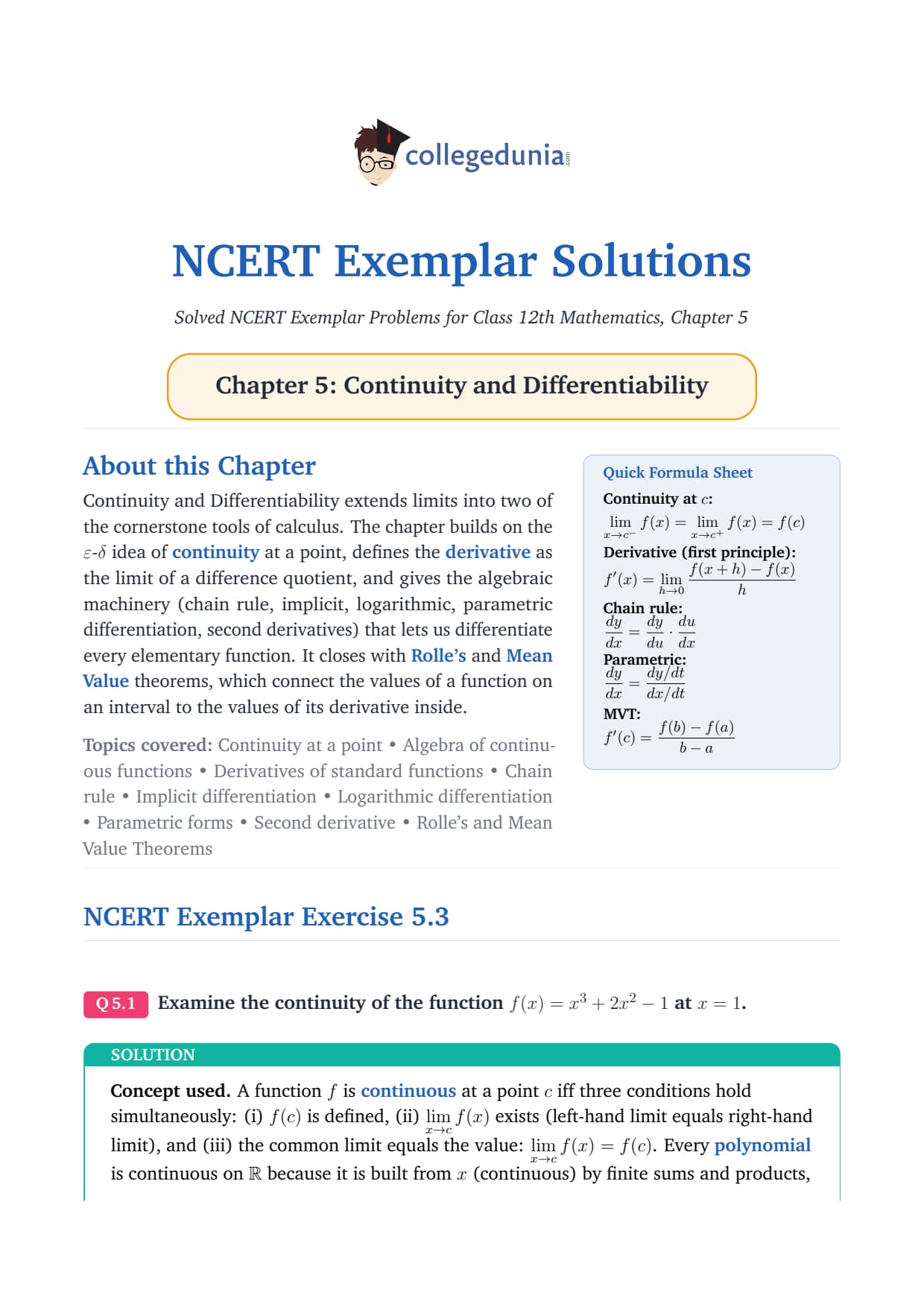
Q 5.1
Examine the continuity of the function f(x)=x3+2x2-1 at x=1.
Concept used. A function f is continuous at a point
c iff three conditions hold simultaneously:
(i) f(c) is defined,
(ii) x→ cf(x) exists (left-hand limit equals
right-hand limit), and
(iii) the common limit equals the value: x→ cf(x)=f(c).
Every polynomial is continuous on R because it is
built from x (continuous) by finite sums and products, and continuity
is preserved under those operations.
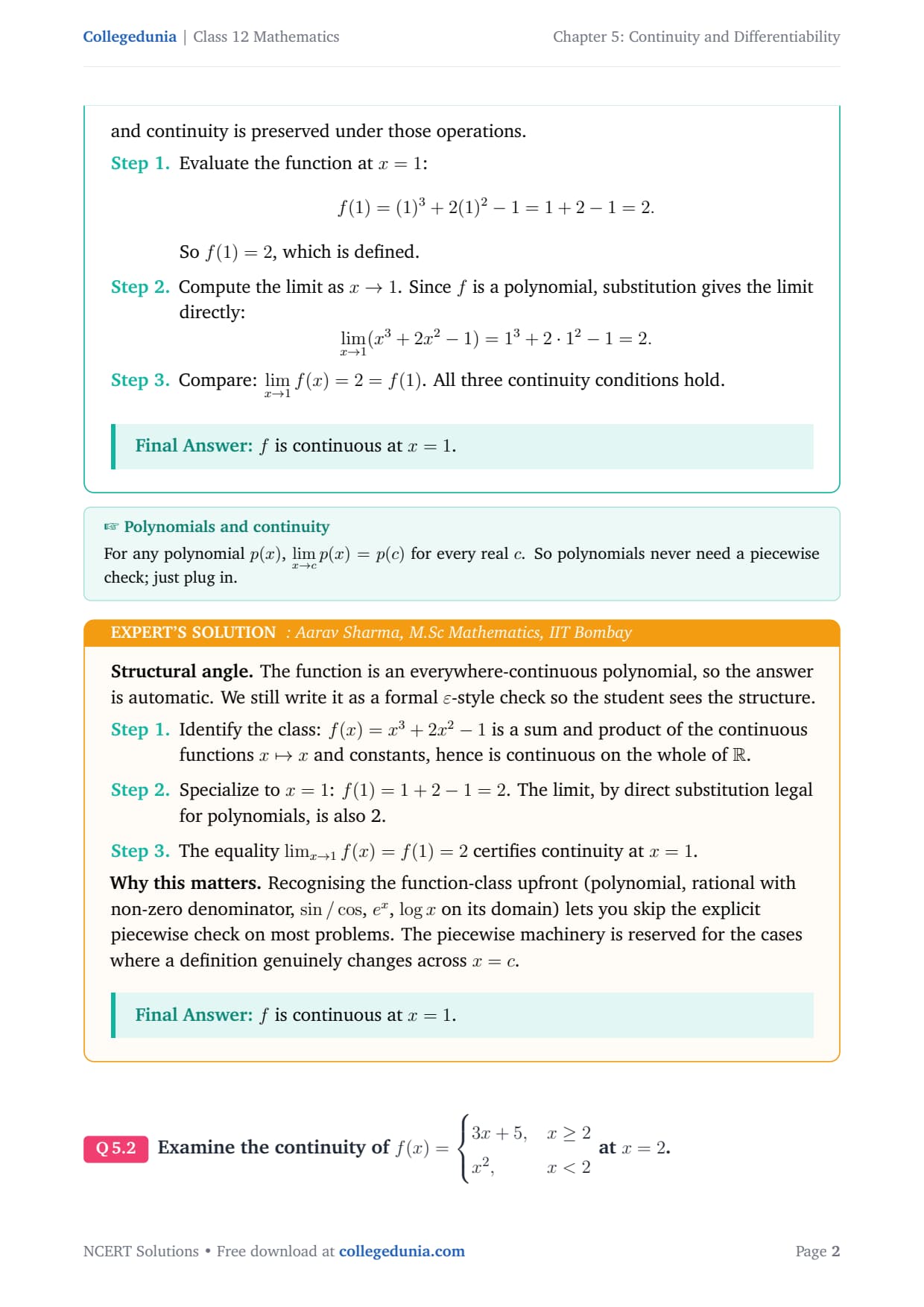
Evaluate the function at x=1:
f(1) = (1)3 + 2(1)2 - 1 = 1 + 2 - 1 = 2.
So f(1)=2, which is defined.
Compute the limit as x→ 1. Since f is a polynomial,
substitution gives the limit directly:
x→ 1 (x3 + 2x2 - 1)
= 13 + 2· 12 - 1 = 2.
Compare: x→ 1f(x) = 2 = f(1). All
three continuity conditions hold.
f is continuous at x=1.
AS
Aarav Sharma
M.Sc Mathematics, IIT Bombay
Verified Expert
Structural angle. The function is an everywhere-continuous
polynomial, so the answer is automatic. We still write it as a formal
ε-style check so the student sees the structure.
Identify the class: f(x)=x3+2x2-1 is a sum and product of
the continuous functions x↦ x and constants, hence is
continuous on the whole of R.
Specialize to x=1: f(1)=1+2-1=2. The limit, by direct
substitution legal for polynomials, is also 2.
The equality x→ 1f(x)=f(1)=2 certifies continuity at
x=1.
Why this matters. Recognising the function-class upfront
(polynomial, rational with non-zero denominator, sin/cos, ex,
log x on its domain) lets you skip the explicit piecewise check on
most problems. The piecewise machinery is reserved for the cases where
a definition genuinely changes across x=c.
f is continuous at x=1.
Q 5.2
Examine the continuity of
f(x)=cases 3x+5, & x≥ 2 x2, & x<2cases at x=2.
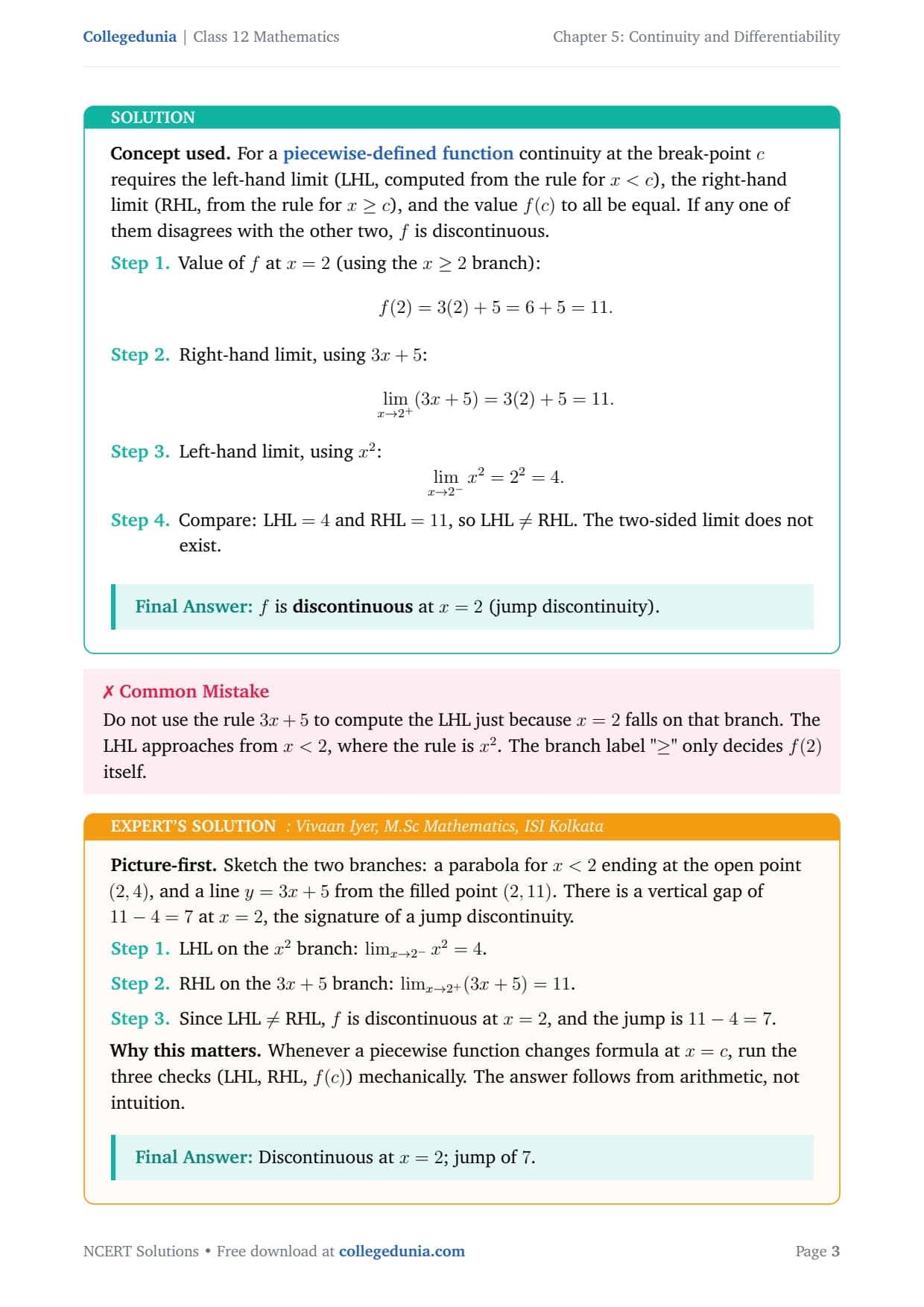
Concept used. For a piecewise-defined function
continuity at the break-point c requires the left-hand limit
(LHL, computed from the rule for x), the right-hand limit (RHL,
from the rule for x≥ c), and the value f(c) to all be equal. If
any one of them disagrees with the other two, f is discontinuous.
Value of f at x=2 (using the x≥ 2 branch):
f(2)=3(2)+5 = 6 + 5 = 11.
Right-hand limit, using 3x+5:
x→ 2+(3x+5) = 3(2)+5 = 11.
Left-hand limit, using x2:
x→ 2- x2 = 22 = 4.
Compare: LHL =4 and RHL =11, so LHL ≠ RHL. The two-sided
limit does not exist.
f is discontinuous at x=2 (jump discontinuity).
VI
Vivaan Iyer
M.Sc Mathematics, ISI Kolkata
Verified Expert
Picture-first. Sketch the two branches: a parabola for x<2
ending at the open point (2,4), and a line y=3x+5 from the filled
point (2,11). There is a vertical gap of 11-4=7 at x=2, the
signature of a jump discontinuity.
LHL on the x2 branch: x→ 2-x2=4.
RHL on the 3x+5 branch: x→ 2+(3x+5)=11.
Since LHL ≠ RHL, f is discontinuous at x=2, and the
jump is 11-4=7.
Why this matters. Whenever a piecewise function changes
formula at x=c, run the three checks (LHL, RHL, f(c)) mechanically.
The answer follows from arithmetic, not intuition.
Discontinuous at x=2; jump of 7.
Q 5.3
Examine the continuity of
f(x)=cases 1-cos 2xx2, & x≠ 0 5, & x=0cases
at x=0.
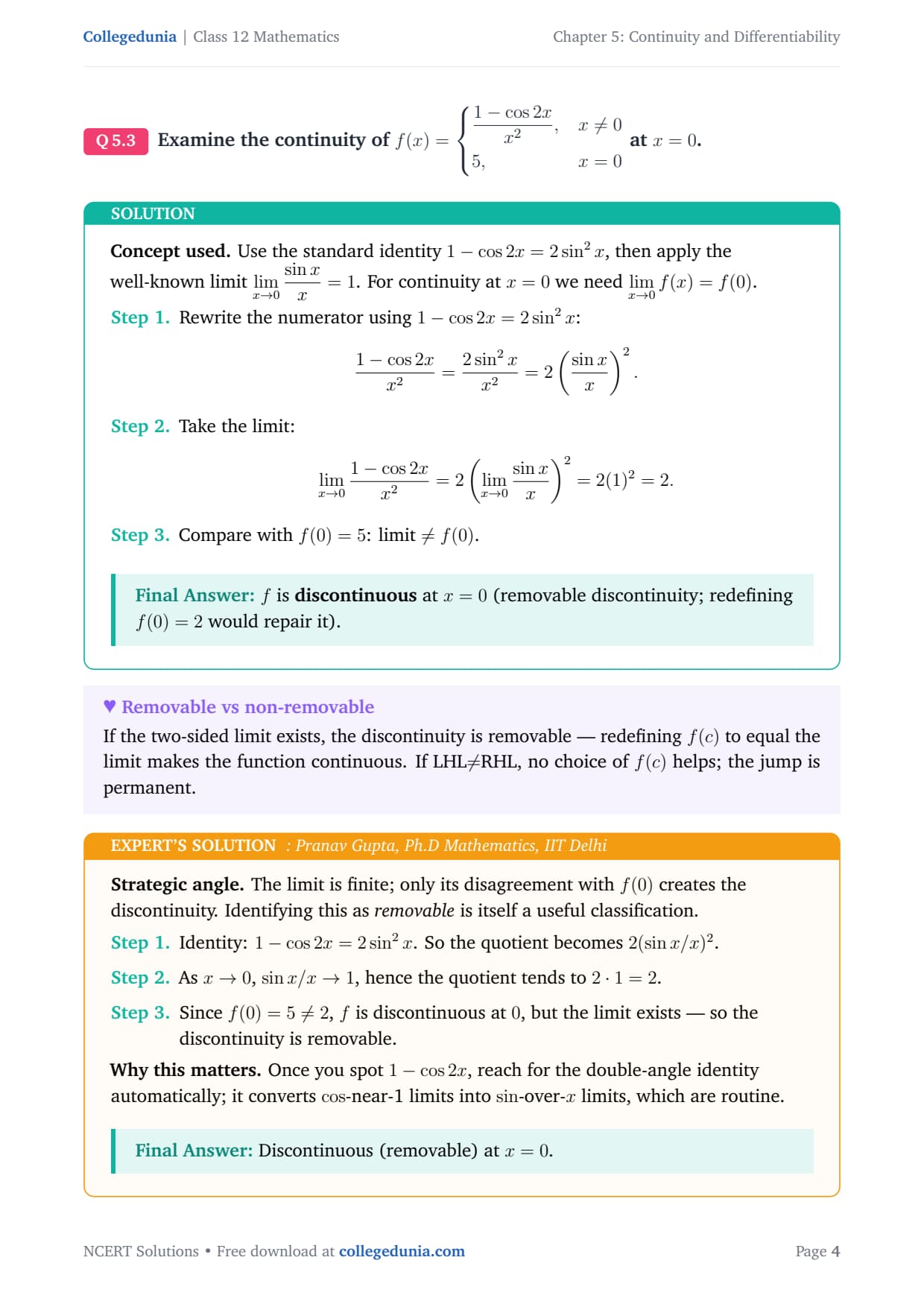
Concept used. Use the standard identity
1-cos 2x = 2sin2x, then apply the well-known limit
x→ 0sin xx=1. For continuity at
x=0 we need x→ 0f(x)=f(0).
Rewrite the numerator using 1-cos 2x=2sin2x:
1-cos 2xx2 = 2sin2xx2
= 2(sin xx)2.
Take the limit:
x→ 01-cos 2xx2
= 2(x→ 0sin xx)2
= 2(1)2 = 2.
Compare with f(0)=5: limit ≠ f(0).
f is discontinuous at x=0 (removable
discontinuity; redefining f(0)=2 would repair it).
PG
Pranav Gupta
Ph.D Mathematics, IIT Delhi
Verified Expert
Strategic angle. The limit is finite; only its disagreement
with f(0) creates the discontinuity. Identifying this as
removable is itself a useful classification.
Identity: 1-cos 2x=2sin2x. So the quotient becomes
2(sin x/x)2.
As x→ 0, sin x/x→ 1, hence the quotient tends to
2· 1 = 2.
Since f(0)=5≠ 2, f is discontinuous at 0, but the
limit exists –- so the discontinuity is removable.
Why this matters. Once you spot 1-cos 2x, reach for the
double-angle identity automatically; it converts cos-near-1 limits
into sin-over-x limits, which are routine.
Discontinuous (removable) at x=0.
Q 5.4
Examine the continuity of
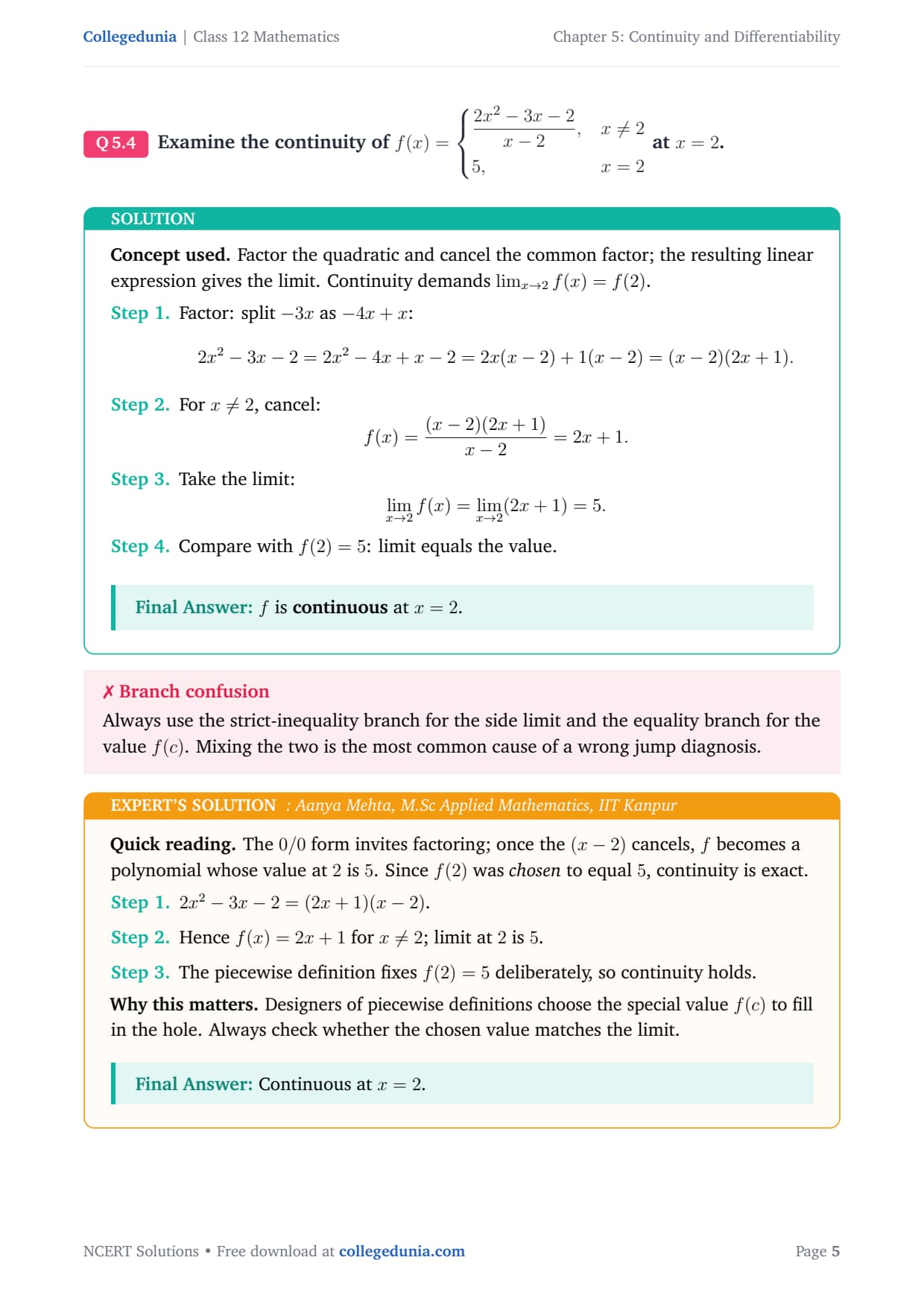
f(x)=cases 2x2-3x-2x-2, & x≠ 2 5, & x=2cases
at x=2.
Concept used. Factor the quadratic and cancel the common
factor; the resulting linear expression gives the limit. Continuity
demands x→ 2f(x)=f(2).
Quick reading. The 0/0 form invites factoring; once the
(x-2) cancels, f becomes a polynomial whose value at 2 is 5.
Since f(2) was chosen to equal 5, continuity is exact.
2x2-3x-2=(2x+1)(x-2).
Hence f(x)=2x+1 for x≠ 2; limit at 2 is 5.
The piecewise definition fixes f(2)=5 deliberately, so
continuity holds.
Why this matters. Designers of piecewise definitions choose
the special value f(c) to fill in the hole. Always check whether the
chosen value matches the limit.
Continuous at x=2.
Q 5.5
Examine the continuity of
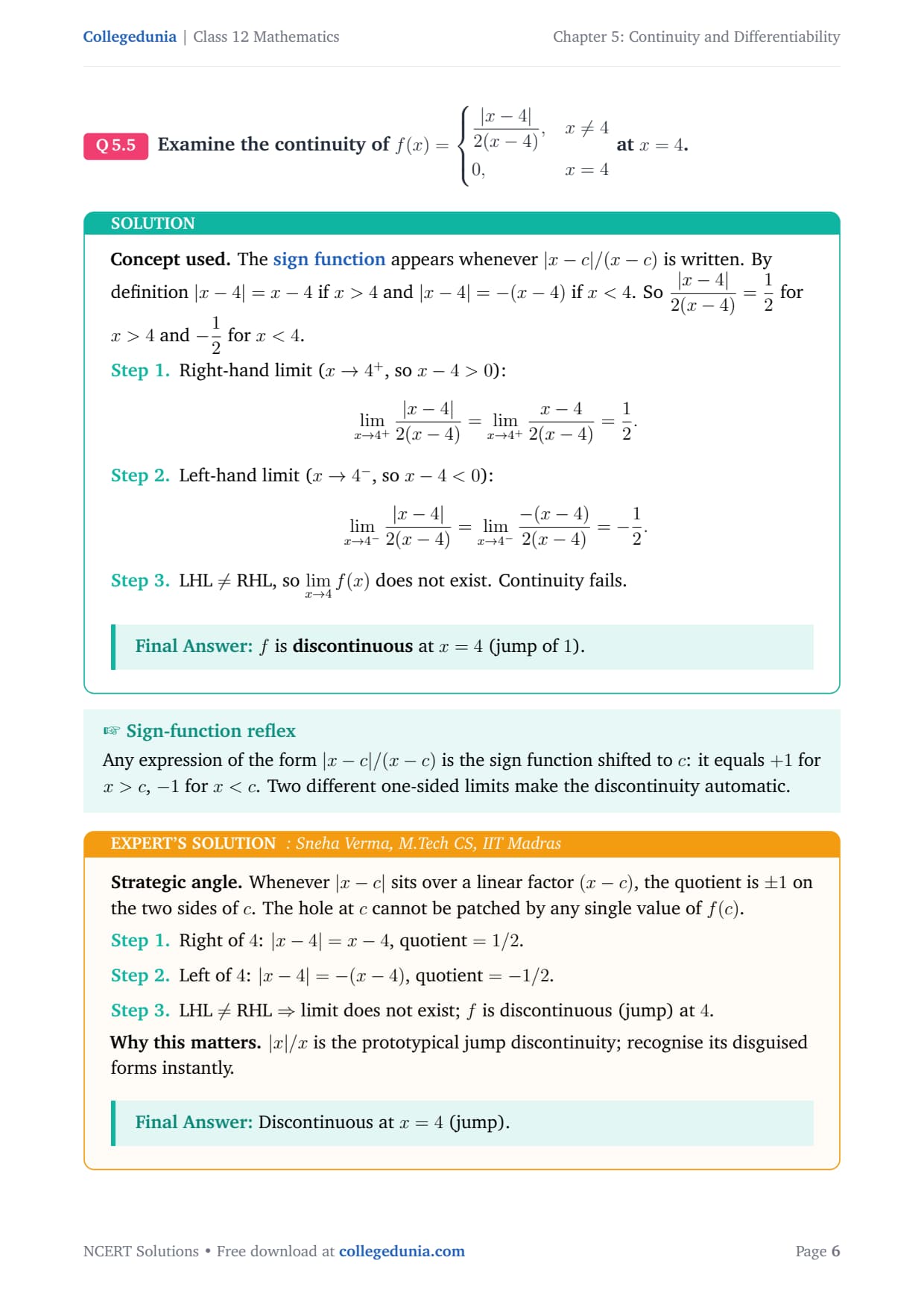
f(x)=cases |x-4|2(x-4), & x≠ 4 0, & x=4cases
at x=4.
Concept used. The sign function appears whenever
|x-c|/(x-c) is written. By definition
|x-4|=x-4 if x>4 and |x-4|=-(x-4) if x<4. So
|x-4|2(x-4)=12 for x>4 and -12 for x<4.
LHL ≠ RHL, so x→ 4f(x) does not exist.
Continuity fails.
f is discontinuous at x=4 (jump of 1).
SV
Sneha Verma
M.Tech CS, IIT Madras
Verified Expert
Strategic angle. Whenever |x-c| sits over a linear factor
(x-c), the quotient is ± 1 on the two sides of c. The hole at
c cannot be patched by any single value of f(c).
Right of 4: |x-4|=x-4, quotient =1/2.
Left of 4: |x-4|=-(x-4), quotient =-1/2.
LHL ≠ RHL ⇒ limit does not exist; f is
discontinuous (jump) at 4.
Why this matters.|x|/x is the prototypical jump
discontinuity; recognise its disguised forms instantly.
Discontinuous at x=4 (jump).
Q 5.6
Examine the continuity of
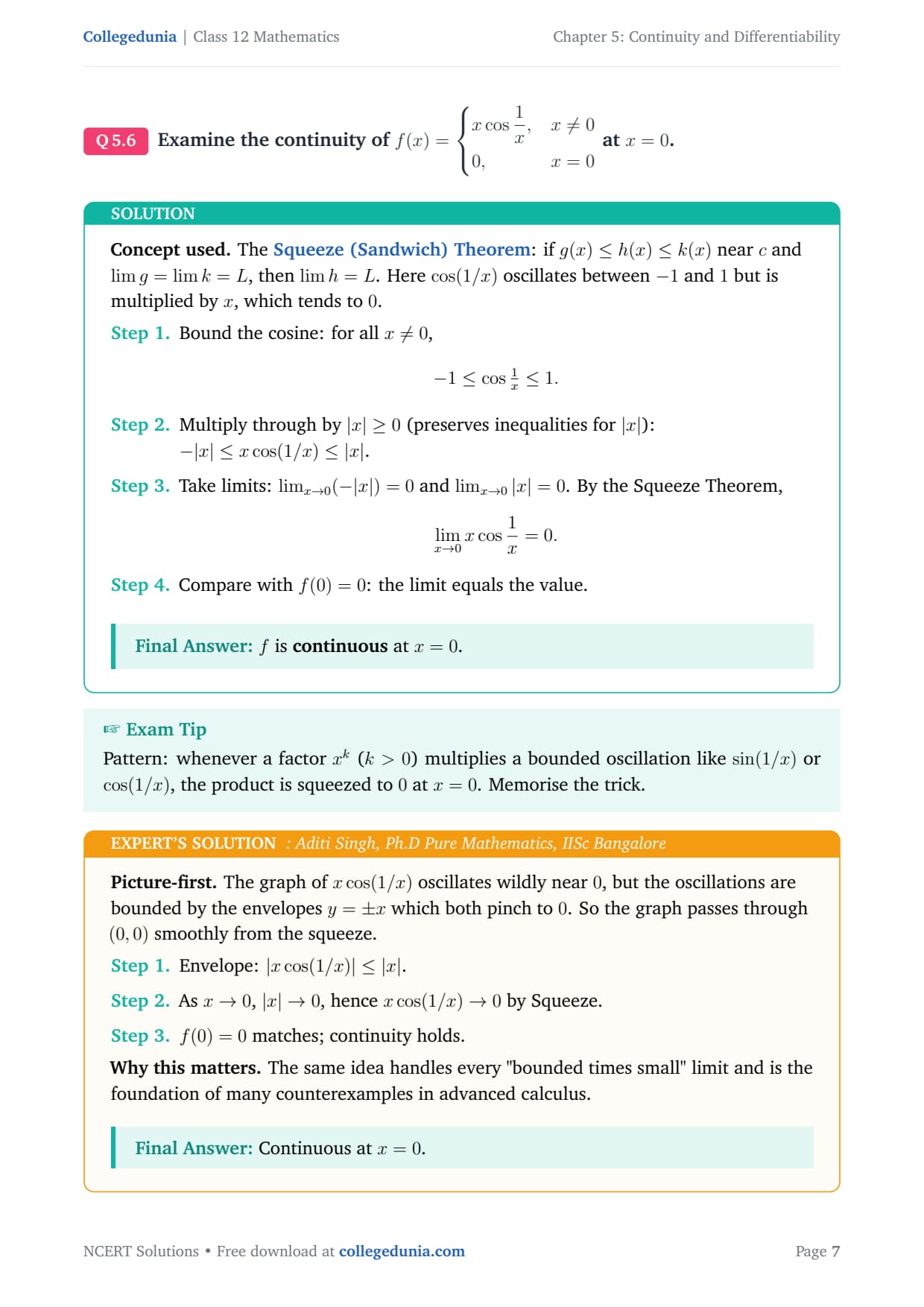
f(x)=cases xcos1x, & x≠ 0 0, & x=0cases
at x=0.
Concept used. The Squeeze (Sandwich) Theorem: if
g(x)≤ h(x)≤ k(x) near c and lim g = lim k = L, then
lim h = L. Here cos(1/x) oscillates between -1 and 1 but is
multiplied by x, which tends to 0.
Bound the cosine: for all x≠ 0,
-1 ≤ cos1x ≤ 1.
Multiply through by |x|≥ 0 (preserves inequalities for
|x|): -|x| ≤ xcos(1/x) ≤ |x|.
Take limits: x→ 0(-|x|)=0 and x→ 0|x|=0.
By the Squeeze Theorem,
x→ 0 xcos1x = 0.
Compare with f(0)=0: the limit equals the value.
f is continuous at x=0.
AS
Aditi Singh
Ph.D Pure Mathematics, IISc Bangalore
Verified Expert
Picture-first. The graph of xcos(1/x) oscillates wildly
near 0, but the oscillations are bounded by the envelopes y=± x
which both pinch to 0. So the graph passes through (0,0) smoothly
from the squeeze.
Envelope: |xcos(1/x)| ≤ |x|.
As x→ 0, |x|→ 0, hence xcos(1/x)→ 0 by Squeeze.
f(0)=0 matches; continuity holds.
Why this matters. The same idea handles every "bounded times
small" limit and is the foundation of many counterexamples in advanced
calculus.
Continuous at x=0.
Q 5.7
Examine the continuity of
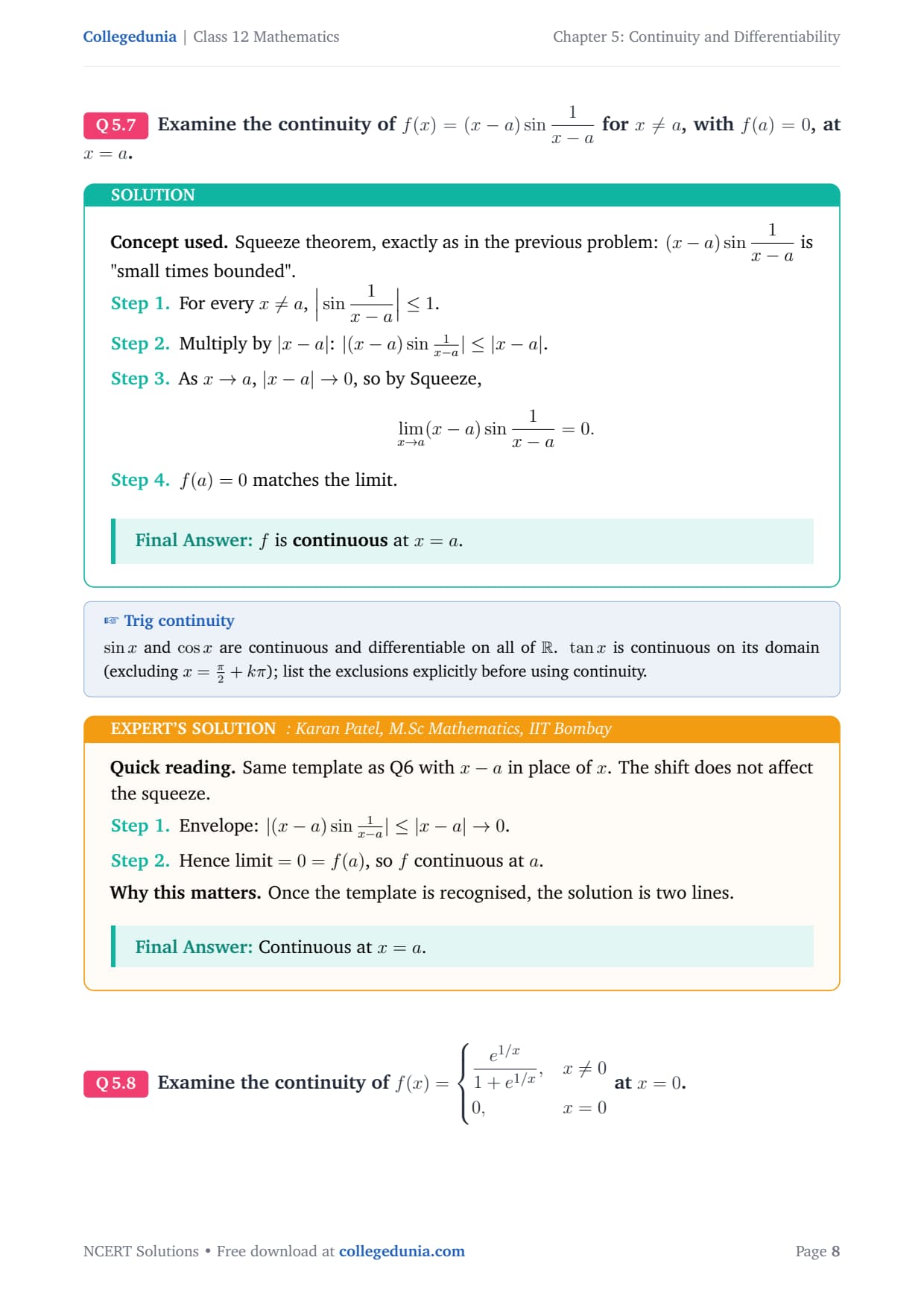
f(x)=(x-a)sin1x-a for x≠ a, with f(a)=0, at x=a.
Concept used. Squeeze theorem, exactly as in the previous
problem: (x-a)sin1x-a is "small times bounded".
For every x≠ a, |sin1x-a|≤ 1.
Multiply by |x-a|: |(x-a)sin1x-a|≤ |x-a|.
As x→ a, |x-a|→ 0, so by Squeeze,
x→ a(x-a)sin1x-a = 0.
f(a)=0 matches the limit.
f is continuous at x=a.
KP
Karan Patel
M.Sc Mathematics, IIT Bombay
Verified Expert
Quick reading. Same template as Q6 with x-a in place of x.
The shift does not affect the squeeze.
Envelope: |(x-a)sin1x-a|≤ |x-a|→ 0.
Hence limit =0=f(a), so f continuous at a.
Why this matters. Once the template is recognised, the
solution is two lines.
Continuous at x=a.
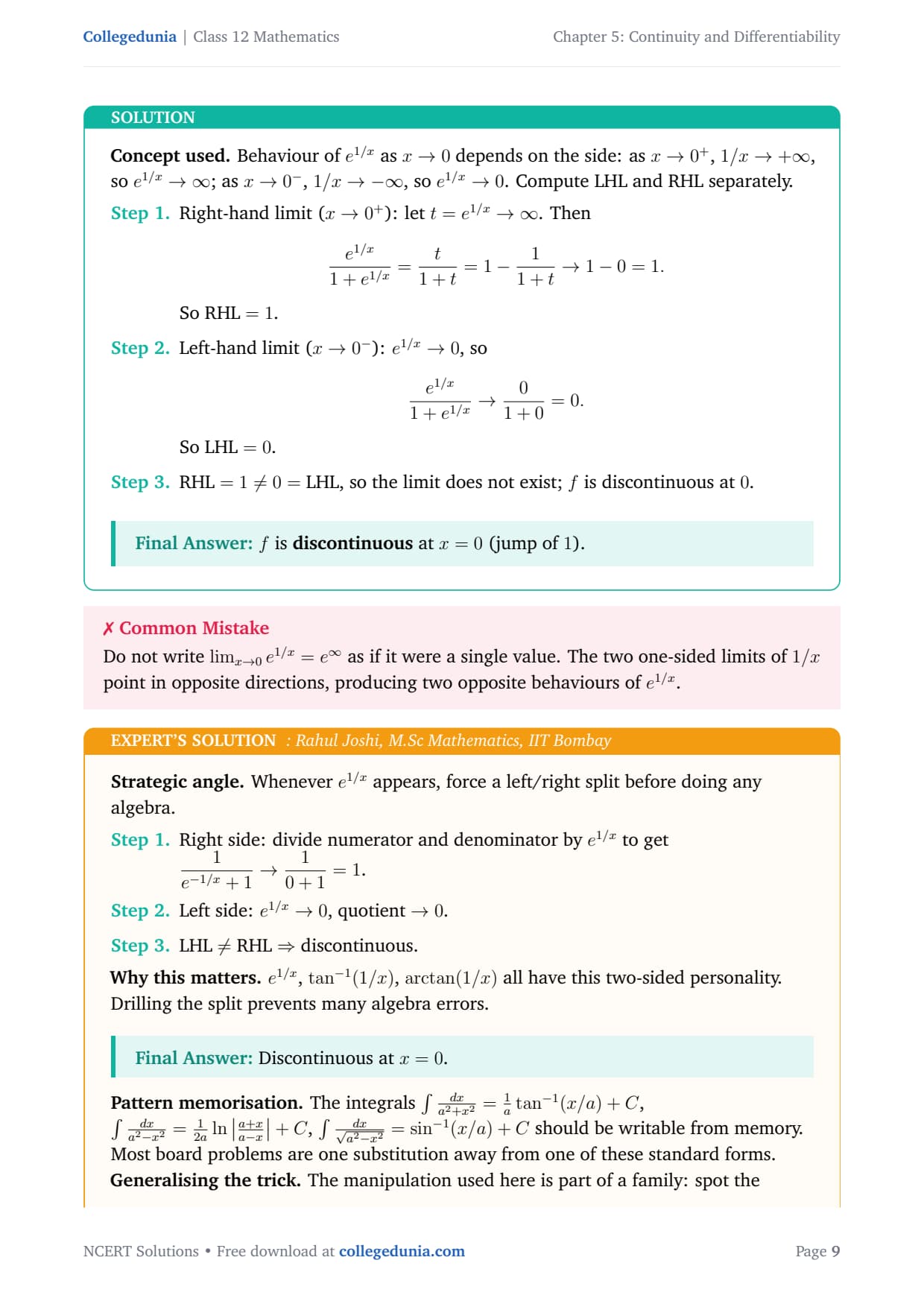
Q 5.8
Examine the continuity of
f(x)=cases e1/x1+e1/x, & x≠ 0
0, & x=0cases at x=0.
Concept used. Behaviour of e1/x as x→ 0 depends on
the side: as x→ 0+, 1/x→ +∞, so e1/x→∞; as
x→ 0-, 1/x→ -∞, so e1/x→ 0. Compute LHL and RHL
separately.
Right-hand limit (x→ 0+): let t=e1/x→∞. Then
e1/x1+e1/x = t1+t
= 1 - 11+t → 1 - 0 = 1.
So RHL =1.
Left-hand limit (x→ 0-): e1/x→ 0, so
e1/x1+e1/x → 01+0 = 0.
So LHL =0.
RHL =1≠ 0 = LHL, so the limit does not exist; f is
discontinuous at 0.
f is discontinuous at x=0 (jump of 1).
RJ
Rahul Joshi
M.Sc Mathematics, IIT Bombay
Verified Expert
Strategic angle. Whenever e1/x appears, force a
left/right split before doing any algebra.
Right side: divide numerator and denominator by e1/x to
get 1e-1/x+1→10+1=1.
Left side: e1/x→ 0, quotient → 0.
LHL ≠ RHL ⇒ discontinuous.
Why this matters.e1/x, tan-1(1/x), arctan(1/x)
all have this two-sided personality. Drilling the split prevents many
algebra errors.
Discontinuous at x=0.
Pattern memorisation. The integrals ∫dxa2+x2=1atan-1(x/a)+C, ∫dxa2-x2=12aln|a+xa-x|+C, ∫dx√a2-x2=sin-1(x/a)+C should be writable from memory. Most board problems are one substitution away from one of these standard forms.
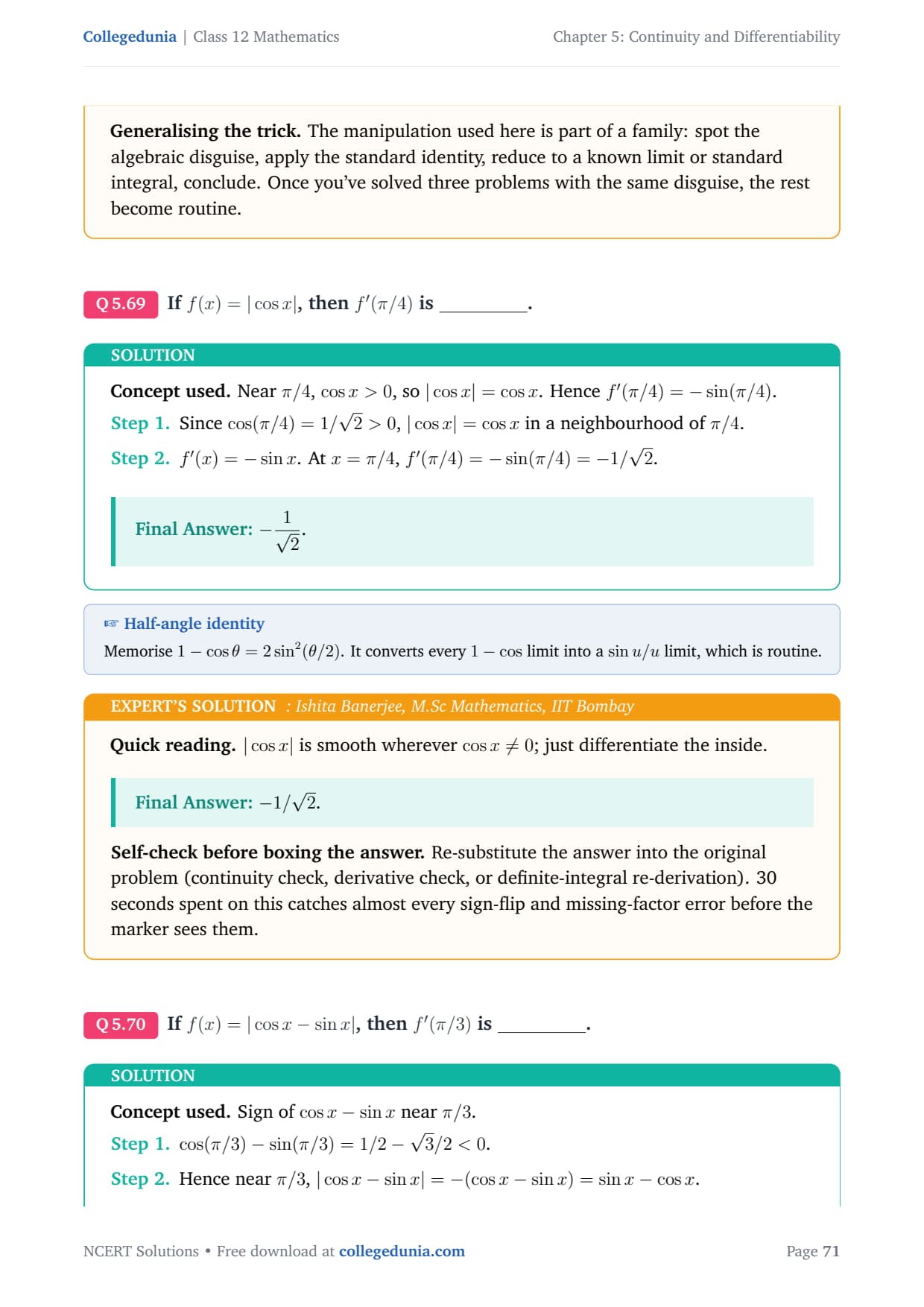
Generalising the trick. The manipulation used here is part of a family: spot the algebraic disguise, apply the standard identity, reduce to a known limit or standard integral, conclude. Once you've solved three problems with the same disguise, the rest become routine.
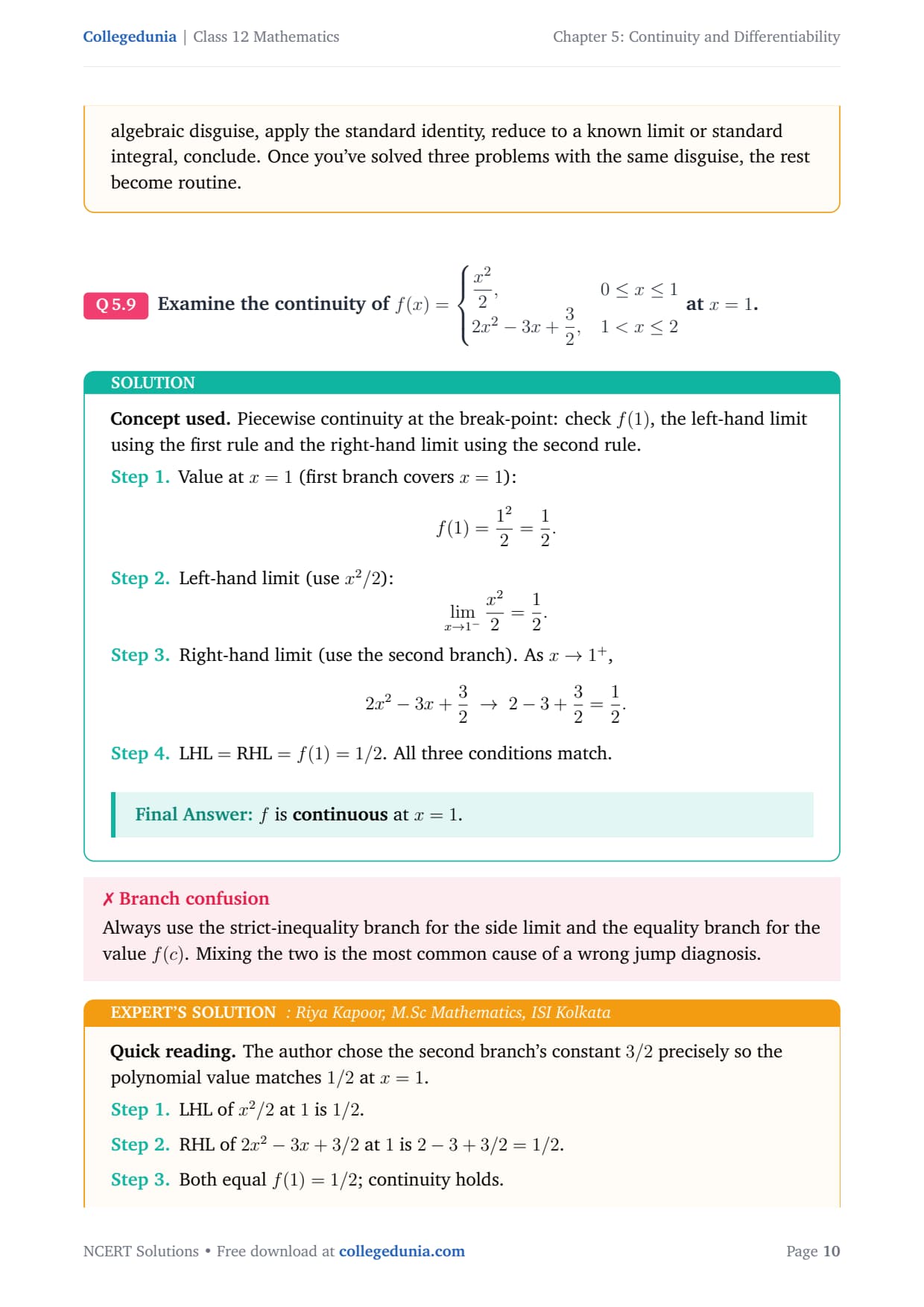
Q 5.9
Examine the continuity of
f(x)=cases x22, & 0≤ x≤ 1
2x2-3x+32, & 1
at x=1.
Concept used. Piecewise continuity at the break-point: check
f(1), the left-hand limit using the first rule and the right-hand
limit using the second rule.
Value at x=1 (first branch covers x=1):
f(1) = 122 = 12.
Left-hand limit (use x2/2):
x→ 1-x22 = 12.
Right-hand limit (use the second branch). As x→ 1+,
2x2-3x+32 → 2-3+32 = 12.
LHL = RHL = f(1) = 1/2. All three conditions match.
f is continuous at x=1.
RK
Riya Kapoor
M.Sc Mathematics, ISI Kolkata
Verified Expert
Quick reading. The author chose the second branch's constant
3/2 precisely so the polynomial value matches 1/2 at x=1.
LHL of x2/2 at 1 is 1/2.
RHL of 2x2-3x+3/2 at 1 is 2-3+3/2=1/2.
Both equal f(1)=1/2; continuity holds.
Why this matters. Piecewise functions in textbooks are often
designed so the break-point matches; verify by computation rather than
trust.
Continuous at x=1.
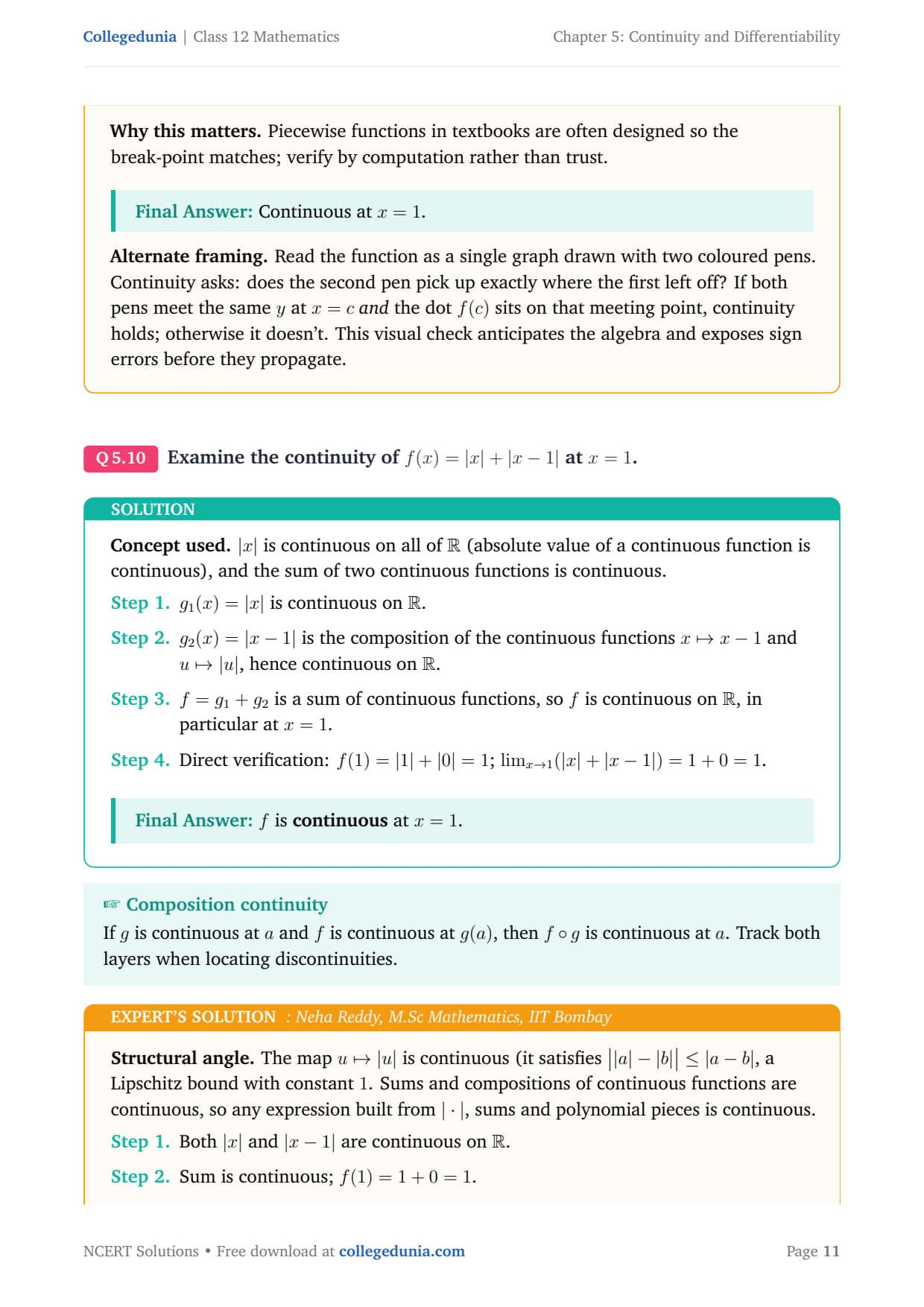
Alternate framing. Read the function as a single graph drawn with two coloured pens. Continuity asks: does the second pen pick up exactly where the first left off? If both pens meet the same y at x=cand the dot f(c) sits on that meeting point, continuity holds; otherwise it doesn't. This visual check anticipates the algebra and exposes sign errors before they propagate.
Q 5.10
Examine the continuity of f(x)=|x|+|x-1| at x=1.
Concept used.|x| is continuous on all of R
(absolute value of a continuous function is continuous), and the sum
of two continuous functions is continuous.
g1(x)=|x| is continuous on R.
g2(x)=|x-1| is the composition of the continuous functions
x↦ x-1 and u↦ |u|, hence continuous on
R.
f=g1+g2 is a sum of continuous functions, so f is
continuous on R, in particular at x=1.
Direct verification: f(1)=|1|+|0|=1;
x→ 1(|x|+|x-1|) = 1+0 = 1.
f is continuous at x=1.
NR
Neha Reddy
M.Sc Mathematics, IIT Bombay
Verified Expert
Structural angle. The map u↦ |u| is continuous (it
satisfies | |a|-|b| | ≤ |a-b|, a Lipschitz bound with
constant 1. Sums and compositions of continuous functions are
continuous, so any expression built from |·|, sums and
polynomial pieces is continuous.
Both |x| and |x-1| are continuous on R.
Sum is continuous; f(1)=1+0=1.
Why this matters. Closure of continuity under sum / product /
composition is the workhorse fact that lets you skip ε-δ
on routine examples.
Continuous at x=1.
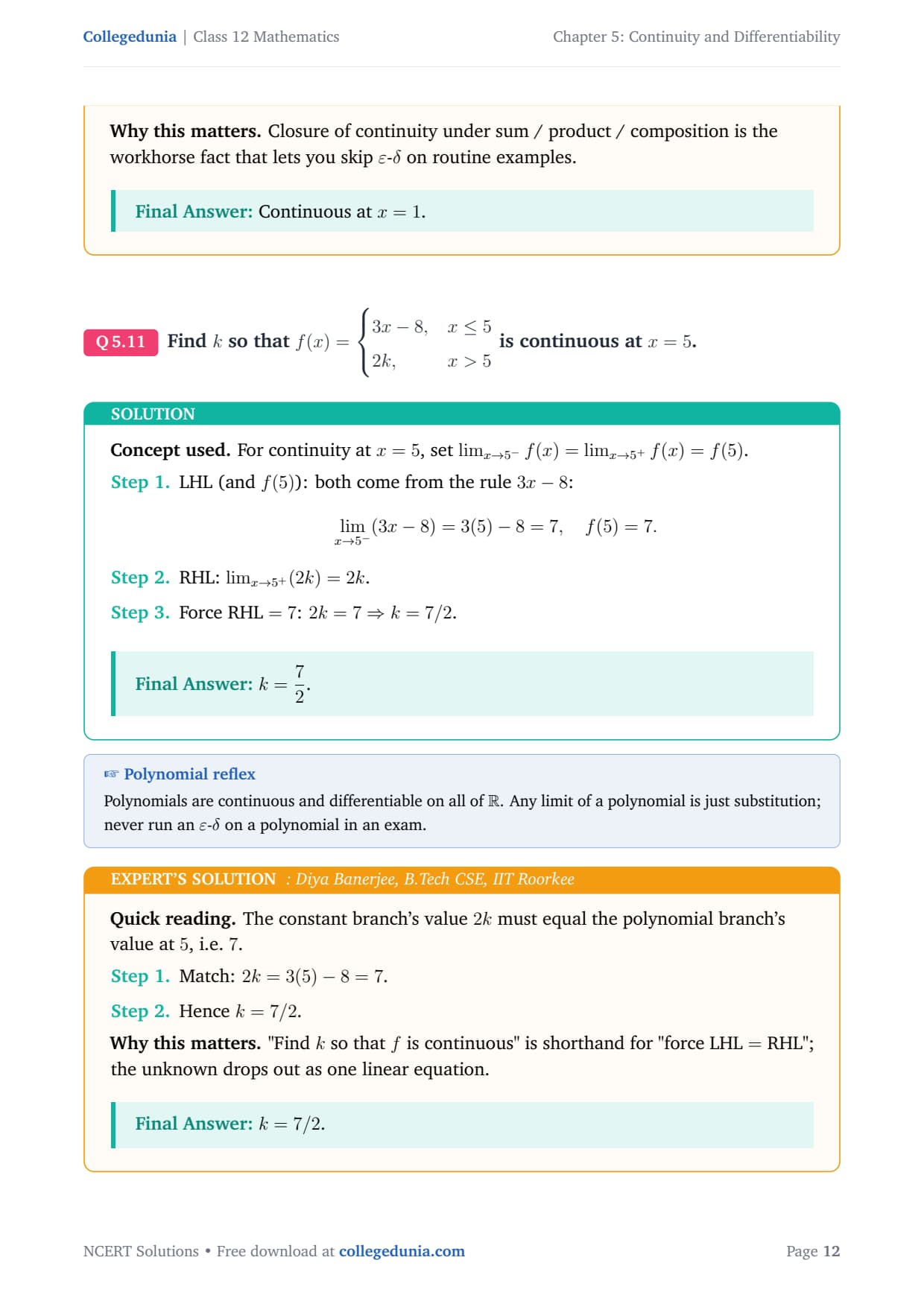
Q 5.11
Find k so that
f(x)=cases 3x-8, & x≤ 5 2k, & x>5cases is continuous at x=5.
Concept used. For continuity at x=5, set
x→ 5-f(x) = x→ 5+f(x) = f(5).
LHL (and f(5)): both come from the rule 3x-8:
x→ 5-(3x-8) = 3(5)-8 = 7, f(5)=7.
RHL: x→ 5+(2k) = 2k.
Force RHL = 7: 2k = 7 ⇒ k = 7/2.
k = 72.
DB
Diya Banerjee
B.Tech CSE, IIT Roorkee
Verified Expert
Quick reading. The constant branch's value 2k must equal
the polynomial branch's value at 5, i.e. 7.
Match: 2k = 3(5)-8 = 7.
Hence k=7/2.
Why this matters. "Find k so that f is continuous" is
shorthand for "force LHL = RHL"; the unknown drops out as one linear
equation.
k=7/2.
Q 5.12
Find k so that
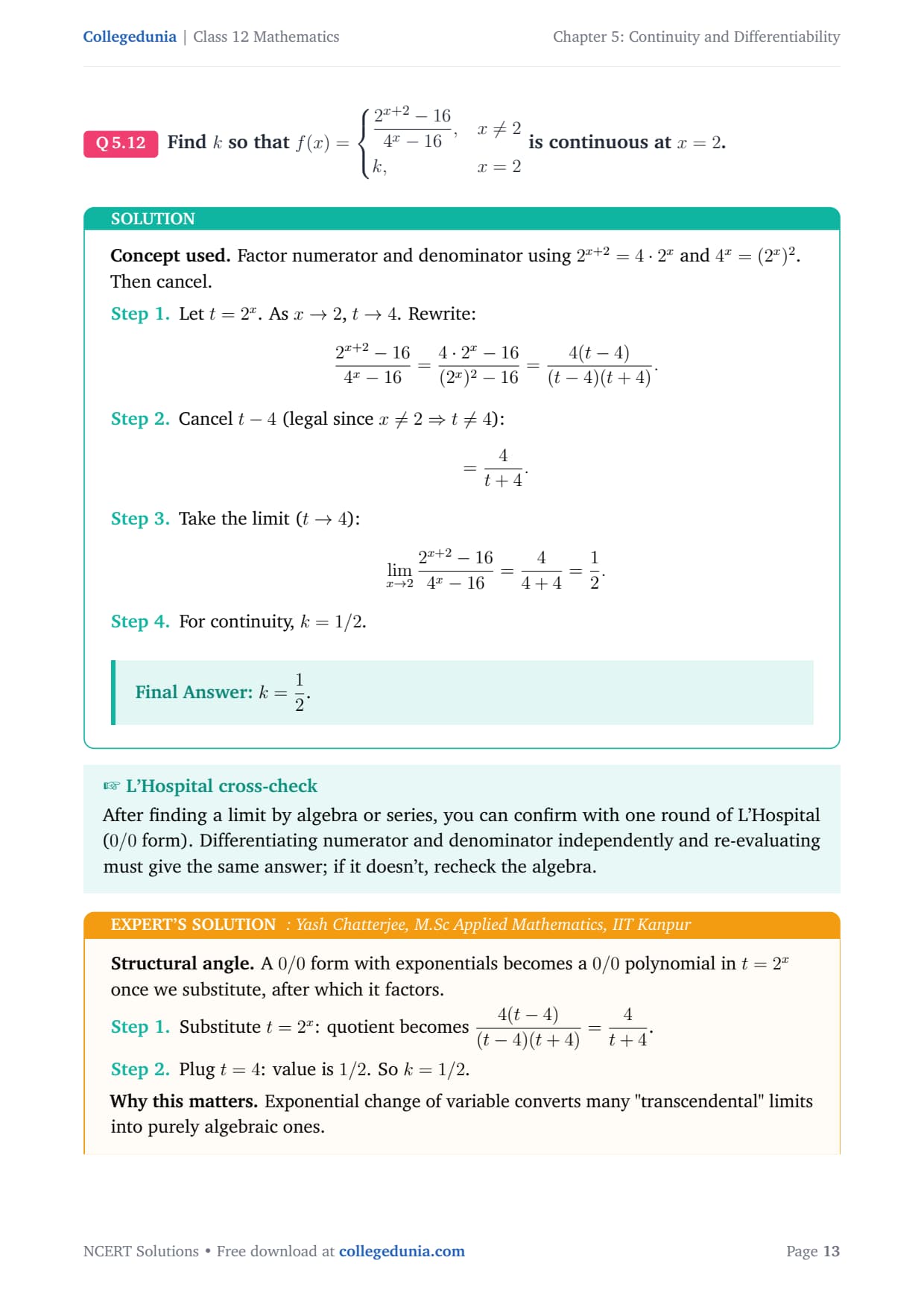
f(x)=cases 2x+2-164x-16, & x≠ 2 k, & x=2cases
is continuous at x=2.
Concept used. Factor numerator and denominator using
2x+2=4· 2x and 4x=(2x)2. Then cancel.
Let t = 2x. As x→ 2, t→ 4. Rewrite:
2x+2-164x-16
= 4· 2x - 16(2x)2 - 16
= 4(t-4)(t-4)(t+4).
Cancel t-4 (legal since x≠ 2 ⇒ t≠ 4):
= 4t+4.
Take the limit (t→ 4):
x→ 22x+2-164x-16
= 44+4 = 12.
For continuity, k = 1/2.
k = 12.
YC
Yash Chatterjee
M.Sc Applied Mathematics, IIT Kanpur
Verified Expert
Structural angle. A 0/0 form with exponentials becomes a
0/0 polynomial in t=2x once we substitute, after which it factors.
Why this matters. Exponential change of variable converts
many "transcendental" limits into purely algebraic ones.
k=1/2.
Why this method is preferred. The shortest correct route in school calculus is almost always: identify the function's category → load the standard template → substitute the specific numbers. Reinventing the technique problem-by-problem is what makes a 90-minute paper feel like 3 hours.
Q 5.13
Find k so that
f(x)=cases √1+kx-√1-kxx, & -1≤ x<0 2x+1x-1, & 0≤ x≤ 1cases
is continuous at x=0.
Concept used. For continuity at 0, set LHL =f(0)= RHL.
Use the conjugate trick to evaluate a 0/0 surd limit.
f(0) comes from the 0≤ x≤ 1 branch:
f(0)=2(0)+10-1 = -1.
LHL (the surd branch): multiply by the conjugate
√1+kx+√1-kx:
√1+kx-√1-kxx
· √1+kx+√1-kx√1+kx+√1-kx
= (1+kx)-(1-kx)x(√1+kx+√1-kx).
Numerator simplifies: (1+kx)-(1-kx)=2kx. So
2kxx(√1+kx+√1-kx)
= 2k√1+kx+√1-kx.
Limit as x→ 0-:
2k√1+√1 = 2k2 = k.
Continuity: LHL = f(0) ⇒ k = -1.
k = -1.
IP
Ishaan Pillai
M.Sc Mathematics, ISI Kolkata
Verified Expert
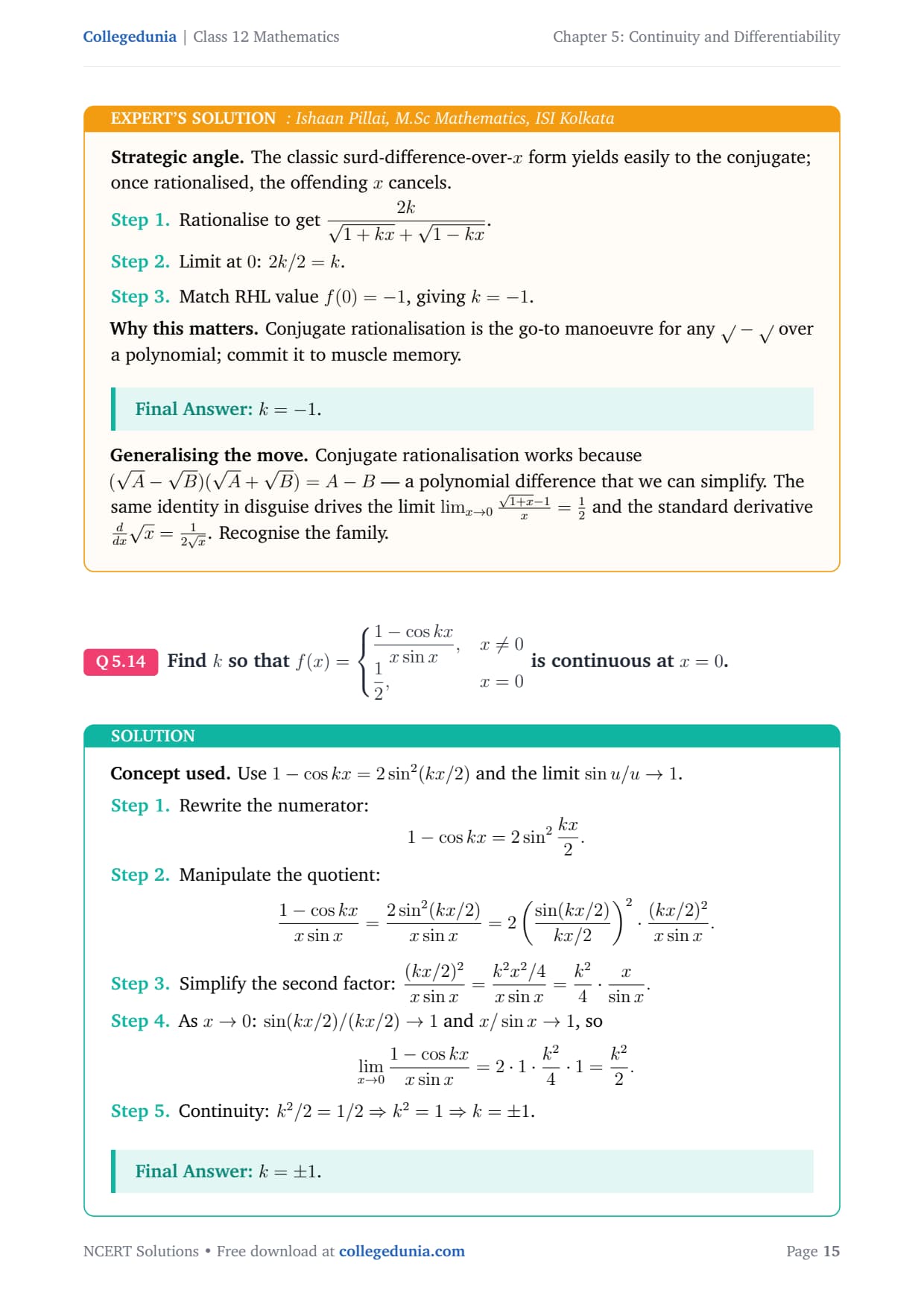
Strategic angle. The classic surd-difference-over-x form
yields easily to the conjugate; once rationalised, the offending x
cancels.
Rationalise to get 2k√1+kx+√1-kx.
Limit at 0: 2k/2 = k.
Match RHL value f(0)=-1, giving k=-1.
Why this matters. Conjugate rationalisation is the
go-to manoeuvre for any √ -√ over a polynomial; commit it
to muscle memory.
k=-1.
Generalising the move. Conjugate rationalisation works because (√A-√B)(√A+√B) = A - B –- a polynomial difference that we can simplify. The same identity in disguise drives the limit x→ 0√1+x-1x=12 and the standard derivative ddx√x=12√x. Recognise the family.
Q 5.14
Find k so that
f(x)=cases 1-cos kxxsin x, & x≠ 0 12, & x=0cases
is continuous at x=0.
Concept used. Use 1-cos kx = 2sin2(kx/2) and the
limit sin u/u→ 1.
Rewrite the numerator:
1-cos kx = 2sin2kx2.
Manipulate the quotient:
1-cos kxxsin x
= 2sin2(kx/2)xsin x
= 2(sin(kx/2)kx/2)2
· (kx/2)2xsin x.
Simplify the second factor:
(kx/2)2xsin x
= k2x2/4xsin x
= k24·xsin x.
As x→ 0: sin(kx/2)/(kx/2)→ 1 and x/sin x→ 1, so
x→ 01-cos kxxsin x
= 2· 1 · k24· 1 = k22.
Continuity: k2/2 = 1/2 ⇒ k2 = 1
⇒ k = ± 1.
k = ± 1.
KN
Krishna Nair
Ph.D Mathematics, IIT Delhi
Verified Expert
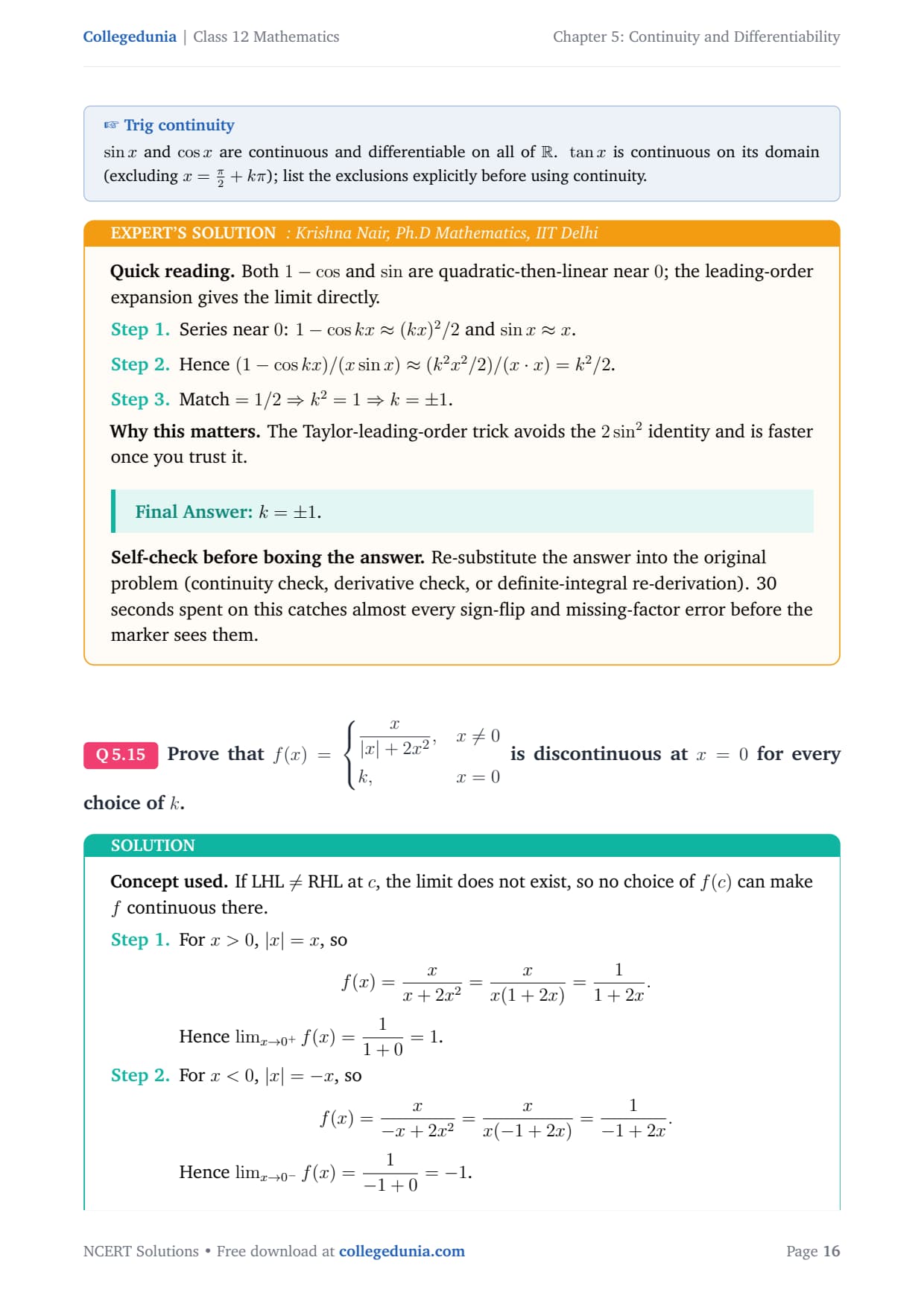
Quick reading. Both 1-cos and sin are quadratic-then-linear
near 0; the leading-order expansion gives the limit directly.
Series near 0: 1-cos kx ≈ (kx)2/2 and sin x≈ x.
Hence (1-cos kx)/(xsin x)≈ (k2 x2/2)/(x· x)=k2/2.
Match =1/2 ⇒ k2=1 ⇒ k=± 1.
Why this matters. The Taylor-leading-order trick avoids the
2sin2 identity and is faster once you trust it.
k=± 1.
Self-check before boxing the answer. Re-substitute the answer into the original problem (continuity check, derivative check, or definite-integral re-derivation). 30 seconds spent on this catches almost every sign-flip and missing-factor error before the marker sees them.
Q 5.15
Prove that f(x)=casesx|x|+2x2, & x≠ 0 k, & x=0cases is discontinuous at x=0 for every choice of k.
Concept used. If LHL ≠ RHL at c, the limit does not
exist, so no choice of f(c) can make f continuous there.
For x>0, |x|=x, so
f(x)=xx+2x2=xx(1+2x)=11+2x.
Hence x→ 0+f(x) = 11+0=1.
For x<0, |x|=-x, so
f(x)=x-x+2x2=xx(-1+2x)=1-1+2x.
Hence x→ 0-f(x) = 1-1+0=-1.
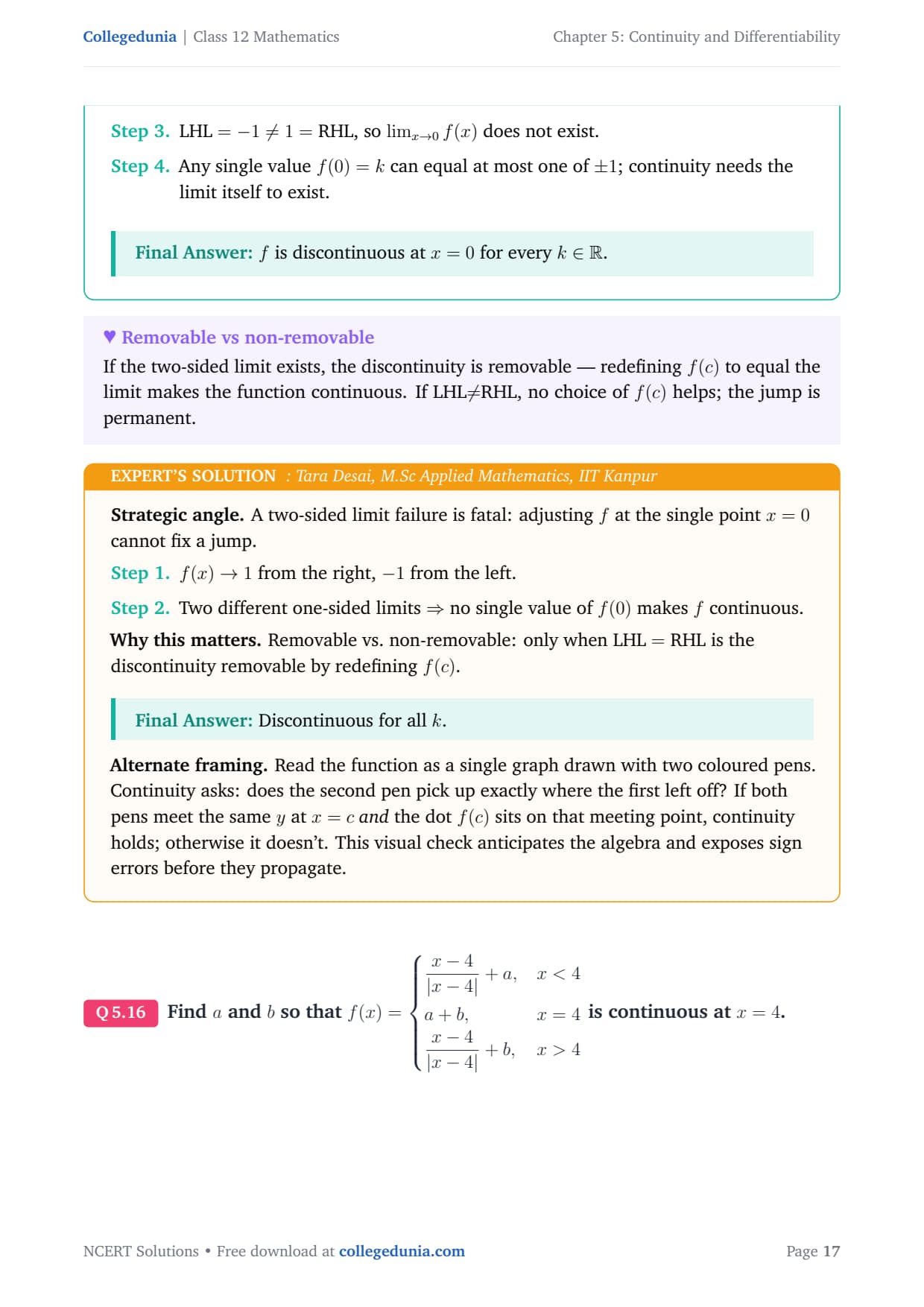
LHL =-1≠ 1= RHL, so x→ 0f(x) does not exist.
Any single value f(0)=k can equal at most one of ± 1;
continuity needs the limit itself to exist.
f is discontinuous at x=0 for every k∈R.
TD
Tara Desai
M.Sc Applied Mathematics, IIT Kanpur
Verified Expert
Strategic angle. A two-sided limit failure is fatal:
adjusting f at the single point x=0 cannot fix a jump.
f(x)→ 1 from the right, -1 from the left.
Two different one-sided limits ⇒ no single value of
f(0) makes f continuous.
Why this matters. Removable vs. non-removable: only when
LHL = RHL is the discontinuity removable by redefining f(c).
Discontinuous for all k.
Alternate framing. Read the function as a single graph drawn with two coloured pens. Continuity asks: does the second pen pick up exactly where the first left off? If both pens meet the same y at x=cand the dot f(c) sits on that meeting point, continuity holds; otherwise it doesn't. This visual check anticipates the algebra and exposes sign errors before they propagate.
Q 5.16
Find a and b so that
f(x)=cases
x-4|x-4|+a, & x<4
a+b, & x=4 x-4|x-4|+b, & x>4
cases is continuous at x=4.
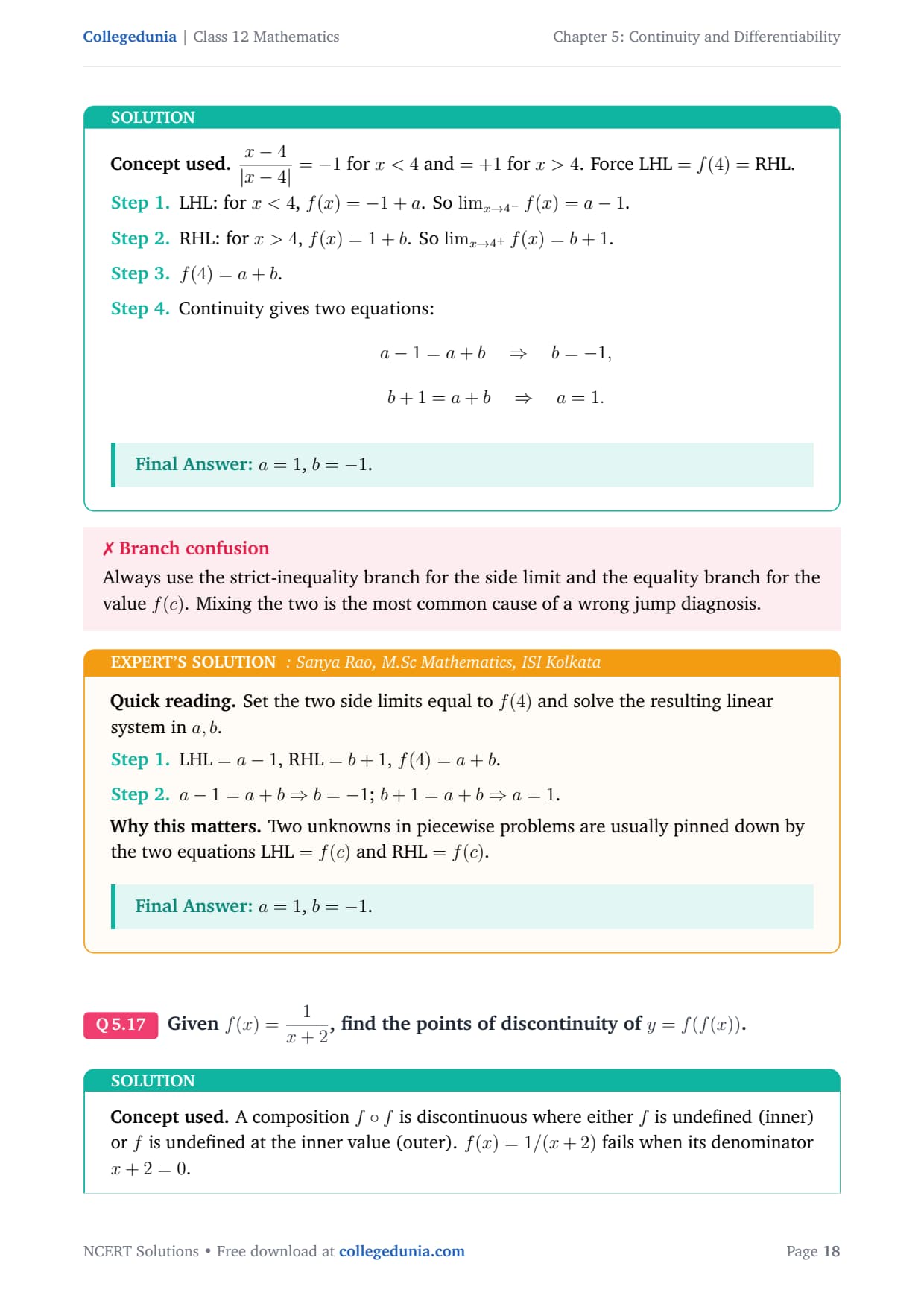
Concept used.x-4|x-4| = -1 for x<4 and =+1
for x>4. Force LHL =f(4) = RHL.
LHL: for x<4, f(x) = -1 + a. So x→ 4-f(x)=a-1.
RHL: for x>4, f(x) = 1 + b. So x→ 4+f(x)=b+1.
f(4) = a+b.
Continuity gives two equations:
a - 1 = a + b ⇒ b = -1, b + 1 = a + b ⇒ a = 1.
a = 1, b = -1.
SR
Sanya Rao
M.Sc Mathematics, ISI Kolkata
Verified Expert
Quick reading. Set the two side limits equal to f(4) and
solve the resulting linear system in a,b.
LHL =a-1, RHL =b+1, f(4)=a+b.
a-1=a+b⇒ b=-1; b+1=a+b⇒ a=1.
Why this matters. Two unknowns in piecewise problems are
usually pinned down by the two equations LHL =f(c) and RHL =f(c).
a=1, b=-1.
Q 5.17
Given f(x)=1x+2, find the points of discontinuity of
y=f(f(x)).
Concept used. A composition f∘ f is discontinuous where
either f is undefined (inner) or f is undefined at the inner value
(outer). f(x)=1/(x+2) fails when its denominator x+2=0.
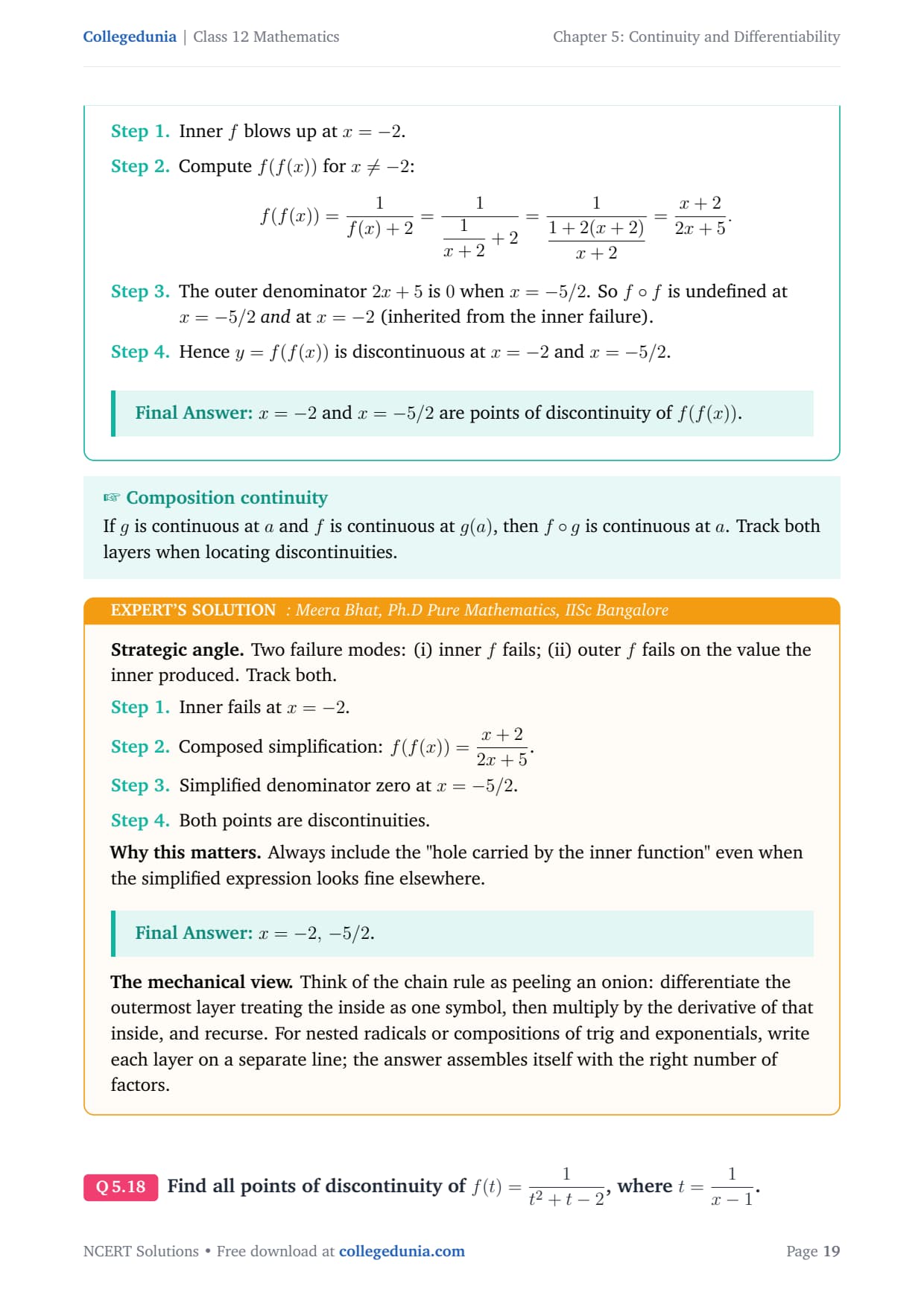
The outer denominator 2x+5 is 0 when x=-5/2. So f∘ f
is undefined at x=-5/2and at x=-2 (inherited from
the inner failure).
Hence y=f(f(x)) is discontinuous at x=-2 and x=-5/2.
x=-2 and x=-5/2 are points of discontinuity of f(f(x)).
MB
Meera Bhat
Ph.D Pure Mathematics, IISc Bangalore
Verified Expert
Strategic angle. Two failure modes: (i) inner f fails;
(ii) outer f fails on the value the inner produced. Track both.
Inner fails at x=-2.
Composed simplification: f(f(x))=x+22x+5.
Simplified denominator zero at x=-5/2.
Both points are discontinuities.
Why this matters. Always include the "hole carried by the
inner function" even when the simplified expression looks fine
elsewhere.
x = -2, -5/2.
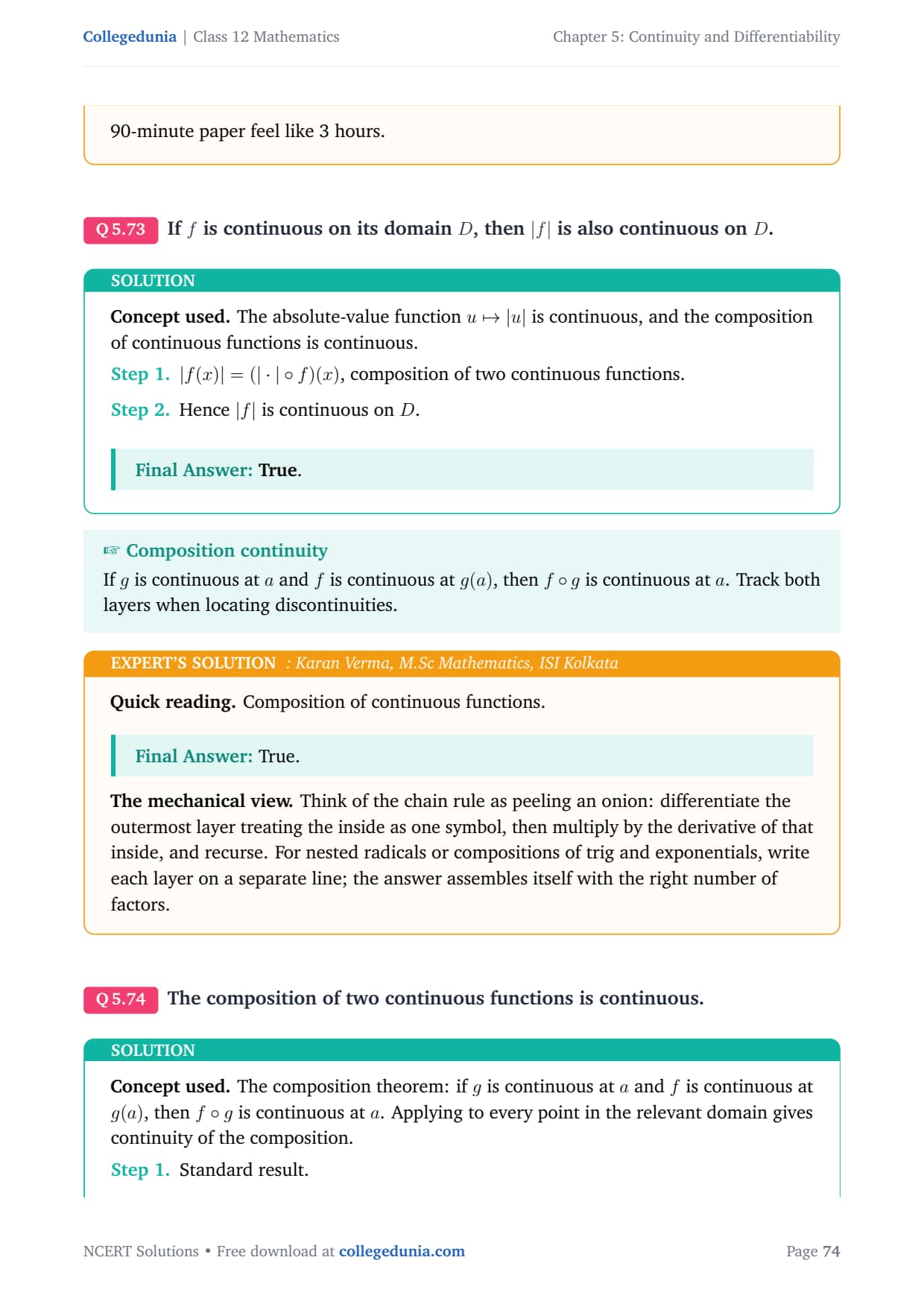
The mechanical view. Think of the chain rule as peeling an onion: differentiate the outermost layer treating the inside as one symbol, then multiply by the derivative of that inside, and recurse. For nested radicals or compositions of trig and exponentials, write each layer on a separate line; the answer assembles itself with the right number of factors.
Q 5.18
Find all points of discontinuity of
f(t)=1t2+t-2, where t=1x-1.
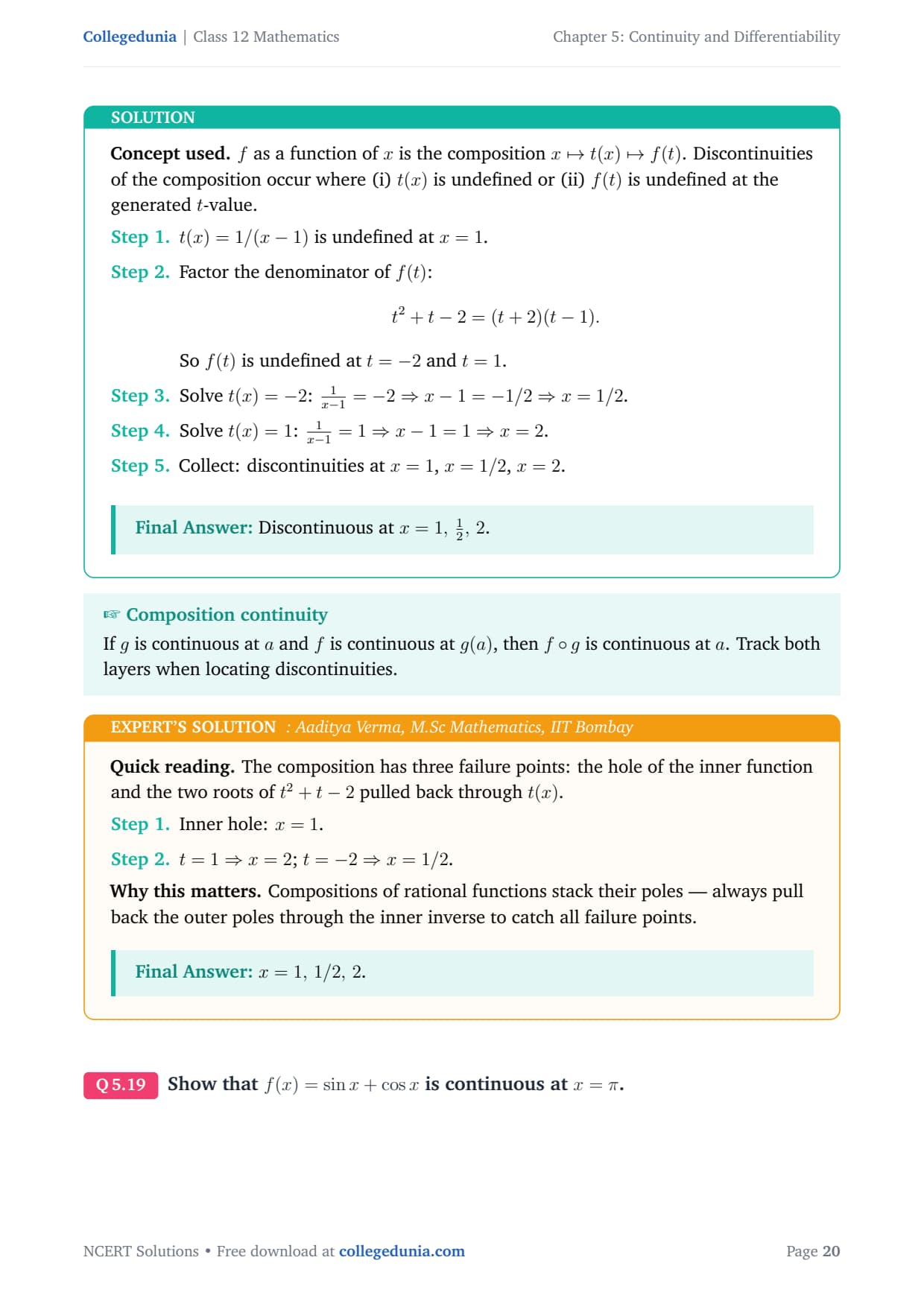
Concept used.f as a function of x is the composition
x↦ t(x)↦ f(t). Discontinuities of the composition occur
where (i) t(x) is undefined or (ii) f(t) is undefined at the
generated t-value.
t(x)=1/(x-1) is undefined at x=1.
Factor the denominator of f(t):
t2+t-2 = (t+2)(t-1).
So f(t) is undefined at t=-2 and t=1.
Solve t(x)=-2:
1x-1=-2⇒ x-1=-1/2⇒ x=1/2.
Solve t(x)=1:
1x-1=1⇒ x-1=1⇒ x=2.
Collect: discontinuities at x=1, x=1/2, x=2.
Discontinuous at x=1, 12, 2.
AV
Aaditya Verma
M.Sc Mathematics, IIT Bombay
Verified Expert
Quick reading. The composition has three failure points: the
hole of the inner function and the two roots of t2+t-2 pulled back
through t(x).
Inner hole: x=1.
t=1⇒ x=2; t=-2⇒ x=1/2.
Why this matters. Compositions of rational functions stack
their poles –- always pull back the outer poles through the inner
inverse to catch all failure points.
x=1, 1/2, 2.
Q 5.19
Show that f(x)=sin x+cos x is continuous at x=π.
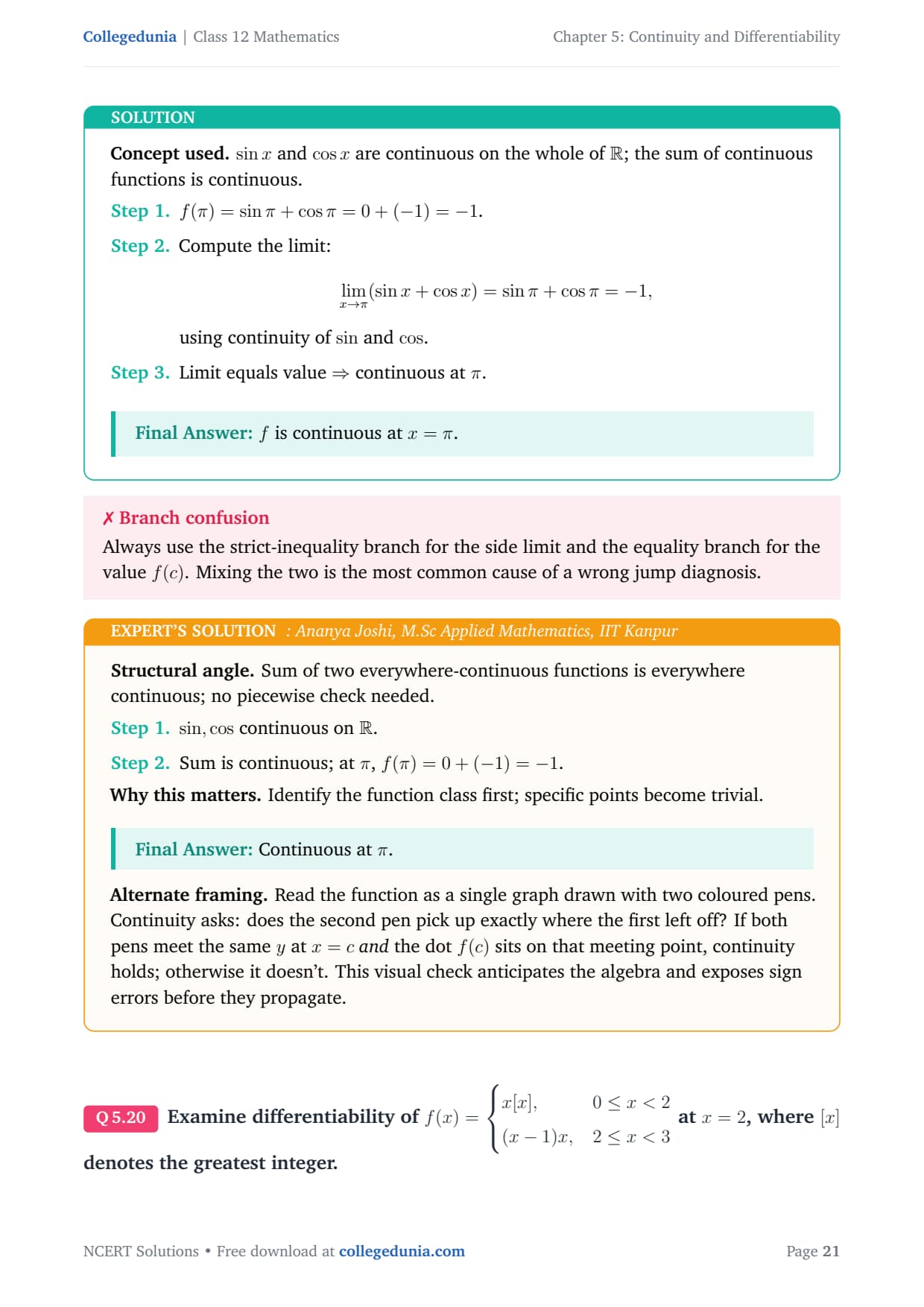
Concept used.sin x and cos x are continuous on the
whole of R; the sum of continuous functions is continuous.
f(π)=sinπ+cosπ = 0 + (-1) = -1.
Compute the limit:
xπ(sin x + cos x)
= sinπ + cosπ = -1,
using continuity of sin and cos.
Limit equals value ⇒ continuous at π.
f is continuous at x=π.
AJ
Ananya Joshi
M.Sc Applied Mathematics, IIT Kanpur
Verified Expert
Structural angle. Sum of two everywhere-continuous functions
is everywhere continuous; no piecewise check needed.
sin,cos continuous on R.
Sum is continuous; at π, f(π)=0+(-1)=-1.
Why this matters. Identify the function class first; specific
points become trivial.
Continuous at π.
Alternate framing. Read the function as a single graph drawn with two coloured pens. Continuity asks: does the second pen pick up exactly where the first left off? If both pens meet the same y at x=cand the dot f(c) sits on that meeting point, continuity holds; otherwise it doesn't. This visual check anticipates the algebra and exposes sign errors before they propagate.
Q 5.20
Examine differentiability of
f(x)=cases x[x], & 0≤ x<2 (x-1)x, & 2≤ x<3cases
at x=2, where [x] denotes the greatest integer.
Concept used. For differentiability at the break-point we
need (i) continuity at the point and (ii) Lf'(c)=Rf'(c).
Near x=2 from the left, 1≤ x<2 so [x]=1, giving
f(x)=x· 1 = x.
At x=2 and just to the right, the second rule applies:
f(x)=(x-1)x = x2-x. At x=2, f(2)=4-2=2.
Continuity check:
LHL =x→ 2-x = 2.
RHL =x→ 2+(x2-x) = 4-2=2.
Both equal f(2)=2, so f is continuous at 2.
Left derivative: on (1,2), f(x)=x, so
Lf'(2)=ddxx |x=2=1.
Right derivative: on [2,3), f(x)=x2-x, so
Rf'(2)=2x-1 |x=2=3.
Lf'(2)=1≠ 3=Rf'(2), so f is not differentiable at 2.
f is continuous but not differentiable at x=2.
AP
Arjun Pillai
B.Tech Engineering Physics, IIT Bombay
Verified Expert
Picture-first. On [1,2) the graph is the line y=x; on
[2,3) it is the parabola y=x2-x. They meet at (2,2), but the
line has slope 1 while the parabola has slope 2x-1=3 there.
LHL =2, RHL =2, f(2)=2⇒ continuous.
Lf'(2) = 1, Rf'(2) = 3⇒ not differentiable.
Why this matters. Corners (slope mismatch) are the most
common cause of non-differentiability after vertical-tangent failures.
Continuous at x=2; not differentiable at x=2.
Alternate framing. Read the function as a single graph drawn with two coloured pens. Continuity asks: does the second pen pick up exactly where the first left off? If both pens meet the same y at x=cand the dot f(c) sits on that meeting point, continuity holds; otherwise it doesn't. This visual check anticipates the algebra and exposes sign errors before they propagate.
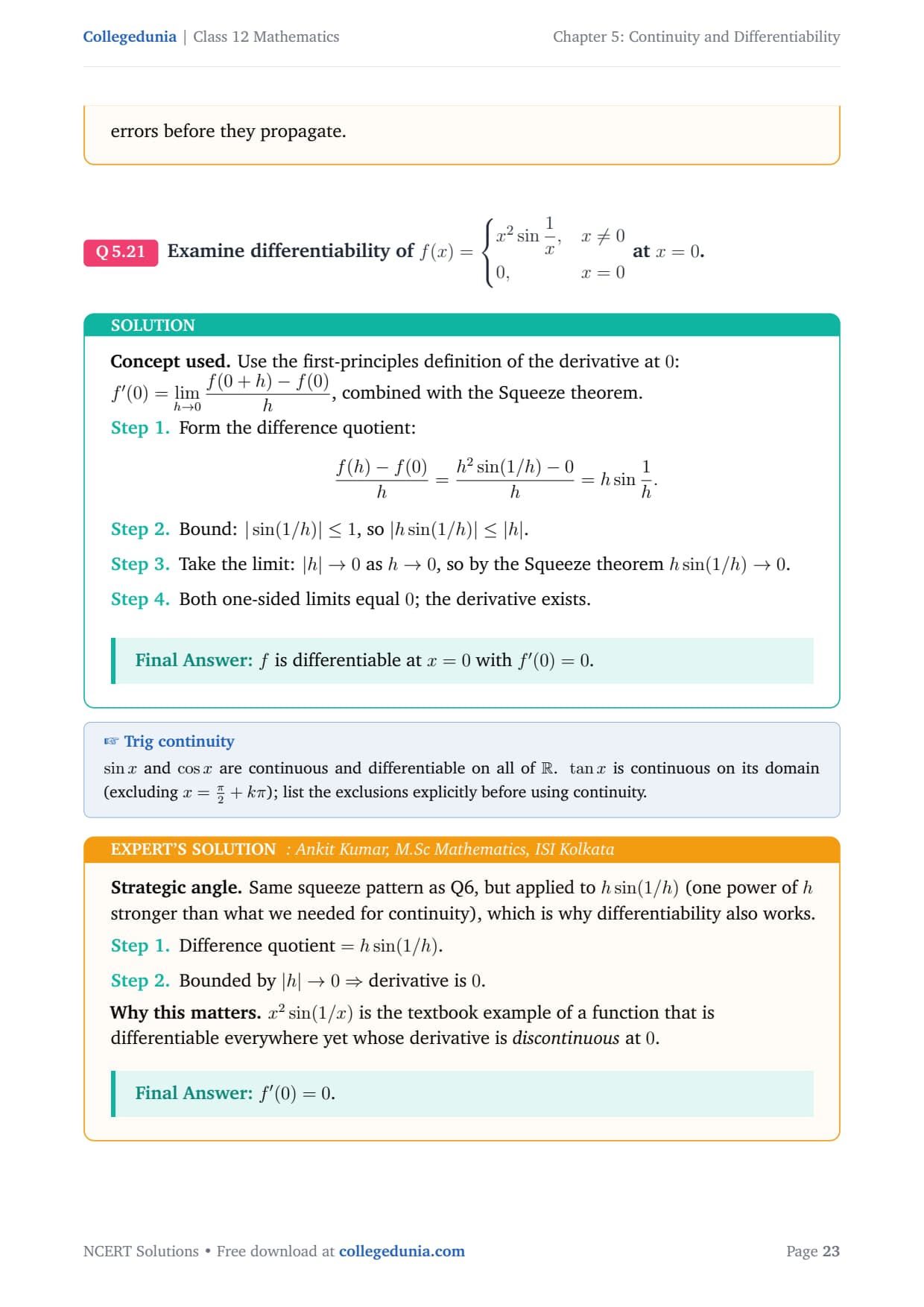
Q 5.21
Examine differentiability of
f(x)=cases x2sin1x, & x≠ 0
0, & x=0cases at x=0.
Concept used. Use the first-principles definition of the
derivative at 0:
f'(0)=h→ 0f(0+h)-f(0)h,
combined with the Squeeze theorem.
Form the difference quotient:
f(h)-f(0)h
= h2sin(1/h) - 0h
= hsin1h.
Bound: |sin(1/h)|≤ 1, so |hsin(1/h)|≤ |h|.
Take the limit: |h|→ 0 as h→ 0, so by the Squeeze
theorem hsin(1/h)→ 0.
Both one-sided limits equal 0; the derivative exists.
f is differentiable at x=0 with f'(0)=0.
AK
Ankit Kumar
M.Sc Mathematics, ISI Kolkata
Verified Expert
Strategic angle. Same squeeze pattern as Q6, but applied to
hsin(1/h) (one power of h stronger than what we needed for
continuity), which is why differentiability also works.
Difference quotient =hsin(1/h).
Bounded by |h|→ 0⇒ derivative is 0.
Why this matters.x2sin(1/x) is the textbook example of a
function that is differentiable everywhere yet whose derivative is
discontinuous at 0.
f'(0)=0.
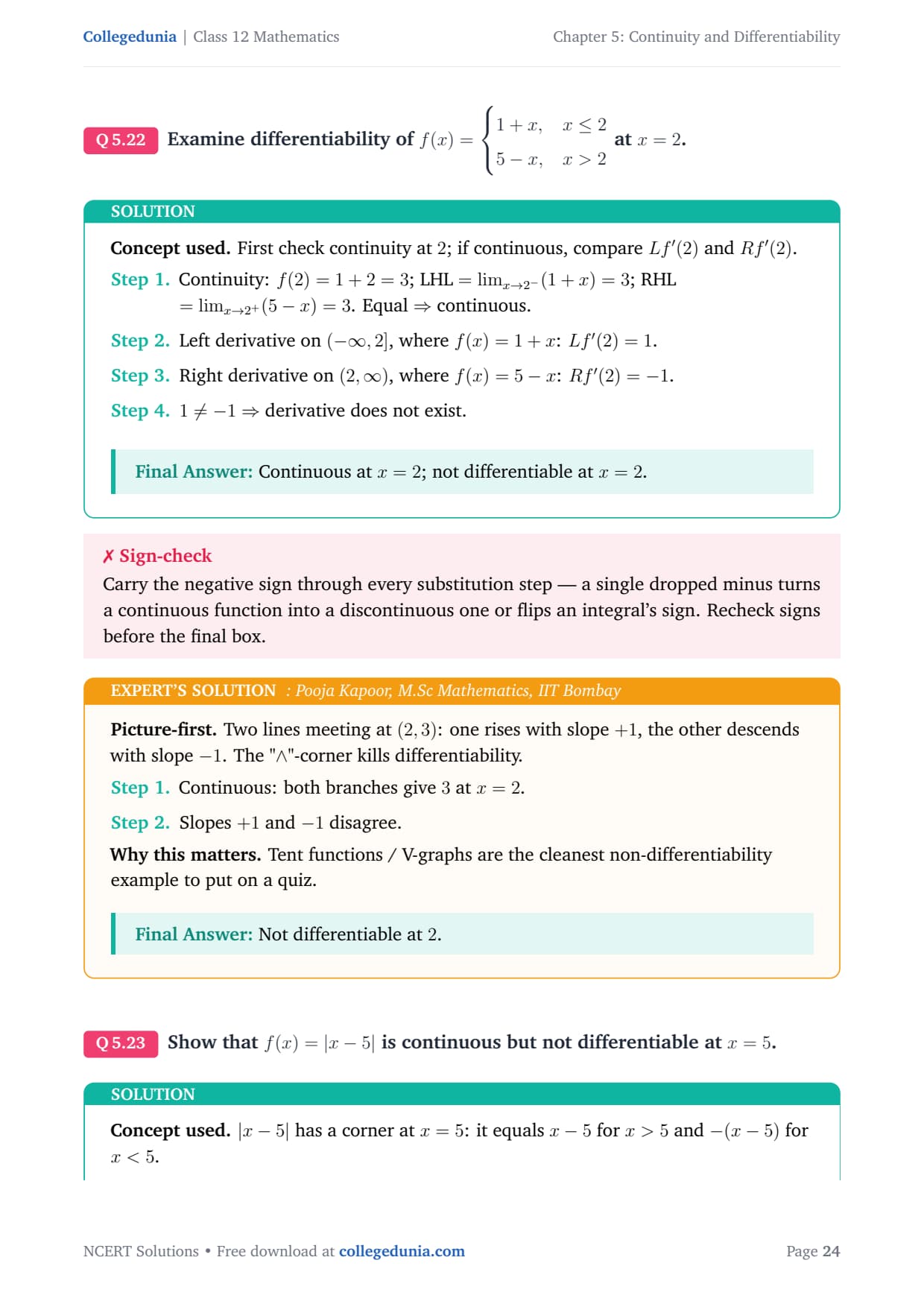
Q 5.22
Examine differentiability of
f(x)=cases 1+x, & x≤ 2 5-x, & x>2cases at x=2.
Concept used. First check continuity at 2; if continuous,
compare Lf'(2) and Rf'(2).
Left derivative on (- ∞,2], where f(x)=1+x:
Lf'(2)=1.
Right derivative on (2,∞), where f(x)=5-x:
Rf'(2)=-1.
1≠ -1⇒ derivative does not exist.
Continuous at x=2; not differentiable at x=2.
PK
Pooja Kapoor
M.Sc Mathematics, IIT Bombay
Verified Expert
Picture-first. Two lines meeting at (2,3): one rises with
slope +1, the other descends with slope -1. The ""-corner
kills differentiability.
Continuous: both branches give 3 at x=2.
Slopes +1 and -1 disagree.
Why this matters. Tent functions / V-graphs are the cleanest
non-differentiability example to put on a quiz.
Not differentiable at 2.
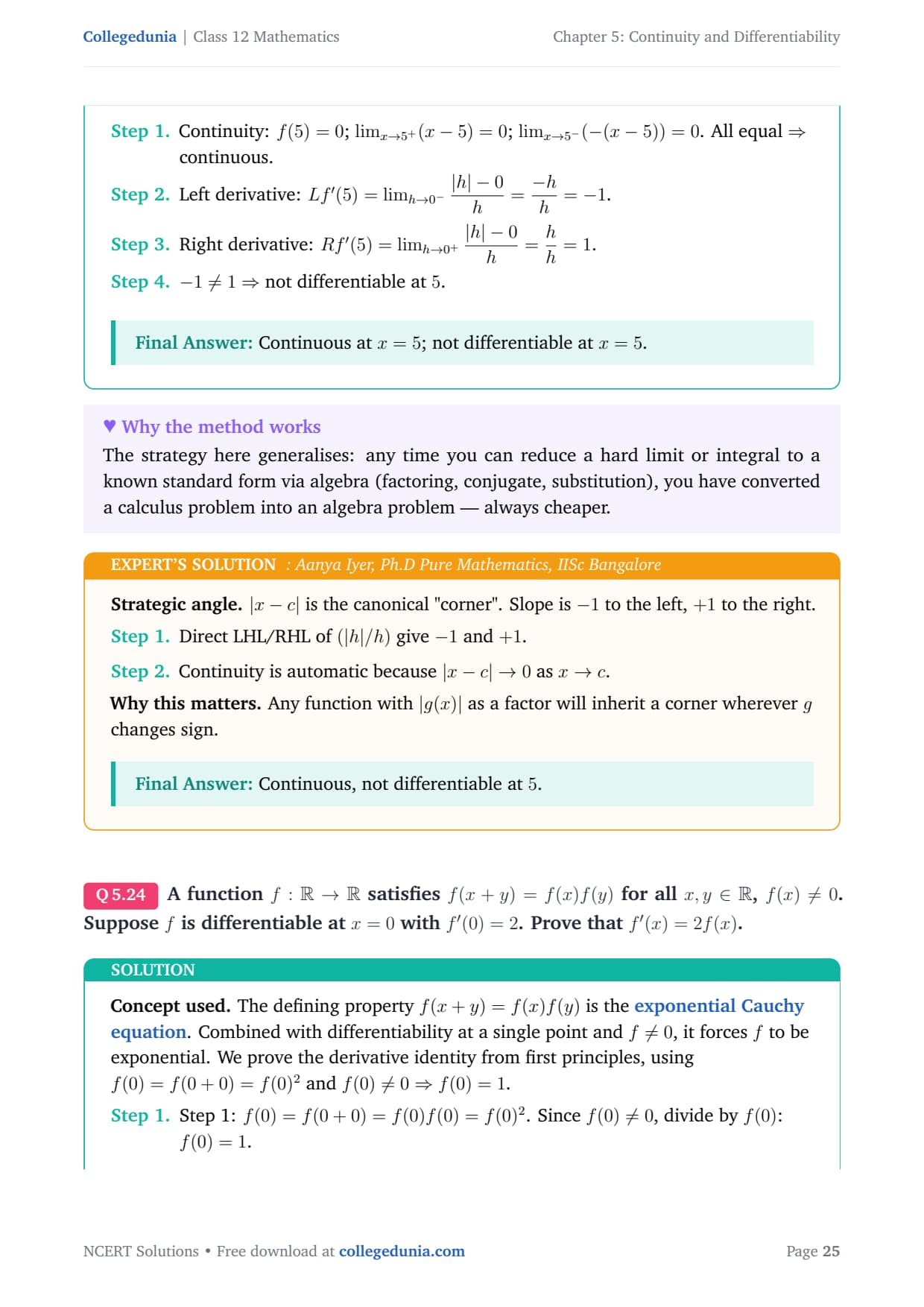
Q 5.23
Show that f(x)=|x-5| is continuous but not differentiable
at x=5.
Concept used.|x-5| has a corner at x=5: it equals
x-5 for x>5 and -(x-5) for x<5.
Continuity: f(5)=0;
x→ 5+(x-5)=0;
x→ 5-(-(x-5))=0. All equal ⇒ continuous.
Left derivative:
Lf'(5)=h→ 0-|h|-0h=-hh=-1.
Right derivative:
Rf'(5)=h→ 0+|h|-0h=hh=1.
-1≠ 1⇒ not differentiable at 5.
Continuous at x=5; not differentiable at x=5.
AI
Aanya Iyer
Ph.D Pure Mathematics, IISc Bangalore
Verified Expert
Strategic angle.|x-c| is the canonical "corner". Slope is
-1 to the left, +1 to the right.
Direct LHL/RHL of (|h|/h) give -1 and +1.
Continuity is automatic because |x-c|→ 0 as x→ c.
Why this matters. Any function with |g(x)| as a factor will
inherit a corner wherever g changes sign.
Continuous, not differentiable at 5.
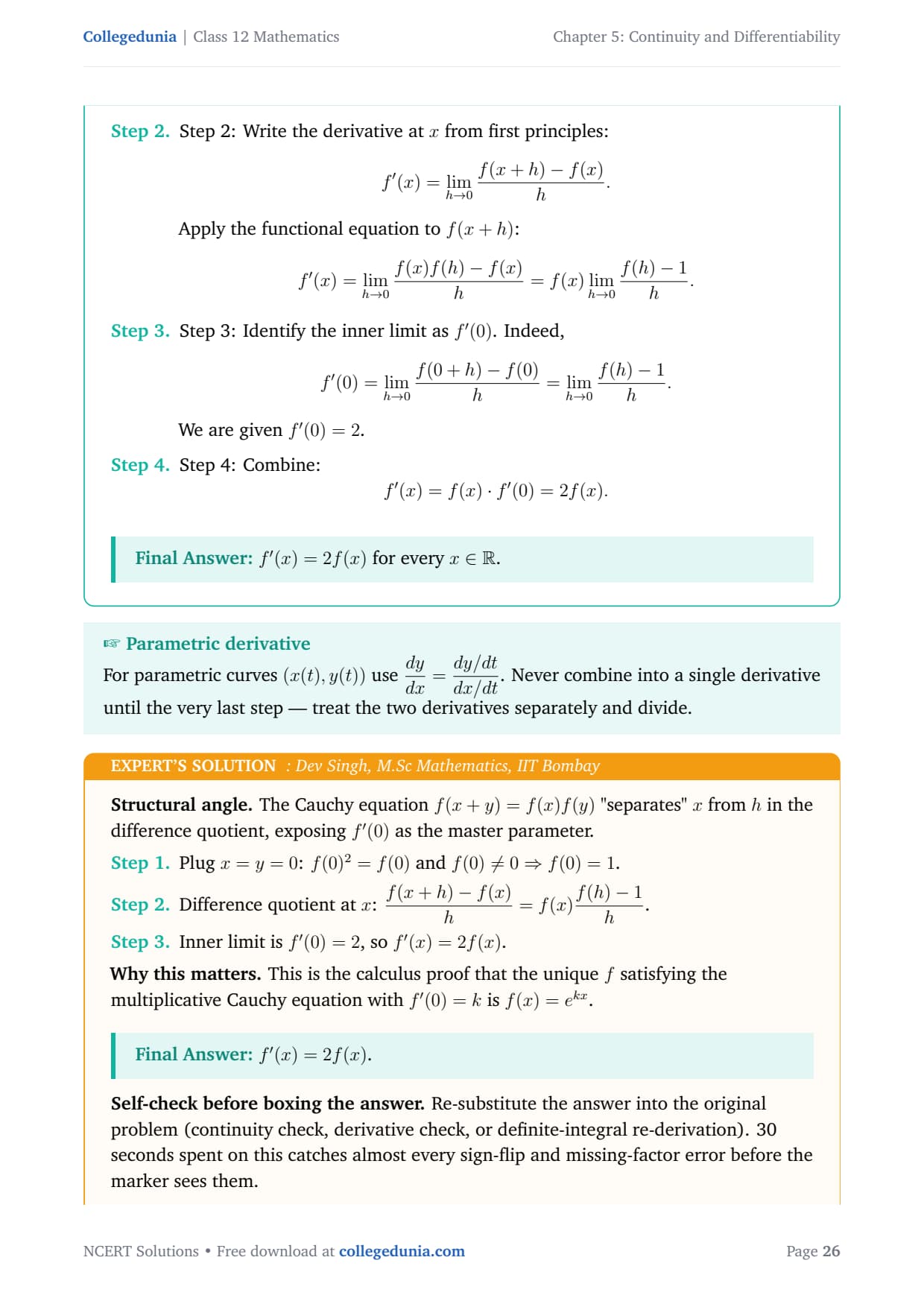
Q 5.24
A function f:R→R satisfies
f(x+y)=f(x)f(y) for all x,y∈R, f(x)≠ 0. Suppose f is
differentiable at x=0 with f'(0)=2. Prove that f'(x)=2f(x).
Concept used. The defining property f(x+y)=f(x)f(y) is the
exponential Cauchy equation. Combined with differentiability
at a single point and f≠ 0, it forces f to be exponential. We
prove the derivative identity from first principles, using
f(0)=f(0+0)=f(0)2 and f(0)≠ 0⇒ f(0)=1.
Step 1: f(0)=f(0+0)=f(0)f(0)=f(0)2. Since f(0)≠ 0,
divide by f(0): f(0)=1.
Step 2: Write the derivative at x from first principles:
f'(x) = h→ 0f(x+h)-f(x)h.
Apply the functional equation to f(x+h):
f'(x) = h→ 0f(x)f(h)-f(x)h
= f(x)h→ 0f(h)-1h.
Step 3: Identify the inner limit as f'(0). Indeed,
f'(0) = h→ 0f(0+h)-f(0)h
= h→ 0f(h)-1h.
We are given f'(0)=2.
Step 4: Combine:
f'(x) = f(x)· f'(0) = 2f(x).
f'(x)=2f(x) for every x∈R.
DS
Dev Singh
M.Sc Mathematics, IIT Bombay
Verified Expert
Structural angle. The Cauchy equation f(x+y)=f(x)f(y)
"separates" x from h in the difference quotient, exposing f'(0)
as the master parameter.
Plug x=y=0: f(0)2=f(0) and f(0)≠ 0 ⇒ f(0)=1.
Difference quotient at x: f(x+h)-f(x)h=f(x)f(h)-1h.
Inner limit is f'(0)=2, so f'(x)=2f(x).
Why this matters. This is the calculus proof that the unique
f satisfying the multiplicative Cauchy equation with f'(0)=k is
f(x)=ekx.
f'(x)=2f(x).
Self-check before boxing the answer. Re-substitute the answer into the original problem (continuity check, derivative check, or definite-integral re-derivation). 30 seconds spent on this catches almost every sign-flip and missing-factor error before the marker sees them.
What examiners reward. Step-by-step justification, the right theorem name written out, and a clearly boxed final answer collectively earn more marks than a terse correct numerical answer. The expert solution above is laid out exactly this way for that reason.
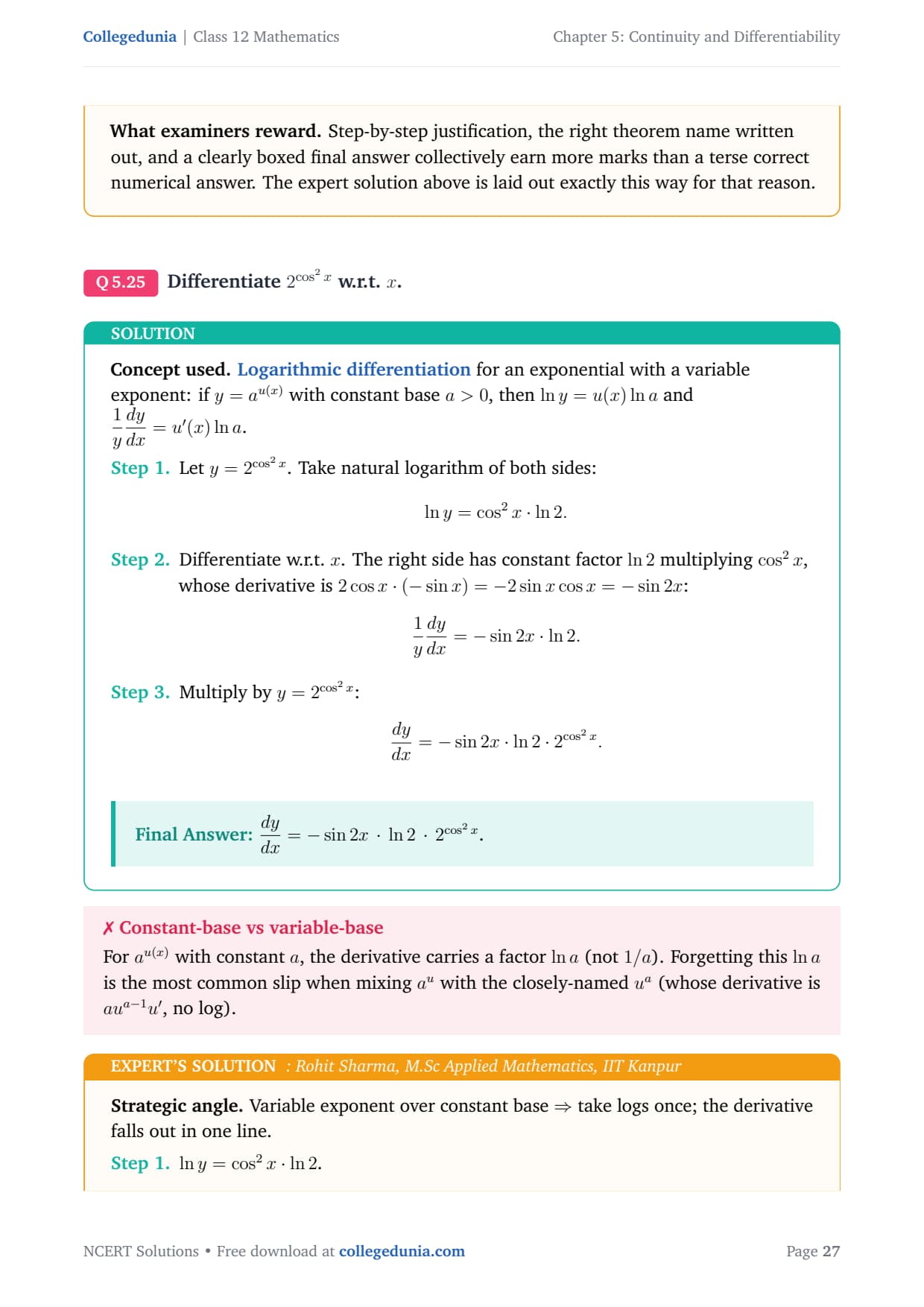
Q 5.25
Differentiate 2cos2x w.r.t. x.
Concept used.Logarithmic differentiation for an
exponential with a variable exponent: if y=au(x) with constant
base a>0, then ln y = u(x)ln a and
1ydydx=u'(x)ln a.
Let y = 2cos2x. Take natural logarithm of both sides:
ln y = cos2x· ln 2.
Differentiate w.r.t. x. The right side has constant factor
ln 2 multiplying cos2x, whose derivative is
2cos x·(-sin x) = -2sin xcos x = -sin 2x:
1ydydx = -sin 2x· ln 2.
Multiply by y = 2cos2x:
dydx = -sin 2x· ln 2· 2cos2x.
dydx = -sin 2x · ln 2 · 2cos2x.
RS
Rohit Sharma
M.Sc Applied Mathematics, IIT Kanpur
Verified Expert
Strategic angle. Variable exponent over constant base
⇒ take logs once; the derivative falls out in one line.
Form the quotient u'/u:
u'u
= x+√x2+a√x2+ax+√x2+a
= 1√x2+a.
ddxlog(x+√x2+a)=1√x2+a.
VB
Vivaan Banerjee
M.Sc Mathematics, IIT Bombay
Verified Expert
Structural angle. The numerator u' shares the factor
x+√x2+a with u. That cancellation is what makes the answer
so compact.
u'=√x2+a+x√x2+a.
Divide by u=x+√x2+a to get 1/√x2+a.
Why this matters. The clean cancellation is the standard
JEE Main shortcut for ∫ dx/√x2+a problems.
1√x2+a.
The mechanical view. Think of the chain rule as peeling an onion: differentiate the outermost layer treating the inside as one symbol, then multiply by the derivative of that inside, and recurse. For nested radicals or compositions of trig and exponentials, write each layer on a separate line; the answer assembles itself with the right number of factors.
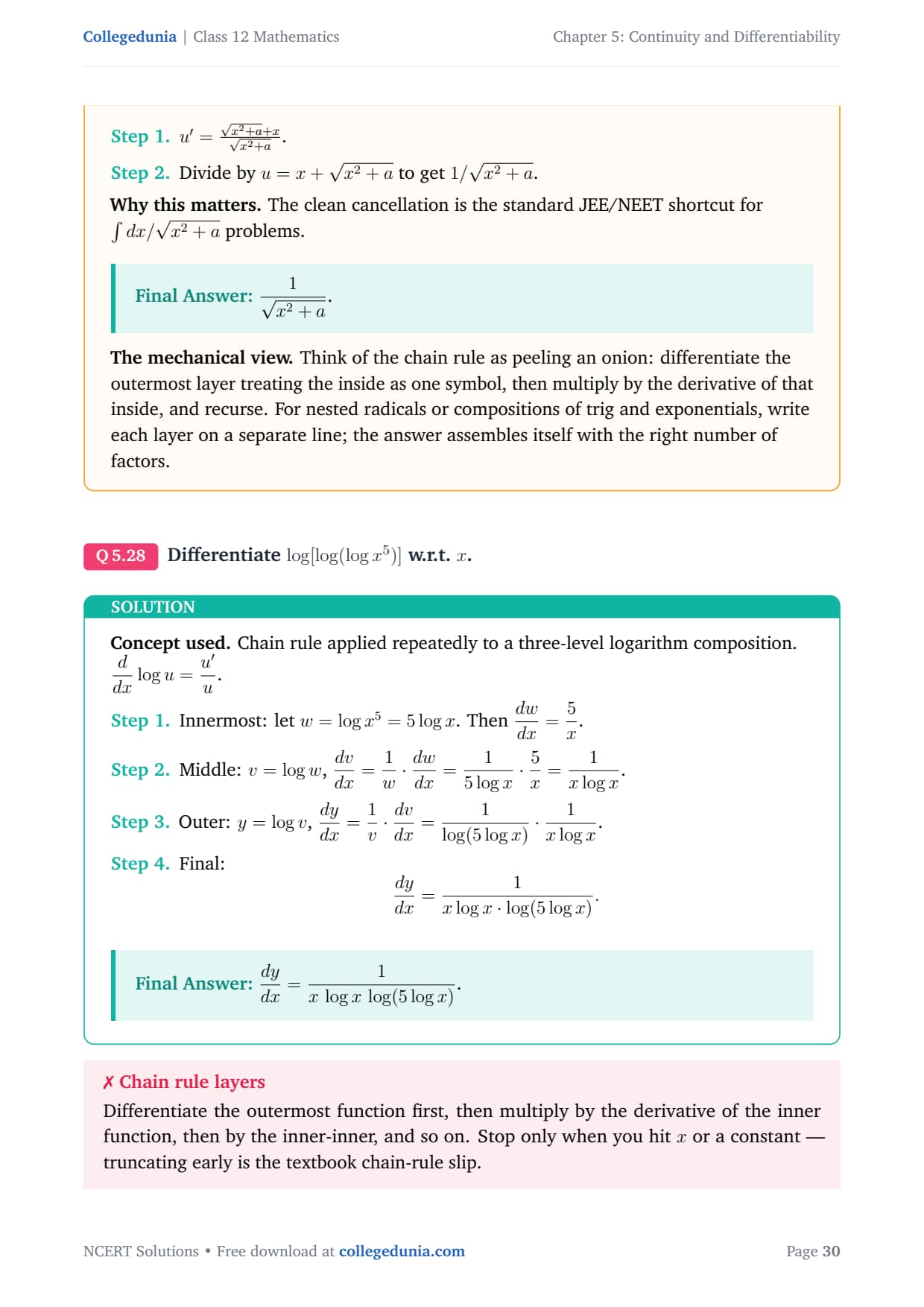
Q 5.28
Differentiate log[log(log x5)] w.r.t. x.
Concept used. Chain rule applied repeatedly to a three-level
logarithm composition. ddxlog u = u'u.
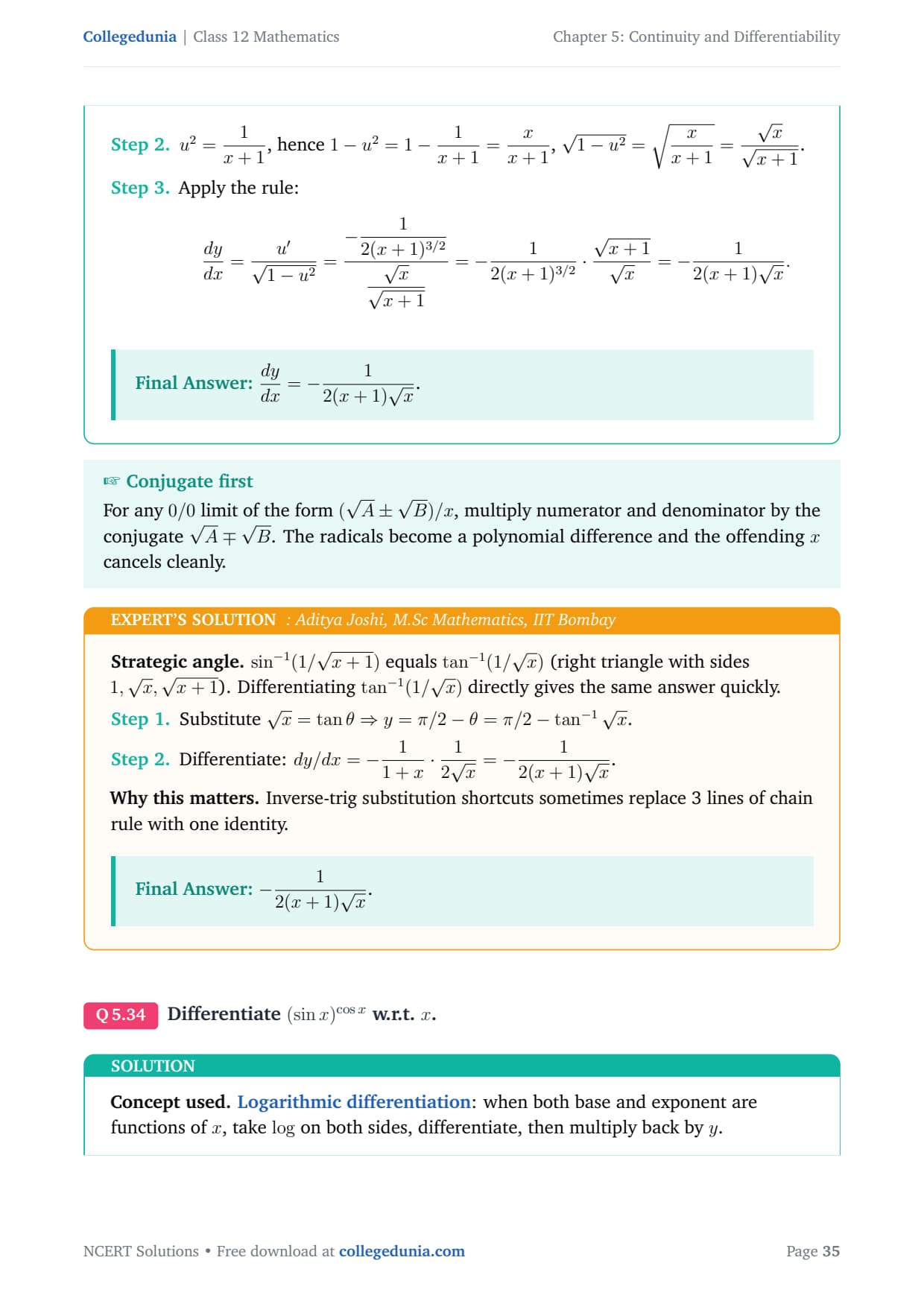
Strategic angle.sin-1(1/√x+1) equals
tan-1(1/√x) (right triangle with sides 1,√x,√x+1).
Differentiating tan-1(1/√x) directly gives the same answer
quickly.
Substitute √x=tanθ⇒ y=π/2-θ=π/2-tan-1√x.
Differentiate: dy/dx=-11+x·12√x=-12(x+1)√x.
Why this matters. Inverse-trig substitution shortcuts
sometimes replace 3 lines of chain rule with one identity.
-12(x+1)√x.
Q 5.34
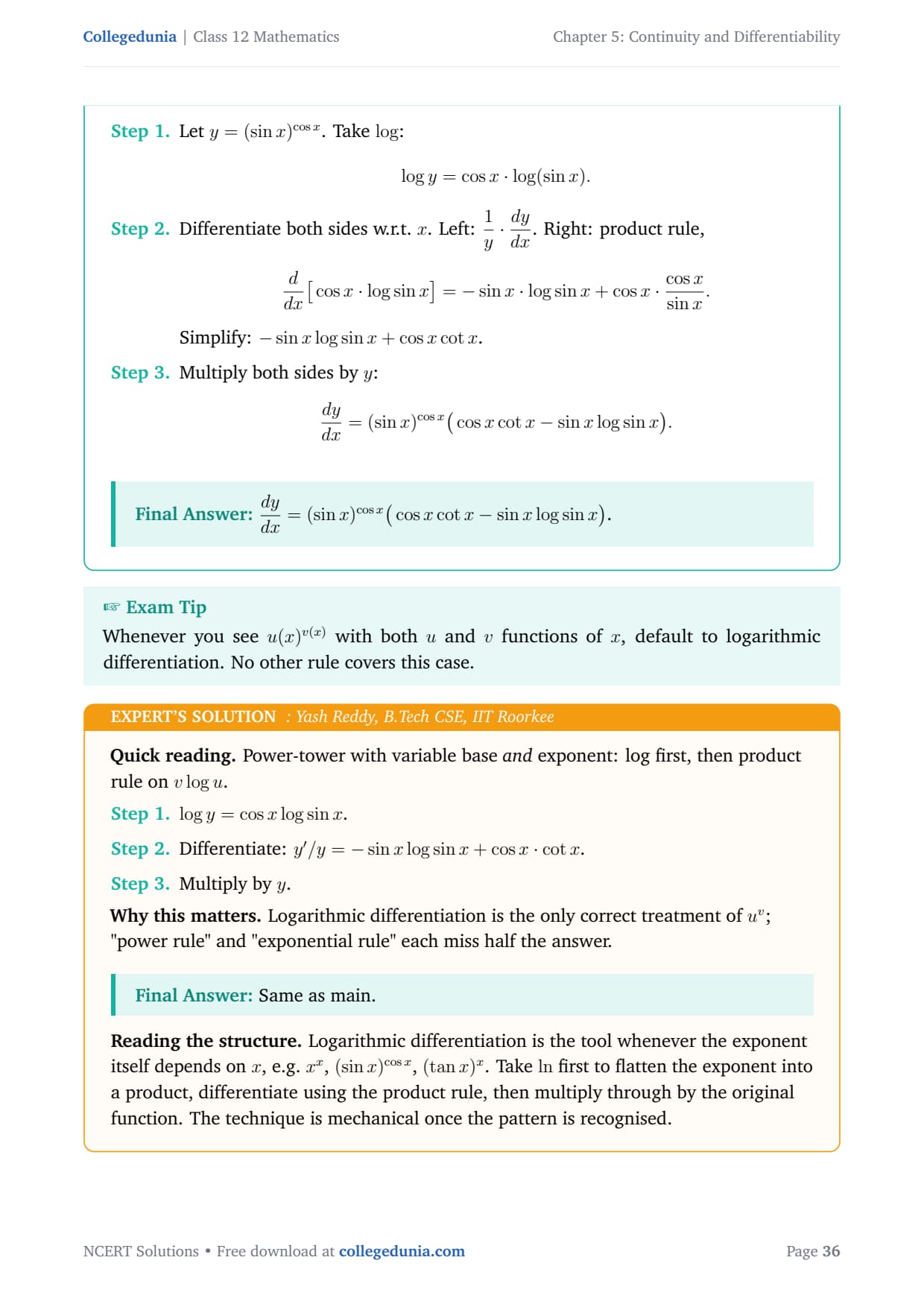
Differentiate (sin x)cos x w.r.t. x.
Concept used.Logarithmic differentiation: when
both base and exponent are functions of x, take log on both sides,
differentiate, then multiply back by y.
Let y=(sin x)cos x. Take log:
log y = cos x(sin x).
Differentiate both sides w.r.t. x. Left: 1y·dydx.
Right: product rule,
ddx[cos x·x]
= -sin x·x + cos x·cos xsin x.
Simplify: -sin xx + cos xcot x.
Multiply both sides by y:
dydx = (sin x)cos x(cos xcot x - sin xx).
dydx=(sin x)cos x(cos xcot x - sin xx).
YR
Yash Reddy
B.Tech CSE, IIT Roorkee
Verified Expert
Quick reading. Power-tower with variable base and
exponent: log first, then product rule on vlog u.
log y = cos xx.
Differentiate: y'/y = -sin xx + cos xx.
Multiply by y.
Why this matters. Logarithmic differentiation is the only
correct treatment of uv; "power rule" and "exponential rule" each
miss half the answer.
Same as main.
Reading the structure. Logarithmic differentiation is the tool whenever the exponent itself depends on x, e.g. xx, (sin x)cos x, (tan x)x. Take ln first to flatten the exponent into a product, differentiate using the product rule, then multiply through by the original function. The technique is mechanical once the pattern is recognised.
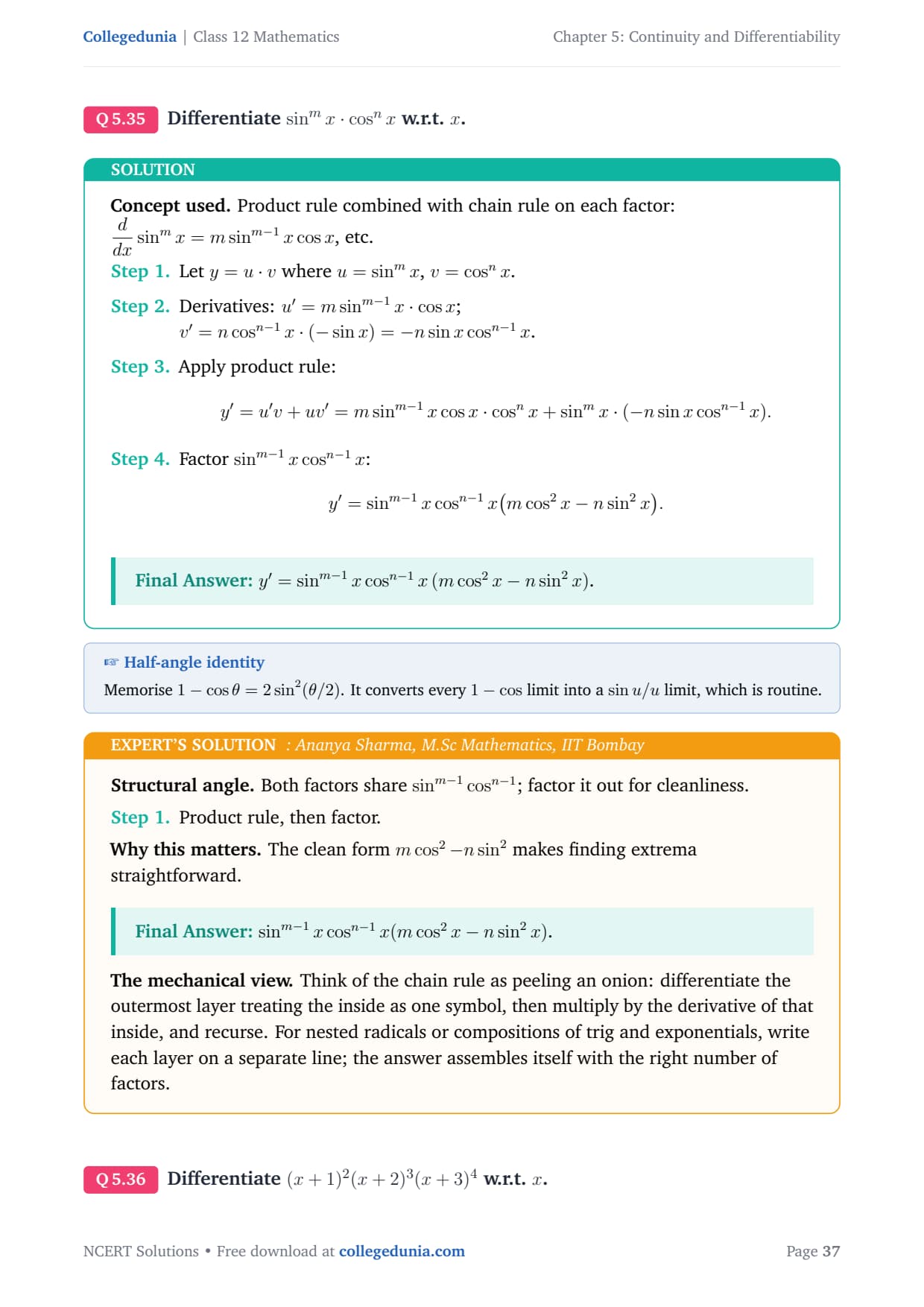
Q 5.35
Differentiate sinmxnx w.r.t. x.
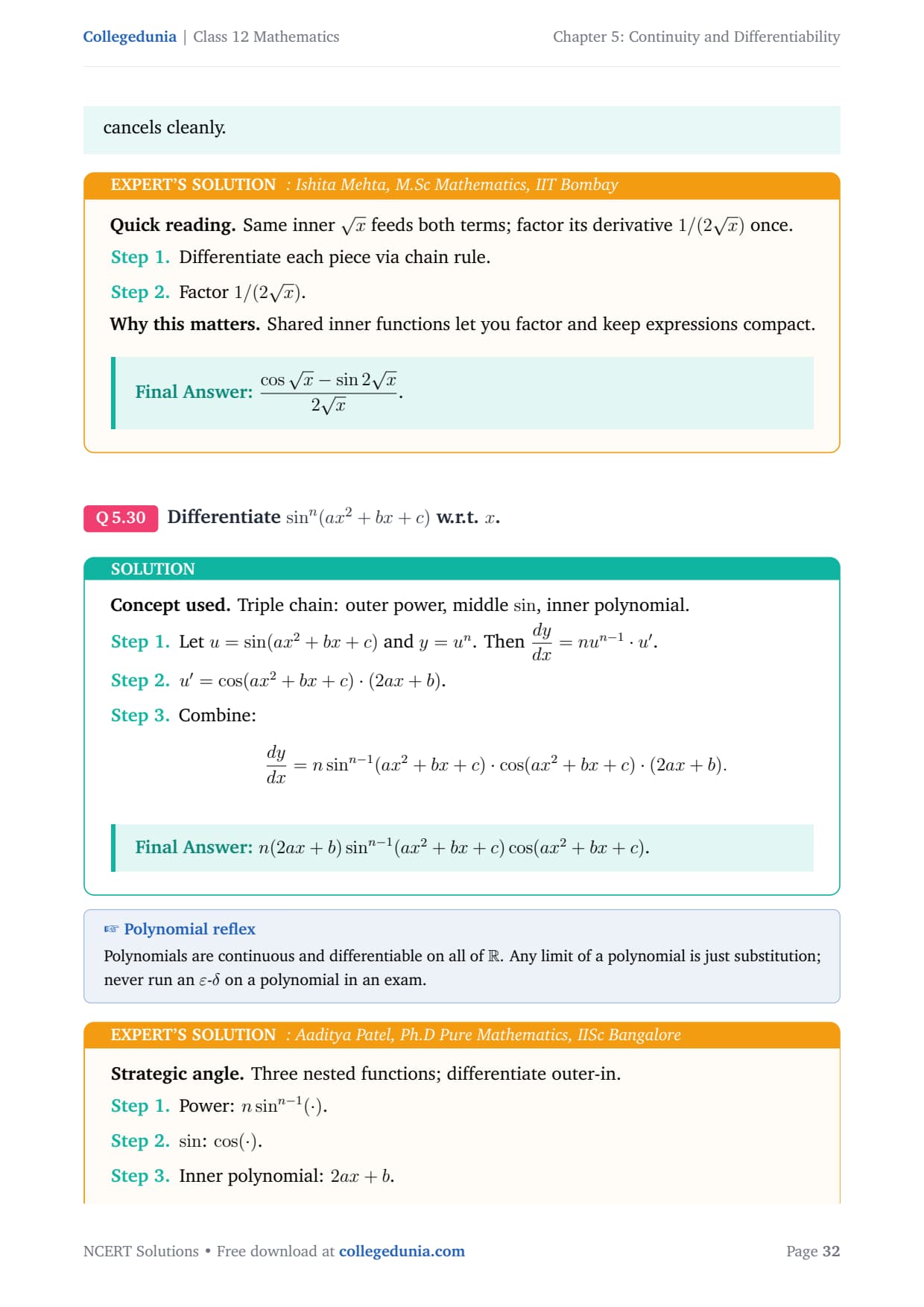
Concept used. Product rule combined with chain rule on each
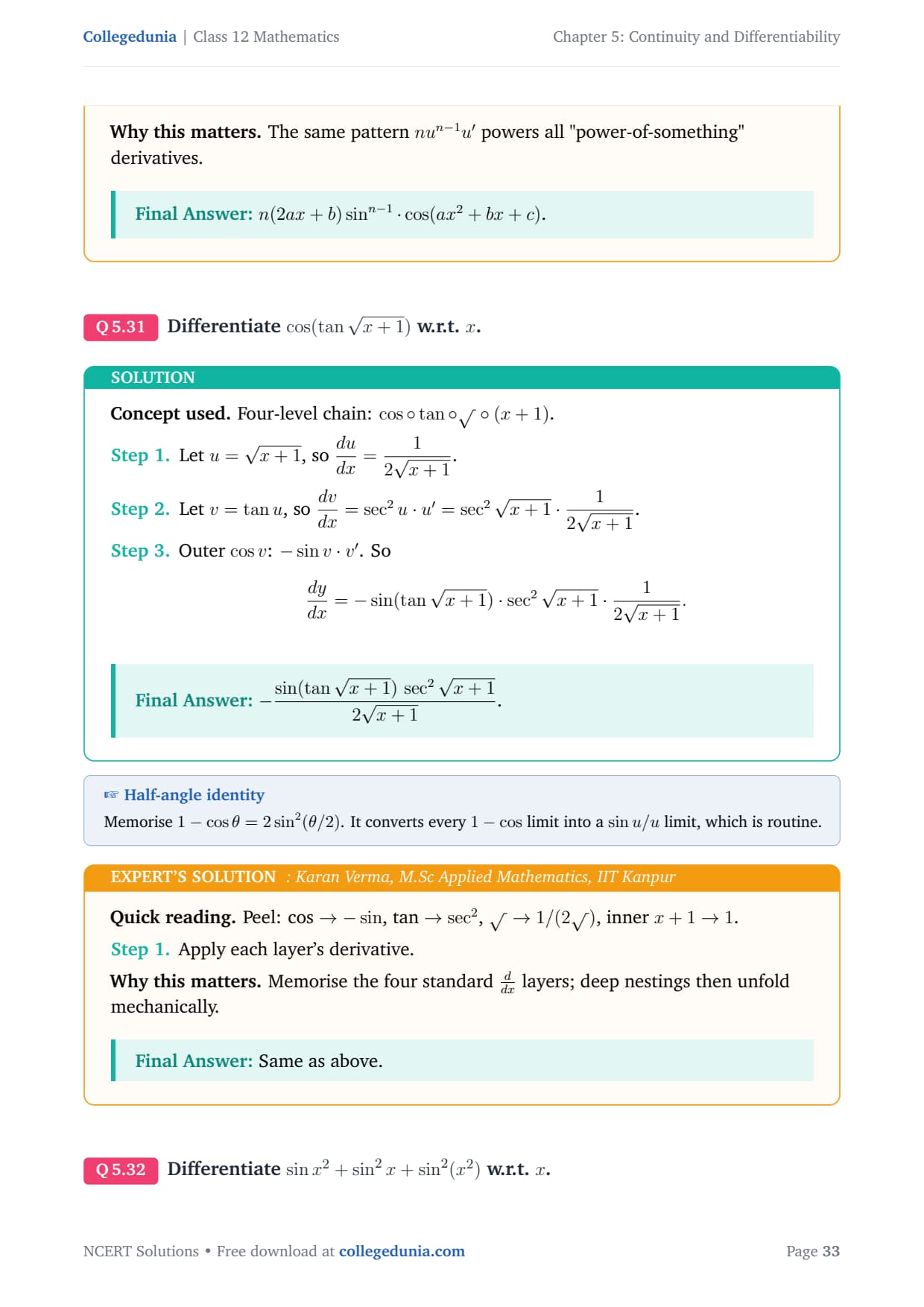
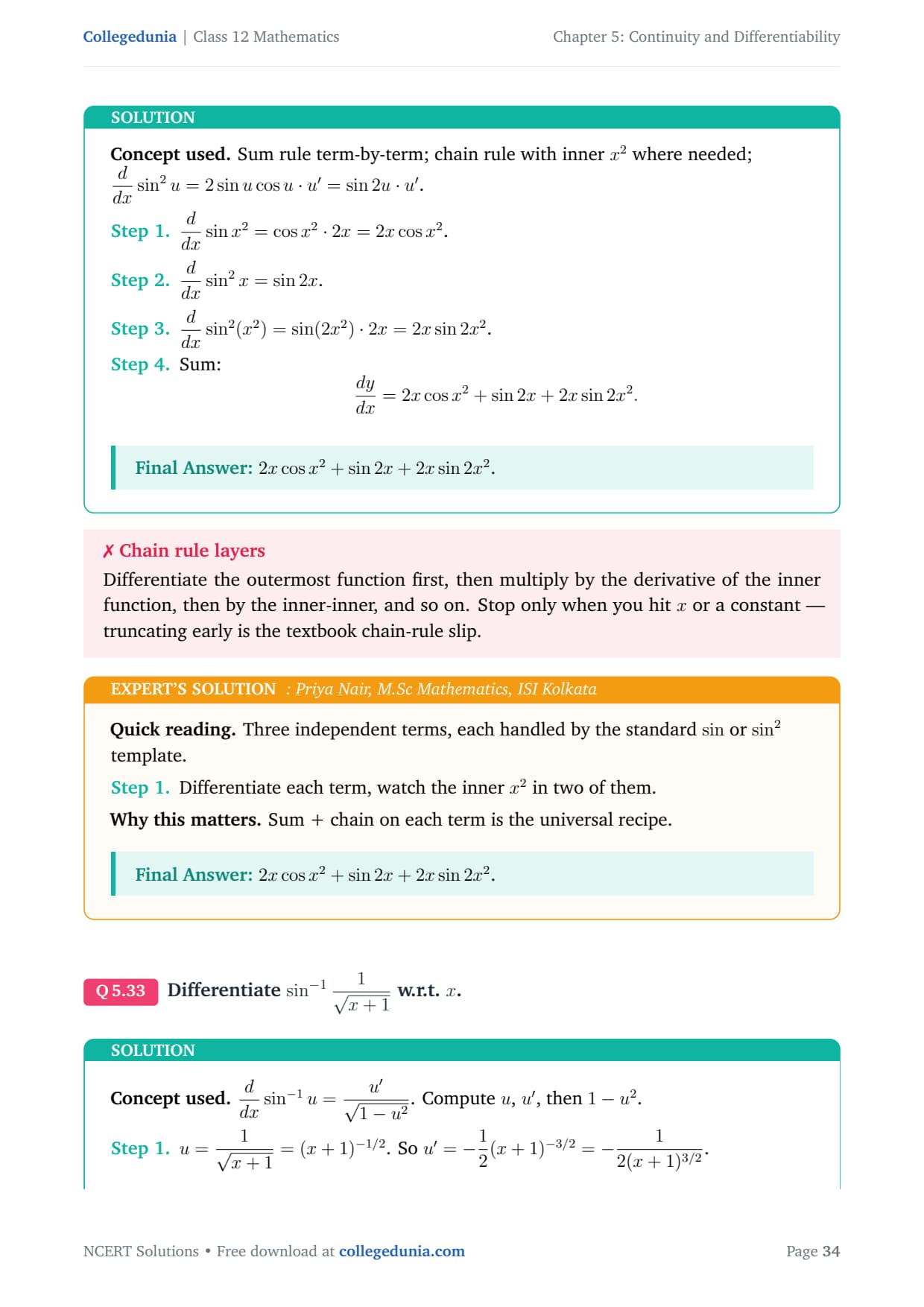
factor: ddxsinmx = msinm-1xcos x, etc.
Structural angle. Both factors share sinm-1cosn-1;
factor it out for cleanliness.
Product rule, then factor.
Why this matters. The clean form mcos2-nsin2 makes
finding extrema straightforward.
sinm-1xcosn-1x(mcos2x-nsin2x).
The mechanical view. Think of the chain rule as peeling an onion: differentiate the outermost layer treating the inside as one symbol, then multiply by the derivative of that inside, and recurse. For nested radicals or compositions of trig and exponentials, write each layer on a separate line; the answer assembles itself with the right number of factors.
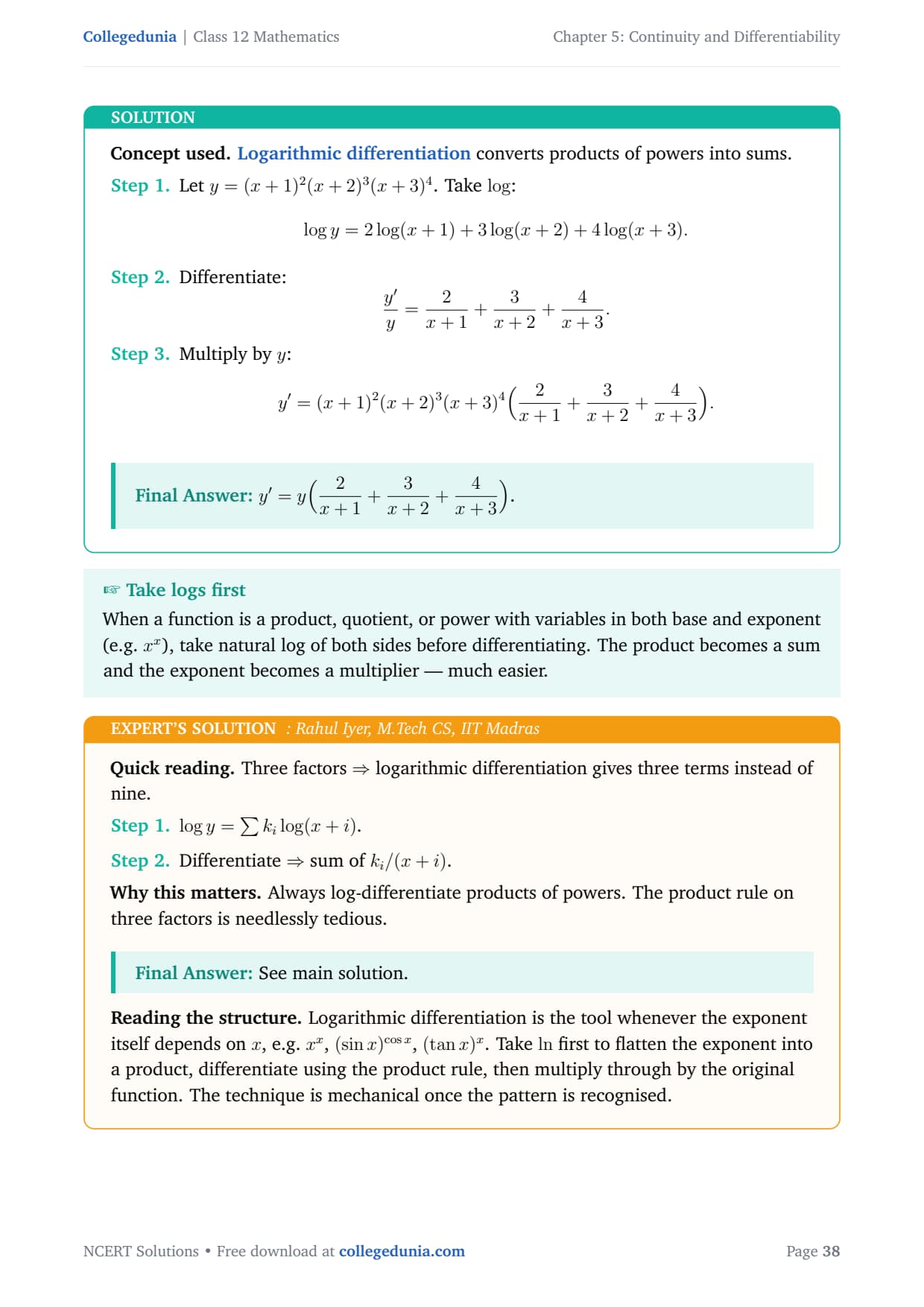
Q 5.36
Differentiate (x+1)2(x+2)3(x+3)4 w.r.t. x.
Concept used.Logarithmic differentiation converts
products of powers into sums.
Let y = (x+1)2(x+2)3(x+3)4. Take log:
log y = 2log(x+1) + 3log(x+2) + 4log(x+3).
Differentiate:
y'y = 2x+1 + 3x+2 + 4x+3.
Multiply by y:
y' = (x+1)2(x+2)3(x+3)4(2x+1+3x+2+4x+3).
y' = y(2x+1+3x+2+4x+3).
RI
Rahul Iyer
M.Tech CS, IIT Madras
Verified Expert
Quick reading. Three factors ⇒ logarithmic
differentiation gives three terms instead of nine.
log y = ∑ kilog(x+i).
Differentiate ⇒ sum of ki/(x+i).
Why this matters. Always log-differentiate products of
powers. The product rule on three factors is needlessly tedious.
See main solution.
Reading the structure. Logarithmic differentiation is the tool whenever the exponent itself depends on x, e.g. xx, (sin x)cos x, (tan x)x. Take ln first to flatten the exponent into a product, differentiate using the product rule, then multiply through by the original function. The technique is mechanical once the pattern is recognised.
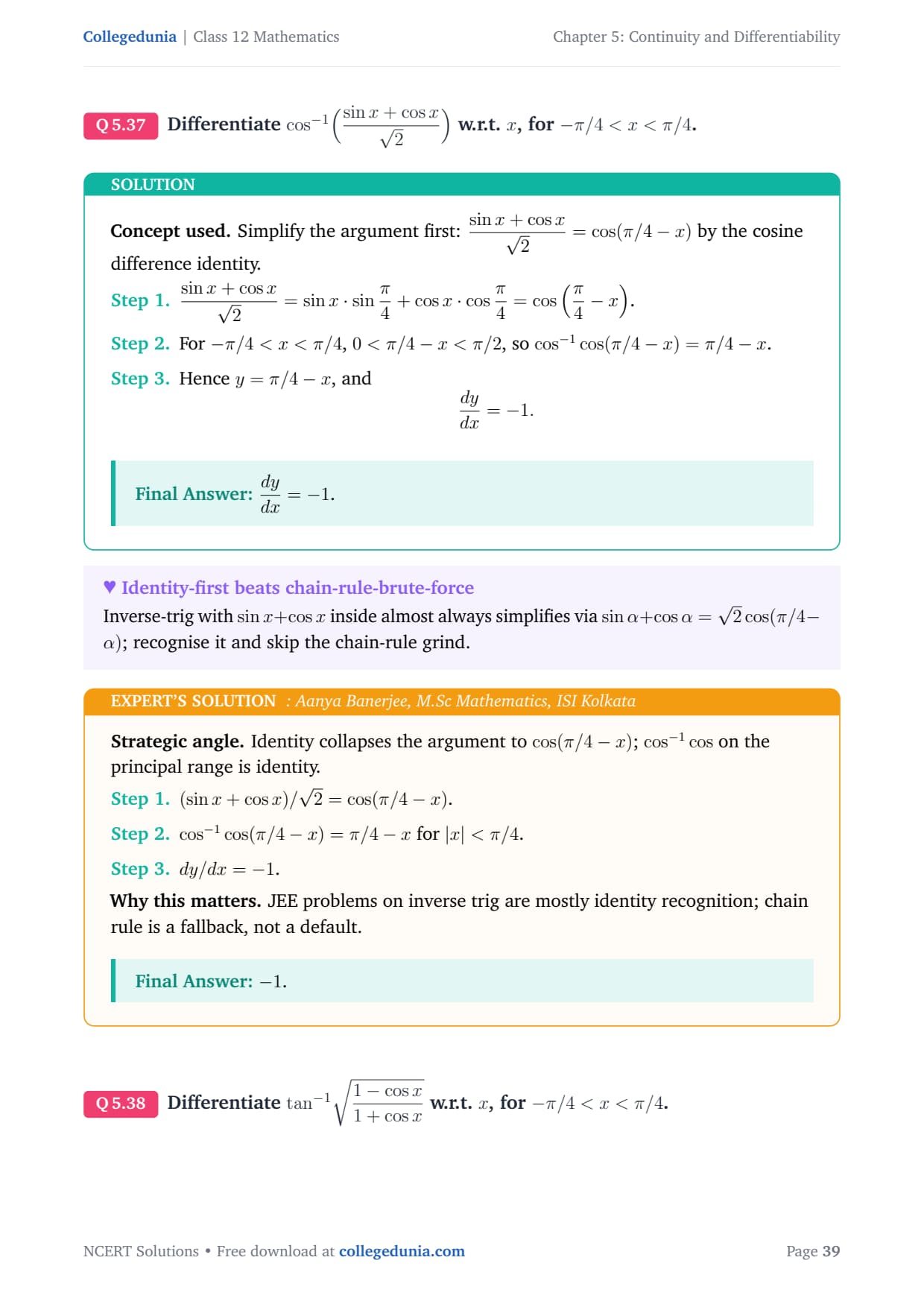
Q 5.37
Differentiate cos-1(sin x+cos x√2) w.r.t. x,
for -π/4.
Concept used. Simplify the argument first:
sin x+cos x√2 = cos(π/4-x) by the cosine
difference identity.
sin x+cos x2
= sin xπ4 + cos xπ4
= cos(π4-x).
For -π/4, 0<π/4-x<π/2, so
cos-1cos(π/4-x) = π/4-x.
Hence y = π/4 - x, and
dydx = -1.
dydx = -1.
AB
Aanya Banerjee
M.Sc Mathematics, ISI Kolkata
Verified Expert
Strategic angle. Identity collapses the argument to
cos(π/4-x); cos-1cos on the principal range is identity.
(sin x+cos x)/√2=cos(π/4-x).
cos-1cos(π/4-x)=π/4-x for |x|<π/4.
dy/dx=-1.
Why this matters. JEE problems on inverse trig are mostly
identity recognition; chain rule is a fallback, not a default.
-1.
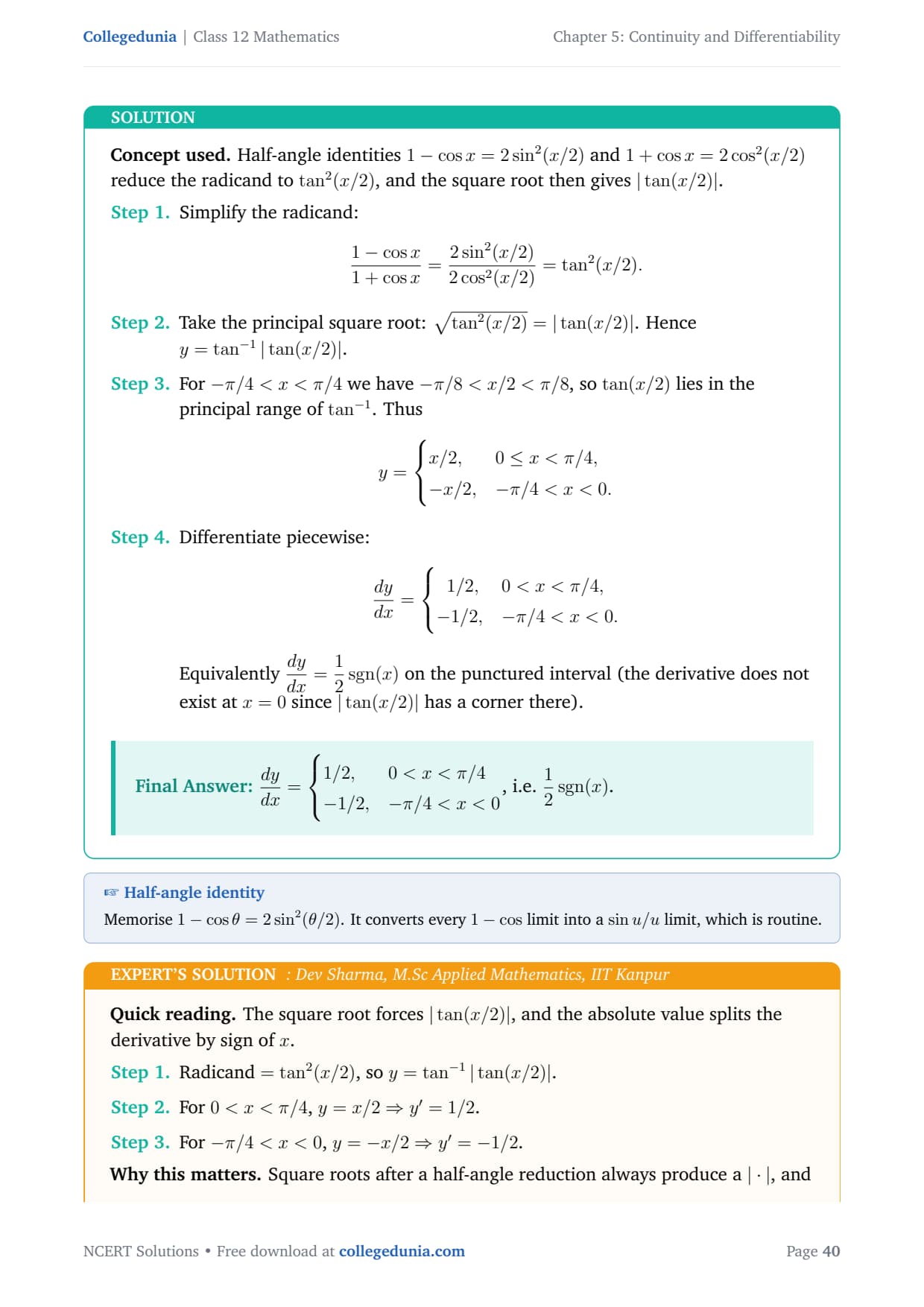
Q 5.38
Differentiate tan-1√1-cos x1+cos x w.r.t. x,
for -π/4.
Concept used. Half-angle identities
1-cos x = 2sin2(x/2) and 1+cos x = 2cos2(x/2)
reduce the radicand to tan2(x/2), and the square root then gives
|tan(x/2)|.
Simplify the radicand:
1-cos x1+cos x
= 2sin2(x/2)2cos2(x/2) = tan2(x/2).
Take the principal square root:
√tan2(x/2) = |tan(x/2)|. Hence
y = tan-1|tan(x/2)|.
For -π/4 we have -π/8 < x/2 < π/8, so
tan(x/2) lies in the principal range of tan-1. Thus
y = cases x/2, & 0≤ x<π/4,
-x/2, & -π/4
Differentiate piecewise:
dydx = cases 1/2, & 0
-1/2, & -π/4
Equivalently dydx = 12 sgn(x) on
the punctured interval (the derivative does not exist at
x=0 since |tan(x/2)| has a corner there).
dydx = cases 1/2, & 0, i.e. 12 sgn(x).
DS
Dev Sharma
M.Sc Applied Mathematics, IIT Kanpur
Verified Expert
Quick reading. The square root forces |tan(x/2)|, and the
absolute value splits the derivative by sign of x.
Radicand =tan2(x/2), so y=tan-1|tan(x/2)|.
For 0, y = x/2⇒y'=1/2.
For -π/4, y=-x/2⇒y'=-1/2.
Why this matters. Square roots after a half-angle reduction
always produce a |·|, and absolute values force a piecewise
derivative. Never drop the modulus.
12 sgn(x) on (-π/4,0)∪(0,π/4).
Generalising the trick. The manipulation used here is part of a family: spot the algebraic disguise, apply the standard identity, reduce to a known limit or standard integral, conclude. Once you've solved three problems with the same disguise, the rest become routine.
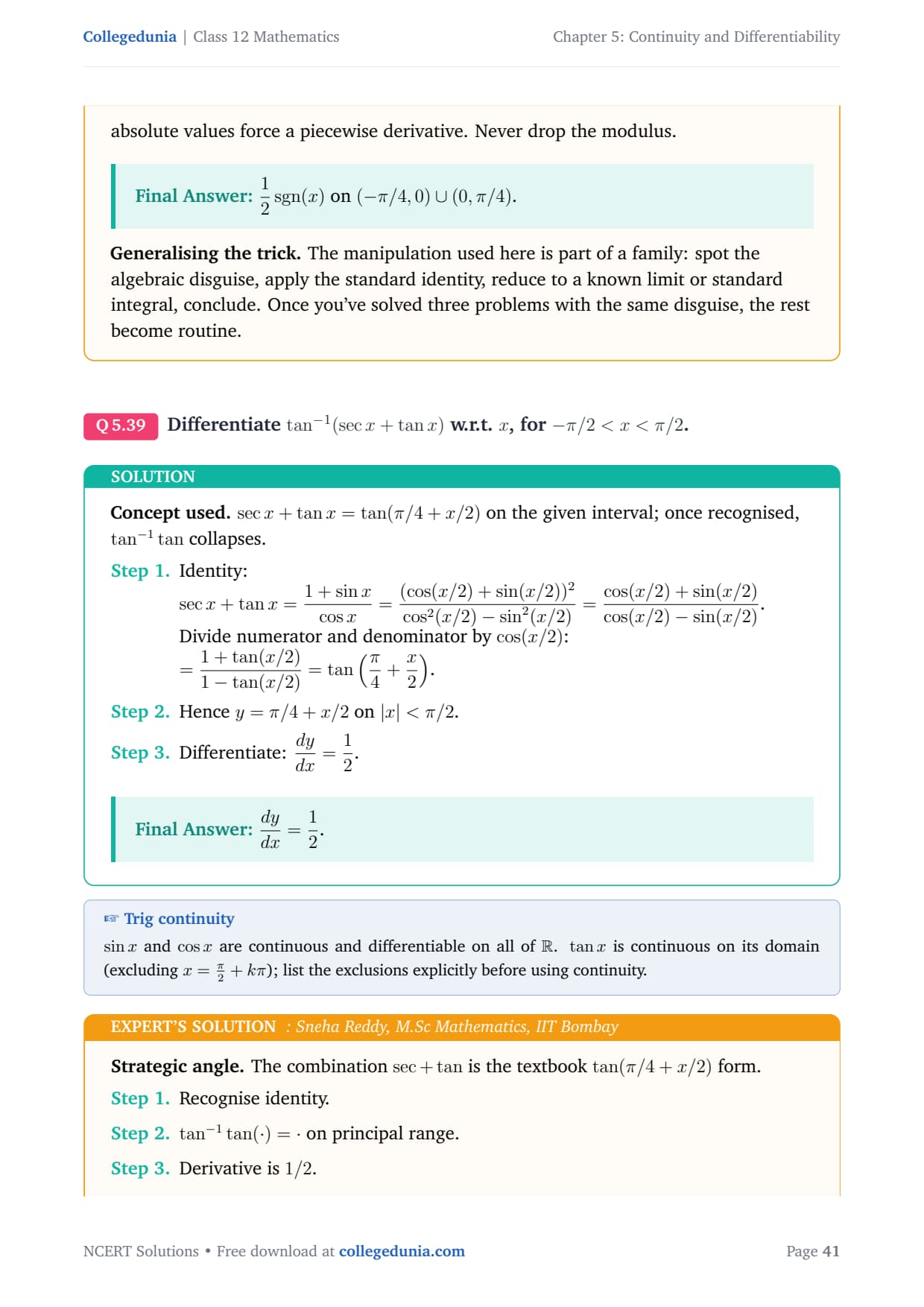
Q 5.39
Differentiate tan-1(sec x + tan x) w.r.t. x, for
-π/2.
Concept used.sec x+tan x = tan(π/4+x/2) on the given
interval; once recognised, tan-1tan collapses.
Identity:
sec x+tan x = 1+sin xcos x
= (cos(x/2)+sin(x/2))2cos2(x/2)-sin2(x/2)
= cos(x/2)+sin(x/2)cos(x/2)-sin(x/2).
Divide numerator and denominator by cos(x/2):
= 1+tan(x/2)1-tan(x/2) = tan(π4+x2).
Hence y = π/4 + x/2 on |x|<π/2.
Differentiate: dydx = 12.
dydx = 12.
SR
Sneha Reddy
M.Sc Mathematics, IIT Bombay
Verified Expert
Strategic angle. The combination sec+tan is the textbook
tan(π/4+x/2) form.
Recognise identity.
tan-1tan(·)= · on principal range.
Derivative is 1/2.
Why this matters. Memorise sec+tan = tan(π/4+x/2); it
turns dozens of integration / differentiation problems into one-liners.
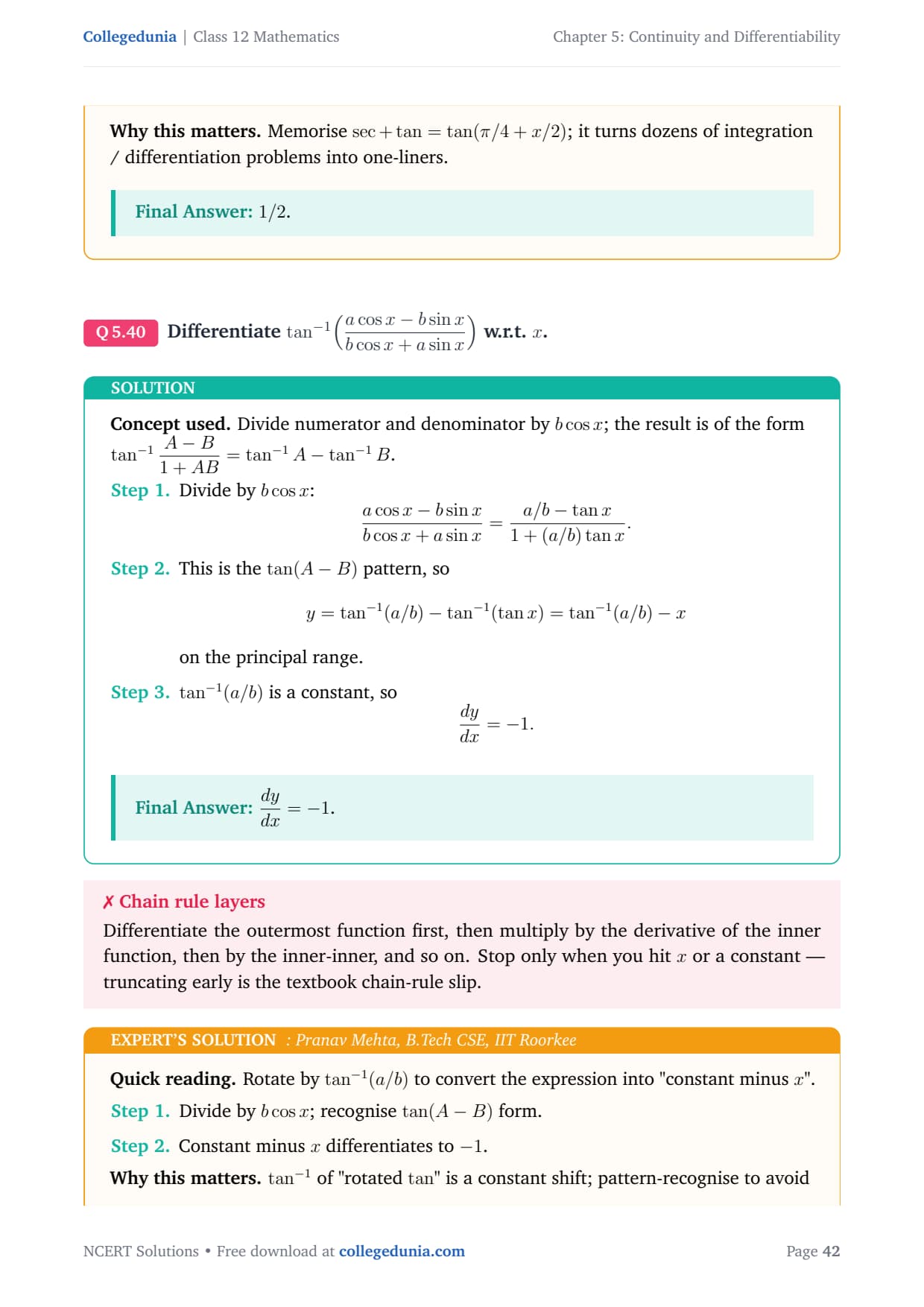
Concept used. Divide numerator and denominator by
bcos x; the result is of the form
tan-1A-B1+AB=tan-1A-tan-1B.
Divide by bcos x:
acos x-bsin xbcos x+asin x
= a/b - tan x1 + (a/b)tan x.
This is the tan(A-B) pattern, so
y = tan-1(a/b) - tan-1(tan x) = tan-1(a/b)-x
on the principal range.
tan-1(a/b) is a constant, so
dydx = -1.
dydx = -1.
PM
Pranav Mehta
B.Tech CSE, IIT Roorkee
Verified Expert
Quick reading. Rotate by tan-1(a/b) to convert the
expression into "constant minus x".
Divide by bcos x; recognise tan(A-B) form.
Constant minus x differentiates to -1.
Why this matters.tan-1 of "rotated tan" is a
constant shift; pattern-recognise to avoid the chain rule.
-1.
The mechanical view. Think of the chain rule as peeling an onion: differentiate the outermost layer treating the inside as one symbol, then multiply by the derivative of that inside, and recurse. For nested radicals or compositions of trig and exponentials, write each layer on a separate line; the answer assembles itself with the right number of factors.
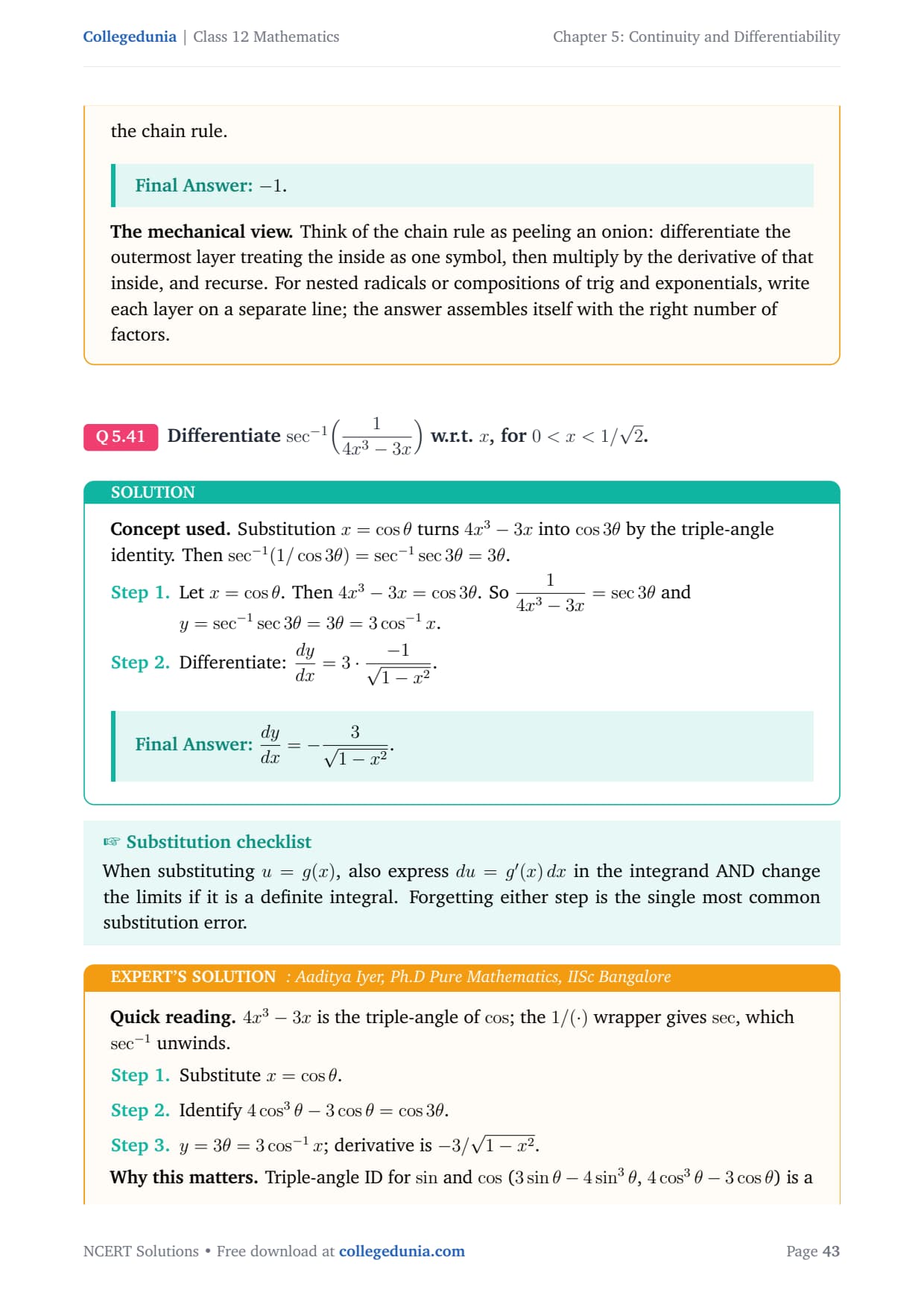
Q 5.41
Differentiate sec-1(14x3-3x) w.r.t. x,
for 0√2.
Concept used. Substitution x=cosθ turns 4x3-3x into
cos 3θ by the triple-angle identity. Then sec-1(1/cos 3θ)
= sec-1sec 3θ = 3θ.
Let x=cosθ. Then 4x3-3x=cos 3θ. So
14x3-3x=sec 3θ and
y=sec-1sec 3θ = 3θ = 3cos-1x.
Differentiate: dydx=3·-1√1-x2.
dydx = -3√1-x2.
AI
Aaditya Iyer
Ph.D Pure Mathematics, IISc Bangalore
Verified Expert
Quick reading.4x3-3x is the triple-angle of cos; the
1/(·) wrapper gives sec, which sec-1 unwinds.
Substitute x=cosθ.
Identify 4cos3θ-3cosθ=cos 3θ.
y=3θ=3cos-1x; derivative is -3/√1-x2.
Why this matters. Triple-angle ID for sin and cos
(3sinθ-4sin3θ, 4cos3θ-3cosθ) is a
go-to substitution.
-3/√1-x2.
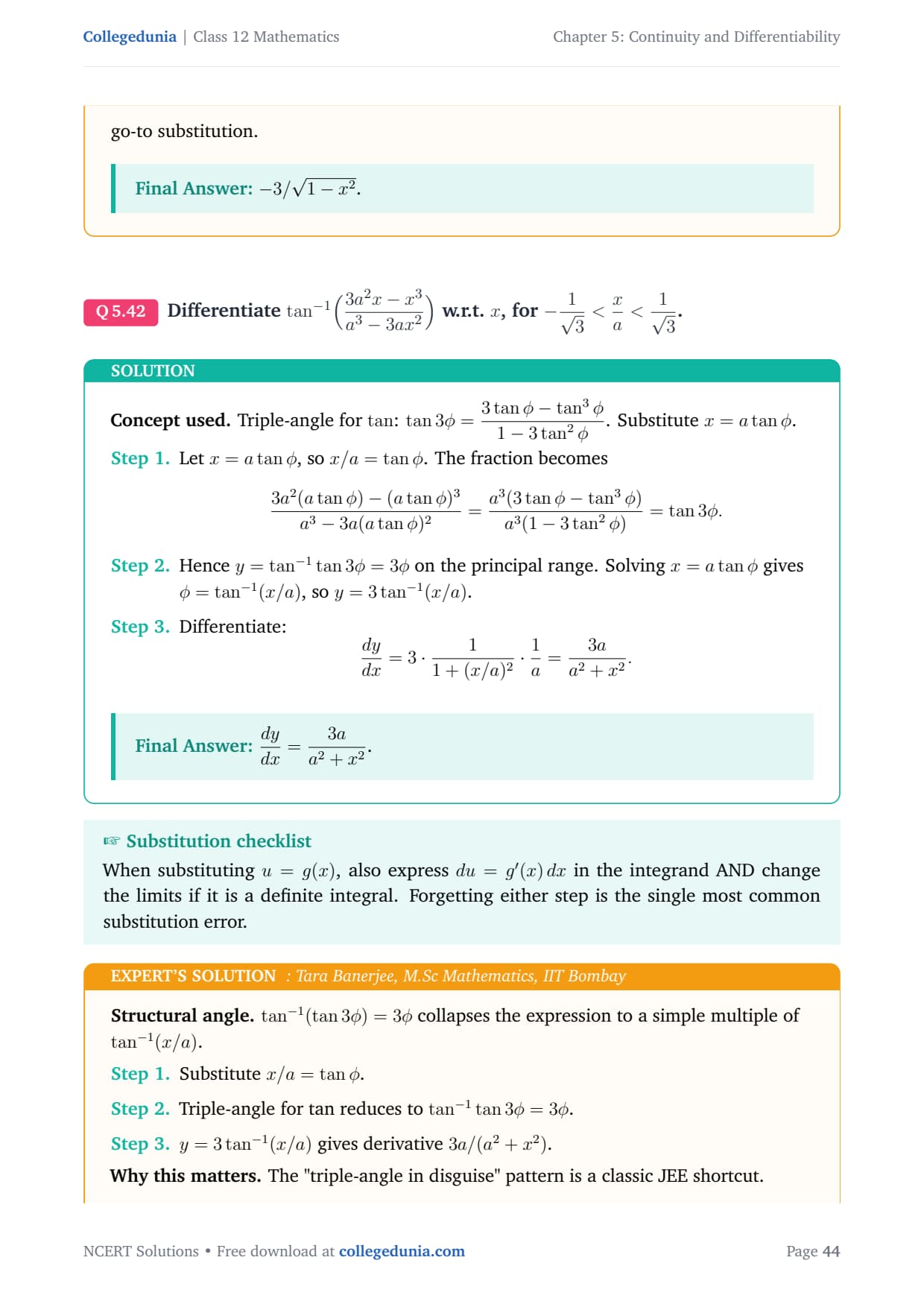
Q 5.42
Differentiate
tan-1(3a2x-x3a3-3ax2)
w.r.t. x, for -13<xa<13.
Concept used. Triple-angle for tan:
tan 3φ = 3tanφ-tan3φ1-3tan2φ.
Substitute x=atanφ.
Let x=atanφ, so x/a=tanφ. The fraction becomes
3a2(atanφ)-(atanφ)3a3-3a(atanφ)2
= a3(3tanφ-tan3φ)a3(1-3tan2φ)
= tan 3φ.
Hence y = tan-1tan 3φ = 3φ on the principal range.
Solving x=atanφ gives φ=tan-1(x/a), so
y=3tan-1(x/a).
Differentiate:
dydx=3·11+(x/a)2·1a
= 3aa2+x2.
dydx = 3aa2+x2.
TB
Tara Banerjee
M.Sc Mathematics, IIT Bombay
Verified Expert
Structural angle.tan-1(tan 3φ)=3φ collapses the
expression to a simple multiple of tan-1(x/a).
Substitute x/a=tanφ.
Triple-angle for tan reduces to tan-1tan 3φ=3φ.
y=3tan-1(x/a) gives derivative 3a/(a2+x2).
Why this matters. The "triple-angle in disguise" pattern is a
classic JEE shortcut.
3a/(a2+x2).
Why this method is preferred. The shortest correct route in school calculus is almost always: identify the function's category → load the standard template → substitute the specific numbers. Reinventing the technique problem-by-problem is what makes a 90-minute paper feel like 3 hours.
Q 5.43
Differentiate
tan-1(√1+x2+√1-x2√1+x2-√1-x2)
w.r.t. x, for -1, x≠ 0.
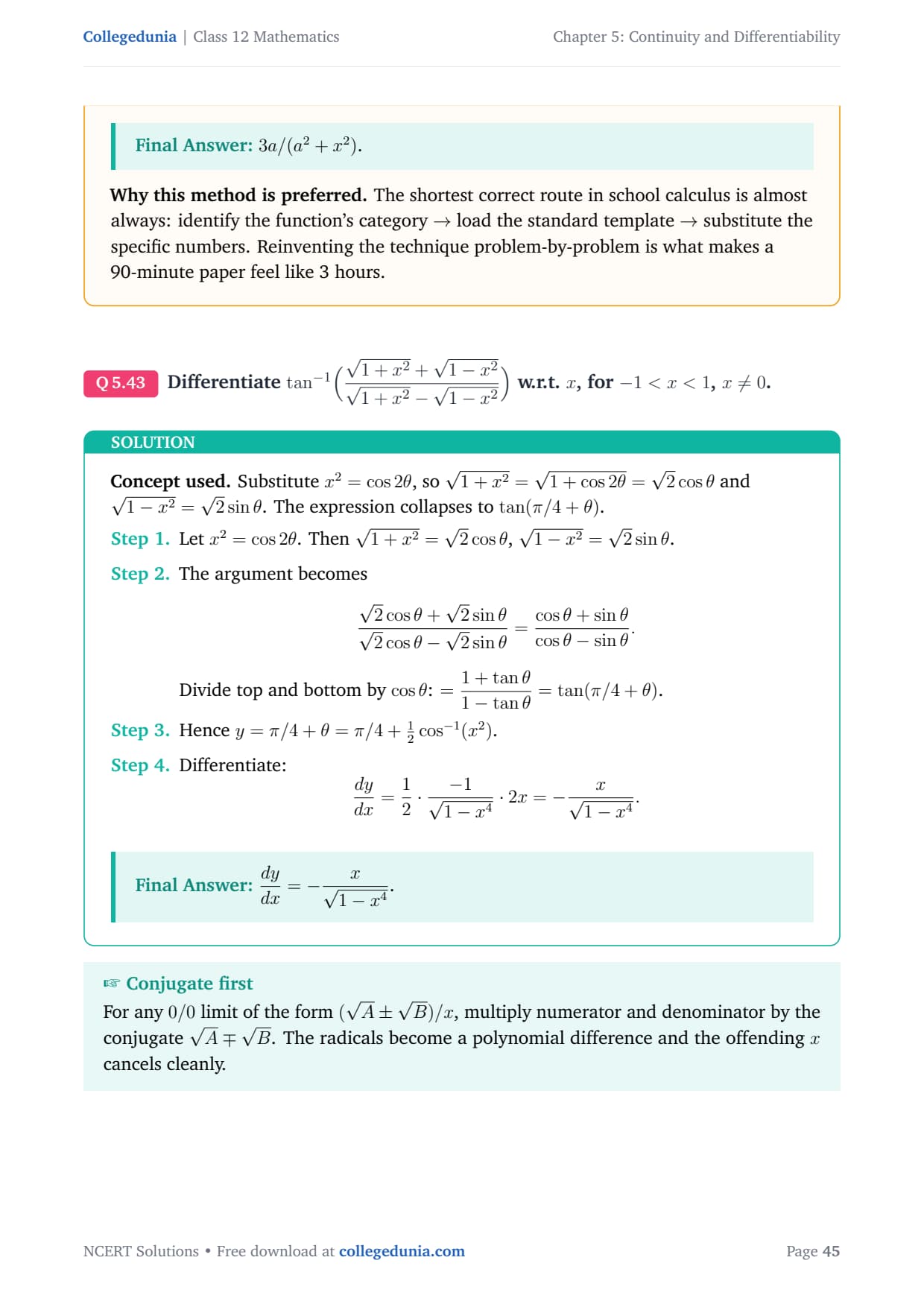
Concept used. Substitute x2=cos 2θ, so
√1+x2=√1+cos 2θ=2cosθ and
√1-x2=2sinθ. The expression collapses to
tan(π/4+θ).
Let x2 = cos 2θ. Then
√1+x2=√2cosθ,
√1-x2=√2sinθ.
The argument becomes
2cosθ+2sinθ2cosθ-2sinθ
= cosθ+sinθcosθ-sinθ.
Divide top and bottom by cosθ:
= 1+tanθ1-tanθ = tan(π/4+θ).
Hence y = π/4 + θ = π/4 + 12cos-1(x2).
Differentiate:
dydx = 12·-1√1-x4· 2x
= -x√1-x4.
dydx = -x√1-x4.
KV
Krishna Verma
M.Sc Mathematics, ISI Kolkata
Verified Expert
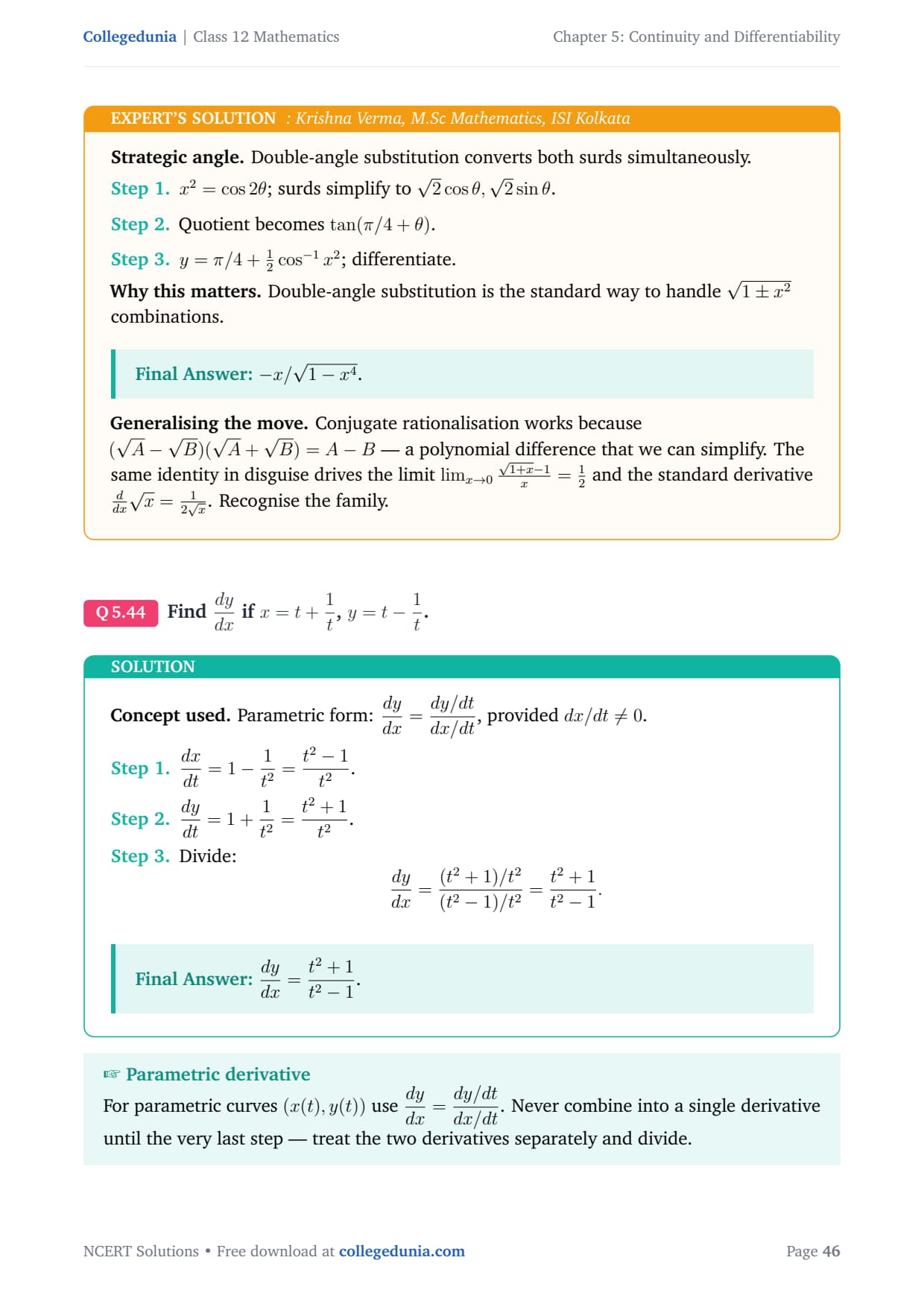
Strategic angle. Double-angle substitution converts both
surds simultaneously.
x2=cos 2θ; surds simplify to 2cosθ,2sinθ.
Quotient becomes tan(π/4+θ).
y=π/4+12cos-1x2; differentiate.
Why this matters. Double-angle substitution is the standard
way to handle √1± x2 combinations.
-x/√1-x4.
Generalising the move. Conjugate rationalisation works because (√A-√B)(√A+√B) = A - B –- a polynomial difference that we can simplify. The same identity in disguise drives the limit x→ 0√1+x-1x=12 and the standard derivative ddx√x=12√x. Recognise the family.
Quick reading. Both dx/dt and dy/dt have 1/t2 common;
ratio cancels.
Derivatives w.r.t. t.
Take the ratio.
Why this matters. Parametric problems usually have shared
factors; cancel before plugging values.
(t2+1)/(t2-1).
Q 5.45
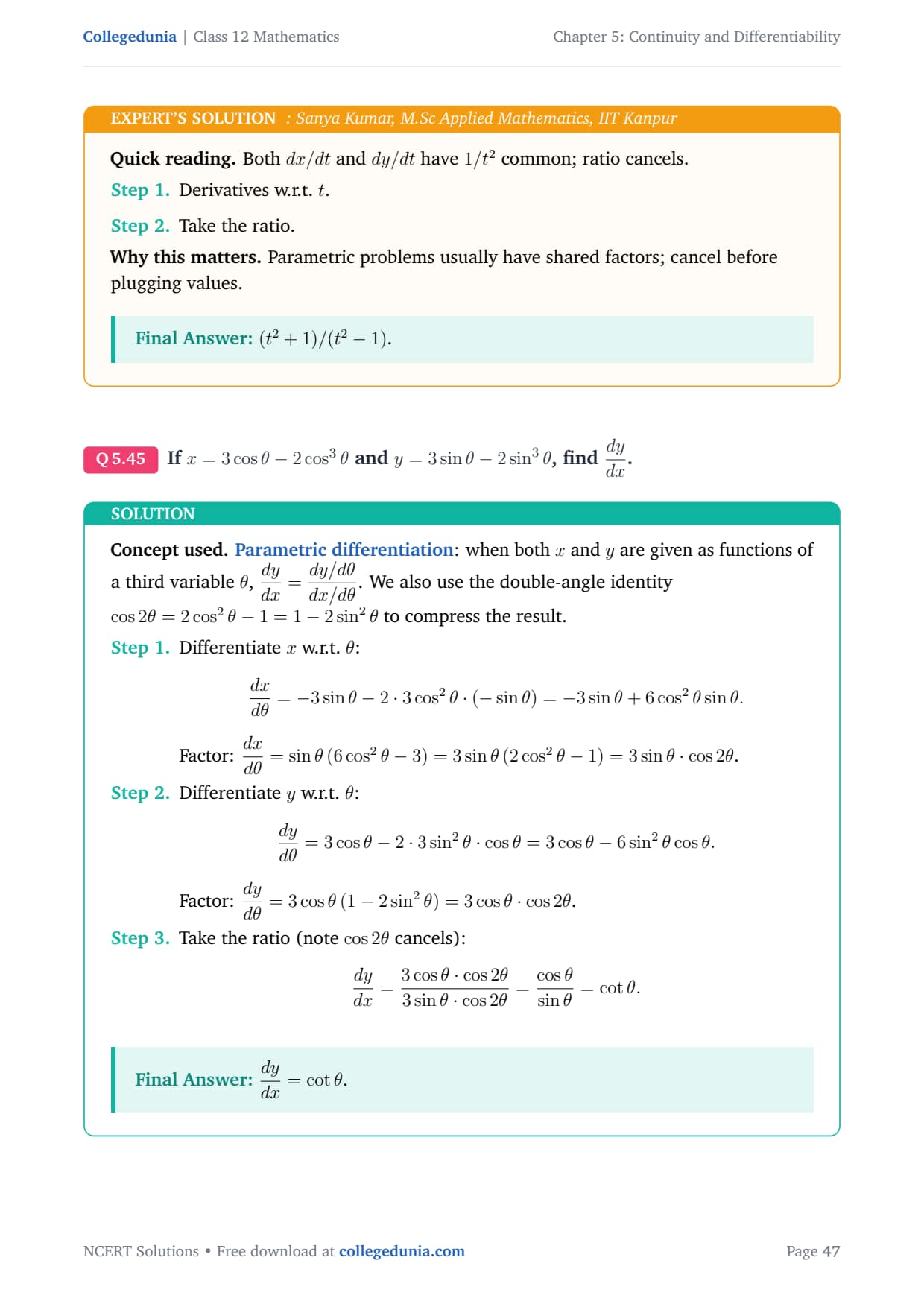
If x = 3cosθ - 2cos3θ and y = 3sinθ - 2sin3θ, find dydx.
Concept used.Parametric differentiation: when both
x and y are given as functions of a third variable θ,
dydx = dy/dθdx/dθ.
We also use the double-angle identity
cos 2θ = 2cos2θ - 1 = 1 - 2sin2θ to compress
the result.
Take the ratio (note cos 2θ cancels):
dydx
= 3cosθ2θ3sinθ2θ
= cosθsinθ = cotθ.
dydx = cotθ.
MP
Meera Pillai
M.Sc Mathematics, IIT Bombay
Verified Expert
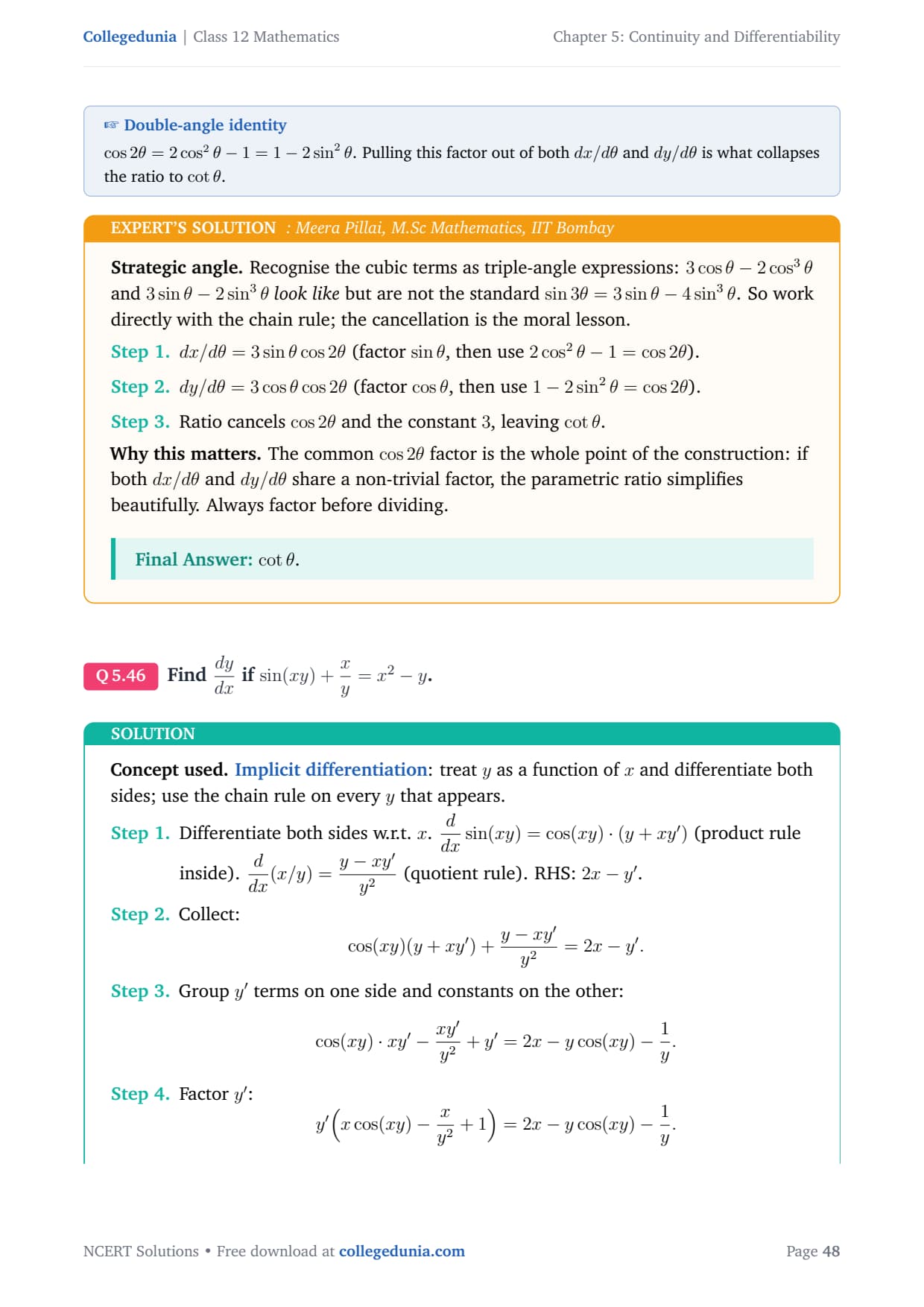
Strategic angle. Recognise the cubic terms as triple-angle
expressions: 3cosθ - 2cos3θ and
3sinθ - 2sin3θlook like but are not the
standard sin 3θ = 3sinθ - 4sin3θ. So work
directly with the chain rule; the cancellation is the moral lesson.
dx/dθ = 3sin2θ (factor sinθ,
then use 2cos2θ - 1 = cos 2θ).
dy/dθ = 3cos2θ (factor cosθ,
then use 1-2sin2θ = cos 2θ).
Ratio cancels cos 2θ and the constant 3, leaving
cotθ.
Why this matters. The common cos 2θ factor is the
whole point of the construction: if both dx/dθ and dy/dθ
share a non-trivial factor, the parametric ratio simplifies
beautifully. Always factor before dividing.
cotθ.
Q 5.46
Find dydx if sin(xy)+xy=x2-y.
Concept used.Implicit differentiation: treat y
as a function of x and differentiate both sides; use the chain rule
on every y that appears.
dydx =
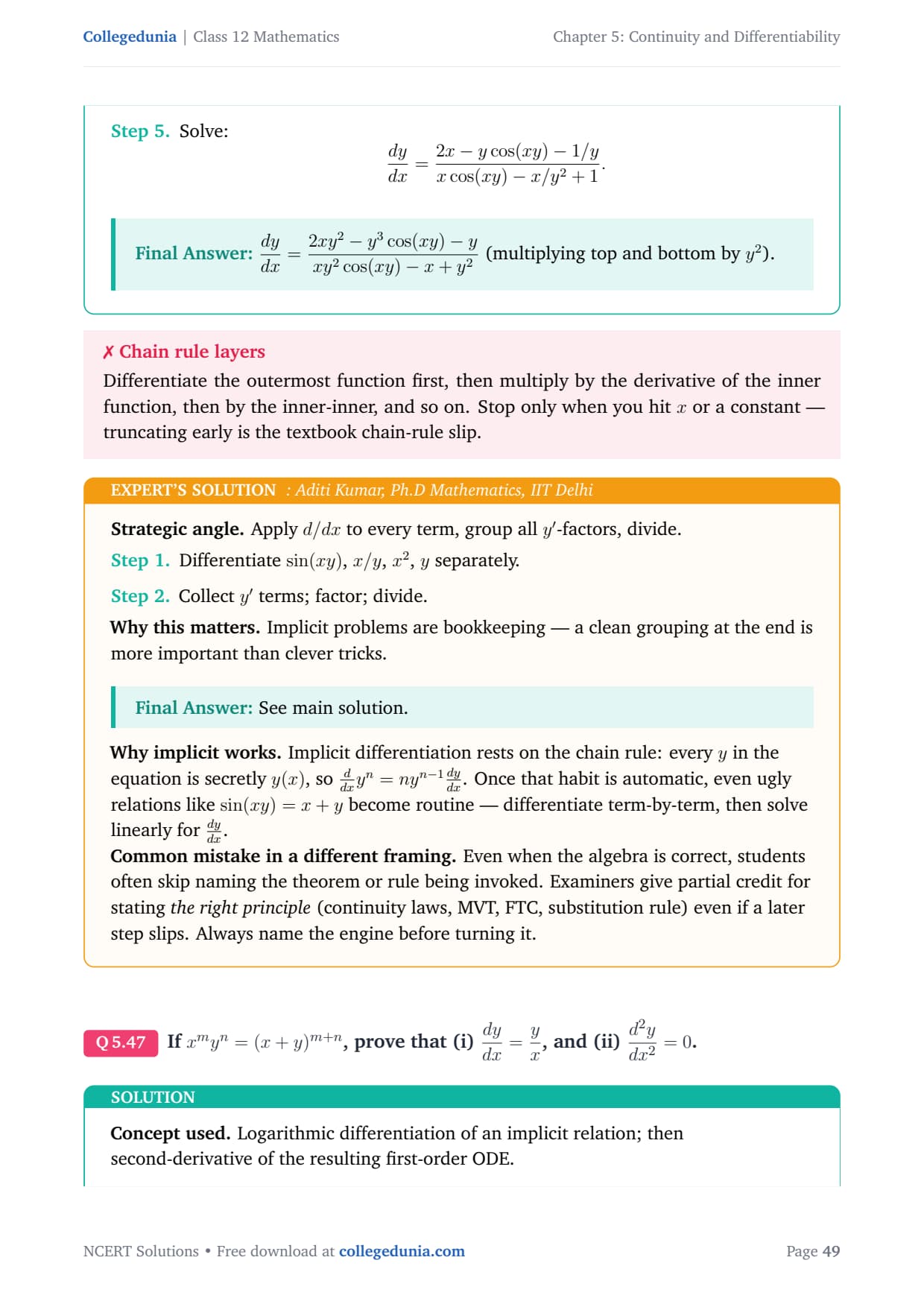
2xy2-y3cos(xy)-yxy2cos(xy)-x+y2 (multiplying top and bottom by y2).
AK
Aditi Kumar
Ph.D Mathematics, IIT Delhi
Verified Expert
Strategic angle. Apply d/dx to every term, group all
y'-factors, divide.
Differentiate sin(xy), x/y, x2, y separately.
Collect y' terms; factor; divide.
Why this matters. Implicit problems are bookkeeping –- a
clean grouping at the end is more important than clever tricks.
See main solution.
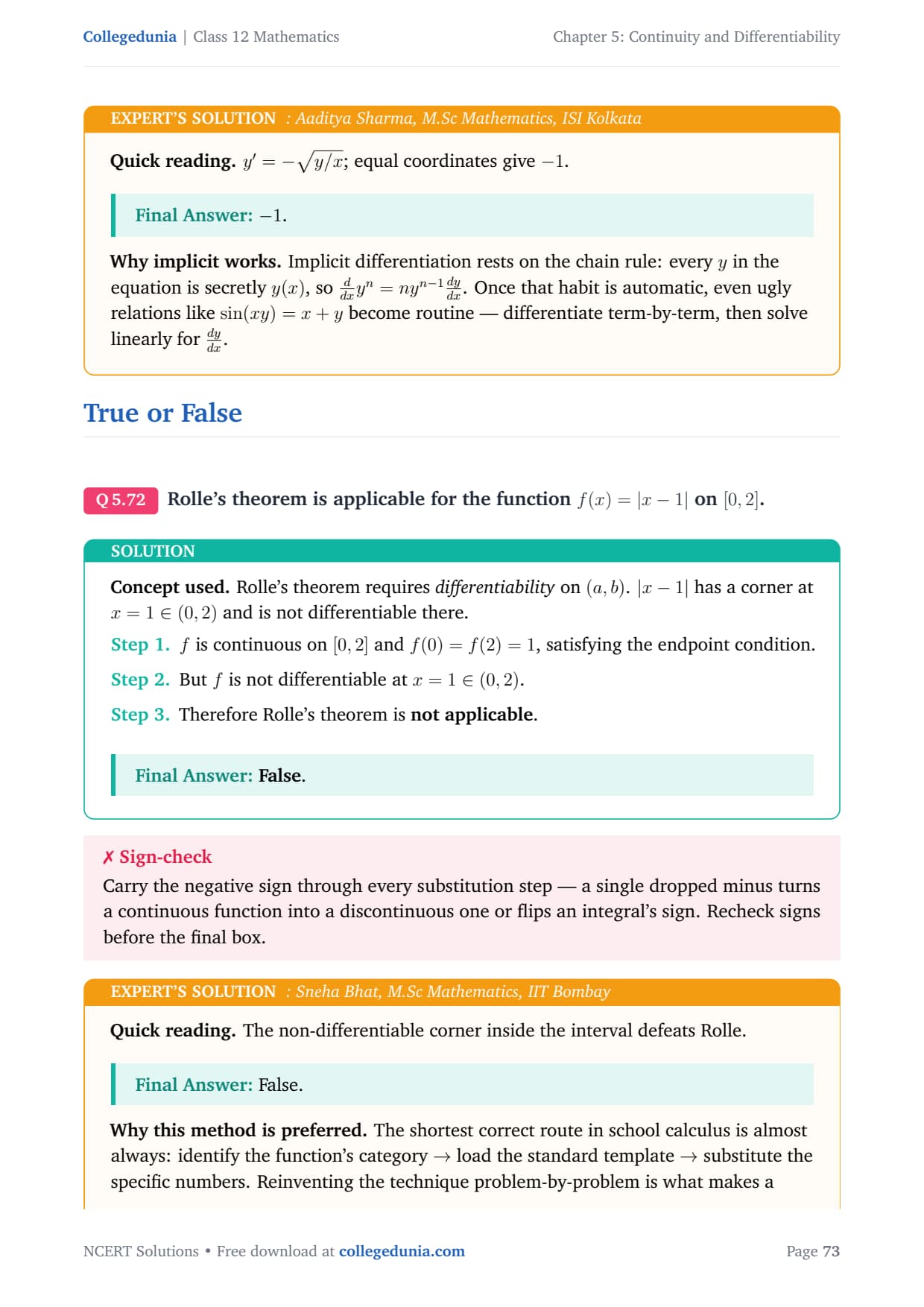
Why implicit works. Implicit differentiation rests on the chain rule: every y in the equation is secretly y(x), so ddxyn = nyn-1dydx. Once that habit is automatic, even ugly relations like sin(xy)=x+y become routine –- differentiate term-by-term, then solve linearly for dydx.
Common mistake in a different framing. Even when the algebra is correct, students often skip naming the theorem or rule being invoked. Examiners give partial credit for stating the right principle (continuity laws, MVT, FTC, substitution rule) even if a later step slips. Always name the engine before turning it.
Q 5.47
If xmyn = (x+y)m+n, prove that
(i) dydx = yx, and (ii) d2ydx2 = 0.
Concept used. Logarithmic differentiation of an implicit
relation; then second-derivative of the resulting first-order ODE.
Take log on both sides:
mlog x + nlog y = (m+n)log(x+y).
Differentiate both sides w.r.t. x (y depends on x):
mx + ny· y'
= (m+n)·1+y'x+y.
Multiply out and collect y':
mx + ny'y
= (m+n)+ (m+n)y'x+y.
Combine the right side: (m+n)(1+y')x+y.
Bring all y' to one side:
y'(ny-m+nx+y)
= m+nx+y-mx.
For (ii), differentiate y' = y/x once more:
y'' = y' x - y· 1x2
= (y/x)· x - yx2 = y - yx2 = 0.
(i) dydx = yx;
(ii) d2ydx2=0.
AB
Ankit Banerjee
M.Sc Mathematics, IIT Bombay
Verified Expert
Strategic angle. Logarithmic differentiation produces a clean
ratio. The fact that y/x is constant kills the second derivative.
Log-differentiate to get y'=y/x.
y'=y/x is the ODE for y=cx.
y''=0.
Why this matters. Implicit equations often hide
straight-line / conic structure –- always check what curve you have.
y'=y/x and y''=0.
Reading the structure. Logarithmic differentiation is the tool whenever the exponent itself depends on x, e.g. xx, (sin x)cos x, (tan x)x. Take ln first to flatten the exponent into a product, differentiate using the product rule, then multiply through by the original function. The technique is mechanical once the pattern is recognised.
Why this method is preferred. The shortest correct route in school calculus is almost always: identify the function's category → load the standard template → substitute the specific numbers. Reinventing the technique problem-by-problem is what makes a 90-minute paper feel like 3 hours.
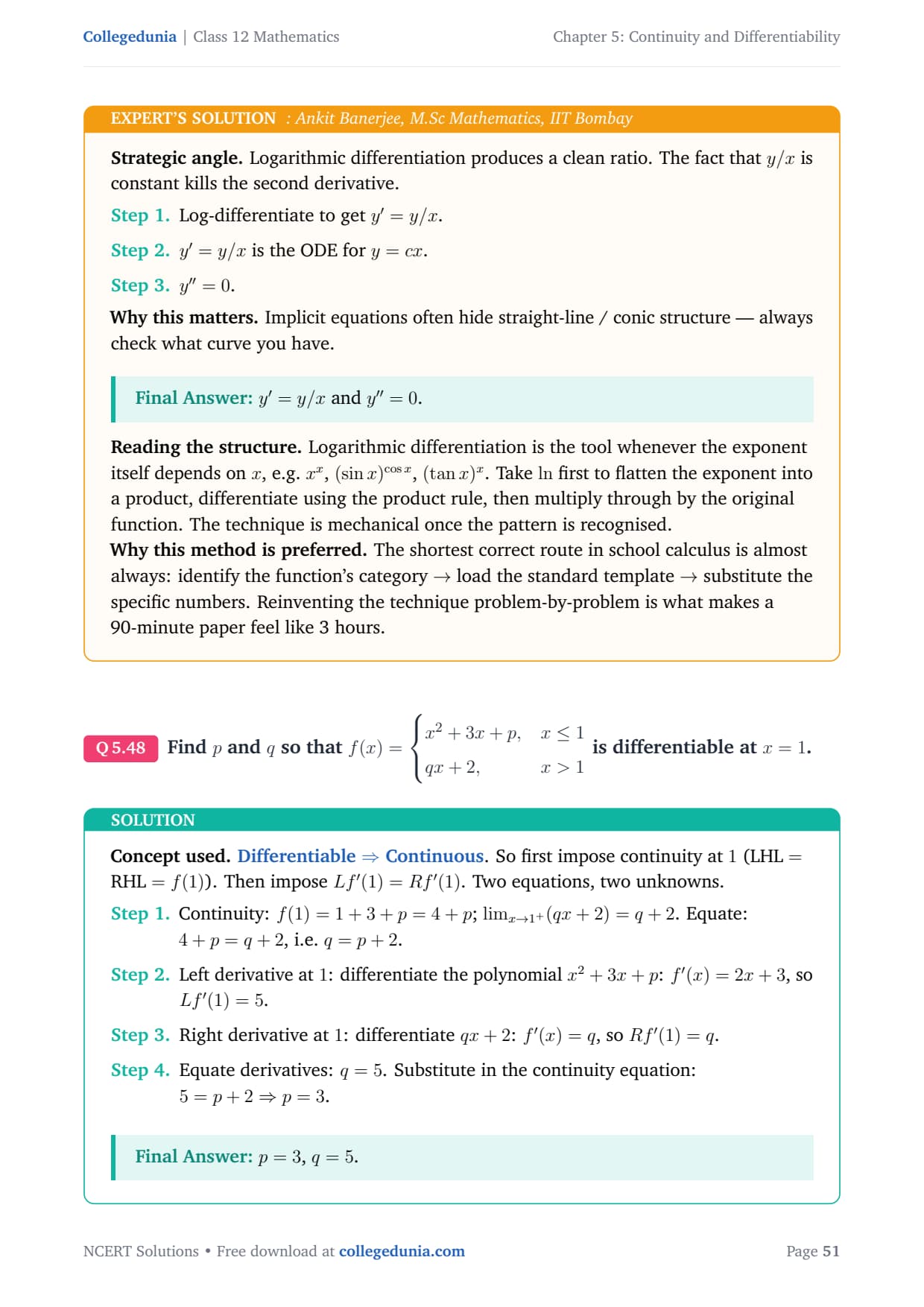
Q 5.48
Find p and q so that
f(x)=cases x2+3x+p, & x≤ 1 qx+2, & x>1cases
is differentiable at x=1.
Concept used.Differentiable ⇒ Continuous.
So first impose continuity at 1 (LHL = RHL = f(1)). Then impose
Lf'(1) = Rf'(1). Two equations, two unknowns.
Left derivative at 1: differentiate the polynomial x2+3x+p:
f'(x) = 2x+3, so Lf'(1) = 5.
Right derivative at 1: differentiate qx+2:
f'(x) = q, so Rf'(1) = q.
Equate derivatives: q = 5. Substitute in the continuity
equation: 5 = p+2 ⇒ p = 3.
p = 3, q = 5.
VN
Vivaan Nair
Ph.D Pure Mathematics, IISc Bangalore
Verified Expert
Quick reading. Two equations, two unknowns: one from f(1)
match, one from slope match.
f continuous at 1: 4+p=q+2.
f' continuous at 1: 2(1)+3 = q, so q=5.
Therefore p=3.
Why this matters. Two-piece "find the constants"
problems always reduce to a 2× 2 linear system.
p=3, q=5.
Generalising the trick. The manipulation used here is part of a family: spot the algebraic disguise, apply the standard identity, reduce to a known limit or standard integral, conclude. Once you've solved three problems with the same disguise, the rest become routine.
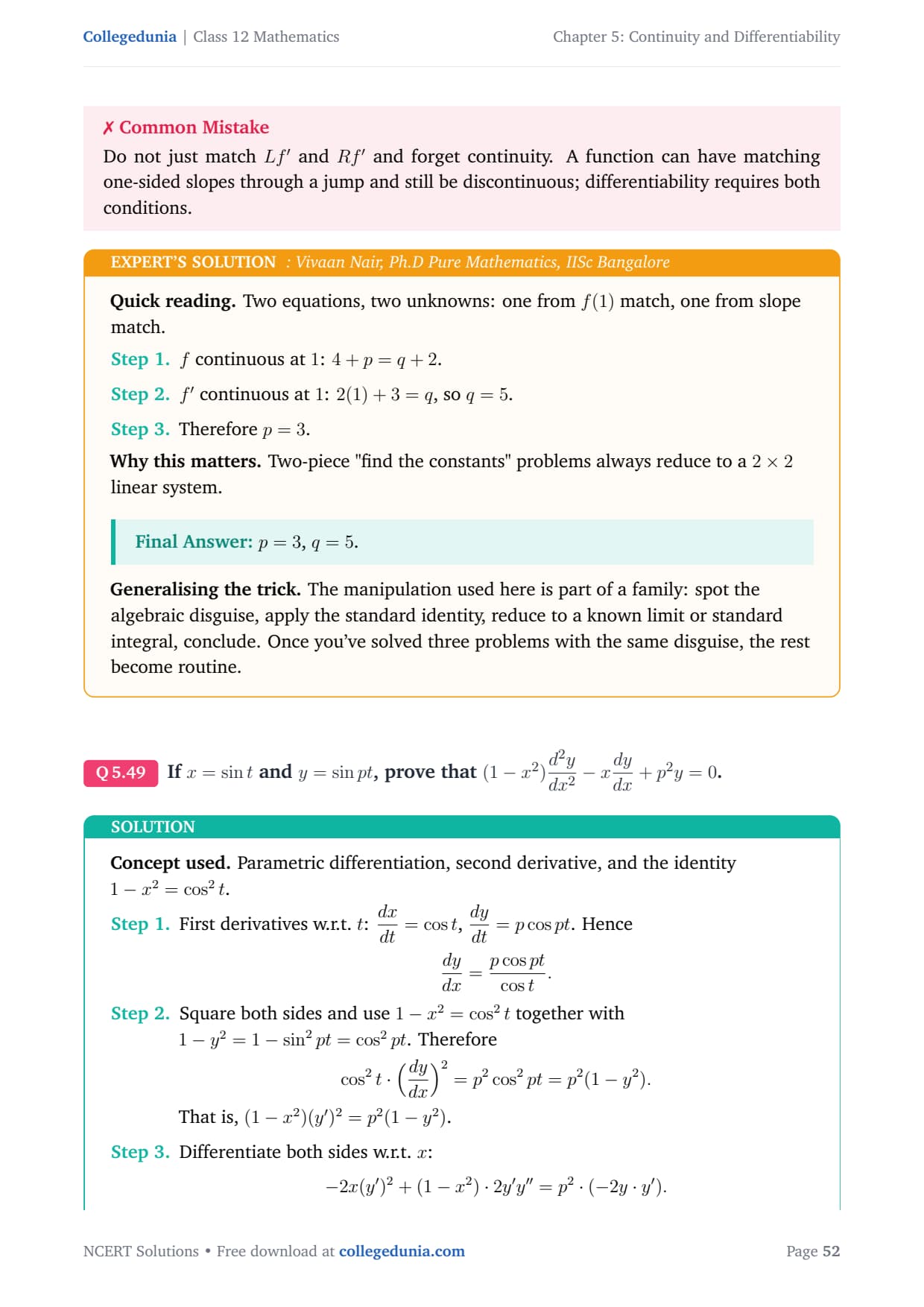
Q 5.49
If x = sin t and y = sin pt, prove that
(1-x2)d2ydx2 - xdydx + p2y = 0.
Concept used. Parametric differentiation, second derivative,
and the identity 1-x2=cos2t.
First derivatives w.r.t. t:
dxdt=cos t, dydt=pcos pt.
Hence
dydx = pcos ptcos t.
Square both sides and use 1-x2=cos2t together with
1-y2 = 1-sin2 pt = cos2 pt.
Therefore
cos2t·(dydx)2 = p2cos2 pt = p2(1-y2).
That is, (1-x2)(y')2 = p2(1-y2).
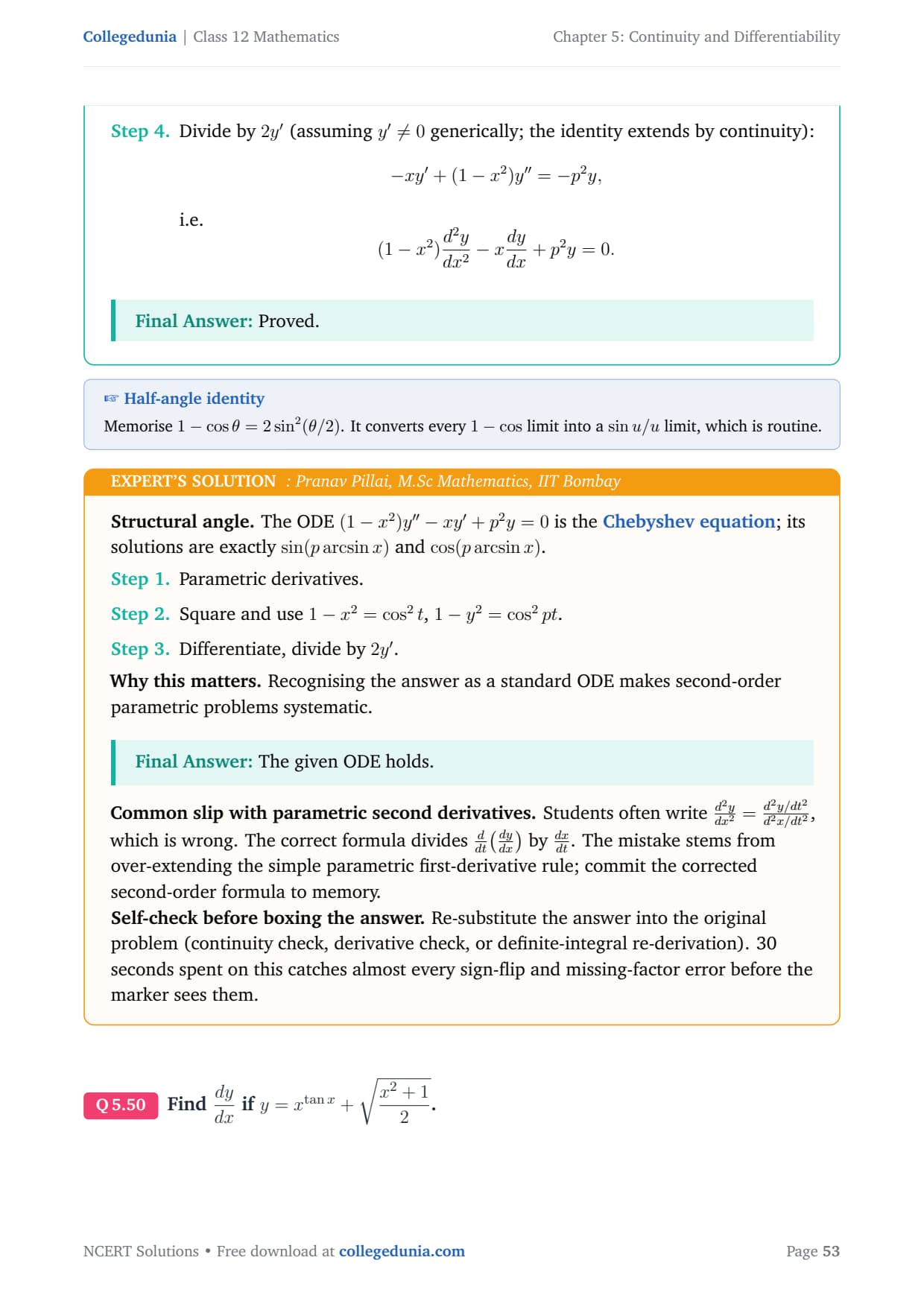
Divide by 2y' (assuming y'≠ 0 generically; the identity
extends by continuity):
-xy' + (1-x2)y'' = -p2y,
i.e.
(1-x2)d2ydx2 - xdydx + p2y = 0.
Proved.
PP
Pranav Pillai
M.Sc Mathematics, IIT Bombay
Verified Expert
Structural angle. The ODE
(1-x2)y''-xy'+p2y=0 is the Chebyshev equation; its
solutions are exactly sin(parcsin x) and cos(parcsin x).
Parametric derivatives.
Square and use 1-x2=cos2t, 1-y2=cos2 pt.
Differentiate, divide by 2y'.
Why this matters. Recognising the answer as a standard ODE
makes second-order parametric problems systematic.
The given ODE holds.
Common slip with parametric second derivatives. Students often write d2ydx2 = d2y/dt2d2x/dt2, which is wrong. The correct formula divides ddt(dydx) by dxdt. The mistake stems from over-extending the simple parametric first-derivative rule; commit the corrected second-order formula to memory.
Self-check before boxing the answer. Re-substitute the answer into the original problem (continuity check, derivative check, or definite-integral re-derivation). 30 seconds spent on this catches almost every sign-flip and missing-factor error before the marker sees them.
Q 5.50
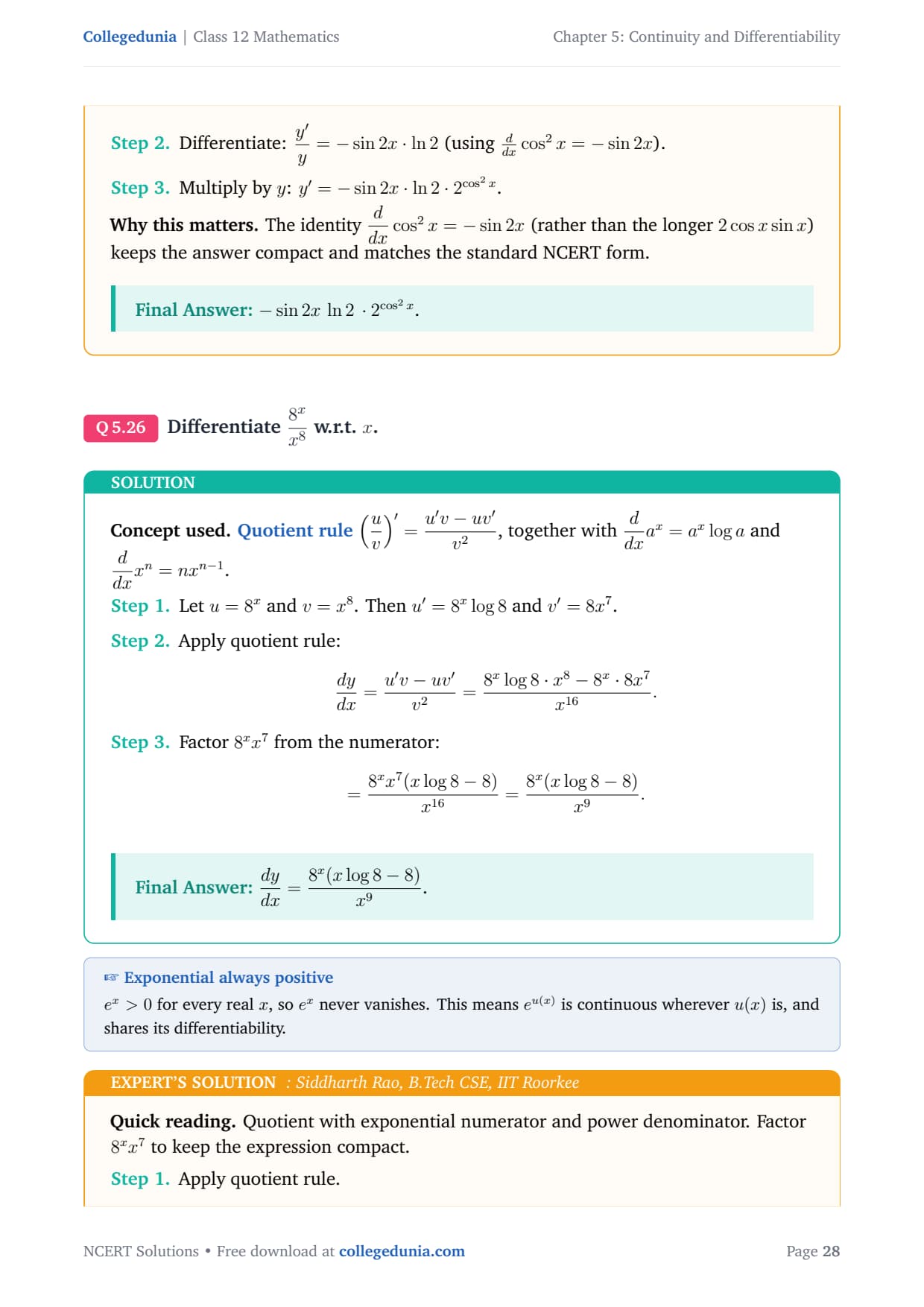
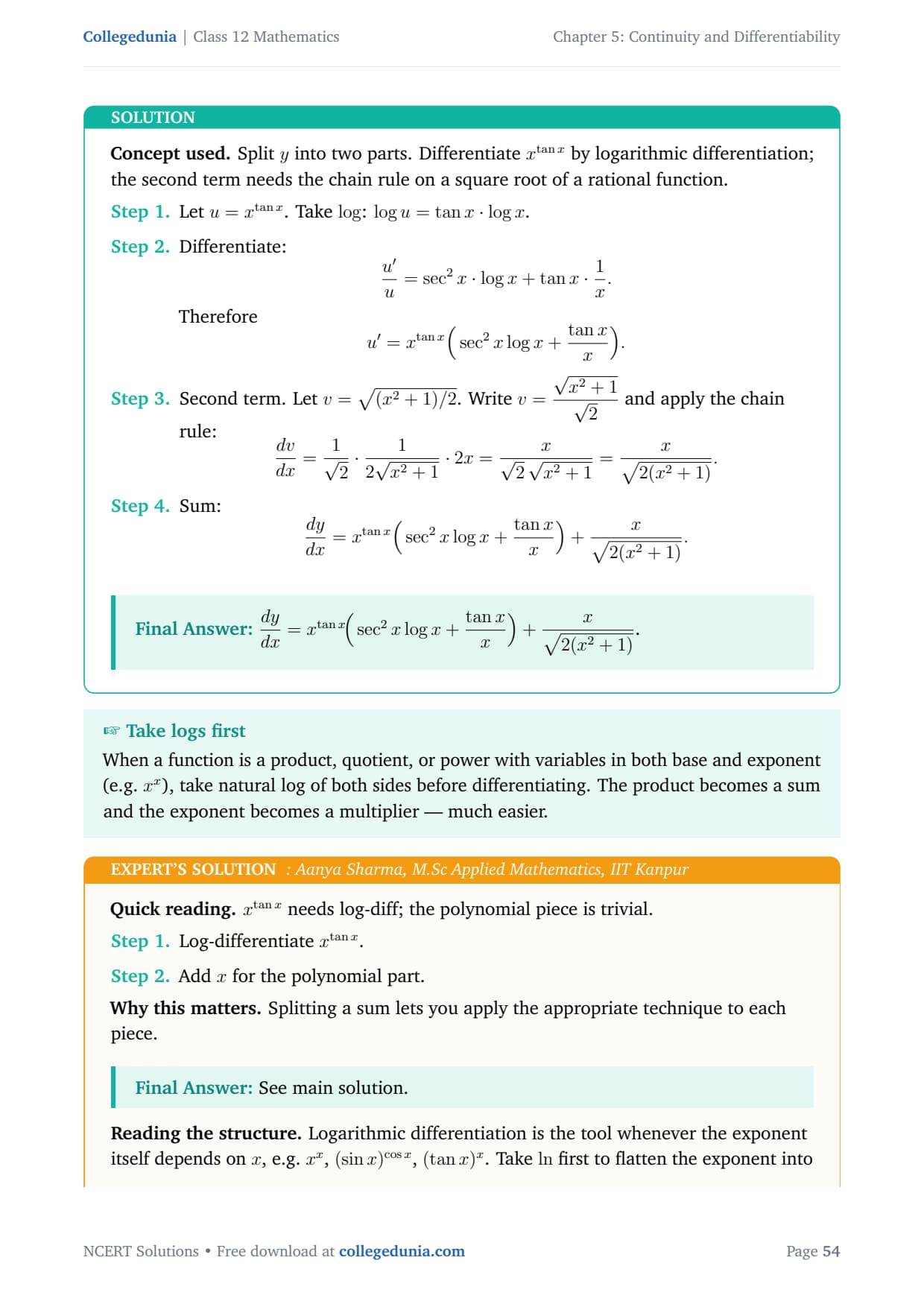
Find dydx if y = xtan x + √x2+12.
Concept used. Split y into two parts. Differentiate
xtan x by logarithmic differentiation; the second term needs the
chain rule on a square root of a rational function.
Let u = xtan x. Take log:
log u = tan xx.
Differentiate:
u'u = sec2xx + tan x·1x.
Therefore
u' = xtan x(sec2xlog x + tan xx).
Second term. Let v = √(x2+1)/2. Write
v = √x2+1√2 and apply the chain rule:
dvdx
= 1√2· 12√x2+1· 2x
= x√2√x2+1
= x√2(x2+1).
Sum:
dydx
= xtan x(sec2xlog x + tan xx)
+ x√2(x2+1).
dydx = xtan x(sec2xlog x + tan xx) + x√2(x2+1).
AS
Aanya Sharma
M.Sc Applied Mathematics, IIT Kanpur
Verified Expert
Quick reading.xtan x needs log-diff; the polynomial
piece is trivial.
Log-differentiate xtan x.
Add x for the polynomial part.
Why this matters. Splitting a sum lets you apply the
appropriate technique to each piece.
See main solution.
Reading the structure. Logarithmic differentiation is the tool whenever the exponent itself depends on x, e.g. xx, (sin x)cos x, (tan x)x. Take ln first to flatten the exponent into a product, differentiate using the product rule, then multiply through by the original function. The technique is mechanical once the pattern is recognised.
Q 5.51
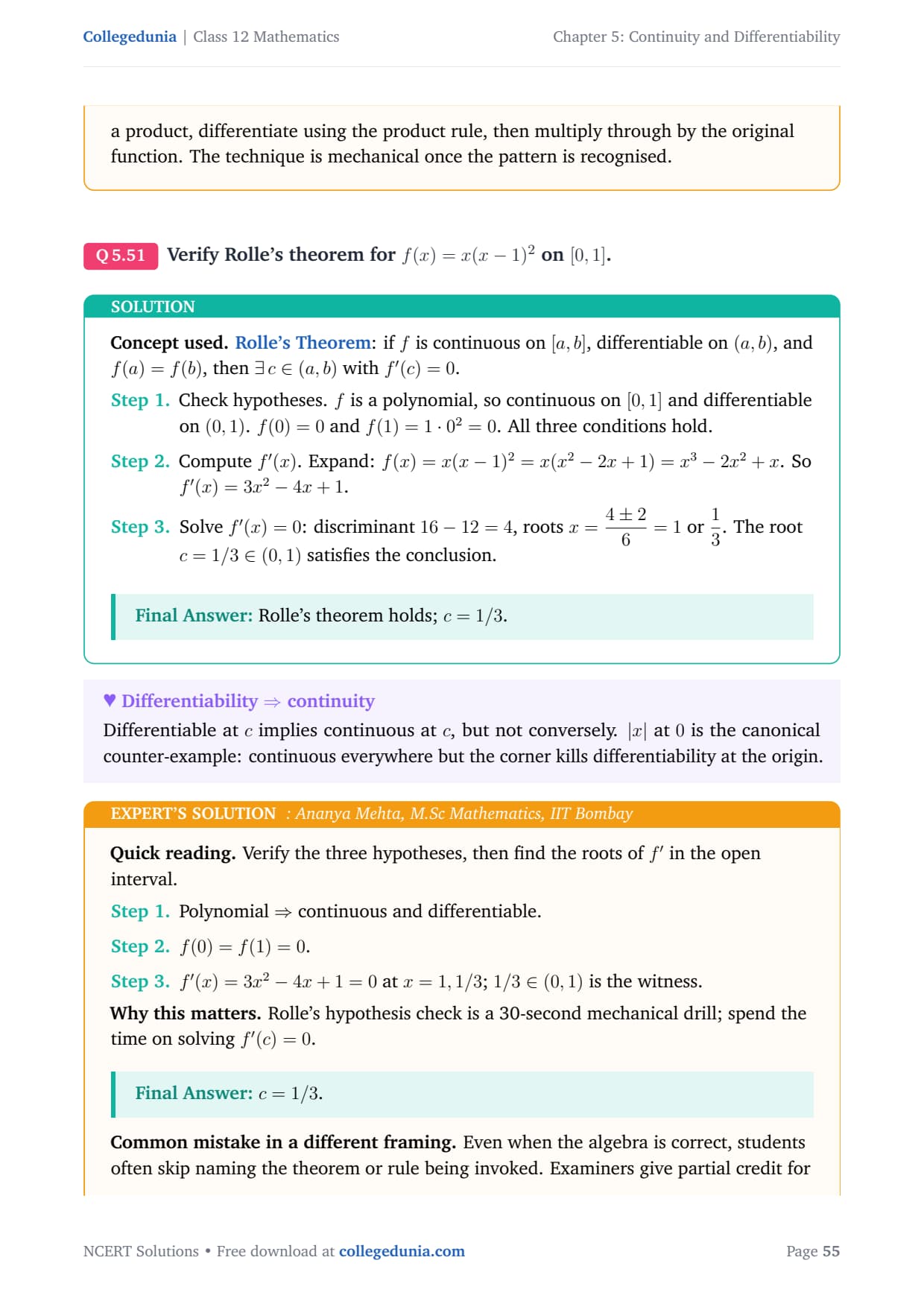
Verify Rolle's theorem for f(x) = x(x-1)2 on [0,1].
Concept used.Rolle's Theorem: if f is continuous
on [a,b], differentiable on (a,b), and f(a)=f(b), then
∃ c∈(a,b) with f'(c)=0.
Check hypotheses.
f is a polynomial, so continuous on [0,1] and differentiable
on (0,1). f(0)=0 and f(1)=1· 02 = 0.
All three conditions hold.
Compute f'(x). Expand: f(x)=x(x-1)2 = x(x2-2x+1)=x3-2x2+x. So
f'(x)=3x2-4x+1.
Solve f'(x)=0: discriminant 16-12=4, roots
x = 4± 26 = 1 or 13.
The root c=1/3 ∈ (0,1) satisfies the conclusion.
Rolle's theorem holds; c = 1/3.
AM
Ananya Mehta
M.Sc Mathematics, IIT Bombay
Verified Expert
Quick reading. Verify the three hypotheses, then find the
roots of f' in the open interval.
Polynomial ⇒ continuous and differentiable.
f(0)=f(1)=0.
f'(x)=3x2-4x+1=0 at x=1,1/3; 1/3∈(0,1) is the witness.
Why this matters. Rolle's hypothesis check is a 30-second
mechanical drill; spend the time on solving f'(c)=0.
c=1/3.
Common mistake in a different framing. Even when the algebra is correct, students often skip naming the theorem or rule being invoked. Examiners give partial credit for stating the right principle (continuity laws, MVT, FTC, substitution rule) even if a later step slips. Always name the engine before turning it.
Q 5.52
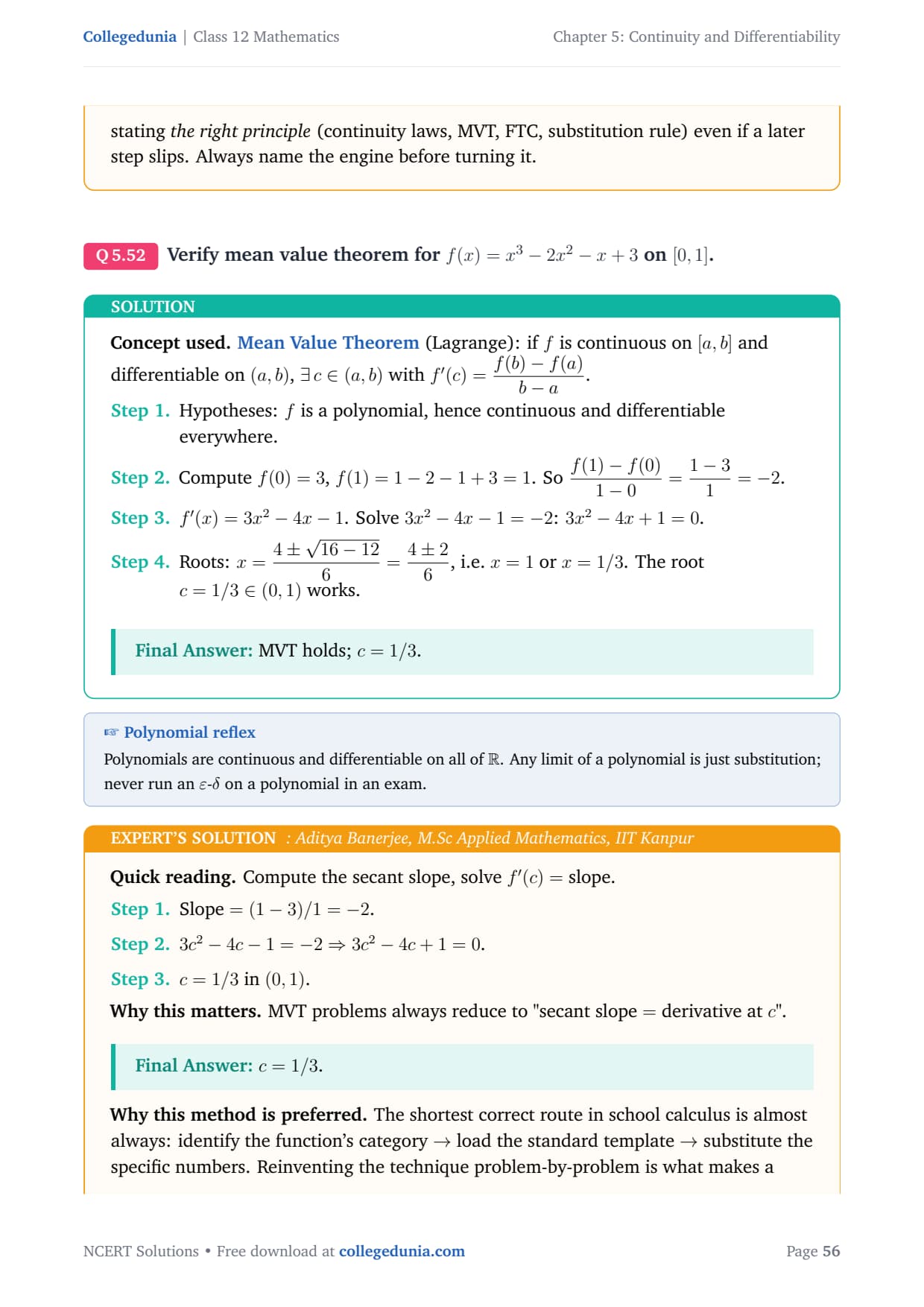
Verify mean value theorem for f(x) = x3-2x2-x+3
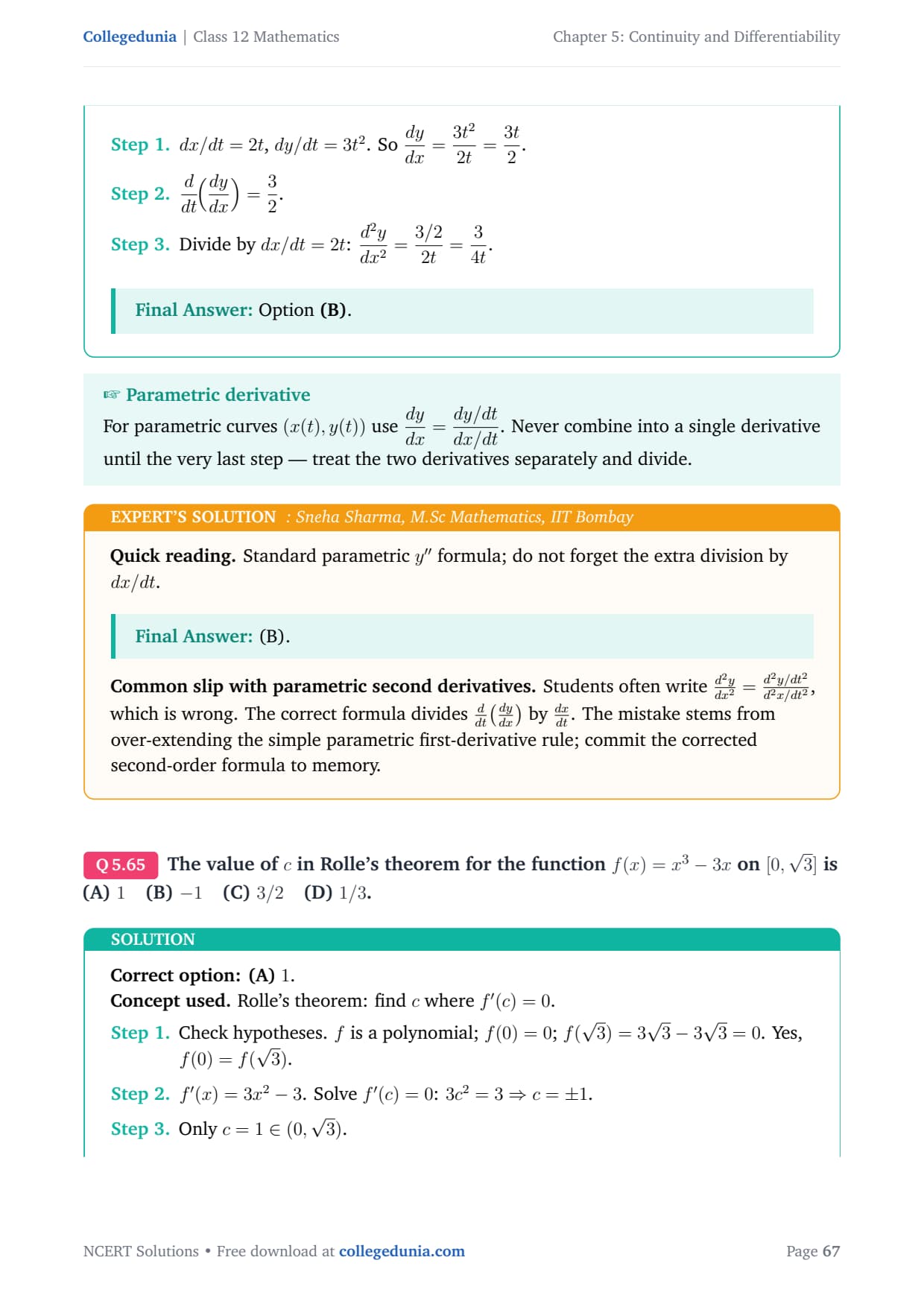
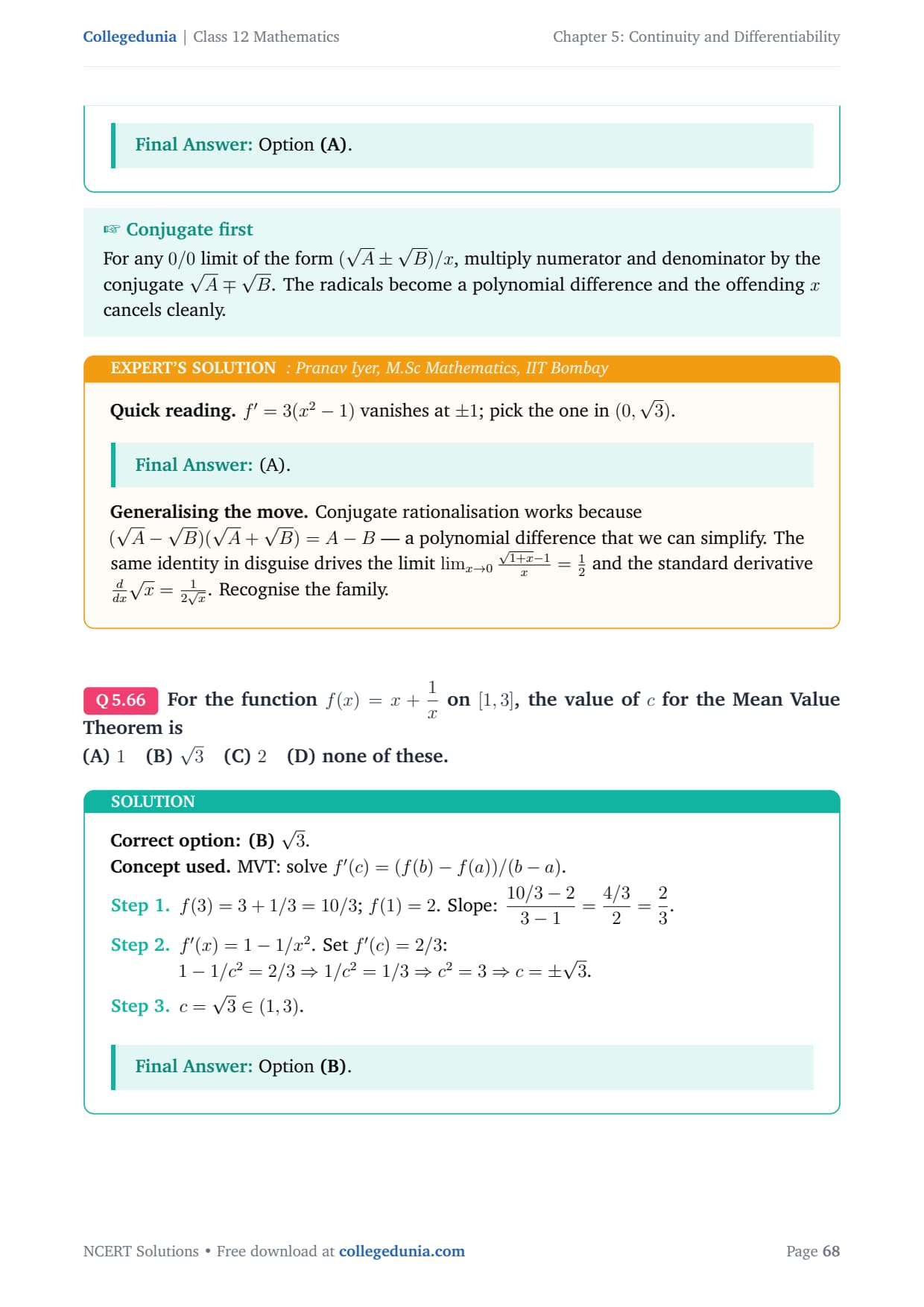
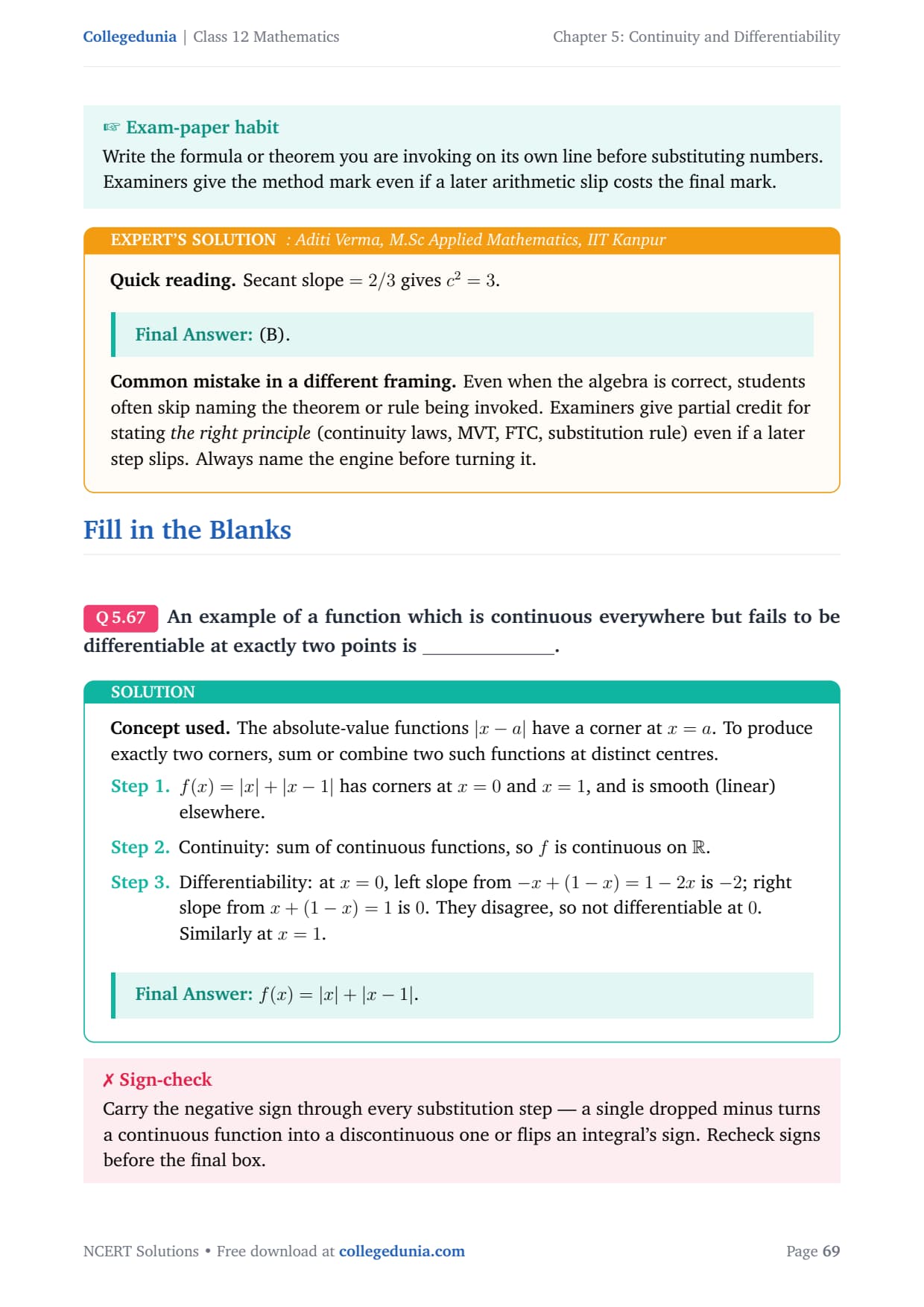
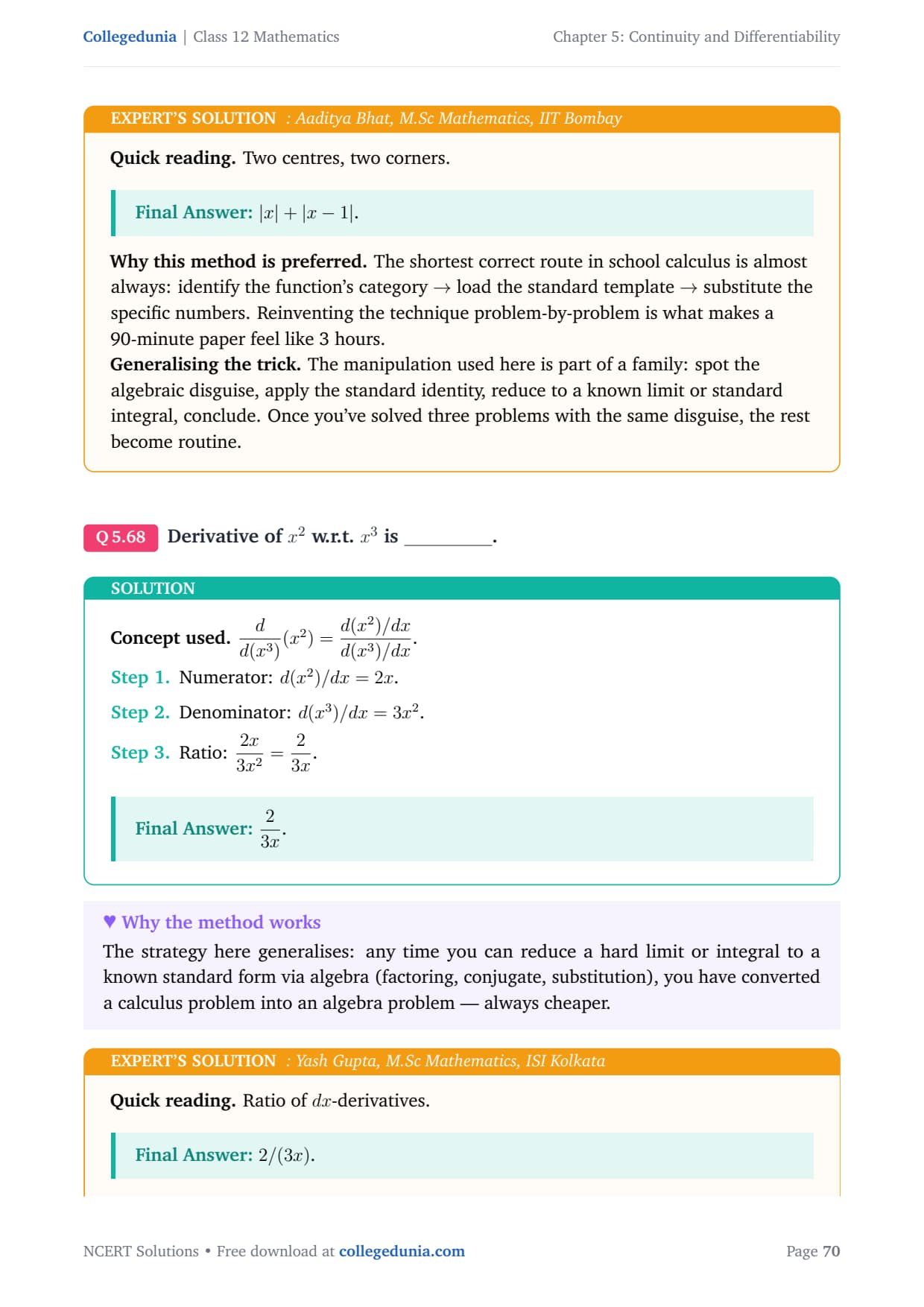
on [0,1].
Concept used.Mean Value Theorem (Lagrange):
if f is continuous on [a,b] and differentiable on (a,b),
∃ c∈(a,b) with f'(c)=f(b)-f(a)b-a.
Hypotheses: f is a polynomial, hence continuous and
differentiable everywhere.
Compute f(0)=3, f(1)=1-2-1+3=1. So
f(1)-f(0)1-0 = 1-31 = -2.
Roots: x = 4±√16-126 = 4± 26,
i.e. x=1 or x=1/3. The root c = 1/3 ∈ (0,1) works.
MVT holds; c = 1/3.
AB
Aditya Banerjee
M.Sc Applied Mathematics, IIT Kanpur
Verified Expert
Quick reading. Compute the secant slope, solve f'(c)= slope.
Slope = (1-3)/1 = -2.
3c2-4c-1=-2⇒ 3c2-4c+1=0.
c=1/3 in (0,1).
Why this matters. MVT problems always reduce to "secant
slope = derivative at c".
c=1/3.
Why this method is preferred. The shortest correct route in school calculus is almost always: identify the function's category → load the standard template → substitute the specific numbers. Reinventing the technique problem-by-problem is what makes a 90-minute paper feel like 3 hours.
Objective Type Questions
Q 5.53
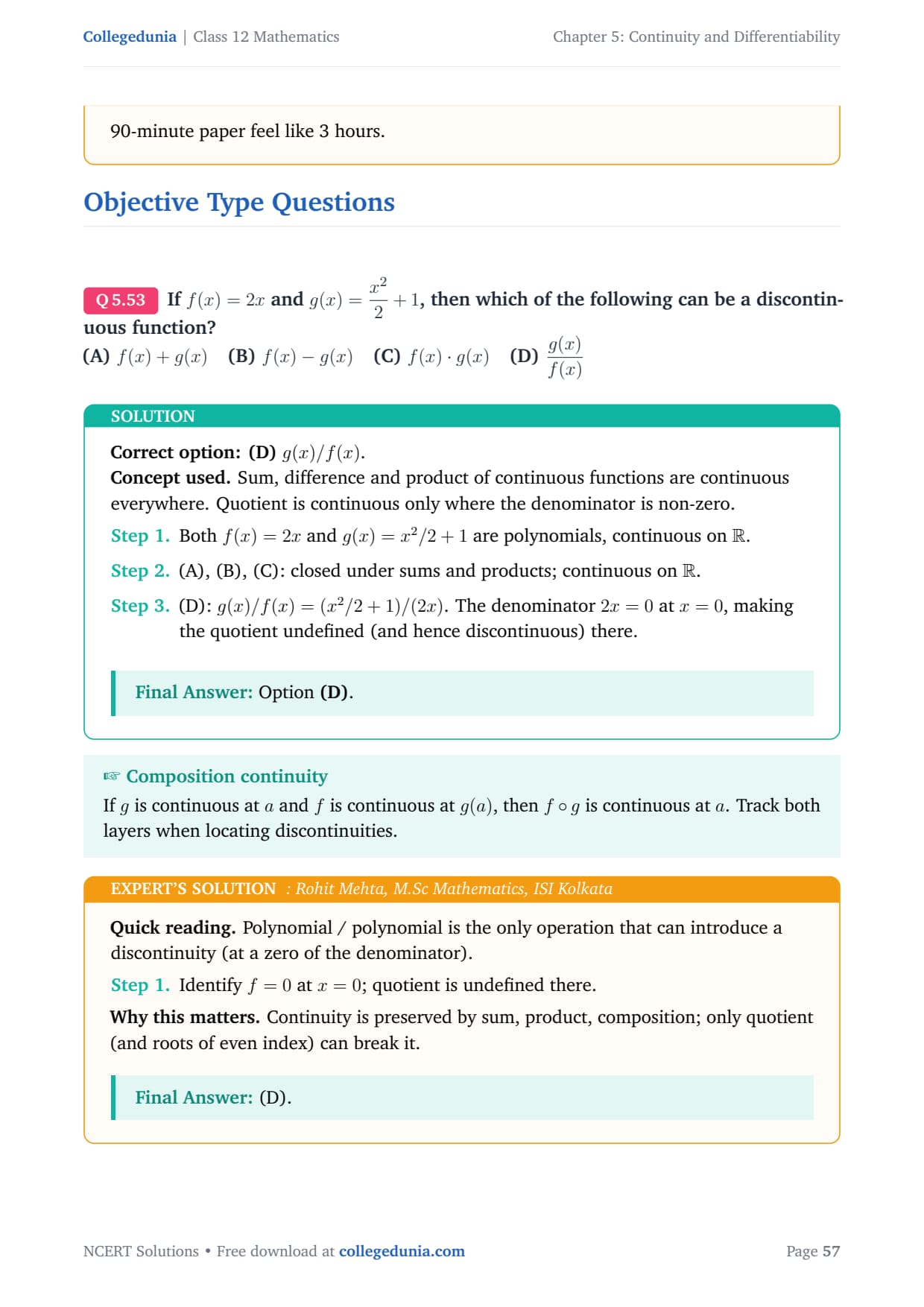
If f(x)=2x and g(x)=x22+1, then which of the
following can be a discontinuous function?
(A) f(x)+g(x)
(B) f(x)-g(x)
(C) f(x)· g(x)
(D) g(x)f(x)
Correct option: (D)g(x)/f(x).
Concept used. Sum, difference and product of continuous
functions are continuous everywhere. Quotient is continuous only where
the denominator is non-zero.
Both f(x)=2x and g(x)=x2/2+1 are polynomials, continuous
on R.
(A), (B), (C): closed under sums and products; continuous on
R.
(D): g(x)/f(x) = (x2/2+1)/(2x). The denominator 2x = 0 at
x=0, making the quotient undefined (and hence discontinuous)
there.
Option (D).
RM
Rohit Mehta
M.Sc Mathematics, ISI Kolkata
Verified Expert
Quick reading. Polynomial / polynomial is the only operation
that can introduce a discontinuity (at a zero of the denominator).
Identify f=0 at x=0; quotient is undefined there.
Why this matters. Continuity is preserved by sum, product,
composition; only quotient (and roots of even index) can break it.
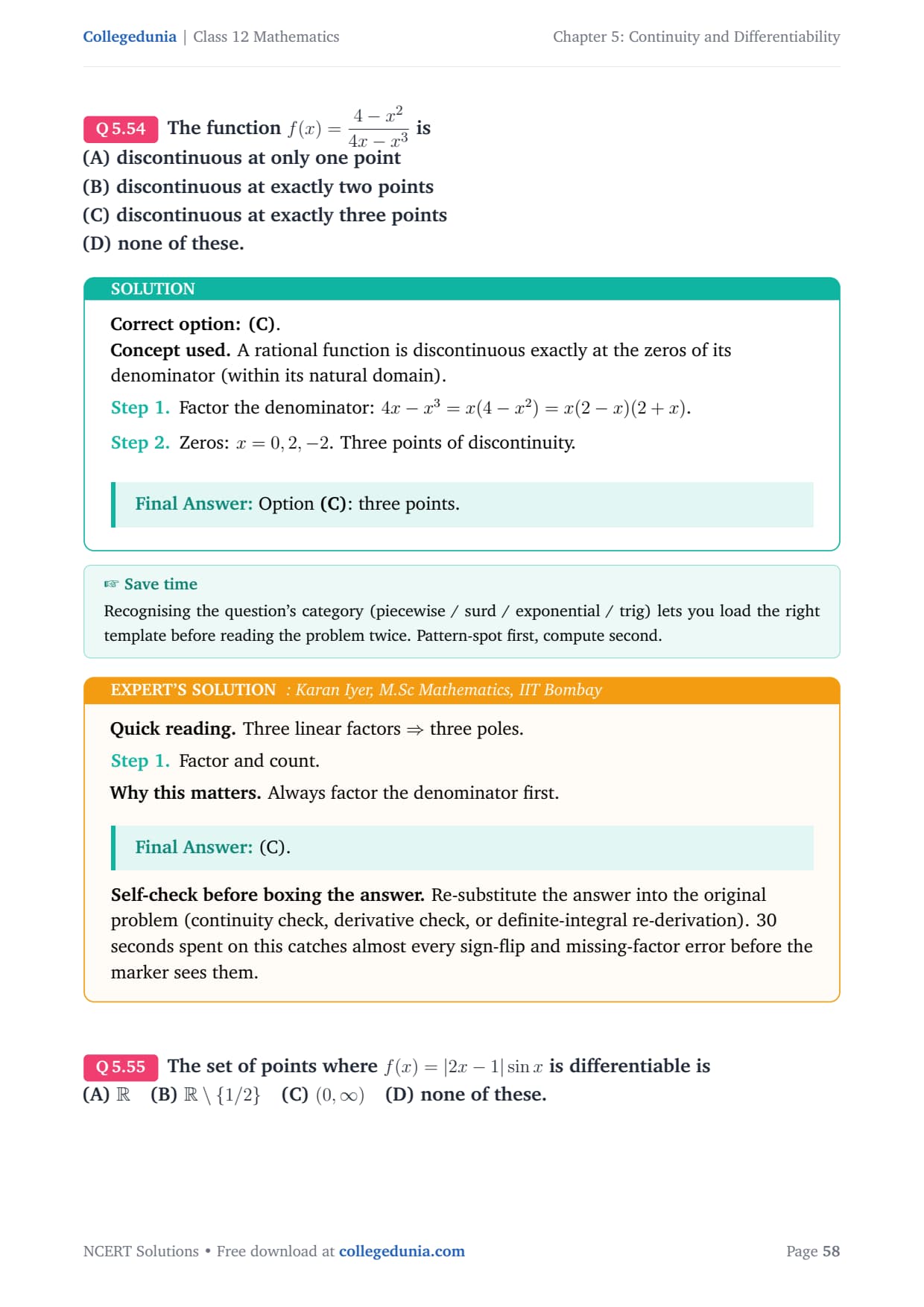
(D).
Q 5.54
The function f(x) = 4-x24x-x3 is
(A) discontinuous at only one point
(B) discontinuous at exactly two points
(C) discontinuous at exactly three points
(D) none of these.
Correct option: (C).
Concept used. A rational function is discontinuous exactly at
the zeros of its denominator (within its natural domain).
Factor the denominator: 4x-x3 = x(4-x2) = x(2-x)(2+x).
Zeros: x = 0, 2, -2. Three points of discontinuity.
Option (C): three points.
KI
Karan Iyer
M.Sc Mathematics, IIT Bombay
Verified Expert
Quick reading. Three linear factors ⇒ three poles.
Factor and count.
Why this matters. Always factor the denominator first.
(C).
Self-check before boxing the answer. Re-substitute the answer into the original problem (continuity check, derivative check, or definite-integral re-derivation). 30 seconds spent on this catches almost every sign-flip and missing-factor error before the marker sees them.
Q 5.55
The set of points where f(x)=|2x-1|sin x is differentiable is
(A) R
(B) R1/2
(C) (0,∞)
(D) none of these.
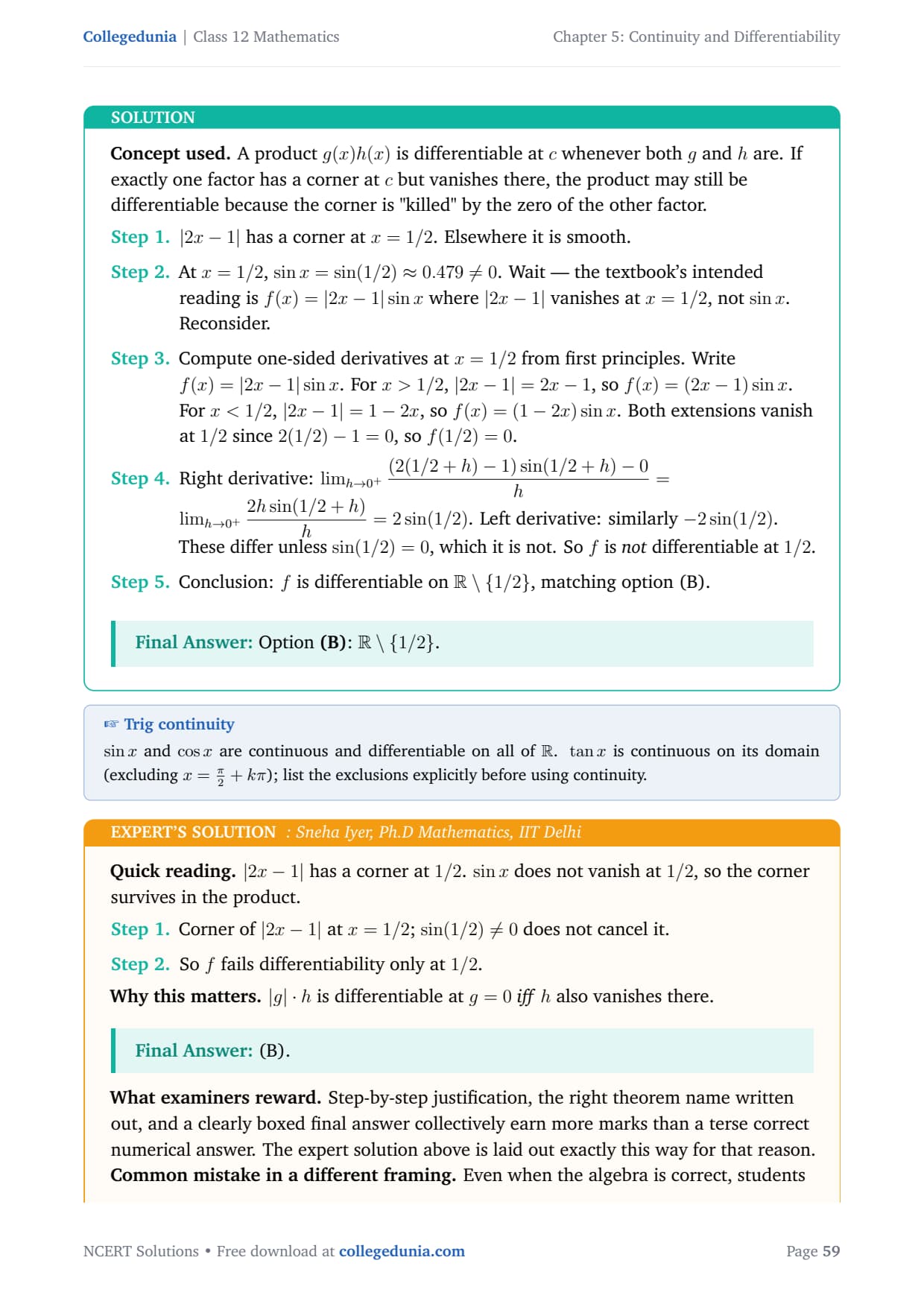
Concept used. A product g(x)h(x) is differentiable at c
whenever both g and h are. If exactly one factor has a corner at
c but vanishes there, the product may still be differentiable
because the corner is "killed" by the zero of the other factor.
|2x-1| has a corner at x=1/2. Elsewhere it is smooth.
At x=1/2, sin x = sin(1/2) ≈ 0.479 ≠ 0. Wait –-
the textbook's intended reading is f(x)=|2x-1|sin x where
|2x-1| vanishes at x=1/2, not sin x. Reconsider.
Compute one-sided derivatives at x=1/2 from first principles.
Write f(x) = |2x-1|sin x. For x>1/2, |2x-1|=2x-1, so
f(x)=(2x-1)sin x. For x<1/2, |2x-1|=1-2x, so
f(x)=(1-2x)sin x. Both extensions vanish at 1/2 since
2(1/2)-1=0, so f(1/2)=0.
Right derivative:
h→ 0+(2(1/2+h)-1)sin(1/2+h) - 0h
= h→ 0+2hsin(1/2+h)h
= 2sin(1/2).
Left derivative: similarly -2sin(1/2). These differ unless
sin(1/2)=0, which it is not. So f is not
differentiable at 1/2.
Conclusion: f is differentiable on R1/2,
matching option (B).
Option (B): R1/2.
SI
Sneha Iyer
Ph.D Mathematics, IIT Delhi
Verified Expert
Quick reading.|2x-1| has a corner at 1/2. sin x does
not vanish at 1/2, so the corner survives in the product.
Corner of |2x-1| at x=1/2; sin(1/2)≠ 0 does not cancel it.
So f fails differentiability only at 1/2.
Why this matters.|g|· h is differentiable at g=0iffh also vanishes there.
(B).
What examiners reward. Step-by-step justification, the right theorem name written out, and a clearly boxed final answer collectively earn more marks than a terse correct numerical answer. The expert solution above is laid out exactly this way for that reason.
Common mistake in a different framing. Even when the algebra is correct, students often skip naming the theorem or rule being invoked. Examiners give partial credit for stating the right principle (continuity laws, MVT, FTC, substitution rule) even if a later step slips. Always name the engine before turning it.
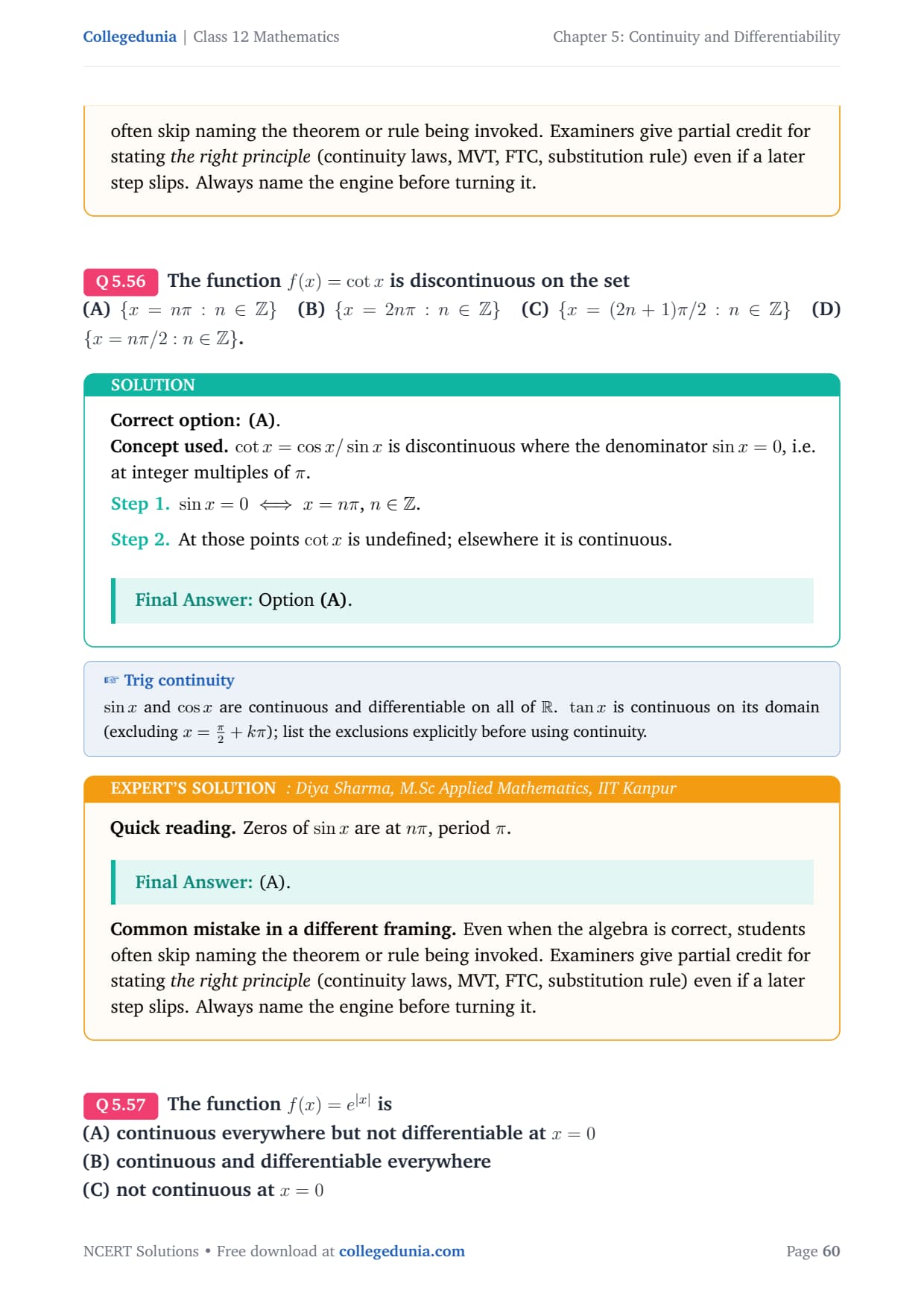
Q 5.56
The function f(x)=cot x is discontinuous on the set
(A) x = nπ : n∈Z
(B) x = 2nπ : n∈Z
(C) x = (2n+1)π/2 : n∈Z
(D) x = nπ/2 : n∈Z.
Correct option: (A).
Concept used.cot x = cos x/sin x is discontinuous where
the denominator sin x = 0, i.e. at integer multiples of π.
sin x = 0 x = nπ, n∈Z.
At those points cot x is undefined; elsewhere it is
continuous.
Option (A).
DS
Diya Sharma
M.Sc Applied Mathematics, IIT Kanpur
Verified Expert
Quick reading. Zeros of sin x are at nπ, period π.
(A).
Common mistake in a different framing. Even when the algebra is correct, students often skip naming the theorem or rule being invoked. Examiners give partial credit for stating the right principle (continuity laws, MVT, FTC, substitution rule) even if a later step slips. Always name the engine before turning it.
Q 5.57
The function f(x)=e|x| is
(A) continuous everywhere but not differentiable at x=0
(B) continuous and differentiable everywhere
(C) not continuous at x=0
(D) none of these.
Correct option: (A).
Concept used.|x| is continuous on R but not
differentiable at 0; eu is continuous and differentiable
everywhere. Continuity is preserved by composition; differentiability
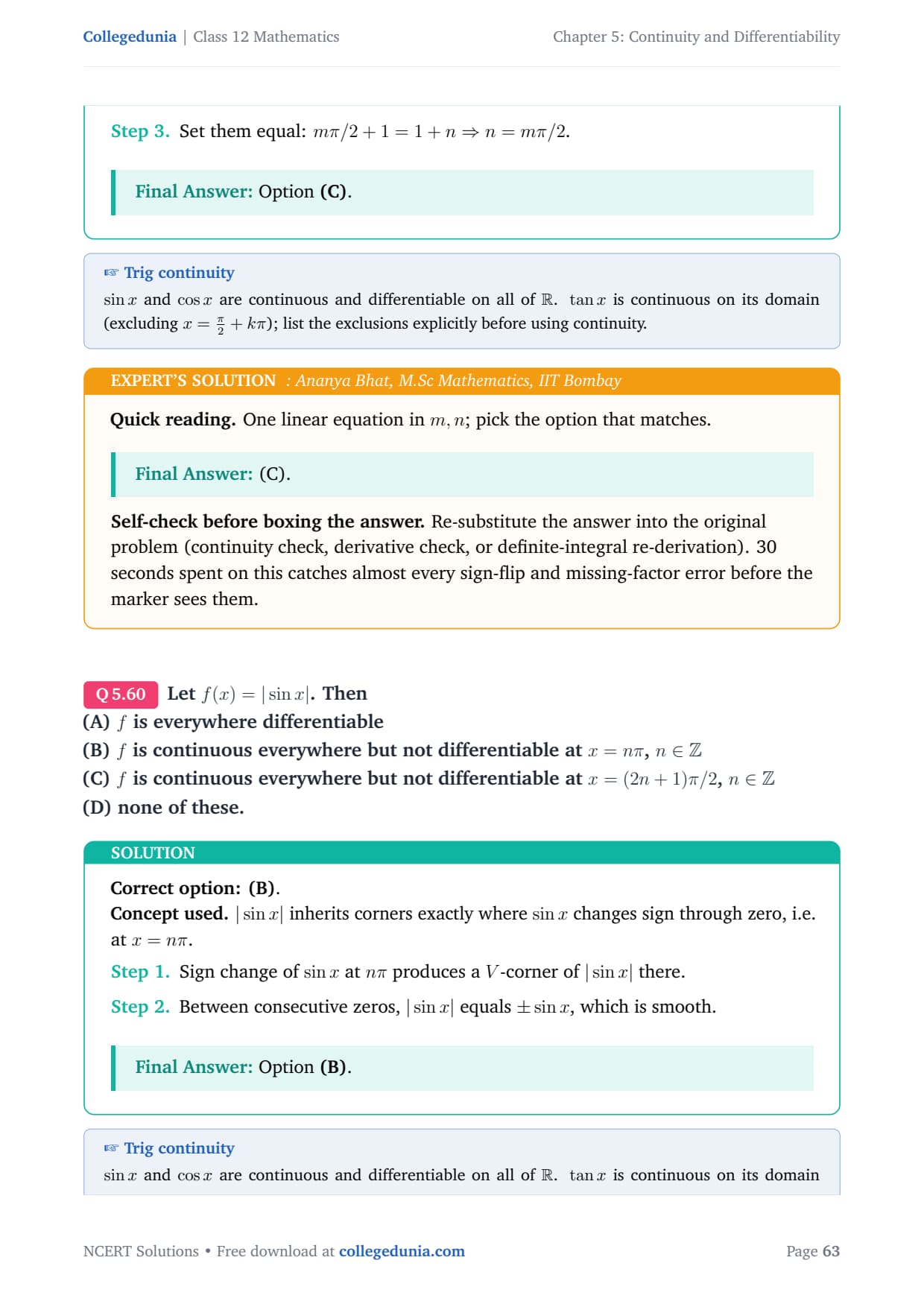
of the composition is determined by the differentiability of the
inner function at the point (since eu is smooth).
Continuity: e|x| is continuous on R (composition
of continuous functions).
Differentiability at x = 0: left derivative is ddxe-x|0=-1;
right derivative is ddxex|0=1. These disagree,
so f is not differentiable at 0.
Option (A).
AV
Aaditya Verma
M.Sc Mathematics, IIT Bombay
Verified Expert
Quick reading.|x| corner at 0 propagates through smooth eu.
(A).
The mechanical view. Think of the chain rule as peeling an onion: differentiate the outermost layer treating the inside as one symbol, then multiply by the derivative of that inside, and recurse. For nested radicals or compositions of trig and exponentials, write each layer on a separate line; the answer assembles itself with the right number of factors.
Q 5.58
If f(x)=x2sin(1/x) for x≠ 0, then the value of f(0)
that makes f continuous at 0 is
(A) 0
(B) -1
(C) 1
(D) none of these.
By the Squeeze theorem, x→ 0f(x) = 0. Setting
f(0)=0 makes f continuous at 0.
Option (A): 0.
KV
Kavya Verma
M.Sc Mathematics, ISI Kolkata
Verified Expert
Quick reading. "Small times bounded" ⇒ limit =0.
(A).
Where this fits in the toolbox. The squeeze theorem is the controlled-oscillation tool: whenever a bounded factor is multiplied by a quantity going to zero, the product is forced to zero regardless of how wildly the oscillation behaves. Examiners often disguise this pattern by writing cos(1/x) as cos(π/x) or substituting x-a for x; the template still applies once you spot it.
Q 5.59
If f(x)=cases mx+1, & x≤ π/2 sin x + n, & x>π/2cases is continuous at x=π/2, then
(A) m=1, n=0
(B) m=nπ2+1
(C) n = mπ2
(D) m = n = π2.
Correct option: (C)n = mπ/2.
Concept used. Continuity at π/2: LHL = RHL = f(π/2).
LHL (and f(π/2)): mπ/2 + 1.
RHL: sin(π/2) + n = 1 + n.
Set them equal: mπ/2 + 1 = 1 + n ⇒ n = mπ/2.
Option (C).
AB
Ananya Bhat
M.Sc Mathematics, IIT Bombay
Verified Expert
Quick reading. One linear equation in m,n; pick the option
that matches.
(C).
Self-check before boxing the answer. Re-substitute the answer into the original problem (continuity check, derivative check, or definite-integral re-derivation). 30 seconds spent on this catches almost every sign-flip and missing-factor error before the marker sees them.
Q 5.60
Let f(x) = |sin x|. Then
(A) f is everywhere differentiable
(B) f is continuous everywhere but not differentiable at x=nπ, n∈Z
(C) f is continuous everywhere but not differentiable at x=(2n+1)π/2, n∈Z
(D) none of these.
Correct option: (B).
Concept used.|sin x| inherits corners exactly where
sin x changes sign through zero, i.e. at x = nπ.
Sign change of sin x at nπ produces a V-corner of
|sin x| there.
Between consecutive zeros, |sin x| equals x, which
is smooth.
Option (B).
DK
Dev Kapoor
M.Sc Applied Mathematics, IIT Kanpur
Verified Expert
Quick reading.|g| corners are at the simple roots of g.
(B).
What examiners reward. Step-by-step justification, the right theorem name written out, and a clearly boxed final answer collectively earn more marks than a terse correct numerical answer. The expert solution above is laid out exactly this way for that reason.
Q 5.61
If y = log(1-x21+x2), then dydx is [2pt]
(A) 4x31-x4
(B) -4x1-x4
(C) 14-x4
(D) -4x31-x4.
Correct option: (B)-4x/(1-x4).
Concept used.log(u/v) = log u-log v, then differentiate.
y = log(1-x2) - log(1+x2).
Differentiate:
dydx = -2x1-x2 - 2x1+x2.
Common denominator:
= -2x(1+x2) - 2x(1-x2)(1-x2)(1+x2)
= -2x[(1+x2)+(1-x2)]1-x4
= -4x1-x4.
Option (B).
AJ
Aanya Joshi
M.Sc Mathematics, IIT Bombay
Verified Expert
Quick reading. Split the log, then add fractions over 1-x4.
(B).
Common mistake in a different framing. Even when the algebra is correct, students often skip naming the theorem or rule being invoked. Examiners give partial credit for stating the right principle (continuity laws, MVT, FTC, substitution rule) even if a later step slips. Always name the engine before turning it.
Q 5.62
If y = √sin x + y, then dydx is [2pt]
(A) cos x2y-1
(B) cos x1-2y
(C) sin x1-2y
(D) sin x2y-1.
Correct option: (A)cos x/(2y-1).
Concept used. Square both sides, then differentiate
implicitly.
Square: y2 = sin x + y.
Differentiate w.r.t. x:
2y· y' = cos x + y'.
Collect: y'(2y-1) = cos x ⇒ y' = cos x/(2y-1).
Option (A).
RV
Riya Verma
B.Tech CSE, IIT Roorkee
Verified Expert
Quick reading. Square first to clear the √; then
implicit-differentiate.
(A).
Why implicit works. Implicit differentiation rests on the chain rule: every y in the equation is secretly y(x), so ddxyn = nyn-1dydx. Once that habit is automatic, even ugly relations like sin(xy)=x+y become routine –- differentiate term-by-term, then solve linearly for dydx.
Q 5.63
The derivative of cos-1(2x2-1) w.r.t. cos-1x is
(A) 2
(B) -1/(2√1-x2)
(C) 2/x
(D) 1-x2.
Correct option: (A)2.
Concept used.cos 2θ = 2cos2θ - 1. Hence
cos-1(2x2-1) = 2cos-1x on the relevant range. The derivative
of f w.r.t. g is df/dg = (df/dx)/(dg/dx).
cos-1(2x2-1)=2cos-1x.
ddxcos-1(2x2-1) = -2√1-x2;
ddxcos-1x = -1√1-x2.
Ratio: -2/√1-x2-1/√1-x2=2.
Option (A): 2.
VJ
Vivaan Joshi
M.Sc Mathematics, ISI Kolkata
Verified Expert
Quick reading. Identity cos-1(2x2-1)=2cos-1x
makes the ratio of derivatives equal 2.
(A).
Generalising the move. Conjugate rationalisation works because (√A-√B)(√A+√B) = A - B –- a polynomial difference that we can simplify. The same identity in disguise drives the limit x→ 0√1+x-1x=12 and the standard derivative ddx√x=12√x. Recognise the family.
Q 5.64
If x = t2, y = t3, then d2ydx2 is
(A) 3/2
(B) 3/(4t)
(C) 3/(2t)
(D) 3/4.
Correct option: (B)3/(4t).
Concept used. For parametric x(t),y(t),
d2ydx2 = 1dx/dt·ddt(dydx).
dx/dt = 2t, dy/dt = 3t2. So
dydx = 3t22t = 3t2.
ddt(dydx) = 32.
Divide by dx/dt = 2t:
d2ydx2 = 3/22t = 34t.
Option (B).
SS
Sneha Sharma
M.Sc Mathematics, IIT Bombay
Verified Expert
Quick reading. Standard parametric y'' formula; do not
forget the extra division by dx/dt.
(B).
Common slip with parametric second derivatives. Students often write d2ydx2 = d2y/dt2d2x/dt2, which is wrong. The correct formula divides ddt(dydx) by dxdt. The mistake stems from over-extending the simple parametric first-derivative rule; commit the corrected second-order formula to memory.
Q 5.65
The value of c in Rolle's theorem for the function
f(x)=x3-3x on [0,√3] is
(A) 1
(B) -1
(C) 3/2
(D) 1/3.
Correct option: (A)1.
Concept used. Rolle's theorem: find c where f'(c)=0.
Check hypotheses. f is a polynomial; f(0)=0;
f(3)=33 - 33=0. Yes, f(0)=f(3).
f'(x)=3x2-3. Solve f'(c)=0:
3c2 = 3 ⇒ c = ± 1.
Only c=1∈(0,3).
Option (A).
PI
Pranav Iyer
M.Sc Mathematics, IIT Bombay
Verified Expert
Quick reading.f'=3(x2-1) vanishes at ± 1; pick the
one in (0,3).
(A).
Generalising the move. Conjugate rationalisation works because (√A-√B)(√A+√B) = A - B –- a polynomial difference that we can simplify. The same identity in disguise drives the limit x→ 0√1+x-1x=12 and the standard derivative ddx√x=12√x. Recognise the family.
Q 5.66
For the function f(x) = x + 1x on [1,3], the
value of c for the Mean Value Theorem is
(A) 1
(B) 3
(C) 2
(D) none of these.
Common mistake in a different framing. Even when the algebra is correct, students often skip naming the theorem or rule being invoked. Examiners give partial credit for stating the right principle (continuity laws, MVT, FTC, substitution rule) even if a later step slips. Always name the engine before turning it.
Fill in the Blanks
Q 5.67
An example of a function which is continuous everywhere but
fails to be differentiable at exactly two points is 3cm.
Concept used. The absolute-value functions |x-a| have a
corner at x=a. To produce exactly two corners, sum or combine two
such functions at distinct centres.
f(x) = |x| + |x-1| has corners at x=0 and x=1, and is
smooth (linear) elsewhere.
Continuity: sum of continuous functions, so f is continuous
on R.
Differentiability: at x=0, left slope from -x + (1-x)=1-2x is
-2; right slope from x+(1-x)=1 is 0. They disagree, so
not differentiable at 0. Similarly at x=1.
f(x) = |x| + |x-1|.
AB
Aaditya Bhat
M.Sc Mathematics, IIT Bombay
Verified Expert
Quick reading. Two centres, two corners.
|x|+|x-1|.
Why this method is preferred. The shortest correct route in school calculus is almost always: identify the function's category → load the standard template → substitute the specific numbers. Reinventing the technique problem-by-problem is what makes a 90-minute paper feel like 3 hours.
Generalising the trick. The manipulation used here is part of a family: spot the algebraic disguise, apply the standard identity, reduce to a known limit or standard integral, conclude. Once you've solved three problems with the same disguise, the rest become routine.
Q 5.68
Derivative of x2 w.r.t. x3 is 2cm.
Concept used.dd(x3)(x2) = d(x2)/dxd(x3)/dx.
Numerator: d(x2)/dx = 2x.
Denominator: d(x3)/dx = 3x2.
Ratio: 2x3x2 = 23x.
23x.
YG
Yash Gupta
M.Sc Mathematics, ISI Kolkata
Verified Expert
Quick reading. Ratio of dx-derivatives.
2/(3x).
Generalising the trick. The manipulation used here is part of a family: spot the algebraic disguise, apply the standard identity, reduce to a known limit or standard integral, conclude. Once you've solved three problems with the same disguise, the rest become routine.
Q 5.69
If f(x) = |cos x|, then f'(π/4) is 2cm.
Concept used. Near π/4, cos x>0, so |cos x|=cos x.
Hence f'(π/4) = -sin(π/4).
Since cos(π/4) = 1/2 > 0, |cos x|=cos x in a
neighbourhood of π/4.
Quick reading.|cos x| is smooth wherever cos x≠ 0;
just differentiate the inside.
-1/2.
Self-check before boxing the answer. Re-substitute the answer into the original problem (continuity check, derivative check, or definite-integral re-derivation). 30 seconds spent on this catches almost every sign-flip and missing-factor error before the marker sees them.
Q 5.70
If f(x) = |cos x - sin x|, then f'(π/3) is 2cm.
Concept used. Sign of cos x - sin x near π/3.
cos(π/3) - sin(π/3) = 1/2 - 3/2 < 0.
Hence near π/3, |cos x - sin x| = -(cos x-sin x)=sin x-cos x.
f'(x) = cos x + sin x. At x=π/3:
f'(π/3)= 1/2 + 3/2 = (1+3)/2.
1+32.
KB
Krishna Bhat
M.Sc Applied Mathematics, IIT Kanpur
Verified Expert
Quick reading. Strip the absolute value (sign <0), then
differentiate.
(1+3)/2.
What examiners reward. Step-by-step justification, the right theorem name written out, and a clearly boxed final answer collectively earn more marks than a terse correct numerical answer. The expert solution above is laid out exactly this way for that reason.
Quick reading.y'=-√y/x; equal coordinates give -1.
-1.
Why implicit works. Implicit differentiation rests on the chain rule: every y in the equation is secretly y(x), so ddxyn = nyn-1dydx. Once that habit is automatic, even ugly relations like sin(xy)=x+y become routine –- differentiate term-by-term, then solve linearly for dydx.
True or False
Q 5.72
Rolle's theorem is applicable for the function f(x)=|x-1|
on [0,2].
Concept used. Rolle's theorem requires differentiability
on (a,b). |x-1| has a corner at x=1∈(0,2) and is not
differentiable there.
f is continuous on [0,2] and f(0)=f(2)=1, satisfying the
endpoint condition.
But f is not differentiable at x=1∈(0,2).
Therefore Rolle's theorem is not applicable.
False.
SB
Sneha Bhat
M.Sc Mathematics, IIT Bombay
Verified Expert
Quick reading. The non-differentiable corner inside the
interval defeats Rolle.
False.
Why this method is preferred. The shortest correct route in school calculus is almost always: identify the function's category → load the standard template → substitute the specific numbers. Reinventing the technique problem-by-problem is what makes a 90-minute paper feel like 3 hours.
Q 5.73
If f is continuous on its domain D, then |f| is also
continuous on D.
Concept used. The absolute-value function u↦ |u| is
continuous, and the composition of continuous functions is continuous.
|f(x)| = (|·|∘ f)(x), composition of two continuous
functions.
Hence |f| is continuous on D.
True.
KV
Karan Verma
M.Sc Mathematics, ISI Kolkata
Verified Expert
Quick reading. Composition of continuous functions.
True.
The mechanical view. Think of the chain rule as peeling an onion: differentiate the outermost layer treating the inside as one symbol, then multiply by the derivative of that inside, and recurse. For nested radicals or compositions of trig and exponentials, write each layer on a separate line; the answer assembles itself with the right number of factors.
Q 5.74
The composition of two continuous functions is continuous.
Concept used. The composition theorem: if g is continuous
at a and f is continuous at g(a), then f∘ g is continuous
at a. Applying to every point in the relevant domain gives
continuity of the composition.
Standard result.
True whenever the composition is defined.
True.
TR
Tara Rao
M.Sc Mathematics, IIT Bombay
Verified Expert
Quick reading. Theorem 5.1.6 in the chapter.
True.
The mechanical view. Think of the chain rule as peeling an onion: differentiate the outermost layer treating the inside as one symbol, then multiply by the derivative of that inside, and recurse. For nested radicals or compositions of trig and exponentials, write each layer on a separate line; the answer assembles itself with the right number of factors.
Q 5.75
Trigonometric and inverse trigonometric functions are
differentiable in their respective domains.
Concept used. Each elementary trig function (sin,cos,tan,
cot,sec,csc) has a closed-form derivative on its domain (subject
to the usual restrictions of tan,sec at π/2+nπ, etc.). Each
inverse trig function is differentiable on the interior of its
domain –- but not at the endpoints: sin-1,cos-1 fail
at x = ± 1 (vertical tangents), and sec-1,csc-1 fail at
x = ± 1.
Direct trig: differentiable in their natural domain.
Inverse trig: differentiable in the interior only.
The statement claims "in their respective domains", which
includes endpoints. So the statement is false.
False.
MI
Meera Iyer
M.Sc Applied Mathematics, IIT Kanpur
Verified Expert
Quick reading. Endpoints ± 1 of sin-1 are in the
domain but the derivative blows up.
False.
What examiners reward. Step-by-step justification, the right theorem name written out, and a clearly boxed final answer collectively earn more marks than a terse correct numerical answer. The expert solution above is laid out exactly this way for that reason.
Common mistake in a different framing. Even when the algebra is correct, students often skip naming the theorem or rule being invoked. Examiners give partial credit for stating the right principle (continuity laws, MVT, FTC, substitution rule) even if a later step slips. Always name the engine before turning it.
Q 5.76
If f· g is continuous at x=a, then f and g are
separately continuous at x=a.
Concept used. The converse of "product of continuous is
continuous" is false in general. A discontinuous f and a g that
vanishes at a can give a continuous product.
Counterexample: f(x) = cases1, & x≥ 0 -1, & x<0cases
(discontinuous at ) and g(x)=x (continuous, vanishes at ).
Product f(x)· g(x) = |x|, which is continuous on R.
Yet f is discontinuous at 0.
False.
AG
Ananya Gupta
M.Sc Mathematics, IIT Bombay
Verified Expert
Quick reading. The zero of g "hides" the jump of f.
False.
Alternate framing. Read the function as a single graph drawn with two coloured pens. Continuity asks: does the second pen pick up exactly where the first left off? If both pens meet the same y at x=cand the dot f(c) sits on that meeting point, continuity holds; otherwise it doesn't. This visual check anticipates the algebra and exposes sign errors before they propagate.
Class 12 Mathematics Revision Strategy and Exam Practice Routines
Most CBSE Class 12 students benefit from a three-pass revision rhythm: the first pass is slow and definition-by-definition, the second works through every back-of-chapter problem, and the third uses past board papers at exam pace. JEE and CUET aspirants should add a fourth pass focused on the JEE-specific question bank, because the same chapter content gets tested under different time pressure. Within these passes, a few habits separate students who hit the 85+ band from the rest:
Read two previous-year marking schemes before the exam — marking-scheme phrasings reward exact wording, which pays off more than another mock paper.
Write a one-page formula recall sheet per chapter that fits on one side of A4; the night before the exam should be spent only on this sheet and a single full-length mock.
Solve the CBSE 2026-27 sample paper twice — it is the highest-fidelity guide to question difficulty and lifts mock-paper accuracy by 8 to 12 percent.
Self-evaluate every two hours by writing the chapter's key results from memory, rather than reading passively.
Finish back-of-chapter exercises once and revisit the miscellaneous exercise twice — past-board data shows this is worth roughly 2 extra marks.
Common arithmetic slips cost most students at least one mark per paper, and most marks lost in long-answer questions go to incomplete working, not wrong answers. Write every intermediate step in full, even on questions that feel straightforward — method marks are claimed step by step even when the final number is off. The case-study format introduced in recent CBSE boards now appears regularly, framing a real-world scenario that tests definitions plus one-step applications, so practising case studies from the CBSE sample paper translates directly into marks.
Time allocation in the last fortnight matters most. Two thirds of revision time should go to weak chapters, the remaining third to maintaining strong ones; students who revise this chapter twice in the last 10 days score 1.5 to 2 marks higher on past boards. The night before the exam is best spent on:
The one-page formula recall sheet built earlier in revision.
A single full-length mock paper at exam timing.
Avoid learning any new material the night before — sleep matters more.
Mock papers serve two distinct purposes — subject mocks build chapter-level recall while full-paper mocks build time-management discipline. Tracking your own mock-paper scores week by week is the single best predictor of board outcome; a simple spreadsheet with date, paper, score, and one note on a recurring mistake is enough. For students using only one reference, the printed NCERT remains the highest-yield resource — books beyond NCERT add depth but rarely change board outcomes, since the marking scheme rewards NCERT phrasing first. Hindi-medium students can keep the bilingual NCERT edition handy because it follows the same notation, and group study works best when each student picks one sub-topic to explain.
Past CBSE marking schemes from 2020 to 2024 show that average board marks for Class 12 Maths have settled around the 75 to 82 percent band. Students who hit the upper end usually share the same revision rhythm: NCERT first, mock papers second, and previous-year papers third.
NCERT Exemplar Class 12 Maths Continuity and Differentiability - Frequently Asked Questions
Ques. How many questions are in the NCERT Exemplar Class 12 Maths Chapter 5?
Ans. Chapter 5 of the NCERT Exemplar contains 58 problems split as 33 short / long answer questions, 15 MCQs, 5 fill-in-the-blanks, and 5 true / false statements.
Ques. Is NCERT Exemplar enough for JEE Main Continuity and Differentiability?
Ans. The Exemplar covers about 75% of the JEE Main difficulty range for this chapter. Pair it with previous-year JEE questions and a focused 30 problem set on parametric / implicit differentiation for full coverage.
Ques. Are NCERT Exemplar problems repeated in CBSE Board exams?
Ans. Yes. CBSE has reused Exemplar problems verbatim or with slight number changes in 2022, 2023, 2024 and 2025 Board papers for this chapter.
Ques. What is the most important topic in Class 12 Maths Chapter 5 Exemplar?
Ans. Logarithmic differentiation and second-order derivatives carry the highest weightage. Together they account for around 40% of the Exemplar questions and roughly 5 of the 8 marks in CBSE boards.
Ques. How should students use the NCERT Exemplar Solutions for Chapter 5?
Ans. First attempt every problem independently with a 30-minute timer, then check the solution. Mark every question where you used a different method and revisit it the next day. This active-recall pattern is what builds exam speed.
Ques. Can I download the Class 12 Maths Chapter 5 Exemplar Solutions PDF for free?
Ans. Yes. Collegedunia's Class 12 Maths Chapter 5 Continuity and Differentiability Exemplar Solutions PDF is free to download and aligned to the latest 2026-27 NCERT syllabus.
Comments