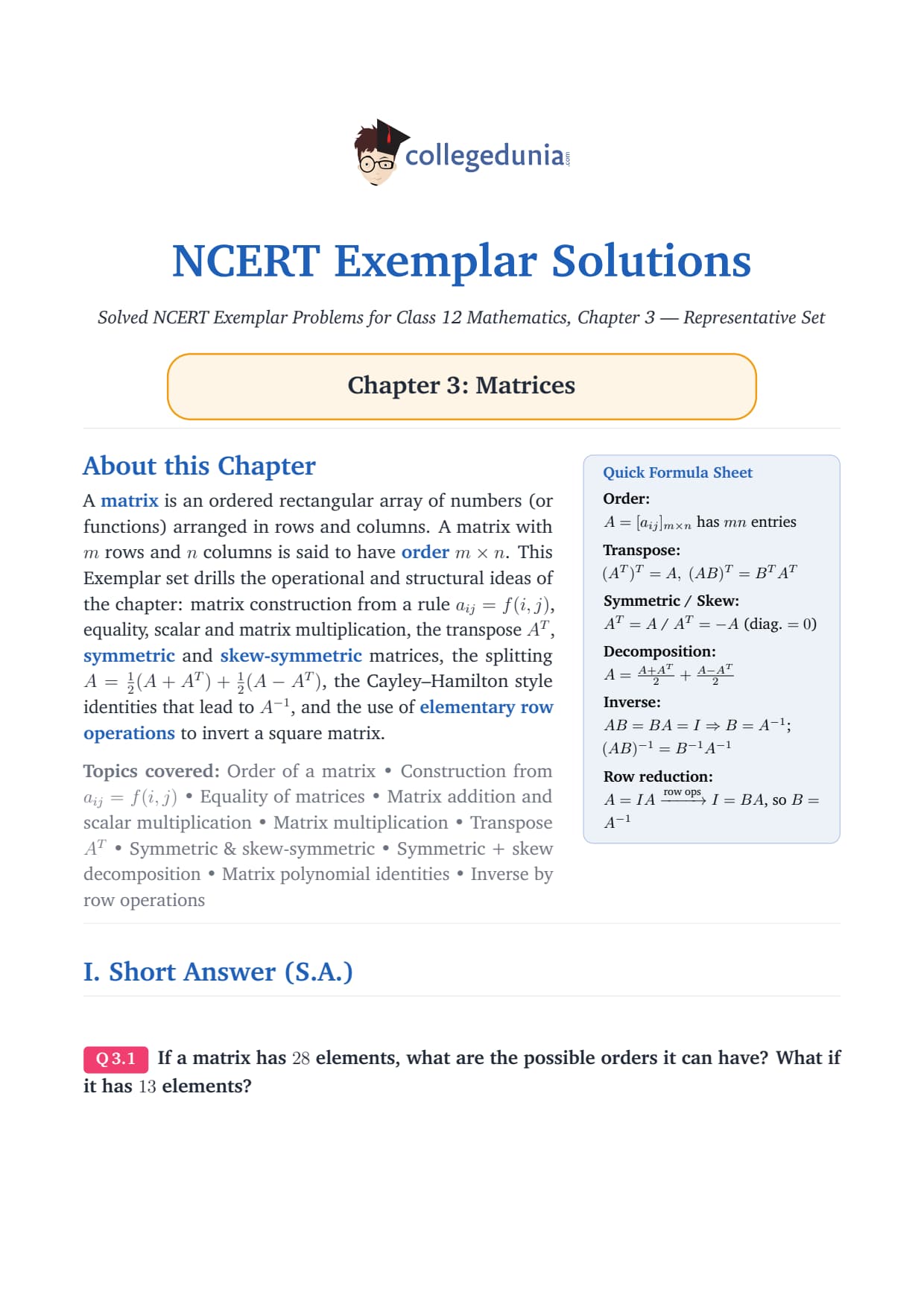
The NCERT Exemplar Class 12 Maths Matrices below provide the complete solution to the NCERT Exemplar booklet for Class 12 Mathematics Chapter 3 Matrices. Each step in the NCERT Exemplar Class 12 Maths Matrices is justified, each formula labelled, and the solutions PDF retain the exact problem-numbering of the official Exemplar.
Use the resource above alongside the chapter breakdown below.
Use the resource above alongside the chapter breakdown below.
Use the resource above alongside the chapter breakdown below.
Use the resource above alongside the chapter breakdown below.
Use the resource above alongside the chapter breakdown below.
Use the resource above alongside the chapter breakdown below.
Use the resource above alongside the chapter breakdown below.
Use the resource above alongside the chapter breakdown below.
Use the resource above alongside the chapter breakdown below.
Use the resource above alongside the chapter breakdown below.
Use the resource above alongside the chapter breakdown below.
Use the resource above alongside the chapter breakdown below.
Use the resource above alongside the chapter breakdown below.
Use the resource above alongside the chapter breakdown below.
Use the resource above alongside the chapter breakdown below.
Use the resource above alongside the chapter breakdown below.
Use the resource above alongside the chapter breakdown below.
Use the resource above alongside the chapter breakdown below.
Use the resource above alongside the chapter breakdown below.
Use the resource above alongside the chapter breakdown below.
Use the resource above alongside the chapter breakdown below.
Use the resource above alongside the chapter breakdown below.
Use the resource above alongside the chapter breakdown below.
Use the resource above alongside the chapter breakdown below.
Use the resource above alongside the chapter breakdown below.
Use the resource above alongside the chapter breakdown below.
Use the resource above alongside the chapter breakdown below.
Use the resource above alongside the chapter breakdown below.
Use the resource above alongside the chapter breakdown below.
Use the resource above alongside the chapter breakdown below.
Use the resource above alongside the chapter breakdown below.
Use the resource above alongside the chapter breakdown below.
Use the resource above alongside the chapter breakdown below.
Use the resource above alongside the chapter breakdown below.
Use the resource above alongside the chapter breakdown below.
Use the resource above alongside the chapter breakdown below.
CBSE Weightage: 10 marks (Unit II: Algebra, shared with Determinants; usually one SA on matrix algebra plus one MCQ on order or symmetry)
JEE Main Weightage: 3 to 4% of paper (1 to 2 questions per shift, mostly on multiplication, inverse via row operations, or skew-symmetric structure)
Representative Questions Solved: 22 (10 MCQ + 4 MCQ-II + 4 VSA + 2 SA + 2 LA)
22 Exemplar problems solved
5 Question types covered
10 CBSE marks (Unit II)
The 22 problems cover order and equality of matrices, addition and scalar multiplication, the row-column rule for multiplication (AB)ij = k aik bkj, non-commutativity AB ≠ BA , transpose properties (AB)T = BT AT, symmetric and skew-symmetric splits A = 12(A + AT) + 12(A - AT) , elementary row operations, and inverse via row reduction.
These Exemplar Solutions are curated by Collegedunia subject experts, mapped to the 2026-27 NCERT print, and benchmarked against the last five years of CBSE Board and JEE Main papers.
Matrices Exemplar Question-Type Tour with One Sample Solved per Type
The representative Exemplar set groups 22 problems into five formats. Working one sample per type calibrates time per item before sitting the NCERT Exemplar Class 12 Maths Matrices end-to-end. Below is one fully-solved sample per question type with the concept stack named.
MCQ Sample, Exemplar Q 3.4 (Order of a Product)
MCQ-II Sample, Exemplar MCQ-II 3.18 (Multi-Correct on Idempotent / Involutory)
VSA Sample, Exemplar 3.27 (Skew-Symmetric Diagonal)
SA Sample, Exemplar SA 3.4 (Commuting Pair)
LA Sample, Exemplar LA 3.1 (Symmetric / Skew-Symmetric Split)
Matrices NCERT Exemplar Question-Type Distribution
Question Type
Problems (Representative Set)
Time per Problem
Best Use For
MCQ (single-correct)
Q 3.1 to Q 3.10
2 to 3 min
JEE Main, CBSE MCQ section
MCQ-II (multi-correct)
MCQ-II 3.18 to 3.21
4 to 5 min
JEE Advanced style, CBSE assertion-reason
VSA (1 to 2 marks)
VSA 3.27 to 3.30
2 to 3 min
CBSE 1-mark questions
SA (3 to 4 marks)
SA 3.4 to SA 3.5
6 to 8 min
CBSE Board short answer
LA (5 to 6 marks)
LA 3.1 to LA 3.2
10 to 12 min
CBSE long answer, JEE proofs
Matrices Class 12: Difficulty Step-Up from NCERT Textbook to Exemplar
Concept
NCERT Textbook Treatment
Exemplar Twist
Step-Up
Matrix multiplication
Numeric 2 × 2 products
Order-compatibility puzzle (Q 3.4) - solve for the order of B
Reverse-engineering order from ATB, BAT
Transpose properties
Single application (AT)T = A
(AB)T = BT AT with non-commuting pair (MCQ-II 3.19)
Order-reversal under product
Symmetric / skew-symmetric
Identify a given matrix
Decompose any 3 × 3 into P + Q (LA 3.1)
Explicit half-sum / half-difference construction
Inverse
Adjoint formula on 2 × 2
Row operations on 3 × 3 (SA 3.2)
Elementary-row algorithm replacing adjoint
Matrices Top 5 Formulae for Exemplar Problems
Formula
Use
Triggered in Exemplar
(AB)ij = k aik bkj
Row-column rule for matrix product
Q 3.4, SA 3.4, MCQ-II 3.18
(AB)T = BT AT
Transpose of a product
MCQ-II 3.19, SA 3.3
A = 12(A + AT) + 12(A - AT)
Symmetric + skew-symmetric split
LA 3.1
aii = 0 for skew-symmetric A
Diagonal entries of skew-symmetric matrix
VSA 3.27
Row operations: [AI] → [I A-1]
Inverse by elementary row operations
SA 3.2
How Frequently Has Matrices Been Asked in CBSE and JEE (Top 3 Recurring Topics)
Sub-Topic
CBSE 2025
JEE Main 2025
Recurring Since
Symmetric / Skew-Symmetric Decomposition
5 marks (one LA)
1 question
2020
Matrix Multiplication and Order Check
3 marks (one SA)
2 questions
2019
Inverse via Row Operations / Adjoint
2 marks (one MCQ + VSA)
1 question
2021
Matrices Class 12 Weightage Snapshot Across Chapters
Chapter
CBSE Marks
Weightage Bar
Ch 1 Relations and Functions
8
Ch 2 Inverse Trigonometric Functions
4
Ch 3 Matrices
10
Ch 4 Determinants
10
Ch 5 Continuity and Differentiability
15
Ch 6 Application of Derivatives
10
Ch 7 Integrals
15
Ch 8 Application of Integrals
5
Ch 9 Differential Equations
10
Ch 10 Vector Algebra
10
Ch 11 Three Dimensional Geometry
10
Ch 12 Linear Programming
5
Ch 13 Probability
8
Exemplar-Specific Common Mistakes in Matrices
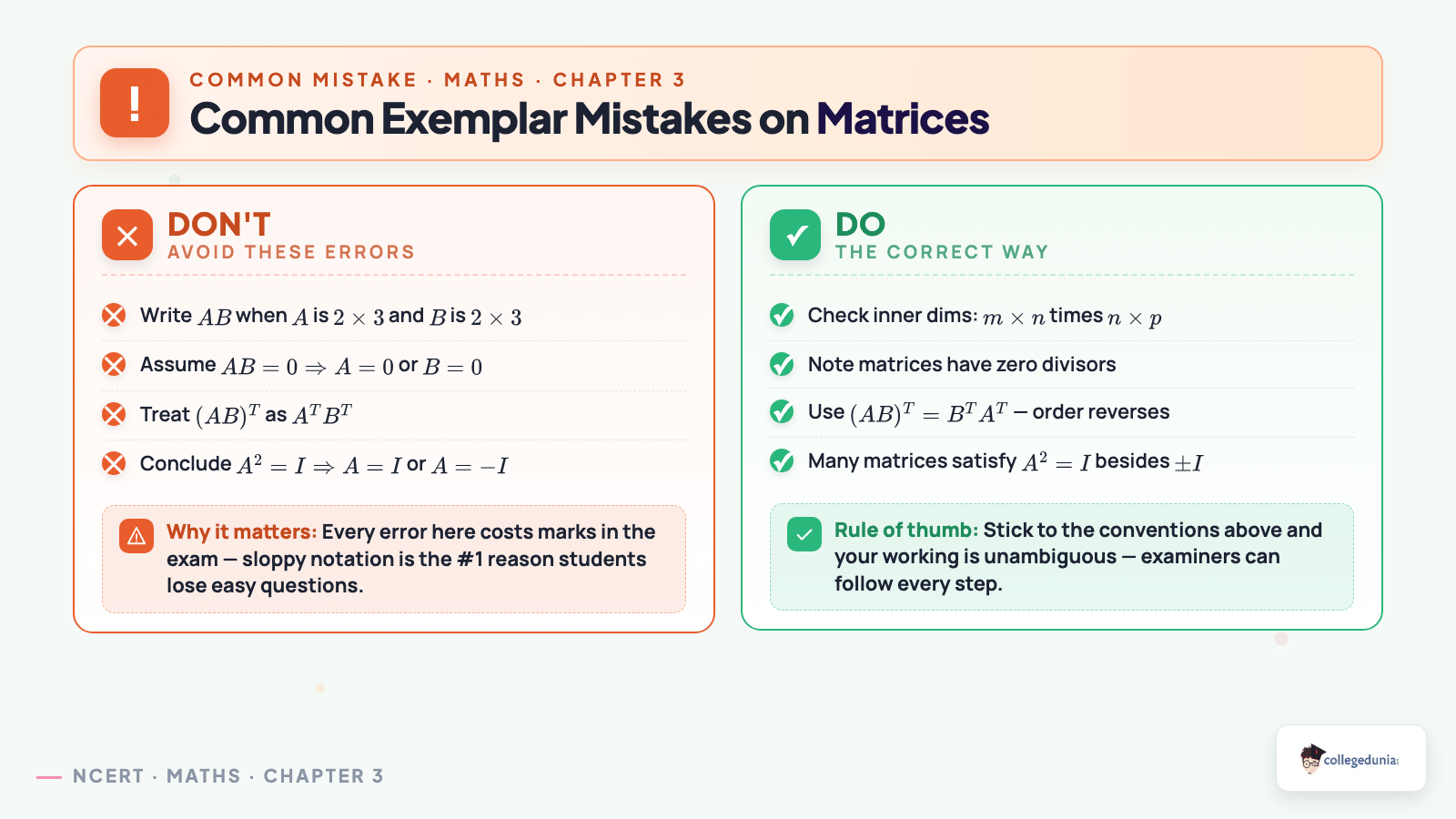
Assuming AB = BA . Matrix multiplication is non-commutative. Writing (A + B)2 = A2 + 2AB + B2 without first proving commutativity loses 1 to 2 marks every time (MCQ-II 3.18).
Forgetting the transpose-order reversal. (AB)T = BT AT, not AT BT. The order flip is the most common 1-mark trap in MCQ (MCQ-II 3.19).
Skipping the order-compatibility check. Trying to compute A2 × 3 · B2 × 3 and getting confused - the inner dimensions must match before any arithmetic begins (Q 3.4).
Mis-reading skew-symmetric diagonal. Students leave aii as some variable instead of recognising aii = 0 - a free 1-mark VSA every CBSE cycle (VSA 3.27).
Botching the half-sum split. Writing A = (A + AT) + (A - AT) without the 12 factor doubles the matrix and zeros the answer (LA 3.1).
All NCERT Exemplar Questions for Matrices with Step-by-Step Solutions
Every question of the NCERT Exemplar set for Class 12 Mathematics Chapter 3 Matrices is listed below with its full Solution and Expert Solution hidden inside collapsible tabs. Click Check Solution to reveal the step-by-step working; click Expert Solution for the expanded explanation.
I. Short Answer (S.A.)
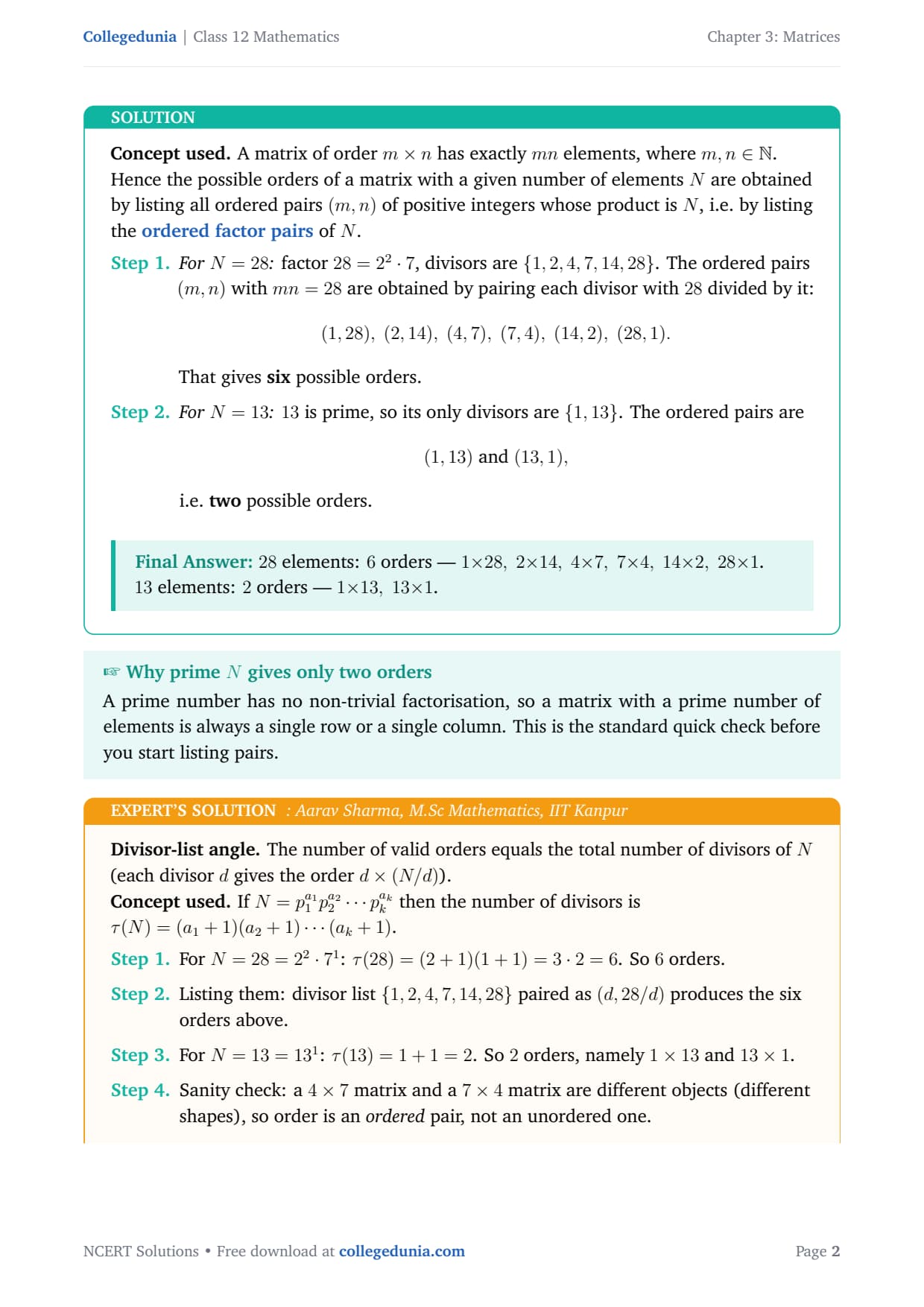
Q 3.1
If a matrix has 28 elements, what are the possible orders it can have? What if it has 13 elements?
Concept used. A matrix of order m× n has exactly
mn elements, where m,n∈N. Hence the possible orders
of a matrix with a given number of elements N are obtained by
listing all ordered pairs (m,n) of positive integers whose
product is N, i.e. by listing the ordered factor pairs
of N.
For N=28: factor 28=22· 7, divisors are
1,2,4,7,14,28. The ordered pairs (m,n) with mn=28
are obtained by pairing each divisor with 28 divided by it:
(1,28), (2,14), (4,7), (7,4), (14,2), (28,1).
That gives six possible orders.
For N=13:13 is prime, so its only divisors are
1,13. The ordered pairs are
(1,13) and (13,1),
i.e. two possible orders.
Divisor-list angle. The number of valid orders equals the
total number of divisors of N (each divisor d gives the order
d× (N/d)).
Concept used. If N = p1a1p2a2⋯
pkak then the number of divisors is
τ(N)=(a1+1)(a2+1)⋯(ak+1).
For N=28=22· 71: τ(28)=(2+1)(1+1)=3· 2=6.
So 6 orders.
Listing them: divisor list 1,2,4,7,14,28 paired as
(d,28/d) produces the six orders above.
For N=13=131: τ(13)=1+1=2. So 2 orders, namely
1× 13 and 13× 1.
Sanity check: a 4× 7 matrix and a 7× 4 matrix
are different objects (different shapes), so order is an
ordered pair, not an unordered one.
6 orders for 28; 2 orders for 13.
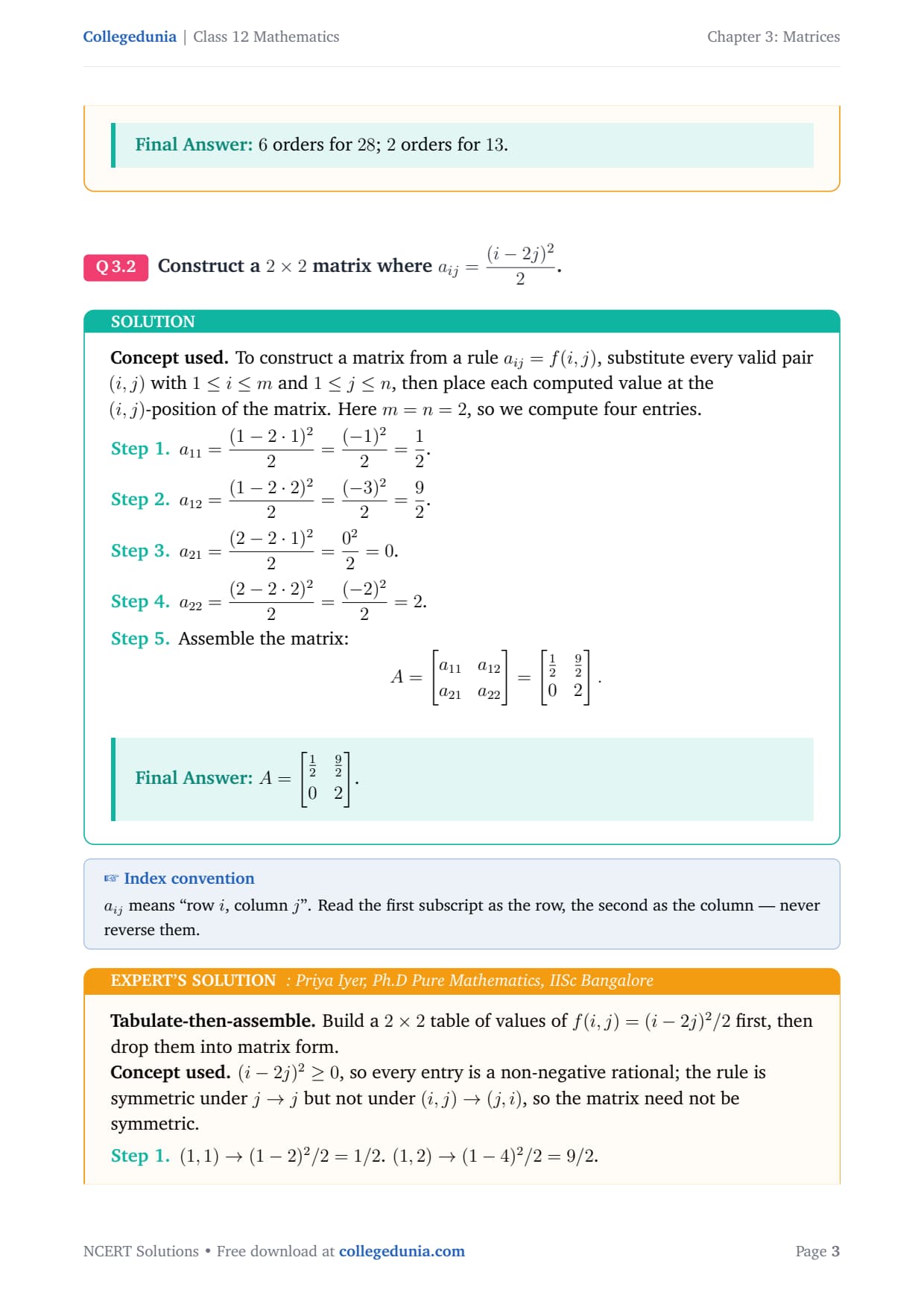
Q 3.2
Construct a 2× 2 matrix where aij=(i-2j)22.
Concept used. To construct a matrix from a rule
aij=f(i,j), substitute every valid pair (i,j) with 1≤ i≤
m and 1≤ j≤ n, then place each computed value at the
(i,j)-position of the matrix. Here m=n=2, so we compute four
entries.
Tabulate-then-assemble. Build a (2× 2) table of values
of (f(i,j)=(i-2j)2/2) first, then drop them into matrix form.
Concept used. ((i-2j)2≥ 0), so every entry is a
non-negative rational; the rule is symmetric under (j→ j) but not
under ((i,j)→ (j,i)), so the matrix need not be symmetric.
((1,1)→ (1-2)2/2=1/2). ((1,2)→ (1-4)2/2=9/2).
((2,1)→ (2-2)2/2=0). ((2,2)→ (2-4)2/2=4/2=2).
Place the row-(1) pair ((1/2,9/2)) on top, the row-(2) pair
((0,2)) below:
[ A=bmatrix 1/2 & 9/2 0 & 2bmatrix.
Cross-check: (A is not symmetric (a12=9/2≠ 0=a21),
consistent with the rule.
A=bmatrix 1/2 & 9/2 0 & 2bmatrix.
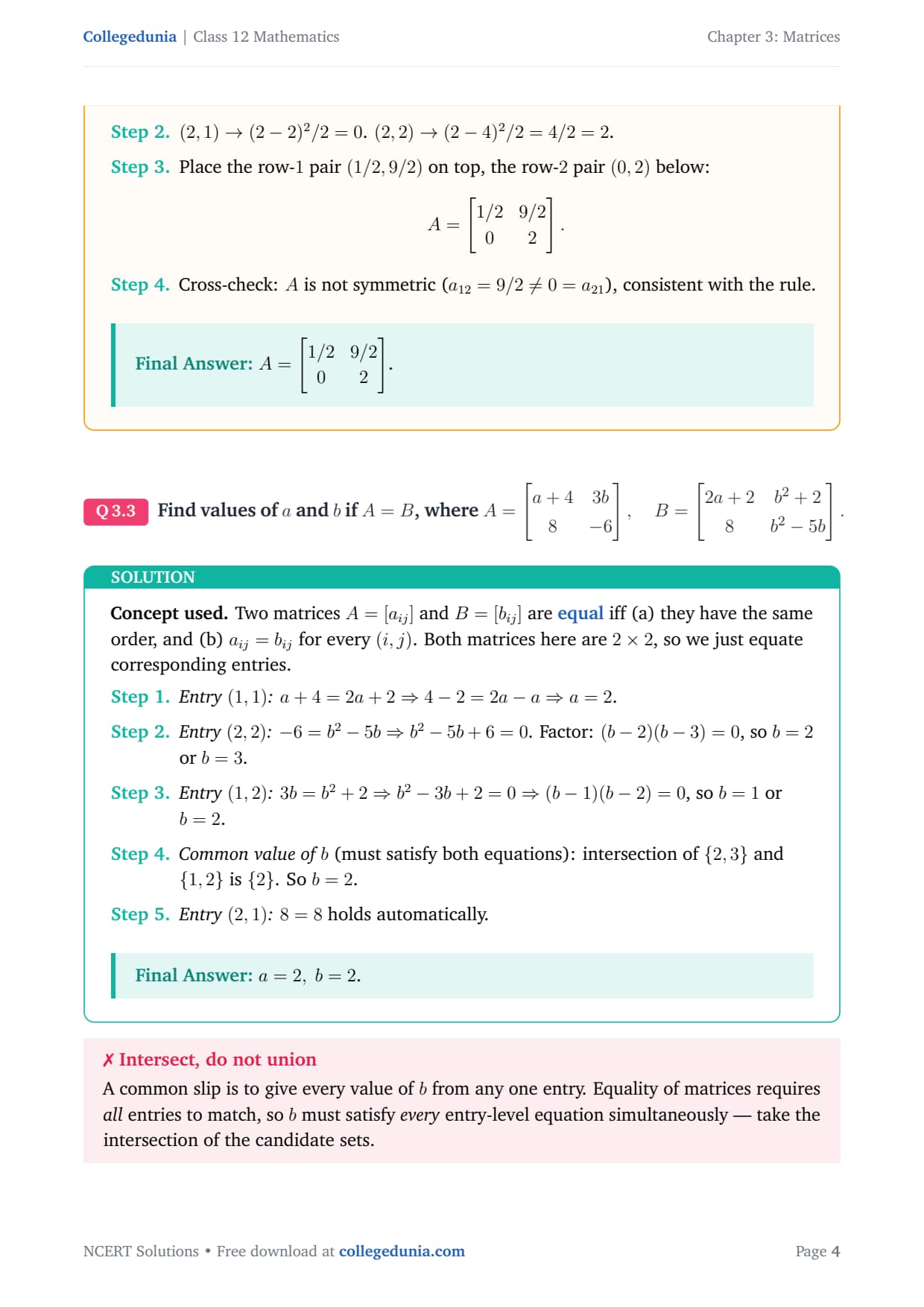
Q 3.3
Find values of a and b if A=B, where
A=bmatrix a+4 & 3b 8 & -6bmatrix,
B=bmatrix 2a+2 & b2+2 8 & b2-5bbmatrix.
Concept used. Two matrices A=[aij] and B=[bij]
are equal iff (a) they have the same order, and (b)
aij=bij for every (i,j). Both matrices here are 2×
2, so we just equate corresponding entries.
Entry (1,1):a+4=2a+2⇒ 4-2=2a-a
⇒ a=2.
Entry (2,2):-6=b2-5b⇒ b2-5b+6=0.
Factor: (b-2)(b-3)=0, so b=2 or b=3.
Entry (1,2):3b=b2+2⇒ b2-3b+2=0
⇒ (b-1)(b-2)=0, so b=1 or b=2.
Common value of b (must satisfy both equations):
intersection of 2,3 and 1,2 is 2. So
b=2.
Entry (2,1):8=8 holds automatically.
a=2, b=2.
KM
Karan Mehta
M.Tech CS, IIT Delhi
Verified Expert
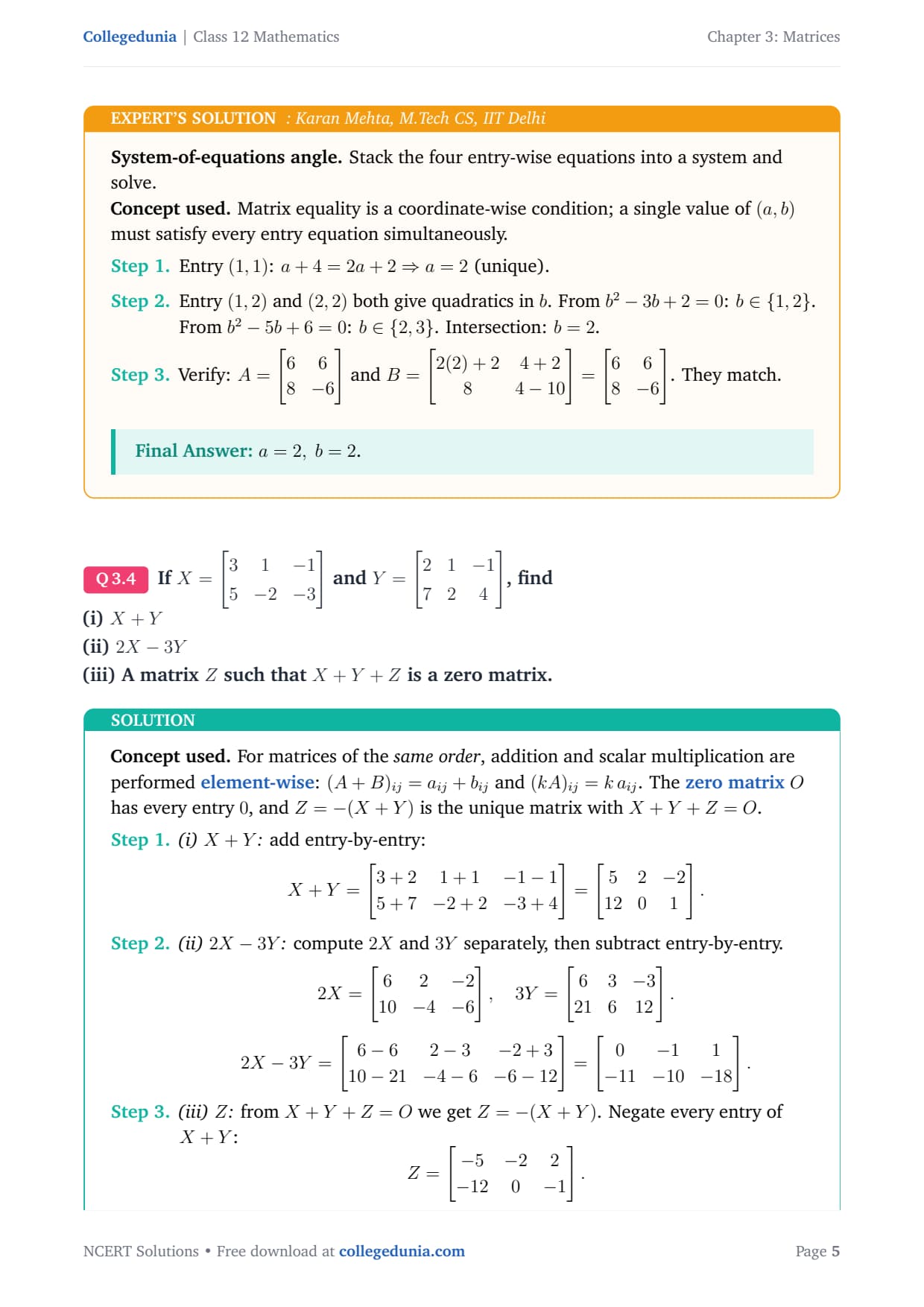
System-of-equations angle. Stack the four entry-wise
equations into a system and solve.
Concept used. Matrix equality is a coordinate-wise
condition; a single value of (a,b) must satisfy every entry
equation simultaneously.
Entry (1,1): a+4=2a+2⇒ a=2 (unique).
Entry (1,2) and (2,2) both give quadratics in b. From
b2-3b+2=0: b∈1,2. From b2-5b+6=0:
b∈2,3. Intersection: b=2.
Verify: A=bmatrix6&6 8&-6bmatrix and
B=bmatrix2(2)+2&4+2 8&4-10bmatrix=
bmatrix6&6 8&-6bmatrix. They match.
a=2, b=2.
Q 3.4
If X=bmatrix3&1&-1 5&-2&-3bmatrix and
Y=bmatrix2&1&-1 7&2&4bmatrix, find
(i) X+Y
(ii) 2X-3Y
(iii) A matrix Z such that X+Y+Z is a zero matrix.
Concept used. For matrices of the same order,
addition and scalar multiplication are performed
element-wise: (A+B)ij=aij+bij and
(kA)ij=k aij. The zero matrixO has every entry
0, and Z = -(X+Y) is the unique matrix with X+Y+Z=O.
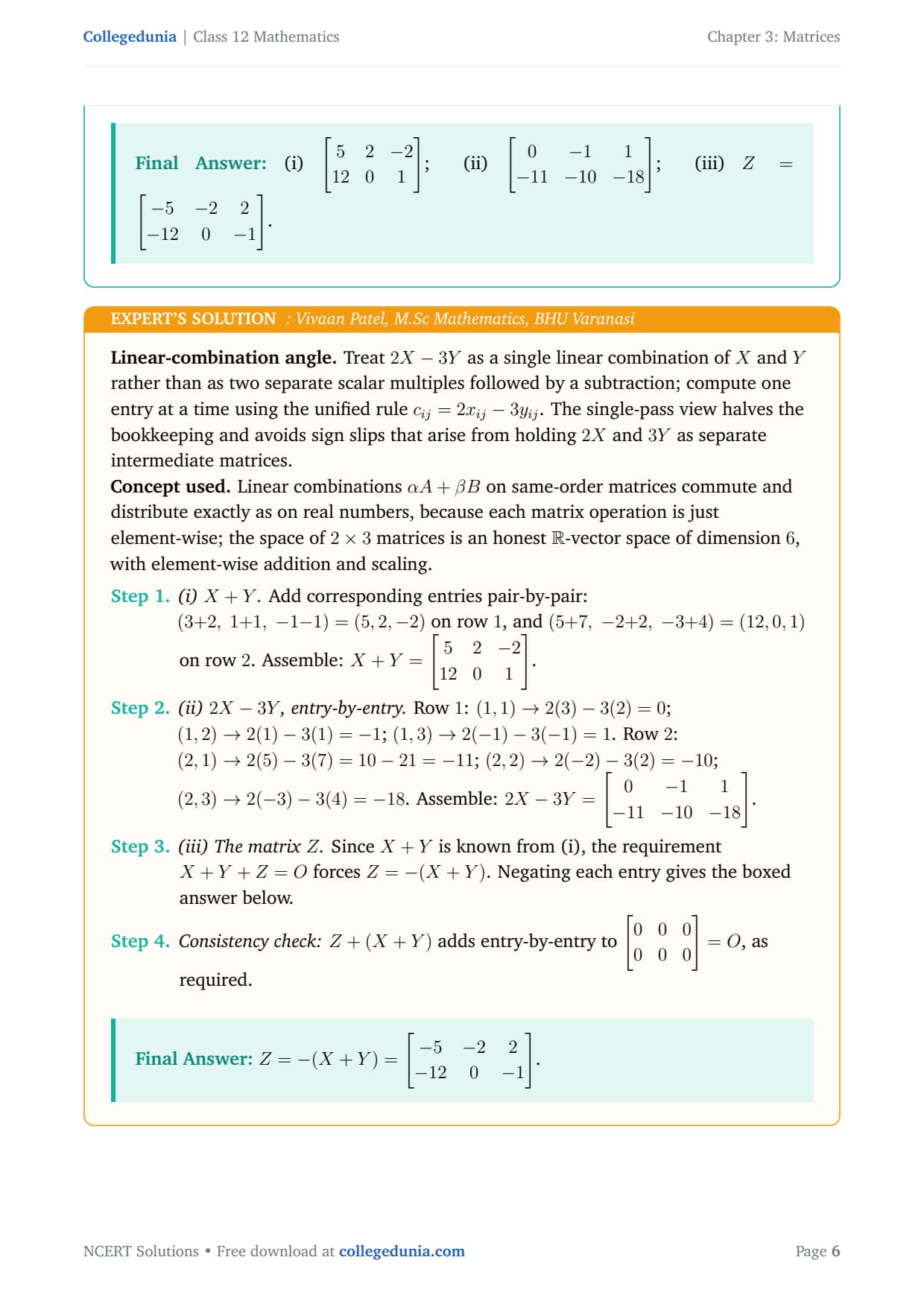
Linear-combination angle. Treat 2X-3Y as a single linear
combination of X and Y rather than as two separate scalar
multiples followed by a subtraction; compute one entry at a time
using the unified rule cij=2xij-3yij. The single-pass
view halves the bookkeeping and avoids sign slips that arise from
holding 2X and 3Y as separate intermediate matrices.
Concept used. Linear combinations α A+β B on
same-order matrices commute and distribute exactly as on real
numbers, because each matrix operation is just element-wise; the
space of 2× 3 matrices is an honest R-vector
space of dimension 6, with element-wise addition and scaling.
(i) X+Y. Add corresponding entries pair-by-pair:
(3+2, 1+1, -1-1) = (5,2,-2) on row 1, and
(5+7, -2+2, -3+4) = (12,0,1) on row 2.
Assemble: X+Y=bmatrix5&2&-2 12&0&1bmatrix.
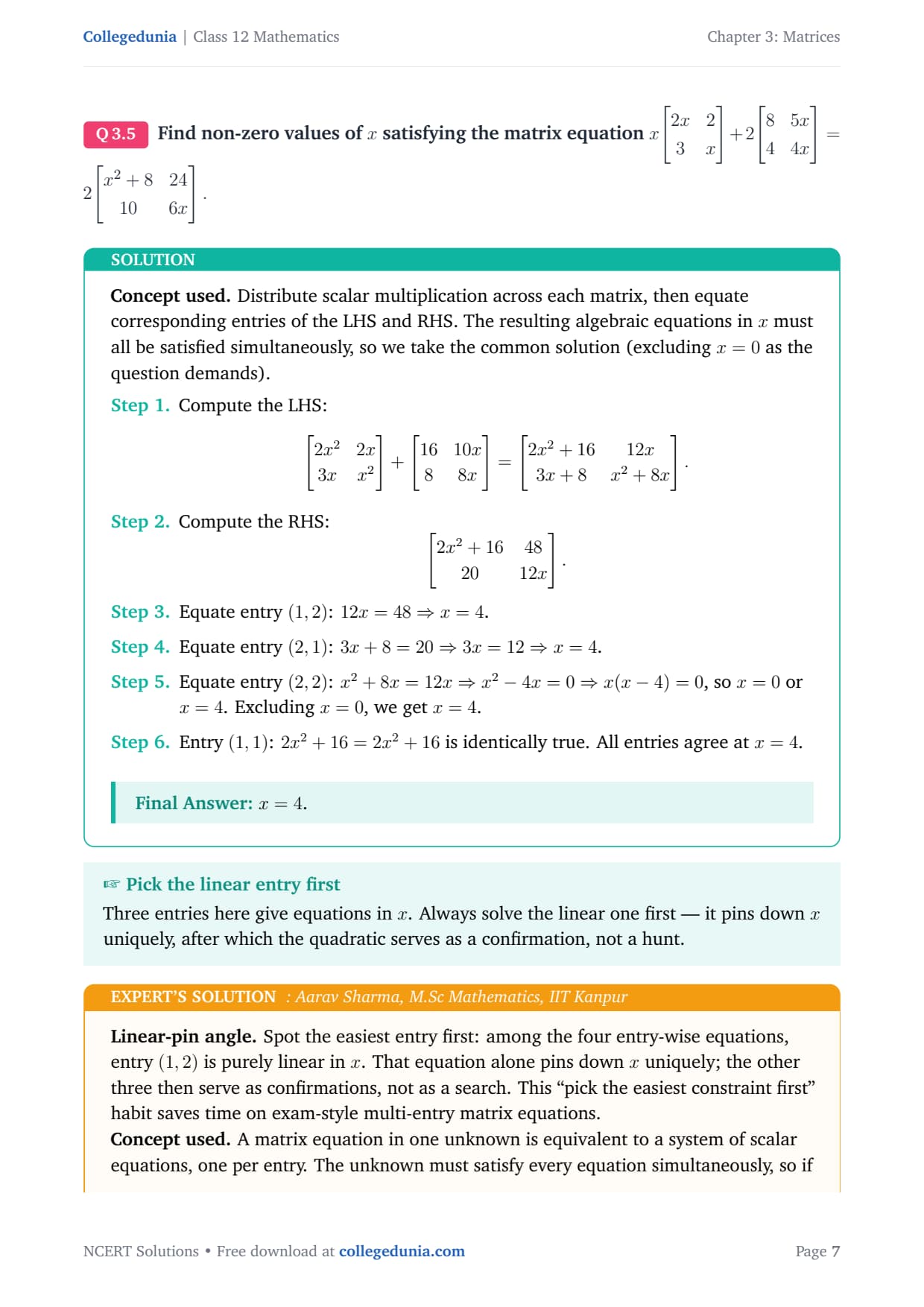
Concept used. Distribute scalar multiplication across each
matrix, then equate corresponding entries of the LHS and RHS. The
resulting algebraic equations in x must all be satisfied
simultaneously, so we take the common solution (excluding x=0 as
the question demands).
Compute the RHS:
bmatrix 2x2+16 & 48 20 & 12xbmatrix.
Equate entry (1,2): 12x=48 ⇒ x=4.
Equate entry (2,1): 3x+8=20 ⇒ 3x=12 ⇒ x=4.
Equate entry (2,2): x2+8x=12x ⇒ x2-4x=0
⇒ x(x-4)=0, so x=0 or x=4.
Excluding x=0, we get x=4.
Entry (1,1): 2x2+16=2x2+16 is identically true.
All entries agree at x=4.
x=4.
AS
Aarav Sharma
M.Sc Mathematics, IIT Kanpur
Verified Expert
Linear-pin angle. Spot the easiest entry first: among the
four entry-wise equations, entry (1,2) is purely linear in x.
That equation alone pins down x uniquely; the other three then
serve as confirmations, not as a search. This ``pick the easiest
constraint first'' habit saves time on exam-style multi-entry
matrix equations.
Concept used. A matrix equation in one unknown is
equivalent to a system of scalar equations, one per entry. The
unknown must satisfy every equation simultaneously, so if any
single equation is linear and gives a unique value, the other
equations must agree on that same value.
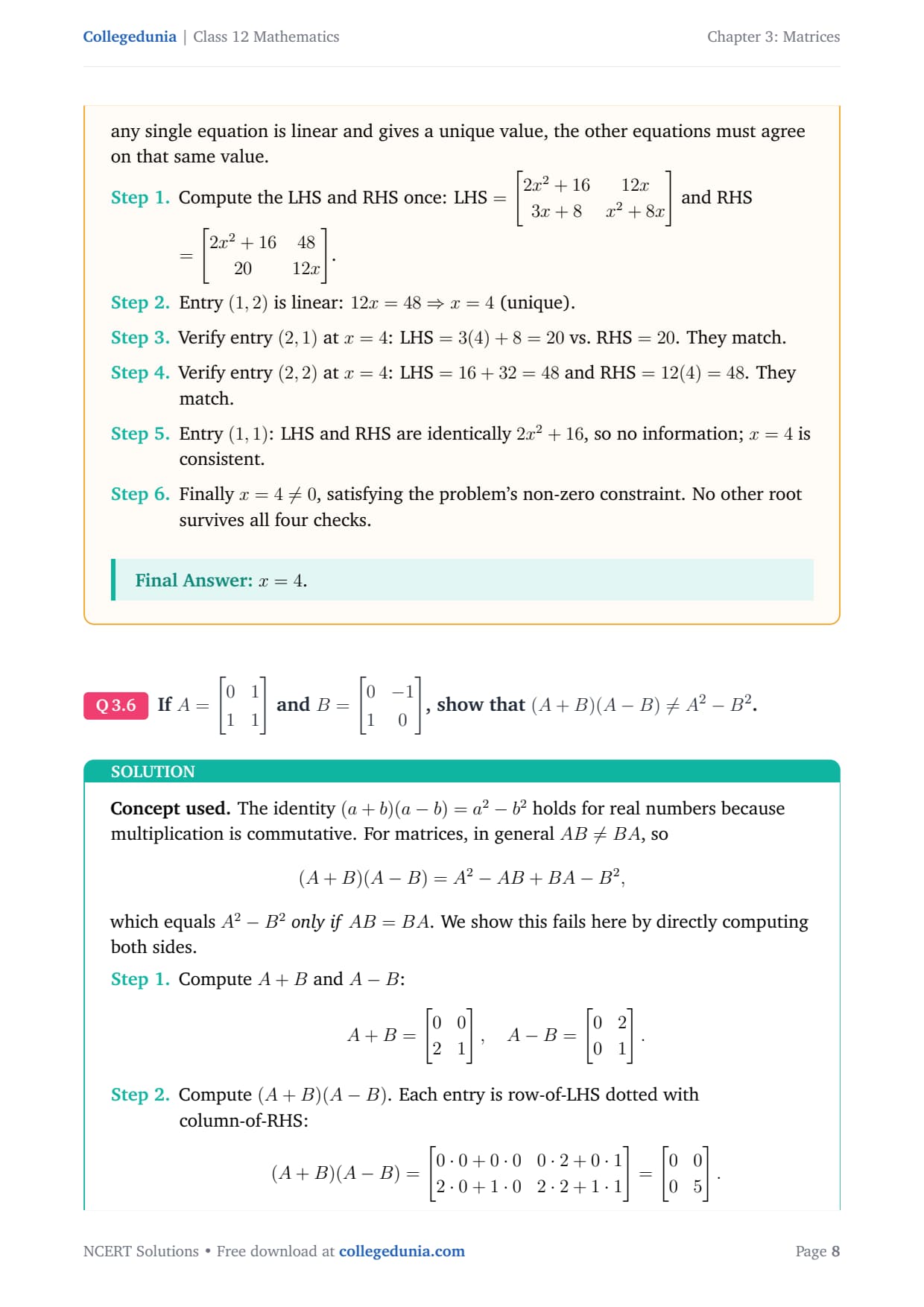
Compute the LHS and RHS once: LHS =bmatrix
2x2+16 & 12x 3x+8 & x2+8xbmatrix and RHS
=bmatrix 2x2+16 & 48 20 & 12xbmatrix.
Entry (1,2) is linear: 12x=48⇒ x=4 (unique).
Verify entry (2,1) at x=4: LHS =3(4)+8=20 vs. RHS
=20. They match.
Verify entry (2,2) at x=4: LHS = 16+32=48 and RHS
=12(4)=48. They match.
Entry (1,1): LHS and RHS are identically 2x2+16, so
no information; x=4 is consistent.
Finally x=4≠ 0, satisfying the problem's non-zero
constraint. No other root survives all four checks.
x=4.
Q 3.6
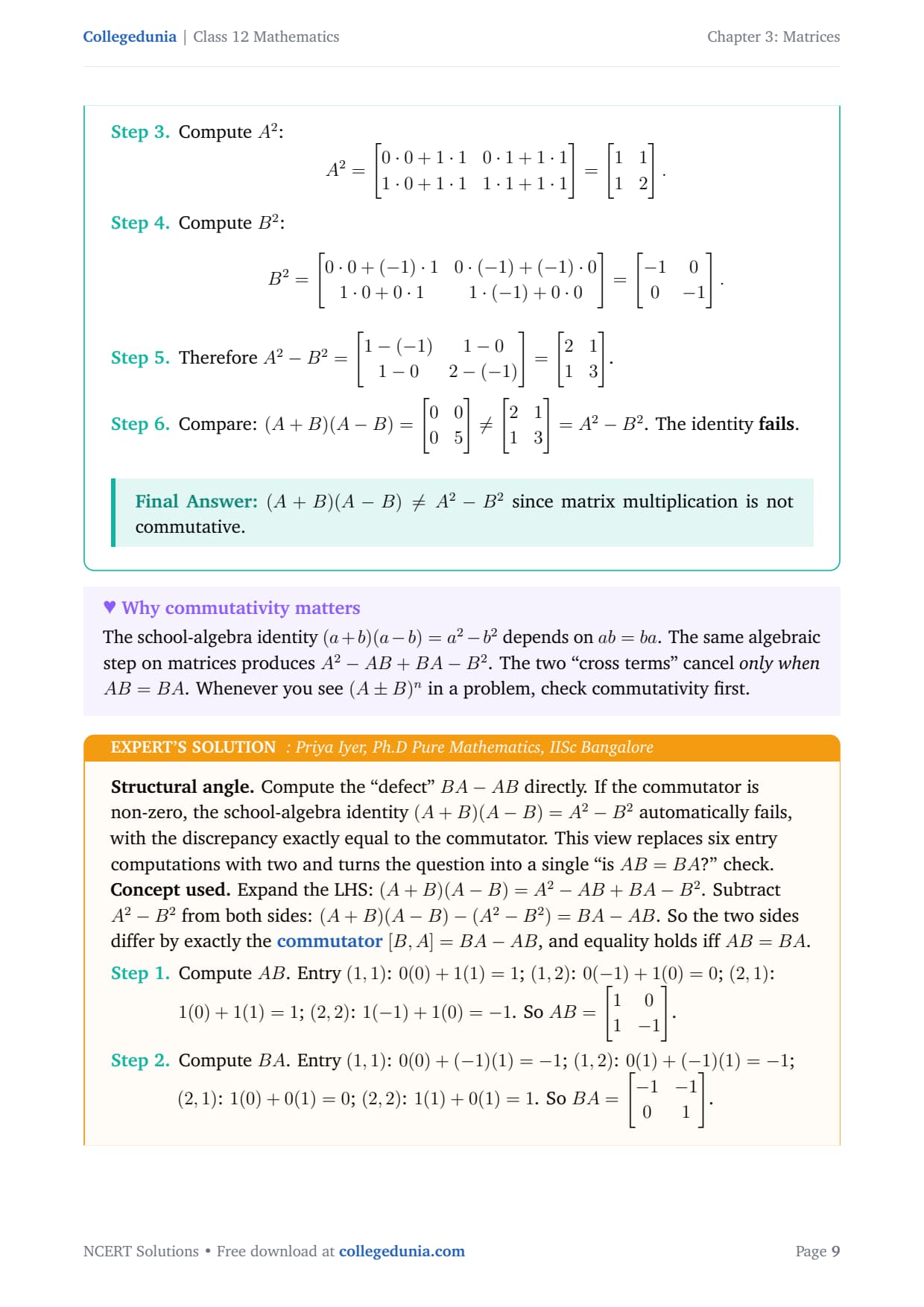
If A=bmatrix0&1 1&1bmatrix and B=bmatrix0&-1 1&0bmatrix, show that (A+B)(A-B)≠ A2-B2.
Concept used. The identity (a+b)(a-b)=a2-b2 holds
for real numbers because multiplication is commutative. For
matrices, in general AB≠ BA, so
(A+B)(A-B) = A2-AB+BA-B2,
which equals A2-B2only ifAB=BA. We show this
fails here by directly computing both sides.
Compare: (A+B)(A-B)=bmatrix0&0 0&5bmatrix≠
bmatrix2&1 1&3bmatrix=A2-B2. The
identity fails.
(A+B)(A-B)≠ A2-B2 since matrix multiplication is not commutative.
PI
Priya Iyer
Ph.D Pure Mathematics, IISc Bangalore
Verified Expert
Structural angle. Compute the ``defect'' BA-AB directly.
If the commutator is non-zero, the school-algebra identity
(A+B)(A-B)=A2-B2 automatically fails, with the discrepancy
exactly equal to the commutator. This view replaces six entry
computations with two and turns the question into a single
``is AB=BA?'' check.
Concept used. Expand the LHS: (A+B)(A-B) = A2-AB+BA-B2.
Subtract A2-B2 from both sides:
(A+B)(A-B)-(A2-B2)=BA-AB. So the two sides differ by exactly
the commutator[B,A]=BA-AB, and equality holds iff
AB=BA.
Compute AB. Entry (1,1): 0(0)+1(1)=1; (1,2): 0(-1)+1(0)=0;
(2,1): 1(0)+1(1)=1; (2,2): 1(-1)+1(0)=-1. So
AB=bmatrix1&0 1&-1bmatrix.
Since the commutator is non-zero, (A+B)(A-B)≠ A2-B2.
Indeed A2-B2-(A+B)(A-B)=AB-BA=bmatrix2&1 1&-2bmatrix,
the entry-wise discrepancy between the two computed matrices
from the main solution.
BA-AB≠ O, so the identity does not hold.
Q 3.7
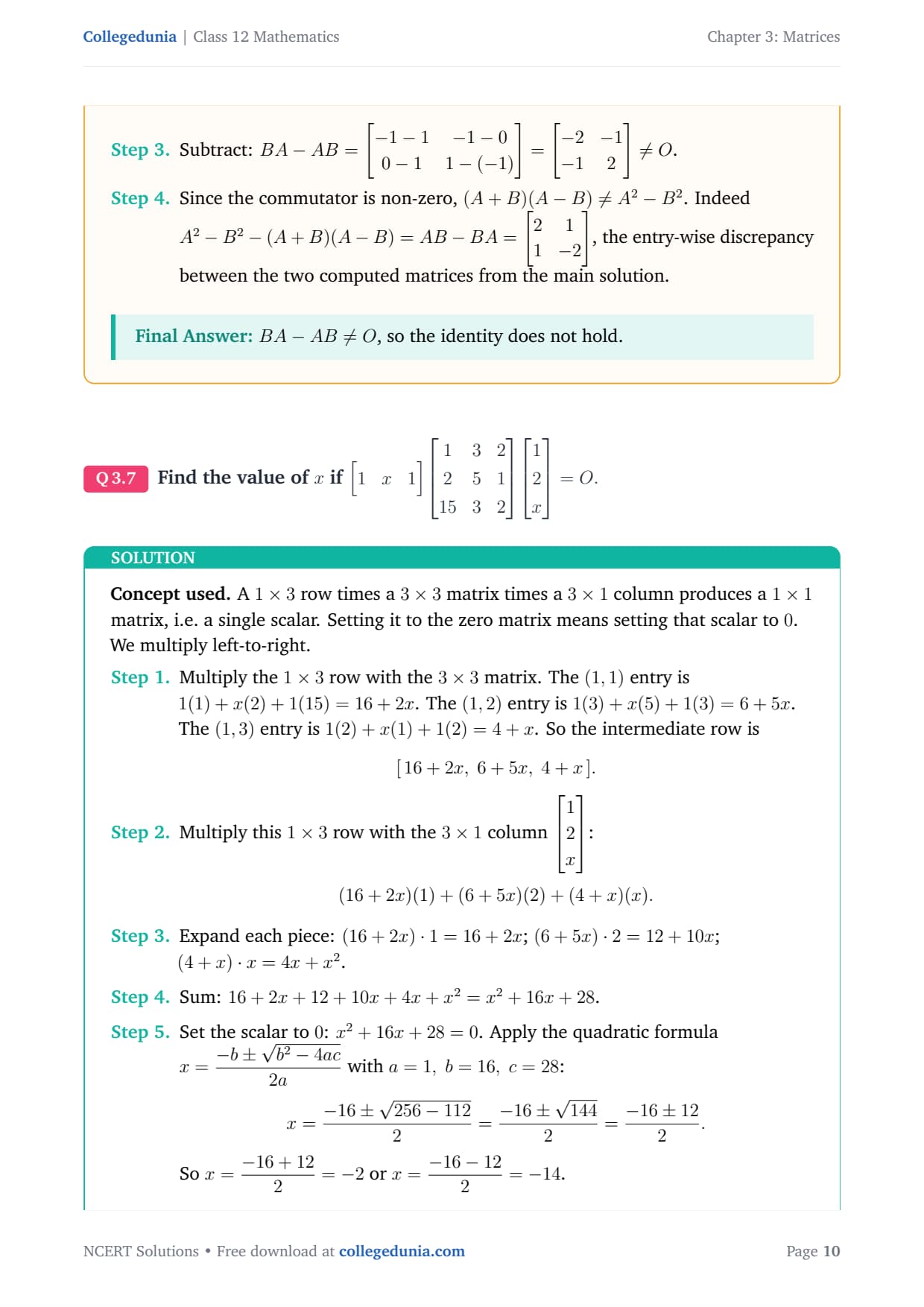
Find the value of x if bmatrix 1 & x & 1bmatrixbmatrix 1 & 3 & 2 2 & 5 & 1 15 & 3 & 2bmatrixbmatrix 1 2 xbmatrix = O.
Concept used. A 1× 3 row times a 3× 3 matrix
times a 3× 1 column produces a 1× 1 matrix, i.e. a
single scalar. Setting it to the zero matrix means setting that
scalar to 0. We multiply left-to-right.
Multiply the 1× 3 row with the 3× 3 matrix.
The (1,1) entry is 1(1)+x(2)+1(15)=16+2x.
The (1,2) entry is 1(3)+x(5)+1(3)=6+5x.
The (1,3) entry is 1(2)+x(1)+1(2)=4+x.
So the intermediate row is
[ 16+2x, 6+5x, 4+x ].
Multiply this 1× 3 row with the 3× 1 column
bmatrix1 2 xbmatrix:
(16+2x)(1) + (6+5x)(2) + (4+x)(x).
Expand each piece:
(16+2x)· 1 = 16+2x;
(6+5x)· 2 = 12+10x;
(4+x)· x = 4x+x2.
Sum: 16+2x+12+10x+4x+x2 = x2+16x+28.
Set the scalar to 0: x2+16x+28=0.
Apply the quadratic formula
x=-b±√b2-4ac2a with a=1, b=16,
c=28:
x=-16±√256-1122=-16±√1442=-16± 122.
So x=-16+122=-2 or x=-16-122=-14.
x=-2 or x=-14.
KM
Karan Mehta
M.Tech CS, IIT Delhi
Verified Expert
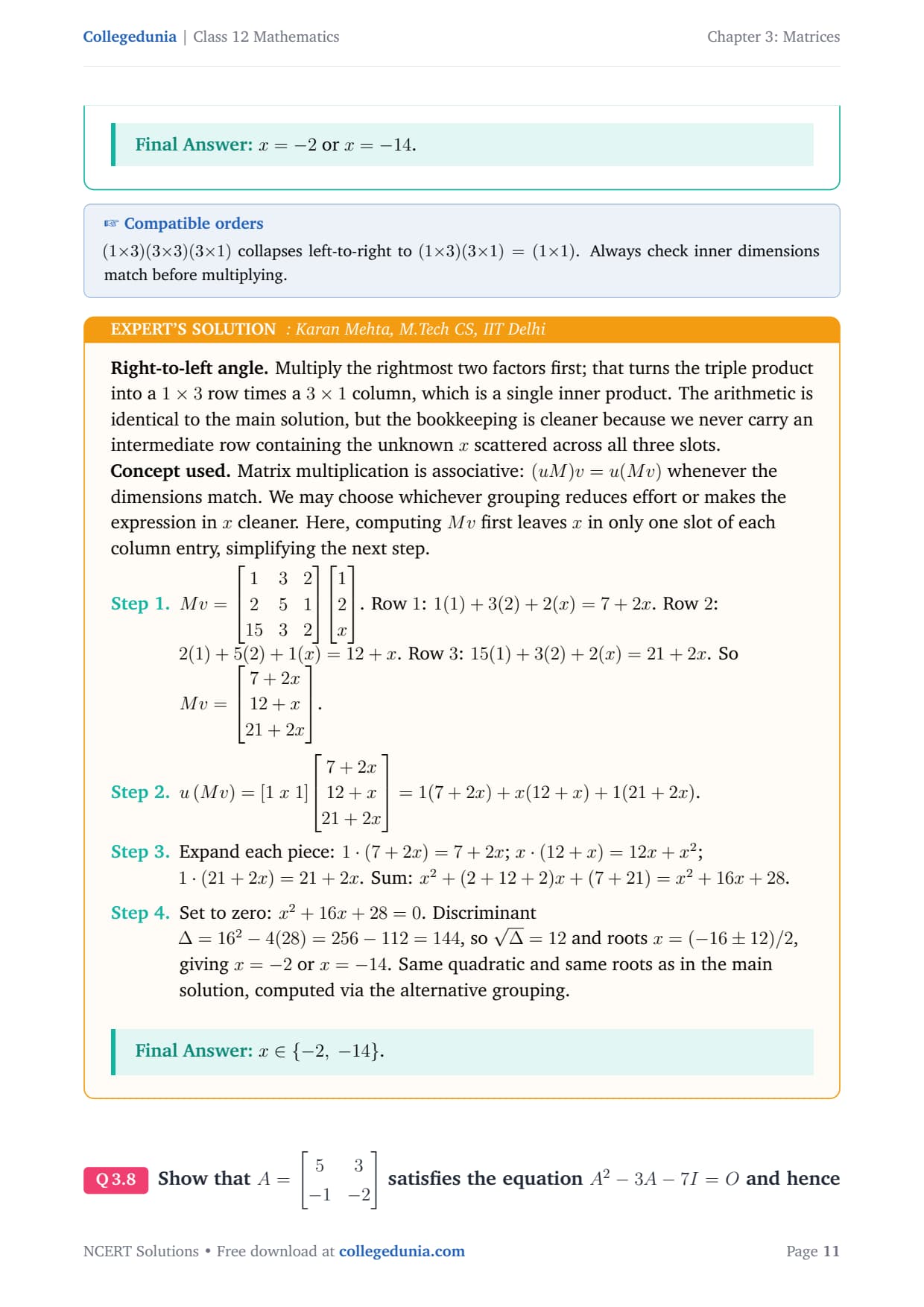
Right-to-left angle. Multiply the rightmost two factors
first; that turns the triple product into a 1× 3 row times
a 3× 1 column, which is a single inner product. The
arithmetic is identical to the main solution, but the bookkeeping
is cleaner because we never carry an intermediate row containing
the unknown x scattered across all three slots.
Concept used. Matrix multiplication is associative:
(uM)v = u(Mv) whenever the dimensions match. We may choose
whichever grouping reduces effort or makes the expression in x
cleaner. Here, computing Mv first leaves x in only one slot of
each column entry, simplifying the next step.
u (Mv)=[1 x 1]bmatrix 7+2x 12+x 21+2xbmatrix
= 1(7+2x) + x(12+x) + 1(21+2x).
Expand each piece: 1·(7+2x)=7+2x; x·(12+x)=12x+x2;
1·(21+2x)=21+2x. Sum: x2+(2+12+2)x+(7+21)=x2+16x+28.
Set to zero: x2+16x+28=0. Discriminant
Δ=162-4(28)=256-112=144, so
√Δ=12 and roots x=(-16± 12)/2, giving x=-2
or x=-14. Same quadratic and same roots as in the main
solution, computed via the alternative grouping.
x∈-2, -14.
Q 3.8
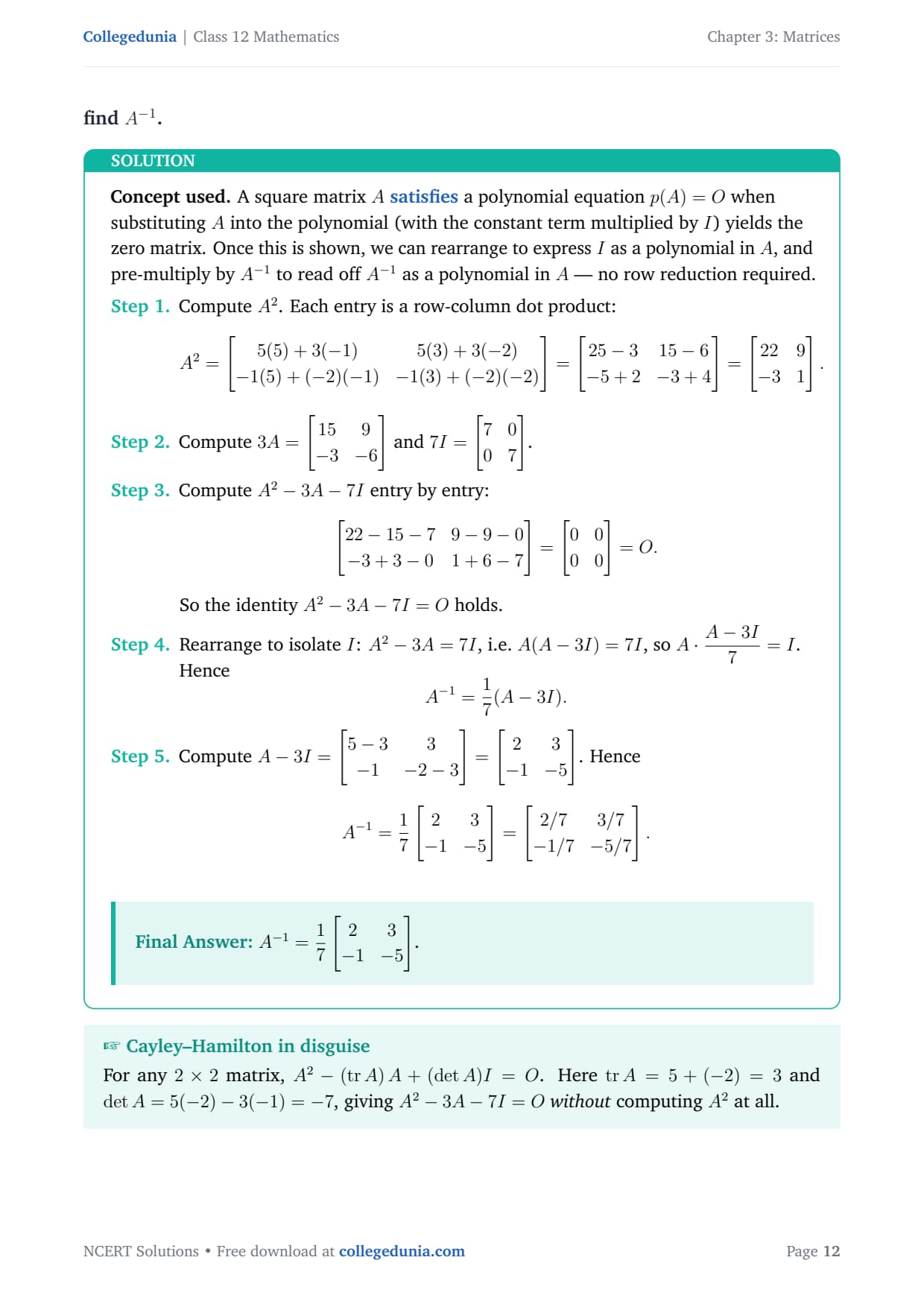
Show that A=bmatrix 5 & 3 -1 & -2bmatrix satisfies the equation A2-3A-7I=O and hence find A-1.
Concept used. A square matrix Asatisfies a
polynomial equation p(A)=O when substituting A into the
polynomial (with the constant term multiplied by I) yields the
zero matrix. Once this is shown, we can rearrange to express I
as a polynomial in A, and pre-multiply by A-1 to read off
A-1 as a polynomial in A –- no row reduction required.
Compute A2. Each entry is a row-column dot product:
A2=bmatrix 5(5)+3(-1) & 5(3)+3(-2)
-1(5)+(-2)(-1) & -1(3)+(-2)(-2)bmatrix
=bmatrix 25-3 & 15-6 -5+2 & -3+4bmatrix
=bmatrix 22 & 9 -3 & 1bmatrix.
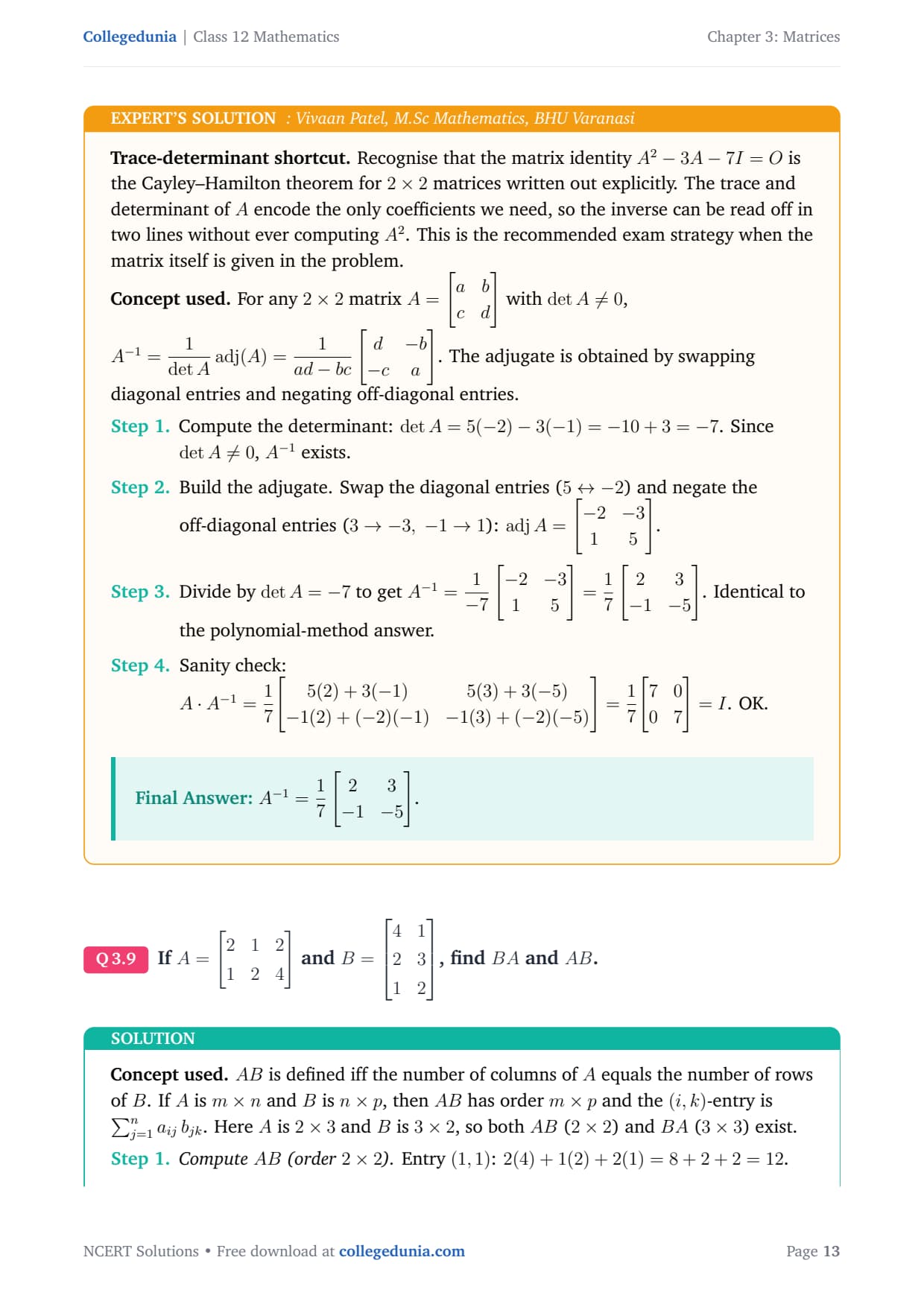
Trace-determinant shortcut. Recognise that the matrix
identity A2-3A-7I=O is the Cayley–Hamilton theorem for
2× 2 matrices written out explicitly. The trace and
determinant of A encode the only coefficients we need, so the
inverse can be read off in two lines without ever computing
A2. This is the recommended exam strategy when the matrix
itself is given in the problem.
Concept used. For any 2× 2 matrix
A=bmatrixa&b c&dbmatrix with det A≠ 0,
A-1=1det A adj(A)=1ad-bcbmatrixd&-b -c&abmatrix.
The adjugate is obtained by swapping diagonal entries and negating
off-diagonal entries.
Compute the determinant: det A = 5(-2)-3(-1) = -10+3 = -7.
Since det A≠ 0, A-1 exists.
Build the adjugate. Swap the diagonal entries
(5↔ -2) and negate the off-diagonal entries
(3→ -3, -1→ 1): adj A=bmatrix-2 & -3 1 & 5bmatrix.
Divide by det A=-7 to get A-1=1-7bmatrix-2 & -3 1 & 5bmatrix
=17bmatrix2 & 3 -1 & -5bmatrix.
Identical to the polynomial-method answer.
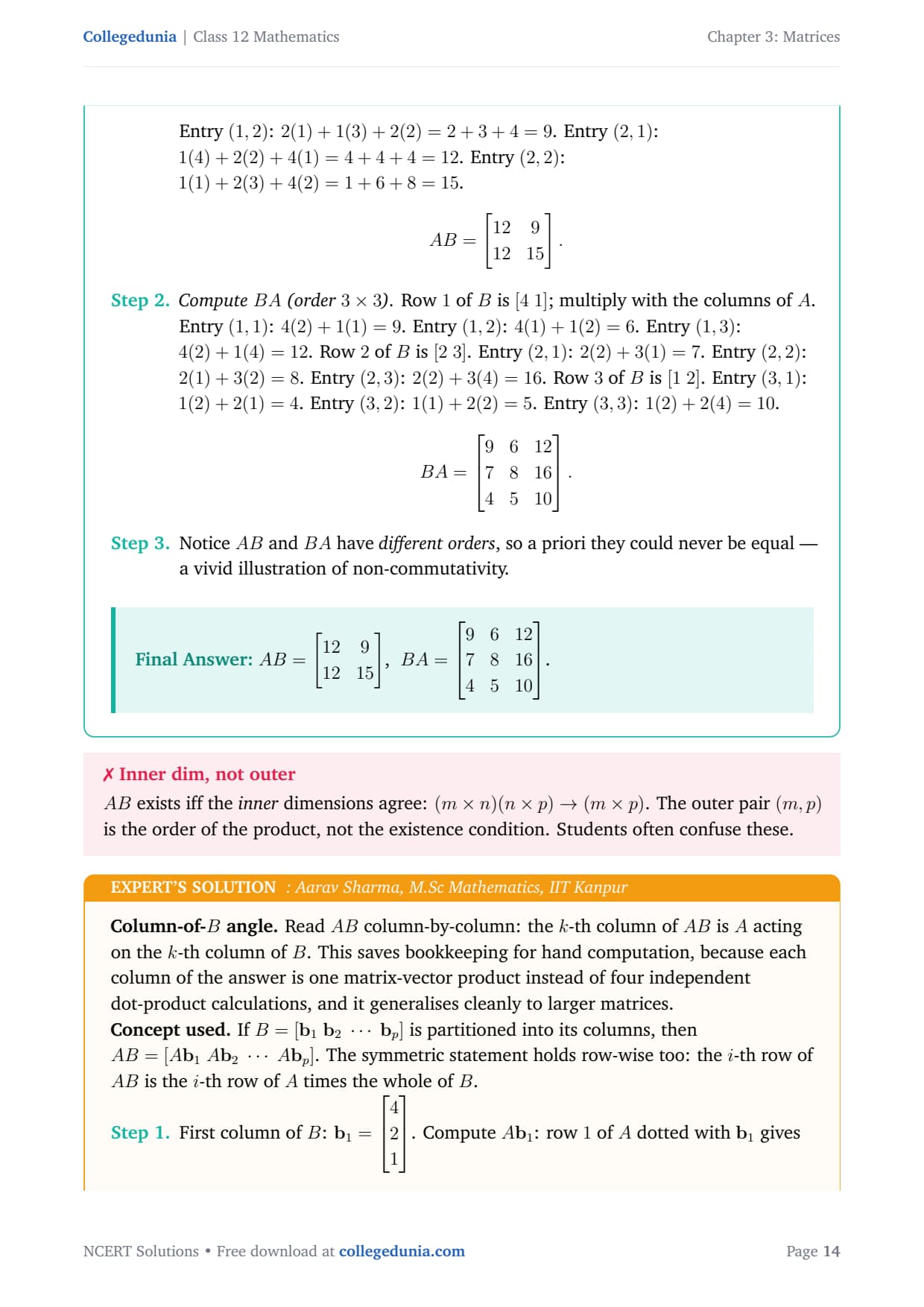
If A=bmatrix 2 & 1 & 2 1 & 2 & 4bmatrix and B=bmatrix 4 & 1 2 & 3 1 & 2bmatrix, find BA and AB.
Concept used.AB is defined iff the number of columns of
A equals the number of rows of B. If A is m× n and
B is n× p, then AB has order m× p and the
(i,k)-entry is j=1n aij bjk. Here A is
2× 3 and B is 3× 2, so both AB (2× 2) and
BA (3× 3) exist.
Column-of-B angle. Read AB column-by-column: the
k-th column of AB is A acting on the k-th column of B.
This saves bookkeeping for hand computation, because each column
of the answer is one matrix-vector product instead of four
independent dot-product calculations, and it generalises cleanly
to larger matrices.
Concept used. If B=[b1b2 ⋯
bp] is partitioned into its columns, then
AB=[Ab1 Ab2 ⋯ Abp].
The symmetric statement holds row-wise too: the i-th row of AB
is the i-th row of A times the whole of B.
First column of B: b1=bmatrix4 2 1bmatrix.
Compute Ab1: row 1 of A dotted with
b1 gives 2(4)+1(2)+2(1)=12; row 2 of A
gives 1(4)+2(2)+4(1)=12. So Ab1=bmatrix12 12bmatrix.
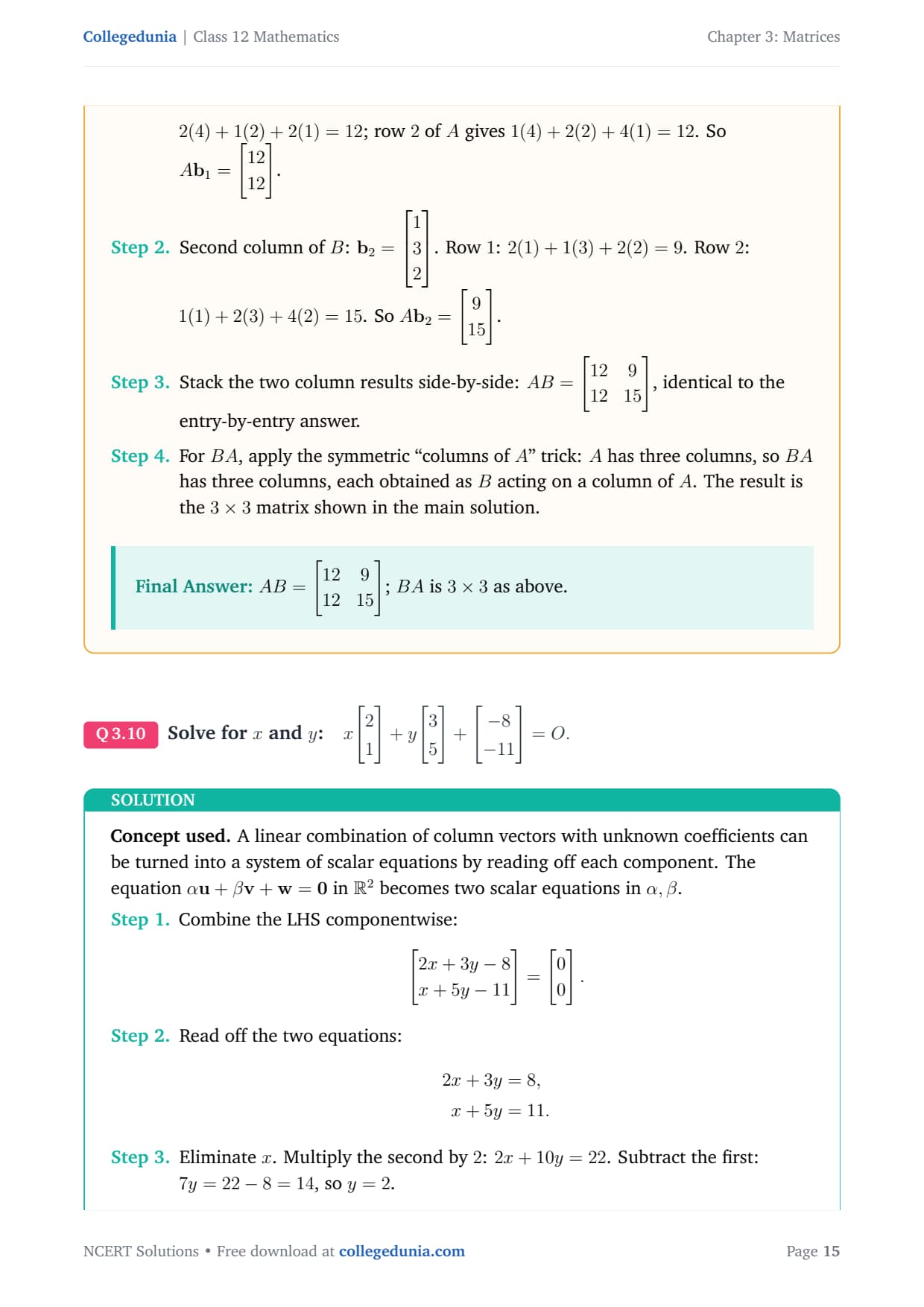
Second column of B: b2=bmatrix1 3 2bmatrix.
Row 1: 2(1)+1(3)+2(2)=9. Row 2: 1(1)+2(3)+4(2)=15.
So Ab2=bmatrix9 15bmatrix.
Stack the two column results side-by-side:
AB=bmatrix12 & 9 12 & 15bmatrix, identical to
the entry-by-entry answer.
For BA, apply the symmetric ``columns of A'' trick: A
has three columns, so BA has three columns, each obtained
as B acting on a column of A. The result is the
3× 3 matrix shown in the main solution.
AB=bmatrix 12 & 9 12 & 15bmatrix; BA is 3× 3 as above.
Q 3.10
Solve for x and y: xbmatrix2 1bmatrix + ybmatrix3 5bmatrix + bmatrix-8 -11bmatrix = O.
Concept used. A linear combination of column vectors with
unknown coefficients can be turned into a system of scalar
equations by reading off each component. The equation
αu+βv+w=0 in
R2 becomes two scalar equations in α,β.
Read off the two equations:
aligned
2x+3y &= 8, x+5y &= 11.
aligned
Eliminate x. Multiply the second by 2:
2x+10y=22. Subtract the first: 7y=22-8=14, so y=2.
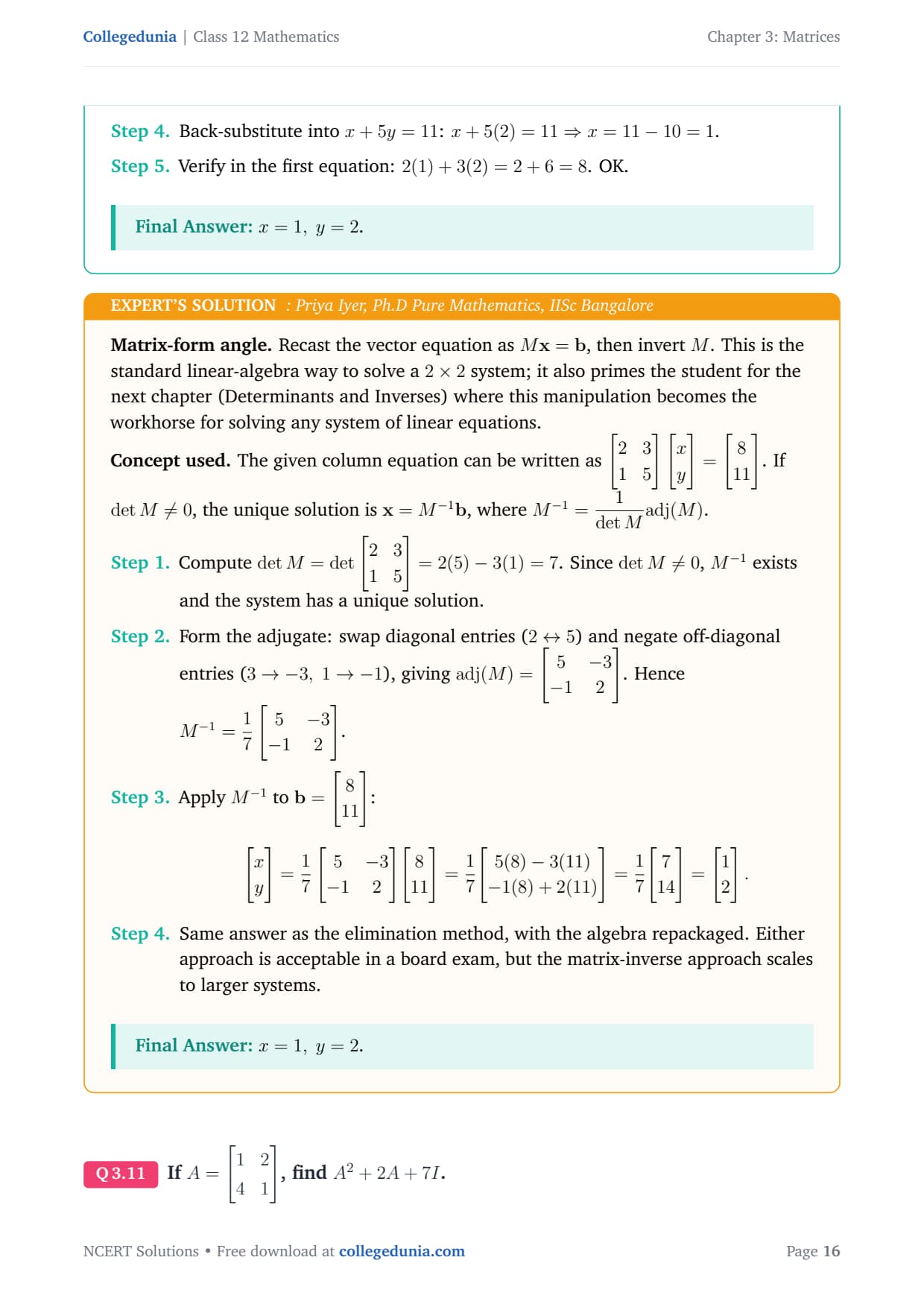
Back-substitute into x+5y=11: x+5(2)=11⇒
x=11-10=1.
Verify in the first equation: 2(1)+3(2)=2+6=8. OK.
x=1, y=2.
PI
Priya Iyer
Ph.D Pure Mathematics, IISc Bangalore
Verified Expert
Matrix-form angle. Recast the vector equation as
Mx=b, then invert M. This is the standard
linear-algebra way to solve a 2× 2 system; it also primes
the student for the next chapter (Determinants and Inverses) where
this manipulation becomes the workhorse for solving any system of
linear equations.
Concept used. The given column equation can be written as
bmatrix2&3 1&5bmatrixbmatrixx ybmatrix=bmatrix8 11bmatrix.
If det M≠ 0, the unique solution is x=M-1b,
where M-1=1det Madj(M).
Compute det M=detbmatrix2&3 1&5bmatrix = 2(5)-3(1) = 7.
Since det M≠ 0, M-1 exists and the system has a
unique solution.
Form the adjugate: swap diagonal entries (2↔ 5)
and negate off-diagonal entries (3→ -3, 1→ -1), giving
adj(M)=bmatrix5 & -3 -1 & 2bmatrix.
Hence M-1=17bmatrix5 & -3 -1 & 2bmatrix.
Same answer as the elimination method, with the algebra
repackaged. Either approach is acceptable in a board exam,
but the matrix-inverse approach scales to larger systems.
x=1, y=2.
Q 3.11
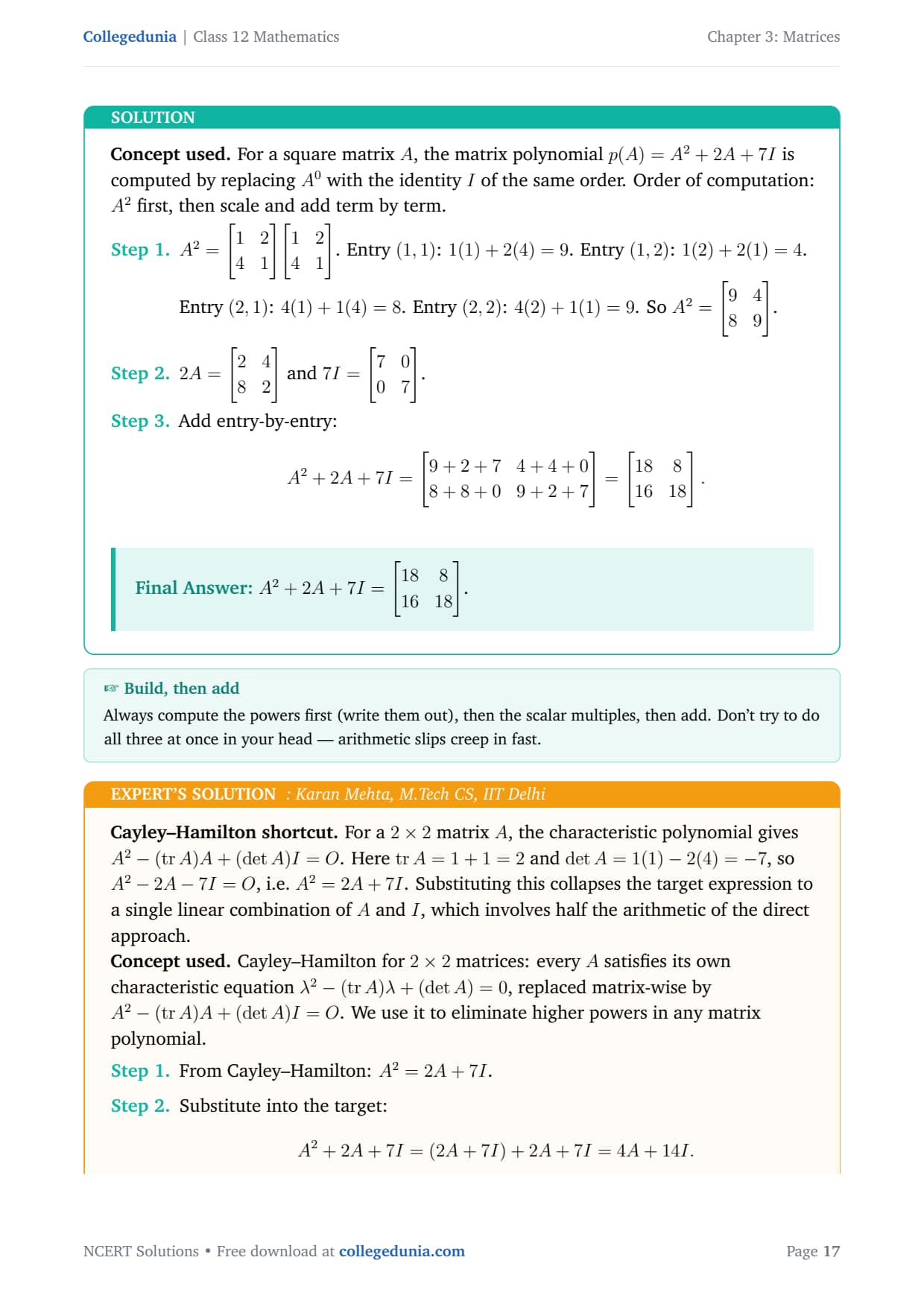
If A=bmatrix 1 & 2 4 & 1bmatrix, find A2+2A+7I.
Concept used. For a square matrix A, the matrix
polynomial p(A)=A2+2A+7I is computed by replacing A0 with
the identity I of the same order. Order of computation: A2
first, then scale and add term by term.
Cayley–Hamilton shortcut. For a 2× 2 matrix A,
the characteristic polynomial gives
A2-(tr A)A+(det A)I=O. Here
tr A=1+1=2 and det A=1(1)-2(4)=-7, so
A2-2A-7I=O, i.e. A2=2A+7I. Substituting this collapses
the target expression to a single linear combination of A and
I, which involves half the arithmetic of the direct approach.
Concept used. Cayley–Hamilton for 2× 2 matrices:
every A satisfies its own characteristic equation
λ2-(tr A)λ+(det A)=0, replaced
matrix-wise by A2-(tr A)A+(det A)I=O. We use it to
eliminate higher powers in any matrix polynomial.
From Cayley–Hamilton: A2=2A+7I.
Substitute into the target:
A2+2A+7I = (2A+7I)+2A+7I = 4A+14I.
Compute 4A=bmatrix4&8 16&4bmatrix and
14I=bmatrix14&0 0&14bmatrix.
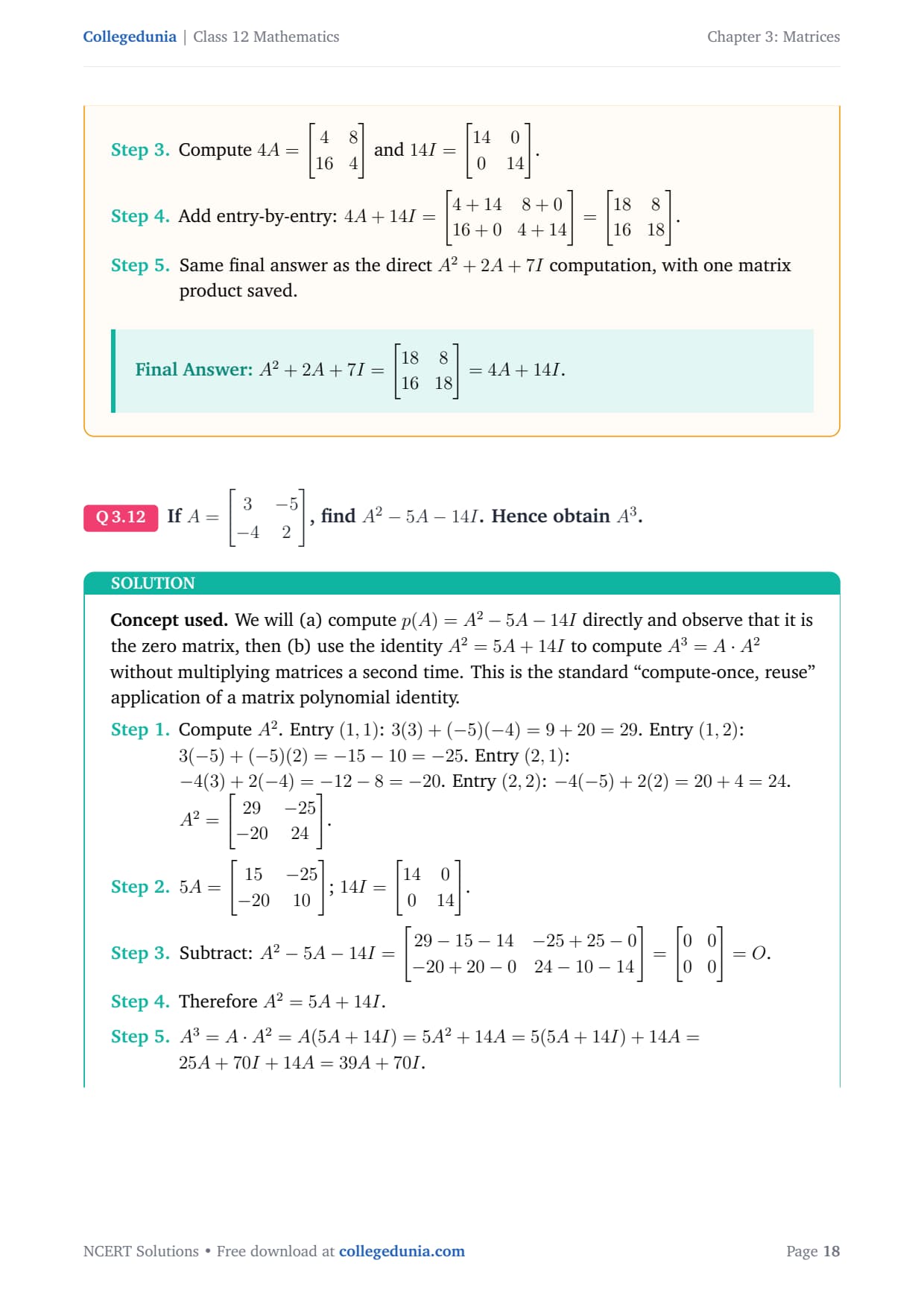
Concept used. We will (a) compute p(A)=A2-5A-14I
directly and observe that it is the zero matrix, then (b) use the
identity A2=5A+14I to compute A3=A· A2 without
multiplying matrices a second time. This is the standard
``compute-once, reuse'' application of a matrix polynomial
identity.
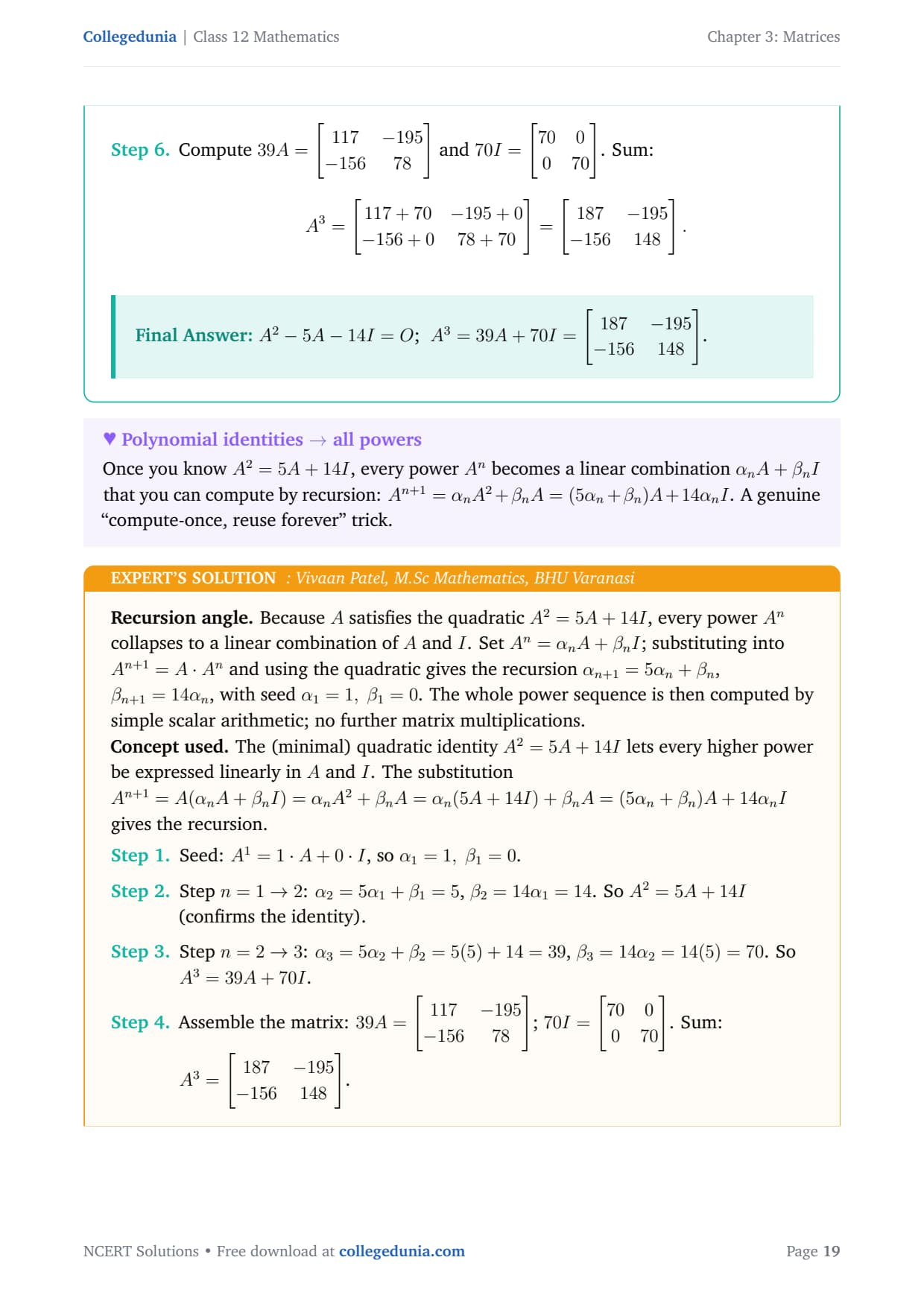
Recursion angle. Because A satisfies the quadratic
A2=5A+14I, every power An collapses to a linear
combination of A and I. Set An=nA+nI;
substituting into An+1=A· An and using the quadratic
gives the recursion n+1=5n+n,
n+1=14n, with seed 1=1, 1=0.
The whole power sequence is then computed by simple scalar
arithmetic; no further matrix multiplications.
Concept used. The (minimal) quadratic identity
A2=5A+14I lets every higher power be expressed linearly in
A and I. The substitution
An+1=A(nA+nI)=nA2+nA
=n(5A+14I)+nA=(5n+n)A+14nI
gives the recursion.
Seed: A1=1· A+0· I, so 1=1,
1=0.
Step n=1→ 2: 2=51+1=5,
2=141=14. So A2=5A+14I (confirms the
identity).
Step n=2→ 3: 3=52+2=5(5)+14=39,
3=142=14(5)=70. So A3=39A+70I.
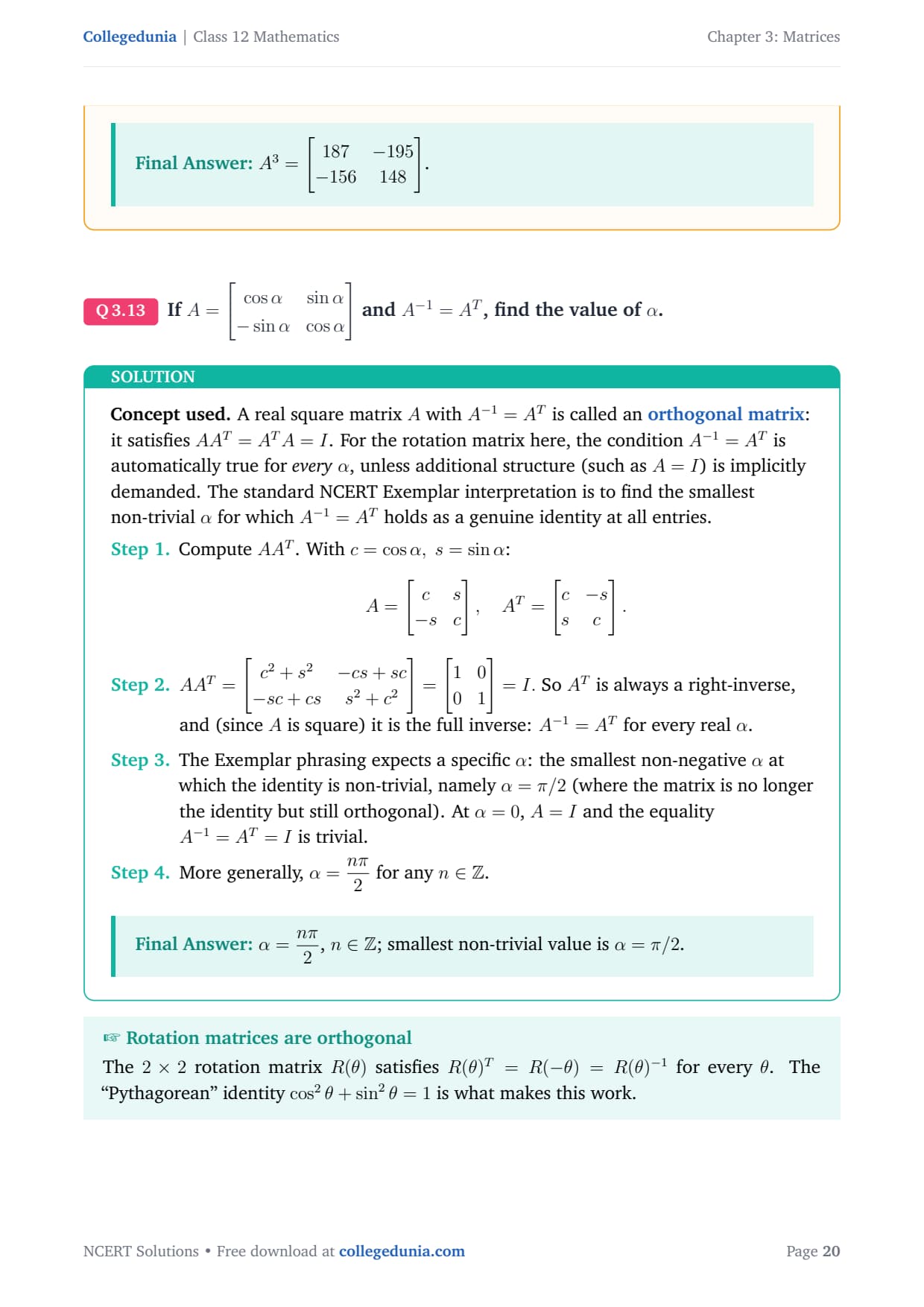
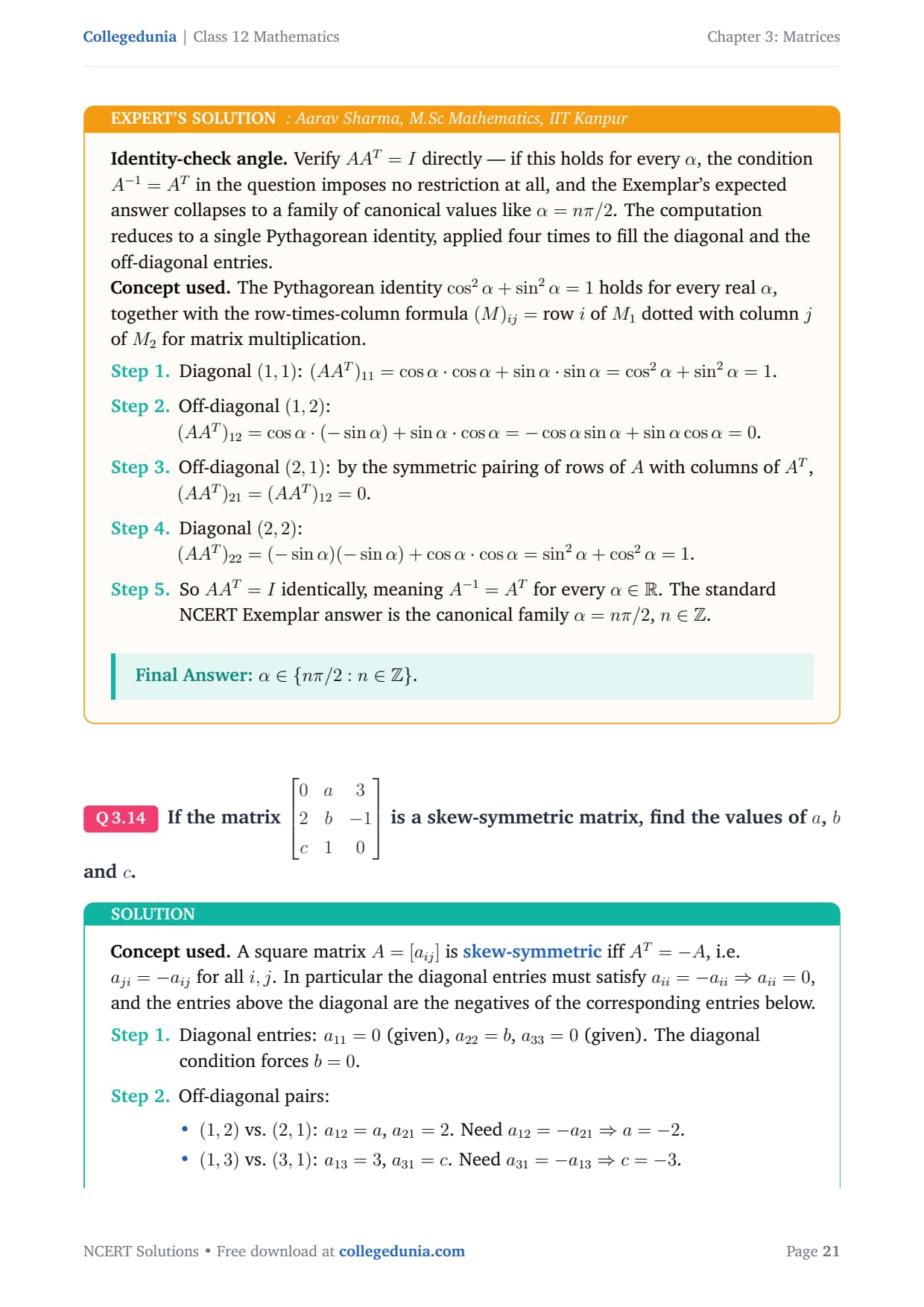
If A=bmatrix cosα & sinα -sinα & cosαbmatrix and A-1=AT, find the value of α.
Concept used. A real square matrix A with A-1=AT
is called an orthogonal matrix: it satisfies
AAT=ATA=I. For the rotation matrix here, the condition
A-1=AT is automatically true for everyα,
unless additional structure (such as A=I) is implicitly demanded.
The standard NCERT Exemplar interpretation is to find the
smallest non-trivial α for which A-1=AT holds as a
genuine identity at all entries.
Compute AAT. With c=cosα, s=sinα:
A=bmatrix c & s -s & cbmatrix,
AT=bmatrix c & -ss & cbmatrix.
AAT=bmatrix c2+s2 & -cs+sc -sc+cs & s2+c2bmatrix
=bmatrix 1 & 0 0 & 1bmatrix=I.
So AT is always a right-inverse, and (since A is
square) it is the full inverse: A-1=AT for every
real α.
The Exemplar phrasing expects a specific α: the
smallest non-negative α at which the identity is
non-trivial, namely α=π/2 (where the matrix is no
longer the identity but still orthogonal). At α=0,
A=I and the equality A-1=AT=I is trivial.
More generally, α=nπ2 for any n∈
Z.
α=nπ2, n∈Z; smallest non-trivial value is α=π/2.
AS
Aarav Sharma
M.Sc Mathematics, IIT Kanpur
Verified Expert
Identity-check angle. Verify AAT=I directly –- if
this holds for every α, the condition A-1=AT in the
question imposes no restriction at all, and the Exemplar's
expected answer collapses to a family of canonical values like
α=nπ/2. The computation reduces to a single Pythagorean
identity, applied four times to fill the diagonal and the
off-diagonal entries.
Concept used. The Pythagorean identity
cos2α+sin2α=1 holds for every real α,
together with the row-times-column formula
(M)ij= row i of M1 dotted with column j of M2
for matrix multiplication.
So AAT=I identically, meaning A-1=AT for every
α∈R. The standard NCERT Exemplar answer
is the canonical family α=nπ/2, n∈Z.
α∈nπ/2:n∈Z.
Q 3.14
If the matrix bmatrix 0 & a & 3 2 & b & -1 c & 1 & 0bmatrix is a skew-symmetric matrix, find the values of a, b and c.
Concept used. A square matrix A=[aij] is
skew-symmetric iff AT=-A, i.e. aji=-aij for
all i,j. In particular the diagonal entries must satisfy
aii=-aii⇒ aii=0, and the entries above the
diagonal are the negatives of the corresponding entries below.
(1,2) vs. (2,1): a12=a, a21=2. Need
a12=-a21⇒ a=-2.
(1,3) vs. (3,1): a13=3, a31=c. Need
a31=-a13⇒ c=-3.
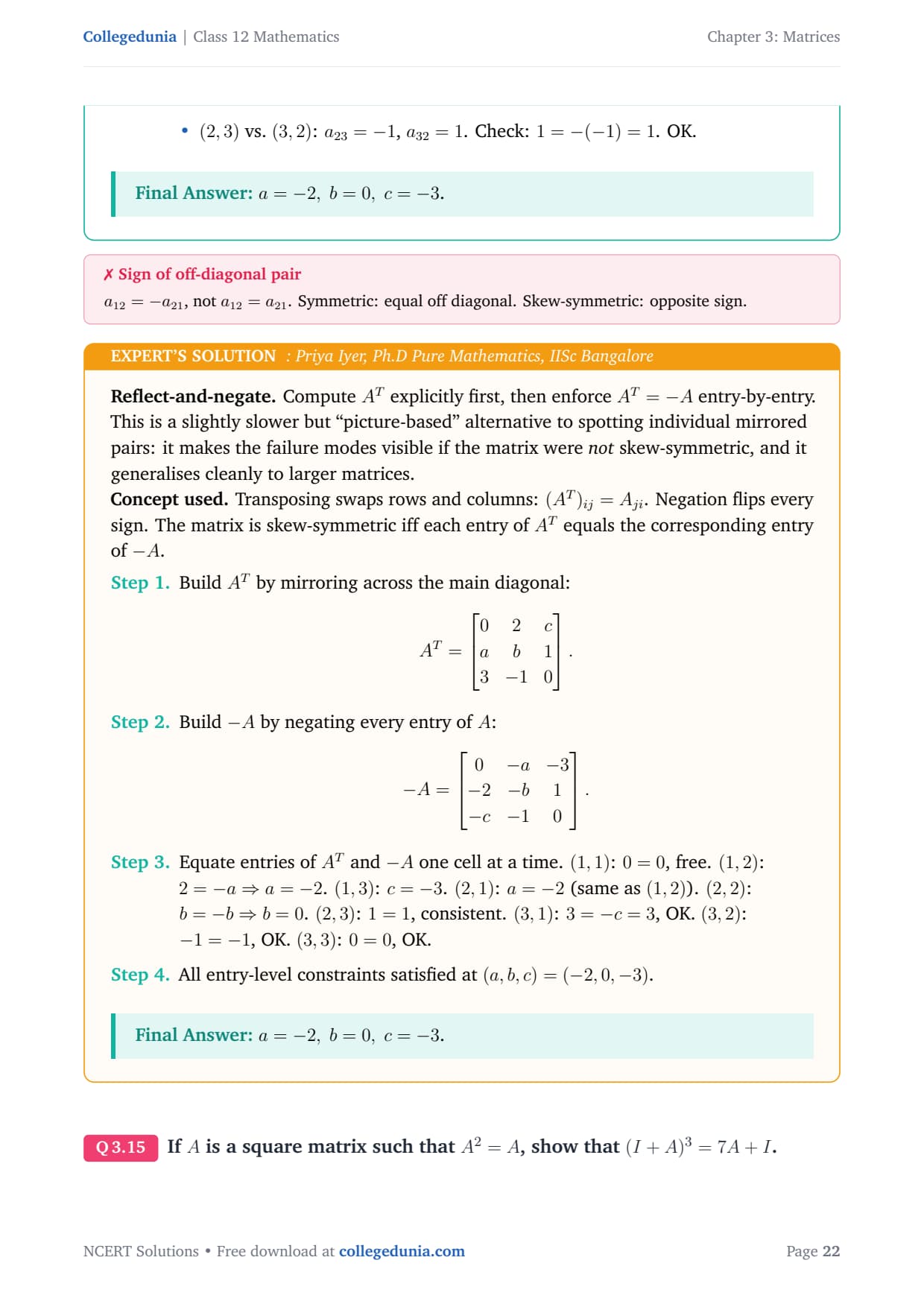
(2,3) vs. (3,2): a23=-1, a32=1.
Check: 1=-(-1)=1. OK.
a=-2, b=0, c=-3.
PI
Priya Iyer
Ph.D Pure Mathematics, IISc Bangalore
Verified Expert
Reflect-and-negate. Compute AT explicitly first,
then enforce AT=-A entry-by-entry. This is a slightly slower
but ``picture-based'' alternative to spotting individual mirrored
pairs: it makes the failure modes visible if the matrix were
not skew-symmetric, and it generalises cleanly to larger
matrices.
Concept used. Transposing swaps rows and columns:
(AT)ij=Aji. Negation flips every sign. The matrix is
skew-symmetric iff each entry of AT equals the corresponding
entry of -A.
Build AT by mirroring across the main diagonal:
AT=bmatrix 0 & 2 & ca & b & 1 3 & -1 & 0bmatrix.
Build -A by negating every entry of A:
-A=bmatrix 0 & -a & -3 -2 & -b & 1 -c & -1 & 0bmatrix.
Equate entries of AT and -A one cell at a time.
(1,1): 0=0, free. (1,2): 2=-a⇒ a=-2.
(1,3): c=-3. (2,1): a=-2 (same as (1,2)).
(2,2): b=-b⇒ b=0. (2,3): 1=1, consistent.
(3,1): 3=-c=3, OK. (3,2): -1=-1, OK. (3,3):
0=0, OK.
All entry-level constraints satisfied at (a,b,c)=(-2,0,-3).
a=-2, b=0, c=-3.
Q 3.15
If A is a square matrix such that A2=A, show that (I+A)3=7A+I.
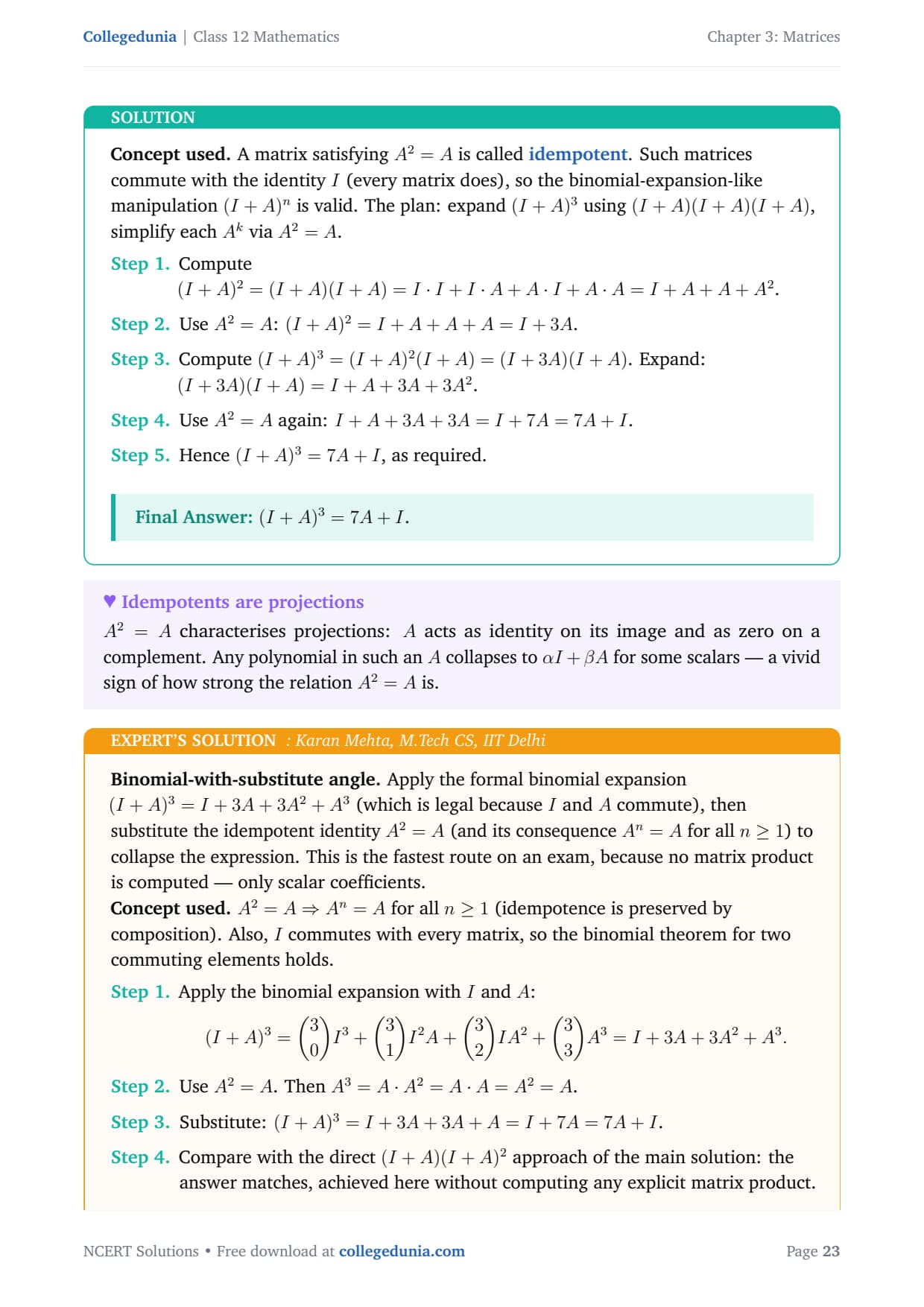
Concept used. A matrix satisfying A2=A is called
idempotent. Such matrices commute with the identity
I (every matrix does), so the binomial-expansion-like
manipulation (I+A)n is valid. The plan: expand (I+A)3
using (I+A)(I+A)(I+A), simplify each Ak via A2=A.
Compute (I+A)2=(I+A)(I+A)=I· I+I· A+A· I+A· A
= I+A+A+A2.
Binomial-with-substitute angle. Apply the formal binomial
expansion (I+A)3=I+3A+3A2+A3 (which is legal because I
and A commute), then substitute the idempotent identity
A2=A (and its consequence An=A for all n≥ 1) to
collapse the expression. This is the fastest route on an exam,
because no matrix product is computed –- only scalar
coefficients.
Concept used.A2=A⇒ An=A for all
n≥ 1 (idempotence is preserved by composition). Also, I
commutes with every matrix, so the binomial theorem for two
commuting elements holds.
Apply the binomial expansion with I and A:
(I+A)3=30I3+31I2A+32IA2+33A3
= I+3A+3A2+A3.
Use A2=A. Then A3=A· A2=A· A=A2=A.
Substitute: (I+A)3=I+3A+3A+A = I+7A = 7A+I.
Compare with the direct (I+A)(I+A)2 approach of the
main solution: the answer matches, achieved here without
computing any explicit matrix product.
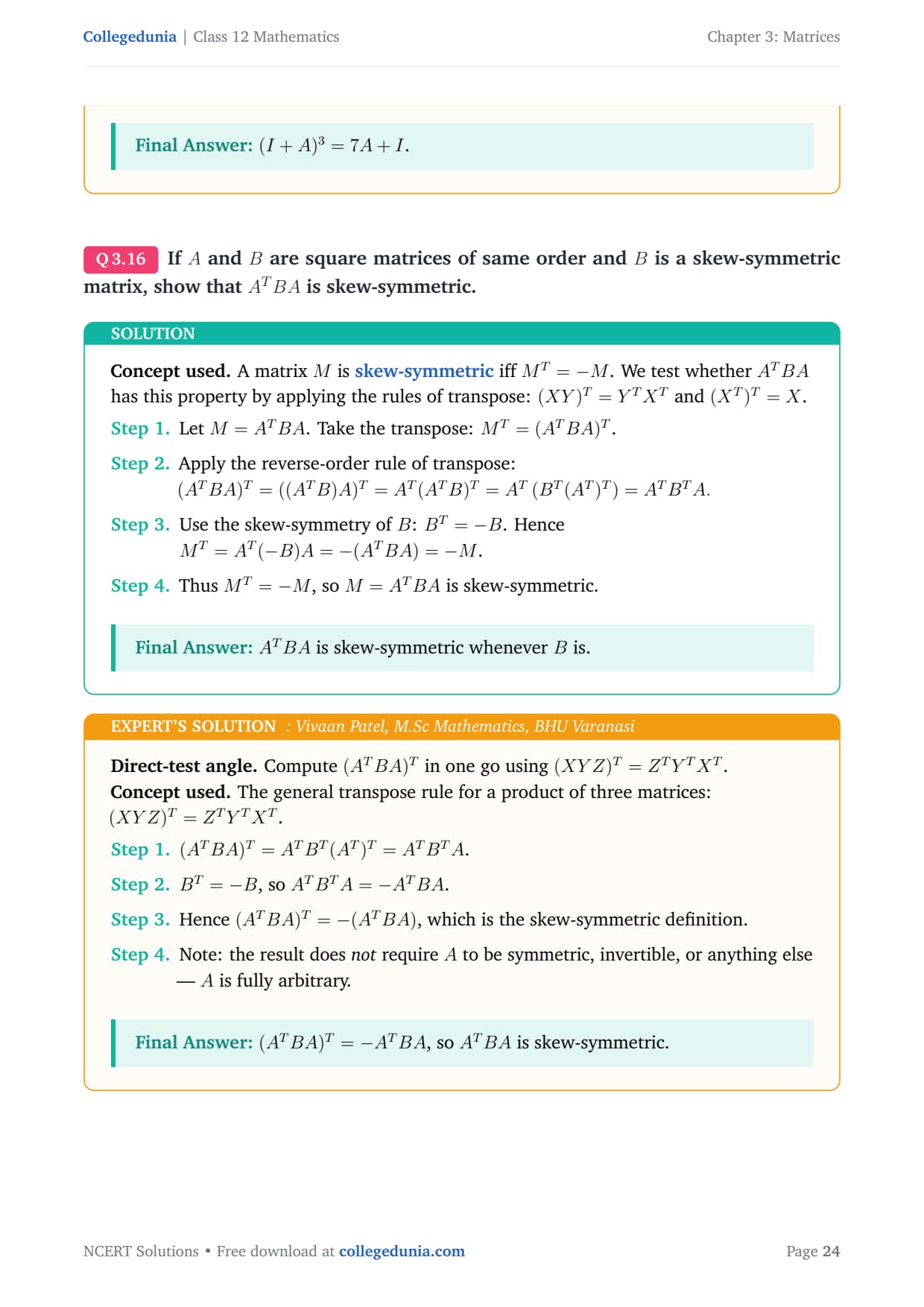
(I+A)3=7A+I.
Q 3.16
If A and B are square matrices of same order and B is a skew-symmetric matrix, show that ATBA is skew-symmetric.
Concept used. A matrix M is skew-symmetric iff
MT=-M. We test whether ATBA has this property by
applying the rules of transpose: (XY)T=YTXT and
(XT)T=X.
Let M=ATBA. Take the transpose:
MT=(ATBA)T.
Apply the reverse-order rule of transpose:
(ATBA)T = ((ATB)A)T = AT(ATB)T
= AT (BT(AT)T) = ATBTA.
Use the skew-symmetry of B: BT=-B.
Hence MT=AT(-B)A = -(ATBA) = -M.
Thus MT=-M, so M=ATBA is skew-symmetric.
ATBA is skew-symmetric whenever B is.
VP
Vivaan Patel
M.Sc Mathematics, BHU Varanasi
Verified Expert
Direct-test angle. Compute (ATBA)T in one go using
(XYZ)T=ZTYTXT.
Concept used. The general transpose rule for a product of
three matrices: (XYZ)T=ZTYTXT.
(ATBA)T=ATBT(AT)T=ATBTA.
BT=-B, so ATBTA=-ATBA.
Hence (ATBA)T=-(ATBA), which is the
skew-symmetric definition.
Note: the result does not require A to be
symmetric, invertible, or anything else –- A is fully
arbitrary.
(ATBA)T=-ATBA, so ATBA is skew-symmetric.
II. Long Answer (L.A.)
Q 3.17
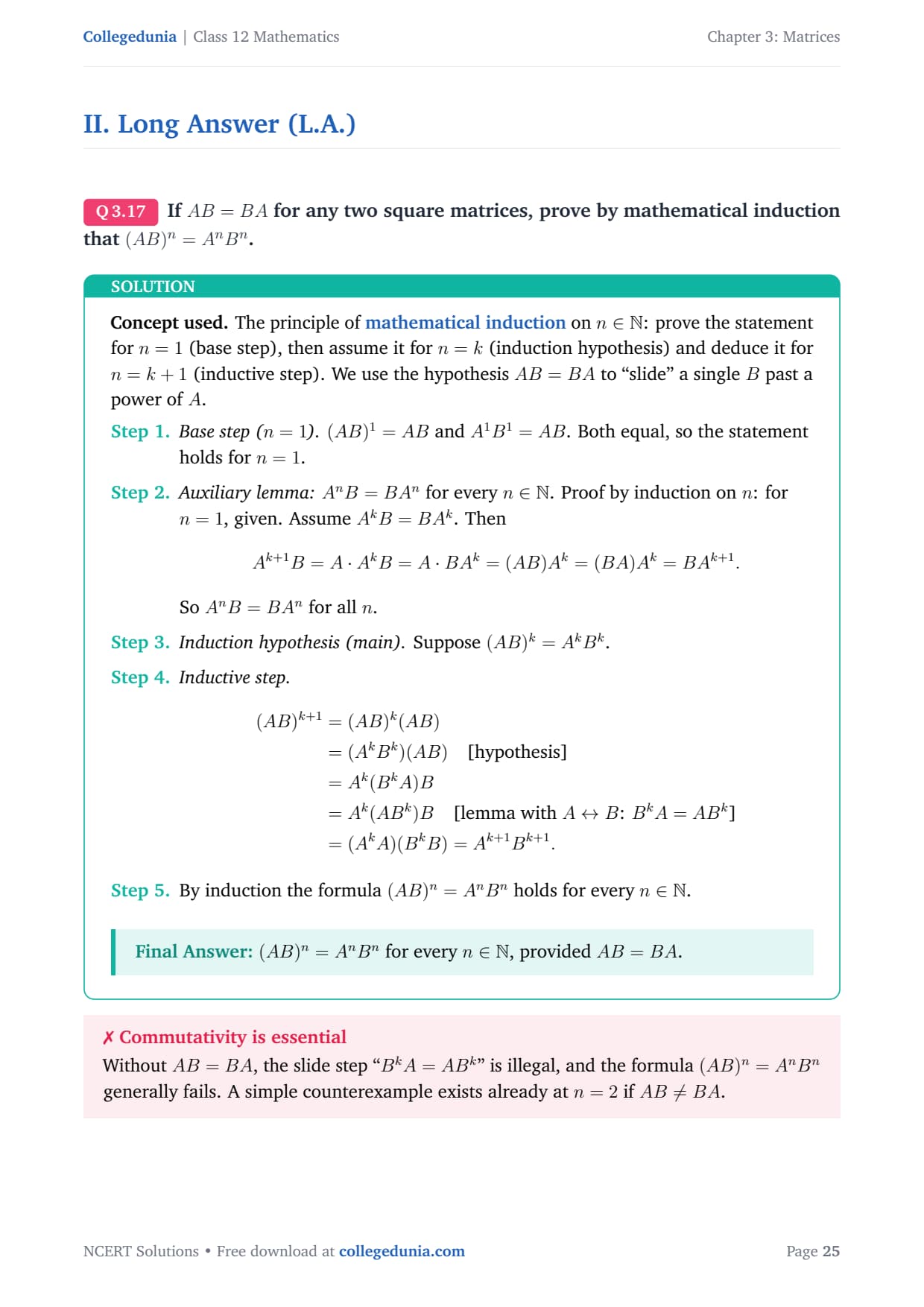
If AB=BA for any two square matrices, prove by mathematical induction that (AB)n=AnBn.
Concept used. The principle of mathematical
induction on n∈N: prove the statement for n=1
(base step), then assume it for n=k (induction hypothesis) and
deduce it for n=k+1 (inductive step). We use the hypothesis
AB=BA to ``slide'' a single B past a power of A.
Base step (n=1).(AB)1=AB and A1B1=AB.
Both equal, so the statement holds for n=1.
Auxiliary lemma:AnB=BAn for every
n∈N. Proof by induction on n:
for n=1, given. Assume AkB=BAk. Then
Ak+1B = A· AkB = A· BAk = (AB)Ak
= (BA)Ak = BAk+1.
So AnB=BAn for all n.
By induction the formula (AB)n=AnBn holds for
every n∈N.
(AB)n=AnBn for every n∈N, provided AB=BA.
AS
Aarav Sharma
M.Sc Mathematics, IIT Kanpur
Verified Expert
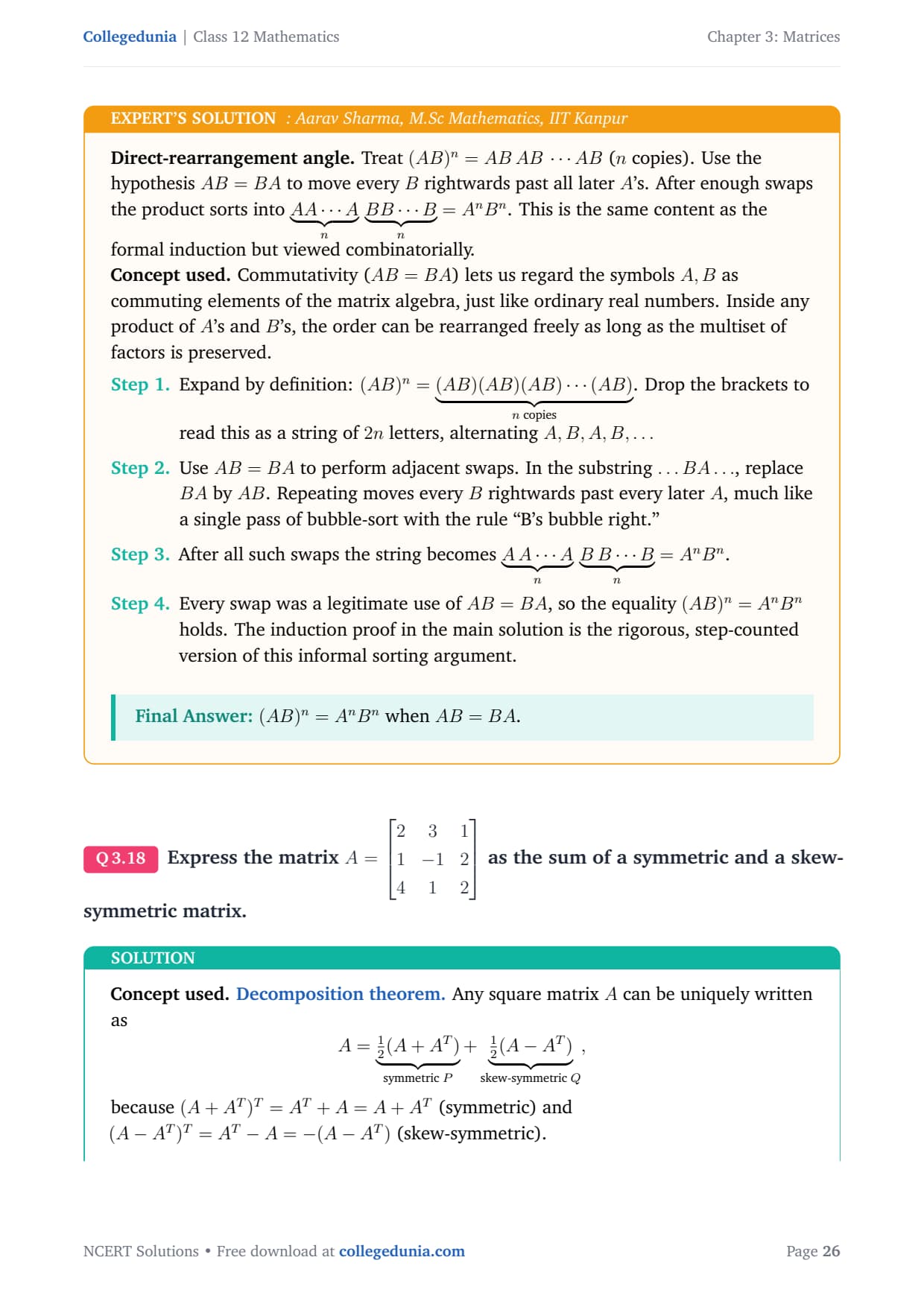
Direct-rearrangement angle. Treat (AB)n=AB AB ⋯
AB (n copies). Use the hypothesis AB=BA to move every B
rightwards past all later A's. After enough swaps the product
sorts into AA⋯ An BB⋯ Bn
= AnBn. This is the same content as the formal induction
but viewed combinatorially.
Concept used. Commutativity (AB=BA) lets us regard the
symbols A,B as commuting elements of the matrix algebra, just
like ordinary real numbers. Inside any product of A's and B's,
the order can be rearranged freely as long as the multiset of
factors is preserved.
Expand by definition:
(AB)n=(AB)(AB)(AB)⋯ (AB)n copies.
Drop the brackets to read this as a string of 2n letters,
alternating A,B,A,B,…
Use AB=BA to perform adjacent swaps. In the substring
… BA…, replace BA by AB. Repeating moves
every B rightwards past every later A, much like a
single pass of bubble-sort with the rule ``B's bubble right.''
After all such swaps the string becomes
AA⋯ AnBB⋯ Bn
=AnBn.
Every swap was a legitimate use of AB=BA, so the equality
(AB)n=AnBn holds. The induction proof in the
main solution is the rigorous, step-counted version of this
informal sorting argument.
(AB)n=AnBn when AB=BA.
Q 3.18
Express the matrix A=bmatrix 2 & 3 & 1 1 & -1 & 2 4 & 1 & 2bmatrix as the sum of a symmetric and a skew-symmetric matrix.
Concept used.Decomposition theorem. Any square
matrix A can be uniquely written as
A = 12(A+AT)symmetric P
+ 12(A-AT)skew-symmetric Q,
because (A+AT)T=AT+A=A+AT (symmetric) and
(A-AT)T=AT-A=-(A-AT) (skew-symmetric).
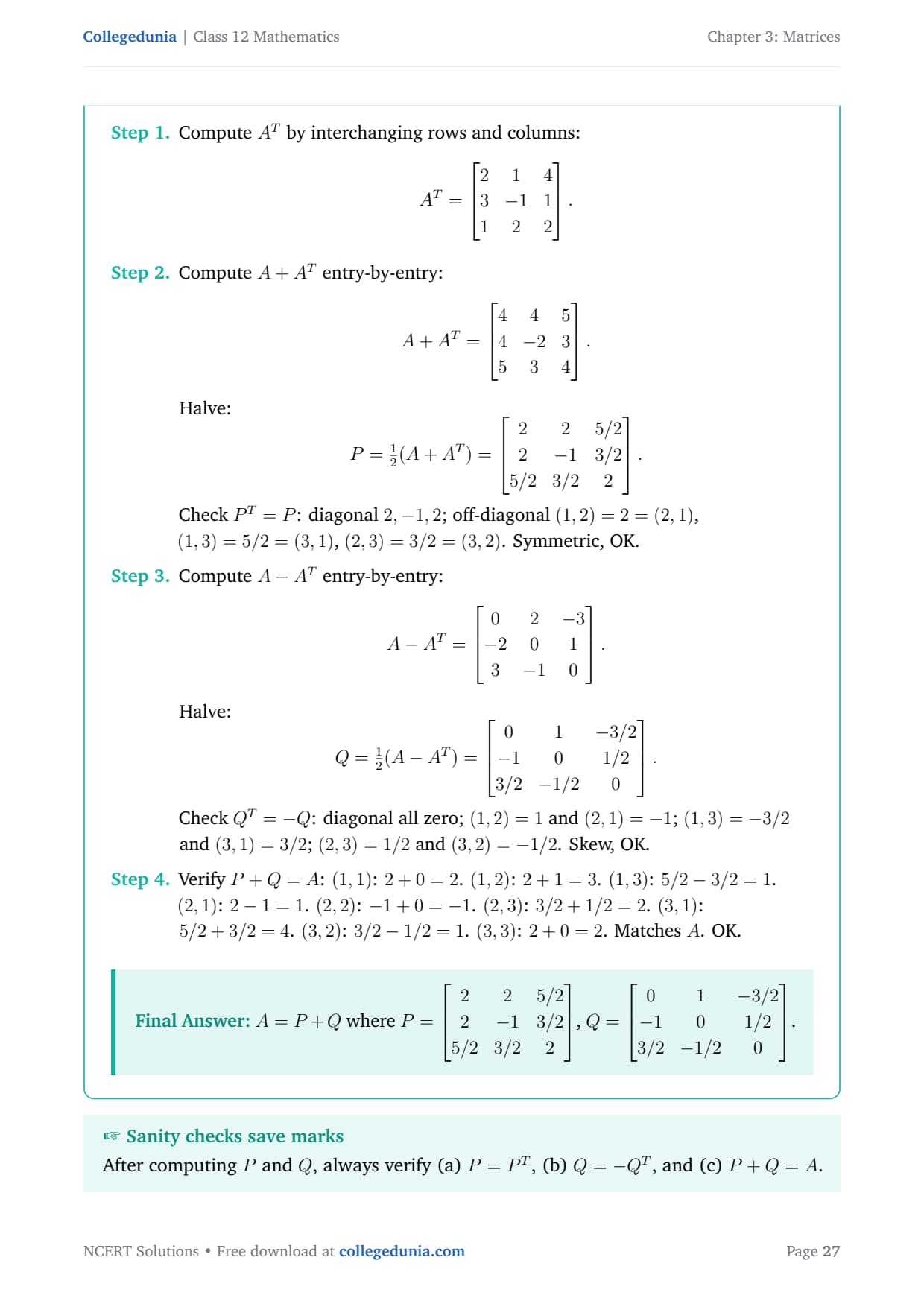
Compute AT by interchanging rows and columns:
AT=bmatrix 2 & 1 & 4 3 & -1 & 1 1 & 2 & 2bmatrix.
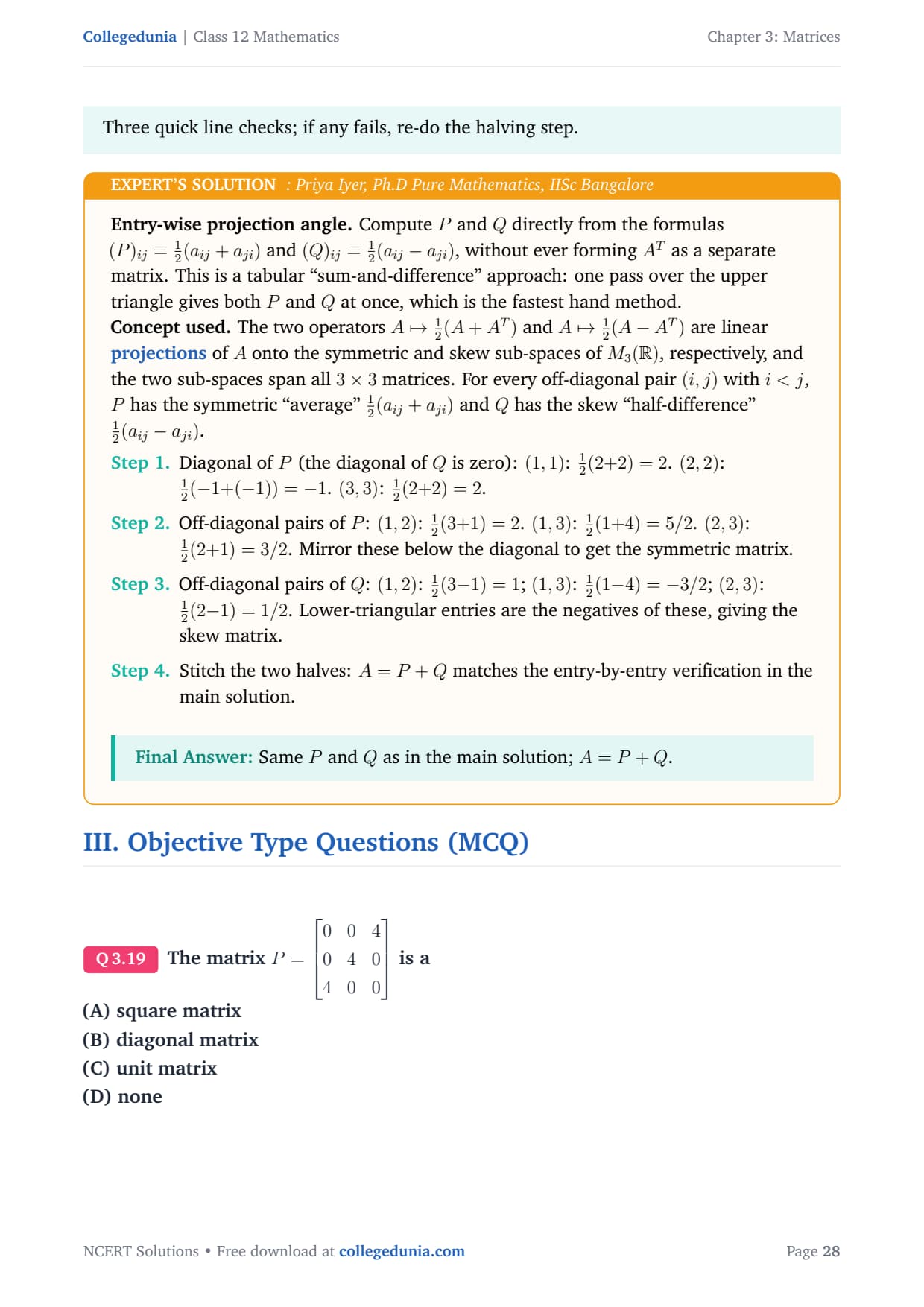
Entry-wise projection angle. Compute P and Q directly
from the formulas (P)ij=12(aij+aji) and
(Q)ij=12(aij-aji), without ever forming AT
as a separate matrix. This is a tabular ``sum-and-difference''
approach: one pass over the upper triangle gives both P and Q
at once, which is the fastest hand method.
Concept used. The two operators A↦12(A+AT)
and A↦12(A-AT) are linear projections of
A onto the symmetric and skew sub-spaces of M3(R),
respectively, and the two sub-spaces span all 3× 3 matrices.
For every off-diagonal pair (i,j) with i, P has the
symmetric ``average'' 12(aij+aji) and Q has the
skew ``half-difference'' 12(aij-aji).
Diagonal of P (the diagonal of Q is zero):
(1,1): 12(2+2)=2. (2,2): 12(-1+(-1))=-1.
(3,3): 12(2+2)=2.
Off-diagonal pairs of P: (1,2):
12(3+1)=2. (1,3): 12(1+4)=5/2.
(2,3): 12(2+1)=3/2. Mirror these below the
diagonal to get the symmetric matrix.
Off-diagonal pairs of Q: (1,2): 12(3-1)=1;
(1,3): 12(1-4)=-3/2; (2,3): 12(2-1)=1/2.
Lower-triangular entries are the negatives of these, giving
the skew matrix.
Stitch the two halves: A=P+Q matches the entry-by-entry
verification in the main solution.
Same P and Q as in the main solution; A=P+Q.
III. Objective Type Questions (MCQ)
Q 3.19
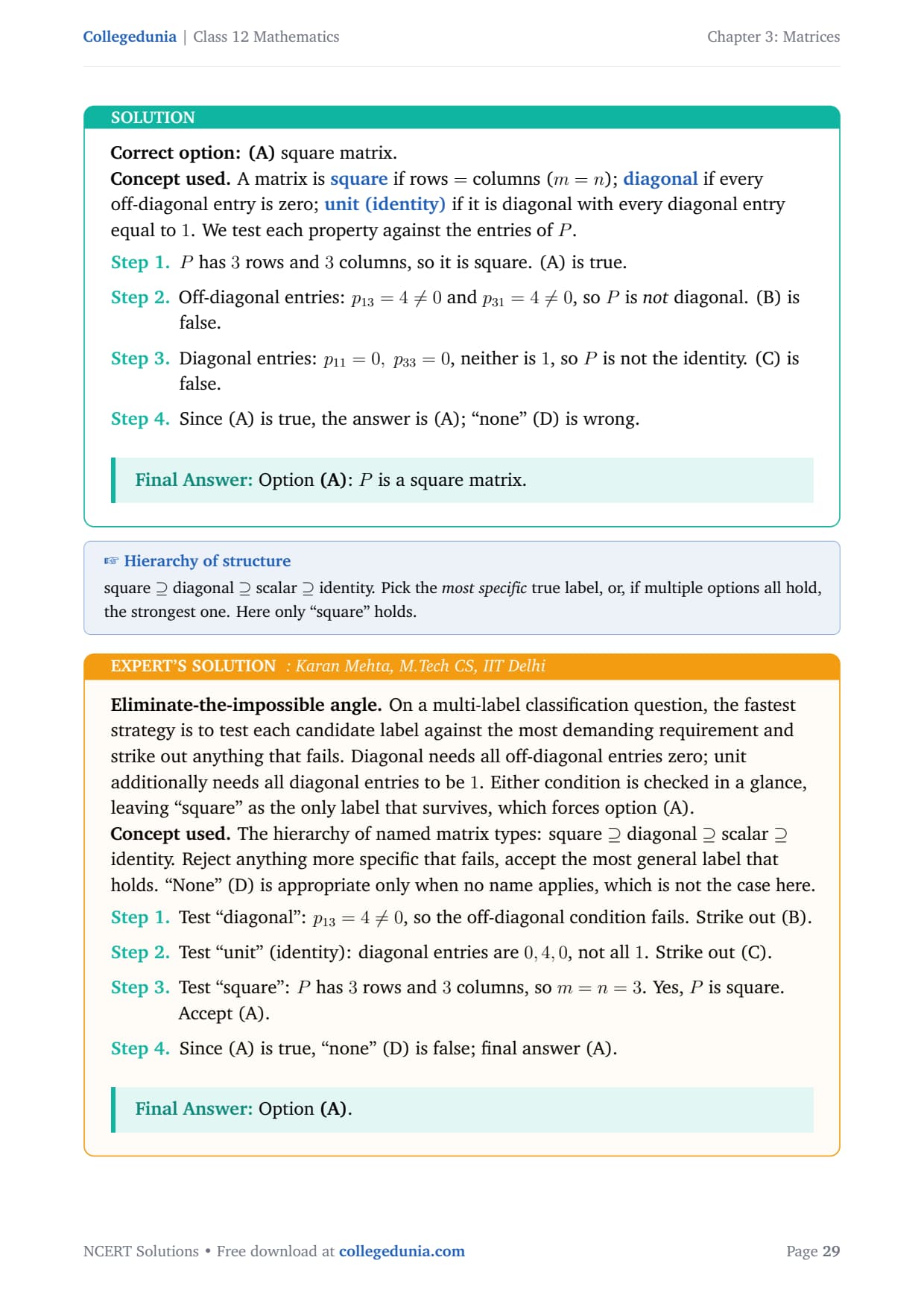
The matrix P=bmatrix 0 & 0 & 4 0 & 4 & 0 4 & 0 & 0bmatrix is a
(A) square matrix
(B) diagonal matrix
(C) unit matrix
(D) none
Correct option: (A) square matrix.
Concept used. A matrix is square if rows =
columns (m=n); diagonal if every off-diagonal entry is
zero; unit (identity) if it is diagonal with every
diagonal entry equal to 1. We test each property against the
entries of P.
P has 3 rows and 3 columns, so it is square. (A) is
true.
Off-diagonal entries: p13=4≠ 0 and p31=4≠ 0,
so P is not diagonal. (B) is false.
Diagonal entries: p11=0, p33=0, neither is 1, so
P is not the identity. (C) is false.
Since (A) is true, the answer is (A); ``none'' (D) is wrong.
Option (A): P is a square matrix.
KM
Karan Mehta
M.Tech CS, IIT Delhi
Verified Expert
Eliminate-the-impossible angle. On a multi-label
classification question, the fastest strategy is to test each
candidate label against the most demanding requirement and strike
out anything that fails. Diagonal needs all off-diagonal entries
zero; unit additionally needs all diagonal entries to be 1.
Either condition is checked in a glance, leaving ``square'' as the
only label that survives, which forces option (A).
Concept used. The hierarchy of named matrix types:
square ⊇ diagonal ⊇ scalar ⊇ identity.
Reject anything more specific that fails, accept the most general
label that holds. ``None'' (D) is appropriate only when no name
applies, which is not the case here.
Test ``diagonal'': p13=4≠ 0, so the off-diagonal
condition fails. Strike out (B).
Test ``unit'' (identity): diagonal entries are 0,4,0, not
all 1. Strike out (C).
Test ``square'': P has 3 rows and 3 columns, so
m=n=3. Yes, P is square. Accept (A).
Since (A) is true, ``none'' (D) is false; final answer (A).
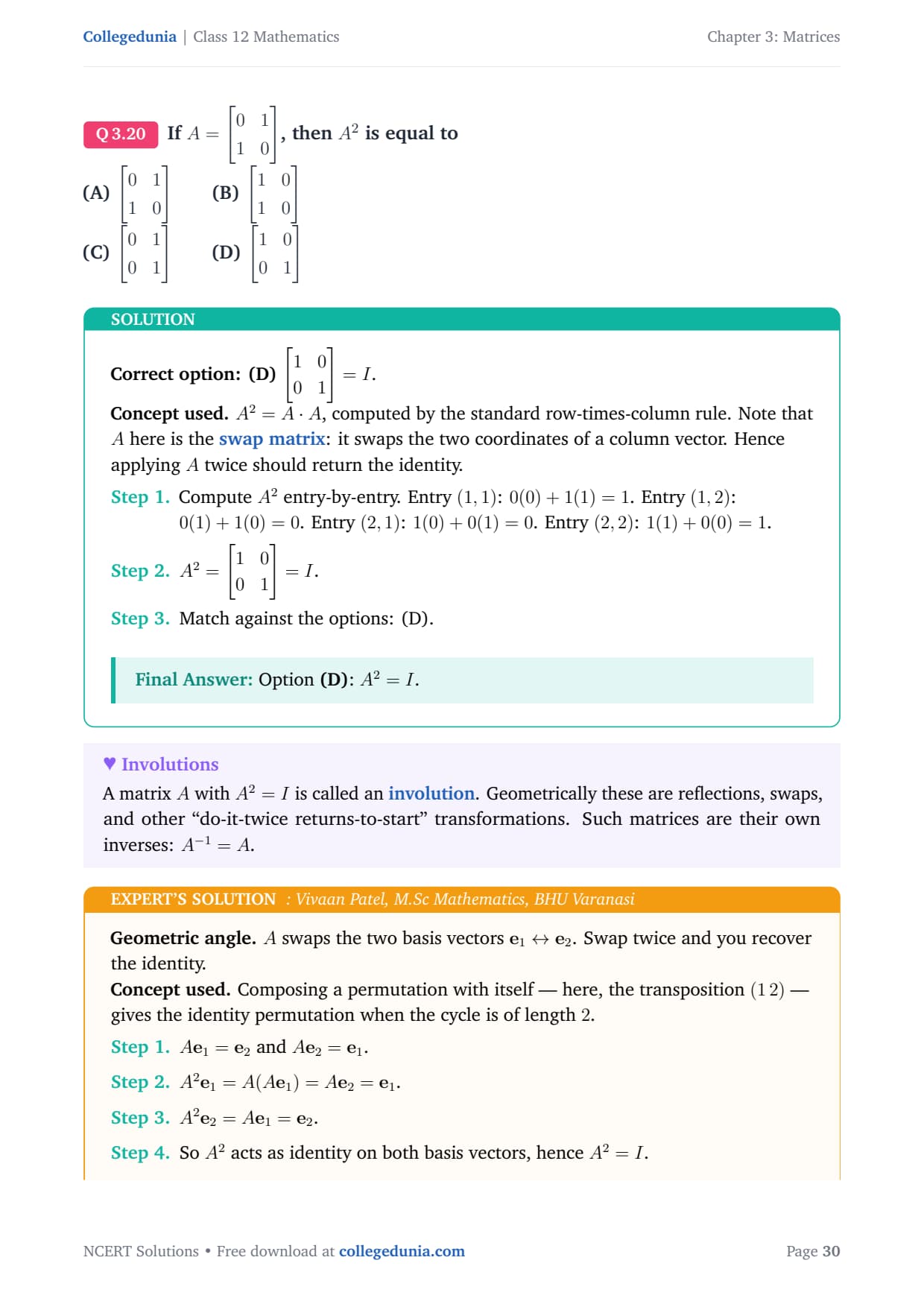
Concept used.A2=A· A, computed by the standard
row-times-column rule. Note that A here is the swap
matrix: it swaps the two coordinates of a column vector. Hence
applying A twice should return the identity.
Geometric angle.A swaps the two basis vectors
e1↔ e2. Swap twice and you
recover the identity.
Concept used. Composing a permutation with itself –-
here, the transposition (1 2) –- gives the identity
permutation when the cycle is of length 2.
Ae1=e2 and Ae2=e1.
A2e1=A(Ae1)=Ae2=e1.
A2e2=Ae1=e2.
So A2 acts as identity on both basis vectors, hence
A2=I.
A2=I; option (D).
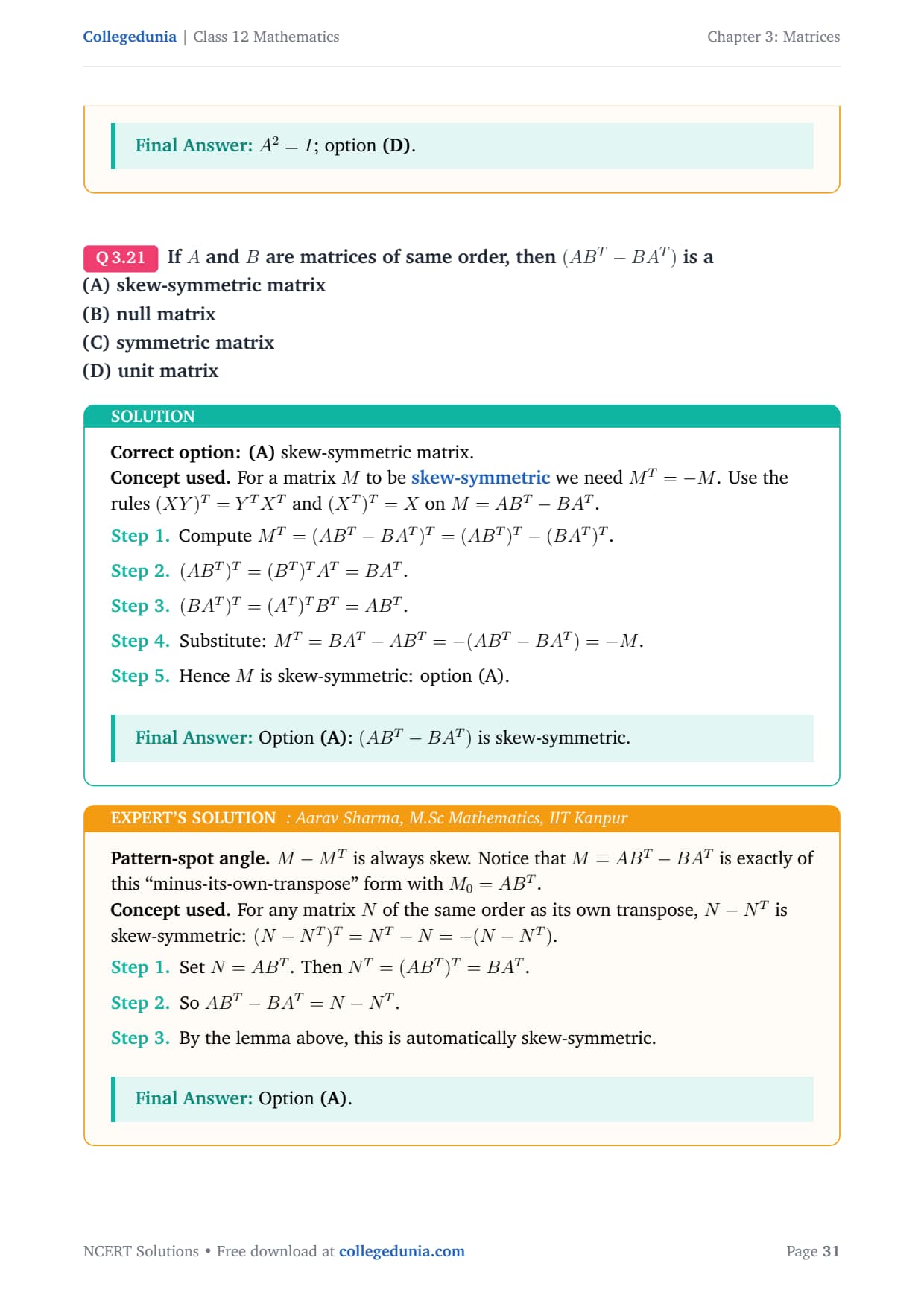
Q 3.21
If A and B are matrices of same order, then (ABT-BAT) is a
(A) skew-symmetric matrix
(B) null matrix
(C) symmetric matrix
(D) unit matrix
Correct option: (A) skew-symmetric matrix.
Concept used. For a matrix M to be skew-symmetric
we need MT=-M. Use the rules (XY)T=YTXT and
(XT)T=X on M=ABT-BAT.
Compute MT=(ABT-BAT)T = (ABT)T-(BAT)T.
(ABT)T=(BT)TAT=BAT.
(BAT)T=(AT)TBT=ABT.
Substitute: MT=BAT-ABT=-(ABT-BAT)=-M.
Hence M is skew-symmetric: option (A).
Option (A): (ABT-BAT) is skew-symmetric.
AS
Aarav Sharma
M.Sc Mathematics, IIT Kanpur
Verified Expert
Pattern-spot angle.M-MT is always skew. Notice that
M=ABT-BAT is exactly of this ``minus-its-own-transpose''
form with M0=ABT.
Concept used. For any matrix N of the same order as its
own transpose, N-NT is skew-symmetric:
(N-NT)T=NT-N=-(N-NT).
Set N=ABT. Then NT=(ABT)T=BAT.
So ABT-BAT=N-NT.
By the lemma above, this is automatically skew-symmetric.
Option (A).
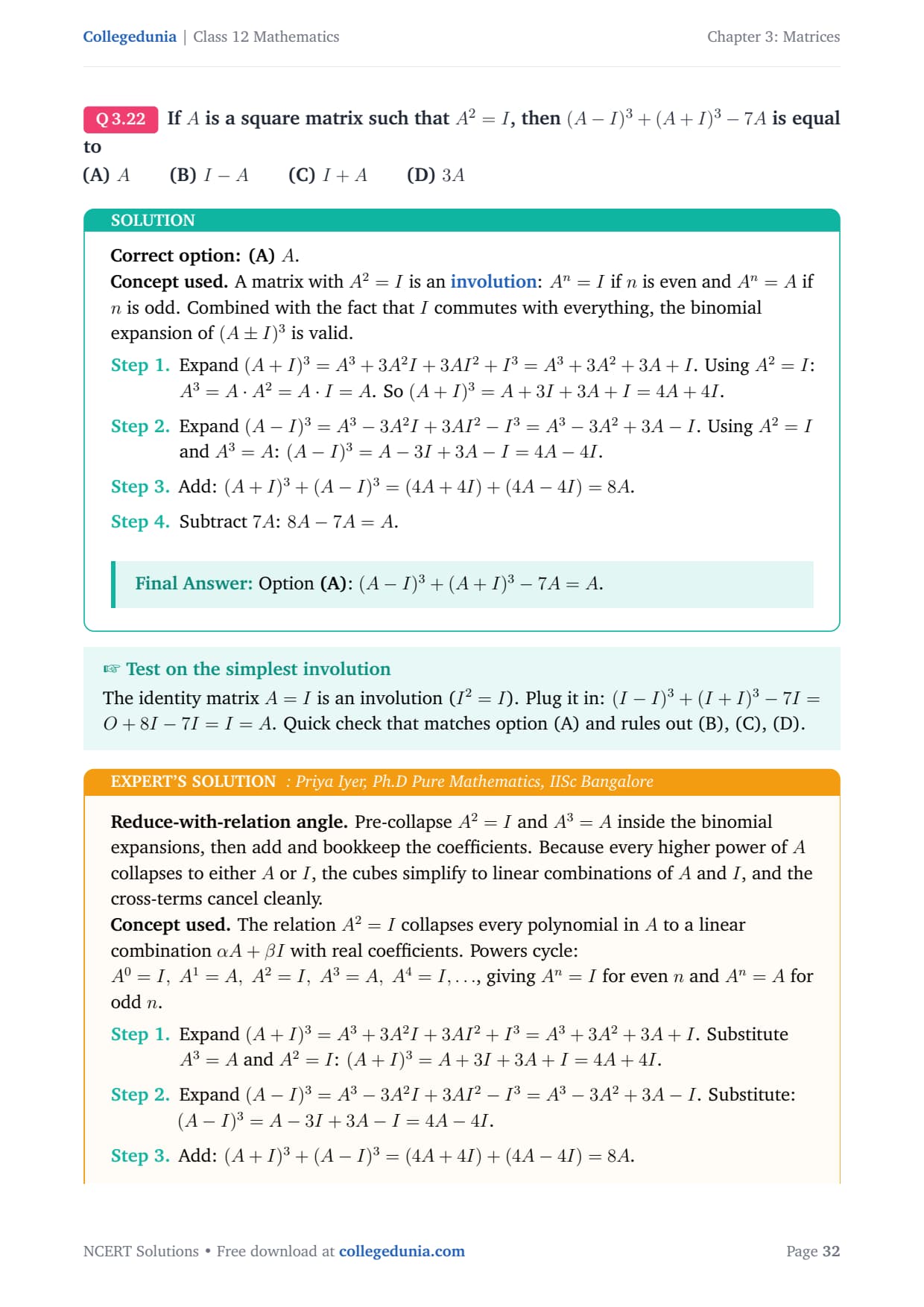
Q 3.22
If A is a square matrix such that A2=I, then (A-I)3+(A+I)3-7A is equal to
(A) A (B) I-A (C) I+A (D) 3A
Correct option: (A)A.
Concept used. A matrix with A2=I is an
involution: An=I if n is even and An=A if
n is odd. Combined with the fact that I commutes with
everything, the binomial expansion of (A± I)3 is valid.
Expand (A+I)3=A3+3A2I+3AI2+I3
= A3+3A2+3A+I.
Using A2=I: A3=A· A2=A· I=A.
So (A+I)3= A+3I+3A+I = 4A+4I.
Expand (A-I)3=A3-3A2I+3AI2-I3
= A3-3A2+3A-I.
Using A2=I and A3=A: (A-I)3 = A-3I+3A-I = 4A-4I.
Add: (A+I)3+(A-I)3 = (4A+4I)+(4A-4I) = 8A.
Subtract 7A: 8A-7A = A.
Option (A): (A-I)3+(A+I)3-7A=A.
PI
Priya Iyer
Ph.D Pure Mathematics, IISc Bangalore
Verified Expert
Reduce-with-relation angle. Pre-collapse A2=I and
A3=A inside the binomial expansions, then add and bookkeep
the coefficients. Because every higher power of A collapses to
either A or I, the cubes simplify to linear combinations of
A and I, and the cross-terms cancel cleanly.
Concept used. The relation A2=I collapses every
polynomial in A to a linear combination α A+β I with
real coefficients. Powers cycle: A0=I, A1=A, A2=I,
A3=A, A4=I,…, giving An=I for even n and
An=A for odd n.
Expand (A+I)3=A3+3A2I+3AI2+I3=A3+3A2+3A+I.
Substitute A3=A and A2=I:
(A+I)3= A+3I+3A+I = 4A+4I.
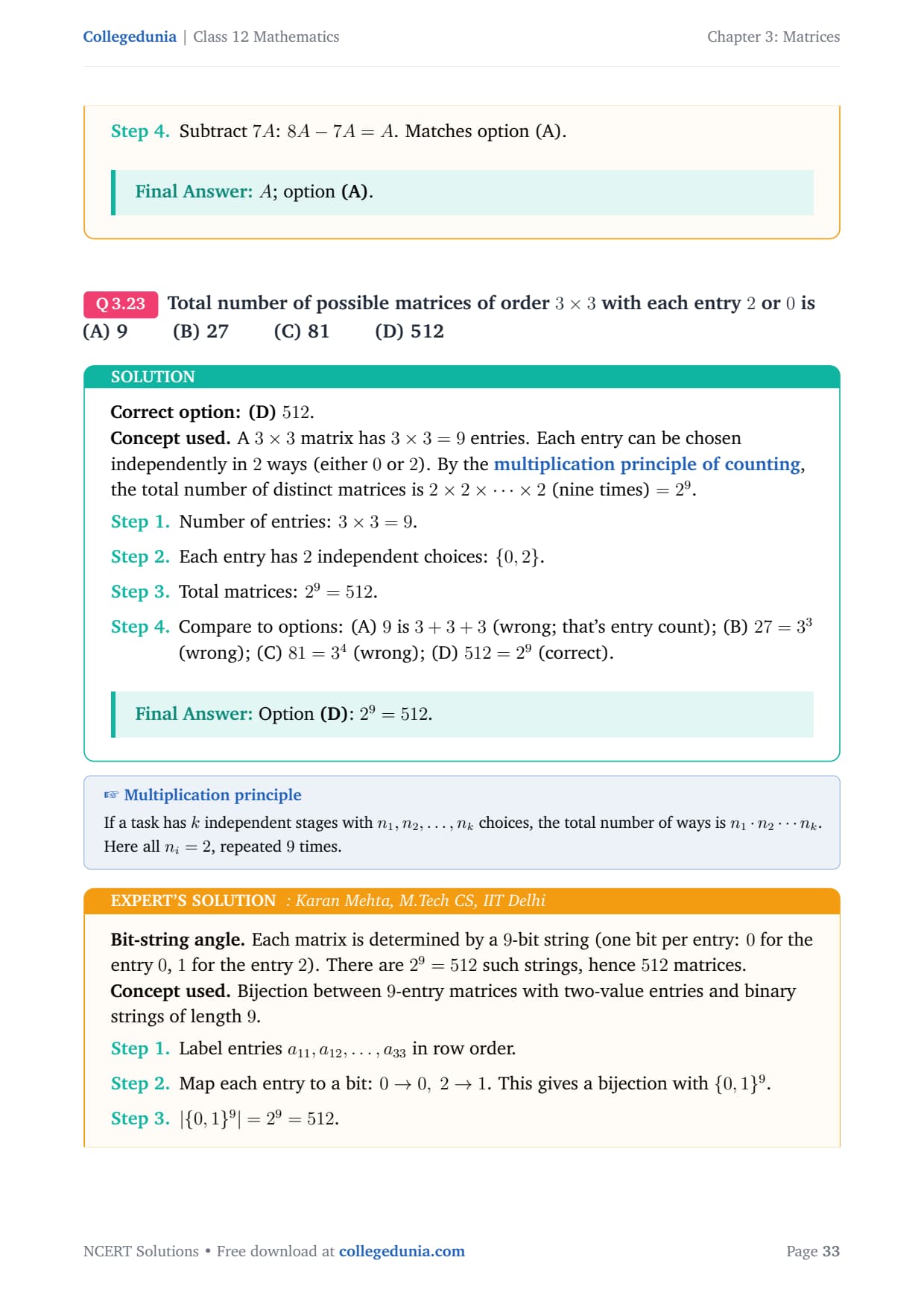
Total number of possible matrices of order 3× 3 with each entry 2 or 0 is
(A) 9 (B) 27 (C) 81 (D) 512
Correct option: (D)512.
Concept used. A 3× 3 matrix has 3× 3=9
entries. Each entry can be chosen independently in 2 ways
(either 0 or 2). By the multiplication principle of
counting, the total number of distinct matrices is
2× 2×⋯× 2 (nine times) = 29.
Number of entries: 3× 3 = 9.
Each entry has 2 independent choices: 0,2.
Total matrices: 29 = 512.
Compare to options: (A) 9 is 3+3+3 (wrong; that's
entry count); (B) 27=33 (wrong); (C) 81=34
(wrong); (D) 512=29 (correct).
Option (D): 29=512.
KM
Karan Mehta
M.Tech CS, IIT Delhi
Verified Expert
Bit-string angle. Each matrix is determined by a
9-bit string (one bit per entry: 0 for the entry 0, 1 for
the entry 2). There are 29=512 such strings, hence 512
matrices.
Concept used. Bijection between 9-entry matrices with
two-value entries and binary strings of length 9.
Label entries a11,a12,…,a33 in row order.
Map each entry to a bit: 0→ 0, 2→ 1. This gives a
bijection with 0,19.
|0,19|=29=512.
512 matrices; option (D).
IV. Fill in the Blanks
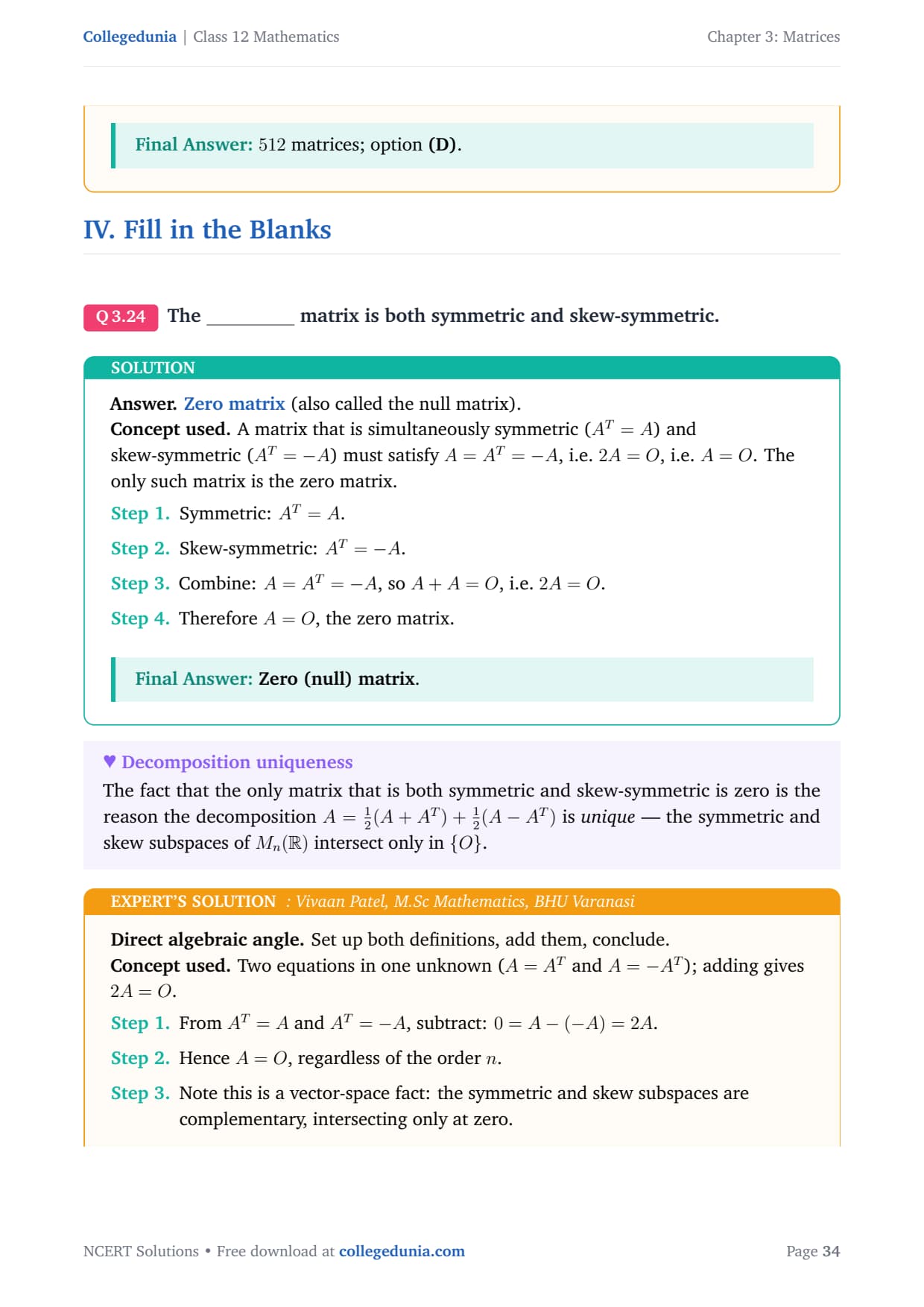
Q 3.24
The 2cm matrix is both symmetric and skew-symmetric.
Answer.Zero matrix (also called the null matrix).
Concept used. A matrix that is simultaneously symmetric
(AT=A) and skew-symmetric (AT=-A) must satisfy
A=AT=-A, i.e. 2A=O, i.e. A=O. The only such matrix is
the zero matrix.
Symmetric: AT=A.
Skew-symmetric: AT=-A.
Combine: A = AT = -A, so A + A = O, i.e. 2A = O.
Therefore A=O, the zero matrix.
Zero (null) matrix.
VP
Vivaan Patel
M.Sc Mathematics, BHU Varanasi
Verified Expert
Direct algebraic angle. Set up both definitions, add
them, conclude.
Concept used. Two equations in one unknown (A=AT and
A=-AT); adding gives 2A=O.
From AT=A and AT=-A, subtract: 0=A-(-A)=2A.
Hence A=O, regardless of the order n.
Note this is a vector-space fact: the symmetric and skew
subspaces are complementary, intersecting only at zero.
A=O (zero matrix).
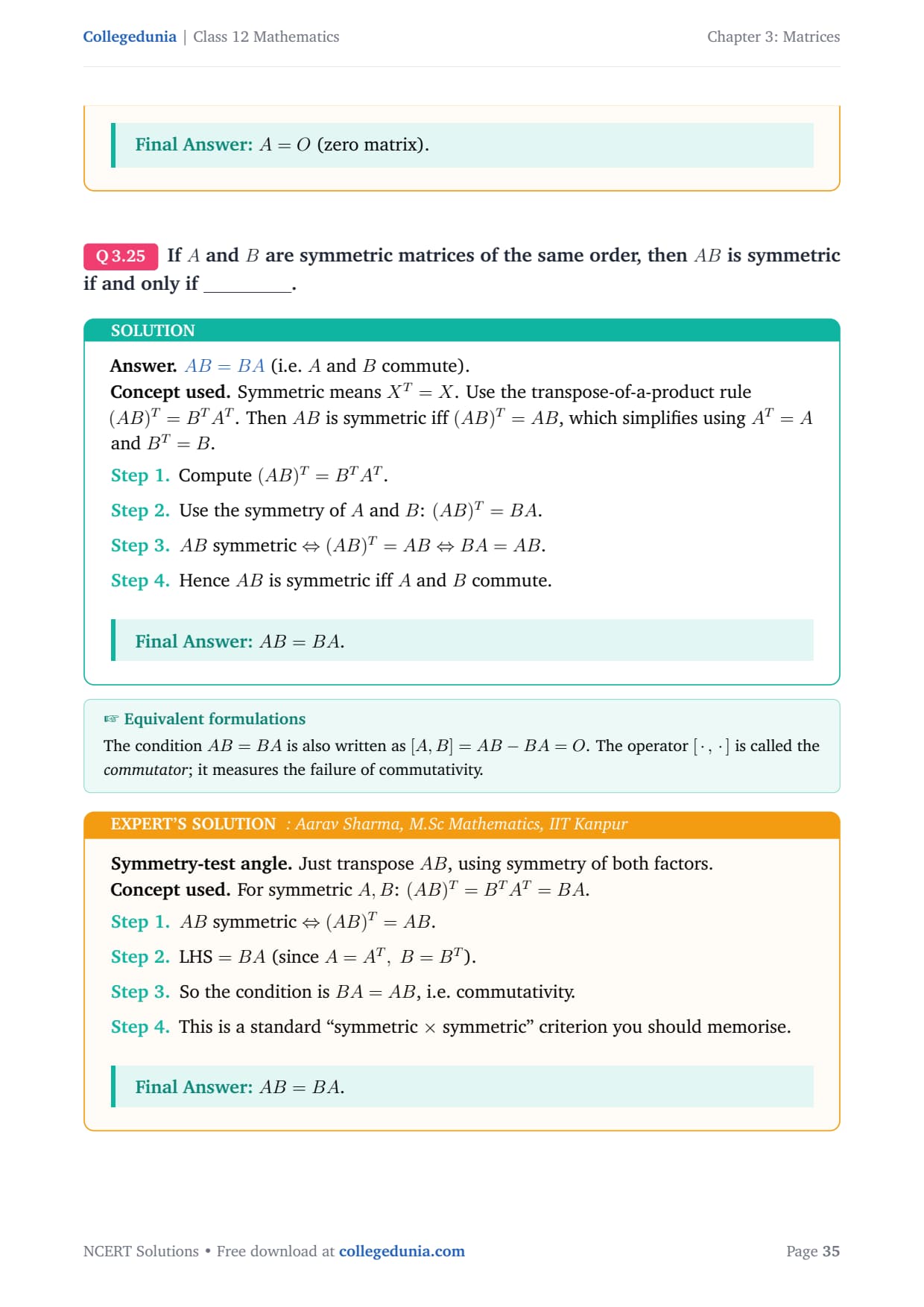
Q 3.25
If A and B are symmetric matrices of the same order, then AB is symmetric if and only if 2cm.
Answer.AB=BA (i.e. A and B commute).
Concept used. Symmetric means XT=X. Use the
transpose-of-a-product rule (AB)T=BTAT. Then AB is
symmetric iff (AB)T=AB, which simplifies using AT=A and
BT=B.
Compute (AB)T=BTAT.
Use the symmetry of A and B: (AB)T = BA.
AB symmetric ⇔(AB)T=AB
⇔ BA = AB.
Hence AB is symmetric iff A and B commute.
AB=BA.
AS
Aarav Sharma
M.Sc Mathematics, IIT Kanpur
Verified Expert
Symmetry-test angle. Just transpose AB, using
symmetry of both factors.
Concept used. For symmetric A,B: (AB)T=BTAT=BA.
AB symmetric ⇔(AB)T=AB.
LHS =BA (since A=AT, B=BT).
So the condition is BA=AB, i.e. commutativity.
This is a standard ``symmetric × symmetric''
criterion you should memorise.








Comments