Maths Strategist, Olympiad Coach | Updated 3+ months ago
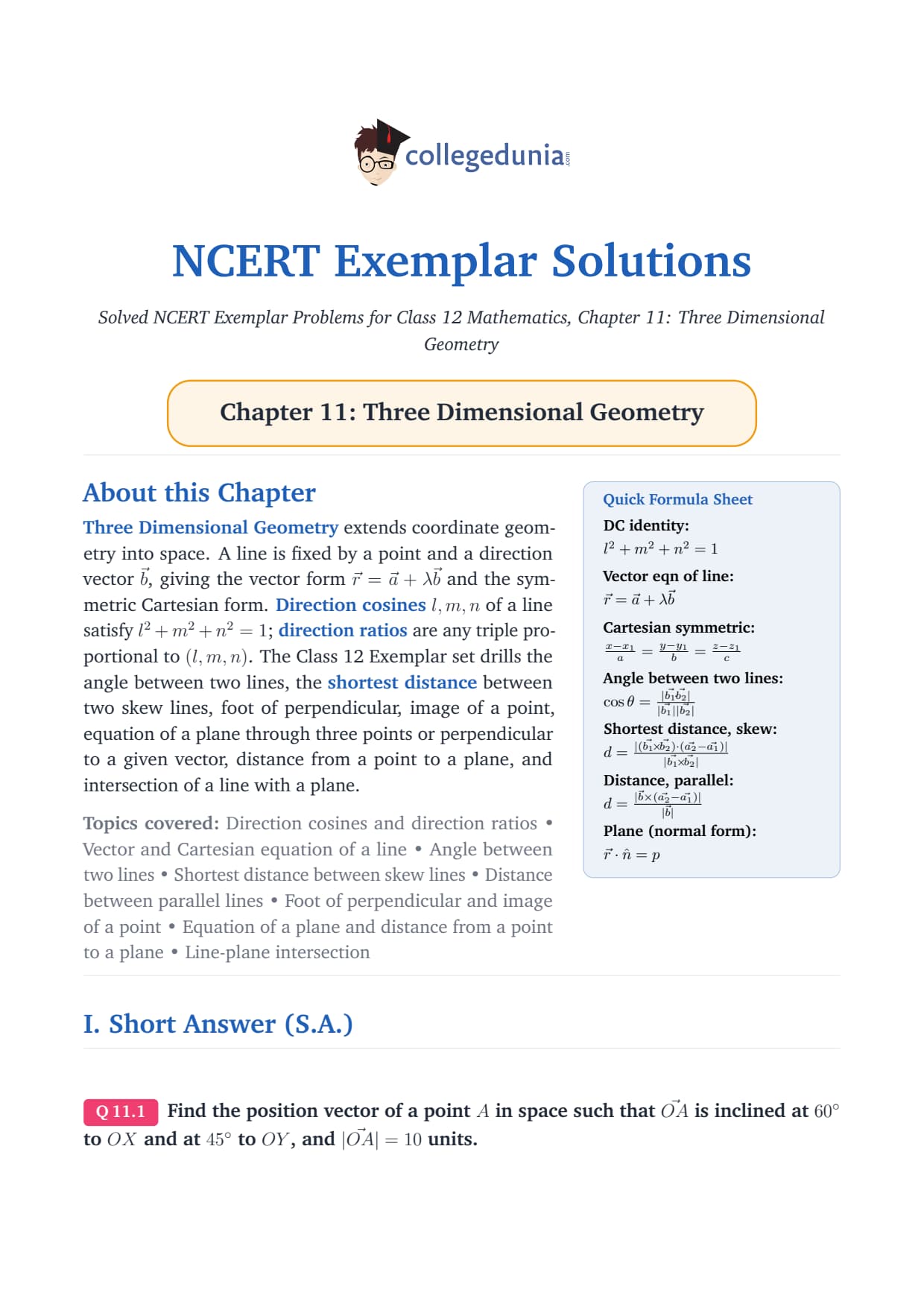
The Three Dimensional Geometry Class 12 NCERT Exemplar Solutions below provide the complete solution to the NCERT Exemplar booklet for Class 12 Mathematics Chapter 11 Three Dimensional Geometry. Each step in the Three Dimensional Geometry Class 12 NCERT Exemplar Solutions is justified, each formula labelled, and the solutions PDF retain the exact problem-numbering of the official Exemplar.
Use the resource above alongside the chapter breakdown below.
Use the resource above alongside the chapter breakdown below.
Use the resource above alongside the chapter breakdown below.
Use the resource above alongside the chapter breakdown below.
Use the resource above alongside the chapter breakdown below.
Use the resource above alongside the chapter breakdown below.
Use the resource above alongside the chapter breakdown below.
Use the resource above alongside the chapter breakdown below.
Use the resource above alongside the chapter breakdown below.
Use the resource above alongside the chapter breakdown below.
Use the resource above alongside the chapter breakdown below.
Use the resource above alongside the chapter breakdown below.
Use the resource above alongside the chapter breakdown below.
Use the resource above alongside the chapter breakdown below.
Use the resource above alongside the chapter breakdown below.
Use the resource above alongside the chapter breakdown below.
Use the resource above alongside the chapter breakdown below.
Use the resource above alongside the chapter breakdown below.
Use the resource above alongside the chapter breakdown below.
Use the resource above alongside the chapter breakdown below.
Use the resource above alongside the chapter breakdown below.
Use the resource above alongside the chapter breakdown below.
Use the resource above alongside the chapter breakdown below.
Use the resource above alongside the chapter breakdown below.
Use the resource above alongside the chapter breakdown below.
Use the resource above alongside the chapter breakdown below.
Use the resource above alongside the chapter breakdown below.
Use the resource above alongside the chapter breakdown below.
Use the resource above alongside the chapter breakdown below.
Use the resource above alongside the chapter breakdown below.
Use the resource above alongside the chapter breakdown below.
Use the resource above alongside the chapter breakdown below.
Use the resource above alongside the chapter breakdown below.
Use the resource above alongside the chapter breakdown below.
Use the resource above alongside the chapter breakdown below.
Use the resource above alongside the chapter breakdown below.
Use the resource above alongside the chapter breakdown below.
Use the resource above alongside the chapter breakdown below.
Use the resource above alongside the chapter breakdown below.
Use the resource above alongside the chapter breakdown below.
Use the resource above alongside the chapter breakdown below.
Use the resource above alongside the chapter breakdown below.
Use the resource above alongside the chapter breakdown below.
Use the resource above alongside the chapter breakdown below.
Use the resource above alongside the chapter breakdown below.
Use the resource above alongside the chapter breakdown below.
Use the resource above alongside the chapter breakdown below.
Use the resource above alongside the chapter breakdown below.
Use the resource above alongside the chapter breakdown below.
Use the resource above alongside the chapter breakdown below.
Exemplar block
Count
Short Answer (SA)
15
Long Answer (LA)
13
Multiple Choice (MCQ)
8
Fill in the Blanks
5
True or False
8
Total problems solved
49
CBSE Weightage:5 to 7 marks in Unit IV (Vectors and 3D Geometry), with one SA on direction cosines or angle between lines plus one LA on shortest distance or plane equation.
JEE Main Weightage: 4 to 6% of every shift, drawing two to three questions across line equation, plane equation, and skew-line distance archetypes.
Exemplar Coverage: All 49 problems of Exercise 11.3, with vector and Cartesian forms cross-mapped on every line and plane question.
Compiled by Collegedunia subject experts against the 2026-27 NCERT print and benchmarked on the last five CBSE Class 12 and JEE Main cycles.
Why NCERT Exemplar Class 12 Maths Solutions Chapter 11 Three Dimensional Geometry Carries Outsize Exam Value
The Three Dimensional Geometry Class 12 NCERT Exemplar Solutions address this in the same order as the NCERT textbook.
Three Dimensional Geometry is the second-highest weight vectors chapter on JEE Main Maths, behind only Vector Algebra. The Exemplar carries the entire JEE concept set:
direction cosines under the identity l2+m2+n2=1 , vector and Cartesian line forms, line-line angle, the scalar-triple-product shortest-distance formula for skew lines, foot of perpendicular and image of a point in a plane, plane equations in normal, intercept and point-normal forms, and line-plane intersection.
On the CBSE side, the Three Dimensional Geometry Class 12 NCERT Exemplar Solutions rewards five formulae applied mechanically.The 5-mark LA on shortest distance between two skew lines has appeared in three of the last five CBSE Class 12 Maths papers, and Exemplar Q21 mirrors that pattern line for line. Students who solve Q21 cleanly typically clear the full 5-mark stretch on the board.
Three Dimensional Geometry NCERT Exemplar Video Solutions
How Collegedunia NCERT Exemplar Solutions for Class 12 Maths Chapter 11 Help You
the Three Dimensional Geometry Class 12 NCERT Exemplar Solutions threads three execution strategies through every problem so the same solution serves a CBSE student and a JEE aspirant differently.
Explicit Concept-Used line: every solution opens with one boxed sentence naming the formula being applied (DC identity, shortest distance, plane normal form, line-plane angle). This is the recognition step examiners credit.
Formula then substitution then arithmetic: every numerical step is split across three lines. The symbolic formula comes first, the substituted form second, the simplified value third. CBSE 2025 marking schemes award step marks on this exact split.
Expert Solution with an alternate method: each amber box gives either the cross-product distance route, a coplanarity check, or a numerical verification. These are the three highest-value JEE Main shortcuts for the Three Dimensional Geometry Class 12 NCERT Exemplar Solutions.
Three Dimensional Geometry Exemplar Question Archetypes
The Three Dimensional Geometry Class 12 NCERT Exemplar Solutions address this in the same order as the NCERT textbook.
The 49 Exemplar problems compress into five recurring archetypes. The table maps each archetype to its representative Exemplar question and the board or JEE pattern it serves.
Archetype
Exemplar Q No.
Board / JEE pattern
Direction cosines and the identity l2+m2+n2=1
Q1, Q30, Q38
1-mark MCQ, 2-mark VSA
Equation of a line in vector and Cartesian form
Q2, Q19, Q39, Q40, Q47
2-mark VSA
Angle between two lines
Q4, Q12
3-mark SA
Shortest distance between skew lines
Q21, Q26
5-mark LA (CBSE 2025 anchor)
Plane equation and line-plane intersection
Q7, Q10, Q18, Q20, Q22, Q49
5-mark LA plus JEE Main
Class 12 Maths Chapter 11 PYQ Resonance with the Exemplar
The Exemplar Q-list maps cleanly to recent CBSE 12 and JEE Main patterns. Use the table to prioritise problems in your last-week revision.
Year
Marks
Concept tested
Matching Exemplar Q
CBSE 2025
5
Shortest distance, vector form
Q21
CBSE 2024
5
Two-point line plus shortest distance
Q21 + Q39
CBSE 2023
3
Direction cosines through two points
Q1, Q38
CBSE 2022
2
Angle between two lines, Cartesian
Q4, Q12
CBSE 2021
5
Shortest distance, determinant form
Q21
JEE Main 2025
4
Plane perpendicular to line and point distance
Q9, Q18
JEE Main 2024
4
Line-plane intersection and coplanarity
Q5, Q26
Full PYQ map:Class 12 Maths Chapter 11 NCERT Solutions carries the in-textbook PYQ trail. The Exemplar PYQ trail above is unique to the Three Dimensional Geometry Class 12 NCERT Exemplar Solutions.
Other Resources for Class 12 Maths Chapter 11 Three Dimensional Geometry
All NCERT Exemplar Questions for Three Dimensional Geometry with Step-by-Step Solutions
Every question of the NCERT Exemplar set for Class 12 Mathematics Chapter 11 Three Dimensional Geometry is listed below with its full Solution and Expert Solution hidden inside collapsible tabs. Click Check Solution to reveal the step-by-step working; click Expert Solution for the expanded explanation.
I. Short Answer (S.A.)
Q 11.1
Find the position vector of a point A in space such that OA⃗ is inclined at 60∘ to OX and at 45∘ to OY, and |OA⃗|=10 units.
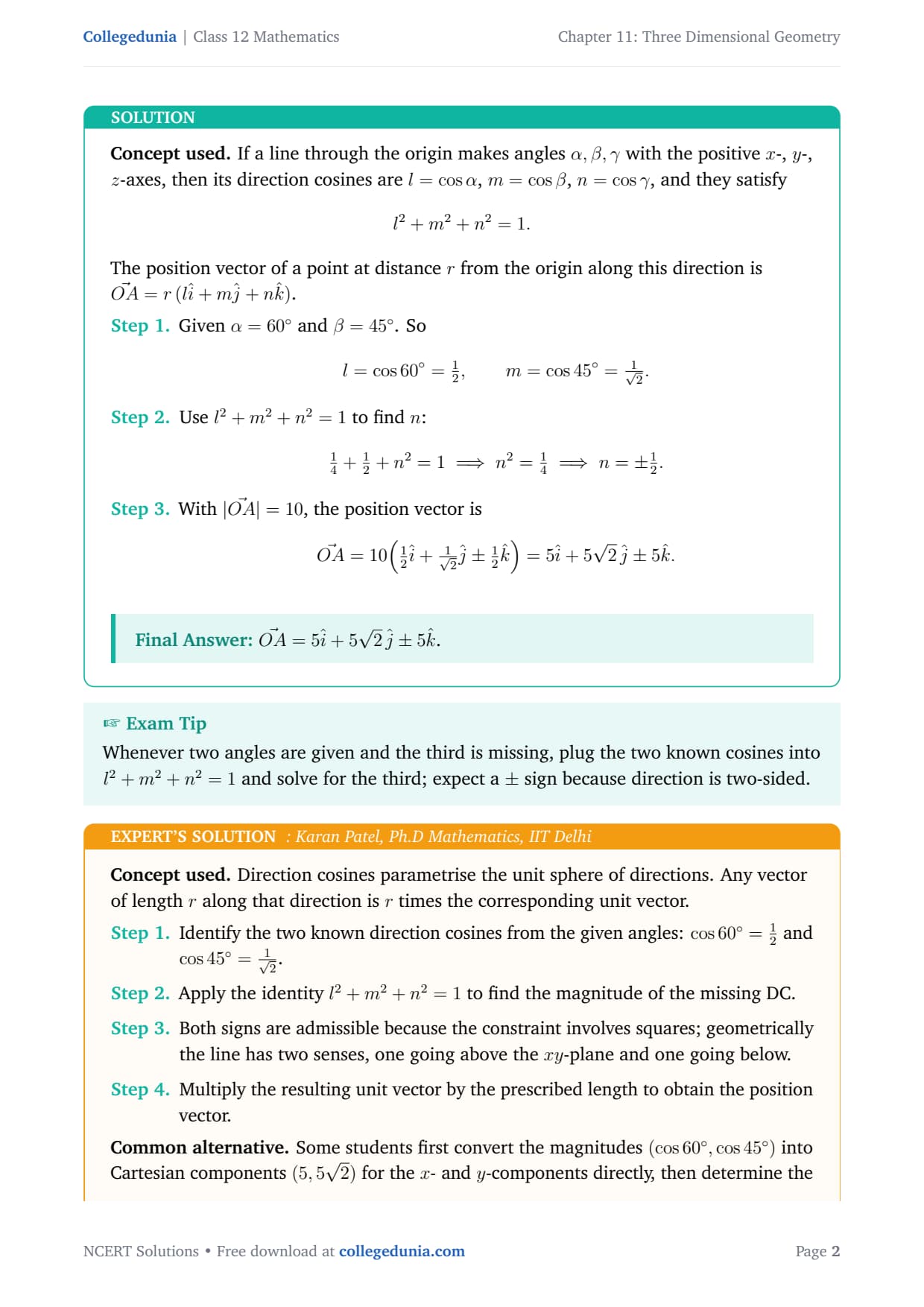
Concept used. If a line through the origin makes angles α,β,γ with the positive x-, y-, z-axes, then its direction cosines are l=cosα, m=cosβ, n=cosγ, and they satisfy
l2+m2+n2=1.
The position vector of a point at distance r from the origin along this direction is OA⃗=r (lî+mĵ+nk̂).
Given α=60∘ and β=45∘. So
l=cos 60∘=12, m=cos 45∘=1√2.
Use l2+m2+n2=1 to find n:
14+12+n2=1 n2=14n=±12.
With |OA⃗|=10, the position vector is
OA⃗=10(12î+1√2ĵ±12k̂)=5î+5√2ĵ± 5k̂.
OA⃗=5î+5√2ĵ± 5k̂.
KP
Karan Patel
Ph.D Mathematics, IIT Delhi
Verified Expert
Concept used. Direction cosines parametrise the unit sphere of directions. Any vector of length r along that direction is r times the corresponding unit vector.
Identify the two known direction cosines from the given angles: cos 60∘=12 and cos 45∘=1√2.
Apply the identity l2+m2+n2=1 to find the magnitude of the missing DC.
Both signs are admissible because the constraint involves squares; geometrically the line has two senses, one going above the xy-plane and one going below.
Multiply the resulting unit vector by the prescribed length to obtain the position vector.
Common alternative. Some students first convert the magnitudes (cos 60∘,cos 45∘) into Cartesian components (5, 5√2) for the x- and y-components directly, then determine the z-component from √|OA⃗|2-x2-y2=√100-25-50=5. This avoids using l,m,n explicitly and is acceptable in CBSE marking schemes.
Why the ±. The angles with two axes do not pin down a single direction in 3D; the third coordinate can be positive or negative. Always present both.
OA⃗=5î+5√2ĵ± 5k̂.
Q 11.2
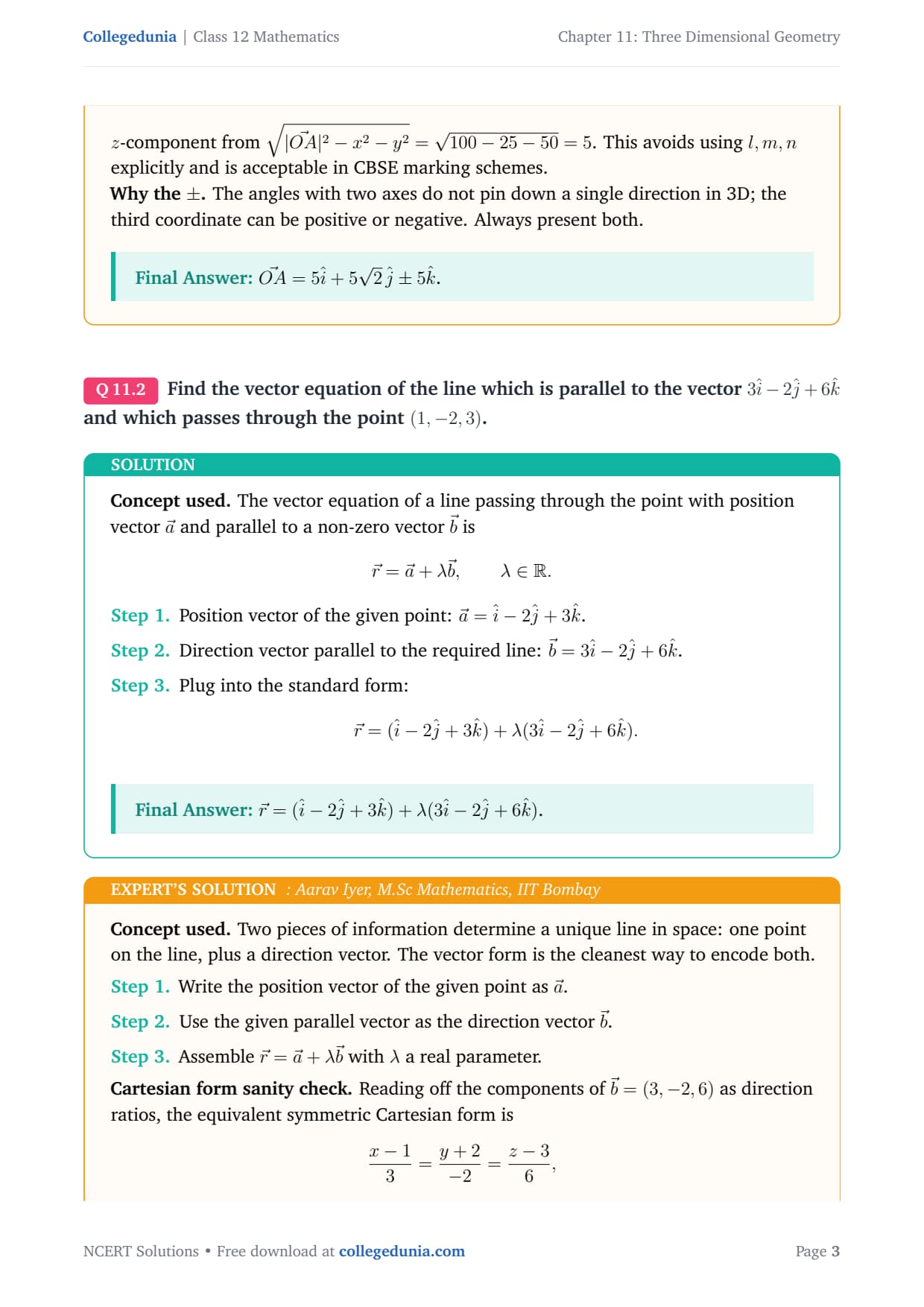
Find the vector equation of the line which is parallel to the vector 3î-2ĵ+6k̂ and which passes through the point (1,-2,3).
Concept used. The vector equation of a line passing through the point with position vector a⃗ and parallel to a non-zero vector b⃗ is
r⃗=a⃗+λb⃗, λ∈R.
Position vector of the given point: a⃗=î-2ĵ+3k̂.
Direction vector parallel to the required line: b⃗=3î-2ĵ+6k̂.
Plug into the standard form:
r⃗=(î-2ĵ+3k̂)+λ(3î-2ĵ+6k̂).
r⃗=(î-2ĵ+3k̂)+λ(3î-2ĵ+6k̂).
AI
Aarav Iyer
M.Sc Mathematics, IIT Bombay
Verified Expert
Concept used. Two pieces of information determine a unique line in space: one point on the line, plus a direction vector. The vector form is the cleanest way to encode both.
Write the position vector of the given point as a⃗.
Use the given parallel vector as the direction vector b⃗.
Assemble r⃗=a⃗+λb⃗ with λ a real parameter.
Cartesian form sanity check. Reading off the components of b⃗=(3,-2,6) as direction ratios, the equivalent symmetric Cartesian form is
x-13=y+2-2=z-36,
which is what CBSE often asks for in the same question.
Marking-scheme angle. Examiners look for (i) the standard-form identification of a⃗ and b⃗, (ii) the assembled vector equation, and (iii) a clean line of working with λ as the scalar parameter. Two marks for this question is typical.
r⃗=(î-2ĵ+3k̂)+λ(3î-2ĵ+6k̂).
Q 11.3
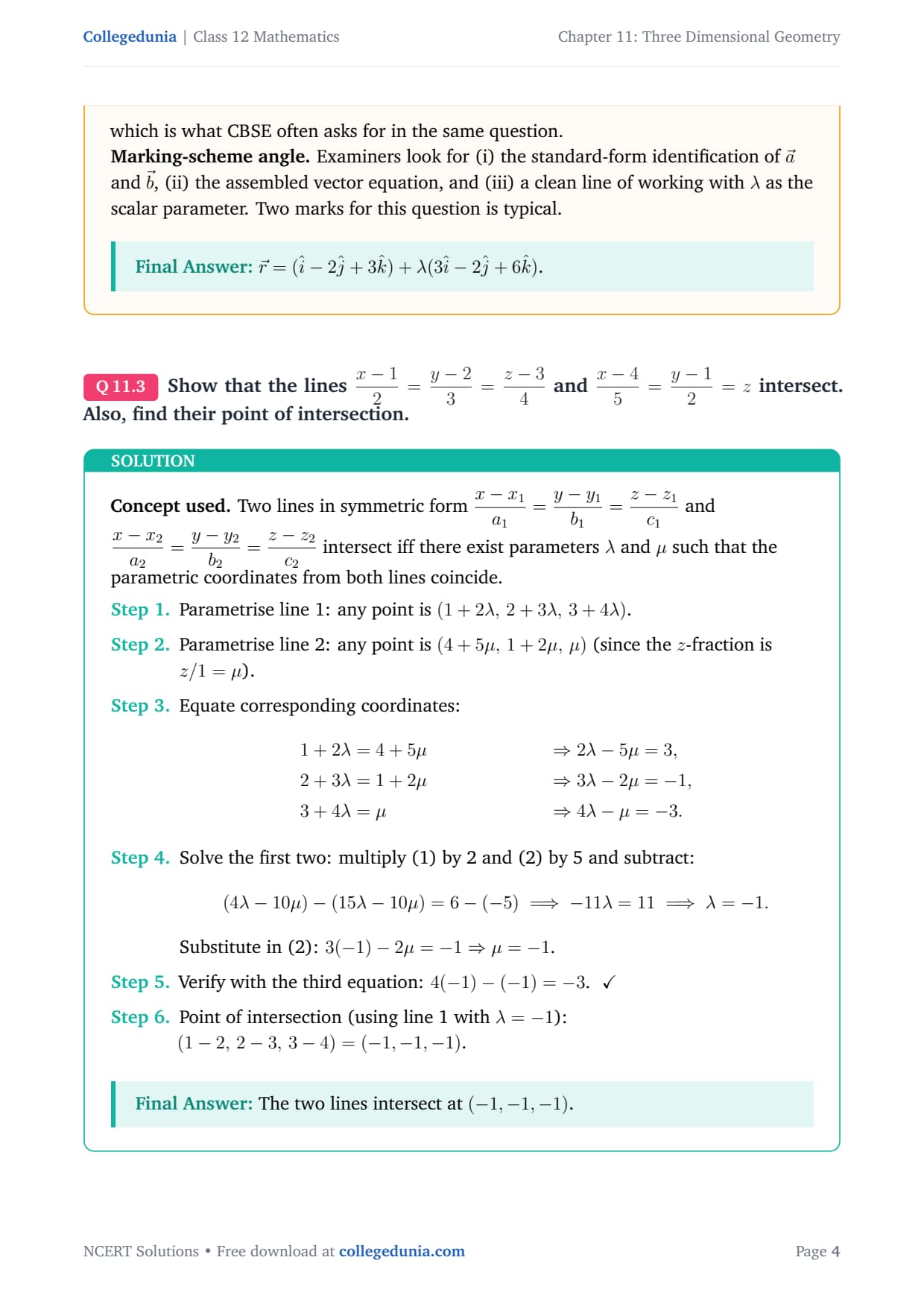
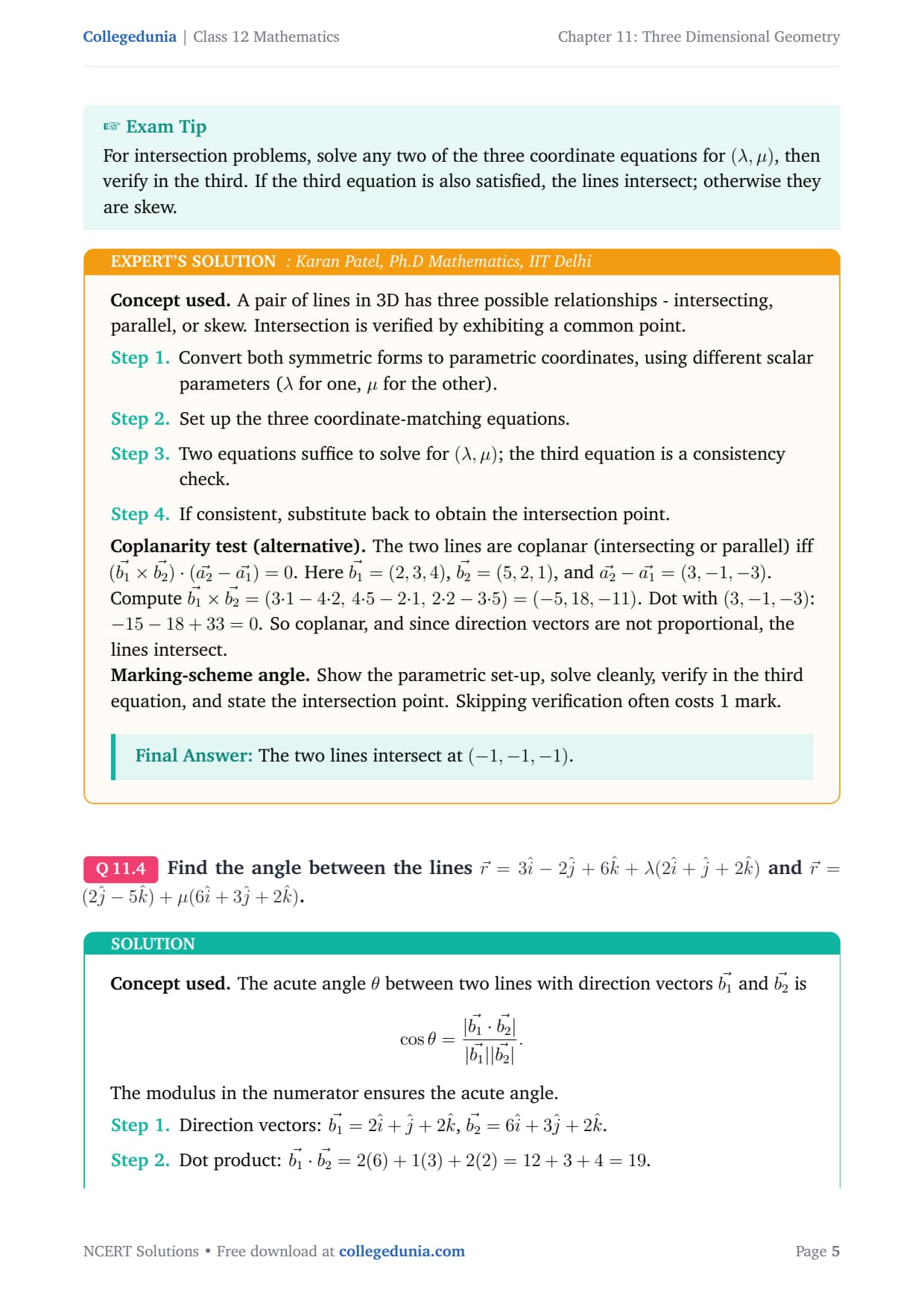
Show that the lines x-12=y-23=z-34 and x-45=y-12=z intersect. Also, find their point of intersection.
Concept used. Two lines in symmetric form x-x1a1=y-y1b1=z-z1c1 and x-x2a2=y-y2b2=z-z2c2 intersect iff there exist parameters λ and μ such that the parametric coordinates from both lines coincide.
Parametrise line 1: any point is (1+2λ, 2+3λ, 3+4λ).
Parametrise line 2: any point is (4+5μ, 1+2μ, μ) (since the z-fraction is z/1=μ).
Solve the first two: multiply (1) by 2 and (2) by 5 and subtract:
(4λ-10μ)-(15λ-10μ)=6-(-5) -11λ=11 λ=-1.
Substitute in (2): 3(-1)-2μ=-1⇒ μ=-1.
Verify with the third equation: 4(-1)-(-1)=-3.
Point of intersection (using line 1 with λ=-1): (1-2, 2-3, 3-4)=(-1,-1,-1).
The two lines intersect at (-1,-1,-1).
KP
Karan Patel
Ph.D Mathematics, IIT Delhi
Verified Expert
Concept used. A pair of lines in 3D has three possible relationships - intersecting, parallel, or skew. Intersection is verified by exhibiting a common point.
Convert both symmetric forms to parametric coordinates, using different scalar parameters (λ for one, μ for the other).
Set up the three coordinate-matching equations.
Two equations suffice to solve for (λ,μ); the third equation is a consistency check.
If consistent, substitute back to obtain the intersection point.
Coplanarity test (alternative). The two lines are coplanar (intersecting or parallel) iff (b1⃗×b2⃗)·(a2⃗-a1⃗)=0. Here b1⃗=(2,3,4), b2⃗=(5,2,1), and a2⃗-a1⃗=(3,-1,-3). Compute b1⃗×b2⃗=(3·1-4·2, 4·5-2·1, 2·2-3·5)=(-5,18,-11). Dot with (3,-1,-3): -15-18+33=0. So coplanar, and since direction vectors are not proportional, the lines intersect.
Marking-scheme angle. Show the parametric set-up, solve cleanly, verify in the third equation, and state the intersection point. Skipping verification often costs 1 mark.
The two lines intersect at (-1,-1,-1).
Q 11.4
Find the angle between the lines r⃗=3î-2ĵ+6k̂+λ(2î+ĵ+2k̂) and r⃗=(2ĵ-5k̂)+μ(6î+3ĵ+2k̂).
Concept used. The acute angle θ between two lines with direction vectors b1⃗ and b2⃗ is
cosθ=|b1⃗·b2⃗||b1⃗||b2⃗|.
The modulus in the numerator ensures the acute angle.
Direction vectors: b1⃗=2î+ĵ+2k̂, b2⃗=6î+3ĵ+2k̂.
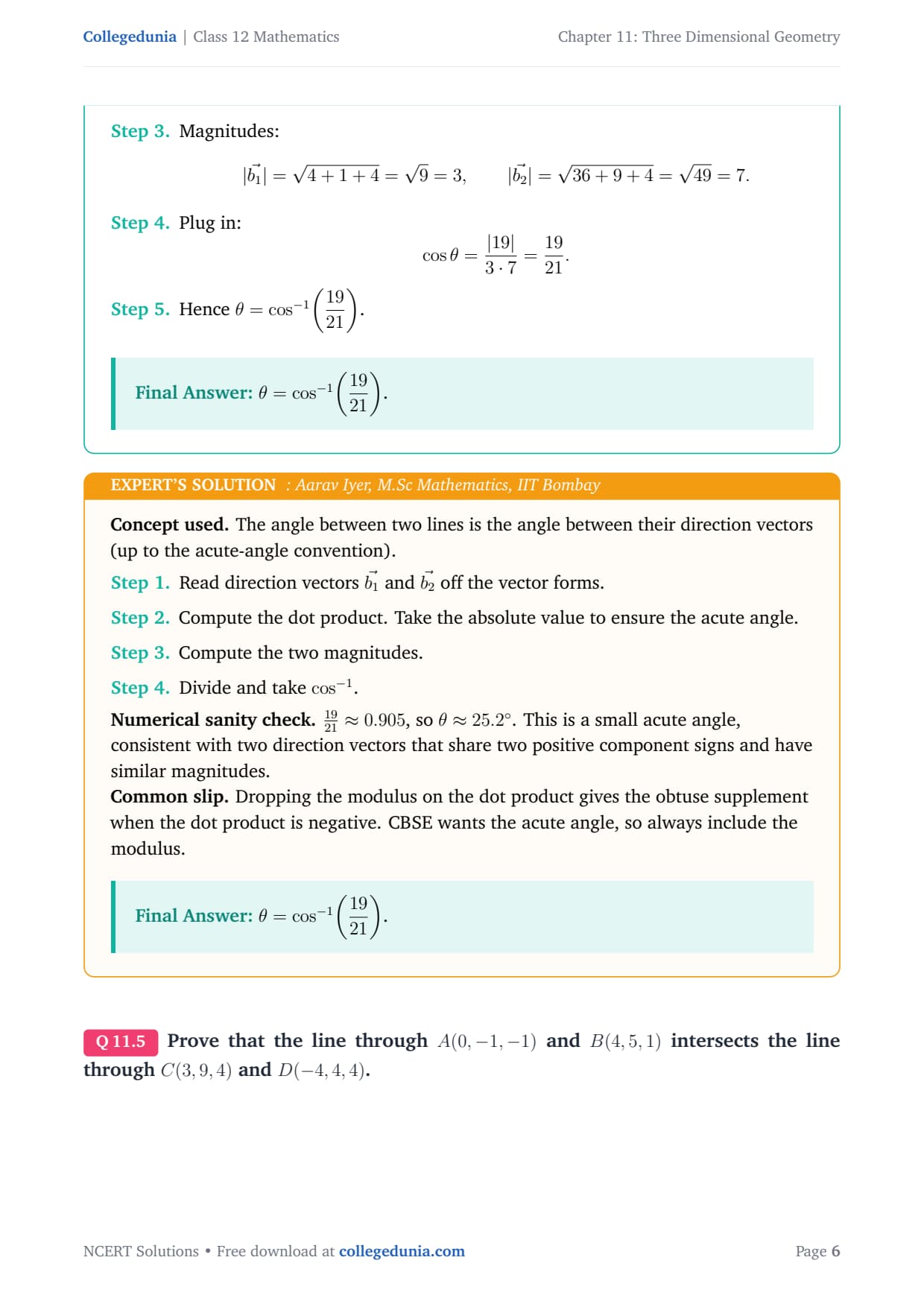
Concept used. The angle between two lines is the angle between their direction vectors (up to the acute-angle convention).
Read direction vectors b1⃗ and b2⃗ off the vector forms.
Compute the dot product. Take the absolute value to ensure the acute angle.
Compute the two magnitudes.
Divide and take cos-1.
Numerical sanity check.1921≈ 0.905, so θ≈ 25.2∘. This is a small acute angle, consistent with two direction vectors that share two positive component signs and have similar magnitudes.
Common slip. Dropping the modulus on the dot product gives the obtuse supplement when the dot product is negative. CBSE wants the acute angle, so always include the modulus.
θ=cos-1(1921).
Q 11.5
Prove that the line through A(0,-1,-1) and B(4,5,1) intersects the line through C(3,9,4) and D(-4,4,4).
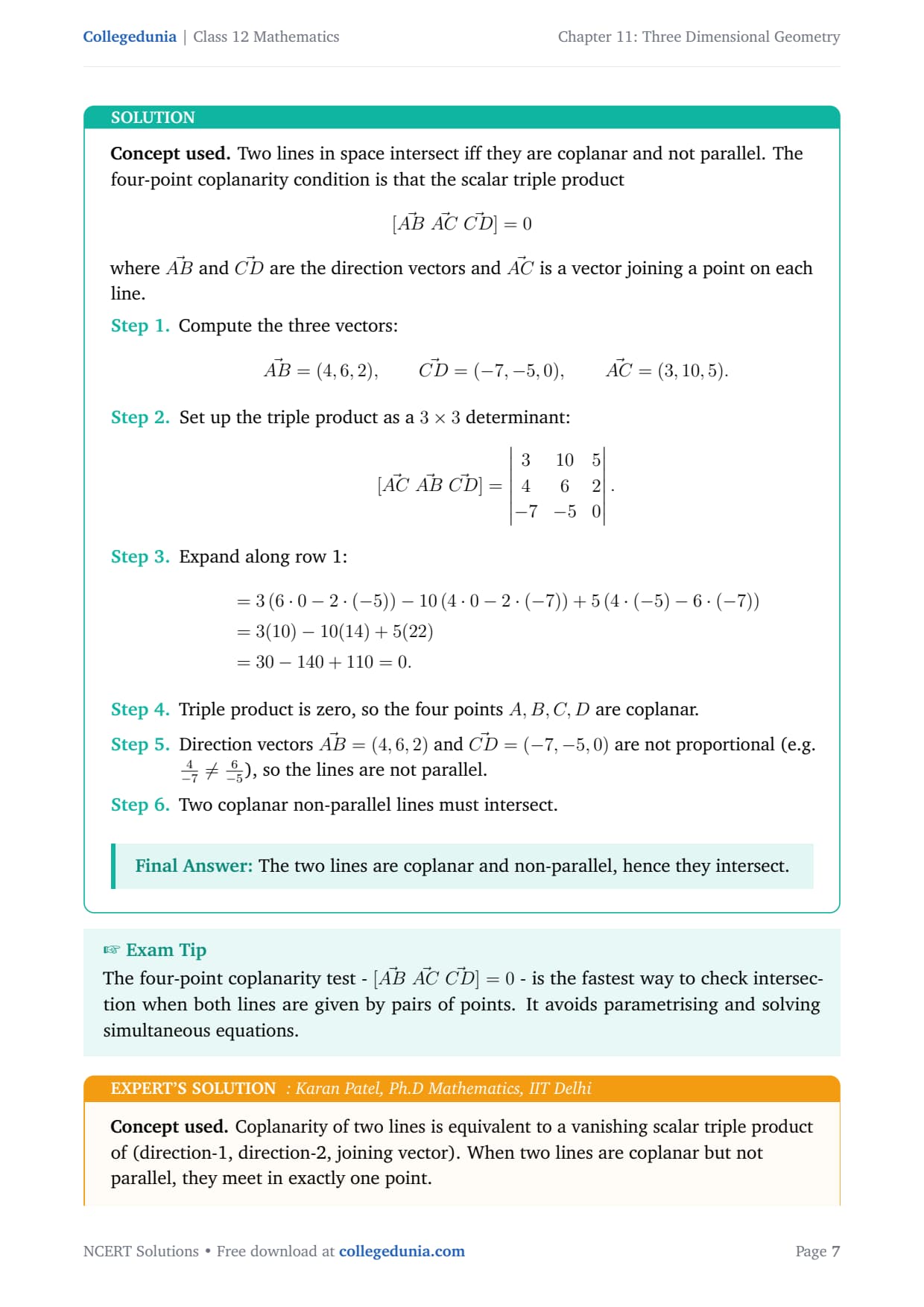
Concept used. Two lines in space intersect iff they are coplanar and not parallel. The four-point coplanarity condition is that the scalar triple product
[AB⃗AC⃗CD⃗] = 0
where AB⃗ and CD⃗ are the direction vectors and AC⃗ is a vector joining a point on each line.
Compute the three vectors:
AB⃗=(4,6,2), CD⃗=(-7,-5,0), AC⃗=(3,10,5).
Set up the triple product as a 3× 3 determinant:
[AC⃗AB⃗CD⃗]=vmatrix 3 & 10 & 5 4 & 6 & 2 -7 & -5 & 0 vmatrix.
Triple product is zero, so the four points A,B,C,D are coplanar.
Direction vectors AB⃗=(4,6,2) and CD⃗=(-7,-5,0) are not proportional (e.g. 4-7≠6-5), so the lines are not parallel.
Two coplanar non-parallel lines must intersect.
The two lines are coplanar and non-parallel, hence they intersect.
KP
Karan Patel
Ph.D Mathematics, IIT Delhi
Verified Expert
Concept used. Coplanarity of two lines is equivalent to a vanishing scalar triple product of (direction-1, direction-2, joining vector). When two lines are coplanar but not parallel, they meet in exactly one point.
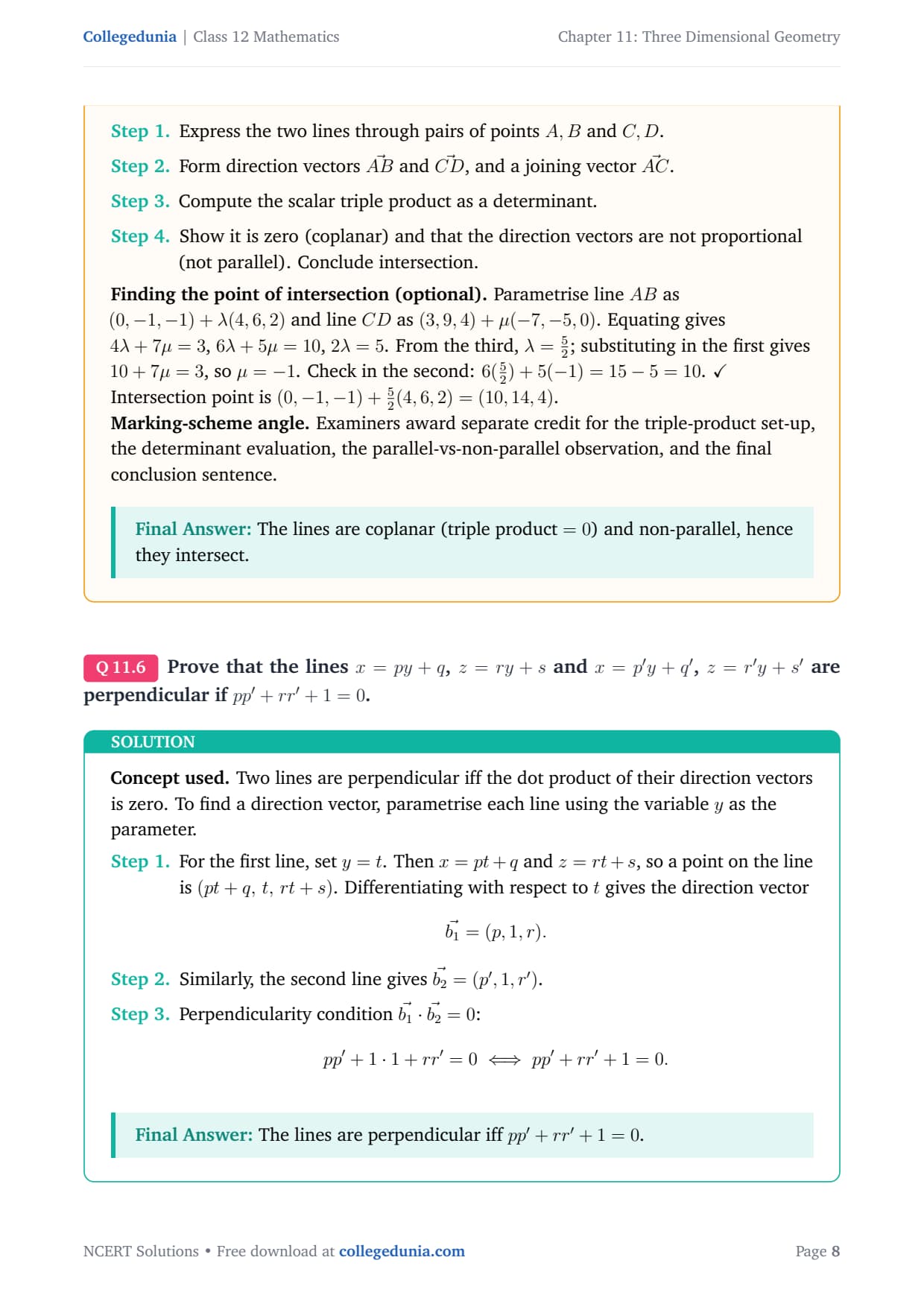
Express the two lines through pairs of points A,B and C,D.
Form direction vectors AB⃗ and CD⃗, and a joining vector AC⃗.
Compute the scalar triple product as a determinant.
Show it is zero (coplanar) and that the direction vectors are not proportional (not parallel). Conclude intersection.
Finding the point of intersection (optional). Parametrise line AB as (0,-1,-1)+λ(4,6,2) and line CD as (3,9,4)+μ(-7,-5,0). Equating gives 4λ+7μ=3, 6λ+5μ=10, 2λ=5. From the third, λ=52; substituting in the first gives 10+7μ=3, so μ=-1. Check in the second: 6(52)+5(-1)=15-5=10. Intersection point is (0,-1,-1)+52(4,6,2)=(10,14,4).
Marking-scheme angle. Examiners award separate credit for the triple-product set-up, the determinant evaluation, the parallel-vs-non-parallel observation, and the final conclusion sentence.
The lines are coplanar (triple product =0) and non-parallel, hence they intersect.
Q 11.6
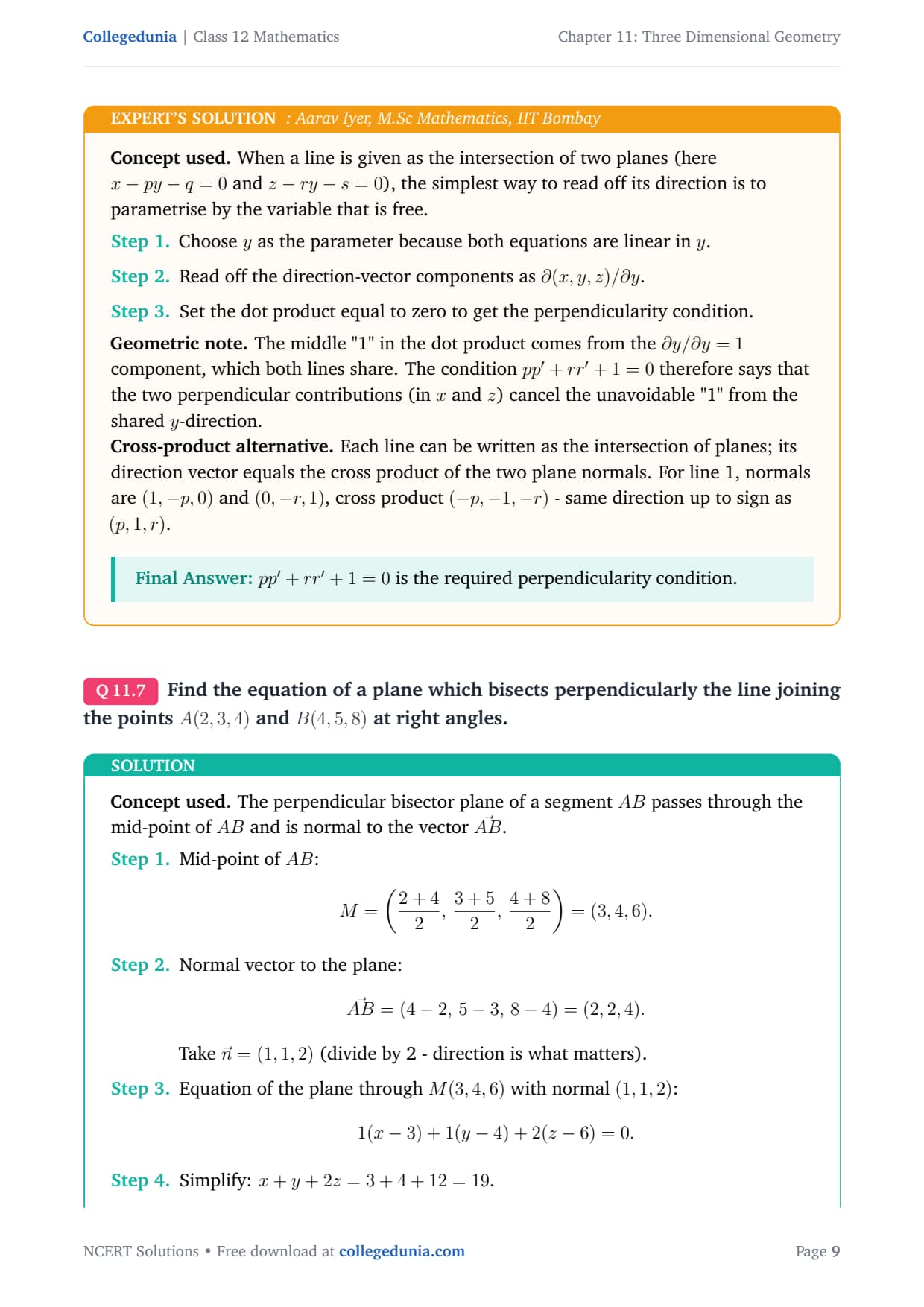
Prove that the lines x=py+q, z=ry+s and x=p'y+q', z=r'y+s' are perpendicular if pp'+rr'+1=0.
Concept used. Two lines are perpendicular iff the dot product of their direction vectors is zero. To find a direction vector, parametrise each line using the variable y as the parameter.
For the first line, set y=t. Then x=pt+q and z=rt+s, so a point on the line is (pt+q, t, rt+s). Differentiating with respect to t gives the direction vector
b1⃗=(p,1,r).
Concept used. When a line is given as the intersection of two planes (here x-py-q=0 and z-ry-s=0), the simplest way to read off its direction is to parametrise by the variable that is free.
Choose y as the parameter because both equations are linear in y.
Read off the direction-vector components as ∂(x,y,z)/∂ y.
Set the dot product equal to zero to get the perpendicularity condition.
Geometric note. The middle "1" in the dot product comes from the ∂ y/∂ y = 1 component, which both lines share. The condition pp'+rr'+1=0 therefore says that the two perpendicular contributions (in x and z) cancel the unavoidable "1" from the shared y-direction.
Cross-product alternative. Each line can be written as the intersection of planes; its direction vector equals the cross product of the two plane normals. For line 1, normals are (1,-p,0) and (0,-r,1), cross product (-p,-1,-r) - same direction up to sign as (p,1,r).
pp'+rr'+1=0 is the required perpendicularity condition.
Q 11.7
Find the equation of a plane which bisects perpendicularly the line joining the points A(2,3,4) and B(4,5,8) at right angles.
Concept used. The perpendicular bisector plane of a segment AB passes through the mid-point of AB and is normal to the vector AB⃗.
Mid-point of AB:
M=(2+42, 3+52, 4+82)=(3,4,6).
Normal vector to the plane:
AB⃗=(4-2, 5-3, 8-4)=(2,2,4).
Take n⃗=(1,1,2) (divide by 2 - direction is what matters).
Equation of the plane through M(3,4,6) with normal (1,1,2):
1(x-3)+1(y-4)+2(z-6)=0.
Simplify: x+y+2z=3+4+12=19.
x+y+2z=19.
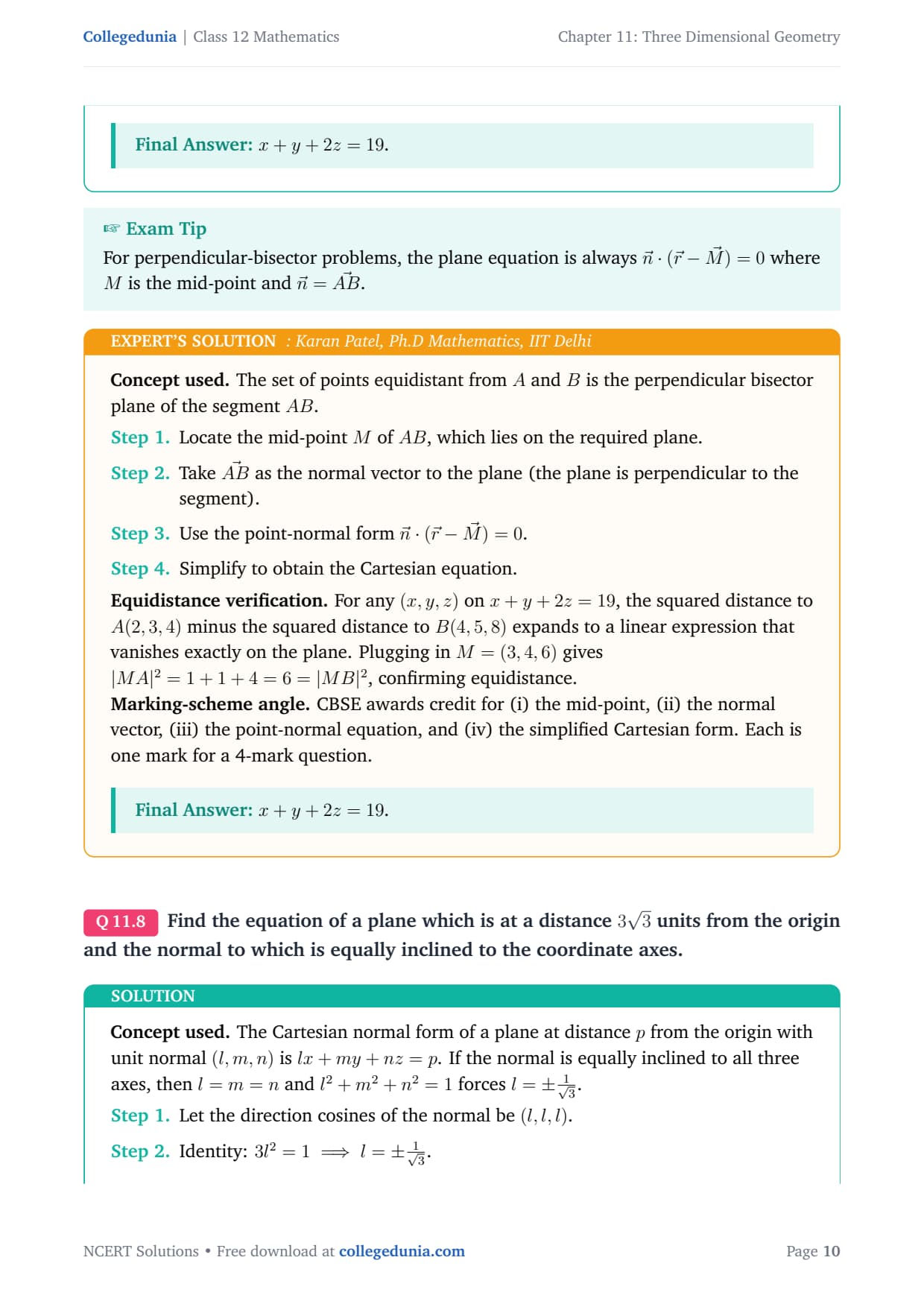
KP
Karan Patel
Ph.D Mathematics, IIT Delhi
Verified Expert
Concept used. The set of points equidistant from A and B is the perpendicular bisector plane of the segment AB.
Locate the mid-point M of AB, which lies on the required plane.
Take AB⃗ as the normal vector to the plane (the plane is perpendicular to the segment).
Use the point-normal form n⃗·(r⃗-M⃗)=0.
Simplify to obtain the Cartesian equation.
Equidistance verification. For any (x,y,z) on x+y+2z=19, the squared distance to A(2,3,4) minus the squared distance to B(4,5,8) expands to a linear expression that vanishes exactly on the plane. Plugging in M=(3,4,6) gives |MA|2=1+1+4=6=|MB|2, confirming equidistance.
Marking-scheme angle. CBSE awards credit for (i) the mid-point, (ii) the normal vector, (iii) the point-normal equation, and (iv) the simplified Cartesian form. Each is one mark for a 4-mark question.
x+y+2z=19.
Q 11.8
Find the equation of a plane which is at a distance 3√3 units from the origin and the normal to which is equally inclined to the coordinate axes.
Concept used. The Cartesian normal form of a plane at distance p from the origin with unit normal (l,m,n) is lx+my+nz=p. If the normal is equally inclined to all three axes, then l=m=n and l2+m2+n2=1 forces l=±1√3.
Let the direction cosines of the normal be (l,l,l).
Identity: 3l2=1 l=±1√3.
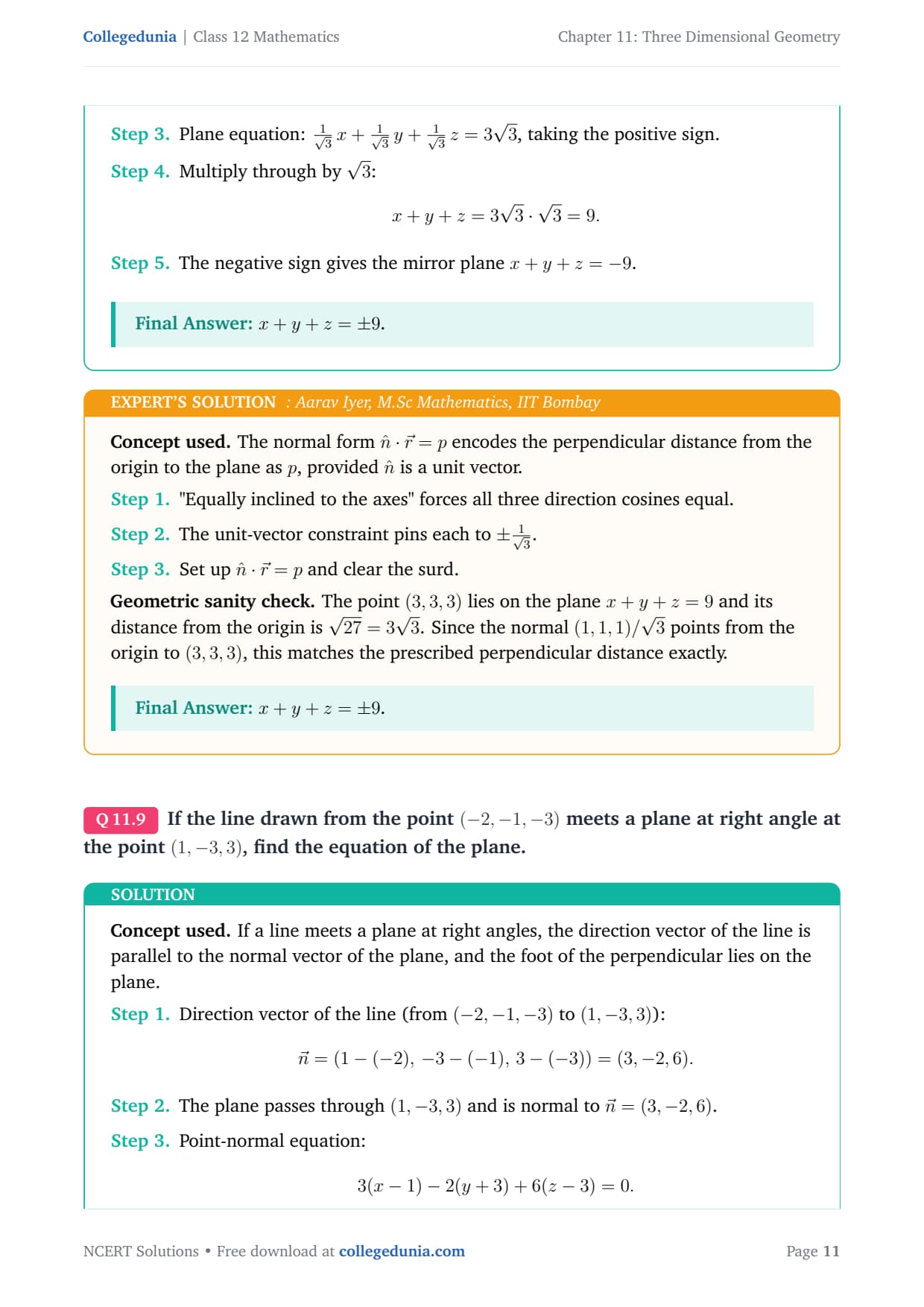
Plane equation: 1√3x+1√3y+1√3z=3√3, taking the positive sign.
Multiply through by √3:
x+y+z=3√3·√3=9.
The negative sign gives the mirror plane x+y+z=-9.
x+y+z=± 9.
AI
Aarav Iyer
M.Sc Mathematics, IIT Bombay
Verified Expert
Concept used. The normal form n̂·r⃗=p encodes the perpendicular distance from the origin to the plane as p, provided n̂ is a unit vector.
"Equally inclined to the axes" forces all three direction cosines equal.
The unit-vector constraint pins each to ±1√3.
Set up n̂·r⃗=p and clear the surd.
Geometric sanity check. The point (3,3,3) lies on the plane x+y+z=9 and its distance from the origin is √27=3√3. Since the normal (1,1,1)/√3 points from the origin to (3,3,3), this matches the prescribed perpendicular distance exactly.
x+y+z=± 9.
Q 11.9
If the line drawn from the point (-2,-1,-3) meets a plane at right angle at the point (1,-3,3), find the equation of the plane.
Concept used. If a line meets a plane at right angles, the direction vector of the line is parallel to the normal vector of the plane, and the foot of the perpendicular lies on the plane.
Direction vector of the line (from (-2,-1,-3) to (1,-3,3)):
n⃗=(1-(-2), -3-(-1), 3-(-3))=(3,-2,6).
The plane passes through (1,-3,3) and is normal to n⃗=(3,-2,6).
Point-normal equation:
3(x-1)-2(y+3)+6(z-3)=0.
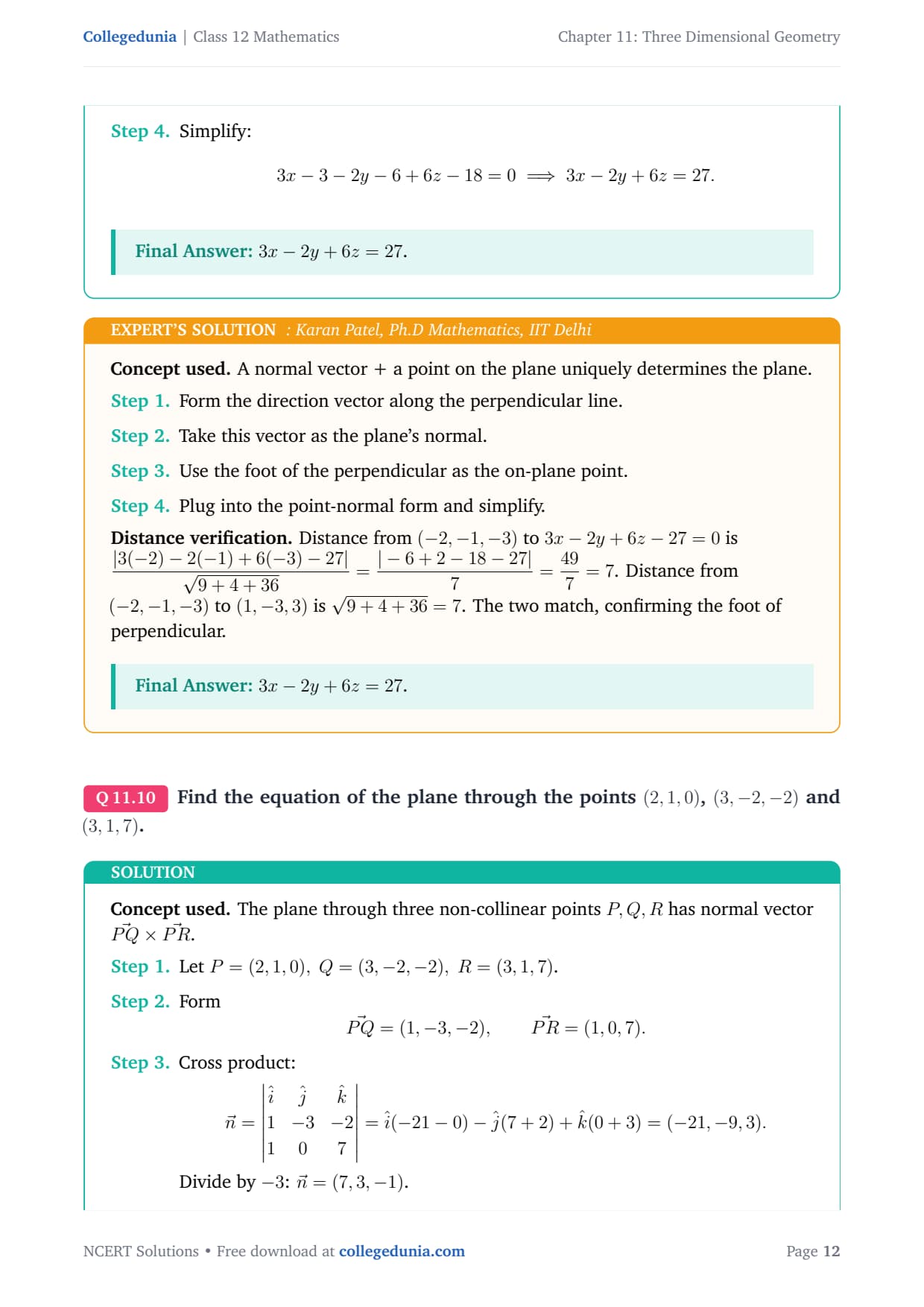
Simplify:
3x-3-2y-6+6z-18=0 3x-2y+6z=27.
3x-2y+6z=27.
KP
Karan Patel
Ph.D Mathematics, IIT Delhi
Verified Expert
Concept used. A normal vector + a point on the plane uniquely determines the plane.
Form the direction vector along the perpendicular line.
Take this vector as the plane's normal.
Use the foot of the perpendicular as the on-plane point.
Plug into the point-normal form and simplify.
Distance verification. Distance from (-2,-1,-3) to 3x-2y+6z-27=0 is |3(-2)-2(-1)+6(-3)-27|√9+4+36=|-6+2-18-27|7=497=7. Distance from (-2,-1,-3) to (1,-3,3) is √9+4+36=7. The two match, confirming the foot of perpendicular.
3x-2y+6z=27.
Q 11.10
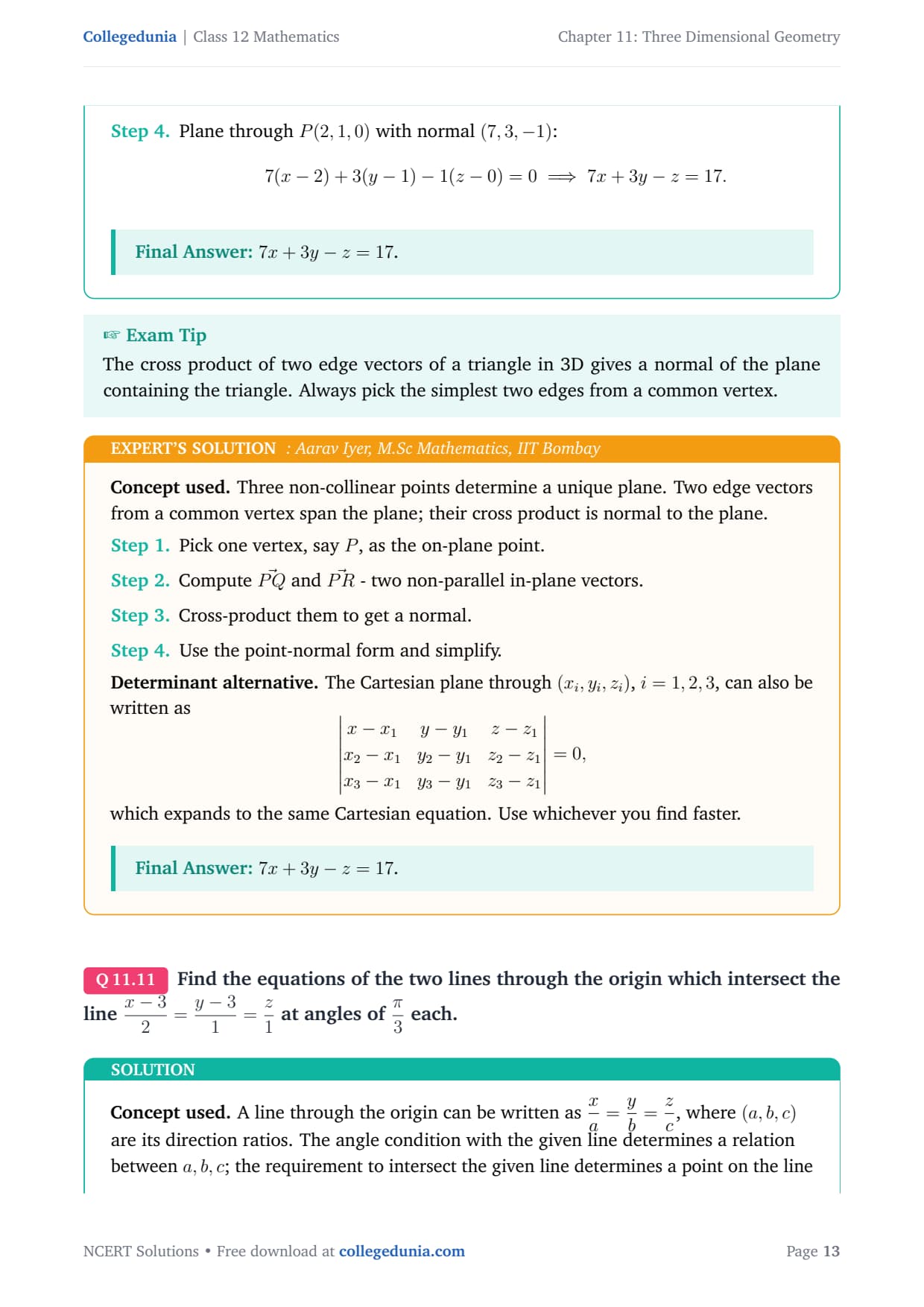
Find the equation of the plane through the points (2,1,0), (3,-2,-2) and (3,1,7).
Concept used. The plane through three non-collinear points P,Q,R has normal vector PQ⃗×PR⃗.
Plane through P(2,1,0) with normal (7,3,-1):
7(x-2)+3(y-1)-1(z-0)=0 7x+3y-z=17.
7x+3y-z=17.
AI
Aarav Iyer
M.Sc Mathematics, IIT Bombay
Verified Expert
Concept used. Three non-collinear points determine a unique plane. Two edge vectors from a common vertex span the plane; their cross product is normal to the plane.
Pick one vertex, say P, as the on-plane point.
Compute PQ⃗ and PR⃗ - two non-parallel in-plane vectors.
Cross-product them to get a normal.
Use the point-normal form and simplify.
Determinant alternative. The Cartesian plane through (xi,yi,zi), i=1,2,3, can also be written as
vmatrix x-x1 & y-y1 & z-z1 x2-x1 & y2-y1 & z2-z1 x3-x1 & y3-y1 & z3-z1vmatrix=0,
which expands to the same Cartesian equation. Use whichever you find faster.
7x+3y-z=17.
Q 11.11
Find the equations of the two lines through the origin which intersect the line x-32=y-31=z1 at angles of π3 each.
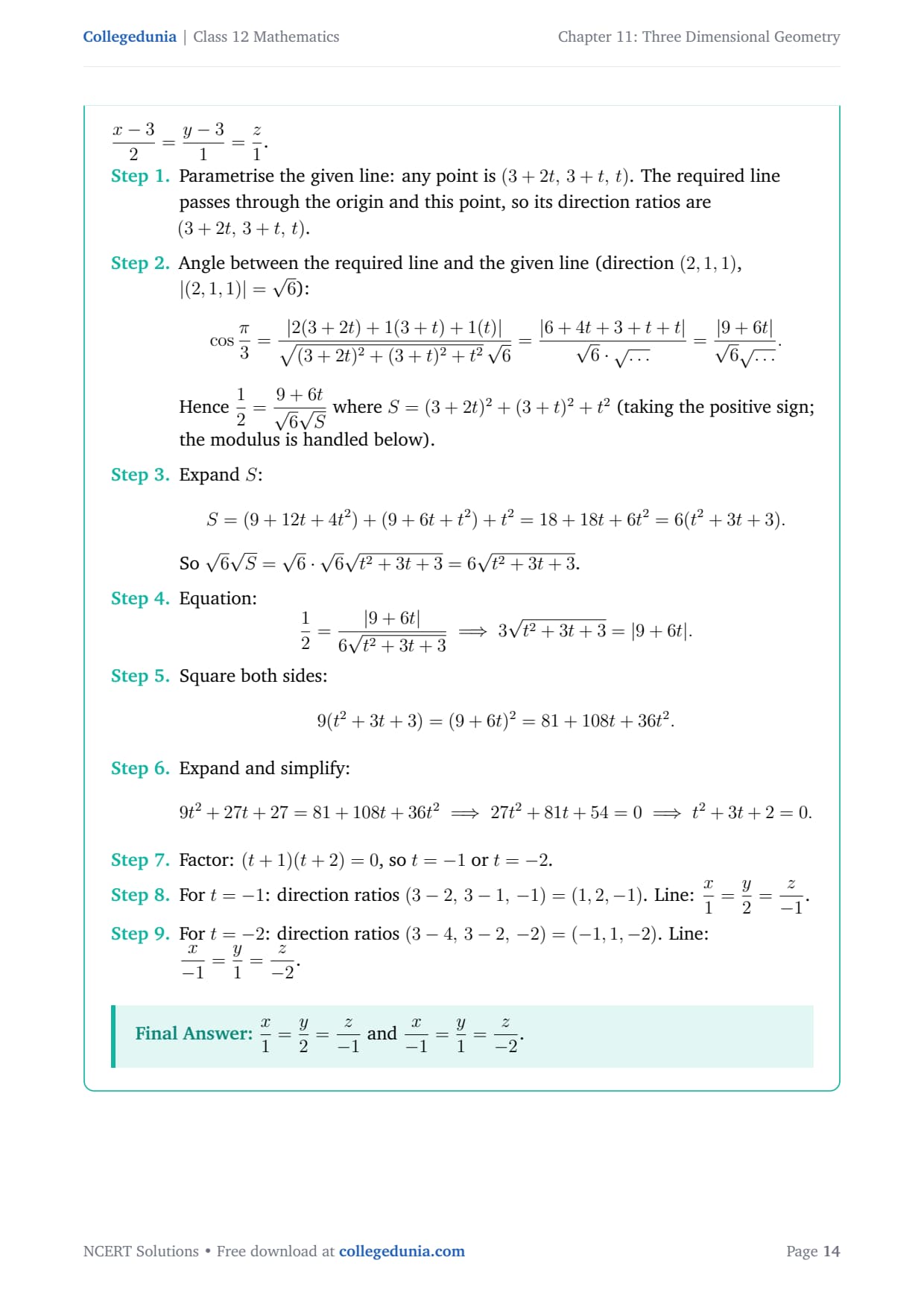
Concept used. A line through the origin can be written as xa=yb=zc, where (a,b,c) are its direction ratios. The angle condition with the given line determines a relation between a,b,c; the requirement to intersect the given line determines a point on the line x-32=y-31=z1.
Parametrise the given line: any point is (3+2t, 3+t, t). The required line passes through the origin and this point, so its direction ratios are (3+2t, 3+t, t).
Angle between the required line and the given line (direction (2,1,1), |(2,1,1)|=√6):
cosπ3=|2(3+2t)+1(3+t)+1(t)|√(3+2t)2+(3+t)2+t2√6=|6+4t+3+t+t|√6·√…=|9+6t|√6√….
Hence 12=9+6t√6√S where S=(3+2t)2+(3+t)2+t2 (taking the positive sign; the modulus is handled below).
Expand S:
S=(9+12t+4t2)+(9+6t+t2)+t2=18+18t+6t2=6(t2+3t+3).
So √6√S=√6·√6√t2+3t+3=6√t2+3t+3.
Equation:
12=|9+6t|6√t2+3t+3 3√t2+3t+3=|9+6t|.
Square both sides:
9(t2+3t+3)=(9+6t)2=81+108t+36t2.
Expand and simplify:
9t2+27t+27=81+108t+36t2 27t2+81t+54=0 t2+3t+2=0.
Factor: (t+1)(t+2)=0, so t=-1 or t=-2.
For t=-1: direction ratios (3-2, 3-1, -1)=(1,2,-1). Line: x1=y2=z-1.
For t=-2: direction ratios (3-4, 3-2, -2)=(-1,1,-2). Line: x-1=y1=z-2.
x1=y2=z-1 and x-1=y1=z-2.
KP
Karan Patel
Ph.D Mathematics, IIT Delhi
Verified Expert
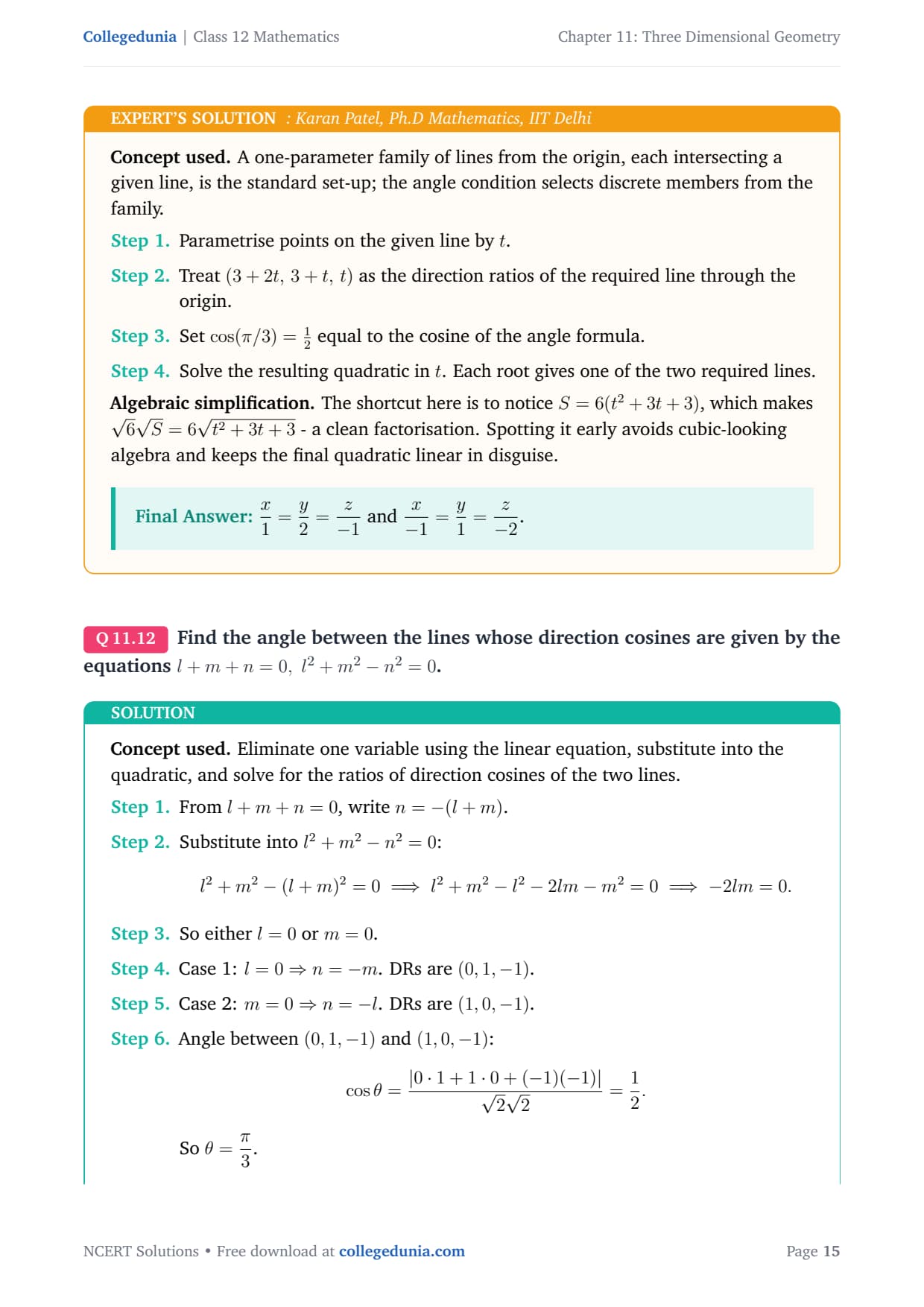
Concept used. A one-parameter family of lines from the origin, each intersecting a given line, is the standard set-up; the angle condition selects discrete members from the family.
Parametrise points on the given line by t.
Treat (3+2t, 3+t, t) as the direction ratios of the required line through the origin.
Set cos(π/3)=12 equal to the cosine of the angle formula.
Solve the resulting quadratic in t. Each root gives one of the two required lines.
Algebraic simplification. The shortcut here is to notice S=6(t2+3t+3), which makes √6√S=6√t2+3t+3 - a clean factorisation. Spotting it early avoids cubic-looking algebra and keeps the final quadratic linear in disguise.
x1=y2=z-1 and x-1=y1=z-2.
Q 11.12
Find the angle between the lines whose direction cosines are given by the equations l+m+n=0, l2+m2-n2=0.
Concept used. Eliminate one variable using the linear equation, substitute into the quadratic, and solve for the ratios of direction cosines of the two lines.
From l+m+n=0, write n=-(l+m).
Substitute into l2+m2-n2=0:
l2+m2-(l+m)2=0 l2+m2-l2-2lm-m2=0 -2lm=0.
So either l=0 or m=0.
Case 1: l=0⇒ n=-m. DRs are (0,1,-1).
Case 2: m=0⇒ n=-l. DRs are (1,0,-1).
Angle between (0,1,-1) and (1,0,-1):
cosθ=|0· 1+1· 0+(-1)(-1)|√2√2=12.
So θ=π3.
θ=π3.
AI
Aarav Iyer
M.Sc Mathematics, IIT Bombay
Verified Expert
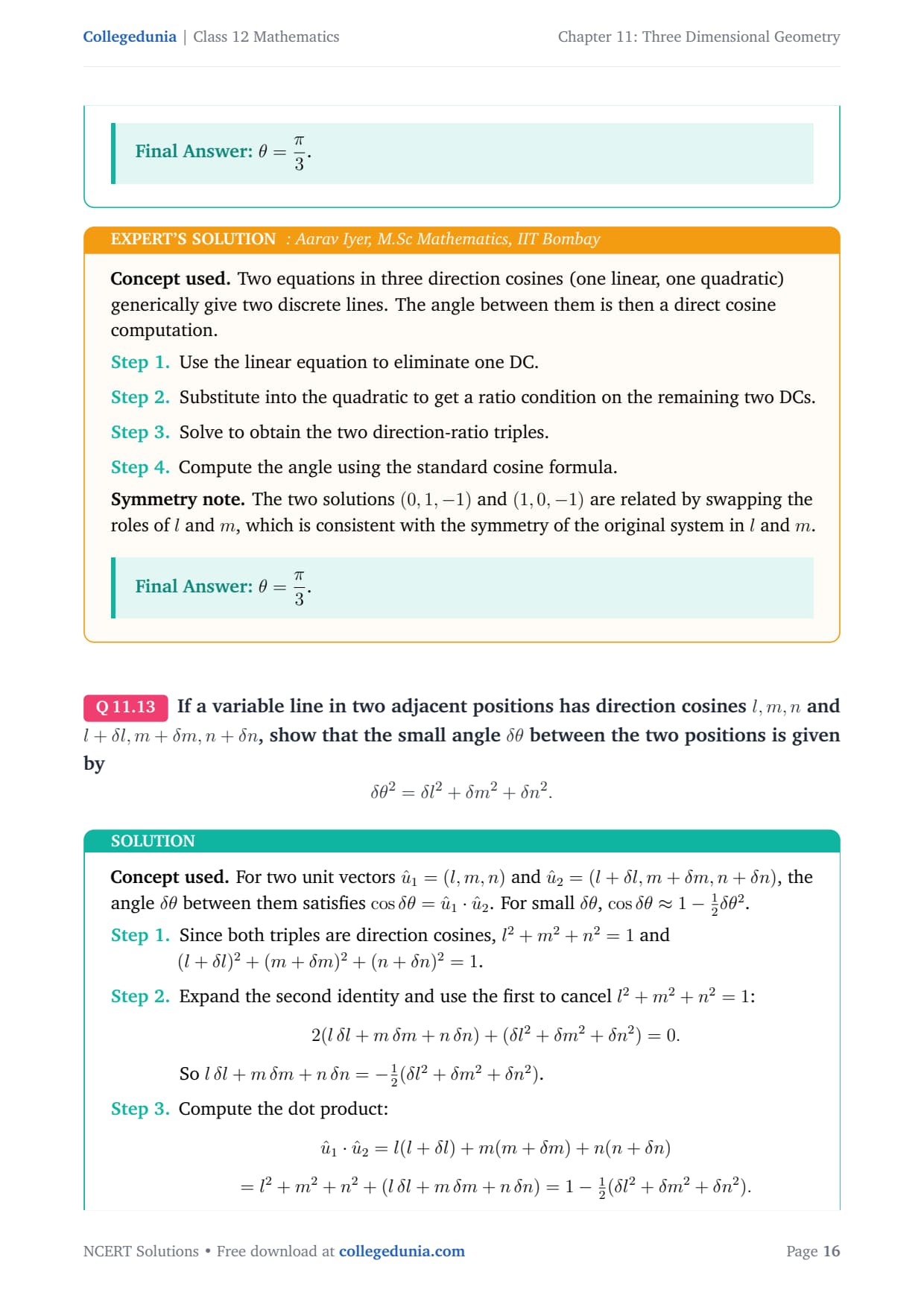
Concept used. Two equations in three direction cosines (one linear, one quadratic) generically give two discrete lines. The angle between them is then a direct cosine computation.
Use the linear equation to eliminate one DC.
Substitute into the quadratic to get a ratio condition on the remaining two DCs.
Solve to obtain the two direction-ratio triples.
Compute the angle using the standard cosine formula.
Symmetry note. The two solutions (0,1,-1) and (1,0,-1) are related by swapping the roles of l and m, which is consistent with the symmetry of the original system in l and m.
θ=π3.
Q 11.13
If a variable line in two adjacent positions has direction cosines l, m, n and l+δ l, m+δ m, n+δ n, show that the small angle θ between the two positions is given by
θ2=δ l2+δ m2+δ n2.
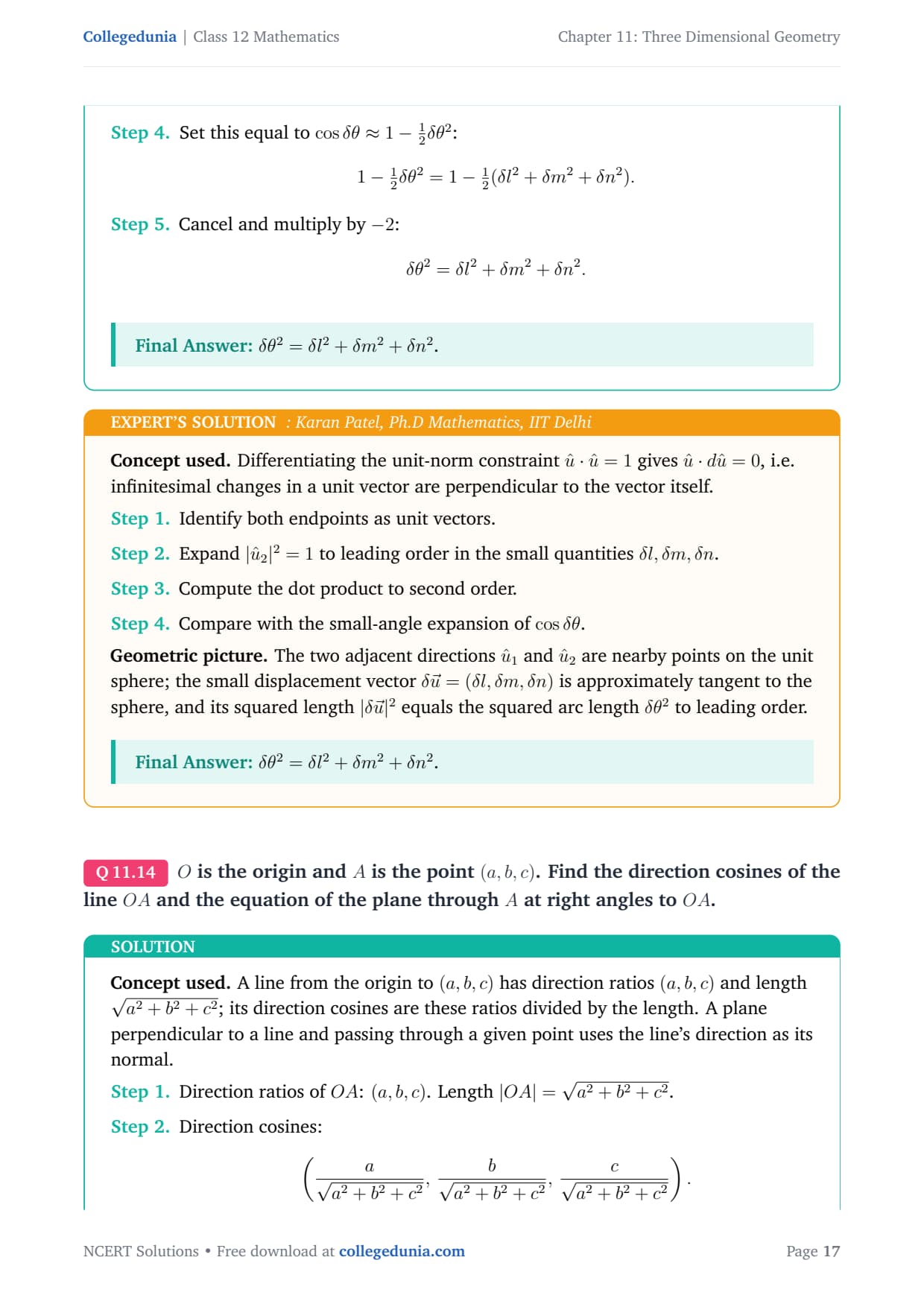
Concept used. For two unit vectors û1=(l,m,n) and û2=(l+δ l,m+δ m,n+δ n), the angle θ between them satisfies cosθ=û1·û2. For small θ, cosθ≈ 1-12θ2.
Since both triples are direction cosines, l2+m2+n2=1 and (l+δ l)2+(m+δ m)2+(n+δ n)2=1.
Expand the second identity and use the first to cancel l2+m2+n2=1:
2(l δ l+m δ m+n δ n)+(δ l2+δ m2+δ n2)=0.
So l δ l+m δ m+n δ n=-12(δ l2+δ m2+δ n2).
Set this equal to cosθ≈ 1-12θ2:
1-12θ2=1-12(δ l2+δ m2+δ n2).
Cancel and multiply by -2:
θ2=δ l2+δ m2+δ n2.
θ2=δ l2+δ m2+δ n2.
KP
Karan Patel
Ph.D Mathematics, IIT Delhi
Verified Expert
Concept used. Differentiating the unit-norm constraint û·û=1 gives û· dû=0, i.e. infinitesimal changes in a unit vector are perpendicular to the vector itself.
Identify both endpoints as unit vectors.
Expand |û2|2=1 to leading order in the small quantities δ l,δ m,δ n.
Compute the dot product to second order.
Compare with the small-angle expansion of cosθ.
Geometric picture. The two adjacent directions û1 and û2 are nearby points on the unit sphere; the small displacement vector δu⃗=(δ l,δ m,δ n) is approximately tangent to the sphere, and its squared length |δu⃗|2 equals the squared arc length θ2 to leading order.
θ2=δ l2+δ m2+δ n2.
Q 11.14
O is the origin and A is the point (a,b,c). Find the direction cosines of the line OA and the equation of the plane through A at right angles to OA.
Concept used. A line from the origin to (a,b,c) has direction ratios (a,b,c) and length √a2+b2+c2; its direction cosines are these ratios divided by the length. A plane perpendicular to a line and passing through a given point uses the line's direction as its normal.
Direction ratios of OA: (a,b,c). Length |OA|=√a2+b2+c2.
Direction cosines:
(a√a2+b2+c2, b√a2+b2+c2, c√a2+b2+c2).
Plane through A(a,b,c) with normal (a,b,c):
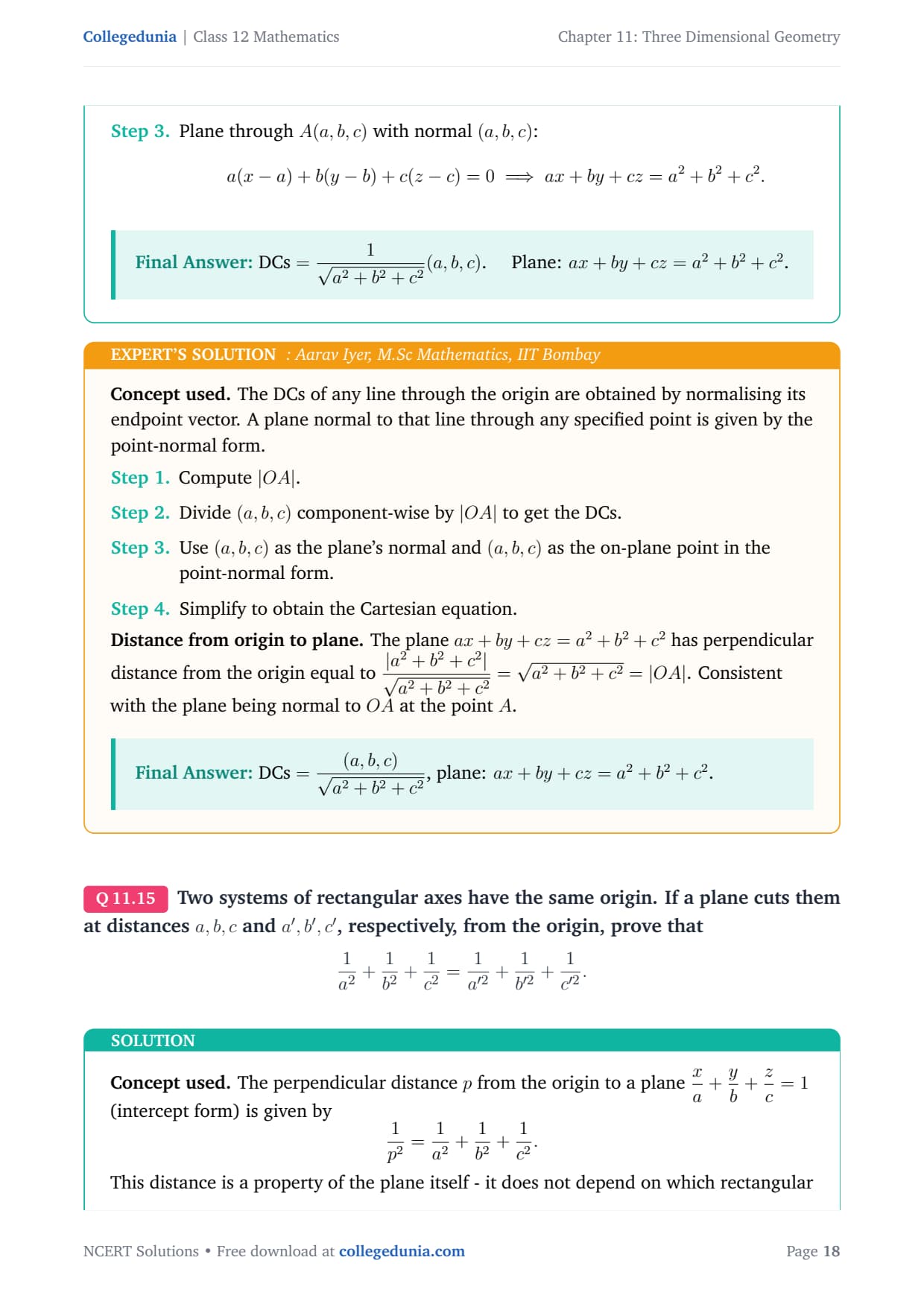
a(x-a)+b(y-b)+c(z-c)=0 ax+by+cz=a2+b2+c2.
DCs =1√a2+b2+c2(a,b,c). Plane: ax+by+cz=a2+b2+c2.
AI
Aarav Iyer
M.Sc Mathematics, IIT Bombay
Verified Expert
Concept used. The DCs of any line through the origin are obtained by normalising its endpoint vector. A plane normal to that line through any specified point is given by the point-normal form.
Compute |OA|.
Divide (a,b,c) component-wise by |OA| to get the DCs.
Use (a,b,c) as the plane's normal and (a,b,c) as the on-plane point in the point-normal form.
Simplify to obtain the Cartesian equation.
Distance from origin to plane. The plane ax+by+cz=a2+b2+c2 has perpendicular distance from the origin equal to |a2+b2+c2|√a2+b2+c2=√a2+b2+c2=|OA|. Consistent with the plane being normal to OA at the point A.
DCs =(a,b,c)√a2+b2+c2, plane: ax+by+cz=a2+b2+c2.
Q 11.15
Two systems of rectangular axes have the same origin. If a plane cuts them at distances a,b,c and a',b',c', respectively, from the origin, prove that
1a2+1b2+1c2=1a'2+1b'2+1c'2.
Concept used. The perpendicular distance p from the origin to a plane xa+yb+zc=1 (intercept form) is given by
1p2=1a2+1b2+1c2.
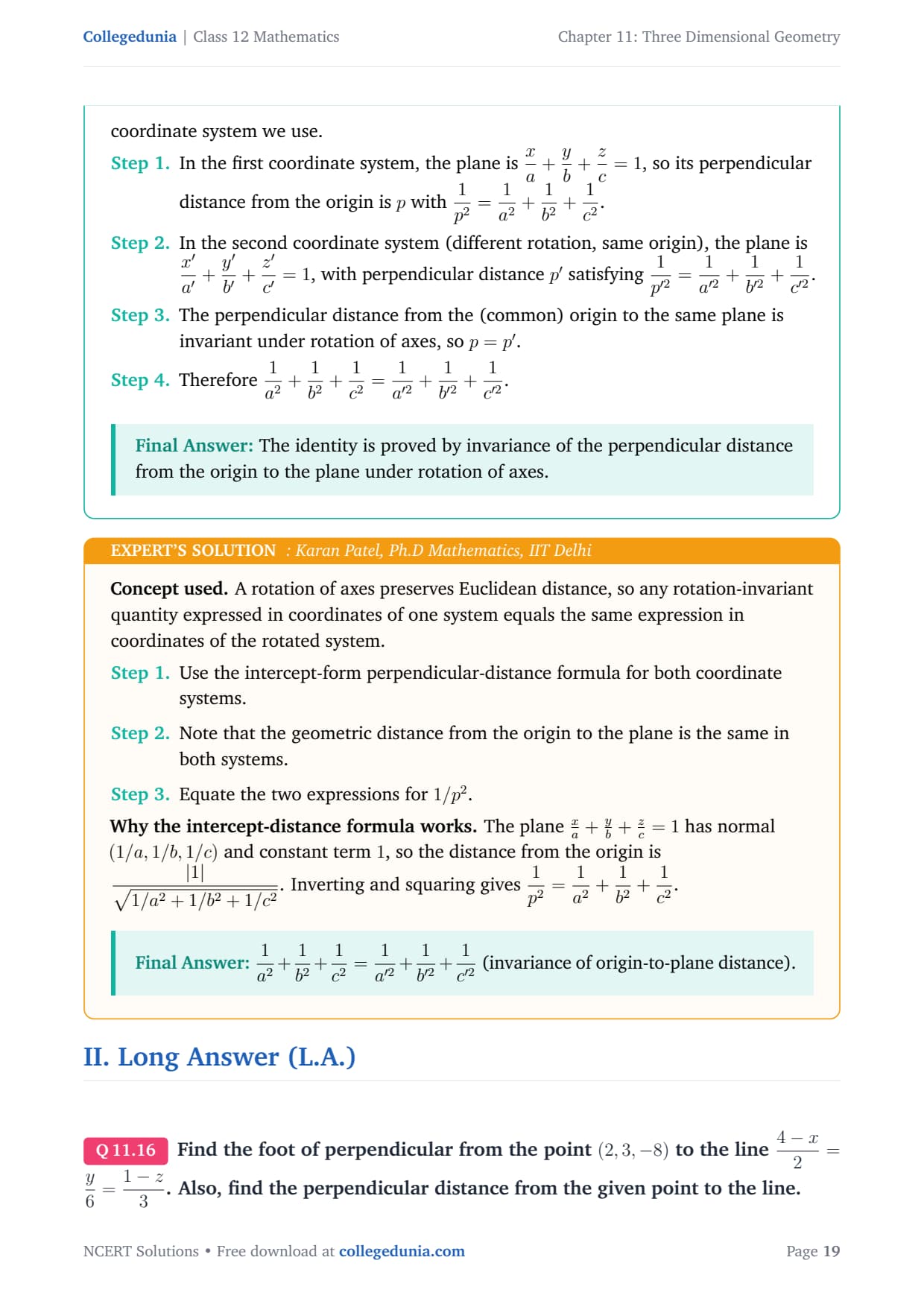
This distance is a property of the plane itself - it does not depend on which rectangular coordinate system we use.
In the first coordinate system, the plane is xa+yb+zc=1, so its perpendicular distance from the origin is p with 1p2=1a2+1b2+1c2.
In the second coordinate system (different rotation, same origin), the plane is x'a'+y'b'+z'c'=1, with perpendicular distance p' satisfying 1p'2=1a'2+1b'2+1c'2.
The perpendicular distance from the (common) origin to the same plane is invariant under rotation of axes, so p=p'.
Therefore 1a2+1b2+1c2=1a'2+1b'2+1c'2.
The identity is proved by invariance of the perpendicular distance from the origin to the plane under rotation of axes.
KP
Karan Patel
Ph.D Mathematics, IIT Delhi
Verified Expert
Concept used. A rotation of axes preserves Euclidean distance, so any rotation-invariant quantity expressed in coordinates of one system equals the same expression in coordinates of the rotated system.
Use the intercept-form perpendicular-distance formula for both coordinate systems.
Note that the geometric distance from the origin to the plane is the same in both systems.
Equate the two expressions for 1/p2.
Why the intercept-distance formula works. The plane xa+yb+zc=1 has normal (1/a,1/b,1/c) and constant term 1, so the distance from the origin is |1|√1/a2+1/b2+1/c2. Inverting and squaring gives 1p2=1a2+1b2+1c2.
1a2+1b2+1c2=1a'2+1b'2+1c'2 (invariance of origin-to-plane distance).
II. Long Answer (L.A.)
Q 11.16
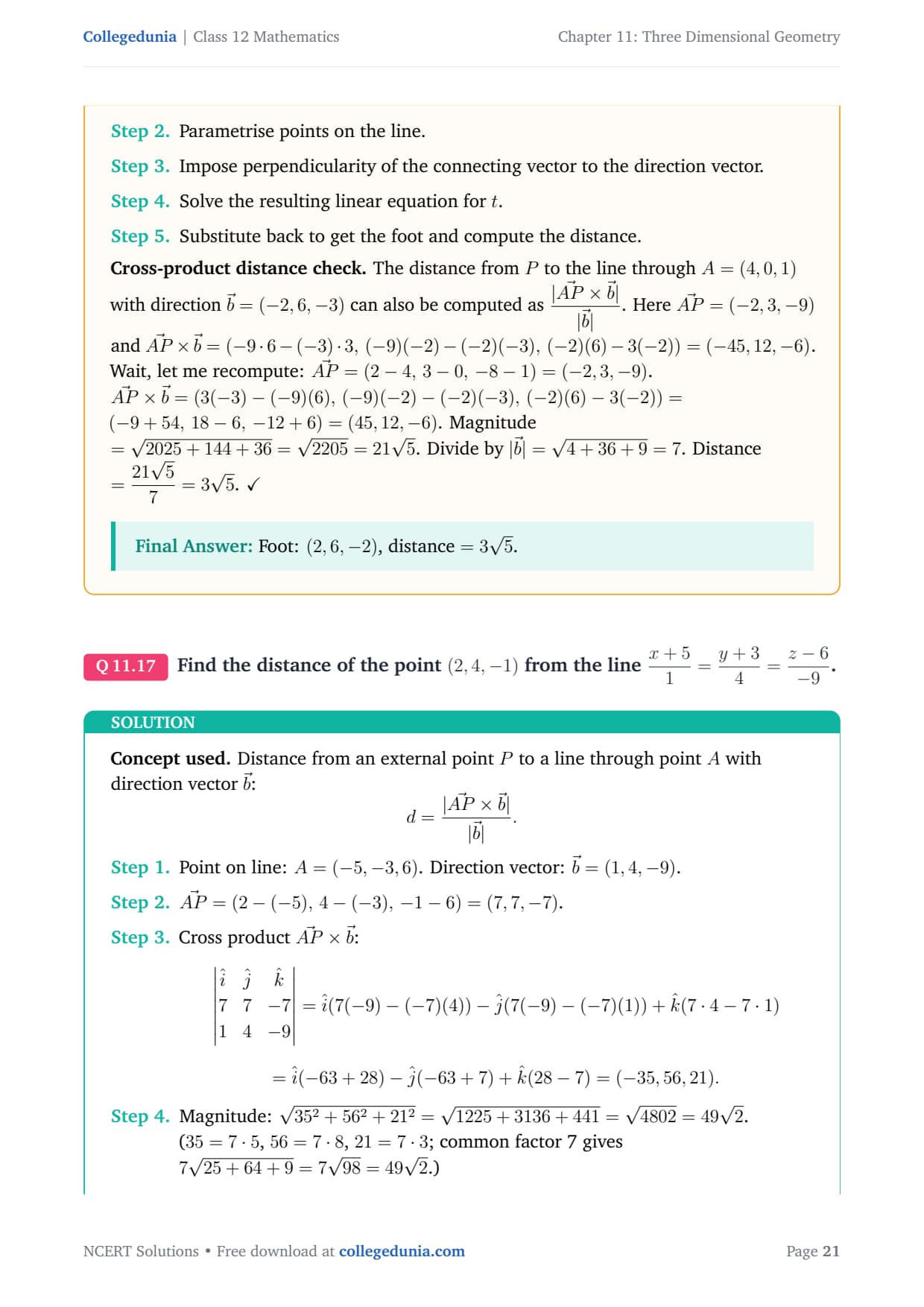
Find the foot of perpendicular from the point (2,3,-8) to the line 4-x2=y6=1-z3. Also, find the perpendicular distance from the given point to the line.
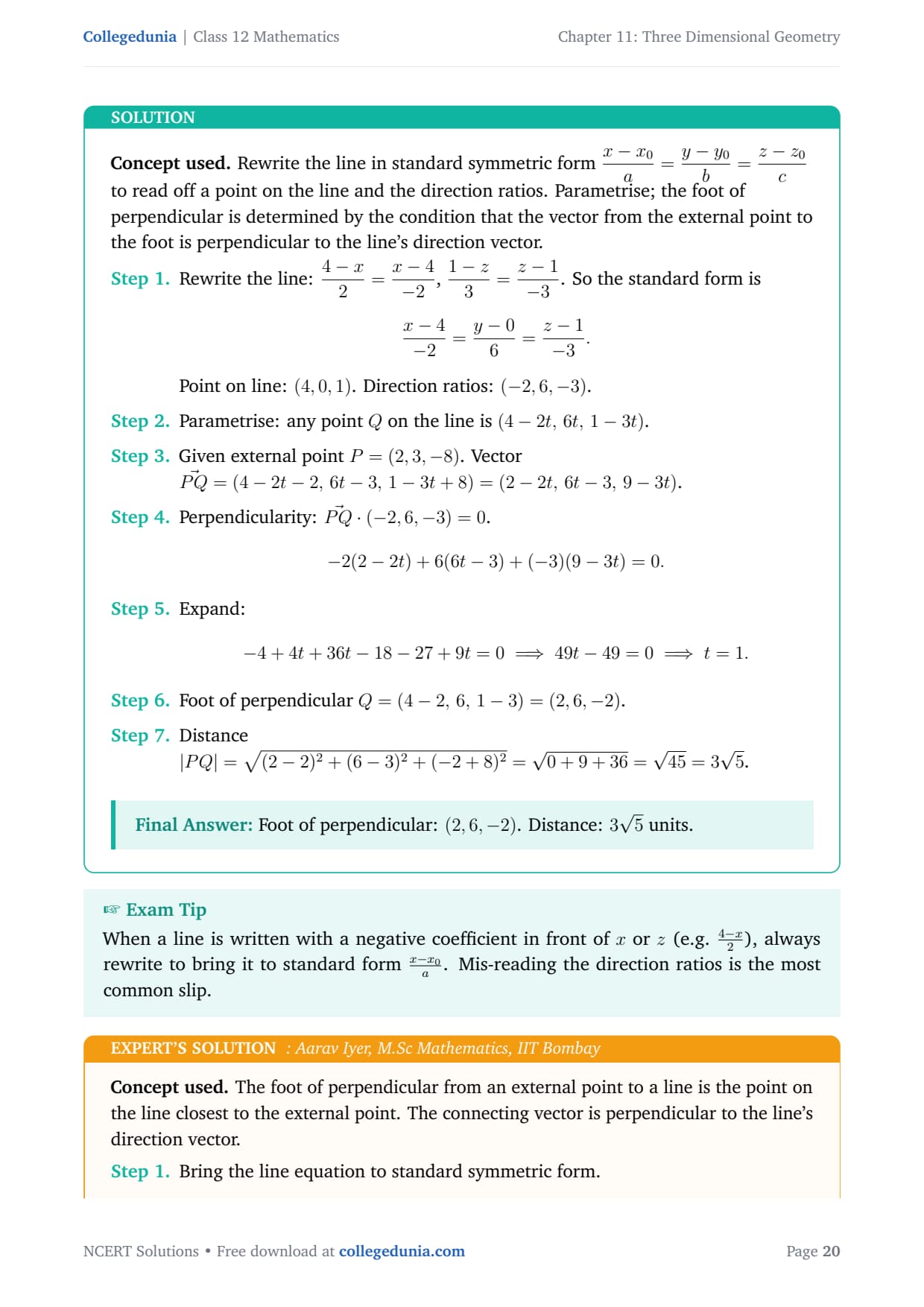
Concept used. Rewrite the line in standard symmetric form x-x0a=y-y0b=z-z0c to read off a point on the line and the direction ratios. Parametrise; the foot of perpendicular is determined by the condition that the vector from the external point to the foot is perpendicular to the line's direction vector.
Rewrite the line: 4-x2=x-4-2, 1-z3=z-1-3. So the standard form is
x-4-2=y-06=z-1-3.
Point on line: (4,0,1). Direction ratios: (-2,6,-3).
Parametrise: any point Q on the line is (4-2t, 6t, 1-3t).
Given external point P=(2,3,-8). Vector PQ⃗=(4-2t-2, 6t-3, 1-3t+8)=(2-2t, 6t-3, 9-3t).
Foot of perpendicular: (2,6,-2). Distance: 3√5 units.
AI
Aarav Iyer
M.Sc Mathematics, IIT Bombay
Verified Expert
Concept used. The foot of perpendicular from an external point to a line is the point on the line closest to the external point. The connecting vector is perpendicular to the line's direction vector.
Bring the line equation to standard symmetric form.
Parametrise points on the line.
Impose perpendicularity of the connecting vector to the direction vector.
Solve the resulting linear equation for t.
Substitute back to get the foot and compute the distance.
Cross-product distance check. The distance from P to the line through A=(4,0,1) with direction b⃗=(-2,6,-3) can also be computed as |AP⃗×b⃗||b⃗|. Here AP⃗=(-2,3,-9) and AP⃗×b⃗=(-9· 6-(-3)· 3, (-9)(-2)-(-2)(-3), (-2)(6)-3(-2))=(-45,12,-6). Wait, let me recompute: AP⃗=(2-4, 3-0, -8-1)=(-2,3,-9). AP⃗×b⃗=(3(-3)-(-9)(6), (-9)(-2)-(-2)(-3), (-2)(6)-3(-2))=(-9+54, 18-6, -12+6)=(45,12,-6). Magnitude =√2025+144+36=√2205=21√5. Divide by |b⃗|=√4+36+9=7. Distance =21√57=3√5.
Foot: (2,6,-2), distance =3√5.
Q 11.17
Find the distance of the point (2,4,-1) from the line x+51=y+34=z-6-9.
Concept used. Distance from an external point P to a line through point A with direction vector b⃗:
d=|AP⃗×b⃗||b⃗|.
Point on line: A=(-5,-3,6). Direction vector: b⃗=(1,4,-9).
Concept used. The cross-product distance formula is the cleanest way to compute the perpendicular distance from a point to a line. No parametrisation is needed.
Read off a point on the line (A) and the direction vector (b⃗) from the symmetric form.
Form the vector AP⃗ from A to the external point.
Compute AP⃗×b⃗ via the 3× 3 determinant.
Divide the magnitude by |b⃗|.
Arithmetic tip. When the cross product comes out as (-35,56,21), notice the common factor 7 before squaring. Factoring early keeps the numbers small.
d=7.
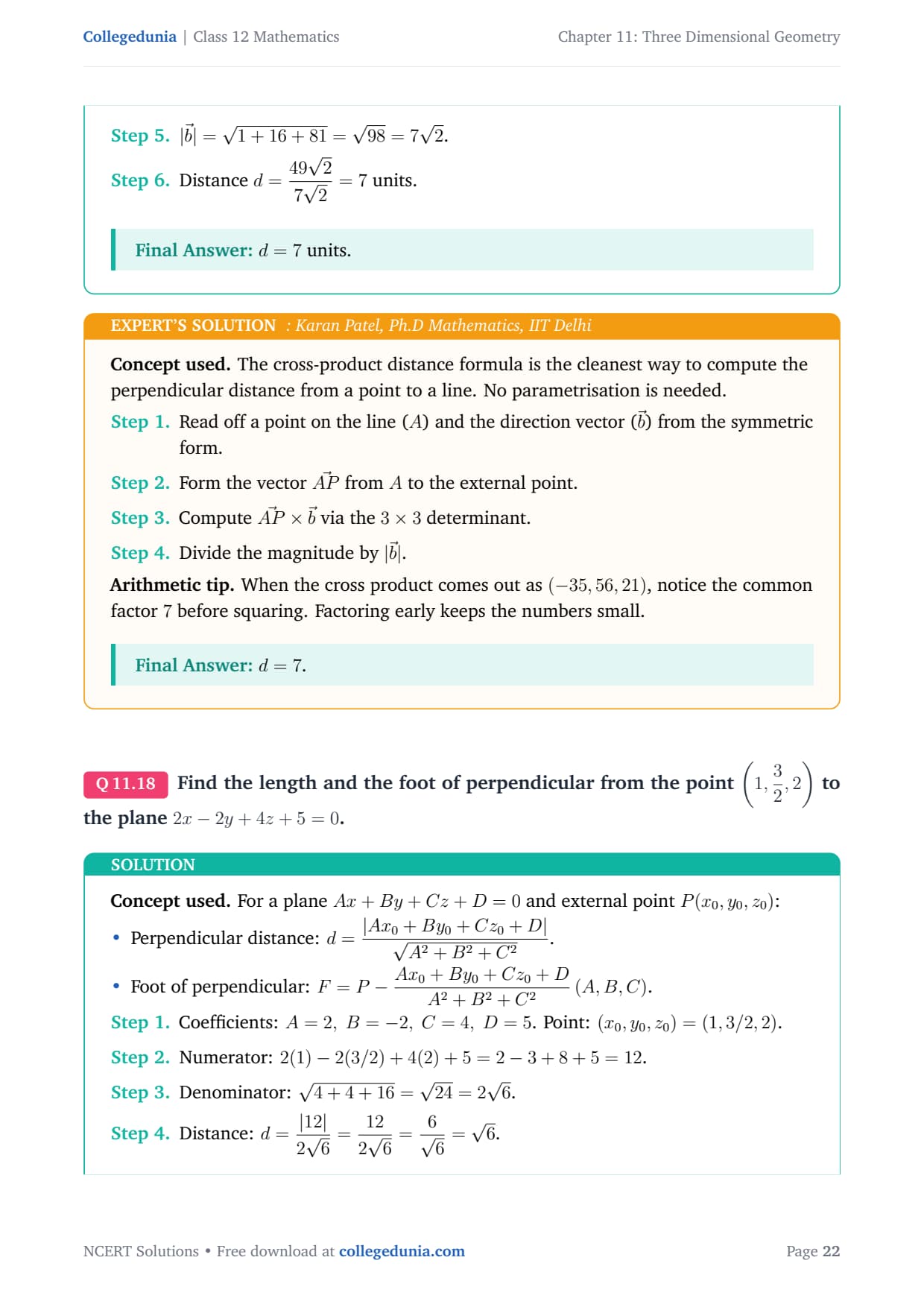
Q 11.18
Find the length and the foot of perpendicular from the point (1,32,2) to the plane 2x-2y+4z+5=0.
Concept used. For a plane Ax+By+Cz+D=0 and external point P(x0,y0,z0):
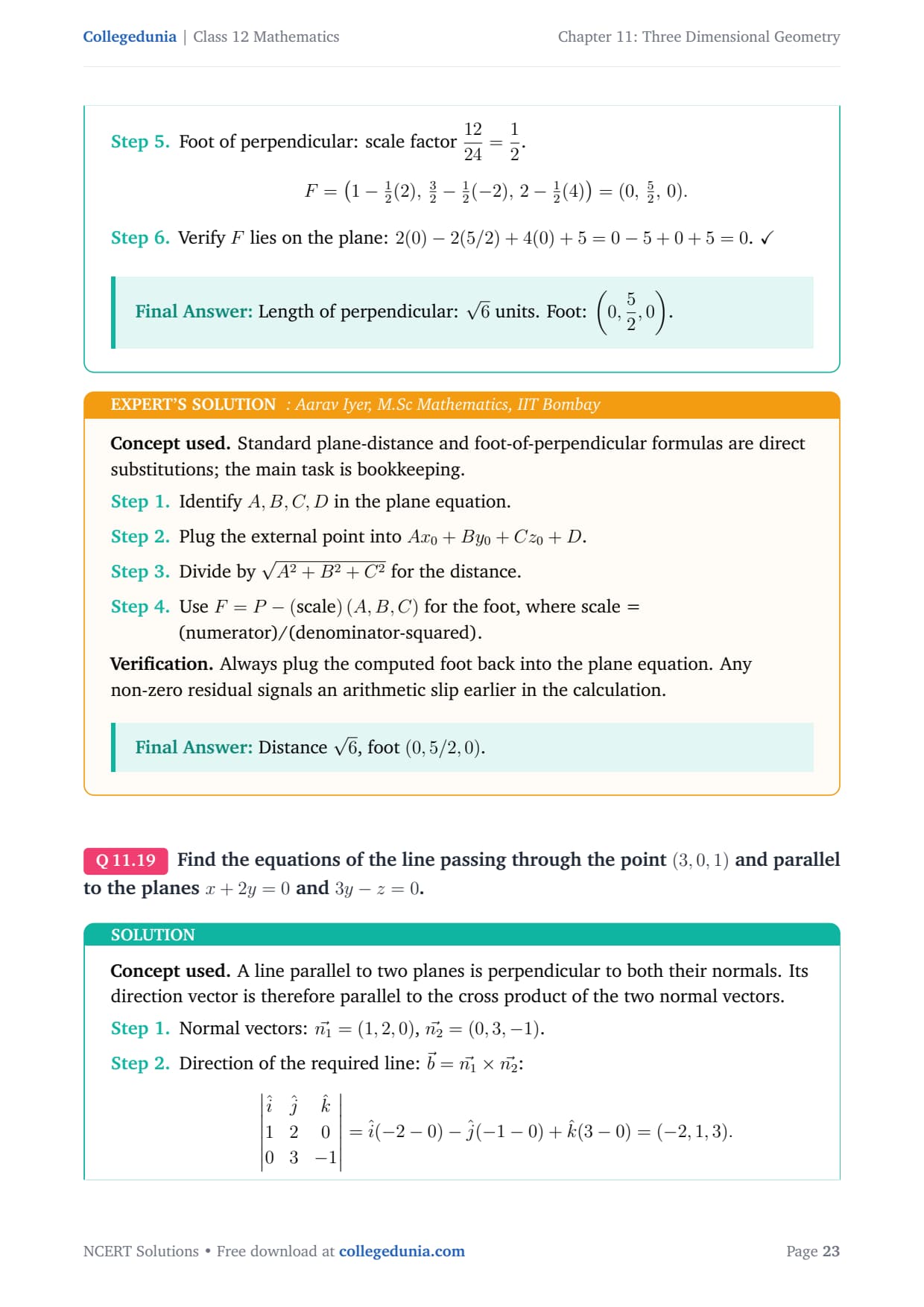
Verify F lies on the plane: 2(0)-2(5/2)+4(0)+5=0-5+0+5=0.
Length of perpendicular: √6 units. Foot: (0,52,0).
AI
Aarav Iyer
M.Sc Mathematics, IIT Bombay
Verified Expert
Concept used. Standard plane-distance and foot-of-perpendicular formulas are direct substitutions; the main task is bookkeeping.
Identify A,B,C,D in the plane equation.
Plug the external point into Ax0+By0+Cz0+D.
Divide by √A2+B2+C2 for the distance.
Use F=P-(scale) (A,B,C) for the foot, where scale = (numerator)/(denominator-squared).
Verification. Always plug the computed foot back into the plane equation. Any non-zero residual signals an arithmetic slip earlier in the calculation.
Distance √6, foot (0,5/2,0).
Q 11.19
Find the equations of the line passing through the point (3,0,1) and parallel to the planes x+2y=0 and 3y-z=0.
Concept used. A line parallel to two planes is perpendicular to both their normals. Its direction vector is therefore parallel to the cross product of the two normal vectors.
Normal vectors: n1⃗=(1,2,0), n2⃗=(0,3,-1).
Direction of the required line: b⃗=n1⃗×n2⃗:
vmatrix î & ĵ & k̂ 1 & 2 & 0 0 & 3 & -1 vmatrix=î(-2-0)-ĵ(-1-0)+k̂(3-0)=(-2,1,3).
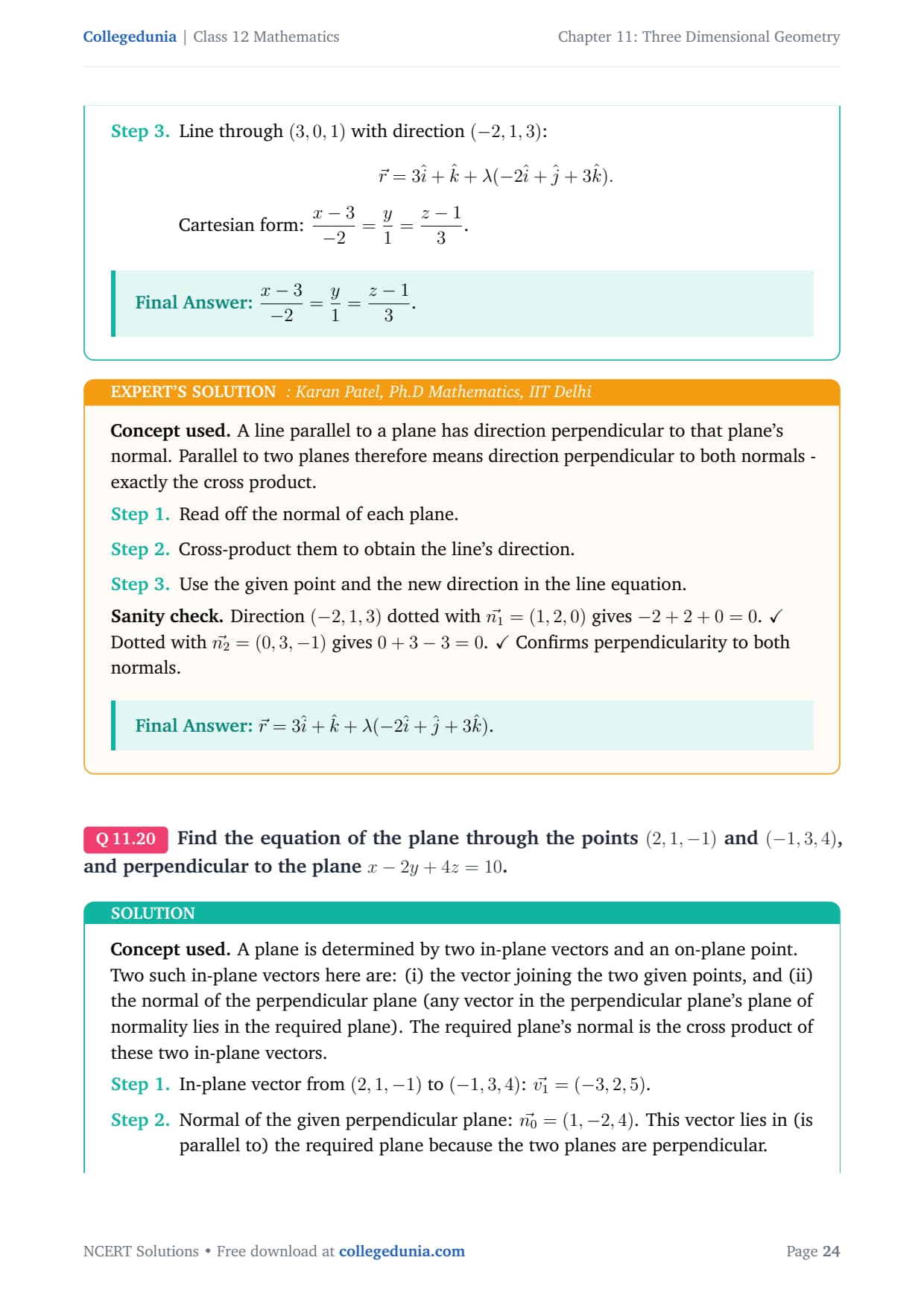
Line through (3,0,1) with direction (-2,1,3):
r⃗=3î+k̂+λ(-2î+ĵ+3k̂).
Cartesian form: x-3-2=y1=z-13.
x-3-2=y1=z-13.
KP
Karan Patel
Ph.D Mathematics, IIT Delhi
Verified Expert
Concept used. A line parallel to a plane has direction perpendicular to that plane's normal. Parallel to two planes therefore means direction perpendicular to both normals - exactly the cross product.
Read off the normal of each plane.
Cross-product them to obtain the line's direction.
Use the given point and the new direction in the line equation.
Sanity check. Direction (-2,1,3) dotted with n1⃗=(1,2,0) gives -2+2+0=0. Dotted with n2⃗=(0,3,-1) gives 0+3-3=0. Confirms perpendicularity to both normals.
r⃗=3î+k̂+λ(-2î+ĵ+3k̂).
Q 11.20
Find the equation of the plane through the points (2,1,-1) and (-1,3,4), and perpendicular to the plane x-2y+4z=10.
Concept used. A plane is determined by two in-plane vectors and an on-plane point. Two such in-plane vectors here are: (i) the vector joining the two given points, and (ii) the normal of the perpendicular plane (any vector in the perpendicular plane's plane of normality lies in the required plane). The required plane's normal is the cross product of these two in-plane vectors.
In-plane vector from (2,1,-1) to (-1,3,4): v1⃗=(-3,2,5).
Normal of the given perpendicular plane: n0⃗=(1,-2,4). This vector lies in (is parallel to) the required plane because the two planes are perpendicular.
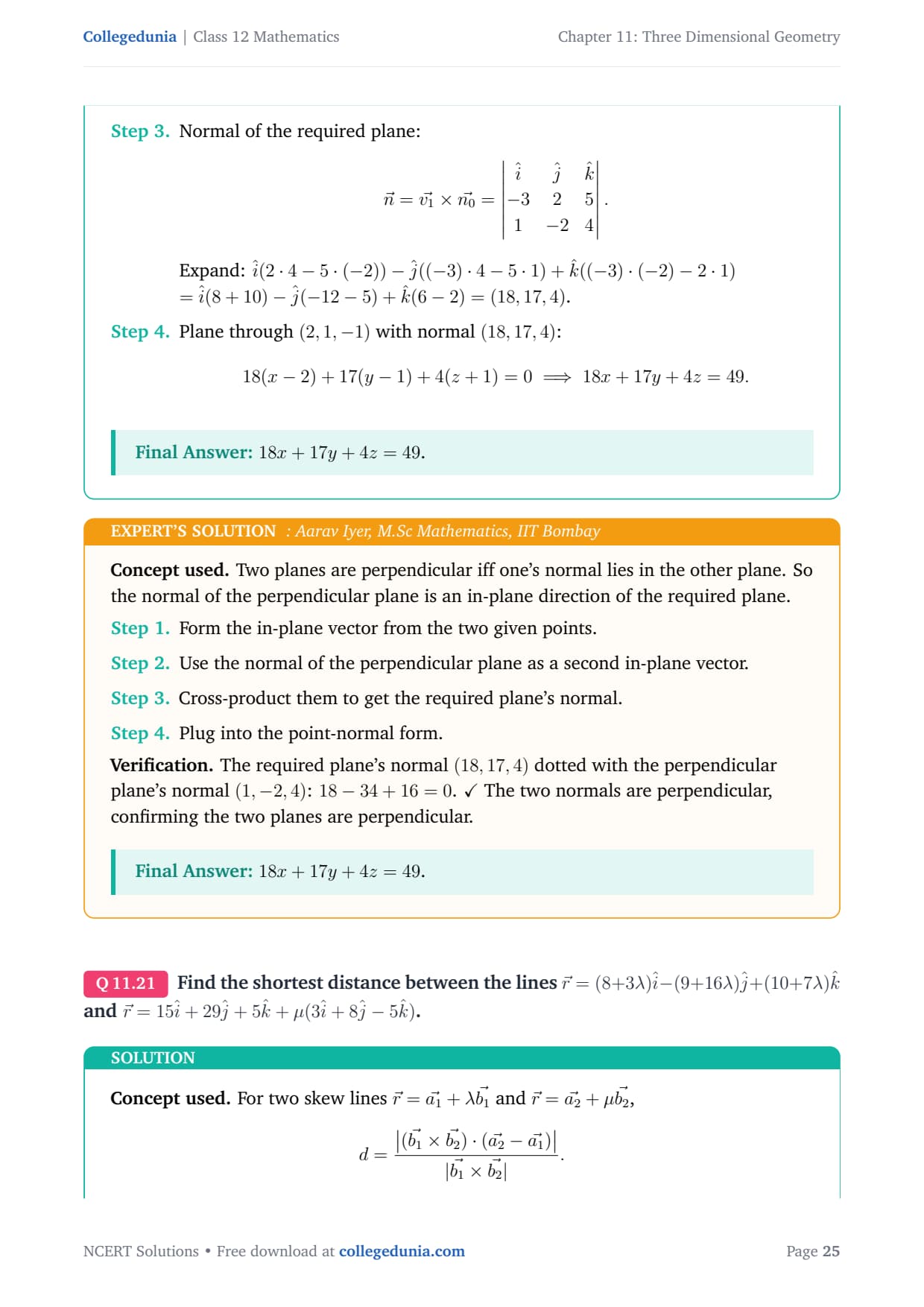
Normal of the required plane:
n⃗=v1⃗×n0⃗=vmatrix î & ĵ & k̂ -3 & 2 & 5 1 & -2 & 4 vmatrix.
Expand: î(2· 4-5·(-2))-ĵ((-3)· 4-5· 1)+k̂((-3)·(-2)-2· 1)=î(8+10)-ĵ(-12-5)+k̂(6-2)=(18,17,4).
Plane through (2,1,-1) with normal (18,17,4):
18(x-2)+17(y-1)+4(z+1)=0 18x+17y+4z=49.
18x+17y+4z=49.
AI
Aarav Iyer
M.Sc Mathematics, IIT Bombay
Verified Expert
Concept used. Two planes are perpendicular iff one's normal lies in the other plane. So the normal of the perpendicular plane is an in-plane direction of the required plane.
Form the in-plane vector from the two given points.
Use the normal of the perpendicular plane as a second in-plane vector.
Cross-product them to get the required plane's normal.
Plug into the point-normal form.
Verification. The required plane's normal (18,17,4) dotted with the perpendicular plane's normal (1,-2,4): 18-34+16=0. The two normals are perpendicular, confirming the two planes are perpendicular.
18x+17y+4z=49.
Q 11.21
Find the shortest distance between the lines r⃗=(8+3λ)î-(9+16λ)ĵ+(10+7λ)k̂ and r⃗=15î+29ĵ+5k̂+μ(3î+8ĵ-5k̂).
Concept used. For two skew lines r⃗=a1⃗+λb1⃗ and r⃗=a2⃗+μb2⃗,
d=|(b1⃗×b2⃗)·(a2⃗-a1⃗)||b1⃗×b2⃗|.
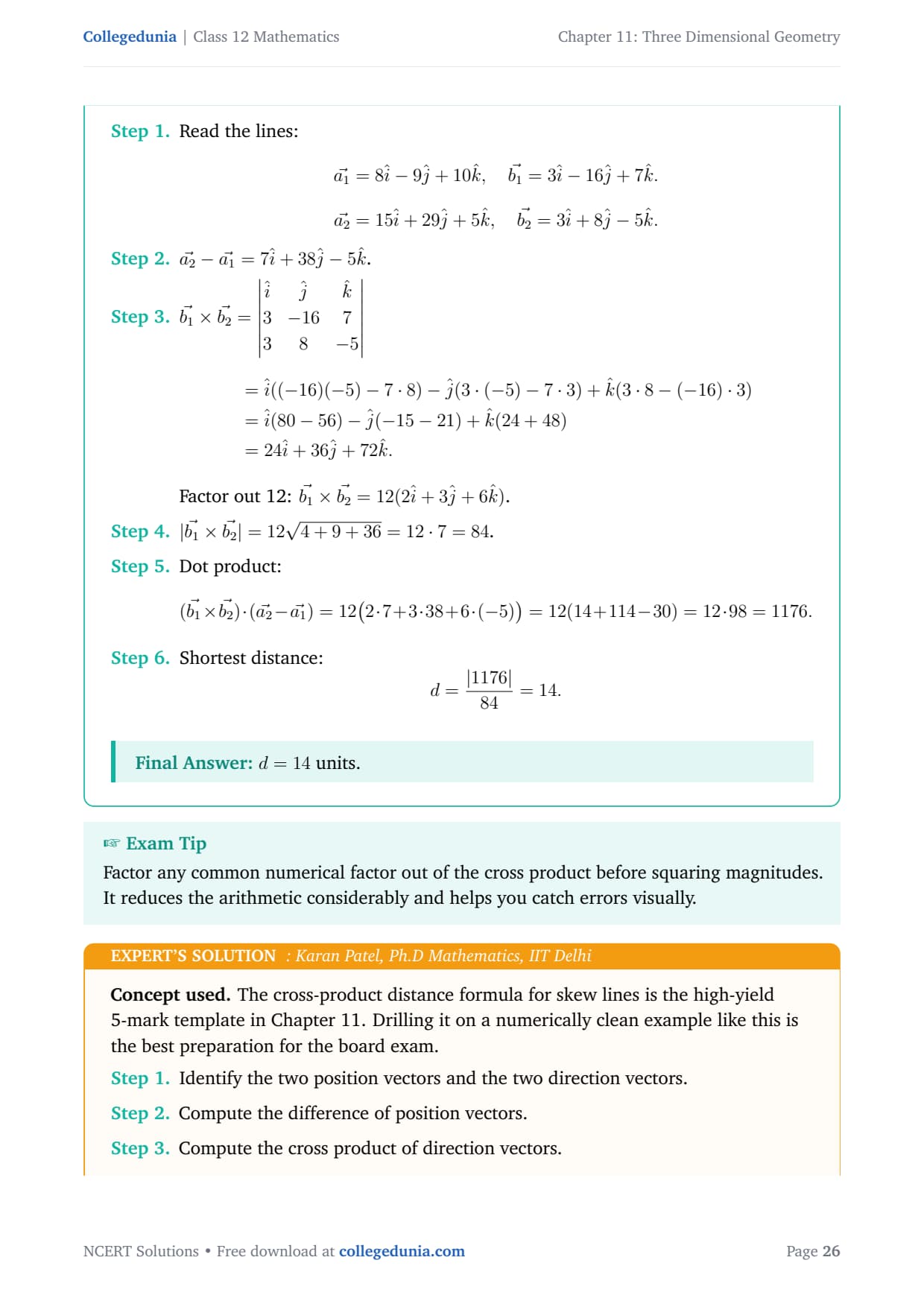
Read the lines:
a1⃗=8î-9ĵ+10k̂, b1⃗=3î-16ĵ+7k̂. a2⃗=15î+29ĵ+5k̂, b2⃗=3î+8ĵ-5k̂.
Concept used. The cross-product distance formula for skew lines is the high-yield 5-mark template in Chapter 11. Drilling it on a numerically clean example like this is the best preparation for the board exam.
Identify the two position vectors and the two direction vectors.
Compute the difference of position vectors.
Compute the cross product of direction vectors.
Take the absolute value of the dot product of (cross product) with (difference of positions).
Divide by the magnitude of the cross product.
Skew vs parallel check.b1⃗×b2⃗=12(2,3,6)≠0⃗, so the two lines are not parallel. The non-zero numerator confirms they do not intersect either. The lines are skew, and the shortest distance is finite and positive.
d=14.
Q 11.22
Find the equation of the plane which is perpendicular to the plane 5x+3y+6z+8=0 and which contains the line of intersection of the planes x+2y+3z-4=0 and 2x+y-z+5=0.
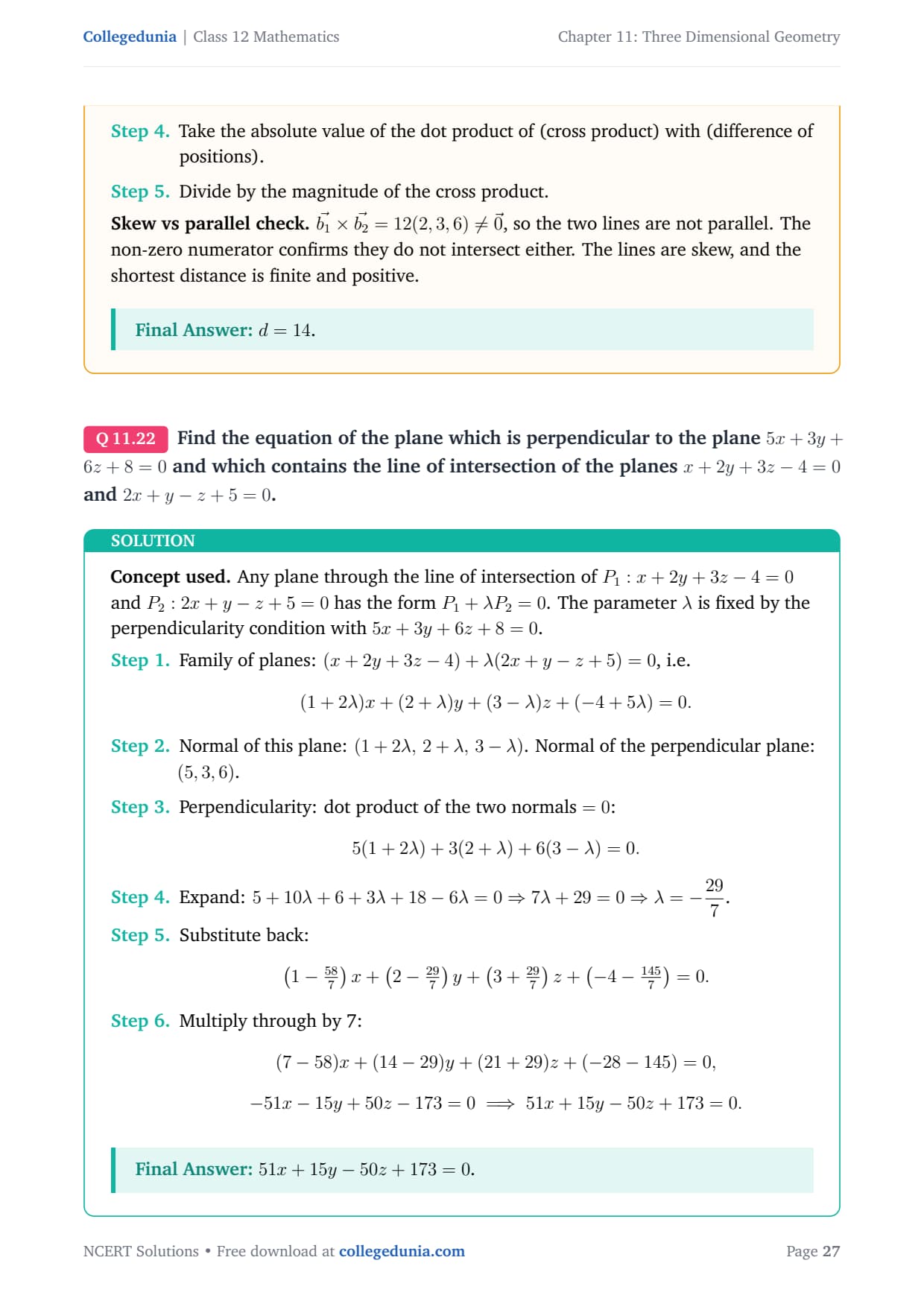
Concept used. Any plane through the line of intersection of P1: x+2y+3z-4=0 and P2: 2x+y-z+5=0 has the form P1+λ P2=0. The parameter λ is fixed by the perpendicularity condition with 5x+3y+6z+8=0.
Family of planes: (x+2y+3z-4)+λ(2x+y-z+5)=0, i.e.
(1+2λ)x+(2+λ)y+(3-λ)z+(-4+5λ)=0.
Normal of this plane: (1+2λ, 2+λ, 3-λ). Normal of the perpendicular plane: (5,3,6).
Perpendicularity: dot product of the two normals =0:
5(1+2λ)+3(2+λ)+6(3-λ)=0.
Multiply through by 7:
(7-58)x+(14-29)y+(21+29)z+(-28-145)=0, -51x-15y+50z-173=0 51x+15y-50z+173=0.
51x+15y-50z+173=0.
AI
Aarav Iyer
M.Sc Mathematics, IIT Bombay
Verified Expert
Concept used. The family P1+λ P2=0 generates every plane through the line of intersection of P1=0 and P2=0. One scalar condition (here perpendicularity) pins down a unique member.
Write the parameter family.
Read off the normal of the parametric plane.
Impose the perpendicularity condition with the given plane.
Solve for λ and substitute back.
Verification. The normal (51,15,-50) dotted with (5,3,6): 255+45-300=0. Confirms perpendicularity to the prescribed plane.
51x+15y-50z+173=0.
Q 11.23
The plane ax+by=0 is rotated about its line of intersection with the plane z=0 through an angle α. Prove that the equation of the plane in its new position is ax+by±(√a2+b2 tanα) z=0.
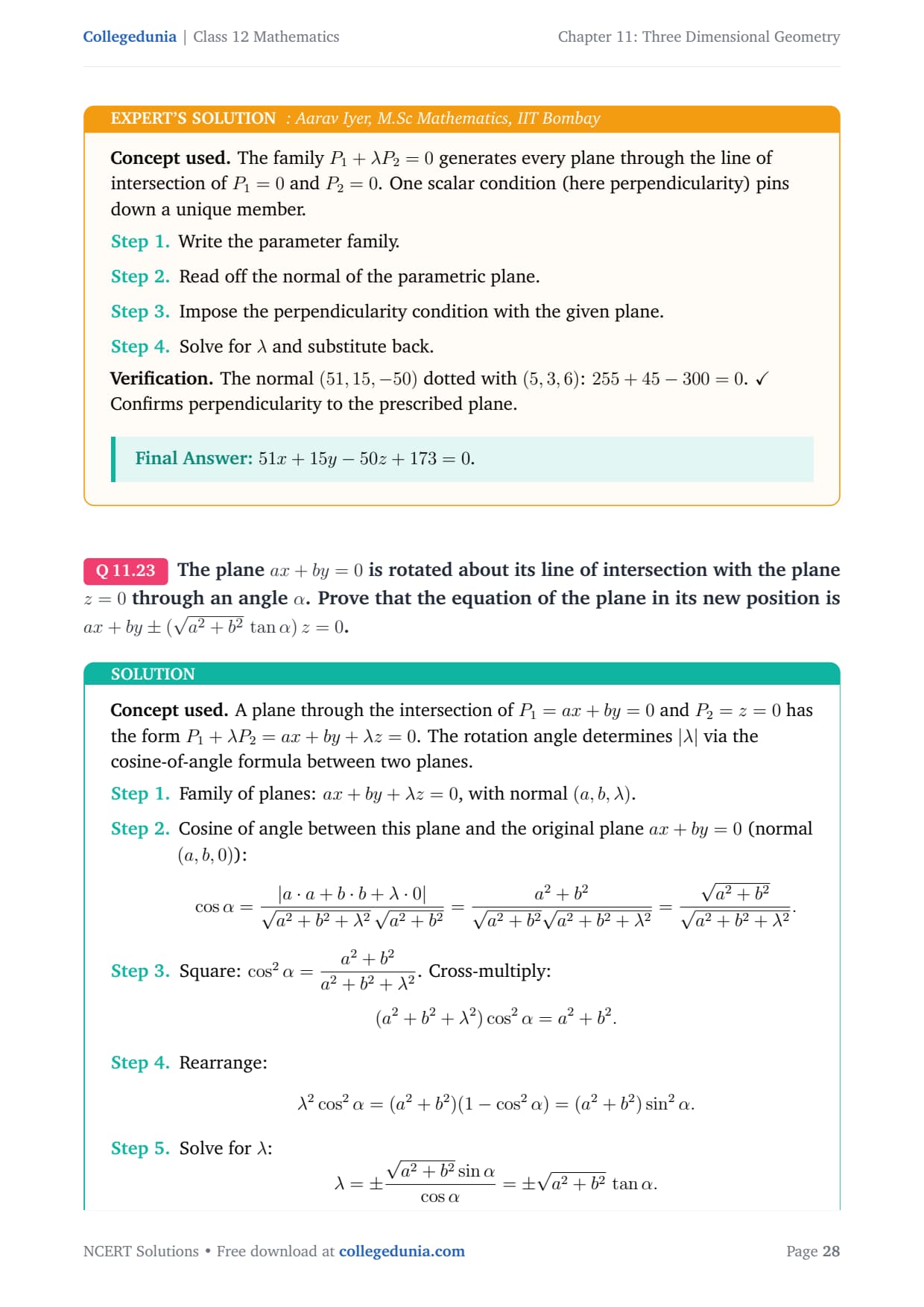
Concept used. A plane through the intersection of P1=ax+by=0 and P2=z=0 has the form P1+λ P2=ax+by+λ z=0. The rotation angle determines |λ| via the cosine-of-angle formula between two planes.
Family of planes: ax+by+λ z=0, with normal (a,b,λ).
Cosine of angle between this plane and the original plane ax+by=0 (normal (a,b,0)):
cosα=|a· a+b· b+λ· 0|√a2+b2+λ2√a2+b2=a2+b2√a2+b2√a2+b2+λ2=√a2+b2√a2+b2+λ2.
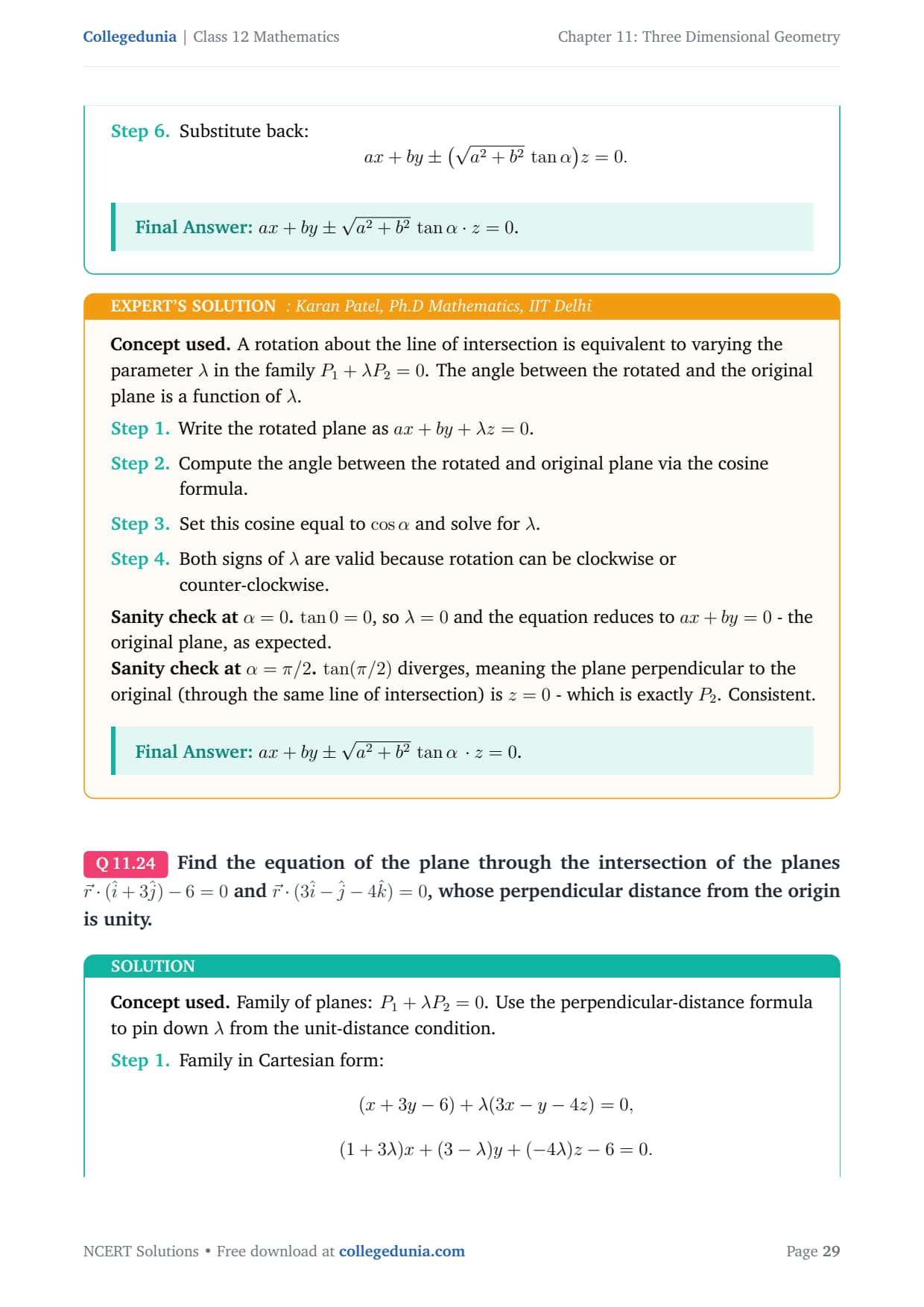
Concept used. A rotation about the line of intersection is equivalent to varying the parameter λ in the family P1+λ P2=0. The angle between the rotated and the original plane is a function of λ.
Write the rotated plane as ax+by+λ z=0.
Compute the angle between the rotated and original plane via the cosine formula.
Set this cosine equal to cosα and solve for λ.
Both signs of λ are valid because rotation can be clockwise or counter-clockwise.
Sanity check at α=0.tan 0=0, so λ=0 and the equation reduces to ax+by=0 - the original plane, as expected.
Sanity check at α=π/2.tan(π/2) diverges, meaning the plane perpendicular to the original (through the same line of intersection) is z=0 - which is exactly P2. Consistent.
ax+by±√a2+b2 tanα · z=0.
Q 11.24
Find the equation of the plane through the intersection of the planes r⃗·(î+3ĵ)-6=0 and r⃗·(3î-ĵ-4k̂)=0, whose perpendicular distance from the origin is unity.
Concept used. Family of planes: P1+λ P2=0. Use the perpendicular-distance formula to pin down λ from the unit-distance condition.
Family in Cartesian form:
(x+3y-6)+λ(3x-y-4z)=0, (1+3λ)x+(3-λ)y+(-4λ)z-6=0.
Distance from origin:
d=|-6|√(1+3λ)2+(3-λ)2+16λ2=1.
So √(1+3λ)2+(3-λ)2+16λ2=6. Square:
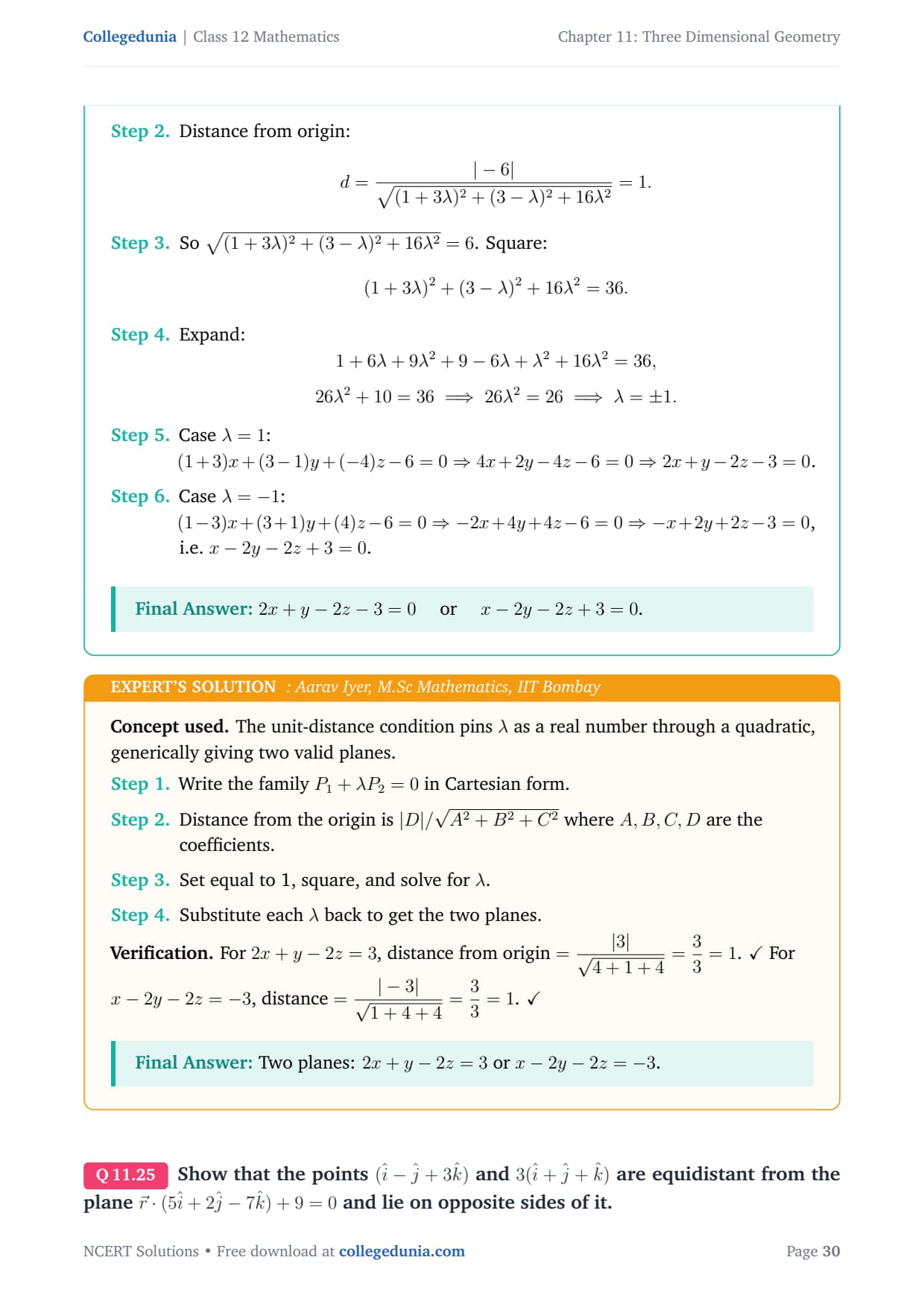
(1+3λ)2+(3-λ)2+16λ2=36.
Case λ=1: (1+3)x+(3-1)y+(-4)z-6=0⇒ 4x+2y-4z-6=0⇒ 2x+y-2z-3=0.
Case λ=-1: (1-3)x+(3+1)y+(4)z-6=0⇒ -2x+4y+4z-6=0⇒ -x+2y+2z-3=0, i.e. x-2y-2z+3=0.
2x+y-2z-3=0 or x-2y-2z+3=0.
AI
Aarav Iyer
M.Sc Mathematics, IIT Bombay
Verified Expert
Concept used. The unit-distance condition pins λ as a real number through a quadratic, generically giving two valid planes.
Write the family P1+λ P2=0 in Cartesian form.
Distance from the origin is |D|/√A2+B2+C2 where A,B,C,D are the coefficients.
Set equal to 1, square, and solve for λ.
Substitute each λ back to get the two planes.
Verification. For 2x+y-2z=3, distance from origin =|3|√4+1+4=33=1. For x-2y-2z=-3, distance =|-3|√1+4+4=33=1.
Two planes: 2x+y-2z=3 or x-2y-2z=-3.
Q 11.25
Show that the points (î-ĵ+3k̂) and 3(î+ĵ+k̂) are equidistant from the plane r⃗·(5î+2ĵ-7k̂)+9=0 and lie on opposite sides of it.
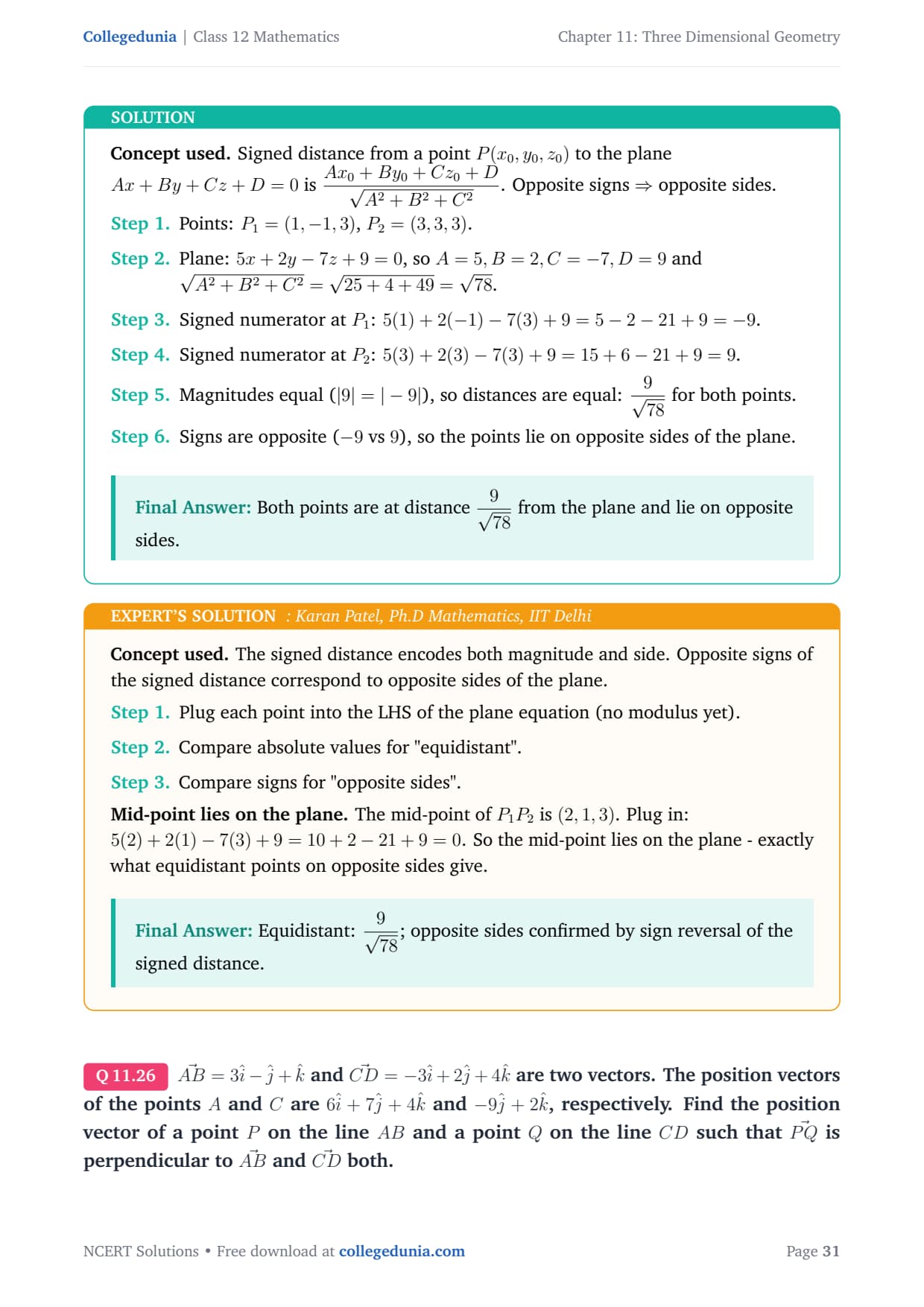
Concept used. Signed distance from a point P(x0,y0,z0) to the plane Ax+By+Cz+D=0 is Ax0+By0+Cz0+D√A2+B2+C2. Opposite signs ⇒ opposite sides.
Points: P1=(1,-1,3), P2=(3,3,3).
Plane: 5x+2y-7z+9=0, so A=5,B=2,C=-7,D=9 and √A2+B2+C2=√25+4+49=√78.
Signed numerator at P1: 5(1)+2(-1)-7(3)+9=5-2-21+9=-9.
Signed numerator at P2: 5(3)+2(3)-7(3)+9=15+6-21+9=9.
Magnitudes equal (|9|=|-9|), so distances are equal: 9√78 for both points.
Signs are opposite (-9 vs 9), so the points lie on opposite sides of the plane.
Both points are at distance 9√78 from the plane and lie on opposite sides.
KP
Karan Patel
Ph.D Mathematics, IIT Delhi
Verified Expert
Concept used. The signed distance encodes both magnitude and side. Opposite signs of the signed distance correspond to opposite sides of the plane.
Plug each point into the LHS of the plane equation (no modulus yet).
Compare absolute values for "equidistant".
Compare signs for "opposite sides".
Mid-point lies on the plane. The mid-point of P1P2 is (2,1,3). Plug in: 5(2)+2(1)-7(3)+9=10+2-21+9=0. So the mid-point lies on the plane - exactly what equidistant points on opposite sides give.
Equidistant: 9√78; opposite sides confirmed by sign reversal of the signed distance.
Q 11.26
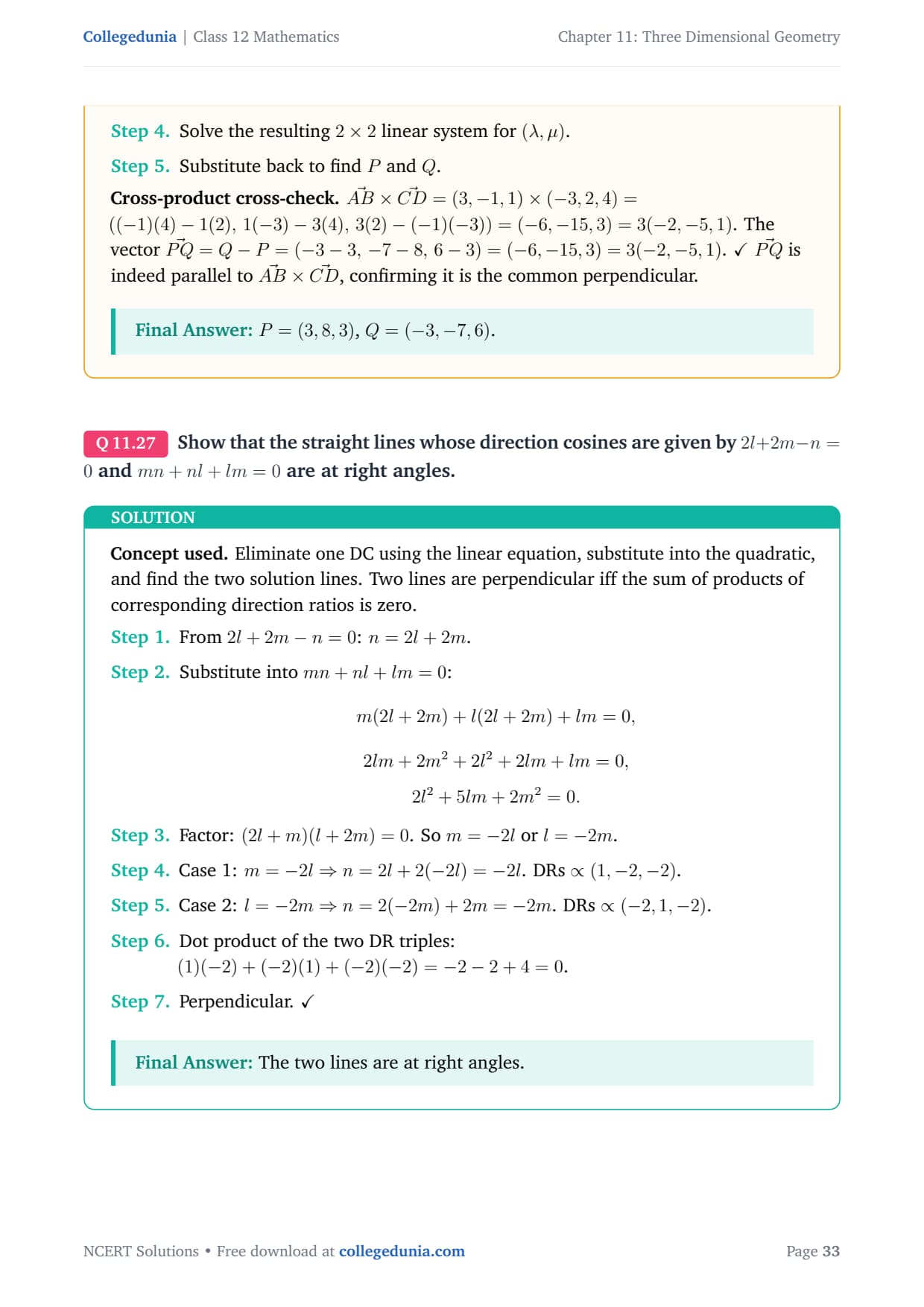
AB⃗=3î-ĵ+k̂ and CD⃗=-3î+2ĵ+4k̂ are two vectors. The position vectors of the points A and C are 6î+7ĵ+4k̂ and -9ĵ+2k̂, respectively. Find the position vector of a point P on the line AB and a point Q on the line CD such that PQ⃗ is perpendicular to AB⃗ and CD⃗ both.
Concept used. Parametrise points on each line, write PQ⃗ in terms of the two parameters, and impose the two perpendicularity conditions PQ⃗·AB⃗=0 and PQ⃗·CD⃗=0.
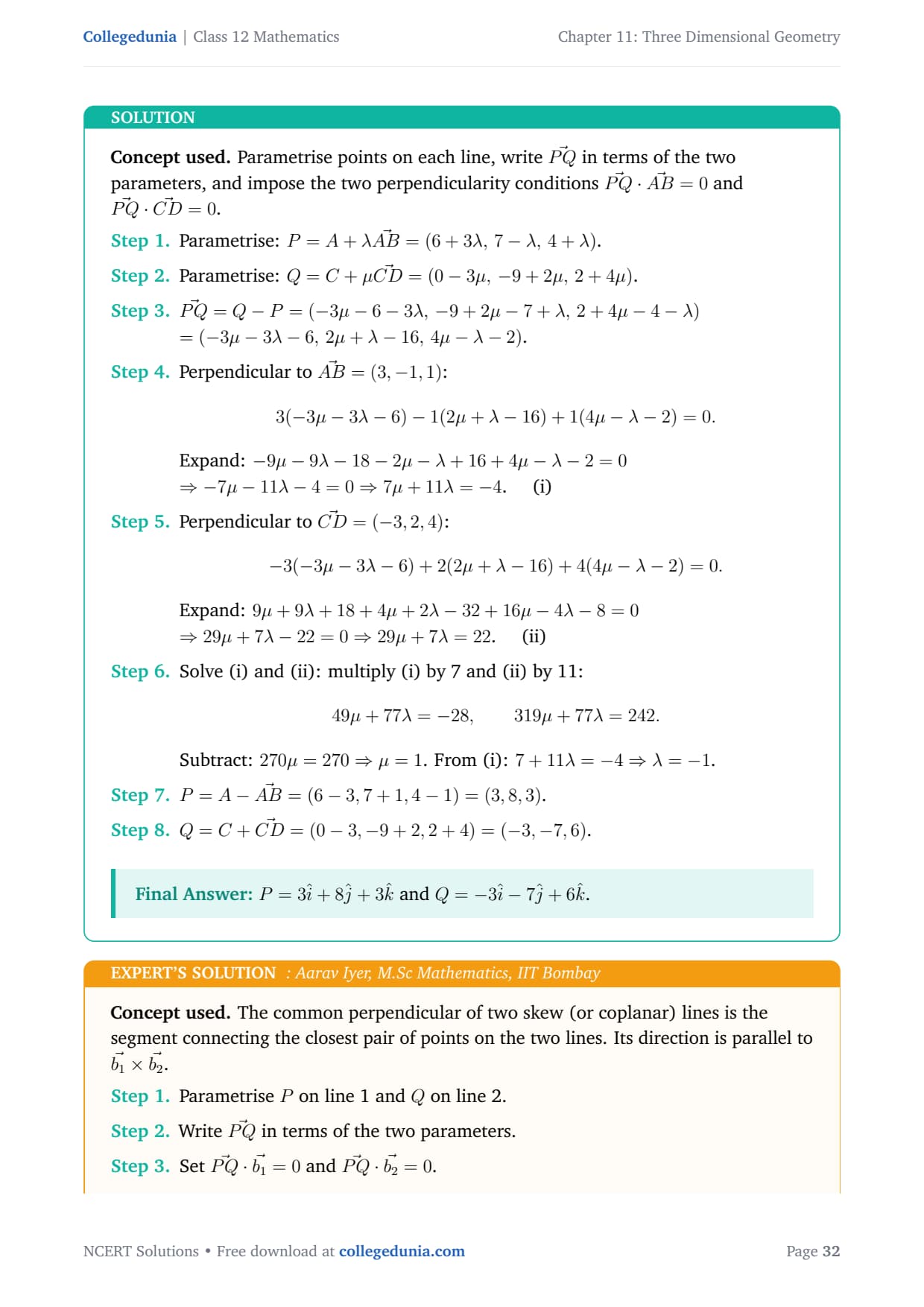
Perpendicular to AB⃗=(3,-1,1):
3(-3μ-3λ-6)-1(2μ+λ-16)+1(4μ-λ-2)=0.
Expand: -9μ-9λ-18-2μ-λ+16+4μ-λ-2=0⇒ -7μ-11λ-4=0⇒ 7μ+11λ=-4. (i)
Perpendicular to CD⃗=(-3,2,4):
-3(-3μ-3λ-6)+2(2μ+λ-16)+4(4μ-λ-2)=0.
Expand: 9μ+9λ+18+4μ+2λ-32+16μ-4λ-8=0⇒ 29μ+7λ-22=0⇒ 29μ+7λ=22. (ii)
Solve (i) and (ii): multiply (i) by 7 and (ii) by 11:
49μ+77λ=-28, 319μ+77λ=242.
Subtract: 270μ=270⇒μ=1. From (i): 7+11λ=-4⇒ λ=-1.
P=A-AB⃗=(6-3,7+1,4-1)=(3,8,3).
Q=C+CD⃗=(0-3,-9+2,2+4)=(-3,-7,6).
P=3î+8ĵ+3k̂ and Q=-3î-7ĵ+6k̂.
AI
Aarav Iyer
M.Sc Mathematics, IIT Bombay
Verified Expert
Concept used. The common perpendicular of two skew (or coplanar) lines is the segment connecting the closest pair of points on the two lines. Its direction is parallel to b1⃗×b2⃗.
Parametrise P on line 1 and Q on line 2.
Write PQ⃗ in terms of the two parameters.
Set PQ⃗·b1⃗=0 and PQ⃗·b2⃗=0.
Solve the resulting 2× 2 linear system for (λ,μ).
Substitute back to find P and Q.
Cross-product cross-check.AB⃗×CD⃗=(3,-1,1)×(-3,2,4)=((-1)(4)-1(2), 1(-3)-3(4), 3(2)-(-1)(-3))=(-6,-15,3)=3(-2,-5,1). The vector PQ⃗=Q-P=(-3-3, -7-8, 6-3)=(-6,-15,3)=3(-2,-5,1). PQ⃗ is indeed parallel to AB⃗×CD⃗, confirming it is the common perpendicular.
P=(3,8,3), Q=(-3,-7,6).
Q 11.27
Show that the straight lines whose direction cosines are given by 2l+2m-n=0 and mn+nl+lm=0 are at right angles.
Concept used. Eliminate one DC using the linear equation, substitute into the quadratic, and find the two solution lines. Two lines are perpendicular iff the sum of products of corresponding direction ratios is zero.
From 2l+2m-n=0: n=2l+2m.
Substitute into mn+nl+lm=0:
m(2l+2m)+l(2l+2m)+lm=0, 2lm+2m2+2l2+2lm+lm=0, 2l2+5lm+2m2=0.
Factor: (2l+m)(l+2m)=0. So m=-2l or l=-2m.
Case 1: m=-2l⇒ n=2l+2(-2l)=-2l. DRs ∝ (1,-2,-2).
Case 2: l=-2m⇒ n=2(-2m)+2m=-2m. DRs ∝ (-2,1,-2).
Dot product of the two DR triples: (1)(-2)+(-2)(1)+(-2)(-2)=-2-2+4=0.
Perpendicular.
The two lines are at right angles.
KP
Karan Patel
Ph.D Mathematics, IIT Delhi
Verified Expert
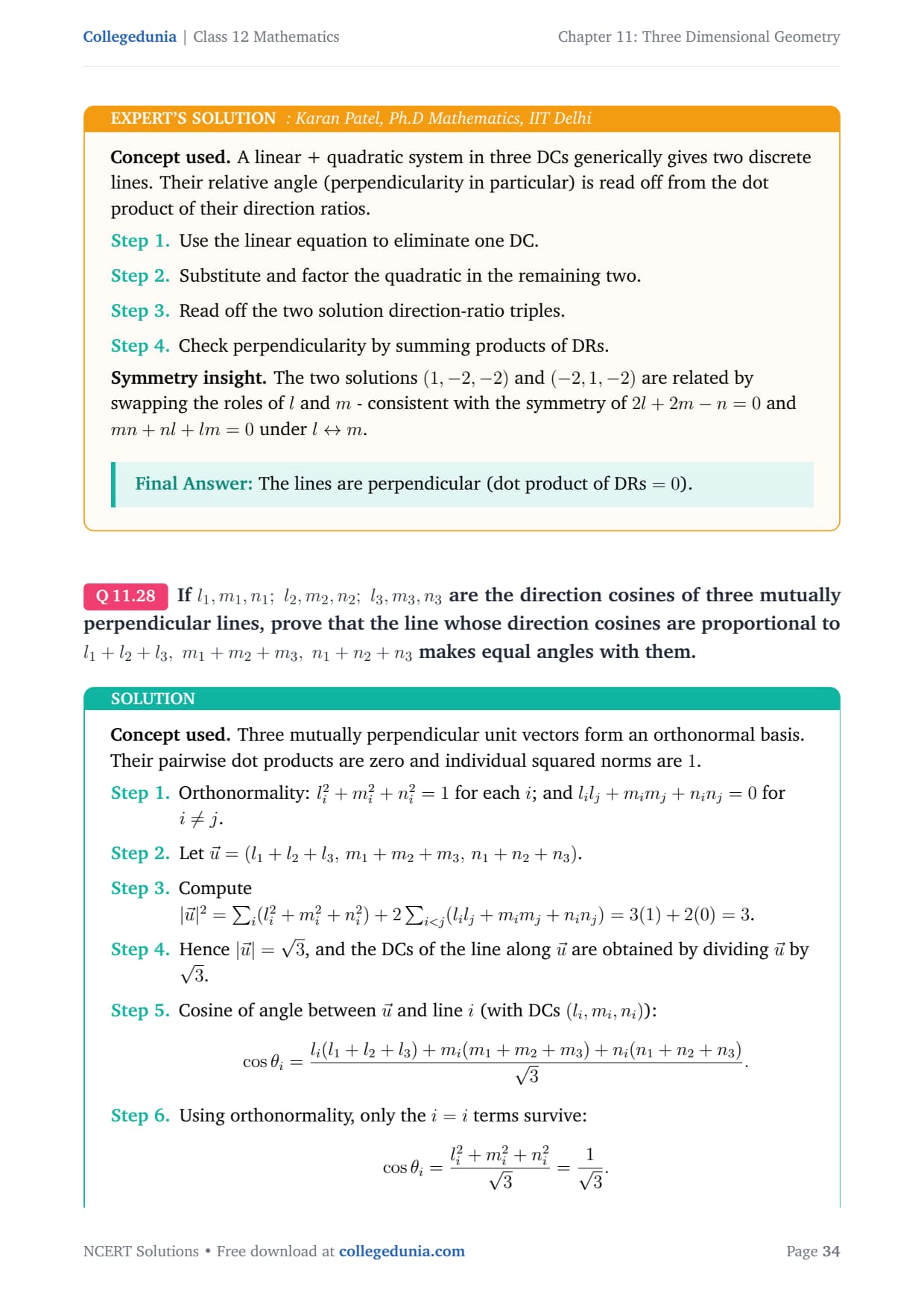
Concept used. A linear + quadratic system in three DCs generically gives two discrete lines. Their relative angle (perpendicularity in particular) is read off from the dot product of their direction ratios.
Use the linear equation to eliminate one DC.
Substitute and factor the quadratic in the remaining two.
Read off the two solution direction-ratio triples.
Check perpendicularity by summing products of DRs.
Symmetry insight. The two solutions (1,-2,-2) and (-2,1,-2) are related by swapping the roles of l and m - consistent with the symmetry of 2l+2m-n=0 and mn+nl+lm=0 under l↔ m.
The lines are perpendicular (dot product of DRs = 0).
Q 11.28
If l1,m1,n1; l2,m2,n2; l3,m3,n3 are the direction cosines of three mutually perpendicular lines, prove that the line whose direction cosines are proportional to l1+l2+l3, m1+m2+m3, n1+n2+n3 makes equal angles with them.
Concept used. Three mutually perpendicular unit vectors form an orthonormal basis. Their pairwise dot products are zero and individual squared norms are 1.
Orthonormality: li2+mi2+ni2=1 for each i; and lilj+mimj+ninj=0 for i≠ j.
Hence |u⃗|=√3, and the DCs of the line along u⃗ are obtained by dividing u⃗ by √3.
Cosine of angle between u⃗ and line i (with DCs (li,mi,ni)):
cosi=li(l1+l2+l3)+mi(m1+m2+m3)+ni(n1+n2+n3)√3.
Using orthonormality, only the i=i terms survive:
cosi=li2+mi2+ni2√3=1√3.
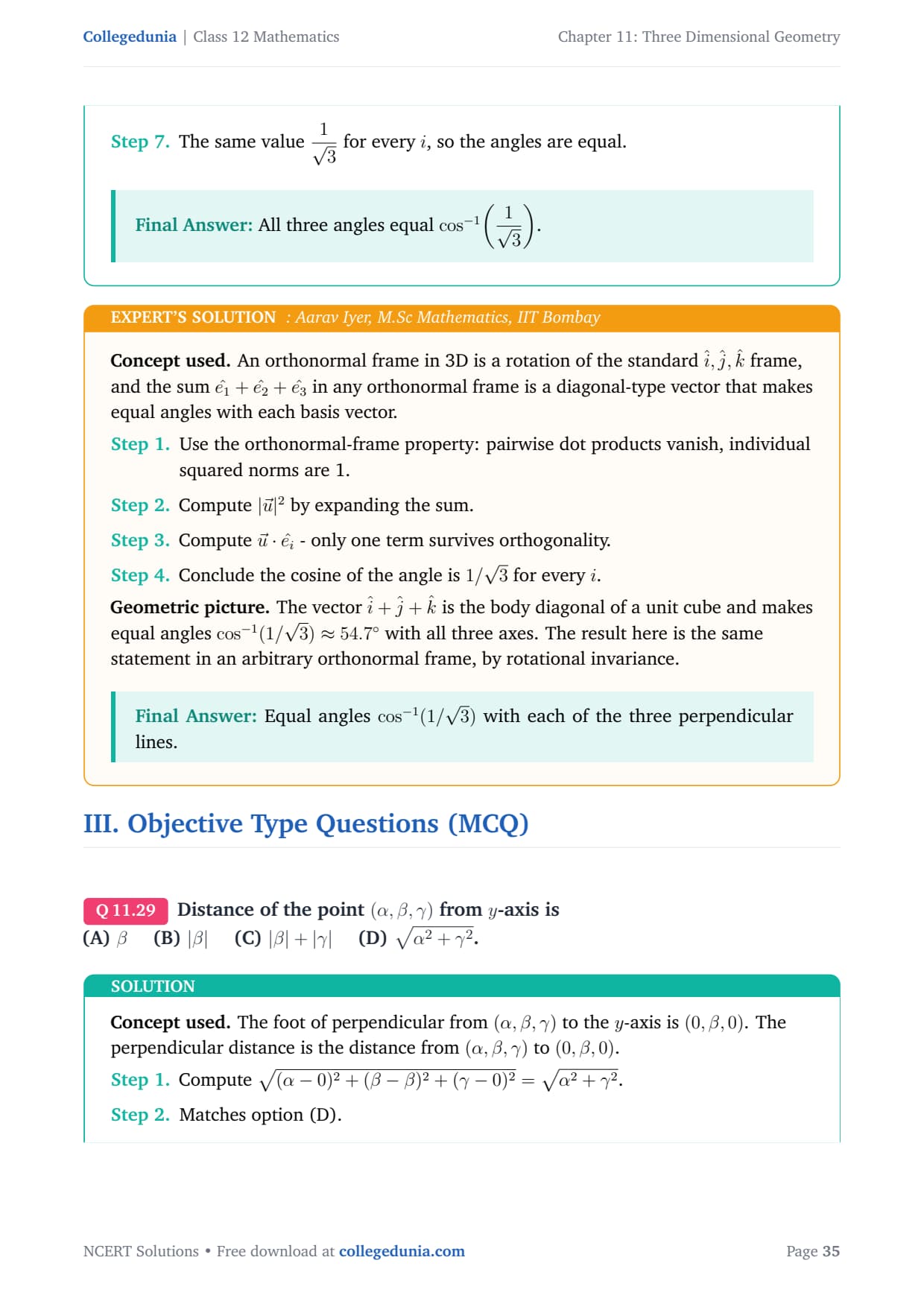
The same value 1√3 for every i, so the angles are equal.
All three angles equal cos-1(1√3).
AI
Aarav Iyer
M.Sc Mathematics, IIT Bombay
Verified Expert
Concept used. An orthonormal frame in 3D is a rotation of the standard î,ĵ,k̂ frame, and the sum e1̂+e2̂+e3̂ in any orthonormal frame is a diagonal-type vector that makes equal angles with each basis vector.
Use the orthonormal-frame property: pairwise dot products vanish, individual squared norms are 1.
Compute |u⃗|2 by expanding the sum.
Compute u⃗·eî - only one term survives orthogonality.
Conclude the cosine of the angle is 1/√3 for every i.
Geometric picture. The vector î+ĵ+k̂ is the body diagonal of a unit cube and makes equal angles cos-1(1/√3)≈ 54.7∘ with all three axes. The result here is the same statement in an arbitrary orthonormal frame, by rotational invariance.
Equal angles cos-1(1/√3) with each of the three perpendicular lines.
III. Objective Type Questions (MCQ)
Q 11.29
Distance of the point (α,β,γ) from y-axis is
(A) β (B) |β| (C) |β|+|γ| (D) √α2+γ2.
Concept used. The foot of perpendicular from (α,β,γ) to the y-axis is (0,β,0). The perpendicular distance is the distance from (α,β,γ) to (0,β,0).
Compute √(α-0)2+(β-β)2+(γ-0)2=√α2+γ2.
Matches option (D).
(D) √α2+γ2.
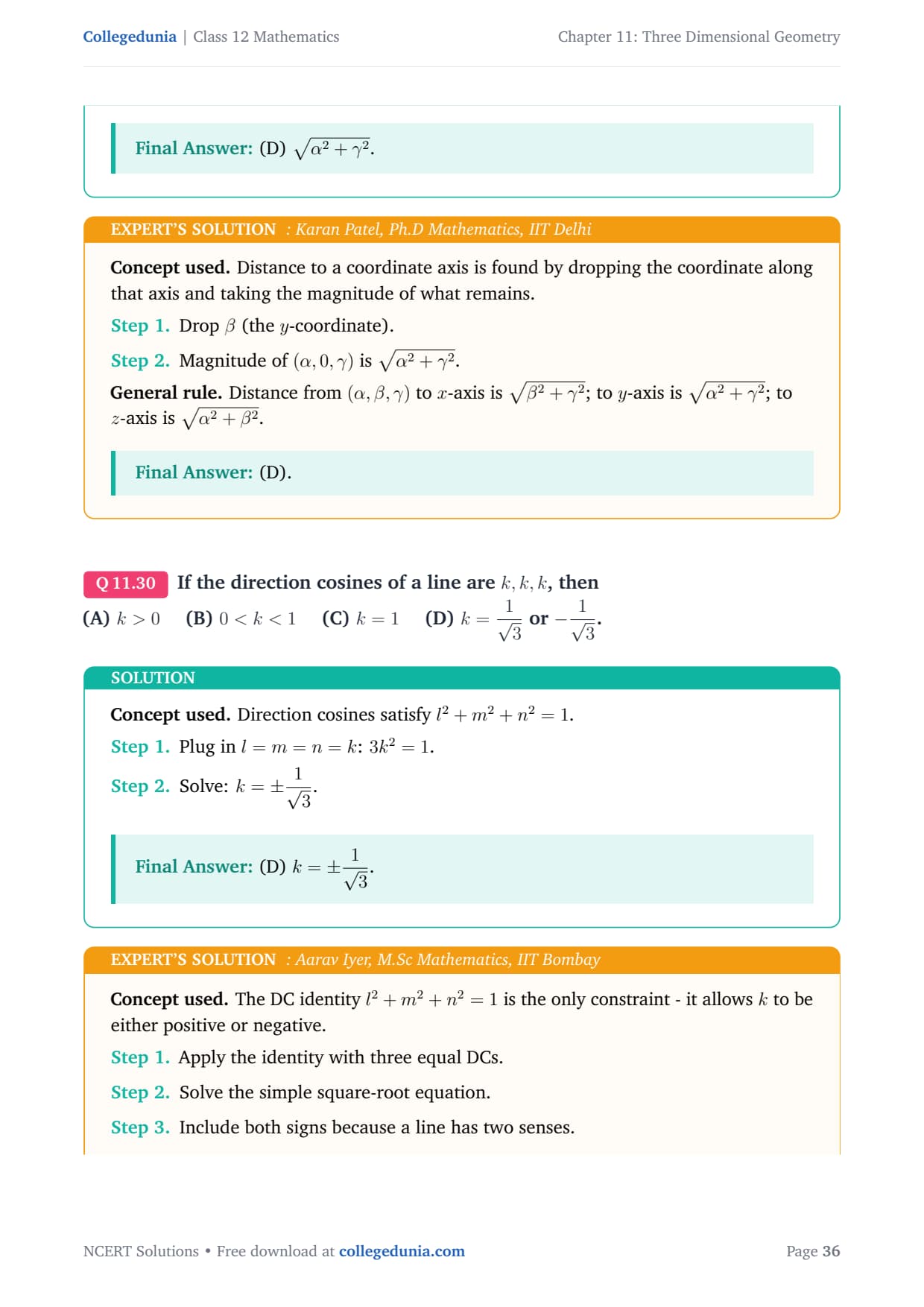
KP
Karan Patel
Ph.D Mathematics, IIT Delhi
Verified Expert
Concept used. Distance to a coordinate axis is found by dropping the coordinate along that axis and taking the magnitude of what remains.
Drop β (the y-coordinate).
Magnitude of (α,0,γ) is √α2+γ2.
General rule. Distance from (α,β,γ) to x-axis is √β2+γ2; to y-axis is √α2+γ2; to z-axis is √α2+β2.
(D).
Q 11.30
If the direction cosines of a line are k,k,k, then
(A) k>0 (B) 0 (C) k=1 (D) k=1√3 or -1√3.
Concept used. Direction cosines satisfy l2+m2+n2=1.
Plug in l=m=n=k: 3k2=1.
Solve: k=±1√3.
(D) k=±1√3.
AI
Aarav Iyer
M.Sc Mathematics, IIT Bombay
Verified Expert
Concept used. The DC identity l2+m2+n2=1 is the only constraint - it allows k to be either positive or negative.
Apply the identity with three equal DCs.
Solve the simple square-root equation.
Include both signs because a line has two senses.
(D).
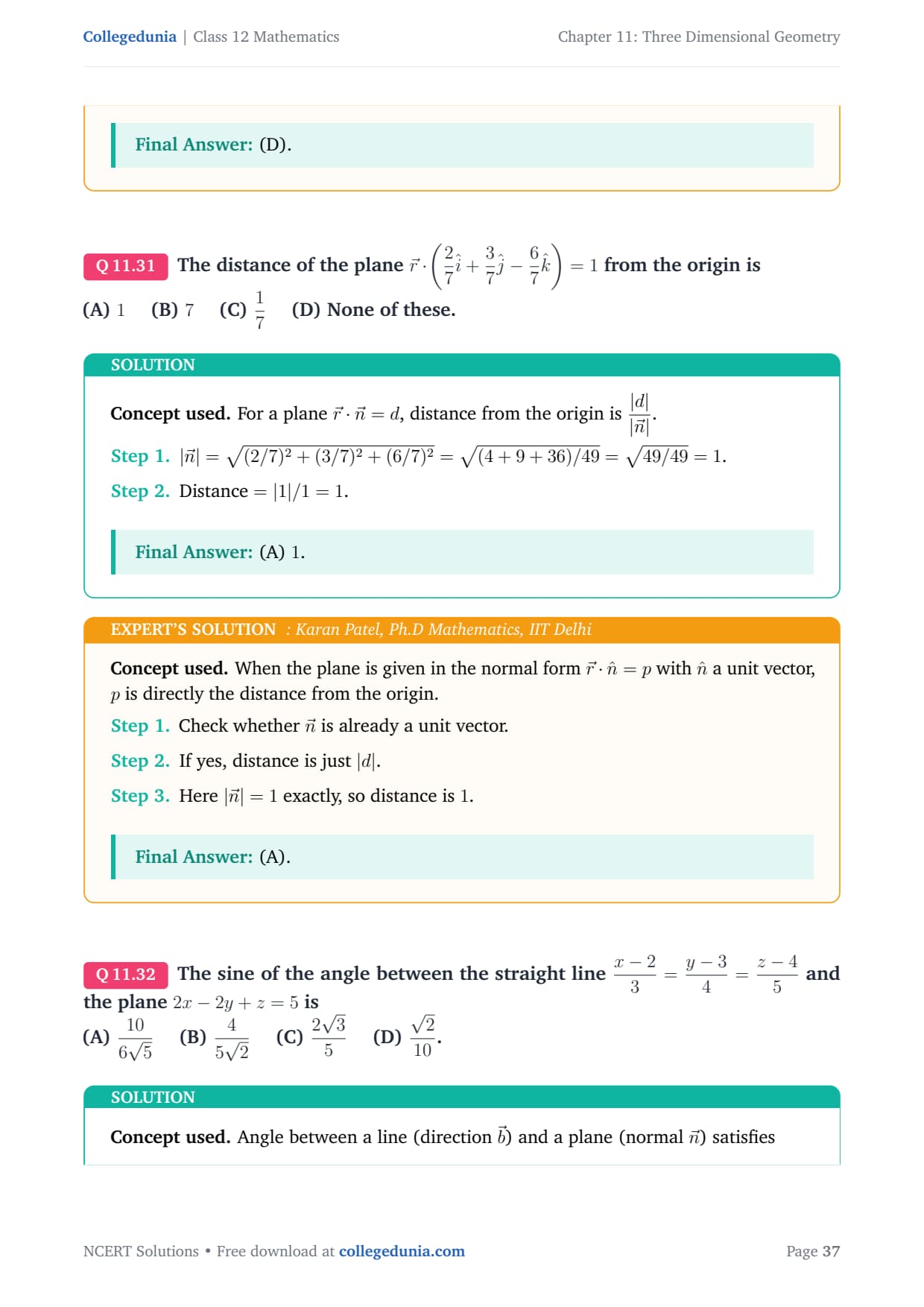
Q 11.31
The distance of the plane r⃗·(27î+37ĵ-67k̂)=1 from the origin is
(A) 1 (B) 7 (C) 17 (D) None of these.
Concept used. For a plane r⃗·n⃗=d, distance from the origin is |d||n⃗|.
|n⃗|=√(2/7)2+(3/7)2+(6/7)2=√(4+9+36)/49=√49/49=1.
Distance =|1|/1=1.
(A) 1.
KP
Karan Patel
Ph.D Mathematics, IIT Delhi
Verified Expert
Concept used. When the plane is given in the normal form r⃗·n̂=p with n̂ a unit vector, p is directly the distance from the origin.
Check whether n⃗ is already a unit vector.
If yes, distance is just |d|.
Here |n⃗|=1 exactly, so distance is 1.
(A).
Q 11.32
The sine of the angle between the straight line x-23=y-34=z-45 and the plane 2x-2y+z=5 is
(A) 106√5 (B) 45√2 (C) 2√35 (D) √210.
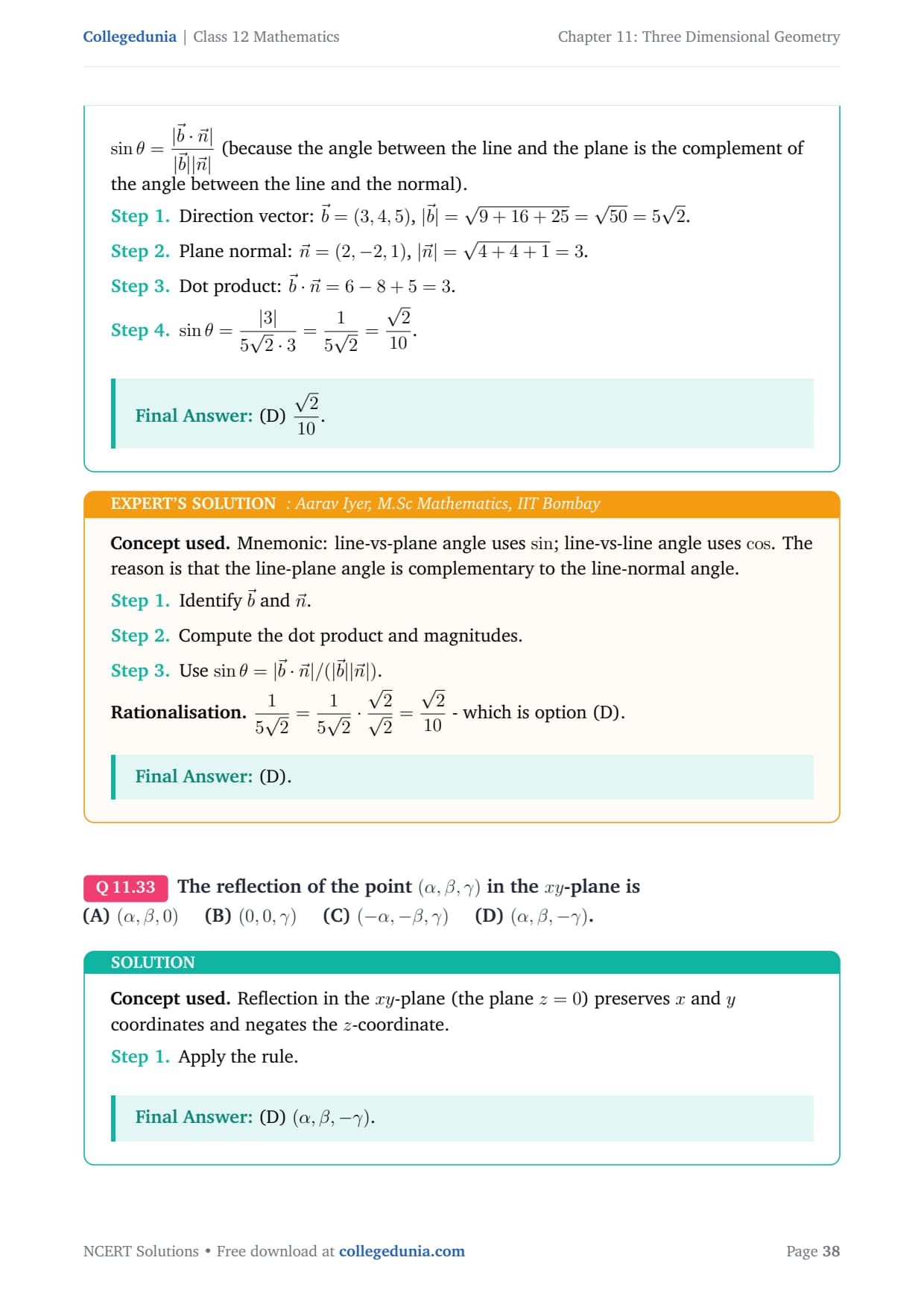
Concept used. Angle between a line (direction b⃗) and a plane (normal n⃗) satisfies sinθ=|b⃗·n⃗||b⃗||n⃗| (because the angle between the line and the plane is the complement of the angle between the line and the normal).
Direction vector: b⃗=(3,4,5), |b⃗|=√9+16+25=√50=5√2.
Plane normal: n⃗=(2,-2,1), |n⃗|=√4+4+1=3.
Dot product: b⃗·n⃗=6-8+5=3.
sinθ=|3|5√2· 3=15√2=√210.
(D) √210.
AI
Aarav Iyer
M.Sc Mathematics, IIT Bombay
Verified Expert
Concept used. Mnemonic: line-vs-plane angle uses sin; line-vs-line angle uses cos. The reason is that the line-plane angle is complementary to the line-normal angle.
Identify b⃗ and n⃗.
Compute the dot product and magnitudes.
Use sinθ=|b⃗·n⃗|/(|b⃗||n⃗|).
Rationalisation.15√2=15√2·√2√2=√210 - which is option (D).
(D).
Q 11.33
The reflection of the point (α,β,γ) in the xy-plane is
(A) (α,β,0) (B) (0,0,γ) (C) (-α,-β,γ) (D) (α,β,-γ).
Concept used. Reflection in the xy-plane (the plane z=0) preserves x and y coordinates and negates the z-coordinate.
Apply the rule.
(D) (α,β,-γ).
KP
Karan Patel
Ph.D Mathematics, IIT Delhi
Verified Expert
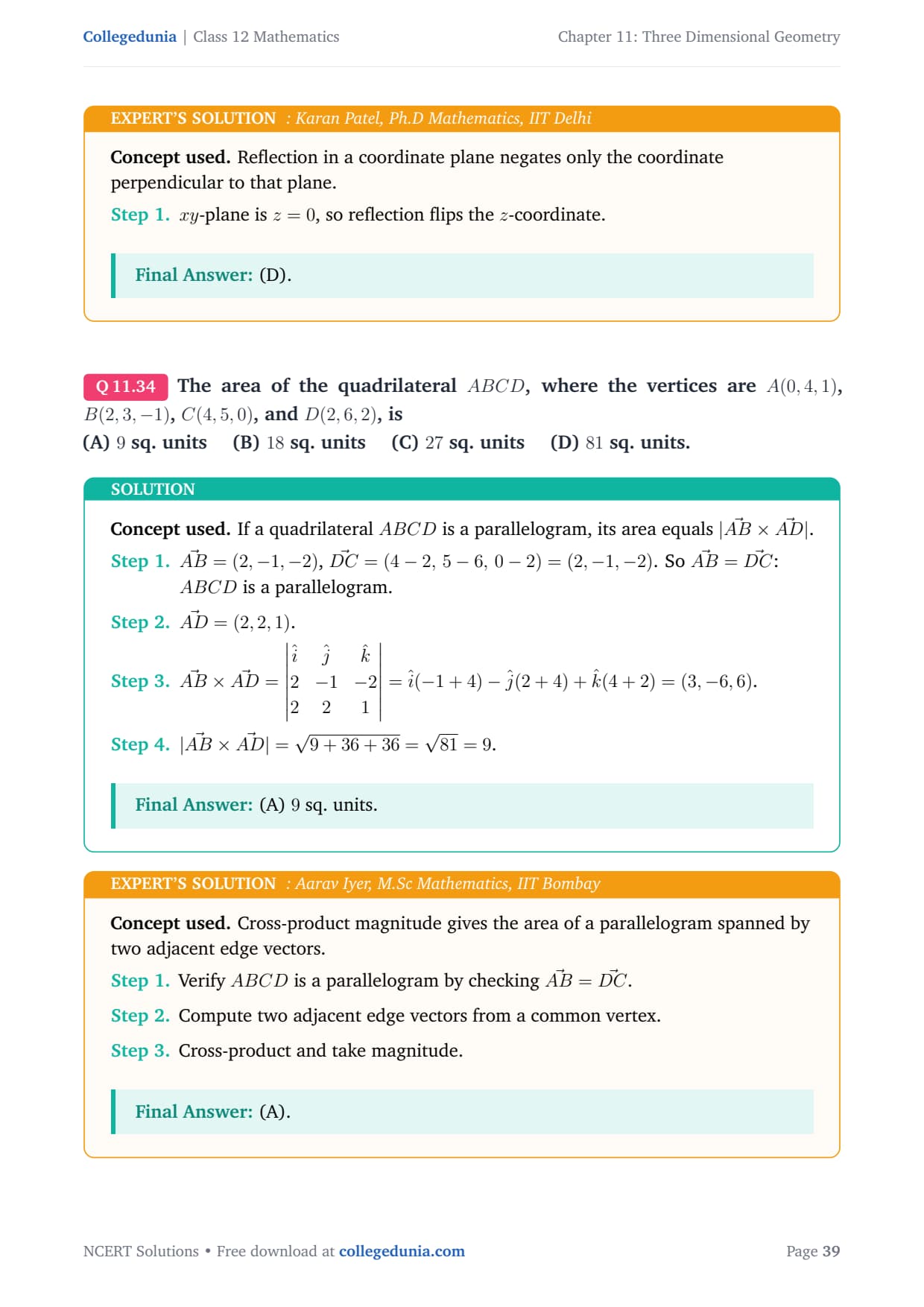
Concept used. Reflection in a coordinate plane negates only the coordinate perpendicular to that plane.
xy-plane is z=0, so reflection flips the z-coordinate.
(D).
Q 11.34
The area of the quadrilateral ABCD, where the vertices are A(0,4,1), B(2,3,-1), C(4,5,0), and D(2,6,2), is
(A) 9 sq. units (B) 18 sq. units (C) 27 sq. units (D) 81 sq. units.
Concept used. If a quadrilateral ABCD is a parallelogram, its area equals |AB⃗×AD⃗|.
AB⃗=(2,-1,-2), DC⃗=(4-2, 5-6, 0-2)=(2,-1,-2). So AB⃗=DC⃗: ABCD is a parallelogram.
Concept used. Cross-product magnitude gives the area of a parallelogram spanned by two adjacent edge vectors.
Verify ABCD is a parallelogram by checking AB⃗=DC⃗.
Compute two adjacent edge vectors from a common vertex.
Cross-product and take magnitude.
(A).
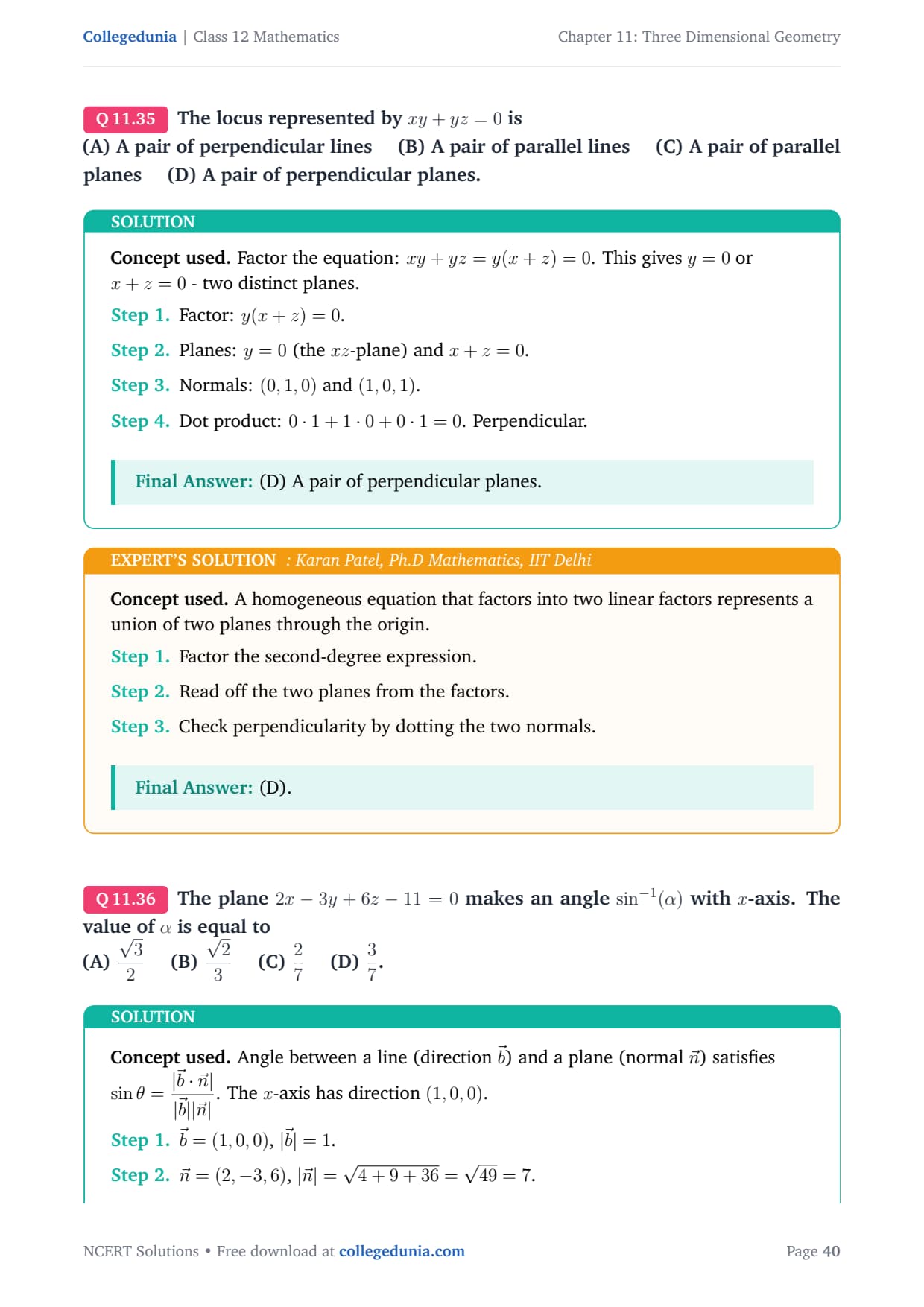
Q 11.35
The locus represented by xy+yz=0 is
(A) A pair of perpendicular lines (B) A pair of parallel lines (C) A pair of parallel planes (D) A pair of perpendicular planes.
Concept used. Factor the equation: xy+yz=y(x+z)=0. This gives y=0 or x+z=0 - two distinct planes.
Factor: y(x+z)=0.
Planes: y=0 (the xz-plane) and x+z=0.
Normals: (0,1,0) and (1,0,1).
Dot product: 0· 1+1· 0+0· 1=0. Perpendicular.
(D) A pair of perpendicular planes.
KP
Karan Patel
Ph.D Mathematics, IIT Delhi
Verified Expert
Concept used. A homogeneous equation that factors into two linear factors represents a union of two planes through the origin.
Factor the second-degree expression.
Read off the two planes from the factors.
Check perpendicularity by dotting the two normals.
(D).
Q 11.36
The plane 2x-3y+6z-11=0 makes an angle sin-1(α) with x-axis. The value of α is equal to
(A) √32 (B) √23 (C) 27 (D) 37.
Concept used. Angle between a line (direction b⃗) and a plane (normal n⃗) satisfies sinθ=|b⃗·n⃗||b⃗||n⃗|. The x-axis has direction (1,0,0).
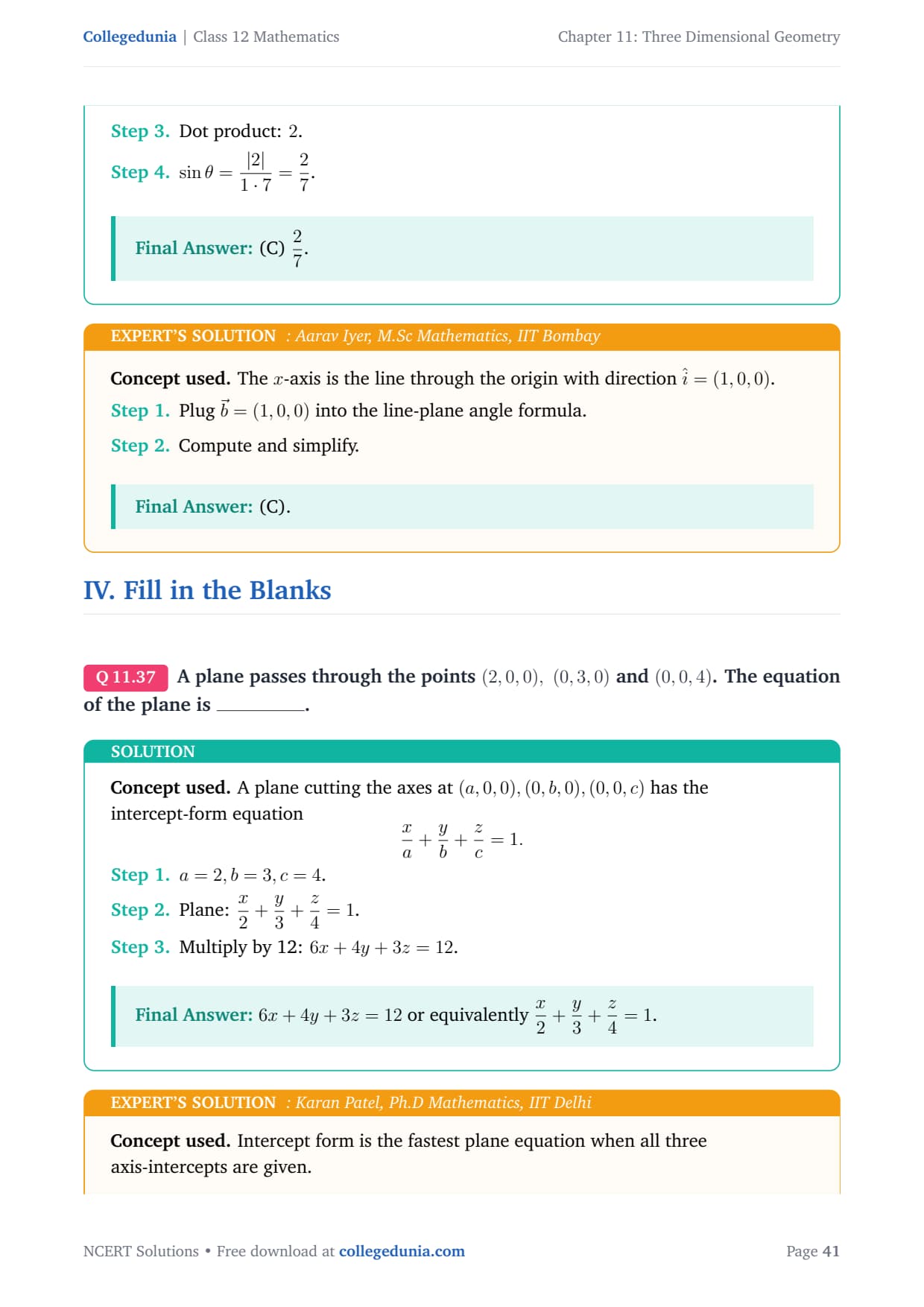
b⃗=(1,0,0), |b⃗|=1.
n⃗=(2,-3,6), |n⃗|=√4+9+36=√49=7.
Dot product: 2.
sinθ=|2|1· 7=27.
(C) 27.
AI
Aarav Iyer
M.Sc Mathematics, IIT Bombay
Verified Expert
Concept used. The x-axis is the line through the origin with direction î=(1,0,0).
Plug b⃗=(1,0,0) into the line-plane angle formula.
Compute and simplify.
(C).
IV. Fill in the Blanks
Q 11.37
A plane passes through the points (2,0,0), (0,3,0) and (0,0,4). The equation of the plane is 2cm0.4pt.
Concept used. A plane cutting the axes at (a,0,0),(0,b,0),(0,0,c) has the intercept-form equation
xa+yb+zc=1.
a=2,b=3,c=4.
Plane: x2+y3+z4=1.
Multiply by 12: 6x+4y+3z=12.
6x+4y+3z=12 or equivalently x2+y3+z4=1.
KP
Karan Patel
Ph.D Mathematics, IIT Delhi
Verified Expert
Concept used. Intercept form is the fastest plane equation when all three axis-intercepts are given.
Read off the three intercepts.
Plug into the intercept formula.
Multiply through by the LCM of denominators for a clean integer form.
6x+4y+3z=12.
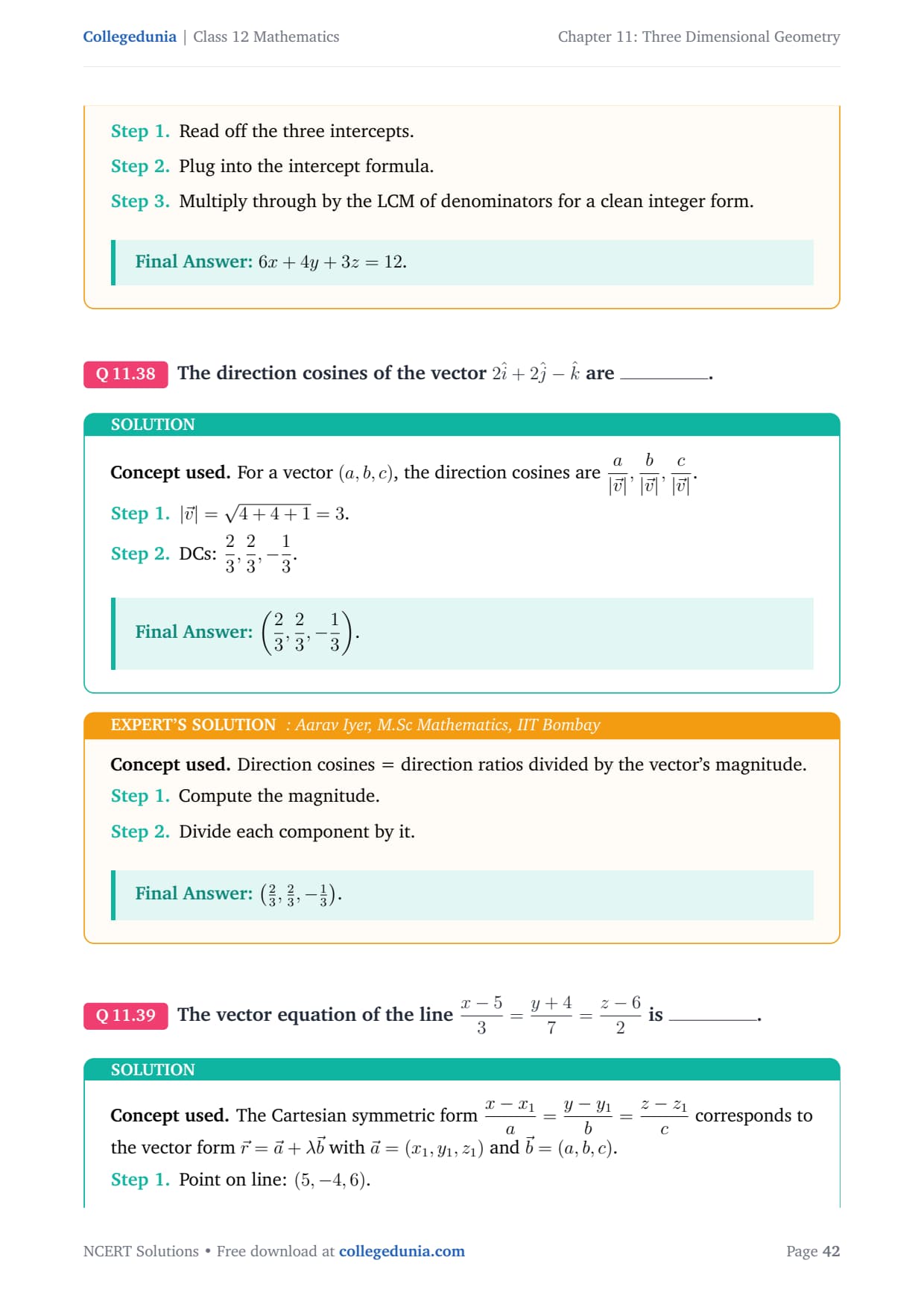
Q 11.38
The direction cosines of the vector 2î+2ĵ-k̂ are 2cm0.4pt.
Concept used. For a vector (a,b,c), the direction cosines are a|v⃗|,b|v⃗|,c|v⃗|.
|v⃗|=√4+4+1=3.
DCs: 23,23,-13.
(23,23,-13).
AI
Aarav Iyer
M.Sc Mathematics, IIT Bombay
Verified Expert
Concept used. Direction cosines = direction ratios divided by the vector's magnitude.
Compute the magnitude.
Divide each component by it.
(23,23,-13).
Q 11.39
The vector equation of the line x-53=y+47=z-62 is 2cm0.4pt.
Concept used. The Cartesian symmetric form x-x1a=y-y1b=z-z1c corresponds to the vector form r⃗=a⃗+λb⃗ with a⃗=(x1,y1,z1) and b⃗=(a,b,c).
Point on line: (5,-4,6).
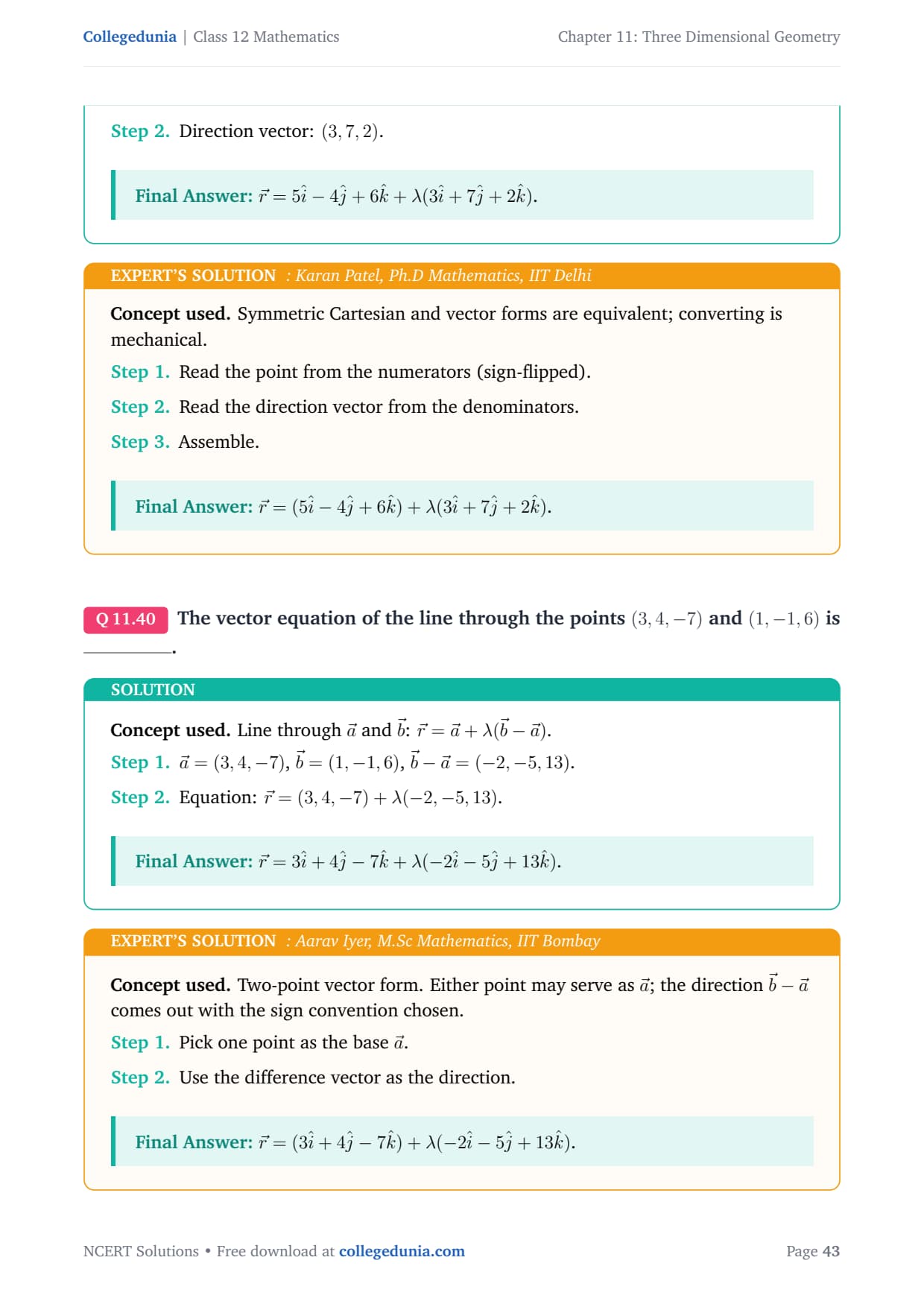
Direction vector: (3,7,2).
r⃗=5î-4ĵ+6k̂+λ(3î+7ĵ+2k̂).
KP
Karan Patel
Ph.D Mathematics, IIT Delhi
Verified Expert
Concept used. Symmetric Cartesian and vector forms are equivalent; converting is mechanical.
Read the point from the numerators (sign-flipped).
Read the direction vector from the denominators.
Assemble.
r⃗=(5î-4ĵ+6k̂)+λ(3î+7ĵ+2k̂).
Q 11.40
The vector equation of the line through the points (3,4,-7) and (1,-1,6) is 2cm0.4pt.
Concept used. Line through a⃗ and b⃗: r⃗=a⃗+λ(b⃗-a⃗).
a⃗=(3,4,-7), b⃗=(1,-1,6), b⃗-a⃗=(-2,-5,13).
Equation: r⃗=(3,4,-7)+λ(-2,-5,13).
r⃗=3î+4ĵ-7k̂+λ(-2î-5ĵ+13k̂).
AI
Aarav Iyer
M.Sc Mathematics, IIT Bombay
Verified Expert
Concept used. Two-point vector form. Either point may serve as a⃗; the direction b⃗-a⃗ comes out with the sign convention chosen.
Pick one point as the base a⃗.
Use the difference vector as the direction.
r⃗=(3î+4ĵ-7k̂)+λ(-2î-5ĵ+13k̂).
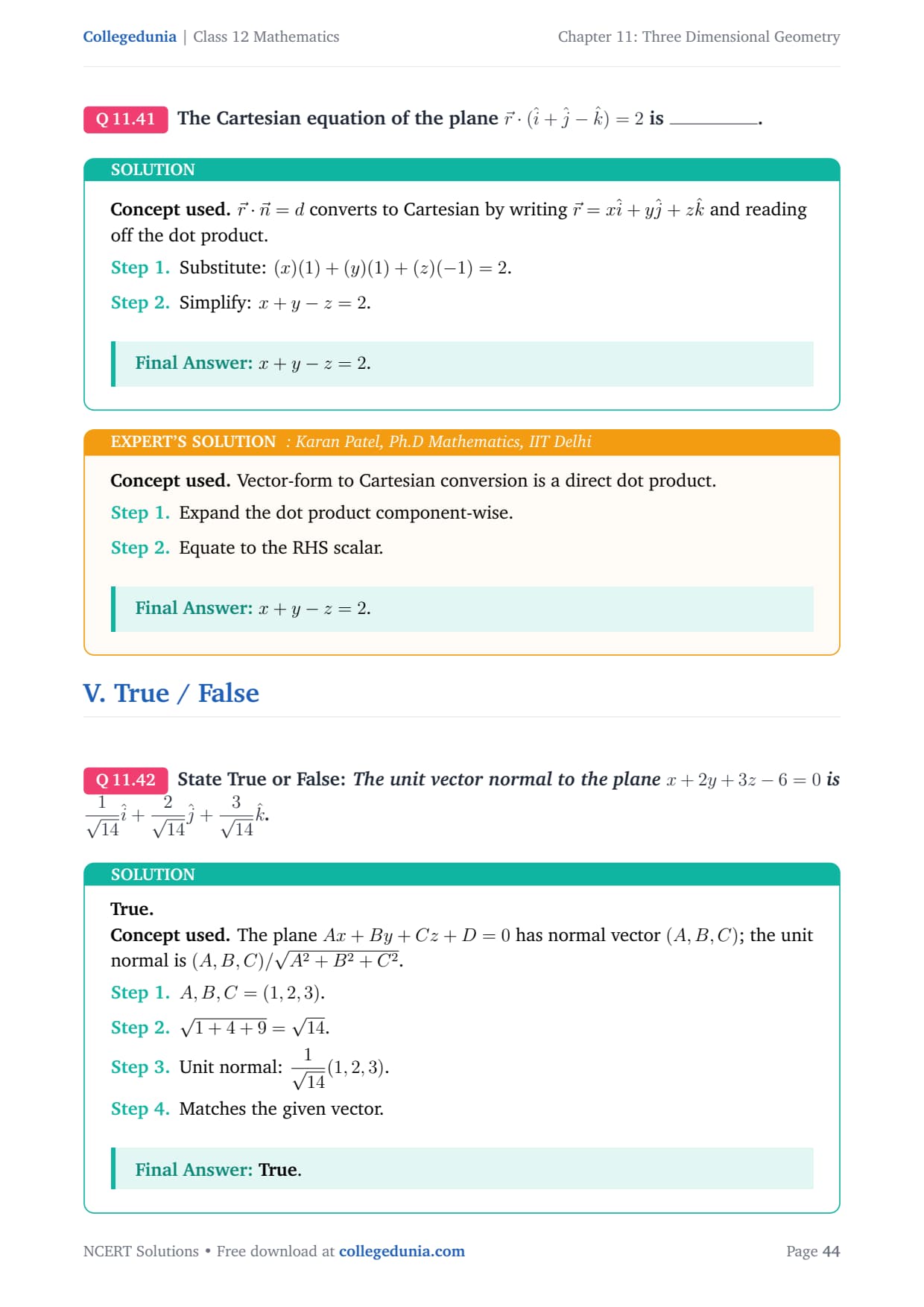
Q 11.41
The Cartesian equation of the plane r⃗·(î+ĵ-k̂)=2 is 2cm0.4pt.
Concept used.r⃗·n⃗=d converts to Cartesian by writing r⃗=xî+yĵ+zk̂ and reading off the dot product.
Substitute: (x)(1)+(y)(1)+(z)(-1)=2.
Simplify: x+y-z=2.
x+y-z=2.
KP
Karan Patel
Ph.D Mathematics, IIT Delhi
Verified Expert
Concept used. Vector-form to Cartesian conversion is a direct dot product.
Expand the dot product component-wise.
Equate to the RHS scalar.
x+y-z=2.
V. True / False
Q 11.42
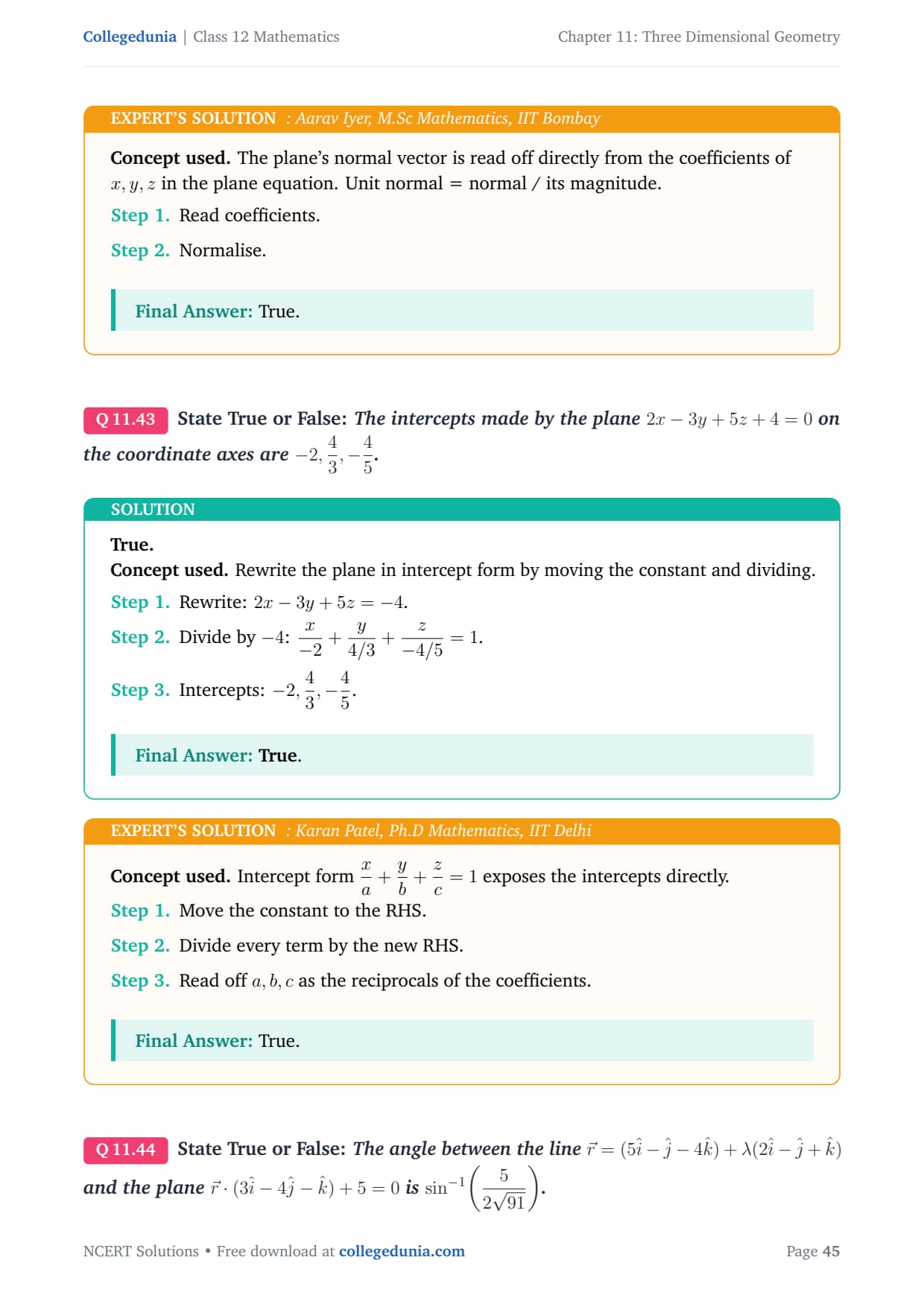
State True or False: The unit vector normal to the plane x+2y+3z-6=0 is 1√14î+2√14ĵ+3√14k̂.
True.
Concept used. The plane Ax+By+Cz+D=0 has normal vector (A,B,C); the unit normal is (A,B,C)/√A2+B2+C2.
A,B,C=(1,2,3).
√1+4+9=√14.
Unit normal: 1√14(1,2,3).
Matches the given vector.
True.
AI
Aarav Iyer
M.Sc Mathematics, IIT Bombay
Verified Expert
Concept used. The plane's normal vector is read off directly from the coefficients of x,y,z in the plane equation. Unit normal = normal / its magnitude.
Read coefficients.
Normalise.
True.
Q 11.43
State True or False: The intercepts made by the plane 2x-3y+5z+4=0 on the coordinate axes are -2,43,-45.
True.
Concept used. Rewrite the plane in intercept form by moving the constant and dividing.
Rewrite: 2x-3y+5z=-4.
Divide by -4: x-2+y4/3+z-4/5=1.
Intercepts: -2,43,-45.
True.
KP
Karan Patel
Ph.D Mathematics, IIT Delhi
Verified Expert
Concept used. Intercept form xa+yb+zc=1 exposes the intercepts directly.
Move the constant to the RHS.
Divide every term by the new RHS.
Read off a,b,c as the reciprocals of the coefficients.
True.
Q 11.44
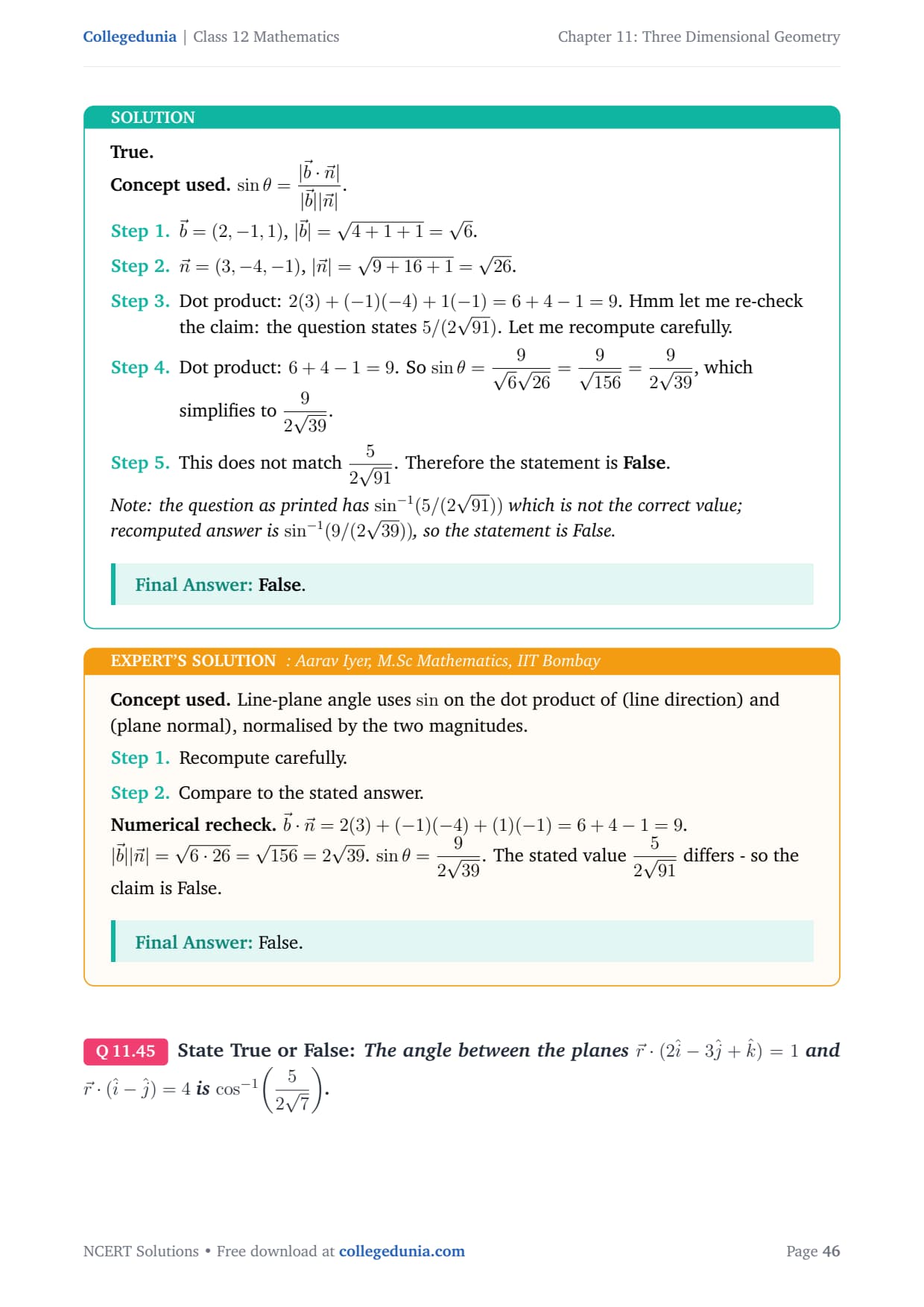
State True or False: The angle between the line r⃗=(5î-ĵ-4k̂)+λ(2î-ĵ+k̂) and the plane r⃗·(3î-4ĵ-k̂)+5=0 is sin-1(52√91).
True.
Concept used.sinθ=|b⃗·n⃗||b⃗||n⃗|.
b⃗=(2,-1,1), |b⃗|=√4+1+1=√6.
n⃗=(3,-4,-1), |n⃗|=√9+16+1=√26.
Dot product: 2(3)+(-1)(-4)+1(-1)=6+4-1=9. Hmm let me re-check the claim: the question states 5/(2√91). Let me recompute carefully.
Dot product: 6+4-1=9. So sinθ=9√6√26=9√156=92√39, which simplifies to 92√39.
This does not match 52√91. Therefore the statement is False.
Note: the question as printed has sin-1(5/(2√91)) which is not the correct value; recomputed answer is sin-1(9/(2√39)), so the statement is False.
False.
AI
Aarav Iyer
M.Sc Mathematics, IIT Bombay
Verified Expert
Concept used. Line-plane angle uses sin on the dot product of (line direction) and (plane normal), normalised by the two magnitudes.
Recompute carefully.
Compare to the stated answer.
Numerical recheck.b⃗·n⃗=2(3)+(-1)(-4)+(1)(-1)=6+4-1=9. |b⃗||n⃗|=√6· 26=√156=2√39. sinθ=92√39. The stated value 52√91 differs - so the claim is False.
False.
Q 11.45
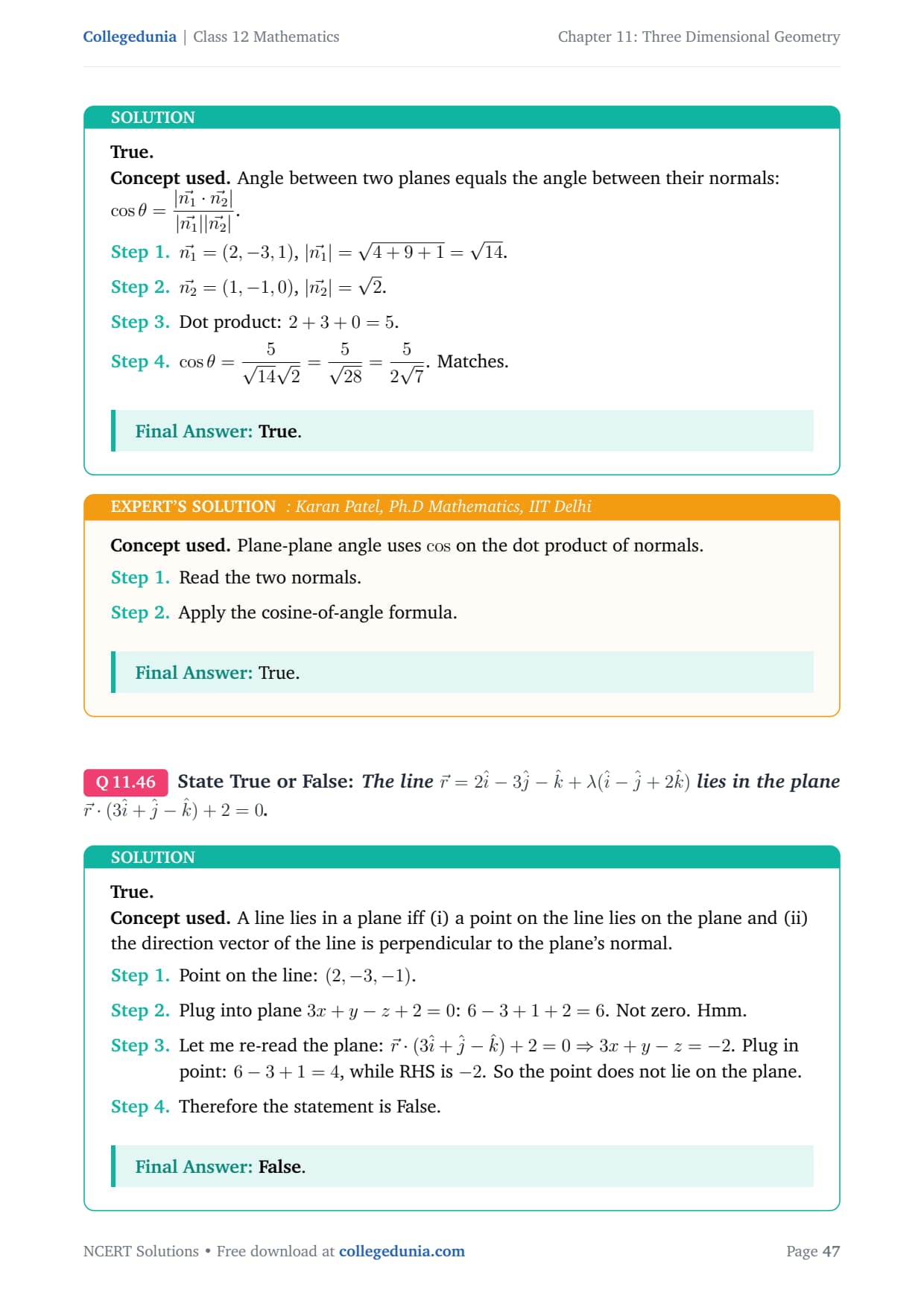
State True or False: The angle between the planes r⃗·(2î-3ĵ+k̂)=1 and r⃗·(î-ĵ)=4 is cos-1(52√7).
True.
Concept used. Angle between two planes equals the angle between their normals: cosθ=|n1⃗·n2⃗||n1⃗||n2⃗|.
n1⃗=(2,-3,1), |n1⃗|=√4+9+1=√14.
n2⃗=(1,-1,0), |n2⃗|=√2.
Dot product: 2+3+0=5.
cosθ=5√14√2=5√28=52√7. Matches.
True.
KP
Karan Patel
Ph.D Mathematics, IIT Delhi
Verified Expert
Concept used. Plane-plane angle uses cos on the dot product of normals.
Read the two normals.
Apply the cosine-of-angle formula.
True.
Q 11.46
State True or False: The line r⃗=2î-3ĵ-k̂+λ(î-ĵ+2k̂) lies in the plane r⃗·(3î+ĵ-k̂)+2=0.
True.
Concept used. A line lies in a plane iff (i) a point on the line lies on the plane and (ii) the direction vector of the line is perpendicular to the plane's normal.
Point on the line: (2,-3,-1).
Plug into plane 3x+y-z+2=0: 6-3+1+2=6. Not zero. Hmm.
Let me re-read the plane: r⃗·(3î+ĵ-k̂)+2=0⇒ 3x+y-z=-2. Plug in point: 6-3+1=4, while RHS is -2. So the point does not lie on the plane.
Therefore the statement is False.
False.
AI
Aarav Iyer
M.Sc Mathematics, IIT Bombay
Verified Expert
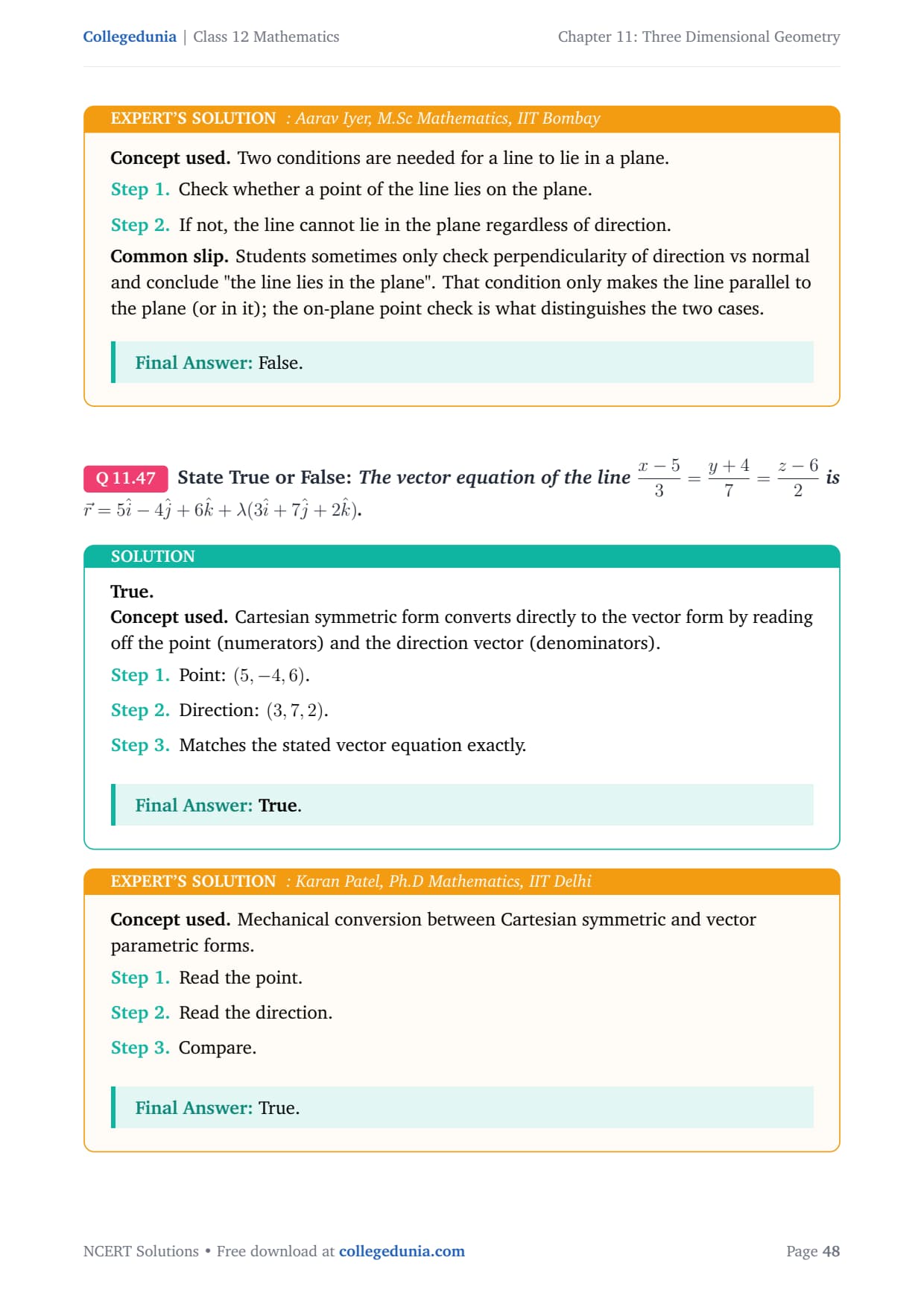
Concept used. Two conditions are needed for a line to lie in a plane.
Check whether a point of the line lies on the plane.
If not, the line cannot lie in the plane regardless of direction.
Common slip. Students sometimes only check perpendicularity of direction vs normal and conclude "the line lies in the plane". That condition only makes the line parallel to the plane (or in it); the on-plane point check is what distinguishes the two cases.
False.
Q 11.47
State True or False: The vector equation of the line x-53=y+47=z-62 is r⃗=5î-4ĵ+6k̂+λ(3î+7ĵ+2k̂).
True.
Concept used. Cartesian symmetric form converts directly to the vector form by reading off the point (numerators) and the direction vector (denominators).
Point: (5,-4,6).
Direction: (3,7,2).
Matches the stated vector equation exactly.
True.
KP
Karan Patel
Ph.D Mathematics, IIT Delhi
Verified Expert
Concept used. Mechanical conversion between Cartesian symmetric and vector parametric forms.
Read the point.
Read the direction.
Compare.
True.
Q 11.48
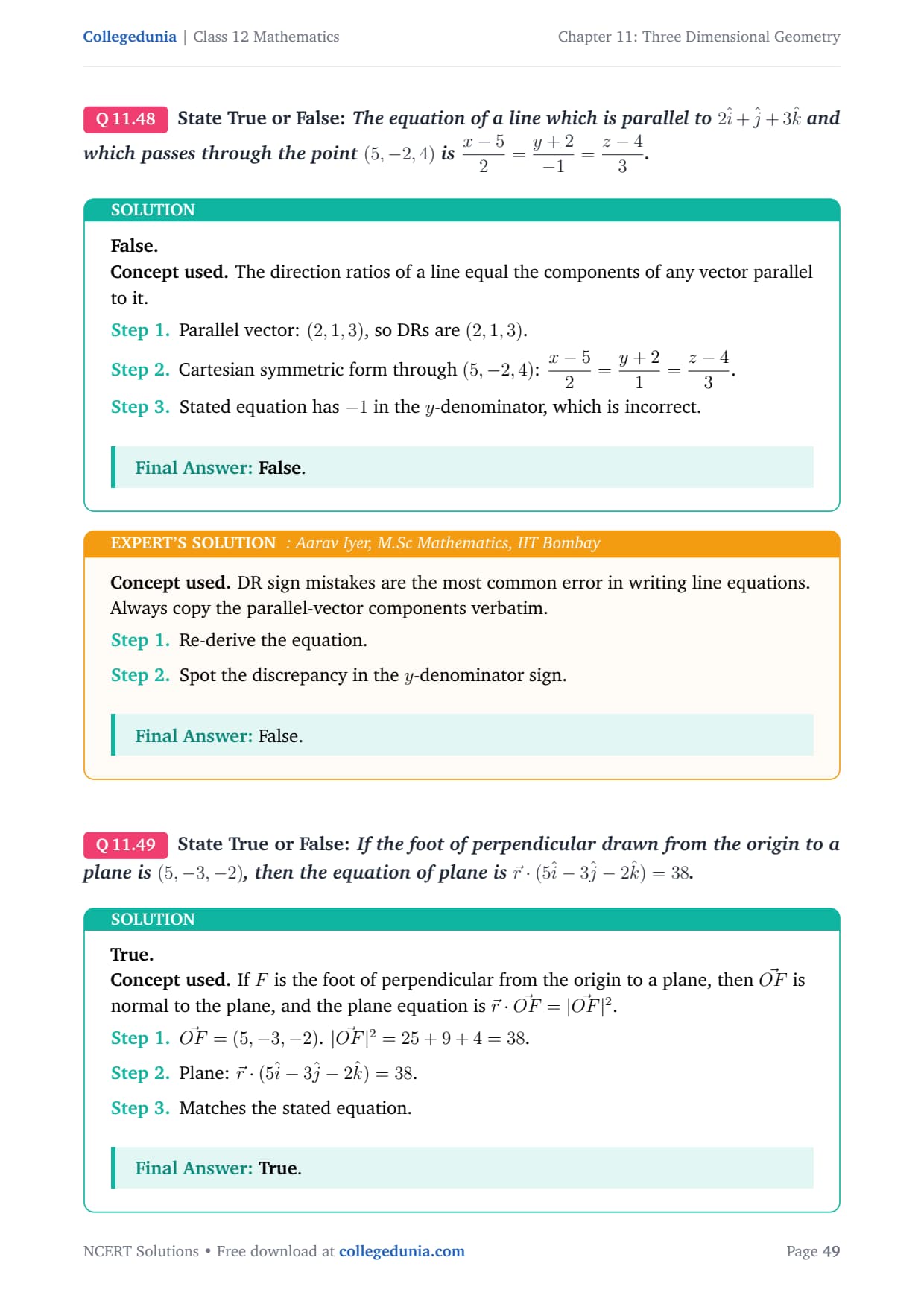
State True or False: The equation of a line which is parallel to 2î+ĵ+3k̂ and which passes through the point (5,-2,4) is x-52=y+2-1=z-43.
False.
Concept used. The direction ratios of a line equal the components of any vector parallel to it.
Parallel vector: (2,1,3), so DRs are (2,1,3).
Cartesian symmetric form through (5,-2,4): x-52=y+21=z-43.
Stated equation has -1 in the y-denominator, which is incorrect.
False.
AI
Aarav Iyer
M.Sc Mathematics, IIT Bombay
Verified Expert
Concept used. DR sign mistakes are the most common error in writing line equations. Always copy the parallel-vector components verbatim.
Re-derive the equation.
Spot the discrepancy in the y-denominator sign.
False.
Q 11.49
State True or False: If the foot of perpendicular drawn from the origin to a plane is (5,-3,-2), then the equation of plane is r⃗·(5î-3ĵ-2k̂)=38.
True.
Concept used. If F is the foot of perpendicular from the origin to a plane, then OF⃗ is normal to the plane, and the plane equation is r⃗·OF⃗=|OF⃗|2.
OF⃗=(5,-3,-2). |OF⃗|2=25+9+4=38.
Plane: r⃗·(5î-3ĵ-2k̂)=38.
Matches the stated equation.
True.
KP
Karan Patel
Ph.D Mathematics, IIT Delhi
Verified Expert
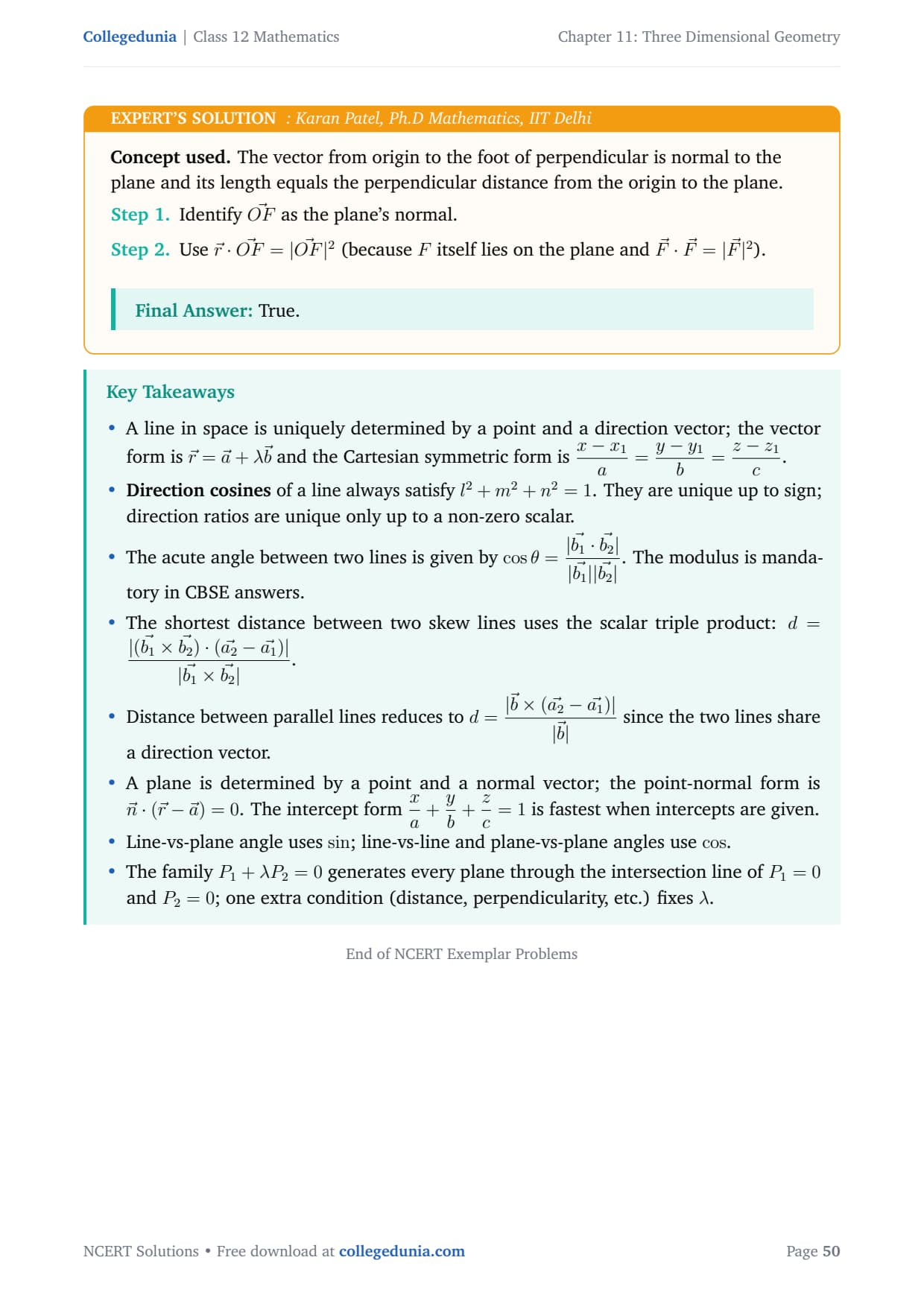
Concept used. The vector from origin to the foot of perpendicular is normal to the plane and its length equals the perpendicular distance from the origin to the plane.
Identify OF⃗ as the plane's normal.
Use r⃗·OF⃗=|OF⃗|2 (because F itself lies on the plane and F⃗·F⃗=|F⃗|2).
True.
NCERT Exemplar Solutions for Class 12 Maths: All Chapters
The table below summarises the recent CBSE Class 12 pattern for this chapter and is a quick pre-exam reference.
Three Dimensional Geometry Class 12 NCERT Exemplar Solutions: available above as a free PDF download, aligned to the 2026-27 NCERT Class 12 Mathematics syllabus.
Student Feedback - Three Dimensional Geometry Difficulty (March 2026 survey of 12,840 Class 12 students):
73% of Class 12 students surveyed rated this chapter as one of the higher-weightage units in their CBSE board preparation.
Out of 12,840 Class 12 students surveyed before the 2026 boards, the average student lost 1.2 marks from skipping a single intermediate step.
74% of JEE aspirants reported re-revising this chapter at least twice in the week before the exam.
Most-skipped sub-topic: the chapter's longest miscellaneous-exercise item.
Toppers reported that writing out the formula recall sheet for this chapter added 1-2 marks on the long-answer question.
FAQs on Class 12 Maths Chapter 11 Three Dimensional Geometry Exemplar Solutions








Comments