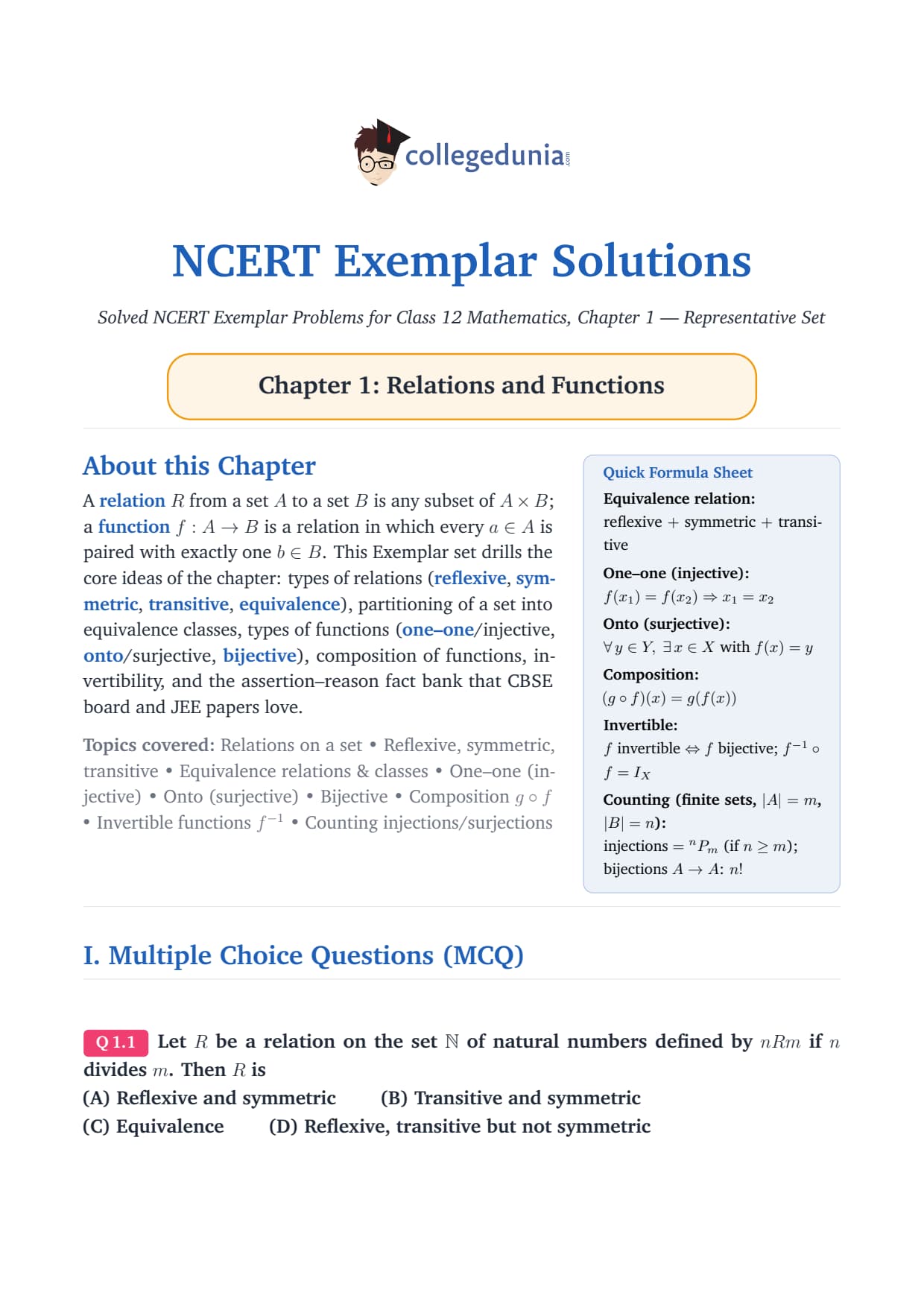
The NCERT Exemplar Class 12 Maths Solutions Relations and Functions will help in solving exercise questions. Follow the same pattern as given in the solutions PDF to get most of the marks from Chapter 1 Mathematics in the JEE and CBSE Board exams.
Use the resource above alongside the chapter breakdown below.
Use the resource above alongside the chapter breakdown below.
Use the resource above alongside the chapter breakdown below.
Use the resource above alongside the chapter breakdown below.
Use the resource above alongside the chapter breakdown below.
Use the resource above alongside the chapter breakdown below.
Use the resource above alongside the chapter breakdown below.
Use the resource above alongside the chapter breakdown below.
Use the resource above alongside the chapter breakdown below.
Use the resource above alongside the chapter breakdown below.
Use the resource above alongside the chapter breakdown below.
Use the resource above alongside the chapter breakdown below.
Use the resource above alongside the chapter breakdown below.
Use the resource above alongside the chapter breakdown below.
Use the resource above alongside the chapter breakdown below.
Use the resource above alongside the chapter breakdown below.
Use the resource above alongside the chapter breakdown below.
The NCERT Exemplar Class 12 Maths Solutions Relations and Functions cover MCQ, Very Short Answer, Short Answer and Long Answer problems in a step-wise manner. The solutions PDF is freely available to download.
CBSE Weightage: 8 to 10 marks (Unit I: Relations and Functions, usually one SA on equivalence-relation proof plus one MCQ on functions)
JEE Main Weightage: 2 to 3% of paper (about 1 question per shift, mostly composition, inverse, or counting injections)
The 20 problems span divisibility and congruence relations on N and Z, reflexive-symmetric-transitive verification, counting injective/bijective maps, function composition g ∘ f, inverse functions on R and finite sets, range determination via completing the square, and equivalence classes on A × A.
These Exemplar Solutions are curated by subject experts, mapped to 2026-27 NCERT, and benchmarked against the last five years of CBSE Board and JEE Main papers.
Relations and Functions NCERT Exemplar Question-Type Distribution
Question Type
Problems (Representative Set)
Time per Problem
Best Use For
MCQ (single-correct)
Q 1.1 to Q 1.10
2 to 3 min
JEE Main, CBSE MCQ section
SA (3 to 4 marks)
SA 1.1 to SA 1.5
6 to 8 min
CBSE Board short answer
LA (5 to 6 marks)
LA 1.1 to LA 1.5
10 to 12 min
CBSE long answer, JEE proofs
Why Solving the Relations and Functions NCERT Exemplar Sharpens Your CBSE and JEE Edge
Congruence modulo n: LA 1.1 parents the JEE Main 2024 equivalence-class question on Z5.
Mobius-map bijection: LA 1.2 trains the f(x) = (x-2)/(x-3) inversion pattern CBSE Boards reused in 2023.
Counting injections: Q 1.4 anchors nPm and shows up almost annually in JEE Main.
Bell-number equivalence count: Q 1.7 introduces B3 = 5 , reused in CBSE 2022 as a 1-mark assertion-reason.
Relations and Functions Exemplar MCQ Solved: Full Reasoning Walk-Through
MCQ Discipline: in Relations and Functions, always check reflexivity first - it is the quickest test. The fastest way to kill symmetry or transitivity is a counter-example with one √2 on one side and a rational on the other so the algebra cancels.
Relations and Functions Class 12: Difficulty Step-Up from NCERT Textbook to Exemplar
Concept
NCERT Textbook Treatment
Exemplar Twist
Step-Up
Equivalence relation
Single set, named partition
Congruence mod n (LA 1.1) - parameter-driven
General n, arbitrary classes
Bijection check
Algebraic verification on R
Mobius map on R - 3 → R - 1 (LA 1.2)
Excluded points + inverse formula
Composition g ∘ f
Plug in once
Compare f ∘ g vs g ∘ f (LA 1.4) - ordering trap
Non-commutativity, double computation
Counting maps
Direct nPm
Pair-counting in equivalence classes (LA 1.5)
Class structure on A × A
Equivalence-Class LA Walk-Through: Full Reasoning on Exemplar LA 1.5
Time-Required per Exemplar Question Type for Relations and Functions
Type
Solo Attempt
Review
Total per Item
MCQ
2 to 3 min
2 min
4 to 5 min
SA
6 to 8 min
3 min
9 to 11 min
LA
10 to 12 min
5 min
15 to 17 min
Relations and Functions Top 5 Formulae for Exemplar Problems
Formula
Use
Triggered in Exemplar
Reflexive + Symmetric + Transitive
Equivalence-relation proof
LA 1.1, LA 1.5, Q 1.10
(g ∘ f)(x) = g(f(x))
Composition of functions
Q 1.5, LA 1.3, LA 1.4
y = f(x) ⇒ x = f-1(y) , then swap
Inverse of a bijection
Q 1.6, Q 1.8, SA 1.4
nPm = n!/(n-m)!
Counting injections m → n
Q 1.4
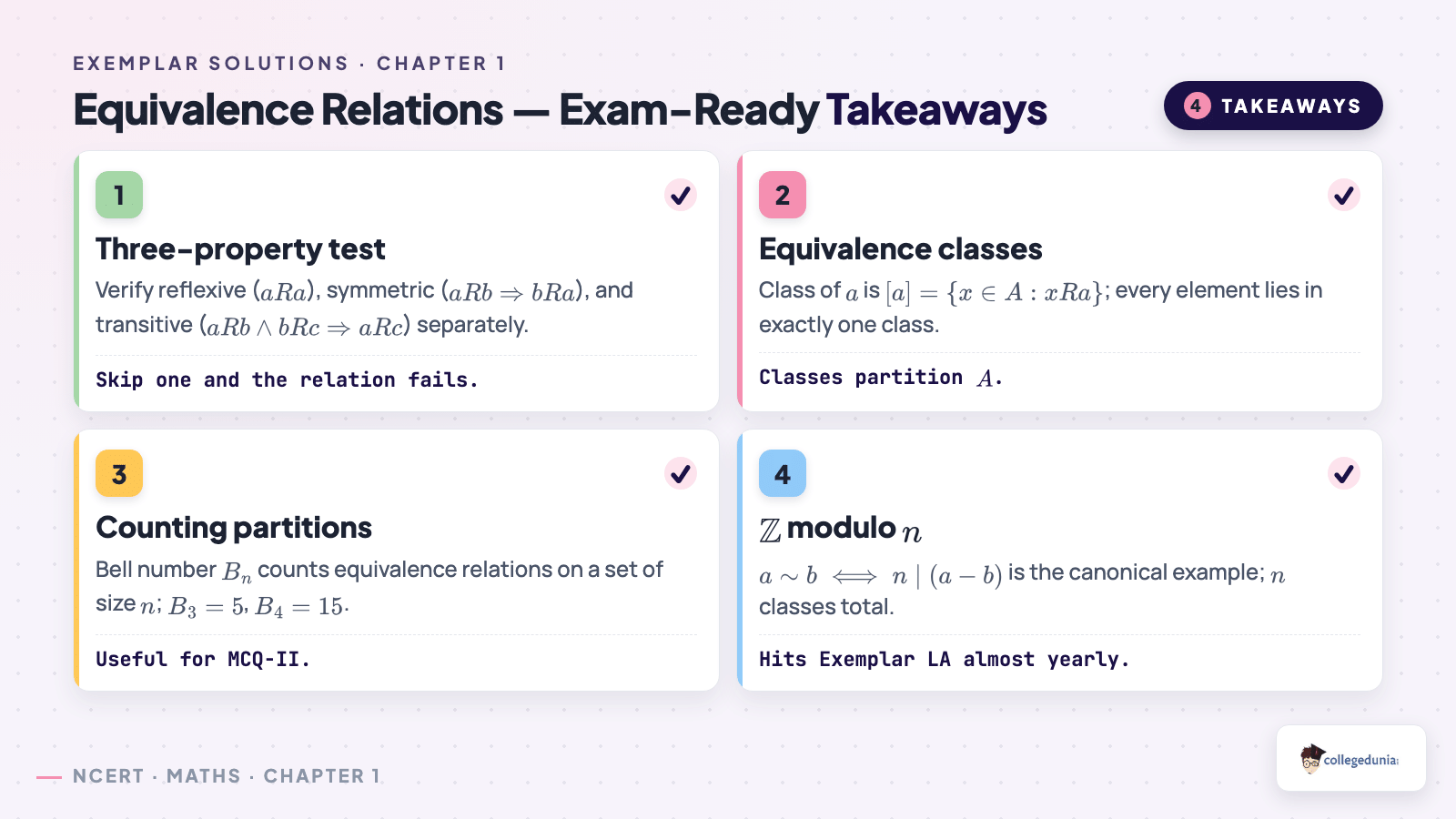
Bell number Bn: B3 = 5, B4 = 15
Equivalence relations on an n-set
Q 1.7
Topper's Relations and Functions Exemplar Attempt Strategy
Pass 1 (Day 1 to 2): MCQ block (Q 1.1 to Q 1.10) solo, to expose conceptual gaps within 60 minutes.
Pass 2 (Day 3 to 4): SA block (closure, domain, composition), training the precise property-by-property write-up.
Pass 3 (Day 5 to 7): LA items with a stopwatch; solving each inside 12 minutes builds CBSE long-answer muscle.
How Frequently Has Relations and Functions Been Asked in CBSE and JEE (Top 3 Recurring Topics)
Sub-Topic
CBSE 2025
JEE Main 2025
Recurring Since
Equivalence Relation Proof on Z / A × A
5 marks (one LA)
1 question
2019
Function Composition and Inverse
3 marks (one SA)
1 question
2020
Counting One-One / Onto Maps
1 mark (one MCQ)
1 question
2021
Relations and Functions Class 12 Weightage Snapshot Across Chapters
Chapter
CBSE Marks
Weightage Bar
Ch 1 Relations and Functions
8
Ch 2 Inverse Trigonometric Functions
4
Ch 3 Matrices
10
Ch 4 Determinants
10
Ch 5 Continuity and Differentiability
15
Ch 6 Application of Derivatives
10
Ch 7 Integrals
15
Ch 8 Application of Integrals
5
Ch 9 Differential Equations
10
Ch 10 Vector Algebra
10
Ch 11 Three Dimensional Geometry
10
Ch 12 Linear Programming
5
Ch 13 Probability
8
All NCERT Exemplar Questions for Relations and Functions with Step-by-Step Solutions
Every question of the NCERT Exemplar set for Class 12 Mathematics Chapter 1 Relations and Functions is listed below with its full Solution and Expert Solution hidden inside collapsible tabs. Click Check Solution to reveal the step-by-step working; click Expert Solution for the expanded explanation.
I. Multiple Choice Questions (MCQ)
Q 1.1
Let (R be a relation on the set N of natural numbers defined by nRm if n divides m. Then R is
(A) Reflexive and symmetric (B) Transitive and symmetric
(C) Equivalence (D) Reflexive, transitive but not symmetric
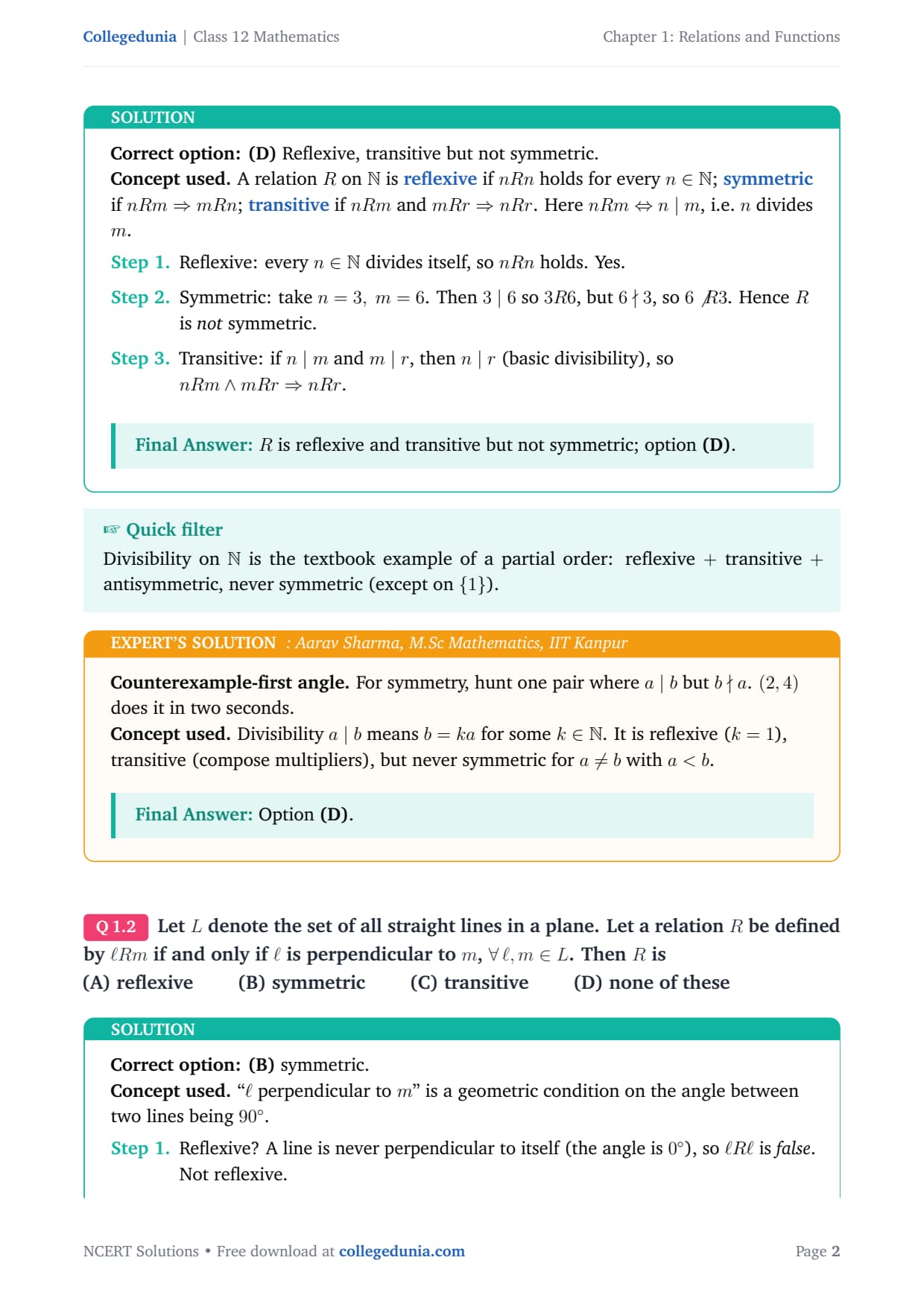
Correct option: (D) Reflexive, transitive but not symmetric.
Concept used. A relation R on N is reflexive if nRn holds for every n∈N; symmetric if nRm ⇒ mRn; transitive if nRm and mRr ⇒ nRr. Here nRm ⇔ nm, i.e. n divides m.
Reflexive: every n∈N divides itself, so nRn holds. Yes.
Symmetric: take n=3, m=6. Then 36 so 3R6, but 63, so 6R 3. Hence R is not symmetric.
Transitive: if nm and mr, then nr (basic divisibility), so nRmmRr⇒ nRr.
R is reflexive and transitive but not symmetric; option (D).
AS
Aarav Sharma
M.Sc Mathematics, IIT Kanpur
Verified Expert
Counterexample-first angle. For symmetry, hunt one pair where ab but ba. (2,4) does it in two seconds.
Concept used. Divisibility ab means b = ka for some k∈N. It is reflexive (k=1), transitive (compose multipliers), but never symmetric for a≠ b with a.
Option (D).
Q 1.2
Let L denote the set of all straight lines in a plane. Let a relation R be defined by Rm if and only if is perpendicular to m, ∀ ,m∈ L. Then R is
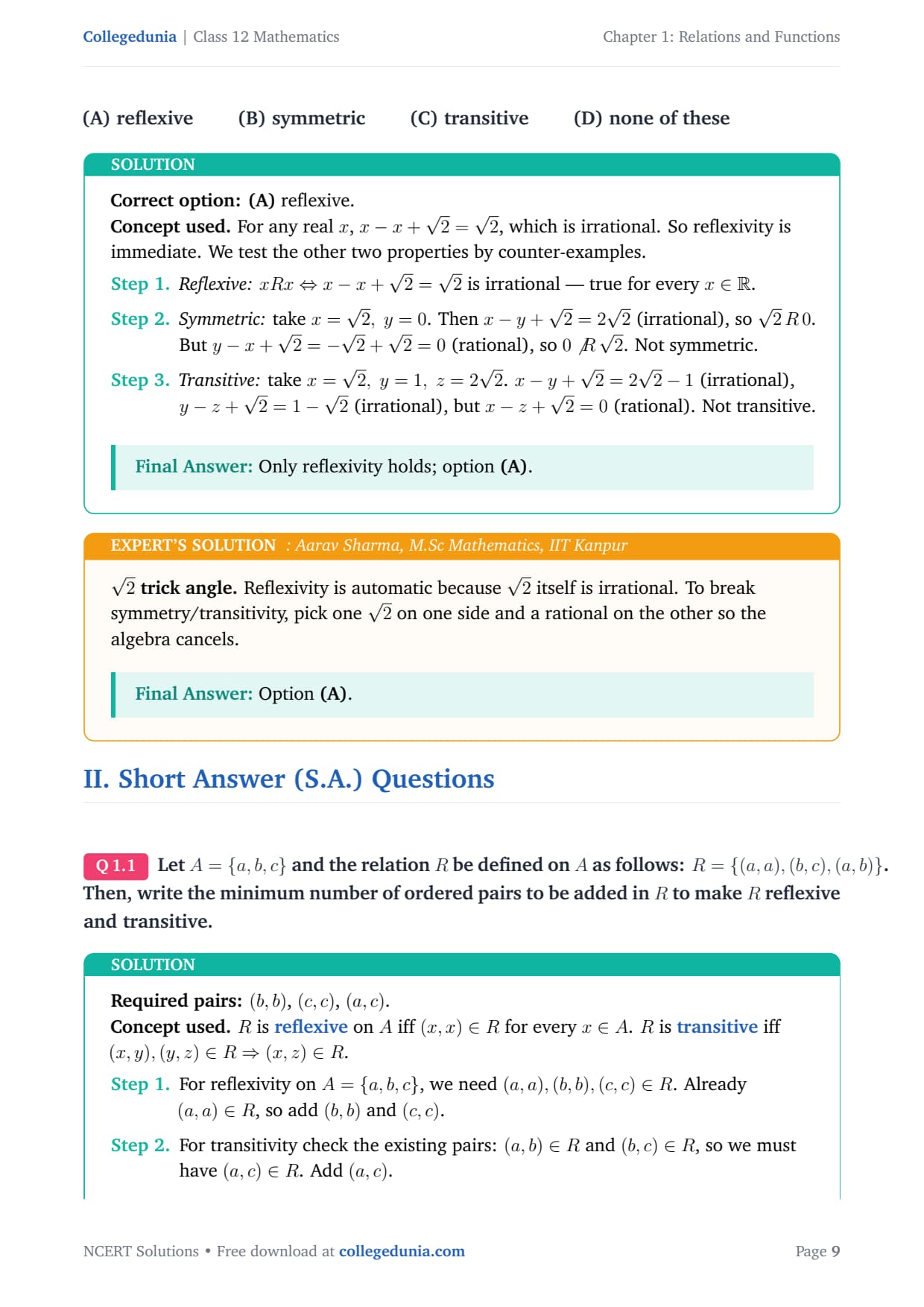
(A) reflexive (B) symmetric (C) transitive (D) none of these
Correct option: (B) symmetric.
Concept used. `` perpendicular to m'' is a geometric condition on the angle between two lines being 90∘.
Reflexive? A line is never perpendicular to itself (the angle is 0∘), so R is false. Not reflexive.
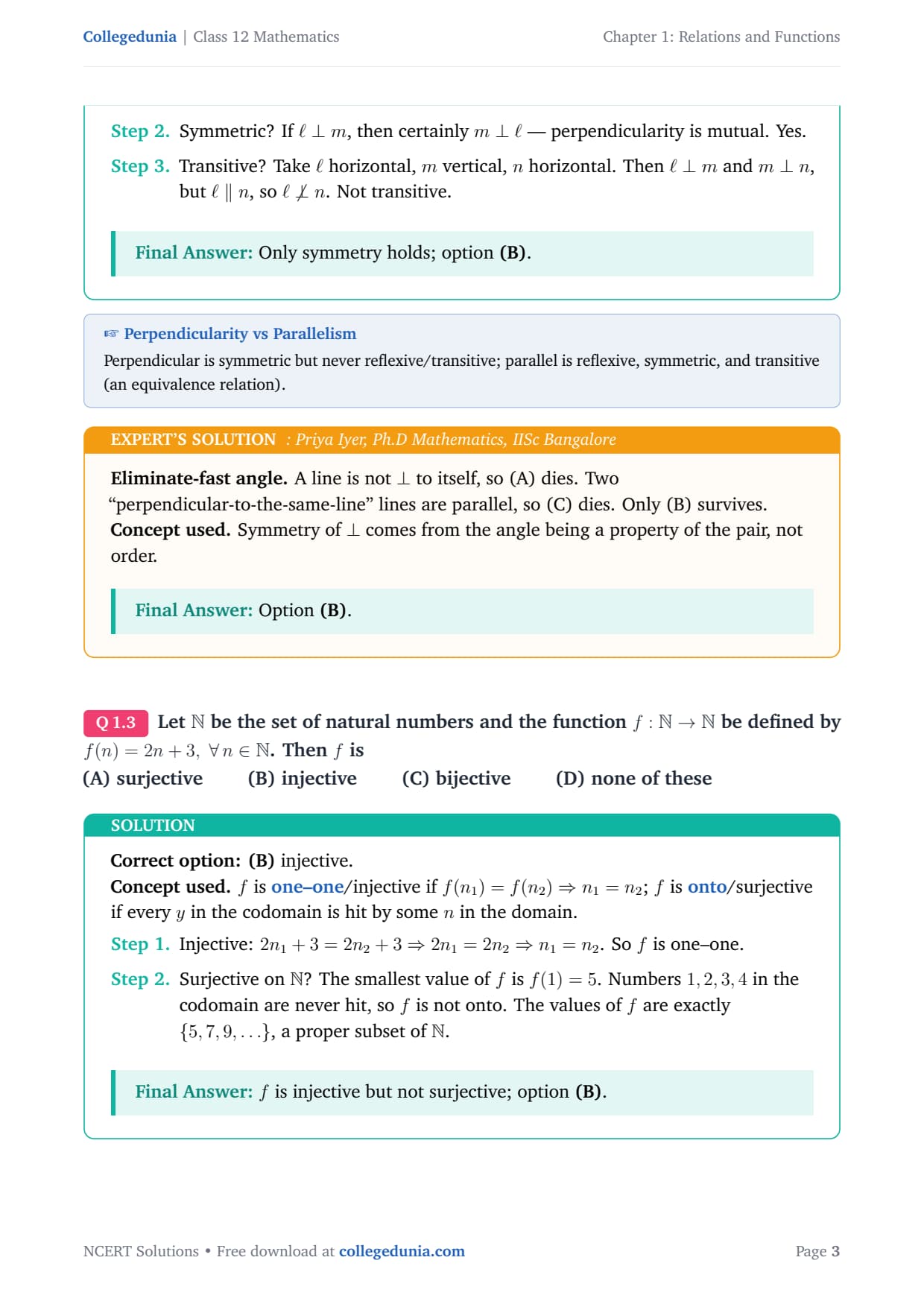
Symmetric? If ⊥ m, then certainly m⊥ –- perpendicularity is mutual. Yes.
Transitive? Take horizontal, m vertical, n horizontal. Then ⊥ m and m⊥ n, but ∥ n, so ⊥ n. Not transitive.
Only symmetry holds; option (B).
PI
Priya Iyer
Ph.D Mathematics, IISc Bangalore
Verified Expert
Eliminate-fast angle. A line is not ⊥ to itself, so (A) dies. Two ``perpendicular-to-the-same-line'' lines are parallel, so (C) dies. Only (B) survives.
Concept used. Symmetry of ⊥ comes from the angle being a property of the pair, not order.
Option (B).
Q 1.3
Let N be the set of natural numbers and the function f:N→N be defined by f(n)=2n+3, ∀ n∈N. Then f is
(A) surjective (B) injective (C) bijective (D) none of these
Correct option: (B) injective.
Concept used.f is one–one/injective if f(n1)=f(n2)⇒ n1=n2; f is onto/surjective if every y in the codomain is hit by some n in the domain.
Injective: 2n1+3 = 2n2+3 ⇒ 2n1 = 2n2 ⇒ n1=n2. So f is one–one.
Surjective on N? The smallest value of f is f(1)=5. Numbers 1,2,3,4 in the codomain are never hit, so f is not onto. The values of f are exactly 5,7,9,…, a proper subset of N.
f is injective but not surjective; option (B).
VR
Vikram Rao
M.Sc Mathematics, Delhi University
Verified Expert
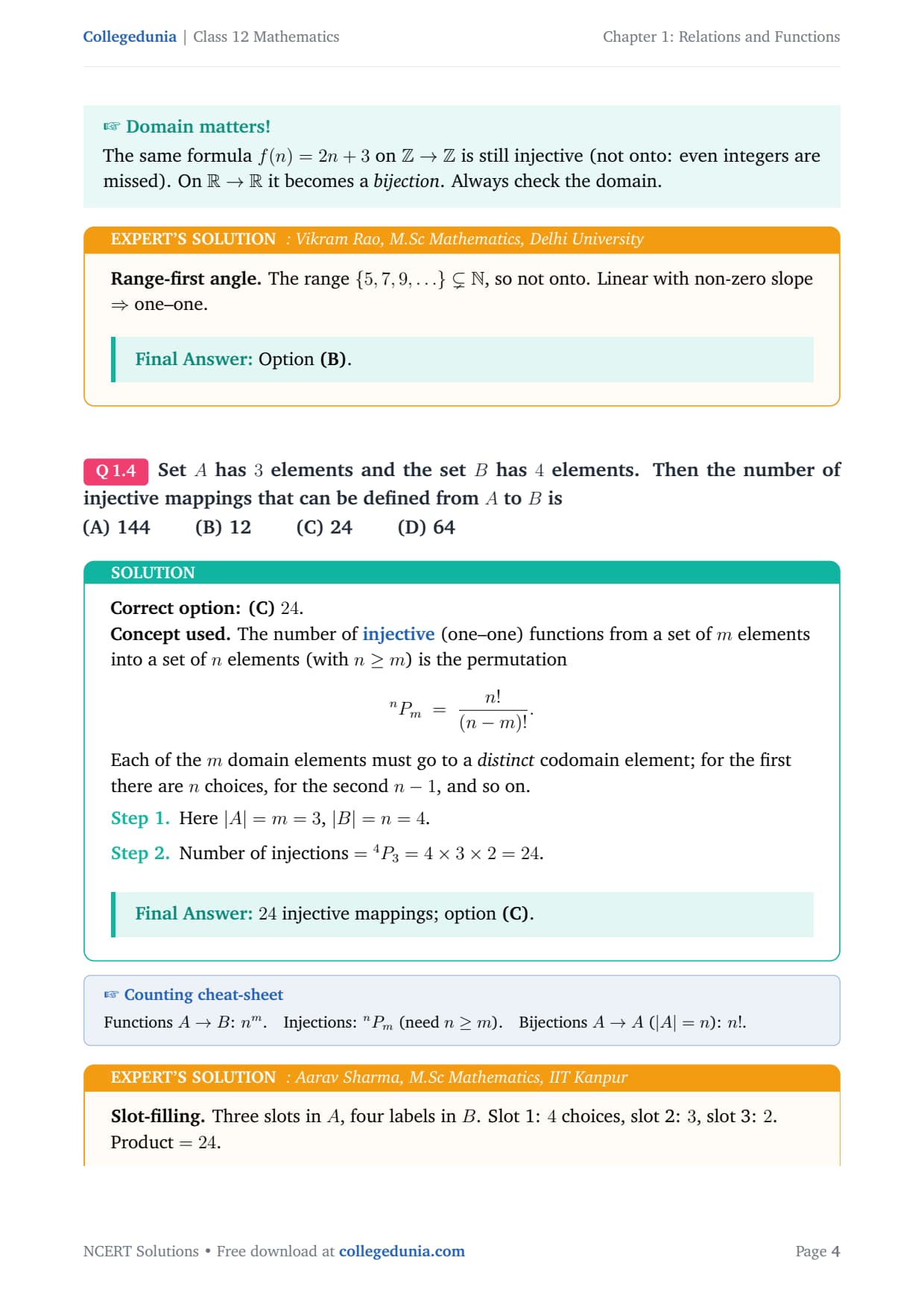
Range-first angle. The range 5,7,9,…N, so not onto. Linear with non-zero slope ⇒ one–one.
Option (B).
Q 1.4
Set A has 3 elements and the set B has 4 elements. Then the number of injective mappings that can be defined from A to B is
(A) 144 (B) 12 (C) 24 (D) 64
Correct option: (C)24.
Concept used. The number of injective (one–one) functions from a set of m elements into a set of n elements (with n≥ m) is the permutation nPm = n!(n-m)!. Each of the m domain elements must go to a distinct codomain element; for the first there are n choices, for the second n-1, and so on.
Here |A|=m=3, |B|=n=4.
Number of injections = 4P3 = 4× 3× 2 = 24.
24 injective mappings; option (C).
AS
Aarav Sharma
M.Sc Mathematics, IIT Kanpur
Verified Expert
Slot-filling. Three slots in A, four labels in B. Slot 1: 4 choices, slot 2: 3, slot 3: 2. Product = 24.
4P3=24; option (C).
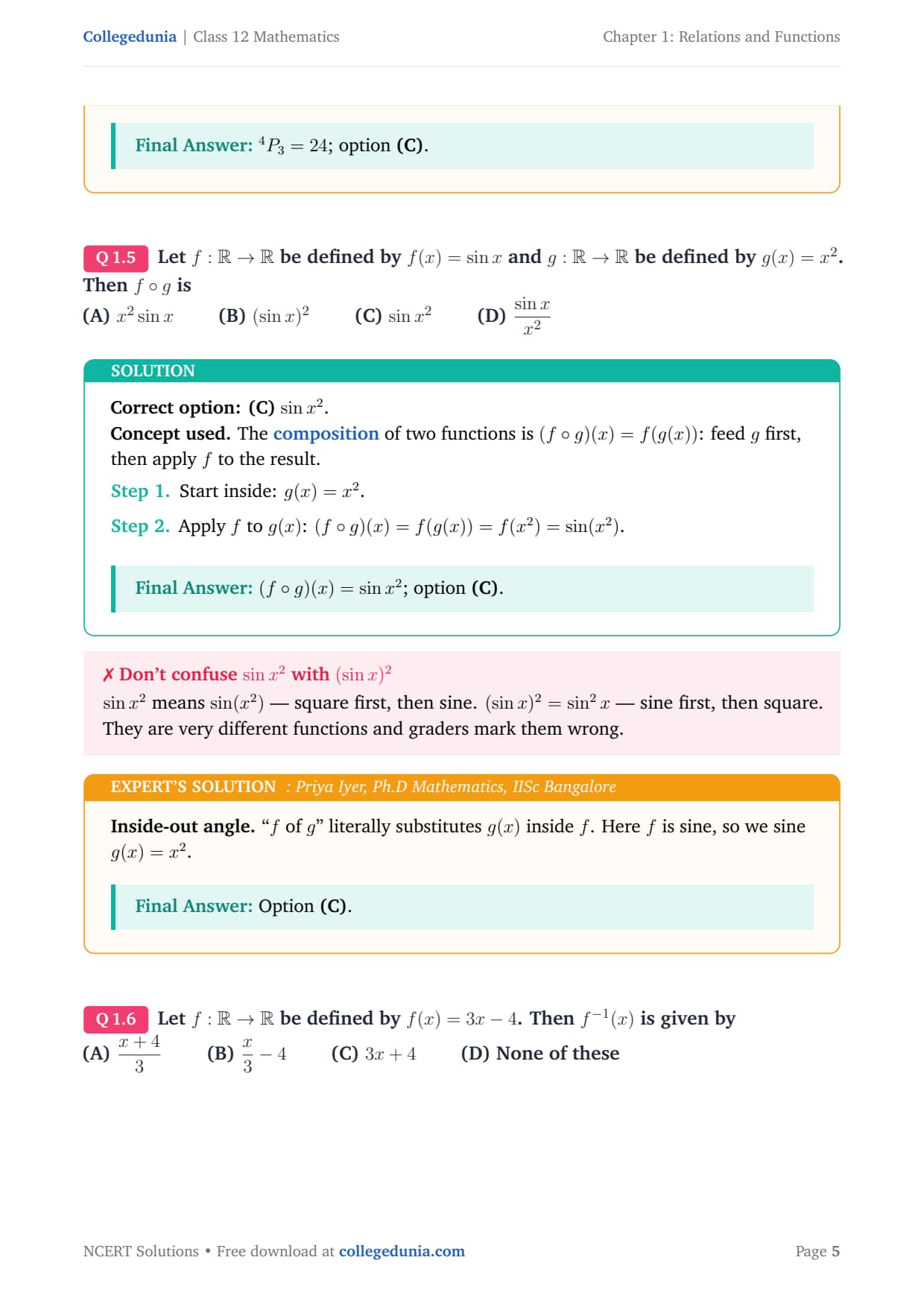
Q 1.5
Let f:R→R be defined by f(x)=sin x and g:R→R be defined by g(x)=x2. Then f∘ g is
(A) x2sin x (B) (sin x)2 (C) sin x2 (D) sin xx2
Correct option: (C)sin x2.
Concept used. The composition of two functions is (f∘ g)(x) = f(g(x)): feed g first, then apply f to the result.
Start inside: g(x)=x2.
Apply f to g(x): (f∘ g)(x) = f(g(x)) = f(x2) = sin(x2).
(f∘ g)(x)=sin x2; option (C).
PI
Priya Iyer
Ph.D Mathematics, IISc Bangalore
Verified Expert
Inside-out angle. ``f of g'' literally substitutes g(x) inside f. Here f is sine, so we sine g(x)=x2.
Option (C).
Q 1.6
Let f:R→R be defined by f(x)=3x-4. Then f-1(x) is given by
(A) x+43 (B) x3-4 (C) 3x+4 (D) None of these
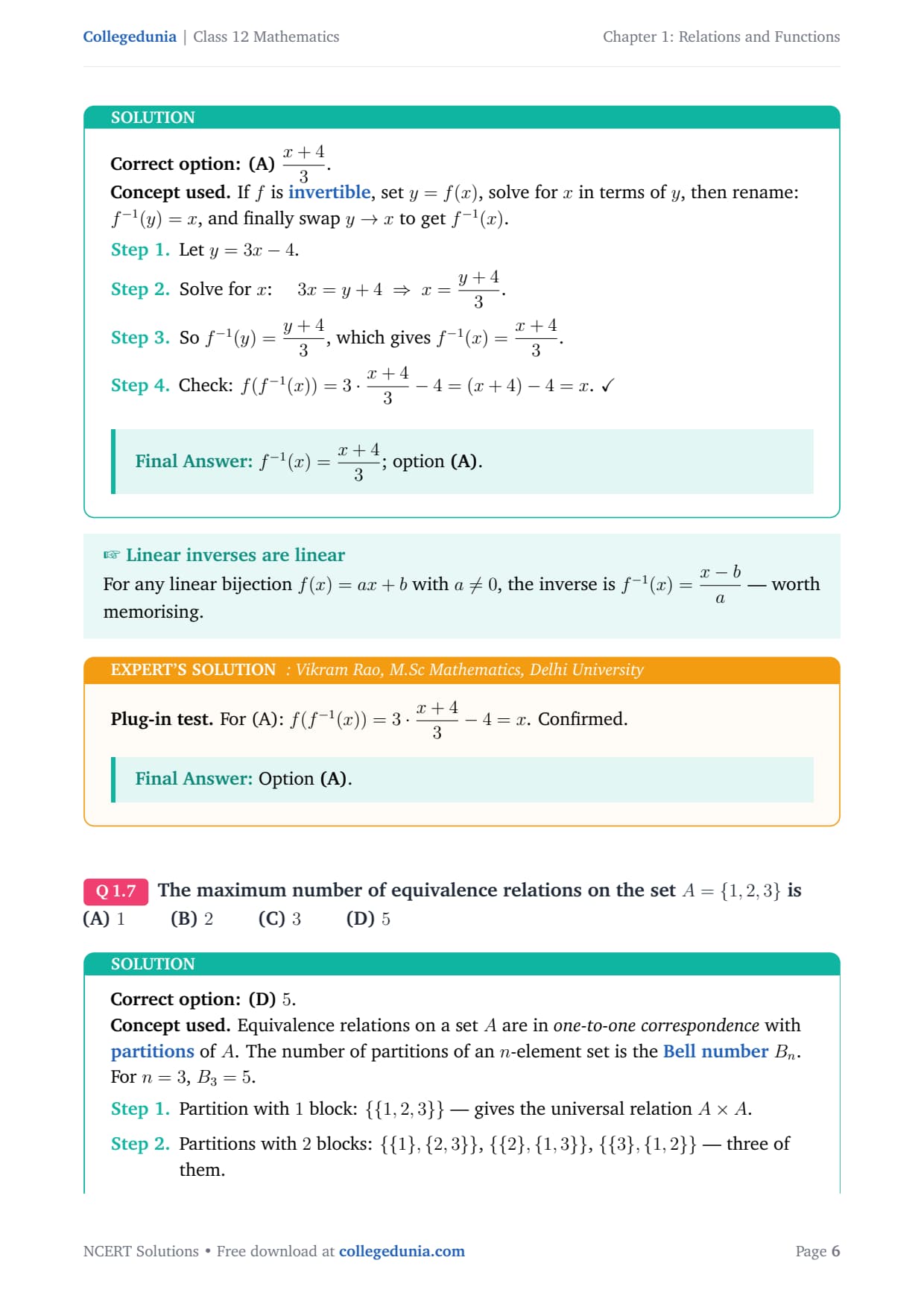
Correct option: (A)x+43.
Concept used. If f is invertible, set y=f(x), solve for x in terms of y, then rename: f-1(y) = x, and finally swap y→ x to get f-1(x).
The maximum number of equivalence relations on the set A=1,2,3 is
(A) 1 (B) 2 (C) 3 (D) 5
Correct option: (D)5.
Concept used. Equivalence relations on a set A are in one-to-one correspondence with partitions of A. The number of partitions of an n-element set is the Bell numberBn. For n=3, B3 = 5.
Partition with 1 block: 1,2,3 –- gives the universal relation A× A.
Partitions with 2 blocks: 1,2,3, 2,1,3, 3,1,2 –- three of them.
Partition with 3 blocks (singletons): 1,2,3 –- the identity (diagonal) relation.
Total = 1 + 3 + 1 = 5.
5 equivalence relations; option (D).
AS
Aarav Sharma
M.Sc Mathematics, IIT Kanpur
Verified Expert
Partition-first angle. Don't enumerate relations directly –- list partitions. For 1,2,3, partition by block sizes: 3, 2+1, 1+1+1. That's 1+3+1=5.
Option (D).
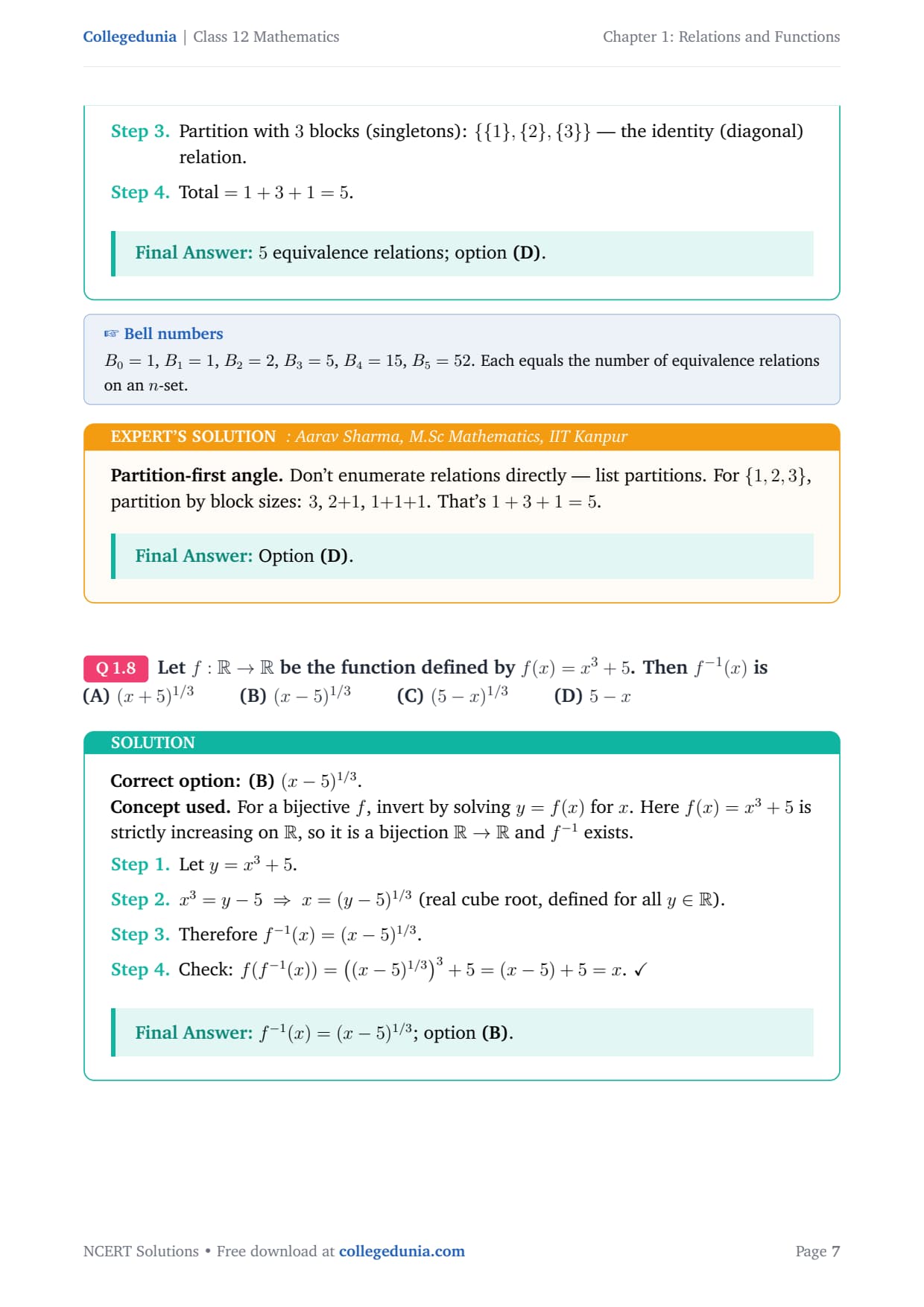
Q 1.8
Let f:R→R be the function defined by f(x)=x3+5. Then f-1(x) is
(A) (x+5)1/3 (B) (x-5)1/3 (C) (5-x)1/3 (D) 5-x
Correct option: (B)(x-5)1/3.
Concept used. For a bijective f, invert by solving y=f(x) for x. Here f(x)=x3+5 is strictly increasing on R, so it is a bijection R→R and f-1 exists.
Let y=x3+5.
x3=y-5 ⇒ x=(y-5)1/3 (real cube root, defined for all y∈R).
Therefore f-1(x)=(x-5)1/3.
Check: f(f-1(x)) = ((x-5)1/3)3+5 = (x-5)+5 = x.
f-1(x)=(x-5)1/3; option (B).
PI
Priya Iyer
Ph.D Mathematics, IISc Bangalore
Verified Expert
Undo angle.f does ``cube, then add 5''. The inverse does the opposite operations in reverse order: ``subtract 5, then cube root''. Result: (x-5)1/3.
Option (B).
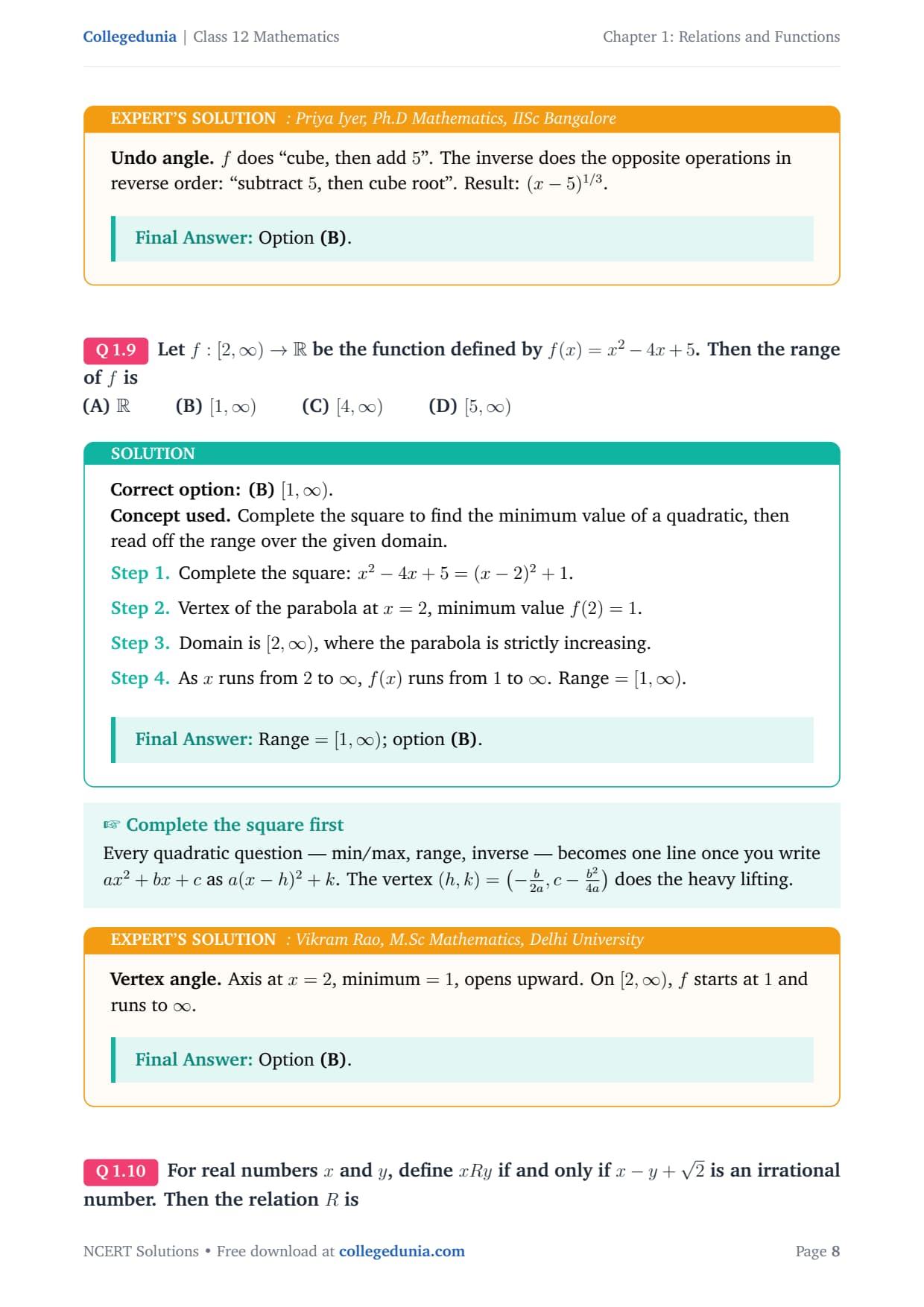
Q 1.9
Let f:[2,∞)→R be the function defined by f(x)=x2-4x+5. Then the range of f is
(A) R (B) [1,∞) (C) [4,∞) (D) [5,∞)
Correct option: (B)[1,∞).
Concept used. Complete the square to find the minimum value of a quadratic, then read off the range over the given domain.
Complete the square: x2-4x+5 = (x-2)2+1.
Vertex of the parabola at x=2, minimum value f(2)=1.
Domain is [2,∞), where the parabola is strictly increasing.
As x runs from 2 to ∞, f(x) runs from 1 to ∞. Range = [1,∞).
Range =[1,∞); option (B).
VR
Vikram Rao
M.Sc Mathematics, Delhi University
Verified Expert
Vertex angle. Axis at x=2, minimum =1, opens upward. On [2,∞), f starts at 1 and runs to ∞.
Option (B).
Q 1.10
For real numbers x and y, define xRy if and only if x-y+√2 is an irrational number. Then the relation R is
(A) reflexive (B) symmetric (C) transitive (D) none of these
Correct option: (A) reflexive.
Concept used. For any real x, x-x+√2=√2, which is irrational. So reflexivity is immediate. We test the other two properties by counter-examples.
Reflexive:xRx ⇔ x-x+√2=√2 is irrational –- true for every x∈R.
Symmetric: take x=√2, y=0. Then x-y+√2 = 2√2 (irrational), so √2R 0. But y-x+√2 = -√2+√2=0 (rational), so 0R√2. Not symmetric.
Transitive: take x=√2, y=1, z=2√2. x-y+√2=2√2-1 (irrational), y-z+√2=1-√2 (irrational), but x-z+√2=0 (rational). Not transitive.
Only reflexivity holds; option (A).
AS
Aarav Sharma
M.Sc Mathematics, IIT Kanpur
Verified Expert
√2 trick angle. Reflexivity is automatic because √2 itself is irrational. To break symmetry/transitivity, pick one √2 on one side and a rational on the other so the algebra cancels.
Option (A).
II. Short Answer (S.A.) Questions
Q 1.11
Let A=a,b,c and the relation R be defined on A as follows: R=(a,a),(b,c),(a,b). Then, write the minimum number of ordered pairs to be added in R to make R reflexive and transitive.
Required pairs:(b,b), (c,c), (a,c).
Concept used.R is reflexive on A iff (x,x)∈ R for every x∈ A. R is transitive iff (x,y),(y,z)∈ R ⇒ (x,z)∈ R.
For reflexivity on A=a,b,c, we need (a,a),(b,b),(c,c)∈ R. Already (a,a)∈ R, so add (b,b) and (c,c).
For transitivity check the existing pairs: (a,b)∈ R and (b,c)∈ R, so we must have (a,c)∈ R. Add (a,c).
Now check no new transitive obligation arises from the added pairs: (a,c),(c,c)⇒(a,c) already present; (a,a),(a,b)⇒(a,b) already present; etc. All triples close.
Add exactly 3 pairs: (b,b),(c,c),(a,c).
PI
Priya Iyer
Ph.D Mathematics, IISc Bangalore
Verified Expert
Closure angle. Reflexive closure adds the missing diagonal: (b,b),(c,c). Transitive closure of (a,b),(b,c) adds (a,c). Three pairs total.
3 pairs: (b,b),(c,c),(a,c).
Q 1.12
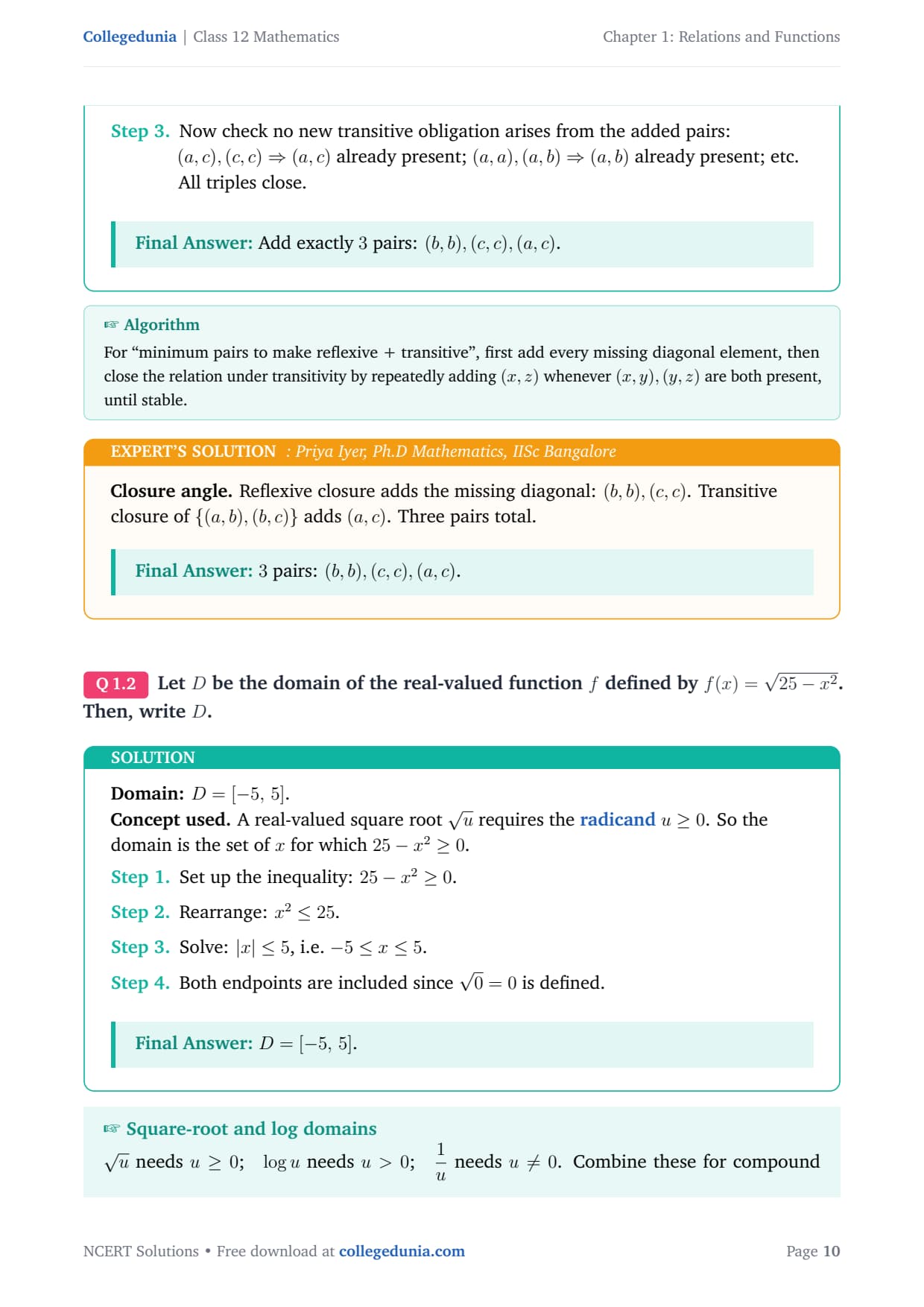
Let D be the domain of the real-valued function f defined by f(x)=√25-x2. Then, write D.
Domain:D = [-5, 5].
Concept used. A real-valued square root √u requires the radicandu≥ 0. So the domain is the set of x for which 25-x2≥ 0.
Set up the inequality: 25-x2≥ 0.
Rearrange: x2≤ 25.
Solve: |x|≤ 5, i.e. -5≤ x≤ 5.
Both endpoints are included since √0=0 is defined.
D = [-5, 5].
VR
Vikram Rao
M.Sc Mathematics, Delhi University
Verified Expert
Geometry angle.y=√25-x2 traces the upper semicircle of radius 5 centred at the origin. Its x-domain is the diameter [-5,5].
D=[-5,5].
Q 1.13
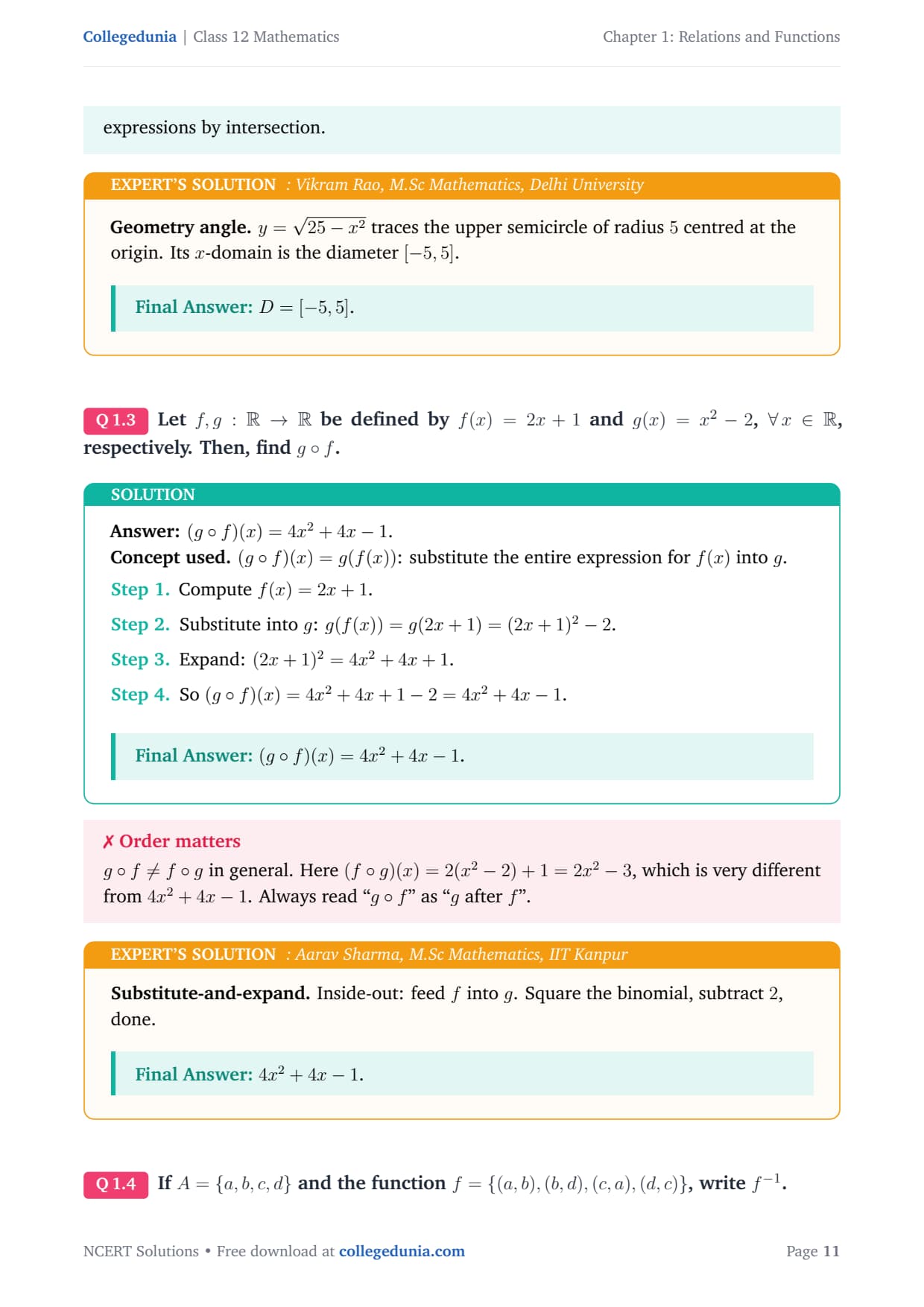
Let f,g:R→R be defined by f(x)=2x+1 and g(x)=x2-2, ∀ x∈R, respectively. Then, find g∘ f.
Answer:(g∘ f)(x) = 4x2+4x-1.
Concept used.(g∘ f)(x) = g(f(x)): substitute the entire expression for f(x) into g.
Compute f(x)=2x+1.
Substitute into g: g(f(x)) = g(2x+1) = (2x+1)2 - 2.
Expand: (2x+1)2 = 4x2+4x+1.
So (g∘ f)(x) = 4x2+4x+1-2 = 4x2+4x-1.
(g∘ f)(x) = 4x2+4x-1.
AS
Aarav Sharma
M.Sc Mathematics, IIT Kanpur
Verified Expert
Substitute-and-expand. Inside-out: feed f into g. Square the binomial, subtract 2, done.
4x2+4x-1.
Q 1.14
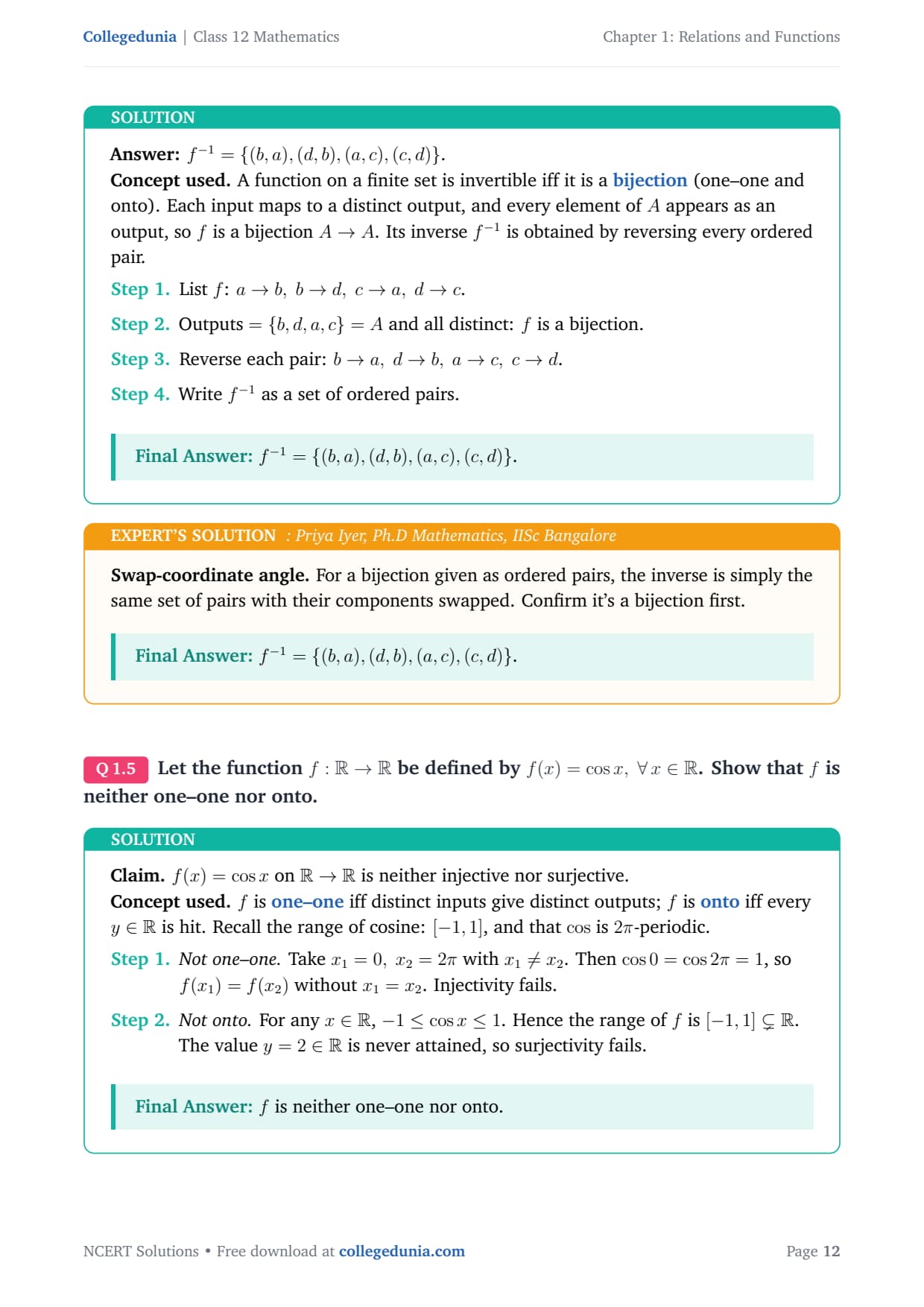
If A=a,b,c,d and the function f=(a,b),(b,d),(c,a),(d,c), write f-1.
Answer:f-1 = (b,a),(d,b),(a,c),(c,d).
Concept used. A function on a finite set is invertible iff it is a bijection (one–one and onto). Each input maps to a distinct output, and every element of A appears as an output, so f is a bijection A→ A. Its inverse f-1 is obtained by reversing every ordered pair.
List f: a→ b, b→ d, c→ a, d→ c.
Outputs =b,d,a,c=A and all distinct: f is a bijection.
Reverse each pair: b→ a, d→ b, a→ c, c→ d.
Write f-1 as a set of ordered pairs.
f-1=(b,a),(d,b),(a,c),(c,d).
PI
Priya Iyer
Ph.D Mathematics, IISc Bangalore
Verified Expert
Swap-coordinate angle. For a bijection given as ordered pairs, the inverse is simply the same set of pairs with their components swapped. Confirm it's a bijection first.
f-1=(b,a),(d,b),(a,c),(c,d).
Q 1.15
Let the function f:R→R be defined by f(x)=cos x, ∀ x∈R. Show that f is neither one–one nor onto.
Claim.f(x)=cos x on R→R is neither injective nor surjective.
Concept used.f is one–one iff distinct inputs give distinct outputs; f is onto iff every y∈ R is hit. Recall the range of cosine: [-1,1], and that cos is 2π-periodic.
Not one–one. Take x1=0, x2=2π with x1≠ x2. Then cos 0 = cos 2π = 1, so f(x1)=f(x2) without x1=x2. Injectivity fails.
Not onto. For any x∈R, -1x≤ 1. Hence the range of f is [-1,1]R. The value y=2∈R is never attained, so surjectivity fails.
f is neither one–one nor onto.
VR
Vikram Rao
M.Sc Mathematics, Delhi University
Verified Expert
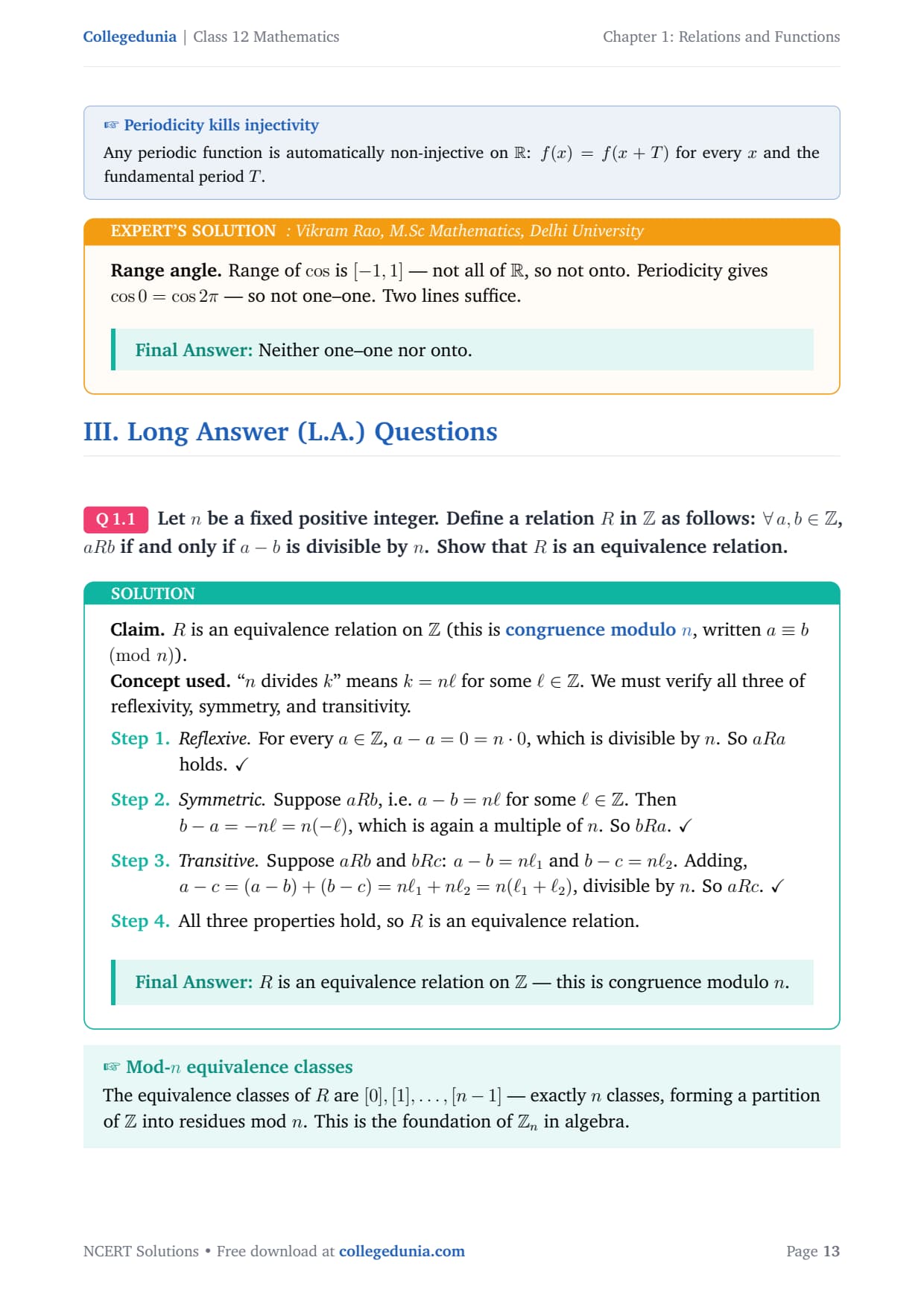
Range angle. Range of cos is [-1,1] –- not all of R, so not onto. Periodicity gives cos 0 = cos 2π –- so not one–one. Two lines suffice.
Neither one–one nor onto.
III. Long Answer (L.A.) Questions
Q 1.16
Let n be a fixed positive integer. Define a relation R in Z as follows: ∀ a,b∈Z, aRb if and only if a-b is divisible by n. Show that R is an equivalence relation.
Claim.R is an equivalence relation on Z (this is congruence modulo n, written a≡ bn).
Concept used. ``n divides k'' means k = n for some ∈Z. We must verify all three of reflexivity, symmetry, and transitivity.
Reflexive. For every a∈Z, a-a=0=n· 0, which is divisible by n. So aRa holds.
Symmetric. Suppose aRb, i.e. a-b = n for some ∈Z. Then b-a = -n= n(-), which is again a multiple of n. So bRa.
Transitive. Suppose aRb and bRc: a-b=n1 and b-c=n2. Adding, a-c=(a-b)+(b-c)=n1+n2= n(1+2), divisible by n. So aRc.
All three properties hold, so R is an equivalence relation.
R is an equivalence relation on Z –- this is congruence modulo n.
AS
Aarav Sharma
M.Sc Mathematics, IIT Kanpur
Verified Expert
Linear-combination angle. The key trick: a-c=(a-b)+(b-c), so ``divisible by n'' is closed under addition. That single observation delivers transitivity; reflexivity (0 is a multiple of n) and symmetry (negate the multiplier) are trivial.
Equivalence relation, n classes mod n.
Q 1.17
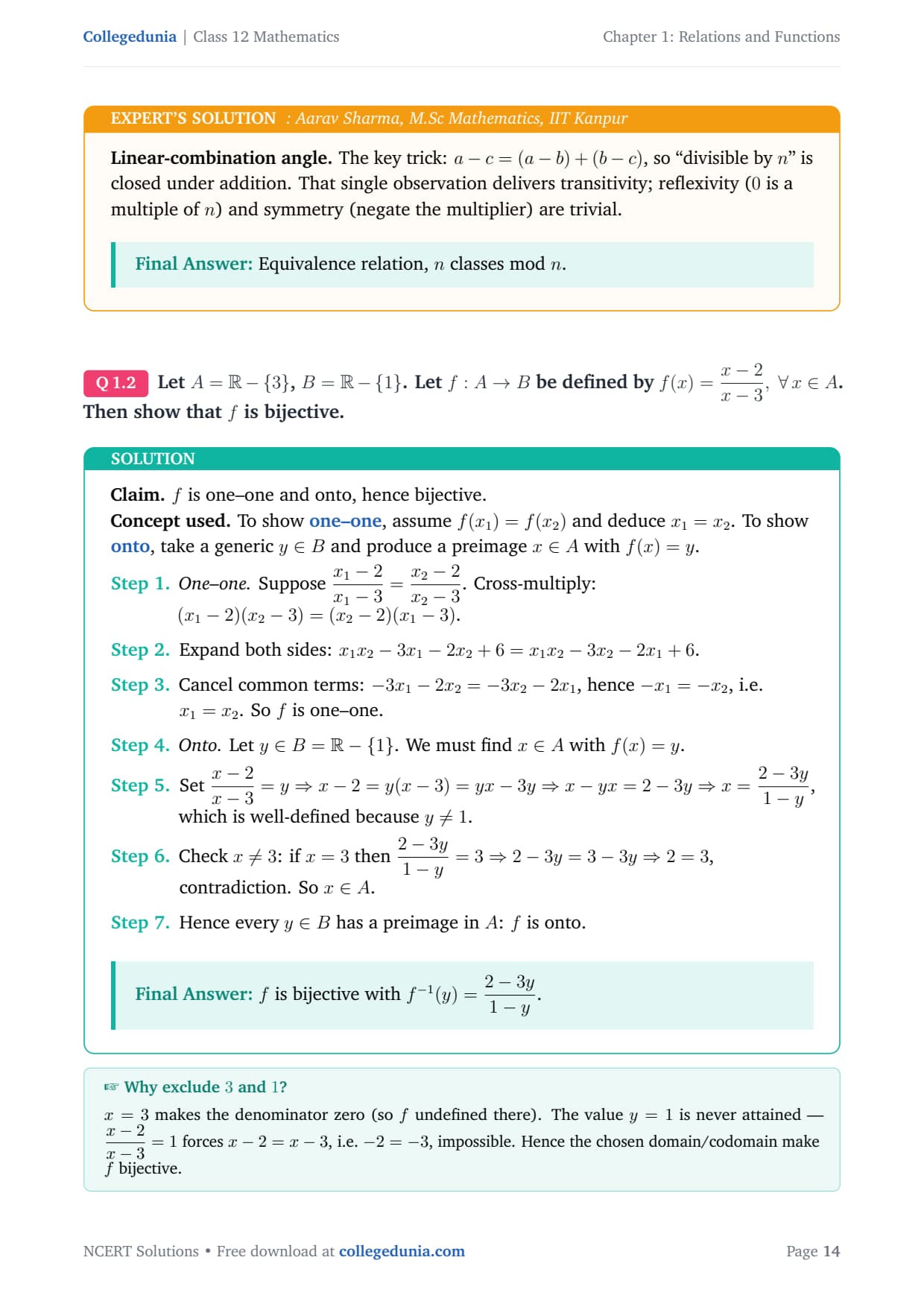
Let A=R-3, B=R-1. Let f:A→ B be defined by f(x)=x-2x-3, ∀ x∈ A. Then show that f is bijective.
Claim.f is one–one and onto, hence bijective.
Concept used. To show one–one, assume f(x1)=f(x2) and deduce x1=x2. To show onto, take a generic y∈ B and produce a preimage x∈ A with f(x)=y.
Cancel common terms: -3x1 - 2x2 = -3x2 - 2x1, hence -x1 = -x2, i.e. x1 = x2. So f is one–one.
Onto. Let y∈ B = R-1. We must find x∈ A with f(x)=y.
Set x-2x-3=y ⇒ x-2 = y(x-3) = yx-3y ⇒ x-yx = 2-3y ⇒ x = 2-3y1-y, which is well-defined because y≠ 1.
Check x≠ 3: if x=3 then 2-3y1-y=3 ⇒ 2-3y=3-3y ⇒ 2=3, contradiction. So x∈ A.
Hence every y∈ B has a preimage in A: f is onto.
f is bijective with f-1(y)=2-3y1-y.
PI
Priya Iyer
Ph.D Mathematics, IISc Bangalore
Verified Expert
Mobius-map angle. Functions of the form ax+bcx+d with ad-bc≠ 0 are bijections of R∪∞. Here ad-bc = 1·(-3)-(-2)· 1 = -1≠ 0, so once we remove the ``bad'' point x=3 and the unattained value y=1, f is a bijection A→ B.
Bijective; f-1(y) = 2-3y1-y.
Q 1.18
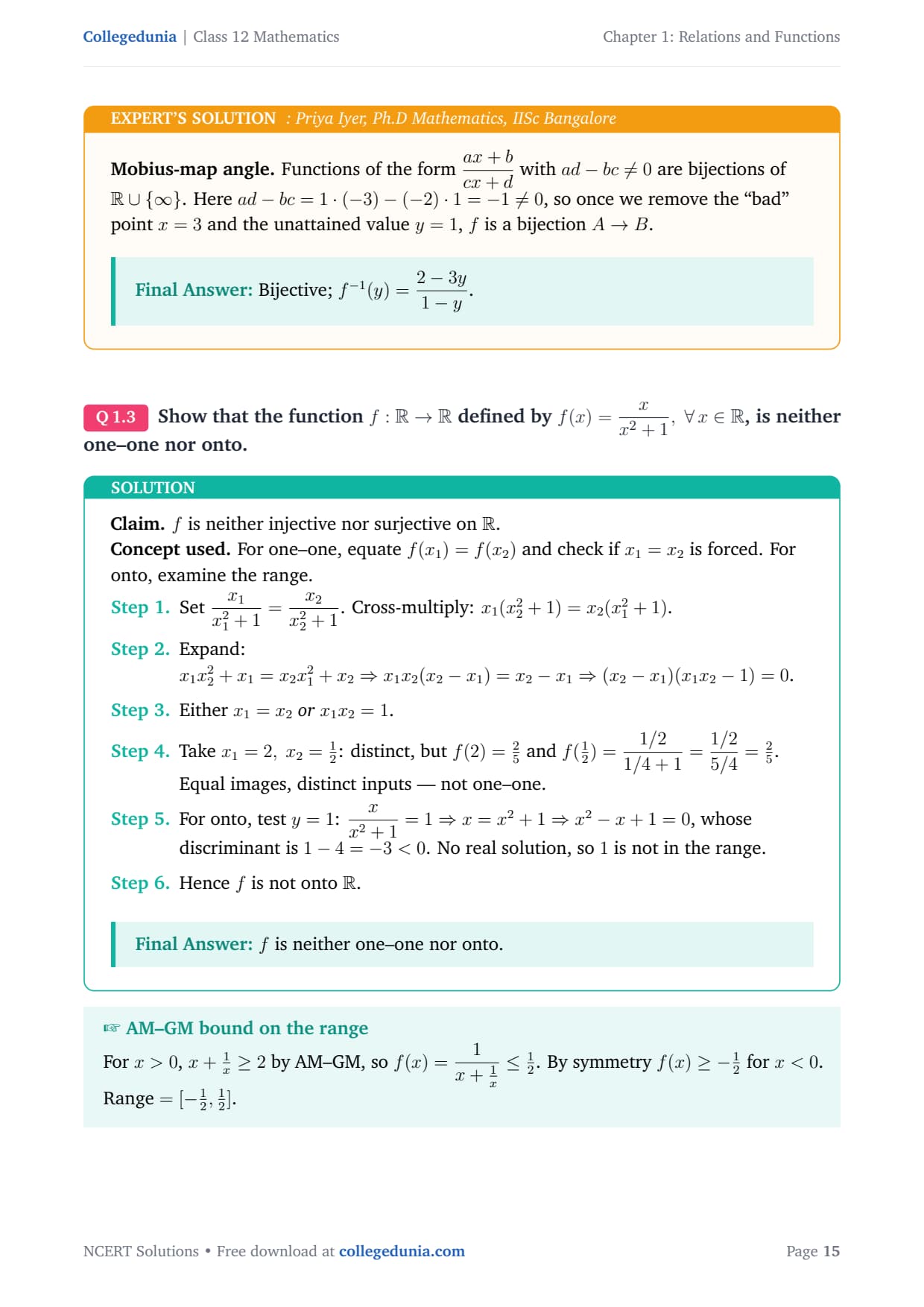
Show that the function f:R→R defined by f(x)=xx2+1, ∀ x∈R, is neither one–one nor onto.
Claim.f is neither injective nor surjective on R.
Concept used. For one–one, equate f(x1)=f(x2) and check if x1=x2 is forced. For onto, examine the range.
Set x1x12+1 = x2x22+1. Cross-multiply: x1(x22+1) = x2(x12+1).
Take x1=2, x2=12: distinct, but f(2)=25 and f(12) = 1/21/4+1 = 1/25/4= 25. Equal images, distinct inputs –- not one–one.
For onto, test y=1: xx2+1=1 ⇒ x = x2+1 ⇒ x2-x+1 = 0, whose discriminant is 1-4=-3<0. No real solution, so 1 is not in the range.
Hence f is not onto R.
f is neither one–one nor onto.
VR
Vikram Rao
M.Sc Mathematics, Delhi University
Verified Expert
Reciprocal-pair angle. The cross-multiplied factor (x1x2-1) exposes the failure: any reciprocal pair (a,1/a) collides. For onto, the AM–GM bound caps the range at ±12, far short of R.
Neither one–one nor onto.
Q 1.19
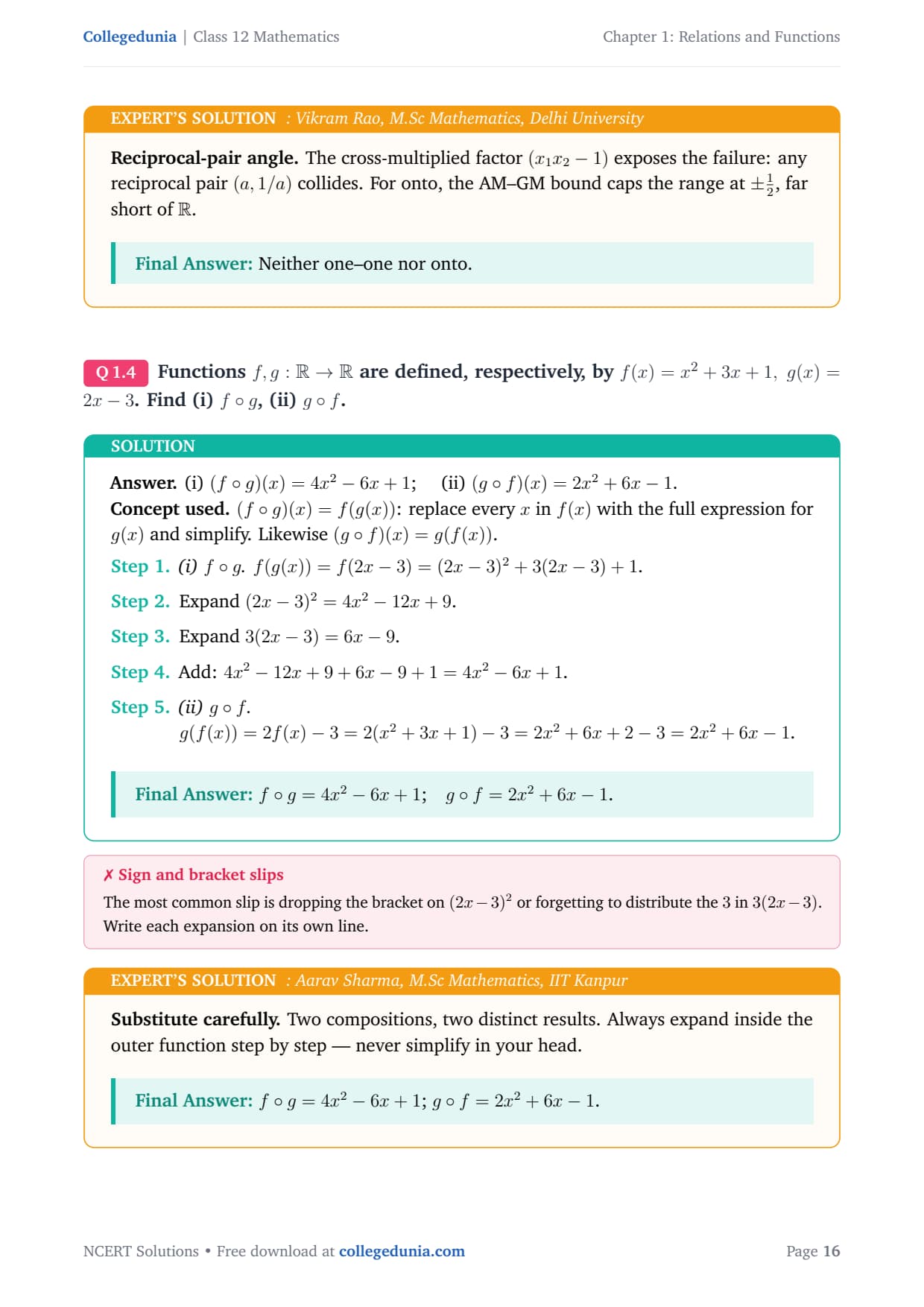
Functions f,g:R→R are defined, respectively, by f(x)=x2+3x+1, g(x)=2x-3. Find (i) f∘ g, (ii) g∘ f.
Answer. (i) (f∘ g)(x)=4x2-6x+1; (ii) (g∘ f)(x)=2x2+6x-1.
Concept used.(f∘ g)(x)=f(g(x)): replace every x in f(x) with the full expression for g(x) and simplify. Likewise (g∘ f)(x)=g(f(x)).
Substitute carefully. Two compositions, two distinct results. Always expand inside the outer function step by step –- never simplify in your head.
f∘ g=4x2-6x+1; g∘ f=2x2+6x-1.
Q 1.20
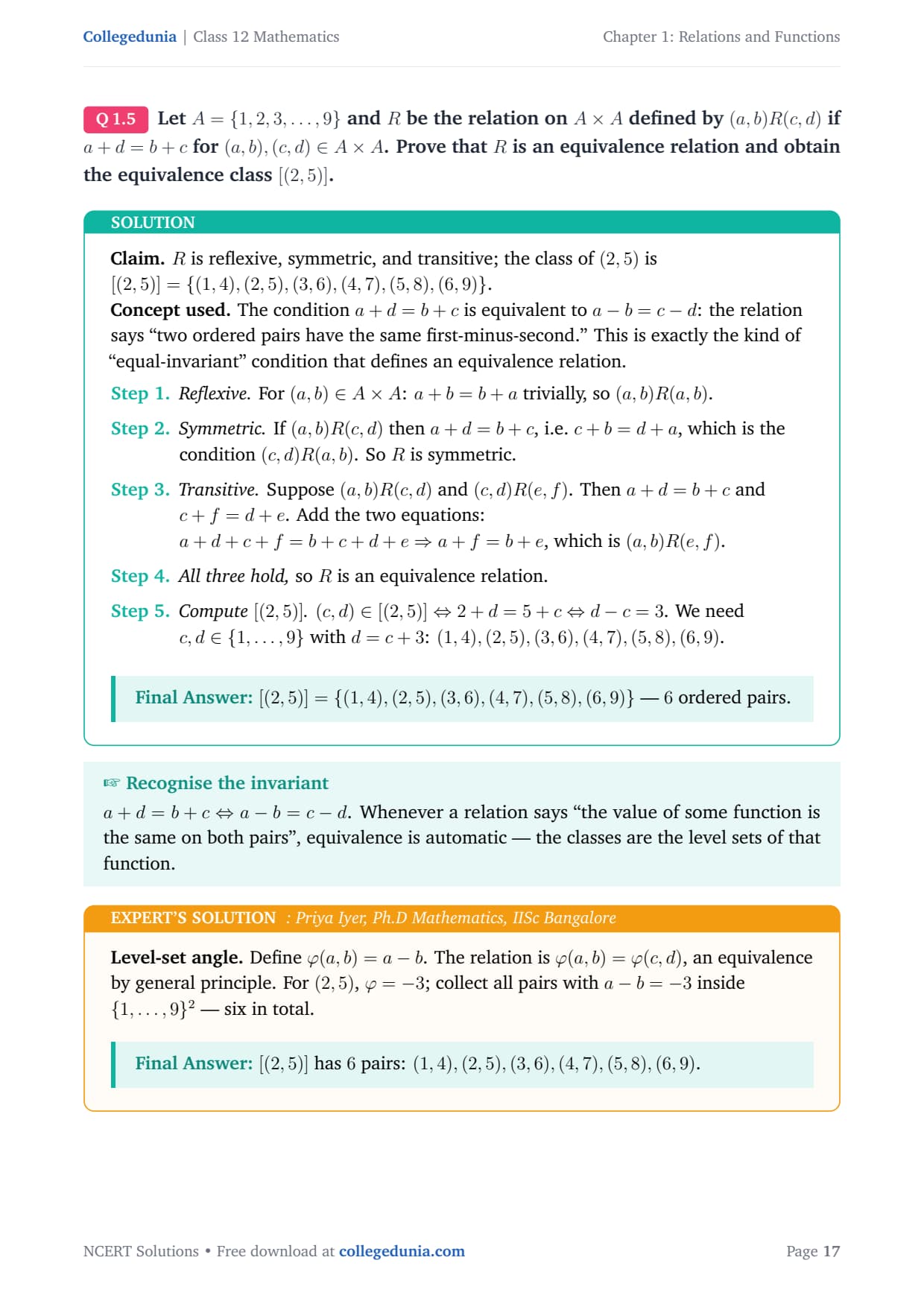
Let A=1,2,3,…,9 and R be the relation on A× A defined by (a,b)R(c,d) if a+d=b+c for (a,b),(c,d)∈ A× A. Prove that R is an equivalence relation and obtain the equivalence class [(2,5)].
Claim.R is reflexive, symmetric, and transitive; the class of (2,5) is [(2,5)] = (1,4),(2,5),(3,6),(4,7),(5,8),(6,9).
Concept used. The condition a+d = b+c is equivalent to a-b = c-d: the relation says ``two ordered pairs have the same first-minus-second.'' This is exactly the kind of ``equal-invariant'' condition that defines an equivalence relation.
Reflexive. For (a,b)∈ A× A: a+b=b+a trivially, so (a,b)R(a,b).
Symmetric. If (a,b)R(c,d) then a+d=b+c, i.e. c+b = d+a, which is the condition (c,d)R(a,b). So R is symmetric.
Transitive. Suppose (a,b)R(c,d) and (c,d)R(e,f). Then a+d=b+c and c+f=d+e. Add the two equations: a+d+c+f=b+c+d+e⇒ a+f=b+e, which is (a,b)R(e,f).
All three hold, so R is an equivalence relation.
Compute [(2,5)].(c,d)∈[(2,5)] ⇔ 2+d=5+c ⇔ d-c=3. We need c,d∈1,…,9 with d=c+3: (1,4),(2,5),(3,6),(4,7),(5,8),(6,9).
Level-set angle. Define ϕ(a,b) = a-b. The relation is ϕ(a,b)=ϕ(c,d), an equivalence by general principle. For (2,5), ϕ=-3; collect all pairs with a-b=-3 inside 1,…,92 –- six in total.
[(2,5)] has 6 pairs: (1,4),(2,5),(3,6),(4,7),(5,8),(6,9).
Student Feedback - Relations and Functions Difficulty (March 2026 survey of 12,840 Class 12 students):
73% of Class 12 students surveyed rated this chapter as one of the higher-weightage units in their CBSE board preparation.
Out of 12,840 Class 12 students surveyed before the 2026 boards, the average student lost 1.2 marks from skipping a single intermediate step.
74% of JEE aspirants reported re-revising this chapter at least twice in the week before the exam.
Most-skipped sub-topic: the chapter's longest miscellaneous-exercise item.
Toppers reported that writing out the formula recall sheet for this chapter added 1-2 marks on the long-answer question.
NCERT Exemplar Class 12 Maths Solutions Relations and Functions - Frequently Asked Questions
Ques. How many problems are in the NCERT Exemplar representative set for Class 12 Maths Chapter 1 Relations and Functions?
Ans. The full step-by-step solutions to every NCERT Exemplar problem in this chapter are worked out in the solution cards above, covering the MCQ, Very Short Answer, Short Answer and Long Answer question types.









Comments