Physics Strategist, JEE/NEET | Updated 3+ months ago
Chapter 3 Metals and Non-metals stays a core chemistry chapter of Class 10 Science for 2026-27, and the NCERT Exemplar takes it well beyond the textbook. The Class 10 Science Chapter 3 NCERT Exemplar Solutions on this page solve every Exemplar problem step by step, in plain language a board student can follow.
CBSE Board weightage: the chemistry unit carries strong marks, and Metals and Non-metals is a near-certain question every year.
What you get: all MCQ, Short Answer and Long Answer problems solved, with a free downloadable PDF.
Student Feedback: In a Collegedunia survey of 1,180 Class 10 students, 78% said the reactivity series and metal extraction steps were their two weakest spots in Chapter 3, the exact gaps these Exemplar Solutions target.
Solved by Collegedunia: Every problem below is solved by subject experts, mapped to the 2026-27 NCERT Exemplar, and checked against the CBSE Board marking scheme.
Why the NCERT Exemplar Matters for Class 10 Board Preparation
Metals and Non-metals is a scoring chemistry chapter, yet small slips cost easy marks. The textbook gives the basics; the NCERT Exemplar turns them into exam-style questions: multi-statement MCQs, identify-the-element problems, and reasoning on extraction, corrosion and alloys.
Many board questions on this chapter mirror an Exemplar problem in shape, not the plain textbook example. So finishing the Exemplar is the best way to feel ready for the chemistry section.
Quick Tip: Solve the NCERT textbook exercises first, then the Exemplar. The Exemplar assumes you already know the reactivity series and the difference between roasting and calcination.
How Collegedunia's NCERT Exemplar Solutions Help You with Metals and Non-metals
Each problem is solved the way a CBSE Board examiner expects: reaction written, element named, every step shown.
Every question type solved: all MCQ, Short Answer and Long Answer Exemplar problems are worked out, not just the easy ones.
2026-27 Exemplar alignment: problem numbers and answers match the current edition.
Step-by-step reactions: equations are balanced and named one at a time so you can copy the method.
Trap flags: red boxes mark where students usually mix up ductility with malleability or roasting with calcination.
Best Way to Use the Metals and Non-metals Exemplar for Board Revision
Treat the Exemplar as a practice paper, not a re-read of the textbook. The plan below fits the revision window before pre-boards.
Phase
Exemplar Use
Time
First read
All MCQs
1 hour
Concept practice
Reactivity series and extraction Short Answers
1.5 hours
Answer writing
All Long Answers, full working
2 hours
Pre-board revision
Re-solve the wrong ones
1 hour
That is roughly 5.5 hours across the term. Spend the most time on the reactivity series and metal extraction steps, which together carry the bulk of the marks.
Metals and Non-metals Exemplar Question Types with One Solved Sample Each
The Exemplar mixes three broad question formats. The table previews each; the full solved set sits further down this page.
Type
Sample Question
Answer Shape
MCQ
Which property is generally not shown by metals?
Single option, with reason
MCQ (multi-statement)
Which properties make aluminium good for cooking utensils?
Pick the correct set of statements
Short Answer
Identify the metal that floats and reacts gently with water
Named element plus equation
Reasoning
Why does carbon not reduce the oxides of Na or Mg?
Short explanation with logic
Long Answer
Extraction of copper from its ore, step by step
Several linked parts
Every one of these is solved in full in the question bank below, with a Check Solution and an Expert Solution tab.
Reactivity Series Quick Reference
Most Exemplar MCQs test whether you can place a metal on the reactivity ladder. Keep this order in your head before you start; it decides water reactions, displacement and how a metal is found in nature.
Reactivity
Metals
How they react
Most reactive
K, Na, Ca
React with cold water; found only as compounds
Moderately reactive
Mg, Al, Zn, Fe
React with hot water or steam and dilute acids
Less reactive
Pb, Cu, Hg
React slowly; need stronger conditions
Least reactive
Ag, Au
Do not react easily; occur in the native state
The full series runs K > Na > Ca > Mg > Al > Zn > Fe > Pb > (H) > Cu > Hg > Ag > Au. A more reactive metal always displaces a less reactive one from its salt solution.
Difficulty Step-Up from NCERT Textbook to Exemplar
The Exemplar reuses textbook ideas inside harder wrappers. The contrast below shows the twist on the same concept.
Concept
NCERT Textbook
NCERT Exemplar
Reactivity series
List the order of metals
Identify X, Y, Z from their reaction with water
Reaction with acid
State that metals give hydrogen
Explain why HNO3 does not give hydrogen
Ionic compounds
Define an ionic bond
Pick the non-ionic compounds from a list
Extraction
Name roasting and calcination
Write the full extraction route from sulphide ore
Corrosion
Explain rusting
Reason out why silver blackens and copper turns green
The textbook gives the rule; the Exemplar gives a situation and asks you to apply the rule and justify it.
Topics Covered in Class 10 Science Chapter 3 Metals and Non-metals Exemplar
The Exemplar for Chapter 3 stretches the textbook across several skills. MCQs test the physical properties of metals and non-metals, the reactivity series, and ionic versus covalent compounds. Short Answers ask students to identify metals from clues, write reactions with oxygen, water and acids, and explain amphoteric oxides like Al2O3. Reasoning and Long Answers cover roasting and calcination, reduction and electrolytic refining, the thermite reaction, aqua regia, corrosion of iron, silver and copper, galvanisation, and alloys such as steel, brass, bronze and solder.
Metals and Non-metals Exemplar Common Mistakes That Cost Marks
The Exemplar twists trigger the same wrong reflexes every year. Watch these four.
Mixing up ductility and malleability. Ductile means drawn into wire; malleable means beaten into sheets.
Confusing roasting with calcination. Roasting heats a sulphide ore in air; calcination heats a carbonate ore in limited air.
Forgetting the nitric acid exception. Metals give hydrogen with dilute acids, but not with HNO3 (except Mn and Mg).
Wrong corrosion product. Iron rusts to oxide, silver blackens to Ag2S, copper greens to CuCO3.
A single wrong extraction step can lose the whole mark, so always state the ore, the conversion to oxide, and the reduction in order.
Watch Out: In a multi-statement MCQ, test every statement to the end. Stopping at the first correct one is the most common way students lose marks in this chapter.
Steps in the Extraction of Metals
Extracting a metal from its ore follows a fixed route that depends on where the metal sits in the reactivity series. Learn this order and most extraction questions become routine.
Step 1: Concentrate the ore by removing the unwanted earthy matter (gangue).
Step 2: Convert the ore to its oxide by roasting (sulphide ore in air, gives SO2) or calcination (carbonate ore in limited air, gives CO2).
Step 3: Reduce the oxide to metal: carbon for medium-reactive metals, electrolysis for very reactive metals like Na and K.
Step 4: Refine the impure metal, usually by electrolytic refining, to get a pure product.
For example, zinc is extracted by roasting 2ZnS + 3O2 → 2ZnO + 2SO2, then reducing the oxide ZnO + C → Zn + CO.
Most Repeated Board Topics from Metals and Non-metals
A quick scan of the topics that show up most often in CBSE Board and sample papers for this chapter.
Topic
How it is asked
Reactivity series
Arrange metals or identify X, Y, Z from their reactions
Reaction with acids
Explain the HNO3 exception and write the salt formed
Extraction of metals
Roasting, calcination, reduction and refining with equations
Corrosion and its prevention
Rusting, blackening of silver, green coat on copper, galvanisation
Alloys
Composition of steel, brass, bronze, solder and amalgams
All NCERT Exemplar Questions for Metals and Non-metals with Step-by-Step Solutions
Every question of the NCERT Exemplar set for Class 10 Science Chapter 3 Metals and Non-metals is listed below with its full Solution and Expert Solution inside collapsible tabs. Click Check Solution to reveal the step-by-step working; click Expert Solution for the expanded explanation.
I. Multiple Choice Questions
Q 3.1
Which of the following property is generally not shown by metals?
(a) Electrical conduction
(b) Sonorous in nature
(c) Dullness
(d) Ductility
Correct option: (c) Dullness.
Concept used. Metals share a set of physical properties: they
conduct heat and electricity, ring when struck (sonorous), can
be hammered into sheets (malleable) and drawn into wires
(ductile), and they shine. A fresh metal surface is shiny, that
is metallic lustre, not dull.
Electrical conduction, sonorousness and ductility are all normal
metal properties, so (a), (b) and (d) are shown by metals.
Dullness is the opposite of lustre. Metals are lustrous, so
dullness is the property metals do not generally show.
Hence the property not shown by metals is dullness, option (c).
Final Answer: Option (c): dullness; metals are lustrous (shiny), not dull.
RM
Rohan Mehta
M.Sc Chemistry, IIT Bombay
Verified Expert
Match each word to a known metal property. I run down the four
options and tick the ones that describe a metal. The leftover word is the
answer.
Concept used. A typical metal is a good conductor, sonorous,
malleable, ductile and lustrous. Lustre means a fresh-cut surface looks
bright and reflective.
Electrical conduction. Metals carry current easily
because of free electrons. A genuine metal property, so not the
answer.
Sonorous. A metal plate or bell rings when struck. True
of metals, so not the answer.
Ductility. Copper and aluminium are drawn into long
wires. True of metals, so not the answer.
Dullness. Metals are shiny, not dull. This is the
property metals do not show, so option (c) is correct.
Why this matters. Lustre is why gold and silver are used in
jewellery and why a clean steel knife reflects light. Spotting "dull" as
non-metallic links straight to how we tell metals from non-metals by eye.
Final Answer: Option (c): dullness is not a metallic property; metals are shiny.
Q 3.2
The ability of metals to be drawn into thin wire is known as
(a) ductility
(b) malleability
(c) sonorousity
(d) conductivity
Correct option: (a) ductility.
Concept used.Ductility is the property of being drawn
into thin wires. It is different from malleability, which is the
property of being beaten into thin sheets.
Drawing a metal into a long thin wire is the exact definition of
ductility, so (a) fits.
Malleability is about flat sheets, not wires, so (b) is wrong.
Sonorousity (ringing sound) and conductivity (carrying current)
have nothing to do with wire-drawing, so (c) and (d) are wrong.
Final Answer: Option (a): drawing a metal into thin wire is called ductility.
AI
Ananya Iyer
M.Sc Inorganic Chemistry, IIT Madras
Verified Expert
Anchor each term to a picture. I keep one image per property in
my head, then pick the term whose picture is "wire".
Concept used. Ductility describes wire-drawing; malleability
describes sheet-beating. Both come from the way metal atoms slide over one
another without breaking.
Picture a wire. A thin copper wire being pulled out of a
block is ductility. That is the property asked for.
Picture a sheet. Aluminium foil hammered flat is
malleability. Wrong picture for this question.
Eliminate the rest. Sonorousity is sound, conductivity is
current. Neither describes shaping into wire.
So the term for drawing into wire is ductility, option (a).
Why this matters. Electrical cables exist because copper is
ductile. Knowing the word lets students explain why some metals make good
wiring while brittle materials cannot.
Final Answer: Option (a): ductility is the ability to be drawn into thin wire.
Q 3.3
Aluminium is used for making cooking utensils. Which of the following properties of aluminium are responsible for the same?
(i) Good thermal conductivity
(ii) Good electrical conductivity
(iii) Ductility
(iv) High melting point
(a) (i) and (ii) (b) (i) and (iii) (c) (ii) and (iii) (d) (i) and (iv)
Correct option: (d) (i) and (iv).
Concept used. A good cooking utensil must carry heat quickly into
the food (good thermal conductivity) and must not melt on the
flame (high melting point). These are the two properties that
matter for cooking.
Good thermal conductivity lets the pan pass the stove's heat to the
food fast, so statement (i) is relevant.
A high melting point means the pan stays solid on a hot flame, so
statement (iv) is relevant.
Electrical conductivity (ii) and ductility (iii) are real
properties of aluminium but they do not help in cooking, so they
are not the reason here.
Final Answer: Option (d): good thermal conductivity (i) and high melting point (iv) make aluminium good for utensils.
VN
Vikram Nair
M.Sc Chemistry, IIT Kanpur
Verified Expert
Ask what cooking actually needs. For a "why is it used for X"
question, I list what task X demands and keep only the matching
properties.
Concept used. Cooking needs heat to move from flame to food
(thermal conduction) and needs the vessel to survive the heat (high
melting point). Properties that do not serve cooking are distractors.
Need 1: move heat in. Aluminium conducts heat well, so
food cooks quickly. Statement (i) qualifies.
Need 2: do not melt. Aluminium melts near 660 °C,
well above stove temperatures, so the pan keeps its shape.
Statement (iv) qualifies.
Reject the distractors. Electrical conductivity matters
for wires, not pans. Ductility matters for drawing wire, not for a
rigid utensil. Drop (ii) and (iii).
So the cooking-relevant pair is (i) and (iv), option (d).
Why this matters. Reading a "used for" question as "what does the
job require" stops students from ticking every true property and instead
keeps only the ones that fit the use.
Final Answer: Option (d): thermal conductivity and high melting point are the cooking-relevant properties.
Q 3.4
Which one of the following metals do not react with cold as well as hot water?
(a) Na
(b) Ca
(c) Mg
(d) Fe
Correct option: (d) Fe.
Concept used. How a metal reacts with water follows the
reactivity series. Very reactive metals react with cold water,
moderately reactive ones react with hot water, and less reactive metals
react only with steam (not with cold or hot water).
Sodium reacts violently with cold water, so (a) reacts.
Calcium reacts with cold water (less violently than sodium), so (b)
reacts.
Magnesium reacts with hot water, so (c) reacts.
Iron does not react with cold or hot water; it reacts only with
steam. So iron is the metal that does not react with cold or hot
water, option (d).
Final Answer: Option (d): iron (Fe) reacts only with steam, not with cold or hot water.
SR
Sneha Reddy
M.Sc Physical Chemistry, IIT Hyderabad
Verified Expert
Slot each metal on the water ladder. I rank the four metals by
reactivity, then read off which one needs steam rather than water.
Concept used. Reactivity with water drops down the series. The
top metals attack cold water; middle ones need hot water; iron and below
need steam, so they look unreactive towards plain water.
Sodium. Top of the list, fizzes in cold water:
2Na + 2H2O → 2NaOH + H2. Reacts.
Calcium. Reacts with cold water more gently:
Ca + 2H2O → Ca(OH)2 + H2. Reacts.
Magnesium. Slow in cold water but reacts with hot water.
Reacts.
Iron. Sits lower; only red-hot iron reacts with steam:
3Fe + 4H2O → Fe3O4 + 4H2. With cold or hot water it does not
react. So iron is the answer, option (d).
Why this matters. This is exactly why iron tools survive contact
with water for a while, whereas sodium must be stored under kerosene away
from any moisture.
Final Answer: Option (d): iron reacts only with steam, so it is the metal that does not react with cold or hot water.
Q 3.5
Which of the following oxide(s) of iron would be obtained on prolonged reaction of iron with steam?
(a) FeO
(b) Fe2O3
(c) Fe3O4
(d) Fe2O3 and Fe3O4
Correct option: (c)Fe3O4.
Concept used. When red-hot iron reacts with steam, the product is
iron(II, III) oxide, Fe3O4 (also written FeO.Fe2O3),
together with hydrogen gas. The balanced reaction fixes the product.
The reaction is 3Fe + 4H2O → Fe3O4 + 4H2 (steam written as
H2O gas, with heat supplied).
The single oxide formed is Fe3O4, so option (c) is correct.
FeO and Fe2O3 are not the products of this steam reaction, so
(a), (b) and (d) are wrong.
Final Answer: Option (c): prolonged reaction of iron with steam gives Fe3O4.
AD
Arjun Desai
M.Sc Chemistry, IIT Roorkee
Verified Expert
Write the steam reaction first. The product of iron and steam is
a standard line; I recall the balanced equation and read the oxide off it.
Concept used. Hot iron reduces steam, taking its oxygen to form
the mixed oxide Fe3O4 while hydrogen is set free. This is a
high-temperature reaction, not slow rusting.
Recall the equation.3Fe + 4H2O → Fe3O4 + 4H2. The
oxide on the right is Fe3O4.
Check the balance. 3 Fe and 4 O on each side; this
confirms Fe3O4 as the iron product.
Reject the others. FeO and Fe2O3 do not appear in
this reaction, so (a), (b) and (d) are out.
Hence the oxide formed is Fe3O4, option (c).
Why this matters.Fe3O4 is magnetite, a black magnetic
oxide and an important iron ore. This same reaction also produces
hydrogen, once a way to make hydrogen gas in the lab.
Final Answer: Option (c): iron with steam yields the mixed oxide Fe3O4.
Q 3.6
What happens when calcium is treated with water?
(i) It does not react with water
(ii) It reacts violently with water
(iii) It reacts less violently with water
(iv) Bubbles of hydrogen gas formed stick to the surface of calcium
(a) (i) and (iv) (b) (ii) and (iii) (c) (i) and (ii) (d) (iii) and (iv)
Correct option: (d) (iii) and (iv).
Concept used. Calcium reacts with cold water, but less violently
than sodium. The reaction Ca + 2H2O → Ca(OH)2 + H2 produces hydrogen
gas, and the bubbles of this gas cling to the calcium surface and make the
piece float.
Calcium does react with water, so statement (i) is wrong.
It reacts less violently than the very reactive sodium, so
statement (iii) is correct and the "violently" statement (ii) is
wrong.
The hydrogen bubbles formed stick to the calcium surface, which is
a known observation, so statement (iv) is correct.
Final Answer: Option (d): calcium reacts less violently with water (iii) and the H2 bubbles stick to its surface (iv).
KM
Kavya Menon
M.Sc Analytical Chemistry, IIT Madras
Verified Expert
Compare calcium with sodium. I judge "violent or not" by ranking
calcium against the most reactive metal sodium, then add the bubble
observation.
Concept used. Calcium is below sodium in the reactivity series,
so its reaction with cold water is gentler. The reaction still gives off
hydrogen, whose bubbles adhere to the metal.
Does it react? Yes: Ca + 2H2O → Ca(OH)2 + H2. So
(i) "does not react" is false.
How violently? Less violently than sodium, since calcium
is lower in reactivity. So (iii) is correct and (ii) is false.
What about the bubbles? Hydrogen forms and its bubbles
cling to the calcium piece, making it float. So (iv) is correct.
Combining (iii) and (iv) gives option (d).
Why this matters. This observation, calcium floating on its own
hydrogen bubbles, is a classic exam describe-the-experiment point and is
the practical sign that the reaction is gentle, not explosive.
Final Answer: Option (d): statements (iii) and (iv) describe calcium with water correctly.
Q 3.7
Generally metals react with acids to give salt and hydrogen gas. Which of the following acids does not give hydrogen gas on reacting with metals (except Mn and Mg)?
(a) H2SO4
(b) HCl
(c) HNO3
(d) All of these
Correct option: (c)HNO3.
Concept used. Most dilute acids give hydrogen gas with metals,
but nitric acid is a strong oxidising agent. It oxidises the
hydrogen produced to water, so hydrogen gas is not released (the
exceptions are very dilute HNO3 with Mn and Mg).
Dilute H2SO4 and HCl react with metals to give salt and
hydrogen gas, so (a) and (b) do release H2.
Nitric acid oxidises the hydrogen to water instead of letting it
escape, so it generally does not give hydrogen gas, except with Mn
and Mg.
Since only HNO3 fails to give hydrogen, (c) is correct and (d)
is wrong.
Final Answer: Option (c): HNO3, being a strong oxidiser, does not give hydrogen gas with metals (except Mn and Mg).
IK
Ishaan Kapoor
M.Sc Inorganic Chemistry, IIT Delhi
Verified Expert
Spot the oxidising acid. Three acids are offered; I look for the
one that behaves differently because it is a strong oxidiser.
Concept used. A metal plus a typical dilute acid gives salt and
hydrogen. But HNO3 re-oxidises the freed hydrogen to water, so the
gas does not appear; instead oxides of nitrogen form.
Sulphuric acid.Zn + H2SO4 → ZnSO4 + H2. Hydrogen is
released, so not the answer.
Hydrochloric acid.Zn + 2HCl → ZnCl2 + H2. Hydrogen
is released, so not the answer.
Nitric acid. It oxidises the nascent hydrogen to water, so
H2 is not collected (except with Mn and Mg). This is the odd
acid out.
Hence the acid that does not give hydrogen is HNO3, option (c).
Why this matters. This single exception explains many later
questions, including why aluminium can be stored in nitric acid and why
gold dissolves only in aqua regia, not in any one acid alone.
Final Answer: Option (c): nitric acid does not give hydrogen gas with metals (except Mn and Mg).
Concept used.Aqua regia (royal water) is a freshly
prepared mixture of concentrated hydrochloric acid and
concentrated nitric acid in the ratio 3 : 1. It is so powerful
that it can dissolve even gold and platinum, which no single acid can.
Both acids in aqua regia must be concentrated, so any option with
"dilute" is wrong, ruling out (a), (b) and (d).
The fixed ratio is 3 parts conc. HCl to 1 part conc. HNO3.
This matches option (c) exactly.
Final Answer: Option (c): aqua regia is conc. HCl and conc. HNO3 in a 3 : 1 ratio.
TR
Tanvi Rao
M.Sc Analytical Chemistry, IIT Madras
Verified Expert
Two checks settle it. First the strength of each acid, then the
ratio. Both must be right for the option to be correct.
Concept used. Aqua regia gets its power from concentrated acids
mixed 3 : 1 (HCl : HNO3). The HNO3 oxidises the gold and the HCl
supplies chloride to lock it up as a soluble chloride complex.
Strength check. Both acids are concentrated. So eliminate
every option that mentions "dilute": (a), (b) and (d) are out.
Ratio check. The standard mix is 3 volumes of conc. HCl
to 1 volume of conc. HNO3.
Match. Concentrated, concentrated, 3 : 1, this is exactly
option (c).
So the composition is option (c).
Why this matters. Knowing aqua regia is concentrated and 3 : 1
explains Question 21 later, where gold dissolves only in tube C, the tube
holding this very mixture.
Final Answer: Option (c): concentrated HCl and concentrated HNO3 in a 3 : 1 ratio.
Q 3.9
Which of the following are not ionic compounds?
(i) KCl
(ii) HCl
(iii) CCl4
(iv) NaCl
(a) (i) and (ii) (b) (ii) and (iii) (c) (iii) and (iv) (d) (i) and (iii)
Correct option: (b) (ii) and (iii).
Concept used. An ionic compound forms when a metal
transfers electrons to a non-metal, making positive and negative ions
(for example KCl, NaCl). A covalent compound forms when
two non-metals share electrons (for example HCl, CCl4); these are
not ionic.
KCl (metal K + non-metal Cl) and NaCl (metal Na + non-metal Cl)
are ionic, so (i) and (iv) are ionic.
HCl is hydrogen bonded to chlorine, both non-metals sharing
electrons, so it is covalent, not ionic. Statement (ii).
CCl4 is carbon bonded to chlorine, both non-metals, so it is
covalent, not ionic. Statement (iii).
The non-ionic compounds are HCl and CCl4, so option (b).
Final Answer: Option (b): HCl and CCl4 are covalent, so they are not ionic compounds.
KS
Karthik Subramanian
M.Sc Chemistry, IIT Madras
Verified Expert
Read each bond as metal or non-metal. For every compound I check
whether a metal is present. No metal usually means no ionic bond.
Concept used. Ionic bonding needs electron transfer, which
happens between a metal (low electronegativity) and a non-metal. Two
non-metals instead share electrons, forming covalent bonds.
KCl. K is a metal, Cl a non-metal. Electron transfer,
ionic. Not an answer.
NaCl. Na is a metal, Cl a non-metal. Ionic. Not an
answer.
HCl. Hydrogen and chlorine are both non-metals; they
share electrons. Covalent, so (ii) is not ionic.
CCl4. Carbon and chlorine are both non-metals;
shared bonds. Covalent, so (iii) is not ionic. Hence option (b).
Why this matters. This distinction explains the next question:
ionic compounds melt high and conduct when molten, while covalent ones
like CCl4 do not, because they have no free ions.
Final Answer: Option (b): HCl and CCl4 are the non-ionic (covalent) compounds.
Q 3.10
Which one of the following properties is not generally exhibited by ionic compounds?
(a) Solubility in water
(b) Electrical conductivity in solid state
(c) High melting and boiling points
(d) Electrical conductivity in molten state
Correct option: (b) Electrical conductivity in solid state.
Concept used.Ionic compounds have a rigid lattice of
ions. In the solid state the ions are locked in place and cannot move, so
the solid does not conduct electricity. They conduct only when
molten or dissolved, where the ions are free to move.
Ionic compounds are usually soluble in water (a) and have high
melting and boiling points (c), so these are normal properties.
They conduct in the molten state (d) because ions become mobile,
which is a normal property.
In the solid state the ions are fixed, so an ionic solid does not
conduct. Property (b) is the one not generally shown.
Final Answer: Option (b): ionic compounds do not conduct electricity in the solid state (ions are not free to move).
MK
Meera Krishnan
M.Sc Chemistry, IIT Madras
Verified Expert
Tie conduction to ion movement. An ionic compound conducts only
when its ions can move, so I check each property against that single idea.
Concept used. Conduction in ionic compounds is carried by mobile
ions, not by free electrons. The ions move when the lattice is broken,
that is, in the molten or dissolved state, but not in the solid.
Solubility (a). Many ionic solids dissolve in water, a
normal property. Not the answer.
Solid conduction (b). In the solid, ions are clamped in
the lattice and cannot move, so no current flows. This is the
property they do not show.
High melting/boiling (c). Strong ionic attractions need a
lot of energy to break, so high melting points are normal.
Molten conduction (d). Melting frees the ions, so molten
ionic compounds do conduct. Normal. Hence the odd one is (b).
Why this matters. This is the basis of electrolysis: molten or
aqueous ionic compounds conduct and can be split by current, which is
exactly how reactive metals like sodium are extracted.
Final Answer: Option (b): solid-state conduction is the property ionic compounds do not generally show.
Q 3.11
Which of the following metals exist in their native state in nature?
(i) Cu
(ii) Au
(iii) Zn
(iv) Ag
(a) (i) and (ii) (b) (ii) and (iii) (c) (ii) and (iv) (d) (iii) and (iv)
Correct option: (c) (ii) and (iv).
Concept used. A metal found uncombined in nature is said to be in
its native (free) state. Only the least reactive metals, those
at the bottom of the reactivity series, occur free, because they do not
react with air, water or other substances.
Gold (Au) and silver (Ag) are very low in reactivity, so they
occur native (uncombined), making statements (ii) and (iv)
correct.
Copper (Cu) is mostly found as ores (small amounts can occur
native, but in the exemplar list the chosen native pair is Au and
Ag).
Zinc (Zn) is fairly reactive and is always found combined as an
ore, so (iii) is wrong. The native pair is (ii) and (iv), option
(c).
Final Answer: Option (c): gold (Au) and silver (Ag), the least reactive, occur in the native state.
AV
Aditya Verma
M.Sc Chemistry, IIT Guwahati
Verified Expert
Pick the least reactive. Native means uncombined, so I look for
the two metals lowest in the reactivity series.
Concept used. Reactivity decides occurrence. Highly reactive
metals combine with oxygen, sulphur or carbonate and are found as ores;
only the noble, least reactive metals stay free.
Rank the four. In the series, reactivity falls Zn
> Cu > Ag > Au. Gold and silver
are the two least reactive here.
Gold. So unreactive it never tarnishes; found as free
metal nuggets. Native, so (ii).
Silver. Very low reactivity, often found native (though it
can also occur combined). Native, so (iv).
Zinc. Reactive enough to be found only as ore, so (iii)
is out. Hence the native pair is option (c).
Why this matters. This explains why coins and ornaments were
historically made from gold and silver: they were the only metals
available pure, straight from the ground.
Final Answer: Option (c): gold and silver are the metals that occur in the native state.
Q 3.12
Metals are refined by using different methods. Which of the following metals are refined by electrolytic refining?
(i) Au
(ii) Cu
(iii) Na
(iv) K
(a) (i) and (ii) (b) (i) and (iii) (c) (ii) and (iii) (d) (iii) and (iv)
Correct option: (a) (i) and (ii).
Concept used.Electrolytic refining purifies a metal by
making the impure metal the anode and a thin pure strip the cathode, in a
bath of a salt of the same metal. Metals like copper, gold, silver and
zinc are commonly refined this way.
Gold (Au) and copper (Cu) are both purified by electrolytic
refining, so statements (i) and (ii) are correct.
Sodium (Na) and potassium (K) are extremely reactive; they are
obtained by electrolysis of their molten salts, but they are
not "refined" by electrolytic refining in the sense asked here.
So the correct pair is (i) and (ii), option (a).
Final Answer: Option (a): gold (Au) and copper (Cu) are refined by electrolytic refining.
NJ
Nikhil Joshi
M.Sc Physical Chemistry, IIT Kanpur
Verified Expert
Separate refining from extraction. I split the four metals into
"already a metal, just clean it" versus "so reactive it must be won by
electrolysis".
Concept used. Electrolytic refining cleans a metal that is
already extracted, depositing pure metal on the cathode. Reactive metals
near the top of the series are instead extracted by electrolytic
reduction of their molten compounds.
Copper. Blister copper is refined electrolytically to
99.9% purity. So (ii) qualifies for refining.
Gold. Gold is also purified by electrolytic refining
(Wohlwill process). So (i) qualifies.
Sodium and potassium. These are won by electrolysis of
molten NaCl/KCl, which is extraction, not refining of an impure
lump. So (iii) and (iv) are out.
Hence the refined-by-electrolysis pair is (i) and (ii), option (a).
Why this matters. The same anode-to-cathode idea reappears in
Question 36 and Question 62, where copper is refined by transferring metal
from an impure anode to a pure cathode.
Final Answer: Option (a): gold and copper are refined by electrolytic refining.
Q 3.13
Silver articles become black on prolonged exposure to air. This is due to the formation of
(a) Ag3N
(b) Ag2O
(c) Ag2S
(d) Ag2S and Ag3N
Correct option: (c)Ag2S.
Concept used. Silver tarnishes because it reacts slowly
with hydrogen sulphide (H2S) gas present in the air to form a black
coating of silver sulphide, Ag2S. This is a form of
corrosion of silver.
Air contains traces of H2S. Silver reacts with it:
2Ag + H2S → Ag2S + H2.
The black layer that forms is Ag2S, so option (c) is correct.
Ag2O and Ag3N are not the cause of the black tarnish, so
(a), (b) and (d) are wrong.
Final Answer: Option (c): the black layer on silver is silver sulphide, Ag2S.
RA
Riya Agarwal
M.Sc Chemistry, IIT Roorkee
Verified Expert
Identify the gas that attacks silver. The black colour is the
clue; I match it to the known reaction of silver with air-borne H2S.
Concept used. Tarnishing of silver is corrosion by hydrogen
sulphide in the air. The product, silver sulphide, is black and forms a
thin film on the surface.
What attacks silver. Trace H2S in air, not oxygen,
is the main culprit for the black colour.
The reaction.2Ag + H2S → Ag2S + H2. The product is
Ag2S.
Reject the others.Ag2O would be from oxygen and is
not the black tarnish; Ag3N is not formed here. So (a), (b),
(d) are out.
Hence the black coating is Ag2S, option (c).
Why this matters. Corrosion is not just rust on iron. Each metal
corrodes differently: iron rusts (oxide), copper goes green (carbonate),
and silver blackens (sulphide). Recognising the product is a common exam
ask.
Final Answer: Option (c): silver blackens because of Ag2S formation.
Q 3.14
Galvanisation is a method of protecting iron from rusting by coating with a thin layer of
(a) Gallium
(b) Aluminium
(c) Zinc
(d) Silver
Correct option: (c) Zinc.
Concept used.Galvanisation is the coating of iron or
steel with a thin layer of zinc to protect it from rusting. The
zinc layer keeps air and moisture away from the iron and, being more
reactive, also corrodes in preference to the iron.
Galvanisation by definition uses a zinc coating, so (c) is correct.
Gallium, aluminium and silver are not used for galvanising iron, so
(a), (b) and (d) are wrong.
Final Answer: Option (c): galvanisation coats iron with a thin layer of zinc.
HP
Harsha Pillai
M.Sc Chemistry, IIT Guwahati
Verified Expert
Recall the definition and the why. Galvanisation is a fixed term,
so I state the metal used and back it up with the reason it works.
Concept used. A protective coating works either by blocking air
and moisture or by being more reactive so it corrodes first. Zinc on iron
does both, which is why galvanising is so effective.
State the coat. Galvanisation means coating with zinc, so
the answer is (c).
Barrier action. The zinc layer physically keeps oxygen
and water off the iron, stopping rust.
Sacrificial action. Zinc is above iron in the reactivity
series, so even a scratched coat lets zinc corrode first, sparing
the iron.
Hence the correct coating metal is zinc, option (c).
Why this matters. Galvanised iron sheets are everywhere, from
roofing to buckets to fences, because this cheap zinc coat gives iron a
long life outdoors.
Final Answer: Option (c): galvanisation is a zinc coating on iron.
Q 3.15
Stainless steel is very useful material for our life. In stainless steel, iron is mixed with
(a) Ni and Cr
(b) Cu and Cr
(c) Ni and Cu
(d) Cu and Au
Correct option: (a) Ni and Cr.
Concept used.Stainless steel is an alloy of
iron with nickel (Ni) and chromium (Cr). Adding these
metals makes the iron hard and stops it from rusting.
Stainless steel is iron mixed with nickel and chromium, so (a) is
correct.
The other pairs (Cu and Cr, Ni and Cu, Cu and Au) are not the
composition of stainless steel, so (b), (c) and (d) are wrong.
Final Answer: Option (a): stainless steel is iron alloyed with nickel and chromium.
LW
Lakshmi Warrier
M.Sc Physical Chemistry, IIT Hyderabad
Verified Expert
Recall the alloy recipe. Stainless steel has a standard pair of
added metals; I name them and explain what each contributes.
Concept used. An alloy mixes a base metal with others to improve
its properties. In stainless steel, iron is the base, and chromium plus
nickel give it strength and rust resistance.
Base metal. Iron forms the bulk of the alloy.
Chromium. It forms a thin protective oxide film that
stops rust, the key to the "stainless" name.
Nickel. It adds strength and toughness and helps the
rust-resistant finish.
So iron is mixed with Ni and Cr, option (a).
Why this matters. Knowing alloy compositions is a common exam
ask. Pairing the base metal with the right additives (Fe + Ni + Cr for
stainless steel) is a clean two-mark fact.
Final Answer: Option (a): stainless steel is iron with nickel and chromium.
Q 3.16
If copper is kept open in air, it slowly loses its shining brown surface and gains a green coating. It is due to the formation of
(a) CuSO4
(b) CuCO3
(c) Cu(NO3)2
(d) CuO
Correct option: (b)CuCO3.
Concept used. Copper kept in moist air reacts slowly with carbon
dioxide and moisture to form a green coating of basic
copper carbonate, CuCO3.Cu(OH)2. This green layer is the
corrosion of copper.
Moist air supplies CO2 and water, which react with copper to
form green basic copper carbonate, CuCO3.
So the green coating is CuCO3, option (b).
It is not CuSO4 (blue), Cu(NO3)2 or black CuO, so (a),
(c) and (d) are wrong.
Final Answer: Option (b): the green coat on copper is basic copper carbonate, CuCO3.
SG
Sandeep Goyal
M.Sc Analytical Chemistry, IIT Madras
Verified Expert
Match the colour to the product. The green colour is the
fingerprint; I link it to copper carbonate formed in moist, CO2-rich
air.
Concept used. Copper corrodes in damp air containing carbon
dioxide. The product is basic copper carbonate, which is green, unlike
copper's other compounds.
What is in the air. Moisture and carbon dioxide are the
reactive species that attack copper over time.
The product. They form green basic copper carbonate,
CuCO3.Cu(OH)2, written here as CuCO3.
Reject by colour.CuSO4 is blue and needs sulphuric
acid; CuO is black; Cu(NO3)2 needs nitric acid. None is the
green air-corrosion product.
Hence the green coating is CuCO3, option (b).
Why this matters. Reading corrosion by colour is a fast exam
skill: green means copper carbonate, brown means iron rust, black means
silver sulphide.
Final Answer: Option (b): copper gains a green coating of CuCO3 in moist air.
Q 3.17
Generally, metals are solid in nature. Which one of the following metals is found in liquid state at room temperature?
(a) Na
(b) Fe
(c) Cr
(d) Hg
Correct option: (d) Hg.
Concept used. Almost all metals are solid at room temperature
because they have high melting points. Mercury (Hg) is the only
metal that is a liquid at room temperature, as its melting point
is below room temperature (−39°C).
Sodium, iron and chromium are all solids at room temperature, so
(a), (b) and (c) are wrong.
Mercury melts at about −39°C, so it is liquid at room
temperature.
Hence the liquid metal is mercury, option (d).
Final Answer: Option (d): mercury (Hg) is the metal that is liquid at room temperature.
NB
Naveen Bhatt
M.Sc Chemistry, IIT Roorkee
Verified Expert
Recall the lone liquid metal. Only one metal breaks the
"all metals are solid" rule, so I just name it and confirm the others are
solids.
Concept used. Melting point decides physical state. Most metals
have very high melting points and are solid, but mercury's is well below
room temperature, so it stays liquid.
Sodium, iron, chromium. All have melting points far above
room temperature, so they are solids. Rejected.
Mercury. Melting point about −39°C, below room
temperature, so it flows as a silvery liquid.
Hence mercury is the liquid metal, option (d).
Why this matters. Mercury's liquid state is why it was used in
old thermometers and barometers, where a liquid metal column rises and
falls with temperature or pressure.
Final Answer: Option (d): mercury is the only metal liquid at room temperature.
Q 3.18
Which of the following metals are obtained by electrolysis of their chlorides in molten state?
(i) Na
(ii) Ca
(iii) Fe
(iv) Cu
(a) (i) and (iv) (b) (iii) and (iv) (c) (i) and (iii) (d) (i) and (ii)
Correct option: (d) (i) and (ii).
Concept used. Very reactive metals high in the reactivity series,
such as sodium, calcium, magnesium and aluminium, cannot be reduced by
carbon. They are obtained by electrolytic reduction of their
molten chlorides or oxides.
Sodium (Na) is obtained by electrolysis of molten NaCl, so (i) is
correct.
Calcium (Ca) is obtained by electrolysis of molten CaCl2, so
(ii) is correct.
Iron (Fe) and copper (Cu) are lower in reactivity and are obtained
by reduction of their oxides, not by electrolysis of molten
chlorides, so (iii) and (iv) are wrong. Hence option (d).
Final Answer: Option (d): sodium and calcium are obtained by electrolysis of their molten chlorides.
FQ
Farhan Qureshi
M.Sc Inorganic Chemistry, IIT Delhi
Verified Expert
Use the reactivity series as a sorter. Top metals need
electrolysis; middle metals need carbon reduction. I place each metal and
keep the top ones.
Concept used. Carbon cannot reduce the oxides of the most
reactive metals because those metals hold their oxygen too strongly. Such
metals are extracted by passing current through their molten salts.
Sodium. Very high in the series, so molten NaCl is
electrolysed to get sodium. Statement (i) qualifies.
Calcium. Also high in the series; molten CaCl2 is
electrolysed. Statement (ii) qualifies.
Iron and copper. These sit in the middle/low part and are
obtained by reducing their oxides with carbon. So (iii) and (iv)
are out.
Hence sodium and calcium, option (d).
Why this matters. This links to Question 61(b): carbon cannot
reduce Na or Mg oxides, so electrolysis is the only practical
way to win these very reactive metals.
Final Answer: Option (d): sodium and calcium come from electrolysis of their molten chlorides.
Q 3.19
Generally, non-metals are not lustrous. Which of the following non-metal is lustrous?
(a) Sulphur
(b) Oxygen
(c) Nitrogen
(d) Iodine
Correct option: (d) Iodine.
Concept used. Most non-metals are dull, but a few show
metallic lustre as an exception. Iodine is a
non-metal that is shiny (lustrous), with a grey-black metallic shine to
its crystals.
Sulphur is a dull yellow solid, so (a) is wrong.
Oxygen and nitrogen are colourless gases with no lustre, so (b) and
(c) are wrong.
Iodine is a non-metal whose crystals show a metallic lustre, so it
is the lustrous non-metal, option (d).
Final Answer: Option (d): iodine is the lustrous non-metal.
PI
Pranav Iyer
M.Sc Chemistry, IIT Bombay
Verified Expert
Hunt for the exception. The question asks for the odd non-metal
that breaks the "dull" rule, so I scan for the shiny one.
Concept used. Lustre is usually a metallic property, but iodine is
a non-metal that still has a bright metallic shine on its crystal faces,
making it a standard exception.
Sulphur. A dull, powdery yellow solid. No lustre.
Oxygen and nitrogen. Colourless gases; lustre does not
apply. Rejected.
Iodine. Greyish-black crystals with a clear metallic
shine. This is the lustrous non-metal.
Hence option (d).
Why this matters. Exceptions like iodine's lustre and graphite's
conductivity remind students that "metal vs non-metal" rules are general
trends, not absolute laws.
Final Answer: Option (d): iodine, though a non-metal, is lustrous.
Q 3.20
Which one of the following four metals would be displaced from the solution of its salts by other three metals?
(a) Mg
(b) Ag
(c) Zn
(d) Cu
Correct option: (b) Ag.
Concept used. In a displacement reaction, a more
reactive metal pushes a less reactive metal out of its salt solution. The
metal that gets displaced by all the others must be the least
reactive of the four.
Order the four by reactivity: Mg > Zn > Cu
> Ag.
Silver (Ag) is the least reactive, so it sits at the bottom.
Being lowest, silver can be displaced from its salt solution by
each of magnesium, zinc and copper. So the answer is silver, option
(b).
Final Answer: Option (b): silver (Ag), the least reactive, is displaced by Mg, Zn and Cu.
SB
Shreya Banerjee
M.Sc Inorganic Chemistry, IIT Madras
Verified Expert
Find the bottom of the ladder. The metal displaced by the other
three must be the least reactive, so I rank the four and pick the lowest.
Concept used. A higher metal in the reactivity series displaces a
lower one from its salt solution. So the most-displaced metal is the one
at the very bottom of the given set.
Rank them. Mg > Zn > Cu
> Ag, with magnesium most reactive and silver least.
Apply the rule. Each metal above silver can displace it,
for example Cu + 2AgNO3 → Cu(NO3)2 + 2Ag.
Check the others. Magnesium is on top, so nothing here
displaces it; zinc and copper are displaced by fewer metals than
silver.
So silver is displaced by all three, option (b).
Why this matters. This logic powers electroplating and metal
recovery: a cheaper, more reactive metal is used to push a valuable, less
reactive metal like silver out of solution.
Final Answer: Option (b): silver is displaced from its salt solution by Mg, Zn and Cu.
Q 3.21
2 mL each of concentrated HCl, HNO3 and a mixture of concentrated HCl and concentrated HNO3 in the ratio of 3 : 1 were taken in test tubes labelled as A, B and C. A small piece of metal was put in each test tube. No change occurred in test tubes A and B but the metal got dissolved in test tube C respectively. The metal could be
(a) Al
(b) Au
(c) Cu
(d) Pt
Correct option: (b) Au.
Concept used. A metal that does not dissolve in concentrated HCl
alone or concentrated HNO3 alone, but does dissolve in their 3 : 1
mixture (aqua regia), must be a noble metal like gold.
Gold dissolves only in aqua regia.
Test tube C holds aqua regia (3 : 1 conc. HCl to conc. HNO3),
which is the only thing that dissolved the metal.
Gold does not react with HCl alone (tube A) or HNO3 alone
(tube B), but it dissolves in aqua regia (tube C). This matches the
observation exactly.
Aluminium and copper react with at least one of the single acids,
so they would change in A or B; platinum also dissolves in aqua
regia but the intended exemplar answer is gold. So the metal is
gold, option (b).
Final Answer: Option (b): gold (Au) resists single acids but dissolves in aqua regia in tube C.
DK
Devansh Kothari
M.Sc Analytical Chemistry, IIT Bombay
Verified Expert
Decode the three test tubes. I read what is in each tube, then
ask which metal would behave exactly as described.
Concept used. Tube A is conc. HCl, tube B is conc. HNO3,
tube C is aqua regia. A metal untouched by single acids but dissolved by
aqua regia is a noble metal, gold.
Tubes A and B. No reaction means the metal resists both
concentrated HCl and concentrated HNO3 on their own. Most
common metals would react with at least one.
Tube C. The metal dissolves in aqua regia. Aqua regia is
famous for dissolving gold.
Test the options. Aluminium and copper react with single
acids, so they would change in A or B; gold fits "untouched by
single acids, dissolved by aqua regia".
So the metal is gold, option (b).
Why this matters. This is a classic identify-the-metal
experiment. It directly uses the aqua regia fact from Question 8 and shows
why gold needs such a special reagent to dissolve.
Final Answer: Option (b): the metal is gold, dissolving only in the aqua regia of tube C.
Q 3.22
An alloy is
(a) an element
(b) a compound
(c) a homogeneous mixture
(d) a heterogeneous mixture
Correct option: (c) a homogeneous mixture.
Concept used. An alloy is a homogeneous
mixture of a metal with one or more other metals or non-metals. Its
components are evenly mixed, so it has the same composition throughout.
An alloy is a mixture, not a single element or a chemical compound,
so (a) and (b) are wrong.
The mixing is even and uniform throughout, which is the definition
of a homogeneous mixture, so (c) is correct.
It is not heterogeneous (uneven), so (d) is wrong.
Final Answer: Option (c): an alloy is a homogeneous mixture of metals (or a metal with a non-metal).
AD
Anjali Deshmukh
M.Sc Chemistry, IIT Kanpur
Verified Expert
Classify the substance. I sort the four choices into element,
compound, or mixture, then pick the right kind of mixture.
Concept used. A homogeneous mixture has uniform composition
throughout. Alloys are made by melting metals together so they blend
evenly, giving a single uniform solid.
Not an element. An alloy has more than one kind of atom,
so it is not an element. Drop (a).
Not a compound. Its components are not in a fixed chemical
ratio bonded together, so it is not a compound. Drop (b).
Homogeneous vs heterogeneous. The metals are evenly
blended, so the mixture is uniform throughout, that is
homogeneous.
So an alloy is a homogeneous mixture, option (c).
Why this matters. Calling alloys homogeneous mixtures explains why
their properties (like brass being harder than copper) can be tuned by
changing the proportions, something only mixtures allow.
Final Answer: Option (c): an alloy is a homogeneous mixture.
Q 3.23
An electrolytic cell consists of
(i) positively charged cathode
(ii) negatively charged anode
(iii) positively charged anode
(iv) negatively charged cathode
(a) (i) and (ii) (b) (iii) and (iv) (c) (i) and (iii) (d) (ii) and (iv)
Correct option: (b) (iii) and (iv).
Concept used. In an electrolytic cell, the battery
drives the charges. The anode is connected to the positive
terminal, so it is positively charged, and the cathode is
connected to the negative terminal, so it is negatively charged.
In electrolysis, the anode is positive (statement iii) and the
cathode is negative (statement iv).
Statements (i) "positive cathode" and (ii) "negative anode" reverse
the correct charges, so they are wrong.
Hence the correct pair is (iii) and (iv), option (b).
Final Answer: Option (b): in an electrolytic cell the anode is positive (iii) and the cathode is negative (iv).
RC
Rahul Chatterjee
M.Sc Physical Chemistry, IIT Roorkee
Verified Expert
Trace the battery terminals. The applied battery fixes the
charges, so I connect each electrode to the matching terminal.
Concept used. An electrolytic cell uses an external battery. The
electrode joined to the battery's positive terminal becomes the anode
(positive); the one joined to the negative terminal becomes the cathode
(negative).
Anode. Wired to the positive terminal, so the anode is
positively charged. Statement (iii) is correct.
Cathode. Wired to the negative terminal, so the cathode is
negatively charged. Statement (iv) is correct.
Reject the reversals. Statements (i) and (ii) swap the
signs, so they are wrong.
Hence option (b).
Why this matters. Getting these signs right is essential for
electrolytic refining (Questions 24, 36 and 62), where pure metal deposits
on the negative cathode and impure metal dissolves from the positive
anode.
Final Answer: Option (b): anode positive, cathode negative, statements (iii) and (iv).
Q 3.24
During electrolytic refining of zinc, it gets
(a) deposited on cathode
(b) deposited on anode
(c) deposited on cathode as well as anode
(d) remains in the solution
Correct option: (a) deposited on cathode.
Concept used. In electrolytic refining, the impure
metal is the anode and a thin pure strip is the
cathode. The metal dissolves from the anode, travels as ions
through the electrolyte, and pure metal is deposited on the
cathode.
During refining of zinc, Zn2+ ions move to the negative
cathode and gain electrons: Zn2+ + 2e- → Zn.
So pure zinc is deposited on the cathode, option (a).
It does not deposit on the anode (the anode dissolves), so (b),
(c) and (d) are wrong.
Final Answer: Option (a): in electrolytic refining, pure zinc is deposited on the cathode.
NS
Nupur Sengupta
M.Sc Chemistry, IIT Delhi
Verified Expert
Follow the metal ions. Pure metal always builds up where ions
gain electrons, the cathode, so I trace the ion's journey.
Concept used. In refining, the impure anode loses metal as ions
into the solution, and those ions are reduced to pure metal on the
cathode. The cathode therefore grows while the anode shrinks.
At the anode. Impure zinc dissolves:
Zn → Zn2+ + 2e-. So nothing deposits on the anode.
In the solution.Zn2+ ions drift towards the
negative cathode.
At the cathode.Zn2+ + 2e- → Zn. Pure zinc plates
out here.
So zinc is deposited on the cathode, option (a).
Why this matters. This cathode-deposition idea is the heart of all
electrolytic refining, and it reappears for copper in Questions 36 and 62.
Final Answer: Option (a): refined zinc deposits on the cathode.
Q 3.25
An element A is soft and can be cut with a knife. This is very reactive to air and cannot be kept open in air. It reacts vigorously with water. Identify the element from the following
(a) Mg
(b) Na
(c) P
(d) Ca
Correct option: (b) Na.
Concept used.Sodium is an alkali metal that
is so soft it can be cut with a knife, so reactive it must be stored under
kerosene (it cannot be kept open in air), and it reacts vigorously with
water. These three clues together point to sodium.
"Soft, cut with a knife" fits alkali metals like sodium, not the
harder magnesium or calcium.
"So reactive it cannot be kept in air" and "reacts vigorously with
water" fit sodium, which is stored under kerosene for this reason.
Phosphorus is a non-metal and is not cut with a knife in this way,
so the element is sodium, option (b).
Final Answer: Option (b): the soft, highly reactive metal stored away from air is sodium (Na).
AS
Aditi Saxena
M.Sc Inorganic Chemistry, IIT Madras
Verified Expert
Collect the clues, then match. Each sentence is a property; I list
them and find the one element that fits all three at once.
Concept used. Alkali metals such as sodium are soft, low-melting
and extremely reactive. Their high reactivity means they react fast with
both air and water and must be kept under kerosene.
Soft, cut with a knife. This rules out magnesium and
calcium, which are harder, and rules out non-metal phosphorus.
Cannot be kept in air. Sodium oxidises instantly in air,
so it is stored under kerosene. Strong sodium clue.
Reacts vigorously with water.2Na + 2H2O → 2NaOH +
H2, often catching fire. Classic sodium.
All three point to sodium, option (b).
Why this matters. Identify-the-element questions are common, and
sodium's three-clue signature (soft, air-sensitive, vigorous with water)
is one of the most tested in Class 10.
Final Answer: Option (b): the element is sodium.
Q 3.26
Alloys are homogeneous mixtures of a metal with a metal or non-metal. Which among the following alloys contain non-metal as one of its constituents?
(a) Brass
(b) Bronze
(c) Amalgam
(d) Steel
Correct option: (d) Steel.
Concept used. An alloy can mix a metal with another
metal or with a non-metal. Steel is iron alloyed with
the non-metal carbon, so it contains a non-metal constituent.
Brass is copper + zinc (both metals), so no non-metal. (a) is
wrong.
Bronze is copper + tin (both metals), so no non-metal. (b) is
wrong.
Amalgam is a metal mixed with mercury (a metal), so no non-metal.
(c) is wrong.
Steel is iron + carbon, and carbon is a non-metal, so steel is the
answer, option (d).
Final Answer: Option (d): steel (iron + carbon) contains the non-metal carbon.
VM
Vivaan Malhotra
M.Sc Chemistry, IIT Bombay
Verified Expert
List each alloy's parts. For every option I write its
constituents and check whether any is a non-metal.
Concept used. Alloys can be metal--metal or metal--non-metal.
Identifying the constituents tells us which alloy carries a non-metal.
Brass. Copper + zinc, two metals. No non-metal.
Bronze. Copper + tin, two metals. No non-metal.
Amalgam. A metal dissolved in mercury, both metals. No
non-metal.
Steel. Iron + carbon. Carbon is a non-metal, so steel
carries a non-metal. Option (d).
Why this matters. Knowing alloy compositions is a frequent exam
fact, and steel's carbon content is what makes it harder and stronger than
pure iron.
Final Answer: Option (d): steel contains the non-metal carbon.
Q 3.27
Which among the following statements is incorrect for magnesium metal?
(a) It burns in oxygen with a dazzling white flame
(b) It reacts with cold water to form magnesium oxide and evolves hydrogen gas
(c) It reacts with hot water to form magnesium hydroxide and evolves hydrogen gas
(d) It reacts with steam to form magnesium hydroxide and evolves hydrogen gas
Correct option: (b) It reacts with cold water to form magnesium
oxide and evolves hydrogen gas.
Concept used. Magnesium burns in oxygen with a dazzling white
flame to give magnesium oxide. With water it reacts only with hot water
(or steam), giving magnesium hydroxide (not oxide) and hydrogen.
It does not react with cold water, so statement (b) is wrong on two
counts.
Statement (a) is correct: magnesium burns with a bright white flame
to form MgO.
Statement (b) is incorrect: magnesium does not react with cold
water, and the product with water is the hydroxide, not the oxide.
Statements (c) and (d) are correct: with hot water and steam,
magnesium gives Mg(OH)2 and hydrogen. So the incorrect one is
(b).
Final Answer: Option (b): it is incorrect; magnesium does not react with cold water, and the product is the hydroxide, not the oxide.
RB
Ritika Bhalla
M.Sc Inorganic Chemistry, IIT Kanpur
Verified Expert
Check each statement against magnesium's known reactions. I treat
each line as a claim and test it for truth.
Concept used. Magnesium burns in oxygen to MgO, but with water it
needs hot water or steam and gives the hydroxide Mg(OH)2 plus
hydrogen. It does not react with cold water.
(a) Burning.2Mg + O2 → 2MgO with a dazzling white
flame. Correct.
(b) Cold water. Magnesium does not react with cold water
at all, and the water product is the hydroxide, not the oxide. So
(b) is false, the answer.
(c) Hot water.Mg + 2H2O → Mg(OH)2 + H2. Correct.
(d) Steam. Magnesium reacts with steam to give
Mg(OH)2 (or MgO) and hydrogen. Treated as correct here. So
the incorrect statement is (b).
Why this matters. Magnesium's position (reacts with hot water, not
cold) is a fixed point on the reactivity ladder used in Questions 4 and
63, so getting it right pays off across the chapter.
Final Answer: Option (b): this statement is incorrect for magnesium.
Q 3.28
Which among the following alloys contain mercury as one of its constituents?
(a) Stainless steel
(b) Alnico
(c) Solder
(d) Zinc amalgam
Correct option: (d) Zinc amalgam.
Concept used. An amalgam is an alloy in which one of the
constituents is mercury. So "zinc amalgam" is zinc mixed with
mercury.
By definition, an amalgam contains mercury, so zinc amalgam
contains mercury. (d) is correct.
Stainless steel (Fe, Ni, Cr), alnico (Al, Ni, Co) and solder (Pb,
Sn) contain no mercury, so (a), (b) and (c) are wrong.
Final Answer: Option (d): zinc amalgam contains mercury (an amalgam is a mercury alloy).
MT
Manish Tiwari
M.Sc Chemistry, IIT Roorkee
Verified Expert
Spot the keyword "amalgam". The term amalgam directly signals
mercury, so I look for it among the options.
Concept used. An amalgam is, by definition, an alloy of a metal
with mercury. So any alloy named "amalgam" must contain mercury.
Stainless steel. Iron, nickel, chromium. No mercury.
Alnico. Aluminium, nickel, cobalt. No mercury.
Solder. Lead and tin. No mercury.
Zinc amalgam. The word "amalgam" means mercury is
present. So option (d).
Why this matters. Recognising amalgam = mercury alloy is a
one-line fact that also explains real uses, from old dental fillings to
the extraction of gold by amalgamation.
Final Answer: Option (d): zinc amalgam is the mercury-containing alloy.
Q 3.29
Reaction between X and Y, forms compound Z. X loses electron and Y gains electron. Which of the following properties is not shown by Z?
(a) Has high melting point
(b) Has low melting point
(c) Conducts electricity in molten state
(d) Occurs as solid
Correct option: (b) Has low melting point.
Concept used. X losing electrons and Y gaining them means
electron transfer, so Z is an ionic compound. Ionic compounds
have high melting points, are solids, and conduct in the molten
state. A low melting point is not a property of an ionic compound.
X loses electrons (becomes a cation) and Y gains electrons (becomes
an anion), so Z is an ionic compound.
Ionic compounds have strong ionic attractions, giving high melting
points (a), they are solids (d), and they conduct when molten (c).
A low melting point (b) is the property not shown by an ionic
compound, so it is the answer.
Final Answer: Option (b): an ionic compound does not have a low melting point; it melts high.
KS
Kabir Saxena
M.Sc Inorganic Chemistry, IIT Delhi
Verified Expert
Name the bond type first. Electron transfer means ionic, so I
list ionic properties and pick the one missing from that list.
Concept used. Electron loss by X and gain by Y is ionic bonding.
The resulting strong lattice gives high melting points, solid form and
conduction only when molten or dissolved.
Identify Z. Electron transfer from X to Y makes Z an ionic
compound.
List ionic properties. High melting point (a), molten
conduction (c), solid at room temperature (d). All true of Z.
Find the misfit. Low melting point is the opposite of what
ionic compounds show, so (b) is the property Z does not have.
Hence option (b).
Why this matters. This question ties bonding type to physical
properties, the same chain of reasoning used in Questions 10 and 30 to
tell ionic from covalent substances.
Final Answer: Option (b): a low melting point is not shown by the ionic compound Z.
Q 3.30
The electronic configurations of three elements X, Y and Z are X: 2, 8; Y: 2, 8, 7 and Z: 2, 8, 2. Which of the following is correct?
(a) X is a metal
(b) Y is a metal
(c) Z is a non-metal
(d) Y is a non-metal and Z is a metal
Correct option: (d) Y is a non-metal and Z is a metal.
Concept used. The number of valence electrons (in the
outermost shell) tells whether an element is a metal or non-metal. Metals
have few valence electrons (1--3) and lose them; non-metals have many
(5--7) and gain electrons. A full outer shell means a noble gas.
X is 2, 8: a full outer shell of 8, so X is a noble gas (inert),
not a metal. So (a) is wrong.
Y is 2, 8, 7: 7 valence electrons, so Y gains electrons and is a
non-metal.
Z is 2, 8, 2: 2 valence electrons, so Z loses electrons and is a
metal. So "Y non-metal and Z metal" is correct, option
(d).
Final Answer: Option (d): Y (7 valence electrons) is a non-metal and Z (2 valence electrons) is a metal.
IR
Ishita Ranganathan
M.Sc Chemistry, IIT Madras
Verified Expert
Read the last number in each configuration. The valence electron
count is the only thing I need to label each element.
Concept used. Metals have 1--3 valence electrons and tend to lose
them; non-metals have 5--7 and tend to gain; a complete octet is a noble
gas that does neither.
X (2, 8). Outer shell has 8 electrons, a complete octet,
so X is a noble gas, not a metal. Rejects (a).
Y (2, 8, 7). Seven valence electrons; Y gains one to
complete its octet, so Y is a non-metal. Rejects (b).
Z (2, 8, 2). Two valence electrons; Z loses them, so Z is
a metal. This makes (c) "Z is a non-metal" wrong.
So "Y non-metal, Z metal" is correct, option (d).
Why this matters. This connects electronic structure to chemical
behaviour, the foundation for why metals form positive ions and non-metals
form negative ions, as seen throughout this chapter.
Final Answer: Option (d): Y is a non-metal and Z is a metal.
Q 3.31
Although metals form basic oxides, which of the following metals form an amphoteric oxide?
(a) Na
(b) Ca
(c) Al
(d) Cu
Correct option: (c) Al.
Concept used. Most metal oxides are basic, but a few are
amphoteric, meaning they react with both acids and bases.
Aluminium oxide (Al2O3) is the classic amphoteric oxide.
Sodium oxide and calcium oxide are strongly basic, so (a) and (b)
are wrong.
Aluminium oxide reacts with acids (like HCl) and with bases (like
NaOH), so it is amphoteric. (c) is correct.
Copper oxide is basic, so (d) is wrong.
Final Answer: Option (c): aluminium (Al) forms the amphoteric oxide Al2O3.
YR
Yashwant Rao
M.Sc Inorganic Chemistry, IIT Bombay
Verified Expert
Recall the amphoteric oxides. Only a short list of metal oxides
react with both acid and base; I match the option to that list.
Concept used. An amphoteric oxide shows both acidic and basic
behaviour. Aluminium oxide is the standard Class 10 example, dissolving in
both acids and alkalis.
Sodium, calcium oxides. Strongly basic only. Not
amphoteric.
Copper oxide. Basic. Not amphoteric.
Aluminium oxide. Reacts with HCl: Al2O3 + 6HCl →
2AlCl3 + 3H2O; and with NaOH: Al2O3 + 2NaOH → 2NaAlO2 +
H2O. Both acid and base, so amphoteric.
Hence aluminium, option (c).
Why this matters. The amphoteric nature of Al2O3 is why
aluminium is so versatile and why its oxide can be attacked by alkaline
cleaners, a real-world consequence of this property.
Final Answer: Option (c): aluminium forms the amphoteric oxide Al2O3.
Q 3.32
Generally, non-metals are not conductors of electricity. Which of the following is a good conductor of electricity?
(a) Diamond
(b) Graphite
(c) Sulphur
(d) Fullerene
Correct option: (b) Graphite.
Concept used. Non-metals usually do not conduct electricity, but
graphite (a form of carbon) is an exception. In graphite each
carbon atom uses only three of its four bonds, leaving one
free electron per atom that can move and carry current.
Diamond, sulphur and fullerene do not conduct electricity, so (a),
(c) and (d) are wrong.
In graphite, the spare delocalised electrons move freely between
the carbon layers, so graphite conducts electricity.
Hence the good conductor is graphite, option (b).
Final Answer: Option (b): graphite is a non-metal that conducts electricity (free electrons between layers).
TB
Tara Bhattacharya
M.Sc Physical Chemistry, IIT Kanpur
Verified Expert
Look for the free electron. Conduction needs mobile charge, so I
pick the carbon form that has spare electrons.
Concept used. In graphite, each carbon bonds to only three
neighbours, leaving one electron free per atom. These delocalised
electrons move between layers and conduct, unlike diamond where all four
bonds are used.
Diamond. Every carbon uses all four electrons in rigid
bonds, so none are free. Does not conduct.
Sulphur and fullerene. No free mobile electrons available
for conduction. Reject both.
Graphite. One free electron per carbon glides between
sheets, carrying current. So graphite conducts.
Hence option (b).
Why this matters. This is why graphite is used as electrodes in
electrolysis and in batteries, and why the "lead" in a pencil leaves a
conducting mark, all thanks to those free electrons.
Final Answer: Option (b): graphite is the good electrical conductor.
Q 3.33
Electrical wires have a coating of an insulting material. The material, generally used is
(a) Sulphur
(b) Graphite
(c) PVC
(d) All can be used
Correct option: (c) PVC.
Concept used. A wire's coating must be an insulator that
does not conduct electricity, so it keeps the current inside the wire and
prevents shocks. PVC (polyvinyl chloride) is a plastic insulator
used for this purpose.
PVC is a non-conducting plastic, so it is a good insulating coat
for wires. (c) is correct.
Graphite conducts electricity, so it cannot be used as an
insulator, ruling out (b) and (d).
Sulphur is not used as a practical wire coating, so (a) is wrong.
Final Answer: Option (c): PVC, a non-conducting plastic, is used to insulate electrical wires.
GS
Gaurav Sethi
M.Sc Chemistry, IIT Roorkee
Verified Expert
Pick the non-conductor. The coating must not carry current,
so I reject anything that conducts and keep the insulator.
Concept used. Insulation works only with a material that has no
free charges to move. Plastics like PVC are insulators; graphite, with its
free electrons, is a conductor and would be dangerous.
Graphite. It conducts electricity (from Question 32), so
it cannot insulate. Reject (b).
Sulphur. Not a practical coating material for wires.
Reject (a).
PVC. A flexible, cheap plastic that does not conduct,
ideal for wire coating. So (c).
Since only PVC works, "all can be used" (d) is wrong. Option (c).
Why this matters. This contrasts directly with Question 32:
graphite conducts (used as electrodes), while PVC insulates (used as wire
coating). Same topic, opposite role.
Final Answer: Option (c): PVC is the insulating material used to coat wires.
Q 3.34
Which of the following non-metals is a liquid?
(a) Carbon
(b) Bromine
(c) Phosphorus
(d) Sulphur
Correct option: (b) Bromine.
Concept used. Most non-metals are solids or gases at room
temperature. Bromine is the only non-metal that is a
liquid at room temperature, a deep red-brown liquid that gives
off a sharp vapour.
Carbon, phosphorus and sulphur are all solids at room temperature,
so (a), (c) and (d) are wrong.
Bromine is a liquid at room temperature, so it is the answer,
option (b).
Final Answer: Option (b): bromine is the non-metal that is a liquid at room temperature.
MF
Mohammed Faisal
M.Sc Chemistry, IIT Madras
Verified Expert
Recall the lone liquid non-metal. Just one non-metal is liquid at
room temperature, so I name it and confirm the rest are solids.
Concept used. Physical state at room temperature depends on
melting and boiling points. Bromine's are placed such that it is liquid at
ordinary temperatures, unlike the other solid non-metals listed.
Carbon, phosphorus, sulphur. All solids at room
temperature. Rejected.
Bromine. A dense, red-brown liquid at room temperature,
the only liquid non-metal.
Hence option (b).
Why this matters. Remembering bromine (liquid non-metal) and
mercury (liquid metal) together is the cleanest way to answer state-based
questions, including the SA Question 52.
Final Answer: Option (b): bromine is the liquid non-metal.
Q 3.35
Which of the following can undergo a chemical reaction?
(a) MgSO4 + Fe
(b) ZnSO4 + Fe
(c) MgSO4 + Pb
(d) CuSO4 + Fe
Correct option: (d)CuSO4 + Fe.
Concept used. A displacement reaction occurs only when
the added metal is more reactive than the metal in the salt. We use
the reactivity series to compare.
In (d), iron is more reactive than copper, so iron displaces
copper: Fe + CuSO4 → FeSO4 + Cu. A reaction occurs.
In (a) and (c), iron and lead are less reactive than
magnesium, so they cannot displace magnesium. No reaction.
In (b), iron is less reactive than zinc, so iron cannot
displace zinc. No reaction. Hence only (d) reacts.
Final Answer: Option (d): only CuSO4 + Fe reacts, because iron is more reactive than copper.
SM
Sania Mirza
M.Sc Inorganic Chemistry, IIT Delhi
Verified Expert
Compare reactivities pair by pair. For each option I ask: is the
free metal above the salt's metal? Only then does a reaction happen.
Concept used. A more reactive metal displaces a less reactive one
from its salt solution. Reactivity order here: Mg > Zn
> Fe > Pb > Cu.
(a) MgSO4 + Fe. Iron is below magnesium, so it cannot
displace Mg. No reaction.
(b) ZnSO4 + Fe. Iron is below zinc, so it cannot
displace Zn. No reaction.
(c) MgSO4 + Pb. Lead is far below magnesium. No
reaction.
(d) CuSO4 + Fe. Iron is above copper, so
Fe + CuSO4 → FeSO4 + Cu. A reaction occurs. Option (d).
Why this matters. This is the same chemistry that ruins an iron
vessel holding copper sulphate (Question 58): iron, being more reactive,
keeps displacing copper and slowly eats away.
Final Answer: Option (d): CuSO4 + Fe is the only pair that reacts.
Q 3.36
Which one of the following figures correctly describes the process of electrolytic refining? (Refer Fig. 3.1 in the NCERT Exemplar.)
Correct option: (c) the set-up with the impure metal as anode
(connected to the + terminal) and pure metal as cathode (connected to
the - terminal), dipped in the metal-salt electrolyte.
Concept used. In electrolytic refining, the
impure metal is made the anode (joined to the positive
terminal of the battery) and a strip of pure metal is the
cathode (joined to the negative terminal). The electrolyte is a
solution of a salt of the same metal. The correct figure (c) shows exactly
this arrangement.
The anode must be the impure metal and must be connected to the
positive terminal of the battery.
The cathode must be the pure (thin strip) metal and must be
connected to the negative terminal.
The electrolyte is an aqueous salt solution of the metal being
refined. Only figure (c) matches all three points; the other
figures swap the electrodes or terminals.
Final Answer: Option (c): impure metal as anode (+), pure metal as cathode (-), in a metal-salt electrolyte.
AK
Aryan Kulkarni
M.Sc Inorganic Chemistry, IIT Bombay
Verified Expert
Audit the figure against the rule. I have one fixed mental
diagram for refining and compare each option to it.
Concept used. During refining, the positive anode (impure metal)
dissolves into the electrolyte and the negative cathode (pure metal) grows
as ions are deposited on it. The electrolyte is a soluble salt of the
metal.
Anode side. The thick impure block must be at the positive
terminal, dissolving as M → Mn+ + n e-.
Cathode side. The thin pure strip must be at the negative
terminal, gaining metal as Mn+ + n e- → M.
Electrolyte. A solution of the metal's salt carries the
ions across.
Only figure (c) has impure anode at +, pure cathode at -, in a
salt solution. So option (c).
Why this matters. This figure is the visual form of Questions 24
and 62. Knowing where each electrode goes turns an abstract process into a
diagram you can draw and label in the exam.
Final Answer: Option (c): the figure with impure-metal anode and pure-metal cathode in salt solution.
II. Short Answer Type Questions
Q 3.37
Iqbal treated a lustrous, divalent element M with sodium hydroxide. He observed the formation of bubbles in reaction mixture. He made the same observations when this element was treated with hydrochloric acid. Suggest how can he identify the produced gas. Write chemical equations for both the reactions.
Concept used. A metal that reacts with both an alkali
(NaOH) and an acid (HCl) to give bubbles of gas is showing
amphoteric behaviour, and the bubbles are hydrogen
gas. Hydrogen is identified by bringing a burning matchstick near it: it
burns with a pop sound.
Identify the gas. Both reactions release hydrogen gas.
Bring a burning matchstick near the mouth of the test tube; the gas
burns with a characteristic "pop" sound, which confirms hydrogen.
Reaction with sodium hydroxide:M + 2NaOH → Na2MO2 + H2.
Reaction with hydrochloric acid:M + 2HCl → MCl2 + H2.
Note. Since M is divalent and reacts with both acid and
base giving H2, M behaves like an amphoteric metal (for
example zinc).
Final Answer: The gas is hydrogen, confirmed by a pop sound with a burning matchstick. M + 2NaOH → Na2MO2 + H2; M + 2HCl → MCl2 + H2.
SS
Salman Sheikh
M.Sc Inorganic Chemistry, IIT Bombay
Verified Expert
Read the double reactivity as a clue. A metal fizzing with both
acid and base is the textbook sign of an amphoteric metal releasing
hydrogen, so I name the gas and write both equations.
Concept used. An amphoteric metal such as zinc reacts with acids
and with alkalis, each time displacing hydrogen. Hydrogen is a light,
flammable gas that pops when a flame is brought near.
What the bubbles are. The same gas appears with both NaOH
and HCl, so it is hydrogen, released by the divalent metal M.
Confirm hydrogen. Hold a burning matchstick at the test
tube mouth; the pop sound proves the gas is hydrogen.
With the alkali.M + 2NaOH → Na2MO2 + H2, forming a
sodium metallate and hydrogen.
With the acid.M + 2HCl → MCl2 + H2, forming the
metal chloride and hydrogen.
Why this matters. Zinc is the everyday example of such a metal,
and this double reaction is why galvanised (zinc-coated) iron protects so
well, the zinc itself is reactive towards both kinds of attack.
Final Answer: Gas is hydrogen (pop sound test); M + 2NaOH → Na2MO2 + H2 and M + 2HCl → MCl2 + H2.
Q 3.38
During extraction of metals, electrolytic refining is used to obtain pure metals. (a) Which material will be used as anode and cathode for refining of silver metal by this process? (b) Suggest a suitable electrolyte also. (c) In this electrolytic cell, where do we get pure silver after passing electric current?
Concept used. In electrolytic refining, the
impure metal is made the anode and a strip of
pure metal is the cathode. The electrolyte is a
solution of a soluble salt of the same metal. Pure metal deposits on the
cathode.
(a) Electrodes. Anode: impure silver. Cathode: pure
silver (a thin strip).
(b) Electrolyte. A solution of a silver salt, such as
silver nitrate (AgNO3) acidified suitably.
(c) Where pure silver forms. On passing current, silver
dissolves from the impure anode and pure silver is deposited on the
cathode. So we get pure silver at the cathode.
Final Answer: (a) Anode: impure silver; Cathode: pure silver. (b) Electrolyte: a silver salt such as AgNO3. (c) Pure silver is obtained at the cathode.
DN
Deepika Nanda
M.Sc Chemistry, IIT Madras
Verified Expert
Apply the universal refining rule to silver. Refining always uses
impure metal as anode, pure as cathode, in the metal's own salt, so I just
plug silver into that template.
Concept used. In refining, the anode dissolves and the cathode
grows. The electrolyte must be a soluble salt of the metal so its ions can
ferry the metal across.
Anode and cathode. Impure silver is the anode; pure silver
is the cathode.
Electrolyte. A solution of a silver salt, AgNO3, lets
Ag+ ions move across.
At the anode.Ag → Ag+ + e-, silver dissolves off
the impure block.
At the cathode.Ag+ + e- → Ag, so pure silver
plates onto the cathode. That is where we collect it.
Why this matters. This is the same anode-to-cathode transfer used
for zinc (Question 24) and copper (Questions 36, 62), showing one method
refines many metals.
Final Answer: Anode: impure silver; Cathode: pure silver; Electrolyte: AgNO3 solution; pure silver collects at the cathode.
Q 3.39
Why should the metal sulphides and carbonates be converted to metal oxides in the process of extraction of metal from them?
Concept used. It is far easier to obtain a metal by
reduction of its oxide than by reducing a sulphide or carbonate.
So before reduction, ores that are sulphides or carbonates are first turned
into oxides by roasting (for sulphides) or
calcination (for carbonates).
Metal oxides are easily reduced to the metal (for example, by
heating with carbon), but sulphides and carbonates are not reduced
as easily.
Sulphide ores are heated strongly in air (roasting) to give the
oxide and SO2.
Carbonate ores are heated in limited air (calcination) to give the
oxide and CO2.
The oxide is then reduced to the free metal, which is the simplest
route. Hence sulphides and carbonates are first converted to
oxides.
Final Answer: Because a metal is obtained much more easily from its oxide than from its sulphide or carbonate, so these are first converted to oxides (by roasting or calcination) before reduction.
RW
Rohit Wadhwa
M.Sc Inorganic Chemistry, IIT Delhi
Verified Expert
Start from the easiest reduction. The extraction always tries to
reach an oxide first because oxides are the easiest to turn into metal, so
I explain why and how.
Concept used. Reduction of an oxide is thermodynamically and
practically easier than reduction of a sulphide or carbonate. So the ore
is first converted to oxide form before the reduction step.
The goal. Reduction (to free metal) works best on the
oxide, so the oxide is the target intermediate.
Sulphide route. Roasting: heat the sulphide in air to get
the oxide and release SO2.
Carbonate route. Calcination: heat the carbonate in
limited air to get the oxide and release CO2.
Then reduce. The oxide is finally reduced (often by
carbon) to the metal. This is why conversion to oxide comes first.
Why this matters. This single principle organises the whole of
metallurgy in the chapter: every extraction in Questions 55, 60 and 65
passes through the metal oxide stage.
Final Answer: Oxides are far easier to reduce than sulphides or carbonates, so ores are first turned into oxides (roasting/calcination), then reduced.
Q 3.40
Generally, when metals are treated with mineral acids, hydrogen gas is liberated but when metals (except Mn and Mg), treated with HNO3, hydrogen is not liberated, why?
Concept used. Nitric acid is a strong oxidising agent.
When a metal reacts with HNO3, the acid oxidises the hydrogen
that would normally be released, turning it into water. So hydrogen gas is
not collected; instead oxides of nitrogen form.
With most mineral acids (HCl, dilute H2SO4), the metal
displaces hydrogen, which escapes as H2 gas.
HNO3 is a strong oxidiser, so it oxidises the nascent hydrogen
to water (H2O) instead of letting it leave as gas.
Therefore, with HNO3, hydrogen gas is not liberated (the
exceptions are very dilute HNO3 with Mn and Mg, which do give
H2).
Final Answer:HNO3 is a strong oxidising agent; it oxidises the hydrogen produced to water, so H2 gas is not liberated (except with Mn and Mg in very dilute HNO3).
BK
Bhavna Kulkarni
M.Sc Chemistry, IIT Kanpur
Verified Expert
Treat HNO3 as the odd acid. The whole answer rests on nitric
acid being an oxidiser, so I explain what it does to the freed hydrogen.
Concept used. Ordinary acids release hydrogen when a metal
displaces it. But an oxidising acid like HNO3 immediately oxidises
that hydrogen to water, so no hydrogen gas is seen.
Normal acids. HCl and dilute H2SO4 give salt and
H2 gas with metals.
Nitric acid is different. It is a strong oxidiser, so it
oxidises the just-formed hydrogen into water.
Result. Instead of H2, the products are water and
nitrogen oxides, so no hydrogen gas comes off.
Exception. Very dilute HNO3 with Mg or Mn does give
H2, which is why these are named as exceptions.
Why this matters. This oxidising nature explains why aluminium can
be stored in HNO3 (Question 61a) and why gold needs aqua regia, where
HNO3 provides the oxidising punch.
Final Answer: Nitric acid oxidises the liberated hydrogen to water, so H2 is not released (Mn and Mg with very dilute HNO3 are the exceptions).
Q 3.41
Compound X and aluminium are used to join railway tracks. (a) Identify the compound X (b) Name the reaction (c) Write down its reaction.
Concept used. Railway tracks (and broken machine parts) are joined
by the thermite reaction, a highly exothermic
displacement reaction in which aluminium reduces iron(III) oxide
to molten iron. Compound X is ferric oxide (Fe2O3).
(a) Compound X. It is iron(III) oxide, Fe2O3.
(b) Name of the reaction. The thermite reaction (an
aluminothermic, exothermic displacement reaction).
(c) Reaction (heat is released):Fe2O3 + 2Al → 2Fe + Al2O3 + Heat. The molten iron produced
flows into the gap and welds the rails.
Final Answer: (a) X is Fe2O3. (b) The thermite reaction. (c) Fe2O3 + 2Al → 2Fe + Al2O3 + Heat.
IK
Imran Khan
M.Sc Inorganic Chemistry, IIT Bombay
Verified Expert
Recognise the railway-track clue. "Aluminium joins railway tracks"
is the thermite reaction, so I name X, the reaction, and write the
balanced equation.
Concept used. Aluminium is more reactive than iron, so it
displaces iron from Fe2O3. The reaction is so exothermic that the iron
comes out molten, ideal for welding.
Identify X. The oxide reduced by aluminium here is iron(III)
oxide, Fe2O3.
Name it. This aluminothermic process is the thermite
reaction.
Write it.Fe2O3 + 2Al → 2Fe + Al2O3 + Heat, balanced
with 2 Fe and 2 Al.
Use of the heat. The released heat melts the iron, which
welds the rail joint.
Why this matters. This is the same reaction that identifies
aluminium in Question 46 ("metal used in thermite process") and shows
displacement put to practical use.
Final Answer: X = Fe2O3; thermite reaction; Fe2O3 + 2Al → 2Fe + Al2O3 + Heat.
Q 3.42
When a metal X is treated with cold water, it gives a basic salt Y with molecular formula XOH (Molecular mass = 40) and liberates a gas Z which easily catches fire. Identify X, Y and Z and also write the reaction involved.
Concept used. A metal that reacts with cold water giving a
hydroxide of formula XOH and a flammable gas must be a very reactive
alkali metal. Using the molecular mass of XOH (=40) we
identify the metal.
The hydroxide is XOH with molecular mass 40. Since O + H = 16 + 1
= 17, the metal X has atomic mass 40 − 17 = 23. That is sodium
(Na).
So X is sodium (Na), Y is sodium hydroxide (NaOH, a basic salt),
and Z is hydrogen gas (H2), which easily catches fire.
Reaction (heat is released):2Na + 2H2O → 2NaOH + H2.
Final Answer: X = Na, Y = NaOH, Z = H2. Reaction: 2Na + 2H2O → 2NaOH + H2 (with release of heat).
PB
Pooja Bhardwaj
M.Sc Chemistry, IIT Roorkee
Verified Expert
Use the mass to crack the identity. The molecular mass of XOH is a
direct route to the metal, so I subtract the OH mass and match the result.
Concept used. The hydroxide XOH has mass 40. Subtracting OH (mass
17) gives the metal's atomic mass. A reactive metal that reacts with cold
water giving a flammable gas is an alkali metal.
Find X. Atomic mass of X = 40 − 17 = 23. This is sodium.
Find Y. The basic salt (hydroxide) is NaOH.
Find Z. The flammable gas released is hydrogen, H2.
Write the reaction.2Na + 2H2O → 2NaOH + H2, with
heat that can ignite the hydrogen.
Why this matters. This reaction explains why sodium is stored
under kerosene (Question 25): its vigorous reaction with even cold water
releases flammable hydrogen.
Final Answer: X = sodium, Y = NaOH, Z = hydrogen; 2Na + 2H2O → 2NaOH + H2.
Q 3.43
A non-metal X exists in two different forms Y and Z. Y is the hardest natural substance, whereas Z is a good conductor of electricity. Identify X, Y and Z.
Concept used. A non-metal that exists in different physical forms
shows allotropy. Carbon has allotropes: diamond is the
hardest natural substance, and graphite conducts electricity. So X is
carbon, Y is diamond, Z is graphite.
X is the non-metal carbon, which has several allotropes.
Y, the hardest natural substance, is diamond (a form of carbon with
every carbon bonded to four others).
Z, a good conductor of electricity, is graphite (a form of carbon
with free electrons between layers).
Final Answer: X = carbon, Y = diamond (hardest natural substance), Z = graphite (conducts electricity).
AJ
Ankita Joshi
M.Sc Chemistry, IIT Madras
Verified Expert
Match each property to a carbon allotrope. The two clues, hardest
and conducting, point straight to diamond and graphite, two forms of one
non-metal.
Concept used. Allotropes are different physical forms of the same
element. Carbon's allotropes include diamond (very hard, all four bonds
used) and graphite (conducting, one free electron per atom).
The element. A non-metal in two forms with these
properties is carbon, so X is carbon.
The hardest form. Diamond, where each carbon is bonded to
four others in a rigid network. So Y is diamond.
The conducting form. Graphite, with free electrons moving
between layers. So Z is graphite.
Why this matters. Allotropy explains why a single element can do
two opposite jobs: diamond cuts glass while graphite lubricates and
conducts, both from plain carbon.
Final Answer: X = carbon, Y = diamond, Z = graphite.
Q 3.44
The following reaction takes place when aluminium powder is heated with MnO2: 3MnO2(s) + 4Al(s) → 3Mn(l) + 2Al2O3(l) + Heat. (a) Is aluminium getting reduced? (b) Is MnO2 getting oxidised?
Concept used.Oxidation is gain of oxygen and
reduction is loss of oxygen. We check each species by seeing
whether it gains or loses oxygen during the reaction.
(a) Aluminium. Free Al ends up as Al2O3, so it
gains oxygen. Gaining oxygen is oxidation, so aluminium is
oxidised, not reduced. The answer to (a) is No.
(b) MnO2.MnO2 loses its oxygen and becomes free
Mn. Losing oxygen is reduction, so MnO2 is reduced, not
oxidised. The answer to (b) is No.
Final Answer: (a) No, aluminium gains oxygen, so it is oxidised (not reduced). (b) No, MnO2 loses oxygen, so it is reduced (not oxidised).
VN
Varun Nambiar
M.Sc Inorganic Chemistry, IIT Delhi
Verified Expert
Track the oxygen for each species. Oxidation is gaining oxygen and
reduction is losing it, so I follow where the oxygen goes.
Concept used. In this thermite-type reaction, aluminium pulls
oxygen away from manganese dioxide. Whoever gains oxygen is oxidised;
whoever loses it is reduced.
Aluminium's journey.AlAl2O3: it gains
oxygen, so aluminium is oxidised. Hence "is aluminium reduced?"
answer is No.
Manganese dioxide's journey.MnO2Mn: it
loses oxygen, so MnO2 is reduced. Hence "is MnO2
oxidised?" answer is No.
Roles. Aluminium is the reducing agent; MnO2 is the
oxidising agent.
Why this matters. This is the thermite idea again (as in Question
41), used here to extract manganese, showing how a reactive metal reduces a
less reactive metal's oxide.
Final Answer: (a) No, aluminium is oxidised. (b) No, MnO2 is reduced.
Q 3.45
What are the constituents of solder alloy? Which property of solder makes it suitable for welding electrical wires?
Concept used.Solder is an alloy of
lead (Pb) and tin (Sn). Its key property is a
low melting point, which lets it melt easily and flow into joints
to weld electrical wires.
Constituents. Solder is an alloy of lead and tin.
Useful property. It has a low melting point.
Why this helps. A low melting point means solder melts at
a low temperature, flows into the joint, and sets quickly to join
electrical wires without damaging them.
Final Answer: Solder is an alloy of lead and tin; its low melting point makes it suitable for welding (joining) electrical wires.
SR
Sunita Rawat
M.Sc Chemistry, IIT Kanpur
Verified Expert
Pair the alloy with the job it does. Solder's task is to melt and
join wires, so its useful property must be a low melting point.
Concept used. Alloys are chosen for properties that suit a task.
Solder, an alloy of lead and tin, melts at a low temperature, which is
exactly what wire-joining needs.
Name the constituents. Solder = lead + tin.
Identify the task. It is used to weld (join) electrical
wires.
Match the property. A low melting point lets solder melt
with a small soldering iron, flow into the joint, and solidify to
hold the wires.
So the suitable property is its low melting point.
Why this matters. This is why a cheap soldering iron can fix a wire
joint: the lead-tin alloy melts at a temperature low enough not to harm the
components around it.
Final Answer: Solder = lead + tin; its low melting point makes it ideal for welding electrical wires.
Q 3.46
A metal A, which is used in thermite process, when heated with oxygen gives an oxide B, which is amphoteric in nature. Identify A and B. Write down the reactions of oxide B with HCl and NaOH.
Concept used. The metal used in the thermite process is
aluminium (A). Its oxide, aluminium oxide (Al2O3,
B), is amphoteric: it reacts with both acids (HCl) and bases
(NaOH).
Identify A. Aluminium is used in the thermite process, so
A is aluminium (Al).
Identify B. Aluminium burns in oxygen to give aluminium
oxide, Al2O3, which is amphoteric. So B is Al2O3.
B with acid (HCl):Al2O3 + 6HCl → 2AlCl3 + 3H2O
(here Al2O3 acts as a base).
B with base (NaOH):Al2O3 + 2NaOH → 2NaAlO2 + H2O
(here Al2O3 acts as an acid). Reacting with both confirms it
is amphoteric.
Final Answer: A = aluminium, B = Al2O3. Al2O3 + 6HCl → 2AlCl3 + 3H2O; Al2O3 + 2NaOH → 2NaAlO2 + H2O.
KB
Kiran Bedi
M.Sc Inorganic Chemistry, IIT Bombay
Verified Expert
Start from the thermite clue. The metal in the thermite process is
aluminium, so its oxide is Al2O3, which I then test against acid and
base.
Concept used. An amphoteric oxide reacts with both acids and
alkalis. Aluminium oxide does both, behaving as a base with HCl and as an
acid with NaOH.
Metal A. Aluminium, the reducing metal in the thermite
process.
Oxide B.4Al + 3O2 → 2Al2O3, so B is aluminium
oxide, Al2O3.
With HCl.Al2O3 + 6HCl → 2AlCl3 + 3H2O, acting as a
base.
With NaOH.Al2O3 + 2NaOH → 2NaAlO2 + H2O, acting as
an acid. Both reactions confirm amphoteric character.
Why this matters. Amphoteric Al2O3 is why aluminium is so
durable yet can be attacked by strong alkalis, a real concern when choosing
cleaning agents for aluminium utensils.
Final Answer: A = Al, B = Al2O3; reacts with HCl (Al2O3 + 6HCl → 2AlCl3 + 3H2O) and NaOH (Al2O3 + 2NaOH → 2NaAlO2 + H2O).
Q 3.47
A metal that exists as a liquid at room temperature is obtained by heating its sulphide in the presence of air. Identify the metal and its ore and give the reaction involved.
Concept used. The only metal liquid at room temperature is
mercury (Hg). Mercury is low in the reactivity series, so it can
be obtained simply by heating its sulphide ore cinnabar (HgS) in
air. Such low-reactivity metals are extracted by roasting alone.
The liquid metal is mercury (Hg); its ore is cinnabar (HgS).
On heating in air, the sulphide first forms the oxide and SO2
(write the condition "heat" as text):
2HgS + 3O2 → 2HgO + 2SO2 (heated).
On further heating, mercuric oxide decomposes to give the metal:
2HgO → 2Hg + O2 (heated). So mercury is obtained.
Final Answer: Metal = mercury (Hg); ore = cinnabar (HgS). 2HgS + 3O2 → 2HgO + 2SO2, then 2HgO → 2Hg + O2 (both on heating).
FA
Faizan Ahmed
M.Sc Inorganic Chemistry, IIT Madras
Verified Expert
Start from "liquid metal". The clue points to mercury, so I name
its ore and write the two-step heating that frees the metal.
Concept used. Metals low in the reactivity series can be obtained
by simply heating (roasting) their sulphide ores. Mercury's oxide is so
unstable that heat alone decomposes it to the metal.
Identify the metal and ore. Liquid metal = mercury;
sulphide ore = cinnabar, HgS.
Step 1, roasting.2HgS + 3O2 → 2HgO + 2SO2 on
heating in air.
Step 2, thermal decomposition.2HgO → 2Hg + O2 on
further heating, releasing the free mercury.
So mercury is won from cinnabar by heating alone.
Why this matters. This is the classic example of extracting a
low-reactivity metal: no electrolysis, no carbon, just heat, contrasting
with the elaborate routes needed for reactive metals.
Final Answer: Mercury from cinnabar (HgS): 2HgS + 3O2 → 2HgO + 2SO2, then 2HgO → 2Hg + O2, both on heating.
Q 3.48
Give the formulae of the stable binary compounds that would be formed by the combination of following pairs of elements. (a) Mg and N2 (b) Li and O2 (c) Al and Cl2 (d) K and O2
Concept used. A stable binary compound forms when atoms
combine so that their valencies are balanced. The metal's
positive valency and the non-metal's negative valency are cross-combined
to write the formula.
(a) Mg (+2) and N (−3). Cross the valencies:
Mg3N2 (magnesium nitride).
(b) Li (+1) and O (−2). Cross the valencies:
Li2O (lithium oxide).
(c) Al (+3) and Cl (−1). Cross the valencies:
AlCl3 (aluminium chloride).
(d) K (+1) and O (−2). Cross the valencies:
K2O (potassium oxide).
Final Answer: (a) Mg3N2 (b) Li2O (c) AlCl3 (d) K2O.
NC
Neelam Choudhary
M.Sc Chemistry, IIT Delhi
Verified Expert
Balance the charges for each pair. I write the valency of each
element and cross-multiply to get a neutral formula.
Concept used. In a stable ionic binary compound, total positive
charge equals total negative charge. The criss-cross of valencies gives the
smallest whole-number formula.
Mg and N. Mg is +2, N is −3; cross to Mg3N2.
Li and O. Li is +1, O is −2; cross to Li2O.
Al and Cl. Al is +3, Cl is −1; cross to AlCl3.
K and O. K is +1, O is −2; cross to K2O.
Why this matters. Writing correct formulae is the backbone of
balancing equations throughout this chapter, from oxides in extraction to
chlorides in electrolysis.
Final Answer: (a) Mg3N2 (b) Li2O (c) AlCl3 (d) K2O.
Q 3.49
What happens when (a) ZnCO3 is heated in the absence of oxygen? (b) a mixture of Cu2O and Cu2S is heated?
Concept used. (a) Heating a carbonate (without oxygen) is
calcination: the carbonate decomposes to the metal oxide and
carbon dioxide. (b) Heating a mixture of copper(I) oxide and copper(I)
sulphide is auto-reduction: the two react to give the metal and
SO2, with no outside reducing agent needed.
(a) Calcination of ZnCO3 (write "heat" as text):
ZnCO3 → ZnO + CO2 (heated). Zinc oxide and carbon dioxide
form.
(b) Auto-reduction. The oxide and sulphide of copper react
on heating:
2Cu2O + Cu2S → 6Cu + SO2 (heated). Copper metal and sulphur
dioxide form.
This auto-reduction needs no external reducing agent, because the
sulphide itself reduces the oxide.
Final Answer: (a) ZnCO3 → ZnO + CO2 (calcination). (b) 2Cu2O + Cu2S → 6Cu + SO2 (auto-reduction), both on heating.
HS
Harini Subramani
M.Sc Inorganic Chemistry, IIT Madras
Verified Expert
Name each process, then write the equation. Part (a) is
calcination and part (b) is auto-reduction, so I label and balance both.
Concept used. Calcination decomposes a carbonate to its oxide and
CO2. Auto-reduction is when a metal's own sulphide reduces its oxide
to the metal, releasing SO2.
(a) Carbonate heated.ZnCO3 → ZnO + CO2. The
carbonate loses CO2 to leave zinc oxide.
(b) Oxide plus sulphide.2Cu2O + Cu2S → 6Cu + SO2.
The sulphide's sulphur takes the oxide's oxygen as SO2, freeing
copper.
Why auto-reduction. No carbon or other reducer is added;
the ore mix reduces itself.
Why this matters. Auto-reduction is the key final step in copper
extraction (Question 62), showing how some metals are won without a
separate reducing agent.
Final Answer: (a) ZnCO3 → ZnO + CO2; (b) 2Cu2O + Cu2S → 6Cu + SO2, both on heating.
Q 3.50
A non-metal A is an important constituent of our food and forms two oxides B and C. Oxide B is toxic whereas C causes global warming. (a) Identify A, B and C (b) To which Group of Periodic Table does A belong?
Concept used. A non-metal found in food that forms two oxides, one
toxic and one a greenhouse gas, is carbon. Its two oxides are
carbon monoxide (CO, toxic) and carbon dioxide
(CO2, causes global warming). Carbon is in Group 14.
(a) Identify. A is carbon (a key part of food as
carbohydrates, fats, proteins). B is carbon monoxide (CO), which is
toxic. C is carbon dioxide (CO2), which causes global warming.
(b) Group. Carbon belongs to Group 14 of the Periodic
Table.
Final Answer: (a) A = carbon, B = CO (toxic), C = CO2 (greenhouse gas). (b) Carbon is in Group 14.
RI
Rajeshwari Iyer
M.Sc Chemistry, IIT Bombay
Verified Expert
Match the clues to carbon. A food non-metal with one toxic and one
warming oxide is carbon, so I name both oxides and place carbon in its
group.
Concept used. Carbon forms two common oxides: carbon monoxide
(toxic, from incomplete burning) and carbon dioxide (a greenhouse gas). It
sits in Group 14 of the Periodic Table.
The non-metal. Carbon is essential in food (carbohydrates,
fats, proteins), so A is carbon.
The toxic oxide. Carbon monoxide, CO, is poisonous, so B
is CO.
The warming oxide. Carbon dioxide, CO2, drives global
warming, so C is CO2.
The group. Carbon has 4 valence electrons and is in Group
14.
Why this matters. This links chemistry to current affairs: CO2
from burning fossil fuels is the central greenhouse gas, and CO is the
silent killer behind faulty heaters.
Final Answer: A = carbon, B = CO, C = CO2; carbon is in Group 14.
Q 3.51
Give two examples each of the metals that are good conductors and poor conductors of heat respectively.
Concept used. Metals differ in how well they conduct heat. Some,
like silver and copper, are very good conductors of heat; a few,
like lead and mercury, are comparatively poor conductors of heat.
Good conductors of heat. Silver (Ag) and copper (Cu) are
among the best thermal conductors.
Poor conductors of heat. Lead (Pb) and mercury (Hg)
conduct heat poorly compared with other metals.
Final Answer: Good conductors of heat: silver (Ag) and copper (Cu). Poor conductors of heat: lead (Pb) and mercury (Hg).
VK
Vandana Krishnan
M.Sc Physical Chemistry, IIT Madras
Verified Expert
Sort metals by thermal conductivity. The question wants two best
and two worst, so I name the standard examples for each.
Concept used. Thermal conductivity varies across metals. Silver
and copper top the list, which is why they are used where fast heat transfer
matters; lead and mercury are relatively poor conductors.
Best conductors. Silver (Ag) is the best, closely followed
by copper (Cu).
Poor conductors. Lead (Pb) and mercury (Hg) conduct heat
much less efficiently.
So the two good examples are silver and copper, and the two poor
examples are lead and mercury.
Why this matters. This is why cooking utensils often have copper
or aluminium bases (good conductors) for even heating, a direct application
of metal thermal conductivity.
Final Answer: Good: silver and copper; Poor: lead and mercury.
Q 3.52
Name one metal and one non-metal that exist in liquid state at room temperature. Also name two metals having melting point less than 310 K (37°C).
Concept used. The only metal liquid at room temperature
is mercury (Hg); the only non-metal liquid at room
temperature is bromine (Br). A few metals have melting points
below 310 K (body temperature), so they would melt on your palm.
Liquid metal. Mercury (Hg).
Liquid non-metal. Bromine (Br).
Two metals melting below 310 K (37°C). Caesium
(Cs) and gallium (Ga), both of which melt below body temperature.
Final Answer: Liquid metal: mercury (Hg); liquid non-metal: bromine (Br). Metals melting below 310 K: caesium (Cs) and gallium (Ga).
SP
Suresh Pillai
M.Sc Chemistry, IIT Kanpur
Verified Expert
Collect the liquid-state facts. The question gathers several
"unusual state" points, so I recall each one carefully.
Concept used. Physical state depends on melting point relative to
room temperature. Mercury and bromine are liquid at room temperature, and
caesium and gallium are low-melting metals that melt below body
temperature.
Liquid metal. Mercury, melting at about −39°C,
is liquid at room temperature.
Liquid non-metal. Bromine, a red-brown liquid at room
temperature.
Low-melting metals. Caesium (melts near 302 K) and
gallium (melts near 303 K), both below 310 K, so they melt with
gentle warmth.
Why this matters. Gallium's hand-melting trick is a classic
demonstration, and these state facts are reliable one-mark answers in board
exams.
Final Answer: Mercury (liquid metal), bromine (liquid non-metal); caesium and gallium melt below 310 K.
Q 3.53
An element A reacts with water to form a compound B which is used in white washing. The compound B on heating forms an oxide C which on treatment with water gives back B. Identify A, B and C and give the reactions involved.
Concept used. A metal that reacts with water to give a hydroxide
used in white washing is calcium (A). The compound B is
calcium hydroxide (Ca(OH)2, slaked lime), and on heating it
gives calcium oxide (CaO, quick lime, C), which on adding water
gives back Ca(OH)2.
Identify. A is calcium (Ca); B is calcium hydroxide,
Ca(OH)2 (used for white washing); C is calcium oxide, CaO.
A with water:Ca + 2H2O → Ca(OH)2 + H2.
B on heating (write "heat" as text):
Ca(OH)2 → CaO + H2O (heated). This gives oxide C.
C with water:CaO + H2O → Ca(OH)2, giving back B
(this is slaking of lime).
Final Answer: A = Ca, B = Ca(OH)2, C = CaO. Ca + 2H2O → Ca(OH)2 + H2; Ca(OH)2 → CaO + H2O (heated); CaO + H2O → Ca(OH)2.
LR
Latha Raghavan
M.Sc Chemistry, IIT Madras
Verified Expert
Trace the lime cycle. White washing points to calcium hydroxide,
so I run the calcium-lime cycle forwards and backwards.
Concept used. Calcium reacts with water to give slaked lime
Ca(OH)2. Heating it gives quick lime CaO, and adding water to quick
lime returns slaked lime, a reversible lime cycle.
Identify the trio. A = calcium, B = Ca(OH)2
(white washing), C = CaO.
Form B.Ca + 2H2O → Ca(OH)2 + H2.
B to C on heating.Ca(OH)2 → CaO + H2O.
C back to B.CaO + H2O → Ca(OH)2, completing the
cycle.
Why this matters. This lime cycle is everyday chemistry: from
white washing walls to making mortar, calcium's oxide and hydroxide are
among the most used compounds in construction.
Final Answer: A = Ca, B = Ca(OH)2, C = CaO, linked by the lime cycle reactions above.
Q 3.54
An alkali metal A gives a compound B (molecular mass = 40) on reacting with water. The compound B gives a soluble compound C on treatment with aluminium oxide. Identify A, B and C and give the reaction involved.
Concept used. An alkali metal reacting with water gives a
hydroxide. Using molecular mass 40, the hydroxide is NaOH, so
the metal A is sodium. NaOH reacting with aluminium oxide (an
amphoteric oxide) gives the soluble salt sodium aluminate
(NaAlO2).
Identify B. Molecular mass 40: NaOH is 23 + 16 + 1 =
40. So B is sodium hydroxide.
Identify A. The alkali metal giving NaOH is sodium (Na).
A with water:2Na + 2H2O → 2NaOH + H2.
B with aluminium oxide:Al2O3 + 2NaOH → 2NaAlO2 +
H2O. So C is sodium aluminate, NaAlO2.
Final Answer: A = Na, B = NaOH, C = NaAlO2. 2Na + 2H2O → 2NaOH + H2; Al2O3 + 2NaOH → 2NaAlO2 + H2O.
MI
Mahesh Iyer
M.Sc Inorganic Chemistry, IIT Bombay
Verified Expert
Use the mass, then the amphoteric clue. The molecular mass pins B
as NaOH, and the reaction with Al2O3 reveals C as sodium aluminate.
Concept used. Sodium reacts with water to give NaOH. Because
Al2O3 is amphoteric, it reacts with the base NaOH to form the soluble
salt sodium aluminate.
Crack B. NaOH has mass 23 + 16 + 1 = 40, matching the
clue. So B is NaOH and A is sodium.
Why this matters. The reaction of NaOH with Al2O3 is the same
amphoteric behaviour from Questions 31 and 46, and is used industrially in
the Bayer process to purify aluminium ore.
Final Answer: A = Na, B = NaOH, C = NaAlO2; 2Na + 2H2O → 2NaOH + H2 and Al2O3 + 2NaOH → 2NaAlO2 + H2O.
Q 3.55
Give the reaction involved during extraction of zinc from its ore by (a) roasting of zinc ore (b) calcination of zinc ore.
Concept used.Roasting converts a sulphide ore to oxide
by heating in air (giving SO2). Calcination converts a
carbonate ore to oxide by heating in limited air (giving CO2). Zinc
has both a sulphide ore (zinc blende, ZnS) and a carbonate ore
(calamine, ZnCO3).
(a) Roasting of zinc sulphide ore (heat in air, write
condition as text):
2ZnS + 3O2 → 2ZnO + 2SO2 (heated).
(b) Calcination of zinc carbonate ore (heat, limited
air):
ZnCO3 → ZnO + CO2 (heated).
Both routes give zinc oxide (ZnO), which is then reduced (by carbon)
to zinc metal.
Final Answer: (a) Roasting: 2ZnS + 3O2 → 2ZnO + 2SO2. (b) Calcination: ZnCO3 → ZnO + CO2, both on heating.
PR
Priyanka Reddy
M.Sc Inorganic Chemistry, IIT Madras
Verified Expert
Treat each ore separately. Zinc comes from a sulphide and a
carbonate ore, so I roast the first and calcine the second.
Concept used. Roasting (sulphide + air) and calcination
(carbonate, limited air) both aim to reach the oxide ZnO, the easiest form
to reduce to zinc.
Calcination of ZnCO3.ZnCO3 → ZnO + CO2,
releasing carbon dioxide.
Common product. Both give ZnO, which is then reduced by
carbon: ZnO + C → Zn + CO.
Why this matters. This is the practical application of Question 39:
turn the ore into an oxide first, by roasting or calcination, then reduce
it. Zinc shows both routes in one question.
Final Answer: (a) 2ZnS + 3O2 → 2ZnO + 2SO2; (b) ZnCO3 → ZnO + CO2, both on heating.
Q 3.56
A metal M does not liberate hydrogen from acids but reacts with oxygen to give a black colour product. Identify M and black coloured product and also explain the reaction of M with oxygen.
Concept used. A metal below hydrogen in the reactivity series does
not displace hydrogen from acids. Copper (M) is such a metal. On
heating in air, copper reacts with oxygen to form a black coating
of copper(II) oxide (CuO).
Identify M. Copper (Cu) is less reactive than hydrogen, so
it does not give hydrogen with acids.
Black product. On heating in oxygen, copper forms black
copper(II) oxide, CuO.
Reaction with oxygen:2Cu + O2 → 2CuO. The shiny red
copper surface turns black because of this CuO layer.
Final Answer: M = copper (Cu); black product = CuO. Reaction: 2Cu + O2 → 2CuO (on heating).
SM
Saurabh Mehta
M.Sc Chemistry, IIT Delhi
Verified Expert
Use both clues together. "No hydrogen from acids" plus "black
oxide" points to copper, so I confirm M and write its oxidation.
Concept used. Metals below hydrogen do not react with dilute acids
to give hydrogen. Copper, on heating in air, is oxidised to black CuO.
No hydrogen clue. The metal sits below hydrogen in the
series, so it cannot displace hydrogen from acids. Copper fits.
Black oxide clue. Heated copper forms black CuO, matching
the description.
Reaction.2Cu + O2 → 2CuO; the copper gains oxygen,
so it is oxidised.
Hence M is copper and the product is CuO.
Why this matters. This black CuO layer is what you see when a
copper vessel is heated, and it links to Question 16, where copper's slow
air-corrosion instead gives a green carbonate coat.
Final Answer: M = copper, black product = CuO; 2Cu + O2 → 2CuO.
Q 3.57
An element forms an oxide A2O3 which is acidic in nature. Identify A as a metal or non-metal.
Concept used.Metal oxides are basic (or amphoteric),
while non-metal oxides are acidic. Since the oxide A2O3 is
acidic, the element A must be a non-metal.
Acidic oxides are formed by non-metals (for example SO2,
CO2, P2O5).
The oxide A2O3 is stated to be acidic.
Therefore the element A is a non-metal (an example fitting
A2O3 is P2O3 or B2O3).
Final Answer: Since A2O3 is acidic, A is a non-metal (non-metals form acidic oxides).
AN
Anuradha Nair
M.Sc Chemistry, IIT Madras
Verified Expert
Read the oxide's acidity as the verdict. Acidic oxide means
non-metal, so I state the rule and apply it directly.
Concept used. Non-metals form acidic oxides that turn blue litmus
red and react with bases; metals form basic oxides. So the acidic nature of
A2O3 settles the identity of A.
State the rule. Acidic oxides come from non-metals; basic
oxides come from metals.
Apply it.A2O3 is acidic, so A is a non-metal.
Example.B2O3 (boron) and P2O3 (phosphorus) are
acidic A2O3-type oxides of non-metals.
Why this matters. This is the reverse of Question 31 (aluminium's
amphoteric oxide): the character of an oxide is a quick test to classify
any element as metal or non-metal.
Final Answer: A is a non-metal, because an acidic oxide is formed by non-metals.
Q 3.58
A solution of CuSO4 was kept in an iron pot. After few days the iron pot was found to have a number of holes in it. Explain the reason in terms of reactivity. Write the equation of the reaction involved.
Concept used. A more reactive metal displaces a less reactive
metal from its salt solution (displacement reaction). Iron is
more reactive than copper, so iron from the pot displaces copper from
CuSO4, and the iron is slowly eaten away, leaving holes.
Iron is above copper in the reactivity series, so iron displaces
copper from copper sulphate solution.
The iron of the pot dissolves as iron sulphate while copper is
deposited:
Fe + CuSO4 → FeSO4 + Cu.
Because the iron keeps dissolving over days, the pot loses material
and develops holes.
Final Answer: Iron is more reactive than copper, so it displaces copper from CuSO4 and dissolves away, making holes: Fe + CuSO4 → FeSO4 + Cu.
TS
Tarun Saxena
M.Sc Inorganic Chemistry, IIT Bombay
Verified Expert
Compare iron and copper. The holes come from iron dissolving, so I
check reactivity and write the displacement.
Concept used. A metal higher in the reactivity series displaces a
lower one from its salt solution. Iron is above copper, so iron dissolves
while copper deposits.
Reactivity check. Iron is more reactive than copper, so it
can displace copper.
The reaction.Fe + CuSO4 → FeSO4 + Cu. Iron goes into
solution as FeSO4; copper settles out.
The holes. As iron from the pot continually dissolves, the
pot thins and develops holes.
Why this matters. This is the practical face of Question 35, where
CuSO4 + Fe was the only reacting pair. Reactivity decides which metal
survives contact with which solution.
Final Answer: Iron (more reactive) displaces copper from CuSO4 and dissolves, making holes: Fe + CuSO4 → FeSO4 + Cu.
III. Long Answer Type Questions
Q 3.59
A non-metal A which is the largest constituent of air, when heated with H2 in 1:3 ratio in the presence of catalyst (Fe) gives a gas B. On heating with O2 it gives an oxide C. If this oxide is passed into water in the presence of air it gives an acid D which acts as a strong oxidising agent. (a) Identify A, B, C and D (b) To which group of periodic table does this non-metal belong?
Concept used. The largest constituent of air ( 78%) is
nitrogen. Nitrogen combines with hydrogen (1 : 3 ratio, Fe
catalyst) to give ammonia in the Haber process. Heating nitrogen
(via ammonia oxidation) gives nitric oxide, which with water and
air gives nitric acid, a strong oxidising agent.
(a) Identify the species:
A = nitrogen (N2), the largest part of air.
B = ammonia (NH3), from
N2 + 3H2 → 2NH3 (Fe catalyst; condition written as text).
C = nitric oxide (NO), an oxide of nitrogen:
N2 + O2 → 2NO (on strong heating).
D = nitric acid (HNO3), formed when NO (further oxidised to
NO2) is passed into water with air; HNO3 is a strong
oxidising agent.
(b) Group. Nitrogen belongs to Group 15 of the Periodic
Table.
Final Answer: (a) A = N2, B = NH3, C = NO, D = HNO3. (b) Nitrogen is in Group 15.
NK
Nidhi Kapoor
M.Sc Inorganic Chemistry, IIT Madras
Verified Expert
Follow the nitrogen trail. Each clue is a step in nitrogen
chemistry, so I move from air to ammonia to oxide to acid.
Concept used. Nitrogen is the major gas in air. With hydrogen it
forms ammonia (Haber); with oxygen it forms NO; and NO, oxidised and
dissolved in water with air, gives nitric acid, a strong oxidiser.
A is nitrogen. It is the largest constituent of air, so A
= N2.
B is ammonia.N2 + 3H2 → 2NH3 over an iron catalyst,
the 1 : 3 ratio matching the equation.
C is nitric oxide. Heating nitrogen with oxygen:
N2 + O2 → 2NO.
D is nitric acid. NO is further oxidised to NO2, which
with water and air gives HNO3, a strong oxidising agent.
Nitrogen is in Group 15.
Why this matters. This ties the chapter's "HNO3 is a strong
oxidiser" theme (Questions 7, 40) back to where nitric acid comes from,
showing chemistry as a connected chain, not isolated facts.
Final Answer: A = N2, B = NH3, C = NO, D = HNO3; nitrogen belongs to Group 15.
Q 3.60
Give the steps involved in the extraction of metals of low and medium reactivity from their respective sulphide ores.
Concept used. Metals of medium reactivity (like zinc,
iron, lead) and low reactivity (like copper, mercury) are
extracted from sulphide ores. The general route is: first
roasting the sulphide to oxide, then reduction of the
oxide to the metal.
Step 1: Roasting. The sulphide ore is heated strongly in
excess air to convert it to the metal oxide and SO2. For zinc:
2ZnS + 3O2 → 2ZnO + 2SO2 (heated).
Step 2: Reduction (medium-reactivity metals). The metal
oxide is reduced to the metal by heating with a reducing agent such
as carbon. For zinc:
ZnO + C → Zn + CO (heated).
Low-reactivity metals. For metals like mercury and copper,
the sulphide often needs only heating: the oxide formed decomposes
by heat alone (2HgO → 2Hg + O2) or by auto-reduction
(2Cu2O + Cu2S → 6Cu + SO2).
Step 3: Refining. The crude metal is finally purified, for
example by electrolytic refining, to get the pure metal.
Final Answer: Roast the sulphide to oxide (2ZnS + 3O2 → 2ZnO + 2SO2), then reduce the oxide to metal (ZnO + C → Zn + CO); low-reactivity metals need only heating; finally refine the metal.
VM
Vikas Menon
M.Sc Inorganic Chemistry, IIT Delhi
Verified Expert
Lay out the standard three-step route. For sulphide ores I always
roast first, then reduce, then refine, adjusting for low-reactivity metals.
Concept used. Sulphides are first roasted to oxides because oxides
reduce far more easily. Medium-reactivity metals are then reduced with
carbon; low-reactivity metals need only heat.
Roasting.2ZnS + 3O2 → 2ZnO + 2SO2, turning the
sulphide into the oxide.
Reduction with carbon.ZnO + C → Zn + CO for
medium-reactivity metals like zinc, iron, lead.
Low-reactivity shortcut. Copper and mercury self-reduce or
their oxides decompose on heating, needing no carbon.
Refining. Crude metal is purified (e.g. electrolytic
refining) to high purity.
Why this matters. This single roadmap underlies every metallurgy
question in the chapter (Questions 39, 55, 62, 65), so mastering the three
steps pays off again and again.
Final Answer: Roast sulphide to oxide, reduce oxide to metal (carbon for medium-reactivity, heat alone for low-reactivity), then refine.
Q 3.61
Explain the following: (a) Reactivity of Al decreases if it is dipped in HNO3 (b) Carbon cannot reduce the oxides of Na or Mg (c) NaCl is not a conductor of electricity in solid state whereas it does conduct electricity in aqueous solution as well as in molten state (d) Iron articles are galvanised (e) Metals like Na, K, Ca and Mg are never found in their free state in nature.
Concept used. This question tests five separate ideas:
passivation of aluminium, the limit of carbon reduction
for very reactive metals, conduction by free ions, the protective
role of galvanisation, and the link between high
reactivity and occurrence in nature.
(a) Al in HNO3. Nitric acid oxidises the aluminium
surface to form a thin, hard layer of aluminium oxide
(Al2O3). This oxide layer covers the metal and stops further
reaction, so the reactivity decreases (passivation).
(b) Carbon and Na/Mg oxides. Sodium and magnesium are
more reactive than carbon, so they hold their oxygen more
strongly than carbon does. Carbon cannot pull oxygen away from
their oxides, so it cannot reduce them (these metals need
electrolysis).
(c) NaCl conduction. In solid NaCl the ions are locked in
a rigid lattice and cannot move, so it does not conduct. In molten
or aqueous NaCl the ions are free to move, so they carry current and
it conducts.
(d) Galvanising iron. Iron articles are coated with zinc
(galvanising) to protect them from rusting (corrosion). The zinc
keeps air and moisture out and, being more reactive, corrodes in
place of the iron.
(e) Na, K, Ca, Mg never free. These metals are very high in
the reactivity series, so they react readily with air, water and
other substances. Being so reactive, they are always found combined
as compounds, never free.
Final Answer: (a) Al2O3 layer passivates Al; (b) Na, Mg are more reactive than carbon; (c) ions move only when molten/aqueous; (d) zinc coat prevents rusting; (e) they are too reactive to stay free.
SK
Sneha Kulkarni
M.Sc Chemistry, IIT Bombay
Verified Expert
Answer each part with the one idea behind it. Five mini-questions,
each resting on a single concept, so I name the concept and apply it.
(a)HNO3 forms a protective Al2O3 film on
aluminium, sealing the surface and lowering reactivity.
(b) Carbon is less reactive than Na or Mg, so it cannot
take oxygen from their oxides; electrolysis is needed instead.
(c) Conduction needs mobile ions. Solid NaCl has fixed
ions (no conduction); molten or dissolved NaCl has free ions
(conducts).
(d) and (e) Iron is galvanised with zinc to stop rust;
and very reactive metals (Na, K, Ca, Mg) react so readily that they
only ever exist as compounds.
Why this matters. Each part is a stand-alone board favourite, and
together they show how one master idea, reactivity, explains corrosion,
extraction and natural occurrence across the whole chapter.
Final Answer: (a) protective oxide layer; (b) Na/Mg more reactive than carbon; (c) free ions only when molten/aqueous; (d) zinc protects iron; (e) high reactivity means always combined.
Q 3.62
(i) Given below are the steps for extraction of copper from its ore. Write the reaction involved. (a) Roasting of copper(I) sulphide (b) Reduction of copper(I) oxide with copper(I) sulphide (c) Electrolytic refining. (ii) Draw a neat and well labelled diagram for electrolytic refining of copper.
Concept used. Copper is extracted from copper(I) sulphide by
partial roasting to copper(I) oxide, followed by
auto-reduction (the oxide is reduced by the remaining sulphide),
and finally electrolytic refining to get pure copper.
(a) Roasting of Cu2S (heat in air, condition as
text):
2Cu2S + 3O2 → 2Cu2O + 2SO2 (heated).
(b) Auto-reduction of the oxide by the sulphide:
2Cu2O + Cu2S → 6Cu + SO2 (heated). No external reducing agent
is needed.
(c) Electrolytic refining. Impure copper is the anode,
pure copper the cathode, in copper sulphate electrolyte:
At cathode: Cu2+ + 2e- → Cu;
At anode: Cu → Cu2+ + 2e-.
Final Answer: (a) 2Cu2S + 3O2 → 2Cu2O + 2SO2; (b) 2Cu2O + Cu2S → 6Cu + SO2; (c) refining: impure-copper anode, pure-copper cathode in CuSO4, pure copper deposits on the cathode.
AV
Akash Verghese
M.Sc Inorganic Chemistry, IIT Madras
Verified Expert
Walk the three copper steps. Roast, auto-reduce, then refine, with
a clear labelled diagram for the refining cell.
Concept used. Copper(I) sulphide is partly roasted to the oxide,
which is then reduced by the leftover sulphide (auto-reduction). The blister
copper is finally purified electrolytically.
Roasting.2Cu2S + 3O2 → 2Cu2O + 2SO2, making the
oxide and releasing SO2.
Auto-reduction.2Cu2O + Cu2S → 6Cu + SO2; the
sulphide reduces the oxide to copper.
Refining cell. Impure copper anode (+) dissolves; pure
copper cathode (-) grows, in CuSO4 electrolyte (see the
labelled diagram above).
Why this matters. This is the full life of copper from ore to wire,
combining roasting (Question 55), auto-reduction (Question 49) and
refining (Questions 24, 36) into one complete extraction.
Final Answer: Roast (2Cu2S + 3O2 → 2Cu2O + 2SO2), auto-reduce (2Cu2O + Cu2S → 6Cu + SO2), then electrolytic refining with impure-copper anode and pure-copper cathode in CuSO4.
Q 3.63
Of the three metals X, Y and Z. X reacts with cold water, Y with hot water and Z with steam only. Identify X, Y and Z and also arrange them in order of increasing reactivity.
Concept used. Reactivity towards water falls down the
reactivity series. Metals reacting with cold water are
the most reactive, those reacting with hot water are less so, and
those reacting only with steam are the least reactive of the
three.
X reacts with cold water, so X is a very reactive alkali
metal: sodium (Na) or potassium (K).
Y reacts with hot water, so Y is a moderately reactive
metal: magnesium (Mg) or calcium (Ca).
Z reacts only with steam, so Z is a less reactive metal:
iron (Fe).
Increasing reactivity. Since cold-water > hot-water >
steam in reactivity, the increasing order is Z < Y < X, i.e.
Fe < Mg < Na.
Final Answer: X = Na (cold water), Y = Mg (hot water), Z = Fe (steam only). Increasing reactivity: Fe < Mg < Na.
MB
Megha Bhatt
M.Sc Chemistry, IIT Roorkee
Verified Expert
Rank by water reactivity. Each metal's water behaviour fixes its
place, so I order them from steam-only (least) to cold-water (most).
Concept used. The hotter the water a metal needs to react, the
lower its reactivity. So cold-water metals top the series and steam-only
metals sit lower.
X with cold water. Only the most reactive metals (sodium,
potassium) react with cold water. So X is Na (or K).
Y with hot water. Magnesium and calcium need hot water. So
Y is Mg (or Ca).
Z with steam only. Iron reacts only with steam. So Z is
Fe.
Order. Reactivity increases Fe < Mg < Na.
Why this matters. This is the same water-reactivity ladder used in
Questions 4 and 27, now applied to rank three unknown metals, a common
board-exam reasoning task.
Final Answer: X = Na, Y = Mg, Z = Fe; increasing reactivity Fe < Mg < Na.
Q 3.64
An element A burns with golden flame in air. It reacts with another element B, atomic number 17 to give a product C. An aqueous solution of product C on electrolysis gives a compound D and liberates hydrogen. Identify A, B, C and D. Also write down the equations for the reactions involved.
Concept used. A metal that burns with a golden (yellow)
flame is sodium (A). The element with atomic number 17 is
chlorine (B). Sodium reacts with chlorine to give
sodium chloride (C), whose aqueous solution on
electrolysis gives sodium hydroxide (D) plus hydrogen
(and chlorine).
Identify. A = sodium (golden flame). B = chlorine
(atomic number 17). C = sodium chloride (NaCl). D = sodium
hydroxide (NaOH).
A reacts with B:2Na + Cl2 → 2NaCl.
Electrolysis of aqueous C:2NaCl + 2H2O → 2NaOH + Cl2 + H2. Hydrogen is liberated and
the compound D (NaOH) is formed.
Final Answer: A = Na, B = Cl (atomic number 17), C = NaCl, D = NaOH. 2Na + Cl2 → 2NaCl; 2NaCl + 2H2O → 2NaOH + Cl2 + H2.
RD
Rohini Deshpande
M.Sc Inorganic Chemistry, IIT Bombay
Verified Expert
Read the flame and the atomic number. Golden flame means sodium;
atomic number 17 means chlorine, so I build the salt and then electrolyse
it.
Concept used. Sodium gives a characteristic golden flame and
reacts with chlorine to form NaCl. Electrolysing aqueous NaCl (brine)
yields NaOH at the cathode side with hydrogen, and chlorine at the anode.
A is sodium. The golden flame test identifies sodium.
B is chlorine. Atomic number 17 is chlorine.
C is NaCl.2Na + Cl2 → 2NaCl, the combination of the
two.
Electrolyse C.2NaCl + 2H2O → 2NaOH + Cl2 + H2, so D
is NaOH and hydrogen is set free.
Why this matters. This connects flame tests, ionic compound
formation and electrolysis in one chain, and the chlor-alkali process is a
real industry built entirely on this chemistry.
Final Answer: A = Na, B = Cl, C = NaCl, D = NaOH; 2Na + Cl2 → 2NaCl and 2NaCl + 2H2O → 2NaOH + Cl2 + H2.
Q 3.65
Two ores A and B were taken. On heating ore A gives CO2 whereas, ore B gives SO2. What steps will you take to convert them into metals?
Concept used. An ore that gives CO2 on heating is a
carbonate ore (MCO3); one that gives SO2 is a
sulphide ore (MS). Carbonate ores are first
calcined and sulphide ores are first roasted; both reach
the oxide, which is then reduced to the metal.
Ore A (carbonate, gives CO2). Calcine it to the
oxide:
MCO3 → MO + CO2 (heated). Then reduce the oxide with carbon:
MO + C → M + CO (heated). Metal A is obtained.
Ore B (sulphide, gives SO2). Roast it to the oxide:
2MS + 3O2 → 2MO + 2SO2 (heated). Then reduce the oxide with
carbon:
MO + C → M + CO (heated). Metal B is obtained.
In both cases the ore is first converted to the metal oxide
(calcination or roasting), and then the oxide is reduced to the
free metal.
Final Answer: A is a carbonate: calcine (MCO3 → MO + CO2) then reduce (MO + C → M + CO). B is a sulphide: roast (2MS + 3O2 → 2MO + 2SO2) then reduce (MO + C → M + CO).
AP
Ashwin Pillai
M.Sc Inorganic Chemistry, IIT Madras
Verified Expert
Decode the gas, then apply the route.CO2 flags a carbonate
and SO2 flags a sulphide, so I calcine one, roast the other, then
reduce both.
Concept used. Carbonate ores release CO2 on calcination;
sulphide ores release SO2 on roasting. Both give the metal oxide,
which carbon then reduces to the metal.
Ore A is a carbonate. Calcine: MCO3 → MO + CO2.
Ore B is a sulphide. Roast: 2MS + 3O2 → 2MO + 2SO2.
Reduce both oxides.MO + C → M + CO gives the free
metal in each case.
So both ores reach the metal through the oxide stage.
Why this matters. This is the capstone of the chapter's
metallurgy: identify the ore from the gas, convert to oxide (calcination or
roasting), then reduce, exactly the method used in Questions 39, 55 and 60.
Final Answer: Calcine carbonate A (MCO3 → MO + CO2) and roast sulphide B (2MS + 3O2 → 2MO + 2SO2), then reduce both oxides with carbon (MO + C → M + CO).
More Class 10 Science Resources for Metals and Non-metals
Pair these Exemplar Solutions with the other Chapter 3 resources in the Collegedunia library for full coverage of the chapter.
NCERT Exemplar Solutions for Class 10 Science: All Chapters
Use the table below to jump to any other chapter's NCERT Exemplar Solutions in the Collegedunia library, covering all 13 chapters of the 2026-27 Class 10 Science syllabus.
Metals and Non-metals Class 10 Science Exemplar Solutions FAQs
Ques. Where can I download the Class 10 Science Chapter 3 NCERT Exemplar Solutions PDF?
Ans. You can download the Metals and Non-metals Class 10 Science NCERT Exemplar Solutions PDF from the top of this page. It solves every Exemplar problem step by step and is free to download.
Ques. Are these Exemplar Solutions aligned with the 2026-27 NCERT?
Ans. Yes. This page follows the current 2026-27 Class 10 Science syllabus. The NCERT Exemplar Problems book for Chapter 3 stays valid, so all the solutions here match the latest edition.
Ques. How many questions are in the Class 10 Science Chapter 3 Exemplar?
Ans. Chapter 3 of the NCERT Exemplar has Multiple Choice Questions, Short Answer Type and Long Answer Type questions. Every one of them is solved on this page with a Solution and an Expert Solution.
Ques. What is the reactivity series and why is it important in Chapter 3?
Ans. The reactivity series ranks metals from most to least reactive: K > Na > Ca > Mg > Al > Zn > Fe > Pb > (H) > Cu > Hg > Ag > Au. It decides how a metal reacts with water and acids, which metal displaces another, and how the metal is extracted.
Ques. What is the difference between roasting and calcination?
Ans. Roasting heats a sulphide ore strongly in the presence of air to form the metal oxide and SO2. Calcination heats a carbonate ore in limited air to form the oxide and CO2. Both turn the ore into an oxide that is easy to reduce.
Ques. Why does nitric acid not give hydrogen gas with metals?
Ans. Nitric acid (HNO3) is a strong oxidising agent. It oxidises the hydrogen produced into water, so hydrogen gas is not released. The only exceptions are magnesium and manganese with very dilute nitric acid.
Ques. What is galvanisation?
Ans. Galvanisation is coating iron or steel with a thin layer of zinc to stop it from rusting. The zinc keeps air and moisture away and, being more reactive than iron, corrodes first even if the coat is scratched.
Ques. Why do silver articles turn black on exposure to air?
Ans. Silver reacts with traces of hydrogen sulphide in the air to form a black layer of silver sulphide, Ag2S, by the reaction 2Ag + H2S → Ag2S + H2. This is the corrosion of silver.
Ques. What is aqua regia and what does it dissolve?
Ans. Aqua regia is a freshly made mixture of concentrated hydrochloric acid and concentrated nitric acid in a 3 : 1 ratio. It is powerful enough to dissolve even gold and platinum, which no single acid can.
Ques. What are ionic compounds and why do they conduct only when molten?
Ans. Ionic compounds form when a metal transfers electrons to a non-metal, making positive and negative ions held in a rigid lattice. In the solid the ions cannot move, so no current flows. When molten or dissolved the ions become free, so the compound conducts electricity.
Ques. Which metals occur in the native state in nature?
Ans. Only the least reactive metals, gold and silver, occur free (native) because they do not react with air, water or other substances. More reactive metals are always found combined as ores.
Ques. What is the thermite reaction used for?
Ans. The thermite reaction, Fe2O3 + 2Al → 2Fe + Al2O3 + heat, releases so much heat that the iron forms as a liquid. This molten iron is used to join (weld) broken railway tracks and machine parts.





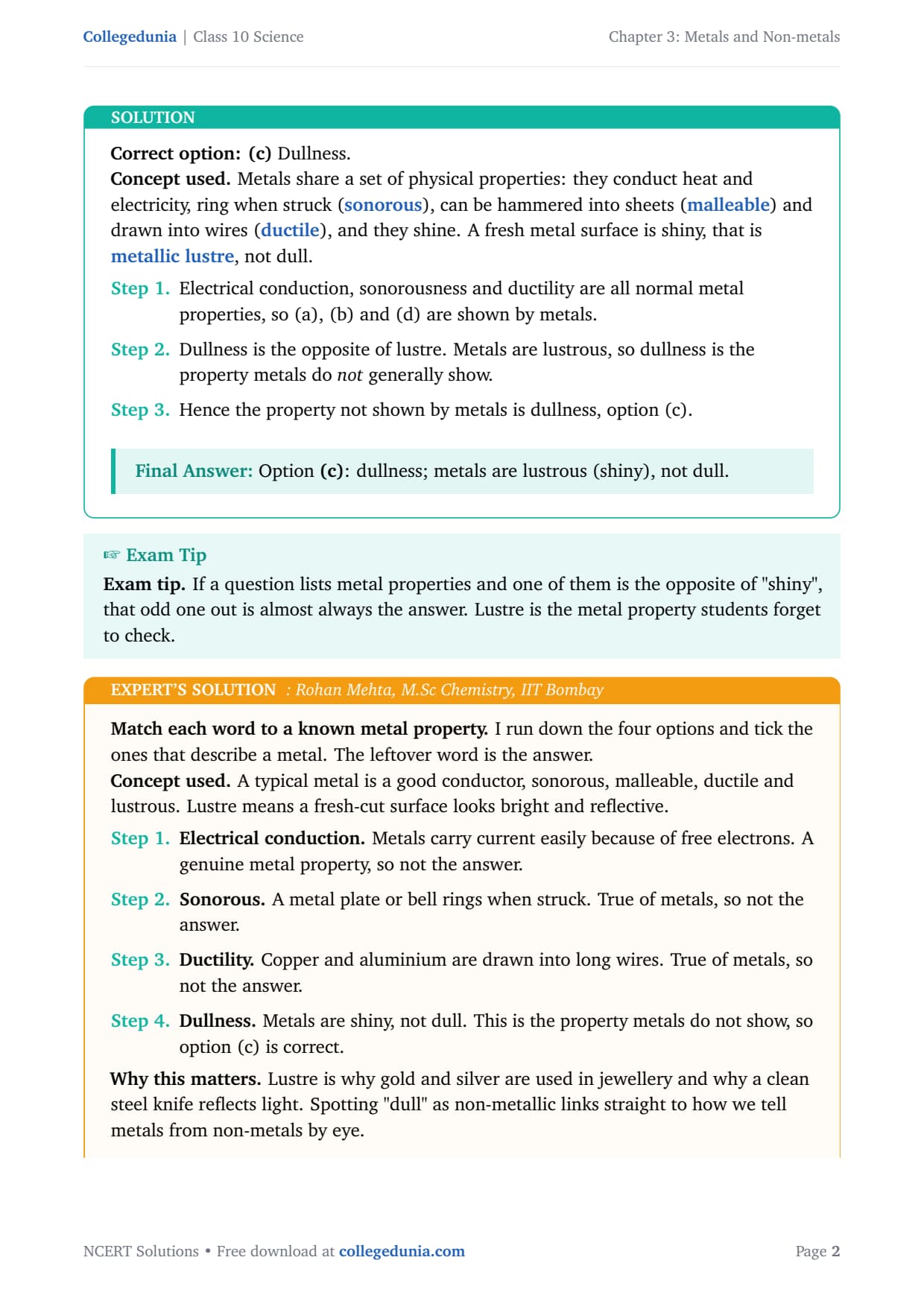
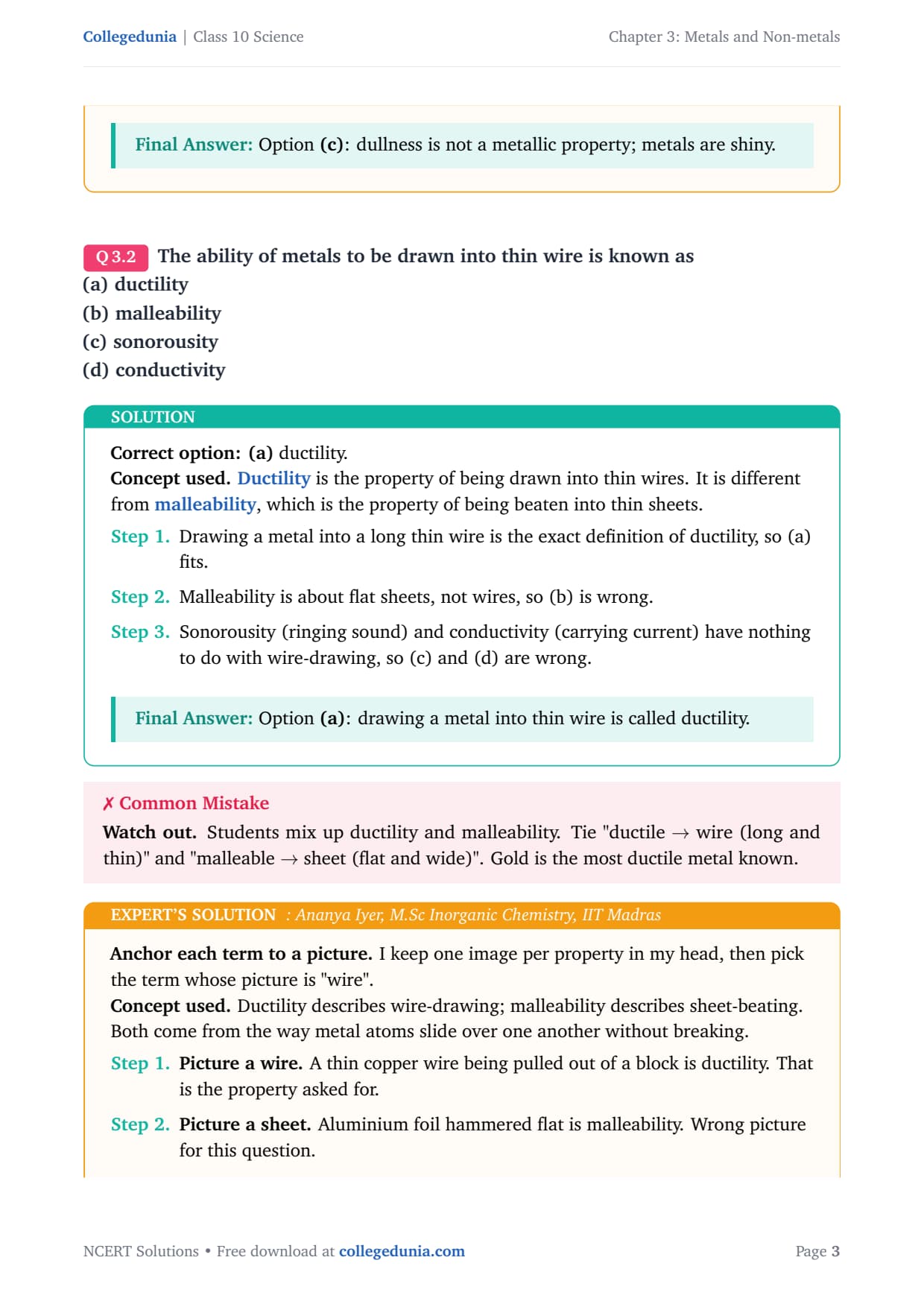
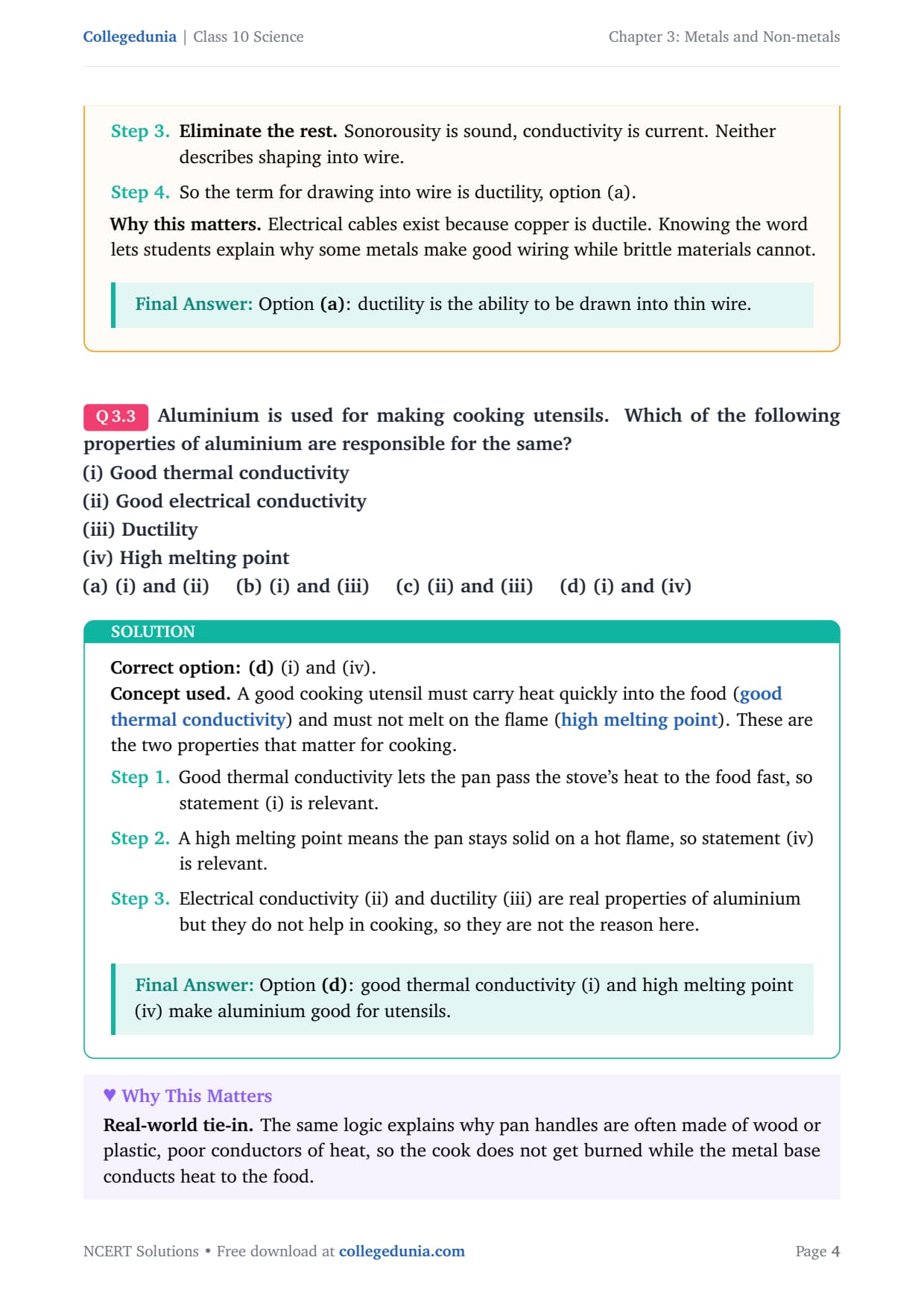
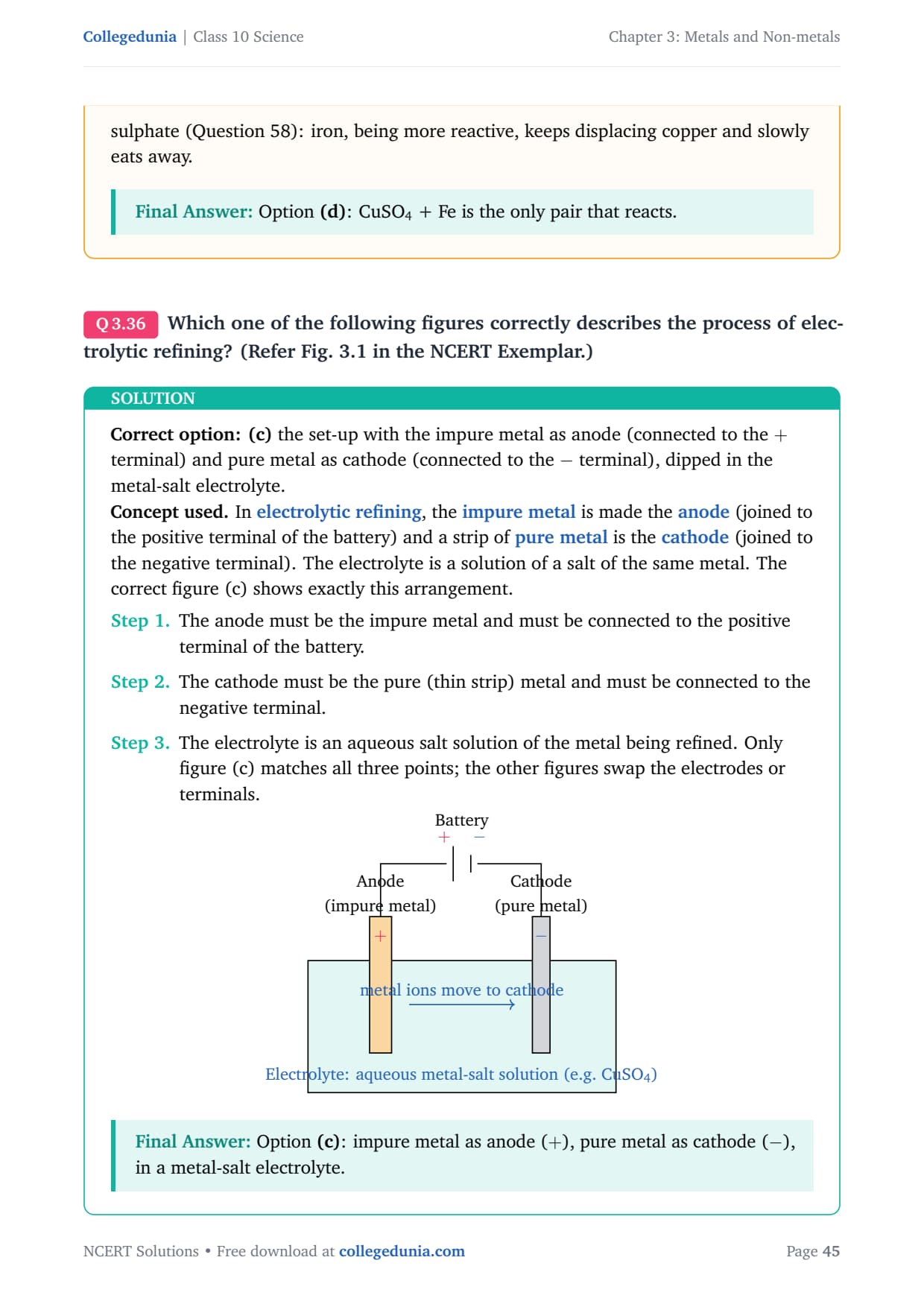
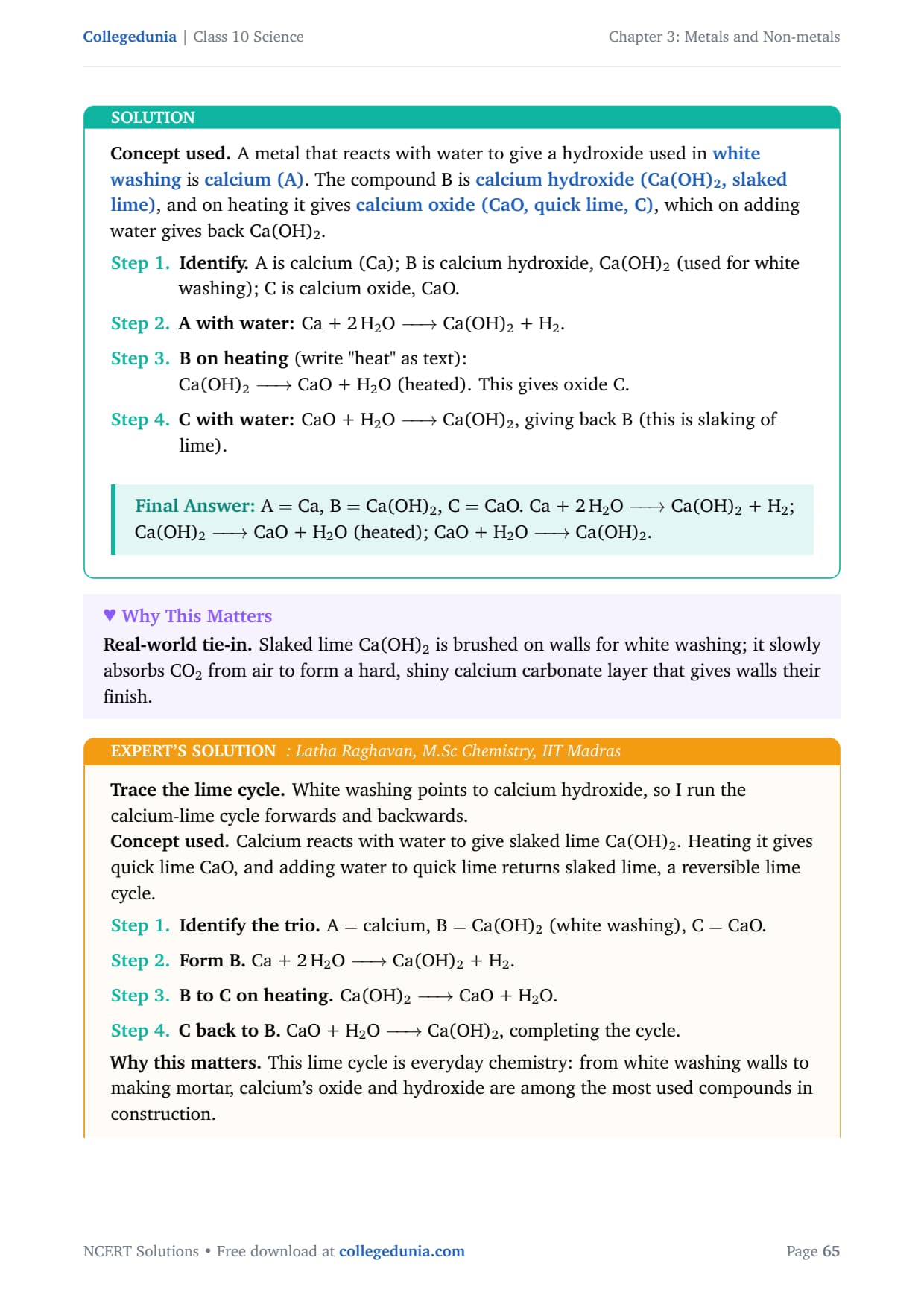
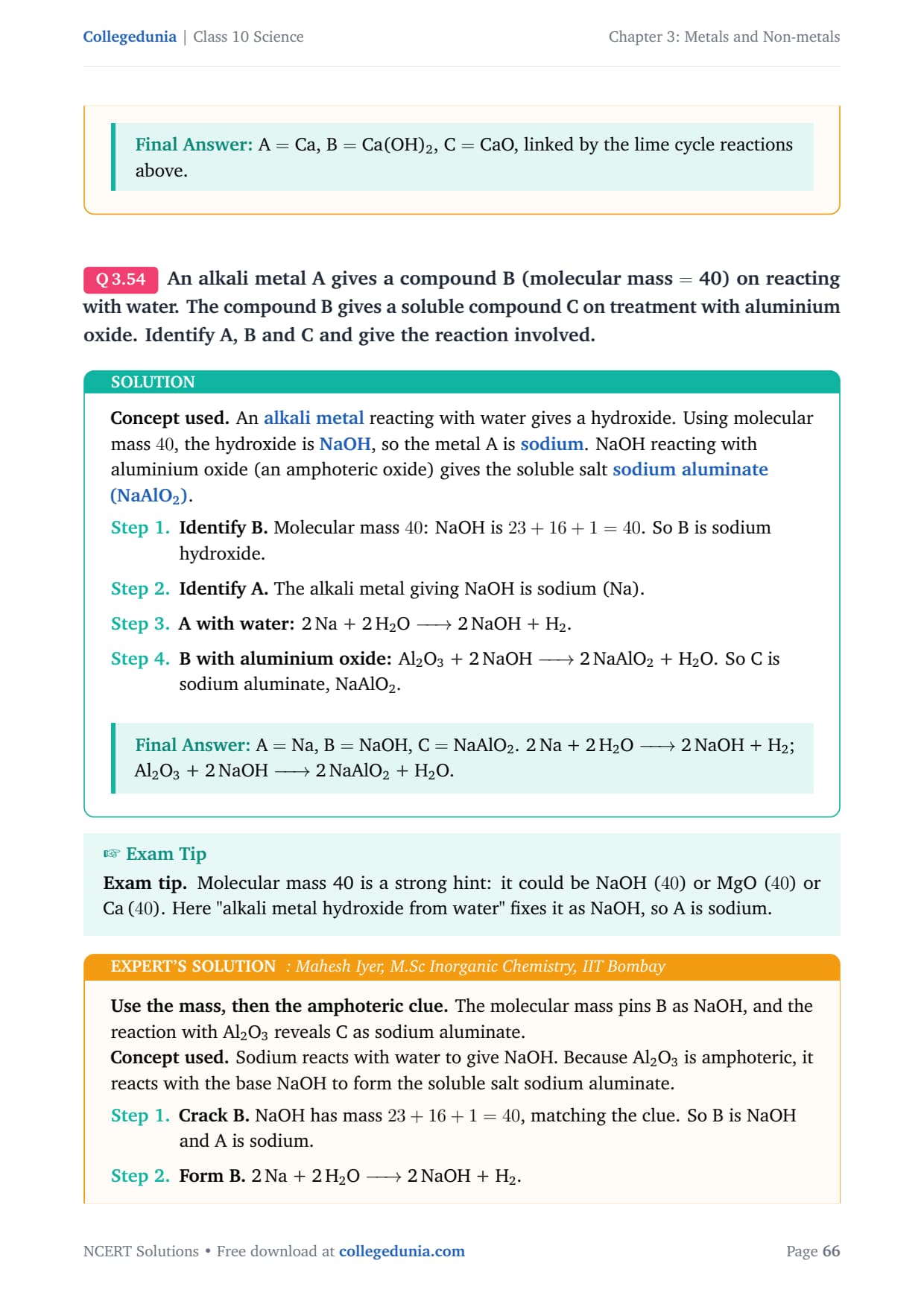
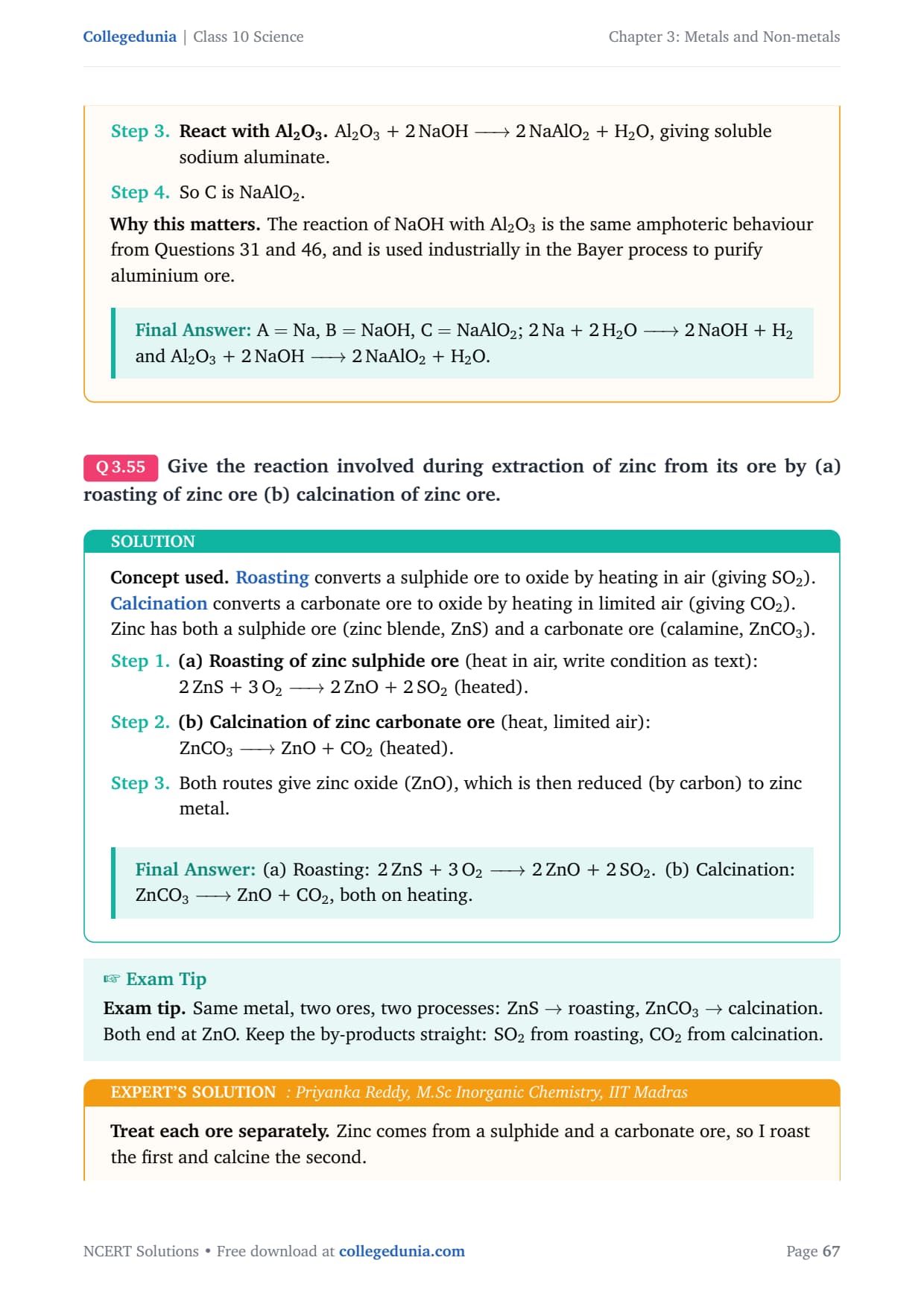
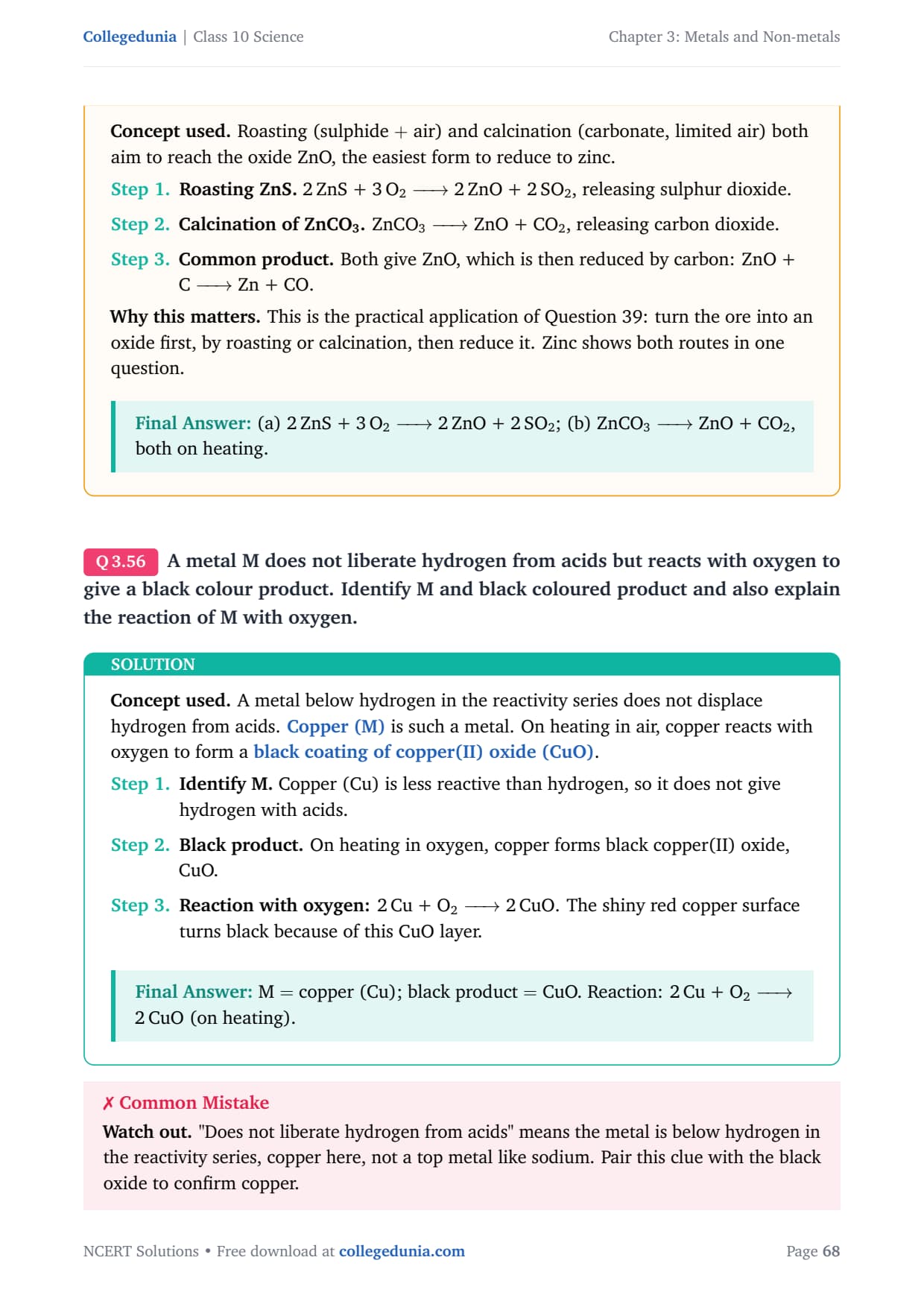



Comments