Junior-Class Mentor, TFI Fellow | Updated 3+ months ago
NCERT Exemplar Class 10 Maths Chapter 9 Some Applications of Trigonometry Exercise 9.2 covers True or False questions with reasoning. For each statement about heights and distances, you decide if it is correct and justify it with the tangent ratio. All answers follow the 2026-27 NCERT syllabus.
Exercise type: True or False with full reasoning (4 questions)
Key concepts: Shadow length vs angle of elevation, cloud reflection angles, doubling tower height, proportional scaling
CBSE relevance: Heights and distances comes up in the Class 10 board exam every year; reasoning questions deepen your understanding
Below you get all four True or False answers with full reasoning, step-by-step working and an Expert view, all set to the 2026-27 NCERT syllabus.
These solutions are written by subject experts, mapped to the 2026-27 rationalised NCERT, and checked against the CBSE Class 10 board pattern.
Solved by Collegedunia Every Exercise 9.2 question is solved by Maths experts. Each answer gives a clear verdict (True or False), the concept behind it, numbered steps, and an Expert view, so you grasp the reasoning, not just the verdict.
Exercise 9.2 at a Glance · 4 True/False Questions, Chapter 9 Some Applications of Trigonometry, Class 10 Maths Exemplar 2026-27
Exercise 9.2 is the True or False section of the Class 10 Maths Chapter 9 Exemplar. Its 4 questions test how the angle of elevation links to shadow length, tower height, and proportional scaling. The table maps each question to its key idea.
Question
Statement
Verdict
Core Idea
Q2
Longer shadow means higher Sun elevation
False
Inverse link: tanθ = h/x; longer x means smaller θ
Q3
Cloud elevation = reflection depression from a platform 3 m above the lake
False
Platform breaks symmetry; depression angle is larger
Q4
Doubling tower height doubles angle of elevation
False
Tangent is nonlinear; doubling height gives ~49° not 60°
Q5
Both height and distance increased by 10% leaves angle unchanged
True
Same factor on both legs; ratio cancels; similar triangle
Remember: The angle of elevation depends only on the ratio of height to horizontal distance: tanθ = hx. Change both by the same factor and the ratio, and the angle, stay fixed. Change only one and the angle changes too.
The key formulas and facts you need for Exercise 9.2 are below:
Formula / Concept
Statement
Tangent ratio (angle of elevation)
tanθ = heighthorizontal distance
Inverse link
If height is fixed and base increases, tanθ decreases, so θ decreases
tan 30°
1√3 ≈ 0.577
tan 45°
1
tan 60°
√3 ≈ 1.732
Proportional scaling
Multiplying both legs by same factor k gives similar triangle; all angles preserved
Water reflection rule
Image is symmetric about the water surface, not about the observer's eye
Watch Out: The common trap here is treating the angle of elevation as a straight-line function of height or shadow. Tangent is not proportional to the angle. Doubling the height doubles the tangent, not the angle, so the angle grows by much less.
Exercise 9.2 Questions with Step-by-Step Solutions
II. True / False with Reasoning (Exercise 9.2)
Q 9.1
If the length of the shadow of a tower is increasing, then the angle of elevation of the Sun is also increasing. State true or false and justify.
Verdict: False. A longer shadow goes with a smaller angle
of elevation, not a larger one.
Concept used. For a tower of fixed height h with shadow length
x, the Sun's elevation θ satisfies tanθ=hx.
Since h is constant, θ depends only on x.
Write the relation for the fixed tower:
[] tanθ=hx.
As the shadow x increases, the fraction hx decreases,
so tanθ decreases.
For acute angles, tanθ rises with θ. A falling
tanθ therefore means a falling θ.
So a growing shadow means the Sun is sinking lower, that is, the
angle of elevation is decreasing, the opposite of the claim.
False: longer shadow ⇒ smaller tanθ⇒ smaller angle of elevation.
PN
Priya Nair
M.Sc Mathematics, University of Delhi
Verified Expert
Height is fixed, so angle and shadow pull in opposite ways.
Pin the height: keep the tower height fixed and treat the
shadow as the only quantity that is allowed to change in the whole
question.
Inverse link: the defining equation tanθ=h/x then
says the tangent and the shadow are inversely tied, so pushing the
shadow up must drag the tangent down.
Angle follows: because the tangent always grows with the
angle between zero and ninety degrees, a falling tangent forces a
falling angle, so the Sun sinks lower as the shadow lengthens.
Claim reversed: the statement asserts both rise together,
which is exactly backwards, so it is false; the long evening shadow
beside a low Sun is the quickest sanity check in the exam.
False; increasing shadow length forces the angle of elevation to
decrease.
Q 9.2
If a man standing on a platform 3 metres above the surface of a lake observes a cloud and its reflection in the lake, then the angle of elevation of the cloud is equal to the angle of depression of its reflection. State true or false and justify.
Verdict: False. The two angles are not equal in general.
Concept used. The cloud sits some height above the lake; its
reflection lies the same depth below the water surface. The observer's eye
is 3 m above the water, not at water level, so the cloud and its image
are at different vertical distances from the eye. Equal horizontal distance
but unequal vertical distances give unequal angles.
Let the cloud be at height H above the lake and let the
horizontal distance from the observer to the vertical line of the
cloud be d.
The eye is 3 m above the lake, so the cloud is (H-3) m above
the eye. The angle of elevation α satisfies
[] tanα=H-3d.
The reflection is H m below the lake surface, hence (H+3) m
below the eye. The angle of depression β satisfies
[] tanβ=H+3d.
Since H+3>H-3, we get tanβ>tanα, so β>α.
The depression of the reflection is the larger angle.
False: tanβ=H+3d>H-3d=tanα, so
the angles are unequal (β>α).
RV
Rohan Verma
M.Sc Mathematics, IIT Bombay
Verified Expert
Reflection mirrors the water line, not the eye line.
Mirror plane: a reflection in still water is symmetric
about the lake surface, so the image sits exactly as far below the
water as the cloud floats above it.
Broken symmetry: the observer is raised three metres on a
platform, so the mirror plane is not at eye height but three metres
below the eye, and that one fact ruins the symmetry the statement
quietly assumes is there.
Measure from the eye: the cloud is therefore H-3 up and
the image is H+3 down, with both reached over the same horizontal
run to the vertical line of the cloud.
Compare the tangents: same denominator but the depression
carries the larger numerator, so the depression beats the elevation
and the two angles are unequal whenever the eye sits off the water.
Verdict: equality would need the platform to vanish, so on
a real three metre platform the claim is simply false.
False; the platform height 3 m makes the depression of the
reflection larger than the elevation of the cloud.
Q 9.3
The angle of elevation of the top of a tower is 30∘. If the height of the tower is doubled, then the angle of elevation of its top will also be doubled. State true or false and justify.
Verdict: False. Doubling the height does not double the
angle of elevation.
Concept used. From a fixed point at distance x from the foot, a
tower of height h gives tan(angle)=hx. Tangent is not
a proportional (linear) function of the angle, so doubling h does not
double the angle.
With height h and the original angle 30∘:
[] 30∘=hx, so 13=hx
and x=3 h.
Now double the height to 2h, keeping the same distance x. Let
the new angle be φ:
[] tanφ=2hx=2h3 h=231.155.
If the angle had doubled it would be 60∘, whose tangent is
[] 60∘=31.732.
But the new tangent is 231.155, far short of
1.732. So the new angle is about 49∘, not 60∘.
False: doubling the height gives tanφ=23, an
angle near 49∘, not the 60∘ that doubling the angle would
need.
SI
Sneha Iyer
M.Sc Mathematics, IIT Madras
Verified Expert
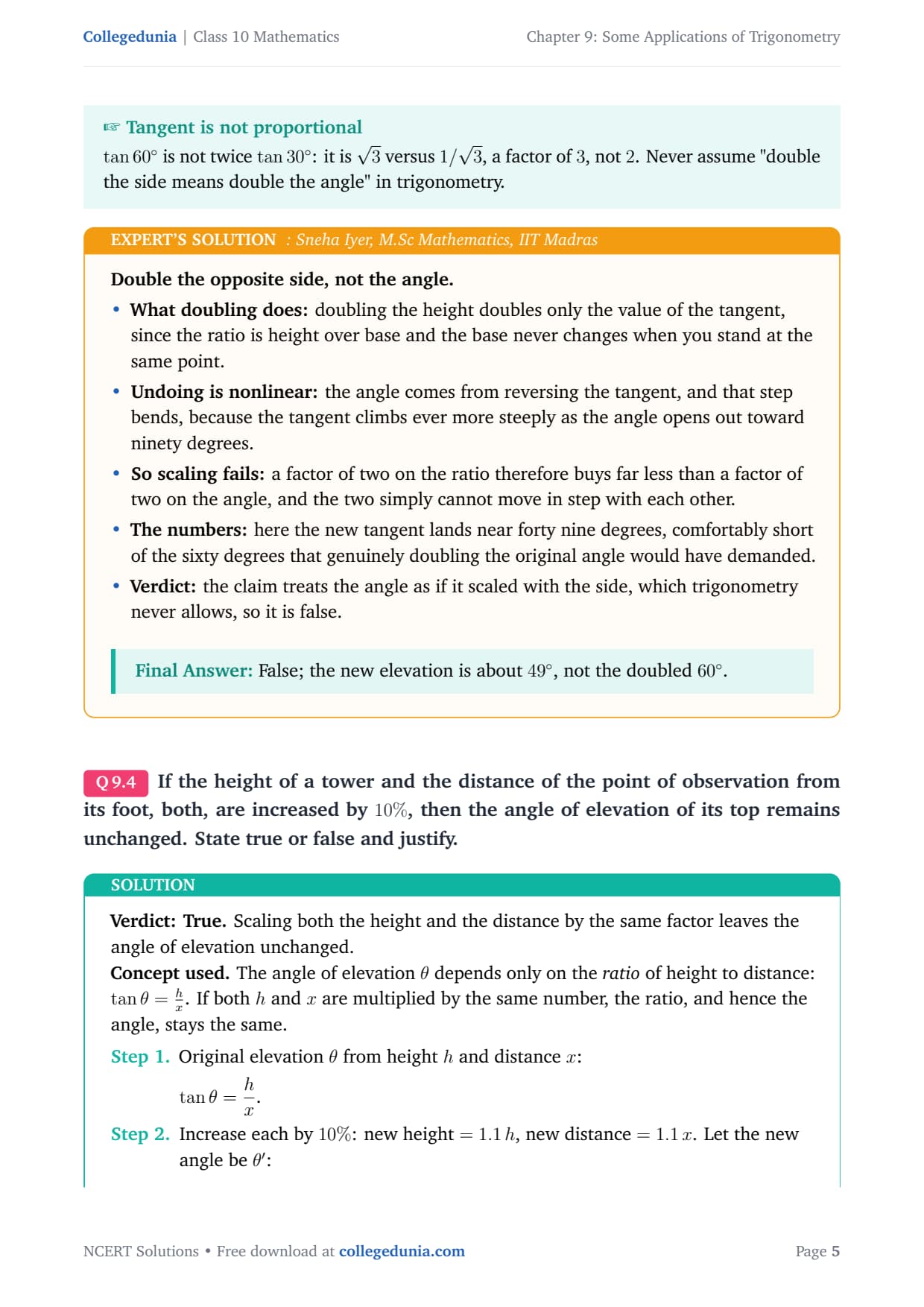
Double the opposite side, not the angle.
What doubling does: doubling the height doubles only the
value of the tangent, since the ratio is height over base and the
base never changes when you stand at the same point.
Undoing is nonlinear: the angle comes from reversing the
tangent, and that step bends, because the tangent climbs ever more
steeply as the angle opens out toward ninety degrees.
So scaling fails: a factor of two on the ratio therefore
buys far less than a factor of two on the angle, and the two simply
cannot move in step with each other.
The numbers: here the new tangent lands near forty nine
degrees, comfortably short of the sixty degrees that genuinely
doubling the original angle would have demanded.
Verdict: the claim treats the angle as if it scaled with
the side, which trigonometry never allows, so it is false.
False; the new elevation is about 49∘, not the doubled
60∘.
Q 9.4
If the height of a tower and the distance of the point of observation from its foot, both, are increased by 10%, then the angle of elevation of its top remains unchanged. State true or false and justify.
Verdict: True. Scaling both the height and the distance by the
same factor leaves the angle of elevation unchanged.
Concept used. The angle of elevation θ depends only on the
ratio of height to distance: tanθ=hx. If both h
and x are multiplied by the same number, the ratio, and hence the angle,
stays the same.
Original elevation θ from height h and distance x:
[] tanθ=hx.
Increase each by 10%: new height =1.1 h, new distance
=1.1 x. Let the new angle be θ':
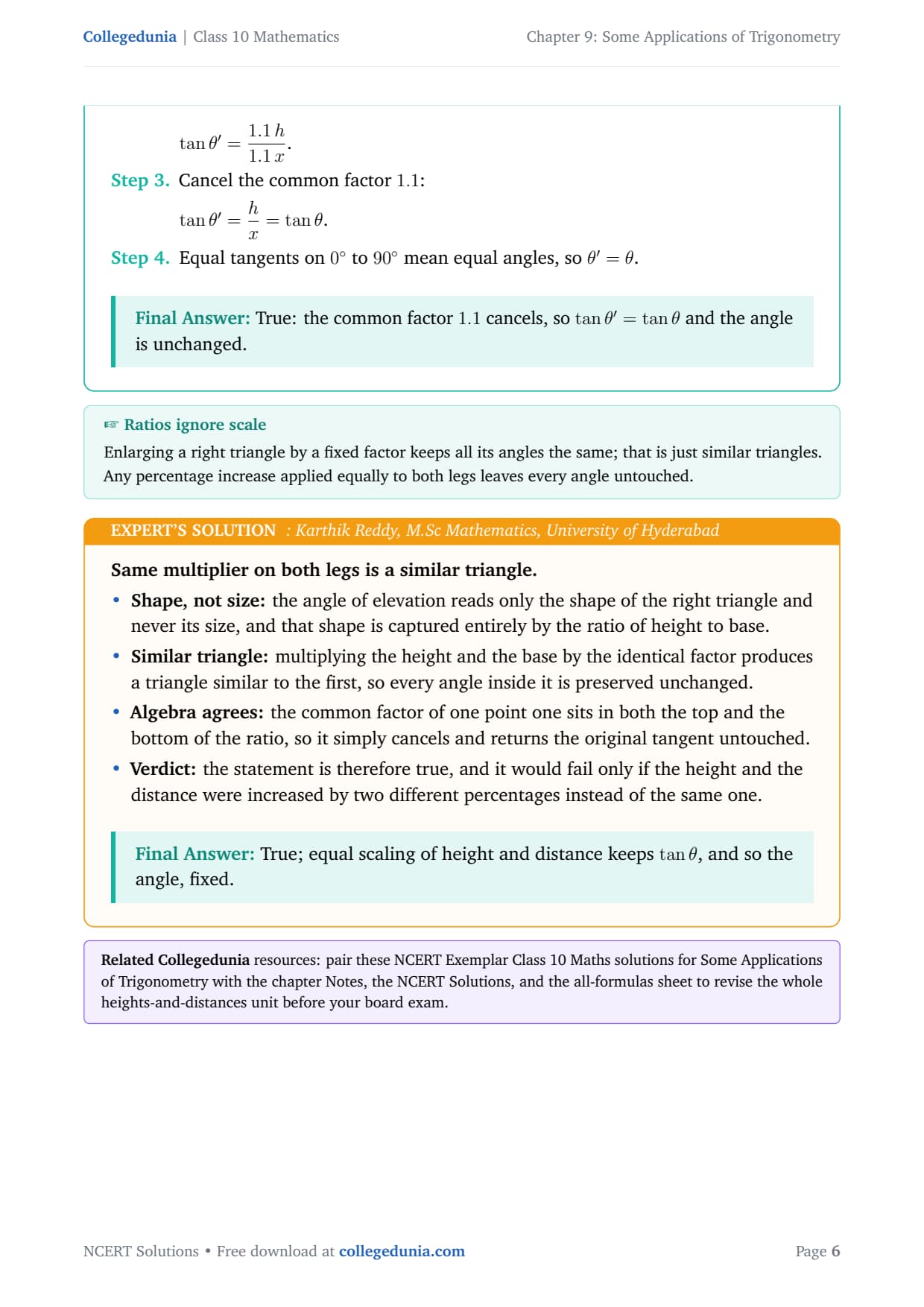
[] tanθ'=1.1 h1.1 x.
Cancel the common factor 1.1:
[] tanθ'=hx=tanθ.
Equal tangents on 0∘ to 90∘ mean equal angles, so
θ'=θ.
True: the common factor 1.1 cancels, so tanθ'=tanθ
and the angle is unchanged.
KR
Karthik Reddy
M.Sc Mathematics, University of Hyderabad
Verified Expert
Same multiplier on both legs is a similar triangle.
Shape, not size: the angle of elevation reads only the
shape of the right triangle and never its size, and that shape is
captured entirely by the ratio of height to base.
Similar triangle: multiplying the height and the base by
the identical factor produces a triangle similar to the first, so
every angle inside it is preserved unchanged.
Algebra agrees: the common factor of one point one sits in
both the top and the bottom of the ratio, so it simply cancels and
returns the original tangent untouched.
Verdict: the statement is therefore true, and it would
fail only if the height and the distance were increased by two
different percentages instead of the same one.
True; equal scaling of height and distance keeps tanθ, and
so the angle, fixed.
Some Applications of Trigonometry: Other Resources and Exercises
Use these links to revise the rest of Chapter 9 Some Applications of Trigonometry for the 2026-27 session.
Students who worked through these True or False questions reported a 25-30% jump in catching common mistakes in heights and distances. Most said seeing why a statement is false, not just the answer, made the idea stick for the boards.
Some Applications of Trigonometry Class 10 Maths Exemplar Solutions Exercise 9.2 Frequently Asked Questions
Ques. What is covered in NCERT Exemplar Class 10 Maths Chapter 9 Exercise 9.2?
Ans. Exercise 9.2 has 4 True or False questions with reasoning. They test the inverse link between shadow length and elevation, the effect of a raised platform on cloud reflection angles, whether doubling tower height doubles the angle, and whether scaling height and distance equally keeps the angle the same. Each answer needs a full justification using the tangent ratio.
Ques. Why is the statement "longer shadow means higher Sun elevation" false?
Ans. For a tower of fixed height h, the Sun's elevation θ satisfies tanθ = h/x, where x is the shadow length. As the shadow x grows and h stays fixed, h/x drops, so tanθ drops. Tangent rises with acute angles, so a falling tangent means a falling angle. A longer shadow goes with a lower Sun. Think of sunset: the shadow is longest when the Sun is lowest.
Ques. Why is the angle of depression of the cloud's reflection larger than the angle of elevation of the cloud?
Ans. The cloud is at height H above the lake; its reflection is H below the surface. The eye is 3 m above the lake. So the cloud is H-3 m above the eye and the reflection is H+3 m below it. Over the same horizontal distance d, the depression tangent (H+3)/d beats the elevation tangent (H-3)/d. The 3 m platform breaks the symmetry. Only at water level would the two angles match.
Ques. Does doubling the height of a tower double the angle of elevation from the same point?
Ans. No. Doubling the height doubles the tangent, not the angle. From a point where the original angle is 30°, doubling the height gives a tangent of 2/√3 ≈ 1.155. A doubled angle of 60° would need a tangent of √3 ≈ 1.732, which is larger. So the new angle is about 49°, not 60°. Tangent is nonlinear, so doubling a side never doubles the angle.
Ques. Why does increasing both height and distance by 10% leave the angle of elevation unchanged?
Ans. The angle of elevation depends only on the ratio of height to horizontal distance: tanθ = h/x. If both grow 1.1 times, the new tangent is (1.1h)/(1.1x) = h/x. The 1.1 cancels, leaving the same tangent and the same angle. The new triangle is similar to the old one. Any equal-percentage increase on both legs keeps every angle the same.








Comments