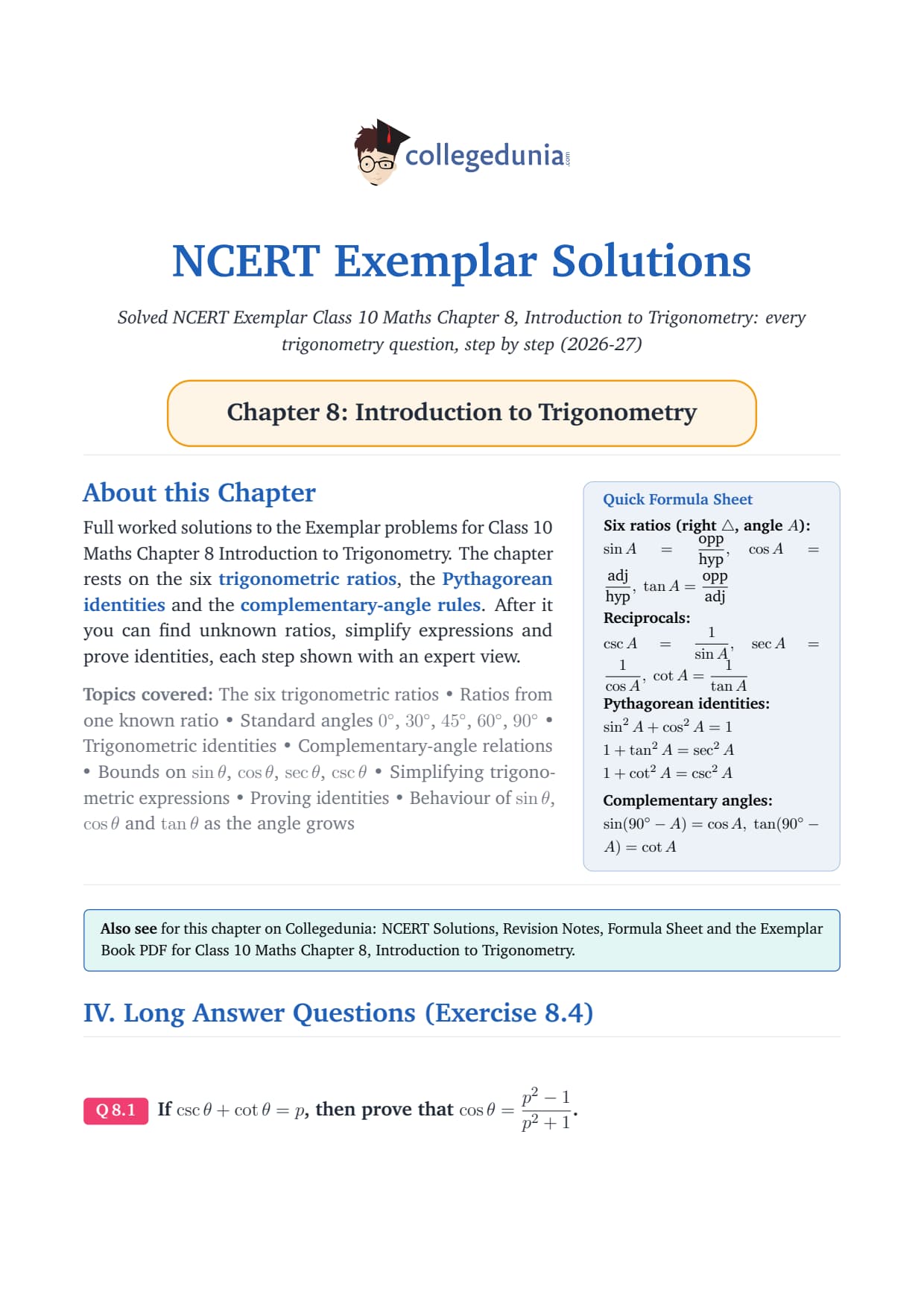
NCERT Exemplar Class 10 Maths Chapter 8 Introduction to Trigonometry Exercise 8.4 has 8 Long Answer Questions (Q35 to Q42). These are proof questions: you are given one relation and must derive another. They use the Pythagorean identities, conjugate pairs, and the squaring-and-adding trick. Each answer is worked step by step with an expert second view, for the 2026-27 CBSE syllabus.
Exercise type: Long Answer Questions (proofs and identity-based), 8 questions (Q35 to Q42)
Key concepts: Pythagorean identities, sec-tan conjugate pairs, squaring and adding technique, quadratic in tan, algebraic manipulation of trig expressions
CBSE board relevance: Proof-type questions from this exercise pattern are regularly tested in CBSE Class 10 board exams for 3-mark and 5-mark slots
Every long-answer proof below is worked step by step, with an expert view that shows the fastest route and the key insight to watch for.
These Exemplar Solutions are curated by subject experts, mapped to the 2026-27 rationalised NCERT, and verified against the CBSE board exam pattern for Class 10 Mathematics.
Solved by Collegedunia Every question in Exercise 8.4 is solved by Maths subject-matter experts. Each solution has a clear strategy note and an Expert view that explains the fastest approach and the key insight students often miss.
Exercise 8.4 at a Glance · 8 Long Answer Questions (Q35 to Q42) · Chapter 8 Introduction to Trigonometry · Class 10 Maths Exemplar 2026-27
Exercise 8.4 is the Long Answer section of the Chapter 8 Exemplar. All 8 questions (Q35 to Q42) are proof-type: you are given one relation and must derive another. The question types and difficulty levels are shown below.
Question
Topic Tested
Key Strategy
Difficulty
Q35
Given cosec + cot = p, prove cos in terms of p
Express p in sin/cos, form p2, build the target ratio
Hard
Q36
Prove √(sec2θ + cosec2θ) = tanθ + cotθ
Combine over common denominator, use sin2+cos2=1
Medium
Q37
Given 1+sin2θ=3sinθcosθ, prove tan = 1 or 1/2
Replace 1 by sin2+cos2, divide by cos2, factorise quadratic
Hard
Q38
Given sin + 2cos = 1, prove 2sin - cos = 2
Add squares of both expressions, use sin2+cos2=1
Medium
Q39
Given tan + sec = l, prove sec in terms of l
sec - tan = 1/l (conjugate pair), add the two relations
Medium
Q40
Given sin + cos = p and sec + cosec = q, prove q(p2-1) = 2p
Expand p2, express q as fraction, cancel sin cos
Medium
Q41
Given a sin + b cos = c, prove a cos - b sin = √(a2+b2-c2)
Add squares of both expressions, cross terms cancel
Replace 1 by sec2-tan2, factor and cancel denominator
Hard
Remember: For proof questions, the three most powerful moves are: (1) write everything in sin and cos, (2) replace the constant 1 using the identity sin2 + cos2 = 1, and (3) add the squares of two related expressions so cross terms cancel.
The key formulas students need for Exercise 8.4 are listed below.
Identity / Rule
Statement
Used in
Pythagorean identity 1
sin2θ + cos2θ = 1
Q36, Q37, Q38, Q40, Q41
Pythagorean identity 2
1 + tan2θ = sec2θ
Q39, Q42
Pythagorean identity 3
1 + cot2θ = cosec2θ
Q35
sec - tan conjugate
(secθ + tanθ)(secθ - tanθ) = 1
Q39, Q42
cosec - cot conjugate
(cosecθ + cotθ)(cosecθ - cotθ) = 1
Q35
Sum-of-squares pairing
(a sinθ + b cosθ)2 + (a cosθ - b sinθ)2 = a2 + b2
Q38, Q41
Watch Out: In Q37, students often try to expand and simplify directly. The faster route is to replace the constant 1 with sin2 + cos2 and then divide every term by cos2. That converts the mixed equation into a clean quadratic in tan.
All Exercise 8.4 Solutions with Step-by-Step Answers
IV. Long Answer Questions (Exercise 8.4)
Q 8.1
If cscθ+cotθ=p, then prove that cosθ=p2-1p2+1.
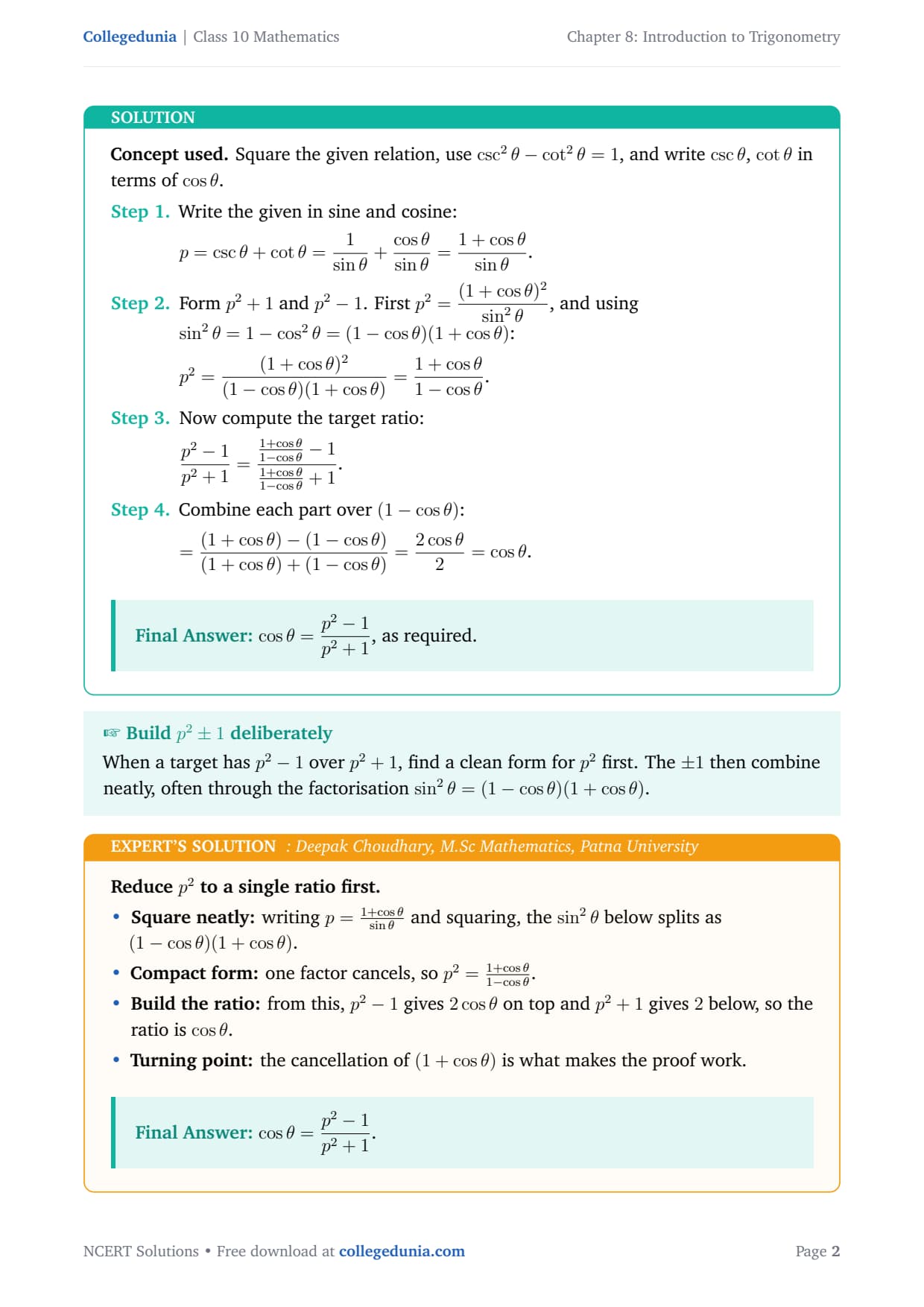
Concept used. Square the given relation, use
csc2θ-cot2θ=1, and write cscθ, cotθ in terms
of cosθ.
Write the given in sine and cosine:
[] p=cscθ+cotθ=1sinθ+cosθsinθ=1+cosθsinθ.
Form p2+1 and p2-1. First p2=(1+cosθ)2sin2θ,
and using sin2θ=1-cos2θ=(1-cosθ)(1+cosθ):
[] p2=(1+cosθ)2(1-cosθ)(1+cosθ)=1+cosθ1-cosθ.
Now compute the target ratio:
[] p2-1p2+1=1+cosθ1-cosθ-11+cosθ1-cosθ+1.
Combine each part over (1-cosθ):
[] =(1+cosθ)-(1-cosθ)(1+cosθ)+(1-cosθ)=2cosθ2=cosθ.
cosθ=p2-1p2+1, as required.
DC
Deepak Choudhary
M.Sc Mathematics, Patna University
Verified Expert
Reduce p2 to a single ratio first.
Square neatly: writing p=1+cosθsinθ and squaring, the sin2θ below splits as (1-cosθ)(1+cosθ).
Compact form: one factor cancels, so p2=1+cosθ1-cosθ.
Build the ratio: from this, p2-1 gives 2cosθ on top and p2+1 gives 2 below, so the ratio is cosθ.
Turning point: the cancellation of (1+cosθ) is what makes the proof work.
cosθ=p2-1p2+1.
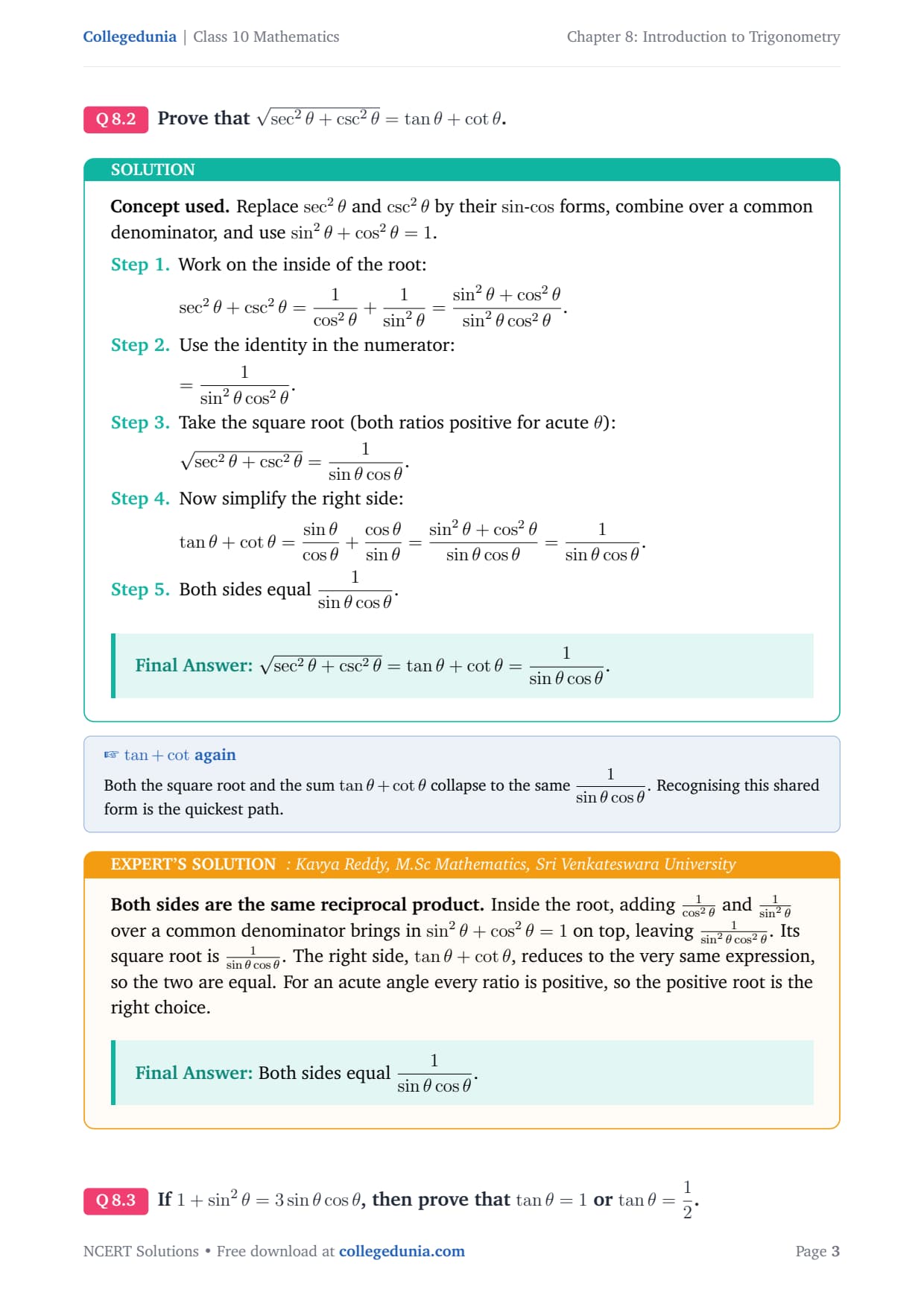
Q 8.2
Prove that √sec2θ+csc2θ=tanθ+cotθ.
Concept used. Replace sec2θ and csc2θ by their
sin-cos forms, combine over a common denominator, and use
sin2θ+cos2θ=1.
Work on the inside of the root:
[] sec2θ+csc2θ=1cos2θ+1sin2θ=sin2θ+cos2θsin22θ.
Use the identity in the numerator:
[] =1sin22θ.
Take the square root (both ratios positive for acute θ):
[] √sec2θ+csc2θ=1sinθ.
Now simplify the right side:
[] tanθ+cotθ=sinθcosθ+cosθsinθ=sin2θ+cos2θsinθ=1sinθ.
Both sides equal 1sinθ.
√sec2θ+csc2θ=tanθ+cotθ=1sinθ.
KR
Kavya Reddy
M.Sc Mathematics, Sri Venkateswara University
Verified Expert
Both sides are the same reciprocal product. Inside the root,
adding 1cos2θ and 1sin2θ over a
common denominator brings in sin2θ+cos2θ=1 on top, leaving
1sin22θ. Its square root is
1sinθ. The right side, tanθ+cotθ,
reduces to the very same expression, so the two are equal. For an acute
angle every ratio is positive, so the positive root is the right choice.
Both sides equal 1sinθ.
Q 8.3
If 1+sin2θ=3sinθ, then prove that tanθ=1 or tanθ=12.
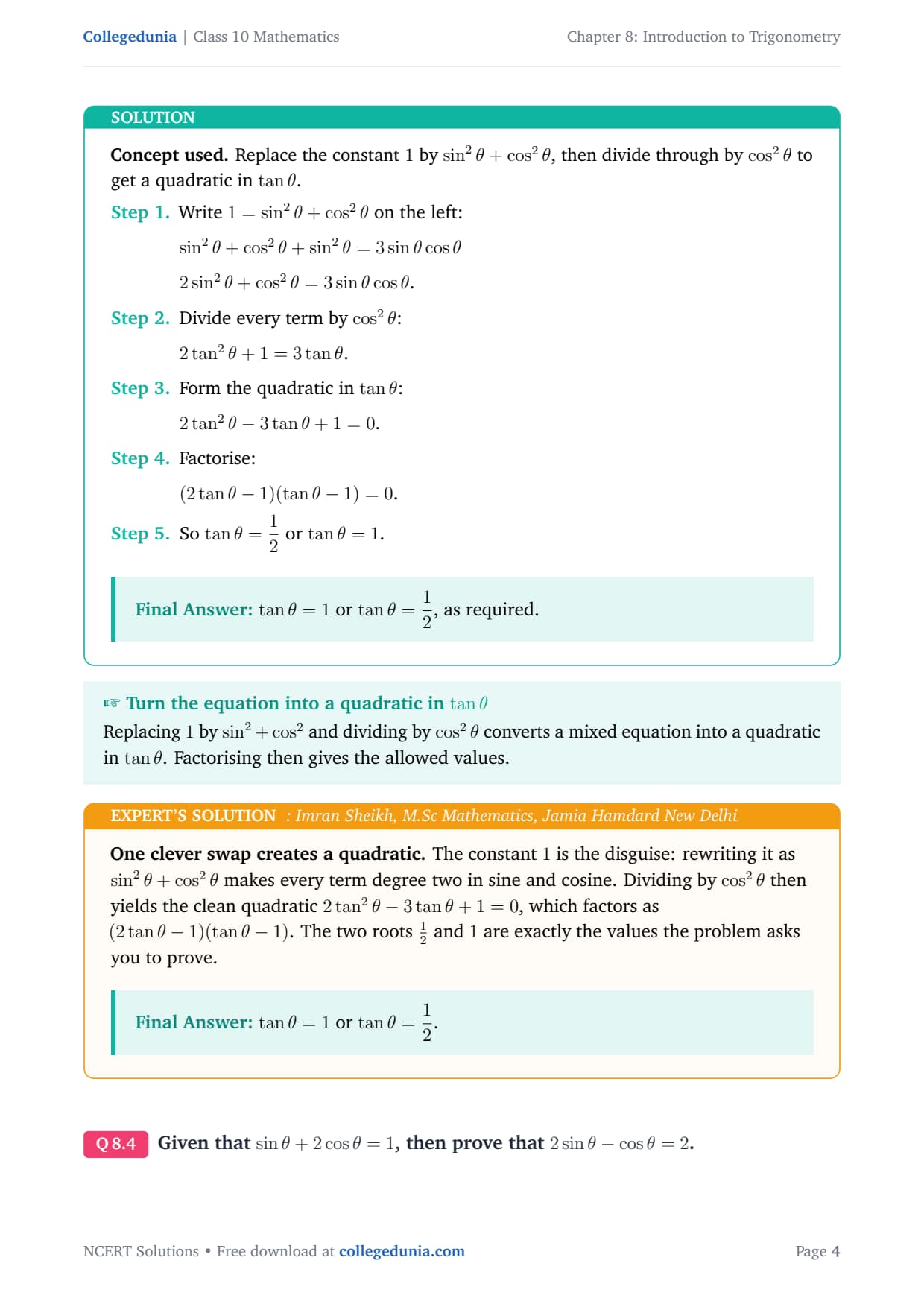
Concept used. Replace the constant 1 by
sin2θ+cos2θ, then divide through by cos2θ to get a
quadratic in tanθ.
Write 1=sin2θ+cos2θ on the left:
[] sin2θ+cos2θ+sin2θ=3sinθ
[] 2sin2θ+cos2θ=3sinθ.
Divide every term by cos2θ:
[] 2tan2θ+1=3tanθ.
Form the quadratic in tanθ:
[] 2tan2θ-3tanθ+1=0.
Factorise:
[] (2tanθ-1)(tanθ-1)=0.
So tanθ=12 or tanθ=1.
tanθ=1 or tanθ=12, as required.
IS
Imran Sheikh
M.Sc Mathematics, Jamia Hamdard New Delhi
Verified Expert
One clever swap creates a quadratic. The constant 1 is the
disguise: rewriting it as sin2θ+cos2θ makes every term
degree two in sine and cosine. Dividing by cos2θ then yields the
clean quadratic 2tan2θ-3tanθ+1=0, which factors as
(2tanθ-1)(tanθ-1). The two roots 12 and 1 are
exactly the values the problem asks you to prove.
tanθ=1 or tanθ=12.
Q 8.4
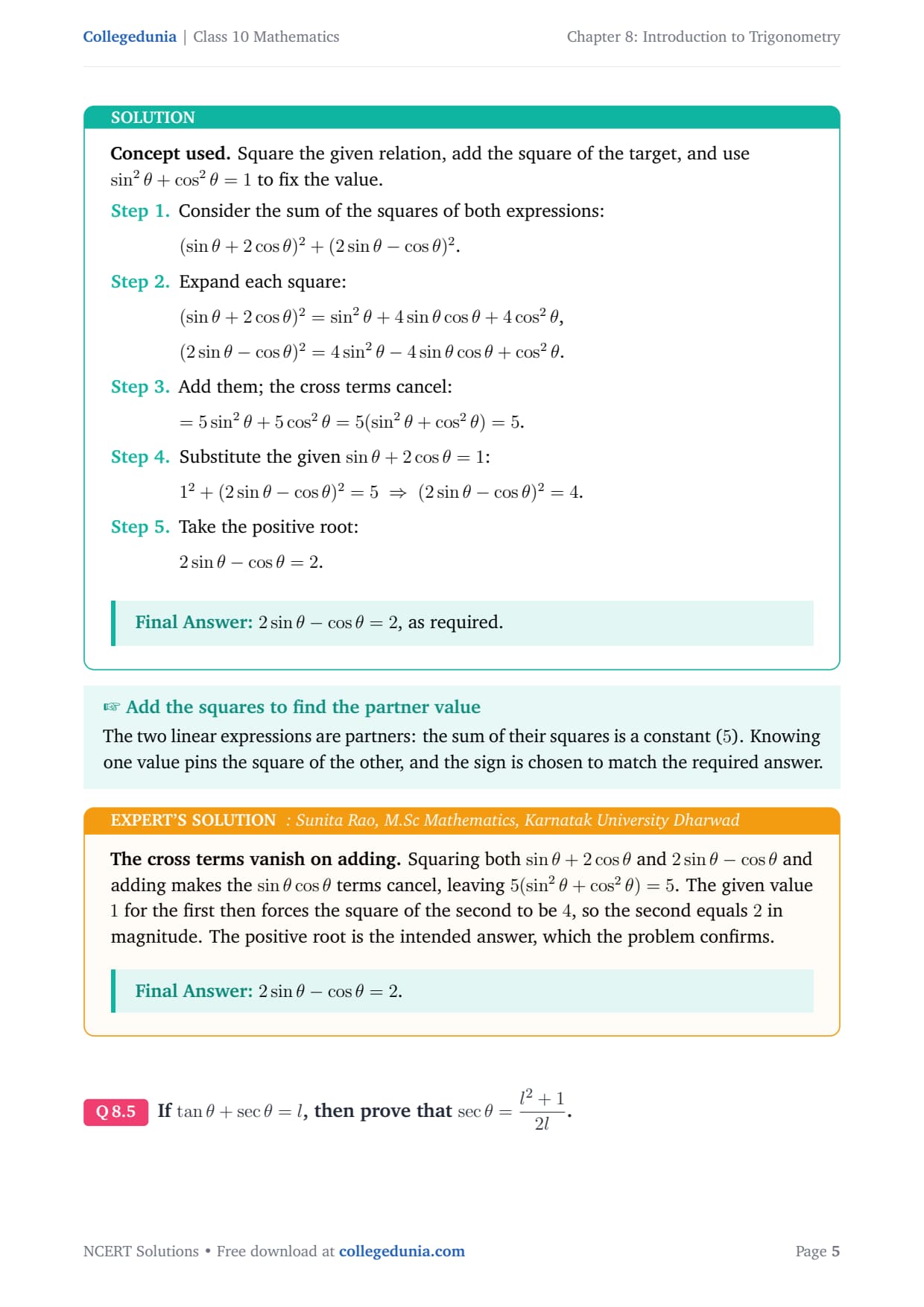
Given that sinθ+2cosθ=1, then prove that 2sinθ-cosθ=2.
Concept used. Square the given relation, add the square of the
target, and use sin2θ+cos2θ=1 to fix the value.
Consider the sum of the squares of both expressions:
[] (sinθ+2cosθ)2+(2sinθ-cosθ)2.
Expand each square:
[] (sinθ+2cosθ)2=sin2θ+4sinθ+4cos2θ,
[] (2sinθ-cosθ)2=4sin2θ-4sinθ+cos2θ.
Add them; the cross terms cancel:
[] =5sin2θ+5cos2θ=5(sin2θ+cos2θ)=5.
Substitute the given sinθ+2cosθ=1:
[] 12+(2sinθ-cosθ)2=5 ⇒ (2sinθ-cosθ)2=4.
Take the positive root:
[] 2sinθ-cosθ=2.
2sinθ-cosθ=2, as required.
SR
Sunita Rao
M.Sc Mathematics, Karnatak University Dharwad
Verified Expert
The cross terms vanish on adding. Squaring both
sinθ+2cosθ and 2sinθ-cosθ and adding makes the
sinθ terms cancel, leaving 5(sin2θ+cos2θ)=5.
The given value 1 for the first then forces the square of the second to
be 4, so the second equals 2 in magnitude. The positive root is the
intended answer, which the problem confirms.
2sinθ-cosθ=2.
Q 8.5
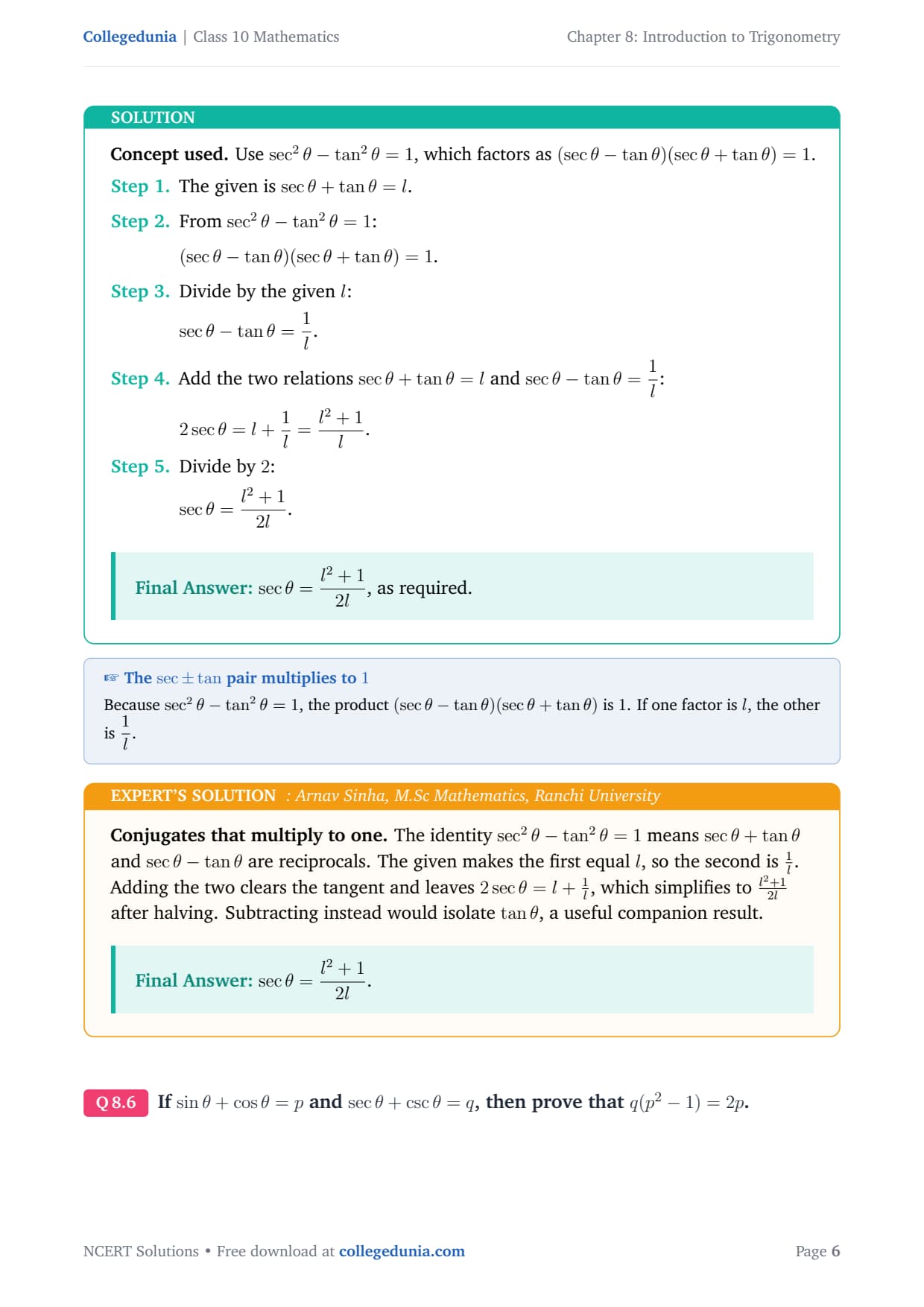
If tanθ+secθ=l, then prove that secθ=l2+12l.
Concept used. Use sec2θ-tan2θ=1, which factors as
(secθ-tanθ)(secθ+tanθ)=1.
The given is secθ+tanθ=l.
From sec2θ-tan2θ=1:
[] (secθ-tanθ)(secθ+tanθ)=1.
Divide by the given l:
[] secθ-tanθ=1l.
Add the two relations secθ+tanθ=l and secθ-tanθ=1l:
[] 2secθ=l+1l=l2+1l.
Divide by 2:
[] secθ=l2+12l.
secθ=l2+12l, as required.
AS
Arnav Sinha
M.Sc Mathematics, Ranchi University
Verified Expert
Conjugates that multiply to one. The identity
sec2θ-tan2θ=1 means secθ+tanθ and
secθ-tanθ are reciprocals. The given makes the first equal
l, so the second is 1l. Adding the two clears the tangent and
leaves 2secθ=l+1l, which simplifies to
l2+12l after halving. Subtracting instead would isolate
tanθ, a useful companion result.
secθ=l2+12l.
Q 8.6
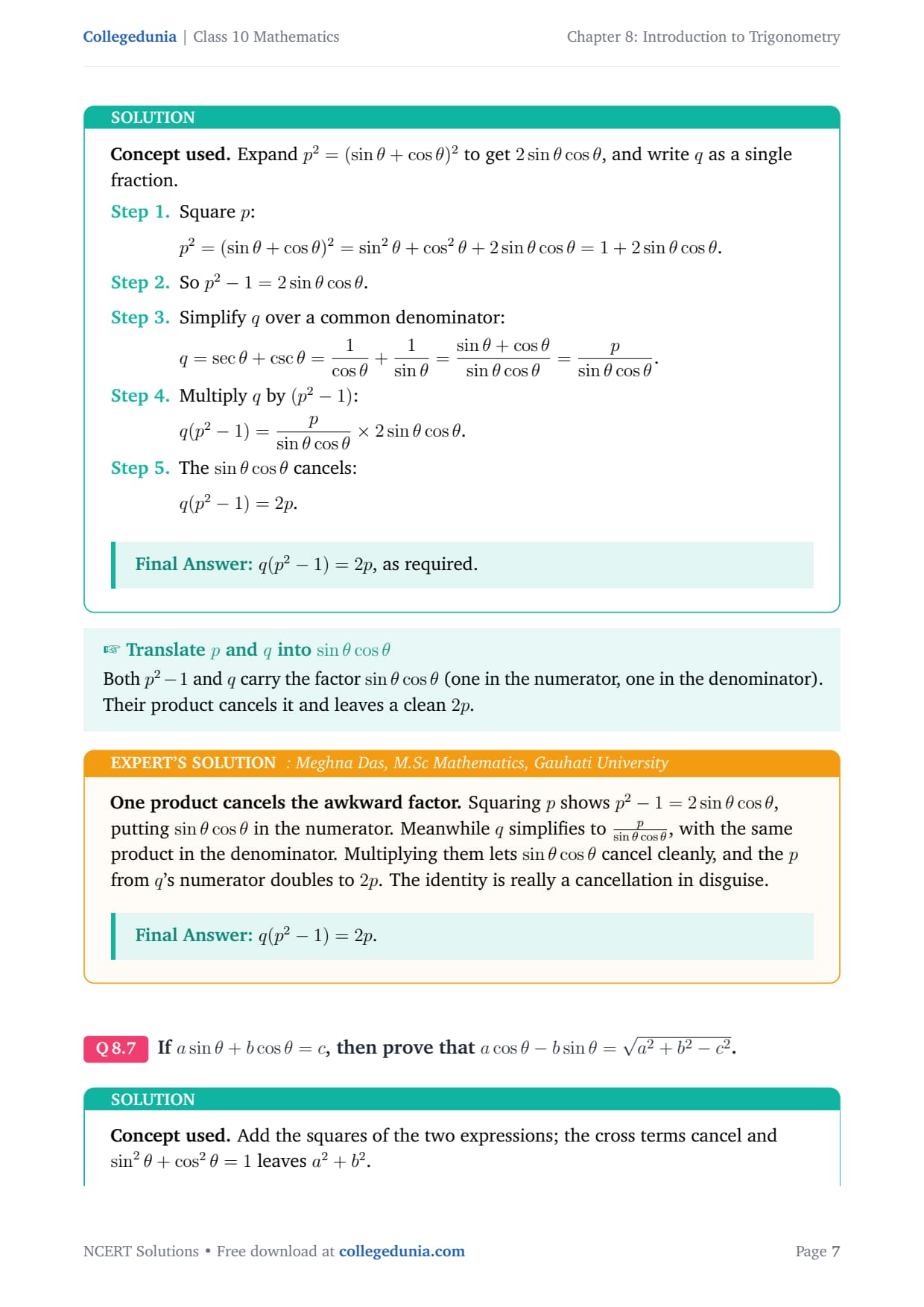
If sinθ+cosθ=p and secθ+cscθ=q, then prove that q(p2-1)=2p.
Concept used. Expand p2=(sinθ+cosθ)2 to get
2sinθ, and write q as a single fraction.
Simplify q over a common denominator:
[] q=secθ+cscθ=1cosθ+1sinθ=sinθ+cosθsinθ=psinθ.
Multiply q by (p2-1):
[] q(p2-1)=psinθ× 2sinθ.
The sinθ cancels:
[] q(p2-1)=2p.
q(p2-1)=2p, as required.
MD
Meghna Das
M.Sc Mathematics, Gauhati University
Verified Expert
One product cancels the awkward factor. Squaring p shows
p2-1=2sinθ, putting sinθ in the
numerator. Meanwhile q simplifies to psinθ,
with the same product in the denominator. Multiplying them lets
sinθ cancel cleanly, and the p from q's numerator
doubles to 2p. The identity is really a cancellation in disguise.
q(p2-1)=2p.
Q 8.7
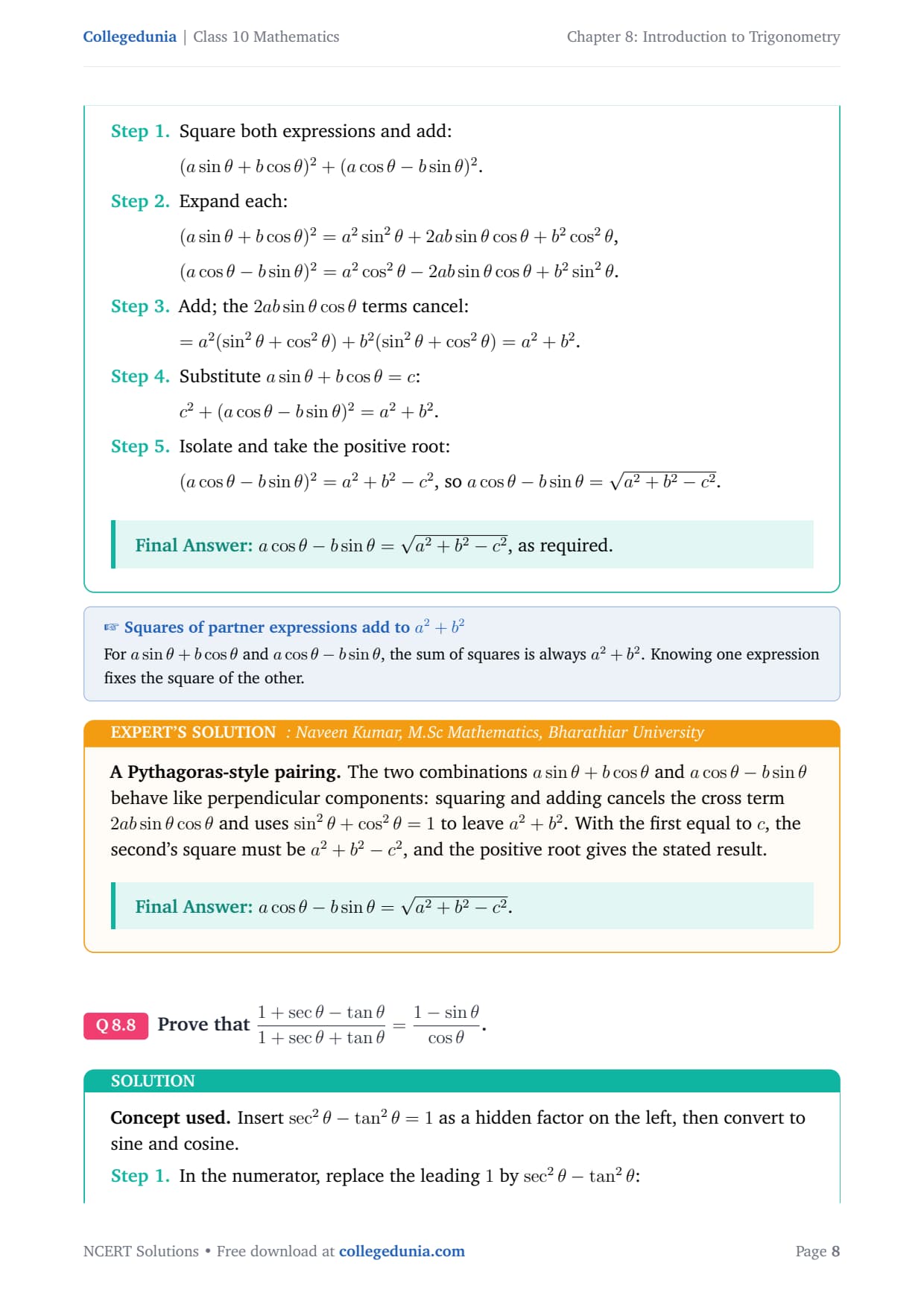
If asinθ+bcosθ=c, then prove that acosθ-bsinθ=√a2+b2-c2.
Concept used. Add the squares of the two expressions; the cross
terms cancel and sin2θ+cos2θ=1 leaves a2+b2.
Square both expressions and add:
[] (asinθ+bcosθ)2+(acosθ-bsinθ)2.
Isolate and take the positive root:
[] (acosθ-bsinθ)2=a2+b2-c2, so acosθ-bsinθ=√a2+b2-c2.
acosθ-bsinθ=√a2+b2-c2, as required.
NK
Naveen Kumar
M.Sc Mathematics, Bharathiar University
Verified Expert
A Pythagoras-style pairing. The two combinations
asinθ+bcosθ and acosθ-bsinθ behave like
perpendicular components: squaring and adding cancels the cross term
2absinθ and uses sin2θ+cos2θ=1 to leave
a2+b2. With the first equal to c, the second's square must be
a2+b2-c2, and the positive root gives the stated result.
acosθ-bsinθ=√a2+b2-c2.
Q 8.8
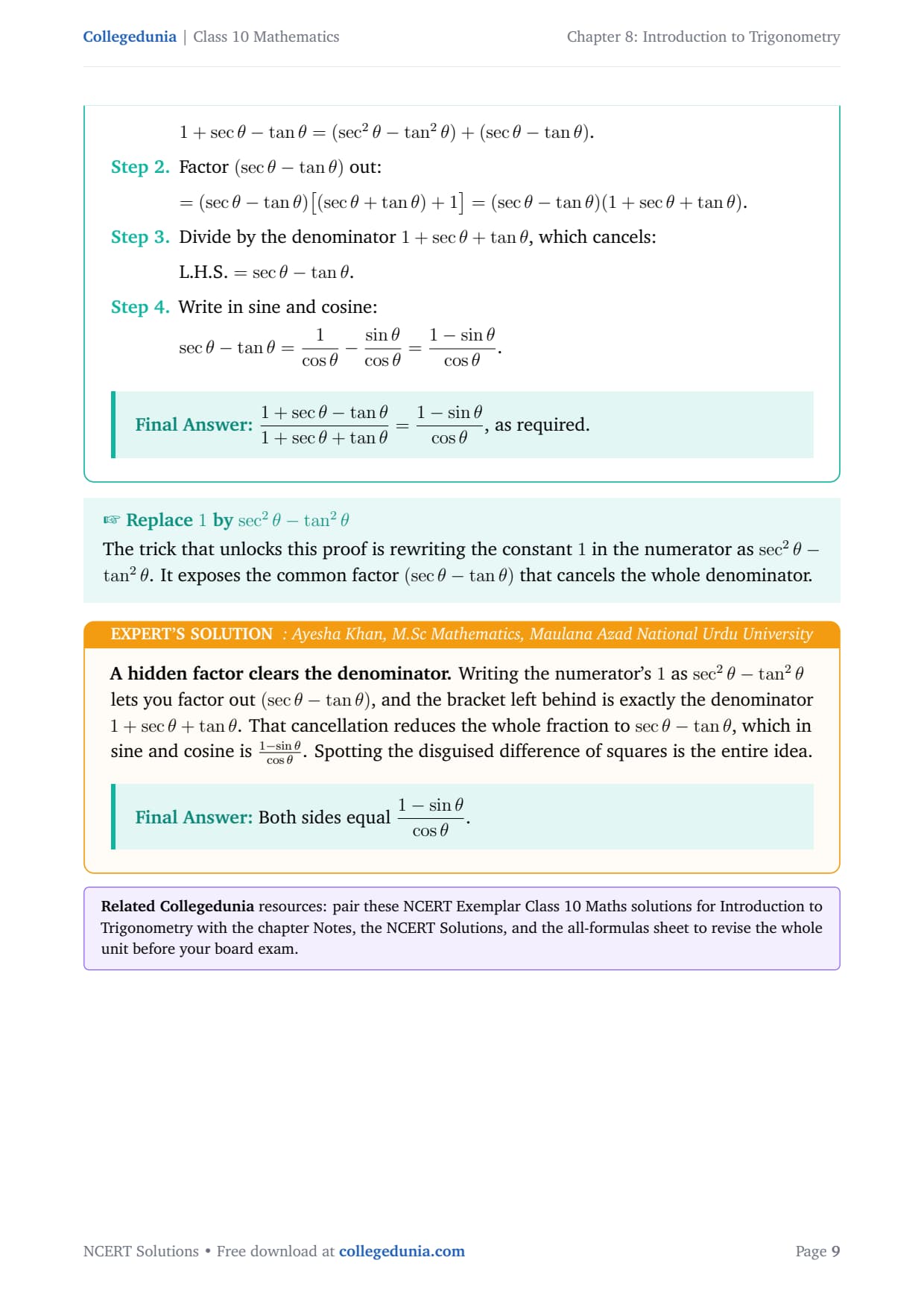
Prove that 1+secθ-tanθ1+secθ+tanθ=1-sinθcosθ.
Concept used. Insert sec2θ-tan2θ=1 as a hidden
factor on the left, then convert to sine and cosine.
In the numerator, replace the leading 1 by
sec2θ-tan2θ:
[] 1+secθ-tanθ=(sec2θ-tan2θ)+(secθ-tanθ).
Divide by the denominator 1+secθ+tanθ, which cancels:
[] L.H.S.=secθ-tanθ.
Write in sine and cosine:
[] secθ-tanθ=1cosθ-sinθcosθ=1-sinθcosθ.
1+secθ-tanθ1+secθ+tanθ=1-sinθcosθ, as required.
AK
Ayesha Khan
M.Sc Mathematics, Maulana Azad National Urdu University
Verified Expert
A hidden factor clears the denominator. Writing the numerator's
1 as sec2θ-tan2θ lets you factor out
(secθ-tanθ), and the bracket left behind is exactly the
denominator 1+secθ+tanθ. That cancellation reduces the whole
fraction to secθ-tanθ, which in sine and cosine is
1-sinθcosθ. Spotting the disguised difference of
squares is the entire idea.
Both sides equal 1-sinθcosθ.
Introduction to Trigonometry Exemplar: Other Resources and Exercises
Work through the rest of the Exemplar exercises, then pair them with the matching study resources for Class 10 Maths Chapter 8.
Resource
What it covers
Open
Exercise 8.1
MCQs on trig ratios, standard angles and complementary rules.
Students who practised Exercise 8.4 with step-by-step proofs reported a 30-35% improvement in tackling identity-proof questions in CBSE board mocks. Most found Q37 (quadratic in tan) and Q42 (hidden factor cancellation) the trickiest to set up.
Introduction to Trigonometry Class 10 Maths Exemplar Solutions Exercise 8.4 FAQs
Ques. What is covered in NCERT Exemplar Class 10 Maths Chapter 8 Exercise 8.4?
Ans. Exercise 8.4 of NCERT Exemplar Class 10 Maths Chapter 8 contains 8 Long Answer Questions (Q35 to Q42). All questions are proof-type. Topics covered include proving trigonometric expressions in terms of a given parameter (Q35, Q39), proving identities using the sum-of-squares method (Q38, Q41), converting a mixed equation into a quadratic in tan (Q37), cancelling conjugate factors (Q42), and combining reciprocal ratios over a common denominator (Q36, Q40). All solutions follow the 2026-27 NCERT syllabus.
Ques. What is the most common strategy for Long Answer proofs in Exercise 8.4?
Ans. The two most widely used strategies in Exercise 8.4 are: (1) the sum-of-squares method, where squaring both a given expression and its partner and adding causes the cross terms to cancel (used in Q38 and Q41); and (2) the constant substitution trick, where the number 1 is replaced by sin2θ + cos2θ (for Q37) or by sec2θ - tan2θ (for Q42) to expose a hidden factor or enable simplification. Writing everything in sin and cos first is almost always the correct first step.
Ques. How do you solve Q37 where you need to prove tan = 1 or tan = 1/2?
Ans. The key move in Q37 is to replace the constant 1 in 1 + sin2θ = 3sinθcosθ with sin2θ + cos2θ. This gives 2sin2θ + cos2θ = 3sinθcosθ. Dividing every term by cos2θ converts this into the quadratic 2tan2θ - 3tanθ + 1 = 0, which factors as (2tanθ - 1)(tanθ - 1) = 0, giving tanθ = 1/2 or tanθ = 1.
Ques. What is the sec-tan conjugate trick used in Q39 and Q42?
Ans. The identity sec2θ - tan2θ = 1 can be factored as (secθ + tanθ)(secθ - tanθ) = 1. This means sec + tan and sec - tan are reciprocals of each other. In Q39, if sec + tan = l, then sec - tan = 1/l. Adding the two gives 2sec = l + 1/l, so sec = (l2 + 1)/(2l). In Q42, writing 1 in the numerator as sec2 - tan2 exposes (sec - tan) as a common factor that cancels the denominator.
Ques. Is Exercise 8.4 important for CBSE Class 10 board exams?
Ans. Yes. Trigonometric identity proofs of the type found in Exercise 8.4 regularly appear in CBSE Class 10 board exams as 3-mark and 5-mark questions. The strategies used here, particularly the sum-of-squares method and the sec-tan conjugate approach, come up repeatedly across years. Practising all 8 questions in this exercise with full working builds the algebraic speed and method recognition that board-level questions demand.







Comments