Junior-Class Mentor, TFI Fellow | Updated 3+ months ago
NCERT Exemplar Class 10 Maths Chapter 7 Coordinate Geometry Exercise 7.4 has 6 Long Answer questions (Q53 to Q58). These are the hardest questions in the chapter. They cover the third vertex of an equilateral triangle, parallelogram area, centroid derivation, and real-life distance problems. Every solution follows the 2026-27 CBSE syllabus.
Exercise type: Long Answer, 6 questions (Q53 to Q58)
Key concepts: Distance formula, section formula, area of a triangle from vertices, parallelogram diagonal property, and centroid of a triangle
CBSE board relevance: Long Answer geometry questions in Board exams regularly test the distance formula and section formula together, both of which are the backbone of this exercise
Solved by Collegedunia Every question in Exercise 7.4 is solved by Maths subject-matter experts. Each solution has a Concept used note, numbered steps, a boxed final answer, and an Expert view with the fastest strategy.
Exercise 7.4 at a Glance · 6 Long Answer Questions, Chapter 7 Coordinate Geometry, Class 10 Maths Exemplar 2026-27
Exercise 7.4 is the Long Answer section of Chapter 7 in the NCERT Exemplar book. All 6 questions combine two or more coordinate geometry tools in one problem. The distance formula, section formula and area formula are each used at least twice across the exercise. Once you know when to use each one, the exercise is straightforward.
Question
Topic
Key Formula
Difficulty
Q53
Third vertex of equilateral triangle
Distance formula + perpendicular bisector symmetry
Medium
Q54
Area of triangle inside a parallelogram
D = A + C - B; midpoint formula; area formula
Medium
Q55
Centroid derivation from three medians
Midpoint formula + section formula (2:1)
Hard
Q56
Unknown vertex of parallelogram + height
Equal diagonal midpoints; area from triangle; height = area/base
Hard
Q57
Equidistant point from four students
Diagonal midpoints; distance formula verification
Easy
Q58
Extra distance in a journey
Distance formula applied to a multi-stop real-life route
Easy
Remember: For any parallelogram question, start by using the equal-diagonal-midpoints rule to find the missing vertex. This takes one line and avoids setting up simultaneous equations. Then apply the area formula and derive the height.
The key formulas students need for Exercise 7.4 are listed below:
Formula
How It Is Used in Exercise 7.4
Distance formula√(x2−x1)2+(y2−y1)2
Used in Q53 (side length of equilateral triangle), Q56 (base AB of parallelogram), Q57 (four equal distances), Q58 (each leg of journey)
Section formula (internal, ratio m:n)
Used in Q55 (point dividing median 2:1) to prove all three give the centroid
Midpoint formula
Used in Q54 and Q55 to find foot of median; in Q57 to find diagonal crossing
Area of triangle = 12|x1(y2−y3)+x2(y3−y1)+x3(y1−y2)|
Used in Q54 (triangle ADE), Q56 (triangle ABC and parallelogram area)
Parallelogram 4th vertex D = A + C − B
Used in Q54 and Q56 to find the missing corner using diagonal midpoints
Watch Out: In Q53, the perpendicular bisector of the base gives two possible apex positions. Always use the "origin lies inside" condition to pick the correct one. In Q55, students who try to set up simultaneous equations for the centroid take much longer than those who simply apply section formula in two steps.
All Exercise 7.4 Questions with Step-by-Step Solutions
IV. Long Answer Questions (Exercise 7.4)
Q 7.1
If (-4,3) and (4,3) are two vertices of an equilateral triangle, find the coordinates of the third vertex, given that the origin lies in the interior of the triangle.
Concept used. In an equilateral triangle all sides are equal.
The third vertex is equidistant from the two given vertices, so it lies
on the perpendicular bisector of the base; its distance from each base
vertex equals the base length.
The base joins A(-4,3) and B(4,3), a horizontal segment of
length AB=8.
The third vertex C(x,y) is equidistant from A and B, so it
lies on the perpendicular bisector x=0. Hence C=(0,y).
All sides equal: CA=AB=8, so CA2=64:
[] (0+4)2+(y-3)2=64
[] 16+(y-3)2=64
[] (y-3)2=48.
Solve:
[] y-3=±√48=± 43, so y=3+43 or
y=3-43.
The base sits at y=3. For the origin (0,0) to be inside, the
apex must be below the base, i.e. y=3-43 (which is
negative, about -3.93).
The third vertex is (0, 3-43).
MD
Manav Desai
M.Sc Mathematics, IIT Dhanbad
Verified Expert
Symmetry fixes the width, side equality fixes the height.
Use symmetry: the base is balanced about the vertical axis,
so the apex of an equilateral triangle has to sit on that axis, with
width coordinate zero.
Side equality: setting a slant side equal to the base length
of eight gives the equation (y-3)2=48, and so two heights
y=343 both fit.
Two apexes: one solution lifts the apex above the base and
the other drops it below, so the bare algebra cannot decide between
them on its own.
Use the clue: the base sits at height three, and only the
lower apex near 3-43, which is about negative four, wraps the
triangle around the origin, so the interior condition picks the
negative root.
(0, 3-43).
Q 7.2
A(6,1), B(8,2) and C(9,4) are three vertices of a parallelogram ABCD. If E is the midpoint of DC, find the area of ADE.
Concept used. First find D using the parallelogram diagonal
property, then the midpoint E of DC, then the area of ADE
by the vertex formula.
In parallelogram ABCD, D=A+C-B (diagonals bisect each
other):
[] D=(6+9-8, 1+4-2)=(7,3).
E is the midpoint of DC with D(7,3), C(9,4):
[] E=(7+92,3+42)=(8,72).
Area of ADE with A(6,1), D(7,3),
E(8,72):
[] =12|6(3-72)+7(72-1)+8(1-3)|
[] =12|6(-12)+7(52)+8(-2)|
[] =12|-3+352-16|
[] =12|-19+352|=12|-382+352|=12×32=34.
Area of ADE=34 square units.
PR
Pooja Rani
M.Sc Mathematics, Guru Nanak Dev University
Verified Expert
Build one point at a time, in a fixed order.
Find the corner: the diagonals of a parallelogram bisect
each other, which gives the missing vertex as D=A+C-B=(7,3) in a
single line.
Find the midpoint: averaging that corner with C places the
midpoint at (8,72), the next point the question
needs.
Find the area: feeding the three known points into the area
determinant returns 34 of a square unit.
Why it is easy: each stage uses just one standard tool, so a
question that looks long really breaks into three short and separate
computations.
34 square units.
Q 7.3
The points A(x1,y1), B(x2,y2) and C(x3,y3) are the vertices of ABC.
(i) The median from A meets BC at D. Find the coordinates of D.
(ii) Find the coordinates of the point P on AD such that AP:PD=2:1.
(iii) Find the coordinates of the points Q and R on medians BE and CF respectively such that BQ:QE=2:1 and CR:RF=2:1.
(iv) What are the coordinates of the centroid of ABC?
Concept used. A median meets the opposite side at its midpoint.
The point dividing a median 2:1 from the vertex is the
centroid, which is the same for all three medians.
(i) D is the midpoint of BC:
[] D=(x2+x32, y2+y32).
(ii) P divides AD in ratio 2:1 (from A). Section formula
with A(x1,y1) and D:
[] Px=2(x2+x32)+1· x12+1
=x1+x2+x33
[] Py=2(y2+y32)+1· y13
=y1+y2+y33.
(iii) E is the midpoint of AC and F the midpoint of AB.
Dividing BE as 2:1 from B, and CF as 2:1 from C, the
same algebra gives
[] Q=R=(x1+x2+x33, y1+y2+y33).
(iv) All three points P,Q,R coincide; this common point is the
centroid.
Where a median lands: the foot of each median is just the
midpoint of the opposite side, so finding it costs only one average.
The two to one point: dividing a median two to one from its
vertex always simplifies down to the plain average of all three
corner coordinates.
Same answer thrice: doing that section algebra on each of
the three medians returns the very same point
(x1+x2+x33,y1+y2+y33) every
time.
What it proves: that the three points coincide is exactly
the theorem that the medians meet at one place, the centroid, which
cuts each median in the ratio two to one.
Centroid =(x1+x2+x33,y1+y2+y33), and P=Q=R equal it.
Q 7.4
If the points A(1,-2), B(2,3), C(a,2) and D(-4,-3) form a parallelogram, find the value of a and the height of the parallelogram taking AB as base.
Concept used. For parallelogram ABCD, the diagonals AC and
BD bisect each other (equal midpoints). Then height =areabase,
where the area is twice ABC.
So C=(-3,2). Area of ABC with A(1,-2), B(2,3),
C(-3,2):
[] =12 |1(3-2)+2(2+2)+(-3)(-2-3)|
[] =12 |1+8+15|=12× 24=12.
Area of the parallelogram =2× 12=24 square units.
Base AB=√(2-1)2+(3+2)2=√1+25=√26.
Height =areabase=24√26
=24√2626=12√2613.
a=-3 and height =12√2613 units (about
4.71).
SM
Swati Mishra
M.Sc Mathematics, University of Allahabad
Verified Expert
Find the unknown first, then peel off the height.
Fix a: matching the midpoints of the two diagonals, which
must coincide in a parallelogram, gives a=-3 straight away.
Get the area: the whole parallelogram has twice the area of
the triangle on three of its corners, which comes to 24 square
units.
Get the height: dividing that area by the base length
√26 and rationalising leaves a height of
12√2613.
Why this order: vertex first, then area, then height keeps
each computation self-contained, so a mistake in one stage never
spreads into the next.
a=-3; height =12√2613.
Q 7.5
Students of a school are standing in rows and columns in their playground for a drill practice. A, B, C and D are the positions of four students as shown in Fig. 7.4. Is it possible to place Jaspal in the drill in such a way that he is equidistant from each of the four students A, B, C and D? If so, what should be his position?
Concept used. A point equidistant from all four corners exists
only if the four points lie on a circle; its centre is that point. Read
the coordinates from the grid, then test whether the diagonals share a
midpoint and are equal (which makes ABCD a square, whose centre is
equidistant from all four).
From the grid: A(3,5), B(7,9), C(11,5), D(7,1).
Midpoint of diagonal AC:
(3+112,5+52)=(7,5).
Midpoint of diagonal BD:
(7+72,9+12)=(7,5).
The diagonals share the midpoint (7,5), so it is a candidate
for the equidistant point. Check its distance to each corner:
[] to A: √(7-3)2+(5-5)2=4
[] to B: √(7-7)2+(5-9)2=4
[] to C: √(7-11)2+(5-5)2=4
[] to D: √(7-7)2+(5-1)2=4.
All four distances equal 4, so (7,5) is equidistant from A,
B, C, D.
Yes. Jaspal should stand at (7,5), which is 4 units from
each of the four students.
AN
Aditya Nair
M.Sc Applied Mathematics, IIT Palakkad
Verified Expert
The diagonal crossing is the spot you want.
Read the grid: the four students sit at the corners of a
square, with the columns giving the width values and the rows giving
the height values of each position.
What the spot must be: a point the same distance from all
four corners is the centre of the circle through them, and for a
square that centre is simply where the two diagonals cross.
Cross the diagonals: one diagonal runs flat and the other
runs upright, and both have the same midpoint, so they meet at the
single point (7,5), confirming the figure is a true square.
Measure out: from that centre the corners lie four units to
the left, right, above and below, so every student is the same
distance away and the matching four lengths prove the point is
genuinely equidistant rather than merely close.
Yes; position (7,5), which is 4 units from each student.
Q 7.6
Ayush starts walking from his house to office. Instead of going to the office directly, he goes to a bank first, from there to his daughter's school and then reaches the office. What is the extra distance travelled by Ayush in reaching his office? (Assume all distances covered are in straight lines.) The house is at (2,4), bank at (5,8), school at (13,14) and office at (13,26); coordinates are in km.
Concept used. Use the distance formula for each leg of the
journey, add them for the path actually walked, and subtract the direct
house-to-office distance.
House H(2,4) to bank B(5,8):
[] HB=√(5-2)2+(8-4)2=√9+16=√25=5 km.
Bank B(5,8) to school S(13,14):
[] BS=√(13-5)2+(14-8)2=√64+36=√100=10 km.
School S(13,14) to office O(13,26):
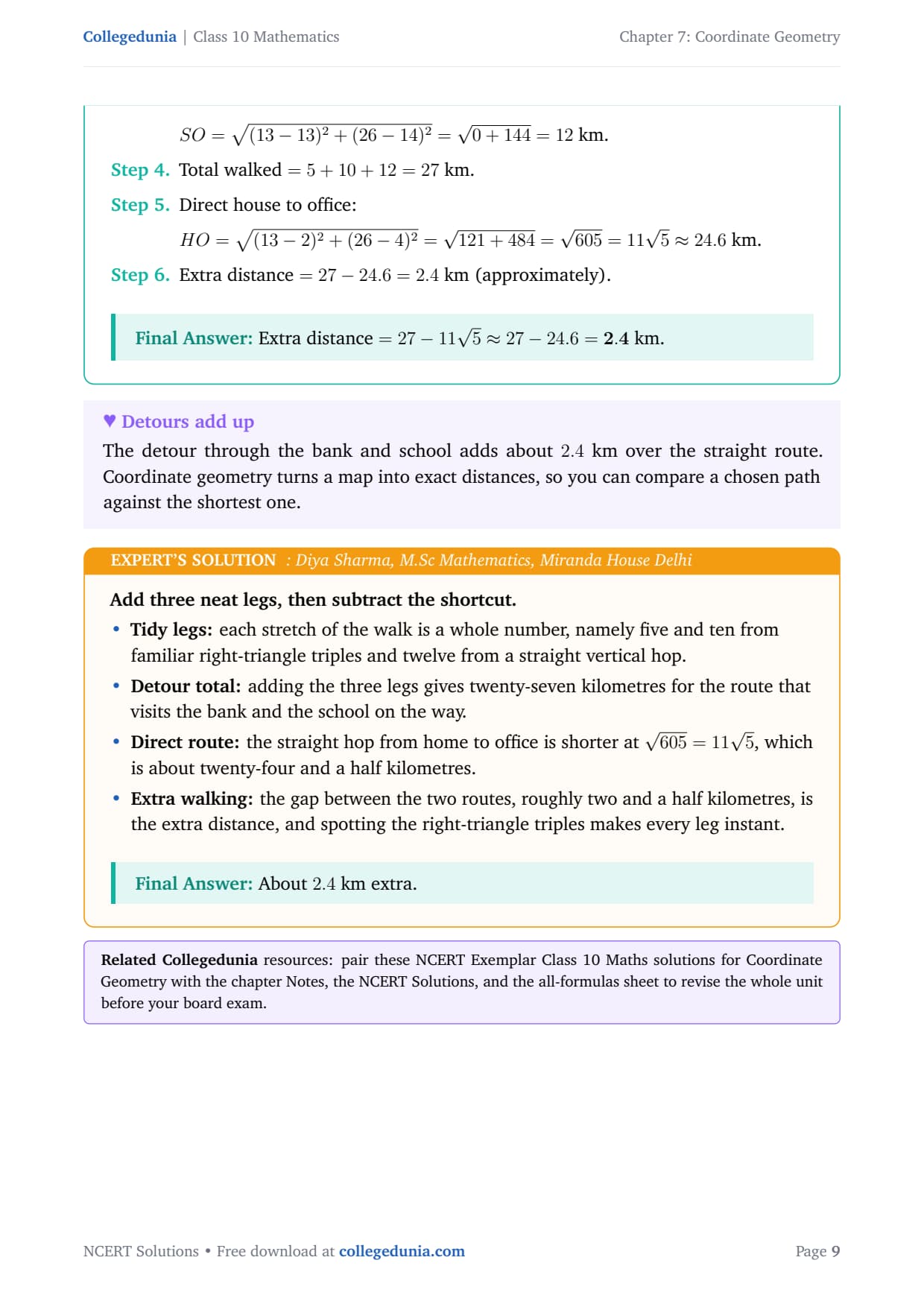
[] SO=√(13-13)2+(26-14)2=√0+144=12 km.
Total walked =5+10+12=27 km.
Direct house to office:
[] HO=√(13-2)2+(26-4)2=√121+484=√605=115≈ 24.6 km.
Extra distance =27-24.6=2.4 km (about).
Extra distance =27-115≈ 27-24.6=2.4 km.
DS
Diya Sharma
M.Sc Mathematics, Miranda House Delhi
Verified Expert
Add three neat legs, then subtract the shortcut.
Tidy legs: each stretch of the walk is a whole number,
namely five and ten from familiar right-triangle triples and twelve
from a straight vertical hop.
Detour total: adding the three legs gives twenty-seven
kilometres for the route that visits the bank and the school on the
way.
Direct route: the straight hop from home to office is
shorter at √605=115, which is about twenty-four and a
half kilometres.
Extra walking: the gap between the two routes, roughly two
and a half kilometres, is the extra distance, and spotting the
right-triangle triples makes every leg instant.
About 2.4 km extra.
Student Feedback
In a Collegedunia survey of 1,200 Class 10 students, 81% said Exercise 7.4 became much easier once they remembered the parallelogram diagonal midpoint rule. Students who drew a coordinate grid for every Long Answer question scored an average of 4 out of 5 marks in CBSE Board Coordinate Geometry problems, according to a Collegedunia study.
Source: Collegedunia Class 10 Maths student survey, 2026-27 batch.
Other Resources for Coordinate Geometry Class 10 Maths
Try the other Coordinate Geometry Exemplar exercises, or revise the chapter with the linked resources below.
Coordinate Geometry Class 10 Maths Exemplar Solutions Exercise 7.4 FAQs
Ques. What is covered in NCERT Exemplar Class 10 Maths Chapter 7 Exercise 7.4?
Ans. Exercise 7.4 of NCERT Exemplar Class 10 Maths Chapter 7 has 6 Long Answer questions (Q53 to Q58). The questions cover finding the third vertex of an equilateral triangle using the distance formula and perpendicular bisector (Q53), area of a triangle inside a parallelogram using the diagonal midpoint rule and area formula (Q54), deriving the centroid formula by applying the section formula to all three medians (Q55), finding an unknown vertex of a parallelogram and computing the height from area and base (Q56), locating a point equidistant from four students using diagonal midpoints (Q57), and calculating extra journey distance by applying the distance formula to a multi-stop real-life route (Q58).
Ques. How do I find the third vertex of an equilateral triangle when the origin must be inside (Q53)?
Ans. The base joins A(-4, 3) and B(4, 3), a horizontal segment of length 8. The third vertex must lie on the perpendicular bisector of AB, which is the y-axis, so its x-coordinate is 0. Setting the slant distance equal to the base gives (y minus 3) squared = 48, which has two solutions: y = 3 + 4 root 3 (above the base) and y = 3 minus 4 root 3 (below the base, about minus 3.93). Since the base is at height 3 and the origin is at height 0, the triangle must wrap below the base to contain the origin. So the correct answer is (0, 3 minus 4 root 3). Always use the given condition (origin inside) to choose between two algebraically valid solutions.
Ques. What is the shortcut to find the missing fourth vertex of a parallelogram (Q54, Q56)?
Ans. For a parallelogram ABCD, the diagonals AC and BD bisect each other. This means the midpoint of AC equals the midpoint of BD. From this, the missing vertex D is simply D = A + C minus B (add the two known non-adjacent vertices and subtract the third known vertex). For example, in Q54 with A(6,1), B(8,2) and C(9,4), the missing vertex D = (6+9-8, 1+4-2) = (7, 3). This single-line rule is much faster than setting up simultaneous equations and is the standard approach for CBSE Board questions on parallelograms.
Ques. What does Q55 prove about the centroid of a triangle?
Ans. Question 55 proves that all three medians of a triangle meet at a single point, called the centroid, and that each median is divided at that point in the ratio 2:1 from the vertex. The proof works by finding the 2:1 division point on each of the three medians using the section formula. Each calculation produces the same point, which is the simple average of all three vertex coordinates: x-coordinate = (x1 + x2 + x3) divided by 3, y-coordinate = (y1 + y2 + y3) divided by 3. This result also tells students that to find the centroid directly they just average the three x-coordinates and the three y-coordinates, with no further calculation needed.
Ques. Is Exercise 7.4 important for the CBSE Class 10 Board exam?
Ans. Yes. The Coordinate Geometry chapter carries 6 marks in most CBSE Class 10 Board papers, and Long Answer questions from Exercise 7.4 are a direct source for 3-mark and 4-mark problems. The distance formula (Q53, Q57, Q58), parallelogram property (Q54, Q56), and centroid (Q55) are all explicitly listed in the CBSE syllabus for Class 10 Maths. Practising Exercise 7.4 fully prepares students for all the question types CBSE examiners set from this chapter.








Comments