Junior-Class Mentor, TFI Fellow | Updated 3+ months ago
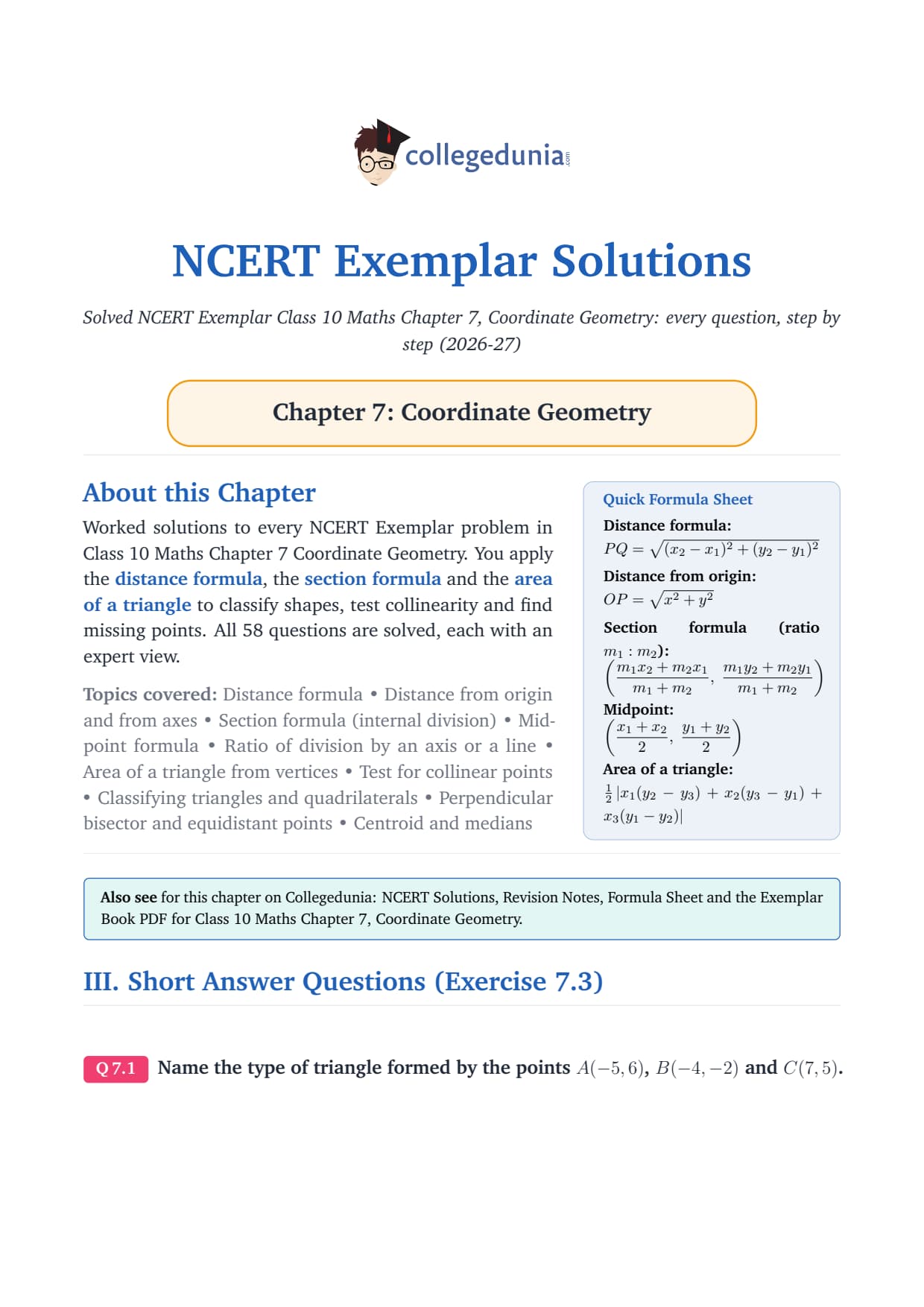
NCERT Exemplar Class 10 Maths Chapter 7 Coordinate Geometry Exercise 7.3 covers 19 short answer questions. Students apply the distance formula, section formula, midpoint formula, and area of a triangle to classify shapes, find unknown coordinates, and test collinearity.
Exercise type: Short Answer (Questions 33-51), 19 questions
Key concepts: Distance formula, section formula, midpoint formula, area of a triangle, collinear points, classifying triangles and quadrilaterals
CBSE board relevance: These questions directly mirror the 3-mark and 4-mark coordinate geometry questions in Class 10 Board papers
All 19 solutions for Exercise 7.3 are given below, with full working and an expert view for each question, to the 2026-27 NCERT syllabus.
These Exemplar Solutions are curated by subject experts and verified against the CBSE Class 10 board exam pattern for 2026-27.
Solved by Collegedunia Every question in Exercise 7.3 is solved by Mathematics subject-matter experts. Each solution has a "Concept used" section, numbered steps, a boxed final answer, and an Expert view so students understand the key geometric or algebraic idea behind each problem.
Exercise 7.3 at a Glance · 19 Short Answer Questions, Chapter 7 Coordinate Geometry, Class 10 Maths Exemplar 2026-27
Exercise 7.3 is the Short Answer set of Chapter 7 in the NCERT Exemplar book. It has 19 questions (Q33 to Q51) that cover every major technique in the chapter. The table below lists the topic tested in each question.
Question
Topic Tested
Formula Used
Difficulty
Q33
Classify a triangle by side lengths
Distance formula
Easy
Q34
Points on x-axis at given distance from a point
Distance formula
Easy
Q35
Classify a quadrilateral by sides and diagonals
Distance formula
Medium
Q36
Find unknown coordinate given distance
Distance formula
Easy
Q37
Equidistant point and perpendicular bisector
Midpoint formula
Easy
Q38
Perpendicular bisector point on x-axis; triangle type
Midpoint formula, distance formula
Medium
Q39
Collinear points: find m from zero area
Area of triangle
Medium
Q39b
Equidistant from two points: find y and PQ
Distance formula
Hard
Q40
Area of triangle (collinear check)
Area formula
Easy
Q41
x-axis divides a segment: ratio and point
Section formula
Medium
Q42
Ratio in which a point divides a segment (fractional coords)
Section formula
Hard
Q43
Find a and b from section formula with given ratio
Section formula
Medium
Q44
Midpoint + linear constraint: find k and AB
Midpoint formula, distance formula
Medium
Q45
Circle centre + diameter + point: find a
Distance formula, quadratic
Hard
Q46
Section point on a line: find k
Section formula, substitution
Medium
Q47
Midpoint triangle area to original area
Area formula, medial triangle
Hard
Q48
Right triangle at B: find a and area
Pythagoras, distance formula
Medium
Q49
Point R given as fraction of segment length
Section formula
Medium
Q50
Variable coordinates: find k for collinear points
Area formula, quadratic
Hard
Q51
Line divides a segment: ratio and point
Section formula, substitution
Hard
Key Strategy for Exercise 7.3: Before you start any question, identify which formula applies: distance formula for lengths and classification, section formula for division ratios, midpoint formula for equidistant/bisector questions, and area formula for collinearity. Picking the right formula first saves half the working time.
The key formulas students need for Exercise 7.3 are listed below:
Formula
Statement
Distance formula
PQ = √((x2−x1)2 + (y2−y1)2)
Section formula (ratio m1:m2)
(m1x2+m2x1) / (m1+m2), (m1y2+m2y1) / (m1+m2)
Midpoint formula
((x1+x2)/2, (y1+y2)/2)
Area of triangle
½|x1(y2−y3) + x2(y3−y1) + x3(y1−y2)|
Axis division shortcut
x-axis divides A(x1,y1) and B(x2,y2) in ratio −y1:y2
Common Mistake: In Q39 and Q50, students often use a slope approach for collinearity. The area method (set area = 0) is faster and avoids fraction errors from the slope formula.
All Exercise 7.3 Questions with Step-by-Step Solutions
III. Short Answer Questions (Exercise 7.3)
Q 7.1
Name the type of triangle formed by the points A(-5,6), B(-4,-2) and C(7,5).
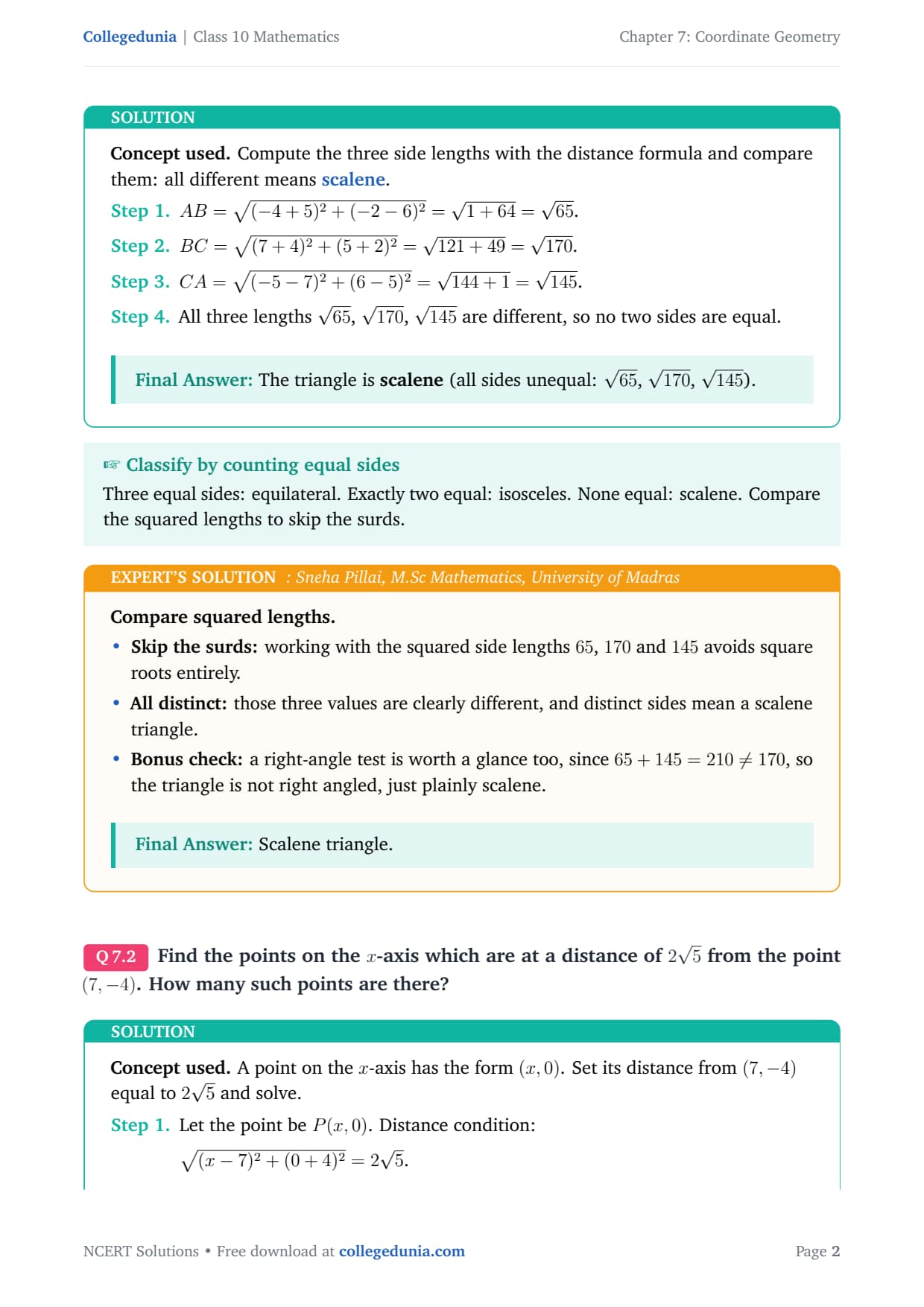
Concept used. Compute the three side lengths with the distance
formula and compare them: all different means scalene.
AB=√(-4+5)2+(-2-6)2=√1+64=√65.
BC=√(7+4)2+(5+2)2=√121+49=√170.
CA=√(-5-7)2+(6-5)2=√144+1=√145.
All three lengths √65, √170, √145 are
different, so no two sides are equal.
The triangle is scalene (all sides unequal:
√65, √170, √145).
SP
Sneha Pillai
M.Sc Mathematics, University of Madras
Verified Expert
Compare squared lengths.
Skip the surds: working with the squared side lengths 65,
170 and 145 avoids square roots entirely.
All distinct: those three values are clearly different, and
distinct sides mean a scalene triangle.
Bonus check: a right-angle test is worth a glance too,
since 65+145=210170, so the triangle is not right angled, just
plainly scalene.
Scalene triangle.
Q 7.2
Find the points on the x-axis which are at a distance of 25 from the point (7,-4). How many such points are there?
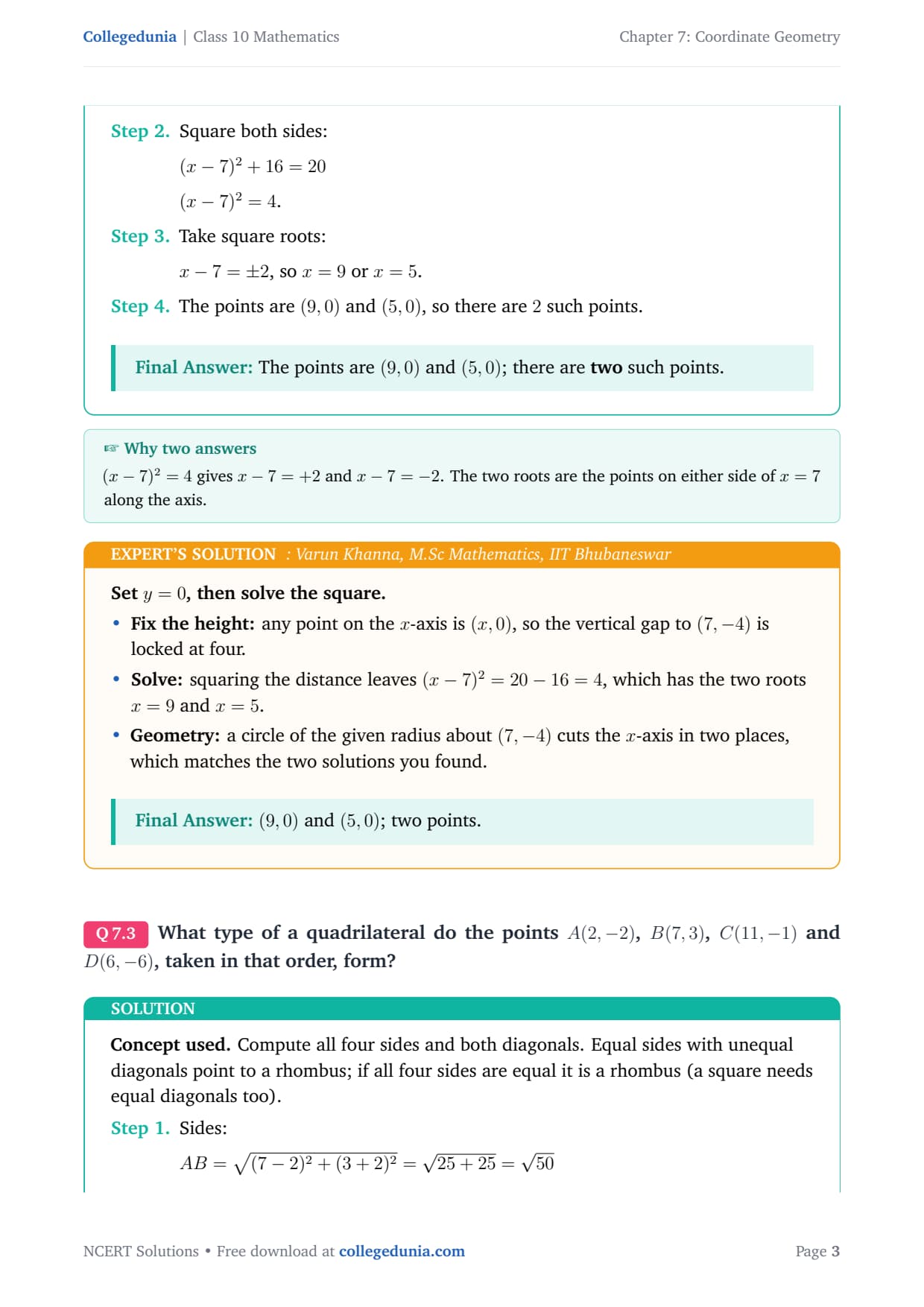
Concept used. A point on the x-axis has the form (x,0). Set
its distance from (7,-4) equal to 25 and solve.
Let the point be P(x,0). Distance condition:
[] √(x-7)2+(0+4)2=25.
Square both sides:
[] (x-7)2+16=20
[] (x-7)2=4.
Take square roots:
[] x-7=± 2, so x=9 or x=5.
The points are (9,0) and (5,0), so there are 2 such points.
The points are (9,0) and (5,0); there are two such
points.
VK
Varun Khanna
M.Sc Mathematics, IIT Bhubaneswar
Verified Expert
Set y=0, then solve the square.
Fix the height: any point on the x-axis is (x,0), so the
vertical gap to (7,-4) is locked at four.
Solve: squaring the distance leaves (x-7)2=20-16=4,
which has the two roots x=9 and x=5.
Geometry: a circle of the given radius about (7,-4) cuts
the x-axis in two places, which matches the two solutions you
found.
(9,0) and (5,0); two points.
Q 7.3
What type of a quadrilateral do the points A(2,-2), B(7,3), C(11,-1) and D(6,-6), taken in that order, form?
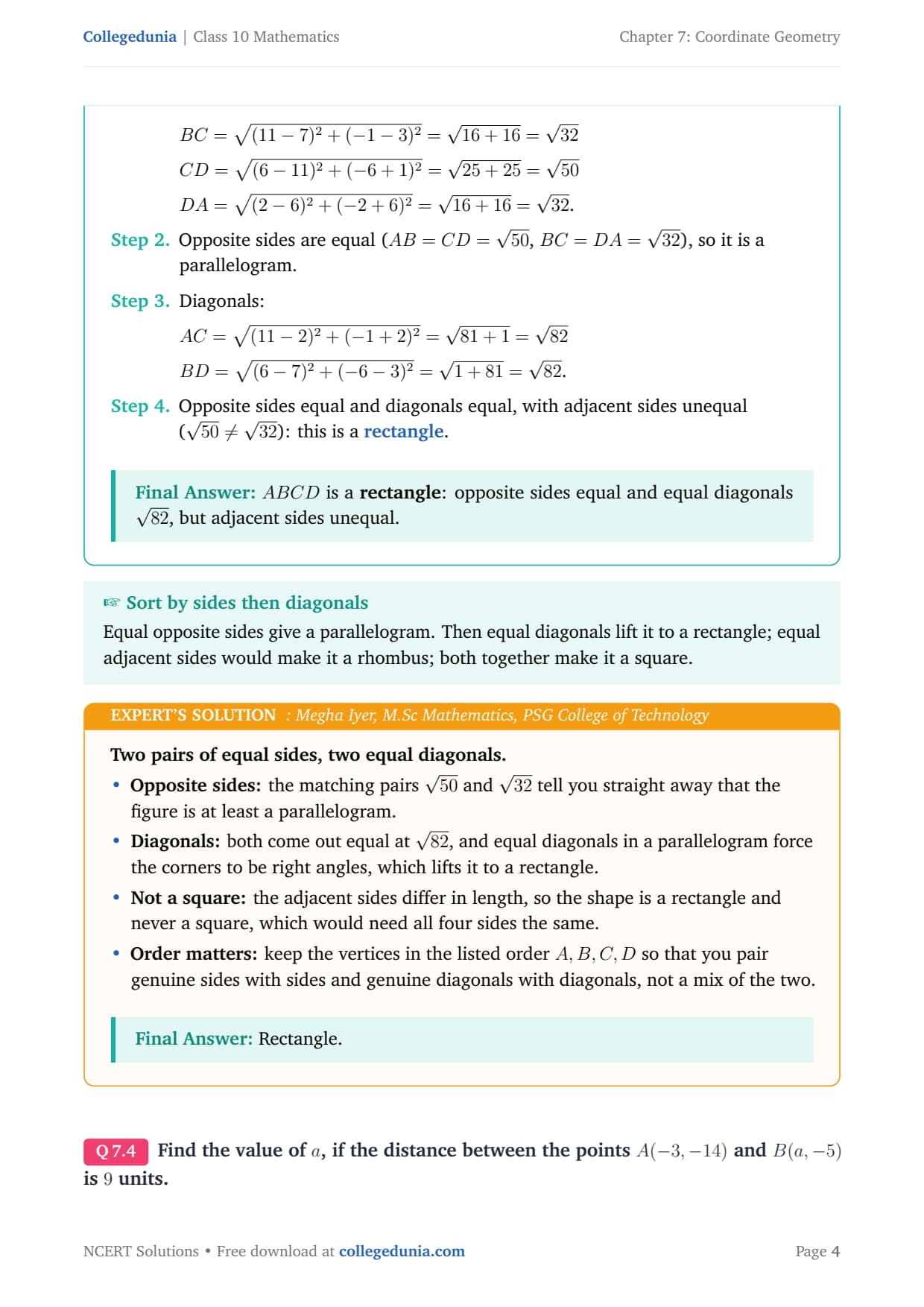
Concept used. Compute all four sides and both diagonals.
Equal sides with unequal diagonals point to a rhombus; if all four sides
are equal it is a rhombus (a square needs equal diagonals too).
Opposite sides equal and diagonals equal, with adjacent sides
unequal (√50≠√32): this is a rectangle.
ABCD is a rectangle: opposite sides equal and equal
diagonals √82, but adjacent sides unequal.
MI
Megha Iyer
M.Sc Mathematics, PSG College of Technology
Verified Expert
Two pairs of equal sides, two equal diagonals.
Opposite sides: the matching pairs √50 and
√32 tell you straight away that the figure is at least a
parallelogram.
Diagonals: both come out equal at √82, and equal
diagonals in a parallelogram force the corners to be right angles,
which lifts it to a rectangle.
Not a square: the adjacent sides differ in length, so the
shape is a rectangle and never a square, which would need all four
sides the same.
Order matters: keep the vertices in the listed order
A,B,C,D so that you pair genuine sides with sides and genuine
diagonals with diagonals, not a mix of the two.
Rectangle.
Q 7.4
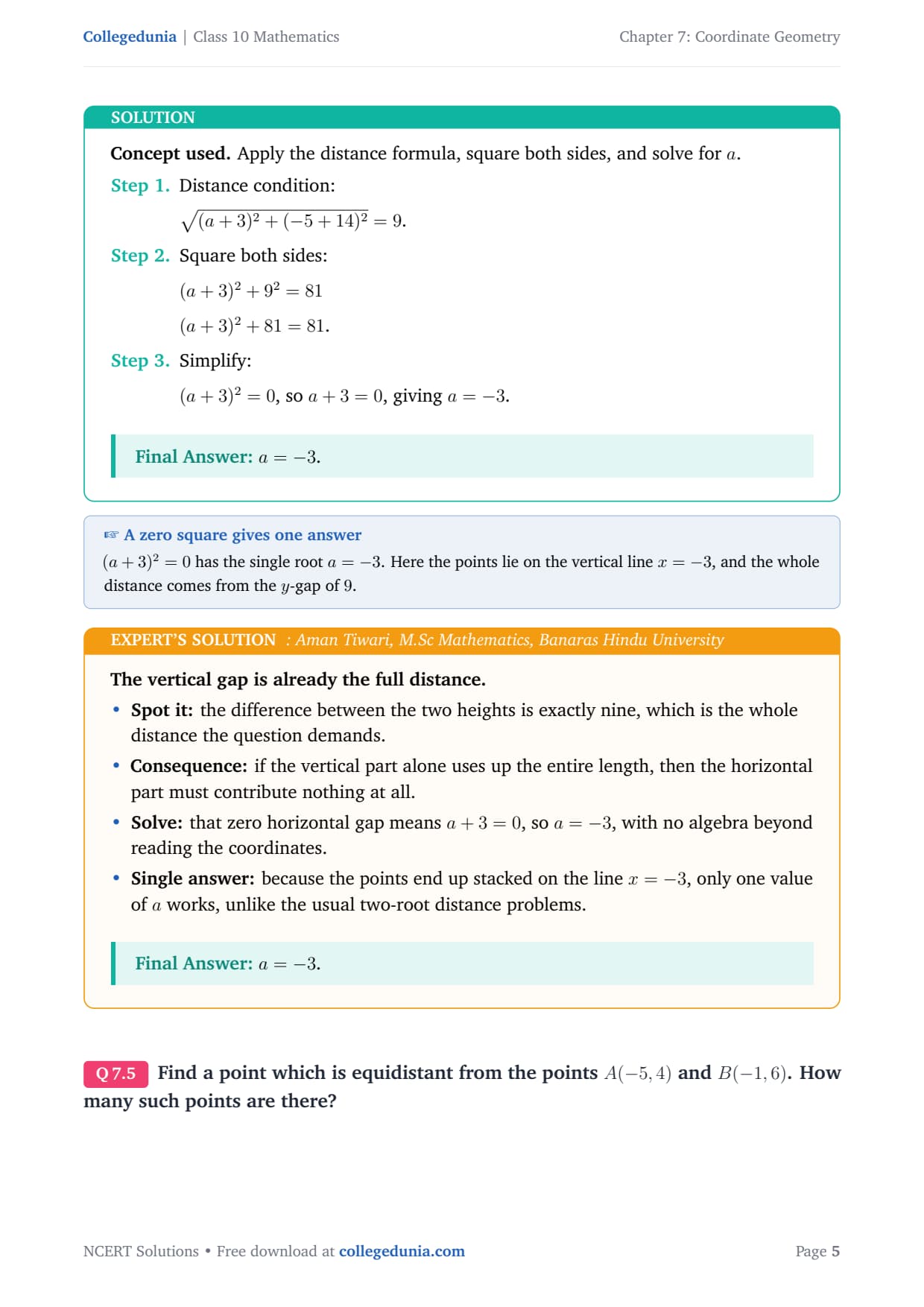
Find the value of a, if the distance between the points A(-3,-14) and B(a,-5) is 9 units.
Concept used. Apply the distance formula, square both sides,
and solve for a.
Distance condition:
[] √(a+3)2+(-5+14)2=9.
Square both sides:
[] (a+3)2+92=81
[] (a+3)2+81=81.
Simplify:
[] (a+3)2=0, so a+3=0, giving a=-3.
a=-3.
AT
Aman Tiwari
M.Sc Mathematics, Banaras Hindu University
Verified Expert
The vertical gap is already the full distance.
Spot it: the difference between the two heights is exactly
nine, which is the whole distance the question demands.
Consequence: if the vertical part alone uses up the entire
length, then the horizontal part must contribute nothing at all.
Solve: that zero horizontal gap means a+3=0, so a=-3,
with no algebra beyond reading the coordinates.
Single answer: because the points end up stacked on the
line x=-3, only one value of a works, unlike the usual two-root
distance problems.
a=-3.
Q 7.5
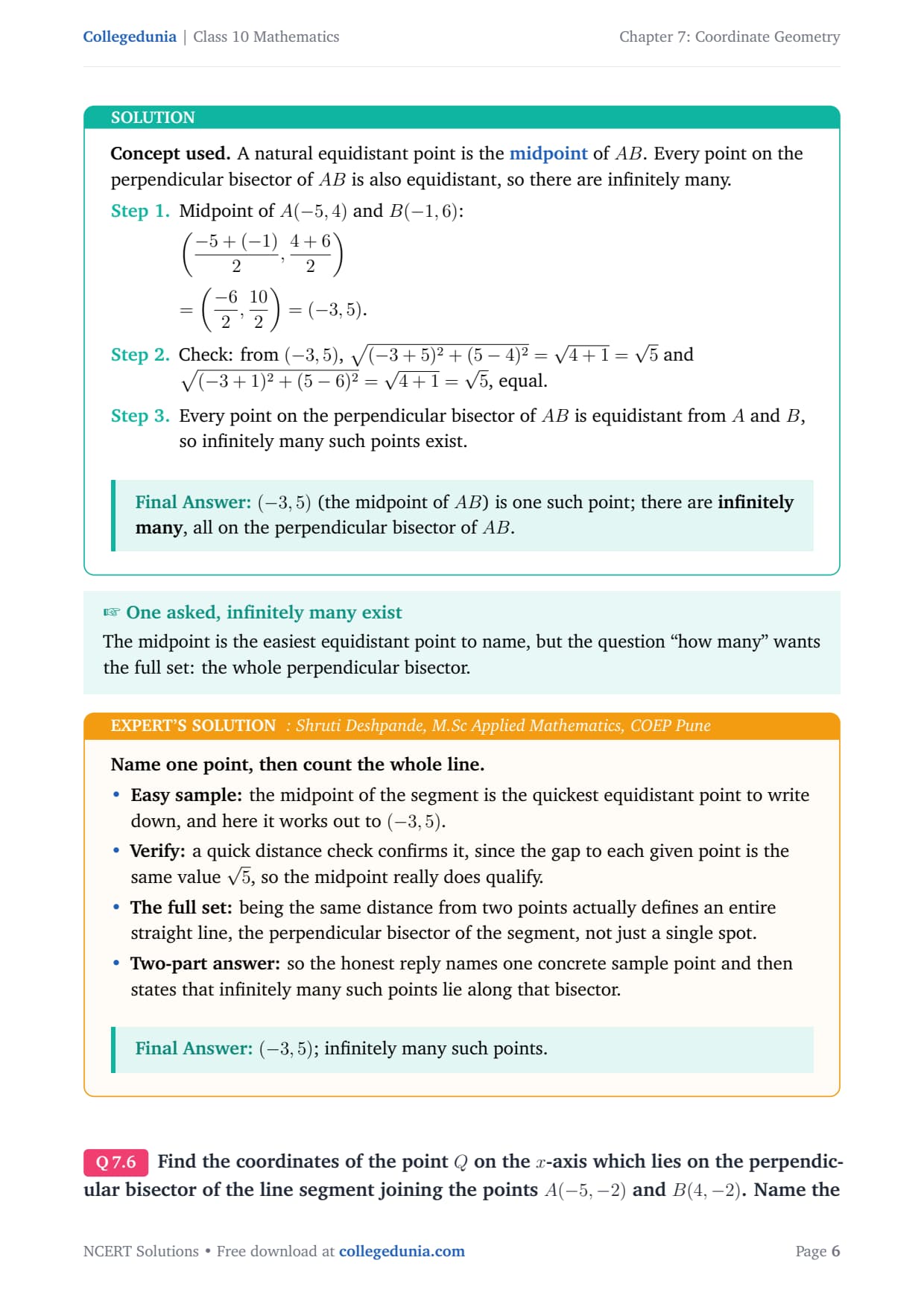
Find a point which is equidistant from the points A(-5,4) and B(-1,6). How many such points are there?
Concept used. A natural equidistant point is the midpoint
of AB. Every point on the perpendicular bisector of AB is also
equidistant, so there are infinitely many.
Midpoint of A(-5,4) and B(-1,6):
[] (-5+(-1)2,4+62)
[] =(-62,102)=(-3,5).
Check: from (-3,5),
√(-3+5)2+(5-4)2=√4+1=5 and
√(-3+1)2+(5-6)2=√4+1=5, equal.
Every point on the perpendicular bisector of AB is equidistant
from A and B, so infinitely many such points exist.
(-3,5) (the midpoint of AB) is one such point; there are
infinitely many, all on the perpendicular bisector of AB.
SD
Shruti Deshpande
M.Sc Applied Mathematics, COEP Pune
Verified Expert
Name one point, then count the whole line.
Easy sample: the midpoint of the segment is the quickest
equidistant point to write down, and here it works out to
(-3,5).
Verify: a quick distance check confirms it, since the gap
to each given point is the same value 5, so the midpoint
really does qualify.
The full set: being the same distance from two points
actually defines an entire straight line, the perpendicular
bisector of the segment, not just a single spot.
Two-part answer: so the honest reply names one concrete
sample point and then states that infinitely many such points lie
along that bisector.
(-3,5); infinitely many such points.
Q 7.6
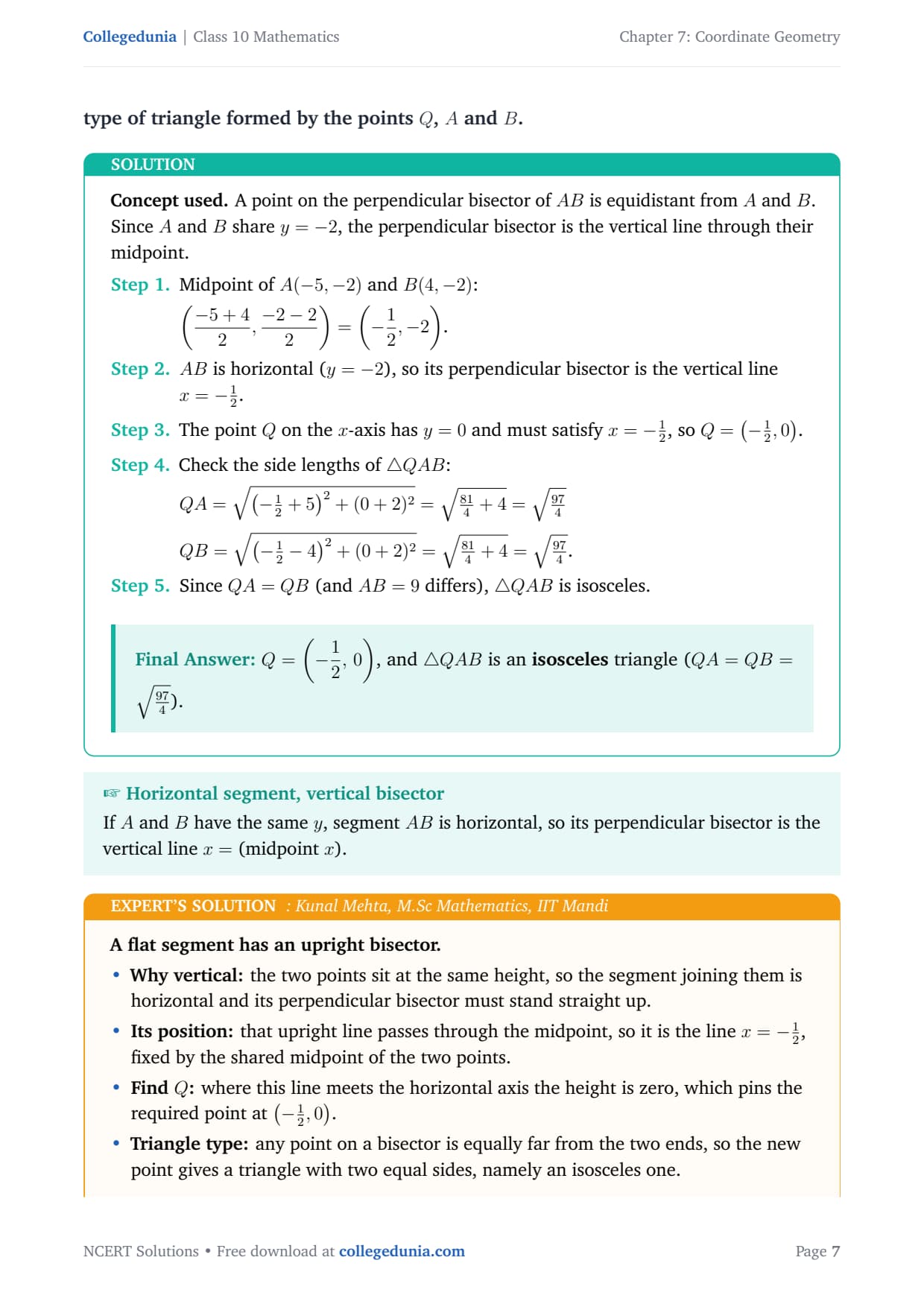
Find the coordinates of the point Q on the x-axis which lies on the perpendicular bisector of the line segment joining the points A(-5,-2) and B(4,-2). Name the type of triangle formed by the points Q, A and B.
Concept used. A point on the perpendicular bisector of AB is
equidistant from A and B. Since A and B share y=-2, the
perpendicular bisector is the vertical line through their midpoint.
Midpoint of A(-5,-2) and B(4,-2):
[] (-5+42,-2-22)=(-12,-2).
AB is horizontal (y=-2), so its perpendicular bisector is the
vertical line x=-12.
The point Q on the x-axis has y=0 and must satisfy
x=-12, so Q=(-12,0).
Check the side lengths of QAB:
[] QA=√(-12+5)2+(0+2)2=√814+4=√974
[] QB=√(-12-4)2+(0+2)2=√814+4=√974.
Since QA=QB (and AB=9 differs), QAB is isosceles.
Q=(-12, 0), and QAB is an
isosceles triangle (QA=QB=√974).
KM
Kunal Mehta
M.Sc Mathematics, IIT Mandi
Verified Expert
A flat segment has an upright bisector.
Why vertical: the two points sit at the same height, so the
segment joining them is horizontal and its perpendicular bisector
must stand straight up.
Its position: that upright line passes through the
midpoint, so it is the line x=-12, fixed by the shared
midpoint of the two points.
Find Q: where this line meets the horizontal axis the
height is zero, which pins the required point at
(-12,0).
Triangle type: any point on a bisector is equally far from
the two ends, so the new point gives a triangle with two equal
sides, namely an isosceles one.
Q=(-12,0); isosceles triangle.
Q 7.7
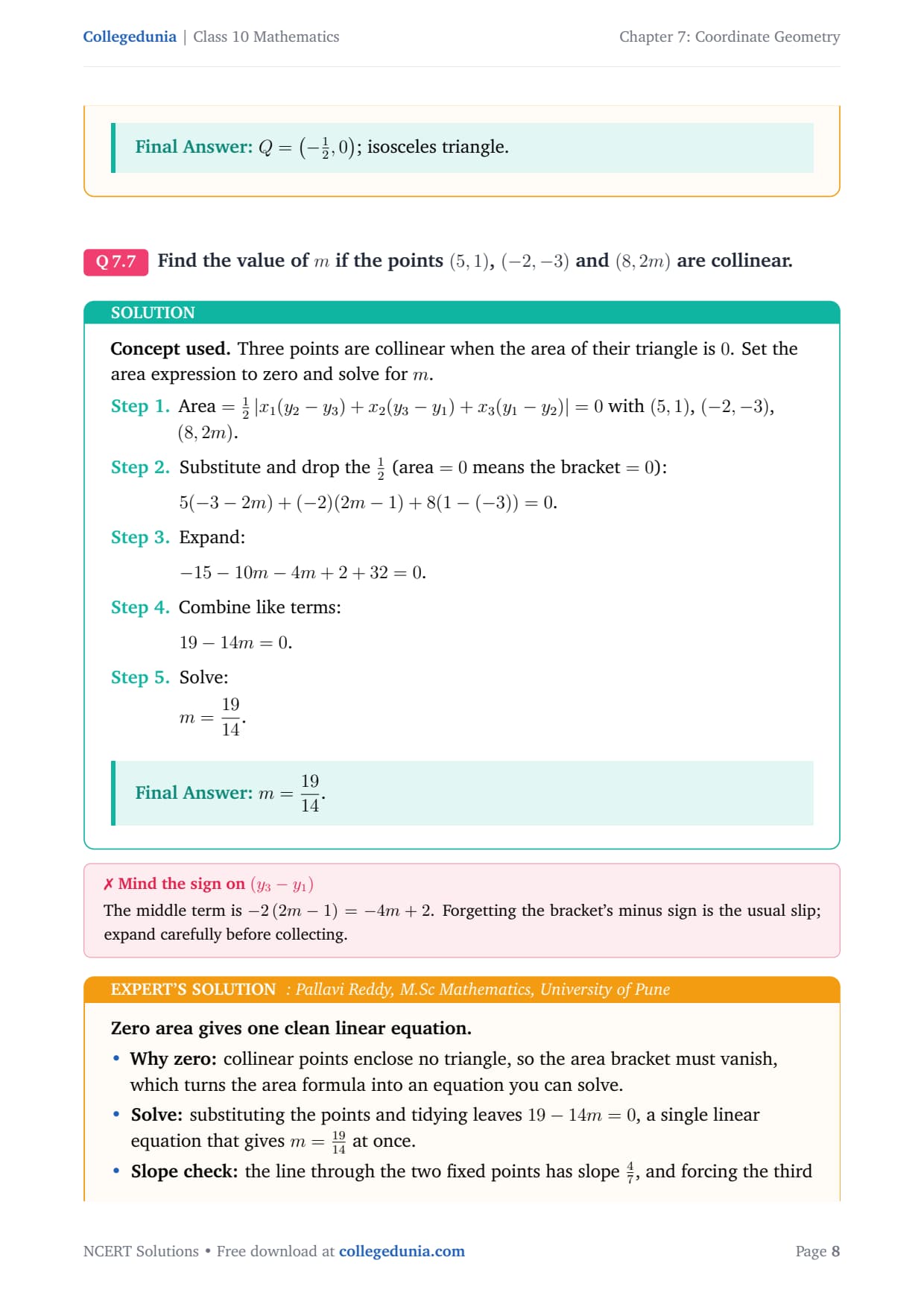
Find the value of m if the points (5,1), (-2,-3) and (8,2m) are collinear.
Concept used. Three points are collinear when the area of their
triangle is 0. Set the area expression to zero and solve for m.
Area =12 |x1(y2-y3)+x2(y3-y1)+x3(y1-y2)|=0
with (5,1), (-2,-3), (8,2m).
Substitute and drop the 12 (area =0 means the bracket
=0):
[] 5(-3-2m)+(-2)(2m-1)+8(1-(-3))=0.
Expand:
[] -15-10m-4m+2+32=0.
Combine like terms:
[] 19-14m=0.
Solve:
[] m=1914.
m=1914.
PR
Pallavi Reddy
M.Sc Mathematics, University of Pune
Verified Expert
Zero area gives one clean linear equation.
Why zero: collinear points enclose no triangle, so the area
bracket must vanish, which turns the area formula into an equation
you can solve.
Solve: substituting the points and tidying leaves
19-14m=0, a single linear equation that gives
m=1914 at once.
Slope check: the line through the two fixed points has slope
47, and forcing the third point to share that slope
reproduces the very same value of m.
Takeaway: either route, area or slope, works, but the area
method is usually quicker because it avoids fractions until the
final step.
m=1914.
Q 7.8
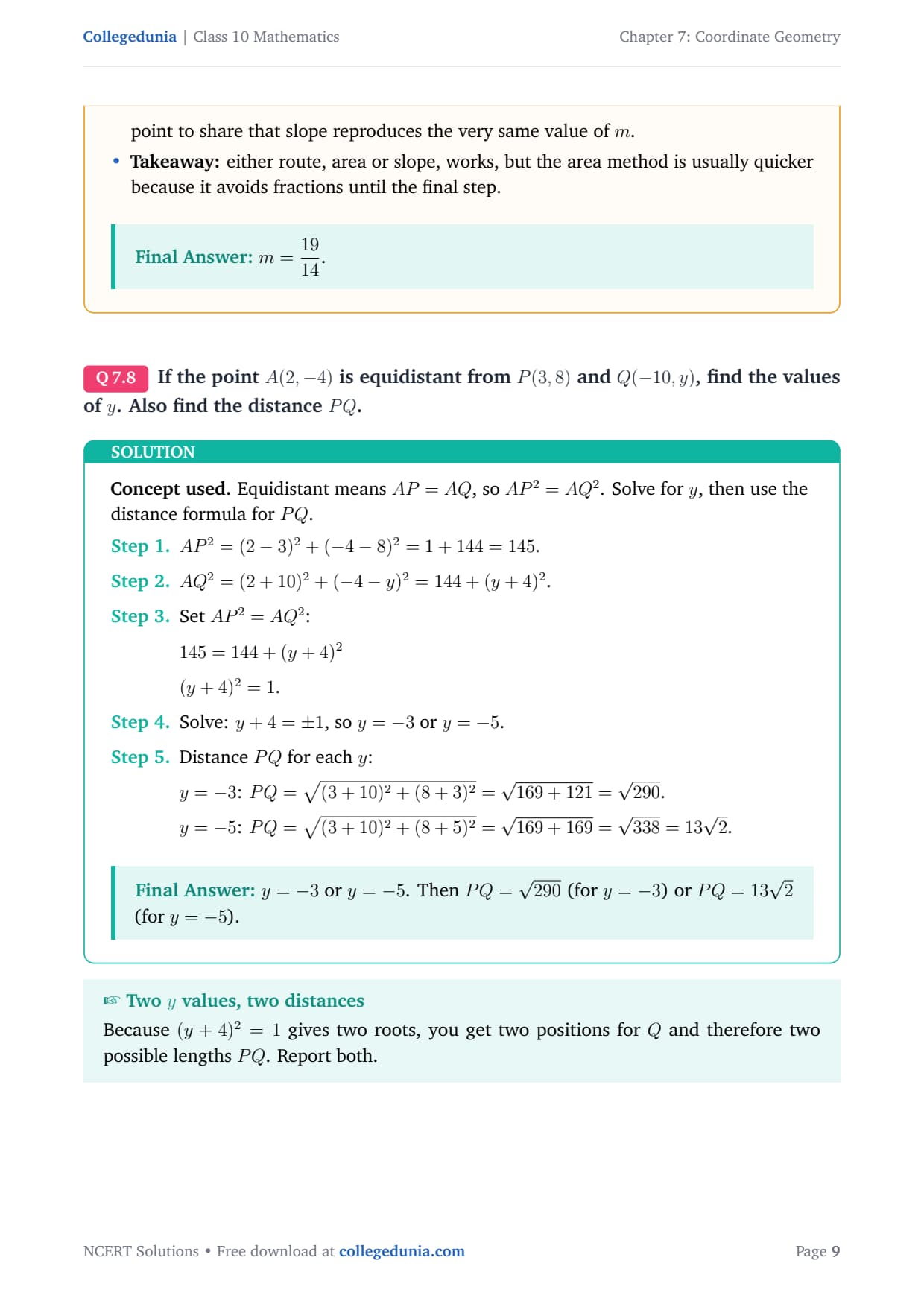
If the point A(2,-4) is equidistant from P(3,8) and Q(-10,y), find the values of y. Also find the distance PQ.
Concept used. Equidistant means AP=AQ, so AP2=AQ2. Solve
for y, then use the distance formula for PQ.
AP2=(2-3)2+(-4-8)2=1+144=145.
AQ2=(2+10)2+(-4-y)2=144+(y+4)2.
Set AP2=AQ2:
[] 145=144+(y+4)2
[] (y+4)2=1.
Solve: y+4=± 1, so y=-3 or y=-5.
Distance PQ for each y:
[] y=-3: PQ=√(3+10)2+(8+3)2=√169+121=√290.
[] y=-5: PQ=√(3+10)2+(8+5)2=√169+169=√338=132.
y=-3 or y=-5. Then PQ=√290 (for y=-3) or
PQ=132 (for y=-5).
HV
Harsh Vardhan
M.Sc Mathematics, IIT Patna
Verified Expert
Square the distances, then split into cases.
Cancel: equating the two squared distances wipes out the
common term and leaves the tidy equation (y+4)2=1, free of any
surds.
Two roots: that square equation has two solutions, y=-3
and y=-5, each placing the point Q at a different spot on its
line.
Two distances: because Q moves, the length PQ has to be
worked out twice, giving √290 in one case and 132 in
the other.
Report both: the question allows two valid positions, so
dropping either case would lose half the correct answer.
y=-3 or -5; PQ=√290 or 132.
Q 7.9
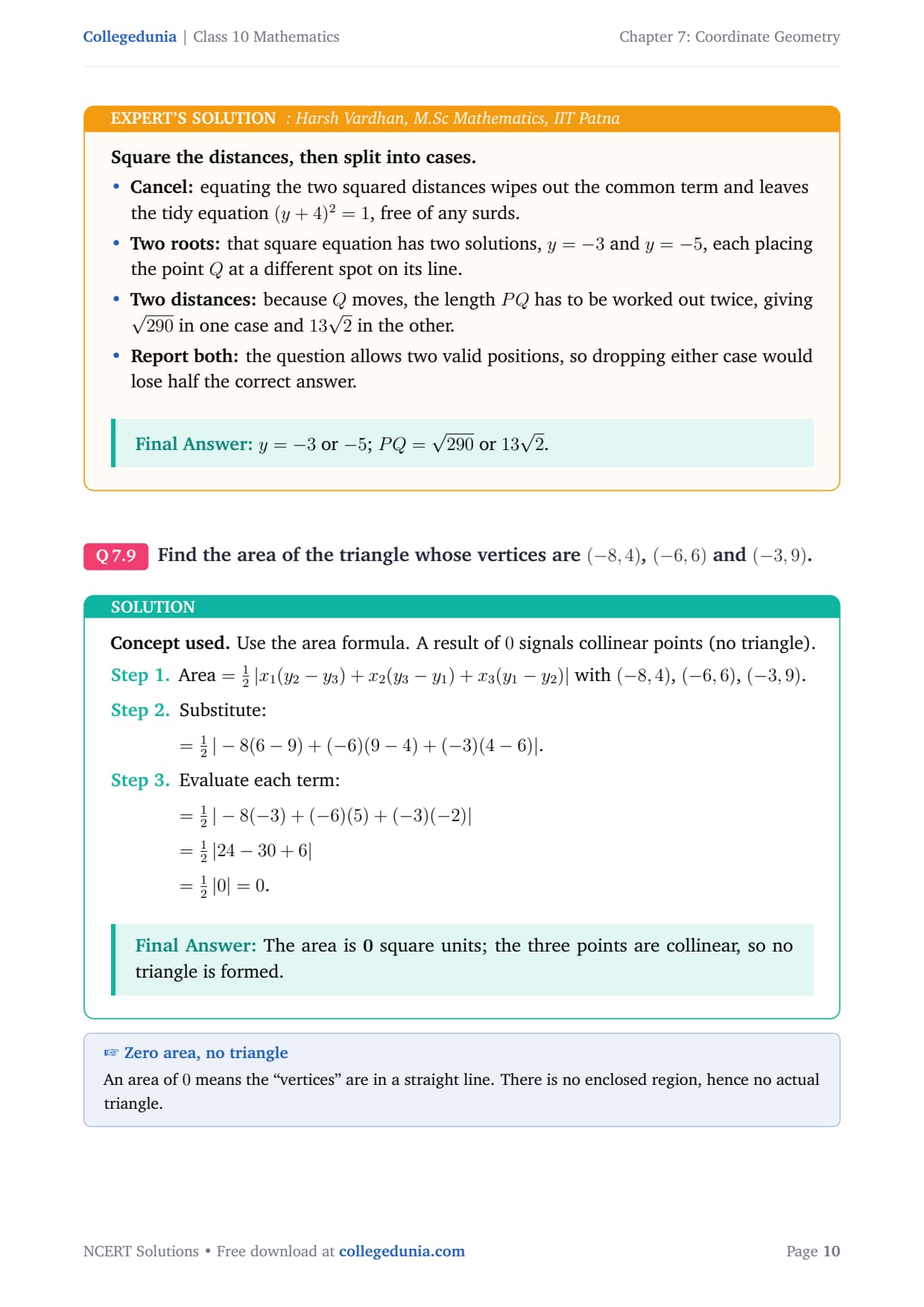
Find the area of the triangle whose vertices are (-8,4), (-6,6) and (-3,9).
Concept used. Use the area formula. A result of 0 signals
collinear points (no triangle).
Area =12 |x1(y2-y3)+x2(y3-y1)+x3(y1-y2)| with
(-8,4), (-6,6), (-3,9).
The area is 0 square units; the three points are
collinear, so no triangle is formed.
TK
Tara Krishnan
M.Sc Mathematics, Loyola College Chennai
Verified Expert
The three points secretly share one line.
Cancel to zero: the area determinant collapses to
24-30+6=0, which is the clear signal that the points are
collinear.
See the pattern: every step of two to the right raises the
height by two, so the slope is one and all three points lie on the
line y=x+12.
No region: points strung along one straight line enclose no
space, so there is genuinely no triangle to measure here.
Honest answer: the only correct value is zero square units,
and the lined-up pattern explains why, rather than leaving it as a
bare arithmetic accident.
Area =0; the points are collinear.
Q 7.10
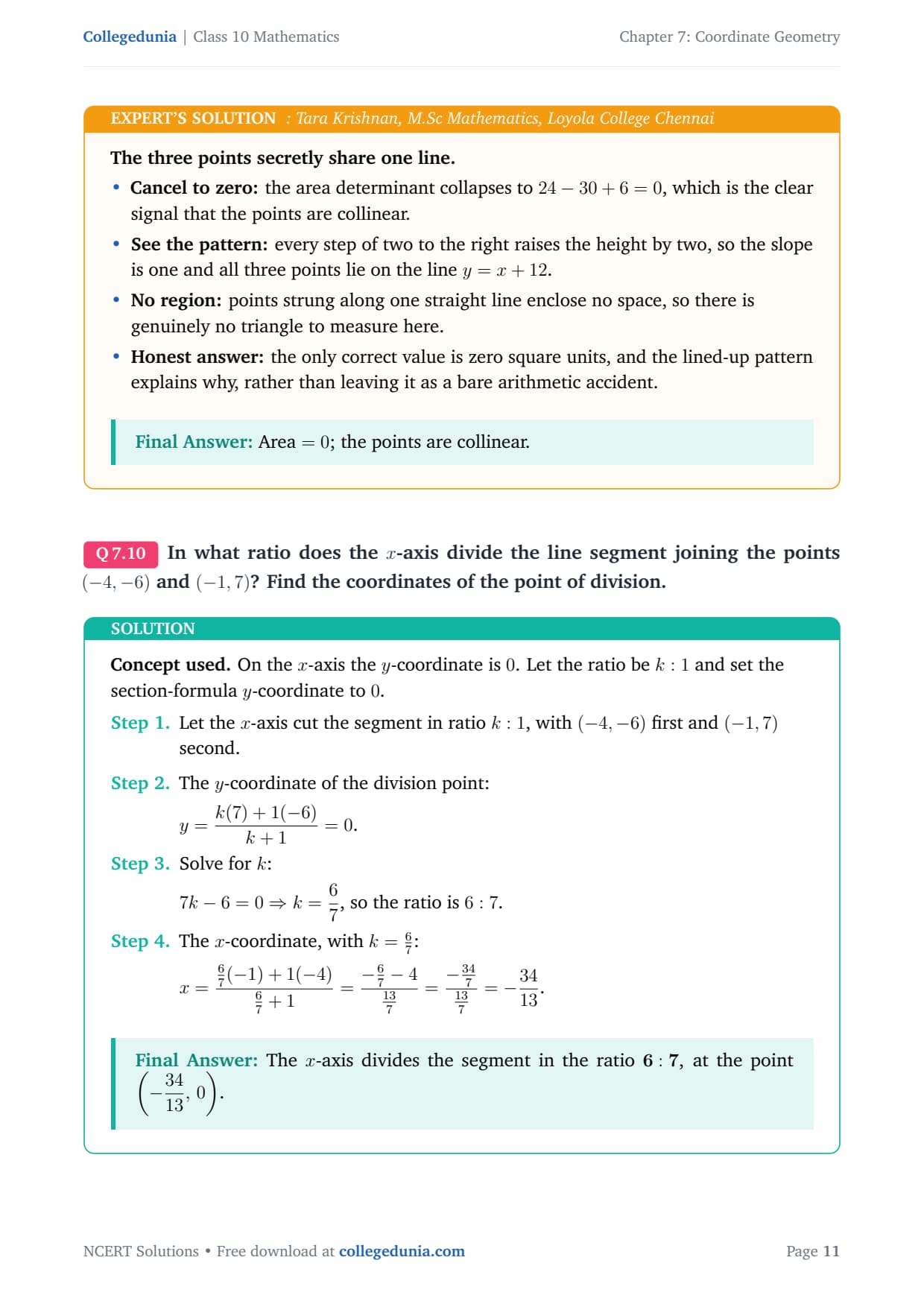
In what ratio does the x-axis divide the line segment joining the points (-4,-6) and (-1,7)? Find the coordinates of the point of division.
Concept used. On the x-axis the y-coordinate is 0. Let the
ratio be k:1 and set the section-formula y-coordinate to 0.
Let the x-axis cut the segment in ratio k:1, with
(-4,-6) first and (-1,7) second.
The y-coordinate of the division point:
[] y=k(7)+1(-6)k+1=0.
Solve for k:
[] 7k-6=0⇒ k=67, so the ratio is 6:7.
The x-coordinate, with k=67:
[] x=67(-1)+1(-4)67+1
=-67-4137
=-347137=-3413.
The x-axis divides the segment in the ratio 6:7,
at the point (-3413, 0).
NJ
Nakul Joshi
M.Sc Mathematics, MNIT Jaipur
Verified Expert
One fact drives the whole problem: the axis has zero height.
Key idea: any point on the horizontal axis has height zero,
so set the section formula's height part equal to zero from the
start.
Find the ratio: that condition reduces to 7k-6=0, giving
k=67, which is the ratio 6:7 in which the axis cuts the
segment.
Find the point: feeding that same ratio into the width part
of the formula gives the crossing point at
x=-3413.
Why it is quick: you never need the full division for both
coordinates, since the zero height already settles the ratio in one
line.
6:7, at (-3413,0).
Q 7.11
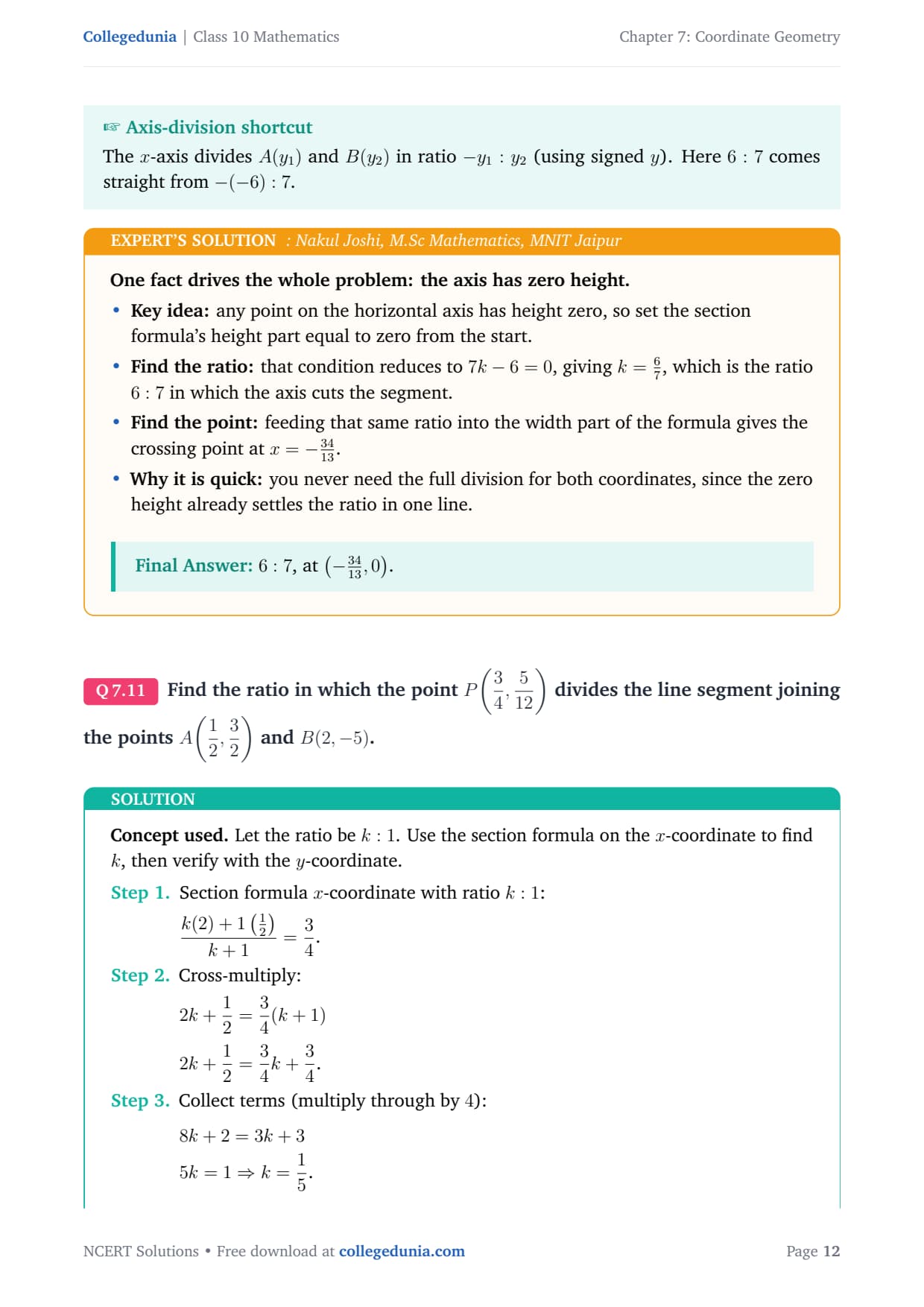
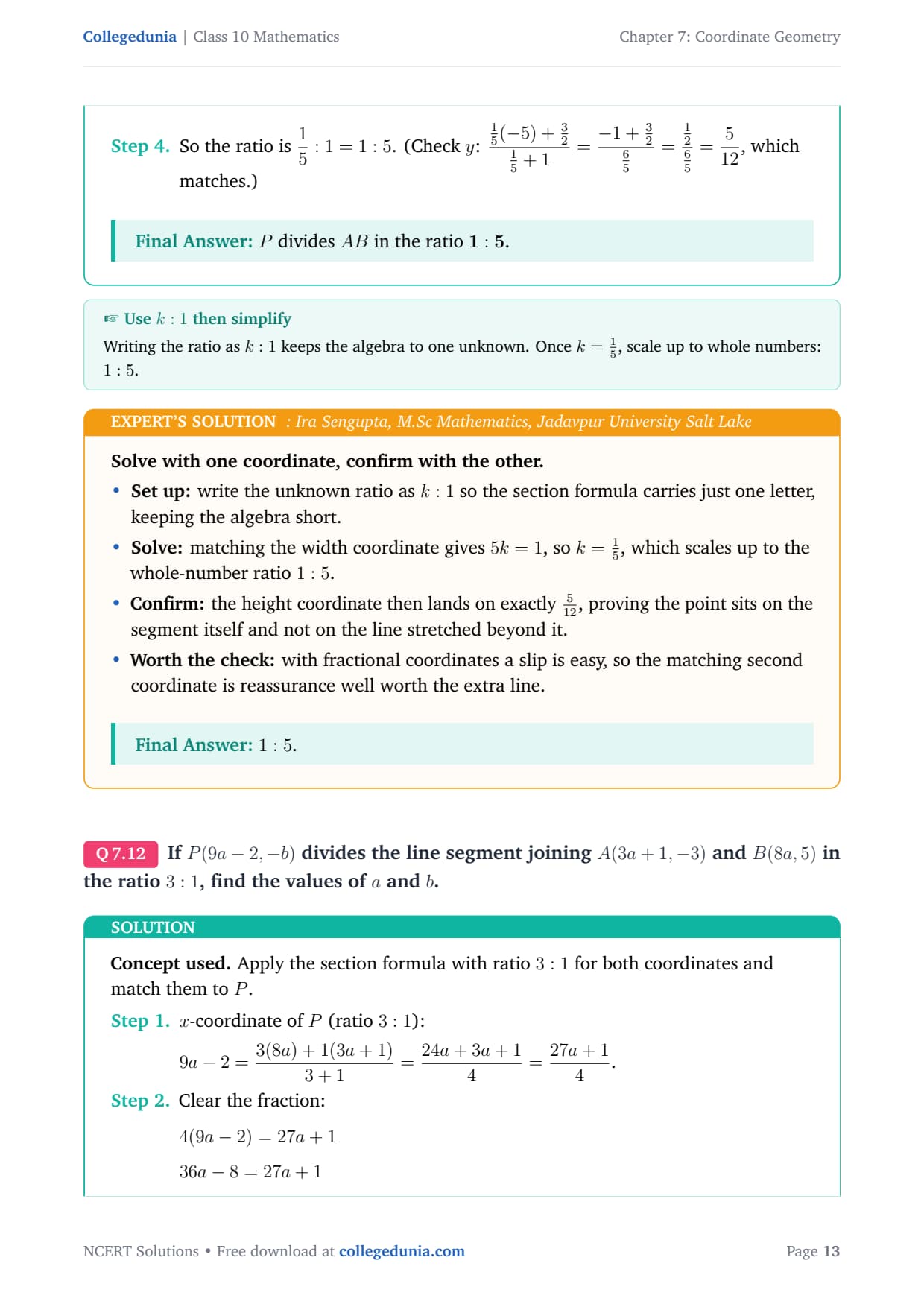
Find the ratio in which the point P(34,512) divides the line segment joining the points A(12,32) and B(2,-5).
Concept used. Let the ratio be k:1. Use the section formula on
the x-coordinate to find k, then verify with the y-coordinate.
Section formula x-coordinate with ratio k:1:
[] k(2)+1(12)k+1=34.
Collect terms (multiply through by 4):
[] 8k+2=3k+3
[] 5k=1⇒ k=15.
So the ratio is 15:1=1:5. (Check y:
15(-5)+3215+1
=-1+3265=1265
=512, which matches.)
P divides AB in the ratio 1:5.
IS
Ira Sengupta
M.Sc Mathematics, Jadavpur University Salt Lake
Verified Expert
Solve with one coordinate, confirm with the other.
Set up: write the unknown ratio as k:1 so the section
formula carries just one letter, keeping the algebra short.
Solve: matching the width coordinate gives 5k=1, so
k=15, which scales up to the whole-number ratio 1:5.
Confirm: the height coordinate then lands on exactly
512, proving the point sits on the segment itself and
not on the line stretched beyond it.
Worth the check: with fractional coordinates a slip is
easy, so the matching second coordinate is reassurance well worth
the extra line.
1:5.
Q 7.12
If P(9a-2,-b) divides the line segment joining A(3a+1,-3) and B(8a,5) in the ratio 3:1, find the values of a and b.
Concept used. Apply the section formula with ratio 3:1 for
both coordinates and match them to P.
x-coordinate of P (ratio 3:1):
[] 9a-2=3(8a)+1(3a+1)3+1=24a+3a+14=27a+14.
Clear the fraction:
[] 4(9a-2)=27a+1
[] 36a-8=27a+1
[] 9a=9⇒ a=1.
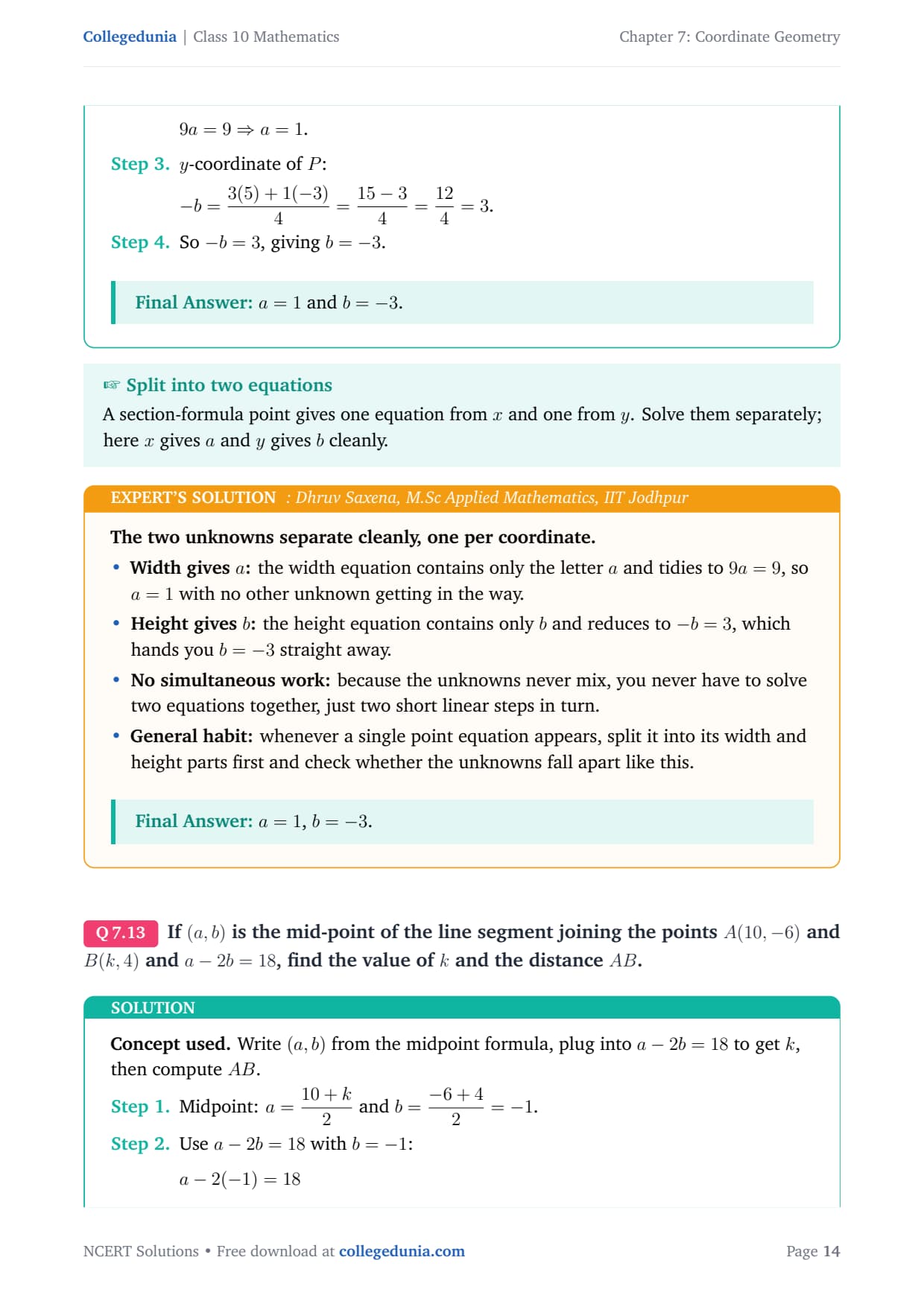
y-coordinate of P:
[] -b=3(5)+1(-3)4=15-34=124=3.
So -b=3, giving b=-3.
a=1 and b=-3.
DS
Dhruv Saxena
M.Sc Applied Mathematics, IIT Jodhpur
Verified Expert
The two unknowns separate cleanly, one per coordinate.
Width gives a: the width equation contains only the letter
a and tidies to 9a=9, so a=1 with no other unknown getting in
the way.
Height gives b: the height equation contains only b and
reduces to -b=3, which hands you b=-3 straight away.
No simultaneous work: because the unknowns never mix, you
never have to solve two equations together, just two short linear
steps in turn.
General habit: whenever a single point equation appears,
split it into its width and height parts first and check whether
the unknowns fall apart like this.
a=1, b=-3.
Q 7.13
If (a,b) is the mid-point of the line segment joining the points A(10,-6) and B(k,4) and a-2b=18, find the value of k and the distance AB.
Concept used. Write (a,b) from the midpoint formula, plug into
a-2b=18 to get k, then compute AB.
Midpoint: a=10+k2 and b=-6+42=-1.
Use a-2b=18 with b=-1:
[] a-2(-1)=18
[] a+2=18⇒ a=16.
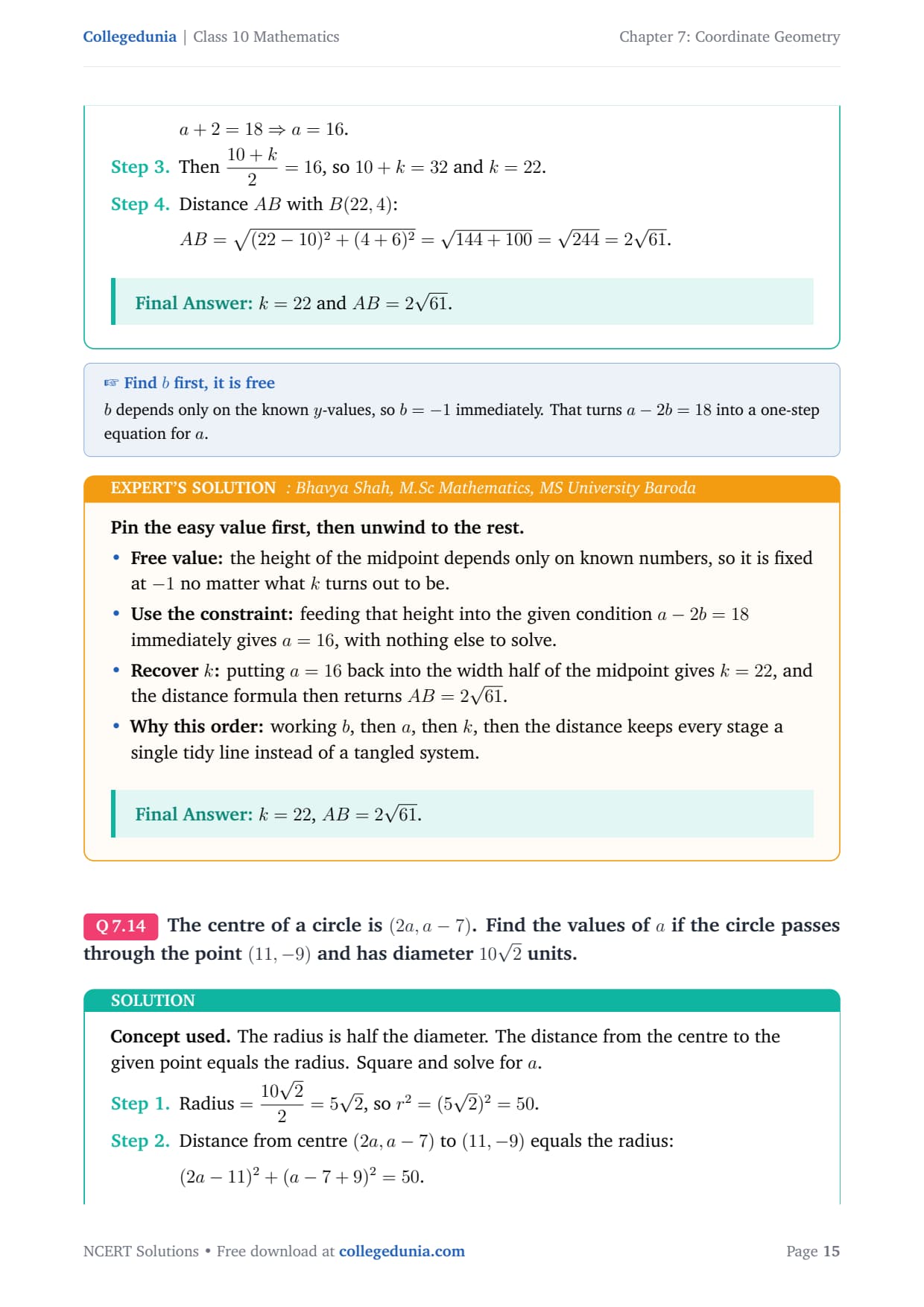
Then 10+k2=16, so 10+k=32 and k=22.
Distance AB with B(22,4):
[] AB=√(22-10)2+(4+6)2=√144+100=√244=2√61.
k=22 and AB=2√61.
BS
Bhavya Shah
M.Sc Mathematics, MS University Baroda
Verified Expert
Pin the easy value first, then unwind to the rest.
Free value: the height of the midpoint depends only on known
numbers, so it is fixed at -1 no matter what k turns out to be.
Use the constraint: feeding that height into the given
condition a-2b=18 immediately gives a=16, with nothing else to
solve.
Recover k: putting a=16 back into the width half of the
midpoint gives k=22, and the distance formula then returns
AB=2√61.
Why this order: working b, then a, then k, then the
distance keeps every stage a single tidy line instead of a tangled
system.
k=22, AB=2√61.
Q 7.14
The centre of a circle is (2a,a-7). Find the values of a if the circle passes through the point (11,-9) and has diameter 102 units.
Concept used. The radius is half the diameter. The distance from
the centre to the given point equals the radius. Square and solve for
a.
Radius =1022=52, so r2=(52)2=50.
Distance from centre (2a,a-7) to (11,-9) equals the radius:
[] (2a-11)2+(a-7+9)2=50.
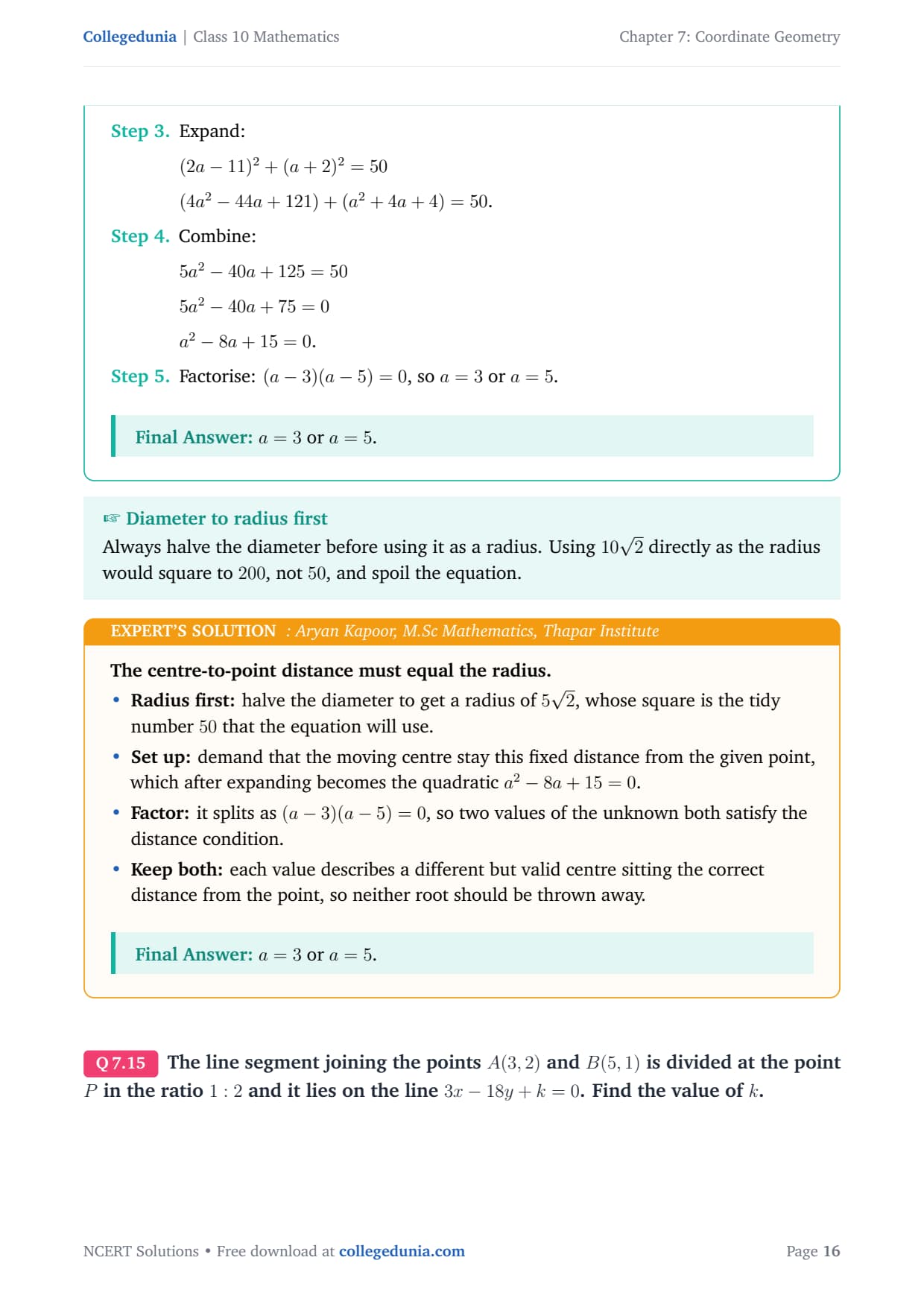
The centre-to-point distance must equal the radius.
Radius first: halve the diameter to get a radius of
52, whose square is the tidy number 50 that the equation
will use.
Set up: demand that the moving centre stay this fixed
distance from the given point, which after expanding becomes the
quadratic a2-8a+15=0.
Factor: it splits as (a-3)(a-5)=0, so two values of the
unknown both satisfy the distance condition.
Keep both: each value describes a different but valid centre
sitting the correct distance from the point, so neither root should
be thrown away.
a=3 or a=5.
Q 7.15
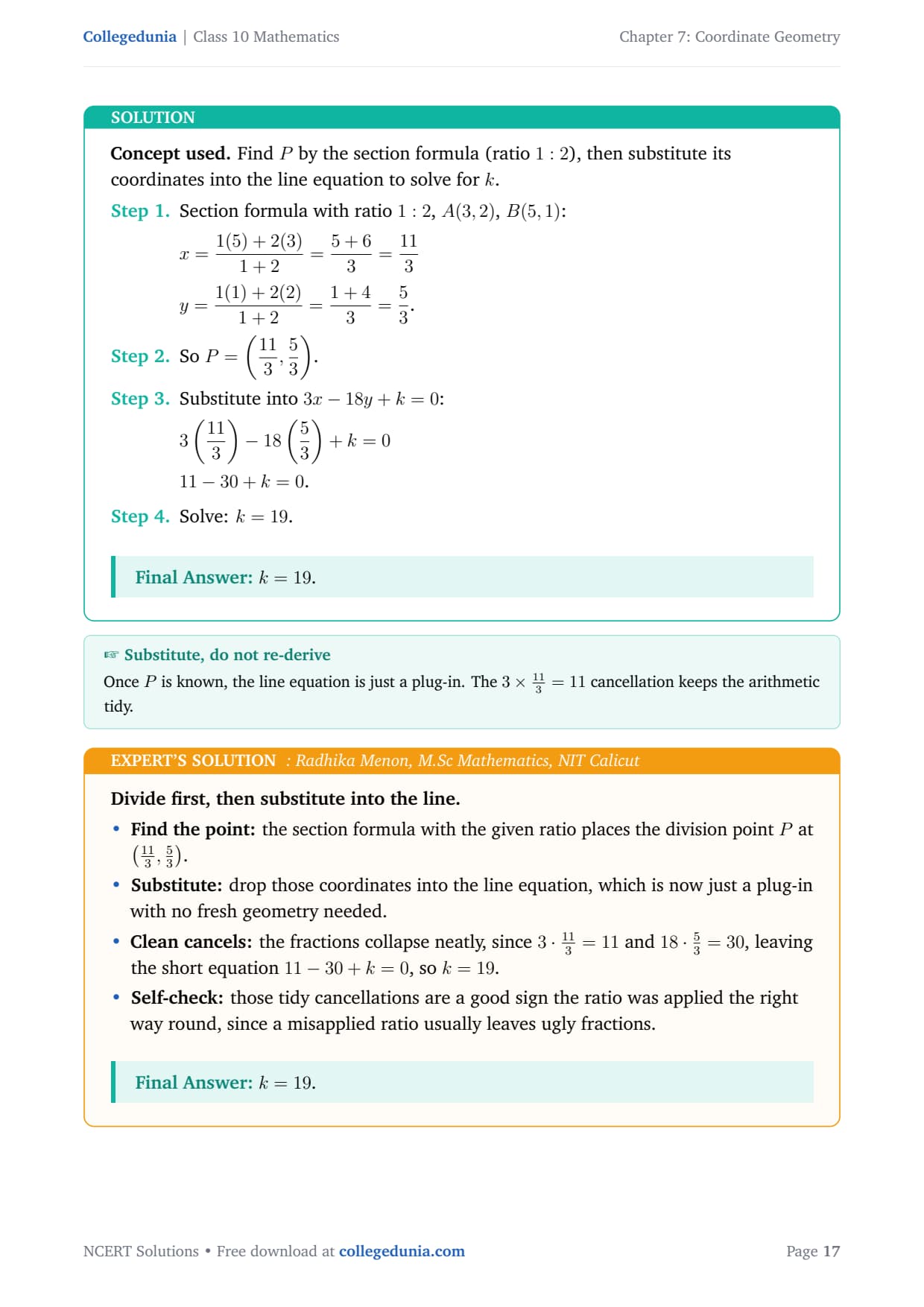
The line segment joining the points A(3,2) and B(5,1) is divided at the point P in the ratio 1:2 and it lies on the line 3x-18y+k=0. Find the value of k.
Concept used. Find P by the section formula (ratio 1:2),
then substitute its coordinates into the line equation to solve for k.
Section formula with ratio 1:2, A(3,2), B(5,1):
[] x=1(5)+2(3)1+2=5+63=113
[] y=1(1)+2(2)1+2=1+43=53.
So P=(113,53).
Substitute into 3x-18y+k=0:
[] 3(113)-18(53)+k=0
[] 11-30+k=0.
Solve: k=19.
k=19.
RM
Radhika Menon
M.Sc Mathematics, NIT Calicut
Verified Expert
Divide first, then substitute into the line.
Find the point: the section formula with the given ratio
places the division point P at
(113,53).
Substitute: drop those coordinates into the line equation,
which is now just a plug-in with no fresh geometry needed.
Clean cancels: the fractions collapse neatly, since
3·113=11 and 18·53=30, leaving the short
equation 11-30+k=0, so k=19.
Self-check: those tidy cancellations are a good sign the
ratio was applied the right way round, since a misapplied ratio
usually leaves ugly fractions.
k=19.
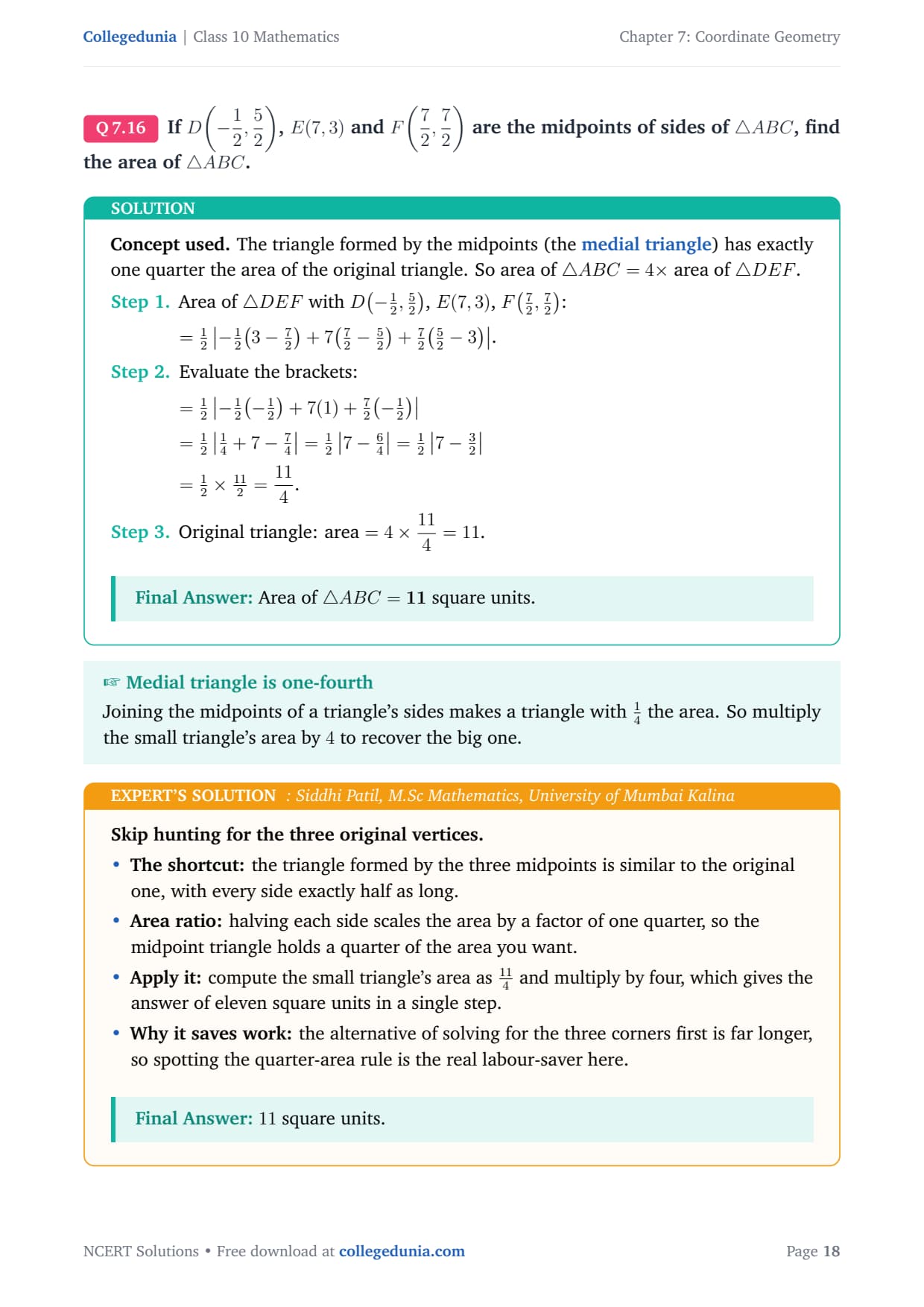
Q 7.16
If D(-12,52), E(7,3) and F(72,72) are the midpoints of sides of ABC, find the area of ABC.
Concept used. The triangle formed by the midpoints (the
medial triangle) has exactly one quarter the area of the
original triangle. So area of ABC=4× area of
DEF.
Area of DEF with
D(-12,52), E(7,3),
F(72,72):
[] =12|-12(3-72)+7(72-52)+72(52-3)|.
Evaluate the brackets:
[] =12|-12(-12)+7(1)+72(-12)|
[] =12|14+7-74|=12|7-64|=12|7-32|
[] =12×112=114.
Original triangle: area =4×114=11.
Area of ABC=11 square units.
SP
Siddhi Patil
M.Sc Mathematics, University of Mumbai Kalina
Verified Expert
Skip hunting for the three original vertices.
The shortcut: the triangle formed by the three midpoints is
similar to the original one, with every side exactly half as long.
Area ratio: halving each side scales the area by a factor of
one quarter, so the midpoint triangle holds a quarter of the area
you want.
Apply it: compute the small triangle's area as
114 and multiply by four, which gives the answer of
eleven square units in a single step.
Why it saves work: the alternative of solving for the three
corners first is far longer, so spotting the quarter-area rule is
the real labour-saver here.
11 square units.
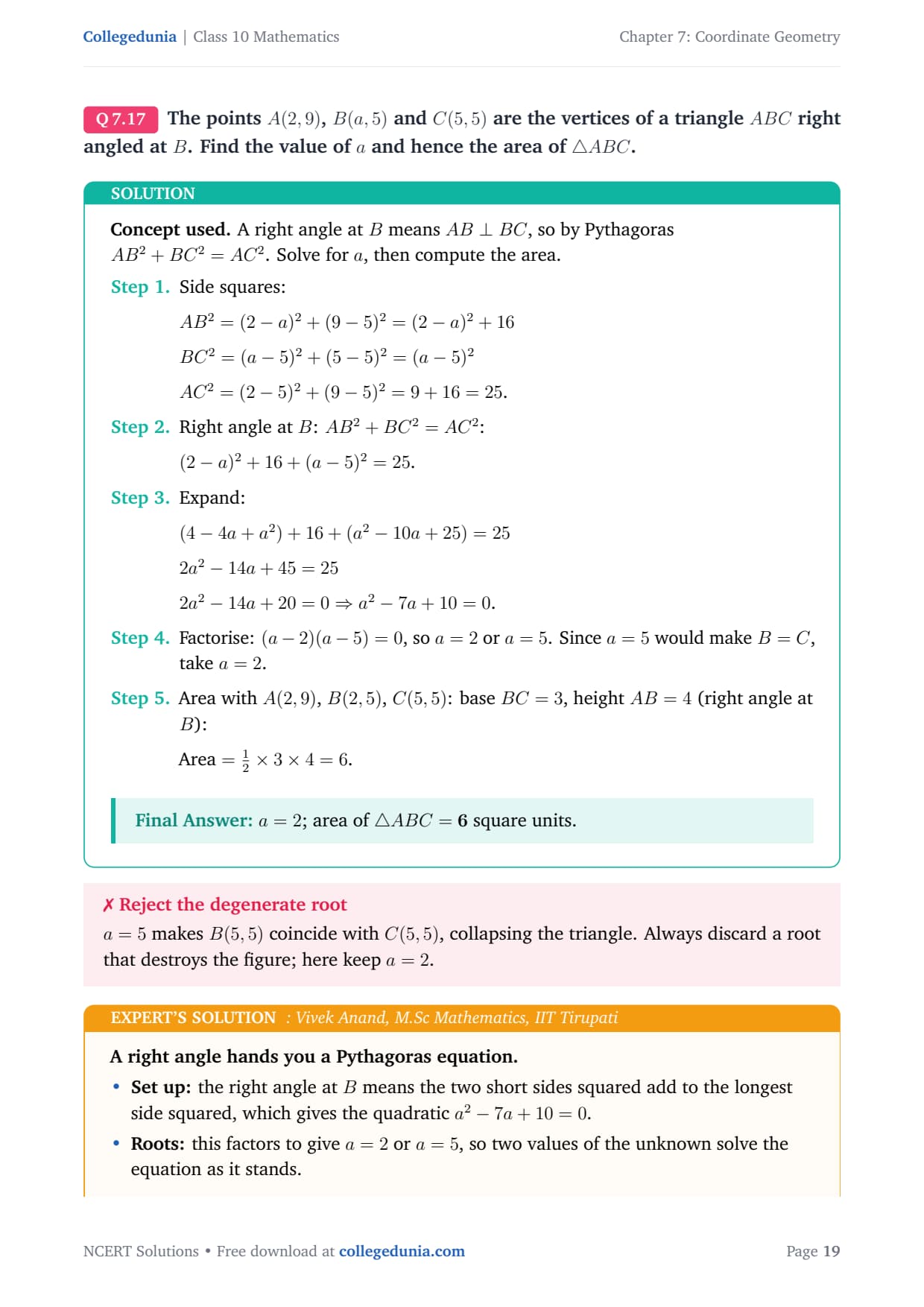
Q 7.17
The points A(2,9), B(a,5) and C(5,5) are the vertices of a triangle ABC right angled at B. Find the value of a and hence the area of ABC.
Concept used. A right angle at B means AB⊥ BC, so by
Pythagoras AB2+BC2=AC2. Solve for a, then compute the area.
Side squares:
[] AB2=(2-a)2+(9-5)2=(2-a)2+16
[] BC2=(a-5)2+(5-5)2=(a-5)2
[] AC2=(2-5)2+(9-5)2=9+16=25.
Right angle at B: AB2+BC2=AC2:
[] (2-a)2+16+(a-5)2=25.
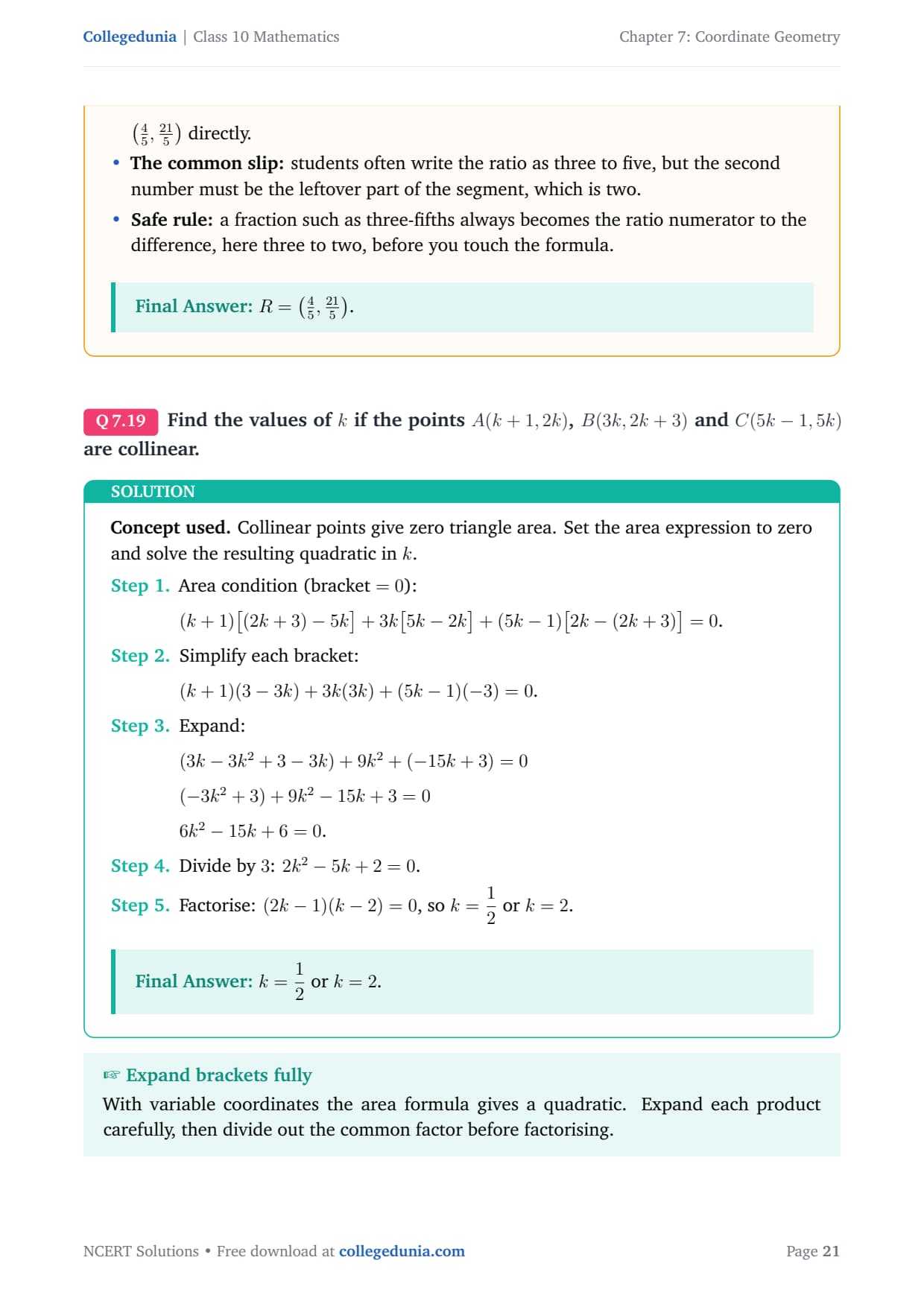
Set up: since the points must be collinear, the area is
zero, and substituting the variable vertices gives the quadratic
6k2-15k+6=0.
Simplify: divide through by the common factor to get the
tidier 2k2-5k+2=0, which is easier to factor.
Solve: it factors as (2k-1)(k-2)=0, so the two solutions
are k=12 and k=2.
Keep both: each value slides all three points to new spots
but still leaves them on one straight line, so both answers are
genuine.
k=12 or k=2.
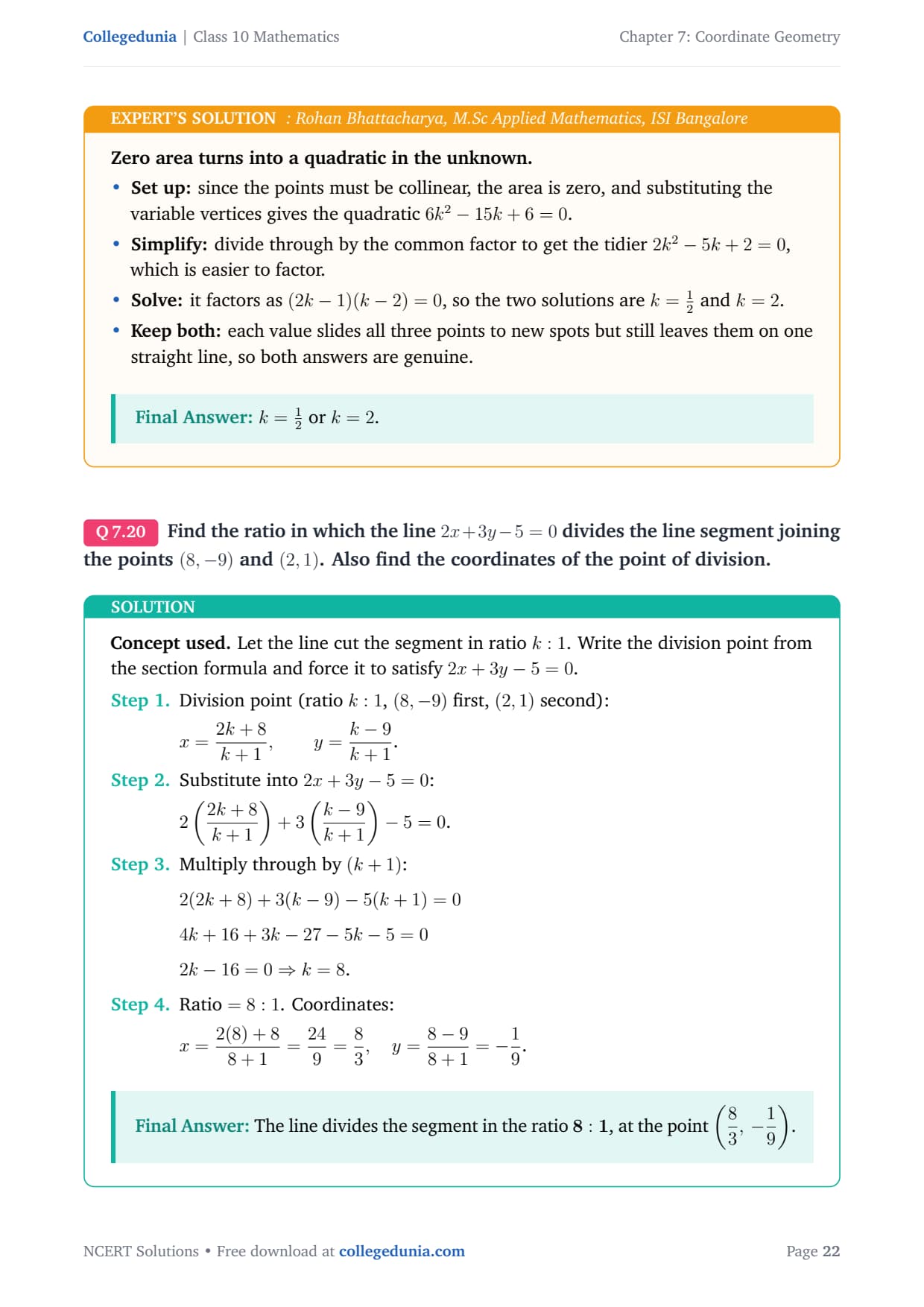
Q 7.20
Find the ratio in which the line 2x+3y-5=0 divides the line segment joining the points (8,-9) and (2,1). Also find the coordinates of the point of division.
Concept used. Let the line cut the segment in ratio k:1.
Write the division point from the section formula and force it to satisfy
2x+3y-5=0.
Substitute into 2x+3y-5=0:
[] 2(2k+8k+1)+3(k-9k+1)-5=0.
Multiply through by (k+1):
[] 2(2k+8)+3(k-9)-5(k+1)=0
[] 4k+16+3k-27-5k-5=0
[] 2k-16=0⇒ k=8.
Ratio =8:1. Coordinates:
[] x=2(8)+88+1=249=83,
y=8-98+1=-19.
The line divides the segment in the ratio 8:1, at
the point (83, -19).
AG
Ananya Gupta
M.Sc Mathematics, Lady Shri Ram College Delhi
Verified Expert
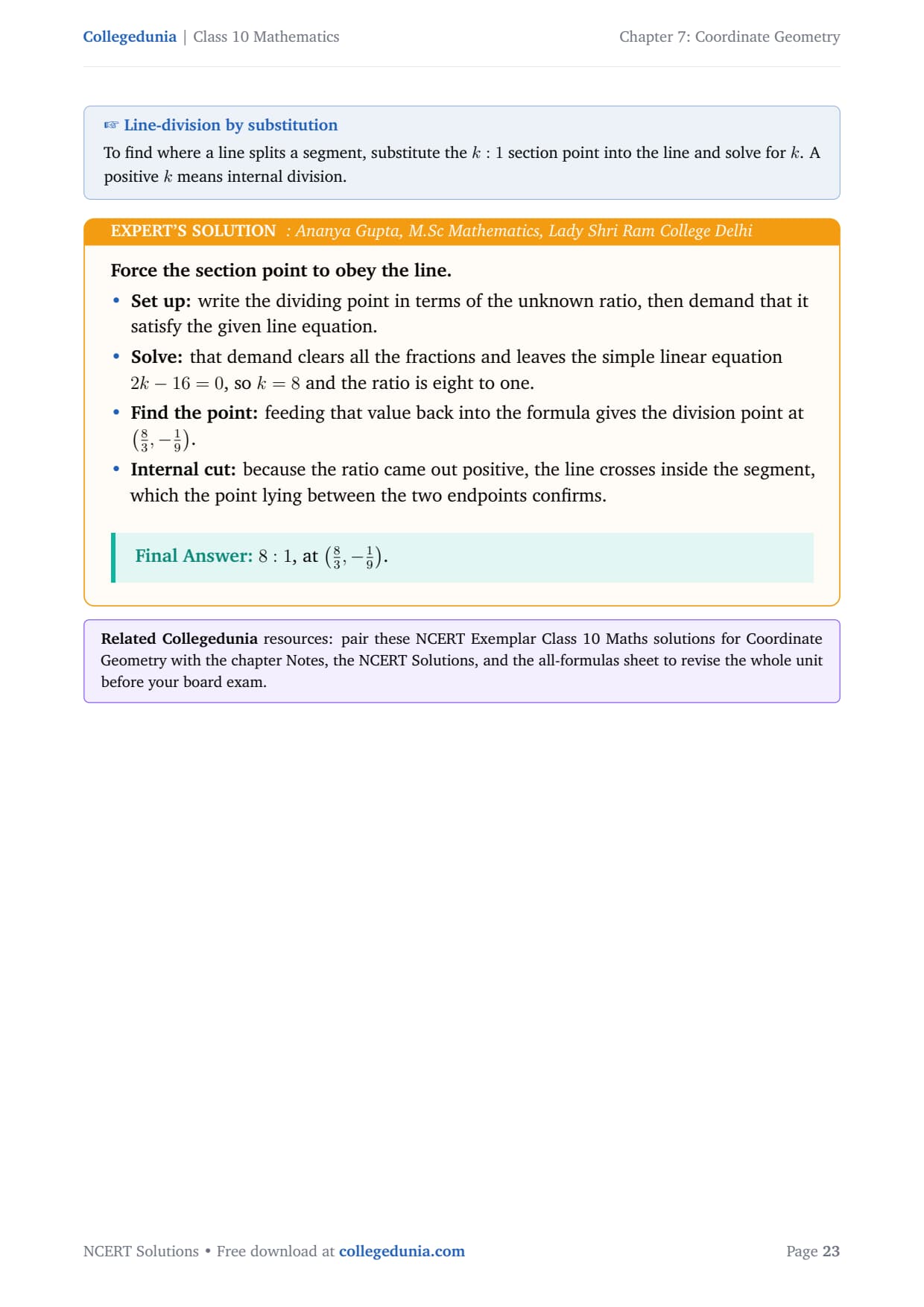
Force the section point to obey the line.
Set up: write the dividing point in terms of the unknown
ratio, then demand that it satisfy the given line equation.
Solve: that demand clears all the fractions and leaves the
simple linear equation 2k-16=0, so k=8 and the ratio is eight
to one.
Find the point: feeding that value back into the formula
gives the division point at
(83,-19).
Internal cut: because the ratio came out positive, the line
crosses inside the segment, which the point lying between the two
endpoints confirms.
8:1, at (83,-19).
Student Feedback
Students who solved Exercise 7.3 with step-by-step solutions reported a 25-30% improvement in coordinate geometry board questions. Most found the section formula ratio problems (Q42, Q48) and the collinearity questions using zero area (Q39, Q50) the most useful for exam prep.
Source: Collegedunia Class 10 Maths student survey, 2026-27 batch.
Other Resources for Coordinate Geometry Class 10 Maths
Try the other Coordinate Geometry Exemplar exercises, or revise the chapter with the linked resources below.
Ques. What is covered in NCERT Exemplar Class 10 Maths Chapter 7 Coordinate Geometry Exercise 7.3?
Ans. Exercise 7.3 of the NCERT Exemplar Class 10 Maths Chapter 7 contains 19 short answer questions (Q33 to Q51). The topics covered include classifying triangles and quadrilaterals using the distance formula, finding unknown coordinates from distance or section conditions, collinearity using the zero-area test, the midpoint formula for equidistant and perpendicular bisector problems, the section formula for axis division and internal division ratios, the medial triangle area property, and finding the value of a parameter when a point lies on a given line. All content is aligned with the 2026-27 NCERT syllabus.
Ques. How do you classify a quadrilateral using coordinate geometry as in Exercise 7.3 Q35?
Ans. Use the distance formula to compute all four sides and both diagonals. Check in this order: if all opposite sides are equal, it is a parallelogram. If the diagonals are also equal, it is a rectangle. If all four sides are equal (but diagonals are not), it is a rhombus. If all four sides are equal AND the diagonals are equal, it is a square. In Q35, opposite sides are equal at √50 and √32, and both diagonals equal √82, so the answer is a rectangle.
Ques. What is the quickest way to check if three points are collinear in Exercise 7.3?
Ans. Set the area of the triangle formed by the three points to zero using the formula ½|x1(y2−y3)+x2(y3−y1)+x3(y1−y2)|=0. This method avoids the fraction errors that can come with the slope approach. In Q39, setting the bracket to zero directly gives the linear equation 19−14m=0, so m=19/14. In Q50, with variable coordinates, the bracket gives a quadratic that factors to k=1/2 or k=2.
Ques. How does the medial triangle property help in Q47 of Exercise 7.3?
Ans. When the three midpoints of a triangle's sides are given, the triangle formed by those midpoints (called the medial triangle) has exactly one quarter the area of the original triangle. This is because each side of the medial triangle is half a side of the original, and area scales as the square of the linear scale factor (so (1/2)2=1/4). In Q47, computing the area of the small triangle ▵DEF as 11/4 and then multiplying by 4 gives the area of ▵ABC as 11 square units, without finding the original vertices at all.
Ques. What is the common mistake students make when using the section formula in Q49 of Exercise 7.3?
Ans. The most common mistake is writing the ratio as 3:5 (the fraction 3/5 used directly) instead of converting it correctly to 3:2. When PR=(3/5)PQ, the remaining part is RQ=(2/5)PQ, giving the ratio PR:RQ=3:2. The rule is: a fraction of the form m/n of the full segment converts to the ratio m:(n−m). Here, 3/5 gives 3:(5−3)=3:2, not 3:5.








Comments