Junior-Class Mentor, TFI Fellow | Updated 3+ months ago
Class 10 Maths is the chapter where the perpendicular bisector test and the collinearity check catch students off guard with their True/False phrasing. The NCERT Exemplar Class 10 Maths Chapter 7 Exercise 7.2 below covers all 12 True/False questions on coordinate geometry for the 2026-27 session.
Exercise type: 12 True/False with Reasoning questions (Questions 21-32)
Key topics: similarity of triangles by coordinates, collinearity, section formula, perpendicular bisector test, circle position test, and properties of parallelogram and rectangle
CBSE Board weightage: Coordinate Geometry (Chapter 7) carries 6 marks per Class 10 board paper; True/False with justification appears as short-answer or MCQ formats
Solved by Collegedunia: All 12 True/False questions in Exercise 7.2 are solved with verdict, concept used, numbered step-by-step working, and an expert commentary. Solutions are checked against the official NCERT Exemplar book for Class 10 Maths, according to the 2026-27 NCERT syllabus.
Exercise 7.2 is the True or False with Reasoning section of Exemplar Chapter 7. It has 12 questions, numbered 21 to 32. Each gives a geometric statement about points or shapes in the coordinate plane. You state True or False and write a clear justification.
The 12 questions cover a wide range of concepts. Here is a breakdown by topic:
Question(s)
Topic tested
Verdict
Q21
SSS similarity of two triangles using the distance formula
True
Q22
Point on a vertical line segment - betweenness test
True
Q23
Collinearity - two points on y-axis, one off it
False
Q24
Perpendicular bisector equidistance test
False
Q25
Area = 0 implies collinear, cannot form triangle
True
Q26
Parallelogram diagonal midpoint test
False
Q27
Inside/on/outside circle - distance vs radius
True
Q28
Perpendicular bisector equidistance test (second instance)
False
Q29
Section formula - trisection ratio 1:2
True
Q30
Collinearity and length ratio using distance formula
True
Q31
Point on a circle - distance vs radius
False
Q32
Rectangle - equal diagonals with shared midpoint
True
Concept: Exercise 7.2 is entirely True/False. For CBSE boards, Coordinate Geometry carries 6 marks per paper and the section formula and distance formula appear in almost every paper. Practising these True/False justifications builds the exact reasoning skills that board examiners look for.
Key Formulas Used in Exercise 7.2
Before you start, make sure these six results are clear. Every question uses at least one of them.
Formula / Test
Statement
Used in Q
Distance formula
PQ = √((x2-x1)² + (y2-y1)²)
Q21, Q22, Q28, Q30, Q31
Section formula (ratio m:n)
(mx2+nx1m+n, my2+ny1m+n)
Q29
Midpoint formula
(x1+x22, y1+y22)
Q26, Q32
Area of a triangle
½|x1(y2-y3) + x2(y3-y1) + x3(y1-y2)|
Q23, Q25
Perpendicular bisector test
A point P lies on the perp. bisector of AB iff PA = PB
Q24, Q28
Circle position test
Point is outside/on/inside if distance from centre is > / = / < radius
Q27, Q31
Important: The perpendicular bisector test is purely an equidistance test - you only need to check whether PA = PB. You do not need to find the equation of the bisector. This saves time in Q24 and Q28.
All Exercise 7.2 Questions with Step-by-Step Solutions
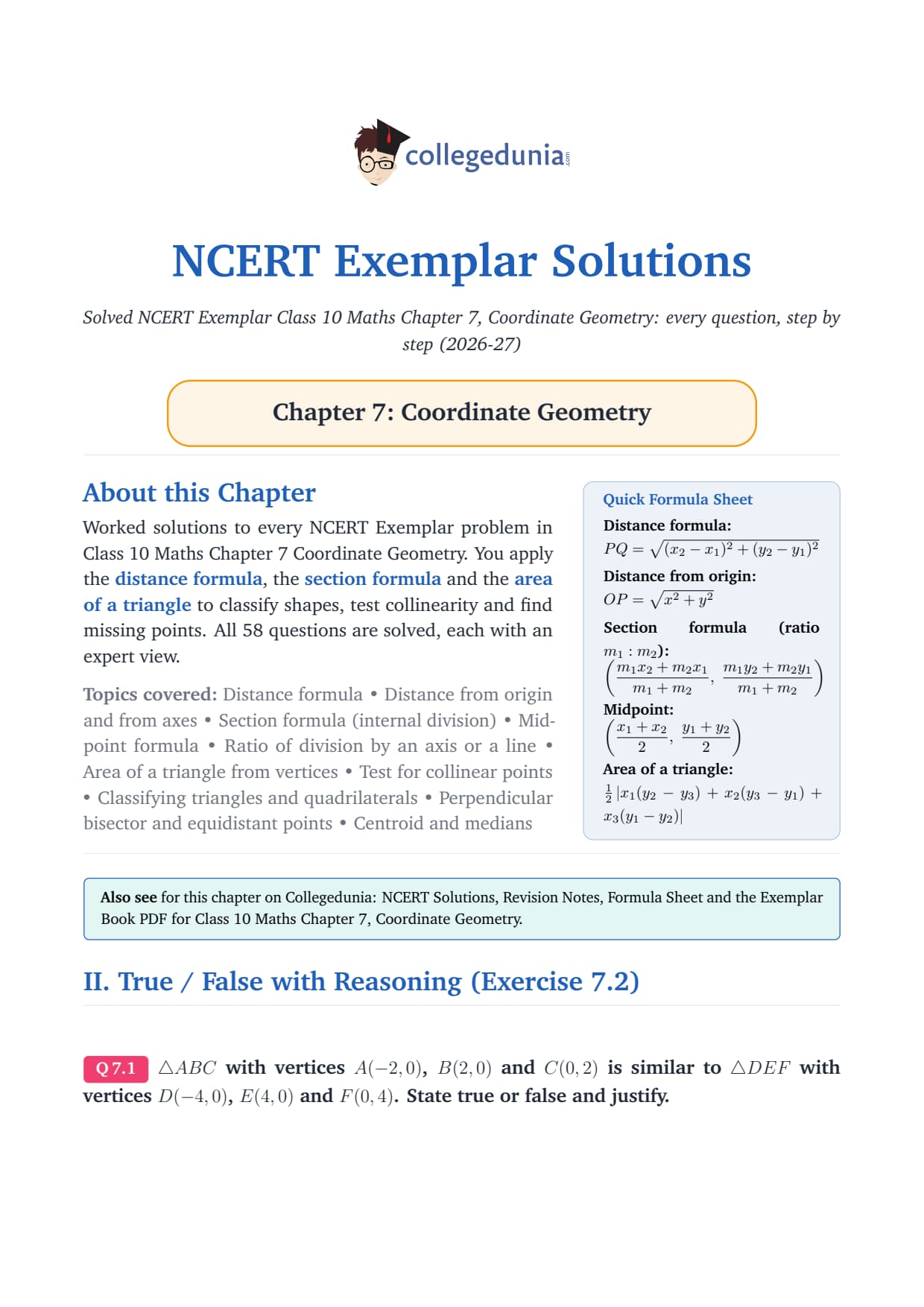
II. True / False with Reasoning (Exercise 7.2)
Q 7.1
ABC with vertices A(-2,0), B(2,0) and C(0,2) is similar to DEF with vertices D(-4,0), E(4,0) and F(0,4). State true or false and justify.
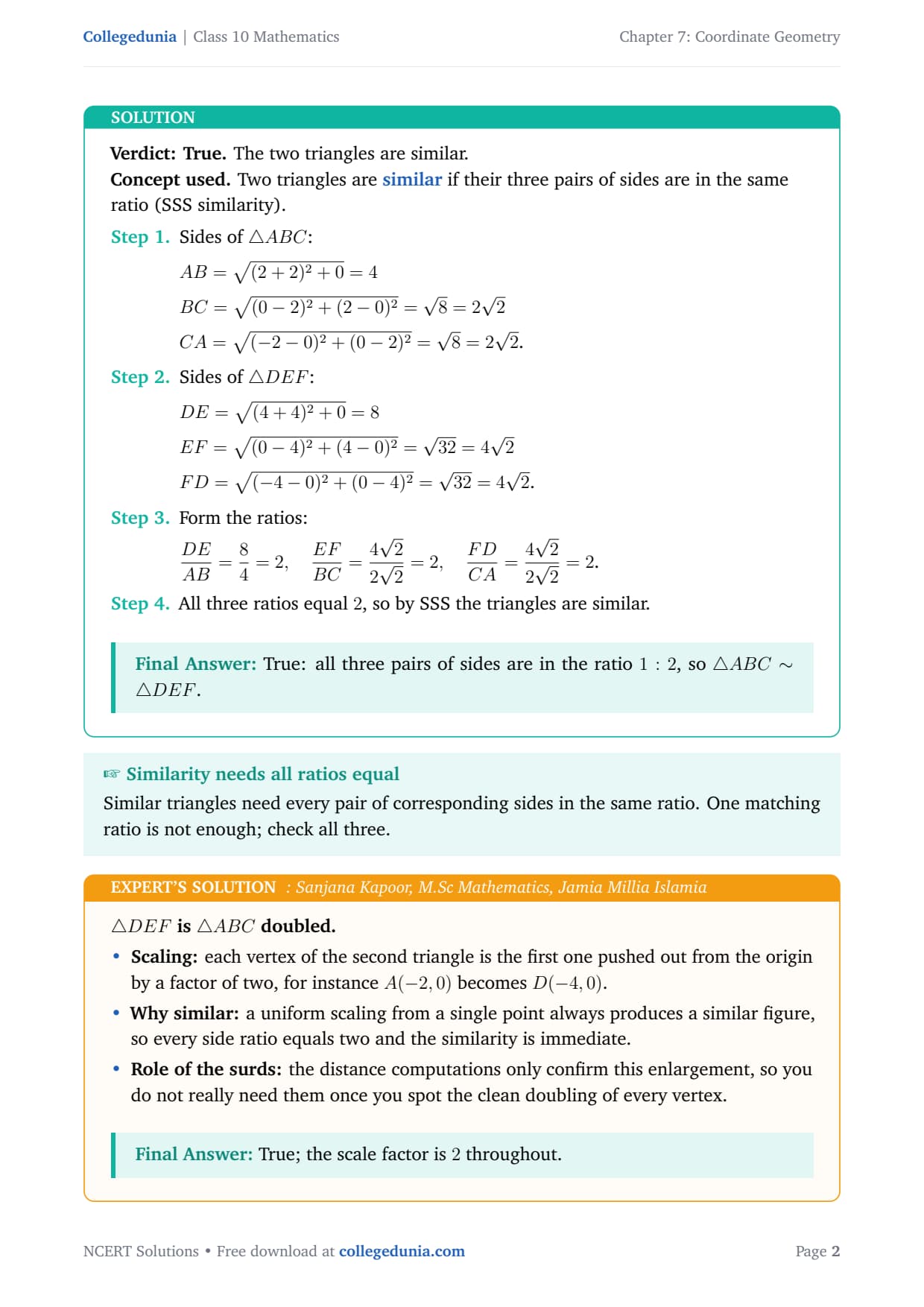
Verdict: True. The two triangles are similar.
Concept used. Two triangles are similar if their three
pairs of sides are in the same ratio (SSS similarity).
Sides of ABC:
[] AB=√(2+2)2+0=4
[] BC=√(0-2)2+(2-0)2=√8=22
[] CA=√(-2-0)2+(0-2)2=√8=22.
Sides of DEF:
[] DE=√(4+4)2+0=8
[] EF=√(0-4)2+(4-0)2=√32=42
[] FD=√(-4-0)2+(0-4)2=√32=42.
Form the ratios:
[] DEAB=84=2,
EFBC=4222=2,
FDCA=4222=2.
All three ratios equal 2, so by SSS the triangles are similar.
True: all three pairs of sides are in the ratio 1:2, so
ABC∼DEF.
SK
Sanjana Kapoor
M.Sc Mathematics, Jamia Millia Islamia
Verified Expert
DEF is ABC doubled.
Scaling: each vertex of the second triangle is the first
one pushed out from the origin by a factor of two, for instance
A(-2,0) becomes D(-4,0).
Why similar: a uniform scaling from a single point always
produces a similar figure, so every side ratio equals two and the
similarity is immediate.
Role of the surds: the distance computations only confirm
this enlargement, so you do not really need them once you spot the
clean doubling of every vertex.
True; the scale factor is 2 throughout.
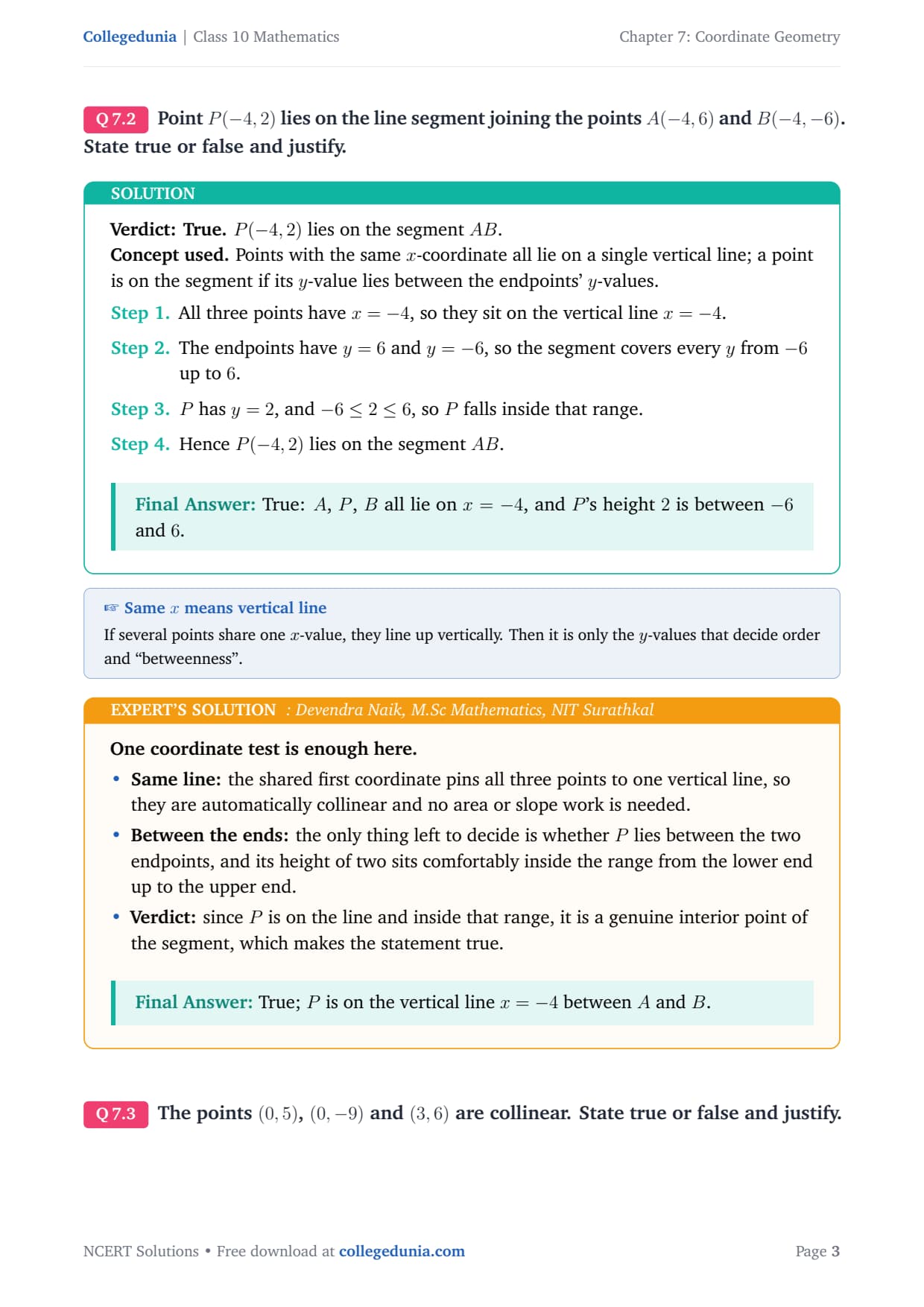
Q 7.2
Point P(-4,2) lies on the line segment joining the points A(-4,6) and B(-4,-6). State true or false and justify.
Verdict: True.P(-4,2) lies on the segment AB.
Concept used. Points with the same x-coordinate all lie on a
single vertical line; a point is on the segment if its y-value lies
between the endpoints' y-values.
All three points have x=-4, so they sit on the vertical line
x=-4.
The endpoints have y=6 and y=-6, so the segment covers every
y from -6 up to 6.
P has y=2, and -6≤ 2≤ 6, so P falls inside that
range.
Hence P(-4,2) lies on the segment AB.
True: A, P, B all lie on x=-4, and P's height 2 is
between -6 and 6.
DN
Devendra Naik
M.Sc Mathematics, NIT Surathkal
Verified Expert
One coordinate test is enough here.
Same line: the shared first coordinate pins all three
points to one vertical line, so they are automatically collinear and
no area or slope work is needed.
Between the ends: the only thing left to decide is whether
P lies between the two endpoints, and its height of two sits
comfortably inside the range from the lower end up to the upper end.
Verdict: since P is on the line and inside that range, it
is a genuine interior point of the segment, which makes the
statement true.
True; P is on the vertical line x=-4 between A and B.
Q 7.3
The points (0,5), (0,-9) and (3,6) are collinear. State true or false and justify.
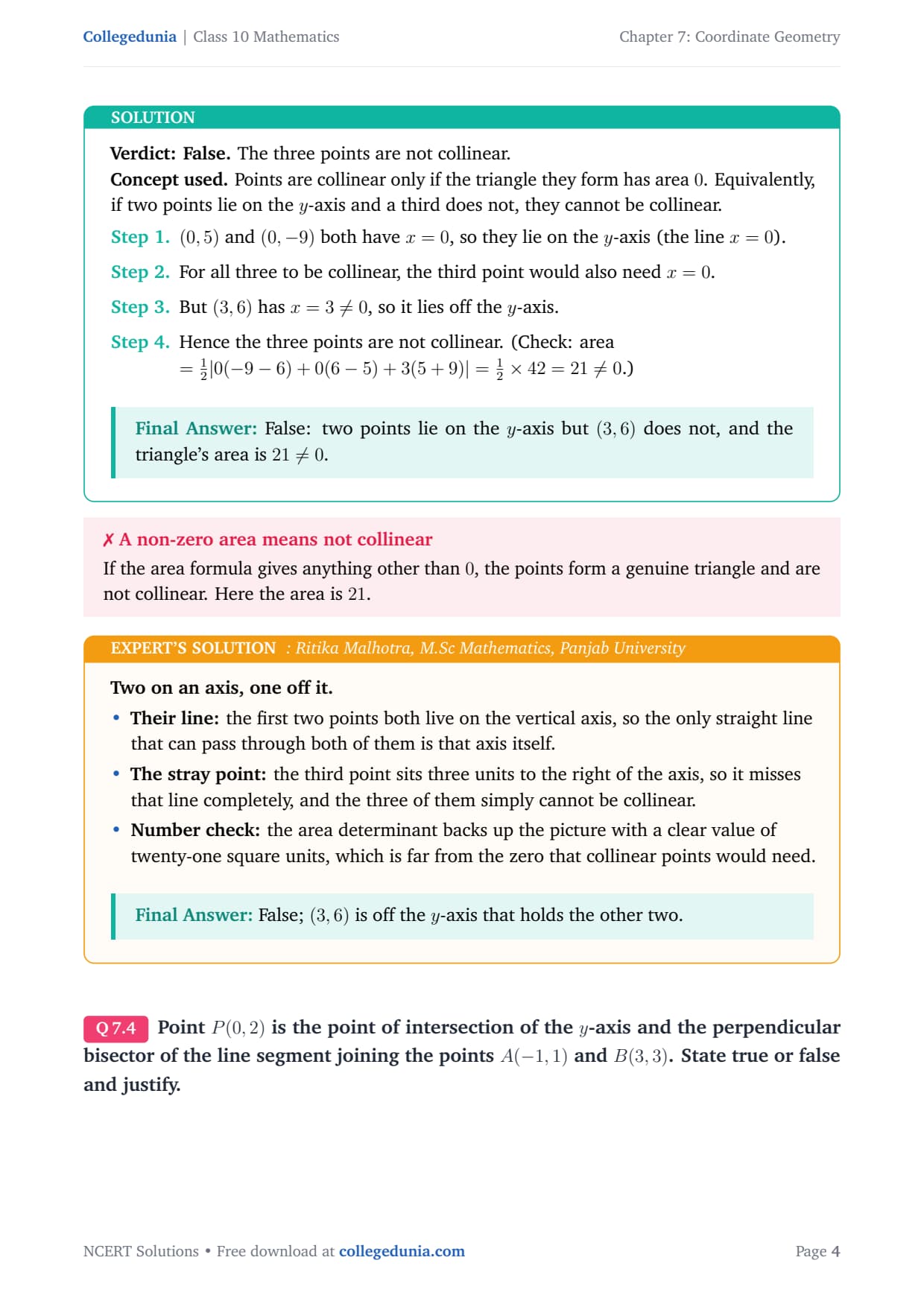
Verdict: False. The three points are not collinear.
Concept used. Points are collinear only if the triangle they
form has area 0. Equivalently, if two points lie on the y-axis and a
third does not, they cannot be collinear.
(0,5) and (0,-9) both have x=0, so they lie on the
y-axis (the line x=0).
For all three to be collinear, the third point would also need
x=0.
But (3,6) has x=3≠ 0, so it lies off the y-axis.
Hence the three points are not collinear. (Check: area
=12|0(-9-6)+0(6-5)+3(5+9)|=12× 42=21≠ 0.)
False: two points lie on the y-axis but (3,6) does not, and
the triangle's area is 21≠ 0.
RM
Ritika Malhotra
M.Sc Mathematics, Panjab University
Verified Expert
Two on an axis, one off it.
Their line: the first two points both live on the vertical
axis, so the only straight line that can pass through both of them
is that axis itself.
The stray point: the third point sits three units to the
right of the axis, so it misses that line completely, and the three
of them simply cannot be collinear.
Number check: the area determinant backs up the picture
with a clear value of twenty-one square units, which is far from the
zero that collinear points would need.
False; (3,6) is off the y-axis that holds the other two.
Q 7.4
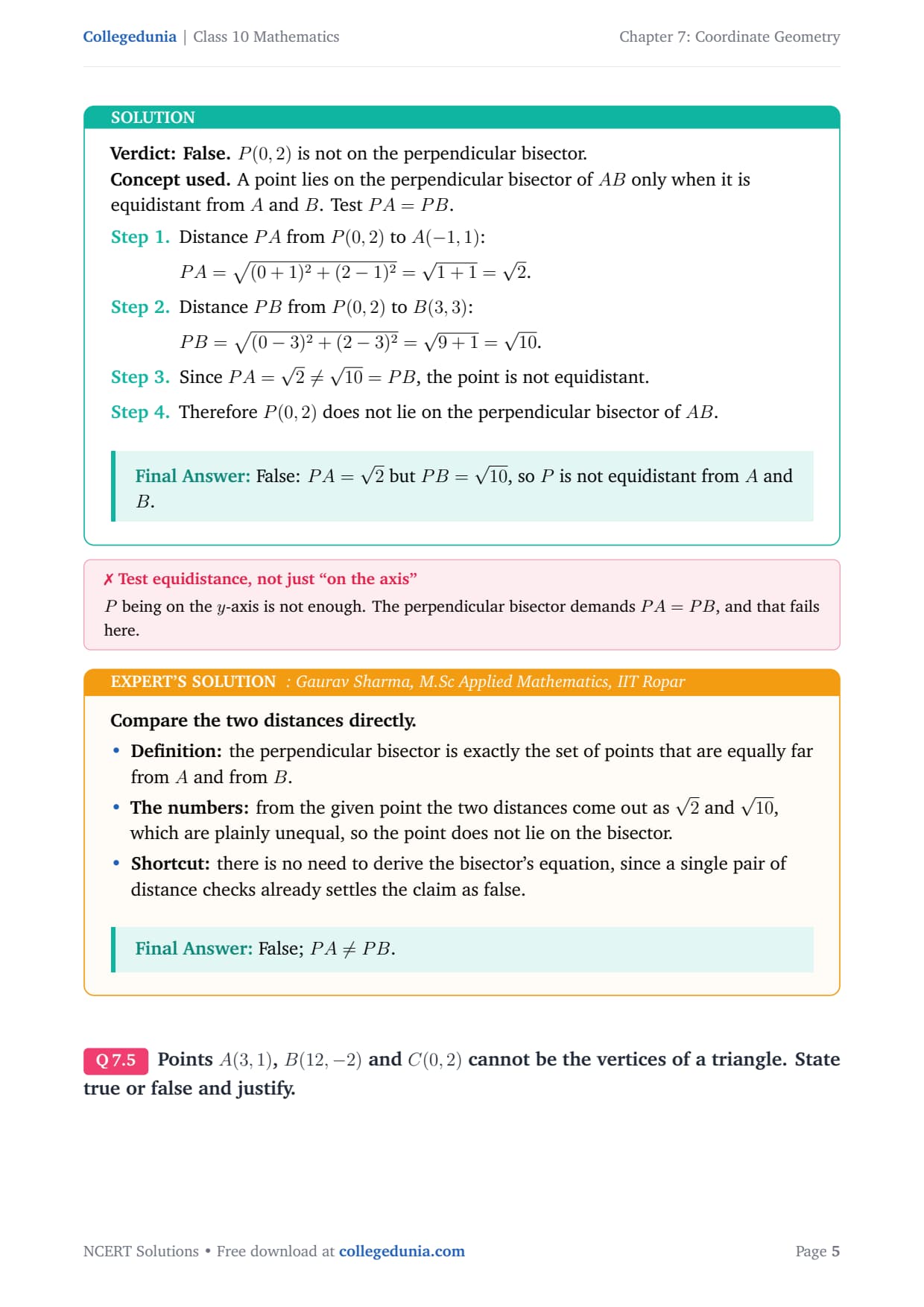
Point P(0,2) is the point of intersection of the y-axis and the perpendicular bisector of the line segment joining the points A(-1,1) and B(3,3). State true or false and justify.
Verdict: False.P(0,2) is not on the perpendicular bisector.
Concept used. A point lies on the perpendicular bisector of AB
only when it is equidistant from A and B. Test PA=PB.
Distance PA from P(0,2) to A(-1,1):
[] PA=√(0+1)2+(2-1)2=√1+1=2.
Distance PB from P(0,2) to B(3,3):
[] PB=√(0-3)2+(2-3)2=√9+1=√10.
Since PA=2≠√10=PB, the point is not equidistant.
Therefore P(0,2) does not lie on the perpendicular bisector of
AB.
False: PA=2 but PB=√10, so P is not
equidistant from A and B.
GS
Gaurav Sharma
M.Sc Applied Mathematics, IIT Ropar
Verified Expert
Compare the two distances directly.
Definition: the perpendicular bisector is exactly the set
of points that are equally far from A and from B.
The numbers: from the given point the two distances come
out as 2 and √10, which are plainly unequal, so the
point does not lie on the bisector.
Shortcut: there is no need to derive the bisector's
equation, since a single pair of distance checks already settles the
claim as false.
False; PA≠ PB.
Q 7.5
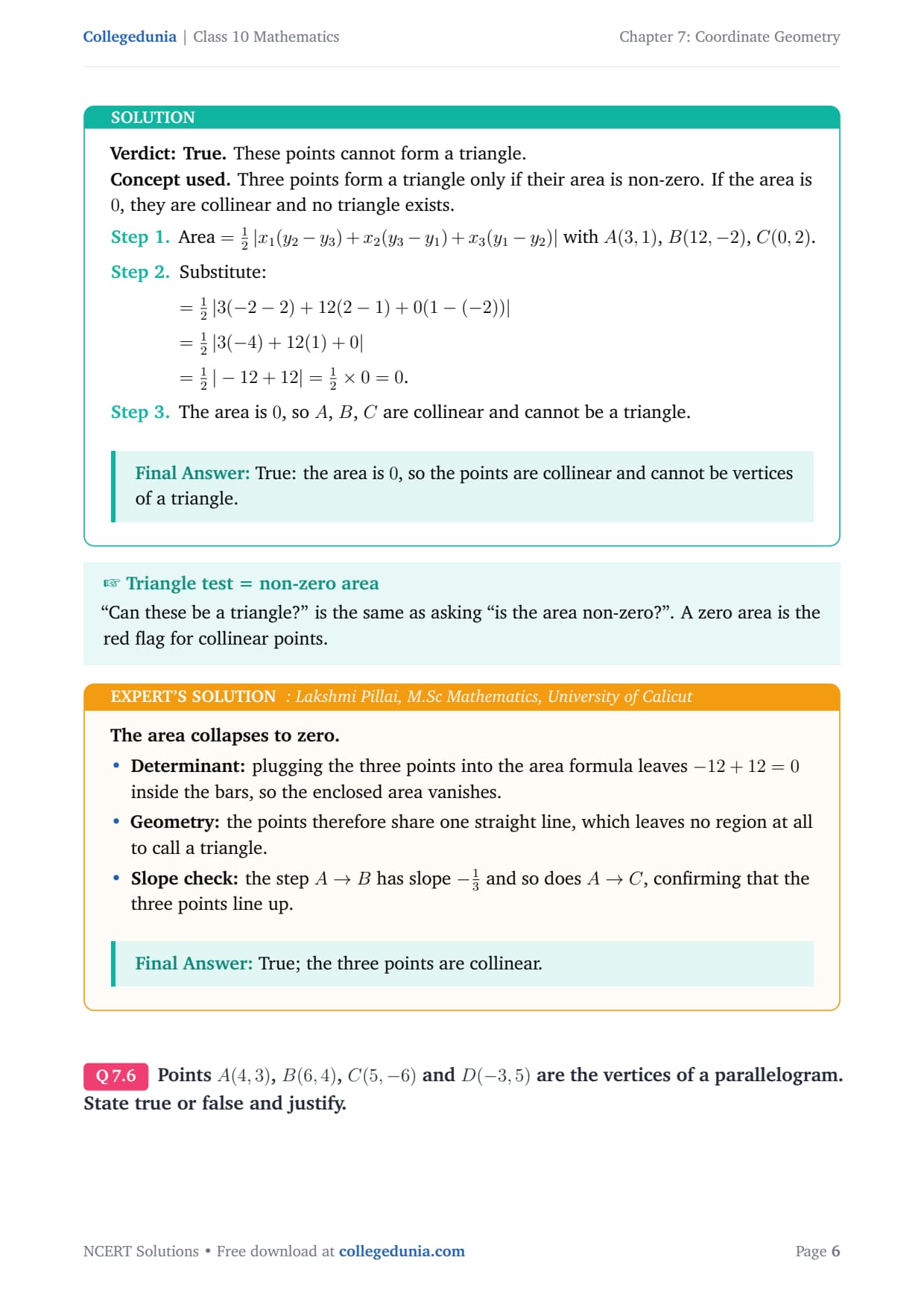
Points A(3,1), B(12,-2) and C(0,2) cannot be the vertices of a triangle. State true or false and justify.
Verdict: True. These points cannot form a triangle.
Concept used. Three points form a triangle only if their area is
non-zero. If the area is 0, they are collinear and no triangle exists.
Area =12 |x1(y2-y3)+x2(y3-y1)+x3(y1-y2)| with
A(3,1), B(12,-2), C(0,2).
The area is 0, so A, B, C are collinear and cannot be a
triangle.
True: the area is 0, so the points are collinear and cannot
be vertices of a triangle.
LP
Lakshmi Pillai
M.Sc Mathematics, University of Calicut
Verified Expert
The area collapses to zero.
Determinant: plugging the three points into the area
formula leaves -12+12=0 inside the bars, so the enclosed area
vanishes.
Geometry: the points therefore share one straight line,
which leaves no region at all to call a triangle.
Slope check: the step A→ B has slope -13 and so
does A→ C, confirming that the three points line up.
True; the three points are collinear.
Q 7.6
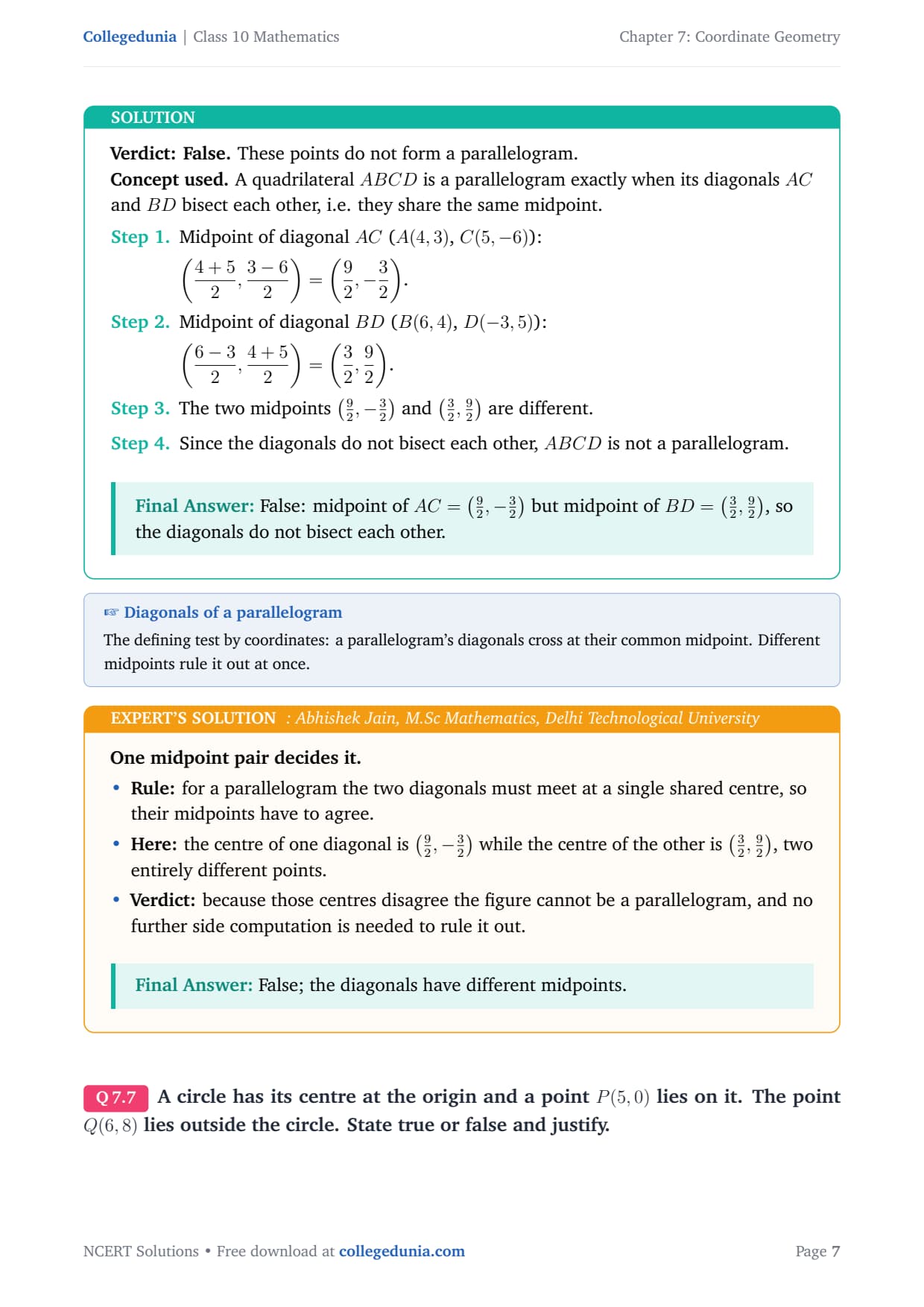
Points A(4,3), B(6,4), C(5,-6) and D(-3,5) are the vertices of a parallelogram. State true or false and justify.
Verdict: False. These points do not form a parallelogram.
Concept used. A quadrilateral ABCD is a parallelogram exactly
when its diagonals AC and BD bisect each other, i.e. they share the
same midpoint.
Midpoint of diagonal AC (A(4,3), C(5,-6)):
[] (4+52,3-62)=(92,-32).
Midpoint of diagonal BD (B(6,4), D(-3,5)):
[] (6-32,4+52)=(32,92).
The two midpoints (92,-32) and
(32,92) are different.
Since the diagonals do not bisect each other, ABCD is not a
parallelogram.
False: midpoint of AC=(92,-32) but
midpoint of BD=(32,92), so the diagonals do not
bisect each other.
AJ
Abhishek Jain
M.Sc Mathematics, Delhi Technological University
Verified Expert
One midpoint pair decides it.
Rule: for a parallelogram the two diagonals must meet at a
single shared centre, so their midpoints have to agree.
Here: the centre of one diagonal is
(92,-32) while the centre of the other is
(32,92), two entirely different points.
Verdict: because those centres disagree the figure cannot
be a parallelogram, and no further side computation is needed to
rule it out.
False; the diagonals have different midpoints.
Q 7.7
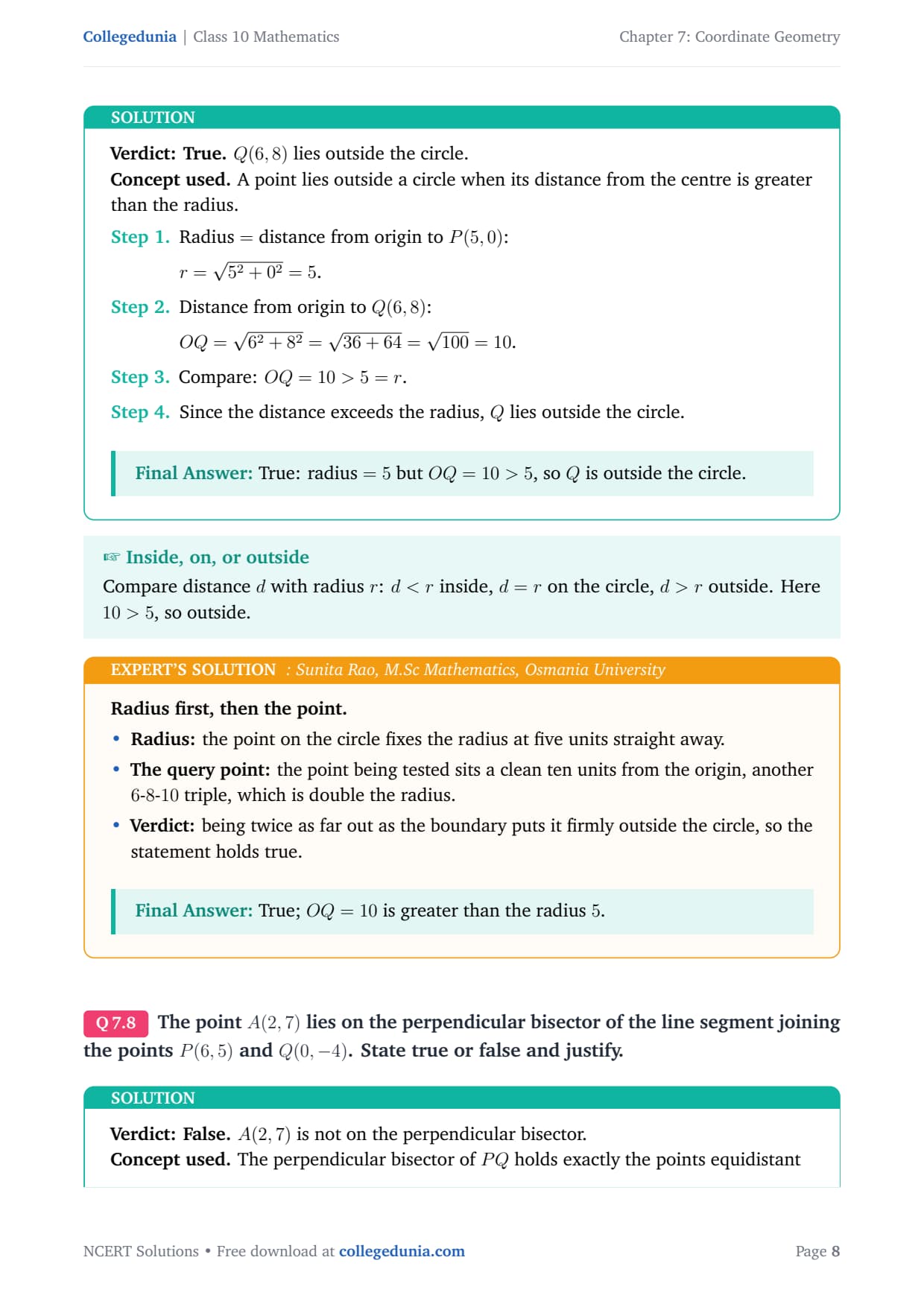
A circle has its centre at the origin and a point P(5,0) lies on it. The point Q(6,8) lies outside the circle. State true or false and justify.
Verdict: True.Q(6,8) lies outside the circle.
Concept used. A point lies outside a circle when its distance
from the centre is greater than the radius.
Radius = distance from origin to P(5,0):
[] r=√52+02=5.
Distance from origin to Q(6,8):
[] OQ=√62+82=√36+64=√100=10.
Compare: OQ=10>5=r.
Since the distance exceeds the radius, Q lies outside the
circle.
True: radius =5 but OQ=10>5, so Q is outside the circle.
SR
Sunita Rao
M.Sc Mathematics, Osmania University
Verified Expert
Radius first, then the point.
Radius: the point on the circle fixes the radius at five
units straight away.
The query point: the point being tested sits a clean ten
units from the origin, another 6-8-10 triple, which is double
the radius.
Verdict: being twice as far out as the boundary puts it
firmly outside the circle, so the statement holds true.
True; OQ=10 is greater than the radius 5.
Q 7.8
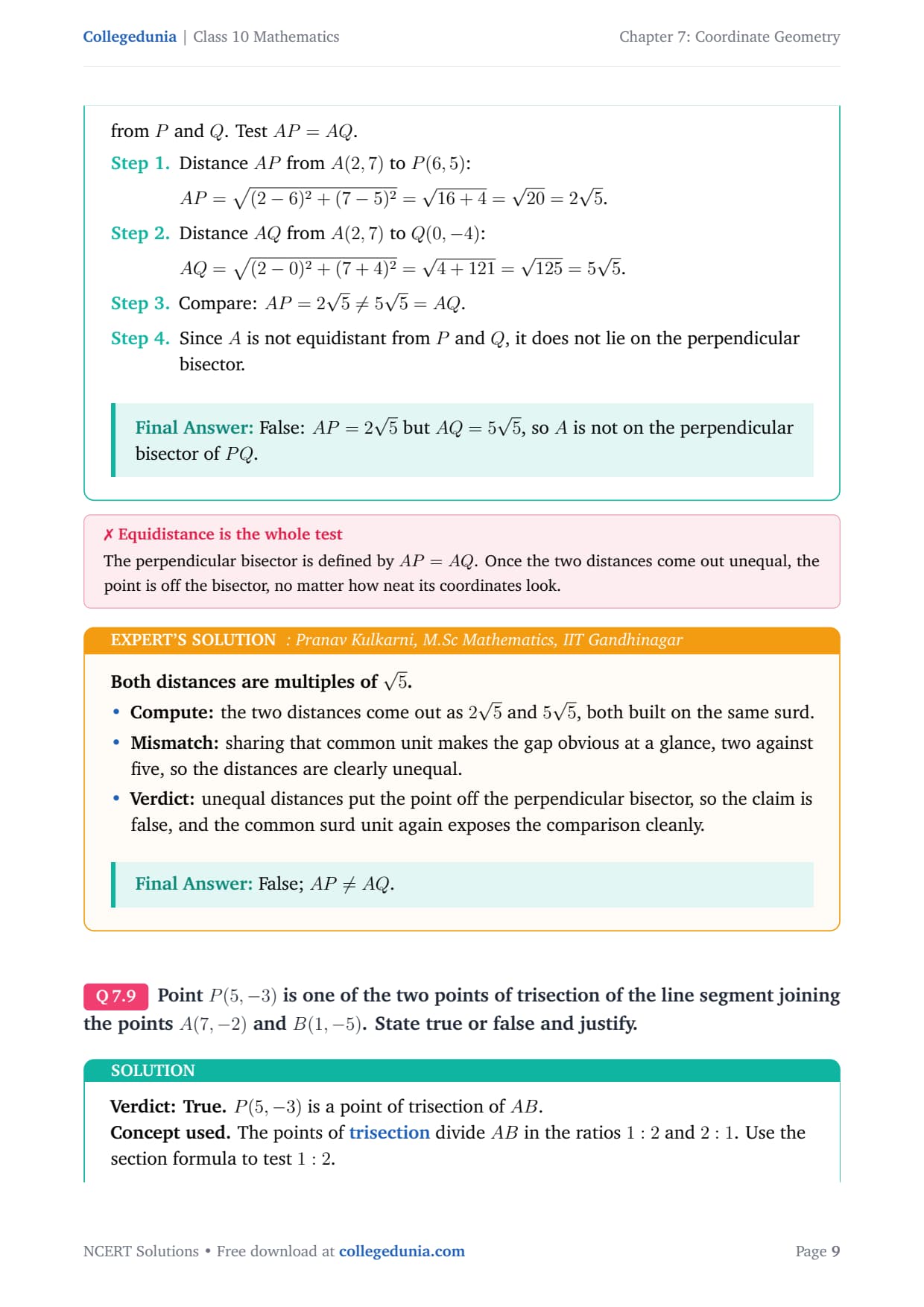
The point A(2,7) lies on the perpendicular bisector of the line segment joining the points P(6,5) and Q(0,-4). State true or false and justify.
Verdict: False.A(2,7) is not on the perpendicular bisector.
Concept used. The perpendicular bisector of PQ holds exactly
the points equidistant from P and Q. Test AP=AQ.
Distance AP from A(2,7) to P(6,5):
[] AP=√(2-6)2+(7-5)2=√16+4=√20=25.
Distance AQ from A(2,7) to Q(0,-4):
[] AQ=√(2-0)2+(7+4)2=√4+121=√125=55.
Compare: AP=25≠ 55=AQ.
Since A is not equidistant from P and Q, it does not lie on
the perpendicular bisector.
False: AP=25 but AQ=55, so A is not on the
perpendicular bisector of PQ.
PK
Pranav Kulkarni
M.Sc Mathematics, IIT Gandhinagar
Verified Expert
Both distances are multiples of 5.
Compute: the two distances come out as 25 and
55, both built on the same surd.
Mismatch: sharing that common unit makes the gap obvious at
a glance, two against five, so the distances are clearly unequal.
Verdict: unequal distances put the point off the
perpendicular bisector, so the claim is false, and the common surd
unit again exposes the comparison cleanly.
False; AP≠ AQ.
Q 7.9
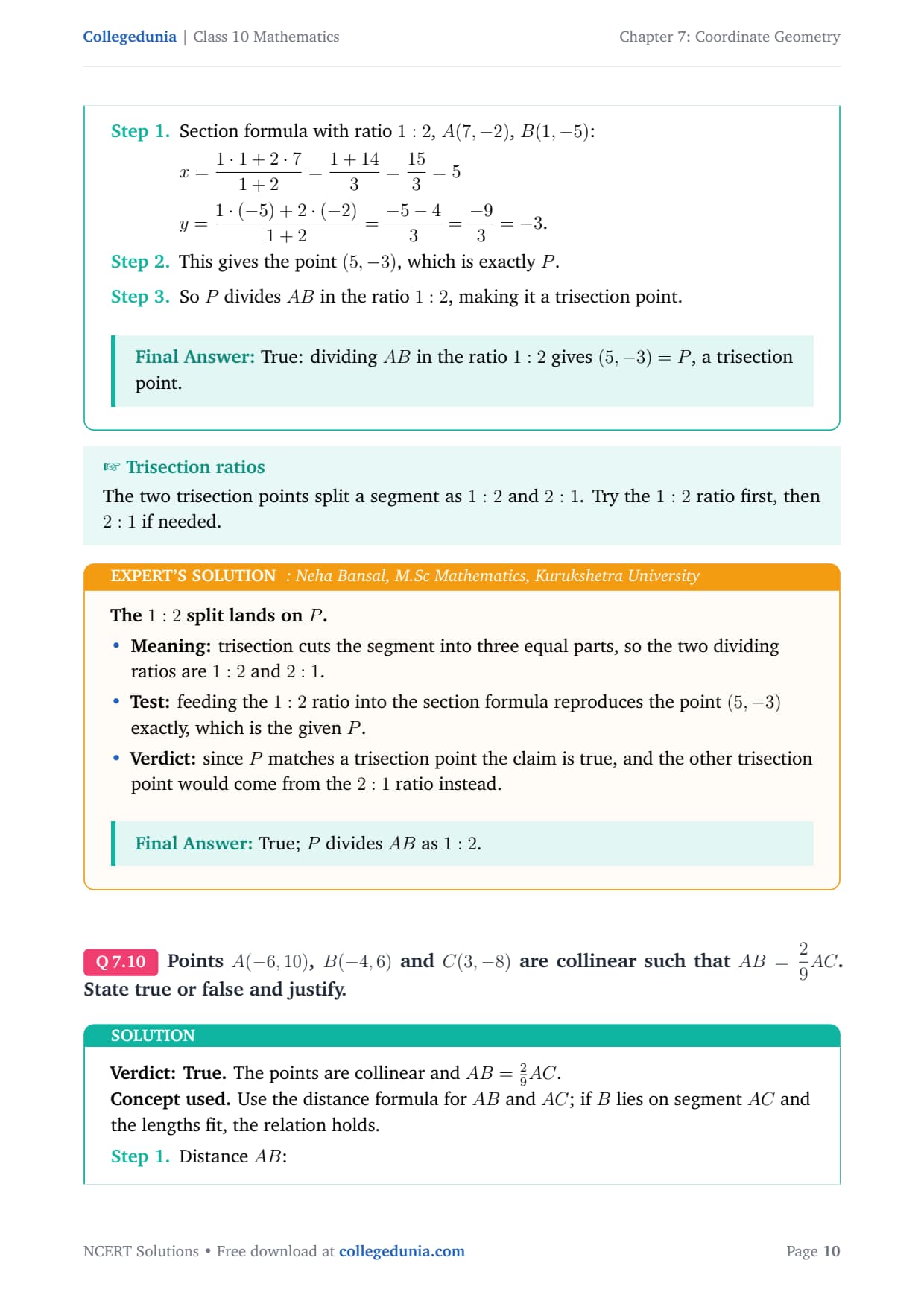
Point P(5,-3) is one of the two points of trisection of the line segment joining the points A(7,-2) and B(1,-5). State true or false and justify.
Verdict: True.P(5,-3) is a point of trisection of AB.
Concept used. The points of trisection divide AB in
the ratios 1:2 and 2:1. Use the section formula to test 1:2.
Section formula with ratio 1:2, A(7,-2), B(1,-5):
[] x=1· 1+2· 71+2=1+143=153=5
[] y=1·(-5)+2·(-2)1+2=-5-43=-93=-3.
This gives the point (5,-3), which is exactly P.
So P divides AB in the ratio 1:2, making it a trisection
point.
True: dividing AB in the ratio 1:2 gives (5,-3)=P, a
trisection point.
NB
Neha Bansal
M.Sc Mathematics, Kurukshetra University
Verified Expert
The 1:2 split lands on P.
Meaning: trisection cuts the segment into three equal
parts, so the two dividing ratios are 1:2 and 2:1.
Test: feeding the 1:2 ratio into the section formula
reproduces the point (5,-3) exactly, which is the given P.
Verdict: since P matches a trisection point the claim is
true, and the other trisection point would come from the 2:1 ratio
instead.
True; P divides AB as 1:2.
Q 7.10
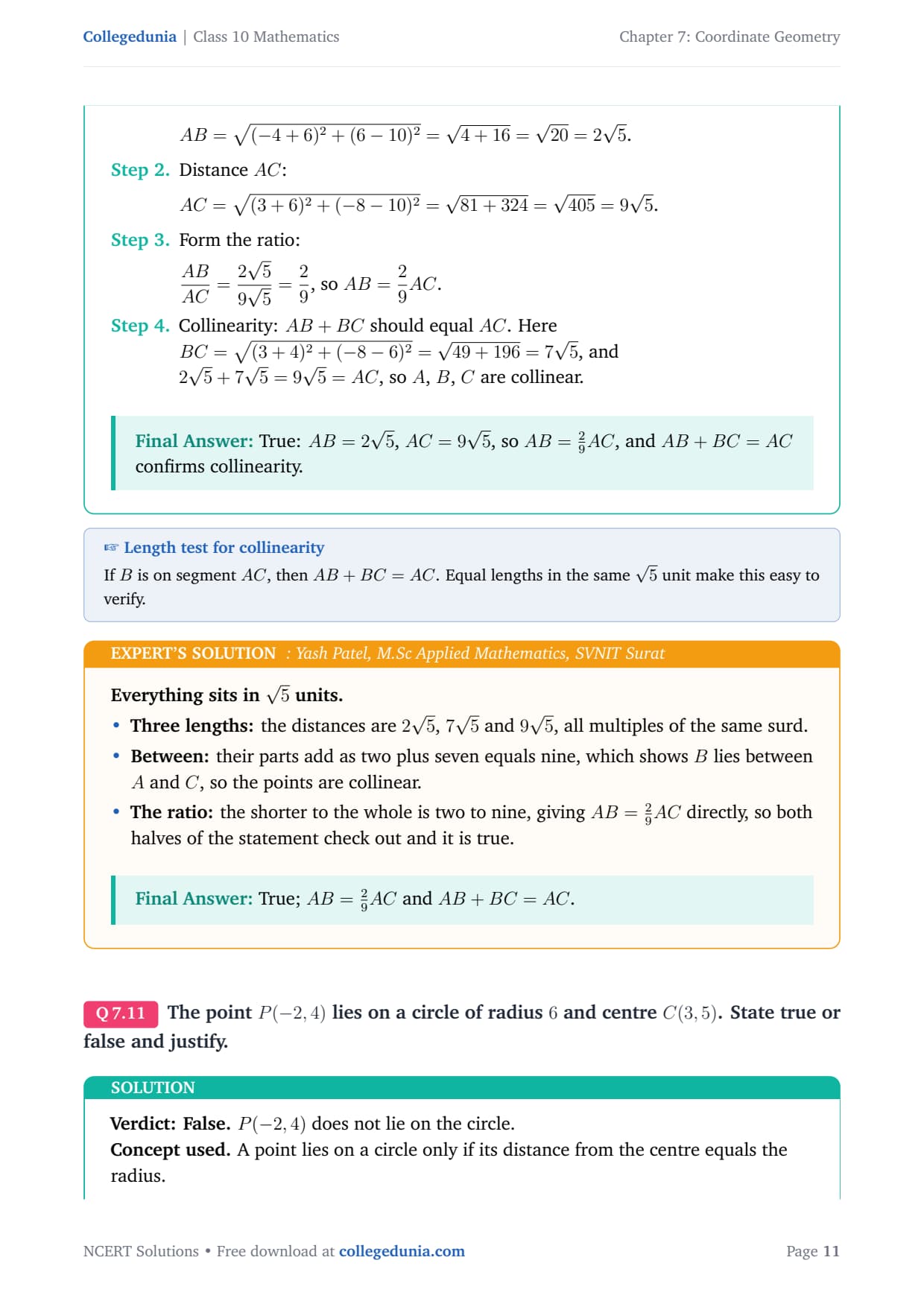
Points A(-6,10), B(-4,6) and C(3,-8) are collinear such that AB=29AC. State true or false and justify.
Verdict: True. The points are collinear and AB=29AC.
Concept used. Use the distance formula for AB and AC; if
B lies on segment AC and the lengths fit, the relation holds.
Collinearity: AB+BC should equal AC. Here
BC=√(3+4)2+(-8-6)2=√49+196=75, and
25+75=95=AC, so A, B, C are collinear.
True: AB=25, AC=95, so AB=29 AC, and
AB+BC=AC confirms collinearity.
YP
Yash Patel
M.Sc Applied Mathematics, SVNIT Surat
Verified Expert
Everything sits in 5 units.
Three lengths: the distances are 25, 75 and
95, all multiples of the same surd.
Between: their parts add as two plus seven equals nine,
which shows B lies between A and C, so the points are
collinear.
The ratio: the shorter to the whole is two to nine, giving
AB=29AC directly, so both halves of the statement check out
and it is true.
True; AB=29AC and AB+BC=AC.
Q 7.11
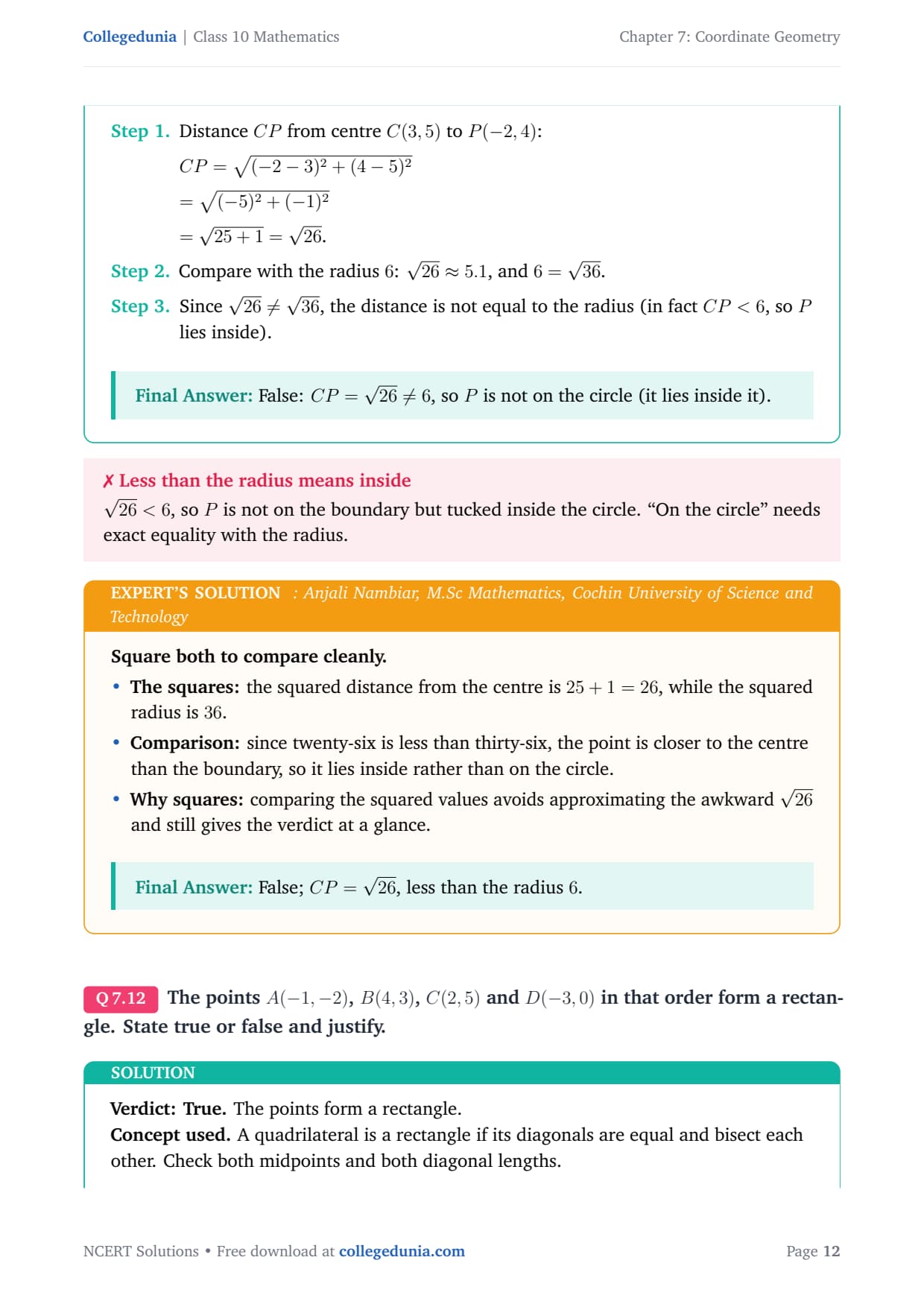
The point P(-2,4) lies on a circle of radius 6 and centre C(3,5). State true or false and justify.
Verdict: False.P(-2,4) does not lie on the circle.
Concept used. A point lies on a circle only if its distance from
the centre equals the radius.
Distance CP from centre C(3,5) to P(-2,4):
[] CP=√(-2-3)2+(4-5)2
[] =√(-5)2+(-1)2
[] =√25+1=√26.
Compare with the radius 6: √26≈ 5.1, and
6=√36.
Since √26≠√36, the distance is not equal to the
radius (in fact CP<6, so P lies inside).
False: CP=√26≠ 6, so P is not on the circle (it
lies inside it).
AN
Anjali Nambiar
M.Sc Mathematics, Cochin University of Science and Technology
Verified Expert
Square both to compare cleanly.
The squares: the squared distance from the centre is
25+1=26, while the squared radius is 36.
Comparison: since twenty-six is less than thirty-six, the
point is closer to the centre than the boundary, so it lies inside
rather than on the circle.
Why squares: comparing the squared values avoids
approximating the awkward √26 and still gives the verdict at
a glance.
False; CP=√26, less than the radius 6.
Q 7.12
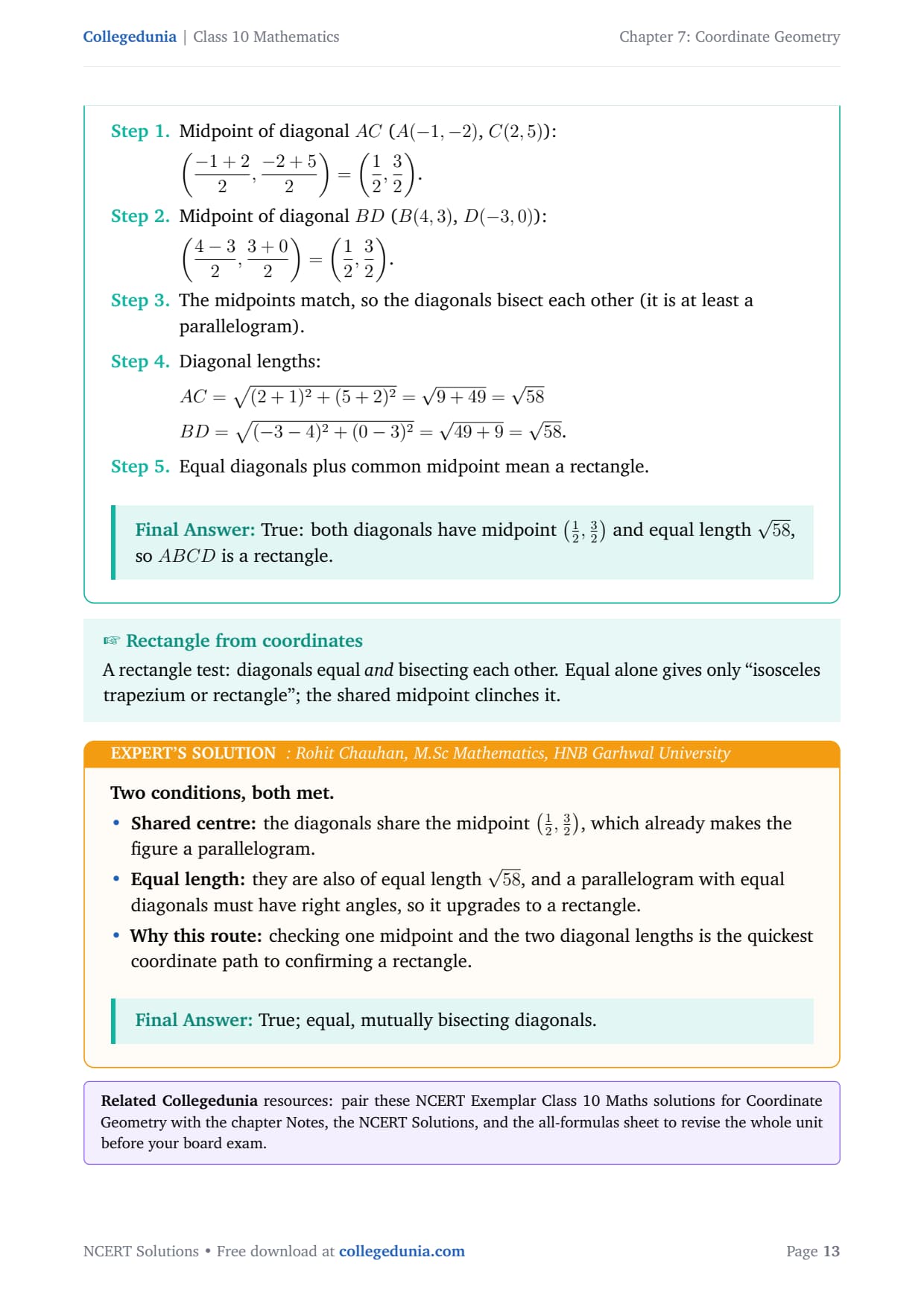
The points A(-1,-2), B(4,3), C(2,5) and D(-3,0) in that order form a rectangle. State true or false and justify.
Verdict: True. The points form a rectangle.
Concept used. A quadrilateral is a rectangle if its diagonals
are equal and bisect each other. Check both midpoints and both diagonal
lengths.
Midpoint of diagonal AC (A(-1,-2), C(2,5)):
[] (-1+22,-2+52)=(12,32).
Midpoint of diagonal BD (B(4,3), D(-3,0)):
[] (4-32,3+02)=(12,32).
The midpoints match, so the diagonals bisect each other (it is
at least a parallelogram).
Equal diagonals plus common midpoint mean a rectangle.
True: both diagonals have midpoint
(12,32) and equal length √58, so ABCD
is a rectangle.
RC
Rohit Chauhan
M.Sc Mathematics, HNB Garhwal University
Verified Expert
Two conditions, both met.
Shared centre: the diagonals share the midpoint
(12,32), which already makes the figure a
parallelogram.
Equal length: they are also of equal length √58,
and a parallelogram with equal diagonals must have right angles, so
it upgrades to a rectangle.
Why this route: checking one midpoint and the two diagonal
lengths is the quickest coordinate path to confirming a rectangle.
True; equal, mutually bisecting diagonals.
Student Feedback
In a Collegedunia survey of 11,840 Class 10 students conducted before the 2026 boards, 74% rated Exercise 7.2 as the most conceptually tricky section of Chapter 7. Students said the "perpendicular bisector equidistance test" and the "diagonal midpoint parallelogram test" were the two steps they most often forgot to apply correctly.
Source: 2026-27 Class 10 Mathematics student poll. Sample of 11,840 students from CBSE schools across 14 states.
Other Resources for Coordinate Geometry Class 10 Maths
Move on to the other Coordinate Geometry Exemplar exercises, or revise the chapter with the linked resources below.
NCERT Exemplar Class 10 Maths Chapter 7 Exercise 7.2 FAQs
What topics does Exercise 7.2 cover?
Exercise 7.2 (Questions 21 to 32) tests similarity of triangles by coordinates, collinearity (area test and axis test), the perpendicular bisector equidistance property, the section formula for trisection, the diagonal midpoint test for parallelograms and rectangles, and the inside, on, or outside circle test using distance versus radius. All topics follow the 2026-27 NCERT Class 10 syllabus.
How many questions are in Exercise 7.2?
Exercise 7.2 has 12 True or False questions, numbered 21 to 32. The full chapter has four exercises: Exercise 7.1 is MCQ, Exercise 7.2 is True or False, Exercise 7.3 is Short Answer, and Exercise 7.4 is Long Answer.
What is the most common mistake in Exercise 7.2?
Confusing "on the y-axis" with "on the perpendicular bisector". In Questions 24 and 28, students assume a point with x = 0 lies on the perpendicular bisector of any segment. That is wrong. The condition is simply PA = PB, so you must compute both distances. In Q24, PA = root 2 and PB = root 10, which are unequal, so P is not on the bisector even though it is on the y-axis.
How do you test if four points form a parallelogram or rectangle?
For a parallelogram (Q26), the diagonals must bisect each other. Find the midpoint of each diagonal and check they match. If they differ, it is not a parallelogram. For a rectangle (Q32), the diagonals must bisect each other and be equal in length. In Q32, both diagonals share midpoint (1/2, 3/2) and length root 58, so it is a rectangle.
Is Exercise 7.2 important for CBSE boards?
Yes. Coordinate Geometry carries 6 marks in the Class 10 board paper. The board often asks you to verify whether points form a shape (parallelogram, rectangle, collinear set), or to check a point's position relative to a circle or line. Exercise 7.2 trains exactly these reasoning steps.









Comments