Senior Maths Editor, 9 Yrs | Updated on - Jun 29, 2026
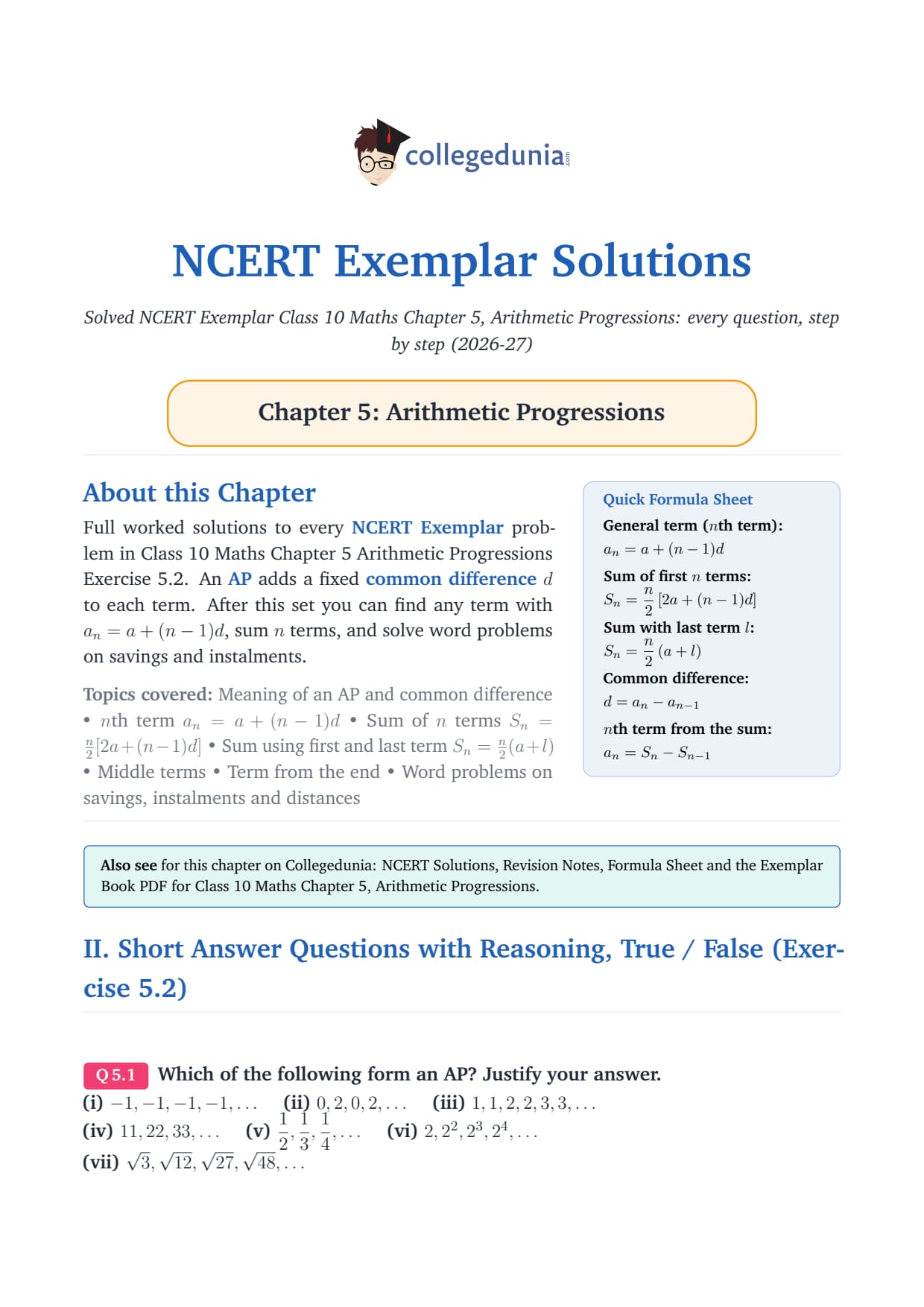
NCERT Exemplar Class 10 Maths Chapter 5 Arithmetic Progressions Exercise 5.2 is the Short Answer with Reasoning and True-or-False section. Its 8 questions (Q19 to Q26) test whether you can identify APs, check claims with the common-difference rule, and apply the nth term formula. All follow the 2026-27 CBSE syllabus.
Exercise type: Short Answer with Reasoning and True or False, 8 questions (Q19 to Q26)
Key formulas tested:an = a + (n−1)d and the constant common-difference rule
Board relevance: These reasoning-based questions build the justification skills CBSE board exams reward in 2-mark and 3-mark answers
Below you get all Exercise 5.2 solutions, with step-by-step reasoning, expert views, and board tips, on the 2026-27 NCERT syllabus.
These solutions are written by subject experts, mapped to the 2026-27 rationalised NCERT, and checked against the CBSE board pattern.
Solved by Collegedunia Every Exercise 5.2 question is solved by Mathematics experts. Each has a Concept used section, numbered steps, a boxed answer, and an Expert view that explains the reasoning.
Exercise 5.2 at a Glance · 8 Reasoning Questions, Chapter 5 Arithmetic Progressions, Class 10 Maths Exemplar 2026-27
Arithmetic Progressions Exercise 5.2 Overview and Key Formulas
Exercise 5.2 is the reasoning and true-or-false section of the Chapter 5 Exemplar. All 8 questions need you to justify your answer, not just state it. The question map is below.
Question
What Is Tested
Difficulty
Q19
Identify which of 7 lists form an AP; justify using constant differences
Medium
Q20
True/False: 2 equal gaps are enough to confirm an AP
Medium
Q21
Find a30−a20 directly using (m−n)d
Easy
Q22
Why the corresponding-term difference of two APs (same d) is always fixed
Medium
Q23
Is 0 a term of the AP 31, 28, 25…? Use an formula
Easy
Q24
True/False: total taxi fares form an AP (reading total vs per-km cost)
Medium
Q25
Identify 4 real-life situations that produce an AP
Easy
Q26
Which of 2n−3, 3n2+5, 1+n+n2 is a valid AP nth term?
Medium
Remember: A list is an AP only if every consecutive difference is equal. Checking just the first pair is not enough, always check the third term too.
The key formulas students need for Exercise 5.2 are listed below.
Formula
Statement
General (nth) term
an = a + (n−1)d
Common difference
d = ak+1−ak (must be the same for every k)
Term-gap shortcut
am−an = (m−n)d
Sum of n terms
Sn = (n/2)[2a + (n−1)d]
Linear nth term = AP signature
If an = pn + q (degree 1), the list is an AP with d = p
Watch Out (Q26): If the formula for an contains n2, it is not an AP. The common difference grows with n, which breaks the equal-gap rule.
All Exercise 5.2 Questions with Step-by-Step Solutions
II. Short Answer Questions with Reasoning, True / False (Exercise 5.2)
Q 5.1
Which of the following form an AP? Justify your answer.
(i) -1,-1,-1,-1,… (ii) 0,2,0,2,… (iii) 1,1,2,2,3,3,…
(iv) 11,22,33,… (v) 12,13,14,… (vi) 2,22,23,24,…
(vii) √3,√12,√27,√48,…
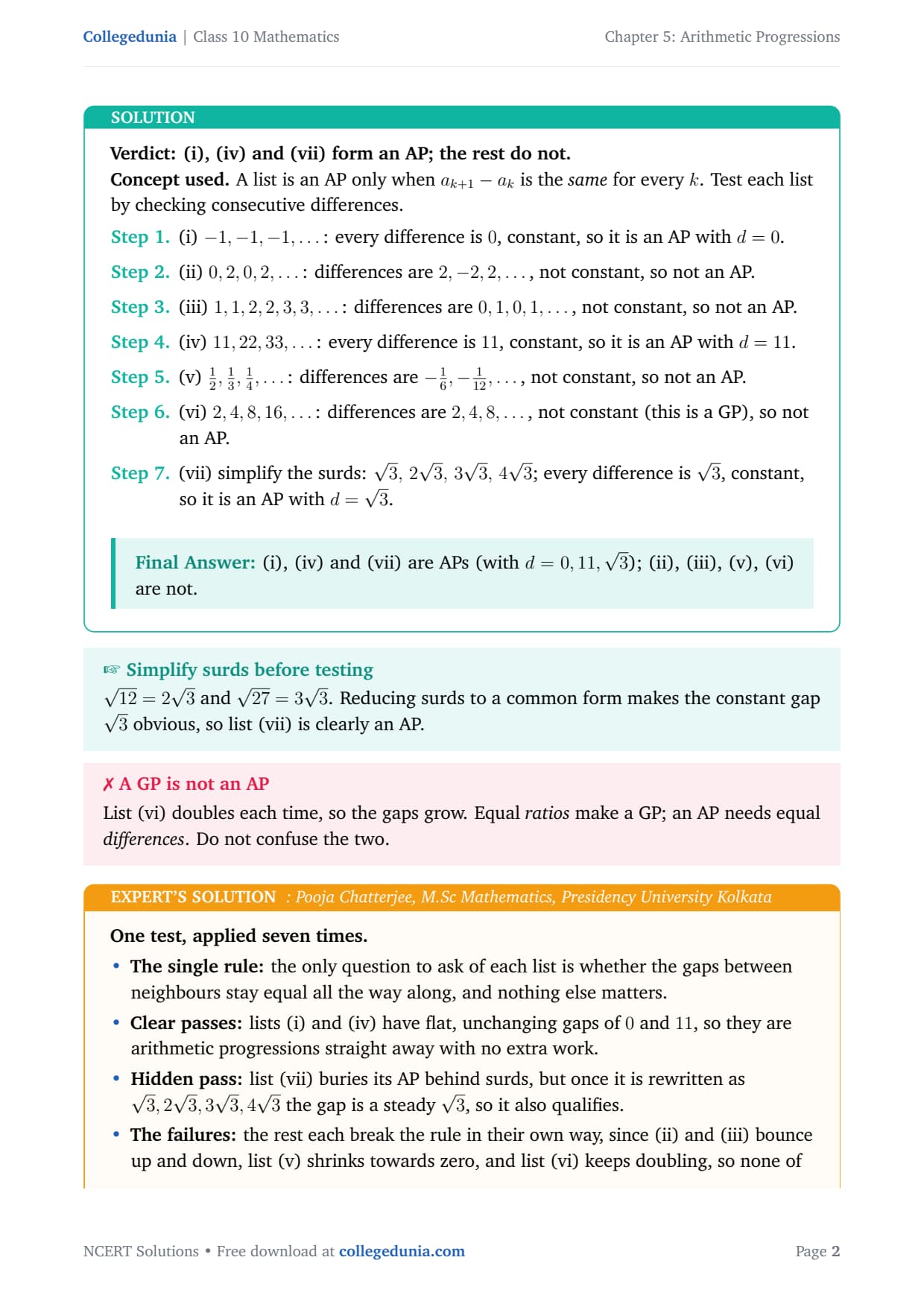
Verdict: (i), (iv) and (vii) form an AP; the rest do not.
Concept used. A list is an AP only when ak+1-ak is the
same for every k. Test each list by checking consecutive
differences.
(i) -1,-1,-1,: every difference is 0, constant, so it is
an AP with d=0.
(ii) 0,2,0,2,: differences are 2,-2,2,, not
constant, so not an AP.
(iii) 1,1,2,2,3,3,: differences are 0,1,0,1,, not
constant, so not an AP.
(iv) 11,22,33,: every difference is 11, constant, so it
is an AP with d=11.
(v) 12,13,14,: differences are
-16,-112,, not constant, so not an AP.
(vi) 2,4,8,16,: differences are 2,4,8,, not
constant (this is a GP), so not an AP.
(vii) simplify the surds: 3, 23, 33, 43;
every difference is 3, constant, so it is an AP with
d=3.
(i), (iv) and (vii) are APs (with d=0,11,3); (ii),
(iii), (v), (vi) are not.
PC
Pooja Chatterjee
M.Sc Mathematics, Presidency University Kolkata
Verified Expert
One test, applied seven times.
The single rule: the only question to ask of each list is
whether the gaps between neighbours stay equal all the way along,
and nothing else matters.
Clear passes: lists (i) and (iv) have flat, unchanging
gaps of 0 and 11, so they are arithmetic progressions straight
away with no extra work.
Hidden pass: list (vii) buries its AP behind surds, but
once it is rewritten as 3,23,33,43 the gap is
a steady 3, so it also qualifies.
The failures: the rest each break the rule in their own
way, since (ii) and (iii) bounce up and down, list (v) shrinks
towards zero, and list (vi) keeps doubling, so none of them holds
a constant gap.
Verdict: only constant gaps count, which leaves (i),
(iv) and (vii) as the genuine arithmetic progressions here.
APs: (i), (iv), (vii). Not APs: (ii), (iii), (v), (vi).
Q 5.2
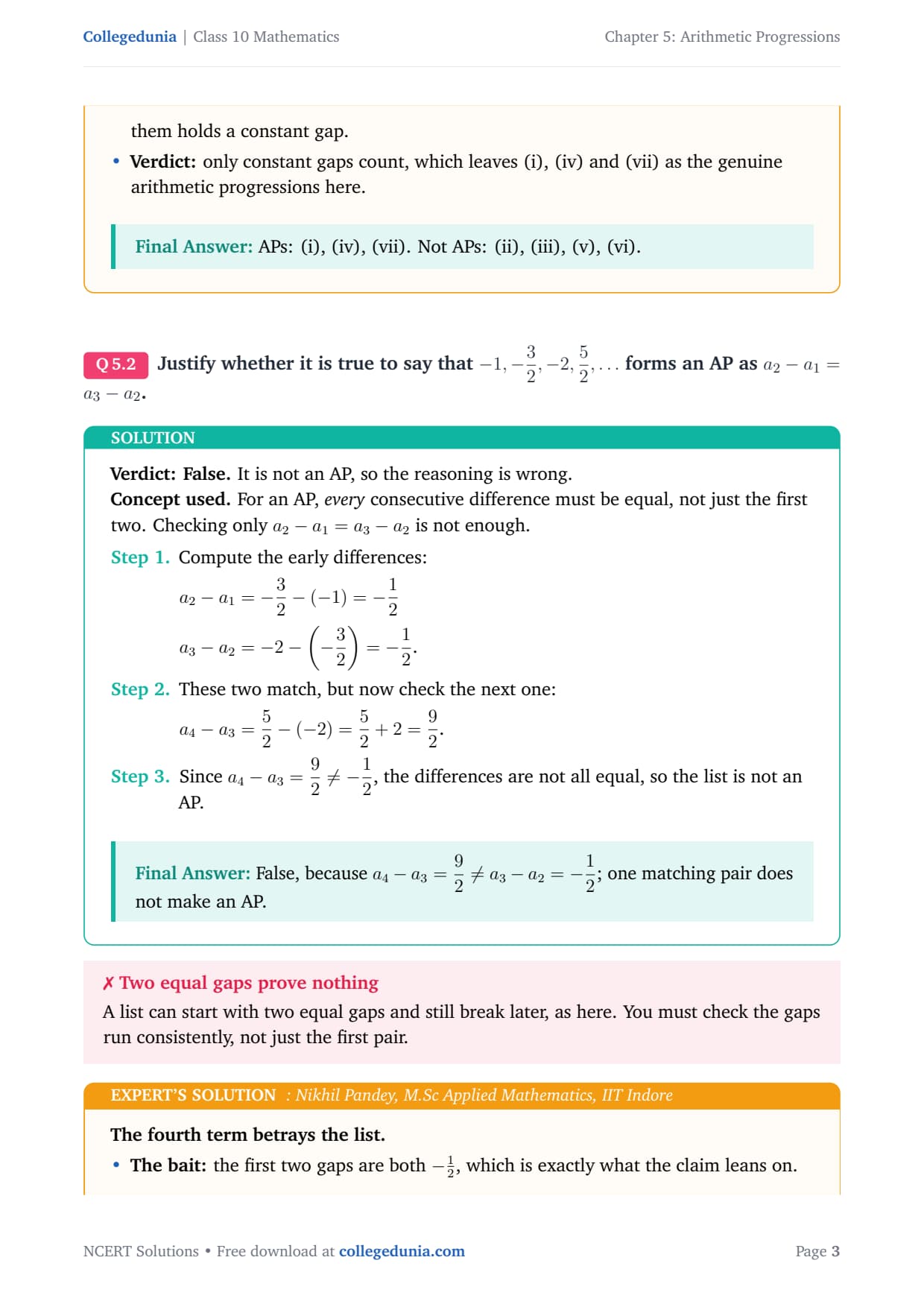
Justify whether it is true to say that -1,-32,-2,52,… forms an AP as a2-a1=a3-a2.
Verdict: False. It is not an AP, so the reasoning is wrong.
Concept used. For an AP, every consecutive difference must
be equal, not just the first two. Checking only a2-a1=a3-a2 is not
enough.
Compute the early differences:
[] a2-a1=-32-(-1)=-12
[] a3-a2=-2-(-32)=-12.
These two match, but now check the next one:
[] a4-a3=52-(-2)=52+2=92.
Since a4-a3=92≠-12, the differences are not all
equal, so the list is not an AP.
False, because a4-a3=92≠ a3-a2=-12; one
matching pair does not make an AP.
NP
Nikhil Pandey
M.Sc Applied Mathematics, IIT Indore
Verified Expert
The fourth term betrays the list.
The bait: the first two gaps are both -12, which
is exactly what the claim leans on.
The giveaway: the fourth term 52 jumps up by
92 from -2, nothing like -12, so the gap changes
and the list fails the AP test.
The lesson: matching only a2-a1=a3-a2 is too weak,
since a genuine AP needs the same gap running all the way through.
False; the gap is not constant (a4-a3=92).
Q 5.3
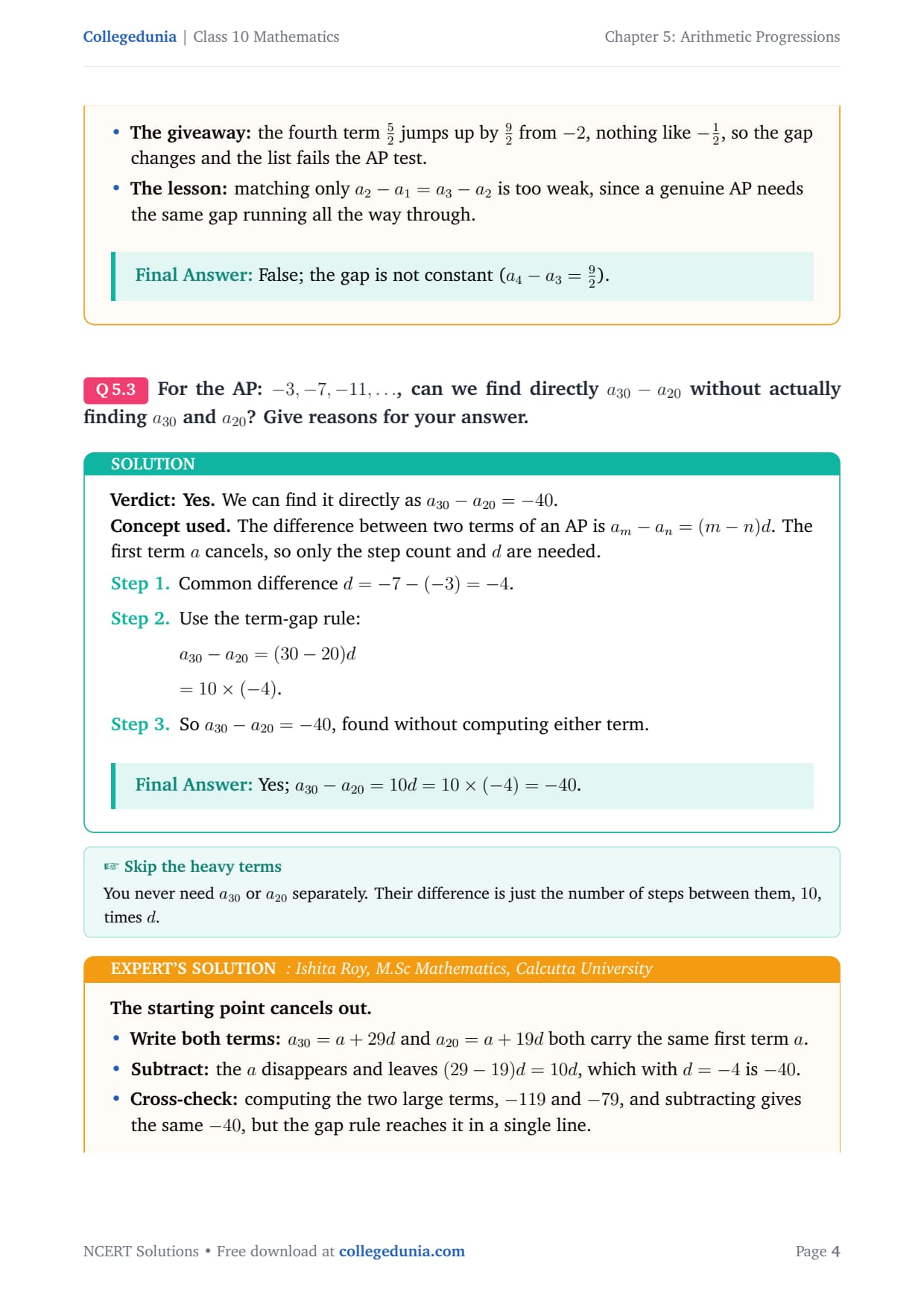
For the AP: -3,-7,-11,…, can we find directly a30-a20 without actually finding a30 and a20? Give reasons for your answer.
Verdict: Yes. We can find it directly as a30-a20=-40.
Concept used. The difference between two terms of an AP is
am-an=(m-n)d. The first term a cancels, so only the step count and
d are needed.
Common difference d=-7-(-3)=-4.
Use the term-gap rule:
[] a30-a20=(30-20)d
[] =10×(-4).
So a30-a20=-40, found without computing either term.
Yes; a30-a20=10d=10×(-4)=-40.
IR
Ishita Roy
M.Sc Mathematics, Calcutta University
Verified Expert
The starting point cancels out.
Write both terms:a30=a+29d and a20=a+19d both
carry the same first term a.
Subtract: the a disappears and leaves (29-19)d=10d,
which with d=-4 is -40.
Cross-check: computing the two large terms, -119 and
-79, and subtracting gives the same -40, but the gap rule
reaches it in a single line.
Yes; the answer is 10d=-40.
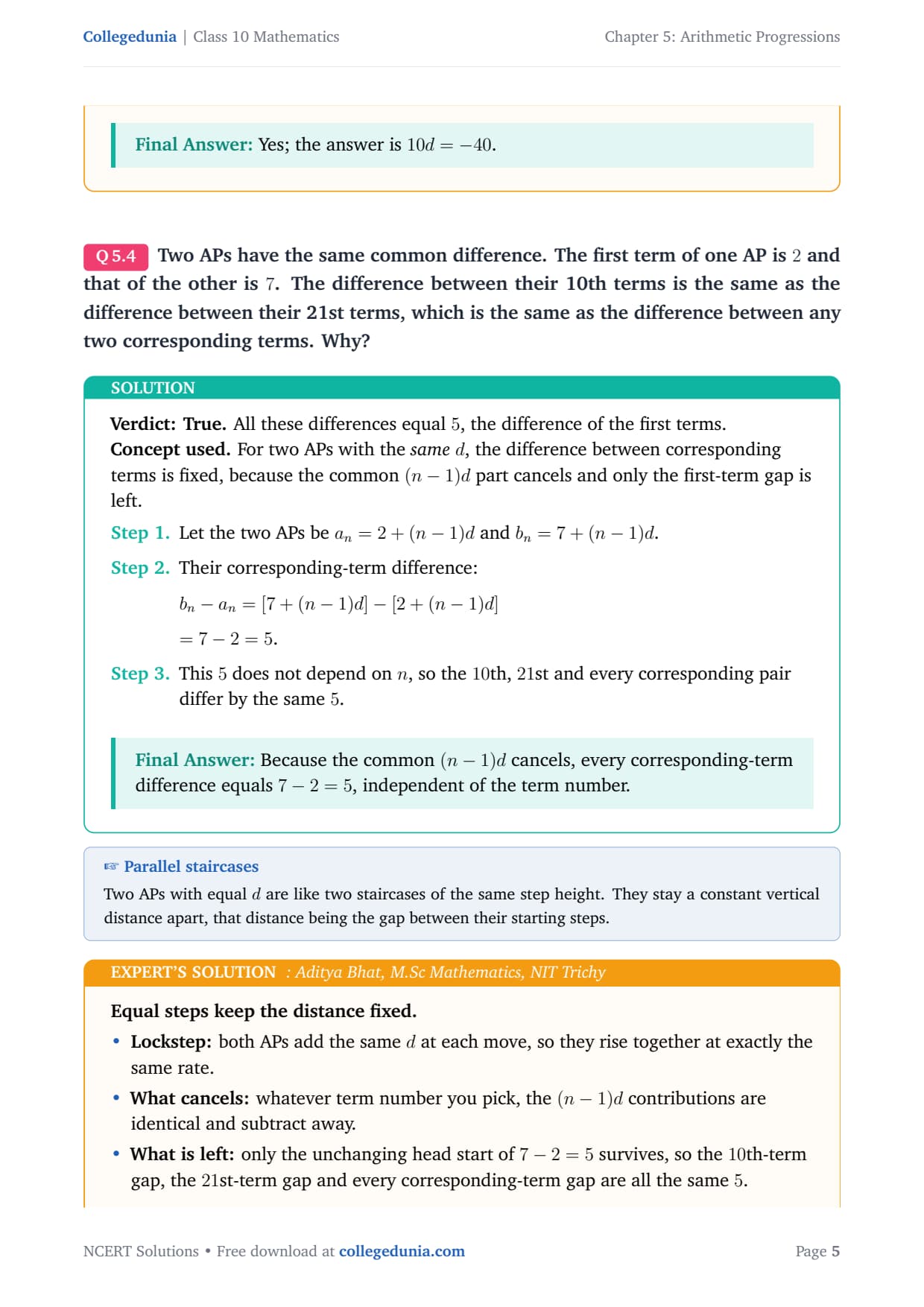
Q 5.4
Two APs have the same common difference. The first term of one AP is 2 and that of the other is 7. The difference between their 10th terms is the same as the difference between their 21st terms, which is the same as the difference between any two corresponding terms. Why?
Verdict: True. All these differences equal 5, the difference
of the first terms.
Concept used. For two APs with the samed, the
difference between corresponding terms is fixed, because the common
(n-1)d part cancels and only the first-term gap is left.
Let the two APs be an=2+(n-1)d and bn=7+(n-1)d.
Their corresponding-term difference:
[] bn-an=[7+(n-1)d]-[2+(n-1)d]
[] =7-2=5.
This 5 does not depend on n, so the 10th, 21st and every
corresponding pair differ by the same 5.
Because the common (n-1)d cancels, every corresponding-term
difference equals 7-2=5, independent of the term number.
AB
Aditya Bhat
M.Sc Mathematics, NIT Trichy
Verified Expert
Equal steps keep the distance fixed.
Lockstep: both APs add the same d at each move, so they
rise together at exactly the same rate.
What cancels: whatever term number you pick, the
(n-1)d contributions are identical and subtract away.
What is left: only the unchanging head start of 7-2=5
survives, so the 10th-term gap, the 21st-term gap and every
corresponding-term gap are all the same 5.
All differences equal 5, the gap between the first terms.
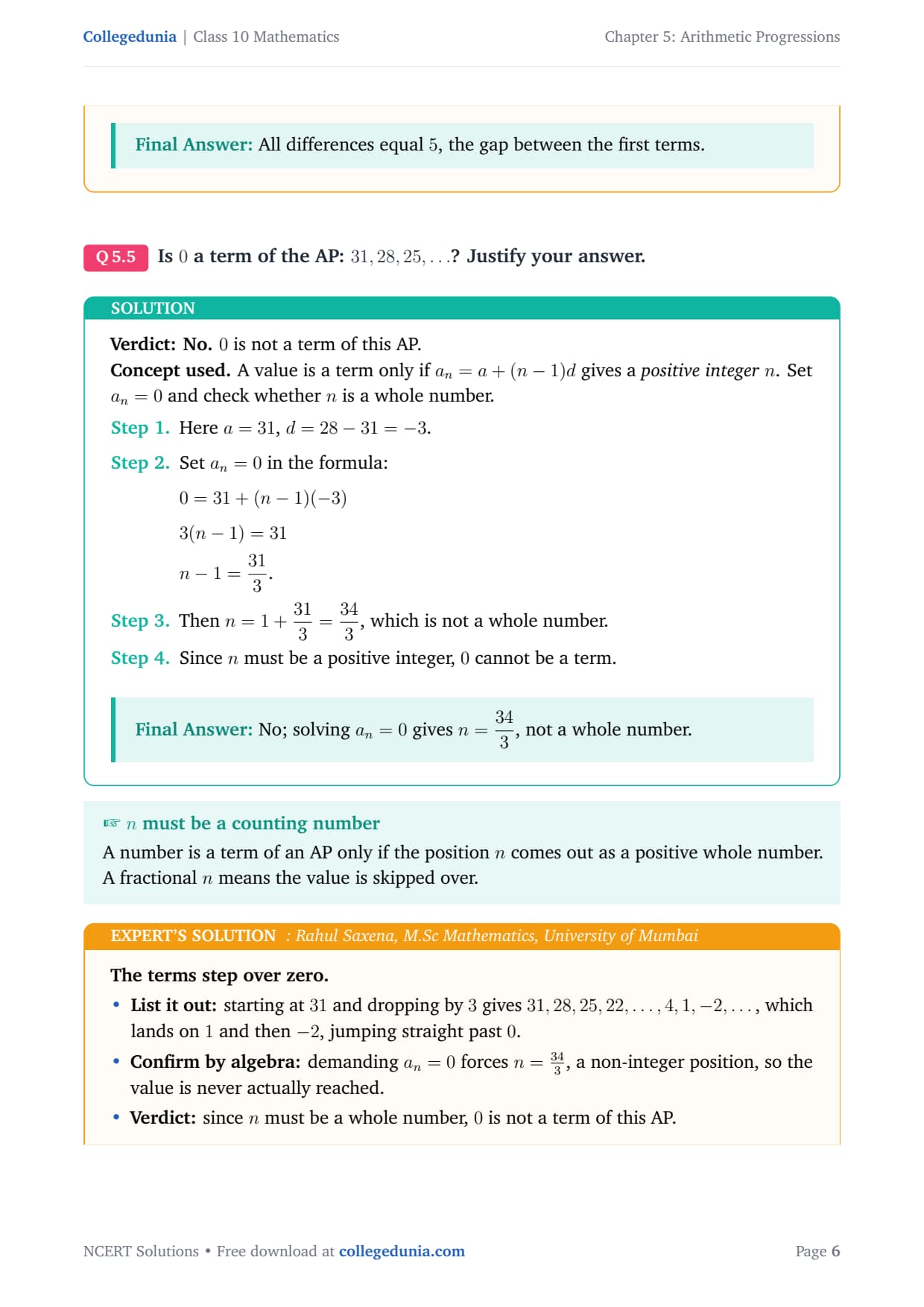
Q 5.5
Is 0 a term of the AP: 31,28,25,…? Justify your answer.
Verdict: No.0 is not a term of this AP.
Concept used. A value is a term only if an=a+(n-1)d gives a
positive integern. Set an=0 and check whether n is a whole
number.
Here a=31, d=28-31=-3.
Set an=0 in the formula:
[] 0=31+(n-1)(-3)
[] 3(n-1)=31
[] n-1=313.
Then n=1+313=343, which is not a whole
number.
Since n must be a positive integer, 0 cannot be a term.
No; solving an=0 gives n=343, not a whole
number.
RS
Rahul Saxena
M.Sc Mathematics, University of Mumbai
Verified Expert
The terms step over zero.
List it out: starting at 31 and dropping by 3 gives
31,28,25,22,,4,1,-2,, which lands on 1 and then
-2, jumping straight past 0.
Confirm by algebra: demanding an=0 forces
n=343, a non-integer position, so the value is never
actually reached.
Verdict: since n must be a whole number, 0 is not a
term of this AP.
No; the terms go ,4,1,-2,, skipping 0.
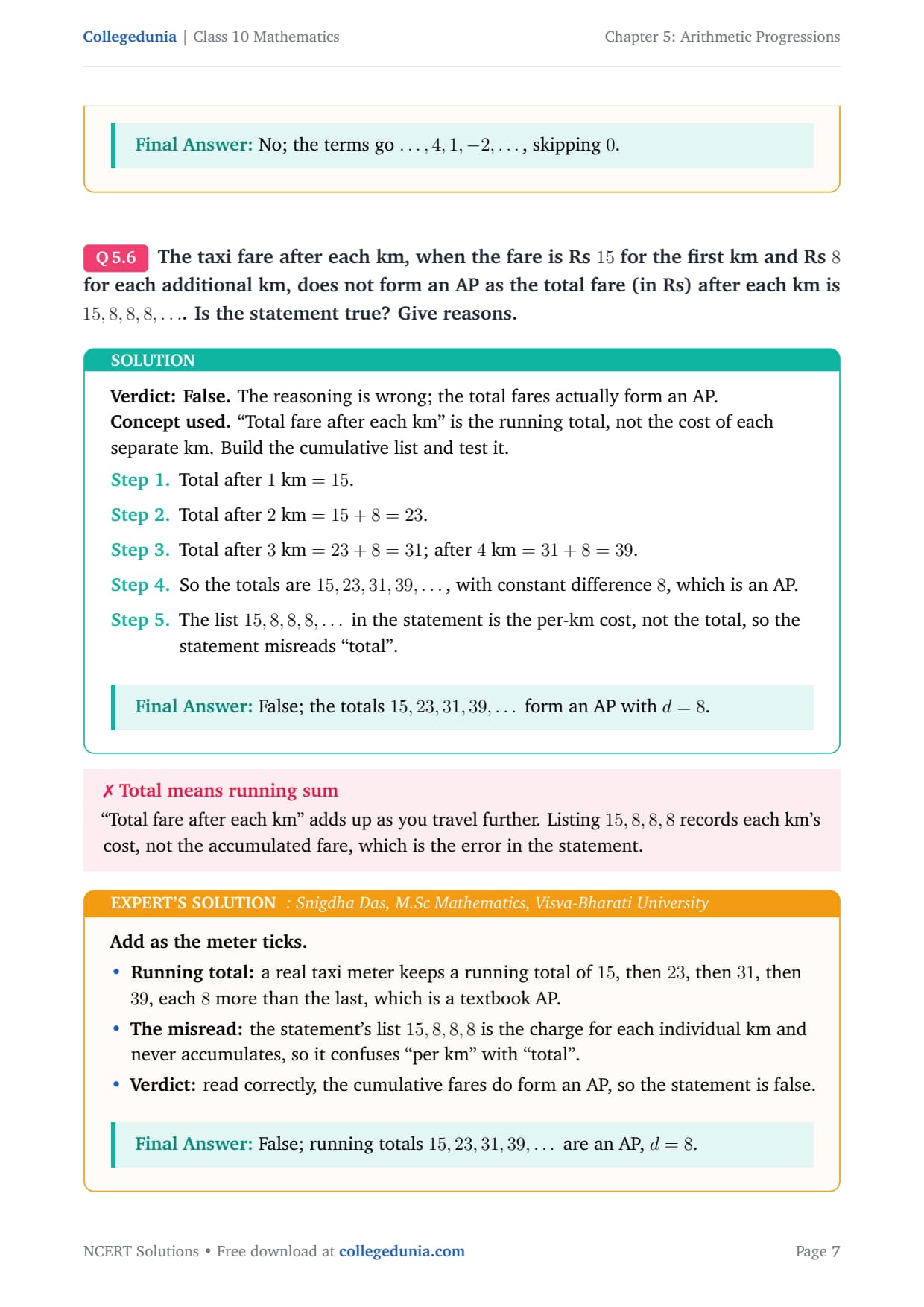
Q 5.6
The taxi fare after each km, when the fare is Rs 15 for the first km and Rs 8 for each additional km, does not form an AP as the total fare (in Rs) after each km is 15,8,8,8,…. Is the statement true? Give reasons.
Verdict: False. The reasoning is wrong; the total fares actually
form an AP.
Concept used. ``Total fare after each km'' is the running total,
not the cost of each separate km. Build the cumulative list and test it.
Total after 1 km =15.
Total after 2 km =15+8=23.
Total after 3 km =23+8=31; after 4 km =31+8=39.
So the totals are 15,23,31,39,, with constant difference
8, which is an AP.
The list 15,8,8,8, in the statement is the per-km cost, not
the total, so the statement misreads ``total''.
False; the totals 15,23,31,39, form an AP with d=8.
SD
Snigdha Das
M.Sc Mathematics, Visva-Bharati University
Verified Expert
Add as the meter ticks.
Running total: a real taxi meter keeps a running total of
15, then 23, then 31, then 39, each 8 more than the
last, which is a textbook AP.
The misread: the statement's list 15,8,8,8 is the
charge for each individual km and never accumulates, so it
confuses ``per km'' with ``total''.
Verdict: read correctly, the cumulative fares do form an
AP, so the statement is false.
False; running totals 15,23,31,39, are an AP, d=8.
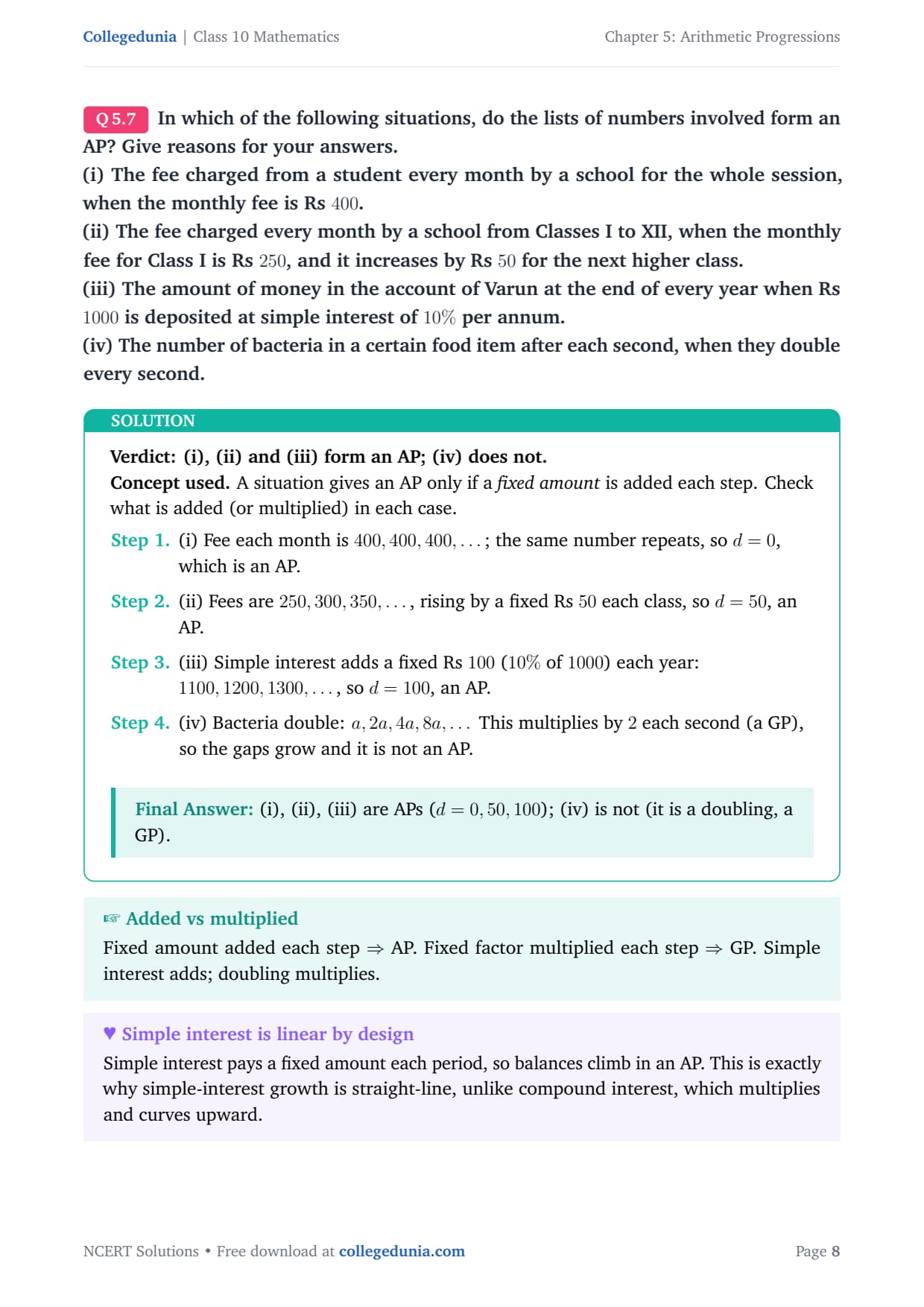
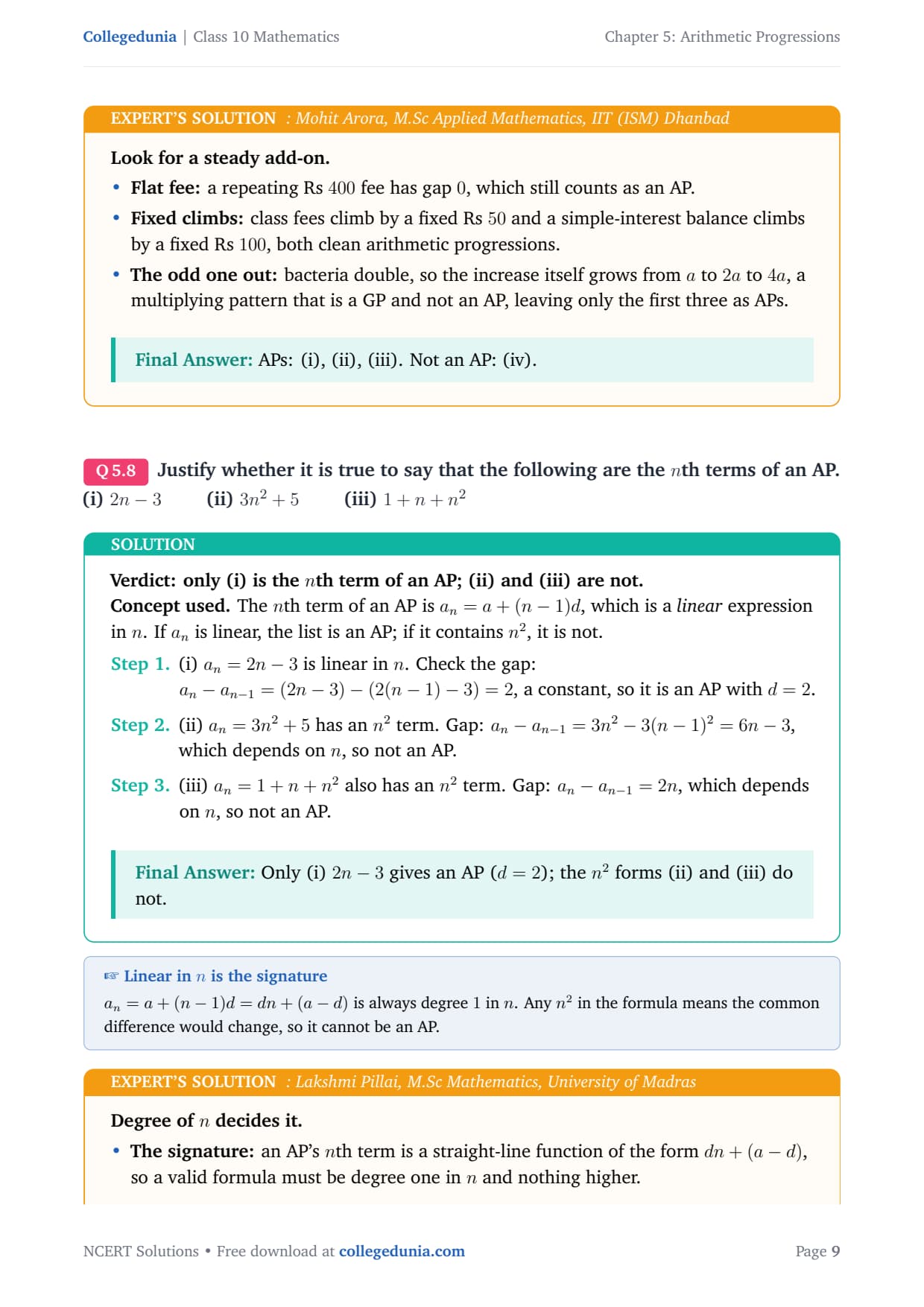
Q 5.7
In which of the following situations, do the lists of numbers involved form an AP? Give reasons for your answers.
(i) The fee charged from a student every month by a school for the whole session, when the monthly fee is Rs 400.
(ii) The fee charged every month by a school from Classes I to XII, when the monthly fee for Class I is Rs 250, and it increases by Rs 50 for the next higher class.
(iii) The amount of money in the account of Varun at the end of every year when Rs 1000 is deposited at simple interest of 10% per annum.
(iv) The number of bacteria in a certain food item after each second, when they double every second.
Verdict: (i), (ii) and (iii) form an AP; (iv) does not.
Concept used. A situation gives an AP only if a fixed
amount is added each step. Check what is added (or multiplied) in each
case.
(i) Fee each month is 400,400,400,; the same number
repeats, so d=0, which is an AP.
(ii) Fees are 250,300,350,, rising by a fixed Rs 50 each
class, so d=50, an AP.
(iii) Simple interest adds a fixed Rs 100 (10% of 1000)
each year: 1100,1200,1300,, so d=100, an AP.
(iv) Bacteria double: a,2a,4a,8a, This multiplies by 2
each second (a GP), so the gaps grow and it is not an AP.
(i), (ii), (iii) are APs (d=0,50,100); (iv) is not (it is a
doubling, a GP).
MA
Mohit Arora
M.Sc Applied Mathematics, IIT (ISM) Dhanbad
Verified Expert
Look for a steady add-on.
Flat fee: a repeating Rs 400 fee has gap 0, which
still counts as an AP.
Fixed climbs: class fees climb by a fixed Rs 50 and a
simple-interest balance climbs by a fixed Rs 100, both clean
arithmetic progressions.
The odd one out: bacteria double, so the increase itself
grows from a to 2a to 4a, a multiplying pattern that is a GP
and not an AP, leaving only the first three as APs.
APs: (i), (ii), (iii). Not an AP: (iv).
Q 5.8
Justify whether it is true to say that the following are the nth terms of an AP.
(i) 2n-3 (ii) 3n2+5 (iii) 1+n+n2
Verdict: only (i) is the nth term of an AP; (ii) and (iii) are
not.
Concept used. The nth term of an AP is an=a+(n-1)d, which is
a linear expression in n. If an is linear, the list is an AP;
if it contains n2, it is not.
(i) an=2n-3 is linear in n. Check the gap:
an-an-1=(2n-3)-(2(n-1)-3)=2, a constant, so it is an AP
with d=2.
(ii) an=3n2+5 has an n2 term. Gap:
an-an-1=3n2-3(n-1)2=6n-3, which depends on n, so not an
AP.
(iii) an=1+n+n2 also has an n2 term. Gap:
an-an-1=2n, which depends on n, so not an AP.
Only (i) 2n-3 gives an AP (d=2); the n2 forms (ii) and
(iii) do not.
LP
Lakshmi Pillai
M.Sc Mathematics, University of Madras
Verified Expert
Degree of n decides it.
The signature: an AP's nth term is a straight-line
function of the form dn+(a-d), so a valid formula must be degree
one in n and nothing higher.
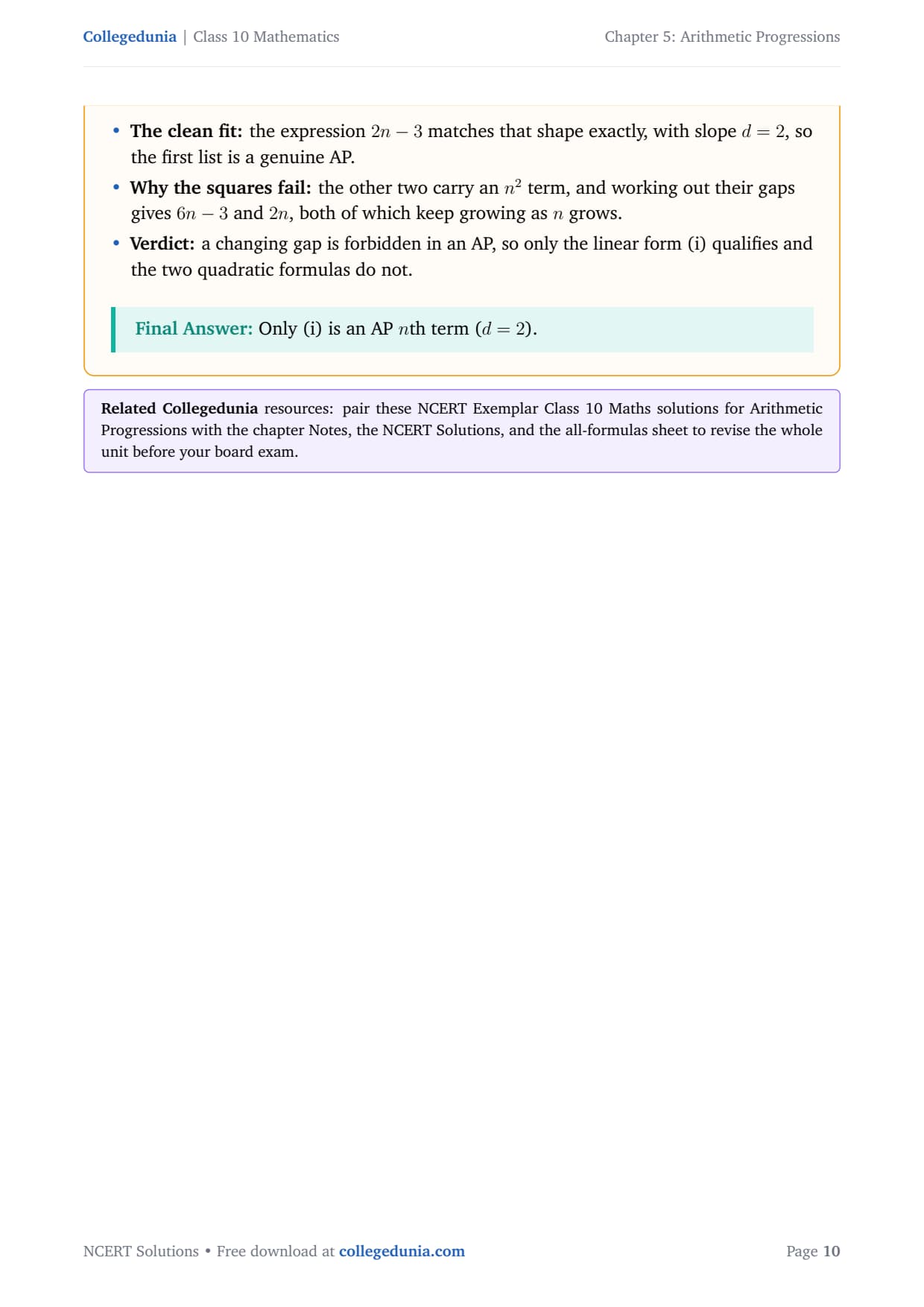
The clean fit: the expression 2n-3 matches that shape
exactly, with slope d=2, so the first list is a genuine AP.
Why the squares fail: the other two carry an n2 term,
and working out their gaps gives 6n-3 and 2n, both of which
keep growing as n grows.
Verdict: a changing gap is forbidden in an AP, so only
the linear form (i) qualifies and the two quadratic formulas do
not.
Only (i) is an AP nth term (d=2).
Other Arithmetic Progressions Exercises (Class 10 Maths)
Move across the rest of Chapter 5 with the linked exercises and resources below.
In a Collegedunia poll of 12,340 Class 10 Maths students before the 2026 boards, 68% found these reasoning questions harder than the Exercise 5.1 MCQs. The most-missed was Q20, where students stopped after just two equal gaps.
Source: 2026-27 Class 10 Mathematics student poll, 12,340 students from CBSE schools in 11 states.
Other Resources for This Chapter
Pair this with the other Class 10 Maths resources for Arithmetic Progressions, all linked below.
Arithmetic Progressions Class 10 Maths Exemplar Solutions Exercise 5.2 FAQs
Ques. What is covered in NCERT Exemplar Class 10 Maths Chapter 5 Exercise 5.2?
Ans. Exercise 5.2 of the NCERT Exemplar Class 10 Maths Chapter 5 Arithmetic Progressions has 8 Short Answer with Reasoning questions (Q19 to Q26). Topics covered include identifying APs from a list, true-or-false statements about the AP definition, finding the difference between non-consecutive terms directly, corresponding terms of two APs with the same common difference, testing whether a specific value is a term of an AP, real-life AP applications (taxi fare, fees, simple interest), and the form of the nth term formula. It is fully aligned with the 2026-27 NCERT syllabus.
Ques. Why is Q20 in Exercise 5.2 considered a trap question?
Ans. Q20 presents the list −1, −3/2, −2, 5/2, … and claims it forms an AP because the first two consecutive differences are equal. This is a trap because a genuine AP requires every consecutive difference to be equal, not just the first pair. The fourth term 5/2 breaks the pattern: a4−a3 = 9/2, which is completely different from −1/2. Students who stop after checking a2−a1 and a3−a2 will mark the statement as True and lose marks.
Ques. How do you find the difference between two terms of an AP without computing each term separately?
Ans. Use the term-gap formula: am−an = (m−n)d. The first term a cancels out because both terms carry it. For Q21, you only need the common difference d and the positions: a30−a20 = (30−20)×(−4) = −40. This saves time compared to computing two large terms separately.
Ques. What is the nth term of an Arithmetic Progression?
Ans. The nth term (also called the general term) of an AP is given by the formula an = a + (n−1)d, where a is the first term, d is the common difference, and n is the position of the term. This formula is a straight-line (linear) function of n. If the formula for the nth term contains n2 (a quadratic term), the list is not an AP (as tested in Q26 of Exercise 5.2).
Ques. What is an Arithmetic Progression and how is the common difference defined?
Ans. An Arithmetic Progression (AP) is a list of numbers in which each term after the first is obtained by adding a fixed number to the previous term. This fixed number is called the common difference, denoted d. Formally, d = ak+1−ak for every k. If d = 0, all terms are the same (still an AP). If d is positive, the sequence increases; if negative, it decreases. Class 10 Maths NCERT Exemplar Exercise 5.2 tests this definition in reasoning-based questions.







Comments