NCERT Exemplar Class 10 Maths Chapter 3 Exercise 3.3 is the Short Answer section for Pair of Linear Equations in Two Variables. Its 25 questions test the consistency conditions, the algebraic methods (substitution, elimination, cross-multiplication), reducible equations, and word problems on ages, fares, geometry and cyclic quadrilaterals. They build the reasoning you need for the 2026-27 CBSE board exam.
Exercise type: Short Answer Questions (25 questions, Q1 to Q25)
Key concepts tested: Ratio test for consistency, graphical method, substitution, elimination, equations reducible to linear form, age and geometry word problems
CBSE relevance: These question patterns are directly aligned with CBSE Class 10 board exams and the 2026-27 rationalised NCERT syllabus
Every solution below has a Concept used note, numbered steps, a boxed final answer, and an Expert View that shows the fastest approach.
These solutions are written by subject experts, mapped to the 2026-27 rationalised NCERT, and checked against the CBSE board pattern.
Solved by Collegedunia Every question in Exercise 3.3 is solved by Mathematics experts. Each solution has a "Concept used" section and an Expert View, so you get the reasoning, not just the answer.
Exercise 3.3 at a Glance · 25 Short Answer Questions, Chapter 3 Pair of Linear Equations, Class 10 Maths Exemplar 2026-27
Pair of Linear Equations Exercise 3.3 Overview & Key Formulas
Exercise 3.3 is the Short Answer section of the NCERT Exemplar Chapter 3 for Class 10 Maths. It has 25 questions. The question types and concepts are listed below.
Question Range
Topic Tested
Difficulty
Q1-Q4
Consistency conditions (ratio test for no solution / infinitely many / unique)
Medium
Q5-Q6
Parallel lines check; writing pairs with a given solution
Easy
Q7-Q8
Solving by elimination; rectangle geometry word problem
Easy
Q9-Q12
Equations with fractions and reciprocals (reducible to linear form)
Medium
Q13
Solve then evaluate a third relation involving lambda
Medium
Q14-Q15
Graphical consistency check; triangle area from two lines and y-axis
Medium
Q16-Q17
Lines through a given point; factor theorem combined with a pair of equations
Remember: The three-ratio test is the heart of this exercise. For a pair a₁x + b₁y + c₁ = 0 and a₂x + b₂y + c₂ = 0: unique solution when a₁/a₂ ≠ b₁/b₂; no solution when a₁/a₂ = b₁/b₂ ≠ c₁/c₂; infinitely many when a₁/a₂ = b₁/b₂ = c₁/c₂.
The key formulas and methods students need for Exercise 3.3 are listed below:
Method / Formula
When to Use
Ratio test (consistency)
Q1-Q5, Q14: deciding number of solutions without actually solving
Elimination method
Q7, Q8, Q9(ii), Q10(iii), Q11(v), Q13, Q14, Q18, Q22, Q25: integer coefficients, one variable cancels by adding/subtracting
Substitution method
Q3, Q6, Q8, Q13, Q17, Q19, Q20, Q21: one equation gives a clean expression
Reducible to linear form
Q9(i), Q10(iii)(iv), Q11(vi), Q12: replace reciprocals with new variables
Add-and-subtract trick
Q11(v): when coefficients are swapped between the two equations
Word-problem setup
Q18-Q25: translate the problem into two unknowns and two equations
Watch Out: In Q10(iv) and Q12, after solving for p = 1/x and q = 1/y, students must flip back to get x and y. Stopping at p and q and writing them as x and y is the most common error in reducible-form questions.
All Exercise 3.3 Questions with Step-by-Step Solutions
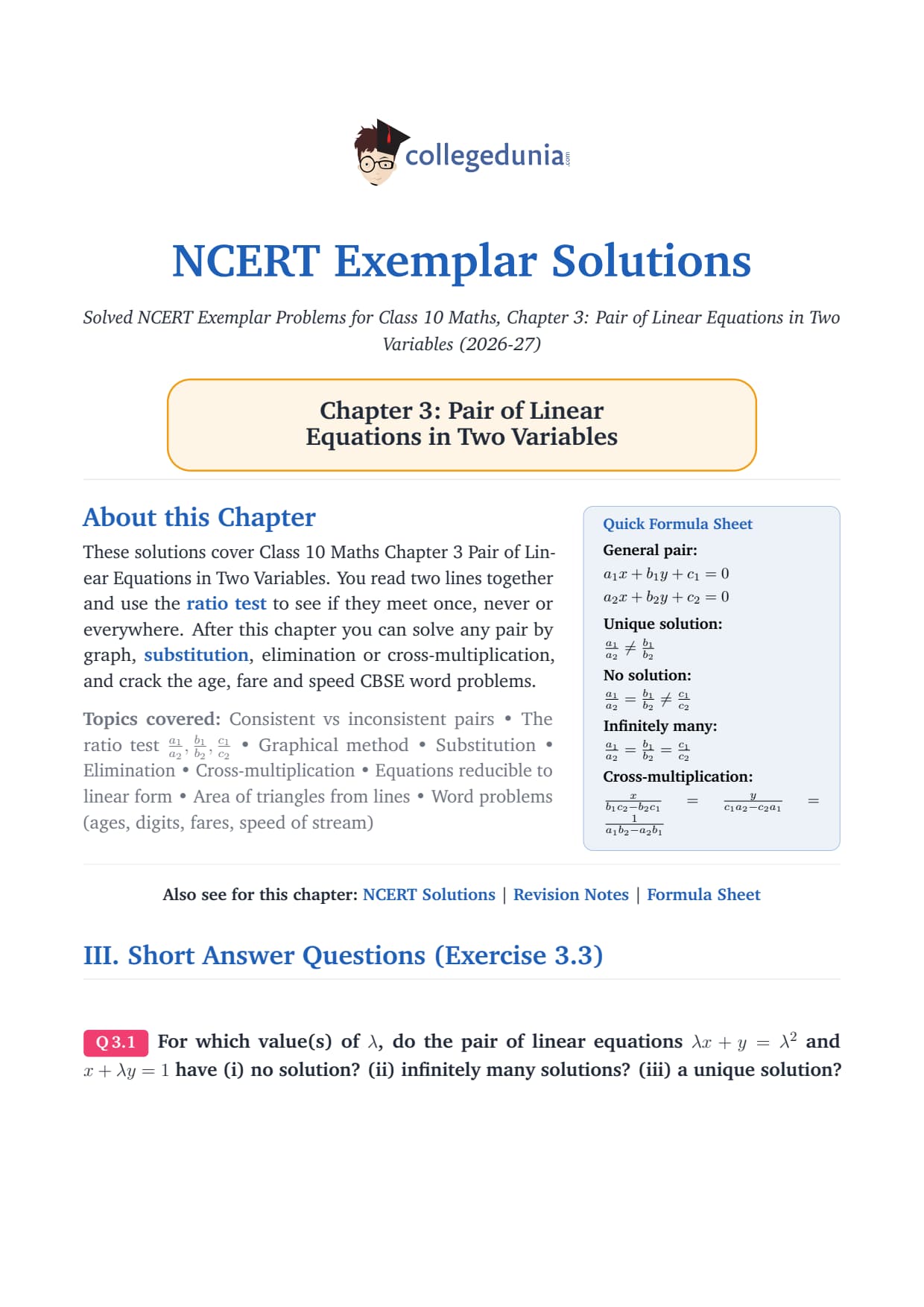
III. Short Answer Questions (Exercise 3.3)
Q 3.1
For which value(s) of λ, do the pair of linear equations
λ x+y=λ2 and x+λ y=1 have
(i) no solution? (ii) infinitely many solutions? (iii) a unique solution?
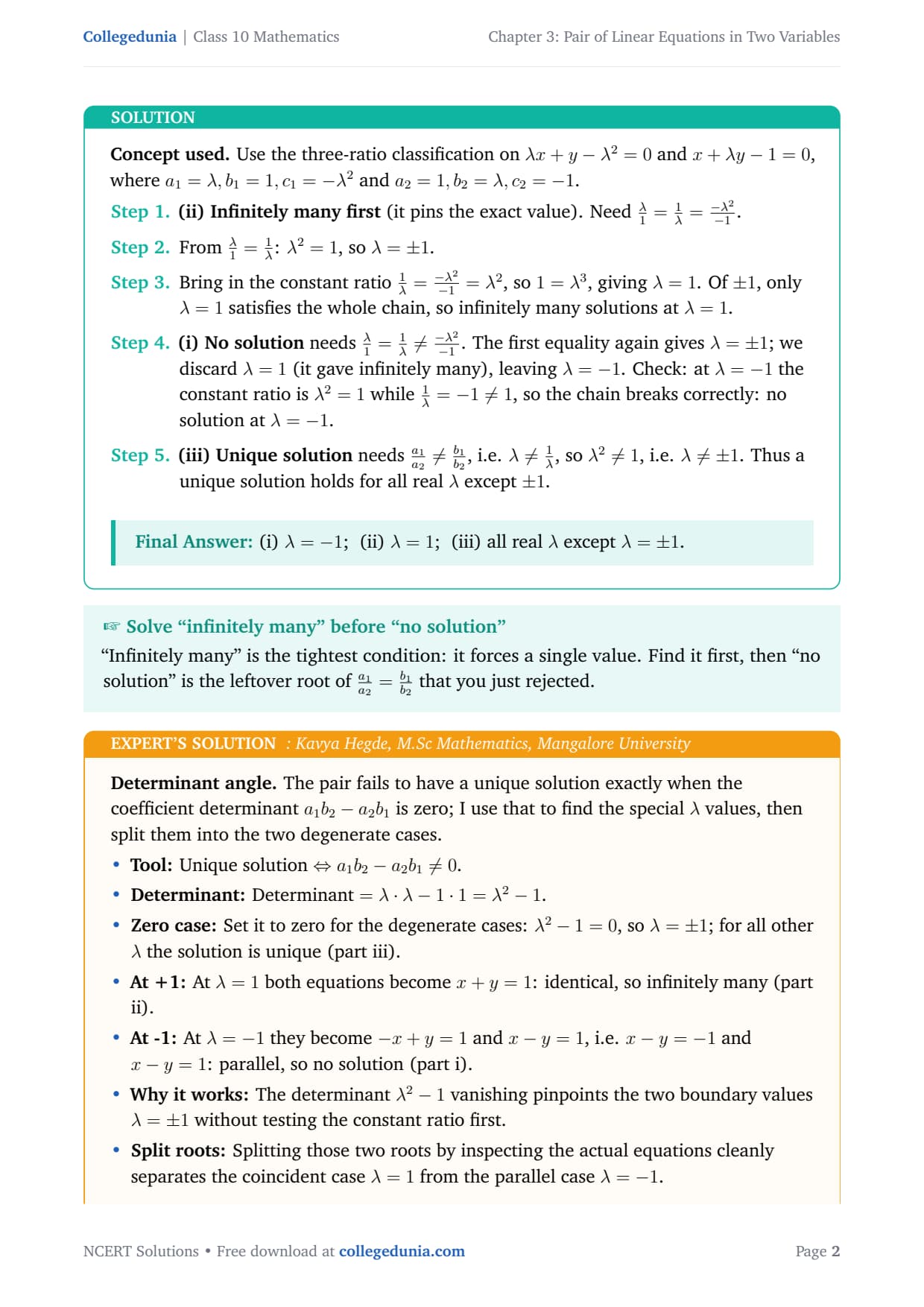
Concept used. Use the three-ratio classification on
λ x+y-λ2=0 and x+λ y-1=0, where a1=λ,
b1=1, c1=-λ2 and a2=1, b2=λ, c2=-1.
(ii) Infinitely many first (it pins the exact value).
Need λ1=1λ=-λ2-1.
From λ1=1λ: λ2=1, so
λ=± 1.
Bring in the constant ratio 1λ=-λ2-1=λ2,
so 1=λ3, giving λ=1. Of ± 1, only λ=1
satisfies the whole chain, so infinitely many solutions at
λ=1.
(i) No solution needs
λ1=1λ≠-λ2-1.
The first equality again gives λ=1; we discard
λ=1 (it gave infinitely many), leaving λ=-1. Check:
at λ=-1 the constant ratio is λ2=1 while
1λ=-1≠ 1, so the chain breaks correctly: no
solution at λ=-1.
(iii) Unique solution needs
a1a2≠b1b2, i.e. λ≠1λ,
so λ2≠ 1, i.e. λ≠± 1. Thus a unique solution
holds for all real λ except ± 1.
(i) λ=-1; (ii) λ=1; (iii) all real λ
except λ=± 1.
KH
Kavya Hegde
M.Sc Mathematics, Mangalore University
Verified Expert
Determinant angle. The pair fails to have a unique solution
exactly when the coefficient determinant a1b2-a2b1 is zero; I use that
to find the special λ values, then split them into the two
degenerate cases.
Tool: Unique solution ⇔a1b2-a2b1≠ 0.
Determinant: Determinant =λλ-1· 1=λ2-1.
Zero case: Set it to zero for the degenerate cases: λ2-1=0, so λ=1; for all other λ the solution is unique (part iii).
At +1: At λ=1 both equations become x+y=1: identical, so infinitely many (part ii).
At -1: At λ=-1 they become -x+y=1 and x-y=1, i.e. x-y=-1 and x-y=1: parallel, so no solution (part i).
Why it works: The determinant λ2-1 vanishing pinpoints the two boundary values λ=1 without testing the constant ratio first.
Split roots: Splitting those two roots by inspecting the actual equations cleanly separates the coincident case λ=1 from the parallel case λ=-1.
(i) λ=-1; (ii) λ=1; (iii) λ≠1.
Q 3.2
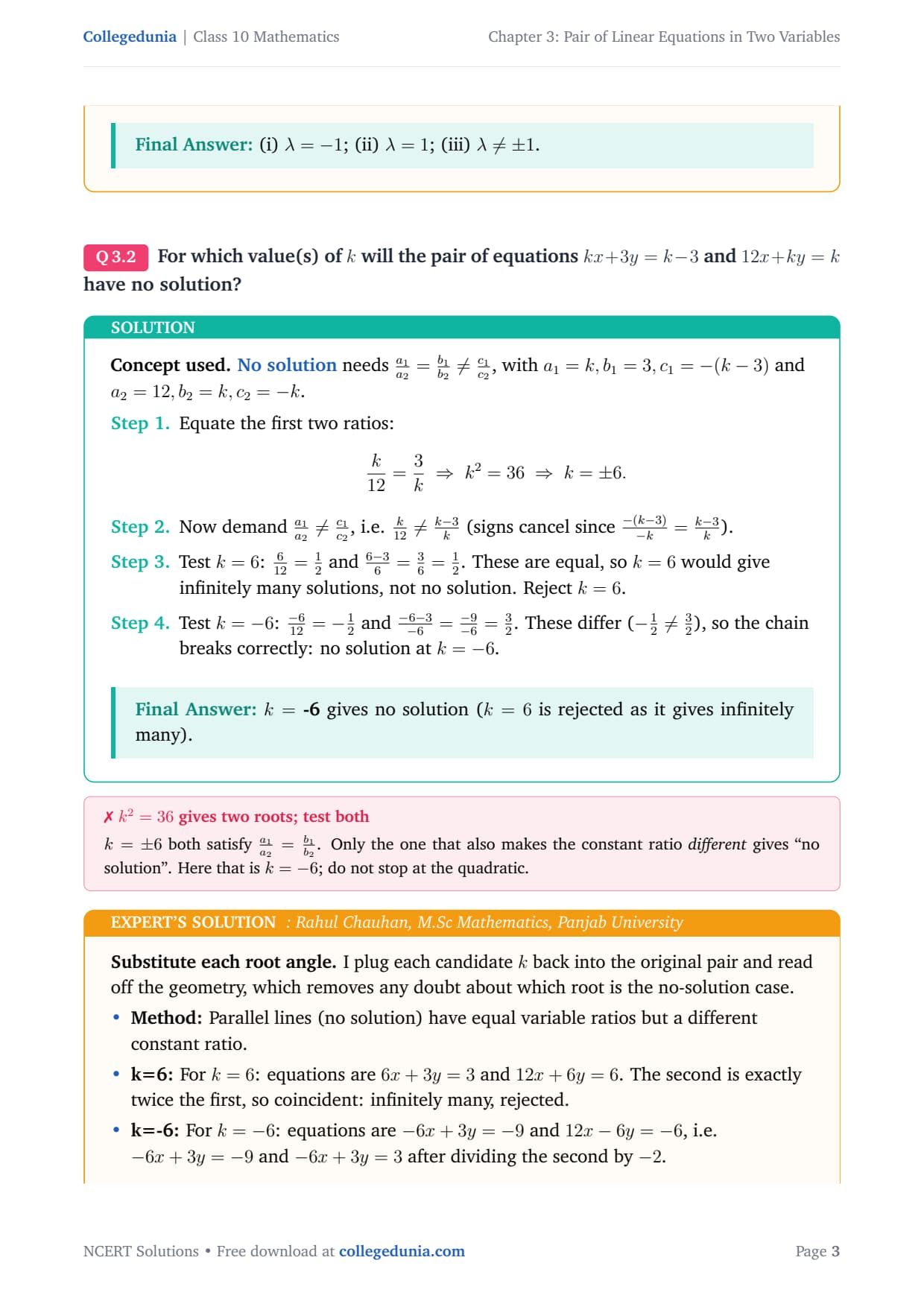
For which value(s) of k will the pair of equations kx+3y=k-3 and 12x+ky=k have no solution?
Concept used.No solution needs
a1a2=b1b2≠c1c2, with
a1=k, b1=3, c1=-(k-3) and a2=12, b2=k, c2=-k.
Equate the first two ratios:
k12=3k ⇒ k2=36 ⇒ k=± 6.
Now demand a1a2≠c1c2, i.e.
k12≠k-3k (signs cancel since
-(k-3)-k=k-3k).
Test k=6: 612=12 and 6-36=36=12.
These are equal, so k=6 would give infinitely many solutions, not
no solution. Reject k=6.
Test k=-6: -612=-12 and
-6-3-6=-9-6=32. These differ
(-12≠32), so the chain breaks correctly: no solution
at k=-6.
k=-6 gives no solution (k=6 is rejected as it gives
infinitely many).
RC
Rahul Chauhan
M.Sc Mathematics, Panjab University
Verified Expert
Substitute each root angle. I plug each candidate k back into the
original pair and read off the geometry, which removes any doubt about which
root is the no-solution case.
Method: Parallel lines (no solution) have equal variable ratios but a different constant ratio.
k=6: For k=6: equations are 6x+3y=3 and 12x+6y=6. The second is exactly twice the first, so coincident: infinitely many, rejected.
k=-6: For k=-6: equations are -6x+3y=-9 and 12x-6y=-6, i.e. -6x+3y=-9 and -6x+3y=3 after dividing the second by -2.
Same side: Same left side -6x+3y but right sides -9 and 3 differ, so the lines are parallel.
No solution: Parallel means no solution, confirming k=-6.
k=-6.
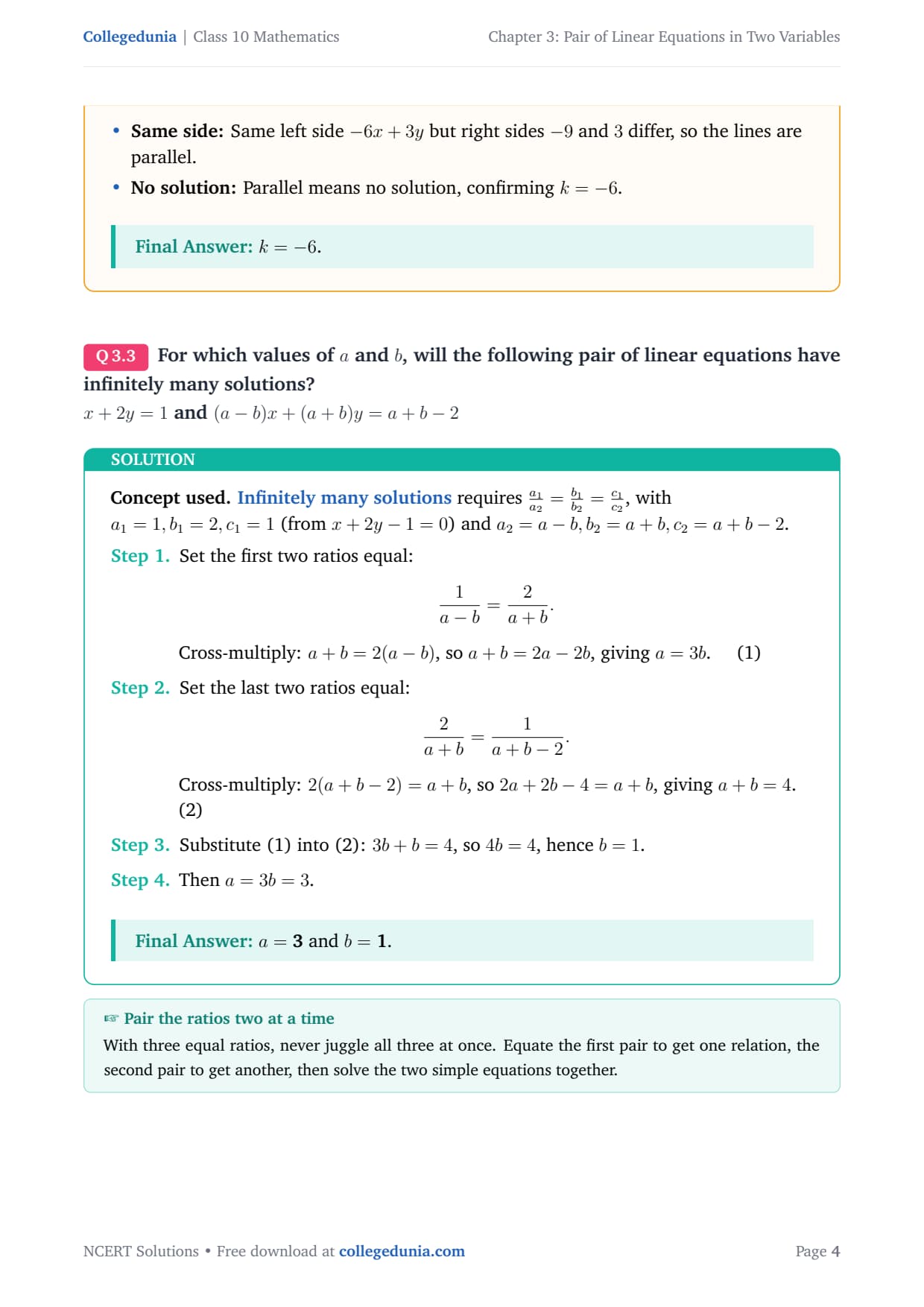
Q 3.3
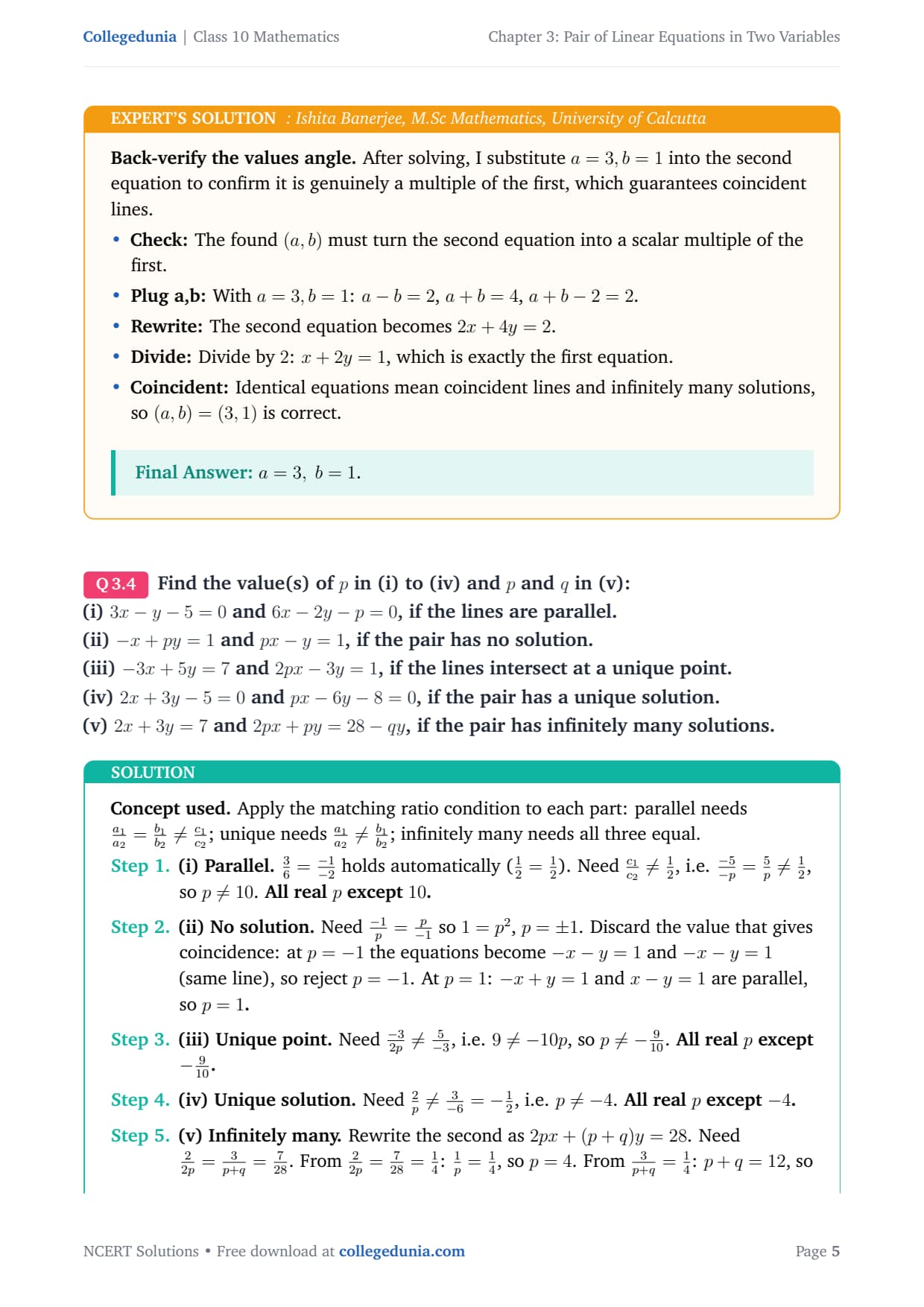
For which values of a and b, will the following pair of linear equations have infinitely many solutions? x+2y=1 and (a-b)x+(a+b)y=a+b-2
Concept used.Infinitely many solutions requires
a1a2=b1b2=c1c2, with a1=1, b1=2,
c1=1 (from x+2y-1=0) and a2=a-b, b2=a+b, c2=a+b-2.
Set the first two ratios equal:
1a-b=2a+b.
Cross-multiply: a+b=2(a-b), so a+b=2a-2b, giving a=3b. (1)
Set the last two ratios equal:
2a+b=1a+b-2.
Cross-multiply: 2(a+b-2)=a+b, so 2a+2b-4=a+b, giving
a+b=4. (2)
Substitute (1) into (2): 3b+b=4, so 4b=4, hence b=1.
Then a=3b=3.
a=3 and b=1.
IB
Ishita Banerjee
M.Sc Mathematics, University of Calcutta
Verified Expert
Back-verify the values angle. After solving, I substitute a=3,
b=1 into the second equation to confirm it is genuinely a multiple of the
first, which guarantees coincident lines.
Check: The found (a,b) must turn the second equation into a scalar multiple of the first.
Plug a,b: With a=3, b=1: a-b=2, a+b=4, a+b-2=2.
Rewrite: The second equation becomes 2x+4y=2.
Divide: Divide by 2: x+2y=1, which is exactly the first equation.
Coincident: Identical equations mean coincident lines and infinitely many solutions, so (a,b)=(3,1) is correct.
a=3, b=1.
Q 3.4
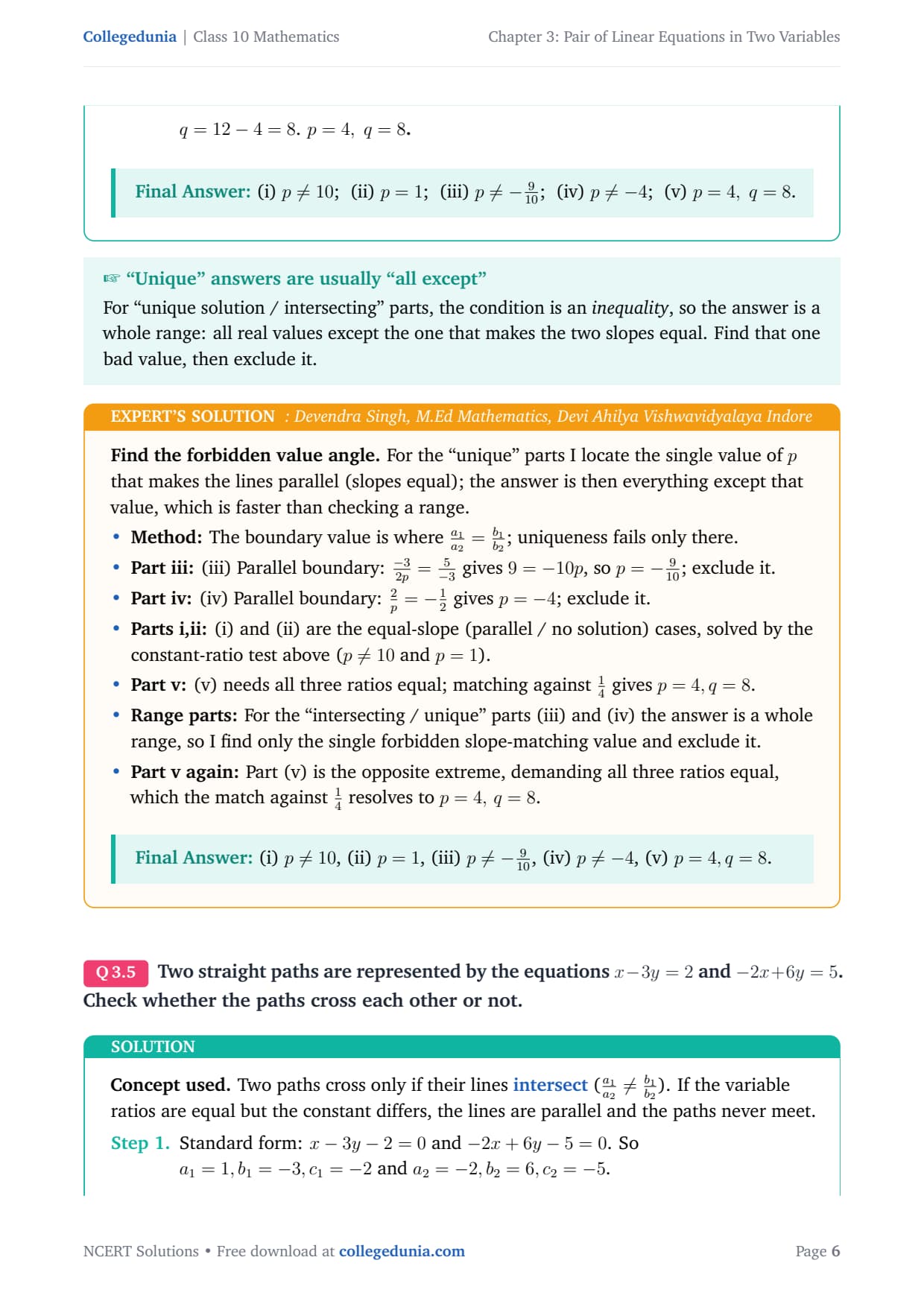
Find the value(s) of p in (i) to (iv) and p and q in (v):
(i) 3x-y-5=0 and 6x-2y-p=0, if the lines are parallel.
(ii) -x+py=1 and px-y=1, if the pair has no solution.
(iii) -3x+5y=7 and 2px-3y=1, if the lines intersect at a unique point.
(iv) 2x+3y-5=0 and px-6y-8=0, if the pair has a unique solution.
(v) 2x+3y=7 and 2px+py=28-qy, if the pair has infinitely many solutions.
Concept used. Apply the matching ratio condition to each part:
parallel needs a1a2=b1b2≠c1c2;
unique needs a1a2≠b1b2; infinitely many needs
all three equal.
(i) Parallel.36=-1-2 holds
automatically (12=12). Need
c1c2≠12, i.e. -5-p=5p≠12,
so p≠ 10. All real p except 10.
(ii) No solution. Need -1p=p-1 so
1=p2, p=1. Discard the value that gives coincidence: at
p=-1 the equations become -x-y=1 and -x-y=1 (same line), so
reject p=-1. At p=1: -x+y=1 and x-y=1 are parallel, so
p=1.
(iii) Unique point. Need
-32p≠5-3, i.e. 9≠ -10p, so
p≠ -910. All real p except -910.
(iv) Unique solution. Need 2p≠3-6=-12,
i.e. p≠ -4. All real p except -4.
(v) Infinitely many. Rewrite the second as
2px+(p+q)y=28. Need
22p=3p+q=728.
From 22p=728=14: 1p=14, so
p=4. From 3p+q=14: p+q=12, so q=12-4=8.
p=4, q=8.
Find the forbidden value angle. For the ``unique'' parts I locate
the single value of p that makes the lines parallel (slopes equal); the
answer is then everything except that value, which is faster than checking a
range.
Method: The boundary value is where a1a2=b1b2; uniqueness fails only there.
Part iii: (iii) Parallel boundary: -32p=5-3 gives 9=-10p, so p=-910; exclude it.
Part iv: (iv) Parallel boundary: 2p=-12 gives p=-4; exclude it.
Parts i,ii: (i) and (ii) are the equal-slope (parallel / no solution) cases, solved by the constant-ratio test above (p10 and p=1).
Part v: (v) needs all three ratios equal; matching against 14 gives p=4, q=8.
Range parts: For the ``intersecting / unique'' parts (iii) and (iv) the answer is a whole range, so I find only the single forbidden slope-matching value and exclude it.
Part v again: Part (v) is the opposite extreme, demanding all three ratios equal, which the match against 14 resolves to p=4, q=8.
(i) p10, (ii) p=1, (iii) p≠-910, (iv) p≠-4,
(v) p=4,q=8.
Q 3.5
Two straight paths are represented by the equations x-3y=2 and -2x+6y=5. Check whether the paths cross each other or not.
Concept used. Two paths cross only if their lines intersect
(a1a2≠b1b2). If the variable ratios are equal but
the constant differs, the lines are parallel and the paths never meet.
Standard form: x-3y-2=0 and -2x+6y-5=0. So a1=1, b1=-3,
c1=-2 and a2=-2, b2=6, c2=-5.
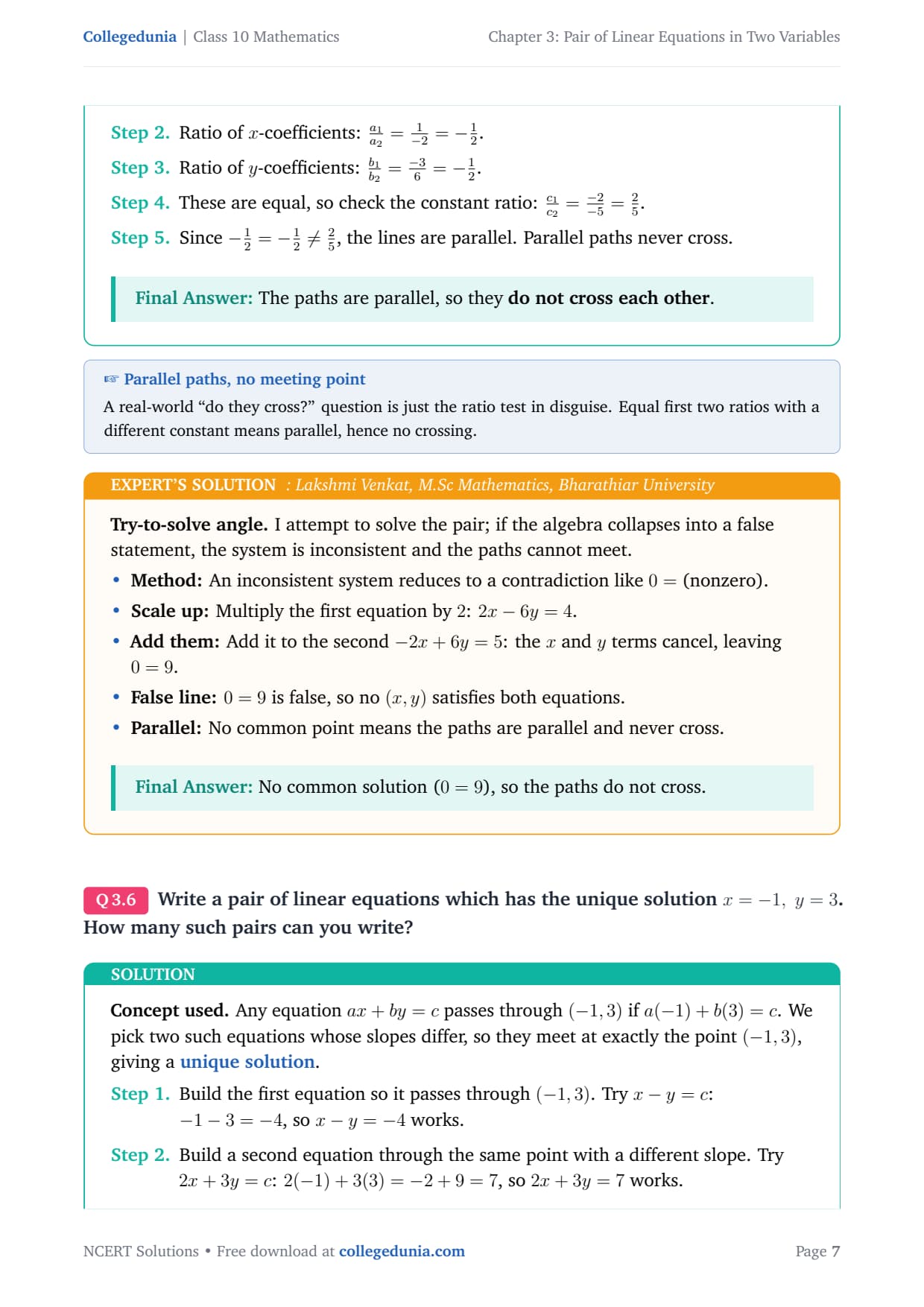
Ratio of x-coefficients:
a1a2=1-2=-12.
Ratio of y-coefficients:
b1b2=-36=-12.
These are equal, so check the constant ratio:
c1c2=-2-5=25.
Since -12=-12≠25, the lines are parallel.
Parallel paths never cross.
The paths are parallel, so they do not cross each other.
LV
Lakshmi Venkat
M.Sc Mathematics, Bharathiar University
Verified Expert
Try-to-solve angle. I attempt to solve the pair; if the algebra
collapses into a false statement, the system is inconsistent and the paths
cannot meet.
Method: An inconsistent system reduces to a contradiction like 0= (nonzero).
Scale up: Multiply the first equation by 2: 2x-6y=4.
Add them: Add it to the second -2x+6y=5: the x and y terms cancel, leaving 0=9.
False line:0=9 is false, so no (x,y) satisfies both equations.
Parallel: No common point means the paths are parallel and never cross.
No common solution (0=9), so the paths do not cross.
Q 3.6
Write a pair of linear equations which has the unique solution x=-1, y=3. How many such pairs can you write?
Concept used. Any equation ax+by=c passes through (-1,3) if
a(-1)+b(3)=c. We pick two such equations whose slopes differ, so they meet
at exactly the point (-1,3), giving a unique solution.
Build the first equation so it passes through (-1,3). Try
x-y=c: -1-3=-4, so x-y=-4 works.
Build a second equation through the same point with a different
slope. Try 2x+3y=c: 2(-1)+3(3)=-2+9=7, so 2x+3y=7 works.
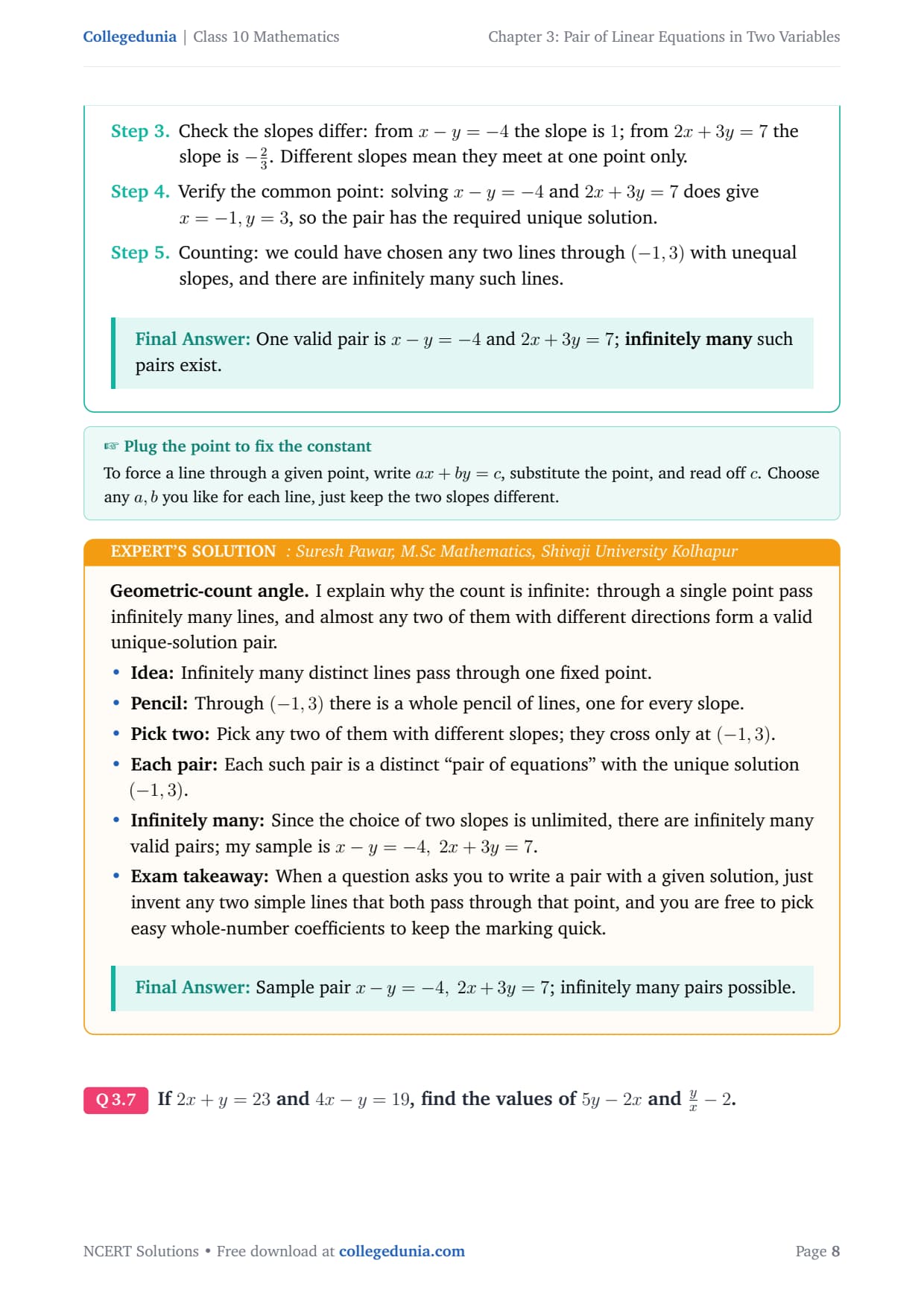
Check the slopes differ: from x-y=-4 the slope is 1; from
2x+3y=7 the slope is -23. Different slopes mean they meet
at one point only.
Verify the common point: solving x-y=-4 and 2x+3y=7 does give
x=-1, y=3, so the pair has the required unique solution.
Counting: we could have chosen any two lines through (-1,3) with
unequal slopes, and there are infinitely many such lines.
One valid pair is x-y=-4 and 2x+3y=7; infinitely many
such pairs exist.
SP
Suresh Pawar
M.Sc Mathematics, Shivaji University Kolhapur
Verified Expert
Geometric-count angle. I explain why the count is infinite: through
a single point pass infinitely many lines, and almost any two of them with
different directions form a valid unique-solution pair.
Idea: Infinitely many distinct lines pass through one fixed point.
Pencil: Through (-1,3) there is a whole pencil of lines, one for every slope.
Pick two: Pick any two of them with different slopes; they cross only at (-1,3).
Each pair: Each such pair is a distinct ``pair of equations'' with the unique solution (-1,3).
Infinitely many: Since the choice of two slopes is unlimited, there are infinitely many valid pairs; my sample is x-y=-4, 2x+3y=7.
Exam takeaway: When a question asks you to write a pair with a given solution, just invent any two simple lines that both pass through that point, and you are free to pick easy whole-number coefficients to keep the marking quick.
Sample pair x-y=-4, 2x+3y=7; infinitely many pairs possible.
Q 3.7
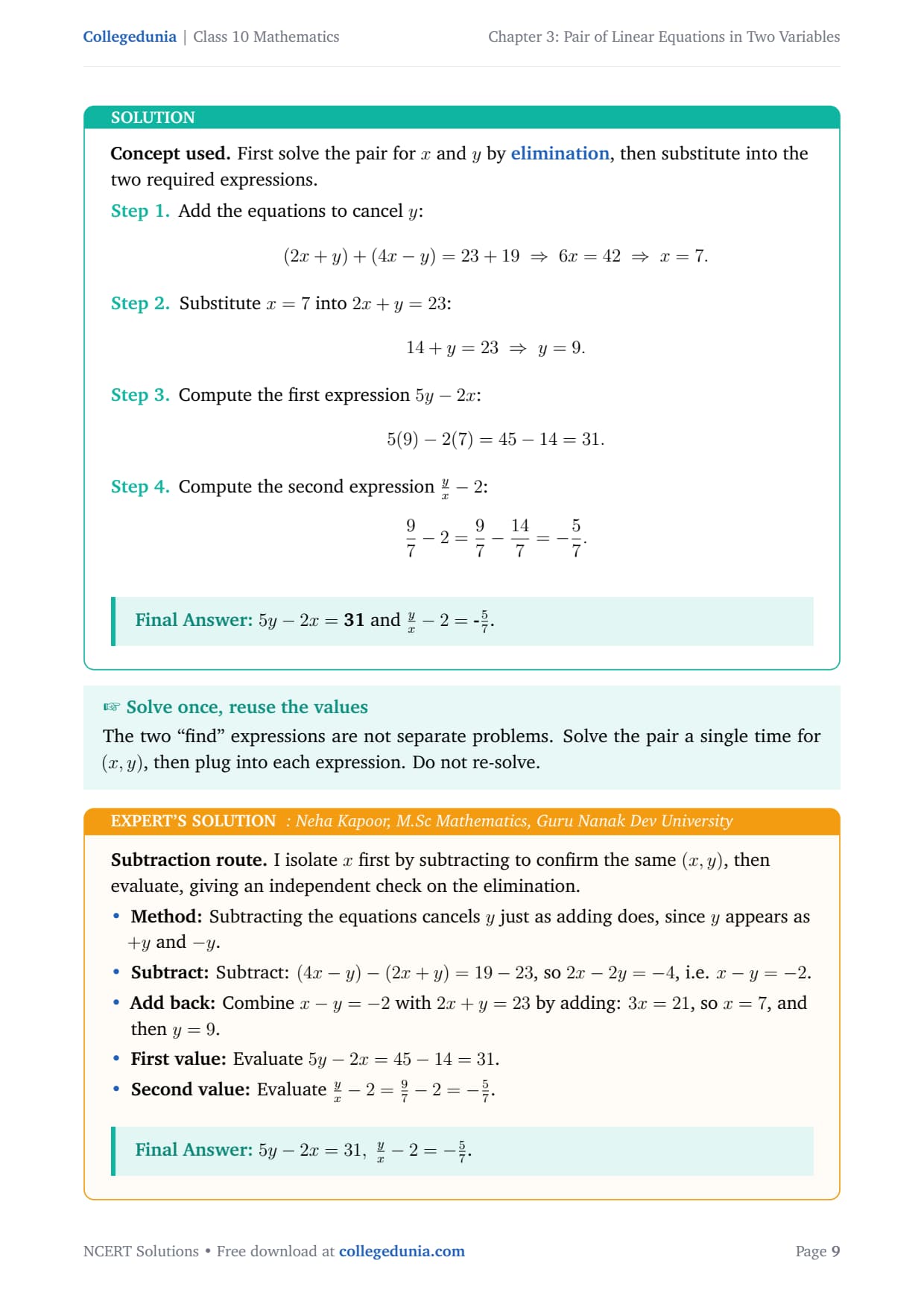
If 2x+y=23 and 4x-y=19, find the values of 5y-2x and yx-2.
Concept used. First solve the pair for x and y by
elimination, then substitute into the two required expressions.
Add the equations to cancel y:
(2x+y)+(4x-y)=23+19 ⇒ 6x=42 ⇒ x=7.
Substitute x=7 into 2x+y=23:
14+y=23 ⇒ y=9.
Compute the first expression 5y-2x:
5(9)-2(7)=45-14=31.
Compute the second expression yx-2:
97-2=97-147=-57.
5y-2x=31 and yx-2=-57.
NK
Neha Kapoor
M.Sc Mathematics, Guru Nanak Dev University
Verified Expert
Subtraction route. I isolate x first by subtracting to confirm
the same (x,y), then evaluate, giving an independent check on the elimination.
Method: Subtracting the equations cancels y just as adding does, since y appears as +y and -y.
Subtract: Subtract: (4x-y)-(2x+y)=19-23, so 2x-2y=-4, i.e. x-y=-2.
Add back: Combine x-y=-2 with 2x+y=23 by adding: 3x=21, so x=7, and then y=9.
First value: Evaluate 5y-2x=45-14=31.
Second value: Evaluate yx-2=97-2=-57.
5y-2x=31, yx-2=-57.
Q 3.8
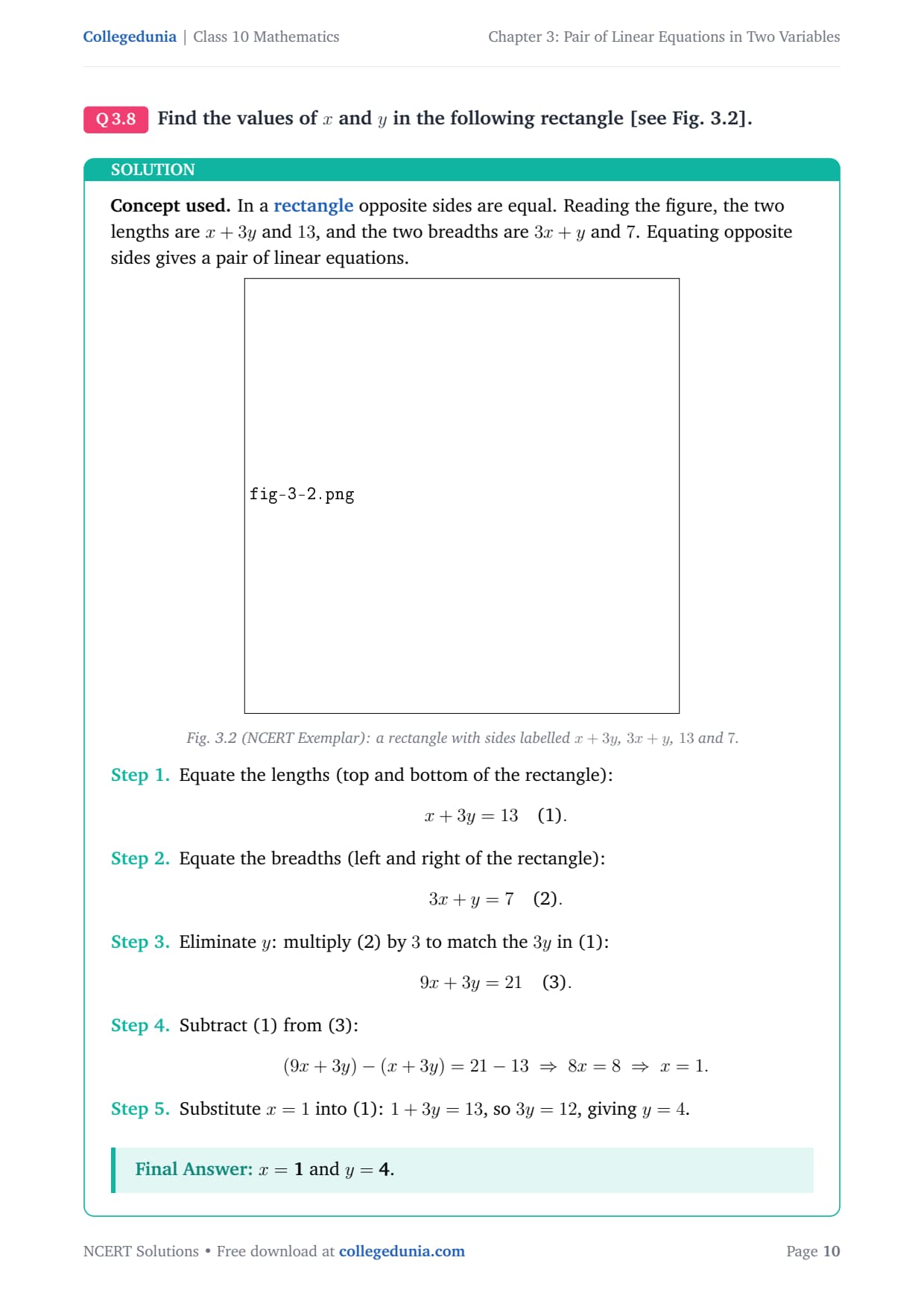
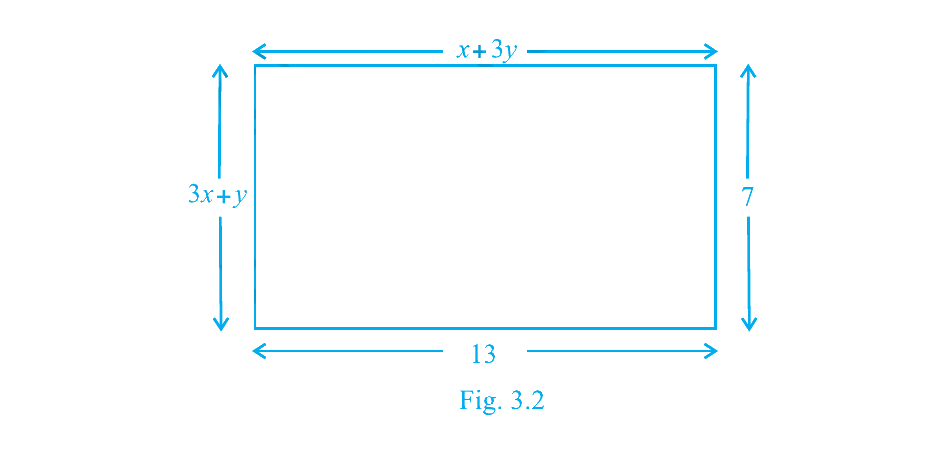
Find the values of x and y in the following rectangle [see Fig. 3.2].
Fig. 3.2 (NCERT Exemplar): a rectangle with
sides labelled x+3y, 3x+y, 13 and 7.
Concept used. In a rectangle opposite sides are equal.
Reading the figure, the two lengths are x+3y and 13, and the two breadths
are 3x+y and 7. Equating opposite sides gives a pair of linear equations.
Equate the lengths (top and bottom of the rectangle):
x+3y=13 (1).
Equate the breadths (left and right of the rectangle):
3x+y=7 (2).
Eliminate y: multiply (2) by 3 to match the 3y in (1):
9x+3y=21 (3).
Subtract (1) from (3):
(9x+3y)-(x+3y)=21-13 ⇒ 8x=8 ⇒ x=1.
Substitute x=1 into (1): 1+3y=13, so 3y=12, giving y=4.
x=1 and y=4.
AJ
Abhishek Jain
M.Sc Mathematics, University of Allahabad
Verified Expert
Substitution route. I solve equation (2) for y and substitute into
(1), which avoids scaling and keeps the arithmetic small.
Method: Substitution replaces one variable using the simpler equation.
Express y: From (2) 3x+y=7, express y=7-3x.
Substitute: Substitute into (1) x+3y=13: x+3(7-3x)=13.
Expand: Expand: x+21-9x=13, so -8x=-8, giving x=1.
Get y: Then y=7-3(1)=4.
No fractions: Substituting y=7-3x keeps every coefficient an integer, so there is no fraction handling at any stage of this rectangle problem.
One equation: The single equation -8x=-8 that results gives x=1 at once, and back-substitution then fixes y=4, matching the elimination route.
x=1, y=4.
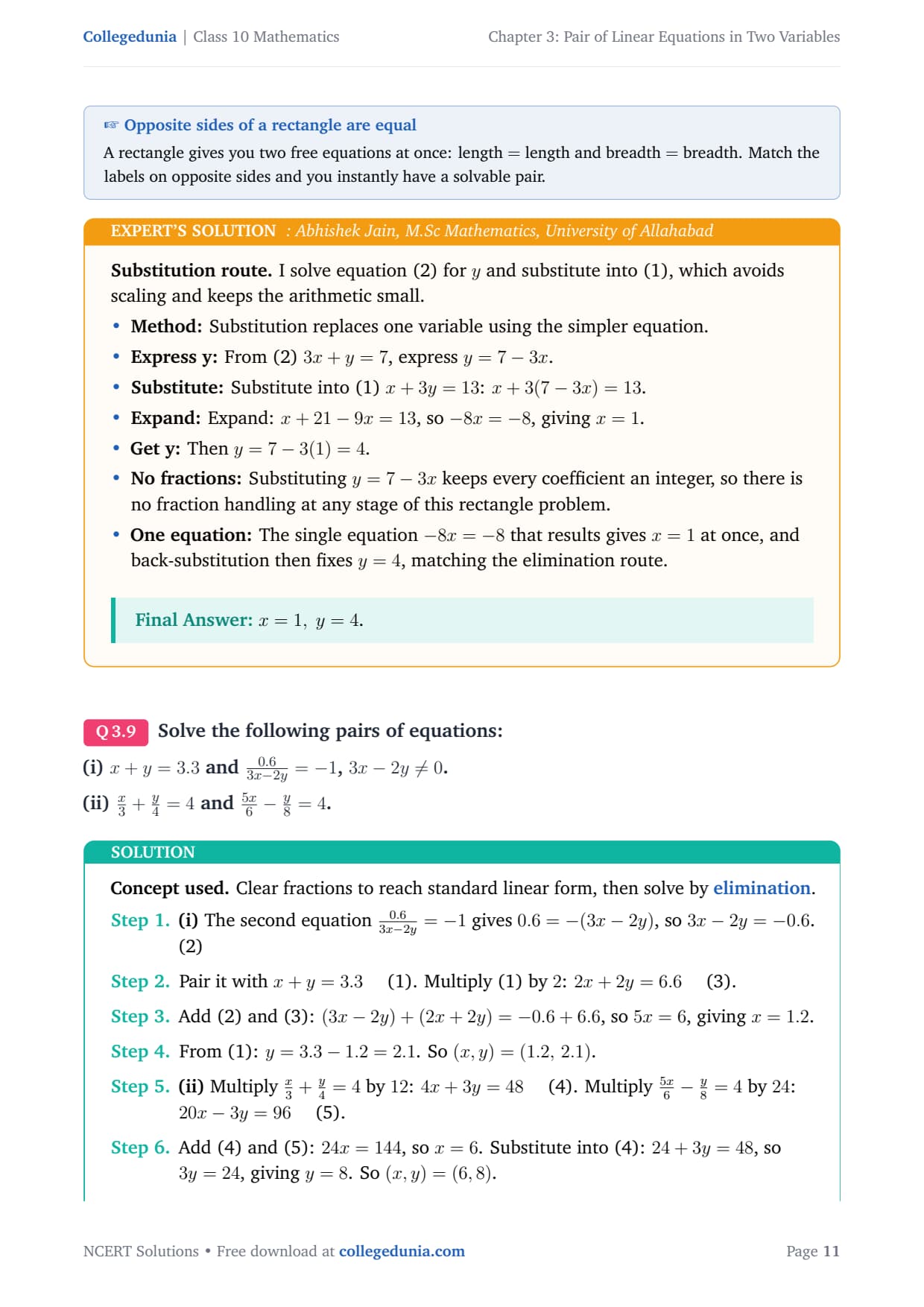
Q 3.9
Solve the following pairs of equations: [5pt]
(i) x+y=3.3 and 0.63x-2y=-1, 3x-2y≠ 0. [5pt]
(ii) x3+y4=4 and 5x6-y8=4.
Concept used. Clear fractions to reach standard linear form, then
solve by elimination.
(i) The second equation 0.63x-2y=-1 gives
0.6=-(3x-2y), so 3x-2y=-0.6. (2)
Pair it with x+y=3.3 (1). Multiply (1) by 2:
2x+2y=6.6 (3).
Add (2) and (3): (3x-2y)+(2x+2y)=-0.6+6.6, so 5x=6, giving
x=1.2.
From (1): y=3.3-1.2=2.1. So (x,y)=(1.2, 2.1).
(ii) Multiply x3+y4=4 by 12:
4x+3y=48 (4). Multiply 5x6-y8=4 by 24:
20x-3y=96 (5).
Add (4) and (5): 24x=144, so x=6. Substitute into (4):
24+3y=48, so 3y=24, giving y=8. So (x,y)=(6,8).
(i) x=1.2, y=2.1; (ii) x=6, y=8.
SM
Sanjana Mukherjee
M.Sc Mathematics, Visva-Bharati University
Verified Expert
Cross-check by back-substitution. I verify each solution in the
original (fractional) equations, since clearing denominators is where
sign and LCM slips usually happen.
Check: A correct solution satisfies the original equations, not just the cleared ones.
Part i: (i) Check x+y=1.2+2.1=3.3 , and 3x-2y=3.6-4.2=-0.6, so 0.6-0.6=-1 .
Part ii: (ii) Check 63+84=2+2=4 .
More of ii: And 566-88=5-1=4 .
Confirm: Both solutions satisfy the originals, confirming the answers.
Why this matters: Students lose marks here by checking the simplified equation they wrote, not the printed one, so a hidden arithmetic slip while clearing fractions slips through unnoticed until the final answer is already wrong.
(i) x=1.2, y=2.1; (ii) x=6, y=8.
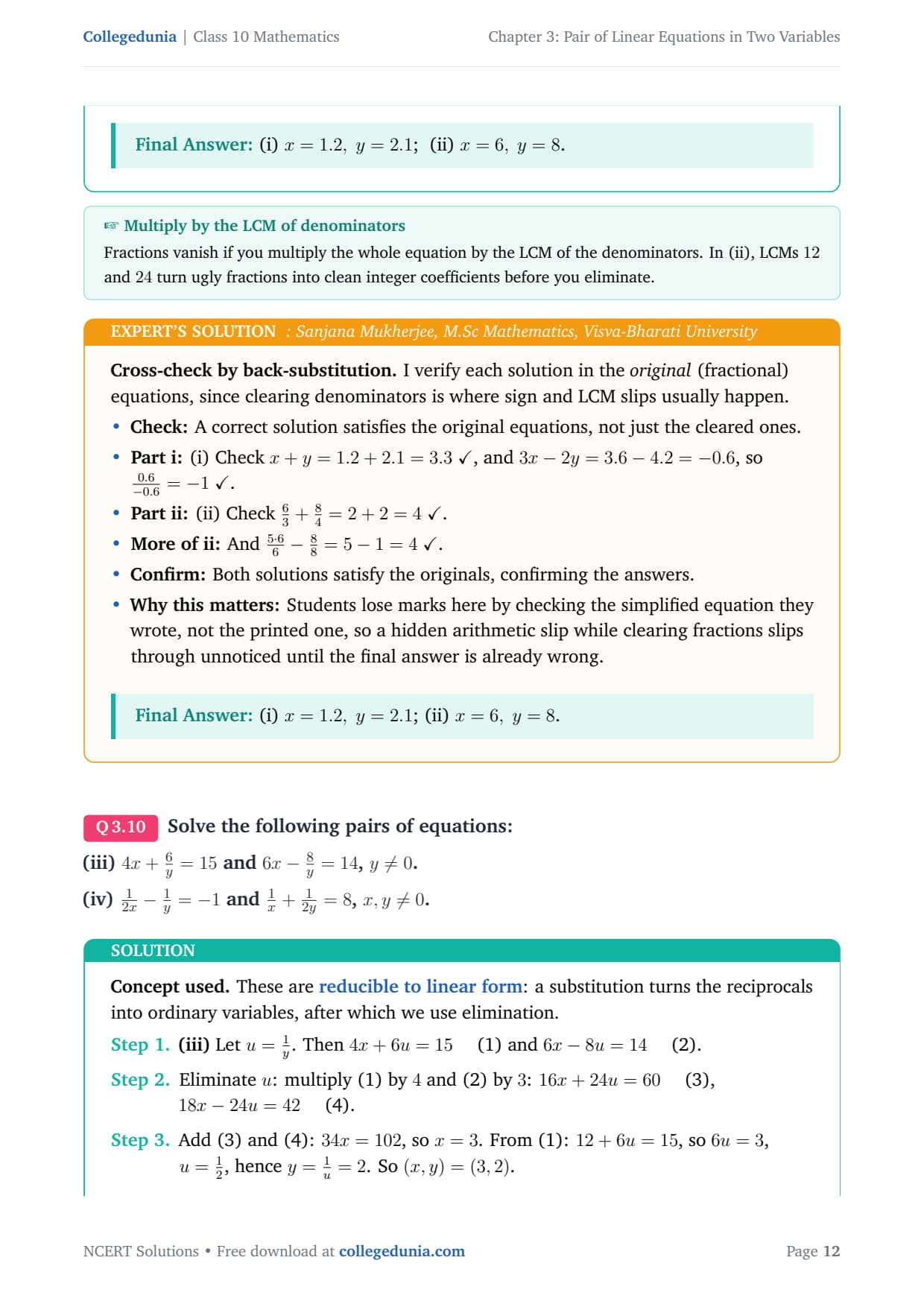
Q 3.10
Solve the following pairs of equations: [5pt]
(iii) 4x+6y=15 and 6x-8y=14, y≠ 0. [5pt]
(iv) 12x-1y=-1 and 1x+12y=8, x,y≠ 0.
Concept used. These are reducible to linear form: a
substitution turns the reciprocals into ordinary variables, after which we
use elimination.
(iii) Let u=1y. Then 4x+6u=15 (1) and
6x-8u=14 (2).
Eliminate u: multiply (1) by 4 and (2) by 3:
16x+24u=60 (3), 18x-24u=42 (4).
Add (3) and (4): 34x=102, so x=3. From (1): 12+6u=15, so
6u=3, u=12, hence y=1u=2. So (x,y)=(3,2).
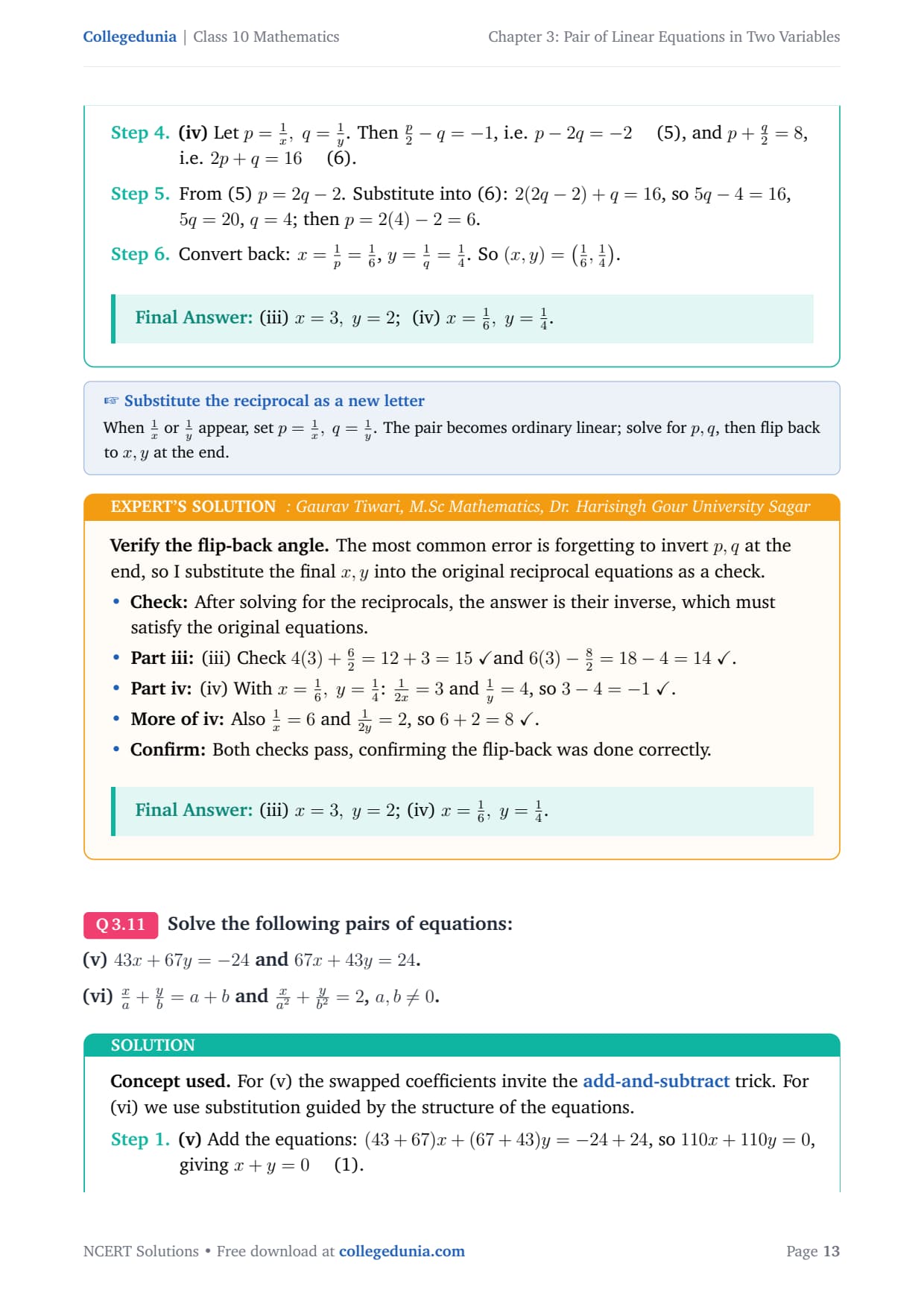
(iv) Let p=1x, q=1y. Then
p2-q=-1, i.e. p-2q=-2 (5), and p+q2=8,
i.e. 2p+q=16 (6).
From (5) p=2q-2. Substitute into (6): 2(2q-2)+q=16, so
5q-4=16, 5q=20, q=4; then p=2(4)-2=6.
Convert back: x=1p=16, y=1q=14. So
(x,y)=(16,14).
(iii) x=3, y=2; (iv) x=16, y=14.
GT
Gaurav Tiwari
M.Sc Mathematics, Dr. Harisingh Gour University Sagar
Verified Expert
Verify the flip-back angle. The most common error is forgetting to
invert p,q at the end, so I substitute the final x,y into the original
reciprocal equations as a check.
Check: After solving for the reciprocals, the answer is their inverse, which must satisfy the original equations.
Part iii: (iii) Check 4(3)+62=12+3=15 and 6(3)-82=18-4=14 .
Part iv: (iv) With x=16, y=14: 12x=3 and 1y=4, so 3-4=-1 .
More of iv: Also 1x=6 and 12y=2, so 6+2=8 .
Confirm: Both checks pass, confirming the flip-back was done correctly.
(iii) x=3, y=2; (iv) x=16, y=14.
Q 3.11
Solve the following pairs of equations: [5pt]
(v) 43x+67y=-24 and 67x+43y=24. [5pt]
(vi) xa+yb=a+b and xa2+yb2=2, a,b≠ 0.
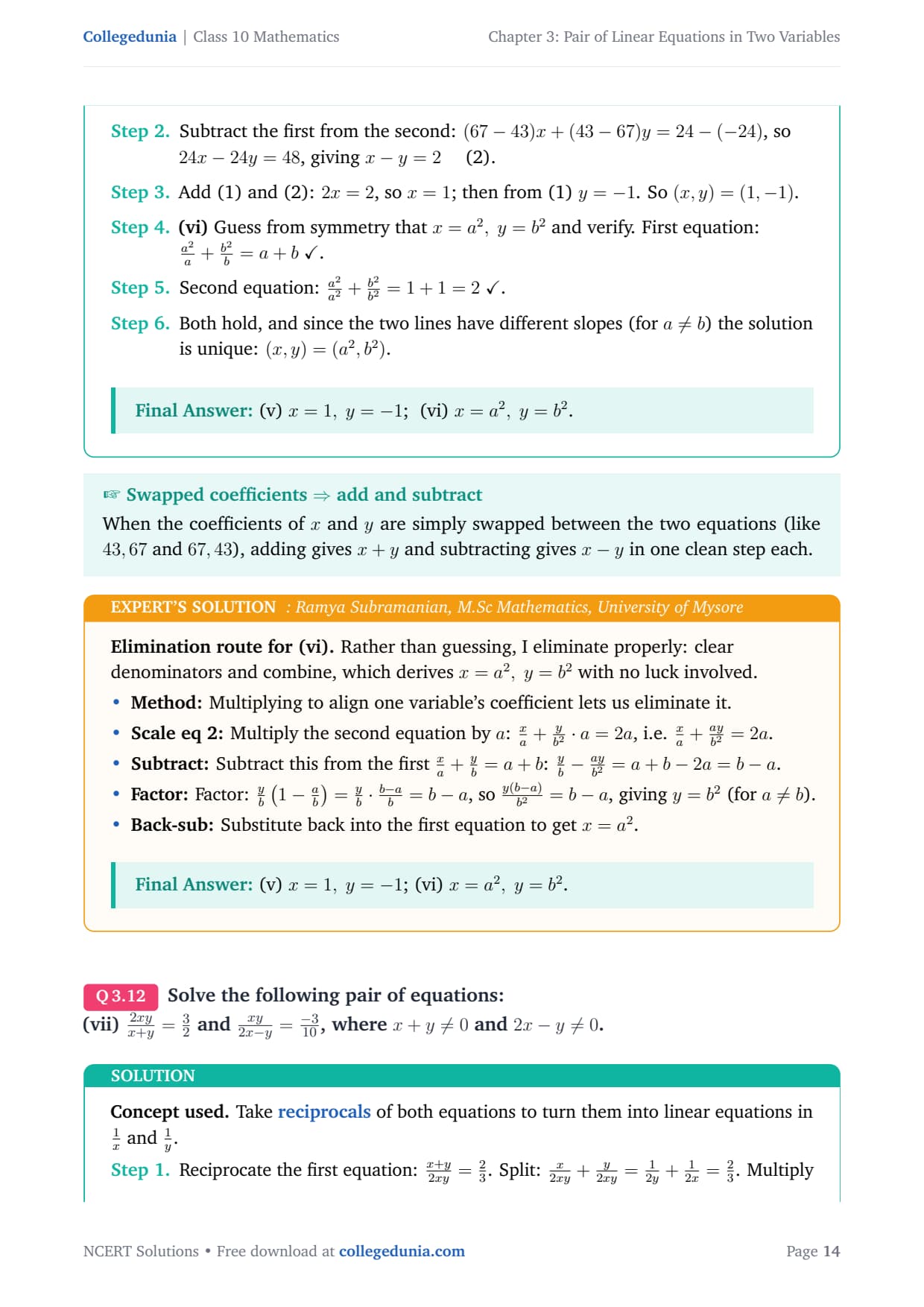
Concept used. For (v) the swapped coefficients invite the
add-and-subtract trick. For (vi) we use substitution guided by the
structure of the equations.
(v) Add the equations: (43+67)x+(67+43)y=-24+24, so
110x+110y=0, giving x+y=0 (1).
Subtract the first from the second:
(67-43)x+(43-67)y=24-(-24), so 24x-24y=48, giving
x-y=2 (2).
Add (1) and (2): 2x=2, so x=1; then from (1) y=-1. So
(x,y)=(1,-1).
(vi) Guess from symmetry that x=a2, y=b2 and verify.
First equation: a2a+b2b=a+b .
Second equation: a2a2+b2b2=1+1=2 .
Both hold, and since the two lines have different slopes (for
a≠ b) the solution is unique: (x,y)=(a2,b2).
(v) x=1, y=-1; (vi) x=a2, y=b2.
RS
Ramya Subramanian
M.Sc Mathematics, University of Mysore
Verified Expert
Elimination route for (vi). Rather than guessing, I eliminate
properly: clear denominators and combine, which derives x=a2, y=b2 with
no luck involved.
Method: Multiplying to align one variable's coefficient lets us eliminate it.
Scale eq 2: Multiply the second equation by a: xa+yb2· a=2a, i.e. xa+ayb2=2a.
Subtract: Subtract this from the first xa+yb=a+b: yb-ayb2=a+b-2a=b-a.
Factor: Factor: yb(1-ab)=yb·b-ab=b-a, so y(b-a)b2=b-a, giving y=b2 (for a≠ b).
Back-sub: Substitute back into the first equation to get x=a2.
(v) x=1, y=-1; (vi) x=a2, y=b2.
Q 3.12
Solve the following pair of equations:
(vii) 2xyx+y=32 and xy2x-y=-310, where x+y≠ 0 and 2x-y≠ 0.
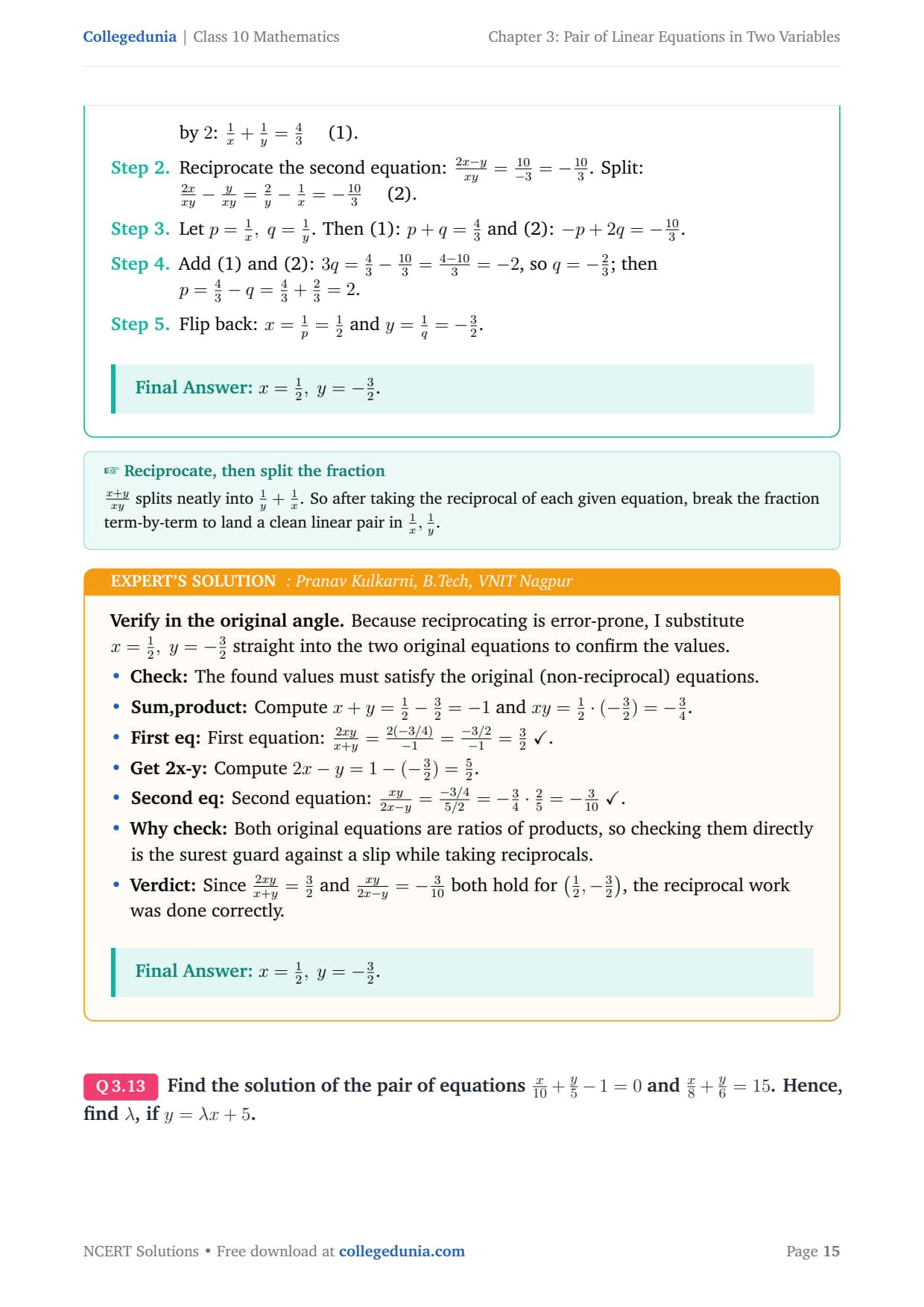
Concept used. Take reciprocals of both equations to turn
them into linear equations in 1x and 1y.
Reciprocate the first equation:
x+y2xy=23. Split:
x2xy+y2xy=12y+12x=23.
Multiply by 2: 1x+1y=43 (1).
Reciprocate the second equation:
2x-yxy=10-3=-103. Split:
2xxy-yxy=2y-1x=-103 (2).
Let p=1x, q=1y. Then (1): p+q=43 and (2):
-p+2q=-103.
Add (1) and (2): 3q=43-103=4-103=-2, so
q=-23; then p=43-q=43+23=2.
Flip back: x=1p=12 and y=1q=-32.
x=12, y=-32.
PK
Pranav Kulkarni
B.Tech, VNIT Nagpur
Verified Expert
Verify in the original angle. Because reciprocating is error-prone,
I substitute x=12, y=-32 straight into the two original
equations to confirm the values.
Check: The found values must satisfy the original (non-reciprocal) equations.
Sum,product: Compute x+y=12-32=-1 and xy=12·(-32)=-34.
First eq: First equation: 2xyx+y=2(-3/4)-1=-3/2-1=32 .
Get 2x-y: Compute 2x-y=1-(-32)=52.
Second eq: Second equation: xy2x-y=-3/45/2=-34·25=-310 .
Why check: Both original equations are ratios of products, so checking them directly is the surest guard against a slip while taking reciprocals.
Verdict: Since 2xyx+y=32 and xy2x-y=-310 both hold for (12,-32), the reciprocal work was done correctly.
x=12, y=-32.
Q 3.13
Find the solution of the pair of equations x10+y5-1=0 and x8+y6=15. Hence, find λ, if y=λ x+5.
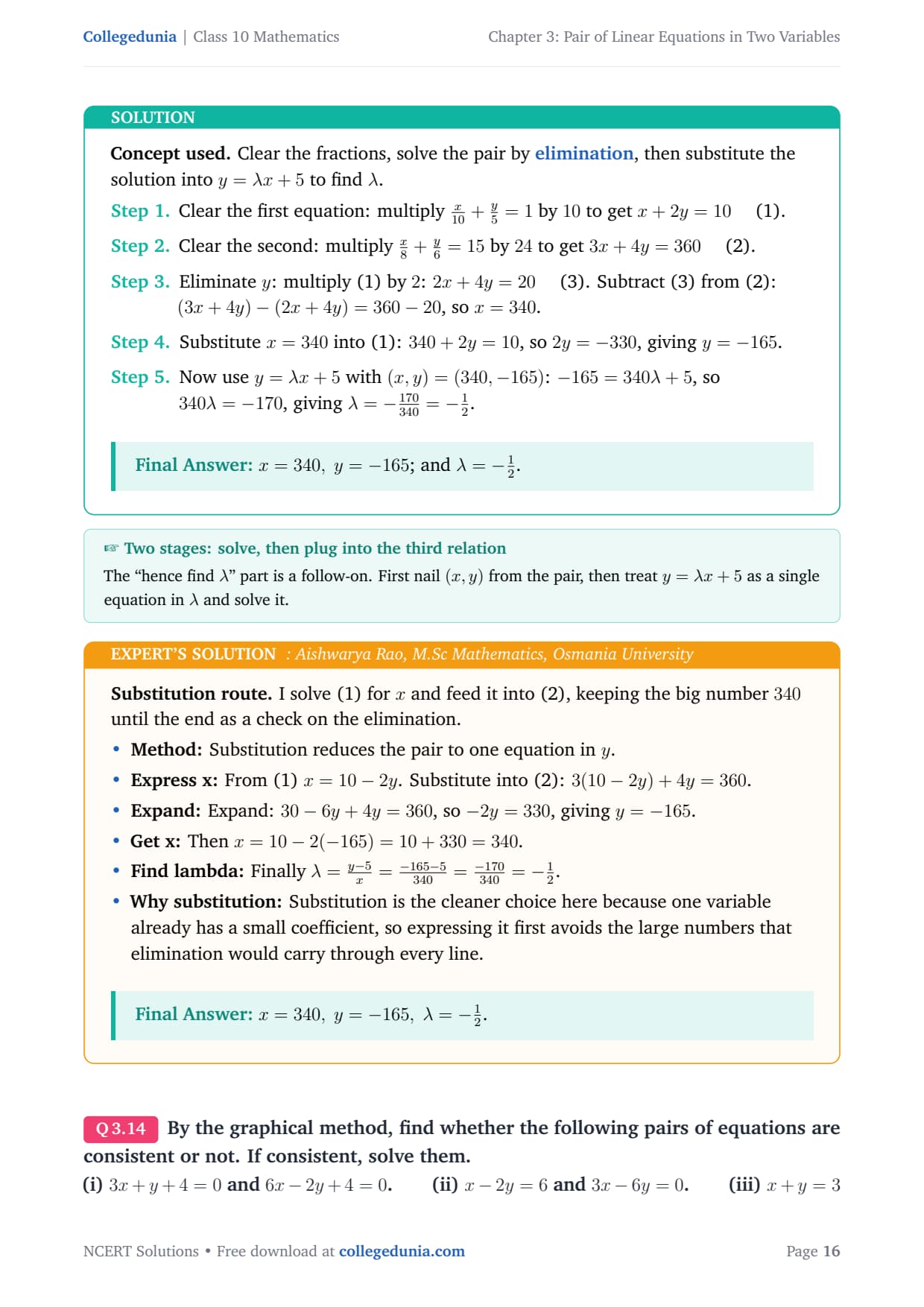
Concept used. Clear the fractions, solve the pair by
elimination, then substitute the solution into y=λ x+5 to
find λ.
Clear the first equation: multiply x10+y5=1 by
10 to get x+2y=10 (1).
Clear the second: multiply x8+y6=15 by 24 to
get 3x+4y=360 (2).
Eliminate y: multiply (1) by 2: 2x+4y=20 (3). Subtract
(3) from (2): (3x+4y)-(2x+4y)=360-20, so x=340.
Substitute x=340 into (1): 340+2y=10, so 2y=-330, giving
y=-165.
Now use y=λ x+5 with (x,y)=(340,-165):
-165=340λ+5, so 340λ=-170, giving
λ=-170340=-12.
x=340, y=-165; and λ=-12.
AR
Aishwarya Rao
M.Sc Mathematics, Osmania University
Verified Expert
Substitution route. I solve (1) for x and feed it into (2),
keeping the big number 340 until the end as a check on the elimination.
Method: Substitution reduces the pair to one equation in y.
Express x: From (1) x=10-2y. Substitute into (2): 3(10-2y)+4y=360.
Expand: Expand: 30-6y+4y=360, so -2y=330, giving y=-165.
Why substitution: Substitution is the cleaner choice here because one variable already has a small coefficient, so expressing it first avoids the large numbers that elimination would carry through every line.
x=340, y=-165, λ=-12.
Q 3.14
By the graphical method, find whether the following pairs of equations are consistent or not. If consistent, solve them.
(i) 3x+y+4=0 and 6x-2y+4=0.
(ii) x-2y=6 and 3x-6y=0.
(iii) x+y=3 and 3x+3y=9.
Concept used. Run the ratio test to decide consistency,
then solve the consistent cases (the graphical intersection point is the
algebraic solution).
(i)3x+y+4=0 and 6x-2y+4=0. Ratios:
36=12, 1-2=-12. Since
12≠-12, lines intersect: consistent.
Solve (i): from 3x+y+4=0, y=-3x-4. Put into 6x-2y+4=0:
6x-2(-3x-4)+4=0, so 6x+6x+8+4=0, 12x=-12, x=-1; then
y=-3(-1)-4=-1. Solution (-1,-1).
(ii)x-2y-6=0 and 3x-6y-0=0. Ratios:
13, -2-6=13, -60
(undefined / c2=0). Variable ratios equal 13 but the
constants are -6 and 0, which are not in the same ratio, so the
lines are parallel: inconsistent.
(iii)x+y-3=0 and 3x+3y-9=0. Ratios:
13=13=-3-9=13. All equal, so
coincident: consistent with infinitely many solutions.
For (iii) every point of x+y=3 works; writing y=3-x, the
solution is the whole line: y=3-x for any x.
(i) consistent, (x,y)=(-1,-1); (ii) inconsistent;
(iii) consistent, infinitely many (y=3-x).
MB
Mohit Bansal
M.Sc Mathematics, Kurukshetra University
Verified Expert
Two-point plotting angle. Graphically, I find two points per line;
crossing lines mean a unique solution, identical lines mean infinitely many,
and never-meeting lines mean inconsistent.
Method: The graph of each consistency type matches its ratio verdict.
Part i: (i) Plotting 3x+y=-4 and 6x-2y=-4 gives two lines crossing at (-1,-1): consistent, unique.
Part ii: (ii) Plotting x-2y=6 and 3x-6y=0 gives two parallel lines (same slope 12, different intercepts): inconsistent.
Part iii: (iii) Plotting x+y=3 and 3x+3y=9 gives the same line twice: consistent, infinitely many.
Plots agree: The plotted pictures agree with the ratio test in all three parts.
Two points: Plotting two points per line makes the three pictures unmistakable: a crossing in (i), separated parallels in (ii), and one line drawn twice in (iii).
Verdict: The visual verdict matches the ratio test exactly, so (i) is uniquely solvable at (-1,-1), (ii) is inconsistent, and (iii) has the whole line y=3-x.
(i) (-1,-1); (ii) inconsistent; (iii) infinitely many,
y=3-x.
Q 3.15
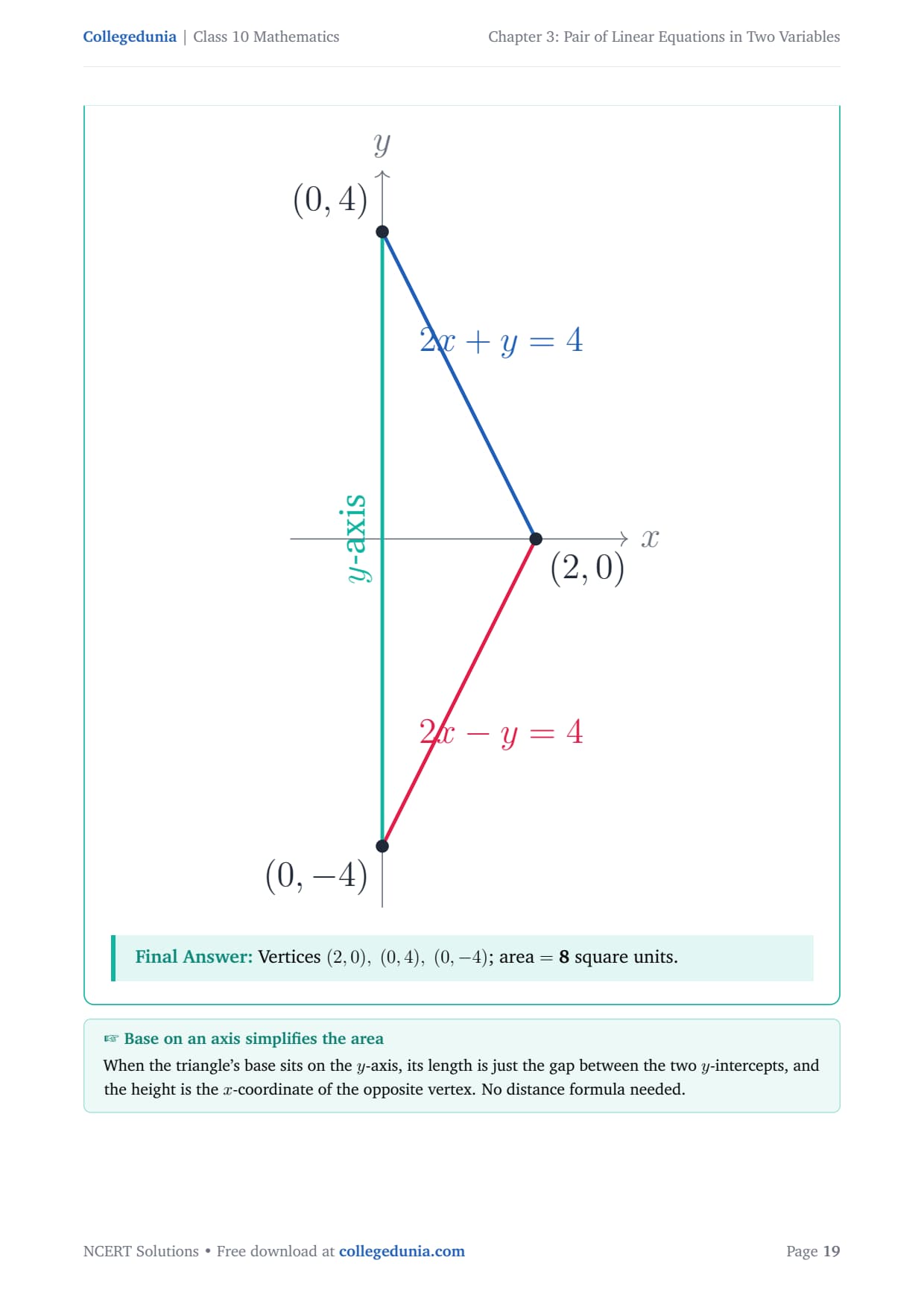
Draw the graph of the pair of equations 2x+y=4 and 2x-y=4. Write the vertices of the triangle formed by these lines and the y-axis. Also find the area of this triangle.
Concept used. Find the intersection of the two lines and their
y-intercepts to get the three vertices, then apply
Area=12.
Find where the two lines meet: add 2x+y=4 and 2x-y=4 to get
4x=8, so x=2; then y=4-2x=0. Meeting point (2,0).
Find the y-intercept of 2x+y=4 (set x=0): y=4, giving
(0,4).
Find the y-intercept of 2x-y=4 (set x=0): -y=4, so y=-4,
giving (0,-4).
The triangle has vertices (2,0), (0,4), (0,-4). Its base lies on
the y-axis from (0,-4) to (0,4), length =4-(-4)=8. The
height is the horizontal distance from this base to (2,0),
namely 2.
Area =12× 8× 2=12× 16=8 square units.
0.6!%
[See diagram in the PDF version]
Vertices (2,0), (0,4), (0,-4); area =8 square
units.
SP
Sneha Pillai
M.Ed Mathematics, NCERT RIE Bhopal
Verified Expert
Coordinate-area-formula angle. I plug the three vertices into the
determinant area formula, which is a fully algebraic check that does not
rely on identifying base and height.
Tool: Area =12 |x1(y2-y3)+x2(y3-y1) +x3(y1-y2)|.
Vertices: Take (x1,y1)=(2,0), (x2,y2)=(0,4), (x3,y3)=(0,-4).
Area: Area =12× 16=8 square units, matching the base-height result.
Why it works: The determinant area formula needs only the three vertices, so it sidesteps any argument about which side is the base and which is the height.
Verdict: Plugging (2,0),(0,4),(0,-4) into it gives 12|16|=8, confirming the base-height answer of 8 square units independently.
Sign safety: Keep the modulus bars in place at every step, because the bracket inside can come out negative depending on the order in which you list the vertices, and the area is always the positive value.
Exam takeaway: This formula is the safer choice in the board exam whenever the triangle is tilted, since you never have to draw a perpendicular or guess which side serves as the base.
Vertices (2,0),(0,4),(0,-4); area =8 sq units.
Q 3.16
Write an equation of a line passing through the point representing the solution of the pair of linear equations x+y=2 and 2x-y=1. How many such lines can we find?
Concept used. First find the solution point of the pair,
then write any line through it. Through one point there are infinitely many
lines.
Solve the pair: add x+y=2 and 2x-y=1 to get 3x=3, so x=1.
Substitute x=1 into x+y=2: 1+y=2, so y=1. The solution point
is (1,1).
Write one line through (1,1). For example x=y passes through it,
since 1=1.
Counting: any line through (1,1) qualifies, and there is one for
every possible slope, so there are infinitely many such lines.
One example is x=y (i.e. x-y=0); infinitely many
lines pass through (1,1).
YP
Yashwant Patil
M.Sc Mathematics, Pune Vidyapeeth
Verified Expert
Family-of-lines angle. I write the general line through (1,1)
explicitly, which both gives a sample answer and shows why the count is
infinite.
Idea: Every line through (1,1) has the form y-1=m(x-1) for some slope m.
Solution: The solution point is (1,1) from the elimination above.
Family: The point-slope family is y-1=m(x-1).
Vary slope: Each real value of m gives a different line, e.g. m=1 gives y=x, m=0 gives y=1, m=2 gives y=2x-1.
Infinitely many: Infinitely many choices of m mean infinitely many lines.
Sample line y=x; infinitely many lines through (1,1).
Q 3.17
If x+1 is a factor of 2x3+ax2+2bx+1, then find the values of a and b given that 2a-3b=4.
Concept used. By the factor theorem, if x+1 is a factor
then x=-1 is a root, so substituting x=-1 gives one linear equation; the
given relation 2a-3b=4 is the second. Solve the pair.
Apply the factor theorem: substitute x=-1 into
2x3+ax2+2bx+1 and set it to 0:
2(-1)3+a(-1)2+2b(-1)+1=0.
Simplify: -2+a-2b+1=0, so a-2b-1=0, giving a-2b=1 (1).
Pair (1) with the given 2a-3b=4 (2). From (1), a=1+2b.
Substitute into (2): 2(1+2b)-3b=4, so 2+4b-3b=4, giving
b=2.
Then a=1+2(2)=5.
a=5 and b=2.
AV
Anjali Verma
M.Sc Mathematics, University of Jammu
Verified Expert
Verification angle. After solving, I plug a=5, b=2 back into the
cubic and confirm x=-1 is genuinely a root, closing the loop.
Check: A correct (a,b) must make x=-1 a zero of the cubic.
Build cubic: With a=5, b=2 the cubic is 2x3+5x2+4x+1.
Plug x=-1: Evaluate at x=-1: 2(-1)+5(1)+4(-1)+1=-2+5-4+1=0 .
Relation: Check the given relation: 2a-3b=2(5)-3(2)=10-6=4 .
Verdict: Both conditions hold, so a=5, b=2 is correct.
Exam takeaway: Whenever a value is claimed to be a root, the fastest confirmation is to substitute it and watch the whole expression collapse to zero, which catches any sign error from the earlier algebra in one line.
a=5, b=2.
Q 3.18
The angles of a triangle are x, y and 40∘. The difference between the two angles x and y is 30∘. Find x and y.
Concept used. The three angles of a triangle sum to
180∘, giving one equation; the stated difference gives the second.
Angle-sum equation: x+y+40∘=180∘, so
x+y=140∘ (1).
Difference equation (take x>y): x-y=30∘ (2).
Add (1) and (2): 2x=170∘, so x=85∘.
Substitute into (1): 85∘+y=140∘, so y=55∘.
x=85∘ and y=55∘.
DN
Deepak Nair
M.Sc Mathematics, Mahatma Gandhi University Kottayam
Verified Expert
Substitution route. I express x from the difference equation and
substitute, which also makes it clear the answer is the same if we had taken
y>x (the two angles just swap).
Method: Substitution from the simpler difference equation.
Express x: From (2) x=y+30∘.
Substitute: Substitute into (1): (y+30∘)+y=140∘, so 2y=110∘, giving y=55∘.
Get x: Then x=55∘+30∘=85∘.
Verify: Check: 85∘+55∘+40∘=180∘ .
x=85∘, y=55∘.
Q 3.19
Two years ago, Salim was thrice as old as his daughter and six years later, he will be four years older than twice her age. How old are they now?
Concept used. Set up a pair of linear equations using ages
shifted by -2 years and +6 years, then solve by substitution.
Let Salim's present age be x years and his daughter's present age
be y years.
``Two years ago, Salim was thrice his daughter'': (x-2)=3(y-2),
so x-2=3y-6, giving x-3y=-4 (1).
``Six years later, Salim is four years older than twice her age'':
(x+6)=2(y+6)+4, so x+6=2y+12+4, giving x-2y=10 (2).
Subtract (1) from (2): (x-2y)-(x-3y)=10-(-4), so y=14.
Substitute y=14 into (2): x-28=10, so x=38.
Salim is 38 years and his daughter is 14
years old now.
SJ
Sakshi Joshi
M.Sc Mathematics, HNB Garhwal University
Verified Expert
Verify both timelines angle. I check the present ages against both
the past and future statements, since age problems can satisfy one timeline
and fail the other.
Check: The present ages must obey every time-shifted condition.
Present: Present: Salim 38, daughter 14.
Two years ago: Two years ago: 36 and 12. Is 36=312? Yes .
Six years on: Six years later: 44 and 20. Is 44=220+4=44? Yes .
Verdict: Both timelines check out, confirming the ages.
Salim 38, daughter 14.
Q 3.20
The age of the father is twice the sum of the ages of his two children. After 20 years, his age will be equal to the sum of the ages of his children. Find the age of the father.
Concept used. Let the father's age and the children's combined age
be the two unknowns; form a pair of equations for now and for 20
years later, remembering both children age.
Let the father's present age be x years and the sum of the two
children's present ages be y years.
``Father is twice the sum of the children's ages'': x=2y (1).
After 20 years the father is x+20 and the two children's ages
sum to y+20+20=y+40 (each child gains 20).
``His age equals the sum of the children's ages'': x+20=y+40, so
x-y=20 (2).
Substitute (1) into (2): 2y-y=20, so y=20; then x=2(20)=40.
The father is 40 years old.
RD
Rohan Dasgupta
M.Sc Mathematics, Tezpur University
Verified Expert
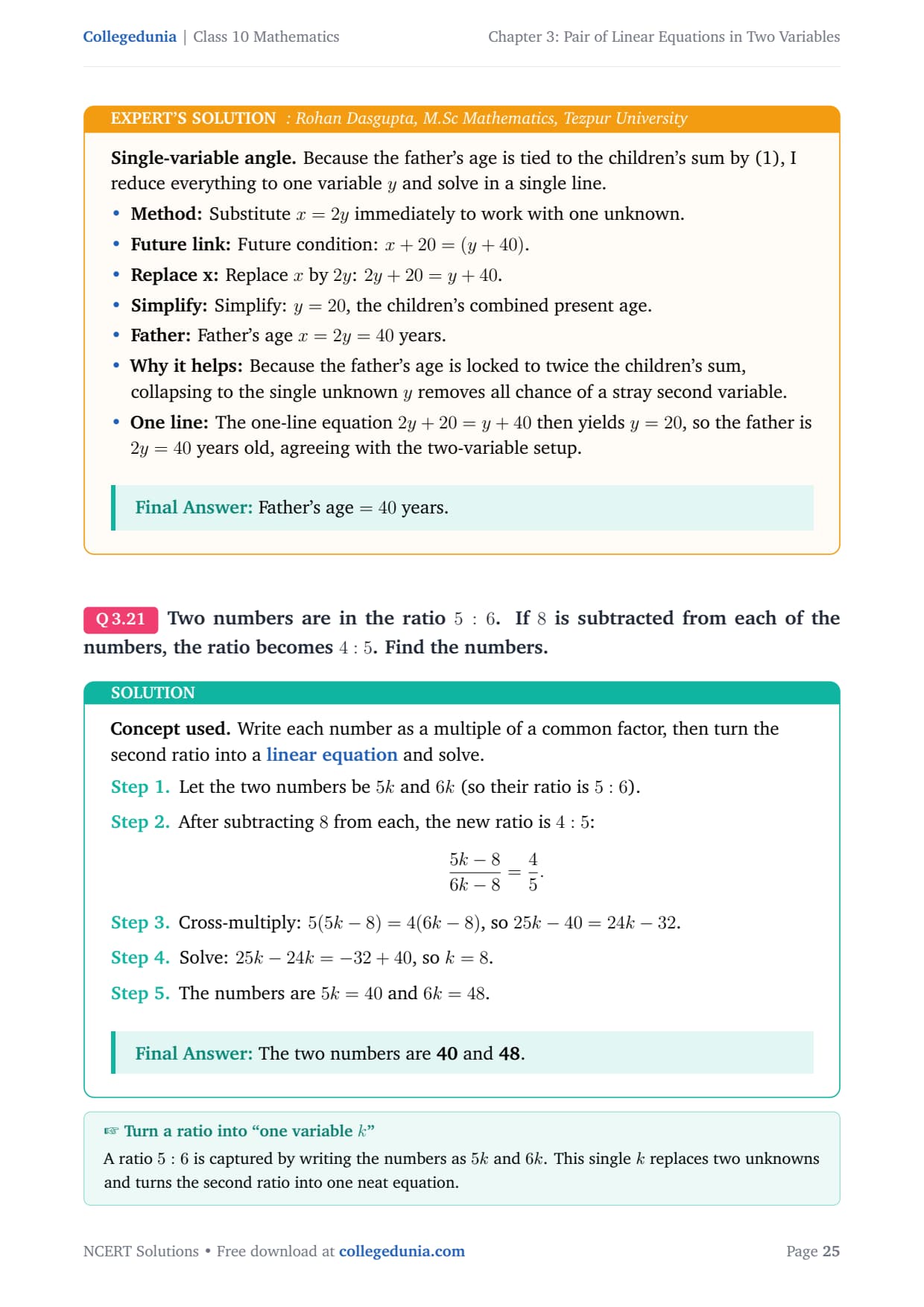
Single-variable angle. Because the father's age is tied to the
children's sum by (1), I reduce everything to one variable y and solve in a
single line.
Method: Substitute x=2y immediately to work with one unknown.
Future link: Future condition: x+20=(y+40).
Replace x: Replace x by 2y: 2y+20=y+40.
Simplify: Simplify: y=20, the children's combined present age.
Father: Father's age x=2y=40 years.
Why it helps: Because the father's age is locked to twice the children's sum, collapsing to the single unknown y removes all chance of a stray second variable.
One line: The one-line equation 2y+20=y+40 then yields y=20, so the father is 2y=40 years old, agreeing with the two-variable setup.
Father's age =40 years.
Q 3.21
Two numbers are in the ratio 5:6. If 8 is subtracted from each of the numbers, the ratio becomes 4:5. Find the numbers.
Concept used. Write each number as a multiple of a common factor,
then turn the second ratio into a linear equation and solve.
Let the two numbers be 5k and 6k (so their ratio is 5:6).
After subtracting 8 from each, the new ratio is 4:5:
5k-86k-8=45.
Cross-multiply: 5(5k-8)=4(6k-8), so 25k-40=24k-32.
Solve: 25k-24k=-32+40, so k=8.
The numbers are 5k=40 and 6k=48.
The two numbers are 40 and 48.
NI
Nandini Iyer
M.Sc Mathematics, SRM Institute of Science and Technology
Verified Expert
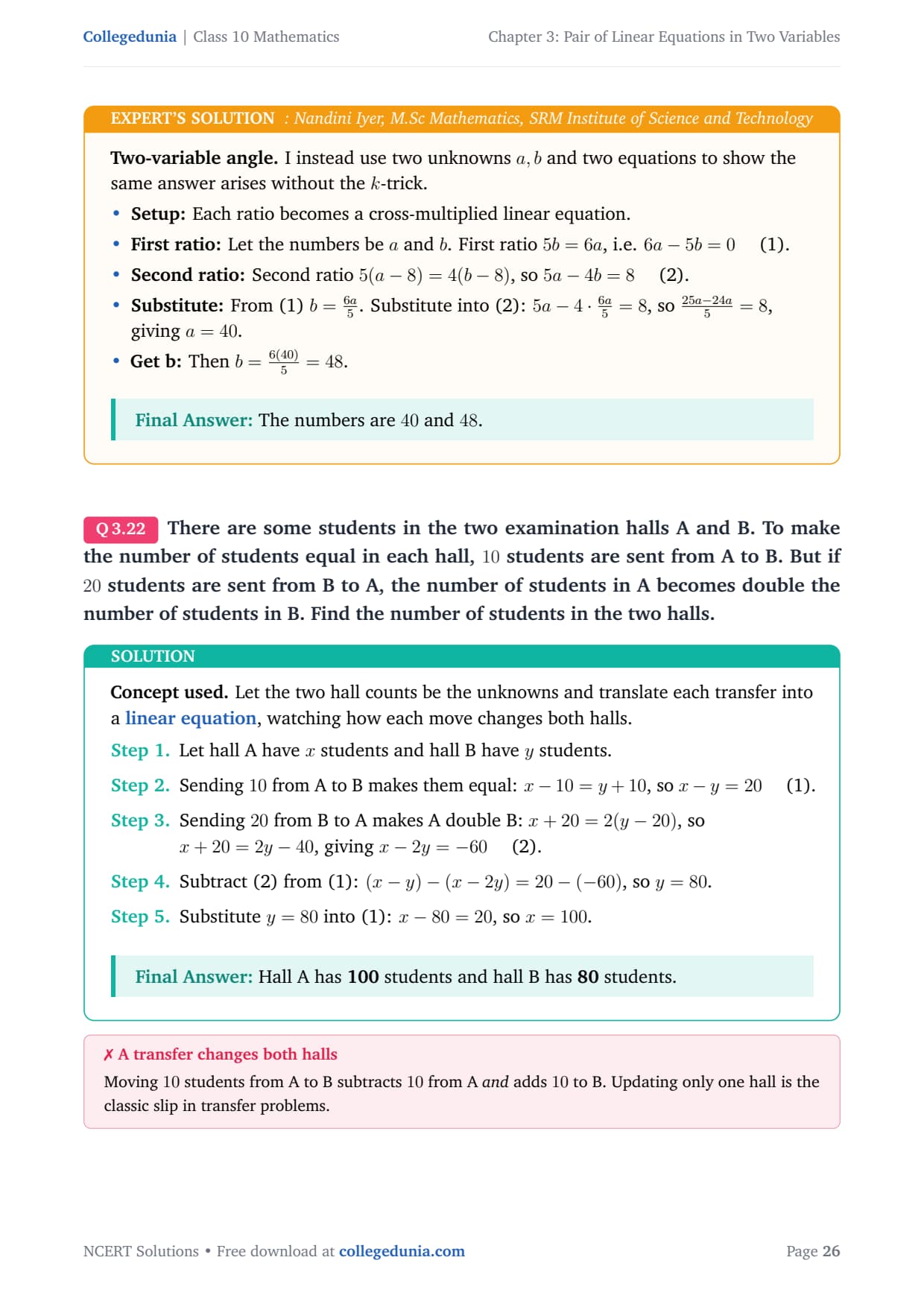
Two-variable angle. I instead use two unknowns a,b and two
equations to show the same answer arises without the k-trick.
Setup: Each ratio becomes a cross-multiplied linear equation.
First ratio: Let the numbers be a and b. First ratio 5b=6a, i.e. 6a-5b=0 (1).
Second ratio: Second ratio 5(a-8)=4(b-8), so 5a-4b=8 (2).
Substitute: From (1) b=6a5. Substitute into (2): 5a-4·6a5=8, so 25a-24a5=8, giving a=40.
Get b: Then b=6(40)5=48.
The numbers are 40 and 48.
Q 3.22
There are some students in the two examination halls A and B. To make the number of students equal in each hall, 10 students are sent from A to B. But if 20 students are sent from B to A, the number of students in A becomes double the number of students in B. Find the number of students in the two halls.
Concept used. Let the two hall counts be the unknowns and translate
each transfer into a linear equation, watching how each move
changes both halls.
Let hall A have x students and hall B have y students.
Sending 10 from A to B makes them equal:
x-10=y+10, so x-y=20 (1).
Sending 20 from B to A makes A double B:
x+20=2(y-20), so x+20=2y-40, giving x-2y=-60 (2).
Subtract (2) from (1): (x-y)-(x-2y)=20-(-60), so y=80.
Substitute y=80 into (1): x-80=20, so x=100.
Hall A has 100 students and hall B has 80
students.
KS
Kunal Saxena
M.Sc Mathematics, Jiwaji University Gwalior
Verified Expert
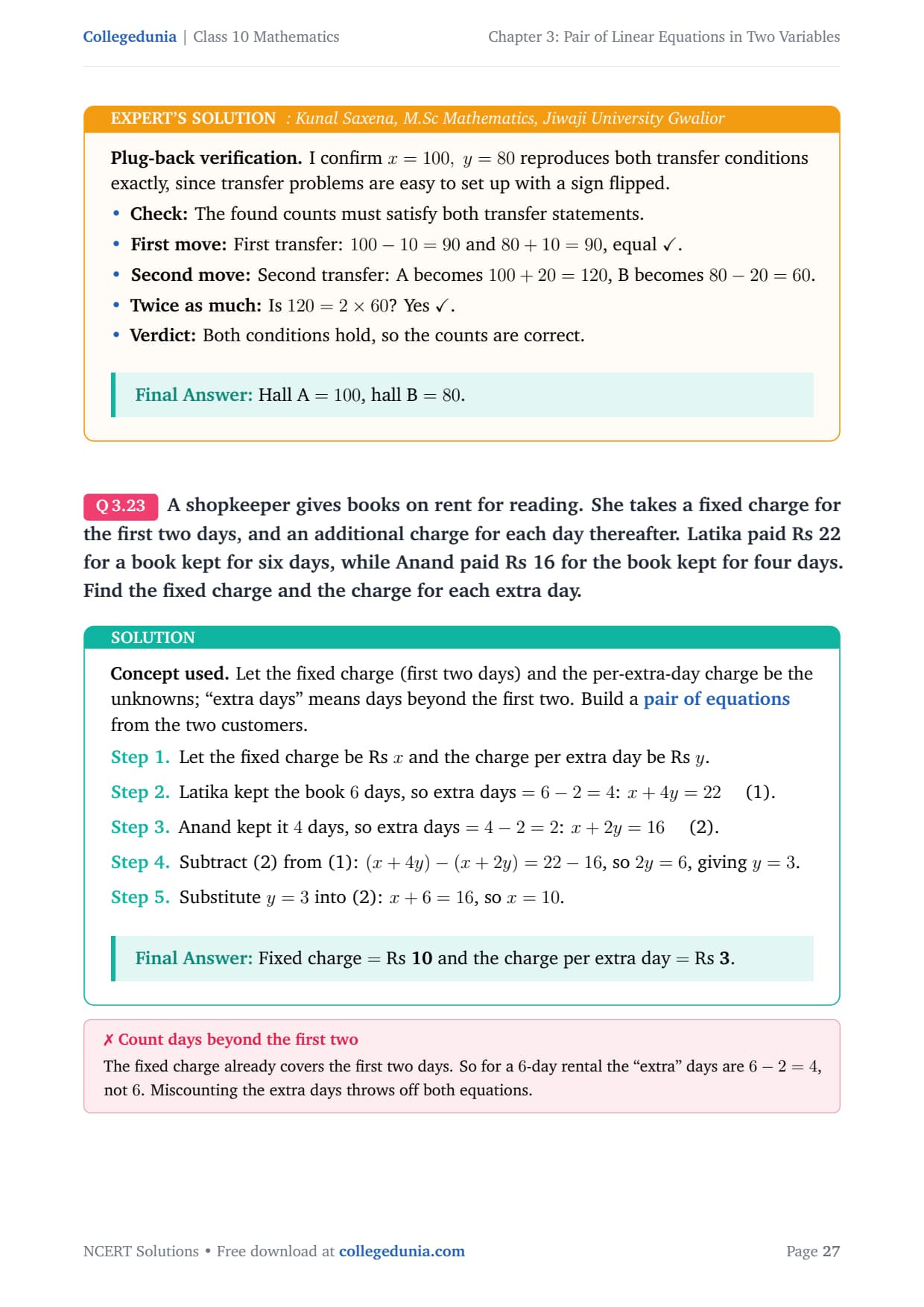
Plug-back verification. I confirm x=100, y=80 reproduces both
transfer conditions exactly, since transfer problems are easy to set up with
a sign flipped.
Check: The found counts must satisfy both transfer statements.
First move: First transfer: 100-10=90 and 80+10=90, equal .
Second move: Second transfer: A becomes 100+20=120, B becomes 80-20=60.
Twice as much: Is 120=260? Yes .
Verdict: Both conditions hold, so the counts are correct.
Hall A =100, hall B =80.
Q 3.23
A shopkeeper gives books on rent for reading. She takes a fixed charge for the first two days, and an additional charge for each day thereafter. Latika paid Rs 22 for a book kept for six days, while Anand paid Rs 16 for the book kept for four days. Find the fixed charge and the charge for each extra day.
Concept used. Let the fixed charge (first two days) and the
per-extra-day charge be the unknowns; ``extra days'' means days beyond the
first two. Build a pair of equations from the two customers.
Let the fixed charge be Rs x and the charge per extra day be
Rs y.
Latika kept the book 6 days, so extra days =6-2=4:
x+4y=22 (1).
Anand kept it 4 days, so extra days =4-2=2:
x+2y=16 (2).
Subtract (2) from (1): (x+4y)-(x+2y)=22-16, so 2y=6, giving
y=3.
Substitute y=3 into (2): x+6=16, so x=10.
Fixed charge = Rs 10 and the charge per extra day =
Rs 3.
BR
Bhavana Reddy
M.Sc Mathematics, Sri Venkateswara University Tirupati
Verified Expert
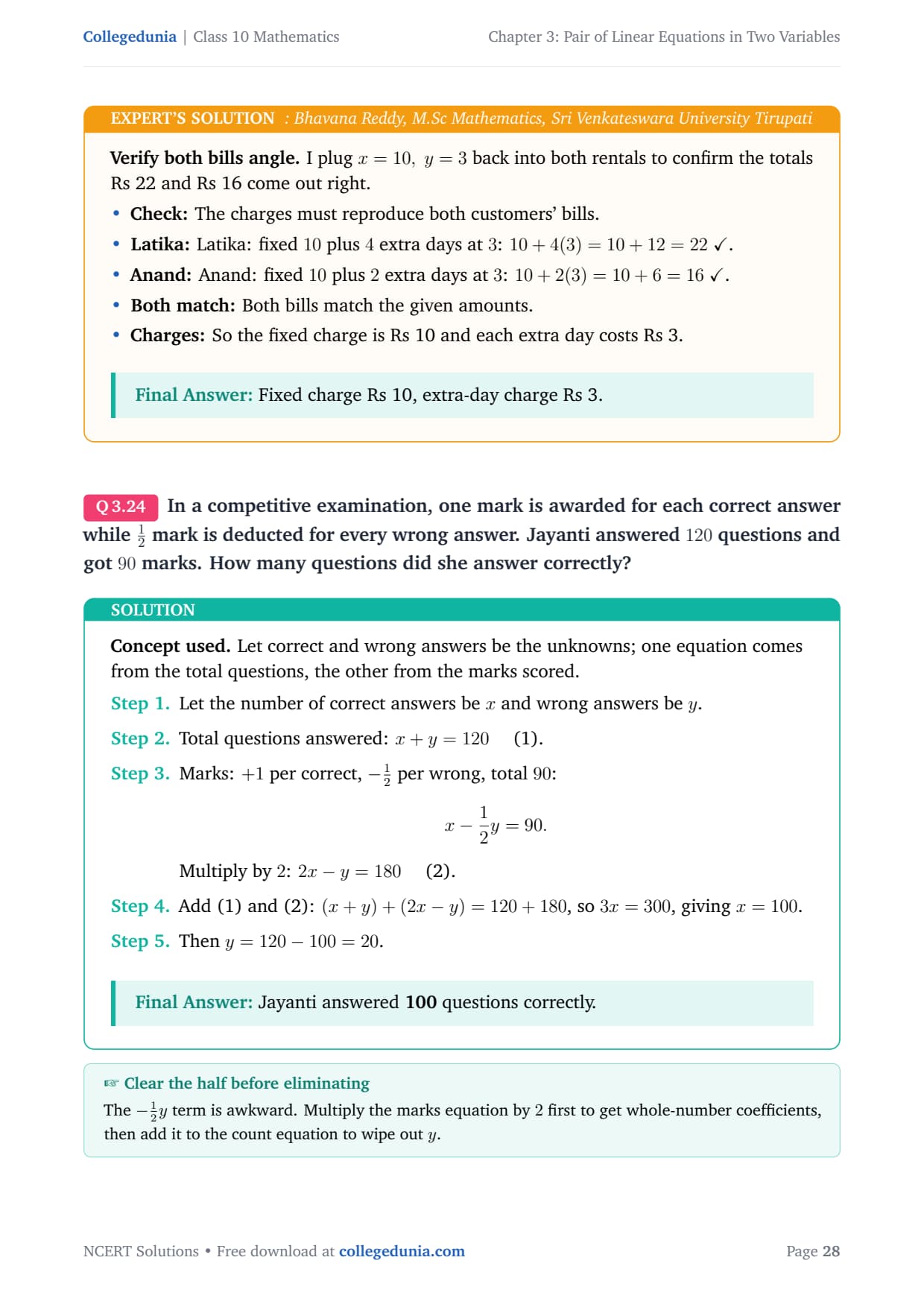
Verify both bills angle. I plug x=10, y=3 back into both rentals
to confirm the totals Rs 22 and Rs 16 come out right.
Check: The charges must reproduce both customers' bills.
Latika: Latika: fixed 10 plus 4 extra days at 3: 10+4(3)=10+12=22 .
Anand: Anand: fixed 10 plus 2 extra days at 3: 10+2(3)=10+6=16 .
Both match: Both bills match the given amounts.
Charges: So the fixed charge is Rs 10 and each extra day costs Rs 3.
Fixed charge Rs 10, extra-day charge Rs 3.
Q 3.24
In a competitive examination, one mark is awarded for each correct answer while 12 mark is deducted for every wrong answer. Jayanti answered 120 questions and got 90 marks. How many questions did she answer correctly?
Concept used. Let correct and wrong answers be the unknowns; one
equation comes from the total questions, the other from the marks scored.
Let the number of correct answers be x and wrong answers be y.
Total questions answered: x+y=120 (1).
Marks: +1 per correct, -12 per wrong, total 90:
x-12y=90.
Multiply by 2: 2x-y=180 (2).
Add (1) and (2): (x+y)+(2x-y)=120+180, so 3x=300, giving
x=100.
Then y=120-100=20.
Jayanti answered 100 questions correctly.
TM
Tarun Malhotra
M.Sc Mathematics, Himachal Pradesh University
Verified Expert
Check the score angle. I confirm x=100, y=20 produces exactly
90 marks, since negative marking problems are easy to set up with the
wrong sign.
Check: Score = (correct) -12(wrong) must equal 90.
Totals: Correct =100, wrong =20, total =120 .
From correct: Marks from correct: 1001=100.
From wrong: Marks lost to wrong: 20×12=10.
Net score: Net score =100-10=90 , matching the data.
100 correct answers.
Q 3.25
The angles of a cyclic quadrilateral ABCD are ∠ A=(6x+10)∘, ∠ B=(5x)∘, ∠ C=(x+y)∘ and ∠ D=(3y-10)∘. Find x and y, and hence the values of the four angles.
Concept used. In a cyclic quadrilateral opposite angles
are supplementary: ∠ A+∠ C=180∘ and
∠ B+∠ D=180∘. These give a pair of linear equations.
∠ A+∠ C=180∘:
(6x+10)+(x+y)=180, so 7x+y=170 (1).
∠ B+∠ D=180∘:
(5x)+(3y-10)=180, so 5x+3y=190 (2).
Eliminate y: multiply (1) by 3: 21x+3y=510 (3). Subtract
(2) from (3): (21x+3y)-(5x+3y)=510-190, so 16x=320, giving
x=20.
Substitute x=20 into (1): 140+y=170, so y=30.
Now the angles:
∠ A=6(20)+10=130∘,
∠ B=5(20)=100∘,
∠ C=20+30=50∘,
∠ D=3(30)-10=80∘.
x=20, y=30; ∠ A=130∘,
∠ B=100∘, ∠ C=50∘, ∠ D=80∘.
PG
Priyanka Ghosh
M.Sc Mathematics, North Bengal University
Verified Expert
Total-angle cross-check. Besides the two supplementary pairs, all
four angles of any quadrilateral sum to 360∘; I use this as an
independent check on the final angles.
Check: The four interior angles of a quadrilateral sum to 360∘.
Angles: From the solution, the angles are 130∘,100∘,50∘,80∘.
Opposite pairs: Check the opposite pairs: ∠ A+∠ C=130+50=180∘ and ∠ B+∠ D=100+80=180∘ .
Total: Check the total: 130+100+50+80=360∘ .
Verdict: All consistency checks pass, confirming x=20, y=30.
x=20, y=30; angles 130∘,100∘,50∘,80∘.
Other Pair of Linear Equations Exercises (Class 10 Maths)
Work through the rest of the Exemplar exercises, then pair them with the matching study resources for Pair of Linear Equations.
Resource
What it covers
Open
Exercise 3.1
MCQs on the ratio test, consistency and word problems.
Students who practised Exercise 3.3 with step-by-step solutions reported a 30-35% jump in confidence on word problems and consistency questions. Most found the ratio-test questions (Q1 to Q4) and the reciprocal-equation questions (Q10 to Q12) the hardest.
Source: Collegedunia Class 10 Maths student survey, 2026-27 session.
Other Resources for This Chapter
Pair this with the other Class 10 Maths resources for Pair of Linear Equations in two Variables, all linked below.
Pair of Linear Equations Exemplar Exercise 3.3 FAQs
Ques. What is covered in NCERT Exemplar Class 10 Maths Chapter 3 Exercise 3.3?
Ans. Exercise 3.3 has 25 Short Answer Questions on Pair of Linear Equations. The topics are the ratio test for consistency, the algebraic methods (substitution, elimination, cross-multiplication and reducible forms), the graphical consistency check, and word problems on triangle angles, ages, cyclic quadrilaterals, ratios, transfers, rentals and exam marks. It follows the 2026-27 NCERT syllabus.
Ques. How do I determine when a pair of equations has no solution or infinitely many solutions?
Ans. Use the three-ratio test on the pair a₁x + b₁y + c₁ = 0 and a₂x + b₂y + c₂ = 0. If a₁/a₂ = b₁/b₂ = c₁/c₂, the lines are coincident and there are infinitely many solutions. If a₁/a₂ = b₁/b₂ but this is not equal to c₁/c₂, the lines are parallel and there is no solution. If a₁/a₂ ≠ b₁/b₂, the lines intersect and there is a unique solution. When a parameter is involved (like λ or k), first solve the infinitely-many case because it pins the exact value, then use the leftover root for the no-solution case.
Ques. How do you solve equations reducible to linear form as in Q10 and Q12 of Exercise 3.3?
Ans. When 1/x or 1/y appears, substitute p = 1/x and q = 1/y to turn the pair into ordinary linear equations. Solve for p and q using elimination or substitution. Then flip back: x = 1/p and y = 1/q. The most common error is forgetting to invert p and q at the end. Always verify the final x and y values in the original (non-substituted) equations.
Ques. What is the add-and-subtract trick for Q11(v) in Exercise 3.3?
Ans. When the coefficients of x and y are swapped between the two equations (like 43, 67 and 67, 43), adding the equations gives (43+67)x + (67+43)y = sum, which simplifies to 110(x + y) = sum. Subtracting gives 110(x - y) = difference. This delivers x + y and x - y in one clean step each, without any elimination calculation. It is much faster than the standard method for this pattern.
Ques. Is Exercise 3.3 important for CBSE Class 10 Board exams?
Ans. Yes. The question patterns in Exercise 3.3 match directly with the 3-mark and 5-mark questions appearing in CBSE Class 10 Board exams. Consistency conditions (ratio test), word problems on ages and geometry, and equations reducible to linear form are among the most frequently tested topics from Chapter 3 in the 2026-27 board papers. Practising all 25 questions with the step-by-step solutions above covers the full range of difficulty and question types expected in the exam.







Comments