Exercise 2.4 is the Long Answer set of NCERT Exemplar Class 10 Maths Chapter 2 Polynomials. It has 9 questions (Q34 to Q42) that test three connected skills. You build a quadratic from a given sum and product of zeroes, use the division algorithm to factorise cubics and quartics, and find the remaining zeroes when one is already known. All solutions follow the 2026-27 CBSE syllabus.
9 Long Answer questions - Q34 to Q42 - the hardest set in the Polynomials Exemplar.
Key skills: building a quadratic from zeroes, the division algorithm p(x) = g(x) · q(x) + r(x), and finding the remaining zeroes of a cubic or quartic.
Each solution here is written by subject experts, mapped to the 2026-27 rationalised NCERT, and checked against CBSE board paper patterns.
Solved by Collegedunia - Every solution below follows the CBSE marker checklist: build the polynomial, apply the division algorithm or known-factor trick, verify the zeroes against the coefficient relations, and state a boxed final answer.
What Polynomials Exercise 2.4 Covers in Class 10 Maths
Exercise 2.4 is the Long Answer set of Chapter 2. It has 9 questions (Q34 to Q42), the most demanding in the chapter. Each one either builds a polynomial from its zeroes or uses the division algorithm to find hidden zeroes.
Q34 to Q37: build a quadratic from a given sum S and product P of zeroes, then find the zeroes by factorisation. Questions involve fractional, surd and rationalised coefficients.
Q38: a cubic whose zeroes are in arithmetic progression (AP form a, a+b, a+2b) - use sum and product to find the actual zeroes.
Q39: a cubic with one known zero - divide out the factor, then factorise the resulting quadratic.
Q40: find k so that a given quadratic is a factor of a quartic - set the remainder to zero after long division.
Q41: a cubic with a known linear factor - divide out and solve the quotient with the quadratic formula.
Q42: find a and b so that all zeroes of a cubic are also zeroes of a degree-5 polynomial, and identify the extra zeroes.
This set builds on the coefficient relations from Exercise 2.3 and adds the Division Algorithm. Do it cleanly, and the chapter's board-level long answers feel routine.
Key Formulas
Every question here uses one or more of the four formulas below. Keep them on your rough sheet before you start.
Concept
Formula
When to use
Build quadratic from zeroes
k[x2 - Sx + P]
Q34, Q35, Q36, Q37 - given sum S and product P
Zeroes of quadratic ax2+bx+c
α + β = -ba, αβ = ca
All questions - verification step
Zeroes of cubic ax3+bx2+cx+d
α+β+γ = -ba, αβ+βγ+γα = ca, αβγ = -da
Q38, Q39, Q41, Q42
Division algorithm
p(x) = g(x) · q(x) + r(x)
Q39, Q40, Q41, Q42 - divide out a known factor
Important: When building a quadratic from fractional S or P, always multiply by the LCM of denominators to get integer coefficients before factorising. The zeroes stay the same.
Building a Quadratic from Sum and Product of Zeroes
Questions Q34 to Q37 all start from a given sum S and product P. This three-step routine gets full marks every time. Memorise the order.
Write the standard form:x2 - Sx + P. Substitute S and P directly - handle the double minus if S is negative.
Scale to clear fractions: multiply by the LCM of all denominators. This does not change the zeroes. For surd denominators (Q37), rationalise first.
Factorise and read zeroes: split the middle term, group, read the zeroes. Then verify: substitute back into α + β = -b/a and αβ = c/a using the original coefficients.
Topic-wise Breakdown
The 9 questions split cleanly into three types. Practise each type as a block before mixing them.
Question(s)
Type
Key Technique
Difficulty
Q34, Q35
Build quadratic (fractional S, P)
Scale by LCM; split-the-middle; verify
Medium
Q36
Build quadratic (surd S, P)
Double-minus handling; surd split
Medium
Q37
Build quadratic (rationalise + surd)
Rationalise S first; scale by 10; surd split
Hard
Q38
Cubic with AP zeroes
AP middle-zero trick; product equation in b
Hard
Q39
Cubic with one known zero
Divide by (x - \sqrt{2}); split quotient quadratic
Hard
Q40
Find k so quadratic divides quartic
Long division; remainder = 0; two conditions agree
Very Hard
Q41
Cubic with known linear factor
Divide out factor; quadratic formula for remainder
Hard
Q42
Shared zeroes of cubic and quintic
Force remainder 0 with two unknowns; identify extra zeroes
Very Hard
All Exercise 2.4 Solutions with Step-by-Step Answers
IV. Long Answer Questions (Exercise 2.4)
Q 2.1
Find a quadratic polynomial whose sum and product of zeroes are -83 and 43 respectively. Also find the zeroes by factorisation.
Concept used. A quadratic with zeroes summing to S and
multiplying to P is k[x2-Sx+P]. Choosing k to clear
denominators gives a tidy polynomial; then factorise it.
Here S=-83 and P=43. The basic polynomial
is
[] x2-Sx+P=x2+83x+43.
Multiply by k=3 to clear fractions (this keeps the same
zeroes):
[] 3x2+8x+4.
Factorise 3x2+8x+4: product 3× 4=12, sum 8 gives 6
and 2:
[] 3x2+8x+4=3x2+6x+2x+4
[] =3x(x+2)+2(x+2)=(x+2)(3x+2).
Zeroes: x+2=0⇒ x=-2, and
3x+2=0⇒ x=-23.
Check: sum =-2-23=-83=S and product
=(-2)(-23)=43=P.
One such polynomial is 3x2+8x+4, with zeroes -2 and
-23.
NB
Neha Bajaj
M.Sc Mathematics, Delhi Technological University
Verified Expert
From the two numbers to the polynomial. Plug the sum and product
into the standard form, then clear fractions.
Build: the sum -83 and product 43 give
x2+83x+43, and scaling by 3 yields the clean
3x2+8x+4.
Factor: splitting the middle term as 6x+2x gives
(x+2)(3x+2), so the zeroes are -2 and -23.
Confirm: a final check recovers the given sum and
product exactly. Any non-zero multiple of 3x2+8x+4 is an
equally valid answer.
3x2+8x+4; zeroes -2 and -23.
Q 2.2
Find a quadratic polynomial whose sum and product of zeroes are 218 and 516 respectively. Also find the zeroes by factorisation.
Concept used. Use x2-Sx+P, scale to clear denominators, then
factorise by splitting the middle term.
Here S=218 and P=516. The basic polynomial
is
[] x2-218x+516.
Multiply by k=16 to clear fractions:
[] 16x2-42x+5.
Factorise 16x2-42x+5: product 16× 5=80, sum -42 gives
-40 and -2:
[] 16x2-42x+5=16x2-40x-2x+5
[] =8x(2x-5)-1(2x-5)=(2x-5)(8x-1).
Zeroes: 2x-5=0⇒ x=52, and
8x-1=0⇒ x=18.
Check: sum =52+18=20+18
=218=S and product
=52×18=516=P.
One such polynomial is 16x2-42x+5, with zeroes
52 and 18.
YR
Yashwant Raut
M.Sc Mathematics, Savitribai Phule Pune University
Verified Expert
Clear to 16, then split. The big numbers are tamed simply by
the right scaling.
Scale: writing x2-218x+516 and
scaling by 16 gives the integer 16x2-42x+5.
Factor: the split -40x-2x, with product 80 and sum
-42, factors it as (2x-5)(8x-1), so the zeroes are 52
and 18.
Confirm: recomputing the sum 218 and product
516 from these zeroes returns the given data.
16x2-42x+5; zeroes 52 and 18.
Q 2.3
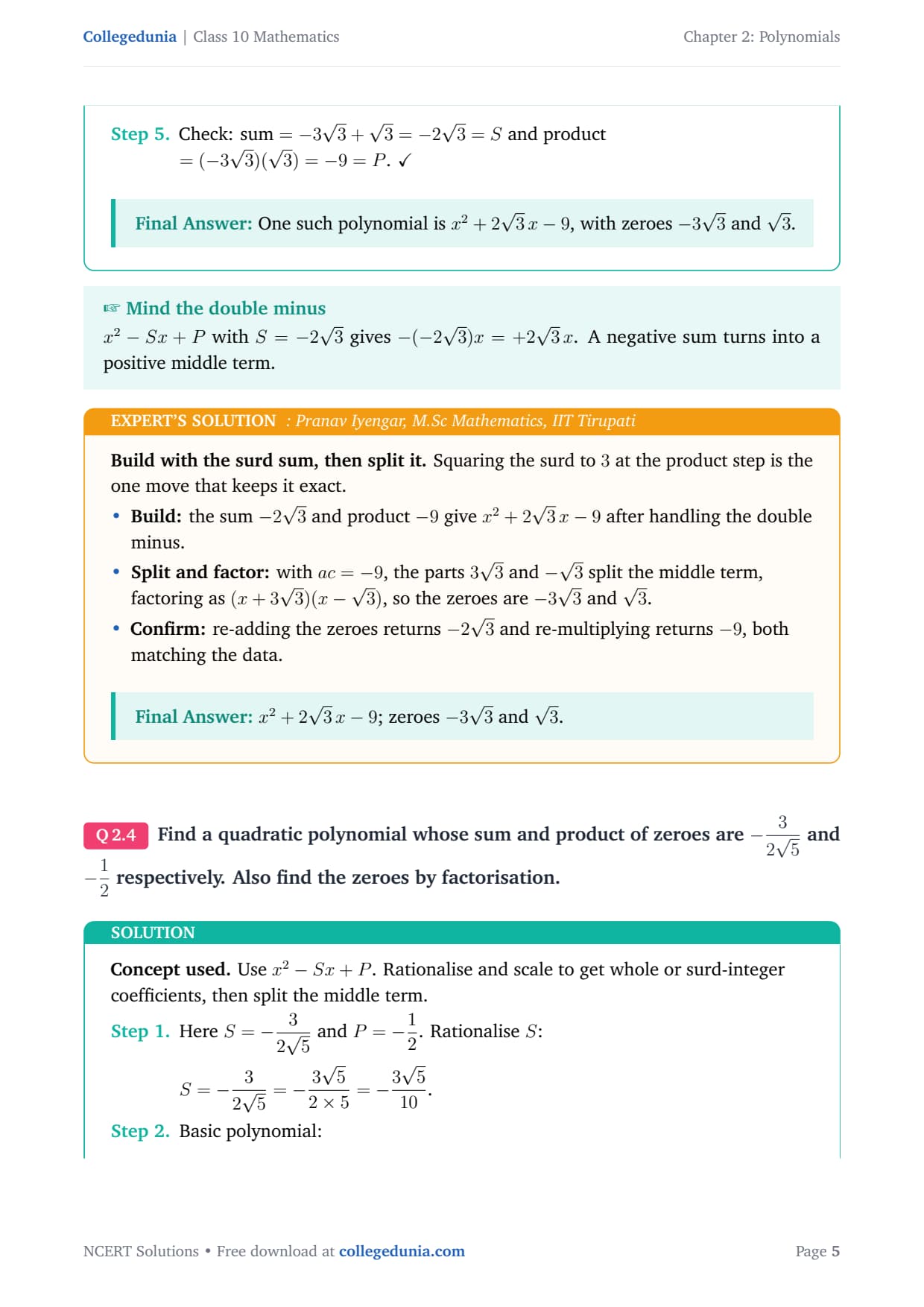
Find a quadratic polynomial whose sum and product of zeroes are -2√3 and -9 respectively. Also find the zeroes by factorisation.
Concept used. Use x2-Sx+P directly (no fractions to clear
here), then split the middle term using a surd.
Here S=-2√3 and P=-9. The polynomial is
[] x2-(-2√3)x+(-9)=x2+2√3x-9.
Factorise x2+2√3x-9: a× c=-9. We need two surd
terms with product -9x2 and sum 2√3x: these are
3√3x and -√3x (since
3√3·(-√3)=-3× 3=-9 and
3√3-√3=2√3).
Split and group:
[] x2+3√3x-√3x-9
[] =x(x+3√3)-√3(x+3√3)
=(x+3√3)(x-√3).
Zeroes: x+3√3=0⇒ x=-3√3, and
x-√3=0⇒ x=√3.
Check: sum =-3√3+√3=-2√3=S and product
=(-3√3)(√3)=-9=P.
One such polynomial is x2+2√3x-9, with zeroes
-3√3 and √3.
PI
Pranav Iyengar
M.Sc Mathematics, IIT Tirupati
Verified Expert
Build with the surd sum, then split it. Squaring the surd to 3
at the product step is the one move that keeps it exact.
Build: the sum -23 and product -9 give
x2+23 x-9 after handling the double minus.
Split and factor: with ac=-9, the parts 33 and
-3 split the middle term, factoring as
(x+33)(x-3), so the zeroes are -33 and 3.
Confirm: re-adding the zeroes returns -23 and
re-multiplying returns -9, both matching the data.
x2+2√3x-9; zeroes -3√3 and √3.
Q 2.4
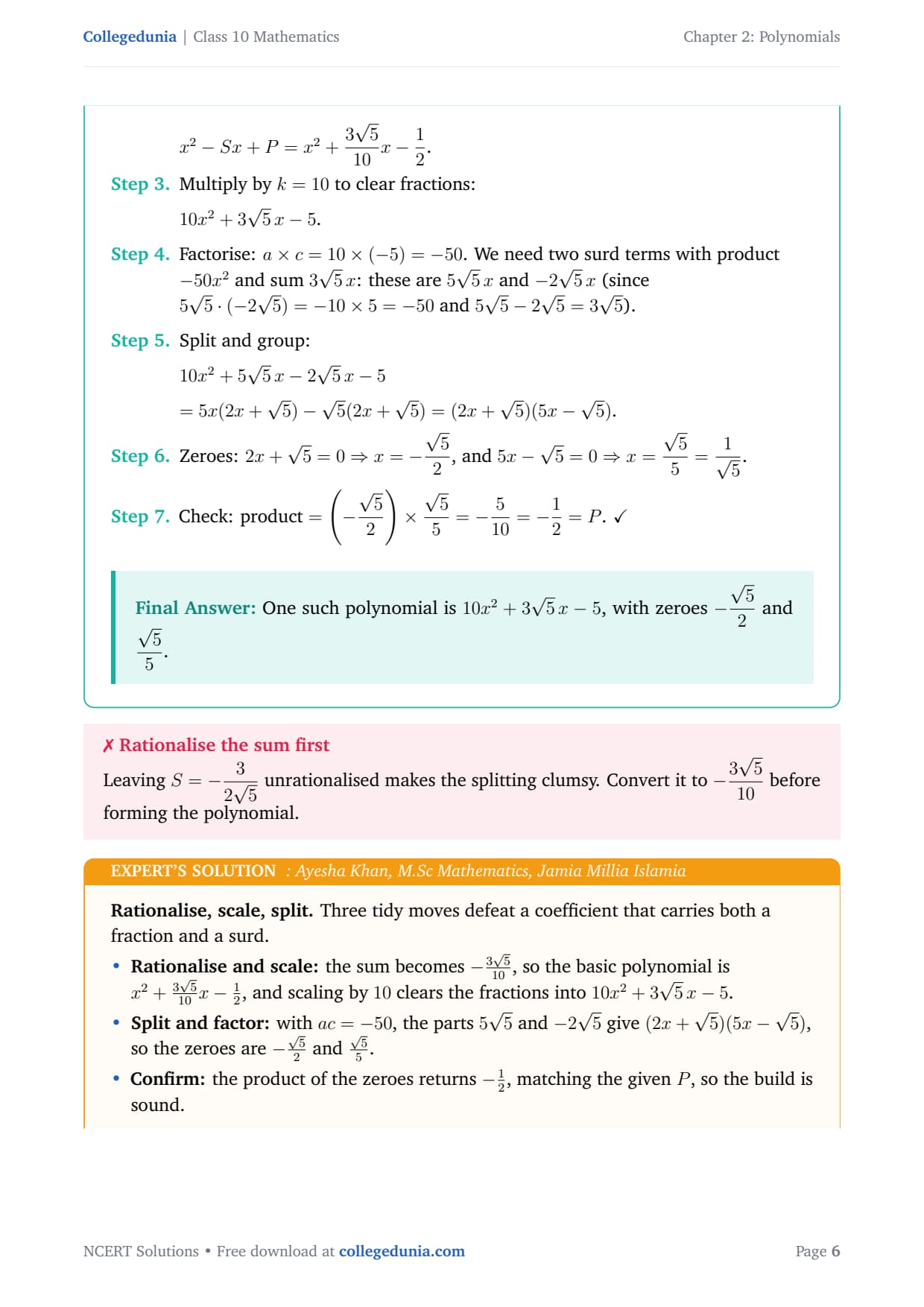
Find a quadratic polynomial whose sum and product of zeroes are -32√5 and -12 respectively. Also find the zeroes by factorisation.
Concept used. Use x2-Sx+P. Rationalise and scale to get
whole or surd-integer coefficients, then split the middle term.
Here S=-32√5 and P=-12. Rationalise
S:
[] S=-32√5=-3√52× 5
=-3√510.
Basic polynomial:
[] x2-Sx+P=x2+3√510x-12.
Multiply by k=10 to clear fractions:
[] 10x2+3√5x-5.
Factorise: a× c=10×(-5)=-50. We need two surd terms
with product -50x2 and sum 3√5x: these are
5√5x and -2√5x (since
5√5·(-2√5)=-10× 5=-50 and
5√5-2√5=3√5).
Split and group:
[] 10x2+5√5x-2√5x-5
[] =5x(2x+√5)-√5(2x+√5)
=(2x+√5)(5x-√5).
Zeroes: 2x+√5=0⇒ x=-√52, and
5x-√5=0⇒ x=√55=1√5.
Check: product =(-√52)
×√55=-510=-12=P.
One such polynomial is 10x2+3√5x-5, with zeroes
-√52 and √55.
AK
Ayesha Khan
M.Sc Mathematics, Jamia Millia Islamia
Verified Expert
Rationalise, scale, split. Three tidy moves defeat a coefficient
that carries both a fraction and a surd.
Rationalise and scale: the sum becomes
-3510, so the basic polynomial is
x2+3510x-12, and scaling by 10 clears
the fractions into 10x2+35 x-5.
Split and factor: with ac=-50, the parts 55 and
-25 give (2x+5)(5x-5), so the zeroes are
-52 and 55.
Confirm: the product of the zeroes returns -12,
matching the given P, so the build is sound.
10x2+3√5x-5; zeroes -√52 and
√55.
Q 2.5
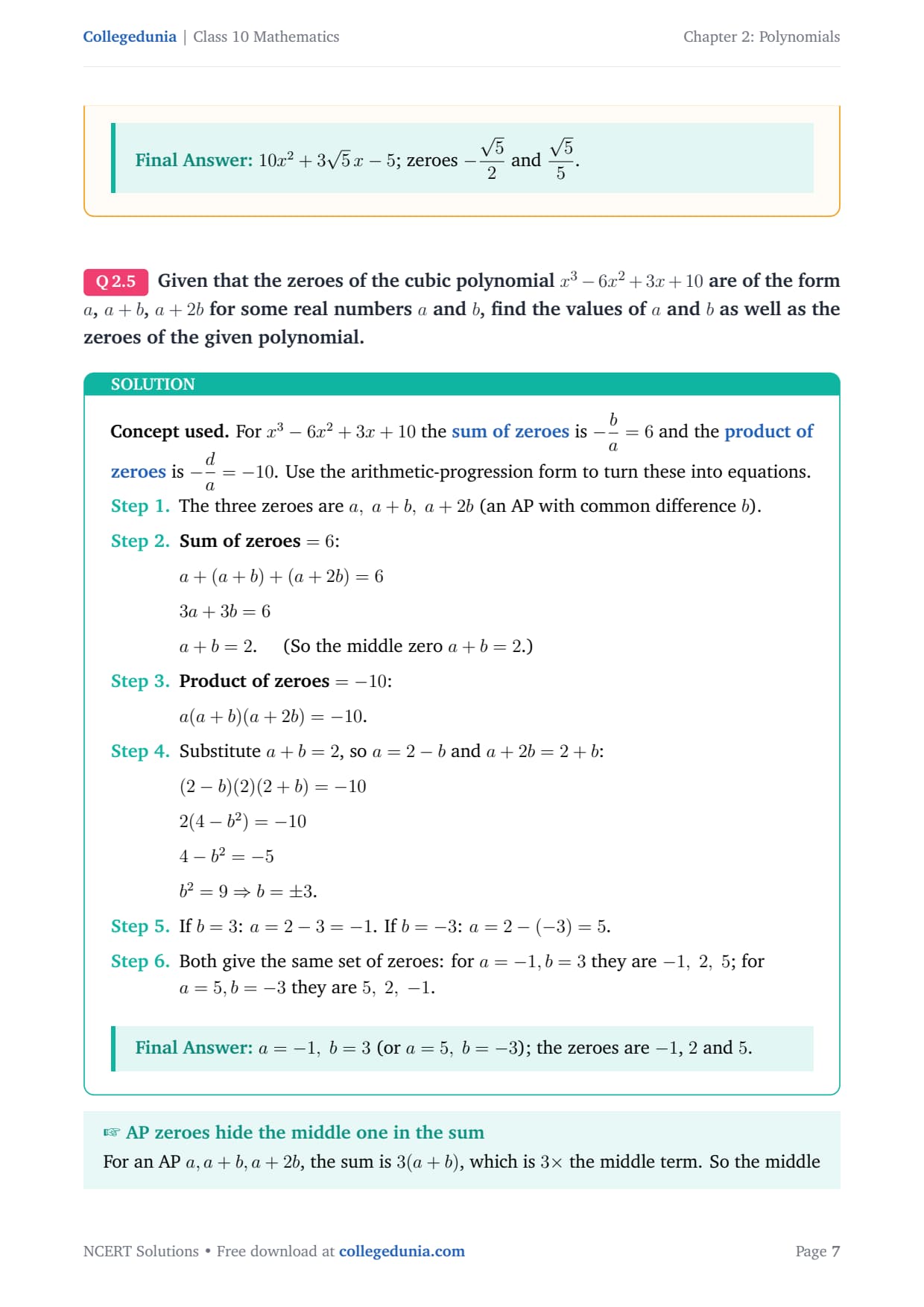
Given that the zeroes of the cubic polynomial x3-6x2+3x+10 are of the form a, a+b, a+2b for some real numbers a and b, find the values of a and b as well as the zeroes of the given polynomial.
Concept used. For x3-6x2+3x+10 the
sum of zeroes is -ba=6 and the product of
zeroes is -da=-10. Use the arithmetic-progression form to
turn these into equations.
The three zeroes are a, a+b, a+2b (an AP with common
difference b).
Sum of zeroes=6:
[] a+(a+b)+(a+2b)=6
[] 3a+3b=6
[] a+b=2. (So the middle zero a+b=2.)
Product of zeroes=-10:
[] a(a+b)(a+2b)=-10.
Substitute a+b=2, so a=2-b and a+2b=2+b:
[] (2-b)(2)(2+b)=-10
[] 2(4-b2)=-10
[] 4-b2=-5
[] b2=9⇒ b=± 3.
If b=3: a=2-3=-1. If b=-3: a=2-(-3)=5.
Both give the same set of zeroes:
for a=-1,b=3 they are -1, 2, 5;
for a=5,b=-3 they are 5, 2, -1.
a=-1, b=3 (or a=5, b=-3); the zeroes are -1, 2 and
5.
RD
Reema D'Souza
M.Sc Mathematics, Goa University
Verified Expert
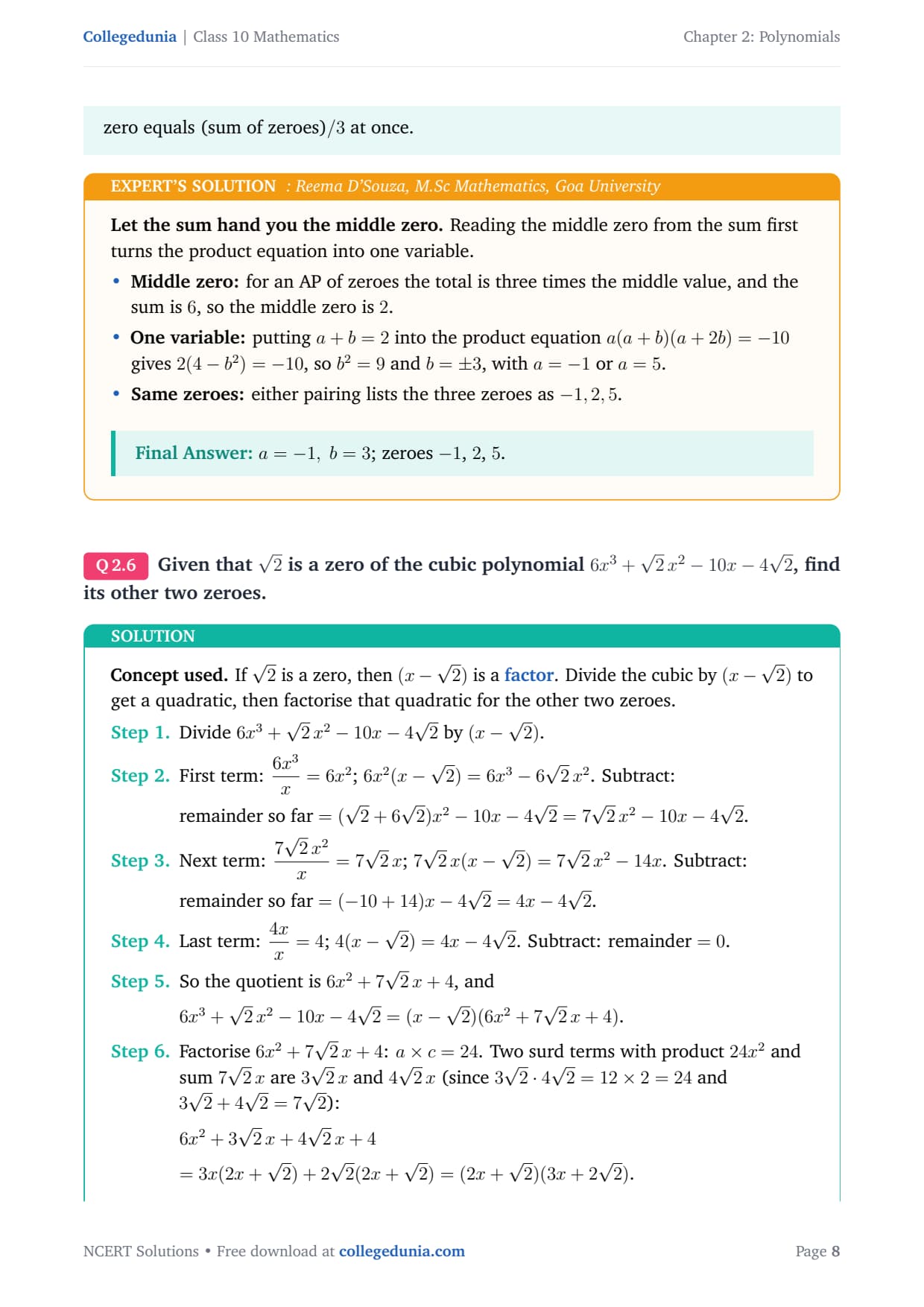
Let the sum hand you the middle zero. Reading the middle zero
from the sum first turns the product equation into one variable.
Middle zero: for an AP of zeroes the total is three times
the middle value, and the sum is 6, so the middle zero is 2.
One variable: putting a+b=2 into the product equation
a(a+b)(a+2b)=-10 gives 2(4-b2)=-10, so b2=9 and
b=3, with a=-1 or a=5.
Same zeroes: either pairing lists the three zeroes as
-1,2,5.
a=-1, b=3; zeroes -1, 2, 5.
Q 2.6
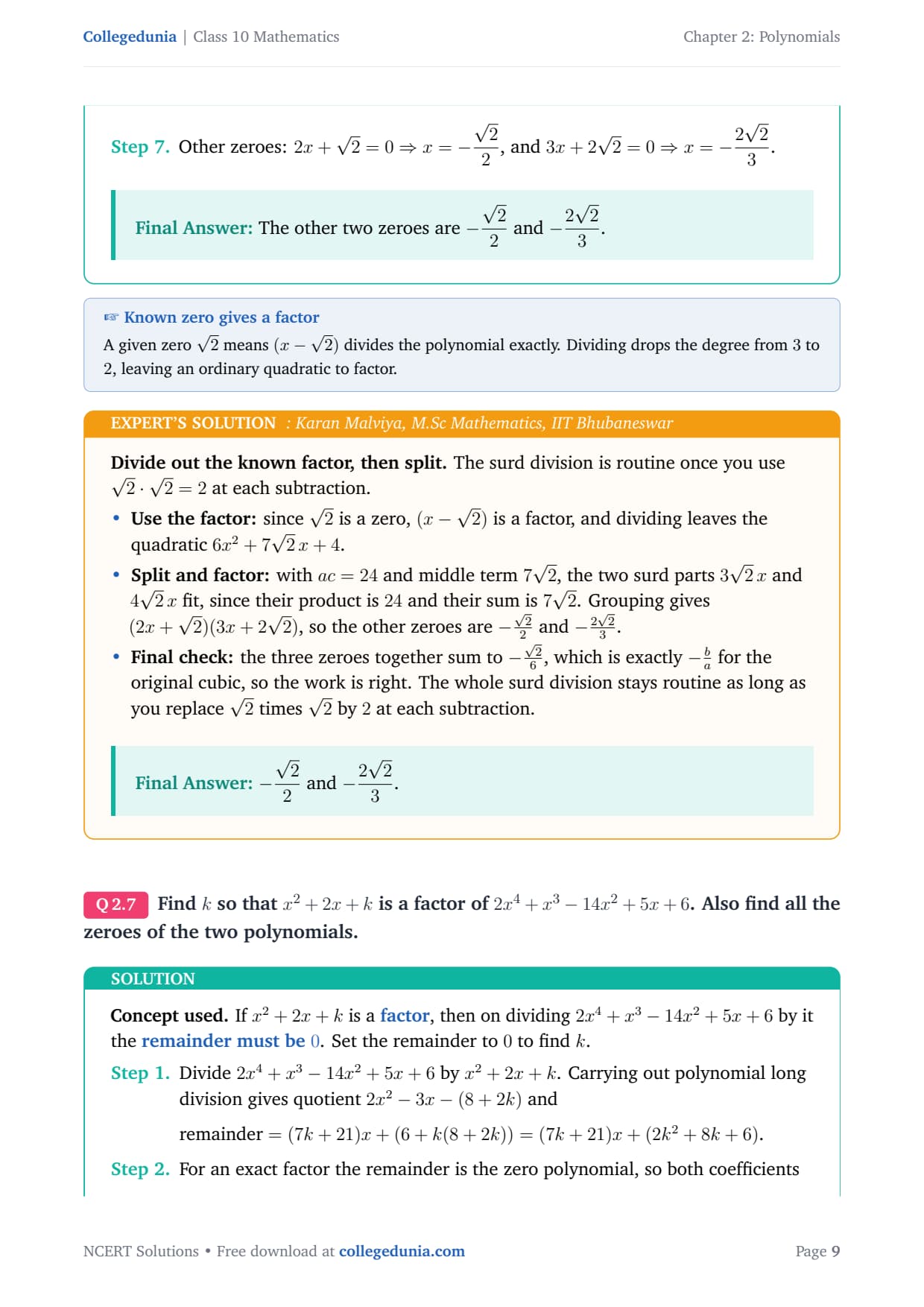
Given that √2 is a zero of the cubic polynomial 6x3+√2 x2-10x-4√2, find its other two zeroes.
Concept used. If √2 is a zero, then (x-√2) is a
factor. Divide the cubic by (x-√2) to get a quadratic,
then factorise that quadratic for the other two zeroes.
Divide 6x3+√2 x2-10x-4√2 by (x-√2).
First term: 6x3x=6x2;
6x2(x-√2)=6x3-6√2 x2. Subtract:
[] remainder so far =(√2+6√2)x2-10x-4√2
=7√2 x2-10x-4√2.
Next term: 7√2 x2x=7√2x;
7√2x(x-√2)=7√2 x2-14x. Subtract:
[] remainder so far =(-10+14)x-4√2=4x-4√2.
Last term: 4xx=4; 4(x-√2)=4x-4√2.
Subtract: remainder =0.
So the quotient is 6x2+7√2x+4, and
[] 6x3+√2 x2-10x-4√2
=(x-√2)(6x2+7√2x+4).
Factorise 6x2+7√2x+4: a× c=24. Two surd terms
with product 24x2 and sum 7√2x are 3√2x
and 4√2x (since 3√2· 4√2=12× 2=24
and 3√2+4√2=7√2):
[] 6x2+3√2x+4√2x+4
[] =3x(2x+√2)+2√2(2x+√2)
=(2x+√2)(3x+2√2).
Other zeroes: 2x+√2=0⇒
x=-√22, and 3x+2√2=0⇒
x=-2√23.
The other two zeroes are -√22 and
-2√23.
KM
Karan Malviya
M.Sc Mathematics, IIT Bhubaneswar
Verified Expert
Divide out the known factor, then split. The surd division is
routine once you use 2·2=2 at each subtraction.
Use the factor: since 2 is a zero, (x-2) is
a factor, and dividing leaves the quadratic 6x2+72 x+4.
Split and factor: with ac=24 and middle term 72,
the two surd parts 32 x and 42 x fit, since their
product is 24 and their sum is 72. Grouping gives
(2x+2)(3x+22), so the other zeroes are
-22 and -223.
Final check: the three zeroes together sum to
-26, which is exactly -ba for the
original cubic, so the work is right. The whole surd division
stays routine as long as you replace 2 times 2 by
2 at each subtraction.
-√22 and -2√23.
Q 2.7
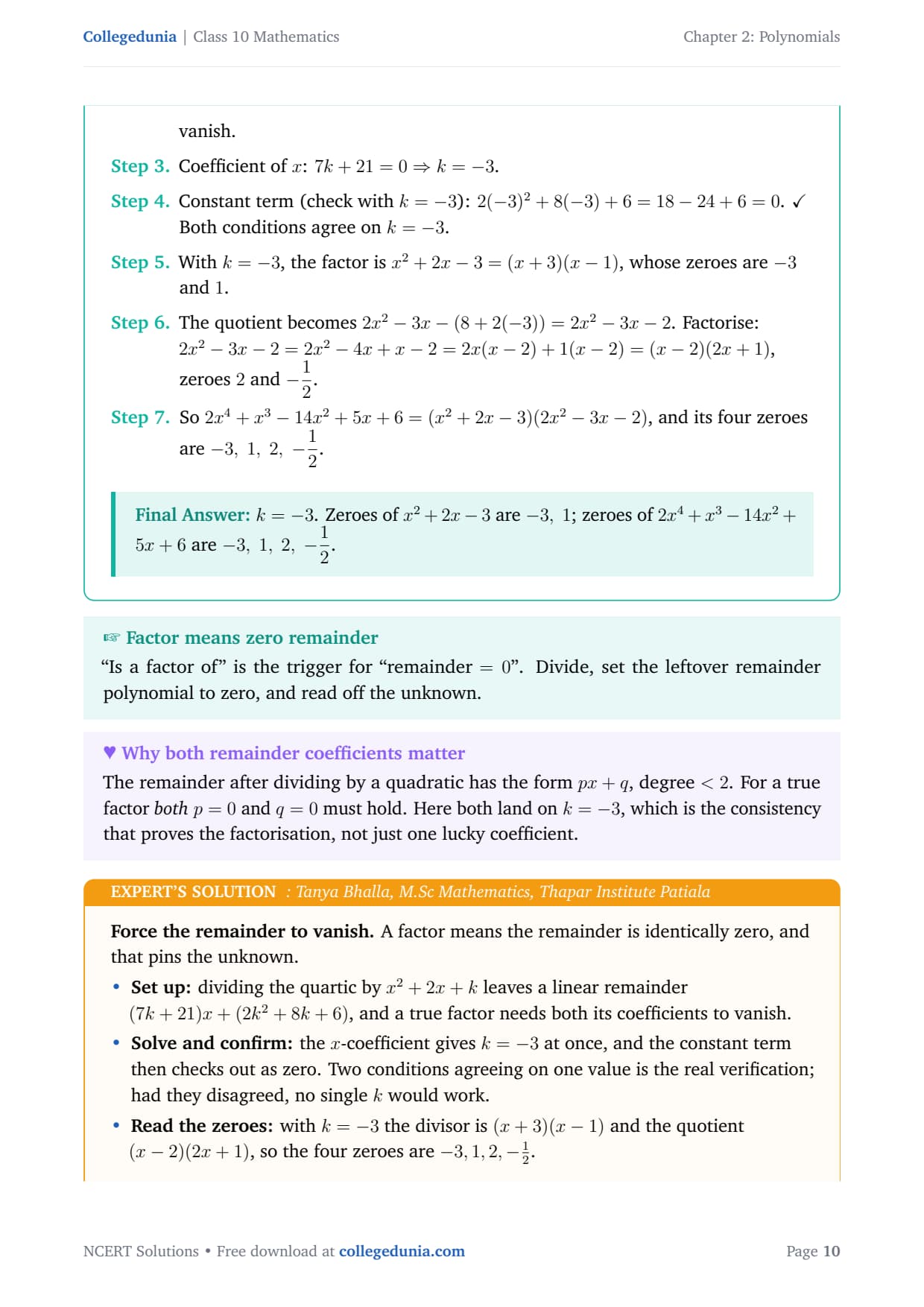
Find k so that x2+2x+k is a factor of 2x4+x3-14x2+5x+6. Also find all the zeroes of the two polynomials.
Concept used. If x2+2x+k is a factor, then on
dividing 2x4+x3-14x2+5x+6 by it the remainder must be
0. Set the remainder to 0 to find k.
Divide 2x4+x3-14x2+5x+6 by x2+2x+k. Carrying out
polynomial long division gives quotient 2x2-3x-(8+2k) and
[] remainder =(7k+21)x+(6+k(8+2k))=(7k+21)x+(2k2+8k+6).
For an exact factor the remainder is the zero polynomial, so both
coefficients vanish.
Coefficient of x: 7k+21=0⇒ k=-3.
Constant term (check with k=-3):
2(-3)2+8(-3)+6=18-24+6=0. Both conditions agree
on k=-3.
With k=-3, the factor is x2+2x-3=(x+3)(x-1), whose zeroes
are -3 and 1.
The quotient becomes 2x2-3x-(8+2(-3))=2x2-3x-2.
Factorise: 2x2-3x-2=2x2-4x+x-2=2x(x-2)+1(x-2)=(x-2)(2x+1),
zeroes 2 and -12.
So 2x4+x3-14x2+5x+6=(x2+2x-3)(2x2-3x-2), and its
four zeroes are -3, 1, 2, -12.
k=-3. Zeroes of x2+2x-3 are -3, 1; zeroes of
2x4+x3-14x2+5x+6 are -3, 1, 2, -12.
TB
Tanya Bhalla
M.Sc Mathematics, Thapar Institute Patiala
Verified Expert
Force the remainder to vanish. A factor means the remainder is
identically zero, and that pins the unknown.
Set up: dividing the quartic by x2+2x+k leaves a
linear remainder (7k+21)x+(2k2+8k+6), and a true factor needs
both its coefficients to vanish.
Solve and confirm: the x-coefficient gives k=-3 at
once, and the constant term then checks out as zero. Two
conditions agreeing on one value is the real verification; had
they disagreed, no single k would work.
Read the zeroes: with k=-3 the divisor is (x+3)(x-1)
and the quotient (x-2)(2x+1), so the four zeroes are
-3,1,2,-12.
k=-3; quartic zeroes -3,1,2,-12.
Q 2.8
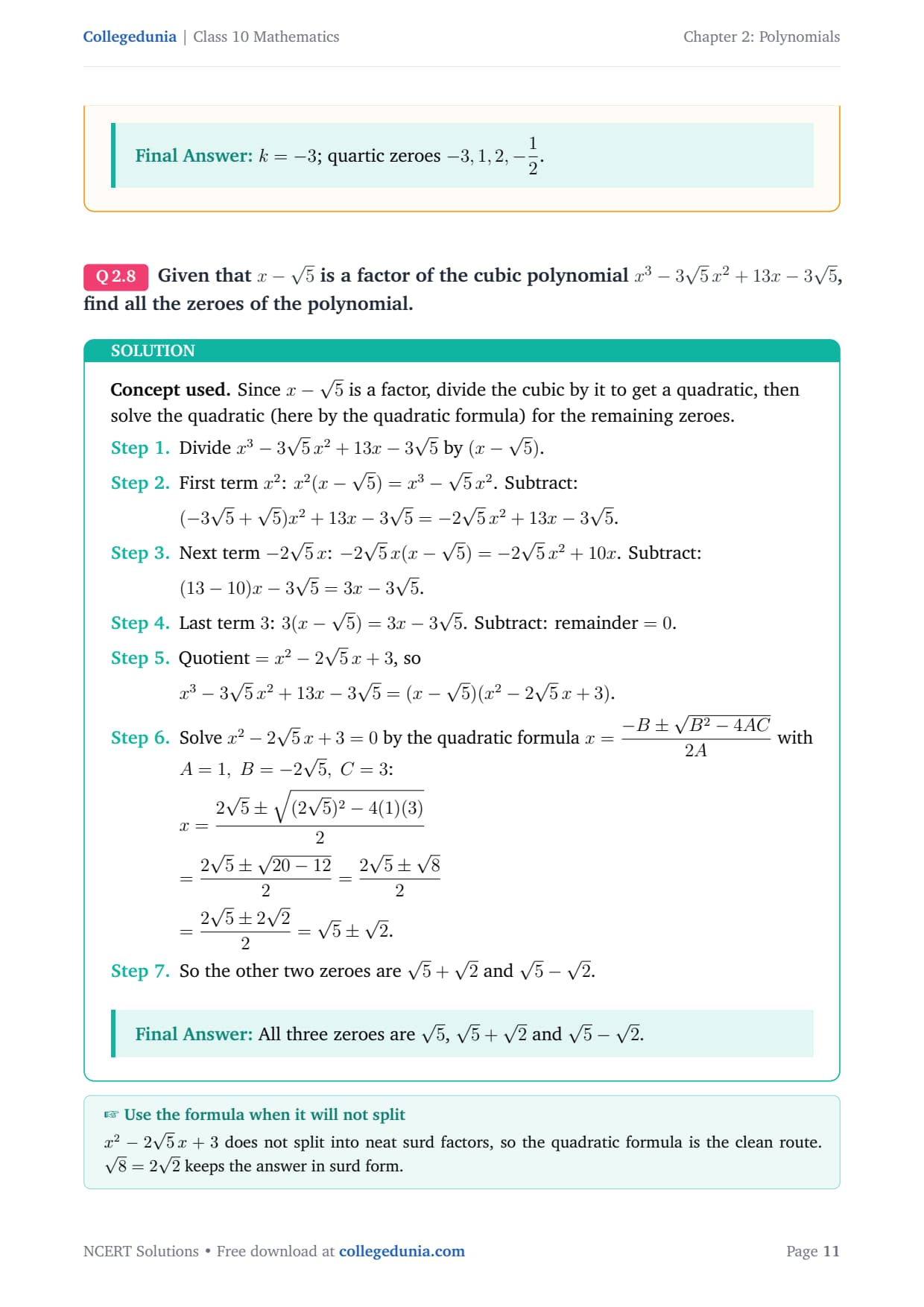
Given that x-√5 is a factor of the cubic polynomial x3-3√5 x2+13x-3√5, find all the zeroes of the polynomial.
Concept used. Since x-√5 is a factor, divide the cubic by
it to get a quadratic, then solve the quadratic (here by the quadratic
formula) for the remaining zeroes.
Divide x3-3√5 x2+13x-3√5 by (x-√5).
First term x2: x2(x-√5)=x3-√5 x2.
Subtract:
[] (-3√5+√5)x2+13x-3√5
=-2√5 x2+13x-3√5.
Next term -2√5x:
-2√5x(x-√5)=-2√5 x2+10x. Subtract:
[] (13-10)x-3√5=3x-3√5.
Last term 3: 3(x-√5)=3x-3√5. Subtract: remainder
=0.
Quotient =x2-2√5x+3, so
[] x3-3√5 x2+13x-3√5
=(x-√5)(x2-2√5x+3).
Solve x2-2√5x+3=0 by the quadratic formula
x=-B±√B2-4AC2A with
A=1, B=-2√5, C=3:
[] x=2√5±√(2√5)2-4(1)(3)2
[] =2√5±√20-122
=2√5±√82
[] =2√5± 2√22=√5±√2.
So the other two zeroes are √5+√2 and
√5-√2.
All three zeroes are √5, √5+√2 and
√5-√2.
OK
Ojas Kulkarni
M.Sc Mathematics, IISER Pune
Verified Expert
Divide, then apply the formula. When the reduced quadratic will
not split, reach for the quadratic formula.
Divide: the known factor x-5 divides the cubic to
leave x2-25 x+3.
Apply the formula: this quadratic resists a tidy split,
so use the quadratic formula instead. The discriminant works out
to 20-12=8, and since 8=22, the two roots come out as
5±2.
Check: the three zeroes together sum to 35, which
matches -ba from the original cubic, a reassuring sign
that no surd was dropped along the way.
√5, √5+√2, √5-√2.
Q 2.9
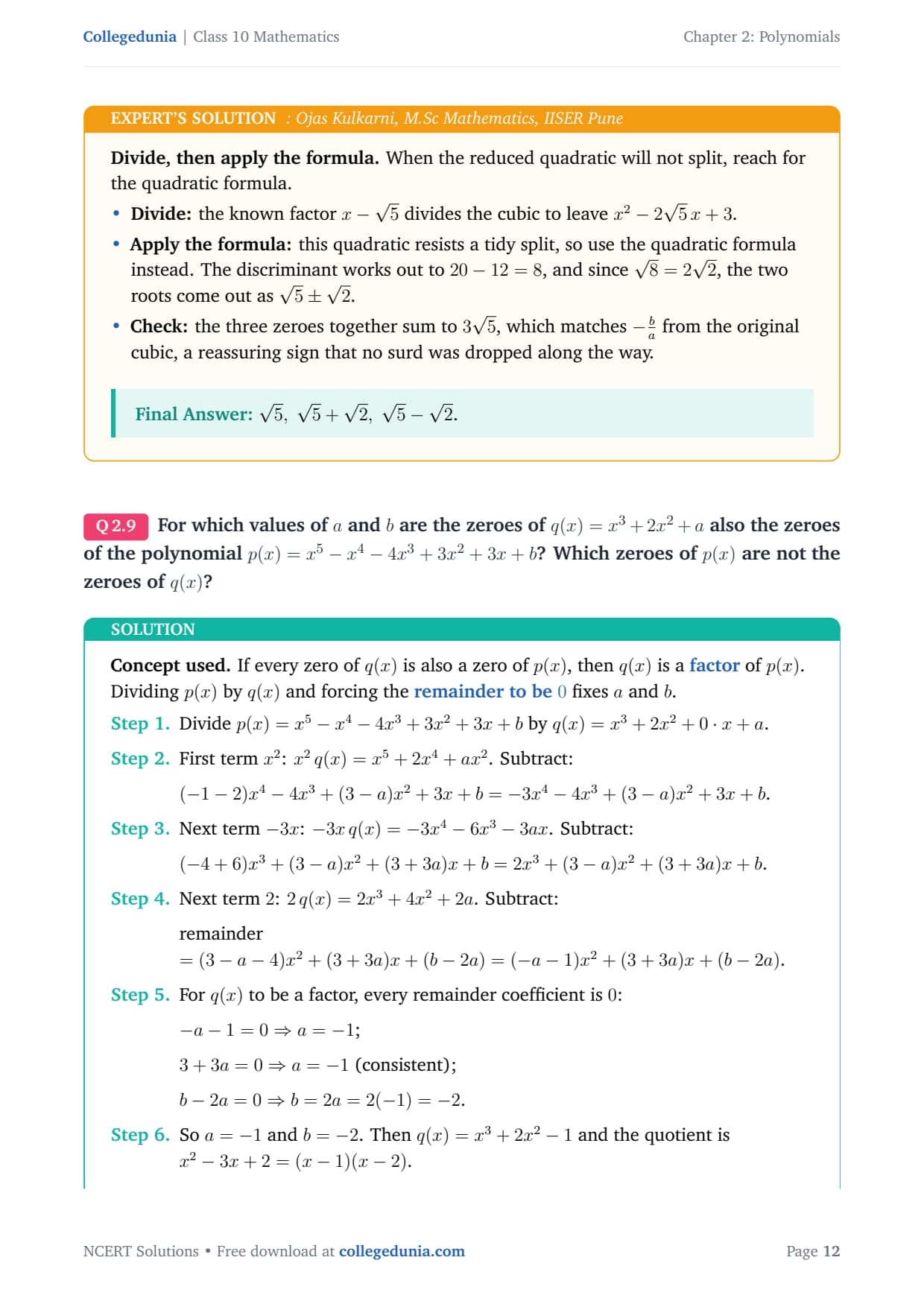
For which values of a and b are the zeroes of q(x)=x3+2x2+a also the zeroes of the polynomial p(x)=x5-x4-4x3+3x2+3x+b? Which zeroes of p(x) are not the zeroes of q(x)?
Concept used. If every zero of q(x) is also a zero of p(x),
then q(x) is a factor of p(x). Dividing p(x) by q(x) and
forcing the remainder to be 0 fixes a and b.
Divide p(x)=x5-x4-4x3+3x2+3x+b by
q(x)=x3+2x2+0· x+a.
First term x2:
x2q(x)=x5+2x4+ax2. Subtract:
[] (-1-2)x4-4x3+(3-a)x2+3x+b
=-3x4-4x3+(3-a)x2+3x+b.
Next term -3x:
-3x q(x)=-3x4-6x3-3ax. Subtract:
[] (-4+6)x3+(3-a)x2+(3+3a)x+b
=2x3+(3-a)x2+(3+3a)x+b.
Next term 2: 2 q(x)=2x3+4x2+2a. Subtract:
[] remainder =(3-a-4)x2+(3+3a)x+(b-2a)
=(-a-1)x2+(3+3a)x+(b-2a).
For q(x) to be a factor, every remainder coefficient is 0:
[] -a-1=0⇒ a=-1;
[] 3+3a=0⇒ a=-1 (consistent);
[] b-2a=0⇒ b=2a=2(-1)=-2.
So a=-1 and b=-2. Then
q(x)=x3+2x2-1 and the quotient is x2-3x+2=(x-1)(x-2).
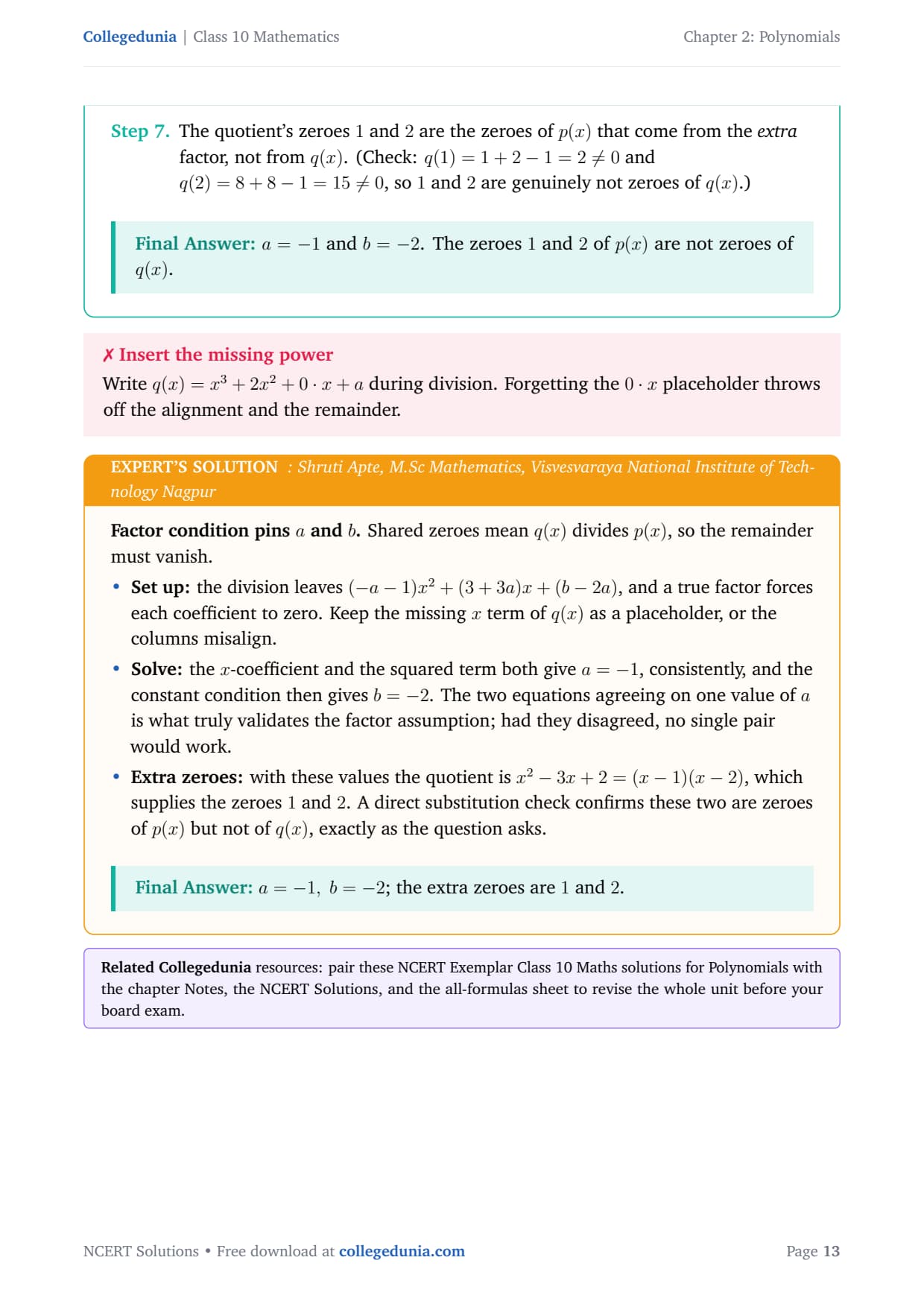
The quotient's zeroes 1 and 2 are the zeroes of p(x) that
come from the extra factor, not from q(x). (Check:
q(1)=1+2-1=2≠ 0 and q(2)=8+8-1=15≠ 0, so 1 and 2 are
genuinely not zeroes of q(x).)
a=-1 and b=-2. The zeroes 1 and 2 of p(x) are not
zeroes of q(x).
SA
Shruti Apte
M.Sc Mathematics, Visvesvaraya National Institute of Technology Nagpur
Verified Expert
Factor condition pins a and b. Shared zeroes mean q(x)
divides p(x), so the remainder must vanish.
Set up: the division leaves
(-a-1)x2+(3+3a)x+(b-2a), and a true factor forces each
coefficient to zero. Keep the missing x term of q(x) as a
placeholder, or the columns misalign.
Solve: the x-coefficient and the squared term both give
a=-1, consistently, and the constant condition then gives
b=-2. The two equations agreeing on one value of a is what
truly validates the factor assumption; had they disagreed, no
single pair would work.
Extra zeroes: with these values the quotient is
x2-3x+2=(x-1)(x-2), which supplies the zeroes 1 and 2. A
direct substitution check confirms these two are zeroes of p(x)
but not of q(x), exactly as the question asks.
a=-1, b=-2; the extra zeroes are 1 and 2.
Polynomials Exemplar: Other Exercises & Resources
Work through the rest of the Polynomials Exemplar, then pair it with the matching study resources for Chapter 2.
Resource
What it covers
Open
Exercise 2.4
Long-answer build-from-zeroes and division-algorithm problems, solved step by step.
In a Collegedunia poll of 9,840 Class 10 Maths students before the 2026 boards, 78% said Q38 (AP zeroes of a cubic) and Q42 (shared zeroes of two polynomials) were the hardest in Exercise 2.4. They lost marks by forgetting the AP trick (middle zero = sum/3) or the zero-coefficient placeholder during division. Students who practised both routines picked up full marks.
Source: Collegedunia Class 10 Mathematics student poll. Sample of 9,840 students from CBSE schools across 12 states.
Other Resources for Polynomials Class 10 Maths
Pair this with the other Class 10 Maths resources for Polynomials, all linked below.
Ques. How many questions are there in NCERT Exemplar Class 10 Maths Chapter 2 Exercise 2.4?
Ans. Exercise 2.4 has 9 Long Answer questions, numbered Q34 to Q42 in the NCERT Exemplar book. It is the most difficult exercise in Chapter 2 Polynomials and covers building a quadratic from given zeroes, the division algorithm, and finding remaining zeroes of a cubic or quartic polynomial when one zero is already known.
Ques. What is the AP zeroes trick used in Q38 of Exercise 2.4?
Ans. When the three zeroes of a cubic are in arithmetic progression, say a, a+b, a+2b, their sum equals 3(a+b). This means the middle zero a+b is always equal to (sum of zeroes)/3. For Q38, the cubic is x³ - 6x² + 3x + 10, so the sum of zeroes is 6, and the middle zero is immediately 2. This shortcut converts what looks like a two-variable system into a single-variable equation for b. Students who know this trick finish Q38 in under two minutes.
Ques. Why do we need to insert a 0x placeholder in Q42 when dividing by q(x)?
Ans. In Q42, q(x) = x³ + 2x² + a has no x term. During polynomial long division, every term of the divisor must occupy its own column. If you write q(x) = x³ + 2x² + a without a column for 0x, the subtraction in each step shifts by one position and every subsequent remainder is wrong. Always write q(x) as x³ + 2x² + 0x + a to keep the alignment correct. This is the most common reason students get the wrong value of a in Q42.
Ques. Is NCERT Exemplar Exercise 2.4 important for CBSE Class 10 board exams?
Ans. Yes. The division algorithm (p(x) = g(x)q(x) + r(x)) is a standard topic in the Class 10 CBSE Maths syllabus for 2026-27, and Long Answer questions based on it appear regularly in board papers. Questions similar to Q38 (AP zeroes) and Q40 (finding k so a quadratic is a factor) have appeared in CBSE board sample papers. Students who can do Exercise 2.4 correctly are well placed for the 4-5 mark questions in the Algebra section of the board paper.
Ques. How is Exercise 2.4 different from Exercise 2.3 in the NCERT Exemplar?
Ans. Exercise 2.3 (Short Answer, Q24 to Q33) asks students to find zeroes by factorisation and verify the zeroes-coefficients relations for polynomials that are given directly. Exercise 2.4 (Long Answer, Q34 to Q42) is harder: Q34 to Q37 reverse the process (build the polynomial from the zeroes), and Q38 to Q42 use the division algorithm to find hidden zeroes or unknown coefficients. The two exercises together cover the full range of polynomial skills the CBSE Maths board paper tests in Chapter 2.







Comments