Maths Mentor, Delhi University | Updated 3+ months ago
NCERT Exemplar Class 10 Maths Chapter 2 Polynomials Exercise 2.1 has 11 MCQs, solved step by step here. They test zeroes of polynomials, the link between zeroes and coefficients, and reading a graph. All answers follow the 2026-27 CBSE syllabus.
Scope: 11 MCQs on quadratic and cubic polynomial zeroes.
Skills tested: sum and product of zeroes, sign analysis, and graph recognition.
Board relevance: Polynomials carry 2 to 3 marks in most CBSE board papers.
Every solution here is verified by subject experts and follows the 2026-27 NCERT Exemplar book exactly.
Solved by Collegedunia - All 11 questions below carry a detailed step-by-step solution and an expert view.
Exercise 2.1 is the MCQ section of the Polynomials chapter. It has 11 questions, each with four options.
Quadratic zeroes: find or check a zero by substitution (Q1, 2, 3, 7, 8, 9, 10).
Cubic zeroes: use the sum, sum-of-pairs and product relations (Q5, 6).
Counting polynomials: the role of the constant multiple (Q4).
Graph of a quadratic: spot which graph is not a parabola (Q11).
The CBSE board paper usually picks one MCQ from Polynomials. These Exemplar MCQs are harder than the textbook ones, so they make the best practice.
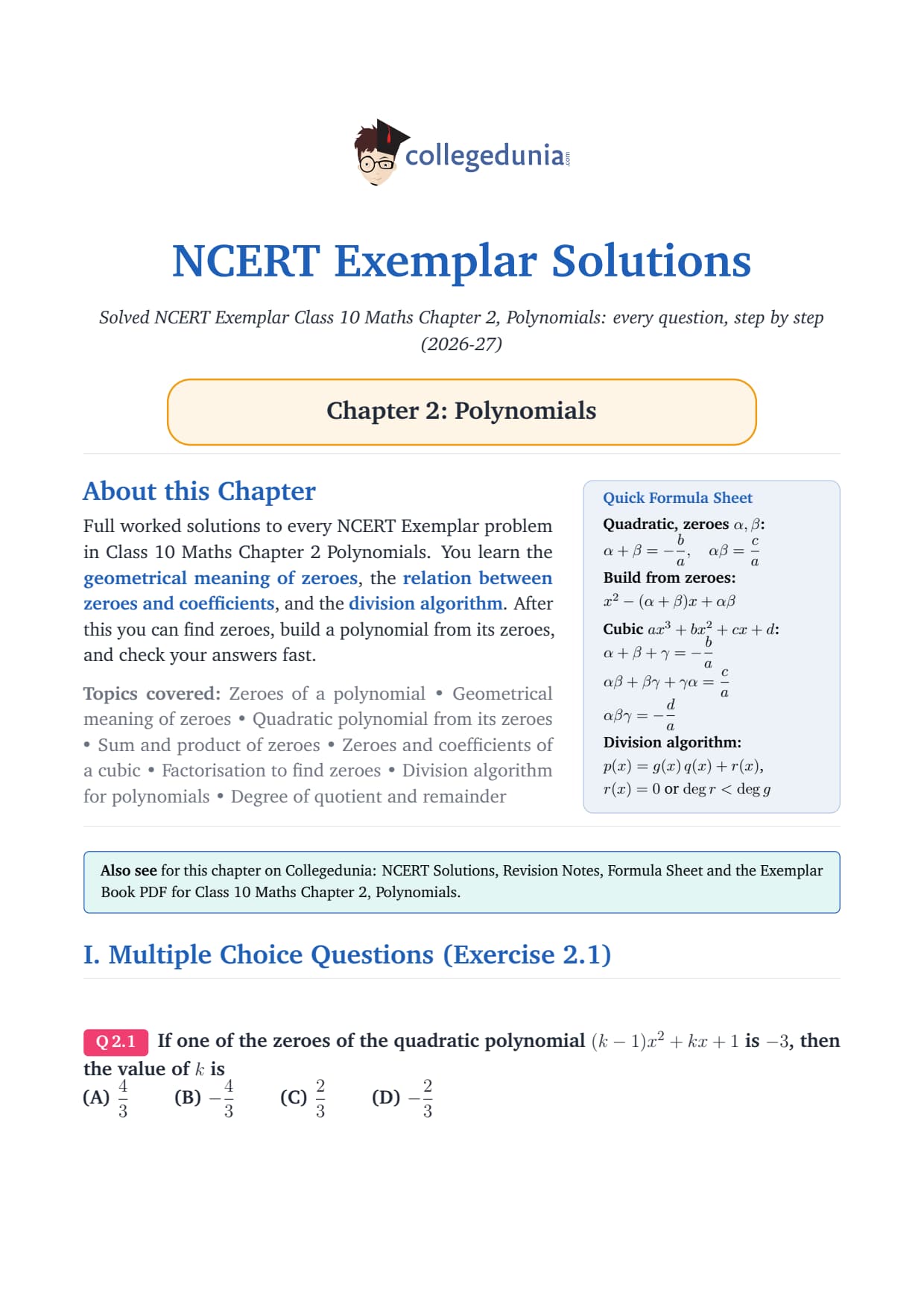
Key Formulas for Zeroes of Polynomials
Before the 11 MCQs, get clear on three formula sets. They come straight from the NCERT Exemplar book for 2026-27.
Polynomial Type
Relation
Formula
Quadratic ax2+bx+c
Sum of zeroes
-b/a
Product of zeroes
c/a
Cubic ax3+bx2+cx+d
Sum of zeroes
-b/a
Sum of pairs
c/a
Product of all three
-d/a
Build from zeroes
Quadratic with zeroes α, β
k[x2 - (α+β)x + αβ]
The cubic "sum of pairs" relation (c/a) is the most-tested formula here. Both Q5 and Q6 need it. Confusing it with the plain sum or product costs marks.
All 11 Questions with Step-by-Step Solutions
I. Multiple Choice Questions (Exercise 2.1)
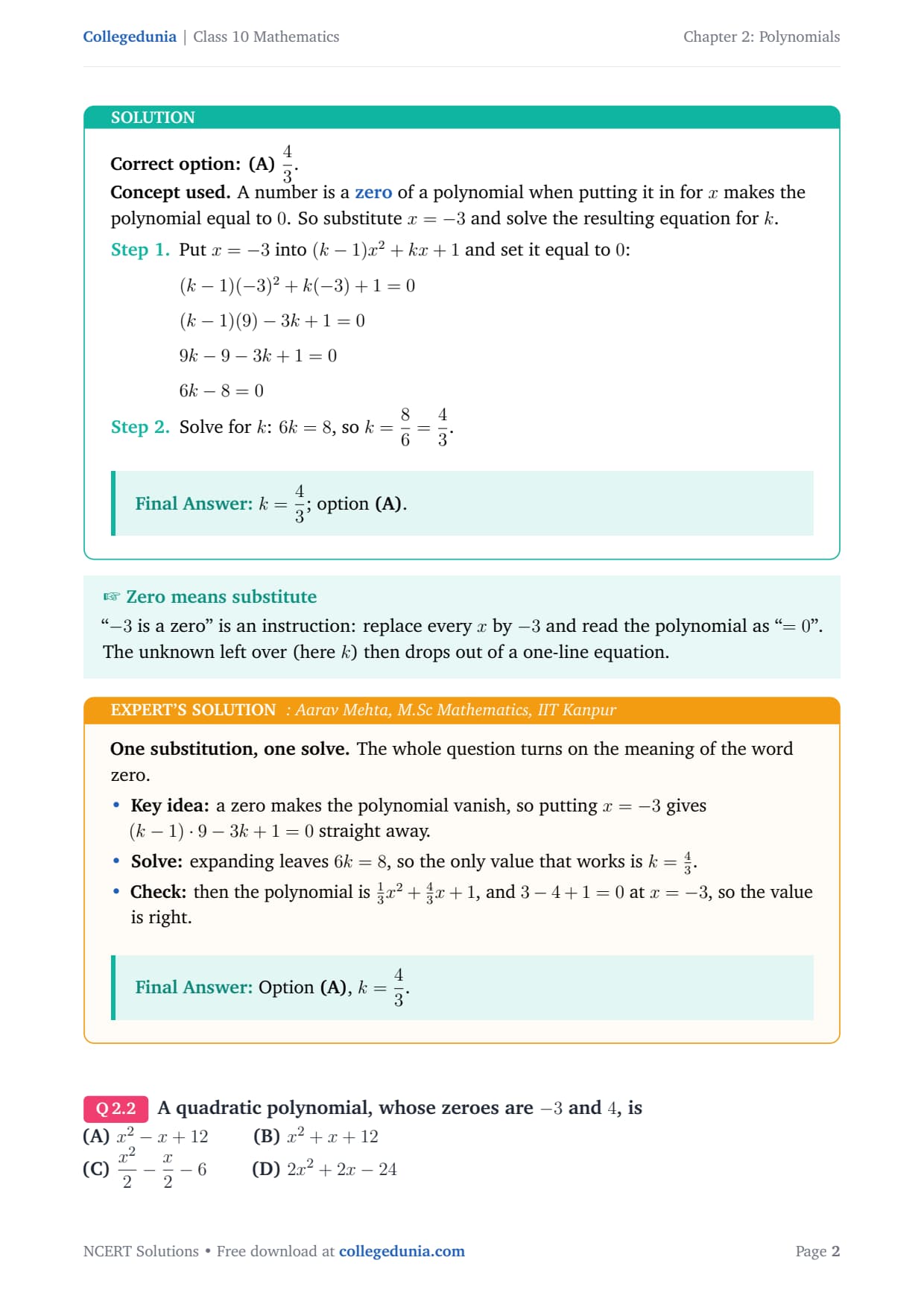
Q 2.1
If one of the zeroes of the quadratic polynomial (k-1)x2+kx+1 is -3, then the value of k is
(A) 43 (B) -43 (C) 23 (D) -23
Correct option: (A)43.
Concept used. A number is a zero of a polynomial when
putting it in for x makes the polynomial equal to 0. So substitute
x=-3 and solve the resulting equation for k.
Put x=-3 into (k-1)x2+kx+1 and set it equal to 0:
[] (k-1)(-3)2+k(-3)+1=0
[] (k-1)(9)-3k+1=0
[] 9k-9-3k+1=0
[] 6k-8=0
Solve for k: 6k=8, so k=86=43.
k=43; option (A).
AM
Aarav Mehta
M.Sc Mathematics, IIT Kanpur
Verified Expert
One substitution, one solve. The whole question turns on the
meaning of the word zero.
Key idea: a zero makes the polynomial vanish, so putting
x=-3 gives (k-1)· 9-3k+1=0 straight away.
Solve: expanding leaves 6k=8, so the only value that
works is k=43.
Check: then the polynomial is
13x2+43x+1, and 3-4+1=0 at x=-3, so
the value is right.
Option (A), k=43.
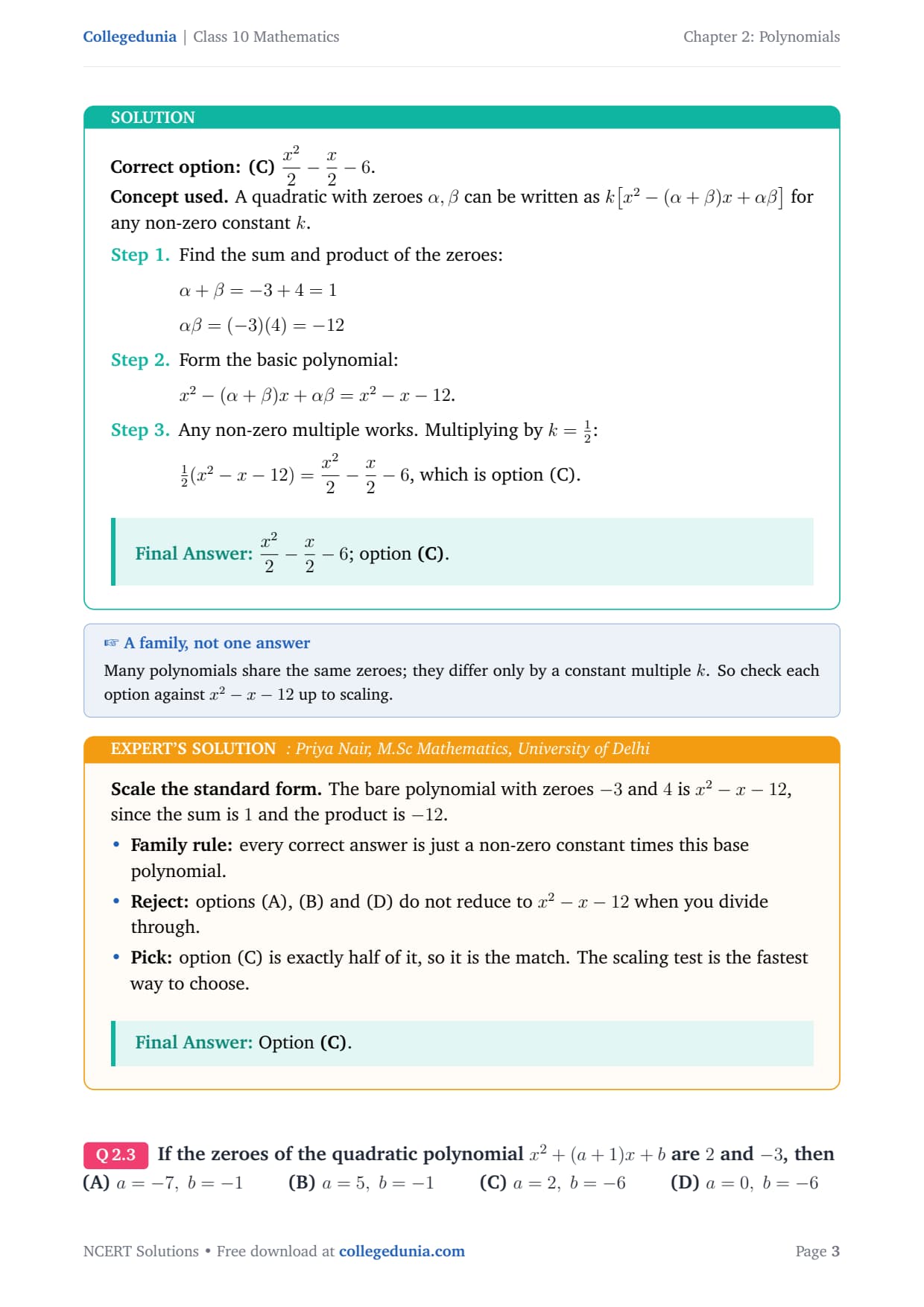
Q 2.2
A quadratic polynomial, whose zeroes are -3 and 4, is
(A) x2-x+12 (B) x2+x+12
(C) x22-x2-6 (D) 2x2+2x-24
Correct option: (C)x22-x2-6.
Concept used. A quadratic with zeroes α,β can be
written as k[x2-(α+β)x+αβ] for any
non-zero constant k.
Find the sum and product of the zeroes:
[] α+β=-3+4=1
[] αβ=(-3)(4)=-12
Form the basic polynomial:
[] x2-(α+β)x+αβ=x2-x-12.
Any non-zero multiple works. Multiplying by k=12:
[] 12(x2-x-12)=x22-x2-6,
which is option (C).
x22-x2-6; option (C).
PN
Priya Nair
M.Sc Mathematics, University of Delhi
Verified Expert
Scale the standard form. The bare polynomial with zeroes -3
and 4 is x2-x-12, since the sum is 1 and the product is -12.
Family rule: every correct answer is just a non-zero
constant times this base polynomial.
Reject: options (A), (B) and (D) do not reduce to
x2-x-12 when you divide through.
Pick: option (C) is exactly half of it, so it is the
match. The scaling test is the fastest way to choose.
Option (C).
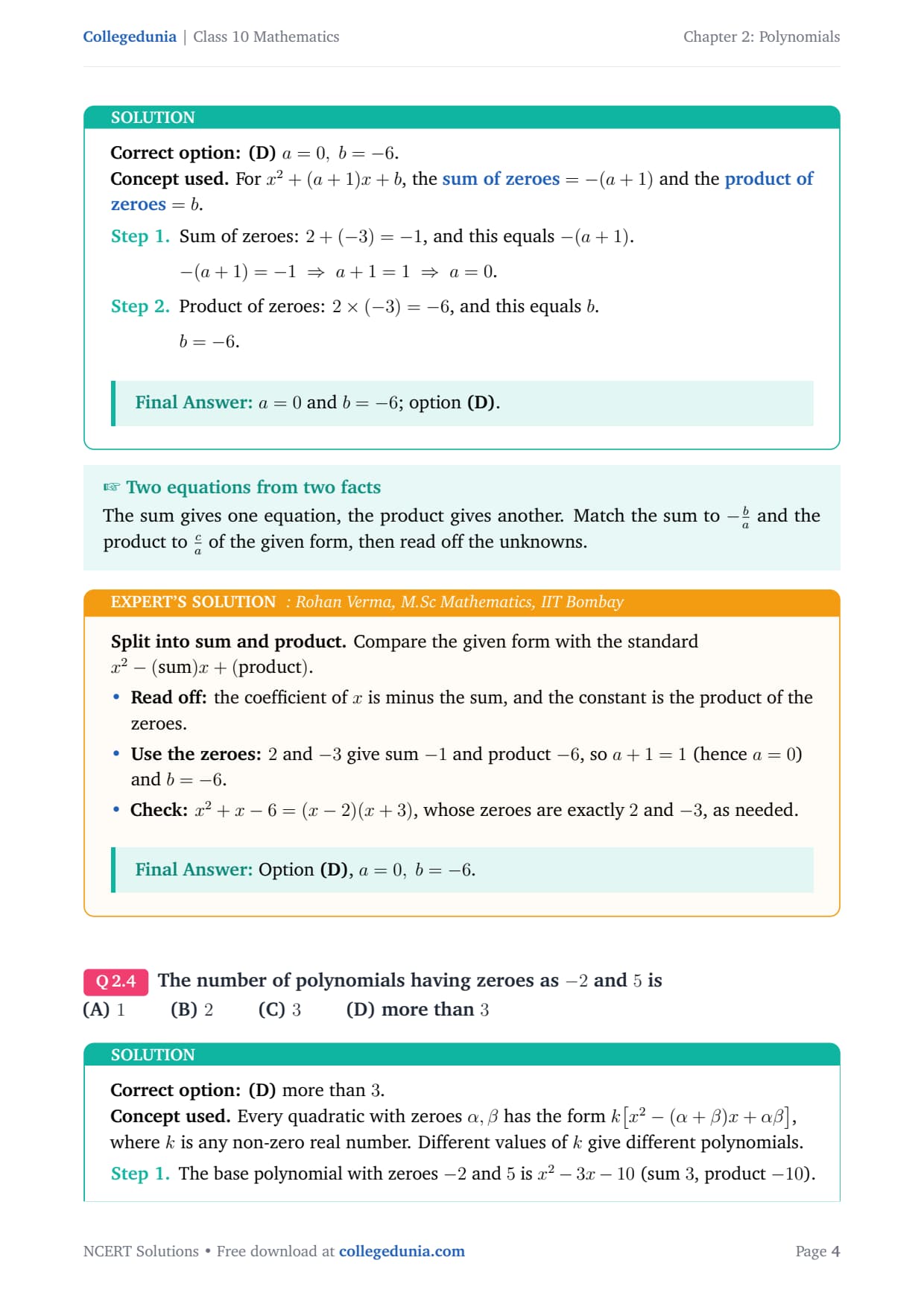
Q 2.3
If the zeroes of the quadratic polynomial x2+(a+1)x+b are 2 and -3, then
(A) a=-7, b=-1 (B) a=5, b=-1 (C) a=2, b=-6 (D) a=0, b=-6
Correct option: (D)a=0, b=-6.
Concept used. For x2+(a+1)x+b, the
sum of zeroes=-(a+1) and the
product of zeroes=b.
Sum of zeroes: 2+(-3)=-1, and this equals -(a+1).
[] -(a+1)=-1 ⇒ a+1=1 ⇒ a=0.
Product of zeroes: 2×(-3)=-6, and this equals b.
[] b=-6.
a=0 and b=-6; option (D).
RV
Rohan Verma
M.Sc Mathematics, IIT Bombay
Verified Expert
Split into sum and product. Compare the given form with the
standard x2-(sum)x+(product).
Read off: the coefficient of x is minus the sum, and
the constant is the product of the zeroes.
Use the zeroes:2 and -3 give sum -1 and product
-6, so a+1=1 (hence a=0) and b=-6.
Check:x2+x-6=(x-2)(x+3), whose zeroes are exactly
2 and -3, as needed.
Option (D), a=0, b=-6.
Q 2.4
The number of polynomials having zeroes as -2 and 5 is
(A) 1 (B) 2 (C) 3 (D) more than 3
Correct option: (D) more than 3.
Concept used. Every quadratic with zeroes α,β has the
form k[x2-(α+β)x+αβ], where k is any
non-zero real number. Different values of k give different
polynomials.
The base polynomial with zeroes -2 and 5 is
x2-3x-10 (sum 3, product -10).
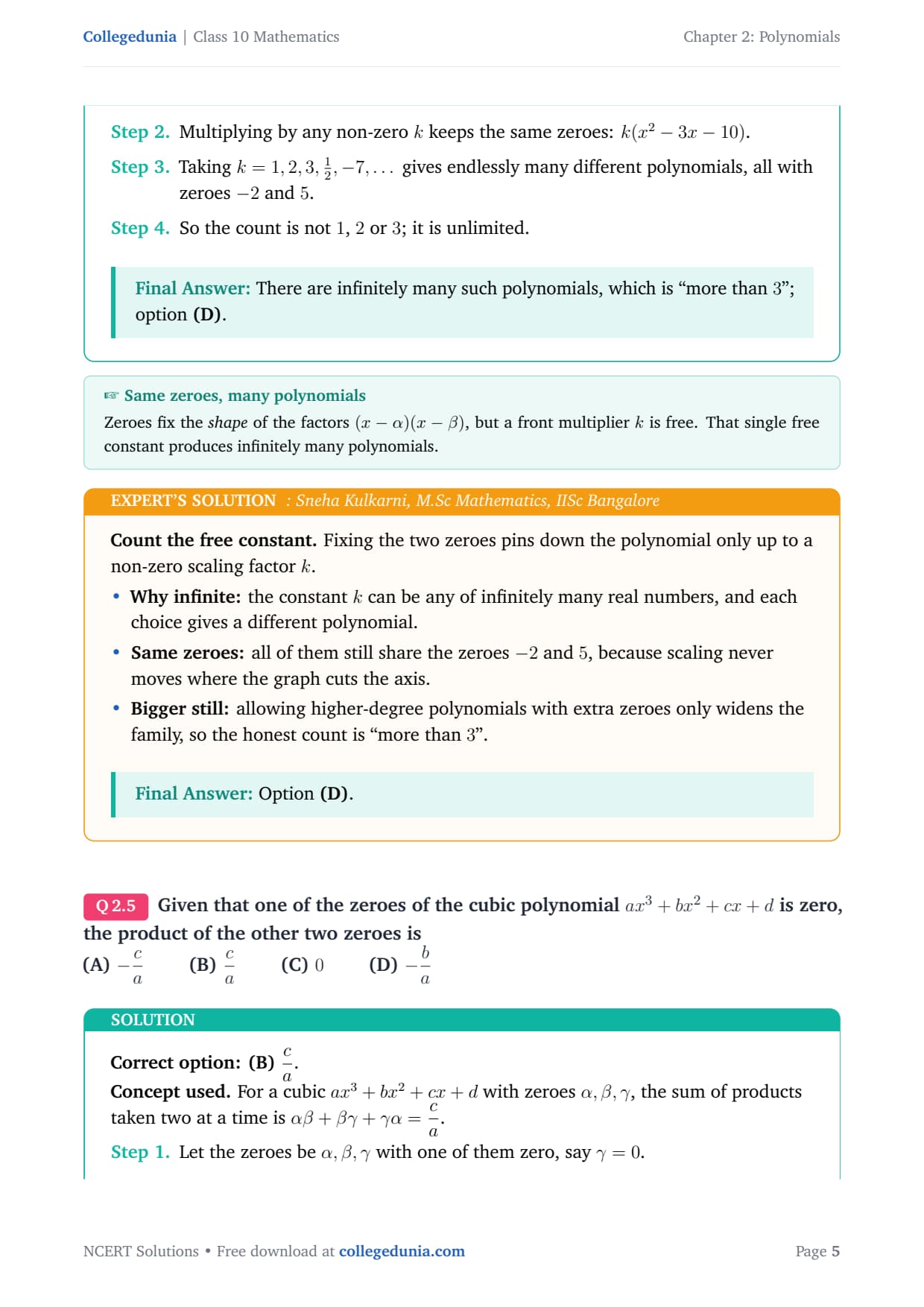
Multiplying by any non-zero k keeps the same zeroes:
k(x2-3x-10).
Taking k=1,2,3,12,-7, gives endlessly many
different polynomials, all with zeroes -2 and 5.
So the count is not 1, 2 or 3; it is unlimited.
There are infinitely many such polynomials, which is ``more
than 3''; option (D).
SK
Sneha Kulkarni
M.Sc Mathematics, IISc Bangalore
Verified Expert
Count the free constant. Fixing the two zeroes pins down the
polynomial only up to a non-zero scaling factor k.
Why infinite: the constant k can be any of infinitely
many real numbers, and each choice gives a different polynomial.
Same zeroes: all of them still share the zeroes -2 and
5, because scaling never moves where the graph cuts the axis.
Bigger still: allowing higher-degree polynomials with
extra zeroes only widens the family, so the honest count is
``more than 3''.
Option (D).
Q 2.5
Given that one of the zeroes of the cubic polynomial ax3+bx2+cx+d is zero, the product of the other two zeroes is
(A) -ca (B) ca (C) 0 (D) -ba
Correct option: (B)ca.
Concept used. For a cubic ax3+bx2+cx+d with zeroes
α,β,γ, the sum of products taken two at a time is
αβ+γ+γα=ca.
Let the zeroes be α,β,γ with one of them zero, say
γ=0.
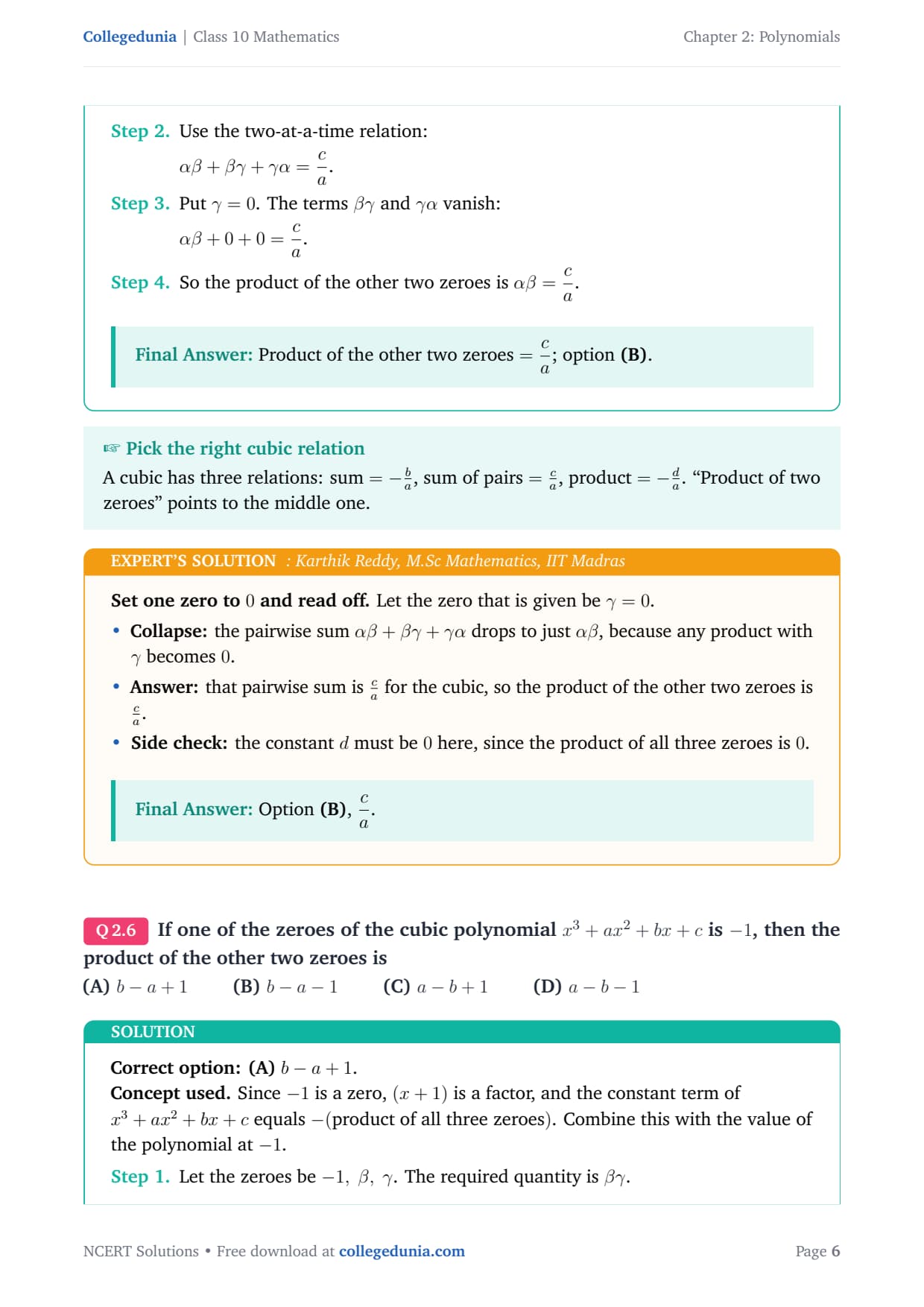
Use the two-at-a-time relation:
[] αβ+γ+γα=ca.
Put γ=0. The terms γ and γα vanish:
[] αβ+0+0=ca.
So the product of the other two zeroes is
αβ=ca.
Product of the other two zeroes =ca; option
(B).
KR
Karthik Reddy
M.Sc Mathematics, IIT Madras
Verified Expert
Set one zero to 0 and read off. Let the zero that is given be
γ=0.
Collapse: the pairwise sum
αβ+γ+γα drops to just
αβ, because any product with γ becomes 0.
Answer: that pairwise sum is ca for the
cubic, so the product of the other two zeroes is ca.
Side check: the constant d must be 0 here, since the
product of all three zeroes is 0.
Option (B), ca.
Q 2.6
If one of the zeroes of the cubic polynomial x3+ax2+bx+c is -1, then the product of the other two zeroes is
(A) b-a+1 (B) b-a-1 (C) a-b+1 (D) a-b-1
Correct option: (A)b-a+1.
Concept used. Since -1 is a zero, (x+1) is a factor, and the
constant term of x3+ax2+bx+c equals -(product of all
three zeroes). Combine this with the value of the polynomial at -1.
Let the zeroes be -1, β, γ. The required quantity is
γ.
Product of all three zeroes (for x3+ax2+bx+c) is -c:
[] (-1) γ=-c ⇒ γ=c.
Now use that -1 is a zero, so the polynomial is 0 at x=-1:
[] (-1)3+a(-1)2+b(-1)+c=0
[] -1+a-b+c=0 ⇒ c=1-a+b.
Therefore γ=c=b-a+1.
Product of the other two zeroes =b-a+1; option (A).
MJ
Meera Joshi
M.Sc Applied Mathematics, IIT Kharagpur
Verified Expert
Combine the product rule with p(-1)=0. One clue is not enough
here; you need both.
Product rule: all three zeroes multiply to -c, and one
of them is -1, so the other two multiply to c.
Substitute: since -1 is a zero, -1+a-b+c=0, which
rearranges to c=b-a+1.
Combine: the product of the other two zeroes is
therefore b-a+1, which is option (A).
Option (A), b-a+1.
Q 2.7
The zeroes of the quadratic polynomial x2+99x+127 are
(A) both positive (B) both negative
(C) one positive and one negative (D) both equal
Correct option: (B) both negative.
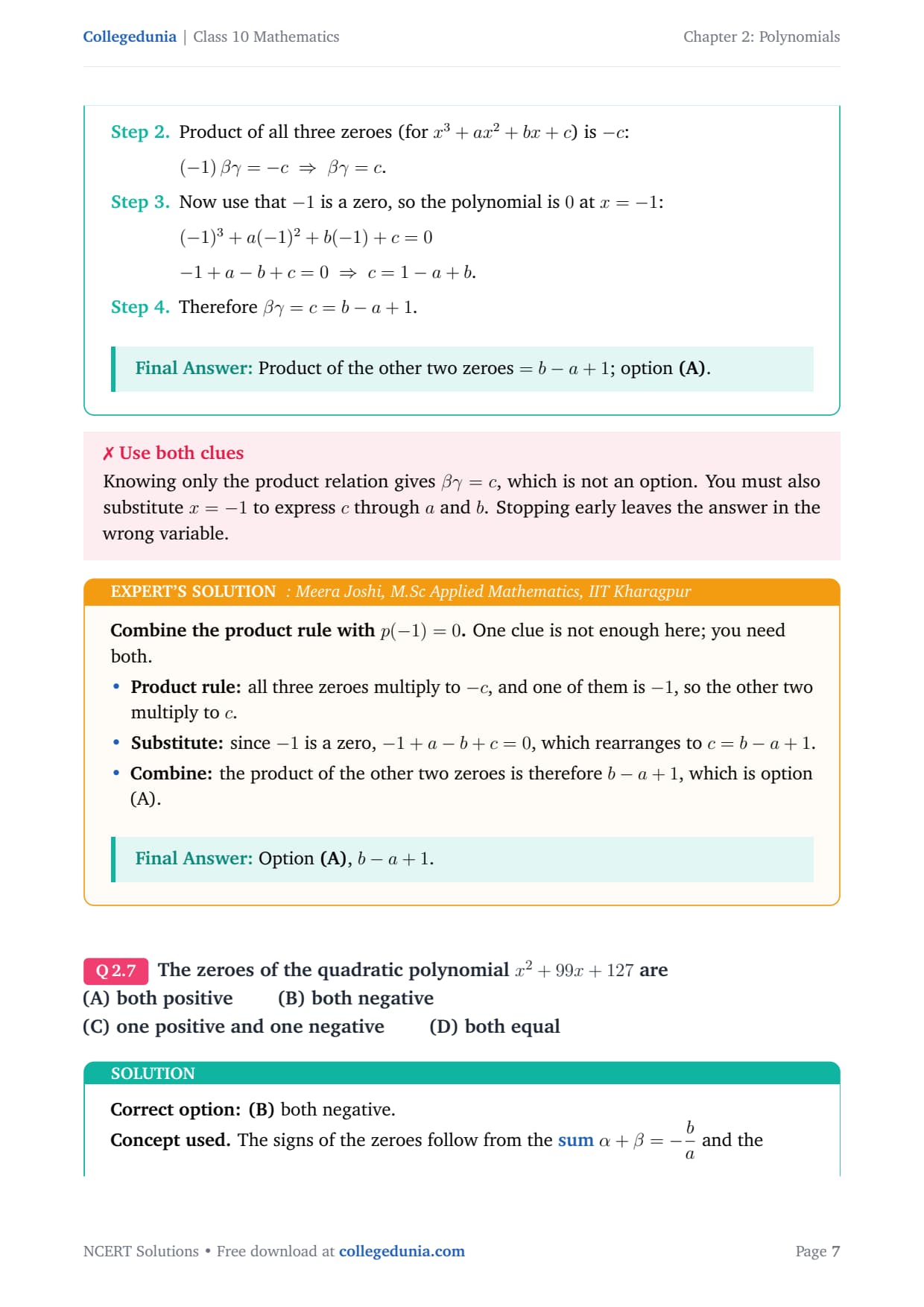
Concept used. The signs of the zeroes follow from the
sumα+β=-ba and the productαβ=ca.
Here a=1, b=99, c=127.
Product of zeroes: αβ=ca=1271=127>0,
so the two zeroes have the same sign.
Sum of zeroes: α+β=-ba=-99<0, so that common
sign is negative.
(Both are real, since the discriminant
992-4(127)=9801-508=9293>0.) Hence both zeroes are negative.
Both zeroes are negative; option (B).
VS
Vikram Singh
M.Sc Mathematics, Jadavpur University
Verified Expert
Let the sum and product decide the signs. You never have to find
the ugly actual zeroes; the sum and product carry all the information.
Same sign: the product 127 is positive, so the zeroes
cannot have opposite signs, which rules out option (C).
Both negative: the sum -99 is negative, so two numbers
with a negative total and a positive product are both negative.
Distinct: the discriminant 9293 is positive and not
zero, so the zeroes are not equal, ruling out option (D).
Shortcut: this sign test is the standard route for any
quadratic with awkward coefficients, so you skip the surds.
Option (B), both zeroes negative.
Q 2.8
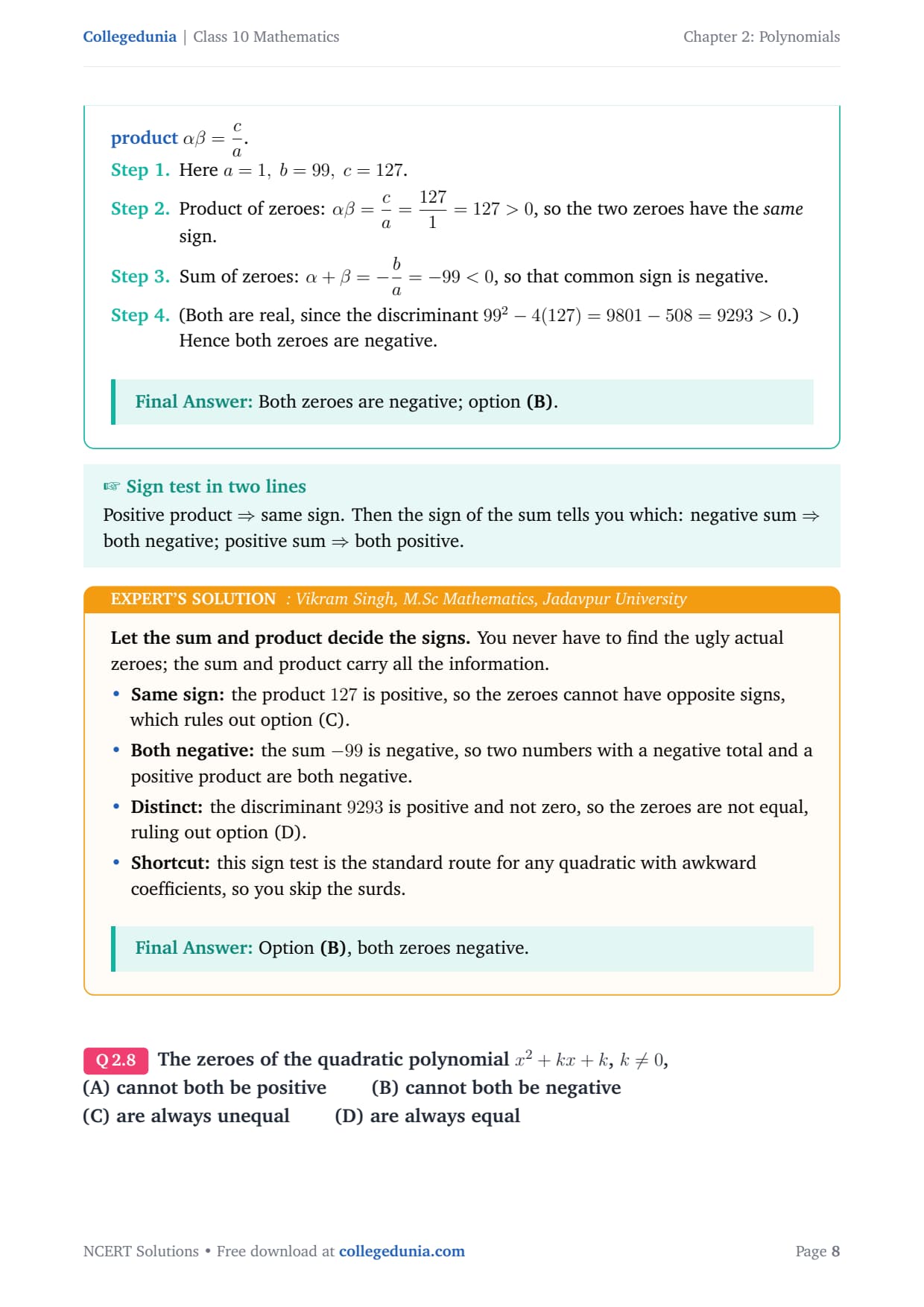
The zeroes of the quadratic polynomial x2+kx+k, k≠ 0,
(A) cannot both be positive (B) cannot both be negative
(C) are always unequal (D) are always equal
Correct option: (A) cannot both be positive.
Concept used. For x2+kx+k, the sum of zeroes is -k and the
product is k. Two positive zeroes would need a positive sum
and a positive product at the same time.
Sum of zeroes =-k and product of zeroes =k.
For both zeroes to be positive, we would need sum >0 and
product >0: that is -k>0 and k>0 together.
But -k>0 means k<0, while k>0 means k>0. These cannot
hold at once for any k≠ 0.
So the zeroes can never both be positive. (When k<0 the product
k<0, giving opposite signs; when k>0 the sum -k<0, so they
are both negative if real.)
The zeroes can never both be positive; option (A).
AI
Ananya Iyer
M.Sc Mathematics, ISI Kolkata
Verified Expert
Chase the contradiction in k. The trick is to assume the thing
in option (A) is false and watch it break.
Set up: for both zeroes positive you need the sum -k
positive and the product k positive at the same time.
Contradiction: a positive sum needs k below zero, while
a positive product needs k above zero. No single non-zero value
of k can be on both sides at once, so both positive is
impossible for every allowed k.
Reject the others: the discriminant k2-4k changes
sign as k varies, so the zeroes are equal for some values and
unequal for others. That kills the always-equal claim in option
(D) and the always-unequal claim in option (C).
Conclusion: only option (A) stays true for every value of
k that the question allows.
Option (A).
Q 2.9
If the zeroes of the quadratic polynomial ax2+bx+c, c≠ 0, are equal, then
(A) c and a have opposite signs (B) c and b have opposite signs
(C) c and a have the same sign (D) c and b have the same sign
Correct option: (C)c and a have the same sign.
Concept used. Two real zeroes are equal exactly when
the discriminantb2-4ac=0.
Equal zeroes means b2-4ac=0.
Rearrange: 4ac=b2.
The right side b2≥ 0, and since c≠ 0 we get
b2>0, so 4ac>0, hence ac>0.
ac>0 means a and c have the same sign.
ac>0, so c and a have the same sign; option (C).
NA
Nisha Agarwal
M.Sc Mathematics, BHU Varanasi
Verified Expert
Read the sign of ac off the discriminant. Equal zeroes set the
discriminant to zero, so b2=4ac.
Force positive: a square is never negative, and with
c0 it is strictly positive, so 4ac>0 and hence ac>0.
Same sign: a positive product of a and c means they
carry the same sign, which is option (C).
Ignore b: the options about b are irrelevant, since
b only fixes the size of ac, not the relative sign.
Option (C).
Q 2.10
If one of the zeroes of a quadratic polynomial of the form x2+ax+b is the negative of the other, then it
(A) has no linear term and the constant term is negative.
(B) has no linear term and the constant term is positive.
(C) can have a linear term but the constant term is negative.
(D) can have a linear term but the constant term is positive.
Correct option: (A) has no linear term and the constant term is
negative.
Concept used. If the zeroes are α and -α, then the
sum of zeroes is 0 (which kills the linear term) and the product is
-α2 (which is negative).
Let the zeroes be α and -α.
Sum of zeroes =α+(-α)=0. In x2+ax+b the sum is
-a, so -a=0, i.e. a=0: there is no linear term.
Product of zeroes =α·(-α)=-α2. In
x2+ax+b the product is b, so b=-α2.
Since α≠ 0 (otherwise both zeroes are 0 and not
``negatives'' in any useful sense), -α2<0, so the
constant term b is negative.
The polynomial has no linear term and a negative constant term;
option (A).
SR
Siddharth Rao
M.Sc Applied Mathematics, IIT Roorkee
Verified Expert
Multiply the two factors out. If one zero is the negative of the
other, the zeroes are α and -α, with factors
(x-α) and (x+α).
No middle term: their product is the difference of
squares x2-α2, and the cross terms cancel exactly, so
both options (A) and (B) rightly say there is no linear term.
Negative constant: the constant is -α2, and a
square is positive for non-zero α, so this is strictly
negative. That rules out (B) and confirms (A).
Same by relations: the sum of zeroes is 0, which kills
the coefficient of x, and the product -α2 is the
negative constant. Both routes agree.
Option (A); no linear term, negative constant.
Q 2.11
Which of the following is not the graph of a quadratic polynomial? (See Fig. 2.1 below.)
(A) (B) (C) (D)
Correct option: (D).
Concept used. The graph of a quadratic polynomial is a
parabola. A quadratic has at most 2 zeroes, so its graph can
cross the x-axis in at most 2 points. A graph that meets the x-axis
at 3 points cannot belong to a quadratic.
Recall: a degree-2 polynomial y=ax2+bx+c draws a single
∪ or ∩ shaped parabola.
A parabola can touch or cross the x-axis 0, 1, or 2 times,
never more.
Graphs (A), (B) and (C) are parabolas (single bend), so each can
be a quadratic.
Graph (D) is an S-shaped curve that crosses the x-axis at
three points, which needs degree ≥ 3. So (D) is not the
graph of a quadratic.
Graph (D) crosses the x-axis three times, so it is not a
quadratic; option (D).
KM
Kabir Malhotra
M.Sc Mathematics, IIT Bombay
Verified Expert
Match the bend count to the degree. A quadratic graph turns
exactly once and cuts the x-axis at most twice.
Fair parabolas: diagrams (A), (B) and (C) each show one
single bend, the up-or-down turn of a true parabola, so each one
can be the graph of a quadratic without any problem.
The odd one: diagram (D) bends twice and crosses the axis
three times, which is the signature of a cubic and not a
quadratic, so it is the graph the question is asking you to spot.
Deciding rule: the number of times a graph meets the
x-axis can never exceed the degree, so three crossings demand a
degree of at least three. A quadratic allows at most two meetings.
What to do: look for the single bend first, then count
the crossings. Only diagram (D) breaks both habits at once, so it
is the answer.
Option (D).
Polynomials Exemplar: Other Exercises & Resources
Work through the other Exemplar exercises, then pair them with the matching study resources for Polynomials.
Resource
What it covers
Open
Exercise 2.1
MCQs on zeroes of quadratic and cubic polynomials and graph recognition.
In a Collegedunia poll of 10,840 Class 10 Maths students before the 2026 boards, 68% rated Questions 6 and 8 as the toughest here. Most confused the product of the remaining two zeroes with the full three-zero product.
Source: Class 10 Maths student poll, 2026-27 session. Sample of 10,840 students from CBSE schools in 14 states.
Other Resources for Polynomials Class 10 Maths
Pair this with the other Class 10 Maths resources for Polynomials, all linked below.
Frequently Asked Questions on NCERT Exemplar Class 10 Maths Chapter 2 Exercise 2.1
Ques. What is NCERT Exemplar Class 10 Maths Chapter 2 Exercise 2.1?
Ans. Exercise 2.1 is the MCQ section of the Polynomials chapter. It has 11 questions on zeroes of quadratic and cubic polynomials, the link between zeroes and coefficients, and reading polynomial graphs. It is harder than the textbook and good practice for the 2026-27 CBSE boards.
Ques. How many questions are in Exercise 2.1?
Ans. There are 11 MCQs, each with four options. They cover quadratic zeroes by substitution, building a polynomial from its zeroes, cubic zeroes, sign analysis, and graph recognition. Solve all 11 for the 2026-27 boards.
Ques. What is the formula for the product of zeroes of a cubic polynomial?
Ans. For a cubic ax3+bx2+cx+d with zeroes α, β, γ, the product of all three is -d/a. The sum of pairs is c/a. Q5 and Q6 test the sum-of-pairs relation. Many students wrongly use -d/a when only two of the three zeroes are asked for.
Ques. Why does a quadratic polynomial have at most two zeroes?
Ans. A quadratic has degree 2, so it has at most 2 zeroes. On a graph, a parabola can cross the x-axis at most twice. Q11 tests this: the graph that is not a quadratic is the one crossing the x-axis 3 times, which needs degree 3 or more.
Ques. If one zero is the negative of the other, what does that tell us?
Ans. If the zeroes are α and -α, their sum is 0, so there is no linear term. Their product is -α2, which is always negative. So the polynomial has no x term and a negative constant, the form x2 - α2. This is what Q10 tests.









Comments