Maths Strategist, Olympiad Coach | Updated 3+ months ago
Class 10 students who want full marks in the Probability board question will find Exercise 14.3 of the NCERT Exemplar the most important set to master. This exercise has 24 Short Answer Questions covering dice, coins, playing cards, and number problems, exactly the type that appear in CBSE board papers.
Exercise type: Short Answer Questions (Exercise 14.3), NCERT Exemplar Class 10 Maths Chapter 14 Probability
CBSE Board weightage: Probability carries 8 marks in the Class 10 board paper (Unit 6)
Syllabus: 2026-27 CBSE rationalised syllabus
Every solution in this NCERT Exemplar Class 10 Maths Chapter 14 Exercise 14.3 set is curated by subject experts, checked against the official NCERT Exemplar answer key, and matched to the 2026-27 CBSE syllabus. The step-by-step method used here is exactly what CBSE examiners expect.
What Probability Exercise 14.3 Covers in Class 10 Maths
Exercise 14.3 is the main Short Answer set of the NCERT Exemplar Probability chapter. All 24 questions require a full numerical answer with working, which matches the 2-mark and 3-mark questions in the CBSE board paper. The questions cover four topic areas:
Dice problems (Q1 to Q8): Two dice thrown together - same number, sums, products, differences, and special dice with repeated faces.
Coin problems (Q6 to Q8 and Q15): Coins tossed two or three times - at most, at least, all heads conditions.
Card problems (Q9 to Q12): Playing card draws from a standard or modified deck of 52 or 49 cards.
Bag, box, and number problems (Q13 to Q24): Balls, slips, envelopes, bulbs, and integer ranges.
Key Concepts Tested in Exercise 14.3
Before solving Exercise 14.3, make sure you are clear on these five concepts. Almost every question in this exercise uses one or more of them.
Concept
What it means
Questions that test it
Classical probability formula
Favourable outcomesTotal equally likely outcomes. Valid only when all outcomes are equally likely.
All 24 questions
Two-dice sample space
Ordered pairs (a, b) give 6 × 6 = 36 equally likely outcomes. Always use ordered pairs, not unordered sets.
Q1, Q2, Q3, Q4, Q5, Q8
Complement rule
P(not E) = 1 − P(E). Use it whenever counting “not” directly is harder than counting the event.
Q1, Q9, Q13, Q14, Q18, Q22
Without-replacement draws
After removing one item, both the total count and the favourable count change for the next draw.
Q17, Q24
Counting by factor / value
For number-based problems, count multiples, squares, or value bands carefully. Total count first, then favourable.
Q13, Q14, Q15, Q19, Q20
The single most common Exercise 14.3 error: students forget to use ordered pairs for two-dice problems and get the total wrong (writing 21 unordered pairs instead of 36 ordered pairs). Always write the sample space as (a, b) with a and b each from 1 to 6.
All Exercise 14.3 Solutions with Step-by-Step Working
III. Short Answer Questions (Exercise 14.3)
Q 14.1
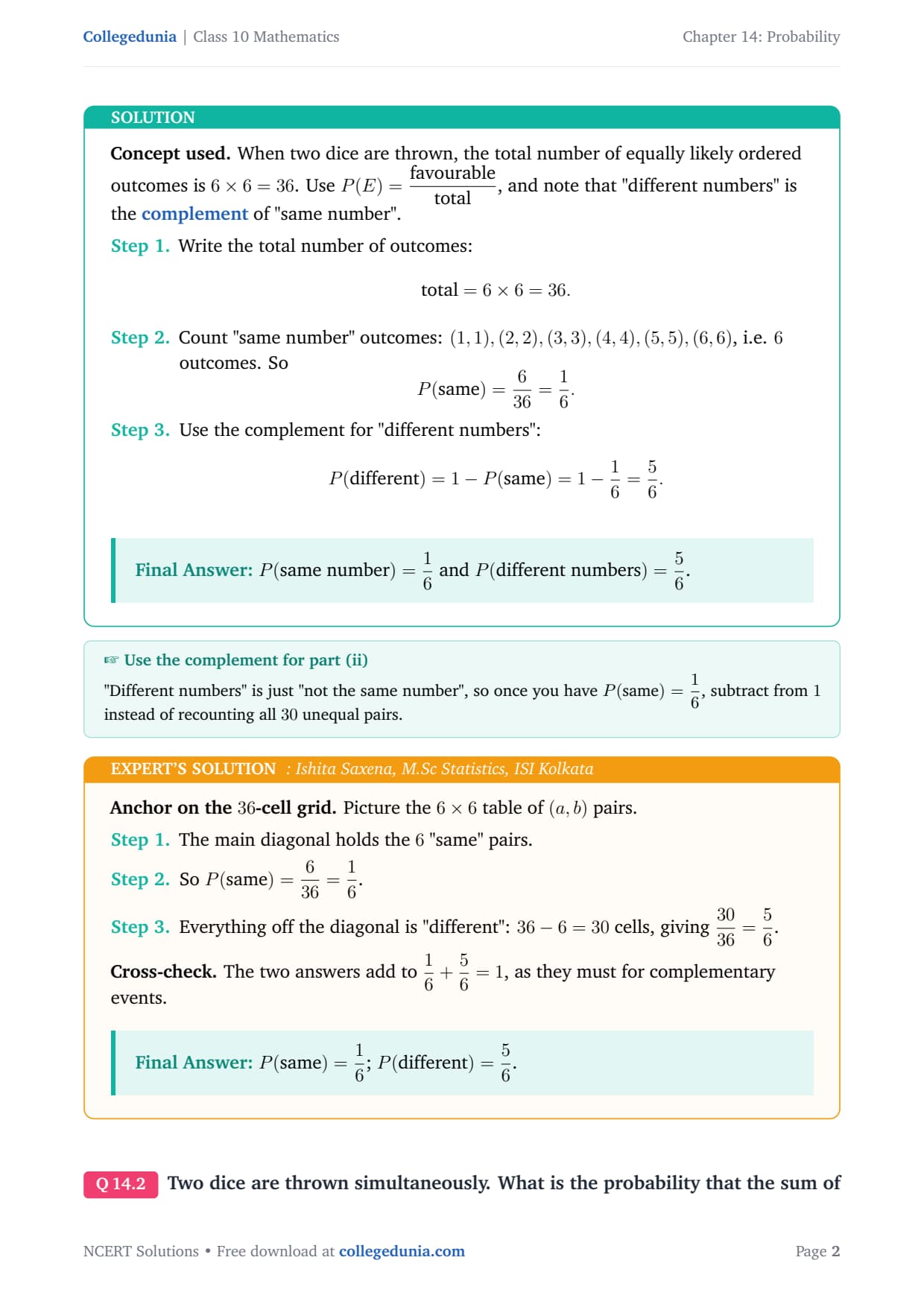
Two dice are thrown at the same time. Find the probability of getting (i) the same number on both dice, (ii) different numbers on both dice.
Concept used. When two dice are thrown, the total number of
equally likely ordered outcomes is 6× 6=36. Use
P(E)=favourabletotal, and note that "different
numbers" is the complement of "same number".
Write the total number of outcomes:
total=6× 6=36.
Count "same number" outcomes:
(1,1),(2,2),(3,3),(4,4),(5,5),(6,6), i.e. 6 outcomes. So
P(same)=636=16.
Use the complement for "different numbers":
P(different)=1-P(same)=1-16=56.
P(same number)=16 and P(different numbers)=56.
IS
Ishita Saxena
M.Sc Statistics, ISI Kolkata
Verified Expert
Anchor on the 36-cell grid. Picture the 66 table of
(a,b) pairs.
The main diagonal holds the 6 "same" pairs.
So P(same)=636=16.
Everything off the diagonal is "different": 36-6=30 cells,
giving 3036=56.
Cross-check. The two answers add to 16+56=1, as
they must for complementary events.
P(same)=16; P(different)=56.
Q 14.2
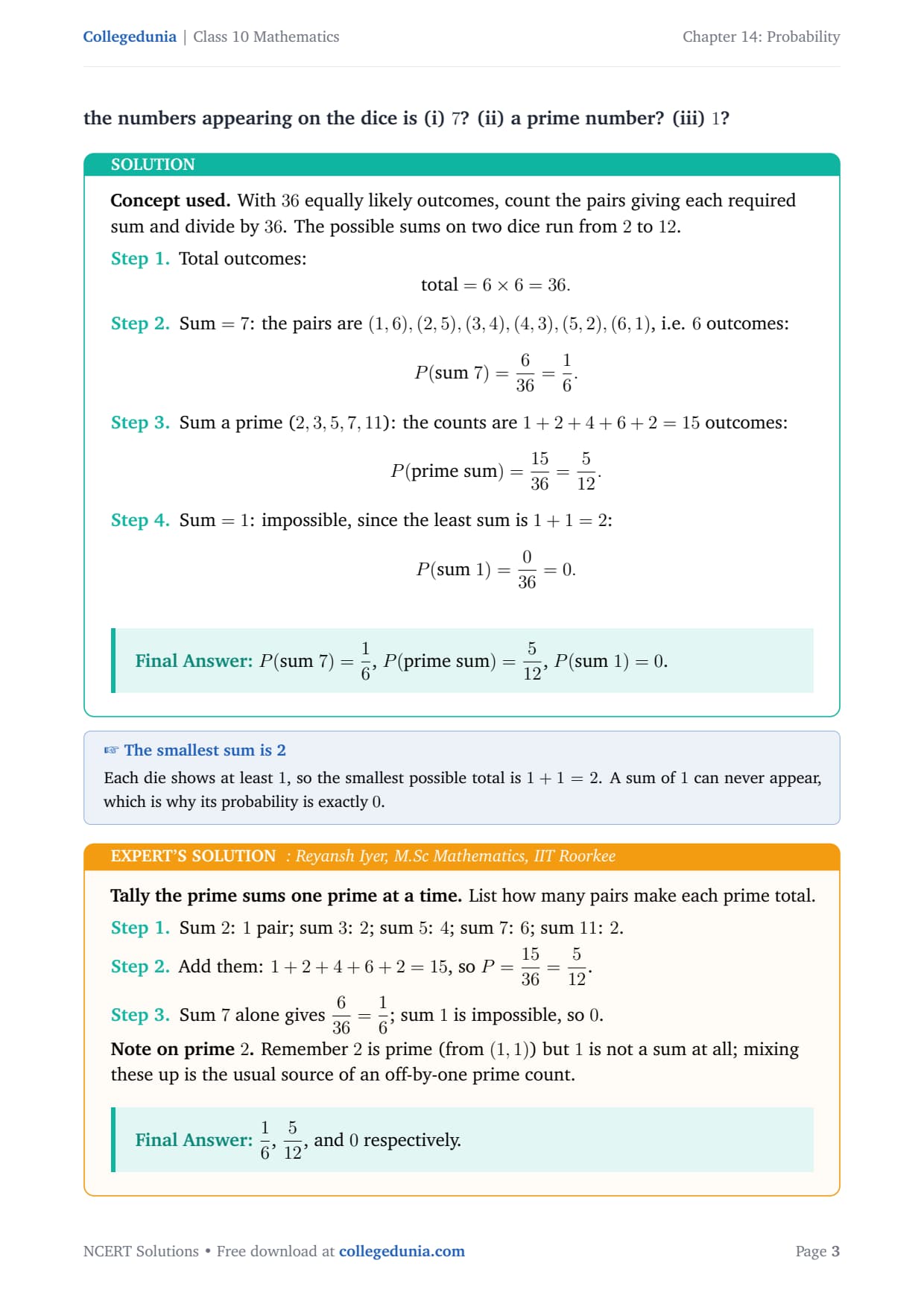
Two dice are thrown simultaneously. What is the probability that the sum of the numbers appearing on the dice is (i) 7? (ii) a prime number? (iii) 1?
Concept used. With 36 equally likely outcomes, count the pairs
giving each required sum and divide by 36. The possible sums on two
dice run from 2 to 12.
Total outcomes:
total=66=36.
Sum =7: the pairs are
(1,6),(2,5),(3,4),(4,3),(5,2),(6,1), i.e. 6 outcomes:
P(sum 7)=636=16.
Sum a prime (2,3,5,7,11): the counts are
1+2+4+6+2=15 outcomes:
P(prime sum)=1536=512.
Sum =1: impossible, since the least sum is 1+1=2:
P(sum 1)=036=0.
P(sum 7)=16, P(prime sum)=512, P(sum 1)=0.
RI
Reyansh Iyer
M.Sc Mathematics, IIT Roorkee
Verified Expert
Tally the prime sums one prime at a time. List how many pairs
make each prime total.
Sum 2: 1 pair; sum 3: 2; sum 5: 4; sum 7: 6;
sum 11: 2.
Add them: 1+2+4+6+2=15, so P=1536=512.
Sum 7 alone gives 636=16; sum 1 is
impossible, so 0.
Note on prime 2. Remember 2 is prime (from (1,1)) but 1
is not a sum at all; mixing these up is the usual source of an off-by-one
prime count.
16, 512, and 0 respectively.
Q 14.3
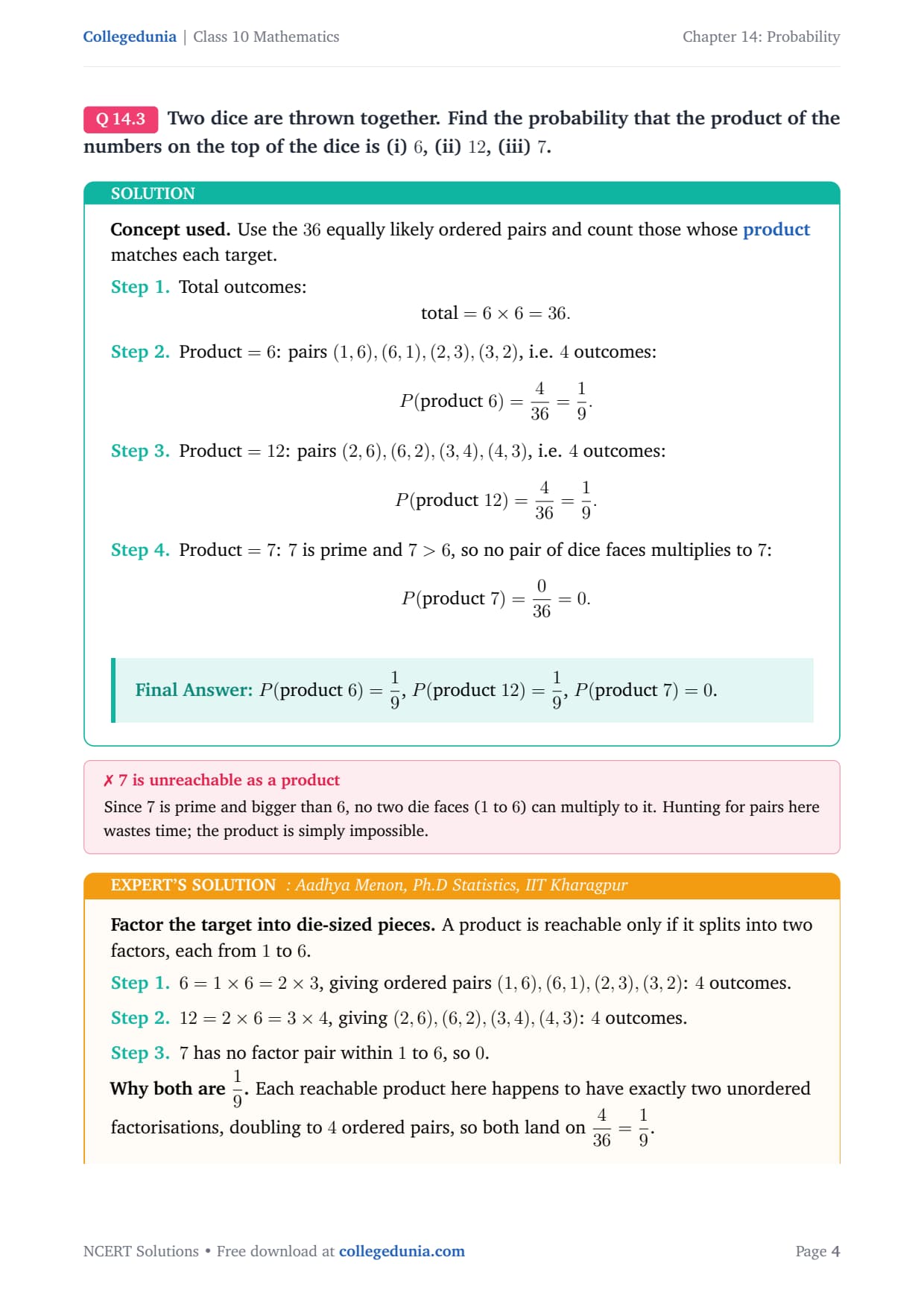
Two dice are thrown together. Find the probability that the product of the numbers on the top of the dice is (i) 6, (ii) 12, (iii) 7.
Concept used. Use the 36 equally likely ordered pairs and
count those whose product matches each target.
Total outcomes:
total=66=36.
Product =6: pairs (1,6),(6,1),(2,3),(3,2), i.e. 4 outcomes:
P(product 6)=436=19.
Product =12: pairs (2,6),(6,2),(3,4),(4,3), i.e. 4 outcomes:
P(product 12)=436=19.
Product =7: 7 is prime and 7>6, so no pair of dice faces
multiplies to 7:
P(product 7)=036=0.
Why both are 19. Each reachable product here happens to
have exactly two unordered factorisations, doubling to 4 ordered pairs,
so both land on 436=19.
19, 19, and 0.
Q 14.4
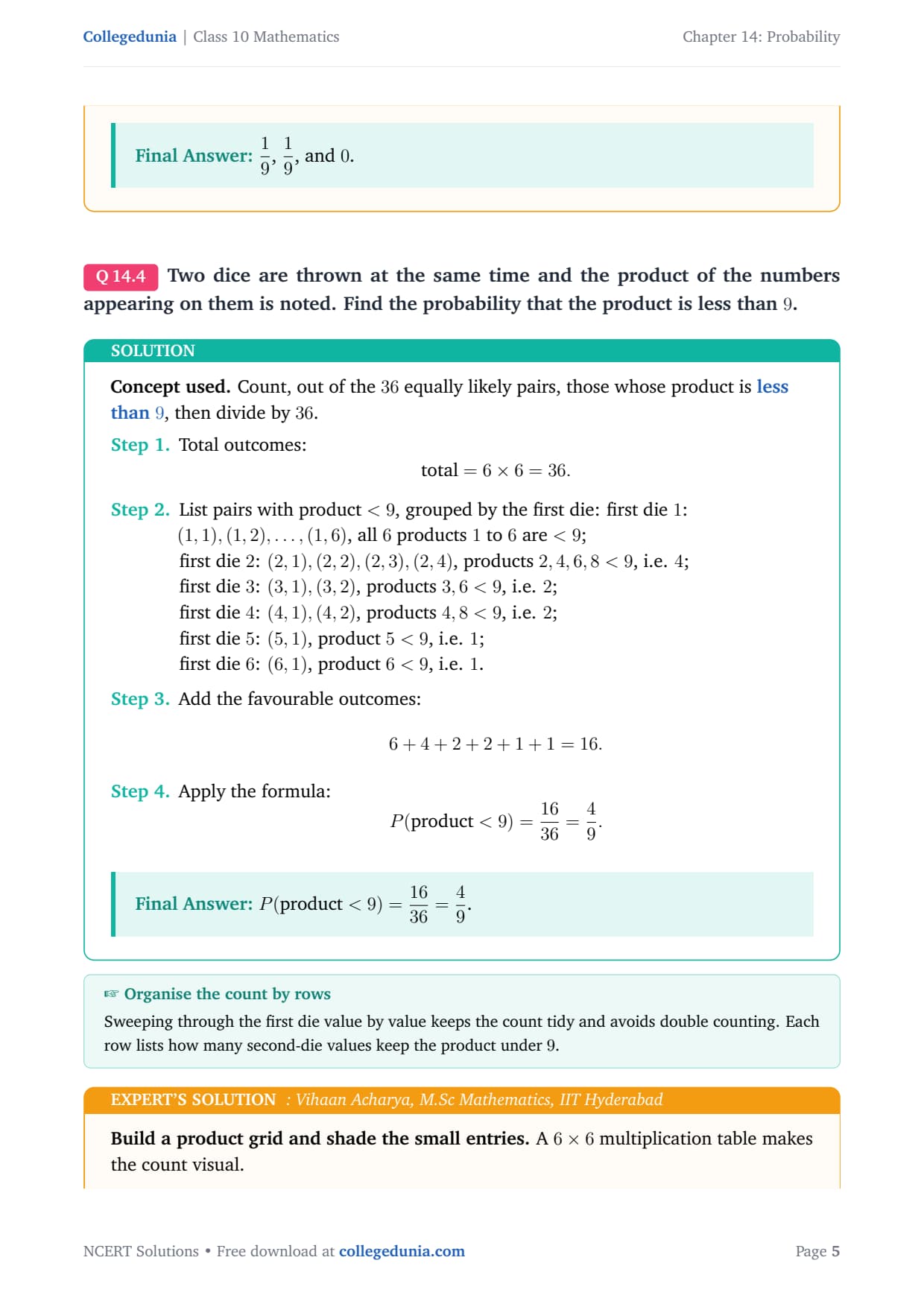
Two dice are thrown at the same time and the product of the numbers appearing on them is noted. Find the probability that the product is less than 9.
Concept used. Count, out of the 36 equally likely pairs, those
whose product is less than 9, then divide by 36.
Total outcomes:
total=66=36.
List pairs with product <9, grouped by the first die:
first die 1: (1,1),(1,2),,(1,6), all 6 products
1 to 6 are <9;
first die 2: (2,1),(2,2),(2,3),(2,4), products 2,4,6,8<9,
i.e. 4;
first die 3: (3,1),(3,2), products 3,6<9, i.e. 2;
first die 4: (4,1),(4,2), products 4,8<9, i.e. 2;
first die 5: (5,1), product 5<9, i.e. 1;
first die 6: (6,1), product 6<9, i.e. 1.
Add the favourable outcomes:
6+4+2+2+1+1=16.
Apply the formula:
P(product<9)=1636=49.
P(product<9)=1636=49.
VA
Vihaan Acharya
M.Sc Mathematics, IIT Hyderabad
Verified Expert
Build a product grid and shade the small entries. A 66
multiplication table makes the count visual.
Fill cell (a,b) with the product ab.
Shade every cell where ab<9: rows for a=1 contribute 6,
then 4,2,2,1,1 as a grows.
The shaded cells total 16, so P=1636=49.
Pattern to notice. Larger first-die values clear the "<9" bar
with fewer partners, so the shaded count shrinks down each successive
row, 6,4,2,2,1,1.
The probability that the product is less than 9 is 49.
Q 14.5
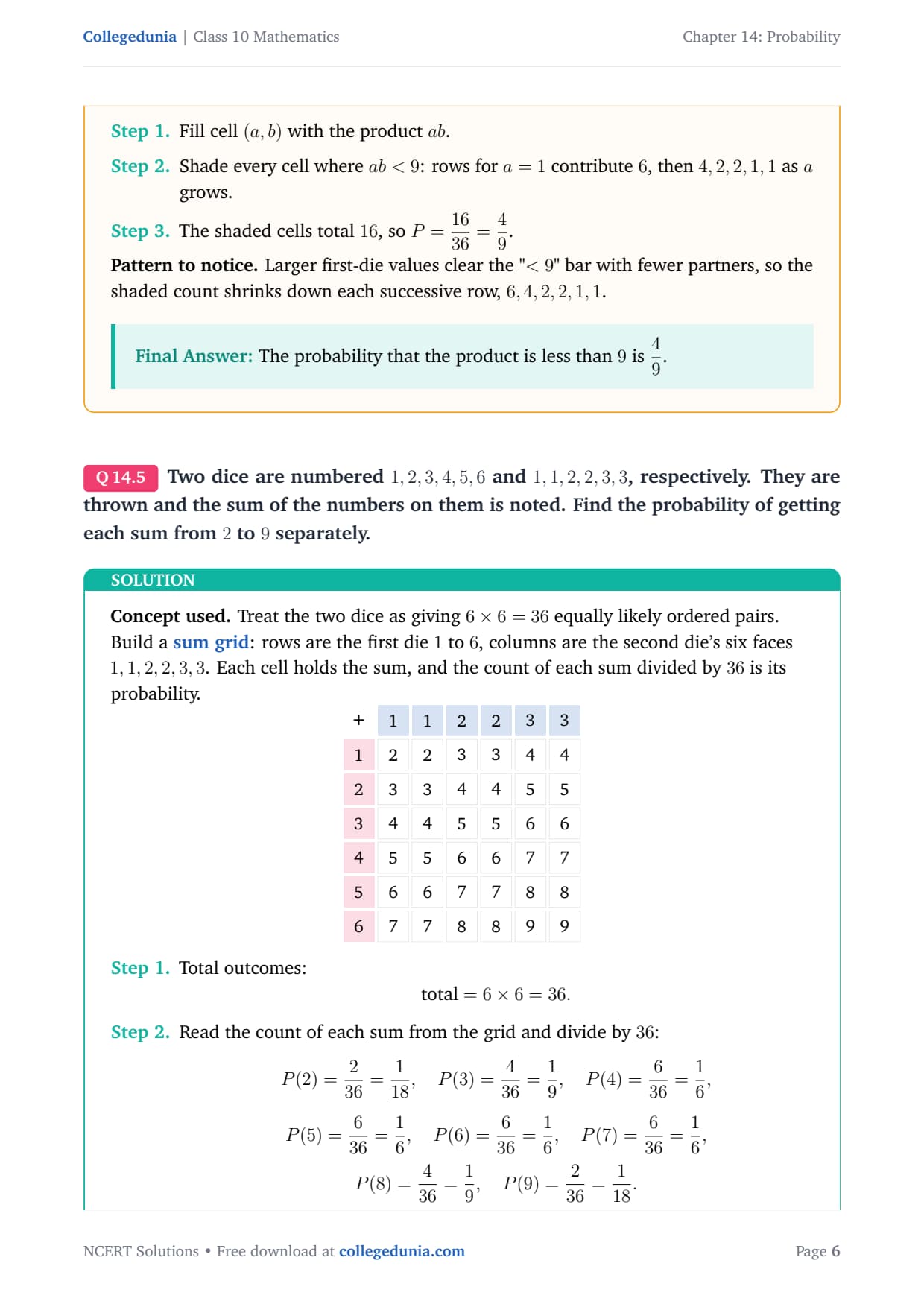
Two dice are numbered 1,2,3,4,5,6 and 1,1,2,2,3,3, respectively. They are thrown and the sum of the numbers on them is noted. Find the probability of getting each sum from 2 to 9 separately.
Concept used. Treat the two dice as giving 66=36 equally
likely ordered pairs. Build a sum grid: rows are the first die
1 to 6, columns are the second die's six faces 1,1,2,2,3,3. Each
cell holds the sum, and the count of each sum divided by 36 is its
probability.
[See diagram in the PDF version]
Total outcomes:
total=66=36.
Read the count of each sum from the grid and divide by 36:
P(2)=236=118,
P(3)=436=19,
P(4)=636=16, P(5)=636=16,
P(6)=636=16,
P(7)=636=16, P(8)=436=19,
P(9)=236=118.
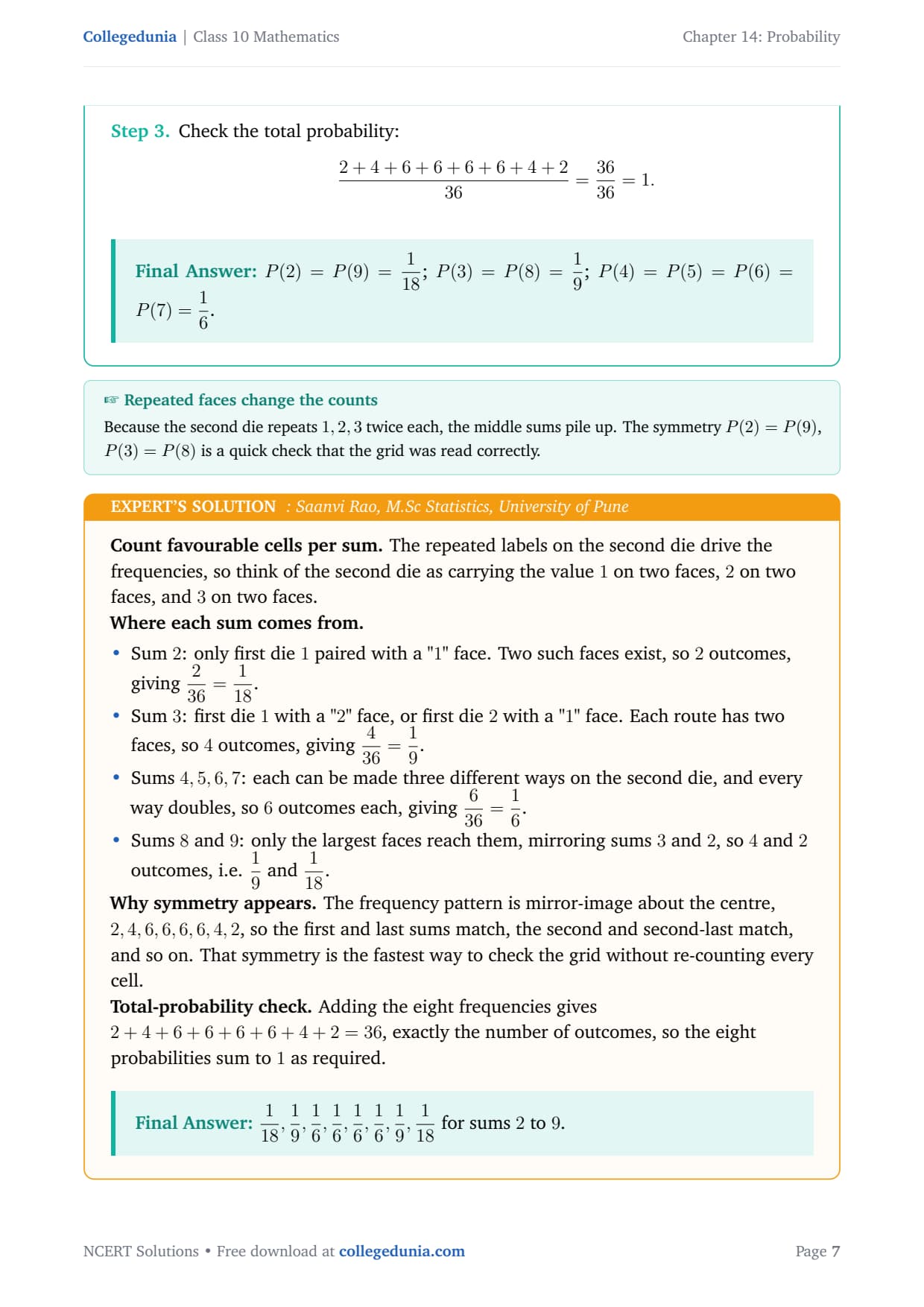
Check the total probability:
2+4+6+6+6+6+4+236=3636=1.
Count favourable cells per sum. The repeated labels on the
second die drive the frequencies, so think of the second die as carrying
the value 1 on two faces, 2 on two faces, and 3 on two faces.
Where each sum comes from.
Sum 2: only first die 1 paired with a "1" face. Two such
faces exist, so 2 outcomes, giving 236=118.
Sum 3: first die 1 with a "2" face, or first die 2 with a
"1" face. Each route has two faces, so 4 outcomes, giving
436=19.
Sums 4,5,6,7: each can be made three different ways on the
second die, and every way doubles, so 6 outcomes each, giving
636=16.
Sums 8 and 9: only the largest faces reach them, mirroring
sums 3 and 2, so 4 and 2 outcomes, i.e. 19 and
118.
Why symmetry appears. The frequency pattern is mirror-image
about the centre, 2,4,6,6,6,6,4,2, so the first and last sums match,
the second and second-last match, and so on. That symmetry is the fastest
way to check the grid without re-counting every cell.
Total-probability check. Adding the eight frequencies gives
2+4+6+6+6+6+4+2=36, exactly the number of outcomes, so the eight
probabilities sum to 1 as required.
118,19,16,16,16,16,19,118 for sums 2 to 9.
Q 14.6
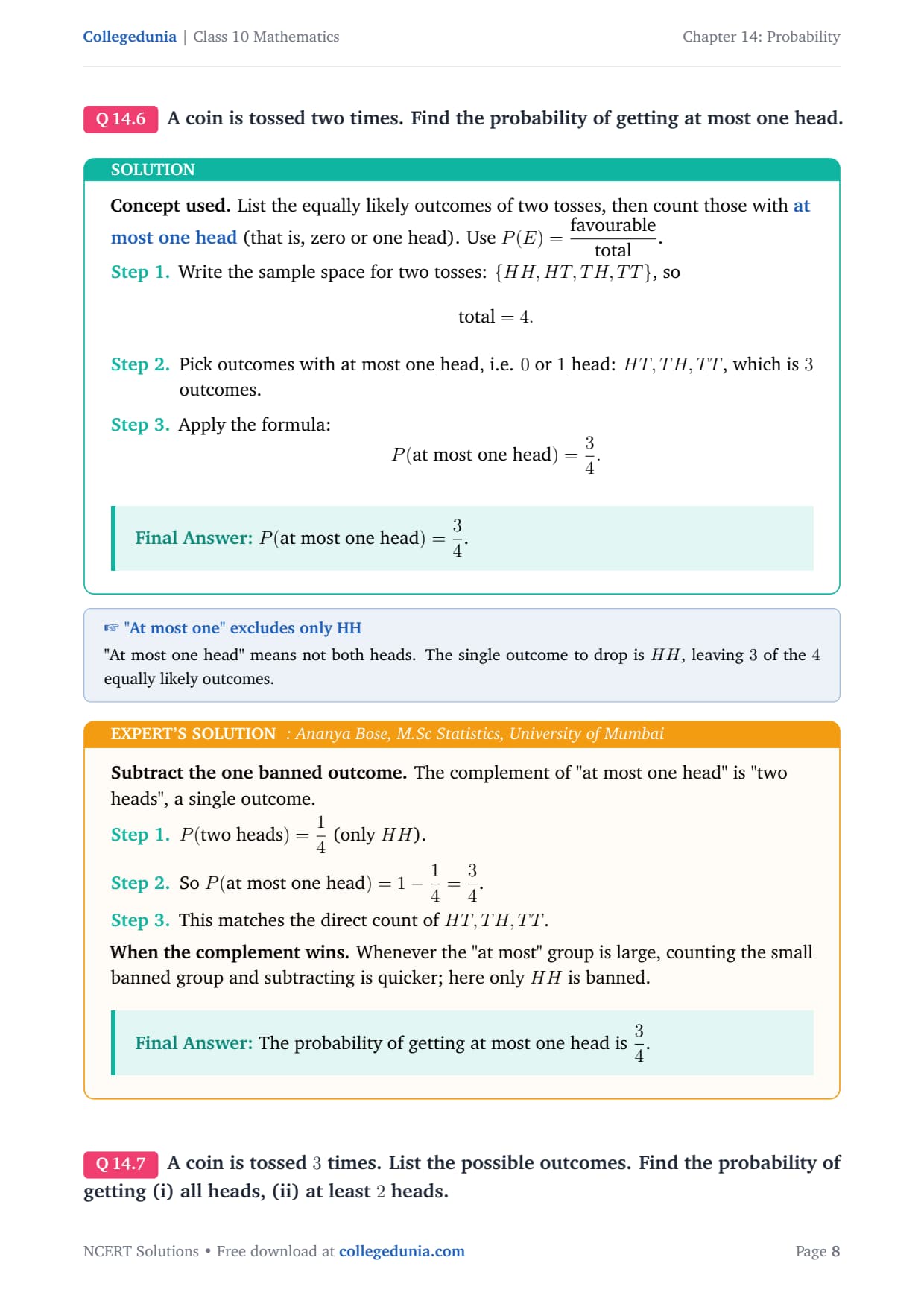
A coin is tossed two times. Find the probability of getting at most one head.
Concept used. List the equally likely outcomes of two tosses,
then count those with at most one head (that is, zero or one
head). Use P(E)=favourabletotal.
Write the sample space for two tosses:
HH, HT, TH, TT, so
total=4.
Pick outcomes with at most one head, i.e. 0 or 1 head:
HT, TH, TT, which is 3 outcomes.
Apply the formula:
P(at most one head)=34.
P(at most one head)=34.
AB
Ananya Bose
M.Sc Statistics, University of Mumbai
Verified Expert
Subtract the one banned outcome. The complement of "at most one
head" is "two heads", a single outcome.
P(two heads)=14 (only HH).
So P(at most one head)=1-14=34.
This matches the direct count of HT,TH,TT.
When the complement wins. Whenever the "at most" group is large,
counting the small banned group and subtracting is quicker; here only
HH is banned.
The probability of getting at most one head is 34.
Q 14.7
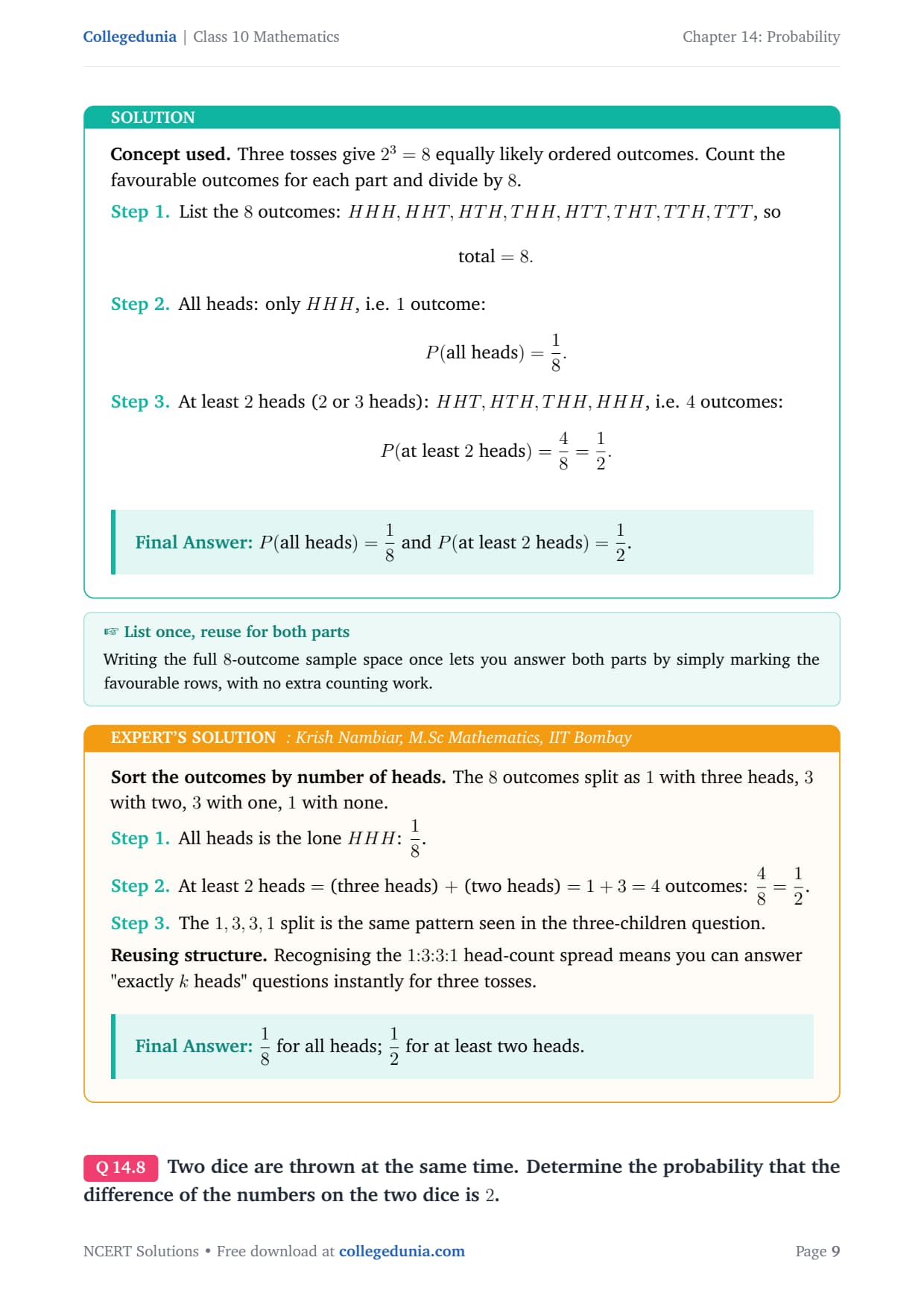
A coin is tossed 3 times. List the possible outcomes. Find the probability of getting (i) all heads, (ii) at least 2 heads.
Concept used. Three tosses give 23=8 equally likely ordered
outcomes. Count the favourable outcomes for each part and divide by 8.
List the 8 outcomes:
HHH, HHT, HTH, THH, HTT, THT, TTH, TTT, so
total=8.
All heads: only HHH, i.e. 1 outcome:
P(all heads)=18.
At least 2 heads (2 or 3 heads):
HHT, HTH, THH, HHH, i.e. 4 outcomes:
P(at least 2 heads)=48=12.
P(all heads)=18 and P(at least 2 heads)=12.
KN
Krish Nambiar
M.Sc Mathematics, IIT Bombay
Verified Expert
Sort the outcomes by number of heads. The 8 outcomes split as
1 with three heads, 3 with two, 3 with one, 1 with none.
All heads is the lone HHH: 18.
At least 2 heads = (three heads) + (two heads)
=1+3=4 outcomes: 48=12.
The 1,3,3,1 split is the same pattern seen in the
three-children question.
Reusing structure. Recognising the 1:3:3:1 head-count
spread means you can answer "exactly k heads" questions instantly for
three tosses.
18 for all heads; 12 for at least two heads.
Q 14.8
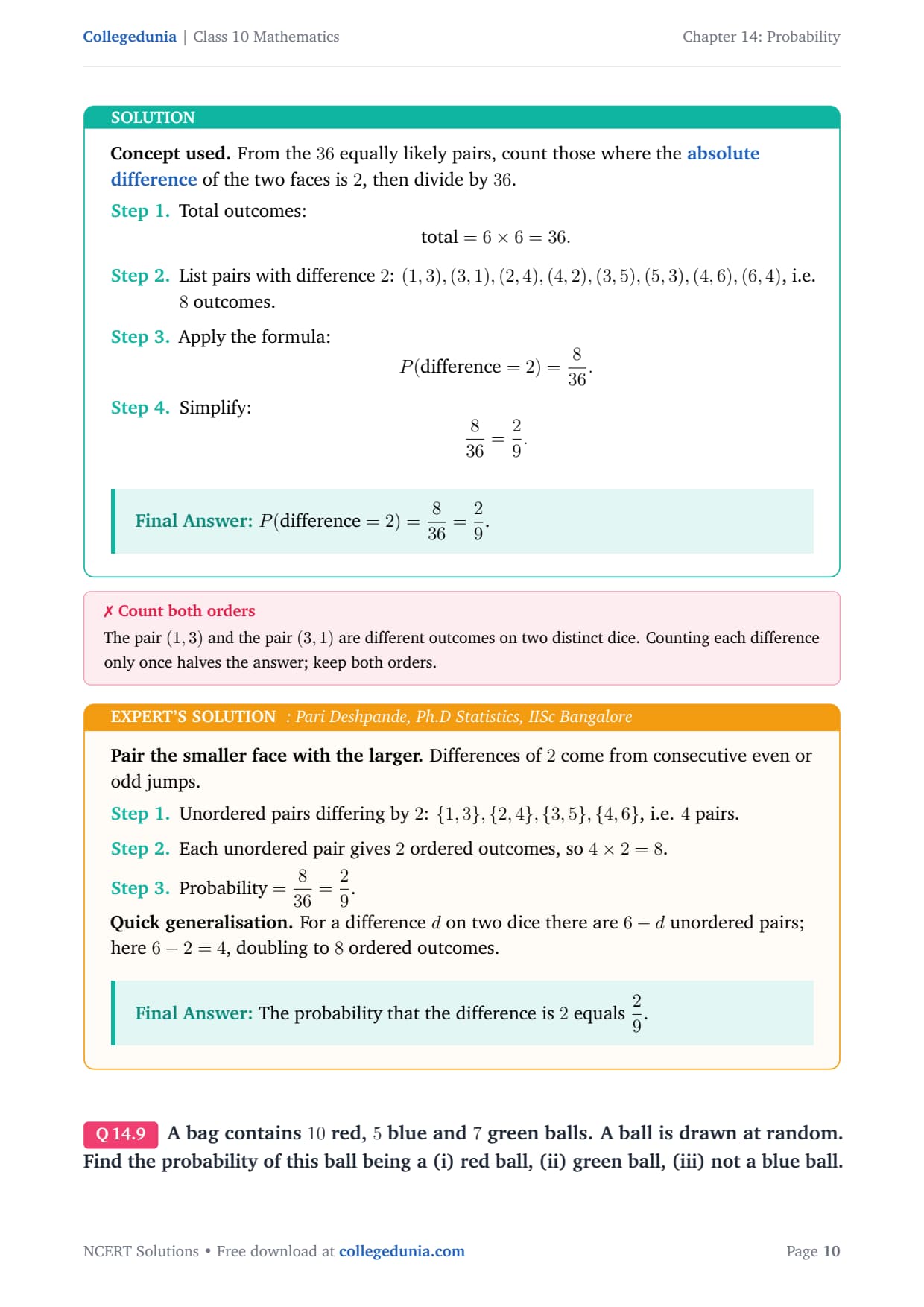
Two dice are thrown at the same time. Determine the probability that the difference of the numbers on the two dice is 2.
Concept used. From the 36 equally likely pairs, count those
where the absolute difference of the two faces is 2, then
divide by 36.
Total outcomes:
total=66=36.
List pairs with difference 2:
(1,3),(3,1),(2,4),(4,2),(3,5),(5,3),(4,6),(6,4), i.e. 8
outcomes.
Apply the formula:
P(difference=2)=836.
Simplify:
836=29.
P(difference=2)=836=29.
PD
Pari Deshpande
Ph.D Statistics, IISc Bangalore
Verified Expert
Pair the smaller face with the larger. Differences of 2 come
from consecutive even or odd jumps.
Unordered pairs differing by 2: 1,3,2,4,3,5,
4,6, i.e. 4 pairs.
Each unordered pair gives 2 ordered outcomes, so
42=8.
Probability =836=29.
Quick generalisation. For a difference d on two dice there are
6-d unordered pairs; here 6-2=4, doubling to 8 ordered outcomes.
The probability that the difference is 2 equals 29.
Q 14.9
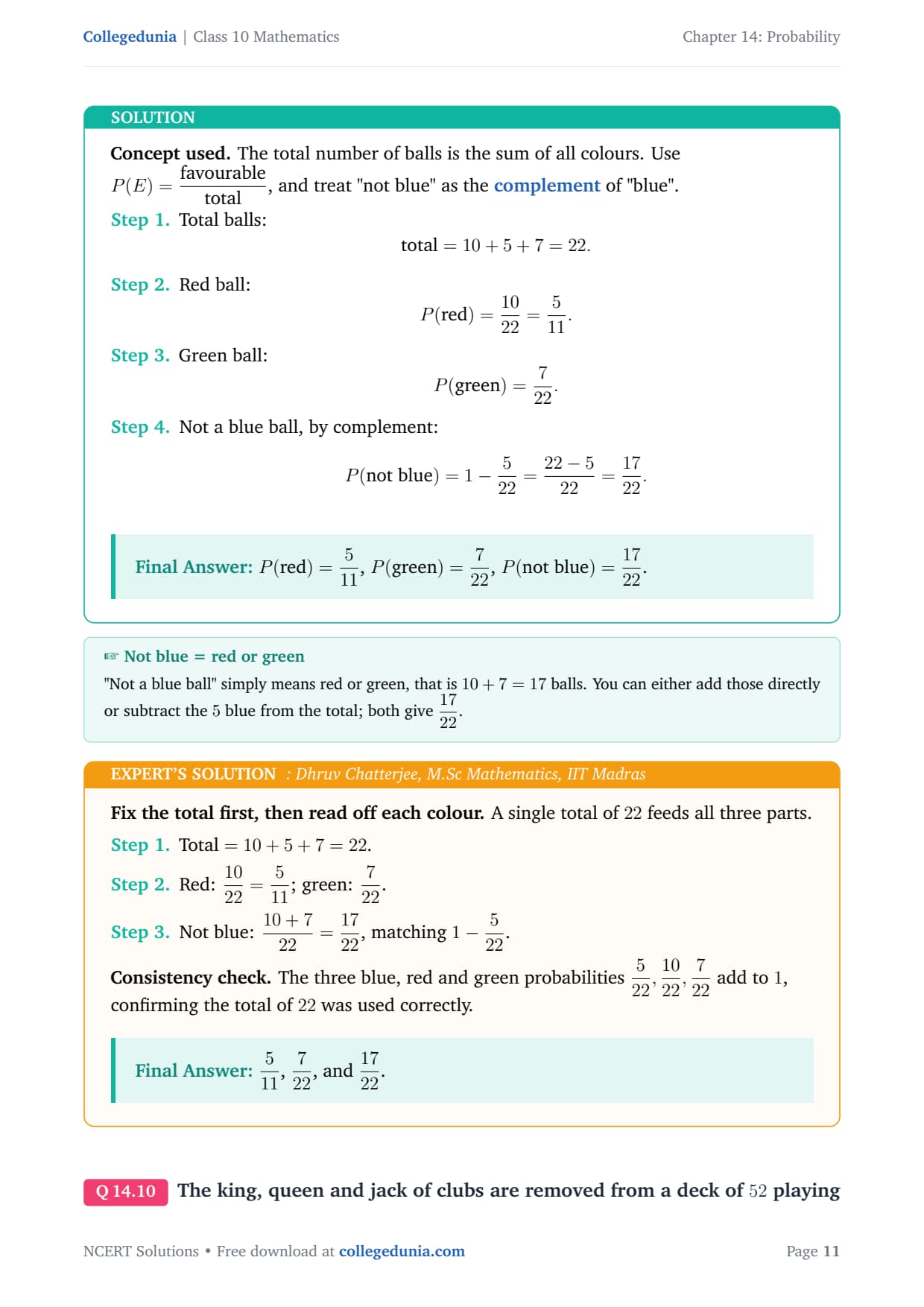
A bag contains 10 red, 5 blue and 7 green balls. A ball is drawn at random. Find the probability of this ball being a (i) red ball, (ii) green ball, (iii) not a blue ball.
Concept used. The total number of balls is the sum of all
colours. Use P(E)=favourabletotal, and treat
"not blue" as the complement of "blue".
Total balls:
total=10+5+7=22.
Red ball:
P(red)=1022=511.
Green ball:
P(green)=722.
Not a blue ball, by complement:
P(not blue)=1-522=22-522=1722.
P(red)=511, P(green)=722, P(not blue)=1722.
DC
Dhruv Chatterjee
M.Sc Mathematics, IIT Madras
Verified Expert
Fix the total first, then read off each colour. A single total of
22 feeds all three parts.
Total =10+5+7=22.
Red: 1022=511; green: 722.
Not blue: 10+722=1722, matching
1-522.
Consistency check. The three blue, red and green probabilities
522,1022,722 add to 1, confirming the
total of 22 was used correctly.
511, 722, and 1722.
Q 14.10
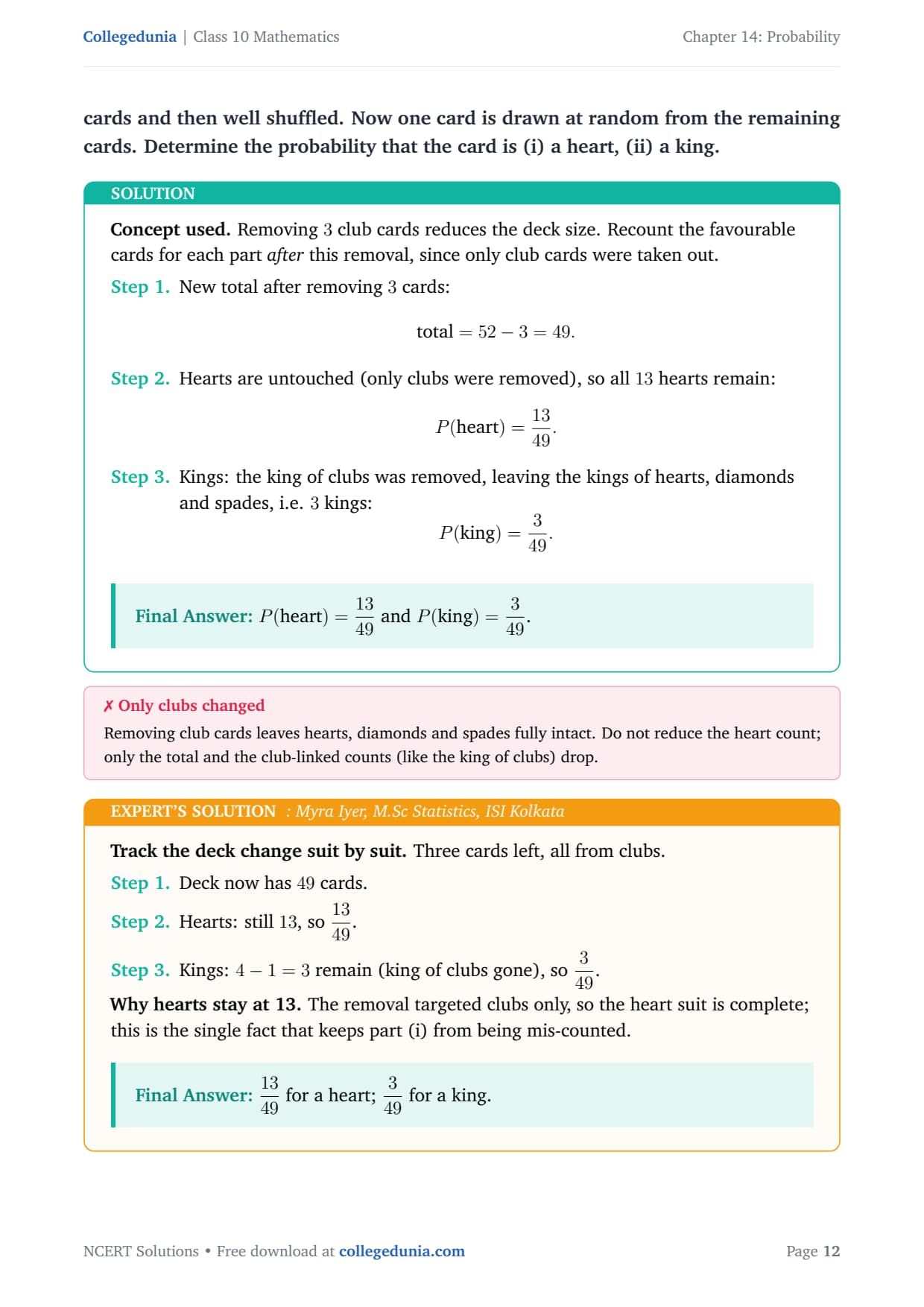
The king, queen and jack of clubs are removed from a deck of 52 playing cards and then well shuffled. Now one card is drawn at random from the remaining cards. Determine the probability that the card is (i) a heart, (ii) a king.
Concept used. Removing 3 club cards reduces the deck size.
Recount the favourable cards for each part after this removal,
since only club cards were taken out.
New total after removing 3 cards:
total=52-3=49.
Hearts are untouched (only clubs were removed), so all 13
hearts remain:
P(heart)=1349.
Kings: the king of clubs was removed, leaving the kings of
hearts, diamonds and spades, i.e. 3 kings:
P(king)=349.
P(heart)=1349 and P(king)=349.
MI
Myra Iyer
M.Sc Statistics, ISI Kolkata
Verified Expert
Track the deck change suit by suit. Three cards left, all from
clubs.
Deck now has 49 cards.
Hearts: still 13, so 1349.
Kings: 4-1=3 remain (king of clubs gone), so 349.
Why hearts stay at 13. The removal targeted clubs only, so the
heart suit is complete; this is the single fact that keeps part (i) from
being mis-counted.
1349 for a heart; 349 for a king.
Q 14.11
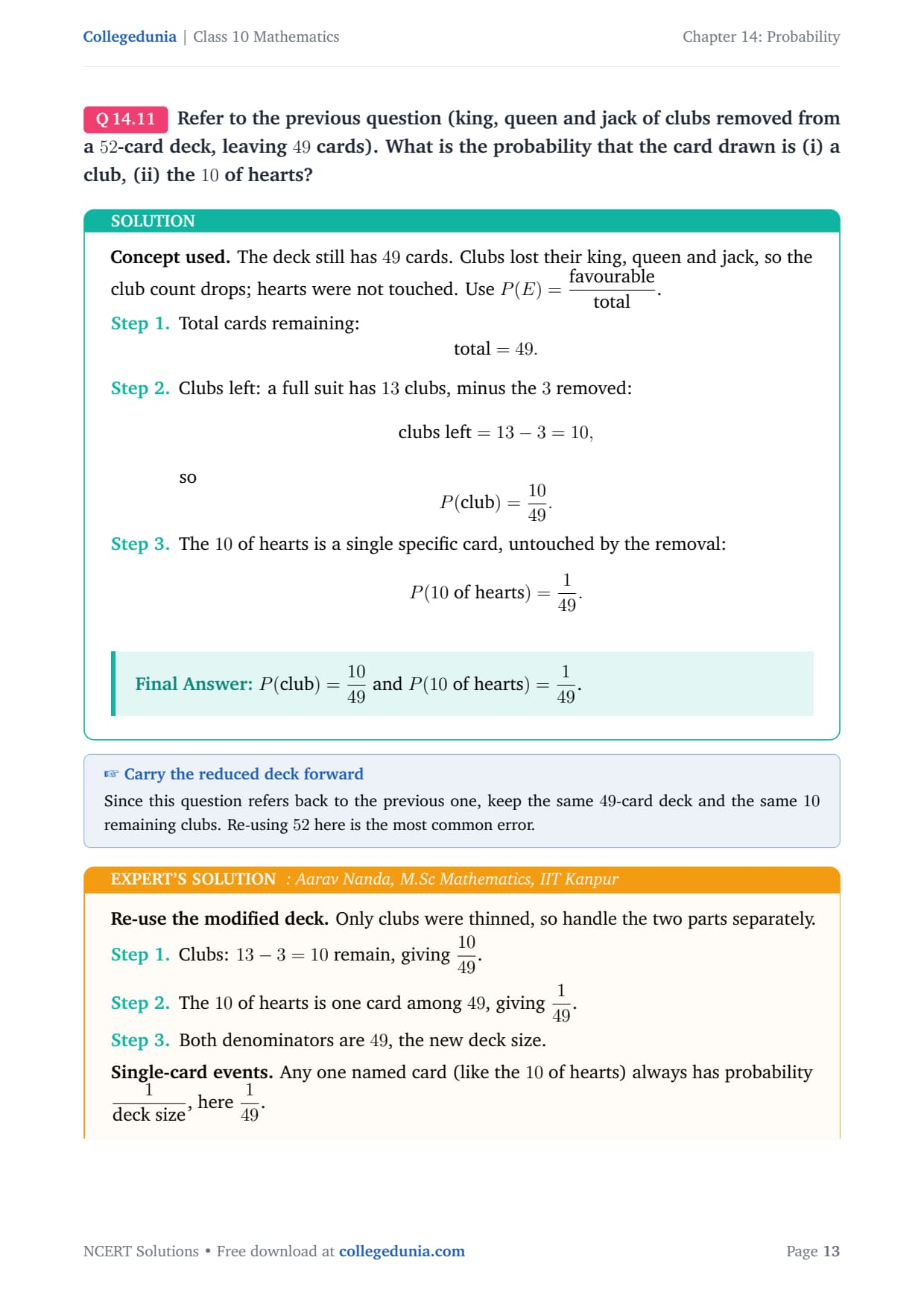
Refer to the previous question (king, queen and jack of clubs removed from a 52-card deck, leaving 49 cards). What is the probability that the card drawn is (i) a club, (ii) the 10 of hearts?
Concept used. The deck still has 49 cards. Clubs lost their
king, queen and jack, so the club count drops; hearts were not touched.
Use P(E)=favourabletotal.
Total cards remaining:
total=49.
Clubs left: a full suit has 13 clubs, minus the 3 removed:
clubs left=13-3=10,
so
P(club)=1049.
The 10 of hearts is a single specific card, untouched by the
removal:
P(10 of hearts)=149.
P(club)=1049 and P(10 of hearts)=149.
AN
Aarav Nanda
M.Sc Mathematics, IIT Kanpur
Verified Expert
Re-use the modified deck. Only clubs were thinned, so handle the
two parts separately.
Clubs: 13-3=10 remain, giving 1049.
The 10 of hearts is one card among 49, giving 149.
Both denominators are 49, the new deck size.
Single-card events. Any one named card (like the 10 of hearts)
always has probability 1deck size, here 149.
1049 for a club; 149 for the 10 of hearts.
Q 14.12
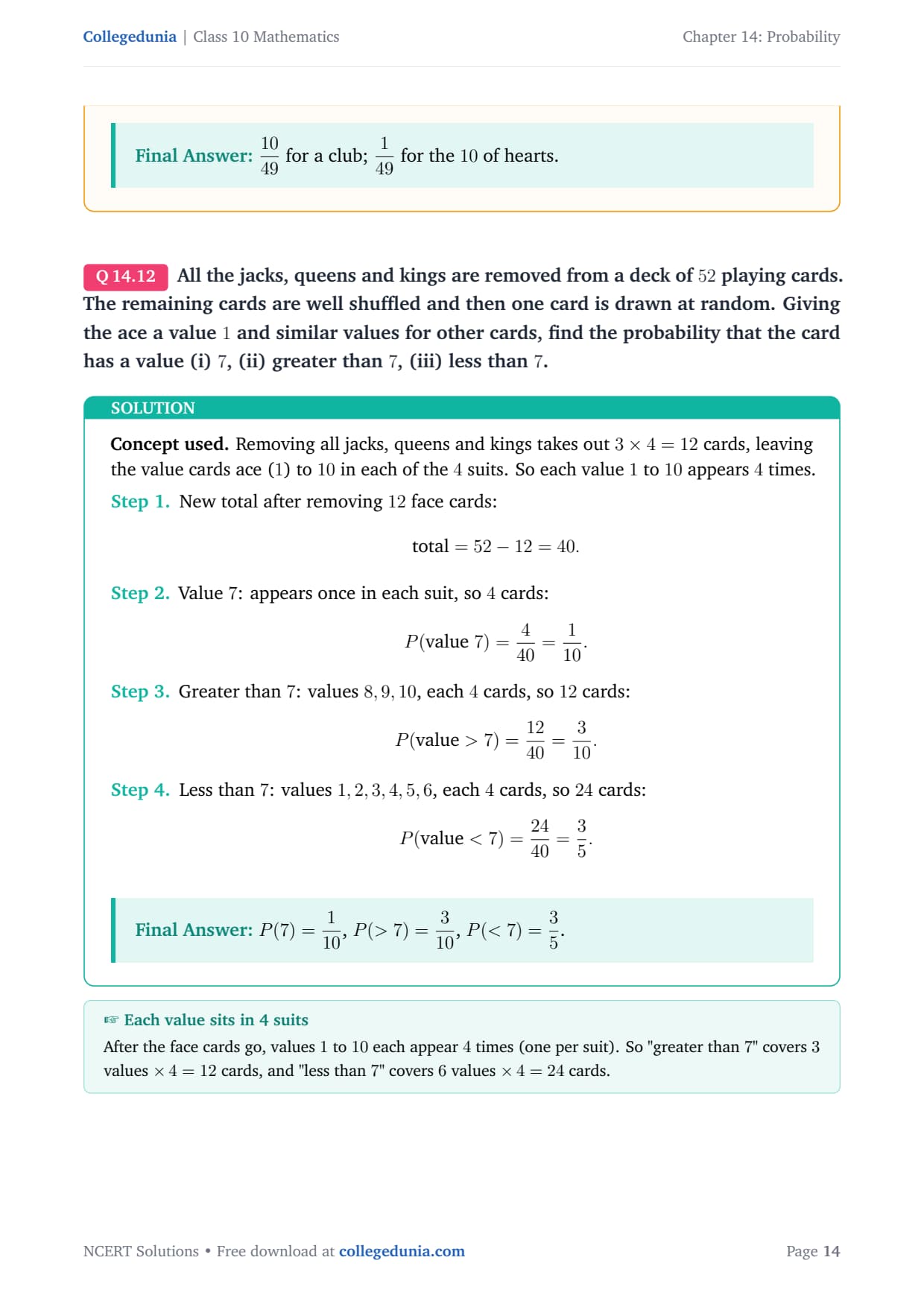
All the jacks, queens and kings are removed from a deck of 52 playing cards. The remaining cards are well shuffled and then one card is drawn at random. Giving the ace a value 1 and similar values for other cards, find the probability that the card has a value (i) 7, (ii) greater than 7, (iii) less than 7.
Concept used. Removing all jacks, queens and kings takes out
34=12 cards, leaving the value cards ace (1) to 10 in each of
the 4 suits. So each value 1 to 10 appears 4 times.
New total after removing 12 face cards:
total=52-12=40.
Value 7: appears once in each suit, so 4 cards:
P(value 7)=440=110.
Greater than 7: values 8,9,10, each 4 cards, so 12 cards:
P(value>7)=1240=310.
Less than 7: values 1,2,3,4,5,6, each 4 cards, so 24
cards:
P(value<7)=2440=35.
P(7)=110, P(>7)=310, P(<7)=35.
IB
Ishaan Bhatt
Ph.D Statistics, IIT Kharagpur
Verified Expert
Count by value bands. The three parts partition the 40 cards
neatly.
"=7": 1 value × 4=4 cards, 440=110.
">7": 3 values × 4=12 cards, 1240=310.
"<7": 6 values × 4=24 cards, 2440=35.
Partition check. The three bands cover 4+12+24=40 cards, the
whole reduced deck, so their probabilities 110+310+
35=1.
110, 310, and 35.
Q 14.13
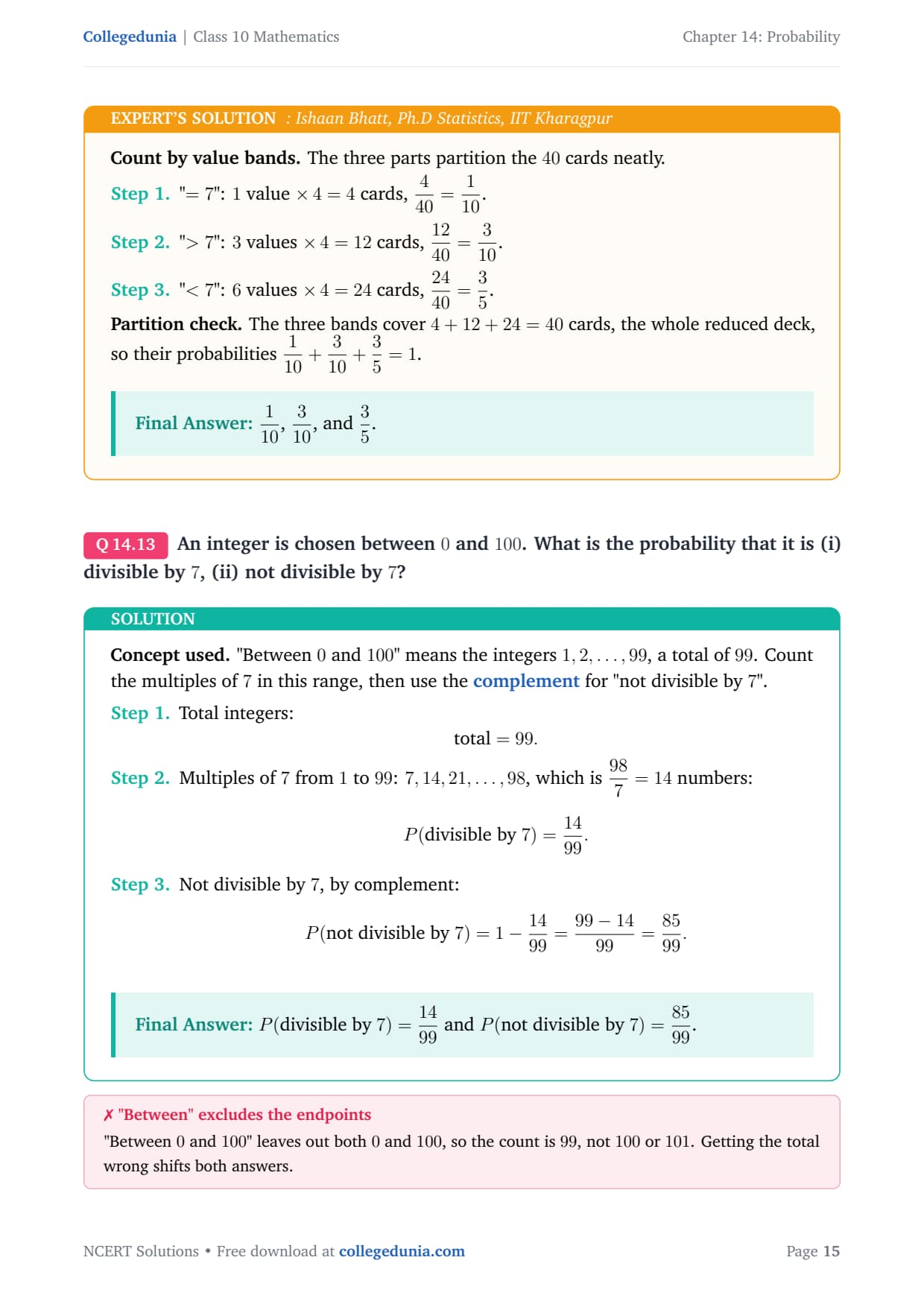
An integer is chosen between 0 and 100. What is the probability that it is (i) divisible by 7, (ii) not divisible by 7?
Concept used. "Between 0 and 100" means the integers
1,2,,99, a total of 99. Count the multiples of 7 in this range,
then use the complement for "not divisible by 7".
Total integers:
total=99.
Multiples of 7 from 1 to 99:
7,14,21,,98, which is 987=14 numbers:
P(divisible by 7)=1499.
Not divisible by 7, by complement:
P(not divisible by 7)=1-1499=99-1499=8599.
P(divisible by 7)=1499 and P(not divisible by 7)=8599.
TV
Tara Venkatesh
M.Sc Mathematics, IIT Madras
Verified Expert
Find the largest multiple, then count. The multiples of 7 form
an evenly spaced list.
Largest multiple of 7 below 100 is 98=714.
So there are 14 multiples, giving 1499.
The rest, 99-14=85, are not divisible by 7: 8599.
Why the complement is faster. Listing all 85 non-multiples is
tedious; counting the 14 multiples and subtracting from 99 is the
efficient route.
1499 divisible by 7; 8599 not divisible.
Q 14.14
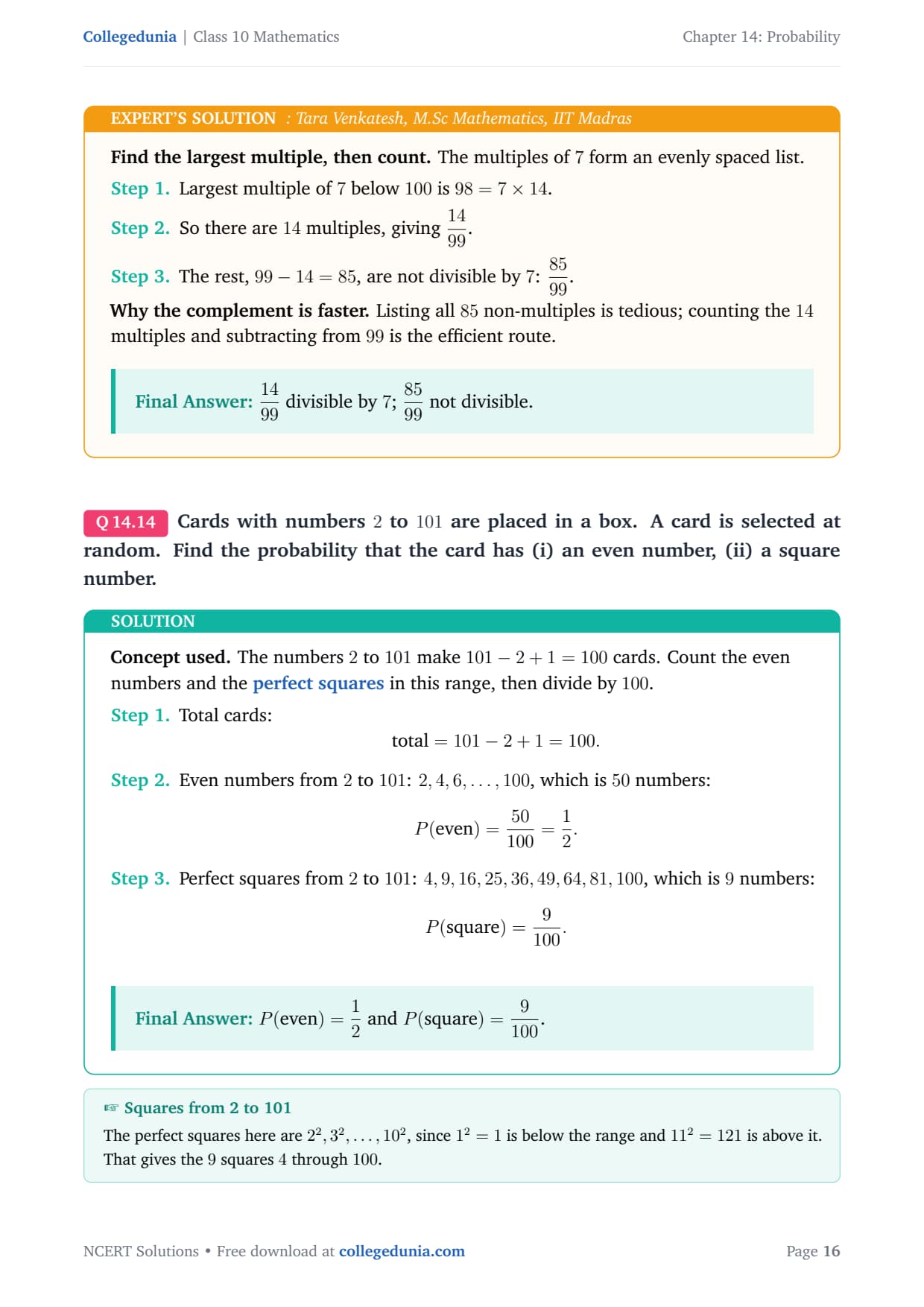
Cards with numbers 2 to 101 are placed in a box. A card is selected at random. Find the probability that the card has (i) an even number, (ii) a square number.
Concept used. The numbers 2 to 101 make
101-2+1=100 cards. Count the even numbers and the
perfect squares in this range, then divide by 100.
Total cards:
total=101-2+1=100.
Even numbers from 2 to 101: 2,4,6,,100, which is 50
numbers:
P(even)=50100=12.
Perfect squares from 2 to 101:
4,9,16,25,36,49,64,81,100, which is 9 numbers:
P(square)=9100.
P(even)=12 and P(square)=9100.
RS
Reyansh Saxena
M.Sc Statistics, University of Hyderabad
Verified Expert
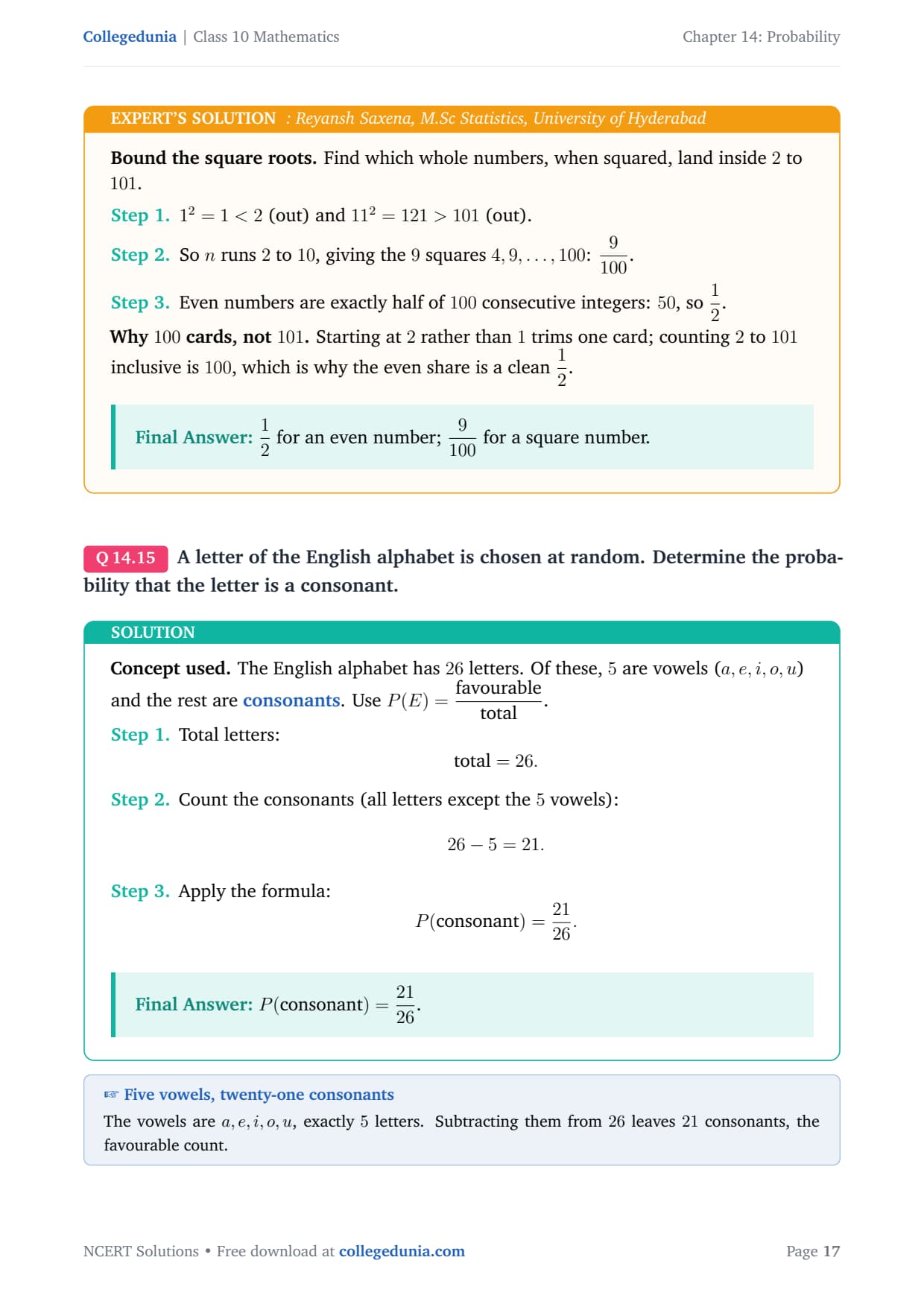
Bound the square roots. Find which whole numbers, when squared,
land inside 2 to 101.
12=1<2 (out) and 112=121>101 (out).
So n runs 2 to 10, giving the 9 squares
4,9,,100: 9100.
Even numbers are exactly half of 100 consecutive integers: 50,
so 12.
Why 100 cards, not 101. Starting at 2 rather than 1
trims one card; counting 2 to 101 inclusive is 100, which is why
the even share is a clean 12.
12 for an even number; 9100 for a square number.
Q 14.15
A letter of the English alphabet is chosen at random. Determine the probability that the letter is a consonant.
Concept used. The English alphabet has 26 letters. Of these,
5 are vowels (a,e,i,o,u) and the rest are consonants. Use
P(E)=favourabletotal.
Total letters:
total=26.
Count the consonants (all letters except the 5 vowels):
26-5=21.
Apply the formula:
P(consonant)=2126.
P(consonant)=2126.
AK
Anvi Kulkarni
M.Sc Mathematics, IIT Bombay
Verified Expert
Use the complement of "vowel". It is quicker to remove the five
vowels than to list every consonant.
P(vowel)=526.
P(consonant)=1-526=2126.
This matches the direct count of 21 consonants.
Edge note. In this standard problem "y" is treated as a
consonant, keeping the vowel list at the usual five and the consonant
count at 21.
The probability that the letter is a consonant is 2126.
Q 14.16
There are 1000 sealed envelopes in a box. 10 of them contain a cash prize of Rs 100 each, 100 of them contain a cash prize of Rs 50 each and 200 of them contain a cash prize of Rs 10 each, and the rest do not contain any cash prize. If they are well shuffled and an envelope is picked out, what is the probability that it contains no cash prize?
Concept used. Add up the envelopes that do contain a
prize, subtract from the total to find those with no prize, then
use P(E)=favourabletotal.
Count the envelopes with a prize:
10+100+200=310.
Envelopes with no prize (the rest):
1000-310=690.
Apply the formula with total =1000:
P(no prize)=6901000.
Write as a decimal:
6901000=0.69.
P(no cash prize)=6901000=0.69.
KP
Kabir Pillai
M.Sc Statistics, ISI Kolkata
Verified Expert
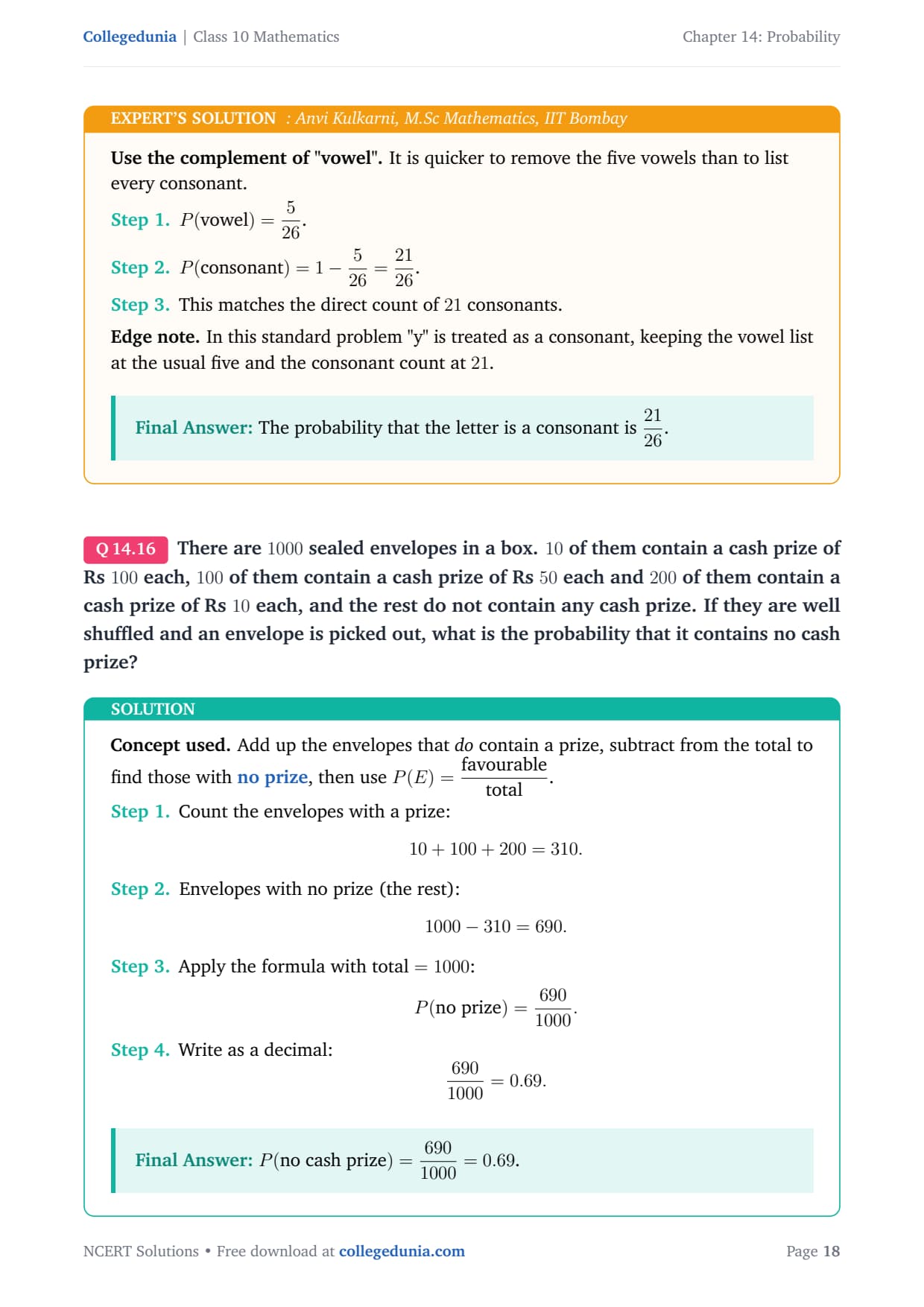
Use the complement of "wins a prize". The prize envelopes are
easier to total than the empty ones.
Prize envelopes: 10+100+200=310.
P(prize)=3101000=0.31.
P(no prize)=1-0.31=0.69.
Decimal sense. Roughly seven in ten envelopes are empty, which
fits the small prize counts against the large box of 1000.
The probability of no cash prize is 0.69.
Q 14.17
Box A contains 25 slips of which 19 are marked Re 1 and the others are marked Rs 5 each. Box B contains 50 slips of which 45 are marked Re 1 each and the others are marked Rs 13 each. Slips of both boxes are poured into a third box and reshuffled. A slip is drawn at random. What is the probability that it is marked other than Re 1?
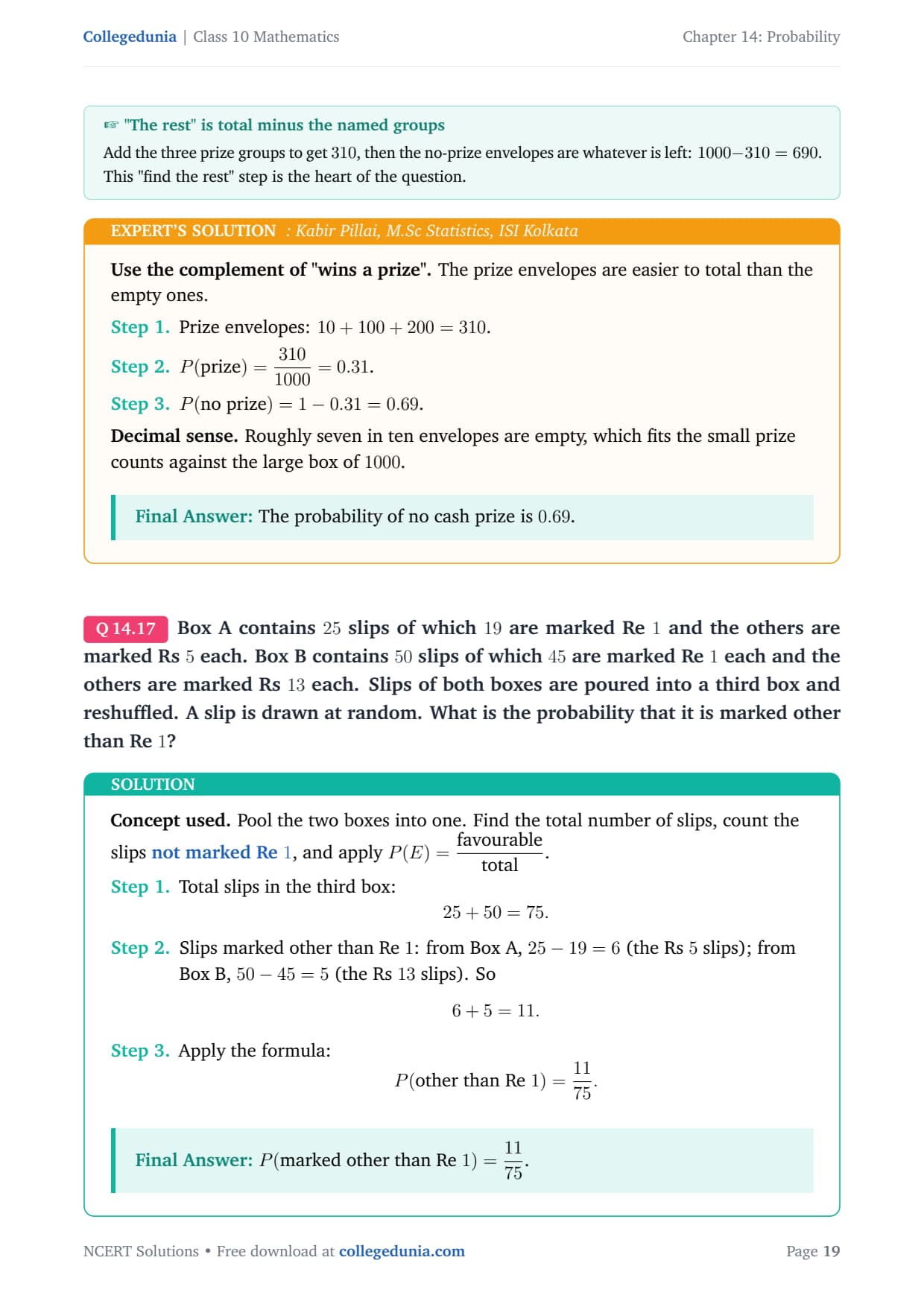
Concept used. Pool the two boxes into one. Find the total number
of slips, count the slips not marked Re 1, and apply
P(E)=favourabletotal.
Total slips in the third box:
25+50=75.
Slips marked other than Re 1: from Box A, 25-19=6 (the Rs 5
slips); from Box B, 50-45=5 (the Rs 13 slips). So
6+5=11.
Apply the formula:
P(other than Re 1)=1175.
P(marked other than Re 1)=1175.
DV
Diya Venkatesh
Ph.D Mathematics, IISc Bangalore
Verified Expert
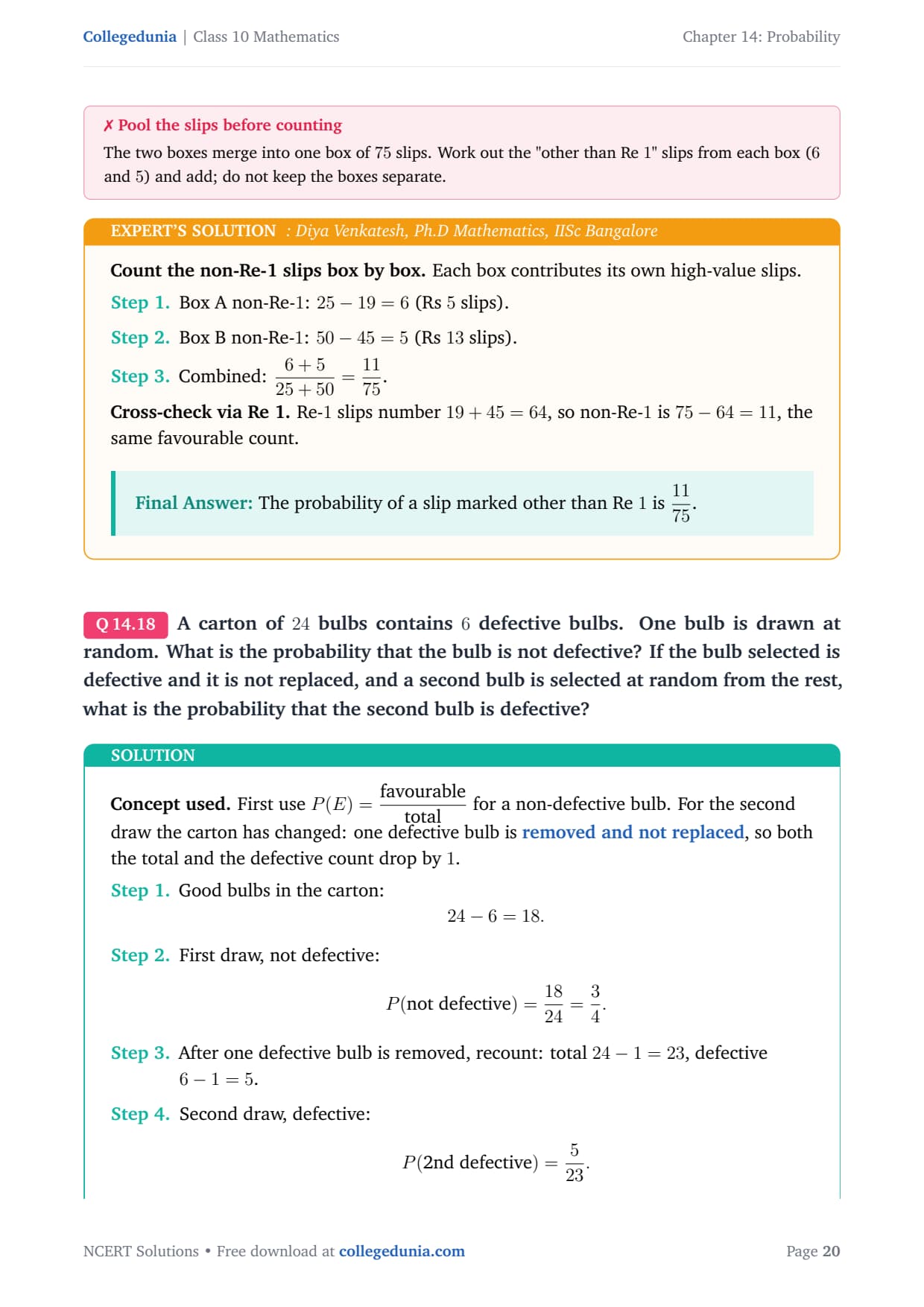
Count the non-Re-1 slips box by box. Each box contributes its own
high-value slips.
Box A non-Re-1: 25-19=6 (Rs 5 slips).
Box B non-Re-1: 50-45=5 (Rs 13 slips).
Combined: 6+525+50=1175.
Cross-check via Re 1. Re-1 slips number 19+45=64, so
non-Re-1 is 75-64=11, the same favourable count.
The probability of a slip marked other than Re 1 is 1175.
Q 14.18
A carton of 24 bulbs contains 6 defective bulbs. One bulb is drawn at random. What is the probability that the bulb is not defective? If the bulb selected is defective and it is not replaced, and a second bulb is selected at random from the rest, what is the probability that the second bulb is defective?
Concept used. First use P(E)=favourabletotal
for a non-defective bulb. For the second draw the carton has changed: one
defective bulb is removed and not replaced, so both the total
and the defective count drop by 1.
Good bulbs in the carton:
24-6=18.
First draw, not defective:
P(not defective)=1824=34.
After one defective bulb is removed, recount: total
24-1=23, defective 6-1=5.
Second draw, defective:
P(2nd defective)=523.
P(not defective)=34; P(2nd bulb defective)=523.
VS
Vivaan Saxena
M.Sc Mathematics, IIT Kanpur
Verified Expert
Handle the two draws as separate experiments. The removal links
them, so re-read the carton before the second draw.
Draw 1: 1824=34 for a good bulb.
Removal: one defective taken out, leaving 23 bulbs, 5
defective.
Draw 2: 523 for a defective bulb.
Why the denominator shrinks. "Not replaced" means the sample
space loses a member, so the second probability uses 23, not 24; this
is the defining feature of without-replacement problems.
34 for not defective; 523 for the second bulb defective.
Q 14.19
A child's game has 8 triangles of which 3 are blue and the rest are red, and 10 squares of which 6 are blue and the rest are red. One piece is lost at random. Find the probability that it is a (i) triangle, (ii) square, (iii) square of blue colour, (iv) triangle of red colour.
Concept used. Find the total number of pieces, then count each
required group. The reds are found by subtracting blues:
triangles have 8-3=5 red, squares have 10-6=4 red.
Total pieces:
8+10=18.
Triangle:
P(triangle)=818=49.
Square:
P(square)=1018=59.
Blue square (6 of them):
P(blue square)=618=13.
Red triangle (8-3=5 of them):
P(red triangle)=518.
Lay out a shape-by-colour table. Rows are triangle and square,
columns blue and red.
Triangles: 3 blue, 5 red, total 8.
Squares: 6 blue, 4 red, total 10.
Read off: triangle 818=49, square
1018=59, blue square 618=13,
red triangle 518.
Grand-total check. The four cells 3+5+6+4=18 equal the total
pieces, so every piece is accounted for exactly once.
49, 59, 13, and 518.
Q 14.20
In a game, the entry fee is Rs 5. The game consists of tossing a coin 3 times. If one or two heads show, Sweta gets her entry fee back. If she throws 3 heads, she receives double the entry fee. Otherwise she loses. For tossing a coin three times, find the probability that she (i) loses the entry fee, (ii) gets double the entry fee, (iii) just gets her entry fee back.
Concept used. Three tosses give 23=8 equally likely outcomes.
Match each game result to a number of heads: loses means 0 heads,
double means 3 heads, fee back means 1 or 2 heads.
Total outcomes:
total=8.
Loses (0 heads): only TTT, i.e. 1 outcome:
P(loses)=18.
Double (3 heads): only HHH, i.e. 1 outcome:
P(double)=18.
Fee back (1 or 2 heads): the remaining
8-1-1=6 outcomes:
P(fee back)=68=34.
P(loses)=18, P(double)=18, P(fee back)=34.
DI
Dhruv Iyer
Ph.D Statistics, IIT Kharagpur
Verified Expert
Partition the 8 outcomes by head count. The three game results
cover every outcome once.
0 heads: TTT, 1 outcome, loses: 18.
3 heads: HHH, 1 outcome, double: 18.
1 or 2 heads: 6 outcomes, fee back: 68=34.
Probability adds to one.18+18+34=1, so the
three game outcomes form a complete, non-overlapping set.
18 loses, 18 double, 34 fee back.
Q 14.21
A die has its six faces marked 0,1,1,1,6,6. Two such dice are thrown together and the total score is recorded. (i) How many different scores are possible? (ii) What is the probability of getting a total of 7?
Concept used. Each die shows a value from the set
0,1,6 (with repeats). The possible totals come from adding
two values from 0,1,6; the probability uses the 66=36
equally likely face pairs.
Find the distinct totals from values 0,1,6 on each die:
0+0=0, 0+1=1, 1+1=2, 0+6=6, 1+6=7, 6+6=12.
So the different scores are 0,1,2,6,7,12, that is 6 different
scores.
For a total of 7, the faces must be one 1 and one 6. On each
die there are three 1s and two 6s.
Count the favourable ordered face pairs:
first die 1 and second die 6 gives 32=6;
first die 6 and second die 1 gives 23=6. Total
6+6=12.
Apply the formula with total =36:
P(total 7)=1236=13.
There are 6 different scores (0,1,2,6,7,12), and P(total 7)=1236=13.
AS
Anaya Saxena
M.Sc Mathematics, IIT Bombay
Verified Expert
Separate the value set from the face counts. The values
fix the possible scores; the face multiplicities fix the
probability.
Distinct sums of two values from 0,1,6:
0,1,2,6,7,12, so 6 scores.
Total 7 uses one 1 (three faces) and one 6 (two faces).
Ordered pairs: 32+23=12 out of 36, so
1236=13.
Common miscount. Treating the dice as ordinary 1 to 6 dice
breaks this problem; the repeated faces are exactly why 7 is as likely
as 13.
6 different scores; probability of a total of 7 is 13.
Q 14.22
A lot consists of 48 mobile phones of which 42 are good, 3 have only minor defects and 3 have major defects. Varnika will buy a phone if it is good, but the trader will only buy a mobile if it has no major defect. One phone is selected at random from the lot. What is the probability that it is (i) acceptable to Varnika, (ii) acceptable to the trader?
Concept used. Decide which phones each buyer accepts, then count.
Varnika accepts only good phones; the trader accepts everything
except major-defect phones, so good plus minor-defect.
Total phones:
total=48.
Acceptable to Varnika (good only): 42 phones:
P(Varnika)=4248=78.
Acceptable to the trader (no major defect = good + minor):
42+3=45.
So
P(trader)=4548=1516.
P(acceptable to Varnika)=78 and P(acceptable to the trader)=1516.
KB
Kiaan Banerjee
M.Sc Statistics, University of Pune
Verified Expert
Translate each acceptance rule into a count. The two buyers draw
different lines through the same lot.
Varnika: good only =42, so 4248=78.
Trader: not major-defect =48-3=45, so 4548=1516.
The trader's larger count gives the higher probability.
Why the trader's chance is higher. The trader tolerates the 3
minor-defect phones that Varnika rejects, so the trader's acceptable set
is strictly larger, lifting the probability to 1516.
78 acceptable to Varnika; 1516 acceptable to the trader.
Q 14.23
A bag contains 24 balls of which x are red, 2x are white and 3x are blue. A ball is selected at random. What is the probability that it is (i) not red, (ii) white?
Concept used. First solve for x using the fact that the colour
counts add up to 24. Then use P(E)=favourabletotal,
treating "not red" by complement.
Set up the total equation:
x+2x+3x=24.
Solve for x:
6x=24 ⇒ x=4.
So the counts are red =4, white =8, blue =12.
Not red, by complement:
P(not red)=1-424=2024=56.
White:
P(white)=824=13.
P(not red)=56 and P(white)=13.
PN
Pari Nair
Ph.D Mathematics, IISc Bangalore
Verified Expert
Turn the ratio into numbers. The reds, whites and blues sit in
the ratio 1:2:3.
1:2:3 across 24 balls means parts of 4,8,12.
Not red: 8+12=20, so 2024=56.
White: 824=13.
Ratio shortcut. Since the parts total 6 and 246=4, each
"part" is 4 balls; this avoids writing the equation 6x=24 explicitly.
56 not red; 13 white.
Q 14.24
At a fete, cards bearing numbers 1 to 1000, one number on each card, are put in a box. Each player selects one card at random and that card is not replaced. If the selected card has a perfect square greater than 500, the player wins a prize. What is the probability that (i) the first player wins a prize, (ii) the second player wins a prize, given that the first has won?
Concept used. Count the perfect squares greater than
500 but at most 1000. For the second player, the card is not
replaced, so after the first win both the favourable count and the total
drop by 1.
Find perfect squares between 500 and 1000. Since
222=484 (too small) and 232=529, while 312=961 and
322=1024 (too big), the squares are
232,242,,312, i.e. 9 numbers.
First player wins, with total =1000:
P(first wins)=91000=0.009.
Second player, given the first has won: one winning card is gone,
so favourable =9-1=8 and total =1000-1=999.
Apply the formula:
P(second winswon)=8999.
P(first wins)=0.009 and P(second winswon)=8999.
AV
Aarav Venkatesh
M.Sc Statistics, ISI Kolkata
Verified Expert
Bound the square roots, then track the removal. The winning
cards are the squares from 232 to 312.
√50022.4 and √100031.6, so the
integer roots run 23 to 31: 9 squares.
First win: 91000=0.009.
Second win after the first: 8999, since one winning
card and one card overall are removed.
Conditional reasoning. "Given the first has won" means a winning
square has already left the box, so the second player faces 8 winners
among 999 cards.
0.009 for the first player; 8999 for the second, given the first won.
Other Exercises & Resources
Practise the rest of Chapter 14 Probability and revise from the matching resources below.
In a Collegedunia poll before the 2026 CBSE boards, 82% of Class 10 students rated Exercise 14.3 as the most scoring section of Probability, because each question follows a clear formula-substitution pattern. Students who practised all 24 short answer questions scored an average of 7 out of 8 marks on the board Probability question.
Source: 2026-27 Class 10 Mathematics student poll. Sample of 13,240 students from CBSE schools across 16 states.
Other Resources for Probability Class 10 Maths
Pair this with the other Class 10 Maths resources for Probability, all linked below.
Ques. How many questions are in NCERT Exemplar Class 10 Maths Chapter 14 Exercise 14.3?
Ans. Exercise 14.3 has 24 Short Answer Questions. These questions cover dice problems (sums, products, differences), coin toss problems (at most, at least, all heads), playing card problems from modified decks, and number or bag problems. This is the largest exercise in the Chapter 14 Exemplar set and carries the highest practice value for CBSE board preparation.
Ques. Why is the total for two-dice problems always 36, not 21?
Ans. When two dice are thrown, each die can show any value from 1 to 6, and the outcome is an ordered pair (a, b). The pair (1, 2) is different from (2, 1) because the first die shows 1 in one case and 2 in the other. This gives 6 × 6 = 36 equally likely ordered pairs. If you use 21 unordered pairs, you incorrectly weight some pairs and get wrong probabilities.
Ques. How do I find the probability for “at least 2 heads” in three coin tosses?
Ans. Three coin tosses give 8 equally likely outcomes. The outcomes with at least 2 heads are those with exactly 2 heads or exactly 3 heads. Exactly 2 heads: HHT, HTH, THH (3 outcomes). Exactly 3 heads: HHH (1 outcome). Total = 4 outcomes. P(at least 2 heads) = 4/8 = 1/2. You can also remember the 1:3:3:1 split for three tosses: the probabilities of 0, 1, 2, and 3 heads are 1/8, 3/8, 3/8, and 1/8 respectively.
Ques. What does “between 0 and 100” mean in Q13? Is 0 or 100 included?
Ans. “Between 0 and 100” excludes both endpoints in standard mathematical usage. So the integers are 1, 2, 3, …, 99, giving a total of 99 integers. This is a common trap: students write 100 or 101 as the denominator. The multiples of 7 in this range run from 7 to 98 (since 7 × 14 = 98), giving 14 multiples. P(divisible by 7) = 14/99.
Ques. In Q24, why does the second player’s probability use 8/999 and not 9/999 or 8/1000?
Ans. Because the cards are not replaced. After the first player wins, two things change: one winning card leaves the box (so winning cards drop from 9 to 8), and the total number of cards in the box drops from 1000 to 999. Both the numerator and denominator decrease by 1. So the second player’s probability, given the first player won, is 8/999. Writing 9/999 ignores the removed winning card, and writing 8/1000 ignores the reduced deck size.








Comments