Class 10 Maths students who find Probability tricky will get the most from Exercise 14.2 of the NCERT Exemplar. This exercise has 10 Short Answer Questions with Reasoning that test whether you can tell the difference between equally likely and unequally likely outcomes.
Exercise type: Short Answer with Reasoning (Exercise 14.2), NCERT Exemplar Class 10 Maths Chapter 14
CBSE Board weightage: Probability carries 8 marks in the Class 10 board paper (Unit 6)
Syllabus: 2026-27 CBSE rationalised syllabus
Every solution in this NCERT Exemplar Class 10 Maths Chapter 14 Exercise 14.2 set is curated by subject experts, mapped to the 2026-27 NCERT Exemplar book, and checked against the official answer key. The reasoning approach used here matches what CBSE markers expect in board answer scripts.
What Probability Exercise 14.2 Covers in Class 10 Maths
Exercise 14.2 is the Short Answer Questions with Reasoning section of the NCERT Exemplar Probability chapter. All 10 questions ask you to agree or disagree with a given statement and justify your answer, which is exactly the style CBSE uses in the 3-mark reasoning questions on the board paper.
Q1: Three-children family, no girl/one/two/three girls — are they equally likely?
Q2: Spinner with unequal-area regions — are outcomes equally likely?
Q3: Apoorv (product of two dice) vs Peehu (square of one die) — who is more likely to get 36?
Each toss/trial starts fresh. Past outcomes do not change future probabilities.
Q7, Q8, Q9
Complementary events
P(E) + P(E′) = 1. But complements are not automatically equally likely (Q5 shows this).
Q5
The most common Exercise 14.2 error: students split any “two outcome” situation into 1/2 each without checking whether the outcomes are equally likely. Questions 1, 5, and 6 all trap students this way.
All Exercise 14.2 Solutions with Step-by-Step Reasoning
II. Short Answer Questions with Reasoning (Exercise 14.2)
Q 14.1
In a family having three children, there may be no girl, one girl, two girls or three girls. So, the probability of each is 14. Is this correct? Justify your answer.
Concept used. The classical probability 14 for each
group is valid only if the four groups are made of equally
likely outcomes. The genuine equally likely outcomes here are the
ordered birth sequences of three children, of which there are 23=8.
State the verdict: the statement is not correct.
List the 8 equally likely sequences (b = boy, g = girl):
bbb, bbg, bgb, gbb, bgg, gbg, ggb, ggg.
Group them by number of girls and count:
no girl =1 (bbb), one girl =3 (bbg, bgb, gbb),
two girls =3 (bgg, gbg, ggb), three girls =1 (ggg).
Incorrect: the four cases are not equally likely; the actual probabilities are 18,38,38,18, not 14 each.
KC
Kabir Chauhan
M.Sc Mathematics, IIT Roorkee
Verified Expert
Build the sample space, then group. The fair unit is the ordered
triple, not the girl-count label.
Each child is a boy or girl, so there are 222=8
equally likely sequences.
The girl-counts split these 8 as 1,3,3,1.
Dividing each by 8 gives unequal probabilities, so a flat
14 is wrong.
Why this matters. The same mistake reappears with "number of
heads in three coin tosses"; recognising that middle cases pack in more
sequences saves you in both topics.
The statement is false; the four girl-counts are not equally likely, so each is not 14.
Q 14.2
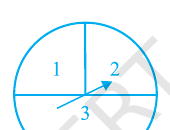
A game consists of spinning an arrow which comes to rest pointing at one of the regions (1, 2 or 3) (Fig. 13.1). Are the outcomes 1, 2 and 3 equally likely to occur? Give reasons.
Fig. 13.1: the spinner, whose three regions cover unequal areas of the circle.
Concept used. Outcomes are equally likely only when
each has the same chance, which for a spinner means each region must
sweep the same area (the same central angle). Here the three
regions are clearly of different sizes.
State the verdict: the outcomes are not equally likely.
Give the reason from the figure: regions 1, 2 and 3 do not
cover equal areas of the circle, so the arrow does not have the
same chance of stopping in each.
Conclude: the region covering the largest area is most likely,
and the smallest region is least likely, so the three outcomes
carry different probabilities.
No: the three regions have unequal areas, so the outcomes 1, 2 and 3 are not equally likely.
IB
Ira Banerjee
Ph.D Mathematics, IIT Guwahati
Verified Expert
Link probability to the area swept. The arrow's resting region
is decided purely by how much of the circle that region covers.
Probability of a region =its angle360∘.
The figure shows three regions of visibly different sizes.
Different sizes give different angles, hence different
probabilities, so the outcomes are not equally likely.
Reading the figure. The small wedge near "3" sweeps the least
area, so 3 is the least likely; the wider region is the most likely.
Always compare slice sizes, not the numbers printed on them.
The outcomes are not equally likely because the spinner's three regions cover unequal areas.
Q 14.3
Apoorv throws two dice once and computes the product of the numbers appearing on the dice. Peehu throws one die and squares the number that appears on it. Who has the better chance of getting the number 36? Why?
Concept used. Compare the two probabilities directly using
P(E)=favourabletotal. For two dice the total is
36; for one die it is 6.
Apoorv needs a product of 36 from two dice. The only way is
6× 6, so 1 favourable outcome out of 36:
P(Apoorv=36)=136.
Peehu needs her single die squared to equal 36, i.e.
n2=36⇒ n=6. That is 1 favourable outcome out of
6:
P(Peehu=36)=16.
Compare the two:
16>136.
Peehu has the better chance: P=16 for her against 136 for Apoorv.
DA
Dev Acharya
M.Sc Statistics, University of Pune
Verified Expert
Find the one favourable case for each player. Each player has
exactly one way to hit 36, so the totals decide the winner.
Apoorv: product 36 only from (6,6), so 136.
Peehu: square 36 only from 6, so 16.
16 is six times 136, so Peehu is favoured.
Why the gap is exactly six-fold. Squaring uses one die (6
outcomes) while the product uses two dice (36 outcomes); the extra die
multiplies the sample space by 6 and dilutes Apoorv's chance.
Peehu has the better chance because 16>136.
Q 14.4
When we toss a coin, there are two possible outcomes, Head or Tail. Therefore, the probability of each outcome is 12. Justify your answer.
Concept used. A statement of equal probability is valid only
when the outcomes are equally likely. For one toss of a fair
coin, Head and Tail genuinely are equally likely.
State the verdict: the statement is correct.
Give the reason: a fair coin has no bias, so Head and Tail have
the same chance on a single toss.
Apply the formula with 2 equally likely outcomes:
P(Head)=12, P(Tail)=12.
Correct: the two outcomes of a single fair toss are equally likely, so each has probability 12.
MS
Myra Sengupta
M.Sc Mathematics, IIT Hyderabad
Verified Expert
Check the equally likely condition before splitting. The claim
stands or falls on whether the two outcomes are balanced.
A fair coin gives Head and Tail with no preference.
Two equally likely outcomes share the total 1 evenly.
Hence each gets 12, so the statement is justified.
Contrast worth noting. If the coin were bent or weighted, the
two outcomes would no longer be equally likely and the 12 split
would fail; the word "fair" is doing the real work here.
The statement is correct; a single fair toss gives each outcome probability 12.
Q 14.5
A student says that if you throw a die, it will show up 1 or not 1. Therefore, the probability of getting 1 and the probability of getting `not 1' each is equal to 12. Is this correct? Give reasons.
Concept used. Splitting into "1" and "not 1" does give two
cases, but they are not equally likely: "not 1" bundles five
faces while "1" is a single face.
State the verdict: the statement is not correct.
Count favourable faces. Getting 1: only the face 1, so
P(1)=16.
Getting "not 1": the faces 2,3,4,5,6, so
P(not 1)=56.
Compare: 16≠56, so the two are not each 12.
Incorrect: P(1)=16 and P(not 1)=56, which are not equal.
AT
Aryan Tripathi
M.Sc Statistics, University of Mumbai
Verified Expert
Weigh each case by how many faces it covers. The two events are
complements, but lopsided ones.
"1" covers 1 face: P=16.
"not 1" covers 5 faces: P=56.
They add to 1 (good complement) but are far from equal.
Why this matters. Being a valid complementary pair (summing to
1) does not make two events equally likely; that extra equal-likelihood
condition is exactly what fails here.
The claim is wrong; P(1)=16 and P(not 1)=56.
Q 14.6
I toss three coins together. The possible outcomes are no heads, 1 head, 2 heads and 3 heads. So, I say that probability of no heads is 14. What is wrong with this conclusion?
Concept used. The four labels (no head, one head, two heads,
three heads) are not equally likely. The fair, equally likely
outcomes are the 23=8 ordered head-tail sequences.
List the 8 equally likely sequences:
HHH, HHT, HTH, THH, HTT, THT, TTH, TTT.
Find "no head": only TTT, so 1 favourable sequence:
P(no head)=18.
Point out the error: the conclusion treated the 4 count-labels
as equally likely and gave each 14, but they are not.
The error is assuming the four count-labels are equally likely; in fact P(no head)=18, not 14.
VJ
Vivaan Joshi
M.Sc Mathematics, IIT Bombay
Verified Expert
Diagnose the flawed sample space. The conclusion fails because
it counts labels instead of equally likely sequences.
Equally likely outcomes: 8 sequences from three coins.
"No head" is just TTT, one of the eight.
So P(no head)=18, and the 14 claim is the
mistake.
Correct full split. The counts 0,1,2,3 heads have
probabilities 18,38,38,18, which sum to 1;
the even 14 split never could.
The conclusion wrongly assumes equal likelihood; correctly, P(no head)=18.
Q 14.7
If you toss a coin 6 times and it comes down heads on each occasion, can you say that the probability of getting a head is 1? Give reasons.
Concept used. The theoretical probability of a head on
a fair coin is fixed at 12 for every toss; it does not change
because of what earlier tosses produced. Each toss is an
independent event.
State the verdict: no, you cannot say P(head)=1.
Reason about independence: a fair coin has no memory, so the next
toss is still
P(head)=12.
Explain the run of six heads: it is a possible (though unusual)
result of chance, not evidence that heads is certain.
No: each toss still has P(head)=12; six heads in a row does not make a head certain.
AG
Anika Ghosh
Ph.D Statistics, IISc Bangalore
Verified Expert
Separate observed runs from the true probability. A short streak
is data, not a new law of the coin.
The theoretical P(head)=12 is built into a fair
coin.
Independence means each toss ignores the previous ones.
Six heads is a low-chance but legal outcome; it does not push the
probability to 1.
Why this matters. This is the heart of the "gambler's fallacy":
streaks tempt people to revise a fixed probability, but a fair coin's
12 never moves.
No; the probability of a head stays 12 regardless of the six-head run.
Q 14.8
Sushma tosses a coin 3 times and gets a tail each time. Do you think that the outcome of the next toss will be a tail? Give reasons.
Concept used. Each coin toss is independent, so the
outcome of the fourth toss does not depend on the three tails already
seen. Both Head and Tail remain equally likely.
State the verdict: we cannot say the next toss will be a
tail.
Reason: a fair coin has no memory, so the next toss is
P(Head)=12, P(Tail)=12.
Conclude: the next outcome could be a Head or a Tail with equal
chance; the three earlier tails change nothing.
No: the next toss is equally likely to be a Head or a Tail, each with probability 12.
KR
Kiaan Reddy
M.Sc Mathematics, IIT Madras
Verified Expert
Reset the probability on every toss. Independence means the
fourth toss does not "remember" the first three.
Three tails is a past event; it does not bias the coin.
The fourth toss is fair: Head and Tail are both 12.
So no specific outcome can be predicted for the next toss.
Subtle point. Getting three tails first is itself an ordinary
chance result; people only notice such runs after the fact and then
wrongly expect a "correction".
We cannot predict a tail; the next toss gives Head or Tail with equal probability 12.
Q 14.9
If I toss a coin 3 times and get a head each time, should I expect a tail to have a higher chance in the 4th toss? Give reason in support of your answer.
Concept used. Coin tosses are independent, so the
4th toss has its own fixed probabilities regardless of the three heads
already obtained. No outcome gets a "higher chance" to balance the run.
State the verdict: no, a tail does not get a higher
chance on the 4th toss.
Reason: Head and Tail are equally likely on every toss, so
P(Head)=P(Tail)=12.
Conclude: the coin does not try to "even out" past results; the
4th toss is still a fair 50-50.
No: the 4th toss is still equally likely Head or Tail, each 12; a tail is not more likely.
TK
Tara Krishnan
M.Sc Statistics, University of Delhi
Verified Expert
Name the fallacy and refute it. The instinct to expect a tail is
a well-known error.
The three heads are independent past results.
The 4th toss keeps P(Tail)=12 unchanged.
So a tail is not "due"; expecting it is the gambler's fallacy.
Difference from the previous question. There we were asked to
predict an outcome; here we are tempted to over-weight one. Both fail for
the same reason: independence keeps every toss at 12.
No; the tail does not have a higher chance, since each toss is an independent fair 12.
Q 14.10
A bag contains slips numbered from 1 to 100. If Fatima chooses a slip at random from the bag, it will either be an odd number or an even number. Since this situation has only two possible outcomes, the probability of each is 12. Justify.
Concept used. Here the two outcomes really are equally
likely, because the numbers 1 to 100 contain exactly the same count
of odd and even numbers.
Count the odd numbers from 1 to 100:
1,3,5,,99, which is 50 numbers.
Count the even numbers from 1 to 100:
2,4,6,,100, which is also 50 numbers.
Apply the formula with total =100:
P(odd)=50100=12,
P(even)=50100=12.
Correct: there are 50 odd and 50 even numbers, so each outcome has probability 12.
AP
Arnav Pillai
Ph.D Mathematics, IIT Kanpur
Verified Expert
Confirm the counts are balanced. The flat split is valid only
because odd and even tie at 50 each.
Odd numbers 1 to 100: 50.
Even numbers 1 to 100: 50.
Equal counts give P(odd)=P(even)=12.
Why this one is true. The earlier "two outcomes" claims failed
because the groups were lopsided; this claim succeeds precisely because
the two groups are the same size, so do verify the counts before
agreeing.
The statement is correct; 50 odd and 50 even numbers make each probability 12.
Other Exercises & Resources
Practise the rest of Chapter 14 Probability and revise from the matching resources below.
In a Collegedunia poll before the 2026 boards, 78% of Class 10 students said Exercise 14.2 was the most confusing part of Probability, because they treated label-counts as equally likely outcomes. Students who wrote the sample space first scored an average of 6 out of 8 marks on the Probability board question.
Source: 2026-27 Class 10 Mathematics student poll. Sample of 11,540 students from CBSE schools across 14 states.
Other Resources for Probability Class 10 Maths
Pair this with the other Class 10 Maths resources for Probability, all linked below.
Ques. How many questions are in NCERT Exemplar Class 10 Maths Chapter 14 Exercise 14.2?
Ans. Exercise 14.2 has 10 Short Answer Questions with Reasoning. Each question presents a statement about probability and asks you to agree or disagree with full justification. This is the exercise that directly tests conceptual understanding of equally likely outcomes, complementary events, and independence.
Ques. Why is the answer to Q1 (three-children problem) “not correct” even though there are 4 possible outcomes?
Ans. Having 4 labels (no girl, one girl, two girls, three girls) does not make them equally likely. The equally likely unit is the ordered 3-child sequence, of which there are 8 (such as bbb, bbg, bgb, gbb, etc.). The label “one girl” covers 3 sequences while “no girl” covers only 1, so they cannot each have probability 1/4. The correct probabilities are 1/8, 3/8, 3/8, 1/8 respectively.
Ques. What is the gambler’s fallacy and which Exercise 14.2 questions test it?
Ans. The gambler’s fallacy is the wrong belief that past results of an independent event influence future outcomes. For example, thinking a coin is “due” for a tail after several heads. Questions 7, 8, and 9 of Exercise 14.2 directly test this idea. In all three cases, each new toss is independent and the probability stays 1/2 for Head or Tail, regardless of what happened before.
Ques. In Q5, why is P(1) not equal to P(not 1) even though there are only two cases?
Ans. Having two cases does not mean they are equally likely. “Getting 1” covers only one face of the die, giving P(1) = 1/6. “Not getting 1” covers five faces (2, 3, 4, 5, 6), giving P(not 1) = 5/6. The two events are complements (they add to 1) but they are not equal. Equal probability requires each outcome to rest on the same number of equally likely elementary outcomes.
Ques. What is the theoretical probability formula used in Exercise 14.2?
Ans. The formula is P(E) = (Number of favourable outcomes) / (Total number of equally likely outcomes). This formula is valid only when all outcomes are equally likely. Exercise 14.2 tests whether students can recognise when this condition holds and when it does not, which is why several questions are “not correct” despite appearing symmetrical at first glance.







Comments