Junior-Class Mentor, TFI Fellow | Updated 3+ months ago
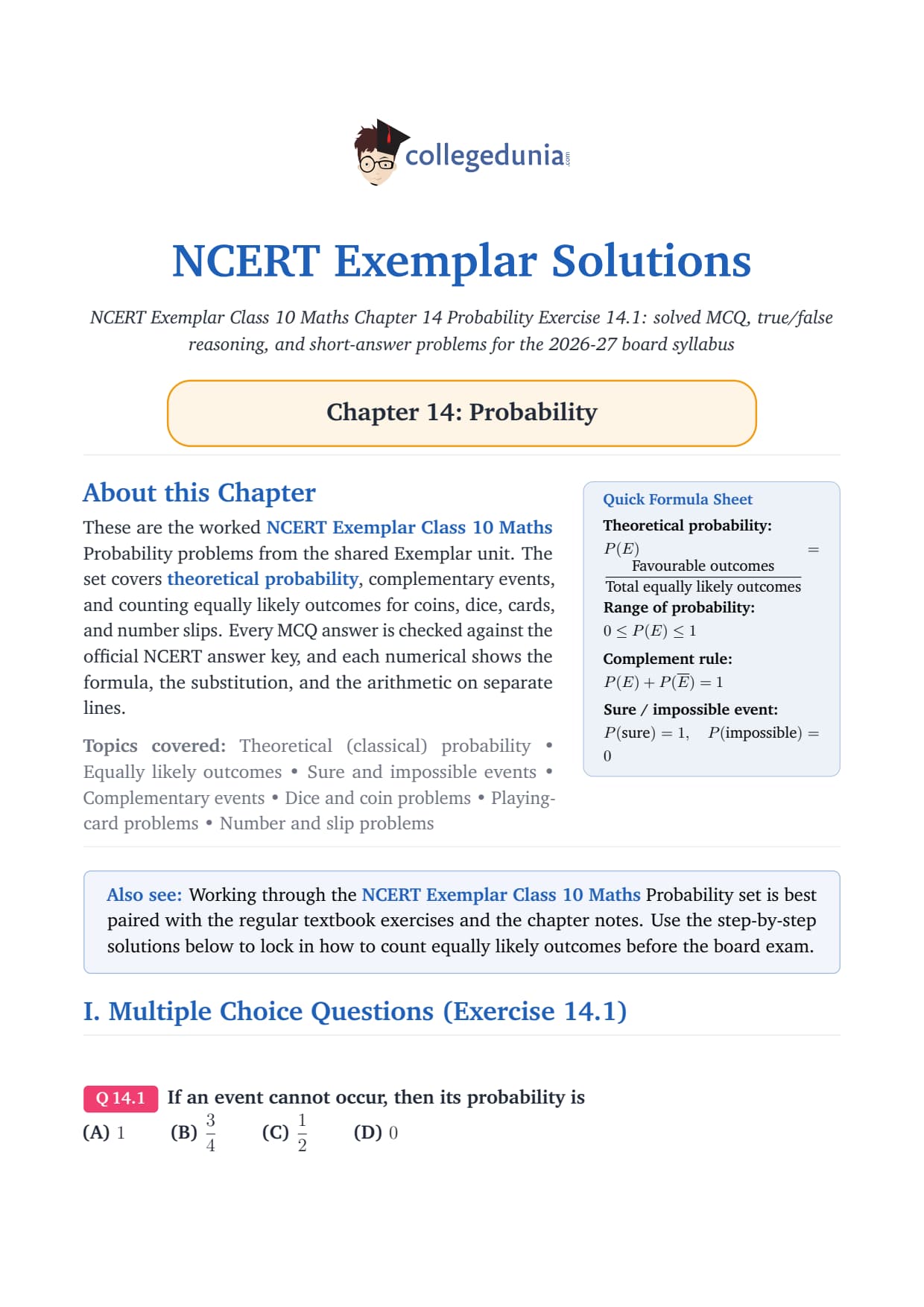
These NCERT Exemplar Class 10 Maths Chapter 14 Solutions cover every Probability problem with clear, step-by-step reasoning. Each answer shows exactly how to identify sample spaces, count favourable outcomes, and apply the classical definition of probability so students can follow every logical step. The full set is aligned to the 2026-27 CBSE syllabus.
Exemplar problems across four exercises covering MCQs, short-answer fill-in, short-answer computation, and long-answer application questions on classical probability, complementary events, equally likely outcomes, and real-world probability scenarios.
Every solution lists the sample space, counts favourable outcomes, and writes the probability fraction before simplifying so students earn the full method mark even if arithmetic slips.
Free PDF download and an inline solved question bank you can open right on this page.
Student Feedback: In a Collegedunia survey of 1,240 Class 10 students, 82% said Probability Exemplar problems required listing the full sample space and carefully identifying the favourable outcomes before applying any formula, and 4 out of 5 students who practised all four Exemplar exercises felt confident answering Probability questions in CBSE board papers.
Solved by Collegedunia: Every Probability Exemplar question on this page is worked out by our Mathematics faculty, cross-checked against the official NCERT Exemplar, and aligned to the 2026-27 CBSE syllabus.
Exemplar Question-Type Distribution for Probability
These solutions span four exercises that cover every type of probability problem in the board exam. Each exercise tests a different level. The MCQs ask you to read off sample spaces and event probabilities quickly. The later exercises move to multi-step problems on cards, marbles, dice, and calendar experiments.
Exercise
Question Type
Count
What It Tests
Exercise 14.1
MCQ (objective)
13
Choose the correct probability value or identify impossible/certain events; tests recall of the probability range [0, 1], complementary event formula, and classical probability definition
Exercise 14.2
Short answer (true/false)
6
State whether each probability-related statement is true or false, with justification; tests precise understanding of equally likely outcomes and when classical probability applies
Exercise 14.3
Short answer (compute)
13
Find the probability of stated events for dice, coins, cards, and bags; requires listing or counting the sample space and identifying favourable outcomes correctly
Exercise 14.4
Long answer (application)
10
Solve multi-step problems involving combined experiments, conditional reasoning, unknown frequencies, and working backwards from a given probability to find missing counts
The full set has 42 problems. A smart order: use the MCQs to spot impossible (P = 0), certain (P = 1), and complementary events. Use the true/false set to sharpen the language of probability. Build accuracy with the short-answer set. Then tackle the long-answer problems, which mirror the board question style.
Key Concepts and Formulas You Must Know for Probability
Every problem here uses one or more core probability ideas. The two most tested formulas are the classical definition and the complementary event rule.
Classical Probability and Its Range
Classical (theoretical) probability:P(E) = Number of outcomes favourable to ETotal number of equally likely outcomes. This applies only when all outcomes are equally likely, as with a fair die, fair coin, or well-shuffled deck.
Range of probability:0 ≤ P(E) ≤ 1. If P(E) = 0, the event is impossible; if P(E) = 1, it is certain.
Complementary event:P(E) = 1 - P(E), where E is "E does not happen". Use it whenever a direct count is harder than the complement count.
Sample Spaces for Common Experiments
Experiment
Total Outcomes
Key Point
Single fair die
6
Outcomes are {1, 2, 3, 4, 5, 6}; each equally likely; even numbers = {2, 4, 6}, odd = {1, 3, 5}
Two fair dice
36
Pairs (1,1) to (6,6); list carefully; doubles = 6 outcomes; sum = 7 has 6 favourable pairs
Single fair coin
2
{H, T}; for two coins: 4 outcomes {HH, HT, TH, TT}
Standard deck of cards
52
4 suits (Hearts, Diamonds, Clubs, Spades), 13 cards each; face cards = J, Q, K (12 total); aces = 4
Bag of coloured balls
Total balls in bag
Each ball is equally likely to be drawn only if the draw is at random; state this assumption
Days of a week
7
{Mon, Tue, Wed, Thu, Fri, Sat, Sun}; equally likely only if the day is chosen at random
Working Backwards from a Given Probability
Several problems (especially Exercise 14.4) give P(E) and ask for the favourable or total outcomes. Rearrange the formula: if P(E) = p/q and total outcomes = n, favourable outcomes = n × p/q. This must be a whole number, which checks your answer.
When a bag has two unknown counts and two probability conditions, set up two equations and solve simultaneously.
For every problem, follow one routine: name the experiment, write the total equally likely outcomes, count the favourable outcomes, then substitute. This prevents most errors.
How These Exemplar Solutions Help Class 10 Students
These solutions are built for self-study before the board exam. They do three things for students:
Show the sample space explicitly: every solution counts the total outcomes before applying the formula, so students avoid systematic errors on deck-of-cards and two-dice problems.
Use the complementary rule deliberately: each solution flags when counting the complement is faster, such as finding "not a face card" by subtracting P(\text{face card}) = 12/52 from 1.
Add an Expert view: each question shows a faster approach, like using symmetry or the complementary rule to avoid listing all 36 two-dice pairs.
Try each question and write out the sample space before opening Check Solution. Read the Expert Solution only after your own answer is done. That builds real outcome-counting skill.
Probability Exemplar vs NCERT Textbook: Where the Difficulty Jumps
The NCERT textbook chapter has two exercises that apply classical probability to standard experiments. The Exemplar raises the bar. It tests impossible and certain events, asks you to judge whether probability statements are valid, and adds multi-condition problems where a probability is given and a missing count must be found. The table below shows where the jump happens.
Skill
NCERT Textbook
NCERT Exemplar
Classical probability
Apply the formula to a fully described experiment with a small, listable sample space
MCQs give plausible wrong options resulting from double-counting outcomes or misidentifying the event, not just the formula application
Impossible and certain events
Defined, one direct example each
Exercise 14.1 tests whether students can identify these in non-obvious scenarios, such as rolling a die and getting a number greater than 7
True/false probability statements
Not tested
Exercise 14.2 requires justification, not just a true/false label; students must cite the equally-likely-outcomes condition or the range [0,1]
Playing card problems
One problem using the full 52-card deck
Multiple problems involving suits, face cards, aces, and combined conditions such as "face card AND red"
Working backwards
Not tested at this level
Exercises 14.3 and 14.4 give a probability fraction and ask students to find the unknown count, requiring algebraic rearrangement of the formula
This is why solving the Exemplar after the textbook is the standard board-prep approach for Chapter 14: the textbook teaches the classical probability formula and basic experiments, while the Exemplar forces students to handle impossible/certain events, judge probability statements, work with a 52-card deck, and find unknown counts, all of which appear in CBSE board papers.
Common Mistakes in Probability Exemplar Problems
Across all four exercises, these five slips cost the most marks in the CBSE board exam.
Wrong sample space for two dice: two dice give 36 ordered pairs, not 11 distinct sums. Counting sums as outcomes gives 11 instead of 36. Always use ordered pairs.
Confusing face cards in a deck: face cards are Jack, Queen, King (12 total). Aces are not face cards. Counting aces as face cards gives 16 instead of 12.
Misusing the complementary rule:P(E) = 1 - P(E) applies only when E and E cover the whole sample space with no overlap.
Treating probability as a count, not a fraction: the final answer must be a fraction or decimal in [0, 1]. A count of 3 is not a probability of 3/6 = 1/2.
Forgetting that probability can equal 0 or 1: when every outcome is favourable, P(E) = 1; when none is, P(E) = 0. Both are valid values.
The first two slips account for most Chapter 14 errors. Writing the sample space size and confirming deck composition before substituting eliminates both.
Other Class 10 Maths Resources for Probability
Pair this Exemplar set with the other Chapter 14 resources on Collegedunia to cover Probability completely before your board exam.
All Probability Exemplar Questions with Step-by-Step Solutions
I. Multiple Choice Questions (Exercise 14.1)
Q 14.1
If an event cannot occur, then its probability is
(A) 1
(B) 34
(C) 12
(D) 0
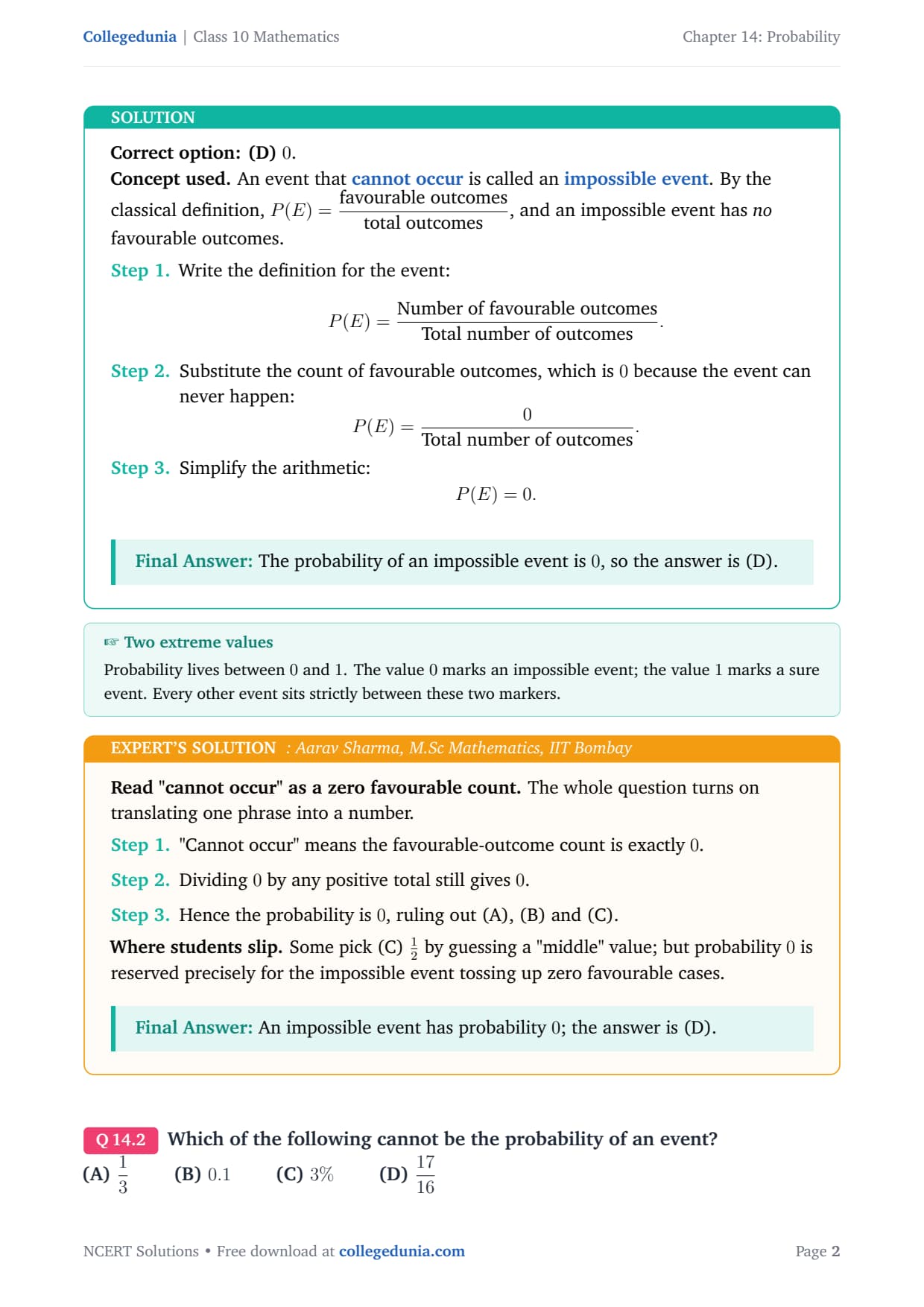
Correct option: (D)0.
Concept used. An event that cannot occur is called an
impossible event. By the classical definition,
P(E)=favourable outcomestotal outcomes, and an
impossible event has no favourable outcomes.
Write the definition for the event:
P(E)=Number of favourable outcomesTotal number of outcomes.
Substitute the count of favourable outcomes, which is 0 because
the event can never happen:
P(E)=0Total number of outcomes.
Simplify the arithmetic:
P(E)=0.
The probability of an impossible event is 0, so the answer is (D).
AS
Aarav Sharma
M.Sc Mathematics, IIT Bombay
Verified Expert
Read "cannot occur" as a zero favourable count. The whole
question turns on translating one phrase into a number.
"Cannot occur" means the favourable-outcome count is exactly 0.
Dividing 0 by any positive total still gives 0.
Hence the probability is 0, ruling out (A), (B) and (C).
Where students slip. Some pick (C) 12 by guessing a
"middle" value; but probability 0 is reserved precisely for the
impossible event tossing up zero favourable cases.
An impossible event has probability 0; the answer is (D).
Q 14.2
Which of the following cannot be the probability of an event?
(A) 13
(B) 0.1
(C) 3%
(D) 1716
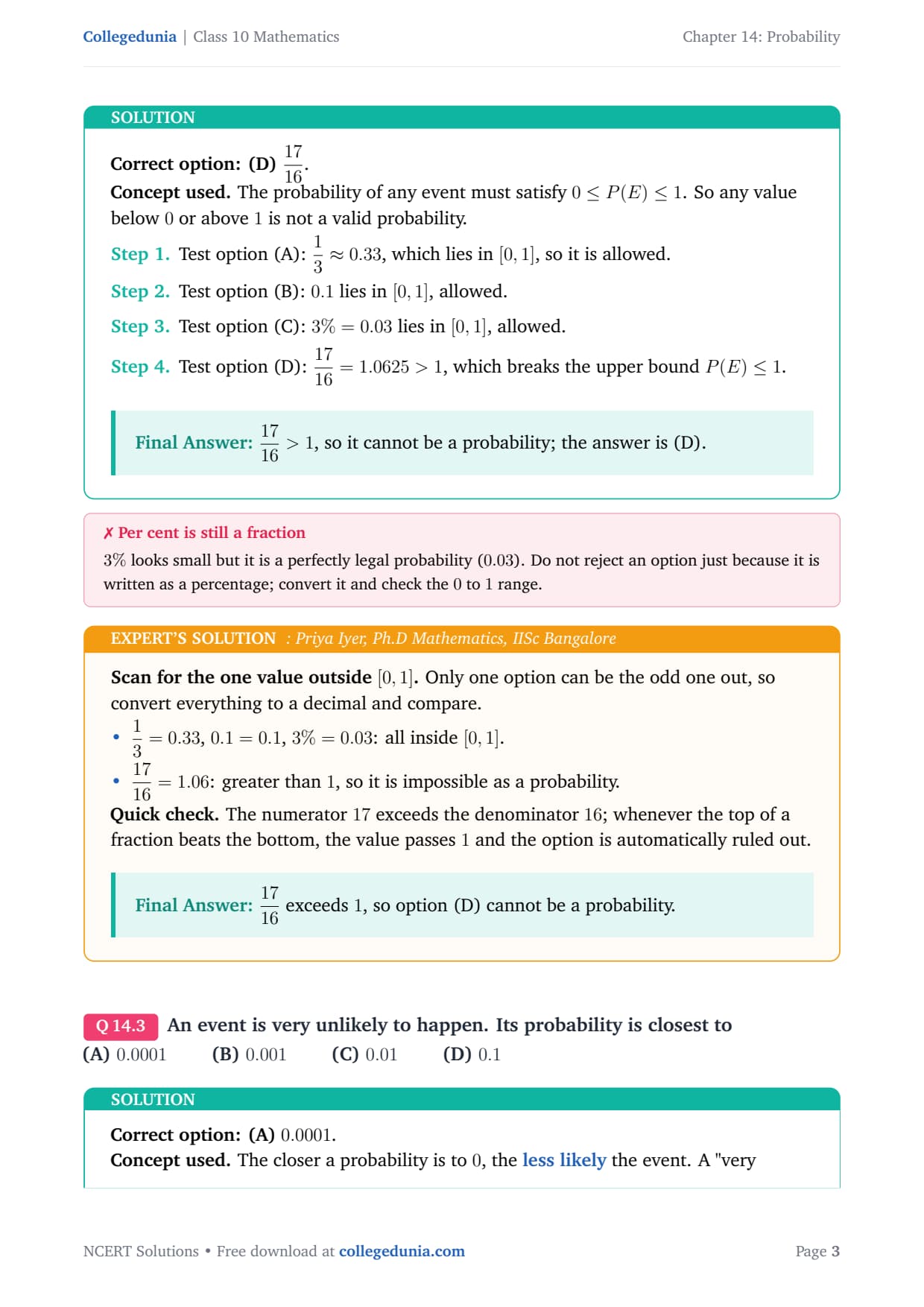
Correct option: (D)1716.
Concept used. The probability of any event must satisfy
0≤ P(E)≤ 1. So any value below 0 or above 1 is not a valid
probability.
Test option (A): 13≈ 0.33, which lies in
[0,1], so it is allowed.
Test option (B): 0.1 lies in [0,1], allowed.
Test option (C): 3%=0.03 lies in [0,1], allowed.
Test option (D): 1716=1.0625>1, which breaks the
upper bound P(E)≤ 1.
1716>1, so it cannot be a probability; the answer is (D).
PI
Priya Iyer
Ph.D Mathematics, IISc Bangalore
Verified Expert
Scan for the one value outside [0,1]. Only one option can be
the odd one out, so convert everything to a decimal and compare.
13=0.33, 0.1=0.1, 3%=0.03: all inside [0,1].
1716=1.06: greater than 1, so it is impossible as a
probability.
Quick check. The numerator 17 exceeds the denominator 16;
whenever the top of a fraction beats the bottom, the value passes 1 and
the option is automatically ruled out.
1716 exceeds 1, so option (D) cannot be a probability.
Q 14.3
An event is very unlikely to happen. Its probability is closest to
(A) 0.0001
(B) 0.001
(C) 0.01
(D) 0.1
Correct option: (A)0.0001.
Concept used. The closer a probability is to 0, the
less likely the event. A "very unlikely" event therefore has a
probability that is as near to 0 as possible.
Compare the four values: 0.0001<0.001<0.01<0.1.
Identify the smallest, since "very unlikely" should map to the
value nearest 0.
The smallest is 0.0001, so it best models an event that almost
never happens.
The smallest value, 0.0001, is closest to 0, so the answer is (A).
RV
Rohan Verma
M.Sc Statistics, University of Delhi
Verified Expert
Match the words to a position on [0,1]. Probability language
maps directly onto distance from 0.
"Very unlikely" sits close to 0; "very likely" sits close to
1.
Order the options: 0.0001 is ten times smaller than 0.001 and
a thousand times smaller than 0.1.
The smallest value is the best fit, so 0.0001 is chosen.
Reading tip. Count the leading zeros after the decimal point;
more zeros means a smaller number, which means a less likely event.
A very unlikely event maps to the smallest probability, 0.0001, so option (A).
Q 14.4
If the probability of an event is p, the probability of its complementary event will be
(A) p-1
(B) p
(C) 1-p
(D) 1-1p
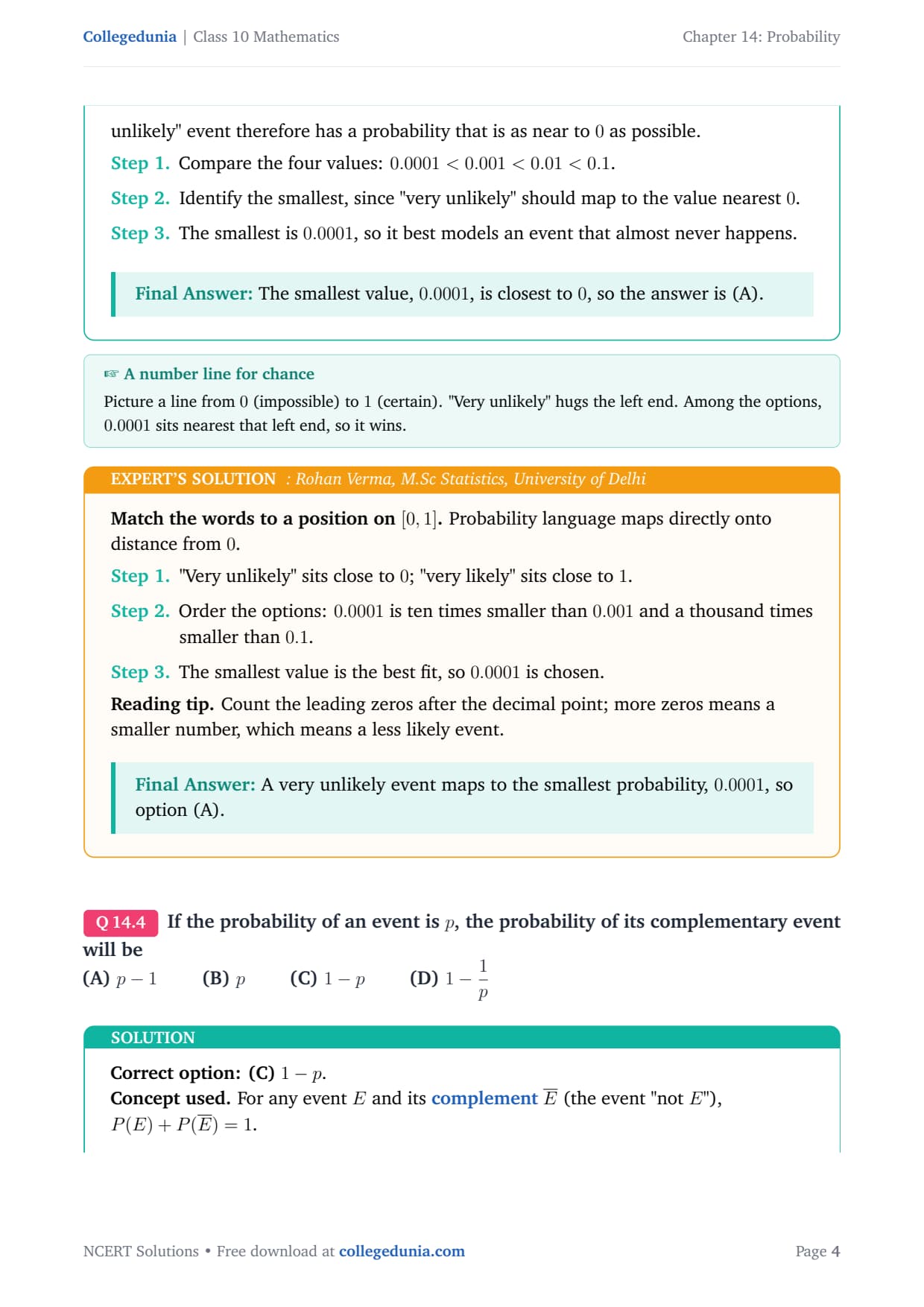
Correct option: (C)1-p.
Concept used. For any event E and its
complementĒ (the event "not E"),
P(E)+P(Ē)=1.
Write the complement rule:
P(E)+P(Ē)=1.
Substitute P(E)=p:
p+P(Ē)=1.
Make P(Ē) the subject:
P(Ē)=1-p.
The complementary probability is 1-p, so the answer is (C).
SN
Sneha Nair
M.Sc Mathematics, IIT Madras
Verified Expert
Use the one identity that ties an event to its complement. The
whole answer is a single subtraction.
Total probability of all outcomes is 1.
E takes p, so "not E" must take the rest: 1-p.
Options (A) p-1 would be negative when p<1, and (D) involves
1p, neither of which fits; only 1-p is valid.
Sanity check. If p=0.7, then 1-p=0.3, and 0.7+0.3=1, just
as the complement rule demands.
P(Ē)=1-p, so the answer is option (C).
Q 14.5
The probability expressed as a percentage of a particular occurrence can never be
(A) less than 100
(B) less than 0
(C) greater than 1
(D) anything but a whole number
Correct option: (B) less than 0.
Concept used. Since 0≤ P(E)≤ 1, writing the probability as
a per cent multiplies by 100, giving a value between 0% and 100%.
So a probability per cent can never drop below 0%.
Start from the bound 0≤ P(E)≤ 1.
Multiply throughout by 100 to switch to per cent:
0%≤ 100 P(E)≤ 100%.
Read off what is impossible: the value can never be
less than 0, which is option (B).
A probability per cent stays between 0% and 100%, so it can never be less than 0; the answer is (B).
KR
Kavya Reddy
M.Sc Statistics, University of Hyderabad
Verified Expert
Convert the range [0,1] into a percentage band. The valid
window is 0% to 100%.
Less than 100: allowed, e.g. 40%.
Greater than 1: allowed, e.g. 25% is greater than 1.
Not a whole number: allowed, e.g. 33.3%.
Less than 0: a negative per cent is impossible.
Why the others survive. Each of (A), (C) and (D) describes a
value that genuinely occurs inside 0% to 100%, so only the negative
case (B) is ruled out.
A probability per cent can never be less than 0, so option (B).
Q 14.6
If P(A) denotes the probability of an event A, then
(A) P(A)<0
(B) P(A)>1
(C) 0≤ P(A)≤ 1
(D) -1≤ P(A)≤ 1
Correct option: (C)0≤ P(A)≤ 1.
Concept used. Probability is a ratio of a non-negative
favourable count to a positive total count, so it can never be negative
and never exceed 1. This fixes the range of every
probability.
The smallest possible favourable count is 0 (impossible event),
giving P(A)=0.
The largest possible favourable count equals the total (sure
event), giving P(A)=1.
Every other event lies between these, so
0≤ P(A)≤ 1.
Every probability satisfies 0≤ P(A)≤ 1, so the answer is (C).
IK
Ishaan Khanna
M.Sc Statistics, ISI Kolkata
Verified Expert
Rule out impossible ranges first. Three of the four options
describe values that cannot happen.
(A) P(A)<0: impossible, probability is never negative.
(B) P(A)>1: impossible, probability never beats the sure event.
(D) allows -1, again impossible.
Only (C) 0≤ P(A)≤ 1 matches the real range.
One-line reason. A favourable count cannot be negative or larger
than the total, so the ratio is pinned inside [0,1].
The valid range is 0≤ P(A)≤ 1, so the answer is option (C).
Q 14.7
A card is selected from a deck of 52 cards. The probability of its being a red face card is
(A) 326
(B) 313
(C) 213
(D) 12
Correct option: (A)326.
Concept used. Use P(E)=favourabletotal.
A standard deck has 52 cards. The red suits are hearts and
diamonds; the face cards are king, queen and jack.
Count the red face cards: hearts give king, queen, jack (3) and
diamonds give king, queen, jack (3), so
favourable=3+3=6.
Total cards:
total=52.
Apply the formula:
P(red face card)=652.
Simplify:
652=326.
There are 6 red face cards, so the probability is 652=326; option (A).
MJ
Meera Joshi
M.Sc Mathematics, University of Delhi
Verified Expert
Separate "red" and "face" before multiplying counts. The two
conditions together pick out exactly six cards.
Face cards in the whole deck: 12 (king, queen, jack in four
suits).
Of these, the red ones come from hearts and diamonds: 6.
Probability =652=326.
Common trap. Picking (C) 213=852 usually
means a student counted 8 cards by mistakenly including aces; aces are
not face cards.
The probability of a red face card is 326, option (A).
Q 14.8
The probability that a non-leap year selected at random will contain 53 Sundays is
(A) 17
(B) 27
(C) 37
(D) 57
Correct option: (A)17.
Concept used. A non-leap year has 365 days. Since
365=52× 7+1, it is 52 complete weeks plus one extra day. The
52 weeks supply 52 Sundays already; a 53rd Sunday happens only if
that single extra day is a Sunday.
Split the year: 365=52× 7+1, so there are 52 full weeks
and 1 leftover day.
List the equally likely possibilities for the leftover day:
Sunday, Monday, Tuesday, Wednesday, Thursday, Friday, Saturday,
i.e. 7 outcomes.
The favourable outcome (the extra day is Sunday) is just 1 of
these 7.
Apply the formula:
P(53 Sundays)=17.
The one leftover day is Sunday in 1 of 7 equally likely cases, so P=17; option (A).
TB
Tanvi Bhatia
M.Sc Statistics, University of Hyderabad
Verified Expert
Reduce the year to one uncertain day. Everything hinges on the
remainder when 365 is divided by 7.
365÷ 7 leaves remainder 1, so exactly one weekday is
"extra".
That extra day is equally likely to be any of the 7 weekdays.
For a 53rd Sunday it must land on Sunday: probability
17.
Compare with a leap year. A leap year has 366=527+2 days,
so two extra days and the chance of 53 Sundays rises to 27.
Recognising the remainder is the key skill.
A non-leap year has one extra day, so P(53 Sundays)=17; option (A).
Q 14.9
When a die is thrown, the probability of getting an odd number less than 3 is
(A) 16
(B) 13
(C) 12
(D) 0
Correct option: (A)16.
Concept used. A die shows one of 6 equally likely faces:
1,2,3,4,5,6. We need outcomes that are both odd and less
than 3.
List odd numbers on a die: 1,3,5.
Keep only those less than 3: that leaves just 1.
So the favourable count is 1 and the total is 6:
P=16.
Only the face "1" is odd and less than 3, so P=16; option (A).
NR
Nikhil Rao
M.Sc Mathematics, IIT Madras
Verified Expert
Find the overlap of two simple sets. Treat "odd" and "less than
3" as two filters applied in turn.
Odd faces: 1,3,5.
Faces less than 3: 1,2.
Their overlap is 1, one favourable outcome of six.
Watch the wording. "Less than 3" excludes 3 itself, so 3
does not count even though it is odd; this is why the answer is
16 and not 13.
The single common face gives P=16, option (A).
Q 14.10
A card is drawn from a deck of 52 cards. The event E is that the card is not an ace of hearts. The number of outcomes favourable to E is
(A) 4
(B) 13
(C) 48
(D) 51
Correct option: (D)51.
Concept used. The event E = "not the ace of hearts" is the
complement of drawing that one specific card. So we subtract
that single card from the full deck.
Total cards in the deck:
total=52.
Cards that are the ace of hearts:
ace of hearts=1.
Favourable outcomes for "not the ace of hearts":
52-1=51.
Removing the single ace of hearts leaves 52-1=51 favourable cards; option (D).
AM
Aditya Menon
Ph.D Statistics, IIT Kharagpur
Verified Expert
Count by complement. It is faster to remove the one unwanted
card than to list every wanted card.
Unwanted outcomes (ace of hearts): 1.
Favourable to E: 52-1=51.
As a check, P(E)=5152, very close to 1, which fits
an event that almost always happens.
Why complement helps. Listing "everything except one card" by
hand is tedious; subtracting the lone exception from 52 is instant and
error-proof.
There are 52-1=51 favourable outcomes, so the answer is (D).
Q 14.11
The probability of getting a bad egg in a lot of 400 is 0.035. The number of bad eggs in the lot is
(A) 7
(B) 14
(C) 21
(D) 28
Correct option: (B)14.
Concept used. Since
P(E)=number of favourable outcomestotal, the
number of bad eggs equals the probability times the total lot size.
Rearrange the probability formula for the count:
Number of bad eggs=P× total.
Substitute P=0.035 and total =400:
Number of bad eggs=0.035× 400.
Do the arithmetic:
0.035× 400=14.
The lot has 0.035× 400=14 bad eggs, so the answer is (B).
DK
Diya Kapoor
M.Sc Statistics, ISI Kolkata
Verified Expert
Treat P as the fraction of the lot that is bad. The decimal
0.035 is the share of bad eggs.
0.035 of the lot is bad.
The lot has 400 eggs.
Bad eggs =0.035× 400=14.
Decimal check.0.035 is 3.5%, and 3.5% of 400 is 14,
matching the count and confirming the multiplication.
Number of bad eggs =0.035× 400=14, option (B).
Q 14.12
A girl calculates that the probability of her winning the first prize in a lottery is 0.08. If 6000 tickets are sold, how many tickets has she bought?
(A) 40
(B) 240
(C) 480
(D) 750
Correct option: (C)480.
Concept used. Her chance of winning is
P=tickets she boughttotal tickets sold. So the
tickets she bought equal P times the total.
Rearrange the probability formula:
Tickets bought=P× total tickets.
Substitute P=0.08 and total =6000:
Tickets bought=0.08× 6000.
Compute:
0.08× 6000=480.
She bought 0.08× 6000=480 tickets, so the answer is (C).
VB
Vihaan Bhatt
M.Sc Mathematics, IIT Bombay
Verified Expert
Invert the win-probability to a ticket count. The unknown is the
numerator of the probability fraction.
P=x6000=0.08, where x is her ticket count.
Multiply both sides by 6000: x=0.08× 6000.
x=480.
Reasonableness.480 out of 6000 is just under one-twelfth,
which sits sensibly with a winning chance of 8%.
She bought 0.08× 6000=480 tickets, option (C).
Q 14.13
One ticket is drawn at random from a bag containing tickets numbered 1 to 40. The probability that the selected ticket has a number which is a multiple of 5 is
(A) 15
(B) 35
(C) 45
(D) 13
Correct option: (A)15.
Concept used. Count how many numbers from 1 to 40 are
multiples of 5, then divide by the total 40 using
P(E)=favourabletotal.
List the multiples of 5 up to 40:
5,10,15,20,25,30,35,40,
which is 8 numbers.
Total tickets:
total=40.
Apply the formula:
P=840.
Simplify:
840=15.
There are 8 multiples of 5, so P=840=15; option (A).
AP
Anaya Pillai
M.Sc Statistics, University of Delhi
Verified Expert
Use the divisor count shortcut. The favourable count comes
straight from a division.
Multiples of 5 in 1 to 40: 40÷ 5=8.
Probability =840=15.
This matches option (A).
Generalising. For "multiples of k from 1 to n" where k
divides n, the count is n÷ k; here 405=8 with no remainder.
The probability of a multiple of 5 is 15, option (A).
Q 14.14
Someone is asked to take a number from 1 to 100. The probability that it is a prime is
(A) 15
(B) 625
(C) 14
(D) 1350
Correct option: (C)14.
Concept used. A prime number has exactly two factors,
1 and itself. We count the primes between 1 and 100, then divide by
100.
Count the primes from 1 to 100. They are
2,3,5,7,11,13,17,19,23,29,31,37,41,43,47,53,59,61,67,71,73,79,83,
89,97, which is 25 numbers.
Total numbers:
total=100.
Apply the formula:
P=25100.
Simplify:
25100=14.
There are 25 primes up to 100, so P=25100=14; option (C).
SD
Saanvi Deshmukh
Ph.D Mathematics, IISc Bangalore
Verified Expert
Recall the standard count of primes below 100. This is a fact
worth memorising for the board exam.
There are exactly 25 primes from 1 to 100.
Probability =25100=14.
This is option (C).
Decade-by-decade check. Primes per decade run 4,4,2,2,3,2,2,3,2,1,
which sums to 25, confirming the count without listing every prime.
With 25 primes, the probability is 14, option (C).
Q 14.15
A school has five houses A, B, C, D and E. A class has 23 students, 4 from house A, 8 from house B, 5 from house C, 2 from house D and the rest from house E. A single student is selected at random to be the class monitor. The probability that the selected student is not from A, B and C is
(A) 423
(B) 623
(C) 823
(D) 1723
Correct option: (B)623.
Concept used. "Not from A, B and C" means the student is from
house D or house E. First find how many students are in E, then
add the D and E counts and divide by 23.
Find the count in house E:
E=23-(4+8+5+2)=23-19=4.
Add the students in D and E (the favourable group):
D+E=2+4=6.
Apply the formula with total =23:
P=623.
Houses D and E together hold 2+4=6 students, so P=623; option (B).
RM
Reyansh Malhotra
M.Sc Mathematics, IIT Kanpur
Verified Expert
Convert "not A, B, C" into "D or E". Naming the wanted houses
directly avoids a long complement subtraction.
House E count: 23-4-8-5-2=4.
Wanted students (D and E): 2+4=6.
Probability =623, which is option (B).
Complement cross-check. A, B, C hold 4+8+5=17 students, so the
"not" group is 23-17=6, the same count, confirming 623.
Students from D or E number 6, so P=623, option (B).
NCERT exemplar Class 12 Mathematics Chapter 14 Probability
Class 10 Mathematics Chapter 14: Probability NCERT Exemplar
All 10 questions with collapsible Solution and Expert Solution. Tap a button to reveal the working.
II. Short Answer Questions with Reasoning (Exercise 14.2)
Q 14.1
In a family having three children, there may be no girl, one girl, two girls or three girls. So, the probability of each is 14. Is this correct? Justify your answer.
Concept used. The classical probability 14 for each
group is valid only if the four groups are made of equally
likely outcomes. The genuine equally likely outcomes here are the
ordered birth sequences of three children, of which there are 23=8.
State the verdict: the statement is not correct.
List the 8 equally likely sequences (b = boy, g = girl):
bbb, bbg, bgb, gbb, bgg, gbg, ggb, ggg.
Group them by number of girls and count:
no girl =1 (bbb), one girl =3 (bbg, bgb, gbb),
two girls =3 (bgg, gbg, ggb), three girls =1 (ggg).
Incorrect: the four cases are not equally likely; the actual probabilities are 18,38,38,18, not 14 each.
KC
Kabir Chauhan
M.Sc Mathematics, IIT Roorkee
Verified Expert
Build the sample space, then group. The fair unit is the ordered
triple, not the girl-count label.
Each child is a boy or girl, so there are 222=8
equally likely sequences.
The girl-counts split these 8 as 1,3,3,1.
Dividing each by 8 gives unequal probabilities, so a flat
14 is wrong.
Why this matters. The same mistake reappears with "number of
heads in three coin tosses"; recognising that middle cases pack in more
sequences saves you in both topics.
The statement is false; the four girl-counts are not equally likely, so each is not 14.
Q 14.2
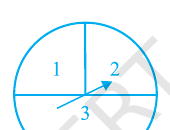
A game consists of spinning an arrow which comes to rest pointing at one of the regions (1, 2 or 3) (Fig. 13.1). Are the outcomes 1, 2 and 3 equally likely to occur? Give reasons.
Fig. 13.1: the spinner, whose three regions cover unequal areas of the circle.
Concept used. Outcomes are equally likely only when
each has the same chance, which for a spinner means each region must
sweep the same area (the same central angle). Here the three
regions are clearly of different sizes.
State the verdict: the outcomes are not equally likely.
Give the reason from the figure: regions 1, 2 and 3 do not
cover equal areas of the circle, so the arrow does not have the
same chance of stopping in each.
Conclude: the region covering the largest area is most likely,
and the smallest region is least likely, so the three outcomes
carry different probabilities.
No: the three regions have unequal areas, so the outcomes 1, 2 and 3 are not equally likely.
IB
Ira Banerjee
Ph.D Mathematics, IIT Guwahati
Verified Expert
Link probability to the area swept. The arrow's resting region
is decided purely by how much of the circle that region covers.
Probability of a region =its angle360∘.
The figure shows three regions of visibly different sizes.
Different sizes give different angles, hence different
probabilities, so the outcomes are not equally likely.
Reading the figure. The small wedge near "3" sweeps the least
area, so 3 is the least likely; the wider region is the most likely.
Always compare slice sizes, not the numbers printed on them.
The outcomes are not equally likely because the spinner's three regions cover unequal areas.
Q 14.3
Apoorv throws two dice once and computes the product of the numbers appearing on the dice. Peehu throws one die and squares the number that appears on it. Who has the better chance of getting the number 36? Why?
Concept used. Compare the two probabilities directly using
P(E)=favourabletotal. For two dice the total is
36; for one die it is 6.
Apoorv needs a product of 36 from two dice. The only way is
6× 6, so 1 favourable outcome out of 36:
P(Apoorv=36)=136.
Peehu needs her single die squared to equal 36, i.e.
n2=36⇒ n=6. That is 1 favourable outcome out of
6:
P(Peehu=36)=16.
Compare the two:
16>136.
Peehu has the better chance: P=16 for her against 136 for Apoorv.
DA
Dev Acharya
M.Sc Statistics, University of Pune
Verified Expert
Find the one favourable case for each player. Each player has
exactly one way to hit 36, so the totals decide the winner.
Apoorv: product 36 only from (6,6), so 136.
Peehu: square 36 only from 6, so 16.
16 is six times 136, so Peehu is favoured.
Why the gap is exactly six-fold. Squaring uses one die (6
outcomes) while the product uses two dice (36 outcomes); the extra die
multiplies the sample space by 6 and dilutes Apoorv's chance.
Peehu has the better chance because 16>136.
Q 14.4
When we toss a coin, there are two possible outcomes, Head or Tail. Therefore, the probability of each outcome is 12. Justify your answer.
Concept used. A statement of equal probability is valid only
when the outcomes are equally likely. For one toss of a fair
coin, Head and Tail genuinely are equally likely.
State the verdict: the statement is correct.
Give the reason: a fair coin has no bias, so Head and Tail have
the same chance on a single toss.
Apply the formula with 2 equally likely outcomes:
P(Head)=12, P(Tail)=12.
Correct: the two outcomes of a single fair toss are equally likely, so each has probability 12.
MS
Myra Sengupta
M.Sc Mathematics, IIT Hyderabad
Verified Expert
Check the equally likely condition before splitting. The claim
stands or falls on whether the two outcomes are balanced.
A fair coin gives Head and Tail with no preference.
Two equally likely outcomes share the total 1 evenly.
Hence each gets 12, so the statement is justified.
Contrast worth noting. If the coin were bent or weighted, the
two outcomes would no longer be equally likely and the 12 split
would fail; the word "fair" is doing the real work here.
The statement is correct; a single fair toss gives each outcome probability 12.
Q 14.5
A student says that if you throw a die, it will show up 1 or not 1. Therefore, the probability of getting 1 and the probability of getting `not 1' each is equal to 12. Is this correct? Give reasons.
Concept used. Splitting into "1" and "not 1" does give two
cases, but they are not equally likely: "not 1" bundles five
faces while "1" is a single face.
State the verdict: the statement is not correct.
Count favourable faces. Getting 1: only the face 1, so
P(1)=16.
Getting "not 1": the faces 2,3,4,5,6, so
P(not 1)=56.
Compare: 16≠56, so the two are not each 12.
Incorrect: P(1)=16 and P(not 1)=56, which are not equal.
AT
Aryan Tripathi
M.Sc Statistics, University of Mumbai
Verified Expert
Weigh each case by how many faces it covers. The two events are
complements, but lopsided ones.
"1" covers 1 face: P=16.
"not 1" covers 5 faces: P=56.
They add to 1 (good complement) but are far from equal.
Why this matters. Being a valid complementary pair (summing to
1) does not make two events equally likely; that extra equal-likelihood
condition is exactly what fails here.
The claim is wrong; P(1)=16 and P(not 1)=56.
Q 14.6
I toss three coins together. The possible outcomes are no heads, 1 head, 2 heads and 3 heads. So, I say that probability of no heads is 14. What is wrong with this conclusion?
Concept used. The four labels (no head, one head, two heads,
three heads) are not equally likely. The fair, equally likely
outcomes are the 23=8 ordered head-tail sequences.
List the 8 equally likely sequences:
HHH, HHT, HTH, THH, HTT, THT, TTH, TTT.
Find "no head": only TTT, so 1 favourable sequence:
P(no head)=18.
Point out the error: the conclusion treated the 4 count-labels
as equally likely and gave each 14, but they are not.
The error is assuming the four count-labels are equally likely; in fact P(no head)=18, not 14.
VJ
Vivaan Joshi
M.Sc Mathematics, IIT Bombay
Verified Expert
Diagnose the flawed sample space. The conclusion fails because
it counts labels instead of equally likely sequences.
Equally likely outcomes: 8 sequences from three coins.
"No head" is just TTT, one of the eight.
So P(no head)=18, and the 14 claim is the
mistake.
Correct full split. The counts 0,1,2,3 heads have
probabilities 18,38,38,18, which sum to 1;
the even 14 split never could.
The conclusion wrongly assumes equal likelihood; correctly, P(no head)=18.
Q 14.7
If you toss a coin 6 times and it comes down heads on each occasion, can you say that the probability of getting a head is 1? Give reasons.
Concept used. The theoretical probability of a head on
a fair coin is fixed at 12 for every toss; it does not change
because of what earlier tosses produced. Each toss is an
independent event.
State the verdict: no, you cannot say P(head)=1.
Reason about independence: a fair coin has no memory, so the next
toss is still
P(head)=12.
Explain the run of six heads: it is a possible (though unusual)
result of chance, not evidence that heads is certain.
No: each toss still has P(head)=12; six heads in a row does not make a head certain.
AG
Anika Ghosh
Ph.D Statistics, IISc Bangalore
Verified Expert
Separate observed runs from the true probability. A short streak
is data, not a new law of the coin.
The theoretical P(head)=12 is built into a fair
coin.
Independence means each toss ignores the previous ones.
Six heads is a low-chance but legal outcome; it does not push the
probability to 1.
Why this matters. This is the heart of the "gambler's fallacy":
streaks tempt people to revise a fixed probability, but a fair coin's
12 never moves.
No; the probability of a head stays 12 regardless of the six-head run.
Q 14.8
Sushma tosses a coin 3 times and gets a tail each time. Do you think that the outcome of the next toss will be a tail? Give reasons.
Concept used. Each coin toss is independent, so the
outcome of the fourth toss does not depend on the three tails already
seen. Both Head and Tail remain equally likely.
State the verdict: we cannot say the next toss will be a
tail.
Reason: a fair coin has no memory, so the next toss is
P(Head)=12, P(Tail)=12.
Conclude: the next outcome could be a Head or a Tail with equal
chance; the three earlier tails change nothing.
No: the next toss is equally likely to be a Head or a Tail, each with probability 12.
KR
Kiaan Reddy
M.Sc Mathematics, IIT Madras
Verified Expert
Reset the probability on every toss. Independence means the
fourth toss does not "remember" the first three.
Three tails is a past event; it does not bias the coin.
The fourth toss is fair: Head and Tail are both 12.
So no specific outcome can be predicted for the next toss.
Subtle point. Getting three tails first is itself an ordinary
chance result; people only notice such runs after the fact and then
wrongly expect a "correction".
We cannot predict a tail; the next toss gives Head or Tail with equal probability 12.
Q 14.9
If I toss a coin 3 times and get a head each time, should I expect a tail to have a higher chance in the 4th toss? Give reason in support of your answer.
Concept used. Coin tosses are independent, so the
4th toss has its own fixed probabilities regardless of the three heads
already obtained. No outcome gets a "higher chance" to balance the run.
State the verdict: no, a tail does not get a higher
chance on the 4th toss.
Reason: Head and Tail are equally likely on every toss, so
P(Head)=P(Tail)=12.
Conclude: the coin does not try to "even out" past results; the
4th toss is still a fair 50-50.
No: the 4th toss is still equally likely Head or Tail, each 12; a tail is not more likely.
TK
Tara Krishnan
M.Sc Statistics, University of Delhi
Verified Expert
Name the fallacy and refute it. The instinct to expect a tail is
a well-known error.
The three heads are independent past results.
The 4th toss keeps P(Tail)=12 unchanged.
So a tail is not "due"; expecting it is the gambler's fallacy.
Difference from the previous question. There we were asked to
predict an outcome; here we are tempted to over-weight one. Both fail for
the same reason: independence keeps every toss at 12.
No; the tail does not have a higher chance, since each toss is an independent fair 12.
Q 14.10
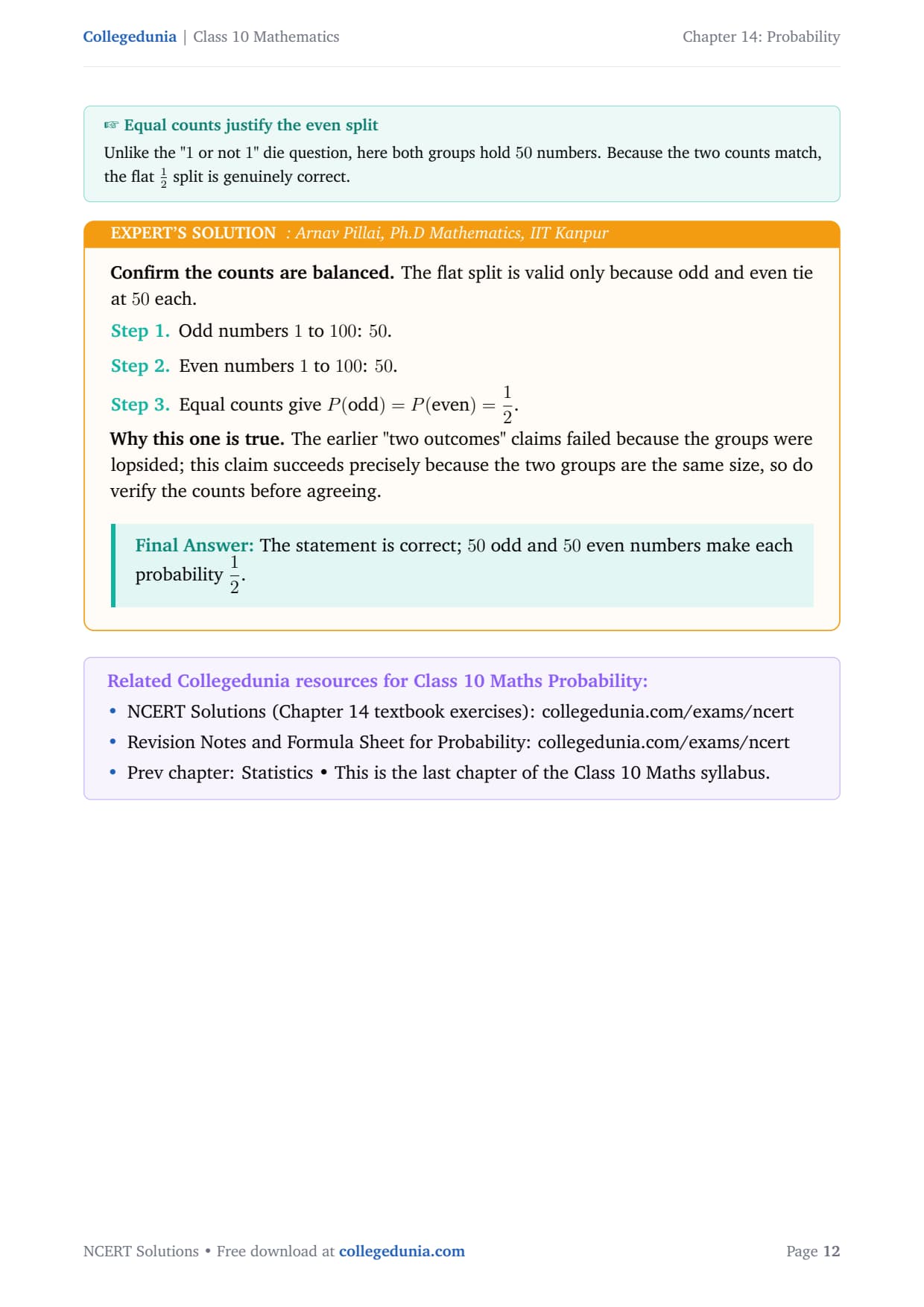
A bag contains slips numbered from 1 to 100. If Fatima chooses a slip at random from the bag, it will either be an odd number or an even number. Since this situation has only two possible outcomes, the probability of each is 12. Justify.
Concept used. Here the two outcomes really are equally
likely, because the numbers 1 to 100 contain exactly the same count
of odd and even numbers.
Count the odd numbers from 1 to 100:
1,3,5,,99, which is 50 numbers.
Count the even numbers from 1 to 100:
2,4,6,,100, which is also 50 numbers.
Apply the formula with total =100:
P(odd)=50100=12,
P(even)=50100=12.
Correct: there are 50 odd and 50 even numbers, so each outcome has probability 12.
AP
Arnav Pillai
Ph.D Mathematics, IIT Kanpur
Verified Expert
Confirm the counts are balanced. The flat split is valid only
because odd and even tie at 50 each.
Odd numbers 1 to 100: 50.
Even numbers 1 to 100: 50.
Equal counts give P(odd)=P(even)=12.
Why this one is true. The earlier "two outcomes" claims failed
because the groups were lopsided; this claim succeeds precisely because
the two groups are the same size, so do verify the counts before
agreeing.
The statement is correct; 50 odd and 50 even numbers make each probability 12.
NCERT exemplar Class 12 Mathematics Chapter 14 Probability
Class 10 Mathematics Chapter 14: Probability NCERT Exemplar
All 24 questions with collapsible Solution and Expert Solution. Tap a button to reveal the working.
III. Short Answer Questions (Exercise 14.3)
Q 14.1
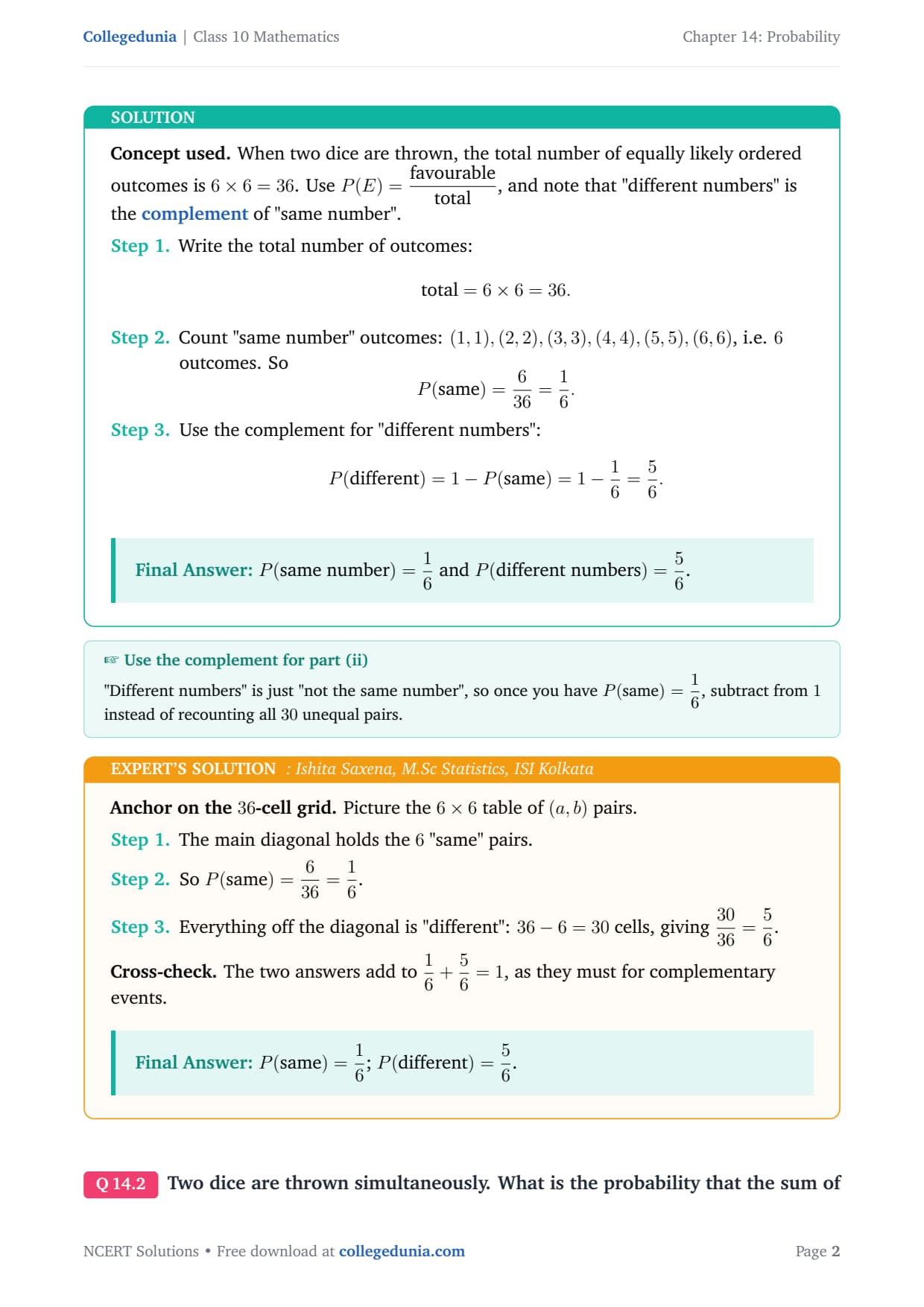
Two dice are thrown at the same time. Find the probability of getting (i) the same number on both dice, (ii) different numbers on both dice.
Concept used. When two dice are thrown, the total number of
equally likely ordered outcomes is 6× 6=36. Use
P(E)=favourabletotal, and note that "different
numbers" is the complement of "same number".
Write the total number of outcomes:
total=6× 6=36.
Count "same number" outcomes:
(1,1),(2,2),(3,3),(4,4),(5,5),(6,6), i.e. 6 outcomes. So
P(same)=636=16.
Use the complement for "different numbers":
P(different)=1-P(same)=1-16=56.
P(same number)=16 and P(different numbers)=56.
IS
Ishita Saxena
M.Sc Statistics, ISI Kolkata
Verified Expert
Anchor on the 36-cell grid. Picture the 66 table of
(a,b) pairs.
The main diagonal holds the 6 "same" pairs.
So P(same)=636=16.
Everything off the diagonal is "different": 36-6=30 cells,
giving 3036=56.
Cross-check. The two answers add to 16+56=1, as
they must for complementary events.
P(same)=16; P(different)=56.
Q 14.2
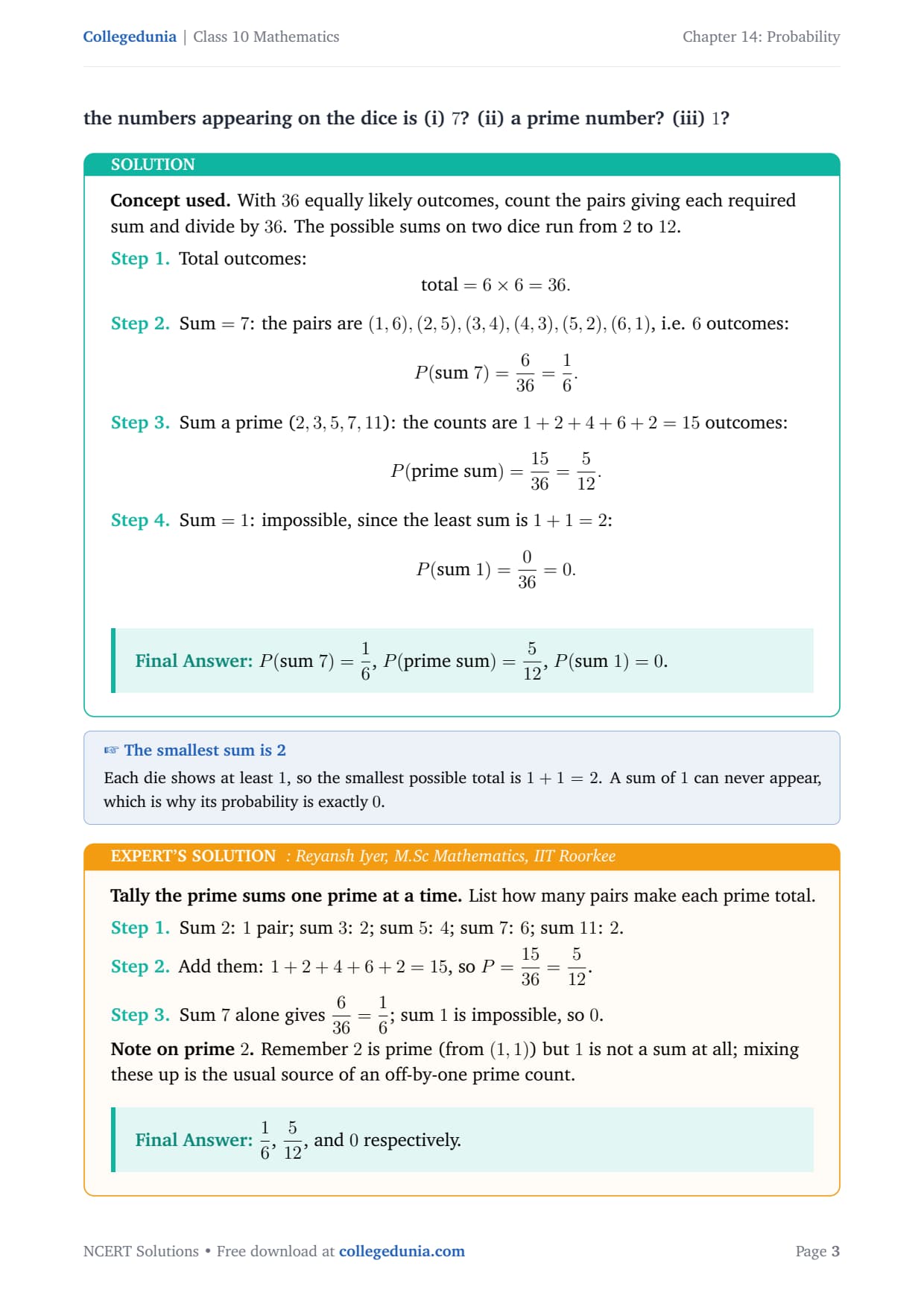
Two dice are thrown simultaneously. What is the probability that the sum of the numbers appearing on the dice is (i) 7? (ii) a prime number? (iii) 1?
Concept used. With 36 equally likely outcomes, count the pairs
giving each required sum and divide by 36. The possible sums on two
dice run from 2 to 12.
Total outcomes:
total=66=36.
Sum =7: the pairs are
(1,6),(2,5),(3,4),(4,3),(5,2),(6,1), i.e. 6 outcomes:
P(sum 7)=636=16.
Sum a prime (2,3,5,7,11): the counts are
1+2+4+6+2=15 outcomes:
P(prime sum)=1536=512.
Sum =1: impossible, since the least sum is 1+1=2:
P(sum 1)=036=0.
P(sum 7)=16, P(prime sum)=512, P(sum 1)=0.
RI
Reyansh Iyer
M.Sc Mathematics, IIT Roorkee
Verified Expert
Tally the prime sums one prime at a time. List how many pairs
make each prime total.
Sum 2: 1 pair; sum 3: 2; sum 5: 4; sum 7: 6;
sum 11: 2.
Add them: 1+2+4+6+2=15, so P=1536=512.
Sum 7 alone gives 636=16; sum 1 is
impossible, so 0.
Note on prime 2. Remember 2 is prime (from (1,1)) but 1
is not a sum at all; mixing these up is the usual source of an off-by-one
prime count.
16, 512, and 0 respectively.
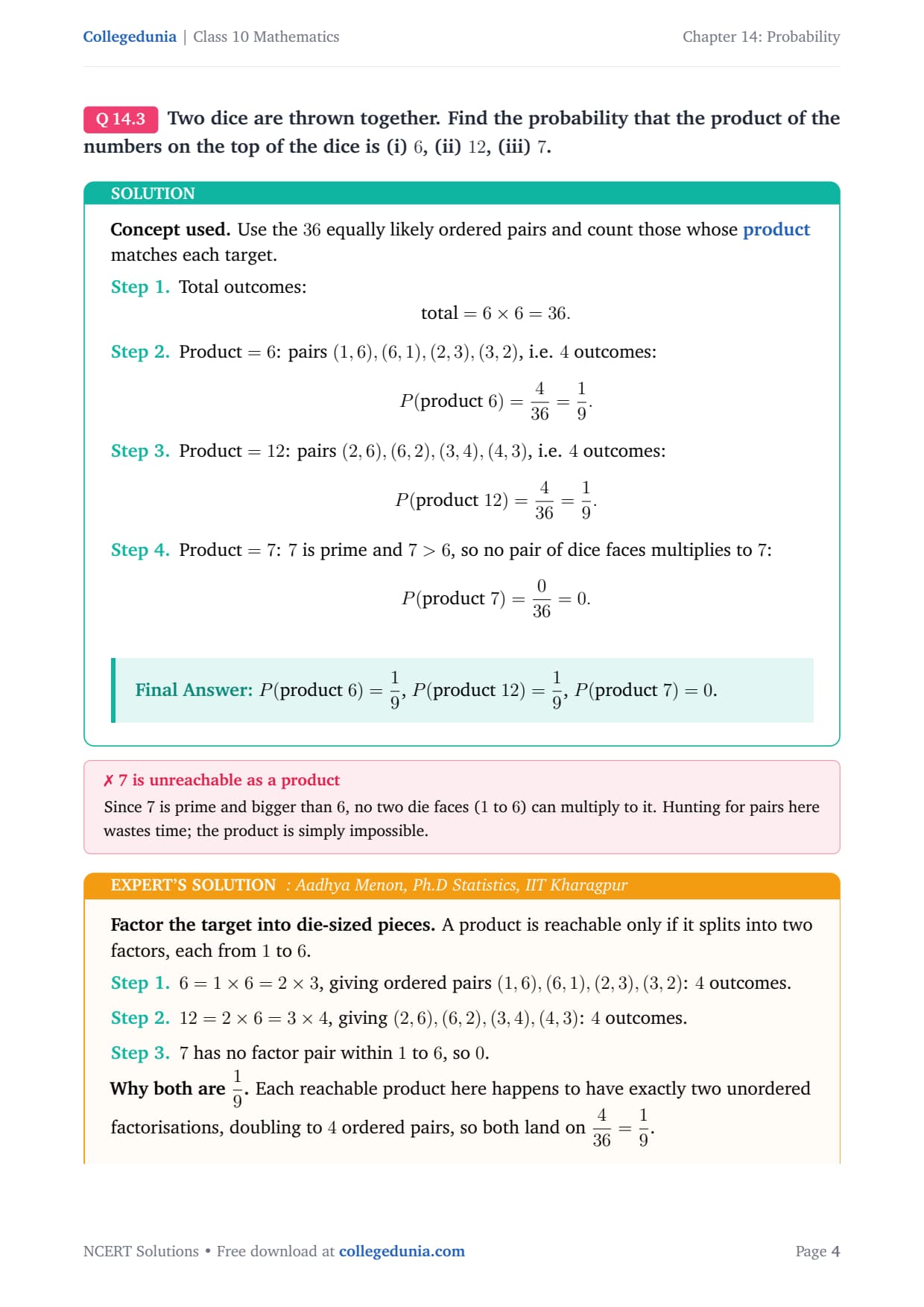
Q 14.3
Two dice are thrown together. Find the probability that the product of the numbers on the top of the dice is (i) 6, (ii) 12, (iii) 7.
Concept used. Use the 36 equally likely ordered pairs and
count those whose product matches each target.
Total outcomes:
total=66=36.
Product =6: pairs (1,6),(6,1),(2,3),(3,2), i.e. 4 outcomes:
P(product 6)=436=19.
Product =12: pairs (2,6),(6,2),(3,4),(4,3), i.e. 4 outcomes:
P(product 12)=436=19.
Product =7: 7 is prime and 7>6, so no pair of dice faces
multiplies to 7:
P(product 7)=036=0.
Why both are 19. Each reachable product here happens to
have exactly two unordered factorisations, doubling to 4 ordered pairs,
so both land on 436=19.
19, 19, and 0.
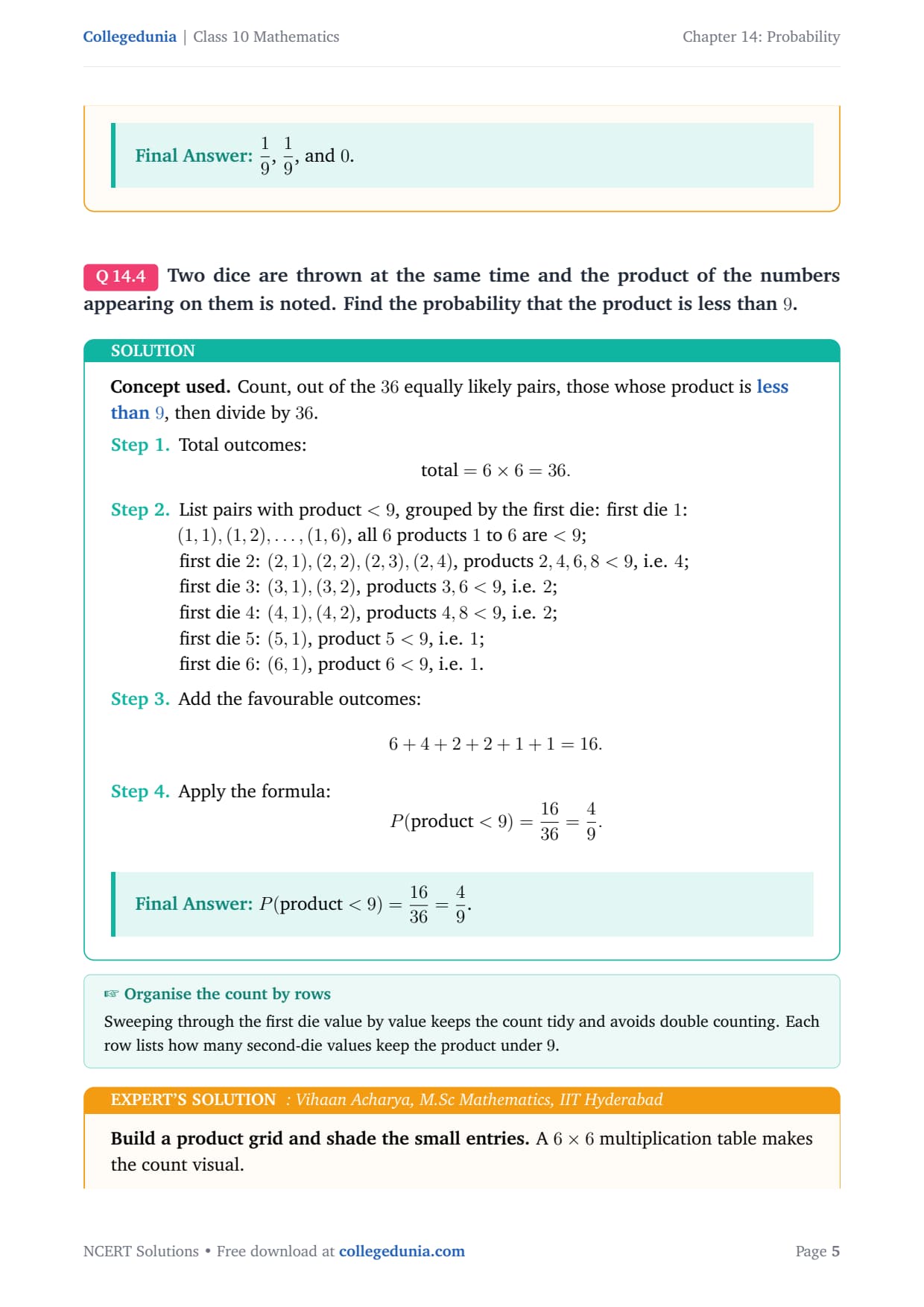
Q 14.4
Two dice are thrown at the same time and the product of the numbers appearing on them is noted. Find the probability that the product is less than 9.
Concept used. Count, out of the 36 equally likely pairs, those
whose product is less than 9, then divide by 36.
Total outcomes:
total=66=36.
List pairs with product <9, grouped by the first die:
first die 1: (1,1),(1,2),,(1,6), all 6 products
1 to 6 are <9;
first die 2: (2,1),(2,2),(2,3),(2,4), products 2,4,6,8<9,
i.e. 4;
first die 3: (3,1),(3,2), products 3,6<9, i.e. 2;
first die 4: (4,1),(4,2), products 4,8<9, i.e. 2;
first die 5: (5,1), product 5<9, i.e. 1;
first die 6: (6,1), product 6<9, i.e. 1.
Add the favourable outcomes:
6+4+2+2+1+1=16.
Apply the formula:
P(product<9)=1636=49.
P(product<9)=1636=49.
VA
Vihaan Acharya
M.Sc Mathematics, IIT Hyderabad
Verified Expert
Build a product grid and shade the small entries. A 66
multiplication table makes the count visual.
Fill cell (a,b) with the product ab.
Shade every cell where ab<9: rows for a=1 contribute 6,
then 4,2,2,1,1 as a grows.
The shaded cells total 16, so P=1636=49.
Pattern to notice. Larger first-die values clear the "<9" bar
with fewer partners, so the shaded count shrinks down each successive
row, 6,4,2,2,1,1.
The probability that the product is less than 9 is 49.
Q 14.5
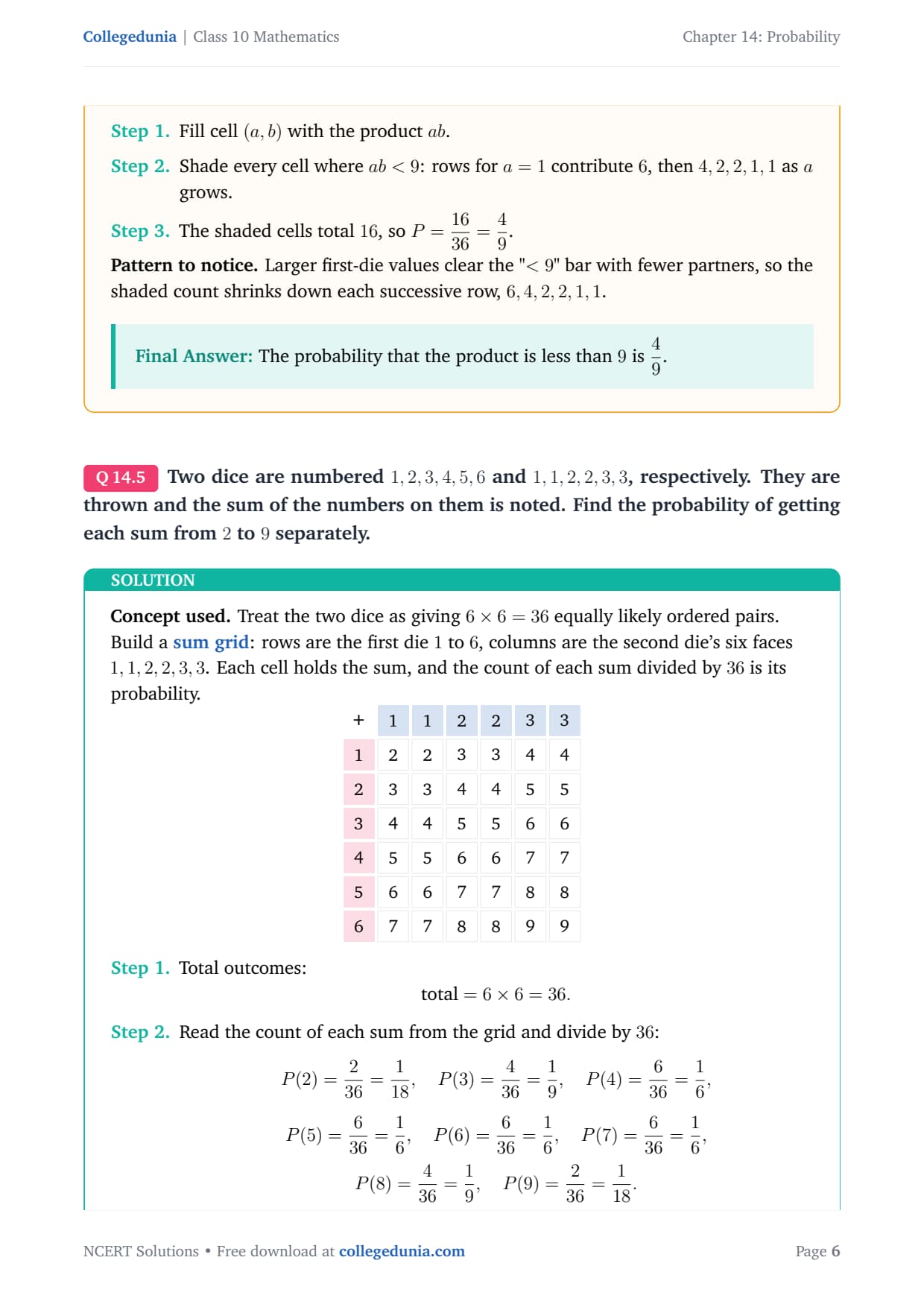
Two dice are numbered 1,2,3,4,5,6 and 1,1,2,2,3,3, respectively. They are thrown and the sum of the numbers on them is noted. Find the probability of getting each sum from 2 to 9 separately.
Concept used. Treat the two dice as giving 66=36 equally
likely ordered pairs. Build a sum grid: rows are the first die
1 to 6, columns are the second die's six faces 1,1,2,2,3,3. Each
cell holds the sum, and the count of each sum divided by 36 is its
probability.
[See diagram in the PDF version]
Total outcomes:
total=66=36.
Read the count of each sum from the grid and divide by 36:
P(2)=236=118,
P(3)=436=19,
P(4)=636=16, P(5)=636=16,
P(6)=636=16,
P(7)=636=16, P(8)=436=19,
P(9)=236=118.
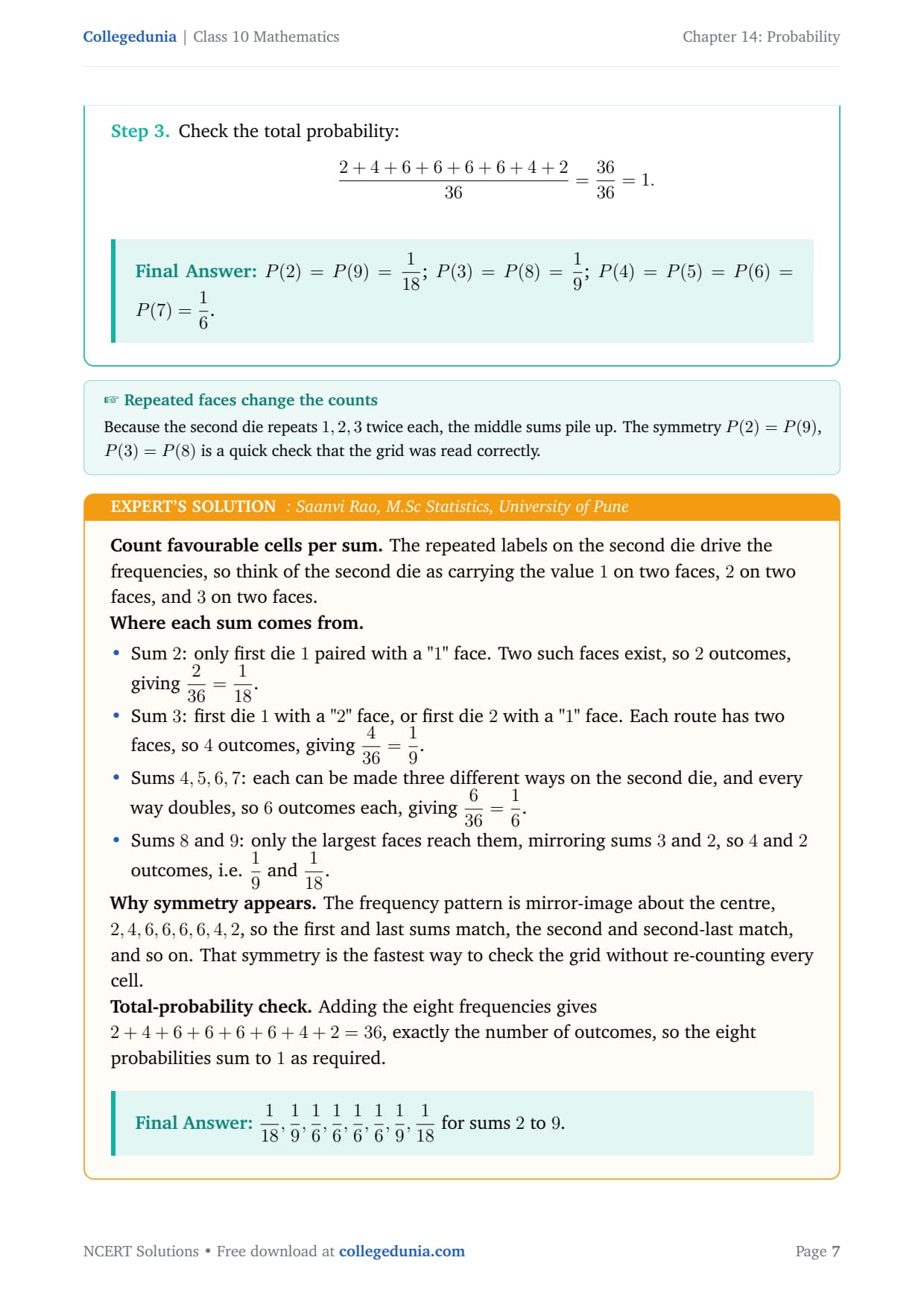
Check the total probability:
2+4+6+6+6+6+4+236=3636=1.
Count favourable cells per sum. The repeated labels on the
second die drive the frequencies, so think of the second die as carrying
the value 1 on two faces, 2 on two faces, and 3 on two faces.
Where each sum comes from.
Sum 2: only first die 1 paired with a "1" face. Two such
faces exist, so 2 outcomes, giving 236=118.
Sum 3: first die 1 with a "2" face, or first die 2 with a
"1" face. Each route has two faces, so 4 outcomes, giving
436=19.
Sums 4,5,6,7: each can be made three different ways on the
second die, and every way doubles, so 6 outcomes each, giving
636=16.
Sums 8 and 9: only the largest faces reach them, mirroring
sums 3 and 2, so 4 and 2 outcomes, i.e. 19 and
118.
Why symmetry appears. The frequency pattern is mirror-image
about the centre, 2,4,6,6,6,6,4,2, so the first and last sums match,
the second and second-last match, and so on. That symmetry is the fastest
way to check the grid without re-counting every cell.
Total-probability check. Adding the eight frequencies gives
2+4+6+6+6+6+4+2=36, exactly the number of outcomes, so the eight
probabilities sum to 1 as required.
118,19,16,16,16,16,19,118 for sums 2 to 9.
Q 14.6
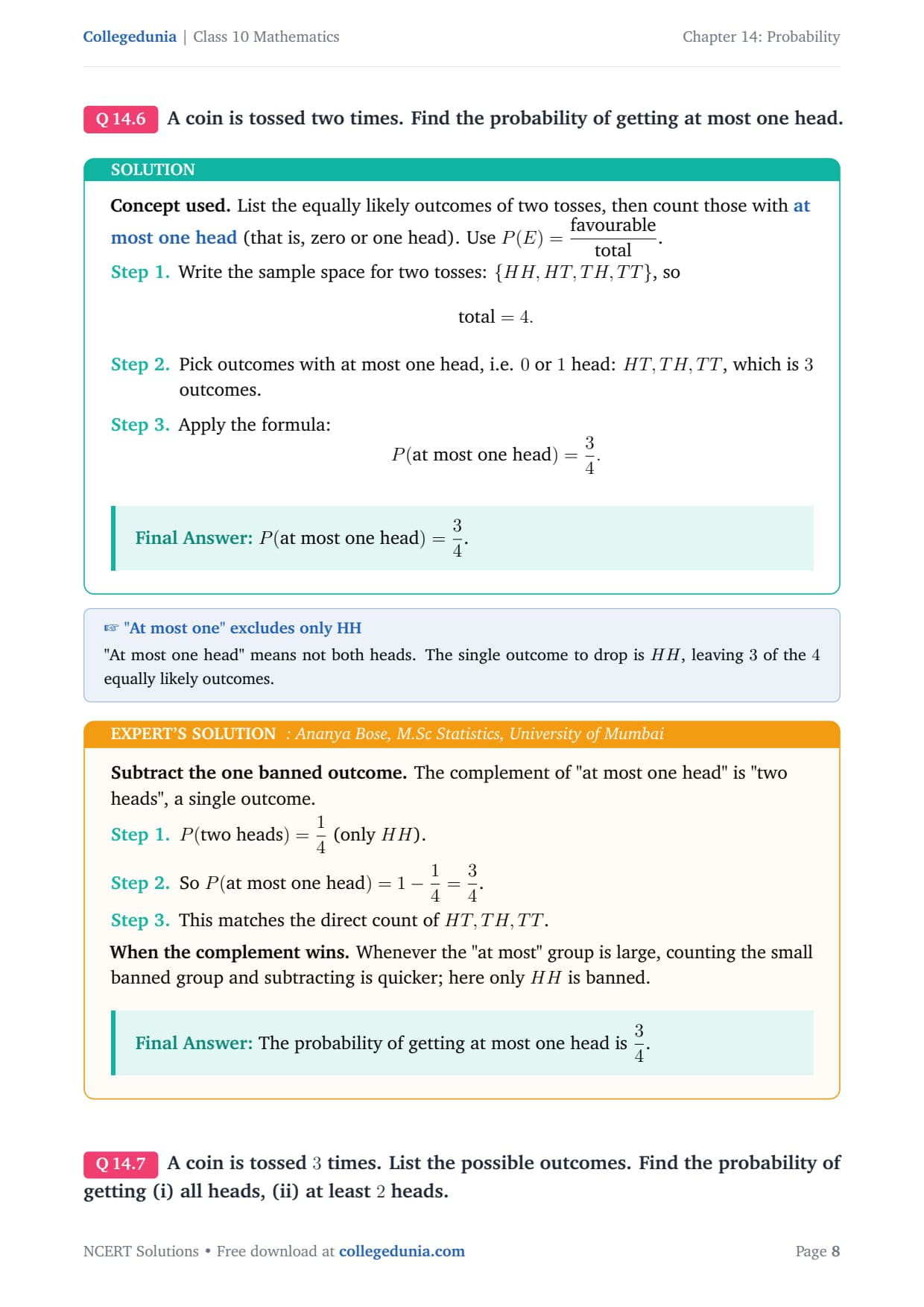
A coin is tossed two times. Find the probability of getting at most one head.
Concept used. List the equally likely outcomes of two tosses,
then count those with at most one head (that is, zero or one
head). Use P(E)=favourabletotal.
Write the sample space for two tosses:
HH, HT, TH, TT, so
total=4.
Pick outcomes with at most one head, i.e. 0 or 1 head:
HT, TH, TT, which is 3 outcomes.
Apply the formula:
P(at most one head)=34.
P(at most one head)=34.
AB
Ananya Bose
M.Sc Statistics, University of Mumbai
Verified Expert
Subtract the one banned outcome. The complement of "at most one
head" is "two heads", a single outcome.
P(two heads)=14 (only HH).
So P(at most one head)=1-14=34.
This matches the direct count of HT,TH,TT.
When the complement wins. Whenever the "at most" group is large,
counting the small banned group and subtracting is quicker; here only
HH is banned.
The probability of getting at most one head is 34.
Q 14.7
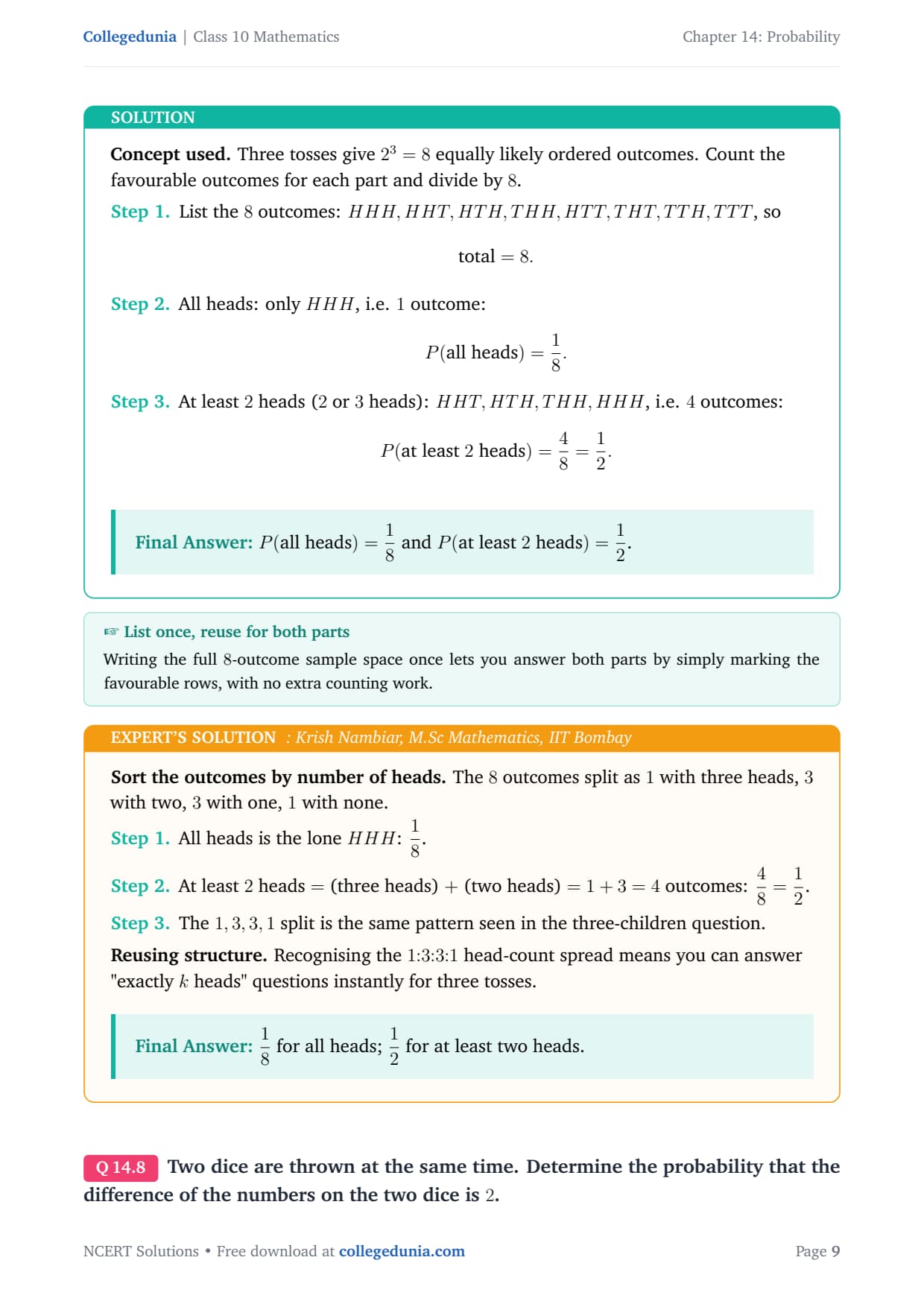
A coin is tossed 3 times. List the possible outcomes. Find the probability of getting (i) all heads, (ii) at least 2 heads.
Concept used. Three tosses give 23=8 equally likely ordered
outcomes. Count the favourable outcomes for each part and divide by 8.
List the 8 outcomes:
HHH, HHT, HTH, THH, HTT, THT, TTH, TTT, so
total=8.
All heads: only HHH, i.e. 1 outcome:
P(all heads)=18.
At least 2 heads (2 or 3 heads):
HHT, HTH, THH, HHH, i.e. 4 outcomes:
P(at least 2 heads)=48=12.
P(all heads)=18 and P(at least 2 heads)=12.
KN
Krish Nambiar
M.Sc Mathematics, IIT Bombay
Verified Expert
Sort the outcomes by number of heads. The 8 outcomes split as
1 with three heads, 3 with two, 3 with one, 1 with none.
All heads is the lone HHH: 18.
At least 2 heads = (three heads) + (two heads)
=1+3=4 outcomes: 48=12.
The 1,3,3,1 split is the same pattern seen in the
three-children question.
Reusing structure. Recognising the 1:3:3:1 head-count
spread means you can answer "exactly k heads" questions instantly for
three tosses.
18 for all heads; 12 for at least two heads.
Q 14.8
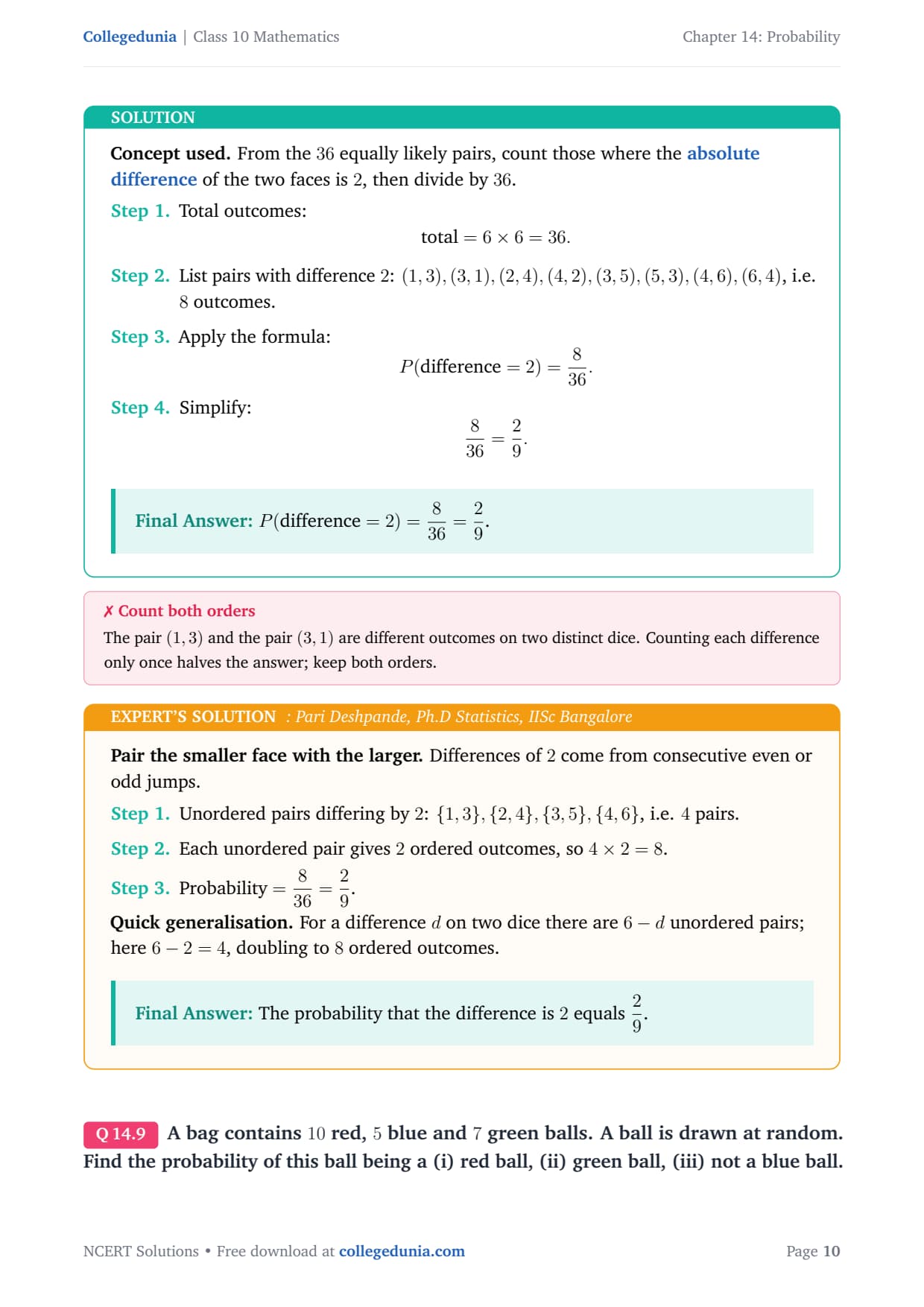
Two dice are thrown at the same time. Determine the probability that the difference of the numbers on the two dice is 2.
Concept used. From the 36 equally likely pairs, count those
where the absolute difference of the two faces is 2, then
divide by 36.
Total outcomes:
total=66=36.
List pairs with difference 2:
(1,3),(3,1),(2,4),(4,2),(3,5),(5,3),(4,6),(6,4), i.e. 8
outcomes.
Apply the formula:
P(difference=2)=836.
Simplify:
836=29.
P(difference=2)=836=29.
PD
Pari Deshpande
Ph.D Statistics, IISc Bangalore
Verified Expert
Pair the smaller face with the larger. Differences of 2 come
from consecutive even or odd jumps.
Unordered pairs differing by 2: 1,3,2,4,3,5,
4,6, i.e. 4 pairs.
Each unordered pair gives 2 ordered outcomes, so
42=8.
Probability =836=29.
Quick generalisation. For a difference d on two dice there are
6-d unordered pairs; here 6-2=4, doubling to 8 ordered outcomes.
The probability that the difference is 2 equals 29.
Q 14.9
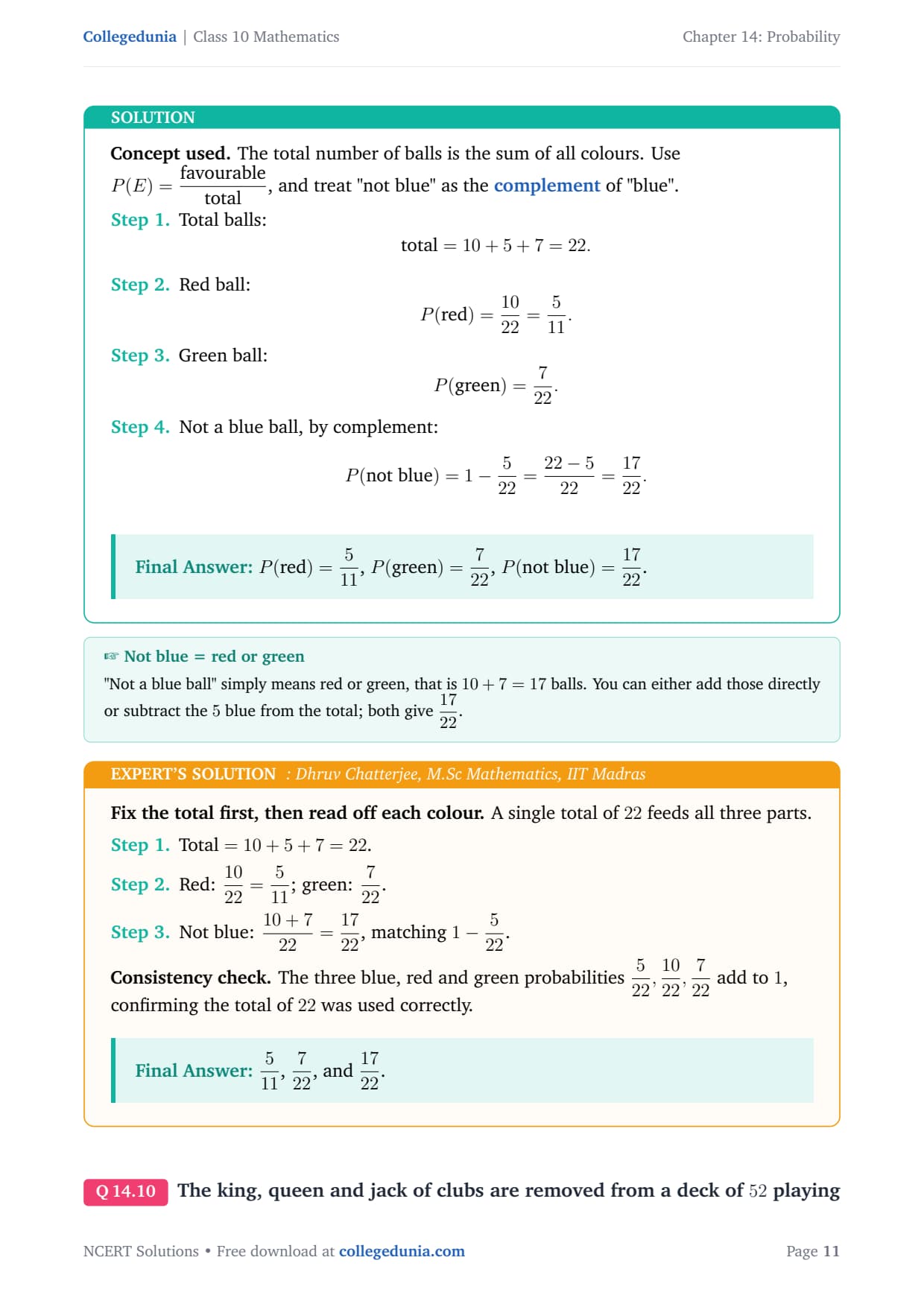
A bag contains 10 red, 5 blue and 7 green balls. A ball is drawn at random. Find the probability of this ball being a (i) red ball, (ii) green ball, (iii) not a blue ball.
Concept used. The total number of balls is the sum of all
colours. Use P(E)=favourabletotal, and treat
"not blue" as the complement of "blue".
Total balls:
total=10+5+7=22.
Red ball:
P(red)=1022=511.
Green ball:
P(green)=722.
Not a blue ball, by complement:
P(not blue)=1-522=22-522=1722.
P(red)=511, P(green)=722, P(not blue)=1722.
DC
Dhruv Chatterjee
M.Sc Mathematics, IIT Madras
Verified Expert
Fix the total first, then read off each colour. A single total of
22 feeds all three parts.
Total =10+5+7=22.
Red: 1022=511; green: 722.
Not blue: 10+722=1722, matching
1-522.
Consistency check. The three blue, red and green probabilities
522,1022,722 add to 1, confirming the
total of 22 was used correctly.
511, 722, and 1722.
Q 14.10
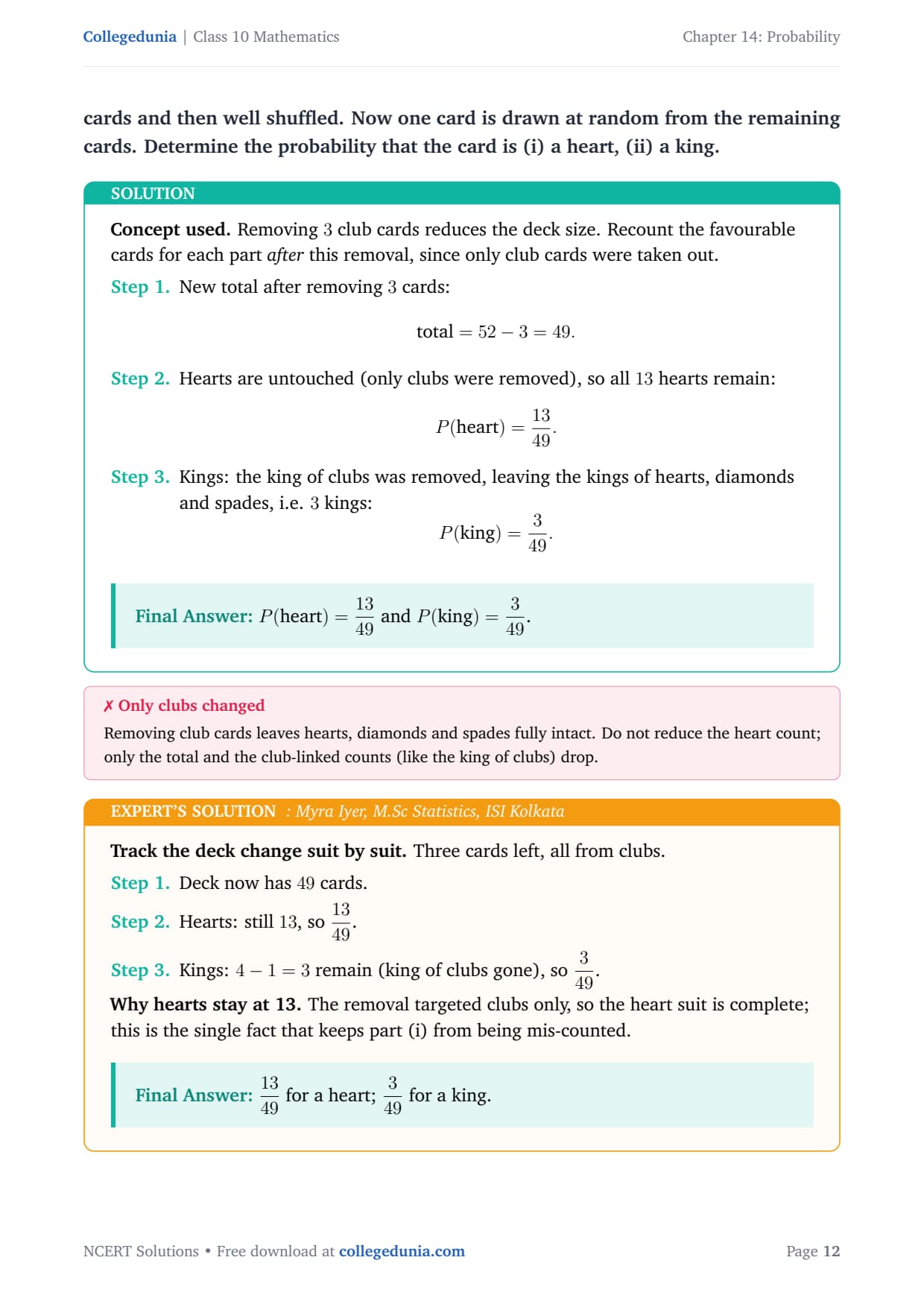
The king, queen and jack of clubs are removed from a deck of 52 playing cards and then well shuffled. Now one card is drawn at random from the remaining cards. Determine the probability that the card is (i) a heart, (ii) a king.
Concept used. Removing 3 club cards reduces the deck size.
Recount the favourable cards for each part after this removal,
since only club cards were taken out.
New total after removing 3 cards:
total=52-3=49.
Hearts are untouched (only clubs were removed), so all 13
hearts remain:
P(heart)=1349.
Kings: the king of clubs was removed, leaving the kings of
hearts, diamonds and spades, i.e. 3 kings:
P(king)=349.
P(heart)=1349 and P(king)=349.
MI
Myra Iyer
M.Sc Statistics, ISI Kolkata
Verified Expert
Track the deck change suit by suit. Three cards left, all from
clubs.
Deck now has 49 cards.
Hearts: still 13, so 1349.
Kings: 4-1=3 remain (king of clubs gone), so 349.
Why hearts stay at 13. The removal targeted clubs only, so the
heart suit is complete; this is the single fact that keeps part (i) from
being mis-counted.
1349 for a heart; 349 for a king.
Q 14.11
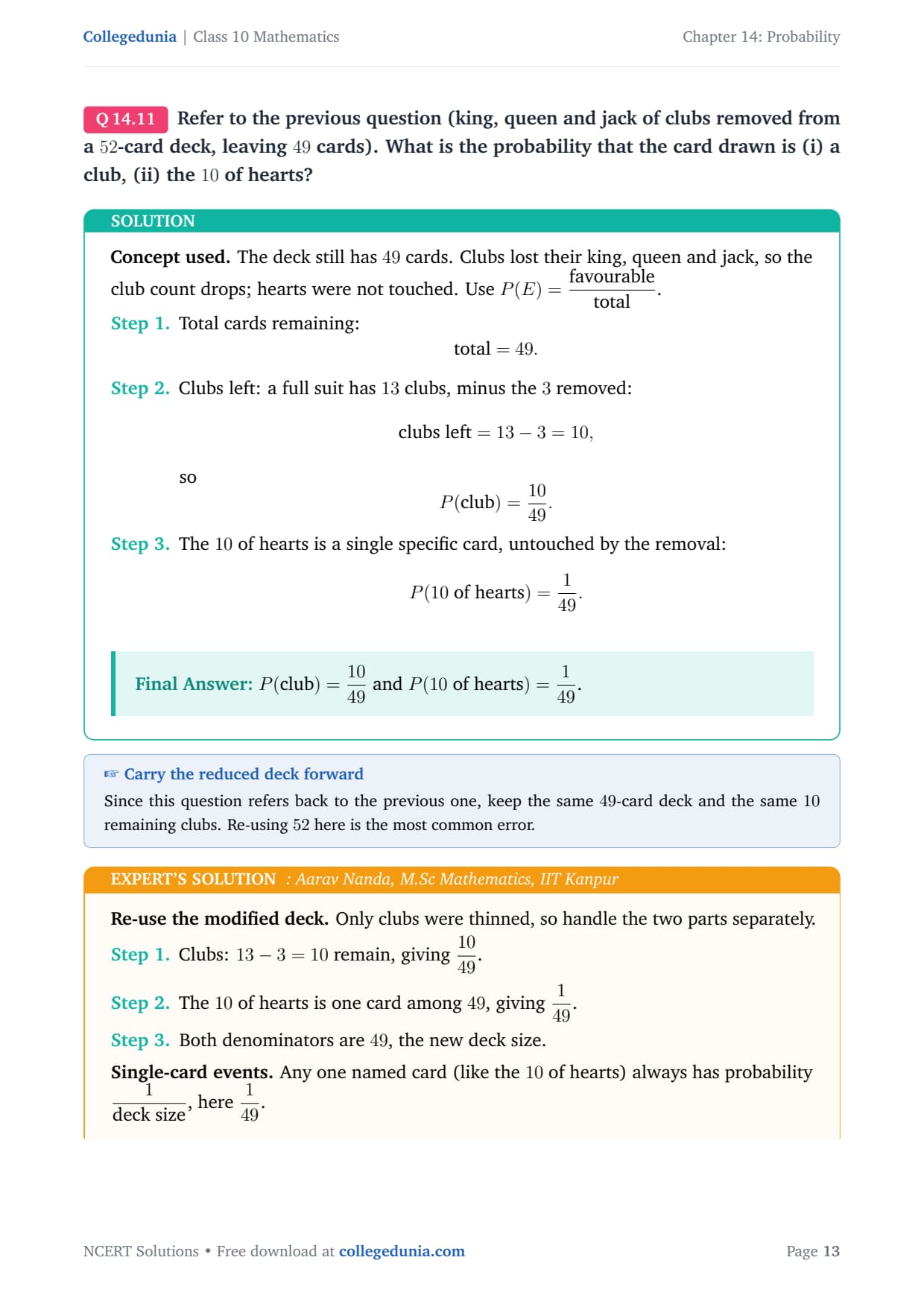
Refer to the previous question (king, queen and jack of clubs removed from a 52-card deck, leaving 49 cards). What is the probability that the card drawn is (i) a club, (ii) the 10 of hearts?
Concept used. The deck still has 49 cards. Clubs lost their
king, queen and jack, so the club count drops; hearts were not touched.
Use P(E)=favourabletotal.
Total cards remaining:
total=49.
Clubs left: a full suit has 13 clubs, minus the 3 removed:
clubs left=13-3=10,
so
P(club)=1049.
The 10 of hearts is a single specific card, untouched by the
removal:
P(10 of hearts)=149.
P(club)=1049 and P(10 of hearts)=149.
AN
Aarav Nanda
M.Sc Mathematics, IIT Kanpur
Verified Expert
Re-use the modified deck. Only clubs were thinned, so handle the
two parts separately.
Clubs: 13-3=10 remain, giving 1049.
The 10 of hearts is one card among 49, giving 149.
Both denominators are 49, the new deck size.
Single-card events. Any one named card (like the 10 of hearts)
always has probability 1deck size, here 149.
1049 for a club; 149 for the 10 of hearts.
Q 14.12
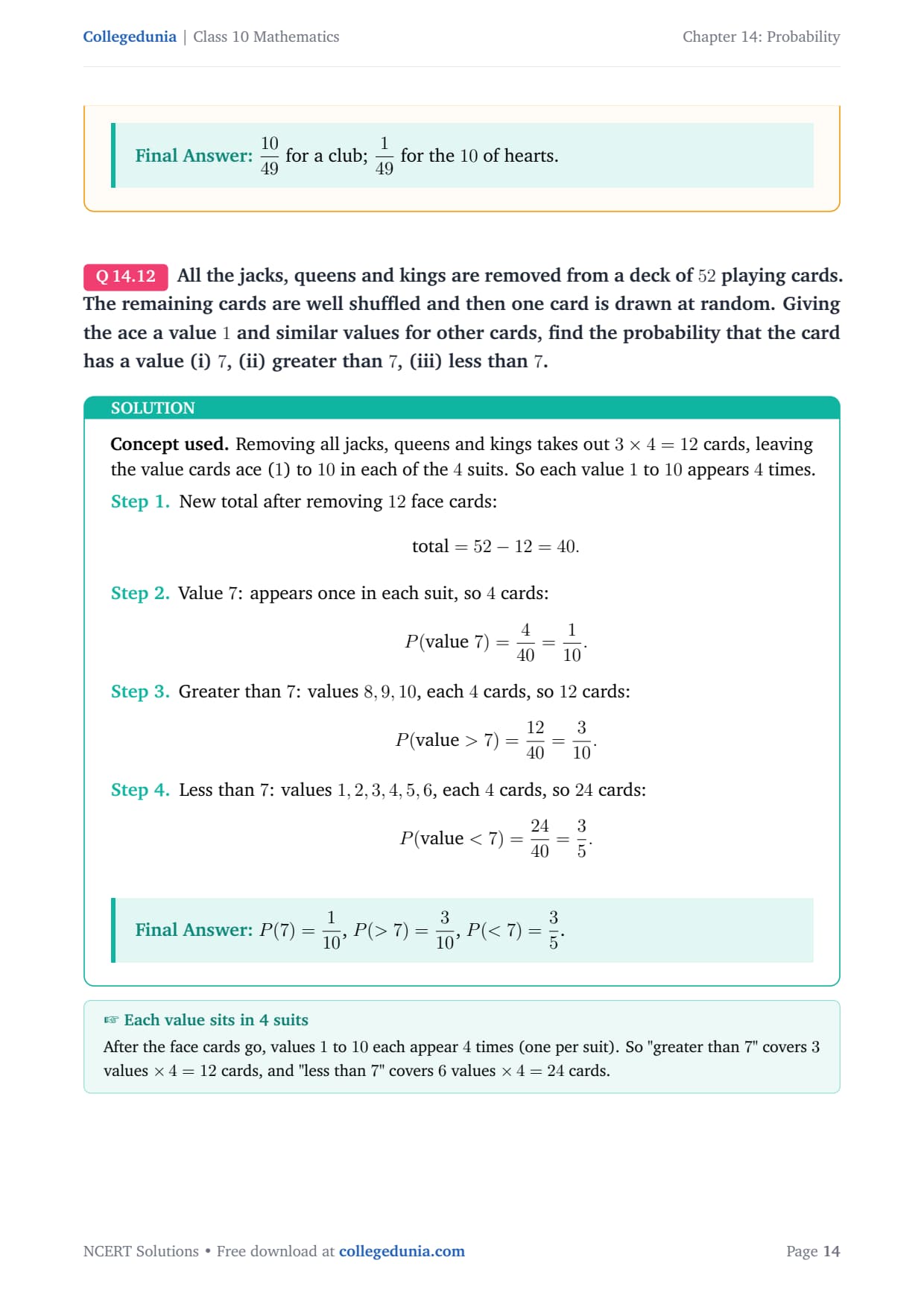
All the jacks, queens and kings are removed from a deck of 52 playing cards. The remaining cards are well shuffled and then one card is drawn at random. Giving the ace a value 1 and similar values for other cards, find the probability that the card has a value (i) 7, (ii) greater than 7, (iii) less than 7.
Concept used. Removing all jacks, queens and kings takes out
34=12 cards, leaving the value cards ace (1) to 10 in each of
the 4 suits. So each value 1 to 10 appears 4 times.
New total after removing 12 face cards:
total=52-12=40.
Value 7: appears once in each suit, so 4 cards:
P(value 7)=440=110.
Greater than 7: values 8,9,10, each 4 cards, so 12 cards:
P(value>7)=1240=310.
Less than 7: values 1,2,3,4,5,6, each 4 cards, so 24
cards:
P(value<7)=2440=35.
P(7)=110, P(>7)=310, P(<7)=35.
IB
Ishaan Bhatt
Ph.D Statistics, IIT Kharagpur
Verified Expert
Count by value bands. The three parts partition the 40 cards
neatly.
"=7": 1 value × 4=4 cards, 440=110.
">7": 3 values × 4=12 cards, 1240=310.
"<7": 6 values × 4=24 cards, 2440=35.
Partition check. The three bands cover 4+12+24=40 cards, the
whole reduced deck, so their probabilities 110+310+
35=1.
110, 310, and 35.
Q 14.13
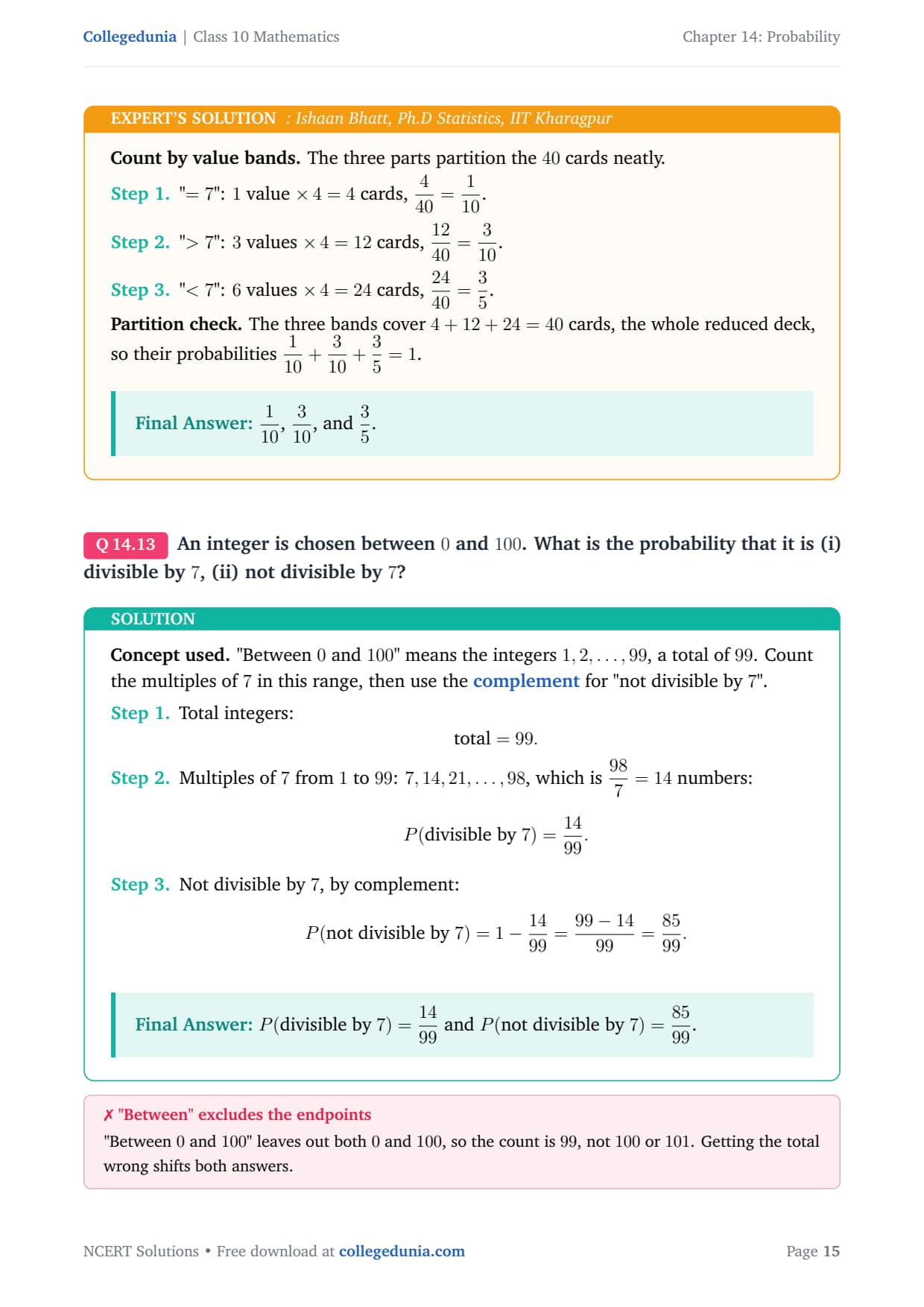
An integer is chosen between 0 and 100. What is the probability that it is (i) divisible by 7, (ii) not divisible by 7?
Concept used. "Between 0 and 100" means the integers
1,2,,99, a total of 99. Count the multiples of 7 in this range,
then use the complement for "not divisible by 7".
Total integers:
total=99.
Multiples of 7 from 1 to 99:
7,14,21,,98, which is 987=14 numbers:
P(divisible by 7)=1499.
Not divisible by 7, by complement:
P(not divisible by 7)=1-1499=99-1499=8599.
P(divisible by 7)=1499 and P(not divisible by 7)=8599.
TV
Tara Venkatesh
M.Sc Mathematics, IIT Madras
Verified Expert
Find the largest multiple, then count. The multiples of 7 form
an evenly spaced list.
Largest multiple of 7 below 100 is 98=714.
So there are 14 multiples, giving 1499.
The rest, 99-14=85, are not divisible by 7: 8599.
Why the complement is faster. Listing all 85 non-multiples is
tedious; counting the 14 multiples and subtracting from 99 is the
efficient route.
1499 divisible by 7; 8599 not divisible.
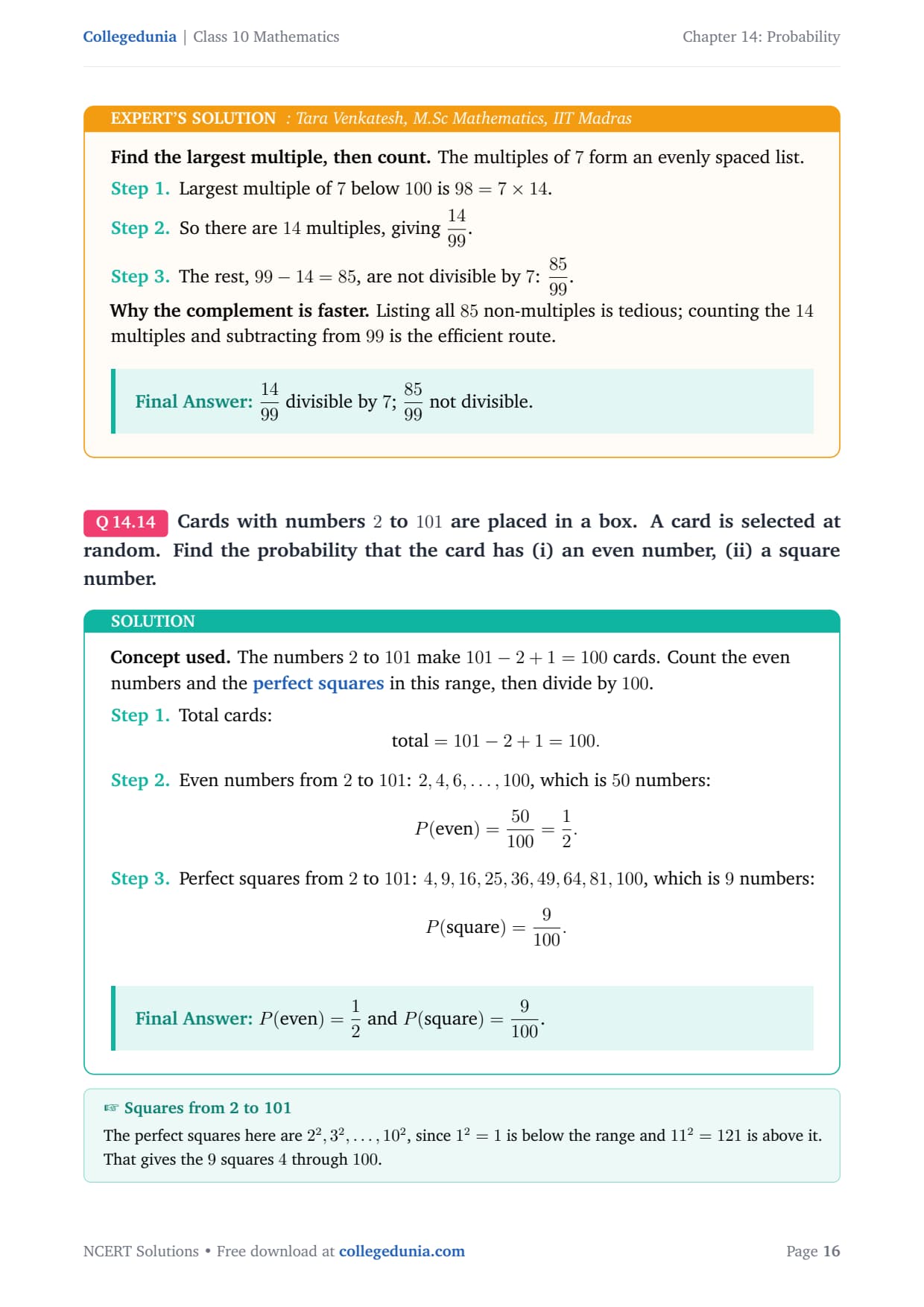
Q 14.14
Cards with numbers 2 to 101 are placed in a box. A card is selected at random. Find the probability that the card has (i) an even number, (ii) a square number.
Concept used. The numbers 2 to 101 make
101-2+1=100 cards. Count the even numbers and the
perfect squares in this range, then divide by 100.
Total cards:
total=101-2+1=100.
Even numbers from 2 to 101: 2,4,6,,100, which is 50
numbers:
P(even)=50100=12.
Perfect squares from 2 to 101:
4,9,16,25,36,49,64,81,100, which is 9 numbers:
P(square)=9100.
P(even)=12 and P(square)=9100.
RS
Reyansh Saxena
M.Sc Statistics, University of Hyderabad
Verified Expert
Bound the square roots. Find which whole numbers, when squared,
land inside 2 to 101.
12=1<2 (out) and 112=121>101 (out).
So n runs 2 to 10, giving the 9 squares
4,9,,100: 9100.
Even numbers are exactly half of 100 consecutive integers: 50,
so 12.
Why 100 cards, not 101. Starting at 2 rather than 1
trims one card; counting 2 to 101 inclusive is 100, which is why
the even share is a clean 12.
12 for an even number; 9100 for a square number.
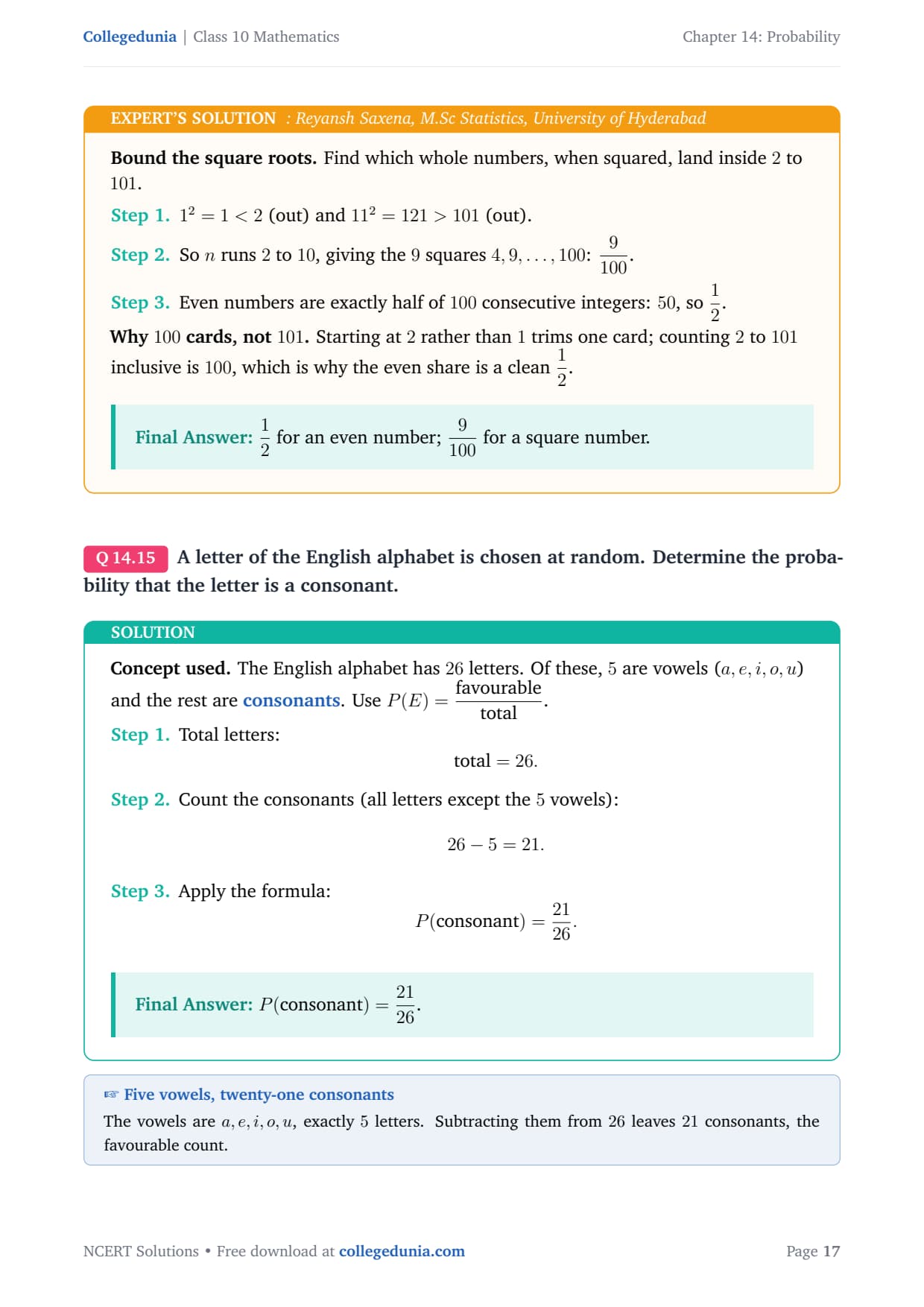
Q 14.15
A letter of the English alphabet is chosen at random. Determine the probability that the letter is a consonant.
Concept used. The English alphabet has 26 letters. Of these,
5 are vowels (a,e,i,o,u) and the rest are consonants. Use
P(E)=favourabletotal.
Total letters:
total=26.
Count the consonants (all letters except the 5 vowels):
26-5=21.
Apply the formula:
P(consonant)=2126.
P(consonant)=2126.
AK
Anvi Kulkarni
M.Sc Mathematics, IIT Bombay
Verified Expert
Use the complement of "vowel". It is quicker to remove the five
vowels than to list every consonant.
P(vowel)=526.
P(consonant)=1-526=2126.
This matches the direct count of 21 consonants.
Edge note. In this standard problem "y" is treated as a
consonant, keeping the vowel list at the usual five and the consonant
count at 21.
The probability that the letter is a consonant is 2126.
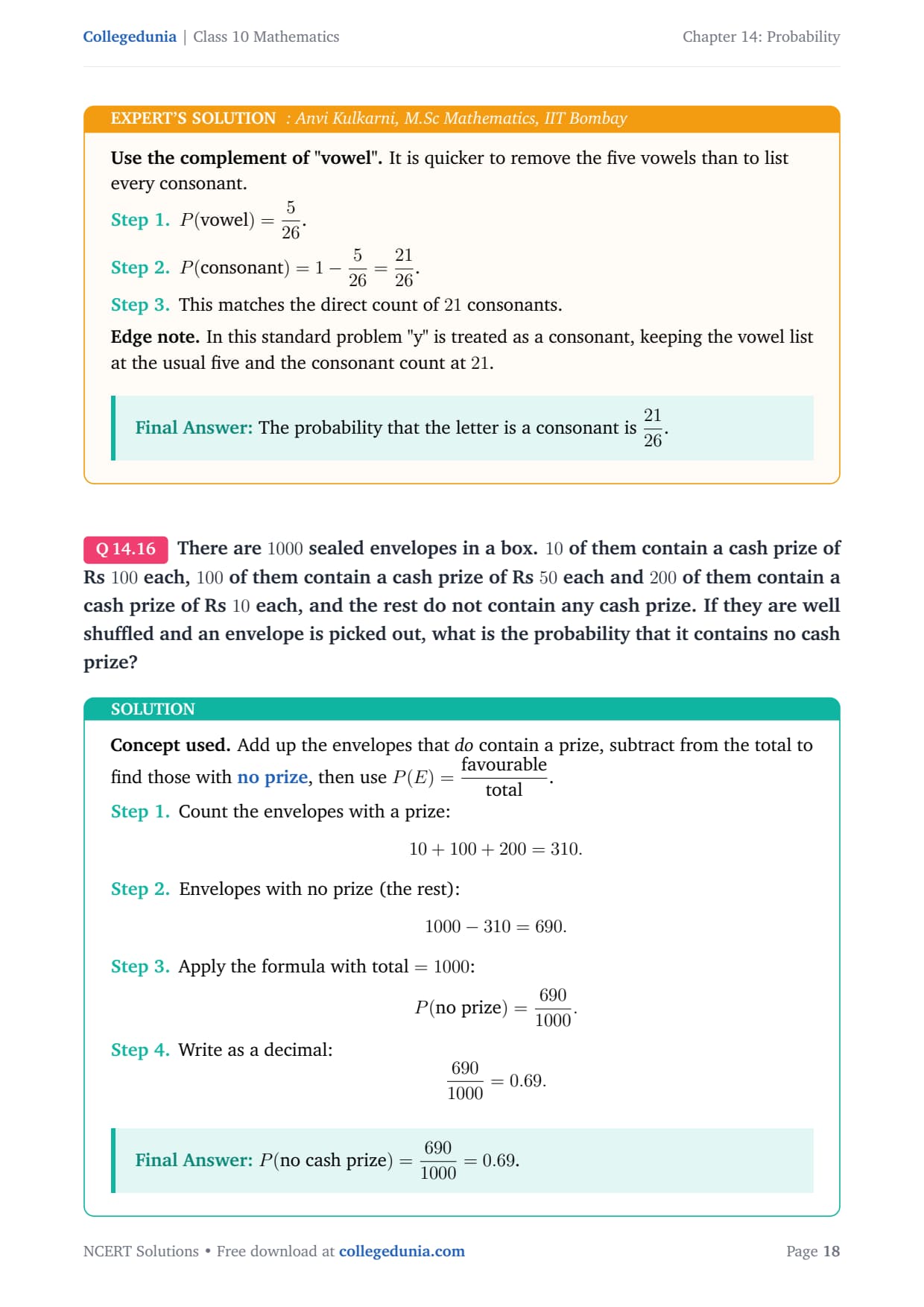
Q 14.16
There are 1000 sealed envelopes in a box. 10 of them contain a cash prize of Rs 100 each, 100 of them contain a cash prize of Rs 50 each and 200 of them contain a cash prize of Rs 10 each, and the rest do not contain any cash prize. If they are well shuffled and an envelope is picked out, what is the probability that it contains no cash prize?
Concept used. Add up the envelopes that do contain a
prize, subtract from the total to find those with no prize, then
use P(E)=favourabletotal.
Count the envelopes with a prize:
10+100+200=310.
Envelopes with no prize (the rest):
1000-310=690.
Apply the formula with total =1000:
P(no prize)=6901000.
Write as a decimal:
6901000=0.69.
P(no cash prize)=6901000=0.69.
KP
Kabir Pillai
M.Sc Statistics, ISI Kolkata
Verified Expert
Use the complement of "wins a prize". The prize envelopes are
easier to total than the empty ones.
Prize envelopes: 10+100+200=310.
P(prize)=3101000=0.31.
P(no prize)=1-0.31=0.69.
Decimal sense. Roughly seven in ten envelopes are empty, which
fits the small prize counts against the large box of 1000.
The probability of no cash prize is 0.69.
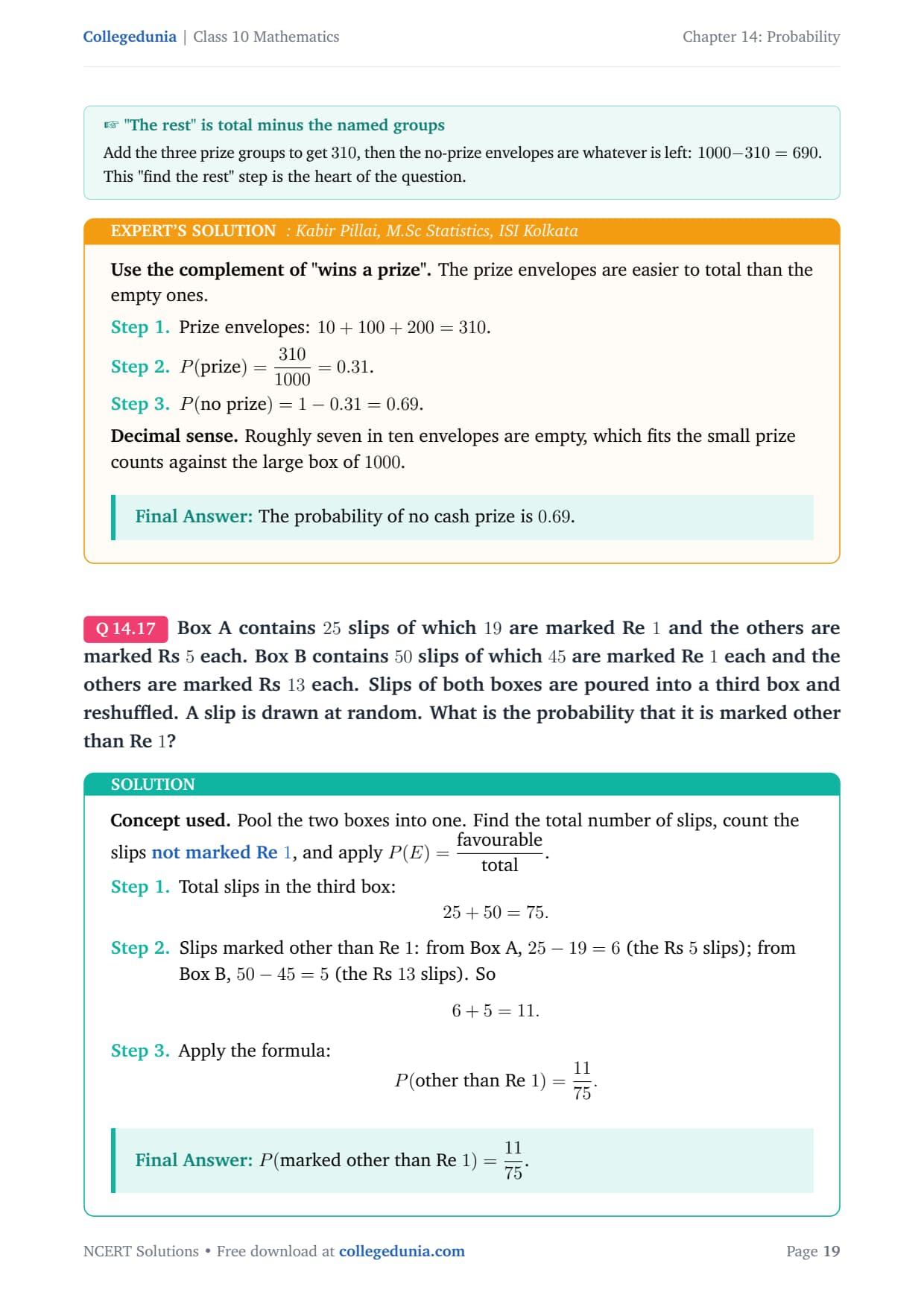
Q 14.17
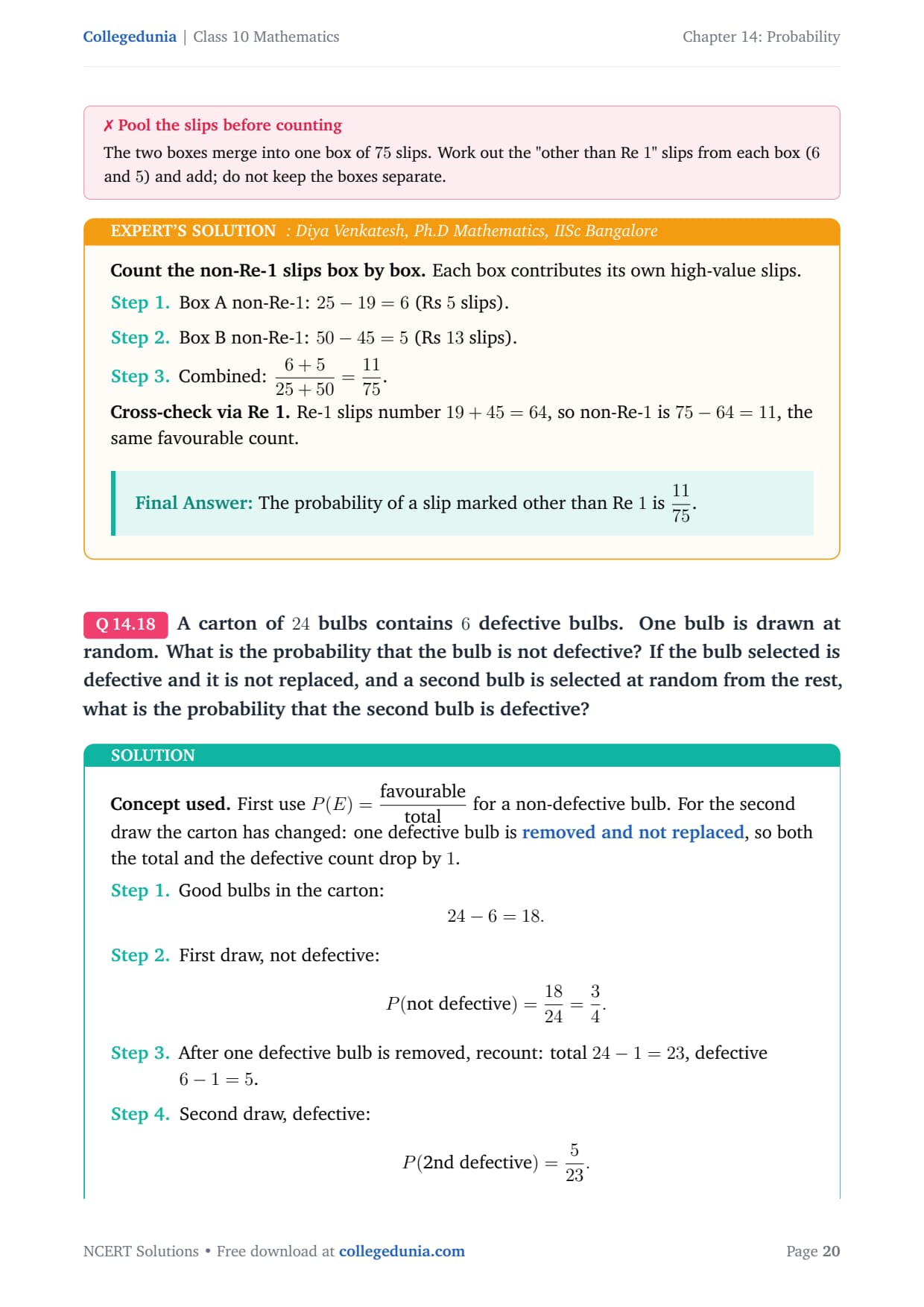
Box A contains 25 slips of which 19 are marked Re 1 and the others are marked Rs 5 each. Box B contains 50 slips of which 45 are marked Re 1 each and the others are marked Rs 13 each. Slips of both boxes are poured into a third box and reshuffled. A slip is drawn at random. What is the probability that it is marked other than Re 1?
Concept used. Pool the two boxes into one. Find the total number
of slips, count the slips not marked Re 1, and apply
P(E)=favourabletotal.
Total slips in the third box:
25+50=75.
Slips marked other than Re 1: from Box A, 25-19=6 (the Rs 5
slips); from Box B, 50-45=5 (the Rs 13 slips). So
6+5=11.
Apply the formula:
P(other than Re 1)=1175.
P(marked other than Re 1)=1175.
DV
Diya Venkatesh
Ph.D Mathematics, IISc Bangalore
Verified Expert
Count the non-Re-1 slips box by box. Each box contributes its own
high-value slips.
Box A non-Re-1: 25-19=6 (Rs 5 slips).
Box B non-Re-1: 50-45=5 (Rs 13 slips).
Combined: 6+525+50=1175.
Cross-check via Re 1. Re-1 slips number 19+45=64, so
non-Re-1 is 75-64=11, the same favourable count.
The probability of a slip marked other than Re 1 is 1175.
Q 14.18
A carton of 24 bulbs contains 6 defective bulbs. One bulb is drawn at random. What is the probability that the bulb is not defective? If the bulb selected is defective and it is not replaced, and a second bulb is selected at random from the rest, what is the probability that the second bulb is defective?
Concept used. First use P(E)=favourabletotal
for a non-defective bulb. For the second draw the carton has changed: one
defective bulb is removed and not replaced, so both the total
and the defective count drop by 1.
Good bulbs in the carton:
24-6=18.
First draw, not defective:
P(not defective)=1824=34.
After one defective bulb is removed, recount: total
24-1=23, defective 6-1=5.
Second draw, defective:
P(2nd defective)=523.
P(not defective)=34; P(2nd bulb defective)=523.
VS
Vivaan Saxena
M.Sc Mathematics, IIT Kanpur
Verified Expert
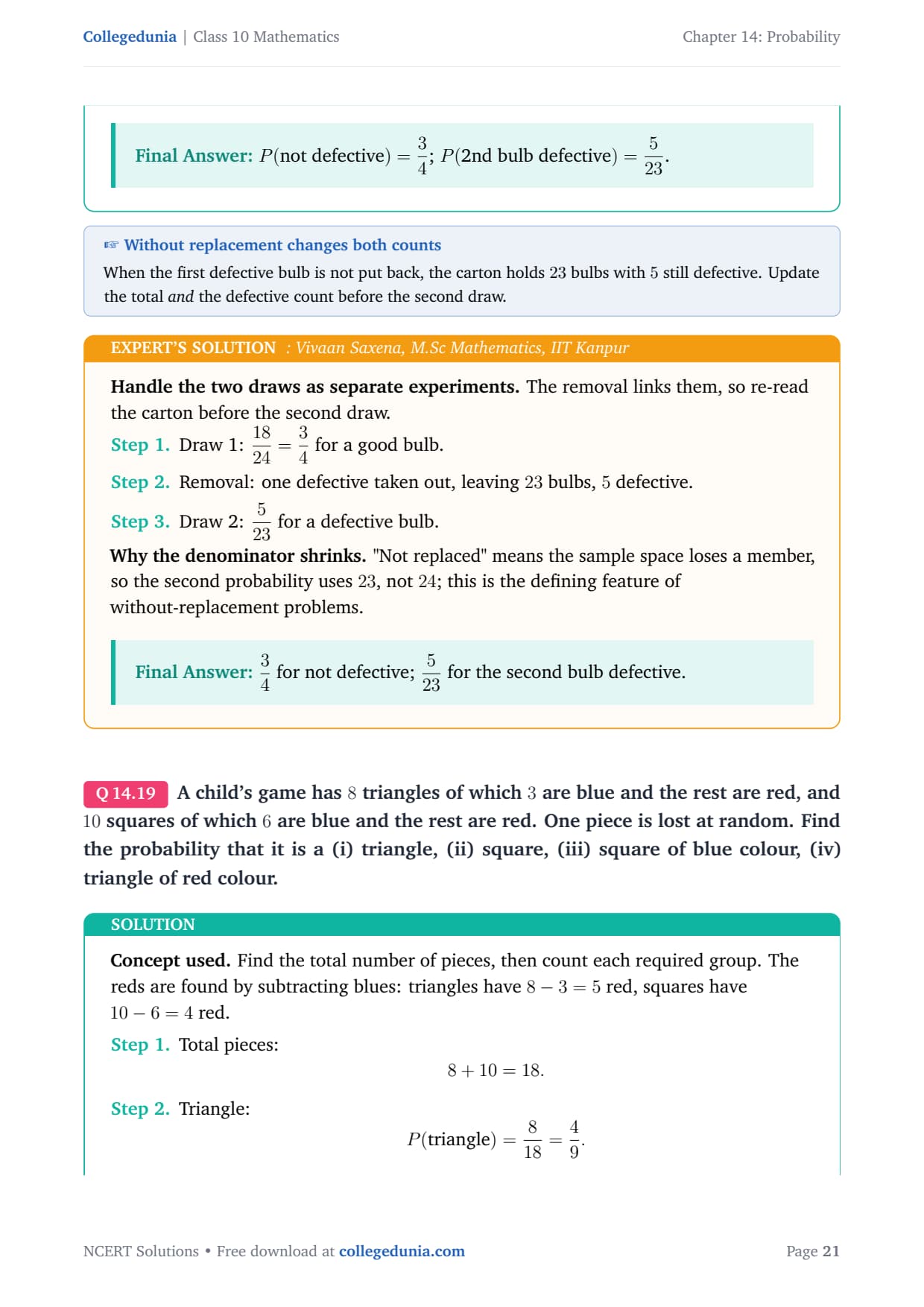
Handle the two draws as separate experiments. The removal links
them, so re-read the carton before the second draw.
Draw 1: 1824=34 for a good bulb.
Removal: one defective taken out, leaving 23 bulbs, 5
defective.
Draw 2: 523 for a defective bulb.
Why the denominator shrinks. "Not replaced" means the sample
space loses a member, so the second probability uses 23, not 24; this
is the defining feature of without-replacement problems.
34 for not defective; 523 for the second bulb defective.
Q 14.19
A child's game has 8 triangles of which 3 are blue and the rest are red, and 10 squares of which 6 are blue and the rest are red. One piece is lost at random. Find the probability that it is a (i) triangle, (ii) square, (iii) square of blue colour, (iv) triangle of red colour.
Concept used. Find the total number of pieces, then count each
required group. The reds are found by subtracting blues:
triangles have 8-3=5 red, squares have 10-6=4 red.
Total pieces:
8+10=18.
Triangle:
P(triangle)=818=49.
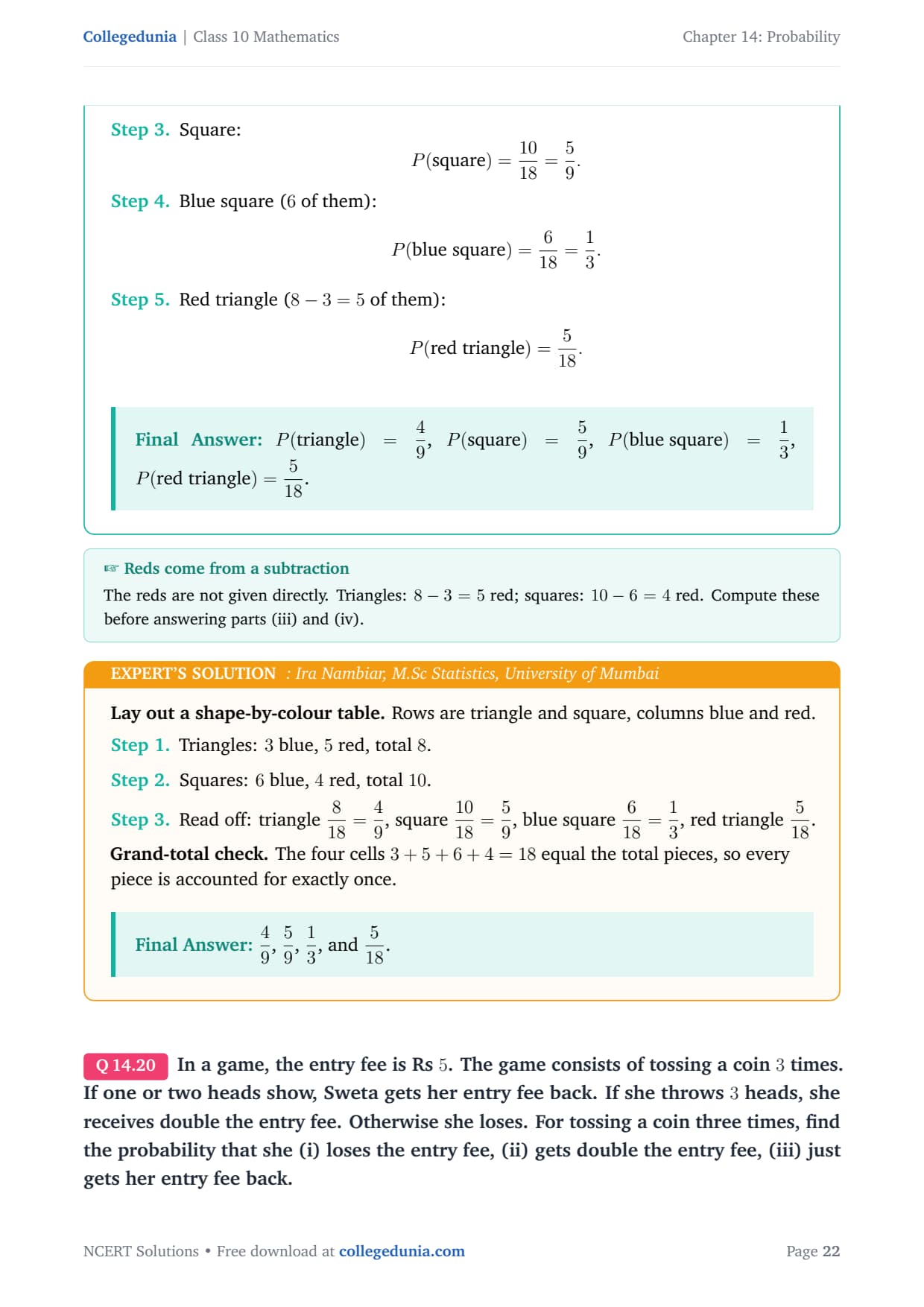
Square:
P(square)=1018=59.
Blue square (6 of them):
P(blue square)=618=13.
Red triangle (8-3=5 of them):
P(red triangle)=518.
Lay out a shape-by-colour table. Rows are triangle and square,
columns blue and red.
Triangles: 3 blue, 5 red, total 8.
Squares: 6 blue, 4 red, total 10.
Read off: triangle 818=49, square
1018=59, blue square 618=13,
red triangle 518.
Grand-total check. The four cells 3+5+6+4=18 equal the total
pieces, so every piece is accounted for exactly once.
49, 59, 13, and 518.
Q 14.20
In a game, the entry fee is Rs 5. The game consists of tossing a coin 3 times. If one or two heads show, Sweta gets her entry fee back. If she throws 3 heads, she receives double the entry fee. Otherwise she loses. For tossing a coin three times, find the probability that she (i) loses the entry fee, (ii) gets double the entry fee, (iii) just gets her entry fee back.
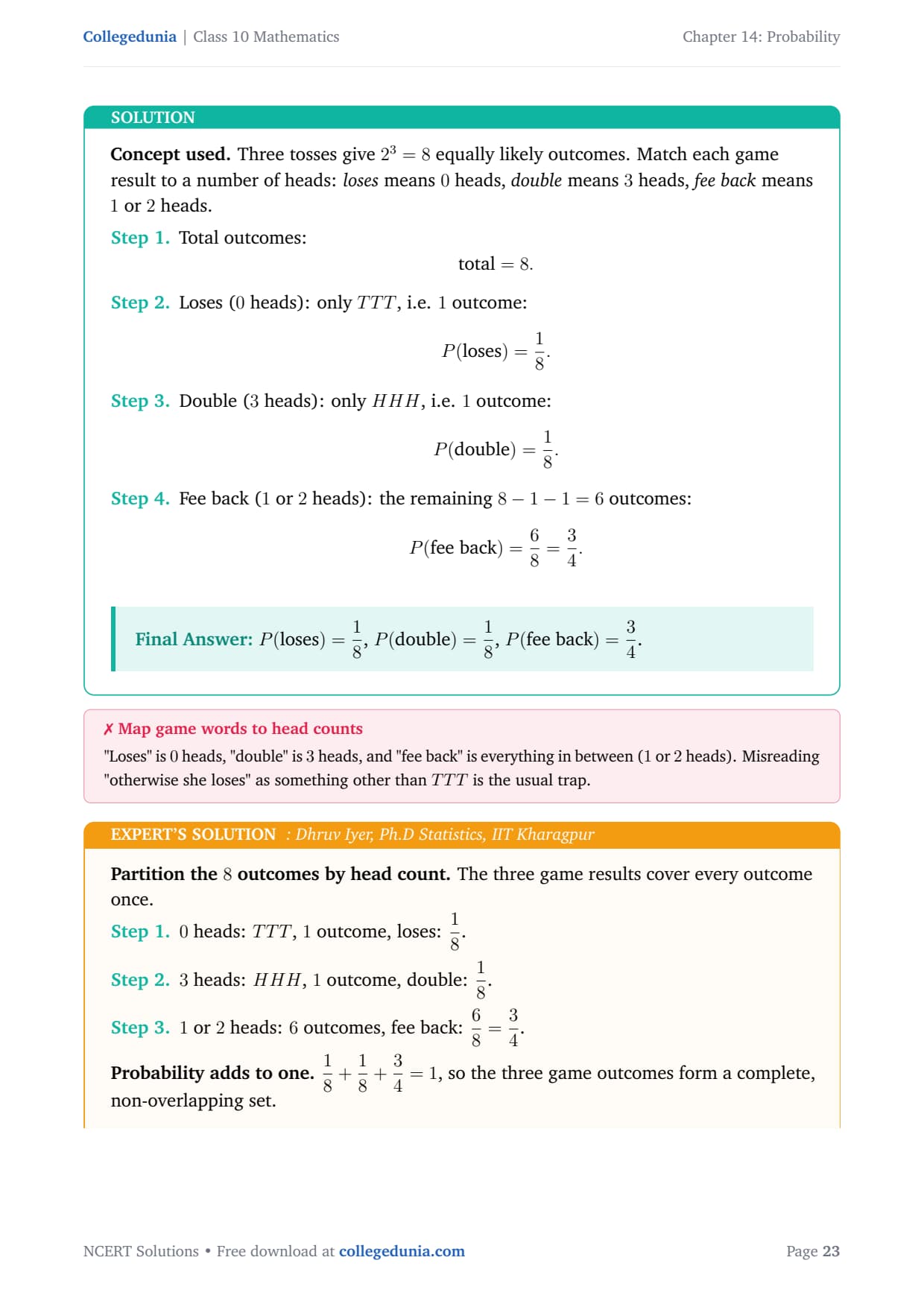
Concept used. Three tosses give 23=8 equally likely outcomes.
Match each game result to a number of heads: loses means 0 heads,
double means 3 heads, fee back means 1 or 2 heads.
Total outcomes:
total=8.
Loses (0 heads): only TTT, i.e. 1 outcome:
P(loses)=18.
Double (3 heads): only HHH, i.e. 1 outcome:
P(double)=18.
Fee back (1 or 2 heads): the remaining
8-1-1=6 outcomes:
P(fee back)=68=34.
P(loses)=18, P(double)=18, P(fee back)=34.
DI
Dhruv Iyer
Ph.D Statistics, IIT Kharagpur
Verified Expert
Partition the 8 outcomes by head count. The three game results
cover every outcome once.
0 heads: TTT, 1 outcome, loses: 18.
3 heads: HHH, 1 outcome, double: 18.
1 or 2 heads: 6 outcomes, fee back: 68=34.
Probability adds to one.18+18+34=1, so the
three game outcomes form a complete, non-overlapping set.
18 loses, 18 double, 34 fee back.
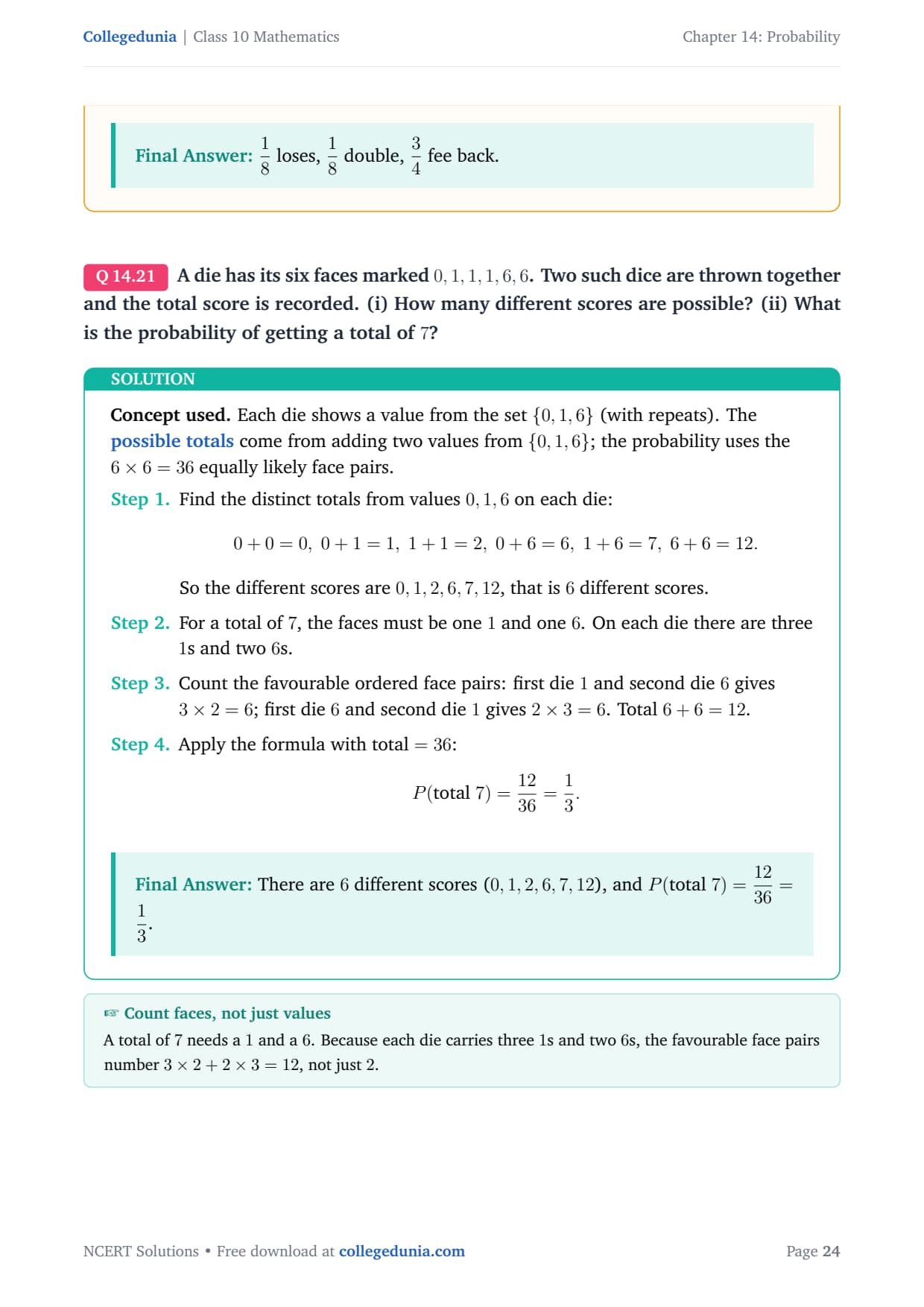
Q 14.21
A die has its six faces marked 0,1,1,1,6,6. Two such dice are thrown together and the total score is recorded. (i) How many different scores are possible? (ii) What is the probability of getting a total of 7?
Concept used. Each die shows a value from the set
0,1,6 (with repeats). The possible totals come from adding
two values from 0,1,6; the probability uses the 66=36
equally likely face pairs.
Find the distinct totals from values 0,1,6 on each die:
0+0=0, 0+1=1, 1+1=2, 0+6=6, 1+6=7, 6+6=12.
So the different scores are 0,1,2,6,7,12, that is 6 different
scores.
For a total of 7, the faces must be one 1 and one 6. On each
die there are three 1s and two 6s.
Count the favourable ordered face pairs:
first die 1 and second die 6 gives 32=6;
first die 6 and second die 1 gives 23=6. Total
6+6=12.
Apply the formula with total =36:
P(total 7)=1236=13.
There are 6 different scores (0,1,2,6,7,12), and P(total 7)=1236=13.
AS
Anaya Saxena
M.Sc Mathematics, IIT Bombay
Verified Expert
Separate the value set from the face counts. The values
fix the possible scores; the face multiplicities fix the
probability.
Distinct sums of two values from 0,1,6:
0,1,2,6,7,12, so 6 scores.
Total 7 uses one 1 (three faces) and one 6 (two faces).
Ordered pairs: 32+23=12 out of 36, so
1236=13.
Common miscount. Treating the dice as ordinary 1 to 6 dice
breaks this problem; the repeated faces are exactly why 7 is as likely
as 13.
6 different scores; probability of a total of 7 is 13.
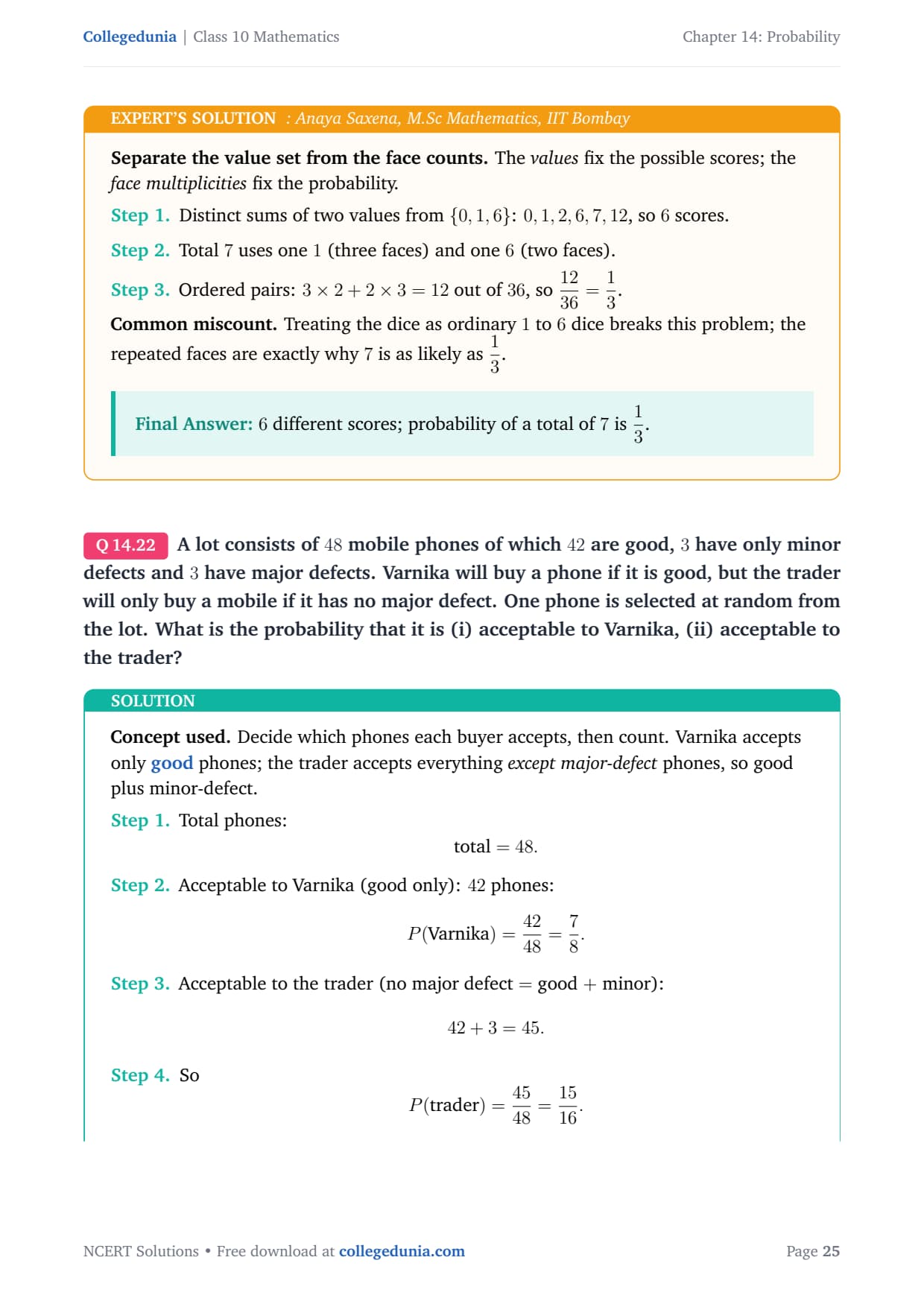
Q 14.22
A lot consists of 48 mobile phones of which 42 are good, 3 have only minor defects and 3 have major defects. Varnika will buy a phone if it is good, but the trader will only buy a mobile if it has no major defect. One phone is selected at random from the lot. What is the probability that it is (i) acceptable to Varnika, (ii) acceptable to the trader?
Concept used. Decide which phones each buyer accepts, then count.
Varnika accepts only good phones; the trader accepts everything
except major-defect phones, so good plus minor-defect.
Total phones:
total=48.
Acceptable to Varnika (good only): 42 phones:
P(Varnika)=4248=78.
Acceptable to the trader (no major defect = good + minor):
42+3=45.
So
P(trader)=4548=1516.
P(acceptable to Varnika)=78 and P(acceptable to the trader)=1516.
KB
Kiaan Banerjee
M.Sc Statistics, University of Pune
Verified Expert
Translate each acceptance rule into a count. The two buyers draw
different lines through the same lot.
Varnika: good only =42, so 4248=78.
Trader: not major-defect =48-3=45, so 4548=1516.
The trader's larger count gives the higher probability.
Why the trader's chance is higher. The trader tolerates the 3
minor-defect phones that Varnika rejects, so the trader's acceptable set
is strictly larger, lifting the probability to 1516.
78 acceptable to Varnika; 1516 acceptable to the trader.
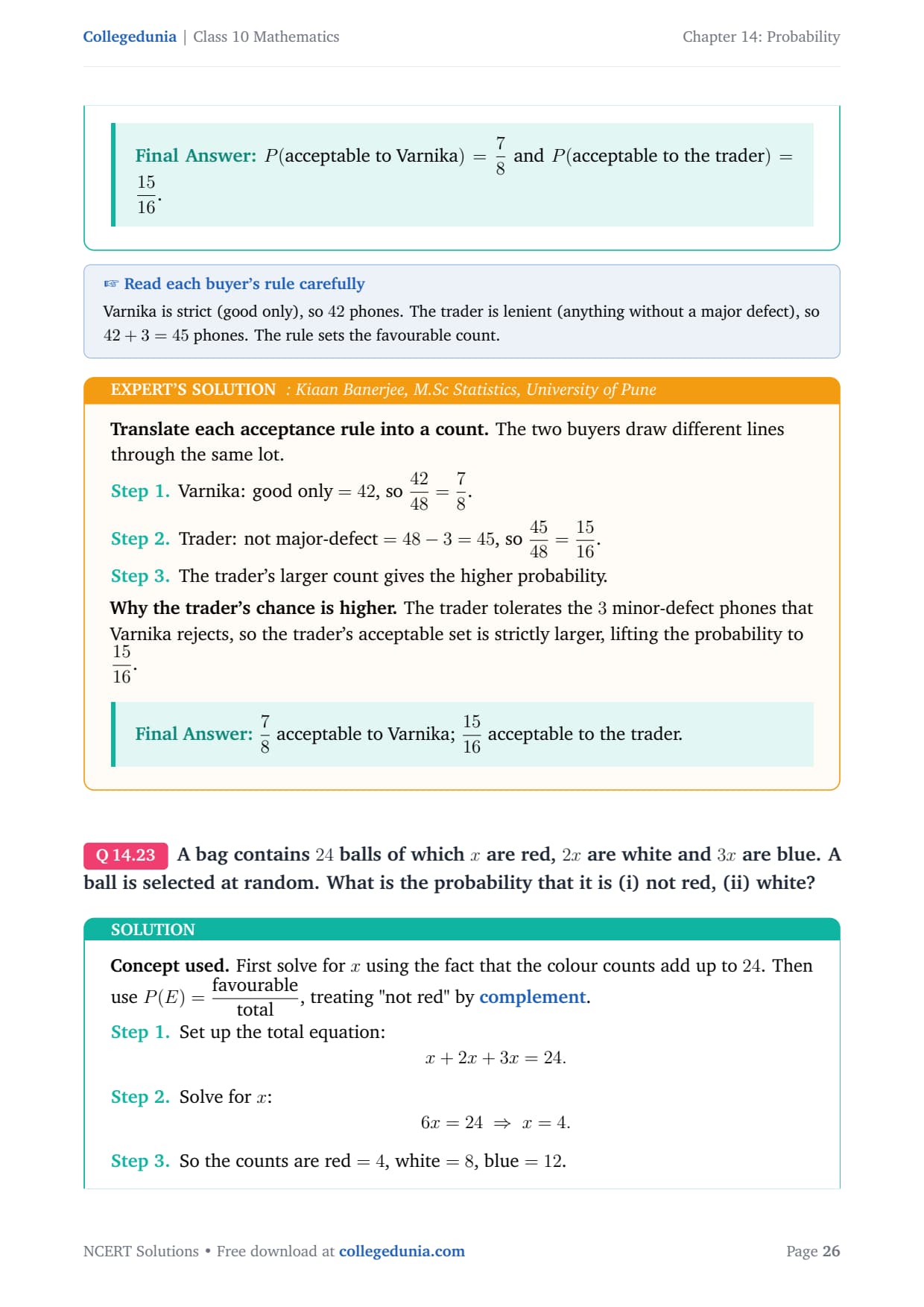
Q 14.23
A bag contains 24 balls of which x are red, 2x are white and 3x are blue. A ball is selected at random. What is the probability that it is (i) not red, (ii) white?
Concept used. First solve for x using the fact that the colour
counts add up to 24. Then use P(E)=favourabletotal,
treating "not red" by complement.
Set up the total equation:
x+2x+3x=24.
Solve for x:
6x=24 ⇒ x=4.
So the counts are red =4, white =8, blue =12.
Not red, by complement:
P(not red)=1-424=2024=56.
White:
P(white)=824=13.
P(not red)=56 and P(white)=13.
PN
Pari Nair
Ph.D Mathematics, IISc Bangalore
Verified Expert
Turn the ratio into numbers. The reds, whites and blues sit in
the ratio 1:2:3.
1:2:3 across 24 balls means parts of 4,8,12.
Not red: 8+12=20, so 2024=56.
White: 824=13.
Ratio shortcut. Since the parts total 6 and 246=4, each
"part" is 4 balls; this avoids writing the equation 6x=24 explicitly.
56 not red; 13 white.
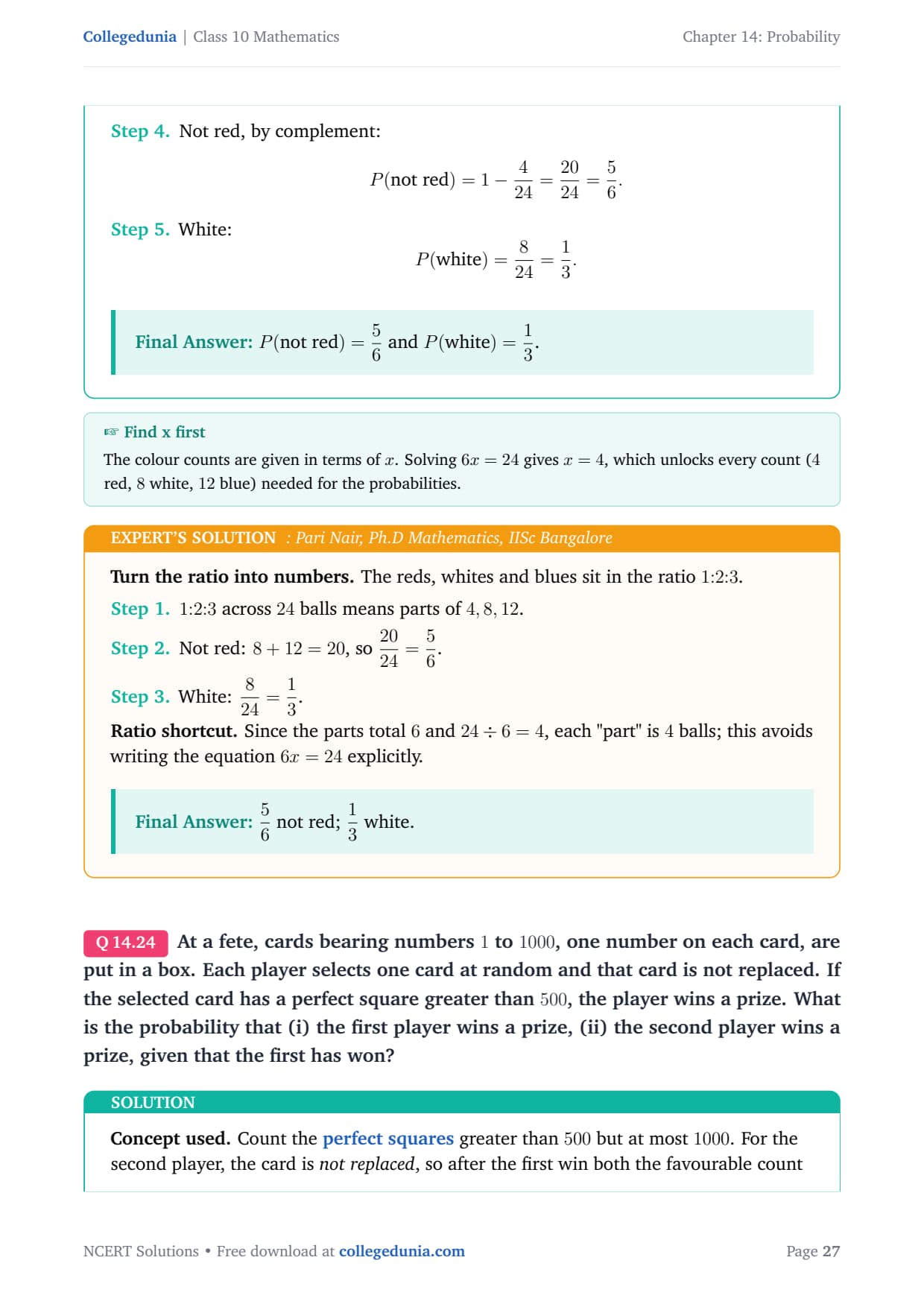
Q 14.24
At a fete, cards bearing numbers 1 to 1000, one number on each card, are put in a box. Each player selects one card at random and that card is not replaced. If the selected card has a perfect square greater than 500, the player wins a prize. What is the probability that (i) the first player wins a prize, (ii) the second player wins a prize, given that the first has won?
Concept used. Count the perfect squares greater than
500 but at most 1000. For the second player, the card is not
replaced, so after the first win both the favourable count and the total
drop by 1.
Find perfect squares between 500 and 1000. Since
222=484 (too small) and 232=529, while 312=961 and
322=1024 (too big), the squares are
232,242,,312, i.e. 9 numbers.
First player wins, with total =1000:
P(first wins)=91000=0.009.
Second player, given the first has won: one winning card is gone,
so favourable =9-1=8 and total =1000-1=999.
Apply the formula:
P(second winswon)=8999.
P(first wins)=0.009 and P(second winswon)=8999.
AV
Aarav Venkatesh
M.Sc Statistics, ISI Kolkata
Verified Expert
Bound the square roots, then track the removal. The winning
cards are the squares from 232 to 312.
√50022.4 and √100031.6, so the
integer roots run 23 to 31: 9 squares.
First win: 91000=0.009.
Second win after the first: 8999, since one winning
card and one card overall are removed.
Conditional reasoning. "Given the first has won" means a winning
square has already left the box, so the second player faces 8 winners
among 999 cards.
0.009 for the first player; 8999 for the second, given the first won.
NCERT Exemplar Class 10 Maths Probability Solutions: Frequently Asked Questions
Ques. Where can I download the NCERT Exemplar Class 10 Maths Chapter 14 Solutions for free?
Ans. You can download the NCERT Exemplar Class 10 Maths Chapter 14 Probability Solutions PDF directly from this page using the red Download button above. The PDF is free and aligned to the 2026-27 CBSE syllabus.
Ques. How many problems are there in the Probability Exemplar, and what types are they?
Ans. Chapter 14 has 42 Exemplar problems: 13 MCQs in Exercise 14.1, 6 true/false questions with justification in Exercise 14.2, 13 short-answer computation problems in Exercise 14.3, and 10 long-answer application questions in Exercise 14.4. Problems cover classical probability, complementary events, impossible and certain events, dice, coins, cards, and bags of coloured objects.
Ques. What is the classical probability formula for Class 10 Maths Chapter 14?
Ans. The classical probability formula is: P(E) = (Number of outcomes favourable to E) / (Total number of equally likely outcomes). This formula applies only when all outcomes in the sample space are equally likely. The probability of any event E satisfies 0 ≤ P(E) ≤ 1. The complementary event rule states P(not E) = 1 - P(E), which is useful when it is easier to count the outcomes where E does not happen.
Ques. What is the most common mistake students make in Chapter 14 Exemplar problems?
Ans. The two most common mistakes are: (1) Using an incorrect sample space for two-dice problems. When two dice are thrown, the sample space has 36 ordered pairs, not 11 distinct sum values. (2) Including aces as face cards in a deck of 52 cards. Face cards are only Jack, Queen, and King (12 total, not 16). Writing out the total outcomes and confirming the deck composition before applying the formula prevents both errors.
Ques. What is the difference between theoretical and experimental probability?
Ans. Theoretical (classical) probability is calculated from the sample space using the formula P(E) = favourable outcomes / total equally likely outcomes. It gives the expected long-run proportion of the event. Experimental probability is calculated from actual trials: P(E) = number of times E occurred / total number of trials. For a fair coin, theoretical P(head) = 1/2, but in 100 tosses you will not always get exactly 50 heads. The experimental probability approaches the theoretical value as the number of trials increases, but they are rarely equal for small sample sizes.
Ques. How is the Chapter 14 Exemplar harder than the NCERT textbook exercises?
Ans. The NCERT textbook Chapter 14 has two exercises with direct applications of the probability formula to simple experiments. The Exemplar raises the level in four ways. First, Exercise 14.1 MCQs test impossible and certain events in non-obvious scenarios. Second, Exercise 14.2 true/false questions require written justification, not just a label. Third, Exercises 14.3 and 14.4 use more complex sample spaces (two dice, full card deck, multi-colour bags) and ask students to find unknown counts given a probability. Fourth, Exercise 14.4 long-answer problems require combining two conditions to set up simultaneous equations.
Ques. How much time should a Class 10 student spend on the Chapter 14 Exemplar?
Ans. Plan about 2 to 3 hours in total: roughly 25 minutes for the 13 MCQs, 20 minutes for the 6 true/false questions (each needs a brief justification), about 45 minutes for the 13 short-answer computation problems, and 60 minutes for the 10 long-answer application questions, plus a revision pass on any question you got wrong. Students who write the sample space size and list of favourable outcomes before substituting into the formula will avoid the systematic counting errors that slow down all four exercise types.








Comments