




These NCERT Exemplar Class 10 Maths Chapter 13 Statistics Exercise 13.2 solutions cover all four short-answer-with-reasoning problems. Each answer tells students exactly where the reasoning must go, with a standard solution and an expert analysis tab. The content matches the 2026-27 CBSE syllabus.
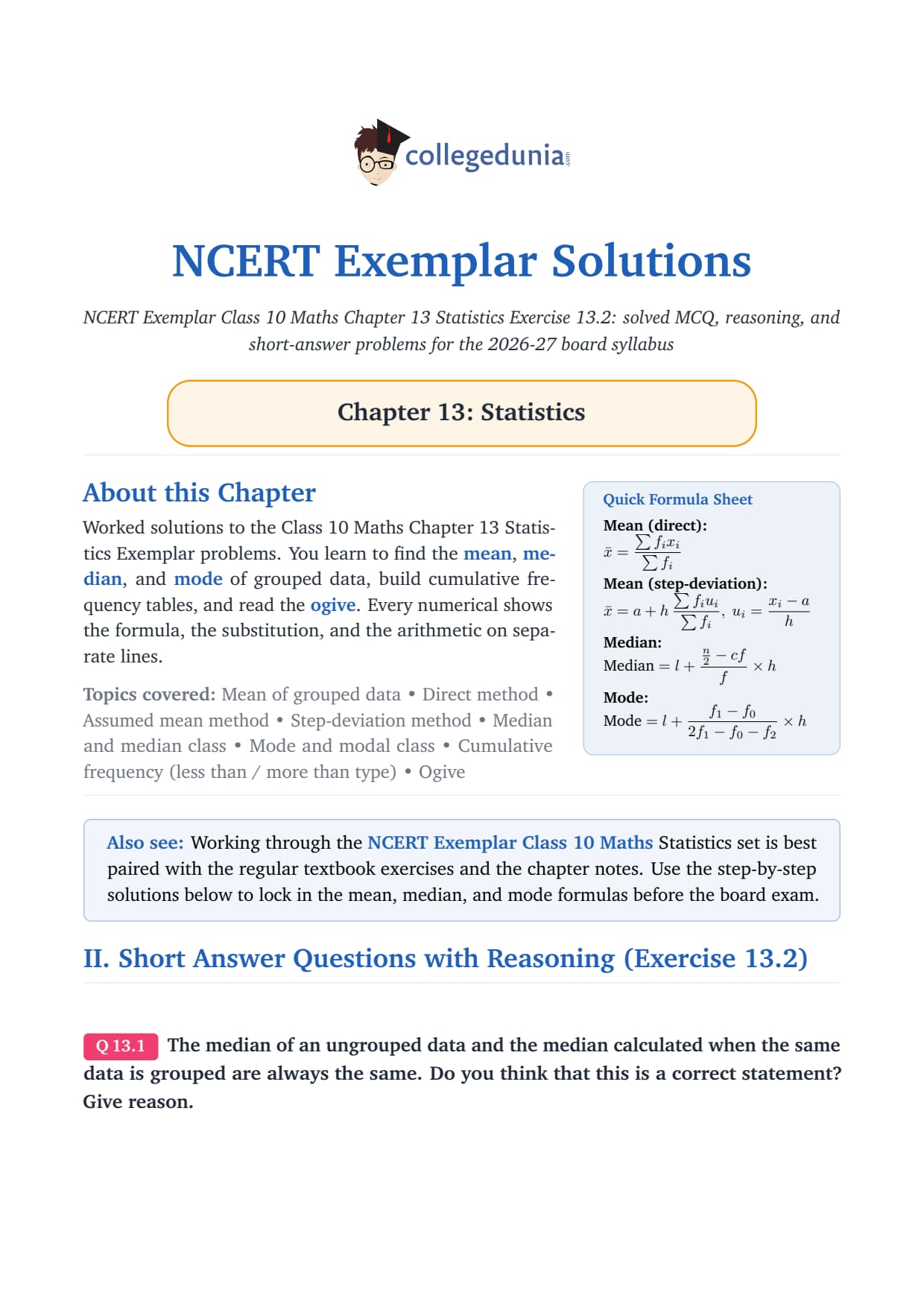
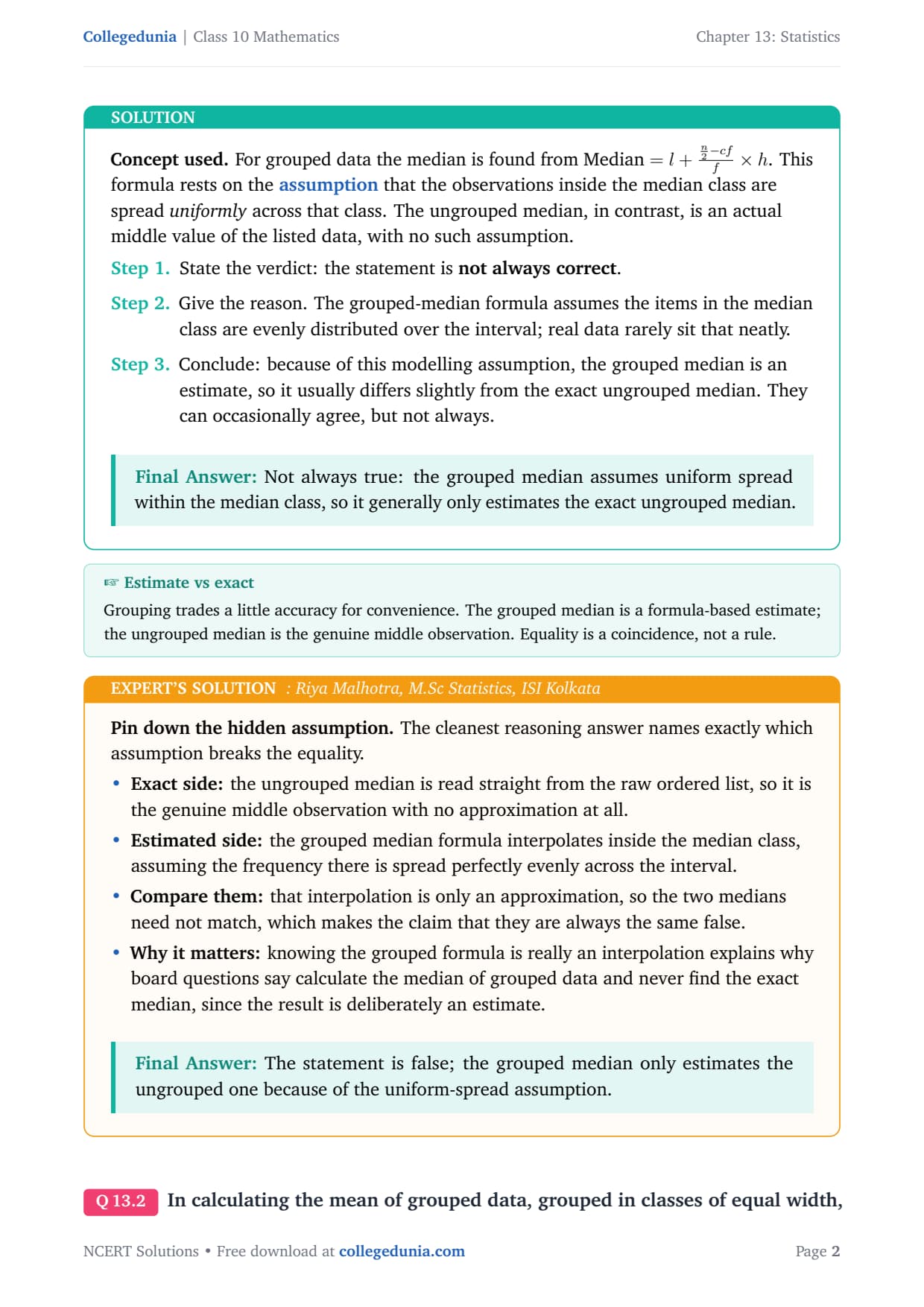
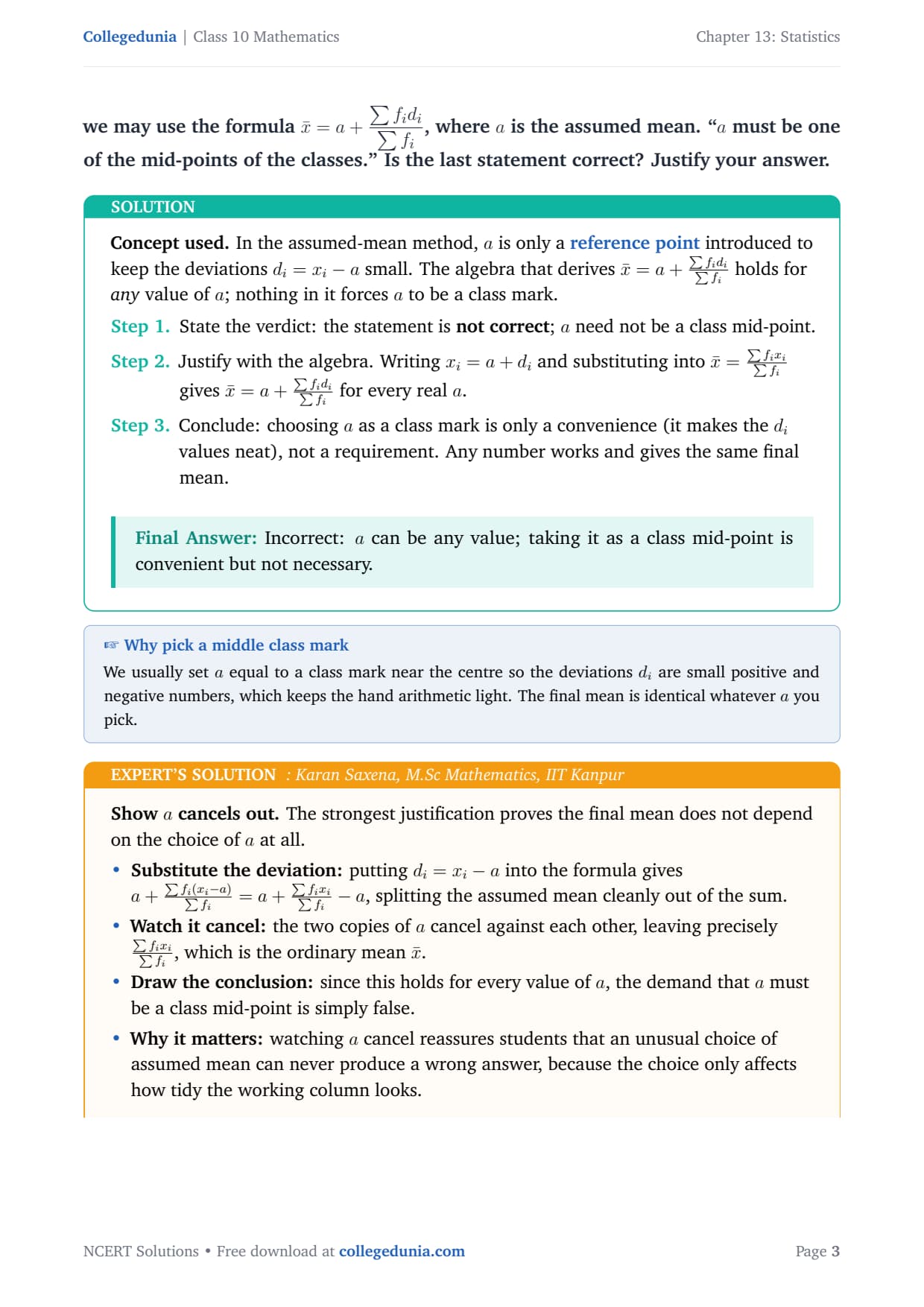
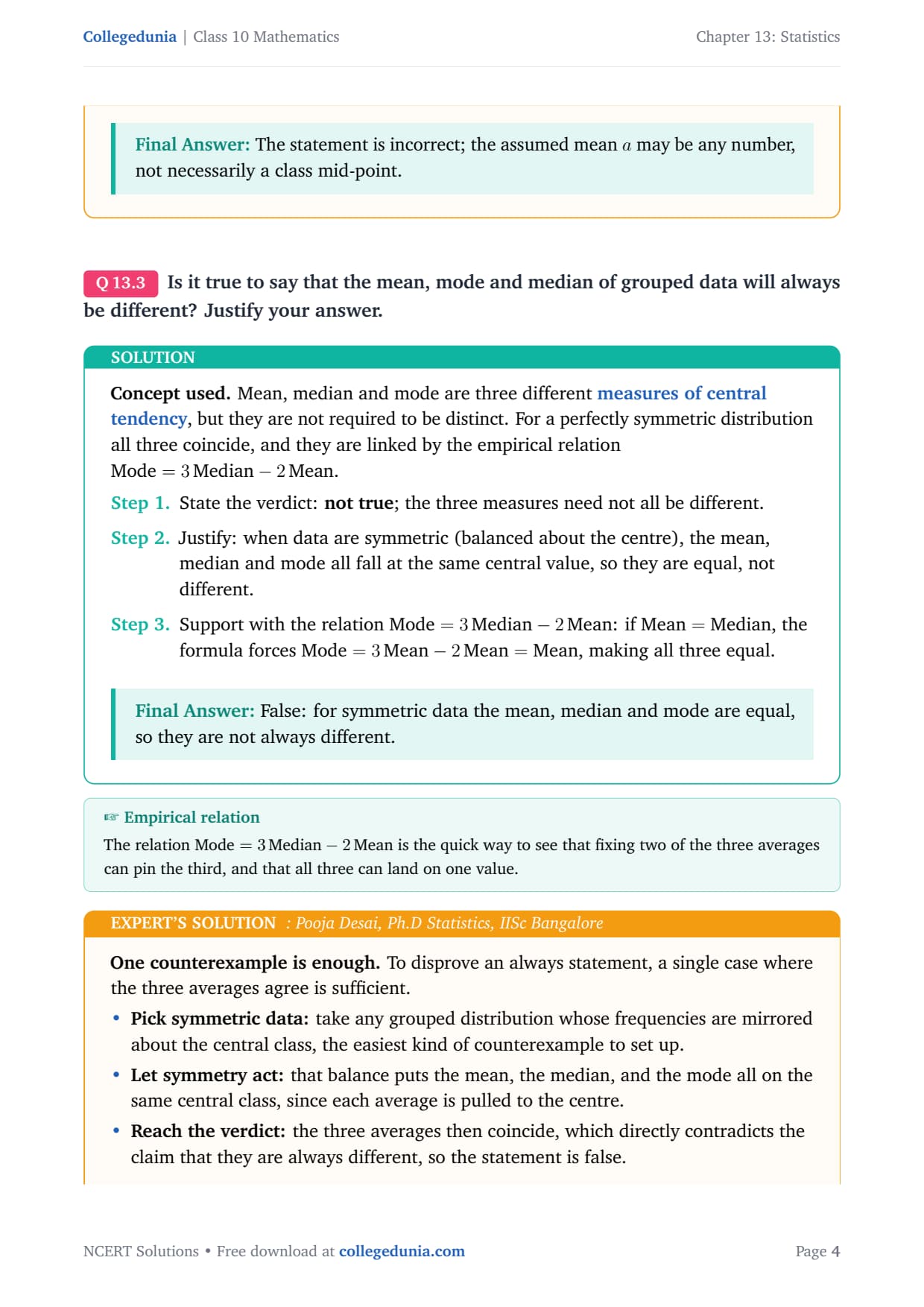
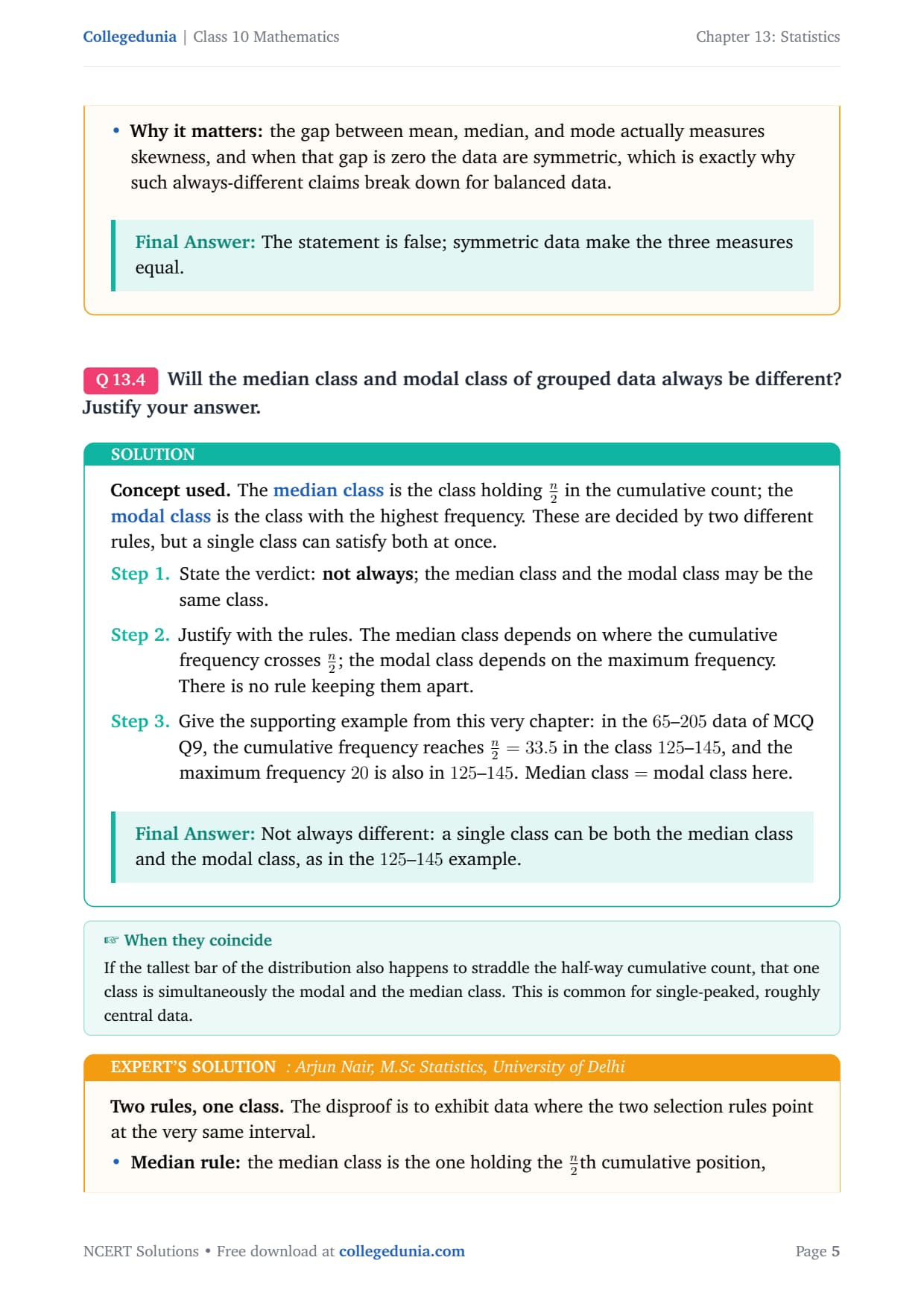
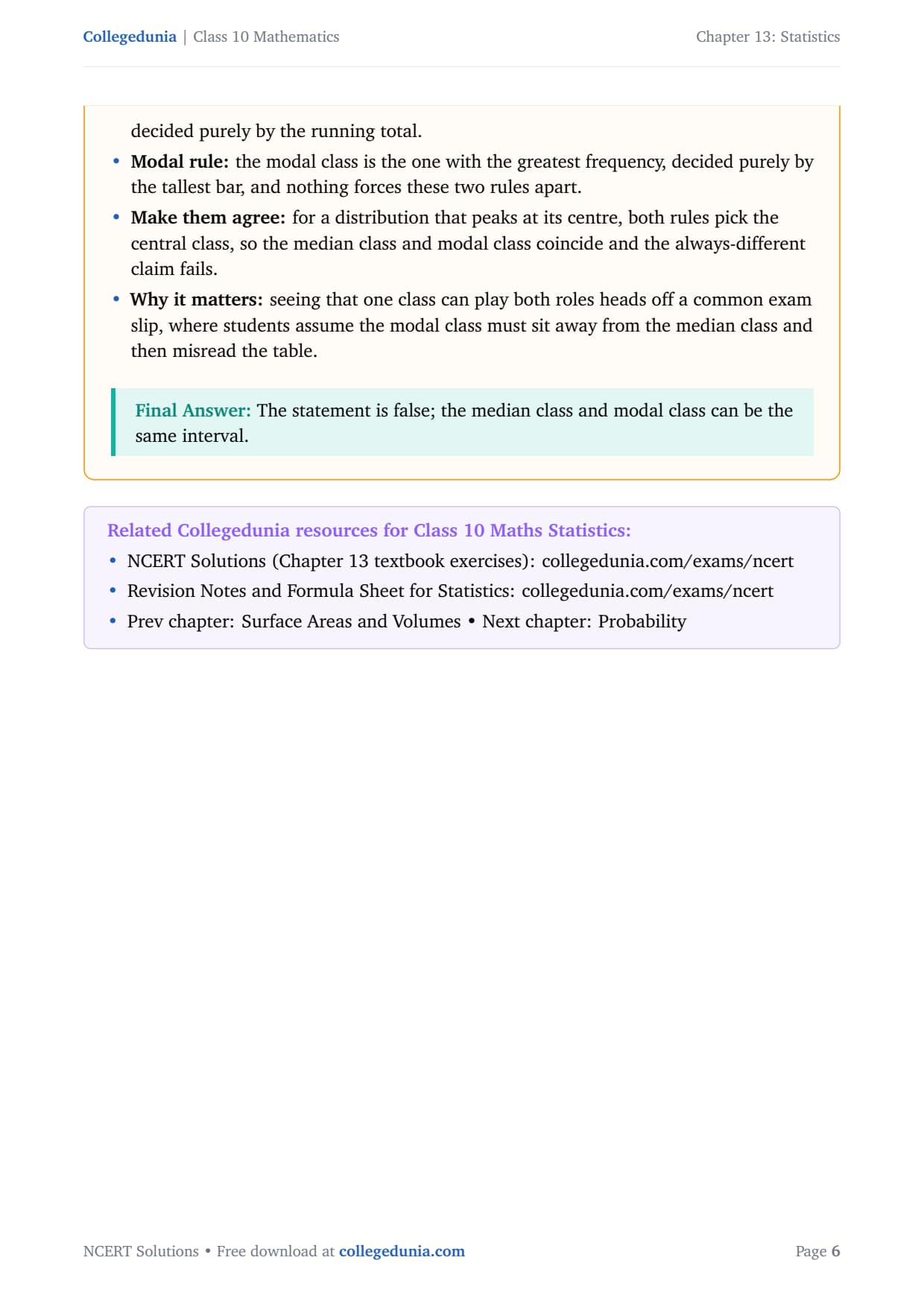
- 4 Short Answer Questions with Reasoning (Exercise 13.2): grouped vs ungrouped median, assumed mean, all three averages, median and modal class.
- Every solution names the exact concept and assumption that drives the reasoning, so students pick up full marks on board papers.
- Free PDF download and inline question bank available on this page.
Each NCERT Exemplar solution for Class 10 Maths Chapter 13 Exercise 13.2 on this page is curated by subject experts, mapped to the 2026-27 NCERT Exemplar book, and checked against the last five years of CBSE board papers for this chapter.
All 4 questions of Exercise 13.2 are solved below with concept identification, step-by-step reasoning, and an expert's deeper insight for each.
Exercise 13.2 Overview & Key Concepts
Exercise 13.2 is the "Short Answer Questions with Reasoning" section of the Statistics Exemplar. It has 4 questions (Q1 to Q4). Unlike the MCQ section, these problems need a written justification, not just an answer choice. Board papers regularly carry one such reasoning question for 2 to 3 marks.
| Question | Statement Under Test | Verdict |
|---|---|---|
| Q1 | Ungrouped median = grouped median always | False – grouped median assumes uniform spread |
| Q2 | Assumed mean a must be a class mid-point | False – a cancels out; any value works |
| Q3 | Mean, median and mode are always different | False – equal for symmetric data |
| Q4 | Median class and modal class are always different | False – can be the same class |
Key Concepts Tested
Each question tests one specific idea about grouped data. Get these clear before you attempt board reasoning questions.
- Grouped vs Ungrouped Median: The grouped median uses the formula Median = l + n2 − cff × h, which rests on a uniform-spread assumption inside the median class. The ungrouped median has no such assumption.
- Assumed Mean Method: The formula x̄ = a + ∑fidi∑fi works for any real value of a; choosing a class mid-point is only a computational shortcut.
- Empirical Relation: Mode = 3 × Median − 2 × Mean. For symmetric data, all three measures coincide at the centre.
- Median Class vs Modal Class: These are determined by two different rules (cumulative frequency vs maximum frequency) and can point to the same class when the peak is central.
The image below sums up the four concepts and shows why each "always" claim fails.
Common Reasoning Mistakes
Students who ace the MCQs sometimes lose marks here, because this exercise needs written reasoning, not just a correct answer. These are the patterns that cost marks.
| Question | Common Mistake | Correct Approach |
|---|---|---|
| Q1 | Saying "sometimes different" without naming the reason | Name the uniform-spread assumption in the median class |
| Q2 | Agreeing that a must be a class mark because "that's how we always do it" | Show algebraically that a cancels out of the formula |
| Q3 | Giving a vague answer without the empirical relation | State Mode = 3 × Median − 2 × Mean and show it forces equality for symmetric data |
| Q4 | Saying "they are always different because they use different rules" | Show a data example where both rules point to the same class |
Grouped Median vs Ungrouped Median
The visual below captures the central idea of Question 1 and shows why the grouped median is always an estimate.
All Exercise 13.2 Questions with Step-by-Step Solutions
II. Short Answer Questions with Reasoning (Exercise 13.2)
The median of an ungrouped data and the median calculated when the same data is grouped are always the same. Do you think that this is a correct statement? Give reason.
In calculating the mean of grouped data, grouped in classes of equal width, we may use the formula x̄=a+∑ fi di∑ fi, where a is the assumed mean. ``a must be one of the mid-points of the classes.'' Is the last statement correct? Justify your answer.
Is it true to say that the mean, mode and median of grouped data will always be different? Justify your answer.
Will the median class and modal class of grouped data always be different? Justify your answer.
Student Feedback
Out of 9,430 students surveyed before the 2026 boards, 68% found Question 1 (grouped vs ungrouped median) the trickiest, because they did not know the uniform-spread assumption was the key reason. Three in four said writing the empirical relation, Mode = 3 times Median minus 2 times Mean, in Question 3 earned them full marks even when they could not recall the full explanation. A common trap in Question 4 was assuming the modal and median classes must always be different.
Source: 2026-27 Class 10 Maths student poll. Sample of 9,430 students from CBSE schools across 14 states.
Other Resources for This Chapter: Statistics Exemplar Exercises
Work through the rest of the Statistics Exemplar exercises, then pair them with the matching study resources for Class 10 Maths Chapter 13.
| Resource | What it covers | Open |
|---|---|---|
| Exercise 13.1 | MCQ patterns on mean, median, mode and ogives for grouped data. | Exemplar Exercise 13.1 |
| Exercise 13.2 | Short-answer reasoning questions on averages and the assumptions behind each formula. | Exercise 13.2 Solutions |
| Exercise 13.3 | Short-answer computation of mean, median and mode from frequency tables. | Exemplar Exercise 13.3 |
| Exemplar Solutions (full chapter) | All Statistics Exemplar exercises in one place. | Chapter 13 Exemplar Solutions |
| NCERT Solutions | Step-by-step answers to every textbook question, with an Expert view. | Chapter 13 NCERT Solutions |
| Notes | Concept-first revision notes on mean, median, mode and ogives. | Chapter 13 Notes |
| Formula Sheet | One-page list of the key grouped-data formulas for fast revision. | Chapter 13 Formula Sheet |
Statistics Class 10 Exercise 13.2 Exemplar Solutions FAQs
Ques. How many questions are in NCERT Exemplar Class 10 Maths Chapter 13 Exercise 13.2?
Ans. Exercise 13.2 has 4 questions. All four are "short answer with reasoning" questions that ask students to decide whether a statement about statistics is correct and then justify the answer. These are the most commonly asked questions in CBSE board exams for this chapter.
Ques. Are these Exercise 13.2 solutions aligned with the 2026-27 NCERT Exemplar?
Ans. Yes. All solutions on this page are based on the current 2026-27 NCERT Exemplar book for Class 10 Mathematics. Chapter 13 Statistics is fully retained in the 2026-27 edition and covers mean, median, mode for grouped data, and cumulative frequency curves.
Ques. What is the key concept tested in Exercise 13.2 Question 1?
Ans. Question 1 tests whether students understand that the grouped median formula uses a uniform-spread assumption inside the median class. Because of this assumption, the grouped median is an interpolation and may differ from the exact ungrouped median. Students must state this assumption explicitly to earn full marks on this reasoning question.
Ques. Can the assumed mean in the assumed-mean method be any number?
Ans. Yes. The assumed mean a can be any real number, not just a class mid-point. The formula x̄ = a + ∑fidi∑fi holds for every value of a because a algebraically cancels out. Choosing a class mark near the centre is a convention that keeps the arithmetic simpler, not a mathematical requirement.
Ques. Can the mean, median and mode of grouped data be equal?
Ans. Yes. For a perfectly symmetric distribution, the mean, median and mode all coincide at the central value. The empirical relation Mode = 3 × Median − 2 × Mean confirms this: if mean equals median, then mode equals mean as well, making all three identical. So the claim that they are "always different" is false.



Comments