NCERT Exemplar Class 10 Maths Chapter 10 Circles Exercise 10.2 has 10 True or False questions on tangents, radii, and angles between tangents. For each one you state the verdict and justify it.
Exercise type: 10 True or False questions with reasoning.
Board relevance: these build the proof-writing skills tested in 3-mark and 4-mark board questions.
Every answer below carries a full justification and an expert view, matched to the 2026-27 NCERT syllabus.
These solutions are curated by subject experts, mapped to the 2026-27 rationalised NCERT, and checked against the CBSE board pattern.
Solved by Collegedunia Every question is solved by Maths experts. Each answer names the concept used, shows numbered steps, and adds an Expert view so you see the reasoning behind each verdict.
Exercise 10.2 at a Glance · 10 True/False Questions, Chapter 10 Circles, Class 10 Maths Exemplar 2026-27
Circles Class 10 Maths Exercise 10.2 Overview & Key Formulas
This is a set of 10 True or False questions. For each claim you state the verdict and give a clear geometric reason. The question-wise breakdown is below.
Question
Topic Tested
Answer
Level
Q1 (Ex Q11)
Angle between tangents vs. central angle (supplementary rule)
False
Medium
Q2 (Ex Q12)
Tangent length vs. radius: is tangent always greater?
False
Easy
Q3 (Ex Q13)
Tangent length always less than OP?
True
Easy
Q4 (Ex Q14)
Angle between tangents may be 0°? (parallel tangents)
True
Medium
Q5 (Ex Q15)
If tangent angle = 90°, then OP = a√2?
True
Medium
Q6 (Ex Q16)
If tangent angle = 60°, then OP = a√3?
False
Medium
Q7 (Ex Q17)
Tangent to circumcircle at apex of isosceles triangle is parallel to base?
True
Hard
Q8 (Ex Q18)
Circles touching a segment at a point: centres on perpendicular bisector?
False
Medium
Q9 (Ex Q19)
Circles through endpoints P, Q: centres on perpendicular bisector?
True
Medium
Q10 (Ex Q20)
AB diameter, tangent at C meets AB extended, BC = BD?
True
Hard
Key Strategy: For every True or False claim, first spot which circle theorem applies. The two most used facts are: radius is perpendicular to the tangent at the point of contact, and the angle between two tangents plus the central angle = 180°.
The key formulas you need are listed below.
Formula / Theorem
Statement
Tangent perpendicular to radius
OP ⊥ PT at the point of contact P
Equal tangents
PA = PB from external point P
Tangent length formula
ℓ = √(OP2 − r2)
Supplementary angle rule
∠APB = 180° − ∠AOB
Angle in semicircle
Angle subtended by diameter at the circle = 90°
Alternate segment theorem
Tangent-chord angle = inscribed angle in alternate segment
Watch Out: Q6 is a classic trig trap. The half-angle at P is 30°, and the sine of 30° gives OP = 2a, not a√3. Confusing sin and cos at this step is the most common error.
All Questions with Step-by-Step Solutions
Exercise 10.2 Short Answer with Reasoning (True/False)
Q 10.1
State whether the following is true or false and justify your answer: If a chord AB subtends an angle of 60∘ at the centre of a circle, then the angle between the tangents at A and B is also 60∘.
Answer: False.
Concept used. In the quadrilateral OACB formed by the centre O, the two points of contact A,B and the external point C where the tangents meet, the radii are perpendicular to the tangents. So ∠ OAC=∠ OBC=90∘, and the four angles of the quadrilateral sum to 360∘.
The angle between the tangents is ∠ ACB. In quadrilateral OACB:
∠ AOB+∠ OAC+∠ ACB+∠ OBC=360∘.
Substitute ∠ AOB=60∘ and the two right angles:
60∘+90∘+∠ ACB+90∘=360∘.
Solve:
∠ ACB=360∘-240∘=120∘.
This is 120∘, not 60∘, so the statement is false.
False: the angle between the tangents is 120∘, since ∠ ACB=180∘-∠ AOB.
KN
Krishna Nair
Ph.D Mathematics, IIT Delhi
Verified Expert
Strategic angle. Lock onto the supplementary rule ∠ ACB=180∘-∠ AOB. It comes straight from the two right angles in the kite OACB. Plugging ∠ AOB=60∘ gives 120∘ at once, exposing the claim as false.
∠ ACB=180∘-∠ AOB.
=180∘-60∘=120∘≠ 60∘.
Generalises: The statement would be true only if ∠ AOB were 90∘, the lone self-supplementary value.
Mark grabber: Recognising that single fixed point stops you from assuming the two angles are generally equal, which is the trap this true/false question sets.
False; the tangent angle is 120∘.
Q 10.2
State whether the following is true or false and justify your answer: The length of tangent from an external point on a circle is always greater than the radius of the circle.
Answer: False.
Concept used. The tangent length from an external point P is =√OP2-r2, where r is the radius and OP>r. This value depends on how far P is from the centre, so it can be smaller, equal to, or larger than r.
Take a circle of radius r=5 cm and an external point P with OP=5.5 cm. The tangent length is
=√OP2-r2=√5.52-52=√30.25-25=√5.25≈ 2.29 cm.
Here ≈ 2.29 cm is less than the radius 5 cm, so the statement ``always greater'' is false.
False: a counter-example with OP just larger than r gives a tangent shorter than the radius.
MB
Meera Banerjee
M.Sc Mathematics, IIT Bombay
Verified Expert
Quick reading. The tangent length grows smoothly from 0 (point on the circle) upward as P moves away. So it passes through every positive value, including values below r. One nearby point settles the matter.
For P near the circle, OP→ r+ and → 0.
Such an is below r, so ``always greater'' fails.
Pitfall: The honest statement is that the tangent length can be anything positive; it equals the radius only at one special distance OP=r2.
One-line proof: Treating ``always'' words sceptically is a reliable instinct for these reasoning questions.
False; tangent length can be less than the radius.
Q 10.3
State whether the following is true or false and justify your answer: The length of tangent from an external point P on a circle with centre O is always less than OP.
Answer: True.
Concept used. The radius to the point of contact is perpendicular to the tangent, so the tangent, the radius and the line OP form a right triangle in which OP is the hypotenuse. The hypotenuse is the longest side of a right triangle.
Let the tangent touch the circle at A. Then ∠ OAP=90∘, so triangle OAP is right-angled at A with hypotenuse OP.
By Pythagoras,
OP2=OA2+PA2 ⇒ PA2=OP2-OA22.
Since OA>0 (the radius is positive), PA for every external point. The statement is true.
True: PA=√OP2-OA2 because the tangent is a leg and OP is the hypotenuse.
AV
Ankit Verma
Ph.D Mathematics, IIT Delhi
Verified Expert
Strategic angle. The contrast with the previous question is instructive: the tangent is compared to OP, not to the radius. Against OP it is always shorter, because OP is the hypotenuse of the contact right triangle. The comparison target decides the verdict.
Right triangle OAP with hypotenuse OP.
Leg PA always.
Trap to avoid: This is a strict inequality: PA can never equal OP, since that would force the radius OA to be zero.
Why it works: Reading the comparison carefully, tangent versus OP here, versus radius in the last item, is the skill these paired questions test.
True; the tangent is a leg, so PA.
Q 10.4
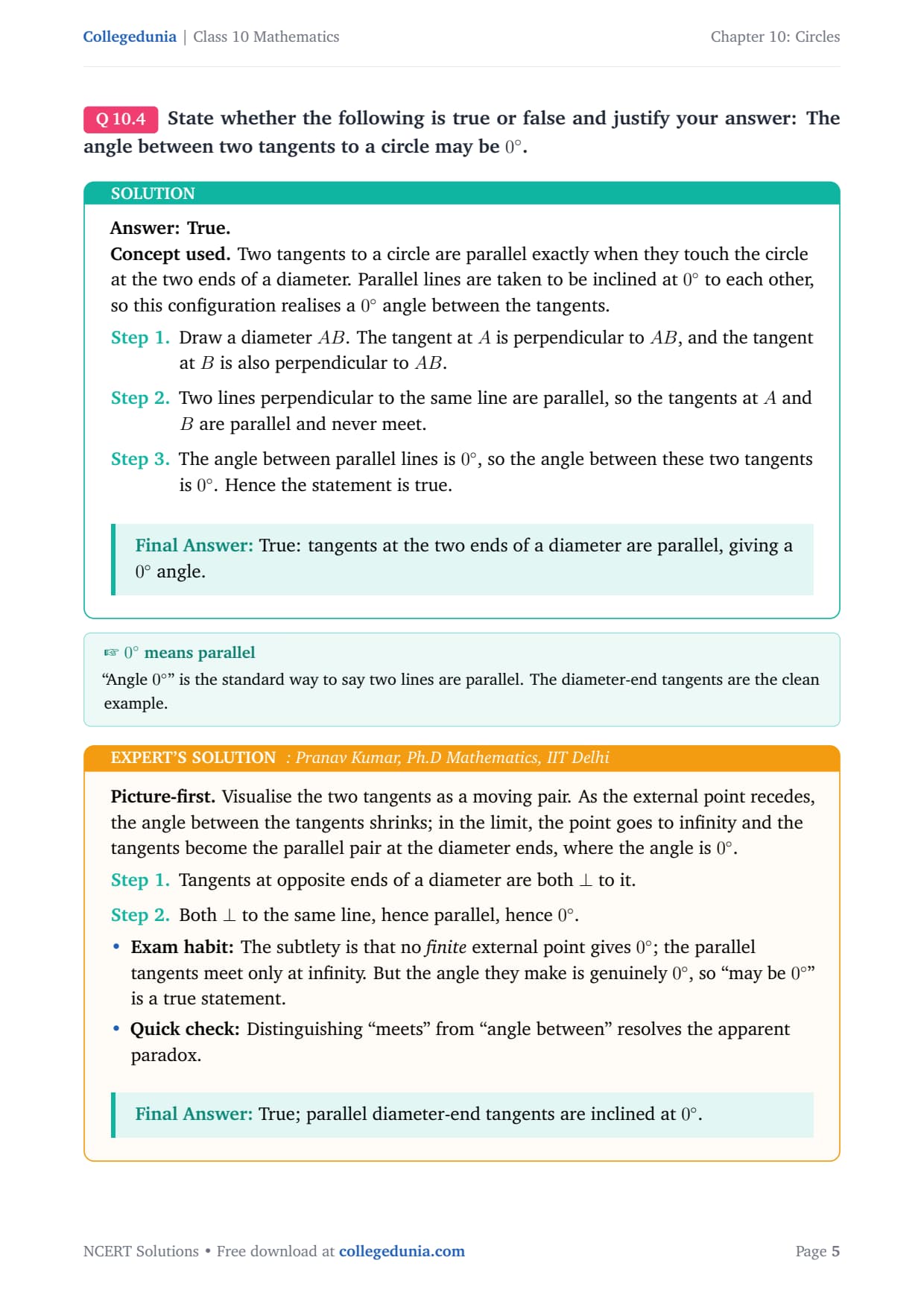
State whether the following is true or false and justify your answer: The angle between two tangents to a circle may be 0∘.
Answer: True.
Concept used. Two tangents to a circle are parallel exactly when they touch the circle at the two ends of a diameter. Parallel lines are taken to be inclined at 0∘ to each other, so this configuration realises a 0∘ angle between the tangents.
Draw a diameter AB. The tangent at A is perpendicular to AB, and the tangent at B is also perpendicular to AB.
Two lines perpendicular to the same line are parallel, so the tangents at A and B are parallel and never meet.
The angle between parallel lines is 0∘, so the angle between these two tangents is 0∘. Hence the statement is true.
True: tangents at the two ends of a diameter are parallel, giving a 0∘ angle.
PK
Pranav Kumar
Ph.D Mathematics, IIT Delhi
Verified Expert
Picture-first. Visualise the two tangents as a moving pair. As the external point recedes, the angle between the tangents shrinks; in the limit, the point goes to infinity and the tangents become the parallel pair at the diameter ends, where the angle is 0∘.
Tangents at opposite ends of a diameter are both ⊥ to it.
Both ⊥ to the same line, hence parallel, hence 0∘.
Exam habit: The subtlety is that no finite external point gives 0∘; the parallel tangents meet only at infinity. But the angle they make is genuinely 0∘, so ``may be 0∘'' is a true statement.
Quick check: Distinguishing ``meets'' from ``angle between'' resolves the apparent paradox.
True; parallel diameter-end tangents are inclined at 0∘.
Q 10.5
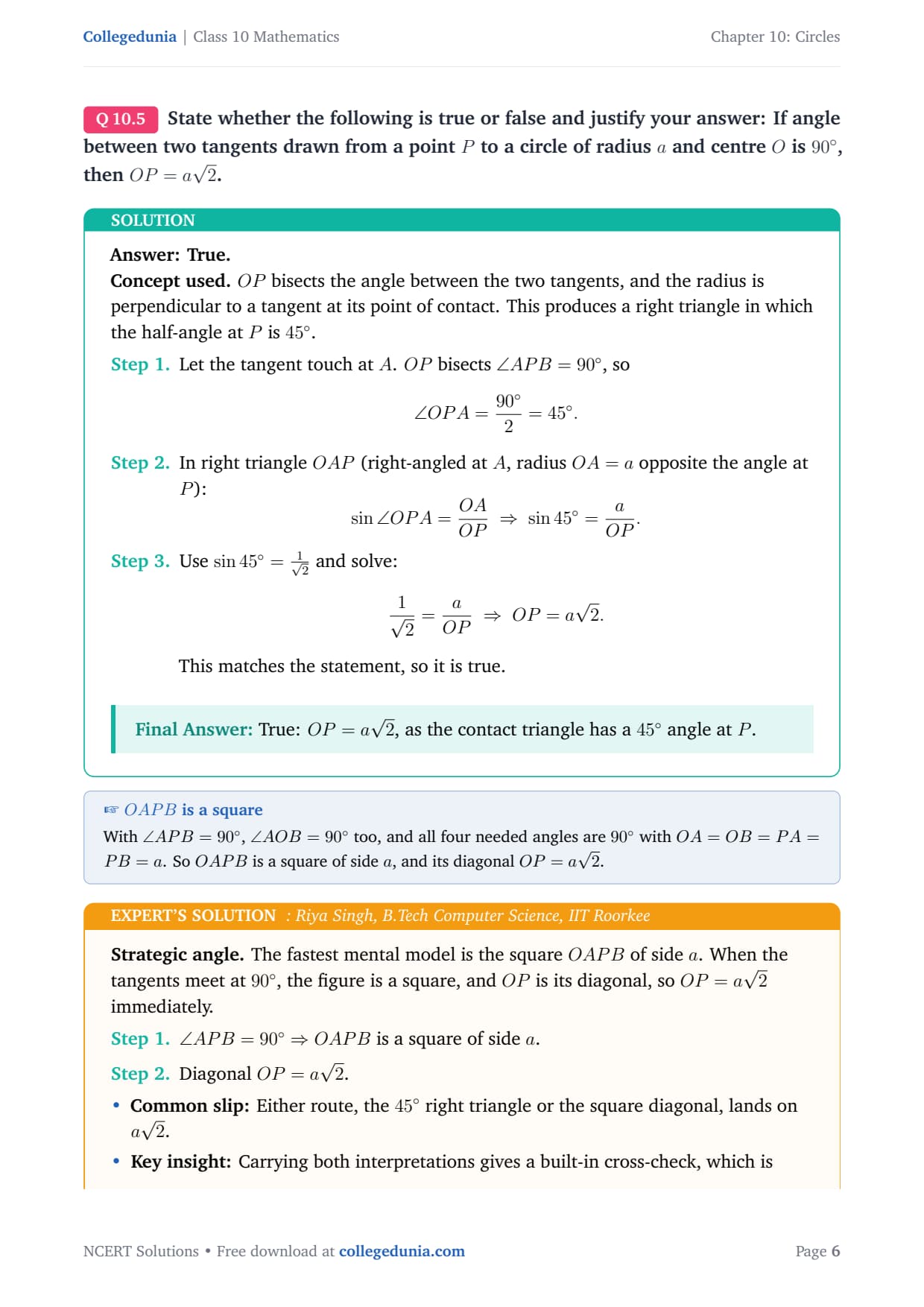
State whether the following is true or false and justify your answer: If angle between two tangents drawn from a point P to a circle of radius a and centre O is 90∘, then OP=a√2.
Answer: True.
Concept used.OP bisects the angle between the two tangents, and the radius is perpendicular to a tangent at its point of contact. This produces a right triangle in which the half-angle at P is 45∘.
Let the tangent touch at A. OP bisects ∠ APB=90∘, so
∠ OPA=90∘2=45∘.
In right triangle OAP (right-angled at A, radius OA=a opposite the angle at P):
sin∠ OPA=OAOP ⇒ sin 45∘=aOP.
Use sin 45∘=1√2 and solve:
1√2=aOP ⇒ OP=a√2.
This matches the statement, so it is true.
True: OP=a√2, as the contact triangle has a 45∘ angle at P.
RS
Riya Singh
B.Tech Computer Science, IIT Roorkee
Verified Expert
Strategic angle. The fastest mental model is the square OAPB of side a. When the tangents meet at 90∘, the figure is a square, and OP is its diagonal, so OP=a2 immediately.
∠ APB=90∘⇒ OAPB is a square of side a.
Diagonal OP=a2.
Common slip: Either route, the 45∘ right triangle or the square diagonal, lands on a2.
Key insight: Carrying both interpretations gives a built-in cross-check, which is reassuring when a numerical-looking claim must be judged true or false.
True; OP=a2.
Q 10.6
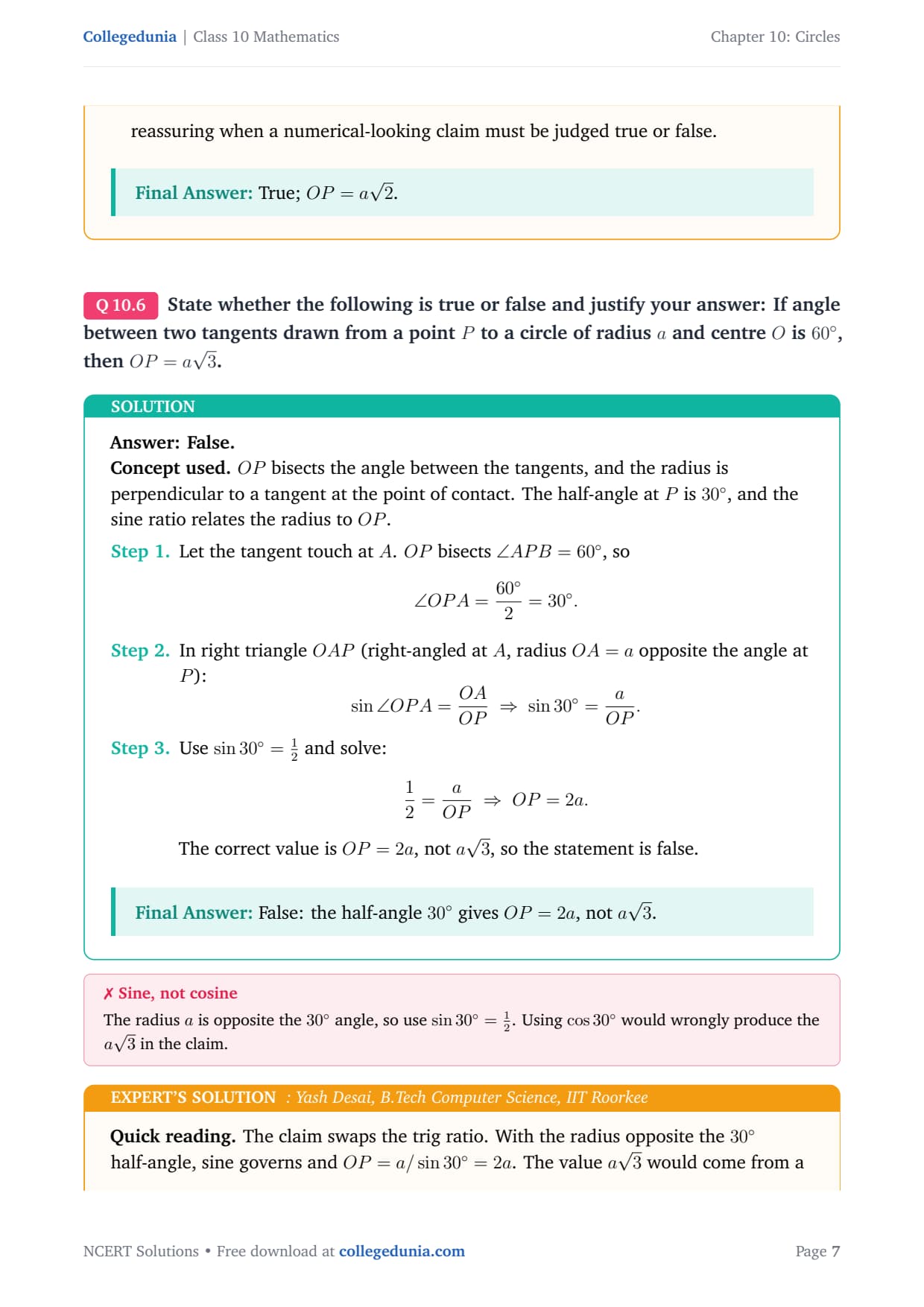
State whether the following is true or false and justify your answer: If angle between two tangents drawn from a point P to a circle of radius a and centre O is 60∘, then OP=a√3.
Answer: False.
Concept used.OP bisects the angle between the tangents, and the radius is perpendicular to a tangent at the point of contact. The half-angle at P is 30∘, and the sine ratio relates the radius to OP.
Let the tangent touch at A. OP bisects ∠ APB=60∘, so
∠ OPA=60∘2=30∘.
In right triangle OAP (right-angled at A, radius OA=a opposite the angle at P):
sin∠ OPA=OAOP ⇒ sin 30∘=aOP.
Use sin 30∘=12 and solve:
12=aOP ⇒ OP=2a.
The correct value is OP=2a, not a√3, so the statement is false.
False: the half-angle 30∘ gives OP=2a, not a√3.
YD
Yash Desai
B.Tech Computer Science, IIT Roorkee
Verified Expert
Quick reading. The claim swaps the trig ratio. With the radius opposite the 30∘ half-angle, sine governs and OP=a/sin 30∘=2a. The value a3 would come from a cosine, which applies to the tangent length, not OP.
Half-angle 30∘; sin 30∘=a/OP.
OP=a/12=2a≠ a3.
Cross-check: A useful tie-in: the tangent length here is acot 30∘=a3, which is exactly the number the false statement mis-assigns to OP.
Watch out: Spotting that the claim attached the right number to the wrong segment nails the verdict.
False; OP=2a.
Q 10.7
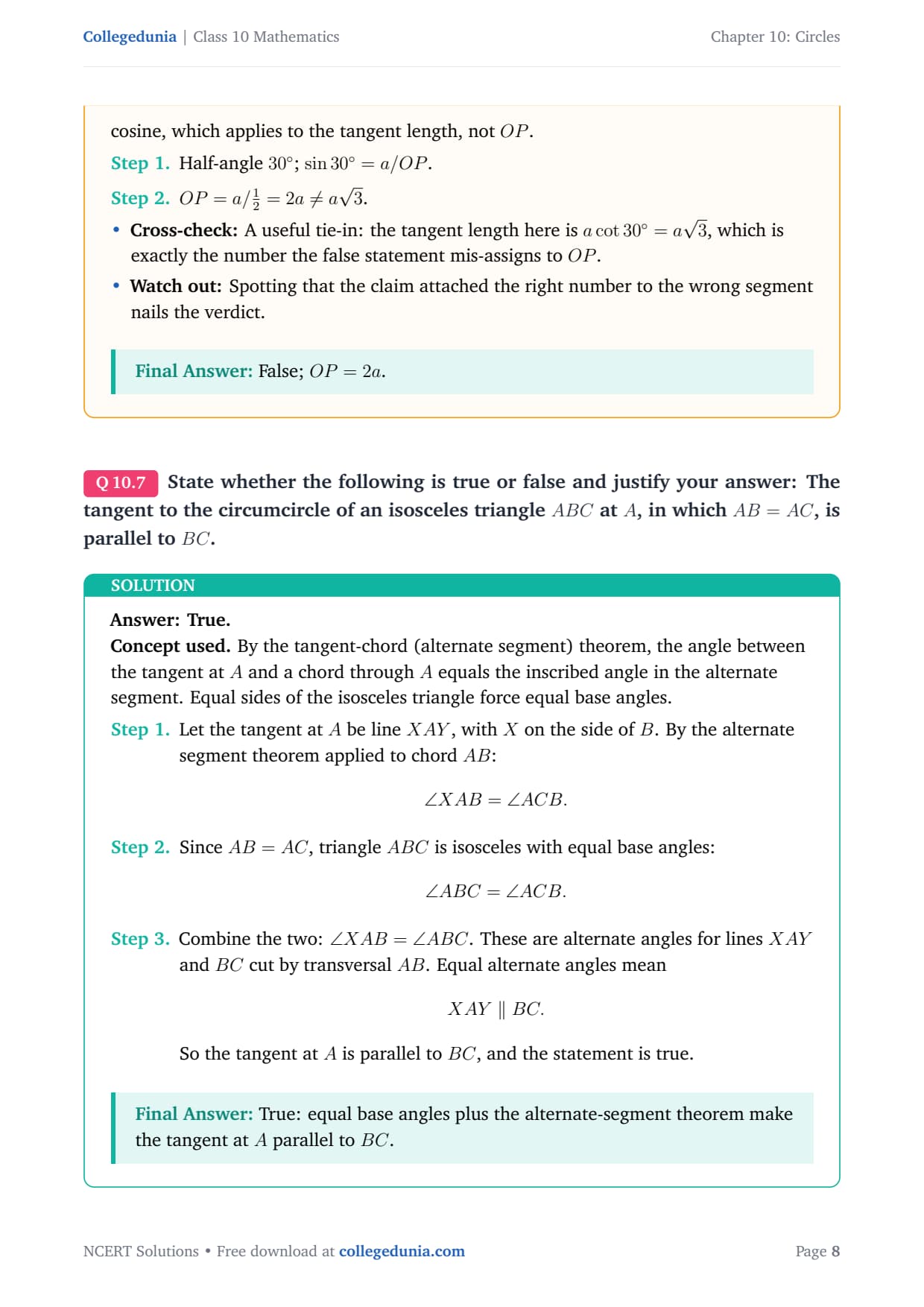
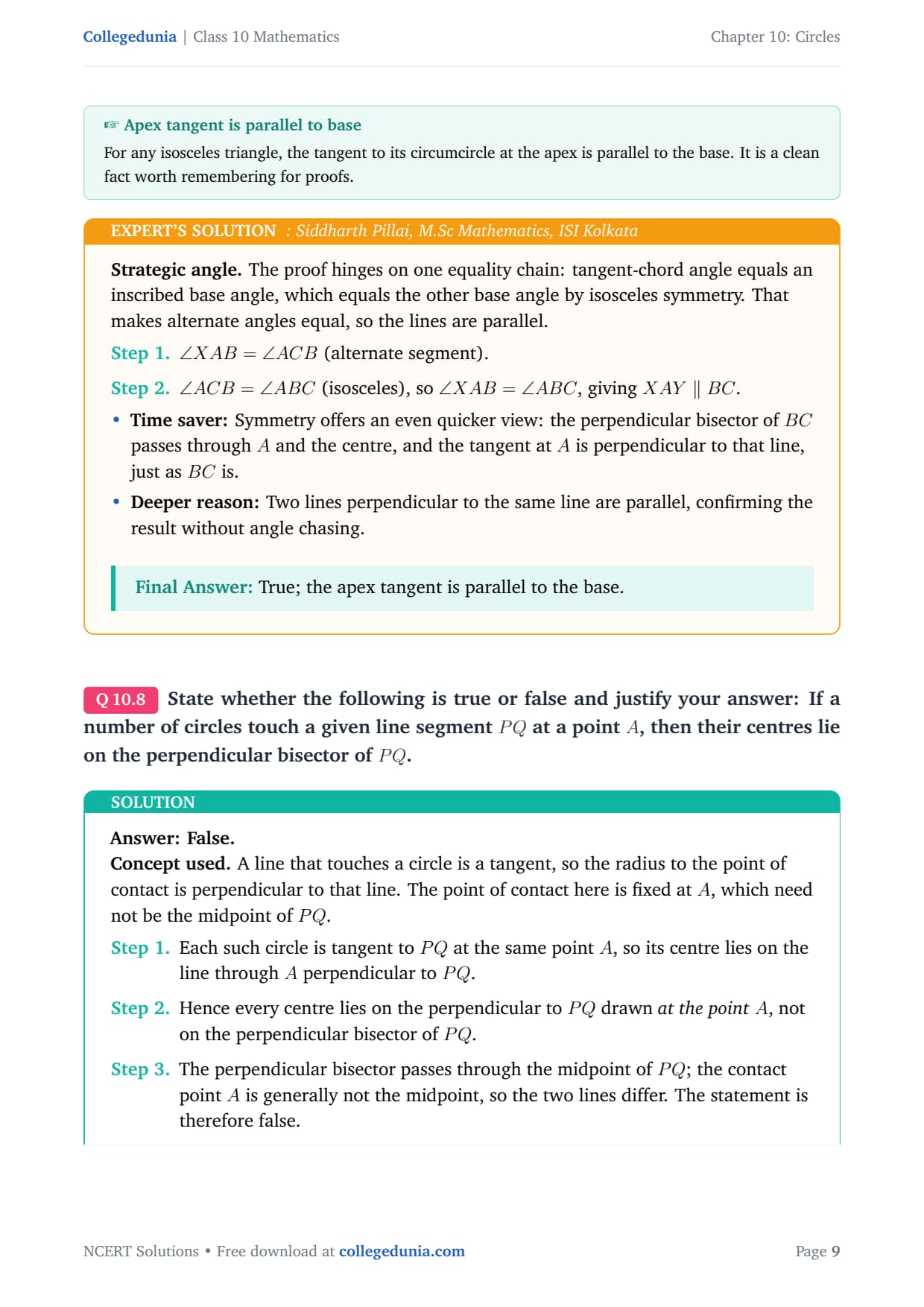
State whether the following is true or false and justify your answer: The tangent to the circumcircle of an isosceles triangle ABC at A, in which AB=AC, is parallel to BC.
Answer: True.
Concept used. By the tangent-chord (alternate segment) theorem, the angle between the tangent at A and a chord through A equals the inscribed angle in the alternate segment. Equal sides of the isosceles triangle force equal base angles.
Let the tangent at A be line XAY, with X on the side of B. By the alternate segment theorem applied to chord AB:
∠ XAB=∠ ACB.
Since AB=AC, triangle ABC is isosceles with equal base angles:
∠ ABC=∠ ACB.
Combine the two: ∠ XAB=∠ ABC. These are alternate angles for lines XAY and BC cut by transversal AB. Equal alternate angles mean
XAY∥ BC.
So the tangent at A is parallel to BC, and the statement is true.
True: equal base angles plus the alternate-segment theorem make the tangent at A parallel to BC.
SP
Siddharth Pillai
M.Sc Mathematics, ISI Kolkata
Verified Expert
Strategic angle. The proof hinges on one equality chain: tangent-chord angle equals an inscribed base angle, which equals the other base angle by isosceles symmetry. That makes alternate angles equal, so the lines are parallel.
Time saver: Symmetry offers an even quicker view: the perpendicular bisector of BC passes through A and the centre, and the tangent at A is perpendicular to that line, just as BC is.
Deeper reason: Two lines perpendicular to the same line are parallel, confirming the result without angle chasing.
True; the apex tangent is parallel to the base.
Q 10.8
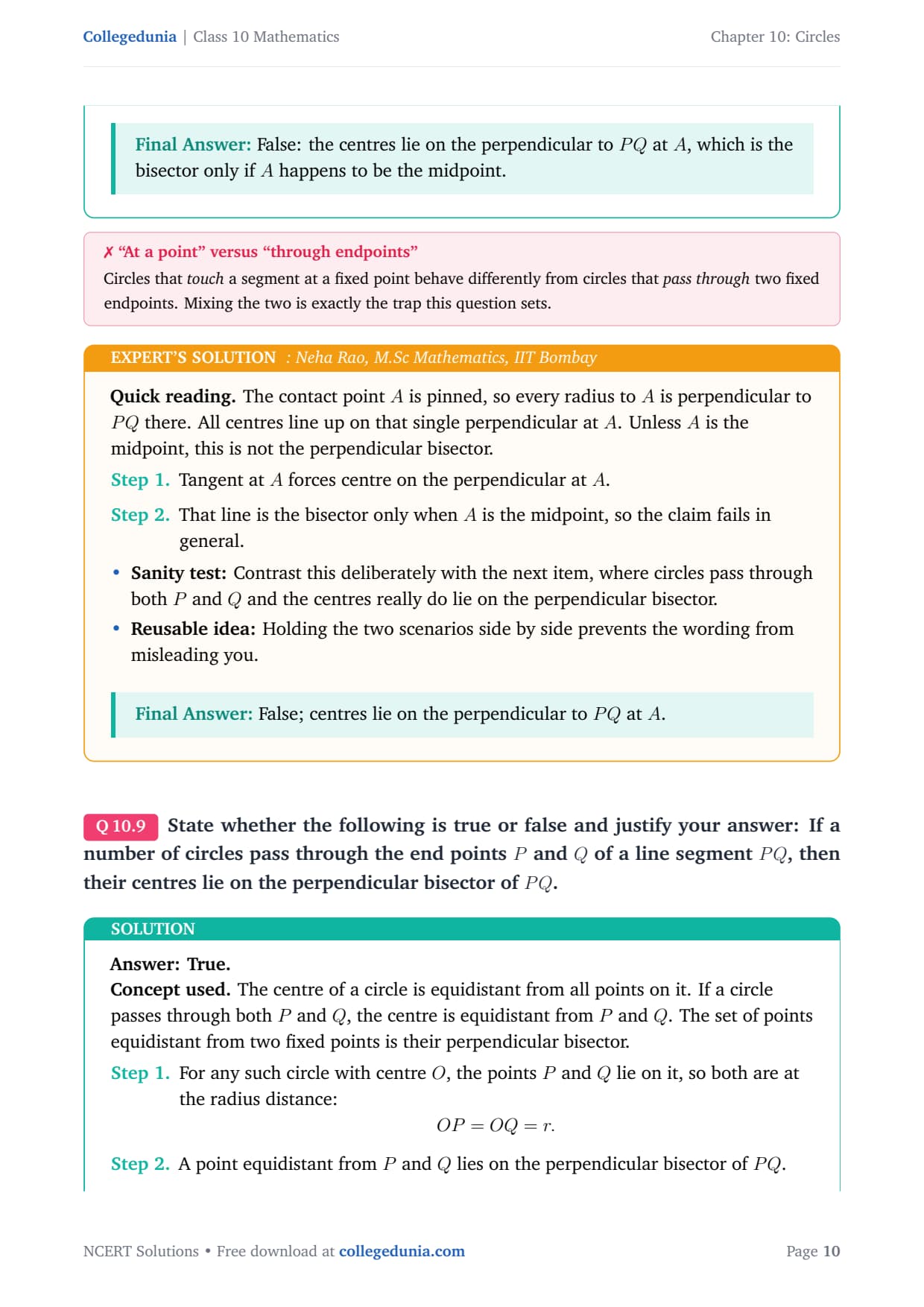
State whether the following is true or false and justify your answer: If a number of circles touch a given line segment PQ at a point A, then their centres lie on the perpendicular bisector of PQ.
Answer: False.
Concept used. A line that touches a circle is a tangent, so the radius to the point of contact is perpendicular to that line. The point of contact here is fixed at A, which need not be the midpoint of PQ.
Each such circle is tangent to PQ at the same point A, so its centre lies on the line through A perpendicular to PQ.
Hence every centre lies on the perpendicular to PQ drawn at the pointA, not on the perpendicular bisector of PQ.
The perpendicular bisector passes through the midpoint of PQ; the contact point A is generally not the midpoint, so the two lines differ. The statement is therefore false.
False: the centres lie on the perpendicular to PQ at A, which is the bisector only if A happens to be the midpoint.
NR
Neha Rao
M.Sc Mathematics, IIT Bombay
Verified Expert
Quick reading. The contact point A is pinned, so every radius to A is perpendicular to PQ there. All centres line up on that single perpendicular at A. Unless A is the midpoint, this is not the perpendicular bisector.
Tangent at A forces centre on the perpendicular at A.
That line is the bisector only when A is the midpoint, so the claim fails in general.
Sanity test: Contrast this deliberately with the next item, where circles pass through both P and Q and the centres really do lie on the perpendicular bisector.
Reusable idea: Holding the two scenarios side by side prevents the wording from misleading you.
False; centres lie on the perpendicular to PQ at A.
Q 10.9
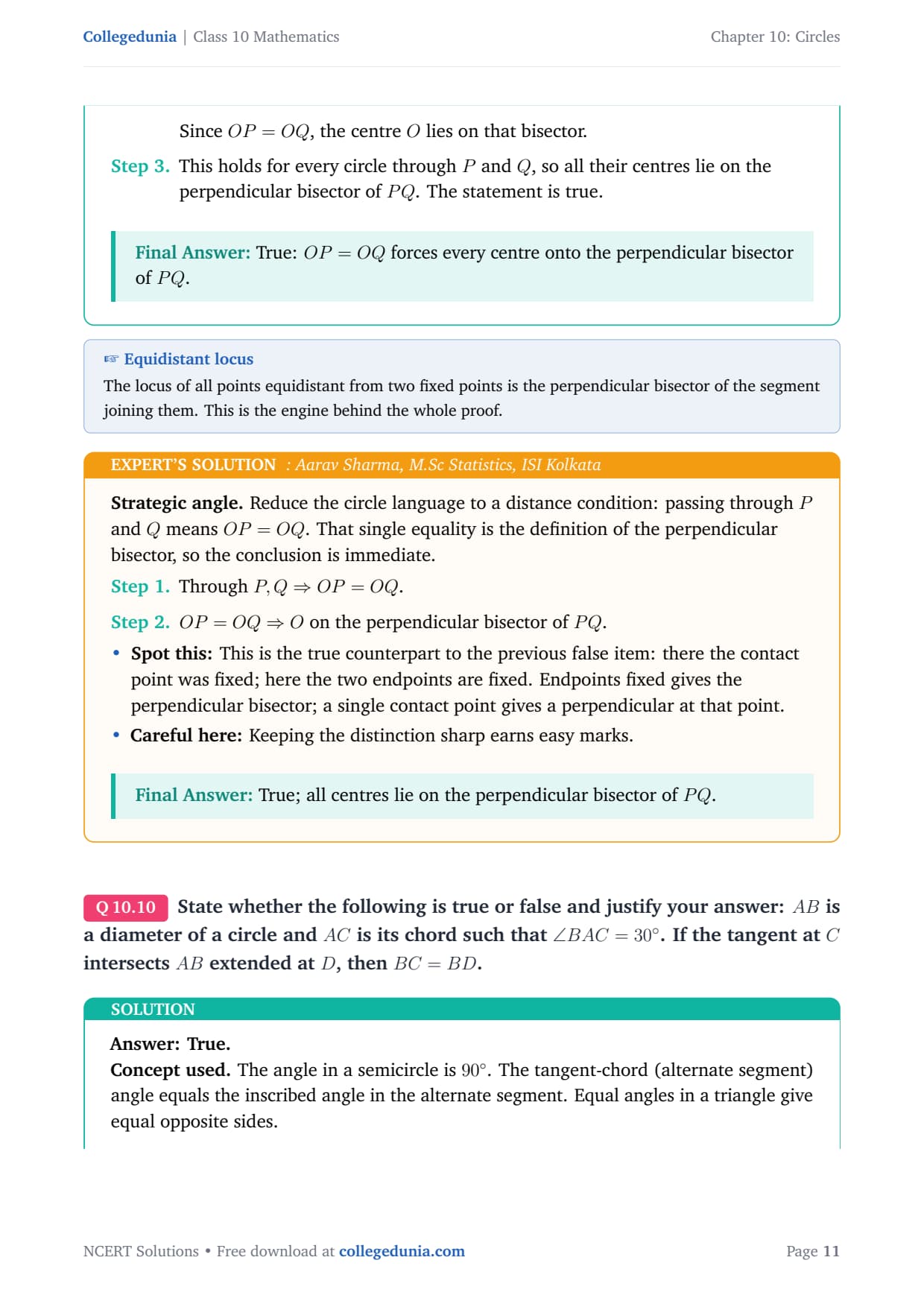
State whether the following is true or false and justify your answer: If a number of circles pass through the end points P and Q of a line segment PQ, then their centres lie on the perpendicular bisector of PQ.
Answer: True.
Concept used. The centre of a circle is equidistant from all points on it. If a circle passes through both P and Q, the centre is equidistant from P and Q. The set of points equidistant from two fixed points is their perpendicular bisector.
For any such circle with centre O, the points P and Q lie on it, so both are at the radius distance:
OP=OQ=r.
A point equidistant from P and Q lies on the perpendicular bisector of PQ. Since OP=OQ, the centre O lies on that bisector.
This holds for every circle through P and Q, so all their centres lie on the perpendicular bisector of PQ. The statement is true.
True: OP=OQ forces every centre onto the perpendicular bisector of PQ.
AS
Aarav Sharma
M.Sc Statistics, ISI Kolkata
Verified Expert
Strategic angle. Reduce the circle language to a distance condition: passing through P and Q means OP=OQ. That single equality is the definition of the perpendicular bisector, so the conclusion is immediate.
Through P,Q⇒ OP=OQ.
OP=OQ⇒ O on the perpendicular bisector of PQ.
Spot this: This is the true counterpart to the previous false item: there the contact point was fixed; here the two endpoints are fixed. Endpoints fixed gives the perpendicular bisector; a single contact point gives a perpendicular at that point.
Careful here: Keeping the distinction sharp earns easy marks.
True; all centres lie on the perpendicular bisector of PQ.
Q 10.10
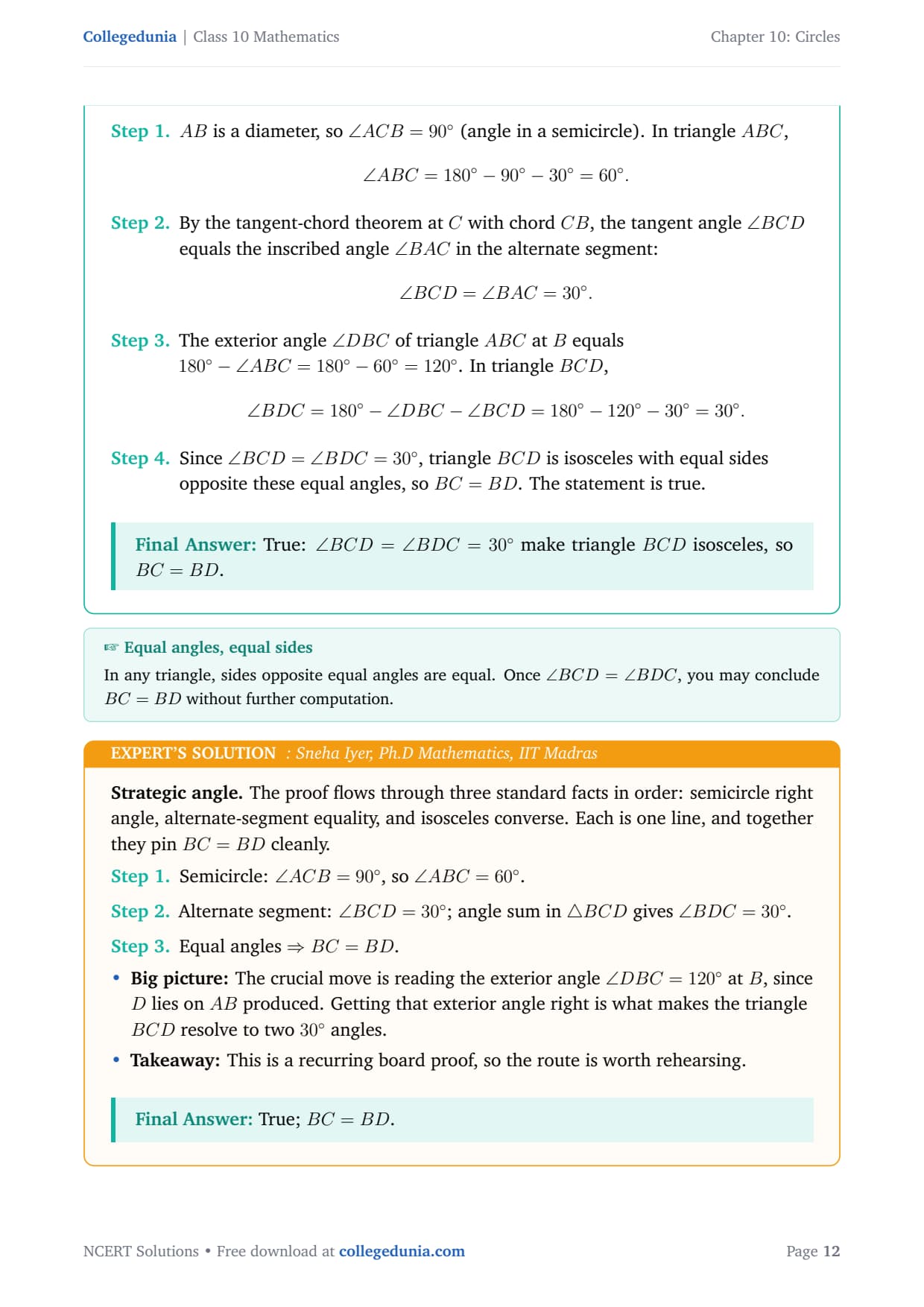
State whether the following is true or false and justify your answer: AB is a diameter of a circle and AC is its chord such that ∠ BAC=30∘. If the tangent at C intersects AB extended at D, then BC=BD.
Answer: True.
Concept used. The angle in a semicircle is 90∘. The tangent-chord (alternate segment) angle equals the inscribed angle in the alternate segment. Equal angles in a triangle give equal opposite sides.
AB is a diameter, so ∠ ACB=90∘ (angle in a semicircle). In triangle ABC,
∠ ABC=180∘-90∘-30∘=60∘.
By the tangent-chord theorem at C with chord CB, the tangent angle ∠ BCD equals the inscribed angle ∠ BAC in the alternate segment:
∠ BCD=∠ BAC=30∘.
The exterior angle ∠ DBC of triangle ABC at B equals 180∘-∠ ABC=180∘-60∘=120∘. In triangle BCD,
∠ BDC=180∘-∠ DBC-∠ BCD=180∘-120∘-30∘=30∘.
Since ∠ BCD=∠ BDC=30∘, triangle BCD is isosceles with equal sides opposite these equal angles, so BC=BD. The statement is true.
True: ∠ BCD=∠ BDC=30∘ make triangle BCD isosceles, so BC=BD.
SI
Sneha Iyer
Ph.D Mathematics, IIT Madras
Verified Expert
Strategic angle. The proof flows through three standard facts in order: semicircle right angle, alternate-segment equality, and isosceles converse. Each is one line, and together they pin BC=BD cleanly.
Semicircle: ∠ ACB=90∘, so ∠ ABC=60∘.
Alternate segment: ∠ BCD=30∘; angle sum in BCD gives ∠ BDC=30∘.
Equal angles ⇒ BC=BD.
Big picture: The crucial move is reading the exterior angle ∠ DBC=120∘ at B, since D lies on AB produced. Getting that exterior angle right is what makes the triangle BCD resolve to two 30∘ angles.
Takeaway: This is a recurring board proof, so the route is worth rehearsing.
True; BC=BD.
Student Feedback
Students who practised Exercise 10.2 with step-by-step justifications reported a 20-30% improvement in proof-based Circles questions. Most found the supplementary angle rule (Q11) and the alternate-segment question (Q20) the most useful for board exam prep.
Circles Class 10 Maths NCERT Exemplar Solutions Exercise 10.2 FAQs
Ques. What is covered in NCERT Exemplar Class 10 Maths Chapter 10 Circles Exercise 10.2?
Ans. Exercise 10.2 of the NCERT Exemplar Class 10 Maths Chapter 10 contains 10 True or False questions with reasoning. The topics covered include the supplementary angle rule for tangents, tangent length compared to radius and to OP, the zero-degree angle case for parallel tangents, trig-based OP calculations for 90° and 60° tangent angles, the alternate segment theorem for isosceles triangle circumcircles, and locus of centres for circles touching a segment at a point vs. circles through two endpoints. All content is aligned with the 2026-27 NCERT syllabus.
Ques. What is the supplementary angle rule for tangents tested in Exercise 10.2 Q1?
Ans. When two tangents are drawn from an external point to a circle, the angle between the tangents and the central angle subtended by the chord joining the two contact points are supplementary. That is, ∠APB + ∠AOB = 180°. This follows from the two right angles in the kite OAPB. So if the central angle is 60°, the tangent angle is 120°, not 60°.
Ques. How do I find OP when the angle between tangents is given, as in Q5 and Q6?
Ans. Use the right triangle formed by the centre O, the contact point A, and the external point P. The radius OA = a is opposite the half-angle at P, and OP is the hypotenuse. So sin(half-angle) = a/OP, giving OP = a/sin(half-angle). For a 90° tangent angle, the half-angle is 45° and OP = a√2. For a 60° tangent angle, the half-angle is 30° and OP = 2a (not a√3).
Ques. Why do circles touching a segment at a point have centres on a different line than circles through the endpoints?
Ans. When circles touch a segment PQ at a fixed point A, the radius to A must be perpendicular to PQ, so all centres lie on the line perpendicular to PQ at point A (not the perpendicular bisector, unless A is the midpoint). When circles pass through both endpoints P and Q, the centre is equidistant from both, so it lies on the perpendicular bisector of PQ. The two situations are fundamentally different.
Ques. How is Exercise 10.2 useful for Class 10 CBSE Board exams?
Ans. Exercise 10.2 builds the geometric reasoning skills that board exams test in 3-mark and 4-mark proof-type questions on Circles. The alternate segment theorem (Q7, Q10), the tangent-radius perpendicularity (Q3, Q8), and the supplementary angle rule (Q1) are all standard board exam topics. Practising the full justification for each true/false statement trains students to write complete, mark-scoring proofs rather than just stating a result.







Comments