Junior-Class Mentor, TFI Fellow | Updated 3+ months ago
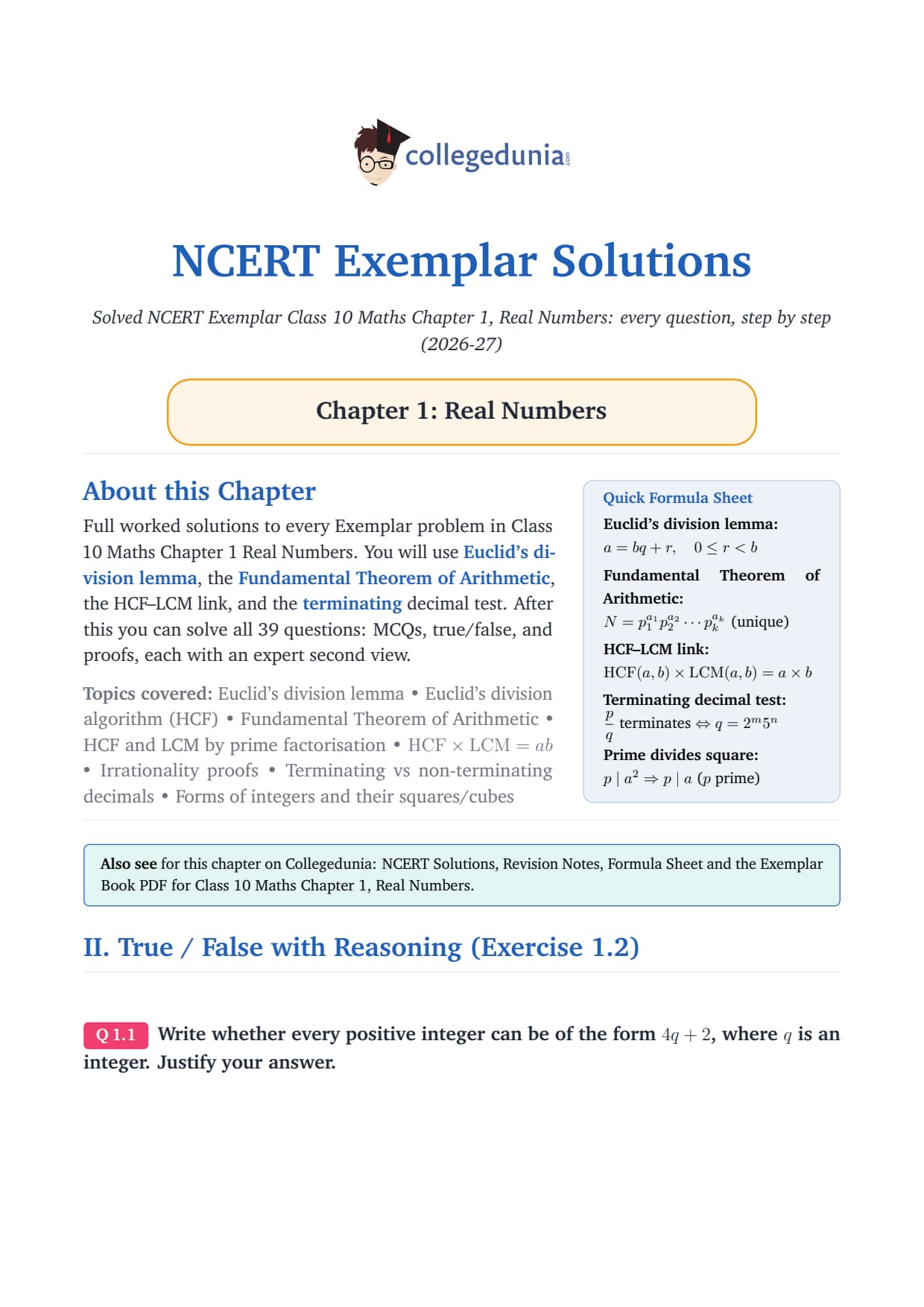
Students often lose marks on the "prove or justify" questions in Real Numbers. NCERT Exemplar Class 10 Maths Chapter 1 Real Numbers Exercise 1.2 has 10 short-answer and justification questions, set to the 2026-27 NCERT syllabus. Each solution below walks through the logic step by step, with an expert second view.
Exercise type: Short-answer / True-False with Justification, 10 questions (Q11-Q20)
Key concepts: Residue classes mod 3/4, product of consecutive integers, composite numbers, HCF-LCM consistency, terminating decimals
CBSE board relevance: Justify-type questions in this style appear frequently in board assessments for Chapter 1
The article below has all 10 justification questions solved, each with an expert view, aligned to the 2026-27 NCERT syllabus.
These Exemplar Solutions for Exercise 1.2 are curated by subject experts, mapped to the 2026-27 rationalised NCERT, and verified against the CBSE board exam pattern for Class 10 Mathematics.
Solved by Collegedunia Every question in Exercise 1.2 is solved by Maths experts. Each solution has a "Concept used" section and an Expert view, so you grasp the reasoning, not just the answer.
Exercise 1.2 at a Glance · 10 Questions (Q11-Q20), Chapter 1 Real Numbers, Class 10 Maths Exemplar 2026-27
Exercise 1.2 is the justification section of the NCERT Exemplar for Real Numbers. You have to write out full reasoning, not just pick an option. The question types are listed below.
Question
Topic Tested
Level
Q11
Can every positive integer be of the form 4q+2?
Easy
Q12
Product of two consecutive integers divisible by 2
Easy
Q13
Product of three consecutive integers divisible by 6
Medium
Q14
Square of any integer of the form 3m+2?
Medium
Q15
Square of 3q+1 is always 3m+1
Medium
Q16
HCF(525, 3000) from common divisors list
Easy
Q17
Why is 3 × 5 × 7 + 7 composite?
Medium
Q18
Can HCF = 18 and LCM = 380 for some pair?
Medium
Q19
Terminating or repeating: 987/10500?
Hard
Q20
Prime factors of q when decimal 327.7081 = p/q
Medium
Key rule: For residue-class questions (Q11, Q14, Q15), always write out all possible forms from Euclid's lemma, then test each. Never check a few examples and stop.
The formulas and rules you need for Exercise 1.2 are listed below.
Formula / Rule
Statement
Euclid's Division Lemma
a = bq + r, where 0 ≤ r < b
Residue classes mod 4
Every integer is 4q, 4q+1, 4q+2 or 4q+3
Residue classes mod 3
Every integer is 3q, 3q+1 or 3q+2
HCF divides LCM
For any two numbers, HCF must divide LCM exactly
Terminating decimal test
p/q (in lowest terms) terminates ⇔ q = 2m5n
Composite number
A number with more than two factors; can be written as a product of two integers both > 1
Common Mistake to Avoid: In Q18, students often try to construct the pair of numbers directly. Always check first whether HCF divides LCM. If it does not, the pair is impossible and no construction is needed.
Key Concept Illustrations for Real Numbers Class 10 Maths
The two images below sum up the visual ideas behind residue classes and the HCF-LCM relationship, both central to Exercise 1.2.
The first image maps the residue classes used in the justify-type questions. The second one links HCF, LCM and terminating decimals in a single view.
All Exercise 1.2 Questions with Step-by-Step Solutions
II. True / False with Reasoning (Exercise 1.2)
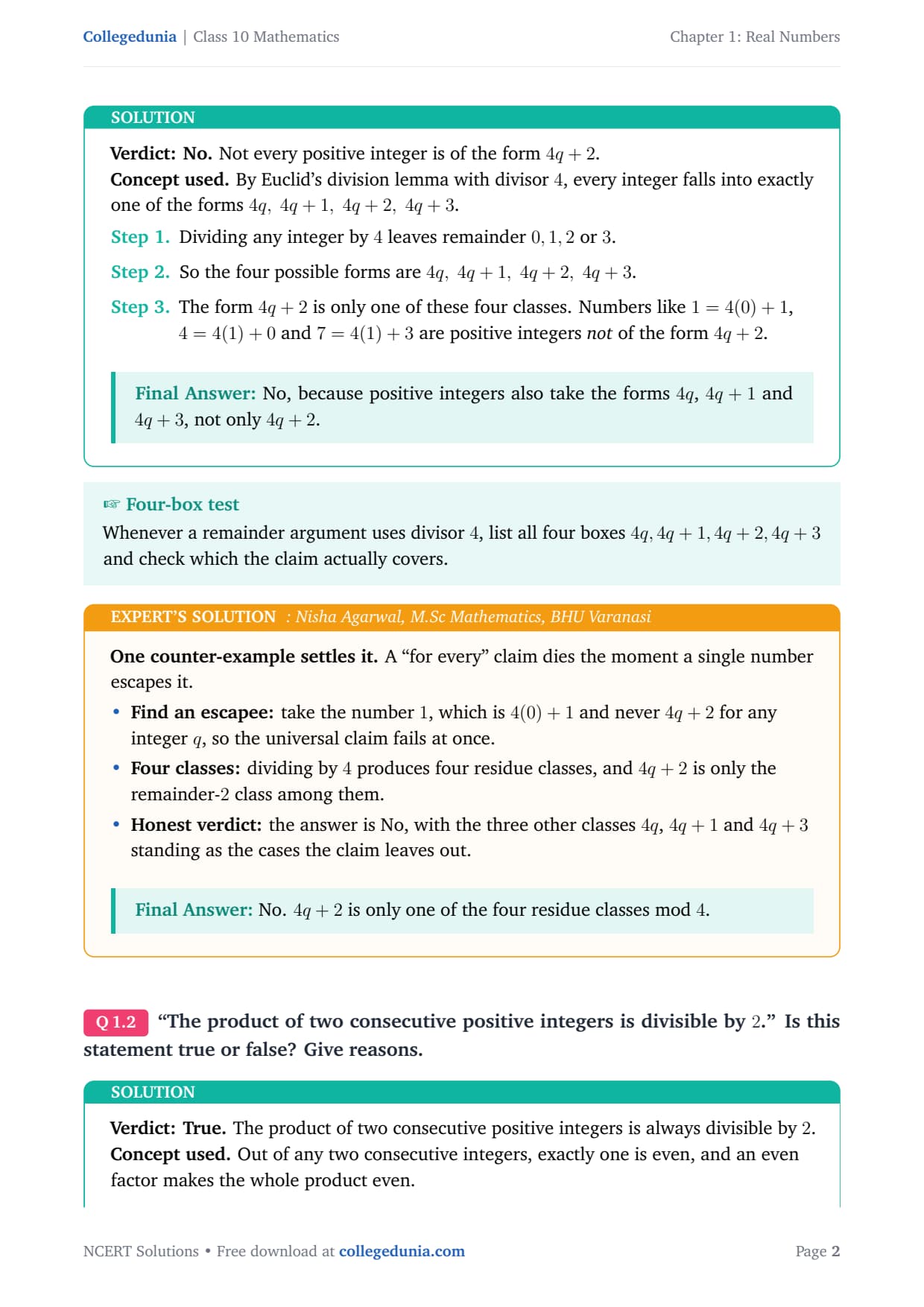
Q 1.1
Write whether every positive integer can be of the form 4q+2, where q is an integer. Justify your answer.
Verdict: No. Not every positive integer is of the form 4q+2.
Concept used. By Euclid's division lemma with divisor 4, every
integer falls into exactly one of the forms 4q, 4q+1, 4q+2, 4q+3.
Dividing any integer by 4 leaves remainder 0,1,2 or 3.
So the four possible forms are 4q, 4q+1, 4q+2, 4q+3.
The form 4q+2 is only one of these four classes. Numbers like
1=4(0)+1, 4=4(1)+0 and 7=4(1)+3 are positive integers
not of the form 4q+2.
No, because positive integers also take the forms 4q, 4q+1
and 4q+3, not only 4q+2.
NA
Nisha Agarwal
M.Sc Mathematics, BHU Varanasi
Verified Expert
One counter-example settles it. A ``for every'' claim dies the
moment a single number escapes it.
Find an escapee: take the number 1, which is 4(0)+1
and never 4q+2 for any integer q, so the universal claim fails
at once.
Four classes: dividing by 4 produces four residue
classes, and 4q+2 is only the remainder-2 class among them.
Honest verdict: the answer is No, with the three other
classes 4q, 4q+1 and 4q+3 standing as the cases the claim
leaves out.
No. 4q+2 is only one of the four residue classes mod 4.
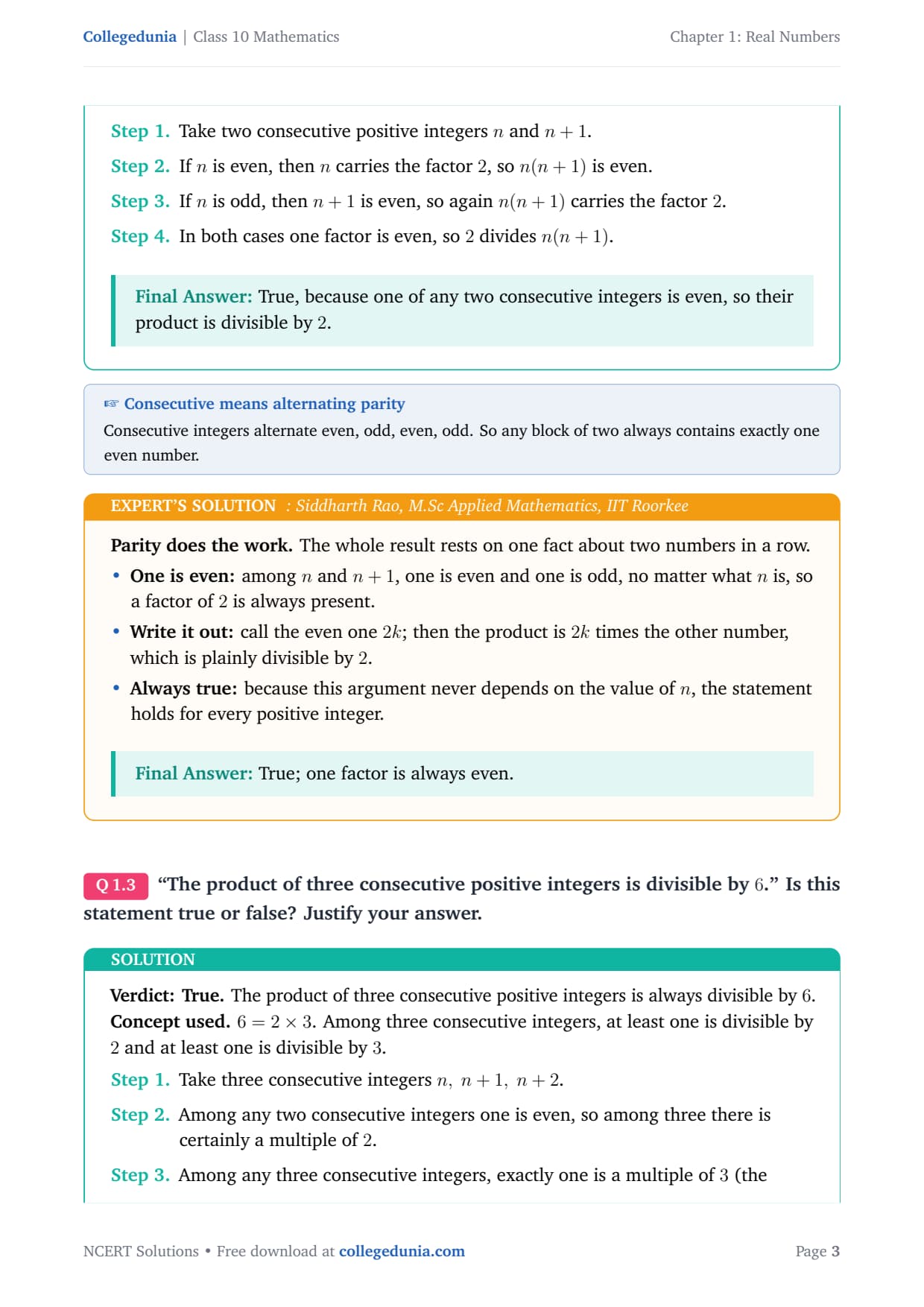
Q 1.2
``The product of two consecutive positive integers is divisible by 2.'' Is this statement true or false? Give reasons.
Verdict: True. The product of two consecutive positive integers
is always divisible by 2.
Concept used. Out of any two consecutive integers, exactly one
is even, and an even factor makes the whole product even.
Take two consecutive positive integers n and n+1.
If n is even, then n carries the factor 2, so n(n+1) is
even.
If n is odd, then n+1 is even, so again n(n+1) carries the
factor 2.
In both cases one factor is even, so 2 divides n(n+1).
True, because one of any two consecutive integers is even, so
their product is divisible by 2.
SR
Siddharth Rao
M.Sc Applied Mathematics, IIT Roorkee
Verified Expert
Parity does the work. The whole result rests on one fact about
two numbers in a row.
One is even: among n and n+1, one is even and one is
odd, no matter what n is, so a factor of 2 is always present.
Write it out: call the even one 2k; then the product is
2k times the other number, which is plainly divisible by 2.
Always true: because this argument never depends on the
value of n, the statement holds for every positive integer.
True; one factor is always even.
Q 1.3
``The product of three consecutive positive integers is divisible by 6.'' Is this statement true or false? Justify your answer.
Verdict: True. The product of three consecutive positive
integers is always divisible by 6.
Concept used.6=2× 3. Among three consecutive integers,
at least one is divisible by 2 and at least one is divisible by 3.
Take three consecutive integers n, n+1, n+2.
Among any two consecutive integers one is even, so among three
there is certainly a multiple of 2.
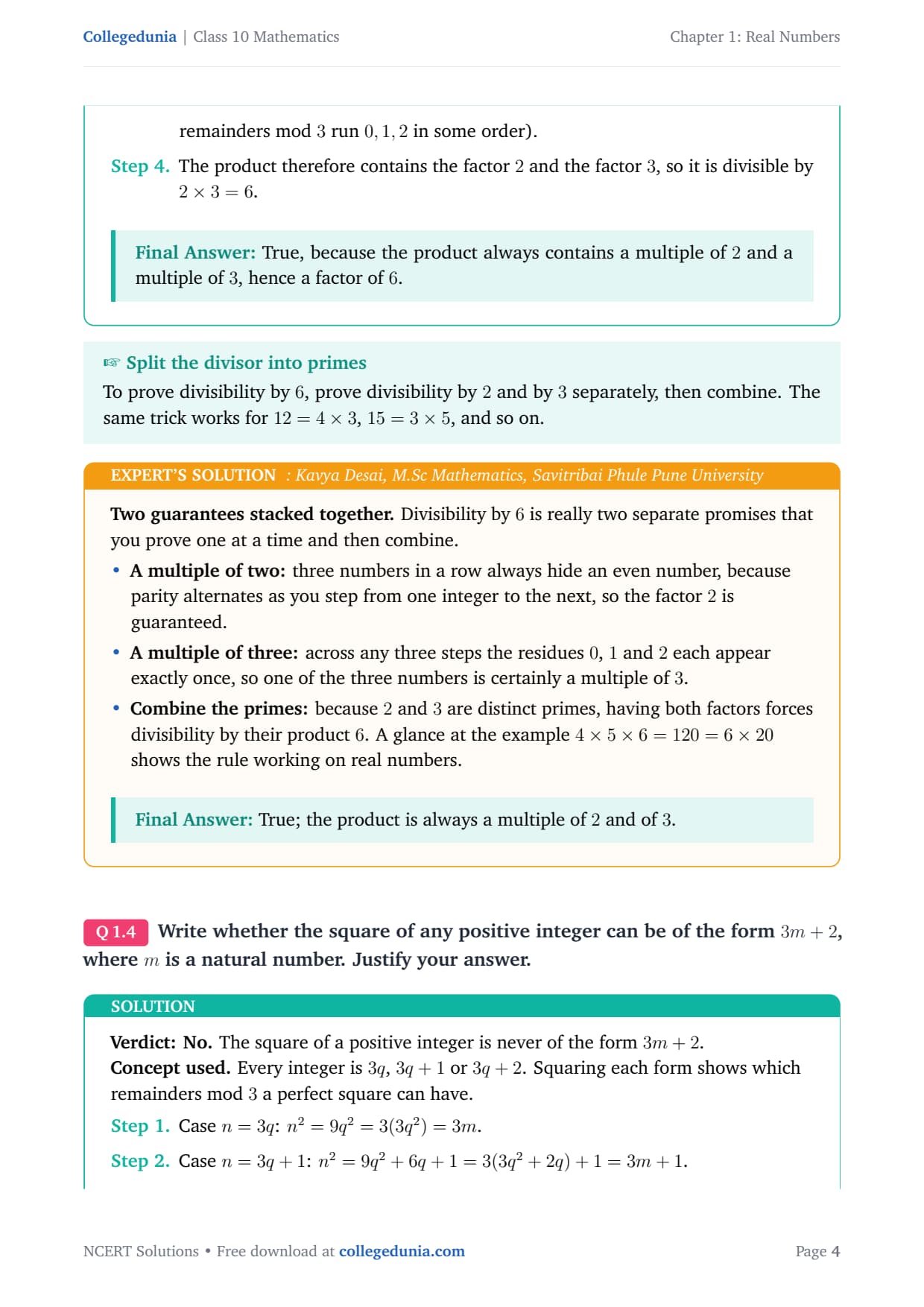
Among any three consecutive integers, exactly one is a multiple
of 3 (the remainders mod 3 run 0,1,2 in some order).
The product therefore contains the factor 2 and the factor
3, so it is divisible by 2× 3=6.
True, because the product always contains a multiple of 2
and a multiple of 3, hence a factor of 6.
KD
Kavya Desai
M.Sc Mathematics, Savitribai Phule Pune University
Verified Expert
Two guarantees stacked together. Divisibility by 6 is really
two separate promises that you prove one at a time and then combine.
A multiple of two: three numbers in a row always hide an
even number, because parity alternates as you step from one
integer to the next, so the factor 2 is guaranteed.
A multiple of three: across any three steps the residues
0, 1 and 2 each appear exactly once, so one of the three
numbers is certainly a multiple of 3.
Combine the primes: because 2 and 3 are distinct
primes, having both factors forces divisibility by their product
6. A glance at the example 456=120=620 shows
the rule working on real numbers.
True; the product is always a multiple of 2 and of 3.
Q 1.4
Write whether the square of any positive integer can be of the form 3m+2, where m is a natural number. Justify your answer.
Verdict: No. The square of a positive integer is never of the
form 3m+2.
Concept used. Every integer is 3q, 3q+1 or 3q+2. Squaring
each form shows which remainders mod 3 a perfect square can have.
Case n=3q: n2=9q2=3(3q2)=3m.
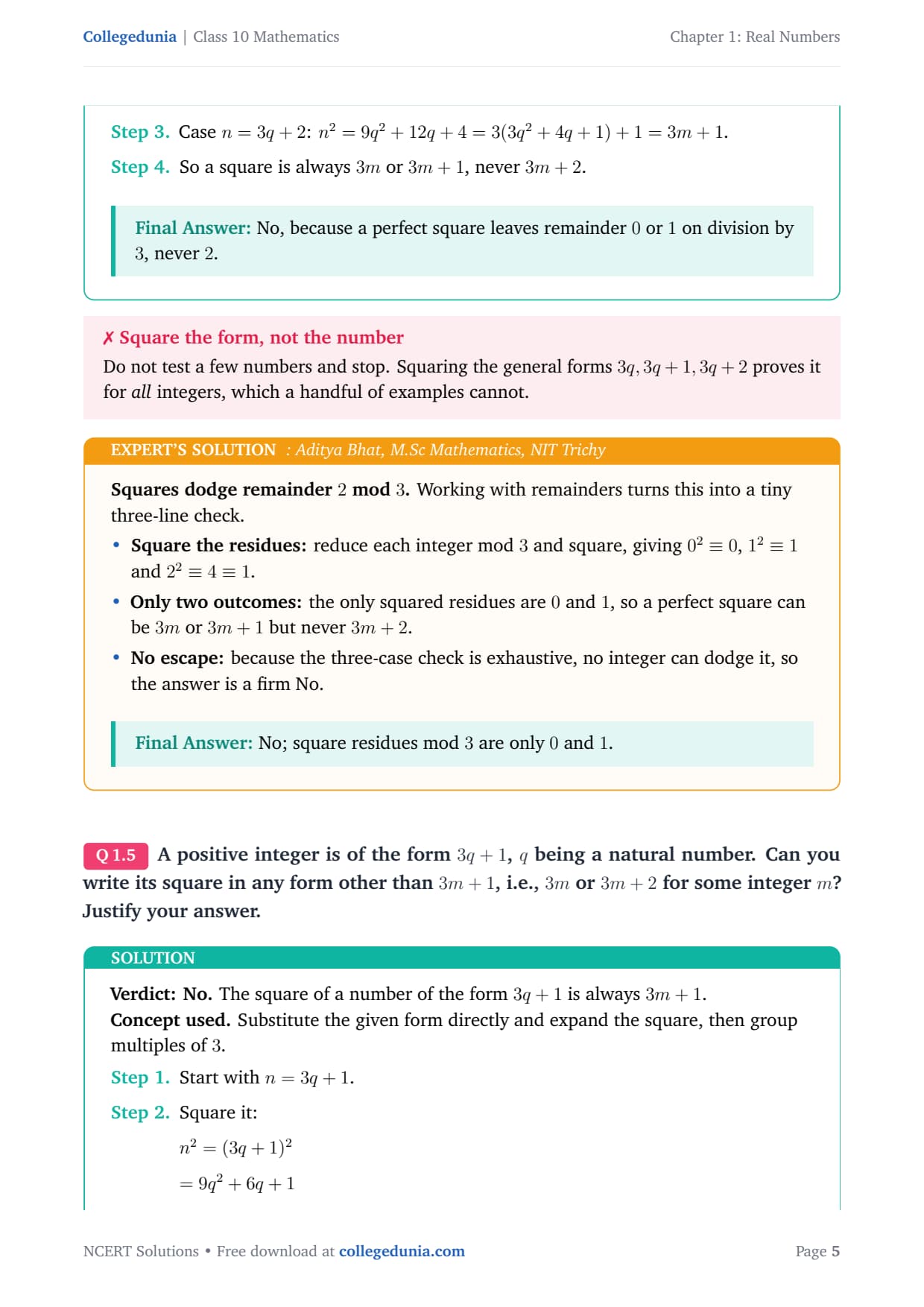
Case n=3q+1:
n2=9q2+6q+1=3(3q2+2q)+1=3m+1.
Case n=3q+2:
n2=9q2+12q+4=3(3q2+4q+1)+1=3m+1.
So a square is always 3m or 3m+1, never 3m+2.
No, because a perfect square leaves remainder 0 or 1 on
division by 3, never 2.
AB
Aditya Bhat
M.Sc Mathematics, NIT Trichy
Verified Expert
Squares dodge remainder 2 mod 3. Working with remainders
turns this into a tiny three-line check.
Square the residues: reduce each integer mod 3 and
square, giving 020, 121 and
2241.
Only two outcomes: the only squared residues are 0 and
1, so a perfect square can be 3m or 3m+1 but never 3m+2.
No escape: because the three-case check is exhaustive, no
integer can dodge it, so the answer is a firm No.
No; square residues mod 3 are only 0 and 1.
Q 1.5
A positive integer is of the form 3q+1, q being a natural number. Can you write its square in any form other than 3m+1, i.e., 3m or 3m+2 for some integer m? Justify your answer.
Verdict: No. The square of a number of the form 3q+1 is always
3m+1.
Concept used. Substitute the given form directly and expand the
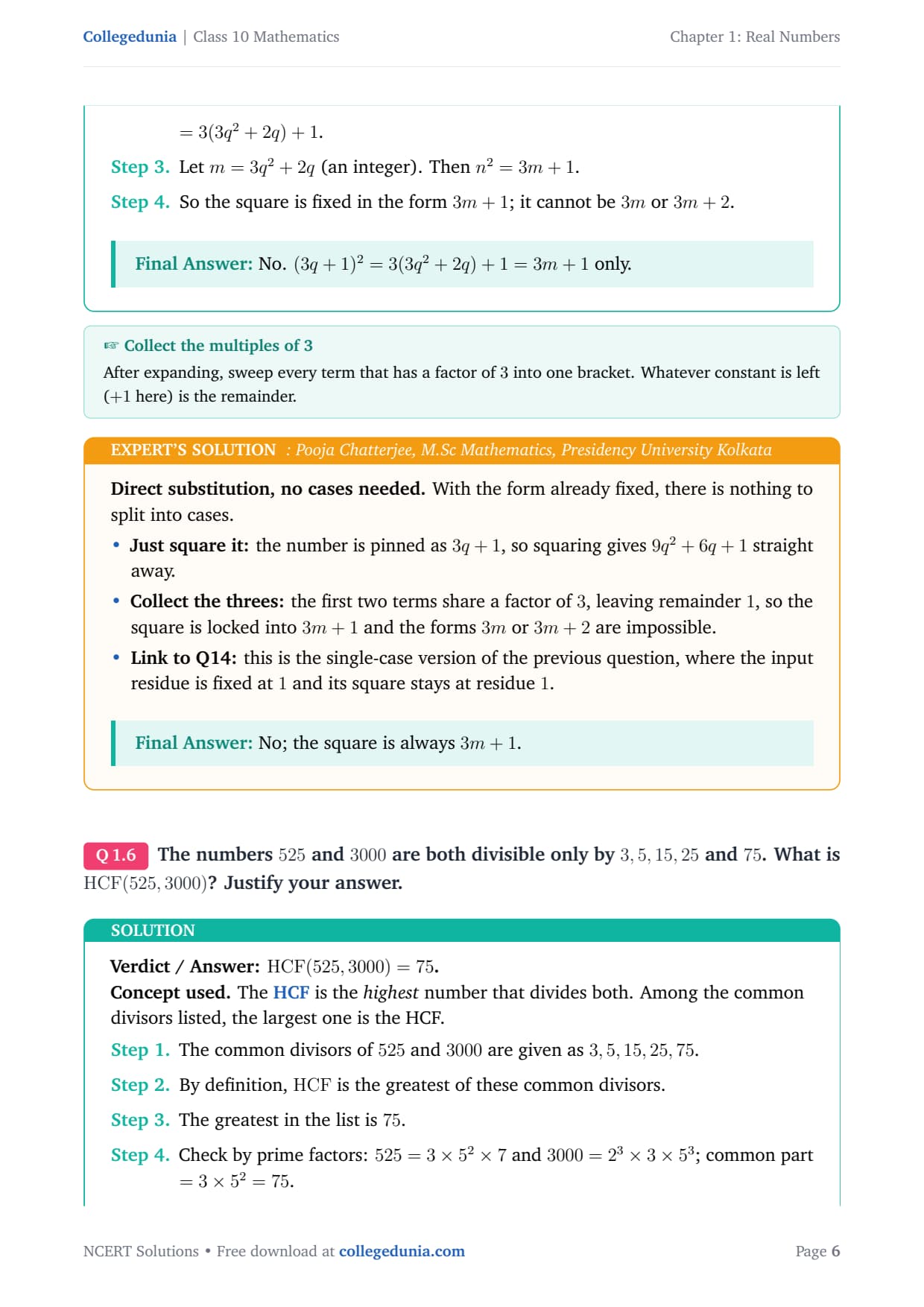
square, then group multiples of 3.
So the square is fixed in the form 3m+1; it cannot be 3m or
3m+2.
No. (3q+1)2=3(3q2+2q)+1=3m+1 only.
PC
Pooja Chatterjee
M.Sc Mathematics, Presidency University Kolkata
Verified Expert
Direct substitution, no cases needed. With the form already
fixed, there is nothing to split into cases.
Just square it: the number is pinned as 3q+1, so
squaring gives 9q2+6q+1 straight away.
Collect the threes: the first two terms share a factor of
3, leaving remainder 1, so the square is locked into 3m+1 and
the forms 3m or 3m+2 are impossible.
Link to Q14: this is the single-case version of the
previous question, where the input residue is fixed at 1 and its
square stays at residue 1.
No; the square is always 3m+1.
Q 1.6
The numbers 525 and 3000 are both divisible only by 3,5,15,25 and 75. What is HCF(525,3000)? Justify your answer.
Verdict / Answer: HCF(525,3000)=75.
Concept used. The HCF is the highest number
that divides both. Among the common divisors listed, the largest one is
the HCF.
The common divisors of 525 and 3000 are given as
3,5,15,25,75.
By definition, HCF is the greatest of these common
divisors.
The greatest in the list is 75.
Check by prime factors: 525=3× 52× 7 and
3000=23× 3× 53; common part =3× 52=75.
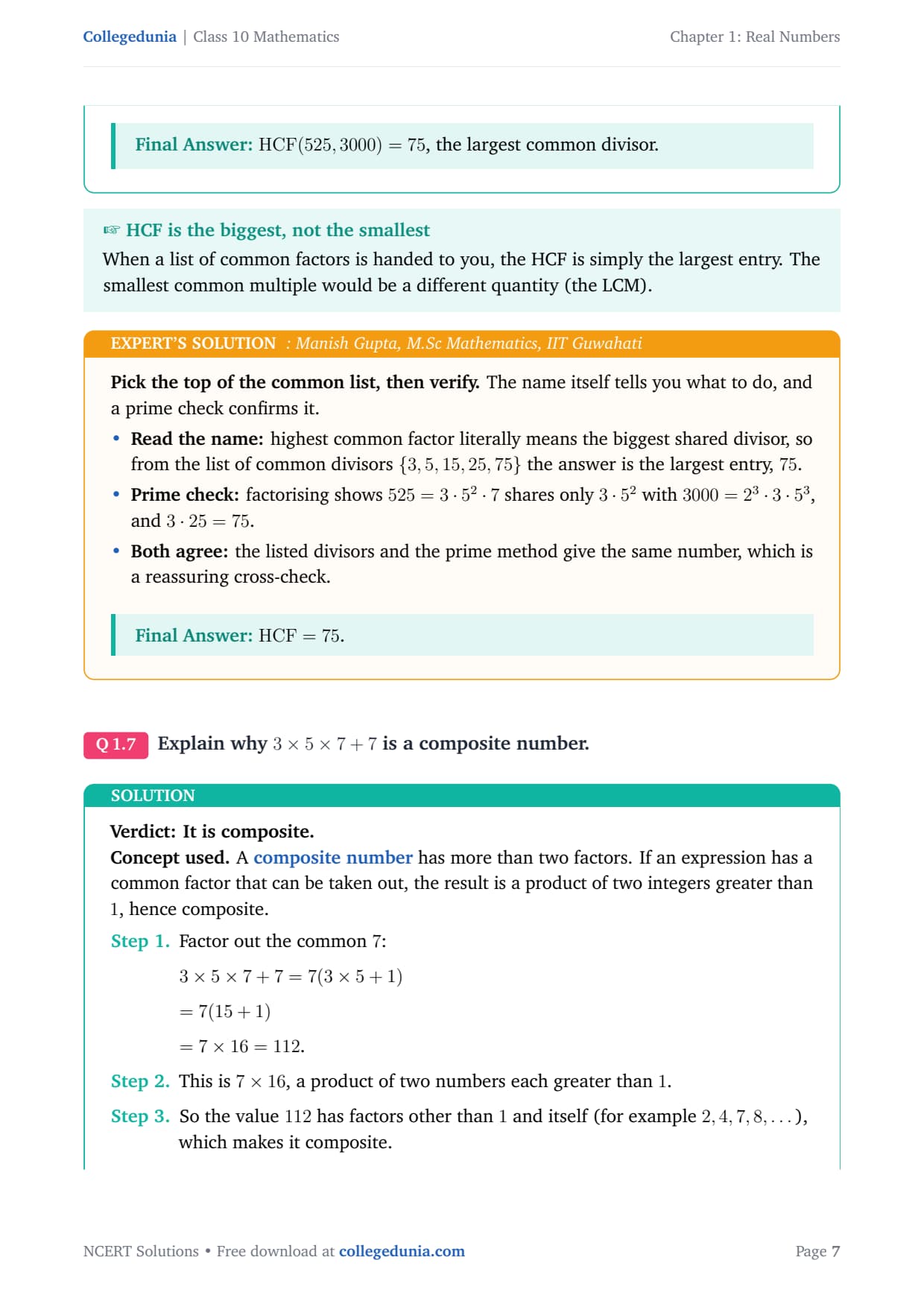
HCF(525,3000)=75, the largest common divisor.
MG
Manish Gupta
M.Sc Mathematics, IIT Guwahati
Verified Expert
Pick the top of the common list, then verify. The name itself
tells you what to do, and a prime check confirms it.
Read the name: highest common factor literally means the
biggest shared divisor, so from the list of common divisors
3,5,15,25,75 the answer is the largest entry, 75.
Prime check: factorising shows 525=3527
shares only 352 with 3000=23353, and
325=75.
Both agree: the listed divisors and the prime method give
the same number, which is a reassuring cross-check.
HCF=75.
Q 1.7
Explain why 3× 5× 7+7 is a composite number.
Verdict: It is composite.
Concept used. A composite number has more than two
factors. If an expression has a common factor that can be taken out,
the result is a product of two integers greater than 1, hence
composite.
Factor out the common 7:
[] 3× 5× 7+7=7(3× 5+1)
[] =7(15+1)
[] =7× 16=112.
This is 7× 16, a product of two numbers each greater than
1.
So the value 112 has factors other than 1 and itself (for
example 2,4,7,8,), which makes it composite.
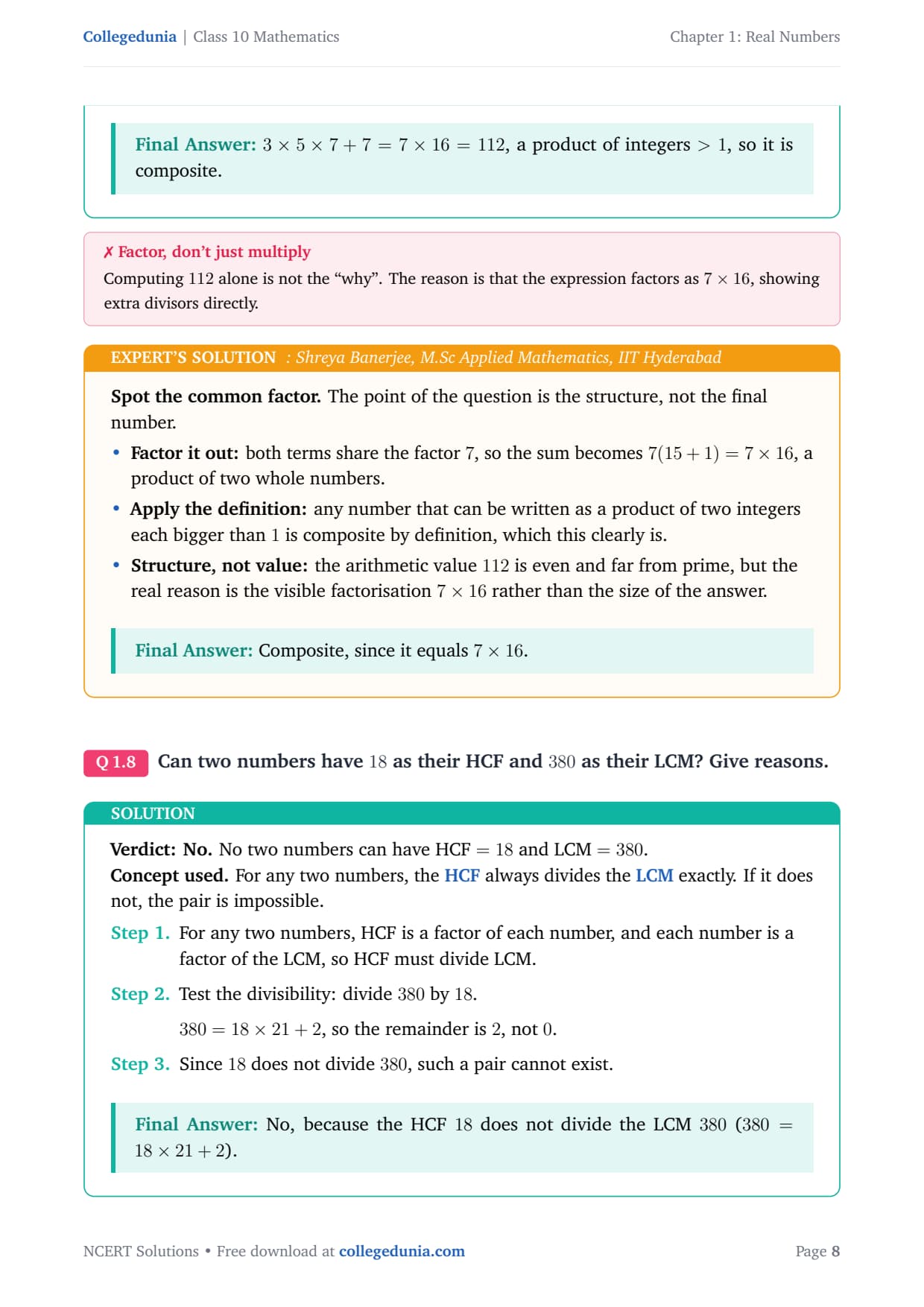
357+7=716=112, a product of integers
>1, so it is composite.
SB
Shreya Banerjee
M.Sc Applied Mathematics, IIT Hyderabad
Verified Expert
Spot the common factor. The point of the question is the
structure, not the final number.
Factor it out: both terms share the factor 7, so the
sum becomes 7(15+1)=716, a product of two whole numbers.
Apply the definition: any number that can be written as a
product of two integers each bigger than 1 is composite by
definition, which this clearly is.
Structure, not value: the arithmetic value 112 is even
and far from prime, but the real reason is the visible
factorisation 716 rather than the size of the answer.
Composite, since it equals 716.
Q 1.8
Can two numbers have 18 as their HCF and 380 as their LCM? Give reasons.
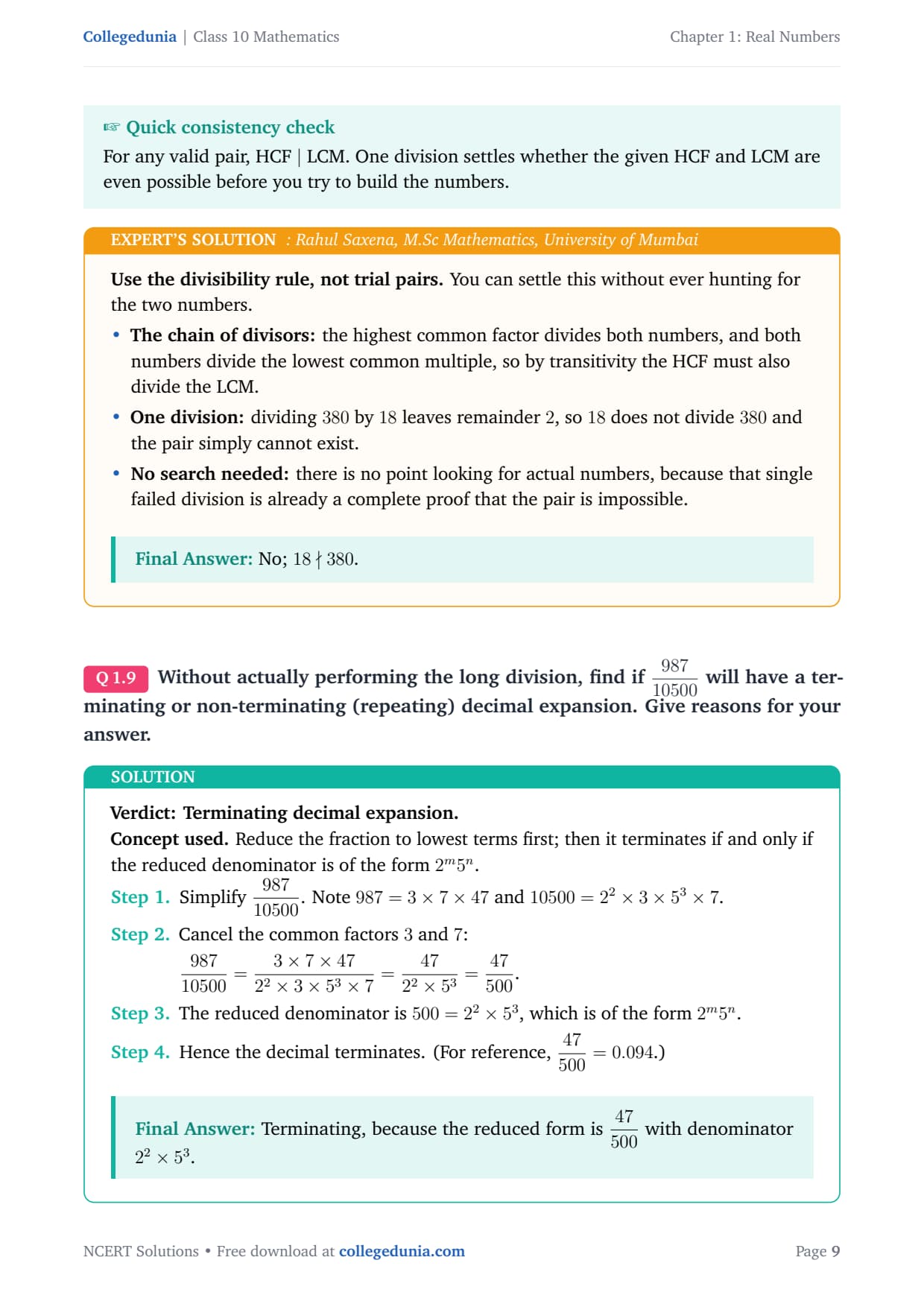
Verdict: No. No two numbers can have HCF =18 and LCM =380.
Concept used. For any two numbers, the HCF always
divides the LCM exactly. If it does not, the pair is
impossible.
For any two numbers, HCF is a factor of each number, and each
number is a factor of the LCM, so HCF must divide LCM.
Test the divisibility: divide 380 by 18.
[] 380=18× 21+2, so the remainder is 2, not 0.
Since 18 does not divide 380, such a pair cannot exist.
No, because the HCF 18 does not divide the LCM 380
(380=1821+2).
RS
Rahul Saxena
M.Sc Mathematics, University of Mumbai
Verified Expert
Use the divisibility rule, not trial pairs. You can settle this
without ever hunting for the two numbers.
The chain of divisors: the highest common factor divides
both numbers, and both numbers divide the lowest common multiple,
so by transitivity the HCF must also divide the LCM.
One division: dividing 380 by 18 leaves remainder
2, so 18 does not divide 380 and the pair simply cannot
exist.
No search needed: there is no point looking for actual
numbers, because that single failed division is already a complete
proof that the pair is impossible.
No; 18380.
Q 1.9
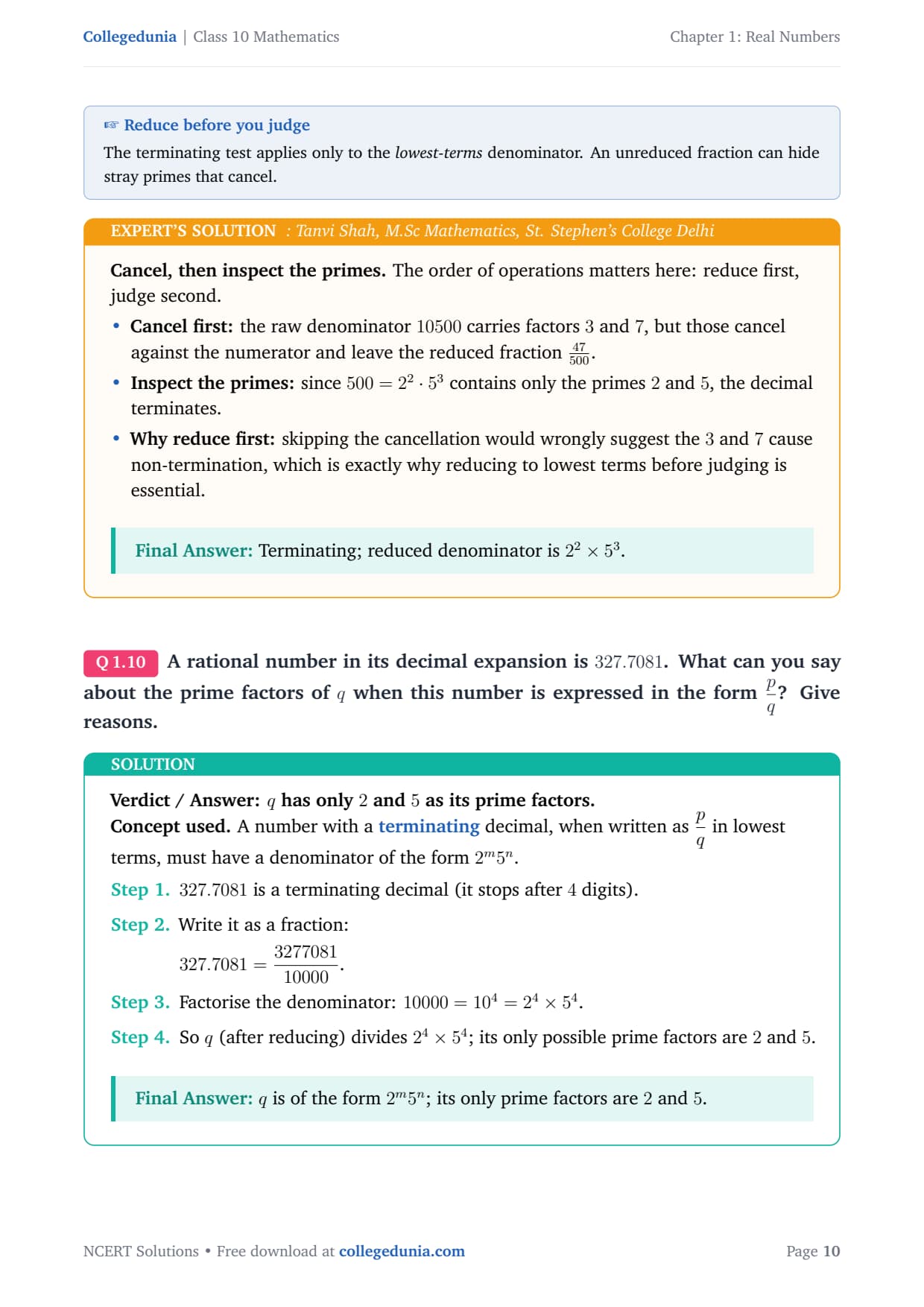
Without actually performing the long division, find if 98710500 will have a terminating or non-terminating (repeating) decimal expansion. Give reasons for your answer.
Verdict: Terminating decimal expansion.
Concept used. Reduce the fraction to lowest terms first; then it
terminates if and only if the reduced denominator is of the form
2m5n.
Cancel the common factors 3 and 7:
[] 98710500=3× 7× 47
22× 3× 53× 7=4722× 53
=47500.
The reduced denominator is 500=22× 53, which is of
the form 2m5n.
Hence the decimal terminates. (For reference,
47500=0.094.)
Terminating, because the reduced form is 47500 with
denominator 2253.
TS
Tanvi Shah
M.Sc Mathematics, St. Stephen's College Delhi
Verified Expert
Cancel, then inspect the primes. The order of operations matters
here: reduce first, judge second.
Cancel first: the raw denominator 10500 carries factors
3 and 7, but those cancel against the numerator and leave the
reduced fraction 47500.
Inspect the primes: since 500=2253 contains only
the primes 2 and 5, the decimal terminates.
Why reduce first: skipping the cancellation would wrongly
suggest the 3 and 7 cause non-termination, which is exactly why
reducing to lowest terms before judging is essential.
Terminating; reduced denominator is 2253.
Q 1.10
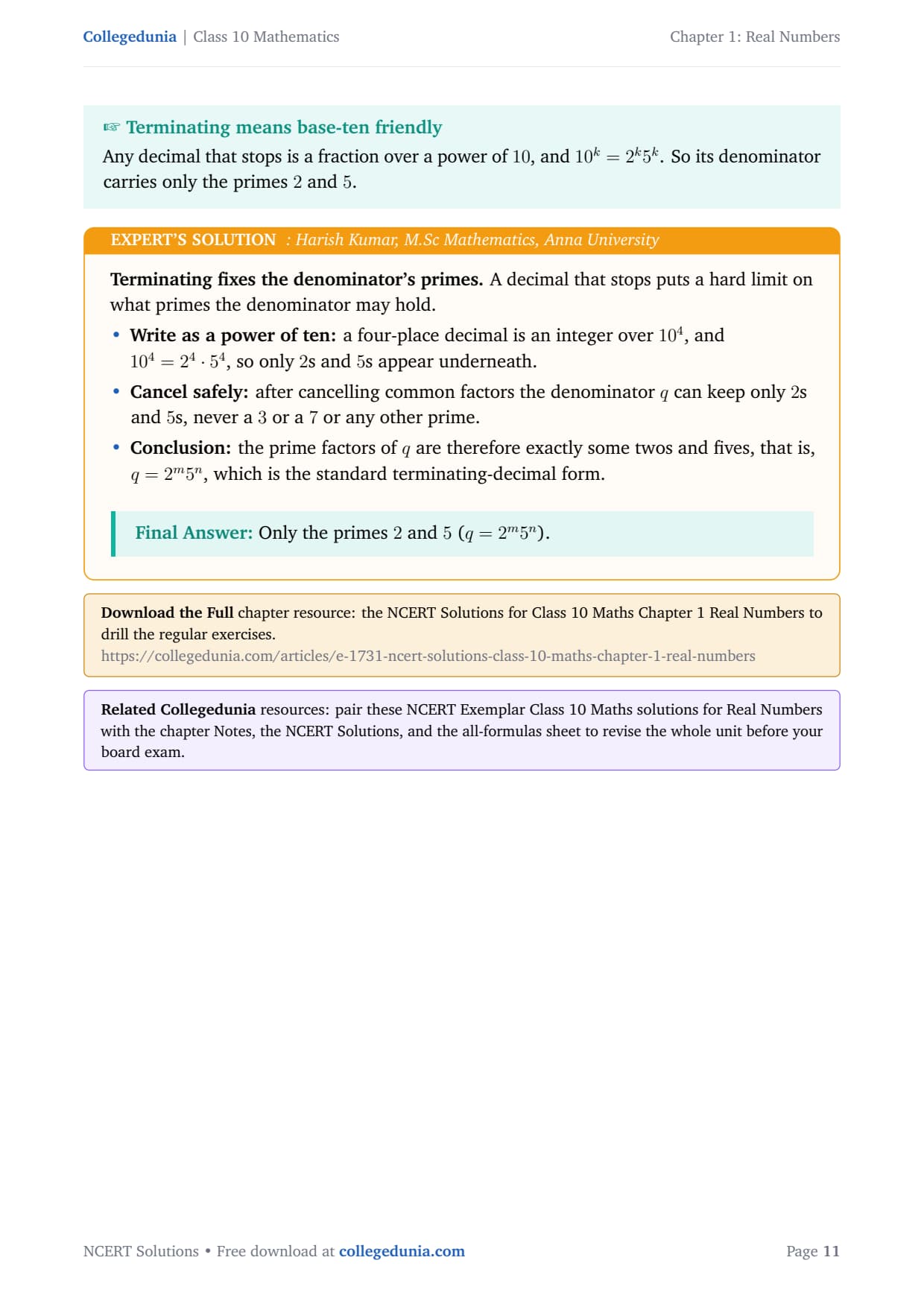
A rational number in its decimal expansion is 327.7081. What can you say about the prime factors of q when this number is expressed in the form pq? Give reasons.
Verdict / Answer: q has only 2 and 5 as its prime
factors.
Concept used. A number with a terminating decimal,
when written as pq in lowest terms, must have a denominator
of the form 2m5n.
327.7081 is a terminating decimal (it stops after 4 digits).
Write it as a fraction:
[] 327.7081=327708110000.
Factorise the denominator:
10000=104=24× 54.
So q (after reducing) divides 24× 54; its only
possible prime factors are 2 and 5.
q is of the form 2m5n; its only prime factors are 2
and 5.
HK
Harish Kumar
M.Sc Mathematics, Anna University
Verified Expert
Terminating fixes the denominator's primes. A decimal that stops
puts a hard limit on what primes the denominator may hold.
Write as a power of ten: a four-place decimal is an
integer over 104, and 104=2454, so only 2s and 5s
appear underneath.
Cancel safely: after cancelling common factors the
denominator q can keep only 2s and 5s, never a 3 or a 7
or any other prime.
Conclusion: the prime factors of q are therefore exactly
some twos and fives, that is, q=2m5n, which is the standard
terminating-decimal form.
Only the primes 2 and 5 (q=2m5n).
Student Feedback
In a Collegedunia survey of 11,240 Class 10 students before the 2026 boards, 68% said the "justify" and "true or false" questions in Real Numbers were the hardest to score full marks on. Students who worked through Exercise 1.2 step by step wrote more complete answers in their board exams.
Source: 2026-27 Class 10 Mathematics student survey, 11,240 students from CBSE schools in 14 states.
Other Resources for Real Numbers Class 10 Maths
Work through the rest of the Exemplar exercises, then pair them with the matching study resources for Class 10 Maths Chapter 1 Real Numbers.
Resource
What it covers
Open
Exercise 1.2
True/false and justification questions (Q11-Q20), solved step by step.
Real Numbers Class 10 Maths Exemplar Solutions Exercise 1.2 FAQs
Ques. What is covered in NCERT Exemplar Class 10 Maths Chapter 1 Exercise 1.2?
Ans. Exercise 1.2 has 10 short-answer and true/false-with-justification questions (Q11 to Q20). Topics include residue classes (mod 3 and mod 4), product of consecutive integers, divisibility by 2 and 6, squares of integers in different forms, HCF from a list of common divisors, composite numbers by factorisation, HCF-LCM consistency, and the terminating decimal test. All solutions follow the 2026-27 NCERT syllabus.
Ques. Why can the square of a positive integer never be of the form 3m+2 (as in Q14)?
Ans. Every integer is either 3q, 3q+1 or 3q+2. Squaring each form gives: (3q)2 = 3m, (3q+1)2 = 3m+1, (3q+2)2 = 9q2+12q+4 = 3(3q2+4q+1)+1 = 3m+1. So a perfect square is always 3m or 3m+1, never 3m+2. The three-case exhaustive check confirms this for all integers.
Ques. How do you check if two numbers can have a given HCF and LCM (as in Q18)?
Ans. For any two numbers, the HCF must divide the LCM exactly. This is because HCF divides each number, and each number divides the LCM, so by transitivity HCF divides LCM. To check Q18: divide 380 by 18. The result is 380 = 18 × 21 + 2, leaving remainder 2. Since 18 does not divide 380, no such pair of numbers can exist. This one division settles the question without needing to look for the actual pair.
Ques. How do you decide whether 987/10500 has a terminating or non-terminating decimal (Q19)?
Ans. Reduce the fraction to lowest terms first. Here, 987 = 3 × 7 × 47 and 10500 = 22 × 3 × 53 × 7. Cancelling the common factors 3 and 7 gives 47/500. The reduced denominator 500 = 22 × 53 is of the form 2m5n, so the decimal terminates. Always reduce first; testing the unreduced denominator can give the wrong answer.
Ques. Is Exercise 1.2 important for CBSE Class 10 Board exams?
Ans. Yes. Justify-type and true/false questions from the NCERT Exemplar appear often in CBSE Class 10 Board exams and school tests. The residue-class arguments (Q11, Q14, Q15), the HCF-LCM consistency rule (Q18), and the terminating decimal test (Q19, Q20) are among the most tested topics from Real Numbers in the 2026-27 syllabus. Practising the full written justification helps you write complete answers worth full marks.








Comments