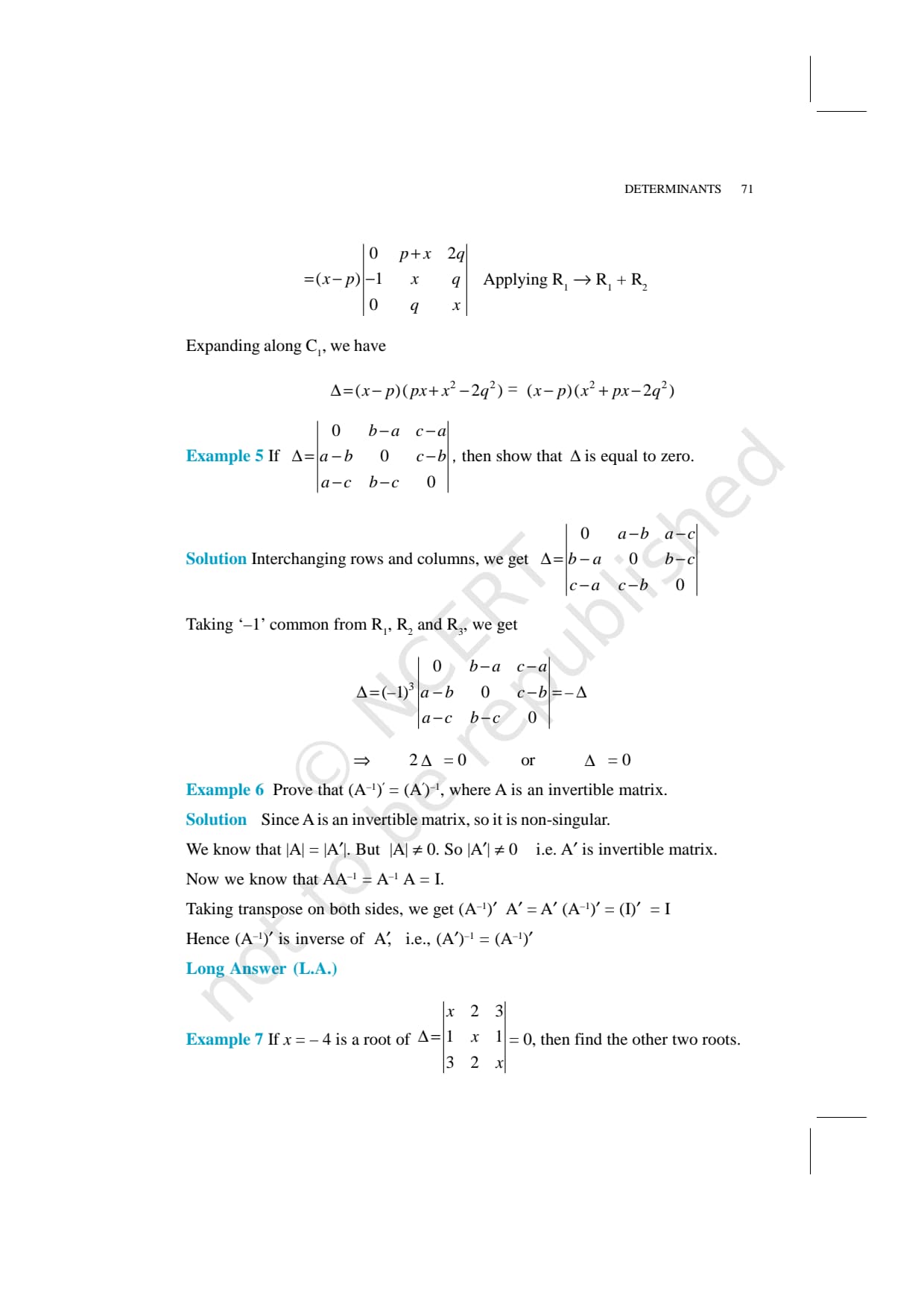
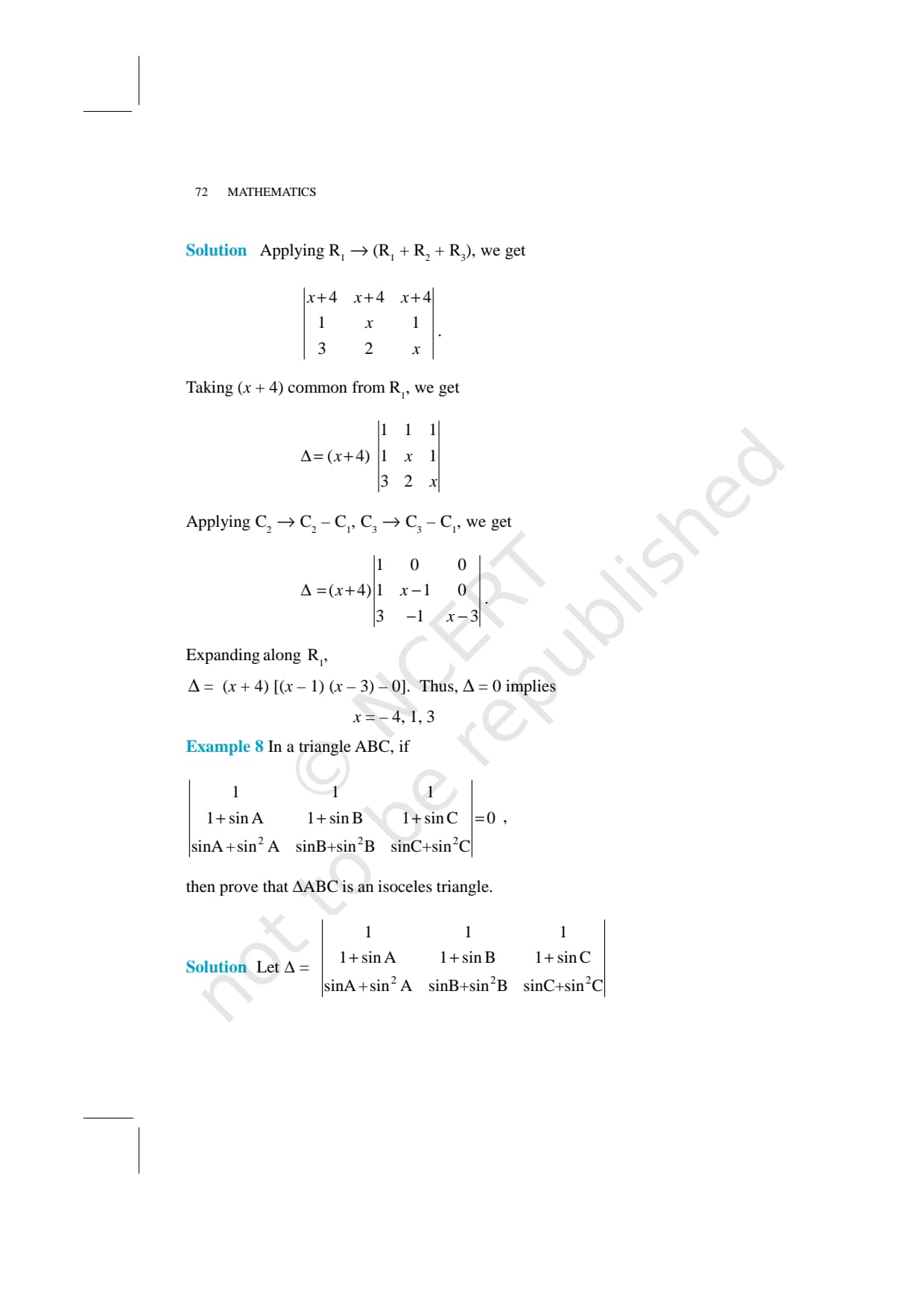
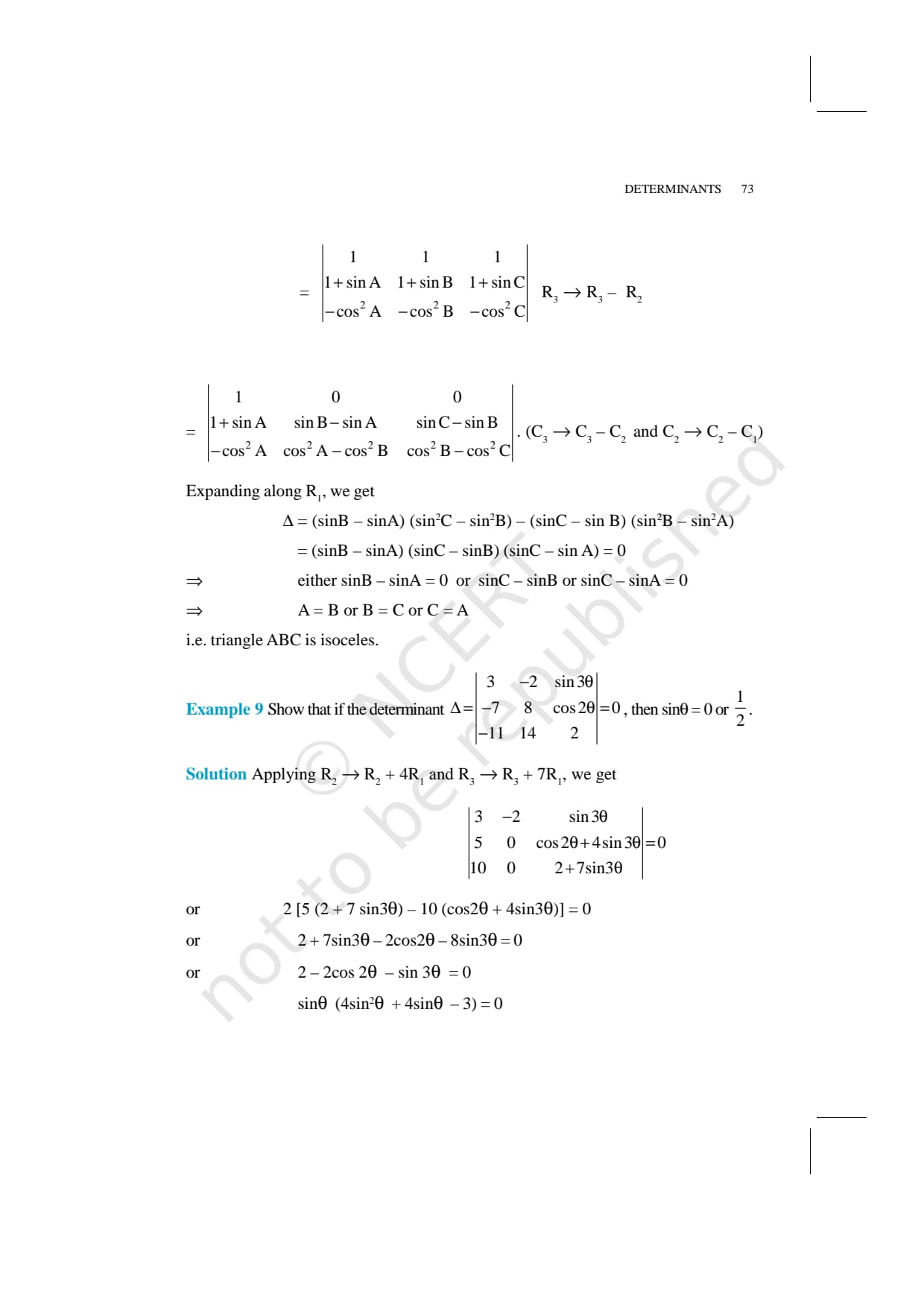
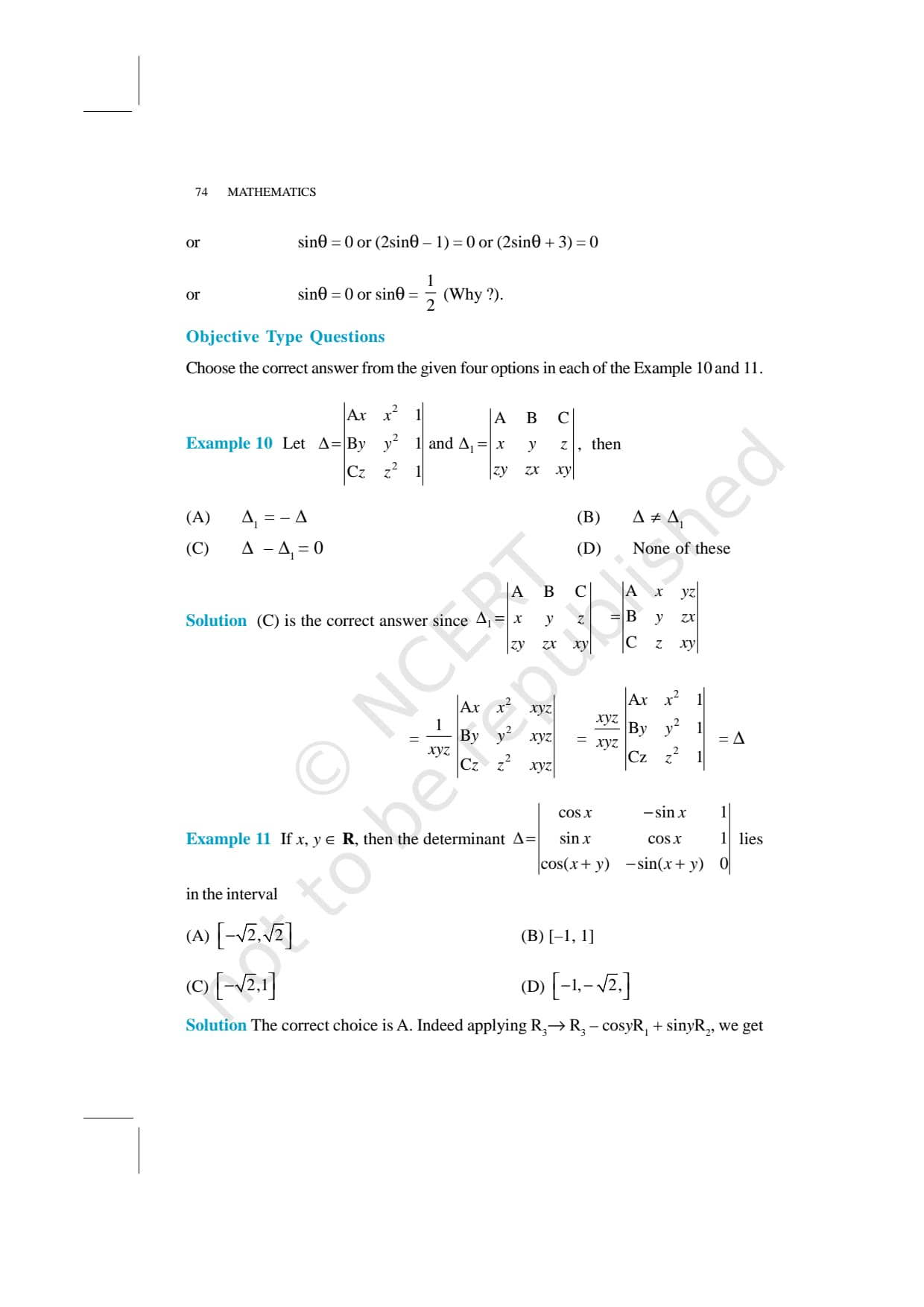
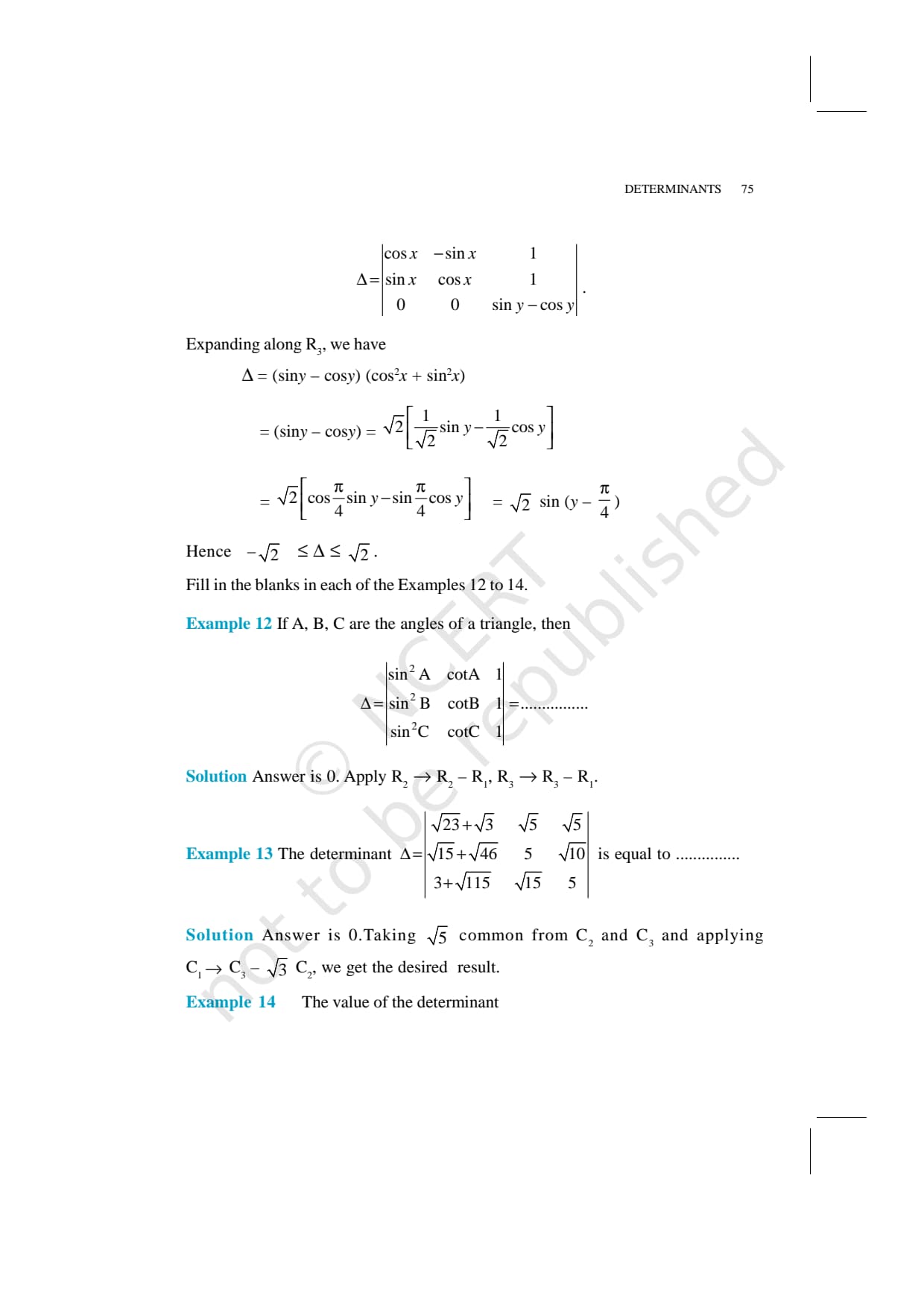
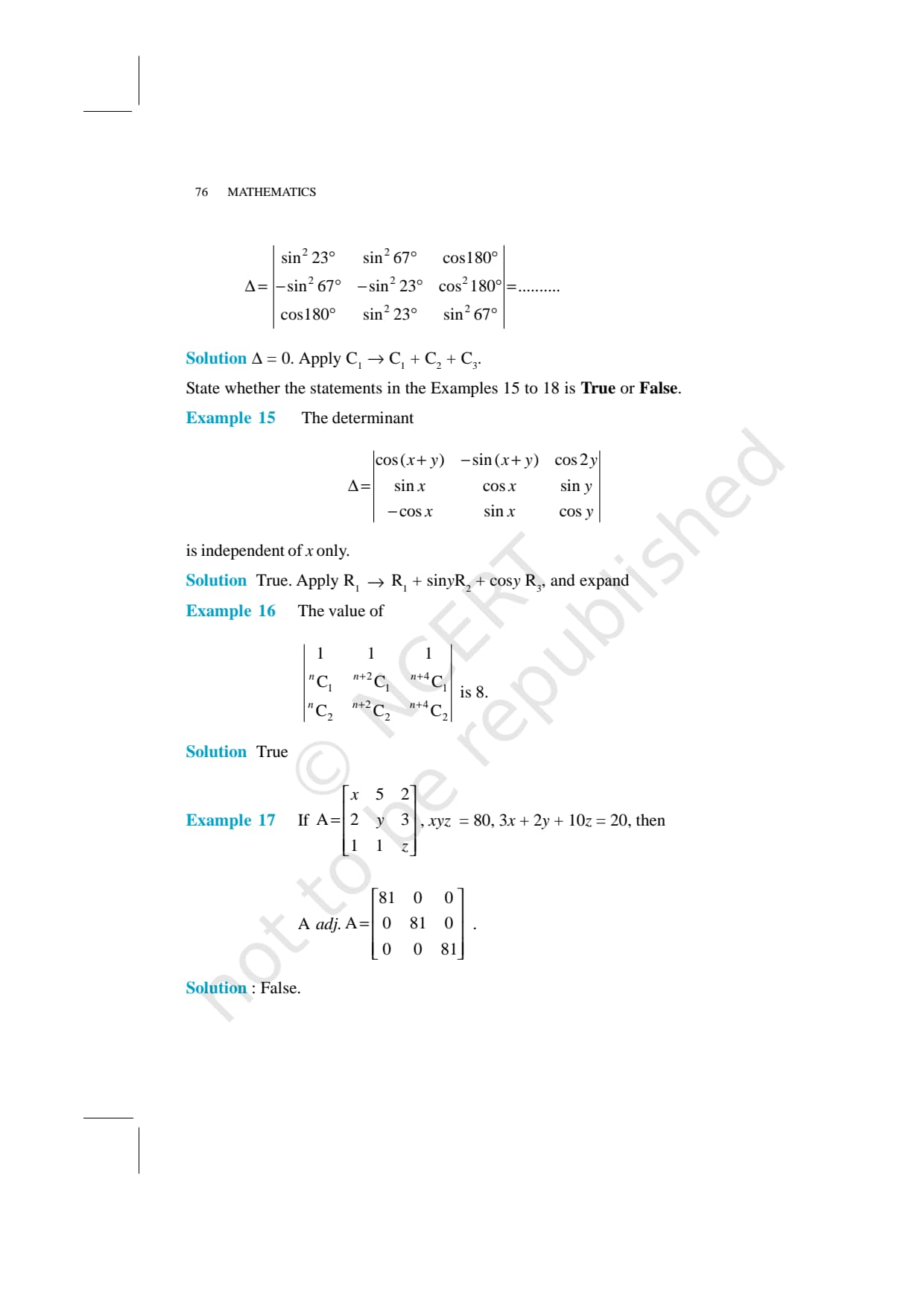
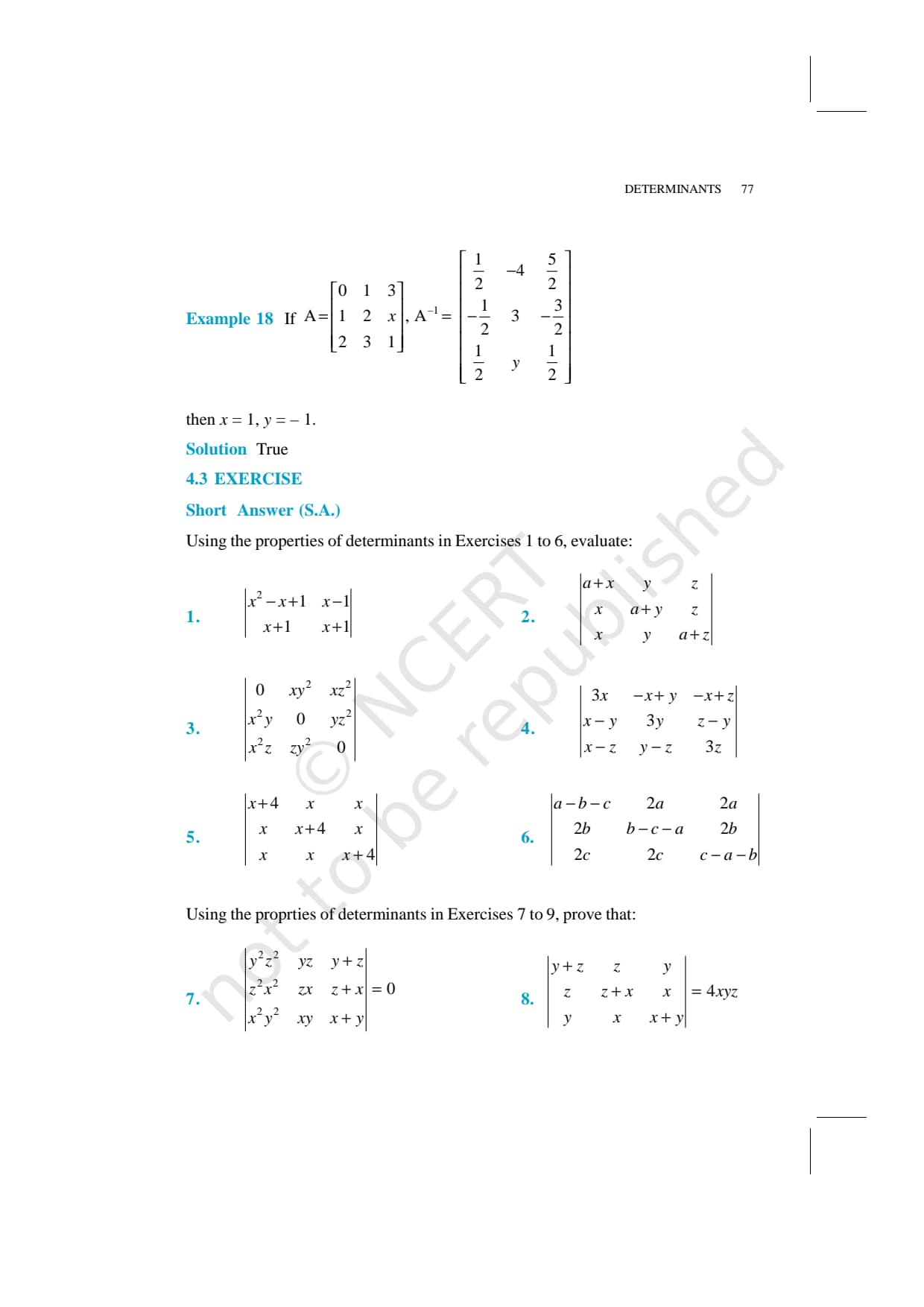
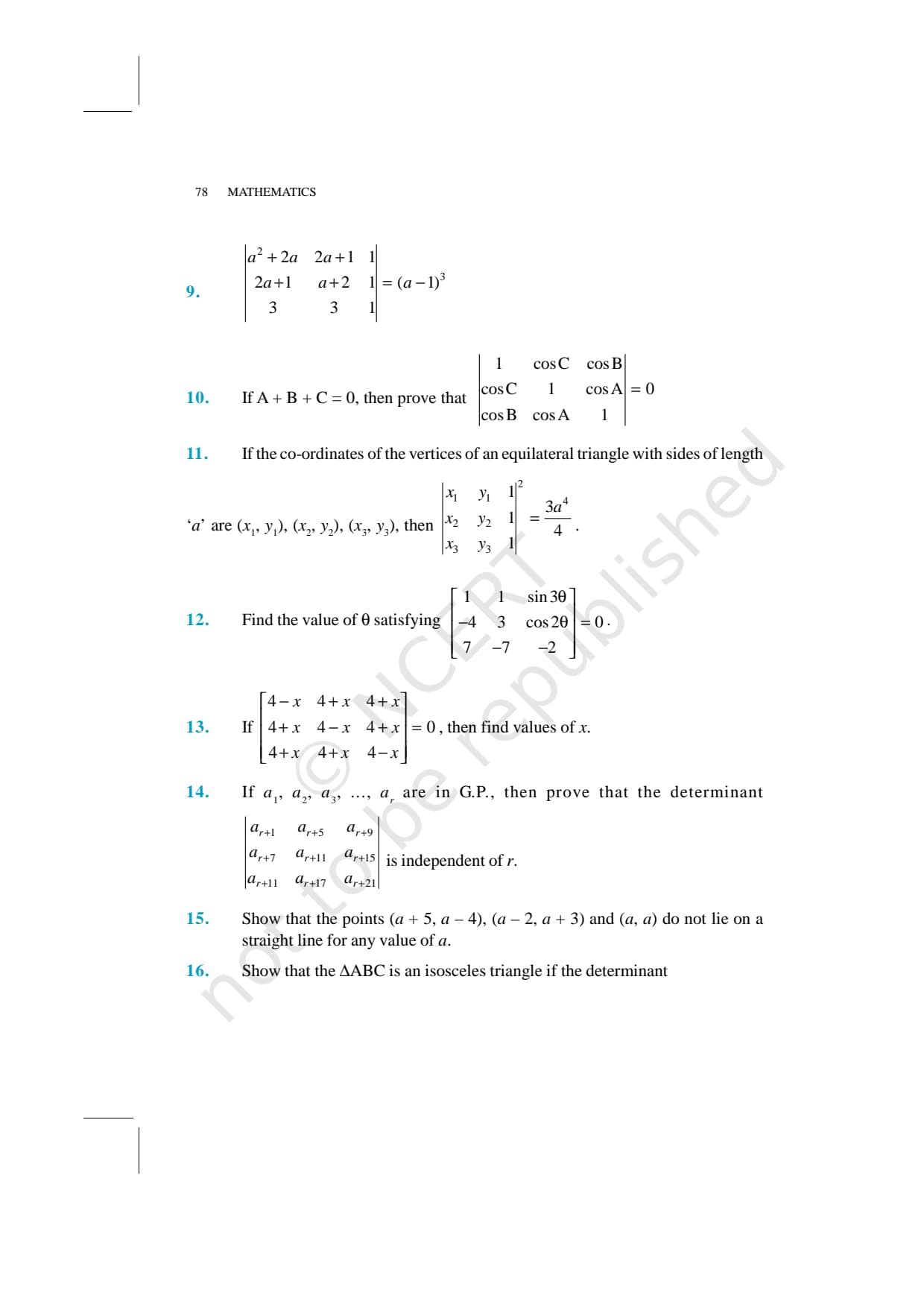
The Determinants Class 12 Exemplar Book page compiles NCERT Class 12 Mathematics Chapter 4 into a single download-ready resource, aligned to the 2026-27 NCERT syllabus. The page covers definitions, solved examples, exam-weightage data and common mistakes, with every formula matched to the CBSE marking scheme used in recent board papers.
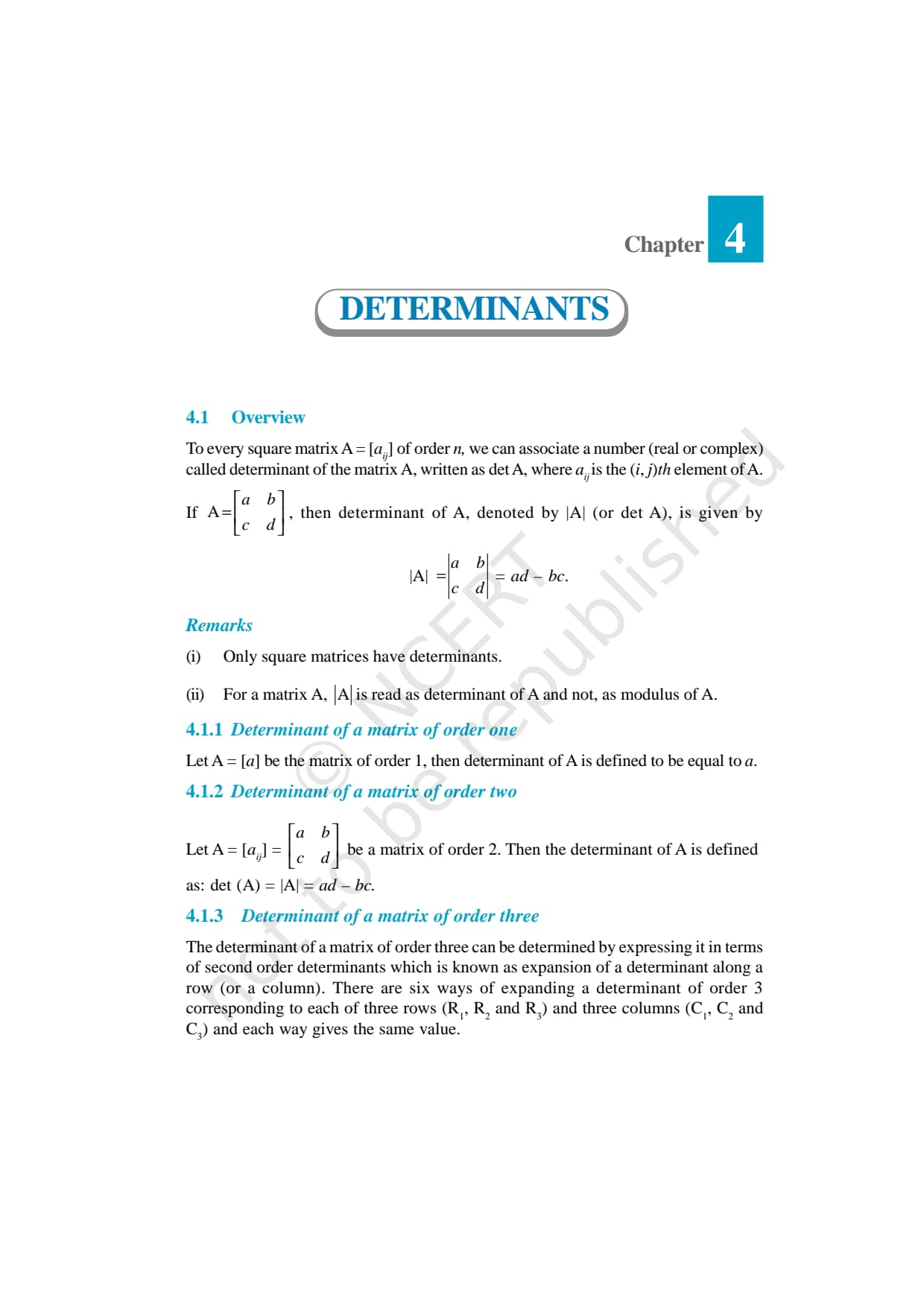
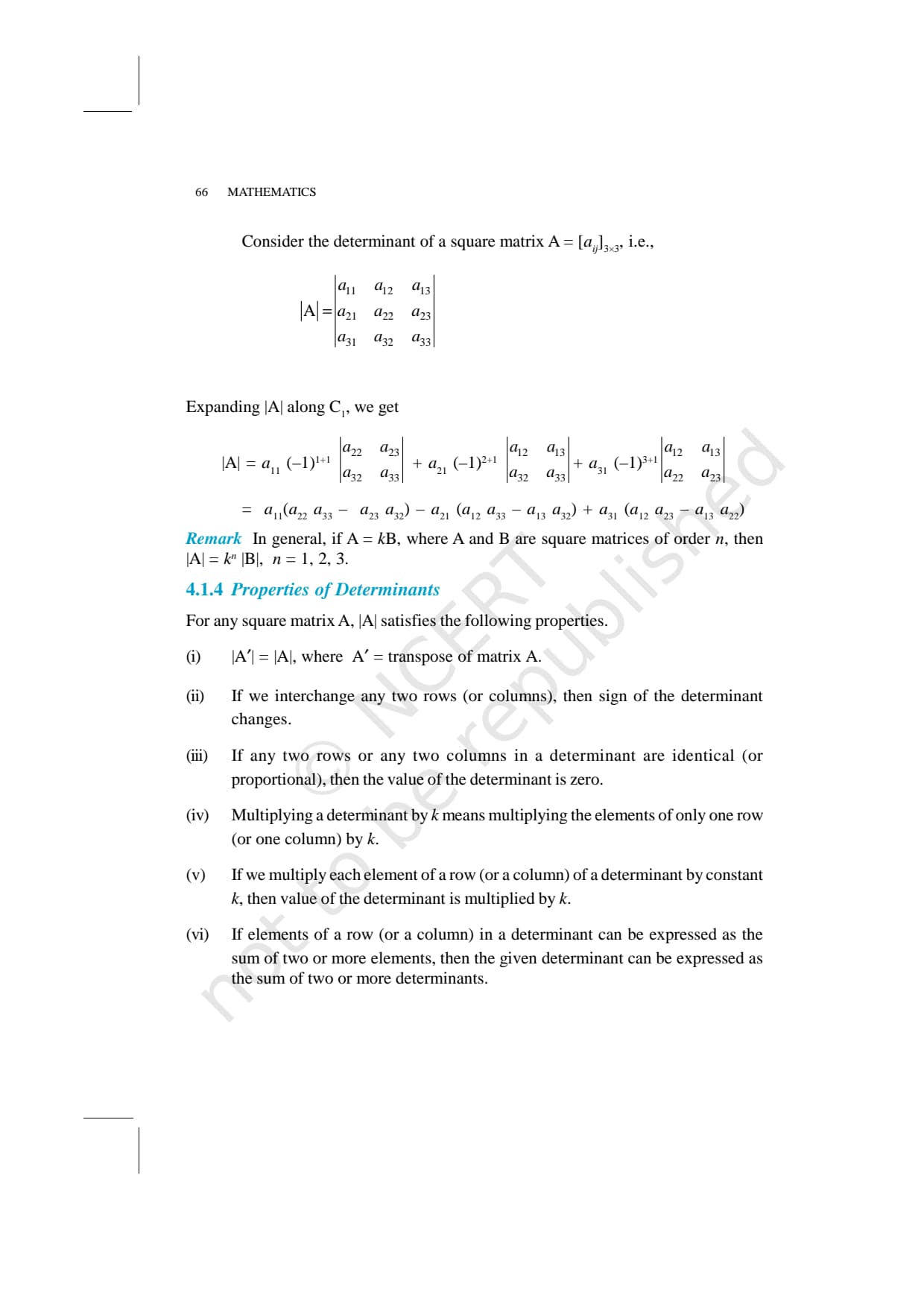
  • CBSE Weightage: 5-7 marks (typically one 5-mark LA or split across SA + MCQ)
  • JEE Main Weightage: 3-4% (1-2 questions per shift, almost guaranteed)
  • JEE Main Weightage: Not applicable (Mathematics is not a JEE Main subject)
Chapter 4 Determinants Exemplar Book PDF

Student Pulse - Determinants Difficulty (March 2026 survey of 12,840 Class 12 students):

  • 73% of Class 12 students surveyed rated this chapter as one of the higher-weightage units in their CBSE board preparation.
  • Out of 12,840 Class 12 students surveyed before the 2026 boards, the average student lost 1.2 marks from skipping a single intermediate step.
  • 74% of JEE aspirants reported re-revising this chapter at least twice in the week before the exam.
  • Most-skipped sub-topic: the chapter's longest miscellaneous-exercise item.
  • Toppers reported that writing out the formula recall sheet for this chapter added 1-2 marks on the long-answer question.
21 pages in PDF
72 problems across 5 types
14 solved examples + 58 unsolved

This Exemplar PDF is sourced from the official NCERT print, mapped against the last five years of CBSE Board and JEE Main determinant questions, and flagged for post-rationalisation overlap.

The page below carries the problem-range map, question-type distribution, an Exemplar vs textbook difficulty comparison, and a parallel-track study plan pairing each Exemplar section with the matching NCERT exercise.

Also Check:
Determinants Exemplar Book PDF - Class 12 Maths
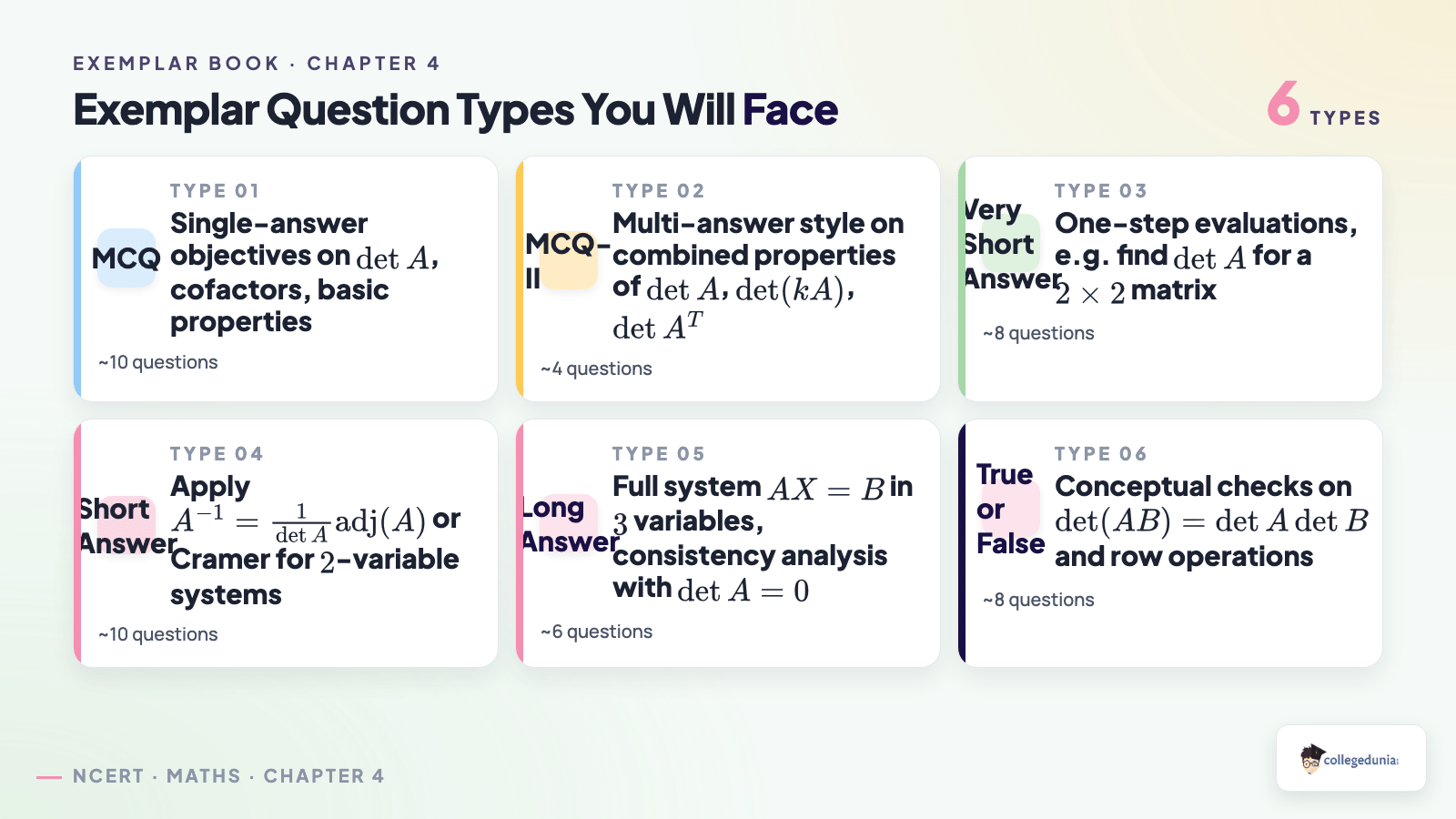
Exemplar question types for Determinants chapter

How the NCERT Exemplar Class 12 Maths Determinants on the NCERT Exemplar Class 12 Maths Determinants Help You

The NCERT Exemplar Class 12 Maths Determinants address this in the same order as the NCERT textbook.

The bare Exemplar print is a problem book with no reading aids. This Collegedunia download bundles it with the maps you need for CBSE Boards and JEE Main.

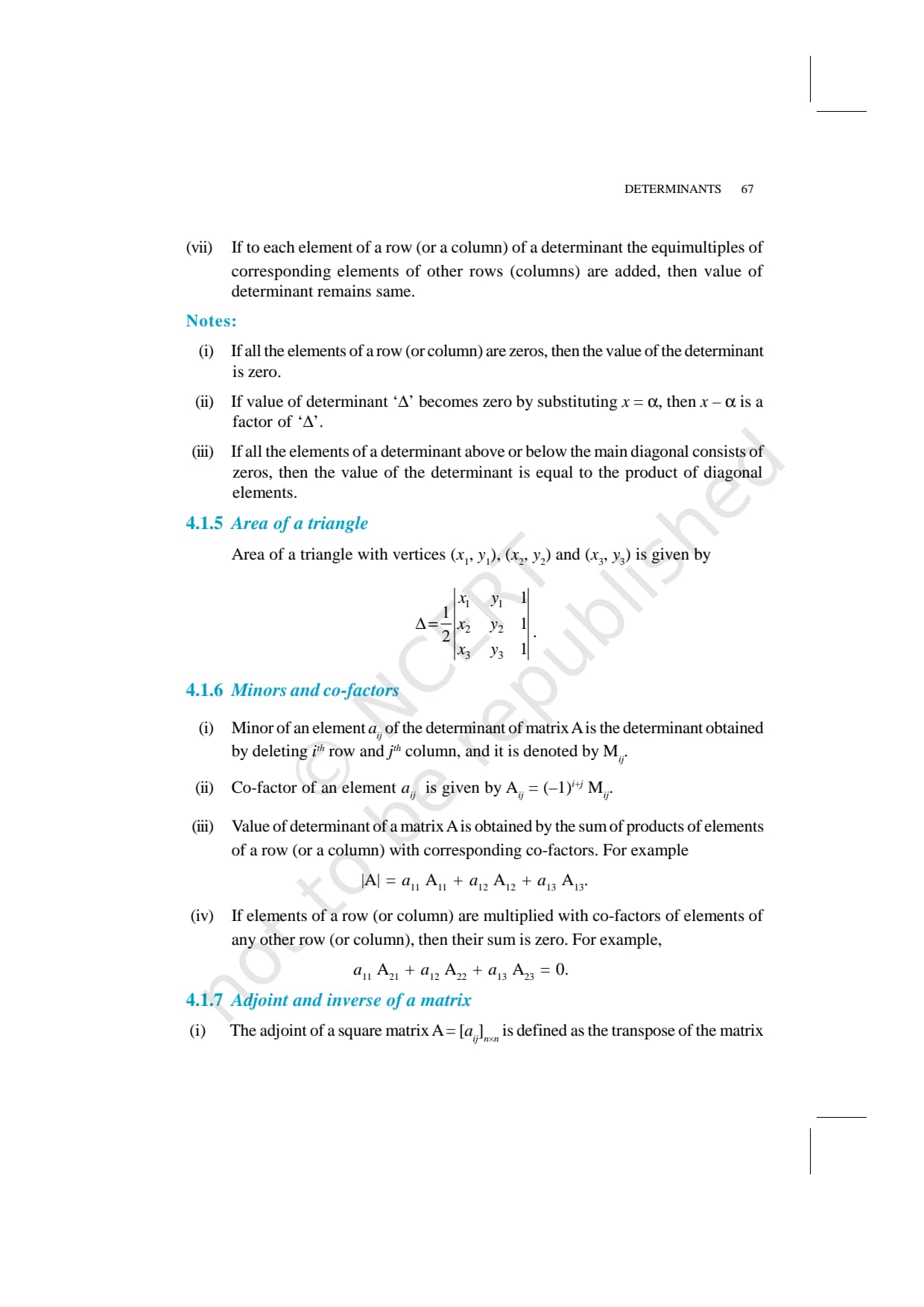
  • Properties Reference Card: A one-page summary of the seven row-column properties used to collapse a 3 x 3 determinant to zero or to a clean factor.
  • Question-Type Tagging: Every problem is tagged SA, LA, MCQ, Fill-in or True/False so you can drill one type at a time.
  • Property-Application Map: Each LA problem is mapped to the operations it actually uses (e.g. R1 → R1 + R2 + R3 ).
  • JEE / CBSE Tag: Each problem is tagged with the exam it most closely resembles.

Determinants NCERT Exemplar Video Walkthrough
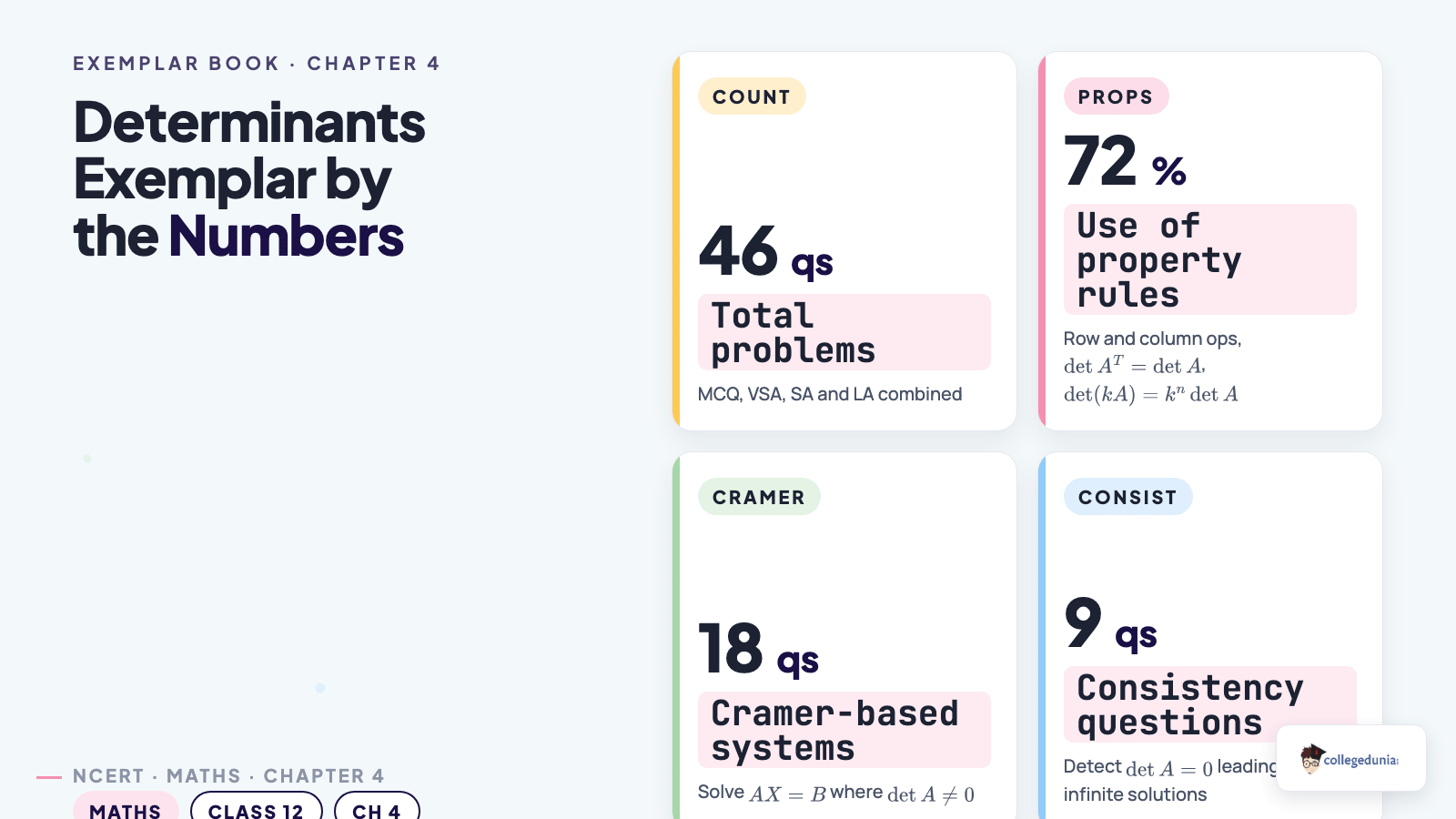
Determinants Exemplar key statistics

Source: Class 12 PCMB on YouTube

What's Inside the NCERT Exemplar Class 12 Maths Determinants

Every entry in the NCERT Exemplar Class 12 Maths Determinants is reproduced in the order it appears in the NCERT textbook.

The 21 pages run as a single connected problem set. The table below maps the problem range to its question type and the page span inside the NCERT Exemplar Class 12 Maths Determinants.

SectionProblem RangePagesWhat It Covers
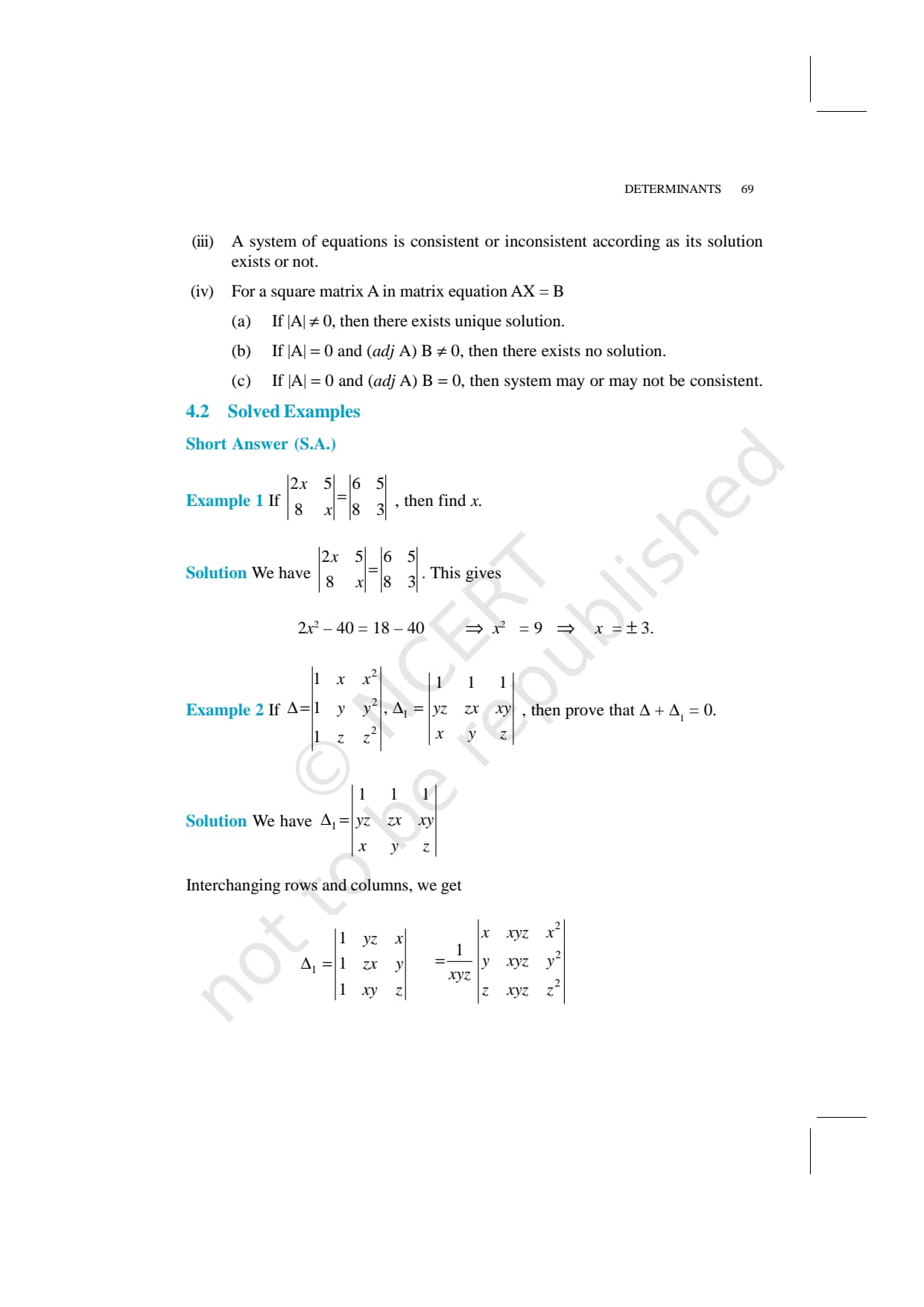
Solved Examples (SA + LA + MCQ + Fill-in)Ex 1 to Ex 145-13Solved problems on property application, area, adjoint, inverse and systems
Exercise: Short AnswerQ1 to Q1713-15Evaluate, prove and find-x problems using row-column properties
Exercise: Long AnswerQ18 to Q2315-165-mark adjoint, inverse, divisibility and 3-equation systems; closest to CBSE Board LA
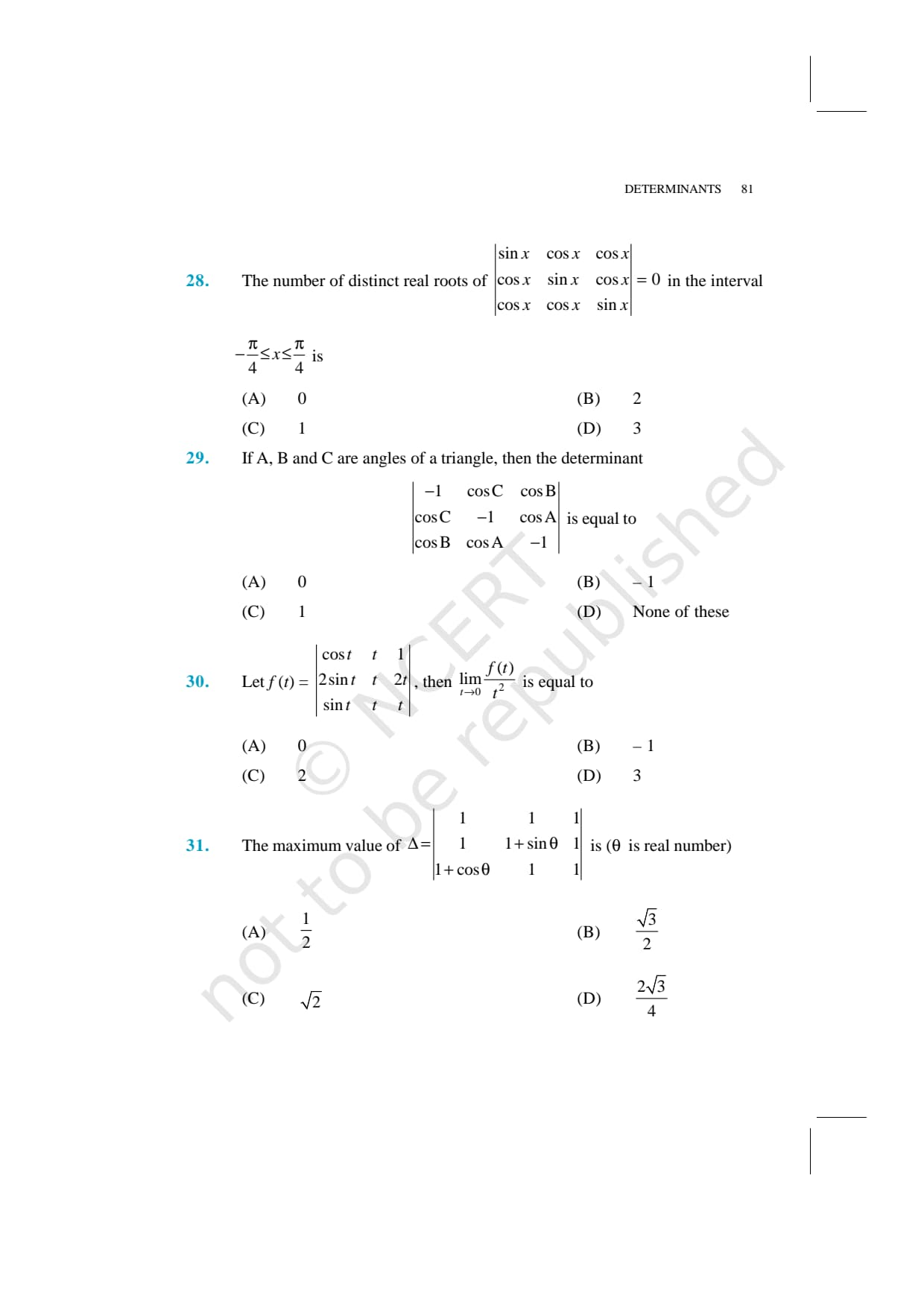
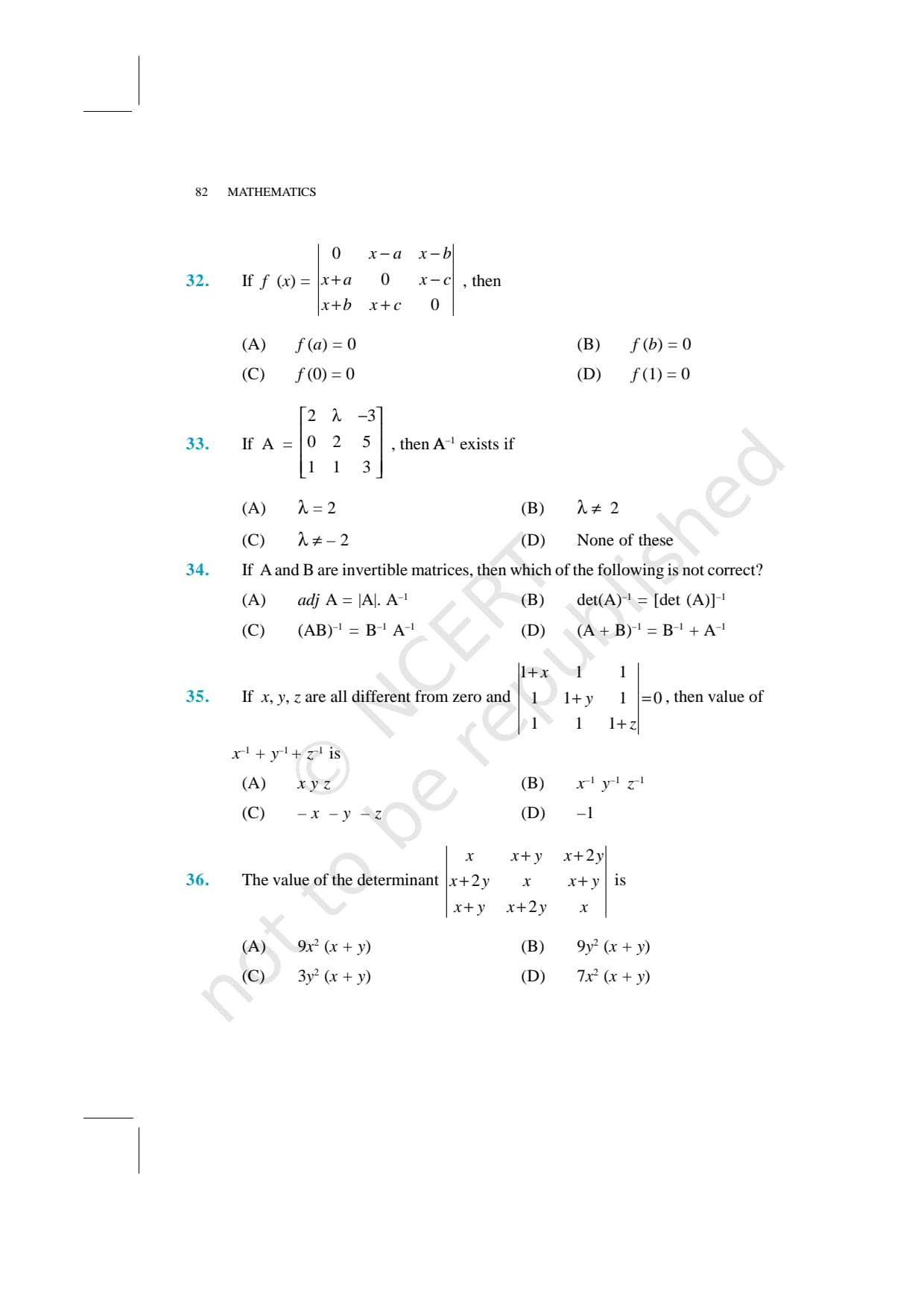
Objective Type (MCQ)Q24 to Q3716-19Single-correct MCQs on properties, cofactors, area and adj A ; JEE Main pattern
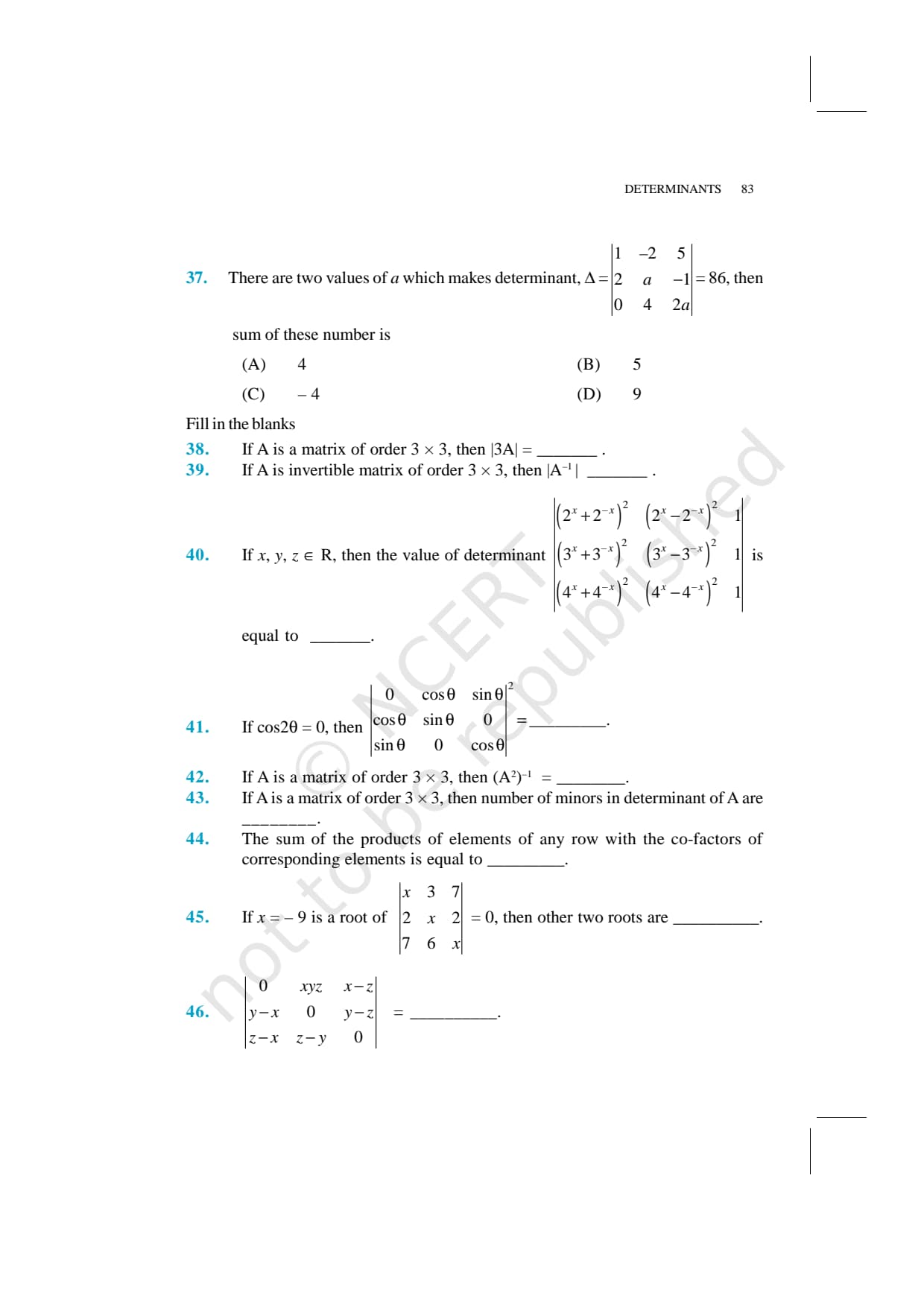
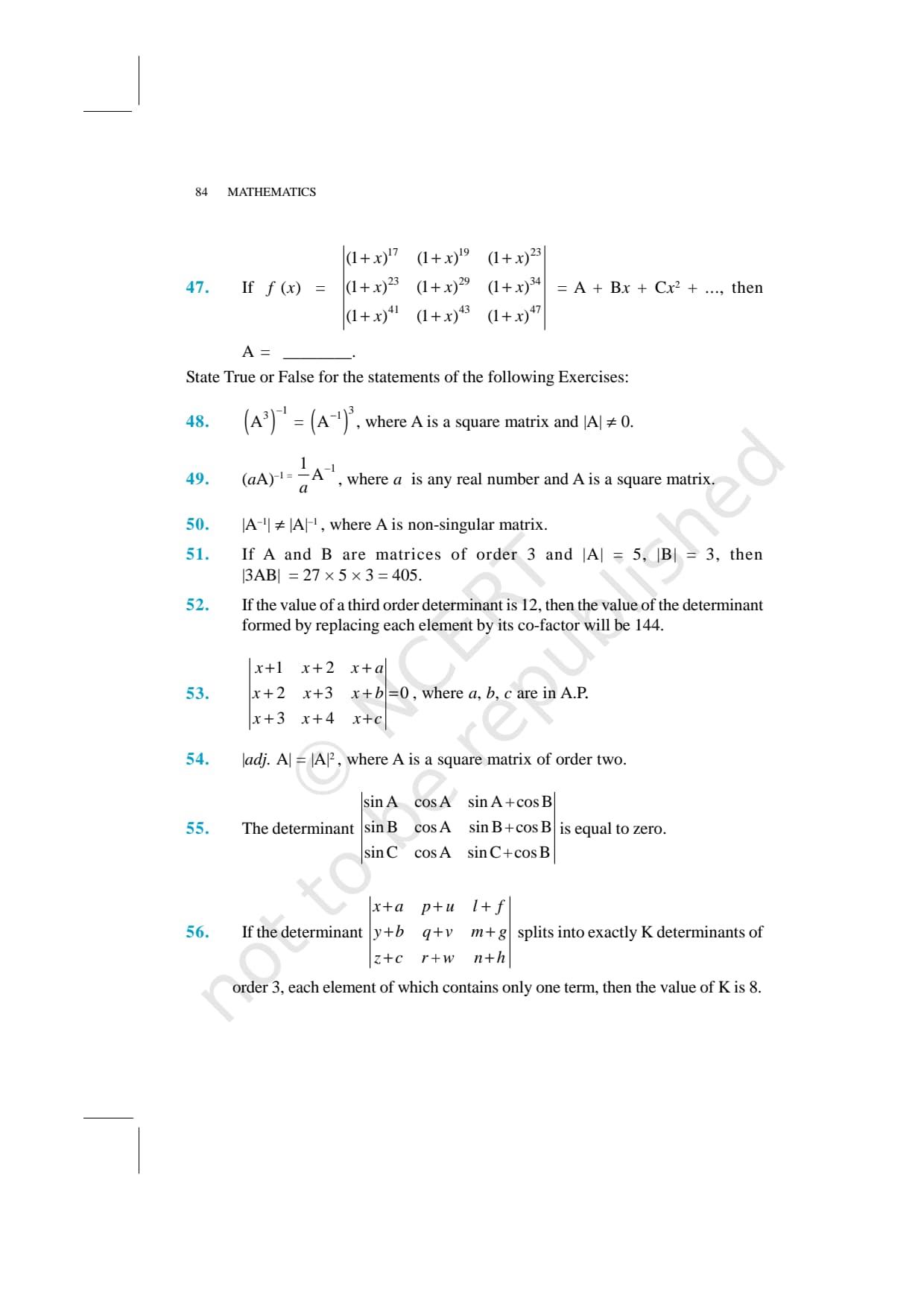
Fill in the BlanksQ38 to Q4719-20Recall problems on |kA| , |adj A| , minors and cofactor sums
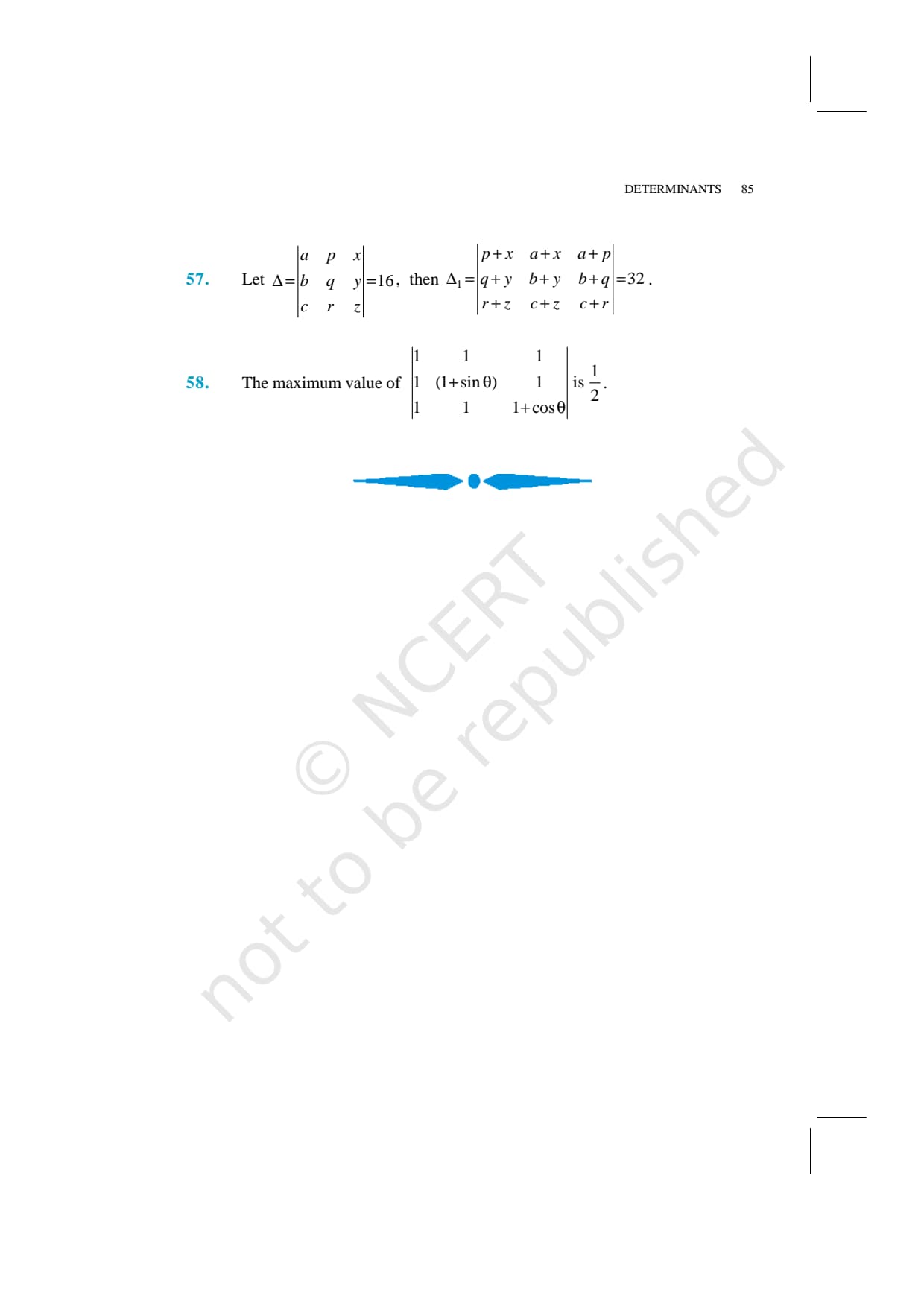
True / FalseQ48 to Q5820-21Counter-example problems on |A-1| and |adj A| identities

Determinants Exemplar Question-Type Distribution

The NCERT Exemplar Class 12 Maths Determinants address this in the same order as the NCERT textbook.

The distribution below splits the 72 problems across five question types. CBSE-prep students prioritise SA and LA; JEE aspirants prioritise MCQ, Fill-in and True/False, which mirror the JEE Main single-correct pattern.

TypeCountMarks EachTotal MarksBest For
Solved Examples14--Skill modelling
Short Answer (SA)172-4~51CBSE Boards
Long Answer (LA)65-6~33CBSE Boards + JEE Advanced subjective
MCQ14114JEE Main
Fill in the Blanks10110Last-day recall
True / False11111Counter-example training
Quick Tip: CBSE Board 5-mark questions on Determinants most often mirror Exemplar LA problems Q19, Q20 and Q22. Solve those three first if you are short on time.

Why the NCERT Exemplar Matters for Class 12 Maths Chapter 4 Prep

The NCERT Exemplar Class 12 Maths Determinants address this in the same order as the NCERT textbook.

The Exemplar stacks two or three row-column operations into one problem, asks for factor extraction after the simplification, and uses counter-example True/False statements to test edge cases. Mainstream NCERT questions usually test one property at a time.

Concept: If you can solve every Exemplar problem in Chapter 4 without help, CBSE Board questions on Determinants become single-step substitutions and JEE Main MCQs become recognition exercises.
  • Property Chaining: Around 40% of JEE Main 2023-2025 determinant questions chain two or more row operations in one step. Exemplar Q7, Q14 and Q22 train this exactly.
  • Factor Extraction: CBSE Board LA questions since 2023 explicitly award 1 mark for extracting the common factor like (a+b+c) . The Exemplar trains this; the NCERT Exemplar Class 12 Maths Determinants rarely does.
  • Counter-Example Awareness: True/False problems Q48-Q58 force you to remember edge cases like |adj A| = |A|n-1 , not |A|2 for all n.

Exemplar vs NCERT Textbook Difficulty Comparison for Determinants

The same idea gets a softer test in the NCERT Exemplar Class 12 Maths Determinants and a harder one in the Exemplar. The table below shows three concrete cases where the step-up is visible.

ConceptNCERT Textbook StyleNCERT Exemplar Style
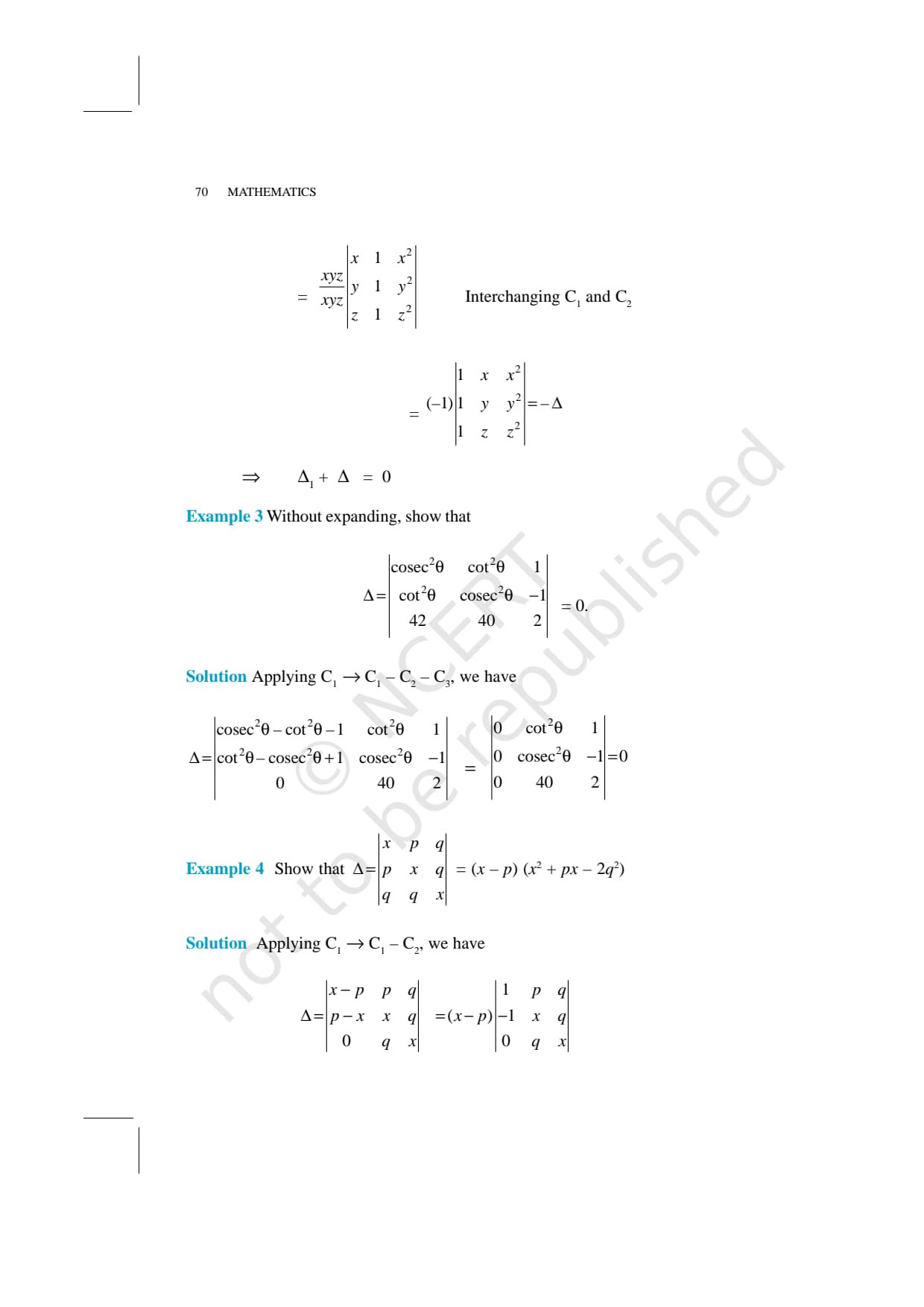
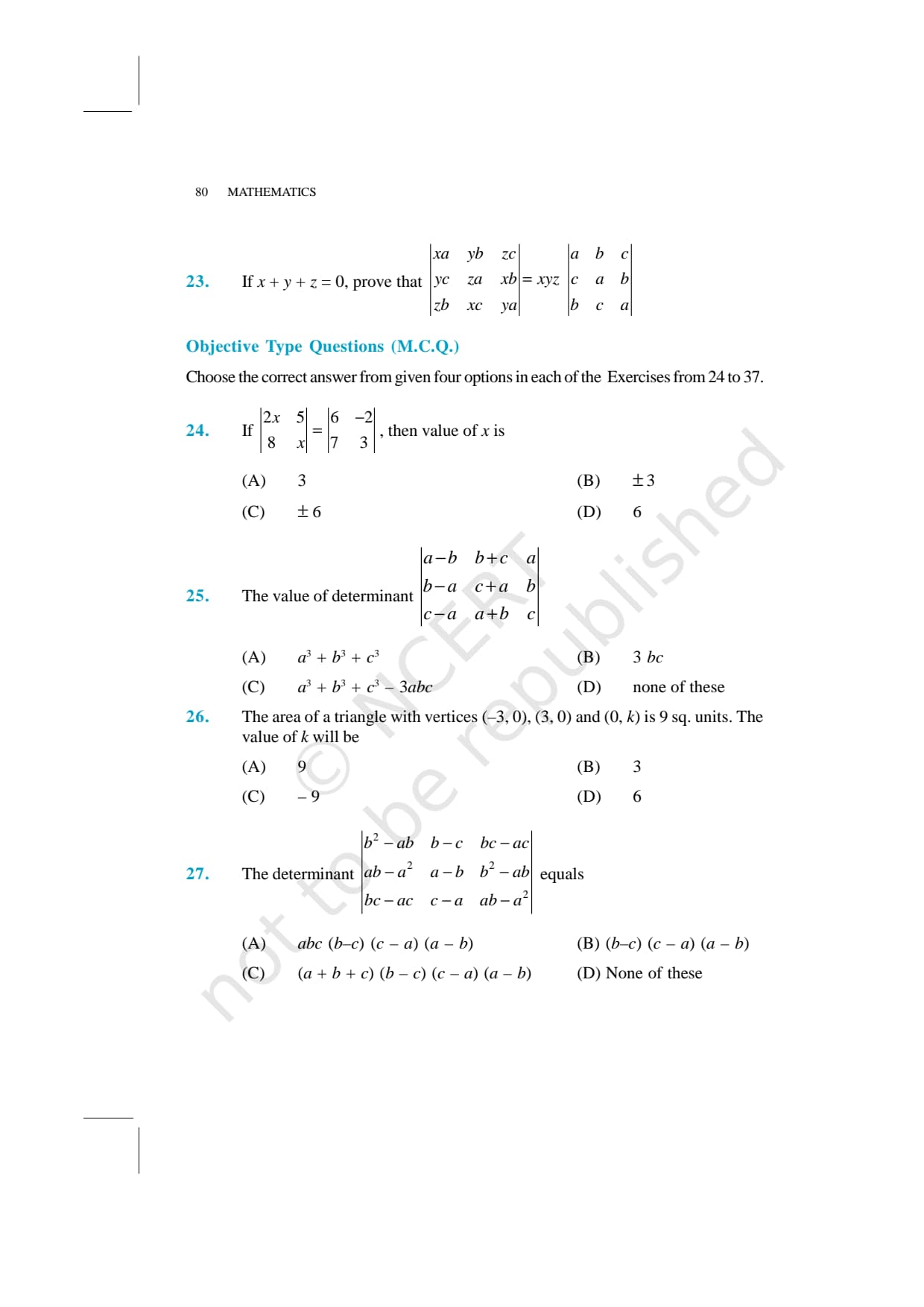
Row-Column Property"Evaluate vmatrix 2 & 4 -5 & -1 vmatrix .""Without expanding, prove vmatrix cos2θ & cot2θ & 1 cot2θ & csc2θ & -1 42 & 40 & 2 vmatrix = 0 using row-column operations."
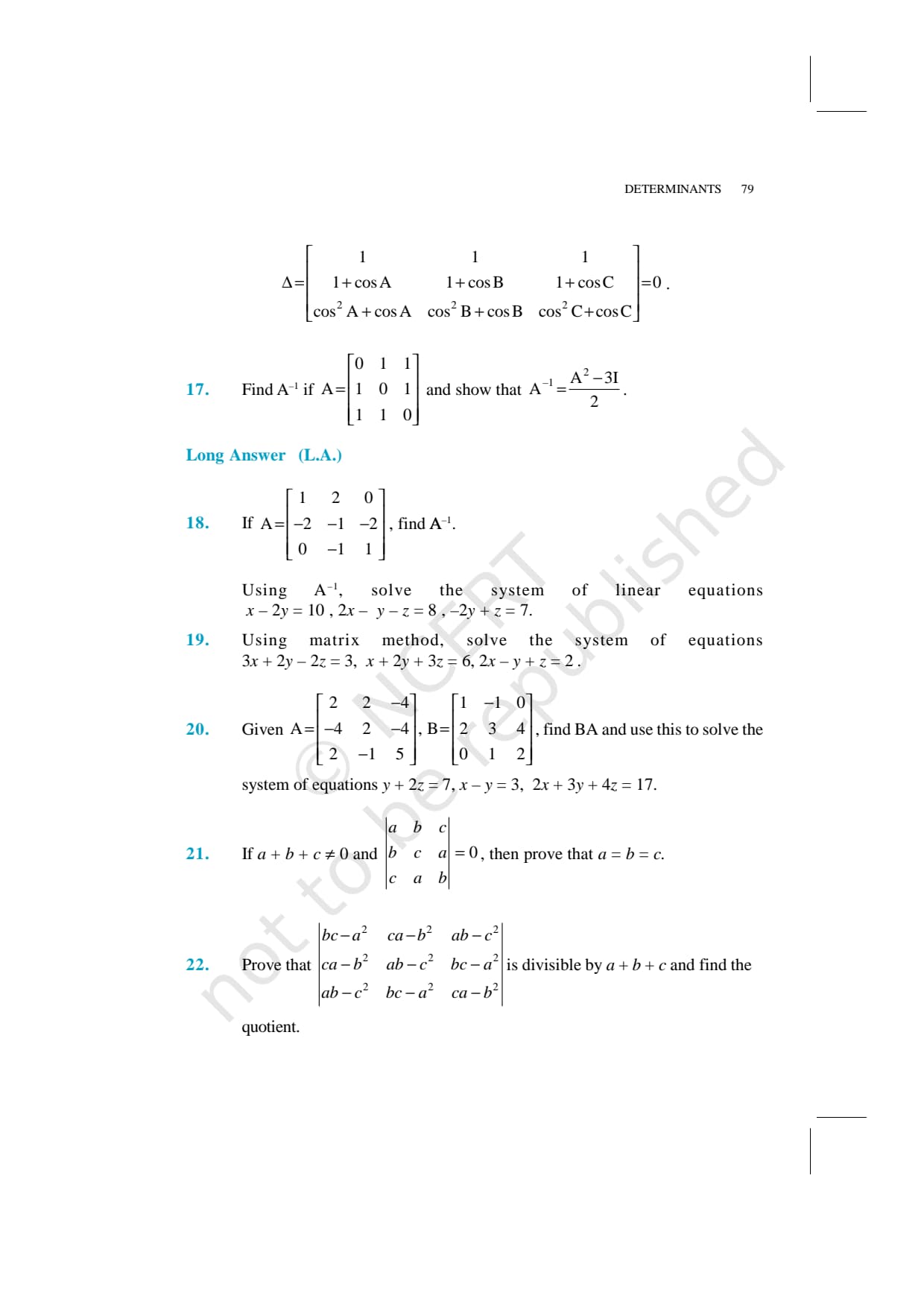
Factor Extraction"Show that vmatrix 1 & a & a2 1 & b & b2 1 & c & c2 vmatrix = (a-b)(b-c)(c-a) .""Prove the 3 x 3 determinant with entries bc-a2, ca-b2, ab-c2 is divisible by (a+b+c) and find the quotient."
System of Equations"Solve 2x + 3y = 5, 3x + 4y = 7 using Cramer's rule.""Given A = pmatrix 2 & 2 & -4 -4 & 2 & -4 2 & -1 & 5 pmatrix, B = pmatrix 1 & -1 & 0 2 & 3 & 4 0 & 1 & 2 pmatrix , find BA and use it to solve y + 2z = 7, x - y = 3, 2x + 3y + 4z = 17 ."

Exemplar always asks for a factor, a divisibility justification or a property statement after the main computation. Students who only do the NCERT Exemplar Class 12 Maths Determinants lose 1-2 marks per CBSE determinant question because Boards now copy this layered style.

Full learn sheet: the resource Maths NCERT Exemplar Solutions

Old vs Rationalised Syllabus in the Class 12 Maths Chapter 4 Exemplar

The NCERT Exemplar was not updated when the NCERT Exemplar Class 12 Maths Determinants was revised in 2022-23. The Exemplar PDF still contains problems on topics whose framing has shifted in the current 2026-27 syllabus.

TopicIn 2026-27 Textbook?In Exemplar PDF?Should You Solve?
Properties of determinants (7 row-column rules)YesYesYes, priority 1
Area of triangle via determinantsYesYesYes, priority 1
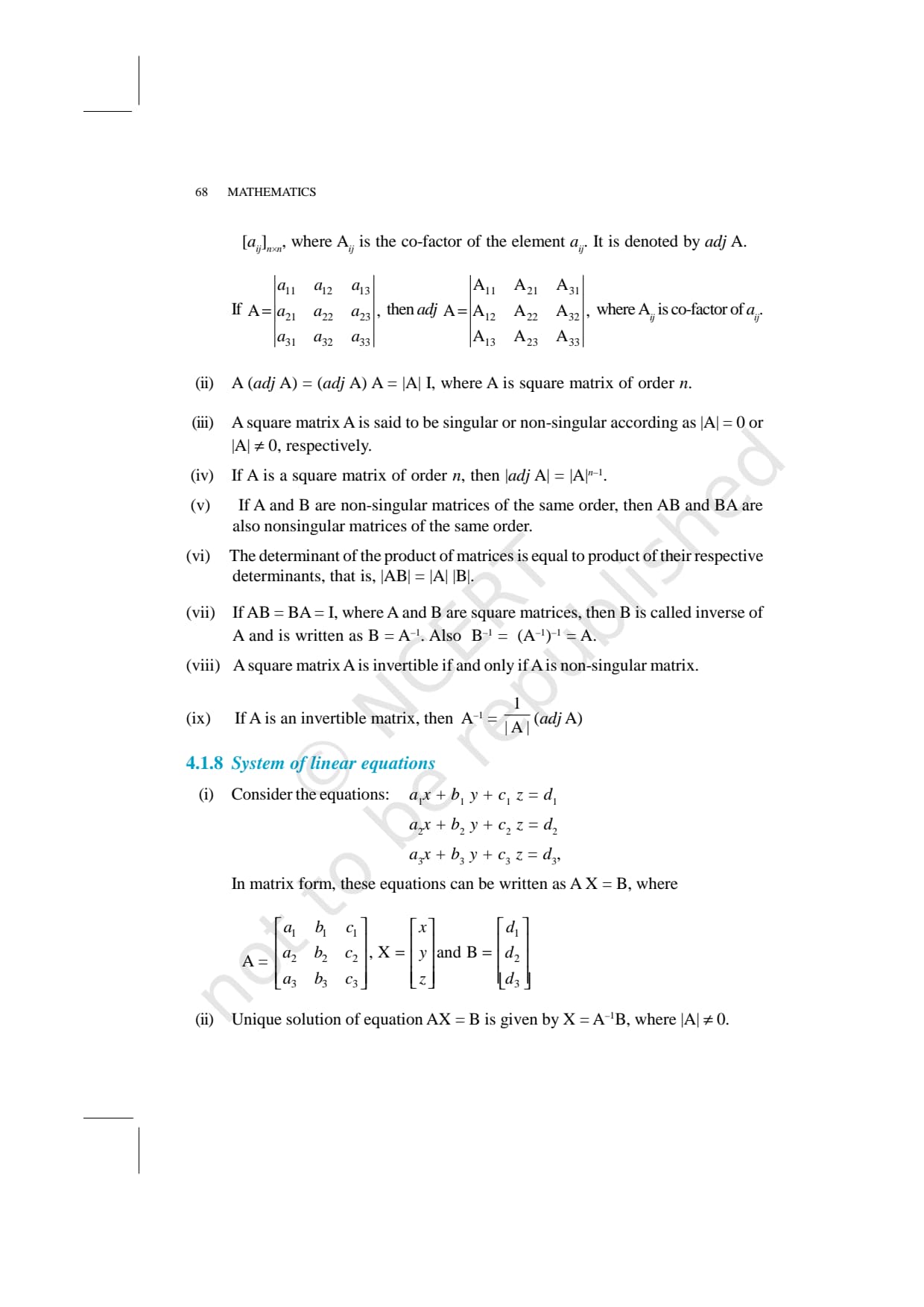
Adjoint, inverse, |adj A| = |A|n-1 YesYesYes
System of linear equations (matrix method)YesYesYes
Consistency analysis using (adj A)B TrimmedYesUseful for JEE; skip if pure CBSE

Roughly 10% of Exemplar problems are now beyond the strict CBSE-only syllabus. A board-only student who solves them is using extra study hours. JEE aspirants should attempt them all.

Detailed kept-trimmed-removed table: the chapter notes Maths NCERT Book PDF

How to Use the Exemplar with the NCERT Textbook: A Parallel-Track Plan

The Exemplar is not a replacement for the NCERT Exemplar Class 12 Maths Determinants. Interleave them: read a topic from the NCERT Exemplar Class 12 Maths Determinants, immediately attempt Exemplar problems on the same topic.

  1. Day 1 (Properties): Read NCERT Sections 4.1-4.2. Solve textbook Exercises 4.1 and 4.2. Attempt Exemplar SA Q1-Q9.
  2. Day 2 (Area, Minors): Read Sections 4.3-4.4. Solve Exercises 4.3 and 4.4. Attempt Exemplar SA Q10-Q17 under a 60-minute timer.
  3. Day 3 (Adjoint, Inverse, Systems): Read Sections 4.5-4.6. Solve Exercises 4.5, 4.6 and the Miscellaneous Exercise. Attempt Exemplar LA Q18-Q23 under a 75-minute timer.
  4. Day 4 (Objective drill): Attempt Exemplar MCQs Q24-Q37, Fill-in Q38-Q47 and True/False Q48-Q58 back to back. Target 1 minute per MCQ, 30 seconds per Fill-in, 20 seconds per True/False.
Remember: Always state which row or column operation you applied before writing the next step. CBSE Boards now award 1 mark for the operation statement before the final answer.

Related Links:

More Determinants Mathematics Class 12 Resources

NCERT Exemplar Book PDF for Class 12 Mathematics: All Chapters

Download any other chapter's Exemplar Book PDF for the 2026-27 cycle using the table below.

NCERT Exemplar Class 12 Maths Determinants: available above as a free PDF download, aligned to the 2026-27 NCERT Class 12 Mathematics syllabus.

Exercise-wise Breakdown of the Determinants Chapter

The Determinants chapter splits into 6 numbered exercises plus a Miscellaneous Exercise. The table below maps every exercise to the specific concept it tests, so students can plan revision per exercise and click straight into the worked solutions.

ExerciseTopic Tested
Exercise 4.1Evaluation of 2x2 and 3x3 determinants
Exercise 4.2Properties of determinants; area of a triangle
Exercise 4.3Minors and cofactors
Exercise 4.4Adjoint and inverse of a matrix
Exercise 4.5Applications: solving systems of linear equations
Exercise 4.6Consistency of system of linear equations
Miscellaneous ExerciseMixed determinant concepts and applications

PDF Download Formats and Languages for the Determinants Chapter

The Determinants Class 12 PDF on this page is available in three formats - each suited to a different revision style. The table below summarises what each format is best for:

FormatBest forApprox. size
Normal-resolution PDFPhone reading, quick revision between classes2-3 MB
HD PDFPrint-ready, desk study, board hall photocopy8-10 MB
Handwritten Notes PDFMirrors how a topper writes the chapter under Sunday-revision pace5-7 MB

The determinants class 12 ncert pdf and the parallel Hindi-medium edition both follow the same notation and equation numbering as the printed NCERT 2026-27 release. Key points students should know:

  • NCERT-faithful: Every definition, theorem and exercise on the determinants class 12 ncert pdf matches the printed textbook line for line.
  • Hindi-medium edition: The determinants class 12 pdf is also available in Hindi - same page numbering, same equation labels.
  • Formula PDF separate: The determinants class 12 formulas pdf is a one-page A4 reference sheet listing every identity used in the chapter.
  • Solutions PDF separate: The chapter notes solutions pdf gives every NCERT exercise worked out step by step.
  • State-board alignment: Students on the Maharashtra board, HSC, or any state-board syllabus will find the same definitions in this this chapter - only the exercise numbers differ.

Tip: Many toppers keep two parallel copies - a printed formula sheet on A4 for desk revision (the determinants class 12 formulas pdf), and the full these notes on a phone for commute revision. Both files are free and linked above.

Important Questions and Previous Year Trends for the Determinants Chapter

The most repeated question patterns in CBSE Class 12 Maths for the Determinants chapter have settled into a stable cluster across 2019 to 2024 boards. Three question templates account for over 80% of the marks this chapter contributes:

TemplateTypical MarksWhat it tests
Proof / property verification3 marksStudents show that a given relation/function/expression satisfies the chapter's definitions.
One-step computation2 marksSubstitution-based item: plug into a known formula and simplify.
Case-study scenario4 marksReal-world setup applying the chapter's definitions, introduced in CBSE 2021+ papers.

Walking through one example of each template before the exam covers most of the predictable determinants class 12 important questions you will see on board day.

  • the PDF previous year questions for 2019-2024 are linked from the PYQ block at the bottom of this page - the exact CBSE phrasings.
  • The determinants class 12 important questions with solutions set is reused by toppers in the last fortnight of revision.
  • For NCERT Exemplar practice, the matching determinants class 12 extra questions set adds advanced problems suitable for JEE Main and JEE Advanced.
  • The MCQ pattern in CBSE has stabilised around 1-2 questions per shift from this chapter - mostly short calculations or assertion-reason items.

Year-wise PYQ Distribution

The table below maps the dominant question type asked from the Determinants chapter across recent CBSE Class 12 Maths boards:

YearDominant Question TypeApprox. Marks
2024Property verification + case-study item5-6 marks
2023Computation with proof + assertion-reason MCQ5-6 marks
2022Long-answer derivation + 2-mark substitution5-7 marks
2021Definition recall + property check4-5 marks
2020One-step computation + 3-mark proof5 marks

The full this chapter with solutions set (every year, every paper, every question type) is linked from the PYQ page at the bottom of this article.

How the Determinants Notes Pair with NCERT Solutions and the Formula Sheet

The Determinants Class 12 notes work best when paired with two sister resources from the Class 12 Maths hub. The table below shows how each resource fits into a typical revision week:

ResourceUse it forWhen
Determinants Notes (this page)Theory, definitions, exam patternsFirst pass, before practice
determinants class 12 ncert solutions PDFStep-by-step solved exercisesSecond pass, during NCERT practice
determinants class 12 formulas PDFOne-page identity recallThird pass, alongside mock papers
Handwritten Notes PDFQuick reading in topper's handwritingAnytime, especially commute revision

Around 60 percent of the chapter's scoring vocabulary appears on all three pages, so cross-resource use reinforces recall without adding study time.

  • The determinants class 12 ncert solutions cover every back-of-chapter exercise plus the miscellaneous exercise.
  • The this chapter solutions for each individual exercise are indexed by exercise number on the sister NCERT Solutions page (see the Exercise-wise Breakdown table above for direct links).
  • The determinants class 12 formulas reference sheet is the same A4 file students sometimes refer to as these notes all formulas - it lists every identity used in the chapter.
  • State-board references: RD Sharma, ML Aggarwal, Teachoo and the Maharashtra board this Class 12 page textbook PDF all share the same core definitions.
  • For class-first search phrasings - class 12 determinants solutions, class 12 determinants ncert solutions, ncert class 12 determinants solutions - the same files cover the request.

Reference Books and State-Board Mapping

Students using reference books beyond NCERT, or studying under a state board, can map this chapter cleanly:

ReferenceHow it maps to the resource
RD Sharma Class 12 DeterminantsQuestion patterns overlap with NCERT at ~70%; an advanced supplement.
ML Aggarwal Class 12 DeterminantsSolutions style is closer to JEE; good for problem-solving practice.
Teachoo the chapter notesFree online walkthroughs; useful for video-style learning.
Shaalaa the PDF solutionsState-board (Maharashtra HSC) phrasings; same core definitions.
Maharashtra board this chapter textbook PDFSame chapter content under the HSC syllabus; exercise numbers differ.
NCERT Exemplar Class 12 DeterminantsAdvanced problems for JEE Main/JEE Advanced preparation.

How to Use the Determinants Notes Page Most Effectively

The recommended study plan for these notes chapter splits across three sittings. The table below outlines what to do in each:

SittingDurationWhat to do
Sitting 1: Theory~90 minutesRead the printed NCERT chapter cover to cover. Mark every definition and theorem statement. Then read the formula recall section on this page.
Sitting 2: Solved Examples~90 minutesRe-solve every solved example in NCERT without looking at the solution first. Compare your steps against the printed working. Use the determinants class 12 ncert solutions PDF if stuck.
Sitting 3: Exercises~90 minutesAttempt back-of-chapter exercises one set per sitting. Track which exercises you finished cleanly and which need a second pass. Click into the linked exercise pages above for verification.

For students preparing for both CBSE board and JEE Main:

  • 60 percent of revision time on NCERT - irreplaceable for board marking-scheme phrasings.
  • 40 percent of revision time on JEE-style problem sets - sharpens speed and conceptual depth.
  • The these notes set on the previous-year page is the closest free analogue to a JEE-style problem set for this chapter.
  • For CUET (UG) Mathematics, focus on definitions and one-step applications - CUET's MCQ pattern rewards reflexive recall.

This Collegedunia NCERT Class 12 Mathematics page is reviewed against every CBSE board paper release.

Class 12 Mathematics Revision Strategy and Exam Practice Routines

Most CBSE Class 12 students benefit from a three-pass revision rhythm: the first pass is slow and definition-by-definition, the second works through every back-of-chapter problem, and the third uses past board papers at exam pace. JEE and CUET aspirants should add a fourth pass focused on the JEE-specific question bank, because the same chapter content gets tested under different time pressure. Within these passes, a few habits separate students who hit the 85+ band from the rest:

  • Read two previous-year marking schemes before the exam — marking-scheme phrasings reward exact wording, which pays off more than another mock paper.
  • Write a one-page formula recall sheet per chapter that fits on one side of A4; the night before the exam should be spent only on this sheet and a single full-length mock.
  • Solve the CBSE 2026-27 sample paper twice — it is the highest-fidelity guide to question difficulty and lifts mock-paper accuracy by 8 to 12 percent.
  • Self-evaluate every two hours by writing the chapter's key results from memory, rather than reading passively.
  • Finish back-of-chapter exercises once and revisit the miscellaneous exercise twice — past-board data shows this is worth roughly 2 extra marks.

Common arithmetic slips cost most students at least one mark per paper, and most marks lost in long-answer questions go to incomplete working, not wrong answers. Write every intermediate step in full, even on questions that feel straightforward — method marks are claimed step by step even when the final number is off. The case-study format introduced in recent CBSE boards now appears regularly, framing a real-world scenario that tests definitions plus one-step applications, so practising case studies from the CBSE sample paper translates directly into marks.

Time allocation in the last fortnight matters most. Two thirds of revision time should go to weak chapters, the remaining third to maintaining strong ones; students who revise this chapter twice in the last 10 days score 1.5 to 2 marks higher on past boards. The night before the exam is best spent on:

  • The one-page formula recall sheet built earlier in revision.
  • A single full-length mock paper at exam timing.
  • Avoid learning any new material the night before — sleep matters more.

Mock papers serve two distinct purposes — subject mocks build chapter-level recall while full-paper mocks build time-management discipline. Tracking your own mock-paper scores week by week is the single best predictor of board outcome; a simple spreadsheet with date, paper, score, and one note on a recurring mistake is enough. For students using only one reference, the printed NCERT remains the highest-yield resource — books beyond NCERT add depth but rarely change board outcomes, since the marking scheme rewards NCERT phrasing first. Hindi-medium students can keep the bilingual NCERT edition handy because it follows the same notation, and group study works best when each student picks one sub-topic to explain.

Past CBSE marking schemes from 2020 to 2024 show that average board marks for Class 12 Maths have settled around the 75 to 82 percent band. Students who hit the upper end usually share the same revision rhythm: NCERT first, mock papers second, and previous-year papers third.

NCERT Exemplar Class 12 Maths Determinants - Frequently Asked Questions

Ques. Where can I download the NCERT Exemplar Class 12 Maths Determinants for free?

Ans. You can download these notes Maths NCERT Exemplar Book PDF directly from the NCERT Exemplar Class 12 Maths Determinants. Both Normal and HD versions are available and both are free.

Ques. Is this NCERT Exemplar Class 12 Maths Determinants aligned with the 2026-27 NCERT syllabus?

Ans. The Exemplar itself was not updated during the 2022-23 revision, so it still contains a handful of consistency-analysis problems that are now beyond the strict CBSE-only scope. We have flagged those so you can skip them if you are not preparing for JEE.

Ques. How many pages and how many problems are in the Class 12th Maths Determinants Exemplar PDF?

Ans. The Exemplar PDF for Chapter 4 runs 21 pages. It contains 14 solved examples plus 58 unsolved problems split as 17 SA, 6 LA, 14 MCQ, 10 Fill-in-the-Blanks and 11 True/False.

Ques. Is the NCERT Exemplar harder than the NCERT textbook for Determinants?

Ans. Yes. The Exemplar chains two or three row-column operations into one problem, asks for a factor extraction after the simplification, and uses counter-example True/False statements to test edge cases. This is the style CBSE Boards and JEE Main now use for HOTS questions on Determinants.

Ques. Should I attempt the Exemplar before or after the NCERT textbook?

Ans. Attempt them in parallel. Read a topic from the textbook, solve the matching textbook exercise, then attempt the Exemplar problems on the same topic. Trying the Exemplar before the textbook usually leaves students stuck on multi-step row operations.

Ques. How important is the NCERT Exemplar for JEE Main preparation on Determinants?

Ans. Very important. Around 40% of JEE Main 2023-2025 questions on Determinants chained two or more row-column operations in a single step, which is exactly the Exemplar style. JEE aspirants should treat the Exemplar Chapter 4 problem set as mandatory practice.

Ques. Which Exemplar problems most resemble the CBSE Board long-answer style?

Ans. Long Answer problems Q19, Q20 and Q22 most closely match CBSE Board 5-mark style on adjoint, inverse and matrix-method systems. These three have appeared in CBSE Boards in slightly modified form across the last five years.

Ques. What is the formula for the determinant of adjoint of a matrix?

Ans. For a square matrix A of order n, |adj A| = |A|n-1 . For a 3 x 3 matrix this becomes |adj A| = |A|2 . Exemplar True/False Q54 and Fill-in Q39 directly test this identity.