




Class 12 Chemistry Chapter 2 Electrochemistry carries 68 problems in the NCERT Exemplar across five question types, more than the textbook exercise. It pushes Nernst equation, conductivity, electrolysis, and battery cells past CBSE level. This page hosts the 2026-27 Exemplar PDF, the question-type map, and the JEE / NEET mapping.
- CBSE Weightage: 4-6 marks (one short answer plus one numerical)
- JEE Main Weightage: 4-5% (2-3 questions per paper)
- NEET Weightage: 2-3 questions per year
Download the full Electrochemistry Exemplar PDF below, with the question-type map, difficulty notes, and JEE / NEET mapping.
Curated by subject experts, mapped to the 2026-27 NCERT, and checked against five years of CBSE, JEE Main, and NEET papers.
Also Check:
- Electrochemistry Class 12 Chemistry NCERT Exemplar Solutions
- Electrochemistry Class 12 Chemistry NCERT Book PDF
Electrochemistry Exemplar: MCQ, VSA, SA, LA Counts and Marks
The 68 problems span five types, shown below with counts and marks.
| Question Type | Question Numbers | Count | Typical Marks |
|---|---|---|---|
| MCQ-I (single correct) | Q1 – Q17 | 17 | 1 each |
| MCQ-II (multiple correct) | Q18 – Q27 | 10 | 2 each |
| Short Answer (SA) | Q28 – Q49 | 22 | 2–3 each |
| Matching Type | Q50 – Q55 | 6 | 2–4 each |
| Assertion & Reason | Q56 – Q65 | 10 | 1 each |
| Long Answer (LA) | Q66 – Q68 | 3 | 5 each |
Note: Short Answer and MCQ-II together carry 32 problems, almost half the Exemplar, so give them the most practice time.
Electrochemistry Class 12 Chemistry Explained
Source: Magnet Brains on YouTube
What's Inside the Electrochemistry Exemplar PDF
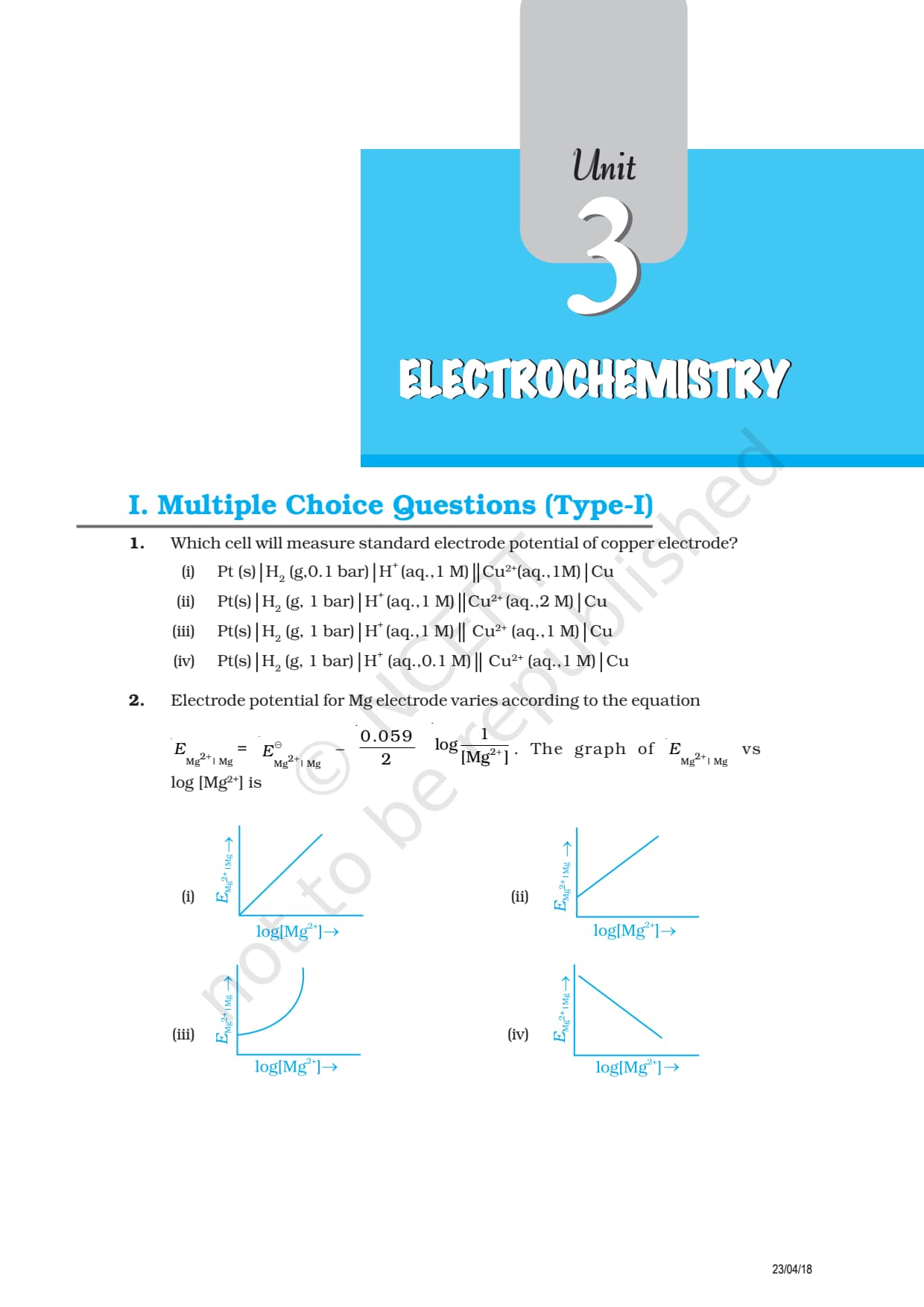
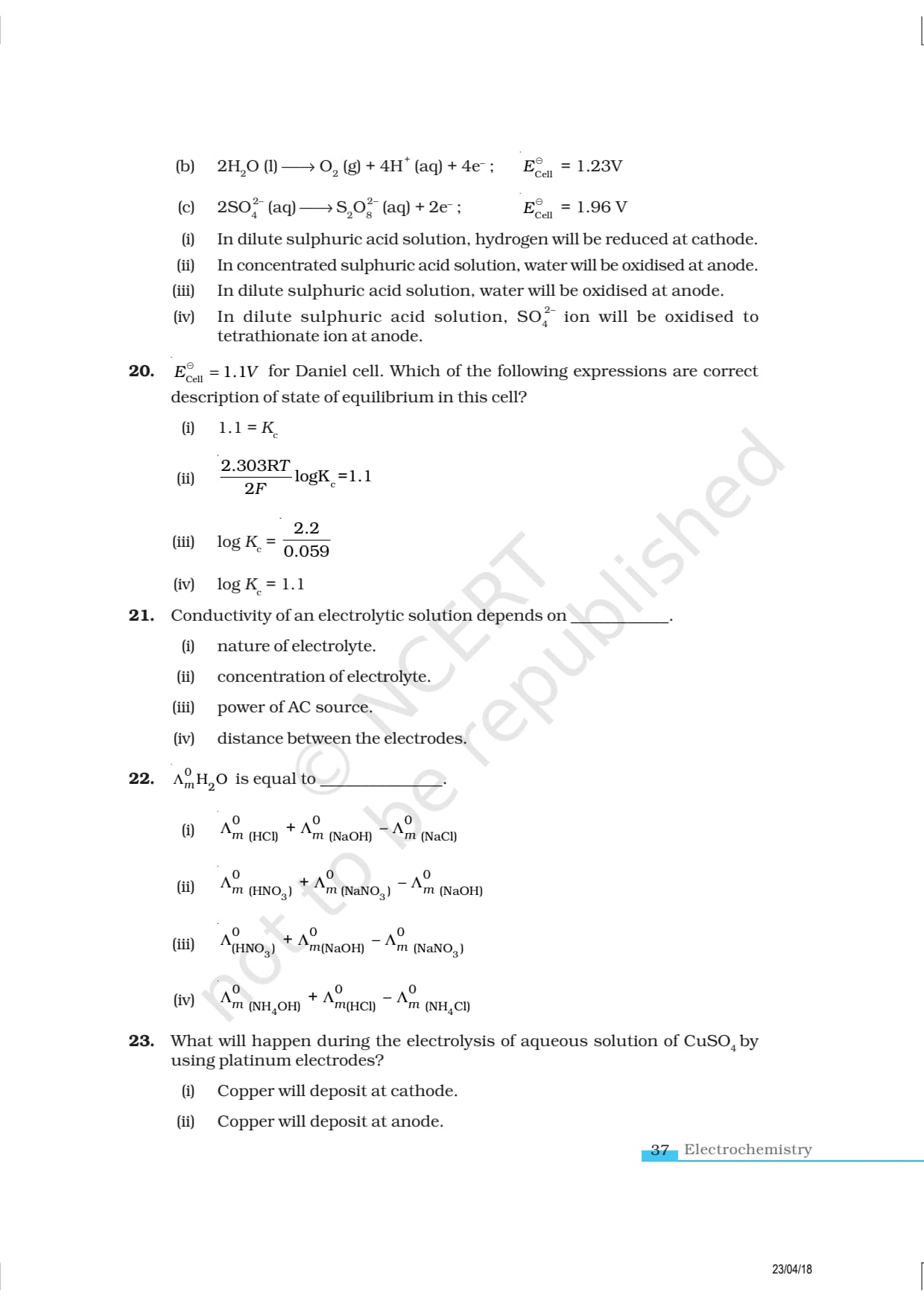
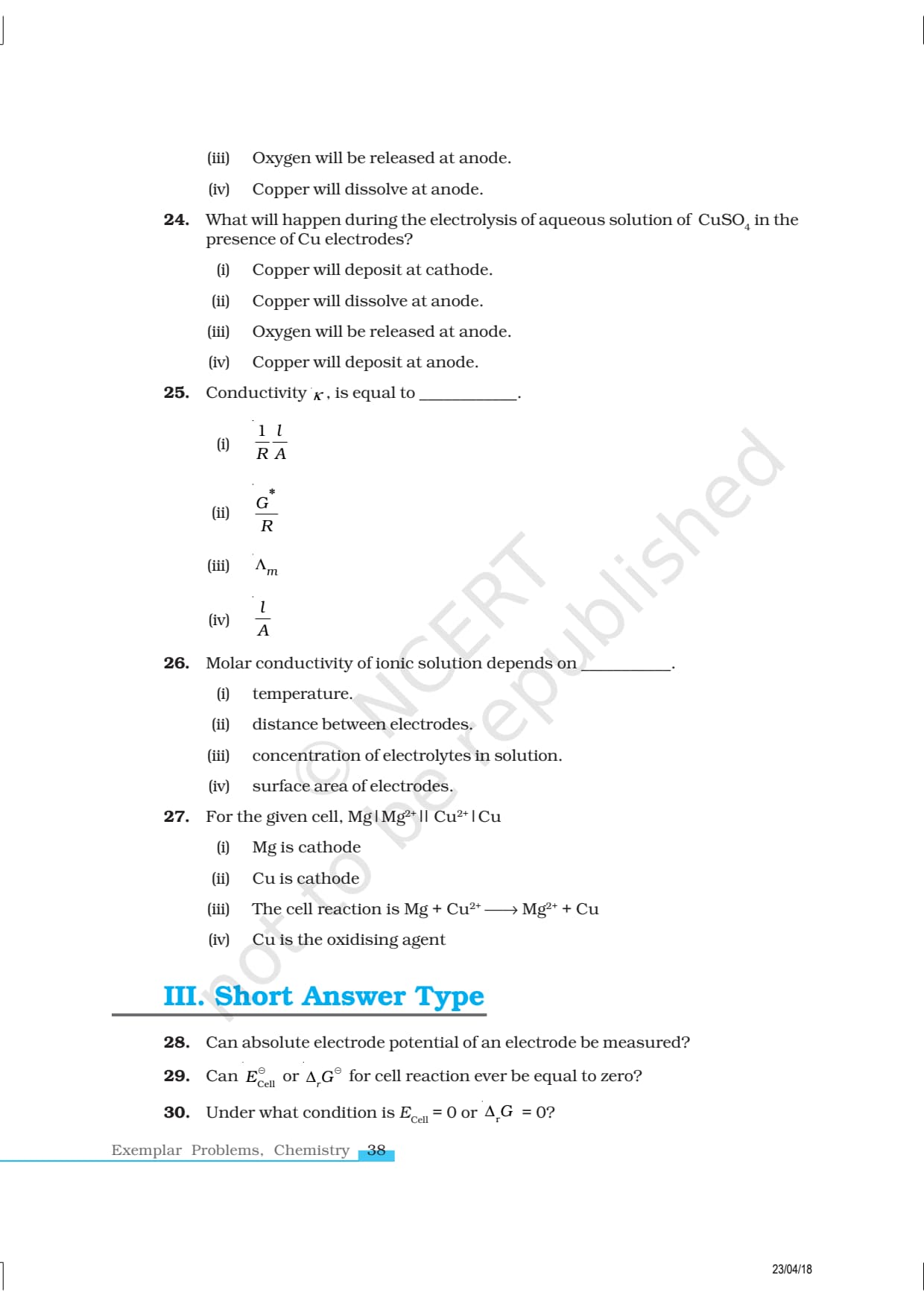
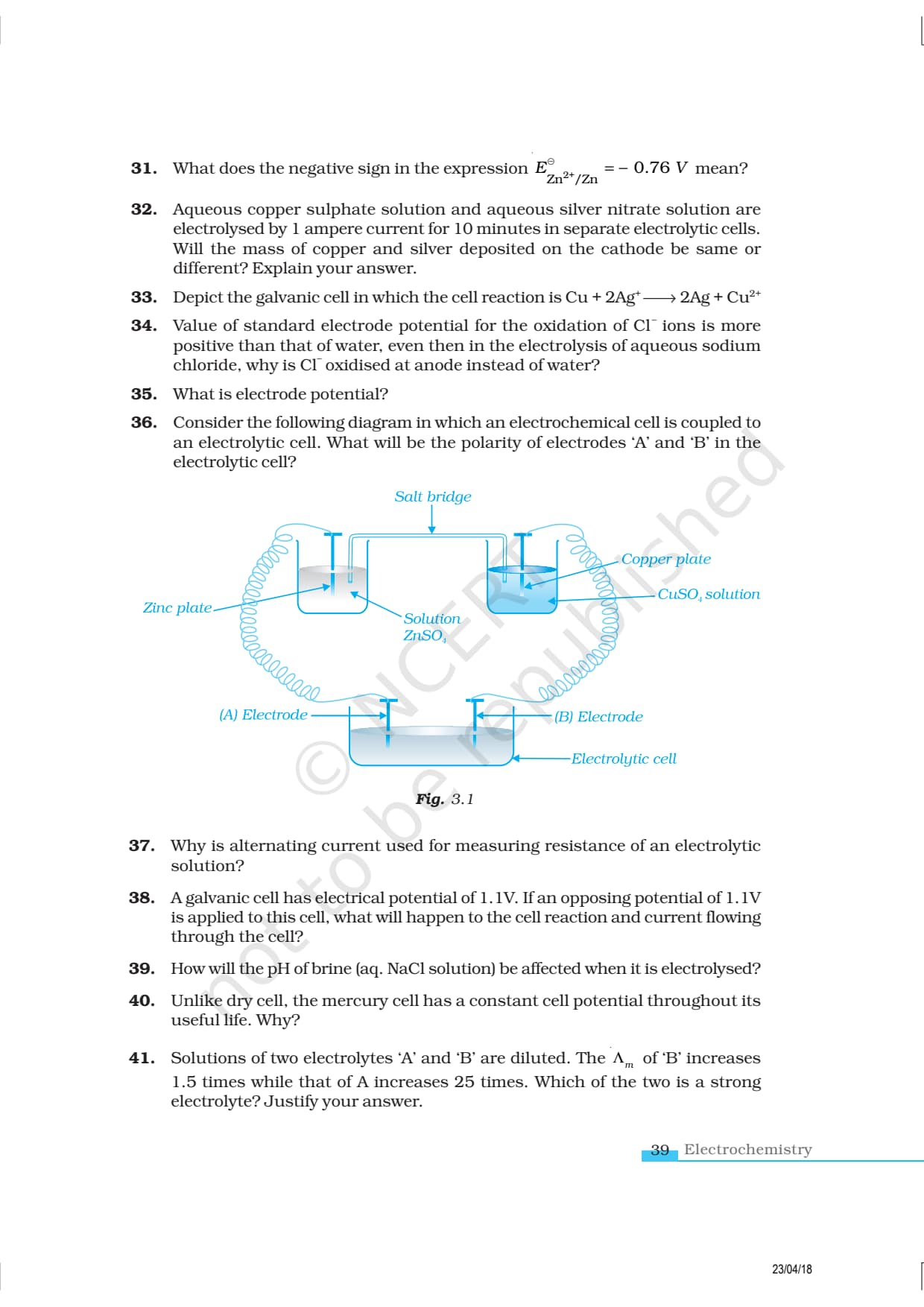
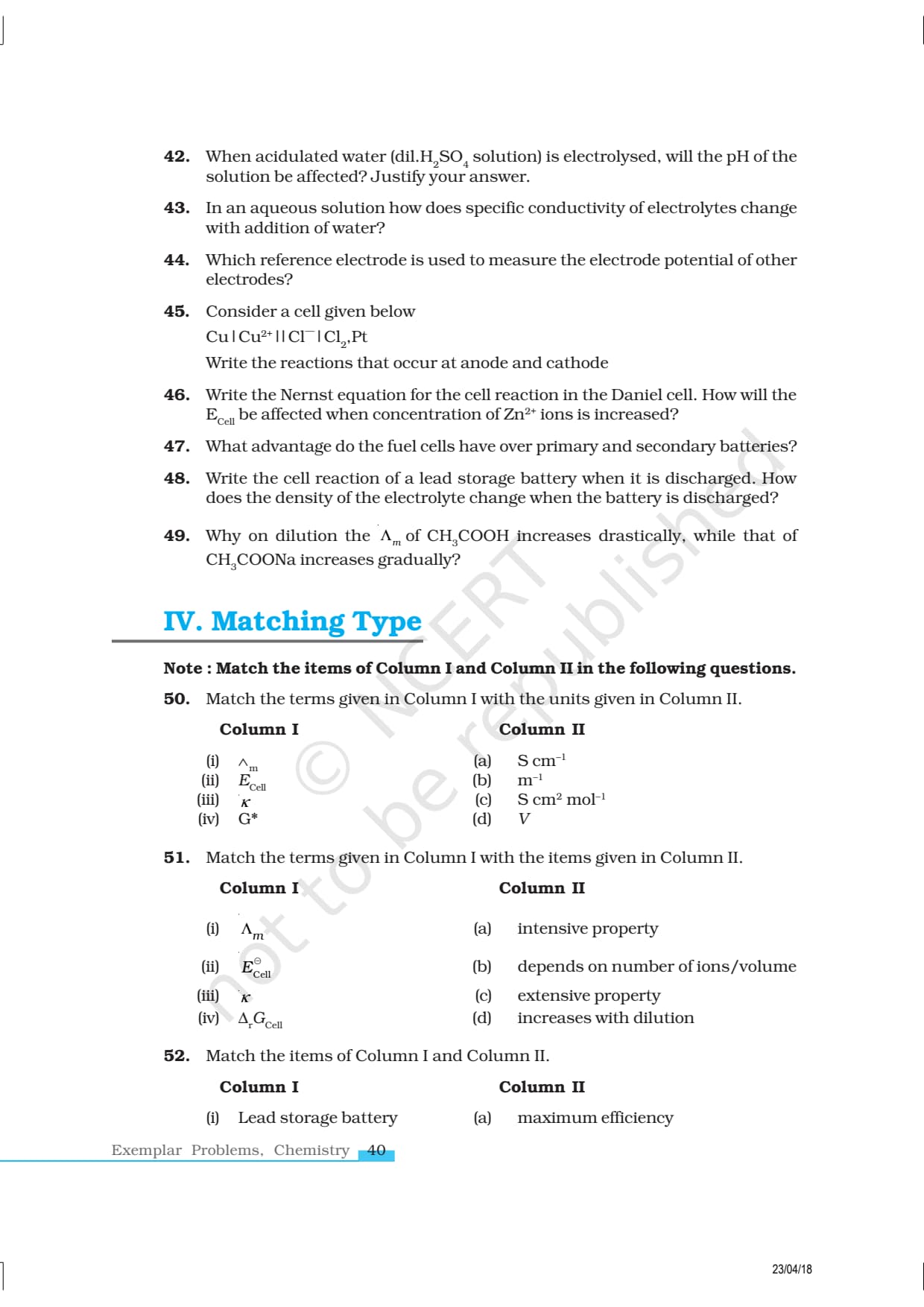
The 14-page PDF (pages 33-46 of NCERT Exemplar Problems Chemistry Class 12) includes:
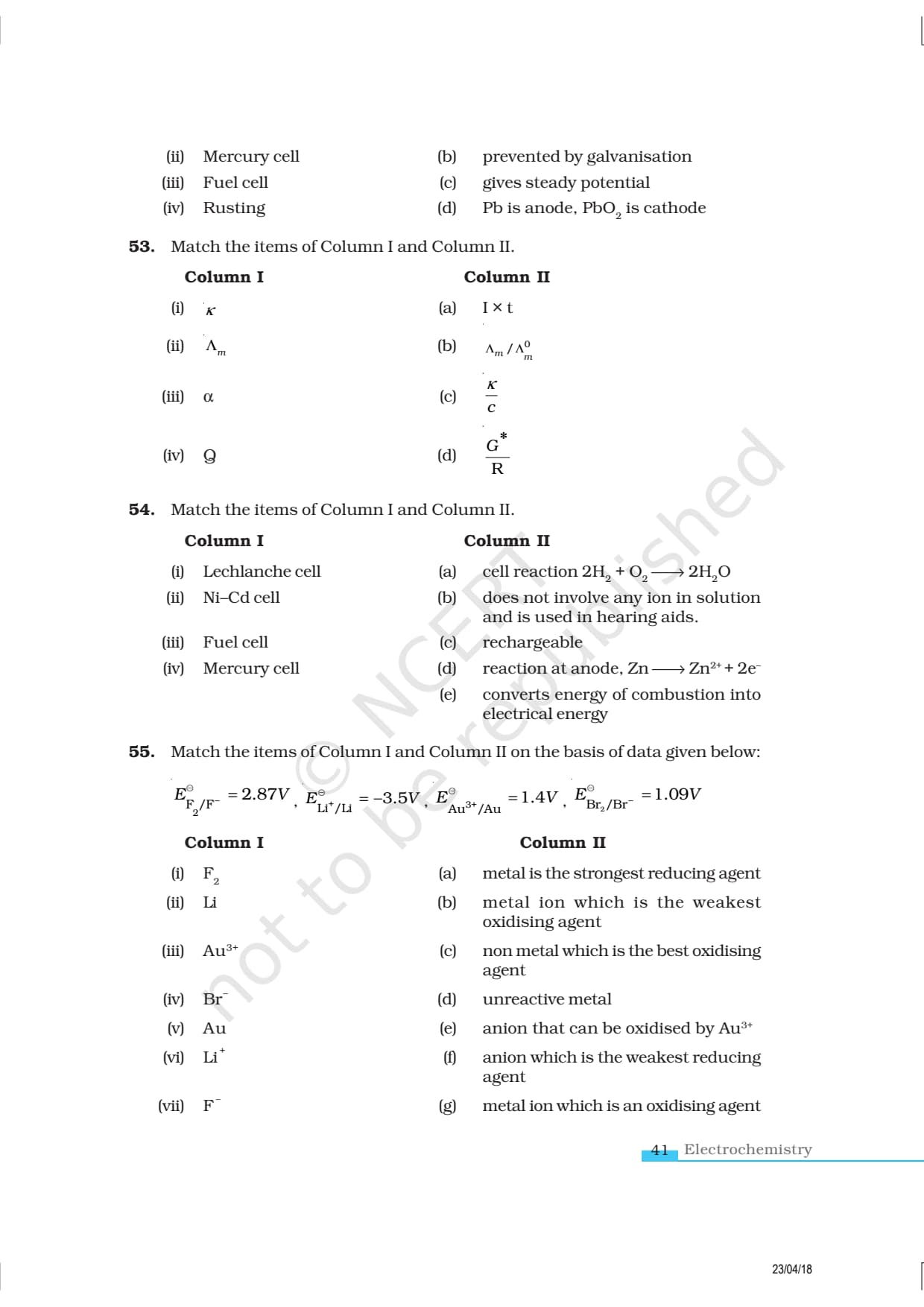
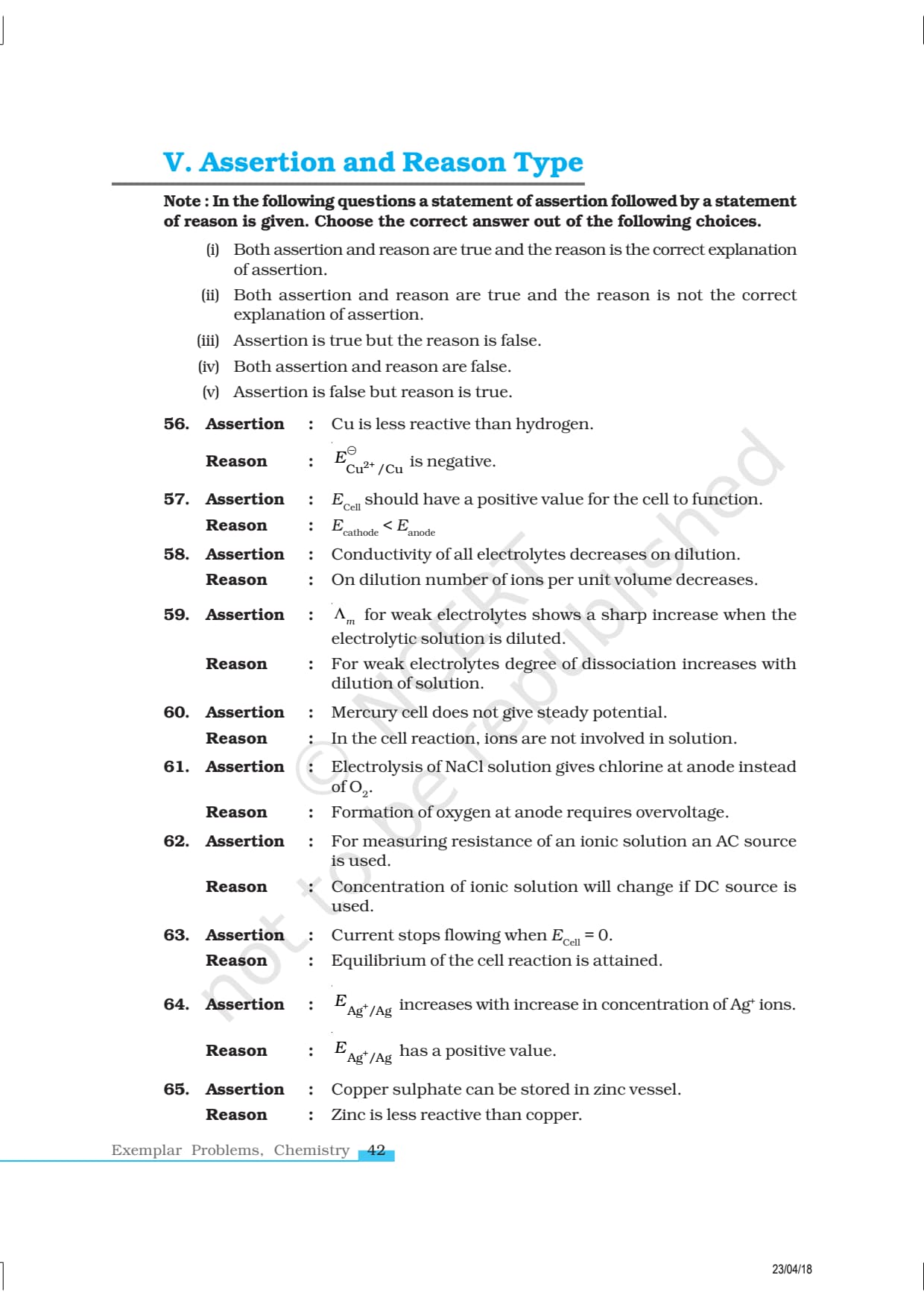
- 5 sections covering MCQ-I, MCQ-II, Short Answer, Matching, Assertion-Reason, and Long Answer.
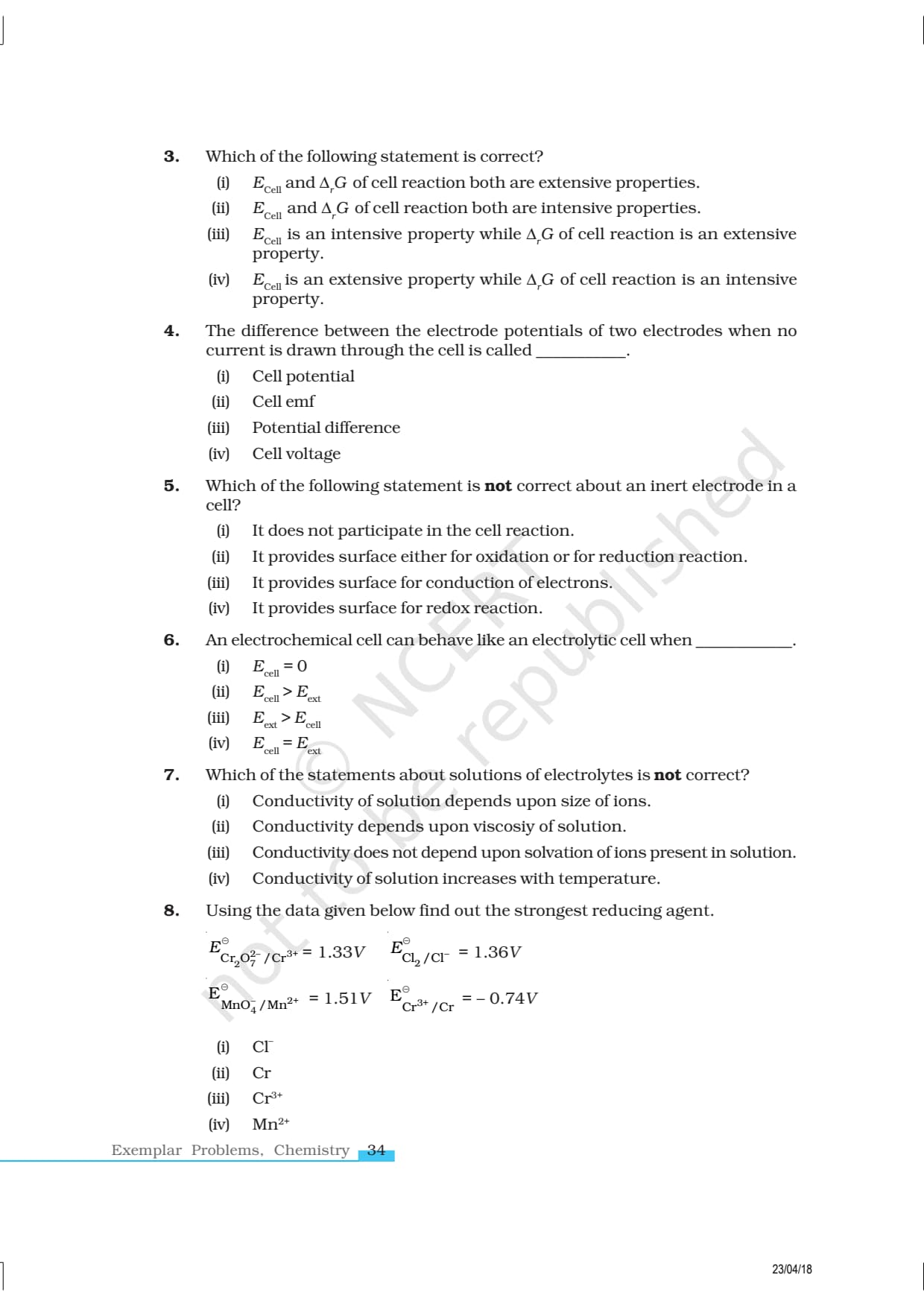
- Electrode potential data tables inside MCQs (Q8, Q55), so you read values from a block, not recall.
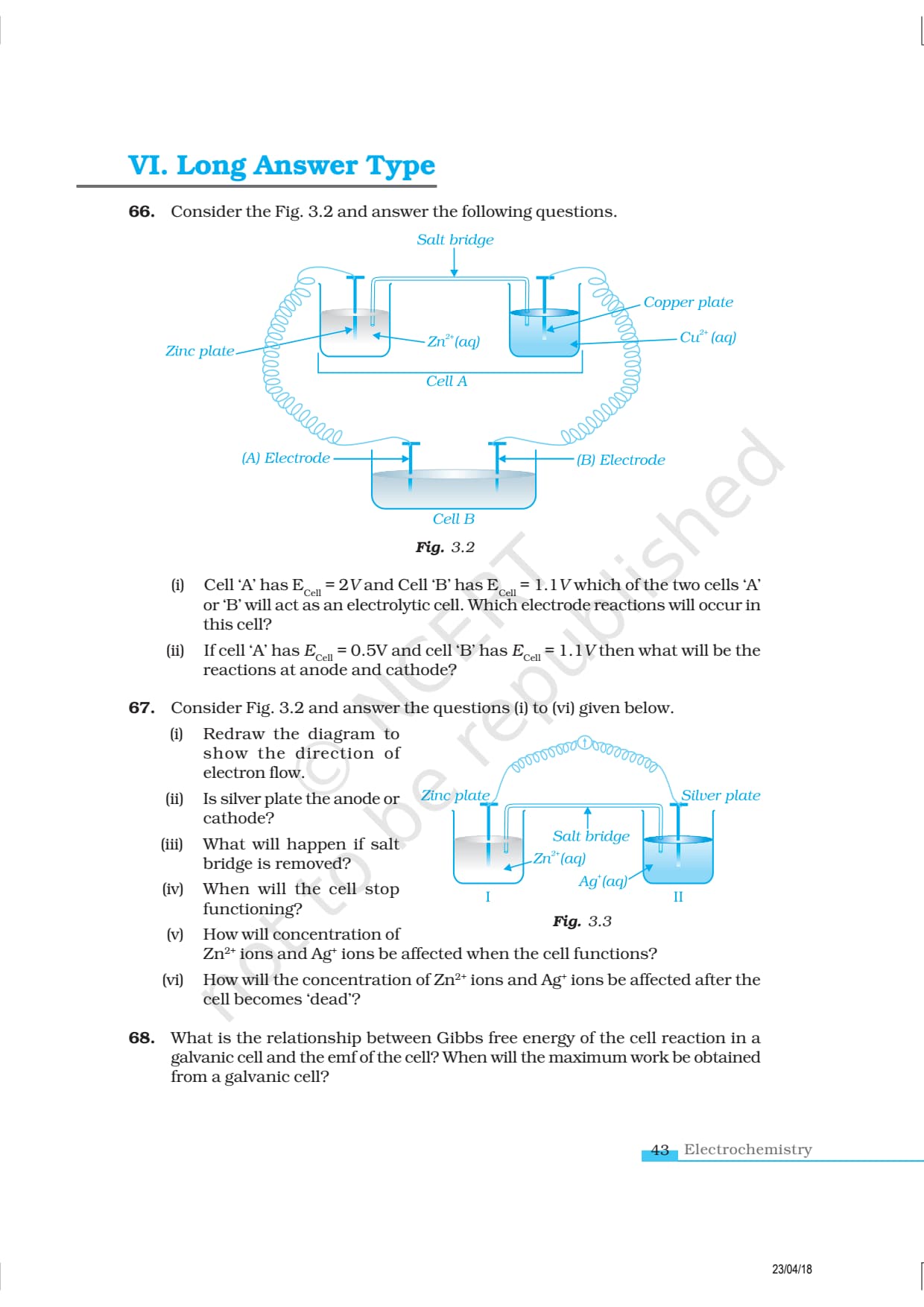
- Galvanic-cell diagrams in the Long Answer set (Fig. 3.1-3.3) on polarity and electron flow.
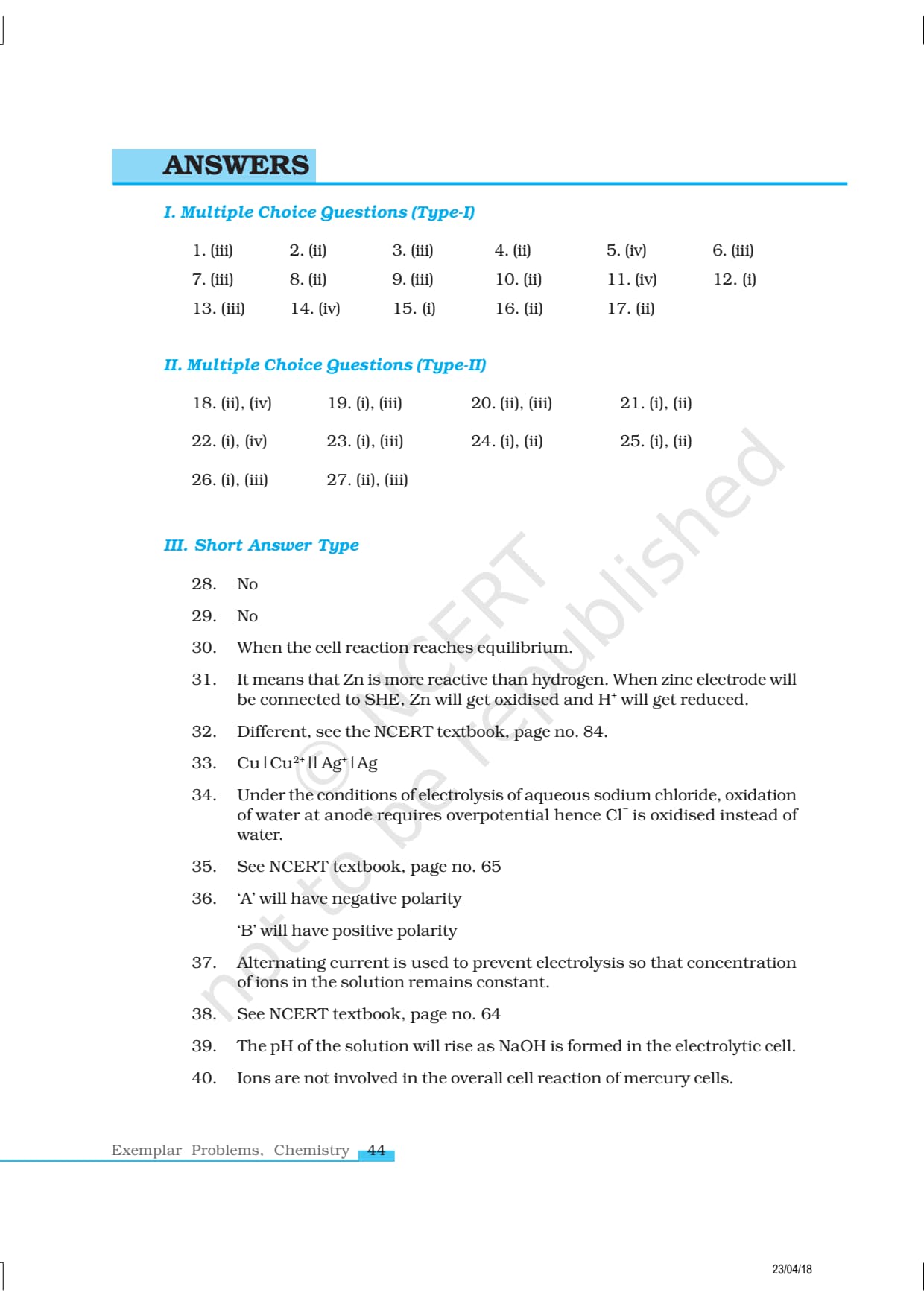
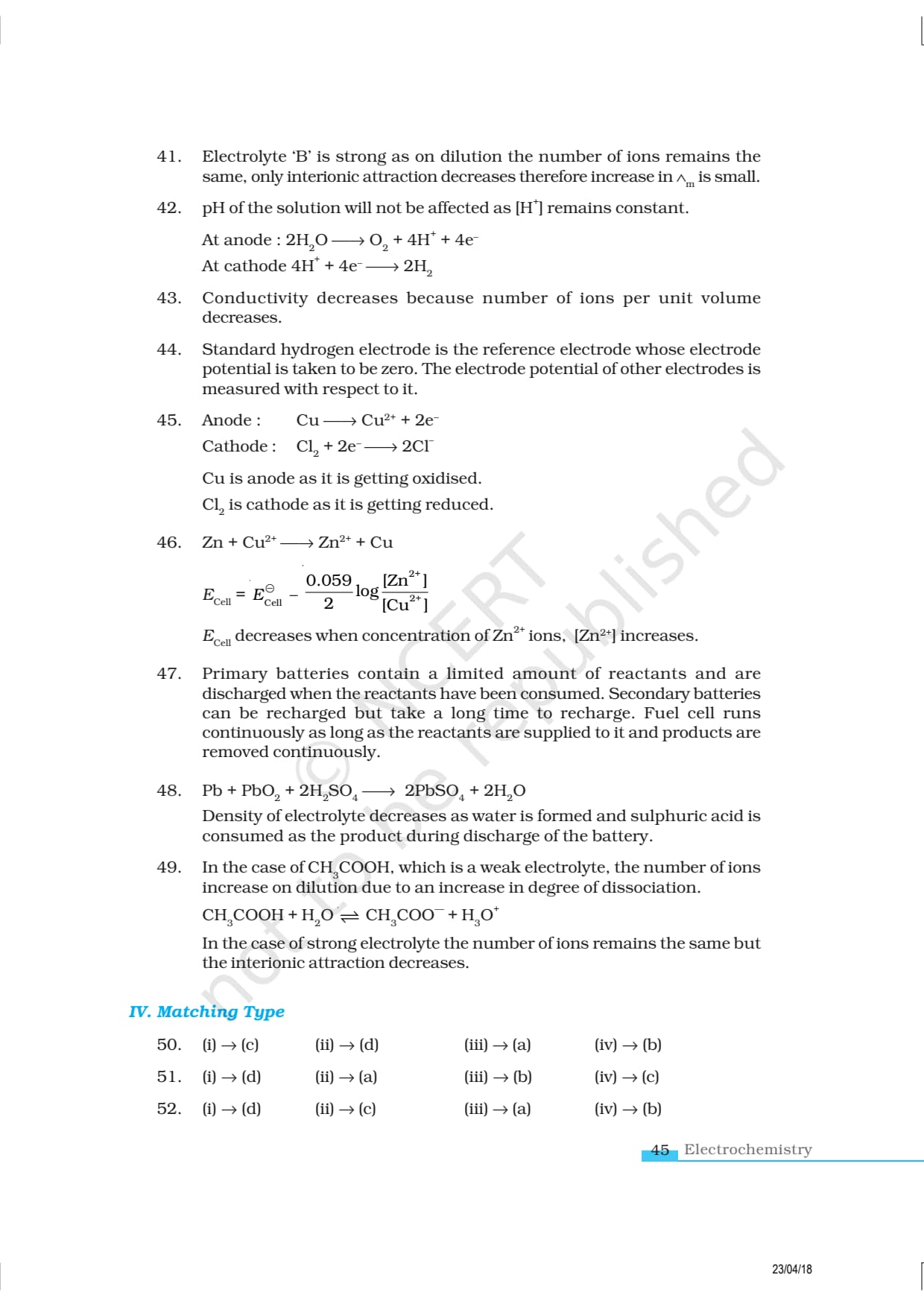
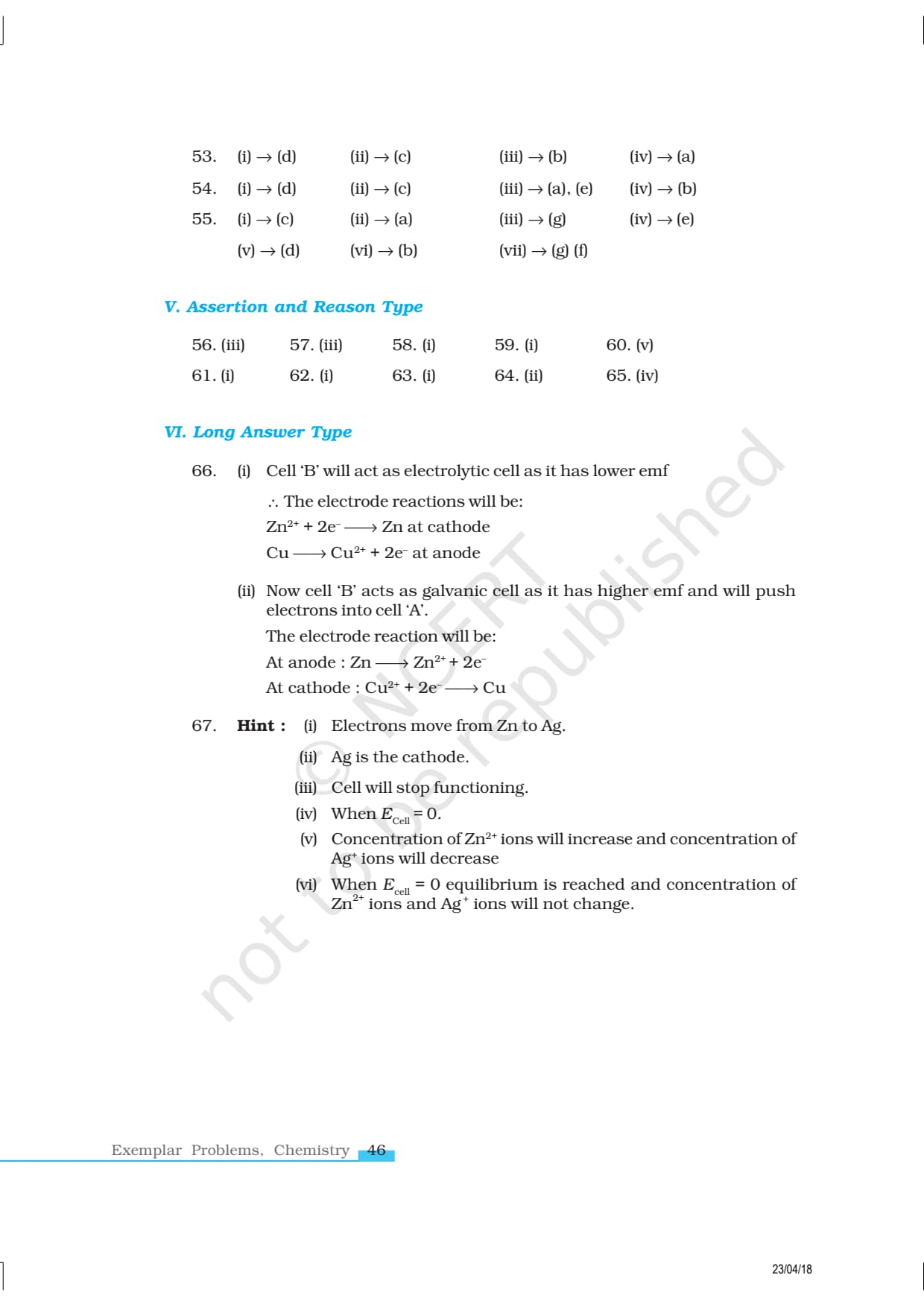
- Answer key at chapter end for every MCQ, MCQ-II, SA, Matching, and Assertion-Reason problem.
How will Collegedunia's Exemplar Book PDF Help You with Electrochemistry?
The Exemplar Book PDF is the highest-yield HOTS resource for this chapter.
- Searchable PDF: Jump to any question type in two clicks.
- 2026-27 Alignment: Every dropped-from-textbook topic still in the Exemplar is flagged below.
- JEE / NEET Mapping: The 15-20 problems mirrored in recent JEE Main and NEET papers are tabled below.
- Expert Verification: Each question is tagged to its NCERT section and checked against the official E° table.
Electrochemistry Exemplar vs NCERT Textbook: Difficulty Comparison
The Exemplar is harder than the textbook: it twists each standard setup by adding one reasoning step.
| Concept | NCERT Textbook | Exemplar Twist |
|---|---|---|
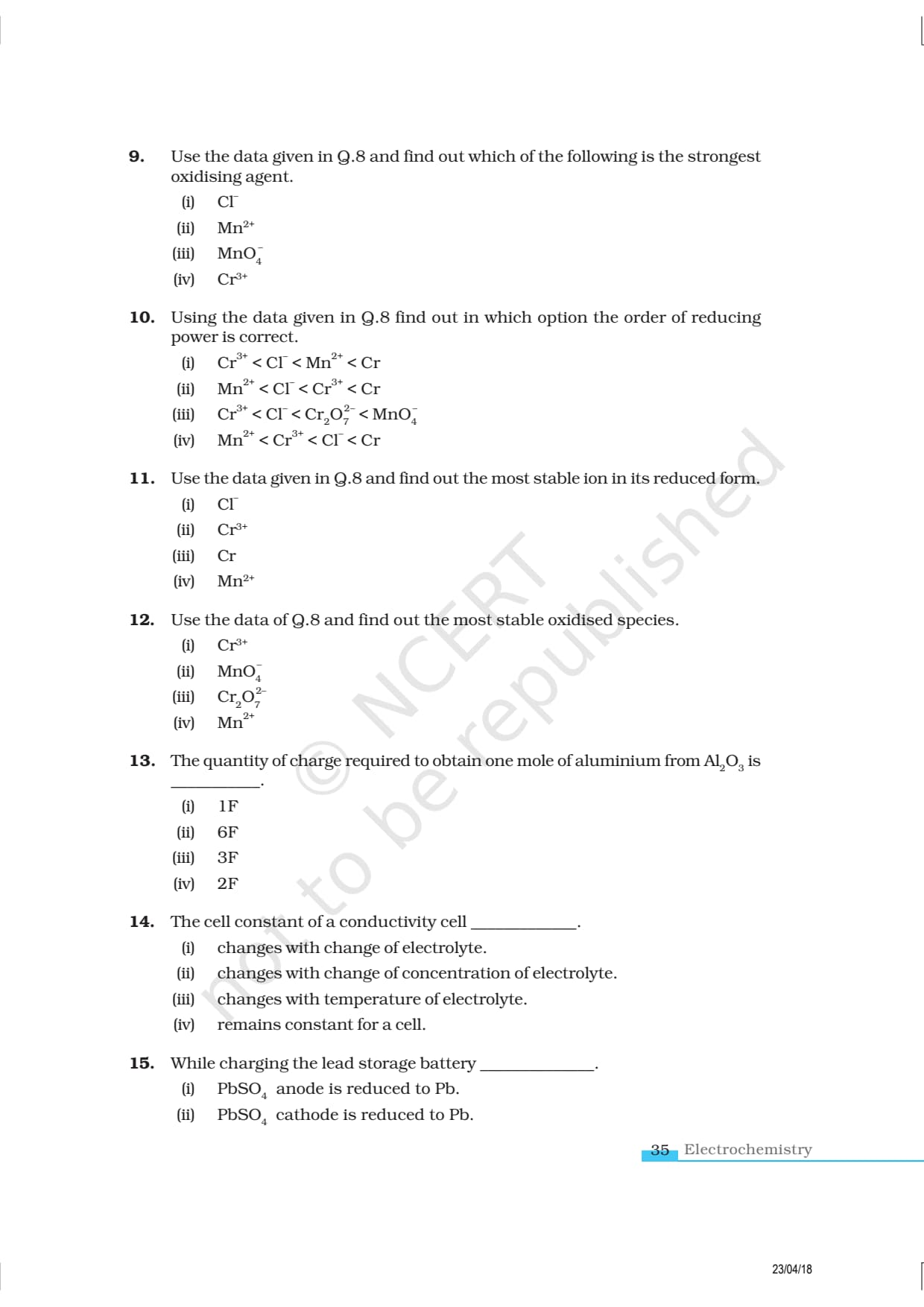
| Standard electrode potential | Look up E° for a single half-cell | Rank four species by reducing power from an E° data block (Q8-Q12) |
| Nernst equation | Compute Ecell at given ion concentrations | Match the E vs log[Mg2+] graph to one of four sketches (Q2) |
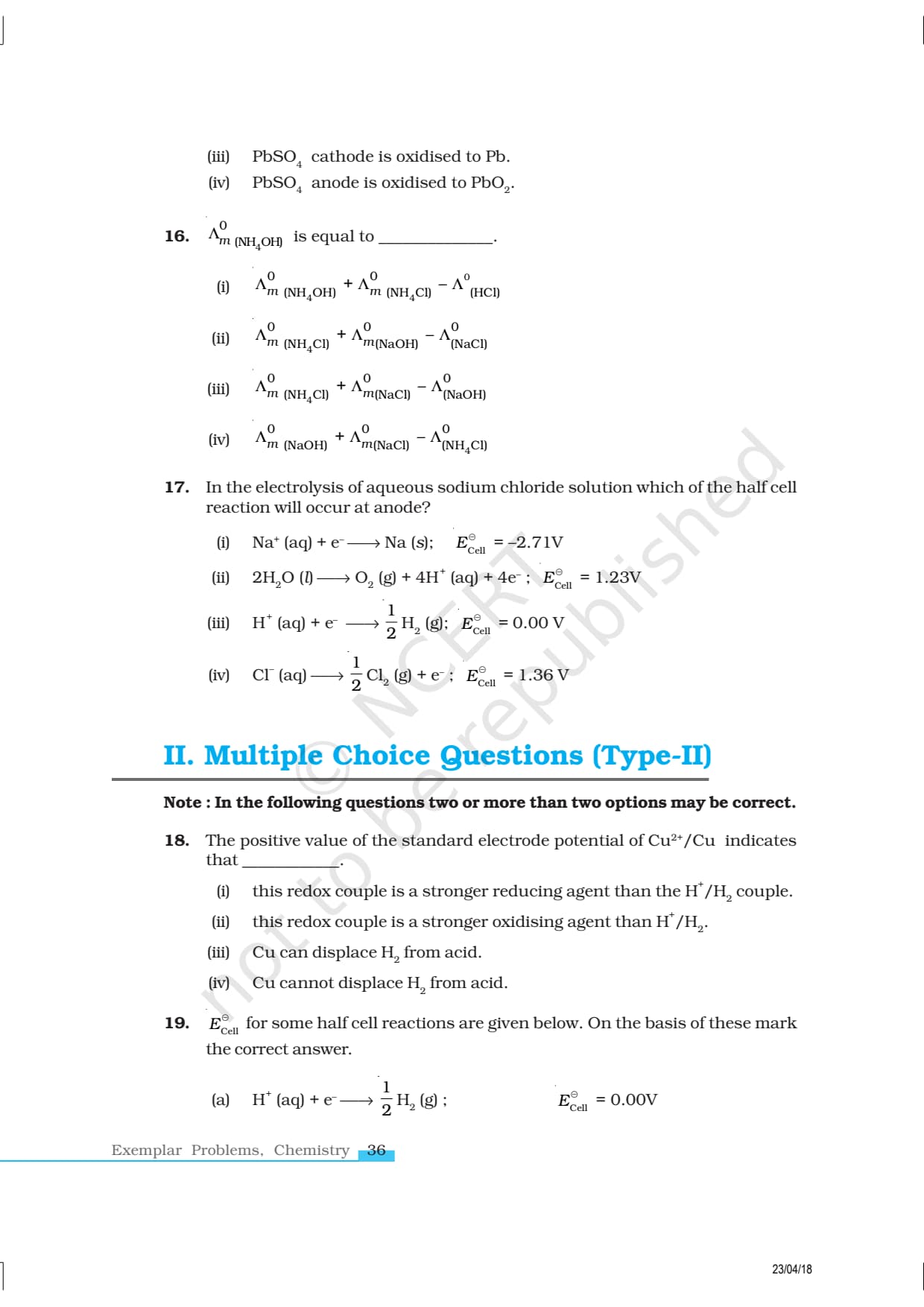
| Kohlrausch's law | Find Λ°m for a weak electrolyte | Express Λ°m(H2O) from HCl, NaOH, NaCl conductivities (Q22) |
| Electrolysis | Compute mass deposited from Q = It | Predict anode and cathode products for CuSO4 with Pt vs Cu electrodes (Q23, Q24) |
| Galvanic vs Electrolytic cell | Identify which is which | Couple a 2V cell to a 1.1V cell and identify which acts as electrolytic (Q66) |
A student who can solve every textbook example still loses 4-6 marks on the Exemplar without separate practice.
Electrochemistry Old Syllabus vs 2026-27: What's Kept in the Exemplar
NCERT updated the textbook in 2023 but did not revise the Exemplar, so a few dropped sub-topics still appear.
- Testable in 2026-27 boards: Nernst equation, conductivity and molar conductivity, Kohlrausch's law, electrolysis, EMF and Gibbs energy, fuel cells, lead storage battery, dry cell.
- Exemplar-only / JEE-only: Lechlanche cell, mercury cell details, corrosion of iron mechanism.
Detailed kept-trimmed-removed table: Electrochemistry Class 12 Chemistry NCERT Book PDF

Why the NCERT Exemplar Matters for JEE / NEET Electrochemistry Prep
Electrochemistry is a high-yield JEE / NEET chapter, and the Exemplar is the only NCERT resource pitched at entrance level.
- Nernst equation numericals (Q2, Q46, Q64) mirror JEE Main 2024-2025 Ecell questions.
- Conductivity on dilution (Q41, Q49, Q58, Q59) is a recurring NEET assertion-reason stem.
- Electrolysis product prediction (Q23, Q24, Q34, Q39, Q42) appears in JEE Main most years, usually CuSO4 / Pt vs Cu.
- Galvanic-cell representation (Q33, Q67) is a 4-marker on CBSE and JEE Main.
Electrochemistry Top 5 Formulae for Quick Exemplar Recall
These five cover Q2, Q20, Q22, Q25, Q46, Q49 and most Long Answers. The full sheet with units lives on the Formula Sheet.
| Quantity | Formula |
|---|---|
| Nernst equation (general) | Ecell = E°cell − (0.059 / n) log Q |
| EMF and Gibbs energy | ΔrG° = −nFE°cell |
| Equilibrium constant and EMF | log Kc = (nE°cell) / 0.059 |
| Conductivity and resistance | κ = (1/R) × (l/A) = G* / R |
| Molar conductivity | Λm = κ / c (or κ × 1000 / c when c is in mol L−1) |
Full master table: Electrochemistry Class 12 Chemistry Formula Sheet
Electrochemistry Exemplar Problems Mapped to JEE Main and NEET
Many of the 68 problems reappear in recent JEE Main and NEET papers with only number swaps. The 10 highest-impact picks:
| Exemplar Q | Type | Concept | Mirrored in |
|---|---|---|---|
| Q2 | MCQ-I | Nernst equation graph for Mg electrode | JEE Main 2024 Jan, Shift 1 |
| Q8–Q12 | MCQ-I cluster | Ranking from E° data block | NEET 2023, NEET 2025 |
| Q22 | MCQ-II | Λ°m(H2O) by Kohlrausch combination | JEE Main 2025 Apr, Shift 2 |
| Q23, Q24 | MCQ-II | Electrolysis of CuSO4 with Pt vs Cu electrodes | JEE Main 2024 Apr, Shift 1 |
| Q41 | SA | Strong vs weak electrolyte on dilution | NEET 2024 |
| Q46 | SA | Nernst equation for Daniell cell | CBSE Board 2025 |
| Q48 | SA | Lead storage battery discharge | CBSE Board 2024, JEE Main 2023 |
| Q56–Q60 | Assertion-Reason | Conductivity, mercury cell, dilution effects | NEET 2022, NEET 2025 |
| Q66 | LA | Galvanic vs electrolytic when coupled | CBSE Board 2023 |
| Q67 | LA | Zn / Ag galvanic cell, electron flow, equilibrium | CBSE Board 2024, NEET 2023 |
This 10-problem set covers roughly 7 of the 12 Electrochemistry marks across CBSE, JEE Main, and NEET 2025.
Electrochemistry Class 12: PYQ Snapshot for CBSE, JEE Main and NEET (2026 → 2021)
The top recurring sub-topics are Nernst numericals, electrolysis-product prediction, and conductivity on dilution. The full PYQ map lives on the NCERT Solutions page.
| Year | CBSE Board | JEE Main | NEET |
|---|---|---|---|
| 2026 | - | Conductivity from cell constant (2 Qs) | Pending (exam rescheduled) |
| 2025 | Nernst equation (3 marks) | Kohlrausch's law (1 Q) | Electrolysis prediction (2 Qs) |
| 2024 | Lead storage battery (3 marks) | Electrolysis of CuSO4 (1 Q) | Standard electrode potential ranking (1 Q) |
| 2023 | Galvanic cell representation (5 marks) | Nernst equation (1 Q) | Mercury cell & primary batteries (1 Q) |
| 2022 | Conductivity on dilution (2 marks) | ΔG and EMF (1 Q) | Fuel cell efficiency (1 Q) |
| 2021 | EMF and equilibrium constant (3 marks) | - | - |
Full year-wise PYQ map: Electrochemistry Class 12 Chemistry NCERT Solutions
Student Feedback
In a Collegedunia poll of 900 Class 12 students, 78% said the Electrochemistry Exemplar felt harder than the textbook, mainly the Nernst-graph and E° ranking problems.
Other Resources for Electrochemistry Class 12 Chemistry
- Electrochemistry Class 12 Chemistry NCERT Exemplar Book PDF
- Electrochemistry Class 12 Chemistry NCERT Solutions
- Electrochemistry Class 12 Chemistry Notes
- Electrochemistry Class 12 Chemistry Formula Sheet
- Electrochemistry Class 12 Chemistry NCERT Book PDF
- Electrochemistry Class 12 Chemistry NCERT Exemplar Solutions
- Electrochemistry Class 12 Chemistry Handwritten Notes
NCERT Exemplar Book PDF for Class 12 Chemistry: All Chapters
The table links every chapter's Exemplar Book PDF in the 2026-27 NCERT sequence.
| Chapter | Resource |
|---|---|
| Chapter 1 | Solutions Exemplar Book PDF |
| Chapter 3 | Chemical Kinetics Exemplar Book PDF |
| Chapter 4 | The d- and f-Block Elements Exemplar Book PDF |
| Chapter 5 | Coordination Compounds Exemplar Book PDF |
| Chapter 6 | Haloalkanes and Haloarenes Exemplar Book PDF |
| Chapter 7 | Alcohols, Phenols and Ethers Exemplar Book PDF |
| Chapter 8 | Aldehydes, Ketones and Carboxylic Acids Exemplar Book PDF |
| Chapter 9 | Amines Exemplar Book PDF |
| Chapter 10 | Biomolecules Exemplar Book PDF |
Electrochemistry Class 12 Chemistry Exemplar Book PDF FAQs
Ques. Where can I download the Electrochemistry Class 12 Chemistry Exemplar Book PDF?
Ans. You can download the Electrochemistry Class 12 Chemistry NCERT Exemplar Book PDF directly from this page. Both the Normal and HD versions are available, and both are free.
Ques. How many problems does the Class 12 Chemistry Chapter 2 Electrochemistry Exemplar contain?
Ans. The Electrochemistry Exemplar has 68 problems spread across five question types: 17 MCQ-I, 10 MCQ-II, 22 Short Answer, 6 Matching, 10 Assertion-Reason, and 3 Long Answer. The full breakdown is in the question-type table on this page.
Ques. Is the Electrochemistry Exemplar aligned with the 2026-27 NCERT?
Ans. The NCERT Exemplar was not formally revised when the textbook was updated, so it still carries a few sub-topics (Lechlanche cell, corrosion mechanism) that are no longer tested on CBSE Boards. These problems remain useful for JEE Main practice. The kept-vs-trimmed list is in the "Old Syllabus vs 2026-27" section above.
Ques. How many pages is the Class 12th Chemistry Electrochemistry Exemplar Book PDF?
Ans. The Electrochemistry NCERT Exemplar PDF runs 14 pages (page 33 to page 46 of NCERT Exemplar Problems Chemistry Class 12) and covers MCQ-I, MCQ-II, Short Answer, Matching, Assertion-Reason, and Long Answer sets along with the answer key.
Ques. Which Electrochemistry Exemplar problems are most useful for JEE Main and NEET?
Ans. The high-yield set is Q2 (Nernst graph), Q8-Q12 (E° ranking), Q22 (Kohlrausch), Q23-Q24 (electrolysis products), Q41 (dilution), and Q46-Q48 (Daniell cell, lead storage). These ten mirror JEE Main 2023-2025 and NEET 2022-2025 patterns.
Ques. How is the Exemplar different from the NCERT textbook for Electrochemistry?
Ans. The textbook exercise tests single-step recall (compute Ecell, find mass deposited). The Exemplar adds one extra reasoning step on each setup, for example asking which of four sketches matches a Nernst E vs log[Mg2+] curve, or asking what happens when a 2V cell is coupled to a 1.1V cell. The "Exemplar vs NCERT Textbook" comparison table on this page lists 5 such twists.
Ques. Are the Exemplar answers given inside the PDF?
Ans. Yes. NCERT prints the answer key for all MCQ-I, MCQ-II, Short Answer, Matching, and Assertion-Reason problems at the end of the chapter (pages 44–46 of the Exemplar). Long Answer hints are also provided. For step-by-step worked solutions, use the Collegedunia Electrochemistry NCERT Exemplar Solutions page linked above.



Comments