




These Class 12 Physics Chapter 2 notes cover Electrostatic Potential and Capacitance in one place. You get electric potential, equipotential surfaces, capacitors, dielectrics, and energy stored in simple steps. You can read the full notes and download the PDF right on this page.
What this chapter is worth in exams:
- CBSE Boards: up to 7 marks, usually one 5-mark capacitor derivation plus one 2-mark question on equipotential surfaces.
- JEE Main: 5 to 6 per cent, two questions per shift on capacitance, energy stored, and dielectrics.
- NEET: 2 to 3 questions every year on potential due to a point charge and capacitor combinations.
Also Check:
- Class 12 Electrostatic Potential and Capacitance NCERT Solutions
- Class 12 Physics Chapter 2 Formula Sheet
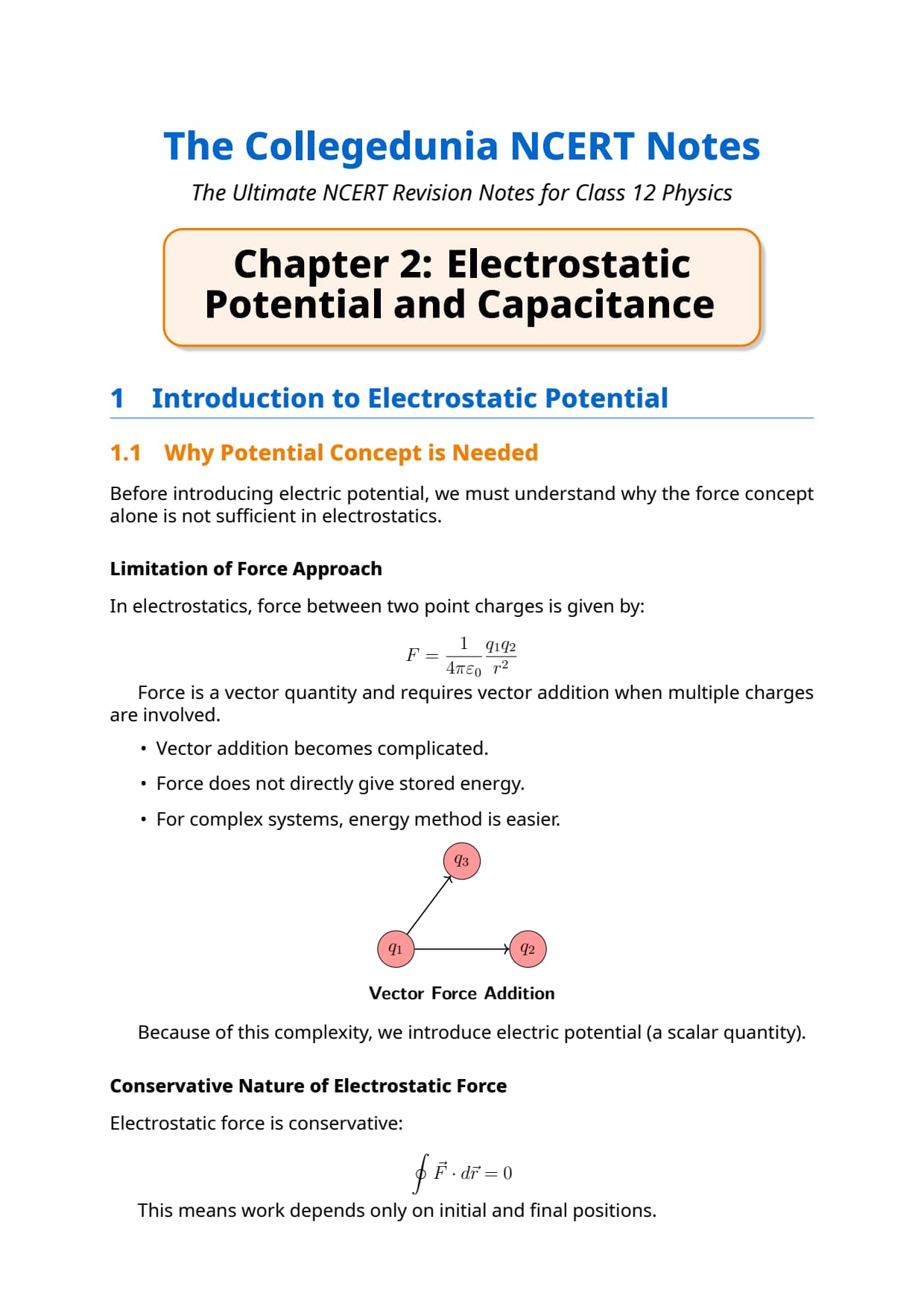
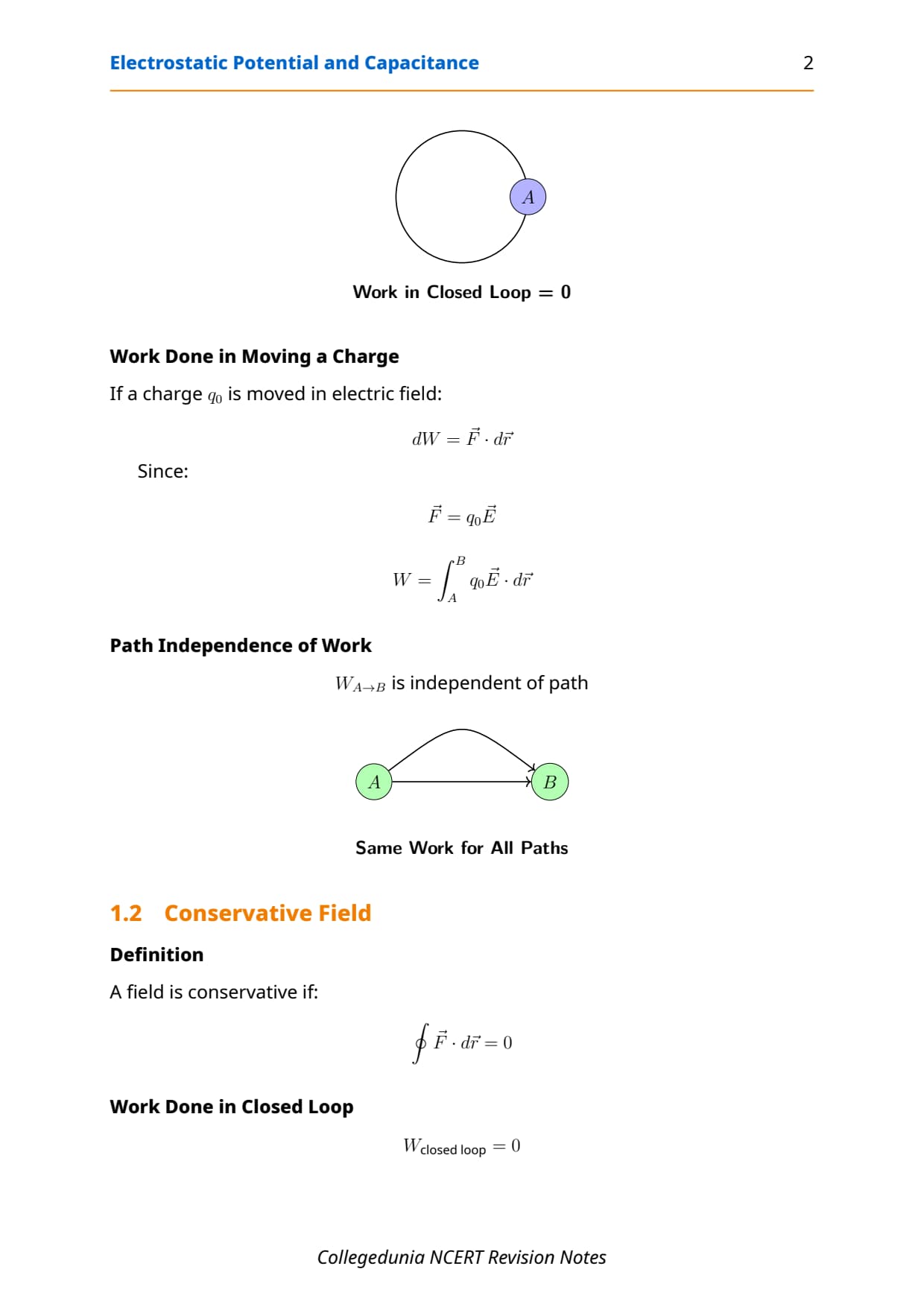
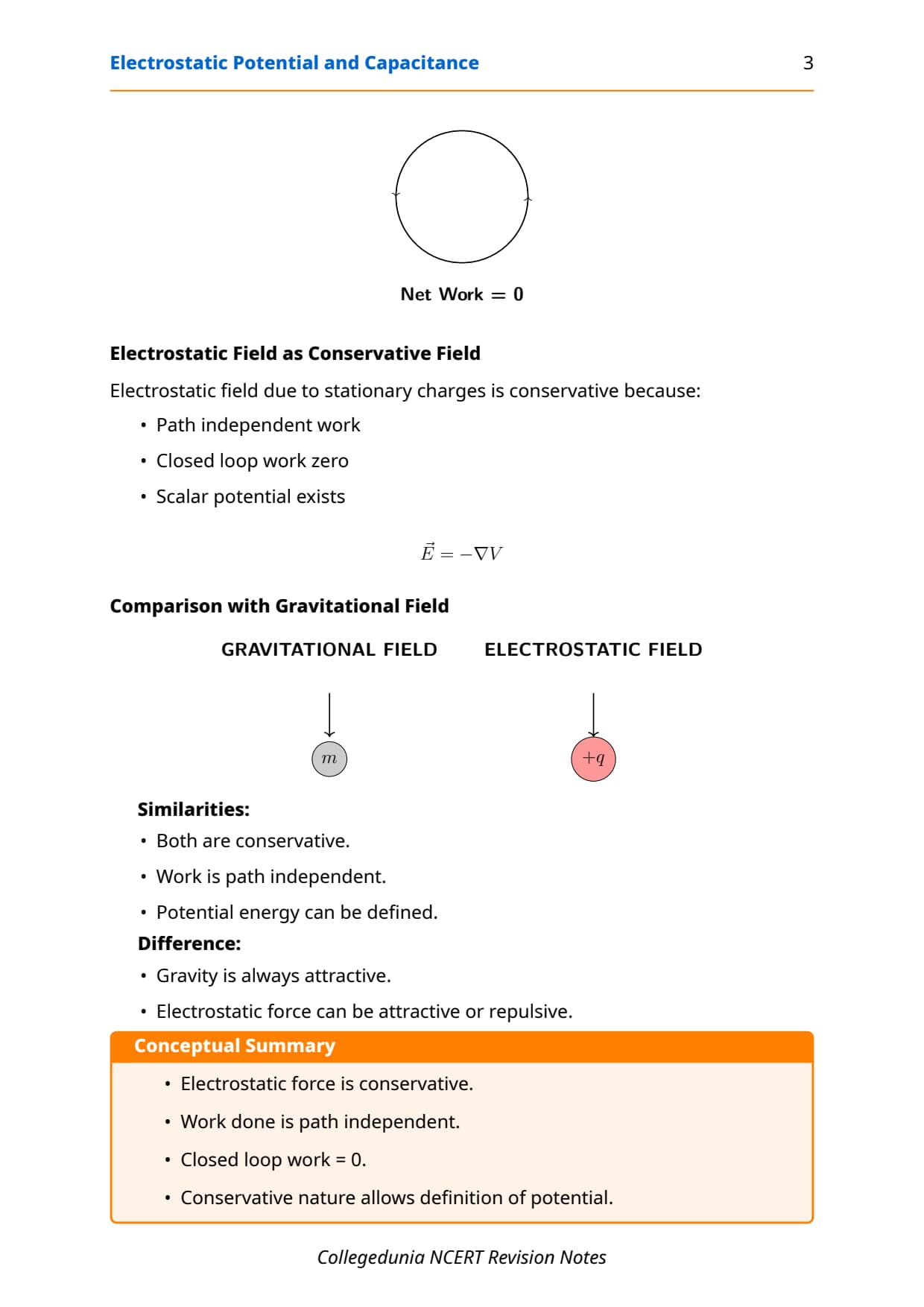
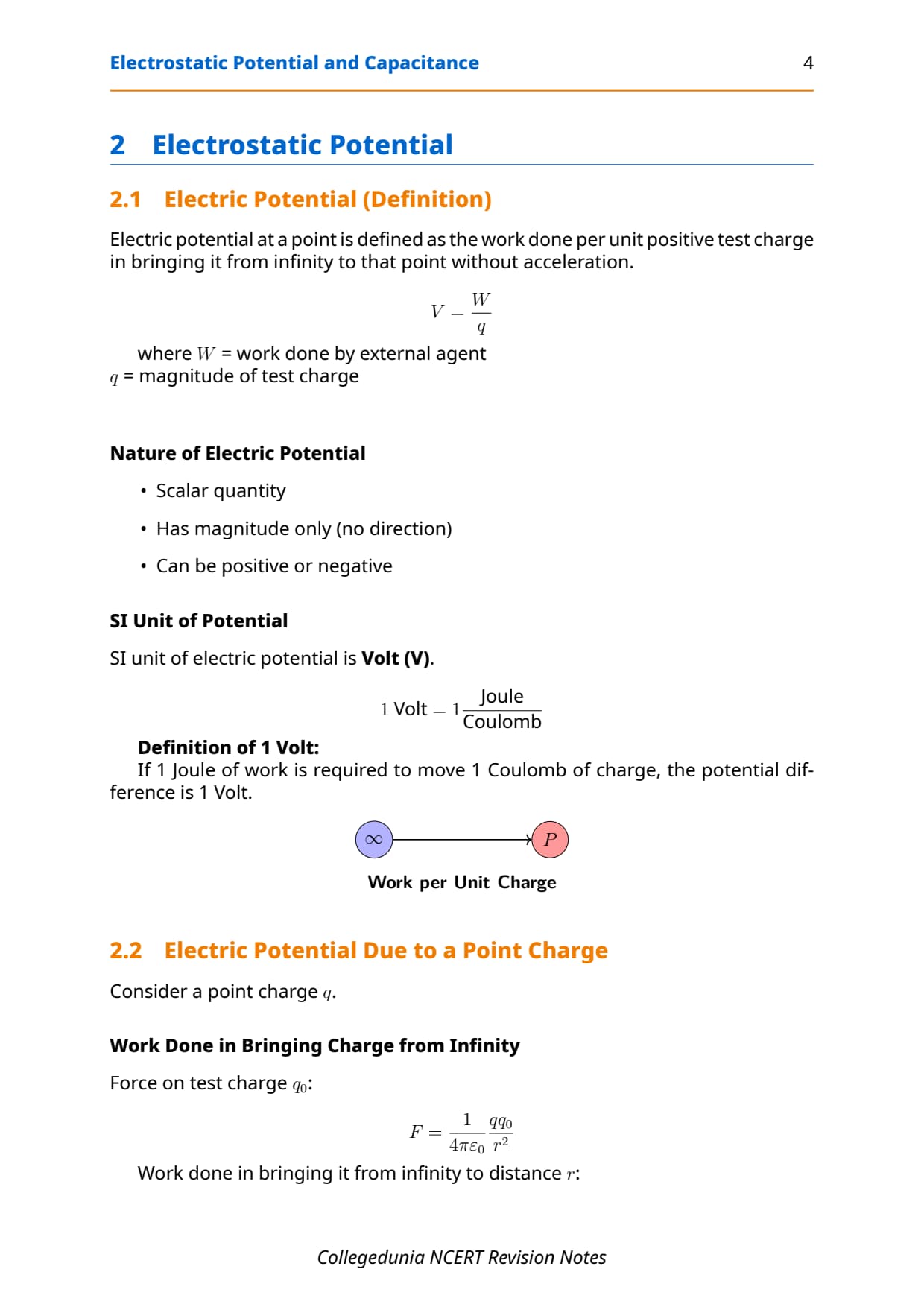
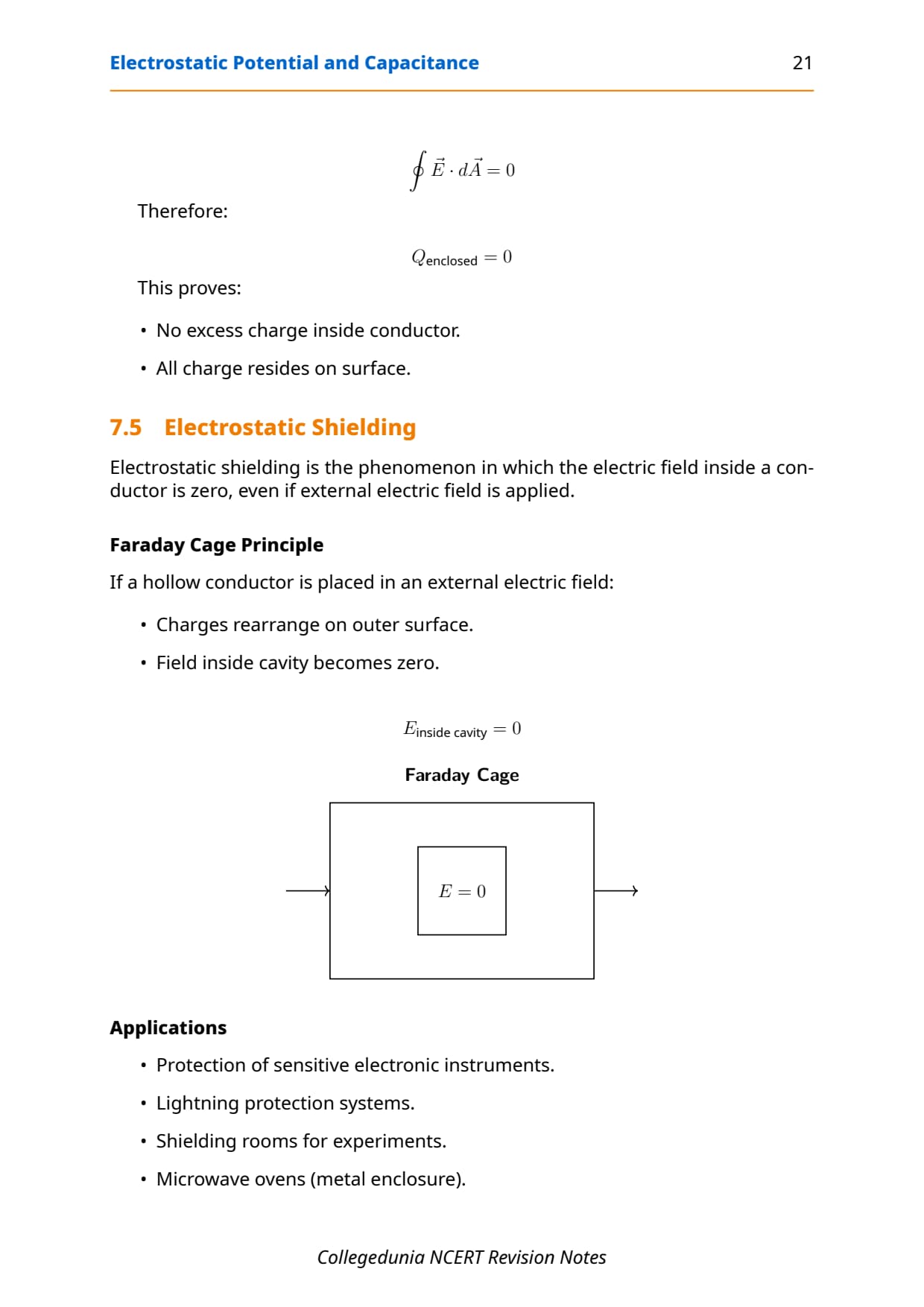
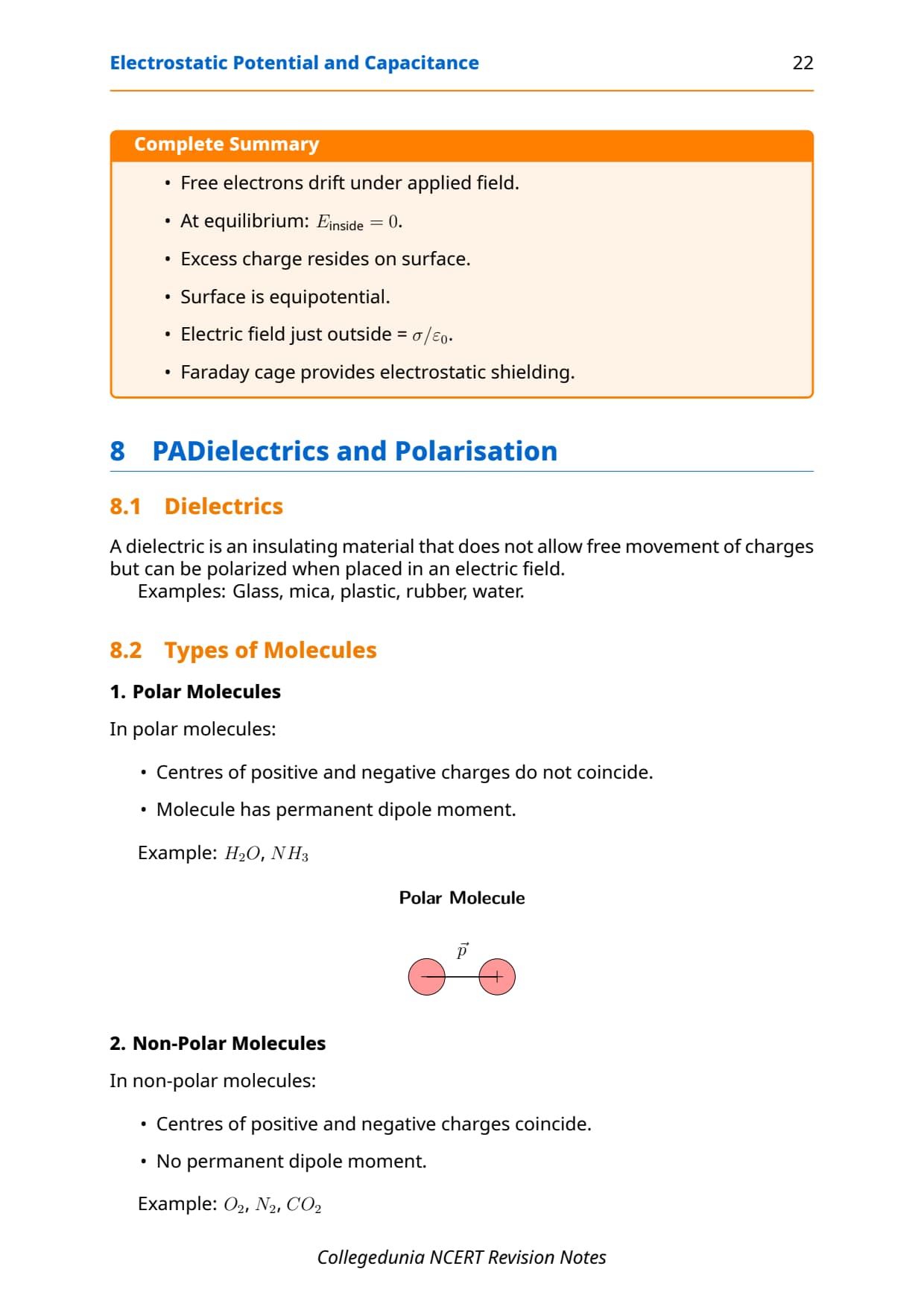
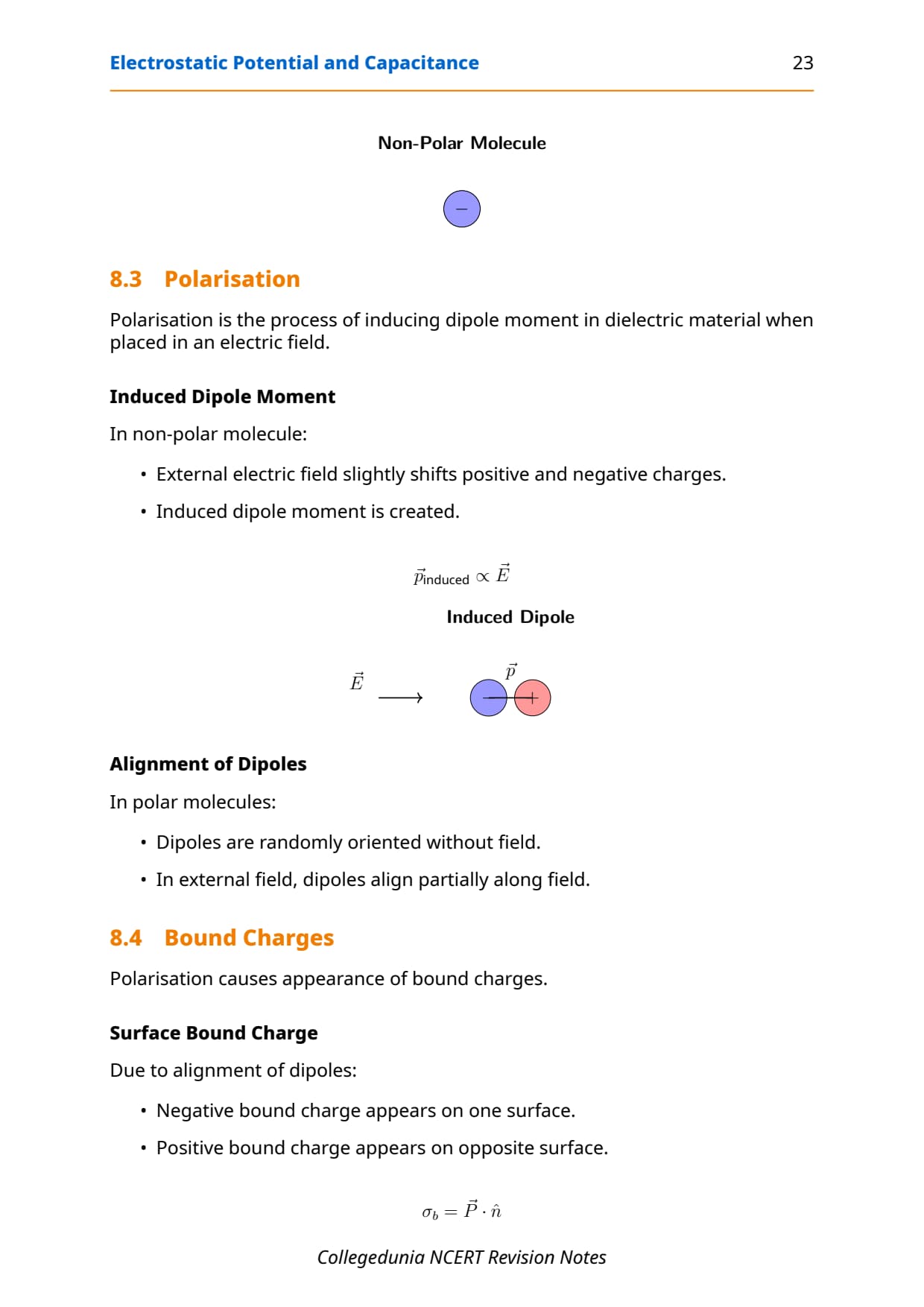
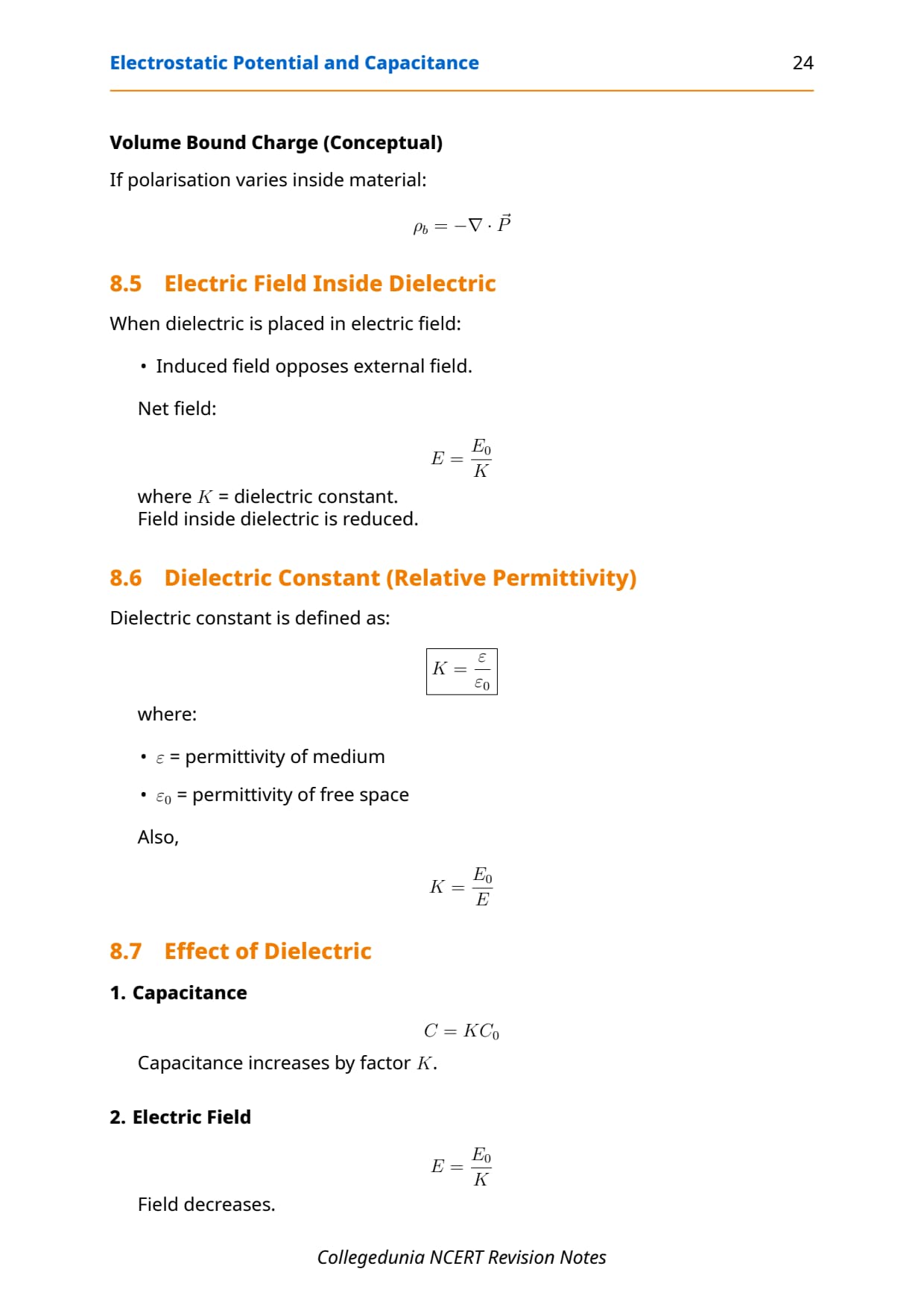
The image below shows how the six topic blocks of this chapter fit together.
Topic-by-Topic Summary for Class 12 Physics Chapter 2
The chapter splits into six topic blocks, each mapped to its CBSE marks below.
- Electric potential and potential difference: 2-mark conceptual on V = W / q.
- Potential due to a point charge, dipole, and system of charges: 3-mark derivation block.
- Equipotential surfaces and the E-V relation: 2-mark conceptual on E = minus dV / dx.
- Capacitance and the parallel-plate capacitor: 5-mark derivation.
- Combination of capacitors: 3-mark numerical on series and parallel.
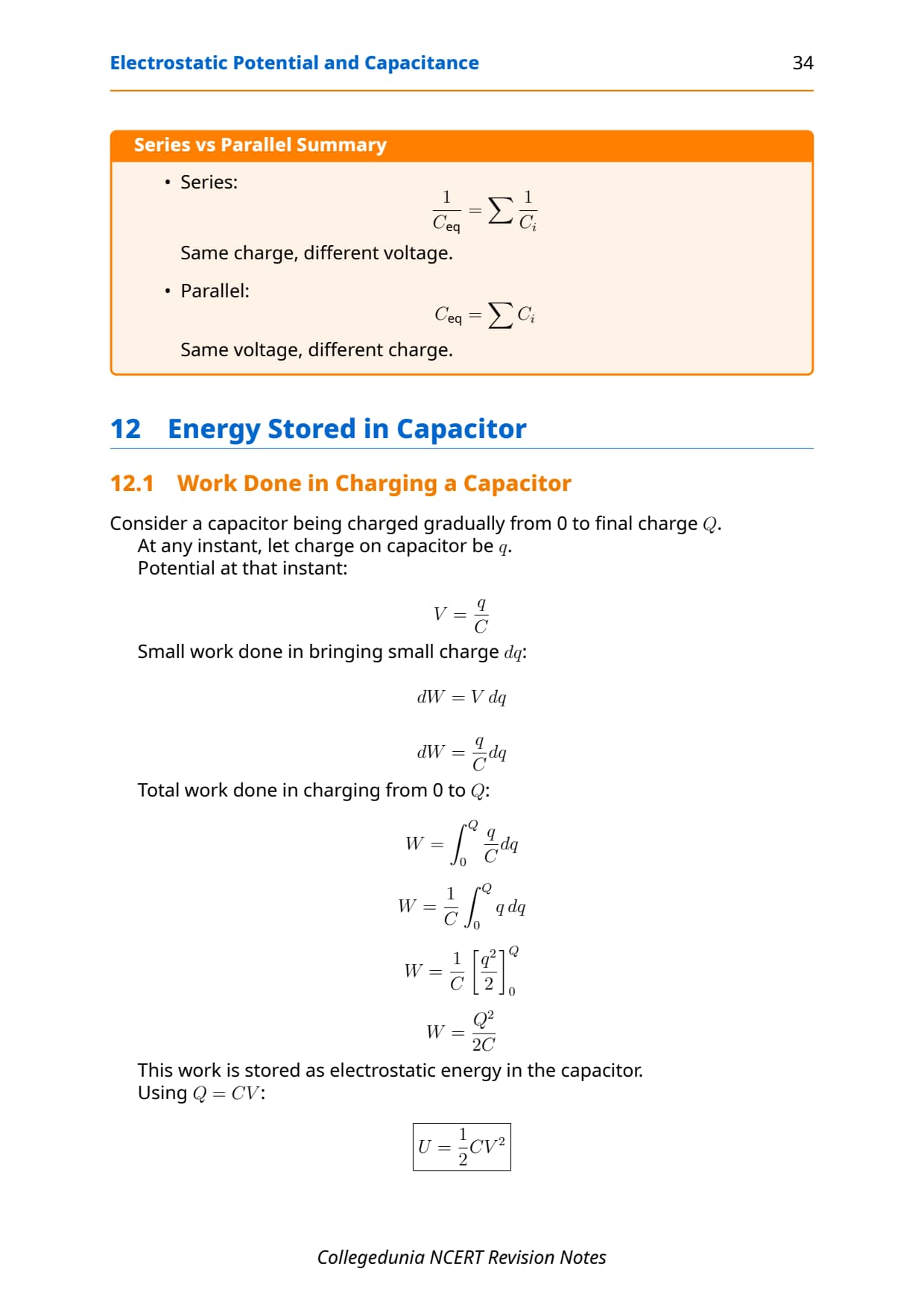
- Energy stored in a capacitor: 3-mark derivation on U = (1/2) C V squared.
Electrostatic Potential and Capacitance Video Lecture
Source: Magnet Brains on YouTube
Electric Potential, Dipole, and Equipotential Surfaces in Class 12 Physics Chapter 2
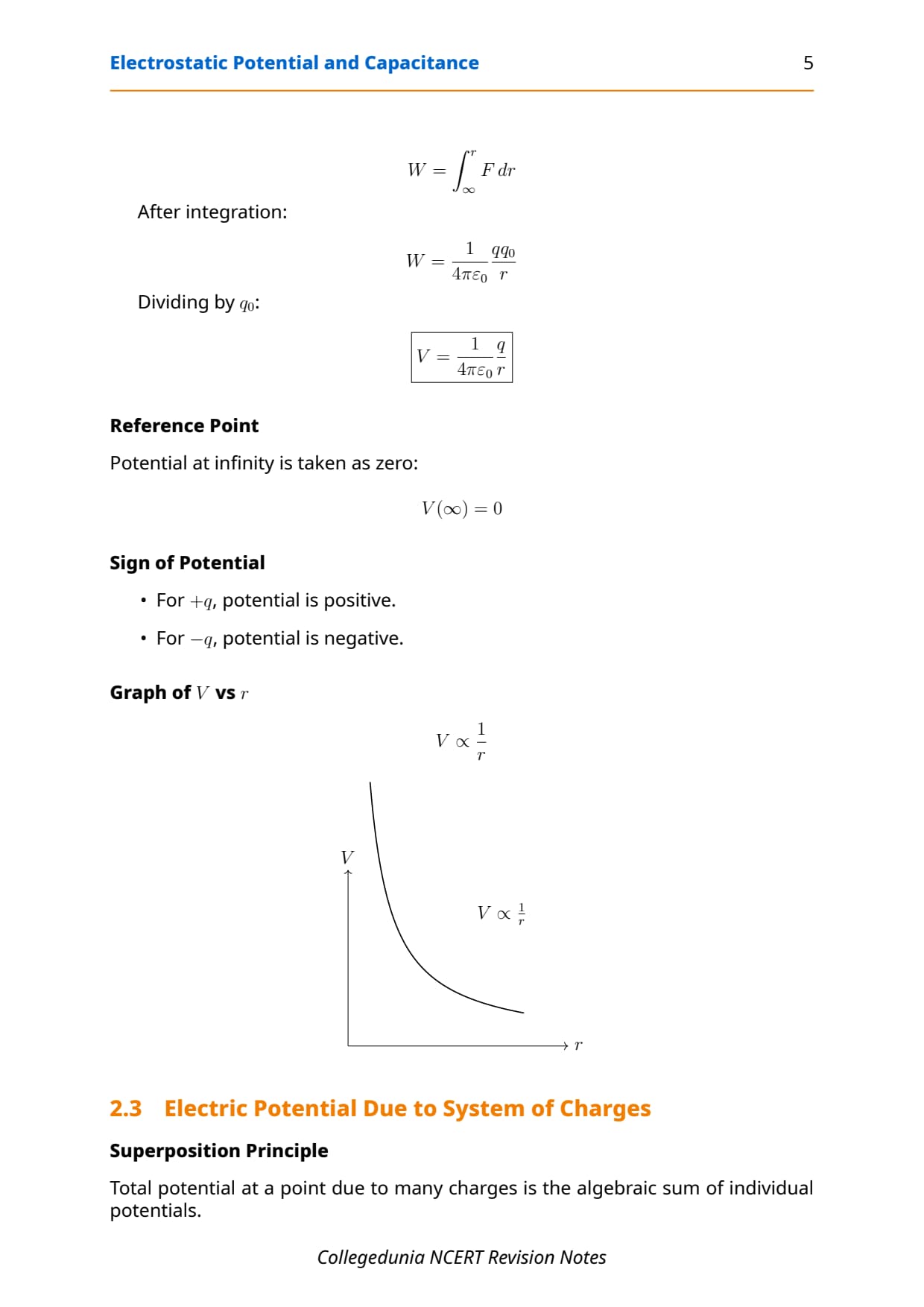
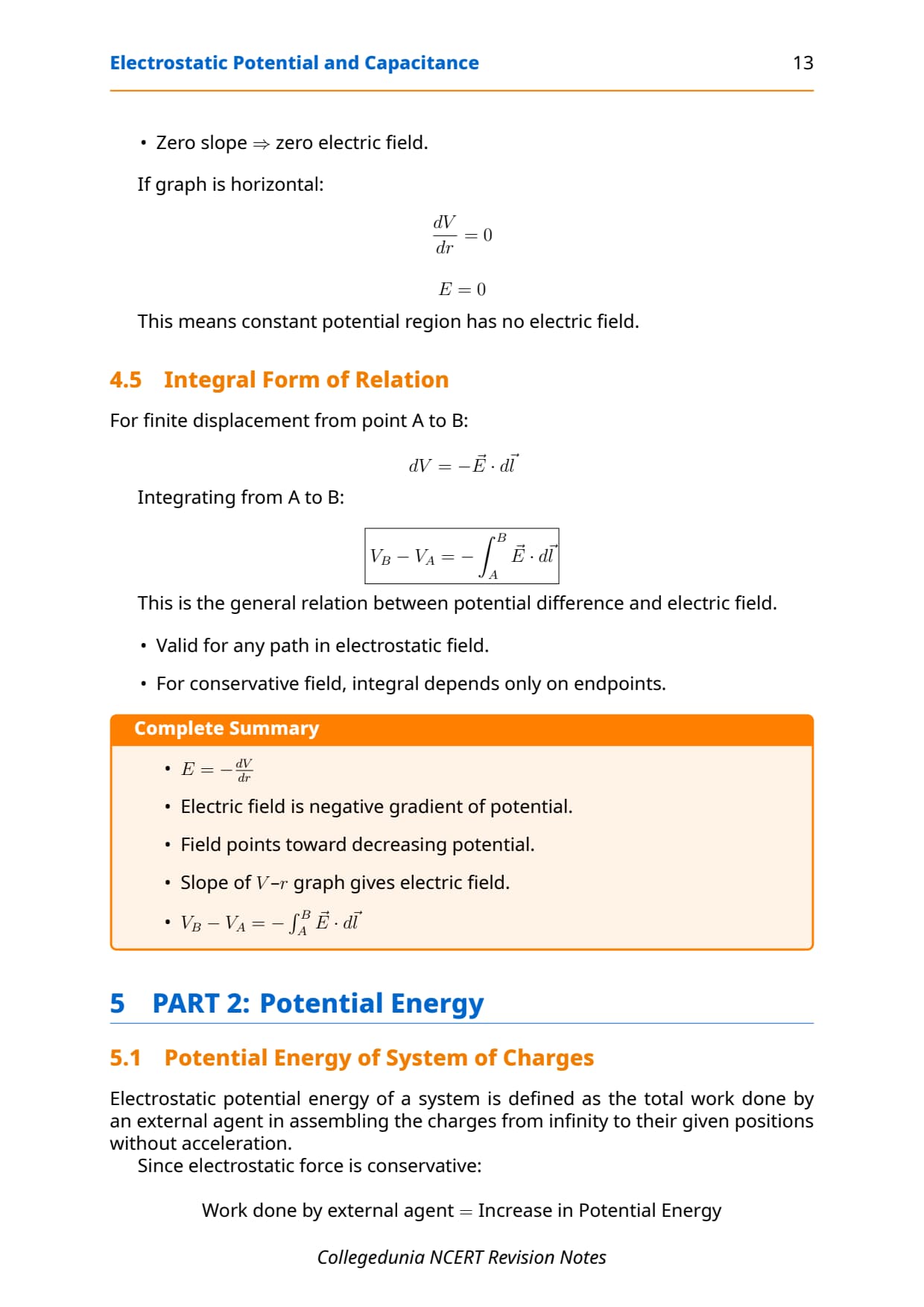
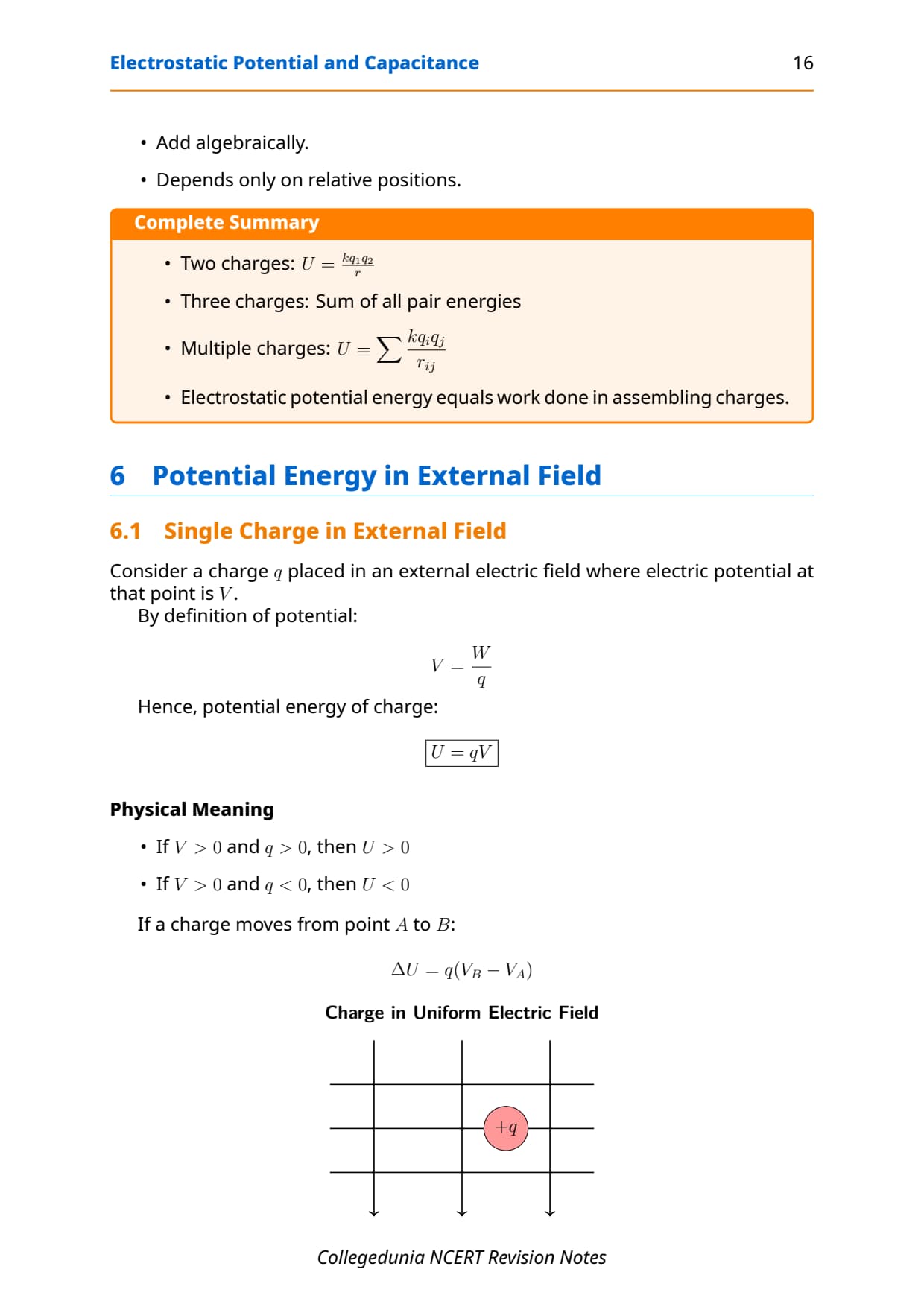
Electric potential at a point is the work done per unit positive test charge to bring it there from infinity. So V = W / q, in volt. Potential is a scalar, so values from many charges just add.
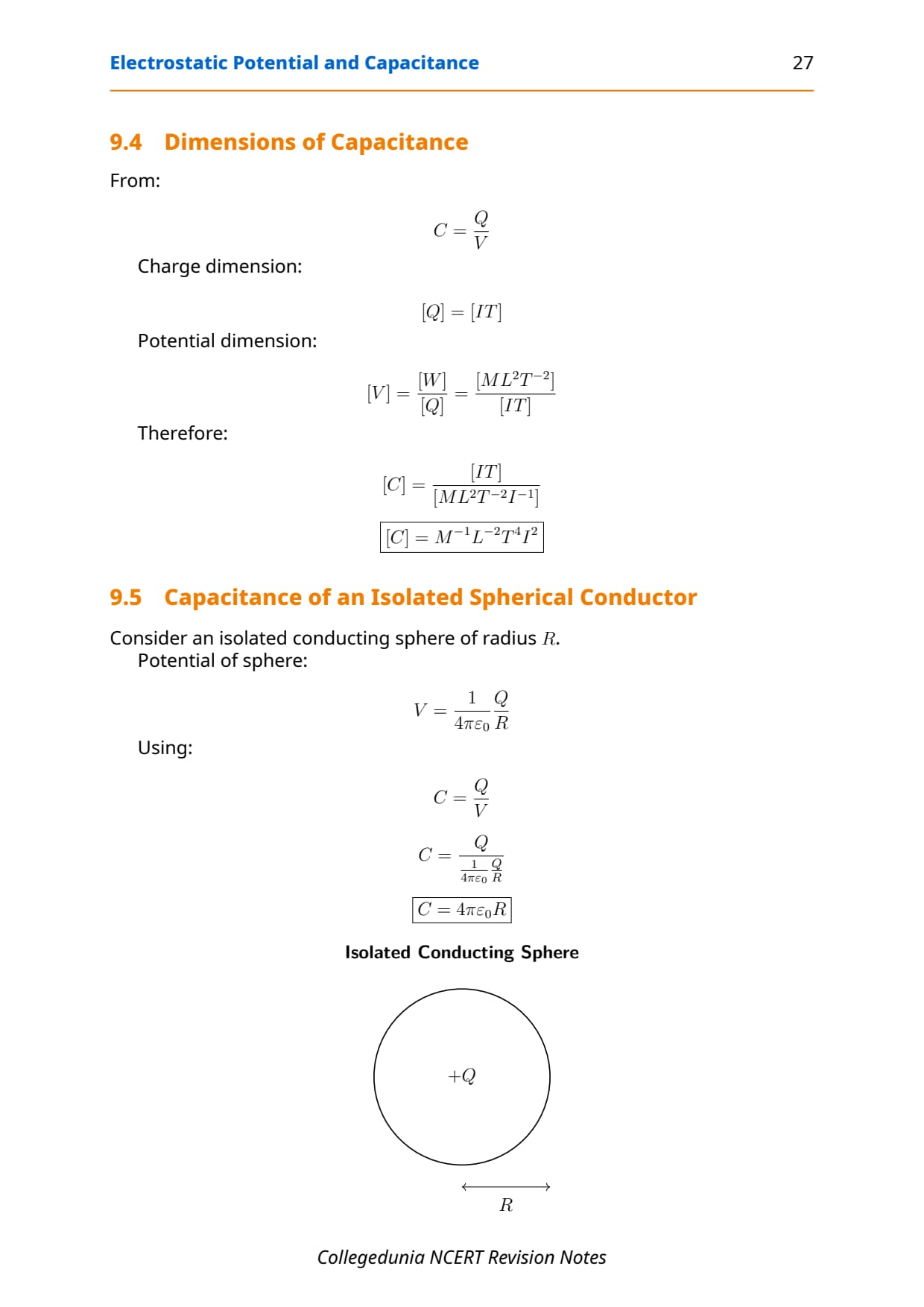
- Point charge: V = k Q / r, where k = 9 times 10^9 N m squared / C squared.
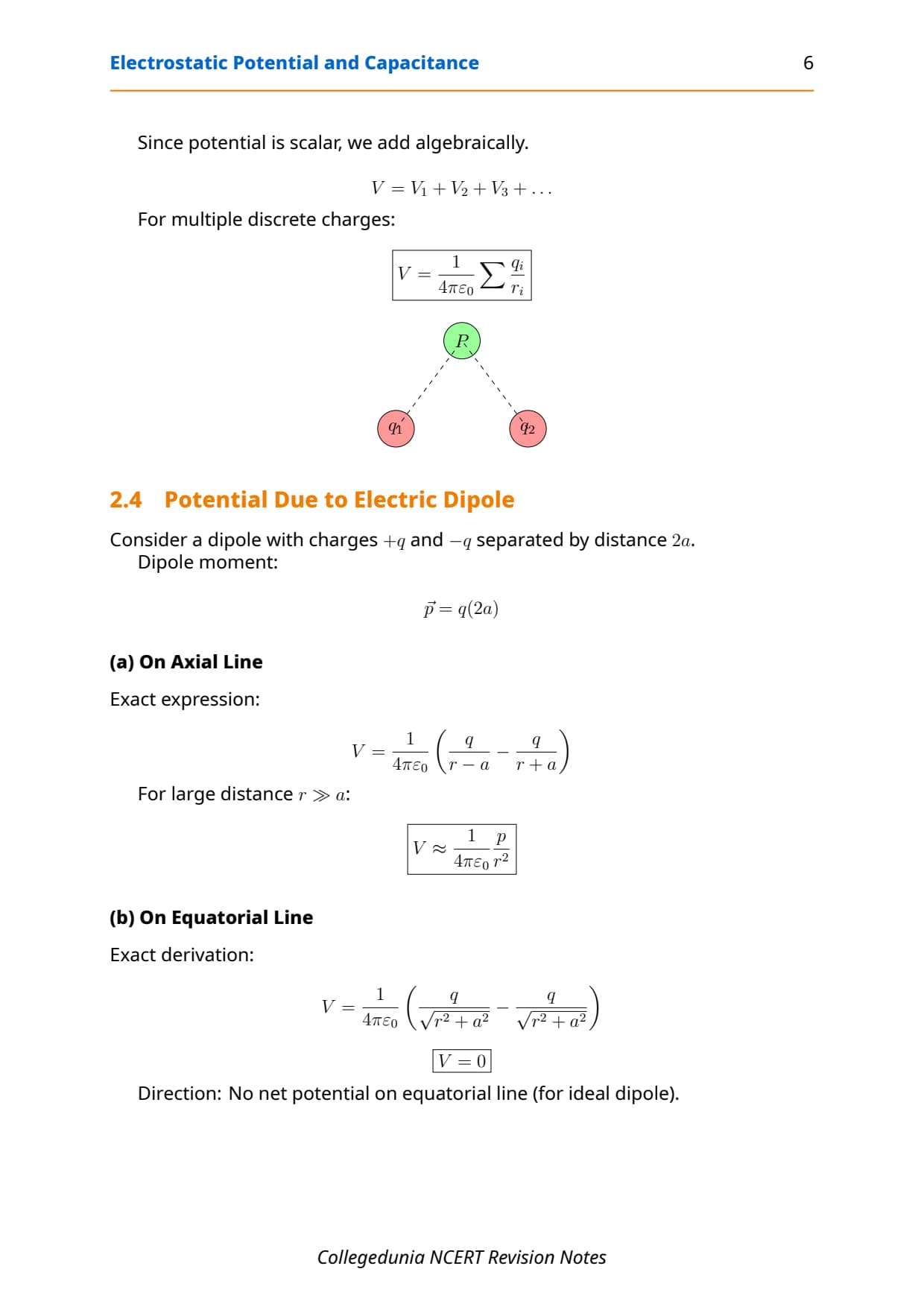
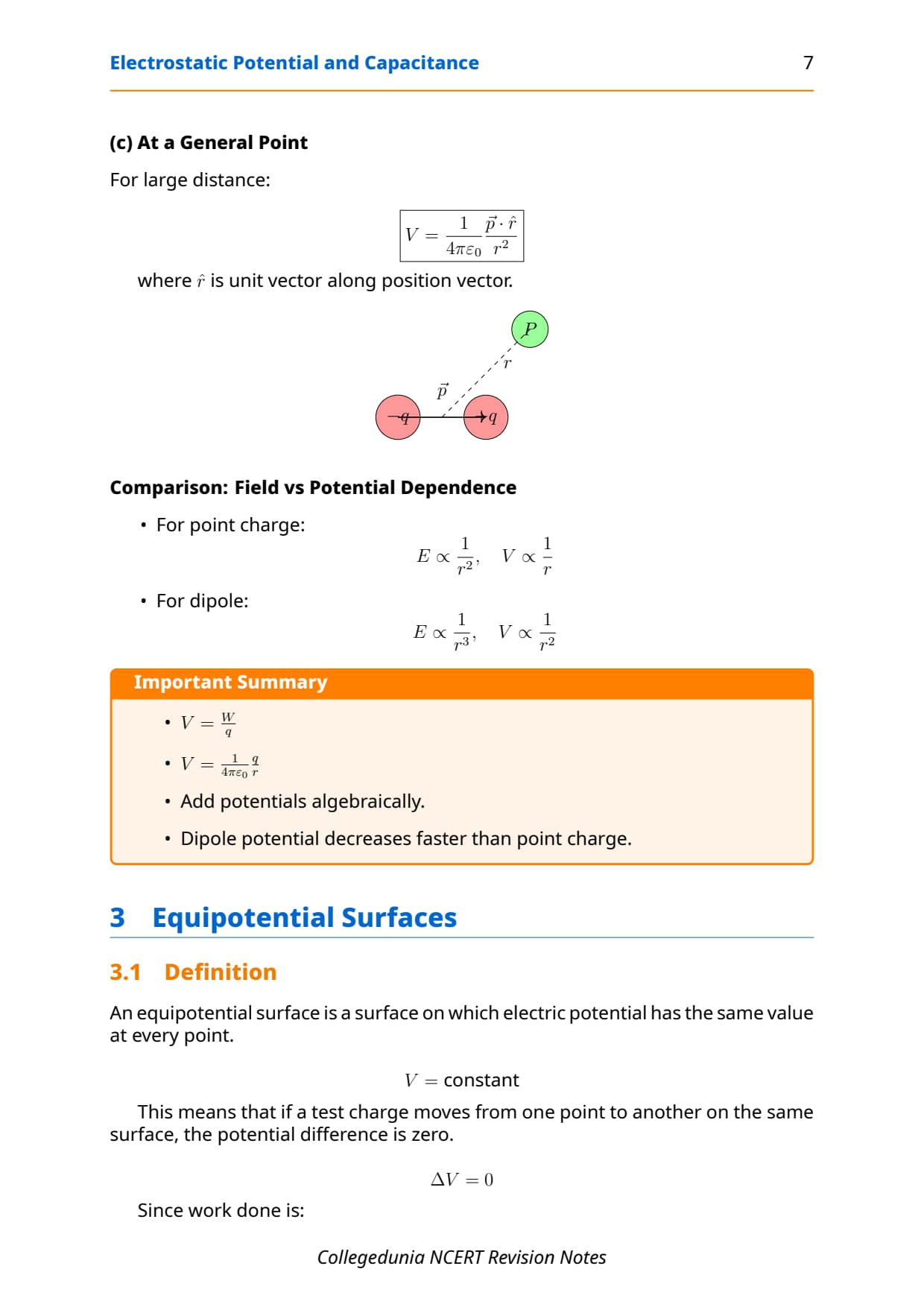
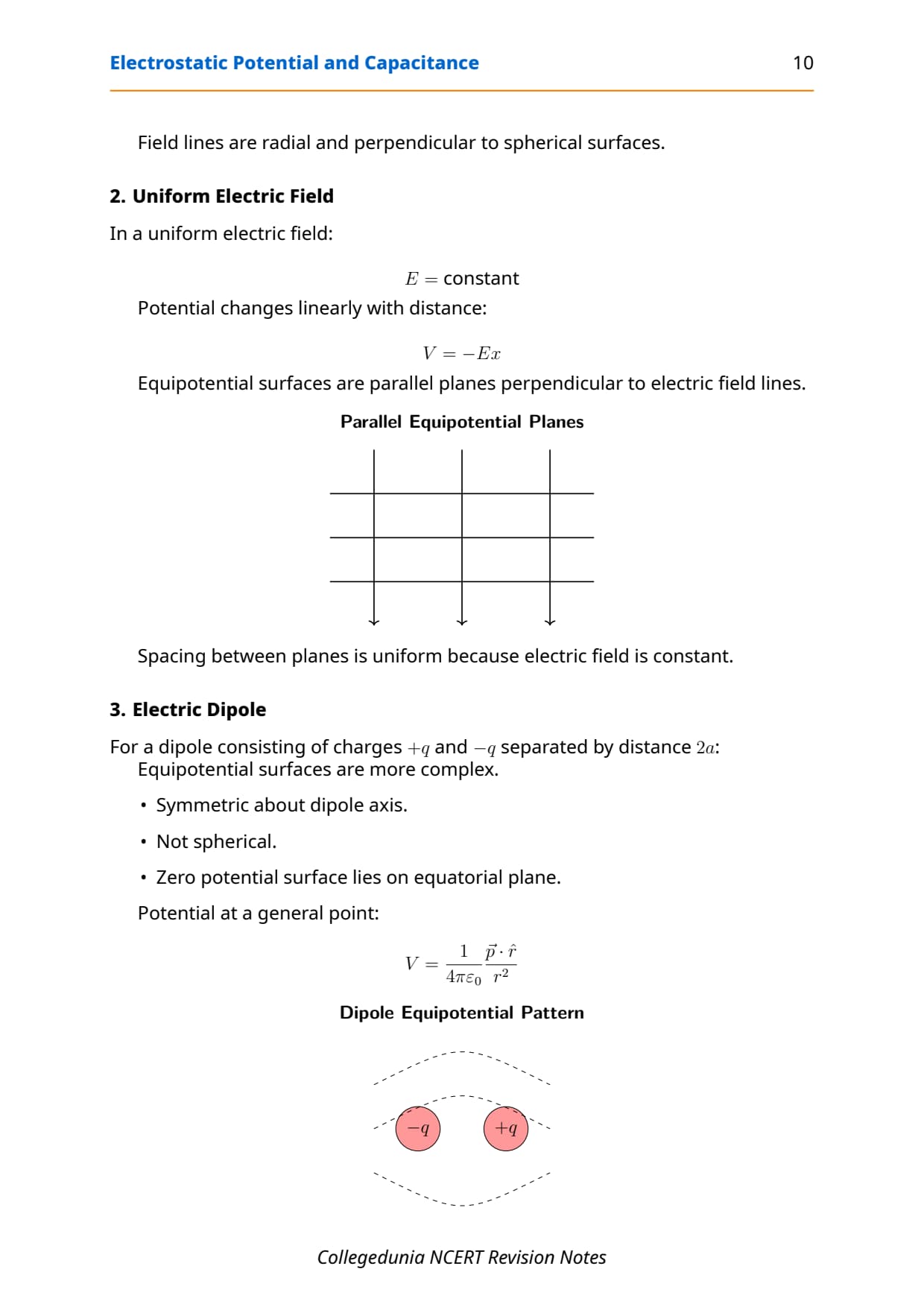
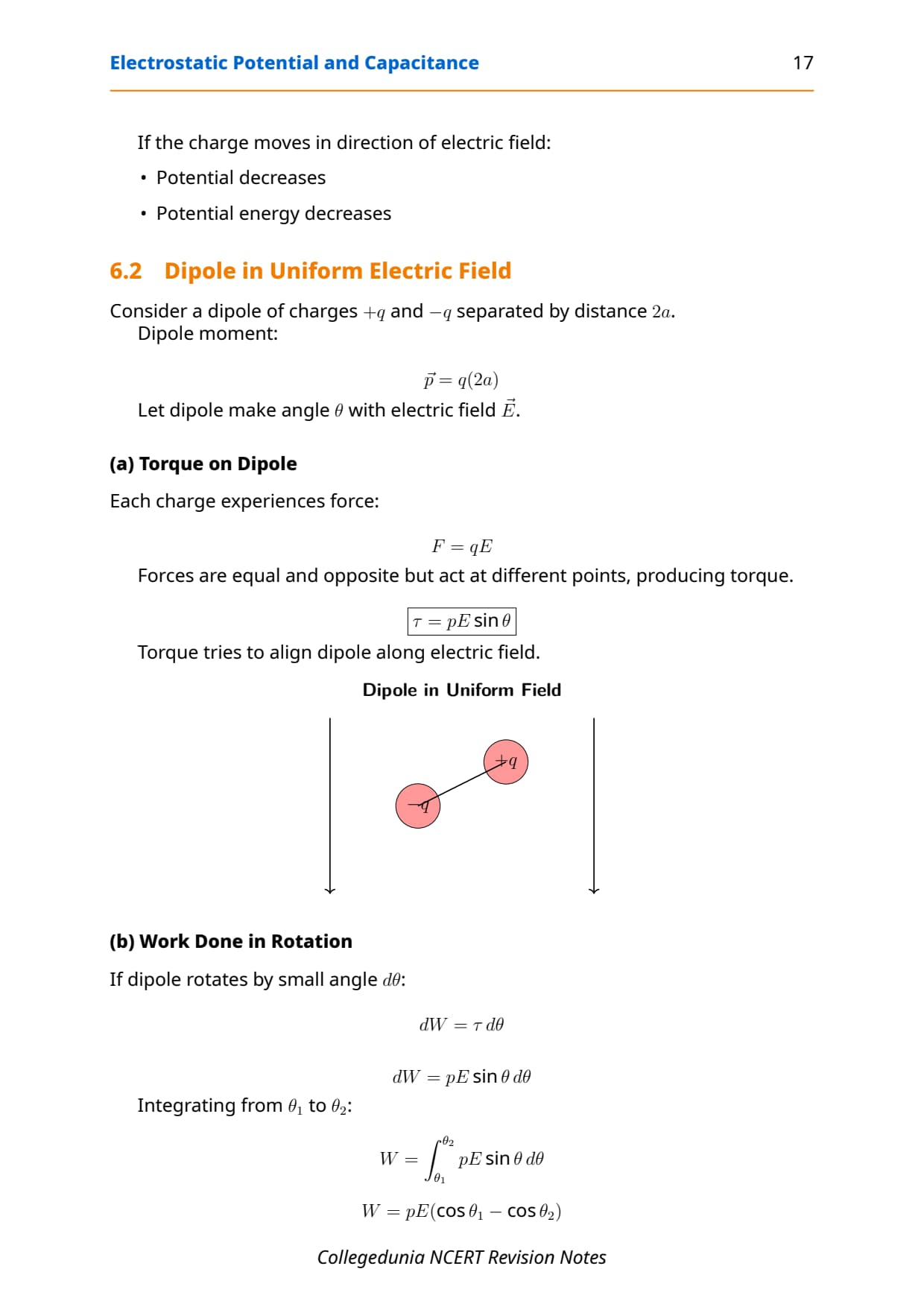
- Dipole: V = (k p cos theta) / r squared. On the axis (theta = 0) it is k p / r squared; on the equatorial line (theta = 90 degrees) it is zero.
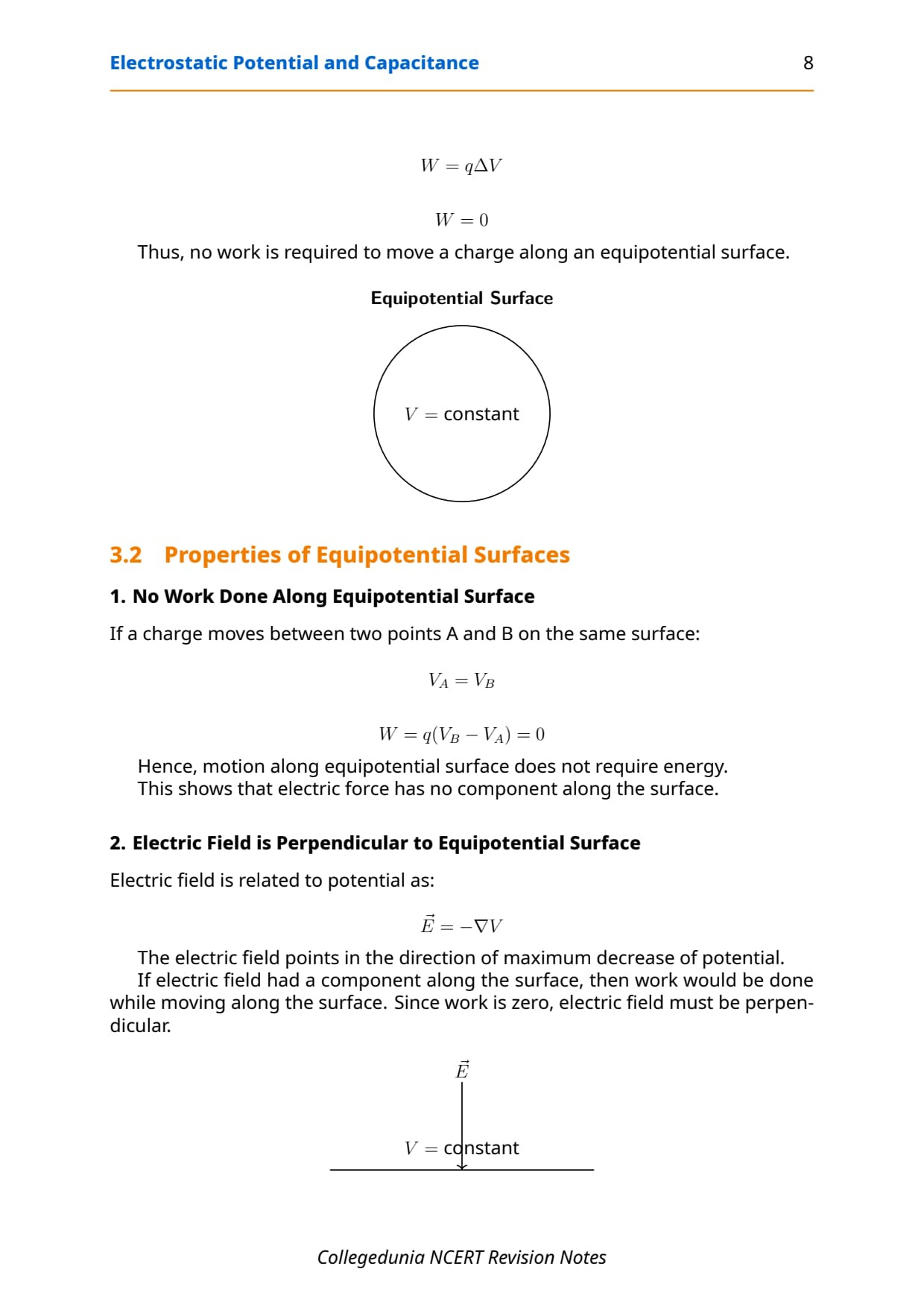
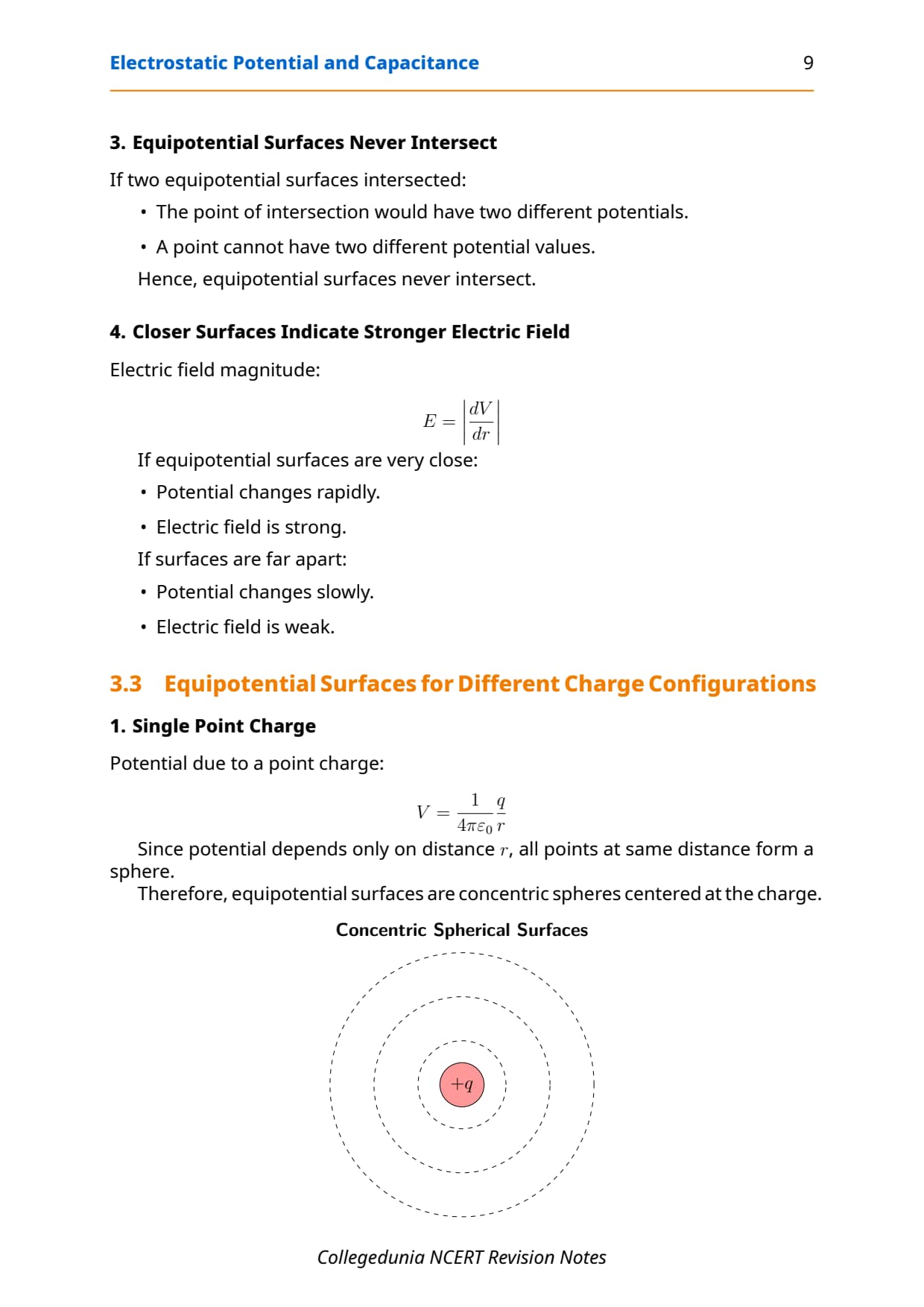
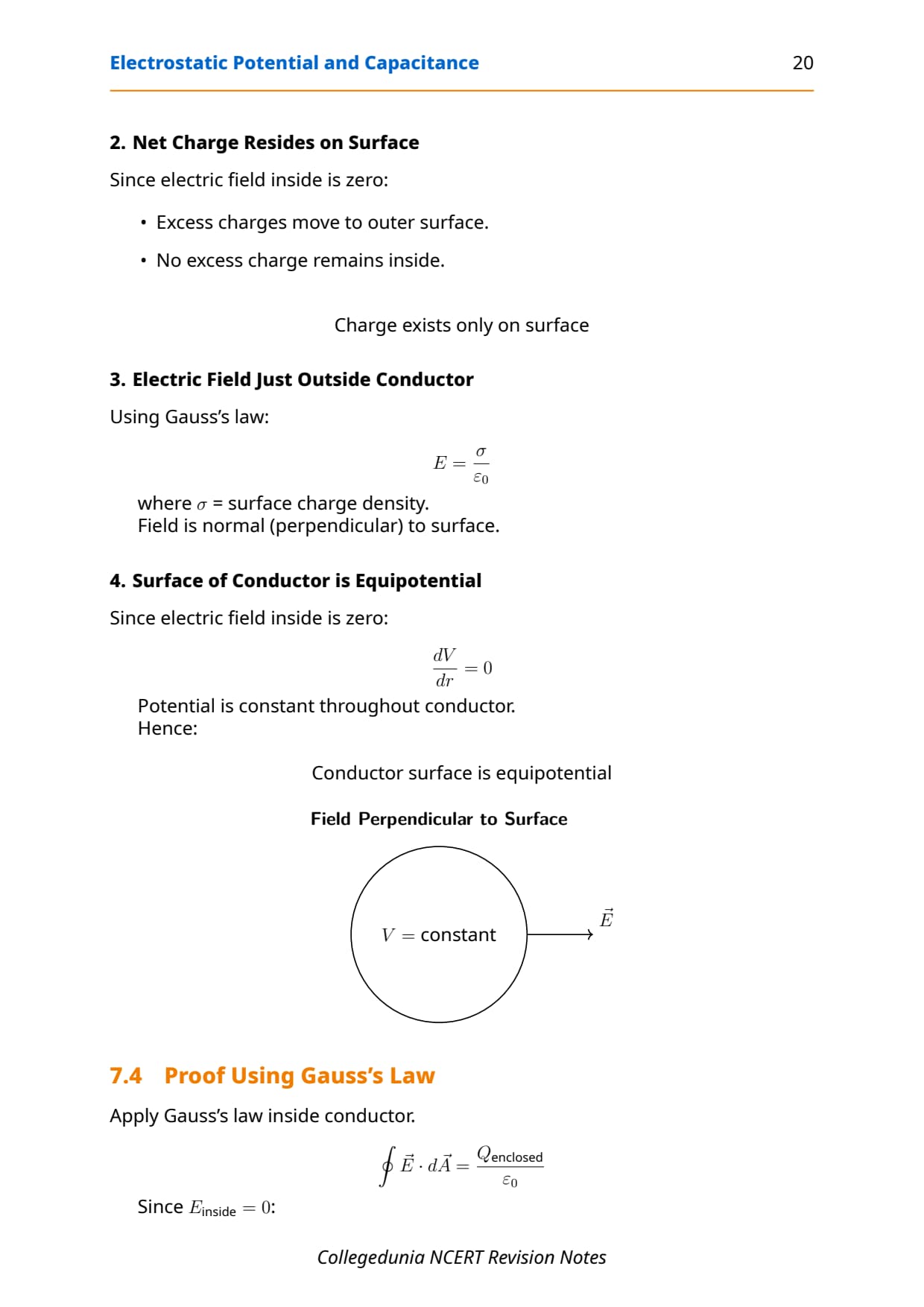
- Equipotential surface: same potential at every point, and always perpendicular to field lines. Work done moving a charge along it is zero.
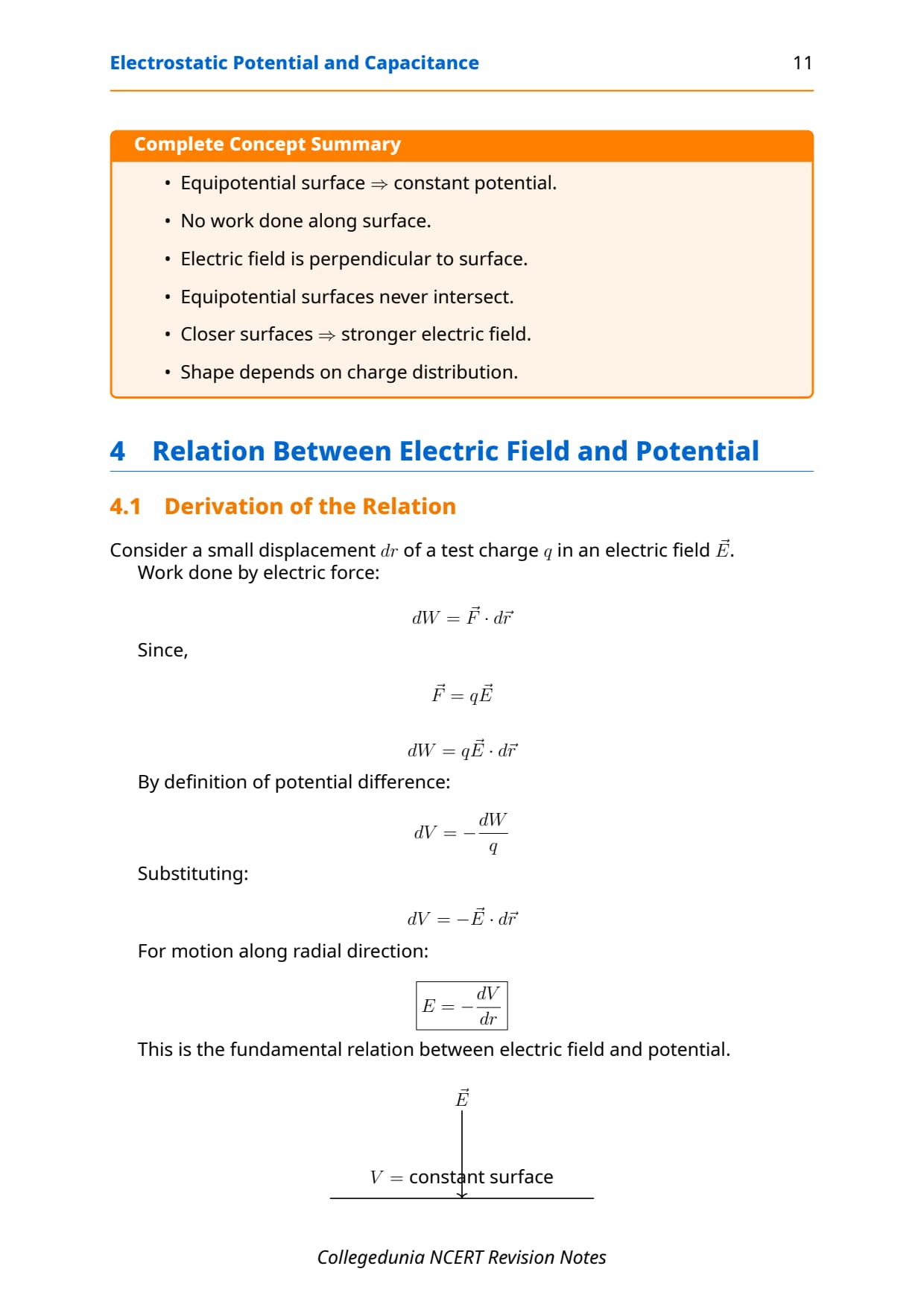
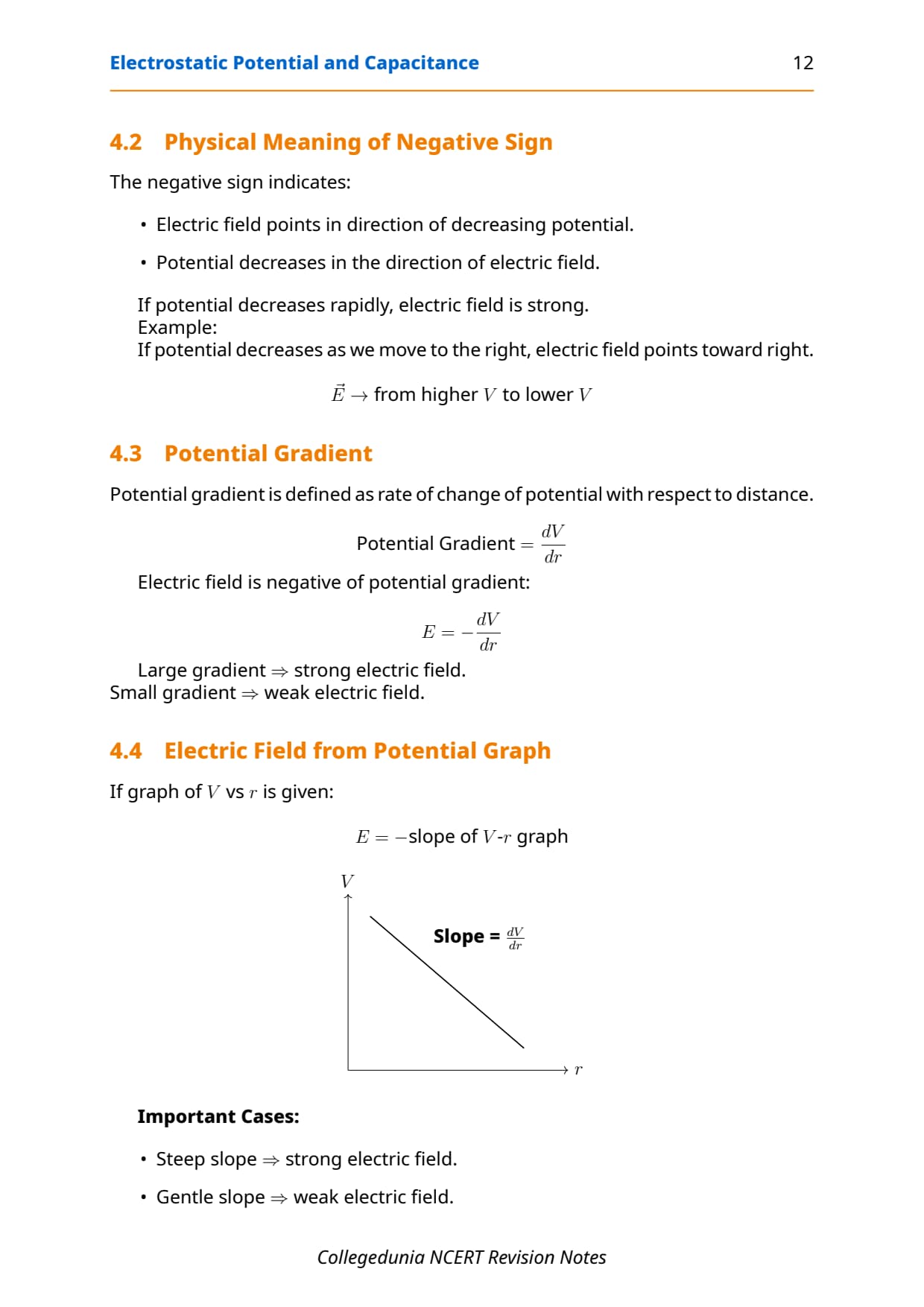
The field links to potential through E = minus dV / dx. It points from high potential to low potential.
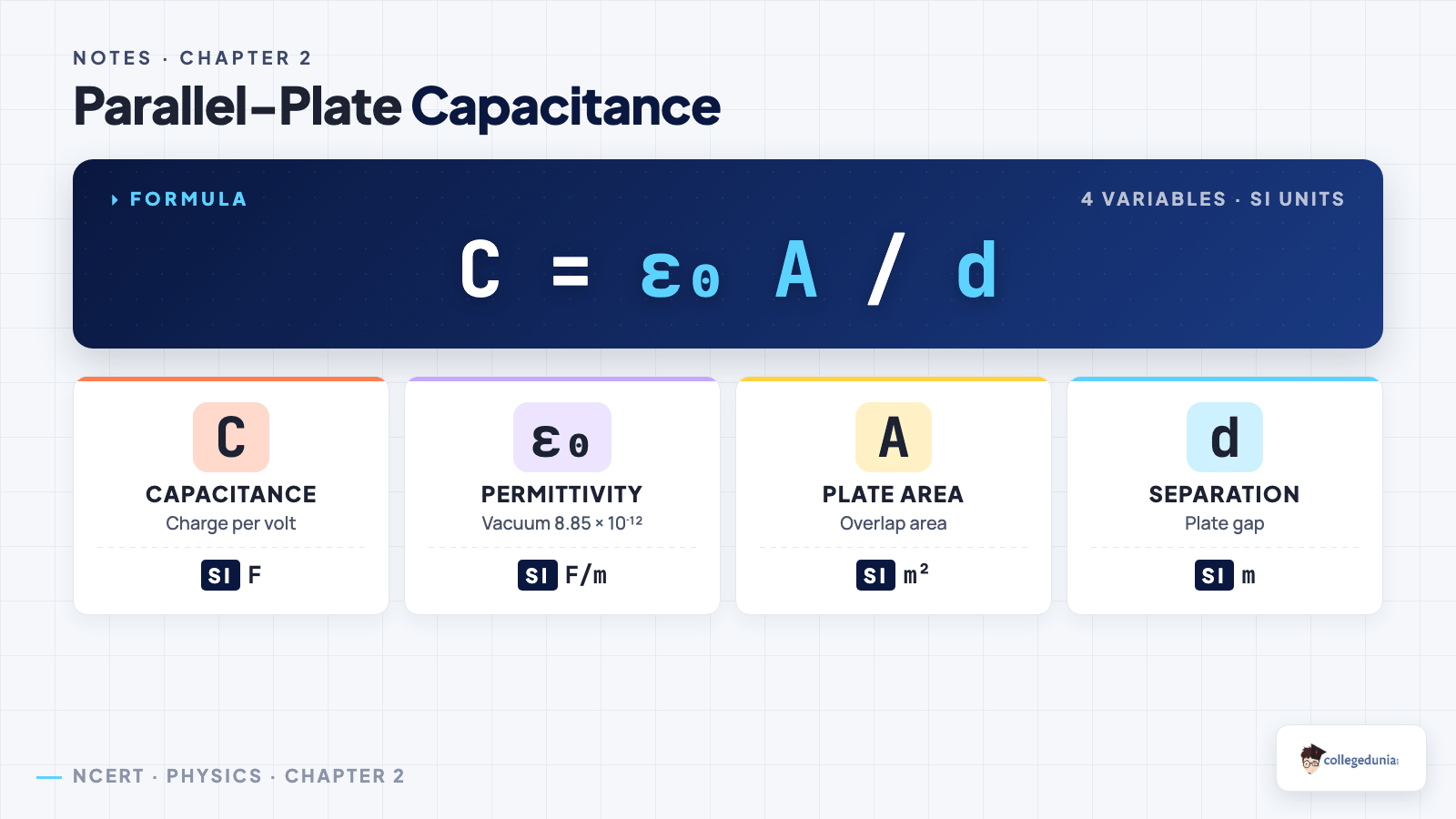
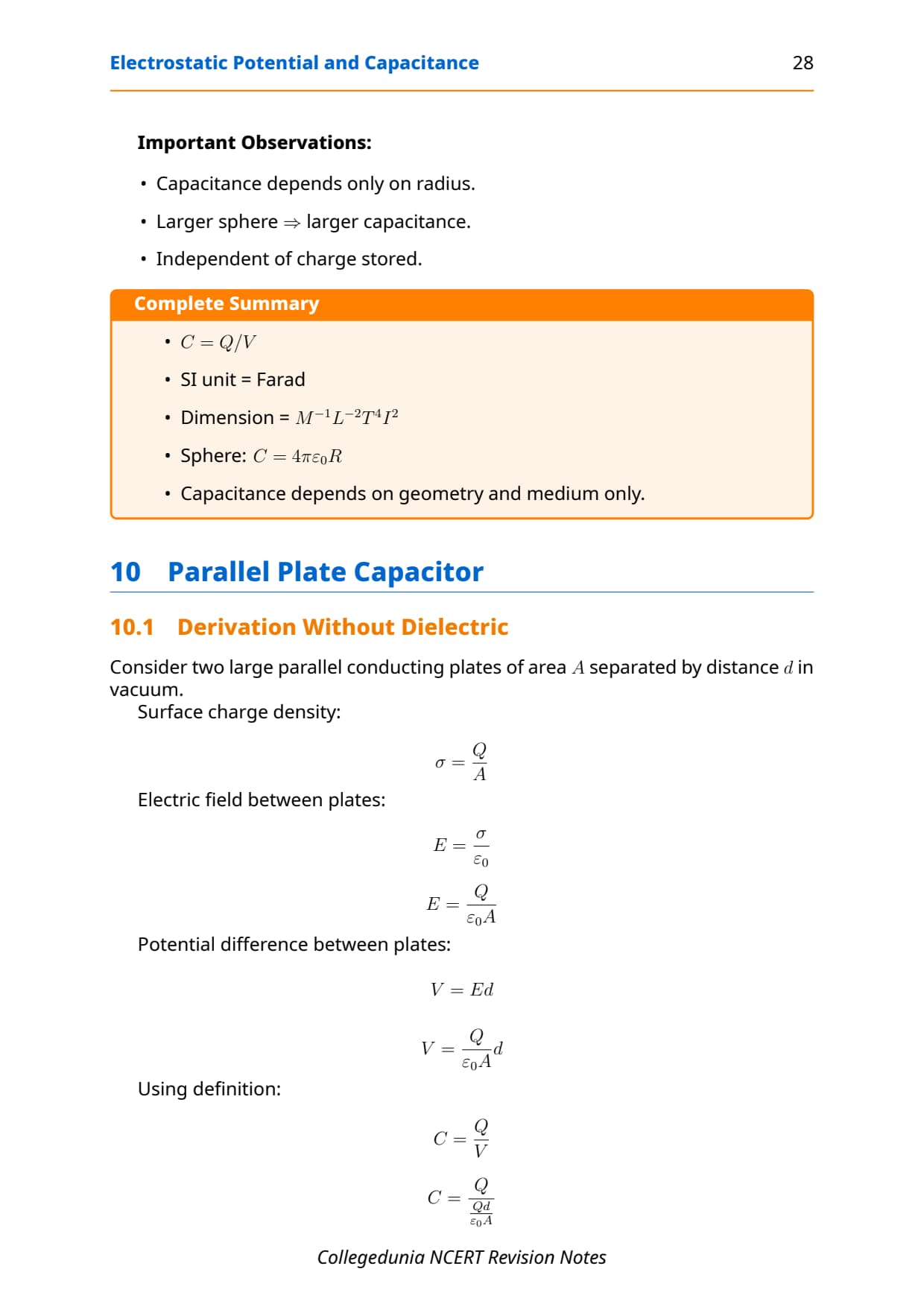
Parallel-plate capacitance: geometry and constants.
Capacitance, Dielectrics, and Energy Stored in Class 12 Physics Chapter 2
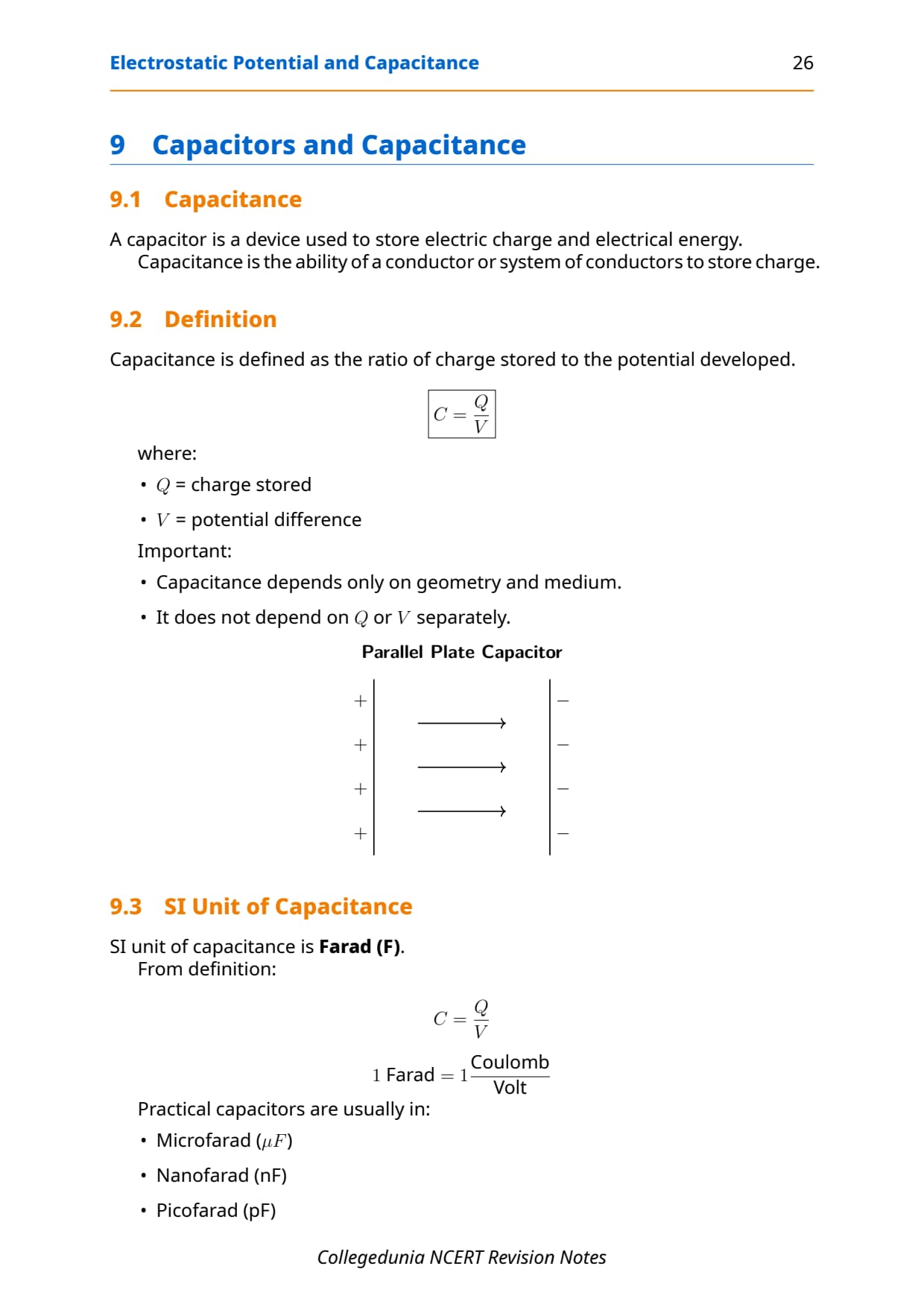
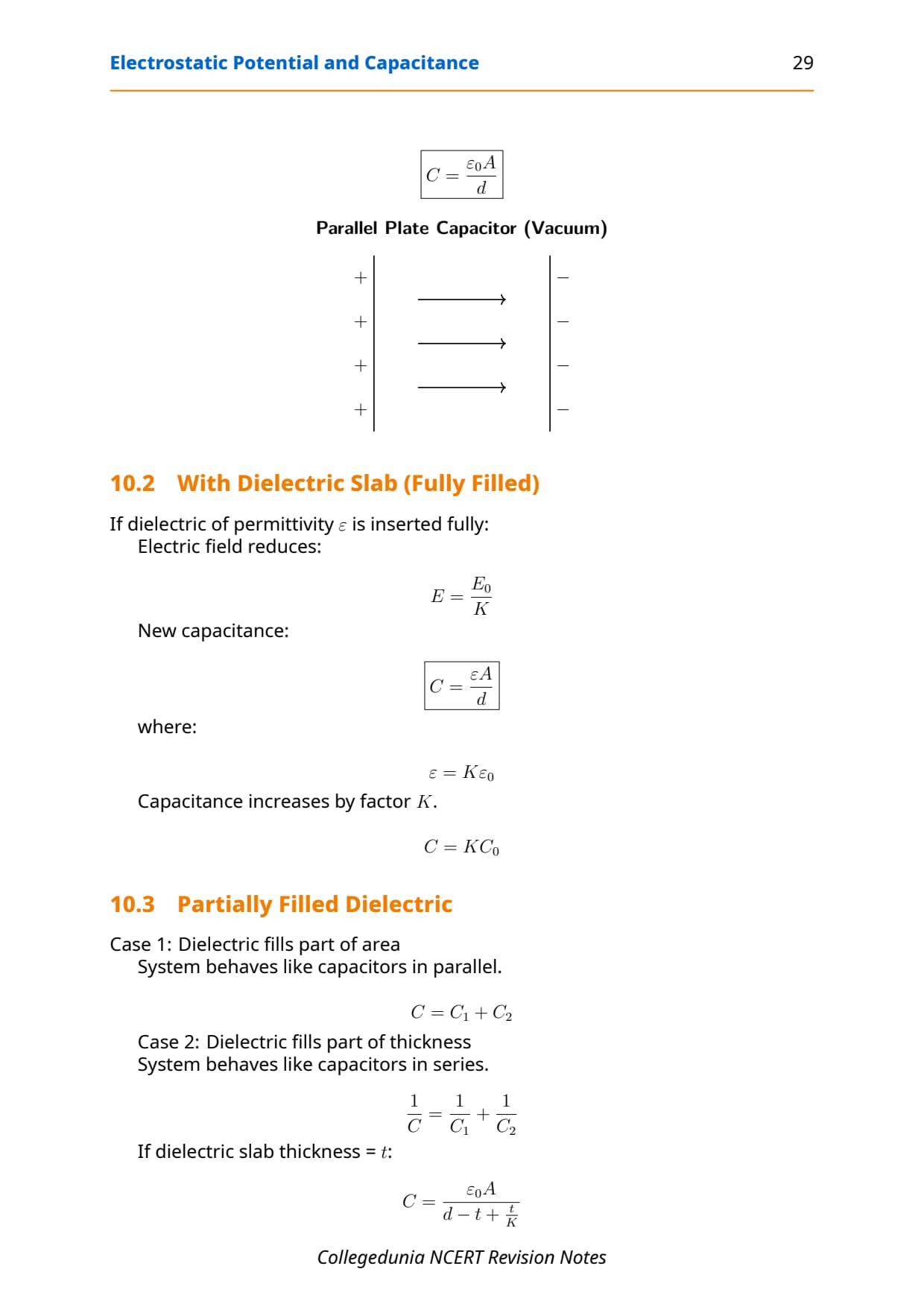
A capacitor stores charge. Its capacitance is C = Q / V, in farad. For a parallel-plate capacitor of area A and gap d, C = epsilon_0 A / d in vacuum and C = K epsilon_0 A / d with a dielectric.
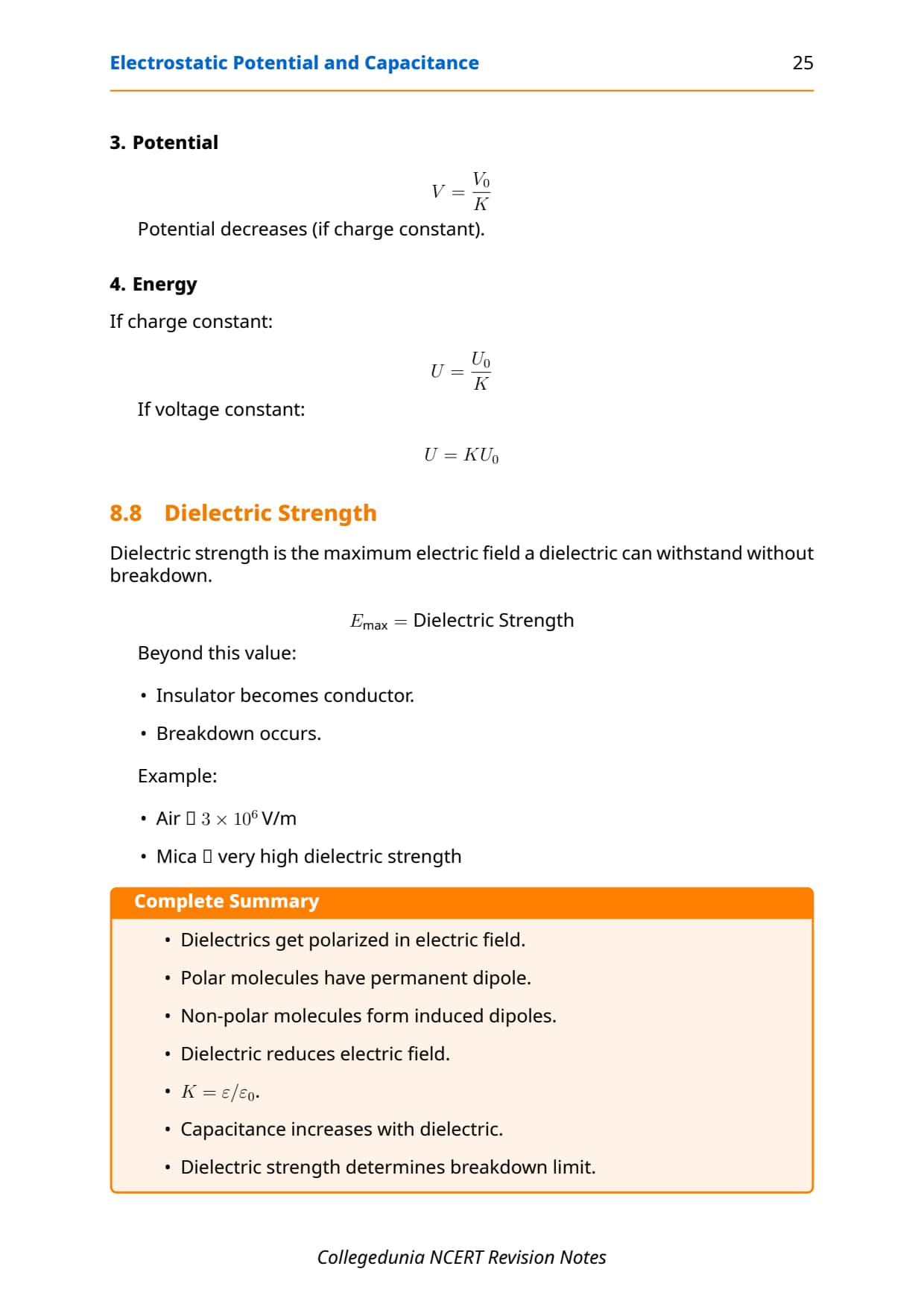
- Dielectric: an insulator that cuts the inside field to E / K and raises capacitance by factor K. K is 1 for vacuum, about 2.5 for paper, and about 80 for water.
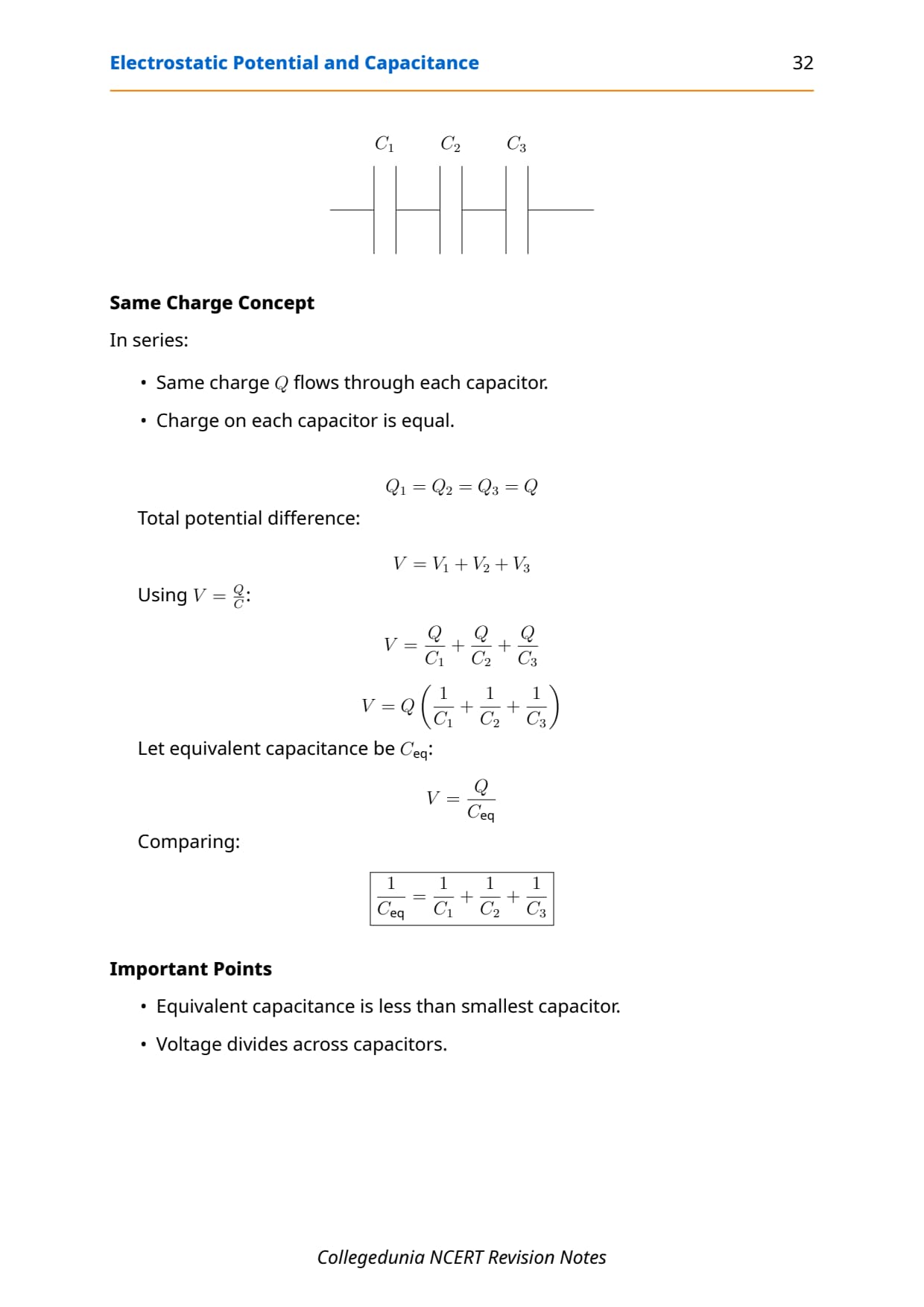
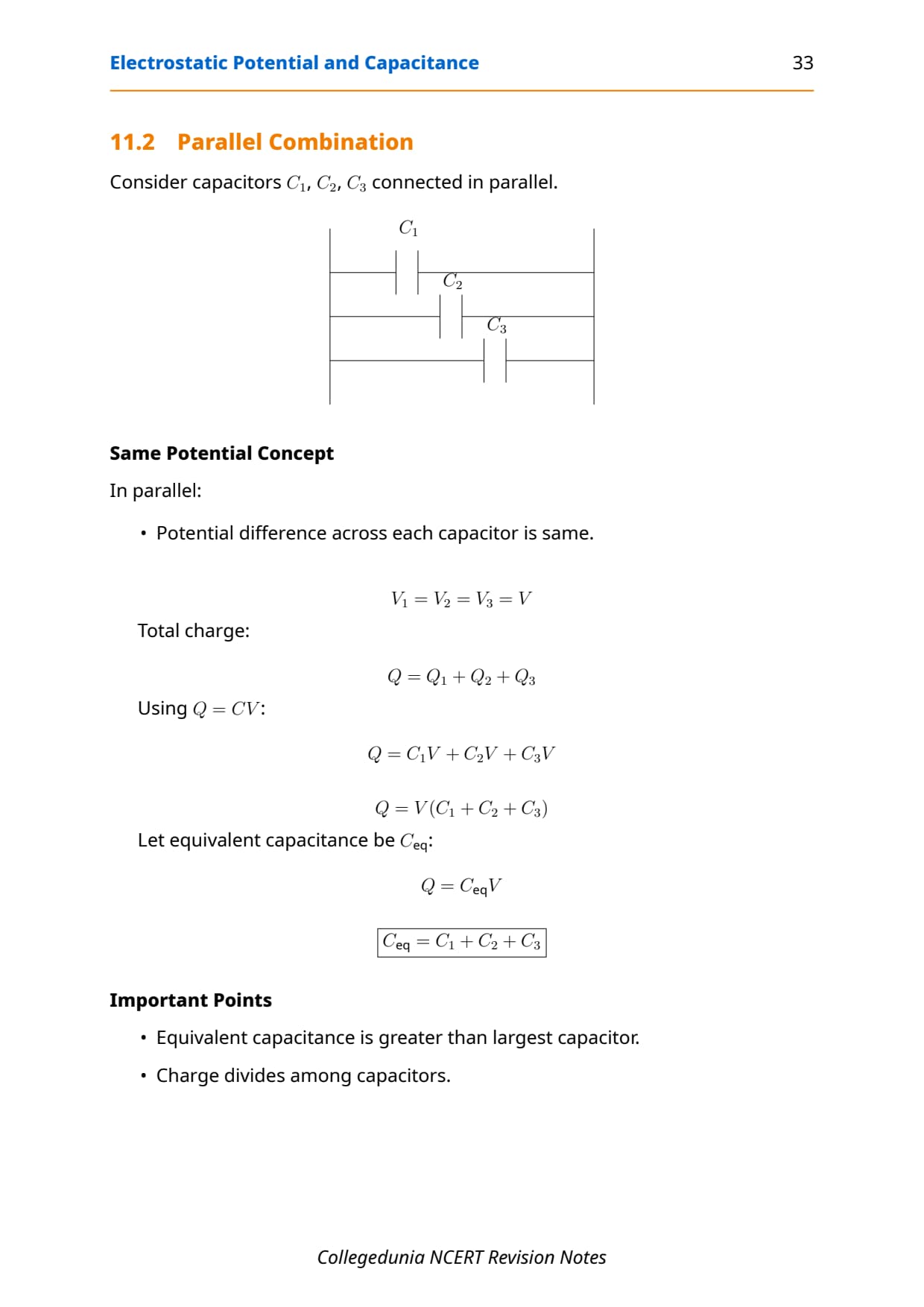
- Series: 1/C_eq = 1/C_1 + 1/C_2 + ... Same charge on each, potentials add.
- Parallel: C_eq = C_1 + C_2 + ... Same potential across each, charges add.
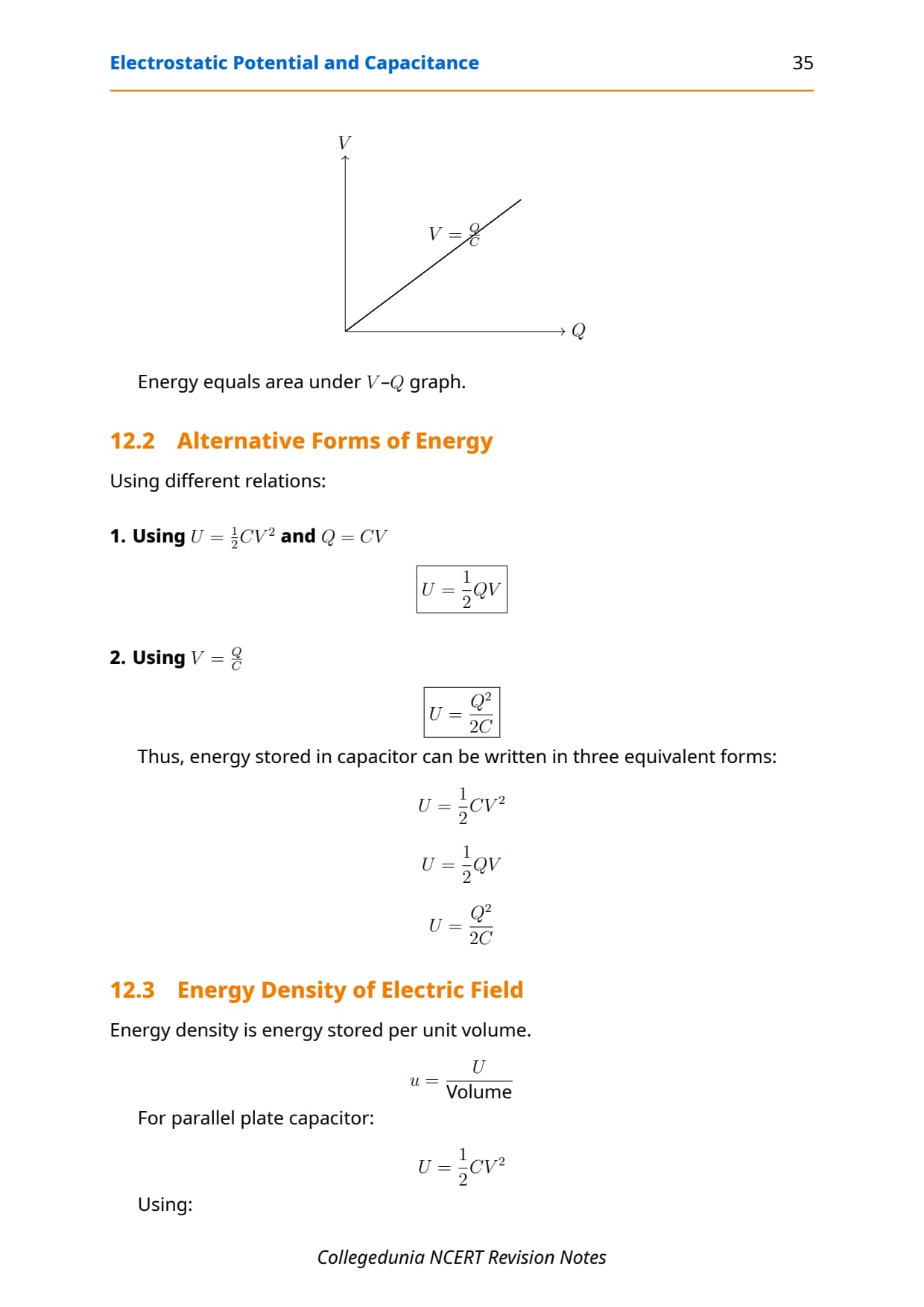
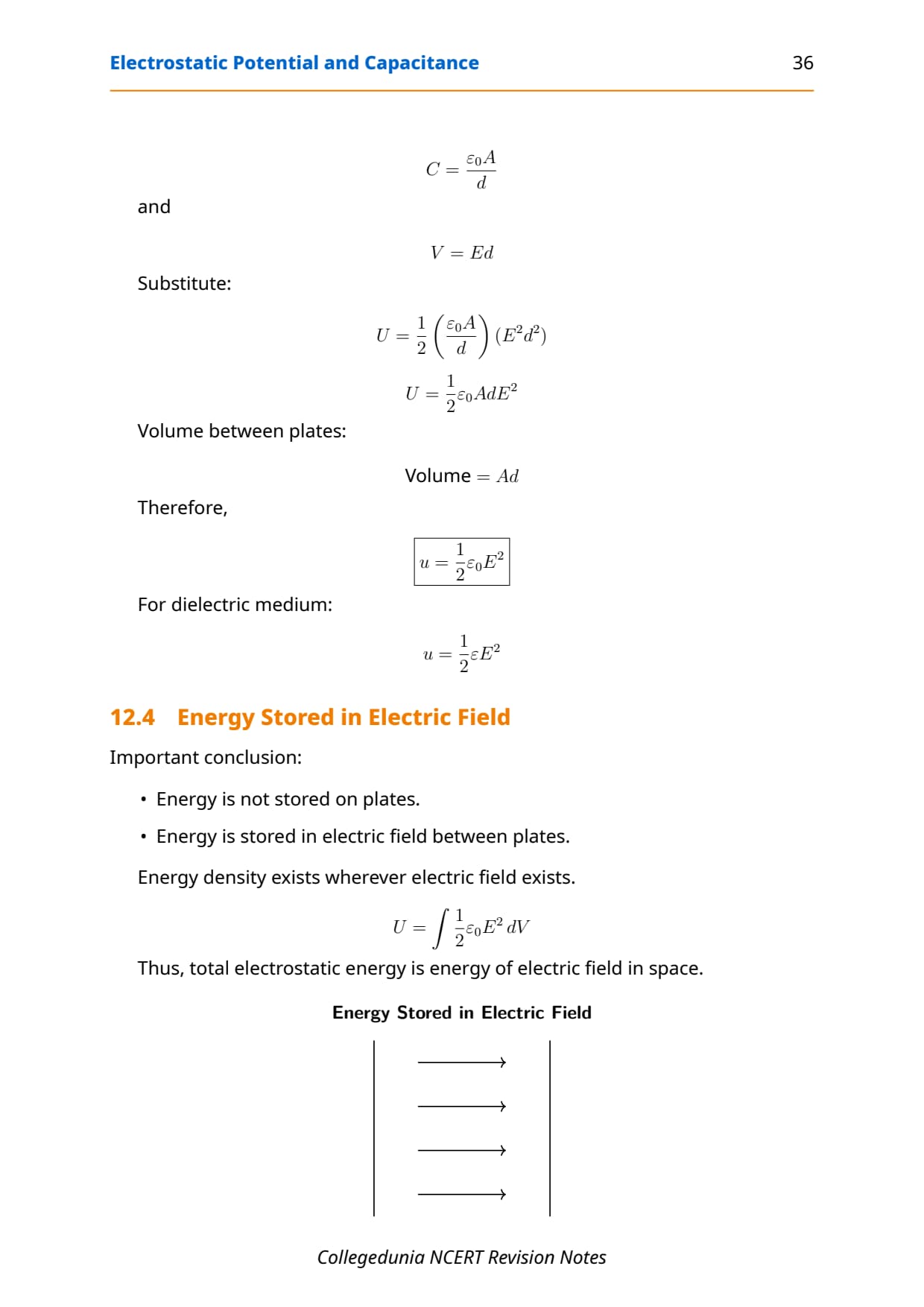
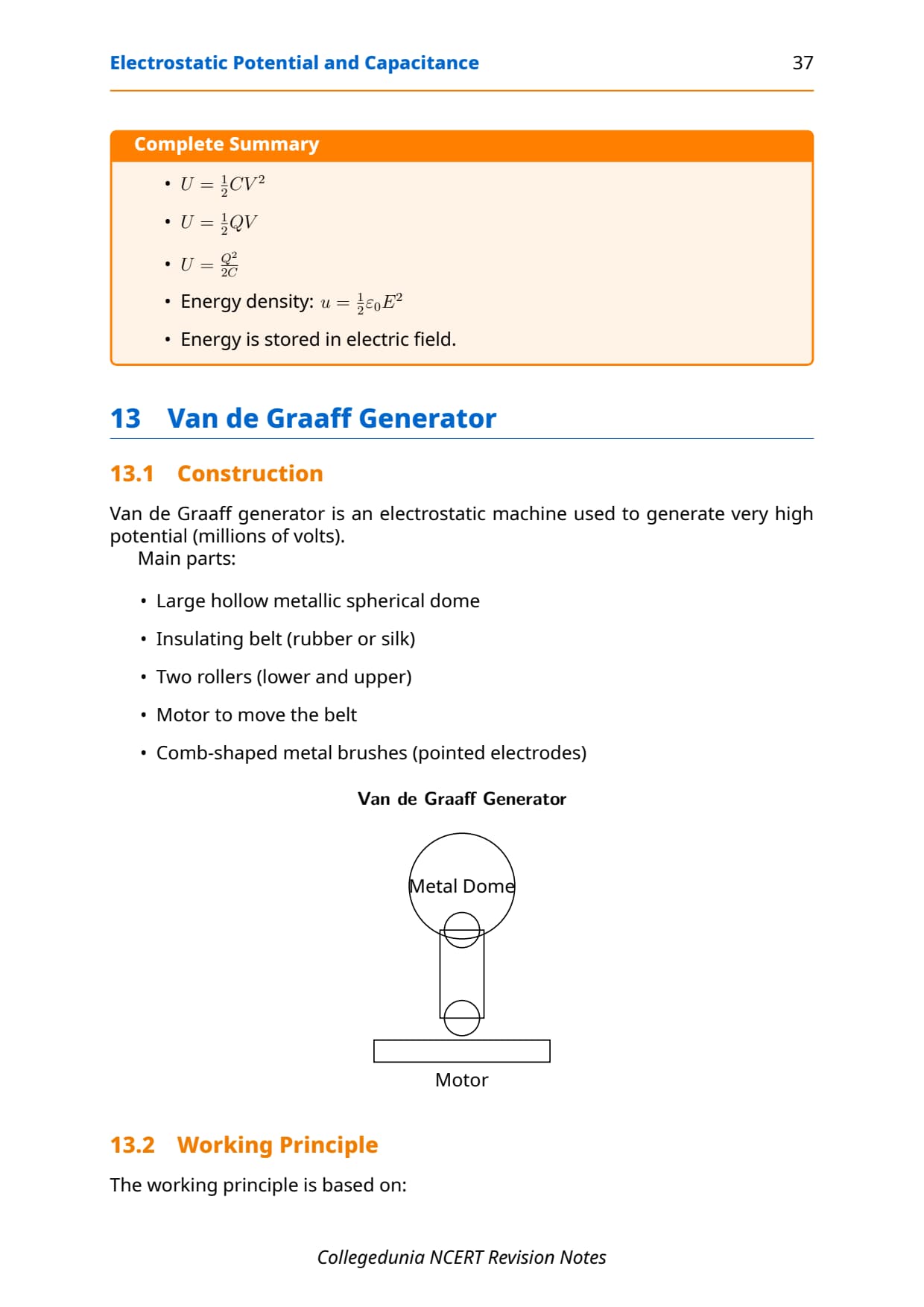
- Energy stored: U = (1/2) Q squared / C = (1/2) C V squared = (1/2) Q V. Energy density is u = (1/2) epsilon_0 E squared.
Class 12 Physics Chapter 2 All Formulas: Quick-Reference Table
| Concept | Formula | SI Unit |
|---|---|---|
| Electric potential (definition) | V = W / q | volt |
| Potential of a point charge | V = k Q / r | volt |
| Potential of a dipole | V = k p cos theta / r squared | volt |
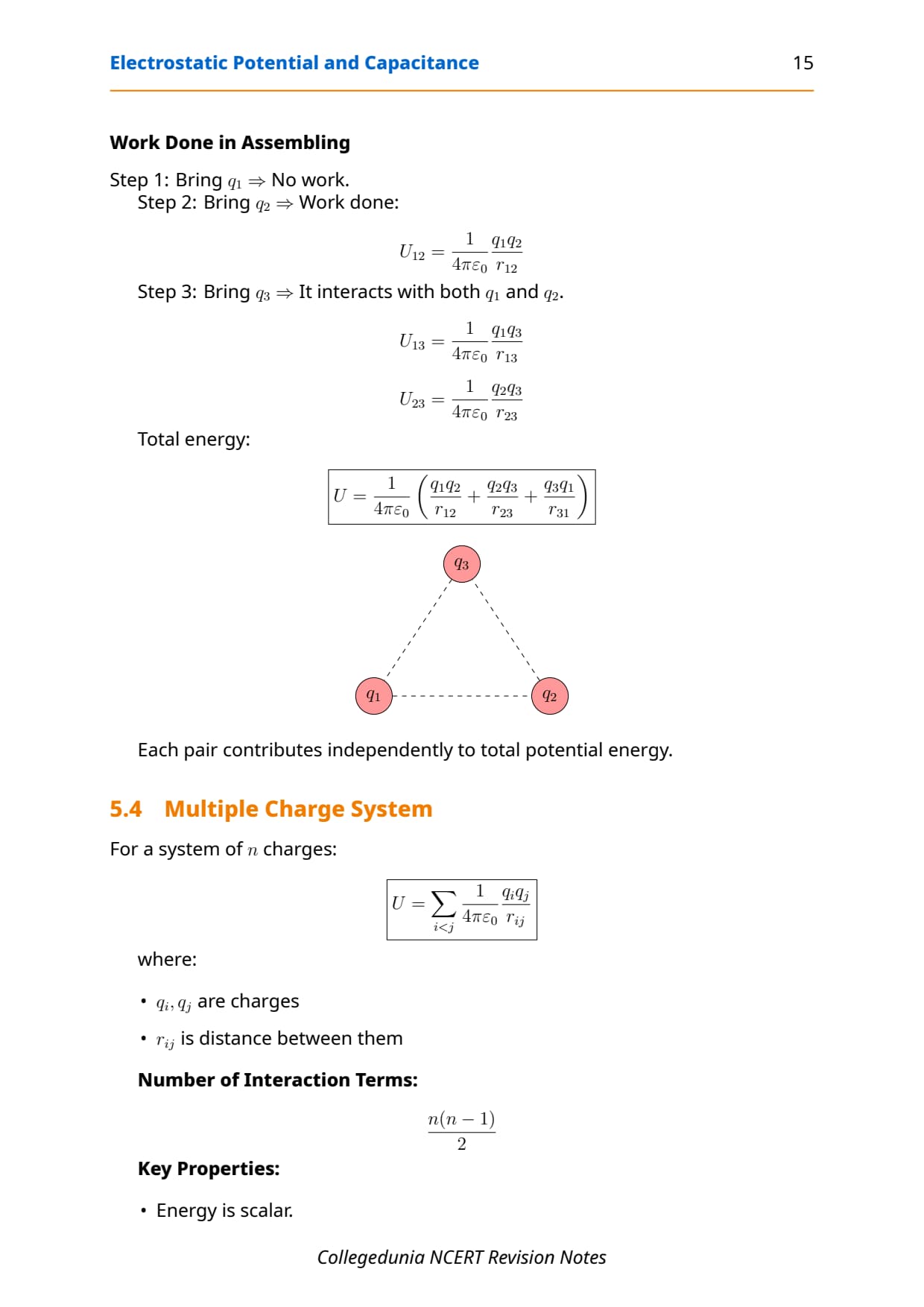
| Potential of system of charges | V = sum of k Q_i / r_i | volt |
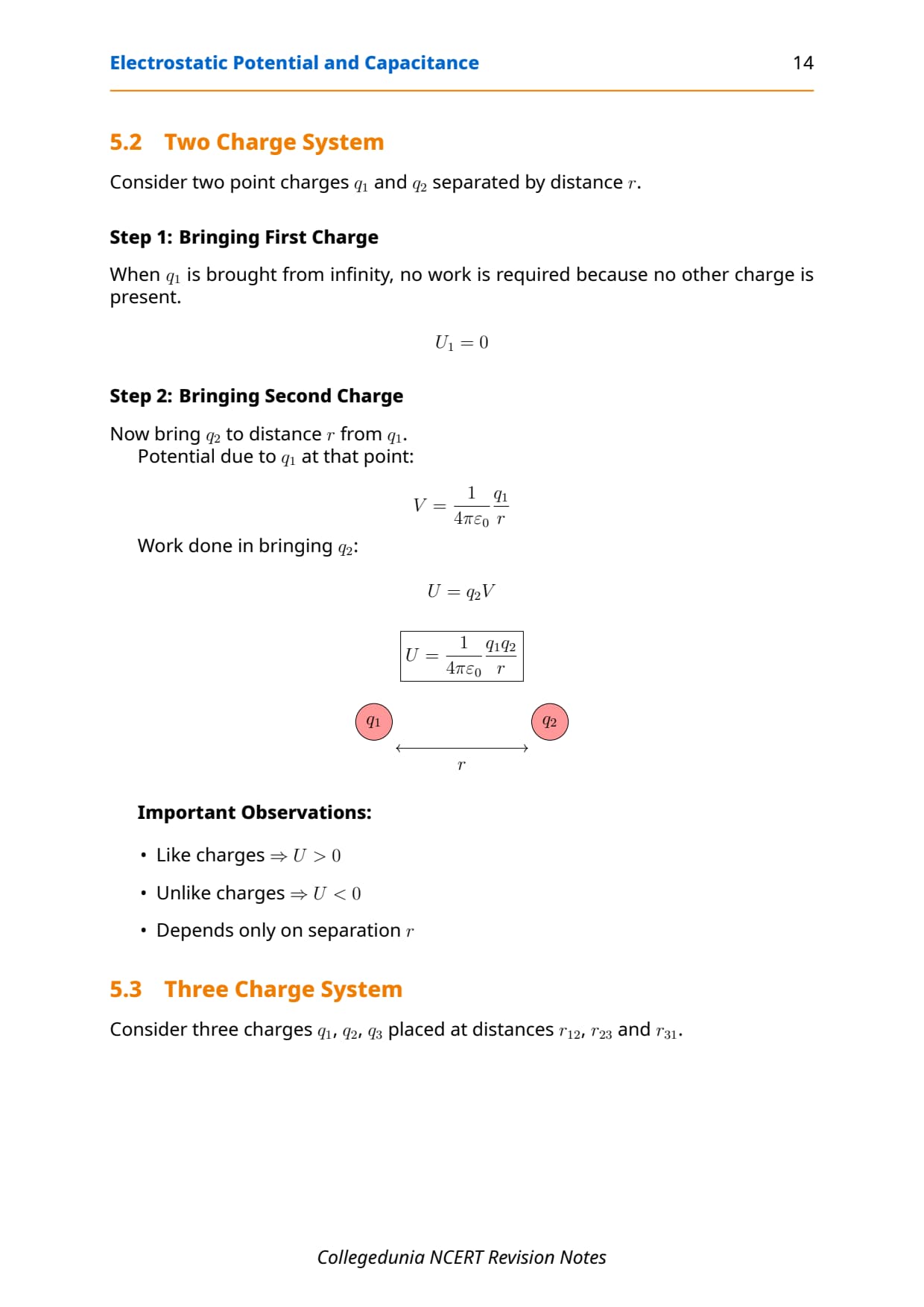
| Potential energy of two charges | U = k q_1 q_2 / r | joule |
| Relation between E and V | E = minus dV / dx | V/m |
| Capacitance | C = Q / V | farad |
| Parallel-plate (vacuum) | C = epsilon_0 A / d | farad |
| Parallel-plate (dielectric) | C = K epsilon_0 A / d | farad |
| Series capacitors | 1/C_eq = sum of 1/C_i | n/a |
| Parallel capacitors | C_eq = sum of C_i | n/a |
| Energy stored | U = (1/2) Q squared / C = (1/2) C V squared | joule |
| Energy density of E field | u = (1/2) epsilon_0 E squared | J/m cubed |
Full formula sheet with derivations: Class 12 Physics Chapter 2 Formula Sheet
Class 12 Physics Chapter 2 All Derivations: Index Table
Seven derivations carry most of the marks in this chapter.
| Derivation | Marks (CBSE) | Section |
|---|---|---|
| Potential due to a point charge (V = k Q / r) | 3 | 2.2 |
| Potential due to an electric dipole | 3 | 2.3 |
| Equipotential surfaces and E = minus dV/dx | 2 | 2.6 |
| Capacitance of a parallel-plate capacitor (vacuum) | 5 | 2.11 |
| Effect of dielectric on capacitance | 5 | 2.12 |
| Series and parallel combination of capacitors | 3 | 2.13 |
| Energy stored in a capacitor | 3 | 2.14 |
Chapter 2 Weightage Compared Across Class 12 Physics Chapters
The table below shows how Chapter 2 weightage compares with other chapters. Marks are CBSE board averages over the last five papers.
| Chapter | Topic | Avg CBSE Marks |
|---|---|---|
| Ch 1 | Electric Charges and Fields | 6 marks |
| Ch 2 | Electrostatic Potential and Capacitance | 7 marks |
| Ch 3 | Current Electricity | 7 marks |
| Ch 4 | Moving Charges and Magnetism | 6 marks |
| Ch 6 | Electromagnetic Induction | 5 marks |
| Ch 9 | Ray Optics and Optical Instruments | 7 marks |
| Ch 10 | Wave Optics | 5 marks |
| Ch 14 | Semiconductor Electronics | 6 marks |
Electrostatic Potential and Capacitance Previous Year Questions (2021 to 2026)
The table below maps CBSE, JEE Main, and NEET appearances of Chapter 2 topics over recent sessions.
| Year | CBSE Board | JEE Main | NEET |
|---|---|---|---|
| 2026 | Parallel-plate capacitor with dielectric (5 marks) | Equipotential surface direction | Capacitance and energy stored in a capacitor (3 questions) |
| 2025 | Energy stored in series-parallel network (5 marks) | Potential due to dipole on equatorial line | Capacitance of parallel plates MCQ |
| 2024 | Effect of dielectric on capacitance (3 marks) | Capacitor charging through resistor | Potential energy of two charges MCQ |
| 2023 | Potential due to electric dipole (3 marks) | Equivalent capacitance of mixed network | Equipotential vs field-line MCQ |
| 2022 | Series and parallel capacitor combinations (3 marks) | Energy density between plates | Electric potential definition |
Common Mistakes in Electrostatic Potential and Capacitance
Mistake 1: Mixing up potential V (scalar) with field E (vector). V adds by simple sum; E adds as vectors.
Mistake 2: Dropping the minus sign in E = minus dV/dx. The field points from high V to low V.
Mistake 3: Swapping the series and parallel formulas. In series, reciprocals add. In parallel, capacitances add.
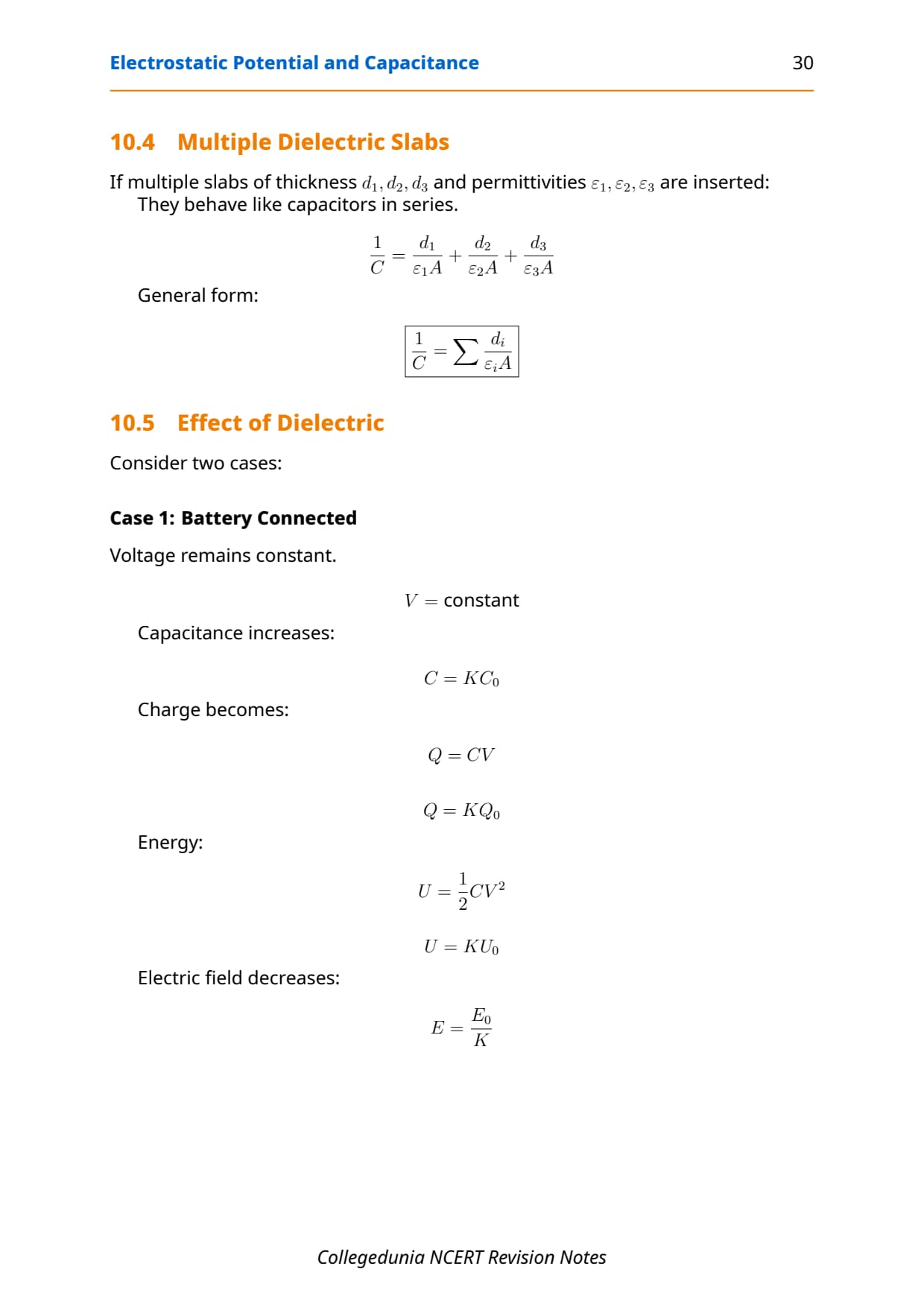
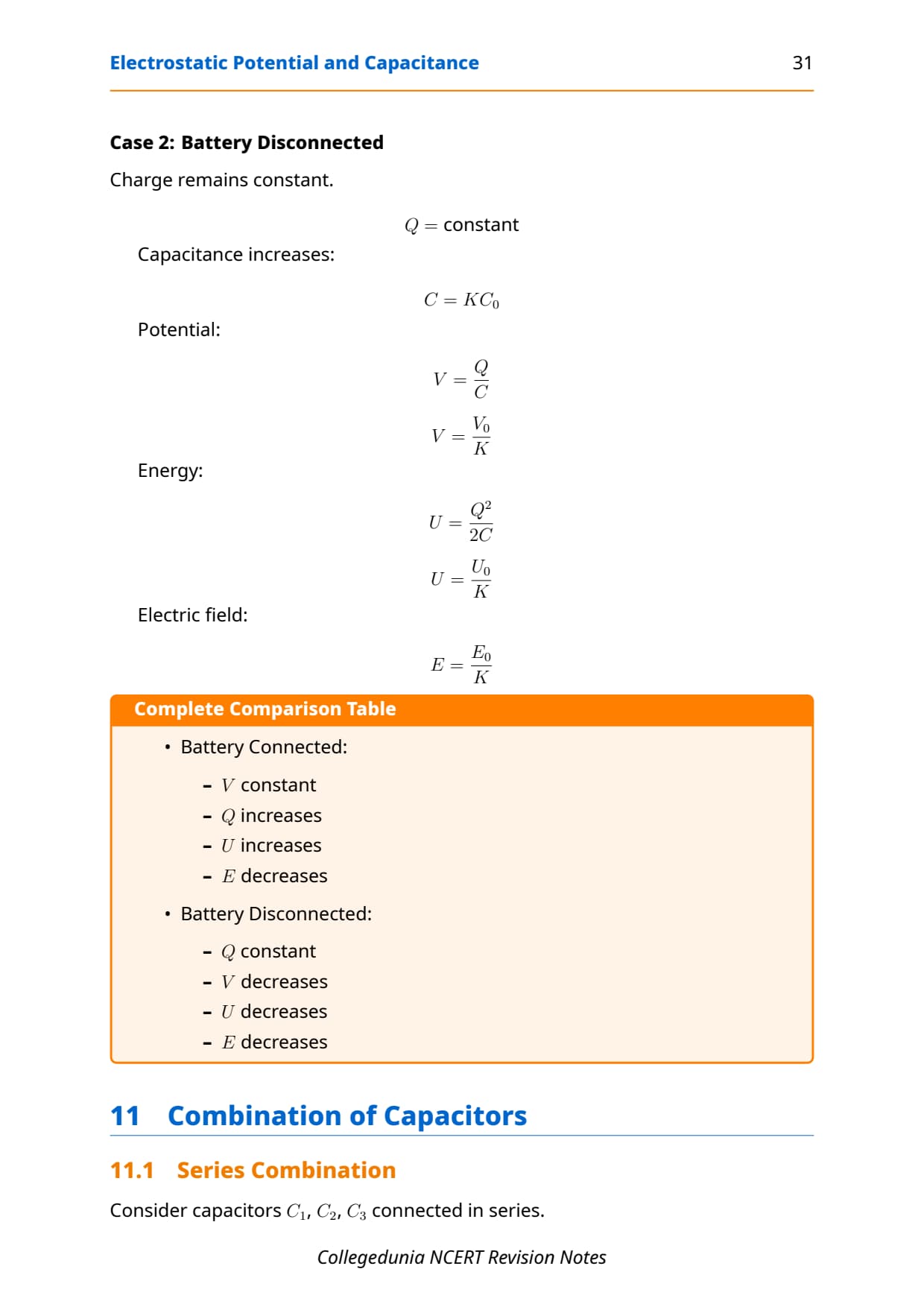
Mistake 4: Using the energy forms without checking what is fixed. Battery connected means V is fixed; battery removed means Q is fixed.
Each slip costs marks.
Solved Example: Equivalent Capacitance for Class 12 Physics Chapter 2
Problem. A 2 microF capacitor is in series with the parallel pair of 3 microF and 6 microF. Find the equivalent capacitance.
Step 1. Parallel of 3 and 6: C_parallel = 3 + 6 = 9 microF.
Step 2. Series of 2 and 9: 1/C_eq = 1/2 + 1/9 = 11/18, so C_eq = 18/11 = 1.64 microF.
This is a standard 3-mark CBSE question. Students lose marks by skipping Step 1.
Student Feedback on Class 12 Physics Chapter 2 Notes
In a Collegedunia poll of 13,420 Class 12 Physics students, the dielectric-effect derivation came out as the trickiest sub-topic.
Student Feedback
- 69% of students surveyed marked the dielectric-effect derivation as the most confusing sub-topic.
- 57% said they swapped series and parallel formulas on at least one class test.
- 4 out of 5 students kept capacitor energy-storage as their most-practised 3-marker before boards.
- Average student took 6 hours for the first read and 2.8 hours for focused revision.
Source: 2025-26 Class 12 Physics student poll. Sample of 13,420 students from CBSE schools across 15 states.
How to Revise Class 12 Physics Chapter 2 in 2 Hours
- 0 to 60 min: Potential definition, point-charge and dipole formulas, then equipotential surfaces and the E-V relation.
- 60 to 120 min: Parallel-plate capacitor, dielectric effect, series/parallel formulas, energy stored, and the 14-formula table.
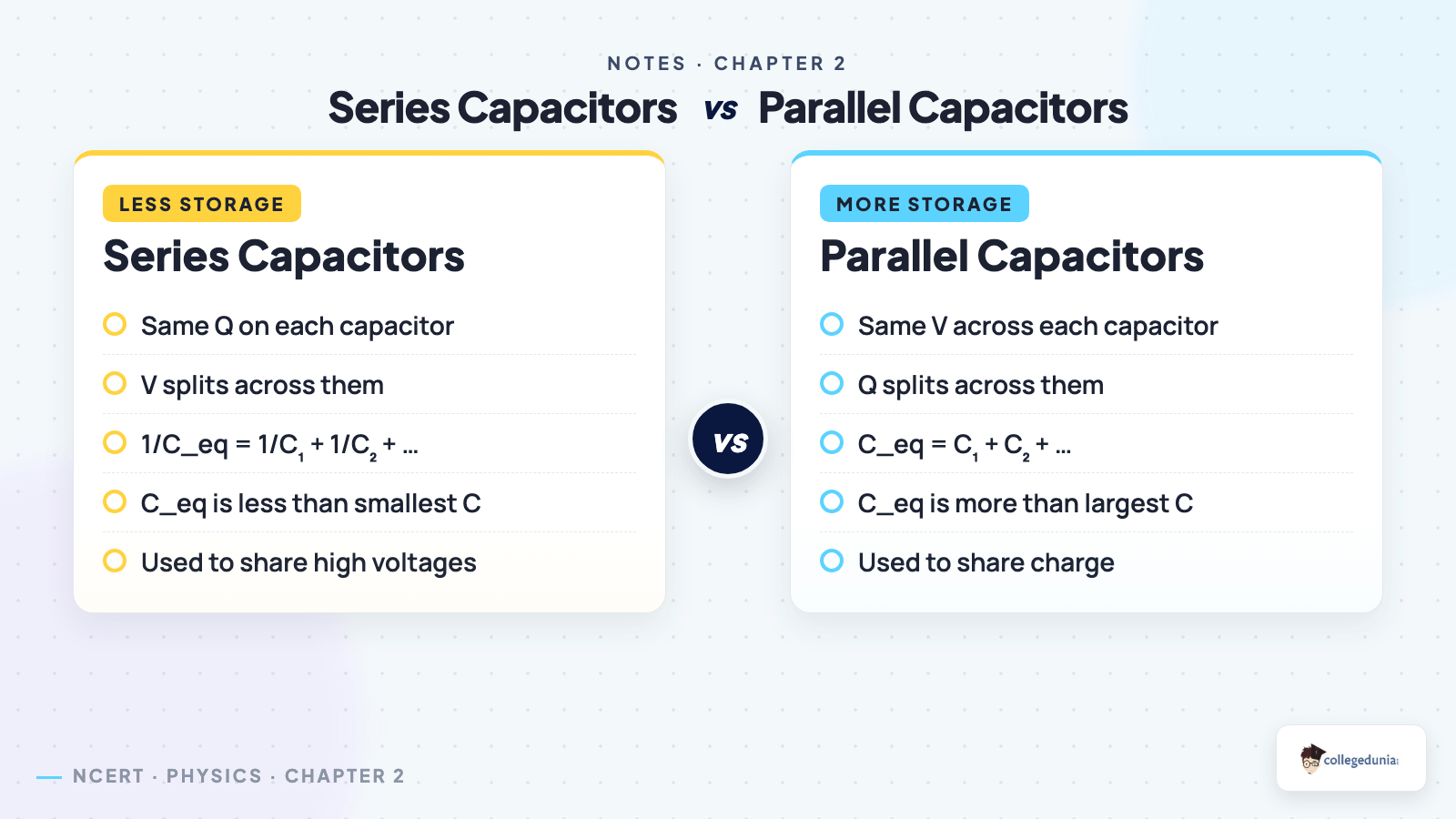
Series vs parallel capacitor combinations at a glance.
Other Resources for Class 12 Physics Chapter 2 Electrostatic Potential and Capacitance
| Resource | Link |
|---|---|
| Notes | Electrostatic Potential and Capacitance Notes |
| NCERT Solutions | Electrostatic Potential and Capacitance Solutions |
| Formula Sheet | Electrostatic Potential and Capacitance Formula Sheet |
| NCERT Book PDF | Electrostatic Potential and Capacitance Book PDF |
| Exemplar Book PDF | Electrostatic Potential and Capacitance Exemplar Book PDF |
| Exemplar Solutions | Electrostatic Potential and Capacitance Exemplar Solutions |
| Handwritten Notes | Electrostatic Potential and Capacitance Handwritten Notes |
NCERT Notes for Class 12 Physics: All Chapters
| Chapter | Resource |
|---|---|
| Chapter 1 | Electric Charges and Fields Notes |
| Chapter 2 | Electrostatic Potential and Capacitance Notes |
| Chapter 3 | Current Electricity Notes |
| Chapter 4 | Moving Charges and Magnetism Notes |
| Chapter 5 | Magnetism and Matter Notes |
| Chapter 6 | Electromagnetic Induction Notes |
| Chapter 7 | Alternating Current Notes |
| Chapter 8 | Electromagnetic Waves Notes |
| Chapter 9 | Ray Optics Notes |
| Chapter 10 | Wave Optics Notes |
| Chapter 11 | Dual Nature of Radiation and Matter Notes |
| Chapter 12 | Atoms Notes |
| Chapter 13 | Nuclei Notes |
| Chapter 14 | Semiconductor Electronics Notes |
Class 12 Physics Chapter 2 Electrostatic Potential and Capacitance Notes FAQs
Ques. What are the main topics in Class 12 Physics Chapter 2 notes?
Ans. The notes cover electric potential and potential difference, potential due to a point charge, dipole, and system of charges, equipotential surfaces, the E-V relation, capacitance, the parallel-plate capacitor, the effect of a dielectric, capacitors in series and parallel, and energy stored in a capacitor.
Ques. What is electric potential?
Ans. Electric potential at a point is the work done per unit positive test charge to bring it from infinity to that point. V = W / q, SI unit volt. It is a scalar, so potentials from many charges add by simple sum.
Ques. What is capacitance?
Ans. Capacitance is the ratio of charge stored to potential difference: C = Q / V, SI unit farad. For a parallel-plate capacitor in vacuum, C = epsilon_0 A / d. With a dielectric of constant K, C = K epsilon_0 A / d.
Ques. How are capacitors combined in series and parallel?
Ans. In series, 1/C_eq = 1/C_1 + 1/C_2 + ... with the same charge on each and potentials adding. In parallel, C_eq = C_1 + C_2 + ... with the same potential and charges adding. Mixed networks are solved group by group.
Ques. What is the energy stored in a capacitor?
Ans. U = (1/2) Q squared / C = (1/2) C V squared = (1/2) Q V. All three forms are equal, so pick the one with the known values. The energy density of the field is u = (1/2) epsilon_0 E squared.



Comments