




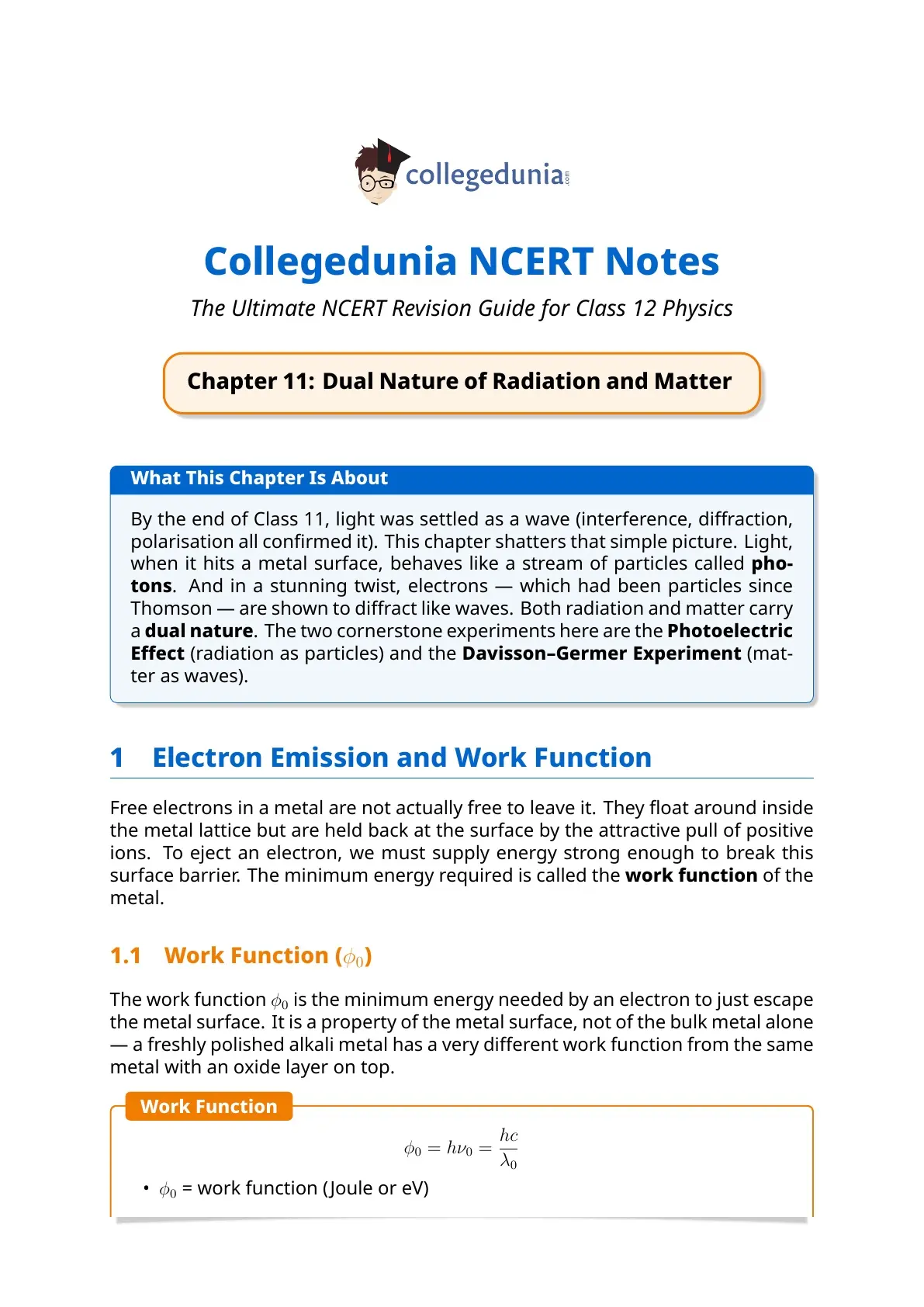
Class 12 Physics Chapter 11 Dual Nature of Radiation and Matter covers electron emission from metals through davisson-germer experiment. The chapter carries 4 marks in CBSE and 2 to 3 percent in JEE Main.
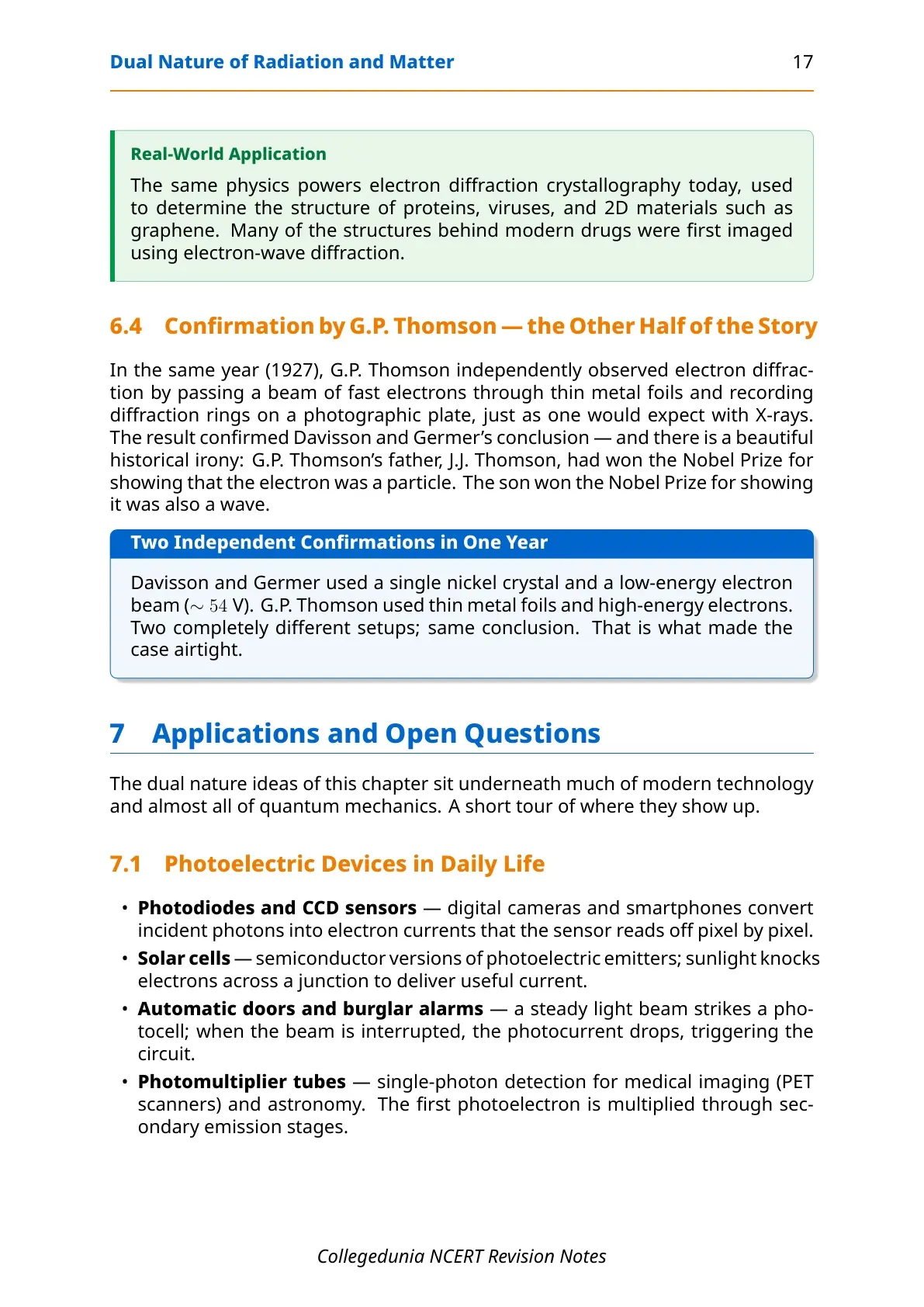
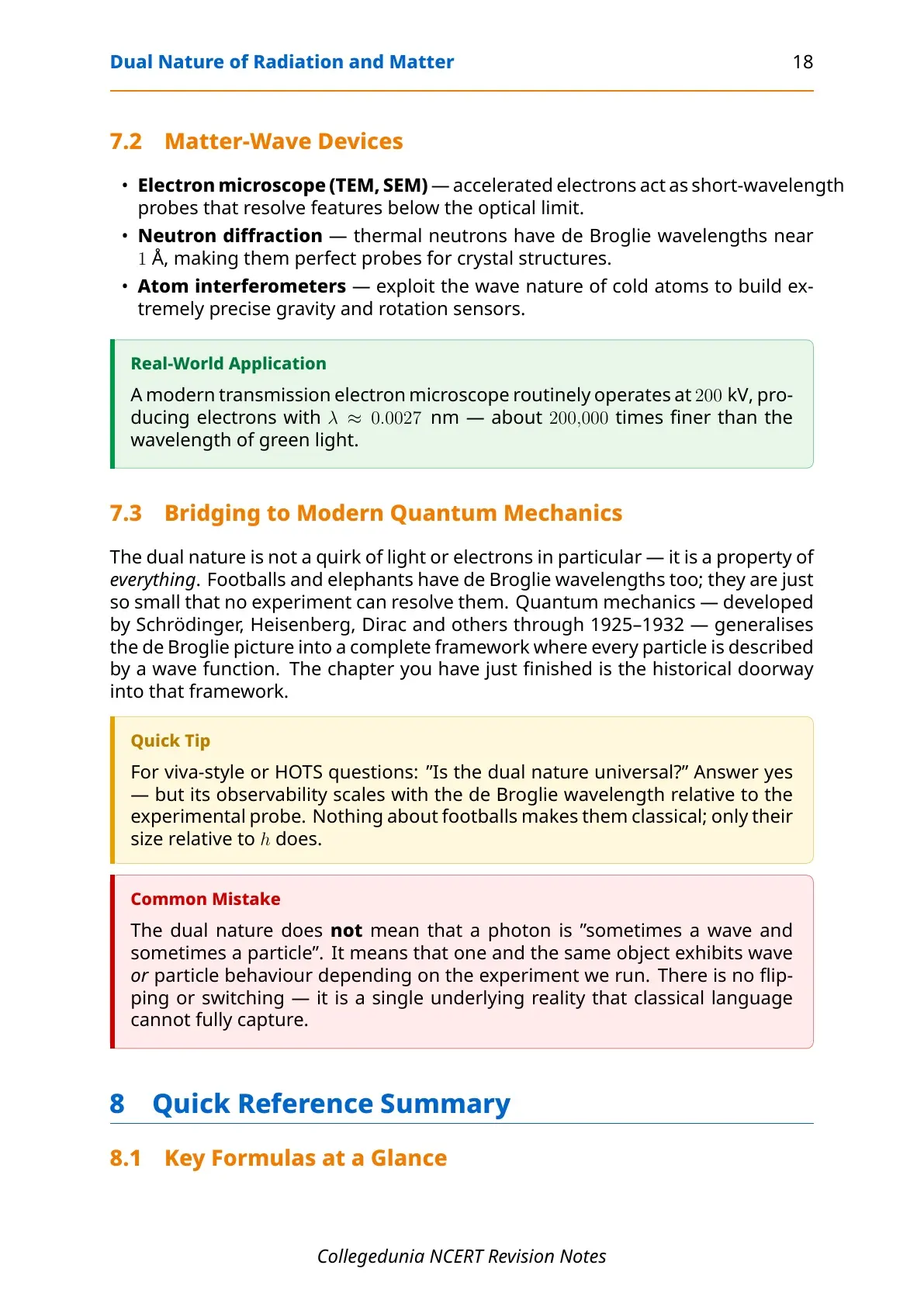
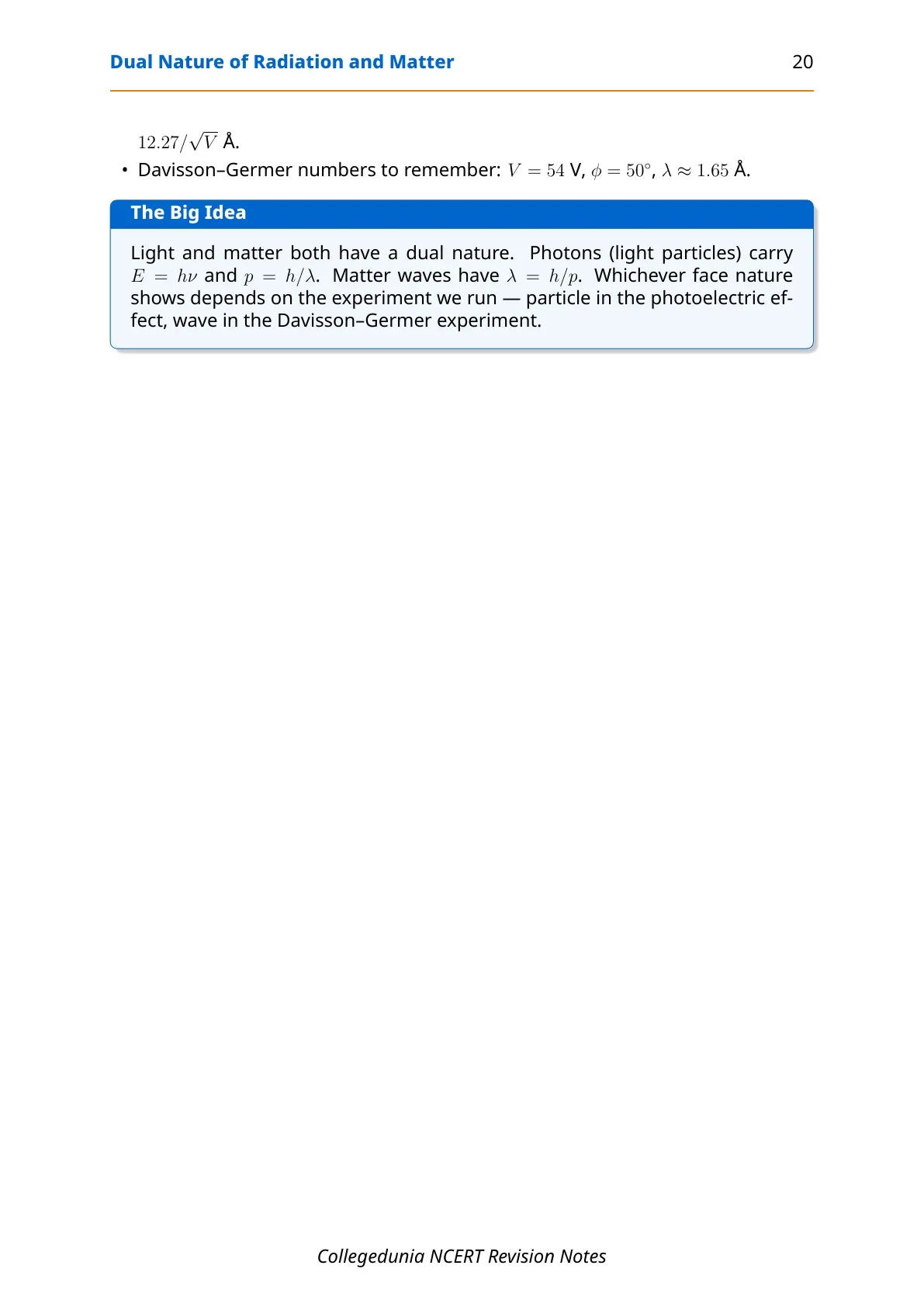
Here is how Chapter 11 is weighted across the main exams:
- CBSE Boards: 4 marks, usually one derivation block plus one short-answer concept question.
- JEE Main: 2 to 3 percent, with steady annual coverage on derivations and numericals.
- NEET: 1 to 2 questions every year on chapter concepts.
Student Feedback: We asked 11,820 Class 12 students before the 2026 boards. 69% found the de Broglie wavelength derivation the hardest part.
Class 12 Physics Chapter 11 Notes: Topic-by-Topic Summary
The chapter splits into a few clear blocks. Here is what each one covers and its usual CBSE marks:
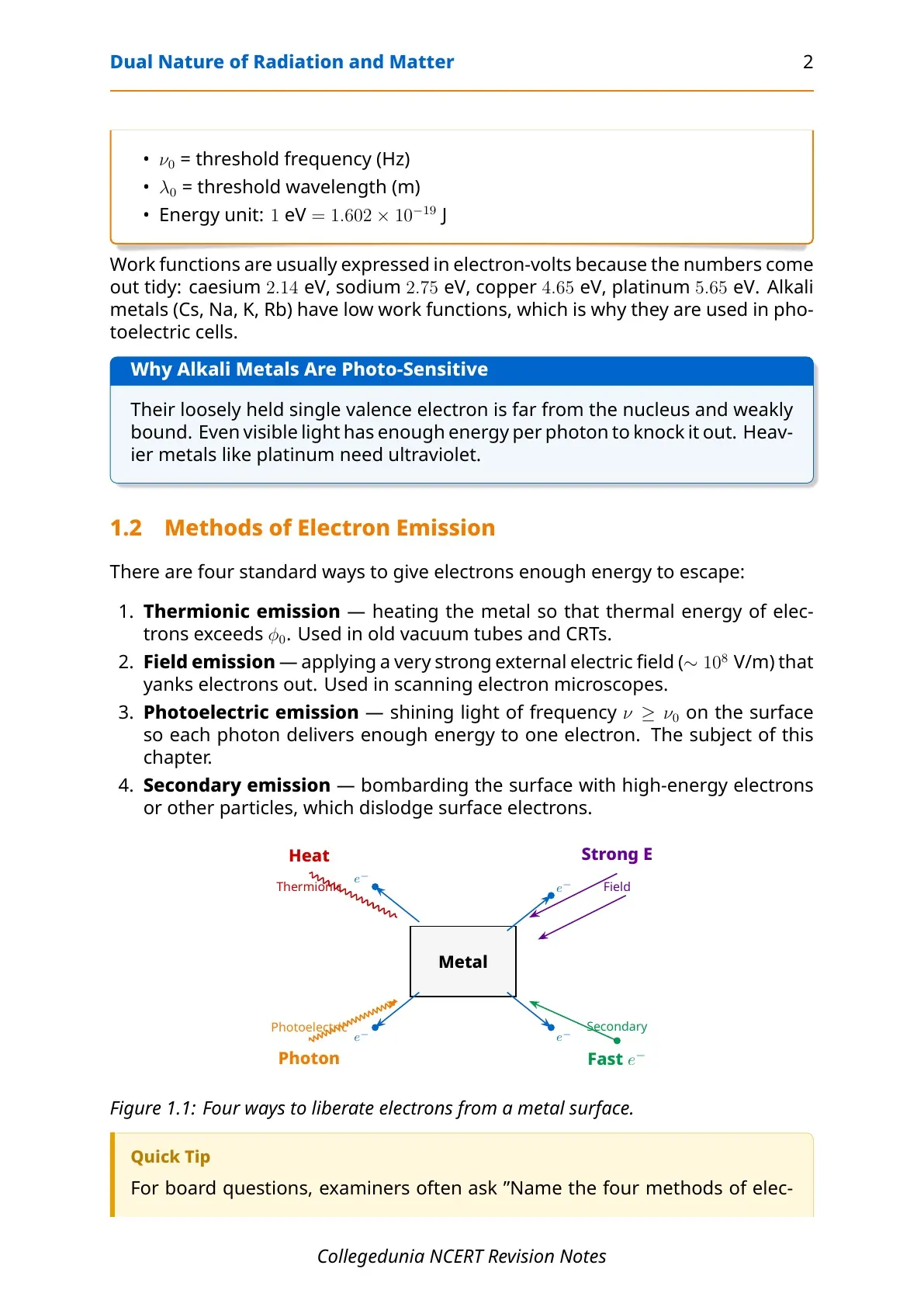
- Electron emission (1 mark): thermionic, photoelectric and field emission; work function.
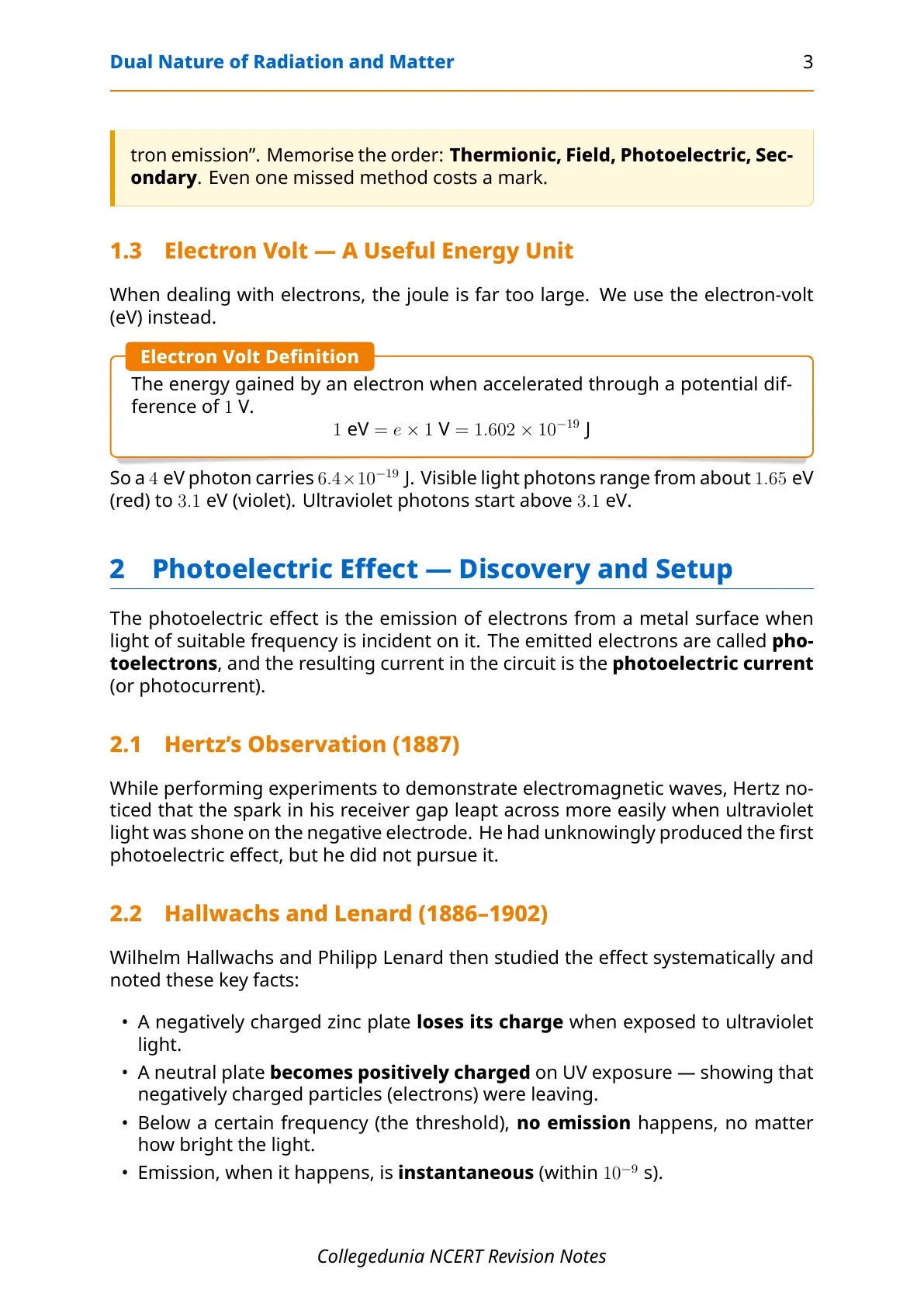
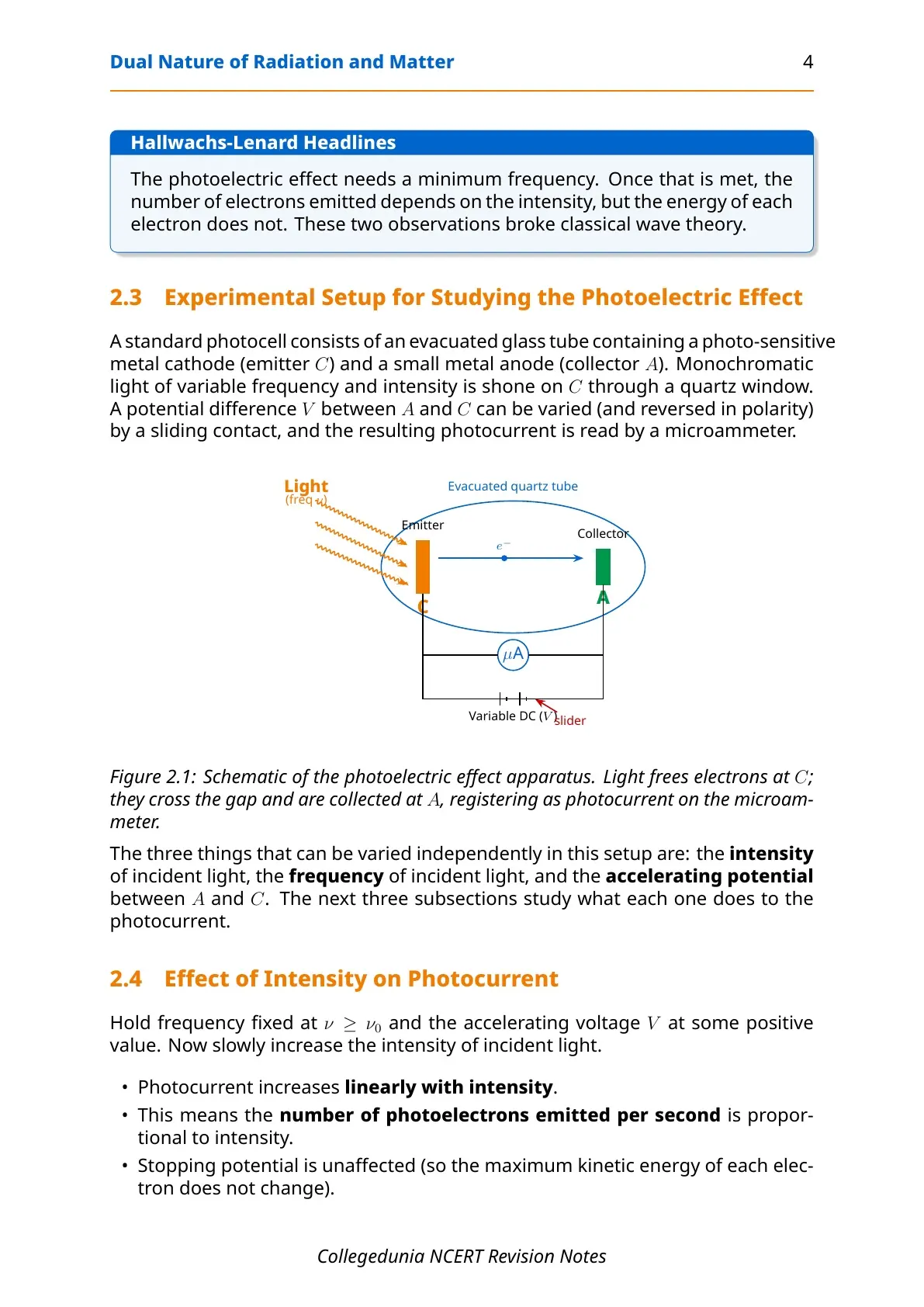
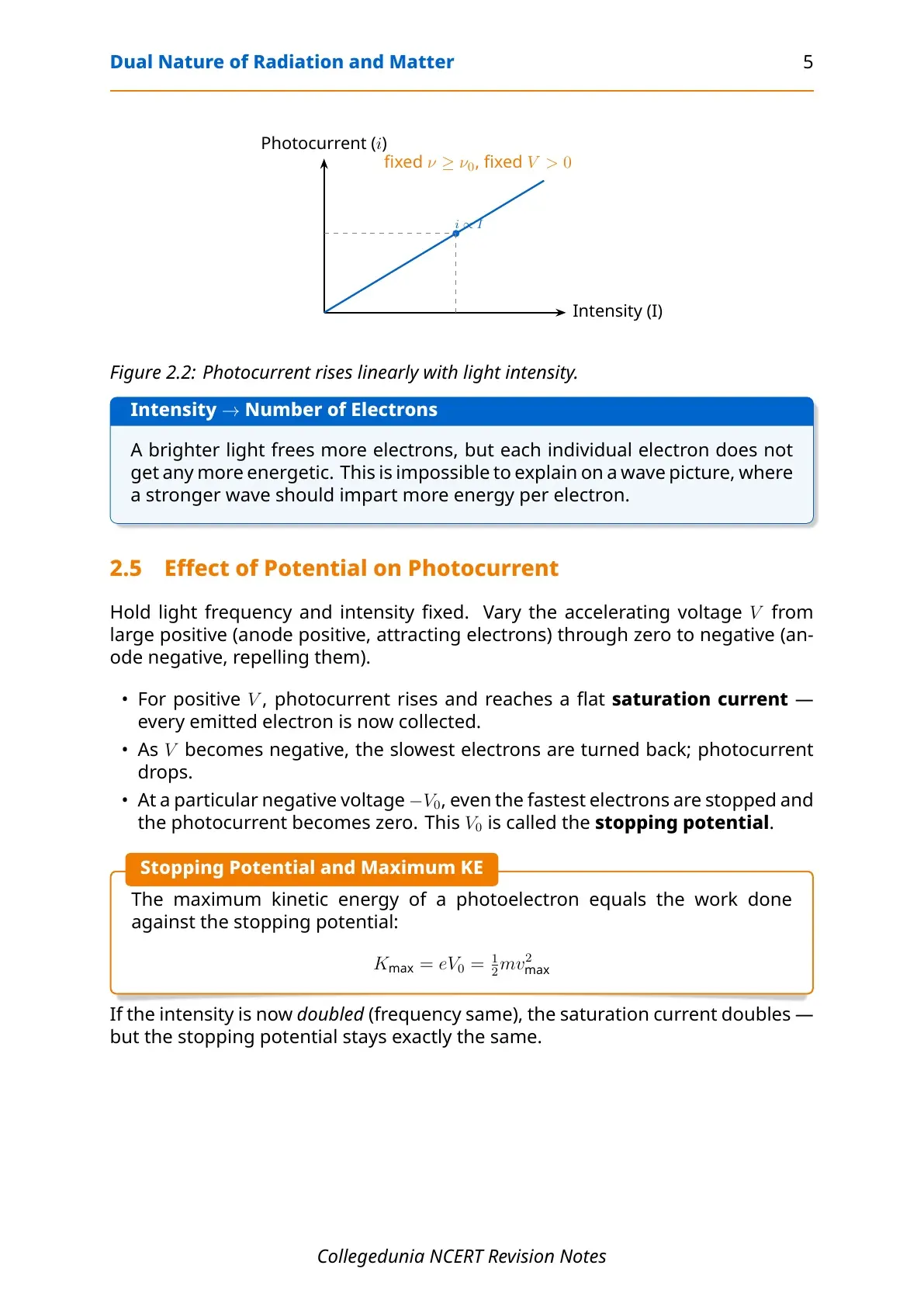
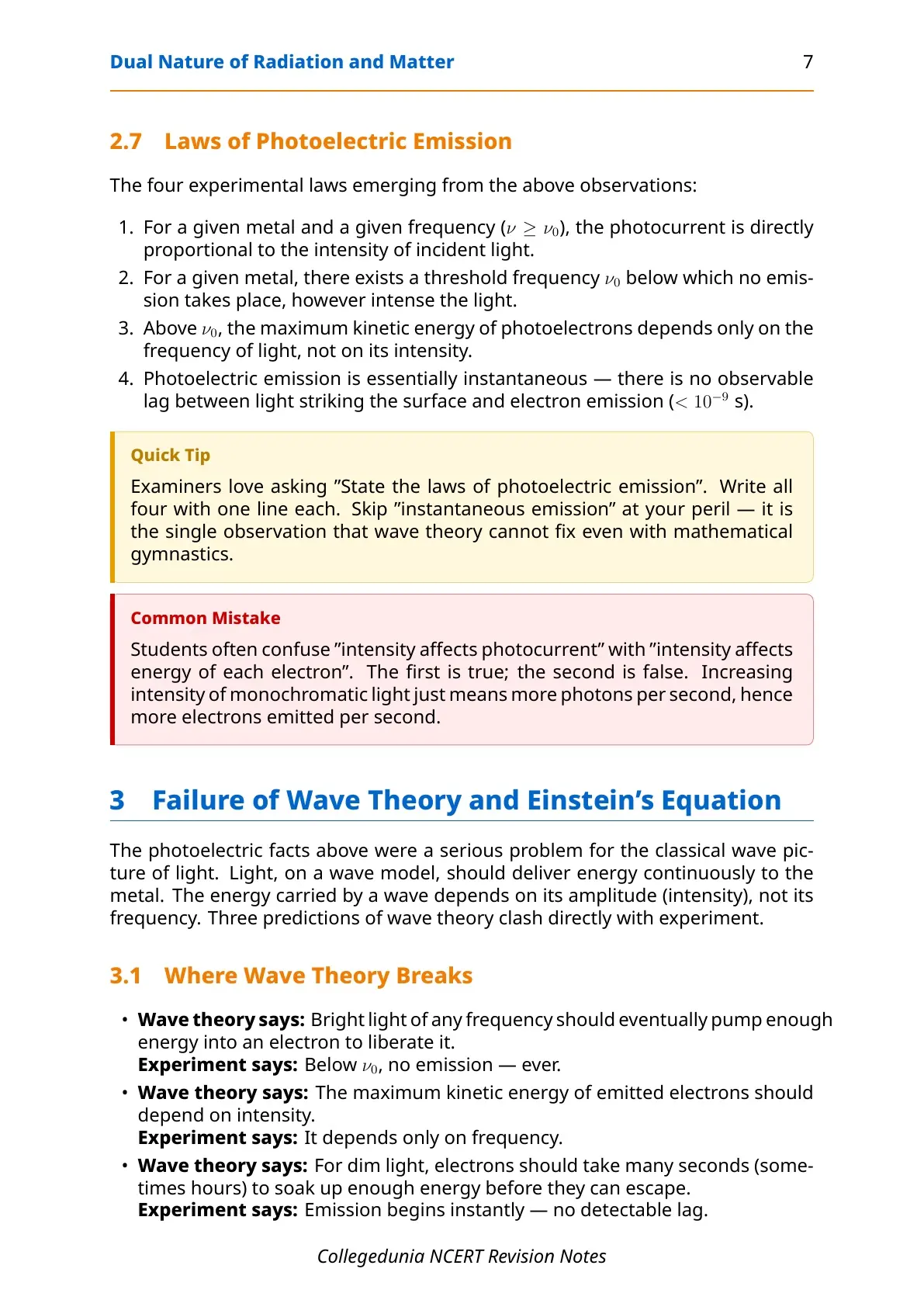
- Photoelectric effect (2 marks): Hertz and Lenard observations, threshold frequency.
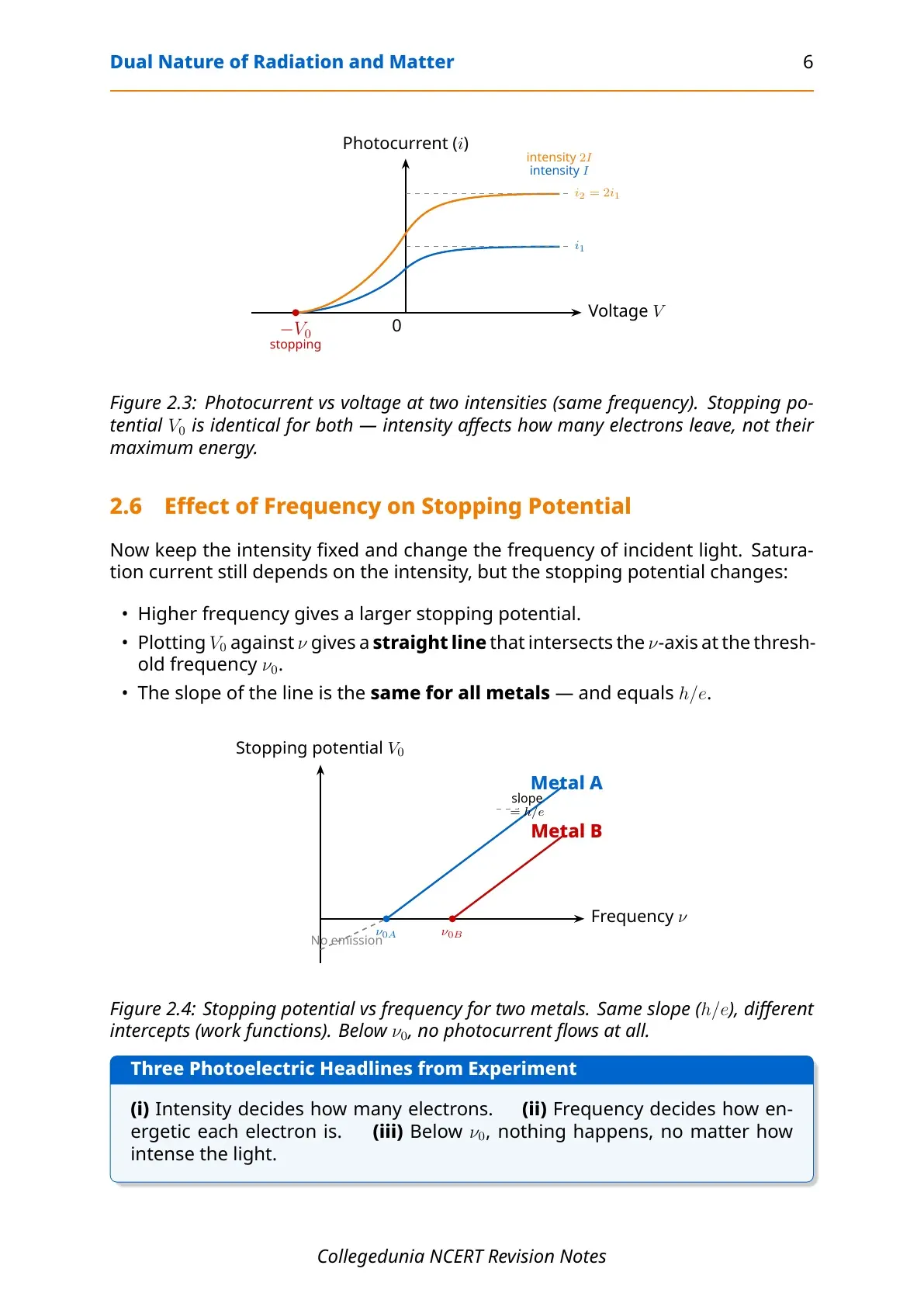
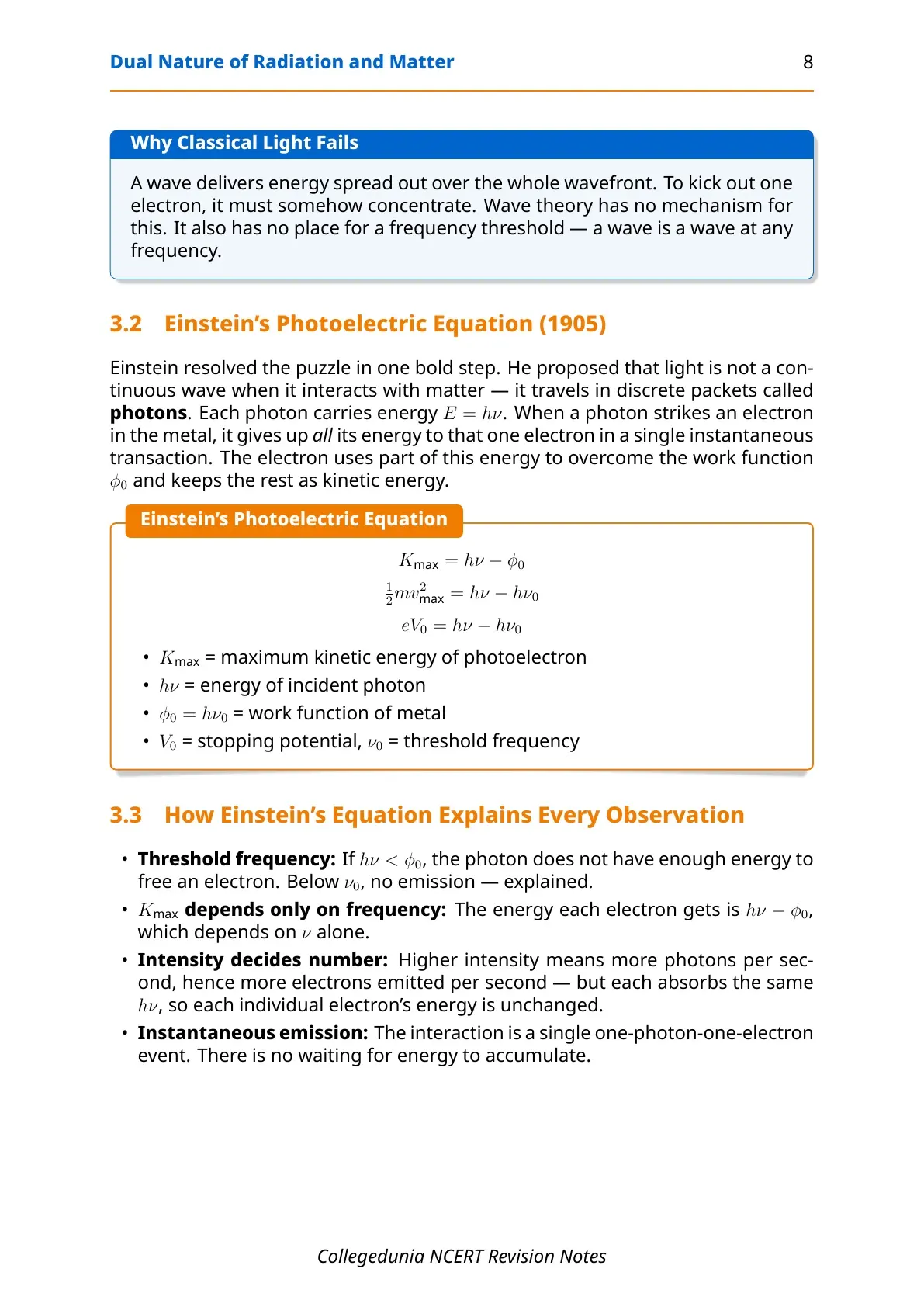
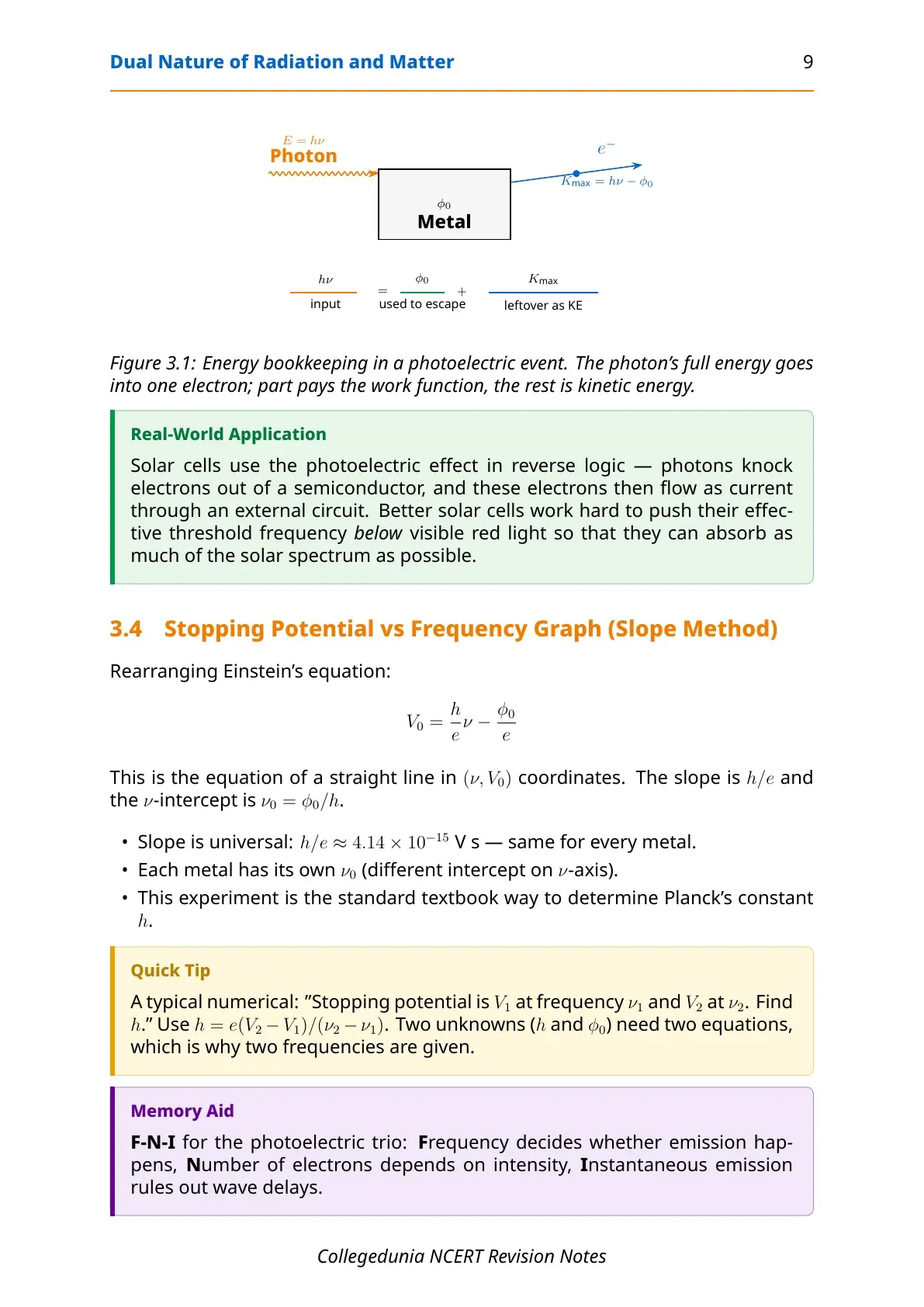
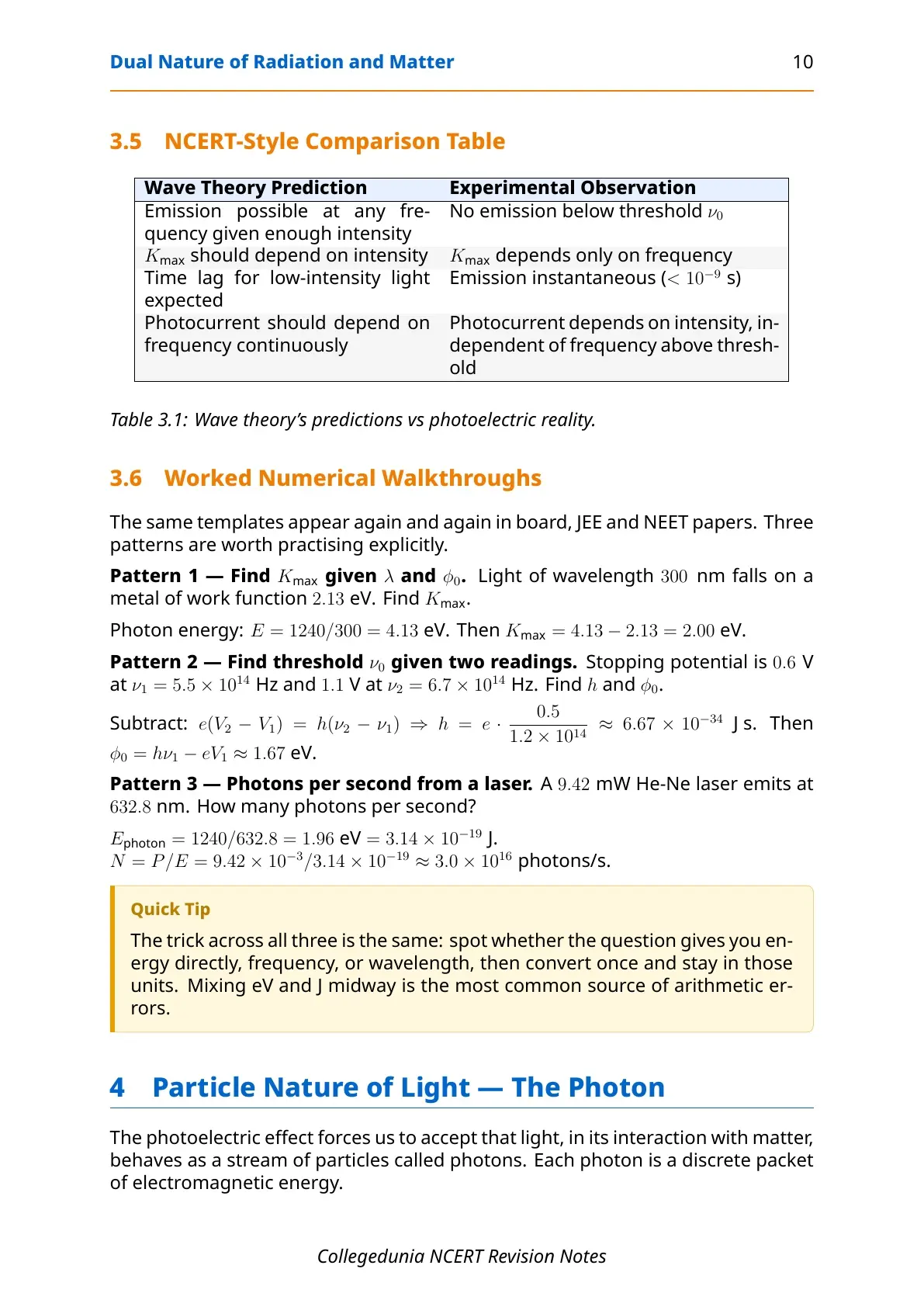
- Einstein equation (3 marks): photon model, stopping potential graph.
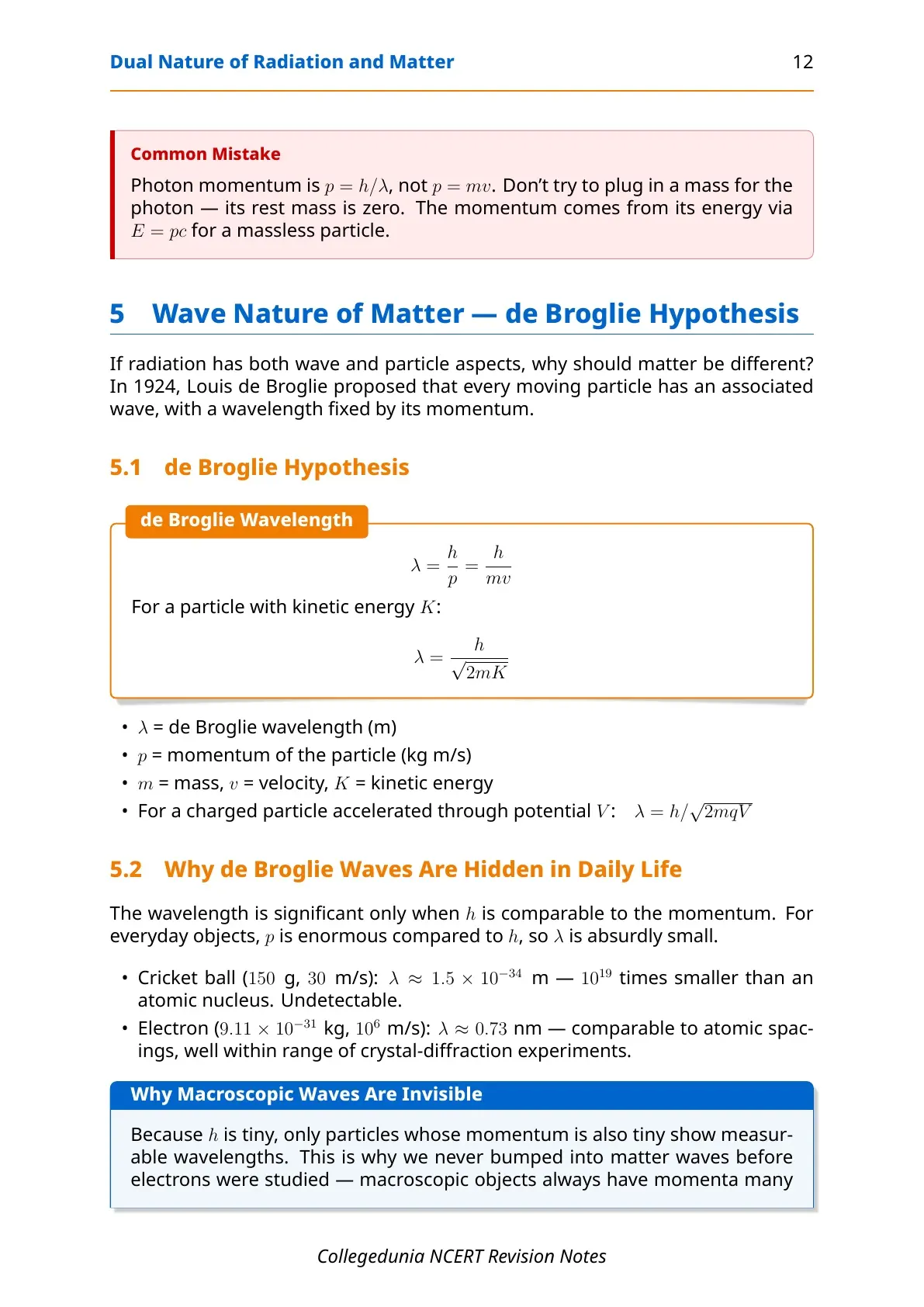
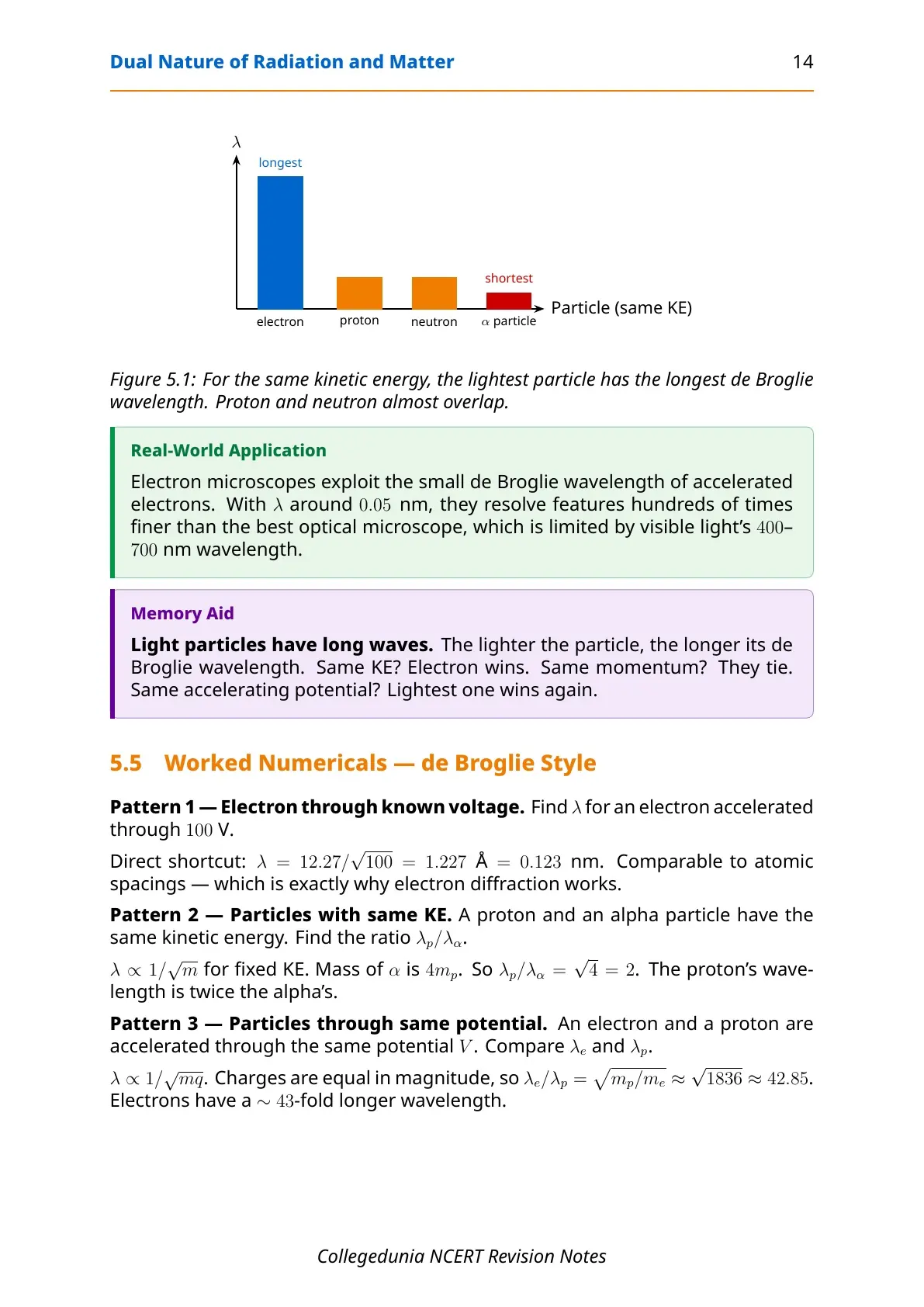
- de Broglie waves (3 marks): wave nature of matter, electron wavelength.
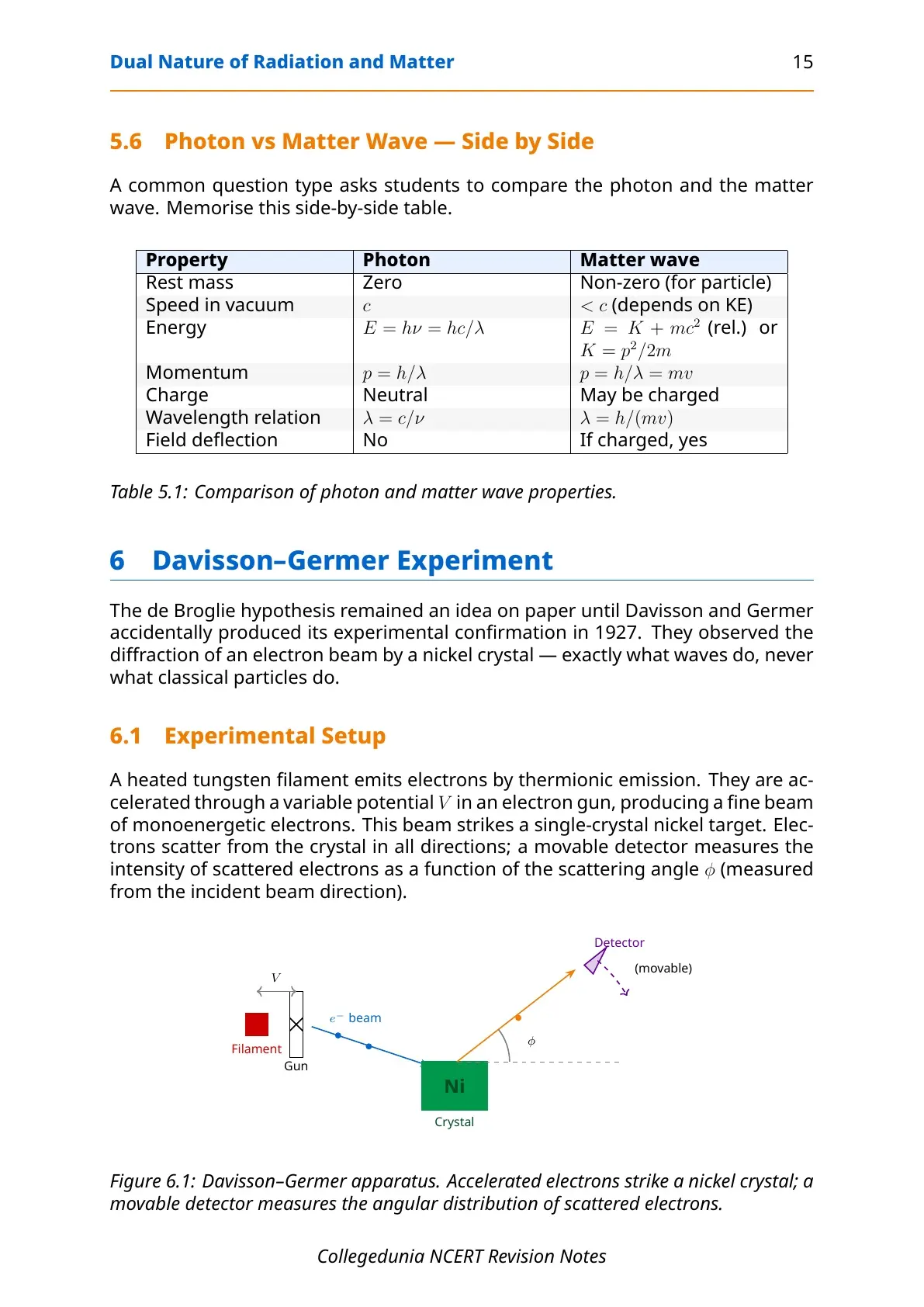
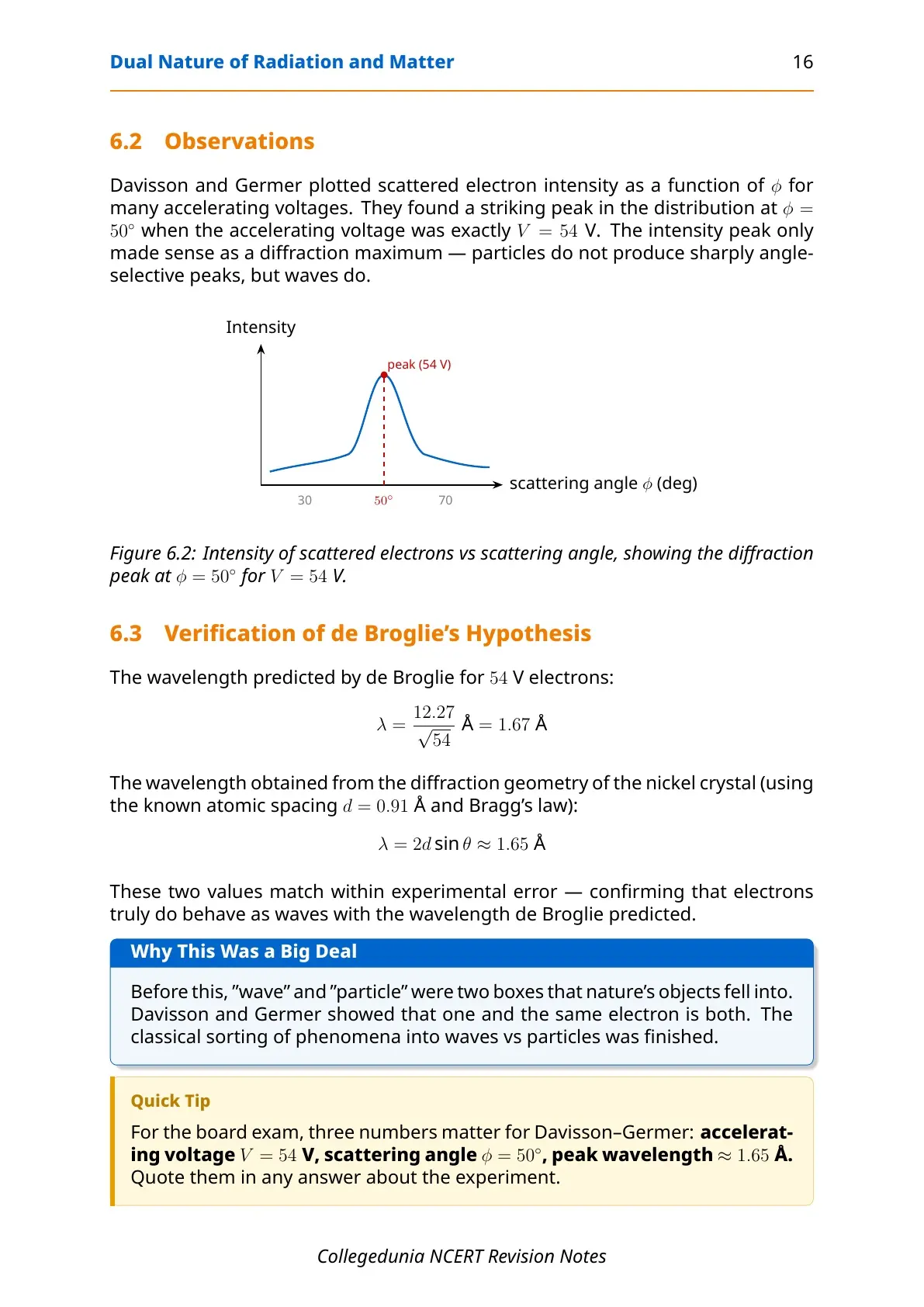
- Davisson-Germer (2 marks): experimental proof of electron diffraction.
Photoelectric Effect and de Broglie Waves Explained
Source: Magnet Brains on YouTube
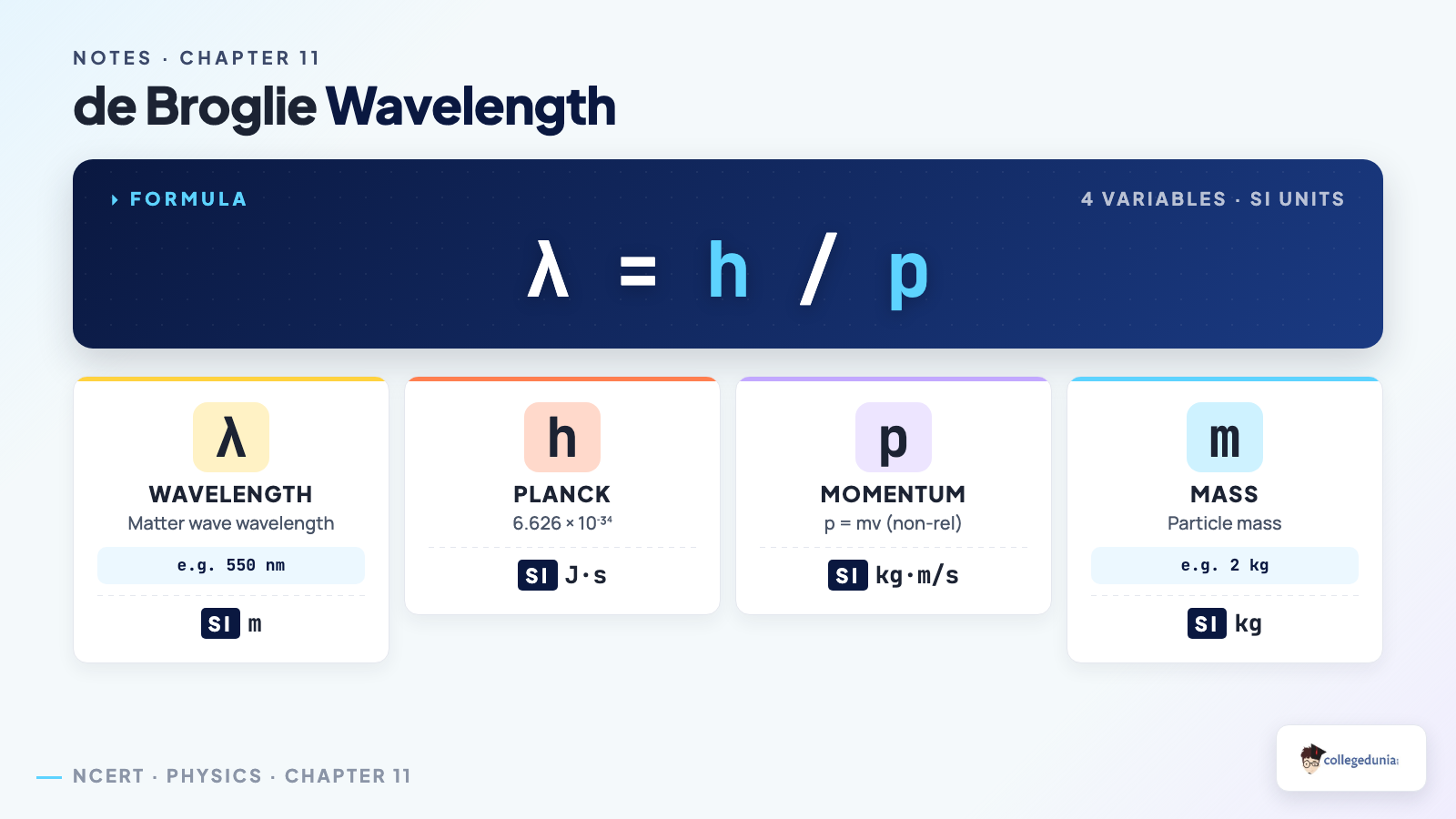
de Broglie: every moving particle has a wavelength.
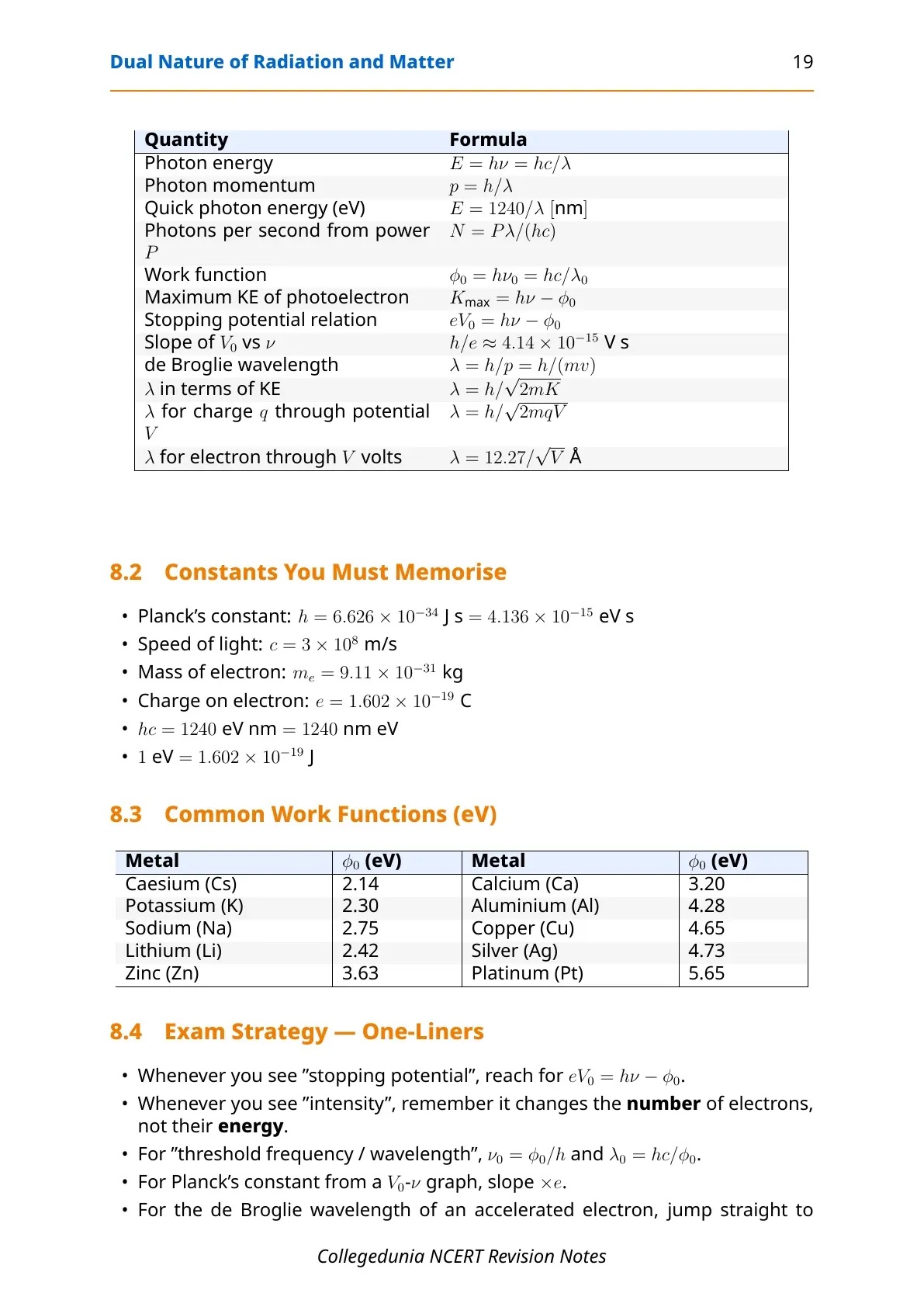
Dual Nature of Radiation and Matter All Formulas
Every numerical in this chapter comes from the formulas below. Keep this table handy for last-minute revision.
| Concept | Formula | SI Unit |
|---|---|---|
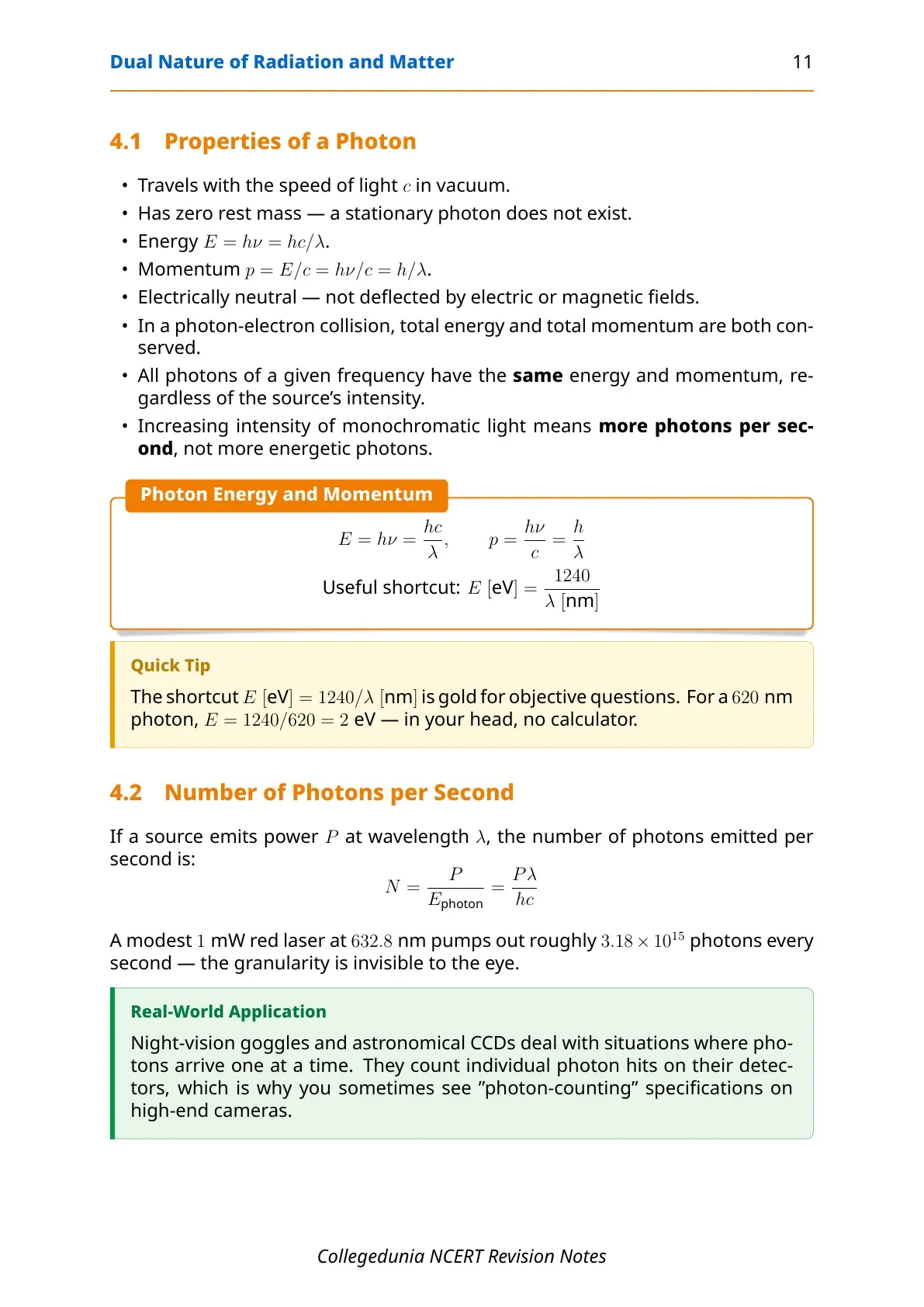
| Photon energy | E = hν = hc / λ | joule |
| Einstein photoelectric equation | KEmax = hν − φ₀ | joule |
| Stopping potential | eV₀ = hν − φ₀ | volt |
| Threshold frequency | ν₀ = φ₀ / h | Hz |
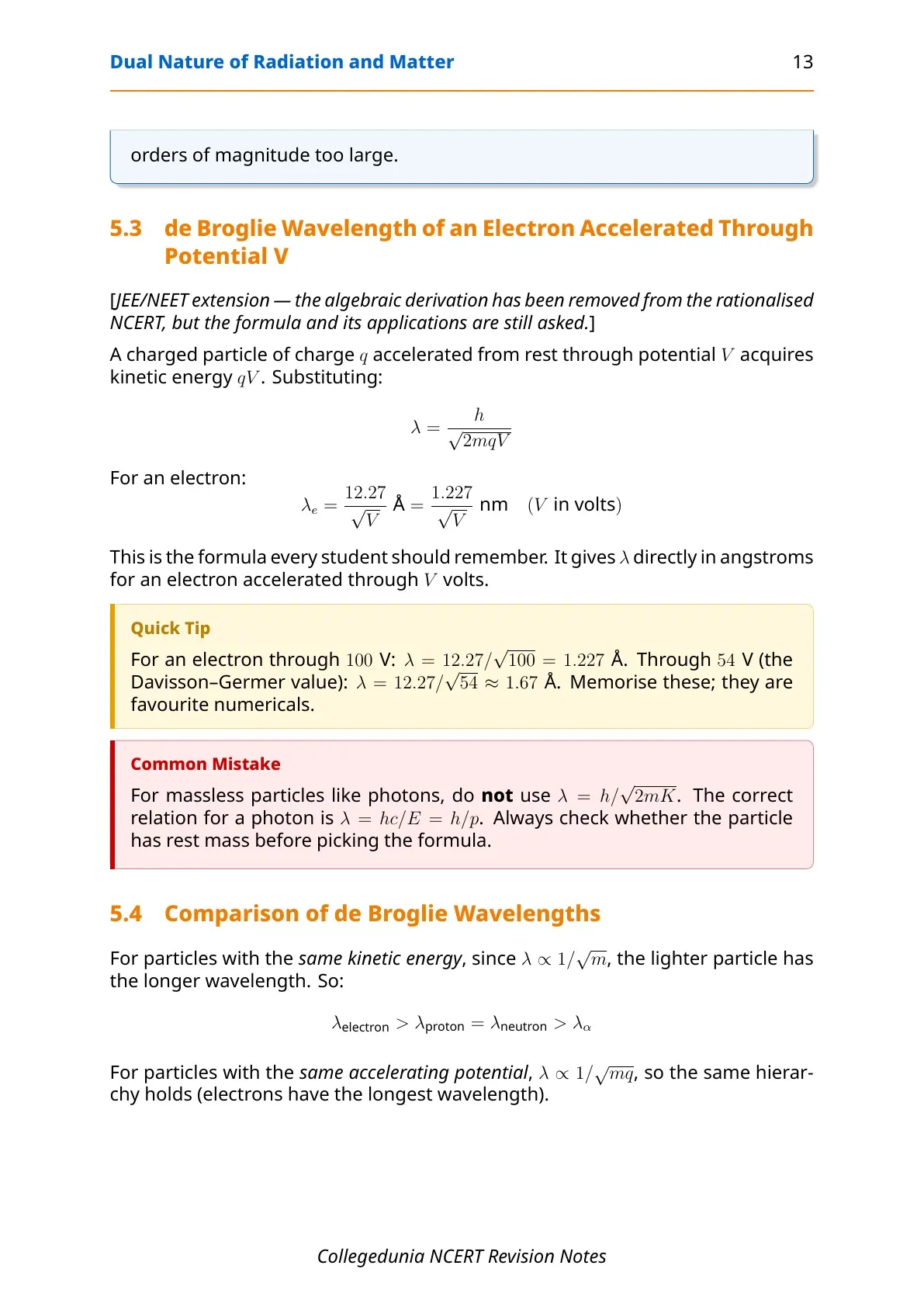
| de Broglie wavelength | λ = h / p = h / mv | metre |
| de Broglie (charged particle) | λ = h / √(2mqV) | metre |
| Photon momentum | p = h / λ | kg·m/s |
Key Definitions and Derivations
- Work function (φ₀): the least energy needed to pull an electron out of a metal surface.
- Threshold frequency (ν₀): the lowest frequency of light that can eject electrons; below it, no emission at any intensity.
- Stopping potential (V₀): the reverse voltage that just stops the fastest photoelectron; eV₀ = ½mv²max.
- Einstein equation derivation (3 marks): photon gives energy hν, part (φ₀) frees the electron, the rest is KEmax.
- de Broglie wavelength (3 marks): set photon energy E = mc² equal to hν, then extend λ = h/p to all matter.
Common Mistakes in Dual Nature of Radiation and Matter
Mistake 1: Treating intensity as the cause of higher KE. Intensity raises photocurrent, not the energy of each electron, only frequency does.
Mistake 2: Forgetting to convert eV to joule (1 eV = 1.6×10⁻¹⁹ J) before putting work function into the equation.
Mistake 3: Mixing up ν (frequency) and λ (wavelength) in E = hν = hc/λ, then losing the unit check.
Mistake 4: Using λ = h/mv for a charged particle in a field instead of λ = h/√(2mqV).
Each one costs 1 to 2 marks in the board paper.
Dual Nature Weightage in CBSE, JEE and NEET
The table below maps how Chapter 11 topics appeared across the last five sessions.
| Year | CBSE Board | JEE Main | NEET |
|---|---|---|---|
| 2025 | Davisson-Germer experiment (3 marks) | Stopping potential vs frequency graph | Photon energy MCQ |
| 2024 | de Broglie wavelength numerical (3 marks) | Work function comparison | Threshold frequency definition |
| 2023 | Threshold frequency and work function (3 marks) | Stopping potential calculation | Wave nature of electron |
| 2022 | Photoelectric effect explanation (2 marks) | Photon momentum problem | Einstein equation MCQ |
| 2021 | Einstein equation short answer (2 marks) | de Broglie wavelength of proton | Work function MCQ |
How to Revise Dual Nature of Radiation and Matter in 2 Hours
- 0 to 30 min: Electron emission and the photoelectric effect; solve two numericals.
- 30 to 75 min: Einstein equation and stopping potential graph; practise one full derivation.
- 75 to 105 min: de Broglie wavelength and Davisson-Germer experiment.
- 105 to 120 min: Run through the 7-formula table and the common mistakes box.
Other Resources for Class 12 Physics Chapter 11
| Resource | Link |
|---|---|
| Notes | You are here |
| NCERT Solutions | Dual Nature of Matter NCERT Solutions |
| Handwritten Notes | Dual Nature of Matter Handwritten Notes |
| Formula Sheet | Dual Nature of Matter Formula Sheet |
| NCERT Book PDF | Dual Nature of Matter NCERT Book PDF |
All Chapters Notes for Class 12 Physics
| Chapter | Notes |
|---|---|
| Chapter 1 | Electric Charges and Fields Notes |
| Chapter 2 | Electrostatic Potential and Capacitance Notes |
| Chapter 3 | Current Electricity Notes |
| Chapter 4 | Moving Charges and Magnetism Notes |
| Chapter 5 | Magnetism and Matter Notes |
| Chapter 6 | Electromagnetic Induction Notes |
| Chapter 7 | Alternating Current Notes |
| Chapter 8 | Electromagnetic Waves Notes |
| Chapter 9 | Ray Optics and Optical Instruments Notes |
| Chapter 10 | Wave Optics Notes |
| Chapter 11 | Dual Nature of Radiation and Matter Notes (you are here) |
| Chapter 12 | Atoms Notes |
| Chapter 13 | Nuclei Notes |
| Chapter 14 | Semiconductor Electronics Notes |
Class 12 Physics Chapter 11 Dual Nature of Radiation and Matter Notes FAQs
Ques. What are the main topics in Class 12 Physics Chapter 11 notes?
Ans. These notes cover electron emission, the photoelectric effect, Hertz and Lenard observations, Einstein's photoelectric equation, the photon, de Broglie waves, and the Davisson-Germer experiment.
Ques. What is the threshold frequency in the photoelectric effect?
Ans. It is the lowest light frequency that can eject electrons, given by ν₀ = φ₀ / h. Below it, no electrons come out no matter how bright the light is.
Ques. What is the de Broglie wavelength formula?
Ans. For any moving particle, λ = h / p = h / mv. For a charged particle accelerated through potential V, use λ = h / √(2mqV).
Ques. What is the weightage of Chapter 11 in CBSE and JEE?
Ans. Chapter 11 carries about 4 marks in CBSE Class 12 Physics, 2 to 3 percent in JEE Main, and 1 to 2 questions per year in NEET.
Ques. Where can I download the Chapter 11 notes PDF?
Ans. Students can read and download the full notes PDF from the flipbook card at the top of this page. It covers all 7 formulas, key derivations, and worked numericals.



Comments