




Social Institutions: Continuity and Change traces how caste, family and kinship in India carry forward old structures while reshaping themselves under democracy, the market and state policy: caste shifts out of a purely ritual hierarchy into a political and associational identity, and the joint family survives more as an ideal than as most households' lived reality. This PYQ set brings together 10 CBSE board questions from 2017 to 2024 on the chapter, and every one comes with a full step-by-step solution, so you can check your own answer against a complete worked explanation.
- 10 questions, CBSE 2017-2024: Section A (3 MCQs, 1 mark), Section B (3 VSA, 2 marks), Section C (2 SA/case-study, 4 marks), Section D (2 LA, 6 marks).
- Full solutions included: every question has a worked, step-by-step answer, not just the bare question paper.
- Topics covered: caste endogamy and rules of the caste system, Sanskritisation and de-Sanskritisation, family structure and rules of residence, Khasi matriliny, and secularisation.
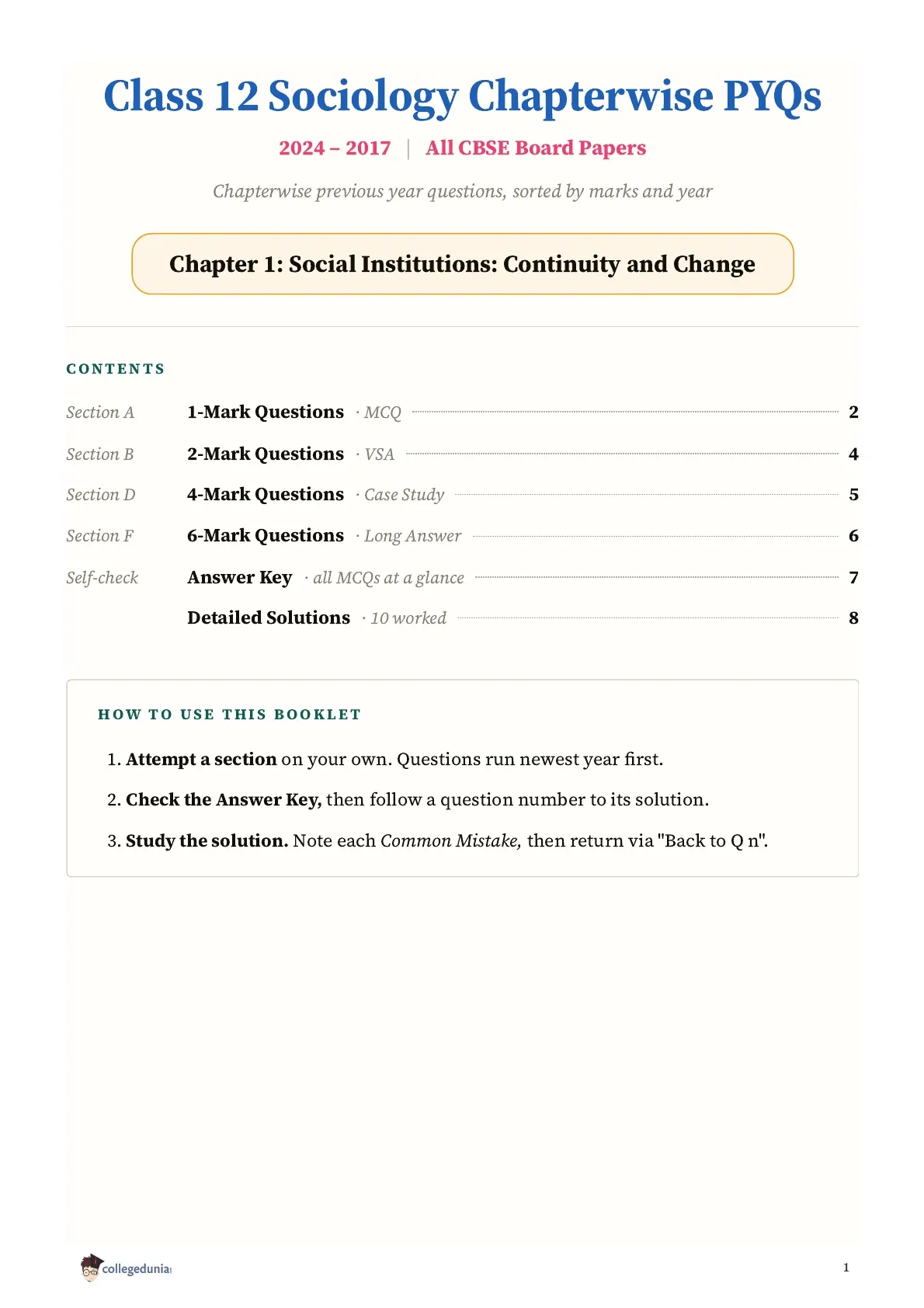
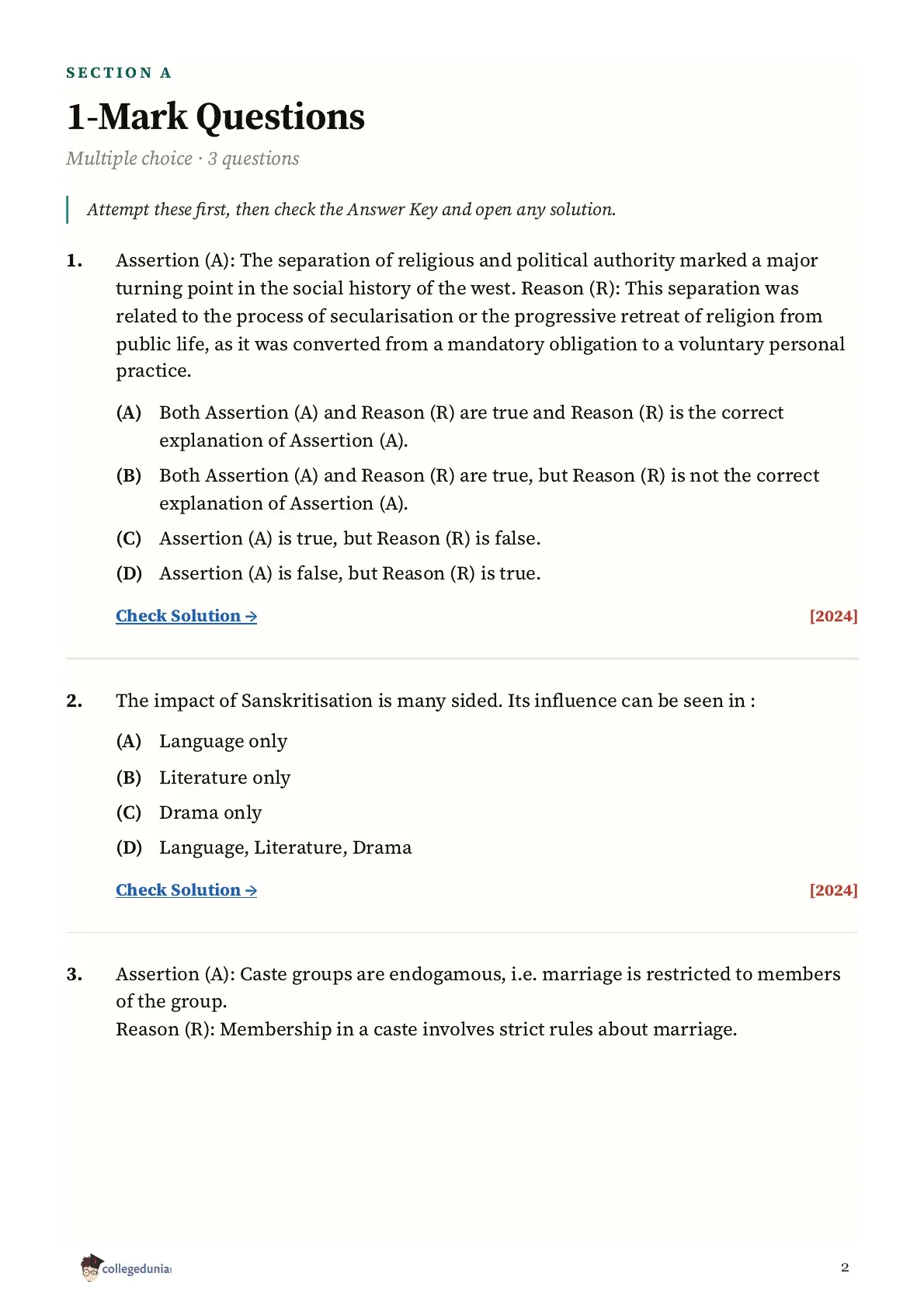
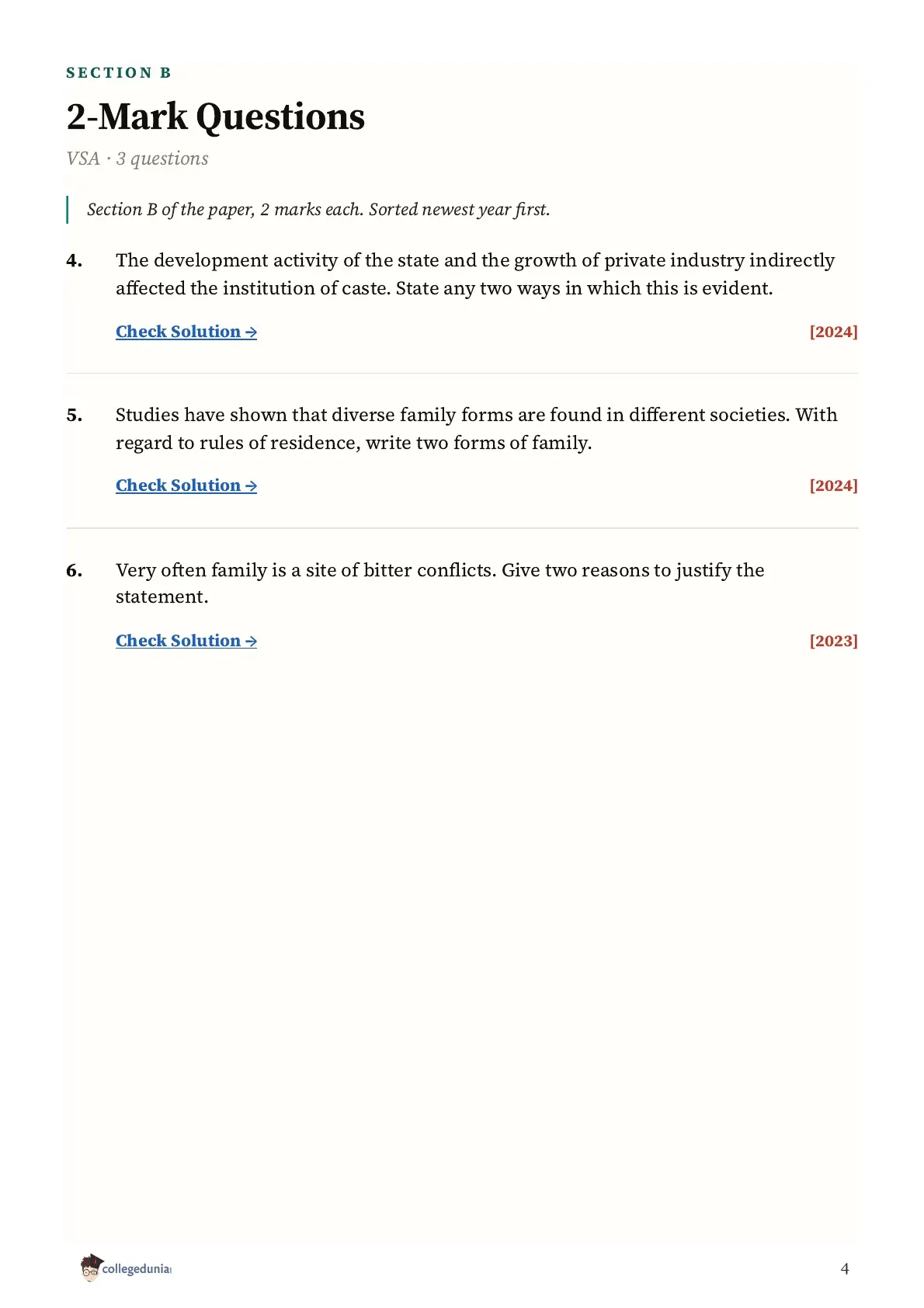
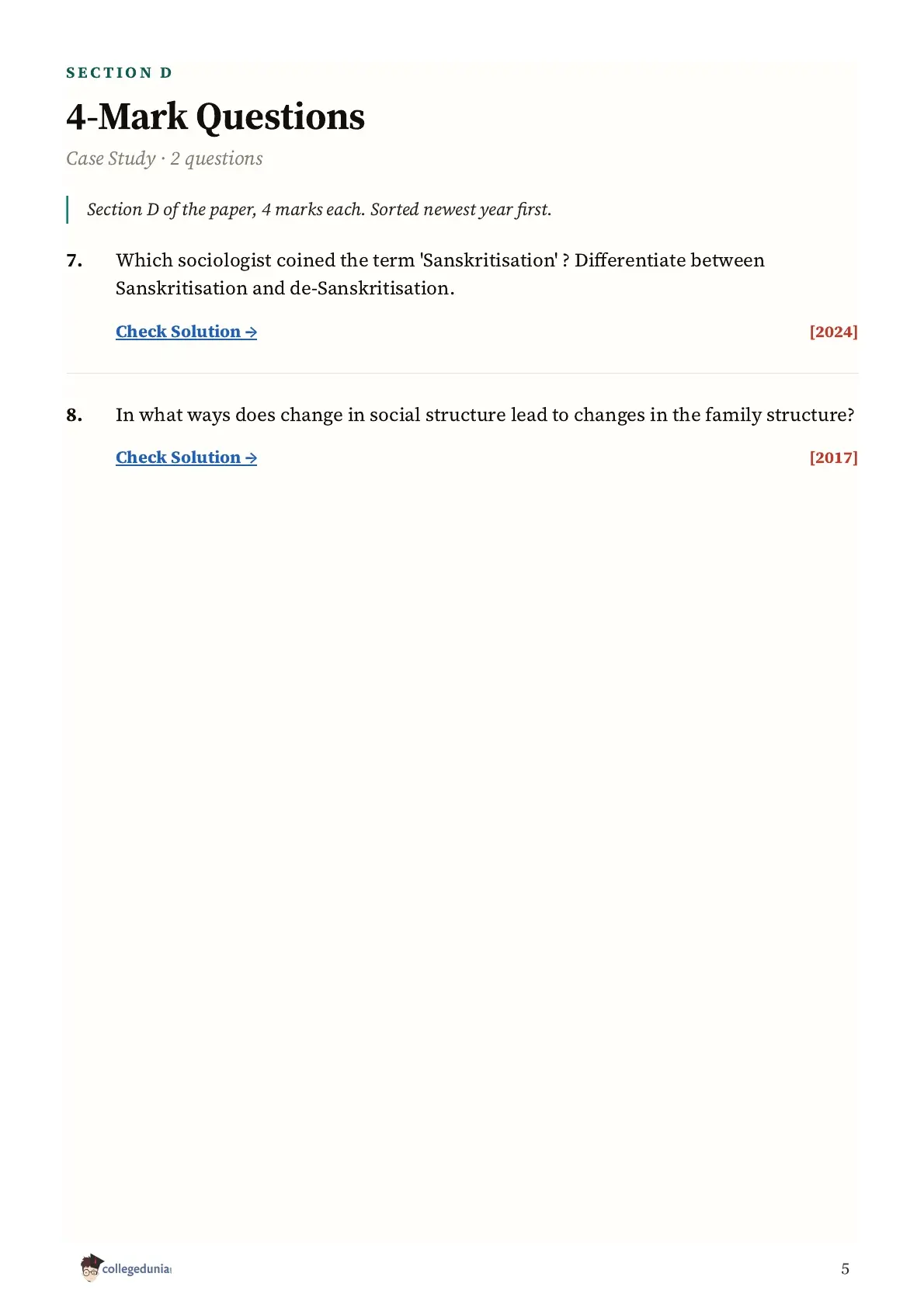
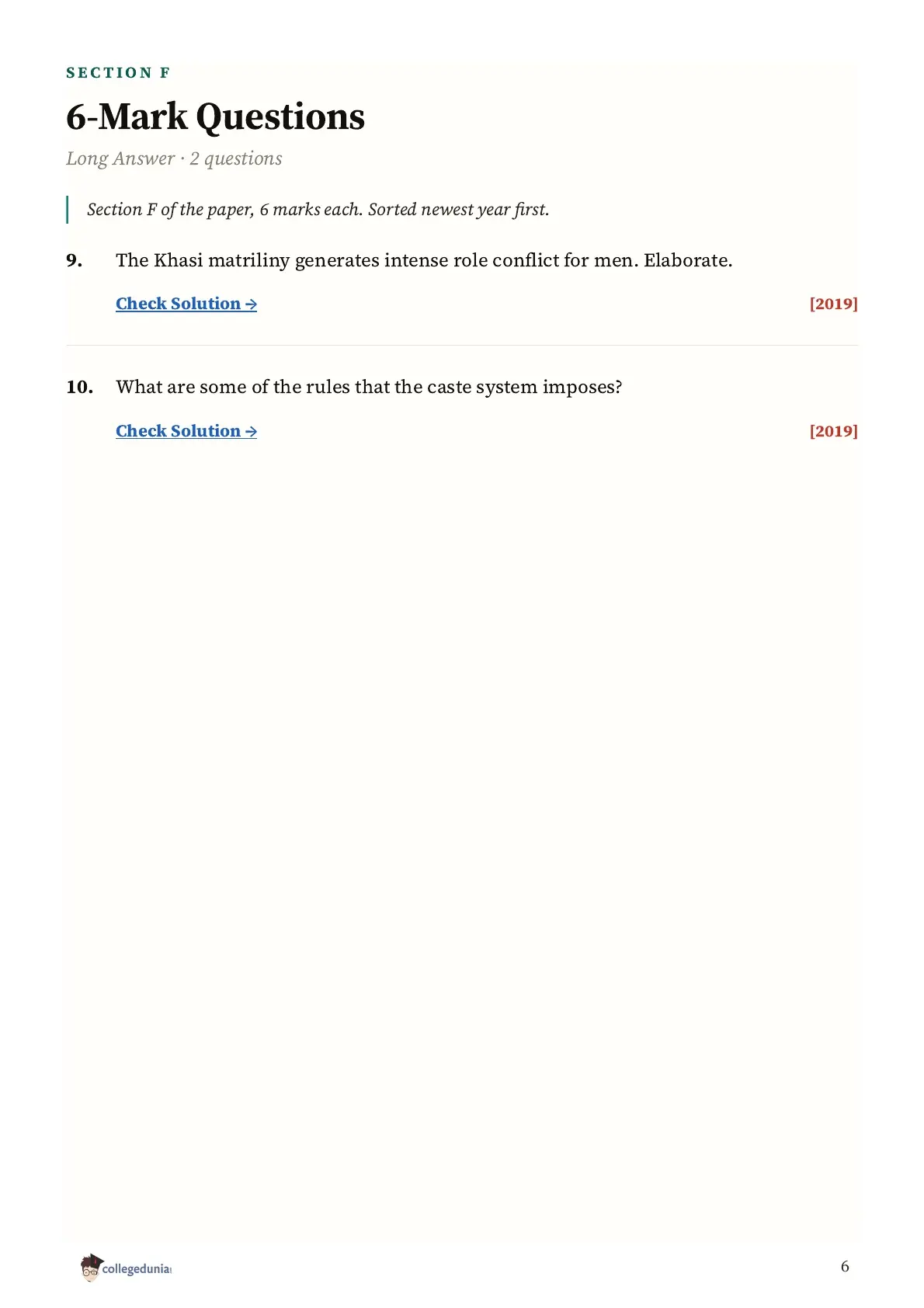
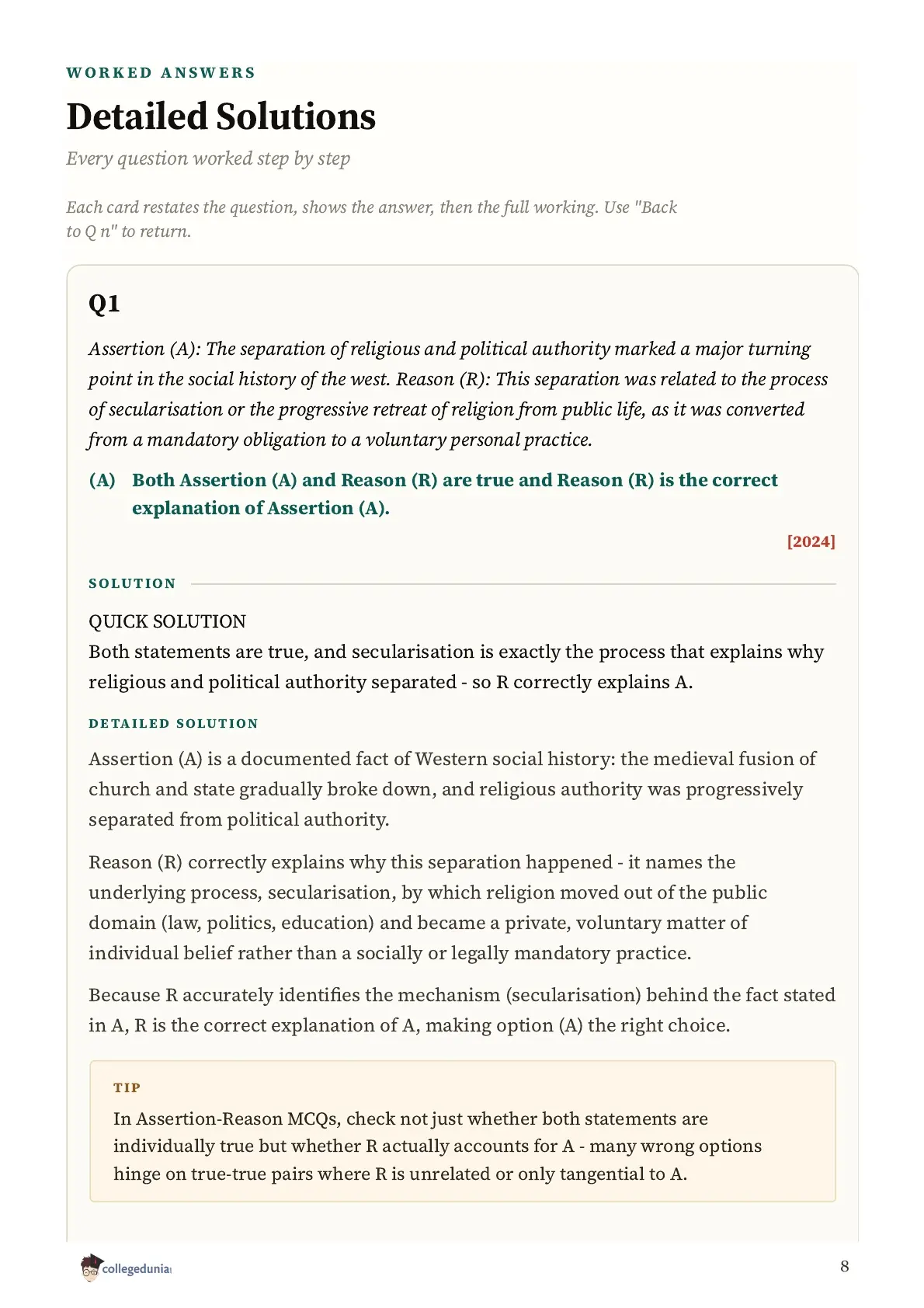
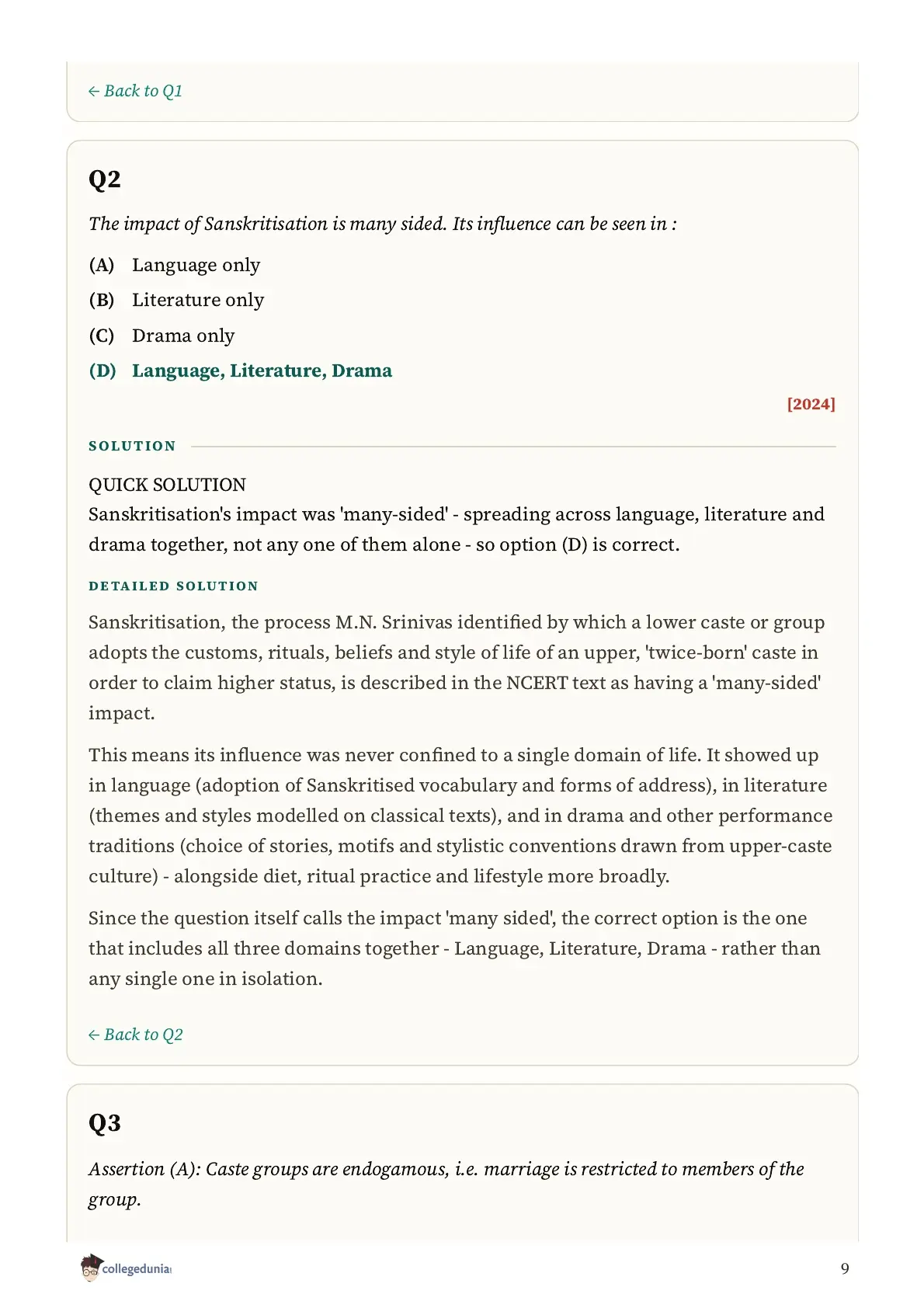
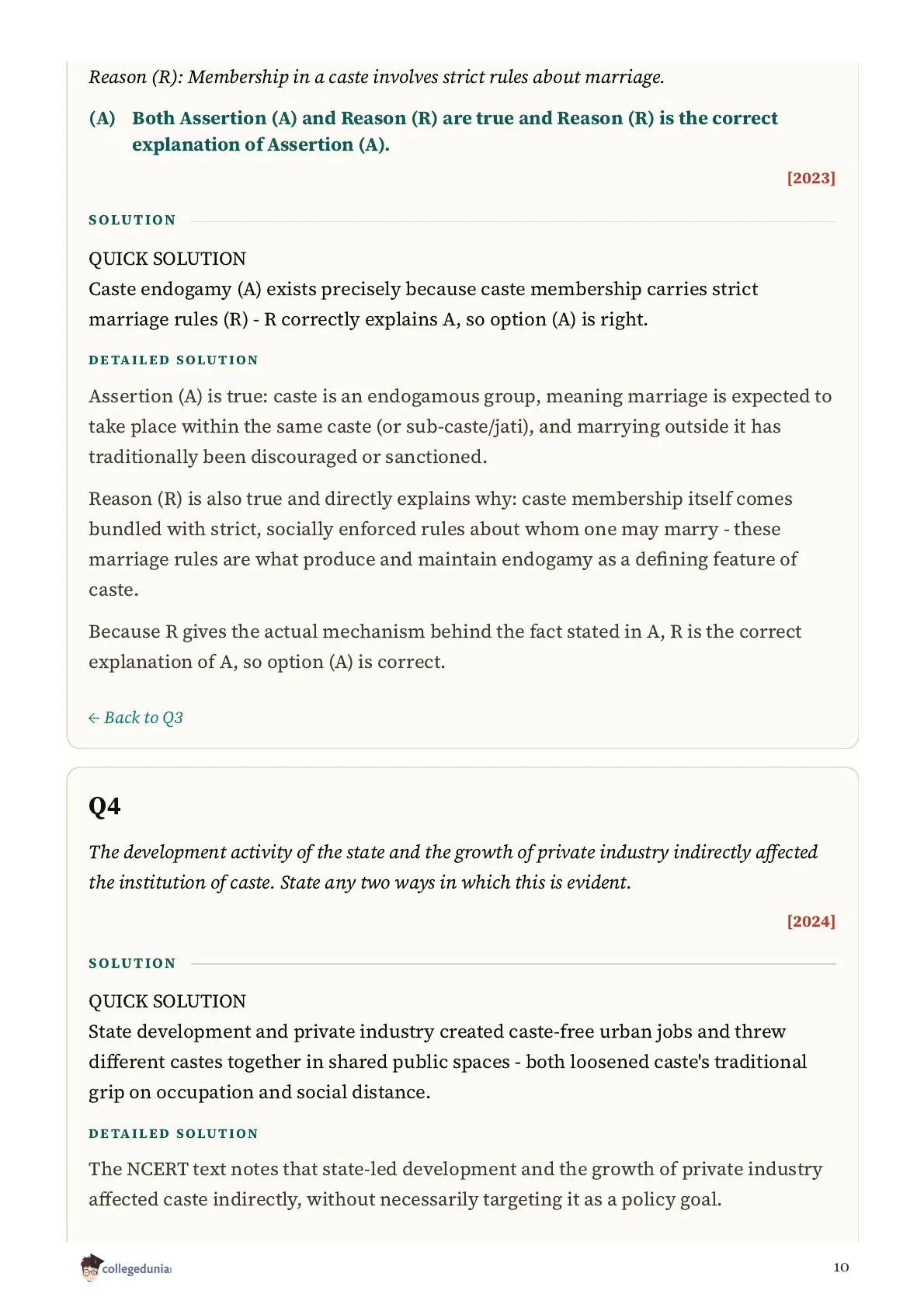
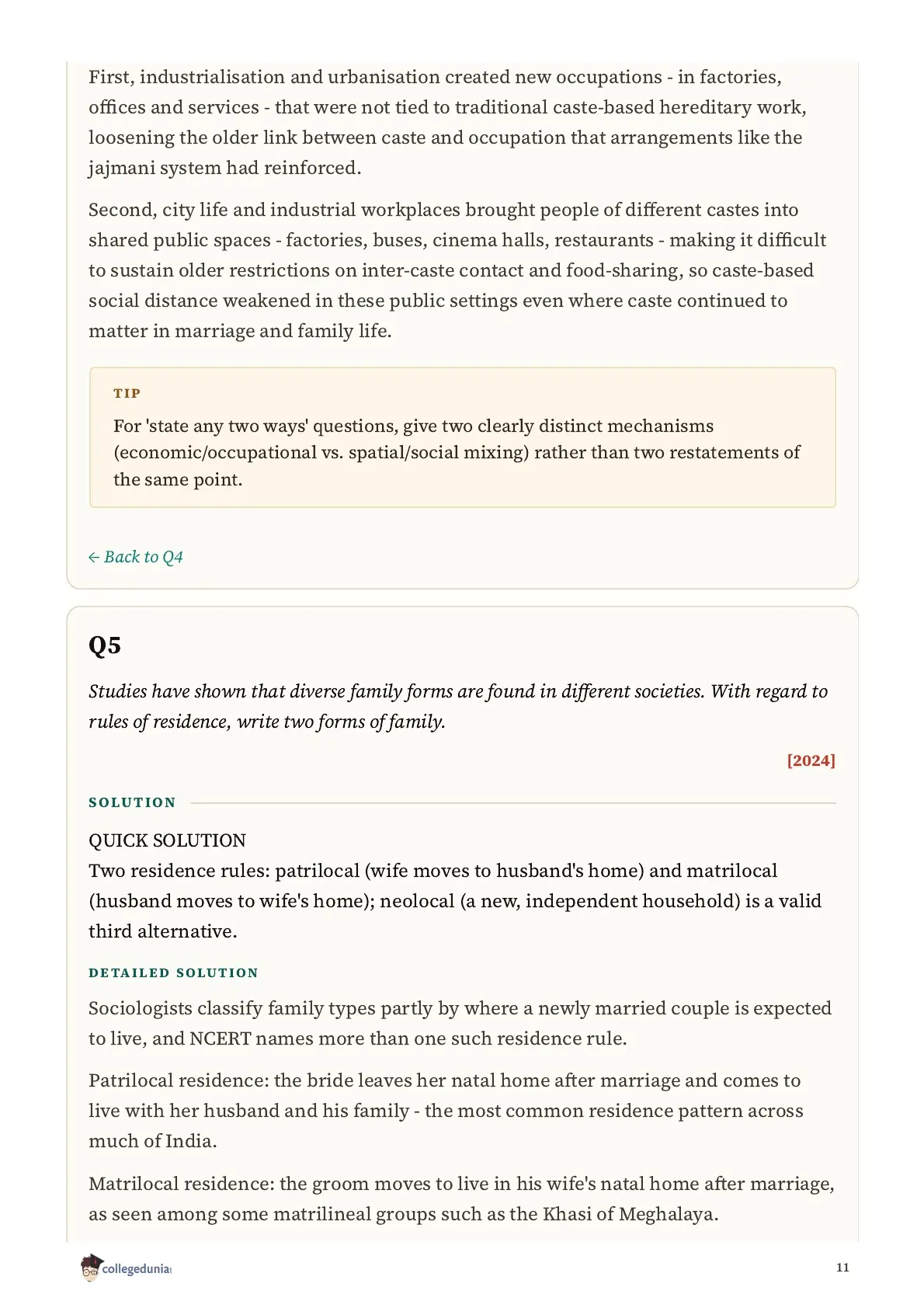
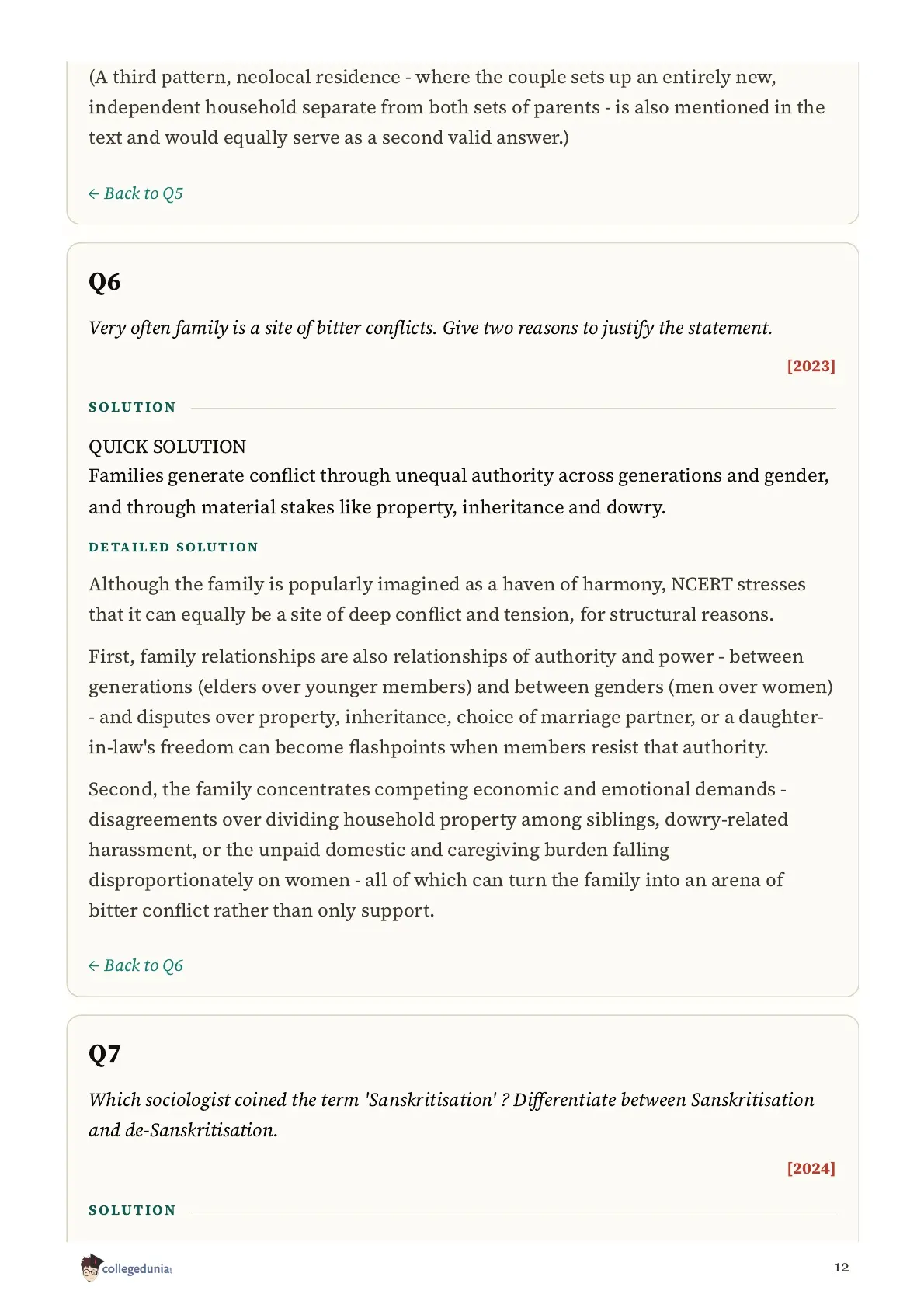
Every question in this Class 12 Sociology Chapter 3 PYQ set is lifted from an actual CBSE board paper (2017-2024) and answered in full by Collegedunia's Sociology experts, according to the 2026-27 NCERT syllabus.
|
Table of Contents |
What Class 12 Sociology Chapter 3 PYQs Test: Caste, Family and Kinship in Transition
This chapter is where CBSE checks whether you can trace continuity and change together, not one without the other. Board papers pull questions from the rules of the caste system (endogamy, commensality, ritual purity and pollution), M.N. Srinivas's idea of Sanskritisation and its lesser-known counterpart, de-Sanskritisation, the impact of the state and industrial growth on caste, and the family as an institution that is both a support system and a site of conflict. The Khasi of Meghalaya and their matrilineal descent system come up often as a case study, alongside secularisation as the separation of religion from political authority.
- Caste: rules of endogamy and commensality, and how caste operates today as both a ritual hierarchy and a political, associational identity.
- Sanskritisation and de-Sanskritisation: lower castes adopting upper-caste customs to claim higher status, and the reverse process, where a dominant group adopts a practice of a group it once looked down on.
- Family and kinship: change in family structure, rules of residence (patrilocal, matrilocal), and family as a site of conflict as much as support.
- Khasi matriliny: property passing through the youngest daughter, and the role conflict this creates with the maternal uncle's political and ritual authority.
- Secularisation: the historical separation of religion from state and political authority in India.
Marks-wise Distribution of Social Institutions PYQs
The 10 questions are spread across four CBSE mark bands. Section A carries the most questions (3 MCQs), but Section D's long-answer questions carry the most marks per question.
| Section | Marks Each | Question Type | Number of Questions |
|---|---|---|---|
| Section A | 1 mark | MCQ | 3 |
| Section B | 2 marks | Very Short Answer (VSA) | 3 |
| Section C | 4 marks | Short Answer / Case-based | 2 |
| Section D | 6 marks | Long Answer (LA) | 2 |
MCQs test whether you can identify a rule or concept correctly, while Section D's 6-mark questions expect a full compare-contrast answer, usually built around caste and Sanskritisation or family structure.
Year-wise Spread of Social Institutions PYQs: 2017 to 2024
The bank covers four CBSE board papers spread across eight years. 2024 contributed the most questions (5), while 2017, 2019 and 2023 fill out the rest of the set.
| Year | Number of Questions |
|---|---|
| 2024 | 5 |
| 2023 | 2 |
| 2019 | 2 |
| 2017 | 1 |
Practising all four years together shows how CBSE keeps returning to caste and Sanskritisation, even as the exact question format shifts from a short definition to a full compare-contrast answer.
Which Topics Repeat Most in Social Institutions PYQs
Caste and its transformation through Sanskritisation dominate the question mix in this chapter. Sanskritisation and de-Sanskritisation and the rules of the caste system show up most often, in both short-answer and long-answer form. Family structure and rules of residence recur almost as frequently, and the Khasi matriliny case study and secularisation turn up in at least one question most years.
- Most frequent: Sanskritisation and de-Sanskritisation, rules of the caste system (endogamy, commensality, ritual status).
- Frequent: change in family structure, impact of Sanskritisation on caste mobility, caste endogamy and marriage rules.
- Regular: family as a site of conflict, impact of state and industry on caste, Khasi matriliny and role conflict, rules of residence in family forms, secularisation and the separation of religion and politics.
How to Attempt Social Institutions PYQs
Start with the MCQs in Section A, they move fast and settle your terminology before the longer questions. Then work through Section D's 6-mark questions, since these reward a clear compare-contrast structure over a descriptive one.
- Never treat Sanskritisation and de-Sanskritisation as synonyms. Name them as opposite processes: one is a status claim moving upward through imitation, the other is a dominant group adopting a practice it once looked down on.
- Structure family and kinship answers as a compare-contrast. State the traditional norm first, such as patrilocal residence, then the documented change or exception, such as matrilocal or neolocal households, rather than describing only one side.
- Anchor caste answers in a specific mechanism such as endogamy, commensality or occupational rules, instead of writing that caste is a hierarchy without naming the rule being tested.
- For the Khasi case study, separate descent from authority. State who inherits property and who holds political or ritual power as two distinct facts, not as one and the same.
Sample Question and Answer Approach for Social Institutions
Here is how to structure two typical question types from this chapter's PYQs. The pattern below is the same one the PDF's step-by-step solutions follow.
| Question Type | How to Structure the Answer |
|---|---|
| 1-mark MCQ (e.g. identifying a rule of the caste system from a description) | Read the description first, then match it to the exact term, endogamy, commensality or pollution, before picking an option. Don't pick an option that sounds close without checking the precise rule being described. |
| 6-mark long answer (e.g. explain Sanskritisation and de-Sanskritisation with examples) | Define Sanskritisation first, then define de-Sanskritisation as its counter-process, give one example of each, and close with a line on why both show that caste is not a fixed but a changing system. |
This two-step habit, define the concept, then give a concrete example, is what separates a 2-mark answer from a full 6-mark one.
Common Mistakes Students Make in Social Institutions Questions
Watch out for these recurring errors:
- Treating caste as purely a ritual-purity category. Caste also has a political and associational dimension today, visible in reservation politics and caste associations, and a one-sided ritual-only answer loses marks.
- Confusing matrilineal descent with matriarchal authority. Among the Khasi, property passes through the youngest daughter, but political and ritual authority typically still rests with the maternal uncle. Descent and authority are not the same thing.
- Assuming the joint family was universally the historical norm. The joint family is closer to an ideal or ideology than a lived reality for most households, and residence rules have always varied a great deal by community.
- Equating secularisation with a decline in religious belief. Secularisation refers to the separation of religion from state and political authority, not to people believing less.
Student Feedback: Social Institutions Difficulty Rating
What 9,280 students told us about this chapter's PYQs
In a Collegedunia poll of 9,280 Class 12 Sociology students conducted before the 2027 boards, 63% rated the Sanskritisation and de-Sanskritisation questions as the hardest part of this chapter, mainly because the two processes get mixed up under exam pressure. Students who practised all four years of PYQs together reported fewer mix-ups on the actual paper.
Source: 2026-27 Class 12 Sociology student poll. Sample of 9,280 students from CBSE schools across 12 states.
How These PYQs Pair with Other Class 12 Sociology Chapter 3 Resources
This PYQ set works best alongside the other Chapter 3 resources already live on Collegedunia. Read the notes first, revise from the handwritten notes, solve these PYQs, then cross-check tricky answers against the full NCERT solutions.
| Resource | Link |
|---|---|
| NCERT Notes | Social Institutions Class 12 Notes |
| Handwritten Notes | Social Institutions Class 12 Handwritten Notes |
| NCERT Solutions | Social Institutions Class 12 NCERT Solutions |
| NCERT Book PDF | Social Institutions Class 12 NCERT Book PDF |
| PYQ (this page) | Social Institutions Class 12 PYQ |
The other Class 12 Sociology PYQ chapters in this same series, Structural Change and Cultural Change, are already live, and more chapters are being added to the series over time.
How to Use the Social Institutions PYQ PDF Effectively
Don't jump to the solution on the first read. Try to answer each question yourself first, then check it against the step-by-step solution in the PDF.
- First pass: attempt all 10 questions without looking at the solutions, section by section.
- Second pass: compare each answer against the solution and mark where a key term, Sanskritisation, endogamy or commensality, was missing or wrong.
- Third pass: redo only the questions you got wrong, a day or two later, from memory.
Downloading and Using the PYQ PDF
The PDF is 16 pages and free to download. It opens with the question paper sorted by mark band, closes with a self-check answer key, and links every question to its full solution.
Social Institutions Class 12 Sociology PYQ FAQs
Ques. How many questions are in the Social Institutions Class 12 PYQ PDF?
Ans. The PDF has 10 questions from CBSE board papers between 2017 and 2024: 3 one-mark MCQs, 3 two-mark VSA, 2 four-mark SA/case-study questions and 2 six-mark long-answer questions.
Ques. Does this PYQ PDF include solutions, or only the questions?
Ans. It includes full solutions. Every one of the 10 questions has a step-by-step answer written out in the PDF, so you can check your own attempt against a worked solution rather than just an answer key.
Ques. Which years of CBSE board papers does this PYQ set cover?
Ans. It covers four years: 2017, 2019, 2023 and 2024. 2024 has the most questions (5), followed by 2019 and 2023 (2 each) and 2017 (1).
Ques. Where can I download the Social Institutions PYQ PDF?
Ans. You can download it directly from this page. It is free and runs to 16 pages, with the questions sorted by mark band and every question linked to its solution.
Ques. Is this PYQ set aligned with the 2026-27 CBSE syllabus?
Ans. Yes. The chapter content and question pattern match the current 2026-27 NCERT Sociology syllabus for Class 12.
Ques. What is Sanskritisation?
Ans. Sanskritisation is a term coined by the sociologist M.N. Srinivas. It describes the process by which a lower or middle caste adopts the customs, rituals and lifestyle of a higher caste in order to claim a higher status in the local caste hierarchy. De-Sanskritisation is its reverse: a dominant group adopting a practice associated with a group it once looked down on, or a reversal in the direction of status-claiming.
Ques. Is the joint family still the norm in India?
Ans. The chapter argues that the joint family was always more an ideal or ideology than a universally lived historical reality. Family structures and rules of residence, patrilocal, matrilocal or neolocal, have long varied by community, region and economic need, so it isn't accurate to call any one form "the norm" for all of Indian society.



Comments