




Application of Integrals is one of the highest-scoring chapters in the CBSE Class 12 Maths paper, and almost every question is a long answer worth full marks.
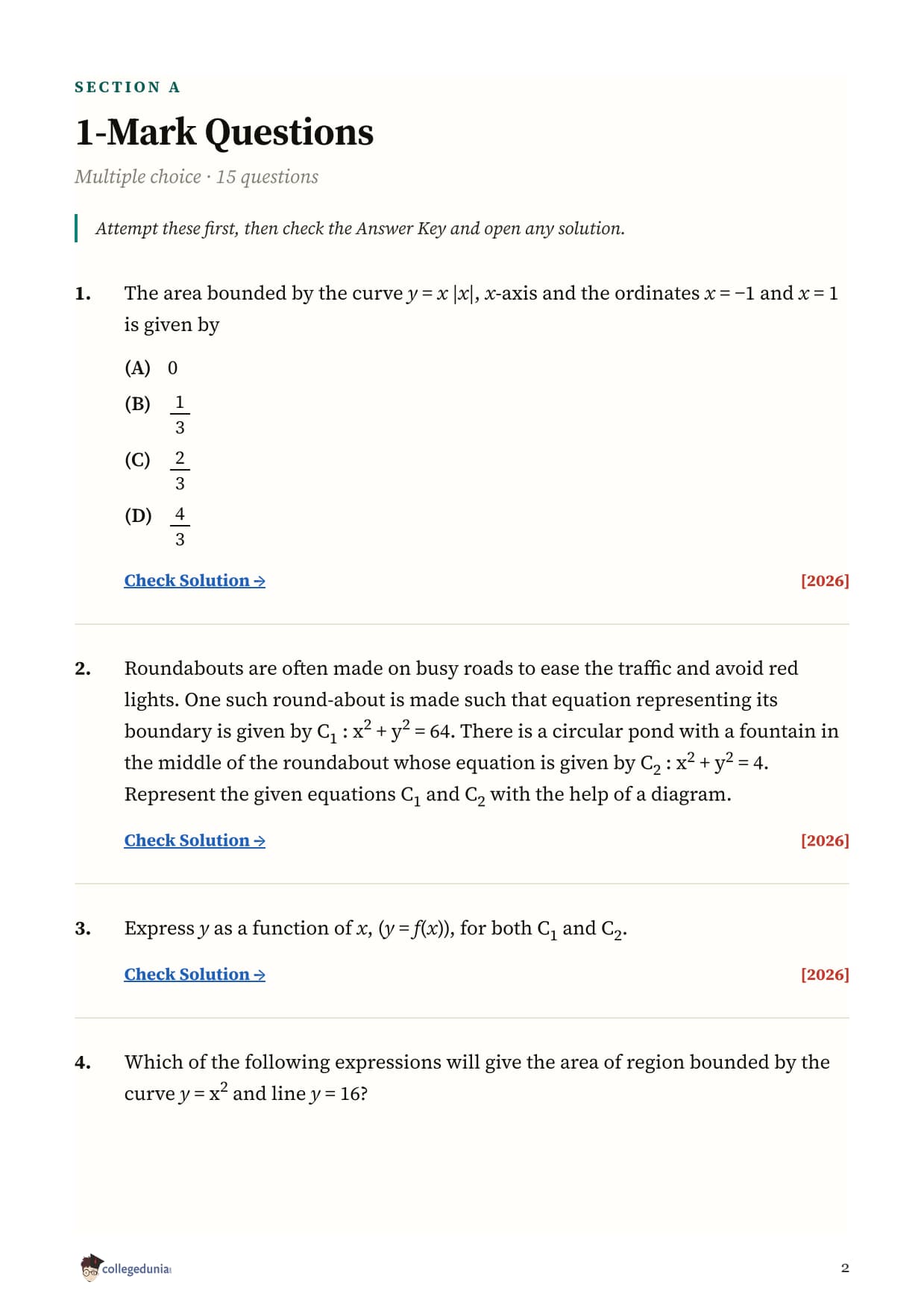
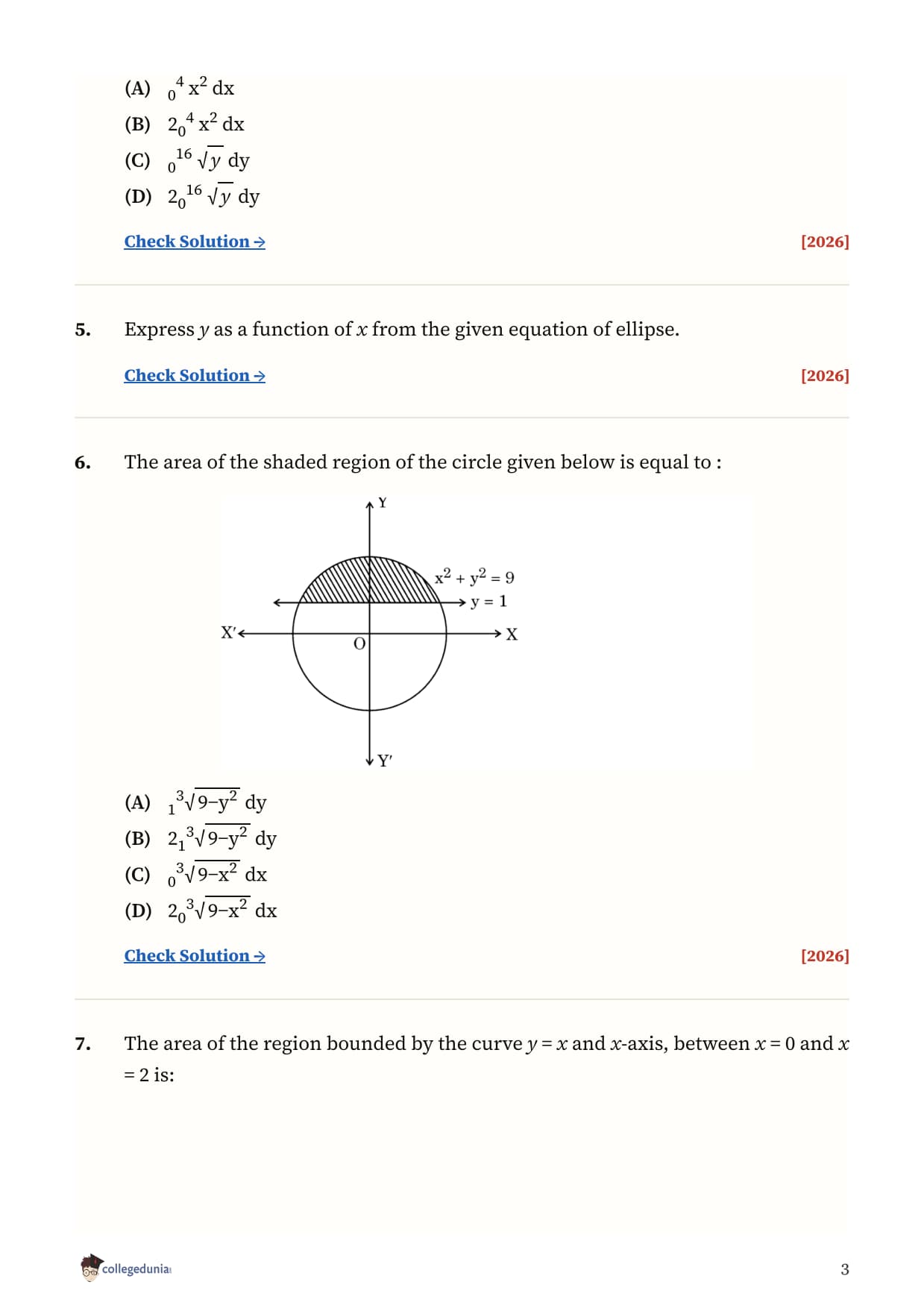
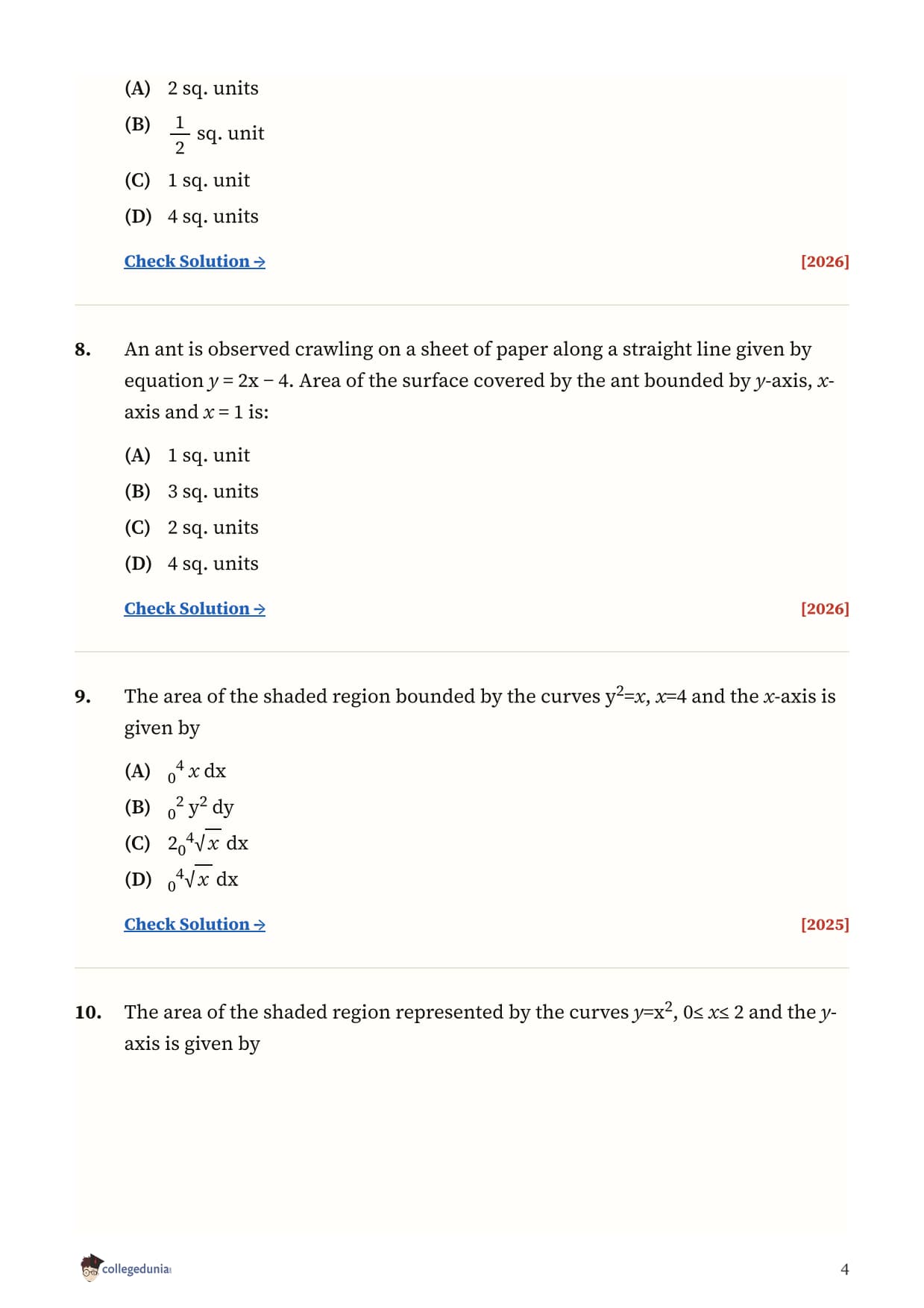
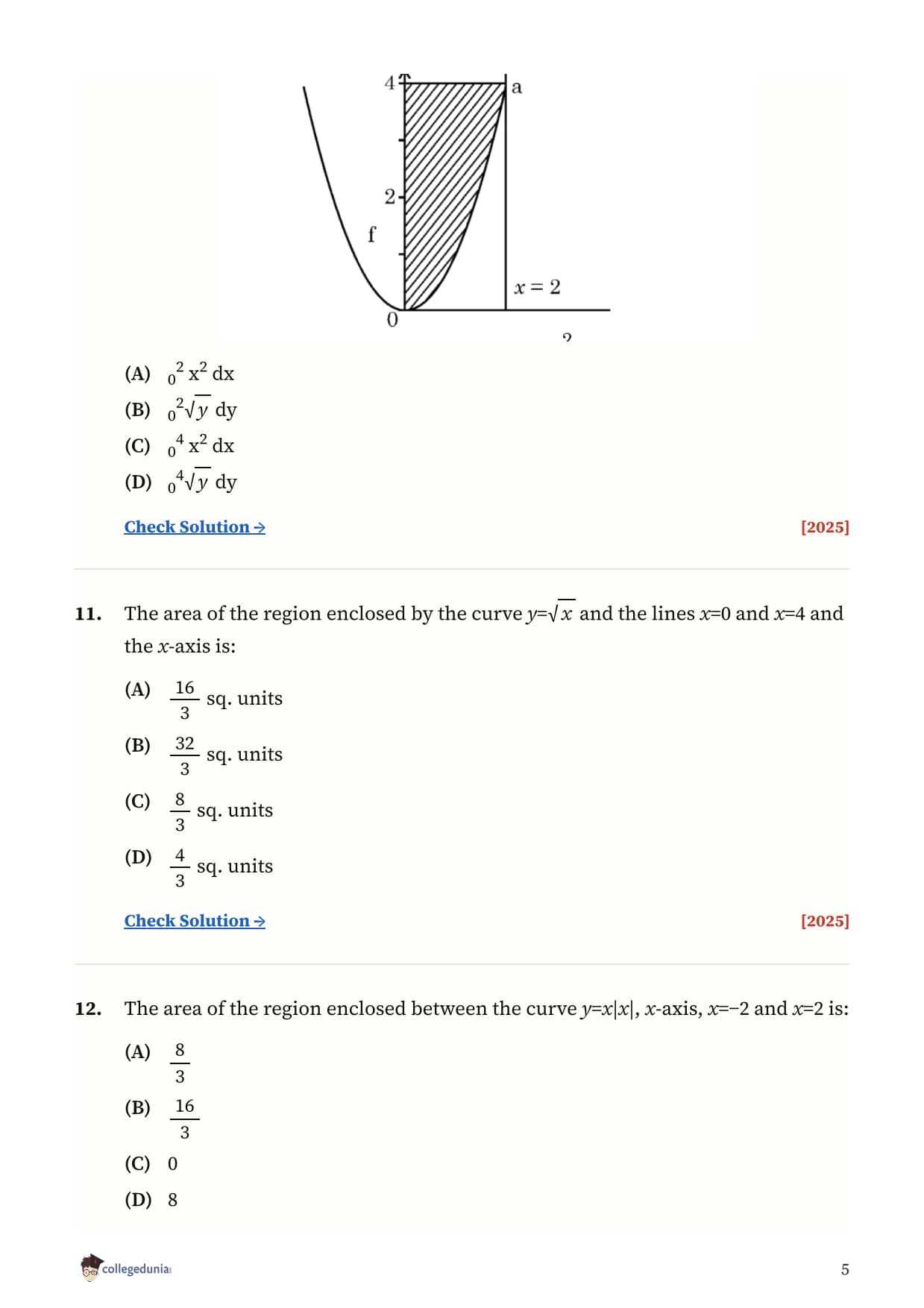
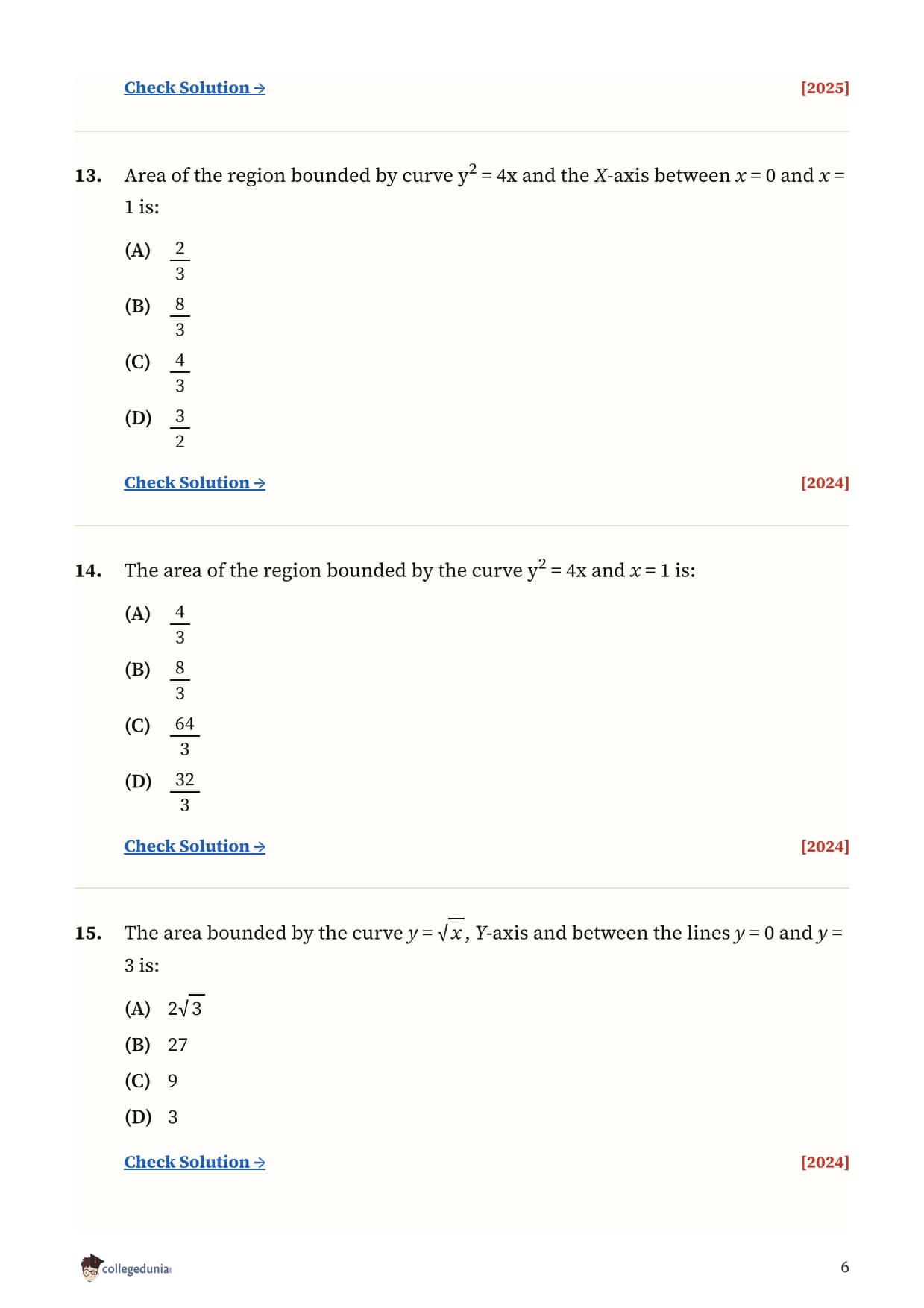
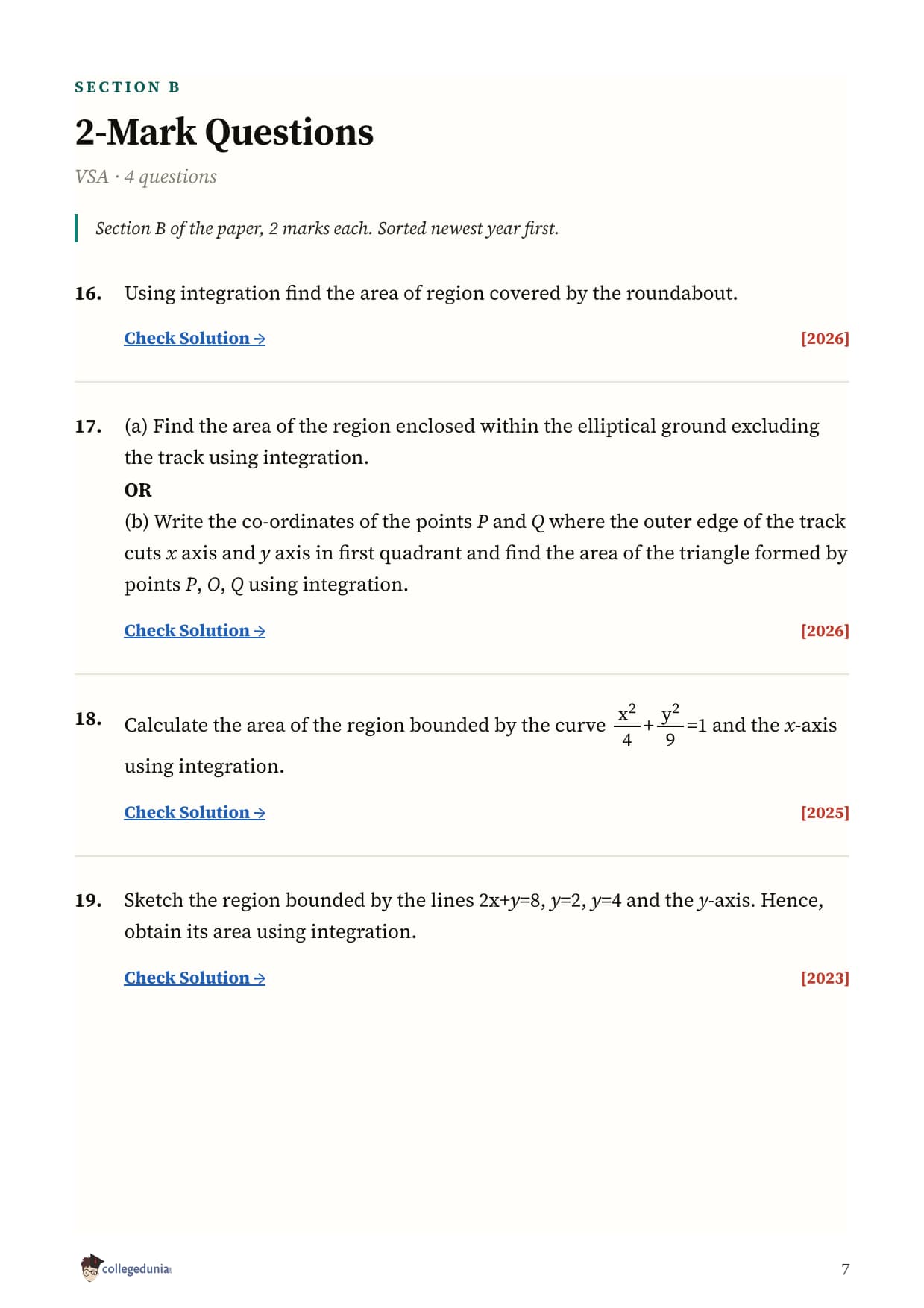
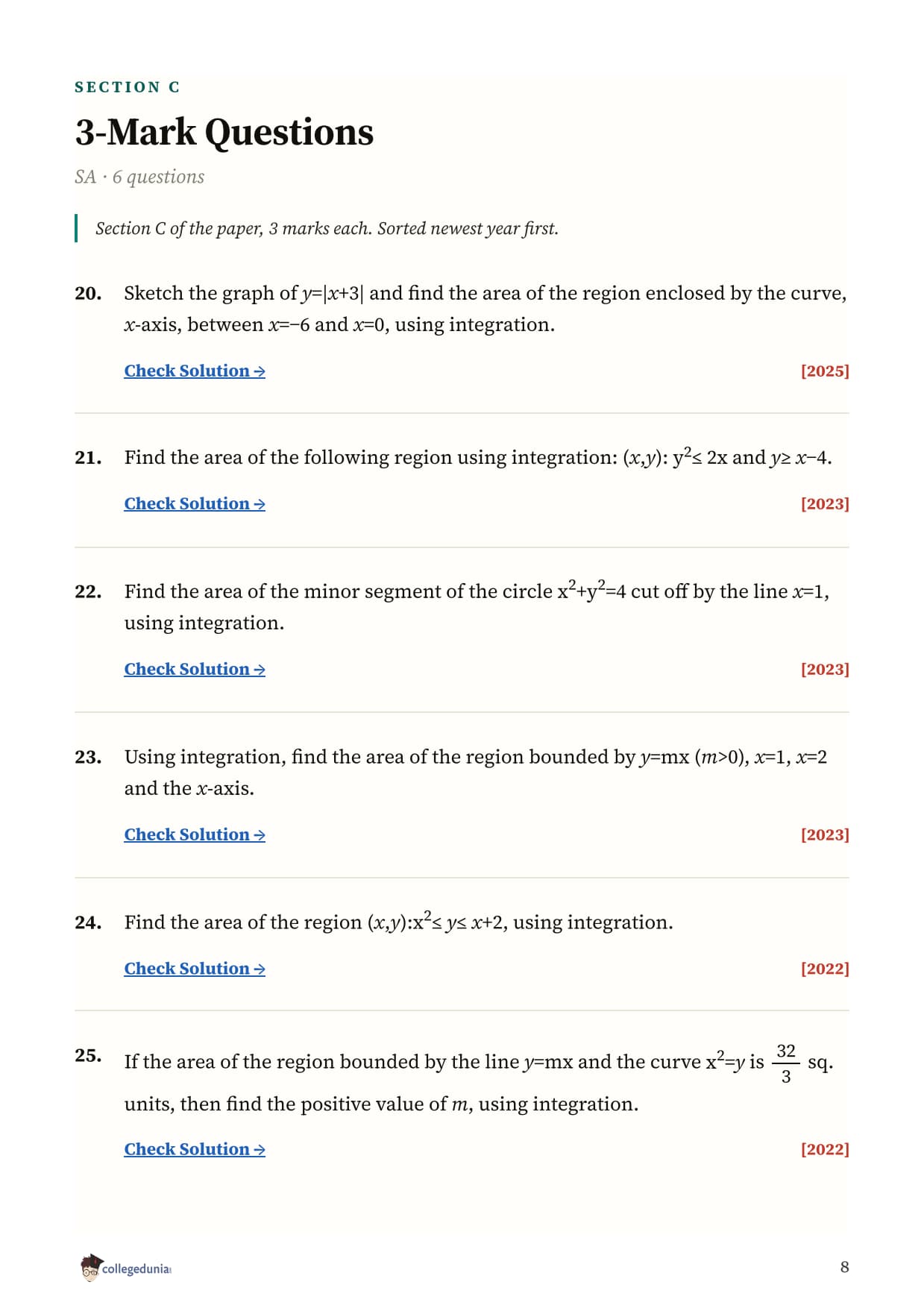
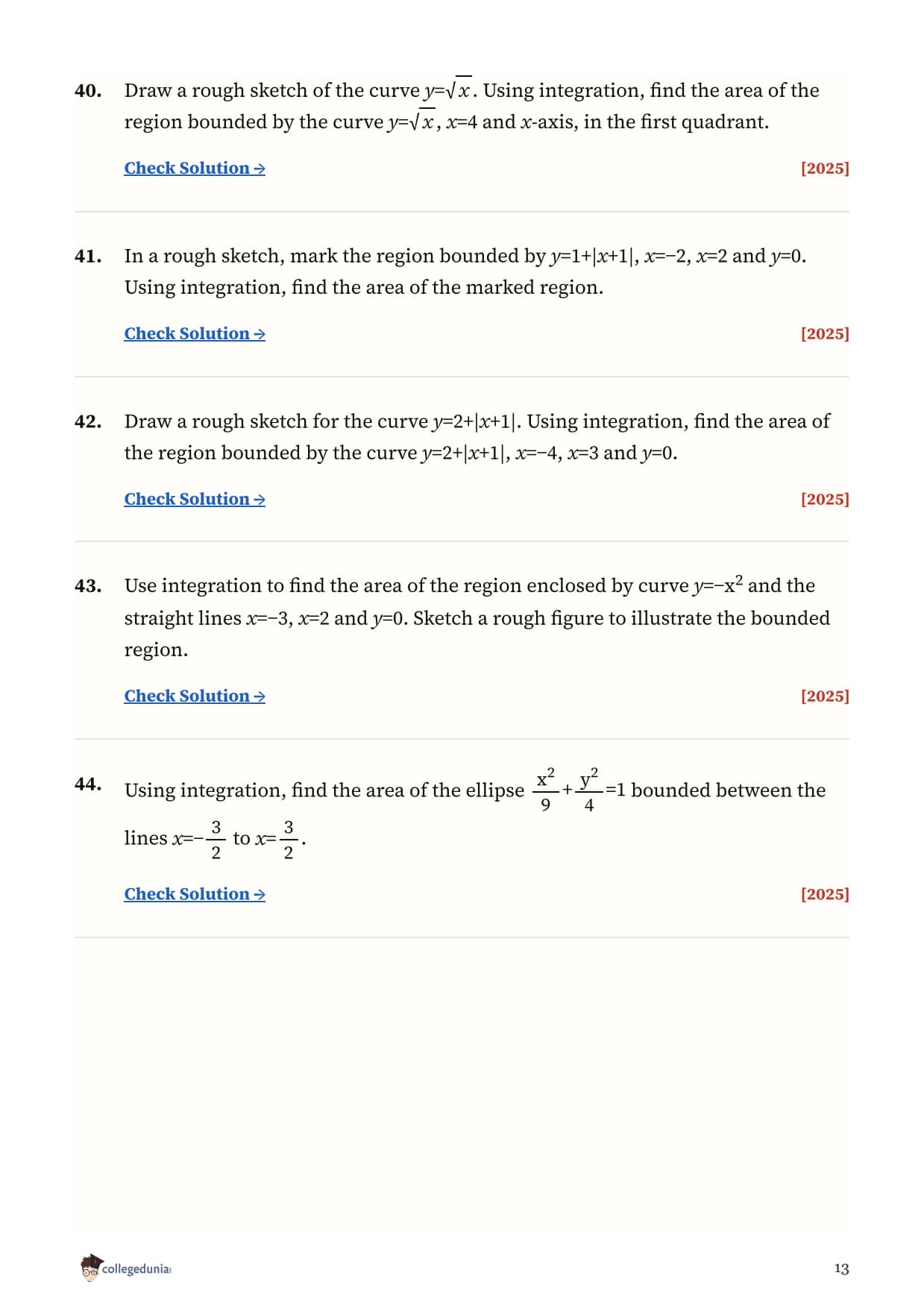
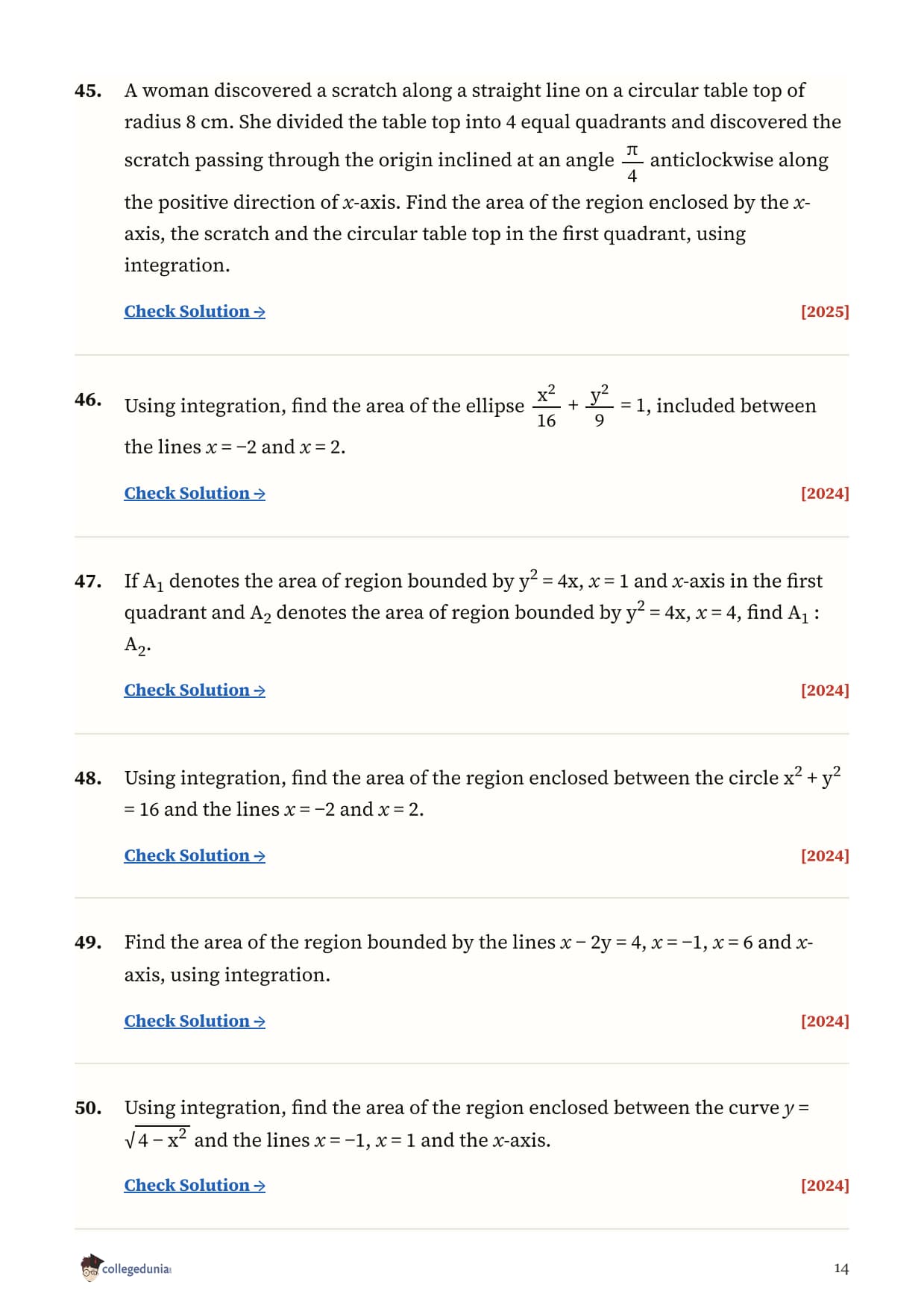
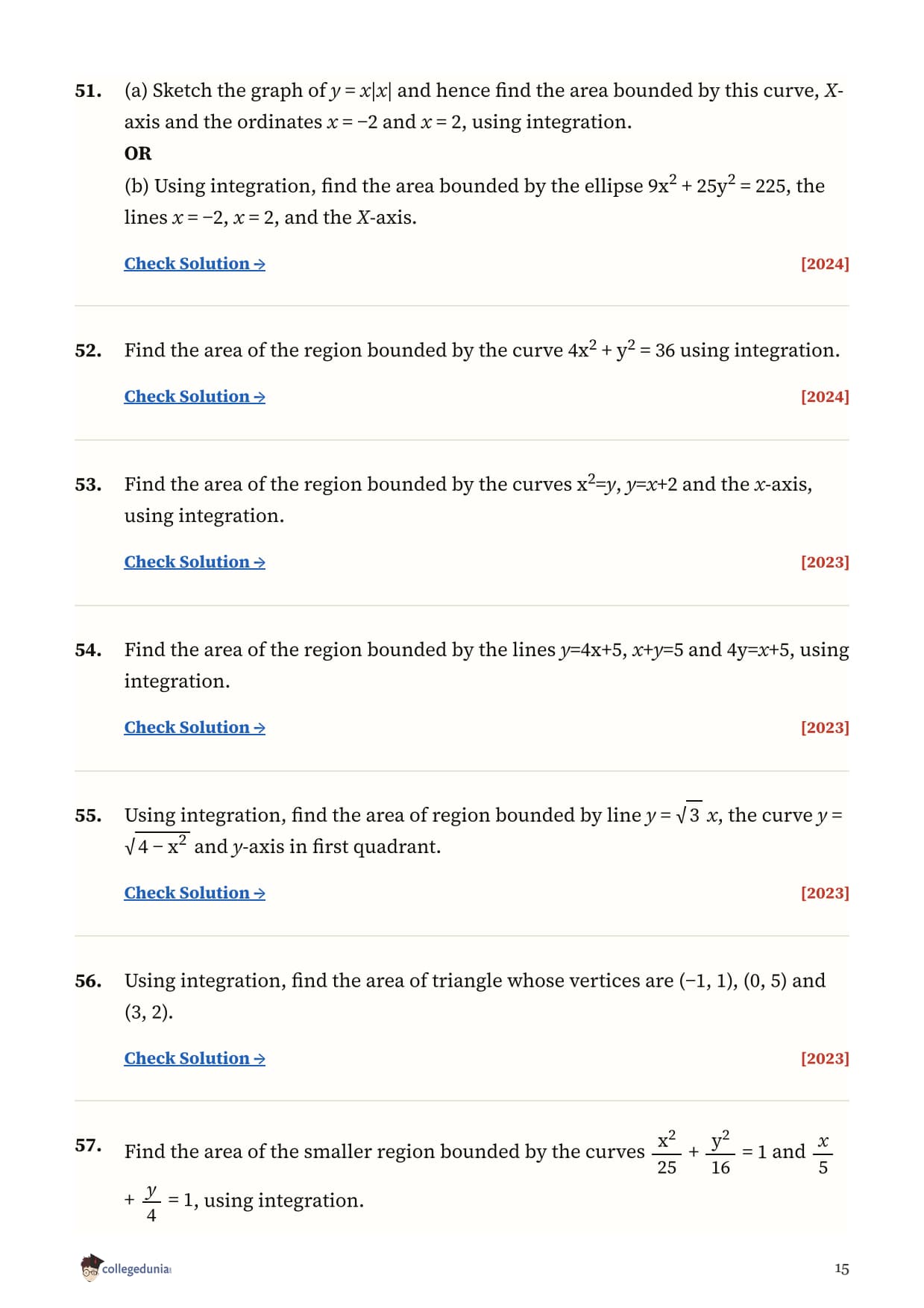
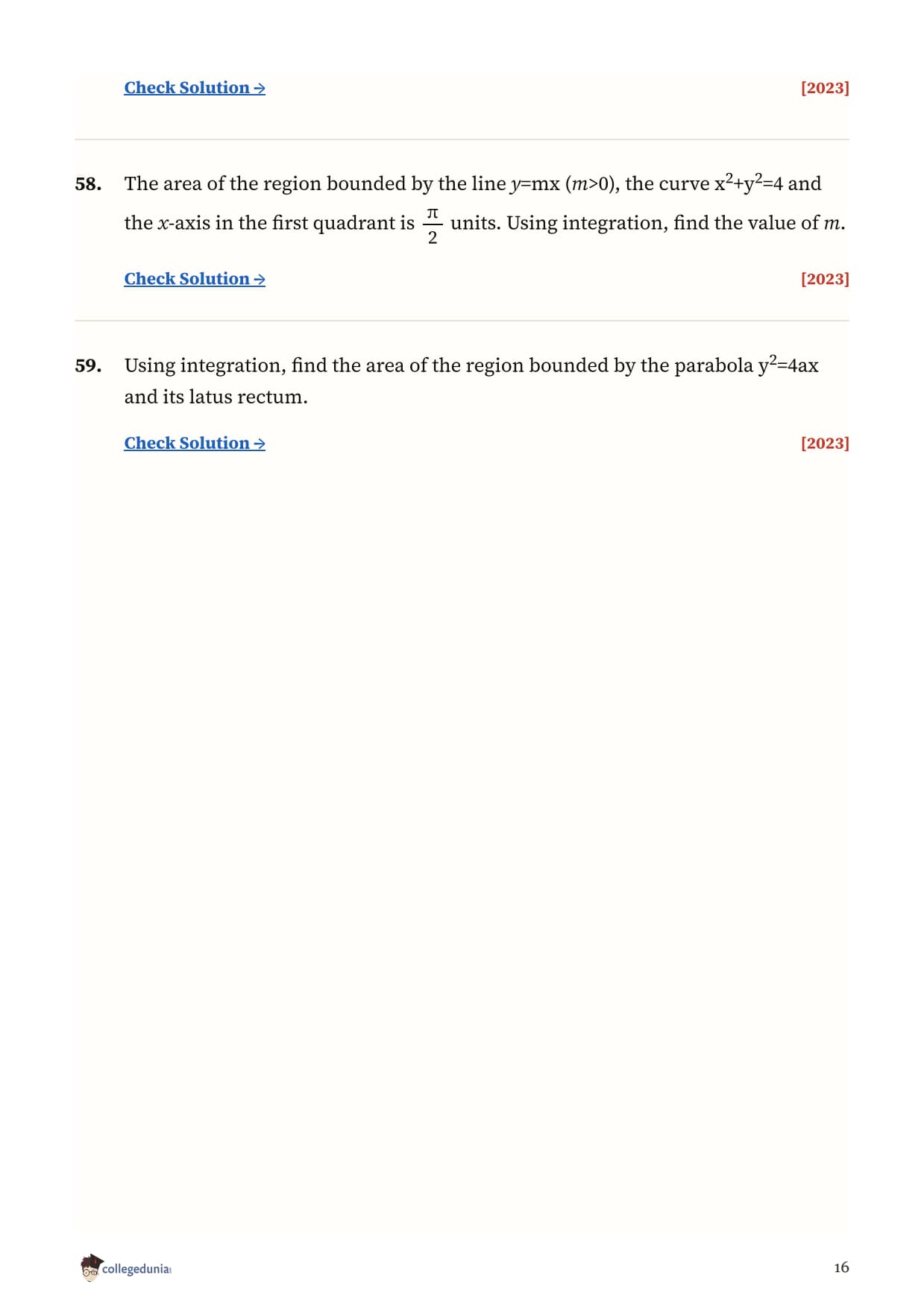
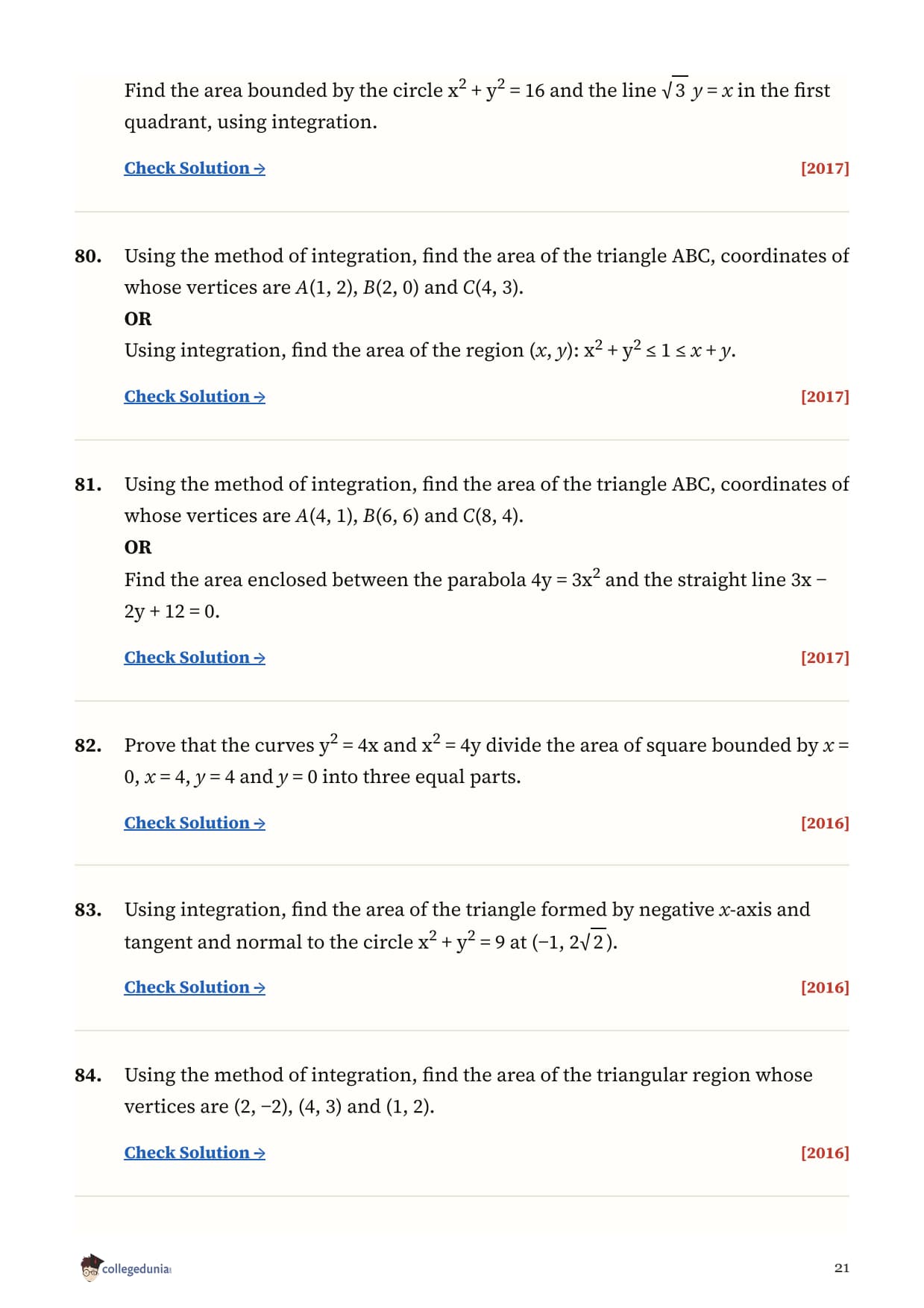
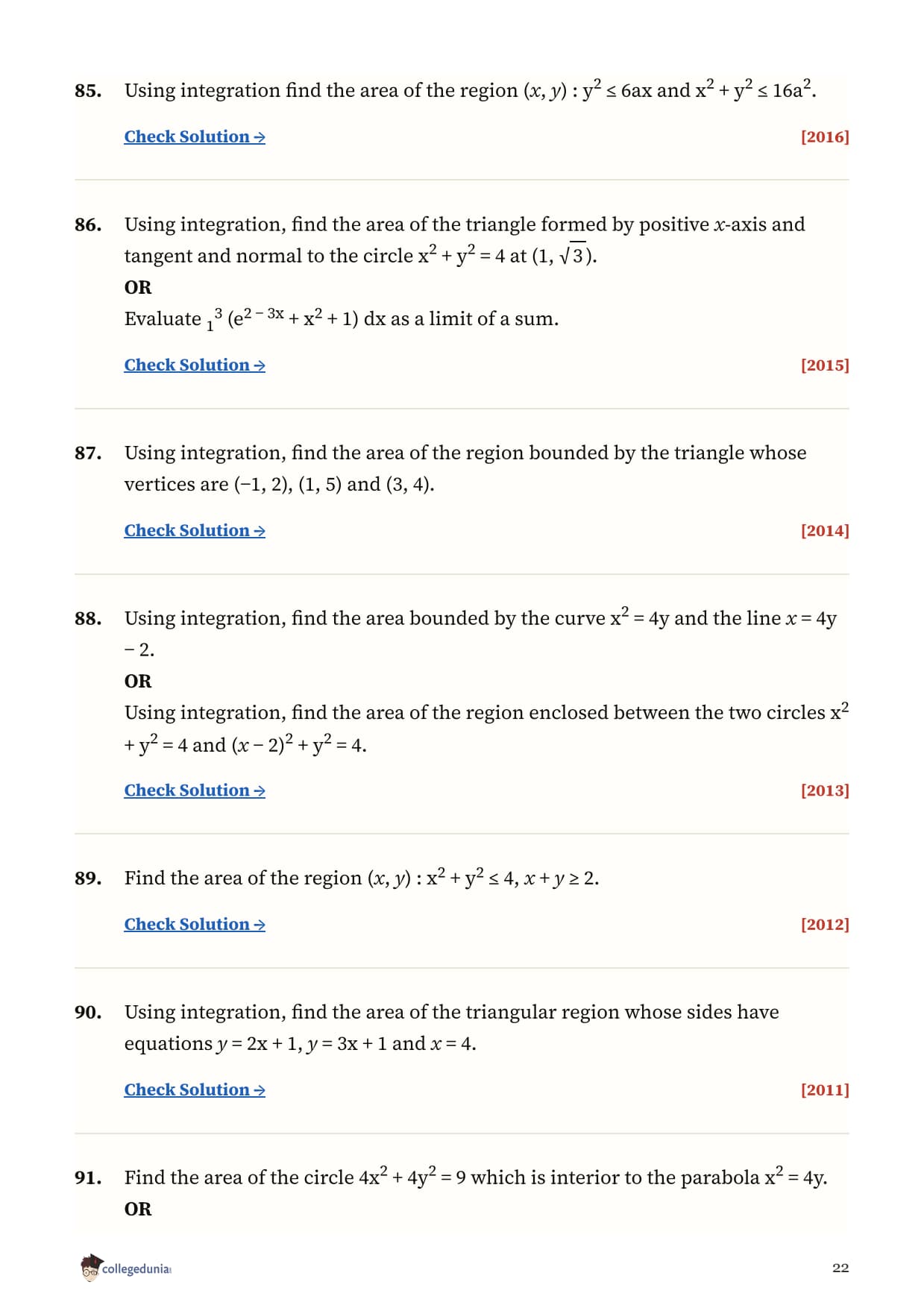
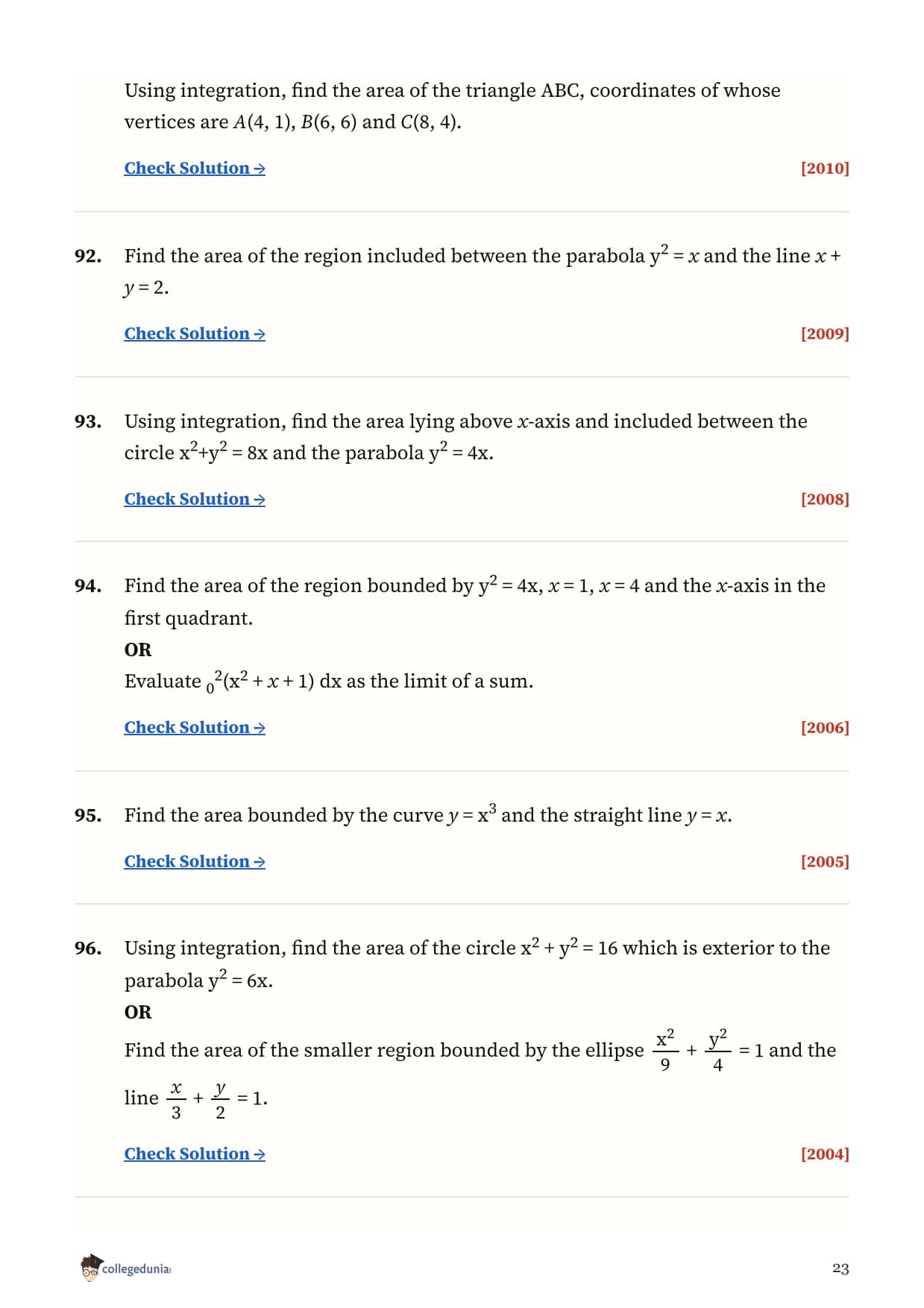
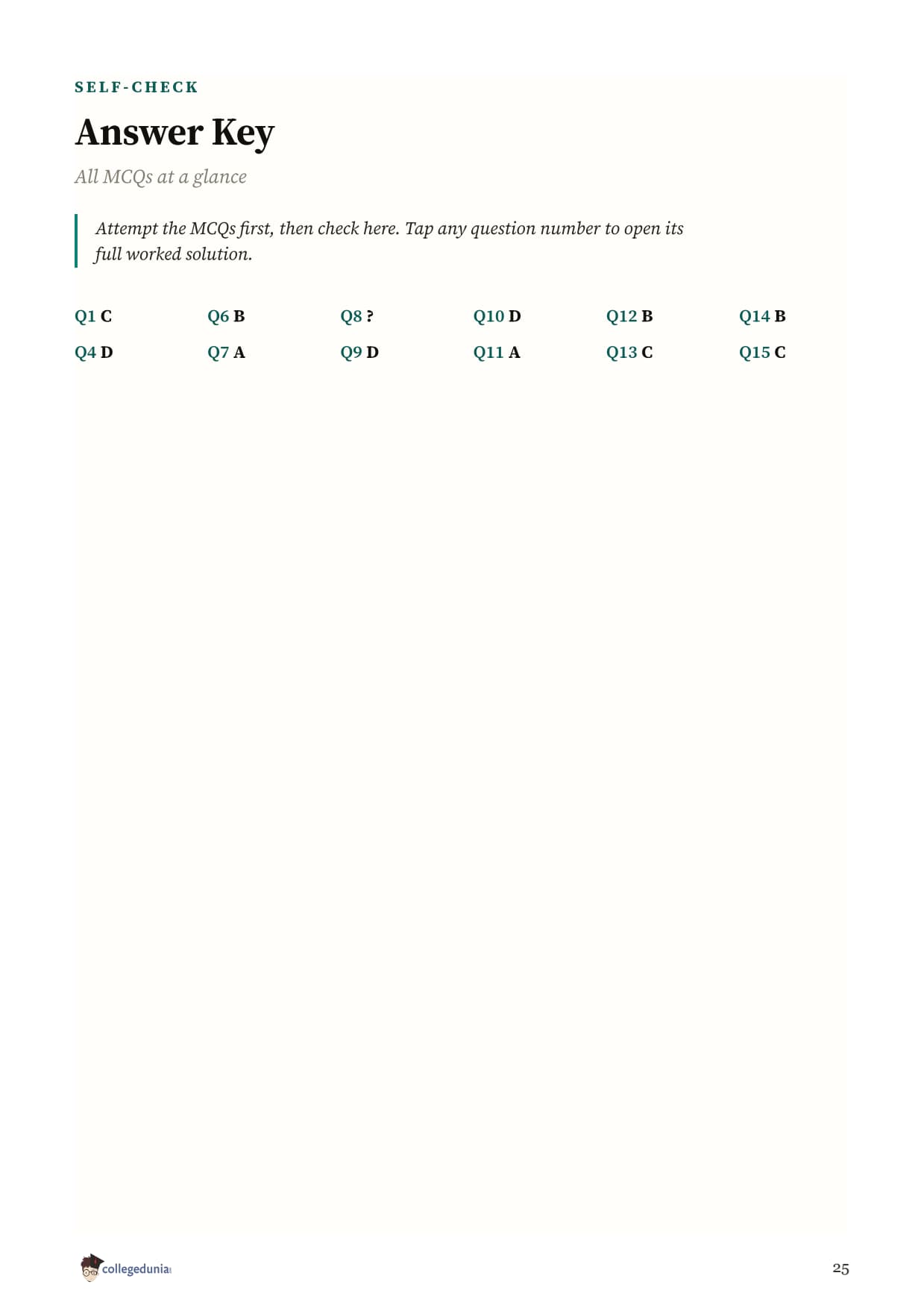
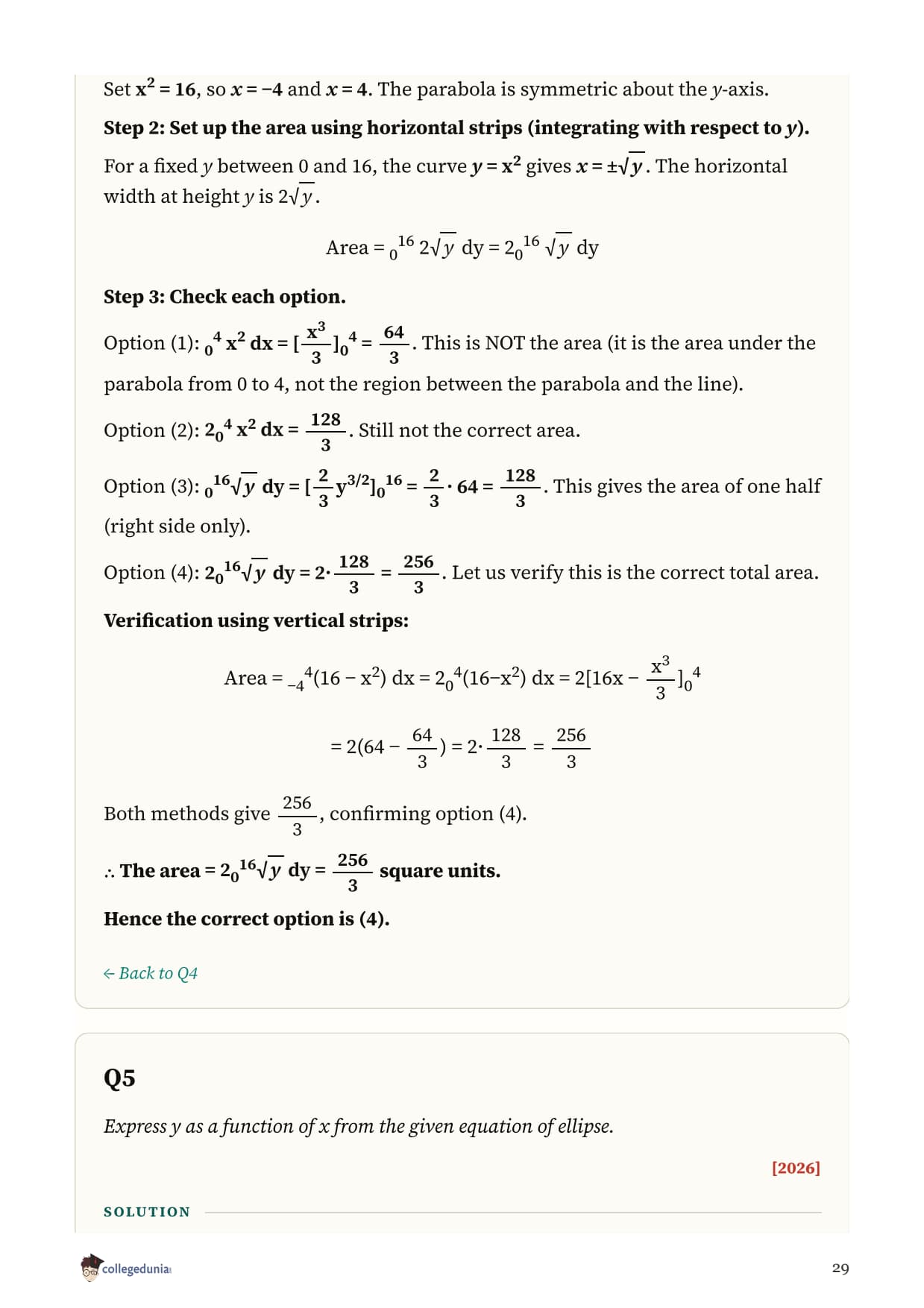
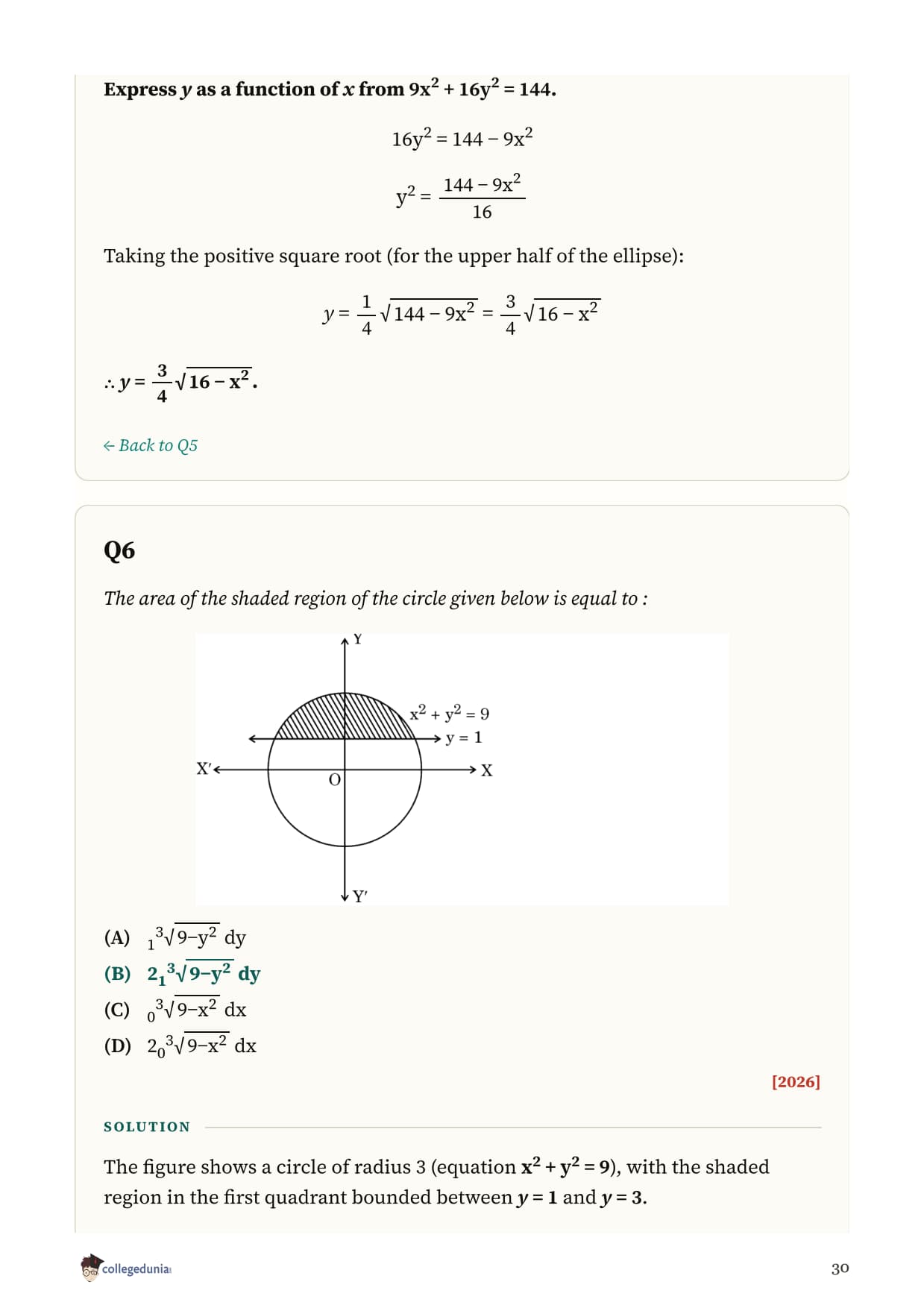
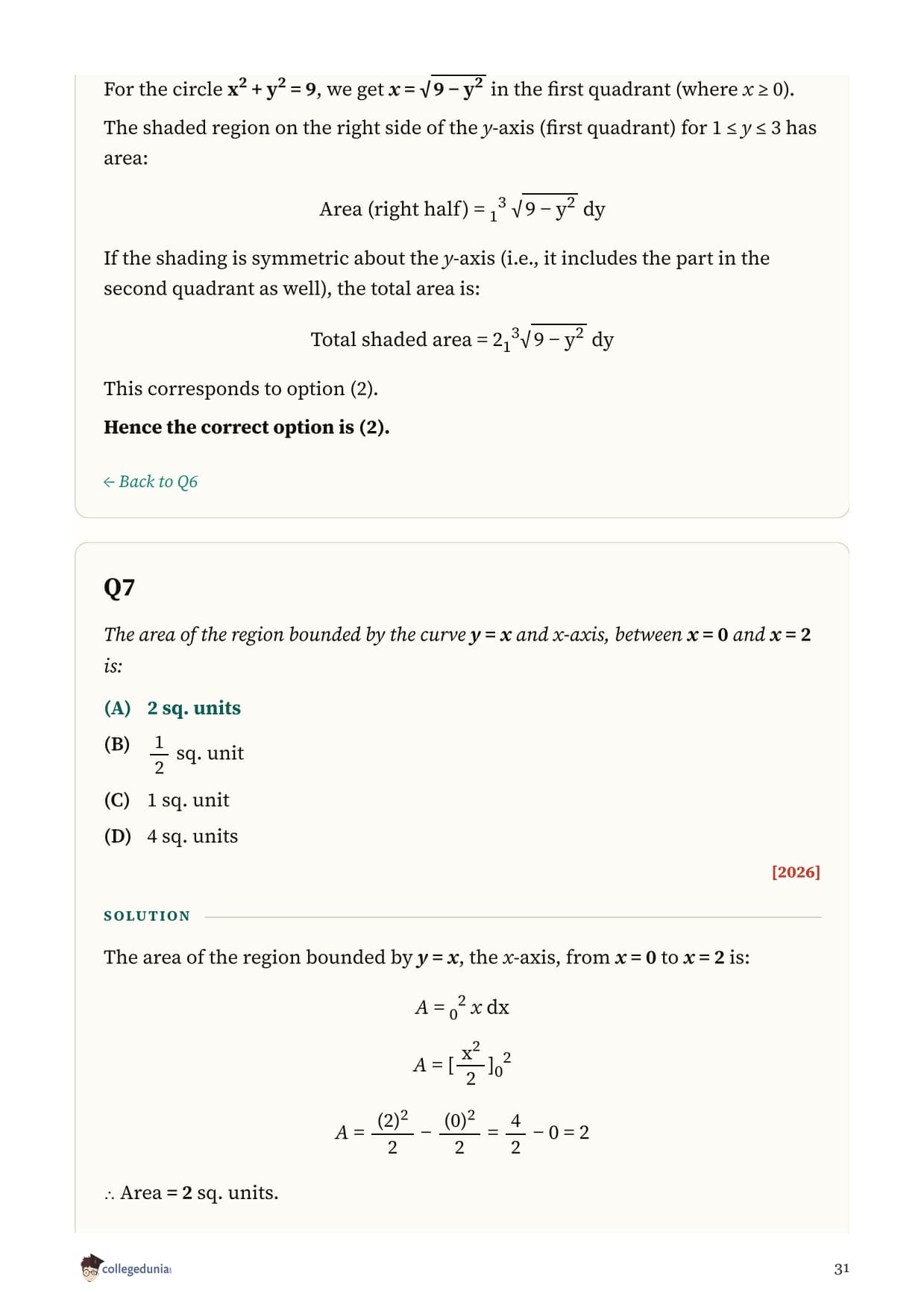
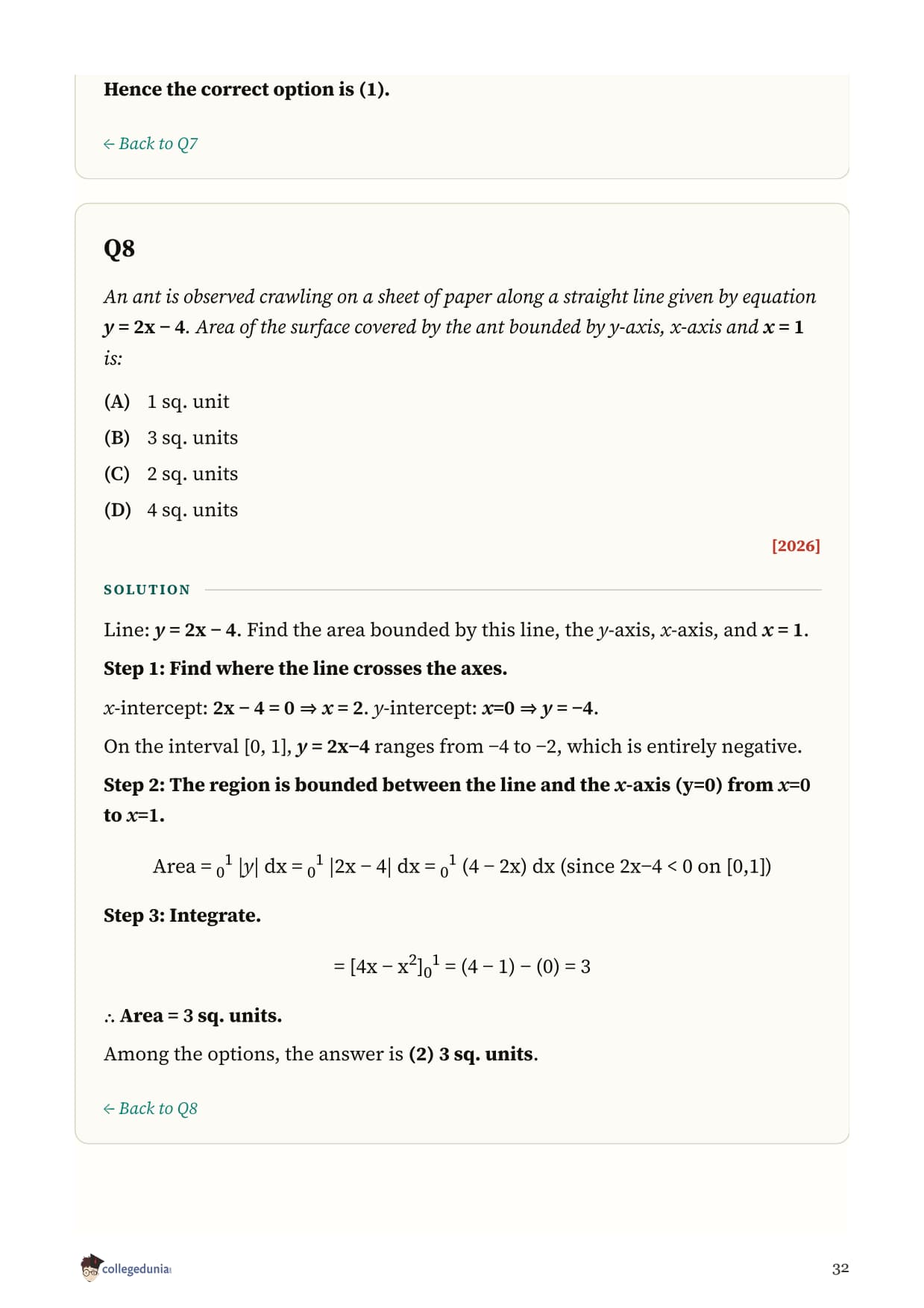
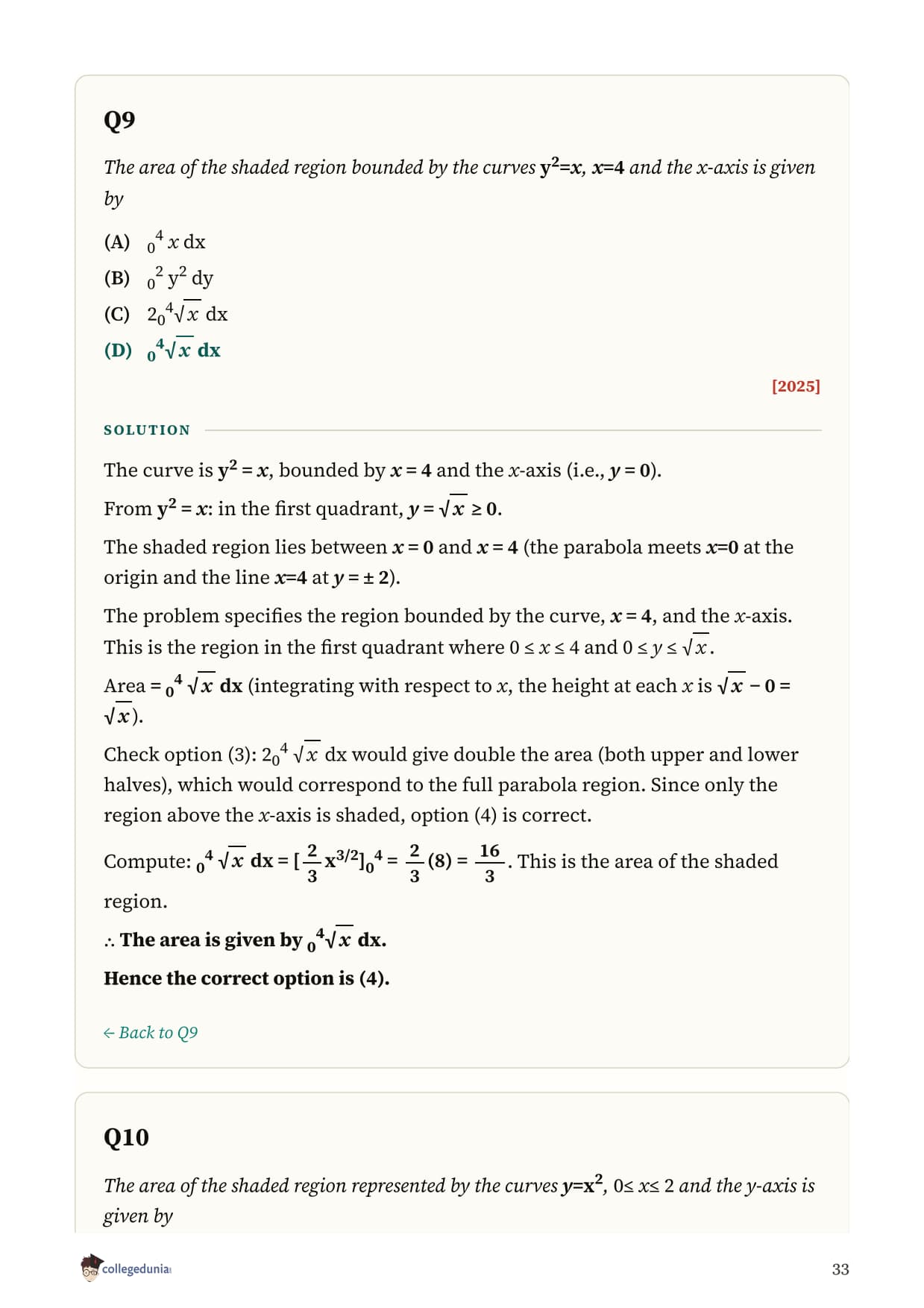
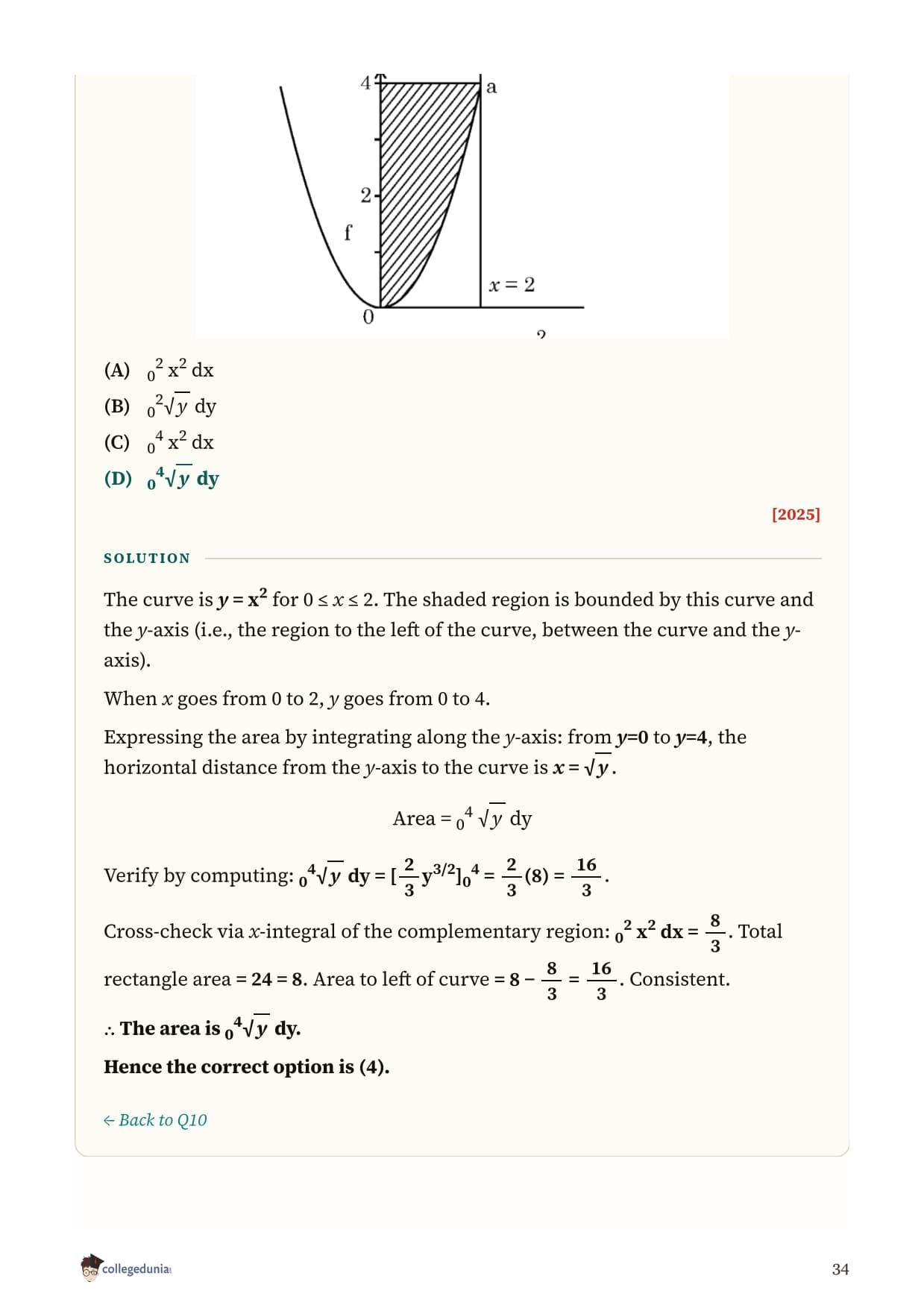
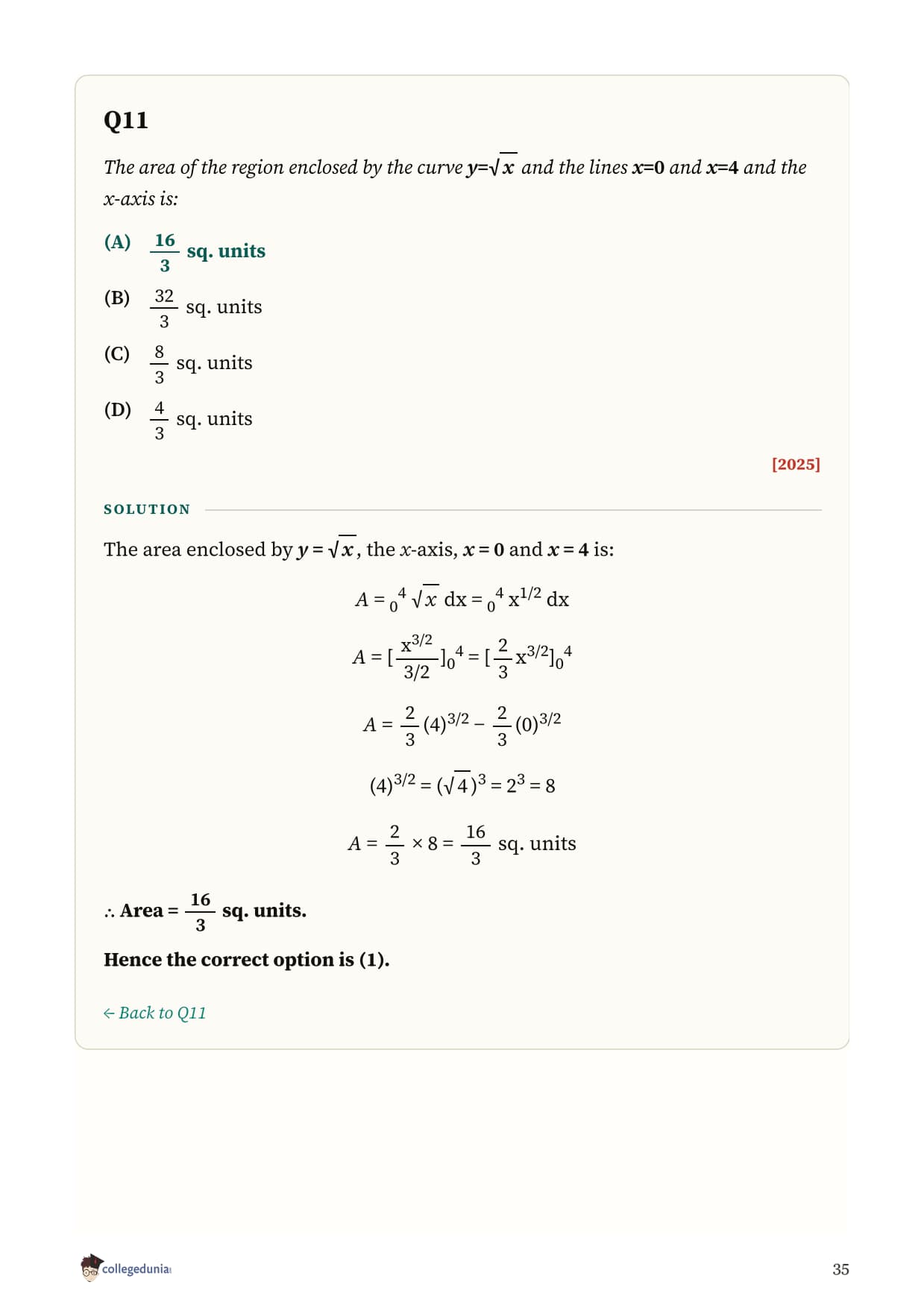
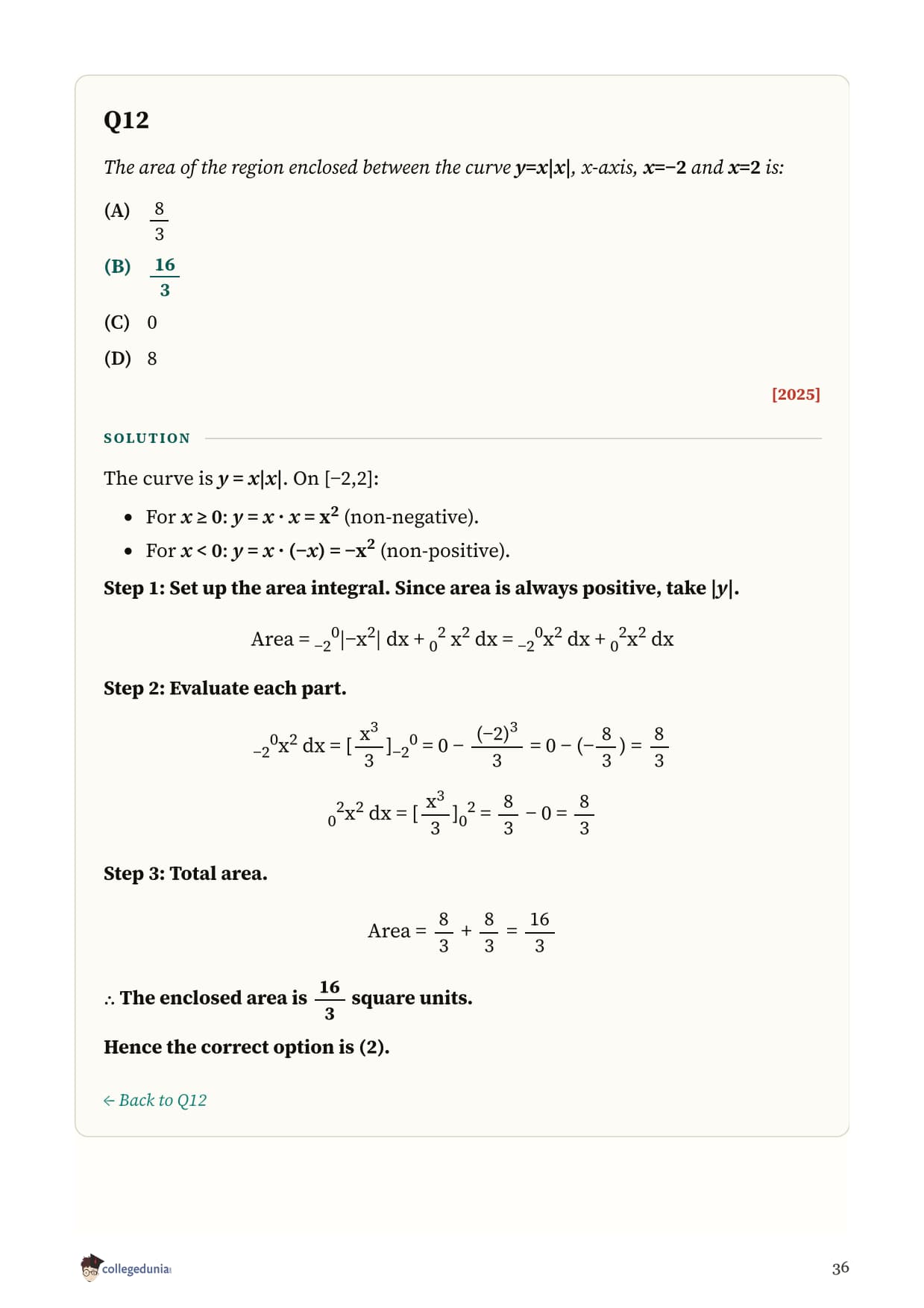
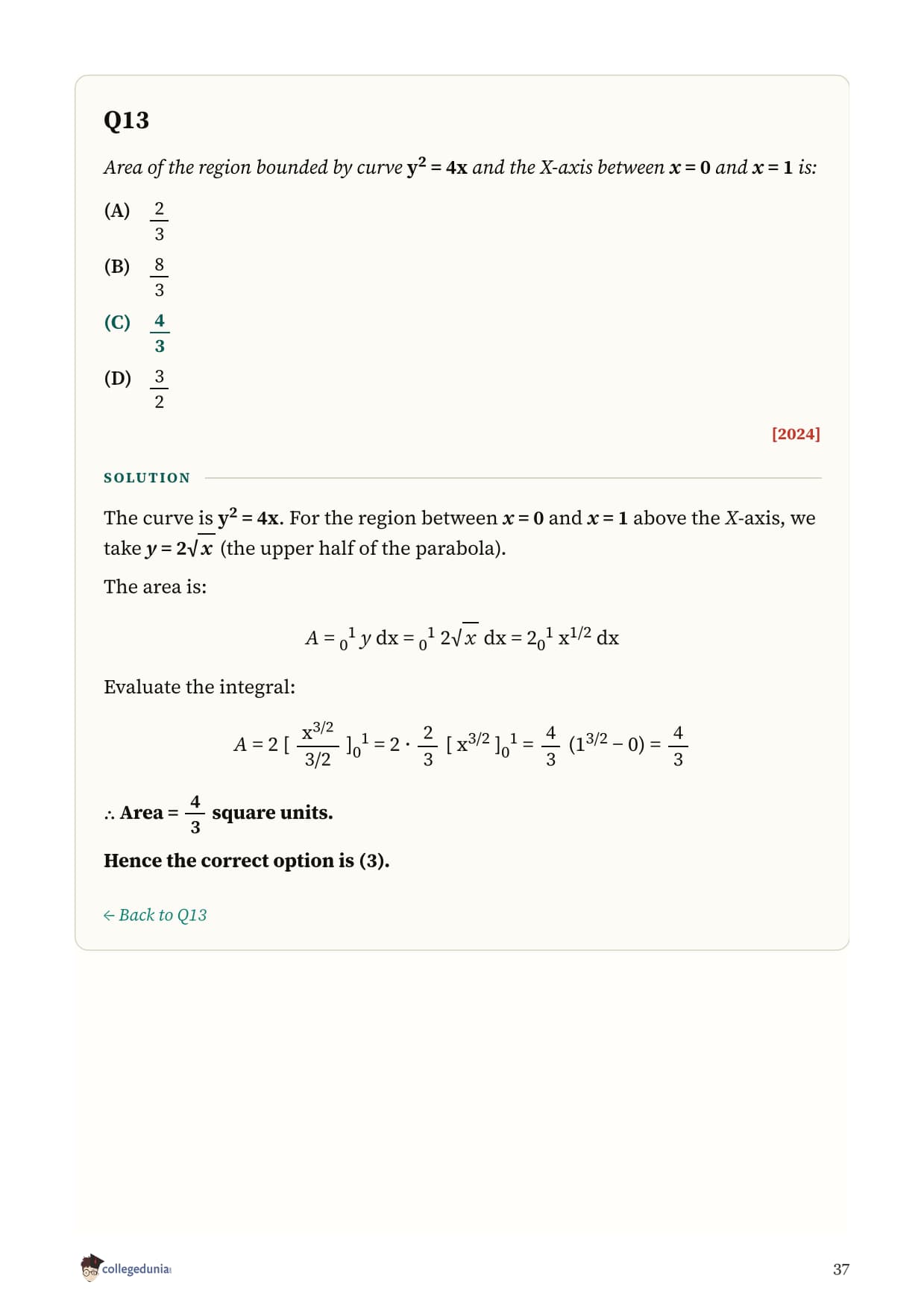
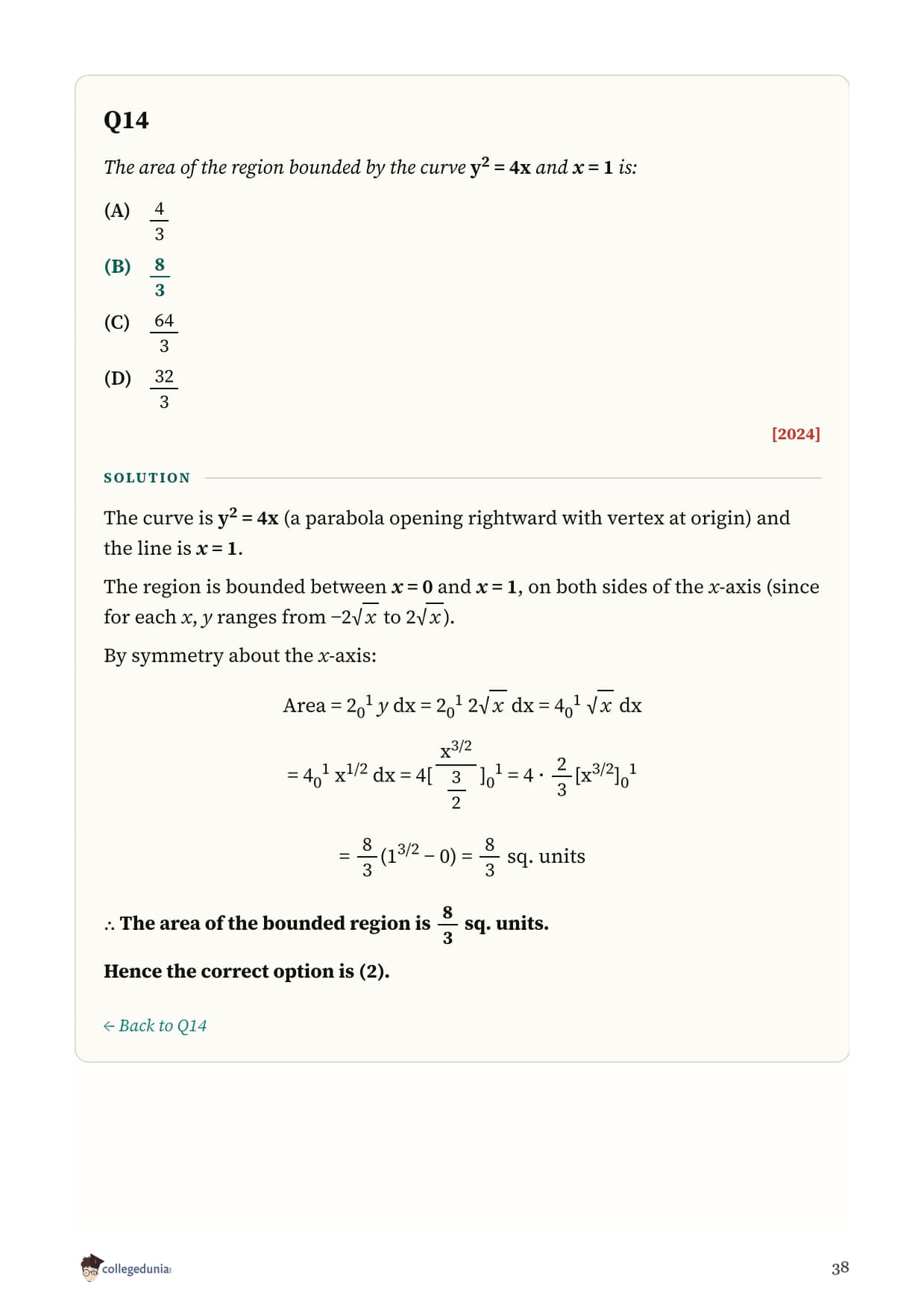
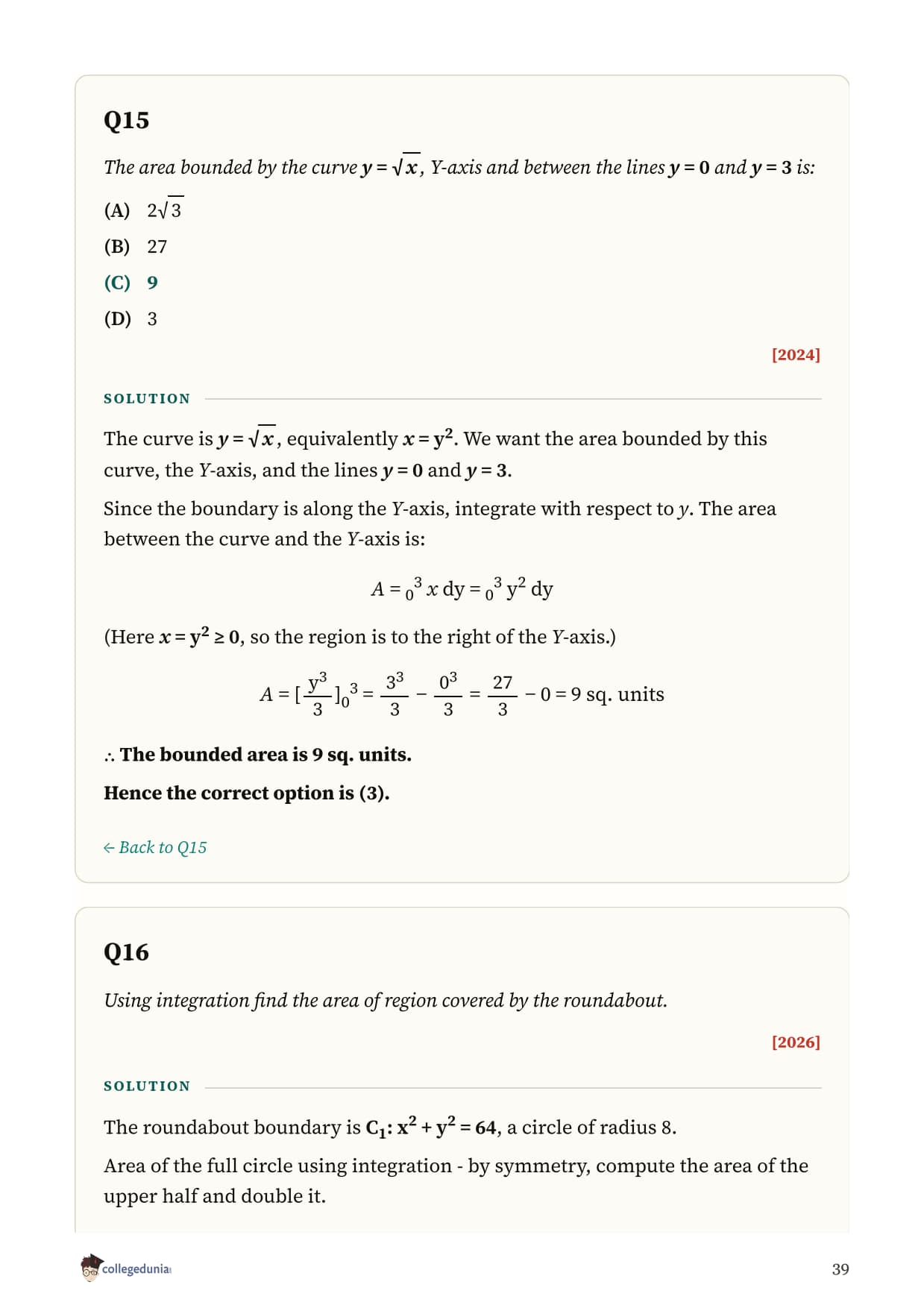
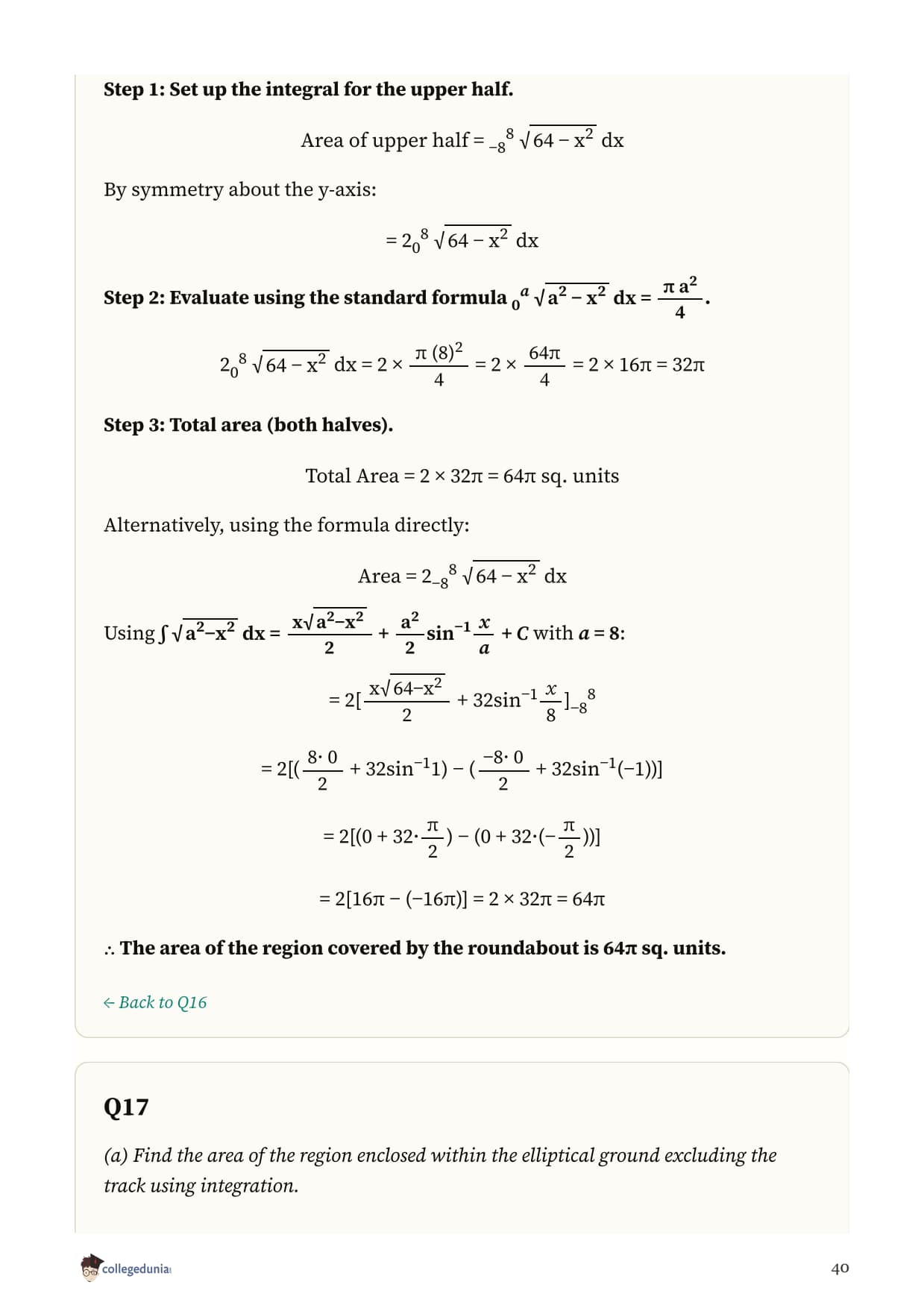
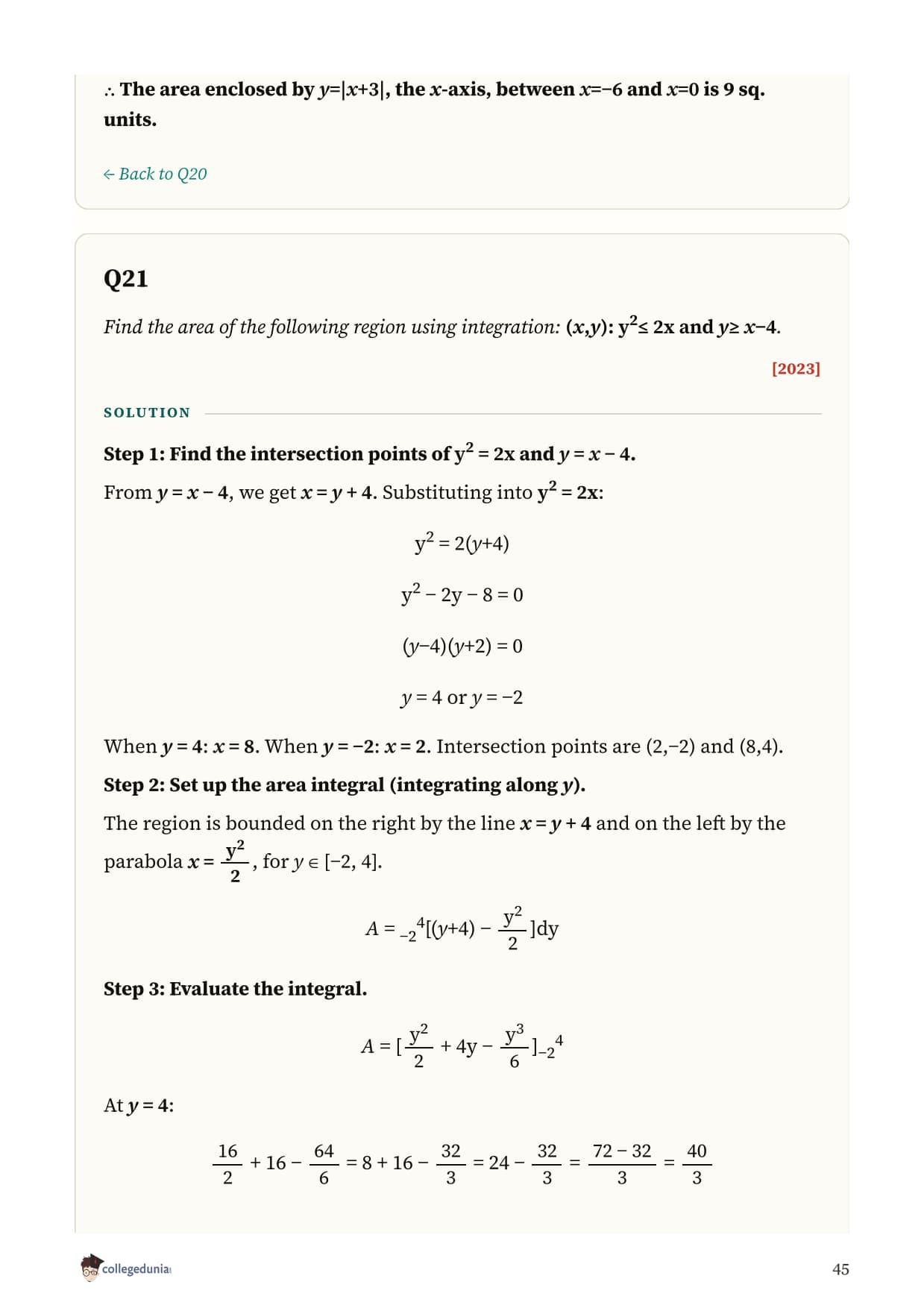
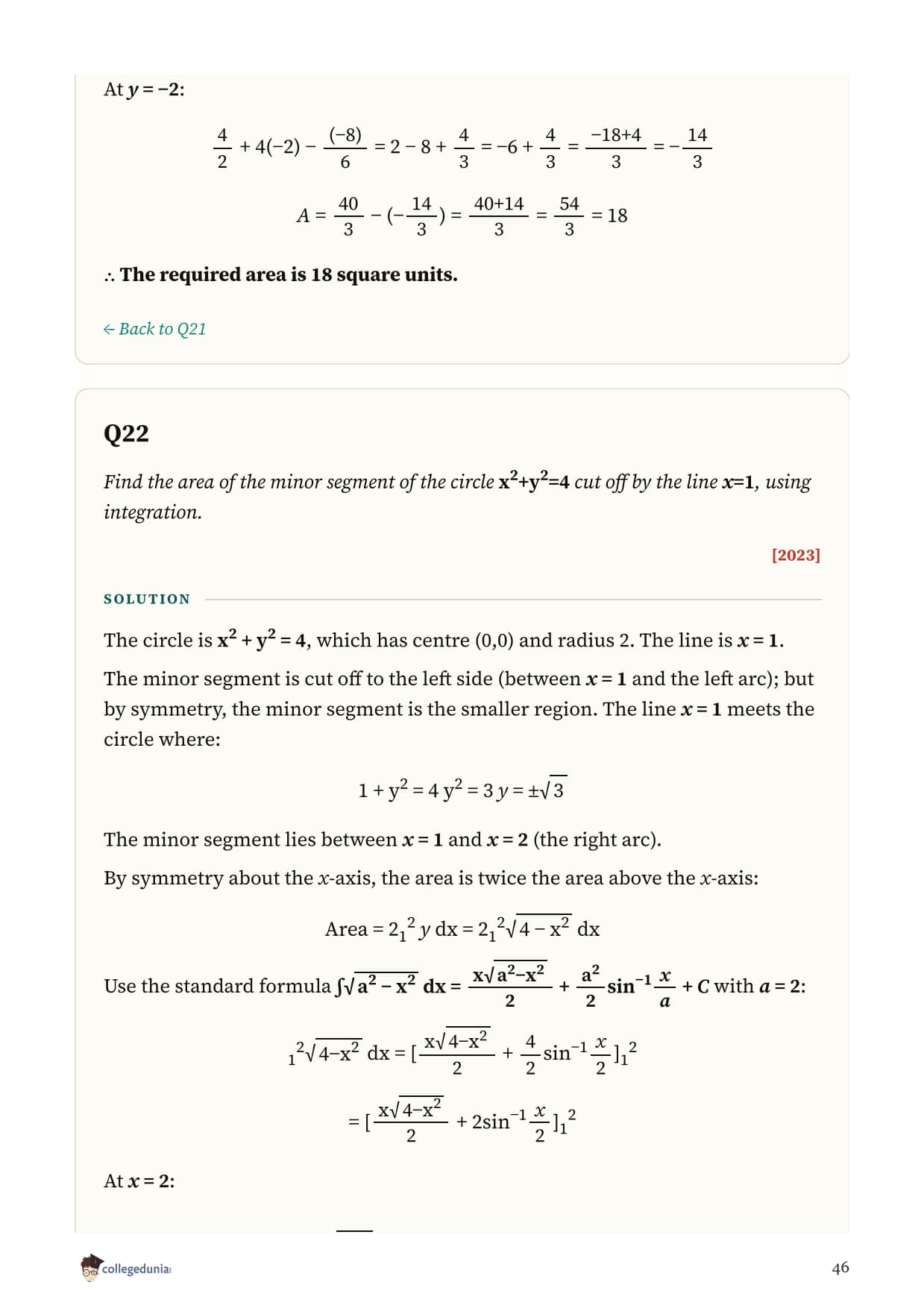
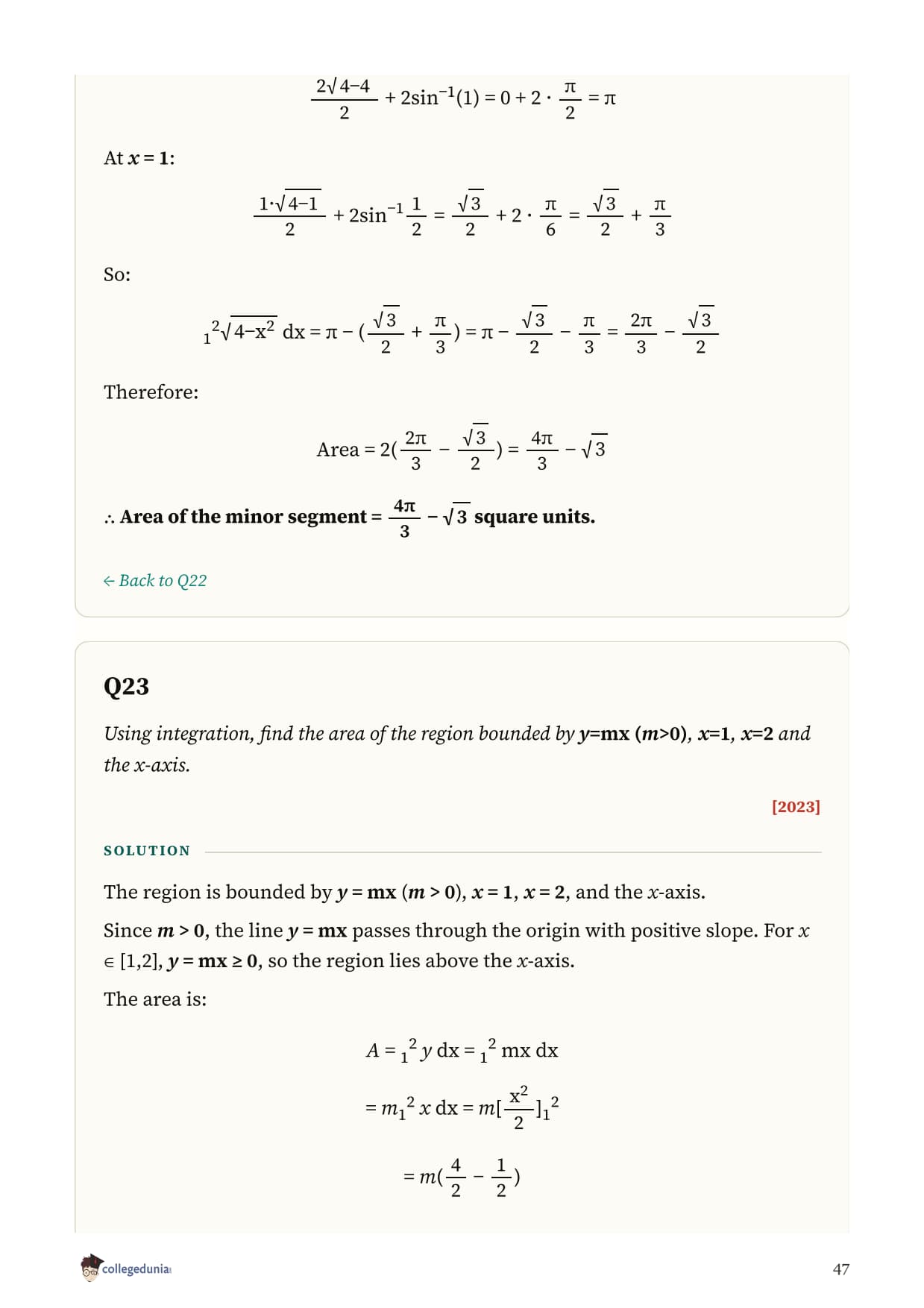
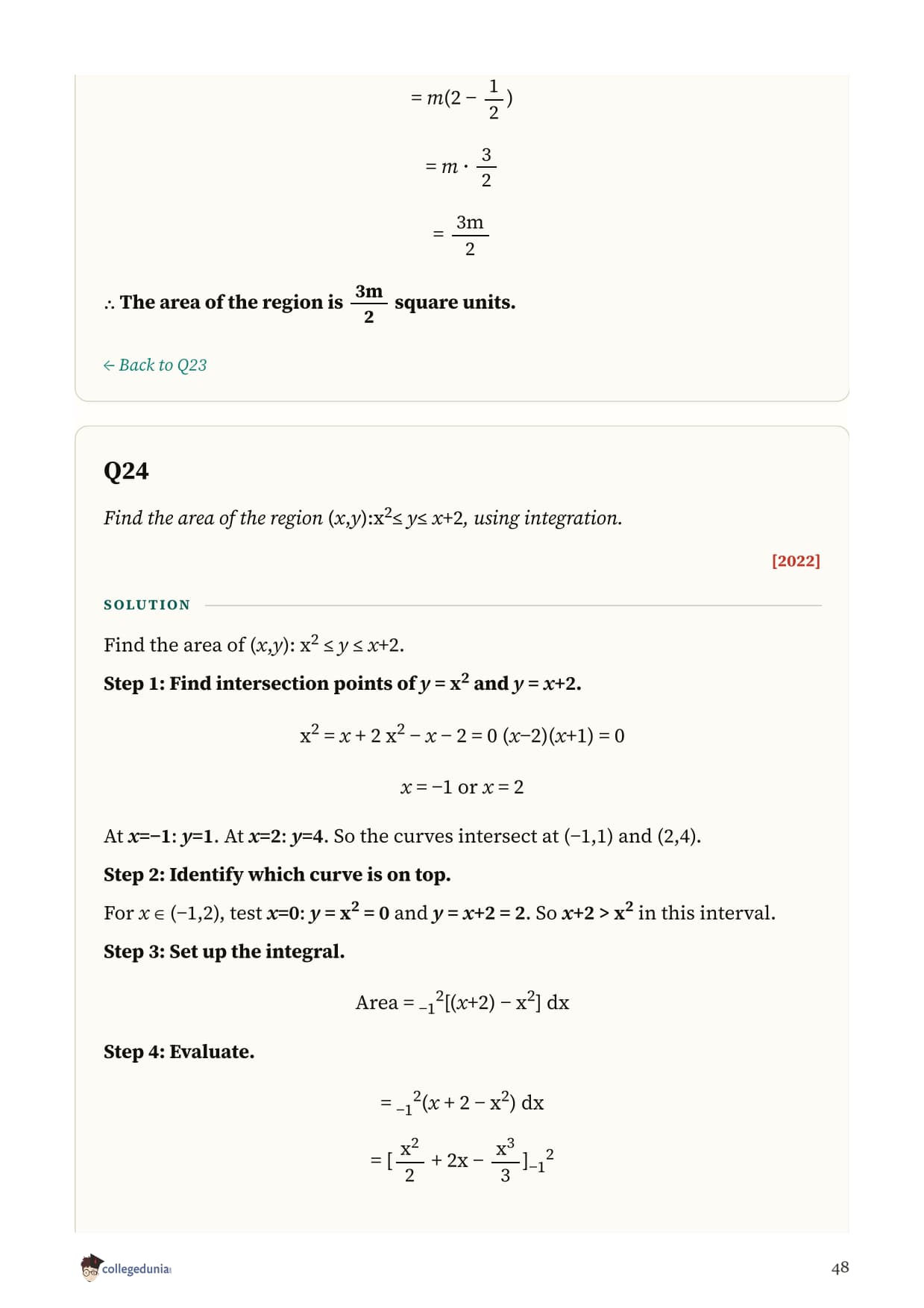
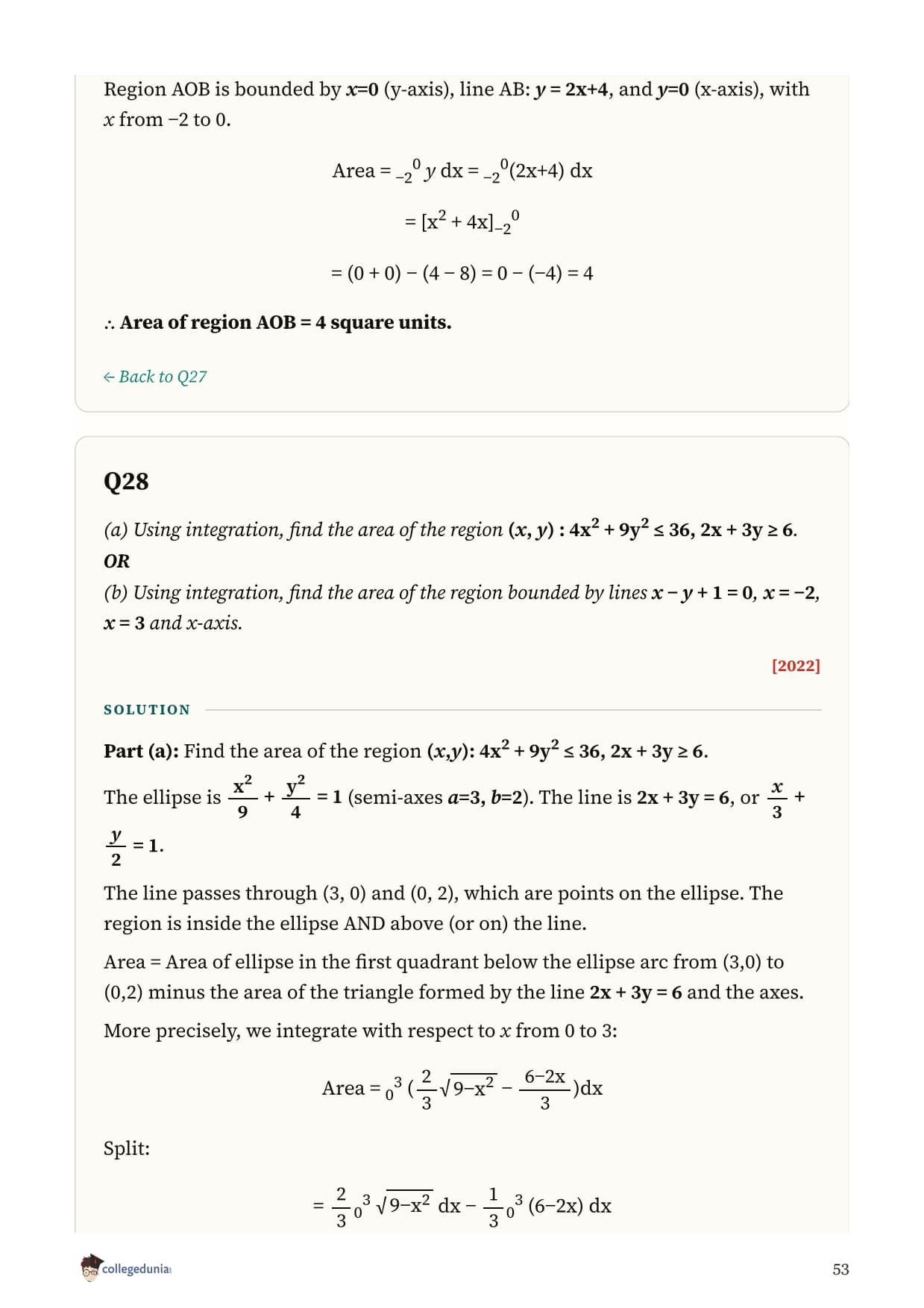
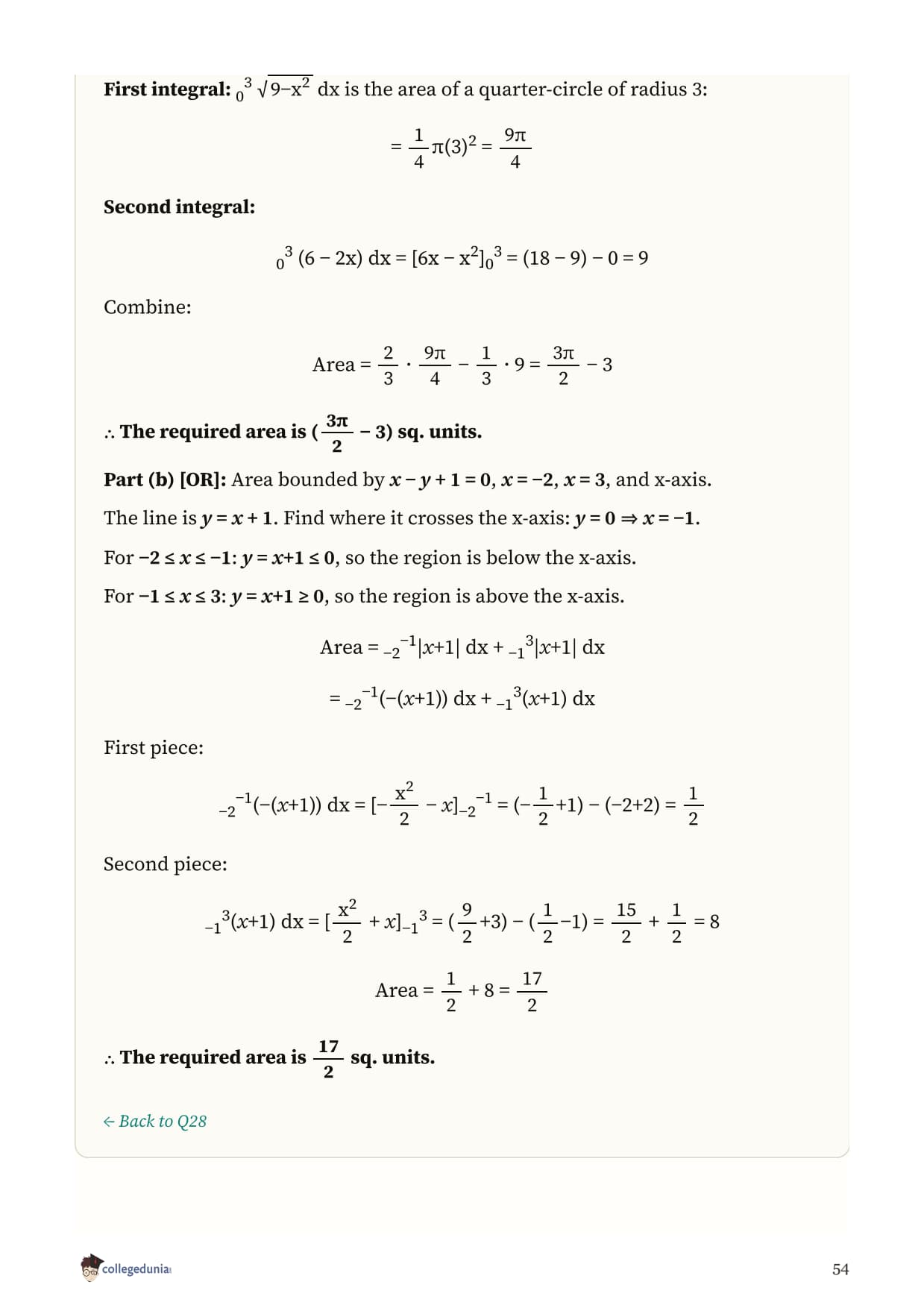
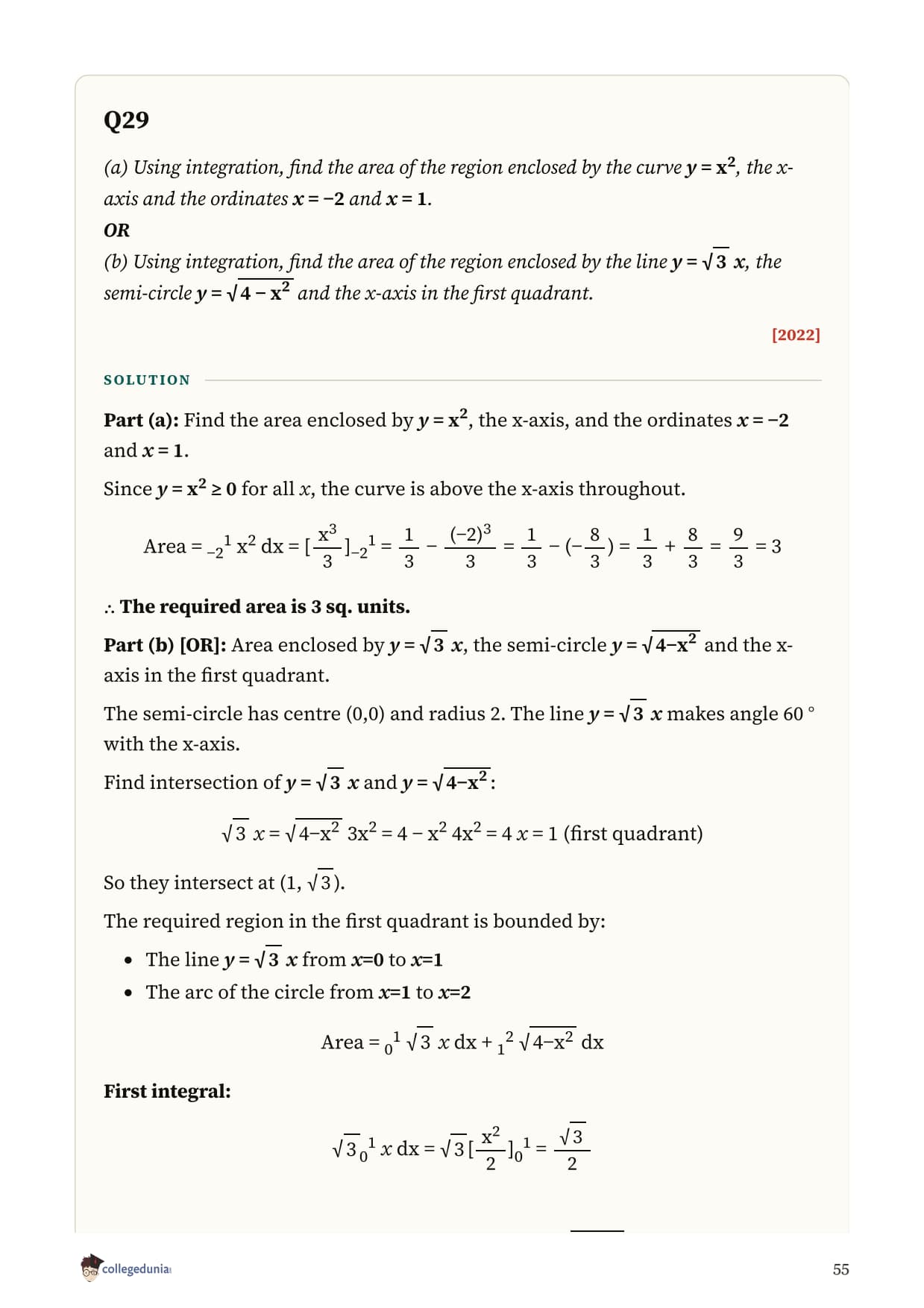
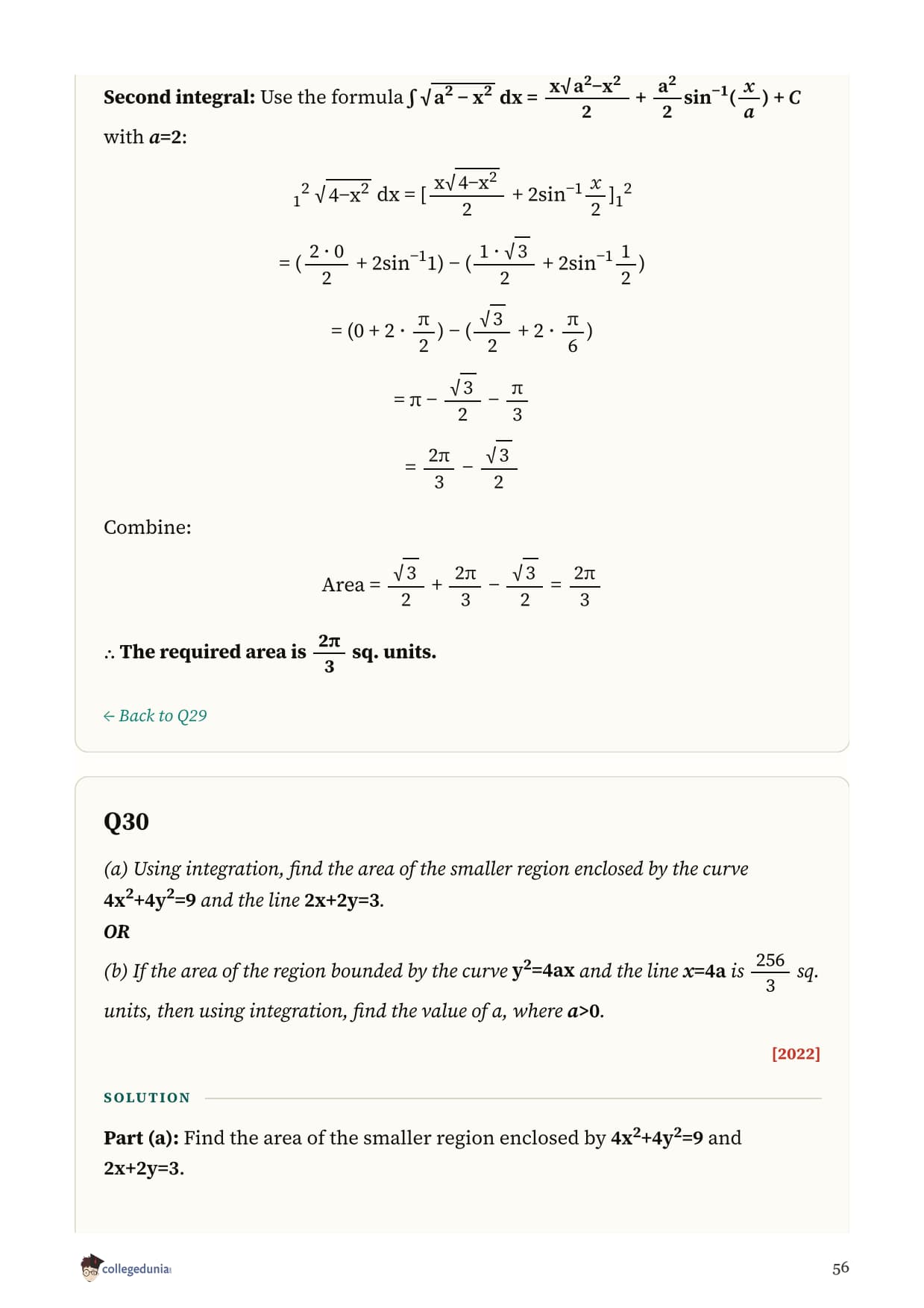
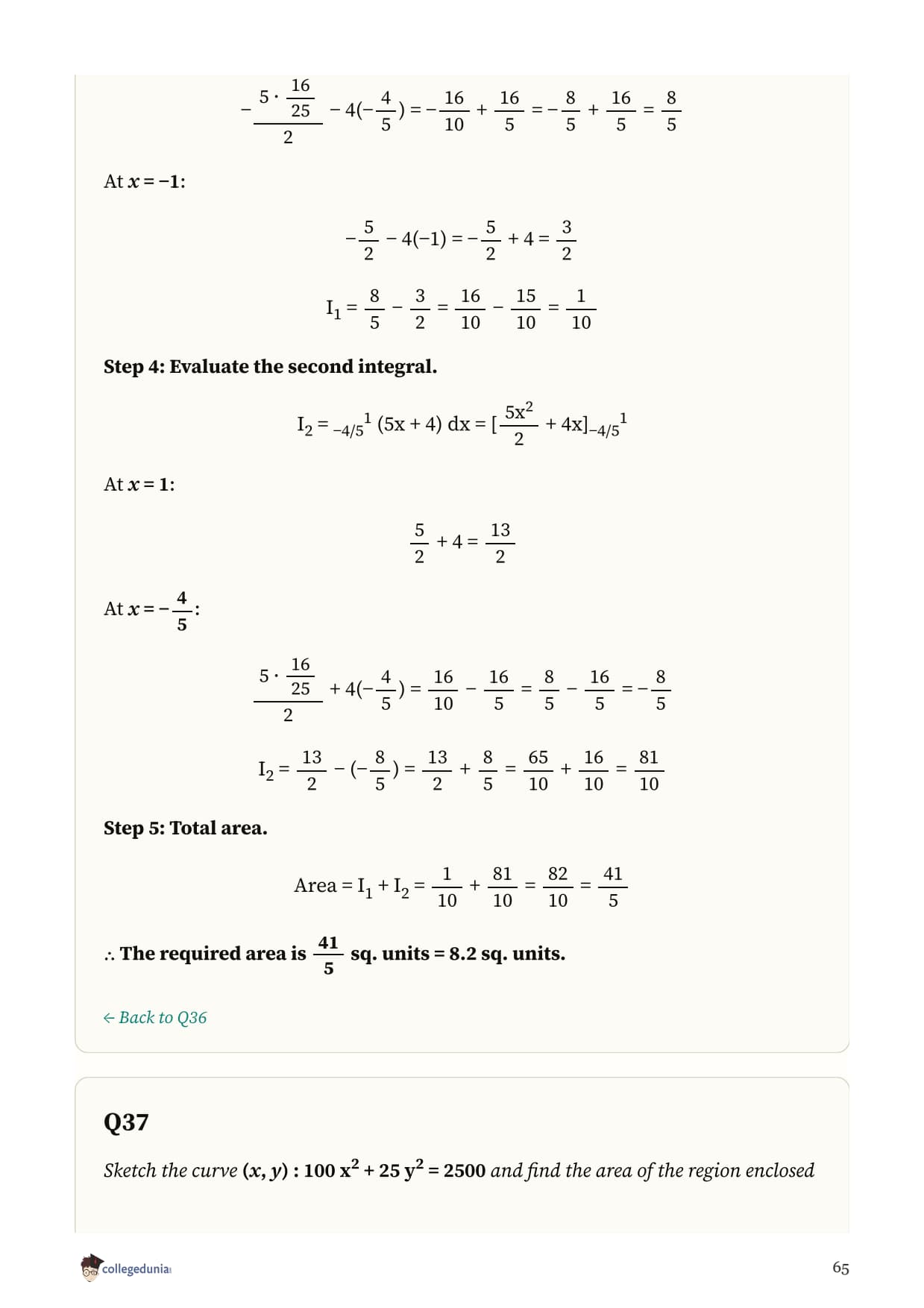
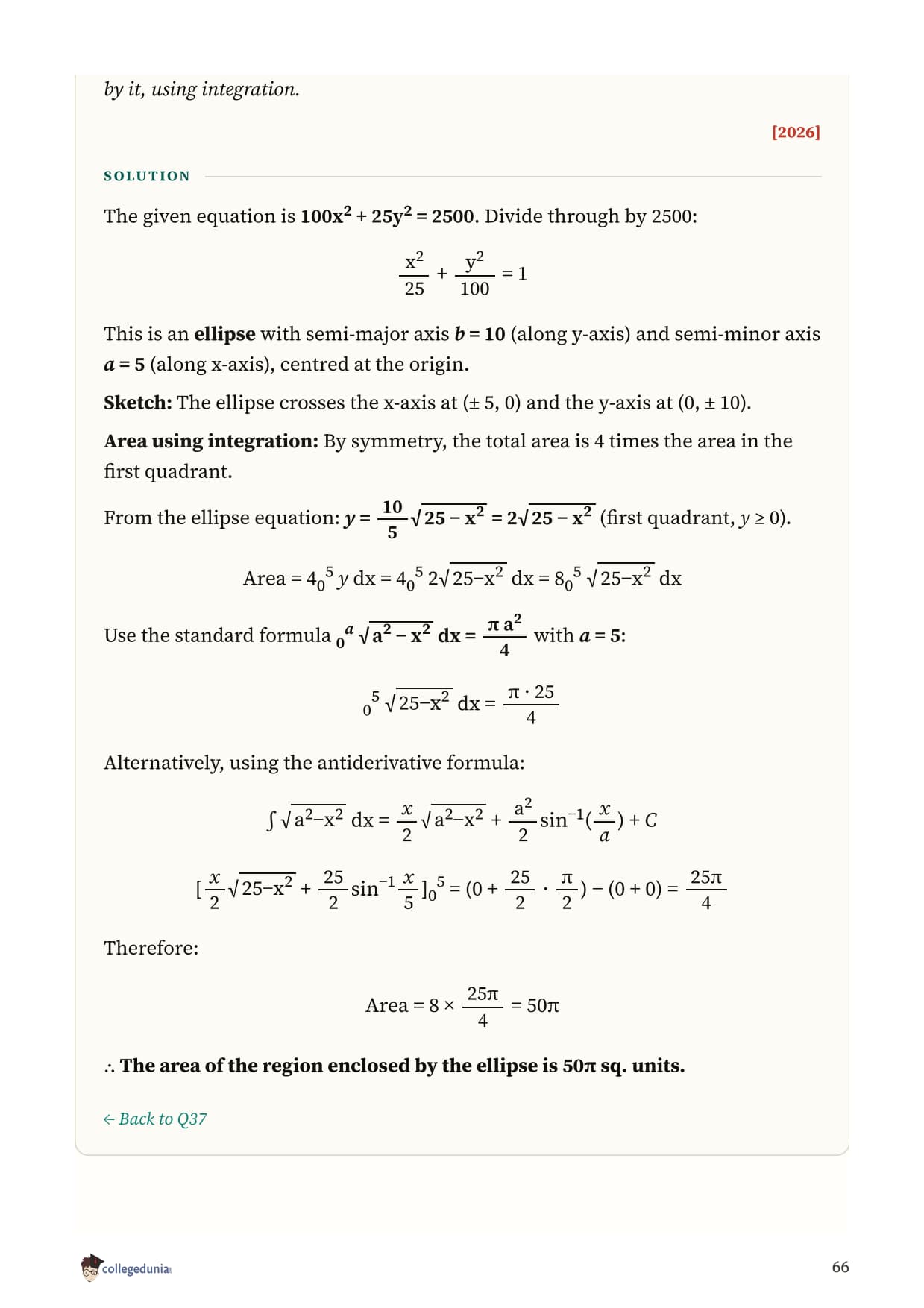
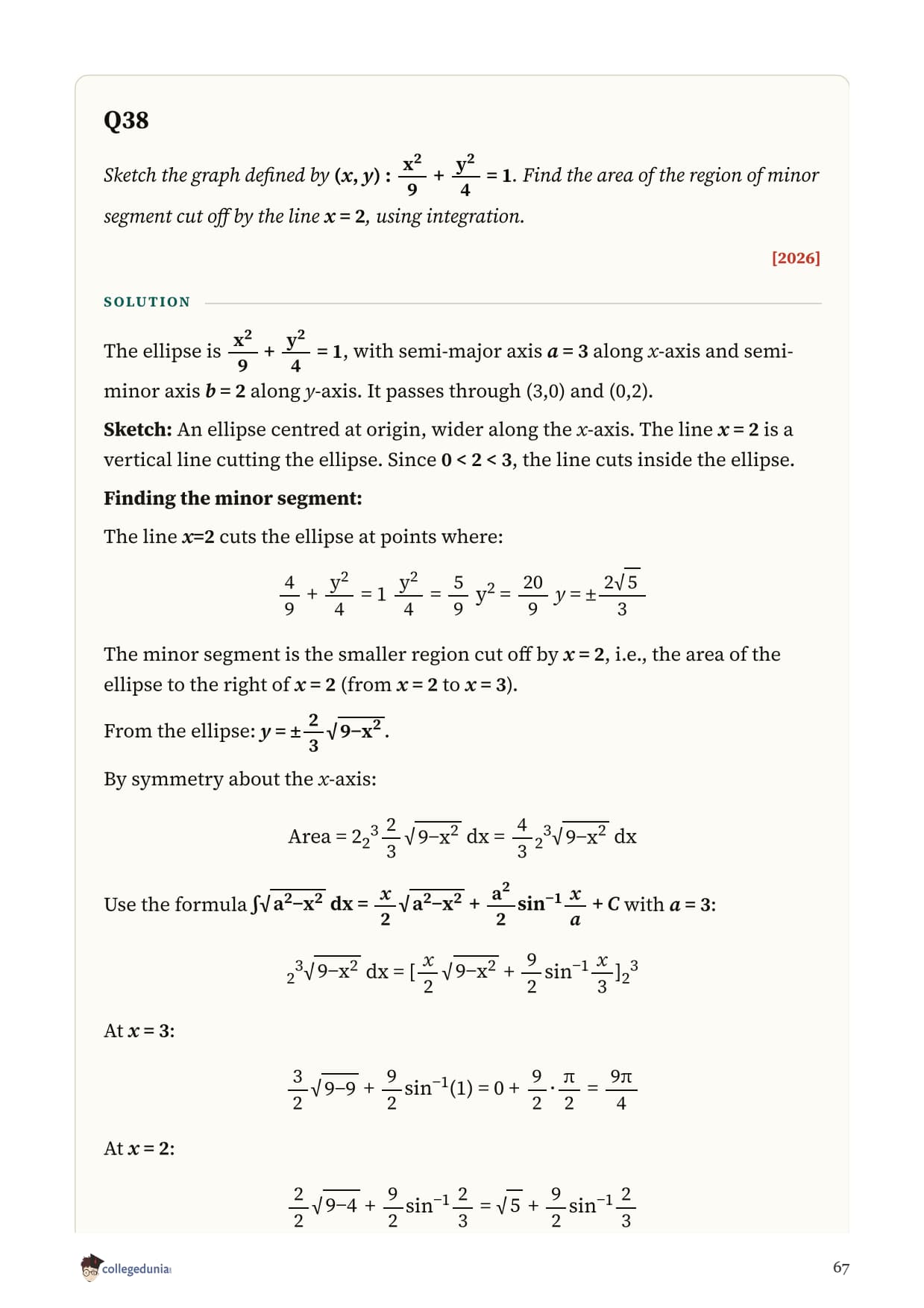
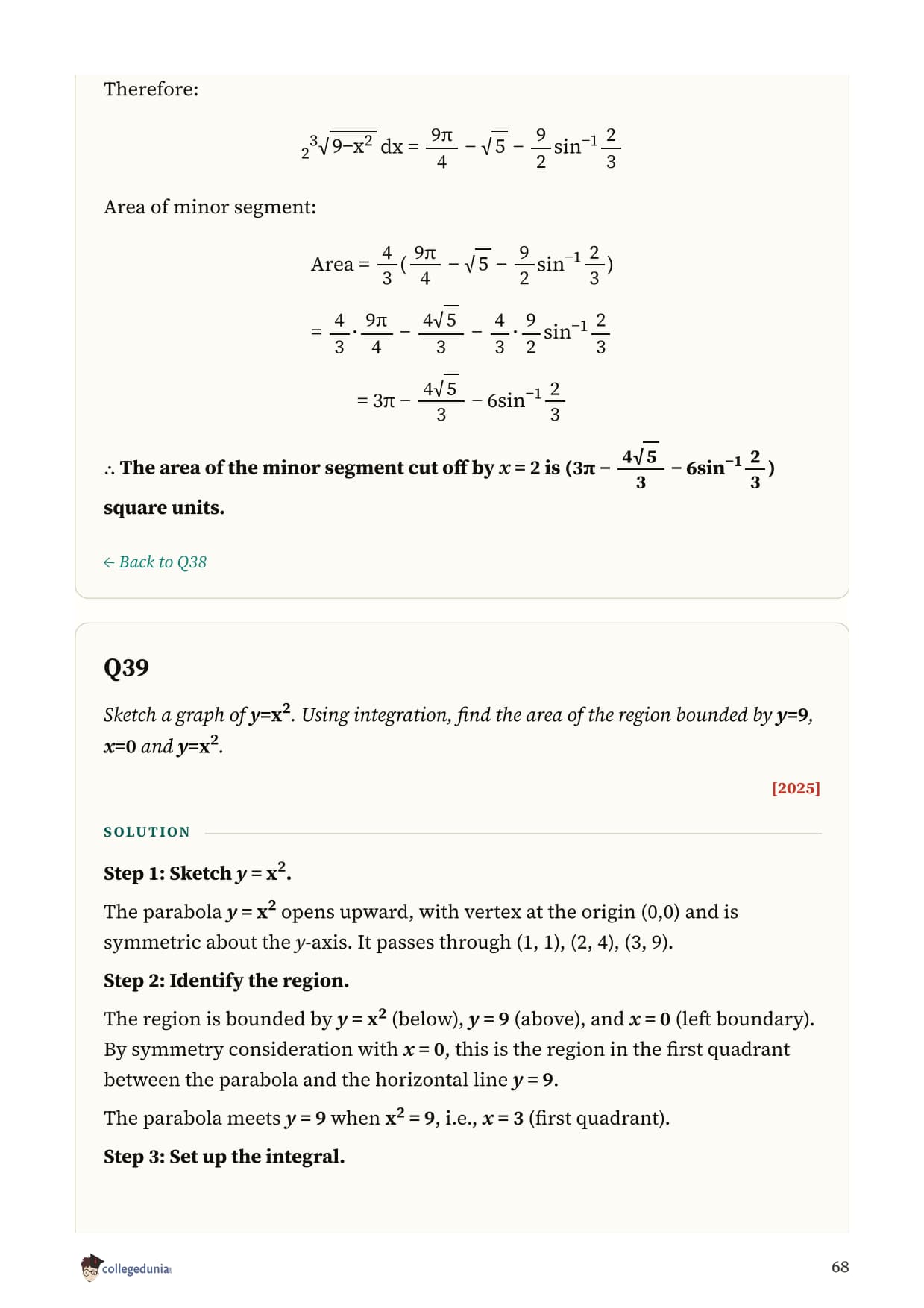
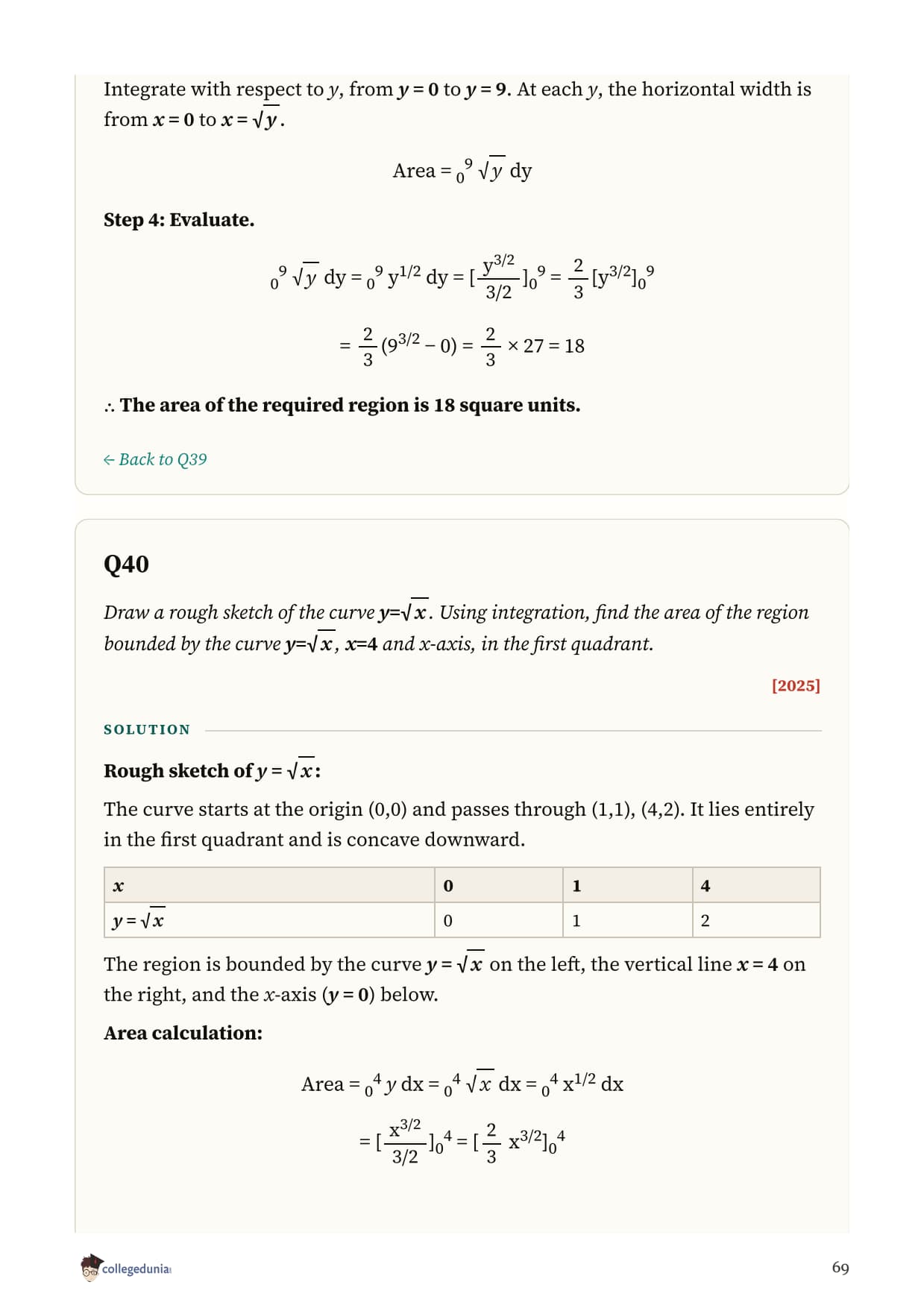
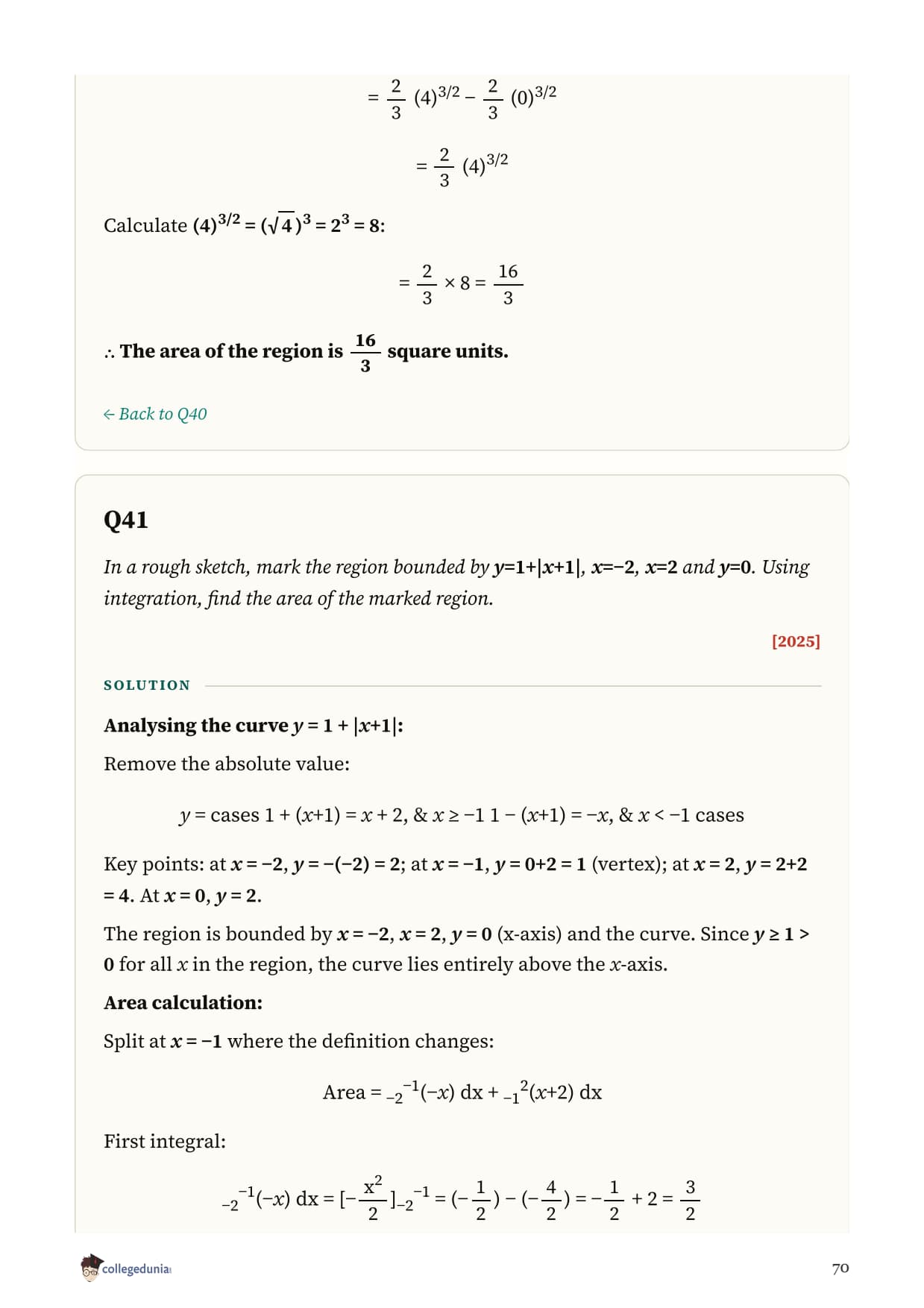
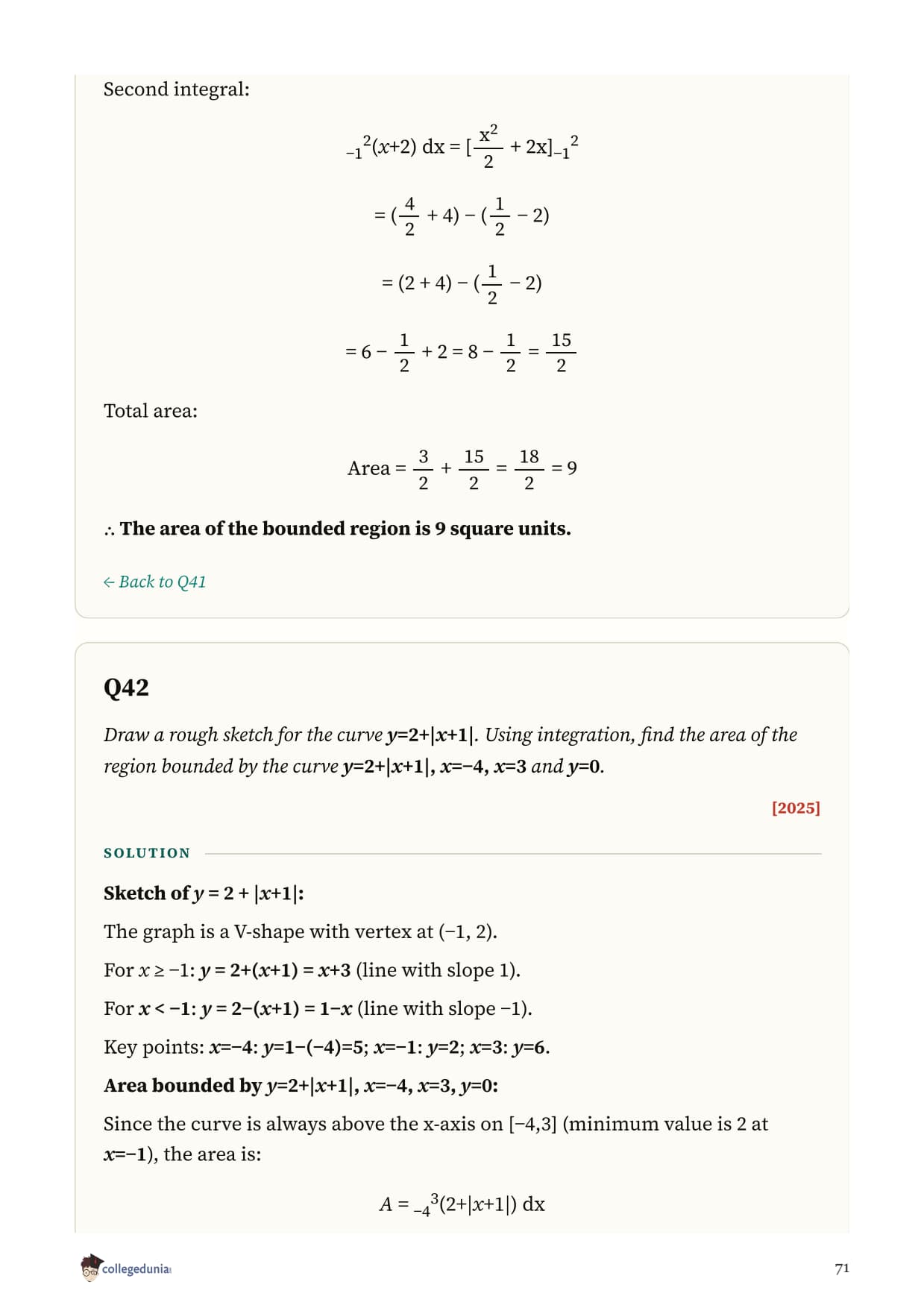
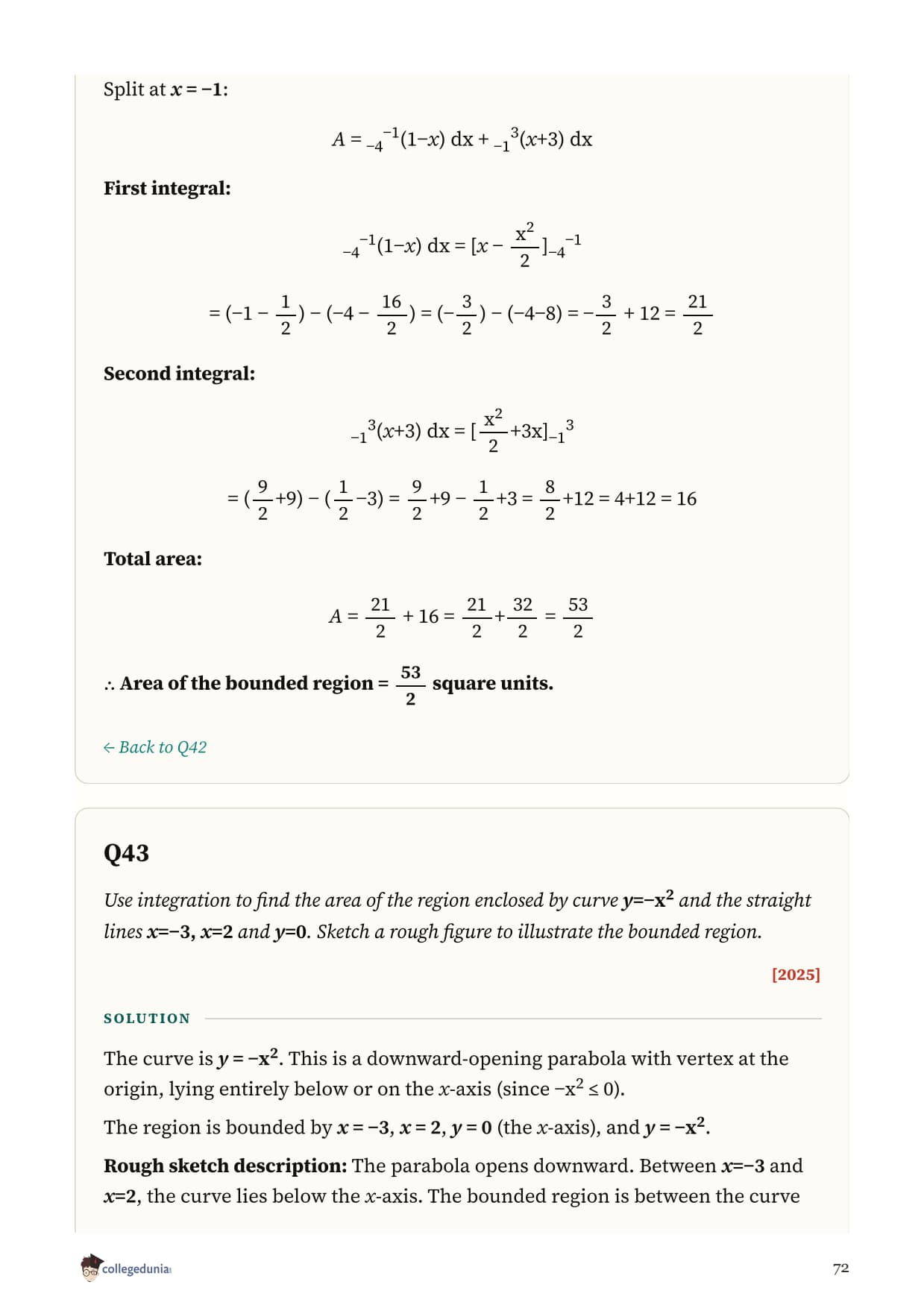
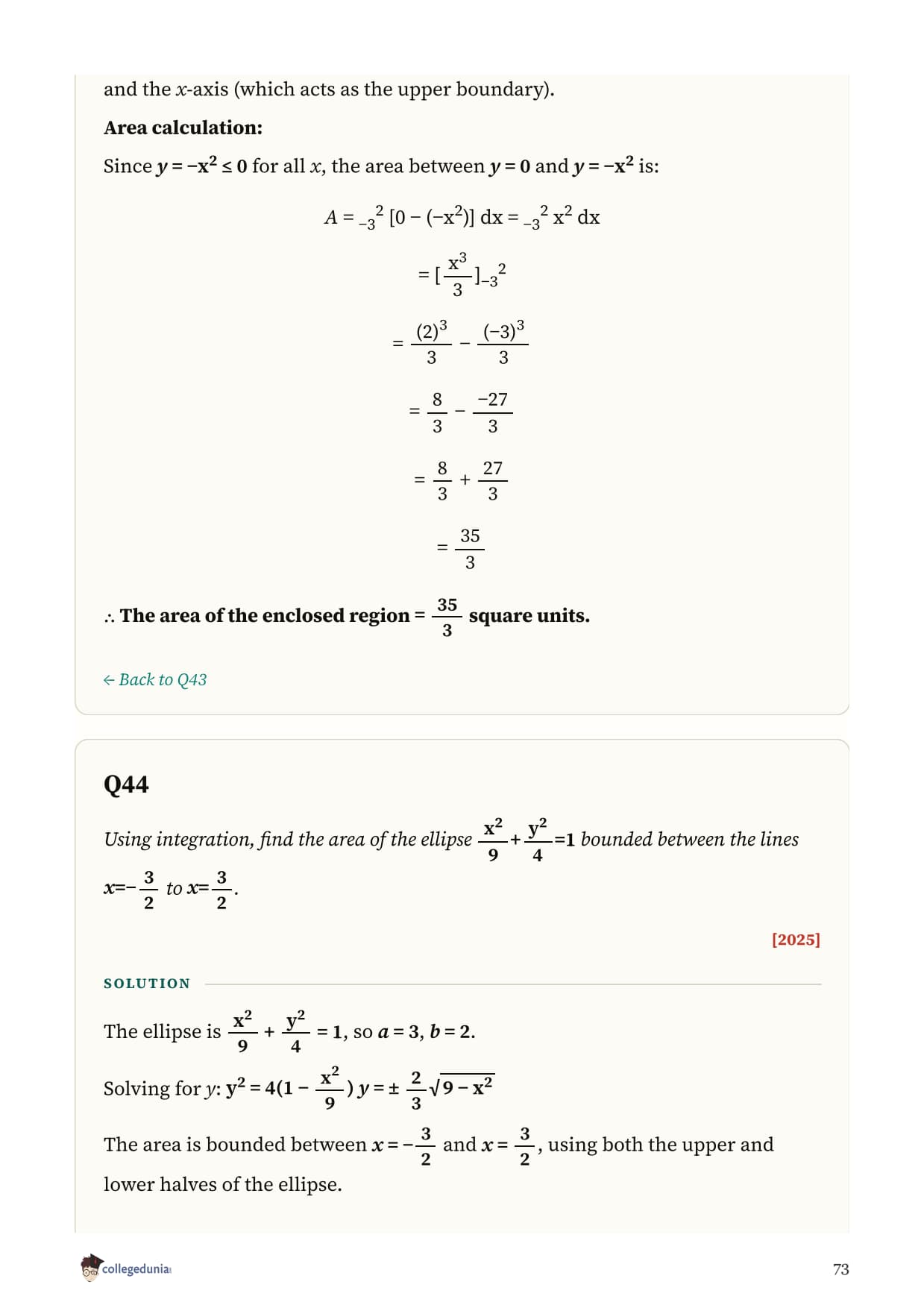
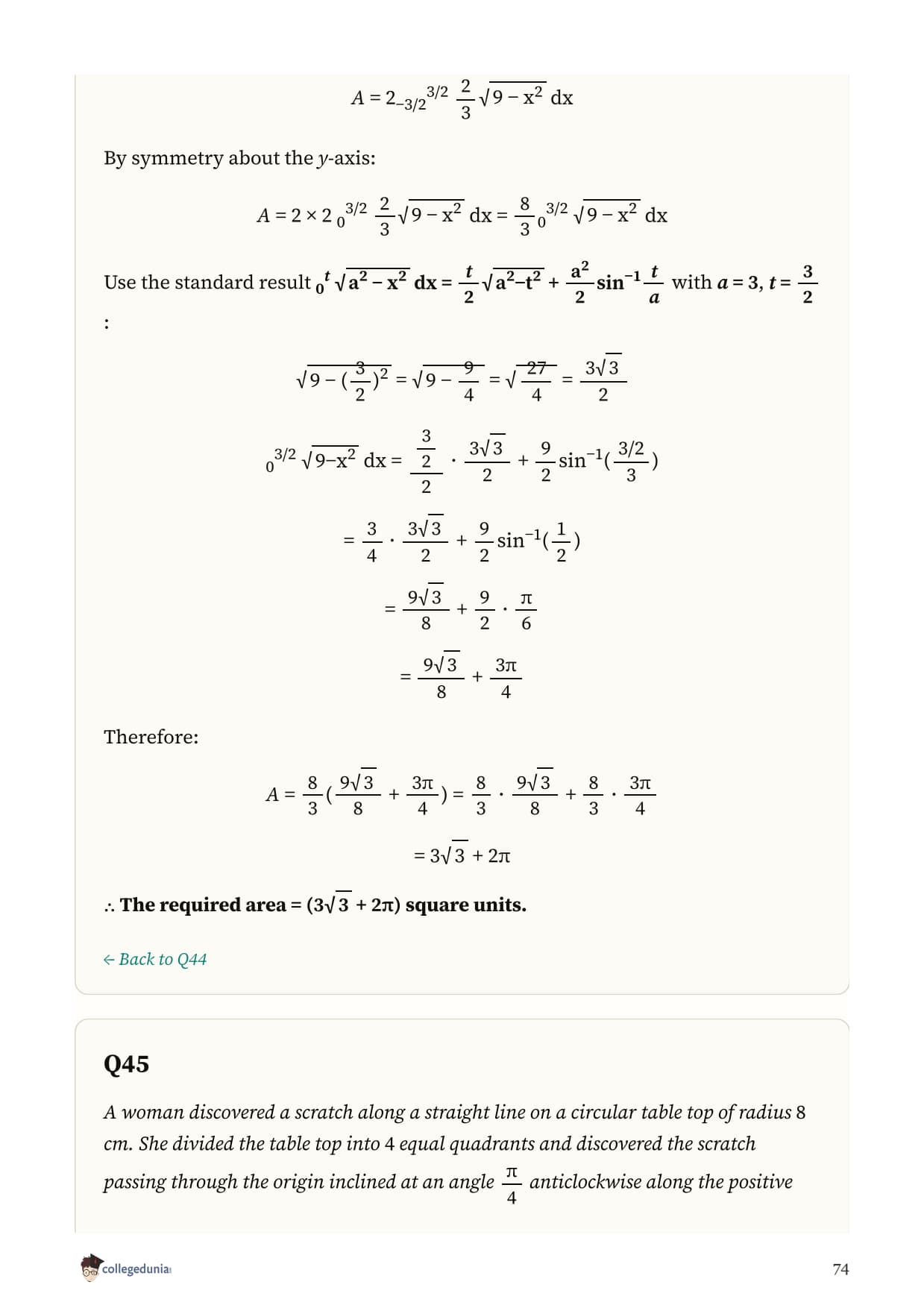
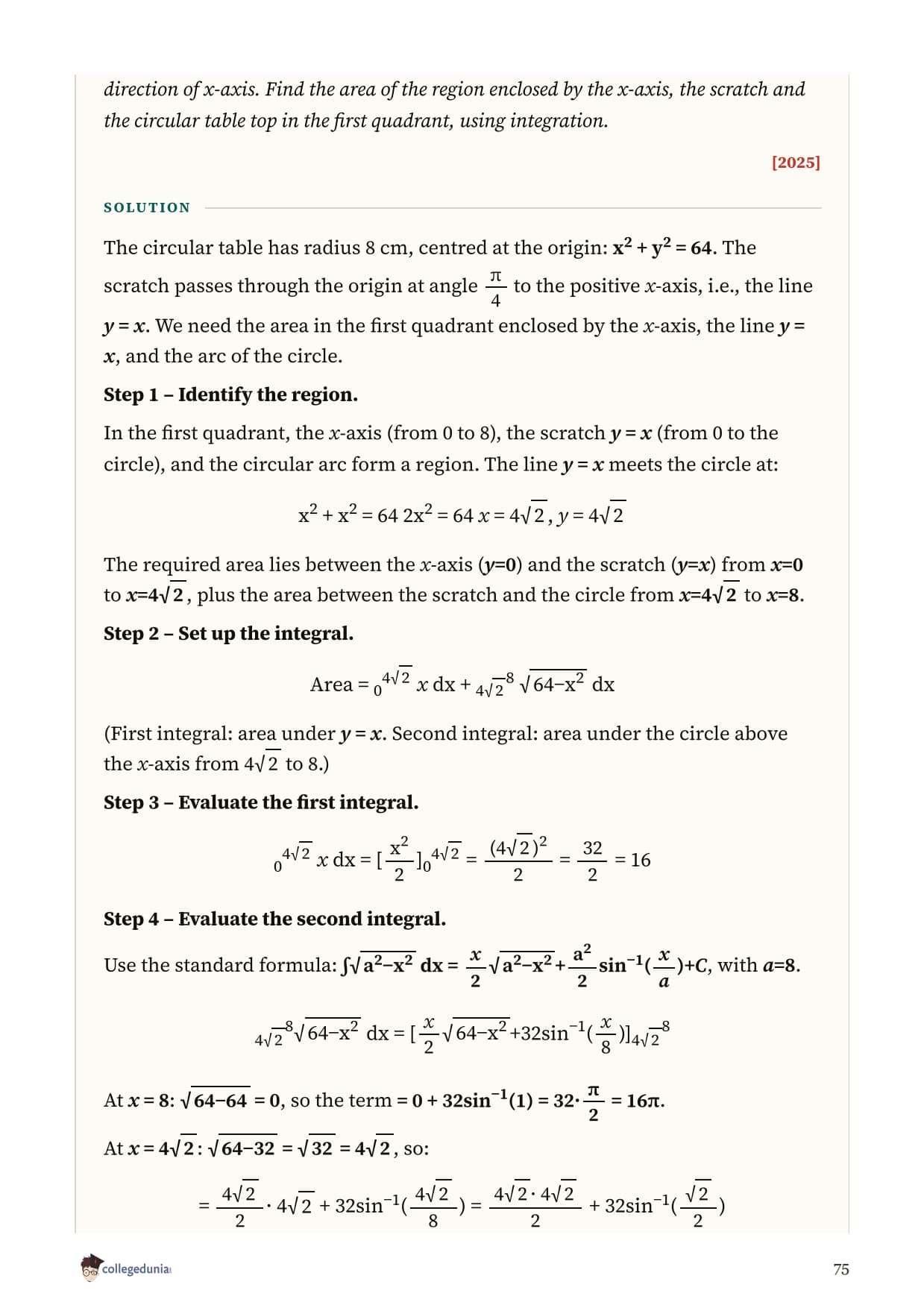
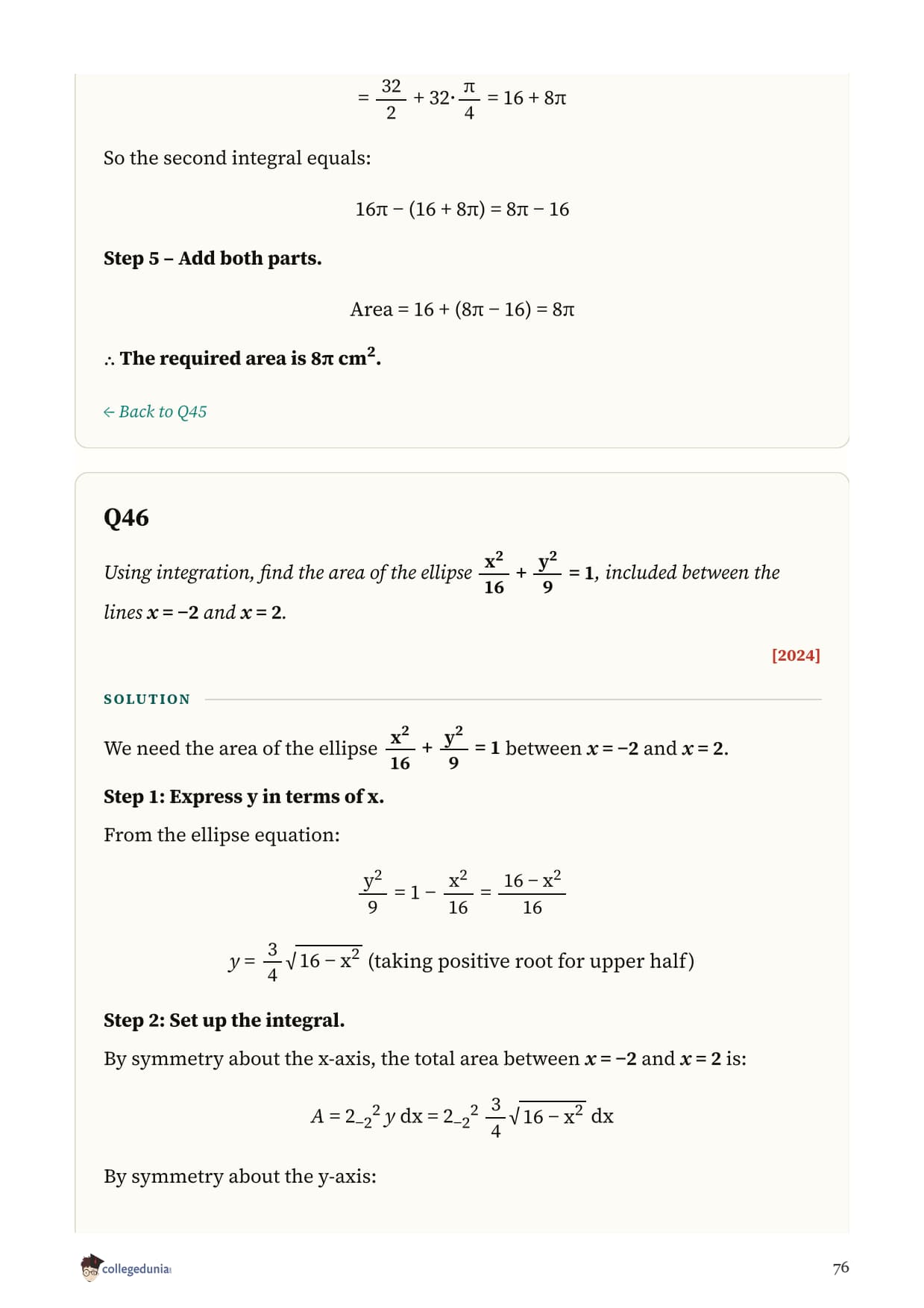
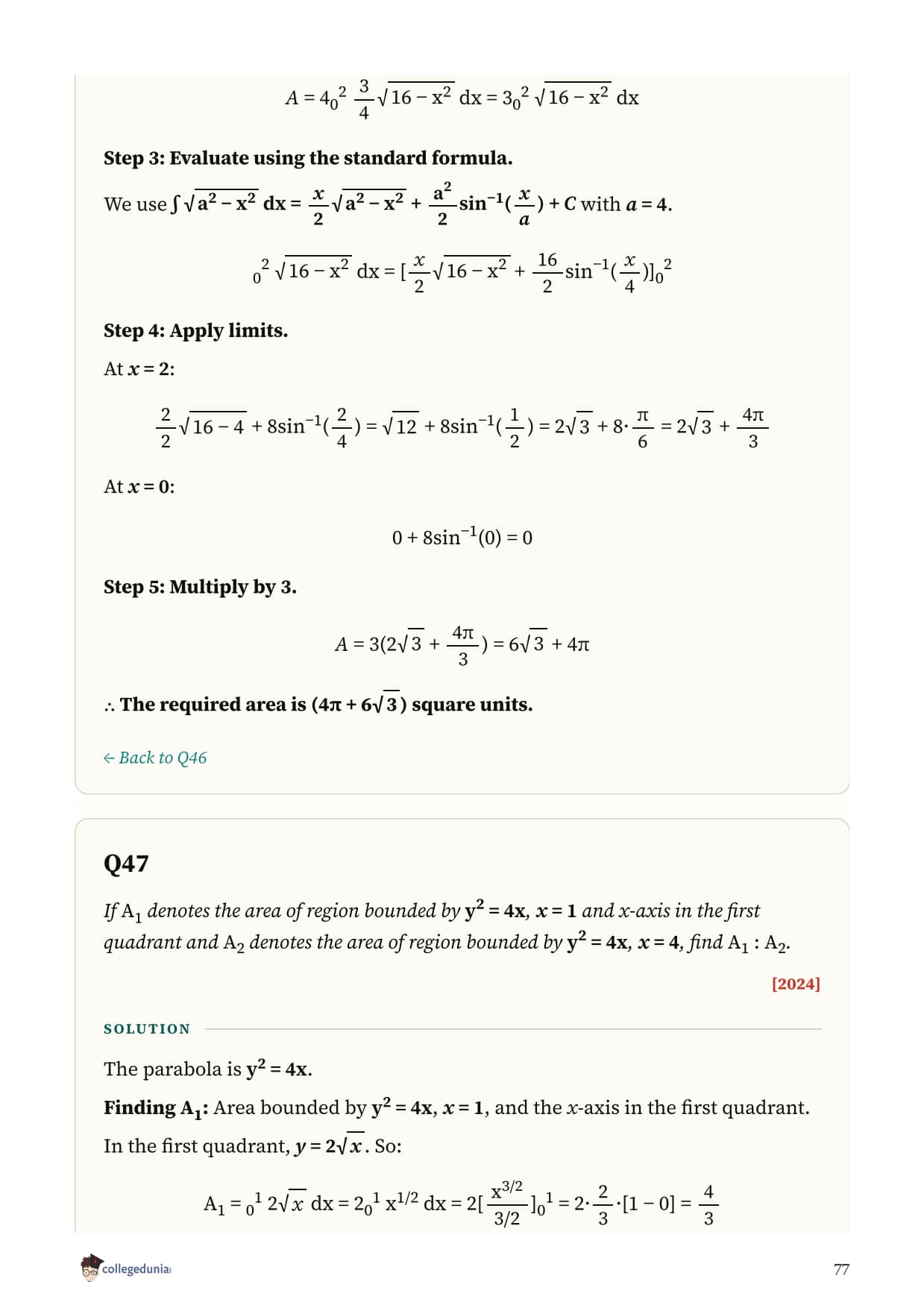
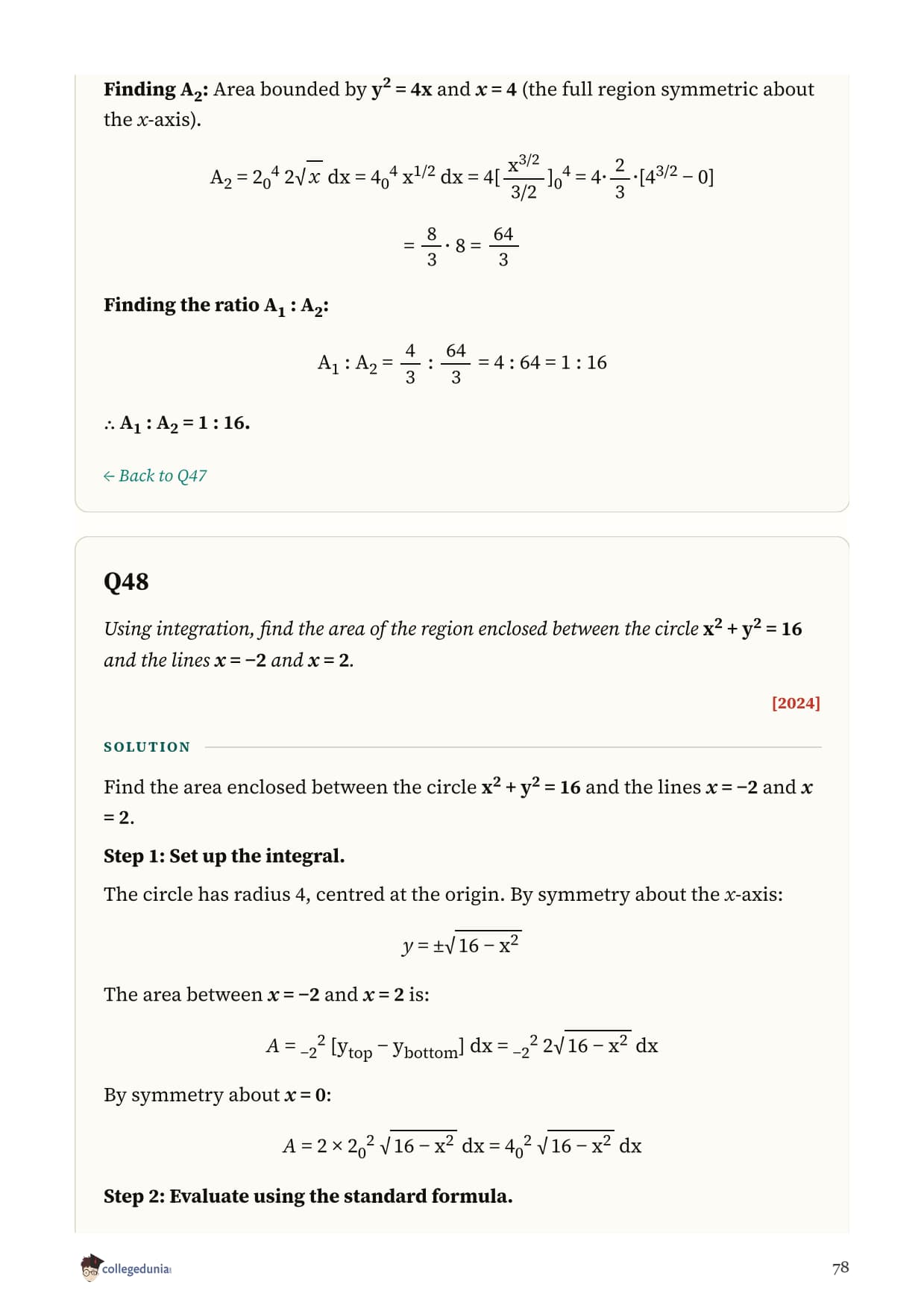
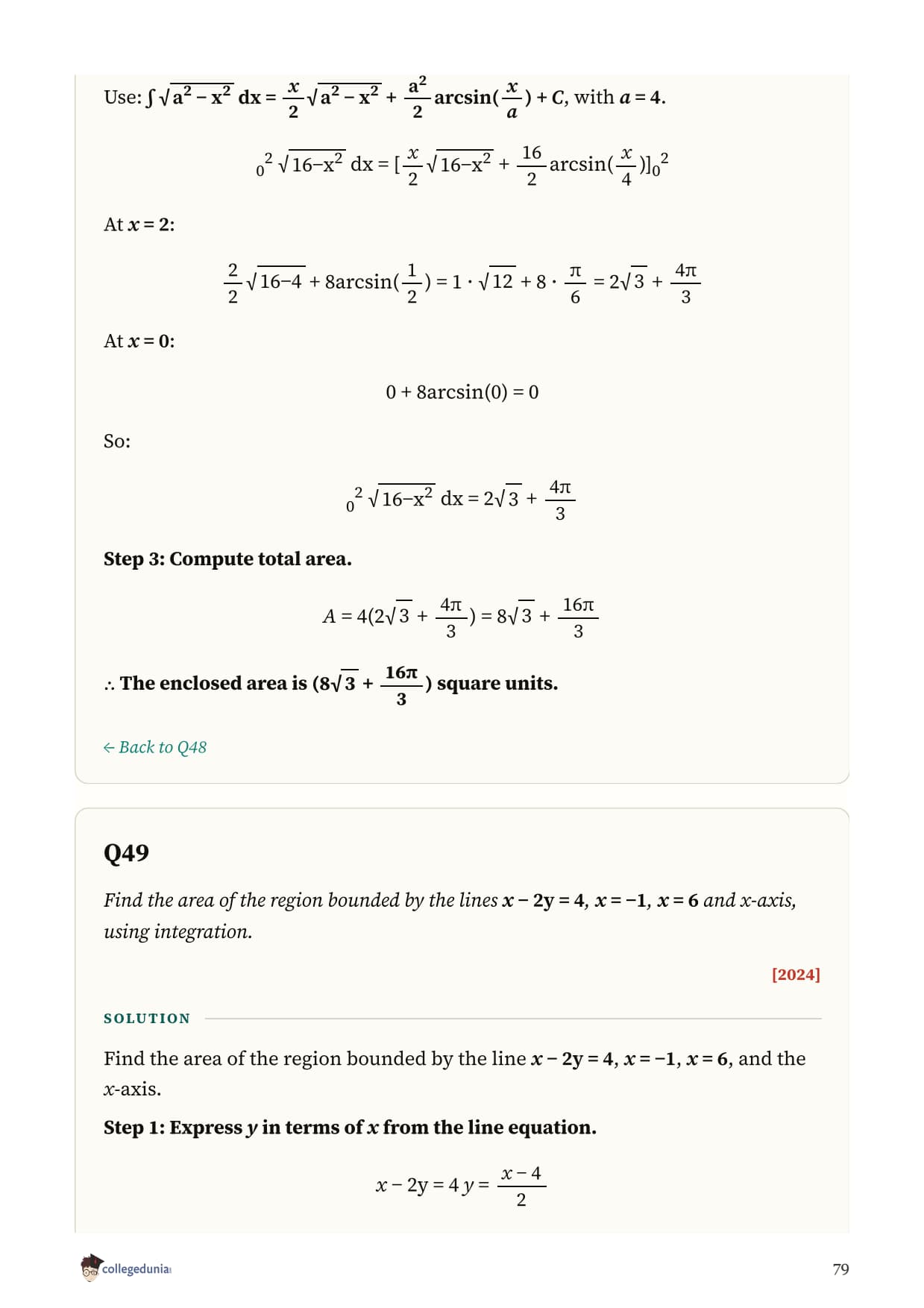
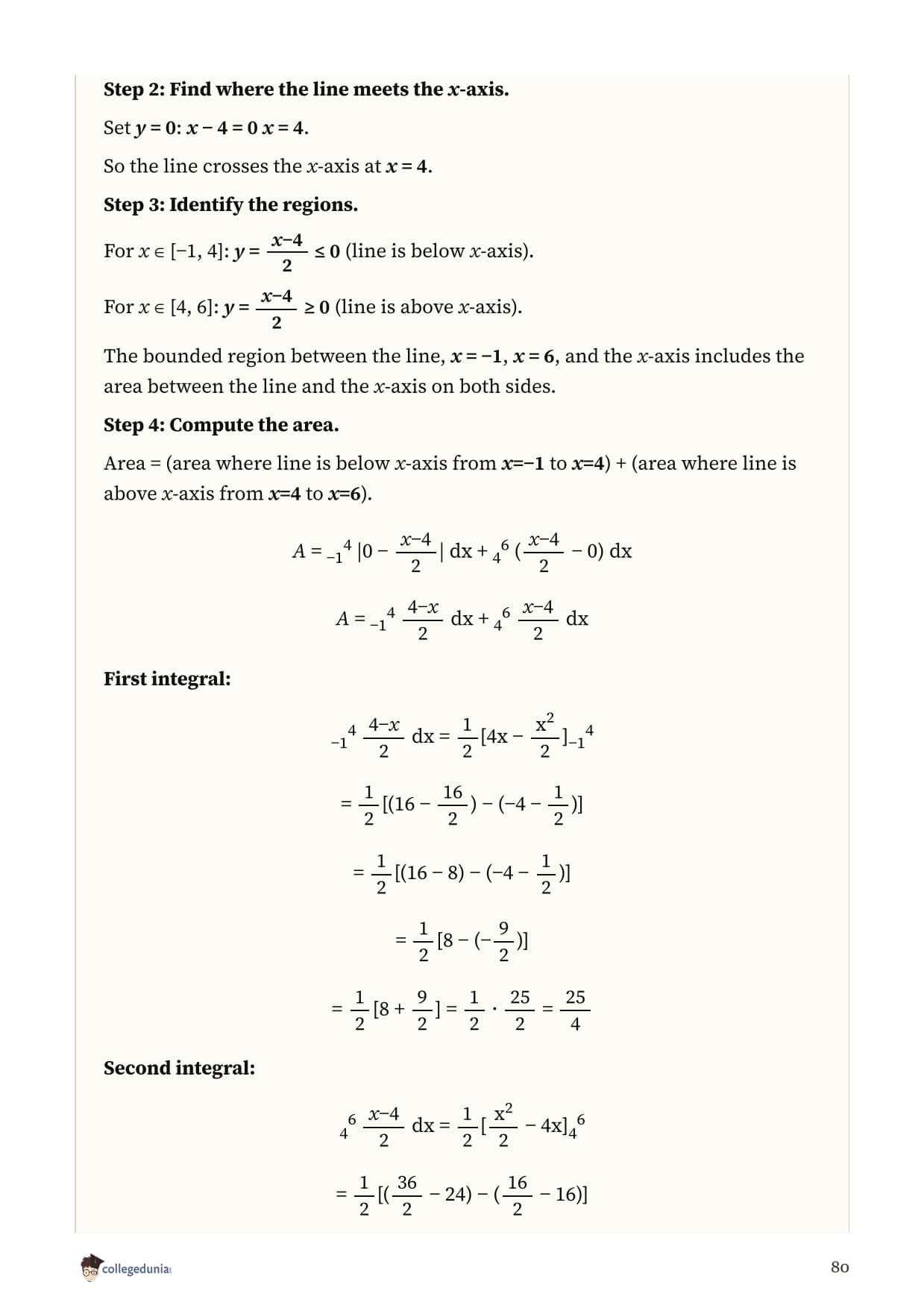
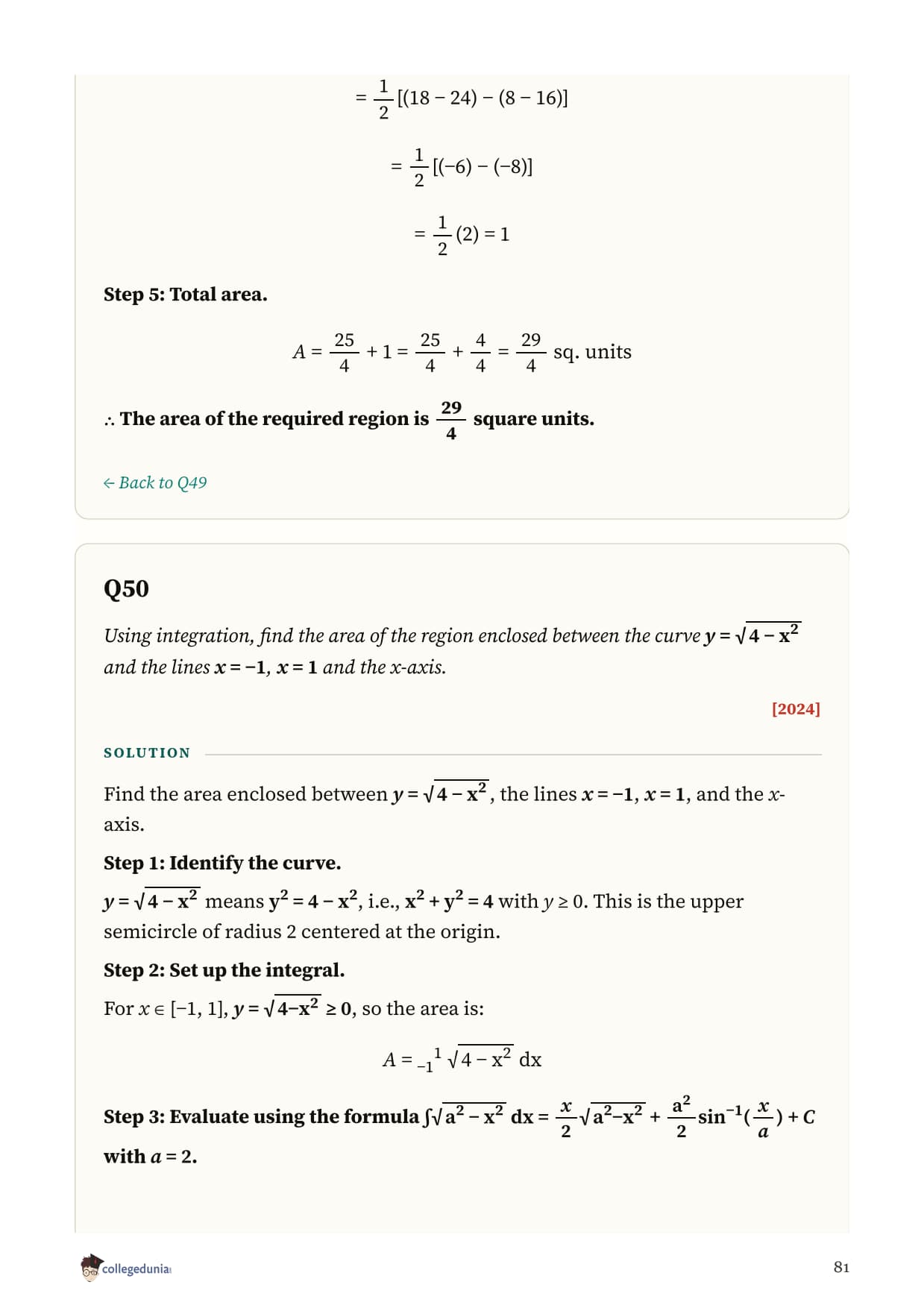
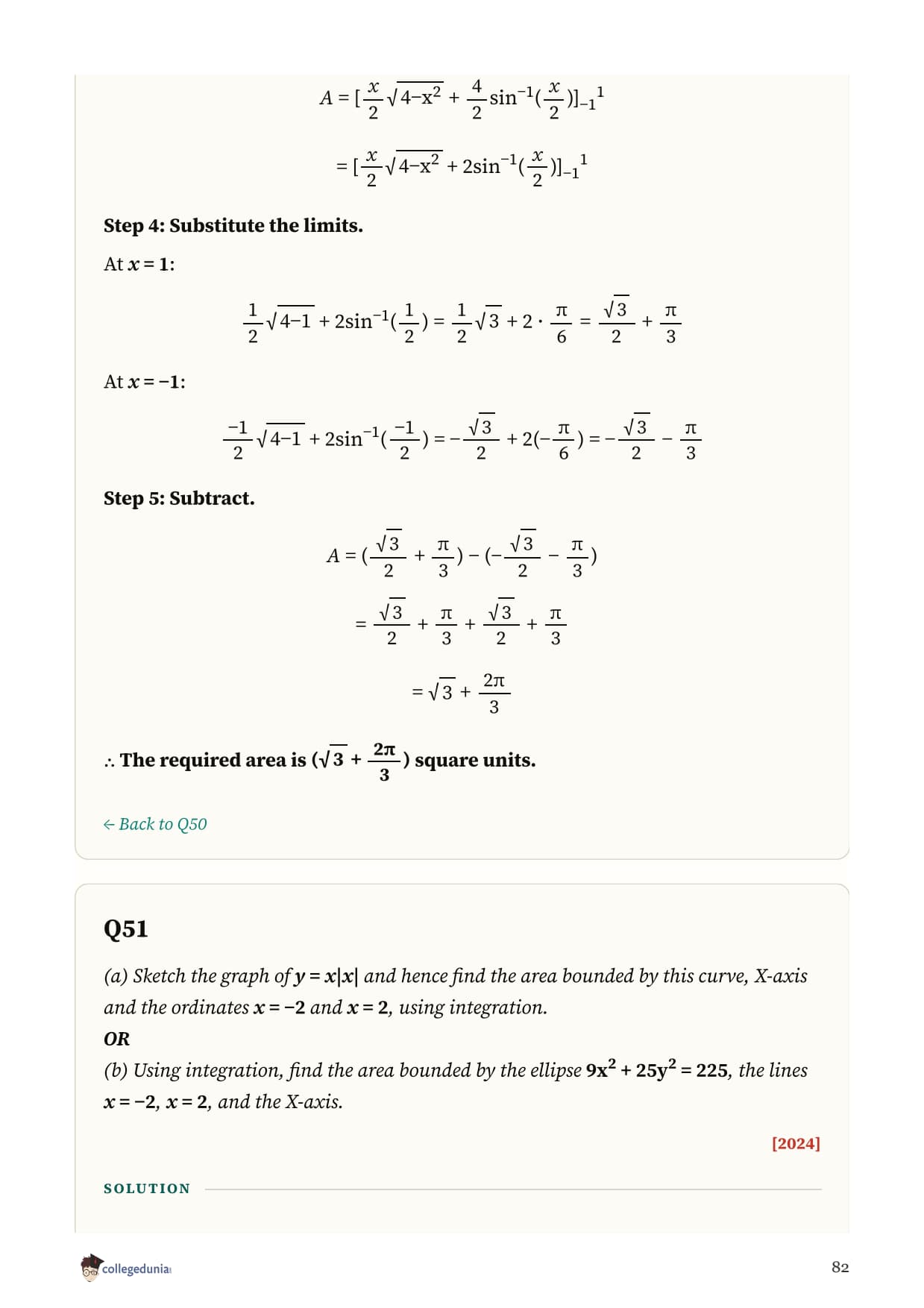
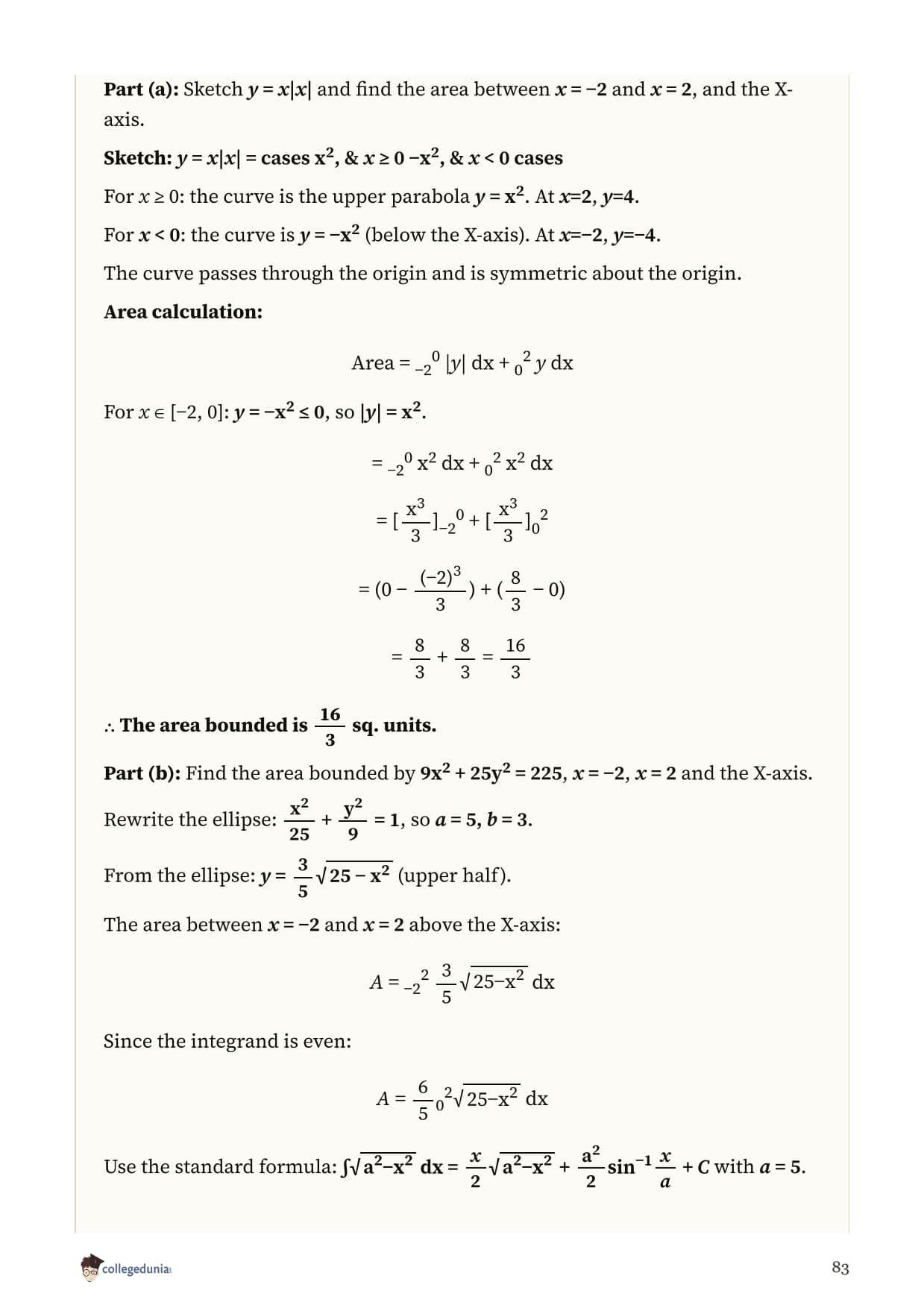
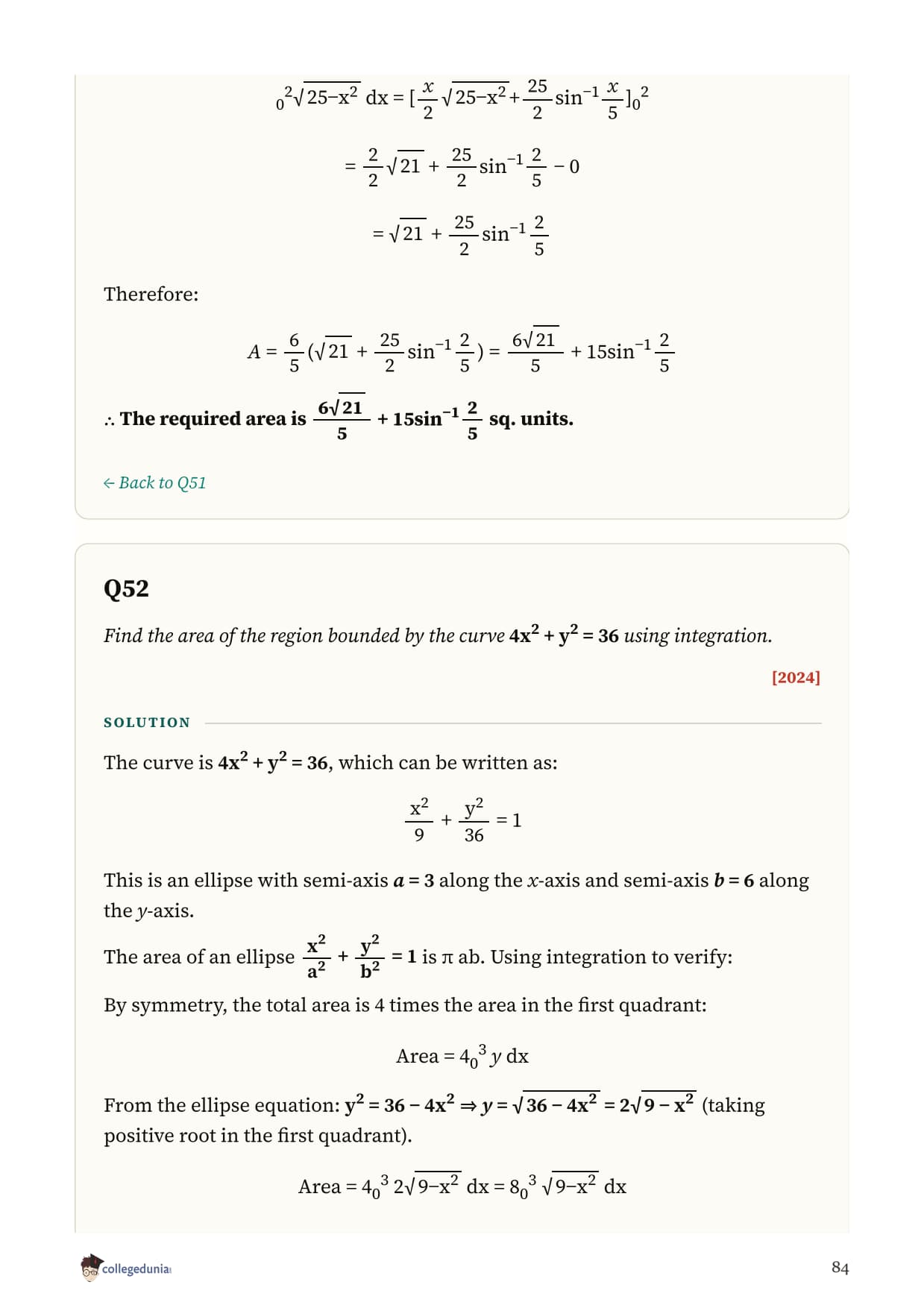
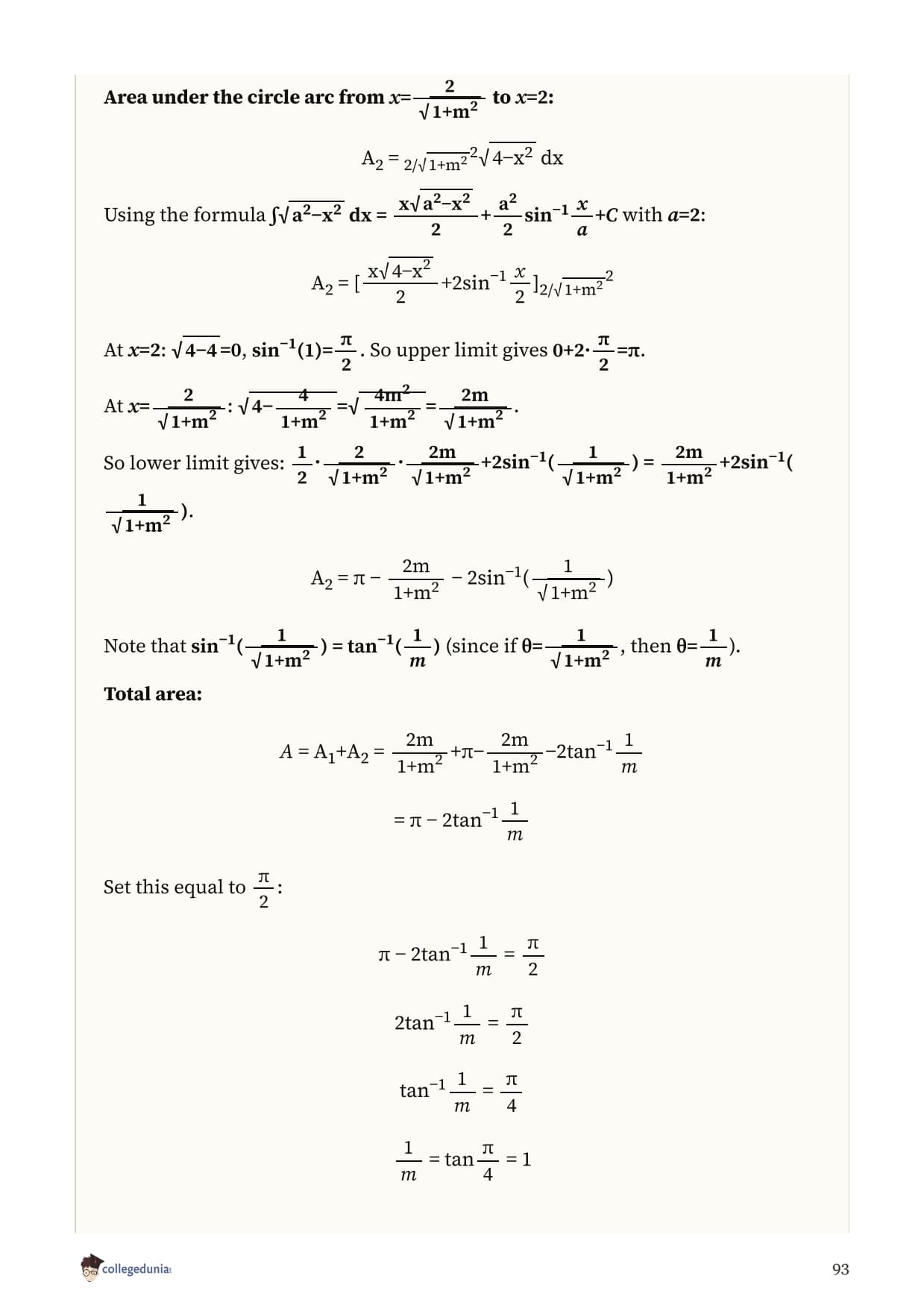
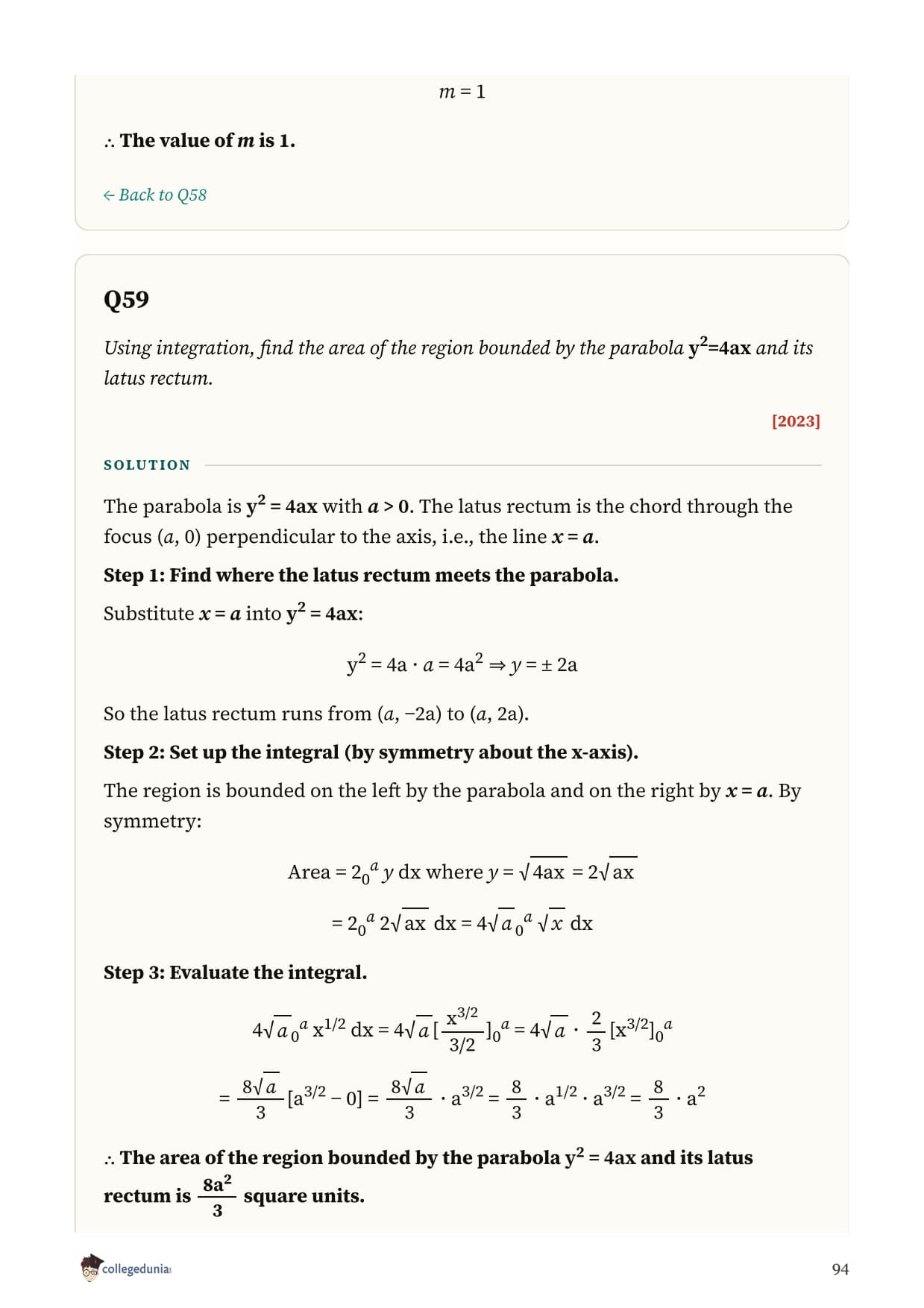
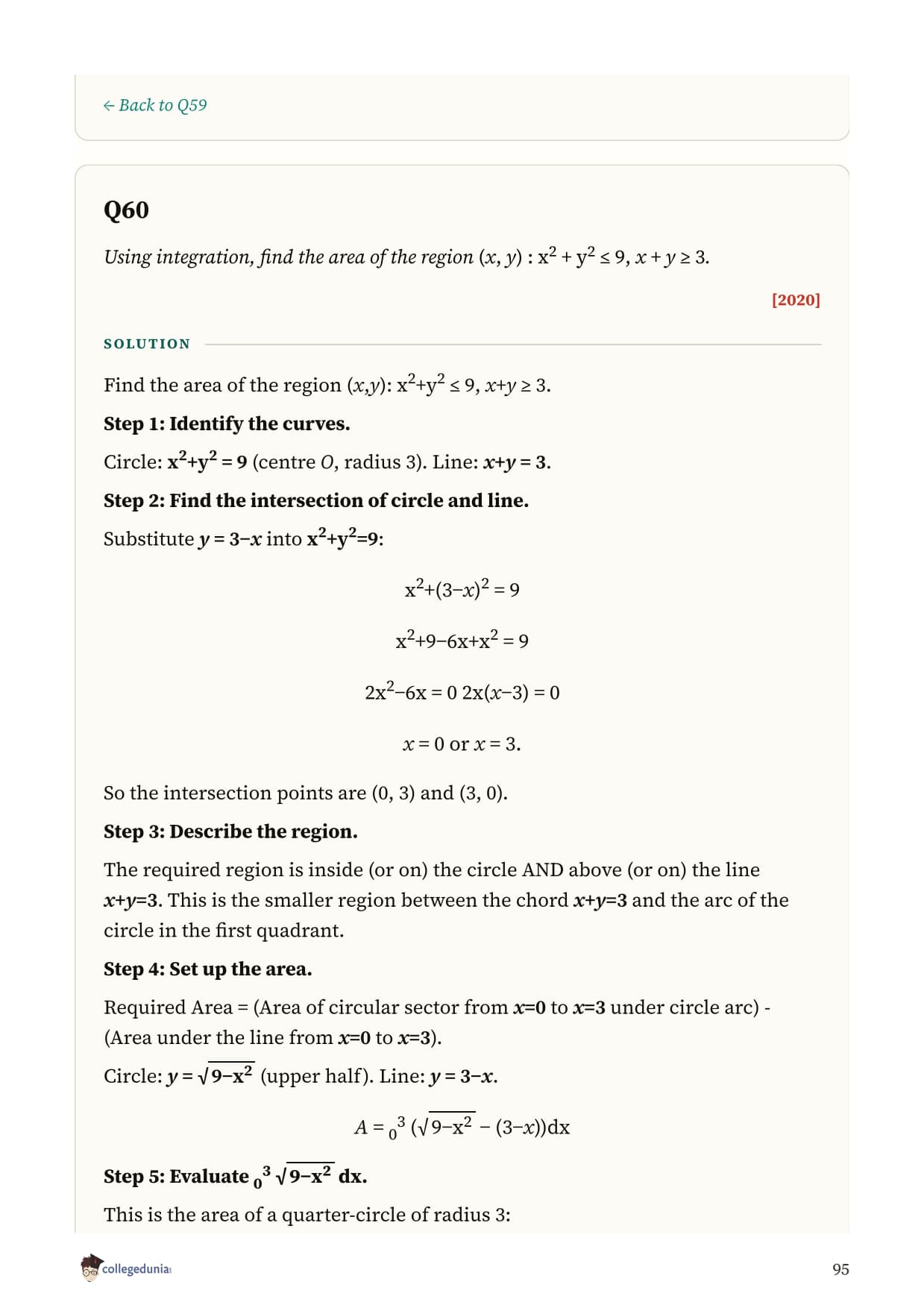
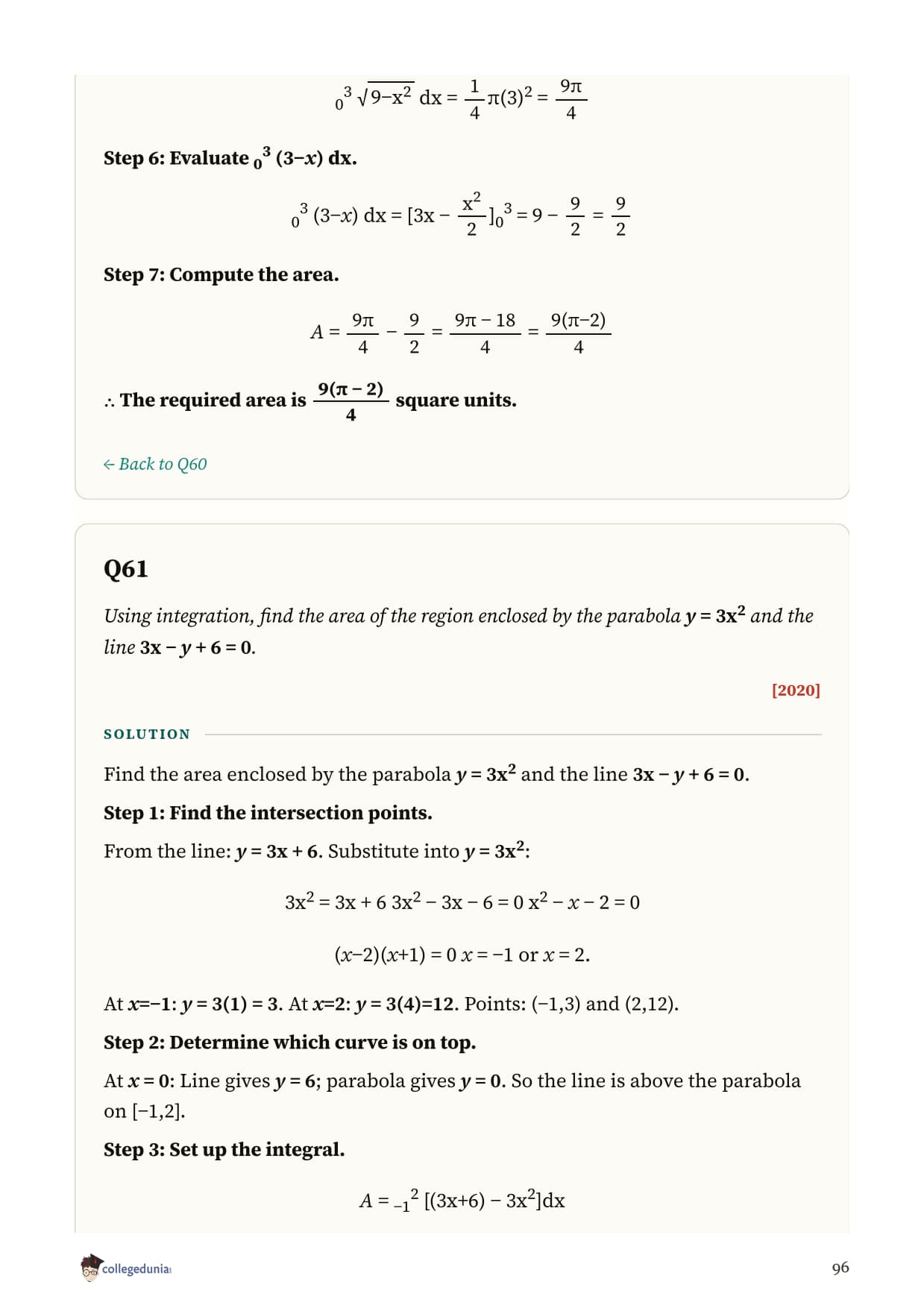
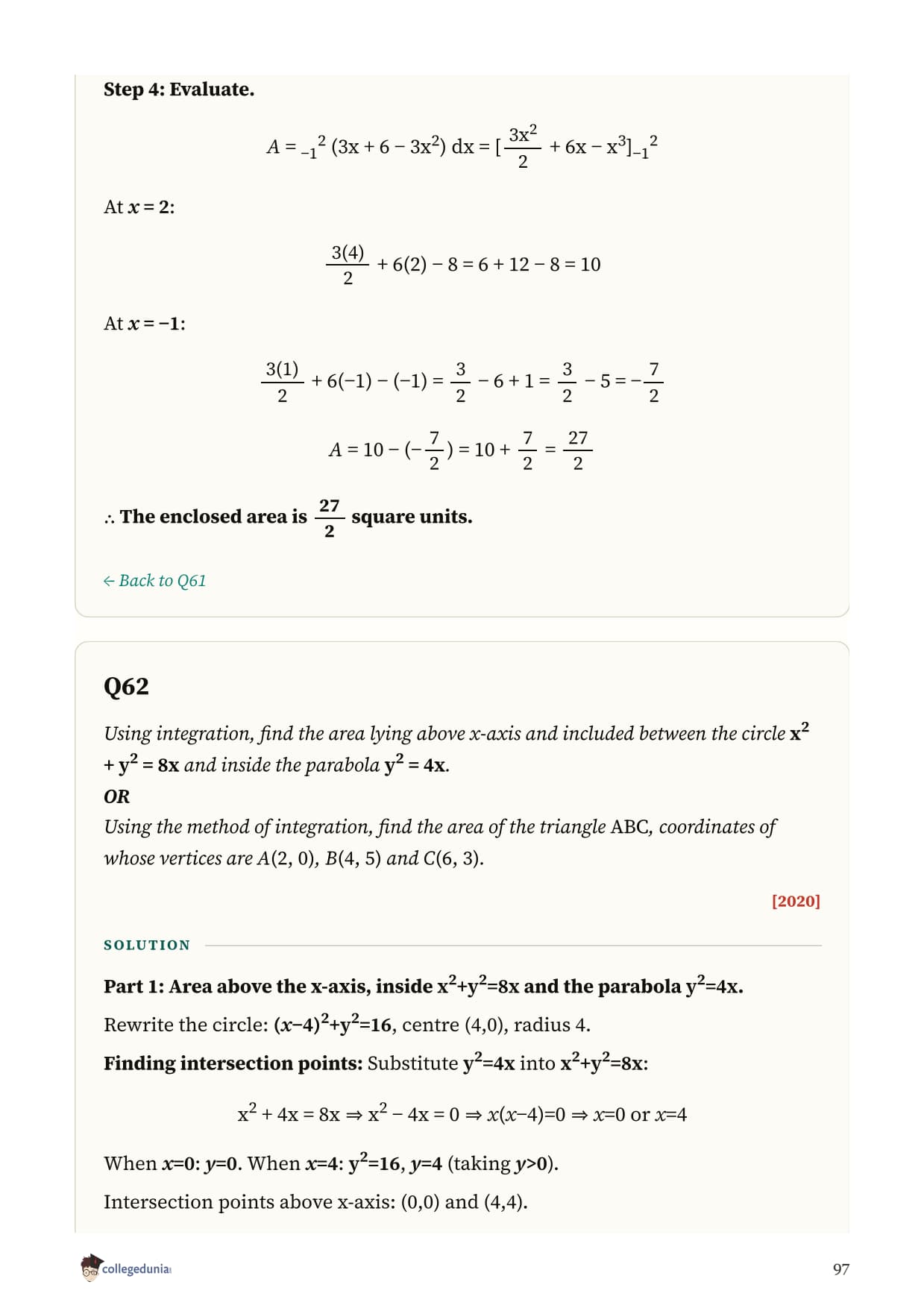
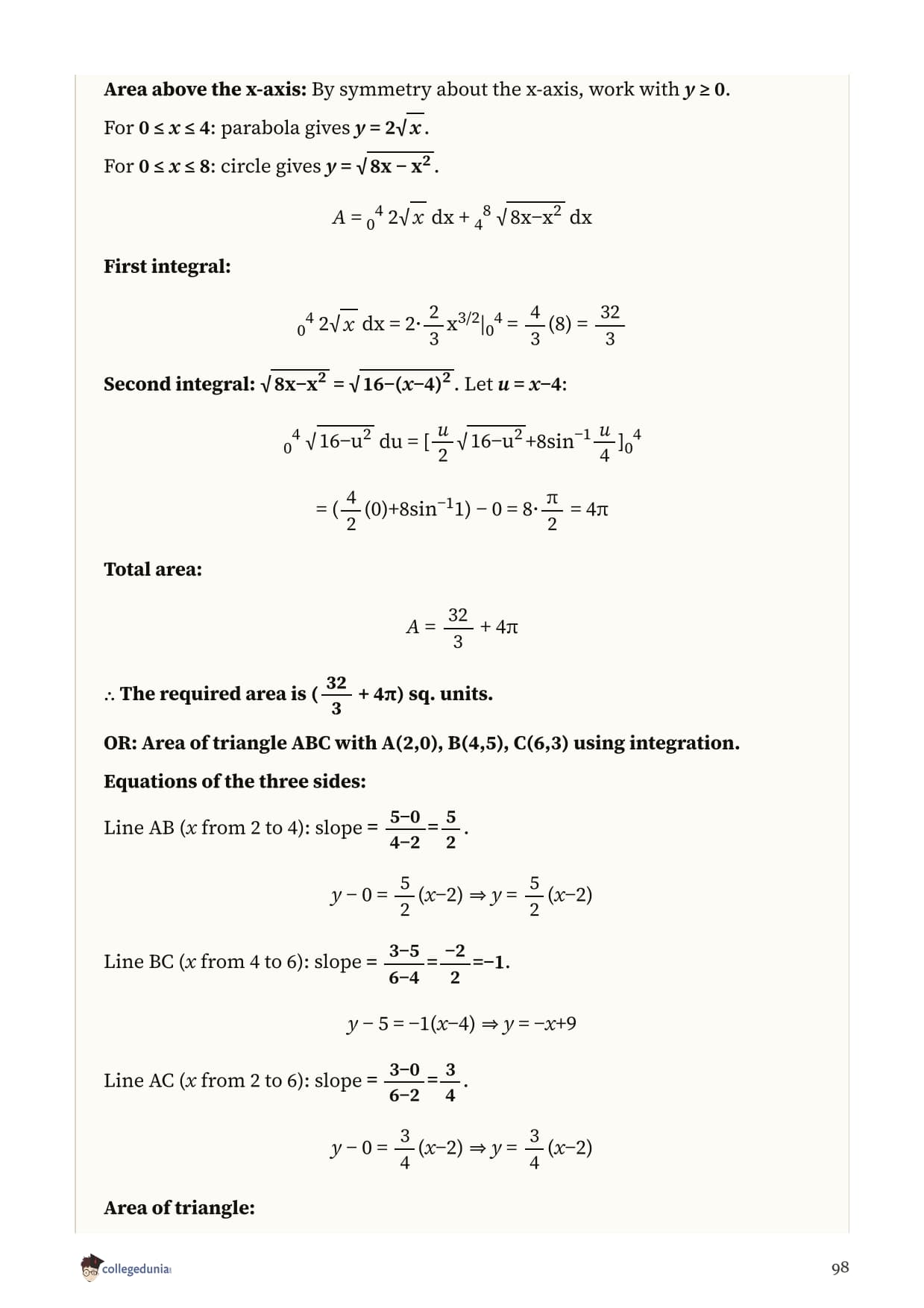
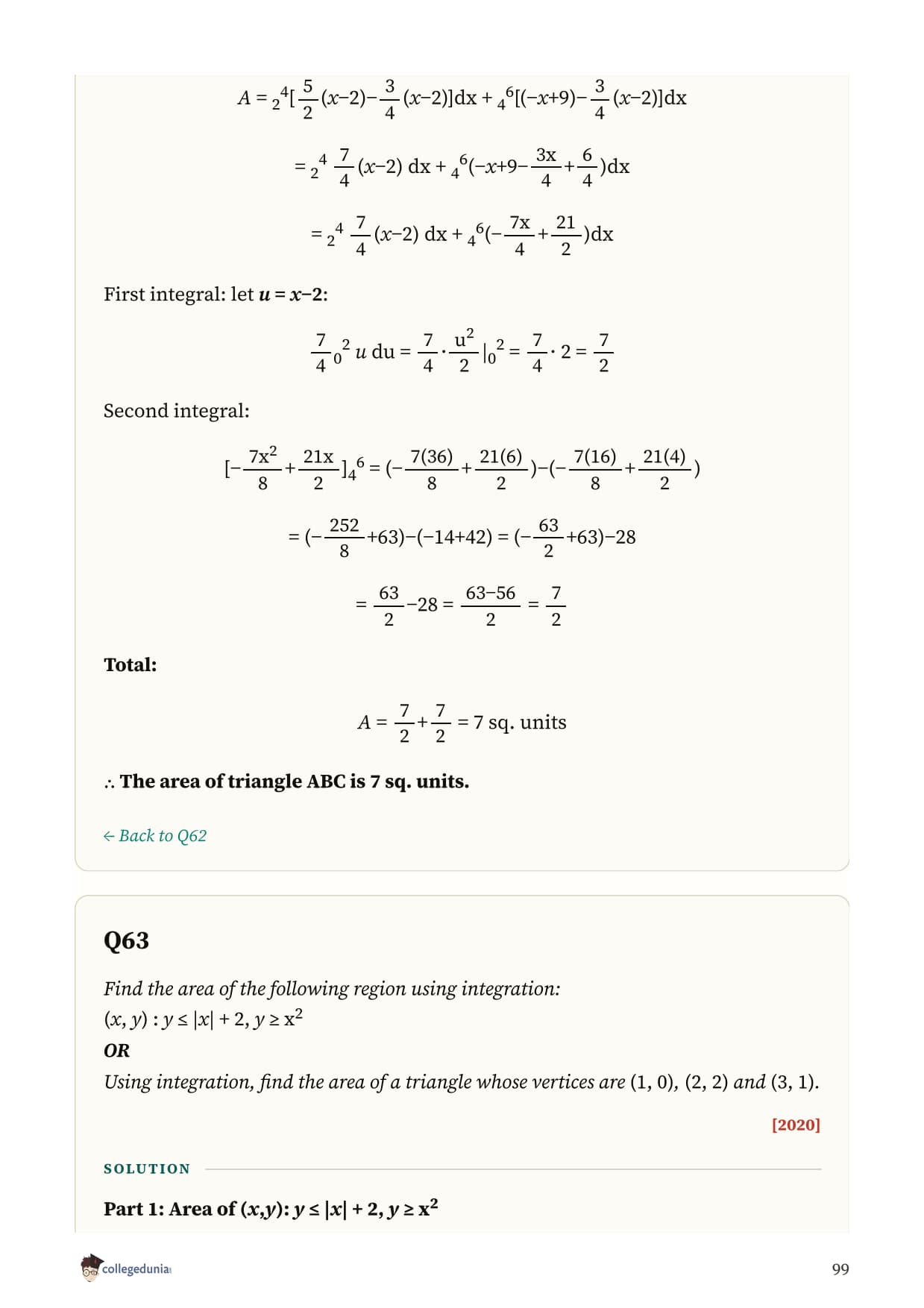
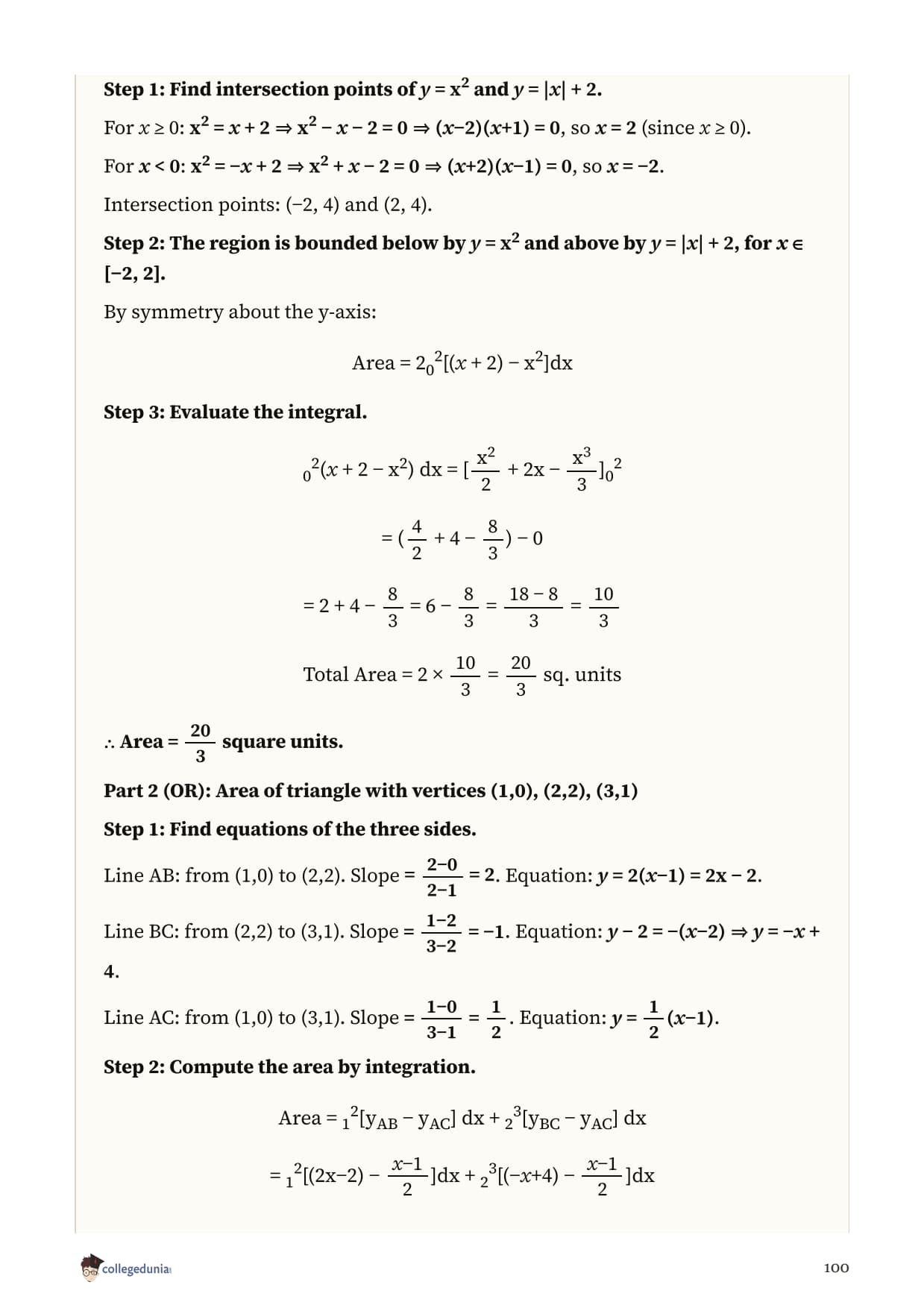
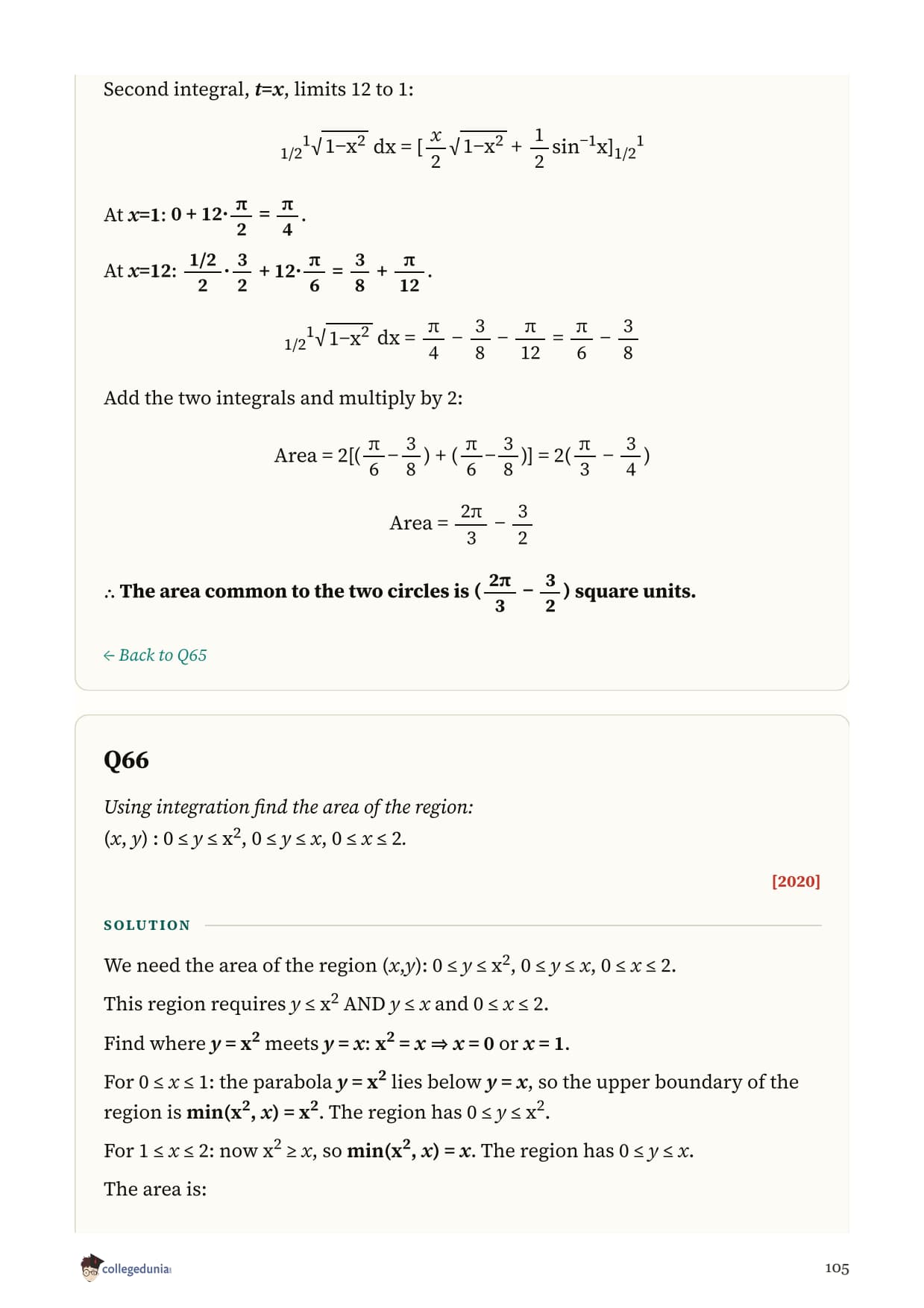
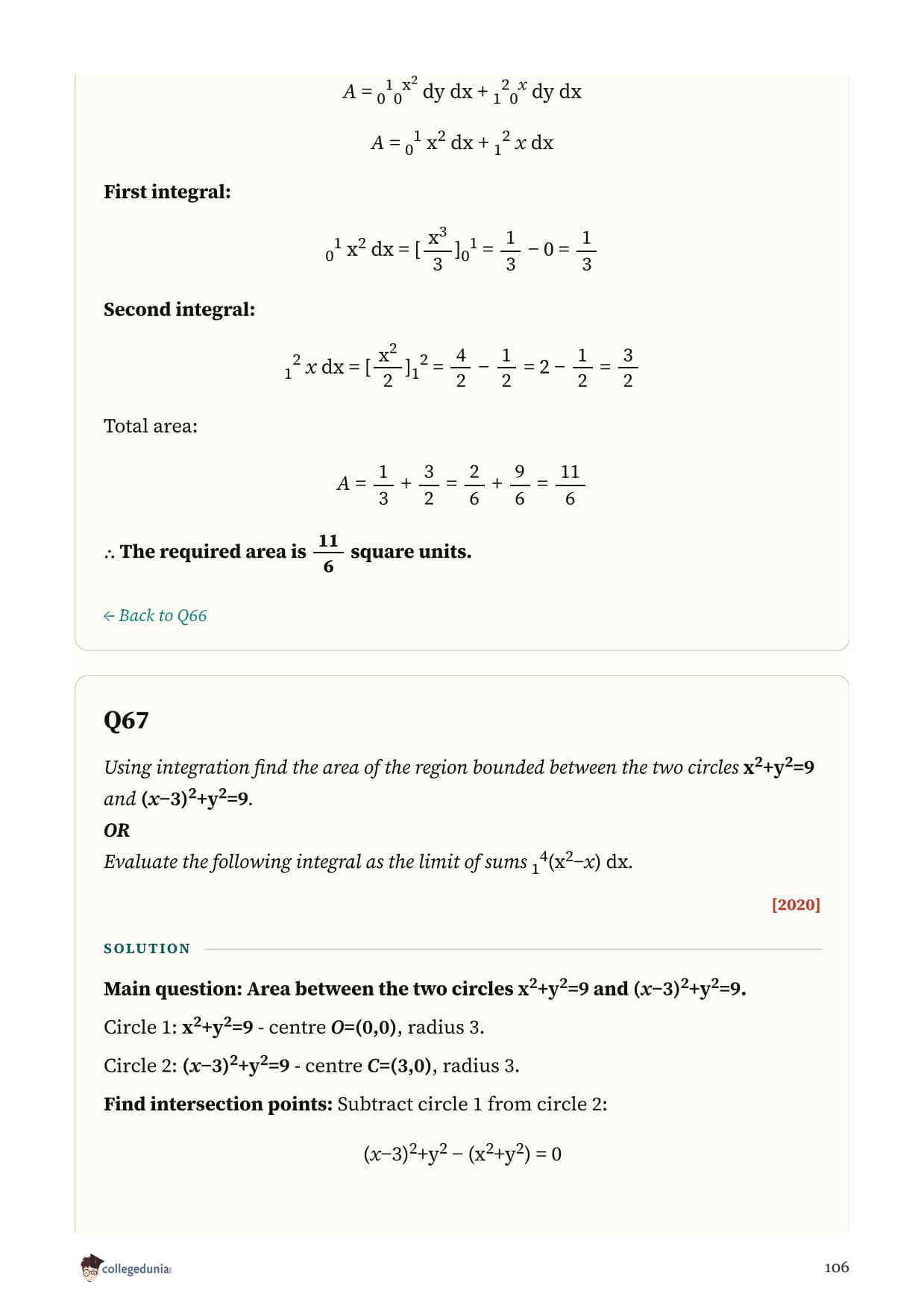
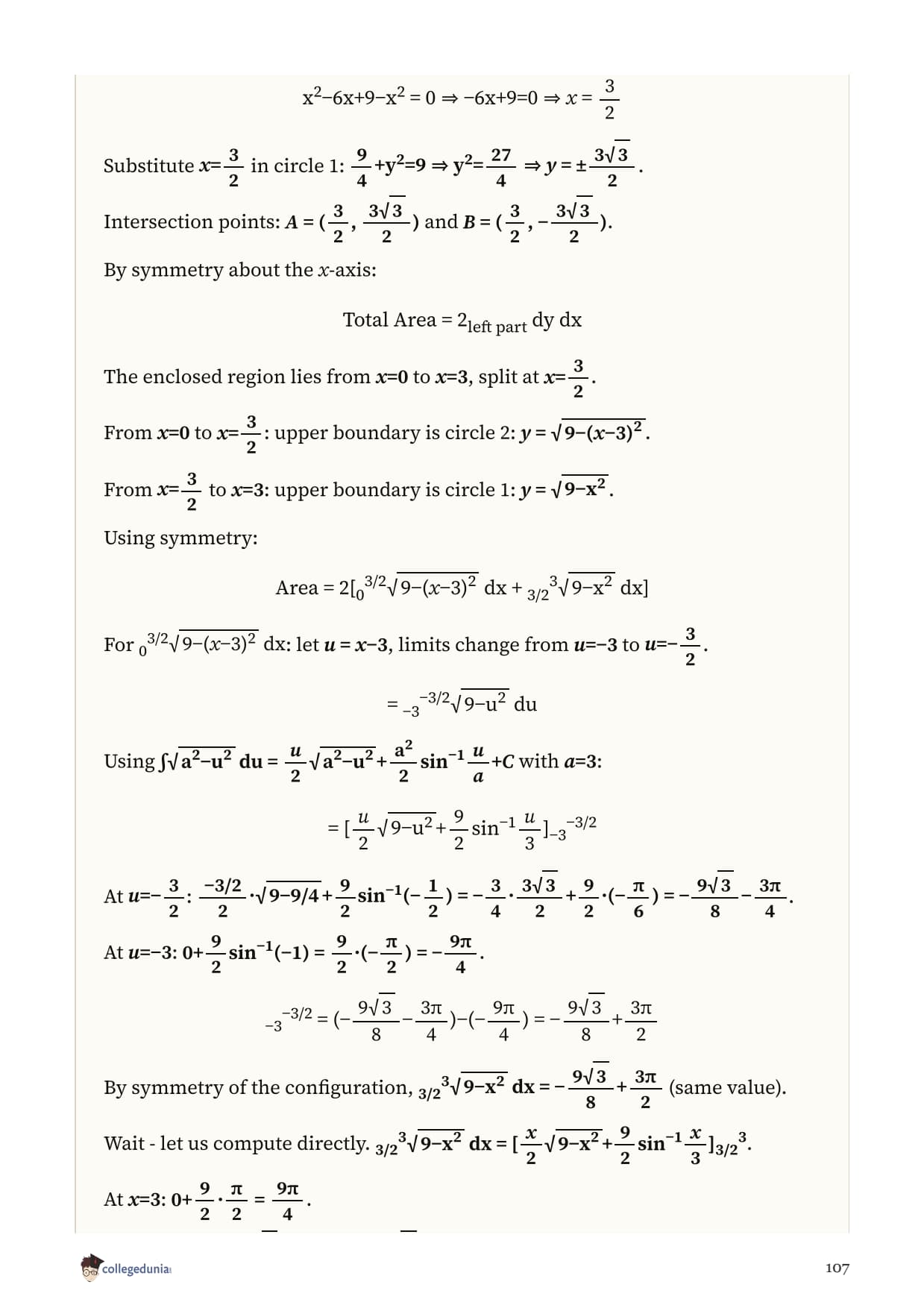
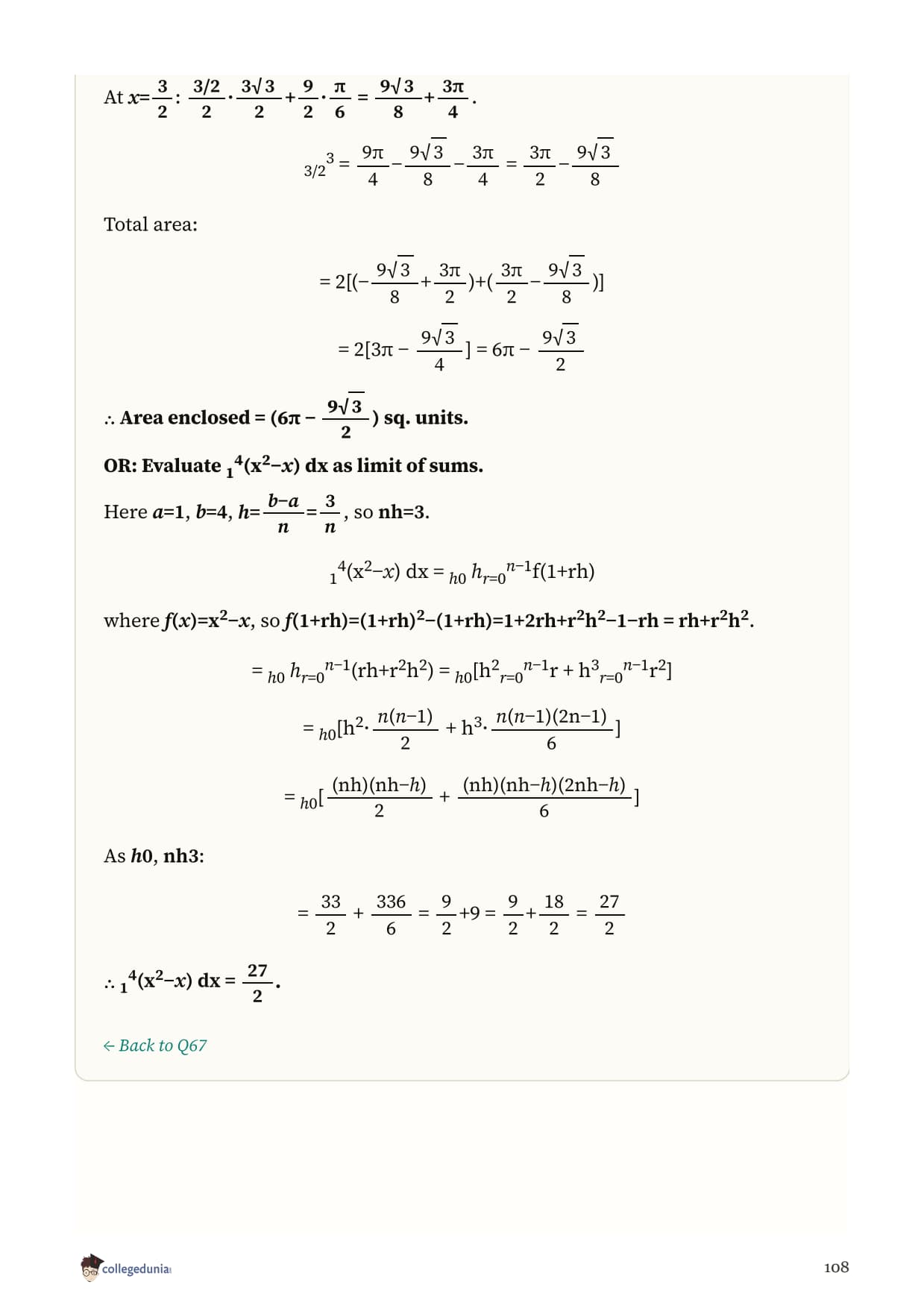
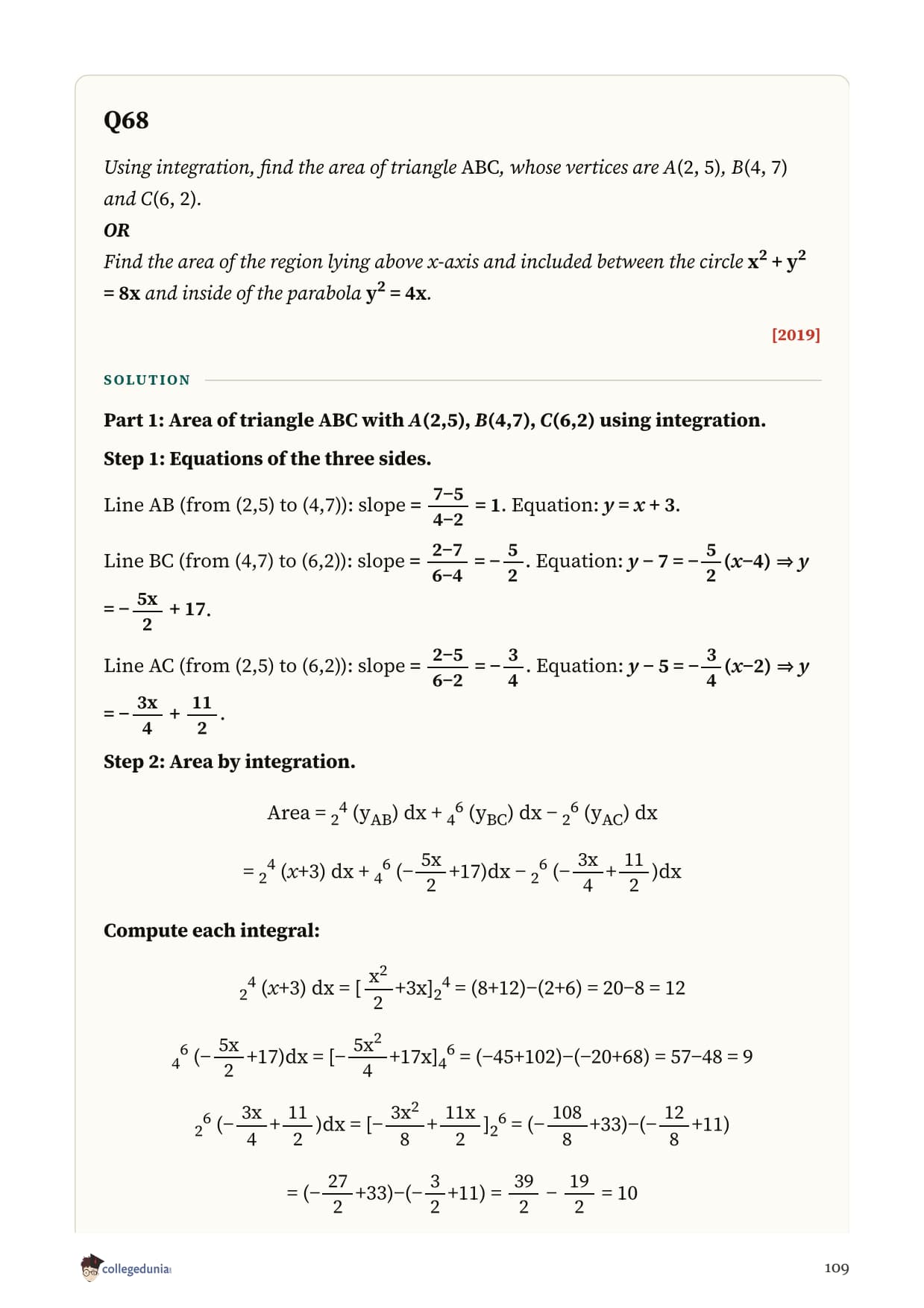
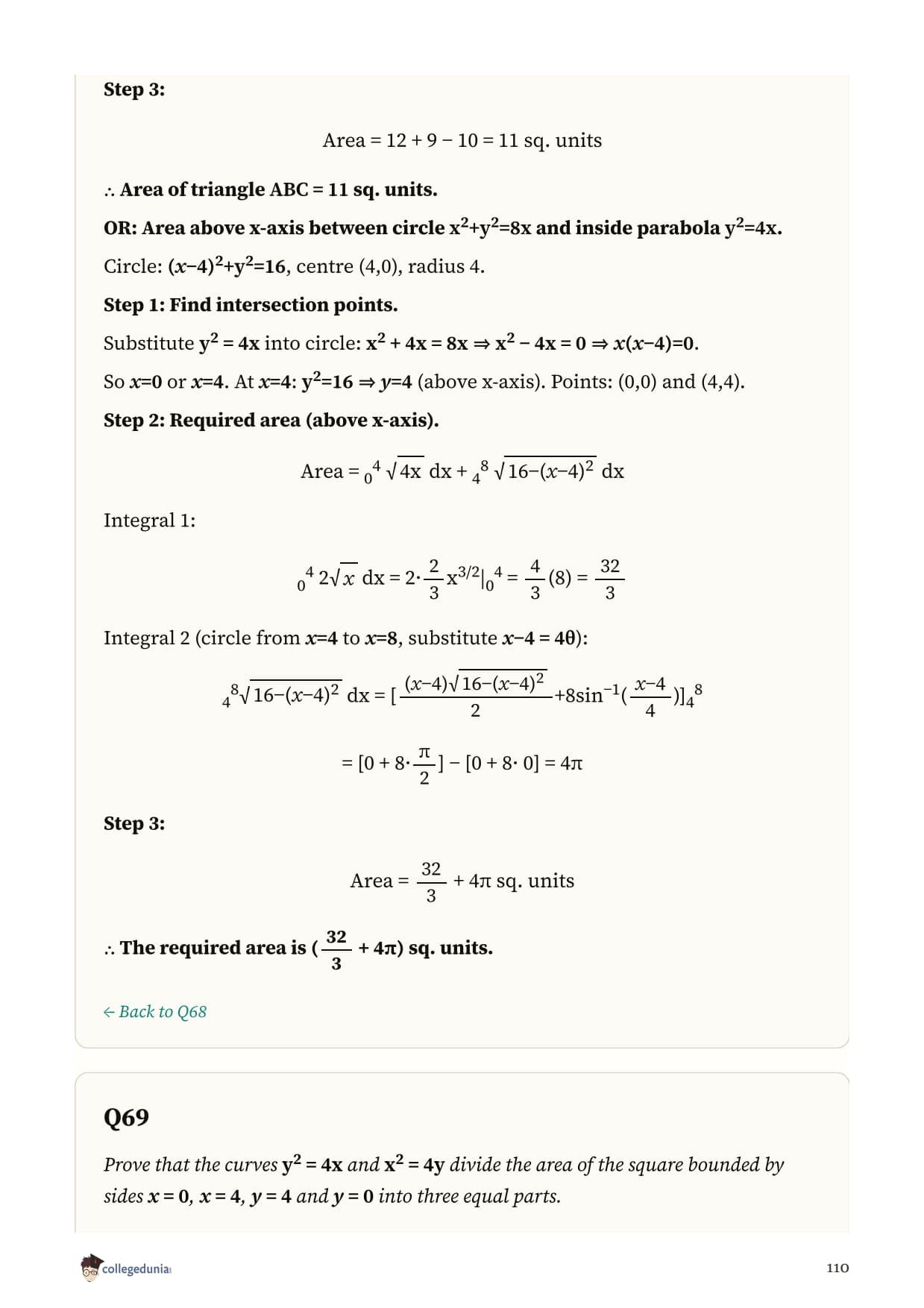
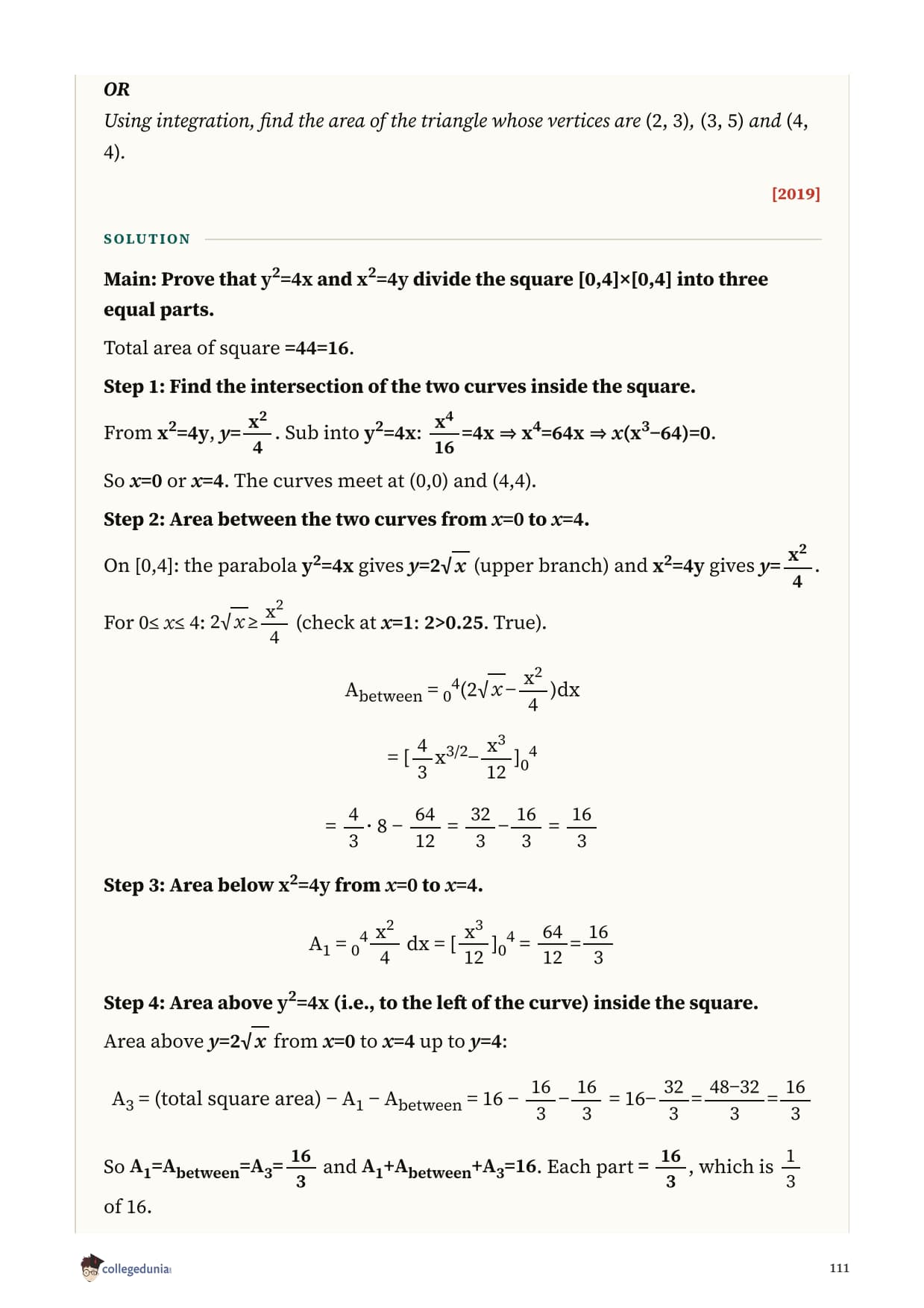
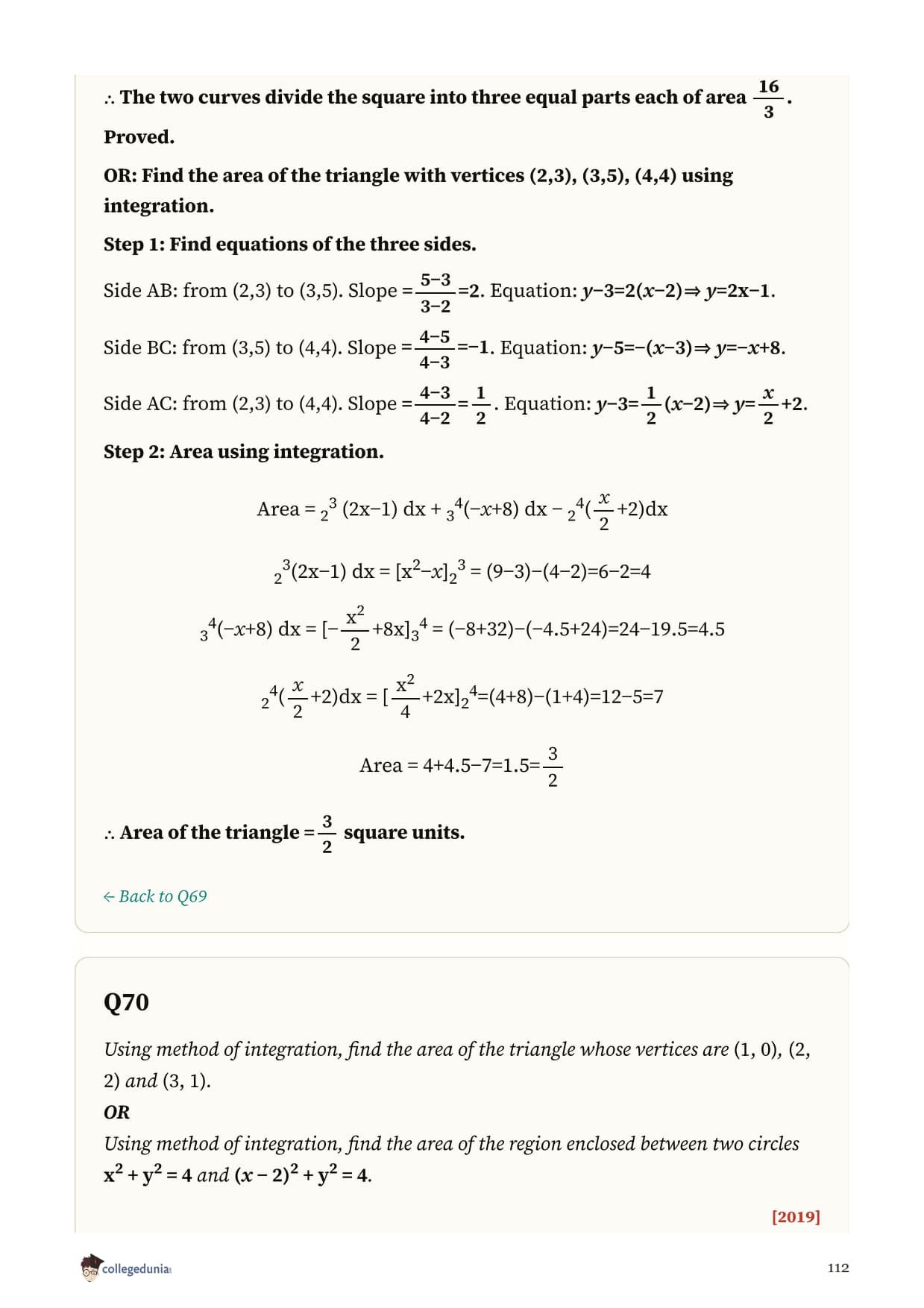
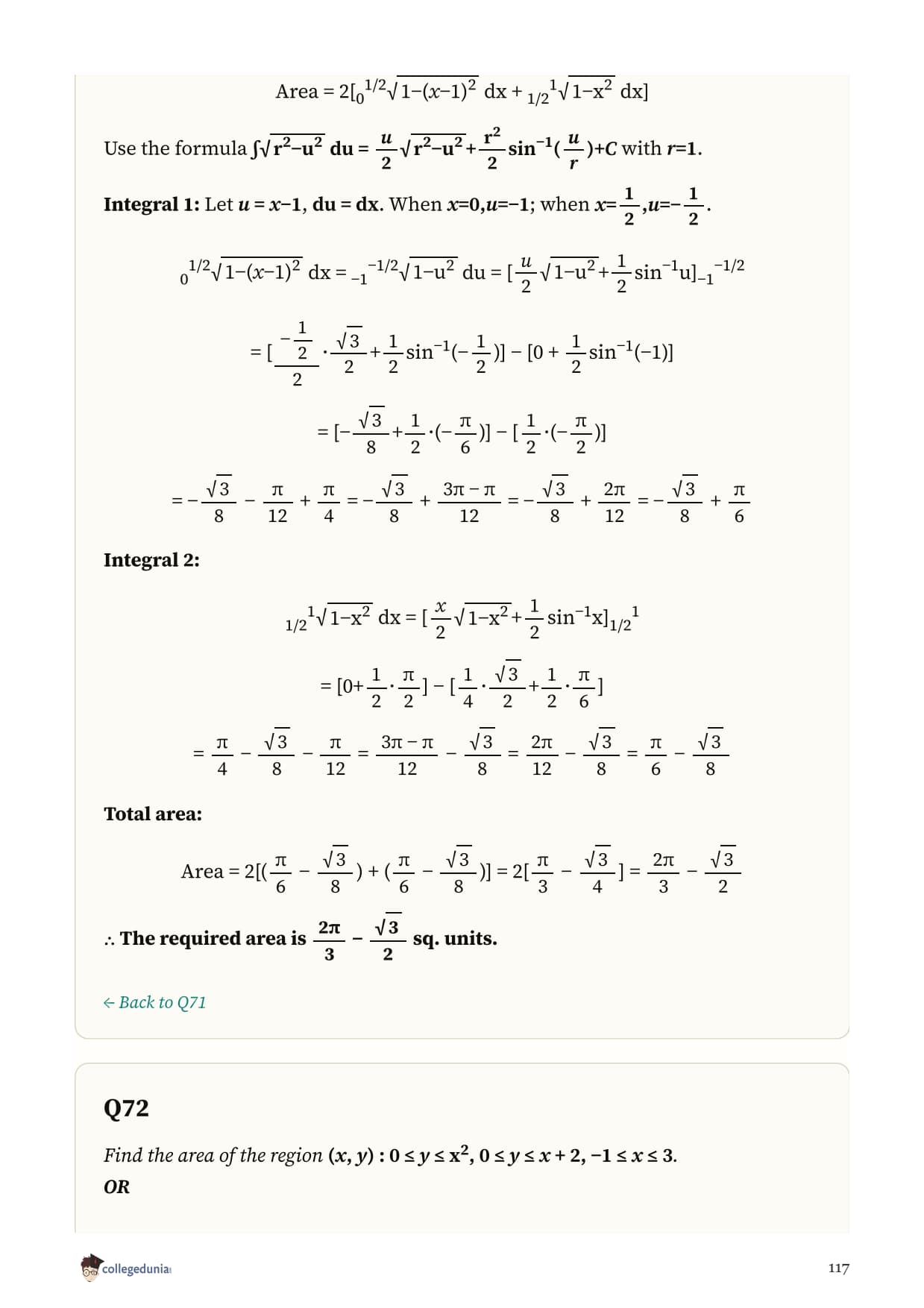
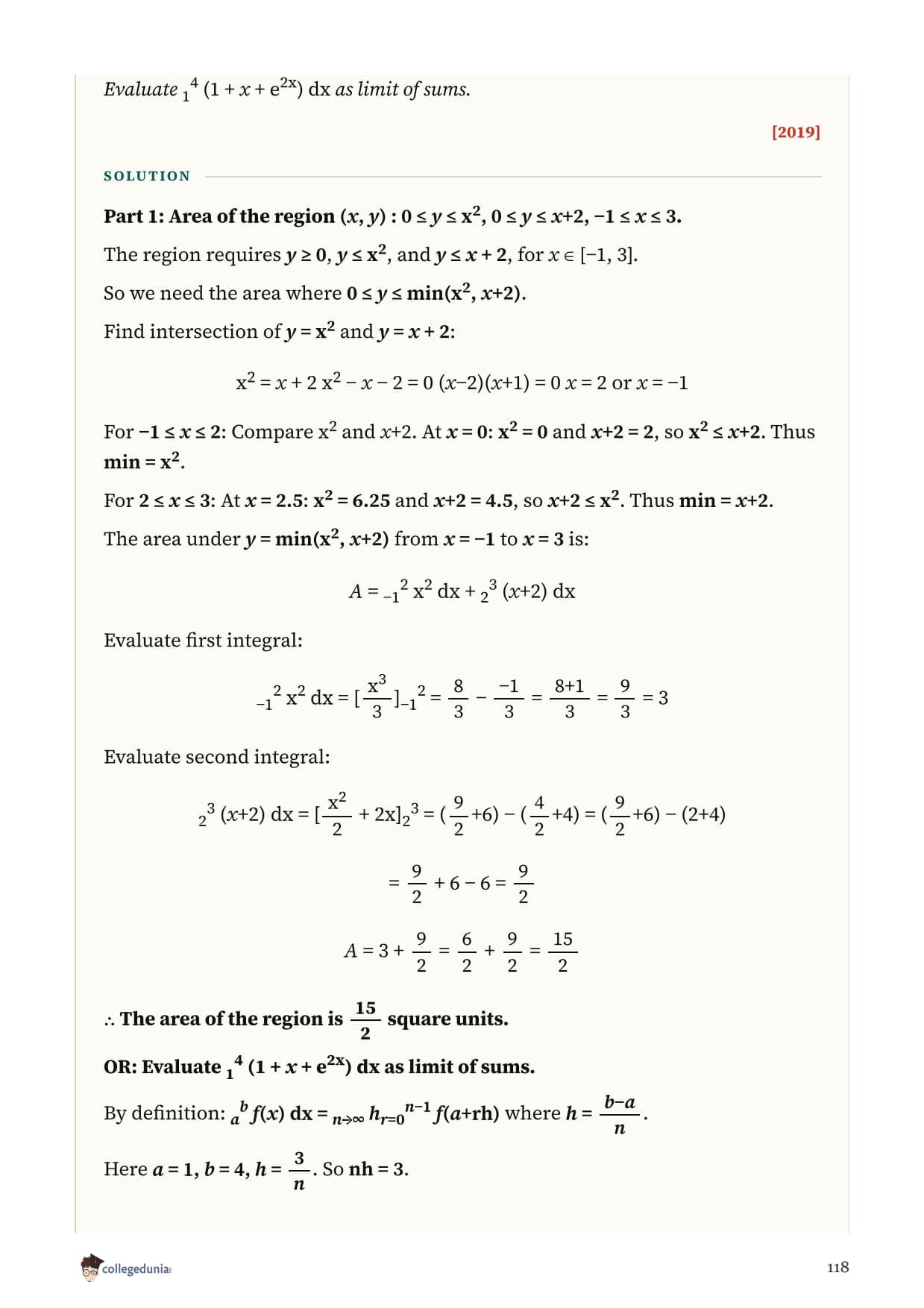
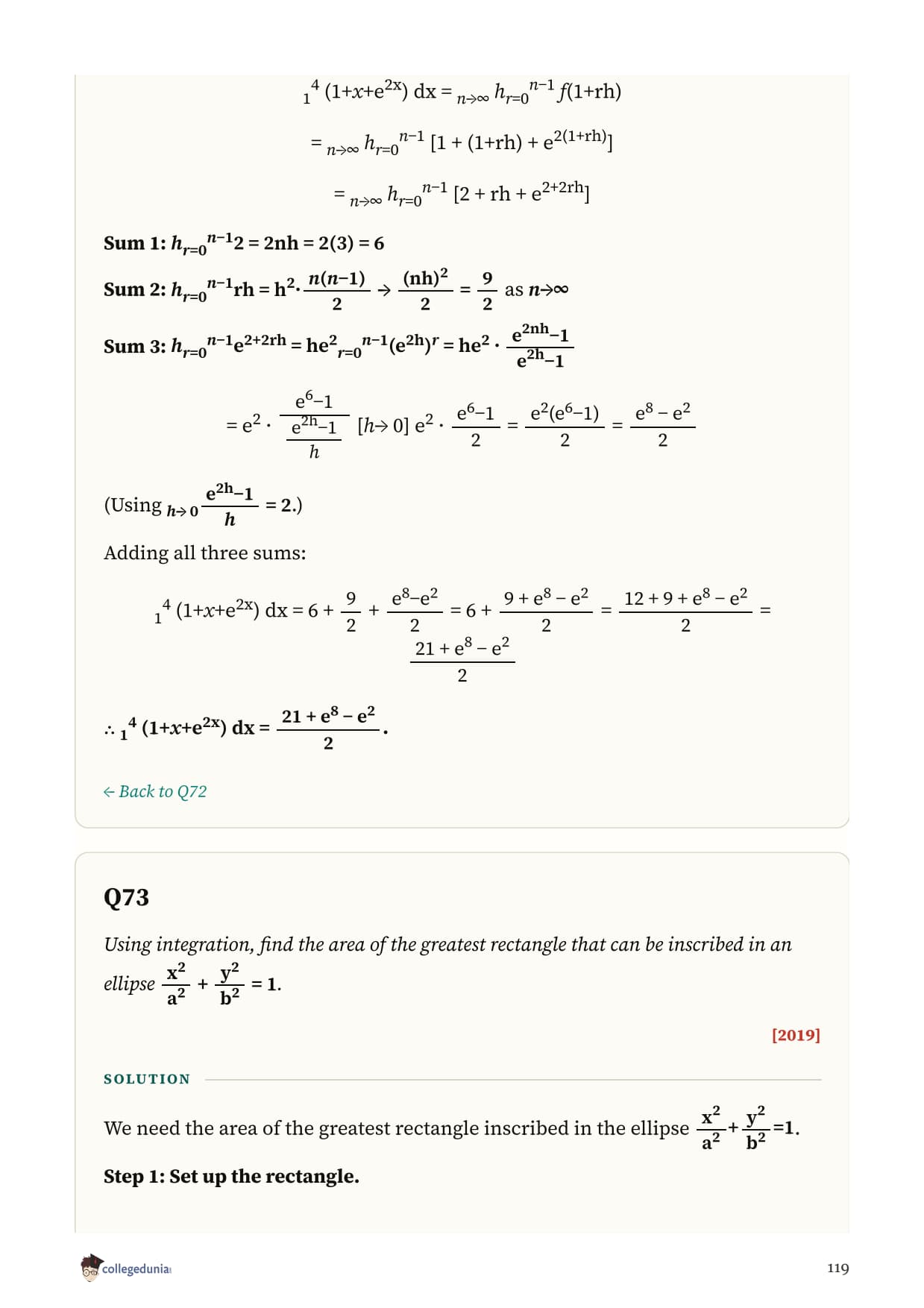
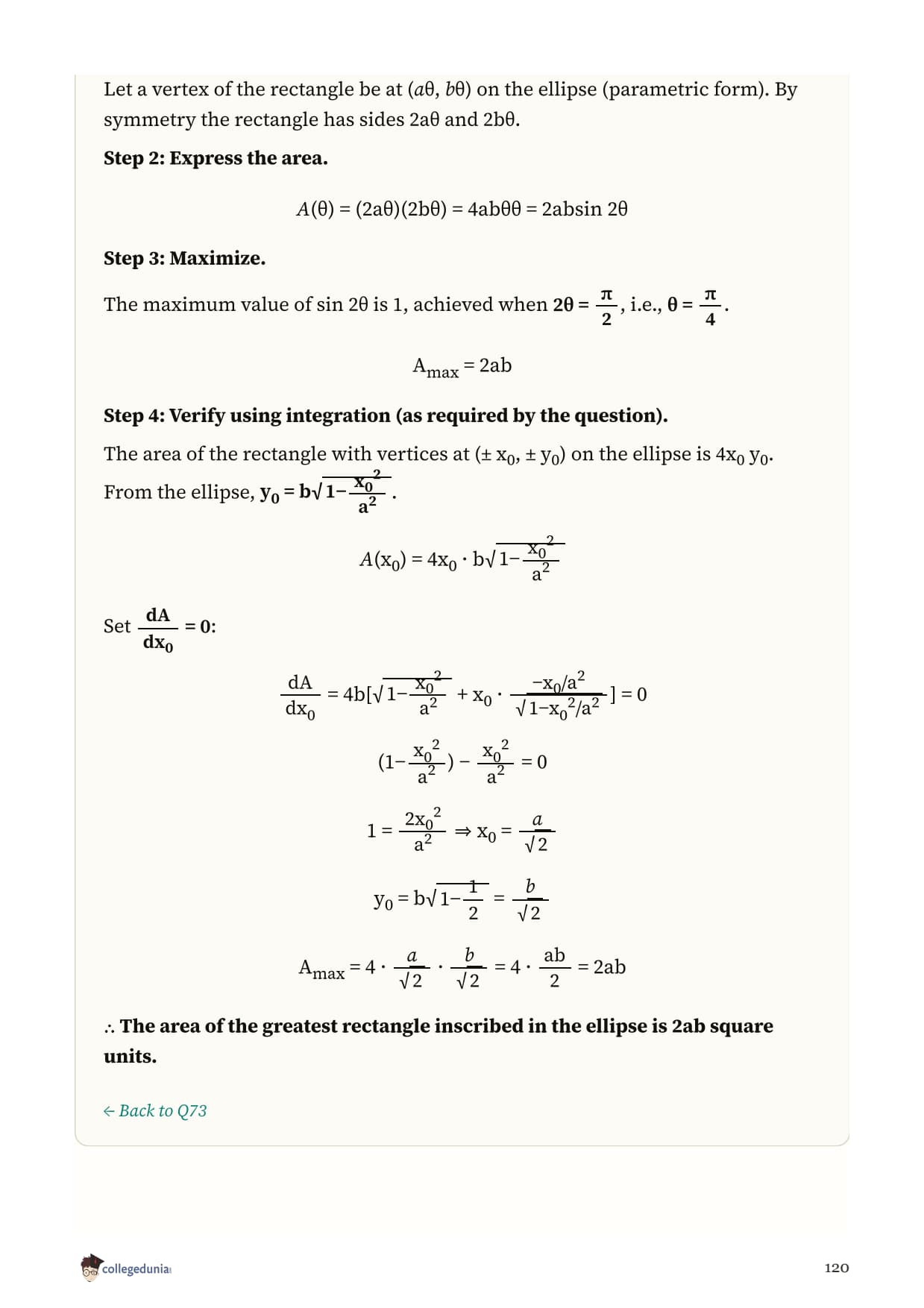
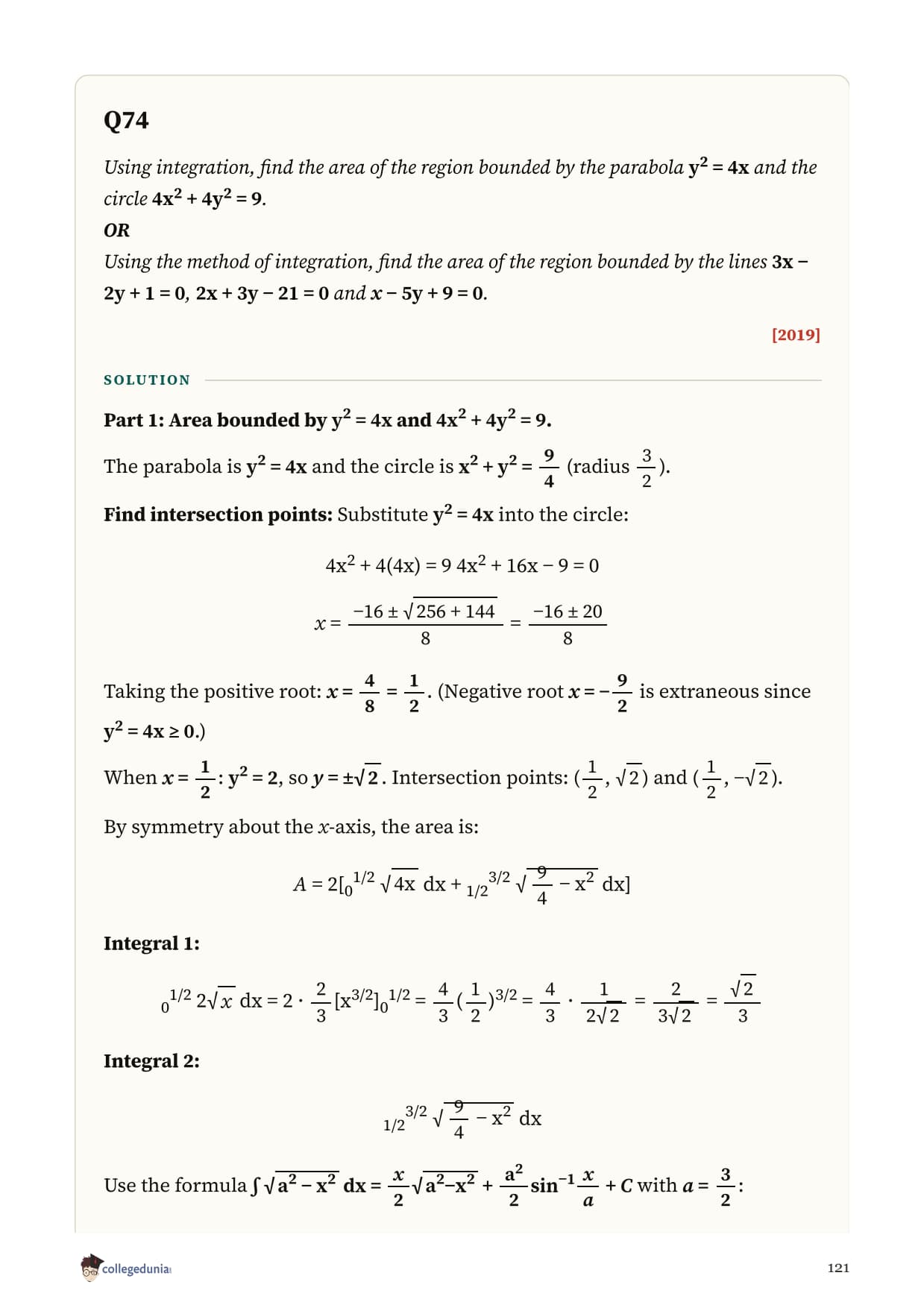
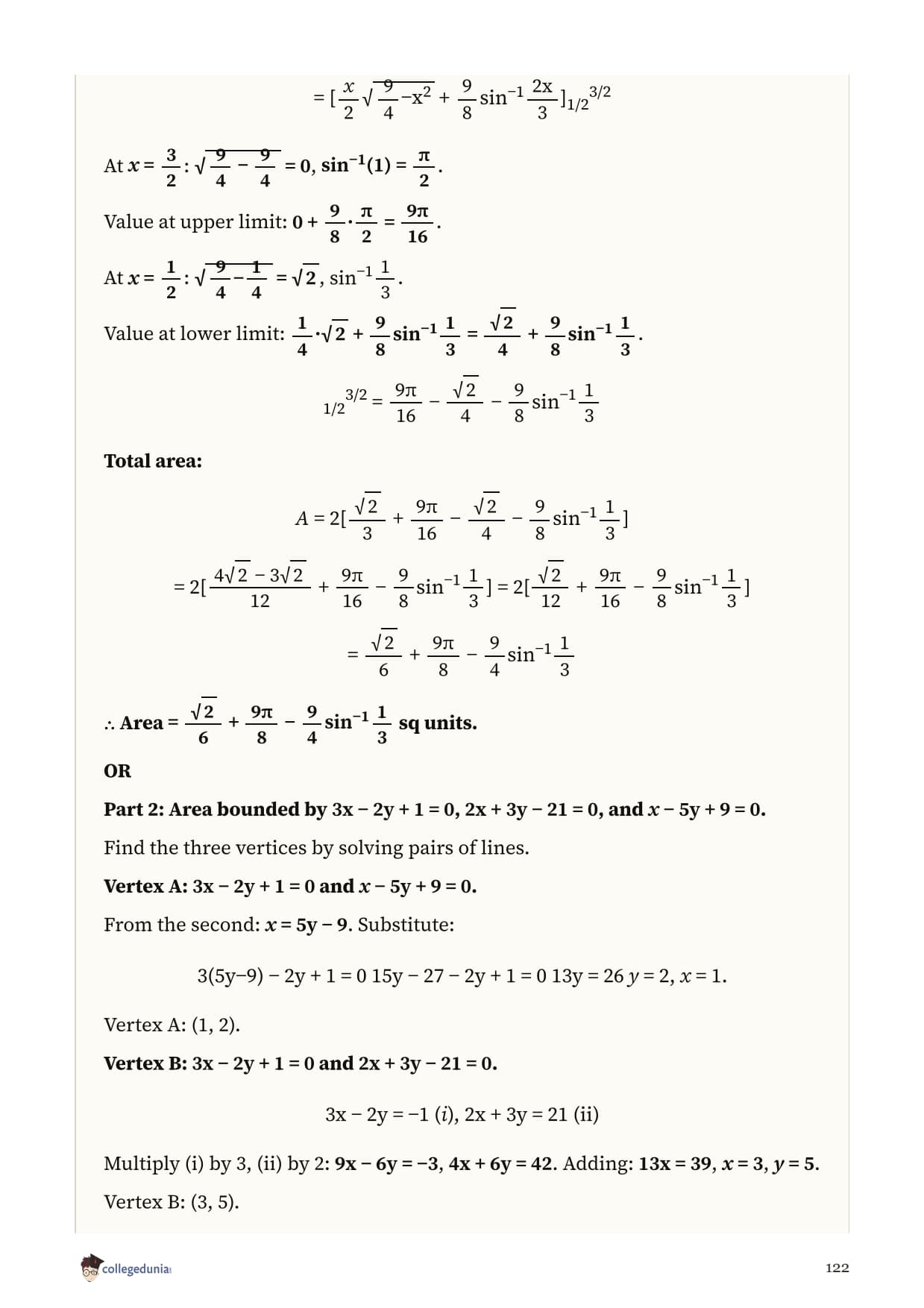
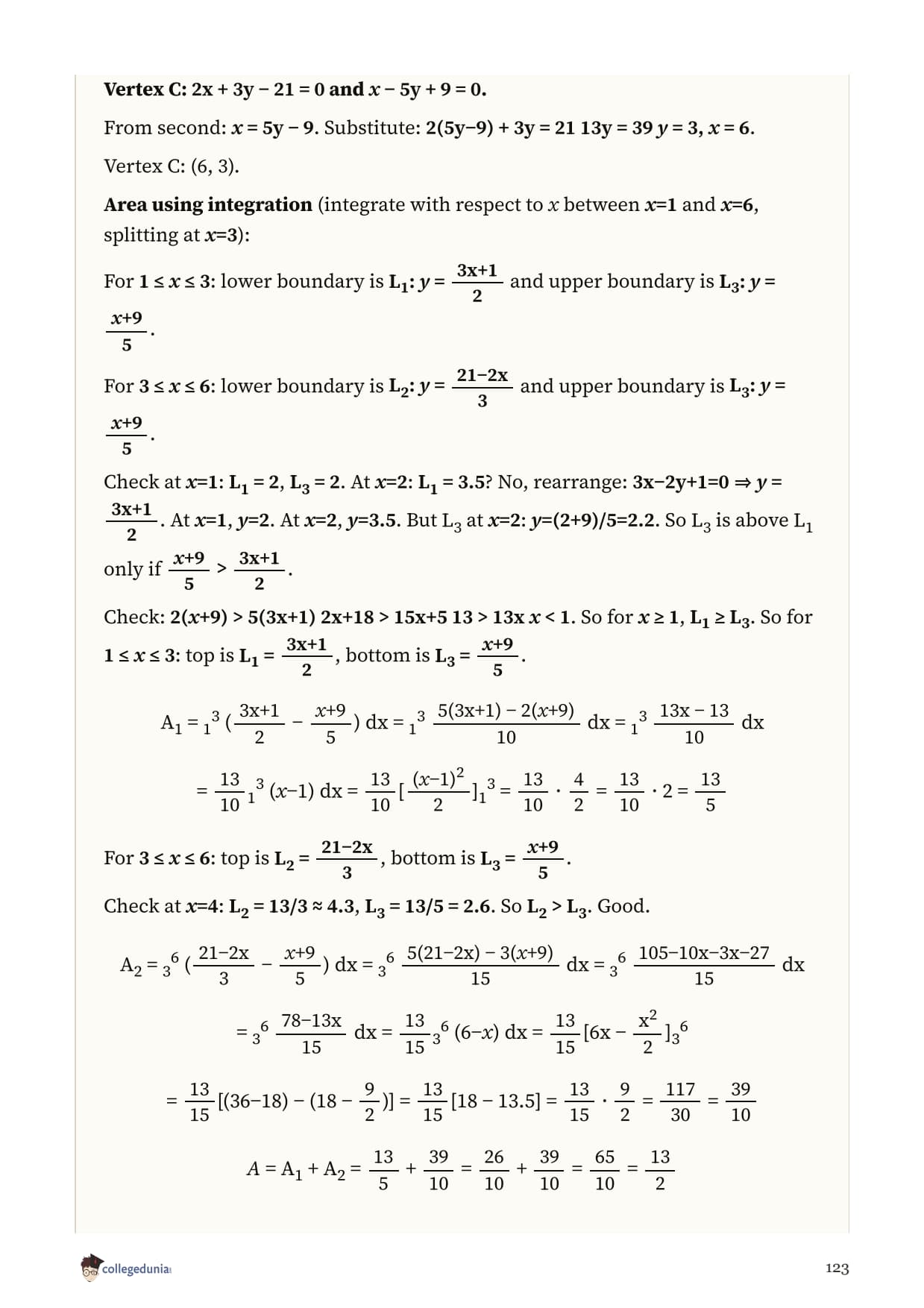
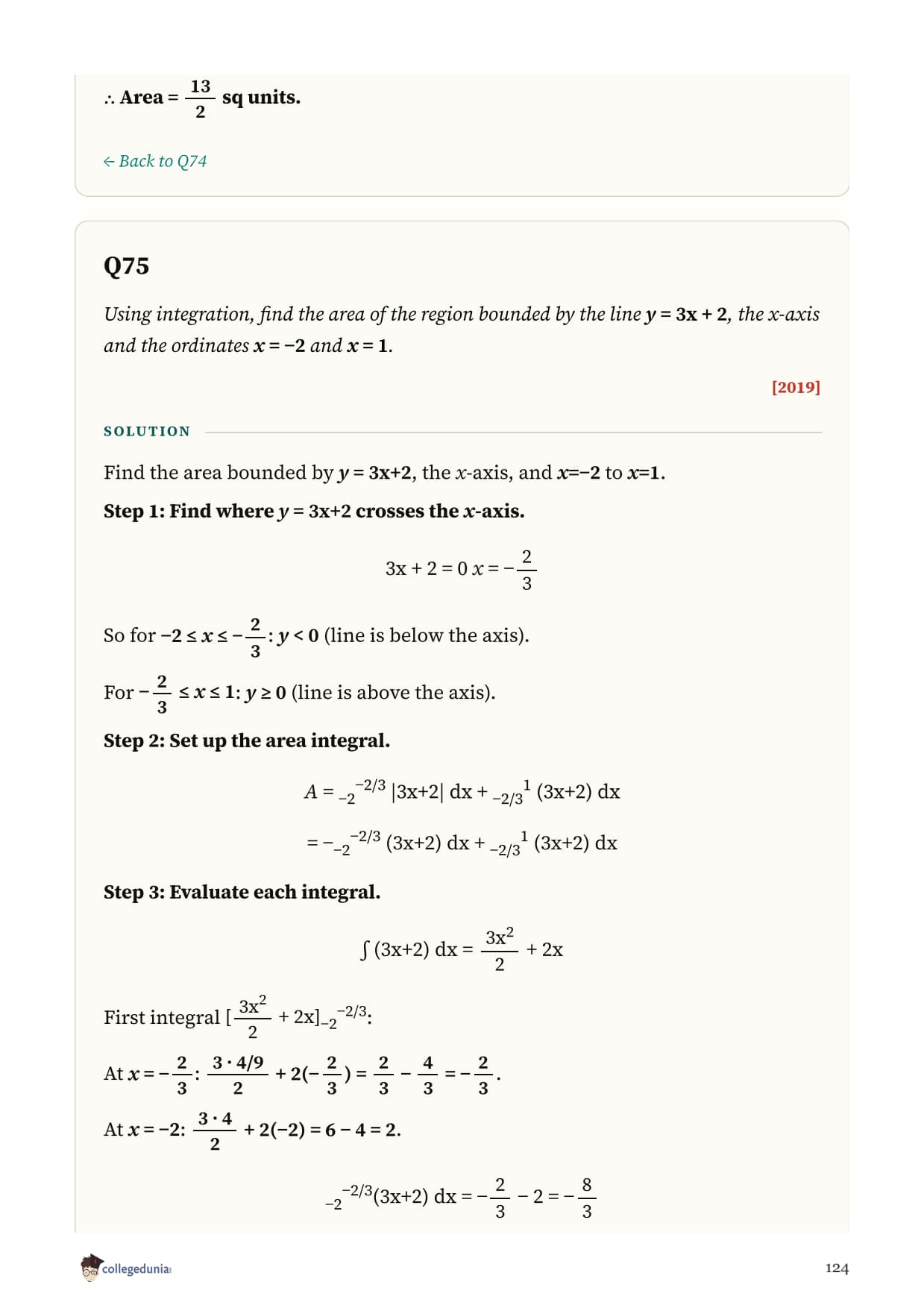
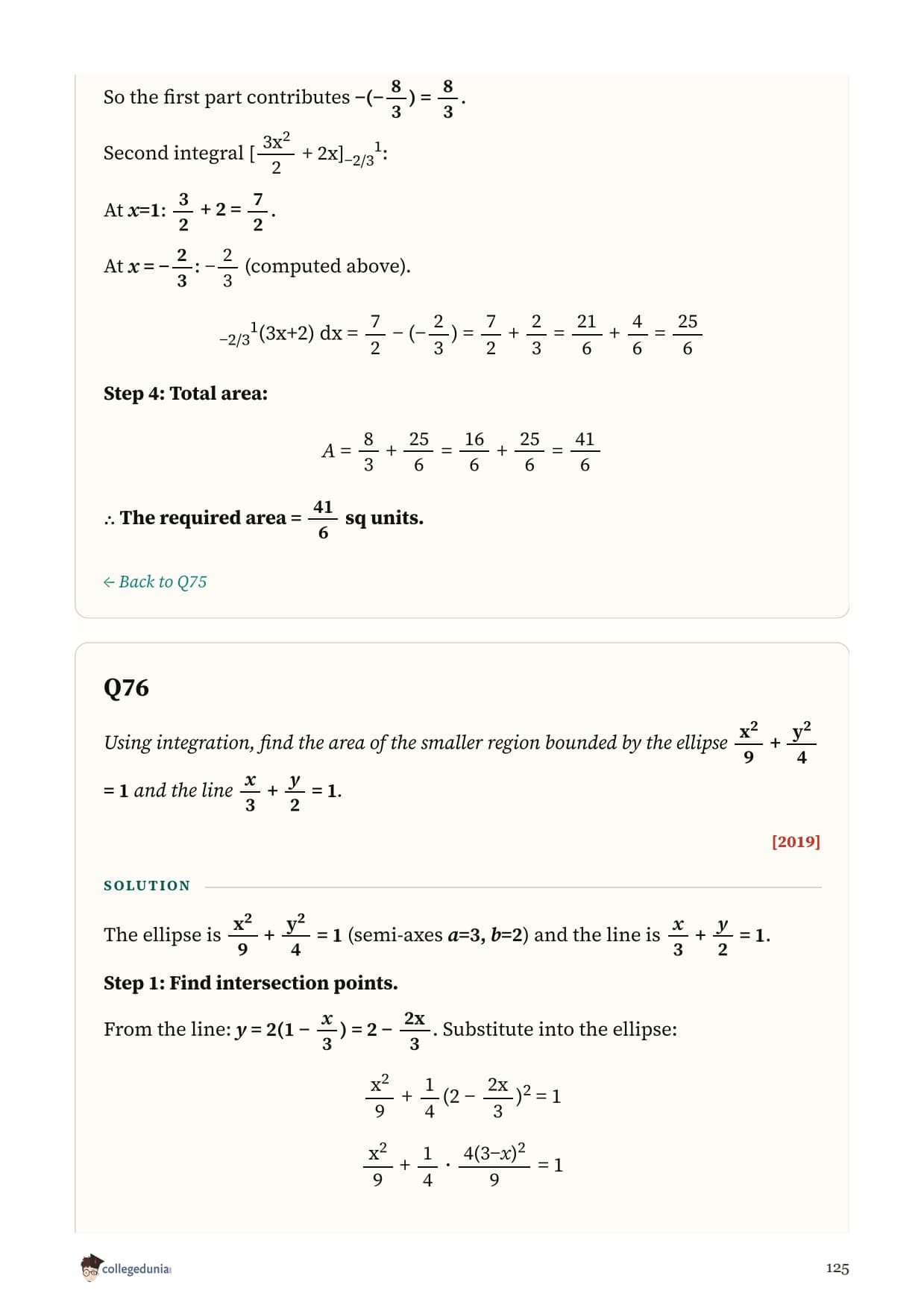
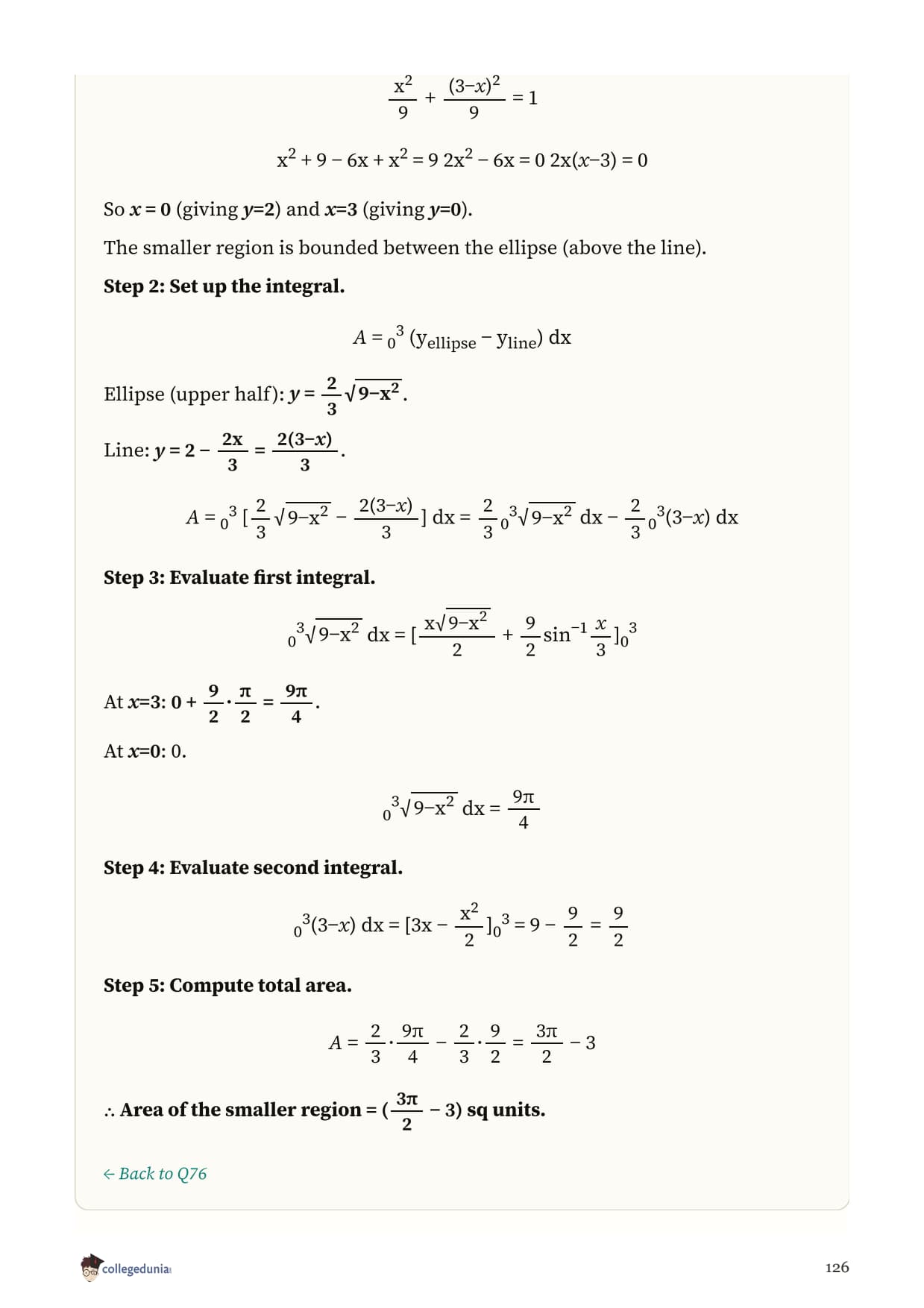
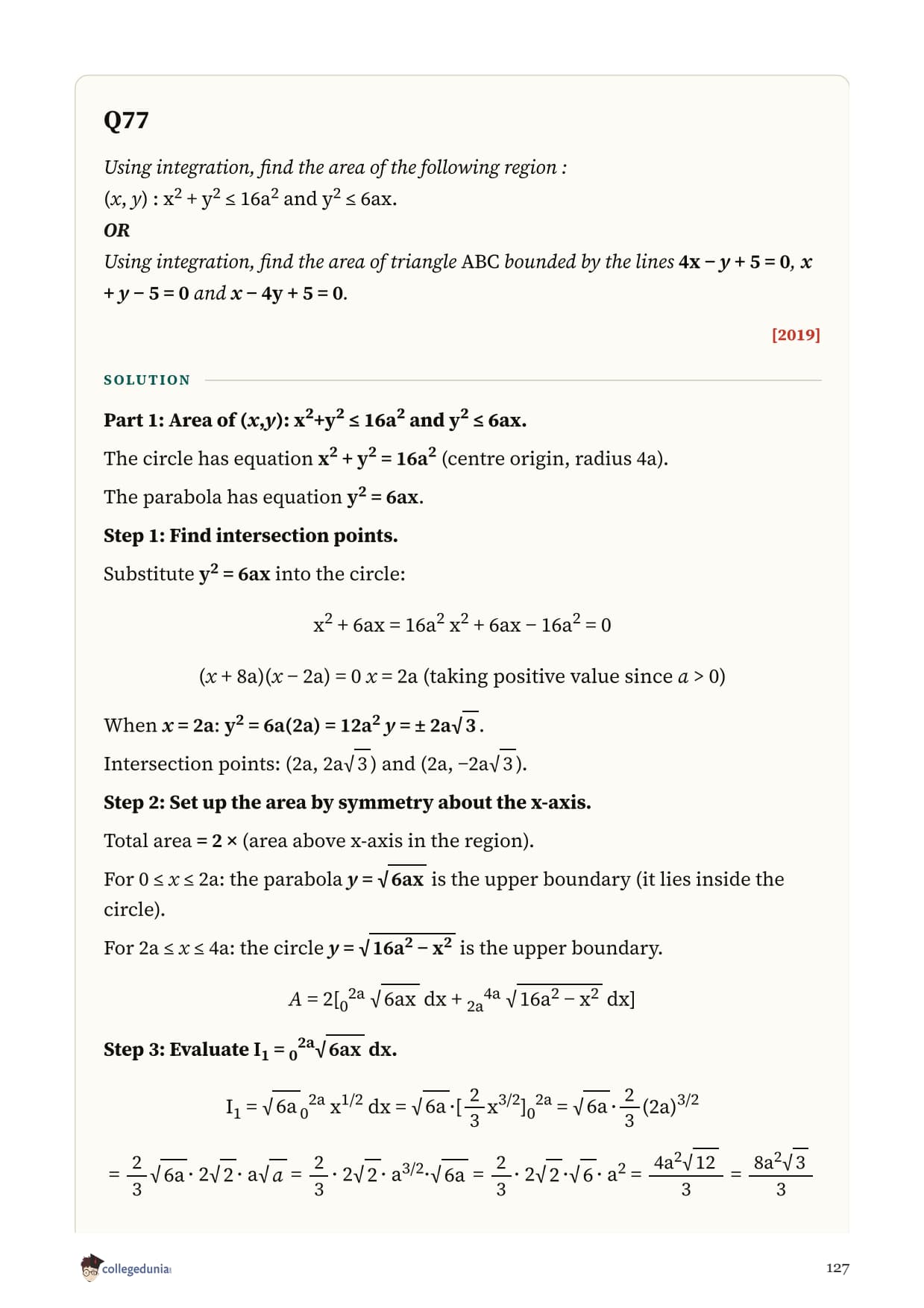
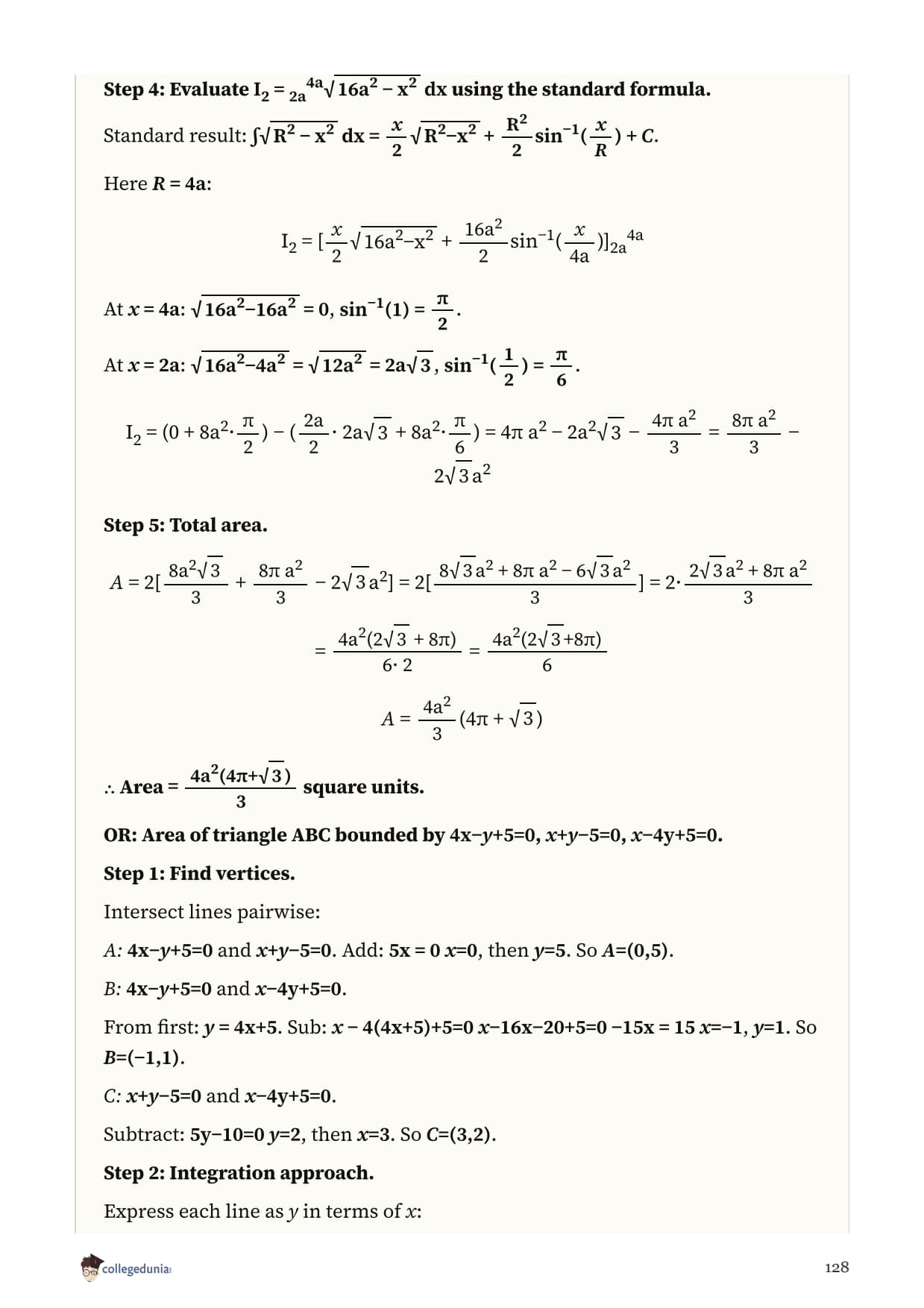
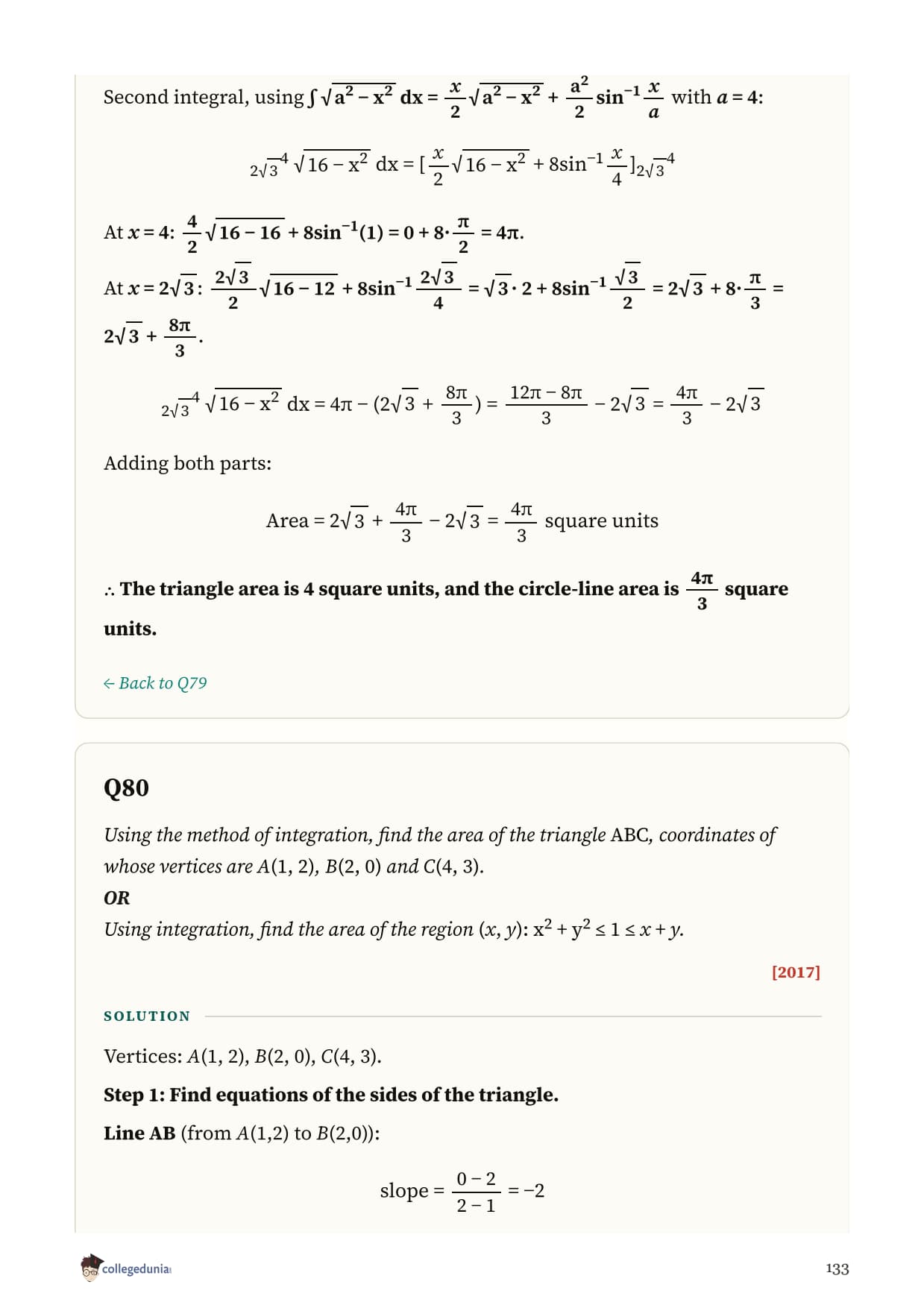
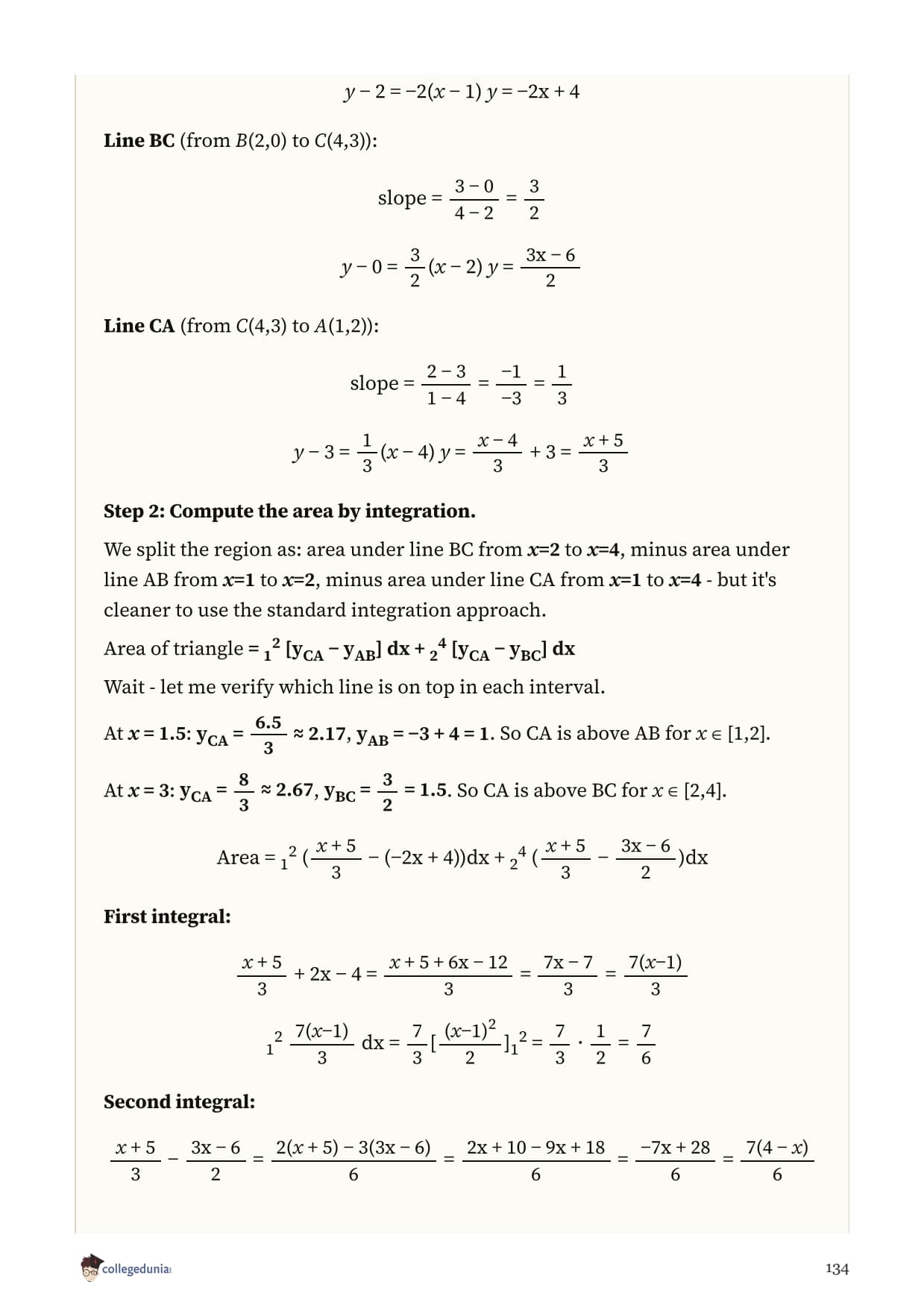
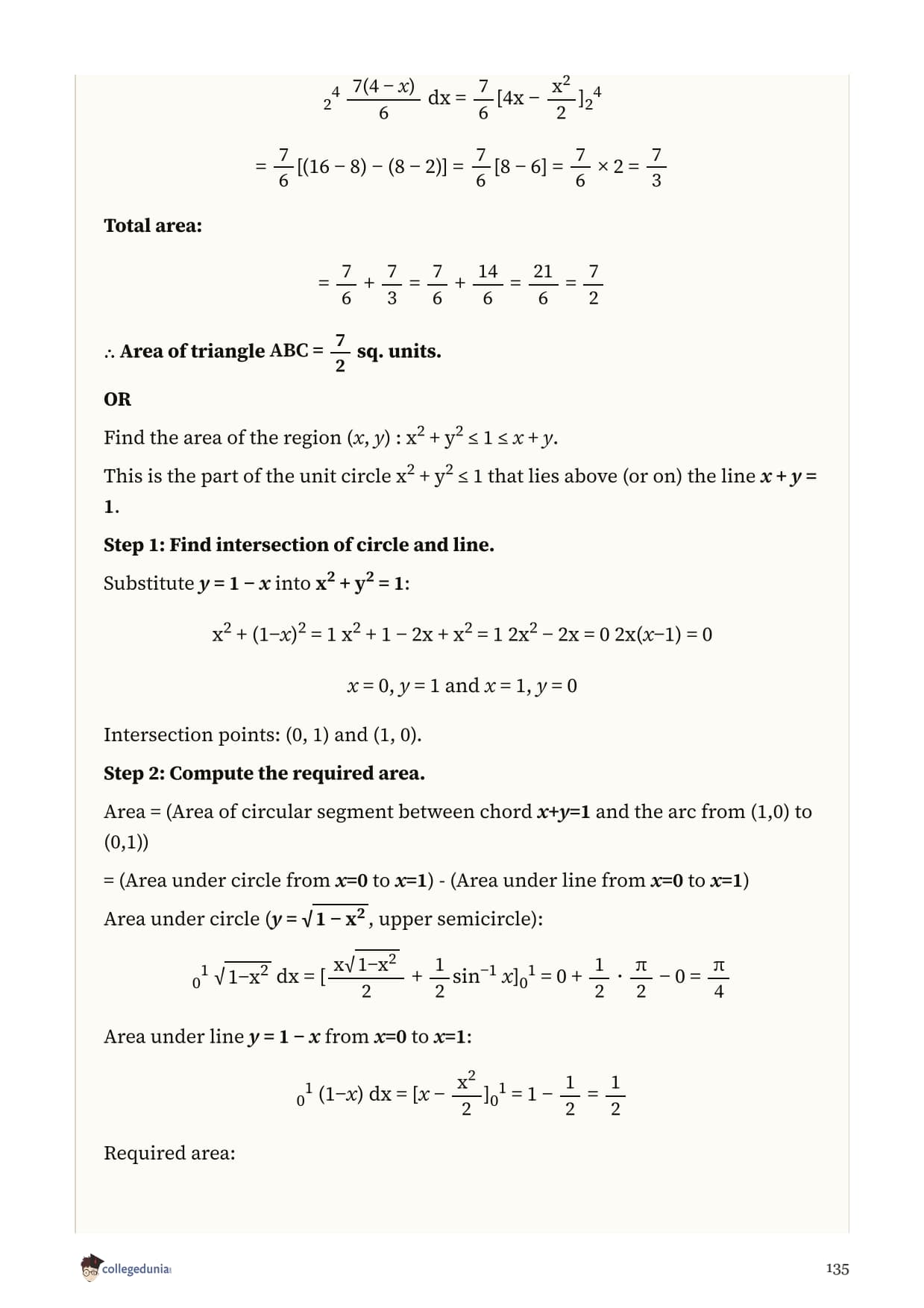
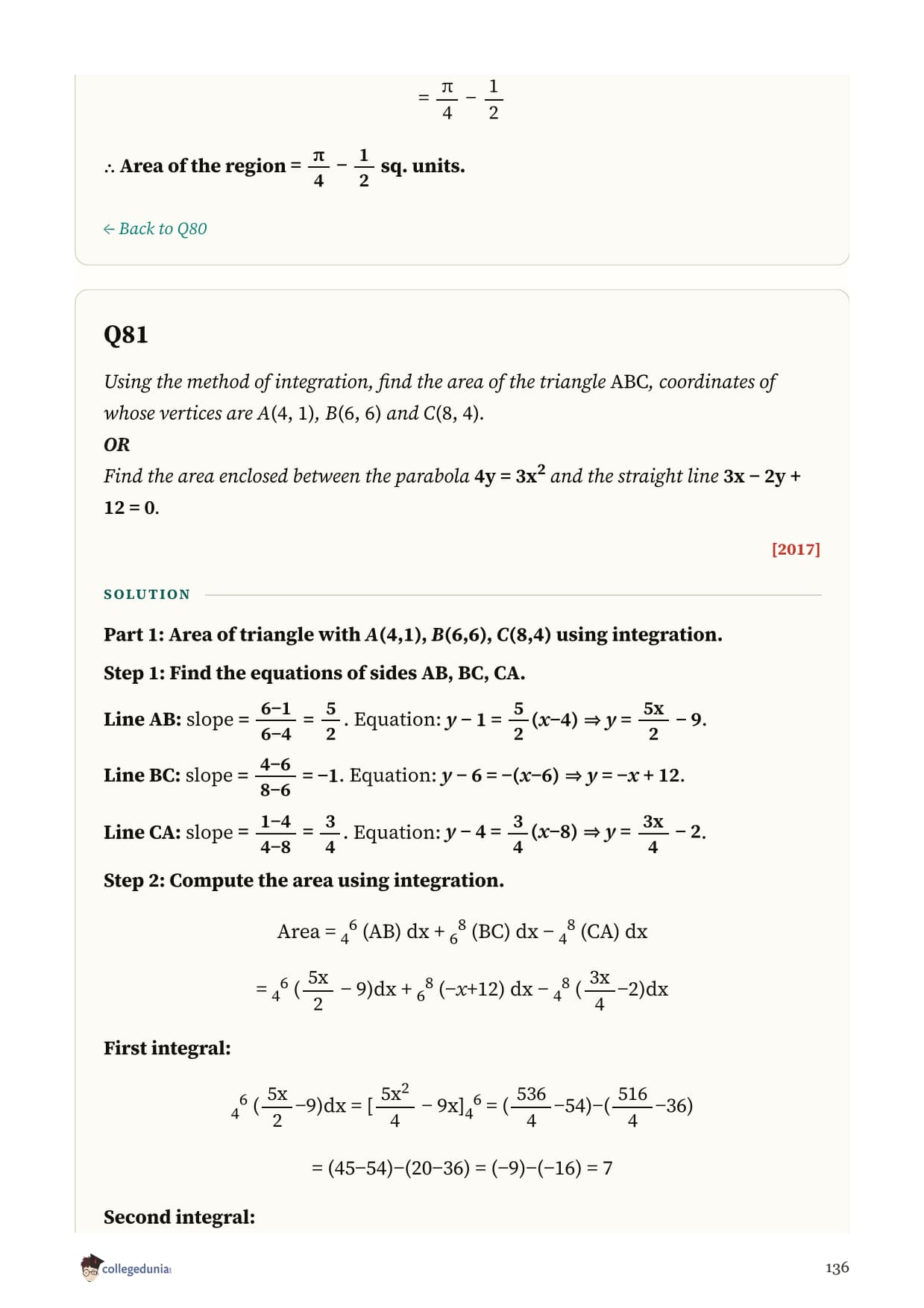
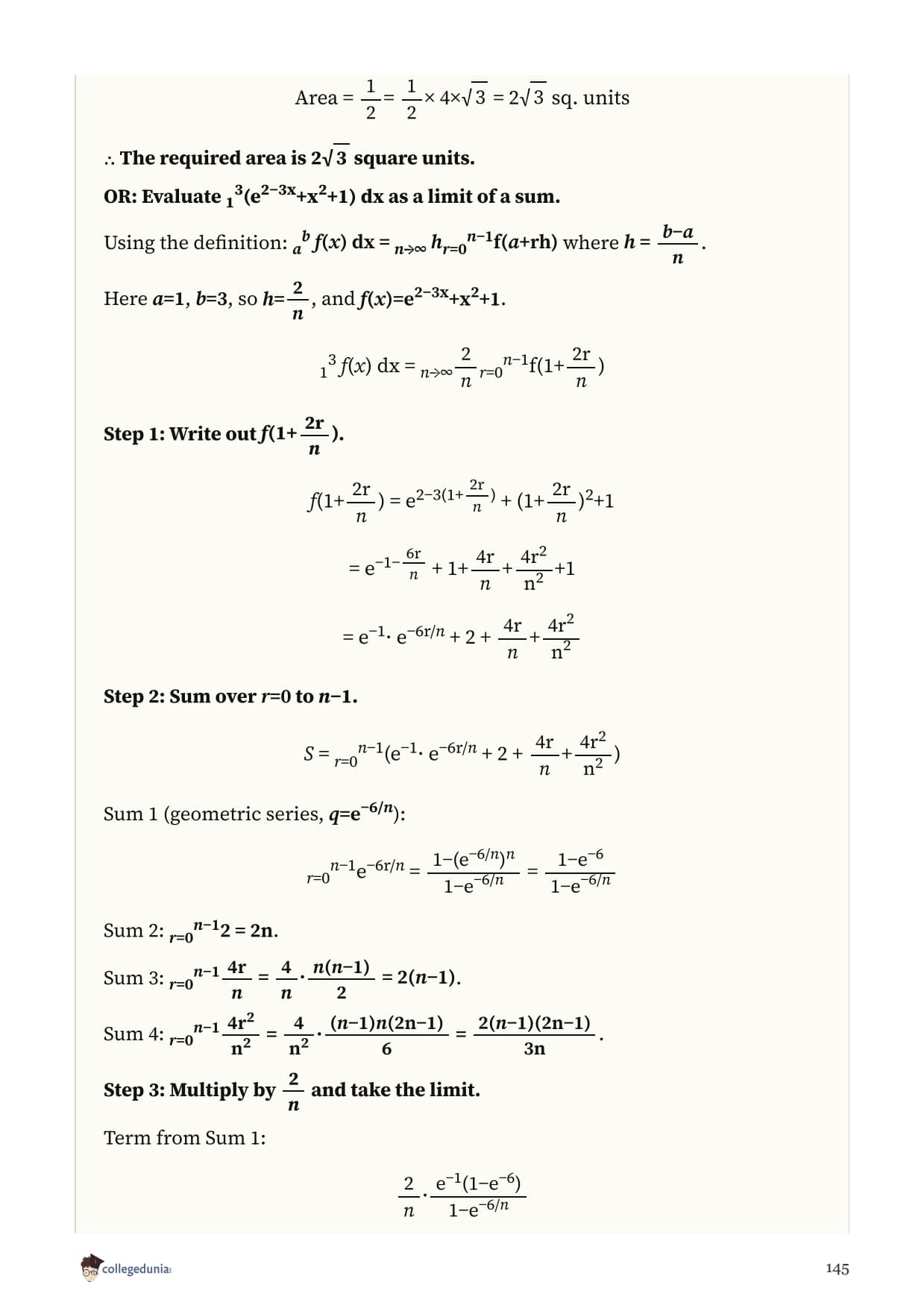
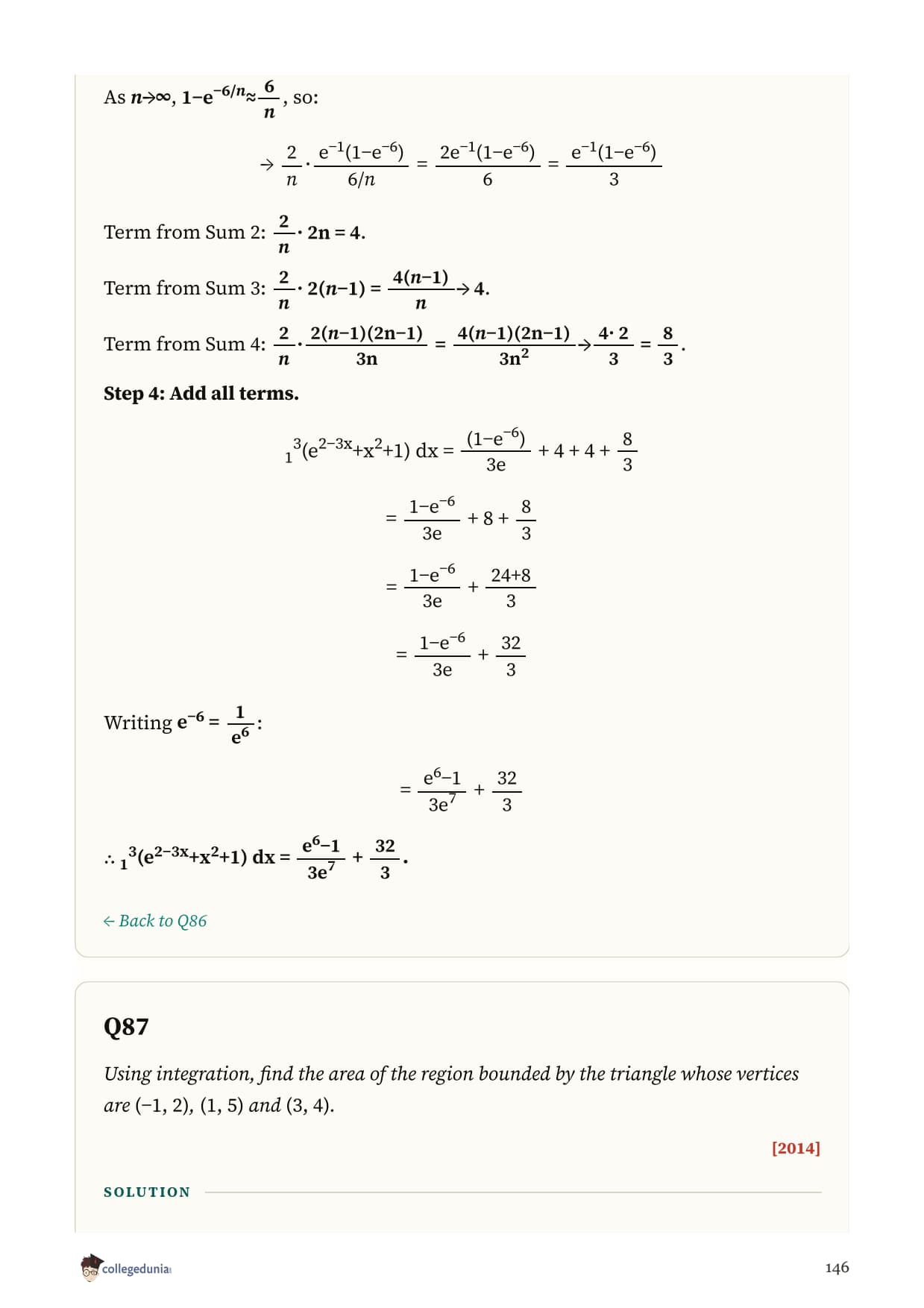
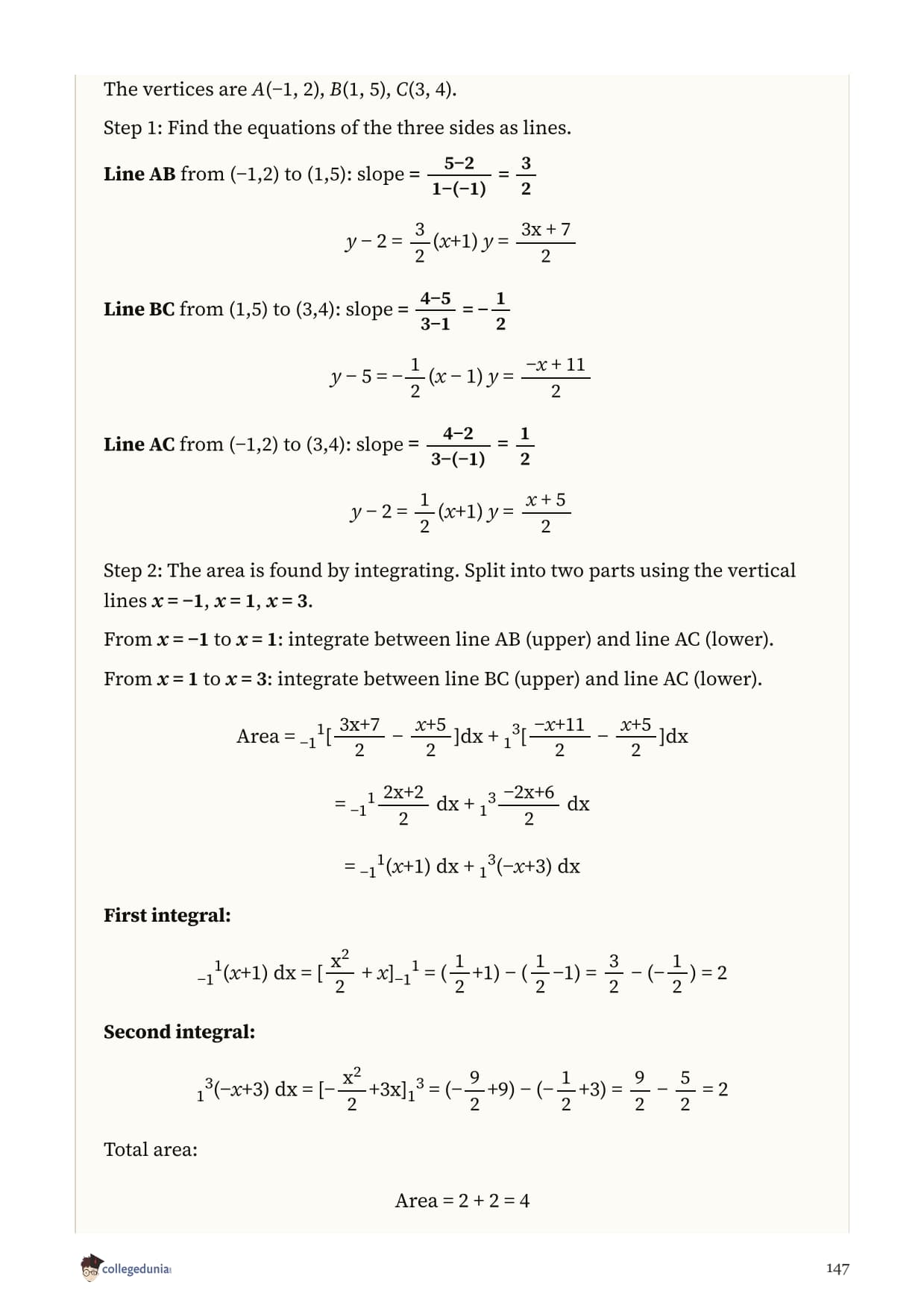
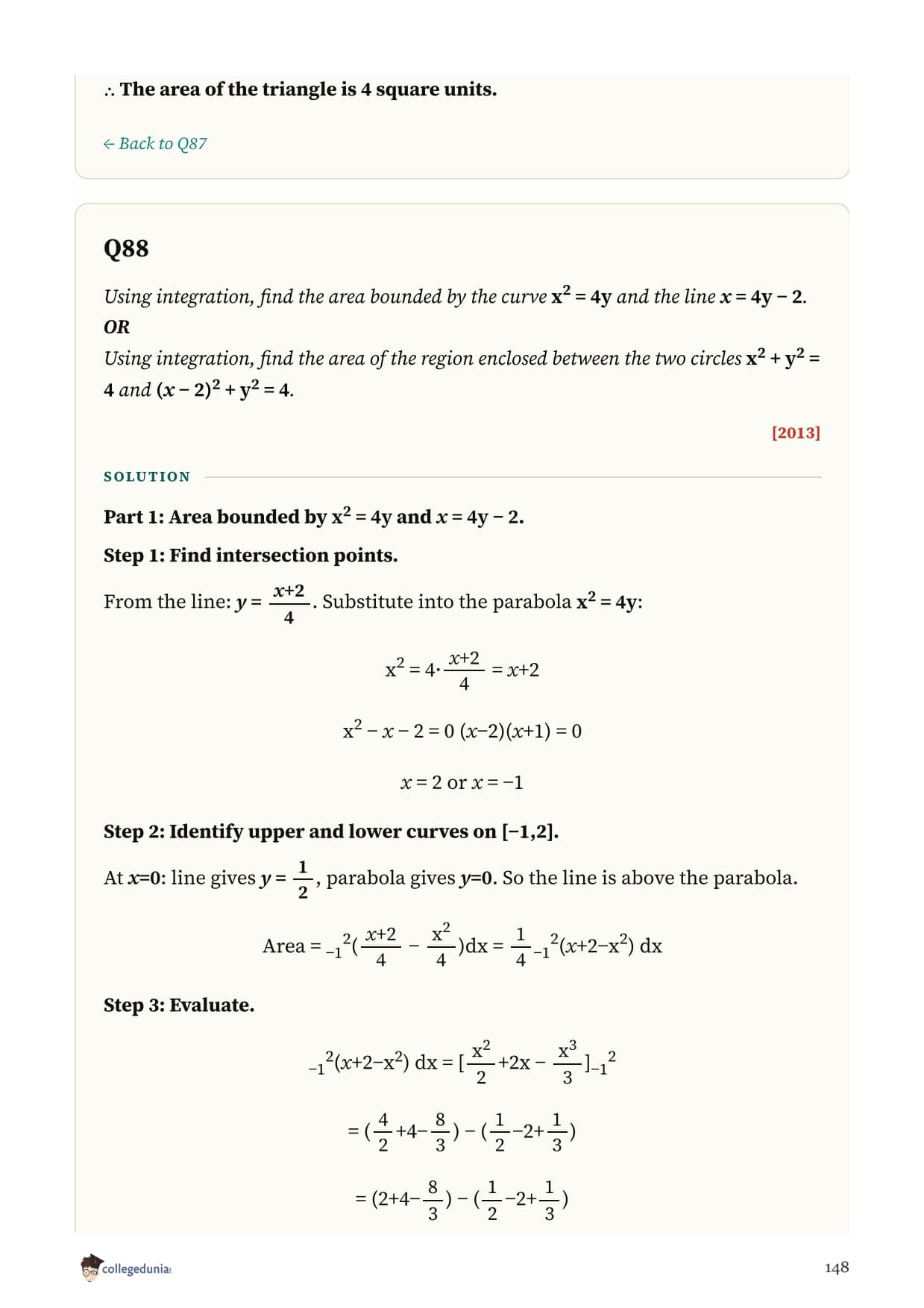
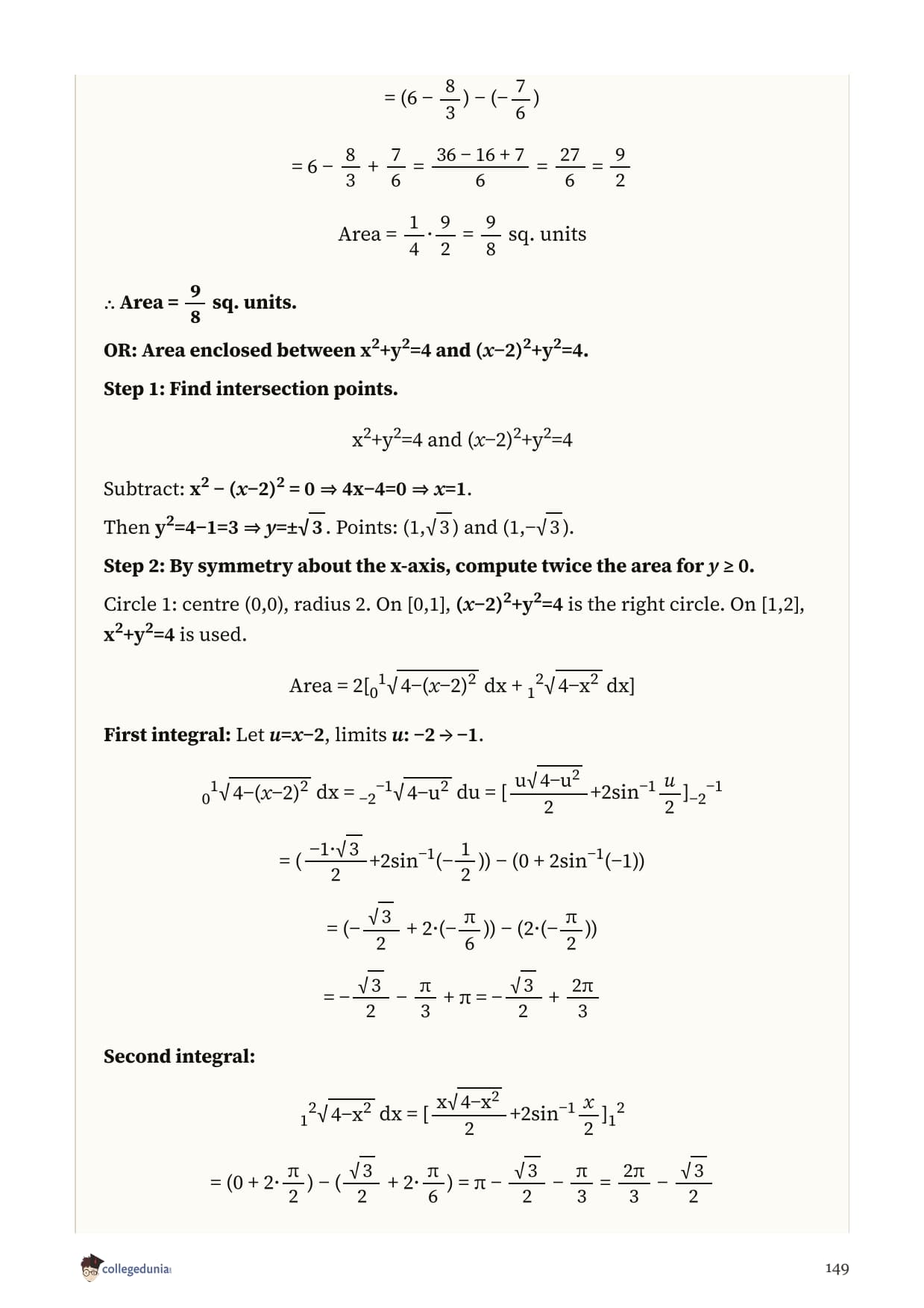
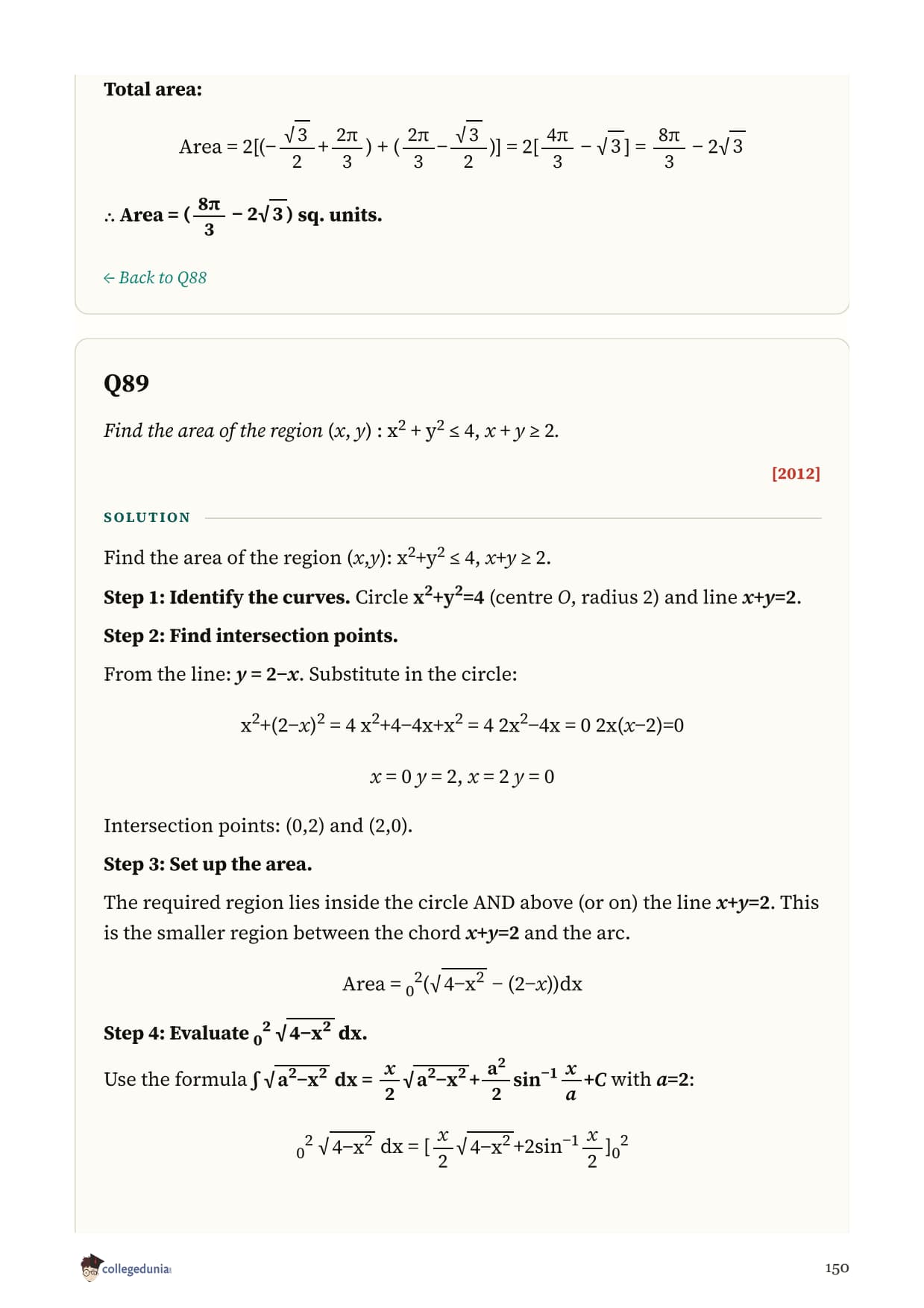
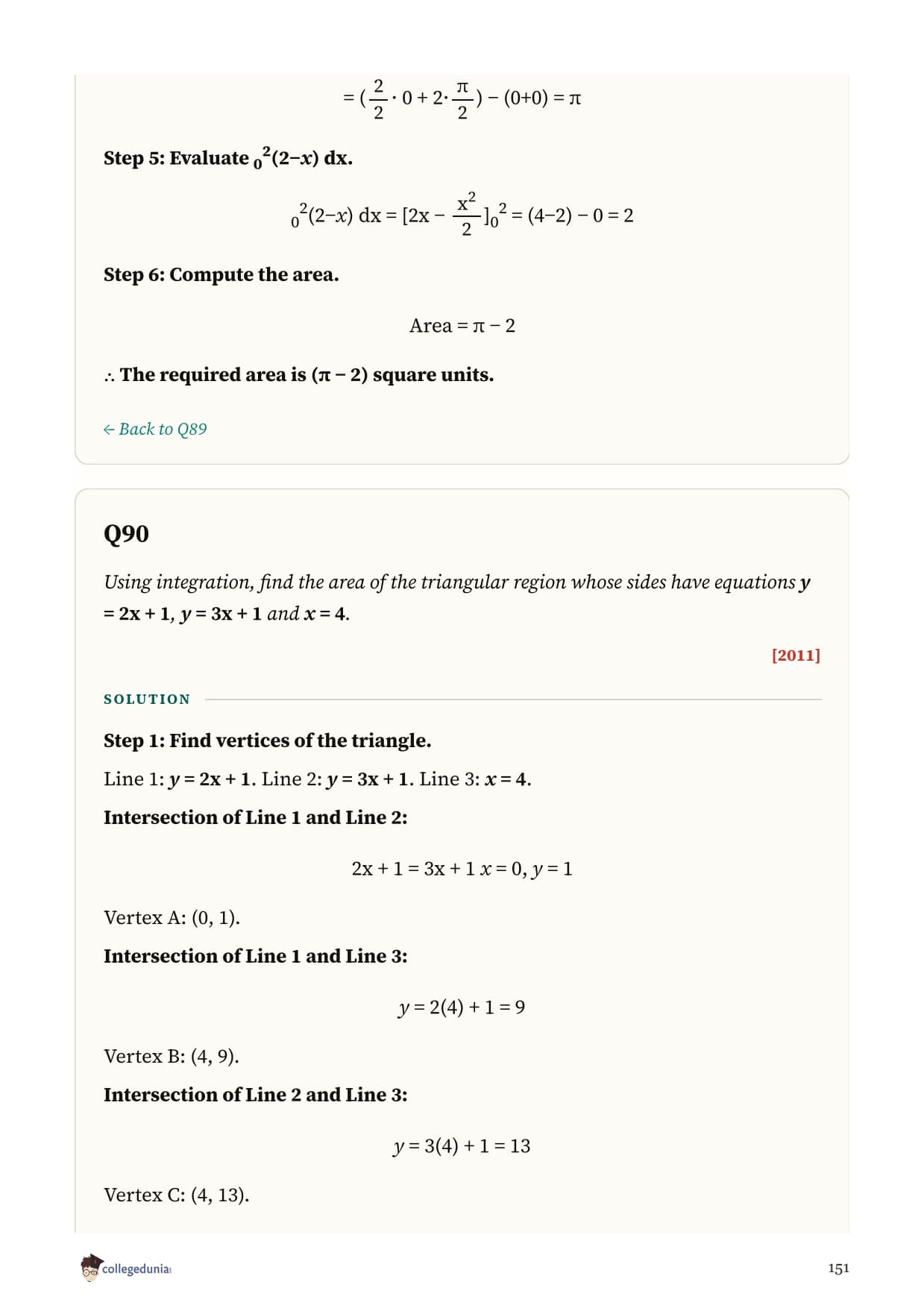
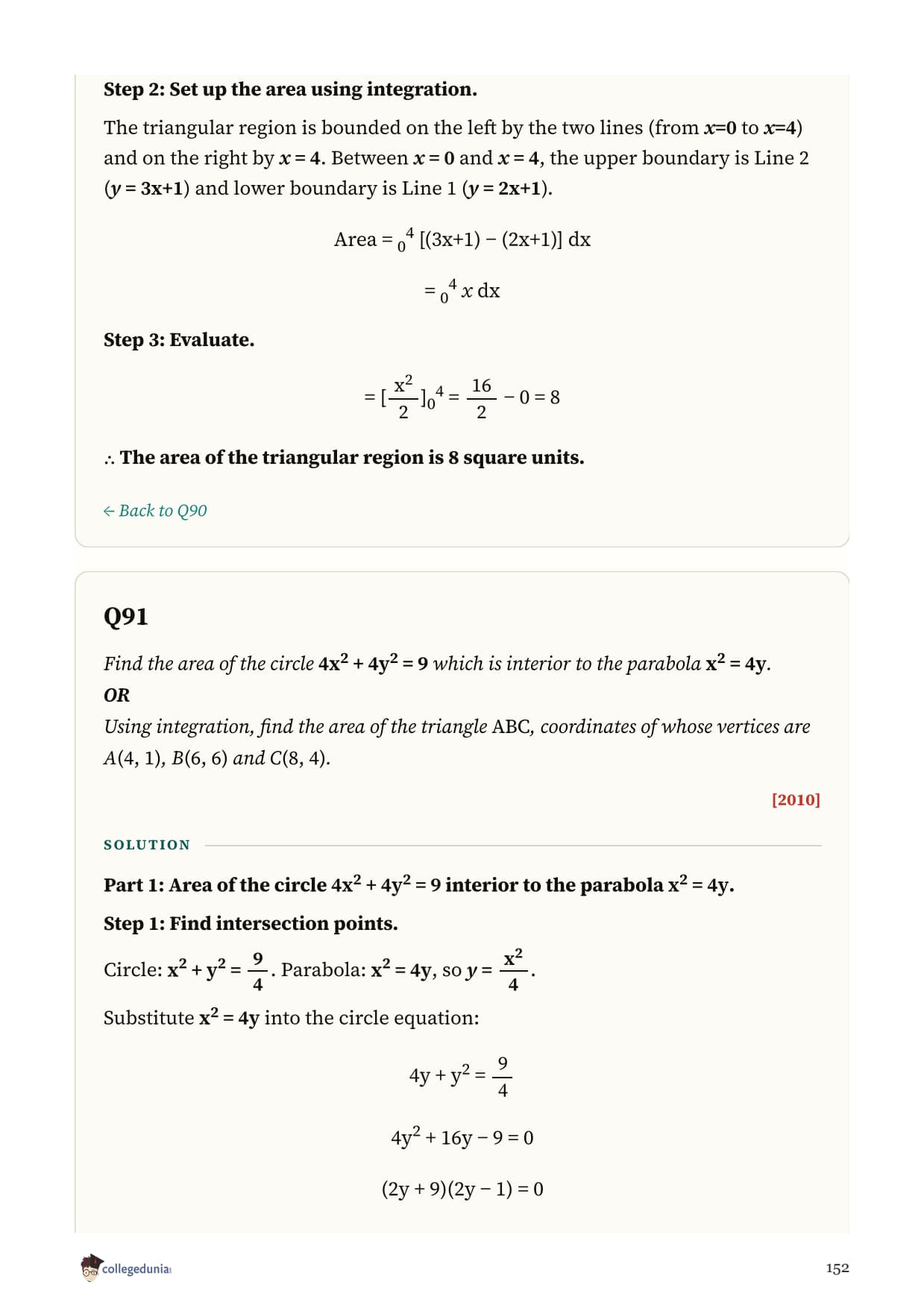
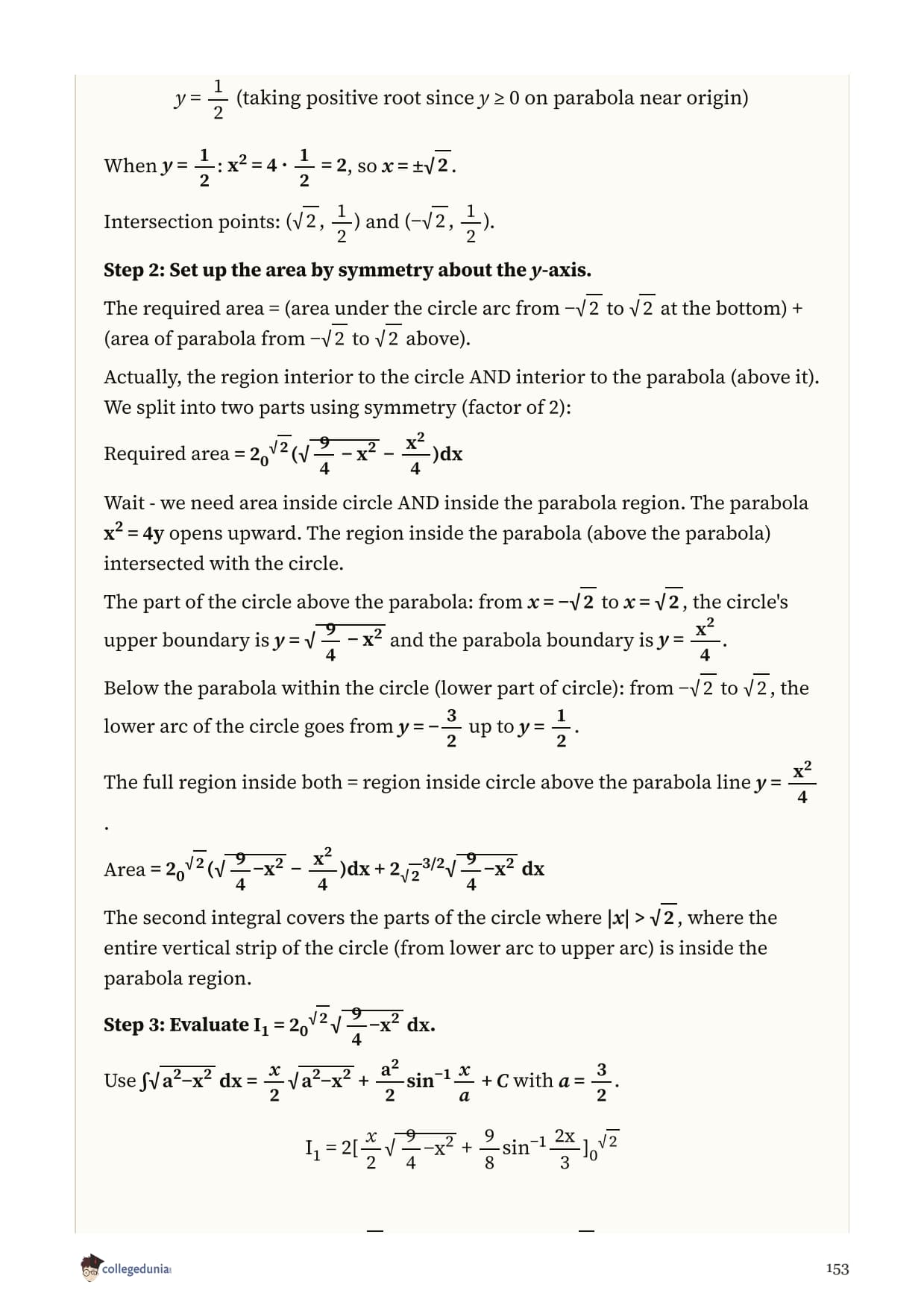
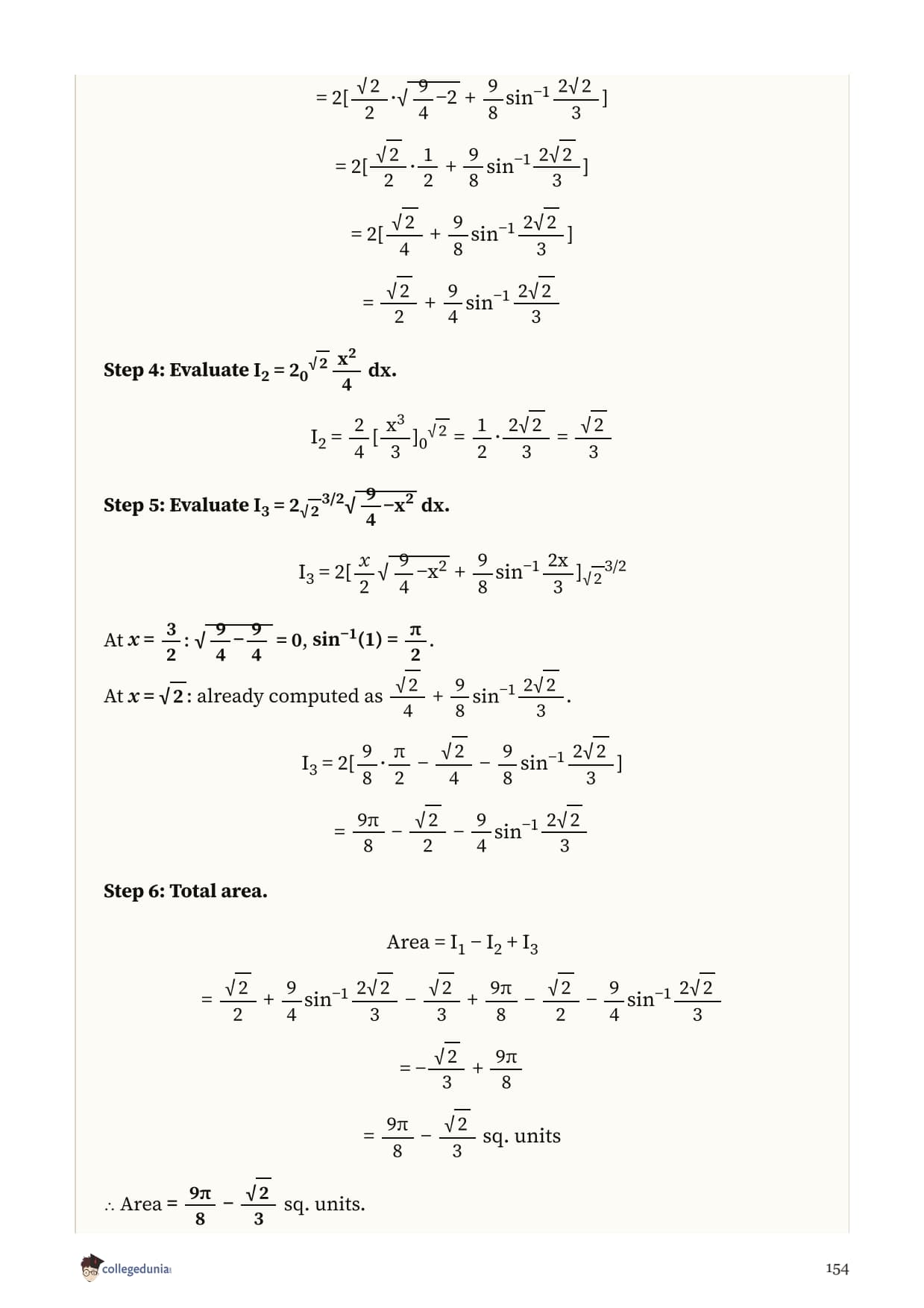
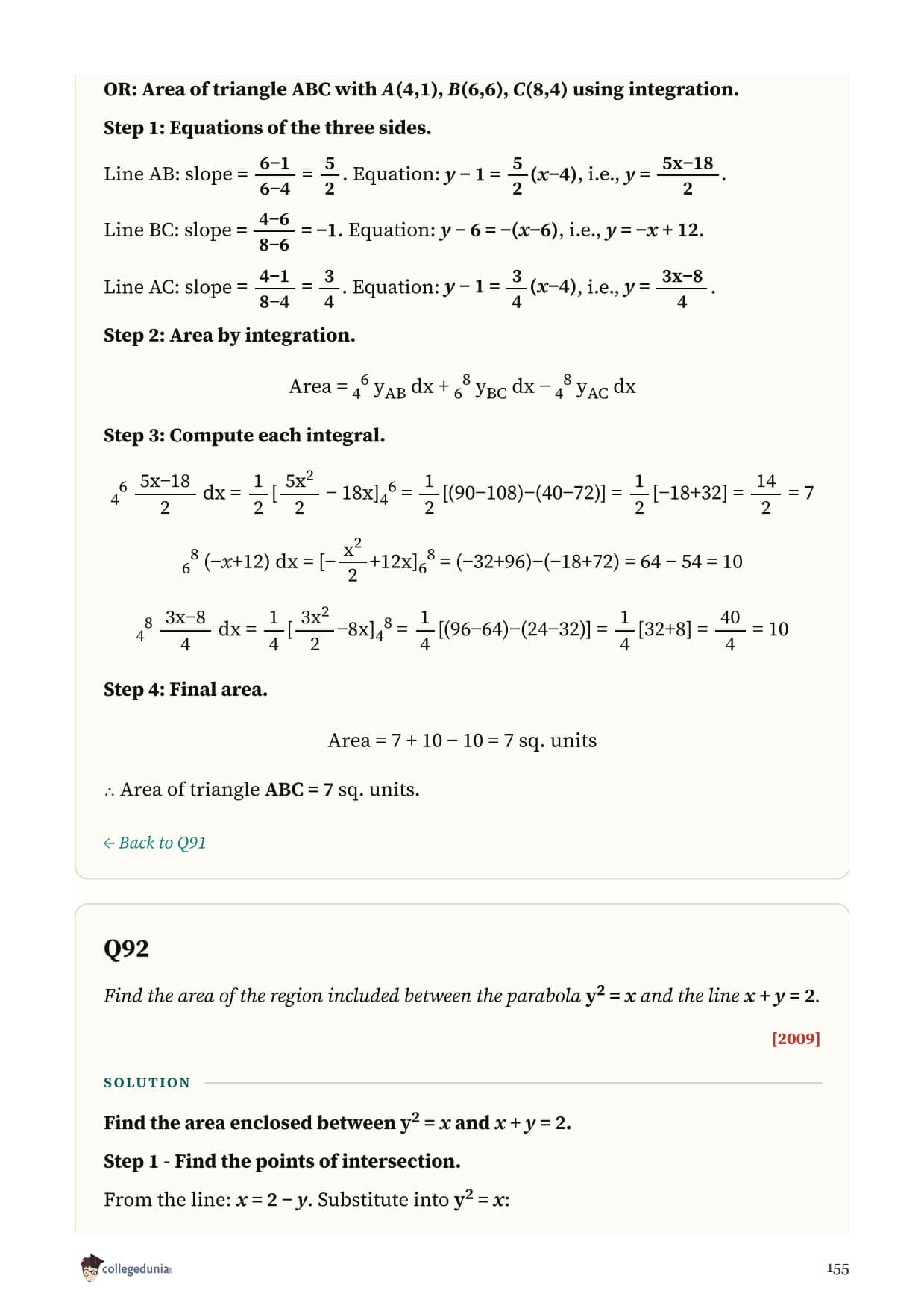
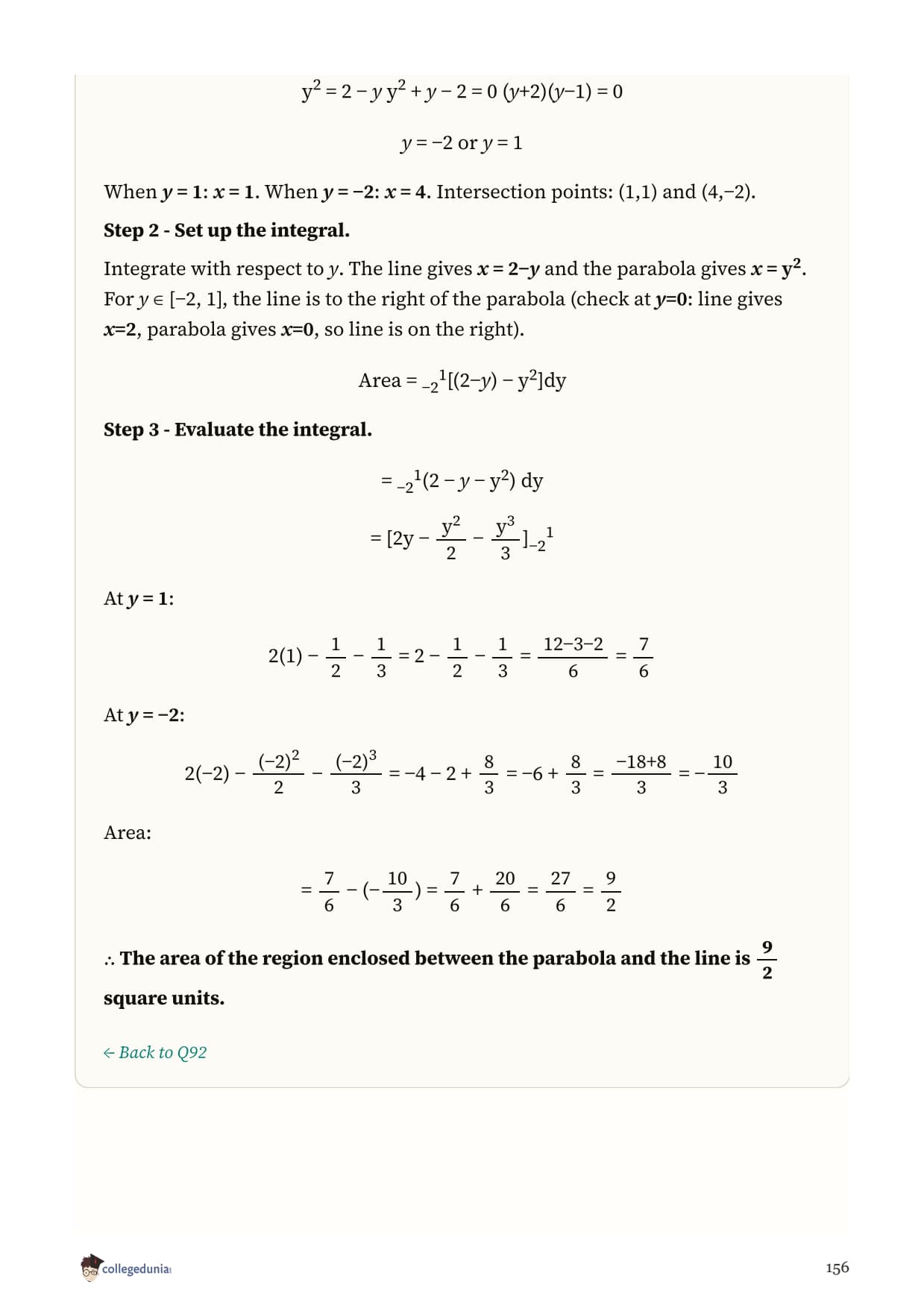
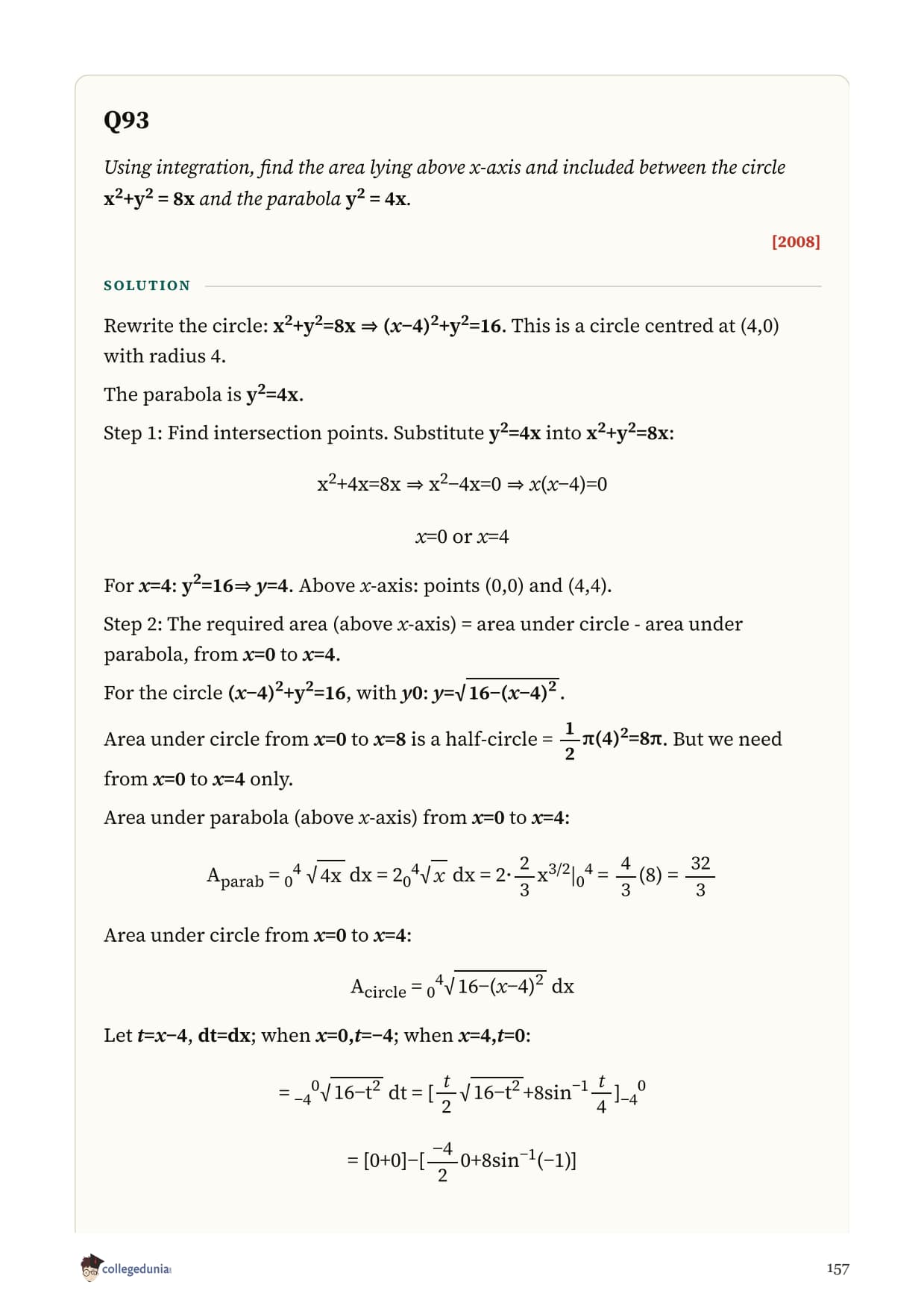
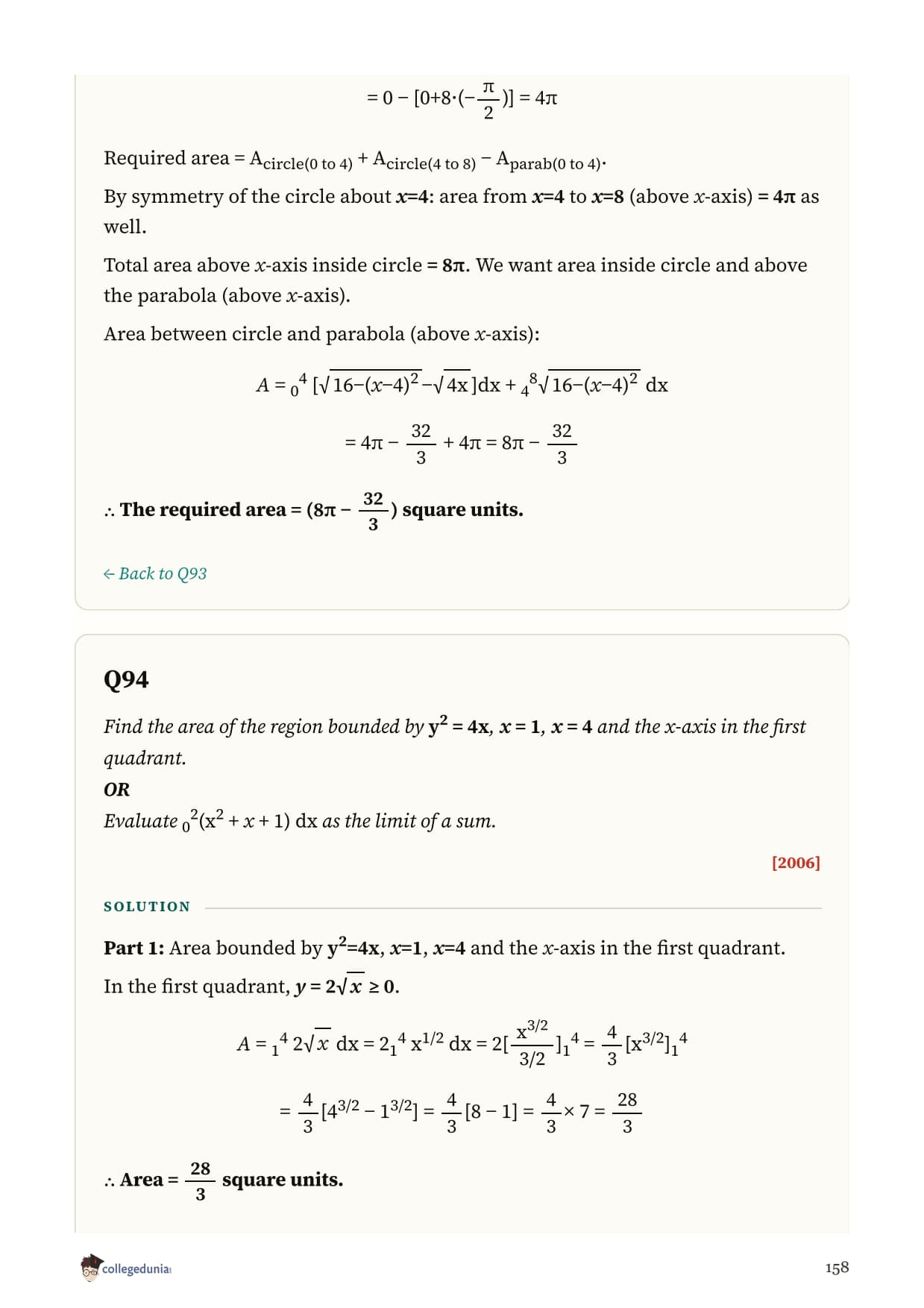
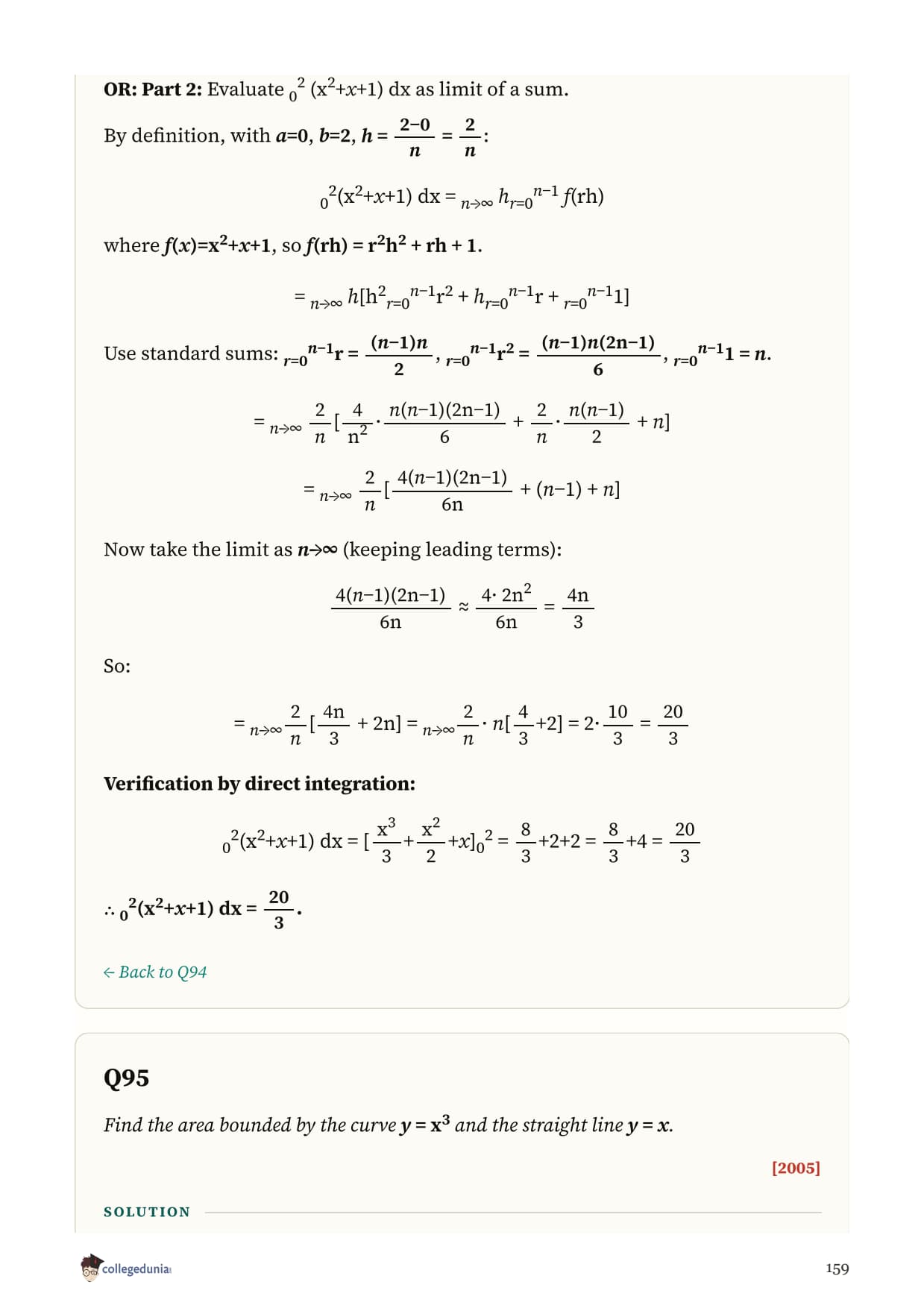
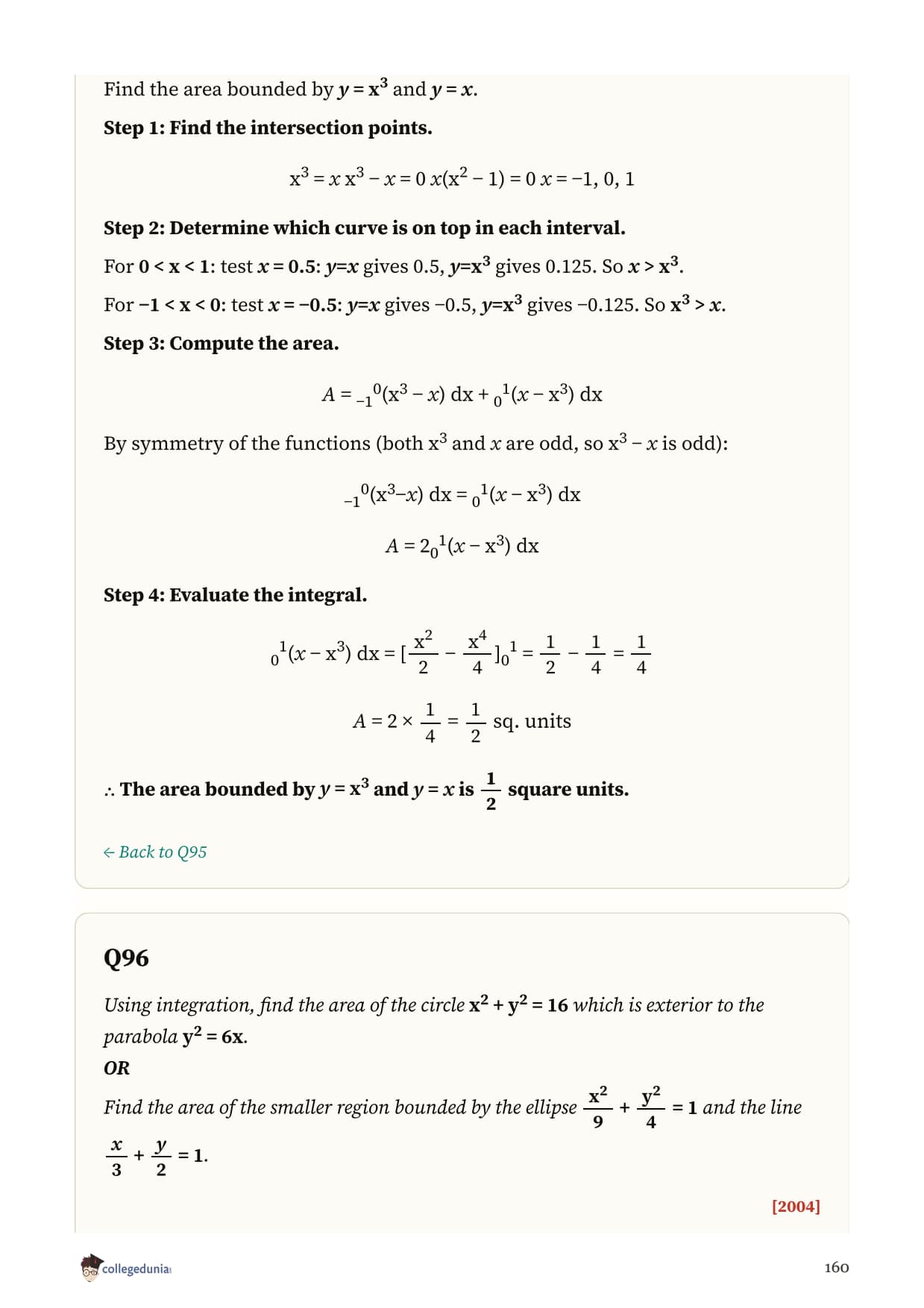
- 1 to 4-mark questions: 15 one-mark MCQs, 4 two-mark, 6 three-mark and 9 four-mark case-study parts on setting up the correct area integral.
- 5-mark questions: 25 questions, where you find the area bounded by a curve, a line or an axis using integration.
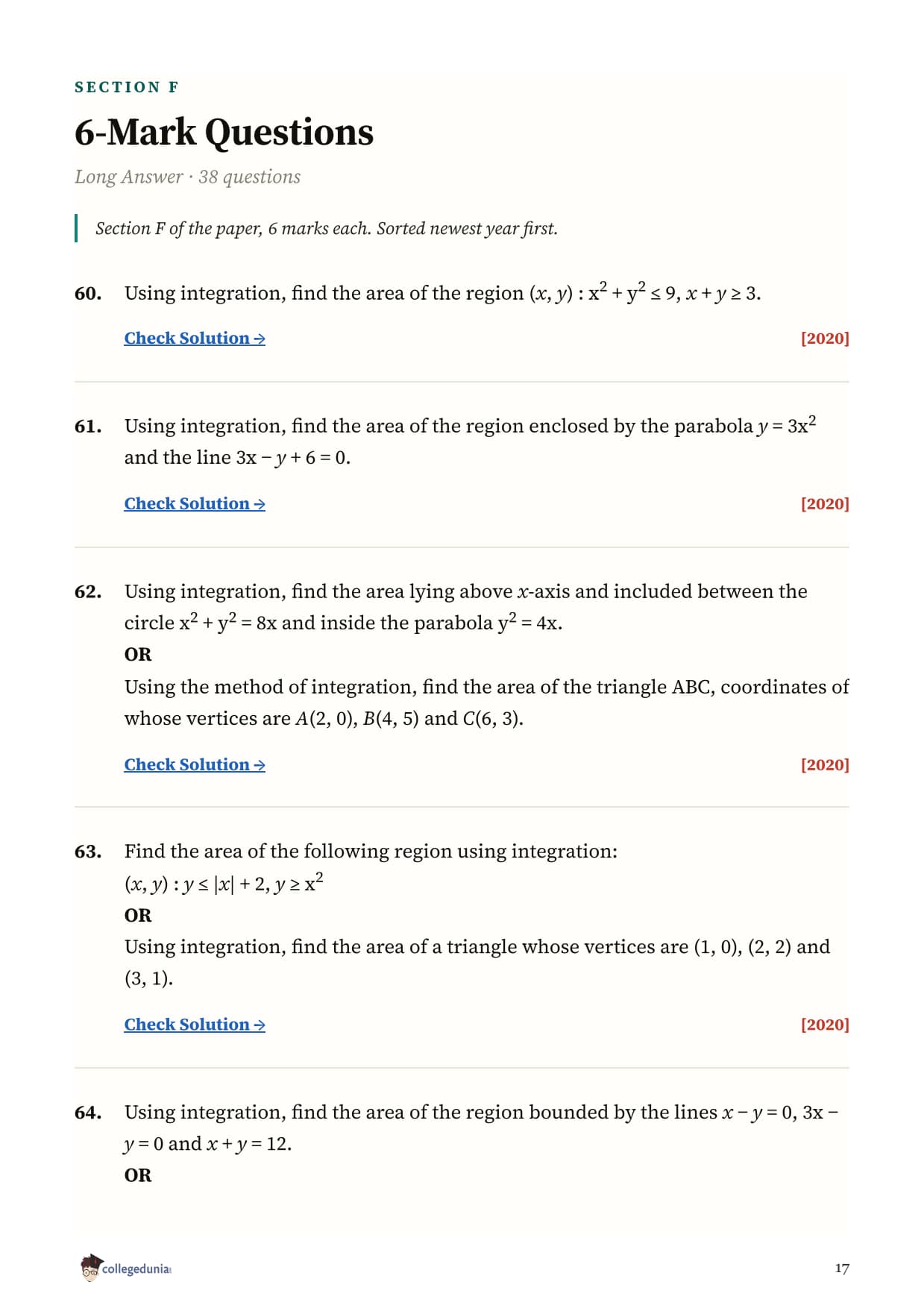
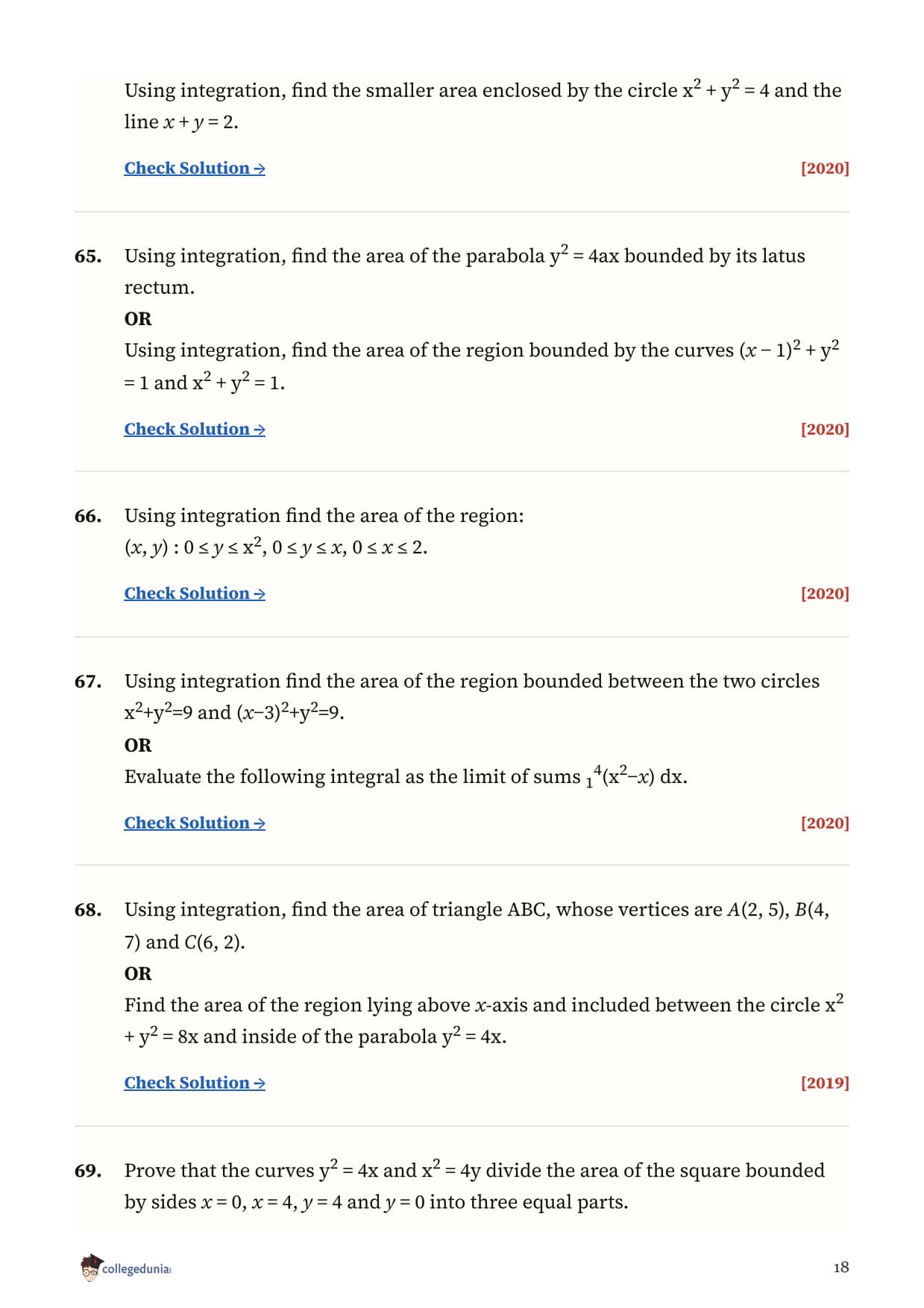
- 6-mark long answers: 38 questions, the biggest band, built around area between two curves like a circle, parabola or ellipse.
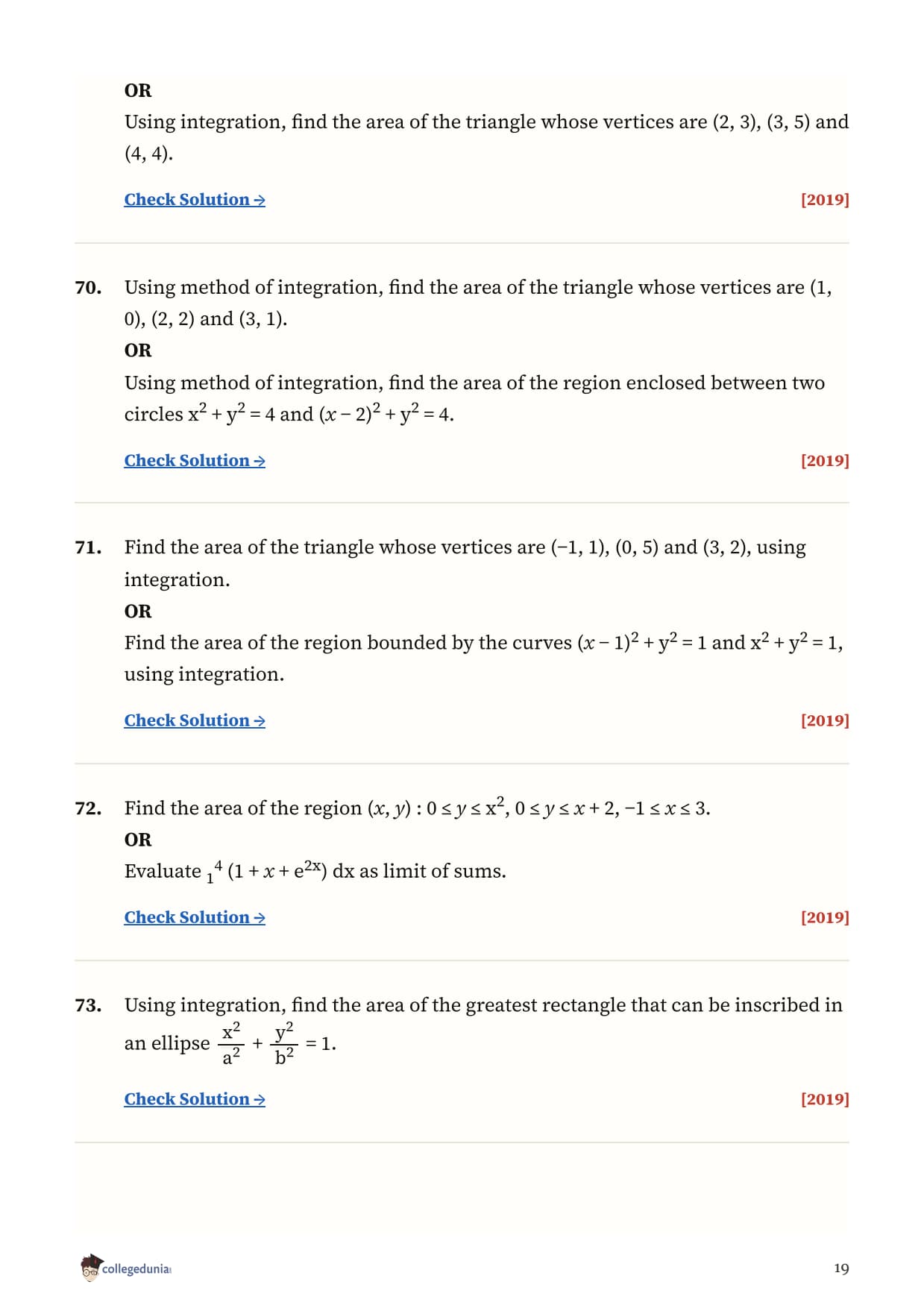
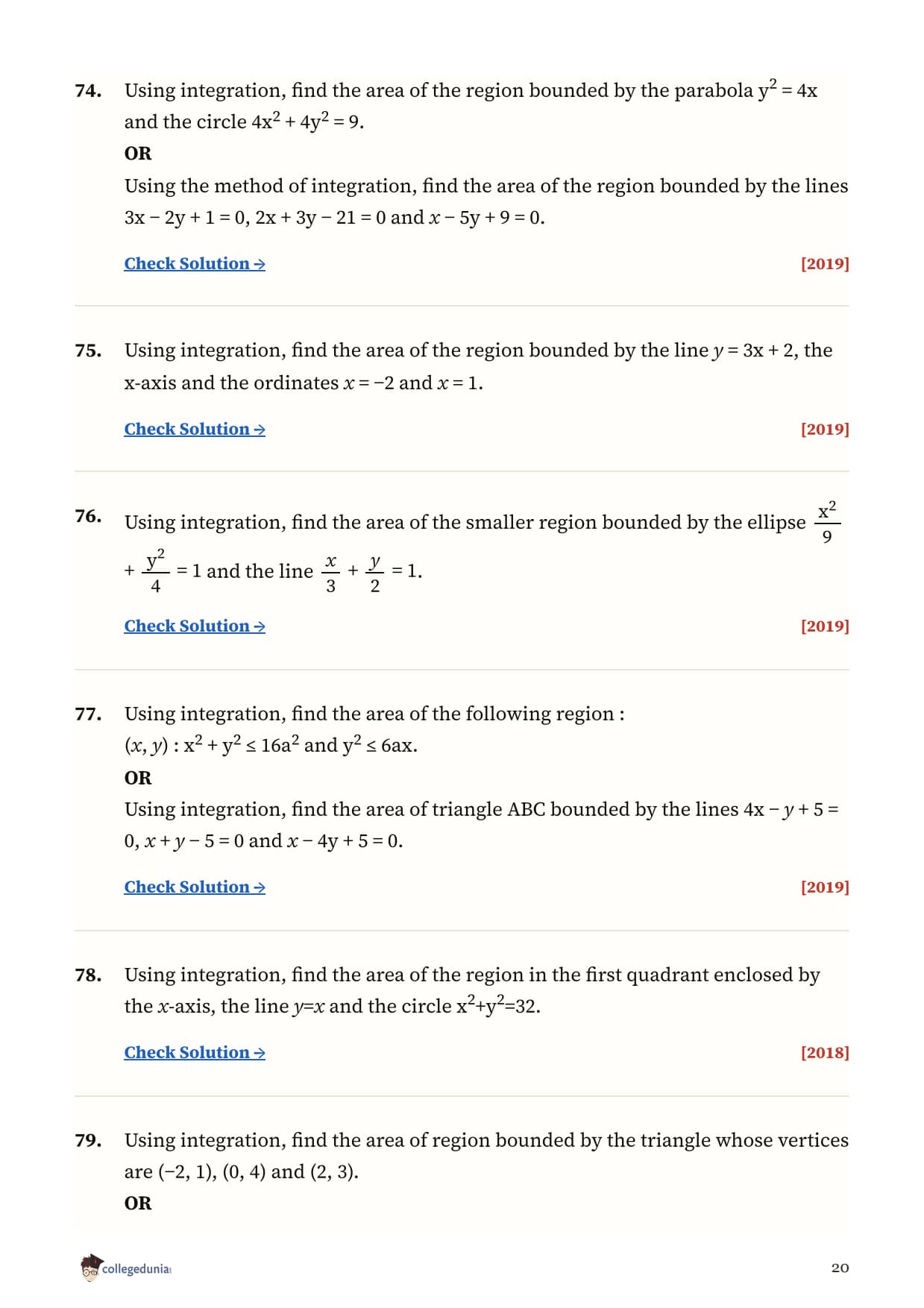
This Application of Integrals PYQ set collects 97 board-paper questions across 2003 to 2026, sorted by marks and then by year so you practise them in the same order CBSE sets them.
Every question in this Class 12 Maths Application of Integrals PYQ compilation is sourced from CBSE board papers (Delhi, Outside Delhi, Foreign and Compartment) and cross-checked against the official mark scheme, with near-duplicate questions removed.
What the Application of Integrals Previous Year Questions Cover
The 97-question set covers every idea the NCERT chapter introduces. Area bounded by a curve and the axes drives the 5-mark band, with the modulus curve and the parabola as repeat favourites. Area between two curves such as a circle and a parabola, or a parabola and a line, fills almost all the 6-mark long answers. Area enclosed by an ellipse and area as a limit of a sum appear in the higher bands too, while the short MCQs test which definite integral gives the correct area.
Marks-wise Distribution of the Application of Integrals PYQs
The table below shows how the 97 questions split across the CBSE marks bands. Use it to decide how much revision time each band deserves.
| Marks | Questions | Total Marks | CBSE Section | Type |
|---|---|---|---|---|
| 1 mark | 15 | 15 | Section A | MCQ / Assertion-Reason |
| 2 mark | 4 | 8 | Section B | VSA (Very Short Answer) |
| 3 mark | 6 | 18 | Section C | SA (Short Answer) |
| 4 mark | 9 | 36 | Section D | Case Study |
| 5 mark | 25 | 125 | Section E | Long Answer |
| 6 mark | 38 | 228 | Section E | Long Answer |
Year-wise Spread of Class 12 Maths Application of Integrals PYQs
The compilation draws from 22 CBSE board years. About 52% of the questions come from 2023 onwards, since the recent papers brought back full-length area questions and added case-study parts.
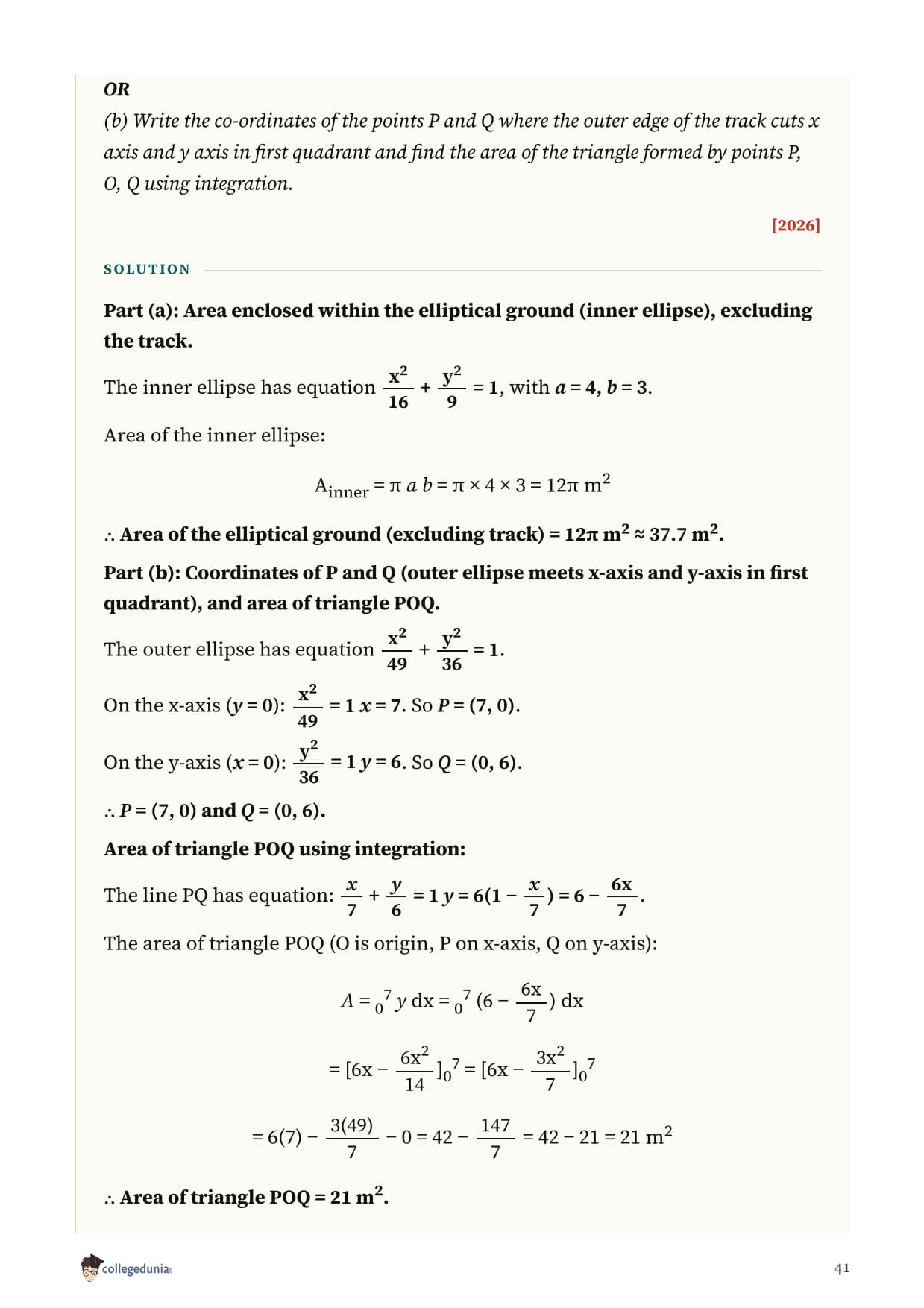
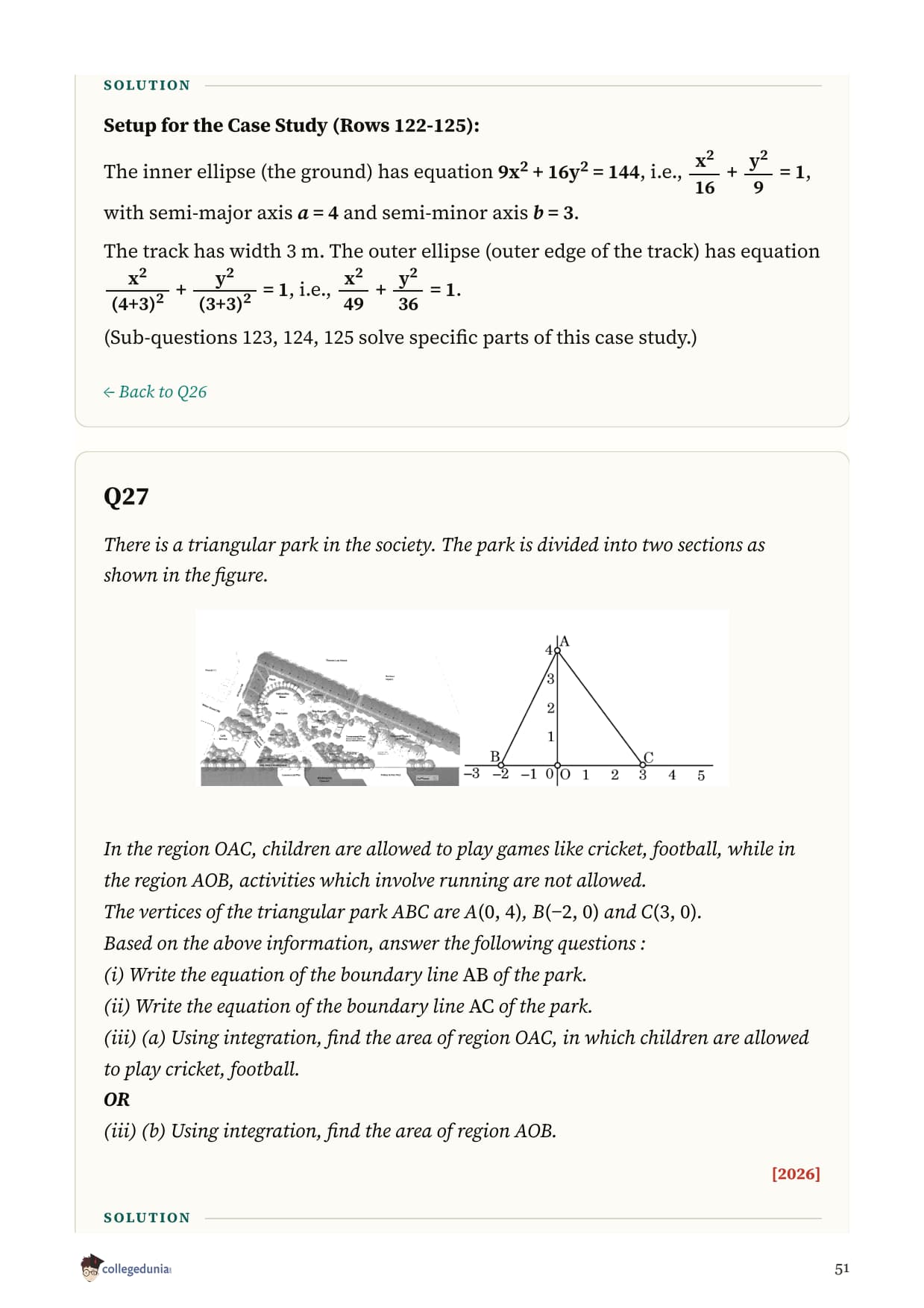
- 2026: The elliptical racing-track case study on 9x² + 16y² = 144, a 5-mark area question on y = |x - 6| between x = 4 and x = 8, and an MCQ on the area bounded by y = x|x| between x = -1 and x = 1.
- 2025: One of the largest contribution years, with several 6-mark area-between-curves questions and a fresh batch of case-study parts.
- 2019 to 2024: Steady 5 and 6-mark questions on area enclosed by an ellipse and area bounded by a parabola and a line.
- 2003 to 2018: Heritage long answers on area between a circle and a parabola and on the triangle area by integration, all still relevant today.
Topic Frequency in the Application of Integrals Board Paper Questions
The 97 questions cluster into the six buckets below, ranked by how often CBSE has set them between 2003 and 2026.
| Rank | Topic Cluster | Frequency | Typical Marks Band |
|---|---|---|---|
| 1 | Area bounded by a curve and an axis (parabola, modulus curve, area as a limit of sum) | ~26 per cent | 5 mark |
| 2 | Area between two curves (circle and parabola, two parabolas) | ~24 per cent | 6 mark |
| 3 | Area bounded by a curve and a line (parabola and line, chord region) | ~18 per cent | 5 and 6 mark |
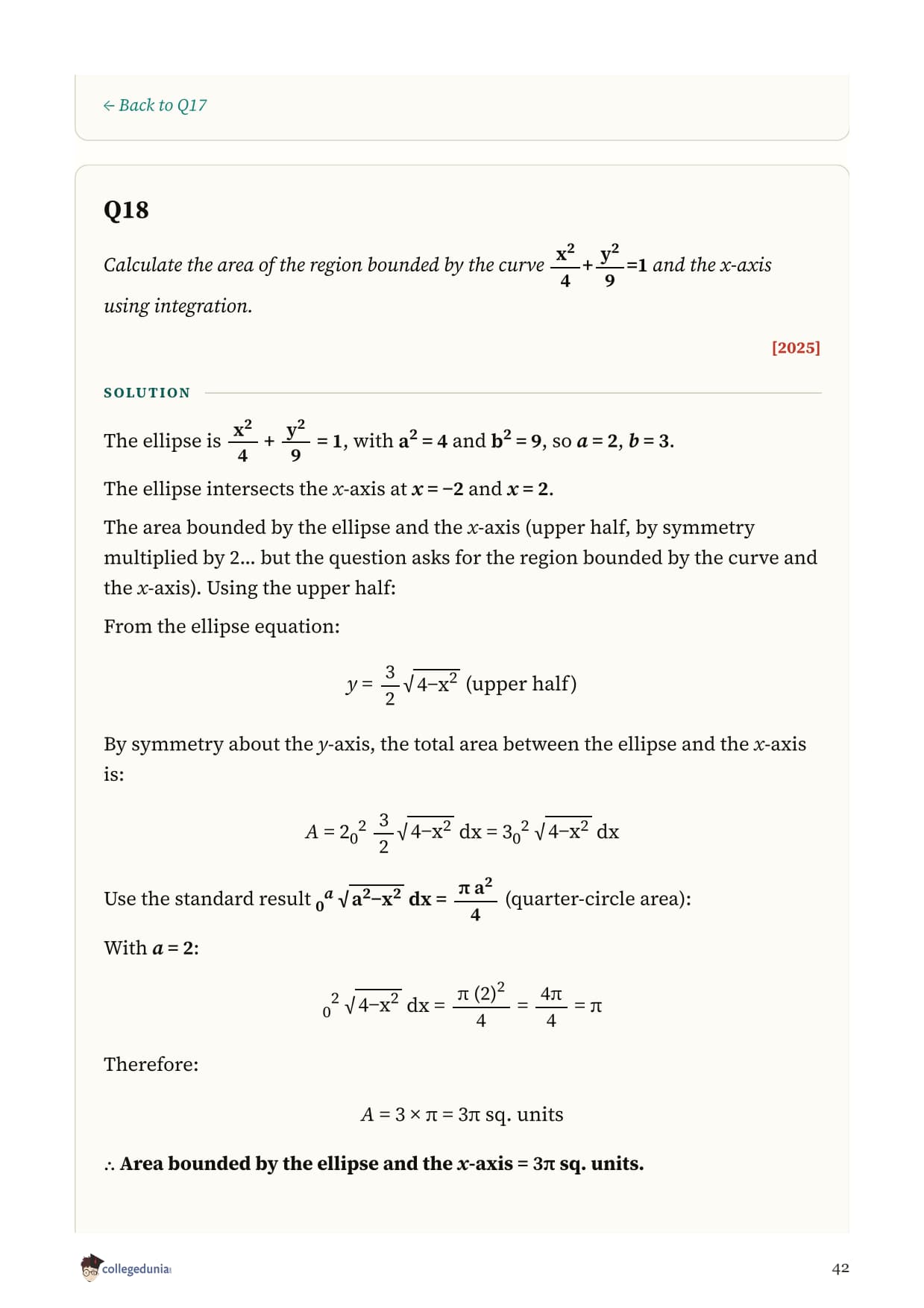
| 4 | Area enclosed by an ellipse (standard ellipse, sector of an ellipse) | ~14 per cent | 5 and 6 mark |
| 5 | Case-study area parts (real-context curves like tracks and arches) | ~10 per cent | 1 and 4 mark |
| 6 | Setting up the area integral (correct limits, dx versus dy form) | ~8 per cent | 1, 2, 3 mark |
Marks-Band Attempt Strategy for the Application of Integrals PYQs
The 97 PYQs are arranged marks-ascending inside the PDF so you can attempt them in the same order the CBSE paper presents them.
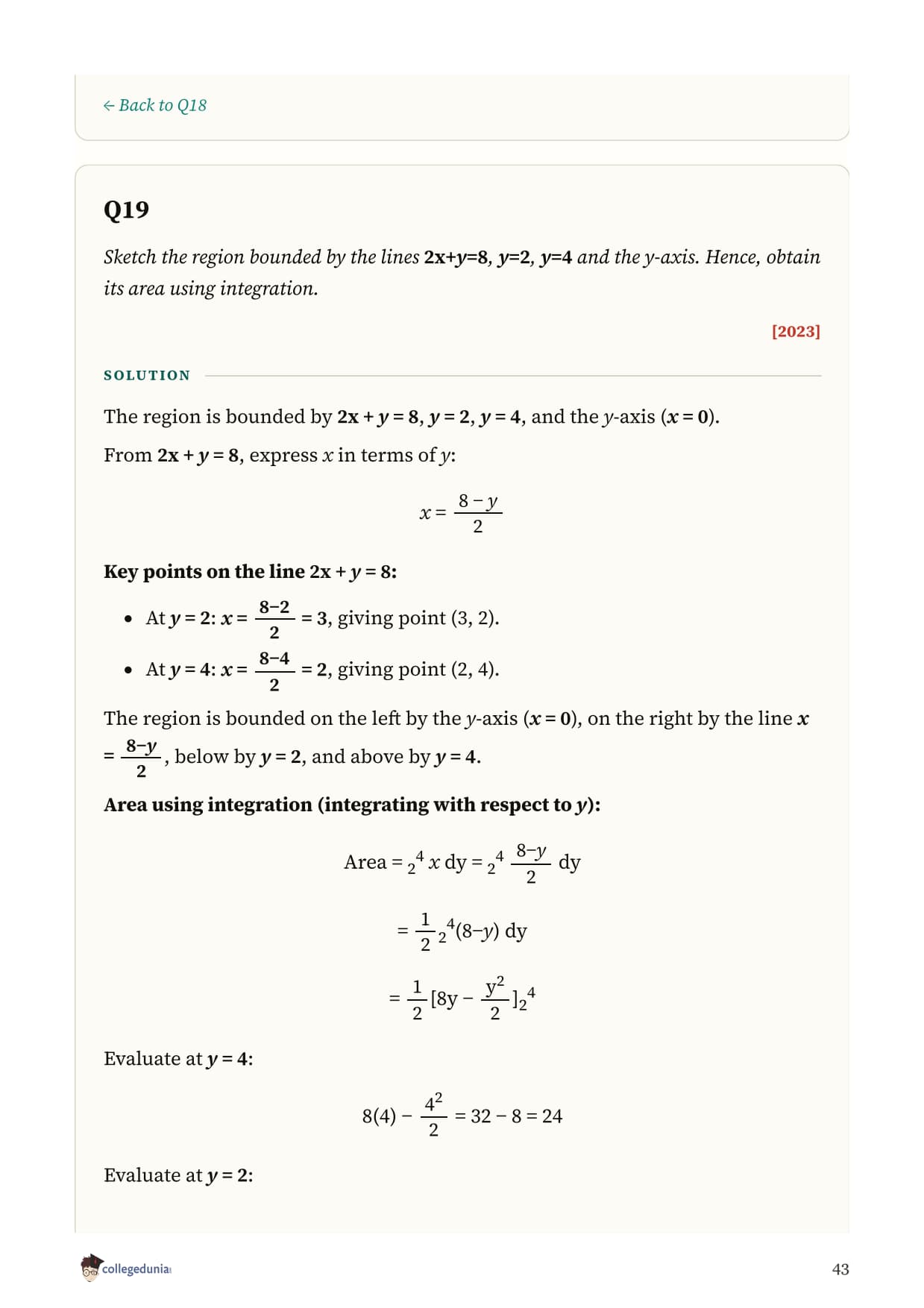
- 1 and 2-mark questions: Spend under a minute each. Most ask which definite integral gives the area, so just check the limits and the dx versus dy form.
- 3 and 4-mark questions: Often a case-study part with one short area calculation. Aim for 4 to 5 minutes.
- 5-mark questions: A single curve and an axis. Always draw the rough sketch and shade the region before you integrate.
- 6-mark long answers: Area between two curves. Find the points of intersection first, then split the integral. Allocate 12 to 15 minutes.
Recent CBSE Trend: 2024 to 2026 Pattern Shift in Application of Integrals
Three things have changed in the recent CBSE cycles that the Application of Integrals previous year questions now reflect:
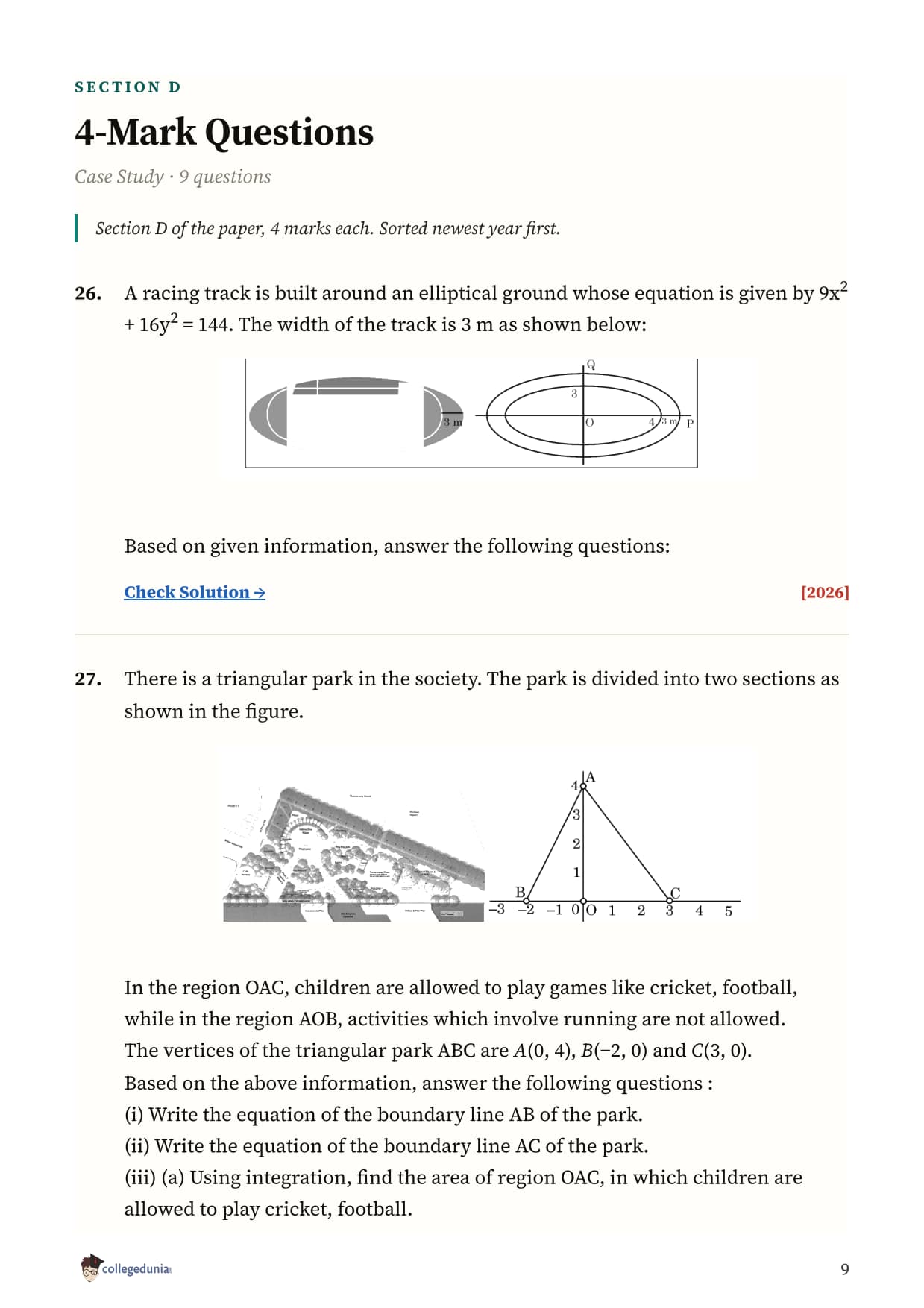
- Real-context case-study questions are now common, like the 2026 elliptical racing track on 9x² + 16y² = 144, which carries small parts worth 1 and 4 marks.
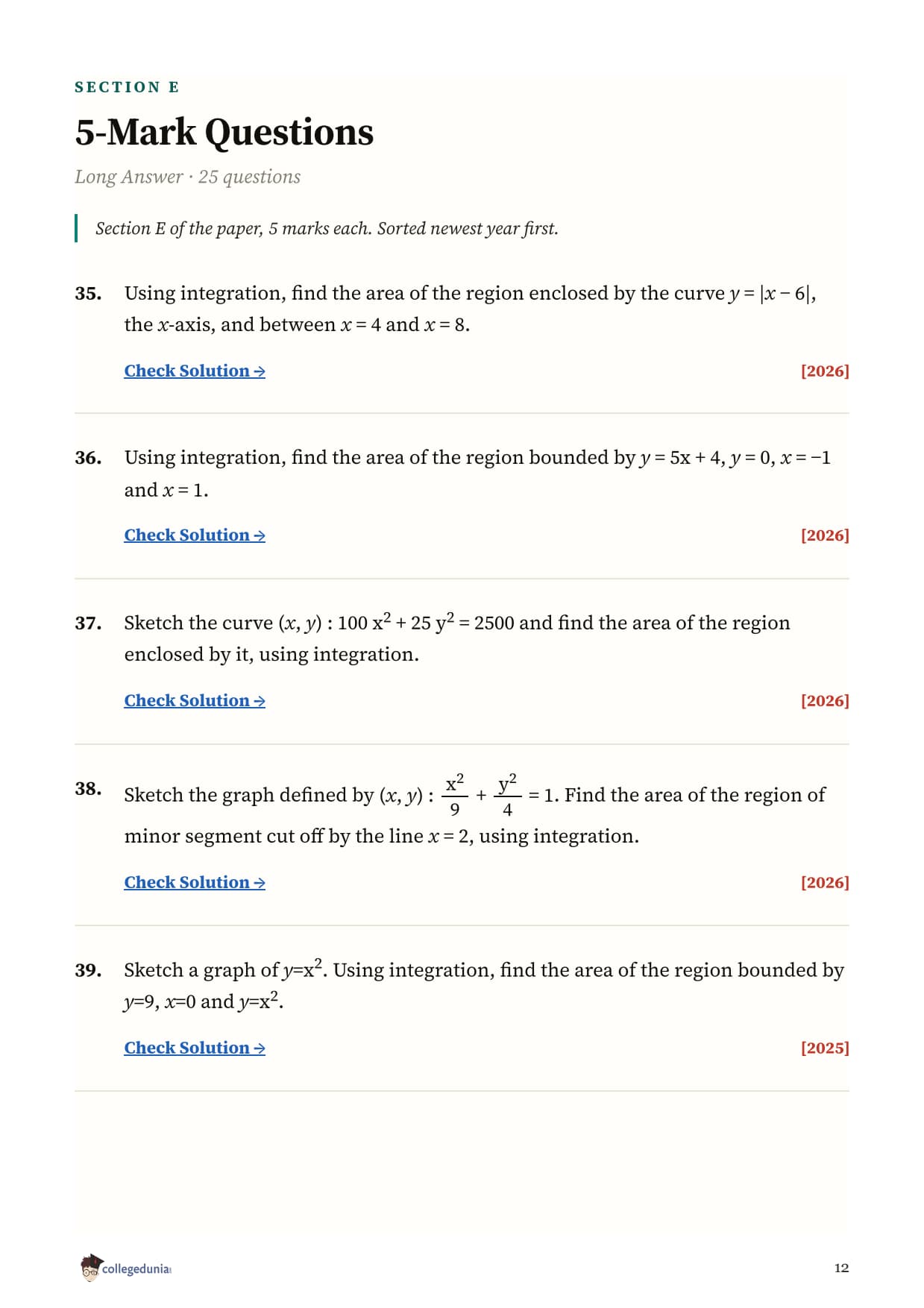
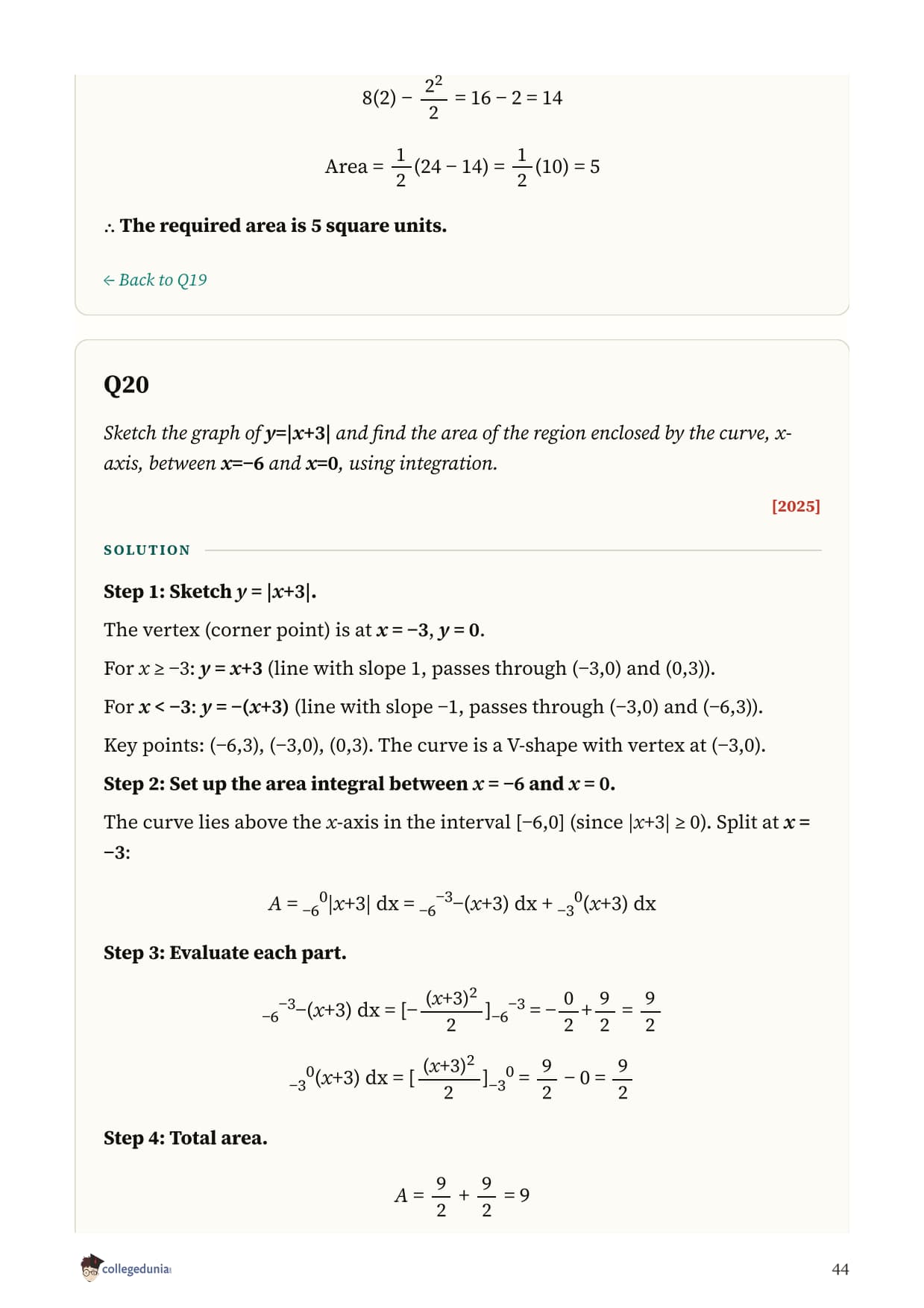
- Modulus and piecewise curves appear more often, as in the 2026 question on the area of y = |x - 6| between x = 4 and x = 8, which forces you to split the region.
- 6-mark questions almost always carry an OR alternative, so the PDF keeps both branches and you can revise each option.
Sample Previous Year Questions from Application of Integrals
Here are a few real previous year questions from the Application of Integrals board papers, taken straight from the compilation. The full set is in the downloadable PDF.
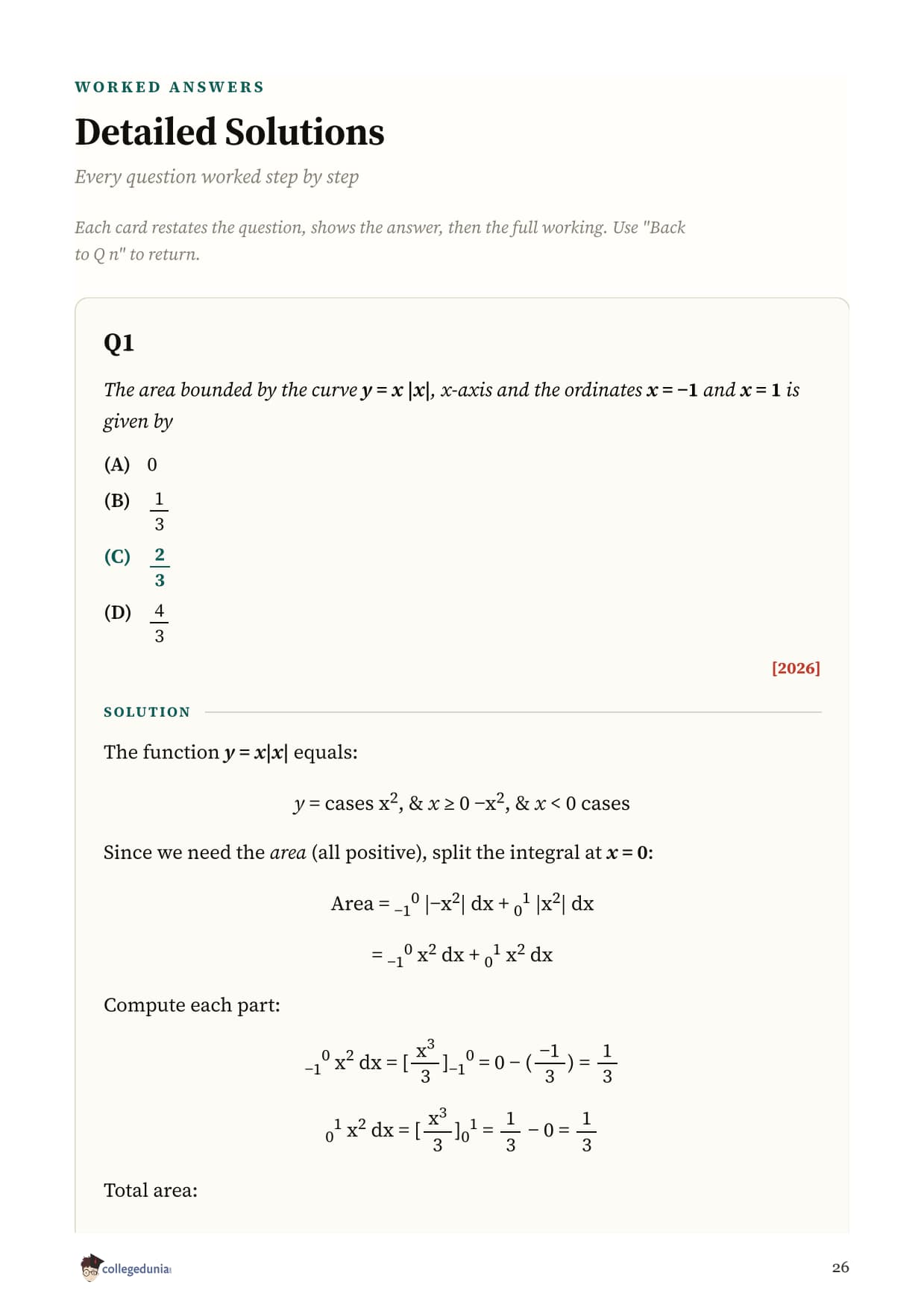
The area bounded by the curve y = x |x|, x-axis and the ordinates x = -1 and x = 1 is given by
- 0
- 13
- 23
- 43
[2026 • 1 mark]
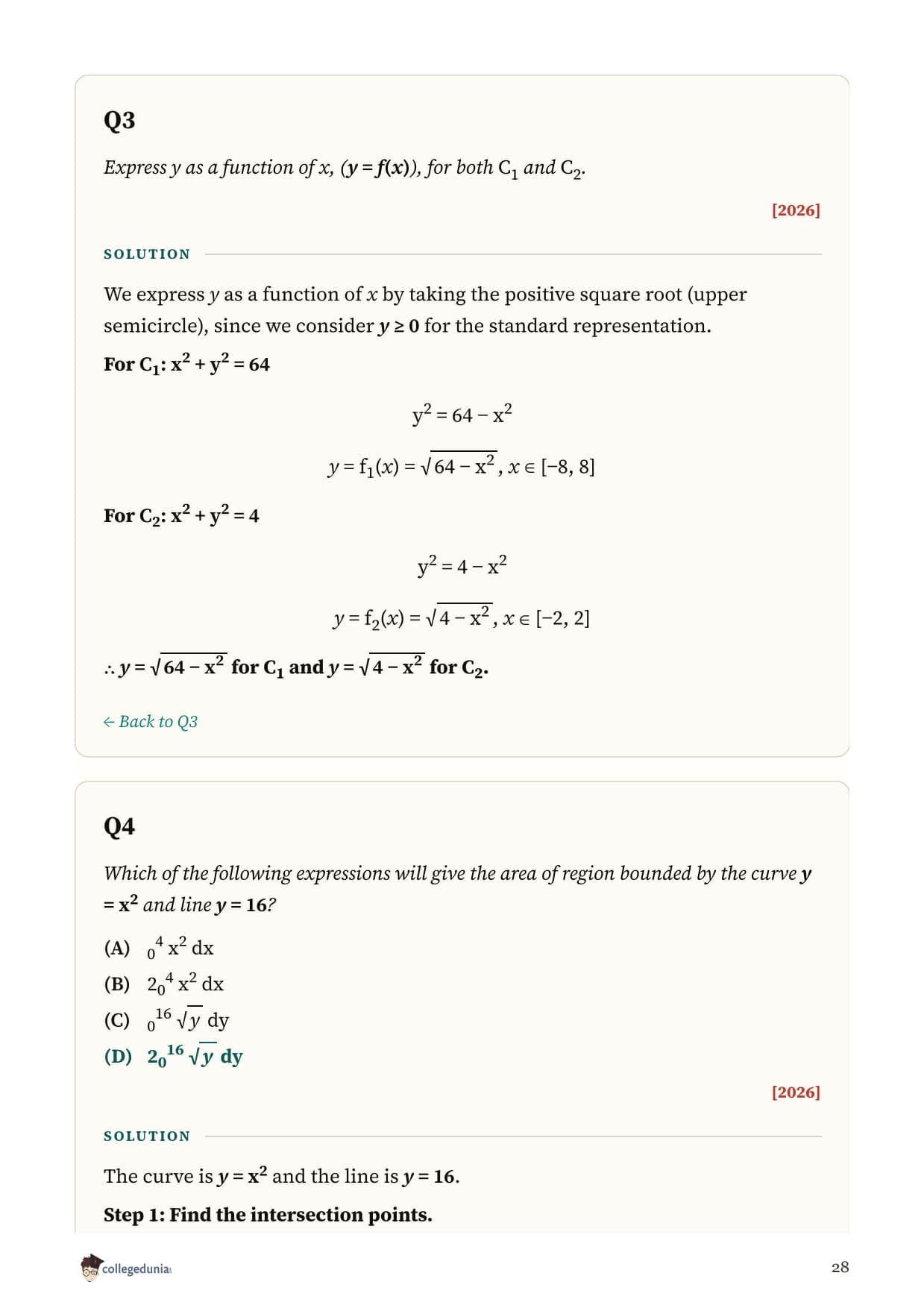
Express y as a function of x, (y = f(x)), for both C_1 and C_2.
[2026 • 1 mark]
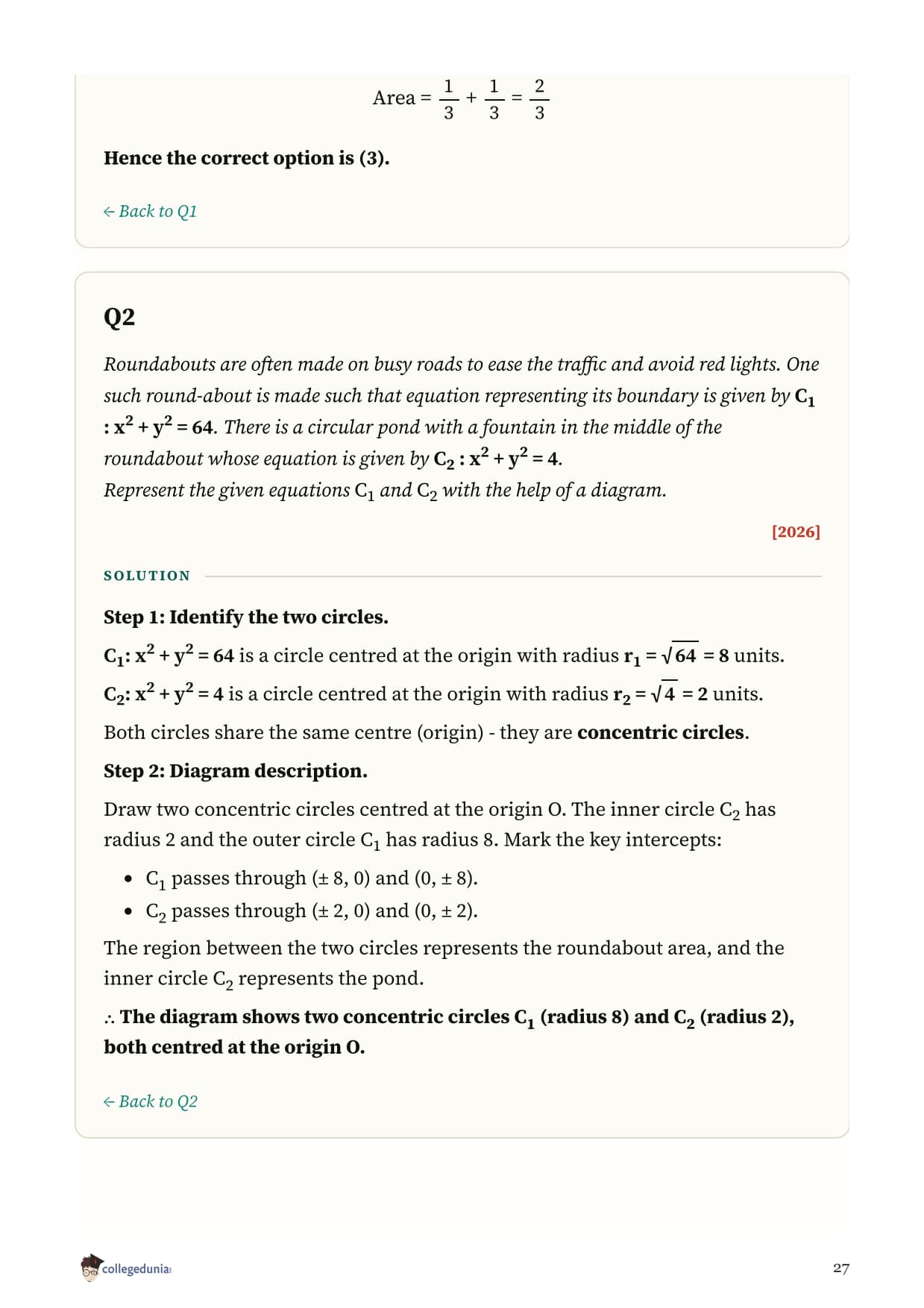
Using integration find the area of region covered by the roundabout.
[2026 • 2 mark]
Common Mistakes in the Application of Integrals Board Questions
- Skipping the rough sketch, so the wrong region gets shaded and the limits come out wrong.
- Using the wrong limits of integration when the curve meets the axis at points other than the origin.
- Forgetting to find the points of intersection first in an area-between-curves question.
- Treating a modulus curve as a single expression instead of splitting it at the point where it changes sign.
- Leaving the answer as a signed value instead of taking the absolute area when the region lies below the axis.
Student Feedback on Application of Integrals PYQ Practice
- 68 per cent said drawing the correct shaded region was the hardest first step in the 5 and 6-mark questions.
- 61 per cent reported gaining 5 to 6 marks after solving all 38 six-mark PYQs from this PDF before the boards.
- 47 per cent said an area-between-curves question very similar to a past paper appeared in their actual 2026 exam.
- Average time to finish all 97 PYQs: about 13 hours across 6 study sessions.
How These PYQs Pair with the Other Application of Integrals Resources
Solving previous year questions alone gives you only half the prep. Pair the PYQ PDF with the matching concept, formula and solution resources for Application of Integrals.
| Resource | What It Gives You | Open |
|---|---|---|
| NCERT Solutions | Step-by-step worked answers to every NCERT back-exercise question of Application of Integrals | NCERT Solutions for Application of Integrals |
| Notes | Concept revision notes covering every topic in the Application of Integrals chapter | Application of Integrals Class 12 Notes |
| Formula Sheet | All key formulas and results of Application of Integrals on one page for last-day revision | Application of Integrals Formula Sheet |
| Handwritten Notes | Scanned handwritten notes of Application of Integrals for quick one-shot revision | Application of Integrals Handwritten Notes |
| Exemplar Solutions | NCERT Exemplar problems of Application of Integrals solved in full for extra practice | NCERT Exemplar Solutions for Application of Integrals |
| NCERT Book | Official NCERT Application of Integrals chapter PDF for free download | Application of Integrals NCERT Book PDF |
| Exemplar Book | NCERT Exemplar Application of Integrals problem book PDF for free download | Application of Integrals Exemplar Book PDF |
How to Use the Application of Integrals PYQ PDF Most Effectively
The 97 questions are sequenced for a three-pass revision plan:
- Pass 1 (Day 1): Attempt the 15 one-mark, 4 two-mark and 6 three-mark questions on choosing the correct area integral. Fix the dx versus dy decision first.
- Pass 2 (Day 2 to 4): Solve the 9 four-mark and 25 five-mark questions. Draw and shade every region before integrating.
- Pass 3 (Day 5 to 9): Work through all 38 six-mark area-between-curves long answers, finding intersection points and splitting the integral each time.
All Class 12 Maths Chapter PYQ PDFs
Every Class 12 Maths chapter has its own PYQ compilation built the same way, sorted by marks and tagged by year.
| Chapter | Topic | Previous Year Questions |
|---|---|---|
| Chapter 1 | Relations and Functions | PYQ PDF |
| Chapter 2 | Inverse Trigonometric Functions | PYQ PDF |
| Chapter 3 | Matrices | PYQ PDF |
| Chapter 4 | Determinants | PYQ PDF |
| Chapter 5 | Continuity and Differentiability | PYQ PDF |
| Chapter 6 | Application of Derivatives | PYQ PDF |
| Chapter 7 | Integrals | PYQ PDF |
| Chapter 8 | Application of Integrals | PYQ PDF |
| Chapter 9 | Differential Equations | PYQ PDF |
| Chapter 10 | Vector Algebra | PYQ PDF |
| Chapter 11 | Three Dimensional Geometry | PYQ PDF |
| Chapter 12 | Linear Programming | PYQ PDF |
| Chapter 13 | Probability | PYQ PDF |
Also Check: NCERT Solutions for Class 12 Maths
Class 12 Maths Application of Integrals PYQ FAQs
Ques. How many previous year questions are in the Class 12 Maths Application of Integrals PYQ PDF?
Ans. The PDF has 97 previous year questions from CBSE board papers between 2003 and 2026, sorted by marks (1 to 6) and then by year, latest first. Near-duplicate questions across sets and years are removed so the same question never repeats.
Ques. Are the Application of Integrals PYQs based on the 2026-27 CBSE syllabus?
Ans. Yes. Every question follows the 2026-27 CBSE Class 12 Mathematics syllabus. Older area questions are kept because finding area by integration is unchanged in the current syllabus.
Ques. Which topics of Application of Integrals appear most often in CBSE board papers?
Ans. From the 97-question set: area bounded by a curve and an axis (about 26 per cent), area between two curves (about 24 per cent), area bounded by a curve and a line (about 18 per cent), and area enclosed by an ellipse (about 14 per cent).
Ques. How is this PYQ PDF different from a CBSE sample paper?
Ans. A sample paper gives you one paper. This PDF stitches together 22 years of questions across every set and region (Delhi, Outside Delhi, Foreign and Compartment) for Application of Integrals alone, so you can see which area types CBSE repeats and how each is usually framed.
Ques. Does the Application of Integrals PYQ PDF include MCQs?
Ans. Yes. 15 of the 97 questions are 1-mark questions, mostly MCQs that ask which definite integral gives the area of a shaded region, such as the 2026 question on y = x|x| between x = -1 and x = 1.
Ques. Where can I download the Application of Integrals Class 12 PYQ PDF for free?
Ans. The full Application of Integrals PYQ PDF is free to download from the PDF button at the top of this page. No sign-up is needed.
Ques. How should I use these PYQs to revise Application of Integrals in the last 10 days?
Ans. Use the three-pass plan: Day 1 attempt the short 1 to 3-mark questions on the correct area integral, Day 2 to 4 solve the 4 and 5-mark questions with a sketch each time, Day 6 to 9 attempt all 38 six-mark area-between-curves long answers under a 12-minute timer.
Ques. Is area between two curves the most important topic for the CBSE Application of Integrals questions?
Ans. Yes for the high-mark band. Area between two curves drives nearly a quarter of the set and almost all the 6-mark long answers. Practising every circle-and-parabola and parabola-and-line question in the PDF is the best use of your time for this chapter.
Ques. How many marks does Application of Integrals carry in the CBSE Class 12 Maths board paper?
Ans. In the 97-question set, the high-mark band dominates: 25 questions are 5-mark and 38 are 6-mark, so most of the chapter's weight sits in full-length area long answers. The short 1 to 4-mark questions, including case-study parts, make up the rest.
Ques. What is the area bounded by a curve?
Ans. The area bounded by a curve is the region enclosed between the curve, the x-axis or y-axis, and two given limits. You find it as a definite integral of the function between those limits, taking the absolute value when the region lies below the axis.
Ques. How is area between two curves defined?
Ans. The area between two curves y = f(x) and y = g(x) is defined as the definite integral of the difference (upper curve minus lower curve) between their points of intersection. So you first solve f(x) = g(x) to get the limits, then integrate (f(x) - g(x)) dx over that interval.
Ques. What is area as a limit of a sum?
Ans. Area as a limit of a sum is the original idea behind the definite integral. You divide the region into many thin strips, add their areas, and take the limit as the strip width approaches zero. This sum equals the definite integral of the function.



Comments