


.png?h=18&w=18&mode=stretch)
MICA PGDM-C and PGDM are the two post graduate programmes at MICA Ahmedabad. Both are two-year residential diplomas approved by AICTE. Both carry the same fee of INR 28 Lakh. The full first year is identical for either programme.
The two paths split only in Year 2. PGDM-C students choose any two functional specialisations. Each one carries 10 credits. PGDM students take Business Analytics and Consulting as a compulsory 15-credit block.
Seat counts differ sharply. Combined approved intake is 240 seats, as per MICA's NIRF 2026 filing. A candidate may apply to both. Only one offer can be accepted, and MICA states the choice cannot be changed later. Details sit on mica.ac.in.
Download: MICA PGDM & PGDM-C Information Brochure 2026
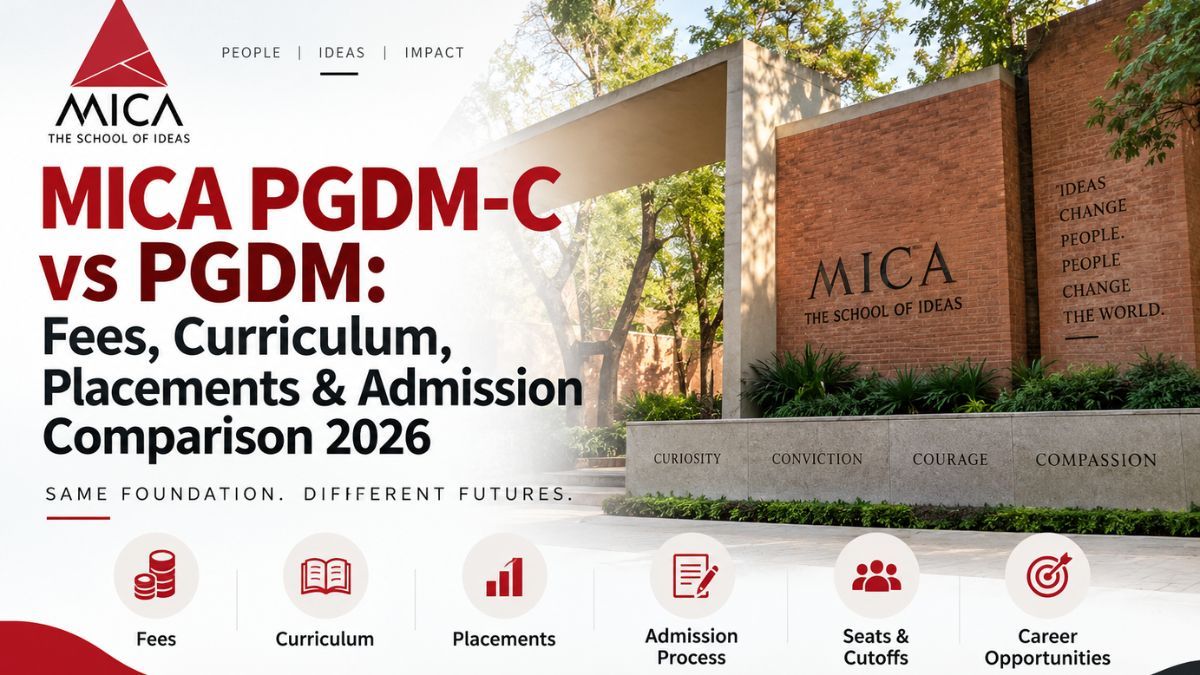
MICA PGDM-C vs PGDM: Quick Comparison 2026
The table below sets the two programmes side by side.
| Parameter | PGDM-C | PGDM |
|---|---|---|
| Full form | Post Graduate Diploma in Management - Communications | Post Graduate Diploma in Management |
| Core strength | Cultural intelligence and brand strategy | Data analytics and technology integration |
| Year 1 curriculum | Common, 54 credits | Common, 54 credits |
| Year 2 compulsory block | None | Business Analytics and Consulting, 15 credits |
| Approved seats | 180 | 60 |
| Total fee | INR 28 Lakh | INR 28 Lakh |
| Entrance route | CAT or XAT or GMAT, plus MICAT | CAT or XAT or GMAT, plus MICAT |
The seat split is as per previous intake data. The combined 240 figure is the officially filed sanctioned intake.
Read More: MICA Courses & Fees 2026
Curriculum Difference Between the Two Programmes
MICA publishes one curriculum document covering both programmes. The 2026-28 structure shows where they overlap and where they part.
Year 1 Is Common to Both
Orientation, Term 1 and Term 2 are identical. Every student takes the same 54 credits in Year 1. Term 1 carries 25 credits and Term 2 carries 29.
Shared Term 1 courses include Quantitative Techniques and How to Read Culture. Term 2 adds Semiotics, Network and Platform Economics, and Finance for Marketeers. So a PGDM student studies culture and semiotics too. A PGDM-C student studies analytics and AI foundations too.
The summer internship between the two years is also common. It carries 2 credits and runs 8 to 10 weeks.
Year 2 Specialisation Split
Term 3 is where the programmes diverge. Both end at 34 credits. The mix inside those credits is different.
| Term 3 Component | PGDM-C | PGDM |
|---|---|---|
| Business Analytics and Consulting | Optional | Compulsory, 15 credits |
| Functional specialisation | Any two, 20 credits | One minor, 5 credits |
| Sectoral specialisation | Any two, 14 credits | Any two, 14 credits |
| Term 3 total | 34 credits | 34 credits |
The practical effect is about freedom. A PGDM-C student can build a fully brand-led Year 2. A PGDM student spends nearly half of Term 3 on analytics.
MICA also lists an MI-Impact Immersive Project as compulsory for PGDM.

Immersion and Capstone Difference
Term 4 carries 15 credits in both programmes. The rural immersion is framed differently for each.
PGDM-C students take Immersion: Rural Socio-Cultural Context. PGDM students take Immersion: Rural Consumer-Market Understanding. The capstone lens changes too. PGDM-C works off a socio-technical systems lens. PGDM works off a strategy lens built around Playing to Win.
A third option sits outside both. The Job Creators Track is open to students of either programme. It replaces the specialisation route with venture building. That track runs to 49 credits across Terms 3 and 4.
Check: MICA Course Admission 2026: Dates, Fees, Eligibility, Application Process, Selection Criteria
Specialisations Offered Under Each Programme
MICA runs eight functional specialisations and eight sectoral ones. PGDM-C students pick two functional majors from the full list. PGDM students pick one as a minor, besides the compulsory analytics block.
The eight functional specialisations are:
- Advanced Product Management and Product Marketing
- Advanced Sales and CRM Leadership
- Advanced Brand Management
- Campaign Design and Performance Management
- Marketing Technology and AI
- Data Science and Analytics with AI
- Customer Experience Strategy and Digital Transformation
- Business Analytics and Consulting
The eight sectoral specialisations are open to both cohorts on the same terms:
- FMCG and FMCD
- Consumer Tech, covering quick commerce, e-commerce and travel tech
- Retail Business
- Media, Entertainment and Sports
- BFSI and FinTech
- Consulting and Tech Consulting
- Business Analytics and AI
- Health-Tech and Health Care Management
Example: a student targeting an FMCG brand role would pick PGDM-C. The choice would be Advanced Brand Management plus Campaign Design. FMCG would then be one sectoral minor.
MICA PGDM & PGDM-C Eligibility
Admission to both MICA PGDM-C (Post Graduate Diploma in Management – Communications) and PGDM (Post Graduate Diploma in Management) follows the same eligibility requirements. Candidates must satisfy the academic criteria prescribed by MICA before participating in the admission process.
| Particulars | Eligibility Requirement |
|---|---|
| Educational Qualification | Bachelor's degree (10+2+3 system) or an equivalent qualification in any discipline recognised by the Association of Indian Universities (AIU). |
| Minimum Marks | At least 50% aggregate marks or an equivalent CGPA in the qualifying bachelor's degree. |
| Final-Year Students | Candidates appearing for the final-year examination or awaiting results are also eligible to apply. |
| Provisional Admission | Selected final-year candidates must submit a certificate from their college/university confirming completion of all degree requirements. |
| Certificate Submission Deadline | The provisional eligibility certificate must be submitted by June 30, 2026. |
| Final Degree Submission | Candidates must submit the final mark sheet and degree/passing certificate by December 31, 2026 to confirm admission. |
| Failure to Submit Documents | Failure to submit the required documents within the stipulated timeline will lead to cancellation of the provisional admission. |
Important Points
- The eligibility criteria are identical for both MICA PGDM-C and PGDM, with no separate academic requirements for either programme.
- Final-year undergraduate students can apply and are granted provisional admission, subject to fulfilling the document submission requirements within the prescribed deadlines.
- Admissions are confirmed only after verification of the final degree and mark sheets, making timely submission of documents essential.
Seats and Batch Size Compared
PGDM-C is the larger of the two by a wide margin. It accounts for 180 of the 240 approved seats. PGDM accounts for the remaining 60.
Actual batch strength runs below the sanctioned intake. MICA's NIRF 2026 filing shows 204 first-year students admitted in 2023-24. The two cohorts then share one campus and one placement season.
The 2024-26 batch profile shows how mixed the classroom is. Around 31 percent came from engineering and 20 percent from arts and design. Another 19 percent came from commerce and 17 percent from management.
Check: MICA Placement
Admission Process and Cutoff Difference
The admission route is the same for both. Candidates need a bachelor's degree under the 10+2+3 system. At least 50 percent marks are required. A valid CAT, XAT or GMAT score is mandatory, and MICAT is written on top of it.
MICAT runs twice, in December and February. The better of the two scores counts. The final composite score then uses a fixed weightage.
| Component | Weightage |
|---|---|
| CAT or XAT or GMAT | 35% |
| MICAT | 25% |
| Personal Interview | 20% |
| Group Exercise | 10% |
| Class 10, Class 12 and graduation | 5% |
| Extra-curricular and diversity | 5% |
One real difference shows up at the cutoff stage. MICA states that PGDM has a greater emphasis on analytics. Quantitative Ability and Data Interpretation cutoffs may be higher for PGDM candidates. Section A of MICAT is a psychometric qualifier for both.
Admitted profiles have clustered around 80 percentile in CAT, as per previous trends. The same band has held for XAT.
Applying to both costs little. The processing fee is INR 2,500 for one programme. Each additional programme costs INR 500 more. But a candidate merit-listed for both must accept only one offer. Accepting one means giving up the other seat.
Fees and Scholarships Compared
There is no fee difference between the two programmes. Both are billed at INR 28 Lakh for the full two years. That figure covers tuition and infrastructure charges.
The optional international immersion is charged separately. MICA awards 25 to 30 scholarships every year. These cover 25 to 100 percent of tuition on merit and need. An Equity Scholarship is offered for candidates from lower-income families.
Placements for Both Programmes
MICA runs one placement season for both programmes. The outcome is reported together. The batch of 2024-26 recorded a 100 percent placement rate.
| Parameter | Batch 2024-26 |
|---|---|
| Students placed | 197 |
| Recruiters | 91 |
| Highest CTC | INR 45.67 LPA |
| Top 25 average CTC | INR 34.00 LPA |
| Average CTC | INR 20.12 LPA |
| Median CTC | INR 19.57 LPA |
Roles offered span both sides of the split. Brand Manager, Content Strategy and Media Planning appear on the list. So do Data Scientist and Strategy and Consulting Analyst. The largest sector cluster was FMCG, FMCD and e-commerce.
The NIRF 2026 filing confirms the trend for the earlier batch. All 201 students who graduated in 2024-25 were placed. The median salary was INR 18,00,000.
MICA holds rank 33 in the NIRF 2025 Management category. That rank covers the institute, not either programme separately.
What Students Say About Choosing Between the Two?
Official pages cover curriculum and cost well. They say less about what the two years actually feel like.
The Fee Is the Main Concern
Students consistently rate MICA high on campus life and infrastructure. Value for money is rated far lower on the same scales. The reason given is the INR 28 Lakh outlay. The median sits near INR 19 LPA. This applies equally to both programmes, since the fee is identical.
Hostel and Residential Life
Both programmes are fully residential on a 19-acre campus. Students describe the hostel blocks as clean but older. Rooms do not all carry air conditioning, a theme that recurs. Residence is not optional. The cost and the constraint are shared.
The Programme Label at Recruitment
Students report that recruiters treat the two cohorts as one pool. The official placement brochure supports that reading. It publishes one set of numbers for both programmes.
What does change is the shortlist a student fits. A PGDM transcript carries 15 credits of analytics and consulting. That reads differently for a consulting or fintech shortlist.
Students often ask: Is PGDM-C better than PGDM at MICA for marketing and advertising careers?
"I've heard their flagship course is PGDM-C but not entirely sure. If anyone has any idea about difference in placement opportunities and roles in both programs, please share.”
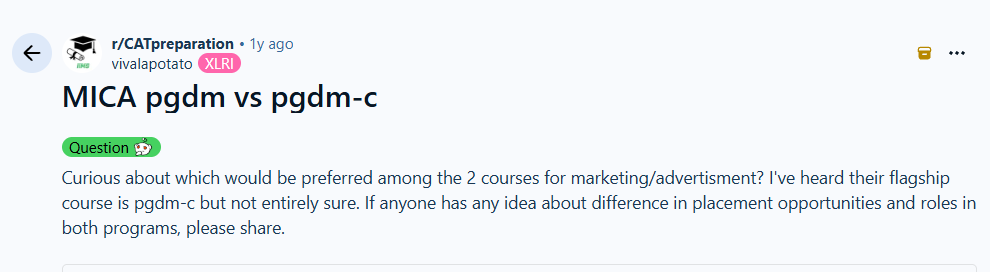
As per a discussion on Reddit's r/CATpreparation, many aspirants consider PGDM-C to be MICA's flagship programme because of its strong focus on strategic marketing, advertising, branding, and communication management.
According to responses from students and alumni, placements for PGDM and PGDM-C are generally conducted together, with recruiters hiring from a common placement pool. The programme name has less impact on placements than an individual's skills, electives, internships, and interview performance.
You can also explore other discussions on Reddit's r/CATpreparation, where MBA aspirants and MICA students have shared their experiences regarding PGDM vs PGDM-C curriculum, placements, career opportunities, and programme preferences.
MICA PGDM-C vs PGDM: Which Is Better?
Neither programme is stronger on fee, placement pool or campus. The choice is about Year 2 and the roles it opens.
PGDM-C suits candidates aiming at brand, advertising, media and sales roles. It gives two full functional majors. Both can stay on the creative side.
PGDM suits candidates aiming at consulting, analytics, product and fintech roles. The compulsory analytics block is the trade-off. It takes 15 of the 34 Term 3 credits. Only one functional minor fits after that.
Example: an engineering graduate with two years in a data role. That profile should lean towards PGDM. A humanities graduate targeting an FMCG brand team should lean towards PGDM-C. Both should note that the first year is the same either way.
Seat scarcity matters at the margin. PGDM has only 60 seats against 180 for PGDM-C. MICA states the QADI cutoff may run higher there. Applying to both keeps the option open for INR 500 more.
MICA PGDM-C vs PGDM FAQs
Ques. Is MICA PGDM-C equivalent to an MBA?
Ans. MICA PGDM-C is a two-year AICTE-approved Post Graduate Diploma in Management. Although it is not a university-awarded MBA degree, it is widely recognized by recruiters and offers career opportunities comparable to leading MBA programmes.
Ques. Can I apply for both MICA PGDM-C and PGDM?
Ans. Yes. Candidates can apply for both programmes in the same admission cycle. The application fee is INR 2,500 for the first programme, while each additional programme costs INR 500. Applicants can choose up to three programmes across MICA's schools.
Ques. Can I switch from PGDM to PGDM-C after admission?
Ans. No. Once your admission is confirmed, the selected programme cannot be changed. Candidates receiving admission offers for both programmes must accept only one.
Ques. Is the MICAT exam different for PGDM and PGDM-C?
Ans. No. Both PGDM and PGDM-C use the same MICAT examination and admission process. There is no separate entrance test for either programme.
Ques. Which programme has a higher admission cutoff?
Ans. Both programmes follow the same selection process. However, MICA indicates that the QADI (Quantitative Ability & Data Interpretation) cutoff may be slightly higher for PGDM candidates than for PGDM-C applicants.
Ques. Do PGDM and PGDM-C have separate placement processes?
Ans. No. Students from both programmes participate in a common placement season and are recruited by the same pool of companies. Placement opportunities depend on the candidate's profile, specialization, and performance rather than the programme name.
Ques. Are scholarships available for PGDM and PGDM-C students?
Ans. Yes. MICA offers 25–30 scholarships every year for eligible students. Depending on merit and financial need, scholarships can cover 25% to 100% of the tuition fee.
Ques. When does the MICA admission process usually begin?
Ans. The admission cycle generally starts with MICAT-I registrations in September, followed by the examination in December. Candidates should regularly check the official MICA website for the latest admission schedule, important dates, and application deadlines.



.png?h=132&w=263&mode=stretch)

![MBA/PGDM | admission | 2024 | Narsee Monjee Institute of Management Studies - [NMIMS Deemed to be University]](https://img.collegedunia.com/public/college_data/images/logos/1506323004Logo.jpg?h=72&w=72&mode=stretch)


![MBA/PGDM | admission | 2024 | Indian Institute of Management - [IIMC]](https://img.collegedunia.com/public/college_data/images/logos/1488950580d2.png?h=72&w=72&mode=stretch)



Comments