


.png?h=35&w=35&mode=stretch)
Study Abroad Content Specialist
When students from India or other countries look to pursue higher education in the United States, the process often seems complex and filled with a range of acronyms and regulations. Among the most crucial of these is SEVP—Student and Exchange Visitor Program. SEVP is a program managed by the U.S. Department of Homeland Security (DHS) designed to oversee and monitor schools that enroll international students and the students themselves. Its primary purpose is to ensure compliance with U.S. immigration laws and to provide accurate, up-to-date information about the status of international students and exchange visitors. For any Indian student aspiring to study in the U.S., understanding SEVP, its role in maintaining legal status, and how it facilitates the overall study experience is essential for navigating the journey from application to post-graduation.
Also Read: Community Colleges in USA for International Students
What is SEVP?
The Student and Exchange Visitor Program (SEVP) is a U.S. government program under the Department of Homeland Security (DHS) responsible for managing information on nonimmigrant students and exchange visitors. The main goal of SEVP is to ensure national security while supporting U.S. educational institutions in providing a safe and compliant environment for international students. This program monitors students who enter the U.S. on F, M, and J visas, ensuring they maintain their status throughout their stay.
SEVP is responsible for certifying schools and programs that are eligible to enroll international students. It also manages the Student and Exchange Visitor Information System (SEVIS), a web-based platform used to track and monitor these students, their academic progress, and compliance with U.S. immigration laws.
Also Check:
SEVIS: The Backbone of SEVP
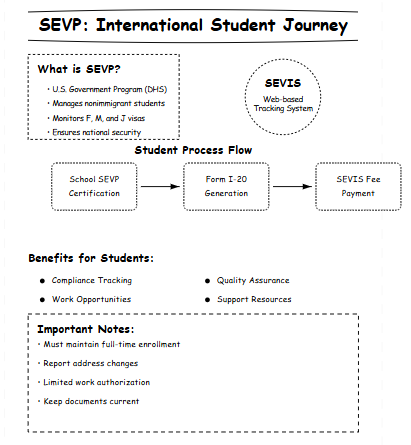
At the heart of SEVP lies SEVIS, a system designed to maintain critical information about students and exchange visitors. SEVIS is used by both U.S. government agencies and educational institutions to ensure that students and exchange visitors comply with U.S. immigration laws. It tracks the admission of students into the U.S., their academic status, and any significant changes, such as transferring schools or starting a new degree program.
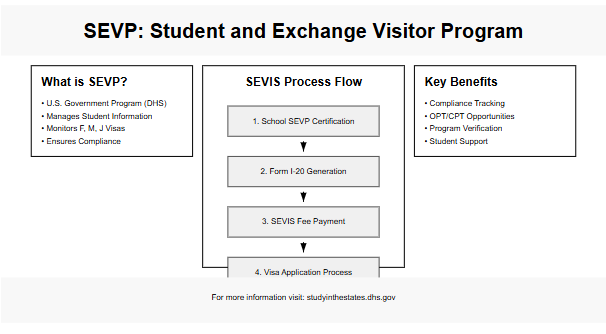
For Indian students planning to study in the U.S., SEVIS is where the journey begins. When you are accepted into a U.S. university or college that is SEVP-certified, you will receive a Form I-20, which is generated through SEVIS. This form is crucial for your visa application process, as it is required to apply for an F-1 or M-1 visa.
| Visa Type | Purpose | Dependents Allowed | Employment Opportunities |
|---|---|---|---|
| F-1 | Academic study programs | Yes (F-2) | On-campus, OPT, CPT |
| M-1 | Vocational/non-academic programs | Yes (M-2) | Limited, varies by program |
Importance of SEVP Certification for Schools
Not all U.S. schools are eligible to admit international students. For a school to accept F or M visa students, it must be SEVP-certified. This certification ensures that the school meets the standards set by DHS, providing an environment where international students can receive quality education while adhering to U.S. immigration rules.
Only SEVP-certified schools can issue Form I-20, the document that students need to apply for their visas. Without this certification, a school cannot legally enroll international students, meaning that Indian students must ensure their chosen institution is recognized by SEVP. This certification guarantees that the school complies with regulations that help ensure the safety and integrity of international student programs, making it a critical step in the U.S. admission process.
SEVP's Role in Student Compliance and Benefits
SEVP is not just a regulatory body but also an informational resource for international students. It helps guide students through the process of obtaining a visa, maintaining their student status during their stay in the U.S., and even applying for post-graduation work opportunities like Optional Practical Training (OPT) or Curricular Practical Training (CPT).
Through SEVIS, SEVP ensures that students follow the necessary rules related to course enrollment, full-time study, and reporting changes such as a change in address, school transfer, or academic status. Indian students who fail to comply with these requirements may risk their visa status, and in extreme cases, may be denied entry into the U.S. or removed from the country.
Also Check:
Moreover, SEVP also helps students by tracking their employment opportunities while they study. For example, students applying for OPT or CPT must have their employment approved and documented through SEVIS. This system ensures that students gain practical experience while complying with the restrictions of their visa.
Also Check:
SEVIS Fees and Visa Applications
One of the first steps for Indian students planning to study in the U.S. is paying the SEVIS I-901 fee. This fee is required before attending your visa interview at the U.S. Embassy or Consulate in India. The SEVIS I-901 fee is separate from the visa application fee and must be paid online. Once you pay this fee, you will receive a receipt that must be presented during your visa application process. Without this fee payment, the visa process cannot proceed.
Also Check: SEVIS Fees for US Visa
How SEVP Benefits Indian Students
- Regulation and Compliance: SEVP helps international students, including those from India, stay compliant with U.S. immigration laws. By keeping track of students through SEVIS, it ensures that students do not overstay their visas or fall out of status.
- Post-Graduation Work Opportunities: For Indian students hoping to work in the U.S. after their studies, SEVP ensures that students can apply for OPT or CPT through SEVIS, providing a clear pathway to employment in the U.S. for up to one year, with the possibility of extending it for students in STEM fields.
- Security and Integrity: SEVP also helps ensure that educational institutions in the U.S. maintain standards that benefit both the students and the country. It monitors schools for quality and compliance, ensuring that students are enrolled in legitimate and accredited programs.
- Support and Guidance: SEVP provides outreach to students, offering resources and answering questions about maintaining their visa status, applying for work, and understanding the rules and regulations that govern their stay in the U.S.
Key Tips for Indian Students
- Always verify your school’s SEVP certification before applying.
- Keep your SEVIS record updated, especially when changing address, school, or program.
- Pay the SEVIS I-901 fee and keep the receipt for visa appointments.
- Consult with your school’s Designated School Official (DSO) for any questions about maintaining status.
For Indian students aspiring to study in the United States, understanding the role of SEVP and SEVIS is essential. These systems are not just bureaucratic tools; they ensure that students follow the rules and regulations that allow them to study, work, and live in the U.S. while keeping their status secure. From school certification to post-graduation opportunities, SEVP is an indispensable part of the process, providing Indian students with a clear, structured pathway to succeed in the U.S. education system. Therefore, students must stay informed, comply with the regulations, and take advantage of the opportunities provided through SEVP and SEVIS to make the most of their time in the U.S.
FAQs
Ques. How can I check if my school is SEVP-certified?
Ans. To check if a school is SEVP-certified, visit the official U.S. Department of Homeland Security website or use the SEVP school search tool. You can search by the school name, city, or state to ensure the institution is eligible to enroll international students on F or M visas.
Ques. What happens if I fail to maintain my SEVIS record?
Ans. If you fail to maintain your SEVIS record by not adhering to student visa requirements (like full-time enrollment or reporting changes), it could result in the termination of your SEVIS status. This could lead to visa violations, and in some cases, you may be asked to leave the U.S.
Ques. Can I transfer between SEVP-certified schools?
Ans. Yes, as an international student, you can transfer between SEVP-certified schools. However, it’s crucial to inform both your current school and the new school, ensuring that your SEVIS record is updated. If done properly, there shouldn’t be any issues with maintaining your visa status.
Ques. Can I work on-campus while studying in the U.S.?
Ans. Yes, F-1 visa holders can work part-time (up to 20 hours per week) on-campus during the academic year and full-time during breaks. However, the work must be approved and comply with U.S. immigration regulations, as recorded in SEVIS.
Ques. What is the SEVIS I-901 fee, and when do I need to pay it?
Ans. The SEVIS I-901 fee is a mandatory fee for international students applying for F or M visas. This fee must be paid after receiving the Form I-20 and before scheduling a visa interview at the U.S. Embassy. You can pay it online, and the payment receipt is required for your visa application.



Comments