



Study Abroad Content Writer | Updated On - May 9, 2026
The USA has 9 official time zones as recognized by the U.S. Department of Transportation under 49 CFR Part 71. These are:
- Atlantic
- Eastern
- Central
- Mountain
- Pacific
- Alaska
- Hawaii-Aleutian
- Samoa
- Chamorro
Across the 50 states, 6 of these zones apply directly. If you are planning to study in the USA, knowing which time zone your university city falls in is not optional — it directly affects your class schedules, visa interview slots, calls home to family, and application deadlines.
India follows a single time zone, IST (UTC+5:30), with no Daylight Saving Time. The USA, by contrast, spans multiple zones and observes Daylight Saving Time (DST) in most states. This means the time gap between India and your US university city changes twice a year. Missing that shift has caused Indian students to miss online classes, submit assignments late, and schedule calls at the wrong hour.
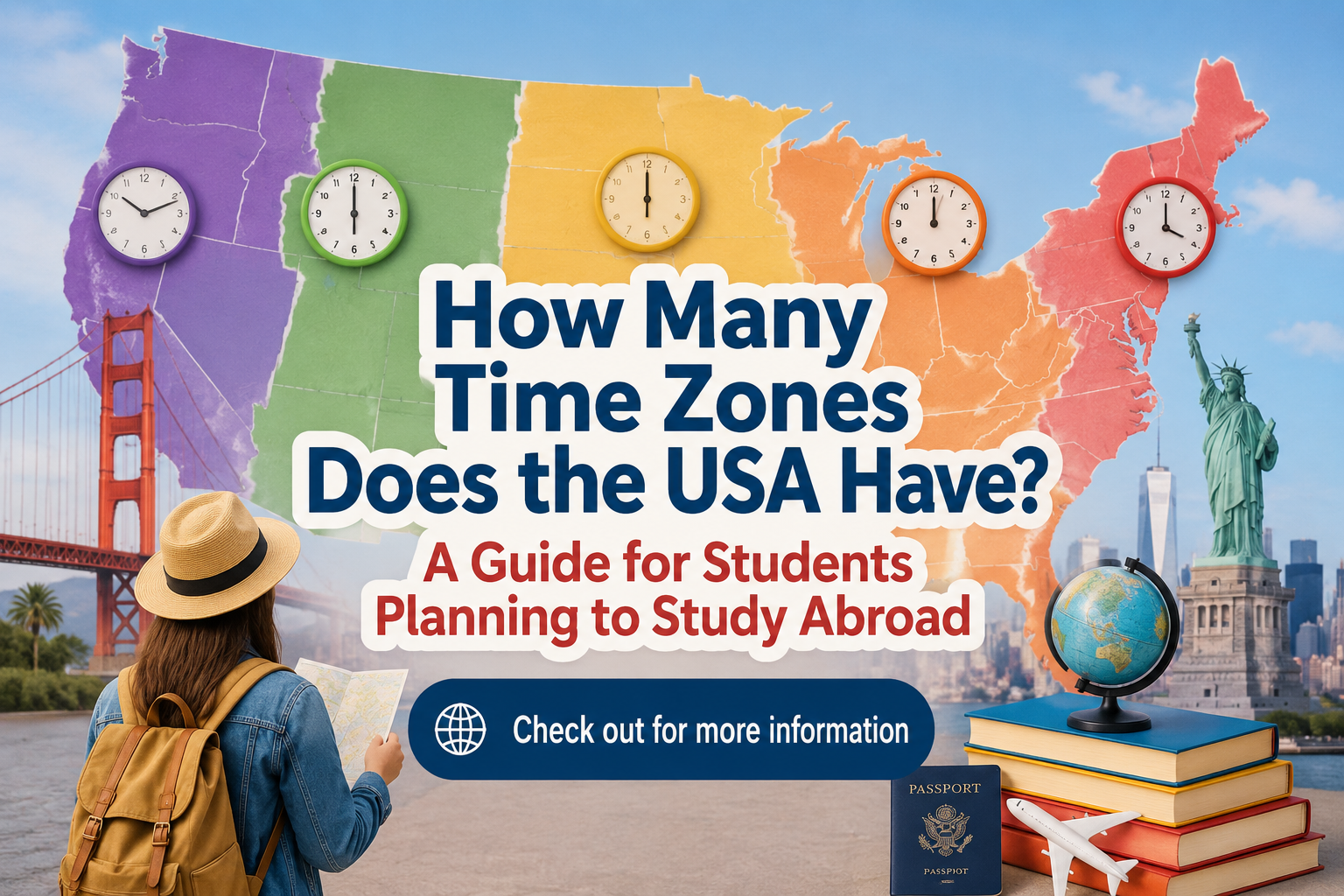
USA Time Zones Explained
The U.S. Department of Transportation officially recognizes 9 time zones for the United States and its territories. The table below lists each zone, its UTC offset during Standard Time, and the key states or territories it covers.
- For students on the US mainland, the 4 primary zones — Eastern, Central, Mountain, and Pacific — are the most relevant.
- Alaska and Hawaii-Aleutian Islands apply to students at universities in those states.
- The remaining three (Atlantic, Samoa, Chamorro) cover US territories.
| Time Zone | Abbreviation | UTC Offset (Standard) | Key States / Territories |
|---|---|---|---|
| Atlantic | AST | UTC - 4 | US Virgin Islands, Puerto Rico |
| Eastern | EST / EDT | UTC - 5 | New York, Boston, Washington D.C., Philadelphia, Atlanta, Miami |
| Central | CST / CDT | UTC - 6 | Chicago, Houston, Dallas, Minneapolis, New Orleans |
| Mountain | MST / MDT | UTC - 7 | Denver, Phoenix, Salt Lake City, Albuquerque |
| Pacific | PST / PDT | UTC - 8 | Los Angeles, San Francisco, Seattle, San Diego |
| Alaska | AKST / AKDT | UTC - 9 | Anchorage, Fairbanks |
| Hawaii-Aleutian | HST | UTC - 10 | Honolulu, Hawaii |
| Samoa | SST | UTC - 11 | American Samoa |
| Chamorro | ChST | UTC + 10 | Guam, Northern Mariana Islands |
Note that Arizona (except the Navajo Nation) and Hawaii do not observe Daylight Saving Time, as confirmed by the U.S. Department of Transportation. This is a common point of confusion for students at Arizona State University or the University of Arizona — the time gap with India stays fixed year-round for those cities.
IST vs US Time Zones: Exact Difference for Indian Students by University City
India Standard Time (IST) is UTC+5:30. The USA does not observe IST and has no half-hour offset. This means the time difference between India and any US city is always expressed in hours and 30 minutes. The gap also shifts by 1 hour during US Daylight Saving Time (DST), which runs from the second Sunday of March to the first Sunday of November each year.
The table below gives you the exact IST difference for major university cities, both during Standard Time (November to March) and Daylight Saving Time (March to November).
| University City | Time Zone | IST Ahead by (Standard Time) | IST Ahead by (Daylight Saving Time) | Top Universities |
|---|---|---|---|---|
| New York / Boston | Eastern (EST/EDT) | 10 hrs 30 mins | 9 hrs 30 mins | NYU, Columbia, MIT, Harvard, Northeastern |
| Washington D.C. / Philadelphia | Eastern (EST/EDT) | 10 hrs 30 mins | 9 hrs 30 mins | Georgetown, GWU, UPenn, Drexel |
| Chicago / Houston / Dallas | Central (CST/CDT) | 11 hrs 30 mins | 10 hrs 30 mins | University of Chicago, Rice University, UT Dallas |
| Denver / Phoenix | Mountain (MST/MDT) | 12 hrs 30 mins | 11 hrs 30 mins* | University of Denver, Arizona State University |
| Los Angeles / San Francisco / Seattle | Pacific (PST/PDT) | 13 hrs 30 mins | 12 hrs 30 mins | UCLA, USC, UC Berkeley, Stanford, University of Washington |
| Honolulu (Hawaii) | Hawaii-Aleutian (HST) | 15 hrs 30 mins | 15 hrs 30 mins (no DST) | University of Hawaii |
*Phoenix (Arizona) does not observe DST. The IST difference for Phoenix stays at 12 hours and 30 mins year-round.
Student Note (from Quora): "The easiest trick is: IST is always 'X hours and 30 minutes' ahead of the US zone. For Eastern, it's 10.5 hours (standard) or 9.5 hours (DST). Add 1 hour as you move west — Central is 11.5, Mountain is 12.5, Pacific is 13.5." This mental anchor works every time.
Planning to study in the USA? Explore all US universities, courses, and fees on Collegedunia
What Is Daylight Saving Time in the USA — and Why It Confuses Indian Students Every Year
Daylight Saving Time (DST) is a federally mandated practice in the USA where clocks are moved forward by 1 hour in the spring and moved back by 1 hour in the fall. It was established under the Uniform Time Act of 1966, which is overseen by the U.S. Department of Transportation.
DST begins on the second Sunday of March (clocks move forward — "spring forward") and ends on the first Sunday of November (clocks move back — "fall back"). During DST, the time gap between India and the USA reduces by 1 hour across all observing zones.
India does not observe DST. IST remains fixed at UTC+5:30 throughout the year. This is the root cause of the confusion Indian students face — the gap with family back home changes twice a year without any change on the Indian side.
| DST Period | Dates (Approximate) | Clock Change | Effect on IST Gap |
|---|---|---|---|
| DST Starts (Spring Forward) | Second Sunday of March | Clocks move 1 hour forward | IST gap reduces by 1 hour |
| DST Ends (Fall Back) | First Sunday of November | Clocks move 1 hour back | IST gap increases by 1 hour |
States that do NOT observe DST (per the U.S. Department of Transportation): Hawaii, American Samoa, Guam, Northern Mariana Islands, Puerto Rico, the US Virgin Islands, and most of Arizona.
Student Insight: Many Indian students studying in the US report missing online classes or scheduling calls at the wrong time right after DST transitions in March and November. The fix is simple — set your phone to show two clocks: one for your US city and one for IST. Your phone will auto-adjust for DST; your family's IST clock will not change.
Which US Time Zone Will Your University Be In?
Most Indian students choose universities in the Eastern and Pacific time zones — cities like New York, Boston, Los Angeles, and San Francisco. The table below maps the most popular student cities to their time zones, so you know exactly what to expect before you land.
This also matters for your F-1 visa interview scheduling, application deadline submissions, and online entrance exams — all of which are often listed in US time zones without specifying IST equivalents.
| City | State | Time Zone | IST Difference (DST Period) | IST Difference (Standard Period) |
|---|---|---|---|---|
| New York City | New York | Eastern | IST is 9.5 hrs ahead | IST is 10.5 hrs ahead |
| Boston | Massachusetts | Eastern | IST is 9.5 hrs ahead | IST is 10.5 hrs ahead |
| Washington D.C. | D.C. | Eastern | IST is 9.5 hrs ahead | IST is 10.5 hrs ahead |
| Philadelphia | Pennsylvania | Eastern | IST is 9.5 hrs ahead | IST is 10.5 hrs ahead |
| Atlanta | Georgia | Eastern | IST is 9.5 hrs ahead | IST is 10.5 hrs ahead |
| Chicago | Illinois | Central | IST is 10.5 hrs ahead | IST is 11.5 hrs ahead |
| Houston | Texas | Central | IST is 10.5 hrs ahead | IST is 11.5 hrs ahead |
| Dallas | Texas | Central | IST is 10.5 hrs ahead | IST is 11.5 hrs ahead |
| Denver | Colorado | Mountain | IST is 11.5 hrs ahead | IST is 12.5 hrs ahead |
| Phoenix | Arizona | Mountain (no DST) | IST is 12.5 hrs ahead (year-round) | IST is 12.5 hrs ahead (year-round) |
| Los Angeles | California | Pacific | IST is 12.5 hrs ahead | IST is 13.5 hrs ahead |
| San Francisco | California | Pacific | IST is 12.5 hrs ahead | IST is 13.5 hrs ahead |
| Seattle | Washington | Pacific | IST is 12.5 hrs ahead | IST is 13.5 hrs ahead |
| Pittsburgh | Pennsylvania | Eastern | IST is 9.5 hrs ahead | IST is 10.5 hrs ahead |
| Baltimore | Maryland | Eastern | IST is 9.5 hrs ahead | IST is 10.5 hrs ahead |
Check the best student cities in the USA — costs, universities, and recruiters
How US Time Zones Affect Your Student Life
Time zone awareness is a practical survival skill for Indian students in the USA — not just a geography fact. Here are the four areas where it directly impacts your daily life.
Will your university application deadlines be in your time zone?
No. US university application deadlines are almost always listed in the time zone of the university. A deadline of "11:59 PM EST" for a New York university means 10:29 AM IST the next day. If you are applying from India, always convert the deadline to IST before your final submission.
What time will your online classes be in India?
If your university is in Boston (Eastern Time) and your class is at 9:00 AM EST, that is 7:30 PM IST during standard time and 6:30 PM IST during DST. For a Pacific Time university like UCLA, a 9:00 AM PST class is 10:30 PM IST in standard time. Students in Pacific Time zone universities often find it harder to attend live sessions from India during holidays.
When is the best time to call family in India?
The overlap window between US daytime and Indian daytime is narrow. For Eastern Time students, calling between 8:00 AM and 10:00 AM EST (6:30 PM to 8:30 PM IST) works well. For Pacific Time students, calling between 7:00 AM and 9:00 AM PST (8:30 PM to 10:30 PM IST) is the practical window.
Does your F-1 visa interview appointment time use IST or US time?
Your US visa interview appointment at the US Embassy or Consulate in India is scheduled in Indian Standard Time (IST). However, if you are communicating with a US university admissions office or scheduling a call with a US consular officer, always confirm which time zone they are using.
A Quick IST Conversion Reference for US Time Zones — Save This Before You Travel
Use this ready reckoner every time you need to convert between IST and a US time zone. The values below are based on the official UTC offsets from the U.S. Department of Transportation.
Conversion Note: 1 USD = ₹84.61 (BookMyForex, May 9, 2026). All INR figures in this article are based on this rate.
| US Time Zone | Standard Time: IST = US Time + | DST: IST = US Time + | Example: 9 AM US = IST |
|---|---|---|---|
| Eastern (EST/EDT) | 10 hrs 30 mins | 9 hrs 30 mins | 7:30 PM IST (standard) / 6:30 PM IST (DST) |
| Central (CST/CDT) | 11 hrs 30 mins | 10 hrs 30 mins | 8:30 PM IST (standard) / 7:30 PM IST (DST) |
| Mountain (MST/MDT) | 12 hrs 30 mins | 11 hrs 30 mins | 9:30 PM IST (standard) / 8:30 PM IST (DST) |
| Pacific (PST/PDT) | 13 hrs 30 mins | 12 hrs 30 mins | 10:30 PM IST (standard) / 9:30 PM IST (DST) |
| Alaska (AKST/AKDT) | 14 hrs 30 mins | 13 hrs 30 mins | 11:30 PM IST (standard) / 10:30 PM IST (DST) |
| Hawaii-Aleutian (HST) | 15 hrs 30 mins | 15 hrs 30 mins (no DST) | 12:30 AM IST next day (year-round) |
Quick mental trick: "Eastern is 10.5 hours (standard). Add 1 hour for each zone as you move west." During DST, subtract 1 hour from each value. This single rule covers all 4 mainland US time zones.
Do All US States Follow the Same Time Zone Rules? What Students Near State Borders Must Know
No — US time zone boundaries do not follow state lines. According to the Bureau of Transportation Statistics, 15 US states are split across two time zones. This is a common misconception among Indian students who assume each state has one uniform time.
The most relevant examples for students are:
- Indiana: Most of the state is on Eastern Time, but some northwestern and southwestern counties observe Central Time.
- Arizona: The state follows Mountain Standard Time year-round with no DST — except the Navajo Nation, which does observe DST.
- Florida: Most of the state is Eastern Time, but the western panhandle (near Pensacola) is Central Time.
- Idaho: The northern part is Pacific Time; the southern part is Mountain Time.
- Kansas: Most of the state is Central Time, but the western counties are Mountain Time.
If your university is near a state border, always confirm the exact time zone of your campus city — not just the state. The U.S. Department of Transportation maintains the official time zone boundary map at the Bureau of Transportation Statistics geospatial portal.
Student Note: A student at Indiana University Bloomington (Eastern Time) and a student at Purdue University West Lafayette (also Eastern Time) are in the same zone. But a student doing an internship in the northwestern Indiana city of Gary is in Central Time — just 30 miles away. Always check the city, not just the state.
Find the best US states for Indian students — safety, cost, and opportunities
Brief History of US Time Zones
The USA adopted standardized time zones in 1883, driven entirely by the railroad industry. Before that, more than 144 local times existed across North America, making train scheduling nearly impossible. The major railroad companies created a four-zone system (Eastern, Central, Mountain, Pacific) to coordinate schedules. The federal government formalized this in 1918 under the Standard Time Act, assigning oversight to the Interstate Commerce Commission.
In 1966, the Uniform Time Act transferred this authority to the newly created U.S. Department of Transportation, which continues to oversee time zone boundaries today. The DOT can only change a time zone boundary if the Secretary of Transportation determines it serves the "convenience of commerce" — and only upon petition from the highest political authorities of a state or locality.
India, by contrast, adopted a single time zone (IST, UTC+5:30) after independence in 1947 for administrative simplicity, despite spanning nearly 30 degrees of longitude. The debate about whether India should have two time zones continues, but IST remains the single national standard.
The practical takeaway for students: the USA's time zone system was built for a continent-sized country with a complex transportation network. Understanding it is part of adapting to life in the US.
Start your US study abroad journey — application process, requirements, and timeline
Frequently Asked Questions
Ques. How many time zones does the USA have?
Ans. The USA has 9 official time zones as recognized by the U.S. Department of Transportation: Atlantic, Eastern, Central, Mountain, Pacific, Alaska, Hawaii-Aleutian, Samoa, and Chamorro. Across the 50 states, 6 time zones apply directly.
Ques. What is the time difference between India and the USA?
Ans. India (IST, UTC+5:30) is ahead of all US mainland time zones. The difference ranges from 9.5 hours ahead of Eastern Time (during DST) to 13.5 hours ahead of Pacific Time (during DST). During Standard Time (November to March), add 1 hour to each of these values.
Ques. Does the USA observe Daylight Saving Time?
Ans. Yes. Most of the USA observes Daylight Saving Time (DST), which runs from the second Sunday of March to the first Sunday of November. Clocks move forward by 1 hour in March and back by 1 hour in November. Hawaii, most of Arizona, and US territories like Guam, Puerto Rico, and American Samoa do not observe DST, as confirmed by the U.S. Department of Transportation.
Ques. Which US time zone do most Indian students study in?
Ans. Most Indian students study in universities located in the Eastern Time Zone (New York, Boston, Washington D.C., Philadelphia, Atlanta) or the Pacific Time Zone (Los Angeles, San Francisco, Seattle). Eastern Time is the most common, as it covers the highest concentration of top-ranked universities.
Ques. How do I convert US time to IST quickly?
Ans. Use this rule: IST = Eastern Time + 10.5 hours (standard) or + 9.5 hours (DST). For each zone moving west, add 1 more hour. Central = +11.5 / +10.5, Mountain = +12.5 / +11.5, Pacific = +13.5 / +12.5. Set a second clock on your phone to your US city — it will auto-adjust for DST.
Ques. Does Arizona follow Daylight Saving Time?
Ans. Most of Arizona does not observe Daylight Saving Time. The state stays on Mountain Standard Time (MST, UTC-7) year-round. The exception is the Navajo Nation within Arizona, which does observe DST. Students at Arizona State University or the University of Arizona will find their IST gap stays fixed at 12.5 hours throughout the year.
Ques. Are US university application deadlines in IST or US time?
Ans. US university application deadlines are listed in the time zone of the university, not IST. Always convert the deadline to IST before submitting. A midnight EST deadline is 10:30 AM IST the next day (standard time) or 9:30 AM IST the next day (DST).
Ques. Which US time zone is best for staying in touch with family in India?
Ans. The Eastern Time Zone offers the smallest gap with India (9.5 to 10.5 hours), making it easier to find overlapping waking hours for calls.
Ques. Which US time zone is best for staying in touch with family in India?
Ans. The Eastern Time Zone offers the smallest gap with India (9.5 to 10.5 hours), making it easier to find overlapping waking hours for calls. A morning call at 8:00 AM EST lands at 6:30 PM IST (DST) or 7:30 PM IST (standard) — a comfortable evening time for family in India. Pacific Time students face a 12.5 to 13.5 hour gap, which means early morning calls from the US side are needed.
Ques. What happens to my class schedule when DST changes in the USA?
Ans. When the USA moves to DST in March, your class times in IST shift 1 hour earlier. When DST ends in November, they shift 1 hour later. Your university's online portal will automatically reflect the correct local time. However, if you have set manual IST reminders for classes, you must update them after each DST transition.
Ques. Do all US states have one time zone?
Ans. No. 15 US states are split across two time zones. Time zone boundaries in the USA follow geographic and commercial lines, not state borders. States like Indiana, Florida, Idaho, Kansas, and Kentucky have counties in two different time zones. Always confirm the time zone of your specific campus city, not just the state.


1691392229.png?tr=w-305,h-145,c-force?h=175&w=350&mode=stretch)



Comments