


| Updated On - Jul 2, 2026
A Statement of Purpose (SOP) is an essay in which a student explains their goals, background, and reasons for choosing a specific program and university abroad. It is a core admission document. For Indian students, the SOP is the one place to show who you are beyond marks, so it often decides borderline applications. Knowing the SOP full form, format, and how to write one helps you build an essay that genuinely strengthens your application.
- SOP stands for Statement of Purpose, a personal admission essay.
- It covers your goals, academics, experience, and reasons for the program.
- A strong SOP is specific, tailored, and 800 to 1,000 words long.
- It should open with a real hook, not a quote or a definition.
| Parameter | Detail |
|---|---|
| Full form | Statement of Purpose |
| What it is | A personal essay on your goals and fit for a program |
| Ideal length | 800 to 1,000 words |
| Format | 4 to 6 paragraphs, first person |
| Written by | The applicant |
| Key to a strong SOP | Specific examples and a clear program fit |
| Avoid | Quotes, cliches and copied content |
Also Read:
- Letter of Recommendation (LOR) for Study Abroad: Format, Types and Sample
- Gap Certificate for Study Abroad: Format, Affidavit and PDF
- What is a Bonafide Certificate? Importance and Samples
- Financial Documents Required For Study Abroad
What Is a Statement of Purpose
A Statement of Purpose, the full form of SOP, is a personal essay where an applicant explains their academic background, goals and reasons for choosing a program and university. It is required by most universities abroad. Unlike a resume, the SOP tells your story in your own voice and shows the admissions committee your motivation and fit.
What an SOP covers and what it does not:
- Covers: your motivation, background, goals, and why the specific program fits.
- Does not: repeat your resume or list achievements without context or purpose.
Note: SOP, SOPs and Statement of Purpose all refer to the same document. Some universities call it a personal statement or a letter of intent, but the purpose is identical: to explain who you are, what you want and why this program is the right fit.
Also Read:
- Academic CV Template with Samples
- How to Study Abroad After 12th from India Full Guide
- Student Visa for Study Abroad: Types and Application Process
- Packing List for Indian Students Going Abroad
Statement of Purpose Format
The Statement of Purpose format runs across four to six paragraphs: an introduction, your academic background, your experience, why the program, your goals, and a conclusion. Each paragraph has a clear job. Most SOPs stay within 800 to 1,000 words in first person.
| Paragraph | What to include |
|---|---|
| Introduction | A specific hook, the program and your core goal |
| Academic background | Degree, key subjects, projects and results |
| Experience | Internships, jobs or research with measurable outcomes |
| Why this program | Specific courses, professors, labs or facilities |
| Career goals | Short and long-term goals the degree bridges |
| Conclusion | Why this country, and a confident closing |
Also Read:
- Study Abroad after 12th: Countries, Courses & Costs 2026
- Study Abroad Exams Entrance Exams In India
- Scholarships to Study Abroad: Types, Eligibility, Award Value
Statement of Purpose Sample
The Statement of Purpose sample below shows the standard layout, and you can download four ready-to-use files: a format template, an MS sample, an MBA sample and a do's and don'ts checklist. Replace the bracketed fields. Use these as a starting point, then tailor each SOP to the program and university.
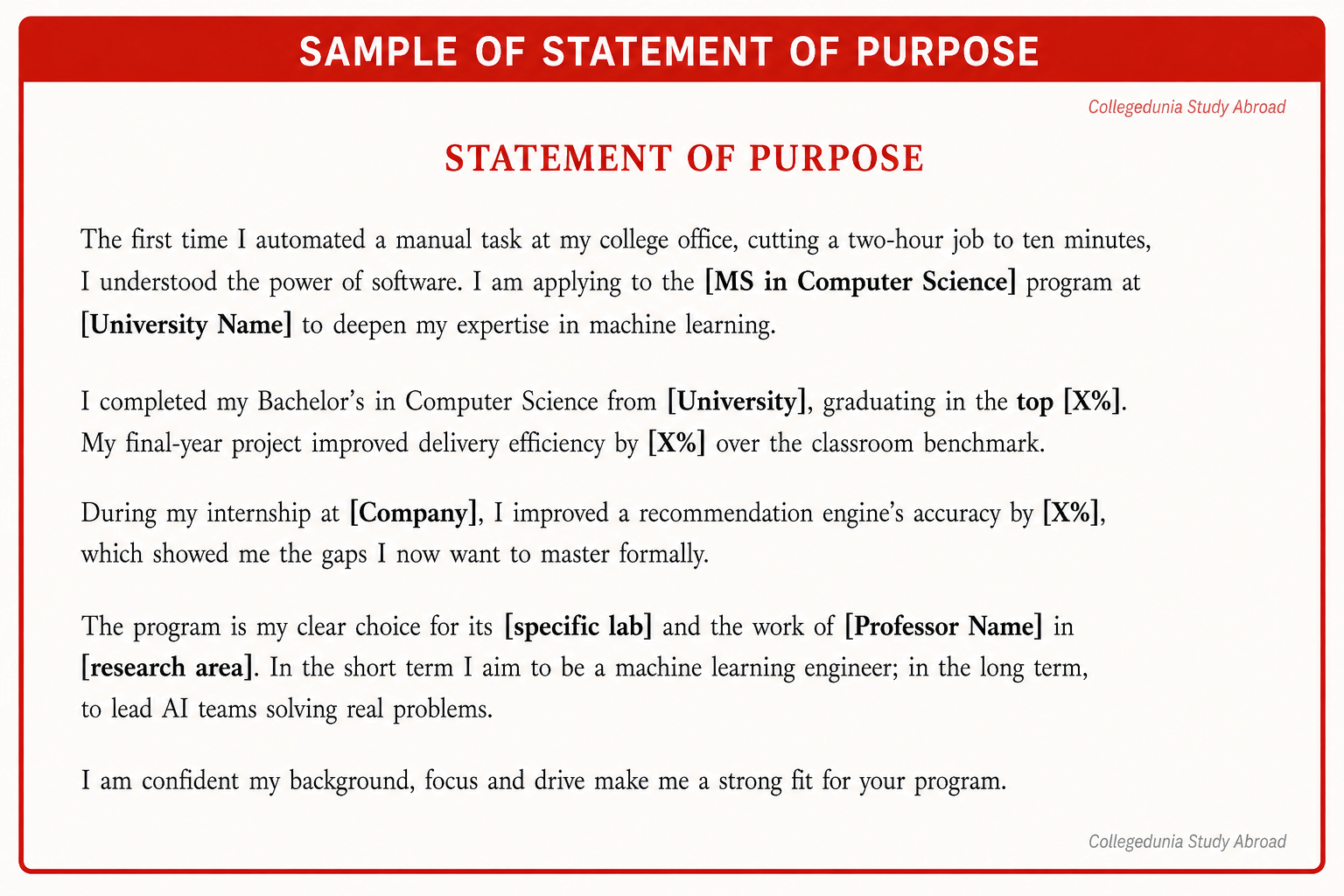
Download the four SOP files below, each marked with the Collegedunia Study Abroad watermark:
| File | Best for |
|---|---|
| SOP Format Template | A blank structure with paragraph-by-paragraph notes |
| SOP Sample (MS) | A full example for a Master's applicant |
| SOP Sample (MBA) | A full example for an MBA applicant |
| SOP Do's and Don'ts | A quick checklist to review your SOP |
How to Write a Statement of Purpose
To write a Statement of Purpose, open with a specific hook, cover your academics and experience with examples, explain why the program fits, state your goals, then close with confidence. Specifics beat adjectives. Write, cut, and rewrite until every line earns its place, since admissions officers read thousands of SOPs.
- Open with a specific hook, a real moment or interest that shows your motivation, then name the program.
- Cover your academics, your degree, key subjects, and projects with measurable results.
- Add your experience, internships, jobs or research, linking each to the program.
- Explain why this program, naming specific courses, professors, labs or facilities.
- State your goals, clear short and long-term plans that the degree bridges.
- Close with confidence, tying your goals to the program and the country, then proofread.
Also Read:
- Cost of Studying Abroad for Indian Students 2026
- Affordable Countries to Study Abroad for Indian Students
- Top Universities/College to Study Abroad
Statement of Purpose Mistakes to Avoid
The most common SOP mistakes are opening with a quote, repeating the resume, using one SOP for all universities, and writing vague goals. Each one weakens an otherwise strong application. Avoiding these puts you ahead of most applicants. The key do's and don'ts are below.
| Do | Don't |
|---|---|
| Open with a specific, personal hook | Start with a famous quote or a definition |
| Use concrete examples and numbers | Repeat your resume line by line |
| Tailor a fresh SOP for each university | Use the same SOP everywhere |
| Write clear, specific career goals | Write vague goals like "I want to succeed" |
Note: Specific examples and numbers make an SOP credible. "Led a team of four to raise revenue by 20%" is far stronger than "I have good leadership skills." Real incidents and measurable results are what admissions committees remember.
A strong SOP can turn a good application into an offer by showing the admissions committee the person behind the marks. Open with a real hook, back every claim with a specific example, explain clearly why the program fits your goals, then tailor a fresh version for each university. Use the downloadable format template, MS and MBA samples and the do's and don'ts checklist above as your starting point. Then edit hard, proofread and let your genuine motivation carry the essay.
FAQs
Ques. What is the full form of SOP?
Ans. SOP stands for Statement of Purpose. It is a personal essay in which an applicant explains their academic background, goals and reasons for choosing a specific program and university abroad.
Ques. What is a Statement of Purpose?
Ans. A Statement of Purpose is a personal admission essay that tells the university who you are, what you want to study and why their program fits your goals. It shows your motivation and fit beyond your marks and resume.
Ques. What is the ideal SOP length and format?
Ans. Most SOPs are 800 to 1,000 words across four to six paragraphs, written in first person. The structure covers an introduction, academics, experience, why the program, career goals and a conclusion.
Ques. How do I write a Statement of Purpose?
Ans. Open with a specific hook, cover your academics and experience with examples, explain why the program fits, state your goals, then close with confidence. Use the downloadable samples and format template above as a guide.
Ques. What should an SOP not include?
Ans. Avoid quotes, cliches, a repeated resume and vague goals. Do not exaggerate, lie or submit the same SOP to every university. Generic content and content you cannot back up are the fastest way to weaken your application.
Ques. Is an SOP the same as a personal statement?
Ans. They are very similar and often the same. Some universities use "Statement of Purpose", others "personal statement" or "letter of intent". The purpose is identical, though a personal statement can be slightly more personal in tone.
Ques. Can I use the same SOP for all universities?
Ans. No. You should tailor a fresh SOP for each university, especially the "why this program" section, naming its specific courses, professors and facilities. Admissions officers can easily spot a generic, reused essay.










Comments