



| Updated On - Jul 1, 2026
A gap certificate is a notarised affidavit on non-judicial stamp paper that explains a break in your studies or career, required by many universities and visa offices when you apply to study abroad. It is the same as a gap affidavit.
- A gap certificate is a notarised self-declaration on stamp paper explaining your study or work break.
- It covers your name, address, dates of the gap, reason, and a declaration of lawful conduct.
- Documents needed include ID proof, last marksheet, and supporting evidence for the gap reason.
- Getting it notarised takes 1 to 3 days and costs about INR 100 to 500.
Universities abroad from the USA to the UK ask for this document when a break appears in your academic timeline, so having the right format matters. A well-prepared gap certificate with the correct format and supporting documents can prevent your application from being delayed or rejected outright.
| Parameter | Detail |
|---|---|
| Also called | Gap affidavit, gap year certificate |
| Type of document | Notarised self-declaration on non-judicial stamp paper |
| Stamp paper value | Rs. 20 to Rs. 100 (varies by state) |
| Who attests it | Notary Public or Oath Commissioner |
| Time to get | 1 to 3 days |
| Cost | INR 100 to 500 (stamp paper plus notary fee) |
| Valid for | The specific admission or visa cycle it is submitted for |
Also Read:
- Study abroad after Class 12 complete guide
- Study Abroad Exams Entrance Exams In India
- Top Universities/College to study Abroad
- Scholarships to Study Abroad: Types, Eligibility, Award Value
What Is a Gap Certificate
A gap certificate is a legal, notarised document on non-judicial stamp paper that officially explains a break in a student's or professional's academic or career history. It is also called a gap affidavit.
Universities, employers and visa offices use it to confirm the gap was genuine and lawful, not the result of a disciplinary action or academic failure. You can see how a gap fits into the wider study-abroad process in this guide on top universities abroad for Indian students.
What a gap certificate does and what it does not:
- Does: confirm the reason and duration of your break, legally attested by a Notary.
- Does not: replace supporting evidence, the certificate must always be attached with proof.
Also Read:
Gap Certificate Format
The gap certificate format is a structured affidavit that includes your personal details, the gap period, the reason, a declaration of lawful conduct, and a notary seal. All fields below are mandatory. The format is broadly standard across India and is accepted by universities and embassies abroad.
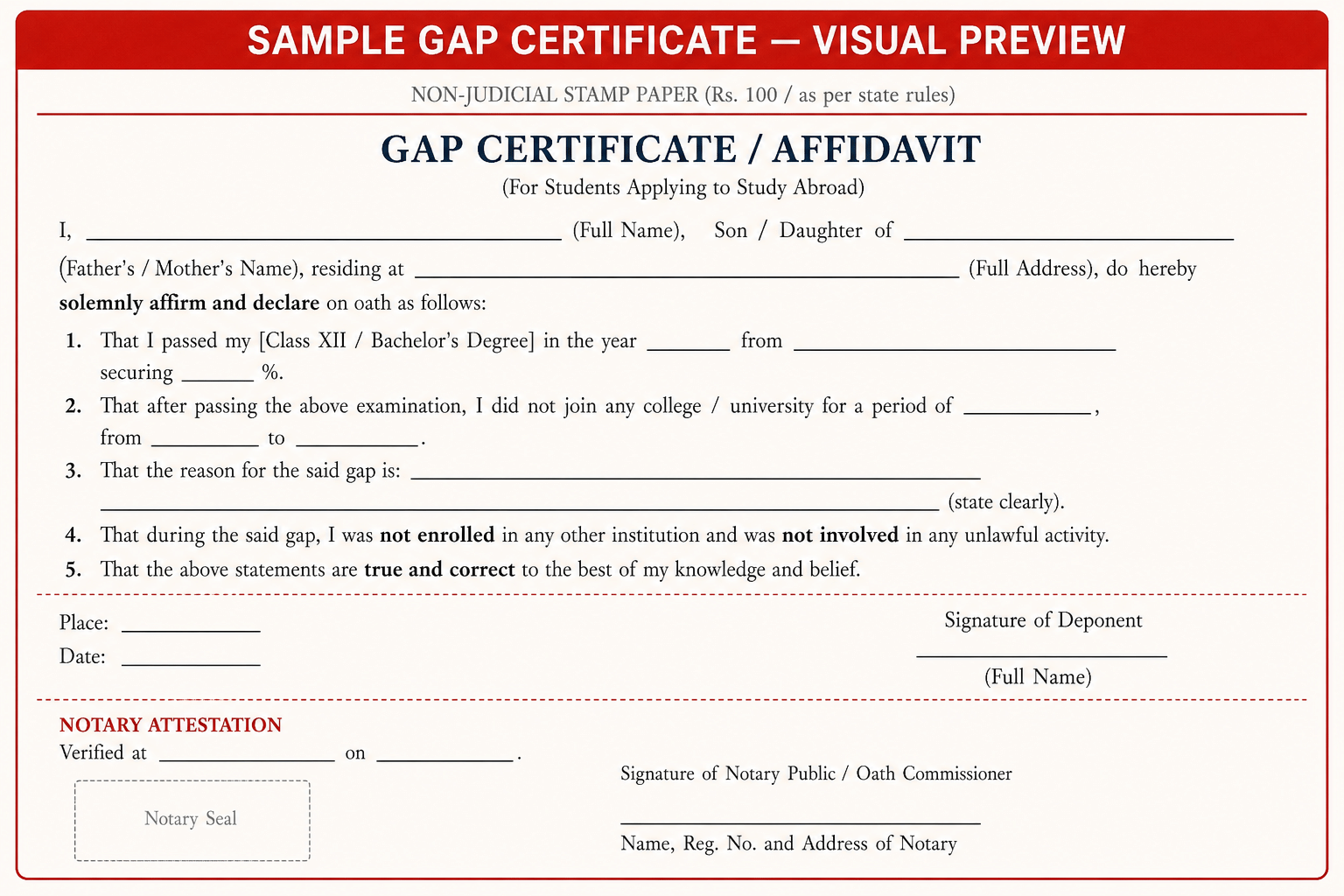
Students can also refer to these pdf for a better understanding of the format used:
Gap Certificate Affidavit Wording
The gap certificate affidavit wording follows a standard seven-clause structure, covering identity, last qualification, gap dates, reason, non-enrolment, lawful conduct and a truth declaration. Clause 3 (the reason) carries the most weight.
| Clause | What to write |
|---|---|
| Clause 1 | Your full name, father's or mother's name, full residential address |
| Clause 2 | Your last qualification, institution, year, and percentage |
| Clause 3 | Exact dates of the gap (from Month, Year to Month, Year) and the clear reason |
| Clause 4 | What you did during the gap (work, exam prep, courses, travel, etc.) |
| Clause 5 | Confirm you were not enrolled elsewhere during the gap |
| Clause 6 | Confirm no involvement in unlawful activity |
| Clause 7 | Truth declaration: all statements are true, nothing concealed |
Note: Name the specific activity in clause 3 and 4 rather than writing a vague reason. "Preparation for NEET UG 2024 conducted by NTA" beats "entrance exam preparation" every time. Visa officers and admissions committees both notice the difference.
Also Read:
Documents for a Gap Certificate
The documents required to make a gap certificate are your ID proof, last academic marksheet and one supporting document for the gap reason. Attach all of these when you submit.
Supporting documents turn your self-declared gap into a verified one. Below is the full list, split by purpose.
| Document | Purpose |
|---|---|
| Aadhaar card or Passport | Identity proof (mandatory) |
| Last marksheet or degree certificate | Shows when your studies ended |
| Address proof | Confirms your residential address as in the affidavit |
| NTA admit card or scorecard | For NEET / JEE / entrance exam preparation gaps |
| Work experience letter and payslips | For work or job gaps |
| Medical certificate from doctor | For health-related gaps |
| Course or certification certificate | For skill-building or online course gaps |
Also Read:
- Statement of Purpose (SOP): Format, Samples & Writing Tips
- 10 Tips to Improve your Statement of Purpose
- Academic Letter of Recommendation: Sample, Structure & Guidelines
How to Make a Gap Certificate
To make a gap certificate, draft the affidavit, buy non-judicial stamp paper, print on it, gather supporting documents and get it notarised. The whole process takes 1 to 3 days.
The steps below work across all states in India and produce a gap certificate accepted by foreign universities and embassies. Start at least four weeks before your first application deadline, not the week of. A full guide to the application process sits in the main study abroad guide for Indian students.
- Draft the affidavit using one of the three PDF formats above, filling in your details.
- Buy non-judicial e-stamp paper worth Rs. 20 to Rs. 100 from a nearby court, sub-registrar office or cooperative bank.
- Print the affidavit content on the stamp paper, or write it clearly in ink.
- Gather supporting documents, the ID proof, last marksheet and one document proving the gap reason.
- Visit a Notary Public or Oath Commissioner, usually near a district court or a lawyer's office.
- Sign in front of the Notary, who verifies your identity, checks the documents and attests the affidavit.
- Collect the attested certificate, make photocopies and keep both physical and scanned digital copies.
If your gap covers more than one sub-period, list each separately with its own dates and reason in the same affidavit. That means one document is enough, not one per sub-gap.
Note: Do not get the gap certificate notarised the week before your deadline. Notaries can be busy. Stamp paper can run out, and some embassies ask for a certificate issued within six months of submission. Starting four weeks early protects you from all of these.
A gap certificate is a simple but essential document for study-abroad applications whenever your academic or career timeline has a break. Use the correct format, name the specific reason clearly in clause 3, attach the matching supporting proof and get the affidavit notarised well before your deadline. Keep digital and physical copies ready for both the university and the visa office. Done right, the certificate turns an unexplained blank in your timeline into a documented, credible part of your story.
FAQs
Ques. What is a gap certificate?
Ans. A gap certificate, also called a gap affidavit, is a notarised self-declaration on non-judicial stamp paper that officially explains a break in your academic or professional career. It is required by many universities and visa offices when you apply to study abroad.
Ques. What is the format of a gap certificate?
Ans. The standard format includes your personal details, last qualification, gap dates and duration, reason for the gap, a non-enrolment and lawful-conduct declaration, your signature and the notary's seal and signature. See the three downloadable PDF formats above for the exact layout.
Ques. What is a gap certificate affidavit?
Ans. A gap certificate affidavit and a gap certificate are the same document. "Affidavit" is the legal term, while "gap certificate" is how universities and consultants refer to it. Both must be signed in front of a Notary Public to be legally valid.
Ques. What documents are required to make a gap certificate?
Ans. You need identity proof (Aadhaar card, PAN card or passport), your last academic marksheet or degree certificate and one supporting document proving the gap reason, such as an NTA admit card, work experience letter or medical certificate.
Ques. How do I make a gap certificate?
Ans. Draft the affidavit (using the PDF formats above), buy non-judicial stamp paper of Rs. 20 to Rs. 100, print and fill your details, gather supporting documents, then visit a Notary Public to sign and get it attested. The whole process takes 1 to 3 days.
Ques. Where do I get a gap certificate?
Ans. You draft it yourself and get it notarised at a Notary Public or Oath Commissioner, usually found near a district court, a lawyer's office or a sub-registrar office. Buy the stamp paper from the court, cooperative bank or register office.
Ques. How much does a gap certificate cost?
Ans. The total cost is usually INR 100 to 500, covering the stamp paper (Rs. 20 to Rs. 100, varying by state) and the Notary's attestation fee. Certified English translation, if required, costs an additional Rs. 300 to Rs. 1,500.
Ques. Is a gap certificate mandatory for all universities abroad?
Ans. Not for all, but most universities ask for it when a gap of one year or more appears in your academic timeline. Always check the specific requirements of the university you are applying to, since some ask for it only at the visa stage.
Ques. What should I write as the reason in my gap certificate?
Ans. Be specific and honest. Name the exact exam (e.g. NEET UG 2024, GRE), employer, medical condition or circumstance. A vague reason like "personal reasons" is much weaker than a named, documented explanation and may attract more scrutiny at the visa interview.
Ques. Does a gap certificate expire?
Ans. There is no fixed national expiry date, but some universities and embassies ask for a certificate issued within six months of submission. If you apply in a new cycle after another gap, draft a fresh affidavit to reflect the updated period.



Comments