



| Updated On - Jul 2, 2026
An LOR for study abroad is a letter from a professor or employer that endorses a student's skills and achievements to a foreign university. Most universities ask for 2 to 3. For Indian students, the LOR is one of the few parts of the application written by someone else, so it adds independent weight to your profile. Knowing the LOR format, the types, and how to write a strong one helps you secure letters that genuinely lift your application.
- An LOR for study abroad endorses a student's skills, achievements, and character to a university.
- Most universities require 2 to 3 LORs, academic or professional.
- A strong LOR uses specific examples and numbers, not generic praise.
- Choose recommenders who know your work well, not just senior titles.
| Parameter | Detail |
|---|---|
| Full form | Letter of Recommendation |
| Who writes it | A professor, teacher or employer |
| Number required | Usually 2 to 3 per university |
| Main types | Academic LOR and professional LOR |
| Ideal length | One side, about 400 to 500 words |
| Format | Official letterhead, signed and dated |
| Key to a strong LOR | Specific examples and measurable results |
Also Read:
- Gap Certificate for Study Abroad: Format, Affidavit and PDF
- Statement of Purpose (SOP): Format, Samples & Writing Tips
- Financial Documents Required For Study Abroad
- How to Study Abroad After 12th from India Full Guide
What Is an LOR for Study Abroad
An LOR, or Letter of Recommendation, is a signed letter in which a professor or employer vouches for a student's academic ability, skills and character for admission abroad. It is a required part of most applications. Because it comes from a third party, the LOR gives the admissions committee an independent view of the applicant that a resume or essay cannot.
What a strong LOR covers and what it does not:
- Covers: specific skills, achievements and character, backed by real examples.
- Does not: repeat the resume or offer generic praise with no evidence.
Note: Choose recommenders who know your work well, not just senior titles. A professor who taught you closely writes a far more convincing LOR than a dean who barely knows you, because specific, first-hand detail is what admissions committees trust.
Also Read:
- Required Documents for Applying to US Universities
- How to Apply to U.S. Universities: A Guide for Indian Students
- Study in UK For Indian Students After 12th
- How to Apply to UK Universities?
Types of LOR for Study Abroad
The two main types are the academic LOR from a professor or teacher and the professional LOR from an employer or manager. Your profile decides the mix. Freshers usually submit academic LORs, while applicants with work experience add a professional one.
| Type | Who writes it | Best for |
|---|---|---|
| Academic LOR | Professor, teacher or project guide | Undergraduate applicants and freshers |
| Professional LOR | Employer, manager or supervisor | Applicants with work experience |
If you have work experience, then include a professional LOR. That means one manager letter alongside your academic ones.
Also Read:
LOR Format for Study Abroad
The LOR format follows a clear structure: letterhead and date, salutation, an introduction, the applicant's strengths with examples, a strong endorsement and the recommender's signature and details. Each section has a purpose, and the strongest letters fill the body with specific, measurable evidence. The structure is below.
| Section | What to include |
|---|---|
| Letterhead and date | Official institution or company letterhead, with the date |
| Salutation | "To the Admissions Committee" or "To Whom It May Concern" |
| Introduction | Recommender's name, role and how they know the applicant and for how long |
| Body | Academic or work performance, skills and achievements with concrete examples |
| Personal qualities | Character, teamwork and leadership, backed by a specific instance |
| Endorsement and signature | A clear recommendation, then signature, name, designation and contact |
LOR Sample for Study Abroad
The LOR sample below shows the standard layout, and you can download three ready-to-use formats: an academic LOR, a professional LOR and a blank format template. Replace the bracketed fields with your details. Use these as a starting point, then tailor each letter to the recommender and the program.
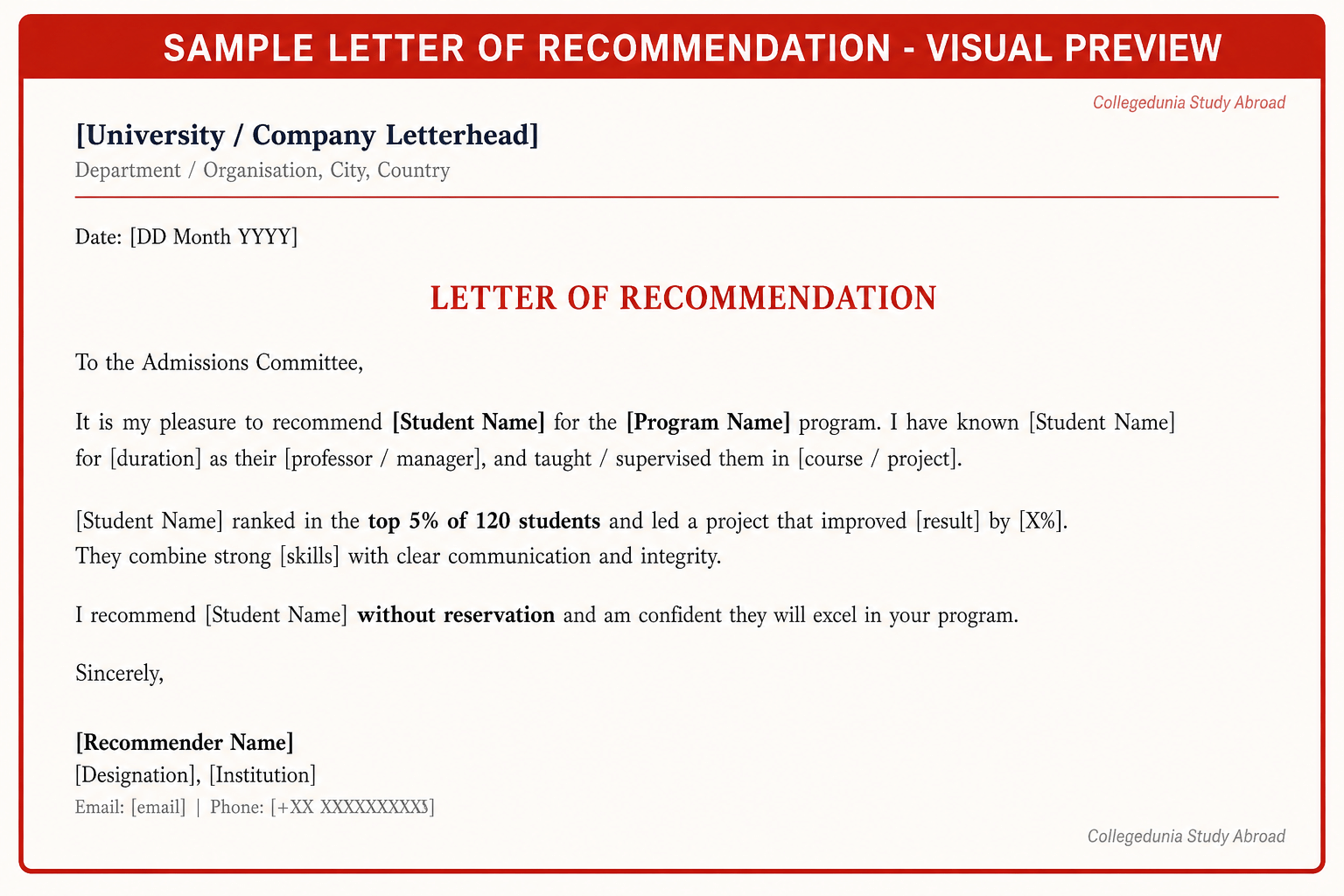
Students can also refer to the three LOR formats below:
| Format | Best for |
|---|---|
| Academic LOR Sample | A filled example from a professor |
| Professional LOR Sample | A filled example from a manager |
| LOR Format Template | A blank structure with section-by-section notes |
Note: A strong LOR uses specific examples and numbers, not generic praise. "Ranked in the top 5% of 120 students" is far stronger than "a good student." Numbers and real incidents are what make a recommendation credible and memorable.
How to Write a Strong LOR
To write a strong LOR, open with the relationship, give two or three specific achievements with numbers, add a personal quality with an example, then close with a clear endorsement. Specifics beat adjectives.
Keep each letter distinct, tailored to the applicant and honest, since admissions officers read thousands of them. Planning the rest of the application is covered in this guide on study abroad after Class 12. The steps are:
- Open with the relationship, stating who the recommender is and how long and how they have known the applicant.
- Give specific achievements, two or three, with measurable results such as rank, GPA or project impact.
- Add a personal quality, such as leadership or teamwork, backed by one real example.
- Compare to peers, placing the applicant among the best the recommender has taught or managed.
- Close with a clear endorsement, then sign with the full name, designation and contact details.
If a recommender asks you to draft it, then keep each letter distinct. That means different examples and a different tone for each one.
A strong LOR can lift an application by giving the admissions committee an honest, first-hand view of who you are beyond your grades. Choose recommenders who know your work, brief them with your resume and goals, then make sure each letter is specific, distinct and signed on official letterhead. Use the downloadable academic, professional and format samples above as your starting point, then tailor every letter to the program. Done well, your recommenders become some of the strongest voices in your study abroad application.
FAQs
Ques. What is an LOR for study abroad?
Ans. An LOR, or Letter of Recommendation, is a signed letter from a professor, teacher or employer that vouches for a student's academic ability, skills and character. It is a required part of most study abroad applications.
Ques. How many LORs are required for study abroad?
Ans. Most universities require 2 to 3 LORs. Freshers usually submit academic LORs from professors, while applicants with work experience typically submit two academic and one professional LOR. Always check each university's requirement.
Ques. What is the format of an LOR?
Ans. The format includes the letterhead and date, a salutation, an introduction, the applicant's strengths with examples, a clear endorsement and the recommender's signature and contact details. See the downloadable format template above for the full structure.
Ques. What are the types of LOR?
Ans. The two main types are the academic LOR from a professor, teacher or project guide and the professional LOR from an employer or manager. Freshers use academic LORs, and working applicants add a professional one.
Ques. Who should write my LOR?
Ans. Choose someone who knows your work well, such as a professor who taught you or a manager who supervised you closely. A recommender with first-hand knowledge writes a far stronger letter than a senior person who barely knows you.
Ques. How long should an LOR be?
Ans. An LOR should be about 400 to 500 words, fitting on one side. It should be long enough to give two or three specific examples but concise enough to stay focused and readable for the admissions committee.
Ques. Can I write my own LOR?
Ans. Sometimes recommenders ask students to draft the letter, which the recommender then reviews and signs. If you do this, vary the examples and tone across your recommenders so the letters are not identical, and ensure each is signed on official letterhead.
Ques. What makes a strong LOR?
Ans. Specific examples and measurable results. A line like "ranked in the top 5% of 120 students" is far stronger than "a good student." Real incidents, numbers and honest comparison to peers make a recommendation credible.
Ques. What is the difference between an LOR and a reference letter?
Ans. They are essentially the same document. "Letter of Recommendation" is the common term for university admissions, while "reference letter" is used more broadly, including for jobs. Both endorse a person's ability and character.
Ques. Do I need an LOR on official letterhead?
Ans. Yes, wherever possible. An LOR on official institution or company letterhead, signed and dated, carries more weight and looks authentic. Include the recommender's designation and contact details so the university can verify it.



Comments