




Karnataka Board is conducting the Class 12 History Board Exam 2026 on March 5, 2026. Class 12 History Question Paper with Solution PDF is available here for download.
The Karnataka Board Class 12 History paper covered key topics from Indian history, world history, and major historical movements and personalities. The MCQ section was mostly straightforward and tested basic factual and conceptual knowledge. The short and long descriptive questions required clear explanations, proper historical context, and well-structured answers. To score well, students should focus on important dates, events, historical interpretations, and structured writing. The official question paper of Karnataka Board Class 12 History Board Exam 2026 is provided below. Students can download the official paper in PDF format for reference.
Karnataka Board Class 12, 2026 History Question Paper with Solution PDF
| Karnataka Board Class 12 History Question Paper 2026 | Download PDF | Check Solution |

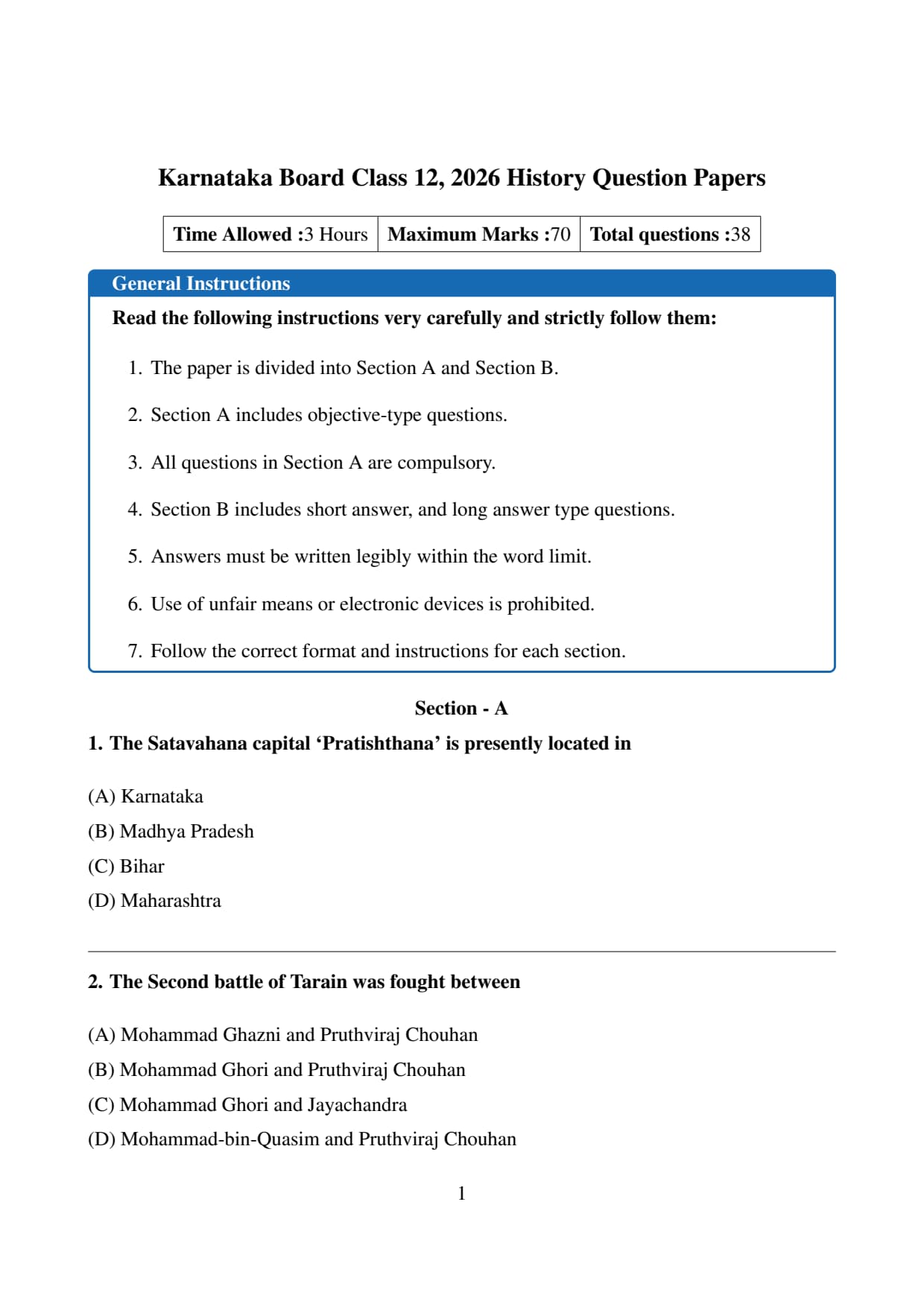
The Satavahana capital ‘Pratishthana’ is presently located in
View Solution
Step 1: Understanding the Satavahana Dynasty.
The Satavahana dynasty was one of the earliest Indian dynasties to rule in the Deccan region. They ruled approximately from the 1st century BCE to the 3rd century CE and played a significant role in the political and cultural development of southern and central India.
Step 2: Identifying the Capital City.
The capital of the Satavahana dynasty was Pratishthana. This city was an important political, economic, and cultural center during the rule of the Satavahanas.
Step 3: Present-day Location of Pratishthana.
The ancient city of Pratishthana corresponds to the modern city Paithan. Paithan is located on the banks of the Godavari River in the present-day state of Maharashtra. It was a major trade and cultural center during ancient times.
Step 4: Evaluation of the Options.
(A) Karnataka: Incorrect. Karnataka was part of the Deccan region but not the location of Pratishthana.
(B) Madhya Pradesh: Incorrect. This region was associated with other ancient kingdoms but not the Satavahana capital.
(C) Bihar: Incorrect. Bihar was mainly the center of Magadha and Mauryan empires.
(D) Maharashtra: Correct. The ancient capital Pratishthana is identified with modern Paithan in Maharashtra.
Step 5: Conclusion.
Since the ancient capital Pratishthana corresponds to the modern city Paithan in Maharashtra, the correct answer is option (D).
Final Answer: Maharashtra. Quick Tip: Pratishthana (modern Paithan) in Maharashtra was the capital of the Satavahana dynasty and an important center of trade on the Godavari River.
The Second battle of Tarain was fought between
View Solution
Step 1: Historical background of the Battle of Tarain.
The Battles of Tarain were two important battles fought in medieval Indian history between the forces of the Rajput king Prithviraj Chauhan and the invading army led by Muhammad Ghori. These battles played a crucial role in determining the political future of North India during the late 12th century.
Step 2: First Battle of Tarain (1191).
The First Battle of Tarain took place in 1191 between Prithviraj Chauhan and Muhammad Ghori. In this battle, Prithviraj Chauhan successfully defeated Muhammad Ghori. Ghori was injured and forced to retreat from the battlefield. This victory strengthened the position of the Rajputs temporarily.
Step 3: Second Battle of Tarain (1192).
The Second Battle of Tarain occurred in 1192. Muhammad Ghori returned with a stronger and better-organized army to challenge Prithviraj Chauhan again. This time, Ghori used improved military strategies and cavalry tactics, which resulted in the defeat of Prithviraj Chauhan. This battle marked a turning point in Indian history as it led to the establishment of Muslim rule in large parts of North India.
Step 4: Analysis of the options.
(A) Mohammad Ghazni and Pruthviraj Chouhan: Incorrect. Mahmud of Ghazni lived earlier (11th century) and never fought Prithviraj Chauhan.
(B) Mohammad Ghori and Pruthviraj Chouhan: Correct. The Second Battle of Tarain in 1192 was fought between Muhammad Ghori and Prithviraj Chauhan.
(C) Mohammad Ghori and Jayachandra: Incorrect. Jayachandra was a contemporary ruler but was not involved in the Battle of Tarain.
(D) Mohammad-bin-Quasim and Pruthviraj Chouhan: Incorrect. Muhammad-bin-Qasim invaded Sindh in the 8th century and had no connection with the Tarain battles.
Step 5: Conclusion.
Therefore, the Second Battle of Tarain was fought between Muhammad Ghori and Prithviraj Chauhan in 1192, which resulted in Ghori's victory and opened the path for the establishment of the Delhi Sultanate.
Final Answer: Mohammad Ghori and Pruthviraj Chouhan. Quick Tip: Remember the timeline: The First Battle of Tarain (1191) was won by Prithviraj Chauhan, while the Second Battle of Tarain (1192) was won by Muhammad Ghori. This second battle marked the beginning of Muslim political dominance in North India.
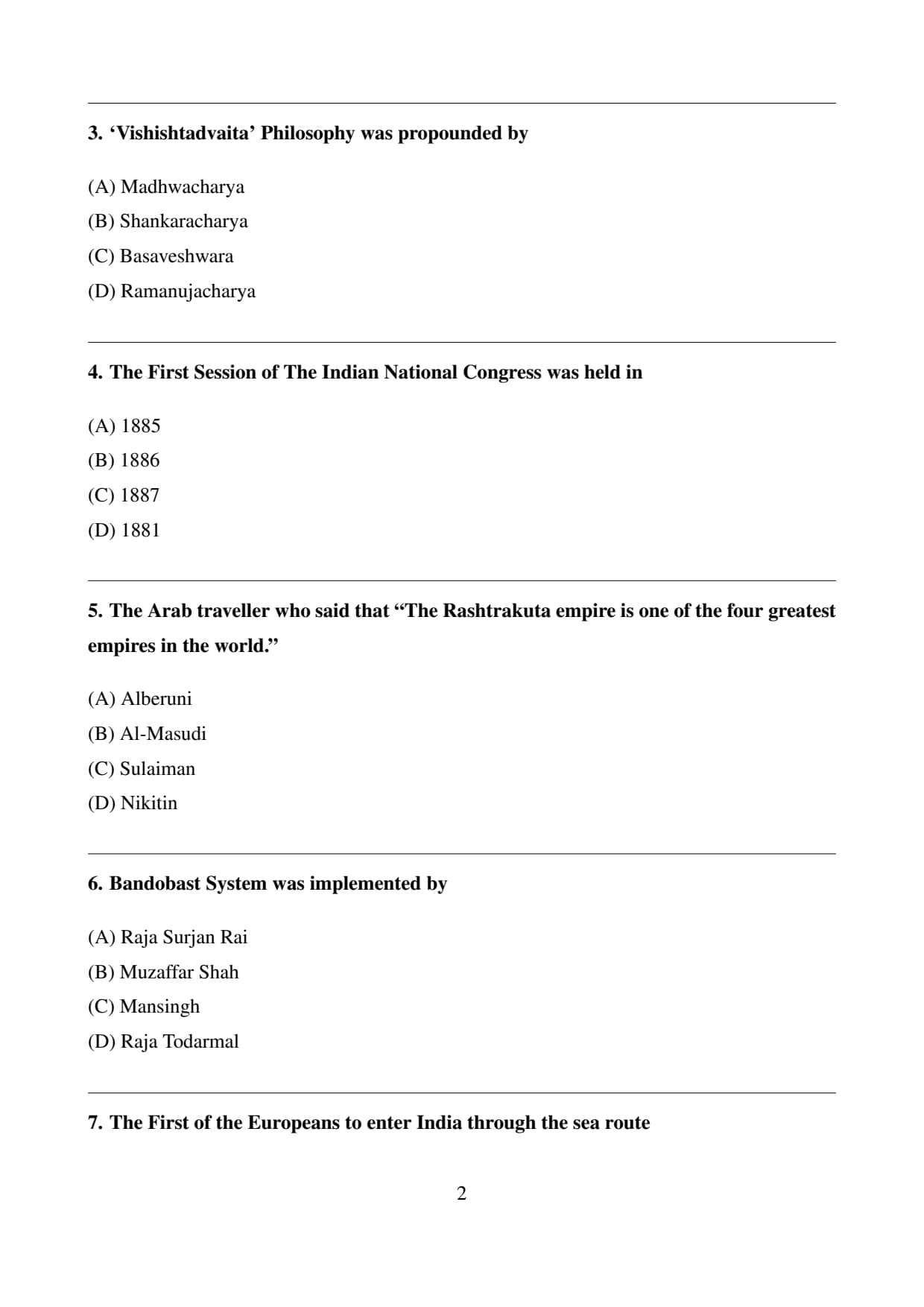
‘Vishishtadvaita’ Philosophy was propounded by
View Solution
Step 1: Understanding Vishishtadvaita philosophy.
Vishishtadvaita is a major school of Vedanta philosophy in Hinduism. The word Vishishtadvaita means “qualified non-dualism”. It explains that Brahman (the ultimate reality) is one but possesses attributes and qualities. The individual souls and the universe are real and exist as parts of Brahman.
Step 2: Contribution of Ramanujacharya.
The philosophy of Vishishtadvaita was systematized and propagated by Ramanujacharya, a great Indian philosopher and theologian of the 11th–12th century. He emphasized devotion (Bhakti) to Lord Vishnu and taught that the soul and the universe are dependent on Brahman.
Step 3: Comparison with other philosophers.
(A) Madhwacharya: He propounded the Dvaita (dualism) philosophy which states that the soul and God are completely different.
(B) Shankaracharya: He propounded Advaita (non-dualism), which states that Brahman alone is real and the world is an illusion.
(C) Basaveshwara: He was a social reformer and founder of the Lingayat movement, not related to Vishishtadvaita.
(D) Ramanujacharya: Correct. He established the Vishishtadvaita school of Vedanta.
Step 4: Conclusion.
Therefore, the philosopher who propounded the Vishishtadvaita philosophy is Ramanujacharya.
Final Answer: Ramanujacharya. Quick Tip: Remember the three important Vedanta philosophies: Advaita – Shankaracharya, Vishishtadvaita – Ramanujacharya, and Dvaita – Madhwacharya.
The First Session of The Indian National Congress was held in
View Solution
Step 1: Formation of the Indian National Congress.
The Indian National Congress (INC) was founded by A.O. Hume, a retired British civil servant, to create a political platform where educated Indians could express their views and demands under British rule.
Step 2: First session details.
The first session of the Indian National Congress was held in December 1885 at Bombay (now Mumbai). The session was presided over by Womesh Chandra Bonnerjee, and around 72 delegates participated in the meeting.
Step 3: Historical significance.
This meeting marked the beginning of organized political activity in India. Initially, the Congress demanded administrative reforms, more representation for Indians in government services, and constitutional improvements.
Step 4: Evaluation of options.
(A) 1885: Correct. The first session of the Indian National Congress took place in 1885.
(B) 1886: Incorrect. This year hosted the second session of INC at Calcutta.
(C) 1887: Incorrect. The third session was held at Madras.
(D) 1881: Incorrect. The INC had not yet been established.
Step 5: Conclusion.
Thus, the first session of the Indian National Congress was held in the year 1885.
Final Answer: 1885. Quick Tip: The first session of the Indian National Congress was held in Bombay in 1885 under the presidency of W.C. Bonnerjee.
The Arab traveller who said that “The Rashtrakuta empire is one of the four greatest empires in the world.”
View Solution
Step 1: Understanding the Rashtrakuta Empire.
The Rashtrakuta Empire was one of the most powerful dynasties in medieval India. It ruled large parts of the Indian subcontinent from the 8th to the 10th century and was known for its strong administration, military strength, and cultural achievements.
Step 2: Accounts of Arab travellers.
During the early medieval period, many Arab merchants and travellers visited India and recorded their observations. These travellers wrote about Indian trade, politics, and the strength of various kingdoms.
Step 3: Statement by Sulaiman.
The Arab traveller Sulaiman, who visited India in the 9th century, mentioned in his travel accounts that the Rashtrakuta Empire was one of the four greatest empires in the world. His statement highlights the global importance and influence of the Rashtrakuta rulers.
Step 4: Analysis of options.
(A) Alberuni: Incorrect. Alberuni came to India in the 11th century with Mahmud of Ghazni and wrote the book \textit{Kitab-ul-Hind.
(B) Al-Masudi: Incorrect. Although he described India, he did not make this specific statement about the Rashtrakutas.
(C) Sulaiman: Correct. He described the Rashtrakuta Empire as one of the four greatest empires in the world.
(D) Nikitin: Incorrect. Nikitin was a Russian traveller who visited India in the 15th century.
Step 5: Conclusion.
Thus, the Arab traveller who praised the Rashtrakuta Empire as one of the four greatest empires of the world was Sulaiman.
Final Answer: Sulaiman. Quick Tip: Arab traveller Sulaiman visited India in the 9th century and praised the power and prestige of the Rashtrakuta Empire in his writings.
Bandobast System was implemented by
View Solution
Step 1: Understanding the Bandobast System.
The Bandobast System was an organized land revenue settlement introduced during the Mughal period. It aimed to create a systematic method for measuring land and collecting revenue from farmers.
Step 2: Role of Raja Todarmal.
Raja Todarmal was an important minister in the court of Mughal Emperor Akbar. As the finance minister, he introduced several administrative and financial reforms to improve the efficiency of the Mughal revenue system.
Step 3: Features of the system.
Under Todarmal's system, agricultural land was carefully measured and classified based on fertility. Revenue was fixed after calculating the average production and prices over several years. This method ensured fair taxation and better administration.
Step 4: Analysis of options.
(A) Raja Surjan Rai: Incorrect. He was a Rajput ruler and not associated with Mughal revenue reforms.
(B) Muzaffar Shah: Incorrect. He was a ruler of Gujarat and did not introduce this system.
(C) Mansingh: Incorrect. Raja Man Singh was a Mughal general but did not introduce the Bandobast system.
(D) Raja Todarmal: Correct. He implemented the Bandobast land revenue system during Akbar's reign.
Step 5: Conclusion.
Therefore, the Bandobast System of land revenue administration was implemented by Raja Todarmal under the Mughal emperor Akbar.
Final Answer: Raja Todarmal. Quick Tip: Raja Todarmal introduced important revenue reforms in Akbar's administration, including systematic land measurement and organized tax assessment known as the Bandobast system.
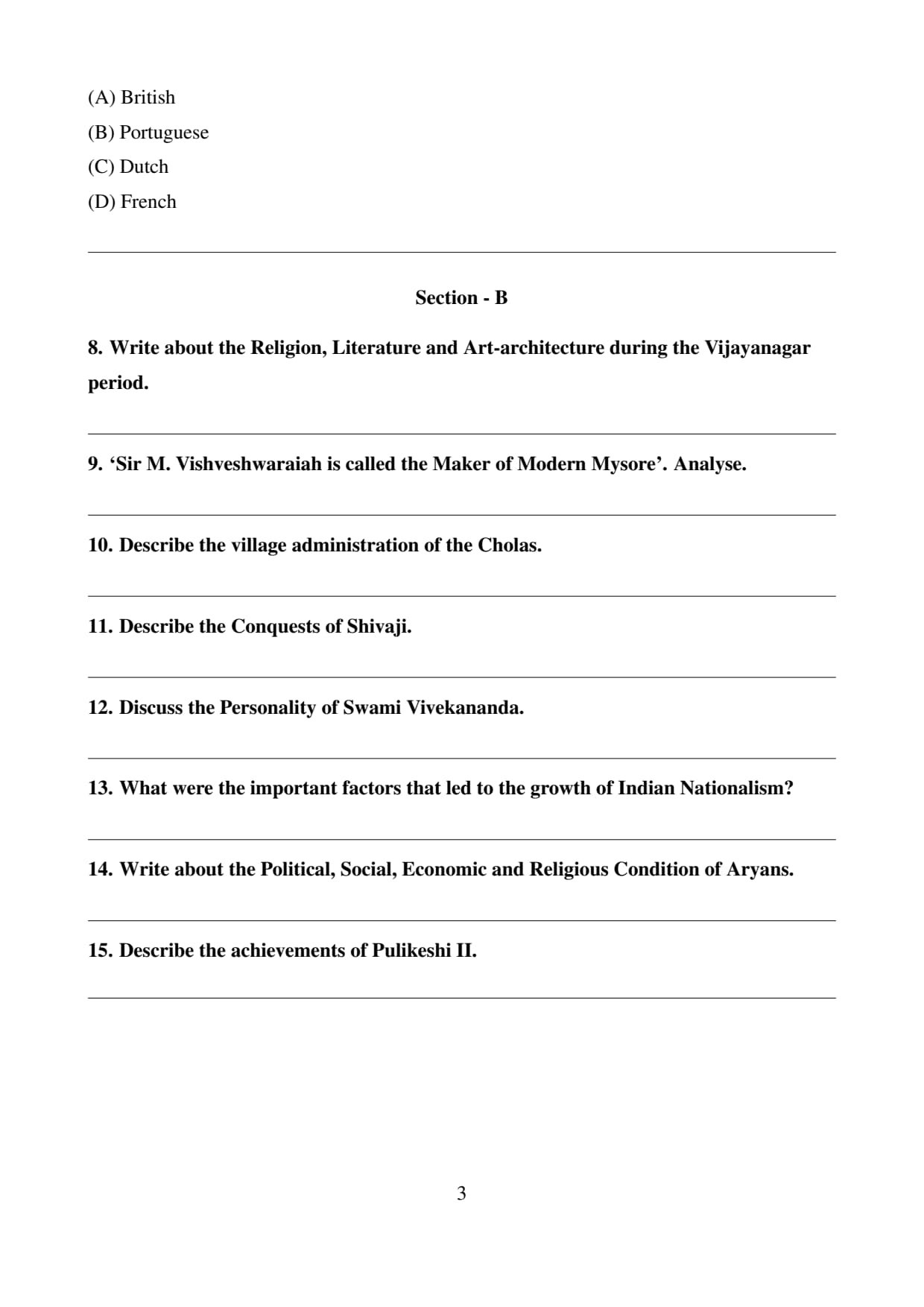
The First of the Europeans to enter India through the sea route
View Solution
Step 1: Background of European exploration.
During the 15th century, European countries were searching for new sea routes to Asia in order to expand trade, especially for valuable goods such as spices, silk, and precious stones. The traditional land routes were controlled by Middle Eastern and Ottoman traders, which made trade expensive for Europeans.
Step 2: Discovery of the sea route to India.
The Portuguese explorer Vasco da Gama successfully discovered a sea route to India by sailing around the Cape of Good Hope in Africa. He reached the port of Calicut (Kozhikode) on the southwest coast of India in the year 1498. This marked the first successful arrival of Europeans in India through the sea route.
Step 3: Comparison with other European powers.
(A) British: The British arrived in India later, mainly through the East India Company in the early 17th century.
(B) Portuguese: Correct. They were the first Europeans to reach India by sea in 1498 under Vasco da Gama.
(C) Dutch: The Dutch entered India in the early 17th century mainly for trade purposes.
(D) French: The French came later and established trading centers such as Pondicherry.
Step 4: Conclusion.
Therefore, the Portuguese were the first Europeans to enter India through the sea route.
Final Answer: Portuguese. Quick Tip: Vasco da Gama reached Calicut in 1498, marking the beginning of European maritime trade and colonial influence in India.
Write about the Religion, Literature and Art-architecture during the Vijayanagar period.
View Solution
Step 1: Religion during the Vijayanagar period.
The Vijayanagar Empire was a strong supporter of the Hindu religion. The rulers mainly followed Shaivism and Vaishnavism and gave patronage to temples, priests and religious institutions. They organized many religious festivals and rituals. Even though the empire promoted Hindu traditions, it also followed a policy of religious tolerance. Followers of Islam, Jainism and other religions were allowed to practice their faith freely.
Step 2: Development of literature.
Literature flourished greatly during the Vijayanagar period. The rulers were patrons of scholars and poets. Literature developed in several languages such as Sanskrit, Telugu, Kannada and Tamil. The court of Krishnadevaraya became famous for its literary activities. He himself was a great scholar and wrote the famous Telugu work Amuktamalyada. The group of eight great Telugu poets known as the Ashtadiggajas also flourished in his court.
Step 3: Development of art.
Art reached a high level during the Vijayanagar period. Sculptures and paintings were widely developed. Artists created beautiful carvings on temples depicting scenes from Hindu mythology, animals, dancers and daily life. Bronze and stone sculptures were made with great detail and artistic excellence.
Step 4: Architectural achievements.
The Vijayanagar rulers built magnificent temples and public buildings. The architecture of this period is known for large temple complexes, tall gopurams, pillared halls and detailed carvings. Important examples include the Virupaksha Temple and Vittala Temple at Hampi. The Vittala Temple is famous for its stone chariot and musical pillars. These structures show the advanced architectural skills of the period.
Step 5: Conclusion.
Thus, the Vijayanagar period was an important era for the development of religion, literature, art and architecture in South India. The rulers promoted culture and protected Hindu traditions while encouraging artistic and literary growth.
Quick Tip: The Vijayanagar Empire is famous for its cultural achievements, especially the temples and monuments of Hampi which are now a UNESCO World Heritage Site.
‘Sir M. Vishveshwaraiah is called the Maker of Modern Mysore’. Analyse.
View Solution
Step 1: Introduction to Sir M. Vishveshwaraiah.
Sir Mokshagundam Vishveshwaraiah was a famous Indian engineer, administrator and statesman. He served as the Diwan of Mysore from 1912 to 1918. Due to his remarkable contributions to the development and modernization of Mysore State, he is known as the Maker of Modern Mysore.
Step 2: Contribution to industrial development.
During his tenure, many industries were established in Mysore. He played an important role in the establishment of industries such as the Mysore Iron and Steel Works at Bhadravati, the Mysore Sandalwood Oil Factory, and the Mysore Soap Factory. These industries helped in economic development and employment generation in the region.
Step 3: Development of infrastructure and irrigation.
Sir M. Vishveshwaraiah contributed significantly to engineering and irrigation projects. One of his most important achievements was the construction of the Krishna Raja Sagara (KRS) Dam across the Kaveri River. This project helped improve irrigation, agriculture and water supply in Mysore State.
Step 4: Educational reforms and modernization.
He strongly believed in education and modernization. Under his guidance, many educational institutions were established and technical education was promoted. He also supported the development of the University of Mysore and encouraged scientific and technological learning.
Step 5: Conclusion.
Because of his efforts in industrial growth, irrigation development, education and modernization of administration, Sir M. Vishveshwaraiah transformed Mysore into a progressive and developed state. Therefore, he is rightly known as the Maker of Modern Mysore.
Quick Tip: Sir M. Vishveshwaraiah was one of India’s greatest engineers and was awarded the Bharat Ratna in 1955 for his outstanding contributions to nation building.
Describe the village administration of the Cholas.
View Solution
Step 1: Introduction to Chola village administration.
The Chola Empire had one of the most efficient and well-organized systems of local administration in medieval South India. The administration was highly decentralized, and villages enjoyed a considerable degree of self-government. The village assemblies managed most of the local affairs without direct interference from the central government.
Step 2: Types of village assemblies.
The Chola administration had different types of village assemblies. The main assemblies were Ur, Sabha, and Nagaram. The Ur was the assembly of common villagers, mainly found in non-Brahmin villages. The Sabha or Mahasabha functioned in Brahmin villages and consisted of learned Brahmins. The Nagaram represented assemblies of merchants and traders in towns.
Step 3: Election and committees.
Members of the village administration were chosen through a unique system called the Kudavolai system. In this system, the names of eligible candidates were written on palm leaves and placed in a pot, and a child picked one name randomly. Various committees called variyams were formed to handle specific responsibilities such as irrigation, gardens, justice and finance.
Step 4: Functions of village assemblies.
The village assemblies performed several important functions. They were responsible for collecting taxes, maintaining irrigation tanks, managing public lands, administering justice and supervising agricultural activities. They also looked after roads, temples and other public works.
Step 5: Conclusion.
Thus, the village administration of the Cholas was highly advanced and democratic in nature. The system of local self-government helped in efficient administration and contributed to the prosperity of the Chola Empire.
Quick Tip: The Chola system of village self-government is considered one of the earliest examples of local democratic administration in Indian history.
Describe the Conquests of Shivaji.
View Solution
Step 1: Introduction to Shivaji.
Shivaji was the founder of the Maratha Empire and one of the greatest warriors in Indian history. He challenged the dominance of the Mughal and Deccan Sultanates and established a powerful independent kingdom in western India through his military skills and strategic planning.
Step 2: Early conquests.
Shivaji began his conquests at a young age. In 1646 he captured the Torna Fort, which was his first major victory. After that, he gradually took control of several forts such as Rajgad, Kondana and Purandar. These forts helped him strengthen his power in the Deccan region.
Step 3: Conflict with the Bijapur Sultanate.
Shivaji fought against the Bijapur Sultanate and expanded his territory by capturing several forts and regions. One of the most famous events was the defeat of Afzal Khan in 1659. This victory greatly increased Shivaji’s reputation and influence in the Deccan.
Step 4: Struggle with the Mughals.
Shivaji also fought against the Mughal Empire led by Aurangzeb. He captured several Mughal territories and used guerrilla warfare tactics effectively. His famous attack on Shaista Khan in Pune and the raid on Surat demonstrated his military brilliance.
Step 5: Establishment of the Maratha kingdom.
Through his successful conquests and administrative abilities, Shivaji established a strong Maratha state. In 1674 he was formally crowned as Chhatrapati at Raigad, marking the establishment of an independent Maratha kingdom.
Quick Tip: Shivaji is remembered for his effective use of guerrilla warfare and his ability to capture and control strategic forts in the Western Ghats.
Discuss the Personality of Swami Vivekananda.
View Solution
Step 1: Introduction to Swami Vivekananda.
Swami Vivekananda was one of the greatest spiritual leaders and social reformers of India. He was the chief disciple of Sri Ramakrishna Paramhansa and played a major role in spreading Indian philosophy and culture across the world.
Step 2: Spiritual and philosophical personality.
He had a deep spiritual outlook and believed in Vedanta philosophy. Vivekananda emphasized the idea that all religions are essentially the same and promote universal brotherhood and harmony among people.
Step 3: His role as a social reformer.
Swami Vivekananda believed that service to humanity is the highest form of worship. He encouraged people to help the poor, educate the masses, and remove social evils such as ignorance and inequality.
Step 4: Contribution to Indian pride and nationalism.
His historic speech at the Parliament of Religions in Chicago in 1893 brought global recognition to Indian culture and philosophy. He inspired Indians to feel proud of their heritage and work for national development.
Step 5: Overall personality.
Thus, Swami Vivekananda was a great philosopher, spiritual teacher, patriot, and reformer whose inspiring personality awakened self-confidence and national consciousness among Indians.
Quick Tip: Swami Vivekananda inspired youth through his teachings of strength, self-confidence, service to humanity, and pride in Indian culture.
What were the important factors that led to the growth of Indian Nationalism?
View Solution
Step 1: Impact of British rule.
The British government followed exploitative economic and political policies in India. These policies created widespread dissatisfaction among Indians and gradually encouraged the feeling of unity against colonial rule.
Step 2: Spread of modern education.
Western education introduced ideas of liberty, equality, democracy, and nationalism. Educated Indians began to question British authority and demanded political rights and self-government.
Step 3: Development of transport and communication.
The development of railways, postal services, and telegraphs connected different regions of India. This helped people exchange ideas easily and strengthened the feeling of unity among Indians.
Step 4: Role of newspapers and literature.
Newspapers, journals, and nationalist literature played an important role in spreading awareness about British exploitation and inspiring people to join the national movement.
Step 5: Socio-religious reform movements.
Reform movements led by leaders such as Raja Ram Mohan Roy, Swami Dayanand Saraswati, and others created social awareness and revived pride in Indian culture, which helped strengthen nationalist feelings.
Quick Tip: The growth of Indian nationalism was influenced by British exploitation, modern education, improved communication, nationalist press, and socio-religious reform movements.
Write about the Political, Social, Economic and Religious Condition of Aryans.
View Solution
Step 1: Political condition of the Aryans.
The political system of the Aryans was mainly based on a tribal monarchy. The head of the tribe was known as the Rajan (King) who governed with the help of assemblies. Two important political assemblies were the Sabha and the Samiti. The Sabha consisted of elders and learned people who advised the king, while the Samiti was a larger assembly that discussed important public matters. The king was responsible for maintaining law, order and protecting the people.
Step 2: Social condition of the Aryans.
The Aryan society was organized into a system known as the Varna system. The four main classes were Brahmins (priests), Kshatriyas (warriors), Vaishyas (traders and farmers) and Shudras (servants). The family was the basic unit of society and it was generally patriarchal. Women enjoyed a respectable position in early Vedic society and were allowed to participate in religious activities and education.
Step 3: Economic condition of the Aryans.
The Aryan economy was mainly based on agriculture and cattle rearing. Cattle were considered a symbol of wealth. People also practiced crafts, trade and other occupations. The use of iron tools improved agricultural production in the later Vedic period. Trade was carried out through barter system where goods were exchanged without the use of money.
Step 4: Religious condition of the Aryans.
The Aryans worshipped many natural forces as gods. Important deities included Indra (god of thunder), Agni (god of fire), Varuna (god of water) and Surya (sun god). Religious practices mainly consisted of yajnas (sacrifices) and prayers. Over time, philosophical ideas such as karma, rebirth and the concept of Brahman developed during the later Vedic period.
Step 5: Conclusion.
Thus, the Aryan civilization had a well-structured political system, organized social order, agriculture-based economy and religious practices centered around nature worship and sacrificial rituals. These aspects played a significant role in shaping early Indian civilization.
Quick Tip: The early Aryans followed nature worship and performed yajnas to please their gods, which later evolved into more complex philosophical ideas in the Vedic period.
Describe the achievements of Pulikeshi II.
View Solution
Step 1: Introduction to Pulikeshi II.
Pulikeshi II was one of the greatest rulers of the Chalukya dynasty. He ruled during the 7th century and expanded the power and influence of the Chalukya Empire. His reign is remembered for military success, administrative efficiency and cultural development.
Step 2: Military achievements.
Pulikeshi II strengthened the Chalukya kingdom by conquering several neighboring territories. He defeated many rulers in the Deccan region and extended his empire across a large part of South India. His most famous victory was against the powerful North Indian ruler Harshavardhana on the banks of the Narmada River, which stopped Harsha's expansion into the south.
Step 3: Administrative achievements.
Pulikeshi II organized a strong administrative system to manage his large empire. He divided the kingdom into provinces and appointed governors to administer them. Efficient administration helped maintain stability and prosperity in the empire.
Step 4: Cultural and diplomatic achievements.
Pulikeshi II encouraged art, architecture and literature. The famous Chinese traveler Hiuen Tsang visited his kingdom and praised its prosperity and administration. The ruler also maintained diplomatic relations with foreign powers such as the Persian king Khusrau II.
Step 5: Conclusion.
Because of his military victories, strong administration and cultural patronage, Pulikeshi II became one of the most powerful rulers of South India and brought great glory to the Chalukya dynasty.
Quick Tip: Pulikeshi II is best remembered for defeating the powerful North Indian emperor Harshavardhana and establishing Chalukya dominance in the Deccan.



Comments