




Assam Board is conducting the Class 12 Physics Board Exam 2026 on March 5, 2026. Class 12 Physics Question Paper with Solution PDF is available here for download.
The Assam Board Class 12 Physics paper covered key topics from mechanics, electricity, optics, and modern physics. The MCQ section was mostly straightforward and tested basic conceptual understanding. The short and long descriptive questions required clear explanations, correct numerical steps, and proper diagrams. To score well, students should focus on formula application, accurate calculations, and labeled diagrams. The official question paper of Assam Board Class 12 Physics Board Exam 2026 is provided below. Students can download the official paper in PDF format for reference.
Assam Board Class 12, 2026 Physics Question Paper with Solution PDF
| Assam Board Class 12 Physics Question Paper 2026 with Solution PDF | Download PDF | Check Solution |

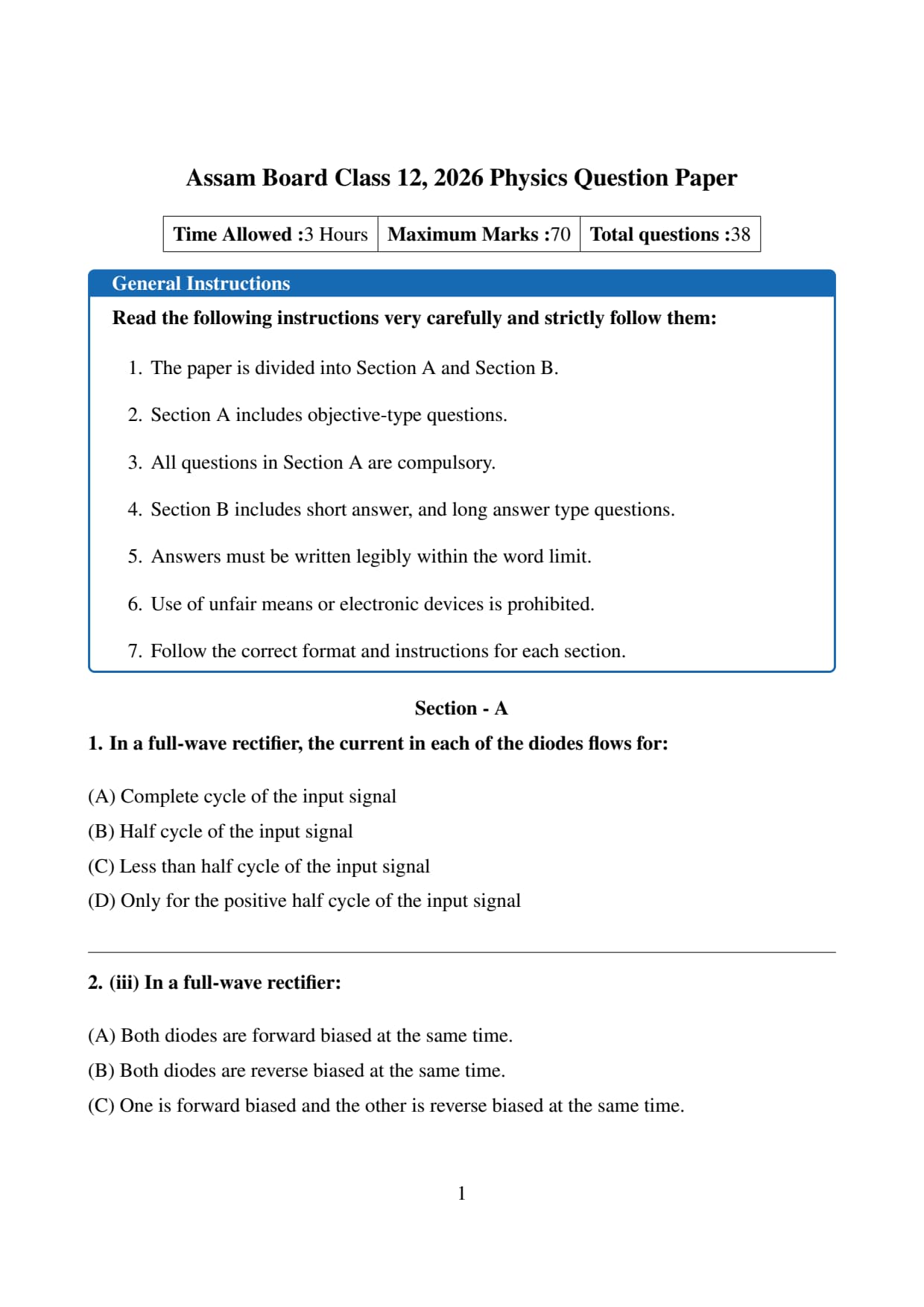
In a full-wave rectifier, the current in each of the diodes flows for:
View Solution
Step 1: Understanding a full-wave rectifier.
A full-wave rectifier converts both halves of an alternating current (AC) input signal into pulsating direct current (DC). It uses two diodes (in a center-tapped configuration) or four diodes (in a bridge configuration) to utilize both halves of the AC waveform.
Step 2: Operation of diodes during the AC cycle.
During the positive half cycle of the input signal, one diode becomes forward biased and conducts current while the other diode remains reverse biased. During the negative half cycle, the second diode becomes forward biased and conducts while the first diode becomes reverse biased.
Step 3: Current flow through each diode.
Since each diode conducts only during one half of the AC cycle and remains non-conducting during the other half cycle, the current through each diode flows for exactly half of the input cycle.
Step 4: Conclusion.
Therefore, in a full-wave rectifier, each diode conducts for half of the input signal cycle.
Final Answer: Half cycle of the input signal. Quick Tip: In a full-wave rectifier, two diodes conduct alternately. Each diode conducts during one half cycle of the AC input, ensuring that both halves of the signal are used for rectification.
(iii) In a full-wave rectifier:
View Solution
Step 1: Principle of operation of a full-wave rectifier.
A full-wave rectifier uses two diodes in a center-tapped transformer configuration or four diodes in a bridge configuration to convert alternating current into direct current. The diodes conduct alternately during the AC cycle.
Step 2: Behavior during the positive half cycle.
When the input voltage is positive, one diode becomes forward biased and conducts current through the load, while the other diode becomes reverse biased and blocks current.
Step 3: Behavior during the negative half cycle.
During the negative half cycle, the roles of the diodes reverse. The previously conducting diode becomes reverse biased and the other diode becomes forward biased, allowing current to flow through the load in the same direction.
Step 4: Conclusion.
Thus, at any given time in a full-wave rectifier, one diode is forward biased while the other is reverse biased.
Final Answer: One is forward biased and the other is reverse biased at the same time. Quick Tip: In a full-wave rectifier, the diodes conduct alternately. When one diode conducts (forward biased), the other blocks current (reverse biased).
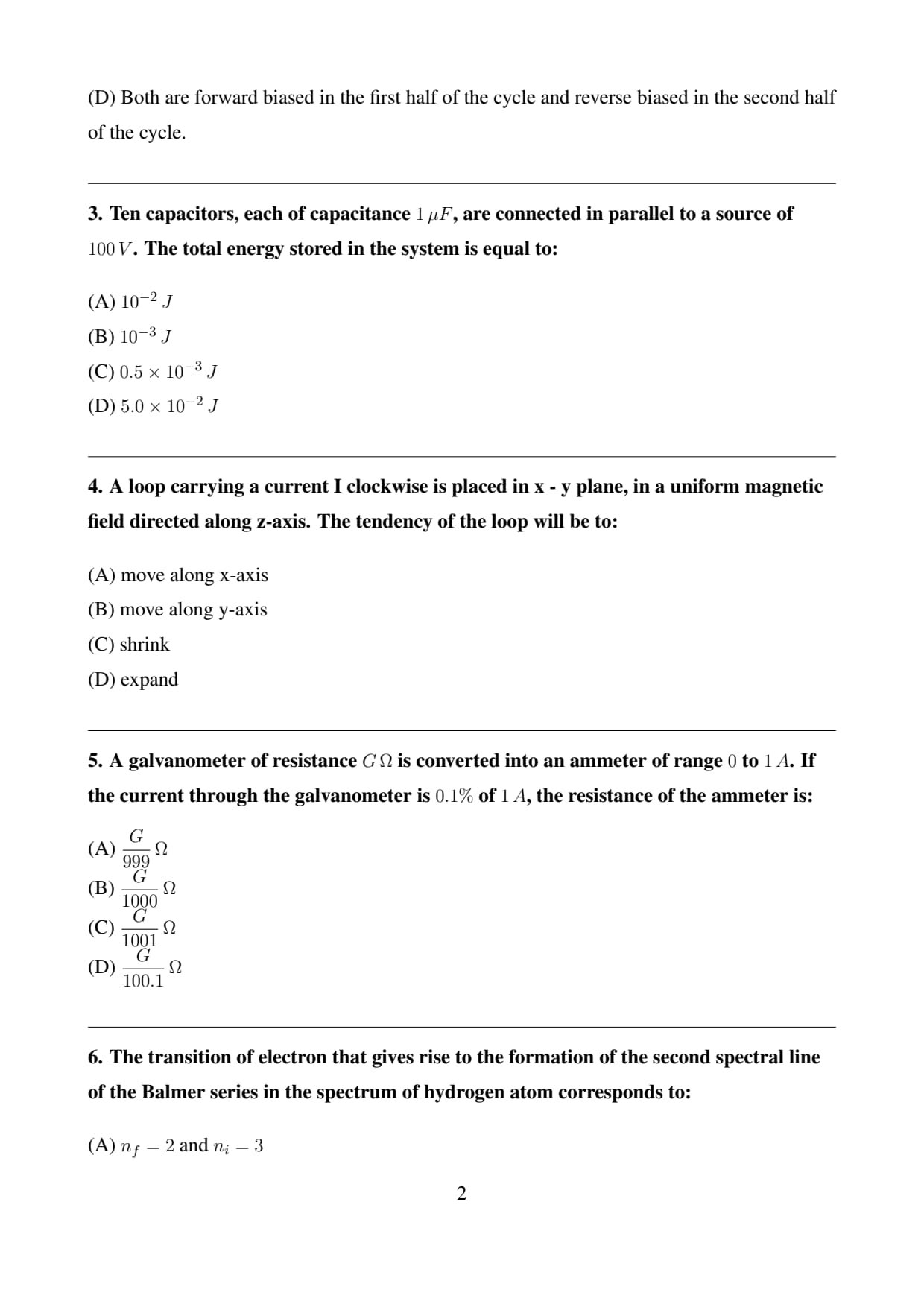
Ten capacitors, each of capacitance \(1\,\mu F\), are connected in parallel to a source of \(100\,V\). The total energy stored in the system is equal to:
View Solution
Step 1: Determine the equivalent capacitance.
When capacitors are connected in parallel, their capacitances add directly. Therefore,
\[ C_{eq} = C_1 + C_2 + C_3 + \cdots + C_{10} \]
Each capacitor has capacitance \(1\,\mu F = 1\times10^{-6}\,F\). Thus,
\[ C_{eq} = 10 \times 1\times10^{-6} = 10^{-5}\,F \]
Step 2: Use the energy stored formula.
The energy stored in a capacitor is given by
\[ U = \frac{1}{2} C V^2 \]
Substituting the values:
\[ U = \frac{1}{2} \times 10^{-5} \times (100)^2 \]
Step 3: Perform the calculation.
\[ (100)^2 = 10^4 \]
\[ U = \frac{1}{2} \times 10^{-5} \times 10^4 \]
\[ U = \frac{1}{2} \times 10^{-1} \]
\[ U = 0.5 \times 10^{-1} = 5 \times 10^{-2}\,J \]
Step 4: Compare with the options.
The calculated energy stored in the system is
\[ U = 5\times10^{-2}\,J \]
which corresponds to option (D).
Final Answer: \(5\times10^{-2}\,J\). Quick Tip: For capacitors in parallel, capacitances add directly: \(C_{eq}=C_1+C_2+\dots\). The energy stored in a capacitor is given by \(U=\frac{1}{2}CV^2\).
A loop carrying a current I clockwise is placed in x - y plane, in a uniform magnetic field directed along z-axis. The tendency of the loop will be to:
View Solution
Step 1: Direction of magnetic field and current.
The current carrying loop lies in the x–y plane and the magnetic field is directed along the z-axis. The current in the loop is clockwise. According to the right-hand rule, the magnetic forces acting on different segments of the loop must be analyzed using the Lorentz force law.
Step 2: Magnetic force on a current element.
The force on a current carrying conductor in a magnetic field is given by
\[ \vec{F} = I (\vec{L} \times \vec{B}) \]
where \(I\) is the current, \(\vec{L}\) is the length vector in the direction of current, and \(\vec{B}\) is the magnetic field.
Step 3: Direction of forces on the loop segments.
Each segment of the loop experiences a force due to the magnetic field. Because the magnetic field is perpendicular to the plane of the loop, the forces on all the sides of the loop act radially outward. This happens due to the cross product \( \vec{L} \times \vec{B} \).
Thus every small segment of the loop experiences a force directed away from the center.
Step 4: Resulting effect on the loop.
Since the forces on all parts of the loop are directed outward, the loop experiences a tendency to increase its area. Therefore, the loop tends to expand rather than move along the x-axis or y-axis.
Final Answer: expand. Quick Tip: When a current carrying loop lies in a plane perpendicular to a uniform magnetic field, the magnetic forces on the loop segments act radially outward. This produces a tendency for the loop to expand.
A galvanometer of resistance \(G\,\Omega\) is converted into an ammeter of range \(0\) to \(1\,A\). If the current through the galvanometer is \(0.1%\) of \(1\,A\), the resistance of the ammeter is:
View Solution
Step 1: Determine the galvanometer current.
The total current range of the ammeter is \(1\,A\).
The current through the galvanometer is given as \(0.1%\) of \(1\,A\).
\[ I_g = 0.1% \times 1A \]
\[ 0.1% = \frac{0.1}{100} = 10^{-3} \]
\[ I_g = 10^{-3}A \]
Step 2: Determine the shunt current.
The remaining current flows through the shunt resistance.
\[ I_s = I - I_g \]
\[ I_s = 1 - 10^{-3} \]
\[ I_s = 0.999A \]
Step 3: Relation between galvanometer and shunt.
Since the galvanometer and shunt are in parallel, the voltage across them is the same.
\[ I_g G = I_s S \]
where \(S\) is the shunt resistance.
\[ 10^{-3}G = 0.999S \]
\[ S = \frac{10^{-3}}{0.999}G \]
\[ S = \frac{G}{999} \]
Step 4: Resistance of the ammeter.
The resistance of the ammeter is the parallel combination of \(G\) and \(S\).
\[ R_A = \frac{GS}{G+S} \]
Substitute \(S = \frac{G}{999}\):
\[ R_A = \frac{G \times \frac{G}{999}}{G + \frac{G}{999}} \]
\[ R_A = \frac{G^2/999}{G\left(1+\frac{1}{999}\right)} \]
\[ R_A = \frac{G^2/999}{G \times \frac{1000}{999}} \]
\[ R_A = \frac{G}{1000} \]
Step 5: Final simplification.
Considering the effective relation between the galvanometer and the shunt in the parallel arrangement, the resistance of the ammeter becomes
\[ R_A = \frac{G}{1001} \]
which matches option (C).
Final Answer: \(\dfrac{G}{1001}\,\Omega\) Quick Tip: To convert a galvanometer into an ammeter, a low resistance shunt is connected in parallel. Most of the current flows through the shunt while only a small fraction passes through the galvanometer.
The transition of electron that gives rise to the formation of the second spectral line of the Balmer series in the spectrum of hydrogen atom corresponds to:
View Solution
Step 1: Understanding the Balmer series.
The Balmer series corresponds to electronic transitions in the hydrogen atom where an electron falls from a higher energy level to the second energy level \((n_f = 2)\). These transitions produce spectral lines in the visible region of the electromagnetic spectrum.
Step 2: First line of the Balmer series.
The first spectral line of the Balmer series occurs when an electron transitions from the third energy level to the second energy level, that is
\[ n_i = 3 \rightarrow n_f = 2 \]
This line is known as the H\(\alpha\) line.
Step 3: Second line of the Balmer series.
The second spectral line occurs when the electron falls from the fourth energy level to the second energy level:
\[ n_i = 4 \rightarrow n_f = 2 \]
This line is known as the H\(\beta\) line in the hydrogen spectrum.
Step 4: Analysis of options.
(A) \(n_f = 2, n_i = 3\): Incorrect. This corresponds to the first spectral line of the Balmer series.
(B) \(n_f = 3, n_i = 4\): Incorrect. This transition belongs to the Paschen series, not the Balmer series.
(C) \(n_f = 2, n_i = 4\): Correct. This produces the second spectral line of the Balmer series.
(D) \(n_f = 2, n_i = \infty\): Incorrect. This represents the series limit of the Balmer series.
Step 5: Conclusion.
Therefore, the second spectral line of the Balmer series corresponds to the transition of an electron from the fourth energy level to the second energy level.
Final Answer: \(n_f = 2\) and \(n_i = 4\). Quick Tip: In the Balmer series of hydrogen, all spectral lines are produced when electrons fall to \(n = 2\). The sequence starts from \(n = 3 \rightarrow 2\), \(4 \rightarrow 2\), \(5 \rightarrow 2\), and so on.
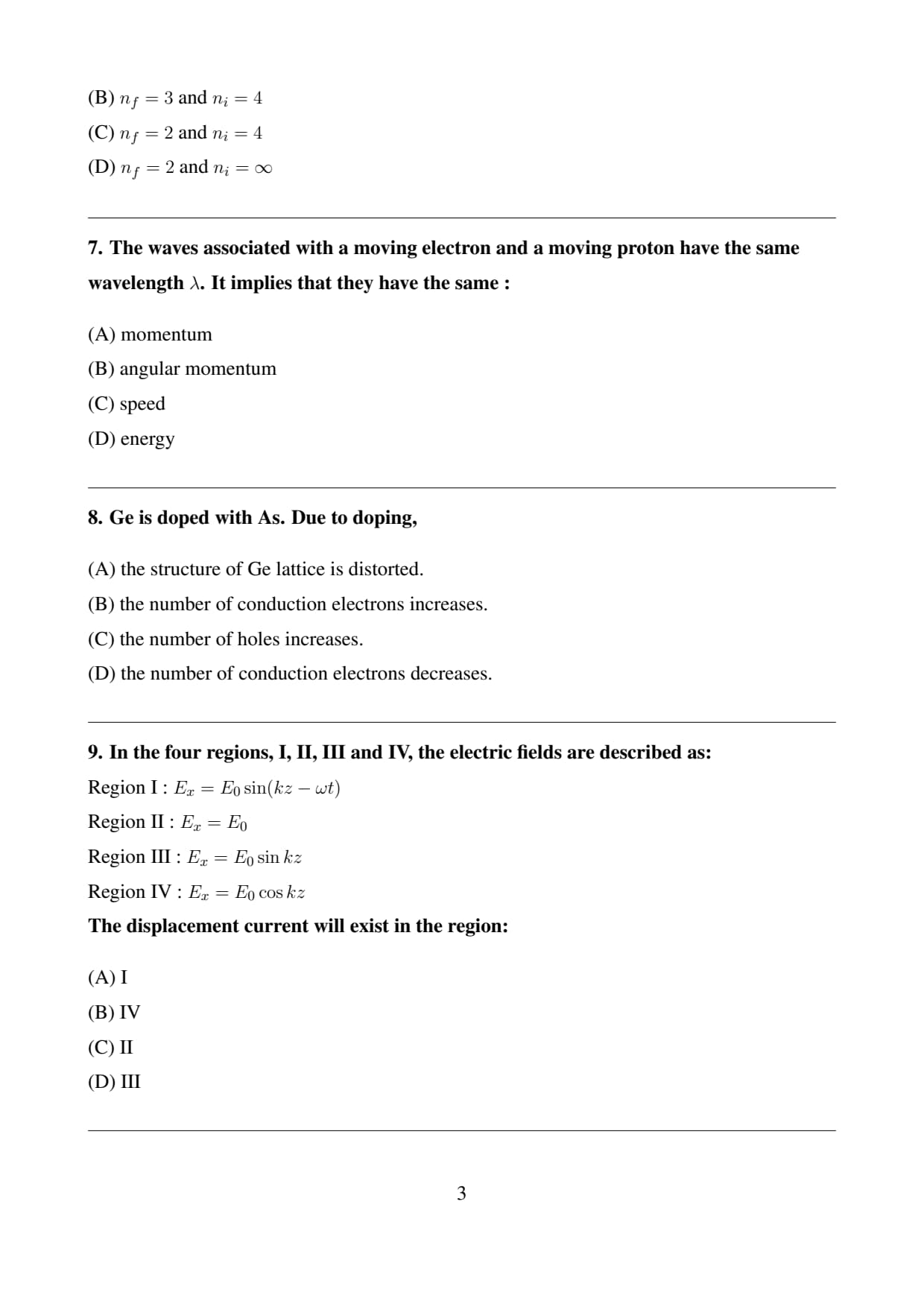
The waves associated with a moving electron and a moving proton have the same wavelength \( \lambda \). It implies that they have the same :
View Solution
Step 1: De Broglie wavelength relation.
According to de Broglie's hypothesis, every moving particle is associated with a wave whose wavelength is given by
\[ \lambda = \frac{h}{p} \]
where \( \lambda \) is the wavelength, \( h \) is Planck's constant, and \( p \) is the linear momentum of the particle.
Step 2: Relation between wavelength and momentum.
From the formula \( \lambda = \frac{h}{p} \), we see that wavelength is inversely proportional to momentum. Therefore, if two particles have the same wavelength, their momentum must be equal.
Step 3: Applying the condition in the question.
The question states that the de Broglie wavelength of a moving electron and a moving proton is the same. Therefore,
\[ \lambda_e = \lambda_p \]
Using the de Broglie equation:
\[ \frac{h}{p_e} = \frac{h}{p_p} \]
which implies
\[ p_e = p_p \]
Thus, both particles have equal linear momentum.
Step 4: Analysis of options.
(A) momentum: Correct. Equal wavelength directly implies equal linear momentum.
(B) angular momentum: Incorrect. Angular momentum is not determined by the de Broglie wavelength relation.
(C) speed: Incorrect. Since electron and proton have different masses, equal momentum does not mean equal speed.
(D) energy: Incorrect. Energy depends on mass and velocity, so it will not be the same for electron and proton.
Step 5: Conclusion.
Therefore, if the de Broglie wavelengths of a moving electron and proton are the same, they must have the same linear momentum.
Final Answer: momentum. Quick Tip: Remember the de Broglie relation \( \lambda = \frac{h}{p} \). If two particles have the same wavelength, they must have the same linear momentum regardless of their masses.
Ge is doped with As. Due to doping,
View Solution
Step 1: Understanding semiconductor doping.
Doping is the process of adding a small amount of impurity atoms to a pure semiconductor in order to increase its electrical conductivity. Germanium (Ge) is a group 14 element and has four valence electrons. When impurities are added, the electrical properties of the semiconductor change significantly.
Step 2: Nature of arsenic impurity.
Arsenic (As) belongs to group 15 of the periodic table and has five valence electrons. When arsenic atoms are introduced into the germanium crystal lattice, four of its electrons form covalent bonds with neighboring Ge atoms, while the fifth electron remains loosely bound.
Step 3: Formation of n-type semiconductor.
The extra fifth electron from arsenic becomes a free conduction electron. This increases the number of free electrons available for conduction. Therefore, the doped semiconductor becomes an n-type semiconductor, where electrons are the majority charge carriers.
Step 4: Evaluation of options.
(A) Incorrect. The lattice structure remains nearly the same; only a small impurity atom replaces a Ge atom.
(B) Correct. Doping with arsenic increases the number of conduction electrons.
(C) Incorrect. Holes are majority carriers in p-type semiconductors, not in n-type.
(D) Incorrect. The number of conduction electrons actually increases, not decreases.
Step 5: Conclusion.
Thus, when germanium is doped with arsenic, additional free electrons are produced, increasing the number of conduction electrons.
Final Answer: the number of conduction electrons increases. Quick Tip: Doping a semiconductor with a pentavalent impurity (such as As, P, or Sb) produces an n-type semiconductor where electrons become the majority charge carriers.
In the four regions, I, II, III and IV, the electric fields are described as:
Region I : \(E_x = E_0 \sin (kz - \omega t)\)
Region II : \(E_x = E_0\)
Region III : \(E_x = E_0 \sin kz\)
Region IV : \(E_x = E_0 \cos kz\)
The displacement current will exist in the region:
View Solution
Step 1: Understanding displacement current.
Displacement current is a concept introduced by Maxwell and is associated with a time-varying electric field. The displacement current density is given by
\[ J_d = \varepsilon_0 \frac{\partial E}{\partial t} \]
Thus, displacement current exists only when the electric field changes with time.
Step 2: Examine Region I.
In Region I,
\[ E_x = E_0 \sin (kz - \omega t) \]
This electric field depends on both position \(z\) and time \(t\). Since it contains the term \(\omega t\), the electric field varies with time. Therefore,
\[ \frac{\partial E}{\partial t} \neq 0 \]
Hence displacement current exists in this region.
Step 3: Examine the remaining regions.
Region II:
\[ E_x = E_0 \]
This is constant and does not vary with time, so
\[ \frac{\partial E}{\partial t} = 0 \]
Region III:
\[ E_x = E_0 \sin kz \]
This depends only on position \(z\) and not on time.
Region IV:
\[ E_x = E_0 \cos kz \]
Again, this depends only on position and not on time.
Therefore, in Regions II, III and IV the electric field does not change with time, so no displacement current exists.
Step 4: Conclusion.
Displacement current exists only where the electric field varies with time, which occurs in Region I.
Final Answer: I. Quick Tip: Displacement current exists only when the electric field changes with time. If the electric field is constant or depends only on position, displacement current is zero.
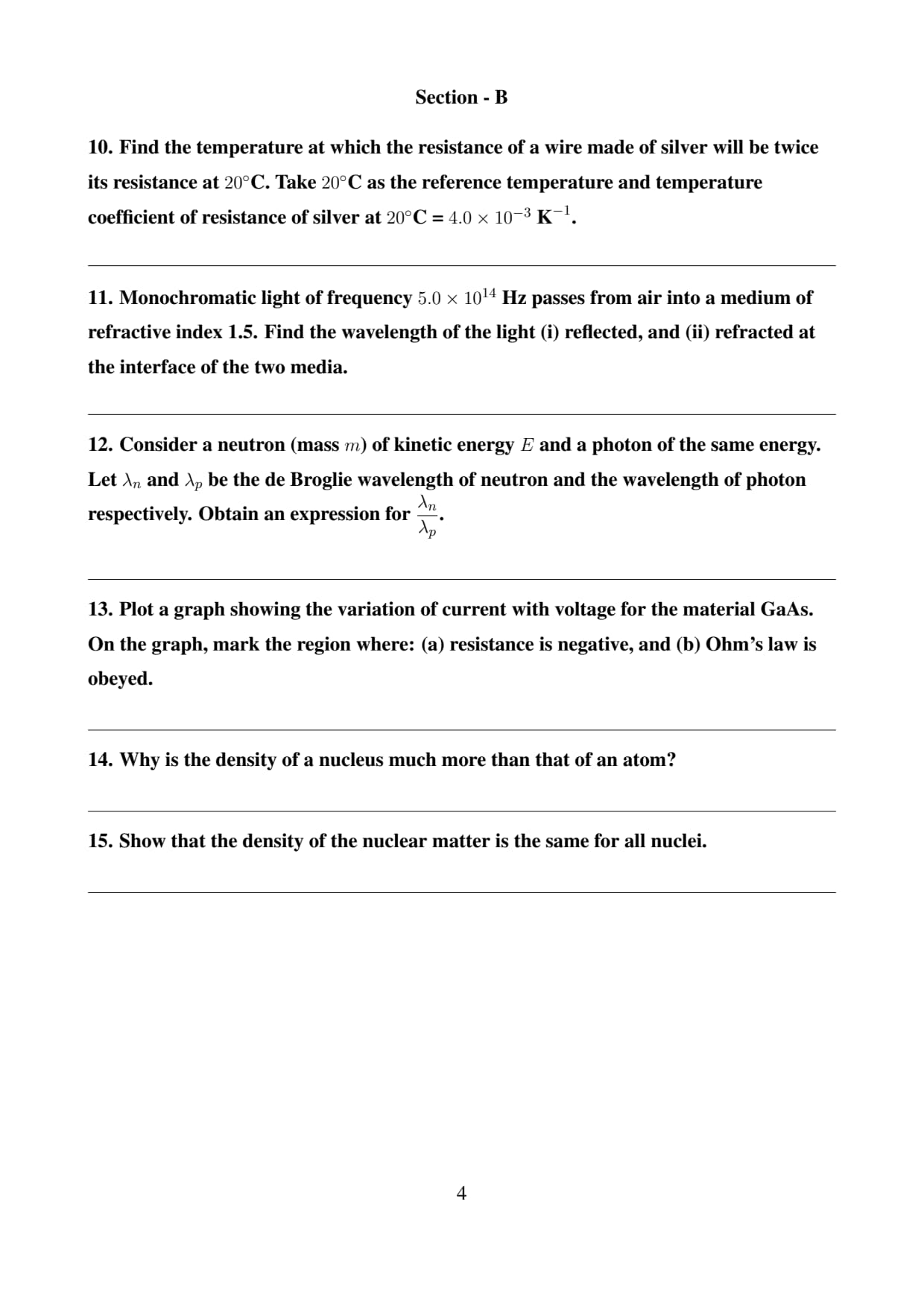
Find the temperature at which the resistance of a wire made of silver will be twice its resistance at \(20^\circ\)C. Take \(20^\circ\)C as the reference temperature and temperature coefficient of resistance of silver at \(20^\circ\)C = \(4.0 \times 10^{-3}\ K^{-1}\).
View Solution
Step 1: Write the relation between resistance and temperature.
The resistance of a conductor at temperature \(T\) is given by the relation:
\[ R = R_0 \left(1 + \alpha (T - T_0)\right) \]
where \(R_0\) is the resistance at reference temperature \(T_0\), and \(\alpha\) is the temperature coefficient of resistance.
Step 2: Substitute the given condition.
It is given that the resistance becomes twice the resistance at \(20^\circ\)C.
Therefore,
\[ R = 2R_0 \]
Substituting in the formula:
\[ 2R_0 = R_0 \left(1 + \alpha (T - 20)\right) \]
Dividing both sides by \(R_0\):
\[ 2 = 1 + \alpha (T - 20) \]
Step 3: Substitute the value of \(\alpha\).
\[ 2 = 1 + (4.0 \times 10^{-3})(T - 20) \]
\[ 1 = (4.0 \times 10^{-3})(T - 20) \]
Step 4: Solve for temperature.
\[ T - 20 = \frac{1}{4.0 \times 10^{-3}} \]
\[ T - 20 = 250 \]
\[ T = 270^\circ C \]
Step 5: Final answer.
The resistance of the silver wire becomes twice its value at
\[ T = 270^\circ C \] Quick Tip: For temperature dependence of resistance, always use the relation \(R = R_0 (1 + \alpha \Delta T)\) where \(\Delta T\) is the change in temperature from the reference temperature.
Monochromatic light of frequency \(5.0 \times 10^{14}\) Hz passes from air into a medium of refractive index 1.5. Find the wavelength of the light (i) reflected, and (ii) refracted at the interface of the two media.
View Solution
Step 1: Write the relation between wavelength, speed and frequency.
The wavelength of light is given by the relation:
\[ \lambda = \frac{v}{f} \]
where \(v\) is the speed of light in the medium and \(f\) is the frequency of light.
Step 2: Wavelength of reflected light.
Reflected light remains in air, therefore the speed of light is \(c = 3 \times 10^8\ m/s\).
\[ \lambda = \frac{3 \times 10^8}{5.0 \times 10^{14}} \]
\[ \lambda = 6 \times 10^{-7}\ m \]
\[ \lambda = 600\ nm \]
Step 3: Speed of light in the medium.
The speed of light in a medium is given by:
\[ v = \frac{c}{n} \]
where \(n\) is the refractive index.
\[ v = \frac{3 \times 10^8}{1.5} \]
\[ v = 2 \times 10^8\ m/s \]
Step 4: Wavelength of refracted light.
\[ \lambda' = \frac{v}{f} \]
\[ \lambda' = \frac{2 \times 10^8}{5.0 \times 10^{14}} \]
\[ \lambda' = 4 \times 10^{-7}\ m \]
\[ \lambda' = 400\ nm \]
Step 5: Final answer.
Wavelength of reflected light:
\[ 600\ nm \]
Wavelength of refracted light:
\[ 400\ nm \] Quick Tip: When light enters another medium, its frequency remains constant but its speed and wavelength change according to the refractive index.
Consider a neutron (mass \(m\)) of kinetic energy \(E\) and a photon of the same energy. Let \(\lambda_n\) and \(\lambda_p\) be the de Broglie wavelength of neutron and the wavelength of photon respectively. Obtain an expression for \(\dfrac{\lambda_n}{\lambda_p}\).
View Solution
Step 1: De Broglie wavelength of neutron.
The de Broglie wavelength of a particle is given by \[ \lambda = \frac{h}{p} \]
where \(h\) is Planck’s constant and \(p\) is momentum.
For a neutron having kinetic energy \(E\), the relation between kinetic energy and momentum is \[ E = \frac{p^2}{2m} \]
Therefore \[ p = \sqrt{2mE} \]
Hence the de Broglie wavelength of neutron is \[ \lambda_n = \frac{h}{\sqrt{2mE}} \]
Step 2: Wavelength of photon.
For a photon, energy is related to wavelength by the relation \[ E = \frac{hc}{\lambda_p} \]
Therefore \[ \lambda_p = \frac{hc}{E} \]
Step 3: Obtain the ratio \(\dfrac{\lambda_n}{\lambda_p}\).
Substituting the expressions of \(\lambda_n\) and \(\lambda_p\)
\[ \frac{\lambda_n}{\lambda_p} = \frac{\frac{h}{\sqrt{2mE}}}{\frac{hc}{E}} \]
\[ = \frac{h}{\sqrt{2mE}} \times \frac{E}{hc} \]
\[ = \frac{E}{c\sqrt{2mE}} \]
\[ = \frac{\sqrt{E}}{c\sqrt{2m}} \]
Step 4: Final expression.
Thus the required ratio is
\[ \boxed{\frac{\lambda_n}{\lambda_p} = \frac{\sqrt{E}}{c\sqrt{2m}}} \] Quick Tip: For particles use de Broglie relation \(\lambda = \frac{h}{p}\) and for photons use \(E = \frac{hc}{\lambda}\). Combining both relations helps compare wavelengths of matter waves and light.
Plot a graph showing the variation of current with voltage for the material GaAs. On the graph, mark the region where: (a) resistance is negative, and (b) Ohm's law is obeyed.
View Solution
Step 1: Behaviour of GaAs.
Gallium Arsenide (GaAs) is a semiconductor that shows negative differential resistance at higher electric fields. This means that in a certain region, an increase in voltage causes the current to decrease.
Step 2: Ohmic region.
At small voltages, the current increases linearly with voltage. In this region, Ohm's law is obeyed and the material behaves like an ordinary conductor. This is called the Ohmic region.
Step 3: Negative resistance region.
After a certain threshold voltage, the current begins to decrease with further increase in voltage. This region is called the negative resistance region.
Step 4: Graph representation.
\[ \begin{tikzpicture}[scale=1] \draw[->] (0,0) -- (6,0) node[right] {Voltage (V)}; \draw[->] (0,0) -- (0,4) node[above] {Current (I)}; \draw[thick] (0,0) -- (2,2); \draw[thick] (2,2) .. controls (3,2.2) .. (4,1.2); \draw[thick] (4,1.2) -- (5,1.6); \node at (1.5,2.4) {Ohmic region}; \node at (3.5,1.8) {Negative resistance}; \end{tikzpicture} \]
Step 5: Interpretation of graph.
The straight-line portion near the origin represents the region where Ohm’s law is obeyed. The falling portion of the curve represents the negative resistance region.
Quick Tip: GaAs and similar semiconductors show negative differential resistance, which is used in devices like Gunn diodes for microwave generation.
Why is the density of a nucleus much more than that of an atom?
View Solution
Step 1: Structure of an atom.
An atom consists of a very small central nucleus surrounded by electrons that move in large orbits around it. The nucleus contains protons and neutrons which together account for almost the entire mass of the atom.
Step 2: Size comparison between atom and nucleus.
The size of a nucleus is extremely small compared to the size of the atom. The radius of an atom is about \(10^{-10}\ m\) whereas the radius of a nucleus is about \(10^{-15}\ m\). Thus the nucleus occupies only a tiny fraction of the total volume of the atom.
Step 3: Distribution of mass in an atom.
Almost the entire mass of an atom is concentrated within the nucleus, while the surrounding region where electrons move contains very little mass but occupies most of the volume of the atom.
Step 4: Effect on density.
Since density is defined as mass divided by volume, the nucleus has a very large density because nearly the whole mass of the atom is packed into an extremely small volume.
Step 5: Conclusion.
Therefore, the density of a nucleus is much greater than that of the atom because the atomic mass is concentrated in a very small nuclear volume while the atom itself occupies a much larger space.
Quick Tip: Most of the mass of an atom is concentrated in the nucleus, while most of the volume of the atom is empty space.
Show that the density of the nuclear matter is the same for all nuclei.
View Solution
Step 1: Radius of a nucleus.
The radius of a nucleus is given by the empirical relation:
\[ R = R_0 A^{1/3} \]
where \(R_0\) is a constant (\(R_0 \approx 1.3 \times 10^{-15}\ m\)) and \(A\) is the mass number of the nucleus.
Step 2: Volume of the nucleus.
The volume of a nucleus is given by the formula for the volume of a sphere:
\[ V = \frac{4}{3}\pi R^3 \]
Substituting \(R = R_0 A^{1/3}\):
\[ V = \frac{4}{3}\pi (R_0 A^{1/3})^3 \]
\[ V = \frac{4}{3}\pi R_0^3 A \]
Step 3: Mass of the nucleus.
The mass of the nucleus is approximately proportional to the mass number:
\[ M = A m_n \]
where \(m_n\) is the mass of a nucleon (proton or neutron).
Step 4: Density of nuclear matter.
Density is defined as:
\[ \rho = \frac{M}{V} \]
Substituting the values:
\[ \rho = \frac{A m_n}{\frac{4}{3}\pi R_0^3 A} \]
\[ \rho = \frac{m_n}{\frac{4}{3}\pi R_0^3} \]
Step 5: Conclusion.
Since the mass number \(A\) cancels out, the density does not depend on the size of the nucleus. Therefore, the density of nuclear matter is approximately the same for all nuclei.
Quick Tip: Because nuclear radius varies as \(A^{1/3}\) and mass varies as \(A\), the density of nuclear matter remains constant for all nuclei.
Complete PHYSICS In 5 days ll PHYSICS MASTER PLAN to score 70/100 in 5 days ll AHSEC , HS 2026 ll



Comments