




JK Board is conducting the Class 10 Geography Board Exam 2026 on March 2, 2026. Class 10 Geography Question Paper with Solution PDF is available here for download.
The official question paper of JK Board Class 10 Geography Board Exam 2026 is provided below. Students can download the official paper in PDF format for reference.
JK Board Class 10 2026 Geography Question Paper with Solution PDF
| JK Board Class 10 Geography Question Paper 2026 | Download PDF | Check Solution |
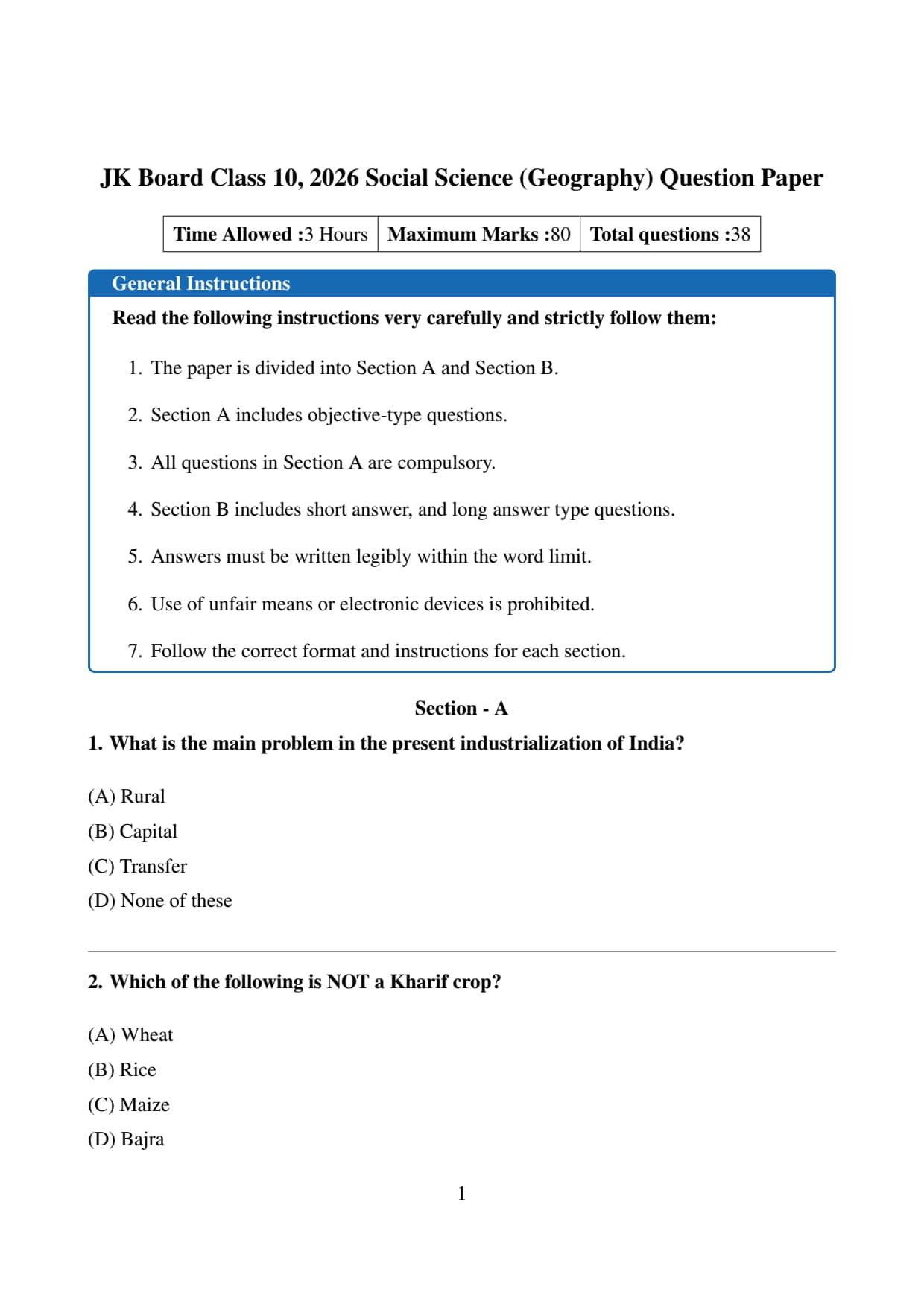
What is the main problem in the present industrialization of India?
View Solution
Step 1: Understanding the problem.
The main challenge in the present industrialization of India is the lack of sufficient capital for investment in new industries and expansion of existing ones. While rural development and other factors are important, the capital constraint has been a key issue preventing faster industrial growth.
Step 2: Analysis of options.
(A) Rural: Incorrect. Although rural areas face challenges in industrialization, the primary issue is the lack of capital investment in the industrial sector.
(B) Capital: Correct. The lack of sufficient capital is a significant barrier to industrial growth and expansion in India. Access to financial resources is crucial for the development of infrastructure, technology, and industry.
(C) Transfer: Incorrect. While the transfer of technology is important, it is not the primary issue in India's industrialization. Capital availability plays a more significant role.
(D) None of these: Incorrect. The lack of capital is the main problem, making this option not correct.
Step 3: Conclusion.
Therefore, the main problem in the present industrialization of India is the lack of capital, which is necessary for the establishment and growth of industries.
Final Answer: Capital. Quick Tip: In industrialization, access to capital is essential for setting up industries, developing infrastructure, and acquiring technology. Capital availability plays a vital role in accelerating economic growth.
Which of the following is NOT a Kharif crop?
View Solution
Step 1: Understanding Kharif crops.
Kharif crops are grown during the monsoon season in India, typically from June to September. These crops require plenty of water and are harvested at the end of the monsoon season.
Step 2: Analysis of options.
(A) Wheat: Correct. Wheat is a Rabi crop, grown during the winter season (from November to April), not a Kharif crop.
(B) Rice: Incorrect. Rice is a Kharif crop, grown in the monsoon season, requiring a lot of water.
(C) Maize: Incorrect. Maize is a Kharif crop, which is sown during the monsoon season.
(D) Bajra: Incorrect. Bajra is a Kharif crop, as it is also sown during the monsoon season and harvested before the end of the season.
Step 3: Conclusion.
Therefore, the crop that is NOT a Kharif crop is Wheat, which is typically grown in the Rabi season.
Final Answer: Wheat. Quick Tip: Remember that Kharif crops are sown during the monsoon season (June to September), and Rabi crops are sown in the winter season (November to April).
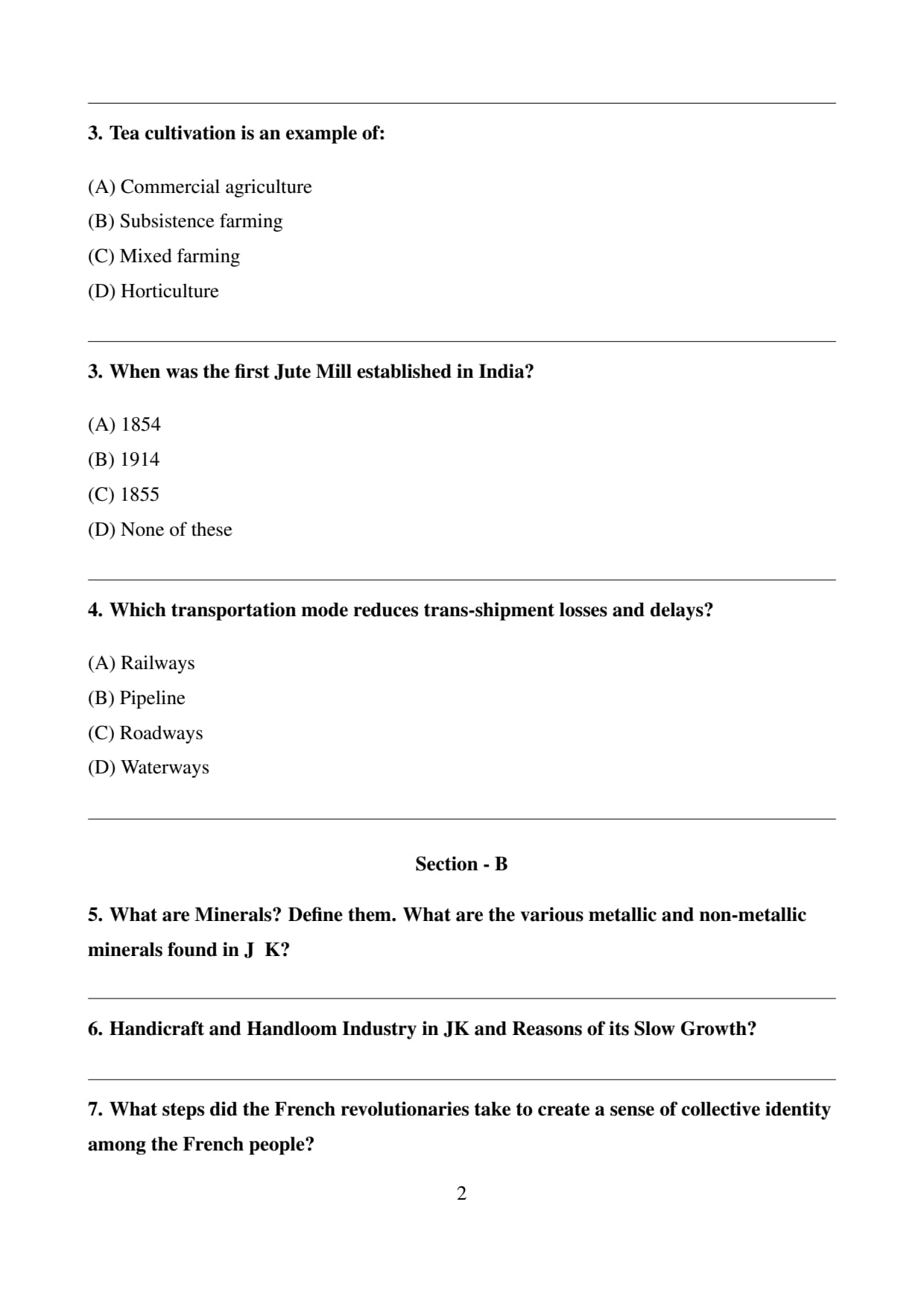
When was the first Jute Mill established in India?
View Solution
Step 1: Understanding Jute mills.
The first Jute Mill in India was established in 1855 at Rishra, near Kolkata. This marked the beginning of the jute industry in India, which later became a significant part of the Indian economy, especially in the eastern region.
Step 2: Analysis of options.
(A) 1854: Incorrect. The first Jute Mill in India was established in 1855, not 1854.
(B) 1914: Incorrect. By 1914, the jute industry in India had already been established, and multiple jute mills were in operation by then.
(C) 1855: Correct. The first Jute Mill in India was established in 1855 at Rishra near Kolkata.
(D) None of these: Incorrect. The correct year is 1855.
Step 3: Conclusion.
The first Jute Mill was established in 1855, which marks the beginning of the organized jute industry in India.
Final Answer: 1855. Quick Tip: The first Jute Mill in India was set up in 1855, in Rishra, near Kolkata. Jute mills played a vital role in the industrialization of India, especially in West Bengal.
Which transportation mode reduces trans-shipment losses and delays?
View Solution
Step 1: Understanding trans-shipment losses and delays.
Trans-shipment losses and delays occur when goods are transferred between different modes of transport, often leading to inefficiencies, damage, or delays in delivery.
Step 2: Analysis of options.
(A) Railways: Incorrect. Railways are efficient for long-distance transportation, but the trans-shipment process still occurs at stations, causing some delays and losses.
(B) Pipeline: Correct. Pipelines minimize trans-shipment losses and delays by providing a continuous, direct mode of transportation for liquids and gases, reducing the need for handling and transfers.
(C) Roadways: Incorrect. Road transportation requires multiple stops and handling, which increases the chances of trans-shipment delays and losses.
(D) Waterways: Incorrect. While waterways are cost-effective, the loading and unloading processes at ports can lead to delays and losses during trans-shipment.
Step 3: Conclusion.
Among all the options, pipelines are the best mode of transport to reduce trans-shipment losses and delays due to their continuous nature.
Final Answer: Pipeline. Quick Tip: Pipelines are the most efficient transport mode for liquids and gases, reducing the need for trans-shipment and minimizing delays and losses.
What are Minerals? Define them. What are the various metallic and non-metallic minerals found in J & K?
View Solution
Step 1: Define Minerals.
Minerals are naturally occurring inorganic solids with a definite chemical composition and crystalline structure. They are the building blocks of rocks and can be found in the Earth's crust.
Step 2: Identify the metallic minerals in J&K.
Some metallic minerals found in Jammu & Kashmir (J&K) include:
- Copper: Found in the Rajouri region.
- Lead and Zinc: Found in the Zanskar region.
- Gold: Found in small quantities in the region.
- Iron: Found in the Poonch and Udhampur districts.
Step 3: Identify the non-metallic minerals in J&K.
Non-metallic minerals in J&K include:
- Limestone: Found in the regions of Kashmir and Jammu.
- Salt: Mined from the saline areas of Ladakh.
- Gypsum: Found in various parts of the region. Quick Tip: Minerals are classified into two categories: metallic and non-metallic. Metallic minerals are those from which metals can be extracted, while non-metallic minerals do not contain metals and are used in various industrial applications.
Handicraft and Handloom Industry in J&K and Reasons of its Slow Growth?
View Solution
Step 1: Introduction to Handicraft and Handloom Industry in J&K.
The handicraft and handloom industries of Jammu & Kashmir are integral to the region's economy. The state is famous for its exquisite shawls, carpets, and Pashmina wool products, which are highly valued in both domestic and international markets.
Step 2: Key Contributions.
Handicraft and handloom products contribute significantly to the livelihood of rural artisans in Jammu & Kashmir. Traditional crafts like Kashmiri shawls, Pashmina, and papier-mâché are popular worldwide.
Step 3: Reasons for Slow Growth.
Despite the potential, the industry faces several challenges that hinder its growth:
1. Lack of Modernization: The industry is largely traditional and lacks modern technology, which hampers production speed and quality.
2. Political Instability: Frequent political instability in the region affects the smooth functioning of the industry.
3. Limited Market Access: The local artisans face difficulties in accessing national and international markets due to inadequate marketing infrastructure.
4. Dependency on Traditional Skills: The industry heavily relies on traditional skills, and there is a lack of skill development programs for modern demands.
5. Inadequate Infrastructure: Insufficient infrastructure, such as poor transportation and limited storage facilities, further limits growth potential.
Step 4: Measures for Growth.
To boost the industry's growth, efforts must be made to modernize production, improve marketing, and develop infrastructure. Training programs should be introduced for artisans to meet global standards. Quick Tip: Investing in technology and infrastructure is key to revitalizing the handicraft and handloom industry in J&K. Enhancing artisans' skills and expanding market access can drive growth.
What steps did the French revolutionaries take to create a sense of collective identity among the French people?
View Solution
Step 1: Establishment of the French Republic.
The French revolutionaries abolished the monarchy and declared France a republic. This move helped foster a sense of unity among the people, as the idea of a republic was seen as a collective identity that all French citizens could relate to.
Step 2: Creation of a National Symbol.
The revolutionaries introduced the Tricolour flag and the Marseillaise, the national anthem, as symbols of unity. These became powerful symbols of national pride and collective identity.
Step 3: Reorganization of the Education System.
The revolutionaries reformed the education system to promote the values of liberty, equality, and fraternity. This helped instill the revolutionary ideals in future generations, creating a shared national consciousness.
Step 4: Promotion of a Common Language.
The French revolutionaries sought to eliminate regional dialects by promoting the use of French as a common language. This helped bring people from different parts of the country together, fostering a stronger national identity.
Step 5: Use of Revolutionary Festivals.
The revolutionaries organized revolutionary festivals to celebrate the values of the revolution and promote national unity. These events served as a reminder of the shared goals and ideals of the French people. Quick Tip: To foster a collective identity, the revolutionaries used symbols, education, and national festivals to create a sense of unity and pride among the French people.
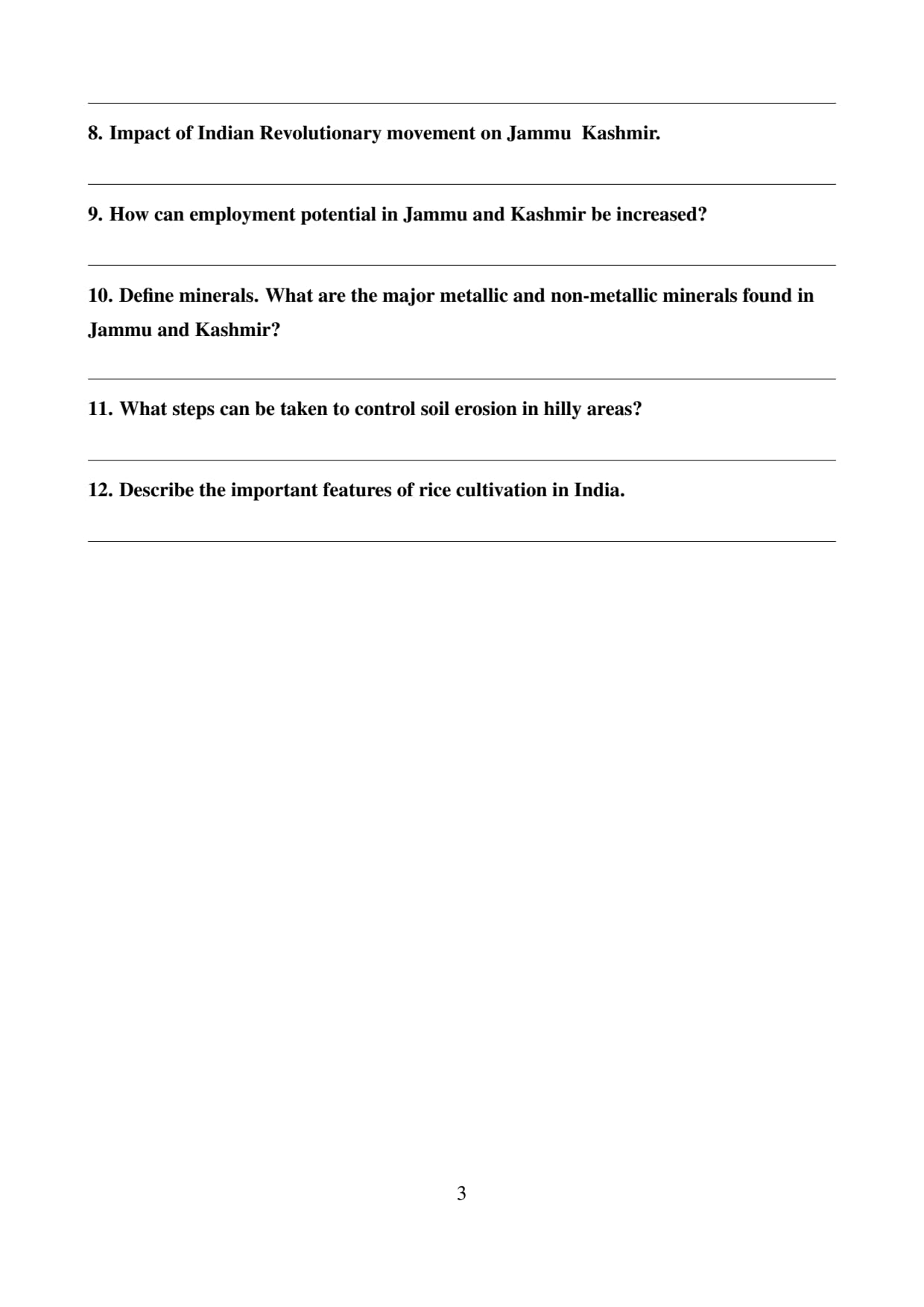
Impact of Indian Revolutionary movement on Jammu & Kashmir.
View Solution
Step 1: Introduction to the Indian Revolutionary Movement.
The Indian Revolutionary movement aimed at overthrowing British rule through armed resistance and insurgency, differing from the non-violent approach of the Congress. It involved several armed groups and leaders who were committed to the idea of Swaraj and independence through revolutionary means.
Step 2: Influence in Jammu & Kashmir.
The revolutionary movement had a significant impact on Jammu & Kashmir, with the region being a crucial center for revolutionary activities. Several freedom fighters from the state were influenced by the ideas of revolutionary leaders like Subhas Chandra Bose, Bhagat Singh, and others.
Step 3: Key Impacts.
1. Formation of Revolutionary Groups: Revolutionary groups like the Jammu and Kashmir National Conference (NC) emerged, which sought to challenge the autocratic rule and demand rights for the people.
2. Social and Political Awareness: The revolutionary movement contributed to a rise in political awareness among the youth, inspiring them to participate actively in the freedom struggle.
3. Support for Armed Struggle: The movement inspired many to take up arms, contributing to the larger national struggle for independence from British rule.
4. Contribution to the National Movement: Many from Jammu & Kashmir participated in nationwide revolutionary activities and supported major events like the Quit India Movement and the Civil Disobedience Movement.
Step 4: Conclusion.
The Indian Revolutionary movement, with its nationalistic fervor, influenced the youth and political landscape in Jammu & Kashmir, fostering a greater sense of nationalism and resistance to colonial rule, which laid the foundation for the state's participation in the larger Indian freedom struggle. Quick Tip: The Indian Revolutionary movement in Jammu & Kashmir played a crucial role in galvanizing support for India's struggle for independence, inspiring generations of freedom fighters in the region.
How can employment potential in Jammu and Kashmir be increased?
View Solution
Step 1: Identify sectors with potential.
The employment potential in Jammu and Kashmir can be increased by focusing on sectors with high growth potential such as tourism, agriculture, horticulture, and handicrafts.
Step 2: Skill Development Programs.
Implementing skill development programs can enhance the employability of the local population, especially the youth, by equipping them with the skills needed in various industries.
Step 3: Development of Infrastructure.
Improving infrastructure such as roads, electricity, and communication facilities would attract investment in various sectors, thereby creating more job opportunities.
Step 4: Encouraging Entrepreneurship.
Encouraging local entrepreneurship through financial support and mentorship programs can help create new businesses, leading to increased employment opportunities.
Step 5: Government Policies and Initiatives.
The government can introduce policies that promote local industry, provide incentives for job creation, and support businesses through subsidies or tax benefits. Quick Tip: Promoting skill development, infrastructure, and entrepreneurship are key steps to increasing employment potential in Jammu and Kashmir.
Define minerals. What are the major metallic and non-metallic minerals found in Jammu and Kashmir?
View Solution
Step 1: Define Minerals.
Minerals are naturally occurring, inorganic substances that have a definite chemical composition and crystalline structure. They are the building blocks of rocks and are found in the Earth's crust.
Step 2: Major Metallic Minerals in Jammu and Kashmir.
Some of the major metallic minerals found in Jammu and Kashmir include:
- Copper: Found in the Rajouri region.
- Lead and Zinc: Found in the Zanskar region.
- Gold: Found in small quantities.
- Iron: Found in the Poonch and Udhampur districts.
Step 3: Major Non-Metallic Minerals in Jammu and Kashmir.
Some non-metallic minerals found in Jammu and Kashmir include:
- Limestone: Found in Kashmir and Jammu.
- Salt: Mined from the saline regions of Ladakh.
- Gypsum: Found in various parts of the region. Quick Tip: Minerals are divided into metallic and non-metallic categories. Metallic minerals are used to extract metals, while non-metallic minerals are used in various industrial applications.
What steps can be taken to control soil erosion in hilly areas?
View Solution
Step 1: Terrace Farming.
Terrace farming involves cutting the slopes into steps to slow down the flow of water. This reduces soil erosion and helps retain moisture in the soil.
Step 2: Afforestation.
Planting trees and vegetation on hilly slopes stabilizes the soil and prevents erosion. The roots of plants hold the soil together, reducing the impact of rainfall.
Step 3: Water Conservation Techniques.
Techniques like check dams and contour bunding can be used to reduce surface runoff, allowing water to infiltrate the soil, thereby preventing erosion.
Step 4: Use of Mulch.
Applying a layer of mulch helps prevent the soil from being washed away by rainfall. It also helps in retaining soil moisture.
Step 5: Crop Rotation.
By rotating crops, soil fertility is maintained, and the land is not left barren, reducing the risk of soil erosion. Quick Tip: Prevent soil erosion by using techniques like terrace farming, afforestation, and water conservation methods to protect the soil in hilly areas.
Describe the important features of rice cultivation in India.
View Solution
Step 1: Geographic Distribution.
Rice is predominantly grown in the northern and eastern states of India, such as West Bengal, Uttar Pradesh, Punjab, and Tamil Nadu. It thrives in regions with abundant water supply.
Step 2: Soil Requirements.
Rice requires alluvial soil, rich in minerals, and is best grown in areas with a high water table or where irrigation is available. The soil must be kept moist throughout the growth period.
Step 3: Climate.
Rice is a tropical crop that needs a warm and humid climate. It grows best in areas that receive heavy rainfall during the monsoon season.
Step 4: Farming Method.
In India, rice is primarily grown using traditional methods, such as transplanting paddy seedlings in flooded fields. In some areas, direct seeding is also practiced.
Step 5: Importance to Economy.
Rice is a staple food crop and plays a major role in the agriculture economy of India. It provides livelihood to millions of farmers and is integral to food security. Quick Tip: Rice requires warm, humid conditions and a good water supply, making it a staple crop in many parts of India. Proper irrigation and soil management are key to its cultivation.



Comments