




JK Board is conducting the Class 10 History Board Exam 2026 on March 2, 2026. Class 10 History Question Paper with Solution PDF is available here for download.
The official question paper of JK Board Class 10 History Board Exam 2026 is provided below. Students can download the official paper in PDF format for reference.
JK Board Class 10, 2026 History Question Paper with Solution PDF
| JK Board Class 10 History Question Paper 2026 | Download PDF | Check Solution |

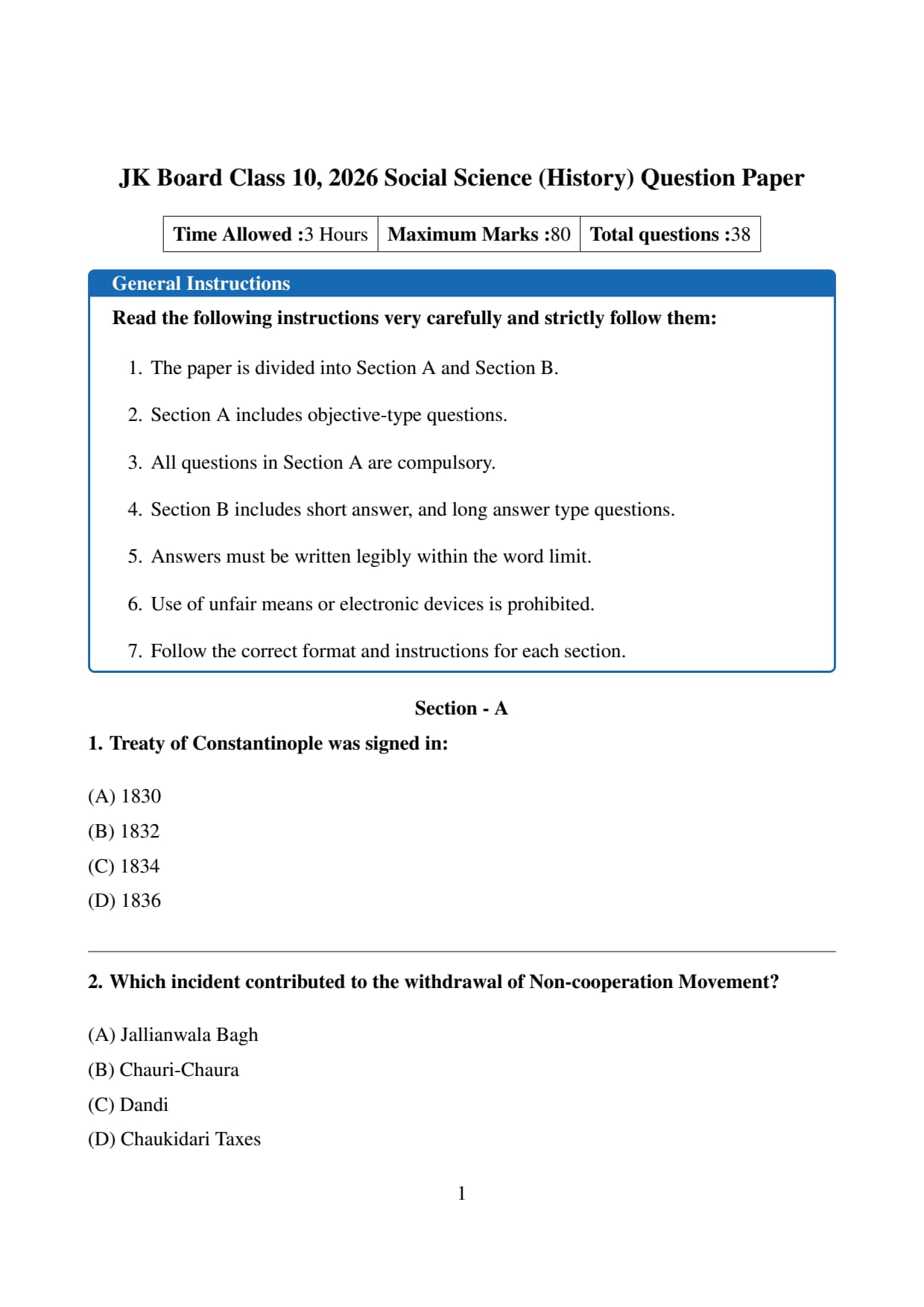
Treaty of Constantinople was signed in:
View Solution
Step 1: Understanding the Treaty of Constantinople.
The Treaty of Constantinople was signed in 1830 between the Ottoman Empire and the Great Powers of Europe. It recognized Greece as an independent nation after the Greek War of Independence.
Step 2: Historical Importance.
This treaty officially granted independence to Greece and marked an important moment in European nationalist movements.
Step 3: Analysis of the options.
(A) 1830: Correct. The treaty was signed in 1830.
(B) 1832: Incorrect.
(C) 1834: Incorrect.
(D) 1836: Incorrect.
Step 4: Conclusion.
Therefore, the Treaty of Constantinople was signed in 1830.
Final Answer: 1830. Quick Tip: The Treaty of Constantinople (1830) recognized Greece as an independent state.
Which incident contributed to the withdrawal of Non-cooperation Movement?
View Solution
Step 1: Understanding the Non-Cooperation Movement.
The Non-Cooperation Movement was launched by Mahatma Gandhi in 1920 to protest against British rule through non-violent means.
Step 2: The Chauri-Chaura Incident.
In February 1922, at Chauri-Chaura in Uttar Pradesh, protesters set a police station on fire, resulting in the death of several policemen. This violent incident went against Gandhi’s principle of non-violence.
Step 3: Reason for withdrawal.
Due to this act of violence, Gandhi decided to withdraw the Non-Cooperation Movement in 1922.
Step 4: Analysis of the options.
(A) Jallianwala Bagh: It triggered nationalist feelings but did not cause withdrawal.
(B) Chauri-Chaura: Correct. It led to withdrawal.
(C) Dandi: Related to Civil Disobedience Movement.
(D) Chaukidari Taxes: Not related to withdrawal.
Step 5: Conclusion.
Thus, the Non-Cooperation Movement was withdrawn after the Chauri-Chaura incident.
Final Answer: Chauri-Chaura. Quick Tip: Gandhi immediately withdrew movements if they turned violent, as he strictly followed non-violence.
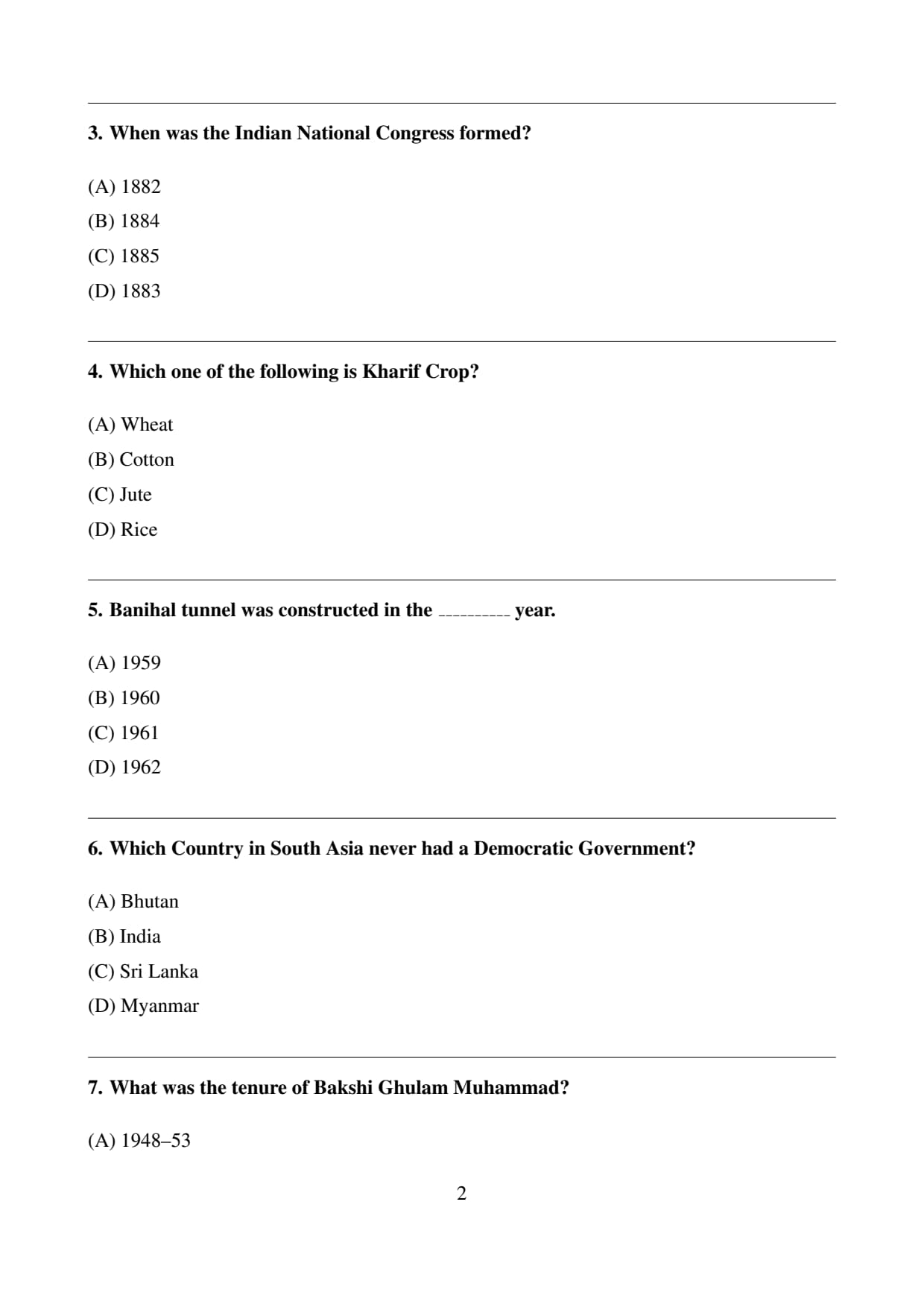
When was the Indian National Congress formed?
View Solution
Step 1: Background of Indian National Congress.
The Indian National Congress (INC) was founded to provide a platform for educated Indians to express their political demands and discuss reforms under British rule.
Step 2: Formation Details.
The INC was formed in December 1885 by A.O. Hume, a retired British civil servant. The first session was held in Bombay (now Mumbai) and was presided over by W.C. Bonnerjee.
Step 3: Analysis of the options.
(A) 1882: Incorrect.
(B) 1884: Incorrect.
(C) 1885: Correct. The INC was established in this year.
(D) 1883: Incorrect.
Step 4: Conclusion.
Therefore, the Indian National Congress was formed in 1885.
Final Answer: 1885. Quick Tip: The first session of the Indian National Congress was held in Bombay in December 1885 under the presidency of W.C. Bonnerjee.
Which one of the following is Kharif Crop?
View Solution
Step 1: Understanding Kharif Crops.
Kharif crops are sown at the beginning of the monsoon season (June–July) and harvested in September–October. These crops require a warm climate and plenty of rainfall.
Step 2: Identifying examples of Kharif crops.
Common Kharif crops include rice, cotton, maize, jowar, and bajra. Wheat is a Rabi crop, which is grown in winter.
Step 3: Analysis of the options.
(A) Wheat: Incorrect. It is a Rabi crop.
(B) Cotton: Though grown in Kharif season, rice is the most typical example.
(C) Jute: Grown in Kharif season but rice is the standard answer.
(D) Rice: Correct. Rice is a major Kharif crop.
Step 4: Conclusion.
Therefore, Rice is a Kharif crop.
Final Answer: Rice. Quick Tip: Kharif crops depend on monsoon rainfall, while Rabi crops are grown in winter.
Banihal tunnel was constructed in the __________ year.
View Solution
Step 1: About Banihal Tunnel.
The Banihal Tunnel, also known as Jawahar Tunnel, connects Jammu with the Kashmir Valley. It is an important engineering project in India.
Step 2: Year of construction.
The tunnel was constructed in 1959 to ensure all-weather connectivity between Jammu and Srinagar.
Step 3: Analysis of options.
(A) 1959: Correct. Construction was completed in this year.
(B) 1960: Incorrect.
(C) 1961: Incorrect.
(D) 1962: Incorrect.
Step 4: Conclusion.
Hence, the Banihal Tunnel was constructed in 1959.
Final Answer: 1959. Quick Tip: The Banihal (Jawahar) Tunnel was one of the longest road tunnels in Asia at the time of its construction.
Which Country in South Asia never had a Democratic Government?
View Solution
Step 1: Understanding Democratic Government.
A democratic government is one in which rulers are elected by the people through free and fair elections. It ensures political rights and participation of citizens.
Step 2: Examining South Asian Countries.
India and Sri Lanka have long histories of democratic governance with regular elections. Bhutan transitioned into a constitutional monarchy with democratic reforms. However, Myanmar has largely been under military rule and did not have a stable democratic government for a long period.
Step 3: Analysis of the options.
(A) Bhutan: It has adopted democratic reforms.
(B) India: A democratic country since independence.
(C) Sri Lanka: Has democratic governance.
(D) Myanmar: Correct. It has mostly been ruled by military regimes.
Step 4: Conclusion.
Thus, Myanmar is the country in South Asia that never had a stable democratic government.
Final Answer: Myanmar. Quick Tip: Myanmar has experienced prolonged military rule, which limited democratic governance.
What was the tenure of Bakshi Ghulam Muhammad?
View Solution
Step 1: Historical Background.
Bakshi Ghulam Muhammad was an important political leader of Jammu and Kashmir. He became the Prime Minister of Jammu and Kashmir after Sheikh Abdullah was dismissed in 1953.
Step 2: Tenure Details.
He remained in office from 1953 to 1963. During his tenure, several developmental works were undertaken in the state.
Step 3: Analysis of the options.
(A) 1948--53: Incorrect.
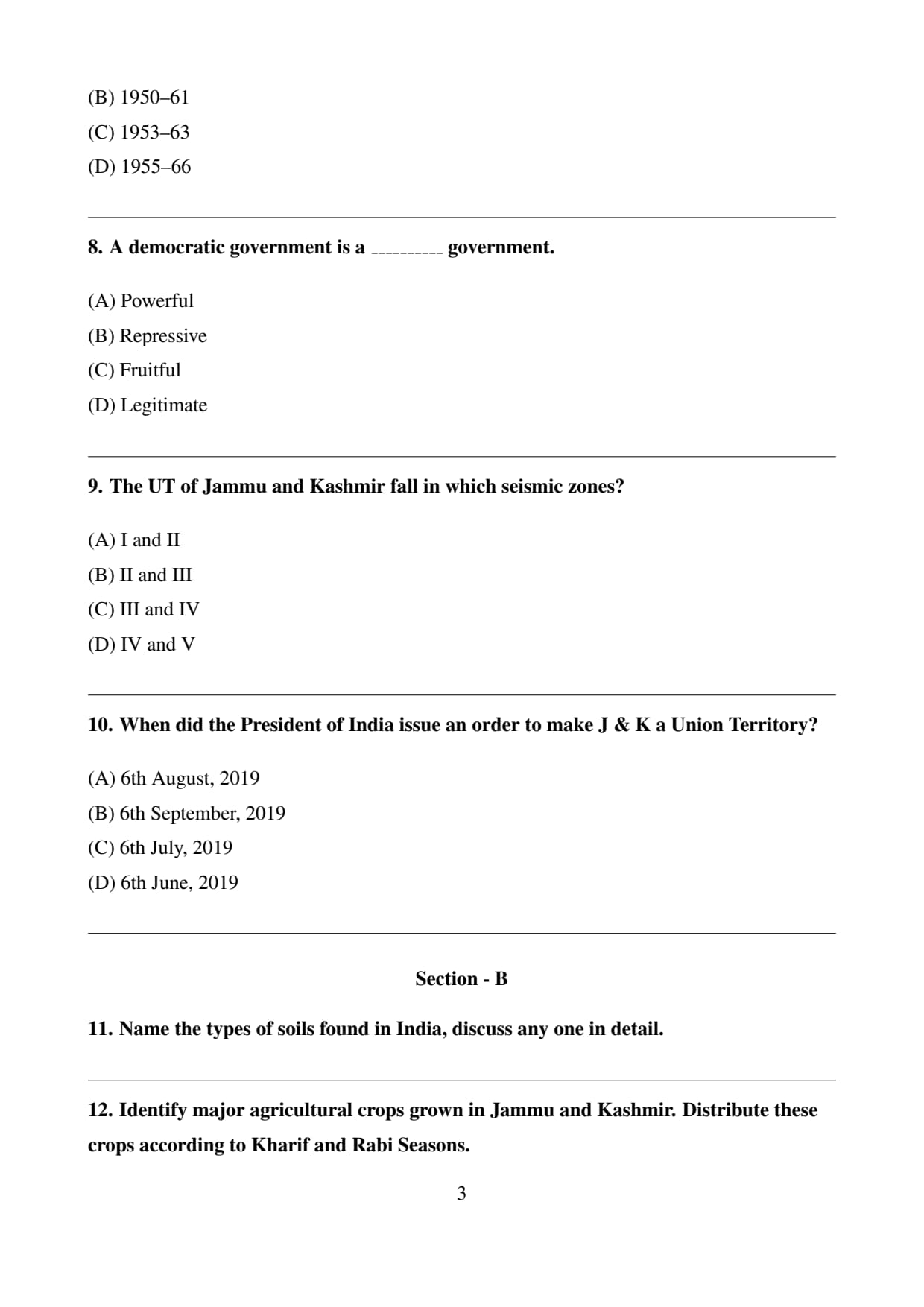
(B) 1950--61: Incorrect.
(C) 1953--63: Correct.
(D) 1955--66: Incorrect.
Step 4: Conclusion.
Thus, the tenure of Bakshi Ghulam Muhammad was from 1953 to 1963.
Final Answer: 1953--63. Quick Tip: Bakshi Ghulam Muhammad succeeded Sheikh Abdullah in 1953 and remained in office for a decade.
A democratic government is a __________ government.
View Solution
Step 1: Understanding democracy.
A democratic government is elected by the people through free and fair elections. It derives its authority from the consent of the governed.
Step 2: Meaning of legitimate government.
A legitimate government is one that is accepted by the people as lawful and rightful. Since democracy is based on public consent, it is considered legitimate.
Step 3: Analysis of options.
(A) Powerful: Not necessarily.
(B) Repressive: Opposite of democratic values.
(C) Fruitful: Not the defining characteristic.
(D) Legitimate: Correct.
Step 4: Conclusion.
Therefore, a democratic government is a legitimate government.
Final Answer: Legitimate. Quick Tip: Democracy gains legitimacy because rulers are elected by the people.
The UT of Jammu and Kashmir fall in which seismic zones?
View Solution
Step 1: Understanding Seismic Zones.
India is divided into seismic zones based on earthquake risk. These zones range from Zone II (least severe) to Zone V (most severe). The higher the zone number, the greater the risk of earthquakes.
Step 2: Seismic condition of Jammu and Kashmir.
The Union Territory of Jammu and Kashmir lies in a highly earthquake-prone region due to its location in the Himalayan belt. Most parts fall under Seismic Zone V (very high risk), while some areas fall under Zone IV (high risk).
Step 3: Analysis of the options.
(A) I and II: Incorrect. These are low-risk zones.
(B) II and III: Incorrect. Not applicable to J\&K.
(C) III and IV: Partially correct but not complete.
(D) IV and V: Correct. J\&K falls in these high-risk zones.
Step 4: Conclusion.
Therefore, the UT of Jammu and Kashmir falls in Seismic Zones IV and V.
Final Answer: IV and V. Quick Tip: Himalayan regions of India, including Jammu and Kashmir, fall under high seismic risk zones (IV and V).
When did the President of India issue an order to make J \& K a Union Territory?
View Solution
Step 1: Background of the Constitutional Change.
On 5th August 2019, the Government of India revoked the special status of Jammu and Kashmir under Article 370. Following this, the President of India issued a constitutional order regarding the reorganization of the state.
Step 2: Presidential Order and Reorganization.
On 6th August 2019, the President issued an order that led to the reorganization of Jammu and Kashmir into two Union Territories — Jammu \& Kashmir and Ladakh. The Jammu and Kashmir Reorganisation Act, 2019 later came into effect on 31st October 2019.
Step 3: Analysis of the options.
(A) 6th August, 2019: Correct. The Presidential order was issued on this date.
(B) 6th September, 2019: Incorrect.
(C) 6th July, 2019: Incorrect.
(D) 6th June, 2019: Incorrect.
Step 4: Conclusion.
Therefore, the President of India issued the order on 6th August 2019 to reorganize Jammu and Kashmir as a Union Territory.
Final Answer: 6th August, 2019. Quick Tip: Article 370 was effectively revoked on 5th August 2019, and the Presidential order was issued on 6th August 2019.
Name the types of soils found in India, discuss any one in detail.
View Solution
The main types of soils found in India are:
1. Alluvial Soil
2. Black Soil (Regur Soil)
3. Red Soil
4. Laterite Soil
5. Mountain or Forest Soil
6. Desert or Arid Soil
Alluvial Soil (in detail):
Alluvial soil is the most widespread and important soil type in India. It is mainly found in the Northern Plains, including the states of Punjab, Haryana, Uttar Pradesh, Bihar, and West Bengal. It is formed by the deposition of sediments brought by rivers such as the Ganga, Yamuna, and Brahmaputra.
Alluvial soil is very fertile and suitable for agriculture. It contains adequate amounts of potash, phosphoric acid, and lime, but is deficient in nitrogen. This soil is ideal for growing crops such as rice, wheat, sugarcane, cotton, and pulses.
There are two main types of alluvial soil:
1. Bhangar – old alluvial soil found in higher areas.
2. Khadar – new alluvial soil deposited annually by floods and is more fertile.
Thus, alluvial soil plays a vital role in Indian agriculture due to its high fertility and wide distribution. Quick Tip: Alluvial soil is the most fertile and widely spread soil in India, mainly found in the Northern Plains.
Identify major agricultural crops grown in Jammu and Kashmir. Distribute these crops according to Kharif and Rabi Seasons.
View Solution
Jammu and Kashmir has diverse climatic conditions which support the cultivation of various crops.
Major Agricultural Crops:
Rice, maize, wheat, barley, pulses, oilseeds, and fruits such as apple, walnut, and saffron are important crops grown in the region.
Distribution According to Seasons:
Kharif Crops (Sown in June–July and harvested in September–October):
1. Rice
2. Maize
3. Pulses
4. Some oilseeds
Rabi Crops (Sown in October–November and harvested in March–April):
1. Wheat
2. Barley
3. Mustard
Rice is mainly grown in the Kashmir Valley due to sufficient water availability, while maize is widely cultivated in hilly areas. Wheat and barley are important winter crops in Jammu and Ladakh regions.
Thus, agriculture in Jammu and Kashmir is seasonal and depends on climatic conditions and availability of irrigation. Quick Tip: Kharif crops grow in the rainy season, while Rabi crops grow in the winter season.
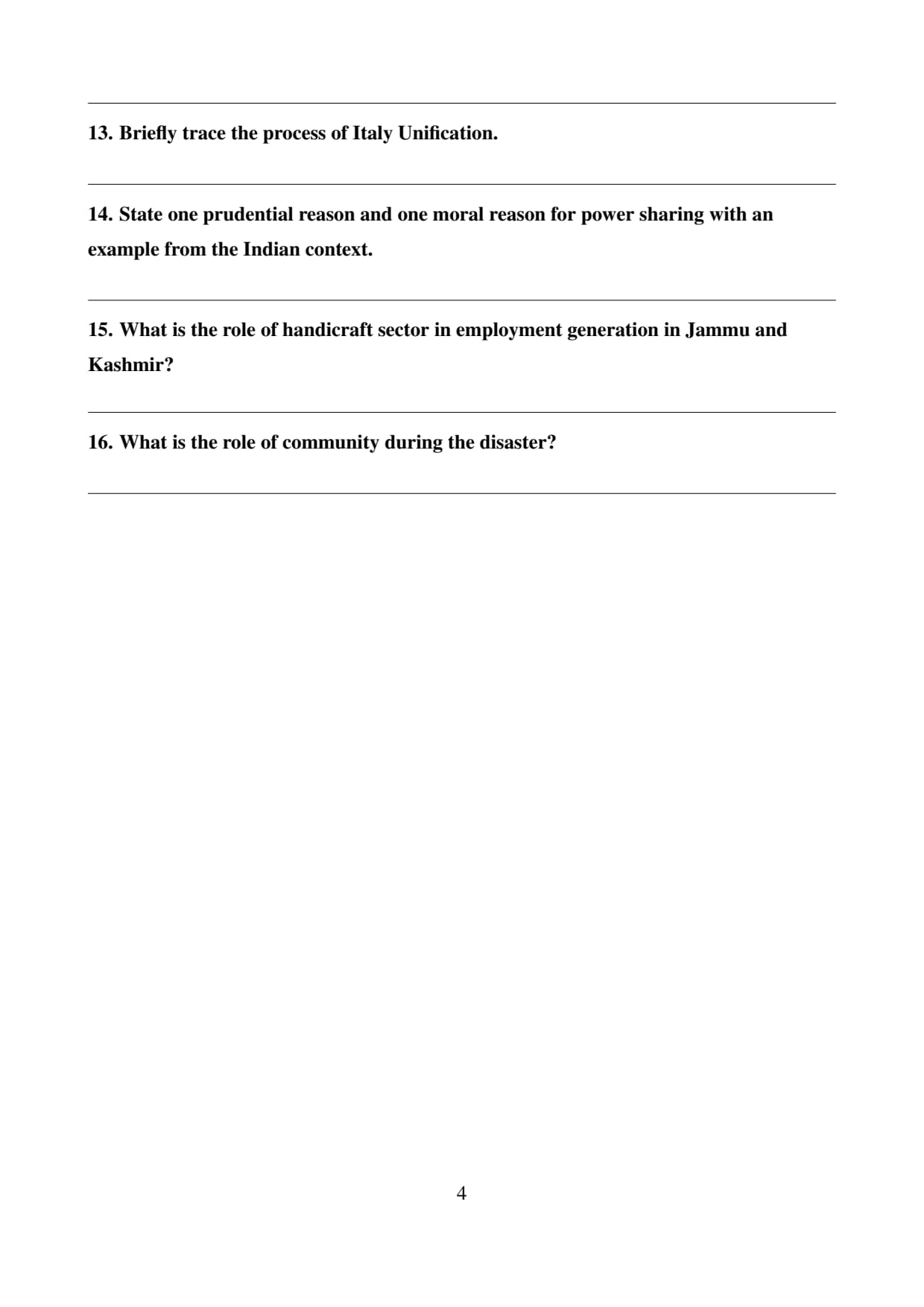
Briefly trace the process of Italy Unification.
View Solution
The unification of Italy was a long political and military process through which various independent states of the Italian Peninsula were united into a single nation during the 19th century. This movement is known as the “Risorgimento”.
In the early 19th century, Italy was divided into several states such as Sardinia-Piedmont, Lombardy, Venetia, Tuscany, the Papal States, and the Kingdom of the Two Sicilies. Many of these states were under Austrian control. The movement for unification was led by three important leaders — Giuseppe Mazzini, Count Camillo de Cavour, and Giuseppe Garibaldi.
Giuseppe Mazzini was a revolutionary who formed the organization “Young Italy” and spread the idea of a unified Italian republic. Count Cavour, the Prime Minister of Sardinia-Piedmont, played a diplomatic role. He formed alliances with France and defeated Austria in 1859, which helped in acquiring Lombardy.
Giuseppe Garibaldi led the famous “Red Shirts” and conquered Sicily and Naples in 1860. He handed over these territories to King Victor Emmanuel II of Sardinia. In 1861, Victor Emmanuel II was declared the King of united Italy. Later, Venetia was annexed in 1866 and Rome in 1870, completing the unification of Italy.
Thus, through revolutionary movements, diplomacy, and wars, Italy became a unified nation in 1870. Quick Tip: Italy was unified under the leadership of Mazzini (ideas), Cavour (diplacy), and Garibaldi (military action).
State one prudential reason and one moral reason for power sharing with an example from the Indian context.
View Solution
Power sharing refers to the distribution of power among different organs and levels of government and among different social groups in a democracy.
Prudential Reason:
The prudential reason for power sharing is that it helps to reduce the possibility of conflict between different social groups. When power is shared among various communities and institutions, it ensures political stability and unity. For example, in India, power is shared between the Central Government and the State Governments through the federal system. This division of powers helps maintain unity in a diverse country.
Moral Reason:
The moral reason for power sharing is that it is the very spirit of democracy. In a democratic system, people have the right to be consulted and participate in governance. Power sharing respects the diversity of society and ensures fairness and equality. For example, reservation of seats for Scheduled Castes, Scheduled Tribes, and women in local bodies in India ensures their participation in decision-making.
Thus, power sharing strengthens democracy by promoting stability and justice. Quick Tip: Prudential reason ensures political stability, while moral reason upholds democratic values and equality.
What is the role of handicraft sector in employment generation in Jammu and Kashmir?
View Solution
The handicraft sector plays a very important role in employment generation in Jammu and Kashmir. It is one of the traditional and largest cottage industries in the region and provides livelihood to a large number of people, especially in rural and semi-urban areas.
The sector includes products such as Pashmina shawls, carpets, wood carving, papier-mâché, silk weaving, embroidery, and walnut wood furniture. These handicrafts are famous not only in India but also in international markets.
The handicraft industry generates both direct and indirect employment. Artisans, weavers, designers, traders, exporters, and workers involved in packaging and transportation all benefit from this sector. It provides employment opportunities to skilled as well as semi-skilled workers, including women and youth.
Since it requires less capital investment and mostly depends on traditional skills, it helps in reducing unemployment and poverty. It also promotes tourism, which further increases income and employment opportunities in the region.
Thus, the handicraft sector is a backbone of the economy of Jammu and Kashmir and plays a significant role in generating employment and preserving cultural heritage. Quick Tip: Handicrafts in Jammu and Kashmir provide large-scale employment and promote both economic growth and cultural heritage.
What is the role of community during the disaster?
View Solution
The community plays a crucial role during a disaster. Since local people are the first to respond before external help arrives, their participation is very important in minimizing damage and saving lives.
Firstly, community members help in rescue operations by evacuating people from dangerous areas and providing immediate assistance. They offer first aid, food, water, shelter, and emotional support to affected families.
Secondly, the community helps in spreading awareness about safety measures and early warning signals. Local volunteers coordinate with government agencies and disaster management teams to ensure proper relief distribution.
Thirdly, community cooperation helps in rehabilitation and rebuilding efforts after the disaster. People work together to restore normal life, repair houses, and support vulnerable groups such as children and elderly persons.
Thus, active community participation strengthens disaster management and reduces the overall impact of disasters. Quick Tip: Community members are the first responders in a disaster and play a key role in rescue, relief, and rehabilitation.



Comments